Cambridge IGCSE History 0470 — 2020 Feb/March Paper 2 · Variant 2
0470/22/F/M/20 · 50 marks · ≈56 min
The question paper and its mark scheme, free to read here and free to download. This is Cambridge’s own paper, exactly as it was sat.
Question paper16 pages
Mark scheme15 pages
Answers below. Sit the paper first if you are practising.
Paper as text
Question paper, page 1
Cambridge IGCSE™ This document has 16 pages. Blank pages are indicated. * 5 3 6 3 8 8 6 2 6 4 * DC (CJ/SG) 184566/2 © UCLES 2020 [Turn over HISTORY 0470/22 Paper 2 February/March 2020 2 hours You must answer on the enclosed answer booklet. You will need: Answer booklet (enclosed) INSTRUCTIONS ● Answer all the questions on one option only. Option A: Nineteenth century topic Option B: Twentieth century topic ● Follow the instructions on the front cover of the answer booklet. If you need additional answer paper, ask the invigilator for a continuation booklet. INFORMATION ● The total mark for this paper is 50. ● The number of marks for each question or part question is shown in brackets [ ].
Question paper, page 2
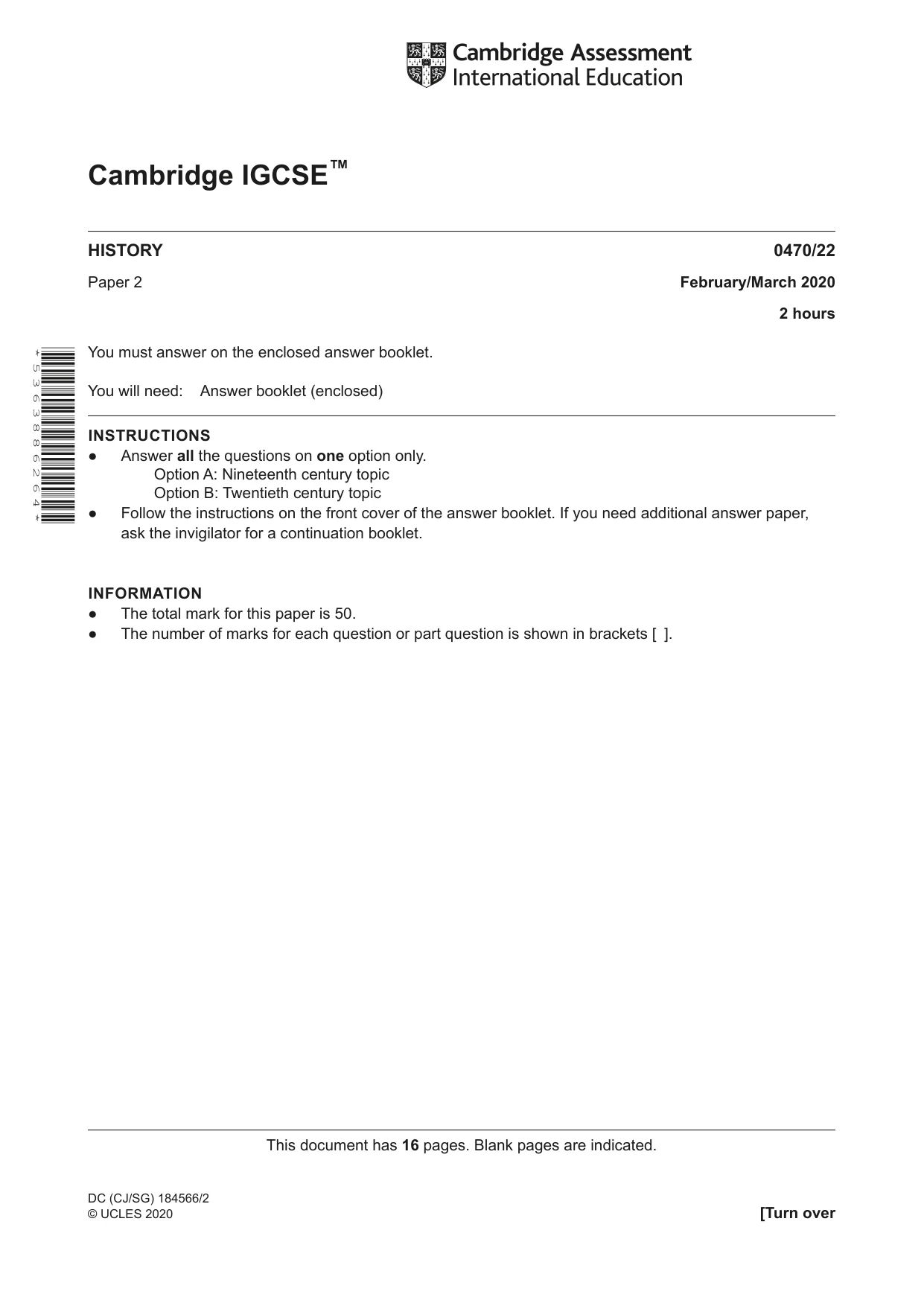
2 0470/22/F/M/20 © UCLES 2020 Option A: Nineteenth century topic HOW DID THE BRITISH BEHAVE DURING AND IMMEDIATELY AFTER THE INDIAN MUTINY OF 1857–58? Study the Background Information and the sources carefully, and then answer all the questions. Background Information The Indian Mutiny of 1857–58 was the result of resentment that had been building during British rule. It started with a mutiny of sepoys in Meerut, but soon turned into a much wider rising against British rule with cities such as Delhi, Cawnpore and Lucknow either falling to the rebels or being put under heavy siege. In some places, such as Cawnpore, British women and children were killed. The army of the British East India Company had to deal with the troubles, and accounts published in Britain showed it doing this with great heroism. After the rising was put down there were demands from Britain that the rebels be dealt with severely. Did the British behave well in their response to the Indian Mutiny? SOURCE A An illustration entitled ‘Miss Wheeler defending herself against the Sepoys at Cawnpore’. It was published in 1858 in a British book entitled ‘The History of the Indian Mutiny’.
Question paper, page 3
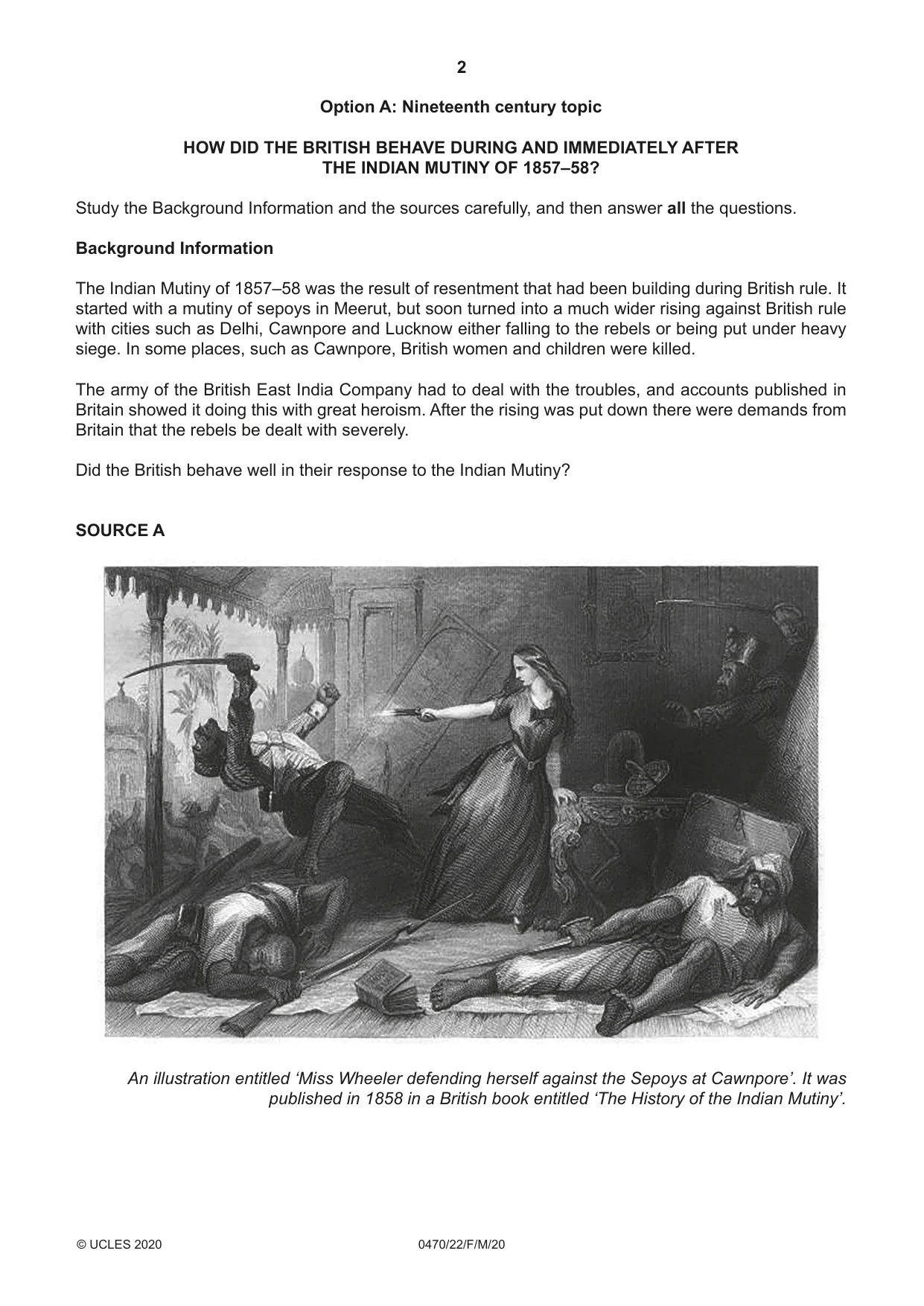
3 0470/22/F/M/20 © UCLES 2020 [Turn over SOURCE B A merry scene it must have been for a true, liberty-loving Briton to see his grenadiers helping themselves freely to the jewels, valuable arms and clothes, of His Majesty of Oude. Every advance was accompanied with plunder and devastation. The Qaisar Bagh Palace had fallen on 14 March and within half an hour, discipline was at an end, and the officers had lost all command over their men. On 17 March General Campbell was obliged to establish patrols to prevent plundering. The troops were completely out of control. In the city, while the vanguard were fighting against the natives’ fire from the houses, the rearguard plundered and destroyed to their hearts’ content. Matters were still so bad that the most strict orders were issued for the suppression of plunder and outrage. This is indeed a dreadful state of things in a civilised army in the nineteenth century. If any other troops in the world had committed one-tenth of these excesses, the indignant British press would brand them with infamy! But these are the deeds of the British army, and therefore we are told that such things are the normal consequences of war. A report from an American newspaper, 25 May 1858. SOURCE C An illustration from 1858. It was later republished in ‘Heroes of Britain in Peace and War’, 1880. The words under this illustration read ‘Some Victoria Cross Exploits of the Indian Mutiny. 1. Private Dempsey rescuing Ensign Erskine. 2. Mr Mangles dressing Taylor’s wound. 3. Mr McDonell releasing the boat in the Arrah expedition. 4. Lieutenant Hills and the mounted troopers. 5. Young Havelock leading his men to the capture of a gun.’ The Victoria Cross is the highest British award for bravery for members of the armed forces.
Question paper, page 4
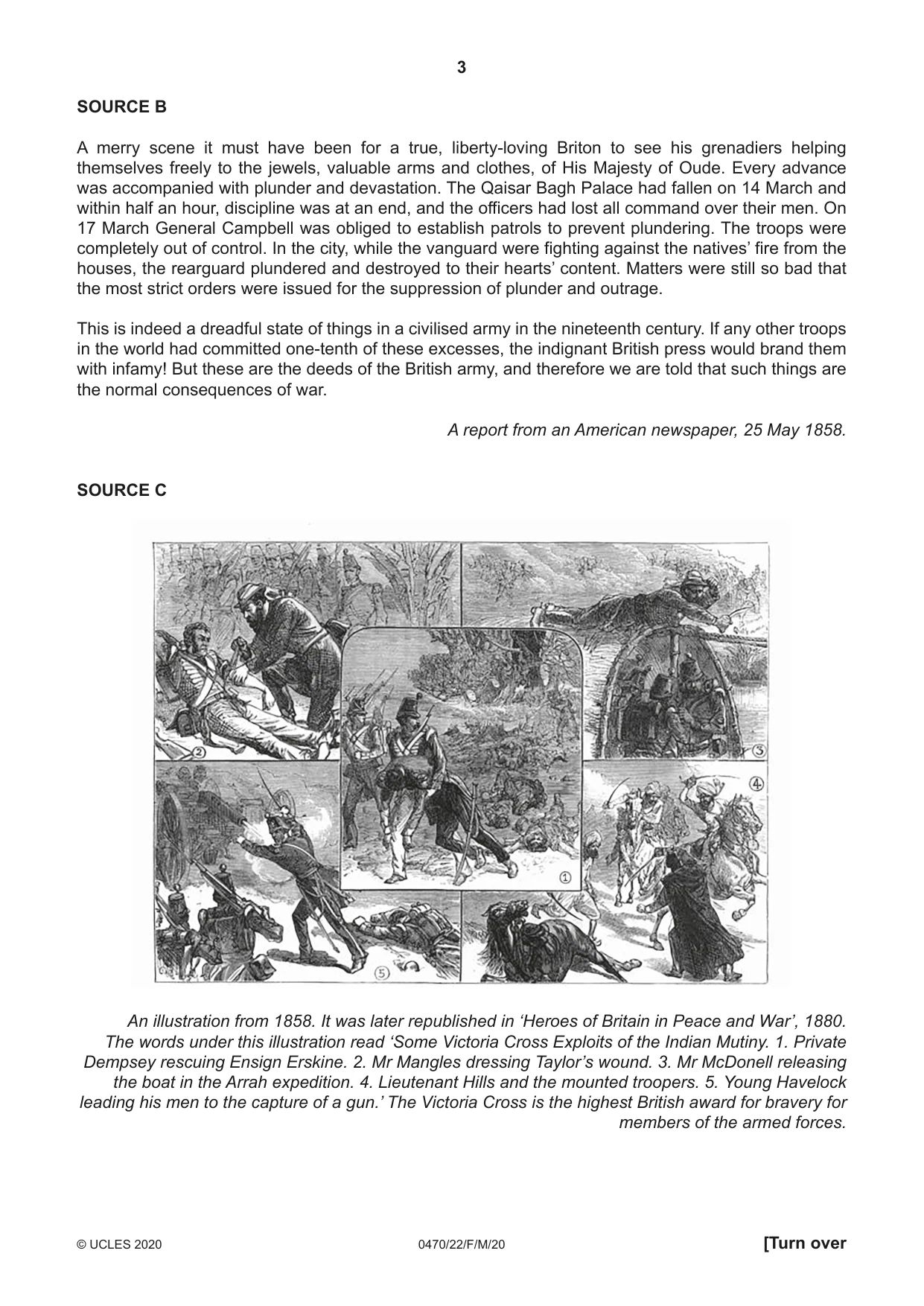
4 0470/22/F/M/20 © UCLES 2020 SOURCE D An illustration showing British troops looting the Qaisar Bagh Palace in Lucknow after the recapture of the city in 1858. It was published in Britain in 1860. The soldier kneeling is saying, ‘Is this string of pearls worth anything, gentlemen?’ SOURCE E The most hostile of our foreign critics are in awe of our administration of India. When we ask, who are the men who have kept intact, and handed down to us these vast privileges, who are they who have preserved for us the splendid burden which we accept and bear with honour today? The answer is that the last of these heroes are among us still, white-haired and too often infirm, but the very men who saved India from itself in 1857 when the tide of rebellion threatened to wipe away the trace of our rule. To these survivors, this little book is dedicated. From a book entitled ‘In Commemoration of the 50th Anniversary of the Indian Mutiny’, published in Britain in 1907. SOURCE F A very large proportion of the English community has a violent hatred of every Indian of every class. There is a cruelty, even from those who ought to set a better example, which is impossible to see without feeling shame for one’s fellow countrymen. Not one man in ten seems to think that the hanging and shooting of 50 000 mutineers is wrong. A letter from Lord Canning to Queen Victoria, 25 September 1858. Canning was British Governor-General of India.
Question paper, page 5
5 0470/22/F/M/20 © UCLES 2020 [Turn over SOURCE G We shall respect the rights, dignity and honour of native princes and we desire that they, as well as our subjects, should enjoy that prosperity which can only be secured by internal peace and good government. We reject the desire to impose Christianity on any of our subjects and we strictly charge all those in authority under us that they abstain from all interference with the religious belief of any of our subjects. We deeply regret the misery which has been brought upon India by the acts of ambitious men, who have deceived their countrymen and led them into open rebellion. We desire to show our mercy by pardoning the offences of those who have been misled, but who desire to return to the path of duty. Our mercy will be extended to all offenders, except those who have been convicted of having taken part in the murder of British subjects. From Queen Victoria’s Proclamation to the Princes and People of India, November 1858.
Question paper, page 6
6 0470/22/F/M/20 © UCLES 2020 Now answer all the following questions. You may use any of the sources to help you answer the questions, in addition to those sources which you are told to use. In answering the questions you should use your knowledge of the topic to help you interpret and evaluate the sources. 1 Study Source A. What impressions does this source give about the Indian Mutiny? Explain your answer using details of the source. [8] 2 Study Source B. Why was this source published in 1858? Explain your answer using details of the source and your knowledge. [7] 3 Study Sources C and D. How far does Source C make Source D surprising? Explain your answer using details of the sources and your knowledge. [8] 4 Study Source E. How useful is this source as evidence about British rule in India? Explain your answer using details of the source and your knowledge. [7] 5 Study Sources F and G. How far does Source G prove that Victoria agreed with Canning (Source F)? Explain your answer using details of the sources and your knowledge. [8] 6 Study all the sources. How far do these sources provide convincing evidence that the British behaved well in their response to the Indian Mutiny? Use the sources to explain your answer. [12]
Question paper, page 7
7 0470/22/F/M/20 © UCLES 2020 [Turn over BLANK PAGE
Question paper, page 8
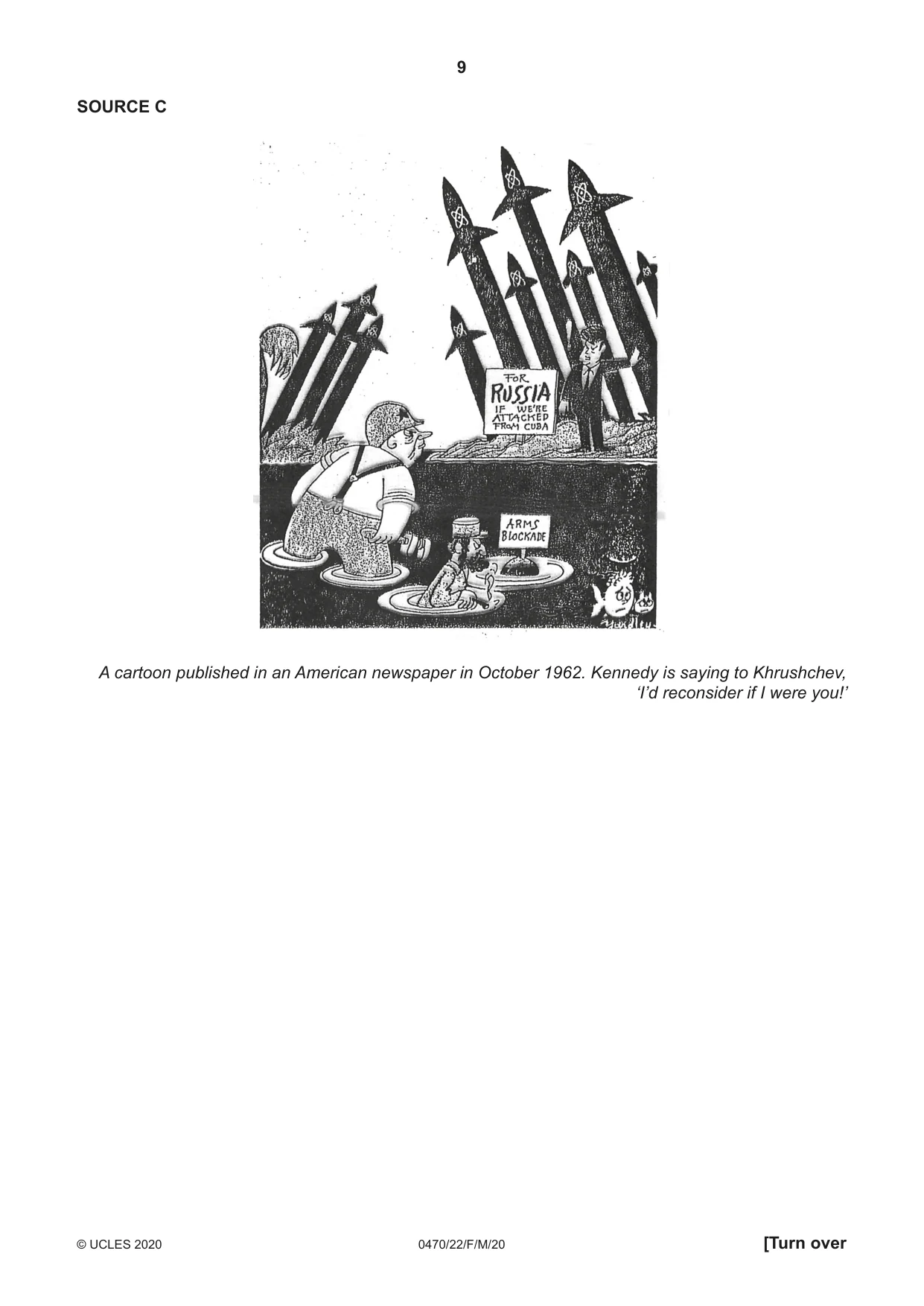
8 0470/22/F/M/20 © UCLES 2020 Option B: Twentieth century topic WAS THE CUBAN MISSILE CRISIS SIMPLY A TRIAL OF STRENGTH BETWEEN KENNEDY AND KHRUSHCHEV? Study the Background Information and the sources carefully, and then answer all the questions. Background Information Accounts and representations of the Cuban Missile Crisis have often presented it as a personal trial of strength between Kennedy and Khrushchev. Many historians criticise this way of representing the crisis. They argue that the broader context of the Cold War and the national interests of the USA and the USSR were crucial factors. How far was the Cuban Missile Crisis simply about personal rivalry between Kennedy and Khrushchev? SOURCE A I’ve got two problems. First, to figure out why Khrushchev acted in such a hostile way. And second, to figure out what we can do about it. I think the first part is pretty easy to explain. I think he did it because of the Bay of Pigs. He thought that anyone who was so young and inexperienced as to get into that mess could be beaten; and anyone who got into it and didn’t see it through had no guts. If he thinks I’m inexperienced and have no guts, until we remove those ideas we won’t get anywhere with him. Kennedy speaking to an American reporter in 1961 shortly after his disastrous Vienna Summit meeting with Khrushchev. SOURCE B Then the exchange of notes began. I dictated the messages and conducted the exchange from our side. President Kennedy issued an ultimatum, demanding that we remove our missiles and bombers from Cuba. I remember the exchange with the President especially well because I started it and was at the centre of the action at our end of the correspondence. I take complete responsibility for the fact that the President and I entered into direct contact at the most crucial and dangerous stage of the crisis. Dobrynin’s report of a meeting with Robert Kennedy went something like this, ‘The President is appealing directly to Chairman Khrushchev. If the situation continues much longer, the President fears that the military will overthrow him.’ We knew that Kennedy was a young President. For some time I had felt there was a danger that he would lose control of his military, and now he was admitting this to us himself. ‘Comrades,’ I said, ‘we have to look for a dignified way out of this conflict.’ We sent a note saying we agreed to remove the missiles on condition the President gave us his assurance that Cuba would not be invaded. From Khrushchev’s memoirs, published in 1970. Dobrynin was Soviet Ambassador to the United States.
Question paper, page 9
9 0470/22/F/M/20 © UCLES 2020 [Turn over SOURCE C A cartoon published in an American newspaper in October 1962. Kennedy is saying to Khrushchev, ‘I’d reconsider if I were you!’
Question paper, page 10
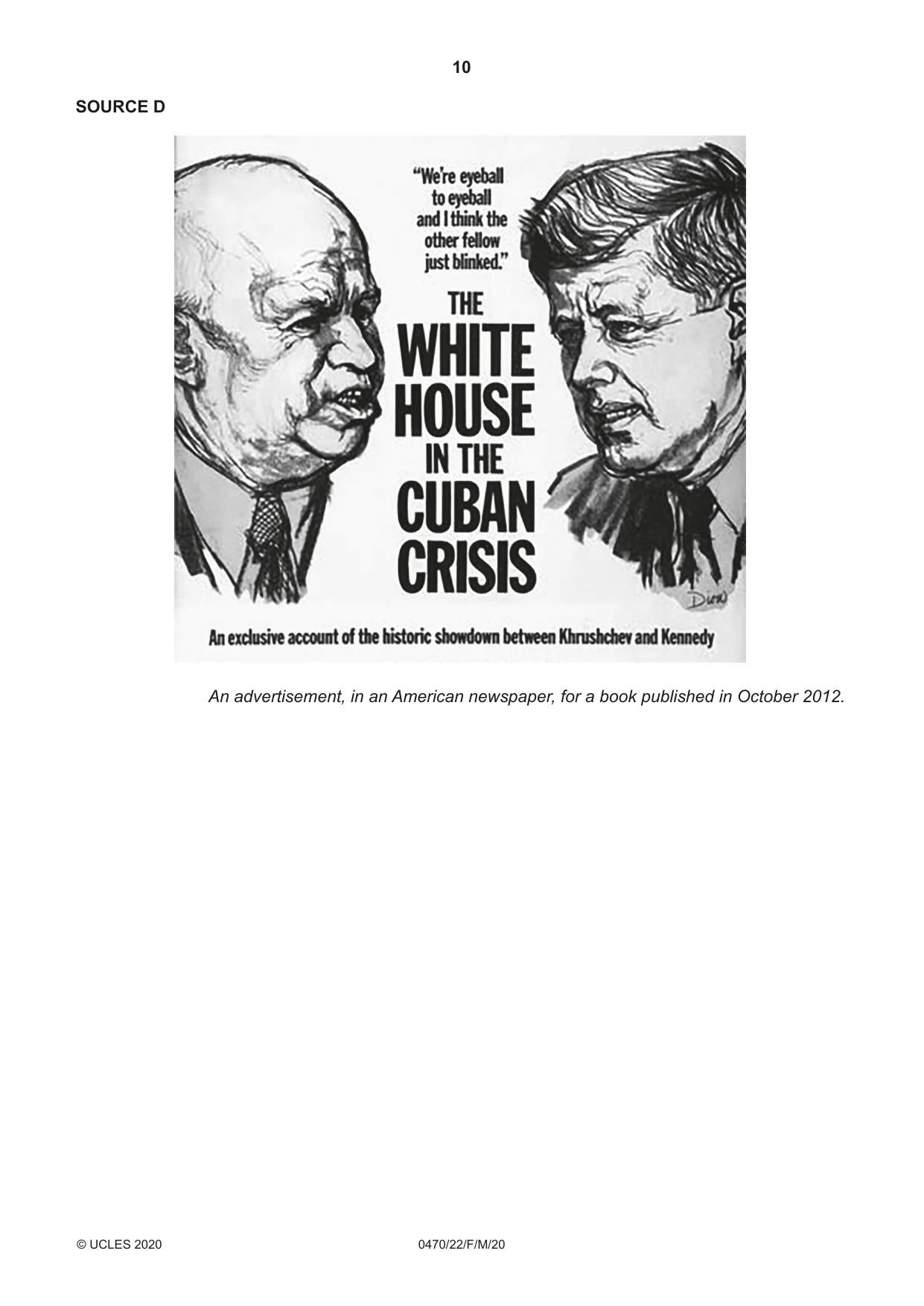
10 0470/22/F/M/20 © UCLES 2020 SOURCE D An advertisement, in an American newspaper, for a book published in October 2012.
Question paper, page 11
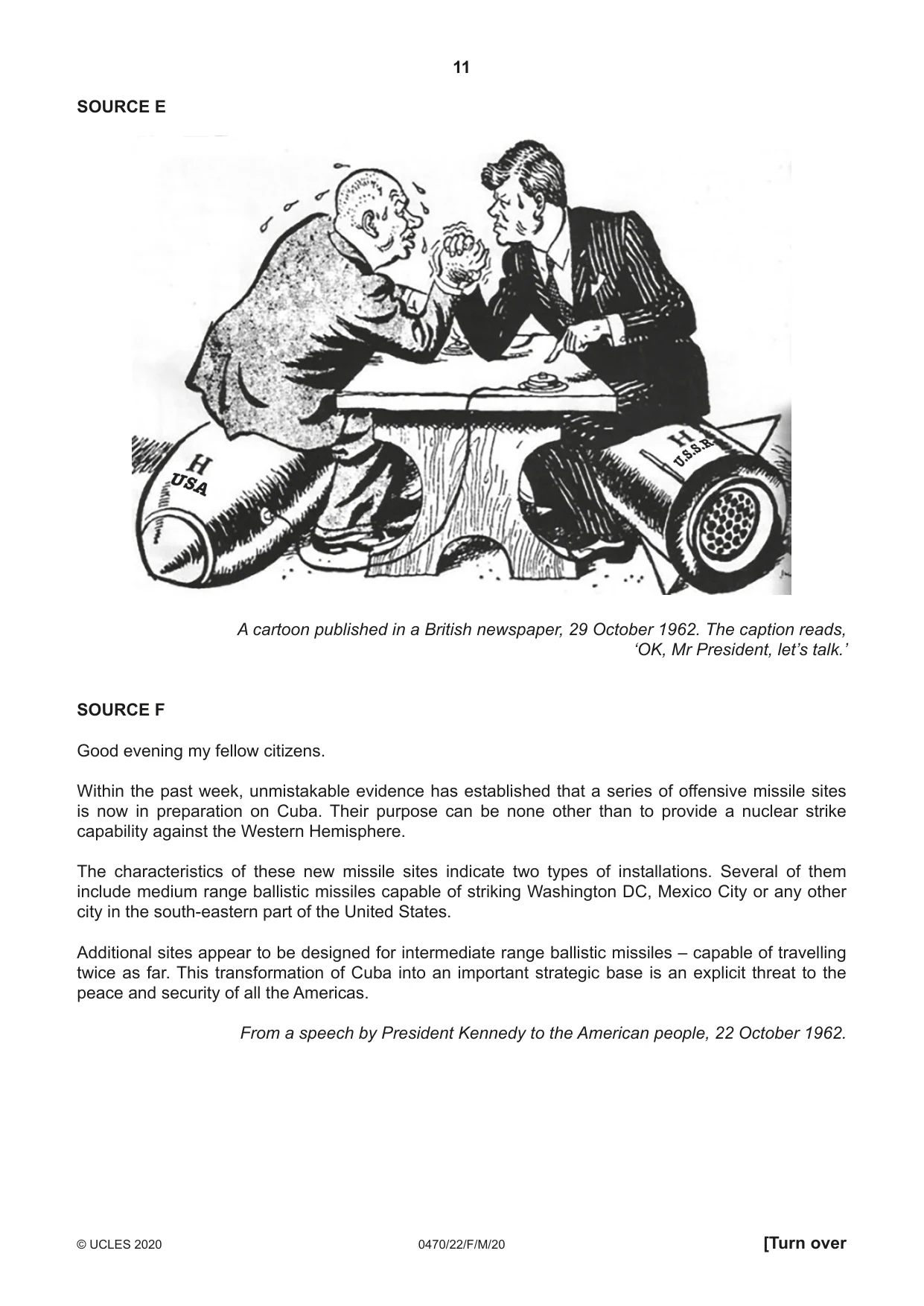
11 0470/22/F/M/20 © UCLES 2020 [Turn over SOURCE E A cartoon published in a British newspaper, 29 October 1962. The caption reads, ‘OK, Mr President, let’s talk.’ SOURCE F Good evening my fellow citizens. Within the past week, unmistakable evidence has established that a series of offensive missile sites is now in preparation on Cuba. Their purpose can be none other than to provide a nuclear strike capability against the Western Hemisphere. The characteristics of these new missile sites indicate two types of installations. Several of them include medium range ballistic missiles capable of striking Washington DC, Mexico City or any other city in the south-eastern part of the United States. Additional sites appear to be designed for intermediate range ballistic missiles – capable of travelling twice as far. This transformation of Cuba into an important strategic base is an explicit threat to the peace and security of all the Americas. From a speech by President Kennedy to the American people, 22 October 1962.
Question paper, page 12
12 0470/22/F/M/20 © UCLES 2020 SOURCE G The accounts of the crisis did not make clear that it was a power confrontation, that the power of the USA was incomparably superior to that of the USSR, and that the leaders of both nations knew this to be a fact. The United States, it is worth repeating, could have erased every important Soviet military installation and population centre in two or three hours, while the strike capability of the USSR was negligible. Although Kennedy held the trump cards, he granted the Communist empire a privileged sanctuary in the Caribbean by means of the ‘no invasion’ pledge. From a book entitled ‘Dagger in the Heart: American Failures in Cuba’, by Mario Lazo, published in 1968. Lazo was a Cuban supporter of the Batista regime. After the Cuban revolution he fled to the United States.
Question paper, page 13
13 0470/22/F/M/20 © UCLES 2020 Now answer all the following questions. You may use any of the sources to help you answer the questions, in addition to those sources which you are told to use. In answering the questions you should use your knowledge of the topic to help you interpret and evaluate the sources. 1 Study Source A. How far do you agree that this source is useful as evidence about the Cuban Missile Crisis? Explain your answer using details of the source and your knowledge. [7] 2 Study Source B. What impressions does this source give of Khrushchev? Explain your answer using details of the source. [7] 3 Study Source C. What is the cartoonist’s message? Explain your answer using details of the source and your knowledge. [8] 4 Study Sources D and E. How far do these two sources agree about the Cuban Missile Crisis? Explain your answer using details of the sources and your knowledge. [8] 5 Study Sources F and G. How far does Source G make Source F surprising? Explain your answer using details of the sources and your knowledge. [8] 6 Study all the sources. How far do these sources provide convincing evidence that the Cuban Missile Crisis was simply about personal rivalry between Kennedy and Khrushchev? Use the sources to explain your answer. [12]
Question paper, page 14
14 0470/22/F/M/20 © UCLES 2020 BLANK PAGE
Question paper, page 15
15 0470/22/F/M/20 © UCLES 2020 BLANK PAGE
Question paper, page 16
16 0470/22/F/M/20 © UCLES 2020 Permission to reproduce items where third-party owned material protected by copyright is included has been sought and cleared where possible. Every reasonable effort has been made by the publisher (UCLES) to trace copyright holders, but if any items requiring clearance have unwittingly been included, the publisher will be pleased to make amends at the earliest possible opportunity. To avoid the issue of disclosure of answer-related information to candidates, all copyright acknowledgements are reproduced online in the Cambridge Assessment International Education Copyright Acknowledgements Booklet. This is produced for each series of examinations and is freely available to download at www.cambridgeinternational.org after the live examination series. Cambridge Assessment International Education is part of the Cambridge Assessment Group. Cambridge Assessment is the brand name of the University of Cambridge Local Examinations Syndicate (UCLES), which itself is a department of the University of Cambridge. BLANK PAGE
Mark scheme, page 1
This document consists of 15 printed pages. © UCLES 2020 [Turn over Cambridge IGCSE™ HISTORY 0470/22 Paper 2 March 2020 MARK SCHEME Maximum Mark: 50 Published This mark scheme is published as an aid to teachers and candidates, to indicate the requirements of the examination. It shows the basis on which Examiners were instructed to award marks. It does not indicate the details of the discussions that took place at an Examiners’ meeting before marking began, which would have considered the acceptability of alternative answers. Mark schemes should be read in conjunction with the question paper and the Principal Examiner Report for Teachers. Cambridge International will not enter into discussions about these mark schemes. Cambridge International is publishing the mark schemes for the March 2020 series for most Cambridge IGCSE™, Cambridge International A and AS Level components and some Cambridge O Level components.
Mark scheme, page 2
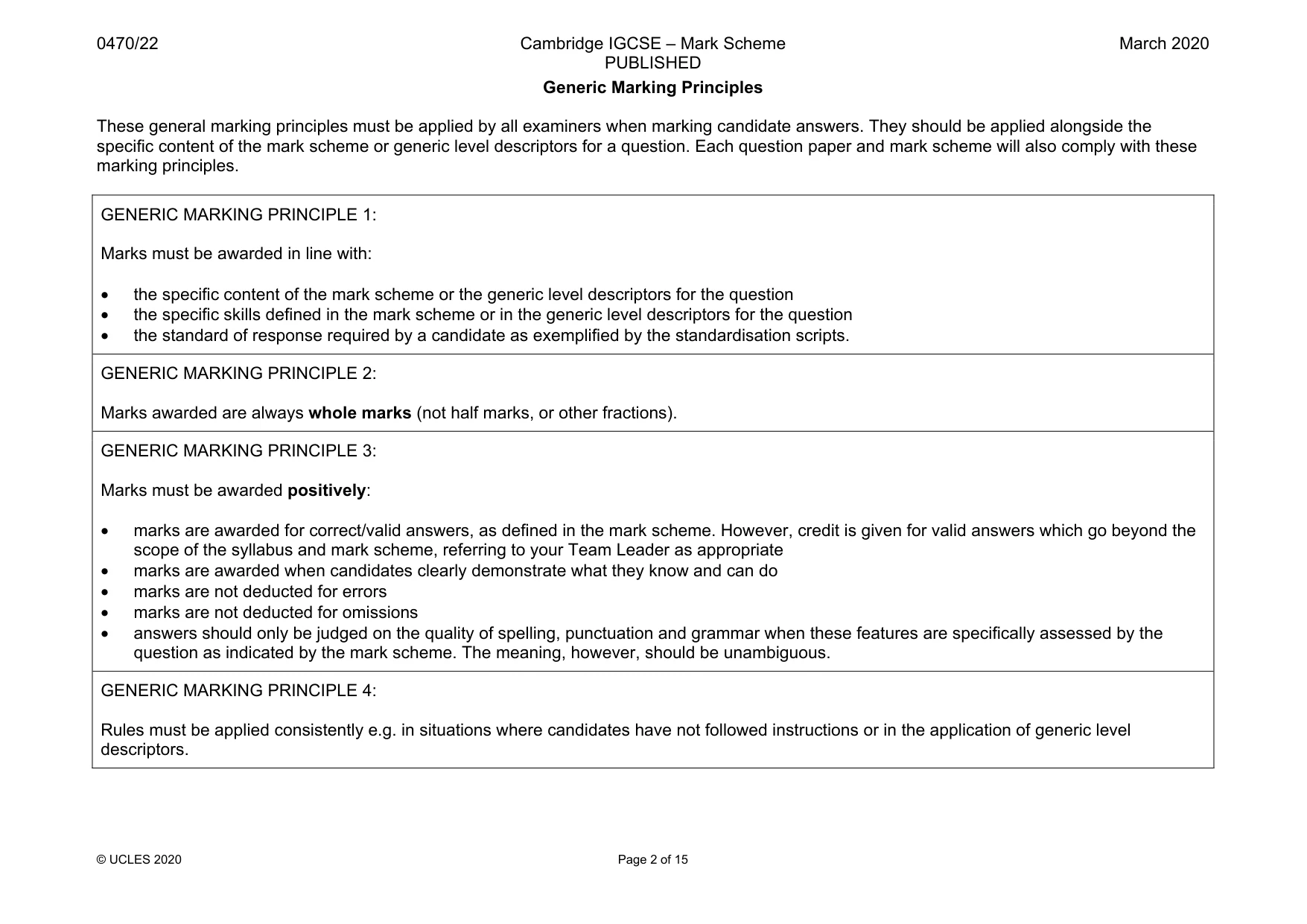
0470/22 Cambridge IGCSE – Mark Scheme PUBLISHED March 2020 © UCLES 2020 Page 2 of 15 Generic Marking Principles These general marking principles must be applied by all examiners when marking candidate answers. They should be applied alongside the specific content of the mark scheme or generic level descriptors for a question. Each question paper and mark scheme will also comply with these marking principles. GENERIC MARKING PRINCIPLE 1: Marks must be awarded in line with: • the specific content of the mark scheme or the generic level descriptors for the question • the specific skills defined in the mark scheme or in the generic level descriptors for the question • the standard of response required by a candidate as exemplified by the standardisation scripts. GENERIC MARKING PRINCIPLE 2: Marks awarded are always whole marks (not half marks, or other fractions). GENERIC MARKING PRINCIPLE 3: Marks must be awarded positively: • marks are awarded for correct/valid answers, as defined in the mark scheme. However, credit is given for valid answers which go beyond the scope of the syllabus and mark scheme, referring to your Team Leader as appropriate • marks are awarded when candidates clearly demonstrate what they know and can do • marks are not deducted for errors • marks are not deducted for omissions • answers should only be judged on the quality of spelling, punctuation and grammar when these features are specifically assessed by the question as indicated by the mark scheme. The meaning, however, should be unambiguous. GENERIC MARKING PRINCIPLE 4: Rules must be applied consistently e.g. in situations where candidates have not followed instructions or in the application of generic level descriptors.
Mark scheme, page 3
0470/22 Cambridge IGCSE – Mark Scheme PUBLISHED March 2020 © UCLES 2020 Page 3 of 15 GENERIC MARKING PRINCIPLE 5: Marks should be awarded using the full range of marks defined in the mark scheme for the question (however; the use of the full mark range may be limited according to the quality of the candidate responses seen). GENERIC MARKING PRINCIPLE 6: Marks awarded are based solely on the requirements as defined in the mark scheme. Marks should not be awarded with grade thresholds or grade descriptors in mind.
Mark scheme, page 4
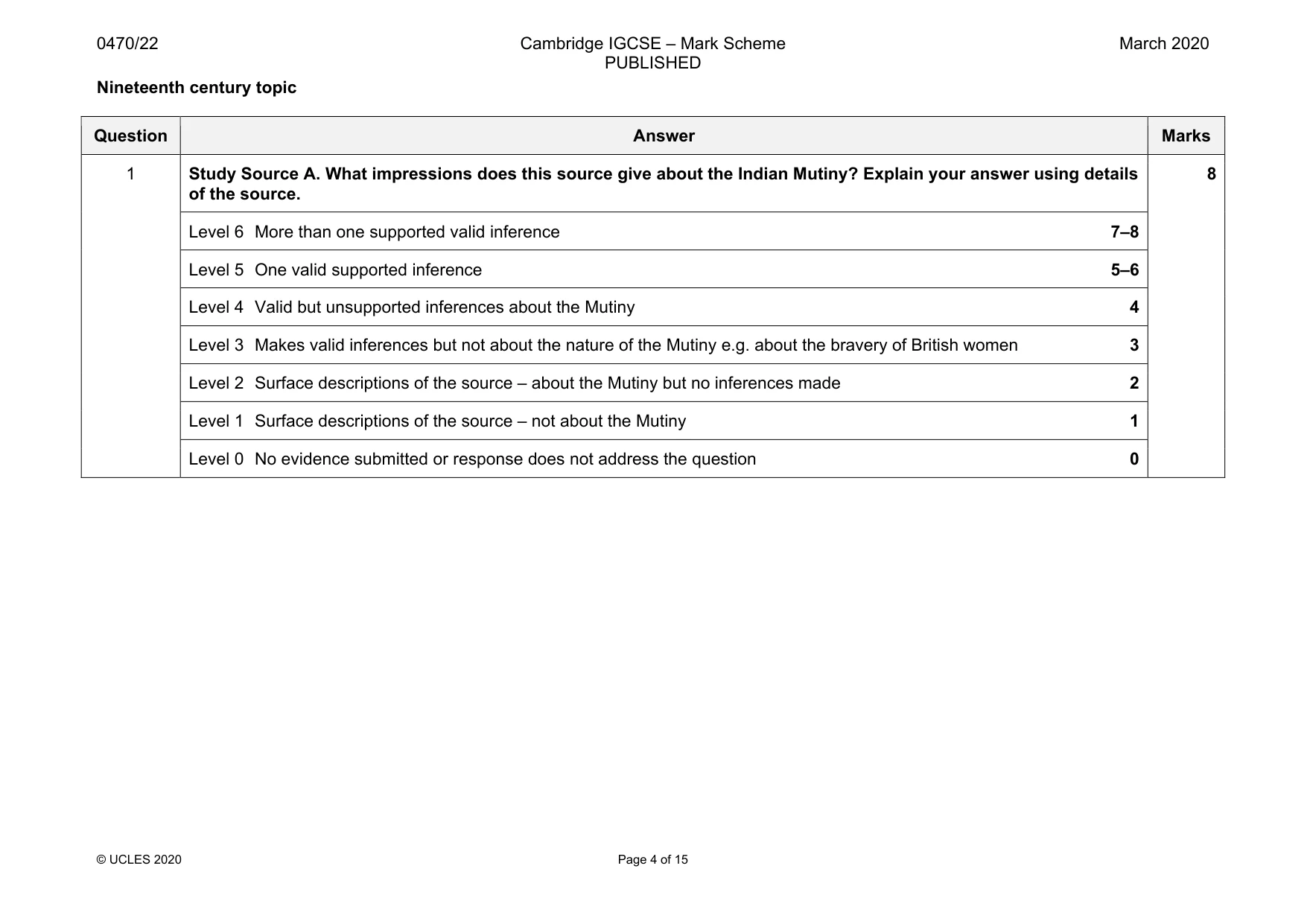
0470/22 Cambridge IGCSE – Mark Scheme PUBLISHED March 2020 © UCLES 2020 Page 4 of 15 Nineteenth century topic Question Answer Marks 1 Study Source A. What impressions does this source give about the Indian Mutiny? Explain your answer using details of the source. 8 Level 6 More than one supported valid inference 7–8 Level 5 One valid supported inference 5–6 Level 4 Valid but unsupported inferences about the Mutiny 4 Level 3 Makes valid inferences but not about the nature of the Mutiny e.g. about the bravery of British women 3 Level 2 Surface descriptions of the source – about the Mutiny but no inferences made 2 Level 1 Surface descriptions of the source – not about the Mutiny 1 Level 0 No evidence submitted or response does not address the question 0
Mark scheme, page 5
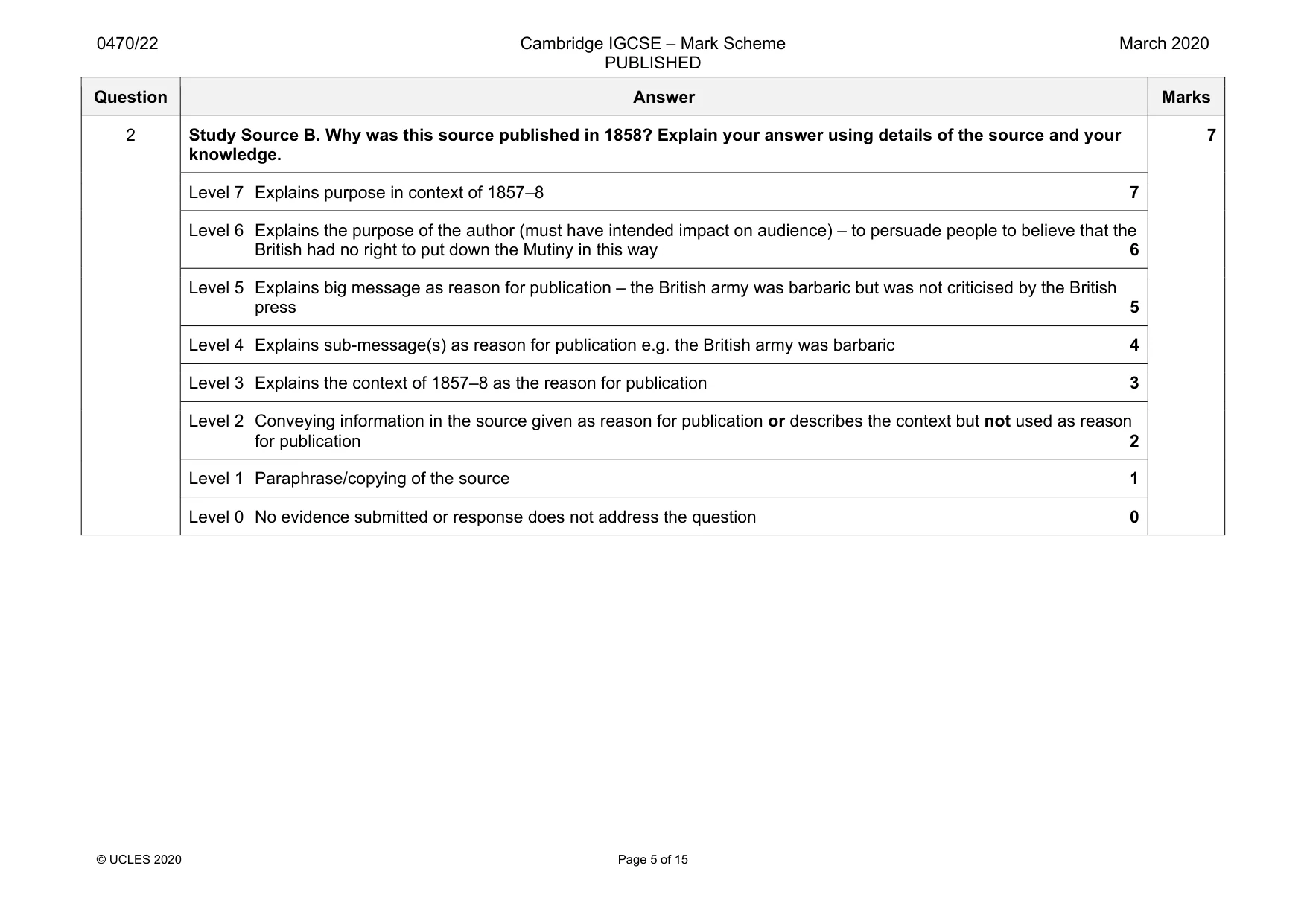
0470/22 Cambridge IGCSE – Mark Scheme PUBLISHED March 2020 © UCLES 2020 Page 5 of 15 Question Answer Marks 2 Study Source B. Why was this source published in 1858? Explain your answer using details of the source and your knowledge. 7 Level 7 Explains purpose in context of 1857–8 7 Level 6 Explains the purpose of the author (must have intended impact on audience) – to persuade people to believe that the British had no right to put down the Mutiny in this way 6 Level 5 Explains big message as reason for publication – the British army was barbaric but was not criticised by the British press 5 Level 4 Explains sub-message(s) as reason for publication e.g. the British army was barbaric 4 Level 3 Explains the context of 1857–8 as the reason for publication 3 Level 2 Conveying information in the source given as reason for publication or describes the context but not used as reason for publication 2 Level 1 Paraphrase/copying of the source 1 Level 0 No evidence submitted or response does not address the question 0
Mark scheme, page 6
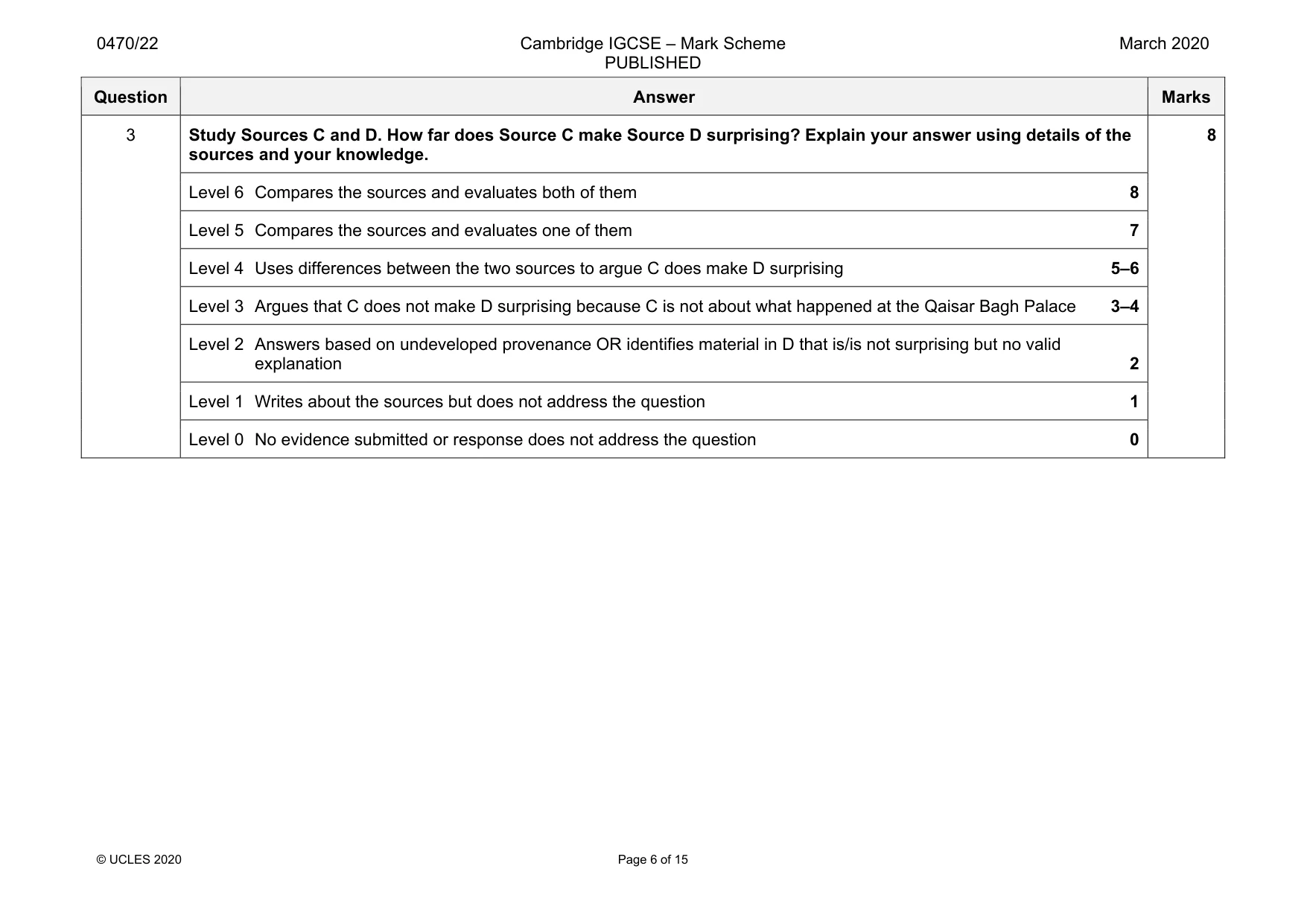
0470/22 Cambridge IGCSE – Mark Scheme PUBLISHED March 2020 © UCLES 2020 Page 6 of 15 Question Answer Marks 3 Study Sources C and D. How far does Source C make Source D surprising? Explain your answer using details of the sources and your knowledge. 8 Level 6 Compares the sources and evaluates both of them 8 Level 5 Compares the sources and evaluates one of them 7 Level 4 Uses differences between the two sources to argue C does make D surprising 5–6 Level 3 Argues that C does not make D surprising because C is not about what happened at the Qaisar Bagh Palace 3–4 Level 2 Answers based on undeveloped provenance OR identifies material in D that is/is not surprising but no valid explanation 2 Level 1 Writes about the sources but does not address the question 1 Level 0 No evidence submitted or response does not address the question 0
Mark scheme, page 7
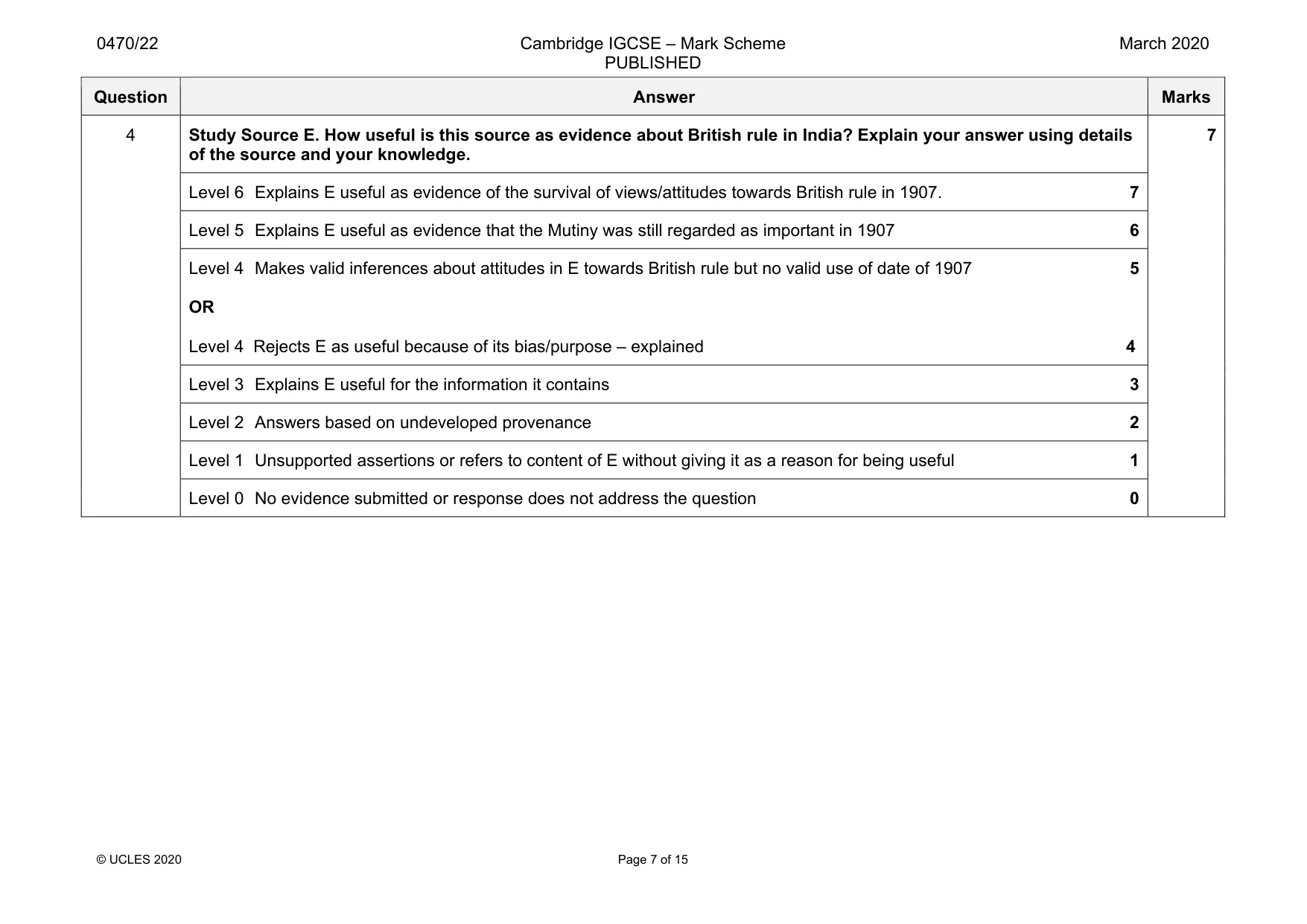
0470/22 Cambridge IGCSE – Mark Scheme PUBLISHED March 2020 © UCLES 2020 Page 7 of 15 Question Answer Marks 4 Study Source E. How useful is this source as evidence about British rule in India? Explain your answer using details of the source and your knowledge. 7 Level 6 Explains E useful as evidence of the survival of views/attitudes towards British rule in 1907. 7 Level 5 Explains E useful as evidence that the Mutiny was still regarded as important in 1907 6 Level 4 Makes valid inferences about attitudes in E towards British rule but no valid use of date of 1907 5 OR Level 4 Rejects E as useful because of its bias/purpose – explained 4 Level 3 Explains E useful for the information it contains 3 Level 2 Answers based on undeveloped provenance 2 Level 1 Unsupported assertions or refers to content of E without giving it as a reason for being useful 1 Level 0 No evidence submitted or response does not address the question 0
Mark scheme, page 8
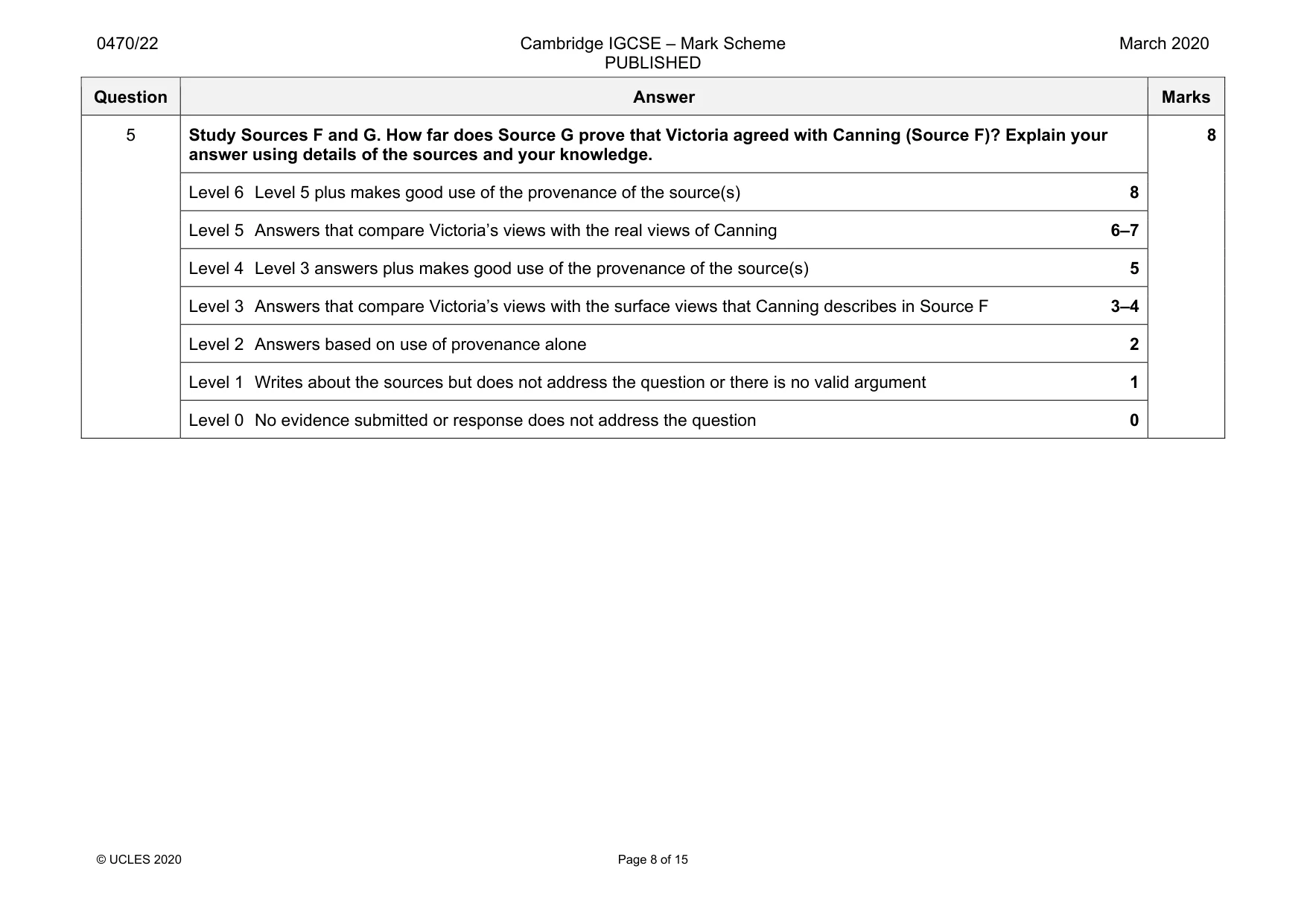
0470/22 Cambridge IGCSE – Mark Scheme PUBLISHED March 2020 © UCLES 2020 Page 8 of 15 Question Answer Marks 5 Study Sources F and G. How far does Source G prove that Victoria agreed with Canning (Source F)? Explain your answer using details of the sources and your knowledge. 8 Level 6 Level 5 plus makes good use of the provenance of the source(s) 8 Level 5 Answers that compare Victoria’s views with the real views of Canning 6–7 Level 4 Level 3 answers plus makes good use of the provenance of the source(s) 5 Level 3 Answers that compare Victoria’s views with the surface views that Canning describes in Source F 3–4 Level 2 Answers based on use of provenance alone 2 Level 1 Writes about the sources but does not address the question or there is no valid argument 1 Level 0 No evidence submitted or response does not address the question 0
Mark scheme, page 9
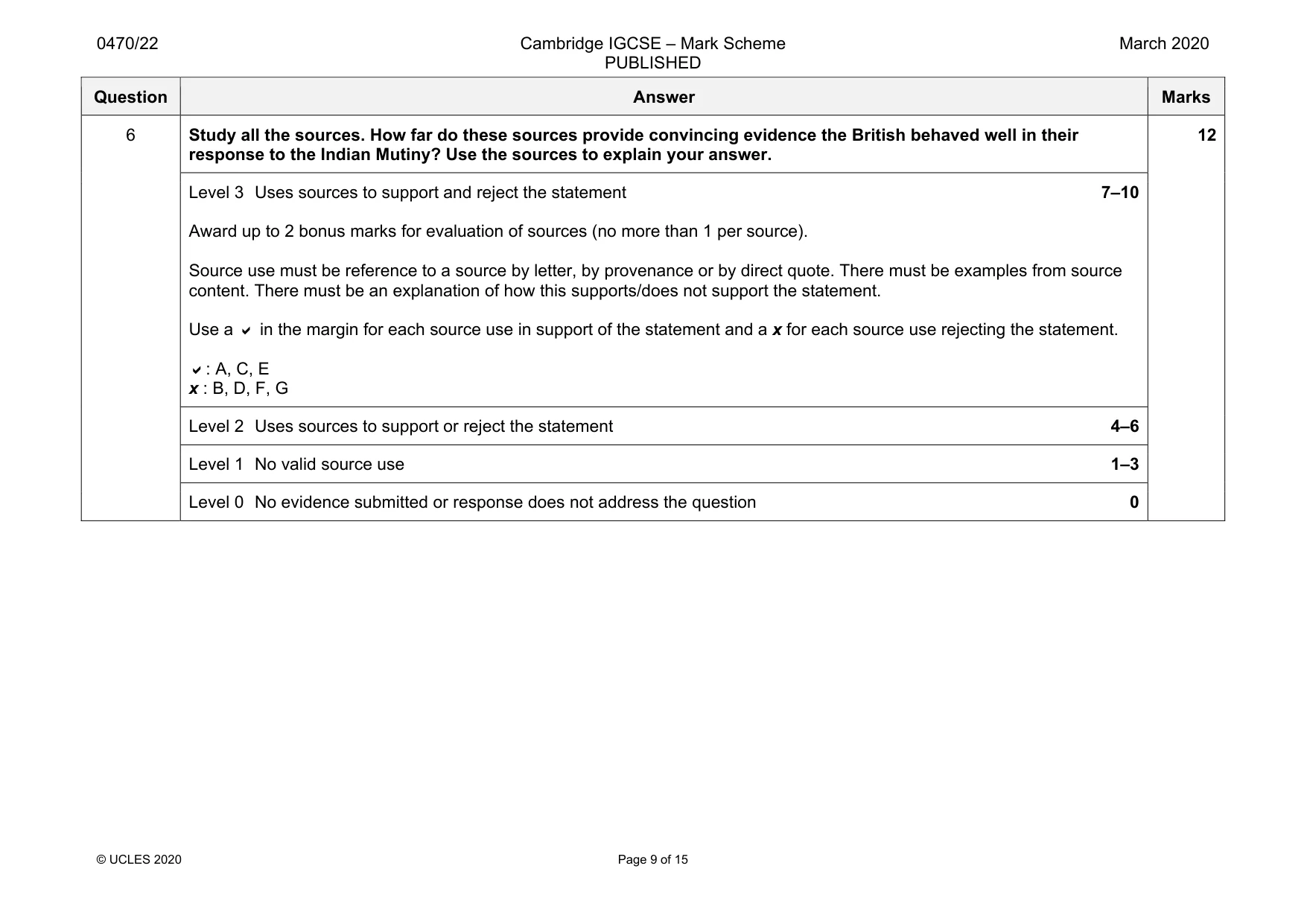
0470/22 Cambridge IGCSE – Mark Scheme PUBLISHED March 2020 © UCLES 2020 Page 9 of 15 Question Answer Marks 6 Study all the sources. How far do these sources provide convincing evidence the British behaved well in their response to the Indian Mutiny? Use the sources to explain your answer. 12 Level 3 Uses sources to support and reject the statement 7–10 Award up to 2 bonus marks for evaluation of sources (no more than 1 per source). Source use must be reference to a source by letter, by provenance or by direct quote. There must be examples from source content. There must be an explanation of how this supports/does not support the statement. Use a in the margin for each source use in support of the statement and a x for each source use rejecting the statement. : A, C, E x : B, D, F, G Level 2 Uses sources to support or reject the statement 4–6 Level 1 No valid source use 1–3 Level 0 No evidence submitted or response does not address the question 0
Mark scheme, page 10
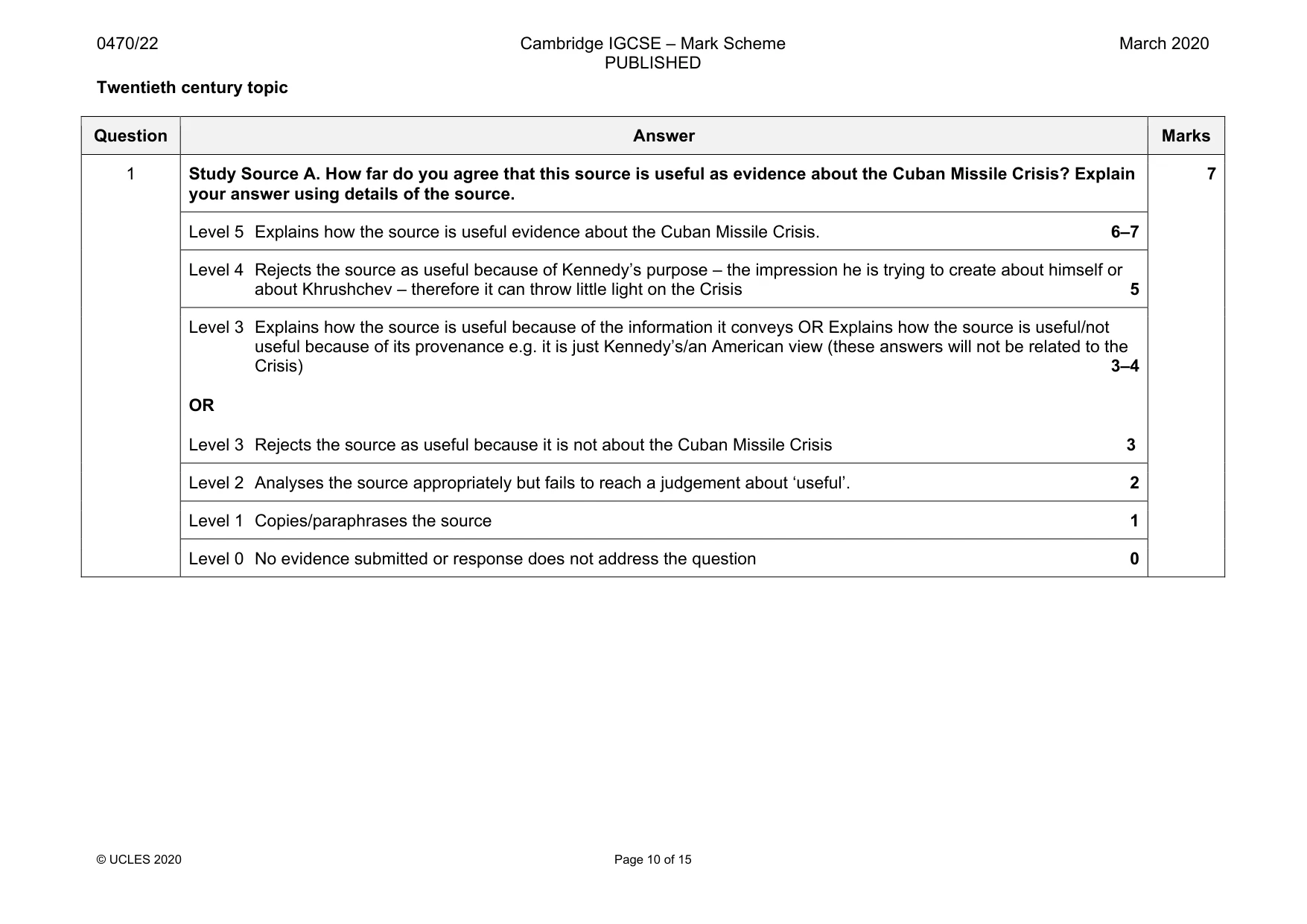
0470/22 Cambridge IGCSE – Mark Scheme PUBLISHED March 2020 © UCLES 2020 Page 10 of 15 Twentieth century topic Question Answer Marks 1 Study Source A. How far do you agree that this source is useful as evidence about the Cuban Missile Crisis? Explain your answer using details of the source. 7 Level 5 Explains how the source is useful evidence about the Cuban Missile Crisis. 6–7 Level 4 Rejects the source as useful because of Kennedy’s purpose – the impression he is trying to create about himself or about Khrushchev – therefore it can throw little light on the Crisis 5 Level 3 Explains how the source is useful because of the information it conveys OR Explains how the source is useful/not useful because of its provenance e.g. it is just Kennedy’s/an American view (these answers will not be related to the Crisis) 3–4 OR Level 3 Rejects the source as useful because it is not about the Cuban Missile Crisis 3 Level 2 Analyses the source appropriately but fails to reach a judgement about ‘useful’. 2 Level 1 Copies/paraphrases the source 1 Level 0 No evidence submitted or response does not address the question 0
Mark scheme, page 11
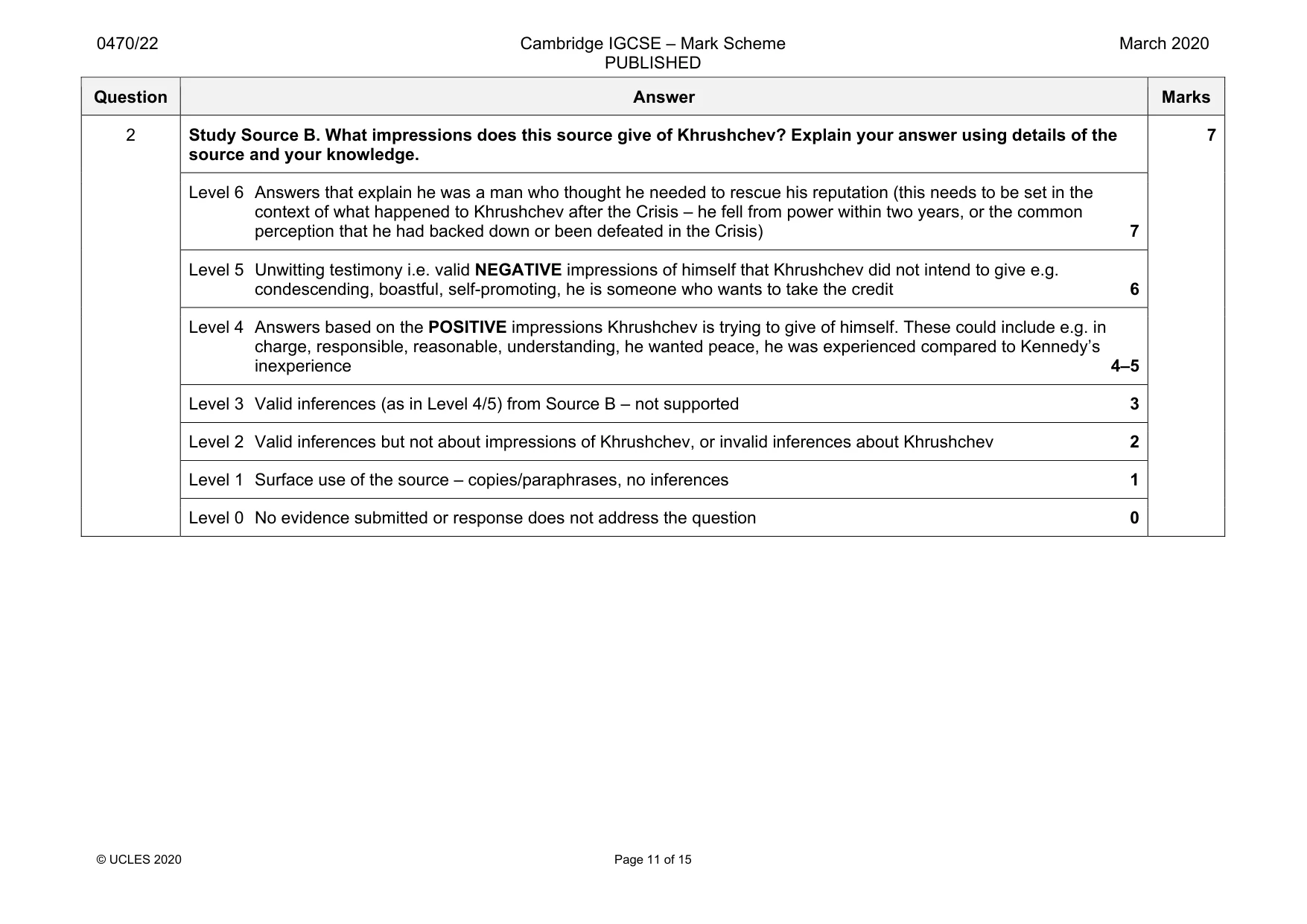
0470/22 Cambridge IGCSE – Mark Scheme PUBLISHED March 2020 © UCLES 2020 Page 11 of 15 Question Answer Marks 2 Study Source B. What impressions does this source give of Khrushchev? Explain your answer using details of the source and your knowledge. 7 Level 6 Answers that explain he was a man who thought he needed to rescue his reputation (this needs to be set in the context of what happened to Khrushchev after the Crisis – he fell from power within two years, or the common perception that he had backed down or been defeated in the Crisis) 7 Level 5 Unwitting testimony i.e. valid NEGATIVE impressions of himself that Khrushchev did not intend to give e.g. condescending, boastful, self-promoting, he is someone who wants to take the credit 6 Level 4 Answers based on the POSITIVE impressions Khrushchev is trying to give of himself. These could include e.g. in charge, responsible, reasonable, understanding, he wanted peace, he was experienced compared to Kennedy’s inexperience 4–5 Level 3 Valid inferences (as in Level 4/5) from Source B – not supported 3 Level 2 Valid inferences but not about impressions of Khrushchev, or invalid inferences about Khrushchev 2 Level 1 Surface use of the source – copies/paraphrases, no inferences 1 Level 0 No evidence submitted or response does not address the question 0
Mark scheme, page 12
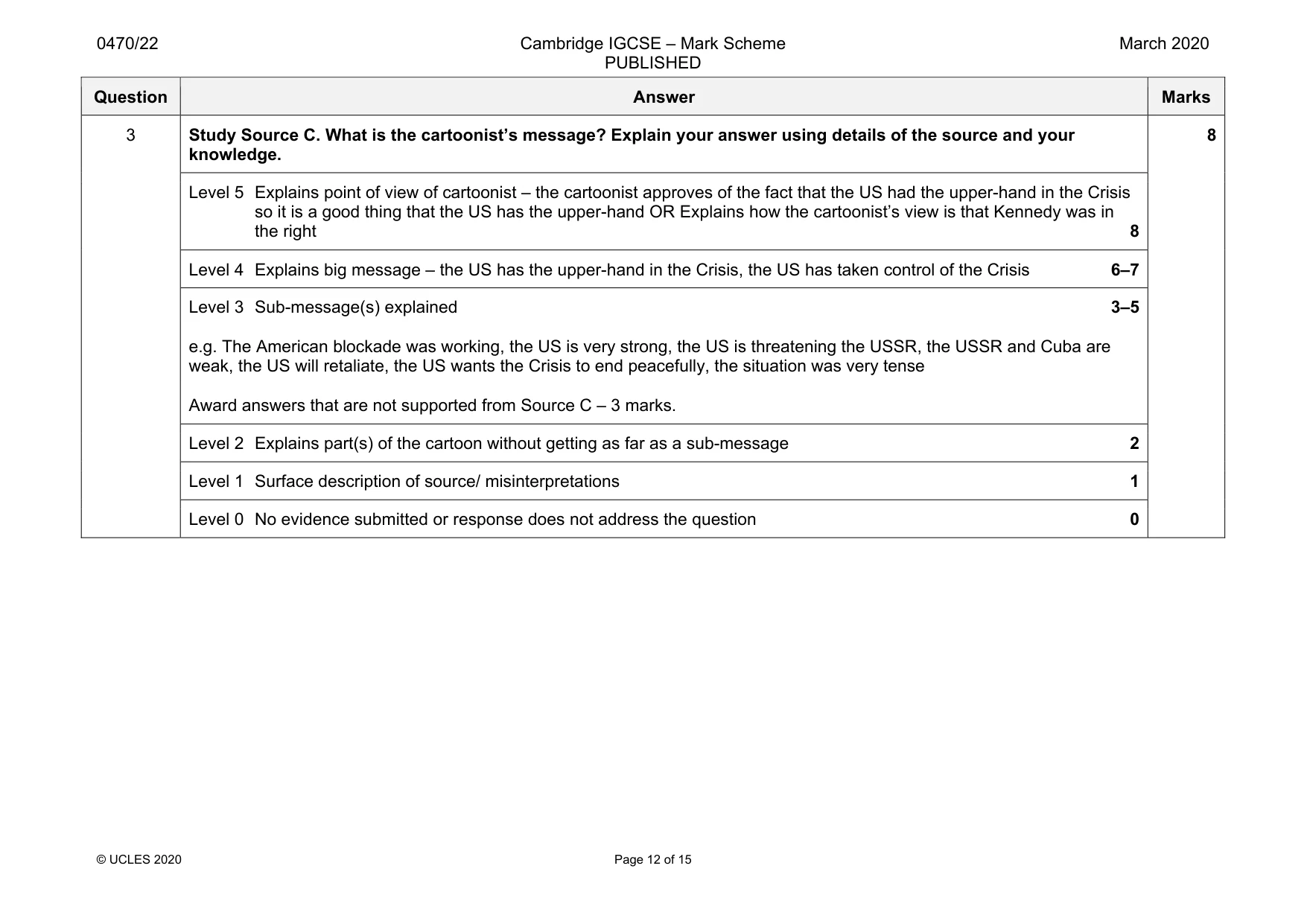
0470/22 Cambridge IGCSE – Mark Scheme PUBLISHED March 2020 © UCLES 2020 Page 12 of 15 Question Answer Marks 3 Study Source C. What is the cartoonist’s message? Explain your answer using details of the source and your knowledge. 8 Level 5 Explains point of view of cartoonist – the cartoonist approves of the fact that the US had the upper-hand in the Crisis so it is a good thing that the US has the upper-hand OR Explains how the cartoonist’s view is that Kennedy was in the right 8 Level 4 Explains big message – the US has the upper-hand in the Crisis, the US has taken control of the Crisis 6–7 Level 3 Sub-message(s) explained 3–5 e.g. The American blockade was working, the US is very strong, the US is threatening the USSR, the USSR and Cuba are weak, the US will retaliate, the US wants the Crisis to end peacefully, the situation was very tense Award answers that are not supported from Source C – 3 marks. Level 2 Explains part(s) of the cartoon without getting as far as a sub-message 2 Level 1 Surface description of source/ misinterpretations 1 Level 0 No evidence submitted or response does not address the question 0
Mark scheme, page 13
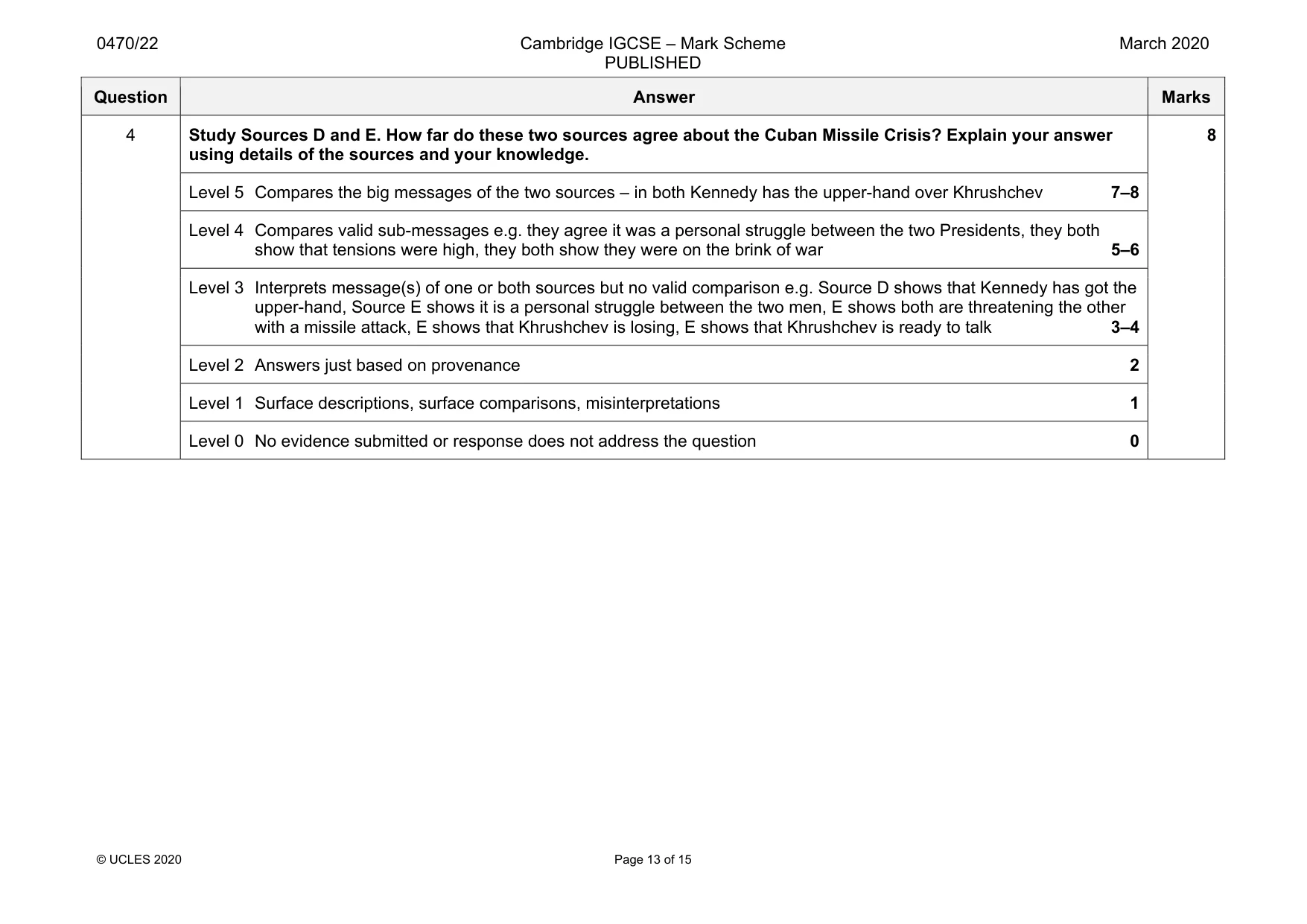
0470/22 Cambridge IGCSE – Mark Scheme PUBLISHED March 2020 © UCLES 2020 Page 13 of 15 Question Answer Marks 4 Study Sources D and E. How far do these two sources agree about the Cuban Missile Crisis? Explain your answer using details of the sources and your knowledge. 8 Level 5 Compares the big messages of the two sources – in both Kennedy has the upper-hand over Khrushchev 7–8 Level 4 Compares valid sub-messages e.g. they agree it was a personal struggle between the two Presidents, they both show that tensions were high, they both show they were on the brink of war 5–6 Level 3 Interprets message(s) of one or both sources but no valid comparison e.g. Source D shows that Kennedy has got the upper-hand, Source E shows it is a personal struggle between the two men, E shows both are threatening the other with a missile attack, E shows that Khrushchev is losing, E shows that Khrushchev is ready to talk 3–4 Level 2 Answers just based on provenance 2 Level 1 Surface descriptions, surface comparisons, misinterpretations 1 Level 0 No evidence submitted or response does not address the question 0
Mark scheme, page 14
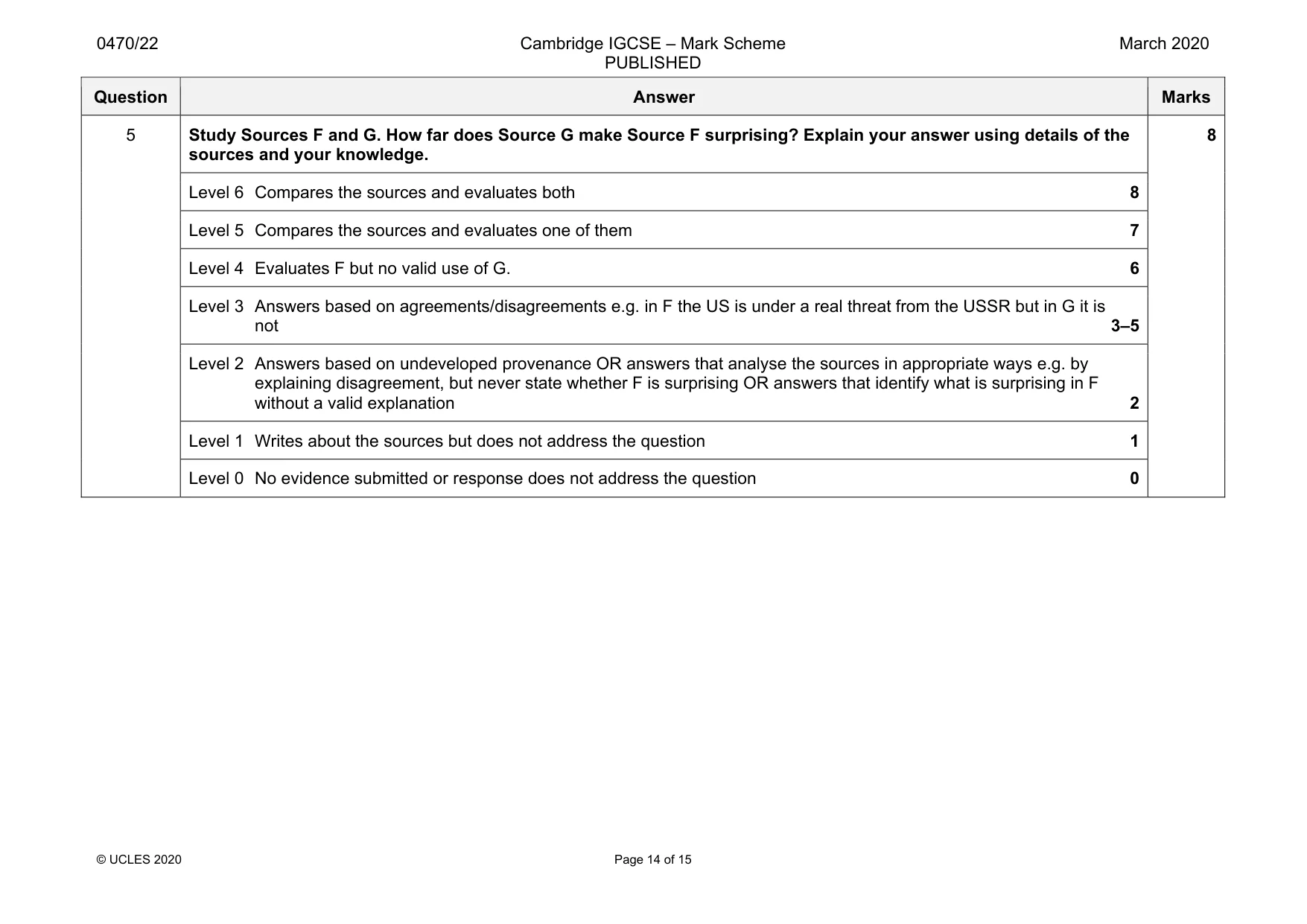
0470/22 Cambridge IGCSE – Mark Scheme PUBLISHED March 2020 © UCLES 2020 Page 14 of 15 Question Answer Marks 5 Study Sources F and G. How far does Source G make Source F surprising? Explain your answer using details of the sources and your knowledge. 8 Level 6 Compares the sources and evaluates both 8 Level 5 Compares the sources and evaluates one of them 7 Level 4 Evaluates F but no valid use of G. 6 Level 3 Answers based on agreements/disagreements e.g. in F the US is under a real threat from the USSR but in G it is not 3–5 Level 2 Answers based on undeveloped provenance OR answers that analyse the sources in appropriate ways e.g. by explaining disagreement, but never state whether F is surprising OR answers that identify what is surprising in F without a valid explanation 2 Level 1 Writes about the sources but does not address the question 1 Level 0 No evidence submitted or response does not address the question 0
Mark scheme, page 15
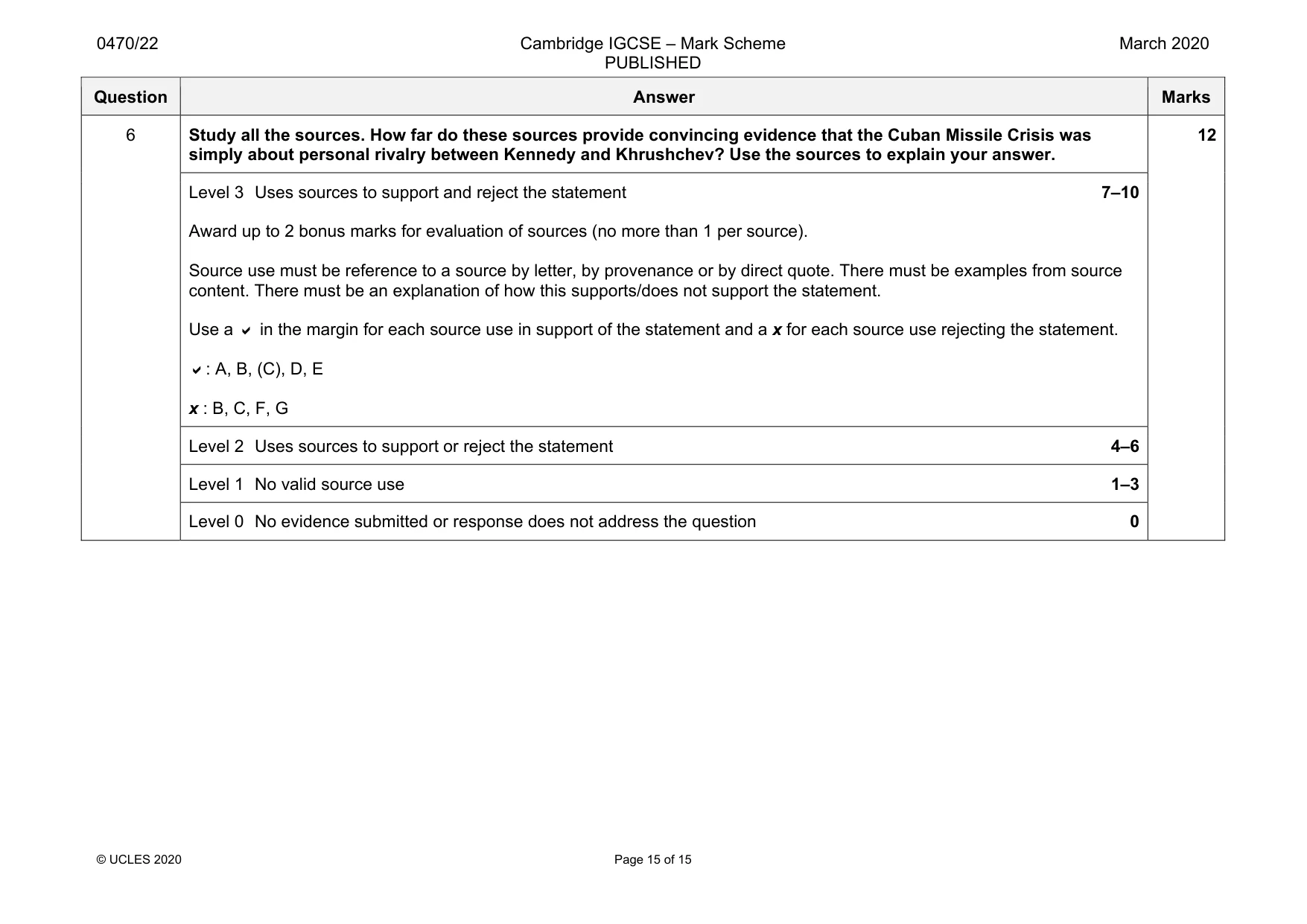
0470/22 Cambridge IGCSE – Mark Scheme PUBLISHED March 2020 © UCLES 2020 Page 15 of 15 Question Answer Marks 6 Study all the sources. How far do these sources provide convincing evidence that the Cuban Missile Crisis was simply about personal rivalry between Kennedy and Khrushchev? Use the sources to explain your answer. 12 Level 3 Uses sources to support and reject the statement 7–10 Award up to 2 bonus marks for evaluation of sources (no more than 1 per source). Source use must be reference to a source by letter, by provenance or by direct quote. There must be examples from source content. There must be an explanation of how this supports/does not support the statement. Use a in the margin for each source use in support of the statement and a x for each source use rejecting the statement. : A, B, (C), D, E x : B, C, F, G Level 2 Uses sources to support or reject the statement 4–6 Level 1 No valid source use 1–3 Level 0 No evidence submitted or response does not address the question 0
What you needed in this session
Cambridge’s own grade thresholds for 2020 Feb/March, Paper 2 · Variant 2. A higher threshold means an easier paper — the bar moves with how the cohort did.