Cambridge IGCSE History 0470 — 2019 Feb/March Paper 2 · Variant 2
0470/22/F/M/19 · 50 marks · ≈56 min
The question paper and its mark scheme, free to read here and free to download. This is Cambridge’s own paper, exactly as it was sat.
Question paper16 pages

Mark scheme11 pages
Answers below. Sit the paper first if you are practising.
Paper as text
Question paper, page 1
This document consists of 14 printed pages, 2 blank pages and 1 Insert. DC (NH/SW) 164785/4 © UCLES 2019 [Turn over Cambridge Assessment International Education Cambridge International General Certificate of Secondary Education * 8 1 1 9 5 5 5 7 1 4 * HISTORY 0470/22 Paper 2 February/March 2019 2 hours No Additional Materials are required. READ THESE INSTRUCTIONS FIRST An answer booklet is provided inside this question paper. You should follow the instructions on the front cover of the answer booklet. If you need additional answer paper ask the invigilator for a continuation booklet. This paper has two options. Choose one option, and answer all of the questions on that topic. Option A: Nineteenth century topic [p2–p7] Option B: Twentieth century topic [p8–p14] The number of marks is given in brackets [ ] at the end of each question or part question. This syllabus is regulated for use in England, Wales and Northern Ireland as a Cambridge International Level 1/Level 2 Certificate.
Question paper, page 2
2 0470/22/F/M/19 © UCLES 2019 Option A: Nineteenth century topic WHO WAS TO BLAME FOR THE FIRST WORLD WAR? Study the Background Information and the sources carefully, and then answer all the questions. Background Information The assassination of Archduke Franz Ferdinand did not cause the First World War by itself. The situation in Europe was already heading towards war with two armed alliances, the Triple Alliance and the Triple Entente, ready to fight. At the same time, Britain and Germany were in an arms race with each other. In the months leading up to the outbreak of war, each of the major powers tried desperately to ensure that they did not appear to be the aggressor. After war had broken out, each one blamed the others. Who was responsible for the First World War? SOURCE A Some of the best people in the world have written about this war, and yet no one stands out as being impartial. The first few sentences always show which side the sympathies of the writer are on. The Germans all believe that they have been attacked. On the other hand, the Allies consider Germany as the aggressor: Sir Edward Grey believes that they desire ‘universal domination’. Instead of blaming other men we should try to realise war could have been avoided if European statesmen had acted with goodwill. Austria and Russia have no real reason to quarrel. Germany should long ago have restored the French parts of Alsace-Lorraine to France. England could have helped Germany build a great colony in Central Africa. For surely a German experiment in colonisation would be worth studying. Such arrangements as these would benefit everyone and be a thousand times more profitable than fighting. It is surely impossible to shut one’s eyes to the fact that it is the English and the Germans and their striving for first place which brought about the war. And Germany, in fighting England and France, is only helping to make Russia master of Europe. In this conflict France has shown itself less eager for war than any of the other countries. And Russia? Whichever side wins, Russia is sure to profit. From a book published in 1915.
Question paper, page 3
3 0470/22/F/M/19 © UCLES 2019 [Turn over SOURCE B I see politicians and militarists of England and Germany jumping at the chance to smash one another and establish themselves as the dominant power in the world. British propaganda about war with Germany has never ceased. From the moment when the Kaiser began to copy our policy by building a big fleet, the anti-German agitation has become openly aggressive with the feeling that a war was bound to come. Our government manoeuvred to surround Germany and Austria with an Anglo-Franco- Russian combination. Let us have no more nonsense about the Prussian Wolf and the British Lamb. Since 1870 France has enlarged her territory, while Germany is still pleading in vain for a place in the sun. It is the terror of Russia that has driven Germany into her present onslaught on France. The one way of avoiding war was to convince Germany that England was willing to fight, but Sir Edward Grey did not understand this and persuaded Germany that he had not the slightest intention of fighting. Germany, confident that with Austria’s help she could break France with one hand and Russia with the other if England stayed out, let Austria throw the spark into the gunpowder. The monstrous system of alliances produced the present war. No nation wanted to fight. England had nothing to gain, Germany had everything to lose, while France would not have risked war for Alsace- Lorraine. Yet Russia, who had a great deal to gain by victory, had a quarrel with Austria over Serbia and has been able to set all three western friends against each other, shedding ‘rivers of blood’ from each others’ throats. When it comes to sacrificing Germany to Russia, we are sharpening a knife for our own throat. From a book published in 1914.
Question paper, page 4
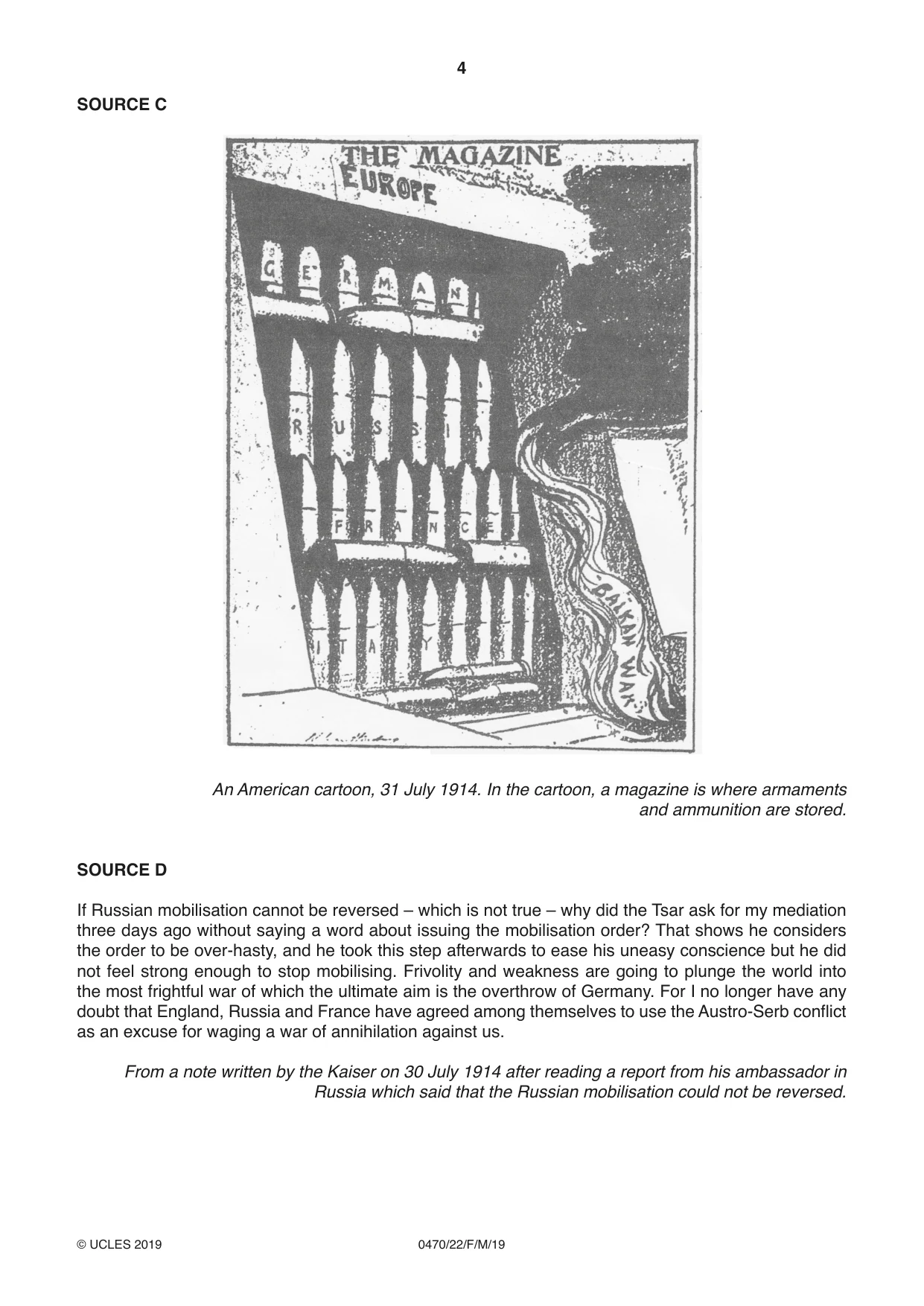
4 0470/22/F/M/19 © UCLES 2019 SOURCE C An American cartoon, 31 July 1914. In the cartoon, a magazine is where armaments and ammunition are stored. SOURCE D If Russian mobilisation cannot be reversed – which is not true – why did the Tsar ask for my mediation three days ago without saying a word about issuing the mobilisation order? That shows he considers the order to be over-hasty, and he took this step afterwards to ease his uneasy conscience but he did not feel strong enough to stop mobilising. Frivolity and weakness are going to plunge the world into the most frightful war of which the ultimate aim is the overthrow of Germany. For I no longer have any doubt that England, Russia and France have agreed among themselves to use the Austro-Serb conflict as an excuse for waging a war of annihilation against us. From a note written by the Kaiser on 30 July 1914 after reading a report from his ambassador in Russia which said that the Russian mobilisation could not be reversed.
Question paper, page 5
5 0470/22/F/M/19 © UCLES 2019 [Turn over SOURCE E Last week I stated that we were working to preserve the peace of Europe, but it is clear that the peace of Europe cannot be preserved. Russia and Germany have declared war upon each other. France is involved in it because of its obligation of honour under a definite alliance with Russia. It is only fair to say to Parliament that that obligation of honour cannot apply in the same way to us. We are not parties to the Franco-Russian alliance. We feel strongly that France was entitled to know whether or not in the event of attack upon its unprotected northern and western coast it could depend upon British support. Yesterday afternoon I gave to the French Ambassador the following statement: ‘I am authorised to give an assurance that if the German fleet comes into the Channel or through the North Sea to undertake hostile operations against the French coasts or shipping, the British fleet will give all the protection in its power.’ If there has been an ultimatum to Belgium, asking her to compromise or violate her neutrality, her independence is gone. If, in a crisis like this, we said, ‘We will have nothing whatever to do with this matter,’ we should, I believe, sacrifice our respect and good name and reputation before the world. We have disclosed the issue and the information which we have, and made clear, I trust, that we are prepared to face that situation, and that should it develop, as probably it may develop, we will face it. From a speech by Sir Edward Grey to the British Parliament, 3 August 1914. Grey was the member of the British government in charge of foreign policy.
Question paper, page 6
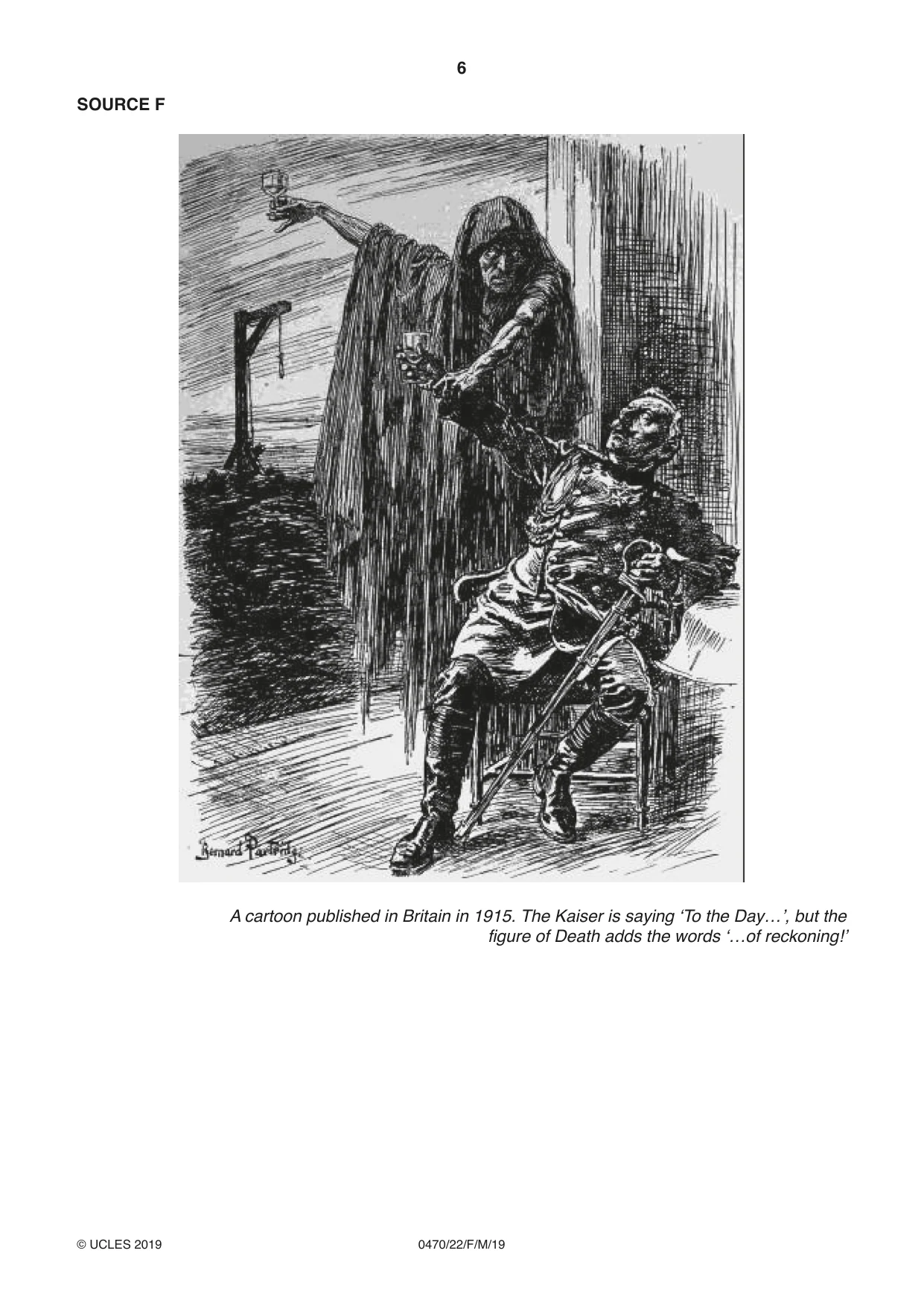
6 0470/22/F/M/19 © UCLES 2019 SOURCE F A cartoon published in Britain in 1915. The Kaiser is saying ‘To the Day…’, but the figure of Death adds the words ‘…of reckoning!’
Question paper, page 7
7 0470/22/F/M/19 © UCLES 2019 [Turn over Now answer all the following questions. You may use any of the sources to help you answer the questions, in addition to those sources which you are told to use. In answering the questions you should use your knowledge of the topic to help you interpret and evaluate the sources. 1 Study Sources A and B. How far do these two sources agree? Explain your answer using details of the sources. [7] 2 Study Source C. Why was this cartoon published on 31 July 1914? Explain your answer using details of the source and your knowledge. [8] 3 Study Source D. How far do you believe what the Kaiser wrote? Explain your answer using details of the source and your knowledge. [8] 4 Study Source E. Are you surprised by this source? Explain your answer using details of the source and your knowledge. [8] 5 Study Source F. What is the message of this cartoon? Explain your answer using details of the source and your knowledge. [7] 6 Study all the sources. How far do these sources provide convincing evidence that Germany was responsible for causing the First World War? Use the sources to explain your answer. [12]
Question paper, page 8
8 0470/22/F/M/19 © UCLES 2019 Option B: Twentieth century topic WERE ITALIAN ACTIONS IN ABYSSINIA JUSTIFIED? Study the Background Information and the sources carefully, and then answer all the questions. Background Information Abyssinia had long and close ties with Italy and so when Mussolini was looking for ways to help the Italian economy and boost his own popularity, his focus became fixed on Abyssinia. Tensions between Abyssinia and the Italians in neighbouring Somaliland had been growing during 1934 and came to a head in the Wal Wal incident in December 1934 when both Abyssinian and Italian soldiers were killed. In October 1935 Italian troops invaded Abyssinia. Despite economic sanctions imposed by the League of Nations, Abyssinia was fully under Italian control by May 1936. Were Italian actions in Abyssinia justified? SOURCE A The Abyssinian empire was the one place in Africa where other European countries had no special concern and where Italy’s predominant interest was widely recognised. In the 1920s Mussolini’s main objective had been peaceful economic gains, although from the beginning there had been talk of war to obtain political control. Abyssinia was looked upon by Rome as an Italian reserve, so much so that throughout the 1920s it was providing most of the soldiers for the Italian army fighting in Libya. A treaty of friendship between the two countries was signed in 1928 and Mussolini was genuinely offended when Haile Selassie sought friends elsewhere. One view held in the Italian government was that Africa should be the main concern of Italian foreign policy. Possibly Abyssinia should be annexed outright, giving Italy the prestige of a military victory. One reason the Italians favoured a friendship with Germany was to put pressure on the French and win French approval of what Italy called their ‘mission to civilise the black continent’. In the early 1930s the Italian government discussed plans for the conquest of Abyssinia but it was a distant possibility. A determining factor in Italy’s decision to act may have been Hitler’s coming to power, because this on the one hand created the tension in Europe which would give Mussolini greater freedom to act, and on the other suggested that Italy had better conquer Abyssinia before the Germans were strong enough to attack Austria. A war plan was devised in the summer of 1934. Laval, the French Foreign Minister, had already privately hinted that Mussolini might one day move into Abyssinia. In January 1935 when he met Mussolini, they agreed a treaty and Laval made a vague commitment to leave Italy some kind of free hand in Africa. In all probability he did not explicitly agree to an Italian invasion, but perhaps there was a tacit understanding, and some historians think Laval may have given his clear approval. After this meeting Mussolini certainly acted as though he had the backing of France and could safely begin an aggressive war. The French and British governments recognised that Hitler was the main danger and were prepared to pay for Italy’s help against him. From a history book published in 1976.
Question paper, page 9
9 0470/22/F/M/19 © UCLES 2019 [Turn over SOURCE B The French government was keen for a better understanding with Italy. In January 1935 the French Foreign Minister met with Mussolini and a treaty was agreed. At the meeting France gave Italy a free hand in Abyssinia. At a later date, the British declared that the French had assured them that they had spoken of ‘a free hand’ only in economic matters. However, it is likely that Mussolini believed he had secured a satisfactory agreement. In the spring of 1935 it was suggested by some in the British government that Italy might be given a position in Abyssinia similar to that of Britain in Egypt. Mussolini replied that this idea was by no means without merit. In June the British government suggested Abyssinia give the Ogaden province to Italy, while Britain would give Abyssinia access to the sea. Mussolini rejected the plan which would have given Abyssinia more opportunities to trade in arms and slaves. Mussolini does not seem to have thought of drastic actions in Abyssinia before the Wal Wal incident. This convinced him that no satisfactory agreement could be reached with Abyssinia. The Wal Wal incident and other subsequent acts of violence by Abyssinians had brought relations between the two countries to a state of acute tension, which was made worse by the intervention of the British government. There can be no doubt that it was these events that brought Mussolini around to the idea of an Italian colony. The responsibility of British action for the events that followed is well established. Had not Haile Selassie been encouraged by Britain, he might well have come to terms with Italy. From a history book published in 1956. SOURCE C Hoare told me that the Italian demands remain unacceptable to Abyssinia, as they do to the League and Britain. I briefed Hoare on our position. We have no quarrels with Italy. We have no interests in Africa. If we are taking a stand against Italy, it is only as a loyal member of the League, and because we want to teach a lesson to serve as a warning for any future aggressors. Italy is not a very serious aggressor, but there are more dangerous candidates in the world. Hoare assured me that the British position is exactly the same. Britain has no interest of its own in the conflict. It is guided purely by loyalty to the League. Hoare, like me, does not regard Italy as a terrifying aggressor. From the diary of Ivan Maisky, the Soviet ambassador to Britain, November 1935. Hoare was in charge of British foreign policy until December 1935, when he resigned.
Question paper, page 10
10 0470/22/F/M/19 © UCLES 2019 SOURCE D At a committee of the League Italy’s use of gas was discussed. France’s only contribution was to ask whether there was any enquiry into the Abyssinians’ use of dum-dum bullets and into the atrocities committed by them. I had to remind the French that the 1925 Gas Protocol, which had been signed by both Abyssinia and Italy, was absolute. There was no provision that the use of gas might be permitted on account of the methods of warfare adopted by the other side. During an adjournment, a private Anglo-French meeting was held. It showed no agreement was possible. I said that the League had lost greatly in prestige in many countries. A despairing message had been received from the Abyssinian government. I wanted to know if the Committee was to do no more than to suggest that its chairman should see the Italian representative and thus give the Italian government further opportunity for delay. I said that the threat of poison gas was not to Africa only. Dictator states might well use gas in Europe. From the memoirs of Anthony Eden, entitled ‘Facing the Dictators’, published in 1962. Eden was a leading member of the British government throughout the Abyssinian crisis and became Foreign Secretary when Hoare resigned in December 1935. In this extract he describes a meeting in April 1936.
Question paper, page 11
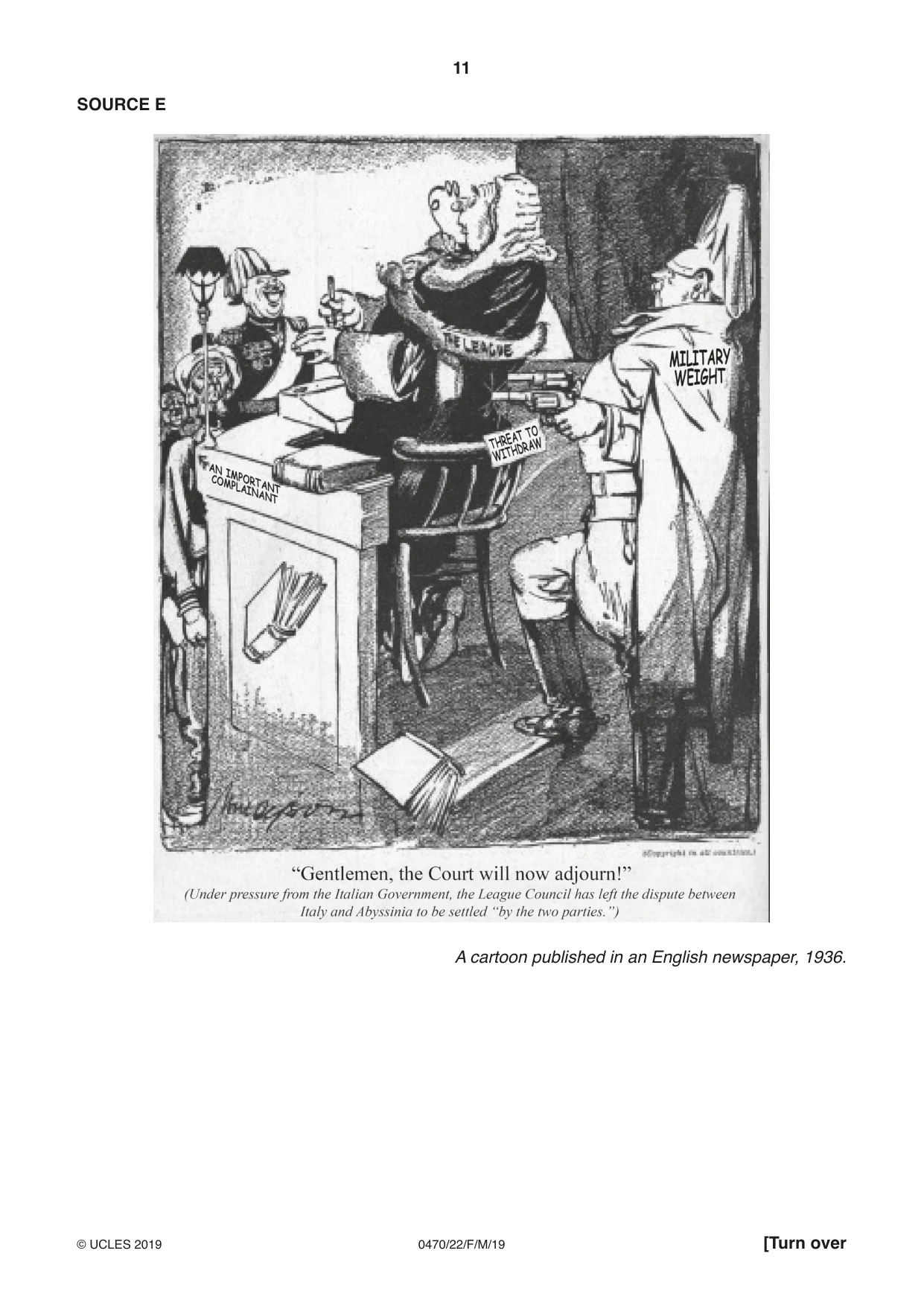
11 0470/22/F/M/19 © UCLES 2019 [Turn over SOURCE E A cartoon published in an English newspaper, 1936.
Question paper, page 12
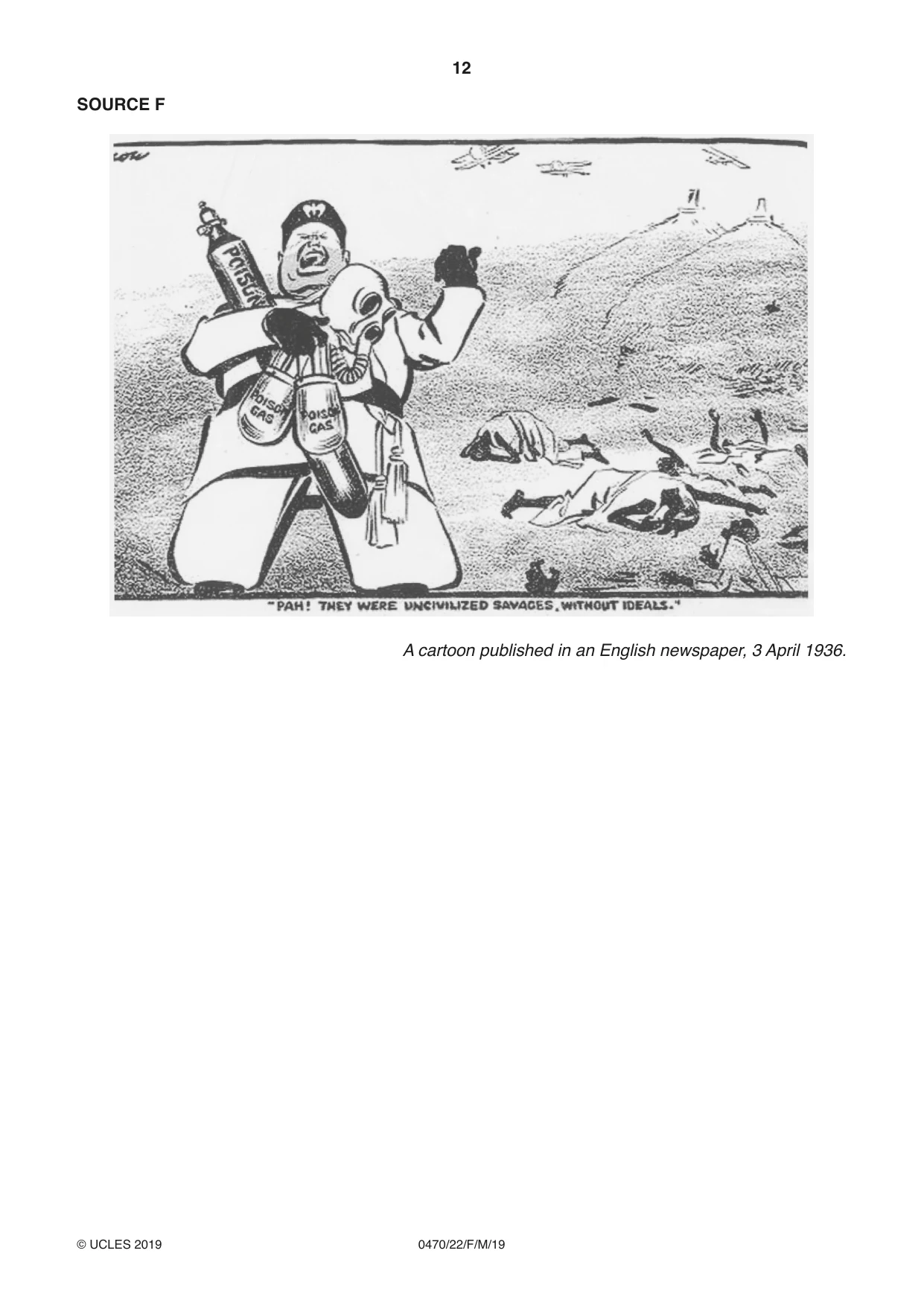
12 0470/22/F/M/19 © UCLES 2019 SOURCE F A cartoon published in an English newspaper, 3 April 1936.
Question paper, page 13
13 0470/22/F/M/19 © UCLES 2019 [Turn over SOURCE G A postcard published in Italy in 1936 showing Italian and Abyssinian children in Abyssinia. SOURCE H Abyssinia is still a barbarous country. It is violently governed and its government is not strong enough to cope with its own lawless elements. It is entertaining to find a country where the noblemen feast on raw beef, but less amusing when they enslave the villagers of neighbouring countries. The Emperor made himself master of a vast population differing absolutely from himself in race, religion and history. It was taken bloodily and he holds the country by force of arms. The Italians have as much right to govern. In the matter of practical politics it is certain that their government would be for the benefit of Abyssinia and the rest of Africa. From an English newspaper, July 1935.
Question paper, page 14
14 0470/22/F/M/19 © UCLES 2019 Now answer all the following questions. You may use any of the sources to help you answer the questions, in addition to those sources which you are told to use. In answering the questions you should use your knowledge of the topic to help you interpret and evaluate the sources. 1 Study Sources A and B. How far do these two sources agree? Explain your answer using details of the sources. [7] 2 Study Sources C and D. Does Source C make Source D surprising? Explain your answer using details of the sources and your knowledge. [8] 3 Study Source E. What is the message of this cartoon? Explain your answer using details of the source and your knowledge. [8] 4 Study Sources F and G. How different are the impressions given by these two sources? Explain your answer using details of the sources and your knowledge. [8] 5 Study Source H. How useful is this source as evidence about the Abyssinian crisis? Explain your answer using details of the source and your knowledge. [7] 6 Study all the sources. How far do these sources provide convincing evidence that Italian actions in Abyssinia were justified? Use the sources to explain your answer. [12]
Question paper, page 15
15 0470/22/F/M/19 © UCLES 2019 BLANK PAGE
Question paper, page 16
16 0470/22/F/M/19 © UCLES 2019 BLANK PAGE Permission to reproduce items where third-party owned material protected by copyright is included has been sought and cleared where possible. Every reasonable effort has been made by the publisher (UCLES) to trace copyright holders, but if any items requiring clearance have unwittingly been included, the publisher will be pleased to make amends at the earliest possible opportunity. To avoid the issue of disclosure of answer-related information to candidates, all copyright acknowledgements are reproduced online in the Cambridge Assessment International Education Copyright Acknowledgements Booklet. This is produced for each series of examinations and is freely available to download at www.cambridgeinternational.org after the live examination series. Cambridge Assessment International Education is part of the Cambridge Assessment Group. Cambridge Assessment is the brand name of the University of Cambridge Local Examinations Syndicate (UCLES), which itself is a department of the University of Cambridge.
Mark scheme, page 1
This syllabus is regulated for use in England, Wales and Northern Ireland as a Cambridge International Level 1/Level 2 Certificate. This document consists of 11 printed pages. © UCLES 2019 [Turn over Cambridge Assessment International Education Cambridge International General Certificate of Secondary Education HISTORY 0470/22 Paper 2 March 2019 MARK SCHEME Maximum Mark: 50 Published This mark scheme is published as an aid to teachers and candidates, to indicate the requirements of the examination. It shows the basis on which Examiners were instructed to award marks. It does not indicate the details of the discussions that took place at an Examiners’ meeting before marking began, which would have considered the acceptability of alternative answers. Mark schemes should be read in conjunction with the question paper and the Principal Examiner Report for Teachers. Cambridge International will not enter into discussions about these mark schemes. Cambridge International is publishing the mark schemes for the March 2019 series for most Cambridge IGCSE™, Cambridge International A and AS Level components and some Cambridge O Level components.
Mark scheme, page 2
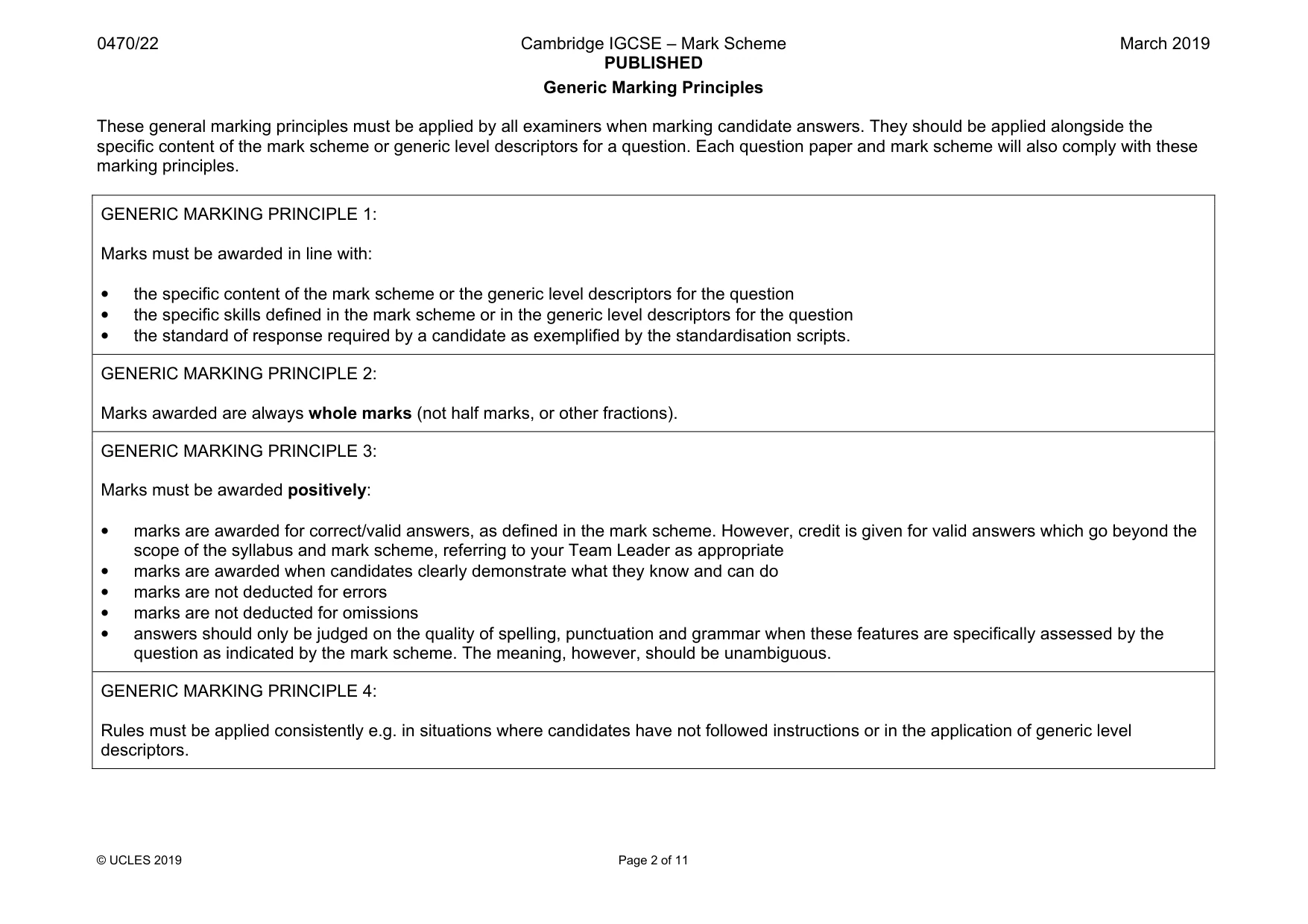
0470/22 Cambridge IGCSE – Mark Scheme PUBLISHED March 2019 © UCLES 2019 Page 2 of 11 Generic Marking Principles These general marking principles must be applied by all examiners when marking candidate answers. They should be applied alongside the specific content of the mark scheme or generic level descriptors for a question. Each question paper and mark scheme will also comply with these marking principles. GENERIC MARKING PRINCIPLE 1: Marks must be awarded in line with: • the specific content of the mark scheme or the generic level descriptors for the question • the specific skills defined in the mark scheme or in the generic level descriptors for the question • the standard of response required by a candidate as exemplified by the standardisation scripts. GENERIC MARKING PRINCIPLE 2: Marks awarded are always whole marks (not half marks, or other fractions). GENERIC MARKING PRINCIPLE 3: Marks must be awarded positively: • marks are awarded for correct/valid answers, as defined in the mark scheme. However, credit is given for valid answers which go beyond the scope of the syllabus and mark scheme, referring to your Team Leader as appropriate • marks are awarded when candidates clearly demonstrate what they know and can do • marks are not deducted for errors • marks are not deducted for omissions • answers should only be judged on the quality of spelling, punctuation and grammar when these features are specifically assessed by the question as indicated by the mark scheme. The meaning, however, should be unambiguous. GENERIC MARKING PRINCIPLE 4: Rules must be applied consistently e.g. in situations where candidates have not followed instructions or in the application of generic level descriptors.
Mark scheme, page 3
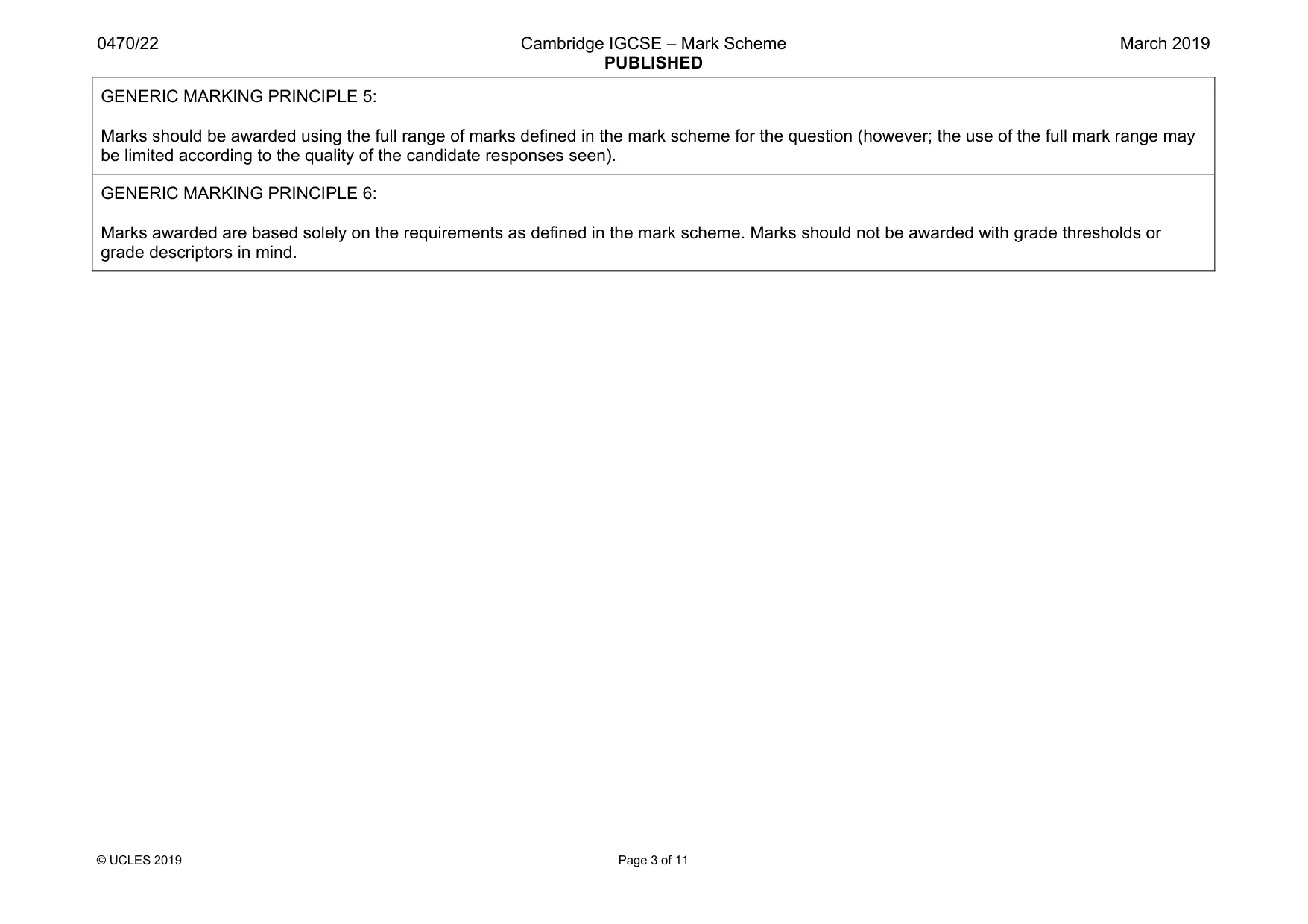
0470/22 Cambridge IGCSE – Mark Scheme PUBLISHED March 2019 © UCLES 2019 Page 3 of 11 GENERIC MARKING PRINCIPLE 5: Marks should be awarded using the full range of marks defined in the mark scheme for the question (however; the use of the full mark range may be limited according to the quality of the candidate responses seen). GENERIC MARKING PRINCIPLE 6: Marks awarded are based solely on the requirements as defined in the mark scheme. Marks should not be awarded with grade thresholds or grade descriptors in mind.
Mark scheme, page 4
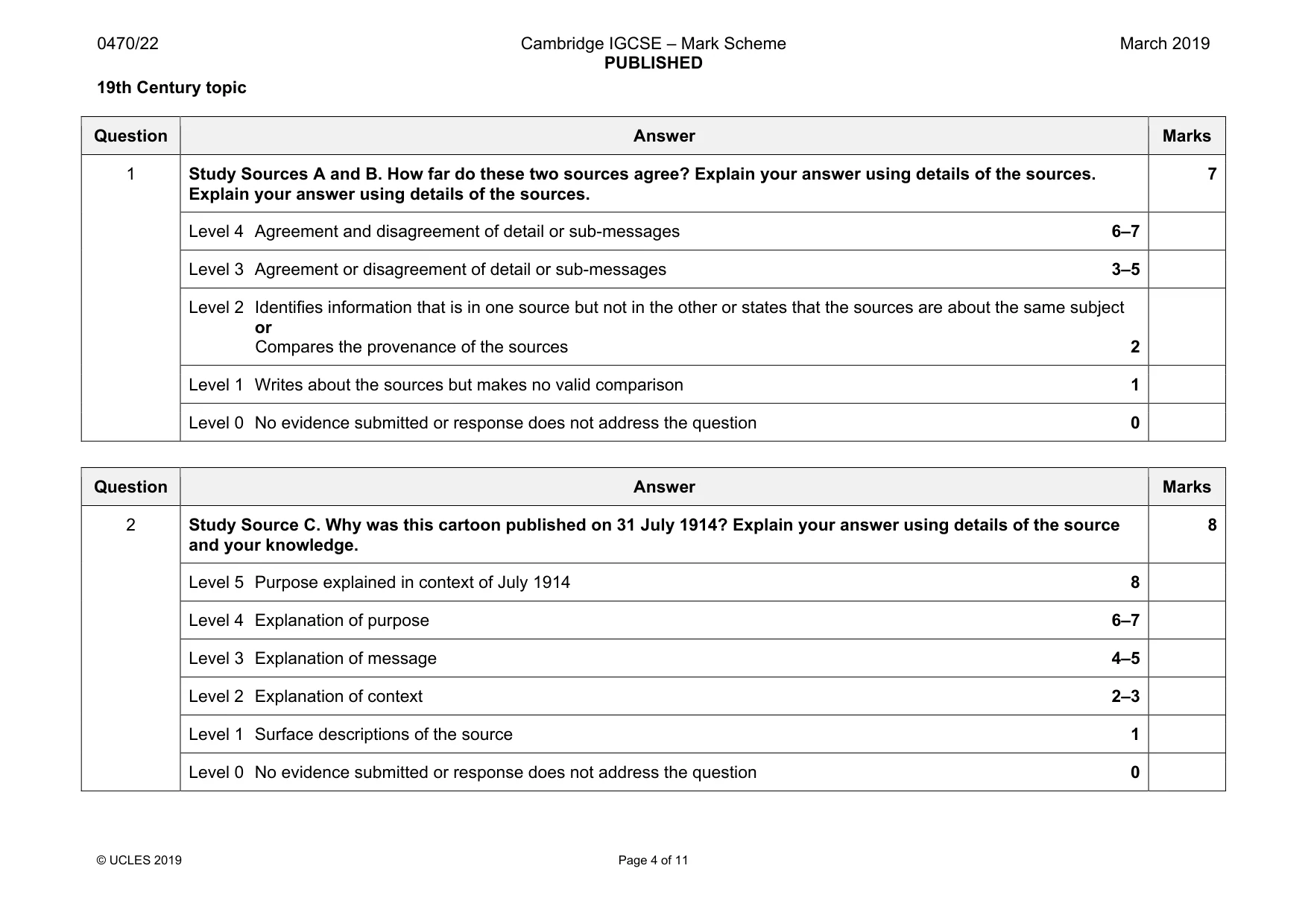
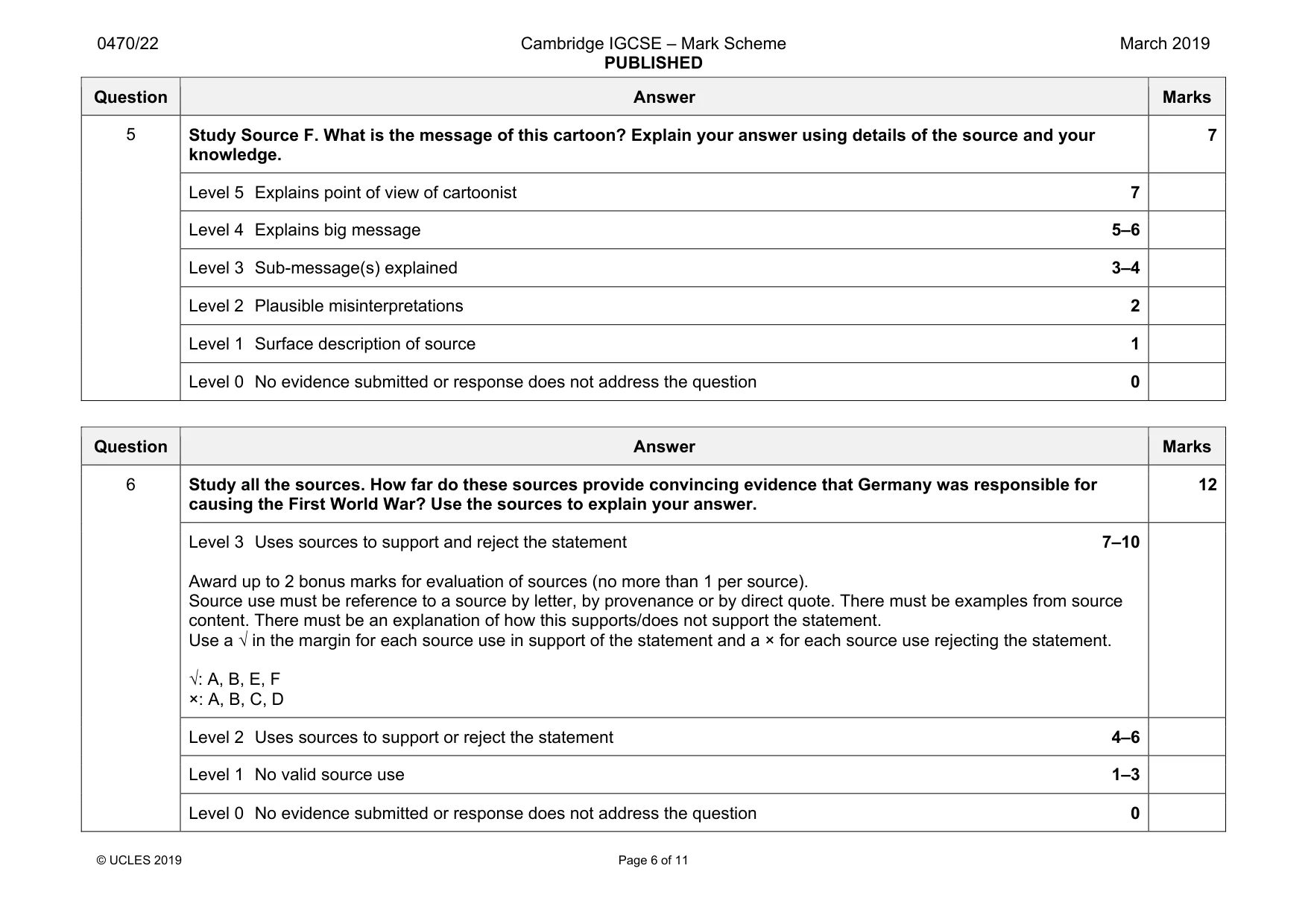
0470/22 Cambridge IGCSE – Mark Scheme PUBLISHED March 2019 © UCLES 2019 Page 4 of 11 19th Century topic Question Answer Marks 1 Study Sources A and B. How far do these two sources agree? Explain your answer using details of the sources. Explain your answer using details of the sources. 7 Level 4 Agreement and disagreement of detail or sub-messages 6–7 Level 3 Agreement or disagreement of detail or sub-messages 3–5 Level 2 Identifies information that is in one source but not in the other or states that the sources are about the same subject or Compares the provenance of the sources 2 Level 1 Writes about the sources but makes no valid comparison 1 Level 0 No evidence submitted or response does not address the question 0 Question Answer Marks 2 Study Source C. Why was this cartoon published on 31 July 1914? Explain your answer using details of the source and your knowledge. 8 Level 5 Purpose explained in context of July 1914 8 Level 4 Explanation of purpose 6–7 Level 3 Explanation of message 4–5 Level 2 Explanation of context 2–3 Level 1 Surface descriptions of the source 1 Level 0 No evidence submitted or response does not address the question 0
Mark scheme, page 5
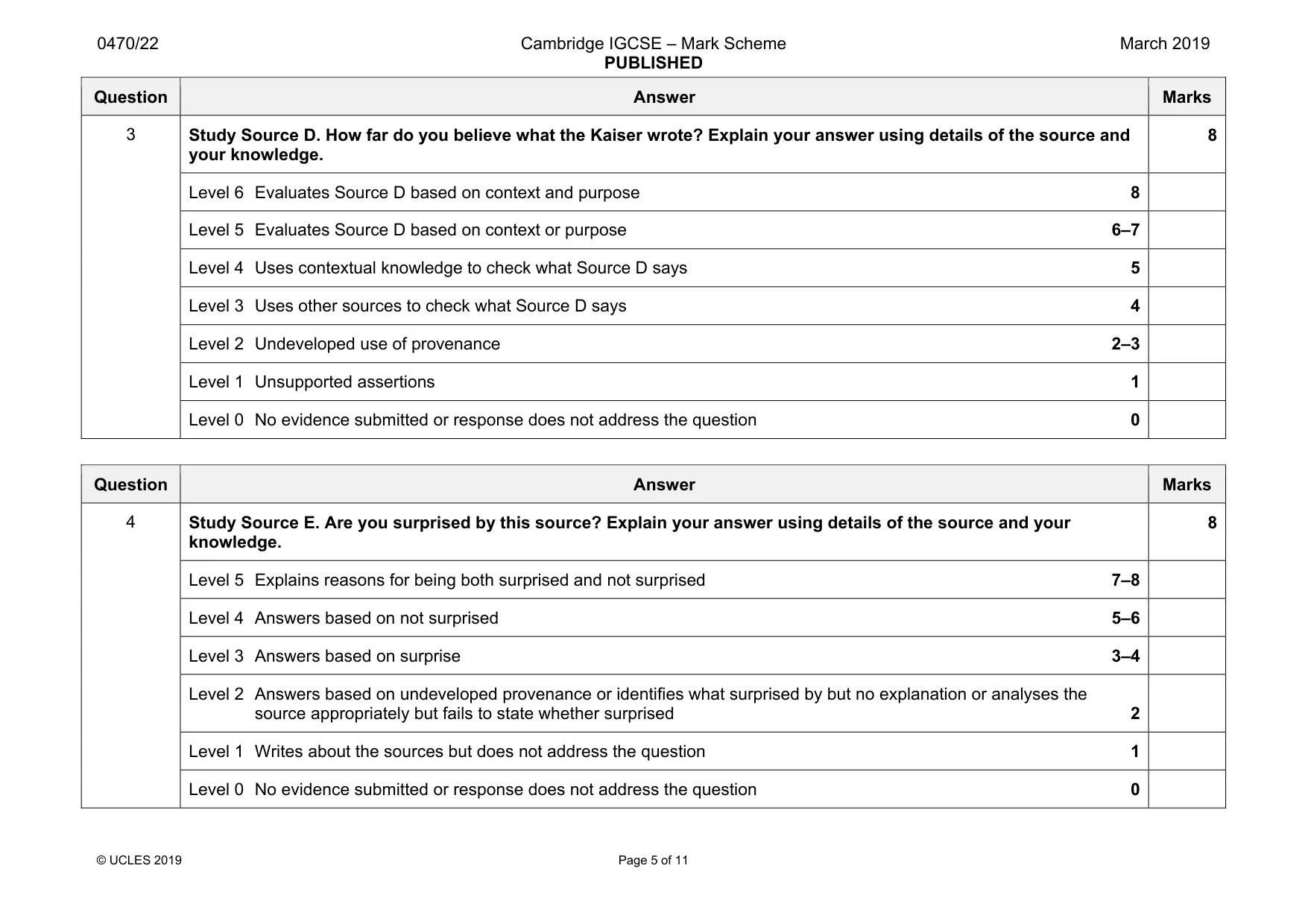
0470/22 Cambridge IGCSE – Mark Scheme PUBLISHED March 2019 © UCLES 2019 Page 5 of 11 Question Answer Marks 3 Study Source D. How far do you believe what the Kaiser wrote? Explain your answer using details of the source and your knowledge. 8 Level 6 Evaluates Source D based on context and purpose 8 Level 5 Evaluates Source D based on context or purpose 6–7 Level 4 Uses contextual knowledge to check what Source D says 5 Level 3 Uses other sources to check what Source D says 4 Level 2 Undeveloped use of provenance 2–3 Level 1 Unsupported assertions 1 Level 0 No evidence submitted or response does not address the question 0 Question Answer Marks 4 Study Source E. Are you surprised by this source? Explain your answer using details of the source and your knowledge. 8 Level 5 Explains reasons for being both surprised and not surprised 7–8 Level 4 Answers based on not surprised 5–6 Level 3 Answers based on surprise 3–4 Level 2 Answers based on undeveloped provenance or identifies what surprised by but no explanation or analyses the source appropriately but fails to state whether surprised 2 Level 1 Writes about the sources but does not address the question 1 Level 0 No evidence submitted or response does not address the question 0
Mark scheme, page 6
0470/22 Cambridge IGCSE – Mark Scheme PUBLISHED March 2019 © UCLES 2019 Page 6 of 11 Question Answer Marks 5 Study Source F. What is the message of this cartoon? Explain your answer using details of the source and your knowledge. 7 Level 5 Explains point of view of cartoonist 7 Level 4 Explains big message 5–6 Level 3 Sub-message(s) explained 3–4 Level 2 Plausible misinterpretations 2 Level 1 Surface description of source 1 Level 0 No evidence submitted or response does not address the question 0 Question Answer Marks 6 Study all the sources. How far do these sources provide convincing evidence that Germany was responsible for causing the First World War? Use the sources to explain your answer. 12 Level 3 Uses sources to support and reject the statement 7–10 Award up to 2 bonus marks for evaluation of sources (no more than 1 per source). Source use must be reference to a source by letter, by provenance or by direct quote. There must be examples from source content. There must be an explanation of how this supports/does not support the statement. Use a √ in the margin for each source use in support of the statement and a × for each source use rejecting the statement. √: A, B, E, F ×: A, B, C, D Level 2 Uses sources to support or reject the statement 4–6 Level 1 No valid source use 1–3 Level 0 No evidence submitted or response does not address the question 0
Mark scheme, page 7
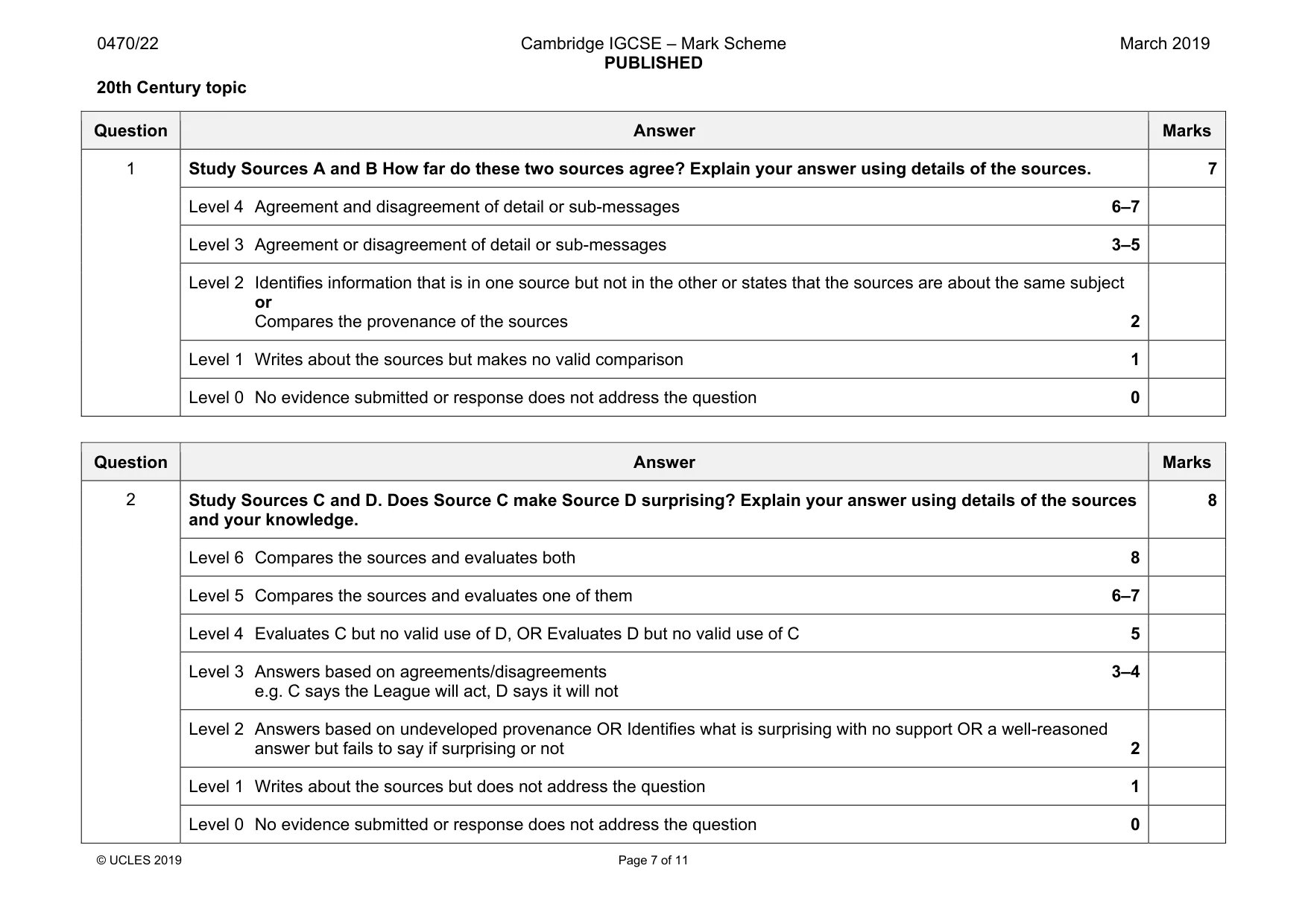
0470/22 Cambridge IGCSE – Mark Scheme PUBLISHED March 2019 © UCLES 2019 Page 7 of 11 20th Century topic Question Answer Marks 1 Study Sources A and B How far do these two sources agree? Explain your answer using details of the sources. 7 Level 4 Agreement and disagreement of detail or sub-messages 6–7 Level 3 Agreement or disagreement of detail or sub-messages 3–5 Level 2 Identifies information that is in one source but not in the other or states that the sources are about the same subject or Compares the provenance of the sources 2 Level 1 Writes about the sources but makes no valid comparison 1 Level 0 No evidence submitted or response does not address the question 0 Question Answer Marks 2 Study Sources C and D. Does Source C make Source D surprising? Explain your answer using details of the sources and your knowledge. 8 Level 6 Compares the sources and evaluates both 8 Level 5 Compares the sources and evaluates one of them 6–7 Level 4 Evaluates C but no valid use of D, OR Evaluates D but no valid use of C 5 Level 3 Answers based on agreements/disagreements 3–4 e.g. C says the League will act, D says it will not Level 2 Answers based on undeveloped provenance OR Identifies what is surprising with no support OR a well-reasoned answer but fails to say if surprising or not 2 Level 1 Writes about the sources but does not address the question 1 Level 0 No evidence submitted or response does not address the question 0
Mark scheme, page 8
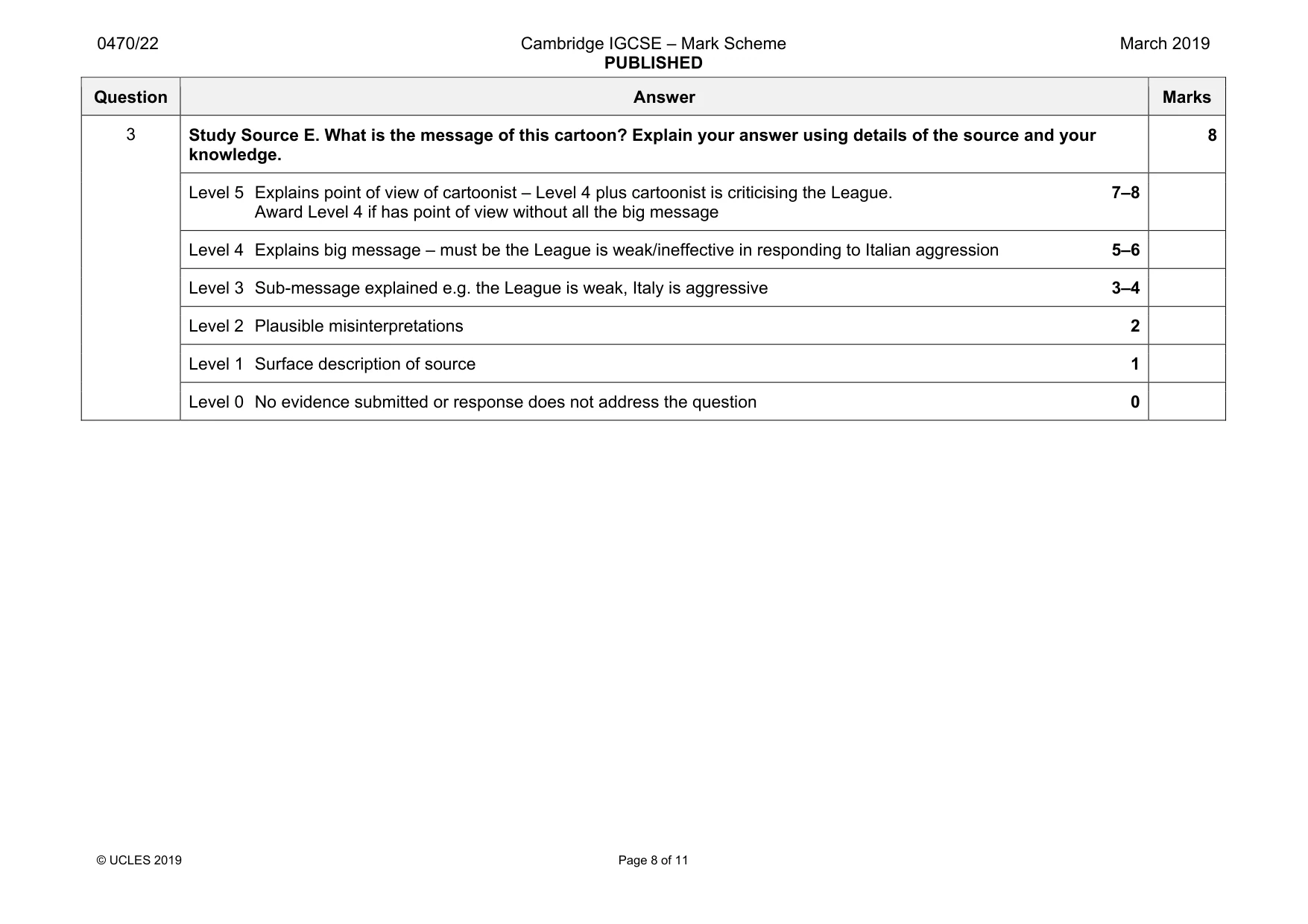
0470/22 Cambridge IGCSE – Mark Scheme PUBLISHED March 2019 © UCLES 2019 Page 8 of 11 Question Answer Marks 3 Study Source E. What is the message of this cartoon? Explain your answer using details of the source and your knowledge. 8 Level 5 Explains point of view of cartoonist – Level 4 plus cartoonist is criticising the League. 7–8 Award Level 4 if has point of view without all the big message Level 4 Explains big message – must be the League is weak/ineffective in responding to Italian aggression 5–6 Level 3 Sub-message explained e.g. the League is weak, Italy is aggressive 3–4 Level 2 Plausible misinterpretations 2 Level 1 Surface description of source 1 Level 0 No evidence submitted or response does not address the question 0
Mark scheme, page 9
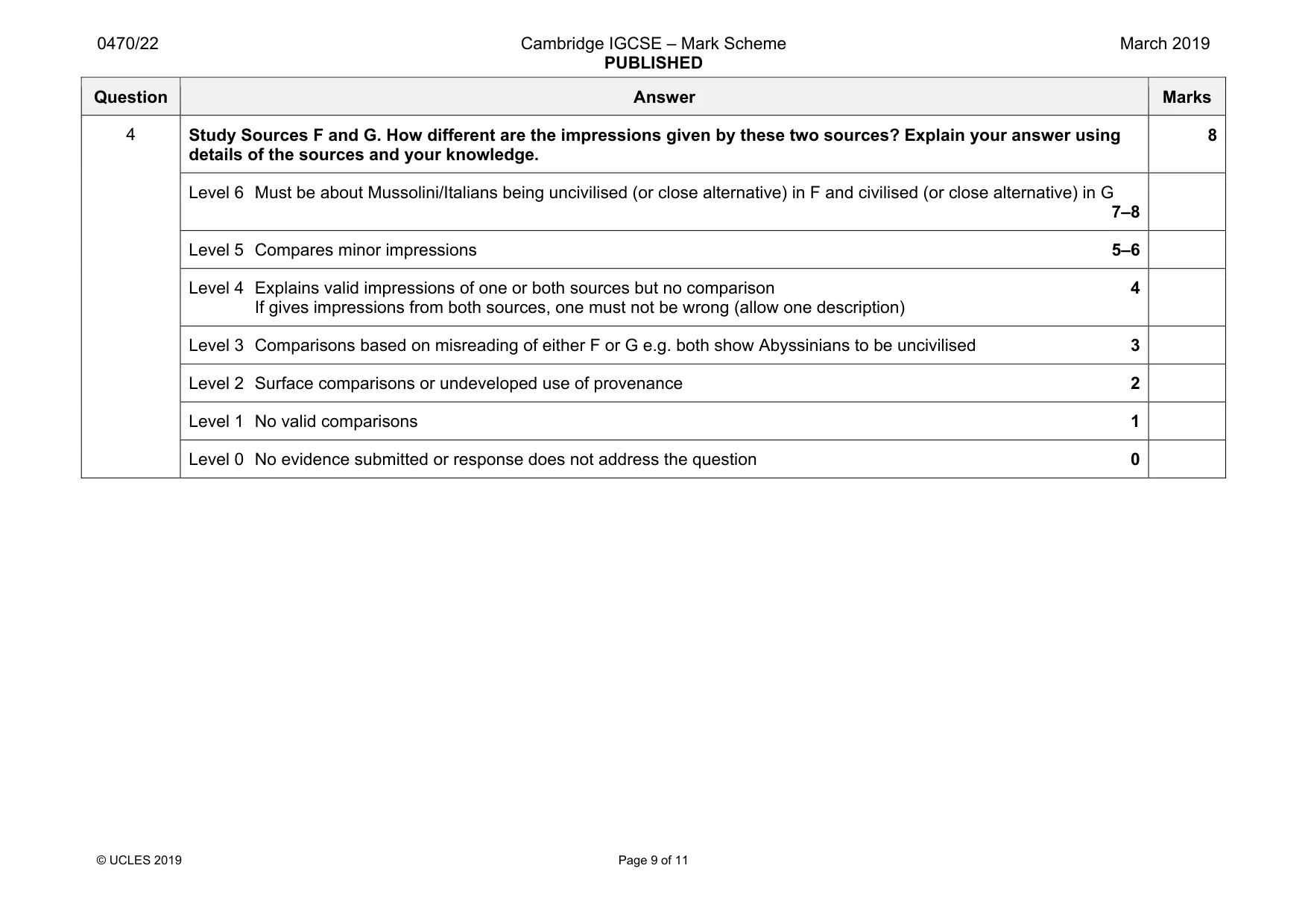
0470/22 Cambridge IGCSE – Mark Scheme PUBLISHED March 2019 © UCLES 2019 Page 9 of 11 Question Answer Marks 4 Study Sources F and G. How different are the impressions given by these two sources? Explain your answer using details of the sources and your knowledge. 8 Level 6 Must be about Mussolini/Italians being uncivilised (or close alternative) in F and civilised (or close alternative) in G 7–8 Level 5 Compares minor impressions 5–6 Level 4 Explains valid impressions of one or both sources but no comparison 4 If gives impressions from both sources, one must not be wrong (allow one description) Level 3 Comparisons based on misreading of either F or G e.g. both show Abyssinians to be uncivilised 3 Level 2 Surface comparisons or undeveloped use of provenance 2 Level 1 No valid comparisons 1 Level 0 No evidence submitted or response does not address the question 0
Mark scheme, page 10
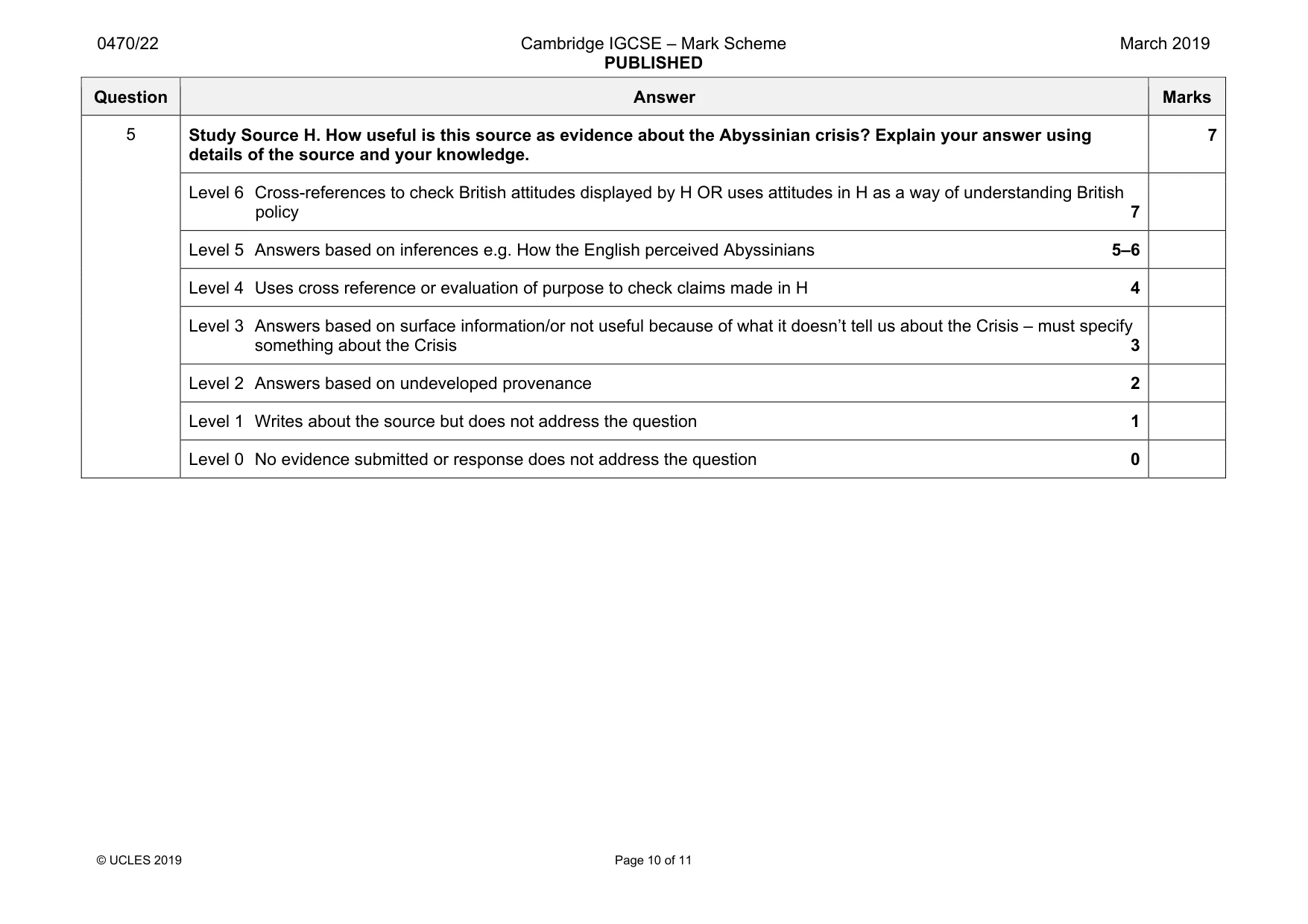
0470/22 Cambridge IGCSE – Mark Scheme PUBLISHED March 2019 © UCLES 2019 Page 10 of 11 Question Answer Marks 5 Study Source H. How useful is this source as evidence about the Abyssinian crisis? Explain your answer using details of the source and your knowledge. 7 Level 6 Cross-references to check British attitudes displayed by H OR uses attitudes in H as a way of understanding British policy 7 Level 5 Answers based on inferences e.g. How the English perceived Abyssinians 5–6 Level 4 Uses cross reference or evaluation of purpose to check claims made in H 4 Level 3 Answers based on surface information/or not useful because of what it doesn’t tell us about the Crisis – must specify something about the Crisis 3 Level 2 Answers based on undeveloped provenance 2 Level 1 Writes about the source but does not address the question 1 Level 0 No evidence submitted or response does not address the question 0
Mark scheme, page 11
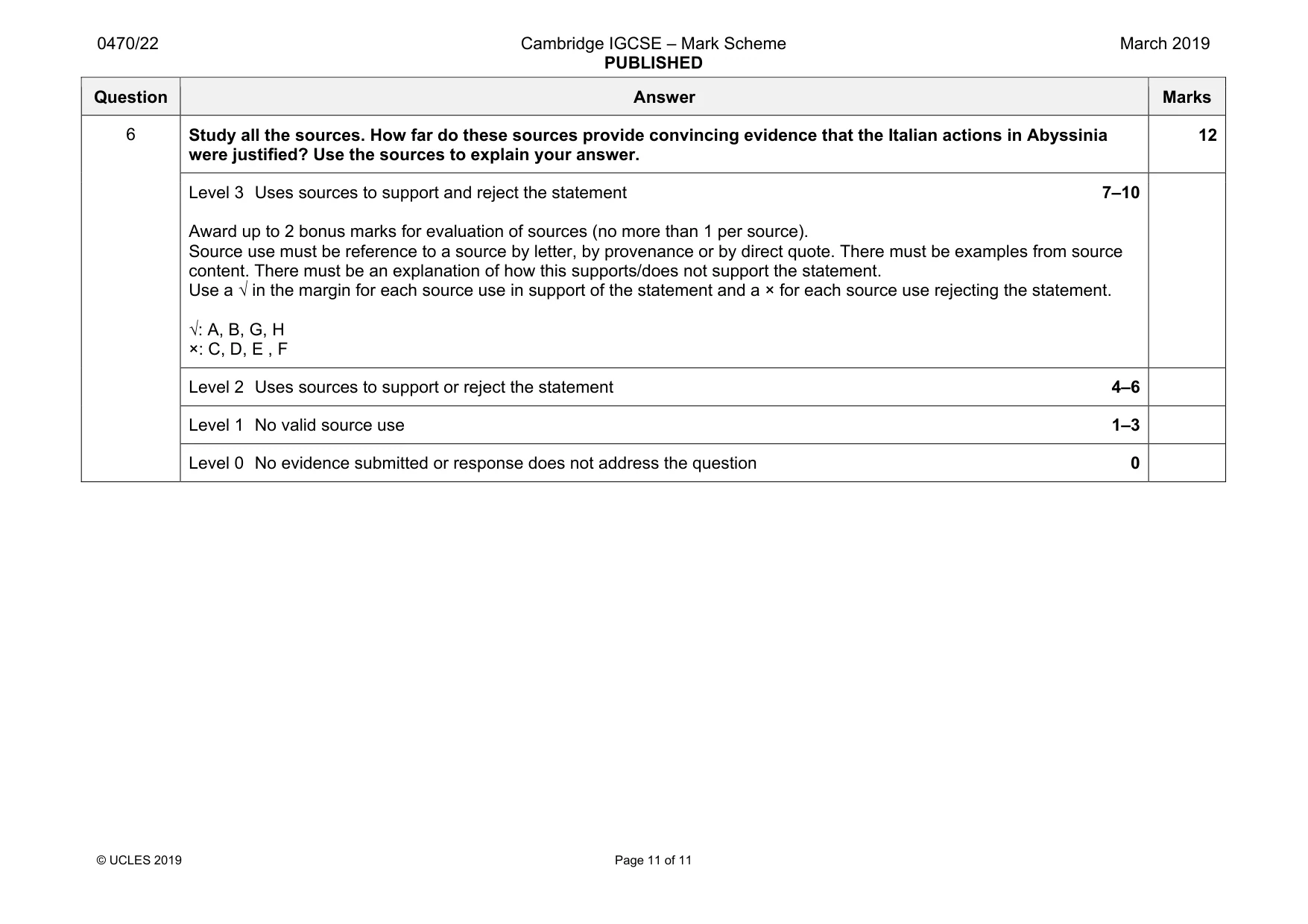
0470/22 Cambridge IGCSE – Mark Scheme PUBLISHED March 2019 © UCLES 2019 Page 11 of 11 Question Answer Marks 6 Study all the sources. How far do these sources provide convincing evidence that the Italian actions in Abyssinia were justified? Use the sources to explain your answer. 12 Level 3 Uses sources to support and reject the statement 7–10 Award up to 2 bonus marks for evaluation of sources (no more than 1 per source). Source use must be reference to a source by letter, by provenance or by direct quote. There must be examples from source content. There must be an explanation of how this supports/does not support the statement. Use a √ in the margin for each source use in support of the statement and a × for each source use rejecting the statement. √: A, B, G, H ×: C, D, E , F Level 2 Uses sources to support or reject the statement 4–6 Level 1 No valid source use 1–3 Level 0 No evidence submitted or response does not address the question 0
What you needed in this session
Cambridge’s own grade thresholds for 2019 Feb/March, Paper 2 · Variant 2. A higher threshold means an easier paper — the bar moves with how the cohort did.