Cambridge IGCSE History 0470 — 2017 Oct/Nov Paper 1 · Variant 3
0470/13/O/N/17 · 60 marks · ≈68 min
The question paper and its mark scheme, free to read here and free to download. This is Cambridge’s own paper, exactly as it was sat.
Question paper12 pages


Mark scheme90 pages
Answers below. Sit the paper first if you are practising.
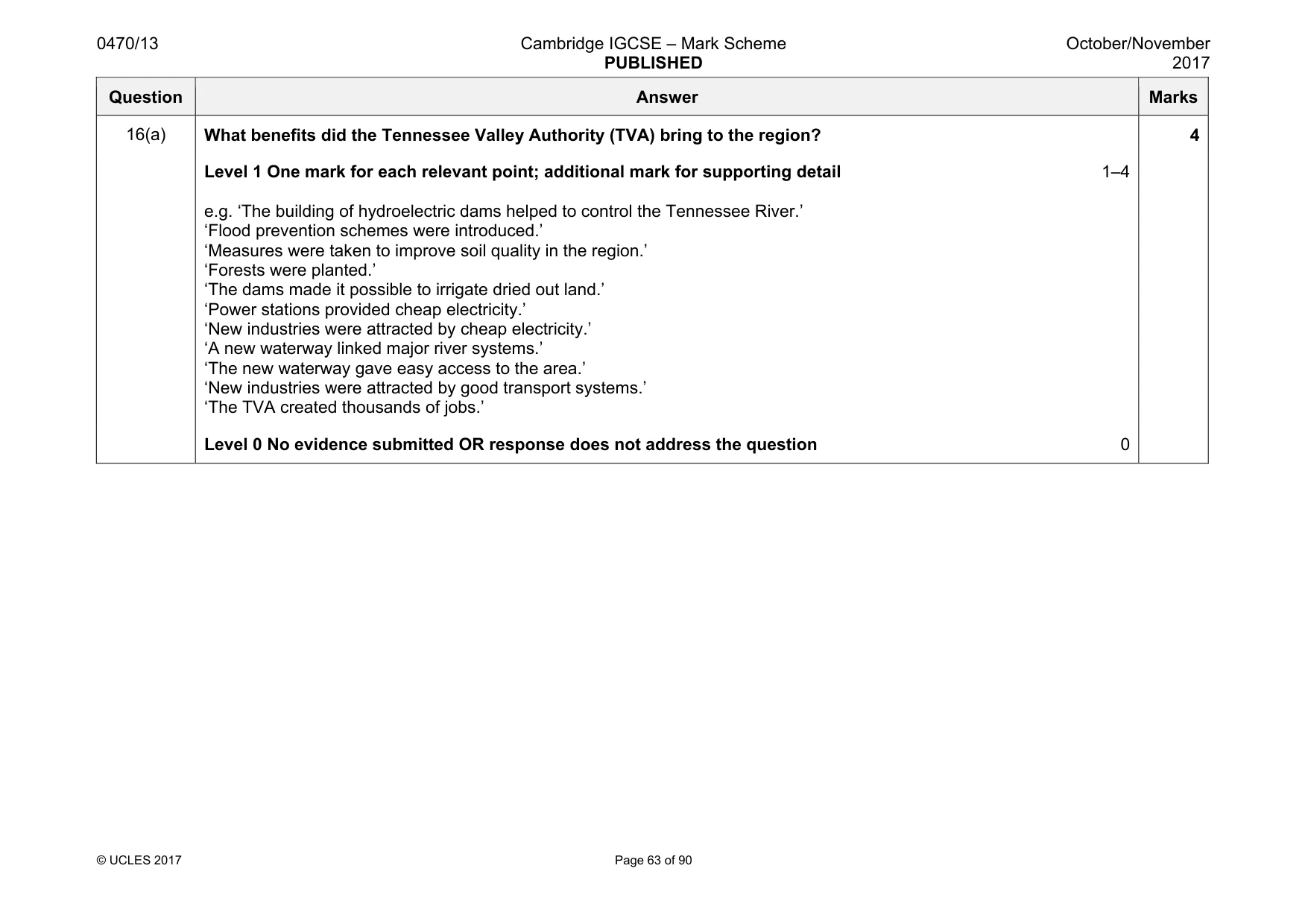
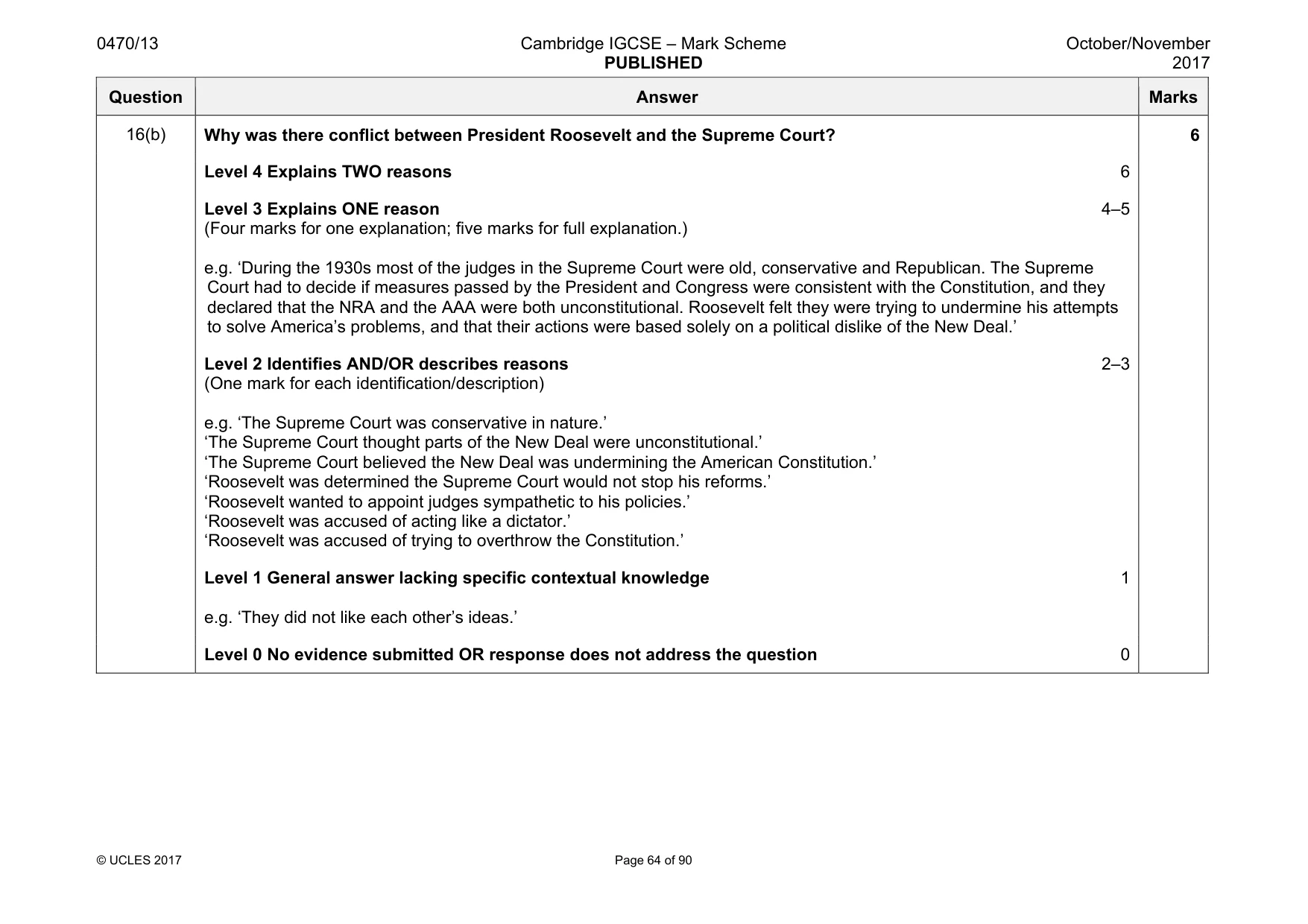
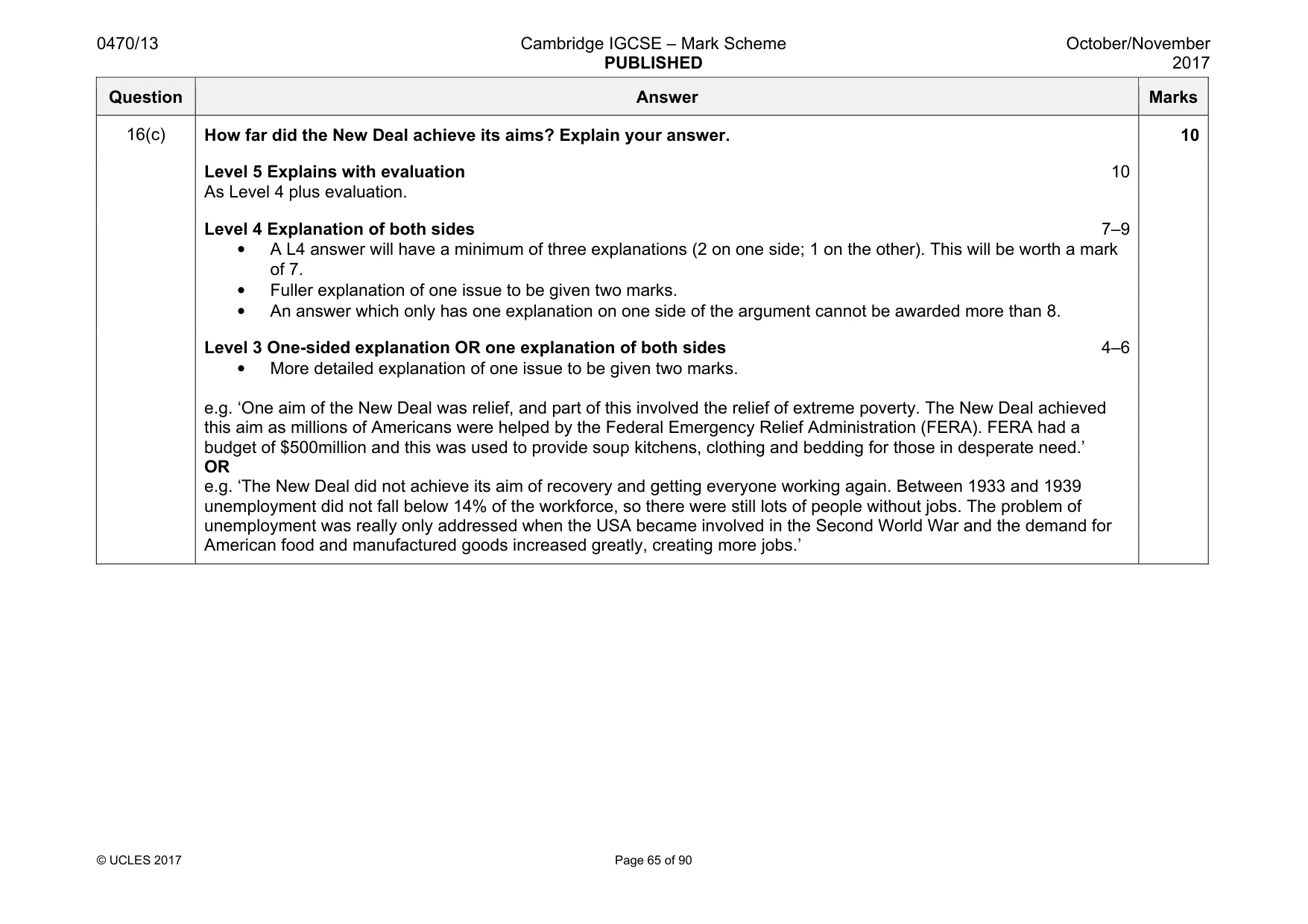
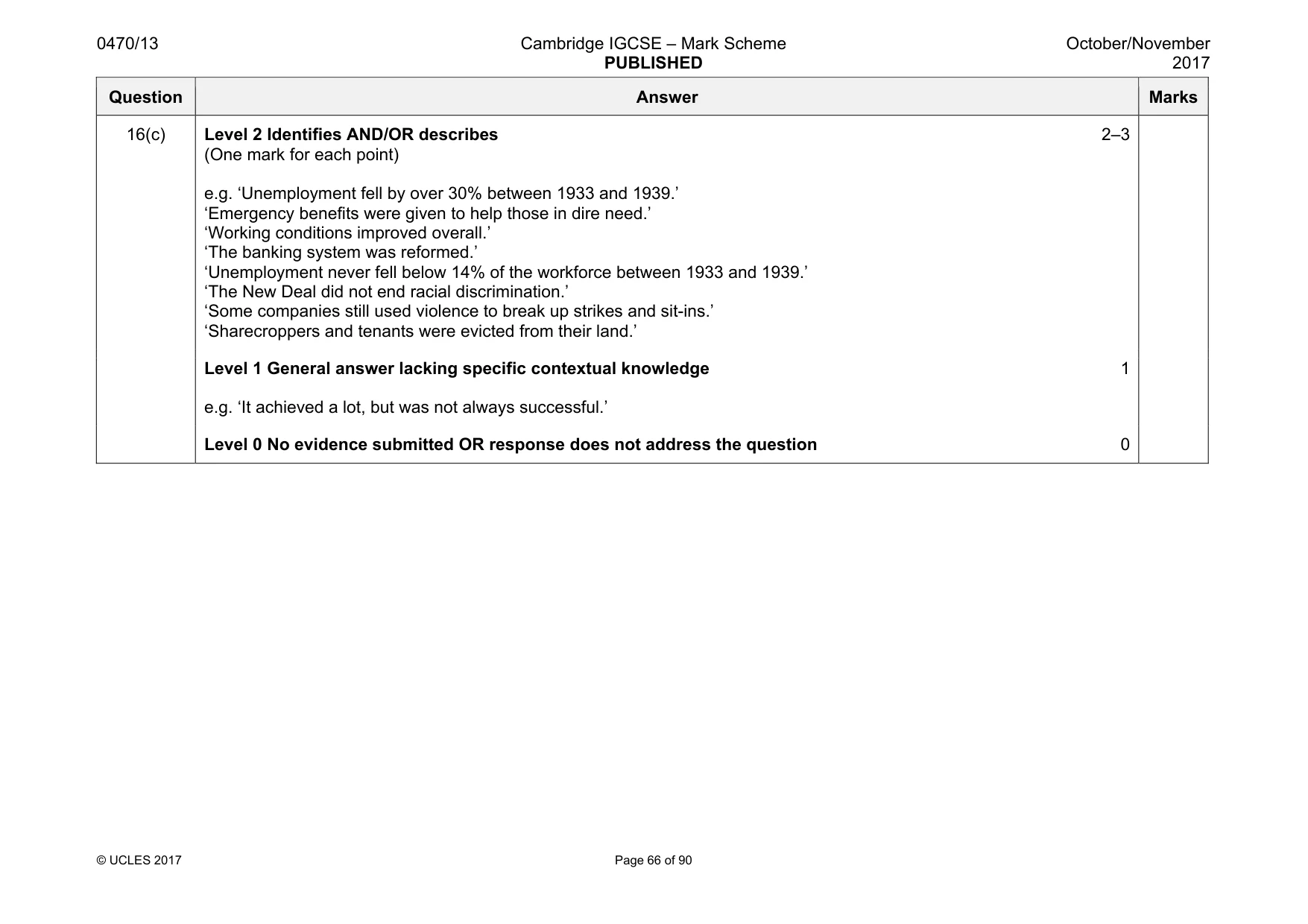
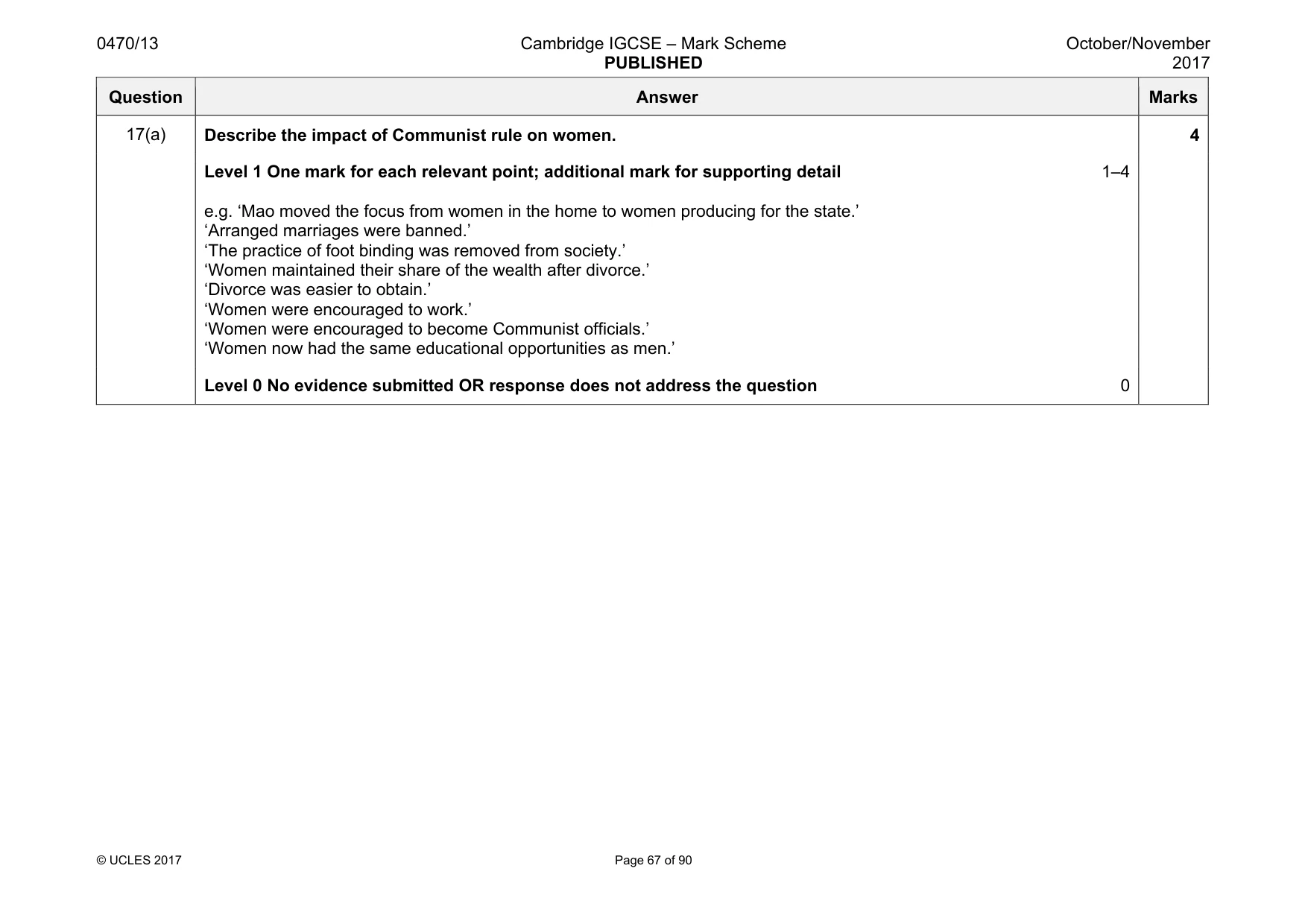
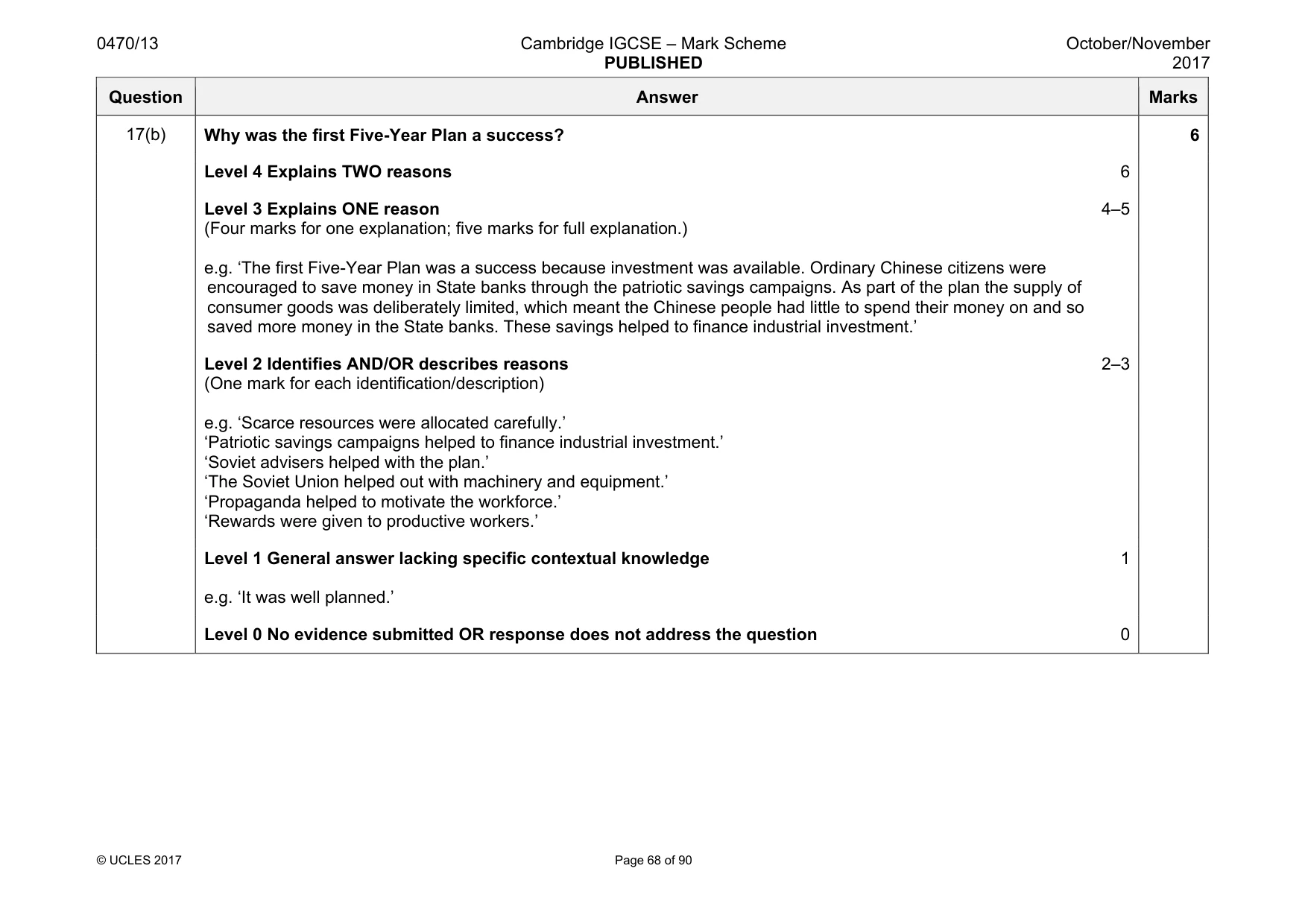
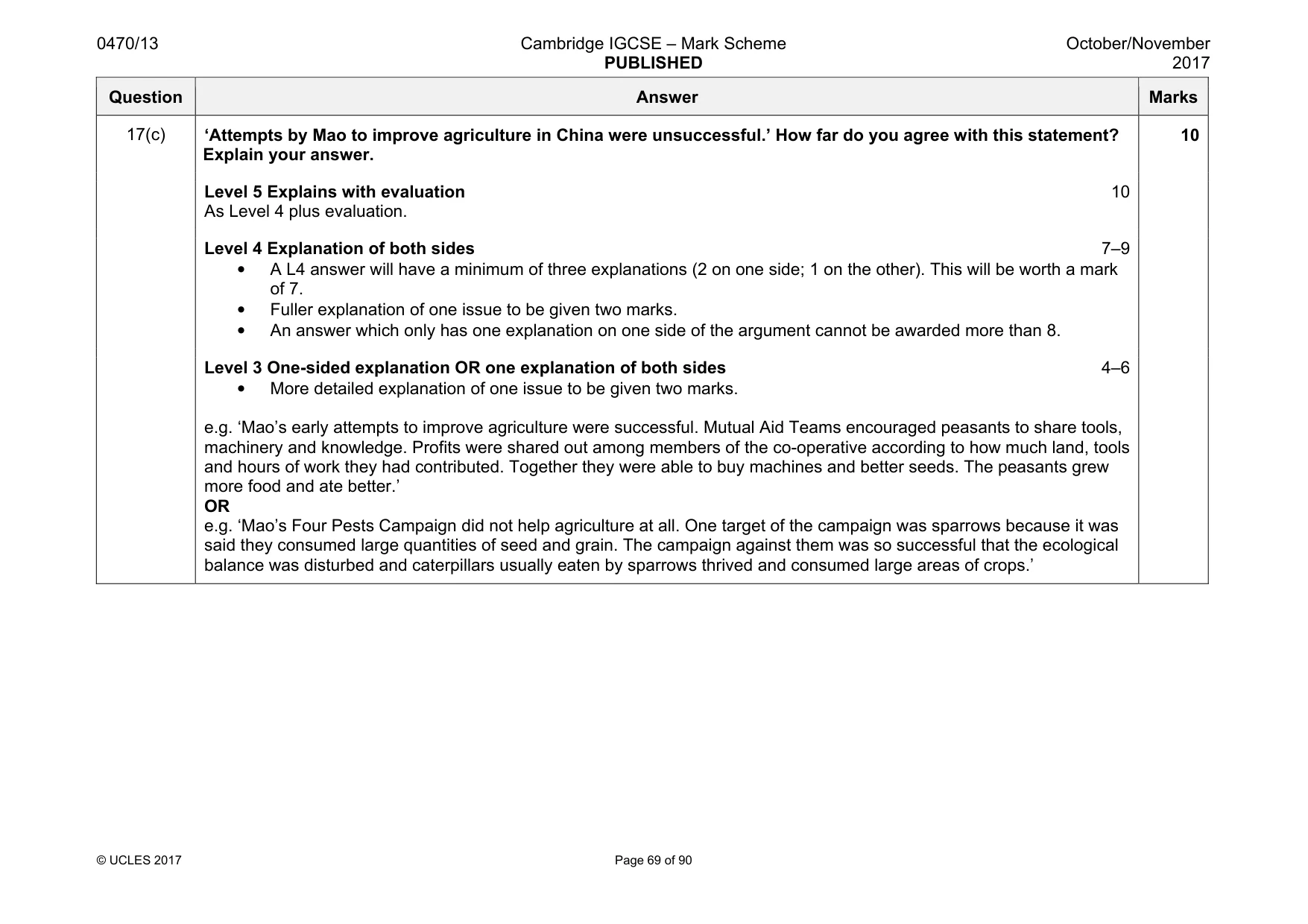
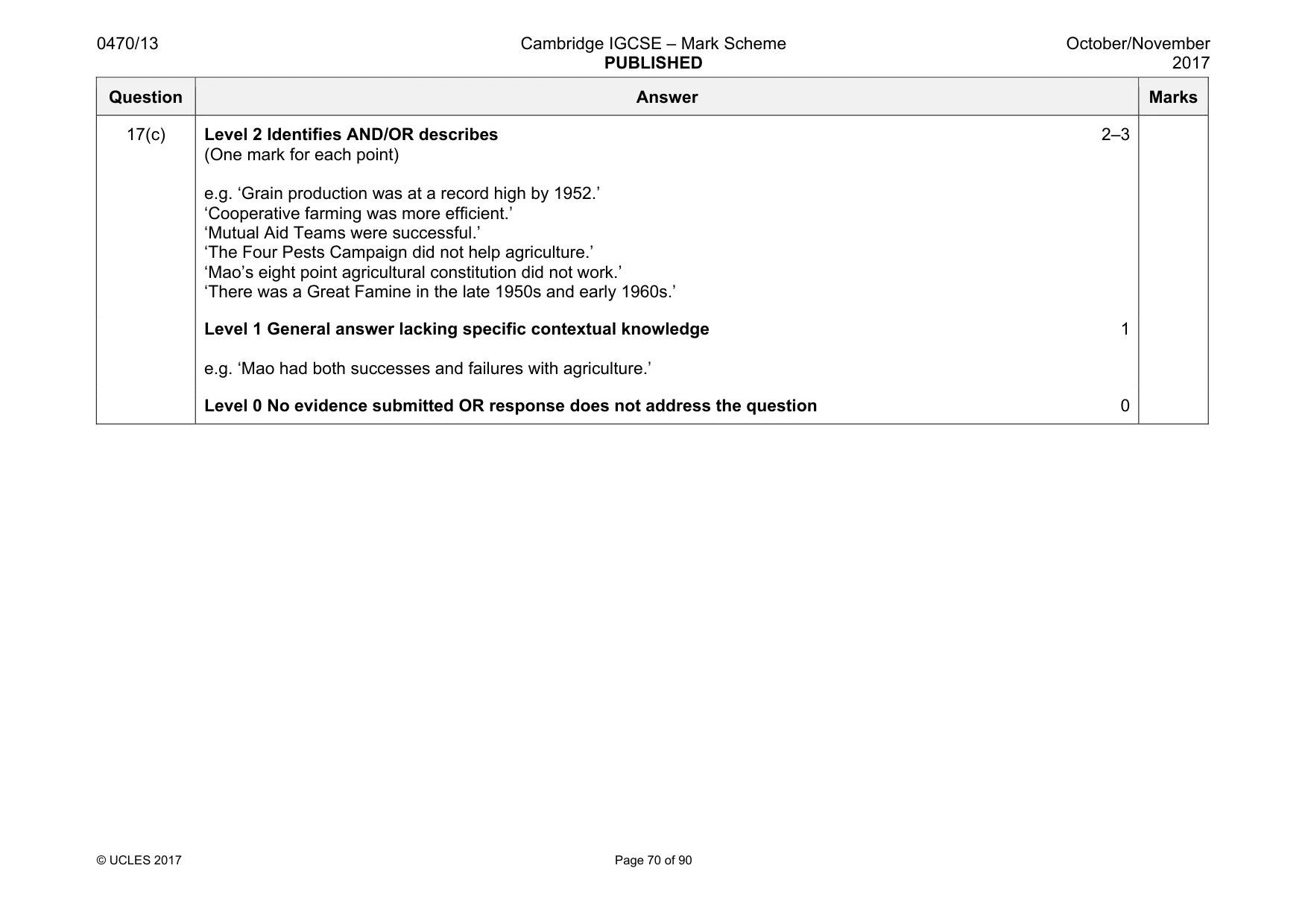
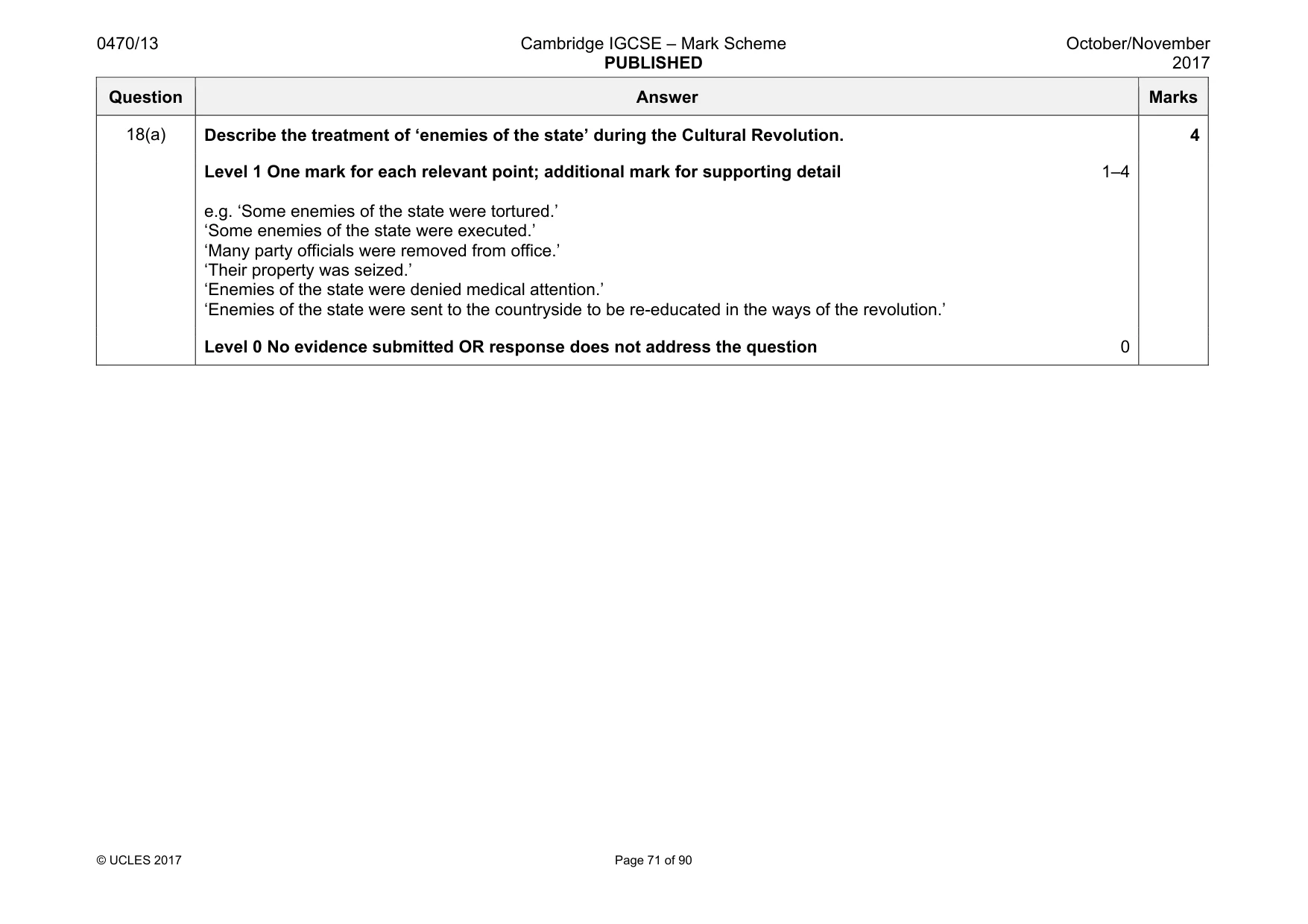
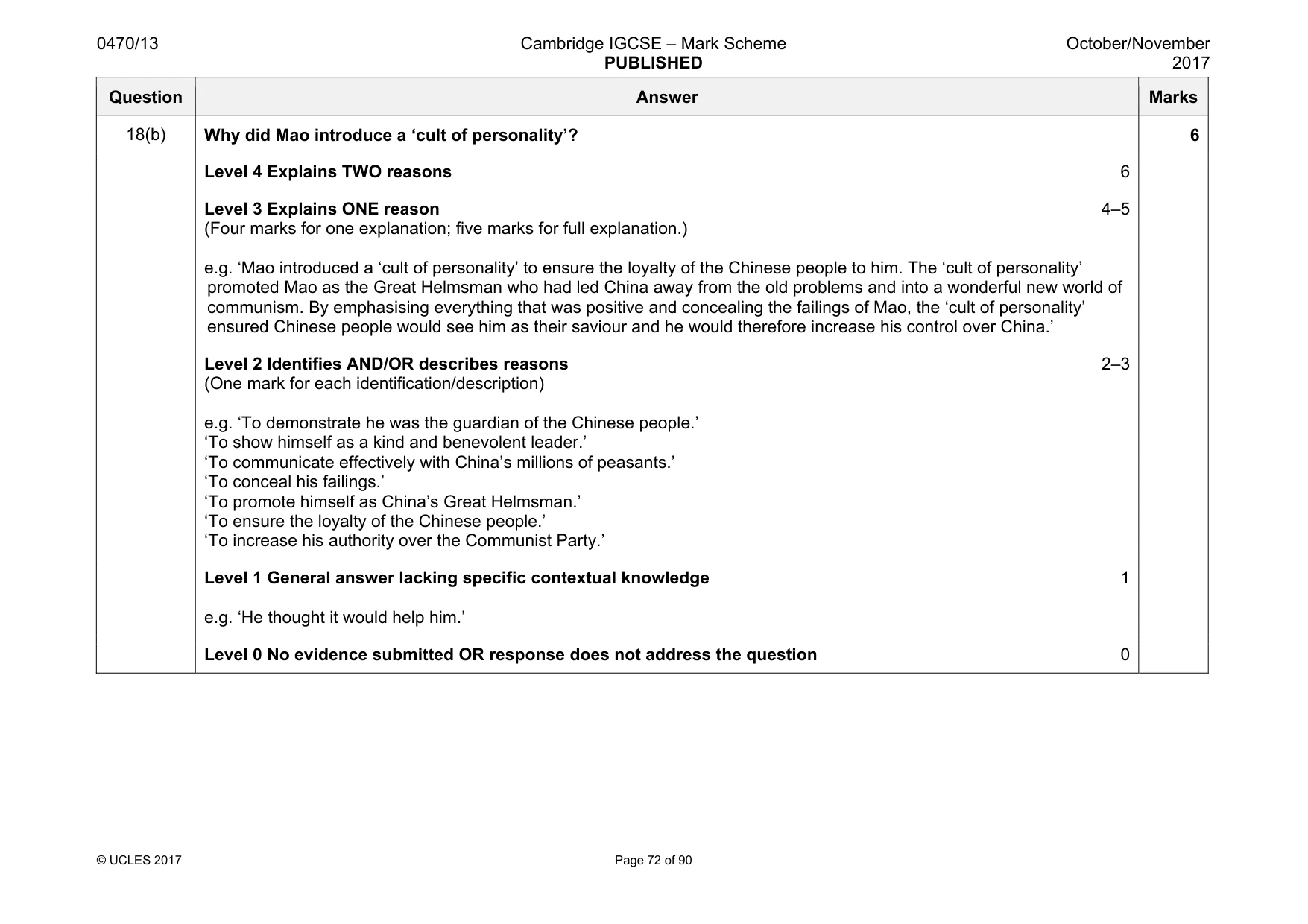
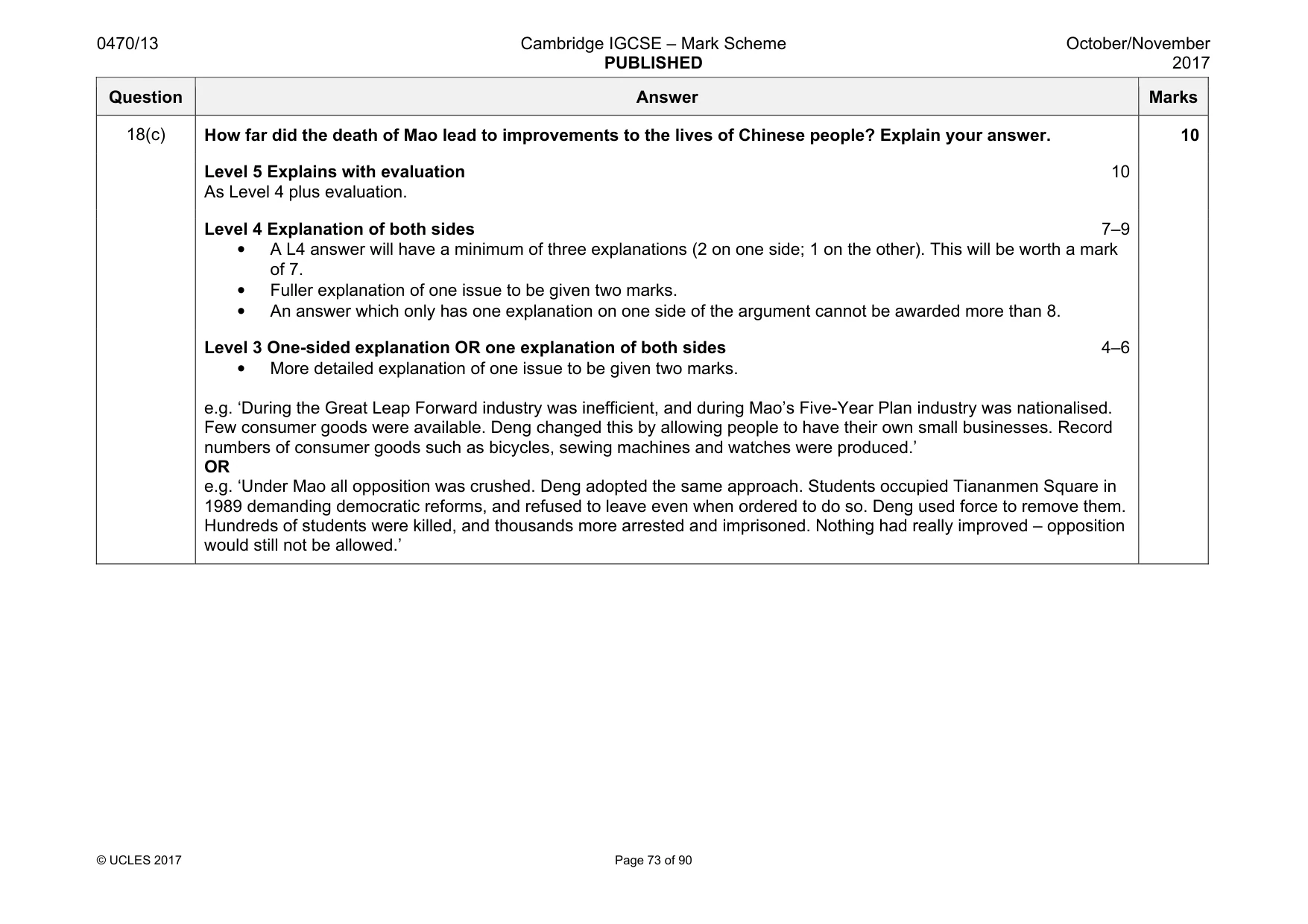
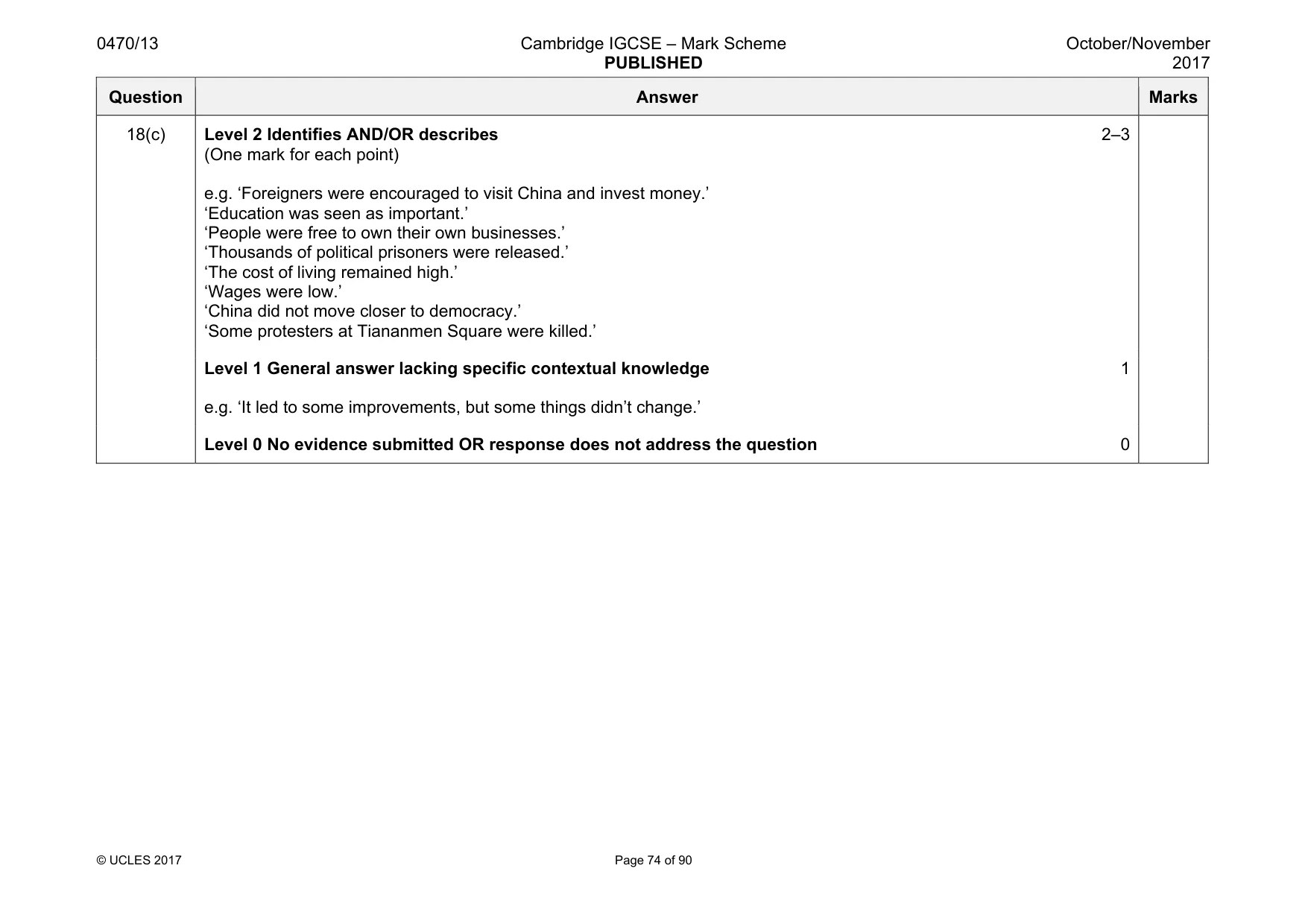
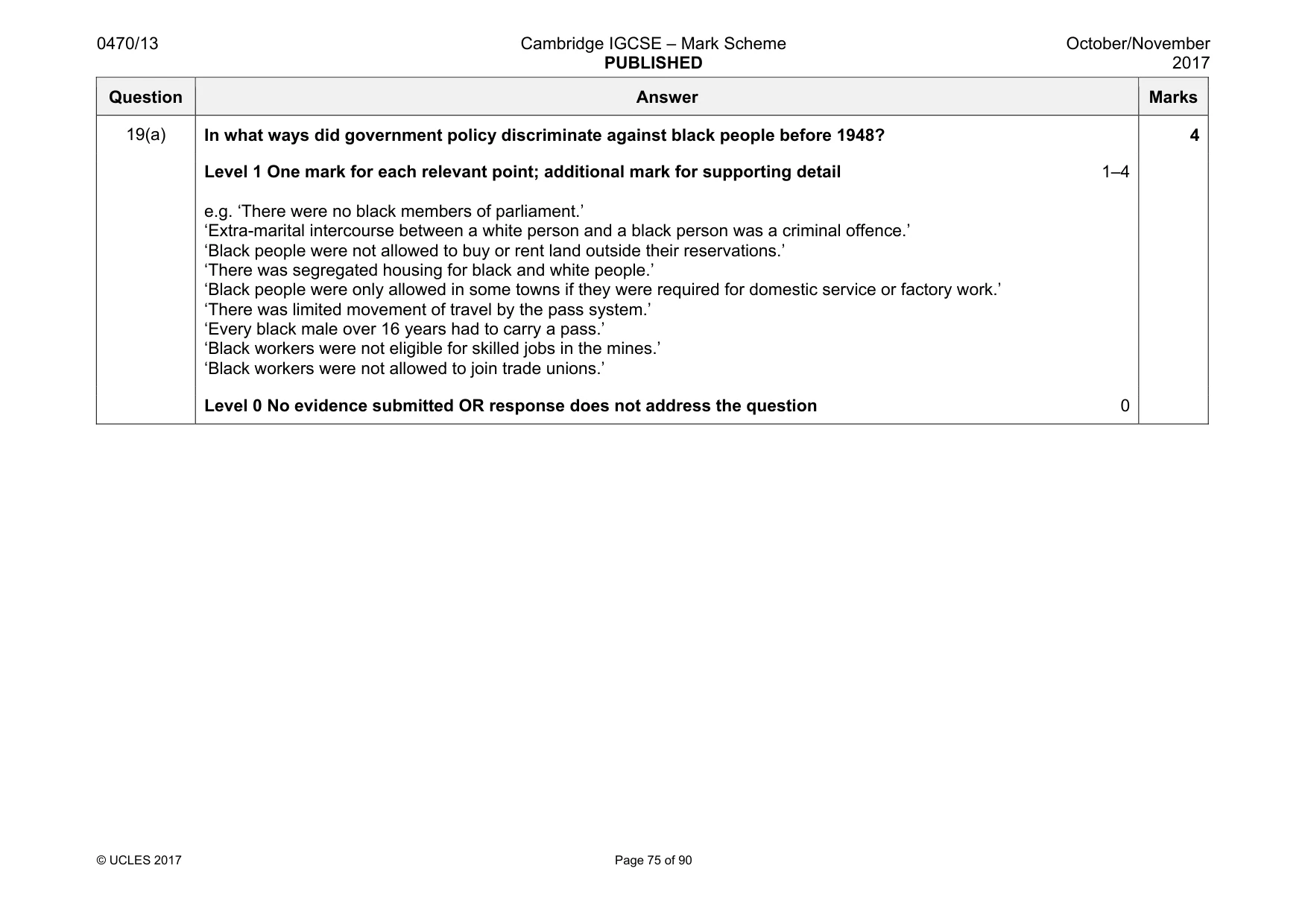
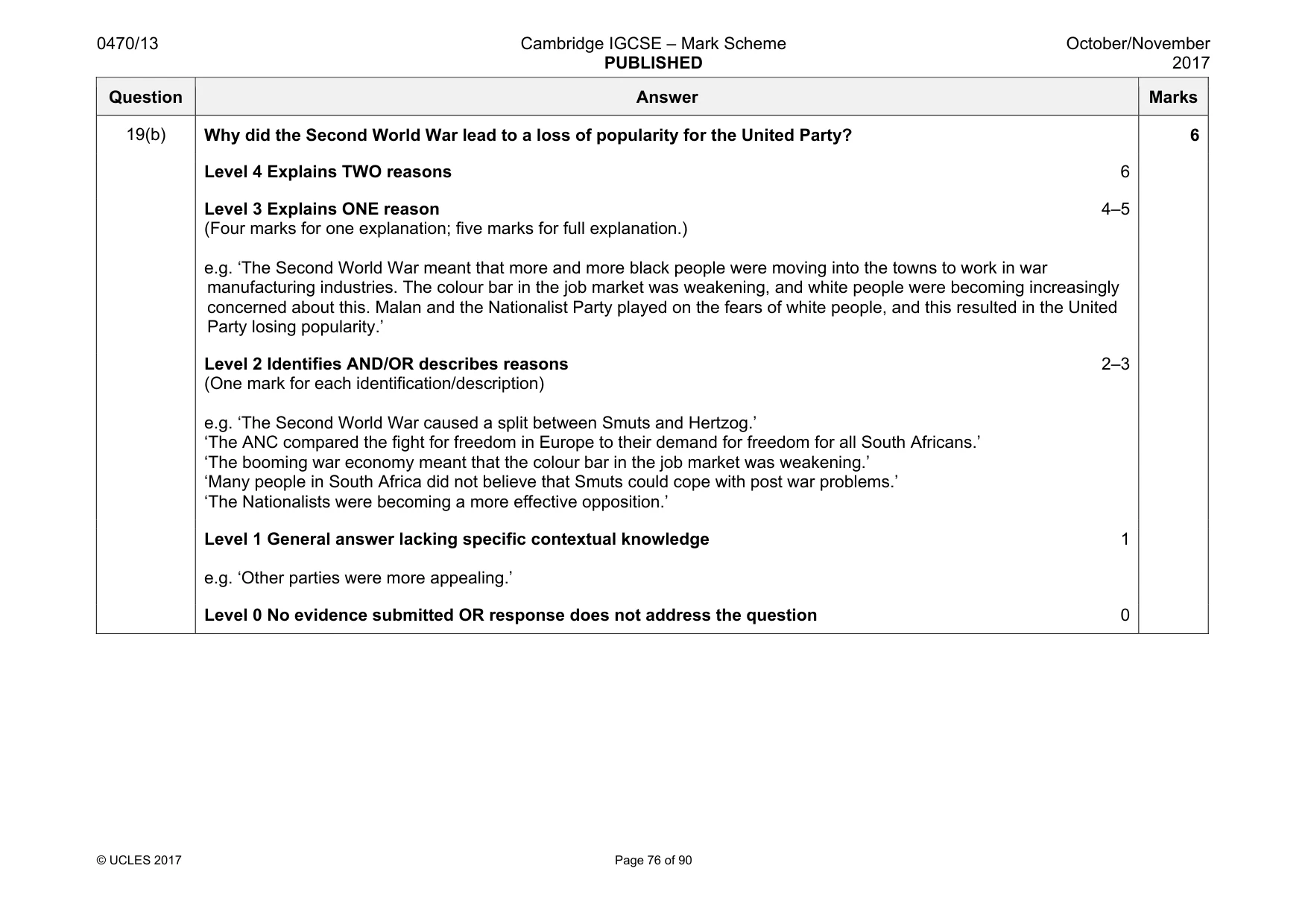
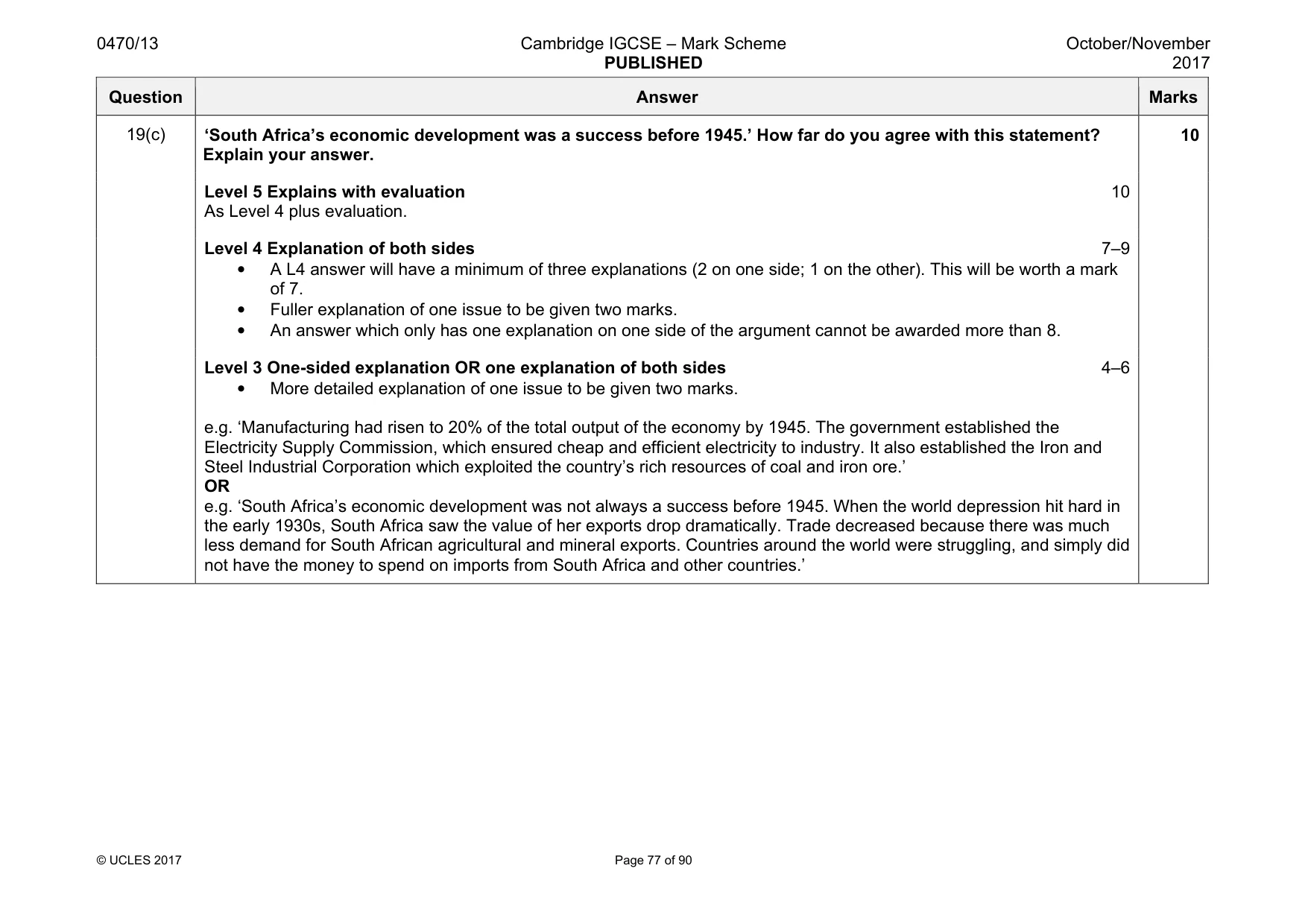
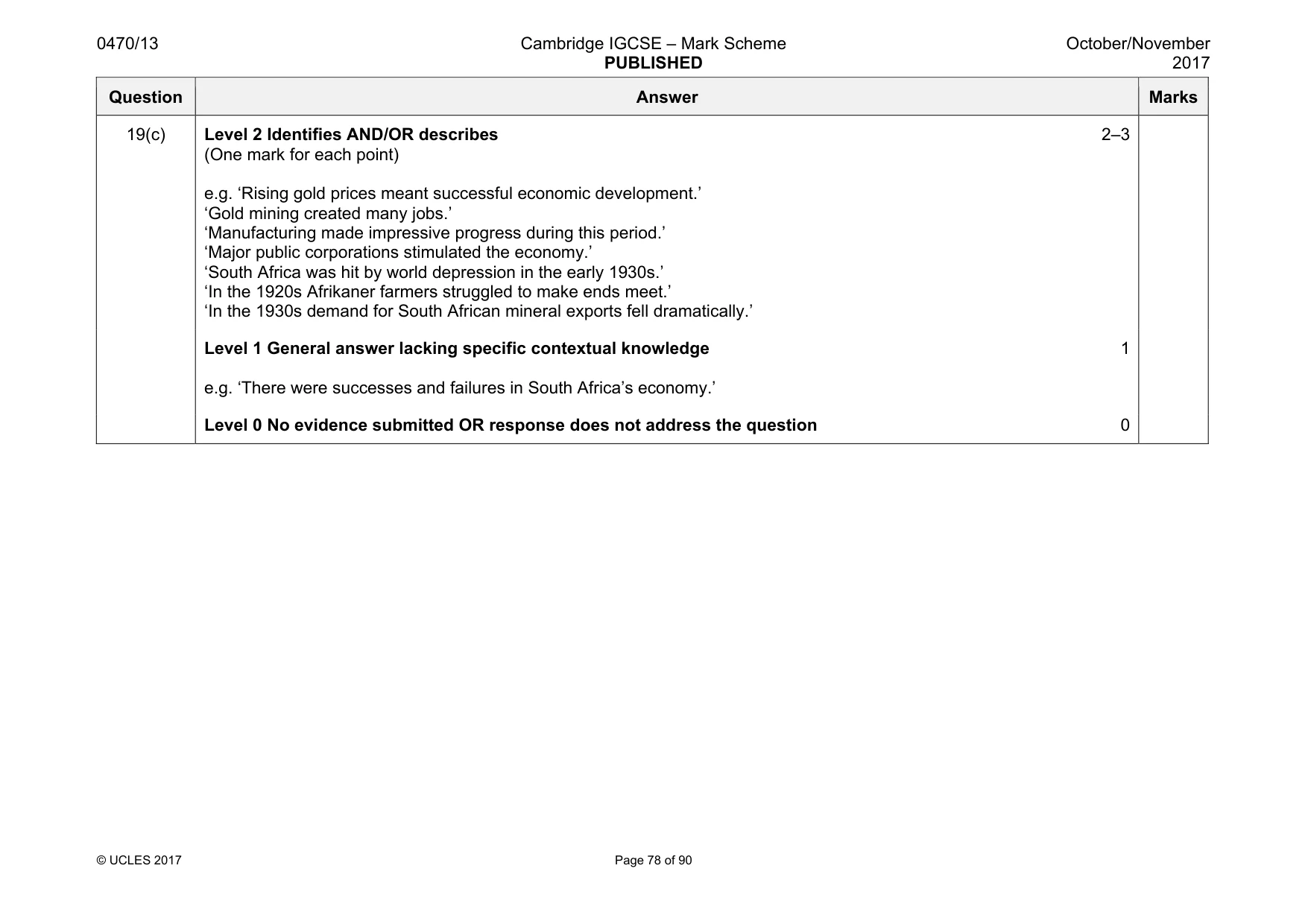
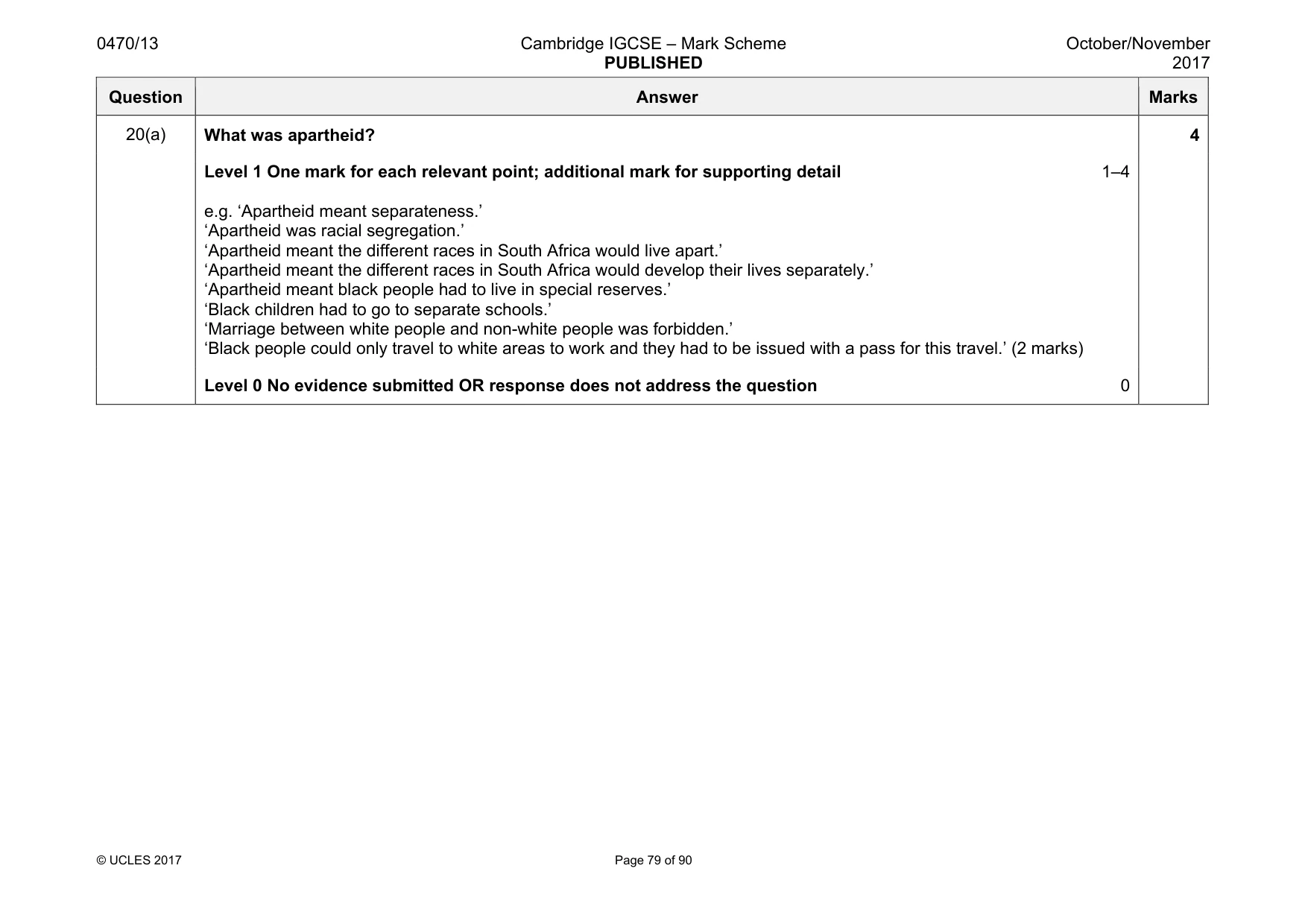
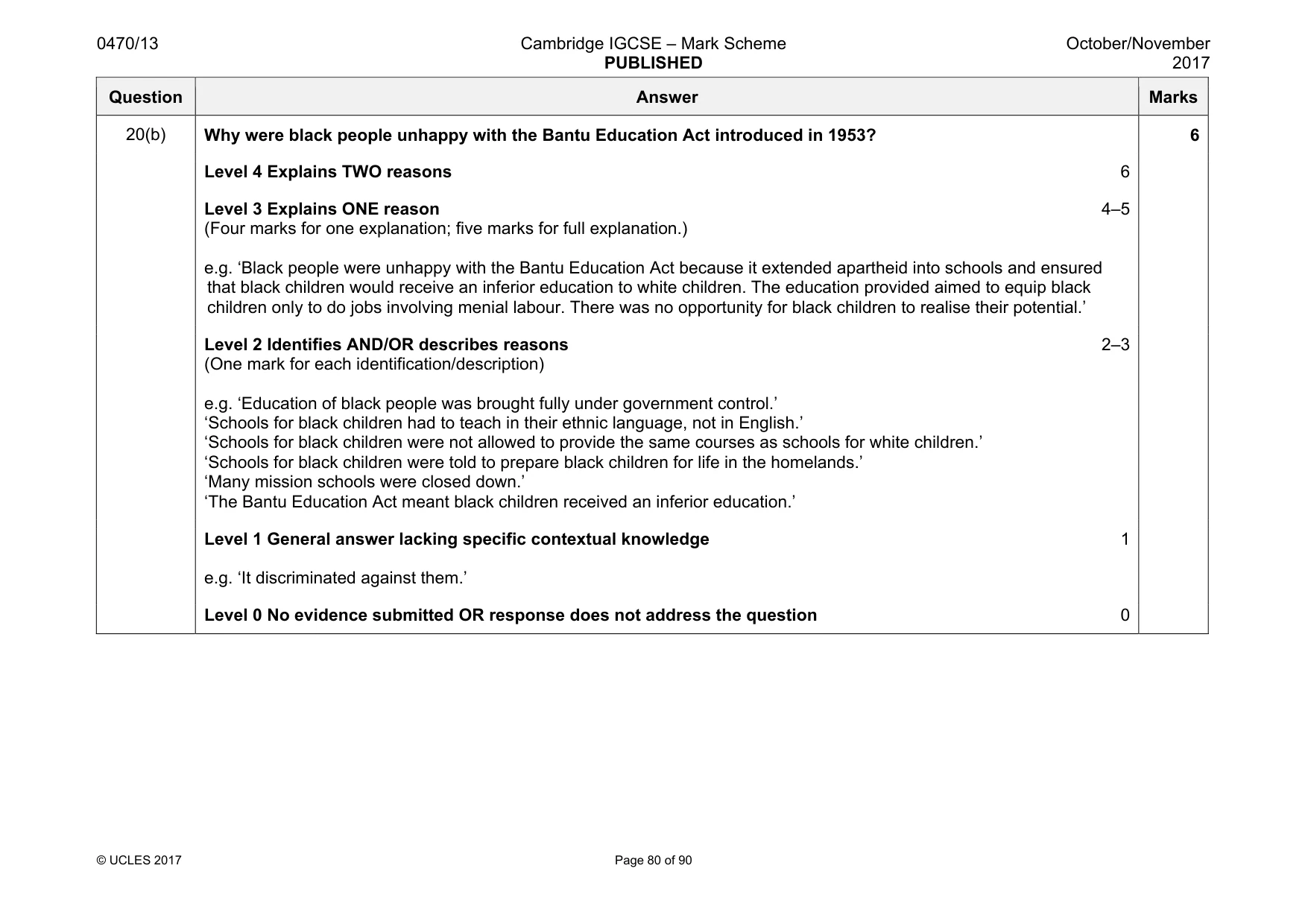
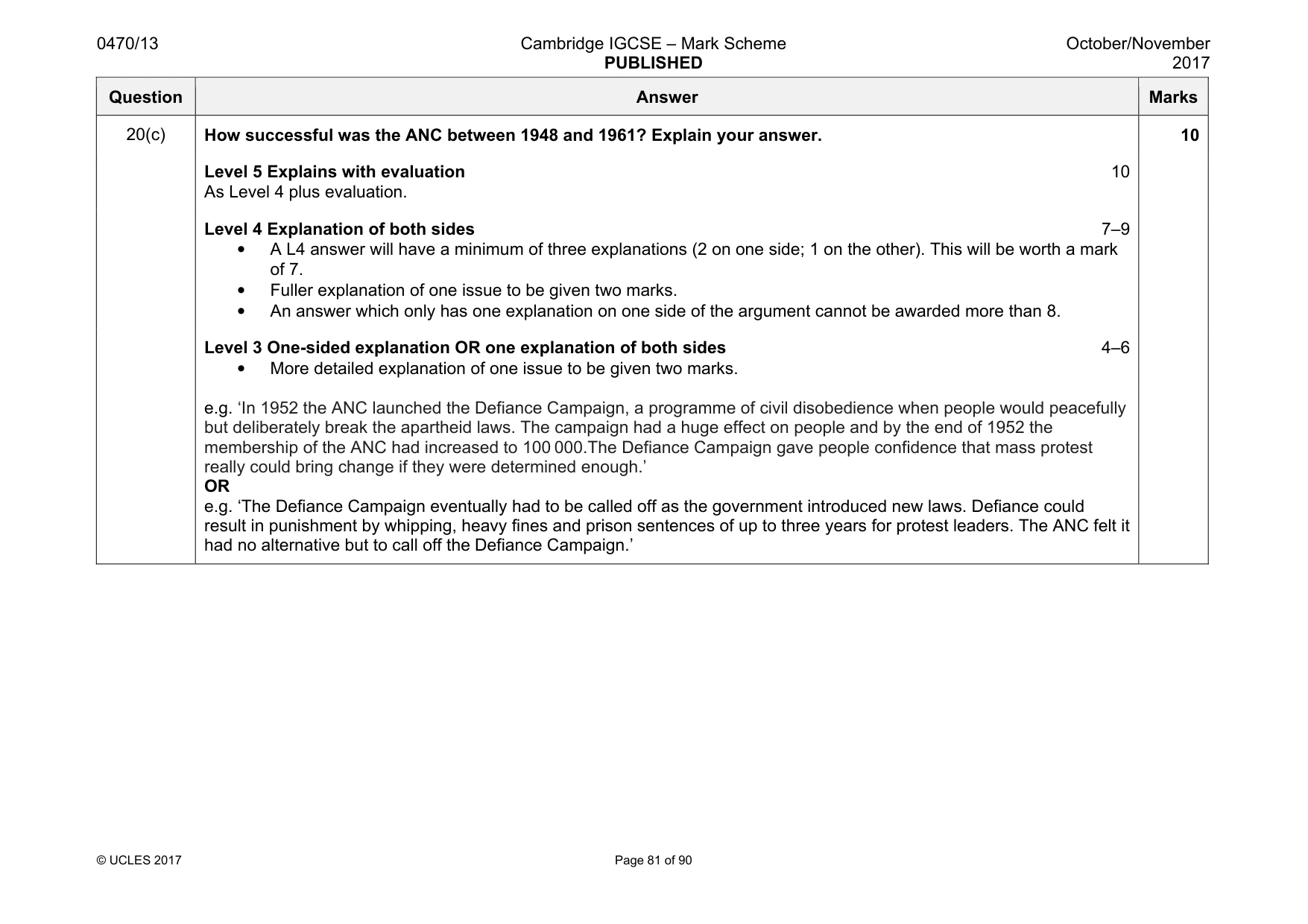
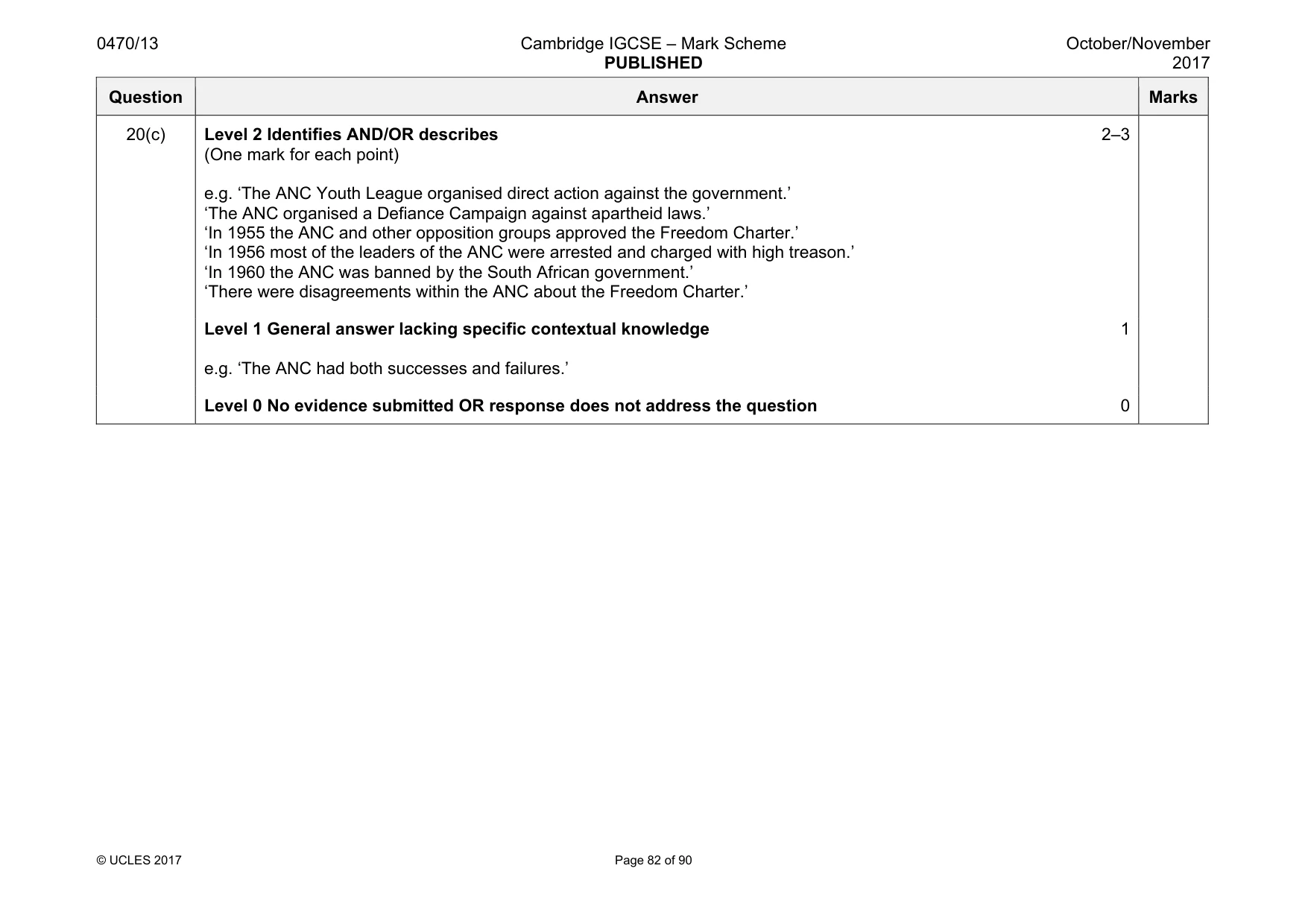
Paper as text
Question paper, page 1
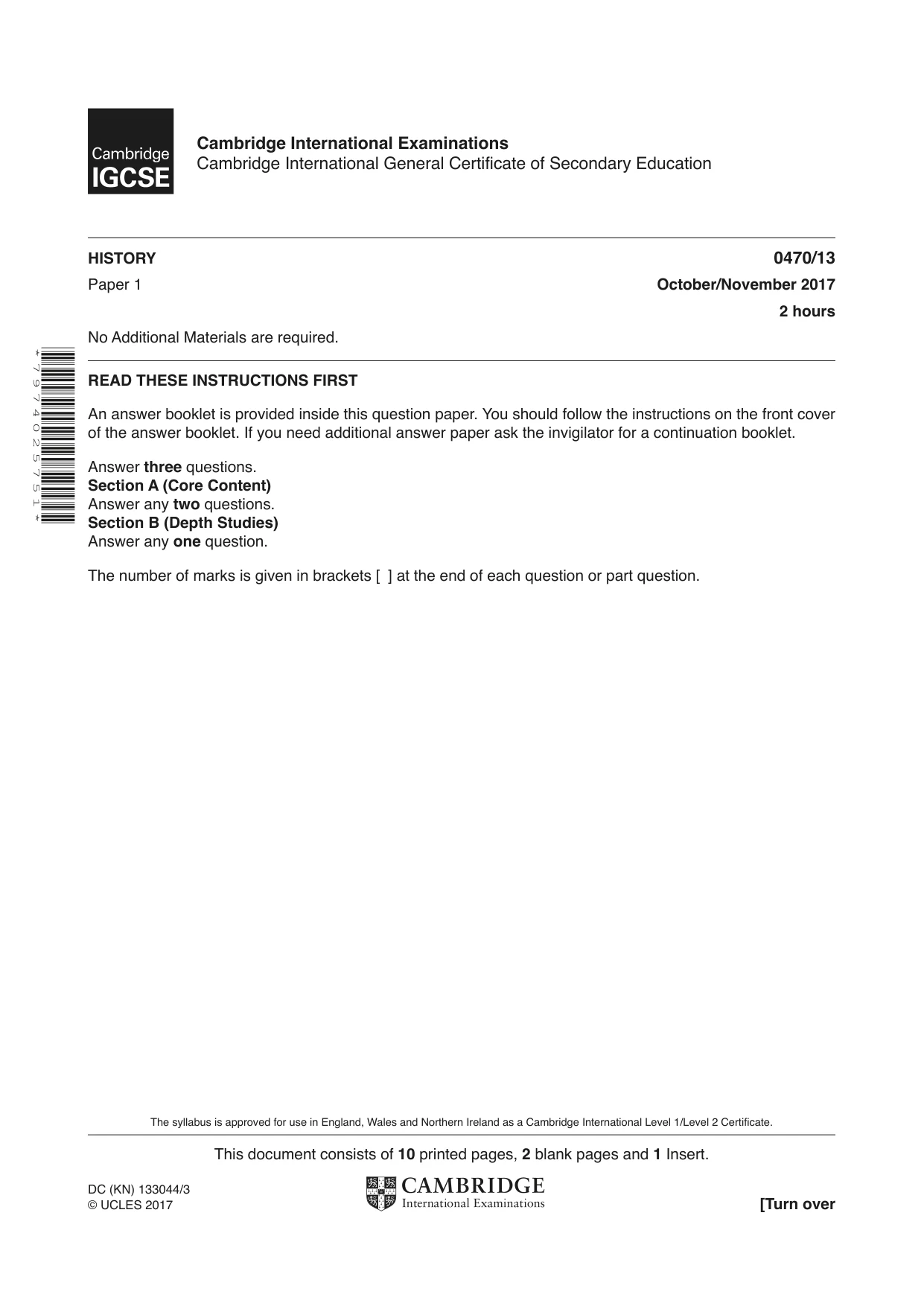
This document consists of 10 printed pages, 2 blank pages and 1 Insert. DC (KN) 133044/3 © UCLES 2017 [Turn over Cambridge International Examinations Cambridge International General Certificate of Secondary Education * 7 9 7 4 0 2 5 7 5 1 * HISTORY 0470/13 Paper 1 October/November 2017 2 hours No Additional Materials are required. READ THESE INSTRUCTIONS FIRST An answer booklet is provided inside this question paper. You should follow the instructions on the front cover of the answer booklet. If you need additional answer paper ask the invigilator for a continuation booklet. Answer three questions. Section A (Core Content) Answer any two questions. Section B (Depth Studies) Answer any one question. The number of marks is given in brackets [ ] at the end of each question or part question. The syllabus is approved for use in England, Wales and Northern Ireland as a Cambridge International Level 1/Level 2 Certificate.
Question paper, page 2
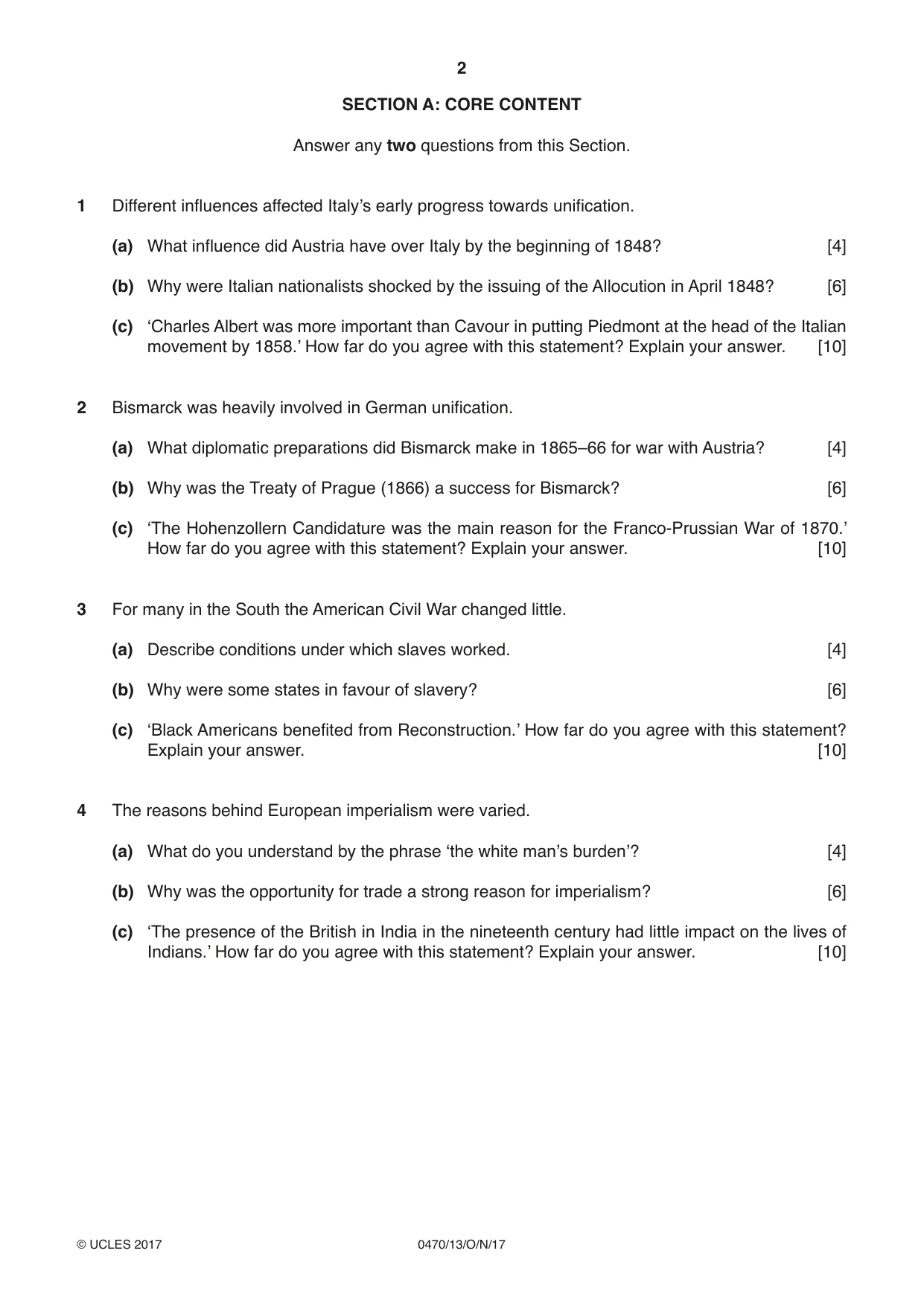
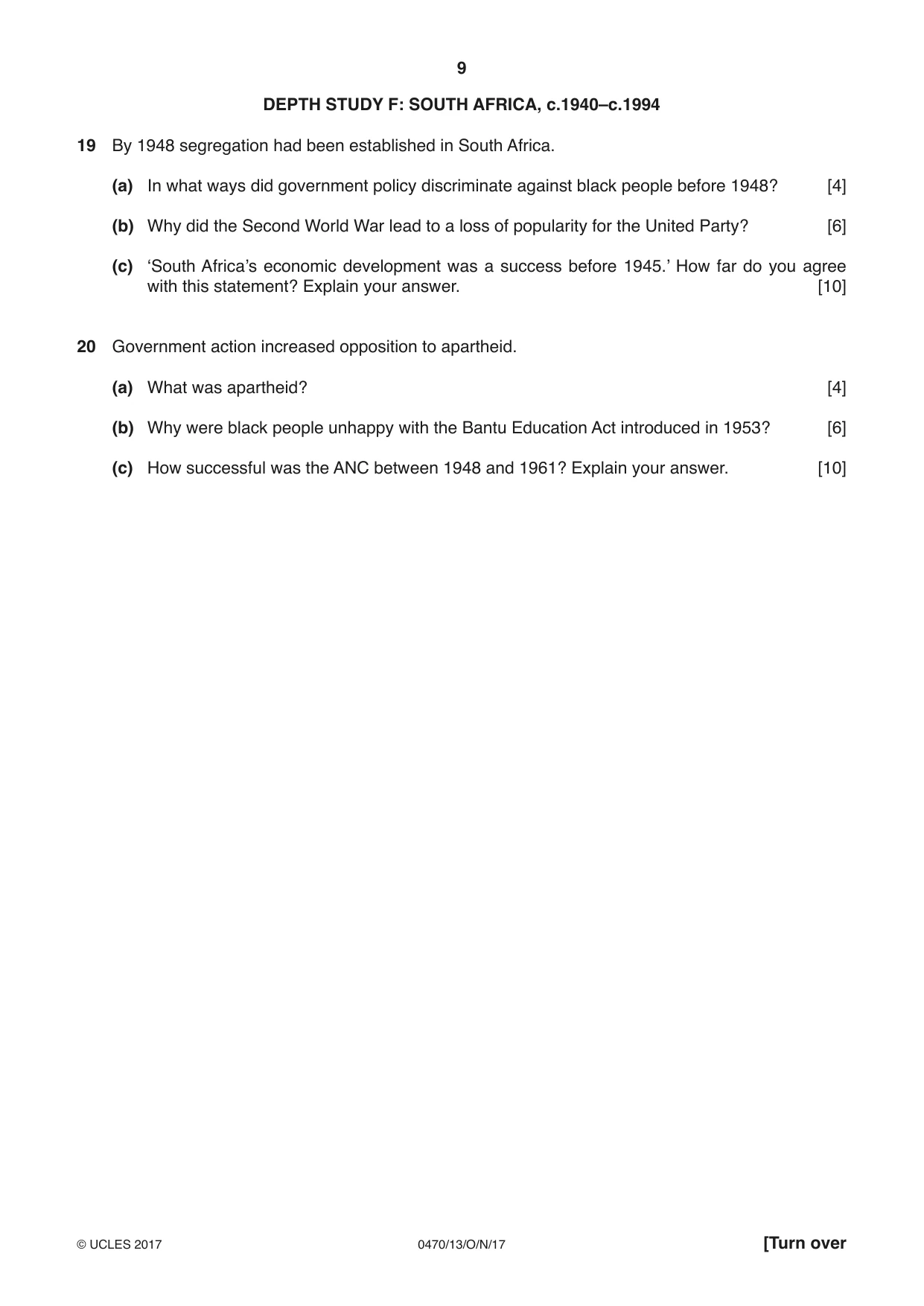
2 0470/13/O/N/17 © UCLES 2017 SECTION A: CORE CONTENT Answer any two questions from this Section. 1 Different influences affected Italy’s early progress towards unification. (a) What influence did Austria have over Italy by the beginning of 1848? [4] (b) Why were Italian nationalists shocked by the issuing of the Allocution in April 1848? [6] (c) ‘Charles Albert was more important than Cavour in putting Piedmont at the head of the Italian movement by 1858.’ How far do you agree with this statement? Explain your answer. [10] 2 Bismarck was heavily involved in German unification. (a) What diplomatic preparations did Bismarck make in 1865–66 for war with Austria? [4] (b) Why was the Treaty of Prague (1866) a success for Bismarck? [6] (c) ‘The Hohenzollern Candidature was the main reason for the Franco-Prussian War of 1870.’ How far do you agree with this statement? Explain your answer. [10] 3 For many in the South the American Civil War changed little. (a) Describe conditions under which slaves worked. [4] (b) Why were some states in favour of slavery? [6] (c) ‘Black Americans benefited from Reconstruction.’ How far do you agree with this statement? Explain your answer. [10] 4 The reasons behind European imperialism were varied. (a) What do you understand by the phrase ‘the white man’s burden’? [4] (b) Why was the opportunity for trade a strong reason for imperialism? [6] (c) ‘The presence of the British in India in the nineteenth century had little impact on the lives of Indians.’ How far do you agree with this statement? Explain your answer. [10]
Question paper, page 3
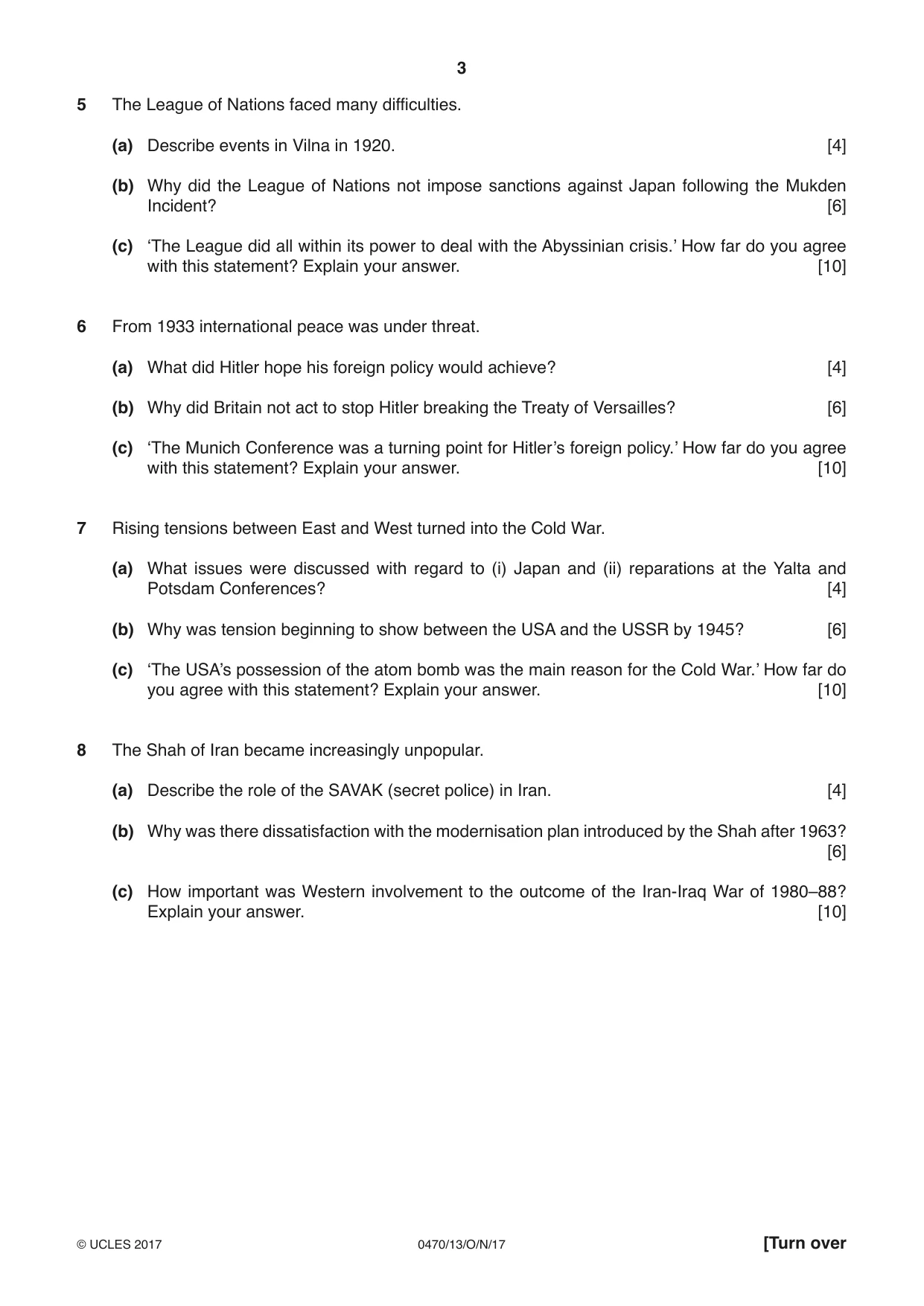
3 0470/13/O/N/17 © UCLES 2017 [Turn over 5 The League of Nations faced many difficulties. (a) Describe events in Vilna in 1920. [4] (b) Why did the League of Nations not impose sanctions against Japan following the Mukden Incident? [6] (c) ‘The League did all within its power to deal with the Abyssinian crisis.’ How far do you agree with this statement? Explain your answer. [10] 6 From 1933 international peace was under threat. (a) What did Hitler hope his foreign policy would achieve? [4] (b) Why did Britain not act to stop Hitler breaking the Treaty of Versailles? [6] (c) ‘The Munich Conference was a turning point for Hitler’s foreign policy.’ How far do you agree with this statement? Explain your answer. [10] 7 Rising tensions between East and West turned into the Cold War. (a) What issues were discussed with regard to (i) Japan and (ii) reparations at the Yalta and Potsdam Conferences? [4] (b) Why was tension beginning to show between the USA and the USSR by 1945? [6] (c) ‘The USA’s possession of the atom bomb was the main reason for the Cold War.’ How far do you agree with this statement? Explain your answer. [10] 8 The Shah of Iran became increasingly unpopular. (a) Describe the role of the SAVAK (secret police) in Iran. [4] (b) Why was there dissatisfaction with the modernisation plan introduced by the Shah after 1963? [6] (c) How important was Western involvement to the outcome of the Iran-Iraq War of 1980–88? Explain your answer. [10]
Question paper, page 4
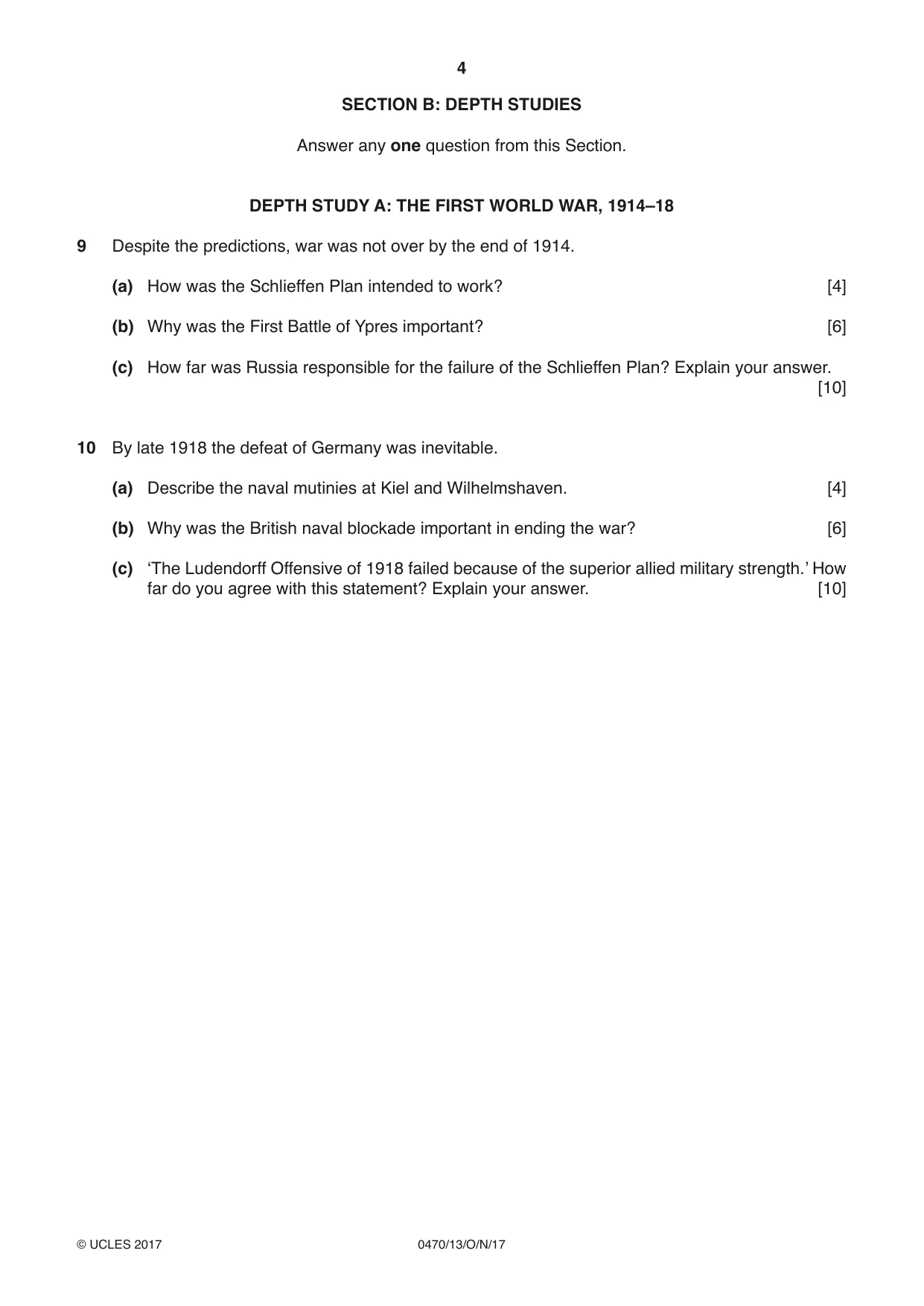
4 0470/13/O/N/17 © UCLES 2017 SECTION B: DEPTH STUDIES Answer any one question from this Section. DEPTH STUDY A: THE FIRST WORLD WAR, 1914–18 9 Despite the predictions, war was not over by the end of 1914. (a) How was the Schlieffen Plan intended to work? [4] (b) Why was the First Battle of Ypres important? [6] (c) How far was Russia responsible for the failure of the Schlieffen Plan? Explain your answer. [10] 10 By late 1918 the defeat of Germany was inevitable. (a) Describe the naval mutinies at Kiel and Wilhelmshaven. [4] (b) Why was the British naval blockade important in ending the war? [6] (c) ‘The Ludendorff Offensive of 1918 failed because of the superior allied military strength.’ How far do you agree with this statement? Explain your answer. [10]
Question paper, page 5
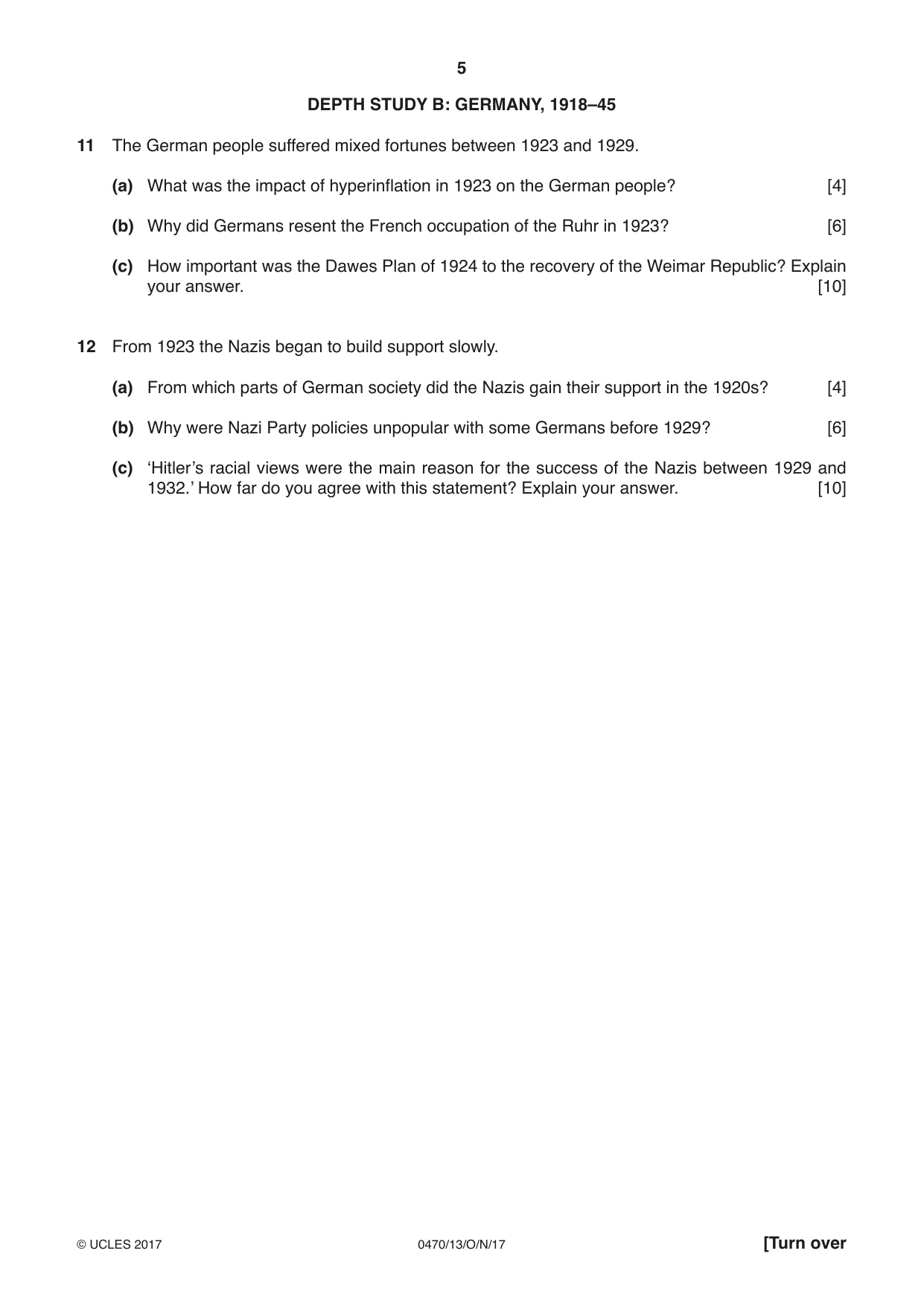
5 0470/13/O/N/17 © UCLES 2017 [Turn over DEPTH STUDY B: GERMANY, 1918–45 11 The German people suffered mixed fortunes between 1923 and 1929. (a) What was the impact of hyperinflation in 1923 on the German people? [4] (b) Why did Germans resent the French occupation of the Ruhr in 1923? [6] (c) How important was the Dawes Plan of 1924 to the recovery of the Weimar Republic? Explain your answer. [10] 12 From 1923 the Nazis began to build support slowly. (a) From which parts of German society did the Nazis gain their support in the 1920s? [4] (b) Why were Nazi Party policies unpopular with some Germans before 1929? [6] (c) ‘Hitler’s racial views were the main reason for the success of the Nazis between 1929 and 1932.’ How far do you agree with this statement? Explain your answer. [10]
Question paper, page 6
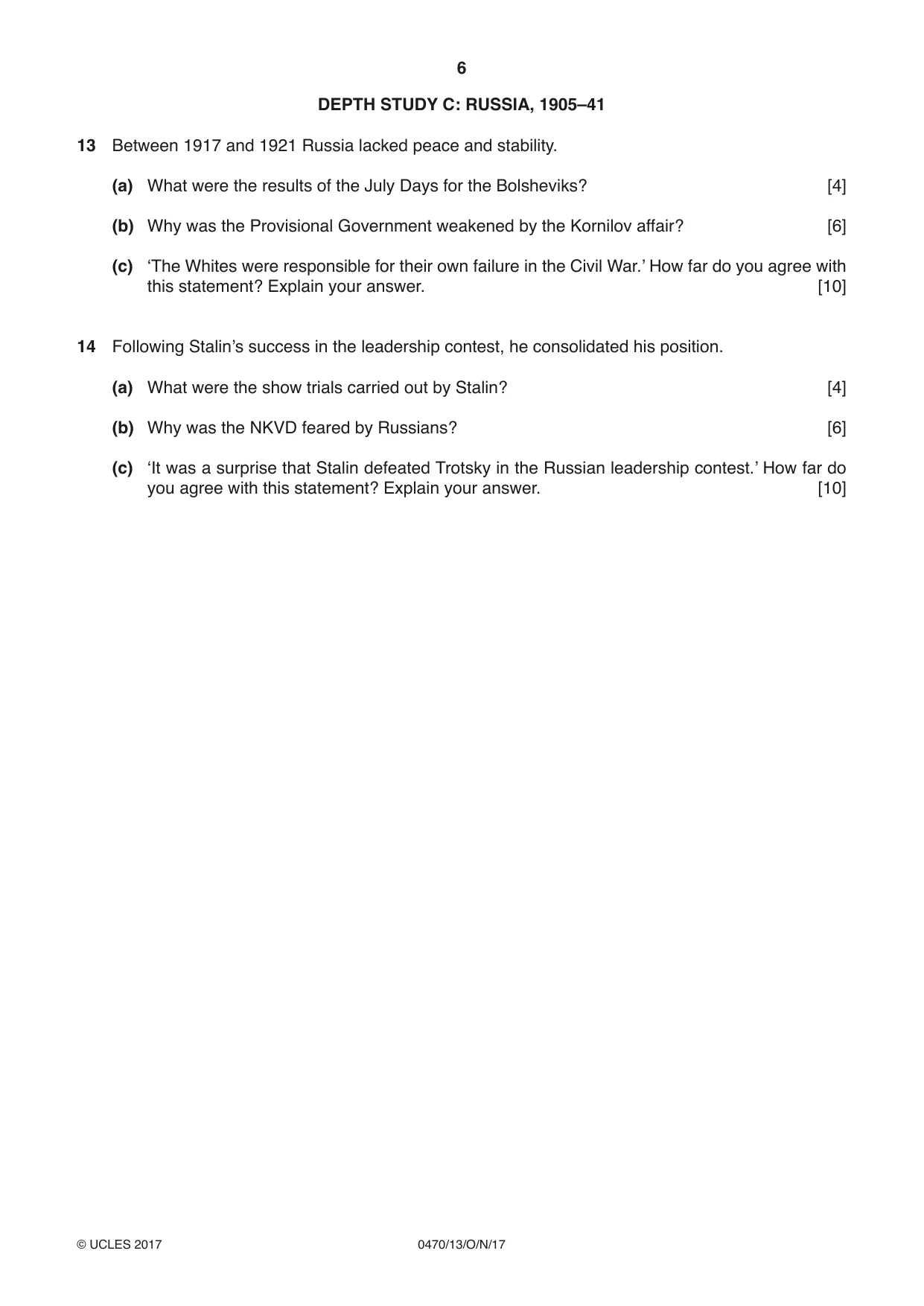
6 0470/13/O/N/17 © UCLES 2017 DEPTH STUDY C: RUSSIA, 1905–41 13 Between 1917 and 1921 Russia lacked peace and stability. (a) What were the results of the July Days for the Bolsheviks? [4] (b) Why was the Provisional Government weakened by the Kornilov affair? [6] (c) ‘The Whites were responsible for their own failure in the Civil War.’ How far do you agree with this statement? Explain your answer. [10] 14 Following Stalin’s success in the leadership contest, he consolidated his position. (a) What were the show trials carried out by Stalin? [4] (b) Why was the NKVD feared by Russians? [6] (c) ‘It was a surprise that Stalin defeated Trotsky in the Russian leadership contest.’ How far do you agree with this statement? Explain your answer. [10]
Question paper, page 7
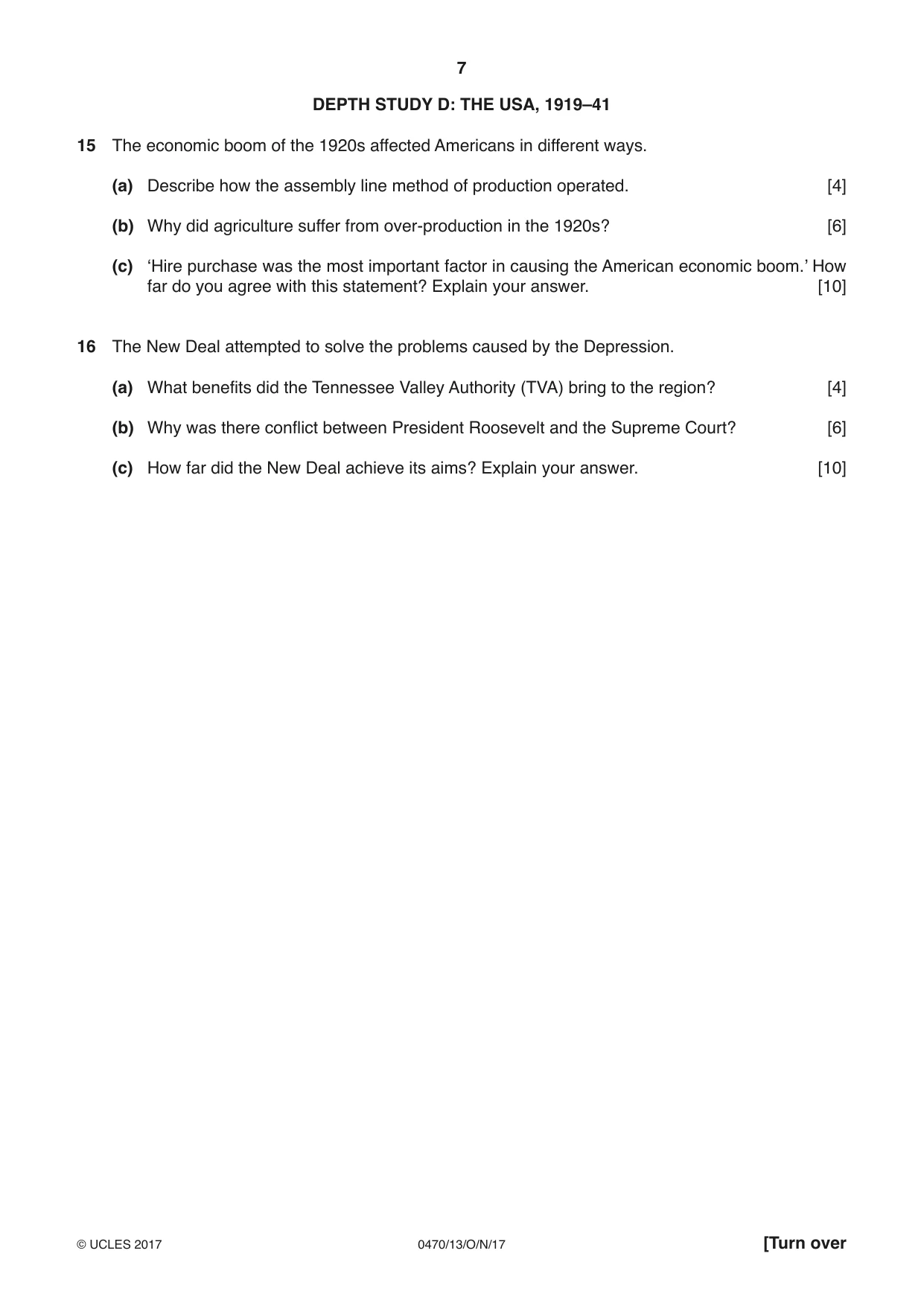
7 0470/13/O/N/17 © UCLES 2017 [Turn over DEPTH STUDY D: THE USA, 1919–41 15 The economic boom of the 1920s affected Americans in different ways. (a) Describe how the assembly line method of production operated. [4] (b) Why did agriculture suffer from over-production in the 1920s? [6] (c) ‘Hire purchase was the most important factor in causing the American economic boom.’ How far do you agree with this statement? Explain your answer. [10] 16 The New Deal attempted to solve the problems caused by the Depression. (a) What benefits did the Tennessee Valley Authority (TVA) bring to the region? [4] (b) Why was there conflict between President Roosevelt and the Supreme Court? [6] (c) How far did the New Deal achieve its aims? Explain your answer. [10]
Question paper, page 8
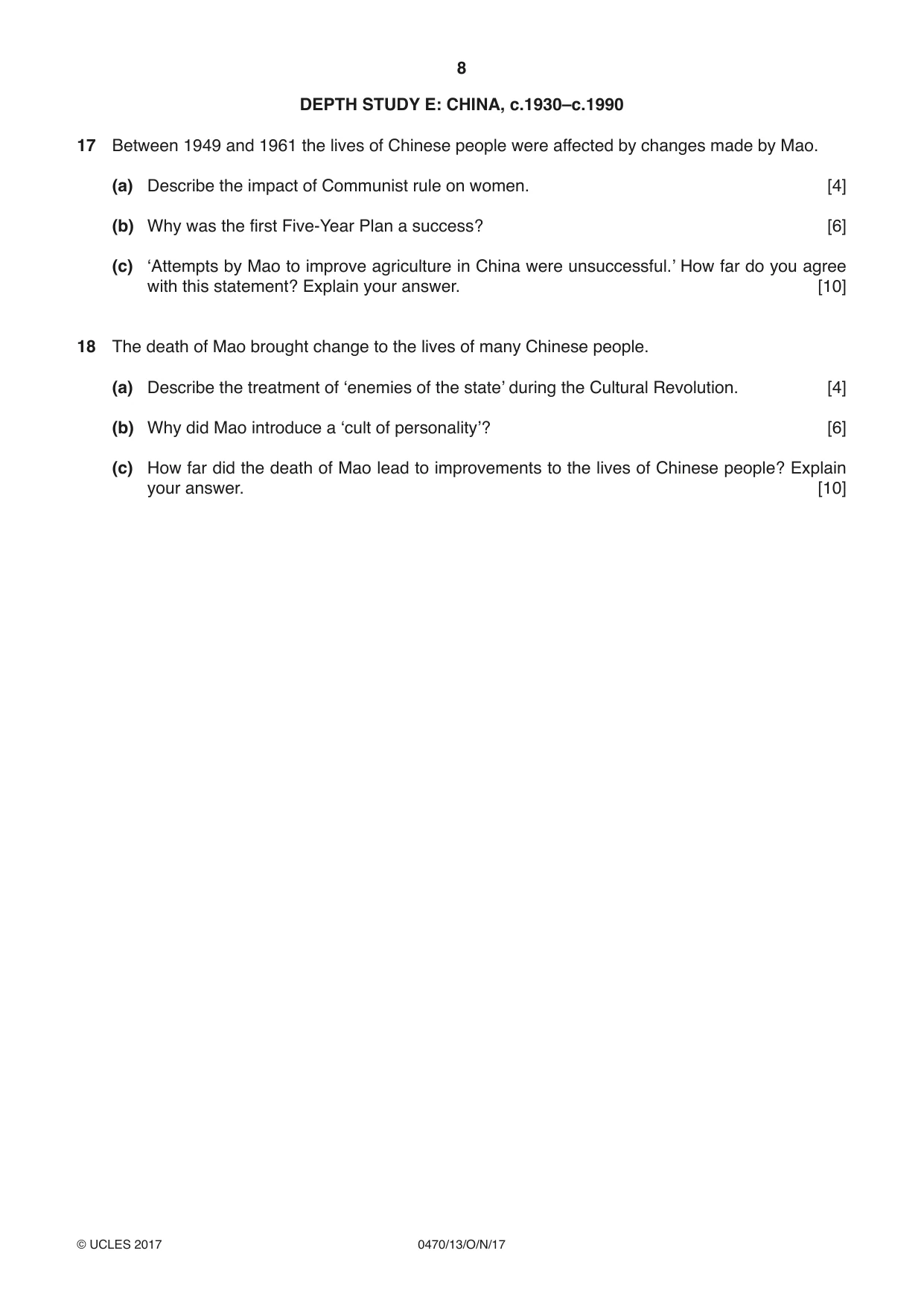
8 0470/13/O/N/17 © UCLES 2017 DEPTH STUDY E: CHINA, c.1930–c.1990 17 Between 1949 and 1961 the lives of Chinese people were affected by changes made by Mao. (a) Describe the impact of Communist rule on women. [4] (b) Why was the first Five-Year Plan a success? [6] (c) ‘Attempts by Mao to improve agriculture in China were unsuccessful.’ How far do you agree with this statement? Explain your answer. [10] 18 The death of Mao brought change to the lives of many Chinese people. (a) Describe the treatment of ‘enemies of the state’ during the Cultural Revolution. [4] (b) Why did Mao introduce a ‘cult of personality’? [6] (c) How far did the death of Mao lead to improvements to the lives of Chinese people? Explain your answer. [10]
Question paper, page 9
9 0470/13/O/N/17 © UCLES 2017 [Turn over DEPTH STUDY F: SOUTH AFRICA, c.1940–c.1994 19 By 1948 segregation had been established in South Africa. (a) In what ways did government policy discriminate against black people before 1948? [4] (b) Why did the Second World War lead to a loss of popularity for the United Party? [6] (c) ‘South Africa’s economic development was a success before 1945.’ How far do you agree with this statement? Explain your answer. [10] 20 Government action increased opposition to apartheid. (a) What was apartheid? [4] (b) Why were black people unhappy with the Bantu Education Act introduced in 1953? [6] (c) How successful was the ANC between 1948 and 1961? Explain your answer. [10]
Question paper, page 10
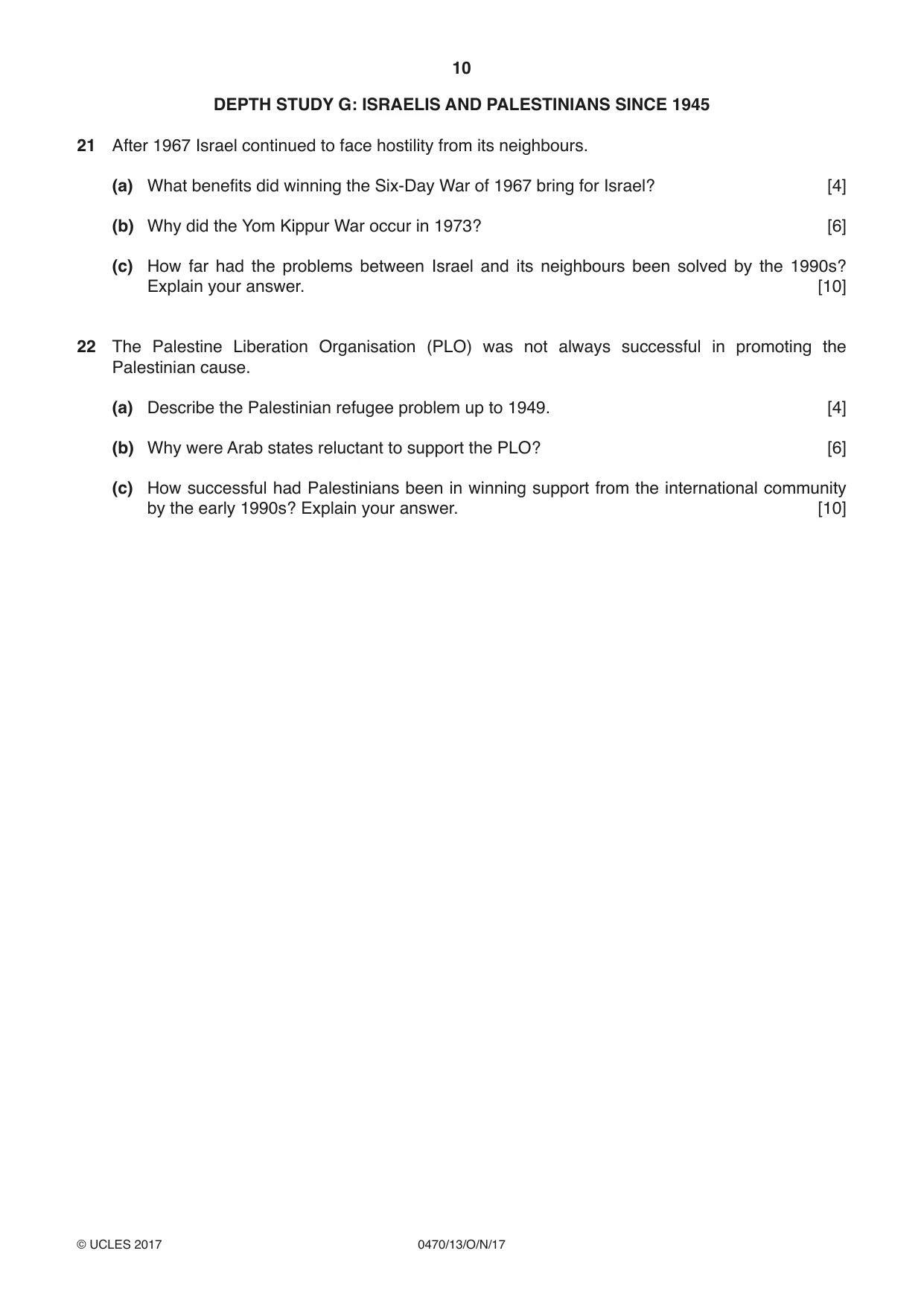
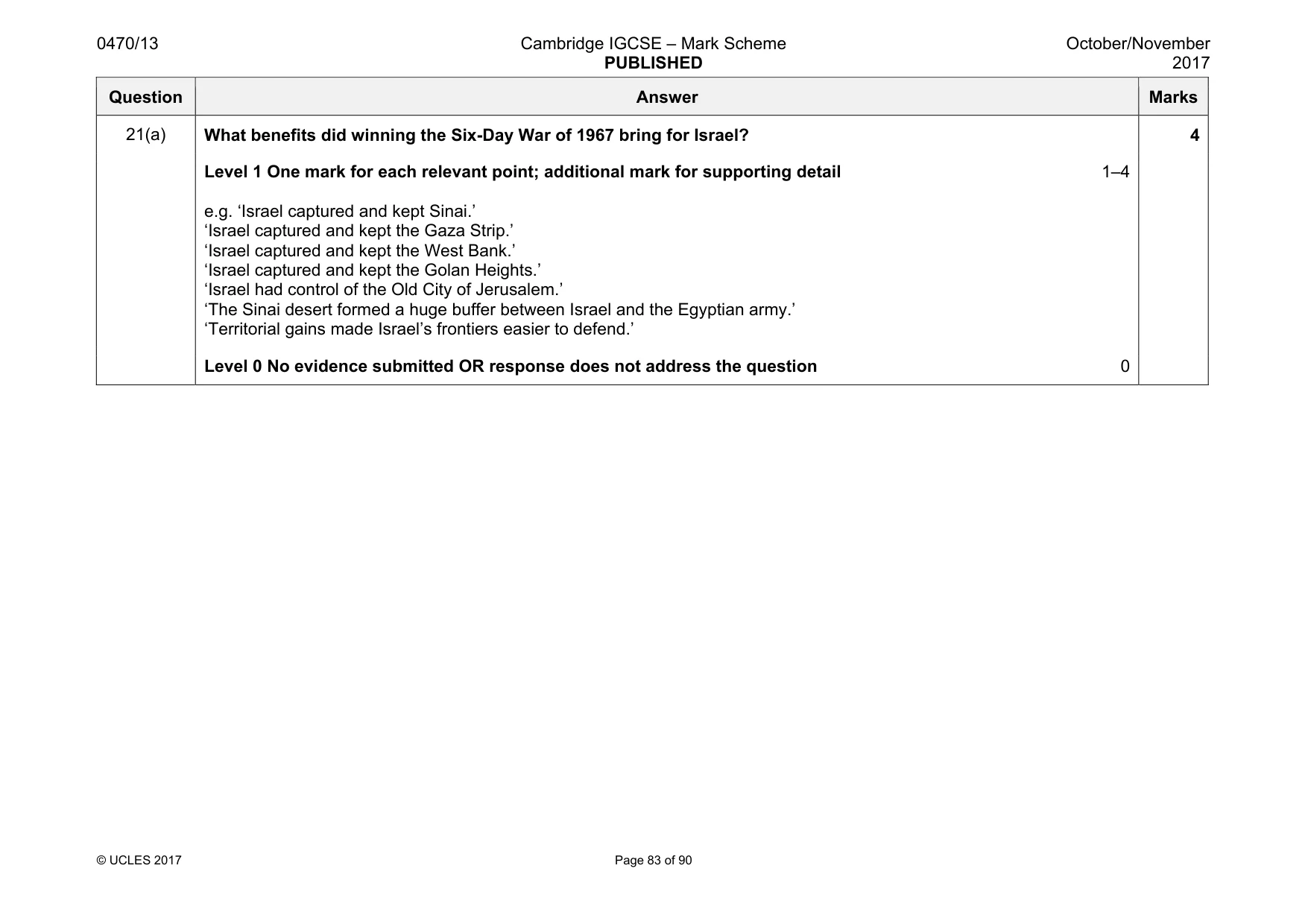
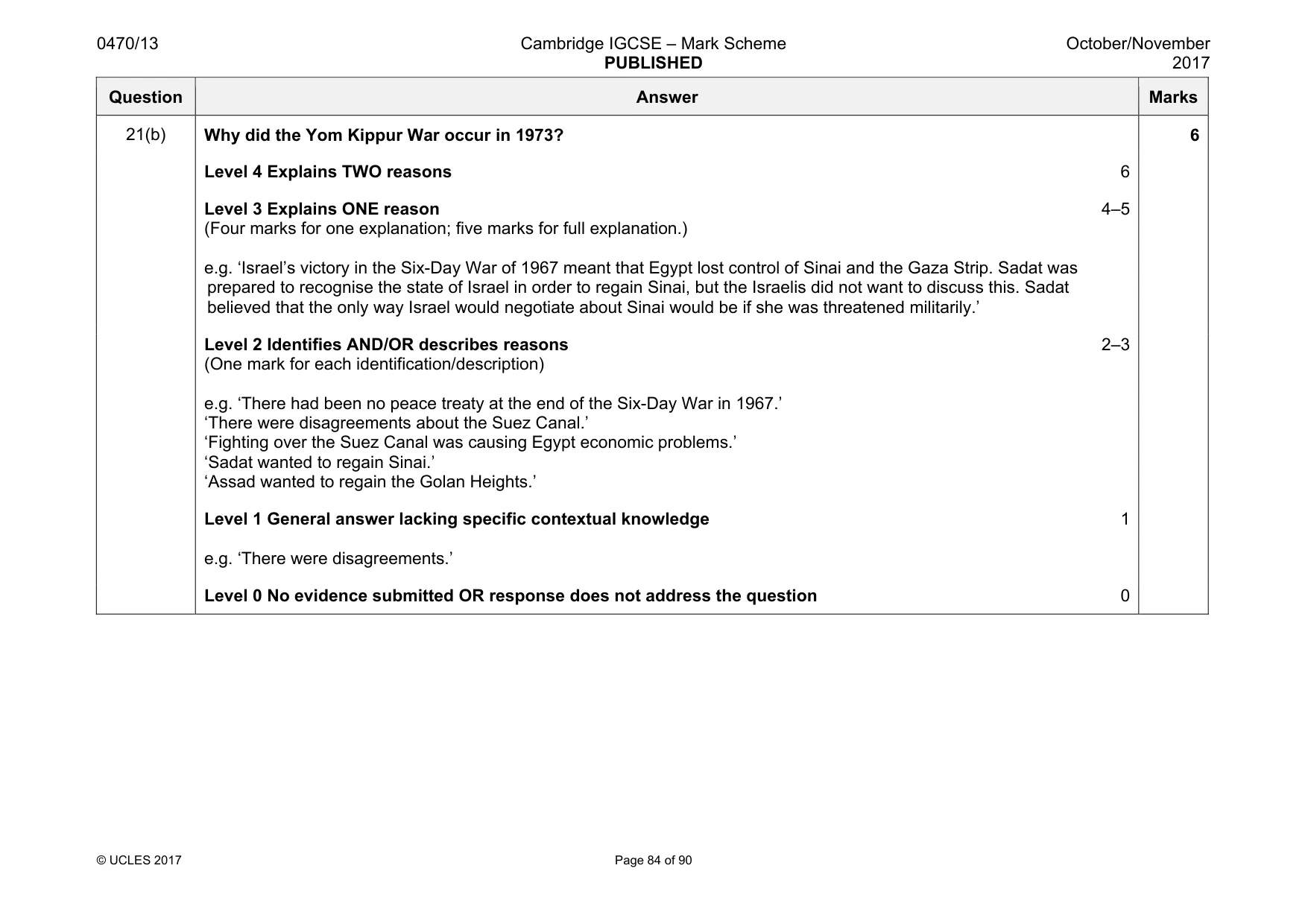
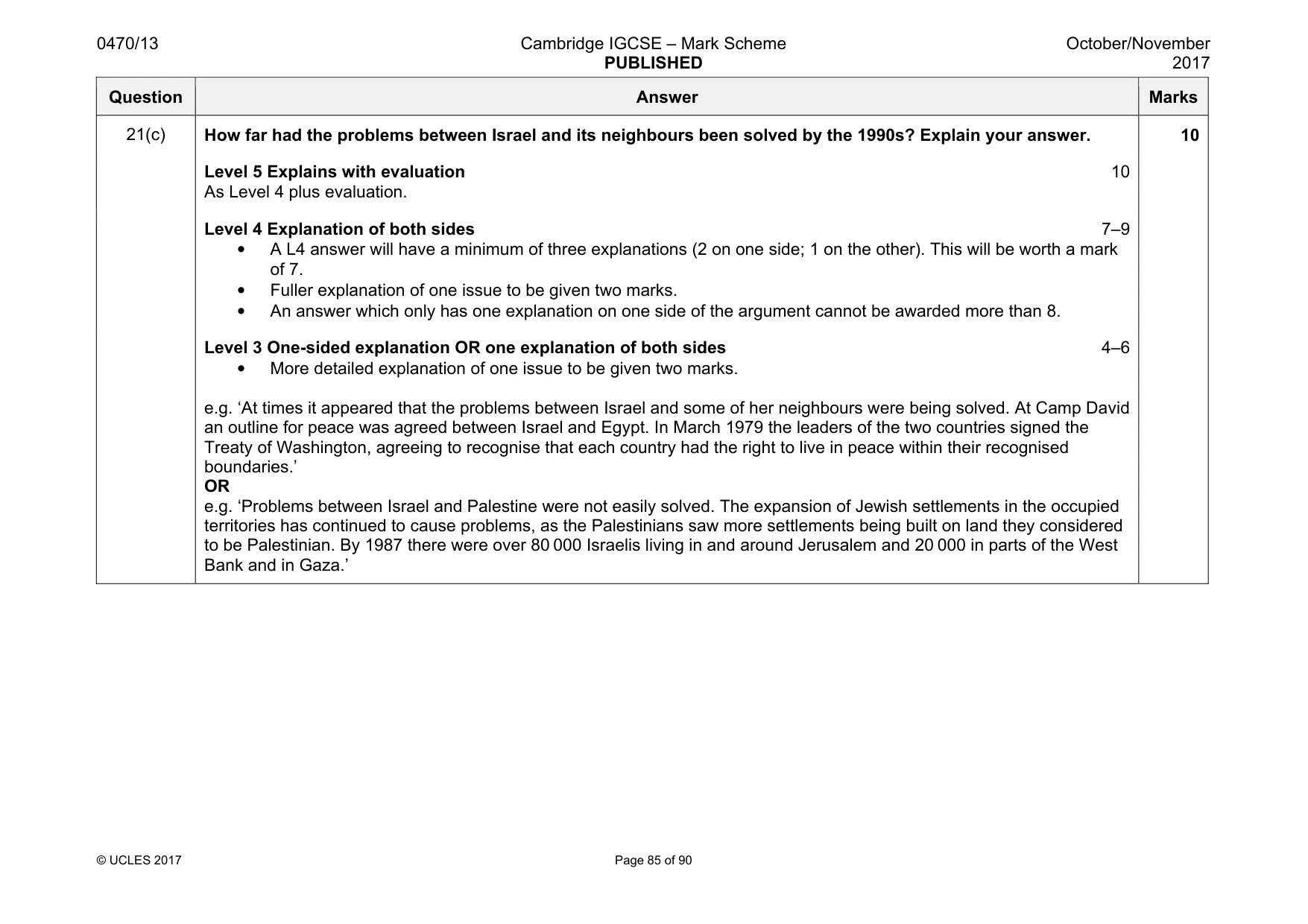
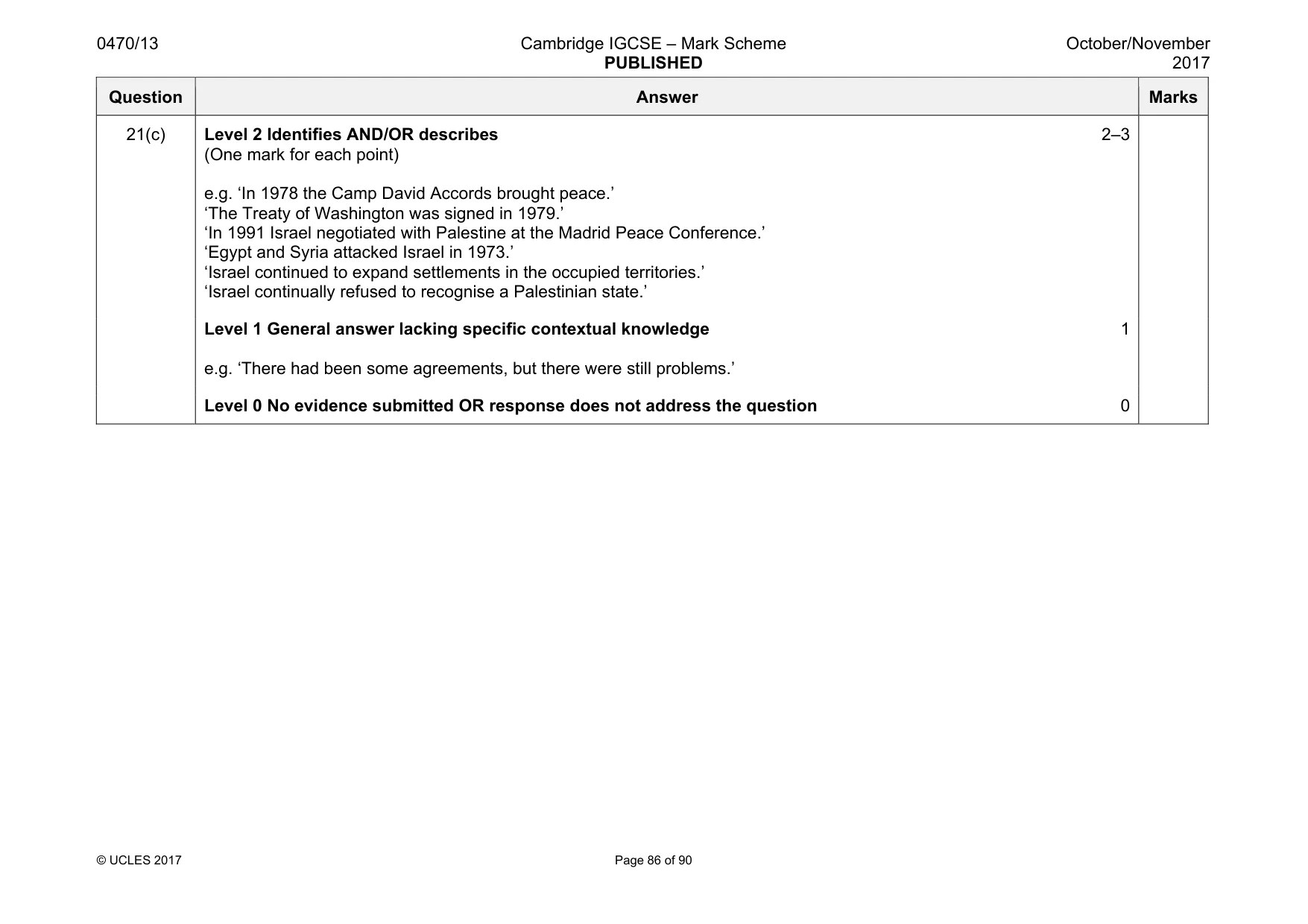
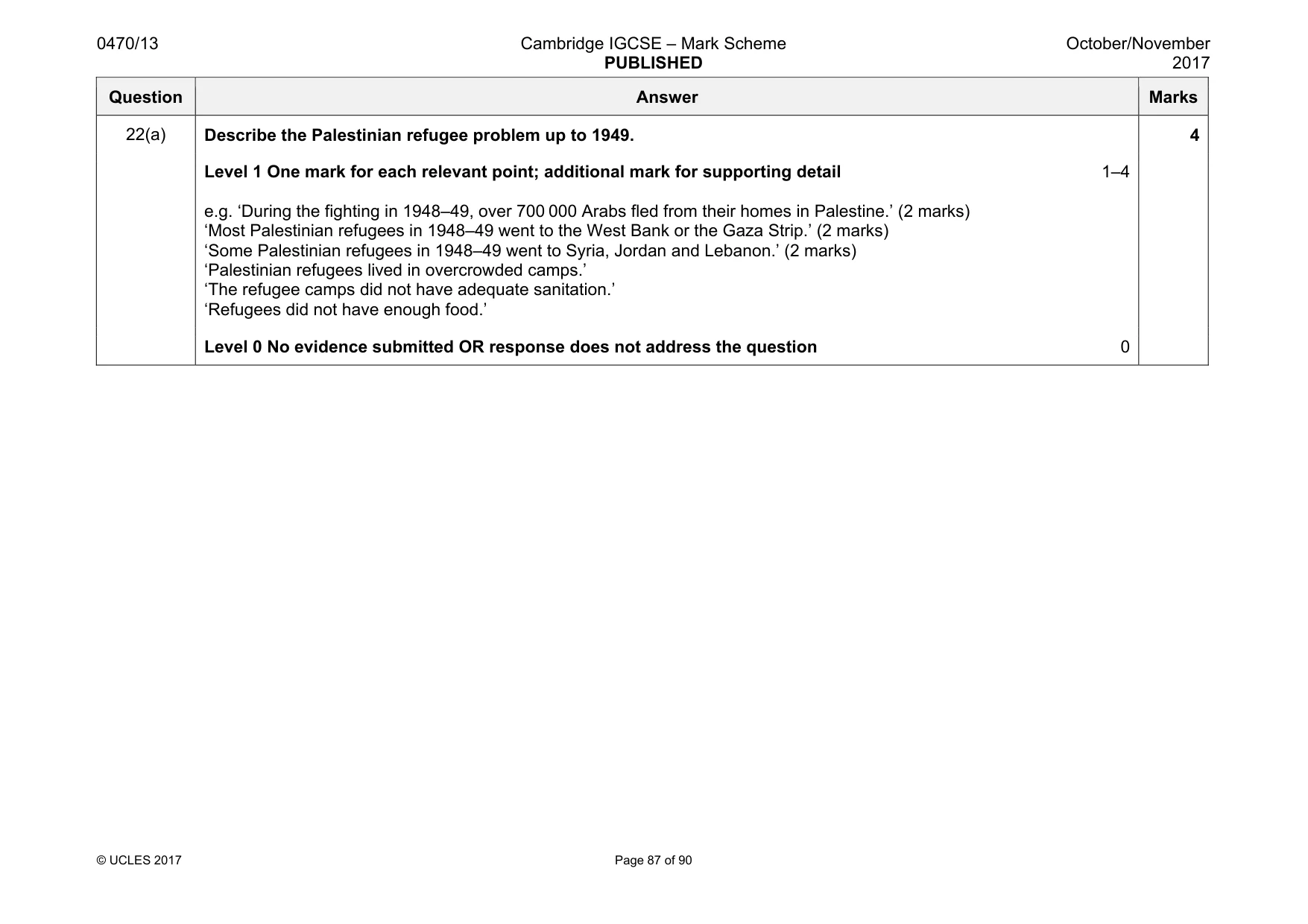
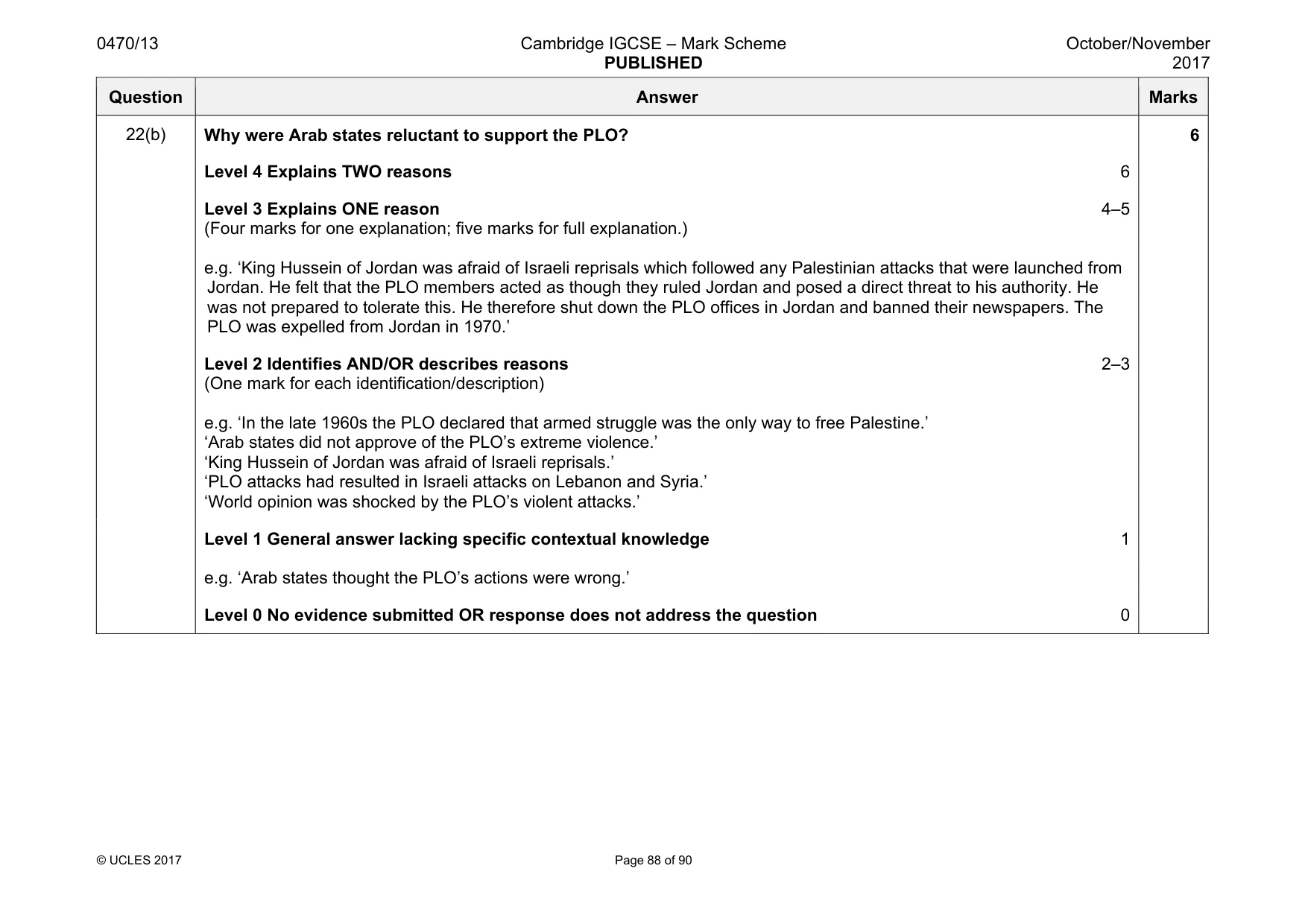
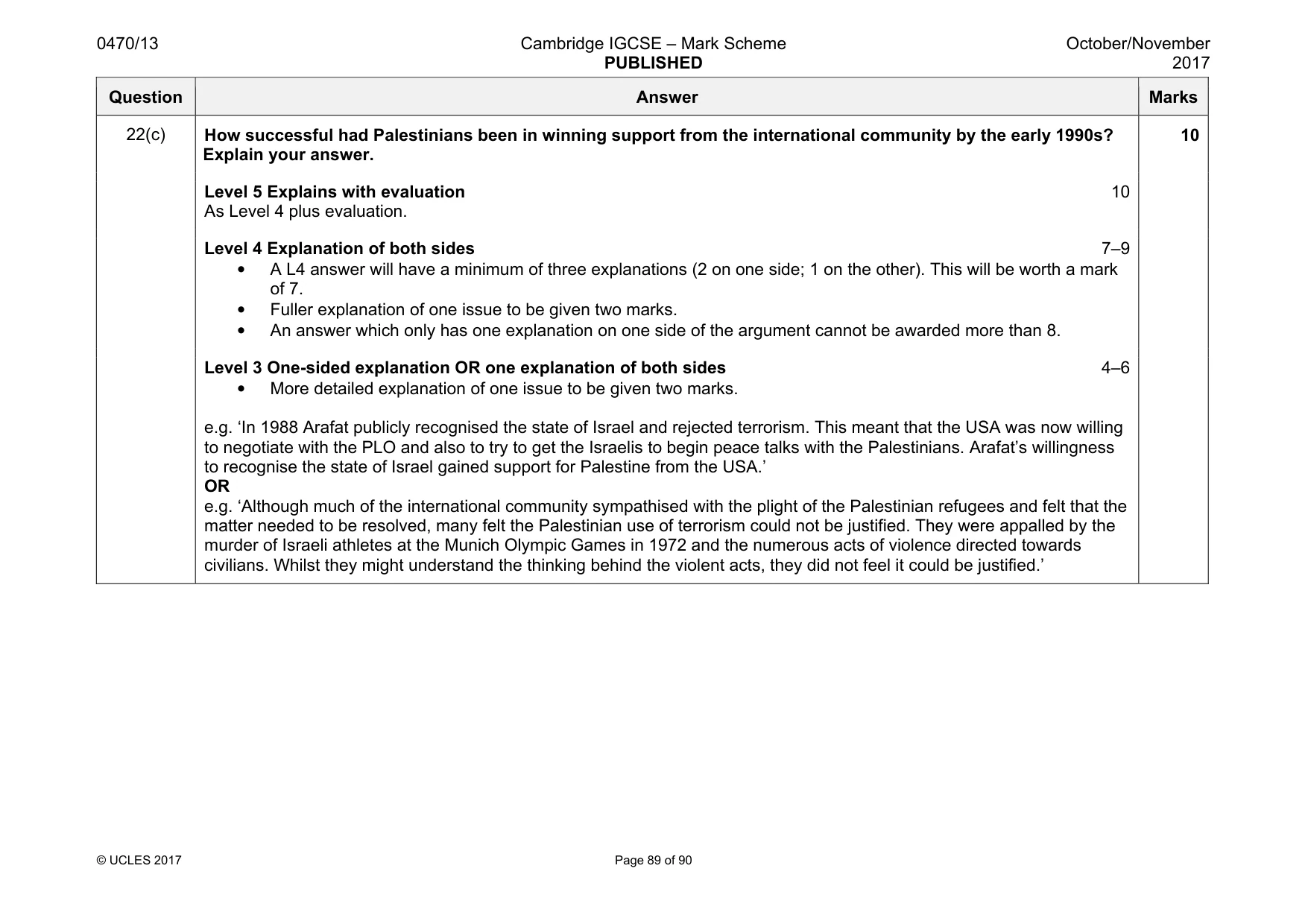
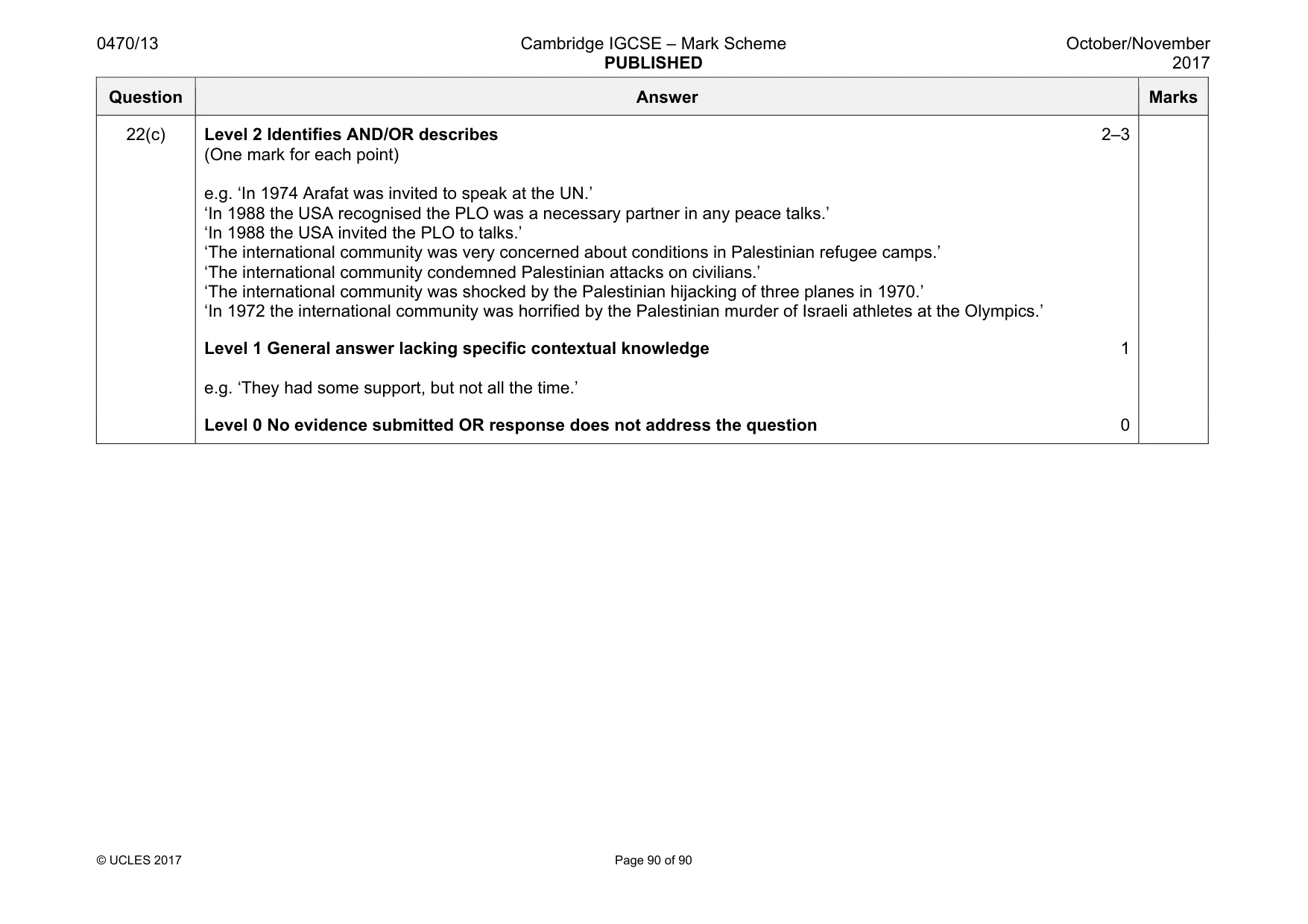
10 0470/13/O/N/17 © UCLES 2017 DEPTH STUDY G: ISRAELIS AND PALESTINIANS SINCE 1945 21 After 1967 Israel continued to face hostility from its neighbours. (a) What benefits did winning the Six-Day War of 1967 bring for Israel? [4] (b) Why did the Yom Kippur War occur in 1973? [6] (c) How far had the problems between Israel and its neighbours been solved by the 1990s? Explain your answer. [10] 22 The Palestine Liberation Organisation (PLO) was not always successful in promoting the Palestinian cause. (a) Describe the Palestinian refugee problem up to 1949. [4] (b) Why were Arab states reluctant to support the PLO? [6] (c) How successful had Palestinians been in winning support from the international community by the early 1990s? Explain your answer. [10]
Question paper, page 11
11 0470/13/O/N/17 © UCLES 2017 BLANK PAGE
Question paper, page 12
12 0470/13/O/N/17 © UCLES 2017 BLANK PAGE Permission to reproduce items where third-party owned material protected by copyright is included has been sought and cleared where possible. Every reasonable effort has been made by the publisher (UCLES) to trace copyright holders, but if any items requiring clearance have unwittingly been included, the publisher will be pleased to make amends at the earliest possible opportunity. To avoid the issue of disclosure of answer-related information to candidates, all copyright acknowledgements are reproduced online in the Cambridge International Examinations Copyright Acknowledgements Booklet. This is produced for each series of examinations and is freely available to download at www.cie.org.uk after the live examination series. Cambridge International Examinations is part of the Cambridge Assessment Group. Cambridge Assessment is the brand name of University of Cambridge Local Examinations Syndicate (UCLES), which is itself a department of the University of Cambridge.
Mark scheme, page 1
® IGCSE is a registered trademark. This syllabus is approved for use in England, Wales and Northern Ireland as a Cambridge International Level 1/Level 2 Certificate. This document consists of 90 printed pages. © UCLES 2017 [Turn over Cambridge Assessment International Education Cambridge International General Certificate of Secondary Education HISTORY 0470/13 Paper 1 October/November 2017 MARK SCHEME Maximum Mark: 60 Published This mark scheme is published as an aid to teachers and candidates, to indicate the requirements of the examination. It shows the basis on which Examiners were instructed to award marks. It does not indicate the details of the discussions that took place at an Examiners’ meeting before marking began, which would have considered the acceptability of alternative answers. Mark schemes should be read in conjunction with the question paper and the Principal Examiner Report for Teachers. Cambridge International will not enter into discussions about these mark schemes. Cambridge International is publishing the mark schemes for the October/November 2017 series for most Cambridge IGCSE®, Cambridge International A and AS Level components and some Cambridge O Level components.
Mark scheme, page 2
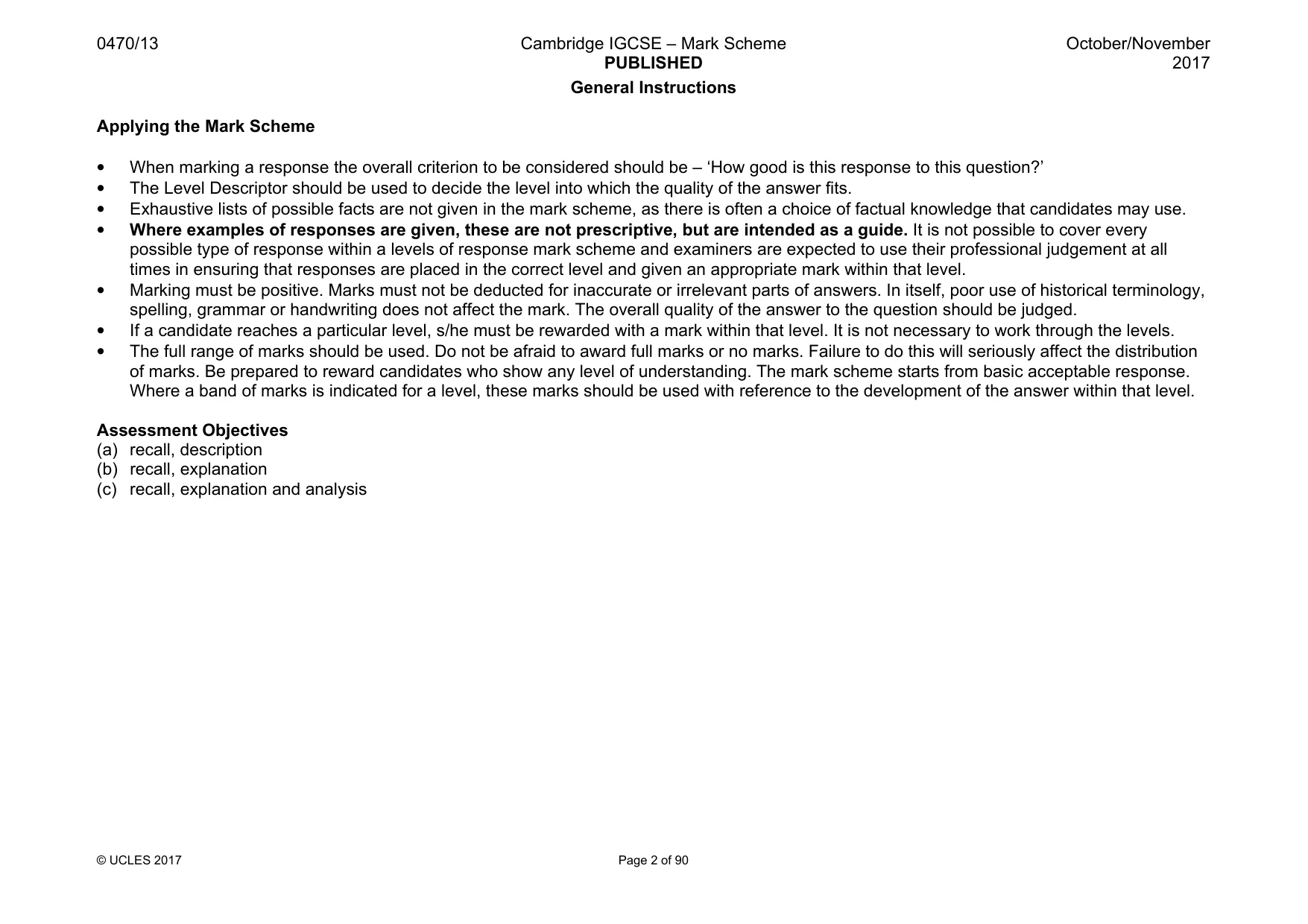
0470/13 Cambridge IGCSE – Mark Scheme PUBLISHED October/November 2017 © UCLES 2017 Page 2 of 90 General Instructions Applying the Mark Scheme • When marking a response the overall criterion to be considered should be – ‘How good is this response to this question?’ • The Level Descriptor should be used to decide the level into which the quality of the answer fits. • Exhaustive lists of possible facts are not given in the mark scheme, as there is often a choice of factual knowledge that candidates may use. • Where examples of responses are given, these are not prescriptive, but are intended as a guide. It is not possible to cover every possible type of response within a levels of response mark scheme and examiners are expected to use their professional judgement at all times in ensuring that responses are placed in the correct level and given an appropriate mark within that level. • Marking must be positive. Marks must not be deducted for inaccurate or irrelevant parts of answers. In itself, poor use of historical terminology, spelling, grammar or handwriting does not affect the mark. The overall quality of the answer to the question should be judged. • If a candidate reaches a particular level, s/he must be rewarded with a mark within that level. It is not necessary to work through the levels. • The full range of marks should be used. Do not be afraid to award full marks or no marks. Failure to do this will seriously affect the distribution of marks. Be prepared to reward candidates who show any level of understanding. The mark scheme starts from basic acceptable response. Where a band of marks is indicated for a level, these marks should be used with reference to the development of the answer within that level. Assessment Objectives (a) recall, description (b) recall, explanation (c) recall, explanation and analysis
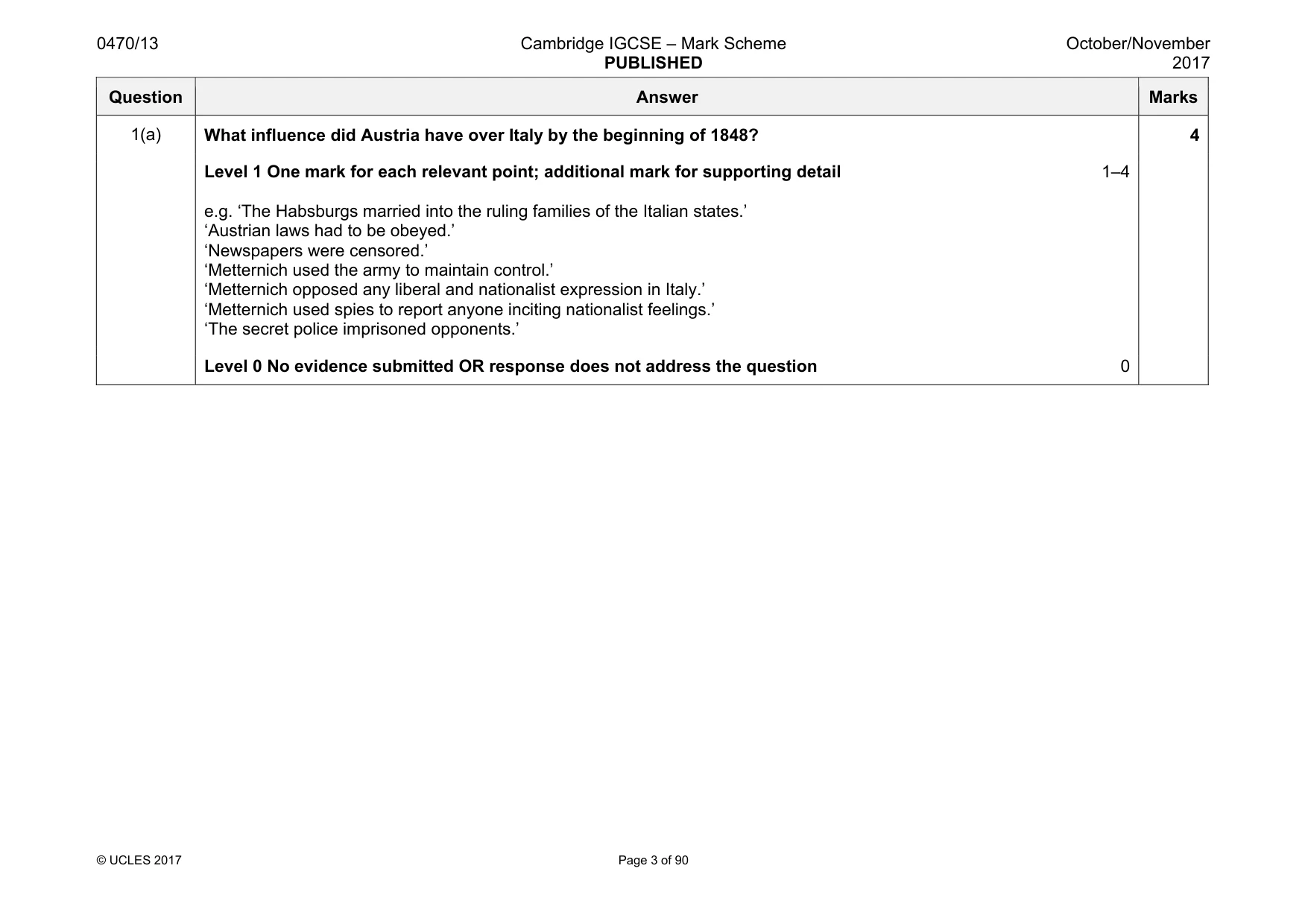
Mark scheme, page 3
0470/13 Cambridge IGCSE – Mark Scheme PUBLISHED October/November 2017 © UCLES 2017 Page 3 of 90 Question Answer Marks 1(a) What influence did Austria have over Italy by the beginning of 1848? 4 Level 1 One mark for each relevant point; additional mark for supporting detail 1–4 e.g. ‘The Habsburgs married into the ruling families of the Italian states.’ ‘Austrian laws had to be obeyed.’ ‘Newspapers were censored.’ ‘Metternich used the army to maintain control.’ ‘Metternich opposed any liberal and nationalist expression in Italy.’ ‘Metternich used spies to report anyone inciting nationalist feelings.’ ‘The secret police imprisoned opponents.’ Level 0 No evidence submitted OR response does not address the question 0
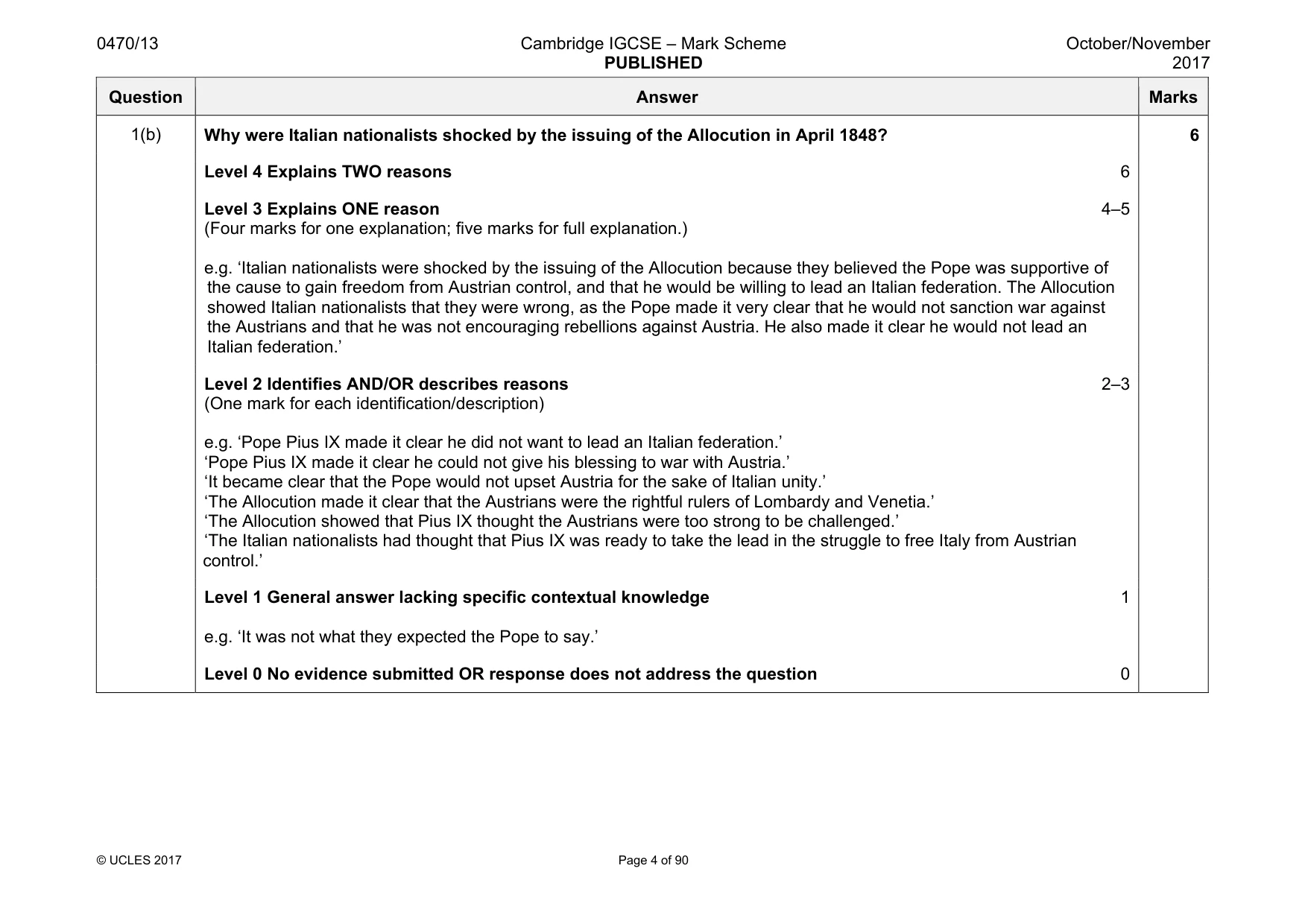
Mark scheme, page 4
0470/13 Cambridge IGCSE – Mark Scheme PUBLISHED October/November 2017 © UCLES 2017 Page 4 of 90 Question Answer Marks 1(b) Why were Italian nationalists shocked by the issuing of the Allocution in April 1848? 6 Level 4 Explains TWO reasons 6 Level 3 Explains ONE reason 4–5 (Four marks for one explanation; five marks for full explanation.) e.g. ‘Italian nationalists were shocked by the issuing of the Allocution because they believed the Pope was supportive of the cause to gain freedom from Austrian control, and that he would be willing to lead an Italian federation. The Allocution showed Italian nationalists that they were wrong, as the Pope made it very clear that he would not sanction war against the Austrians and that he was not encouraging rebellions against Austria. He also made it clear he would not lead an Italian federation.’ Level 2 Identifies AND/OR describes reasons 2–3 (One mark for each identification/description) e.g. ‘Pope Pius IX made it clear he did not want to lead an Italian federation.’ ‘Pope Pius IX made it clear he could not give his blessing to war with Austria.’ ‘It became clear that the Pope would not upset Austria for the sake of Italian unity.’ ‘The Allocution made it clear that the Austrians were the rightful rulers of Lombardy and Venetia.’ ‘The Allocution showed that Pius IX thought the Austrians were too strong to be challenged.’ ‘The Italian nationalists had thought that Pius IX was ready to take the lead in the struggle to free Italy from Austrian control.’ Level 1 General answer lacking specific contextual knowledge 1 e.g. ‘It was not what they expected the Pope to say.’ Level 0 No evidence submitted OR response does not address the question 0
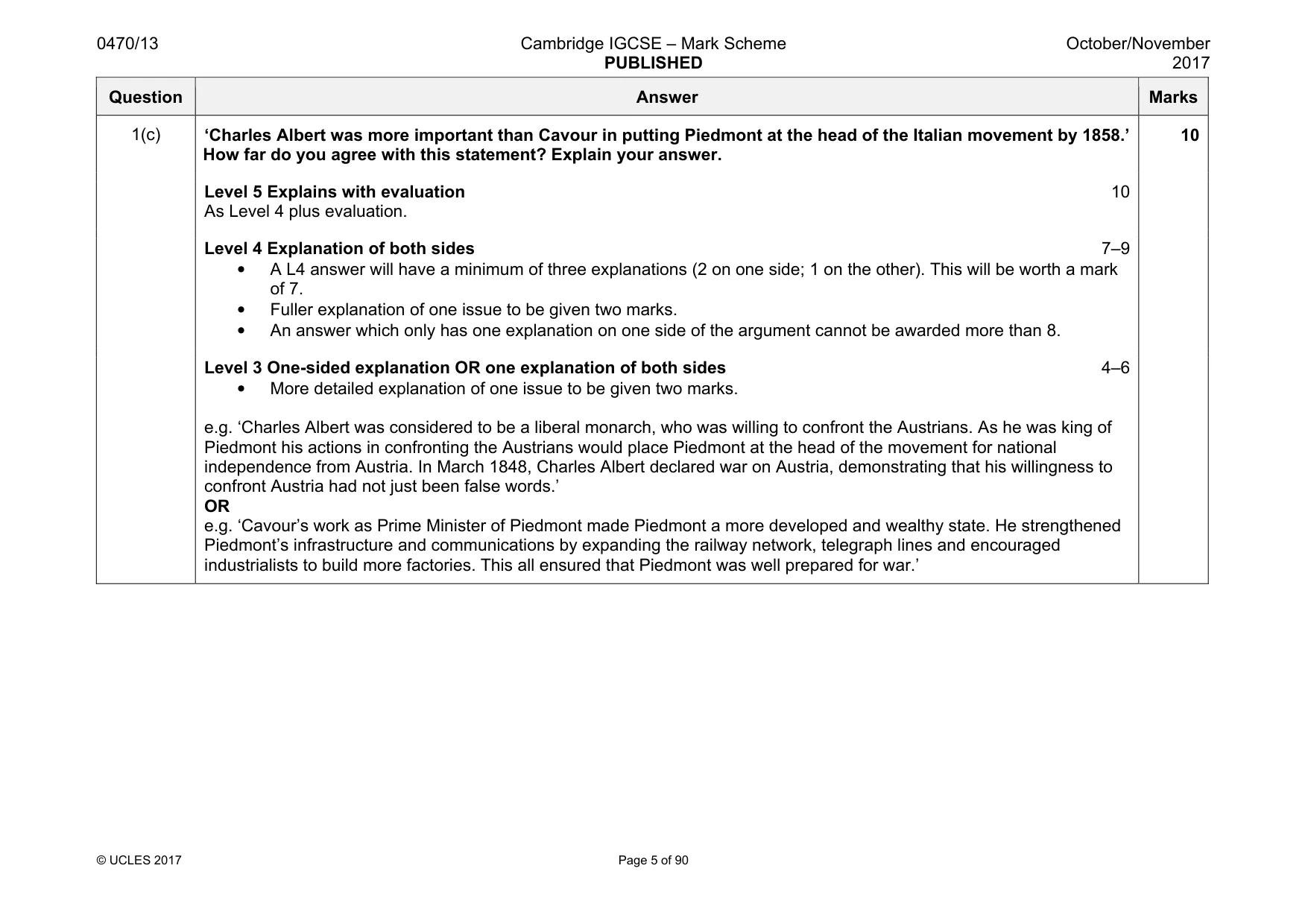
Mark scheme, page 5
0470/13 Cambridge IGCSE – Mark Scheme PUBLISHED October/November 2017 © UCLES 2017 Page 5 of 90 Question Answer Marks 1(c) ‘Charles Albert was more important than Cavour in putting Piedmont at the head of the Italian movement by 1858.’ How far do you agree with this statement? Explain your answer. 10 Level 5 Explains with evaluation 10 As Level 4 plus evaluation. Level 4 Explanation of both sides 7–9 • A L4 answer will have a minimum of three explanations (2 on one side; 1 on the other). This will be worth a mark of 7. • Fuller explanation of one issue to be given two marks. • An answer which only has one explanation on one side of the argument cannot be awarded more than 8. Level 3 One-sided explanation OR one explanation of both sides 4–6 • More detailed explanation of one issue to be given two marks. e.g. ‘Charles Albert was considered to be a liberal monarch, who was willing to confront the Austrians. As he was king of Piedmont his actions in confronting the Austrians would place Piedmont at the head of the movement for national independence from Austria. In March 1848, Charles Albert declared war on Austria, demonstrating that his willingness to confront Austria had not just been false words.’ OR e.g. ‘Cavour’s work as Prime Minister of Piedmont made Piedmont a more developed and wealthy state. He strengthened Piedmont’s infrastructure and communications by expanding the railway network, telegraph lines and encouraged industrialists to build more factories. This all ensured that Piedmont was well prepared for war.’
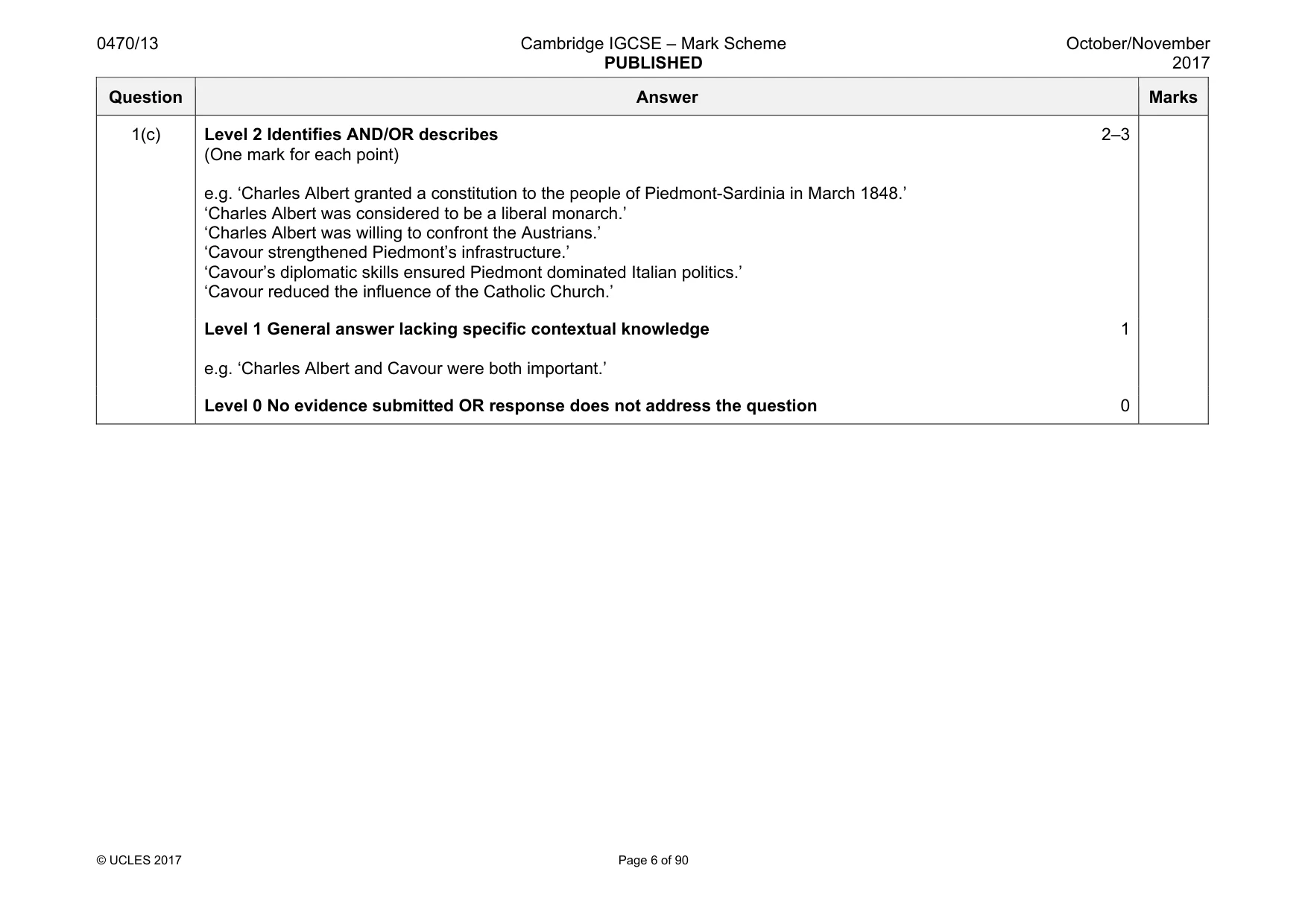
Mark scheme, page 6
0470/13 Cambridge IGCSE – Mark Scheme PUBLISHED October/November 2017 © UCLES 2017 Page 6 of 90 Question Answer Marks 1(c) Level 2 Identifies AND/OR describes 2–3 (One mark for each point) e.g. ‘Charles Albert granted a constitution to the people of Piedmont-Sardinia in March 1848.’ ‘Charles Albert was considered to be a liberal monarch.’ ‘Charles Albert was willing to confront the Austrians.’ ‘Cavour strengthened Piedmont’s infrastructure.’ ‘Cavour’s diplomatic skills ensured Piedmont dominated Italian politics.’ ‘Cavour reduced the influence of the Catholic Church.’ Level 1 General answer lacking specific contextual knowledge 1 e.g. ‘Charles Albert and Cavour were both important.’ Level 0 No evidence submitted OR response does not address the question 0
Mark scheme, page 7
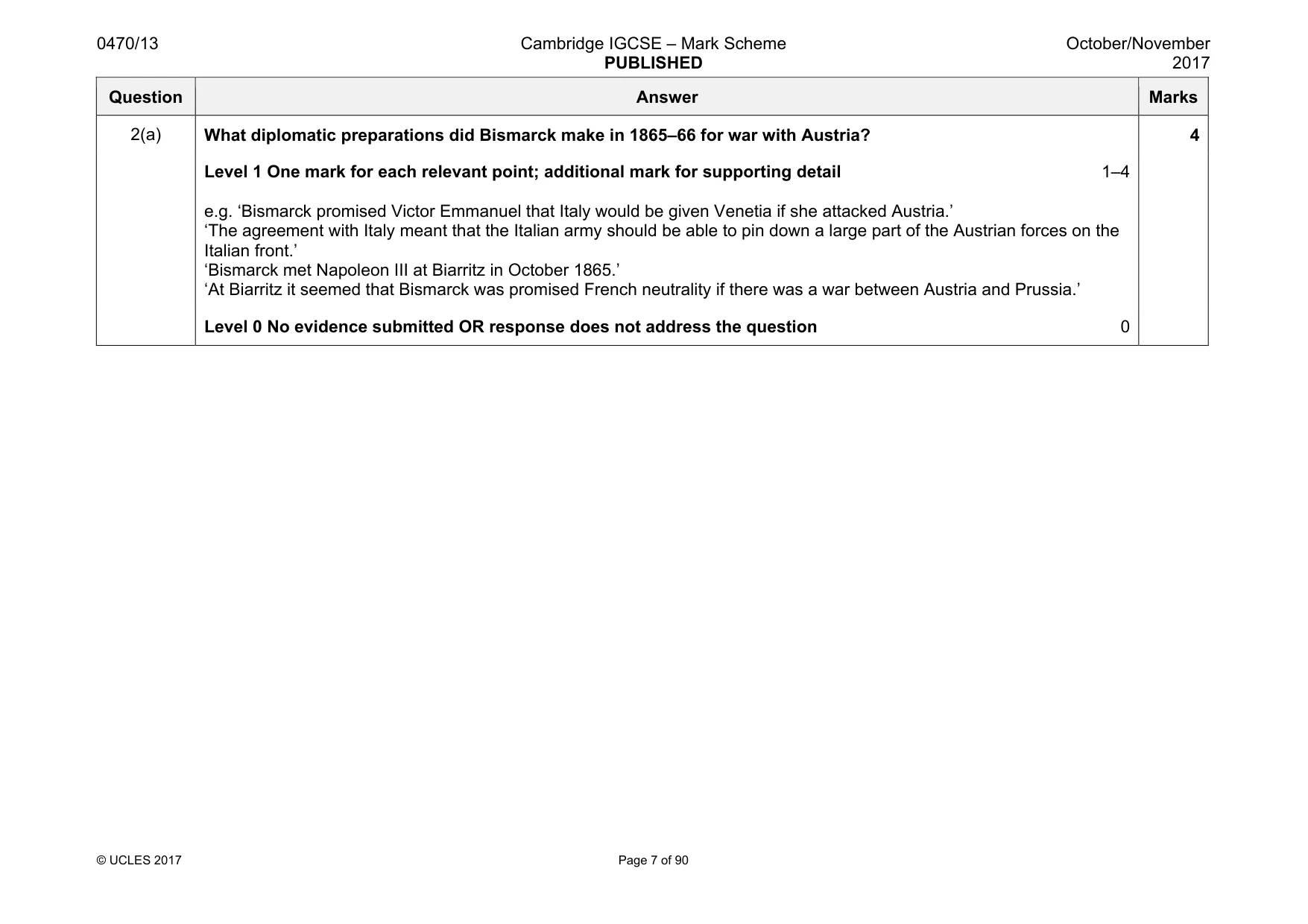
0470/13 Cambridge IGCSE – Mark Scheme PUBLISHED October/November 2017 © UCLES 2017 Page 7 of 90 Question Answer Marks 2(a) What diplomatic preparations did Bismarck make in 1865–66 for war with Austria? 4 Level 1 One mark for each relevant point; additional mark for supporting detail 1–4 e.g. ‘Bismarck promised Victor Emmanuel that Italy would be given Venetia if she attacked Austria.’ ‘The agreement with Italy meant that the Italian army should be able to pin down a large part of the Austrian forces on the Italian front.’ ‘Bismarck met Napoleon III at Biarritz in October 1865.’ ‘At Biarritz it seemed that Bismarck was promised French neutrality if there was a war between Austria and Prussia.’ Level 0 No evidence submitted OR response does not address the question 0
Mark scheme, page 8
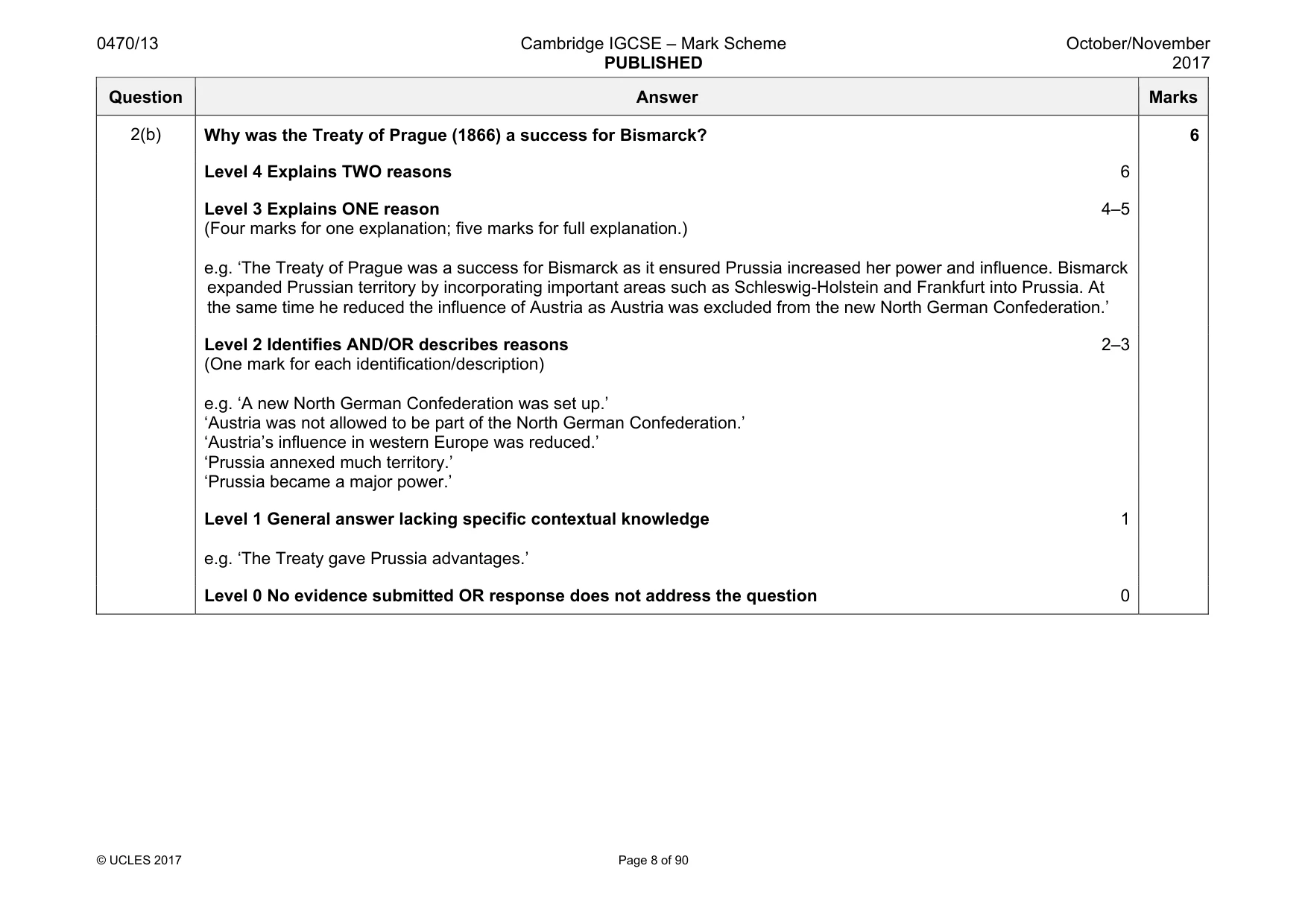
0470/13 Cambridge IGCSE – Mark Scheme PUBLISHED October/November 2017 © UCLES 2017 Page 8 of 90 Question Answer Marks 2(b) Why was the Treaty of Prague (1866) a success for Bismarck? 6 Level 4 Explains TWO reasons 6 Level 3 Explains ONE reason 4–5 (Four marks for one explanation; five marks for full explanation.) e.g. ‘The Treaty of Prague was a success for Bismarck as it ensured Prussia increased her power and influence. Bismarck expanded Prussian territory by incorporating important areas such as Schleswig-Holstein and Frankfurt into Prussia. At the same time he reduced the influence of Austria as Austria was excluded from the new North German Confederation.’ Level 2 Identifies AND/OR describes reasons 2–3 (One mark for each identification/description) e.g. ‘A new North German Confederation was set up.’ ‘Austria was not allowed to be part of the North German Confederation.’ ‘Austria’s influence in western Europe was reduced.’ ‘Prussia annexed much territory.’ ‘Prussia became a major power.’ Level 1 General answer lacking specific contextual knowledge 1 e.g. ‘The Treaty gave Prussia advantages.’ Level 0 No evidence submitted OR response does not address the question 0
Mark scheme, page 9
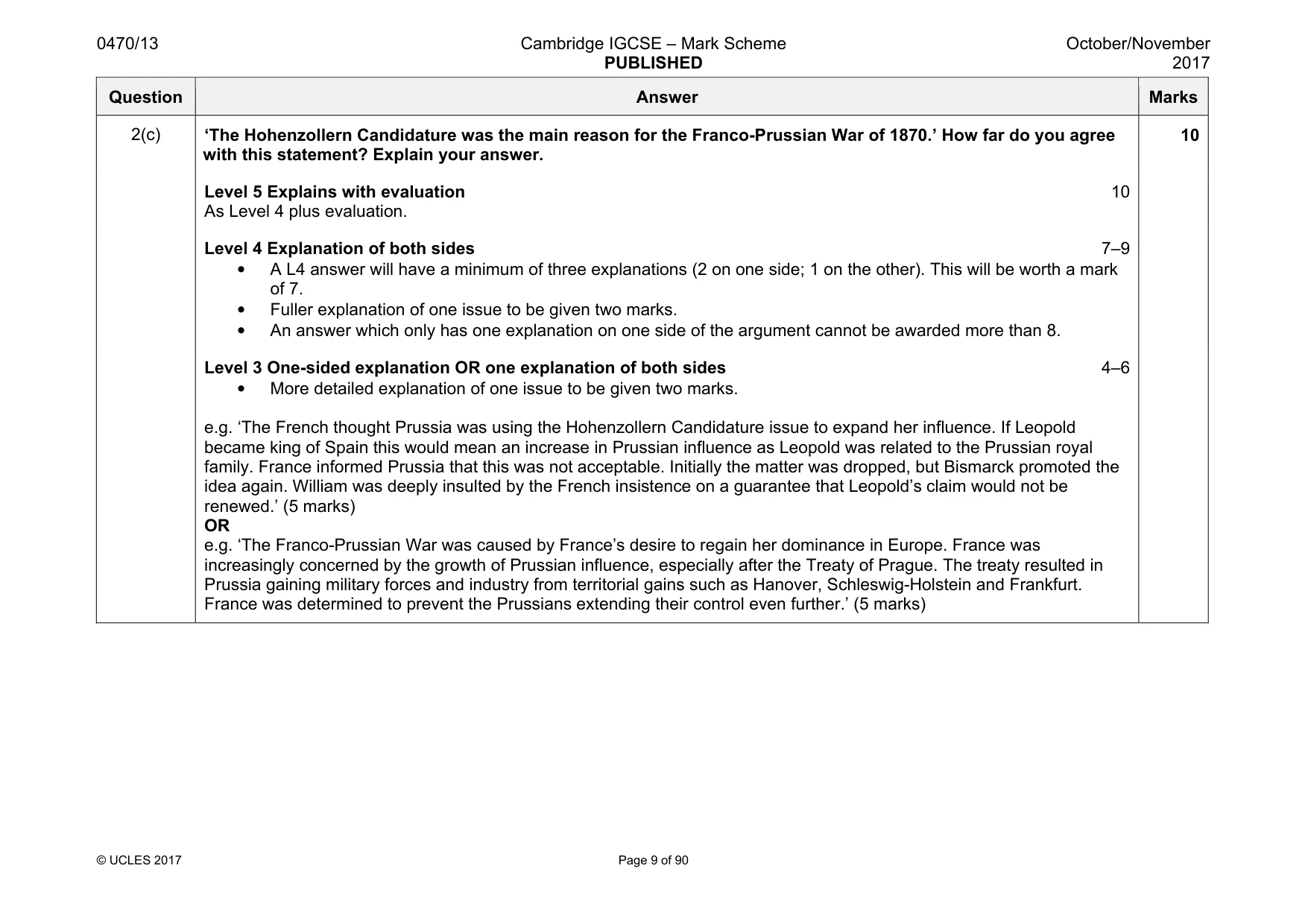
0470/13 Cambridge IGCSE – Mark Scheme PUBLISHED October/November 2017 © UCLES 2017 Page 9 of 90 Question Answer Marks 2(c) ‘The Hohenzollern Candidature was the main reason for the Franco-Prussian War of 1870.’ How far do you agree with this statement? Explain your answer. 10 Level 5 Explains with evaluation 10 As Level 4 plus evaluation. Level 4 Explanation of both sides 7–9 • A L4 answer will have a minimum of three explanations (2 on one side; 1 on the other). This will be worth a mark of 7. • Fuller explanation of one issue to be given two marks. • An answer which only has one explanation on one side of the argument cannot be awarded more than 8. Level 3 One-sided explanation OR one explanation of both sides 4–6 • More detailed explanation of one issue to be given two marks. e.g. ‘The French thought Prussia was using the Hohenzollern Candidature issue to expand her influence. If Leopold became king of Spain this would mean an increase in Prussian influence as Leopold was related to the Prussian royal family. France informed Prussia that this was not acceptable. Initially the matter was dropped, but Bismarck promoted the idea again. William was deeply insulted by the French insistence on a guarantee that Leopold’s claim would not be renewed.’ (5 marks) OR e.g. ‘The Franco-Prussian War was caused by France’s desire to regain her dominance in Europe. France was increasingly concerned by the growth of Prussian influence, especially after the Treaty of Prague. The treaty resulted in Prussia gaining military forces and industry from territorial gains such as Hanover, Schleswig-Holstein and Frankfurt. France was determined to prevent the Prussians extending their control even further.’ (5 marks)
Mark scheme, page 10
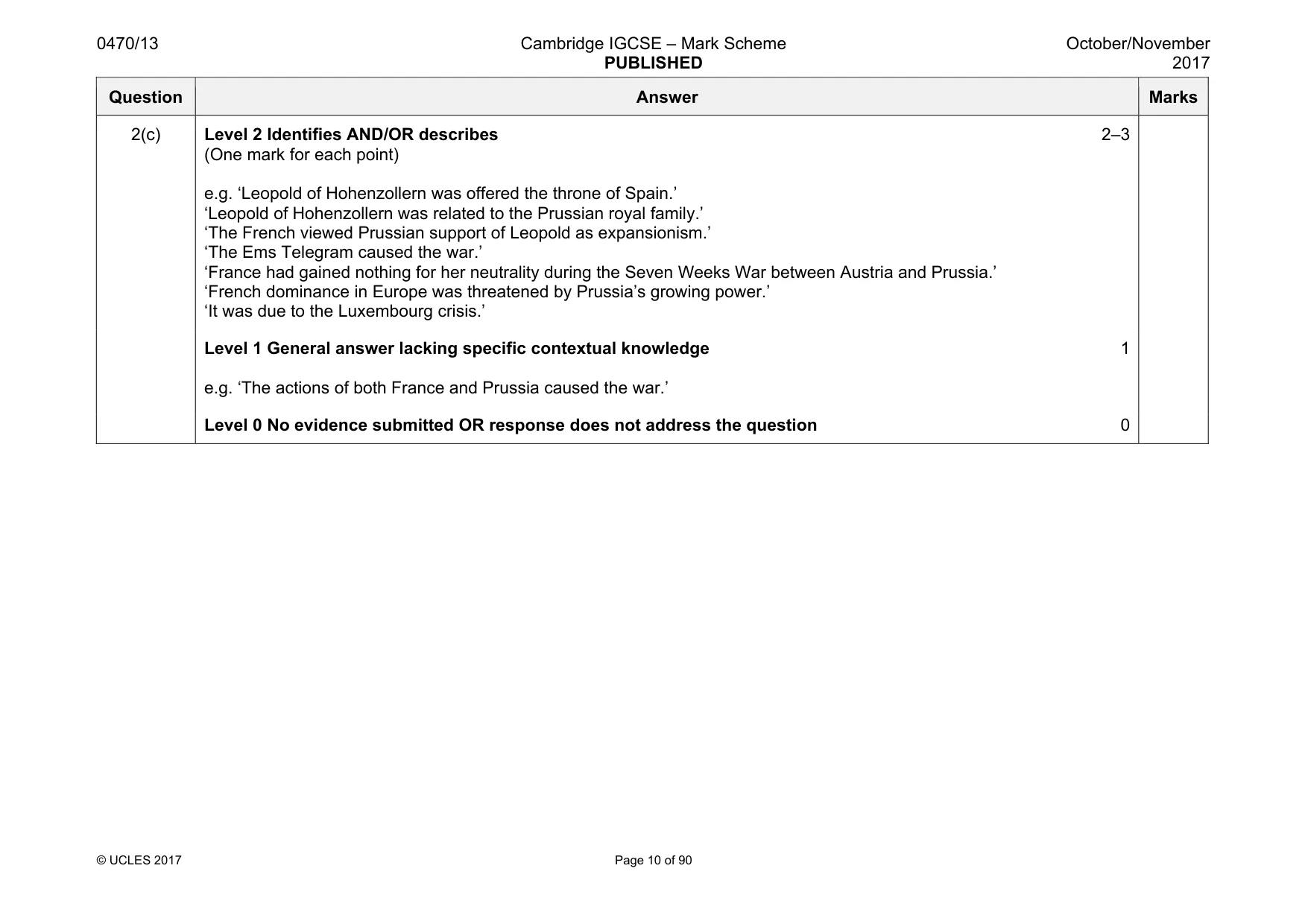
0470/13 Cambridge IGCSE – Mark Scheme PUBLISHED October/November 2017 © UCLES 2017 Page 10 of 90 Question Answer Marks 2(c) Level 2 Identifies AND/OR describes 2–3 (One mark for each point) e.g. ‘Leopold of Hohenzollern was offered the throne of Spain.’ ‘Leopold of Hohenzollern was related to the Prussian royal family.’ ‘The French viewed Prussian support of Leopold as expansionism.’ ‘The Ems Telegram caused the war.’ ‘France had gained nothing for her neutrality during the Seven Weeks War between Austria and Prussia.’ ‘French dominance in Europe was threatened by Prussia’s growing power.’ ‘It was due to the Luxembourg crisis.’ Level 1 General answer lacking specific contextual knowledge 1 e.g. ‘The actions of both France and Prussia caused the war.’ Level 0 No evidence submitted OR response does not address the question 0
Mark scheme, page 11
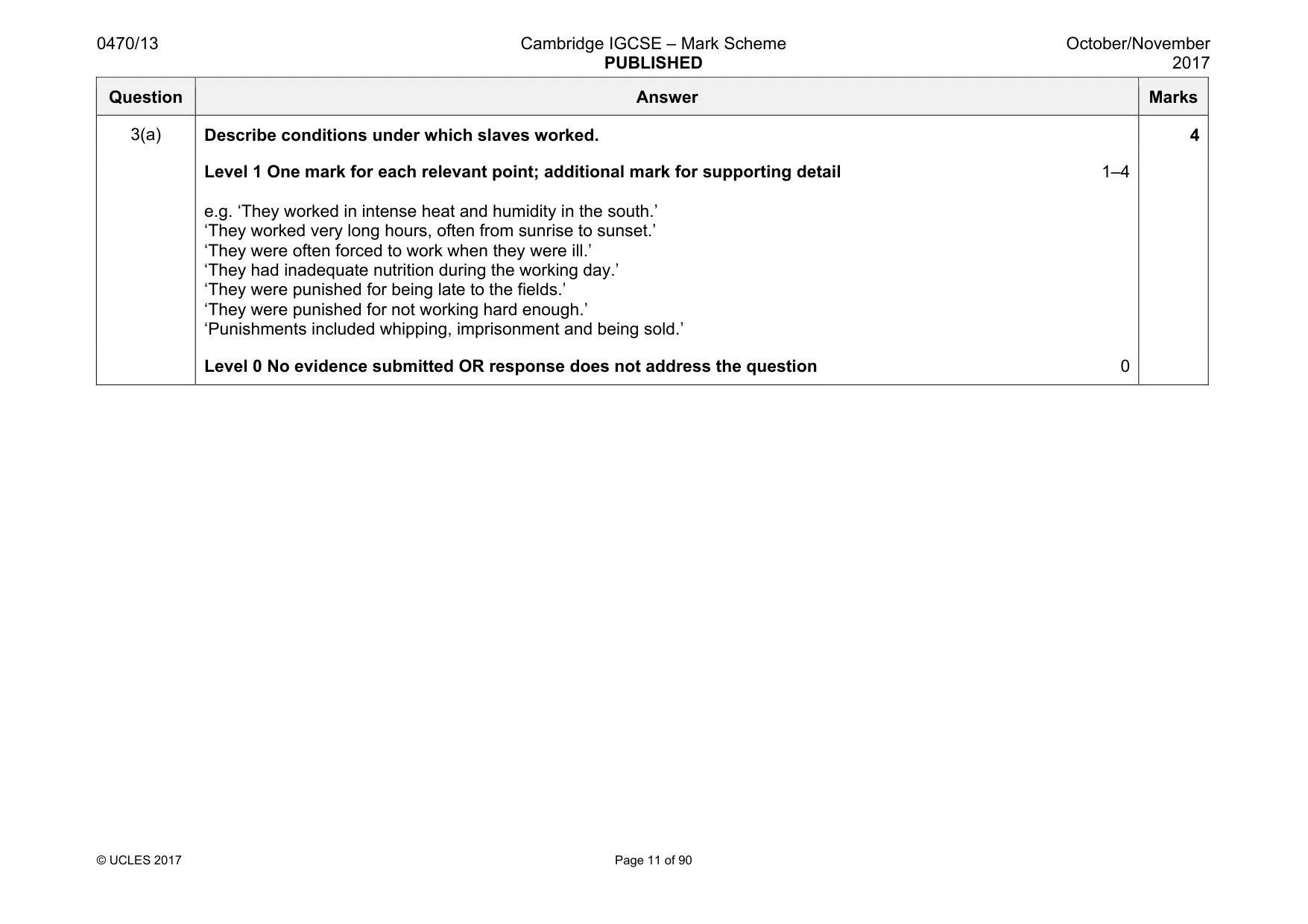
0470/13 Cambridge IGCSE – Mark Scheme PUBLISHED October/November 2017 © UCLES 2017 Page 11 of 90 Question Answer Marks 3(a) Describe conditions under which slaves worked. 4 Level 1 One mark for each relevant point; additional mark for supporting detail 1–4 e.g. ‘They worked in intense heat and humidity in the south.’ ‘They worked very long hours, often from sunrise to sunset.’ ‘They were often forced to work when they were ill.’ ‘They had inadequate nutrition during the working day.’ ‘They were punished for being late to the fields.’ ‘They were punished for not working hard enough.’ ‘Punishments included whipping, imprisonment and being sold.’ Level 0 No evidence submitted OR response does not address the question 0
Mark scheme, page 12
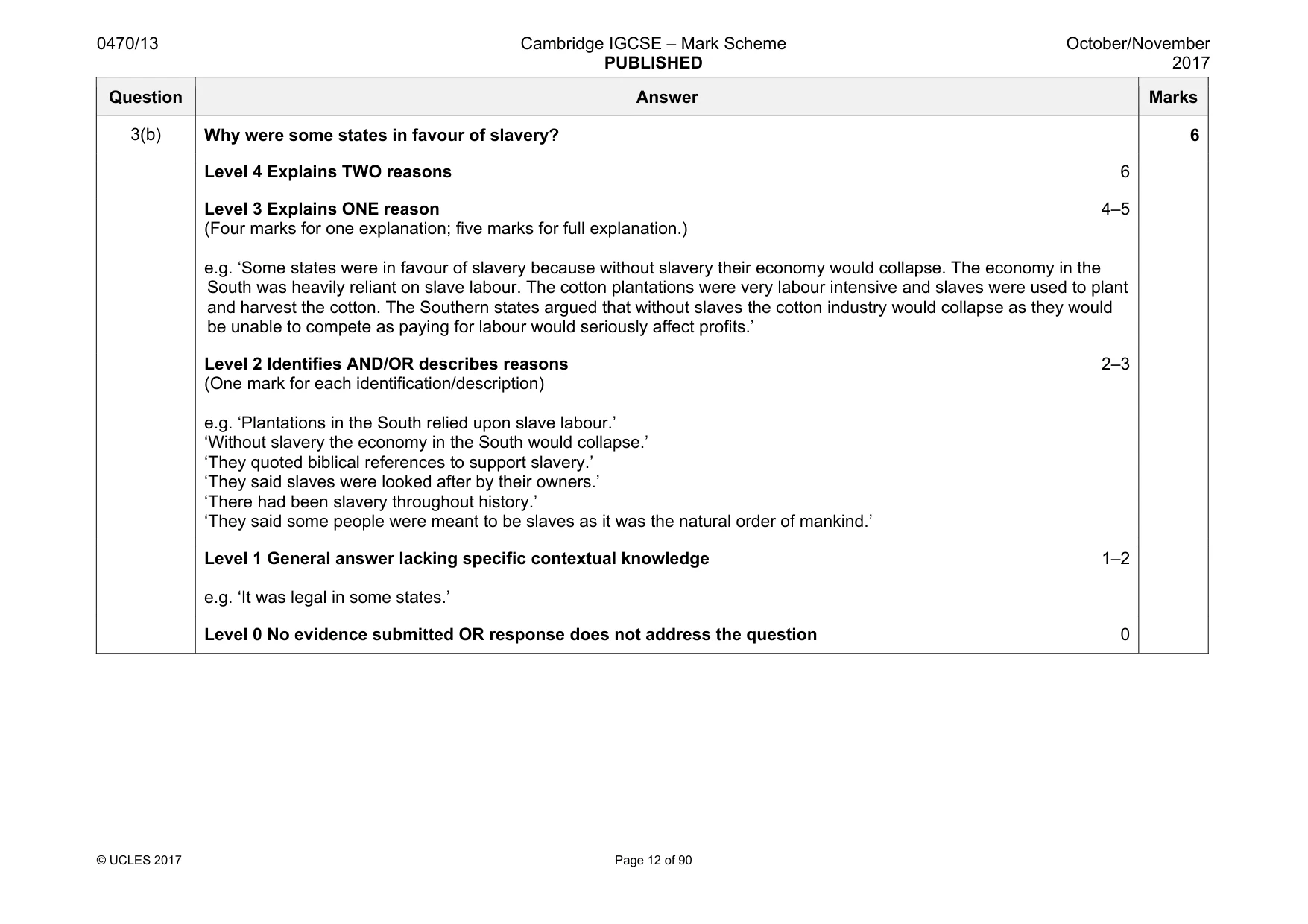
0470/13 Cambridge IGCSE – Mark Scheme PUBLISHED October/November 2017 © UCLES 2017 Page 12 of 90 Question Answer Marks 3(b) Why were some states in favour of slavery? 6 Level 4 Explains TWO reasons 6 Level 3 Explains ONE reason 4–5 (Four marks for one explanation; five marks for full explanation.) e.g. ‘Some states were in favour of slavery because without slavery their economy would collapse. The economy in the South was heavily reliant on slave labour. The cotton plantations were very labour intensive and slaves were used to plant and harvest the cotton. The Southern states argued that without slaves the cotton industry would collapse as they would be unable to compete as paying for labour would seriously affect profits.’ Level 2 Identifies AND/OR describes reasons 2–3 (One mark for each identification/description) e.g. ‘Plantations in the South relied upon slave labour.’ ‘Without slavery the economy in the South would collapse.’ ‘They quoted biblical references to support slavery.’ ‘They said slaves were looked after by their owners.’ ‘There had been slavery throughout history.’ ‘They said some people were meant to be slaves as it was the natural order of mankind.’ Level 1 General answer lacking specific contextual knowledge 1–2 e.g. ‘It was legal in some states.’ Level 0 No evidence submitted OR response does not address the question 0
Mark scheme, page 13
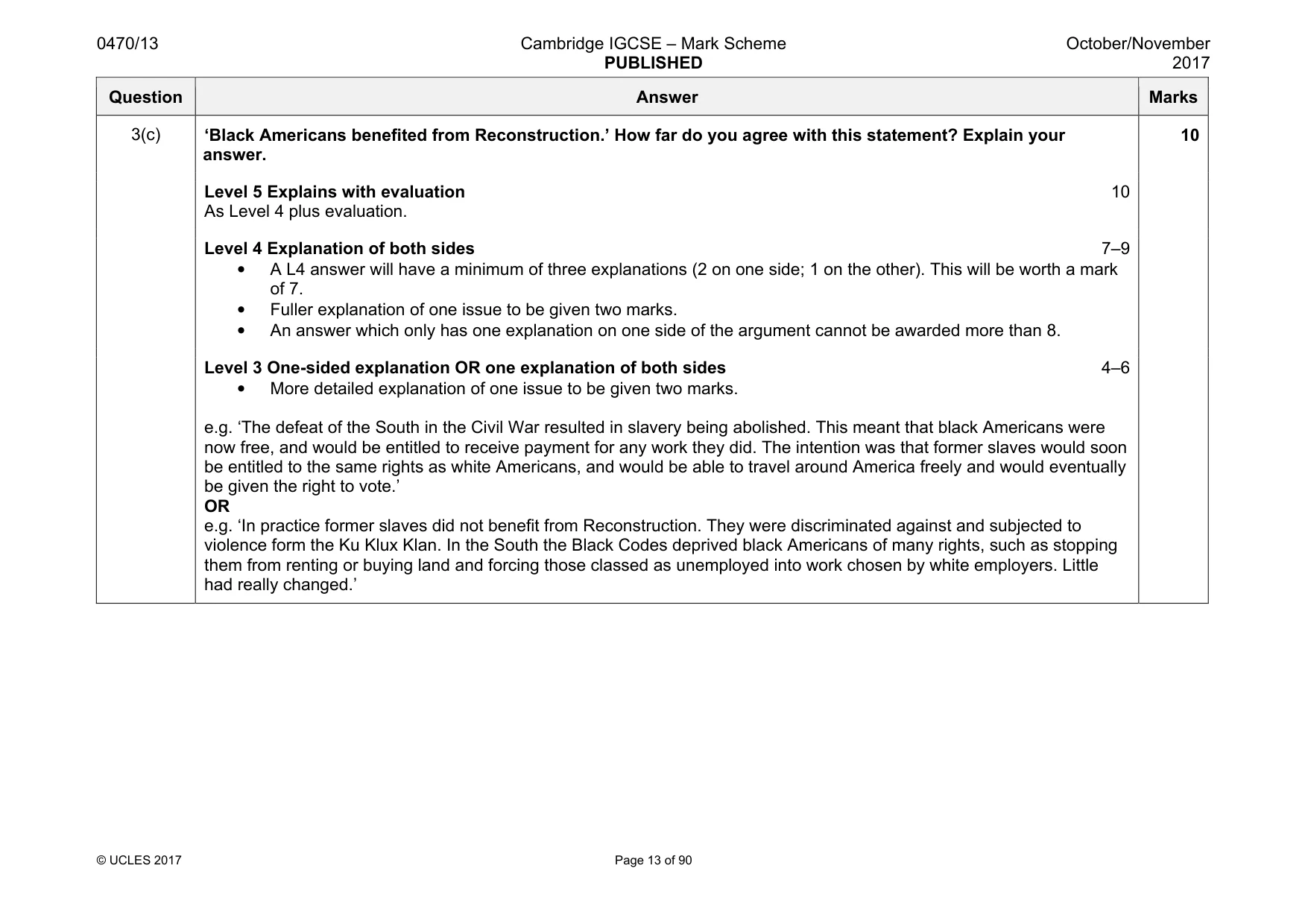
0470/13 Cambridge IGCSE – Mark Scheme PUBLISHED October/November 2017 © UCLES 2017 Page 13 of 90 Question Answer Marks 3(c) ‘Black Americans benefited from Reconstruction.’ How far do you agree with this statement? Explain your answer. 10 Level 5 Explains with evaluation 10 As Level 4 plus evaluation. Level 4 Explanation of both sides 7–9 • A L4 answer will have a minimum of three explanations (2 on one side; 1 on the other). This will be worth a mark of 7. • Fuller explanation of one issue to be given two marks. • An answer which only has one explanation on one side of the argument cannot be awarded more than 8. Level 3 One-sided explanation OR one explanation of both sides 4–6 • More detailed explanation of one issue to be given two marks. e.g. ‘The defeat of the South in the Civil War resulted in slavery being abolished. This meant that black Americans were now free, and would be entitled to receive payment for any work they did. The intention was that former slaves would soon be entitled to the same rights as white Americans, and would be able to travel around America freely and would eventually be given the right to vote.’ OR e.g. ‘In practice former slaves did not benefit from Reconstruction. They were discriminated against and subjected to violence form the Ku Klux Klan. In the South the Black Codes deprived black Americans of many rights, such as stopping them from renting or buying land and forcing those classed as unemployed into work chosen by white employers. Little had really changed.’
Mark scheme, page 14
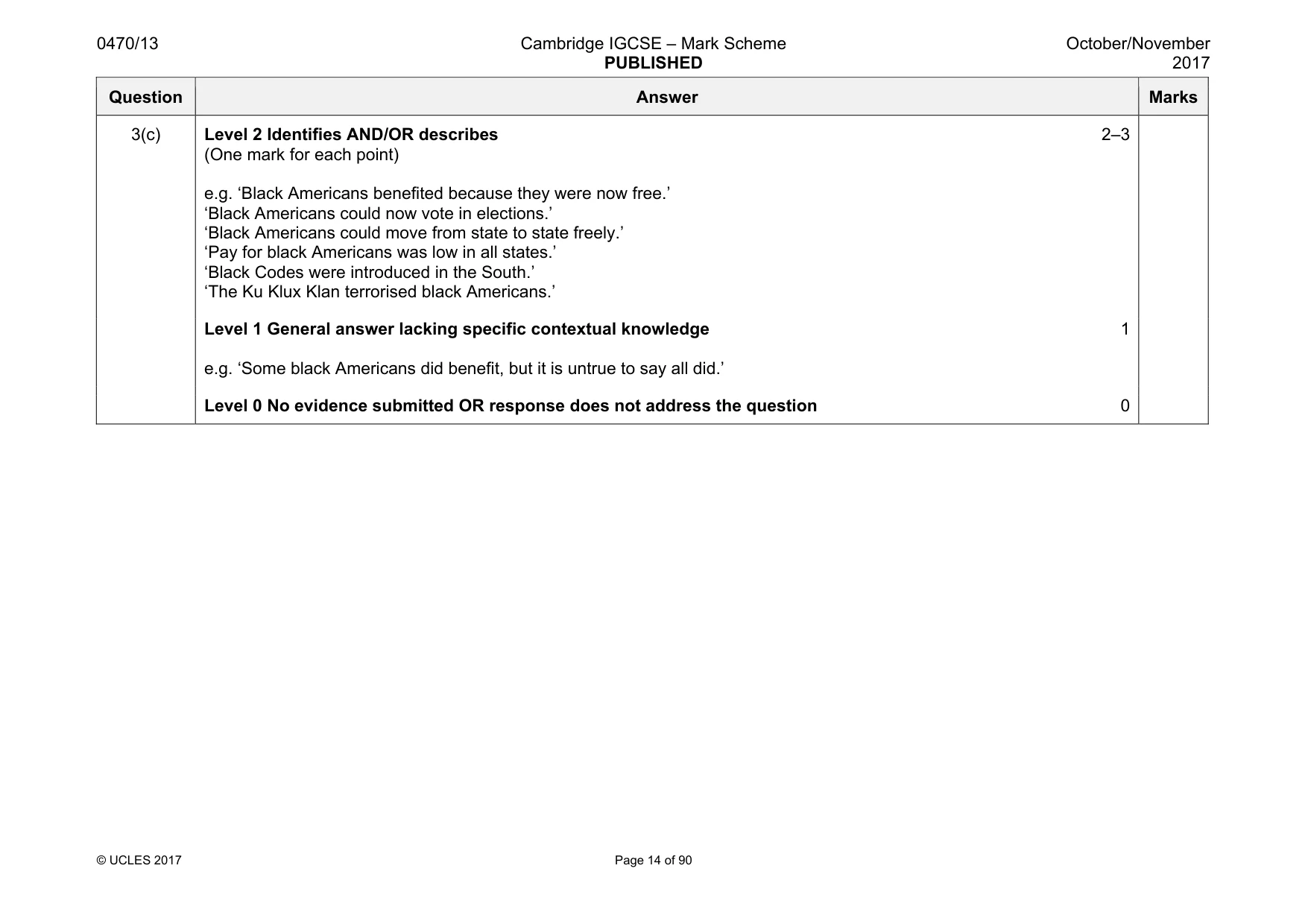
0470/13 Cambridge IGCSE – Mark Scheme PUBLISHED October/November 2017 © UCLES 2017 Page 14 of 90 Question Answer Marks 3(c) Level 2 Identifies AND/OR describes 2–3 (One mark for each point) e.g. ‘Black Americans benefited because they were now free.’ ‘Black Americans could now vote in elections.’ ‘Black Americans could move from state to state freely.’ ‘Pay for black Americans was low in all states.’ ‘Black Codes were introduced in the South.’ ‘The Ku Klux Klan terrorised black Americans.’ Level 1 General answer lacking specific contextual knowledge 1 e.g. ‘Some black Americans did benefit, but it is untrue to say all did.’ Level 0 No evidence submitted OR response does not address the question 0
Mark scheme, page 15
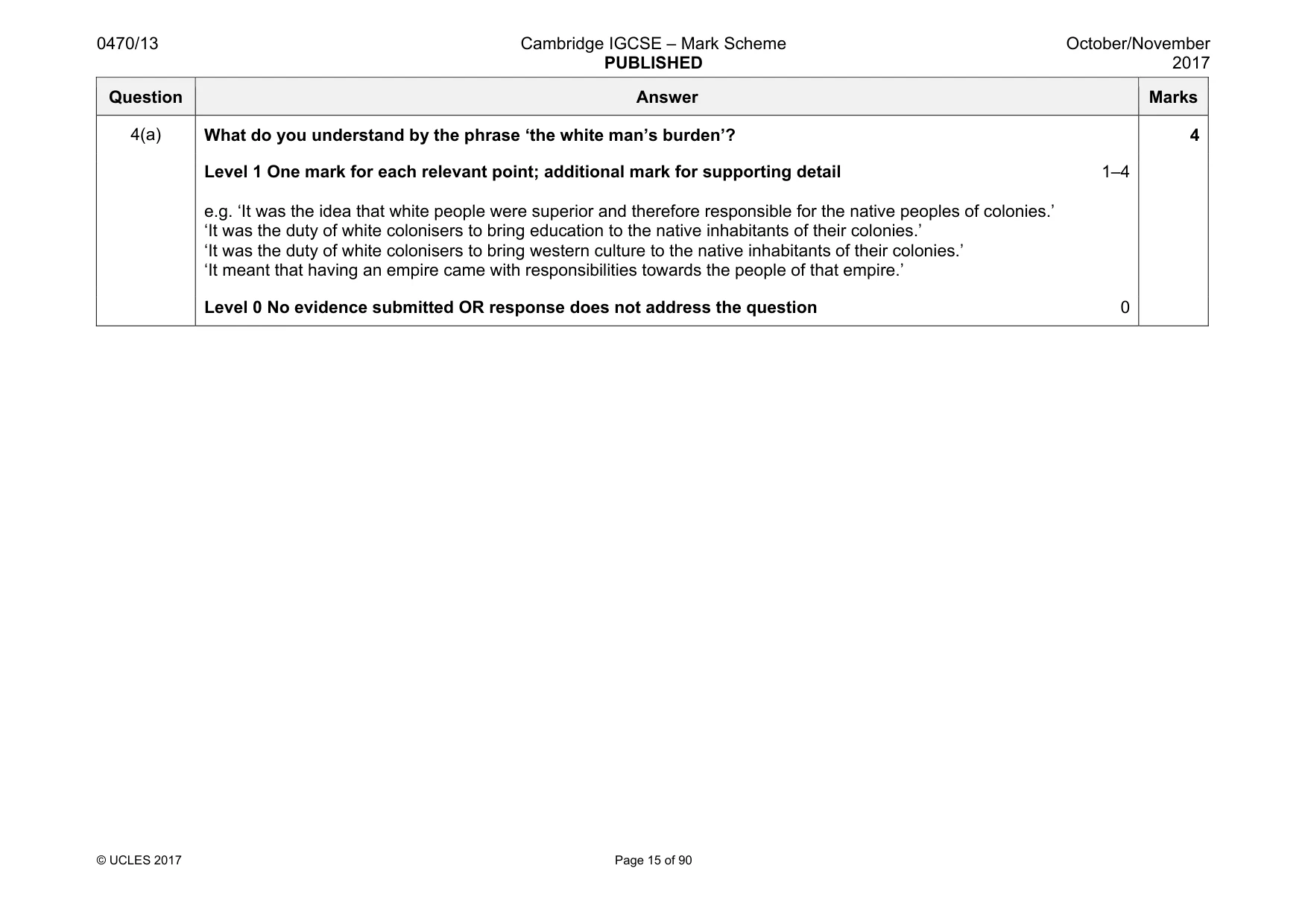
0470/13 Cambridge IGCSE – Mark Scheme PUBLISHED October/November 2017 © UCLES 2017 Page 15 of 90 Question Answer Marks 4(a) What do you understand by the phrase ‘the white man’s burden’? 4 Level 1 One mark for each relevant point; additional mark for supporting detail 1–4 e.g. ‘It was the idea that white people were superior and therefore responsible for the native peoples of colonies.’ ‘It was the duty of white colonisers to bring education to the native inhabitants of their colonies.’ ‘It was the duty of white colonisers to bring western culture to the native inhabitants of their colonies.’ ‘It meant that having an empire came with responsibilities towards the people of that empire.’ Level 0 No evidence submitted OR response does not address the question 0
Mark scheme, page 16
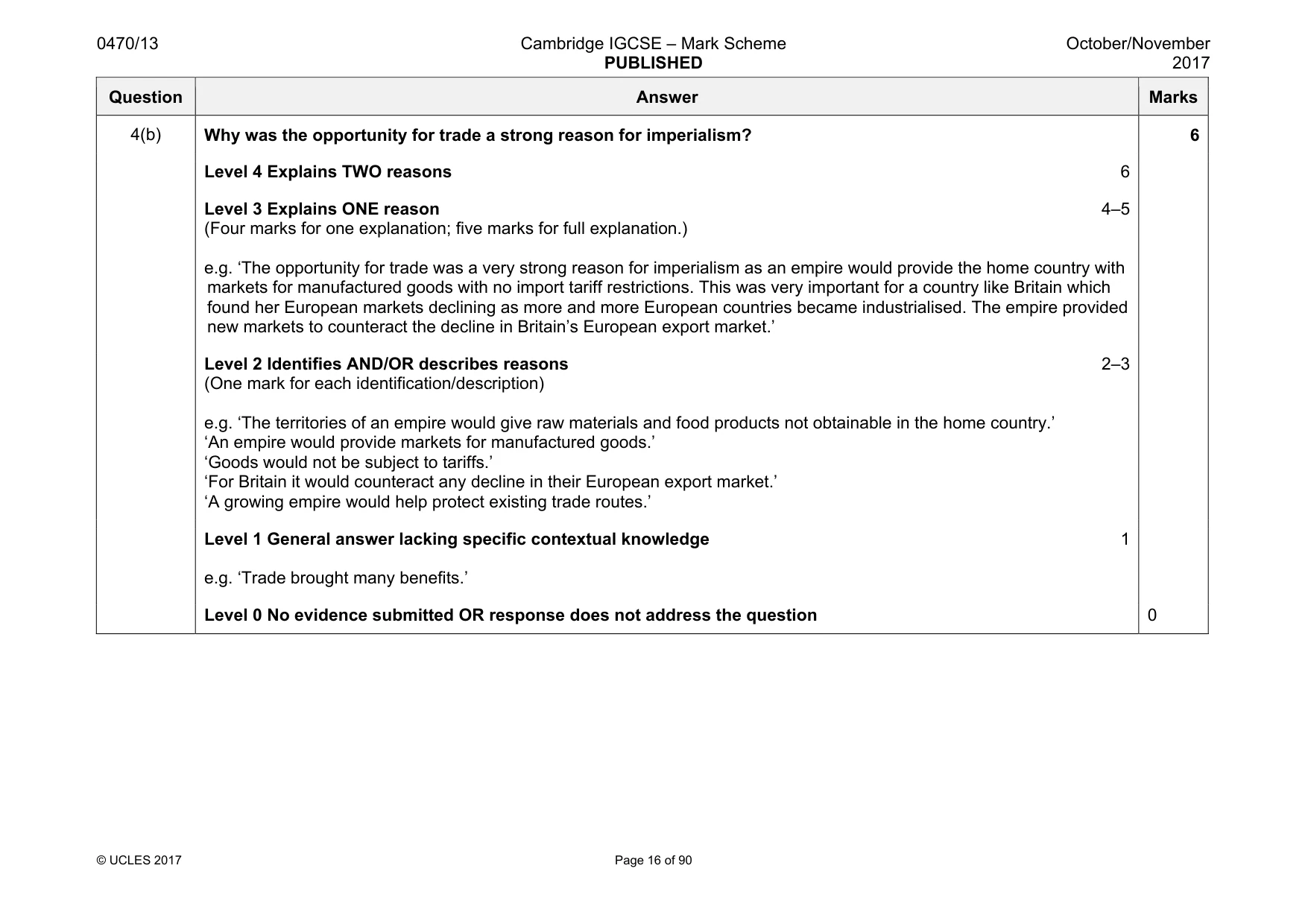
0470/13 Cambridge IGCSE – Mark Scheme PUBLISHED October/November 2017 © UCLES 2017 Page 16 of 90 Question Answer Marks 4(b) Why was the opportunity for trade a strong reason for imperialism? 6 Level 4 Explains TWO reasons 6 Level 3 Explains ONE reason 4–5 (Four marks for one explanation; five marks for full explanation.) e.g. ‘The opportunity for trade was a very strong reason for imperialism as an empire would provide the home country with markets for manufactured goods with no import tariff restrictions. This was very important for a country like Britain which found her European markets declining as more and more European countries became industrialised. The empire provided new markets to counteract the decline in Britain’s European export market.’ Level 2 Identifies AND/OR describes reasons 2–3 (One mark for each identification/description) e.g. ‘The territories of an empire would give raw materials and food products not obtainable in the home country.’ ‘An empire would provide markets for manufactured goods.’ ‘Goods would not be subject to tariffs.’ ‘For Britain it would counteract any decline in their European export market.’ ‘A growing empire would help protect existing trade routes.’ Level 1 General answer lacking specific contextual knowledge 1 e.g. ‘Trade brought many benefits.’ Level 0 No evidence submitted OR response does not address the question 0
Mark scheme, page 17
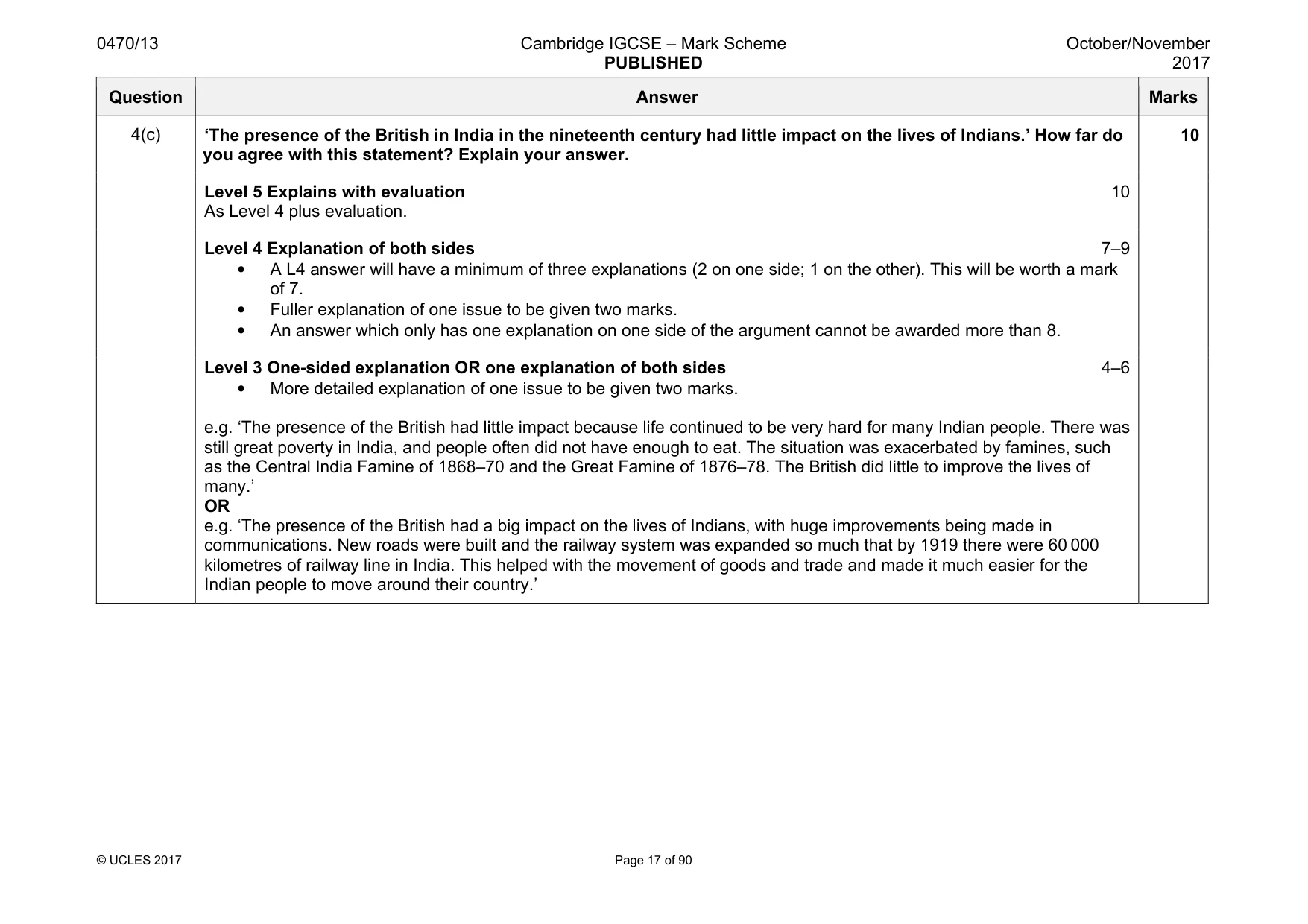
0470/13 Cambridge IGCSE – Mark Scheme PUBLISHED October/November 2017 © UCLES 2017 Page 17 of 90 Question Answer Marks 4(c) ‘The presence of the British in India in the nineteenth century had little impact on the lives of Indians.’ How far do you agree with this statement? Explain your answer. 10 Level 5 Explains with evaluation 10 As Level 4 plus evaluation. Level 4 Explanation of both sides 7–9 • A L4 answer will have a minimum of three explanations (2 on one side; 1 on the other). This will be worth a mark of 7. • Fuller explanation of one issue to be given two marks. • An answer which only has one explanation on one side of the argument cannot be awarded more than 8. Level 3 One-sided explanation OR one explanation of both sides 4–6 • More detailed explanation of one issue to be given two marks. e.g. ‘The presence of the British had little impact because life continued to be very hard for many Indian people. There was still great poverty in India, and people often did not have enough to eat. The situation was exacerbated by famines, such as the Central India Famine of 1868–70 and the Great Famine of 1876–78. The British did little to improve the lives of many.’ OR e.g. ‘The presence of the British had a big impact on the lives of Indians, with huge improvements being made in communications. New roads were built and the railway system was expanded so much that by 1919 there were 60 000 kilometres of railway line in India. This helped with the movement of goods and trade and made it much easier for the Indian people to move around their country.’
Mark scheme, page 18
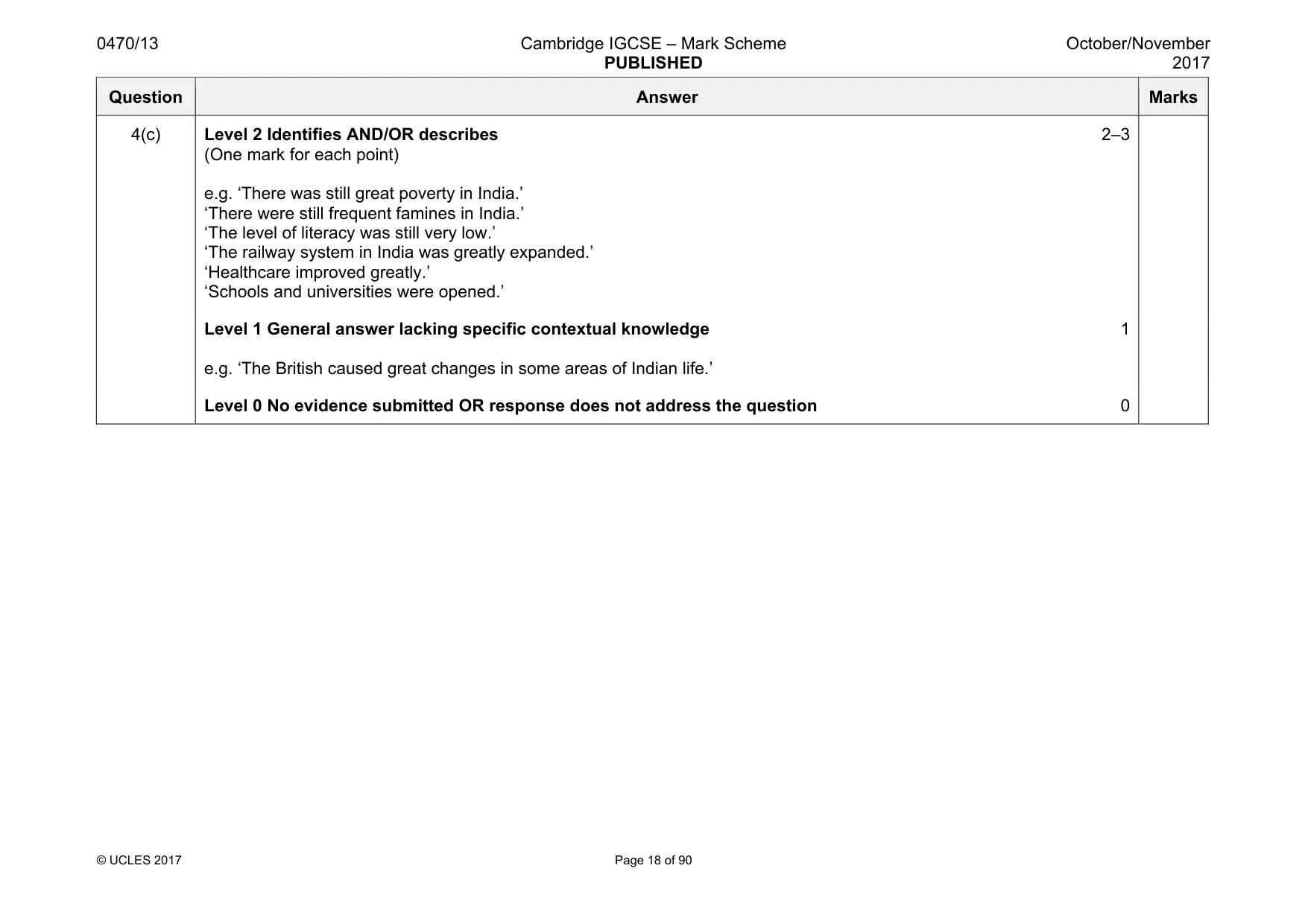
0470/13 Cambridge IGCSE – Mark Scheme PUBLISHED October/November 2017 © UCLES 2017 Page 18 of 90 Question Answer Marks 4(c) Level 2 Identifies AND/OR describes 2–3 (One mark for each point) e.g. ‘There was still great poverty in India.’ ‘There were still frequent famines in India.’ ‘The level of literacy was still very low.’ ‘The railway system in India was greatly expanded.’ ‘Healthcare improved greatly.’ ‘Schools and universities were opened.’ Level 1 General answer lacking specific contextual knowledge 1 e.g. ‘The British caused great changes in some areas of Indian life.’ Level 0 No evidence submitted OR response does not address the question 0
Mark scheme, page 19
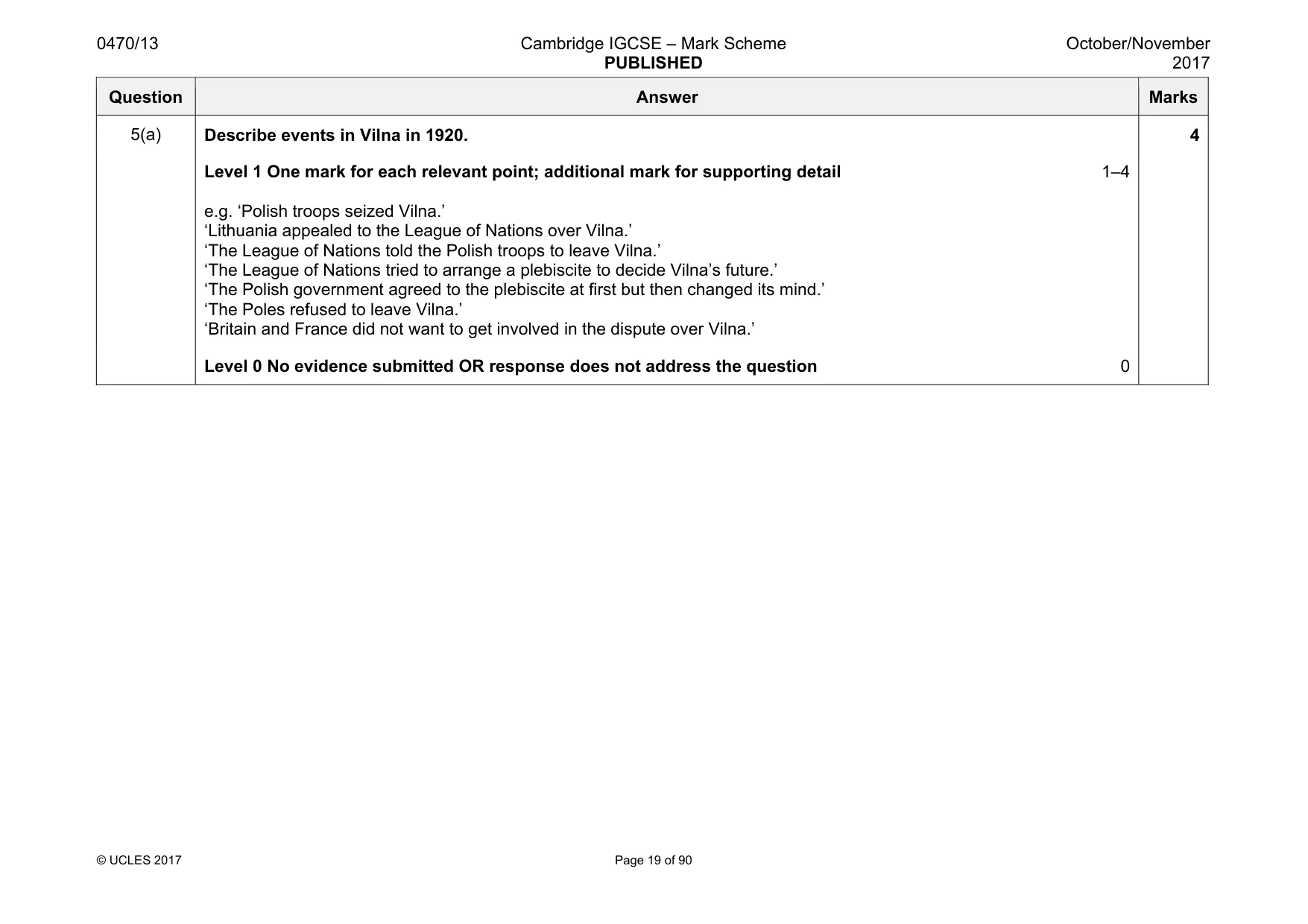
0470/13 Cambridge IGCSE – Mark Scheme PUBLISHED October/November 2017 © UCLES 2017 Page 19 of 90 Question Answer Marks 5(a) Describe events in Vilna in 1920. 4 Level 1 One mark for each relevant point; additional mark for supporting detail 1–4 e.g. ‘Polish troops seized Vilna.’ ‘Lithuania appealed to the League of Nations over Vilna.’ ‘The League of Nations told the Polish troops to leave Vilna.’ ‘The League of Nations tried to arrange a plebiscite to decide Vilna’s future.’ ‘The Polish government agreed to the plebiscite at first but then changed its mind.’ ‘The Poles refused to leave Vilna.’ ‘Britain and France did not want to get involved in the dispute over Vilna.’ Level 0 No evidence submitted OR response does not address the question 0
Mark scheme, page 20
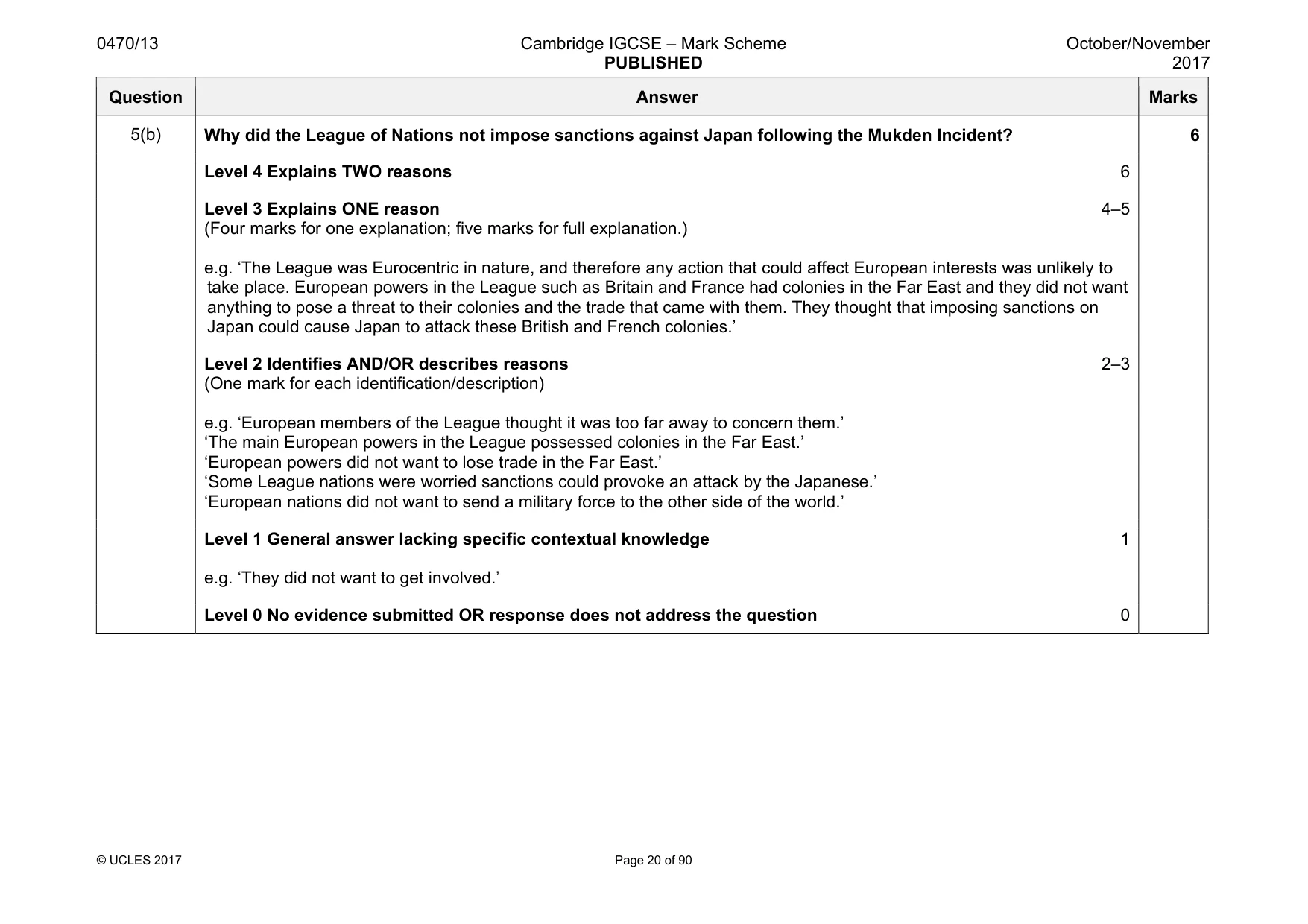
0470/13 Cambridge IGCSE – Mark Scheme PUBLISHED October/November 2017 © UCLES 2017 Page 20 of 90 Question Answer Marks 5(b) Why did the League of Nations not impose sanctions against Japan following the Mukden Incident? 6 Level 4 Explains TWO reasons 6 Level 3 Explains ONE reason 4–5 (Four marks for one explanation; five marks for full explanation.) e.g. ‘The League was Eurocentric in nature, and therefore any action that could affect European interests was unlikely to take place. European powers in the League such as Britain and France had colonies in the Far East and they did not want anything to pose a threat to their colonies and the trade that came with them. They thought that imposing sanctions on Japan could cause Japan to attack these British and French colonies.’ Level 2 Identifies AND/OR describes reasons 2–3 (One mark for each identification/description) e.g. ‘European members of the League thought it was too far away to concern them.’ ‘The main European powers in the League possessed colonies in the Far East.’ ‘European powers did not want to lose trade in the Far East.’ ‘Some League nations were worried sanctions could provoke an attack by the Japanese.’ ‘European nations did not want to send a military force to the other side of the world.’ Level 1 General answer lacking specific contextual knowledge 1 e.g. ‘They did not want to get involved.’ Level 0 No evidence submitted OR response does not address the question 0
Mark scheme, page 21
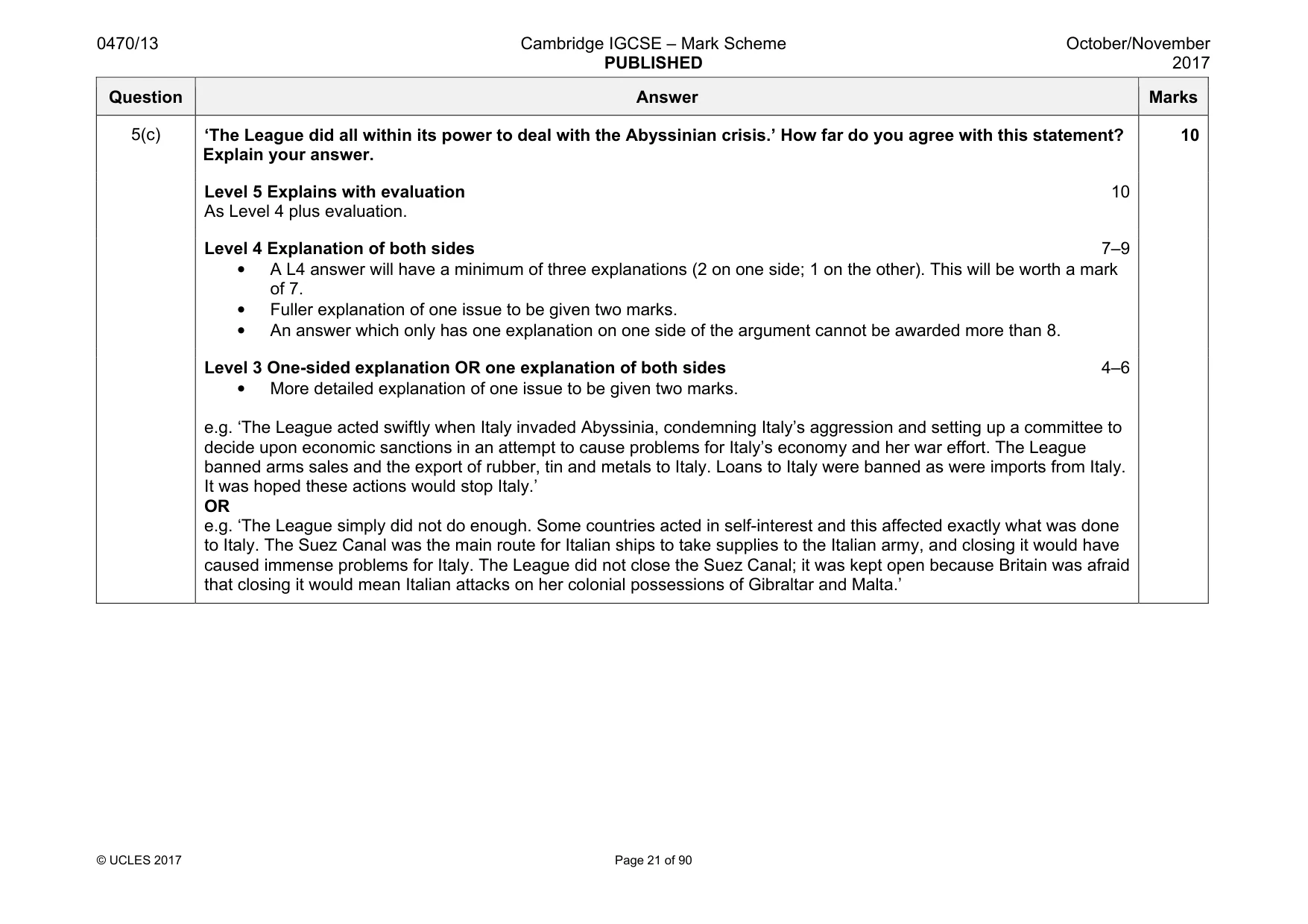
0470/13 Cambridge IGCSE – Mark Scheme PUBLISHED October/November 2017 © UCLES 2017 Page 21 of 90 Question Answer Marks 5(c) ‘The League did all within its power to deal with the Abyssinian crisis.’ How far do you agree with this statement? Explain your answer. 10 Level 5 Explains with evaluation 10 As Level 4 plus evaluation. Level 4 Explanation of both sides 7–9 • A L4 answer will have a minimum of three explanations (2 on one side; 1 on the other). This will be worth a mark of 7. • Fuller explanation of one issue to be given two marks. • An answer which only has one explanation on one side of the argument cannot be awarded more than 8. Level 3 One-sided explanation OR one explanation of both sides 4–6 • More detailed explanation of one issue to be given two marks. e.g. ‘The League acted swiftly when Italy invaded Abyssinia, condemning Italy’s aggression and setting up a committee to decide upon economic sanctions in an attempt to cause problems for Italy’s economy and her war effort. The League banned arms sales and the export of rubber, tin and metals to Italy. Loans to Italy were banned as were imports from Italy. It was hoped these actions would stop Italy.’ OR e.g. ‘The League simply did not do enough. Some countries acted in self-interest and this affected exactly what was done to Italy. The Suez Canal was the main route for Italian ships to take supplies to the Italian army, and closing it would have caused immense problems for Italy. The League did not close the Suez Canal; it was kept open because Britain was afraid that closing it would mean Italian attacks on her colonial possessions of Gibraltar and Malta.’
Mark scheme, page 22
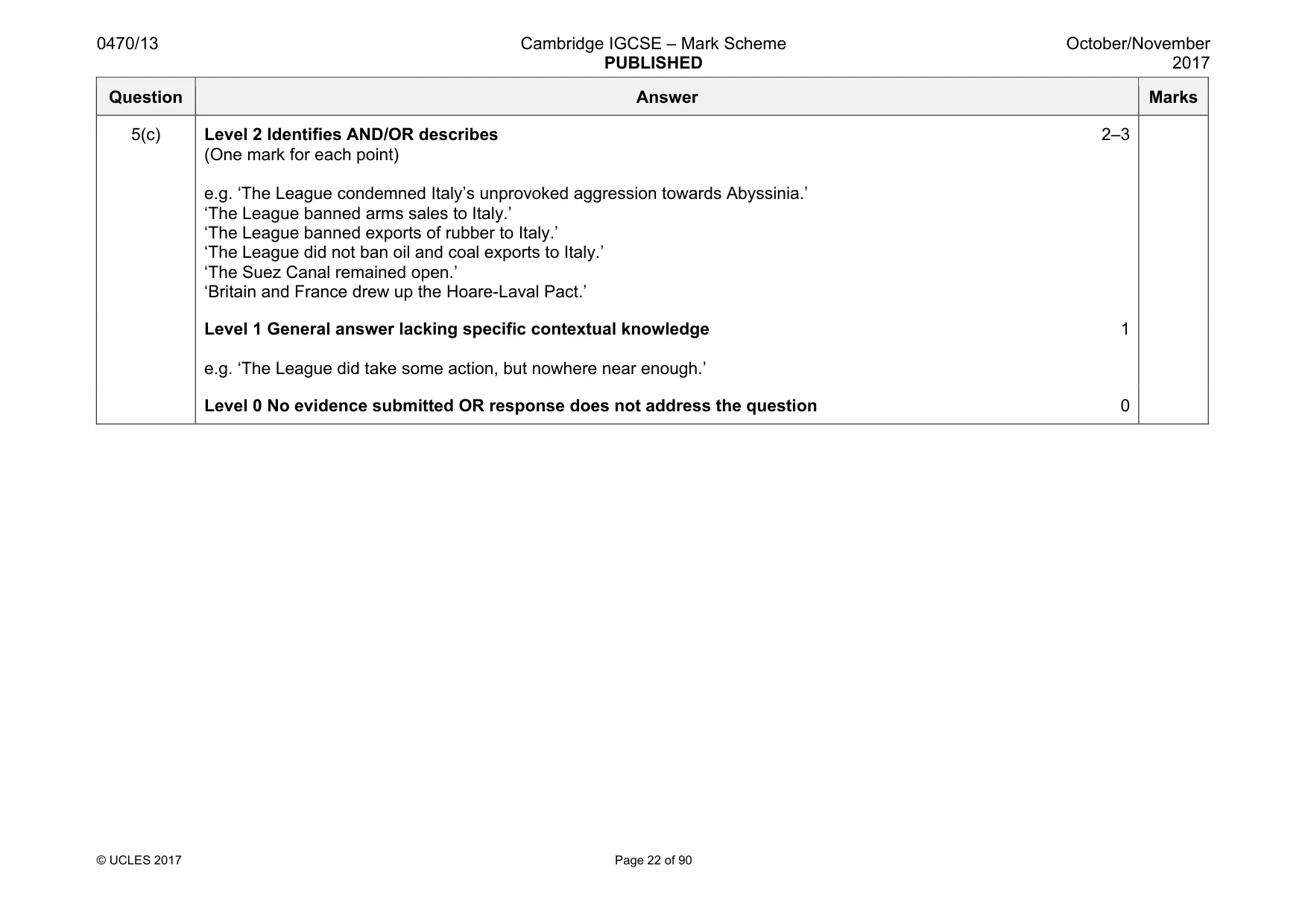
0470/13 Cambridge IGCSE – Mark Scheme PUBLISHED October/November 2017 © UCLES 2017 Page 22 of 90 Question Answer Marks 5(c) Level 2 Identifies AND/OR describes 2–3 (One mark for each point) e.g. ‘The League condemned Italy’s unprovoked aggression towards Abyssinia.’ ‘The League banned arms sales to Italy.’ ‘The League banned exports of rubber to Italy.’ ‘The League did not ban oil and coal exports to Italy.’ ‘The Suez Canal remained open.’ ‘Britain and France drew up the Hoare-Laval Pact.’ Level 1 General answer lacking specific contextual knowledge 1 e.g. ‘The League did take some action, but nowhere near enough.’ Level 0 No evidence submitted OR response does not address the question 0
Mark scheme, page 23
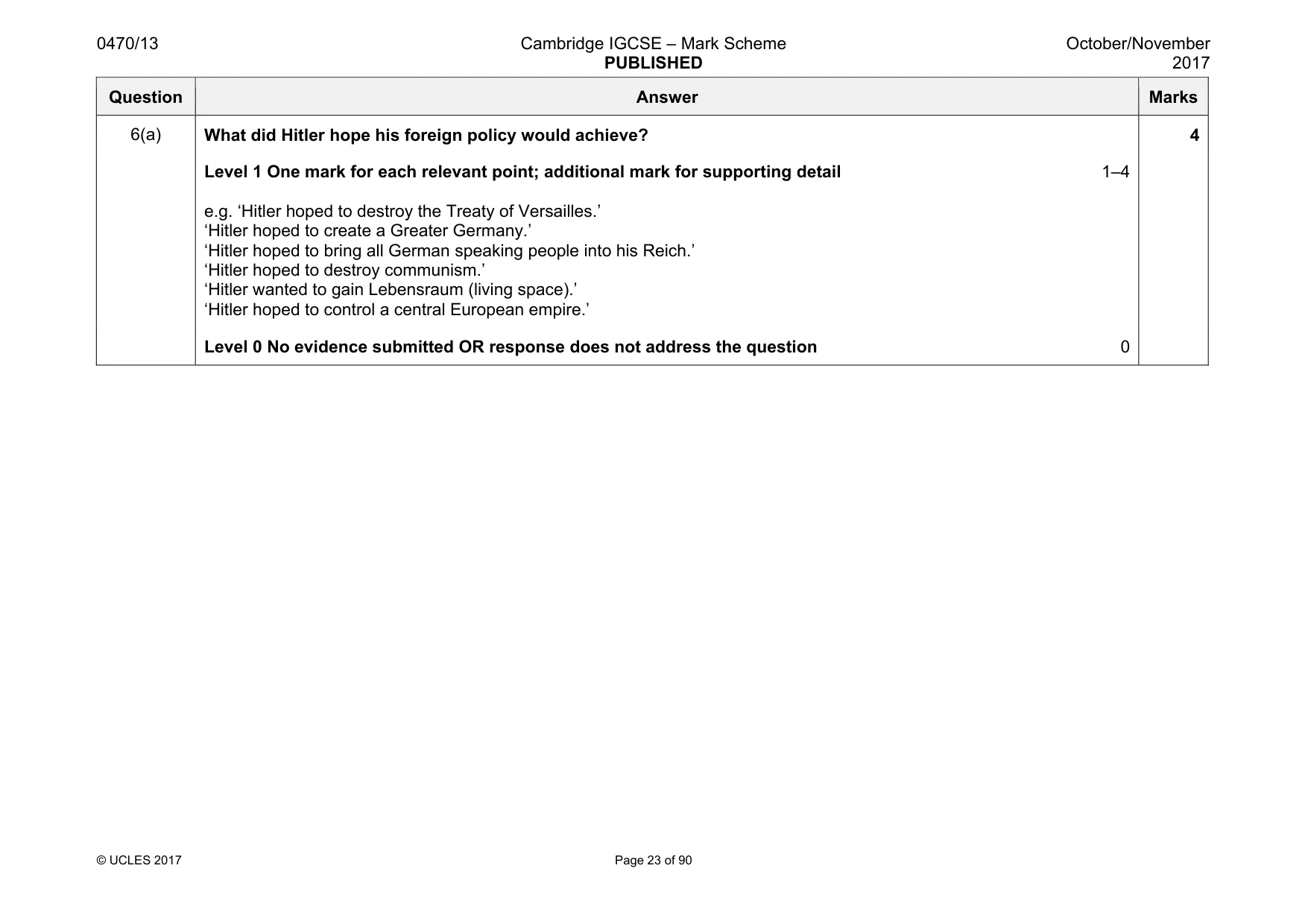
0470/13 Cambridge IGCSE – Mark Scheme PUBLISHED October/November 2017 © UCLES 2017 Page 23 of 90 Question Answer Marks 6(a) What did Hitler hope his foreign policy would achieve? 4 Level 1 One mark for each relevant point; additional mark for supporting detail 1–4 e.g. ‘Hitler hoped to destroy the Treaty of Versailles.’ ‘Hitler hoped to create a Greater Germany.’ ‘Hitler hoped to bring all German speaking people into his Reich.’ ‘Hitler hoped to destroy communism.’ ‘Hitler wanted to gain Lebensraum (living space).’ ‘Hitler hoped to control a central European empire.’ Level 0 No evidence submitted OR response does not address the question 0
Mark scheme, page 24
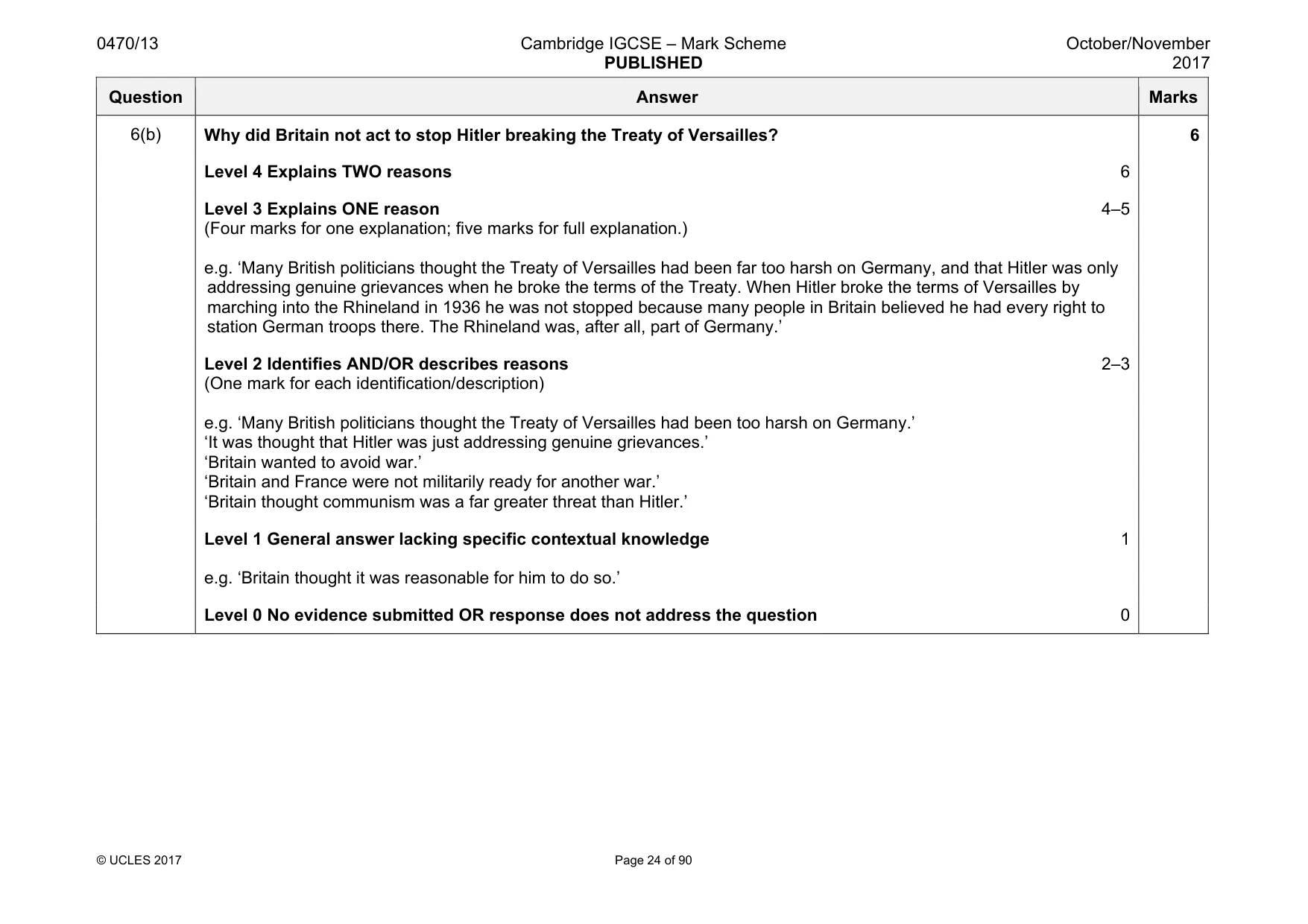
0470/13 Cambridge IGCSE – Mark Scheme PUBLISHED October/November 2017 © UCLES 2017 Page 24 of 90 Question Answer Marks 6(b) Why did Britain not act to stop Hitler breaking the Treaty of Versailles? 6 Level 4 Explains TWO reasons 6 Level 3 Explains ONE reason 4–5 (Four marks for one explanation; five marks for full explanation.) e.g. ‘Many British politicians thought the Treaty of Versailles had been far too harsh on Germany, and that Hitler was only addressing genuine grievances when he broke the terms of the Treaty. When Hitler broke the terms of Versailles by marching into the Rhineland in 1936 he was not stopped because many people in Britain believed he had every right to station German troops there. The Rhineland was, after all, part of Germany.’ Level 2 Identifies AND/OR describes reasons 2–3 (One mark for each identification/description) e.g. ‘Many British politicians thought the Treaty of Versailles had been too harsh on Germany.’ ‘It was thought that Hitler was just addressing genuine grievances.’ ‘Britain wanted to avoid war.’ ‘Britain and France were not militarily ready for another war.’ ‘Britain thought communism was a far greater threat than Hitler.’ Level 1 General answer lacking specific contextual knowledge 1 e.g. ‘Britain thought it was reasonable for him to do so.’ Level 0 No evidence submitted OR response does not address the question 0
Mark scheme, page 25
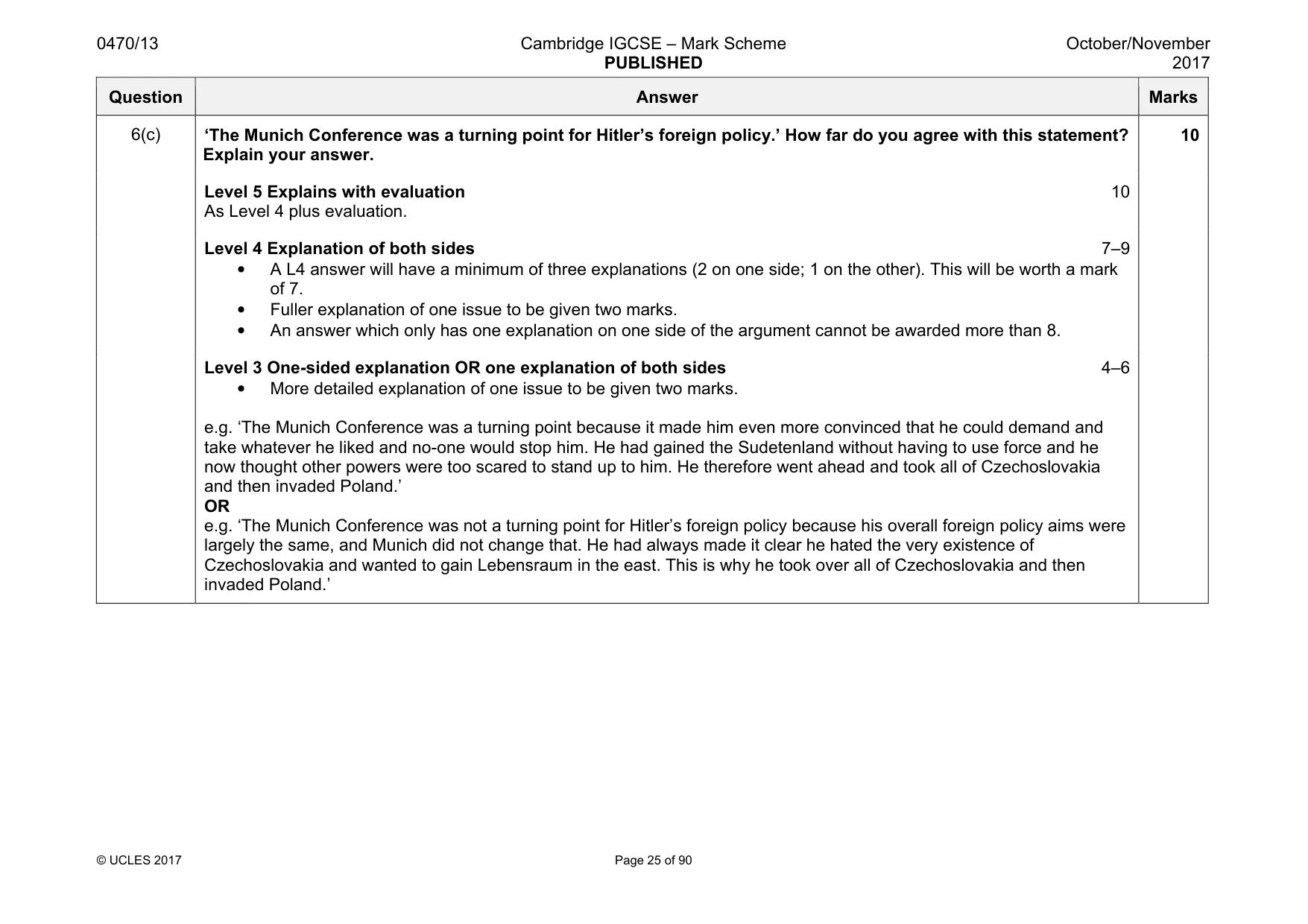
0470/13 Cambridge IGCSE – Mark Scheme PUBLISHED October/November 2017 © UCLES 2017 Page 25 of 90 Question Answer Marks 6(c) ‘The Munich Conference was a turning point for Hitler’s foreign policy.’ How far do you agree with this statement? Explain your answer. 10 Level 5 Explains with evaluation 10 As Level 4 plus evaluation. Level 4 Explanation of both sides 7–9 • A L4 answer will have a minimum of three explanations (2 on one side; 1 on the other). This will be worth a mark of 7. • Fuller explanation of one issue to be given two marks. • An answer which only has one explanation on one side of the argument cannot be awarded more than 8. Level 3 One-sided explanation OR one explanation of both sides 4–6 • More detailed explanation of one issue to be given two marks. e.g. ‘The Munich Conference was a turning point because it made him even more convinced that he could demand and take whatever he liked and no-one would stop him. He had gained the Sudetenland without having to use force and he now thought other powers were too scared to stand up to him. He therefore went ahead and took all of Czechoslovakia and then invaded Poland.’ OR e.g. ‘The Munich Conference was not a turning point for Hitler’s foreign policy because his overall foreign policy aims were largely the same, and Munich did not change that. He had always made it clear he hated the very existence of Czechoslovakia and wanted to gain Lebensraum in the east. This is why he took over all of Czechoslovakia and then invaded Poland.’
Mark scheme, page 26
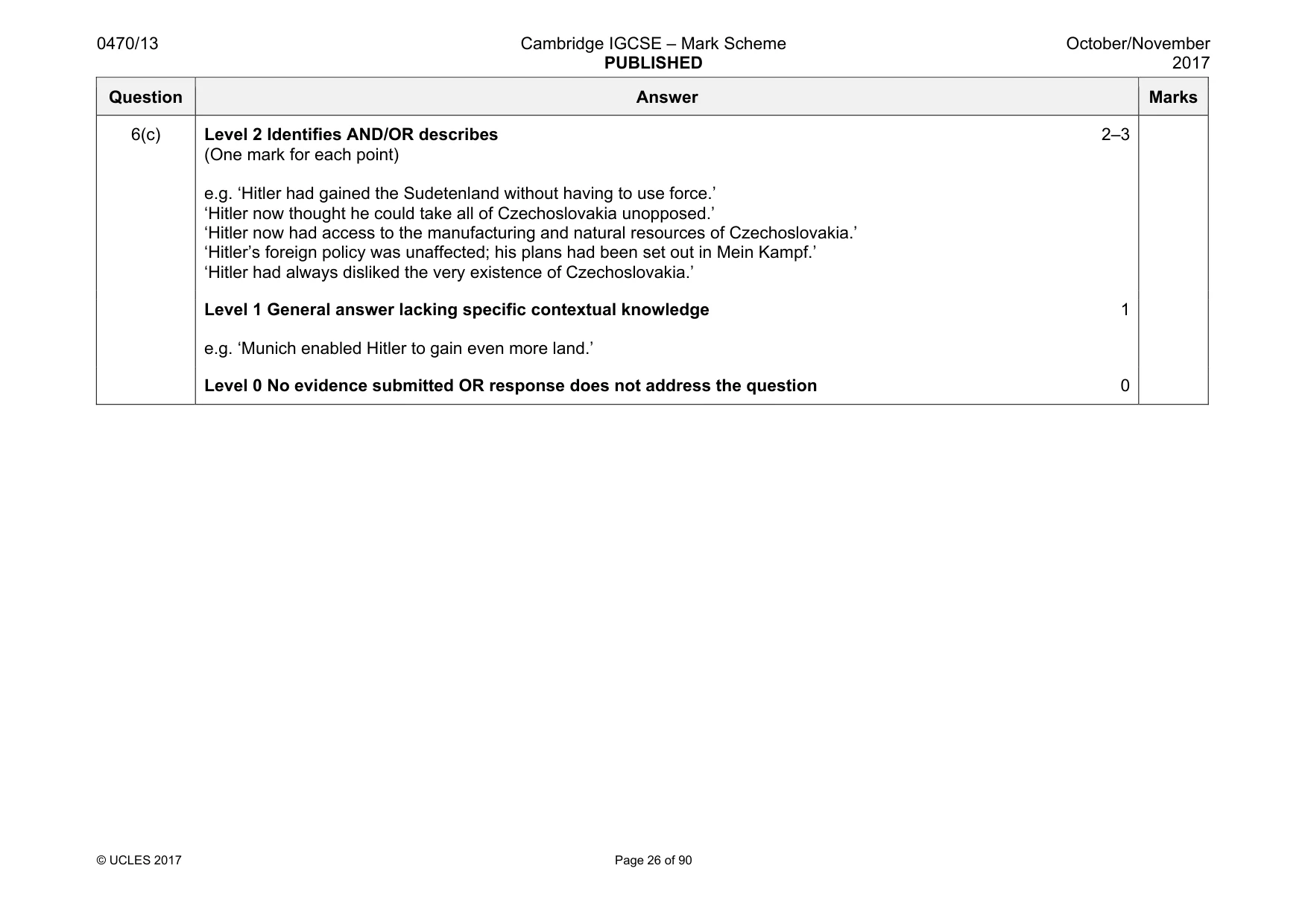
0470/13 Cambridge IGCSE – Mark Scheme PUBLISHED October/November 2017 © UCLES 2017 Page 26 of 90 Question Answer Marks 6(c) Level 2 Identifies AND/OR describes 2–3 (One mark for each point) e.g. ‘Hitler had gained the Sudetenland without having to use force.’ ‘Hitler now thought he could take all of Czechoslovakia unopposed.’ ‘Hitler now had access to the manufacturing and natural resources of Czechoslovakia.’ ‘Hitler’s foreign policy was unaffected; his plans had been set out in Mein Kampf.’ ‘Hitler had always disliked the very existence of Czechoslovakia.’ Level 1 General answer lacking specific contextual knowledge 1 e.g. ‘Munich enabled Hitler to gain even more land.’ Level 0 No evidence submitted OR response does not address the question 0
Mark scheme, page 27
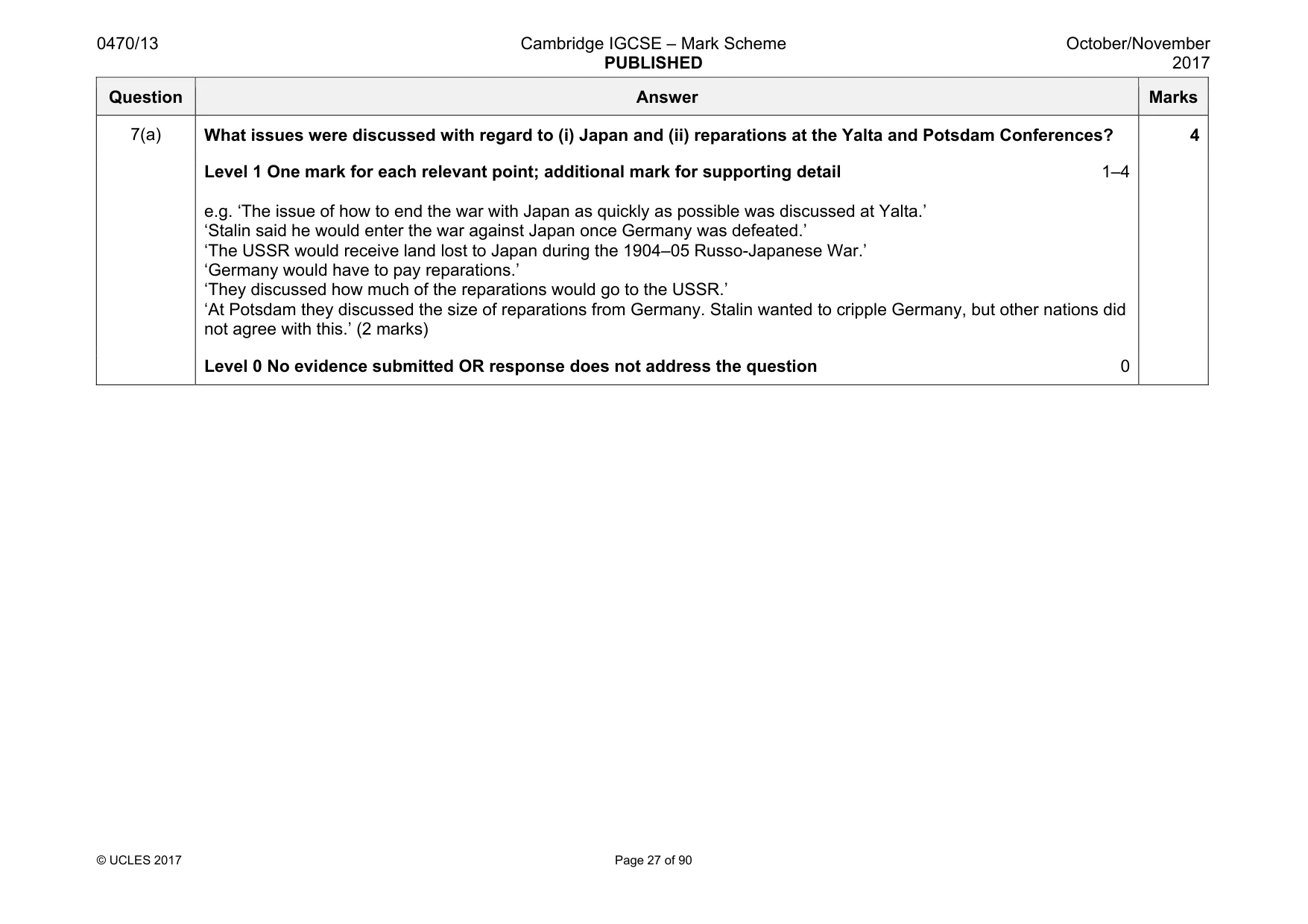
0470/13 Cambridge IGCSE – Mark Scheme PUBLISHED October/November 2017 © UCLES 2017 Page 27 of 90 Question Answer Marks 7(a) What issues were discussed with regard to (i) Japan and (ii) reparations at the Yalta and Potsdam Conferences? 4 Level 1 One mark for each relevant point; additional mark for supporting detail 1–4 e.g. ‘The issue of how to end the war with Japan as quickly as possible was discussed at Yalta.’ ‘Stalin said he would enter the war against Japan once Germany was defeated.’ ‘The USSR would receive land lost to Japan during the 1904–05 Russo-Japanese War.’ ‘Germany would have to pay reparations.’ ‘They discussed how much of the reparations would go to the USSR.’ ‘At Potsdam they discussed the size of reparations from Germany. Stalin wanted to cripple Germany, but other nations did not agree with this.’ (2 marks) Level 0 No evidence submitted OR response does not address the question 0
Mark scheme, page 28
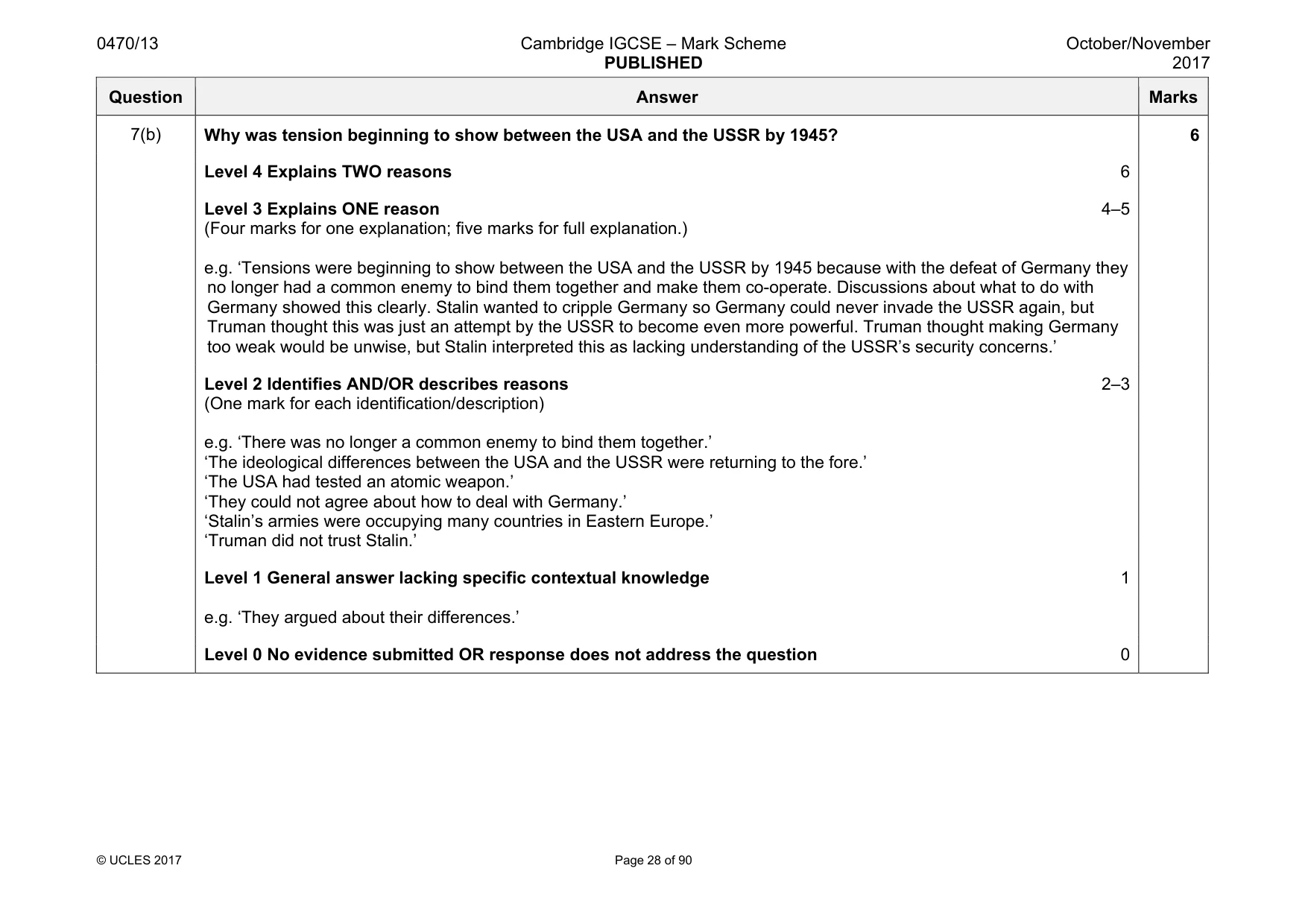
0470/13 Cambridge IGCSE – Mark Scheme PUBLISHED October/November 2017 © UCLES 2017 Page 28 of 90 Question Answer Marks 7(b) Why was tension beginning to show between the USA and the USSR by 1945? 6 Level 4 Explains TWO reasons 6 Level 3 Explains ONE reason 4–5 (Four marks for one explanation; five marks for full explanation.) e.g. ‘Tensions were beginning to show between the USA and the USSR by 1945 because with the defeat of Germany they no longer had a common enemy to bind them together and make them co-operate. Discussions about what to do with Germany showed this clearly. Stalin wanted to cripple Germany so Germany could never invade the USSR again, but Truman thought this was just an attempt by the USSR to become even more powerful. Truman thought making Germany too weak would be unwise, but Stalin interpreted this as lacking understanding of the USSR’s security concerns.’ Level 2 Identifies AND/OR describes reasons 2–3 (One mark for each identification/description) e.g. ‘There was no longer a common enemy to bind them together.’ ‘The ideological differences between the USA and the USSR were returning to the fore.’ ‘The USA had tested an atomic weapon.’ ‘They could not agree about how to deal with Germany.’ ‘Stalin’s armies were occupying many countries in Eastern Europe.’ ‘Truman did not trust Stalin.’ Level 1 General answer lacking specific contextual knowledge 1 e.g. ‘They argued about their differences.’ Level 0 No evidence submitted OR response does not address the question 0
Mark scheme, page 29
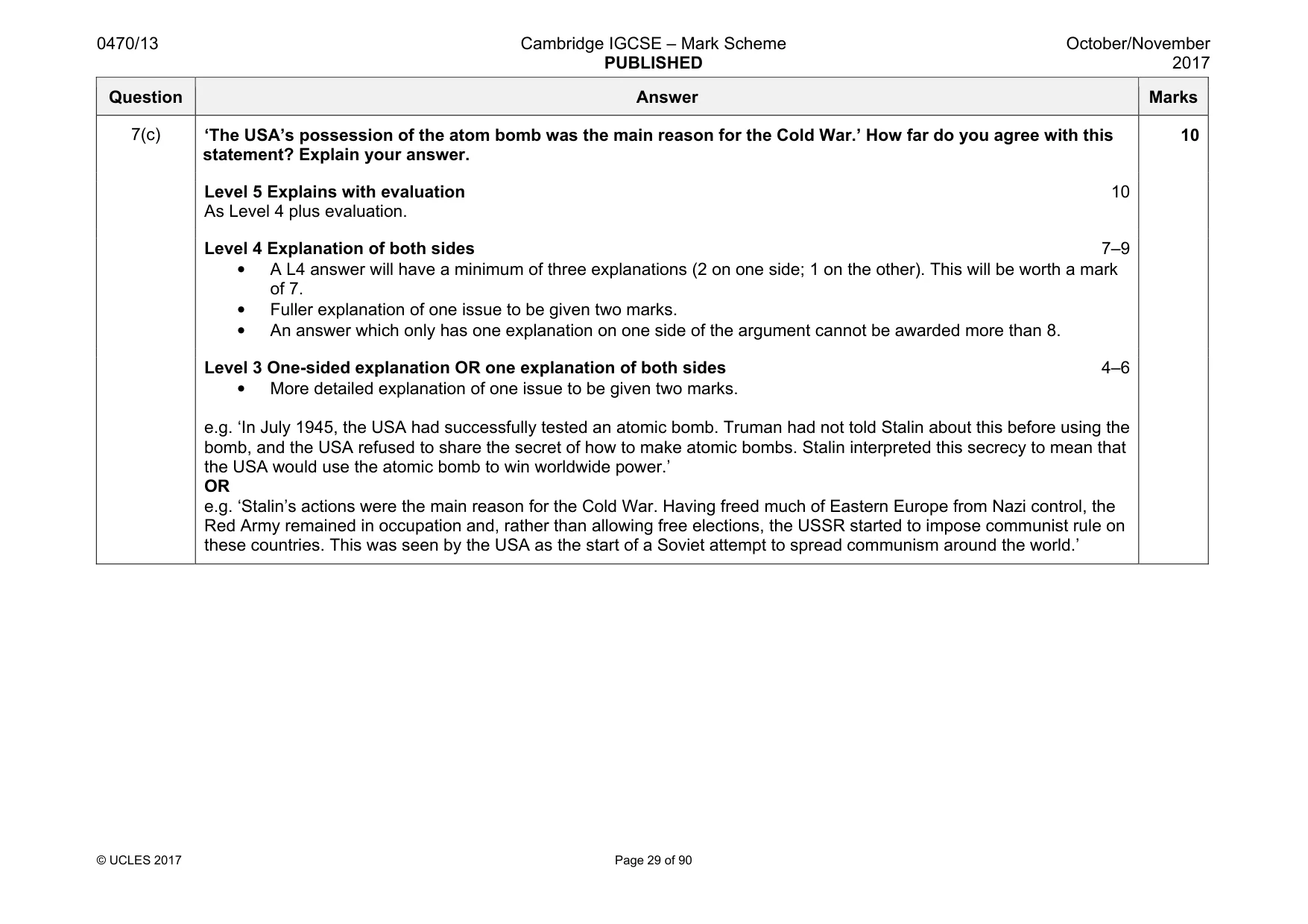
0470/13 Cambridge IGCSE – Mark Scheme PUBLISHED October/November 2017 © UCLES 2017 Page 29 of 90 Question Answer Marks 7(c) ‘The USA’s possession of the atom bomb was the main reason for the Cold War.’ How far do you agree with this statement? Explain your answer. 10 Level 5 Explains with evaluation 10 As Level 4 plus evaluation. Level 4 Explanation of both sides 7–9 • A L4 answer will have a minimum of three explanations (2 on one side; 1 on the other). This will be worth a mark of 7. • Fuller explanation of one issue to be given two marks. • An answer which only has one explanation on one side of the argument cannot be awarded more than 8. Level 3 One-sided explanation OR one explanation of both sides 4–6 • More detailed explanation of one issue to be given two marks. e.g. ‘In July 1945, the USA had successfully tested an atomic bomb. Truman had not told Stalin about this before using the bomb, and the USA refused to share the secret of how to make atomic bombs. Stalin interpreted this secrecy to mean that the USA would use the atomic bomb to win worldwide power.’ OR e.g. ‘Stalin’s actions were the main reason for the Cold War. Having freed much of Eastern Europe from Nazi control, the Red Army remained in occupation and, rather than allowing free elections, the USSR started to impose communist rule on these countries. This was seen by the USA as the start of a Soviet attempt to spread communism around the world.’
Mark scheme, page 30
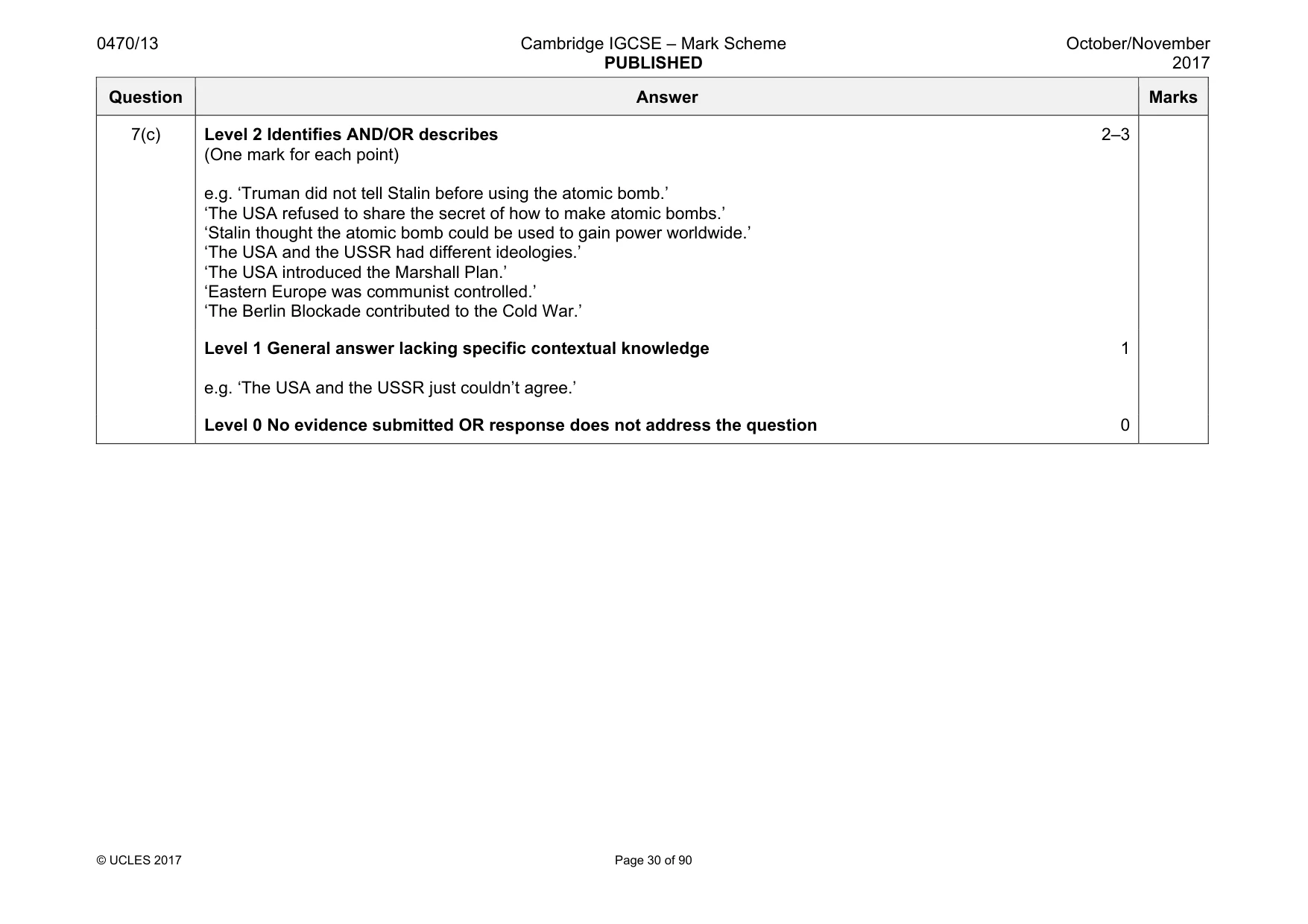
0470/13 Cambridge IGCSE – Mark Scheme PUBLISHED October/November 2017 © UCLES 2017 Page 30 of 90 Question Answer Marks 7(c) Level 2 Identifies AND/OR describes 2–3 (One mark for each point) e.g. ‘Truman did not tell Stalin before using the atomic bomb.’ ‘The USA refused to share the secret of how to make atomic bombs.’ ‘Stalin thought the atomic bomb could be used to gain power worldwide.’ ‘The USA and the USSR had different ideologies.’ ‘The USA introduced the Marshall Plan.’ ‘Eastern Europe was communist controlled.’ ‘The Berlin Blockade contributed to the Cold War.’ Level 1 General answer lacking specific contextual knowledge 1 e.g. ‘The USA and the USSR just couldn’t agree.’ Level 0 No evidence submitted OR response does not address the question 0
Mark scheme, page 31
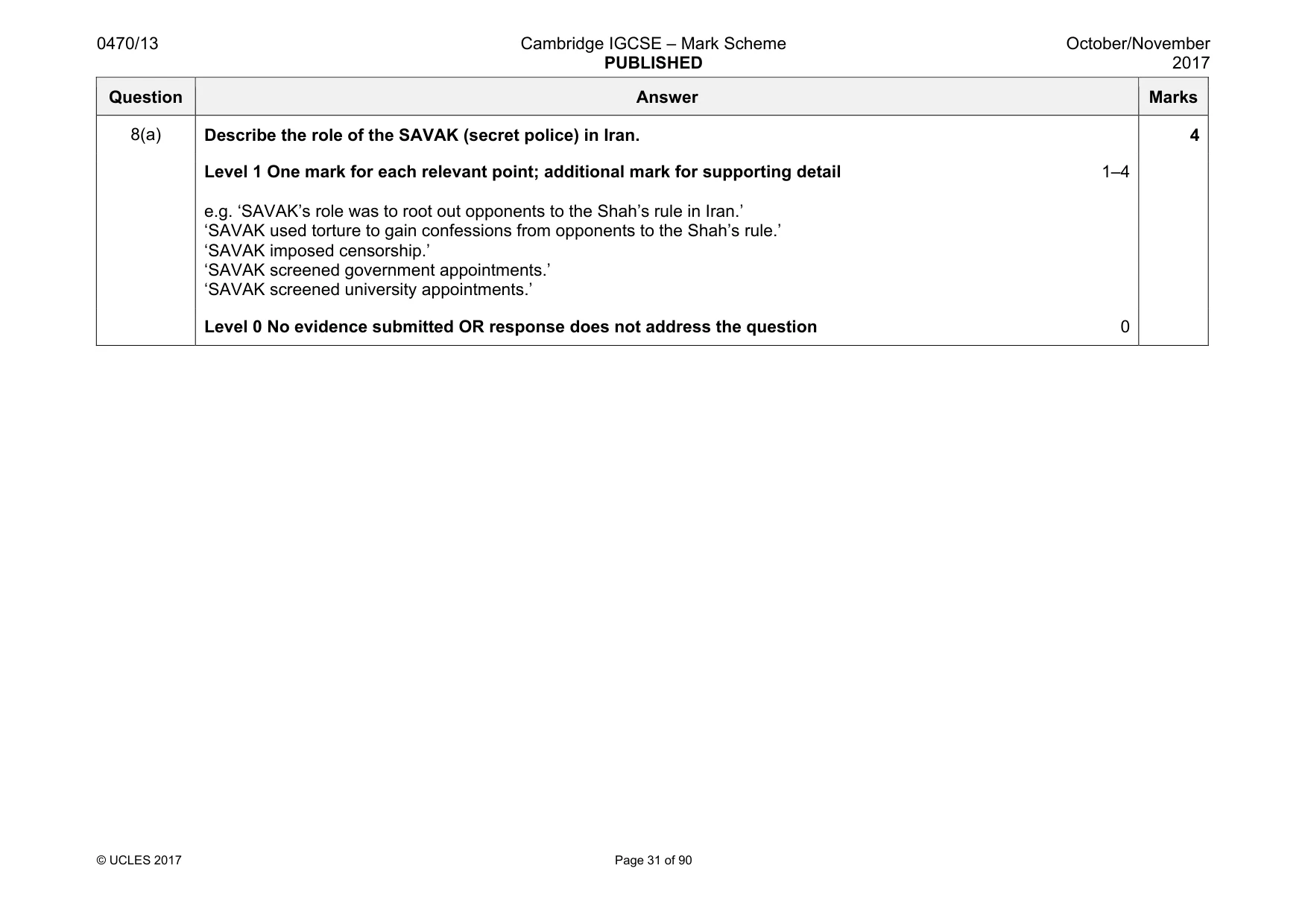
0470/13 Cambridge IGCSE – Mark Scheme PUBLISHED October/November 2017 © UCLES 2017 Page 31 of 90 Question Answer Marks 8(a) Describe the role of the SAVAK (secret police) in Iran. 4 Level 1 One mark for each relevant point; additional mark for supporting detail 1–4 e.g. ‘SAVAK’s role was to root out opponents to the Shah’s rule in Iran.’ ‘SAVAK used torture to gain confessions from opponents to the Shah’s rule.’ ‘SAVAK imposed censorship.’ ‘SAVAK screened government appointments.’ ‘SAVAK screened university appointments.’ Level 0 No evidence submitted OR response does not address the question 0
Mark scheme, page 32
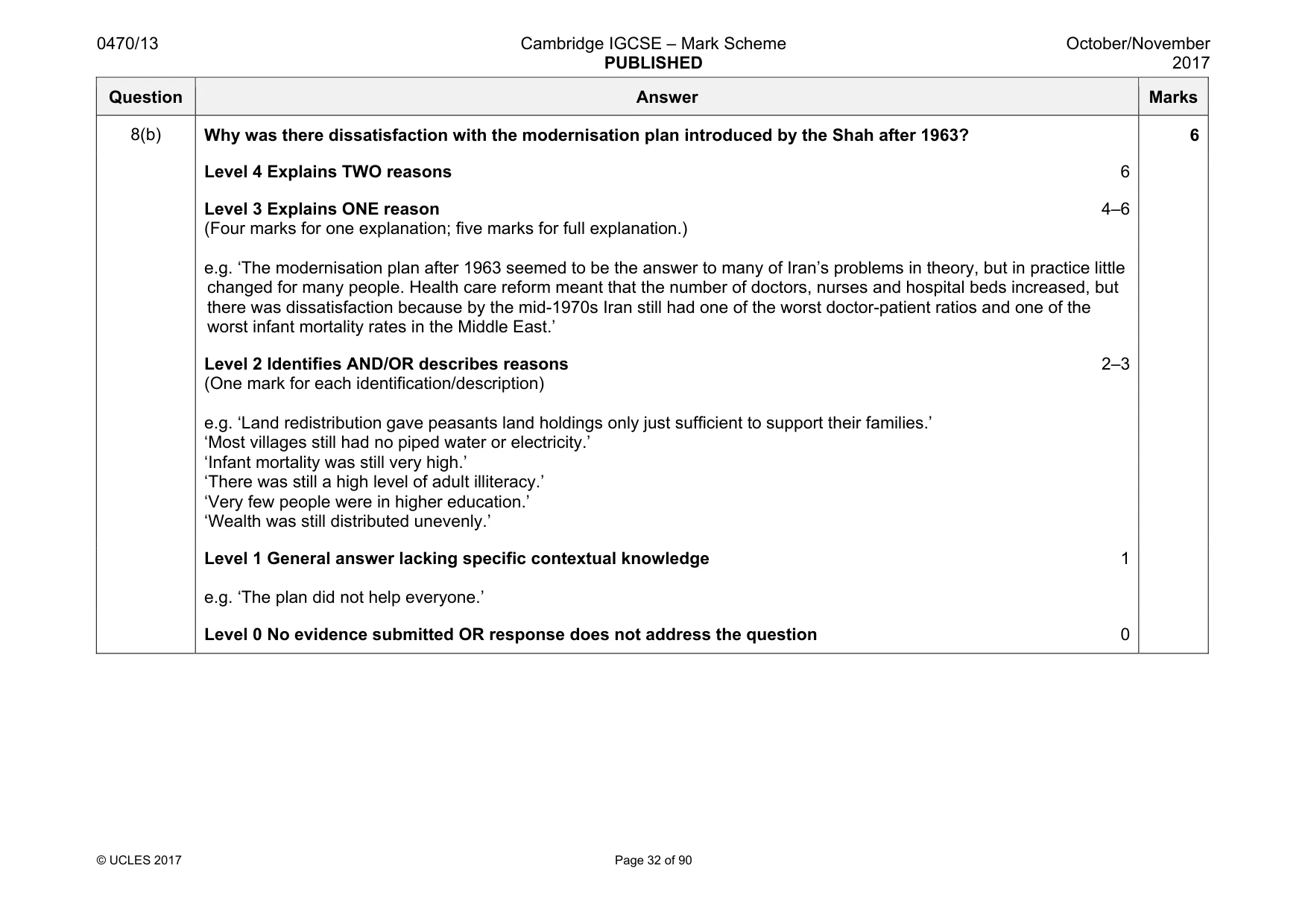
0470/13 Cambridge IGCSE – Mark Scheme PUBLISHED October/November 2017 © UCLES 2017 Page 32 of 90 Question Answer Marks 8(b) Why was there dissatisfaction with the modernisation plan introduced by the Shah after 1963? 6 Level 4 Explains TWO reasons 6 Level 3 Explains ONE reason 4–6 (Four marks for one explanation; five marks for full explanation.) e.g. ‘The modernisation plan after 1963 seemed to be the answer to many of Iran’s problems in theory, but in practice little changed for many people. Health care reform meant that the number of doctors, nurses and hospital beds increased, but there was dissatisfaction because by the mid-1970s Iran still had one of the worst doctor-patient ratios and one of the worst infant mortality rates in the Middle East.’ Level 2 Identifies AND/OR describes reasons 2–3 (One mark for each identification/description) e.g. ‘Land redistribution gave peasants land holdings only just sufficient to support their families.’ ‘Most villages still had no piped water or electricity.’ ‘Infant mortality was still very high.’ ‘There was still a high level of adult illiteracy.’ ‘Very few people were in higher education.’ ‘Wealth was still distributed unevenly.’ Level 1 General answer lacking specific contextual knowledge 1 e.g. ‘The plan did not help everyone.’ Level 0 No evidence submitted OR response does not address the question 0
Mark scheme, page 33
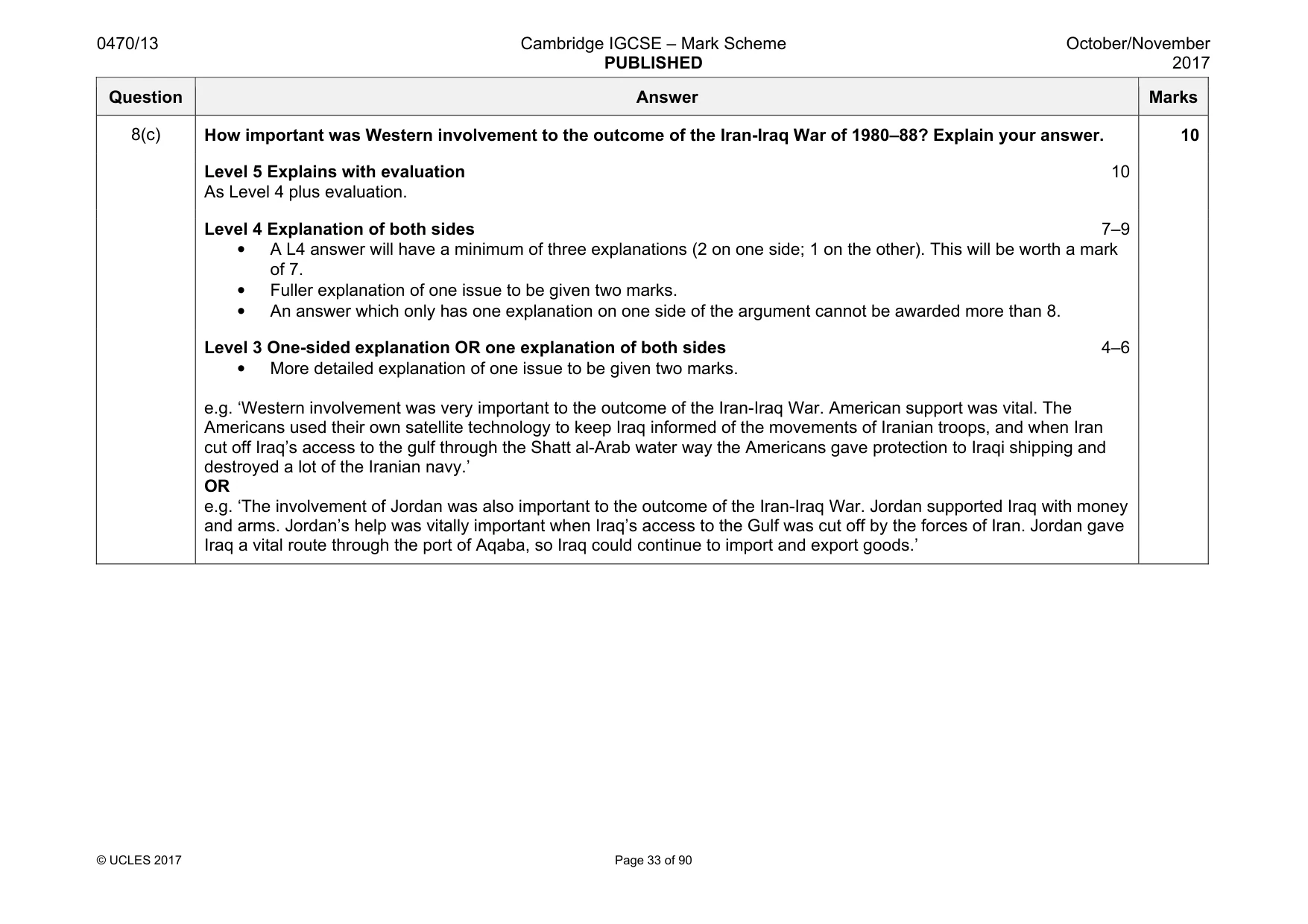
0470/13 Cambridge IGCSE – Mark Scheme PUBLISHED October/November 2017 © UCLES 2017 Page 33 of 90 Question Answer Marks 8(c) How important was Western involvement to the outcome of the Iran-Iraq War of 1980–88? Explain your answer. 10 Level 5 Explains with evaluation 10 As Level 4 plus evaluation. Level 4 Explanation of both sides 7–9 • A L4 answer will have a minimum of three explanations (2 on one side; 1 on the other). This will be worth a mark of 7. • Fuller explanation of one issue to be given two marks. • An answer which only has one explanation on one side of the argument cannot be awarded more than 8. Level 3 One-sided explanation OR one explanation of both sides 4–6 • More detailed explanation of one issue to be given two marks. e.g. ‘Western involvement was very important to the outcome of the Iran-Iraq War. American support was vital. The Americans used their own satellite technology to keep Iraq informed of the movements of Iranian troops, and when Iran cut off Iraq’s access to the gulf through the Shatt al-Arab water way the Americans gave protection to Iraqi shipping and destroyed a lot of the Iranian navy.’ OR e.g. ‘The involvement of Jordan was also important to the outcome of the Iran-Iraq War. Jordan supported Iraq with money and arms. Jordan’s help was vitally important when Iraq’s access to the Gulf was cut off by the forces of Iran. Jordan gave Iraq a vital route through the port of Aqaba, so Iraq could continue to import and export goods.’
Mark scheme, page 34
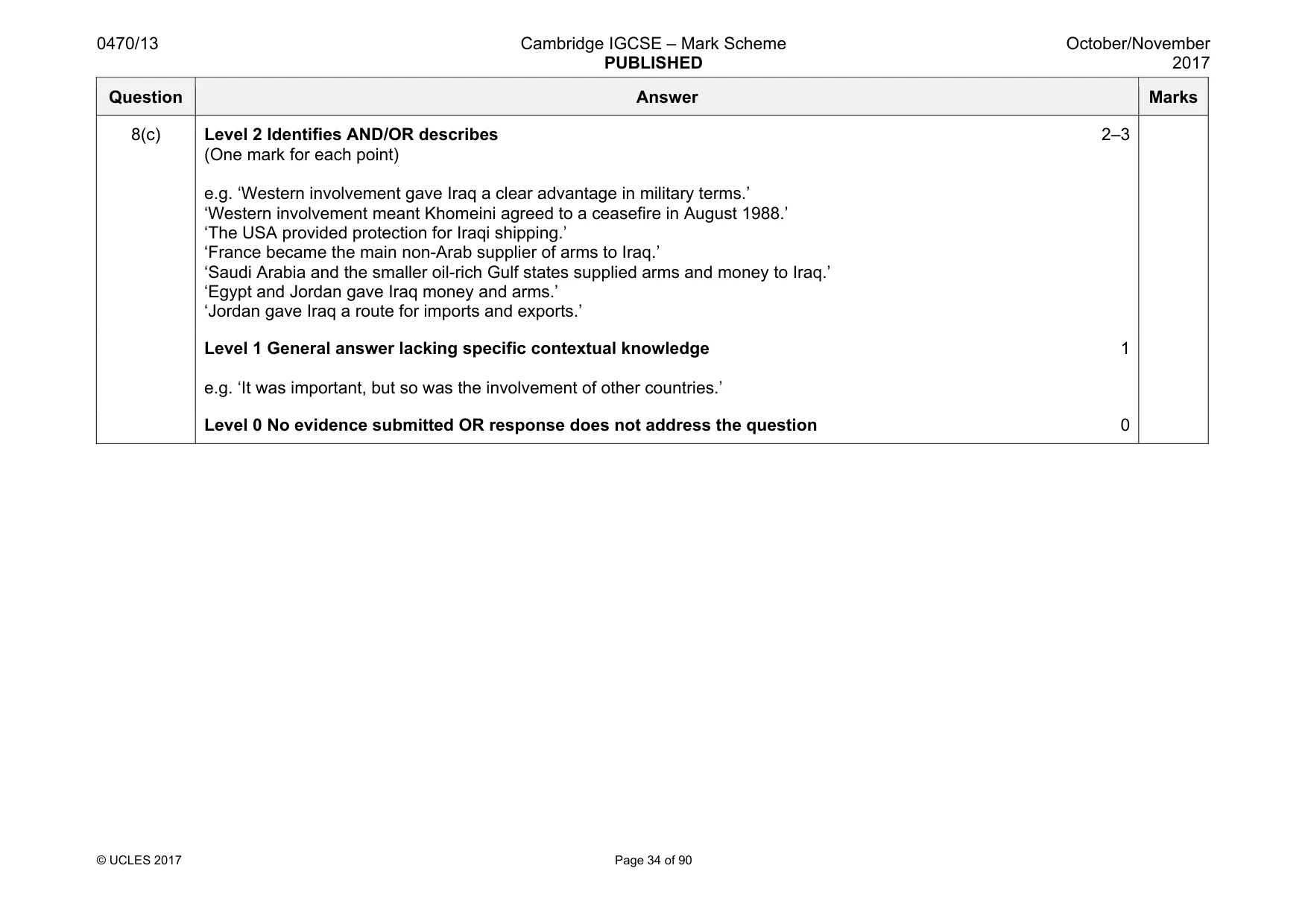
0470/13 Cambridge IGCSE – Mark Scheme PUBLISHED October/November 2017 © UCLES 2017 Page 34 of 90 Question Answer Marks 8(c) Level 2 Identifies AND/OR describes 2–3 (One mark for each point) e.g. ‘Western involvement gave Iraq a clear advantage in military terms.’ ‘Western involvement meant Khomeini agreed to a ceasefire in August 1988.’ ‘The USA provided protection for Iraqi shipping.’ ‘France became the main non-Arab supplier of arms to Iraq.’ ‘Saudi Arabia and the smaller oil-rich Gulf states supplied arms and money to Iraq.’ ‘Egypt and Jordan gave Iraq money and arms.’ ‘Jordan gave Iraq a route for imports and exports.’ Level 1 General answer lacking specific contextual knowledge 1 e.g. ‘It was important, but so was the involvement of other countries.’ Level 0 No evidence submitted OR response does not address the question 0
Mark scheme, page 35
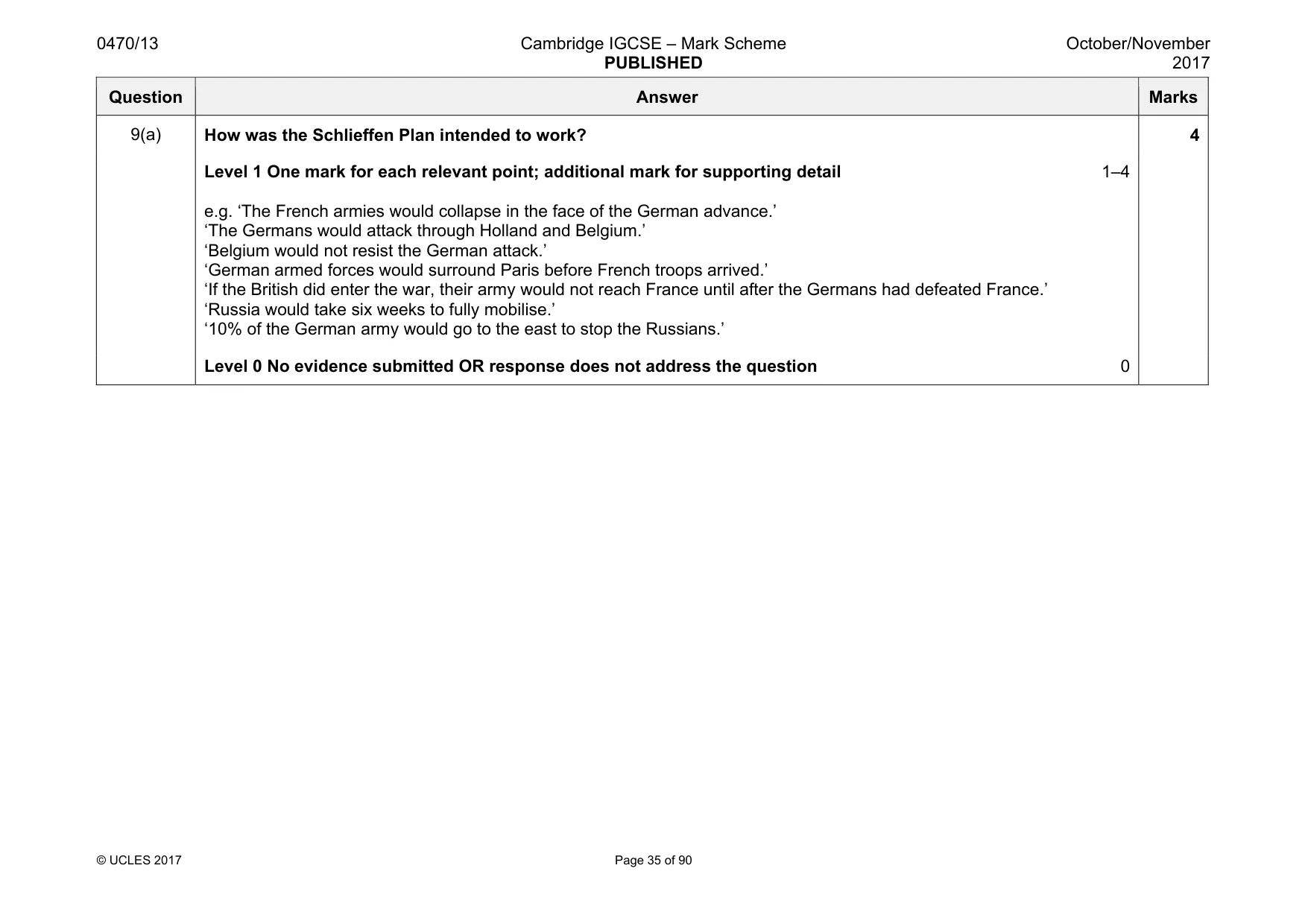
0470/13 Cambridge IGCSE – Mark Scheme PUBLISHED October/November 2017 © UCLES 2017 Page 35 of 90 Question Answer Marks 9(a) How was the Schlieffen Plan intended to work? 4 Level 1 One mark for each relevant point; additional mark for supporting detail 1–4 e.g. ‘The French armies would collapse in the face of the German advance.’ ‘The Germans would attack through Holland and Belgium.’ ‘Belgium would not resist the German attack.’ ‘German armed forces would surround Paris before French troops arrived.’ ‘If the British did enter the war, their army would not reach France until after the Germans had defeated France.’ ‘Russia would take six weeks to fully mobilise.’ ‘10% of the German army would go to the east to stop the Russians.’ Level 0 No evidence submitted OR response does not address the question 0
Mark scheme, page 36
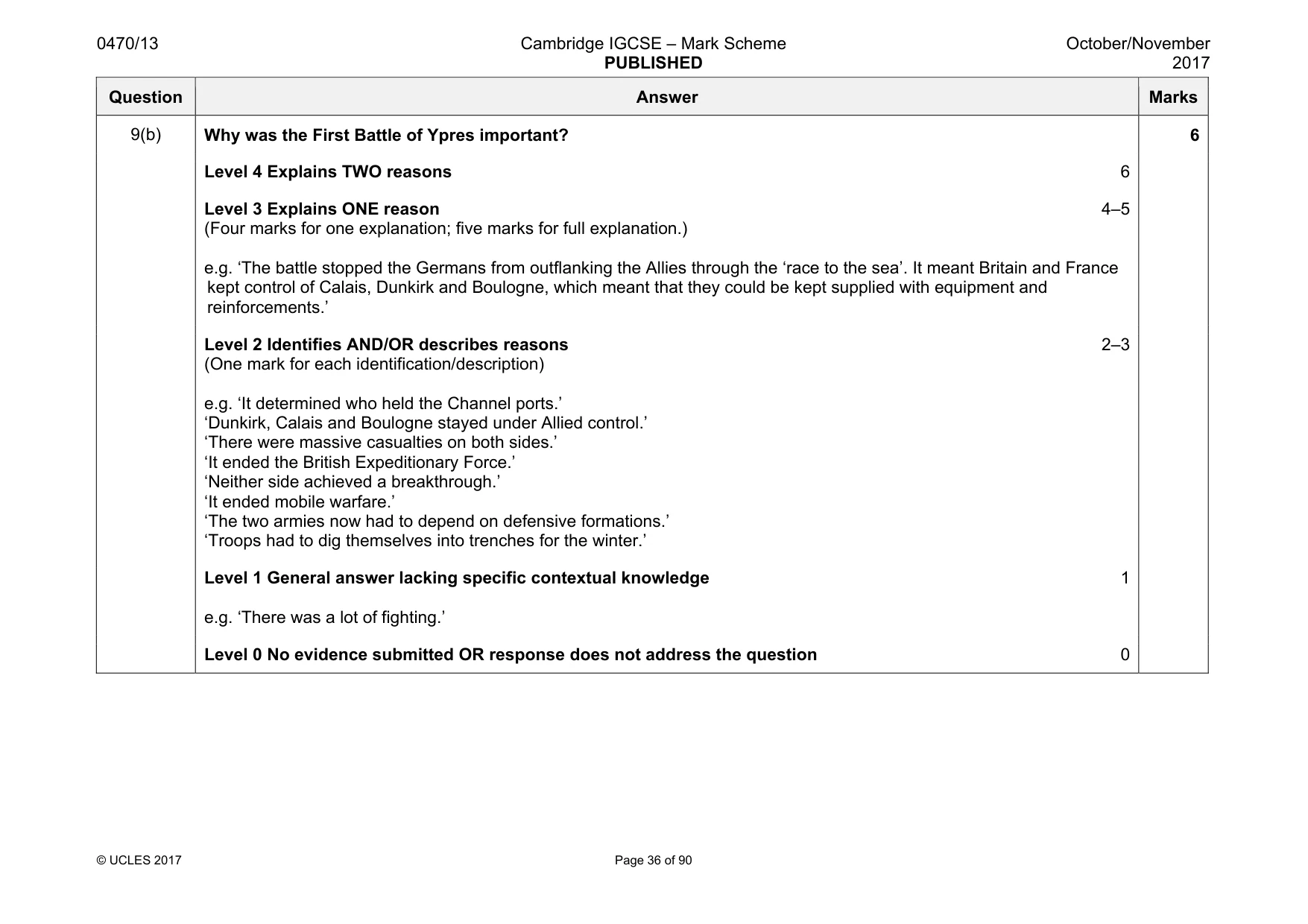
0470/13 Cambridge IGCSE – Mark Scheme PUBLISHED October/November 2017 © UCLES 2017 Page 36 of 90 Question Answer Marks 9(b) Why was the First Battle of Ypres important? 6 Level 4 Explains TWO reasons 6 Level 3 Explains ONE reason 4–5 (Four marks for one explanation; five marks for full explanation.) e.g. ‘The battle stopped the Germans from outflanking the Allies through the ‘race to the sea’. It meant Britain and France kept control of Calais, Dunkirk and Boulogne, which meant that they could be kept supplied with equipment and reinforcements.’ Level 2 Identifies AND/OR describes reasons 2–3 (One mark for each identification/description) e.g. ‘It determined who held the Channel ports.’ ‘Dunkirk, Calais and Boulogne stayed under Allied control.’ ‘There were massive casualties on both sides.’ ‘It ended the British Expeditionary Force.’ ‘Neither side achieved a breakthrough.’ ‘It ended mobile warfare.’ ‘The two armies now had to depend on defensive formations.’ ‘Troops had to dig themselves into trenches for the winter.’ Level 1 General answer lacking specific contextual knowledge 1 e.g. ‘There was a lot of fighting.’ Level 0 No evidence submitted OR response does not address the question 0
Mark scheme, page 37
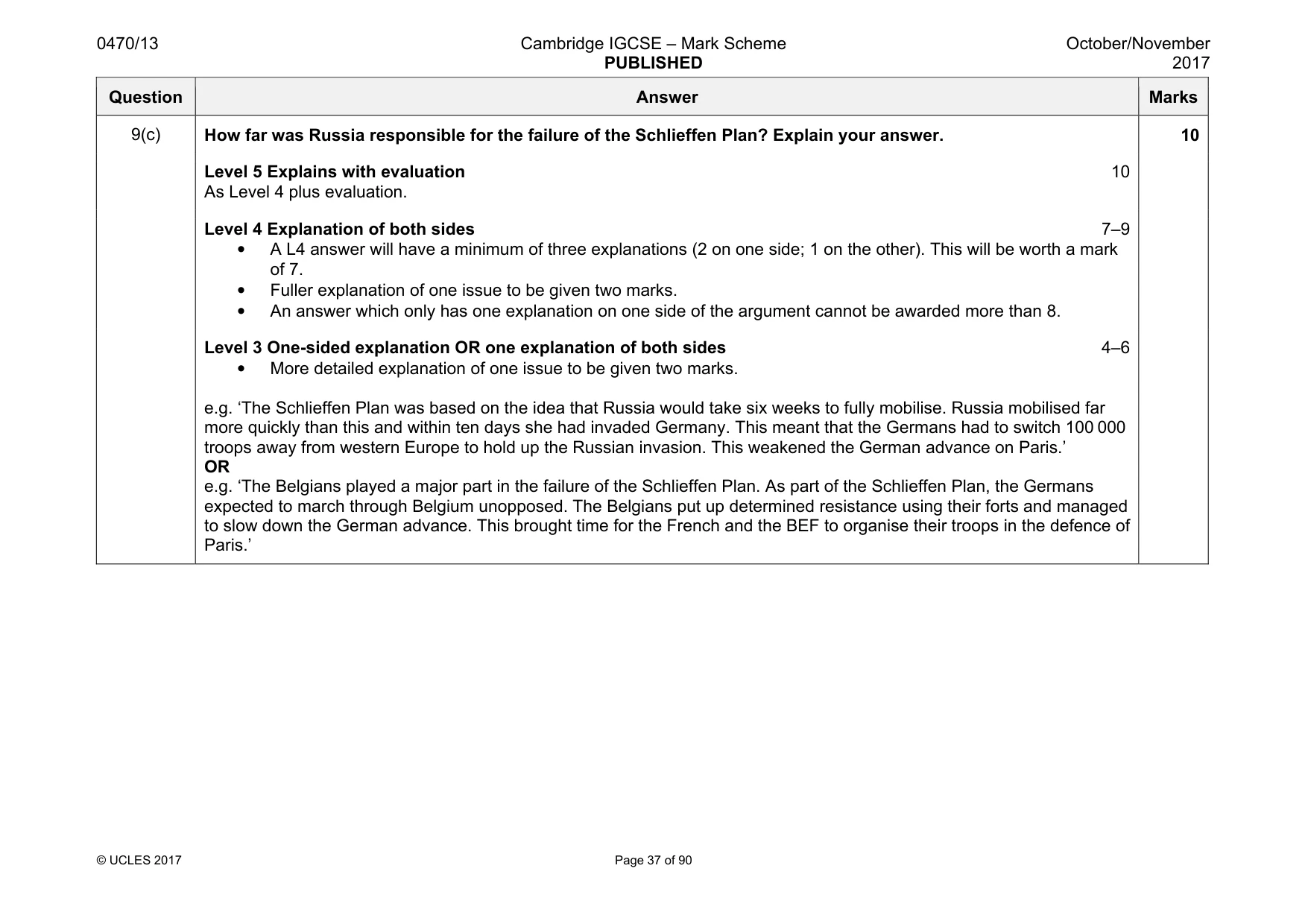
0470/13 Cambridge IGCSE – Mark Scheme PUBLISHED October/November 2017 © UCLES 2017 Page 37 of 90 Question Answer Marks 9(c) How far was Russia responsible for the failure of the Schlieffen Plan? Explain your answer. 10 Level 5 Explains with evaluation 10 As Level 4 plus evaluation. Level 4 Explanation of both sides 7–9 • A L4 answer will have a minimum of three explanations (2 on one side; 1 on the other). This will be worth a mark of 7. • Fuller explanation of one issue to be given two marks. • An answer which only has one explanation on one side of the argument cannot be awarded more than 8. Level 3 One-sided explanation OR one explanation of both sides 4–6 • More detailed explanation of one issue to be given two marks. e.g. ‘The Schlieffen Plan was based on the idea that Russia would take six weeks to fully mobilise. Russia mobilised far more quickly than this and within ten days she had invaded Germany. This meant that the Germans had to switch 100 000 troops away from western Europe to hold up the Russian invasion. This weakened the German advance on Paris.’ OR e.g. ‘The Belgians played a major part in the failure of the Schlieffen Plan. As part of the Schlieffen Plan, the Germans expected to march through Belgium unopposed. The Belgians put up determined resistance using their forts and managed to slow down the German advance. This brought time for the French and the BEF to organise their troops in the defence of Paris.’
Mark scheme, page 38
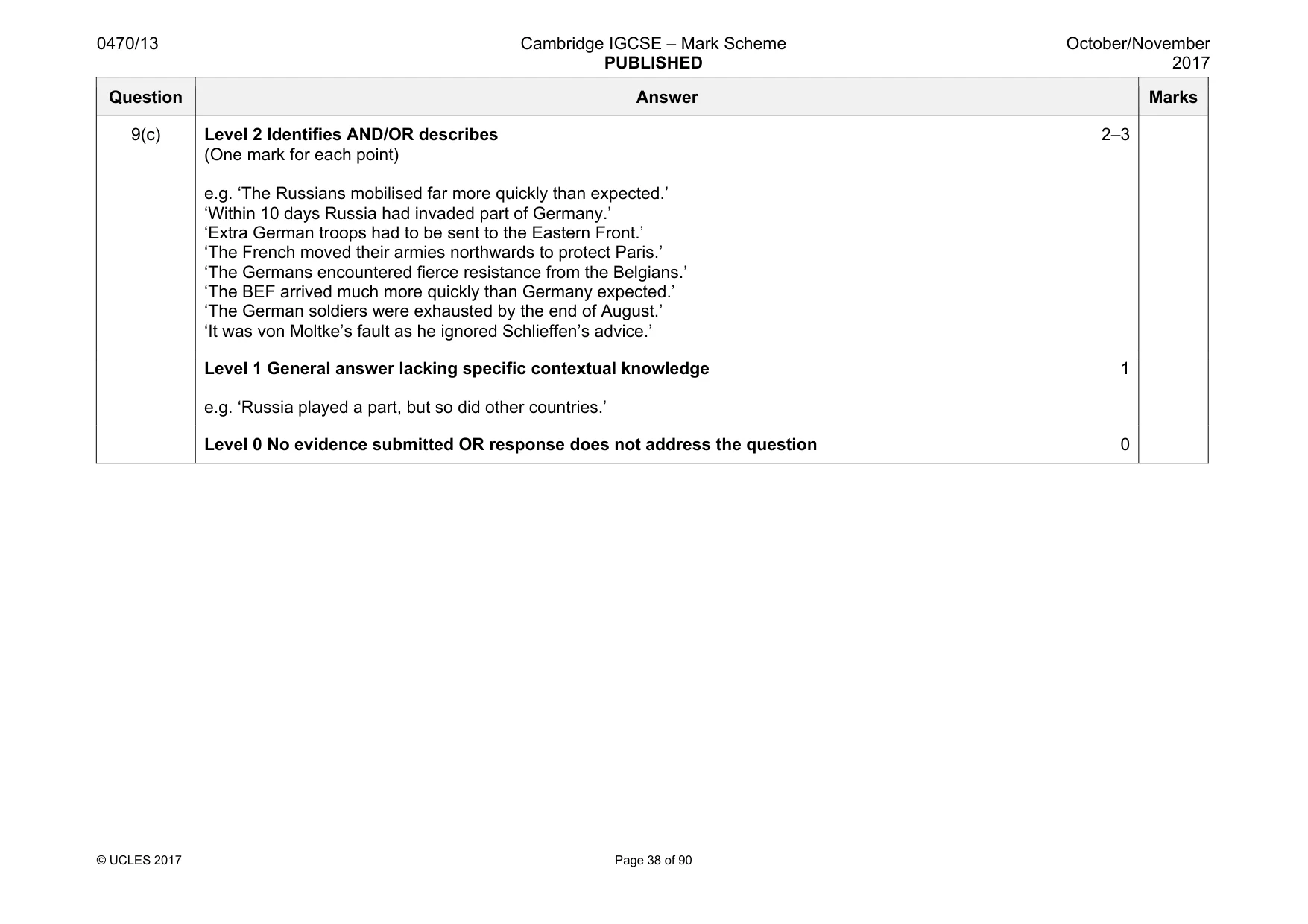
0470/13 Cambridge IGCSE – Mark Scheme PUBLISHED October/November 2017 © UCLES 2017 Page 38 of 90 Question Answer Marks 9(c) Level 2 Identifies AND/OR describes 2–3 (One mark for each point) e.g. ‘The Russians mobilised far more quickly than expected.’ ‘Within 10 days Russia had invaded part of Germany.’ ‘Extra German troops had to be sent to the Eastern Front.’ ‘The French moved their armies northwards to protect Paris.’ ‘The Germans encountered fierce resistance from the Belgians.’ ‘The BEF arrived much more quickly than Germany expected.’ ‘The German soldiers were exhausted by the end of August.’ ‘It was von Moltke’s fault as he ignored Schlieffen’s advice.’ Level 1 General answer lacking specific contextual knowledge 1 e.g. ‘Russia played a part, but so did other countries.’ Level 0 No evidence submitted OR response does not address the question 0
Mark scheme, page 39
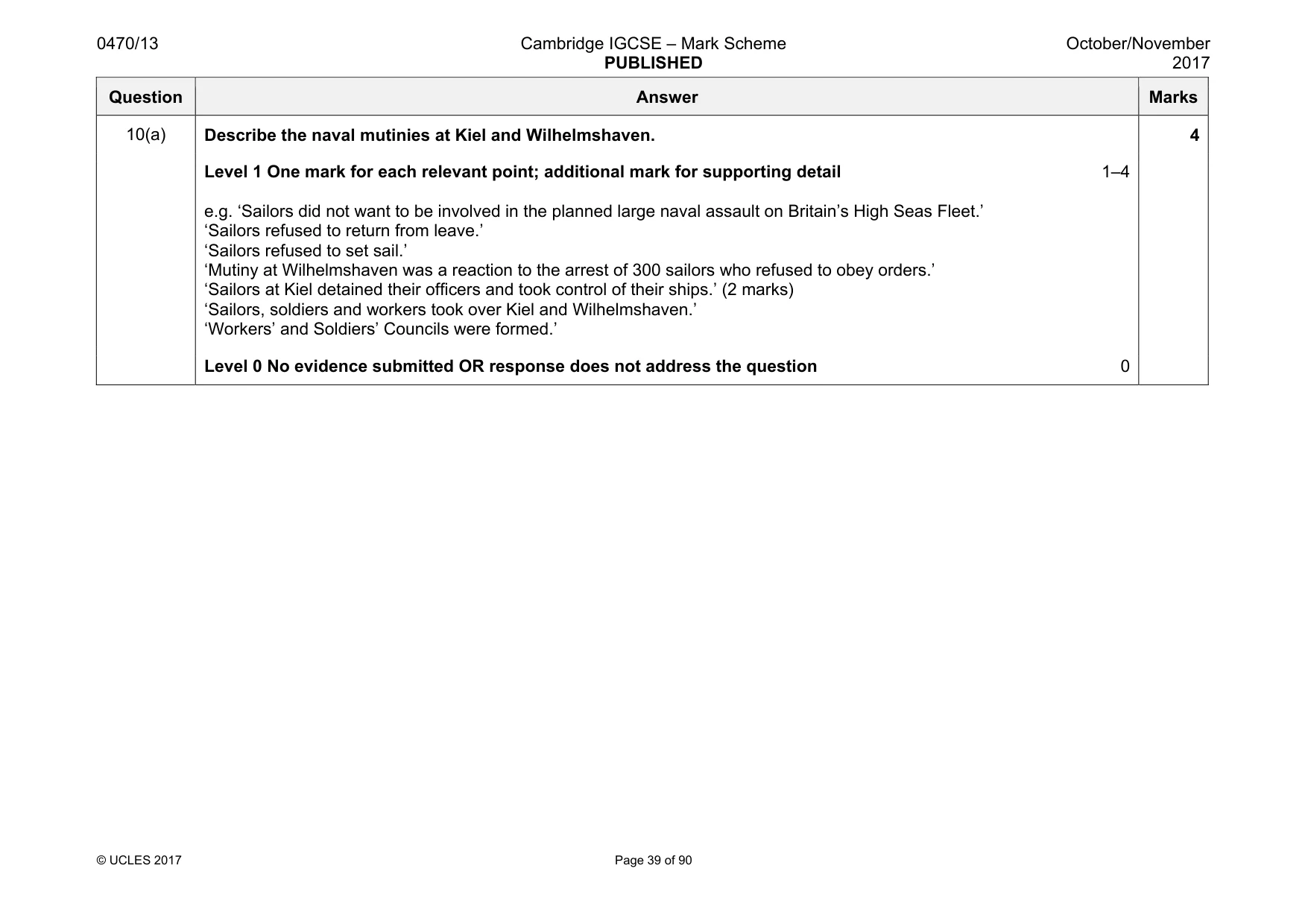
0470/13 Cambridge IGCSE – Mark Scheme PUBLISHED October/November 2017 © UCLES 2017 Page 39 of 90 Question Answer Marks 10(a) Describe the naval mutinies at Kiel and Wilhelmshaven. 4 Level 1 One mark for each relevant point; additional mark for supporting detail 1–4 e.g. ‘Sailors did not want to be involved in the planned large naval assault on Britain’s High Seas Fleet.’ ‘Sailors refused to return from leave.’ ‘Sailors refused to set sail.’ ‘Mutiny at Wilhelmshaven was a reaction to the arrest of 300 sailors who refused to obey orders.’ ‘Sailors at Kiel detained their officers and took control of their ships.’ (2 marks) ‘Sailors, soldiers and workers took over Kiel and Wilhelmshaven.’ ‘Workers’ and Soldiers’ Councils were formed.’ Level 0 No evidence submitted OR response does not address the question 0
Mark scheme, page 40
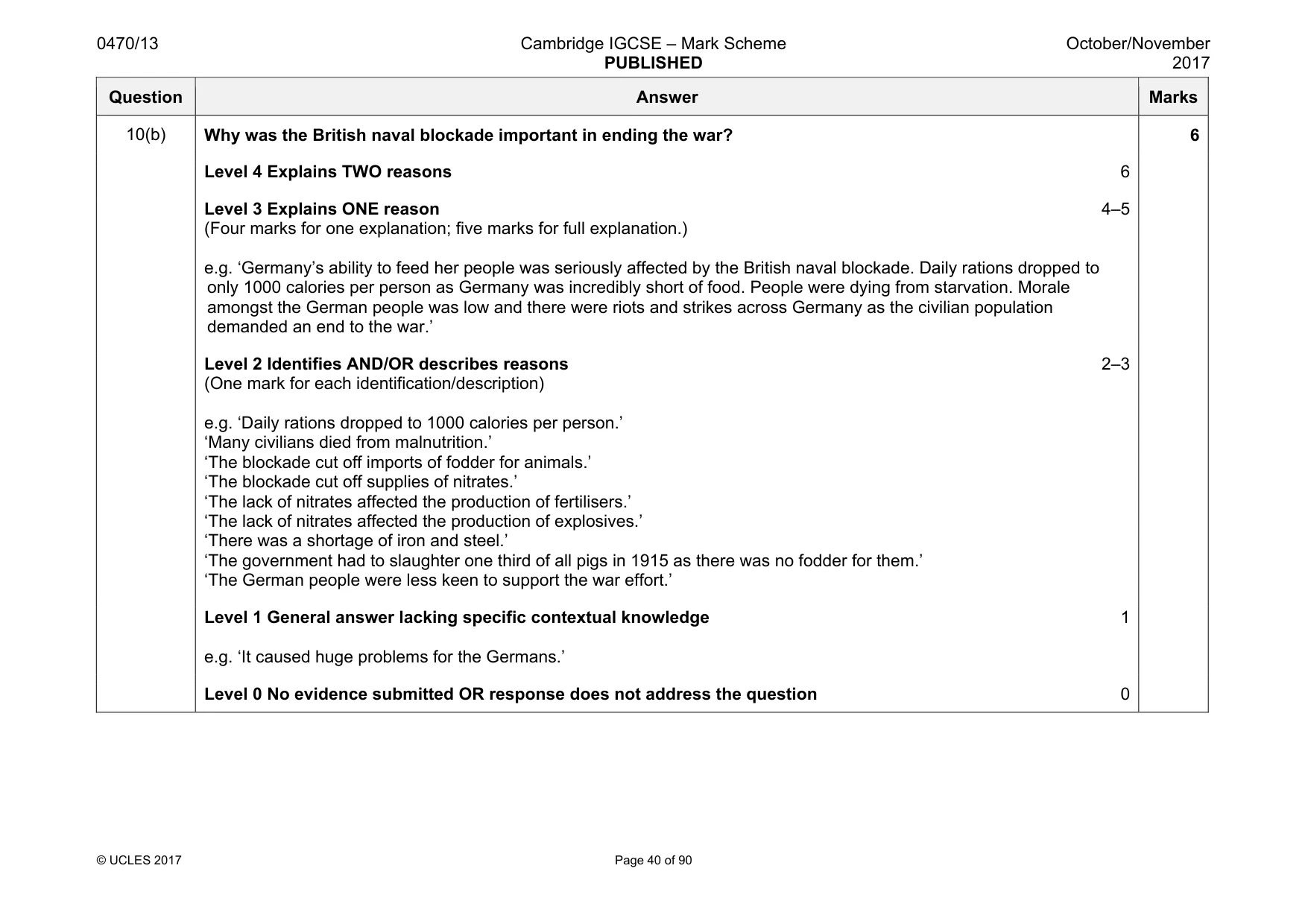
0470/13 Cambridge IGCSE – Mark Scheme PUBLISHED October/November 2017 © UCLES 2017 Page 40 of 90 Question Answer Marks 10(b) Why was the British naval blockade important in ending the war? 6 Level 4 Explains TWO reasons 6 Level 3 Explains ONE reason 4–5 (Four marks for one explanation; five marks for full explanation.) e.g. ‘Germany’s ability to feed her people was seriously affected by the British naval blockade. Daily rations dropped to only 1000 calories per person as Germany was incredibly short of food. People were dying from starvation. Morale amongst the German people was low and there were riots and strikes across Germany as the civilian population demanded an end to the war.’ Level 2 Identifies AND/OR describes reasons 2–3 (One mark for each identification/description) e.g. ‘Daily rations dropped to 1000 calories per person.’ ‘Many civilians died from malnutrition.’ ‘The blockade cut off imports of fodder for animals.’ ‘The blockade cut off supplies of nitrates.’ ‘The lack of nitrates affected the production of fertilisers.’ ‘The lack of nitrates affected the production of explosives.’ ‘There was a shortage of iron and steel.’ ‘The government had to slaughter one third of all pigs in 1915 as there was no fodder for them.’ ‘The German people were less keen to support the war effort.’ Level 1 General answer lacking specific contextual knowledge 1 e.g. ‘It caused huge problems for the Germans.’ Level 0 No evidence submitted OR response does not address the question 0
Mark scheme, page 41
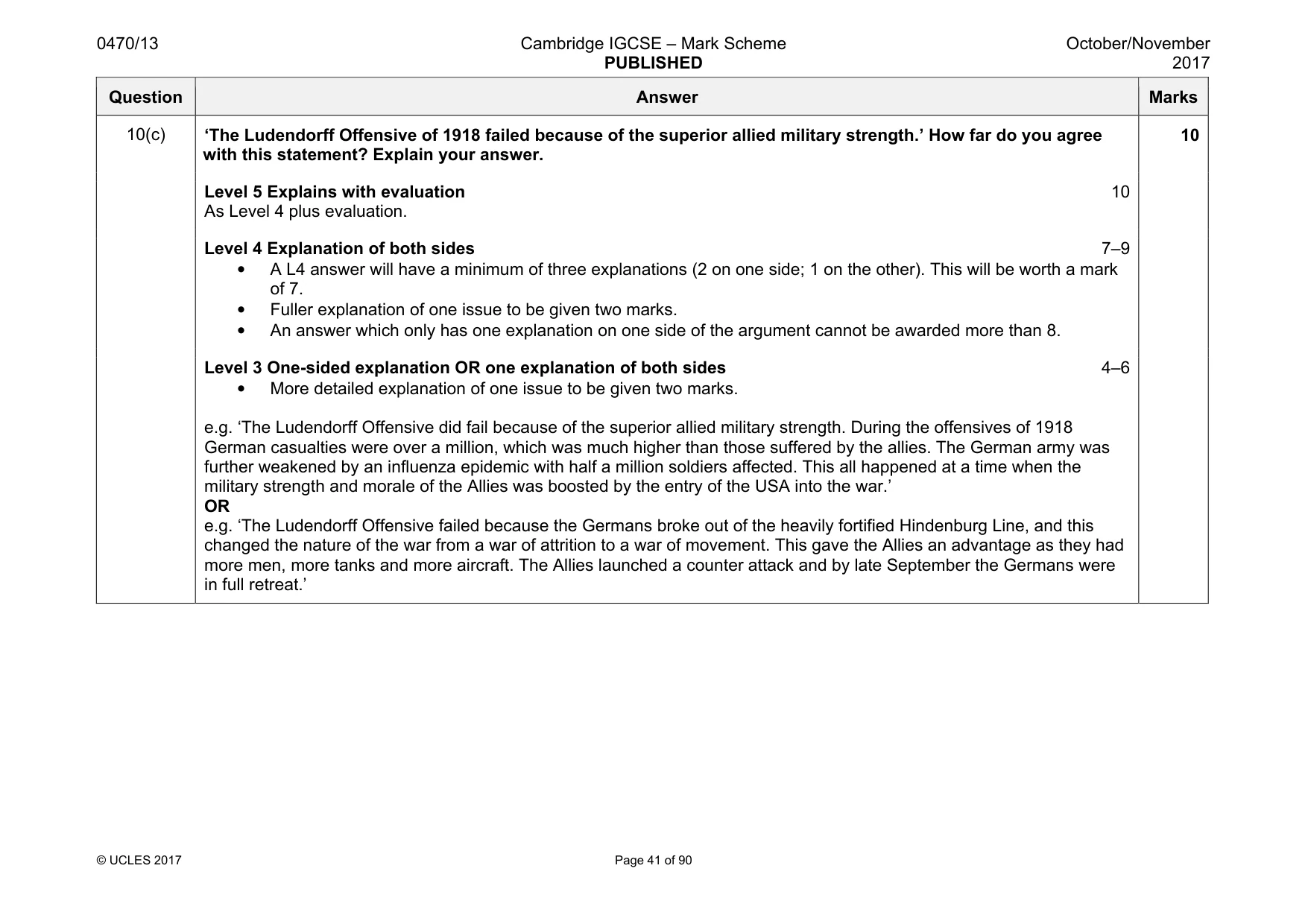
0470/13 Cambridge IGCSE – Mark Scheme PUBLISHED October/November 2017 © UCLES 2017 Page 41 of 90 Question Answer Marks 10(c) ‘The Ludendorff Offensive of 1918 failed because of the superior allied military strength.’ How far do you agree with this statement? Explain your answer. 10 Level 5 Explains with evaluation 10 As Level 4 plus evaluation. Level 4 Explanation of both sides 7–9 • A L4 answer will have a minimum of three explanations (2 on one side; 1 on the other). This will be worth a mark of 7. • Fuller explanation of one issue to be given two marks. • An answer which only has one explanation on one side of the argument cannot be awarded more than 8. Level 3 One-sided explanation OR one explanation of both sides 4–6 • More detailed explanation of one issue to be given two marks. e.g. ‘The Ludendorff Offensive did fail because of the superior allied military strength. During the offensives of 1918 German casualties were over a million, which was much higher than those suffered by the allies. The German army was further weakened by an influenza epidemic with half a million soldiers affected. This all happened at a time when the military strength and morale of the Allies was boosted by the entry of the USA into the war.’ OR e.g. ‘The Ludendorff Offensive failed because the Germans broke out of the heavily fortified Hindenburg Line, and this changed the nature of the war from a war of attrition to a war of movement. This gave the Allies an advantage as they had more men, more tanks and more aircraft. The Allies launched a counter attack and by late September the Germans were in full retreat.’
Mark scheme, page 42
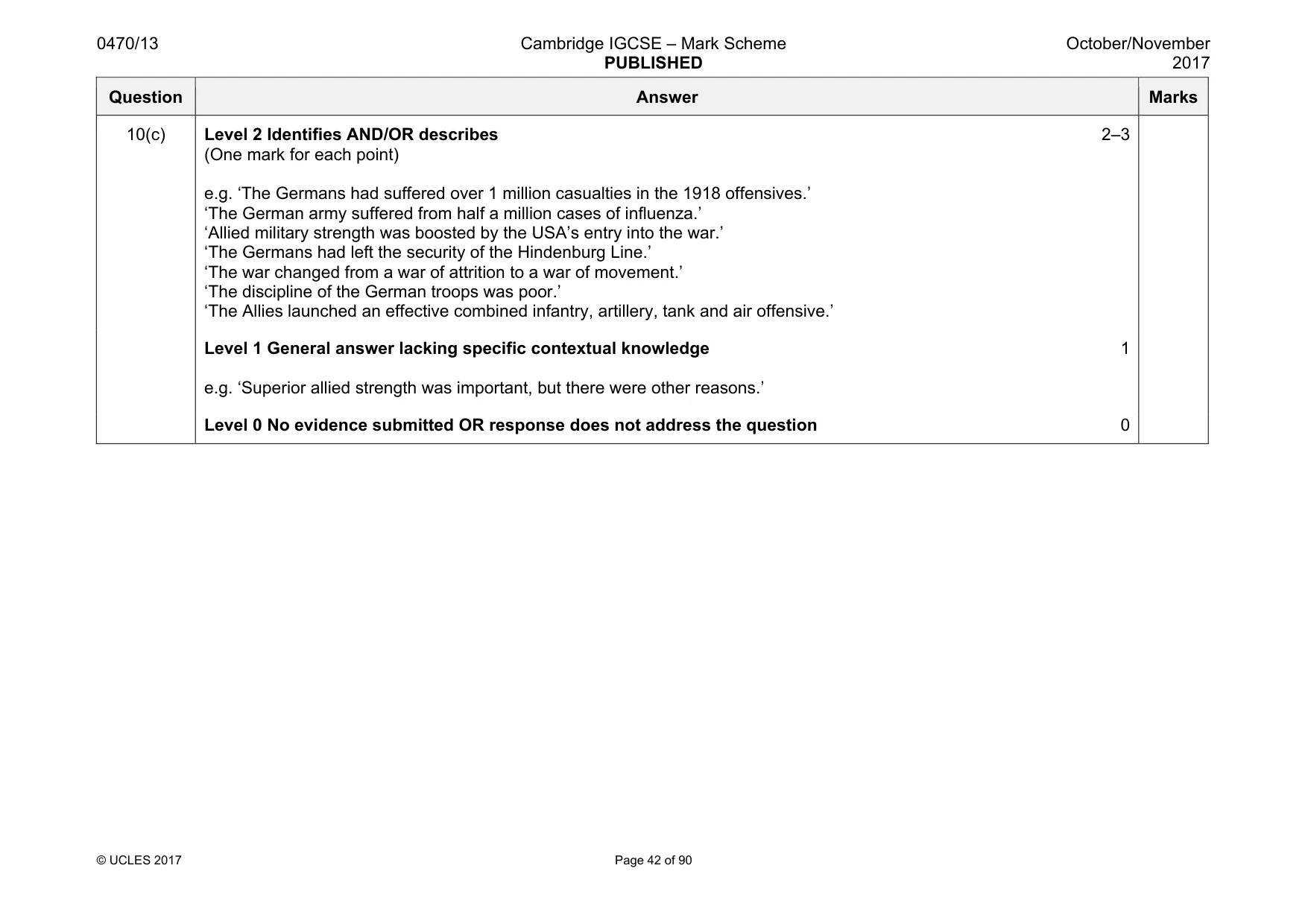
0470/13 Cambridge IGCSE – Mark Scheme PUBLISHED October/November 2017 © UCLES 2017 Page 42 of 90 Question Answer Marks 10(c) Level 2 Identifies AND/OR describes 2–3 (One mark for each point) e.g. ‘The Germans had suffered over 1 million casualties in the 1918 offensives.’ ‘The German army suffered from half a million cases of influenza.’ ‘Allied military strength was boosted by the USA’s entry into the war.’ ‘The Germans had left the security of the Hindenburg Line.’ ‘The war changed from a war of attrition to a war of movement.’ ‘The discipline of the German troops was poor.’ ‘The Allies launched an effective combined infantry, artillery, tank and air offensive.’ Level 1 General answer lacking specific contextual knowledge 1 e.g. ‘Superior allied strength was important, but there were other reasons.’ Level 0 No evidence submitted OR response does not address the question 0
Mark scheme, page 43
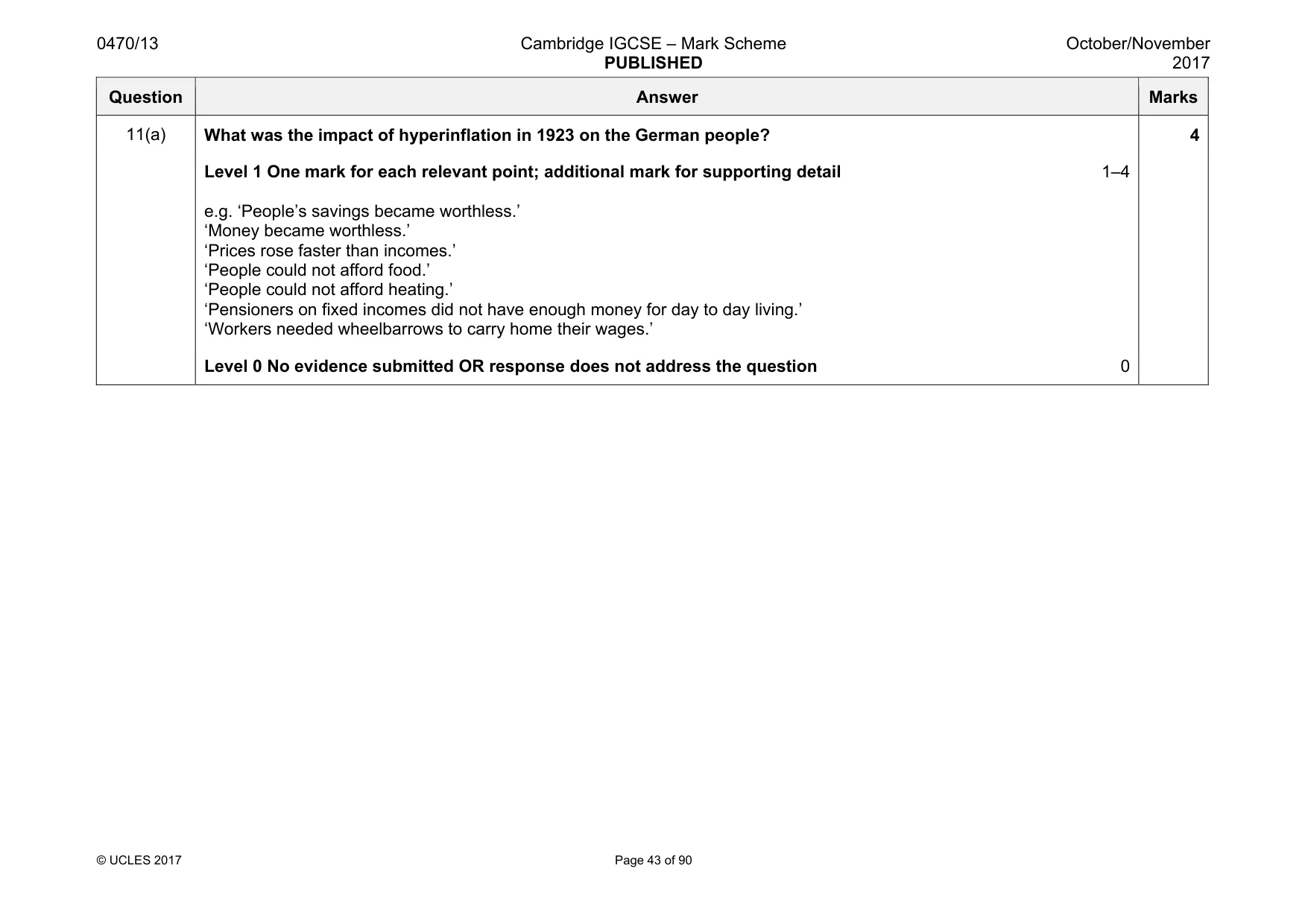
0470/13 Cambridge IGCSE – Mark Scheme PUBLISHED October/November 2017 © UCLES 2017 Page 43 of 90 Question Answer Marks 11(a) What was the impact of hyperinflation in 1923 on the German people? 4 Level 1 One mark for each relevant point; additional mark for supporting detail 1–4 e.g. ‘People’s savings became worthless.’ ‘Money became worthless.’ ‘Prices rose faster than incomes.’ ‘People could not afford food.’ ‘People could not afford heating.’ ‘Pensioners on fixed incomes did not have enough money for day to day living.’ ‘Workers needed wheelbarrows to carry home their wages.’ Level 0 No evidence submitted OR response does not address the question 0
Mark scheme, page 44
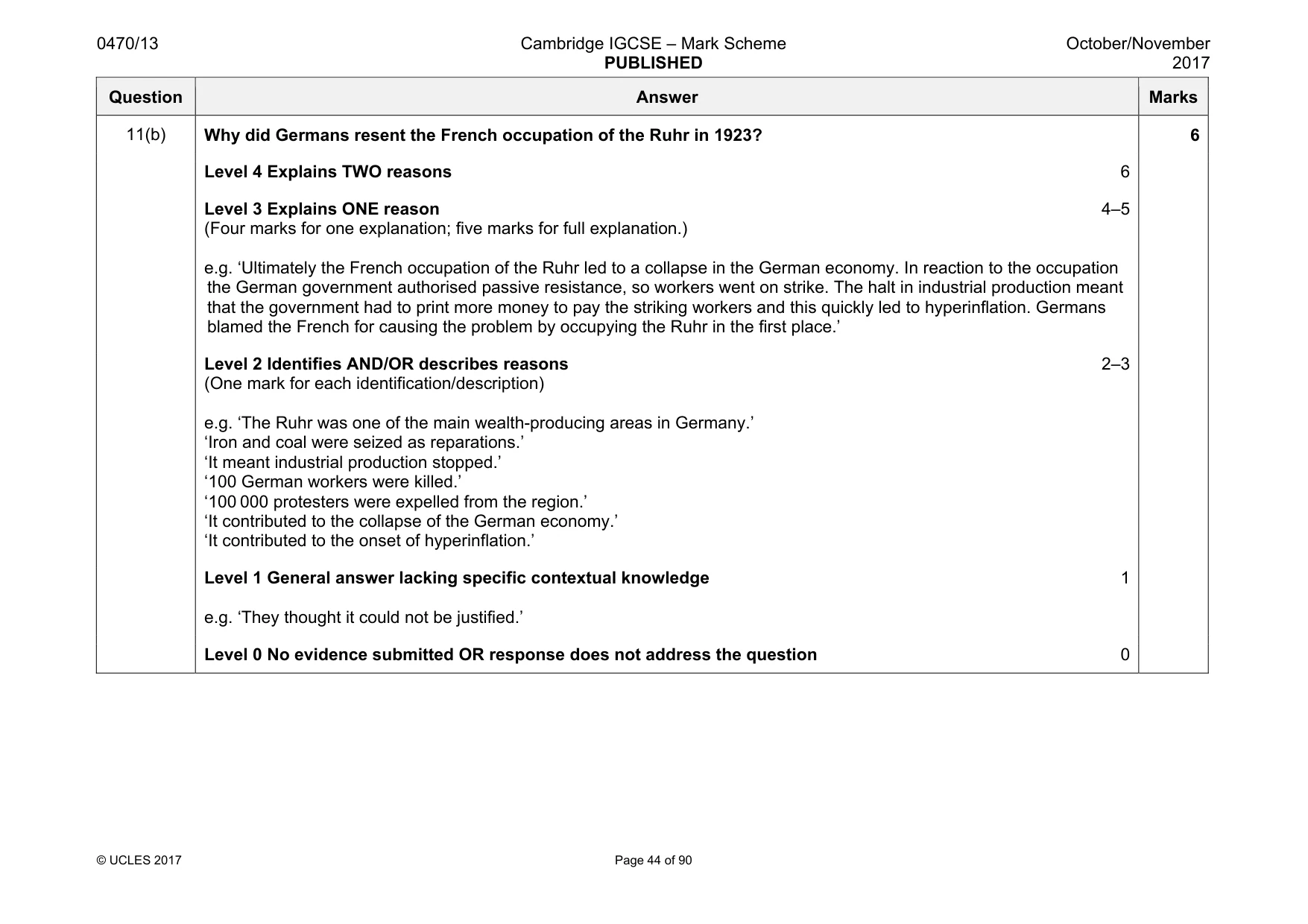
0470/13 Cambridge IGCSE – Mark Scheme PUBLISHED October/November 2017 © UCLES 2017 Page 44 of 90 Question Answer Marks 11(b) Why did Germans resent the French occupation of the Ruhr in 1923? 6 Level 4 Explains TWO reasons 6 Level 3 Explains ONE reason 4–5 (Four marks for one explanation; five marks for full explanation.) e.g. ‘Ultimately the French occupation of the Ruhr led to a collapse in the German economy. In reaction to the occupation the German government authorised passive resistance, so workers went on strike. The halt in industrial production meant that the government had to print more money to pay the striking workers and this quickly led to hyperinflation. Germans blamed the French for causing the problem by occupying the Ruhr in the first place.’ Level 2 Identifies AND/OR describes reasons 2–3 (One mark for each identification/description) e.g. ‘The Ruhr was one of the main wealth-producing areas in Germany.’ ‘Iron and coal were seized as reparations.’ ‘It meant industrial production stopped.’ ‘100 German workers were killed.’ ‘100 000 protesters were expelled from the region.’ ‘It contributed to the collapse of the German economy.’ ‘It contributed to the onset of hyperinflation.’ Level 1 General answer lacking specific contextual knowledge 1 e.g. ‘They thought it could not be justified.’ Level 0 No evidence submitted OR response does not address the question 0
Mark scheme, page 45
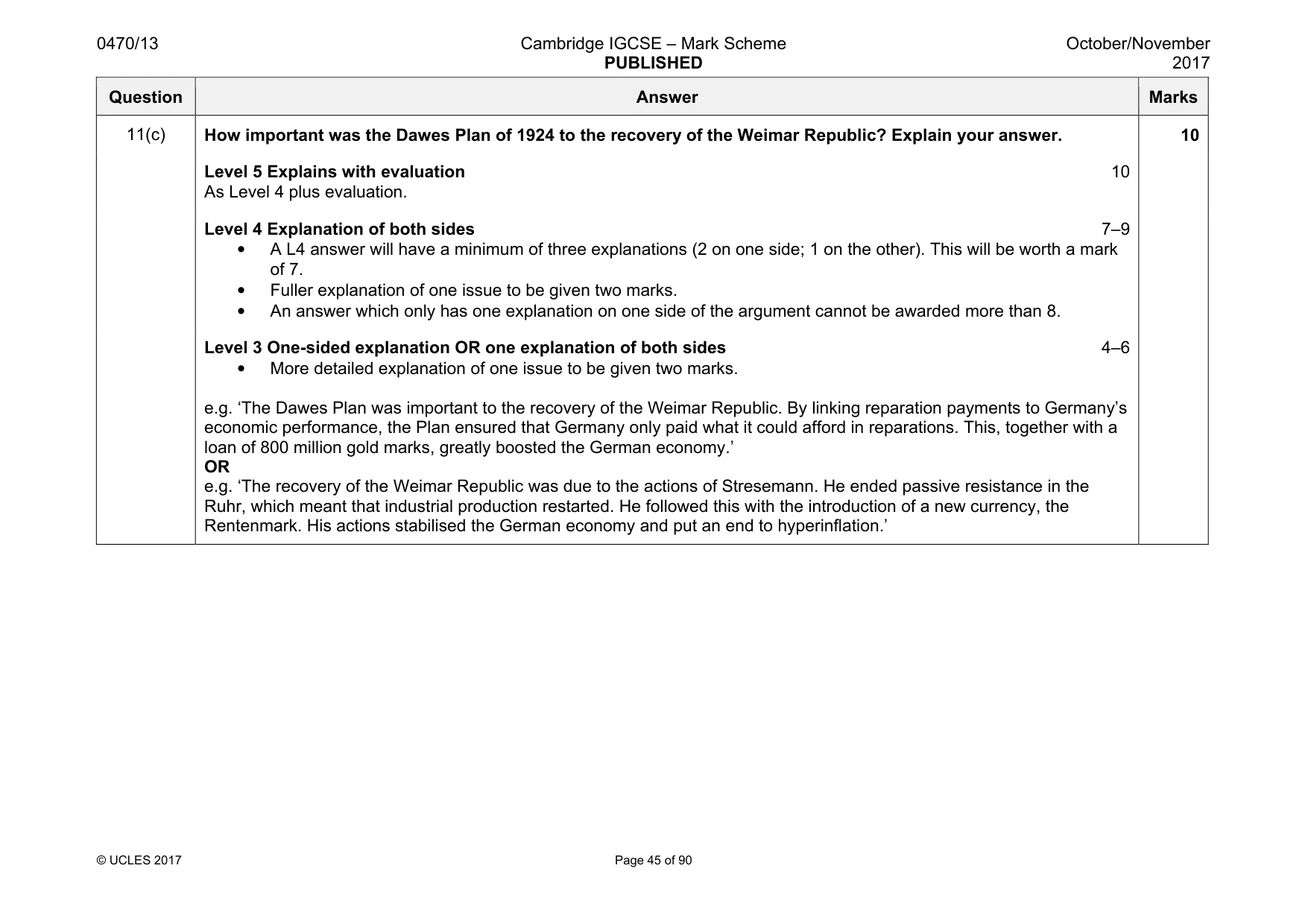
0470/13 Cambridge IGCSE – Mark Scheme PUBLISHED October/November 2017 © UCLES 2017 Page 45 of 90 Question Answer Marks 11(c) How important was the Dawes Plan of 1924 to the recovery of the Weimar Republic? Explain your answer. 10 Level 5 Explains with evaluation 10 As Level 4 plus evaluation. Level 4 Explanation of both sides 7–9 • A L4 answer will have a minimum of three explanations (2 on one side; 1 on the other). This will be worth a mark of 7. • Fuller explanation of one issue to be given two marks. • An answer which only has one explanation on one side of the argument cannot be awarded more than 8. Level 3 One-sided explanation OR one explanation of both sides 4–6 • More detailed explanation of one issue to be given two marks. e.g. ‘The Dawes Plan was important to the recovery of the Weimar Republic. By linking reparation payments to Germany’s economic performance, the Plan ensured that Germany only paid what it could afford in reparations. This, together with a loan of 800 million gold marks, greatly boosted the German economy.’ OR e.g. ‘The recovery of the Weimar Republic was due to the actions of Stresemann. He ended passive resistance in the Ruhr, which meant that industrial production restarted. He followed this with the introduction of a new currency, the Rentenmark. His actions stabilised the German economy and put an end to hyperinflation.’
Mark scheme, page 46
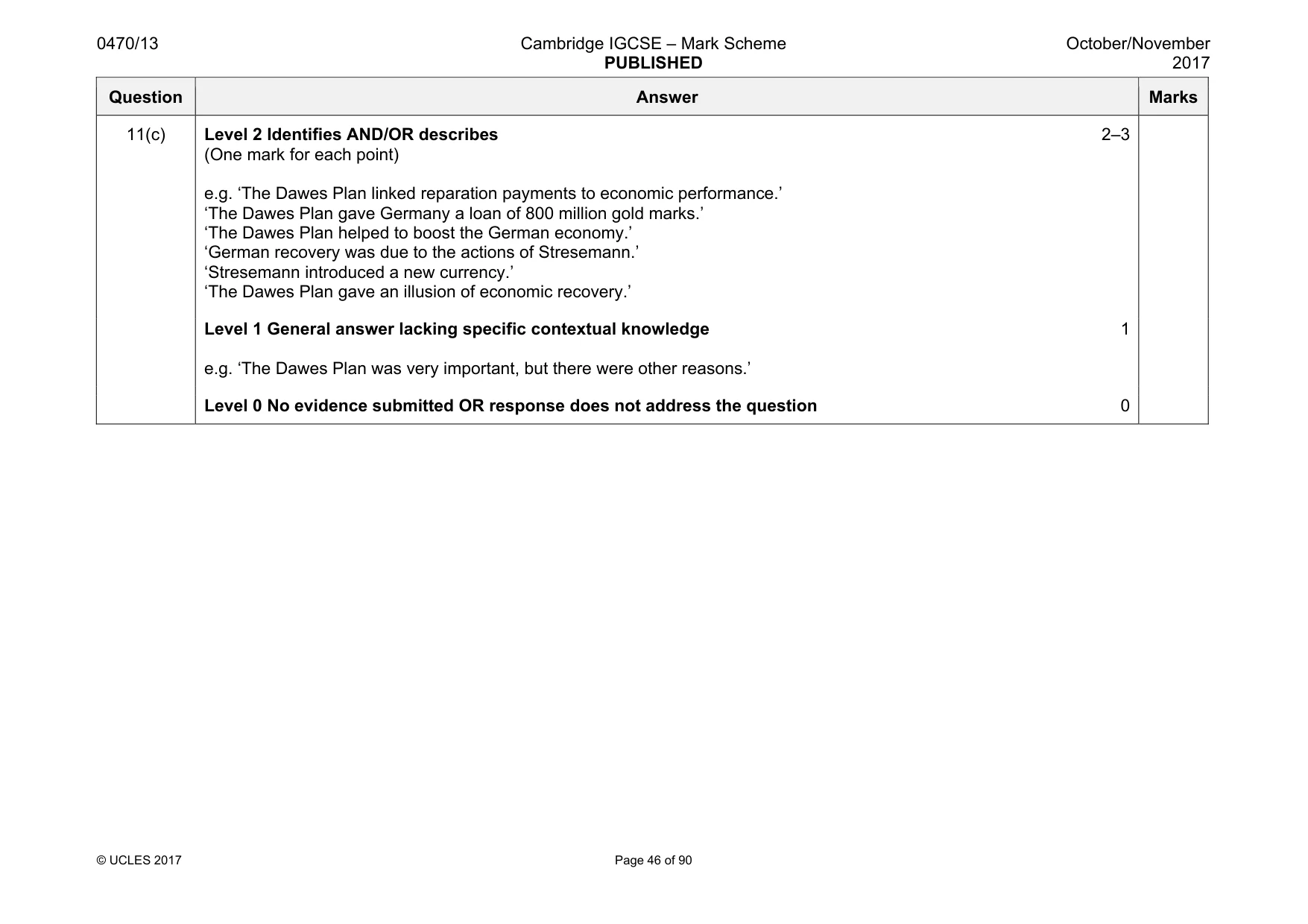
0470/13 Cambridge IGCSE – Mark Scheme PUBLISHED October/November 2017 © UCLES 2017 Page 46 of 90 Question Answer Marks 11(c) Level 2 Identifies AND/OR describes 2–3 (One mark for each point) e.g. ‘The Dawes Plan linked reparation payments to economic performance.’ ‘The Dawes Plan gave Germany a loan of 800 million gold marks.’ ‘The Dawes Plan helped to boost the German economy.’ ‘German recovery was due to the actions of Stresemann.’ ‘Stresemann introduced a new currency.’ ‘The Dawes Plan gave an illusion of economic recovery.’ Level 1 General answer lacking specific contextual knowledge 1 e.g. ‘The Dawes Plan was very important, but there were other reasons.’ Level 0 No evidence submitted OR response does not address the question 0
Mark scheme, page 47
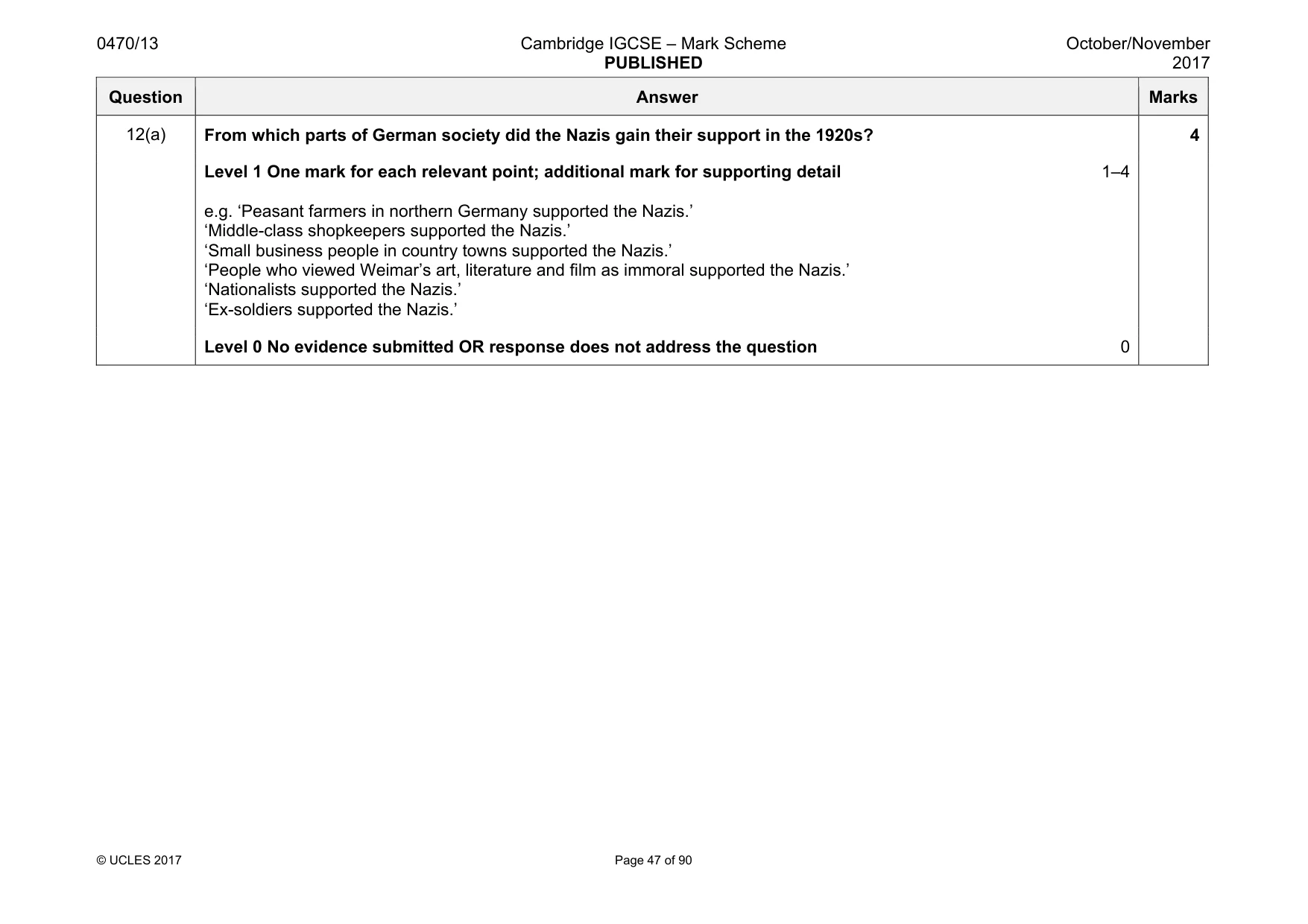
0470/13 Cambridge IGCSE – Mark Scheme PUBLISHED October/November 2017 © UCLES 2017 Page 47 of 90 Question Answer Marks 12(a) From which parts of German society did the Nazis gain their support in the 1920s? 4 Level 1 One mark for each relevant point; additional mark for supporting detail 1–4 e.g. ‘Peasant farmers in northern Germany supported the Nazis.’ ‘Middle-class shopkeepers supported the Nazis.’ ‘Small business people in country towns supported the Nazis.’ ‘People who viewed Weimar’s art, literature and film as immoral supported the Nazis.’ ‘Nationalists supported the Nazis.’ ‘Ex-soldiers supported the Nazis.’ Level 0 No evidence submitted OR response does not address the question 0
Mark scheme, page 48
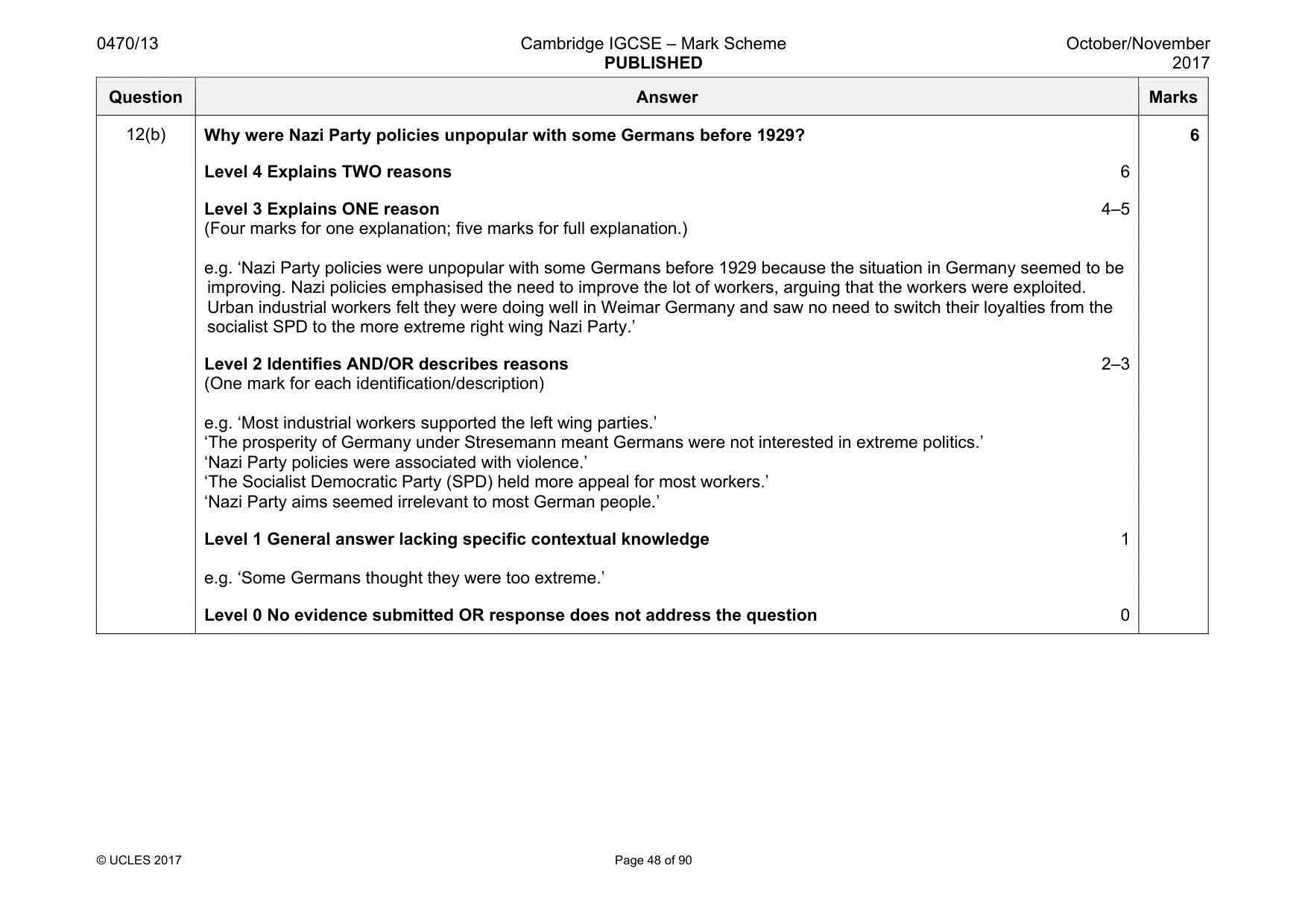
0470/13 Cambridge IGCSE – Mark Scheme PUBLISHED October/November 2017 © UCLES 2017 Page 48 of 90 Question Answer Marks 12(b) Why were Nazi Party policies unpopular with some Germans before 1929? 6 Level 4 Explains TWO reasons 6 Level 3 Explains ONE reason 4–5 (Four marks for one explanation; five marks for full explanation.) e.g. ‘Nazi Party policies were unpopular with some Germans before 1929 because the situation in Germany seemed to be improving. Nazi policies emphasised the need to improve the lot of workers, arguing that the workers were exploited. Urban industrial workers felt they were doing well in Weimar Germany and saw no need to switch their loyalties from the socialist SPD to the more extreme right wing Nazi Party.’ Level 2 Identifies AND/OR describes reasons 2–3 (One mark for each identification/description) e.g. ‘Most industrial workers supported the left wing parties.’ ‘The prosperity of Germany under Stresemann meant Germans were not interested in extreme politics.’ ‘Nazi Party policies were associated with violence.’ ‘The Socialist Democratic Party (SPD) held more appeal for most workers.’ ‘Nazi Party aims seemed irrelevant to most German people.’ Level 1 General answer lacking specific contextual knowledge 1 e.g. ‘Some Germans thought they were too extreme.’ Level 0 No evidence submitted OR response does not address the question 0
Mark scheme, page 49
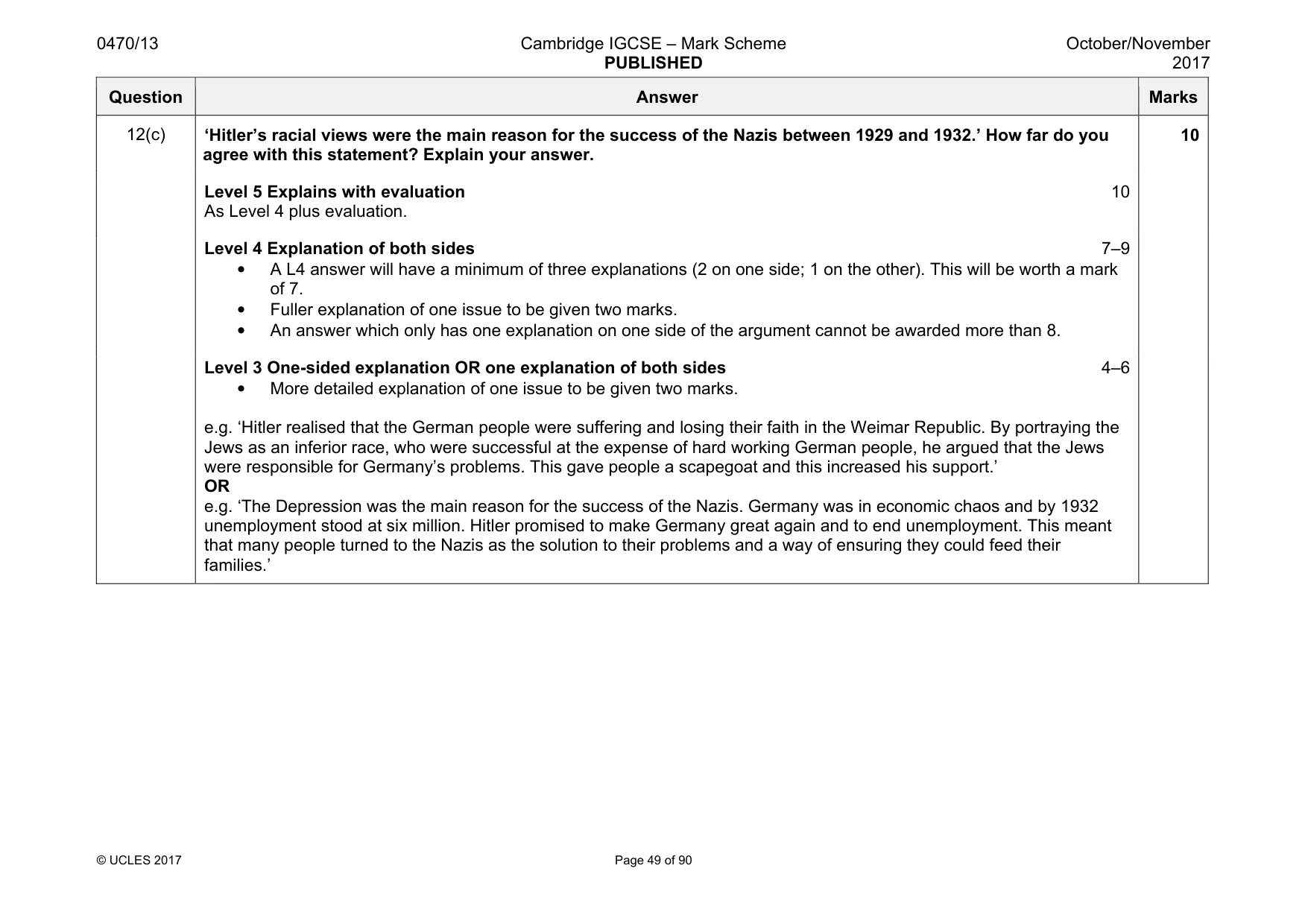
0470/13 Cambridge IGCSE – Mark Scheme PUBLISHED October/November 2017 © UCLES 2017 Page 49 of 90 Question Answer Marks 12(c) ‘Hitler’s racial views were the main reason for the success of the Nazis between 1929 and 1932.’ How far do you agree with this statement? Explain your answer. 10 Level 5 Explains with evaluation 10 As Level 4 plus evaluation. Level 4 Explanation of both sides 7–9 • A L4 answer will have a minimum of three explanations (2 on one side; 1 on the other). This will be worth a mark of 7. • Fuller explanation of one issue to be given two marks. • An answer which only has one explanation on one side of the argument cannot be awarded more than 8. Level 3 One-sided explanation OR one explanation of both sides 4–6 • More detailed explanation of one issue to be given two marks. e.g. ‘Hitler realised that the German people were suffering and losing their faith in the Weimar Republic. By portraying the Jews as an inferior race, who were successful at the expense of hard working German people, he argued that the Jews were responsible for Germany’s problems. This gave people a scapegoat and this increased his support.’ OR e.g. ‘The Depression was the main reason for the success of the Nazis. Germany was in economic chaos and by 1932 unemployment stood at six million. Hitler promised to make Germany great again and to end unemployment. This meant that many people turned to the Nazis as the solution to their problems and a way of ensuring they could feed their families.’
Mark scheme, page 50
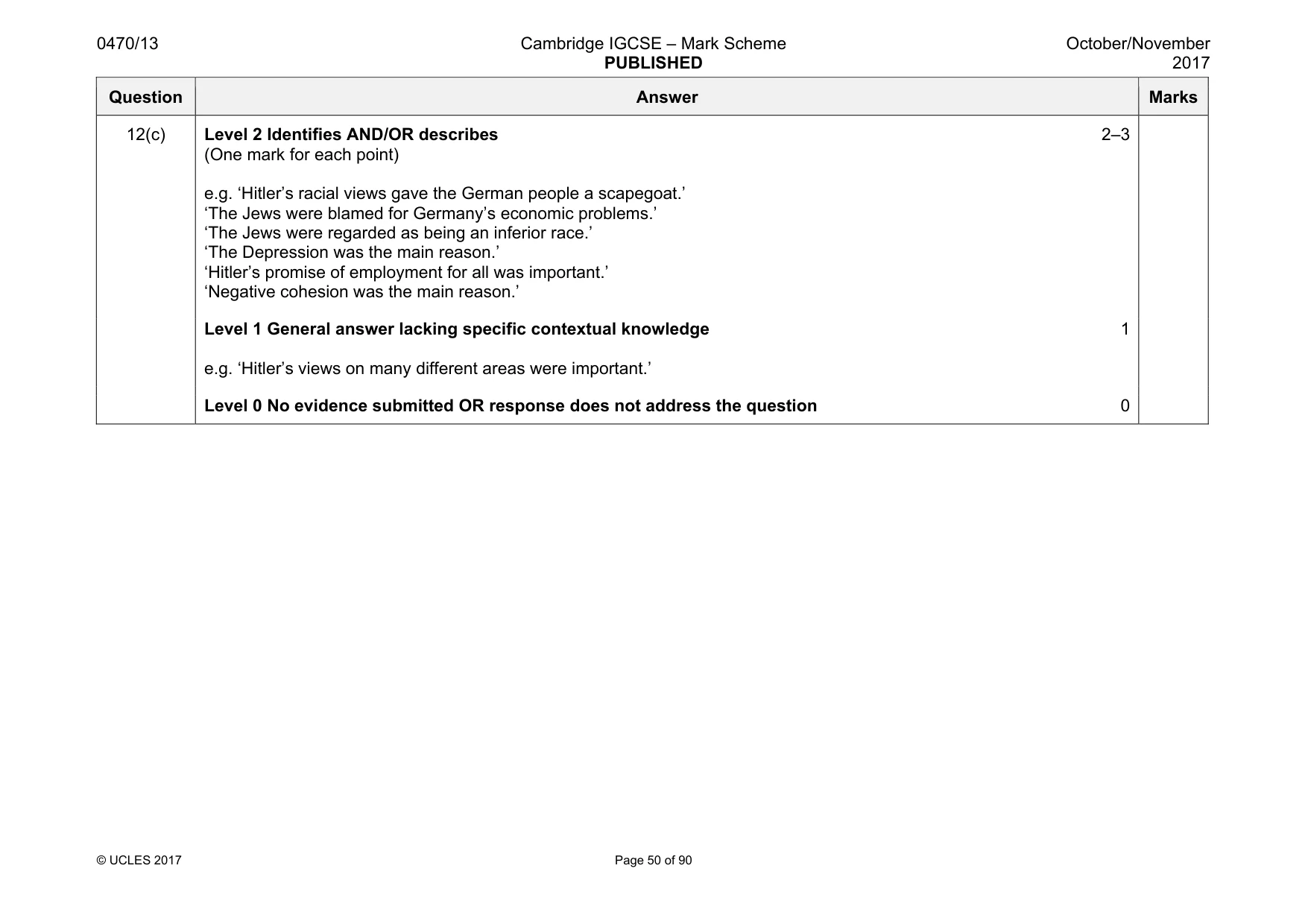
0470/13 Cambridge IGCSE – Mark Scheme PUBLISHED October/November 2017 © UCLES 2017 Page 50 of 90 Question Answer Marks 12(c) Level 2 Identifies AND/OR describes 2–3 (One mark for each point) e.g. ‘Hitler’s racial views gave the German people a scapegoat.’ ‘The Jews were blamed for Germany’s economic problems.’ ‘The Jews were regarded as being an inferior race.’ ‘The Depression was the main reason.’ ‘Hitler’s promise of employment for all was important.’ ‘Negative cohesion was the main reason.’ Level 1 General answer lacking specific contextual knowledge 1 e.g. ‘Hitler’s views on many different areas were important.’ Level 0 No evidence submitted OR response does not address the question 0
Mark scheme, page 51
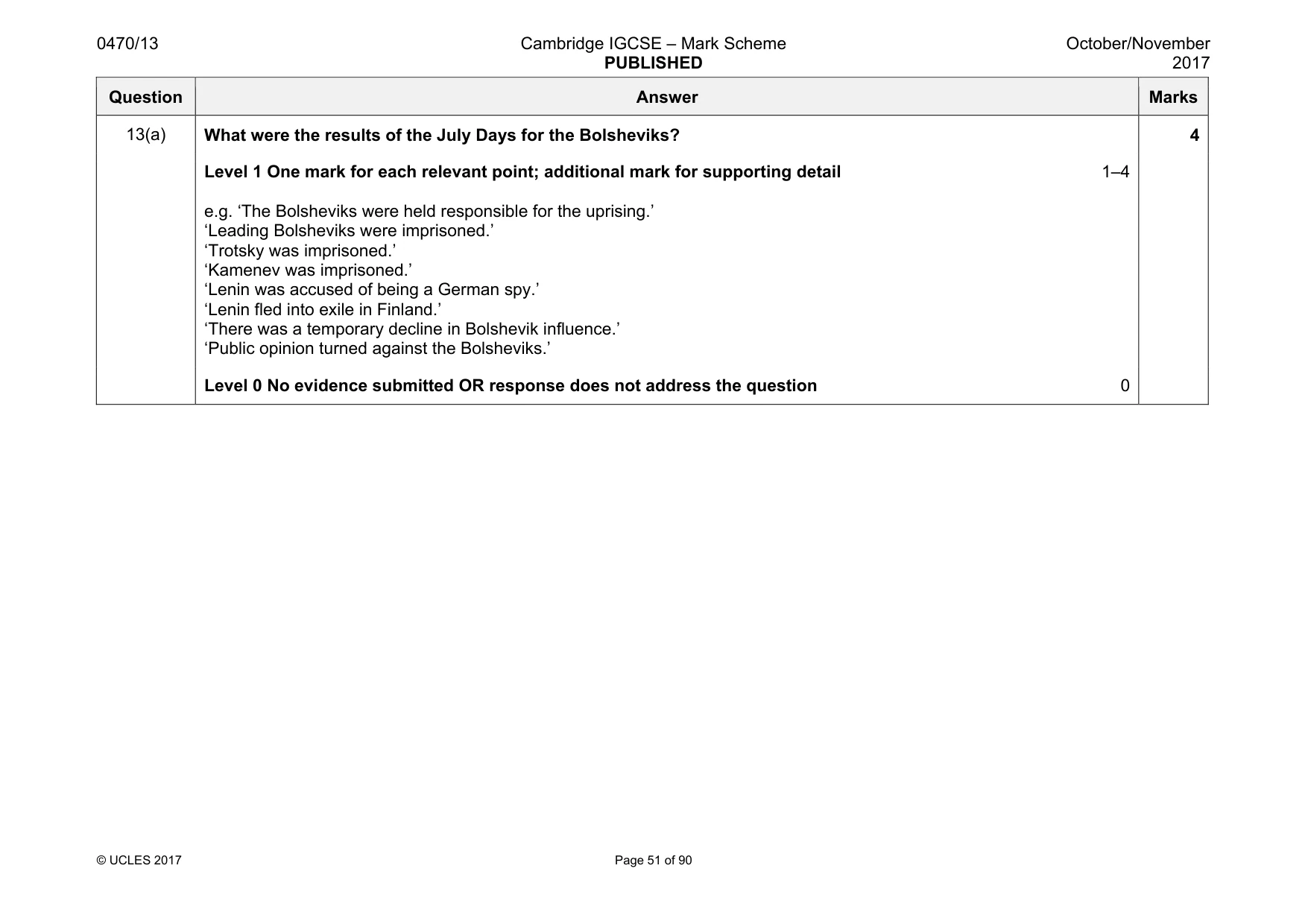
0470/13 Cambridge IGCSE – Mark Scheme PUBLISHED October/November 2017 © UCLES 2017 Page 51 of 90 Question Answer Marks 13(a) What were the results of the July Days for the Bolsheviks? 4 Level 1 One mark for each relevant point; additional mark for supporting detail 1–4 e.g. ‘The Bolsheviks were held responsible for the uprising.’ ‘Leading Bolsheviks were imprisoned.’ ‘Trotsky was imprisoned.’ ‘Kamenev was imprisoned.’ ‘Lenin was accused of being a German spy.’ ‘Lenin fled into exile in Finland.’ ‘There was a temporary decline in Bolshevik influence.’ ‘Public opinion turned against the Bolsheviks.’ Level 0 No evidence submitted OR response does not address the question 0
Mark scheme, page 52
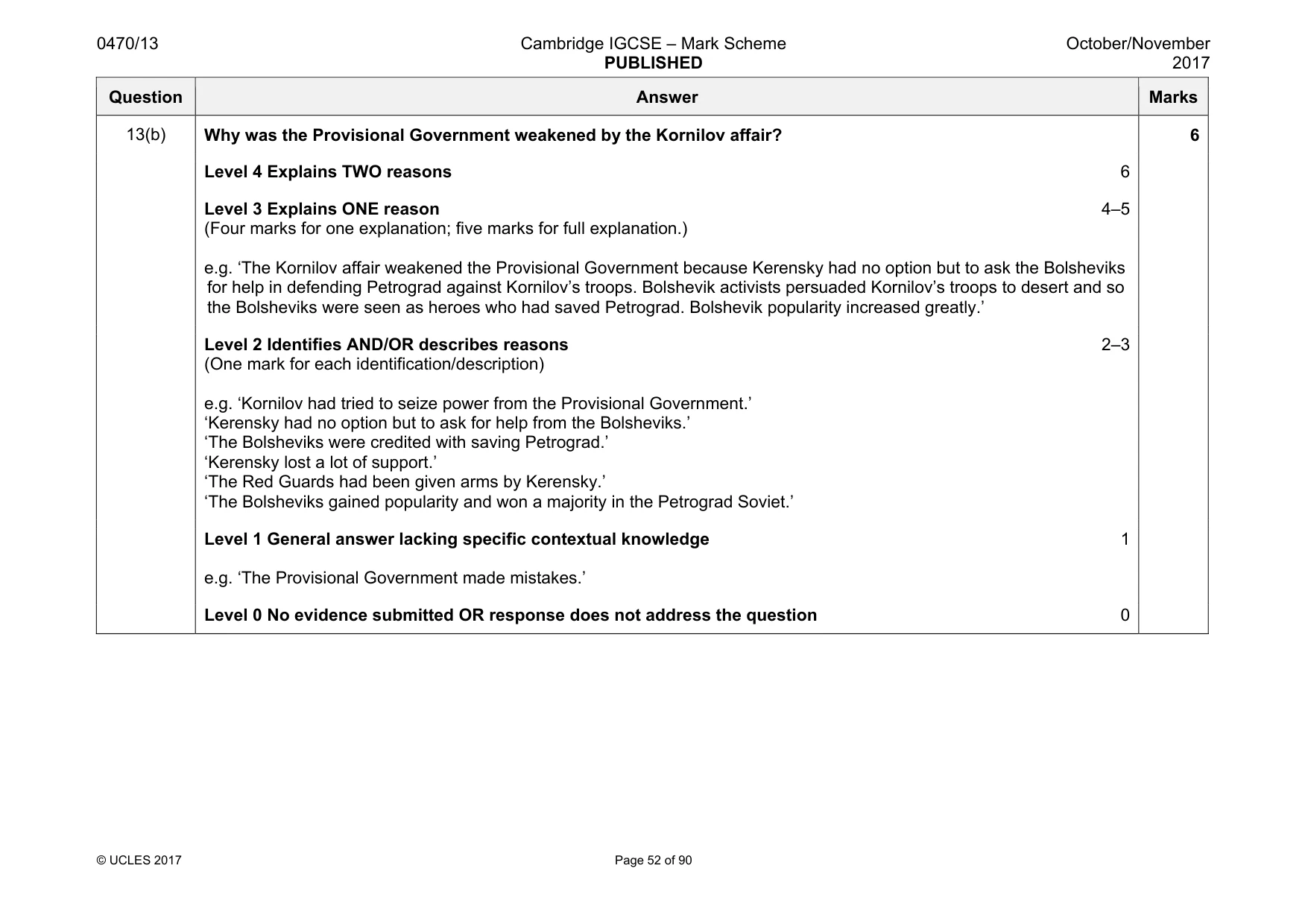
0470/13 Cambridge IGCSE – Mark Scheme PUBLISHED October/November 2017 © UCLES 2017 Page 52 of 90 Question Answer Marks 13(b) Why was the Provisional Government weakened by the Kornilov affair? 6 Level 4 Explains TWO reasons 6 Level 3 Explains ONE reason 4–5 (Four marks for one explanation; five marks for full explanation.) e.g. ‘The Kornilov affair weakened the Provisional Government because Kerensky had no option but to ask the Bolsheviks for help in defending Petrograd against Kornilov’s troops. Bolshevik activists persuaded Kornilov’s troops to desert and so the Bolsheviks were seen as heroes who had saved Petrograd. Bolshevik popularity increased greatly.’ Level 2 Identifies AND/OR describes reasons 2–3 (One mark for each identification/description) e.g. ‘Kornilov had tried to seize power from the Provisional Government.’ ‘Kerensky had no option but to ask for help from the Bolsheviks.’ ‘The Bolsheviks were credited with saving Petrograd.’ ‘Kerensky lost a lot of support.’ ‘The Red Guards had been given arms by Kerensky.’ ‘The Bolsheviks gained popularity and won a majority in the Petrograd Soviet.’ Level 1 General answer lacking specific contextual knowledge 1 e.g. ‘The Provisional Government made mistakes.’ Level 0 No evidence submitted OR response does not address the question 0
Mark scheme, page 53
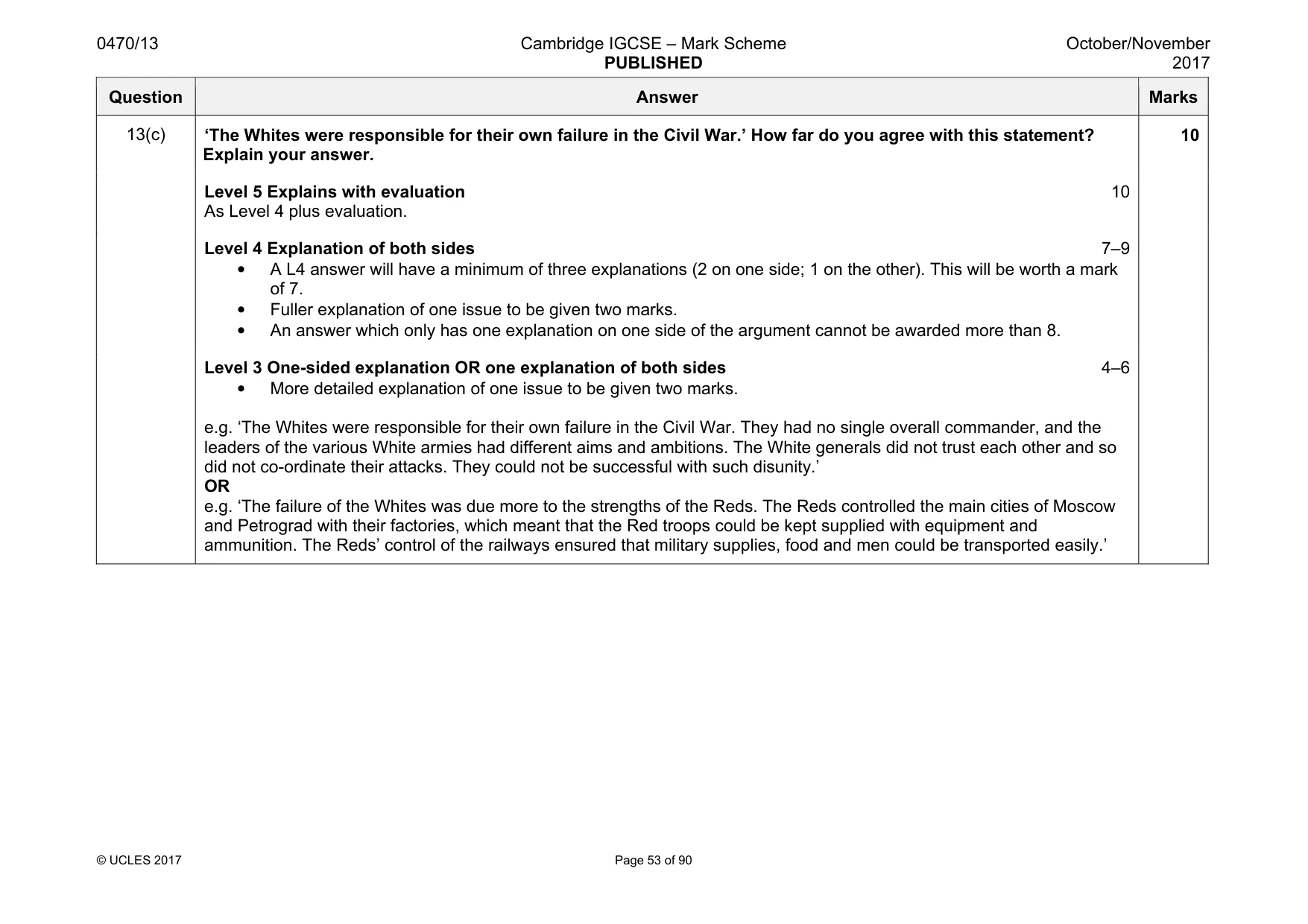
0470/13 Cambridge IGCSE – Mark Scheme PUBLISHED October/November 2017 © UCLES 2017 Page 53 of 90 Question Answer Marks 13(c) ‘The Whites were responsible for their own failure in the Civil War.’ How far do you agree with this statement? Explain your answer. 10 Level 5 Explains with evaluation 10 As Level 4 plus evaluation. Level 4 Explanation of both sides 7–9 • A L4 answer will have a minimum of three explanations (2 on one side; 1 on the other). This will be worth a mark of 7. • Fuller explanation of one issue to be given two marks. • An answer which only has one explanation on one side of the argument cannot be awarded more than 8. Level 3 One-sided explanation OR one explanation of both sides 4–6 • More detailed explanation of one issue to be given two marks. e.g. ‘The Whites were responsible for their own failure in the Civil War. They had no single overall commander, and the leaders of the various White armies had different aims and ambitions. The White generals did not trust each other and so did not co-ordinate their attacks. They could not be successful with such disunity.’ OR e.g. ‘The failure of the Whites was due more to the strengths of the Reds. The Reds controlled the main cities of Moscow and Petrograd with their factories, which meant that the Red troops could be kept supplied with equipment and ammunition. The Reds’ control of the railways ensured that military supplies, food and men could be transported easily.’
Mark scheme, page 54
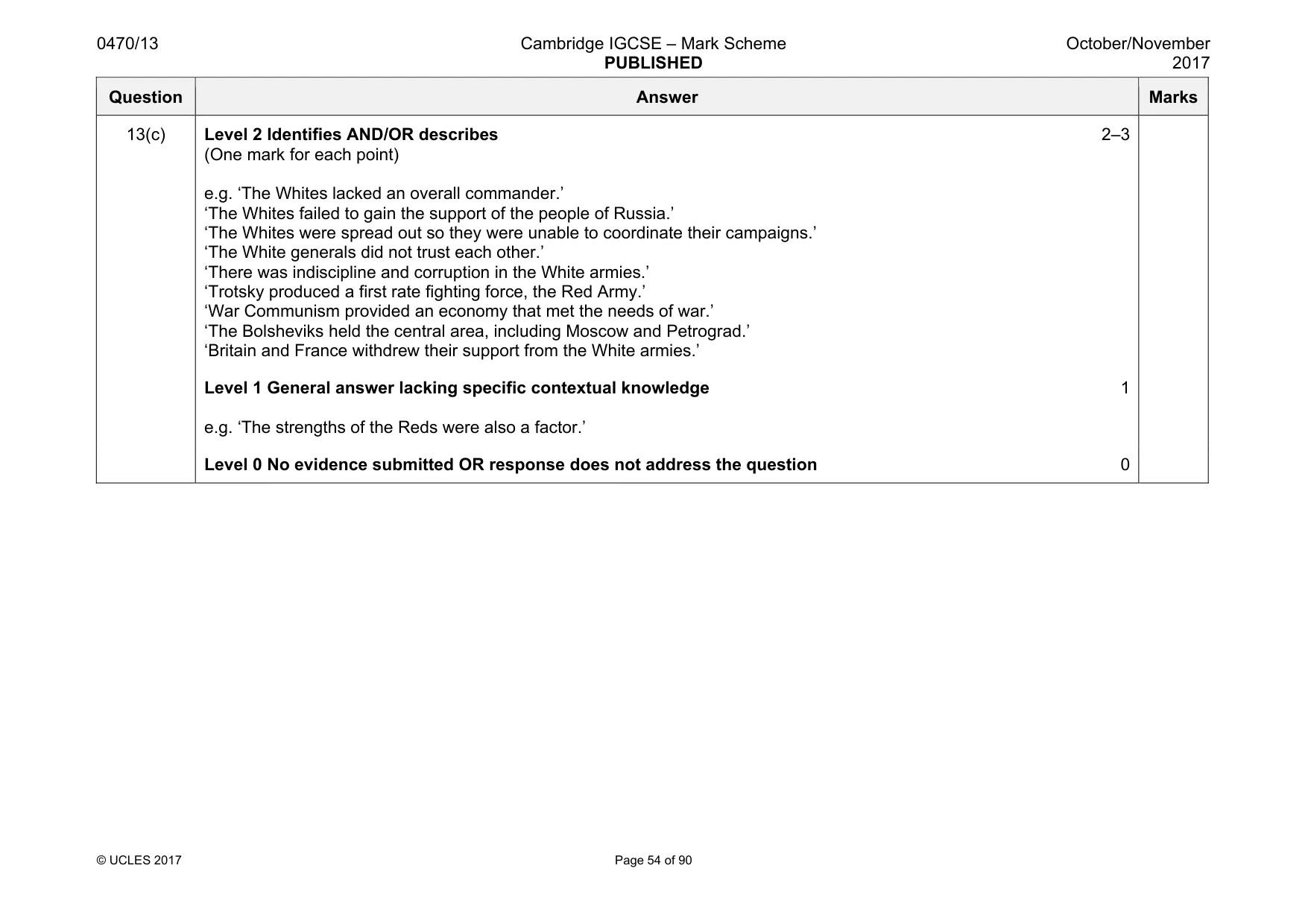
0470/13 Cambridge IGCSE – Mark Scheme PUBLISHED October/November 2017 © UCLES 2017 Page 54 of 90 Question Answer Marks 13(c) Level 2 Identifies AND/OR describes 2–3 (One mark for each point) e.g. ‘The Whites lacked an overall commander.’ ‘The Whites failed to gain the support of the people of Russia.’ ‘The Whites were spread out so they were unable to coordinate their campaigns.’ ‘The White generals did not trust each other.’ ‘There was indiscipline and corruption in the White armies.’ ‘Trotsky produced a first rate fighting force, the Red Army.’ ‘War Communism provided an economy that met the needs of war.’ ‘The Bolsheviks held the central area, including Moscow and Petrograd.’ ‘Britain and France withdrew their support from the White armies.’ Level 1 General answer lacking specific contextual knowledge 1 e.g. ‘The strengths of the Reds were also a factor.’ Level 0 No evidence submitted OR response does not address the question 0
Mark scheme, page 55
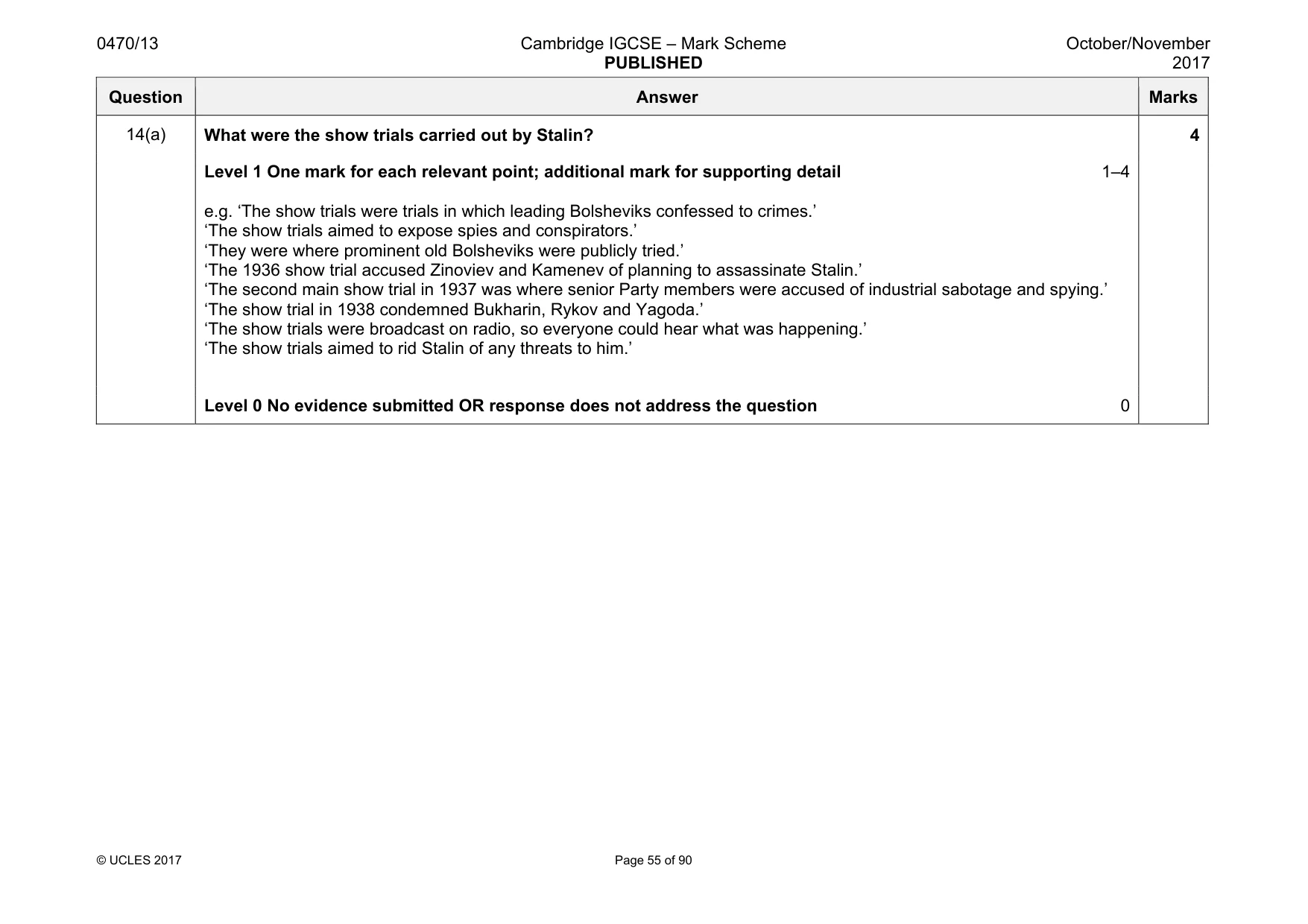
0470/13 Cambridge IGCSE – Mark Scheme PUBLISHED October/November 2017 © UCLES 2017 Page 55 of 90 Question Answer Marks 14(a) What were the show trials carried out by Stalin? 4 Level 1 One mark for each relevant point; additional mark for supporting detail 1–4 e.g. ‘The show trials were trials in which leading Bolsheviks confessed to crimes.’ ‘The show trials aimed to expose spies and conspirators.’ ‘They were where prominent old Bolsheviks were publicly tried.’ ‘The 1936 show trial accused Zinoviev and Kamenev of planning to assassinate Stalin.’ ‘The second main show trial in 1937 was where senior Party members were accused of industrial sabotage and spying.’ ‘The show trial in 1938 condemned Bukharin, Rykov and Yagoda.’ ‘The show trials were broadcast on radio, so everyone could hear what was happening.’ ‘The show trials aimed to rid Stalin of any threats to him.’ Level 0 No evidence submitted OR response does not address the question 0
Mark scheme, page 56
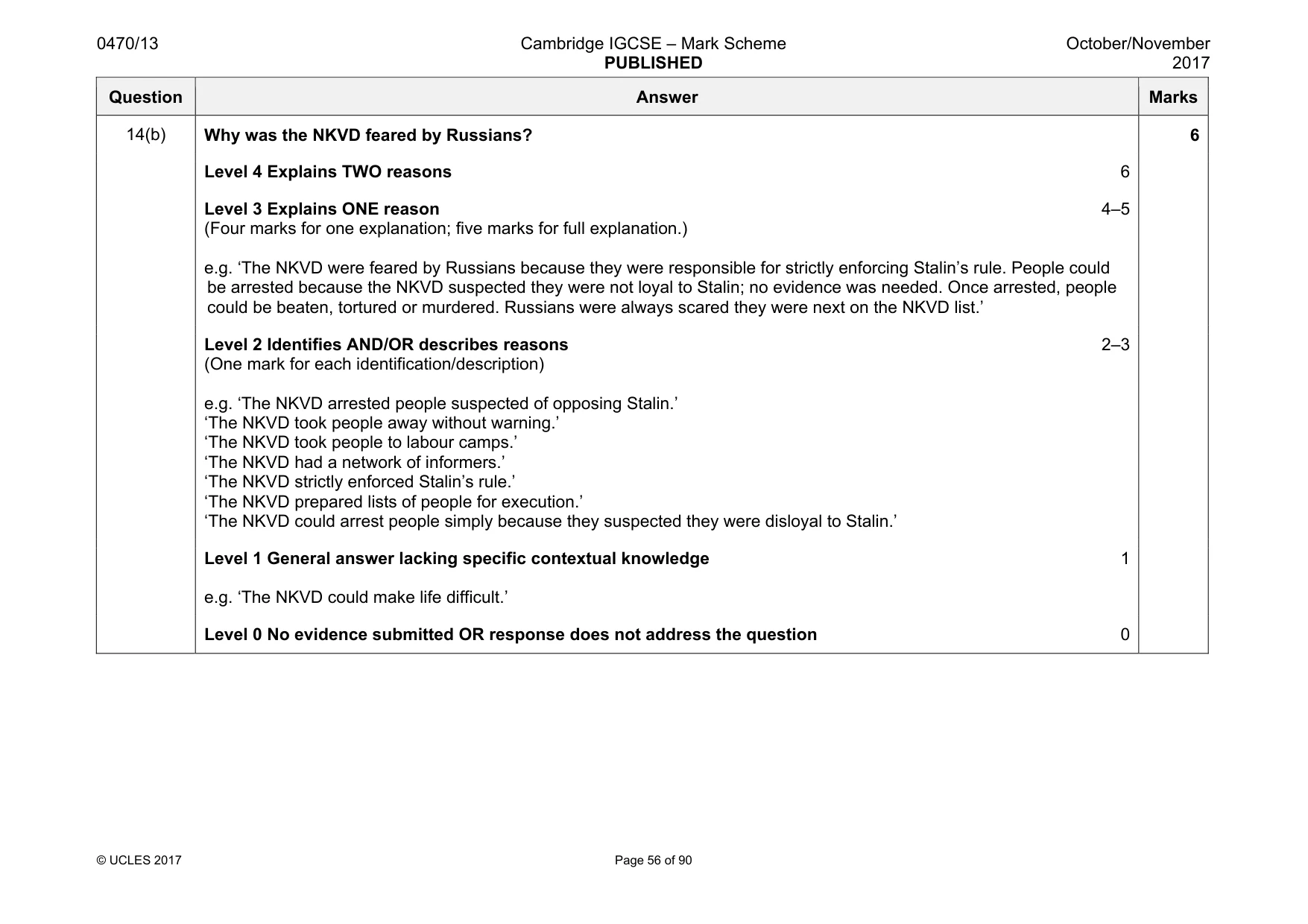
0470/13 Cambridge IGCSE – Mark Scheme PUBLISHED October/November 2017 © UCLES 2017 Page 56 of 90 Question Answer Marks 14(b) Why was the NKVD feared by Russians? 6 Level 4 Explains TWO reasons 6 Level 3 Explains ONE reason 4–5 (Four marks for one explanation; five marks for full explanation.) e.g. ‘The NKVD were feared by Russians because they were responsible for strictly enforcing Stalin’s rule. People could be arrested because the NKVD suspected they were not loyal to Stalin; no evidence was needed. Once arrested, people could be beaten, tortured or murdered. Russians were always scared they were next on the NKVD list.’ Level 2 Identifies AND/OR describes reasons 2–3 (One mark for each identification/description) e.g. ‘The NKVD arrested people suspected of opposing Stalin.’ ‘The NKVD took people away without warning.’ ‘The NKVD took people to labour camps.’ ‘The NKVD had a network of informers.’ ‘The NKVD strictly enforced Stalin’s rule.’ ‘The NKVD prepared lists of people for execution.’ ‘The NKVD could arrest people simply because they suspected they were disloyal to Stalin.’ Level 1 General answer lacking specific contextual knowledge 1 e.g. ‘The NKVD could make life difficult.’ Level 0 No evidence submitted OR response does not address the question 0
Mark scheme, page 57
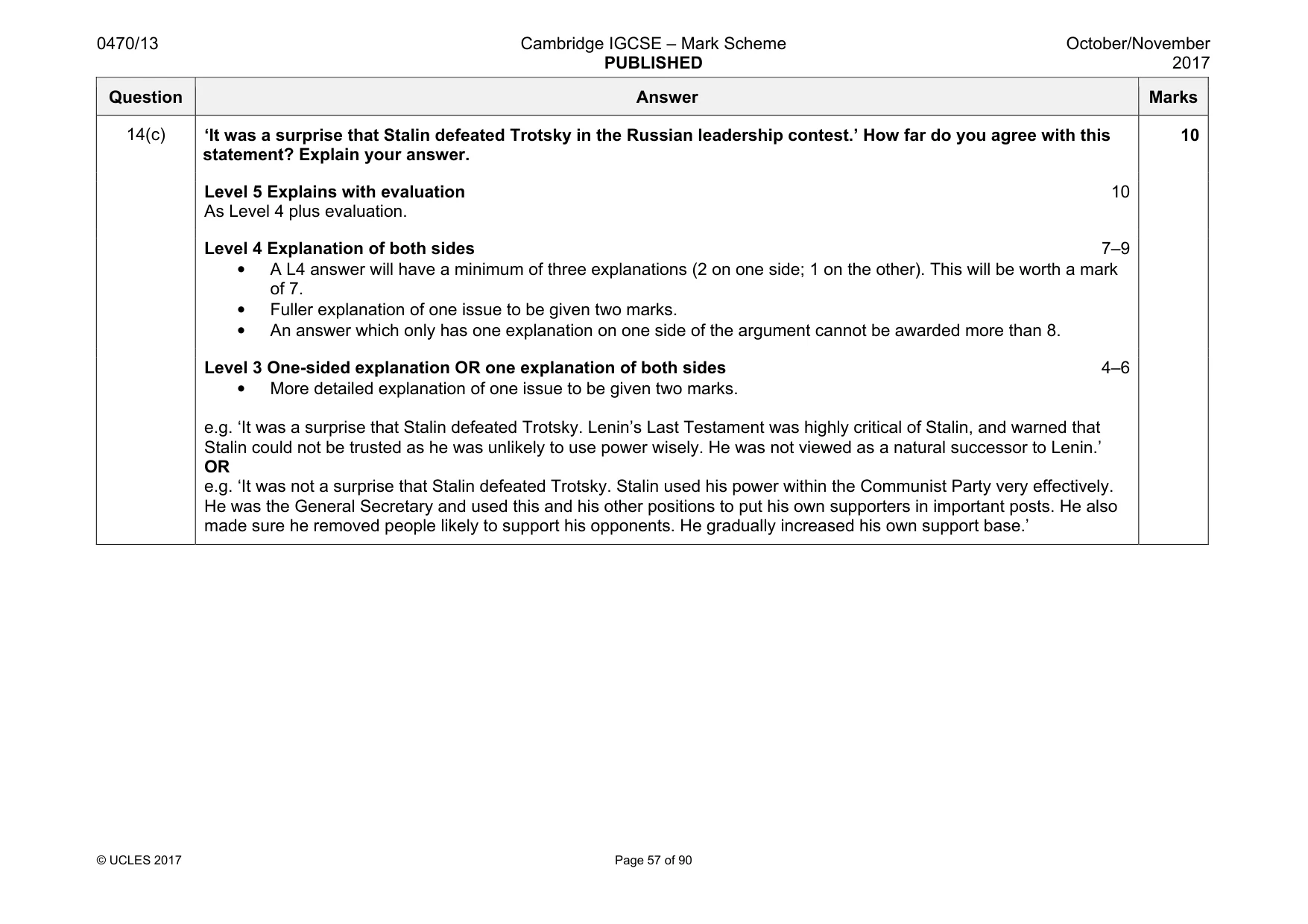
0470/13 Cambridge IGCSE – Mark Scheme PUBLISHED October/November 2017 © UCLES 2017 Page 57 of 90 Question Answer Marks 14(c) ‘It was a surprise that Stalin defeated Trotsky in the Russian leadership contest.’ How far do you agree with this statement? Explain your answer. 10 Level 5 Explains with evaluation 10 As Level 4 plus evaluation. Level 4 Explanation of both sides 7–9 • A L4 answer will have a minimum of three explanations (2 on one side; 1 on the other). This will be worth a mark of 7. • Fuller explanation of one issue to be given two marks. • An answer which only has one explanation on one side of the argument cannot be awarded more than 8. Level 3 One-sided explanation OR one explanation of both sides 4–6 • More detailed explanation of one issue to be given two marks. e.g. ‘It was a surprise that Stalin defeated Trotsky. Lenin’s Last Testament was highly critical of Stalin, and warned that Stalin could not be trusted as he was unlikely to use power wisely. He was not viewed as a natural successor to Lenin.’ OR e.g. ‘It was not a surprise that Stalin defeated Trotsky. Stalin used his power within the Communist Party very effectively. He was the General Secretary and used this and his other positions to put his own supporters in important posts. He also made sure he removed people likely to support his opponents. He gradually increased his own support base.’
Mark scheme, page 58
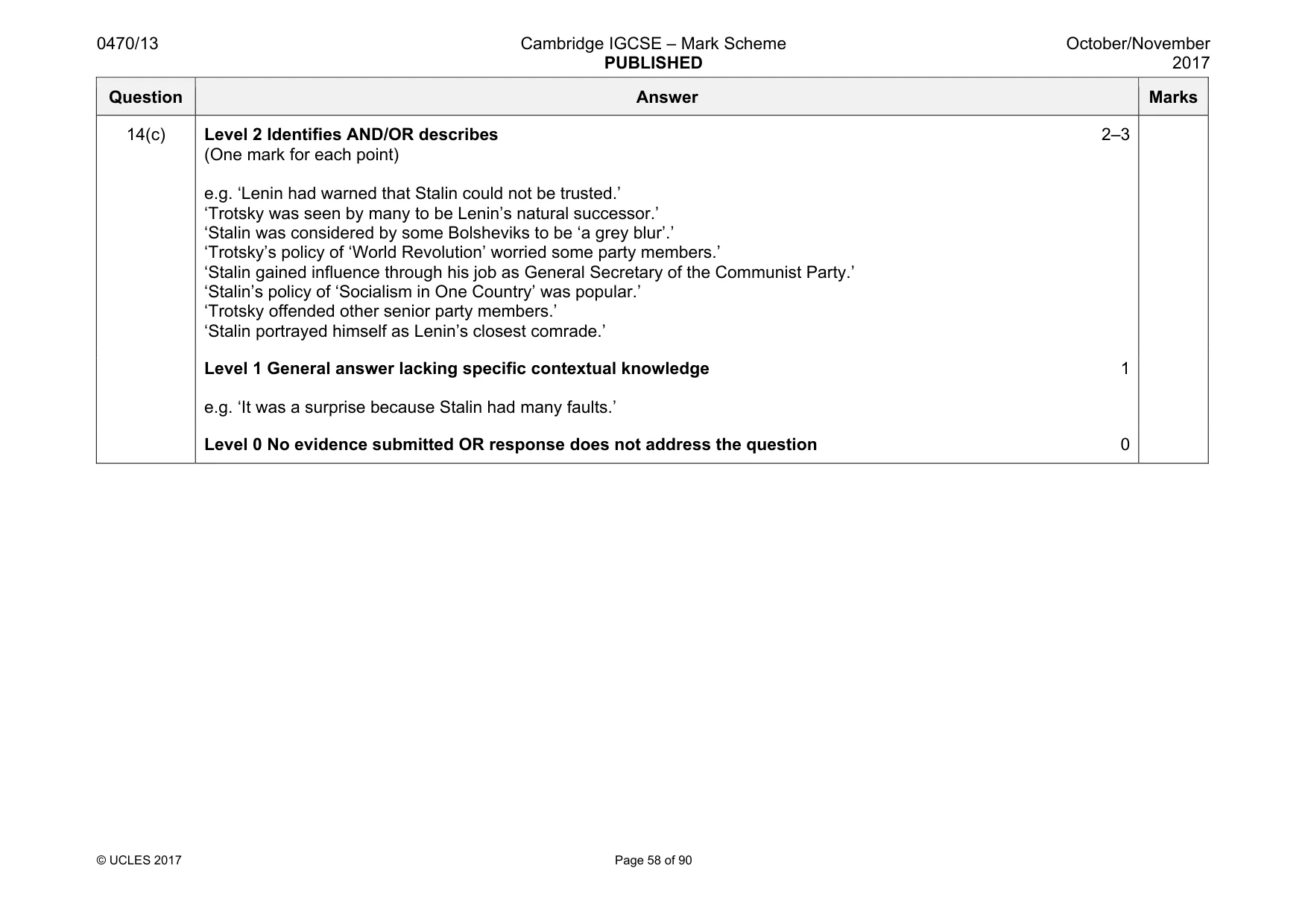
0470/13 Cambridge IGCSE – Mark Scheme PUBLISHED October/November 2017 © UCLES 2017 Page 58 of 90 Question Answer Marks 14(c) Level 2 Identifies AND/OR describes 2–3 (One mark for each point) e.g. ‘Lenin had warned that Stalin could not be trusted.’ ‘Trotsky was seen by many to be Lenin’s natural successor.’ ‘Stalin was considered by some Bolsheviks to be ‘a grey blur’.’ ‘Trotsky’s policy of ‘World Revolution’ worried some party members.’ ‘Stalin gained influence through his job as General Secretary of the Communist Party.’ ‘Stalin’s policy of ‘Socialism in One Country’ was popular.’ ‘Trotsky offended other senior party members.’ ‘Stalin portrayed himself as Lenin’s closest comrade.’ Level 1 General answer lacking specific contextual knowledge 1 e.g. ‘It was a surprise because Stalin had many faults.’ Level 0 No evidence submitted OR response does not address the question 0
Mark scheme, page 59
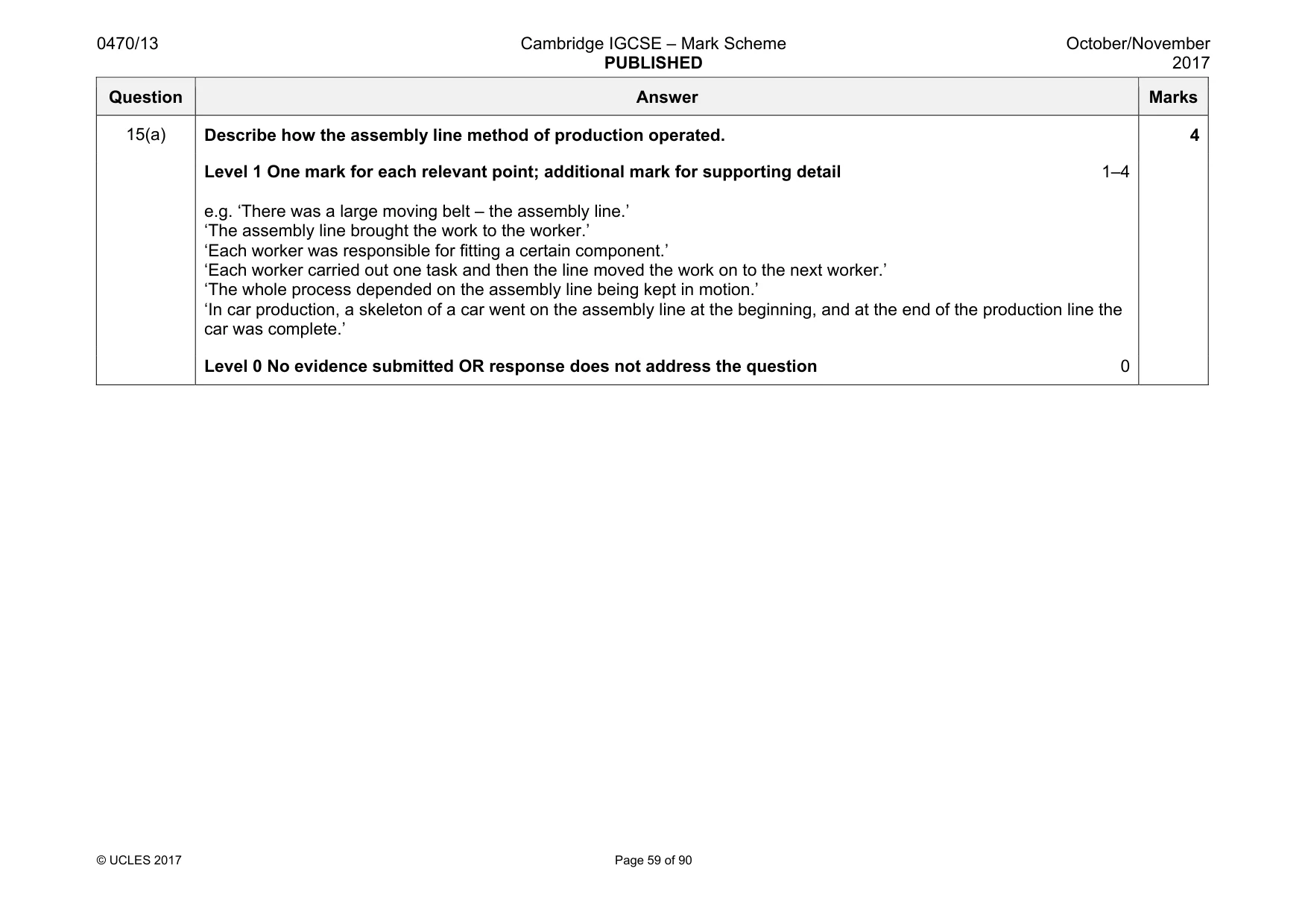
0470/13 Cambridge IGCSE – Mark Scheme PUBLISHED October/November 2017 © UCLES 2017 Page 59 of 90 Question Answer Marks 15(a) Describe how the assembly line method of production operated. 4 Level 1 One mark for each relevant point; additional mark for supporting detail 1–4 e.g. ‘There was a large moving belt – the assembly line.’ ‘The assembly line brought the work to the worker.’ ‘Each worker was responsible for fitting a certain component.’ ‘Each worker carried out one task and then the line moved the work on to the next worker.’ ‘The whole process depended on the assembly line being kept in motion.’ ‘In car production, a skeleton of a car went on the assembly line at the beginning, and at the end of the production line the car was complete.’ Level 0 No evidence submitted OR response does not address the question 0
Mark scheme, page 60
0470/13 Cambridge IGCSE – Mark Scheme PUBLISHED October/November 2017 © UCLES 2017 Page 60 of 90 Question Answer Marks 15(b) Why did agriculture suffer from over-production in the 1920s? 6 Level 4 Explains TWO reasons 6 Level 3 Explains ONE reason 4–5 (Four marks for one explanation; five marks for full explanation.) e.g. ‘New machines like the combine harvester and the use of new improved fertilisers had made American agriculture very efficient indeed. During the war any surplus production had been sold to European countries. After the war, agricultural production in European countries gradually returned to normal, and these countries no longer needed to import so much from the USA. The USA was left with a surplus.’ Level 2 Identifies AND/OR describes reasons 2–3 (One mark for each identification/description) e.g. ‘New machines made production much easier and quicker.’ ‘America was producing far more than the Americans needed for their own use.’ ‘European markets no longer imported so much American food.’ ‘There was competition from Canadian farmers.’ ‘US tariffs caused problems.’ Level 1 General answer lacking specific contextual knowledge 1 e.g. ‘There were many problems in agriculture.’ Level 0 No evidence submitted OR response does not address the question 0
Mark scheme, page 61
0470/13 Cambridge IGCSE – Mark Scheme PUBLISHED October/November 2017 © UCLES 2017 Page 61 of 90 Question Answer Marks 15(c) ‘Hire purchase was the most important factor in causing the American economic boom.’ How far do you agree with this statement? Explain your answer. 10 Level 5 Explains with evaluation 10 As Level 4 plus evaluation. Level 4 Explanation of both sides 7–9 • A L4 answer will have a minimum of three explanations (2 on one side; 1 on the other). This will be worth a mark of 7. • Fuller explanation of one issue to be given two marks. • An answer which only has one explanation on one side of the argument cannot be awarded more than 8. Level 3 One-sided explanation OR one explanation of both sides 4–6 • More detailed explanation of one issue to be given two marks. e.g. ‘Hire purchase was very important as it meant that more and more goods could be sold. People who could not afford to purchase an item outright were able to pay for it in instalments under a hire purchase agreement. This meant increasing numbers of goods were purchased which stimulated the economy.’ OR e.g. ‘Republican policies were very important in causing the economic boom. Tariffs were placed on imported goods which made these imports more expensive than American made goods. This encouraged people to buy American, which helped American producers to increase their profits.’
Mark scheme, page 62
0470/13 Cambridge IGCSE – Mark Scheme PUBLISHED October/November 2017 © UCLES 2017 Page 62 of 90 Question Answer Marks 15(c) Level 2 Identifies AND/OR describes 2–3 (One mark for each point) e.g. ‘Hire purchase meant people could purchase goods in instalments.’ ‘Hire purchase meant people could buy goods even if they did not have enough money to pay on the spot.’ ‘Mass marketing was important.’ ‘Mass production helped to cause the economic boom.’ ‘The motor industry boosted the economy.’ ‘Republican policies were important.’ ‘The USA had taken over European overseas markets in the war.’ Level 1 General answer lacking specific contextual knowledge 1 e.g. ‘Hire purchase was important, but there were many other reasons.’ Level 0 No evidence submitted OR response does not address the question 0
Mark scheme, page 63
0470/13 Cambridge IGCSE – Mark Scheme PUBLISHED October/November 2017 © UCLES 2017 Page 63 of 90 Question Answer Marks 16(a) What benefits did the Tennessee Valley Authority (TVA) bring to the region? 4 Level 1 One mark for each relevant point; additional mark for supporting detail 1–4 e.g. ‘The building of hydroelectric dams helped to control the Tennessee River.’ ‘Flood prevention schemes were introduced.’ ‘Measures were taken to improve soil quality in the region.’ ‘Forests were planted.’ ‘The dams made it possible to irrigate dried out land.’ ‘Power stations provided cheap electricity.’ ‘New industries were attracted by cheap electricity.’ ‘A new waterway linked major river systems.’ ‘The new waterway gave easy access to the area.’ ‘New industries were attracted by good transport systems.’ ‘The TVA created thousands of jobs.’ Level 0 No evidence submitted OR response does not address the question 0
Mark scheme, page 64
0470/13 Cambridge IGCSE – Mark Scheme PUBLISHED October/November 2017 © UCLES 2017 Page 64 of 90 Question Answer Marks 16(b) Why was there conflict between President Roosevelt and the Supreme Court? 6 Level 4 Explains TWO reasons 6 Level 3 Explains ONE reason 4–5 (Four marks for one explanation; five marks for full explanation.) e.g. ‘During the 1930s most of the judges in the Supreme Court were old, conservative and Republican. The Supreme Court had to decide if measures passed by the President and Congress were consistent with the Constitution, and they declared that the NRA and the AAA were both unconstitutional. Roosevelt felt they were trying to undermine his attempts to solve America’s problems, and that their actions were based solely on a political dislike of the New Deal.’ Level 2 Identifies AND/OR describes reasons 2–3 (One mark for each identification/description) e.g. ‘The Supreme Court was conservative in nature.’ ‘The Supreme Court thought parts of the New Deal were unconstitutional.’ ‘The Supreme Court believed the New Deal was undermining the American Constitution.’ ‘Roosevelt was determined the Supreme Court would not stop his reforms.’ ‘Roosevelt wanted to appoint judges sympathetic to his policies.’ ‘Roosevelt was accused of acting like a dictator.’ ‘Roosevelt was accused of trying to overthrow the Constitution.’ Level 1 General answer lacking specific contextual knowledge 1 e.g. ‘They did not like each other’s ideas.’ Level 0 No evidence submitted OR response does not address the question 0
Mark scheme, page 65
0470/13 Cambridge IGCSE – Mark Scheme PUBLISHED October/November 2017 © UCLES 2017 Page 65 of 90 Question Answer Marks 16(c) How far did the New Deal achieve its aims? Explain your answer. 10 Level 5 Explains with evaluation 10 As Level 4 plus evaluation. Level 4 Explanation of both sides 7–9 • A L4 answer will have a minimum of three explanations (2 on one side; 1 on the other). This will be worth a mark of 7. • Fuller explanation of one issue to be given two marks. • An answer which only has one explanation on one side of the argument cannot be awarded more than 8. Level 3 One-sided explanation OR one explanation of both sides 4–6 • More detailed explanation of one issue to be given two marks. e.g. ‘One aim of the New Deal was relief, and part of this involved the relief of extreme poverty. The New Deal achieved this aim as millions of Americans were helped by the Federal Emergency Relief Administration (FERA). FERA had a budget of $500million and this was used to provide soup kitchens, clothing and bedding for those in desperate need.’ OR e.g. ‘The New Deal did not achieve its aim of recovery and getting everyone working again. Between 1933 and 1939 unemployment did not fall below 14% of the workforce, so there were still lots of people without jobs. The problem of unemployment was really only addressed when the USA became involved in the Second World War and the demand for American food and manufactured goods increased greatly, creating more jobs.’
Mark scheme, page 66
0470/13 Cambridge IGCSE – Mark Scheme PUBLISHED October/November 2017 © UCLES 2017 Page 66 of 90 Question Answer Marks 16(c) Level 2 Identifies AND/OR describes 2–3 (One mark for each point) e.g. ‘Unemployment fell by over 30% between 1933 and 1939.’ ‘Emergency benefits were given to help those in dire need.’ ‘Working conditions improved overall.’ ‘The banking system was reformed.’ ‘Unemployment never fell below 14% of the workforce between 1933 and 1939.’ ‘The New Deal did not end racial discrimination.’ ‘Some companies still used violence to break up strikes and sit-ins.’ ‘Sharecroppers and tenants were evicted from their land.’ Level 1 General answer lacking specific contextual knowledge 1 e.g. ‘It achieved a lot, but was not always successful.’ Level 0 No evidence submitted OR response does not address the question 0
Mark scheme, page 67
0470/13 Cambridge IGCSE – Mark Scheme PUBLISHED October/November 2017 © UCLES 2017 Page 67 of 90 Question Answer Marks 17(a) Describe the impact of Communist rule on women. 4 Level 1 One mark for each relevant point; additional mark for supporting detail 1–4 e.g. ‘Mao moved the focus from women in the home to women producing for the state.’ ‘Arranged marriages were banned.’ ‘The practice of foot binding was removed from society.’ ‘Women maintained their share of the wealth after divorce.’ ‘Divorce was easier to obtain.’ ‘Women were encouraged to work.’ ‘Women were encouraged to become Communist officials.’ ‘Women now had the same educational opportunities as men.’ Level 0 No evidence submitted OR response does not address the question 0
Mark scheme, page 68
0470/13 Cambridge IGCSE – Mark Scheme PUBLISHED October/November 2017 © UCLES 2017 Page 68 of 90 Question Answer Marks 17(b) Why was the first Five-Year Plan a success? 6 Level 4 Explains TWO reasons 6 Level 3 Explains ONE reason 4–5 (Four marks for one explanation; five marks for full explanation.) e.g. ‘The first Five-Year Plan was a success because investment was available. Ordinary Chinese citizens were encouraged to save money in State banks through the patriotic savings campaigns. As part of the plan the supply of consumer goods was deliberately limited, which meant the Chinese people had little to spend their money on and so saved more money in the State banks. These savings helped to finance industrial investment.’ Level 2 Identifies AND/OR describes reasons 2–3 (One mark for each identification/description) e.g. ‘Scarce resources were allocated carefully.’ ‘Patriotic savings campaigns helped to finance industrial investment.’ ‘Soviet advisers helped with the plan.’ ‘The Soviet Union helped out with machinery and equipment.’ ‘Propaganda helped to motivate the workforce.’ ‘Rewards were given to productive workers.’ Level 1 General answer lacking specific contextual knowledge 1 e.g. ‘It was well planned.’ Level 0 No evidence submitted OR response does not address the question 0
Mark scheme, page 69
0470/13 Cambridge IGCSE – Mark Scheme PUBLISHED October/November 2017 © UCLES 2017 Page 69 of 90 Question Answer Marks 17(c) ‘Attempts by Mao to improve agriculture in China were unsuccessful.’ How far do you agree with this statement? Explain your answer. 10 Level 5 Explains with evaluation 10 As Level 4 plus evaluation. Level 4 Explanation of both sides 7–9 • A L4 answer will have a minimum of three explanations (2 on one side; 1 on the other). This will be worth a mark of 7. • Fuller explanation of one issue to be given two marks. • An answer which only has one explanation on one side of the argument cannot be awarded more than 8. Level 3 One-sided explanation OR one explanation of both sides 4–6 • More detailed explanation of one issue to be given two marks. e.g. ‘Mao’s early attempts to improve agriculture were successful. Mutual Aid Teams encouraged peasants to share tools, machinery and knowledge. Profits were shared out among members of the co-operative according to how much land, tools and hours of work they had contributed. Together they were able to buy machines and better seeds. The peasants grew more food and ate better.’ OR e.g. ‘Mao’s Four Pests Campaign did not help agriculture at all. One target of the campaign was sparrows because it was said they consumed large quantities of seed and grain. The campaign against them was so successful that the ecological balance was disturbed and caterpillars usually eaten by sparrows thrived and consumed large areas of crops.’
Mark scheme, page 70
0470/13 Cambridge IGCSE – Mark Scheme PUBLISHED October/November 2017 © UCLES 2017 Page 70 of 90 Question Answer Marks 17(c) Level 2 Identifies AND/OR describes 2–3 (One mark for each point) e.g. ‘Grain production was at a record high by 1952.’ ‘Cooperative farming was more efficient.’ ‘Mutual Aid Teams were successful.’ ‘The Four Pests Campaign did not help agriculture.’ ‘Mao’s eight point agricultural constitution did not work.’ ‘There was a Great Famine in the late 1950s and early 1960s.’ Level 1 General answer lacking specific contextual knowledge 1 e.g. ‘Mao had both successes and failures with agriculture.’ Level 0 No evidence submitted OR response does not address the question 0
Mark scheme, page 71
0470/13 Cambridge IGCSE – Mark Scheme PUBLISHED October/November 2017 © UCLES 2017 Page 71 of 90 Question Answer Marks 18(a) Describe the treatment of ‘enemies of the state’ during the Cultural Revolution. 4 Level 1 One mark for each relevant point; additional mark for supporting detail 1–4 e.g. ‘Some enemies of the state were tortured.’ ‘Some enemies of the state were executed.’ ‘Many party officials were removed from office.’ ‘Their property was seized.’ ‘Enemies of the state were denied medical attention.’ ‘Enemies of the state were sent to the countryside to be re-educated in the ways of the revolution.’ Level 0 No evidence submitted OR response does not address the question 0
Mark scheme, page 72
0470/13 Cambridge IGCSE – Mark Scheme PUBLISHED October/November 2017 © UCLES 2017 Page 72 of 90 Question Answer Marks 18(b) Why did Mao introduce a ‘cult of personality’? 6 Level 4 Explains TWO reasons 6 Level 3 Explains ONE reason 4–5 (Four marks for one explanation; five marks for full explanation.) e.g. ‘Mao introduced a ‘cult of personality’ to ensure the loyalty of the Chinese people to him. The ‘cult of personality’ promoted Mao as the Great Helmsman who had led China away from the old problems and into a wonderful new world of communism. By emphasising everything that was positive and concealing the failings of Mao, the ‘cult of personality’ ensured Chinese people would see him as their saviour and he would therefore increase his control over China.’ Level 2 Identifies AND/OR describes reasons 2–3 (One mark for each identification/description) e.g. ‘To demonstrate he was the guardian of the Chinese people.’ ‘To show himself as a kind and benevolent leader.’ ‘To communicate effectively with China’s millions of peasants.’ ‘To conceal his failings.’ ‘To promote himself as China’s Great Helmsman.’ ‘To ensure the loyalty of the Chinese people.’ ‘To increase his authority over the Communist Party.’ Level 1 General answer lacking specific contextual knowledge 1 e.g. ‘He thought it would help him.’ Level 0 No evidence submitted OR response does not address the question 0
Mark scheme, page 73
0470/13 Cambridge IGCSE – Mark Scheme PUBLISHED October/November 2017 © UCLES 2017 Page 73 of 90 Question Answer Marks 18(c) How far did the death of Mao lead to improvements to the lives of Chinese people? Explain your answer. 10 Level 5 Explains with evaluation 10 As Level 4 plus evaluation. Level 4 Explanation of both sides 7–9 • A L4 answer will have a minimum of three explanations (2 on one side; 1 on the other). This will be worth a mark of 7. • Fuller explanation of one issue to be given two marks. • An answer which only has one explanation on one side of the argument cannot be awarded more than 8. Level 3 One-sided explanation OR one explanation of both sides 4–6 • More detailed explanation of one issue to be given two marks. e.g. ‘During the Great Leap Forward industry was inefficient, and during Mao’s Five-Year Plan industry was nationalised. Few consumer goods were available. Deng changed this by allowing people to have their own small businesses. Record numbers of consumer goods such as bicycles, sewing machines and watches were produced.’ OR e.g. ‘Under Mao all opposition was crushed. Deng adopted the same approach. Students occupied Tiananmen Square in 1989 demanding democratic reforms, and refused to leave even when ordered to do so. Deng used force to remove them. Hundreds of students were killed, and thousands more arrested and imprisoned. Nothing had really improved – opposition would still not be allowed.’
Mark scheme, page 74
0470/13 Cambridge IGCSE – Mark Scheme PUBLISHED October/November 2017 © UCLES 2017 Page 74 of 90 Question Answer Marks 18(c) Level 2 Identifies AND/OR describes 2–3 (One mark for each point) e.g. ‘Foreigners were encouraged to visit China and invest money.’ ‘Education was seen as important.’ ‘People were free to own their own businesses.’ ‘Thousands of political prisoners were released.’ ‘The cost of living remained high.’ ‘Wages were low.’ ‘China did not move closer to democracy.’ ‘Some protesters at Tiananmen Square were killed.’ Level 1 General answer lacking specific contextual knowledge 1 e.g. ‘It led to some improvements, but some things didn’t change.’ Level 0 No evidence submitted OR response does not address the question 0
Mark scheme, page 75
0470/13 Cambridge IGCSE – Mark Scheme PUBLISHED October/November 2017 © UCLES 2017 Page 75 of 90 Question Answer Marks 19(a) In what ways did government policy discriminate against black people before 1948? 4 Level 1 One mark for each relevant point; additional mark for supporting detail 1–4 e.g. ‘There were no black members of parliament.’ ‘Extra-marital intercourse between a white person and a black person was a criminal offence.’ ‘Black people were not allowed to buy or rent land outside their reservations.’ ‘There was segregated housing for black and white people.’ ‘Black people were only allowed in some towns if they were required for domestic service or factory work.’ ‘There was limited movement of travel by the pass system.’ ‘Every black male over 16 years had to carry a pass.’ ‘Black workers were not eligible for skilled jobs in the mines.’ ‘Black workers were not allowed to join trade unions.’ Level 0 No evidence submitted OR response does not address the question 0
Mark scheme, page 76
0470/13 Cambridge IGCSE – Mark Scheme PUBLISHED October/November 2017 © UCLES 2017 Page 76 of 90 Question Answer Marks 19(b) Why did the Second World War lead to a loss of popularity for the United Party? 6 Level 4 Explains TWO reasons 6 Level 3 Explains ONE reason 4–5 (Four marks for one explanation; five marks for full explanation.) e.g. ‘The Second World War meant that more and more black people were moving into the towns to work in war manufacturing industries. The colour bar in the job market was weakening, and white people were becoming increasingly concerned about this. Malan and the Nationalist Party played on the fears of white people, and this resulted in the United Party losing popularity.’ Level 2 Identifies AND/OR describes reasons 2–3 (One mark for each identification/description) e.g. ‘The Second World War caused a split between Smuts and Hertzog.’ ‘The ANC compared the fight for freedom in Europe to their demand for freedom for all South Africans.’ ‘The booming war economy meant that the colour bar in the job market was weakening.’ ‘Many people in South Africa did not believe that Smuts could cope with post war problems.’ ‘The Nationalists were becoming a more effective opposition.’ Level 1 General answer lacking specific contextual knowledge 1 e.g. ‘Other parties were more appealing.’ Level 0 No evidence submitted OR response does not address the question 0
Mark scheme, page 77
0470/13 Cambridge IGCSE – Mark Scheme PUBLISHED October/November 2017 © UCLES 2017 Page 77 of 90 Question Answer Marks 19(c) ‘South Africa’s economic development was a success before 1945.’ How far do you agree with this statement? Explain your answer. 10 Level 5 Explains with evaluation 10 As Level 4 plus evaluation. Level 4 Explanation of both sides 7–9 • A L4 answer will have a minimum of three explanations (2 on one side; 1 on the other). This will be worth a mark of 7. • Fuller explanation of one issue to be given two marks. • An answer which only has one explanation on one side of the argument cannot be awarded more than 8. Level 3 One-sided explanation OR one explanation of both sides 4–6 • More detailed explanation of one issue to be given two marks. e.g. ‘Manufacturing had risen to 20% of the total output of the economy by 1945. The government established the Electricity Supply Commission, which ensured cheap and efficient electricity to industry. It also established the Iron and Steel Industrial Corporation which exploited the country’s rich resources of coal and iron ore.’ OR e.g. ‘South Africa’s economic development was not always a success before 1945. When the world depression hit hard in the early 1930s, South Africa saw the value of her exports drop dramatically. Trade decreased because there was much less demand for South African agricultural and mineral exports. Countries around the world were struggling, and simply did not have the money to spend on imports from South Africa and other countries.’
Mark scheme, page 78
0470/13 Cambridge IGCSE – Mark Scheme PUBLISHED October/November 2017 © UCLES 2017 Page 78 of 90 Question Answer Marks 19(c) Level 2 Identifies AND/OR describes 2–3 (One mark for each point) e.g. ‘Rising gold prices meant successful economic development.’ ‘Gold mining created many jobs.’ ‘Manufacturing made impressive progress during this period.’ ‘Major public corporations stimulated the economy.’ ‘South Africa was hit by world depression in the early 1930s.’ ‘In the 1920s Afrikaner farmers struggled to make ends meet.’ ‘In the 1930s demand for South African mineral exports fell dramatically.’ Level 1 General answer lacking specific contextual knowledge 1 e.g. ‘There were successes and failures in South Africa’s economy.’ Level 0 No evidence submitted OR response does not address the question 0
Mark scheme, page 79
0470/13 Cambridge IGCSE – Mark Scheme PUBLISHED October/November 2017 © UCLES 2017 Page 79 of 90 Question Answer Marks 20(a) What was apartheid? 4 Level 1 One mark for each relevant point; additional mark for supporting detail 1–4 e.g. ‘Apartheid meant separateness.’ ‘Apartheid was racial segregation.’ ‘Apartheid meant the different races in South Africa would live apart.’ ‘Apartheid meant the different races in South Africa would develop their lives separately.’ ‘Apartheid meant black people had to live in special reserves.’ ‘Black children had to go to separate schools.’ ‘Marriage between white people and non-white people was forbidden.’ ‘Black people could only travel to white areas to work and they had to be issued with a pass for this travel.’ (2 marks) Level 0 No evidence submitted OR response does not address the question 0
Mark scheme, page 80
0470/13 Cambridge IGCSE – Mark Scheme PUBLISHED October/November 2017 © UCLES 2017 Page 80 of 90 Question Answer Marks 20(b) Why were black people unhappy with the Bantu Education Act introduced in 1953? 6 Level 4 Explains TWO reasons 6 Level 3 Explains ONE reason 4–5 (Four marks for one explanation; five marks for full explanation.) e.g. ‘Black people were unhappy with the Bantu Education Act because it extended apartheid into schools and ensured that black children would receive an inferior education to white children. The education provided aimed to equip black children only to do jobs involving menial labour. There was no opportunity for black children to realise their potential.’ Level 2 Identifies AND/OR describes reasons 2–3 (One mark for each identification/description) e.g. ‘Education of black people was brought fully under government control.’ ‘Schools for black children had to teach in their ethnic language, not in English.’ ‘Schools for black children were not allowed to provide the same courses as schools for white children.’ ‘Schools for black children were told to prepare black children for life in the homelands.’ ‘Many mission schools were closed down.’ ‘The Bantu Education Act meant black children received an inferior education.’ Level 1 General answer lacking specific contextual knowledge 1 e.g. ‘It discriminated against them.’ Level 0 No evidence submitted OR response does not address the question 0
Mark scheme, page 81
0470/13 Cambridge IGCSE – Mark Scheme PUBLISHED October/November 2017 © UCLES 2017 Page 81 of 90 Question Answer Marks 20(c) How successful was the ANC between 1948 and 1961? Explain your answer. 10 Level 5 Explains with evaluation 10 As Level 4 plus evaluation. Level 4 Explanation of both sides 7–9 • A L4 answer will have a minimum of three explanations (2 on one side; 1 on the other). This will be worth a mark of 7. • Fuller explanation of one issue to be given two marks. • An answer which only has one explanation on one side of the argument cannot be awarded more than 8. Level 3 One-sided explanation OR one explanation of both sides 4–6 • More detailed explanation of one issue to be given two marks. e.g. ‘In 1952 the ANC launched the Defiance Campaign, a programme of civil disobedience when people would peacefully but deliberately break the apartheid laws. The campaign had a huge effect on people and by the end of 1952 the membership of the ANC had increased to 100 000.The Defiance Campaign gave people confidence that mass protest really could bring change if they were determined enough.’ OR e.g. ‘The Defiance Campaign eventually had to be called off as the government introduced new laws. Defiance could result in punishment by whipping, heavy fines and prison sentences of up to three years for protest leaders. The ANC felt it had no alternative but to call off the Defiance Campaign.’
Mark scheme, page 82
0470/13 Cambridge IGCSE – Mark Scheme PUBLISHED October/November 2017 © UCLES 2017 Page 82 of 90 Question Answer Marks 20(c) Level 2 Identifies AND/OR describes 2–3 (One mark for each point) e.g. ‘The ANC Youth League organised direct action against the government.’ ‘The ANC organised a Defiance Campaign against apartheid laws.’ ‘In 1955 the ANC and other opposition groups approved the Freedom Charter.’ ‘In 1956 most of the leaders of the ANC were arrested and charged with high treason.’ ‘In 1960 the ANC was banned by the South African government.’ ‘There were disagreements within the ANC about the Freedom Charter.’ Level 1 General answer lacking specific contextual knowledge 1 e.g. ‘The ANC had both successes and failures.’ Level 0 No evidence submitted OR response does not address the question 0
Mark scheme, page 83
0470/13 Cambridge IGCSE – Mark Scheme PUBLISHED October/November 2017 © UCLES 2017 Page 83 of 90 Question Answer Marks 21(a) What benefits did winning the Six-Day War of 1967 bring for Israel? 4 Level 1 One mark for each relevant point; additional mark for supporting detail 1–4 e.g. ‘Israel captured and kept Sinai.’ ‘Israel captured and kept the Gaza Strip.’ ‘Israel captured and kept the West Bank.’ ‘Israel captured and kept the Golan Heights.’ ‘Israel had control of the Old City of Jerusalem.’ ‘The Sinai desert formed a huge buffer between Israel and the Egyptian army.’ ‘Territorial gains made Israel’s frontiers easier to defend.’ Level 0 No evidence submitted OR response does not address the question 0
Mark scheme, page 84
0470/13 Cambridge IGCSE – Mark Scheme PUBLISHED October/November 2017 © UCLES 2017 Page 84 of 90 Question Answer Marks 21(b) Why did the Yom Kippur War occur in 1973? 6 Level 4 Explains TWO reasons 6 Level 3 Explains ONE reason 4–5 (Four marks for one explanation; five marks for full explanation.) e.g. ‘Israel’s victory in the Six-Day War of 1967 meant that Egypt lost control of Sinai and the Gaza Strip. Sadat was prepared to recognise the state of Israel in order to regain Sinai, but the Israelis did not want to discuss this. Sadat believed that the only way Israel would negotiate about Sinai would be if she was threatened militarily.’ Level 2 Identifies AND/OR describes reasons 2–3 (One mark for each identification/description) e.g. ‘There had been no peace treaty at the end of the Six-Day War in 1967.’ ‘There were disagreements about the Suez Canal.’ ‘Fighting over the Suez Canal was causing Egypt economic problems.’ ‘Sadat wanted to regain Sinai.’ ‘Assad wanted to regain the Golan Heights.’ Level 1 General answer lacking specific contextual knowledge 1 e.g. ‘There were disagreements.’ Level 0 No evidence submitted OR response does not address the question 0
Mark scheme, page 85
0470/13 Cambridge IGCSE – Mark Scheme PUBLISHED October/November 2017 © UCLES 2017 Page 85 of 90 Question Answer Marks 21(c) How far had the problems between Israel and its neighbours been solved by the 1990s? Explain your answer. 10 Level 5 Explains with evaluation 10 As Level 4 plus evaluation. Level 4 Explanation of both sides 7–9 • A L4 answer will have a minimum of three explanations (2 on one side; 1 on the other). This will be worth a mark of 7. • Fuller explanation of one issue to be given two marks. • An answer which only has one explanation on one side of the argument cannot be awarded more than 8. Level 3 One-sided explanation OR one explanation of both sides 4–6 • More detailed explanation of one issue to be given two marks. e.g. ‘At times it appeared that the problems between Israel and some of her neighbours were being solved. At Camp David an outline for peace was agreed between Israel and Egypt. In March 1979 the leaders of the two countries signed the Treaty of Washington, agreeing to recognise that each country had the right to live in peace within their recognised boundaries.’ OR e.g. ‘Problems between Israel and Palestine were not easily solved. The expansion of Jewish settlements in the occupied territories has continued to cause problems, as the Palestinians saw more settlements being built on land they considered to be Palestinian. By 1987 there were over 80 000 Israelis living in and around Jerusalem and 20 000 in parts of the West Bank and in Gaza.’
Mark scheme, page 86
0470/13 Cambridge IGCSE – Mark Scheme PUBLISHED October/November 2017 © UCLES 2017 Page 86 of 90 Question Answer Marks 21(c) Level 2 Identifies AND/OR describes 2–3 (One mark for each point) e.g. ‘In 1978 the Camp David Accords brought peace.’ ‘The Treaty of Washington was signed in 1979.’ ‘In 1991 Israel negotiated with Palestine at the Madrid Peace Conference.’ ‘Egypt and Syria attacked Israel in 1973.’ ‘Israel continued to expand settlements in the occupied territories.’ ‘Israel continually refused to recognise a Palestinian state.’ Level 1 General answer lacking specific contextual knowledge 1 e.g. ‘There had been some agreements, but there were still problems.’ Level 0 No evidence submitted OR response does not address the question 0
Mark scheme, page 87
0470/13 Cambridge IGCSE – Mark Scheme PUBLISHED October/November 2017 © UCLES 2017 Page 87 of 90 Question Answer Marks 22(a) Describe the Palestinian refugee problem up to 1949. 4 Level 1 One mark for each relevant point; additional mark for supporting detail 1–4 e.g. ‘During the fighting in 1948–49, over 700 000 Arabs fled from their homes in Palestine.’ (2 marks) ‘Most Palestinian refugees in 1948–49 went to the West Bank or the Gaza Strip.’ (2 marks) ‘Some Palestinian refugees in 1948–49 went to Syria, Jordan and Lebanon.’ (2 marks) ‘Palestinian refugees lived in overcrowded camps.’ ‘The refugee camps did not have adequate sanitation.’ ‘Refugees did not have enough food.’ Level 0 No evidence submitted OR response does not address the question 0
Mark scheme, page 88
0470/13 Cambridge IGCSE – Mark Scheme PUBLISHED October/November 2017 © UCLES 2017 Page 88 of 90 Question Answer Marks 22(b) Why were Arab states reluctant to support the PLO? 6 Level 4 Explains TWO reasons 6 Level 3 Explains ONE reason 4–5 (Four marks for one explanation; five marks for full explanation.) e.g. ‘King Hussein of Jordan was afraid of Israeli reprisals which followed any Palestinian attacks that were launched from Jordan. He felt that the PLO members acted as though they ruled Jordan and posed a direct threat to his authority. He was not prepared to tolerate this. He therefore shut down the PLO offices in Jordan and banned their newspapers. The PLO was expelled from Jordan in 1970.’ Level 2 Identifies AND/OR describes reasons 2–3 (One mark for each identification/description) e.g. ‘In the late 1960s the PLO declared that armed struggle was the only way to free Palestine.’ ‘Arab states did not approve of the PLO’s extreme violence.’ ‘King Hussein of Jordan was afraid of Israeli reprisals.’ ‘PLO attacks had resulted in Israeli attacks on Lebanon and Syria.’ ‘World opinion was shocked by the PLO’s violent attacks.’ Level 1 General answer lacking specific contextual knowledge 1 e.g. ‘Arab states thought the PLO’s actions were wrong.’ Level 0 No evidence submitted OR response does not address the question 0
Mark scheme, page 89
0470/13 Cambridge IGCSE – Mark Scheme PUBLISHED October/November 2017 © UCLES 2017 Page 89 of 90 Question Answer Marks 22(c) How successful had Palestinians been in winning support from the international community by the early 1990s? Explain your answer. 10 Level 5 Explains with evaluation 10 As Level 4 plus evaluation. Level 4 Explanation of both sides 7–9 • A L4 answer will have a minimum of three explanations (2 on one side; 1 on the other). This will be worth a mark of 7. • Fuller explanation of one issue to be given two marks. • An answer which only has one explanation on one side of the argument cannot be awarded more than 8. Level 3 One-sided explanation OR one explanation of both sides 4–6 • More detailed explanation of one issue to be given two marks. e.g. ‘In 1988 Arafat publicly recognised the state of Israel and rejected terrorism. This meant that the USA was now willing to negotiate with the PLO and also to try to get the Israelis to begin peace talks with the Palestinians. Arafat’s willingness to recognise the state of Israel gained support for Palestine from the USA.’ OR e.g. ‘Although much of the international community sympathised with the plight of the Palestinian refugees and felt that the matter needed to be resolved, many felt the Palestinian use of terrorism could not be justified. They were appalled by the murder of Israeli athletes at the Munich Olympic Games in 1972 and the numerous acts of violence directed towards civilians. Whilst they might understand the thinking behind the violent acts, they did not feel it could be justified.’
Mark scheme, page 90
0470/13 Cambridge IGCSE – Mark Scheme PUBLISHED October/November 2017 © UCLES 2017 Page 90 of 90 Question Answer Marks 22(c) Level 2 Identifies AND/OR describes 2–3 (One mark for each point) e.g. ‘In 1974 Arafat was invited to speak at the UN.’ ‘In 1988 the USA recognised the PLO was a necessary partner in any peace talks.’ ‘In 1988 the USA invited the PLO to talks.’ ‘The international community was very concerned about conditions in Palestinian refugee camps.’ ‘The international community condemned Palestinian attacks on civilians.’ ‘The international community was shocked by the Palestinian hijacking of three planes in 1970.’ ‘In 1972 the international community was horrified by the Palestinian murder of Israeli athletes at the Olympics.’ Level 1 General answer lacking specific contextual knowledge 1 e.g. ‘They had some support, but not all the time.’ Level 0 No evidence submitted OR response does not address the question 0
What you needed in this session
Cambridge’s own grade thresholds for 2017 Oct/Nov, Paper 1 · Variant 3. A higher threshold means an easier paper — the bar moves with how the cohort did.