Cambridge IGCSE History 0470 — 2017 Oct/Nov Paper 1 · Variant 2
0470/12/O/N/17 · 60 marks · ≈68 min
The question paper and its mark scheme, free to read here and free to download. This is Cambridge’s own paper, exactly as it was sat.
Question paper12 pages


Mark scheme90 pages
Answers below. Sit the paper first if you are practising.
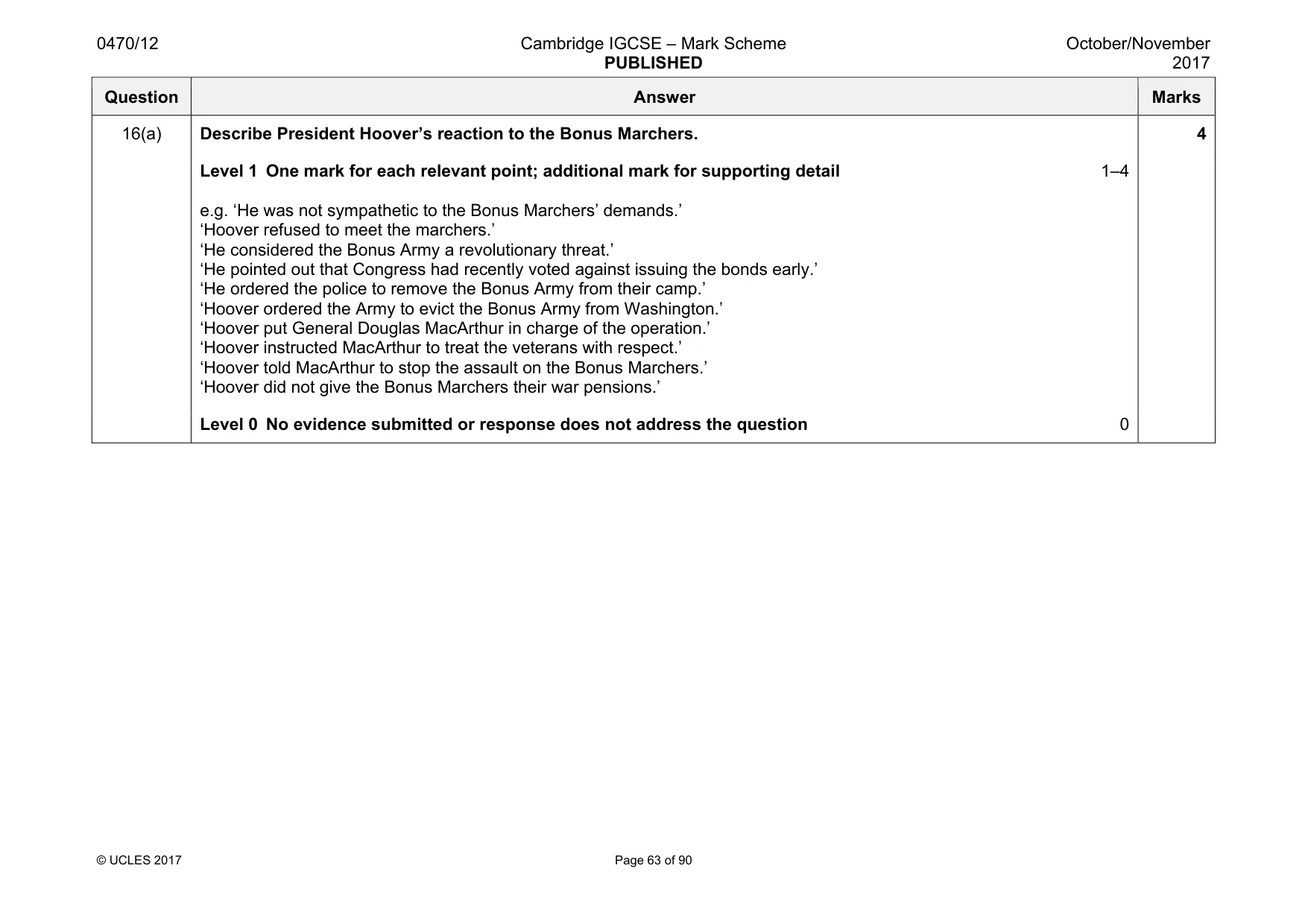
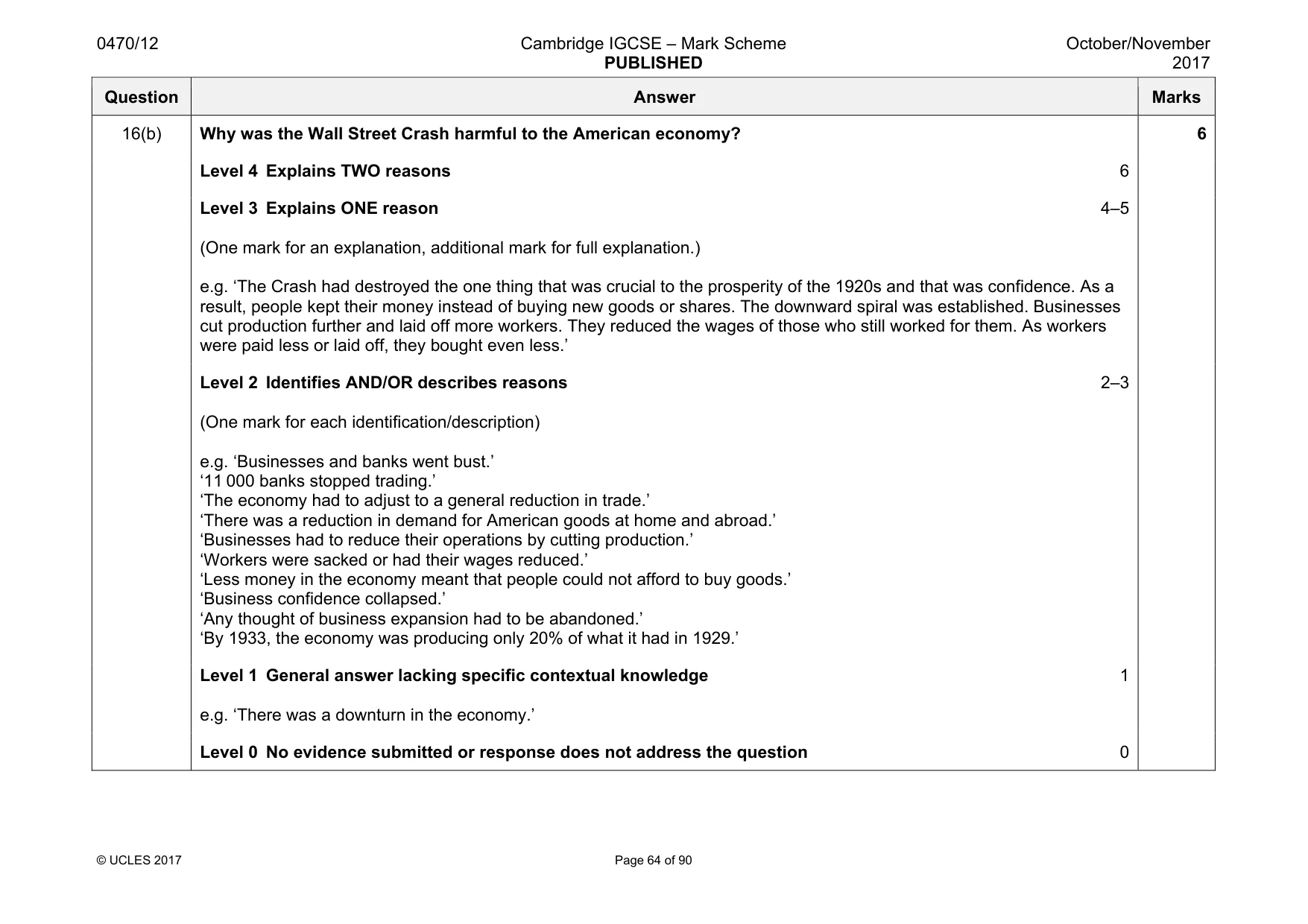
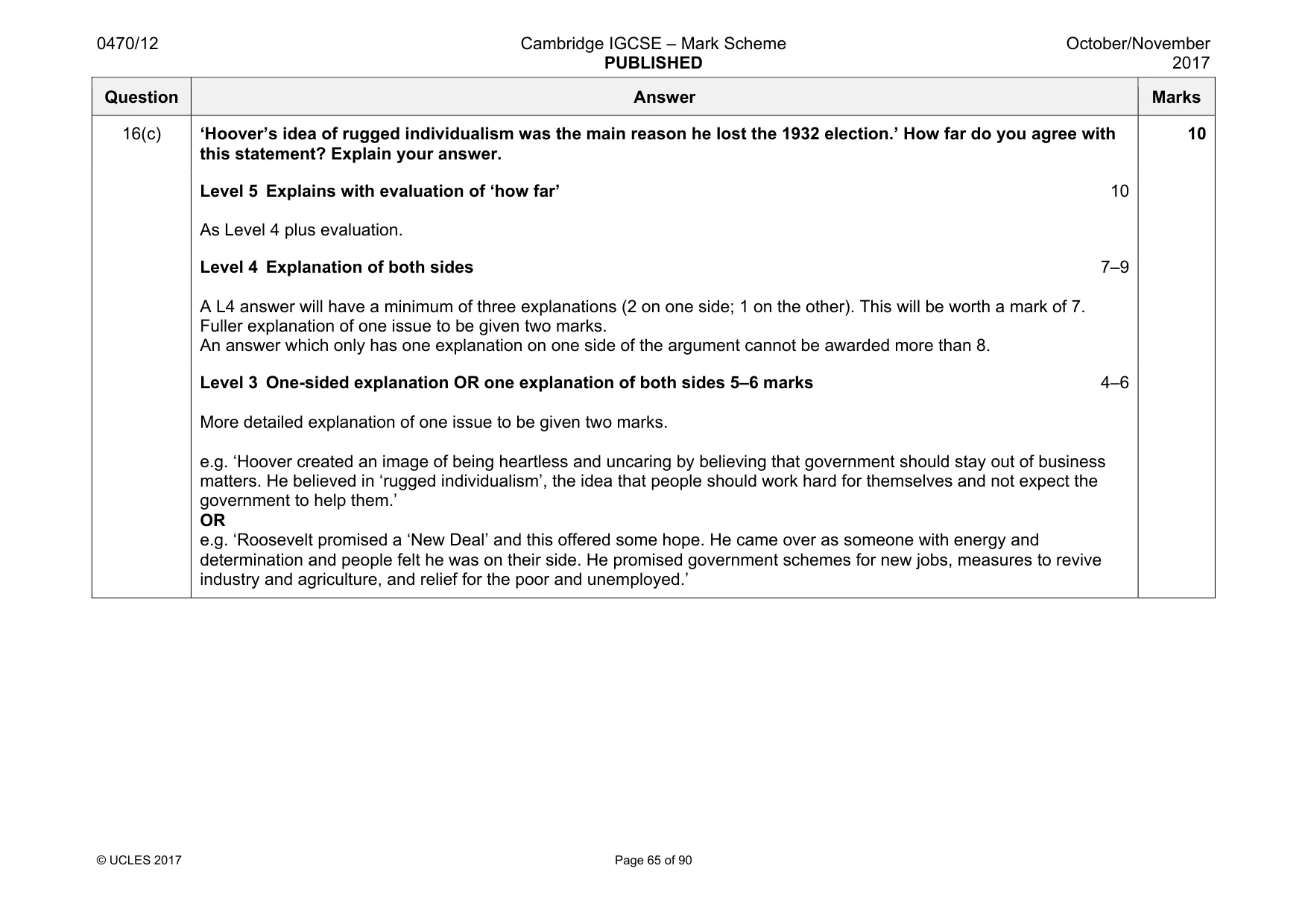
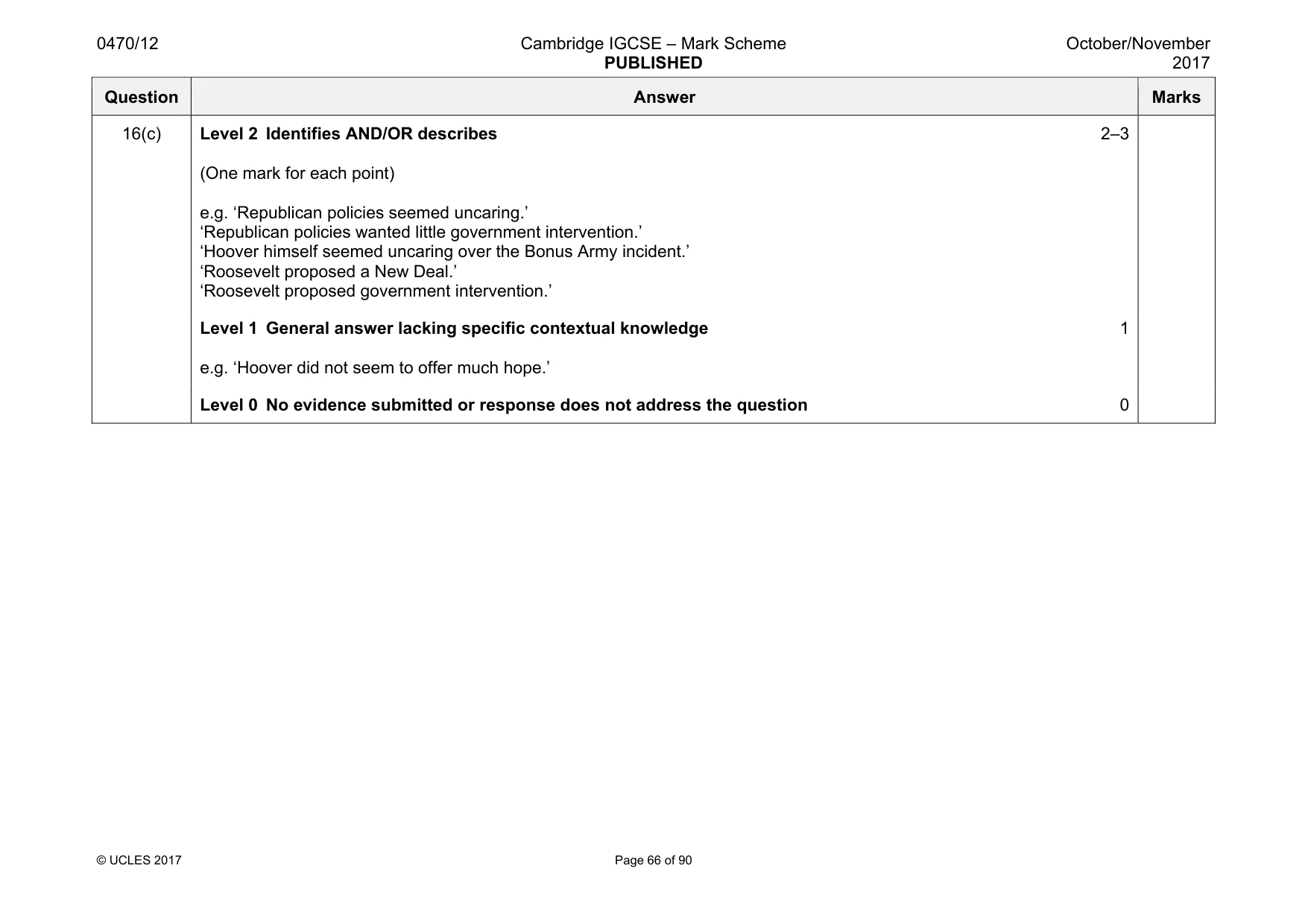
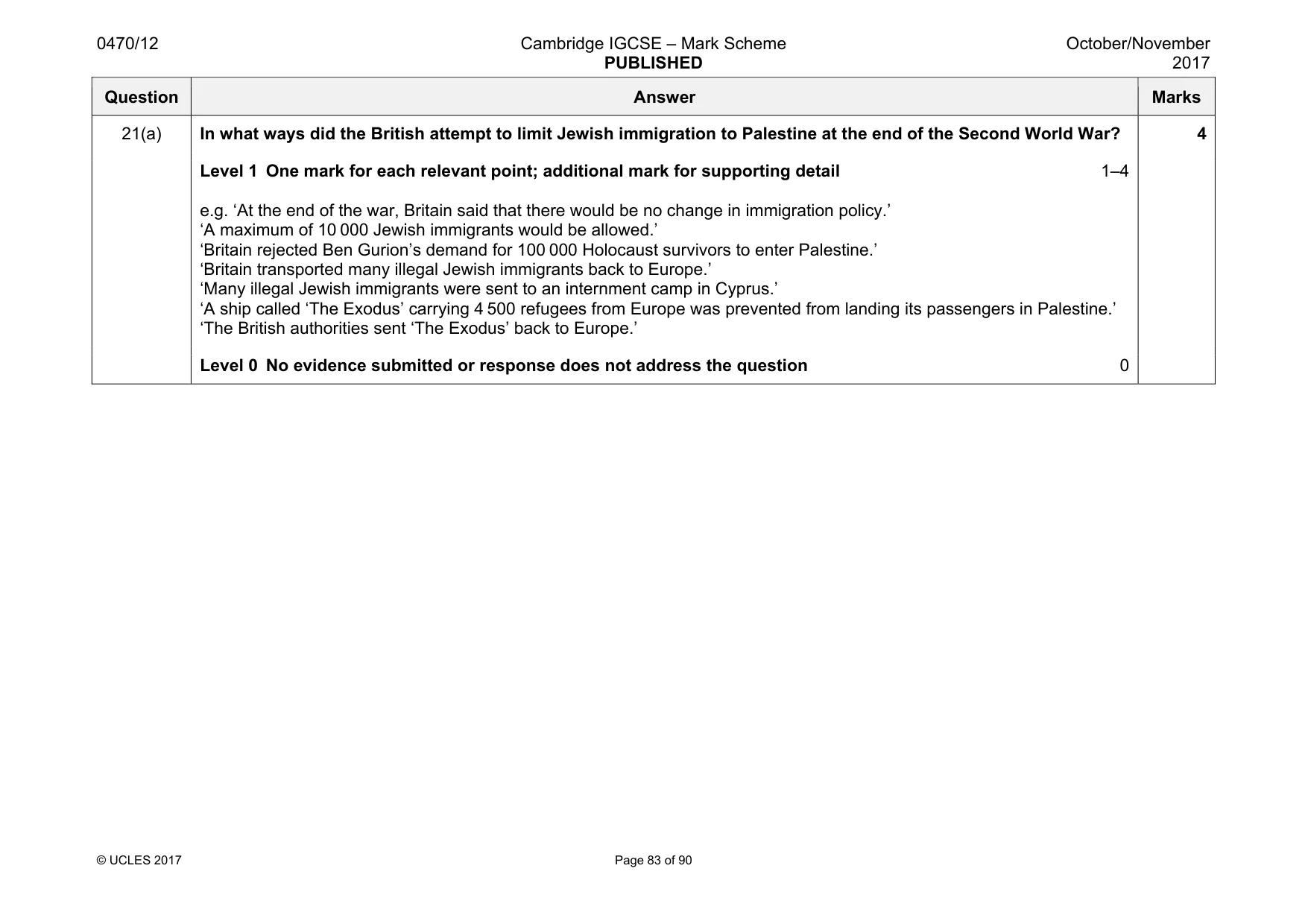
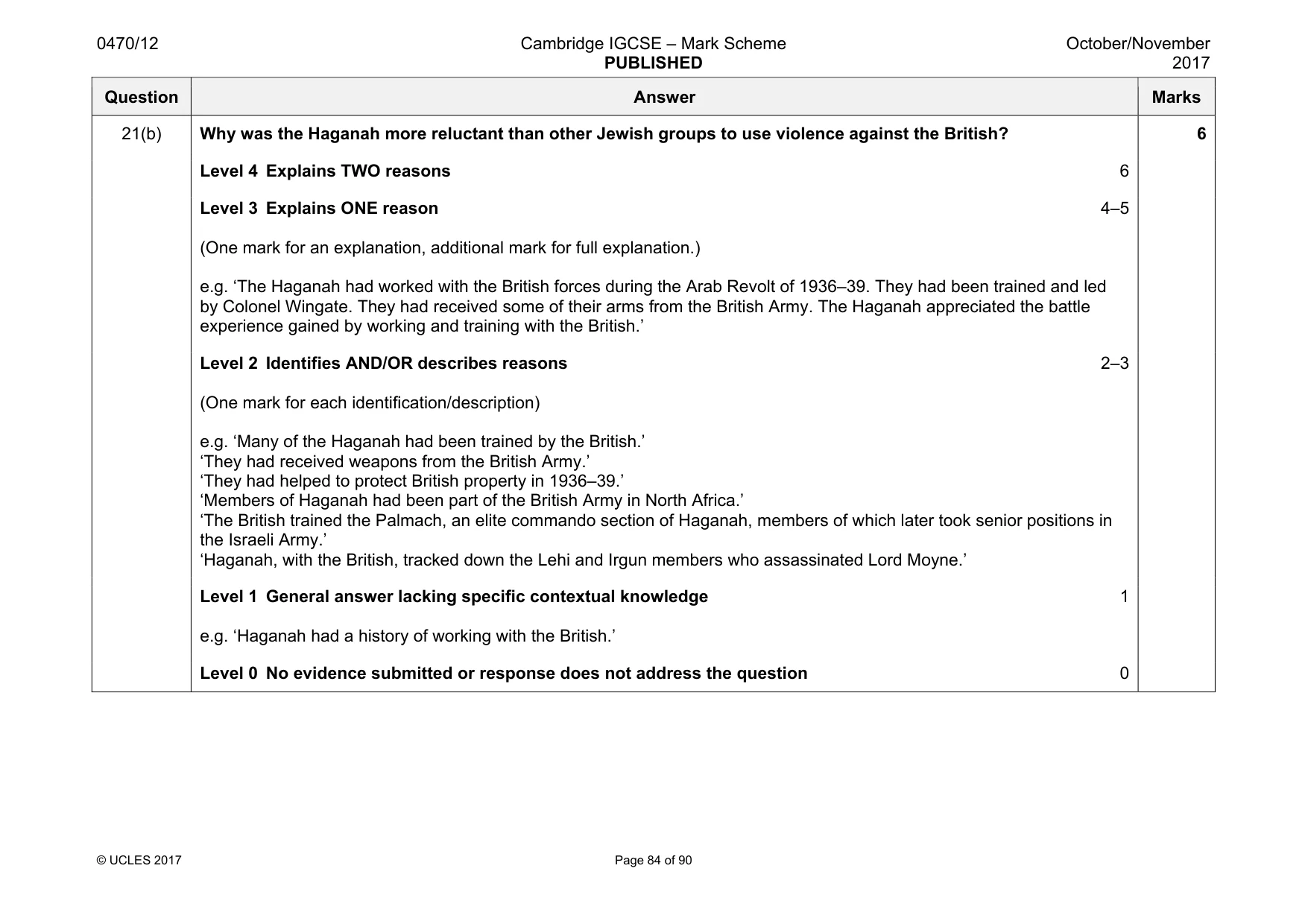
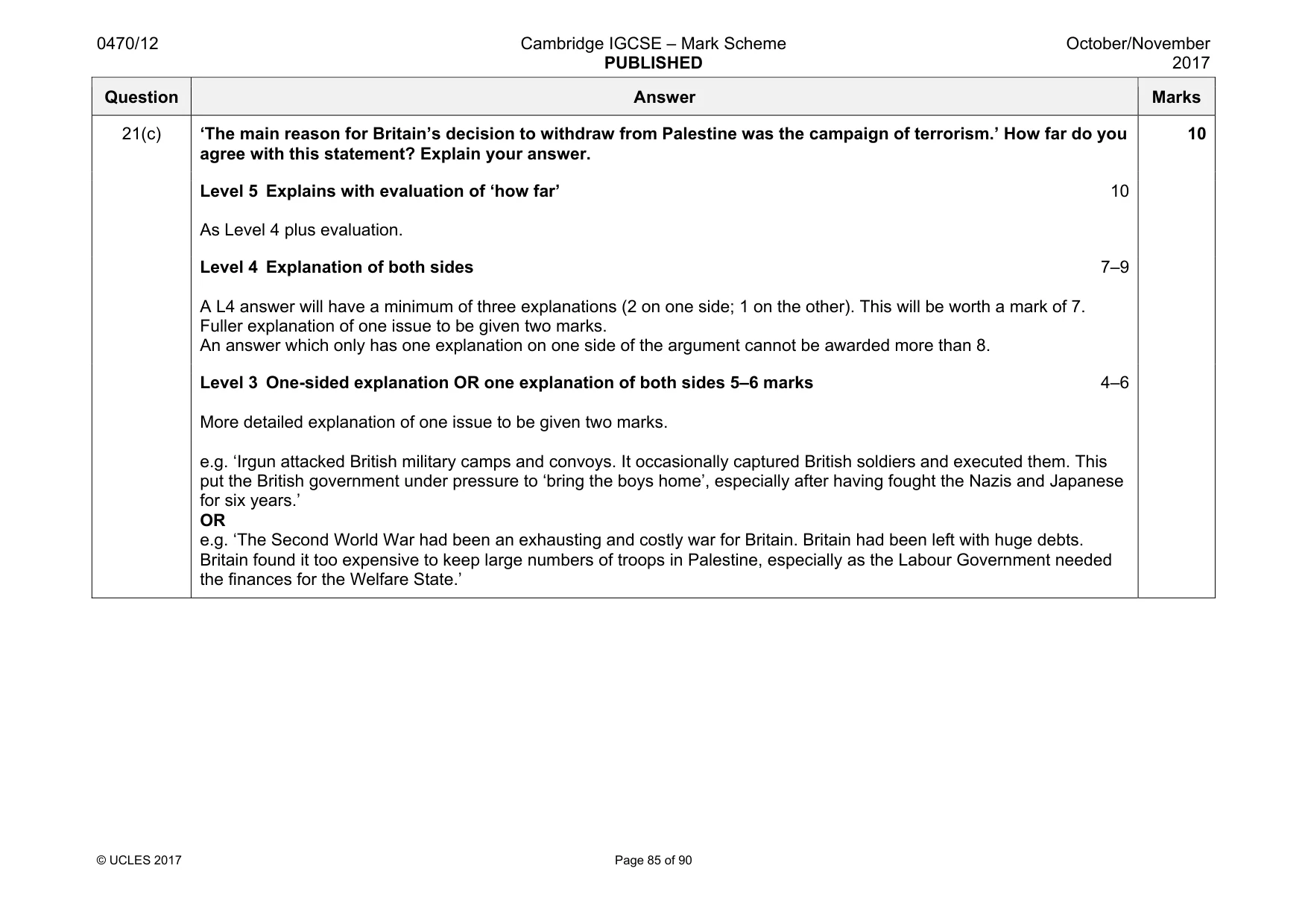
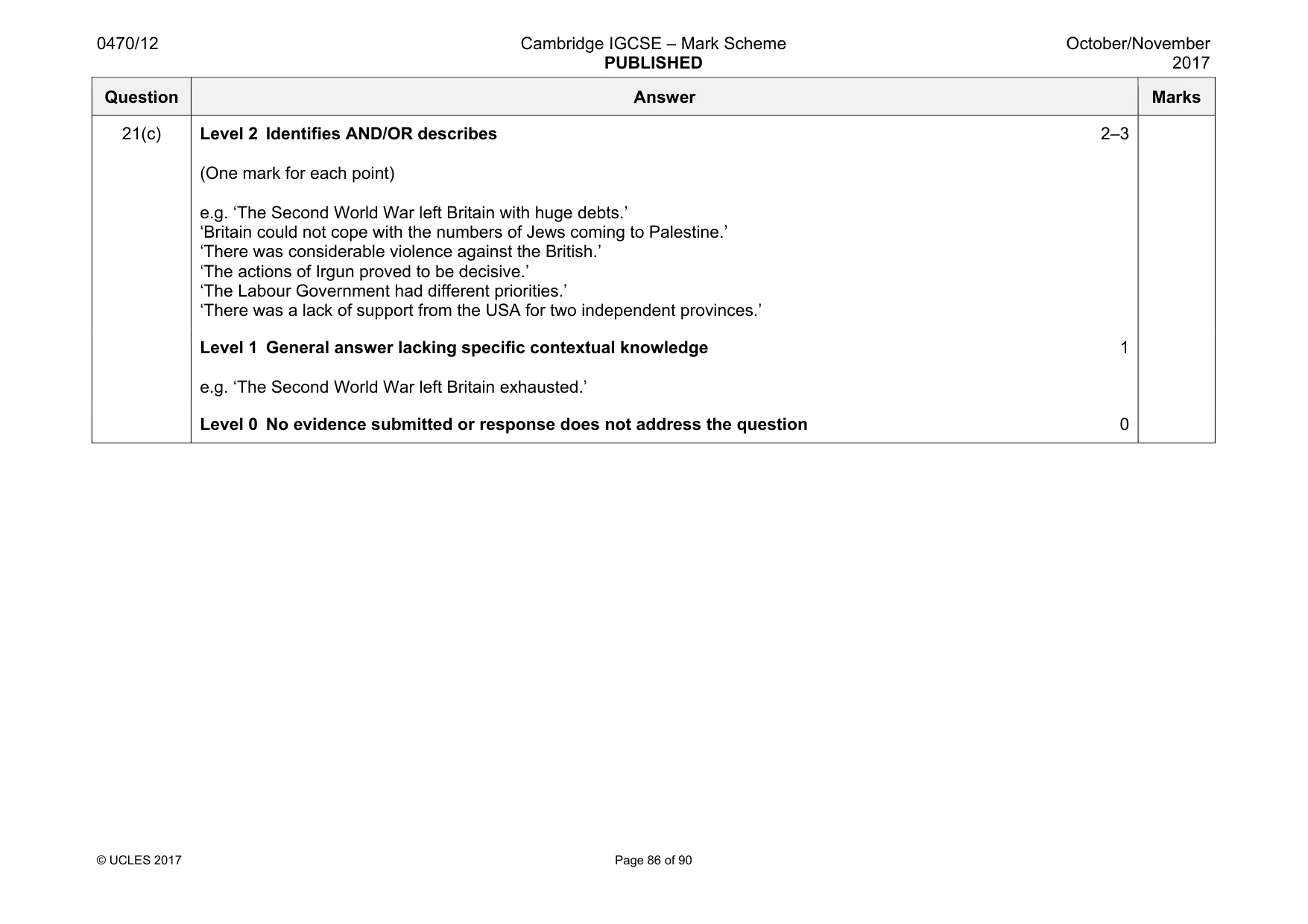
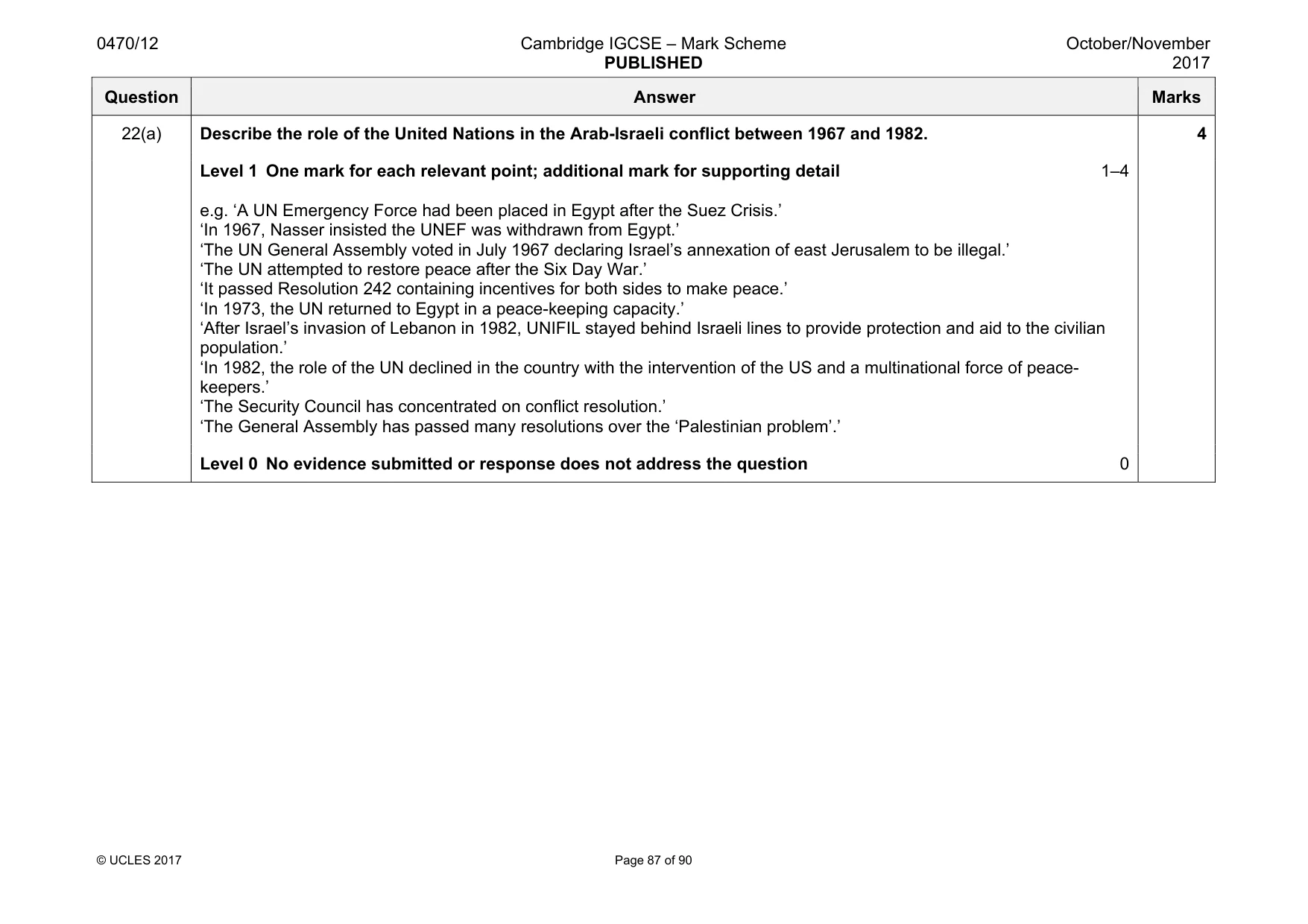
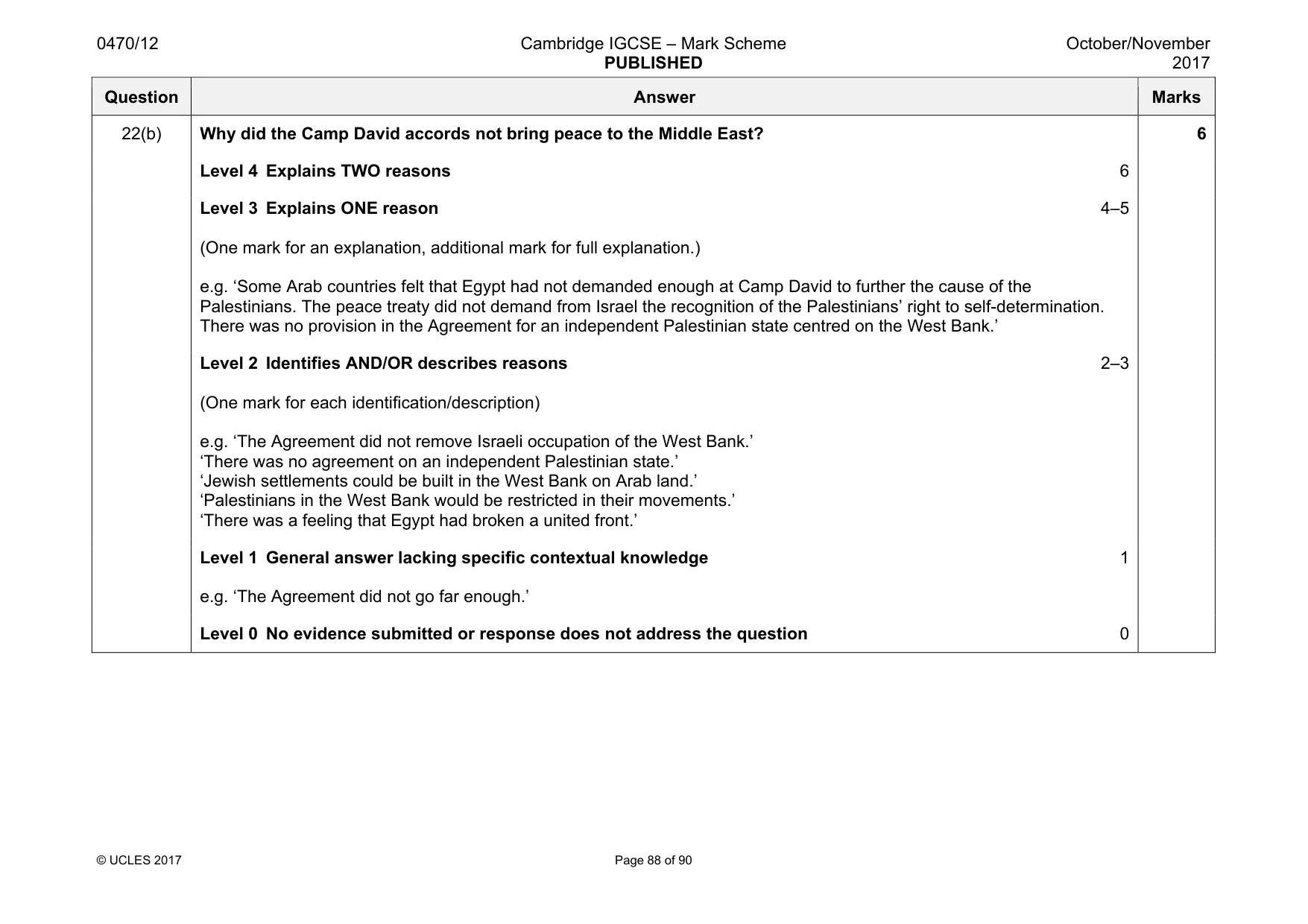
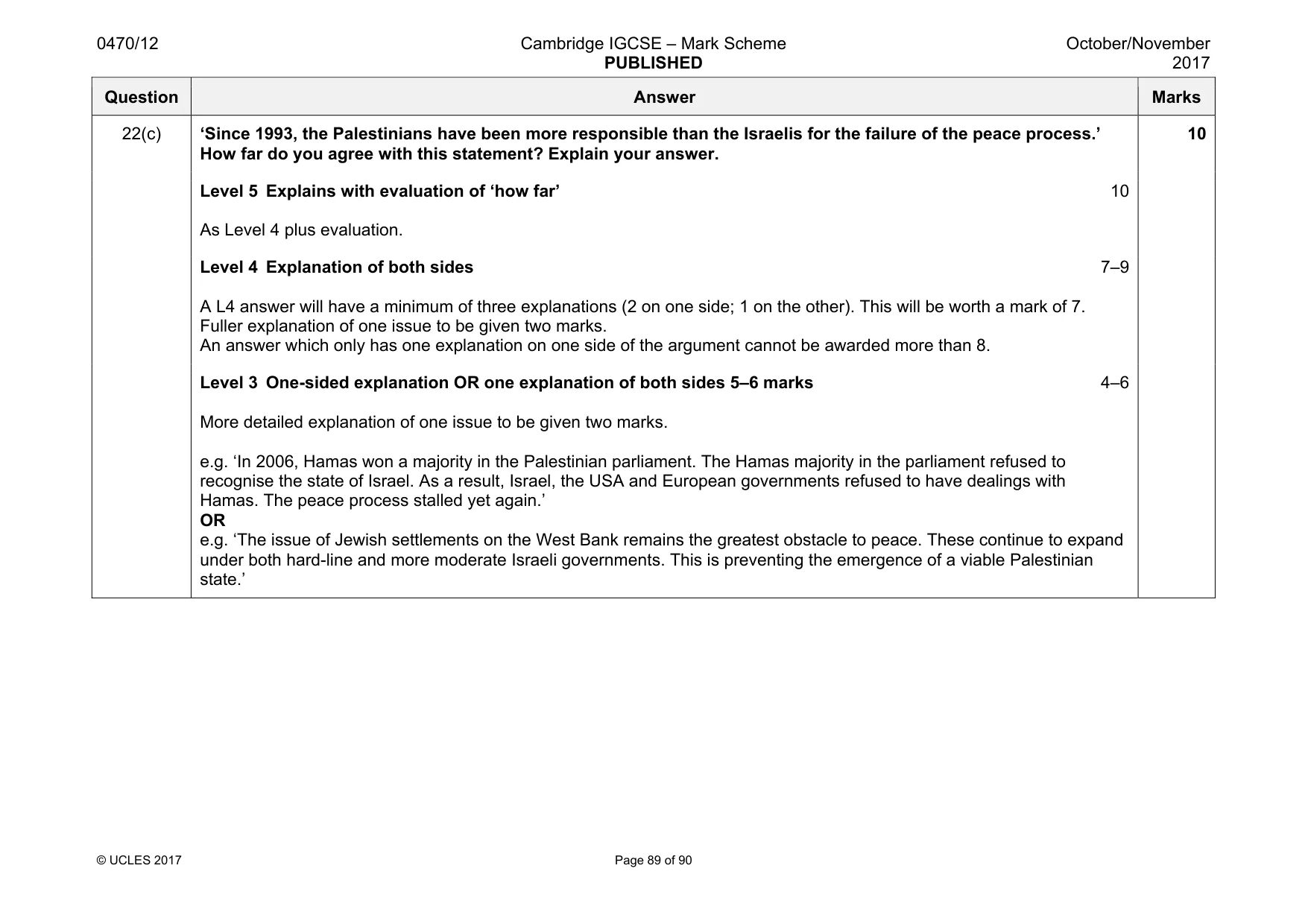
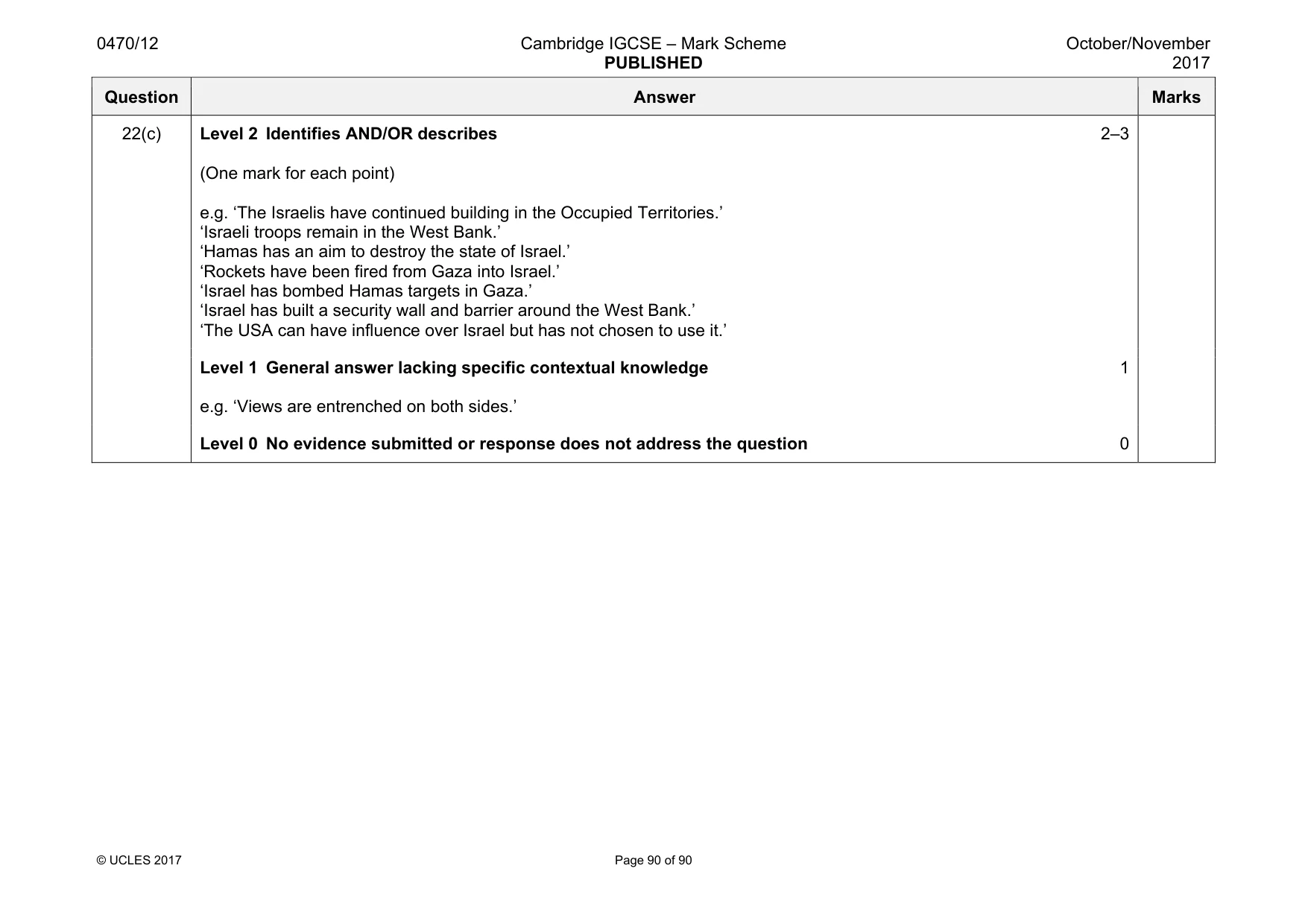
Paper as text
Question paper, page 1
This document consists of 10 printed pages, 2 blank pages and 1 Insert. DC (KN) 133047/2 © UCLES 2017 [Turn over Cambridge International Examinations Cambridge International General Certificate of Secondary Education * 2 5 5 1 1 5 0 5 5 0 * HISTORY 0470/12 Paper 1 October/November 2017 2 hours No Additional Materials are required. READ THESE INSTRUCTIONS FIRST An answer booklet is provided inside this question paper. You should follow the instructions on the front cover of the answer booklet. If you need additional answer paper ask the invigilator for a continuation booklet. Answer three questions. Section A (Core Content) Answer any two questions. Section B (Depth Studies) Answer any one question. The number of marks is given in brackets [ ] at the end of each question or part question. The syllabus is approved for use in England, Wales and Northern Ireland as a Cambridge International Level 1/Level 2 Certificate.
Question paper, page 2
2 0470/12/O/N/17 © UCLES 2017 SECTION A: CORE CONTENT Answer any two questions from this Section. 1 Nationalism and liberalism became increasingly important in nineteenth-century Europe. (a) What was meant by nationalism in the nineteenth century? [4] (b) Why did liberalism pose a revolutionary threat in 1848? [6] (c) How far was Louis Philippe responsible for revolution in France in 1848? Explain your answer. [10] 2 Italian attempts at unification before 1849 were unsuccessful. (a) What contribution did Mazzini make to the growth of Italian nationalism? [4] (b) Why was Piedmont humiliated in its conflict with Austria in 1848–49? [6] (c) ‘A lack of unity between revolutionary groups was the main reason Italy was not unified in 1848−49.’ How far do you agree with this statement? Explain your answer. [10] 3 Life was difficult for many living in the Southern states of America in the second half of the nineteenth century. (a) What opportunities existed for slaves to escape to the Northern states of America? [4] (b) Why was there opposition to the Fugitive Slave Act of 1850? [6] (c) How successful was the economic reconstruction of the South after the Civil War? Explain your answer. [10] 4 European imperialism was not always viewed favourably. (a) What was the impact of French imperialism on Senegal? [4] (b) Why did events of the Indian Mutiny cause bitterness amongst Indians? [6] (c) How important for the West was intervention in China? Explain your answer. [10]
Question paper, page 3
3 0470/12/O/N/17 © UCLES 2017 [Turn over 5 Disagreements between the peacemakers at the Paris Peace Conference led to compromise and bitterness. (a) What did Wilson hope to achieve with his ‘Fourteen Points’? [4] (b) Why was Lloyd George unhappy with the French demands? [6] (c) ‘The reduction in its military strength was the main reason for Germany’s bitterness with the Treaty of Versailles.’ How far do you agree with this statement? Explain your answer. [10] 6 The League of Nations aimed to secure world peace and co-operation. (a) Describe the work of the League of Nations in the 1920s in relation to health. [4] (b) Why was the League of Nations ineffective in resolving the Corfu Crisis? [6] (c) ‘The main reason for the League of Nations failing to preserve world peace was that not all Great Powers were members.’ How far do you agree with this statement? Explain your answer. [10] 7 Following the ending of the Second World War both the USA and the USSR held strong views about the future. (a) What did a strong Communist Eastern Europe provide for the USSR? [4] (b) Why did the development of the atomic bomb increase tension between East and West? [6] (c) How surprising was Stalin’s decision to impose a blockade on West Berlin? Explain your answer. [10] 8 After the Second World War, the USA viewed the Communist threat as significant. (a) What happened to Vietnam immediately following the Geneva Peace Accords of 1954? [4] (b) Why did Khrushchev place nuclear weapons in Cuba? [6] (c) ‘America failed to contain Communism.’ How far do you agree with this statement? Explain your answer. [10]
Question paper, page 4
4 0470/12/O/N/17 © UCLES 2017 SECTION B: DEPTH STUDIES Answer any one question from this Section. DEPTH STUDY A: THE FIRST WORLD WAR, 1914−18 9 War impacted on the British civilian population. (a) What methods were used in Britain to deal with food shortages? [4] (b) Why was the introduction of the Defence of the Realm Act helpful to the British government? [6] (c) ‘Censorship was more important than propaganda to the war effort on the home front in Britain.’ How far do you agree with this statement? Explain your answer. [10] 10 Ludendorff’s 1918 Offensive ultimately failed. (a) Describe the tactics used by Ludendorff between March and May 1918. [4] (b) Why was Ludendorff’s Offensive of March 1918 a gamble? [6] (c) ‘America’s entry into the war was more important than the Kiel Mutiny in ending the war.’ How far do you agree with this statement? Explain your answer. [10]
Question paper, page 5
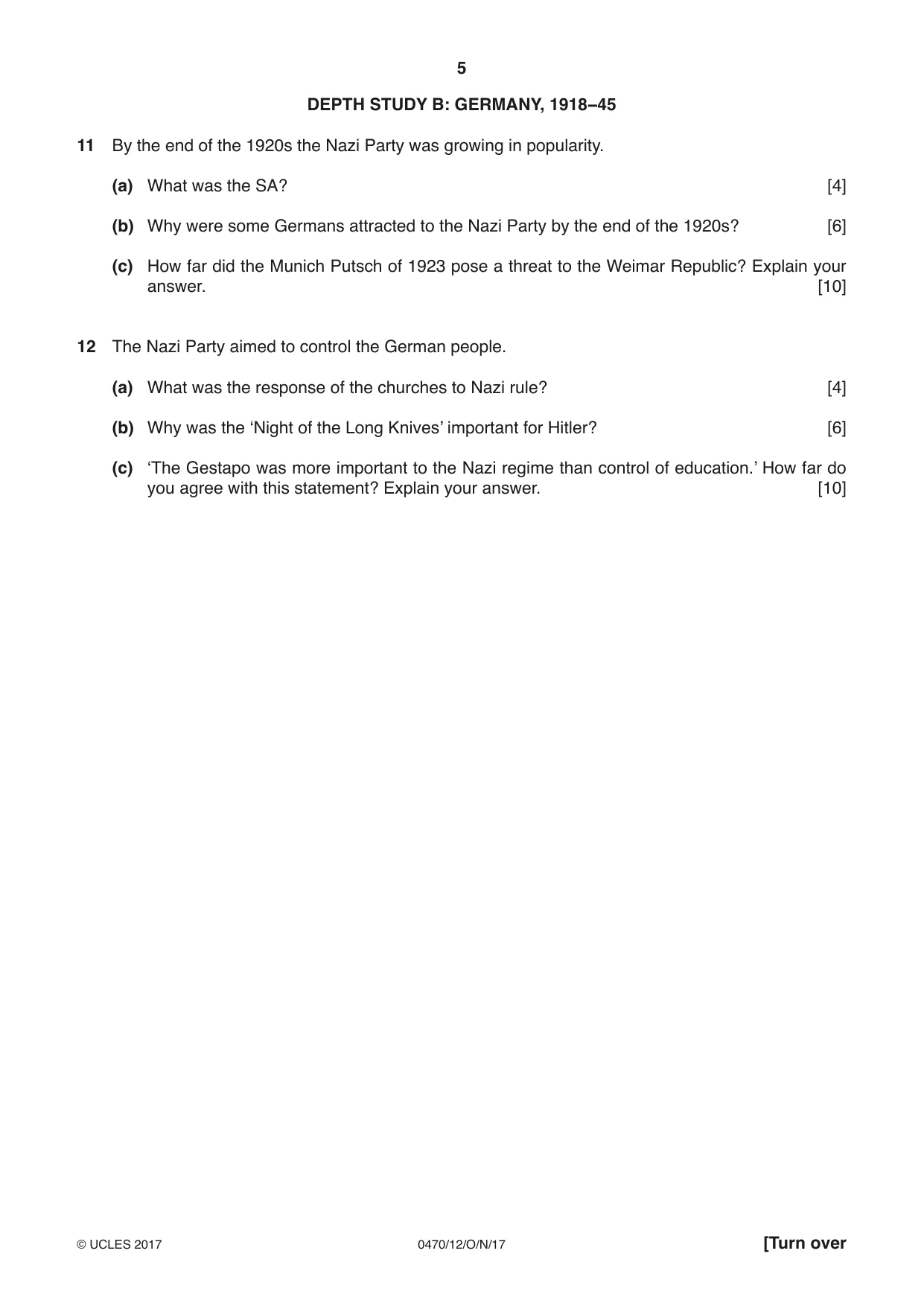
5 0470/12/O/N/17 © UCLES 2017 [Turn over DEPTH STUDY B: GERMANY, 1918−45 11 By the end of the 1920s the Nazi Party was growing in popularity. (a) What was the SA? [4] (b) Why were some Germans attracted to the Nazi Party by the end of the 1920s? [6] (c) How far did the Munich Putsch of 1923 pose a threat to the Weimar Republic? Explain your answer. [10] 12 The Nazi Party aimed to control the German people. (a) What was the response of the churches to Nazi rule? [4] (b) Why was the ‘Night of the Long Knives’ important for Hitler? [6] (c) ‘The Gestapo was more important to the Nazi regime than control of education.’ How far do you agree with this statement? Explain your answer. [10]
Question paper, page 6
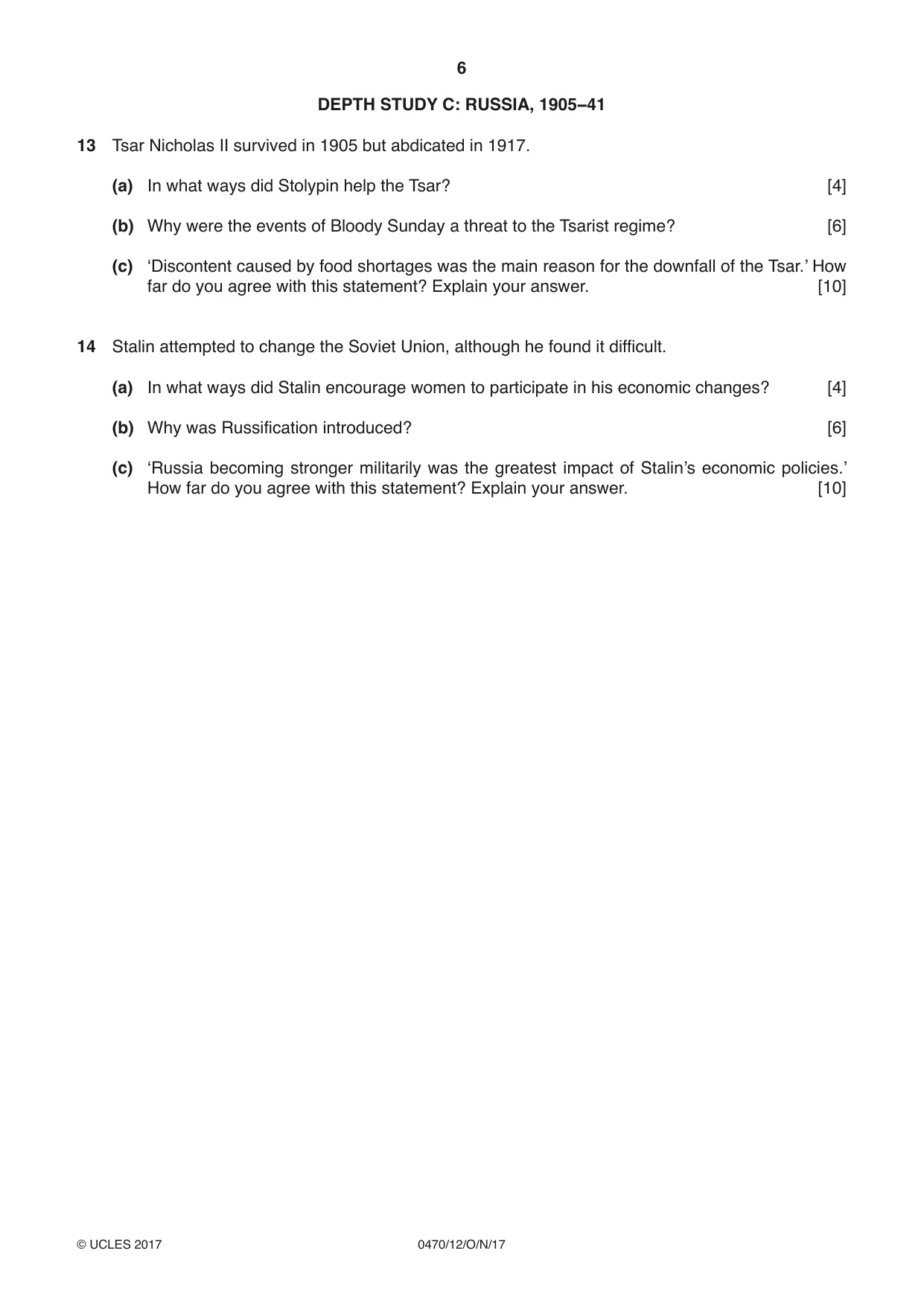
6 0470/12/O/N/17 © UCLES 2017 DEPTH STUDY C: RUSSIA, 1905−41 13 Tsar Nicholas II survived in 1905 but abdicated in 1917. (a) In what ways did Stolypin help the Tsar? [4] (b) Why were the events of Bloody Sunday a threat to the Tsarist regime? [6] (c) ‘Discontent caused by food shortages was the main reason for the downfall of the Tsar.’ How far do you agree with this statement? Explain your answer. [10] 14 Stalin attempted to change the Soviet Union, although he found it difficult. (a) In what ways did Stalin encourage women to participate in his economic changes? [4] (b) Why was Russification introduced? [6] (c) ‘Russia becoming stronger militarily was the greatest impact of Stalin’s economic policies.’ How far do you agree with this statement? Explain your answer. [10]
Question paper, page 7
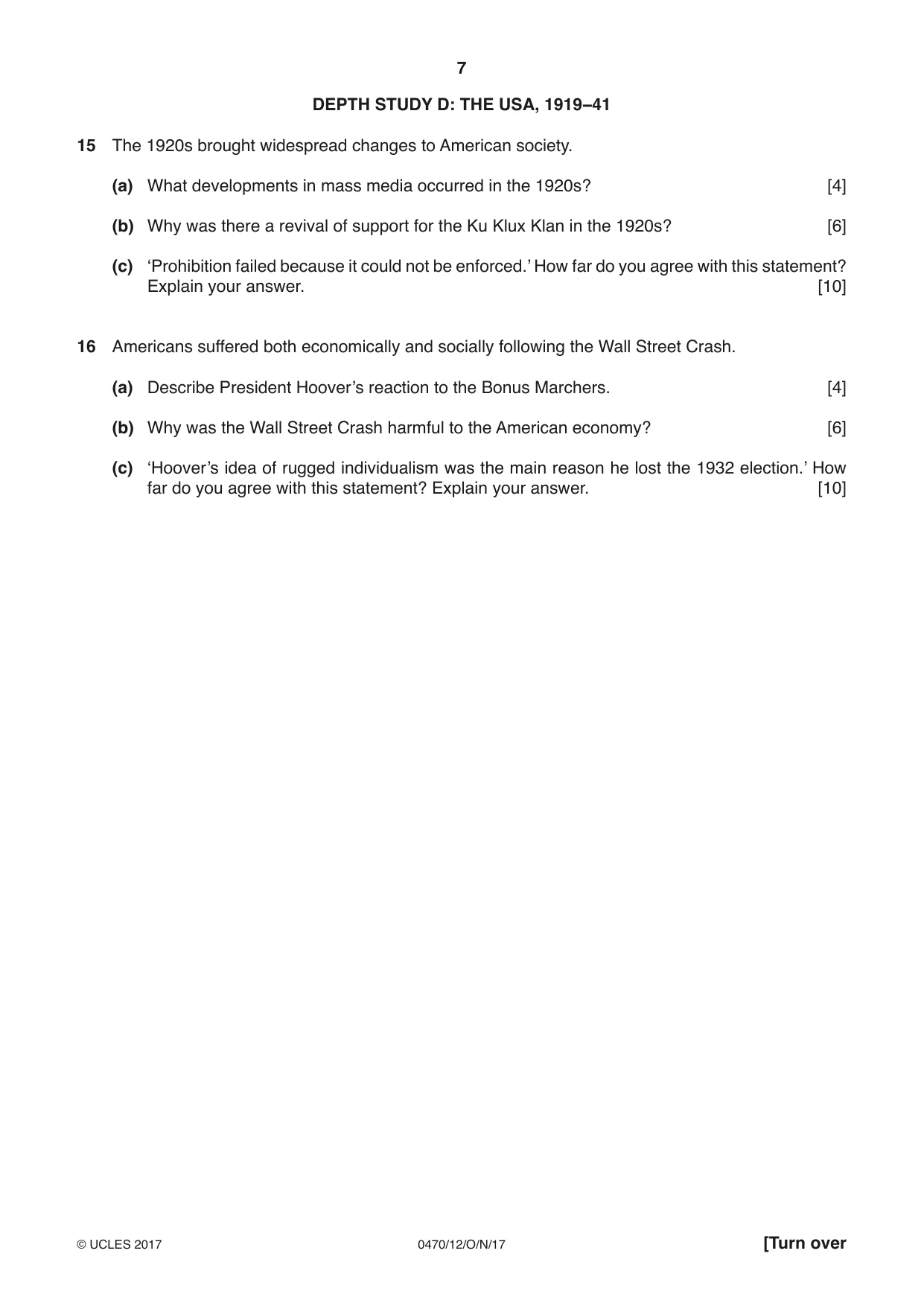
7 0470/12/O/N/17 © UCLES 2017 [Turn over DEPTH STUDY D: THE USA, 1919−41 15 The 1920s brought widespread changes to American society. (a) What developments in mass media occurred in the 1920s? [4] (b) Why was there a revival of support for the Ku Klux Klan in the 1920s? [6] (c) ‘Prohibition failed because it could not be enforced.’ How far do you agree with this statement? Explain your answer. [10] 16 Americans suffered both economically and socially following the Wall Street Crash. (a) Describe President Hoover’s reaction to the Bonus Marchers. [4] (b) Why was the Wall Street Crash harmful to the American economy? [6] (c) ‘Hoover’s idea of rugged individualism was the main reason he lost the 1932 election.’ How far do you agree with this statement? Explain your answer. [10]
Question paper, page 8
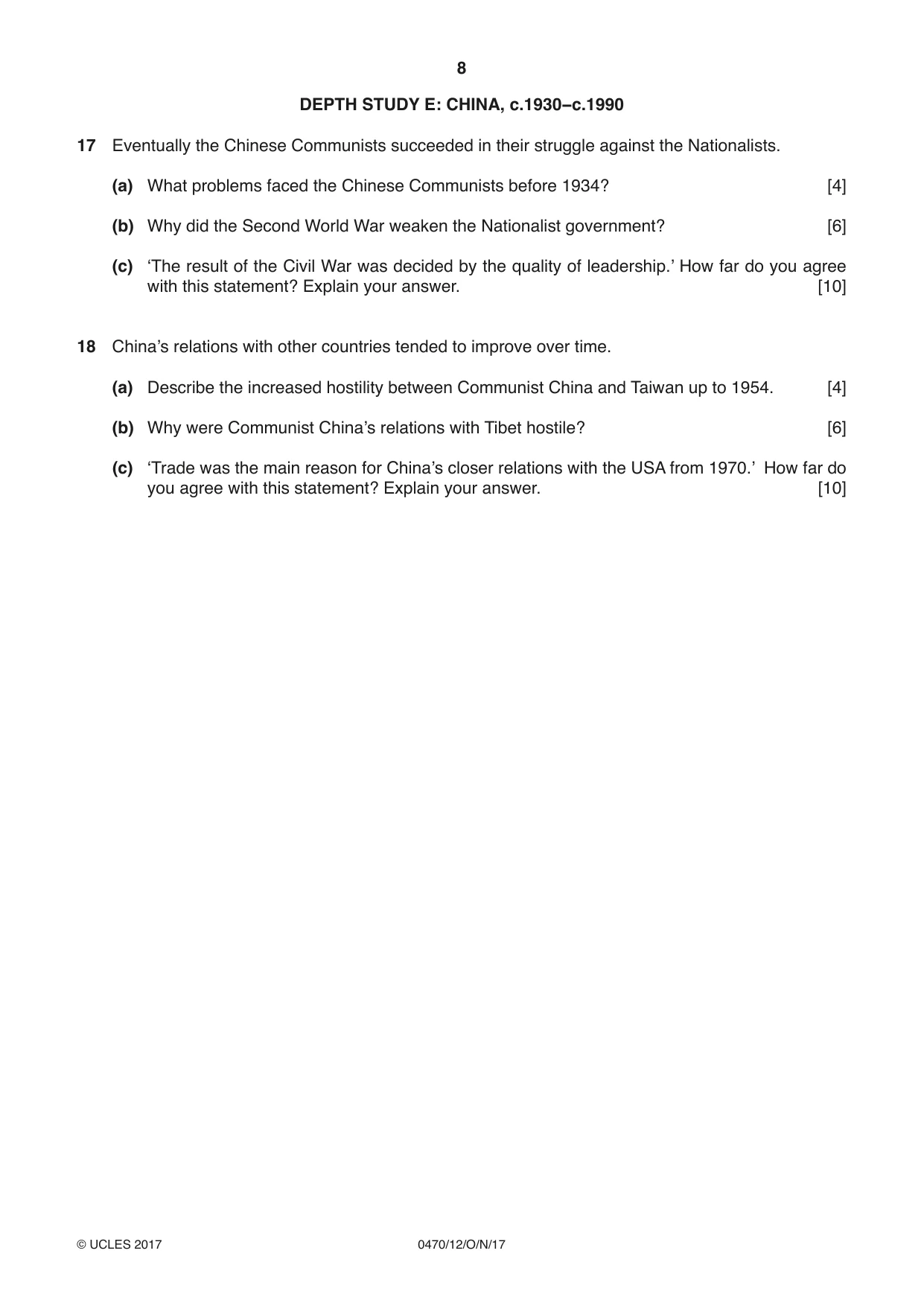
8 0470/12/O/N/17 © UCLES 2017 DEPTH STUDY E: CHINA, c.1930−c.1990 17 Eventually the Chinese Communists succeeded in their struggle against the Nationalists. (a) What problems faced the Chinese Communists before 1934? [4] (b) Why did the Second World War weaken the Nationalist government? [6] (c) ‘The result of the Civil War was decided by the quality of leadership.’ How far do you agree with this statement? Explain your answer. [10] 18 China’s relations with other countries tended to improve over time. (a) Describe the increased hostility between Communist China and Taiwan up to 1954. [4] (b) Why were Communist China’s relations with Tibet hostile? [6] (c) ‘Trade was the main reason for China’s closer relations with the USA from 1970.’ How far do you agree with this statement? Explain your answer. [10]
Question paper, page 9
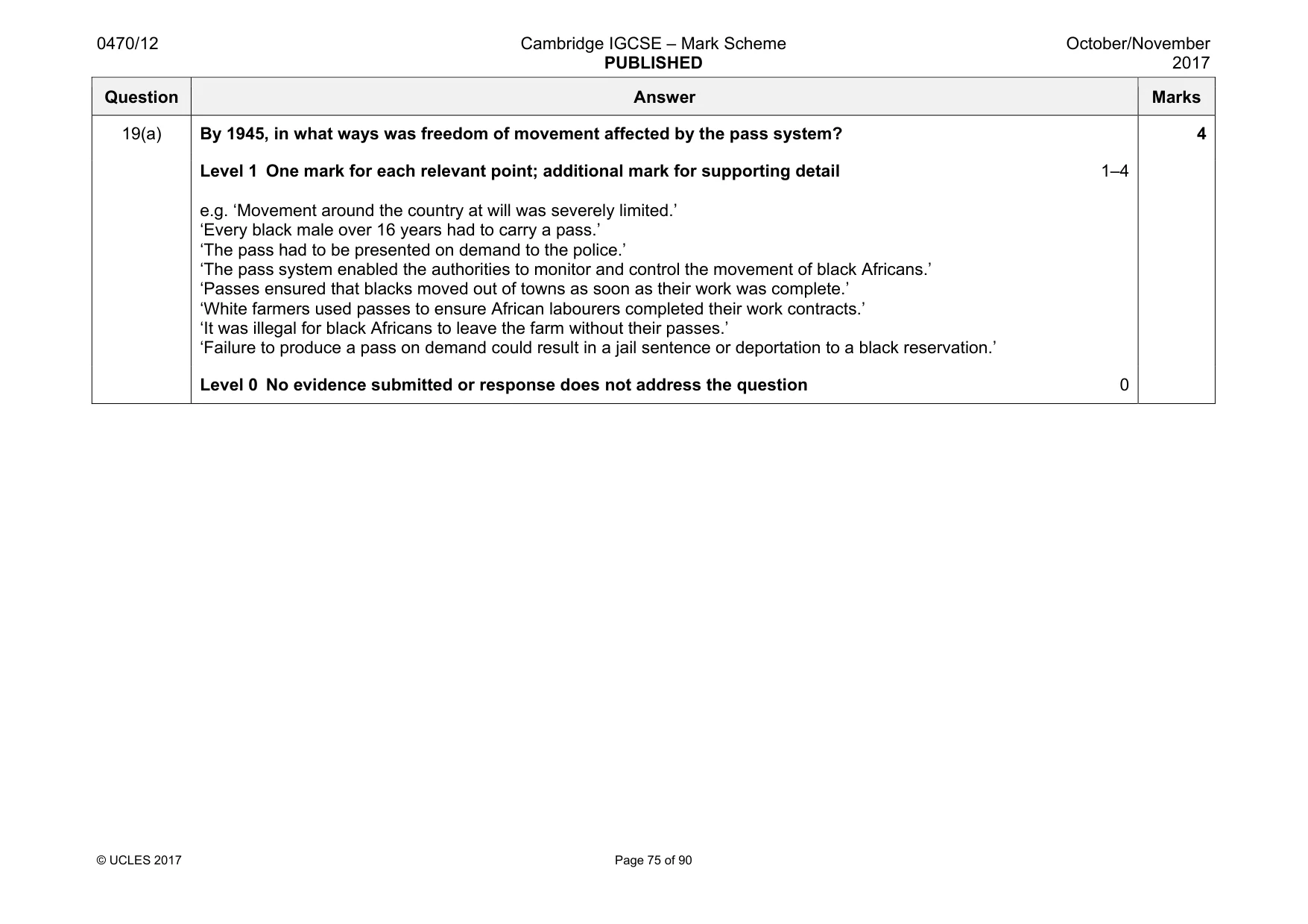
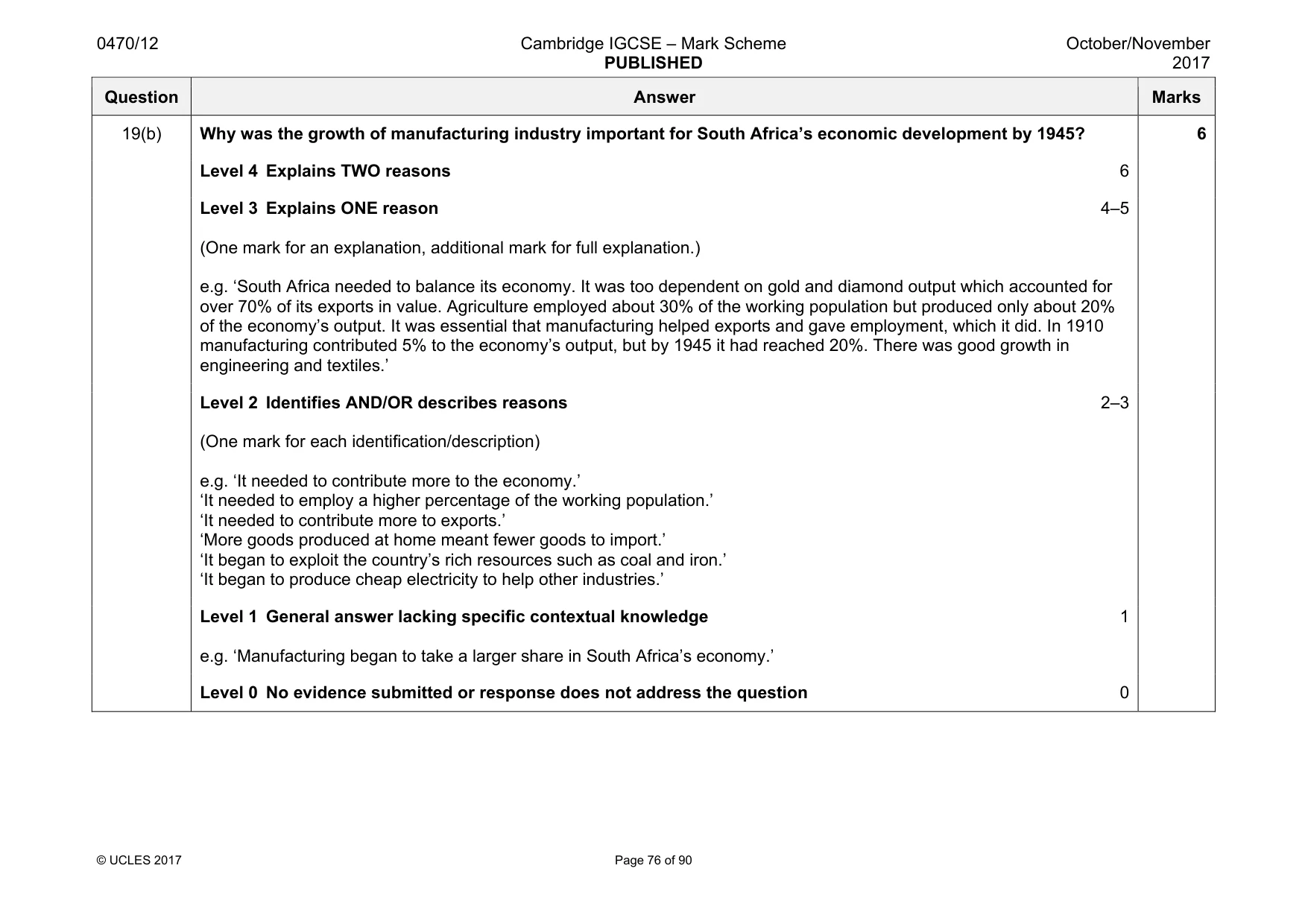
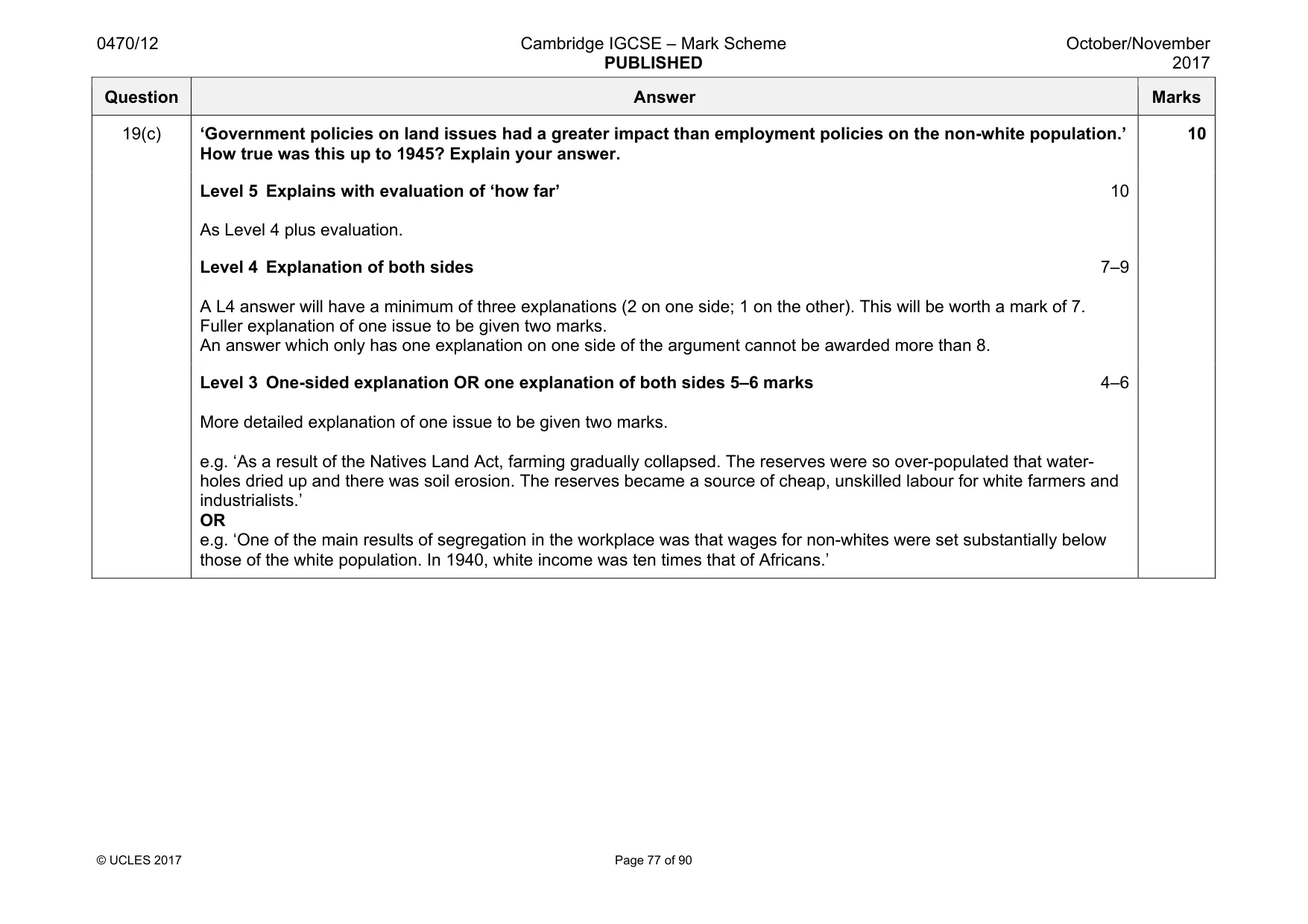
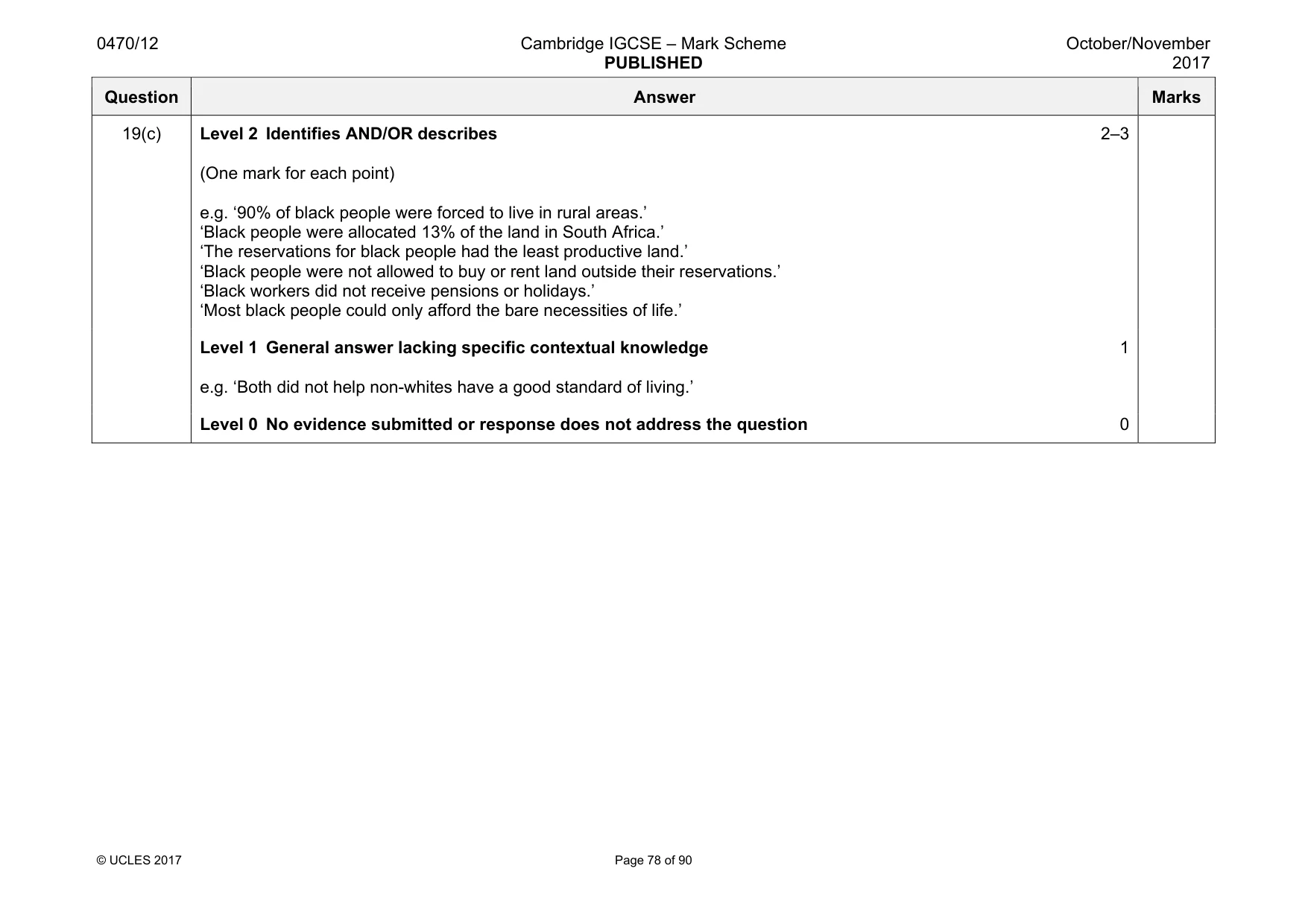
9 0470/12/O/N/17 © UCLES 2017 [Turn over DEPTH STUDY F: SOUTH AFRICA, c.1940−c.1994 19 By 1945 government policy had ensured segregation was established. (a) By 1945, in what ways was freedom of movement affected by the pass system? [4] (b) Why was the growth of manufacturing industry important for South Africa’s economic development by 1945? [6] (c) ‘Government policies on land issues had a greater impact than employment policies on the non-white population.’ How true was this up to 1945? Explain your answer. [10] 20 Despite difficulties, white minority rule in South Africa was ended. (a) Describe the contribution of Desmond Tutu to the collapse of apartheid. [4] (b) Why was reform legislation introduced by Botha’s government between 1979 and 1986 not as successful as he had hoped? [6] (c) ‘The transfer of power between 1990 and 1994 proceeded smoothly.’ How far do you agree with this statement? Explain your answer. [10]
Question paper, page 10
10 0470/12/O/N/17 © UCLES 2017 DEPTH STUDY G: ISRAELIS AND PALESTINIANS SINCE 1945 21 After the Second World War tension increased in Palestine. (a) In what ways did the British attempt to limit Jewish immigration to Palestine at the end of the Second World War? [4] (b) Why was the Haganah more reluctant than other Jewish groups to use violence against the British? [6] (c) ‘The main reason for Britain’s decision to withdraw from Palestine was the campaign of terrorism.’ How far do you agree with this statement? Explain your answer. [10] 22 Peace in the Middle East remains difficult to achieve. (a) Describe the role of the United Nations in the Arab-Israeli conflict between 1967 and 1982. [4] (b) Why did the Camp David accords not bring peace to the Middle East? [6] (c) ‘Since 1993, the Palestinians have been more responsible than the Israelis for the failure of the peace process.’ How far do you agree with this statement? Explain your answer. [10]
Question paper, page 11
11 0470/12/O/N/17 © UCLES 2017 BLANK PAGE
Question paper, page 12
12 0470/12/O/N/17 © UCLES 2017 BLANK PAGE Permission to reproduce items where third-party owned material protected by copyright is included has been sought and cleared where possible. Every reasonable effort has been made by the publisher (UCLES) to trace copyright holders, but if any items requiring clearance have unwittingly been included, the publisher will be pleased to make amends at the earliest possible opportunity. To avoid the issue of disclosure of answer-related information to candidates, all copyright acknowledgements are reproduced online in the Cambridge International Examinations Copyright Acknowledgements Booklet. This is produced for each series of examinations and is freely available to download at www.cie.org.uk after the live examination series. Cambridge International Examinations is part of the Cambridge Assessment Group. Cambridge Assessment is the brand name of University of Cambridge Local Examinations Syndicate (UCLES), which is itself a department of the University of Cambridge.
Mark scheme, page 1
® IGCSE is a registered trademark. This syllabus is approved for use in England, Wales and Northern Ireland as a Cambridge International Level 1/Level 2 Certificate. This document consists of 90 printed pages. © UCLES 2017 [Turn over Cambridge Assessment International Education Cambridge International General Certificate of Secondary Education HISTORY 0470/12 Paper 1 October/November 2017 MARK SCHEME Maximum Mark: 60 Published This mark scheme is published as an aid to teachers and candidates, to indicate the requirements of the examination. It shows the basis on which Examiners were instructed to award marks. It does not indicate the details of the discussions that took place at an Examiners’ meeting before marking began, which would have considered the acceptability of alternative answers. Mark schemes should be read in conjunction with the question paper and the Principal Examiner Report for Teachers. Cambridge International will not enter into discussions about these mark schemes. Cambridge International is publishing the mark schemes for the October/November 2017 series for most Cambridge IGCSE®, Cambridge International A and AS Level components and some Cambridge O Level components.
Mark scheme, page 2
0470/12 Cambridge IGCSE – Mark Scheme PUBLISHED October/November 2017 © UCLES 2017 Page 2 of 90 GENERAL INSTRUCTIONS Applying the Mark Scheme • When marking a response the overall criterion to be considered should be – ‘How good is this response to this question?’ • The Level Descriptor should be used to decide the level into which the quality of the answer fits. • Exhaustive lists of possible facts are not given in the mark scheme, as there is often a choice of factual knowledge that candidates may use. • WHERE EXAMPLES OF RESPONSES ARE GIVEN, THESE ARE NOT PRESCRIPTIVE, BUT ARE INTENDED AS A GUIDE. It is not possible to cover every possible type of response within a levels of response mark scheme and examiners are expected to use their professional judgement at all times in ensuring that responses are placed in the correct level and given an appropriate mark within that level. • Marking must be positive. Marks must not be deducted for inaccurate or irrelevant parts of answers. In itself, poor use of historical terminology, spelling, grammar or handwriting does not affect the mark. The overall quality of the answer to the question should be judged. • If a candidate reaches a particular level, s/he must be rewarded with a mark within that level. It is not necessary to work through the levels. • The full range of marks should be used. Do not be afraid to award full marks or no marks. Failure to do this will seriously affect the distribution of marks. Be prepared to reward candidates who show any level of understanding. The mark scheme starts from basic acceptable response. Where a band of marks is indicated for a level, these marks should be used with reference to the development of the answer within that level. Assessment Objectives (a) recall, description (b) recall, explanation (c) recall, explanation and analysis
Mark scheme, page 3
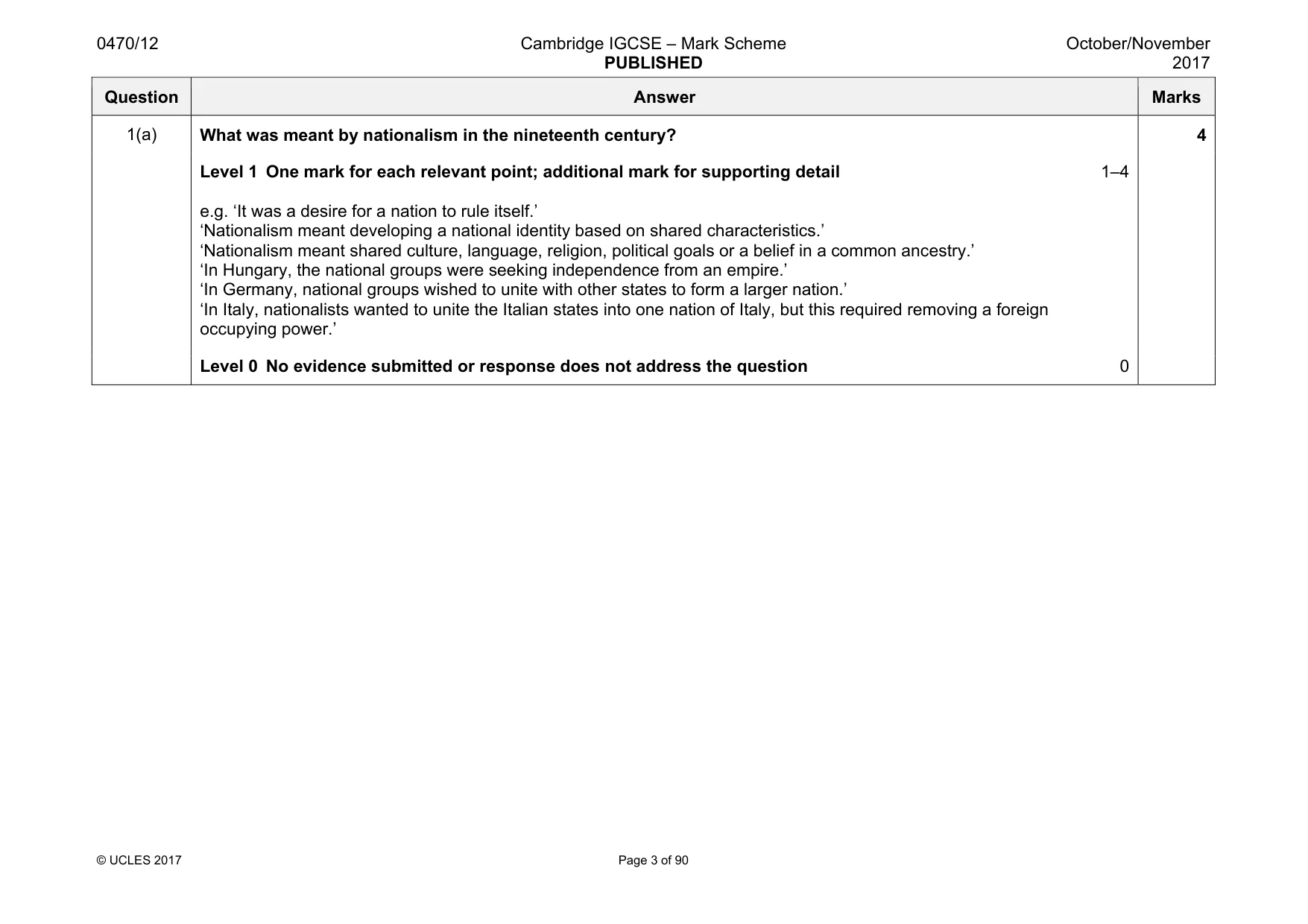
0470/12 Cambridge IGCSE – Mark Scheme PUBLISHED October/November 2017 © UCLES 2017 Page 3 of 90 Question Answer Marks 1(a) What was meant by nationalism in the nineteenth century? 4 Level 1 One mark for each relevant point; additional mark for supporting detail 1–4 e.g. ‘It was a desire for a nation to rule itself.’ ‘Nationalism meant developing a national identity based on shared characteristics.’ ‘Nationalism meant shared culture, language, religion, political goals or a belief in a common ancestry.’ ‘In Hungary, the national groups were seeking independence from an empire.’ ‘In Germany, national groups wished to unite with other states to form a larger nation.’ ‘In Italy, nationalists wanted to unite the Italian states into one nation of Italy, but this required removing a foreign occupying power.’ Level 0 No evidence submitted or response does not address the question 0
Mark scheme, page 4
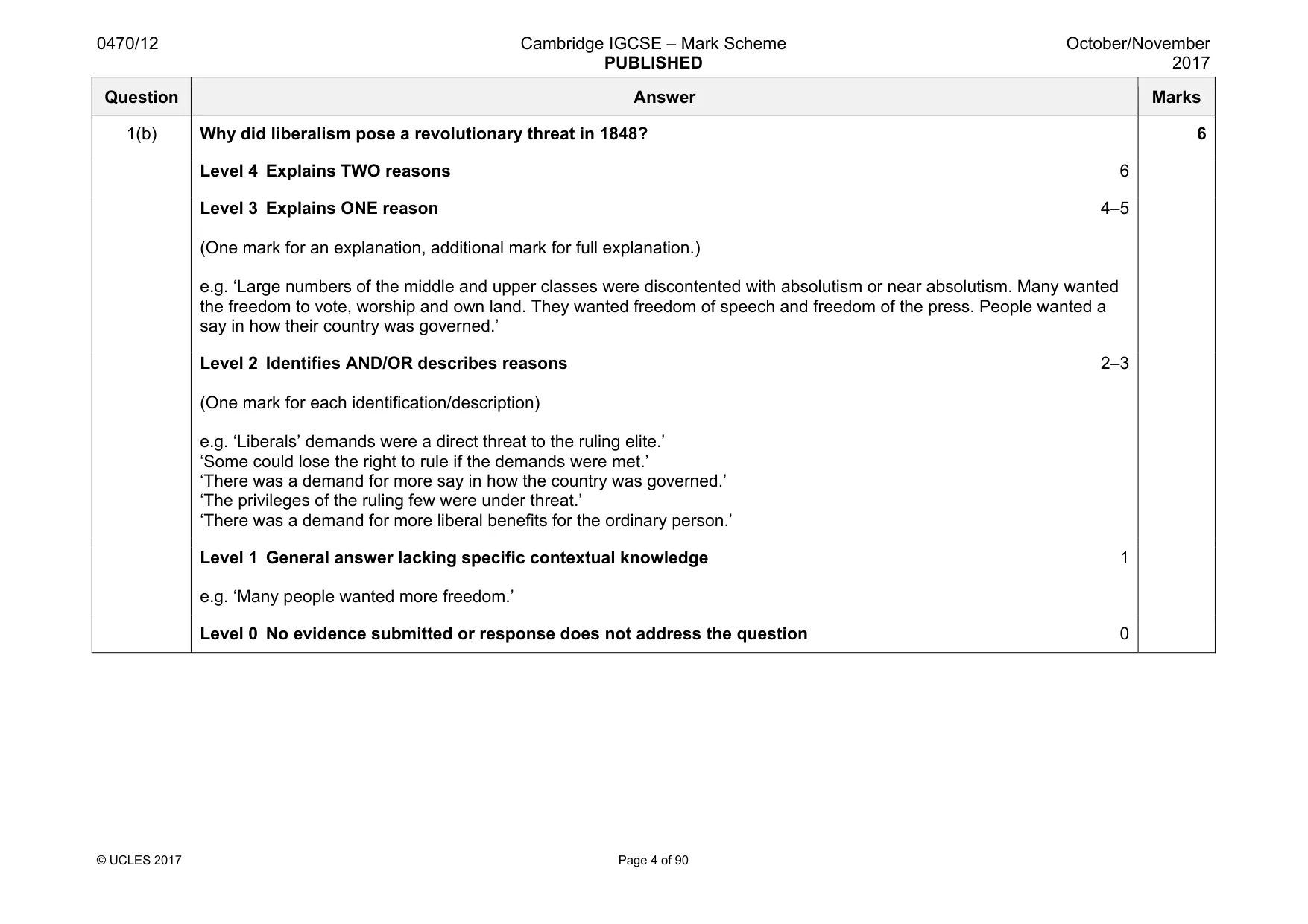
0470/12 Cambridge IGCSE – Mark Scheme PUBLISHED October/November 2017 © UCLES 2017 Page 4 of 90 Question Answer Marks 1(b) Why did liberalism pose a revolutionary threat in 1848? 6 Level 4 Explains TWO reasons 6 Level 3 Explains ONE reason 4–5 (One mark for an explanation, additional mark for full explanation.) e.g. ‘Large numbers of the middle and upper classes were discontented with absolutism or near absolutism. Many wanted the freedom to vote, worship and own land. They wanted freedom of speech and freedom of the press. People wanted a say in how their country was governed.’ Level 2 Identifies AND/OR describes reasons 2–3 (One mark for each identification/description) e.g. ‘Liberals’ demands were a direct threat to the ruling elite.’ ‘Some could lose the right to rule if the demands were met.’ ‘There was a demand for more say in how the country was governed.’ ‘The privileges of the ruling few were under threat.’ ‘There was a demand for more liberal benefits for the ordinary person.’ Level 1 General answer lacking specific contextual knowledge 1 e.g. ‘Many people wanted more freedom.’ Level 0 No evidence submitted or response does not address the question 0
Mark scheme, page 5
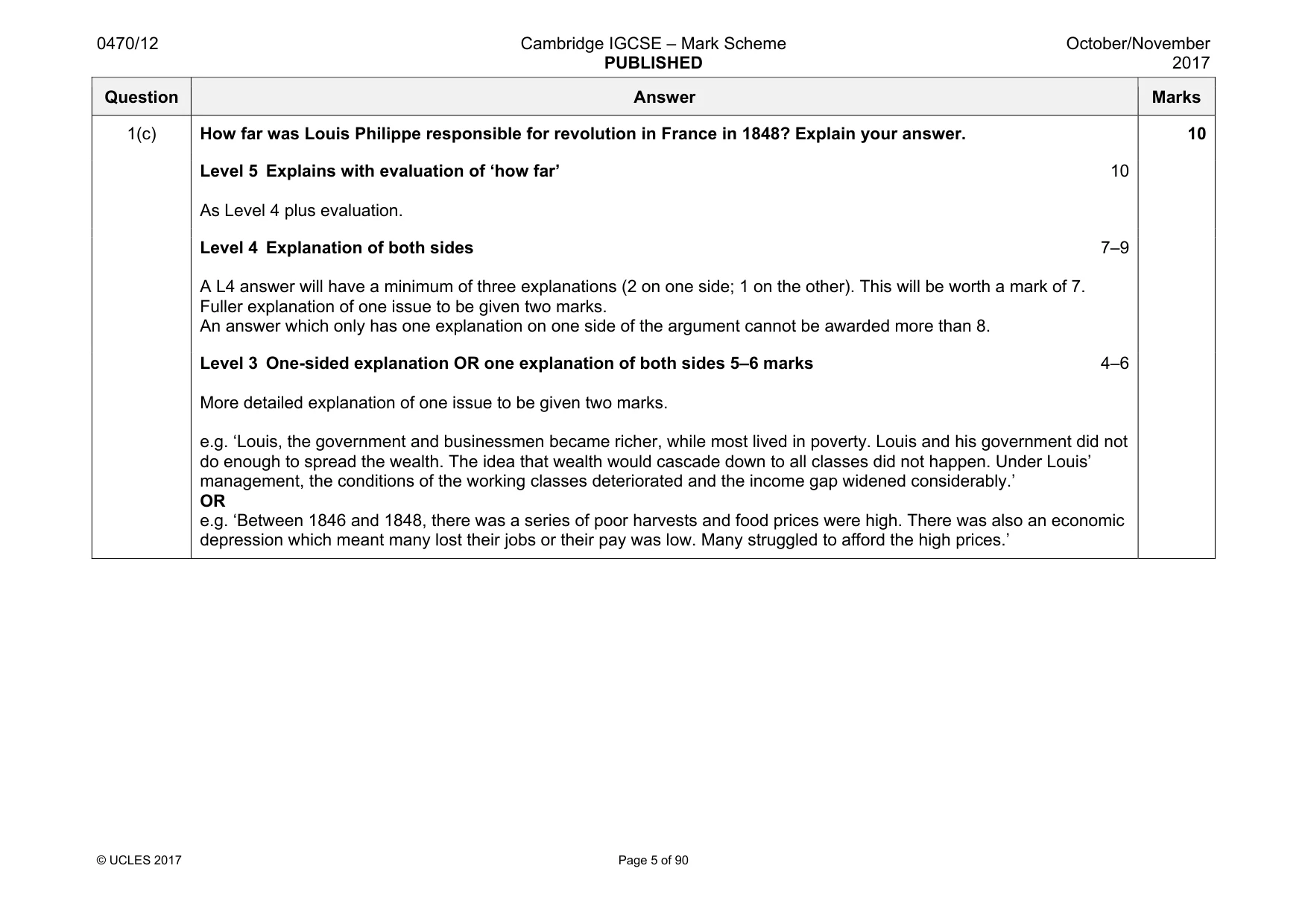
0470/12 Cambridge IGCSE – Mark Scheme PUBLISHED October/November 2017 © UCLES 2017 Page 5 of 90 Question Answer Marks 1(c) How far was Louis Philippe responsible for revolution in France in 1848? Explain your answer. 10 Level 5 Explains with evaluation of ‘how far’ 10 As Level 4 plus evaluation. Level 4 Explanation of both sides 7–9 A L4 answer will have a minimum of three explanations (2 on one side; 1 on the other). This will be worth a mark of 7. Fuller explanation of one issue to be given two marks. An answer which only has one explanation on one side of the argument cannot be awarded more than 8. Level 3 One-sided explanation OR one explanation of both sides 5–6 marks 4–6 More detailed explanation of one issue to be given two marks. e.g. ‘Louis, the government and businessmen became richer, while most lived in poverty. Louis and his government did not do enough to spread the wealth. The idea that wealth would cascade down to all classes did not happen. Under Louis’ management, the conditions of the working classes deteriorated and the income gap widened considerably.’ OR e.g. ‘Between 1846 and 1848, there was a series of poor harvests and food prices were high. There was also an economic depression which meant many lost their jobs or their pay was low. Many struggled to afford the high prices.’
Mark scheme, page 6
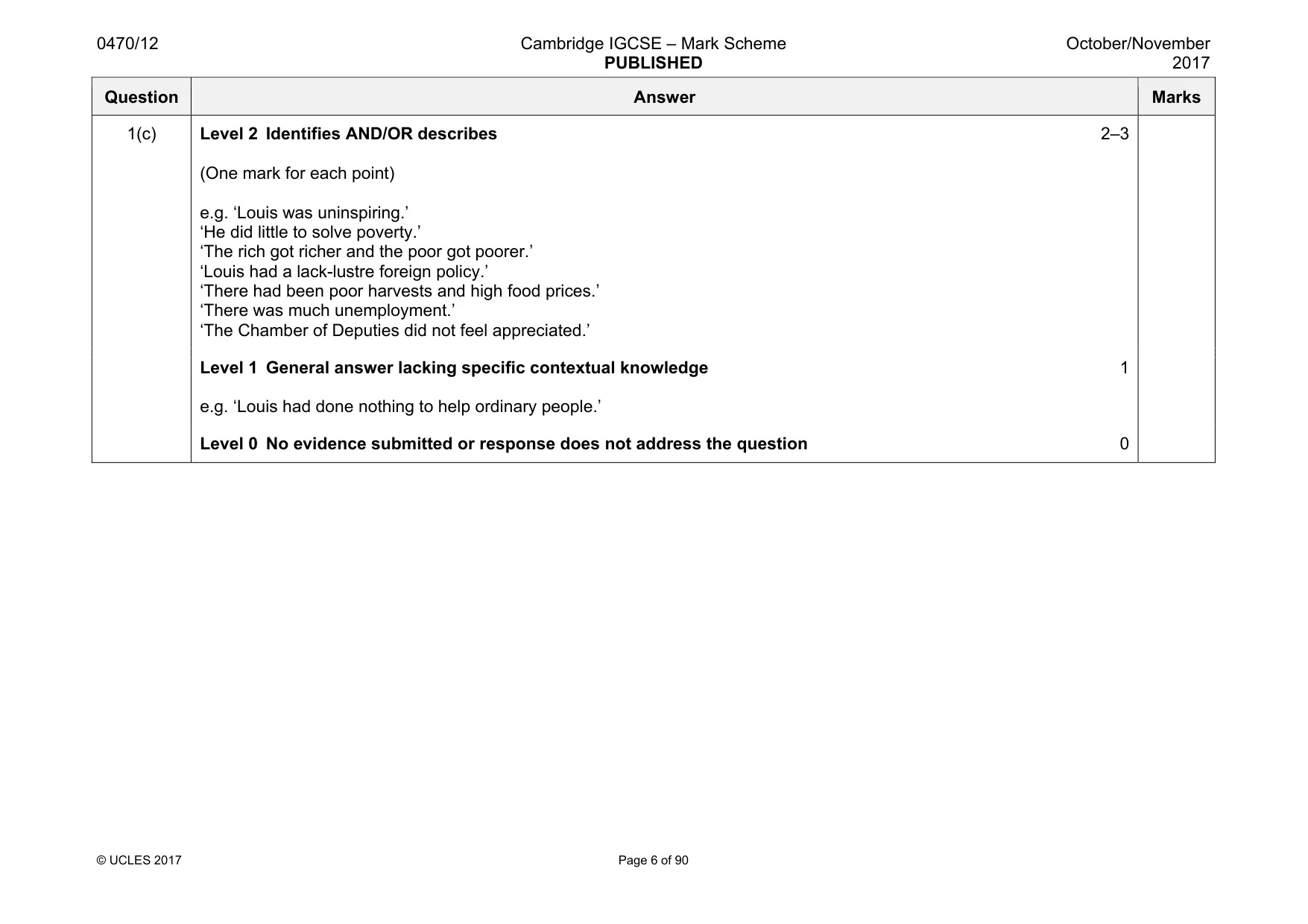
0470/12 Cambridge IGCSE – Mark Scheme PUBLISHED October/November 2017 © UCLES 2017 Page 6 of 90 Question Answer Marks 1(c) Level 2 Identifies AND/OR describes 2–3 (One mark for each point) e.g. ‘Louis was uninspiring.’ ‘He did little to solve poverty.’ ‘The rich got richer and the poor got poorer.’ ‘Louis had a lack-lustre foreign policy.’ ‘There had been poor harvests and high food prices.’ ‘There was much unemployment.’ ‘The Chamber of Deputies did not feel appreciated.’ Level 1 General answer lacking specific contextual knowledge 1 e.g. ‘Louis had done nothing to help ordinary people.’ Level 0 No evidence submitted or response does not address the question 0
Mark scheme, page 7
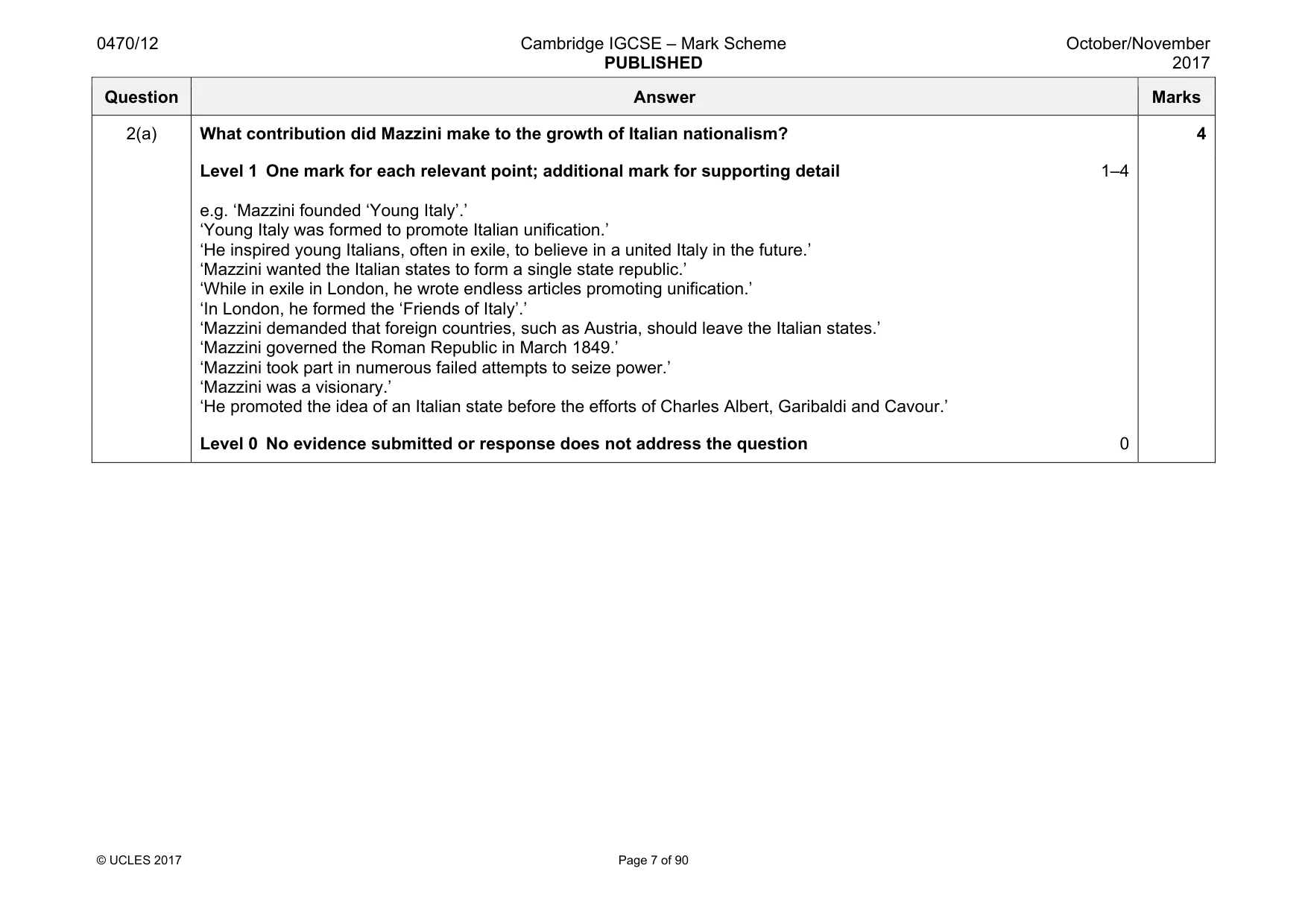
0470/12 Cambridge IGCSE – Mark Scheme PUBLISHED October/November 2017 © UCLES 2017 Page 7 of 90 Question Answer Marks 2(a) What contribution did Mazzini make to the growth of Italian nationalism? 4 Level 1 One mark for each relevant point; additional mark for supporting detail 1–4 e.g. ‘Mazzini founded ‘Young Italy’.’ ‘Young Italy was formed to promote Italian unification.’ ‘He inspired young Italians, often in exile, to believe in a united Italy in the future.’ ‘Mazzini wanted the Italian states to form a single state republic.’ ‘While in exile in London, he wrote endless articles promoting unification.’ ‘In London, he formed the ‘Friends of Italy’.’ ‘Mazzini demanded that foreign countries, such as Austria, should leave the Italian states.’ ‘Mazzini governed the Roman Republic in March 1849.’ ‘Mazzini took part in numerous failed attempts to seize power.’ ‘Mazzini was a visionary.’ ‘He promoted the idea of an Italian state before the efforts of Charles Albert, Garibaldi and Cavour.’ Level 0 No evidence submitted or response does not address the question 0
Mark scheme, page 8
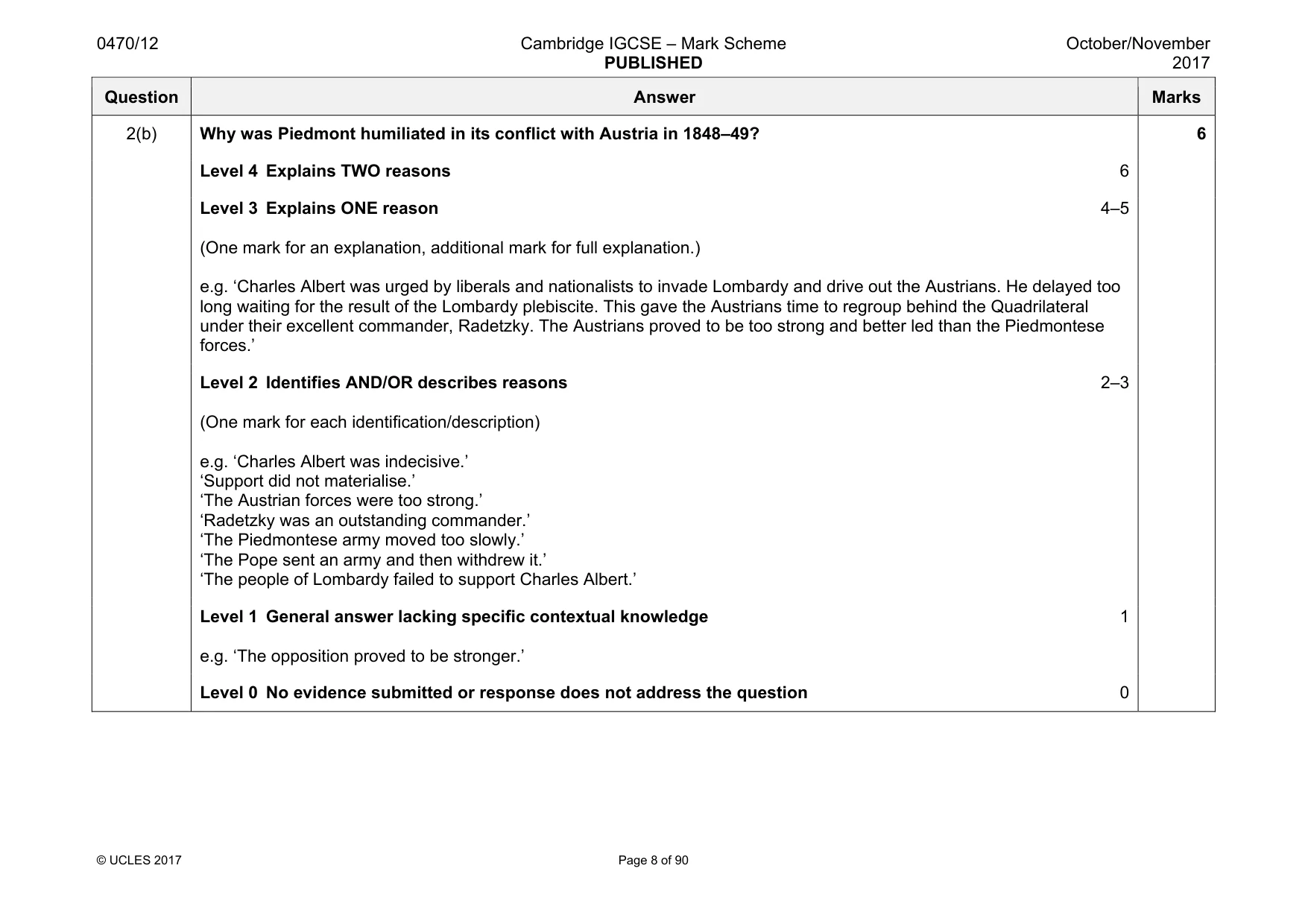
0470/12 Cambridge IGCSE – Mark Scheme PUBLISHED October/November 2017 © UCLES 2017 Page 8 of 90 Question Answer Marks 2(b) Why was Piedmont humiliated in its conflict with Austria in 1848–49? 6 Level 4 Explains TWO reasons 6 Level 3 Explains ONE reason 4–5 (One mark for an explanation, additional mark for full explanation.) e.g. ‘Charles Albert was urged by liberals and nationalists to invade Lombardy and drive out the Austrians. He delayed too long waiting for the result of the Lombardy plebiscite. This gave the Austrians time to regroup behind the Quadrilateral under their excellent commander, Radetzky. The Austrians proved to be too strong and better led than the Piedmontese forces.’ Level 2 Identifies AND/OR describes reasons 2–3 (One mark for each identification/description) e.g. ‘Charles Albert was indecisive.’ ‘Support did not materialise.’ ‘The Austrian forces were too strong.’ ‘Radetzky was an outstanding commander.’ ‘The Piedmontese army moved too slowly.’ ‘The Pope sent an army and then withdrew it.’ ‘The people of Lombardy failed to support Charles Albert.’ Level 1 General answer lacking specific contextual knowledge 1 e.g. ‘The opposition proved to be stronger.’ Level 0 No evidence submitted or response does not address the question 0
Mark scheme, page 9
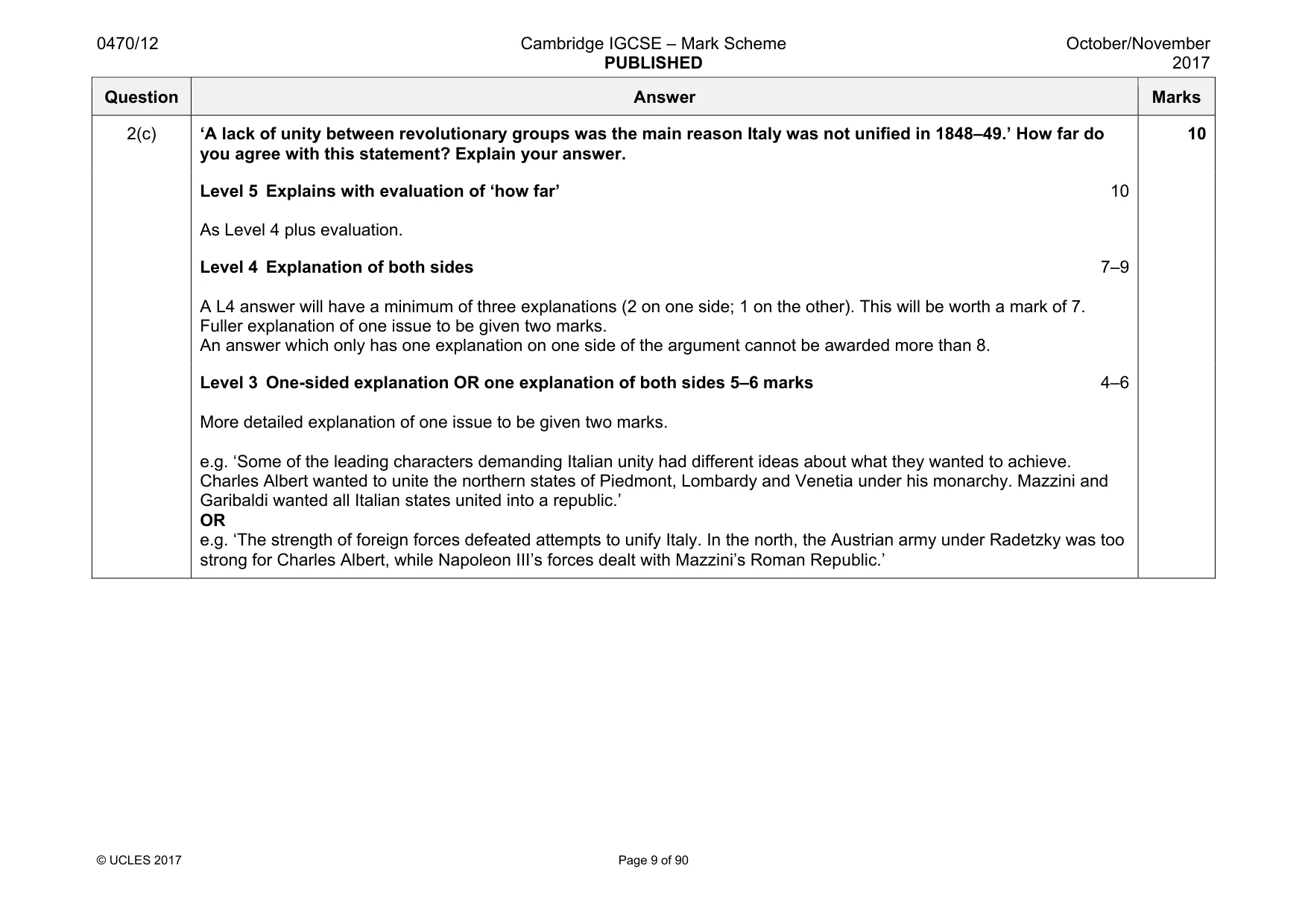
0470/12 Cambridge IGCSE – Mark Scheme PUBLISHED October/November 2017 © UCLES 2017 Page 9 of 90 Question Answer Marks 2(c) ‘A lack of unity between revolutionary groups was the main reason Italy was not unified in 1848–49.’ How far do you agree with this statement? Explain your answer. 10 Level 5 Explains with evaluation of ‘how far’ 10 As Level 4 plus evaluation. Level 4 Explanation of both sides 7–9 A L4 answer will have a minimum of three explanations (2 on one side; 1 on the other). This will be worth a mark of 7. Fuller explanation of one issue to be given two marks. An answer which only has one explanation on one side of the argument cannot be awarded more than 8. Level 3 One-sided explanation OR one explanation of both sides 5–6 marks 4–6 More detailed explanation of one issue to be given two marks. e.g. ‘Some of the leading characters demanding Italian unity had different ideas about what they wanted to achieve. Charles Albert wanted to unite the northern states of Piedmont, Lombardy and Venetia under his monarchy. Mazzini and Garibaldi wanted all Italian states united into a republic.’ OR e.g. ‘The strength of foreign forces defeated attempts to unify Italy. In the north, the Austrian army under Radetzky was too strong for Charles Albert, while Napoleon III’s forces dealt with Mazzini’s Roman Republic.’
Mark scheme, page 10
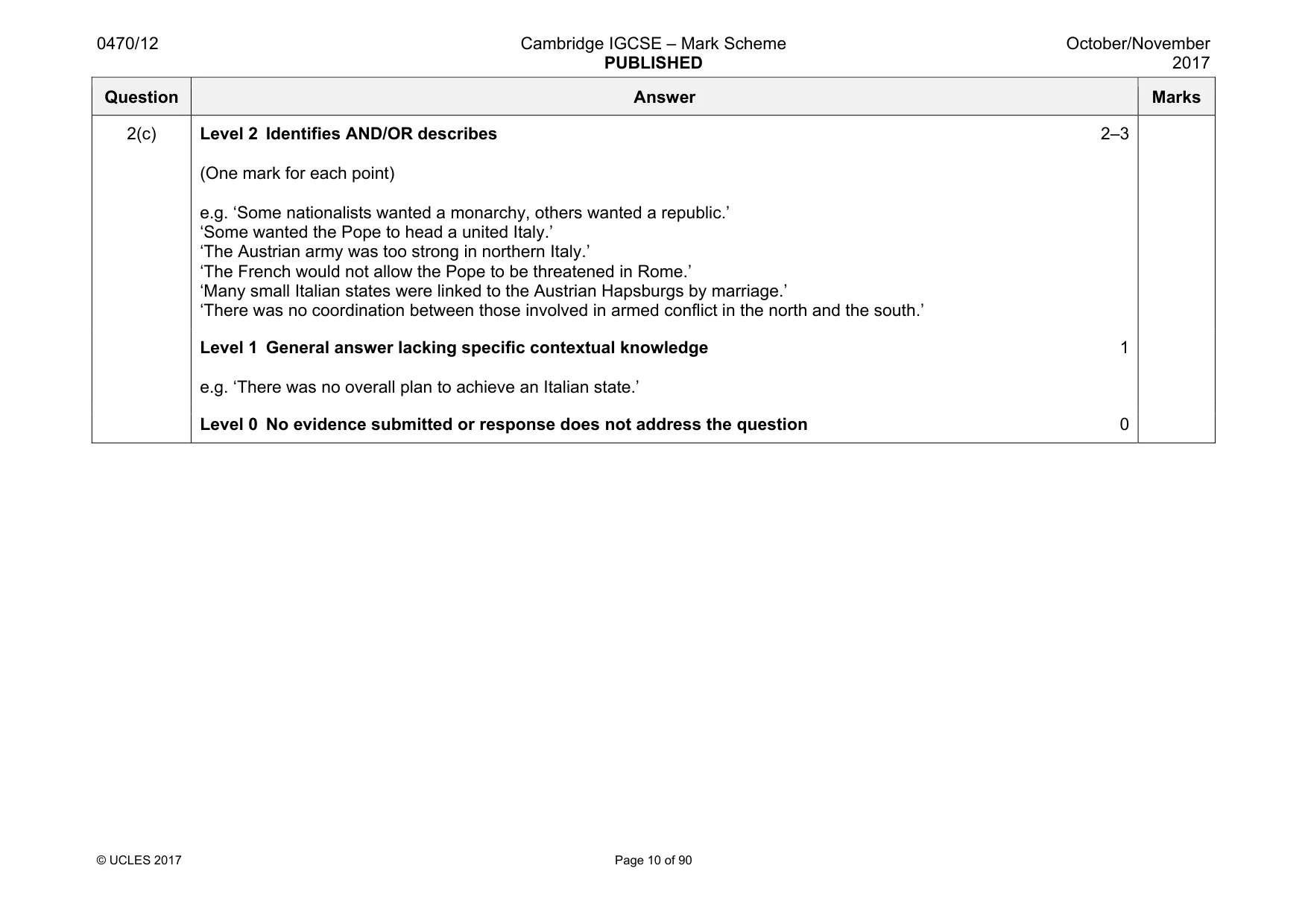
0470/12 Cambridge IGCSE – Mark Scheme PUBLISHED October/November 2017 © UCLES 2017 Page 10 of 90 Question Answer Marks 2(c) Level 2 Identifies AND/OR describes 2–3 (One mark for each point) e.g. ‘Some nationalists wanted a monarchy, others wanted a republic.’ ‘Some wanted the Pope to head a united Italy.’ ‘The Austrian army was too strong in northern Italy.’ ‘The French would not allow the Pope to be threatened in Rome.’ ‘Many small Italian states were linked to the Austrian Hapsburgs by marriage.’ ‘There was no coordination between those involved in armed conflict in the north and the south.’ Level 1 General answer lacking specific contextual knowledge 1 e.g. ‘There was no overall plan to achieve an Italian state.’ Level 0 No evidence submitted or response does not address the question 0
Mark scheme, page 11
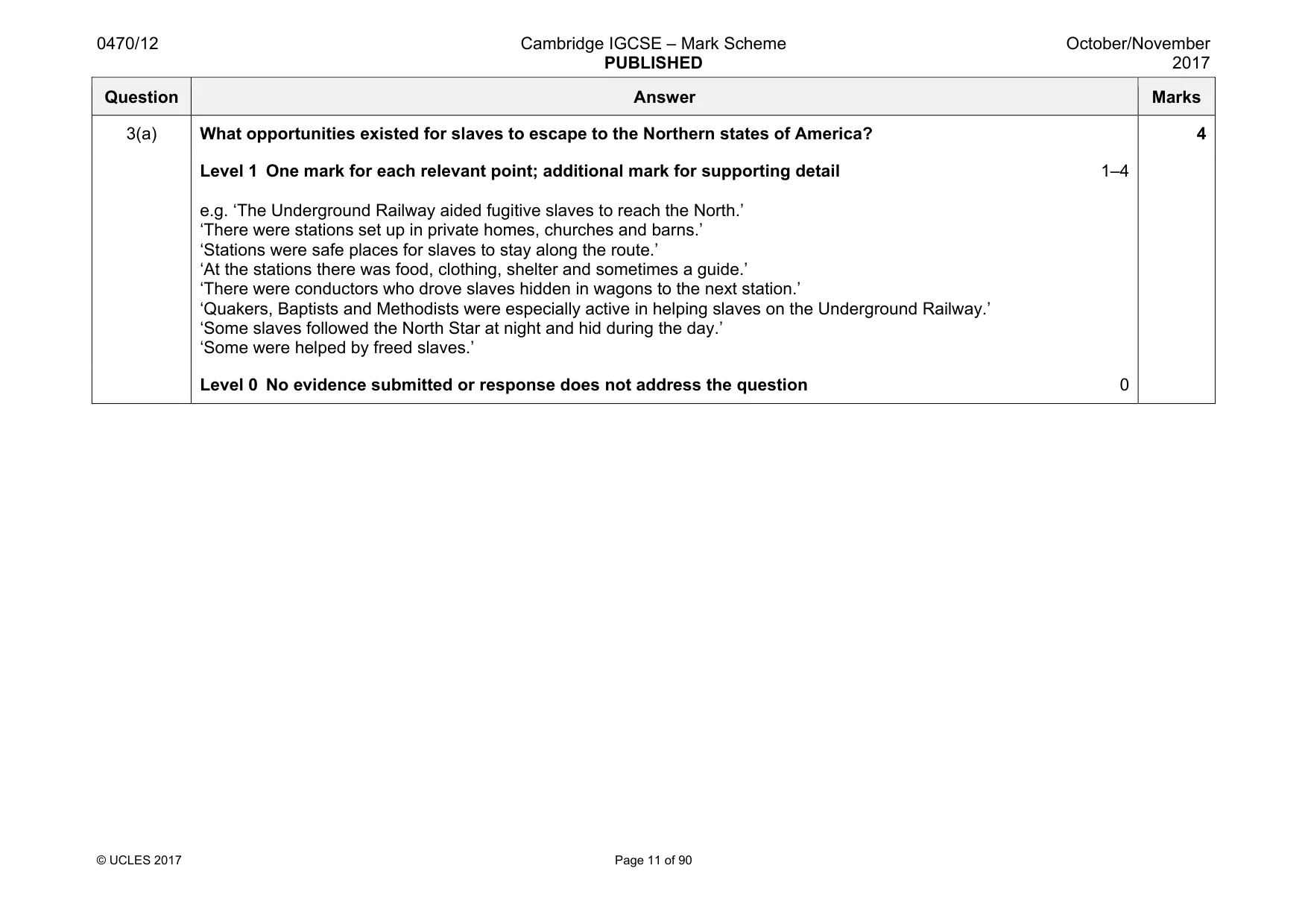
0470/12 Cambridge IGCSE – Mark Scheme PUBLISHED October/November 2017 © UCLES 2017 Page 11 of 90 Question Answer Marks 3(a) What opportunities existed for slaves to escape to the Northern states of America? 4 Level 1 One mark for each relevant point; additional mark for supporting detail 1–4 e.g. ‘The Underground Railway aided fugitive slaves to reach the North.’ ‘There were stations set up in private homes, churches and barns.’ ‘Stations were safe places for slaves to stay along the route.’ ‘At the stations there was food, clothing, shelter and sometimes a guide.’ ‘There were conductors who drove slaves hidden in wagons to the next station.’ ‘Quakers, Baptists and Methodists were especially active in helping slaves on the Underground Railway.’ ‘Some slaves followed the North Star at night and hid during the day.’ ‘Some were helped by freed slaves.’ Level 0 No evidence submitted or response does not address the question 0
Mark scheme, page 12
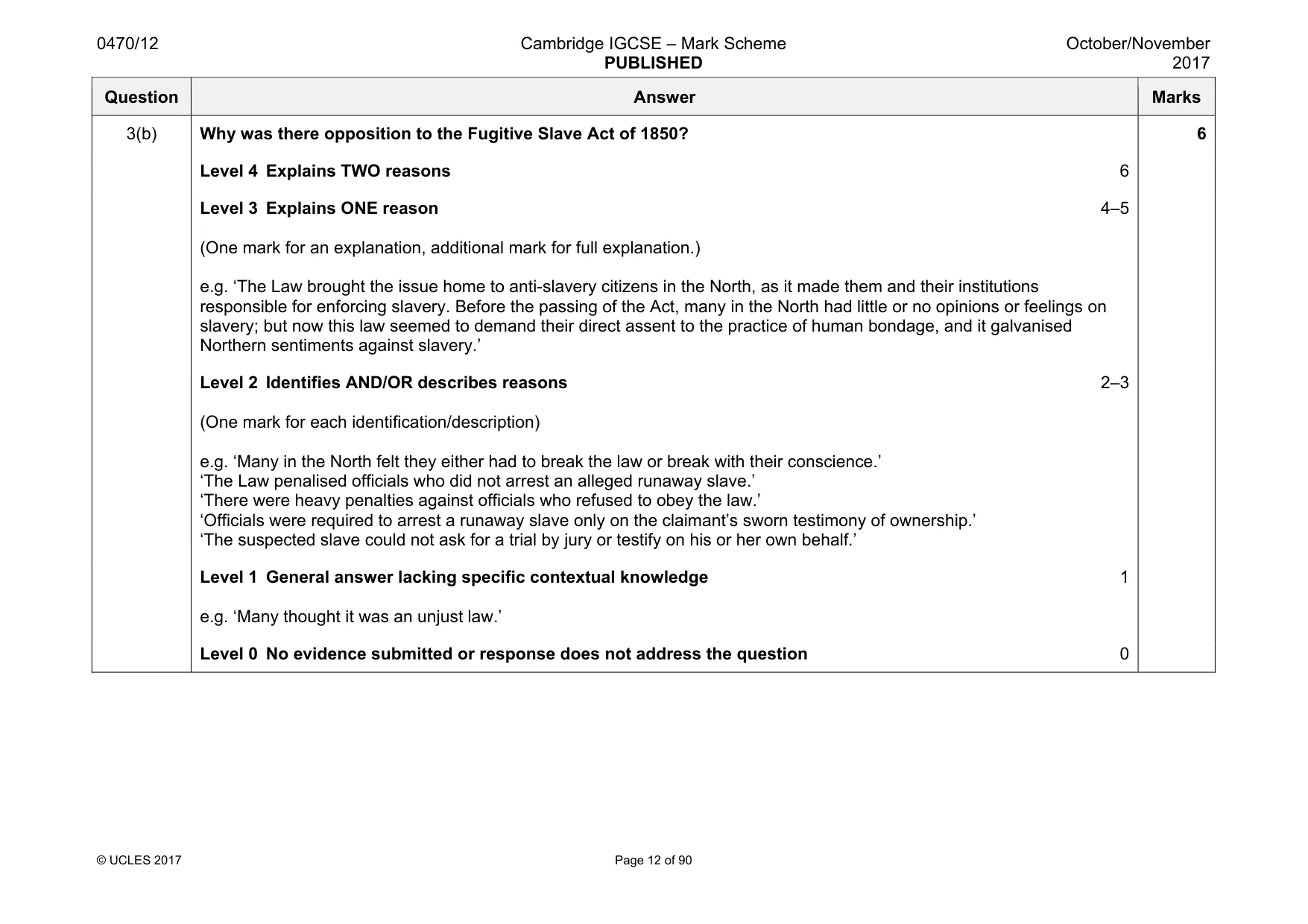
0470/12 Cambridge IGCSE – Mark Scheme PUBLISHED October/November 2017 © UCLES 2017 Page 12 of 90 Question Answer Marks 3(b) Why was there opposition to the Fugitive Slave Act of 1850? 6 Level 4 Explains TWO reasons 6 Level 3 Explains ONE reason 4–5 (One mark for an explanation, additional mark for full explanation.) e.g. ‘The Law brought the issue home to anti-slavery citizens in the North, as it made them and their institutions responsible for enforcing slavery. Before the passing of the Act, many in the North had little or no opinions or feelings on slavery; but now this law seemed to demand their direct assent to the practice of human bondage, and it galvanised Northern sentiments against slavery.’ Level 2 Identifies AND/OR describes reasons 2–3 (One mark for each identification/description) e.g. ‘Many in the North felt they either had to break the law or break with their conscience.’ ‘The Law penalised officials who did not arrest an alleged runaway slave.’ ‘There were heavy penalties against officials who refused to obey the law.’ ‘Officials were required to arrest a runaway slave only on the claimant’s sworn testimony of ownership.’ ‘The suspected slave could not ask for a trial by jury or testify on his or her own behalf.’ Level 1 General answer lacking specific contextual knowledge 1 e.g. ‘Many thought it was an unjust law.’ Level 0 No evidence submitted or response does not address the question 0
Mark scheme, page 13
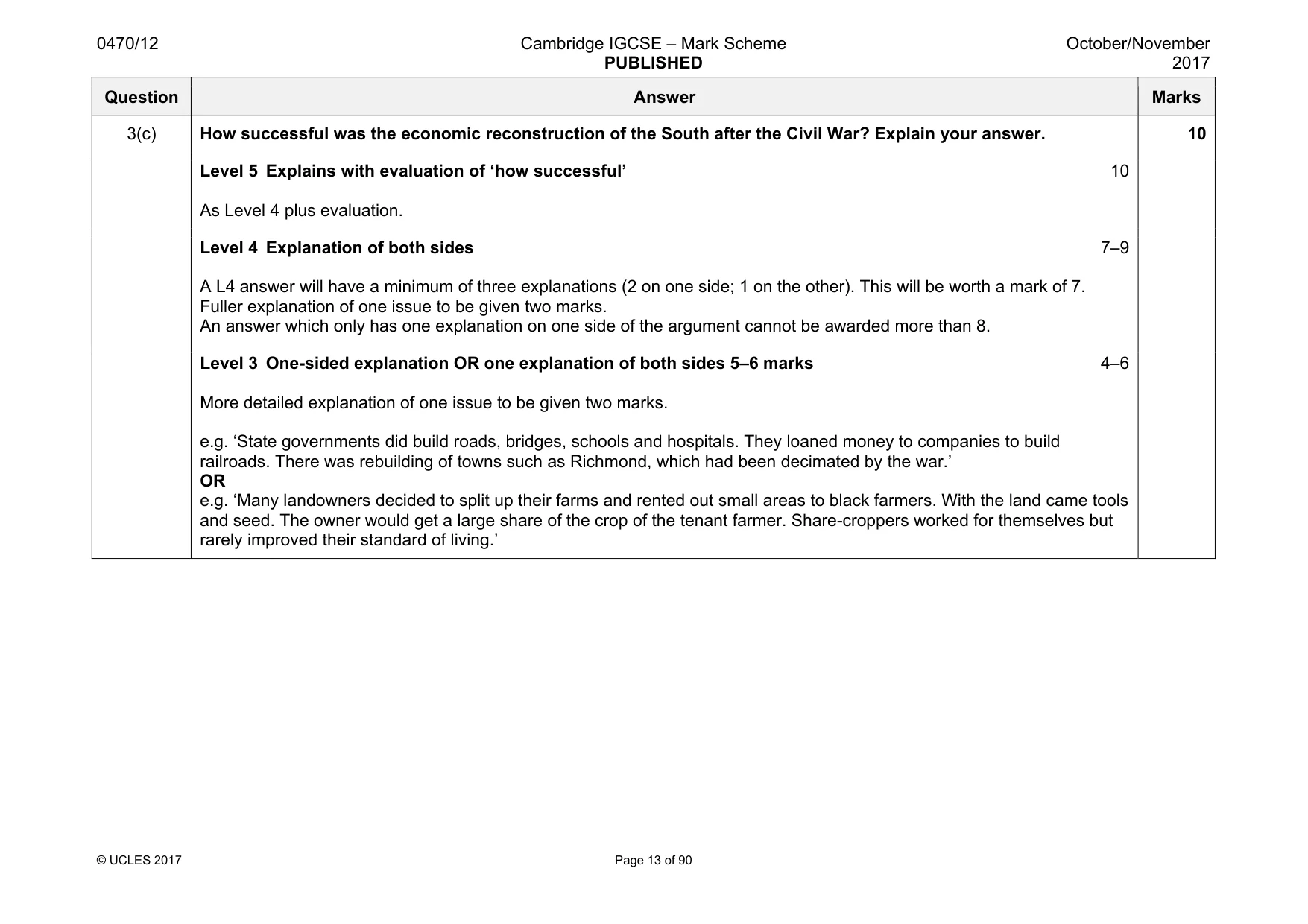
0470/12 Cambridge IGCSE – Mark Scheme PUBLISHED October/November 2017 © UCLES 2017 Page 13 of 90 Question Answer Marks 3(c) How successful was the economic reconstruction of the South after the Civil War? Explain your answer. 10 Level 5 Explains with evaluation of ‘how successful’ 10 As Level 4 plus evaluation. Level 4 Explanation of both sides 7–9 A L4 answer will have a minimum of three explanations (2 on one side; 1 on the other). This will be worth a mark of 7. Fuller explanation of one issue to be given two marks. An answer which only has one explanation on one side of the argument cannot be awarded more than 8. Level 3 One-sided explanation OR one explanation of both sides 5–6 marks 4–6 More detailed explanation of one issue to be given two marks. e.g. ‘State governments did build roads, bridges, schools and hospitals. They loaned money to companies to build railroads. There was rebuilding of towns such as Richmond, which had been decimated by the war.’ OR e.g. ‘Many landowners decided to split up their farms and rented out small areas to black farmers. With the land came tools and seed. The owner would get a large share of the crop of the tenant farmer. Share-croppers worked for themselves but rarely improved their standard of living.’
Mark scheme, page 14
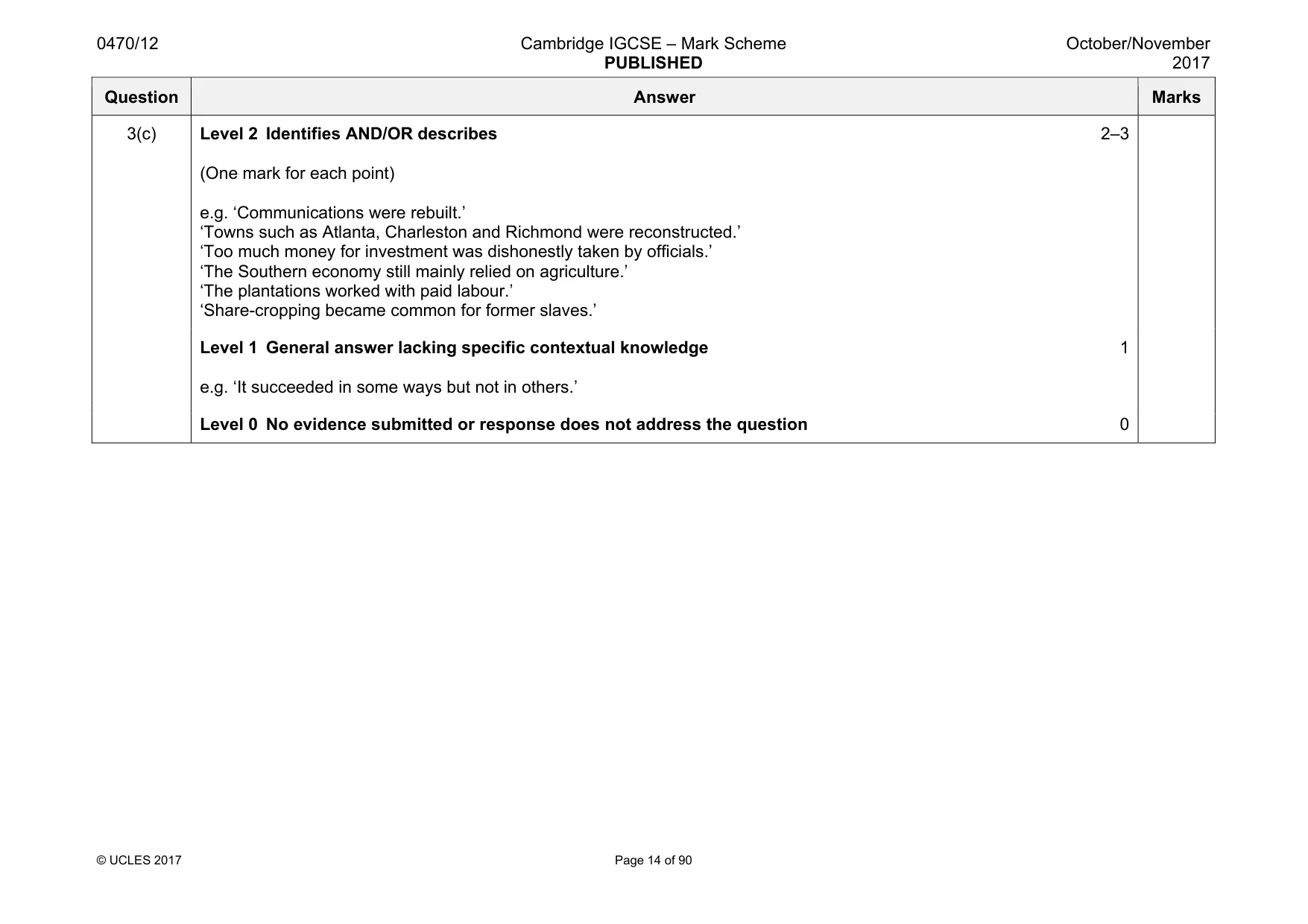
0470/12 Cambridge IGCSE – Mark Scheme PUBLISHED October/November 2017 © UCLES 2017 Page 14 of 90 Question Answer Marks 3(c) Level 2 Identifies AND/OR describes 2–3 (One mark for each point) e.g. ‘Communications were rebuilt.’ ‘Towns such as Atlanta, Charleston and Richmond were reconstructed.’ ‘Too much money for investment was dishonestly taken by officials.’ ‘The Southern economy still mainly relied on agriculture.’ ‘The plantations worked with paid labour.’ ‘Share-cropping became common for former slaves.’ Level 1 General answer lacking specific contextual knowledge 1 e.g. ‘It succeeded in some ways but not in others.’ Level 0 No evidence submitted or response does not address the question 0
Mark scheme, page 15
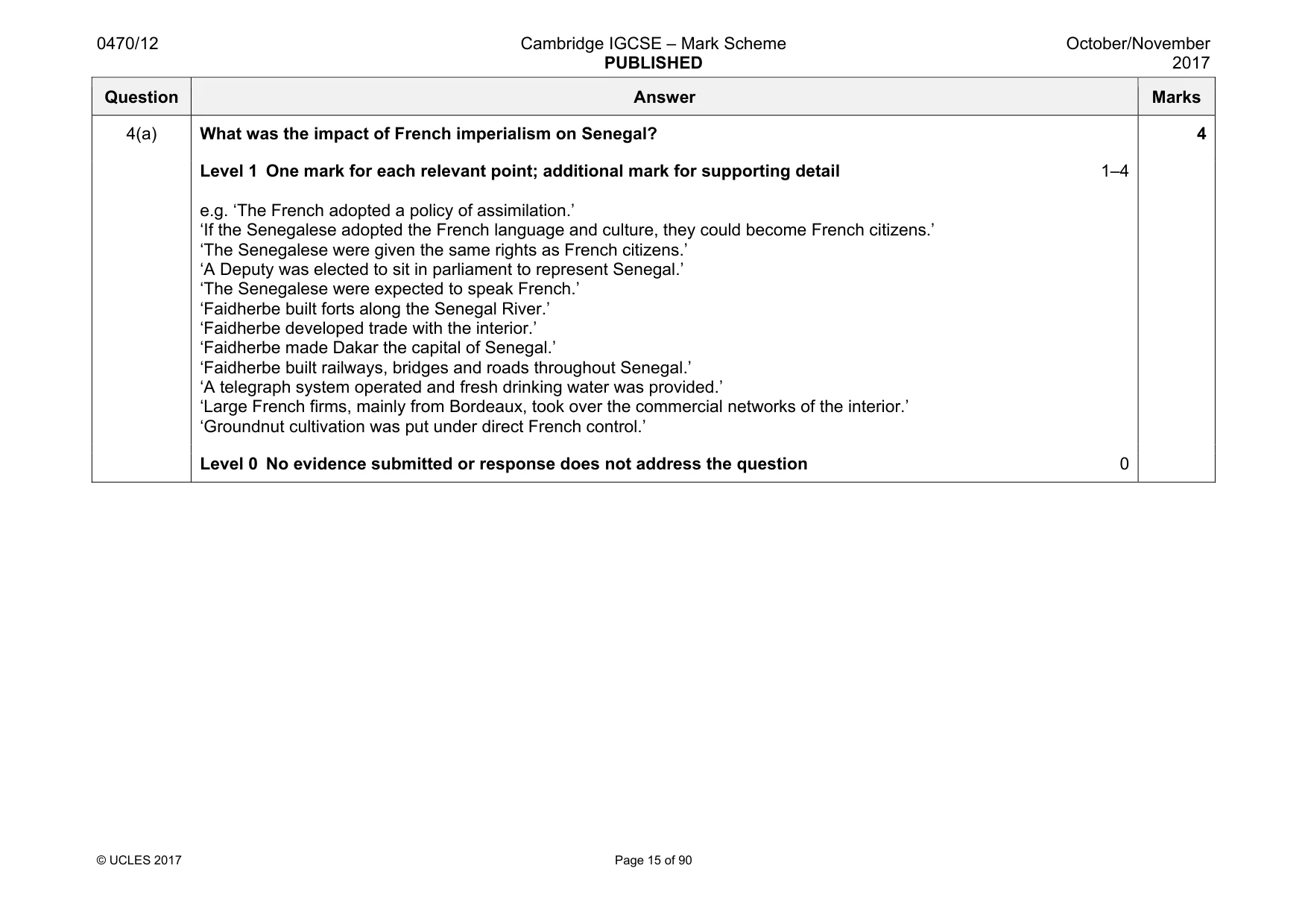
0470/12 Cambridge IGCSE – Mark Scheme PUBLISHED October/November 2017 © UCLES 2017 Page 15 of 90 Question Answer Marks 4(a) What was the impact of French imperialism on Senegal? 4 Level 1 One mark for each relevant point; additional mark for supporting detail 1–4 e.g. ‘The French adopted a policy of assimilation.’ ‘If the Senegalese adopted the French language and culture, they could become French citizens.’ ‘The Senegalese were given the same rights as French citizens.’ ‘A Deputy was elected to sit in parliament to represent Senegal.’ ‘The Senegalese were expected to speak French.’ ‘Faidherbe built forts along the Senegal River.’ ‘Faidherbe developed trade with the interior.’ ‘Faidherbe made Dakar the capital of Senegal.’ ‘Faidherbe built railways, bridges and roads throughout Senegal.’ ‘A telegraph system operated and fresh drinking water was provided.’ ‘Large French firms, mainly from Bordeaux, took over the commercial networks of the interior.’ ‘Groundnut cultivation was put under direct French control.’ Level 0 No evidence submitted or response does not address the question 0
Mark scheme, page 16
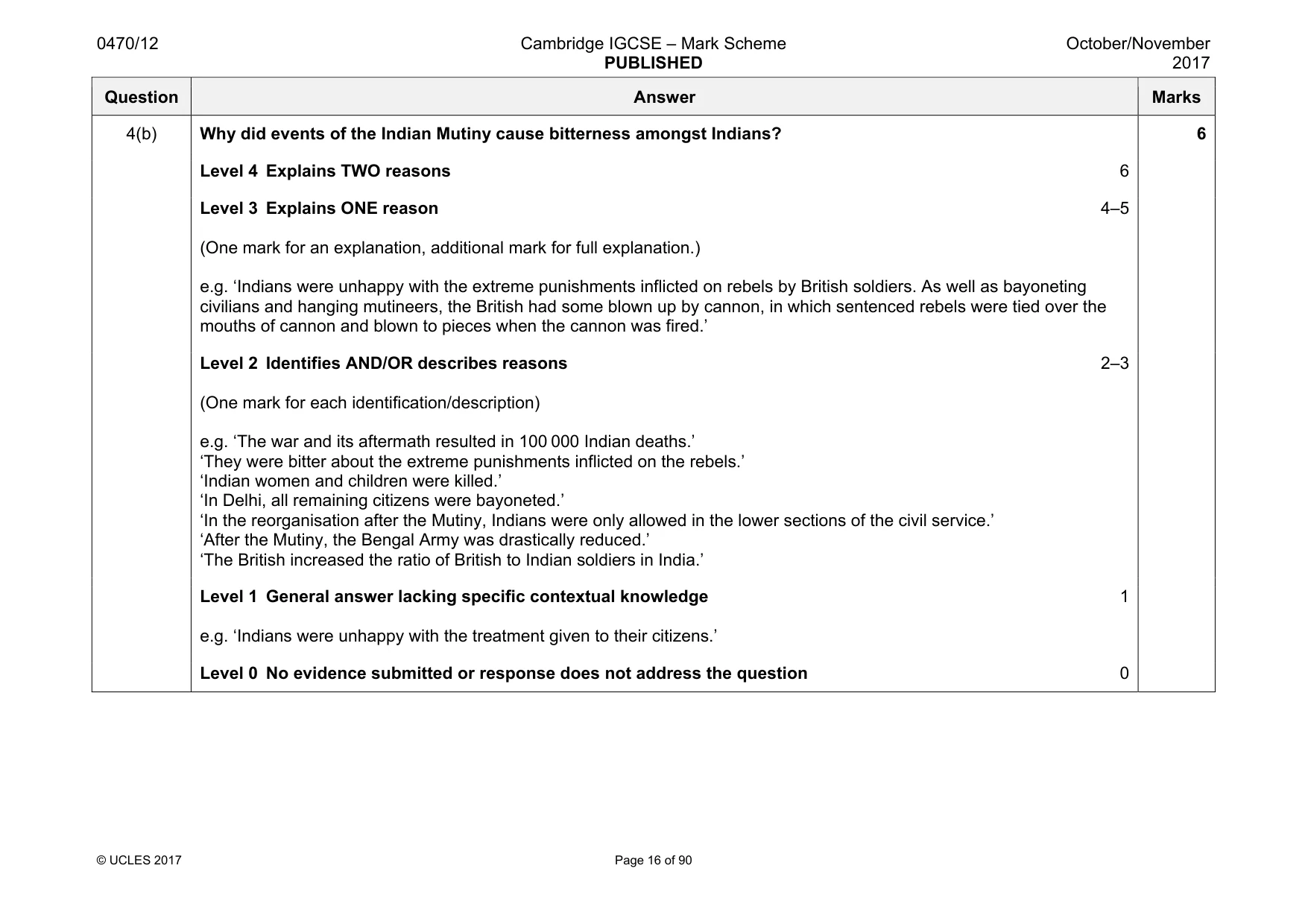
0470/12 Cambridge IGCSE – Mark Scheme PUBLISHED October/November 2017 © UCLES 2017 Page 16 of 90 Question Answer Marks 4(b) Why did events of the Indian Mutiny cause bitterness amongst Indians? 6 Level 4 Explains TWO reasons 6 Level 3 Explains ONE reason 4–5 (One mark for an explanation, additional mark for full explanation.) e.g. ‘Indians were unhappy with the extreme punishments inflicted on rebels by British soldiers. As well as bayoneting civilians and hanging mutineers, the British had some blown up by cannon, in which sentenced rebels were tied over the mouths of cannon and blown to pieces when the cannon was fired.’ Level 2 Identifies AND/OR describes reasons 2–3 (One mark for each identification/description) e.g. ‘The war and its aftermath resulted in 100 000 Indian deaths.’ ‘They were bitter about the extreme punishments inflicted on the rebels.’ ‘Indian women and children were killed.’ ‘In Delhi, all remaining citizens were bayoneted.’ ‘In the reorganisation after the Mutiny, Indians were only allowed in the lower sections of the civil service.’ ‘After the Mutiny, the Bengal Army was drastically reduced.’ ‘The British increased the ratio of British to Indian soldiers in India.’ Level 1 General answer lacking specific contextual knowledge 1 e.g. ‘Indians were unhappy with the treatment given to their citizens.’ Level 0 No evidence submitted or response does not address the question 0
Mark scheme, page 17
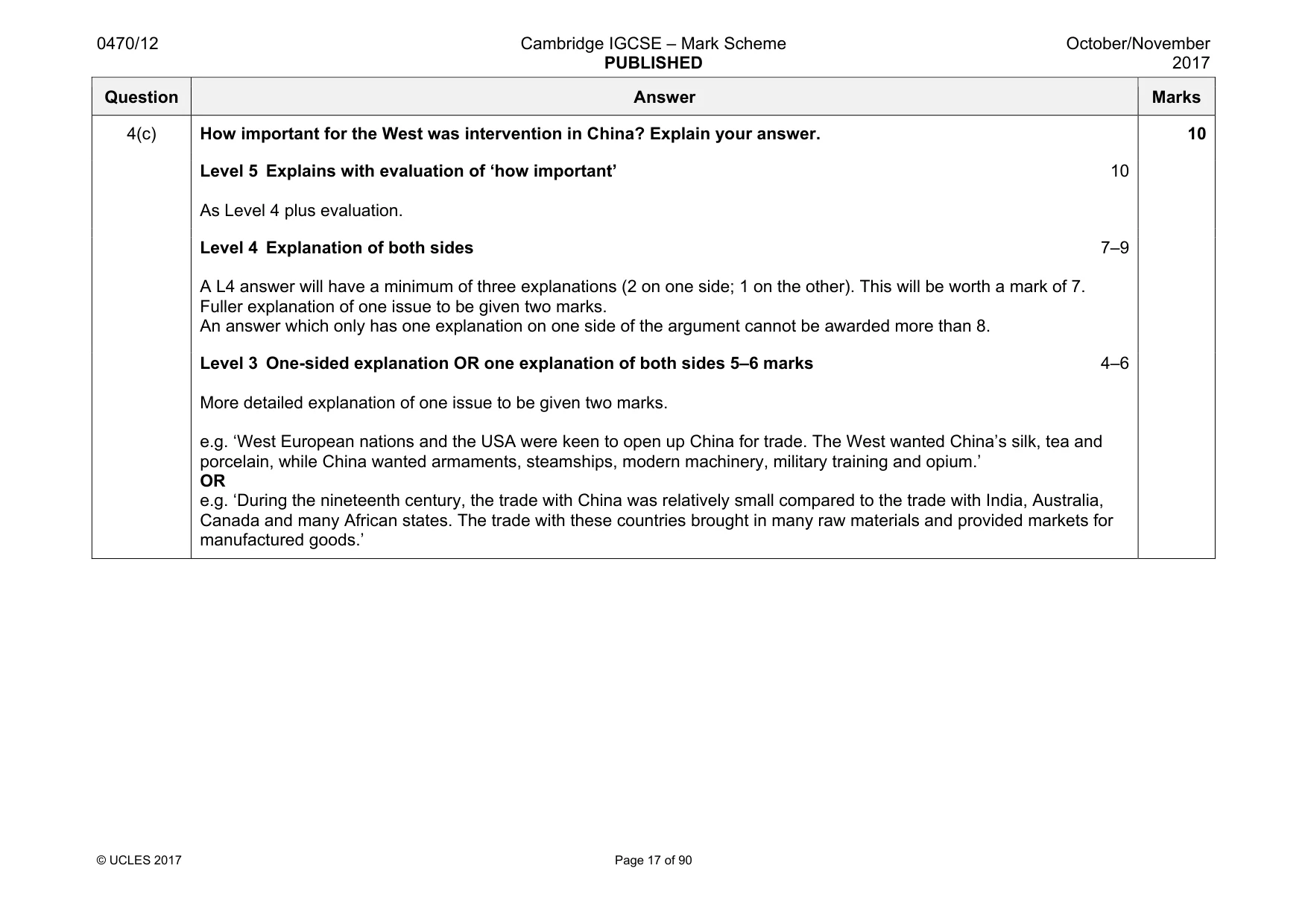
0470/12 Cambridge IGCSE – Mark Scheme PUBLISHED October/November 2017 © UCLES 2017 Page 17 of 90 Question Answer Marks 4(c) How important for the West was intervention in China? Explain your answer. 10 Level 5 Explains with evaluation of ‘how important’ 10 As Level 4 plus evaluation. Level 4 Explanation of both sides 7–9 A L4 answer will have a minimum of three explanations (2 on one side; 1 on the other). This will be worth a mark of 7. Fuller explanation of one issue to be given two marks. An answer which only has one explanation on one side of the argument cannot be awarded more than 8. Level 3 One-sided explanation OR one explanation of both sides 5–6 marks 4–6 More detailed explanation of one issue to be given two marks. e.g. ‘West European nations and the USA were keen to open up China for trade. The West wanted China’s silk, tea and porcelain, while China wanted armaments, steamships, modern machinery, military training and opium.’ OR e.g. ‘During the nineteenth century, the trade with China was relatively small compared to the trade with India, Australia, Canada and many African states. The trade with these countries brought in many raw materials and provided markets for manufactured goods.’
Mark scheme, page 18
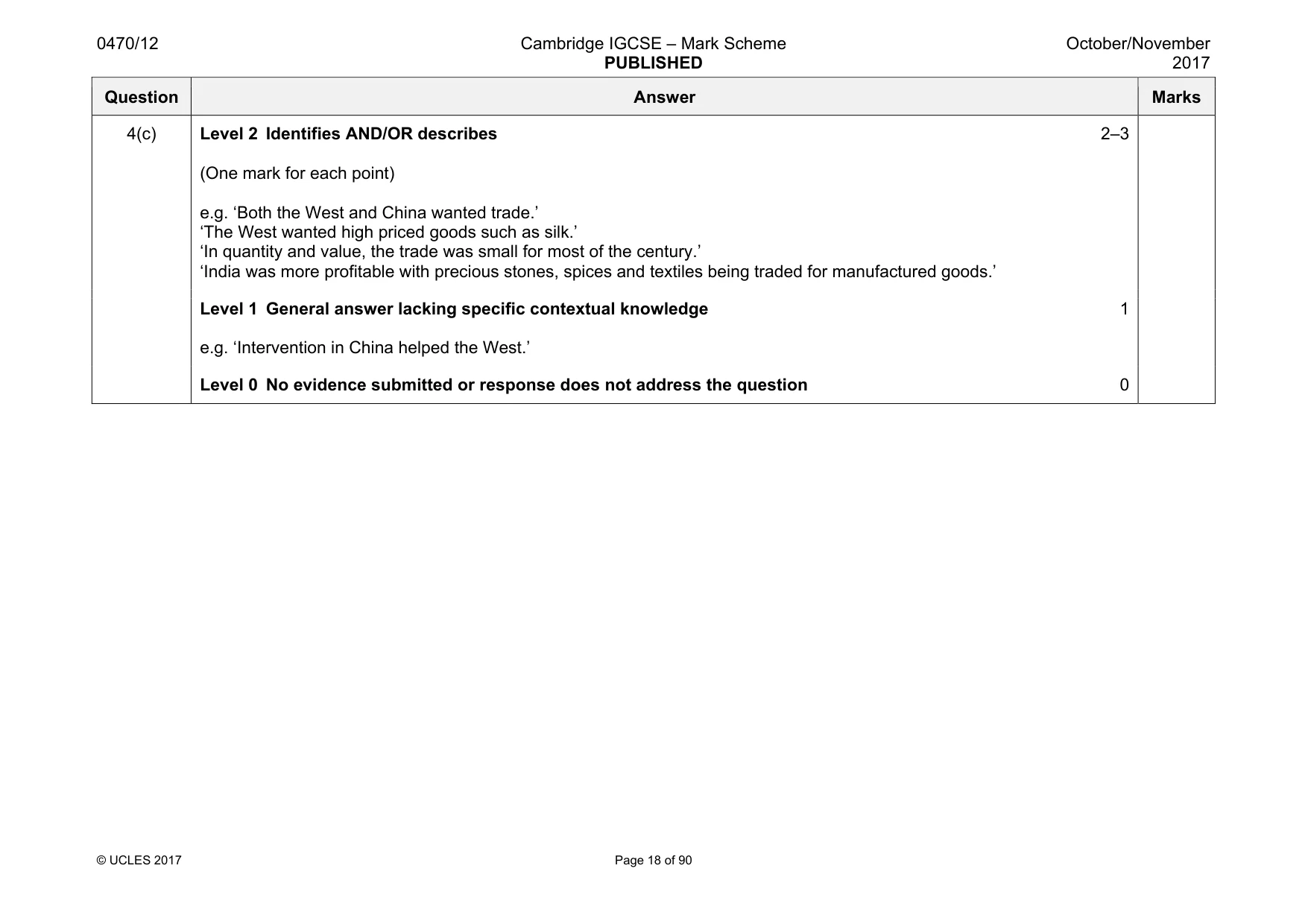
0470/12 Cambridge IGCSE – Mark Scheme PUBLISHED October/November 2017 © UCLES 2017 Page 18 of 90 Question Answer Marks 4(c) Level 2 Identifies AND/OR describes 2–3 (One mark for each point) e.g. ‘Both the West and China wanted trade.’ ‘The West wanted high priced goods such as silk.’ ‘In quantity and value, the trade was small for most of the century.’ ‘India was more profitable with precious stones, spices and textiles being traded for manufactured goods.’ Level 1 General answer lacking specific contextual knowledge 1 e.g. ‘Intervention in China helped the West.’ Level 0 No evidence submitted or response does not address the question 0
Mark scheme, page 19
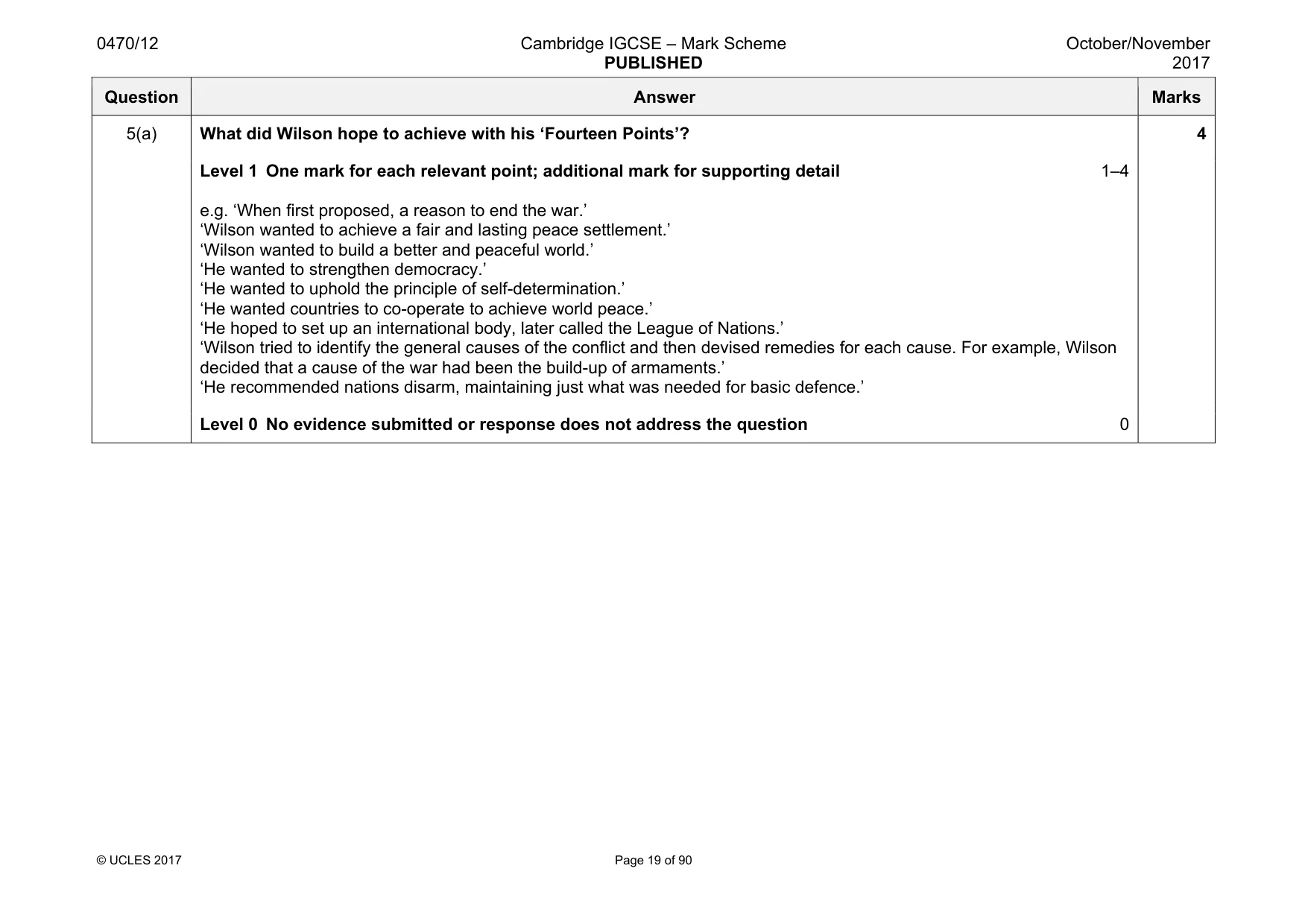
0470/12 Cambridge IGCSE – Mark Scheme PUBLISHED October/November 2017 © UCLES 2017 Page 19 of 90 Question Answer Marks 5(a) What did Wilson hope to achieve with his ‘Fourteen Points’? 4 Level 1 One mark for each relevant point; additional mark for supporting detail 1–4 e.g. ‘When first proposed, a reason to end the war.’ ‘Wilson wanted to achieve a fair and lasting peace settlement.’ ‘Wilson wanted to build a better and peaceful world.’ ‘He wanted to strengthen democracy.’ ‘He wanted to uphold the principle of self-determination.’ ‘He wanted countries to co-operate to achieve world peace.’ ‘He hoped to set up an international body, later called the League of Nations.’ ‘Wilson tried to identify the general causes of the conflict and then devised remedies for each cause. For example, Wilson decided that a cause of the war had been the build-up of armaments.’ ‘He recommended nations disarm, maintaining just what was needed for basic defence.’ Level 0 No evidence submitted or response does not address the question 0
Mark scheme, page 20
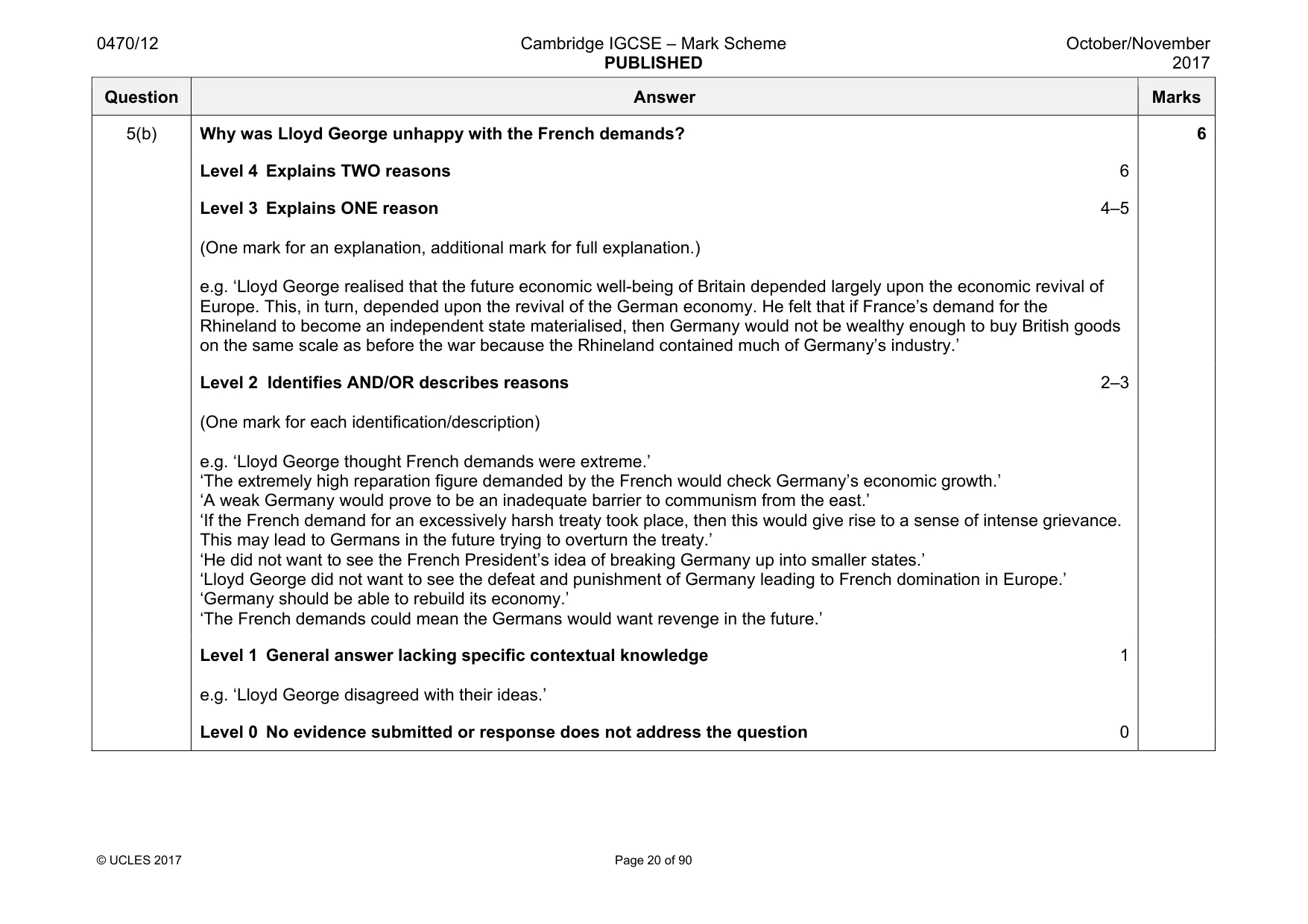
0470/12 Cambridge IGCSE – Mark Scheme PUBLISHED October/November 2017 © UCLES 2017 Page 20 of 90 Question Answer Marks 5(b) Why was Lloyd George unhappy with the French demands? 6 Level 4 Explains TWO reasons 6 Level 3 Explains ONE reason 4–5 (One mark for an explanation, additional mark for full explanation.) e.g. ‘Lloyd George realised that the future economic well-being of Britain depended largely upon the economic revival of Europe. This, in turn, depended upon the revival of the German economy. He felt that if France’s demand for the Rhineland to become an independent state materialised, then Germany would not be wealthy enough to buy British goods on the same scale as before the war because the Rhineland contained much of Germany’s industry.’ Level 2 Identifies AND/OR describes reasons 2–3 (One mark for each identification/description) e.g. ‘Lloyd George thought French demands were extreme.’ ‘The extremely high reparation figure demanded by the French would check Germany’s economic growth.’ ‘A weak Germany would prove to be an inadequate barrier to communism from the east.’ ‘If the French demand for an excessively harsh treaty took place, then this would give rise to a sense of intense grievance. This may lead to Germans in the future trying to overturn the treaty.’ ‘He did not want to see the French President’s idea of breaking Germany up into smaller states.’ ‘Lloyd George did not want to see the defeat and punishment of Germany leading to French domination in Europe.’ ‘Germany should be able to rebuild its economy.’ ‘The French demands could mean the Germans would want revenge in the future.’ Level 1 General answer lacking specific contextual knowledge 1 e.g. ‘Lloyd George disagreed with their ideas.’ Level 0 No evidence submitted or response does not address the question 0
Mark scheme, page 21
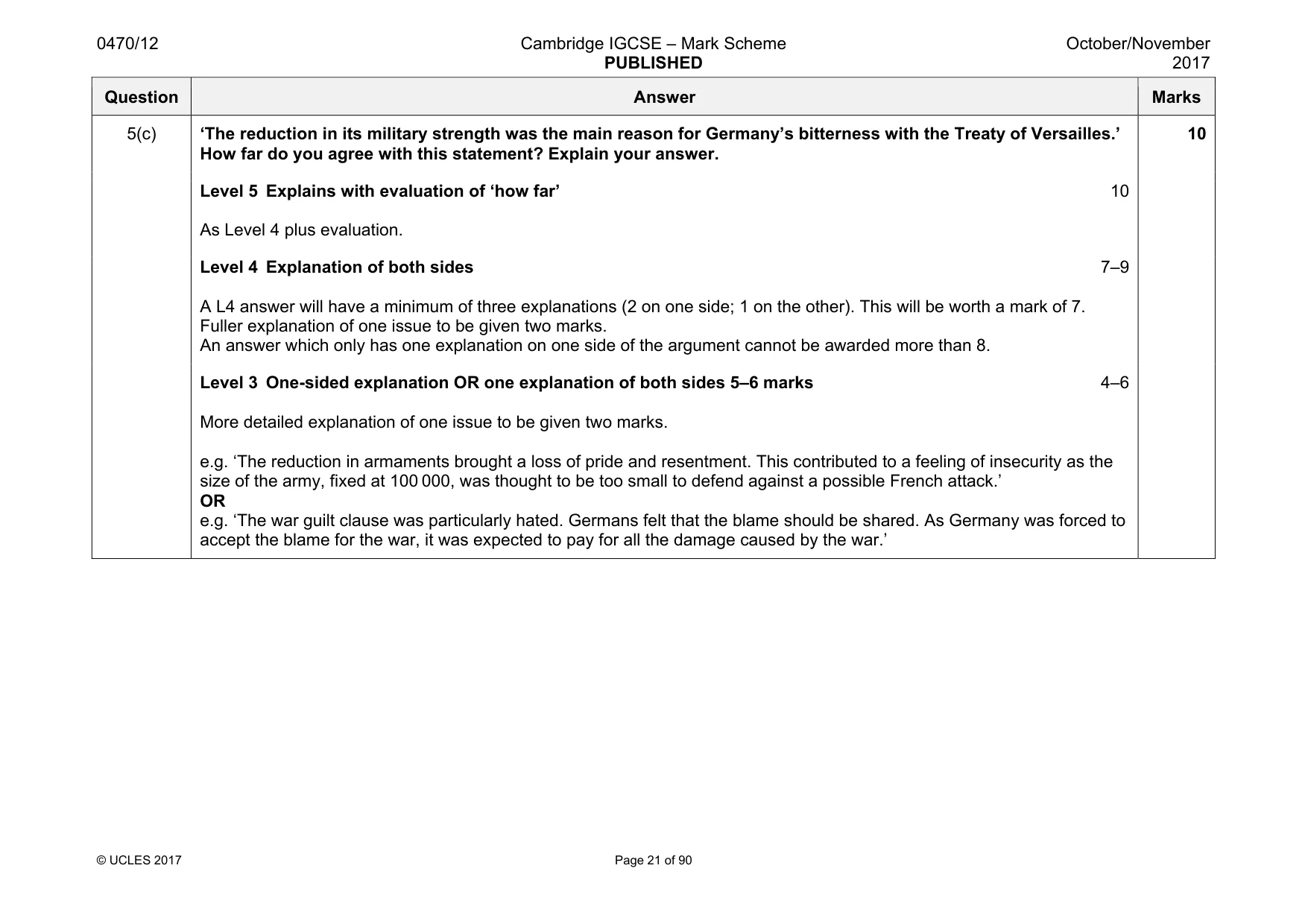
0470/12 Cambridge IGCSE – Mark Scheme PUBLISHED October/November 2017 © UCLES 2017 Page 21 of 90 Question Answer Marks 5(c) ‘The reduction in its military strength was the main reason for Germany’s bitterness with the Treaty of Versailles.’ How far do you agree with this statement? Explain your answer. 10 Level 5 Explains with evaluation of ‘how far’ 10 As Level 4 plus evaluation. Level 4 Explanation of both sides 7–9 A L4 answer will have a minimum of three explanations (2 on one side; 1 on the other). This will be worth a mark of 7. Fuller explanation of one issue to be given two marks. An answer which only has one explanation on one side of the argument cannot be awarded more than 8. Level 3 One-sided explanation OR one explanation of both sides 5–6 marks 4–6 More detailed explanation of one issue to be given two marks. e.g. ‘The reduction in armaments brought a loss of pride and resentment. This contributed to a feeling of insecurity as the size of the army, fixed at 100 000, was thought to be too small to defend against a possible French attack.’ OR e.g. ‘The war guilt clause was particularly hated. Germans felt that the blame should be shared. As Germany was forced to accept the blame for the war, it was expected to pay for all the damage caused by the war.’
Mark scheme, page 22
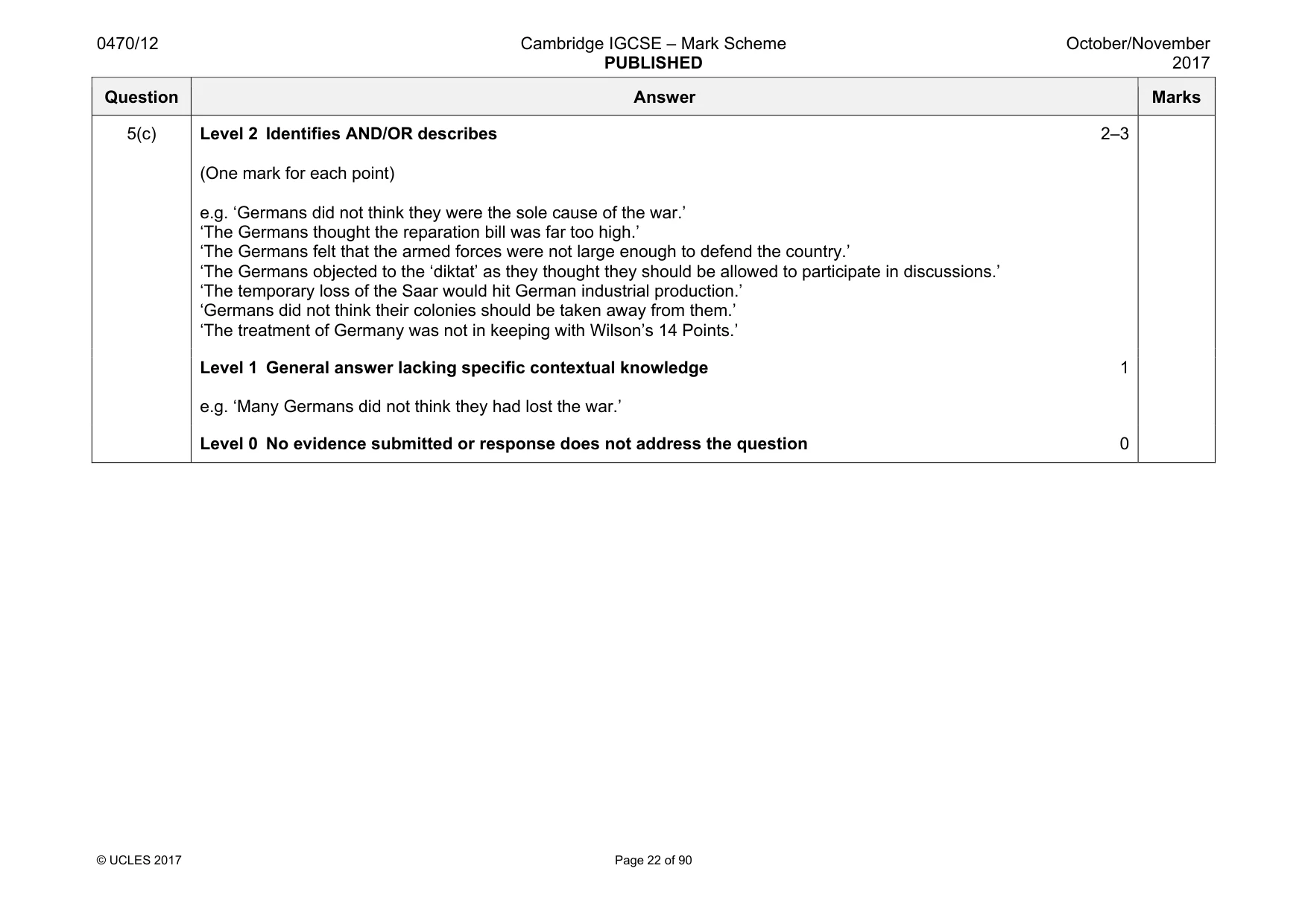
0470/12 Cambridge IGCSE – Mark Scheme PUBLISHED October/November 2017 © UCLES 2017 Page 22 of 90 Question Answer Marks 5(c) Level 2 Identifies AND/OR describes 2–3 (One mark for each point) e.g. ‘Germans did not think they were the sole cause of the war.’ ‘The Germans thought the reparation bill was far too high.’ ‘The Germans felt that the armed forces were not large enough to defend the country.’ ‘The Germans objected to the ‘diktat’ as they thought they should be allowed to participate in discussions.’ ‘The temporary loss of the Saar would hit German industrial production.’ ‘Germans did not think their colonies should be taken away from them.’ ‘The treatment of Germany was not in keeping with Wilson’s 14 Points.’ Level 1 General answer lacking specific contextual knowledge 1 e.g. ‘Many Germans did not think they had lost the war.’ Level 0 No evidence submitted or response does not address the question 0
Mark scheme, page 23
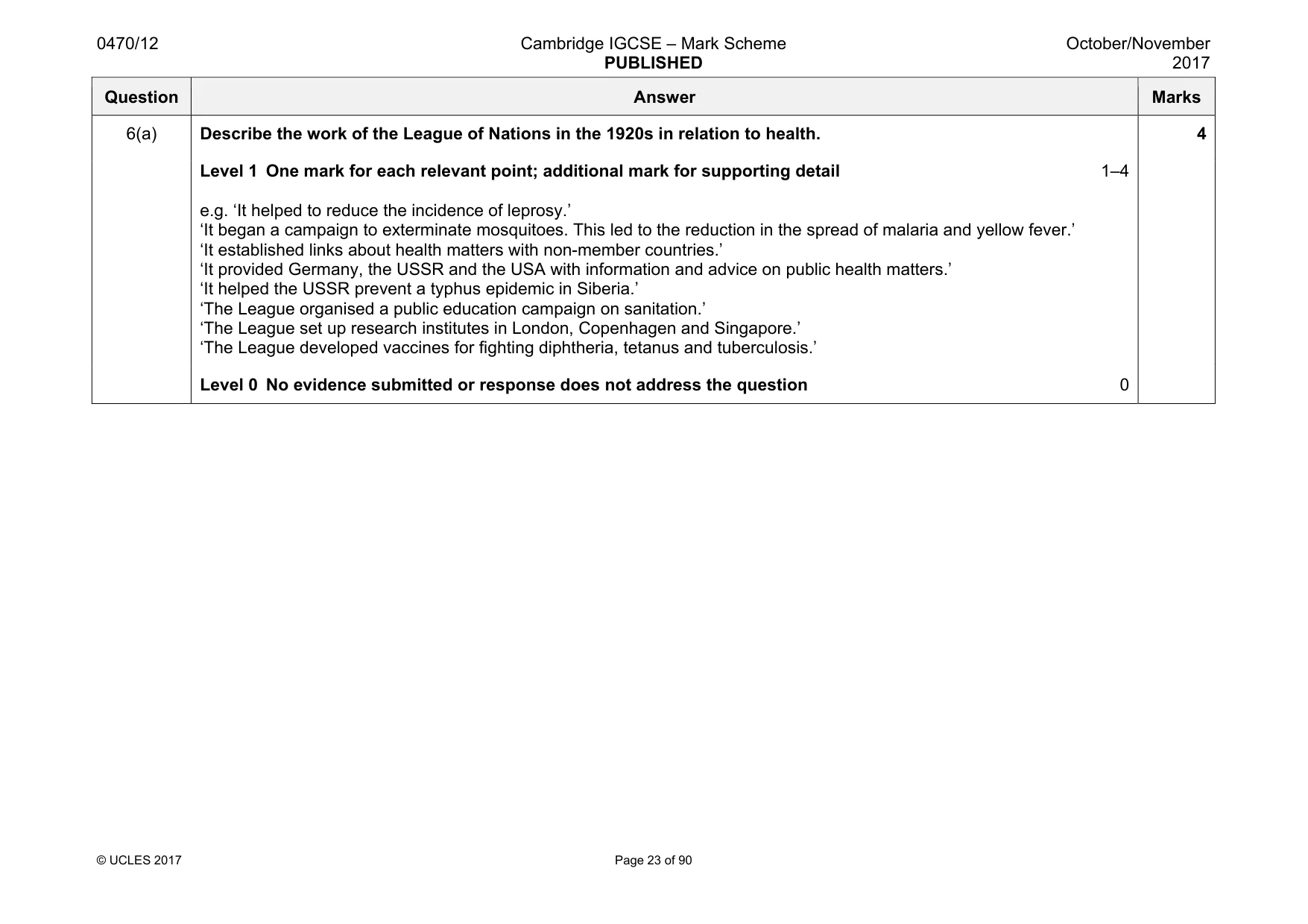
0470/12 Cambridge IGCSE – Mark Scheme PUBLISHED October/November 2017 © UCLES 2017 Page 23 of 90 Question Answer Marks 6(a) Describe the work of the League of Nations in the 1920s in relation to health. 4 Level 1 One mark for each relevant point; additional mark for supporting detail 1–4 e.g. ‘It helped to reduce the incidence of leprosy.’ ‘It began a campaign to exterminate mosquitoes. This led to the reduction in the spread of malaria and yellow fever.’ ‘It established links about health matters with non-member countries.’ ‘It provided Germany, the USSR and the USA with information and advice on public health matters.’ ‘It helped the USSR prevent a typhus epidemic in Siberia.’ ‘The League organised a public education campaign on sanitation.’ ‘The League set up research institutes in London, Copenhagen and Singapore.’ ‘The League developed vaccines for fighting diphtheria, tetanus and tuberculosis.’ Level 0 No evidence submitted or response does not address the question 0
Mark scheme, page 24
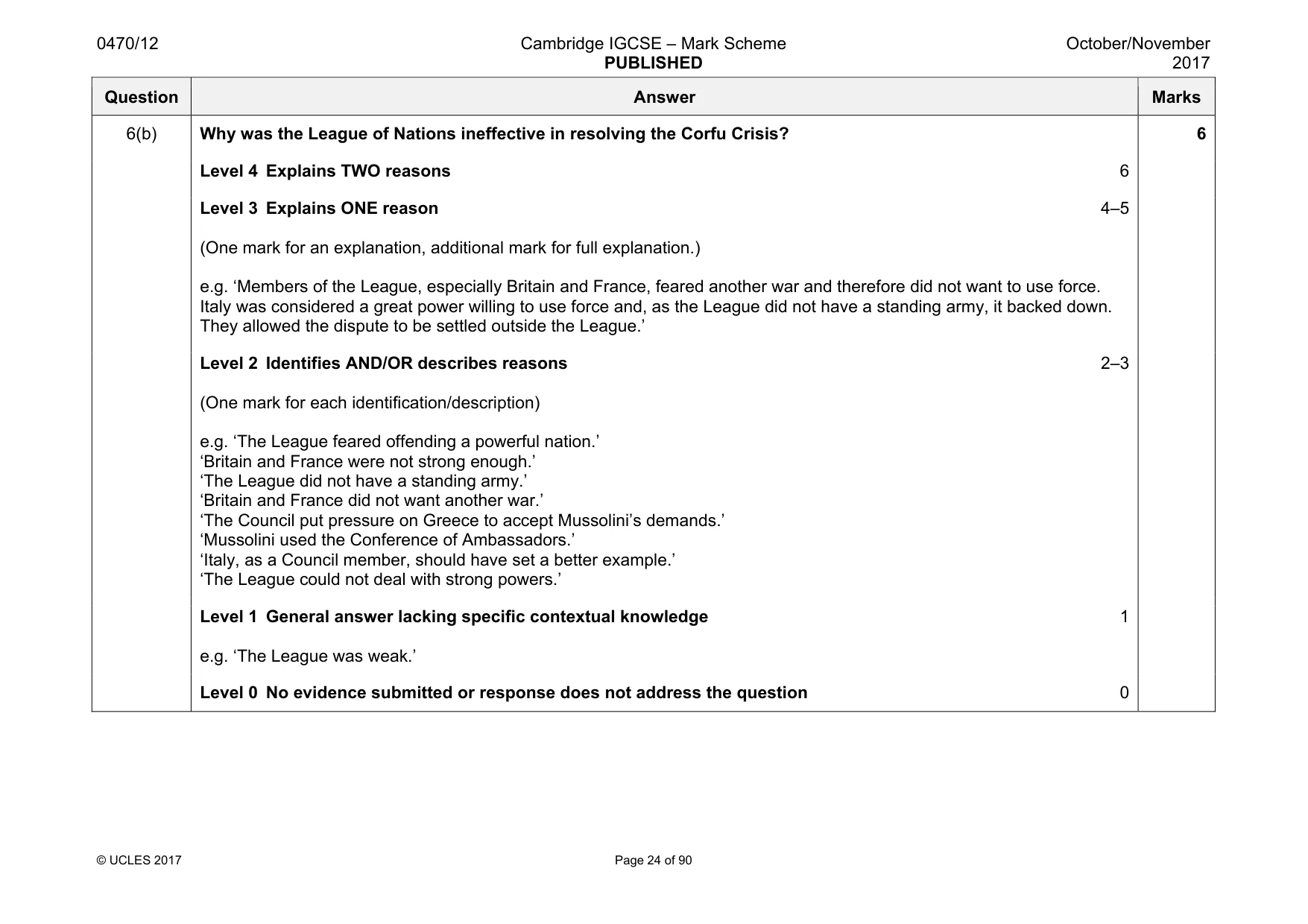
0470/12 Cambridge IGCSE – Mark Scheme PUBLISHED October/November 2017 © UCLES 2017 Page 24 of 90 Question Answer Marks 6(b) Why was the League of Nations ineffective in resolving the Corfu Crisis? 6 Level 4 Explains TWO reasons 6 Level 3 Explains ONE reason 4–5 (One mark for an explanation, additional mark for full explanation.) e.g. ‘Members of the League, especially Britain and France, feared another war and therefore did not want to use force. Italy was considered a great power willing to use force and, as the League did not have a standing army, it backed down. They allowed the dispute to be settled outside the League.’ Level 2 Identifies AND/OR describes reasons 2–3 (One mark for each identification/description) e.g. ‘The League feared offending a powerful nation.’ ‘Britain and France were not strong enough.’ ‘The League did not have a standing army.’ ‘Britain and France did not want another war.’ ‘The Council put pressure on Greece to accept Mussolini’s demands.’ ‘Mussolini used the Conference of Ambassadors.’ ‘Italy, as a Council member, should have set a better example.’ ‘The League could not deal with strong powers.’ Level 1 General answer lacking specific contextual knowledge 1 e.g. ‘The League was weak.’ Level 0 No evidence submitted or response does not address the question 0
Mark scheme, page 25
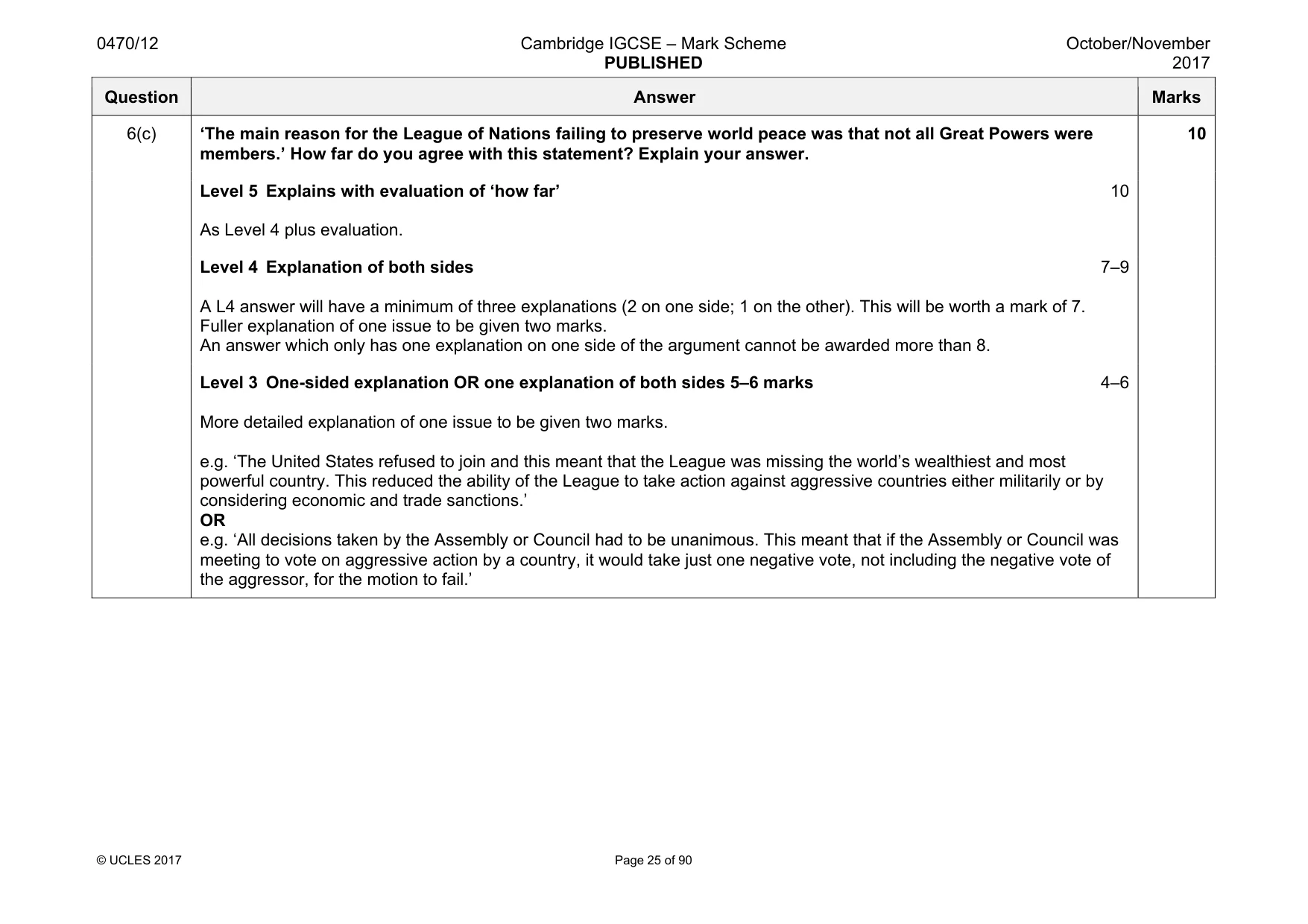
0470/12 Cambridge IGCSE – Mark Scheme PUBLISHED October/November 2017 © UCLES 2017 Page 25 of 90 Question Answer Marks 6(c) ‘The main reason for the League of Nations failing to preserve world peace was that not all Great Powers were members.’ How far do you agree with this statement? Explain your answer. 10 Level 5 Explains with evaluation of ‘how far’ 10 As Level 4 plus evaluation. Level 4 Explanation of both sides 7–9 A L4 answer will have a minimum of three explanations (2 on one side; 1 on the other). This will be worth a mark of 7. Fuller explanation of one issue to be given two marks. An answer which only has one explanation on one side of the argument cannot be awarded more than 8. Level 3 One-sided explanation OR one explanation of both sides 5–6 marks 4–6 More detailed explanation of one issue to be given two marks. e.g. ‘The United States refused to join and this meant that the League was missing the world’s wealthiest and most powerful country. This reduced the ability of the League to take action against aggressive countries either militarily or by considering economic and trade sanctions.’ OR e.g. ‘All decisions taken by the Assembly or Council had to be unanimous. This meant that if the Assembly or Council was meeting to vote on aggressive action by a country, it would take just one negative vote, not including the negative vote of the aggressor, for the motion to fail.’
Mark scheme, page 26
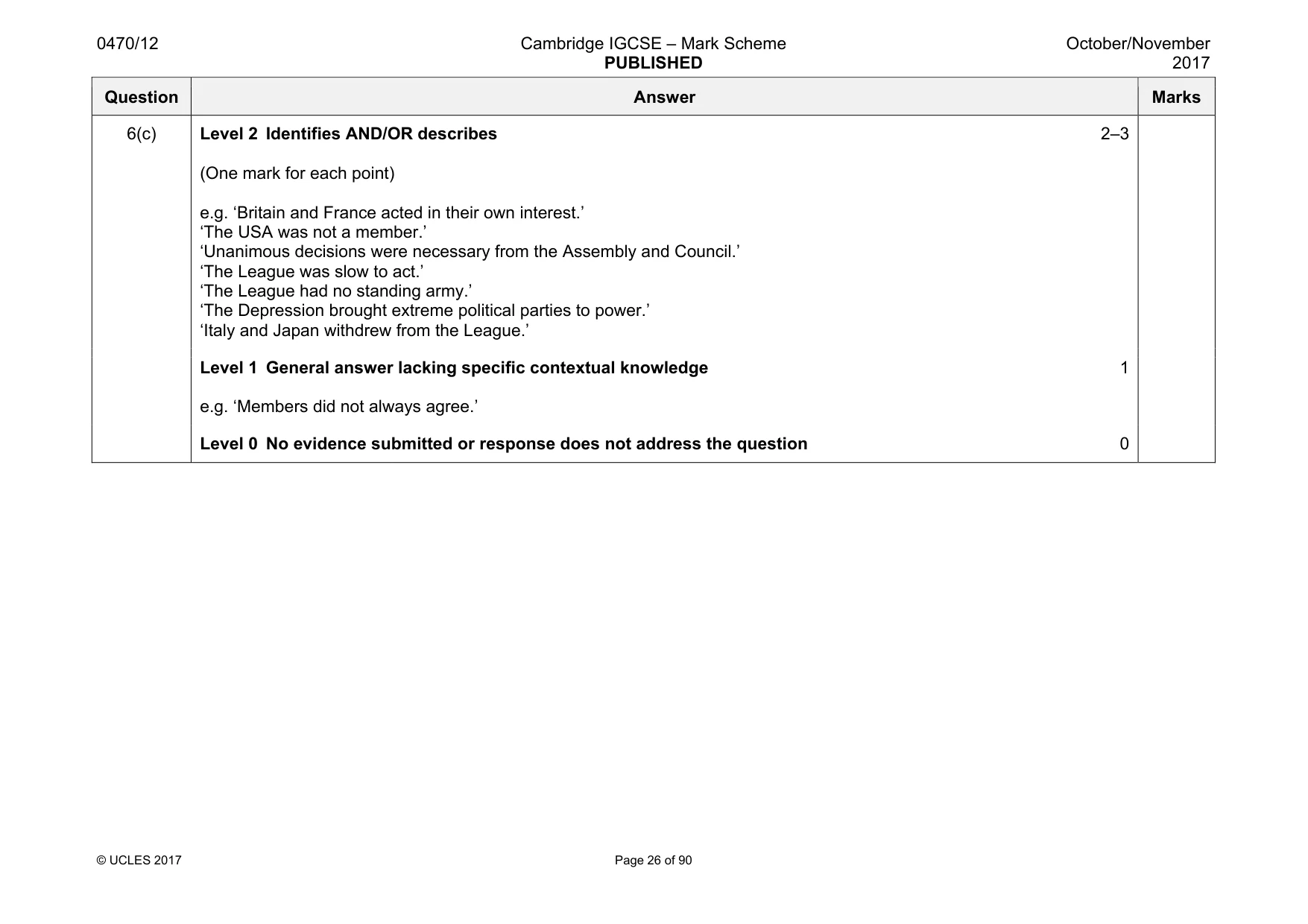
0470/12 Cambridge IGCSE – Mark Scheme PUBLISHED October/November 2017 © UCLES 2017 Page 26 of 90 Question Answer Marks 6(c) Level 2 Identifies AND/OR describes 2–3 (One mark for each point) e.g. ‘Britain and France acted in their own interest.’ ‘The USA was not a member.’ ‘Unanimous decisions were necessary from the Assembly and Council.’ ‘The League was slow to act.’ ‘The League had no standing army.’ ‘The Depression brought extreme political parties to power.’ ‘Italy and Japan withdrew from the League.’ Level 1 General answer lacking specific contextual knowledge 1 e.g. ‘Members did not always agree.’ Level 0 No evidence submitted or response does not address the question 0
Mark scheme, page 27
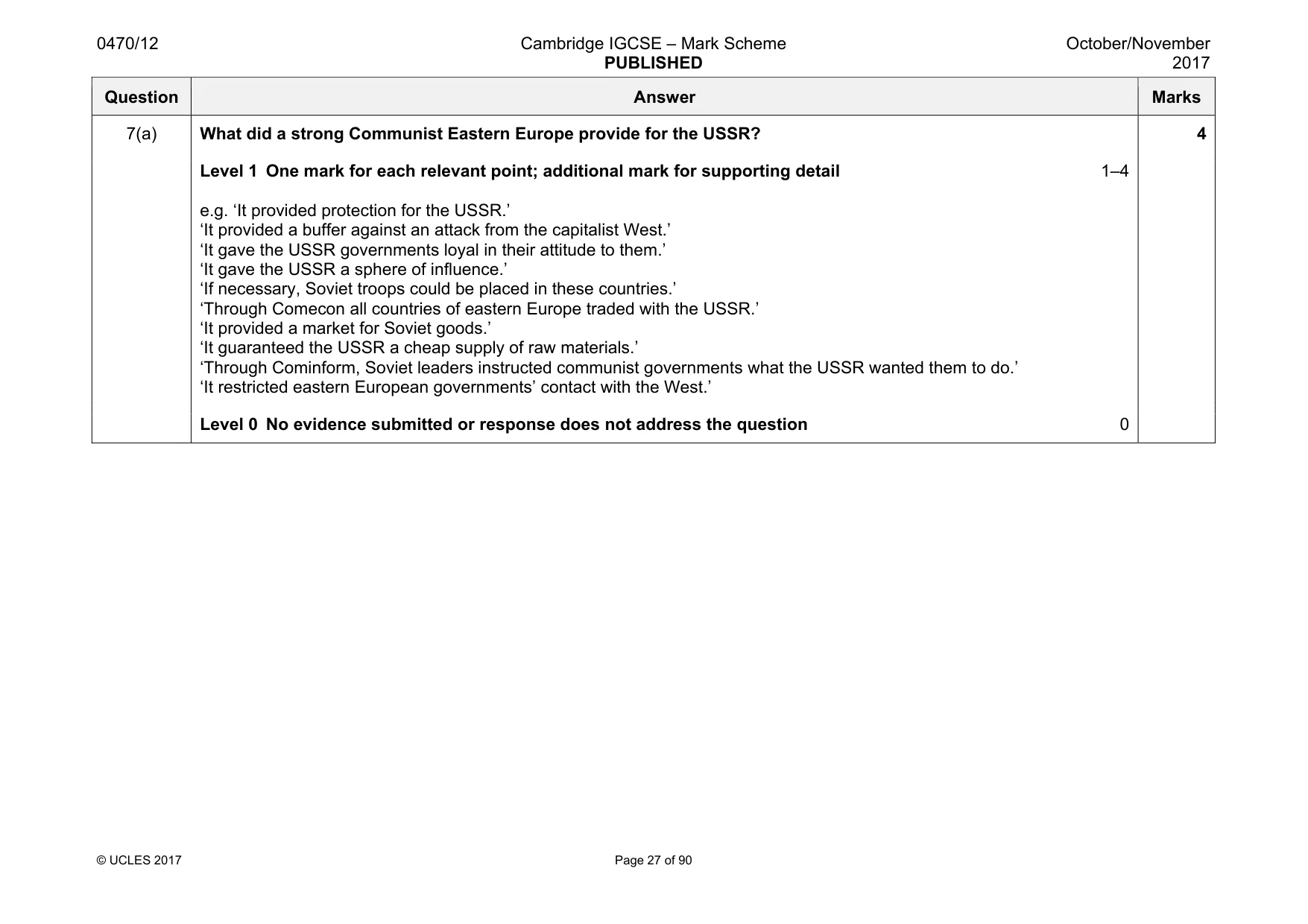
0470/12 Cambridge IGCSE – Mark Scheme PUBLISHED October/November 2017 © UCLES 2017 Page 27 of 90 Question Answer Marks 7(a) What did a strong Communist Eastern Europe provide for the USSR? 4 Level 1 One mark for each relevant point; additional mark for supporting detail 1–4 e.g. ‘It provided protection for the USSR.’ ‘It provided a buffer against an attack from the capitalist West.’ ‘It gave the USSR governments loyal in their attitude to them.’ ‘It gave the USSR a sphere of influence.’ ‘If necessary, Soviet troops could be placed in these countries.’ ‘Through Comecon all countries of eastern Europe traded with the USSR.’ ‘It provided a market for Soviet goods.’ ‘It guaranteed the USSR a cheap supply of raw materials.’ ‘Through Cominform, Soviet leaders instructed communist governments what the USSR wanted them to do.’ ‘It restricted eastern European governments’ contact with the West.’ Level 0 No evidence submitted or response does not address the question 0
Mark scheme, page 28
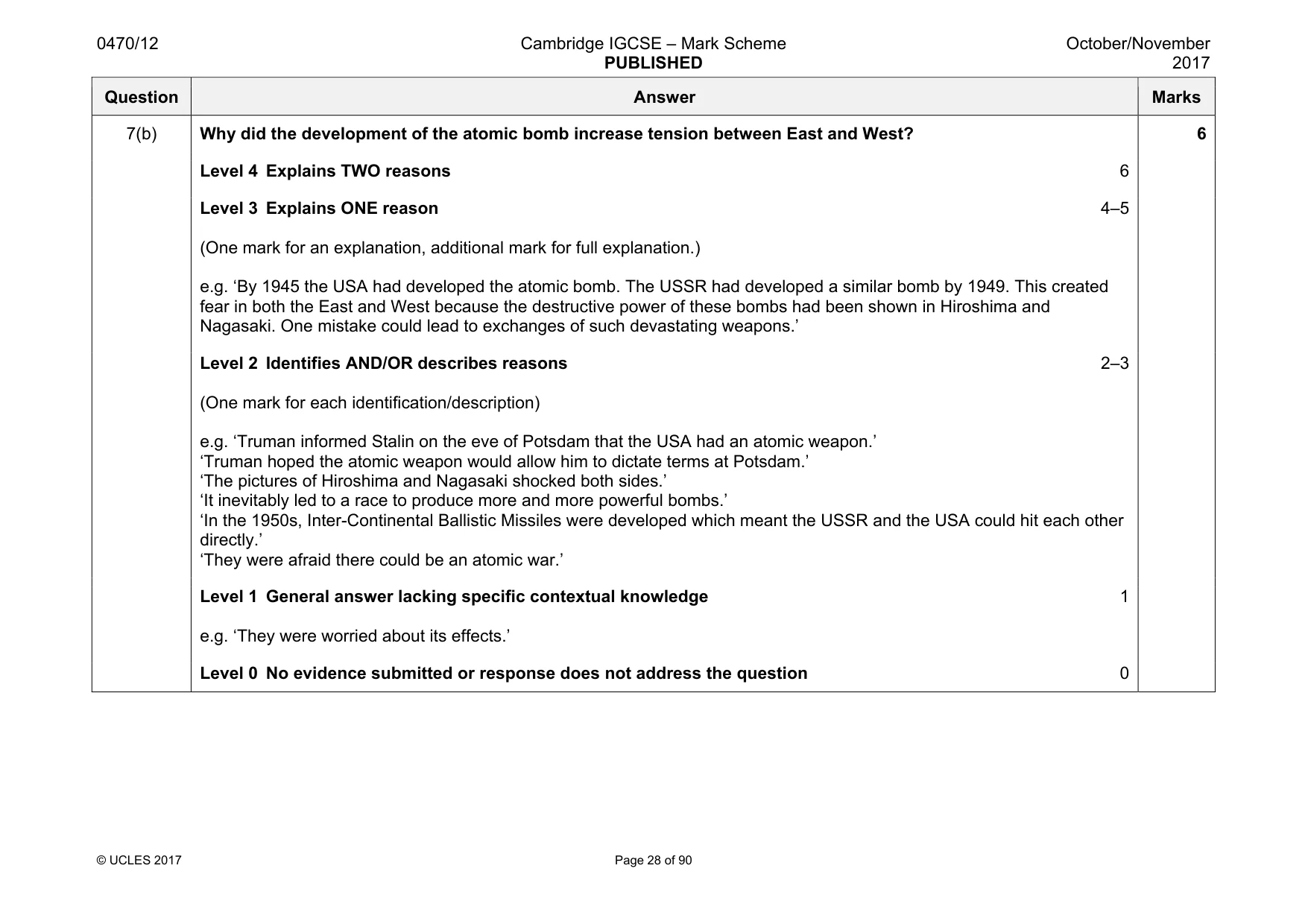
0470/12 Cambridge IGCSE – Mark Scheme PUBLISHED October/November 2017 © UCLES 2017 Page 28 of 90 Question Answer Marks 7(b) Why did the development of the atomic bomb increase tension between East and West? 6 Level 4 Explains TWO reasons 6 Level 3 Explains ONE reason 4–5 (One mark for an explanation, additional mark for full explanation.) e.g. ‘By 1945 the USA had developed the atomic bomb. The USSR had developed a similar bomb by 1949. This created fear in both the East and West because the destructive power of these bombs had been shown in Hiroshima and Nagasaki. One mistake could lead to exchanges of such devastating weapons.’ Level 2 Identifies AND/OR describes reasons 2–3 (One mark for each identification/description) e.g. ‘Truman informed Stalin on the eve of Potsdam that the USA had an atomic weapon.’ ‘Truman hoped the atomic weapon would allow him to dictate terms at Potsdam.’ ‘The pictures of Hiroshima and Nagasaki shocked both sides.’ ‘It inevitably led to a race to produce more and more powerful bombs.’ ‘In the 1950s, Inter-Continental Ballistic Missiles were developed which meant the USSR and the USA could hit each other directly.’ ‘They were afraid there could be an atomic war.’ Level 1 General answer lacking specific contextual knowledge 1 e.g. ‘They were worried about its effects.’ Level 0 No evidence submitted or response does not address the question 0
Mark scheme, page 29
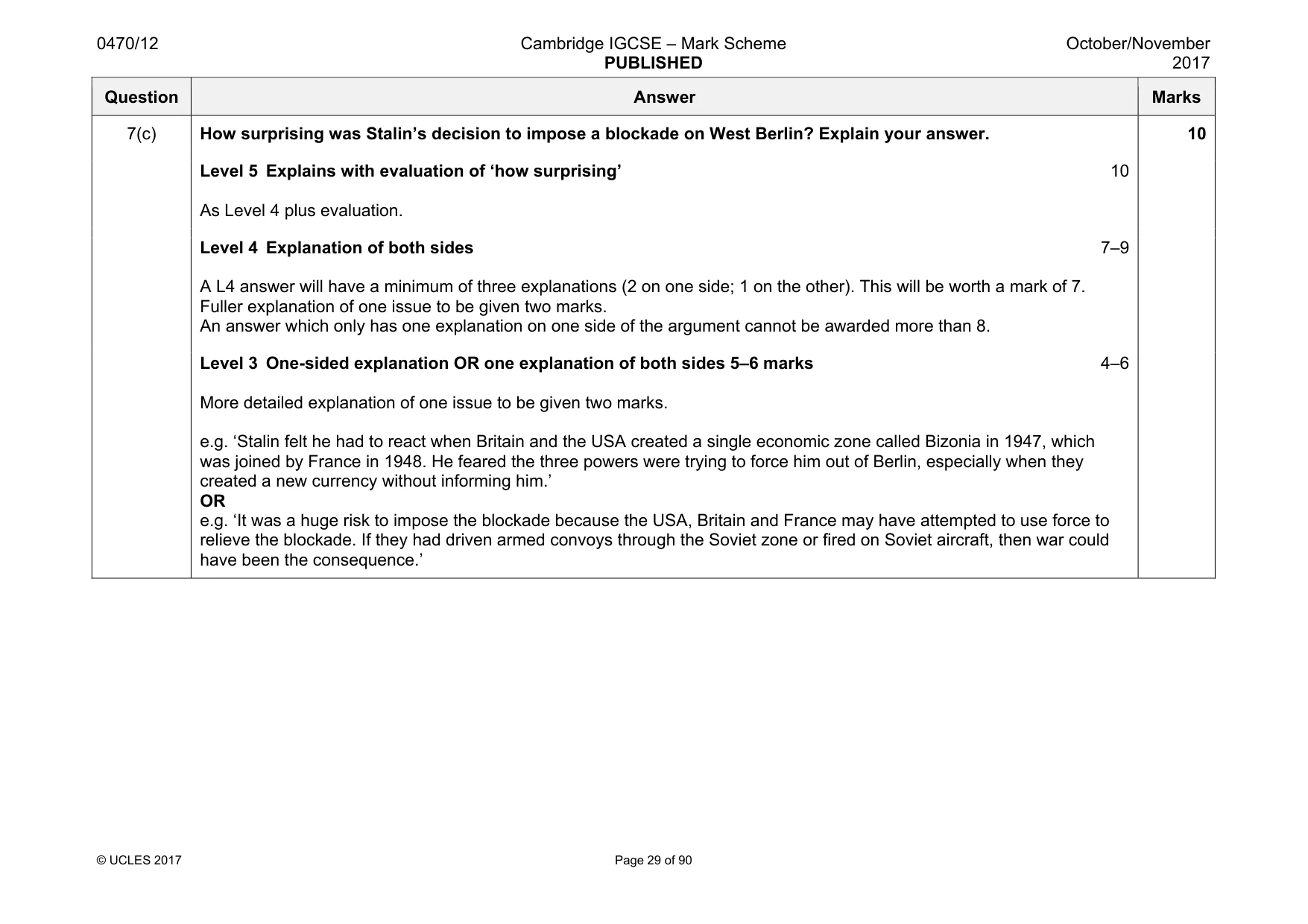
0470/12 Cambridge IGCSE – Mark Scheme PUBLISHED October/November 2017 © UCLES 2017 Page 29 of 90 Question Answer Marks 7(c) How surprising was Stalin’s decision to impose a blockade on West Berlin? Explain your answer. 10 Level 5 Explains with evaluation of ‘how surprising’ 10 As Level 4 plus evaluation. Level 4 Explanation of both sides 7–9 A L4 answer will have a minimum of three explanations (2 on one side; 1 on the other). This will be worth a mark of 7. Fuller explanation of one issue to be given two marks. An answer which only has one explanation on one side of the argument cannot be awarded more than 8. Level 3 One-sided explanation OR one explanation of both sides 5–6 marks 4–6 More detailed explanation of one issue to be given two marks. e.g. ‘Stalin felt he had to react when Britain and the USA created a single economic zone called Bizonia in 1947, which was joined by France in 1948. He feared the three powers were trying to force him out of Berlin, especially when they created a new currency without informing him.’ OR e.g. ‘It was a huge risk to impose the blockade because the USA, Britain and France may have attempted to use force to relieve the blockade. If they had driven armed convoys through the Soviet zone or fired on Soviet aircraft, then war could have been the consequence.’
Mark scheme, page 30
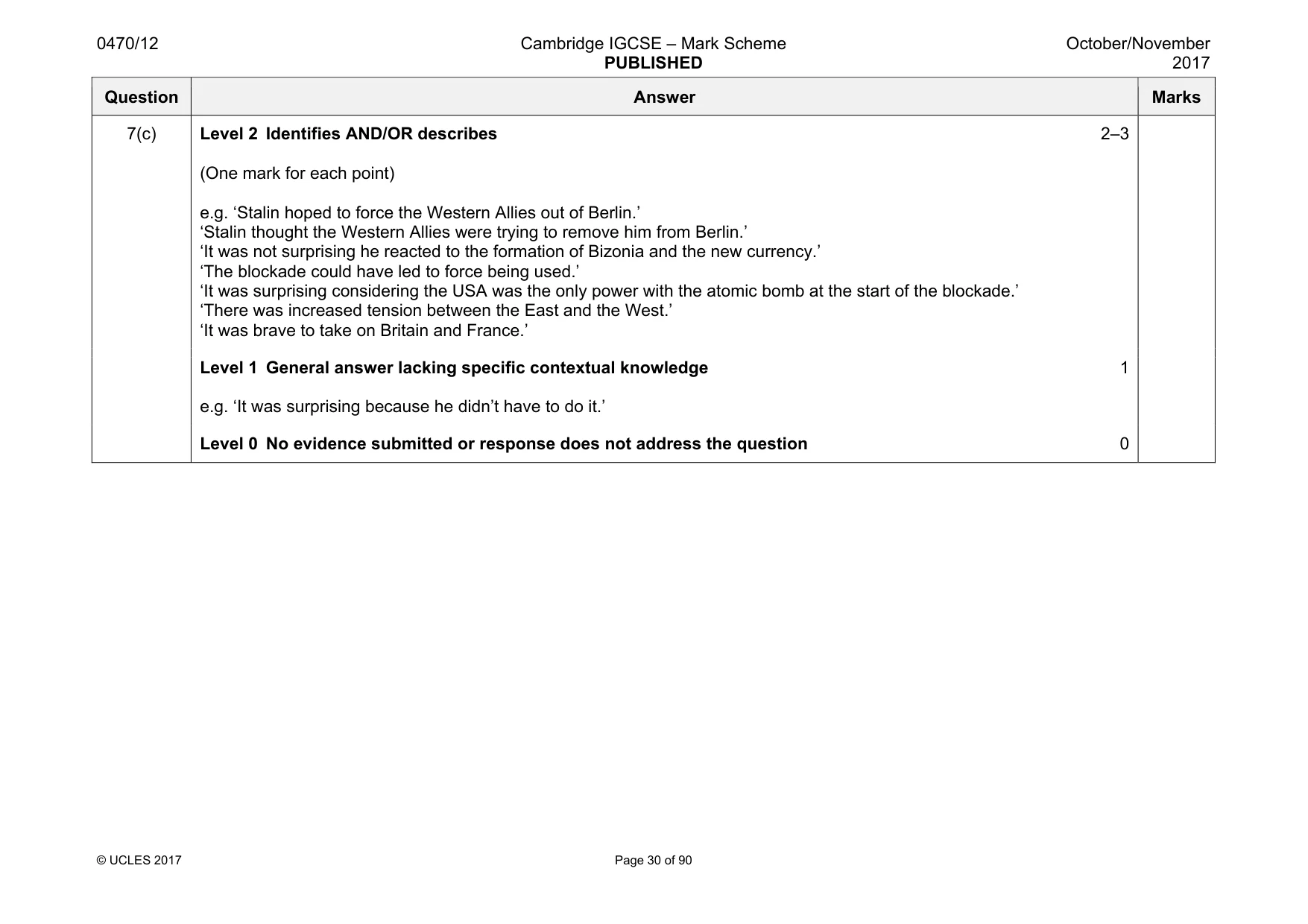
0470/12 Cambridge IGCSE – Mark Scheme PUBLISHED October/November 2017 © UCLES 2017 Page 30 of 90 Question Answer Marks 7(c) Level 2 Identifies AND/OR describes 2–3 (One mark for each point) e.g. ‘Stalin hoped to force the Western Allies out of Berlin.’ ‘Stalin thought the Western Allies were trying to remove him from Berlin.’ ‘It was not surprising he reacted to the formation of Bizonia and the new currency.’ ‘The blockade could have led to force being used.’ ‘It was surprising considering the USA was the only power with the atomic bomb at the start of the blockade.’ ‘There was increased tension between the East and the West.’ ‘It was brave to take on Britain and France.’ Level 1 General answer lacking specific contextual knowledge 1 e.g. ‘It was surprising because he didn’t have to do it.’ Level 0 No evidence submitted or response does not address the question 0
Mark scheme, page 31
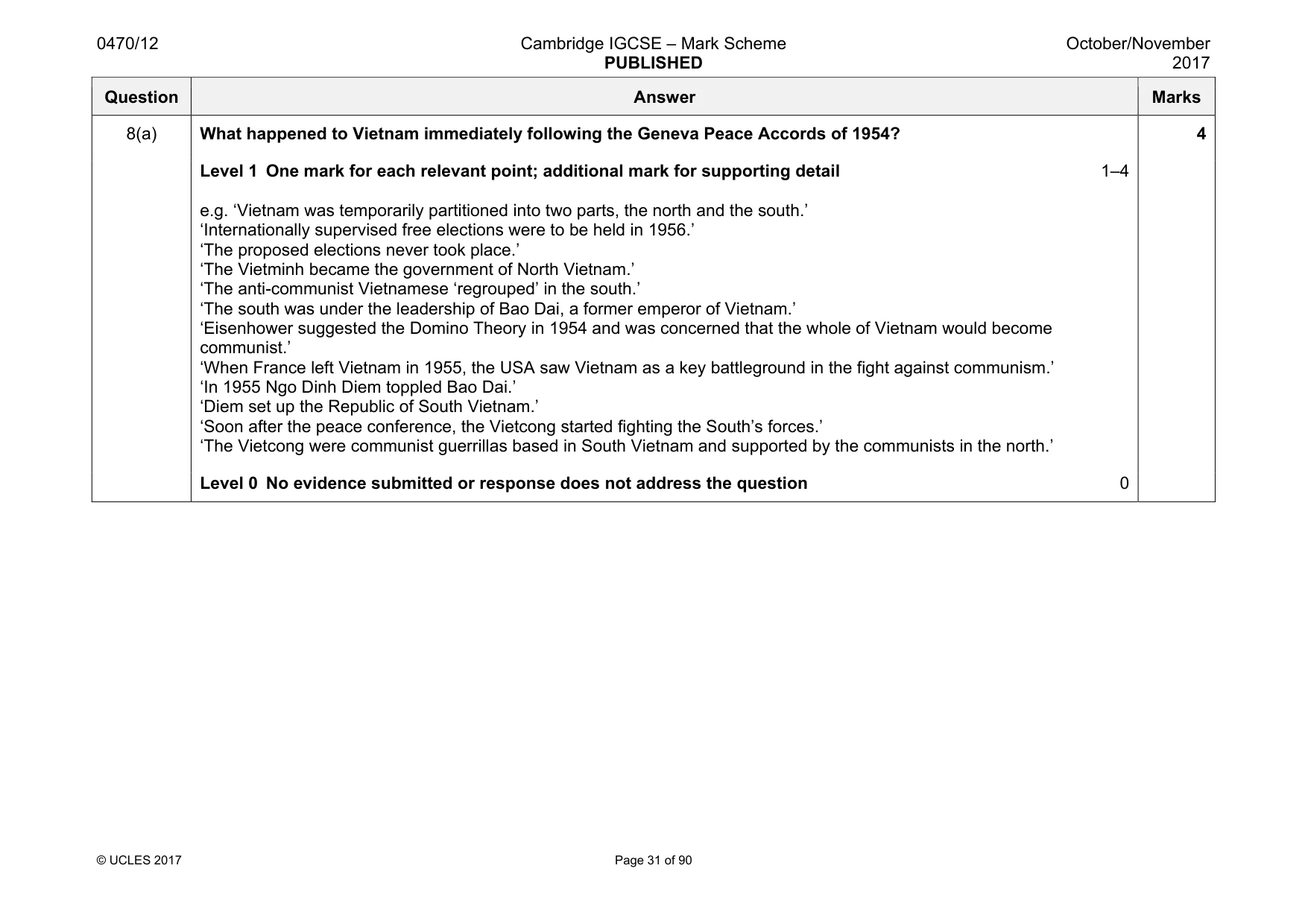
0470/12 Cambridge IGCSE – Mark Scheme PUBLISHED October/November 2017 © UCLES 2017 Page 31 of 90 Question Answer Marks 8(a) What happened to Vietnam immediately following the Geneva Peace Accords of 1954? 4 Level 1 One mark for each relevant point; additional mark for supporting detail 1–4 e.g. ‘Vietnam was temporarily partitioned into two parts, the north and the south.’ ‘Internationally supervised free elections were to be held in 1956.’ ‘The proposed elections never took place.’ ‘The Vietminh became the government of North Vietnam.’ ‘The anti-communist Vietnamese ‘regrouped’ in the south.’ ‘The south was under the leadership of Bao Dai, a former emperor of Vietnam.’ ‘Eisenhower suggested the Domino Theory in 1954 and was concerned that the whole of Vietnam would become communist.’ ‘When France left Vietnam in 1955, the USA saw Vietnam as a key battleground in the fight against communism.’ ‘In 1955 Ngo Dinh Diem toppled Bao Dai.’ ‘Diem set up the Republic of South Vietnam.’ ‘Soon after the peace conference, the Vietcong started fighting the South’s forces.’ ‘The Vietcong were communist guerrillas based in South Vietnam and supported by the communists in the north.’ Level 0 No evidence submitted or response does not address the question 0
Mark scheme, page 32
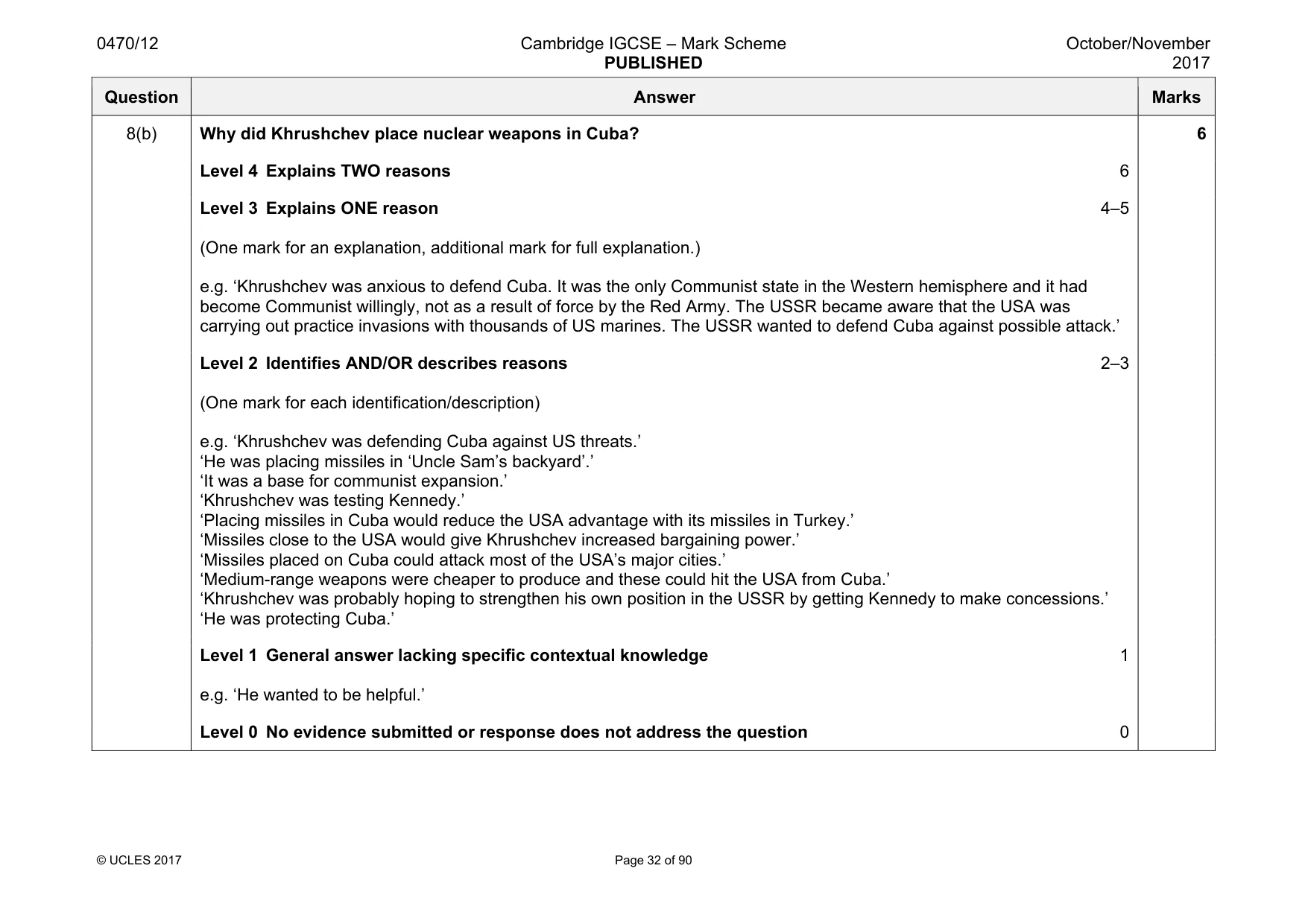
0470/12 Cambridge IGCSE – Mark Scheme PUBLISHED October/November 2017 © UCLES 2017 Page 32 of 90 Question Answer Marks 8(b) Why did Khrushchev place nuclear weapons in Cuba? 6 Level 4 Explains TWO reasons 6 Level 3 Explains ONE reason 4–5 (One mark for an explanation, additional mark for full explanation.) e.g. ‘Khrushchev was anxious to defend Cuba. It was the only Communist state in the Western hemisphere and it had become Communist willingly, not as a result of force by the Red Army. The USSR became aware that the USA was carrying out practice invasions with thousands of US marines. The USSR wanted to defend Cuba against possible attack.’ Level 2 Identifies AND/OR describes reasons 2–3 (One mark for each identification/description) e.g. ‘Khrushchev was defending Cuba against US threats.’ ‘He was placing missiles in ‘Uncle Sam’s backyard’.’ ‘It was a base for communist expansion.’ ‘Khrushchev was testing Kennedy.’ ‘Placing missiles in Cuba would reduce the USA advantage with its missiles in Turkey.’ ‘Missiles close to the USA would give Khrushchev increased bargaining power.’ ‘Missiles placed on Cuba could attack most of the USA’s major cities.’ ‘Medium-range weapons were cheaper to produce and these could hit the USA from Cuba.’ ‘Khrushchev was probably hoping to strengthen his own position in the USSR by getting Kennedy to make concessions.’ ‘He was protecting Cuba.’ Level 1 General answer lacking specific contextual knowledge 1 e.g. ‘He wanted to be helpful.’ Level 0 No evidence submitted or response does not address the question 0
Mark scheme, page 33
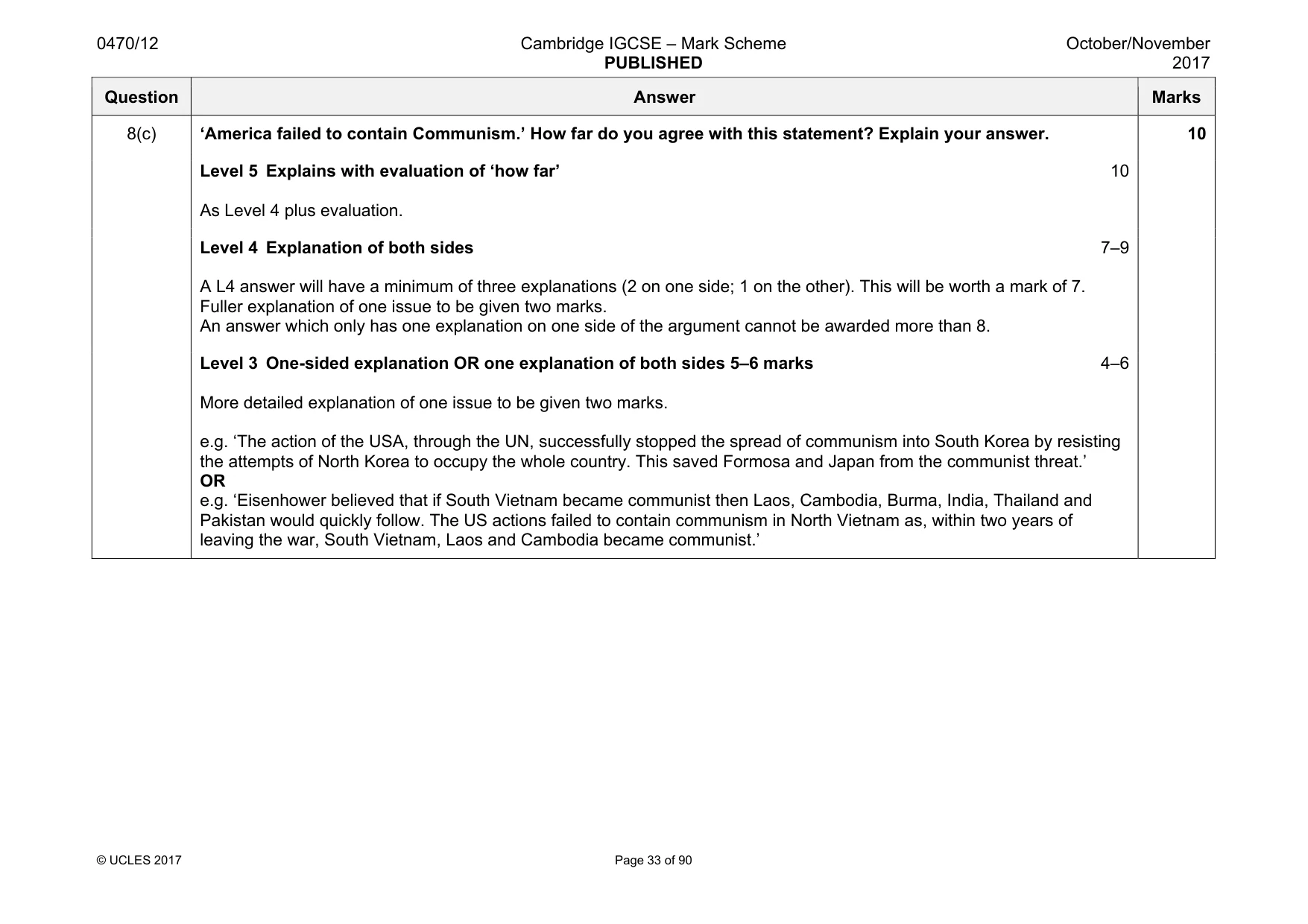
0470/12 Cambridge IGCSE – Mark Scheme PUBLISHED October/November 2017 © UCLES 2017 Page 33 of 90 Question Answer Marks 8(c) ‘America failed to contain Communism.’ How far do you agree with this statement? Explain your answer. 10 Level 5 Explains with evaluation of ‘how far’ 10 As Level 4 plus evaluation. Level 4 Explanation of both sides 7–9 A L4 answer will have a minimum of three explanations (2 on one side; 1 on the other). This will be worth a mark of 7. Fuller explanation of one issue to be given two marks. An answer which only has one explanation on one side of the argument cannot be awarded more than 8. Level 3 One-sided explanation OR one explanation of both sides 5–6 marks 4–6 More detailed explanation of one issue to be given two marks. e.g. ‘The action of the USA, through the UN, successfully stopped the spread of communism into South Korea by resisting the attempts of North Korea to occupy the whole country. This saved Formosa and Japan from the communist threat.’ OR e.g. ‘Eisenhower believed that if South Vietnam became communist then Laos, Cambodia, Burma, India, Thailand and Pakistan would quickly follow. The US actions failed to contain communism in North Vietnam as, within two years of leaving the war, South Vietnam, Laos and Cambodia became communist.’
Mark scheme, page 34
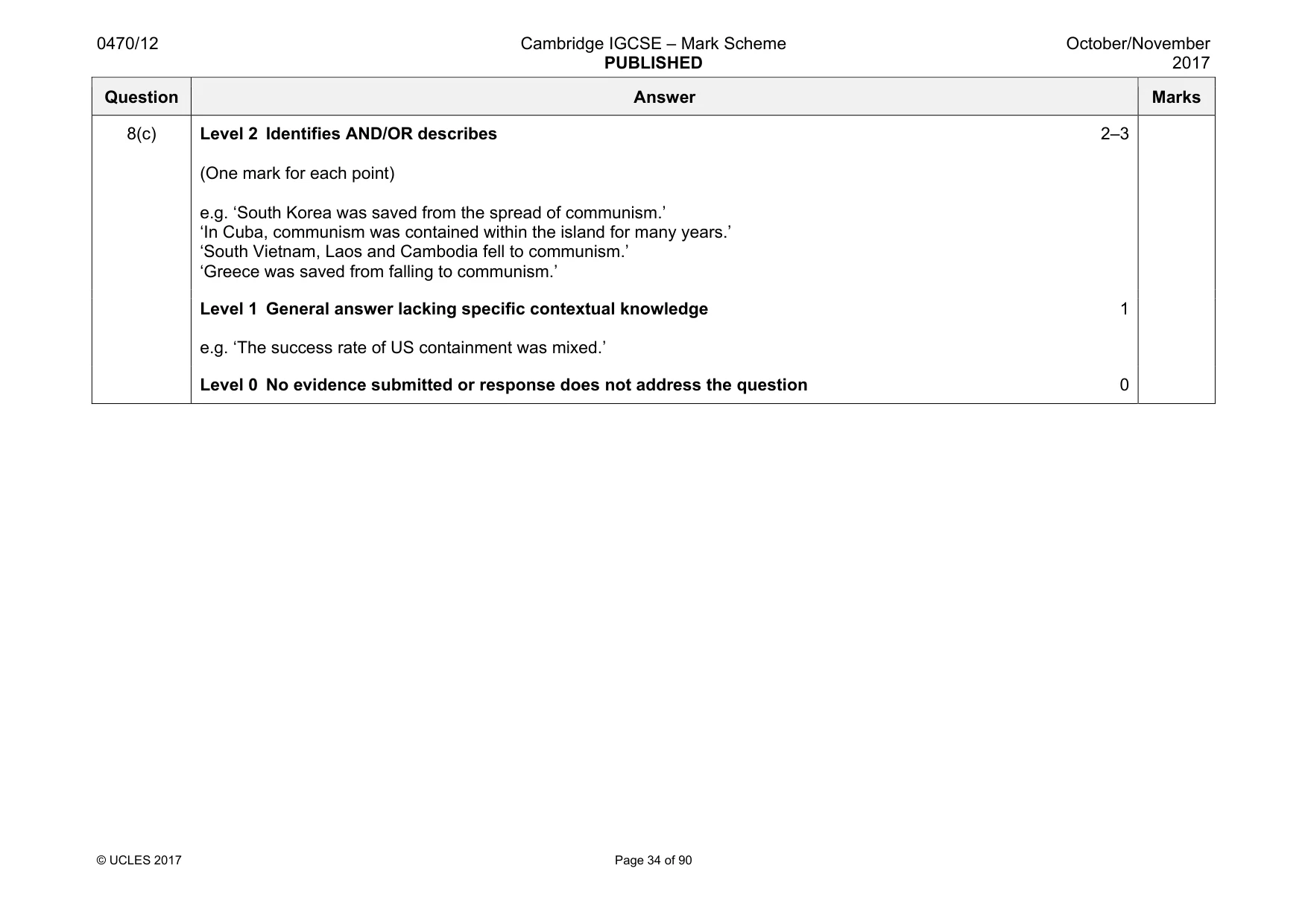
0470/12 Cambridge IGCSE – Mark Scheme PUBLISHED October/November 2017 © UCLES 2017 Page 34 of 90 Question Answer Marks 8(c) Level 2 Identifies AND/OR describes 2–3 (One mark for each point) e.g. ‘South Korea was saved from the spread of communism.’ ‘In Cuba, communism was contained within the island for many years.’ ‘South Vietnam, Laos and Cambodia fell to communism.’ ‘Greece was saved from falling to communism.’ Level 1 General answer lacking specific contextual knowledge 1 e.g. ‘The success rate of US containment was mixed.’ Level 0 No evidence submitted or response does not address the question 0
Mark scheme, page 35
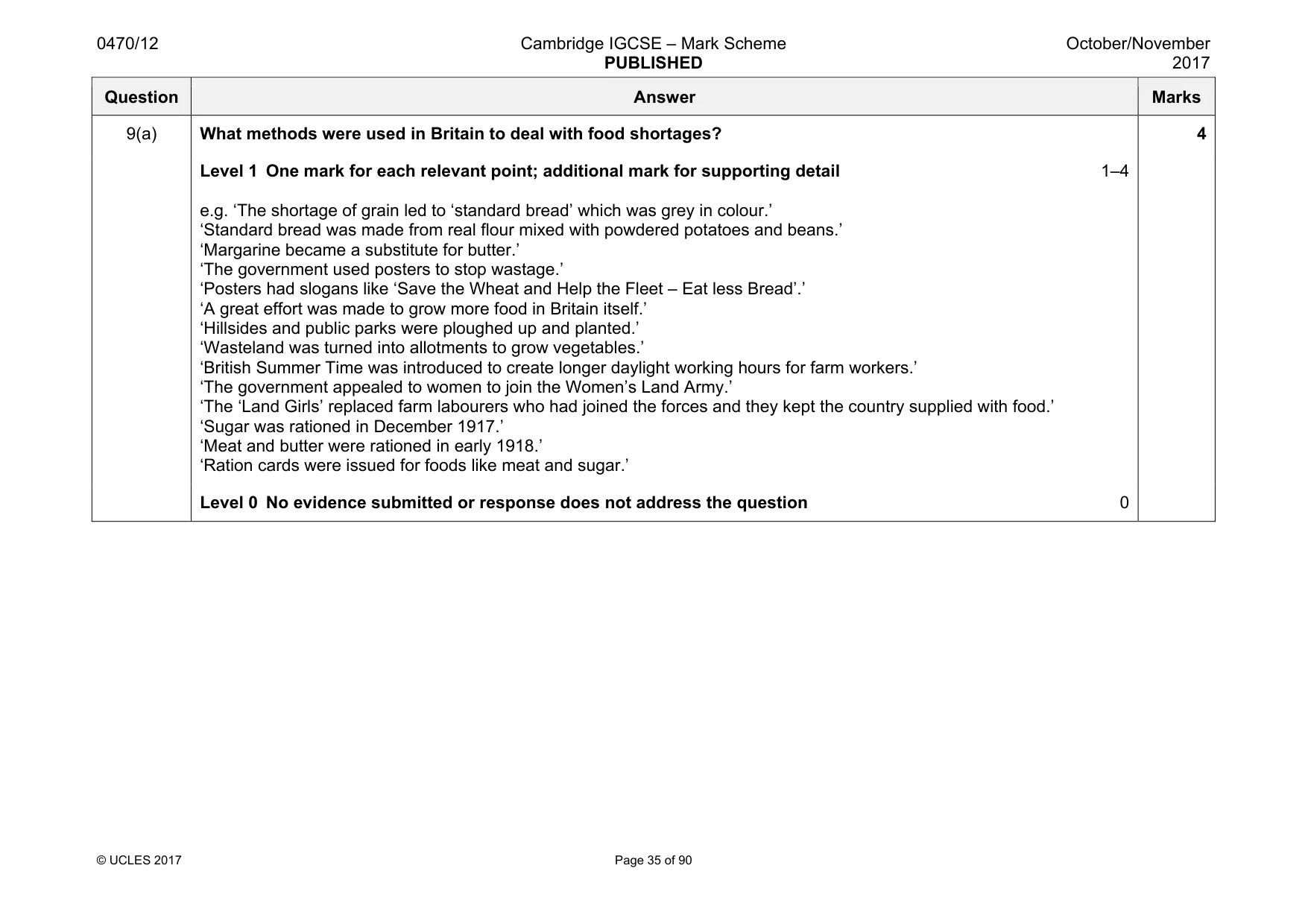
0470/12 Cambridge IGCSE – Mark Scheme PUBLISHED October/November 2017 © UCLES 2017 Page 35 of 90 Question Answer Marks 9(a) What methods were used in Britain to deal with food shortages? 4 Level 1 One mark for each relevant point; additional mark for supporting detail 1–4 e.g. ‘The shortage of grain led to ‘standard bread’ which was grey in colour.’ ‘Standard bread was made from real flour mixed with powdered potatoes and beans.’ ‘Margarine became a substitute for butter.’ ‘The government used posters to stop wastage.’ ‘Posters had slogans like ‘Save the Wheat and Help the Fleet – Eat less Bread’.’ ‘A great effort was made to grow more food in Britain itself.’ ‘Hillsides and public parks were ploughed up and planted.’ ‘Wasteland was turned into allotments to grow vegetables.’ ‘British Summer Time was introduced to create longer daylight working hours for farm workers.’ ‘The government appealed to women to join the Women’s Land Army.’ ‘The ‘Land Girls’ replaced farm labourers who had joined the forces and they kept the country supplied with food.’ ‘Sugar was rationed in December 1917.’ ‘Meat and butter were rationed in early 1918.’ ‘Ration cards were issued for foods like meat and sugar.’ Level 0 No evidence submitted or response does not address the question 0
Mark scheme, page 36
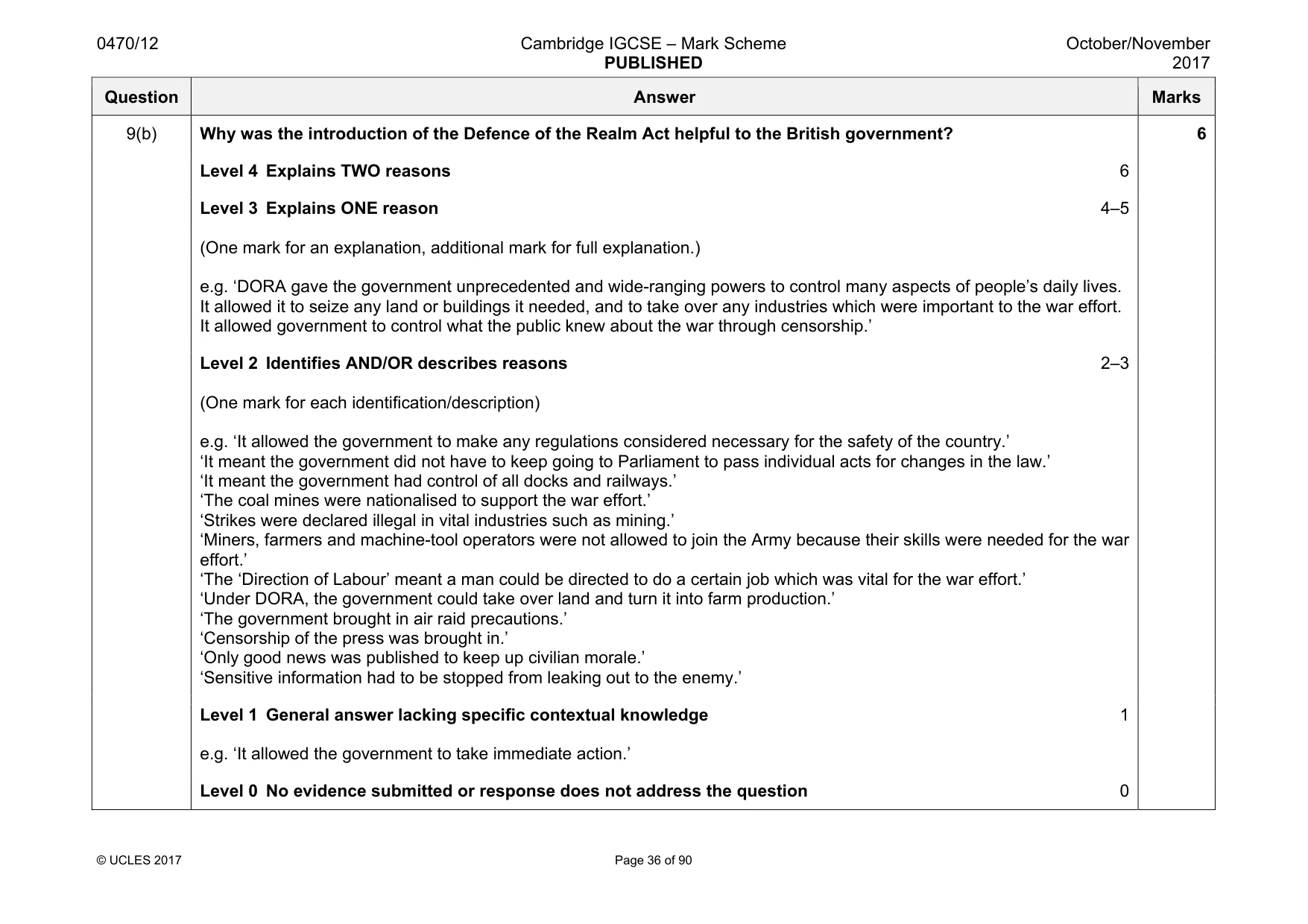
0470/12 Cambridge IGCSE – Mark Scheme PUBLISHED October/November 2017 © UCLES 2017 Page 36 of 90 Question Answer Marks 9(b) Why was the introduction of the Defence of the Realm Act helpful to the British government? 6 Level 4 Explains TWO reasons 6 Level 3 Explains ONE reason 4–5 (One mark for an explanation, additional mark for full explanation.) e.g. ‘DORA gave the government unprecedented and wide-ranging powers to control many aspects of people’s daily lives. It allowed it to seize any land or buildings it needed, and to take over any industries which were important to the war effort. It allowed government to control what the public knew about the war through censorship.’ Level 2 Identifies AND/OR describes reasons 2–3 (One mark for each identification/description) e.g. ‘It allowed the government to make any regulations considered necessary for the safety of the country.’ ‘It meant the government did not have to keep going to Parliament to pass individual acts for changes in the law.’ ‘It meant the government had control of all docks and railways.’ ‘The coal mines were nationalised to support the war effort.’ ‘Strikes were declared illegal in vital industries such as mining.’ ‘Miners, farmers and machine-tool operators were not allowed to join the Army because their skills were needed for the war effort.’ ‘The ‘Direction of Labour’ meant a man could be directed to do a certain job which was vital for the war effort.’ ‘Under DORA, the government could take over land and turn it into farm production.’ ‘The government brought in air raid precautions.’ ‘Censorship of the press was brought in.’ ‘Only good news was published to keep up civilian morale.’ ‘Sensitive information had to be stopped from leaking out to the enemy.’ Level 1 General answer lacking specific contextual knowledge 1 e.g. ‘It allowed the government to take immediate action.’ Level 0 No evidence submitted or response does not address the question 0
Mark scheme, page 37
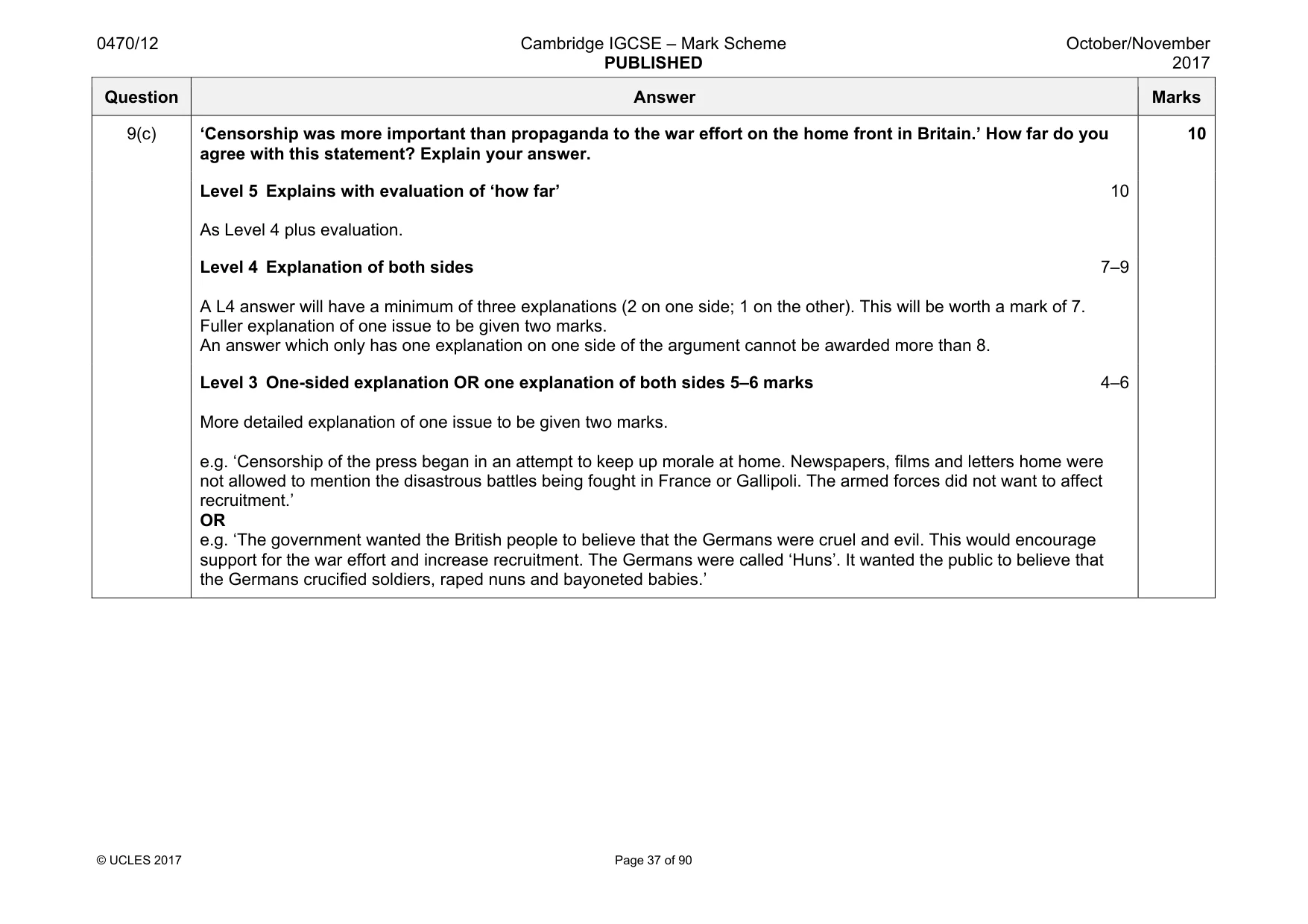
0470/12 Cambridge IGCSE – Mark Scheme PUBLISHED October/November 2017 © UCLES 2017 Page 37 of 90 Question Answer Marks 9(c) ‘Censorship was more important than propaganda to the war effort on the home front in Britain.’ How far do you agree with this statement? Explain your answer. 10 Level 5 Explains with evaluation of ‘how far’ 10 As Level 4 plus evaluation. Level 4 Explanation of both sides 7–9 A L4 answer will have a minimum of three explanations (2 on one side; 1 on the other). This will be worth a mark of 7. Fuller explanation of one issue to be given two marks. An answer which only has one explanation on one side of the argument cannot be awarded more than 8. Level 3 One-sided explanation OR one explanation of both sides 5–6 marks 4–6 More detailed explanation of one issue to be given two marks. e.g. ‘Censorship of the press began in an attempt to keep up morale at home. Newspapers, films and letters home were not allowed to mention the disastrous battles being fought in France or Gallipoli. The armed forces did not want to affect recruitment.’ OR e.g. ‘The government wanted the British people to believe that the Germans were cruel and evil. This would encourage support for the war effort and increase recruitment. The Germans were called ‘Huns’. It wanted the public to believe that the Germans crucified soldiers, raped nuns and bayoneted babies.’
Mark scheme, page 38
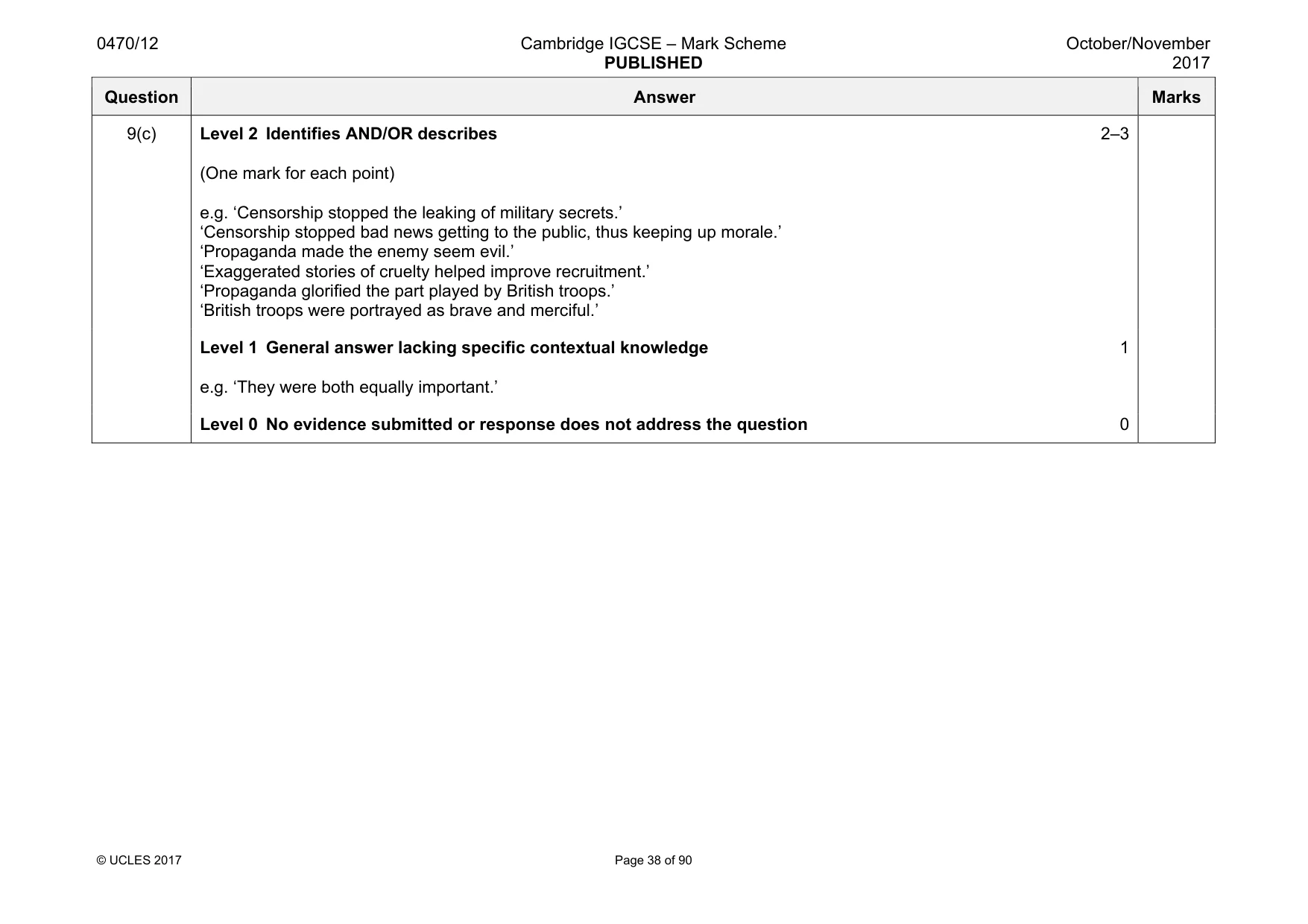
0470/12 Cambridge IGCSE – Mark Scheme PUBLISHED October/November 2017 © UCLES 2017 Page 38 of 90 Question Answer Marks 9(c) Level 2 Identifies AND/OR describes 2–3 (One mark for each point) e.g. ‘Censorship stopped the leaking of military secrets.’ ‘Censorship stopped bad news getting to the public, thus keeping up morale.’ ‘Propaganda made the enemy seem evil.’ ‘Exaggerated stories of cruelty helped improve recruitment.’ ‘Propaganda glorified the part played by British troops.’ ‘British troops were portrayed as brave and merciful.’ Level 1 General answer lacking specific contextual knowledge 1 e.g. ‘They were both equally important.’ Level 0 No evidence submitted or response does not address the question 0
Mark scheme, page 39
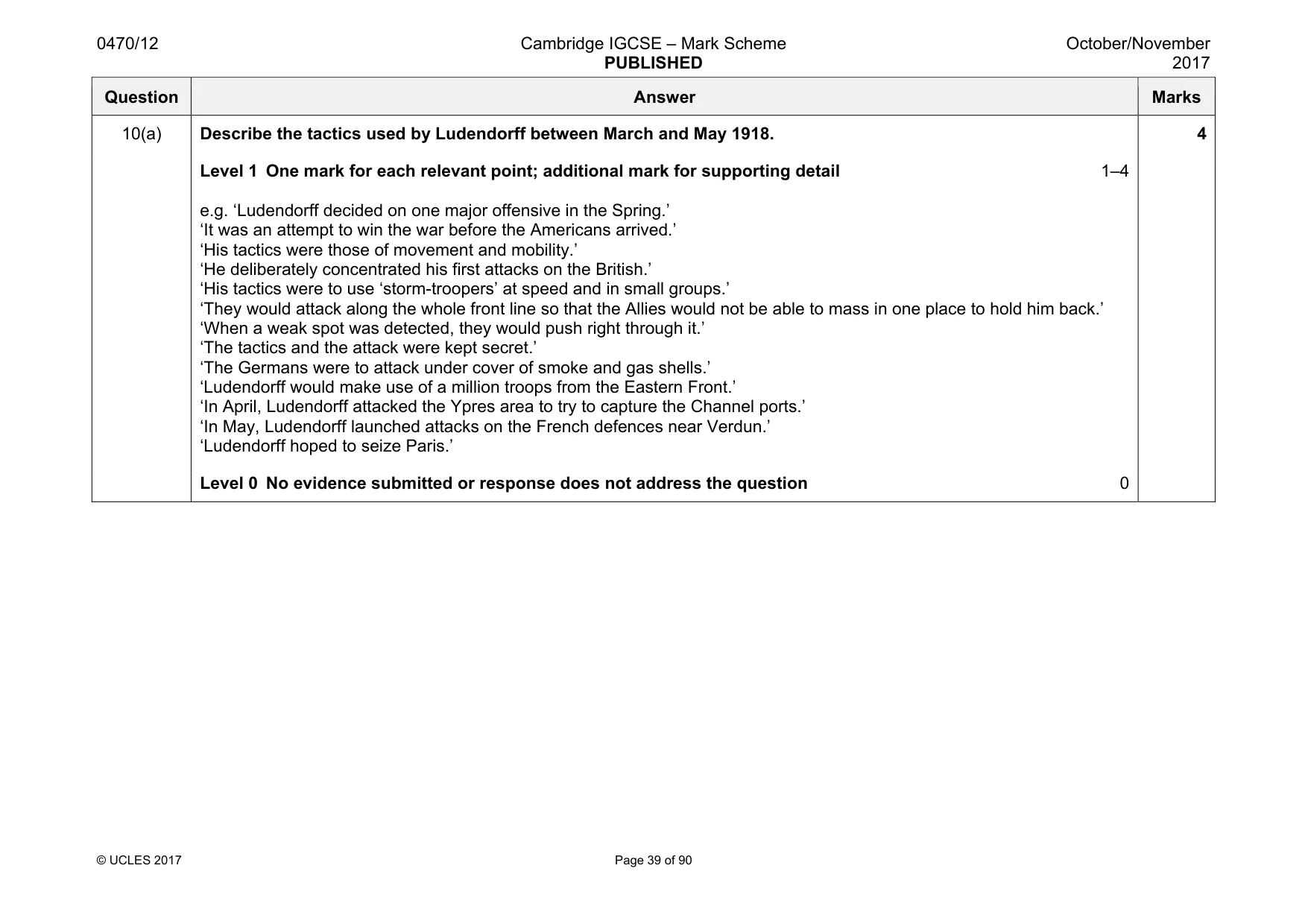
0470/12 Cambridge IGCSE – Mark Scheme PUBLISHED October/November 2017 © UCLES 2017 Page 39 of 90 Question Answer Marks 10(a) Describe the tactics used by Ludendorff between March and May 1918. 4 Level 1 One mark for each relevant point; additional mark for supporting detail 1–4 e.g. ‘Ludendorff decided on one major offensive in the Spring.’ ‘It was an attempt to win the war before the Americans arrived.’ ‘His tactics were those of movement and mobility.’ ‘He deliberately concentrated his first attacks on the British.’ ‘His tactics were to use ‘storm-troopers’ at speed and in small groups.’ ‘They would attack along the whole front line so that the Allies would not be able to mass in one place to hold him back.’ ‘When a weak spot was detected, they would push right through it.’ ‘The tactics and the attack were kept secret.’ ‘The Germans were to attack under cover of smoke and gas shells.’ ‘Ludendorff would make use of a million troops from the Eastern Front.’ ‘In April, Ludendorff attacked the Ypres area to try to capture the Channel ports.’ ‘In May, Ludendorff launched attacks on the French defences near Verdun.’ ‘Ludendorff hoped to seize Paris.’ Level 0 No evidence submitted or response does not address the question 0
Mark scheme, page 40
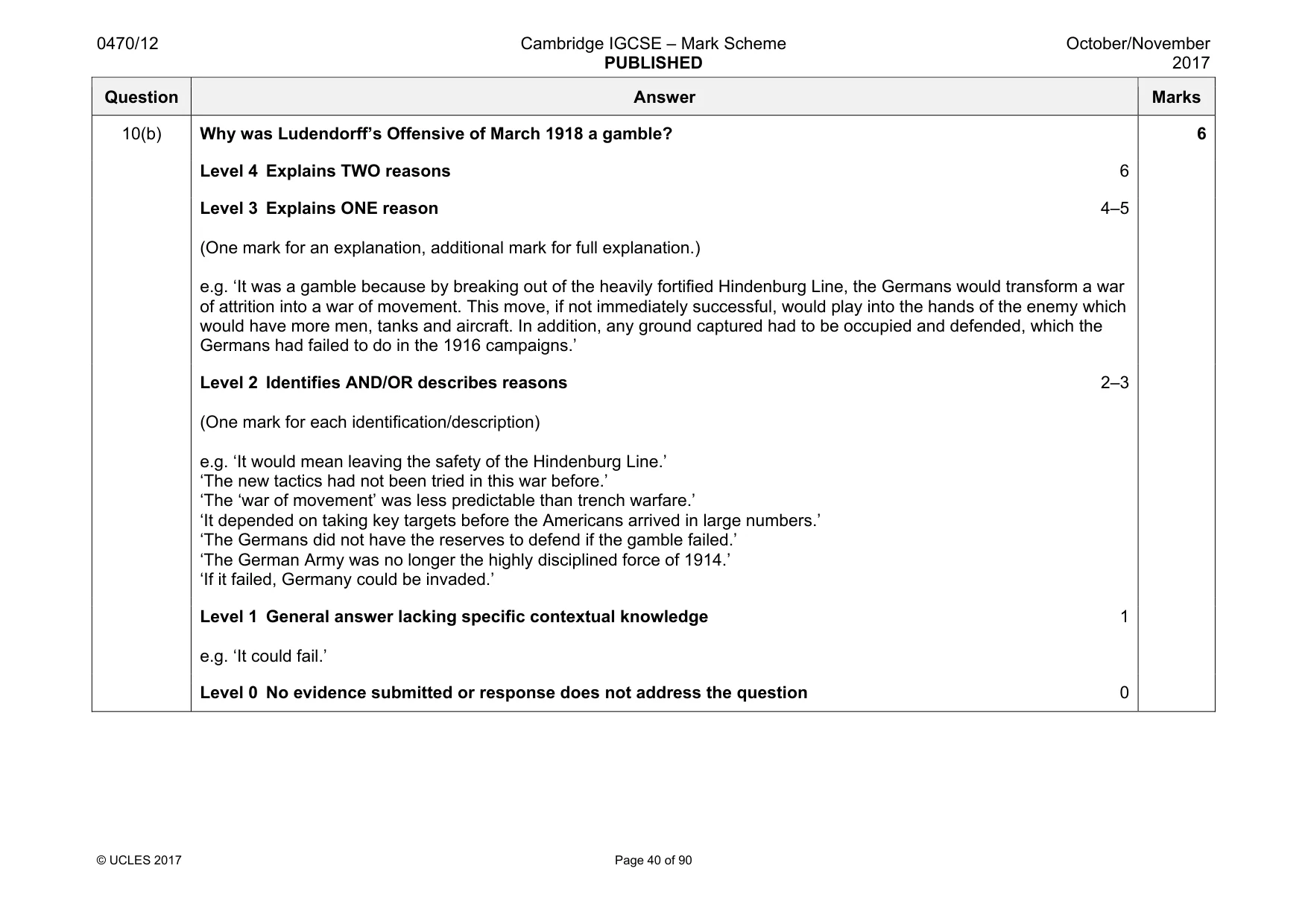
0470/12 Cambridge IGCSE – Mark Scheme PUBLISHED October/November 2017 © UCLES 2017 Page 40 of 90 Question Answer Marks 10(b) Why was Ludendorff’s Offensive of March 1918 a gamble? 6 Level 4 Explains TWO reasons 6 Level 3 Explains ONE reason 4–5 (One mark for an explanation, additional mark for full explanation.) e.g. ‘It was a gamble because by breaking out of the heavily fortified Hindenburg Line, the Germans would transform a war of attrition into a war of movement. This move, if not immediately successful, would play into the hands of the enemy which would have more men, tanks and aircraft. In addition, any ground captured had to be occupied and defended, which the Germans had failed to do in the 1916 campaigns.’ Level 2 Identifies AND/OR describes reasons 2–3 (One mark for each identification/description) e.g. ‘It would mean leaving the safety of the Hindenburg Line.’ ‘The new tactics had not been tried in this war before.’ ‘The ‘war of movement’ was less predictable than trench warfare.’ ‘It depended on taking key targets before the Americans arrived in large numbers.’ ‘The Germans did not have the reserves to defend if the gamble failed.’ ‘The German Army was no longer the highly disciplined force of 1914.’ ‘If it failed, Germany could be invaded.’ Level 1 General answer lacking specific contextual knowledge 1 e.g. ‘It could fail.’ Level 0 No evidence submitted or response does not address the question 0
Mark scheme, page 41
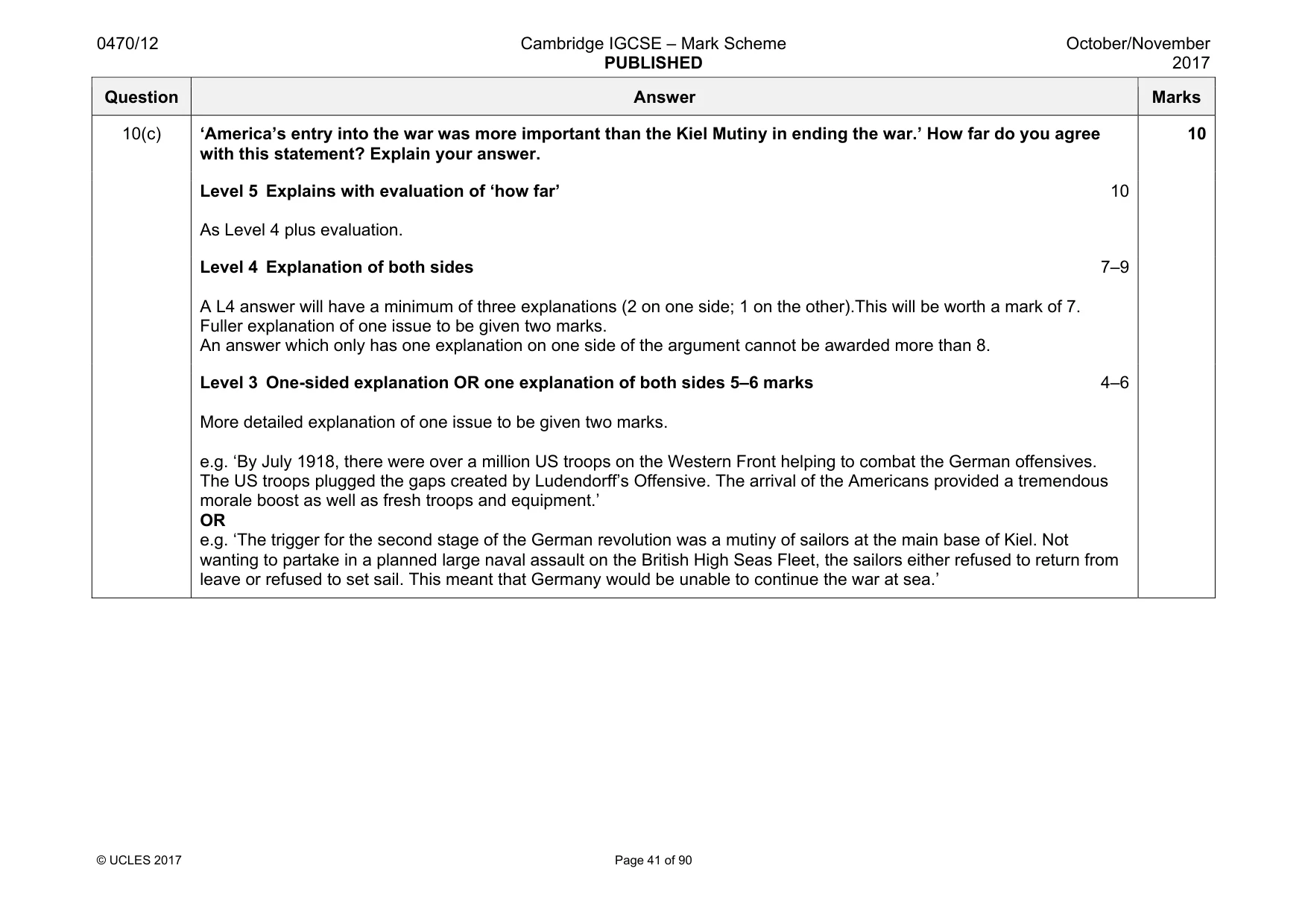
0470/12 Cambridge IGCSE – Mark Scheme PUBLISHED October/November 2017 © UCLES 2017 Page 41 of 90 Question Answer Marks 10(c) ‘America’s entry into the war was more important than the Kiel Mutiny in ending the war.’ How far do you agree with this statement? Explain your answer. 10 Level 5 Explains with evaluation of ‘how far’ 10 As Level 4 plus evaluation. Level 4 Explanation of both sides 7–9 A L4 answer will have a minimum of three explanations (2 on one side; 1 on the other).This will be worth a mark of 7. Fuller explanation of one issue to be given two marks. An answer which only has one explanation on one side of the argument cannot be awarded more than 8. Level 3 One-sided explanation OR one explanation of both sides 5–6 marks 4–6 More detailed explanation of one issue to be given two marks. e.g. ‘By July 1918, there were over a million US troops on the Western Front helping to combat the German offensives. The US troops plugged the gaps created by Ludendorff’s Offensive. The arrival of the Americans provided a tremendous morale boost as well as fresh troops and equipment.’ OR e.g. ‘The trigger for the second stage of the German revolution was a mutiny of sailors at the main base of Kiel. Not wanting to partake in a planned large naval assault on the British High Seas Fleet, the sailors either refused to return from leave or refused to set sail. This meant that Germany would be unable to continue the war at sea.’
Mark scheme, page 42
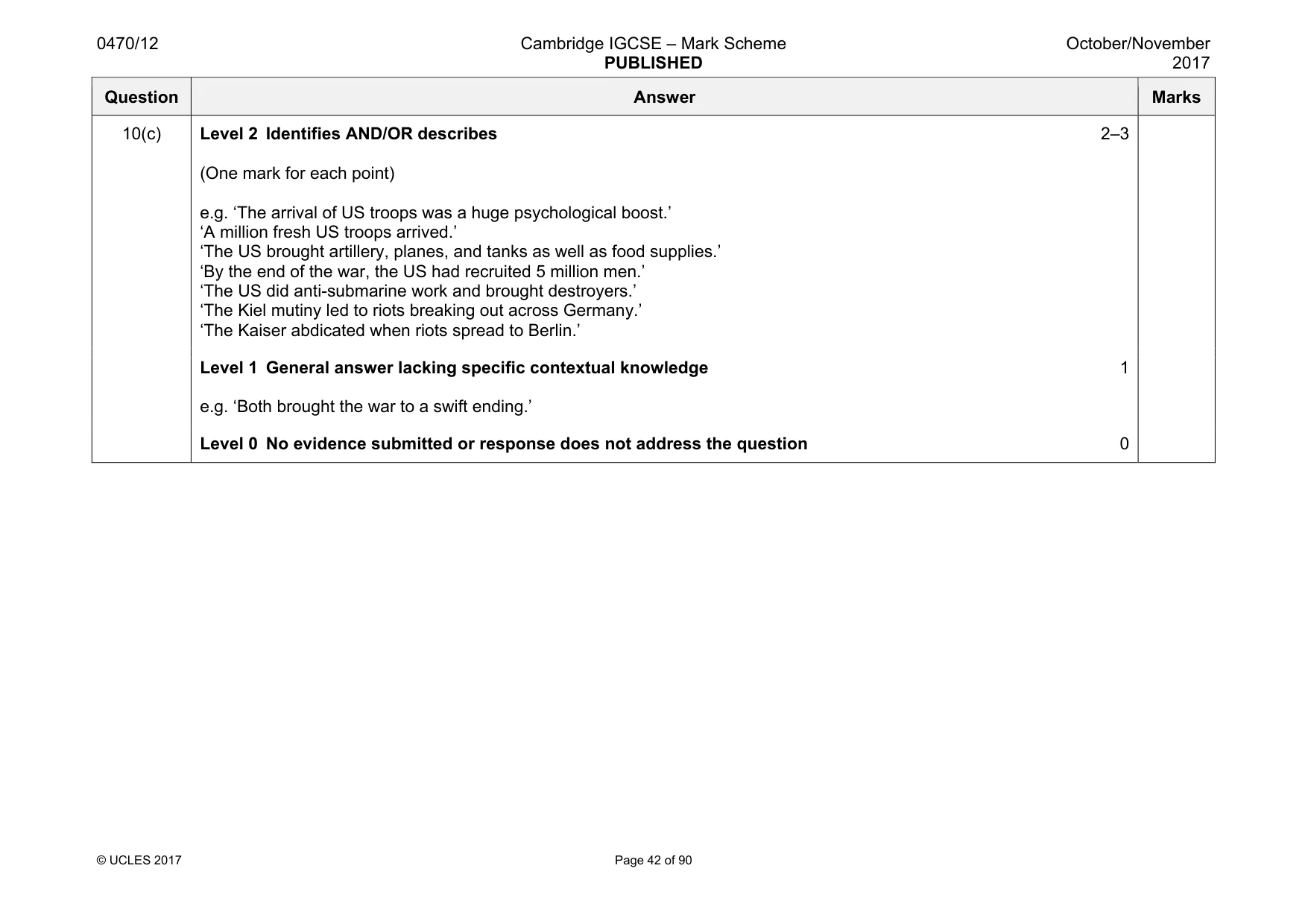
0470/12 Cambridge IGCSE – Mark Scheme PUBLISHED October/November 2017 © UCLES 2017 Page 42 of 90 Question Answer Marks 10(c) Level 2 Identifies AND/OR describes 2–3 (One mark for each point) e.g. ‘The arrival of US troops was a huge psychological boost.’ ‘A million fresh US troops arrived.’ ‘The US brought artillery, planes, and tanks as well as food supplies.’ ‘By the end of the war, the US had recruited 5 million men.’ ‘The US did anti-submarine work and brought destroyers.’ ‘The Kiel mutiny led to riots breaking out across Germany.’ ‘The Kaiser abdicated when riots spread to Berlin.’ Level 1 General answer lacking specific contextual knowledge 1 e.g. ‘Both brought the war to a swift ending.’ Level 0 No evidence submitted or response does not address the question 0
Mark scheme, page 43
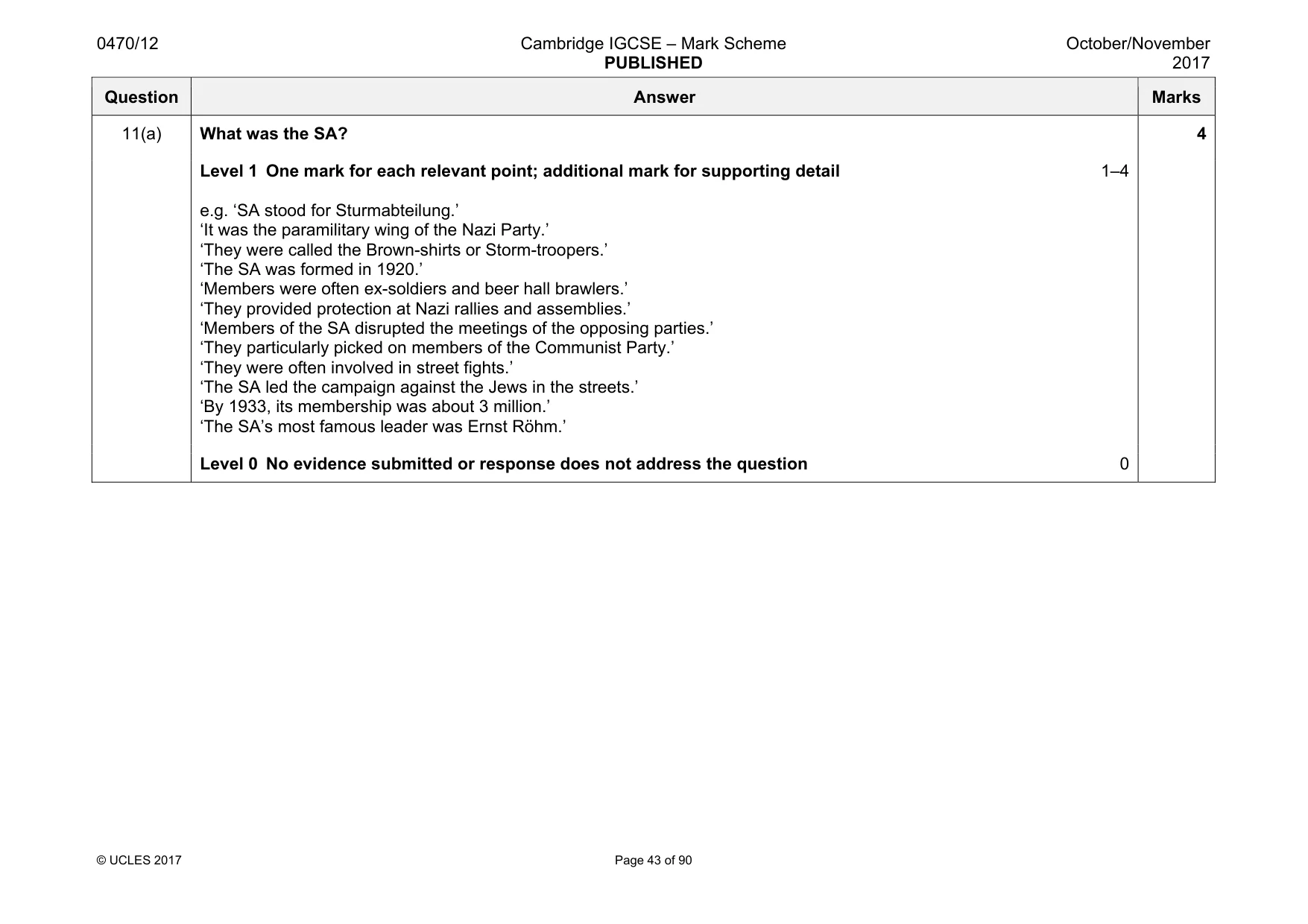
0470/12 Cambridge IGCSE – Mark Scheme PUBLISHED October/November 2017 © UCLES 2017 Page 43 of 90 Question Answer Marks 11(a) What was the SA? 4 Level 1 One mark for each relevant point; additional mark for supporting detail 1–4 e.g. ‘SA stood for Sturmabteilung.’ ‘It was the paramilitary wing of the Nazi Party.’ ‘They were called the Brown-shirts or Storm-troopers.’ ‘The SA was formed in 1920.’ ‘Members were often ex-soldiers and beer hall brawlers.’ ‘They provided protection at Nazi rallies and assemblies.’ ‘Members of the SA disrupted the meetings of the opposing parties.’ ‘They particularly picked on members of the Communist Party.’ ‘They were often involved in street fights.’ ‘The SA led the campaign against the Jews in the streets.’ ‘By 1933, its membership was about 3 million.’ ‘The SA’s most famous leader was Ernst Röhm.’ Level 0 No evidence submitted or response does not address the question 0
Mark scheme, page 44
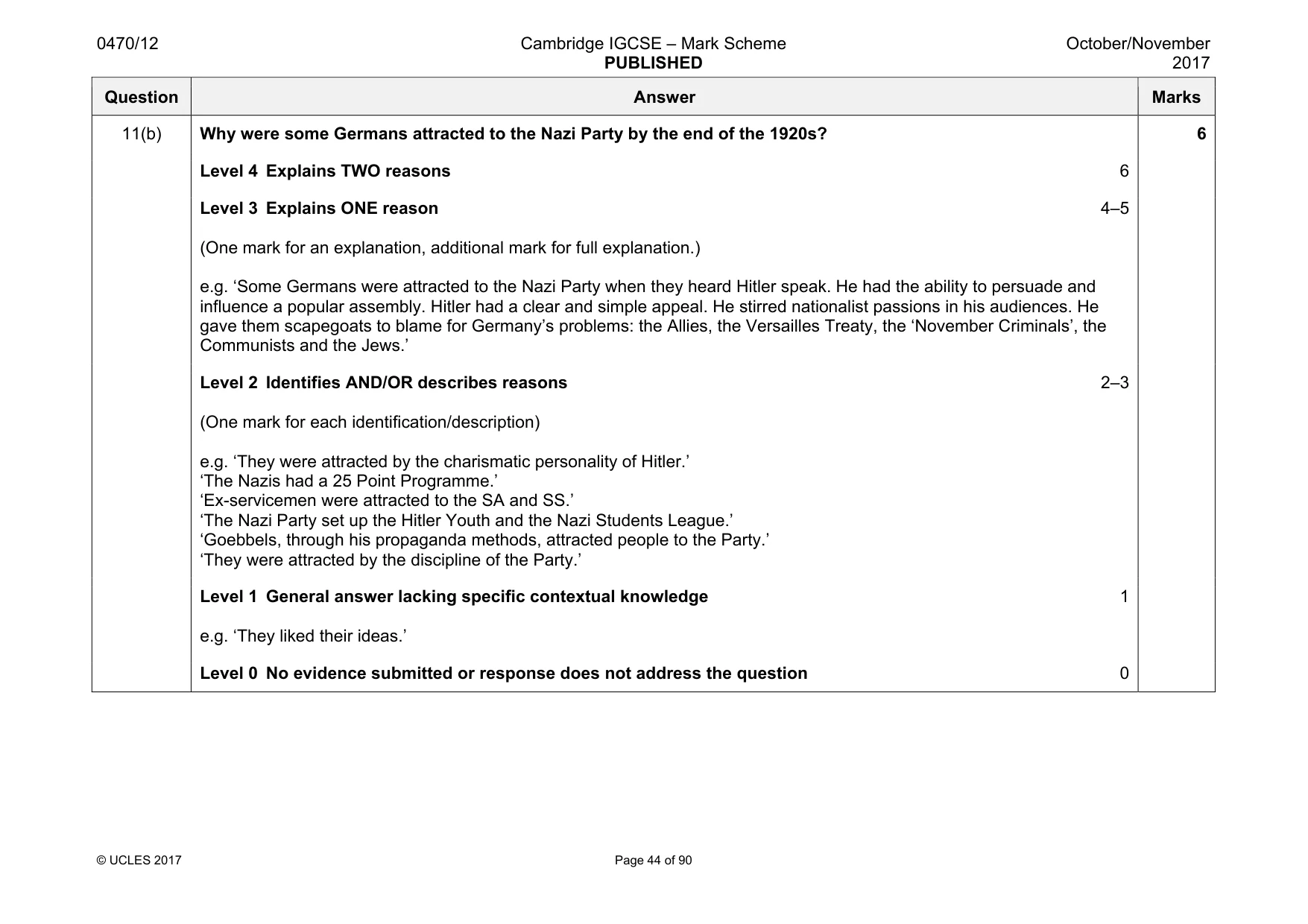
0470/12 Cambridge IGCSE – Mark Scheme PUBLISHED October/November 2017 © UCLES 2017 Page 44 of 90 Question Answer Marks 11(b) Why were some Germans attracted to the Nazi Party by the end of the 1920s? 6 Level 4 Explains TWO reasons 6 Level 3 Explains ONE reason 4–5 (One mark for an explanation, additional mark for full explanation.) e.g. ‘Some Germans were attracted to the Nazi Party when they heard Hitler speak. He had the ability to persuade and influence a popular assembly. Hitler had a clear and simple appeal. He stirred nationalist passions in his audiences. He gave them scapegoats to blame for Germany’s problems: the Allies, the Versailles Treaty, the ‘November Criminals’, the Communists and the Jews.’ Level 2 Identifies AND/OR describes reasons 2–3 (One mark for each identification/description) e.g. ‘They were attracted by the charismatic personality of Hitler.’ ‘The Nazis had a 25 Point Programme.’ ‘Ex-servicemen were attracted to the SA and SS.’ ‘The Nazi Party set up the Hitler Youth and the Nazi Students League.’ ‘Goebbels, through his propaganda methods, attracted people to the Party.’ ‘They were attracted by the discipline of the Party.’ Level 1 General answer lacking specific contextual knowledge 1 e.g. ‘They liked their ideas.’ Level 0 No evidence submitted or response does not address the question 0
Mark scheme, page 45
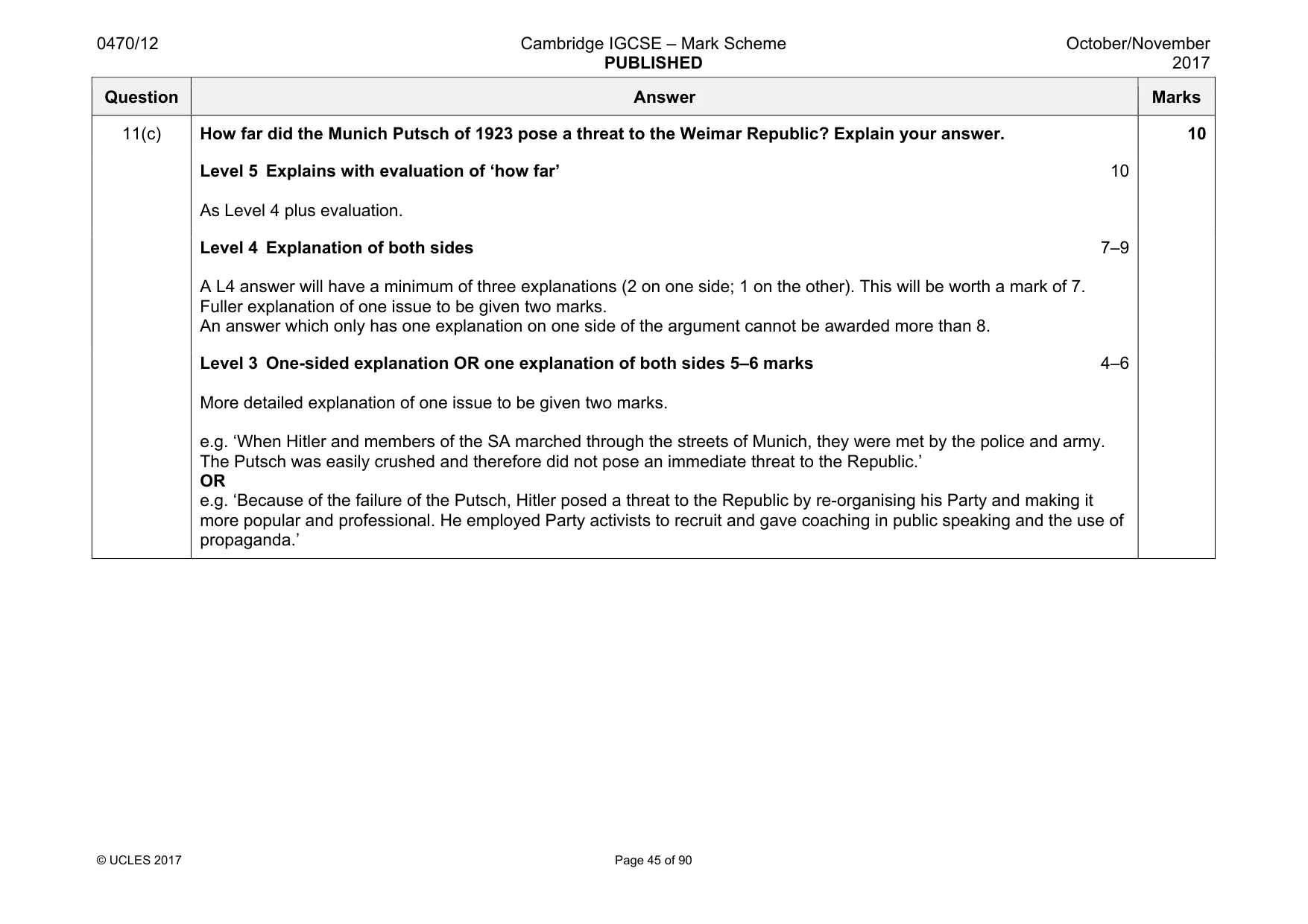
0470/12 Cambridge IGCSE – Mark Scheme PUBLISHED October/November 2017 © UCLES 2017 Page 45 of 90 Question Answer Marks 11(c) How far did the Munich Putsch of 1923 pose a threat to the Weimar Republic? Explain your answer. 10 Level 5 Explains with evaluation of ‘how far’ 10 As Level 4 plus evaluation. Level 4 Explanation of both sides 7–9 A L4 answer will have a minimum of three explanations (2 on one side; 1 on the other). This will be worth a mark of 7. Fuller explanation of one issue to be given two marks. An answer which only has one explanation on one side of the argument cannot be awarded more than 8. Level 3 One-sided explanation OR one explanation of both sides 5–6 marks 4–6 More detailed explanation of one issue to be given two marks. e.g. ‘When Hitler and members of the SA marched through the streets of Munich, they were met by the police and army. The Putsch was easily crushed and therefore did not pose an immediate threat to the Republic.’ OR e.g. ‘Because of the failure of the Putsch, Hitler posed a threat to the Republic by re-organising his Party and making it more popular and professional. He employed Party activists to recruit and gave coaching in public speaking and the use of propaganda.’
Mark scheme, page 46
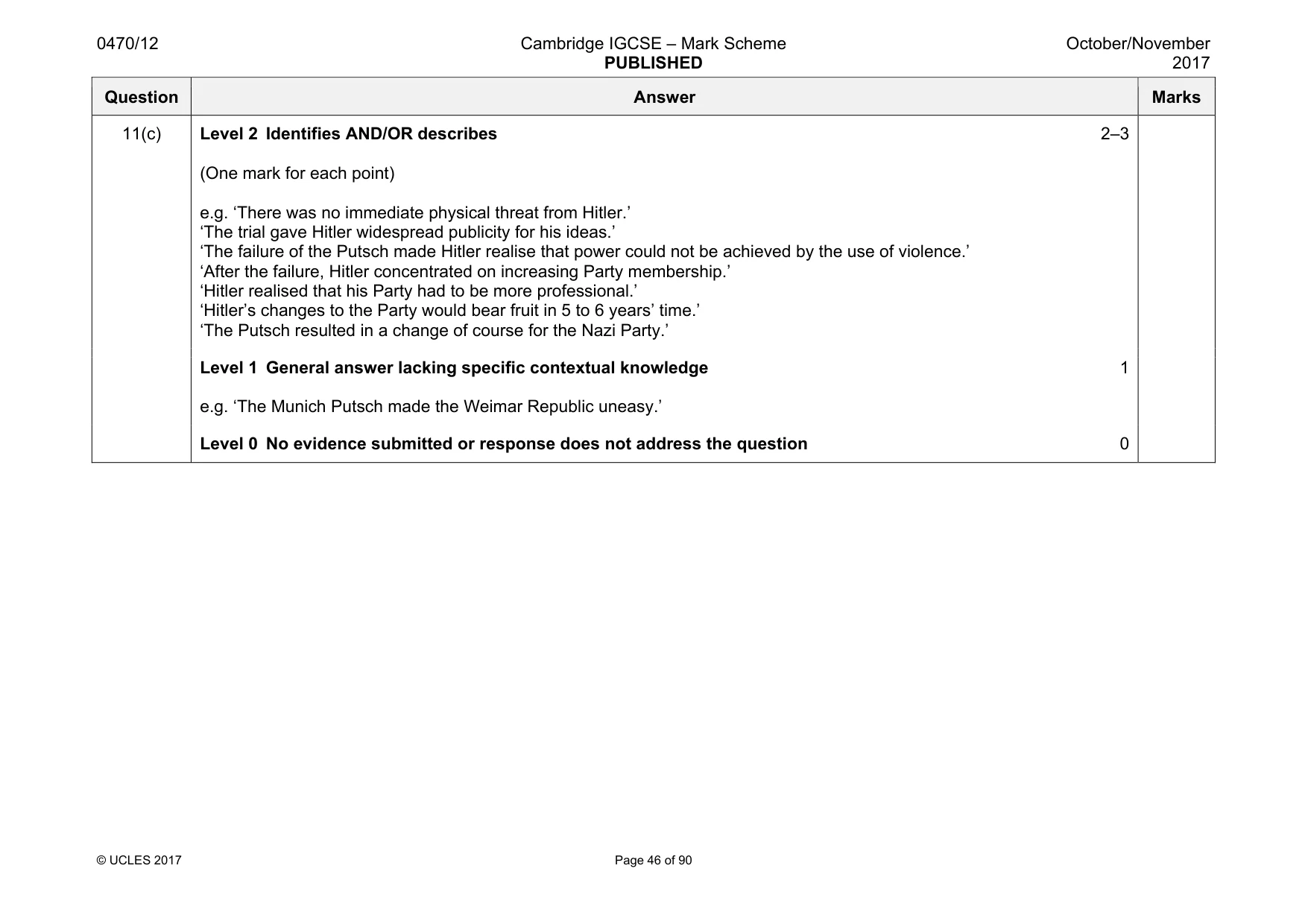
0470/12 Cambridge IGCSE – Mark Scheme PUBLISHED October/November 2017 © UCLES 2017 Page 46 of 90 Question Answer Marks 11(c) Level 2 Identifies AND/OR describes 2–3 (One mark for each point) e.g. ‘There was no immediate physical threat from Hitler.’ ‘The trial gave Hitler widespread publicity for his ideas.’ ‘The failure of the Putsch made Hitler realise that power could not be achieved by the use of violence.’ ‘After the failure, Hitler concentrated on increasing Party membership.’ ‘Hitler realised that his Party had to be more professional.’ ‘Hitler’s changes to the Party would bear fruit in 5 to 6 years’ time.’ ‘The Putsch resulted in a change of course for the Nazi Party.’ Level 1 General answer lacking specific contextual knowledge 1 e.g. ‘The Munich Putsch made the Weimar Republic uneasy.’ Level 0 No evidence submitted or response does not address the question 0
Mark scheme, page 47
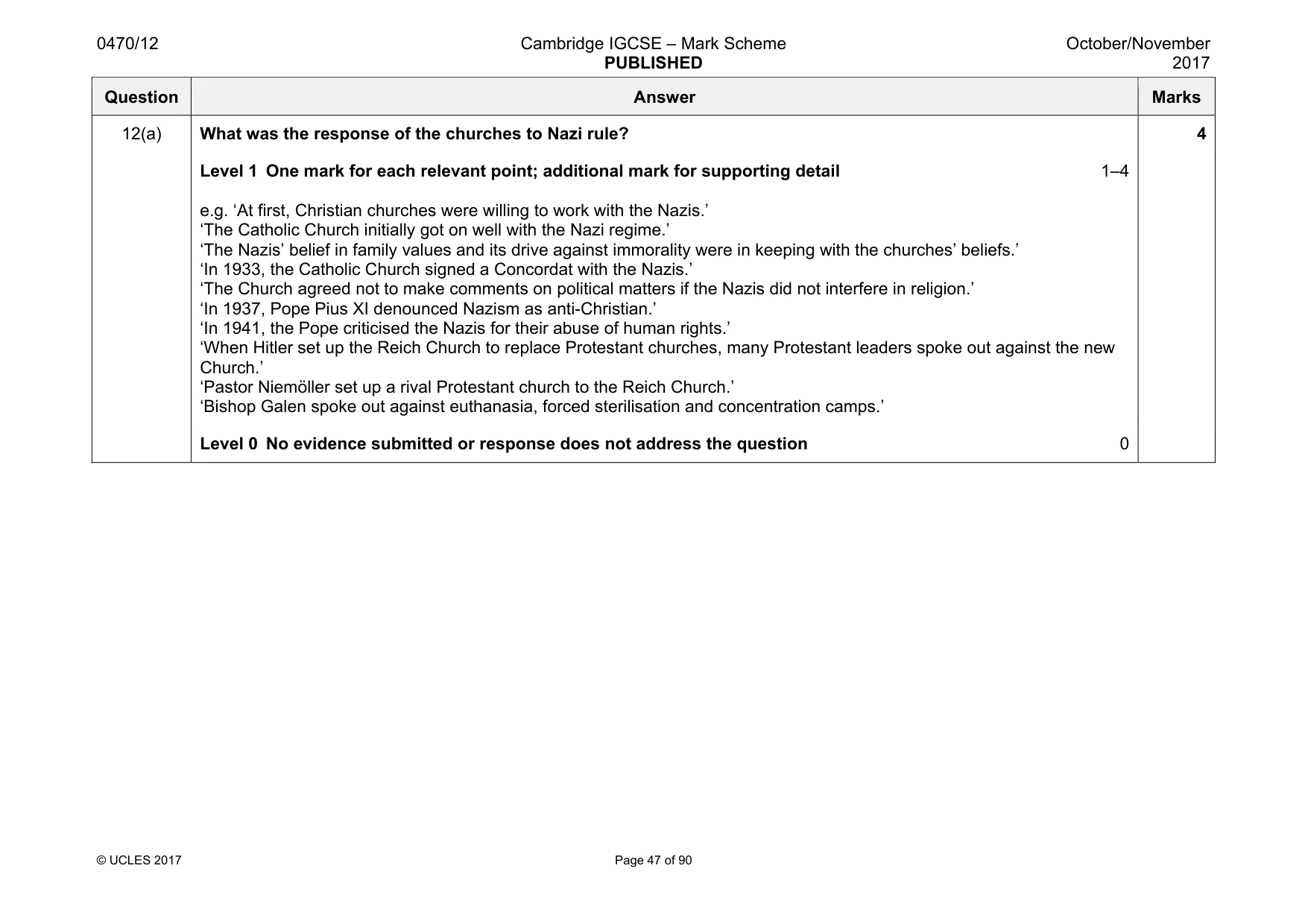
0470/12 Cambridge IGCSE – Mark Scheme PUBLISHED October/November 2017 © UCLES 2017 Page 47 of 90 Question Answer Marks 12(a) What was the response of the churches to Nazi rule? 4 Level 1 One mark for each relevant point; additional mark for supporting detail 1–4 e.g. ‘At first, Christian churches were willing to work with the Nazis.’ ‘The Catholic Church initially got on well with the Nazi regime.’ ‘The Nazis’ belief in family values and its drive against immorality were in keeping with the churches’ beliefs.’ ‘In 1933, the Catholic Church signed a Concordat with the Nazis.’ ‘The Church agreed not to make comments on political matters if the Nazis did not interfere in religion.’ ‘In 1937, Pope Pius XI denounced Nazism as anti-Christian.’ ‘In 1941, the Pope criticised the Nazis for their abuse of human rights.’ ‘When Hitler set up the Reich Church to replace Protestant churches, many Protestant leaders spoke out against the new Church.’ ‘Pastor Niemöller set up a rival Protestant church to the Reich Church.’ ‘Bishop Galen spoke out against euthanasia, forced sterilisation and concentration camps.’ Level 0 No evidence submitted or response does not address the question 0
Mark scheme, page 48
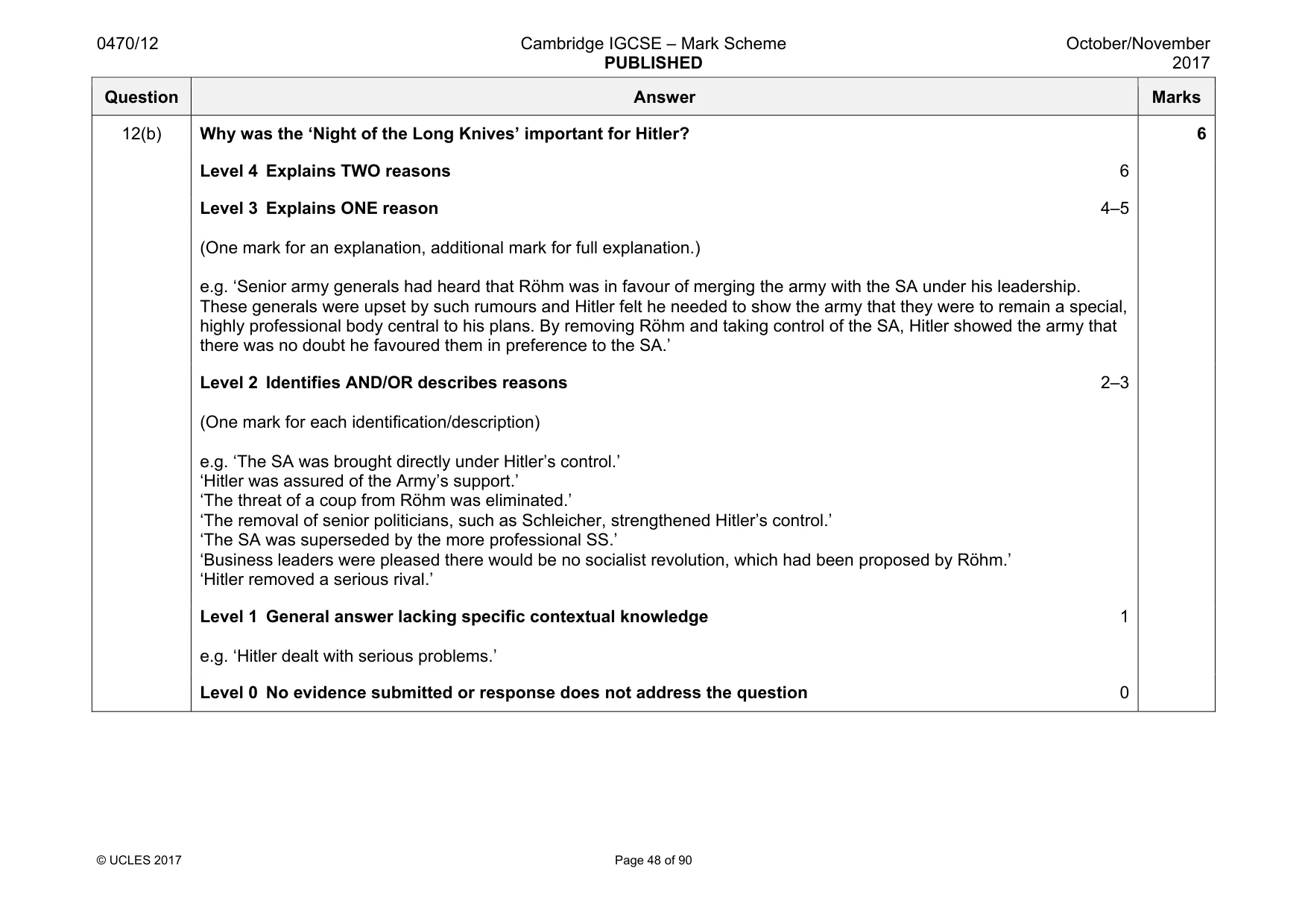
0470/12 Cambridge IGCSE – Mark Scheme PUBLISHED October/November 2017 © UCLES 2017 Page 48 of 90 Question Answer Marks 12(b) Why was the ‘Night of the Long Knives’ important for Hitler? 6 Level 4 Explains TWO reasons 6 Level 3 Explains ONE reason 4–5 (One mark for an explanation, additional mark for full explanation.) e.g. ‘Senior army generals had heard that Röhm was in favour of merging the army with the SA under his leadership. These generals were upset by such rumours and Hitler felt he needed to show the army that they were to remain a special, highly professional body central to his plans. By removing Röhm and taking control of the SA, Hitler showed the army that there was no doubt he favoured them in preference to the SA.’ Level 2 Identifies AND/OR describes reasons 2–3 (One mark for each identification/description) e.g. ‘The SA was brought directly under Hitler’s control.’ ‘Hitler was assured of the Army’s support.’ ‘The threat of a coup from Röhm was eliminated.’ ‘The removal of senior politicians, such as Schleicher, strengthened Hitler’s control.’ ‘The SA was superseded by the more professional SS.’ ‘Business leaders were pleased there would be no socialist revolution, which had been proposed by Röhm.’ ‘Hitler removed a serious rival.’ Level 1 General answer lacking specific contextual knowledge 1 e.g. ‘Hitler dealt with serious problems.’ Level 0 No evidence submitted or response does not address the question 0
Mark scheme, page 49
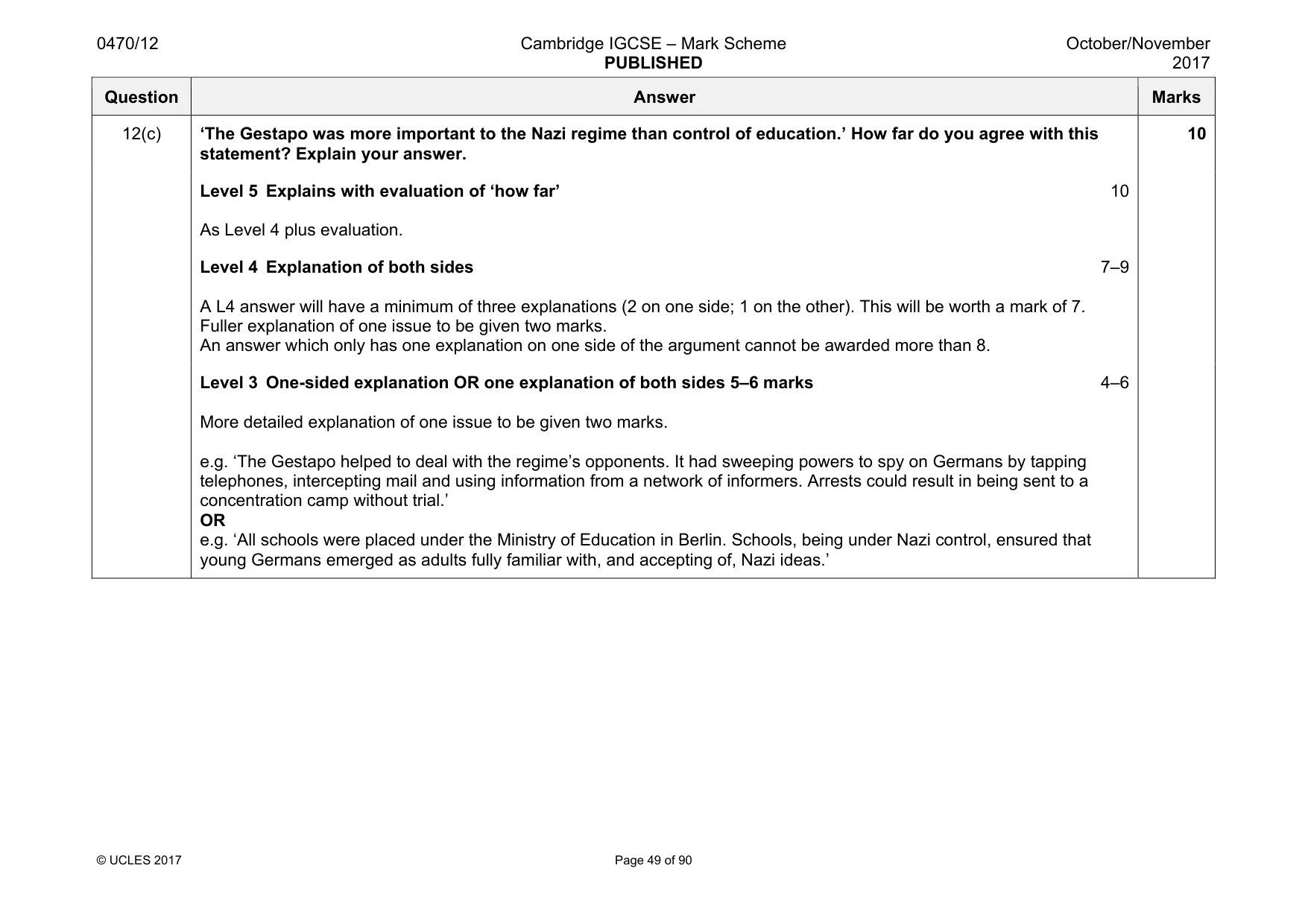
0470/12 Cambridge IGCSE – Mark Scheme PUBLISHED October/November 2017 © UCLES 2017 Page 49 of 90 Question Answer Marks 12(c) ‘The Gestapo was more important to the Nazi regime than control of education.’ How far do you agree with this statement? Explain your answer. 10 Level 5 Explains with evaluation of ‘how far’ 10 As Level 4 plus evaluation. Level 4 Explanation of both sides 7–9 A L4 answer will have a minimum of three explanations (2 on one side; 1 on the other). This will be worth a mark of 7. Fuller explanation of one issue to be given two marks. An answer which only has one explanation on one side of the argument cannot be awarded more than 8. Level 3 One-sided explanation OR one explanation of both sides 5–6 marks 4–6 More detailed explanation of one issue to be given two marks. e.g. ‘The Gestapo helped to deal with the regime’s opponents. It had sweeping powers to spy on Germans by tapping telephones, intercepting mail and using information from a network of informers. Arrests could result in being sent to a concentration camp without trial.’ OR e.g. ‘All schools were placed under the Ministry of Education in Berlin. Schools, being under Nazi control, ensured that young Germans emerged as adults fully familiar with, and accepting of, Nazi ideas.’
Mark scheme, page 50
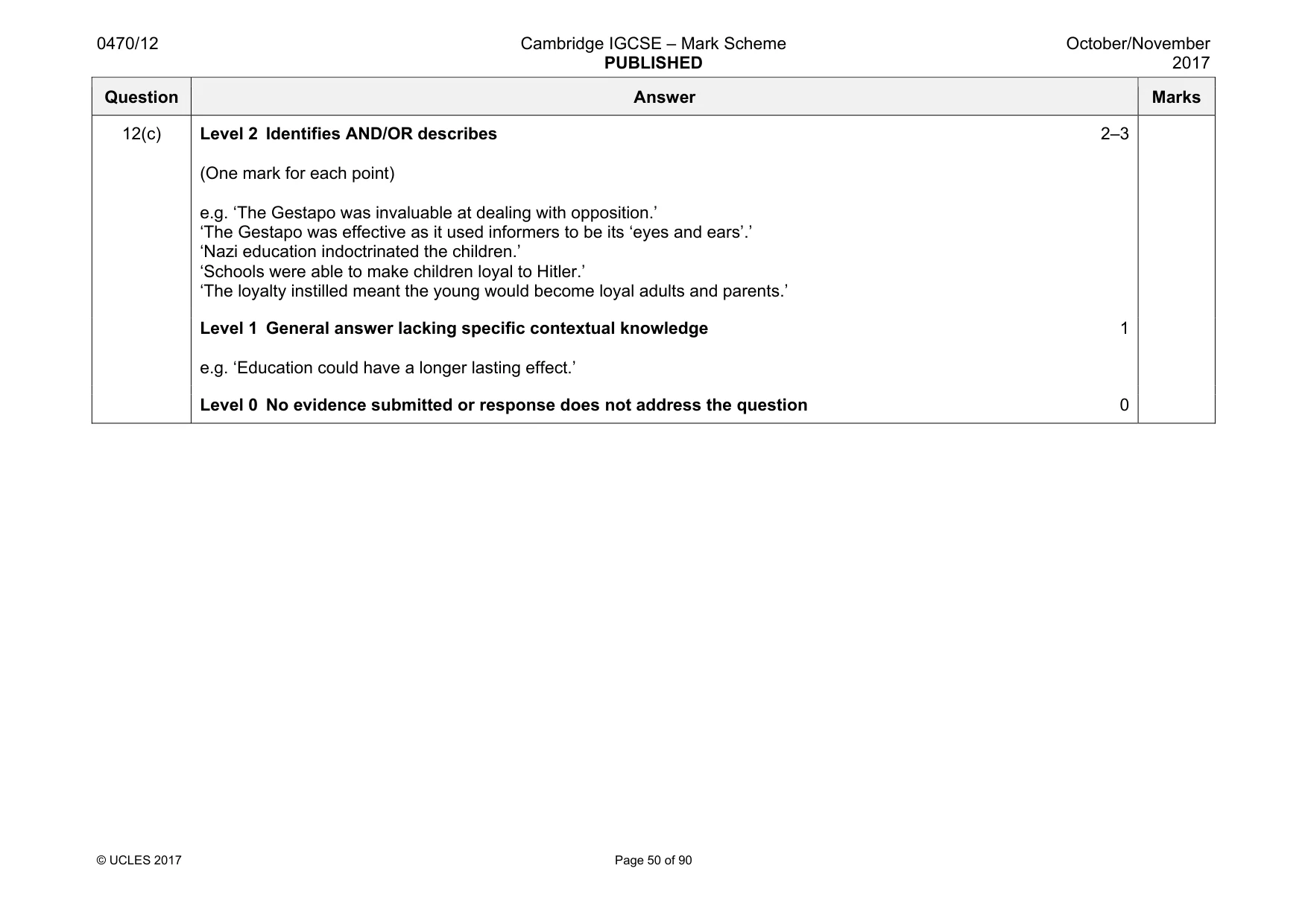
0470/12 Cambridge IGCSE – Mark Scheme PUBLISHED October/November 2017 © UCLES 2017 Page 50 of 90 Question Answer Marks 12(c) Level 2 Identifies AND/OR describes 2–3 (One mark for each point) e.g. ‘The Gestapo was invaluable at dealing with opposition.’ ‘The Gestapo was effective as it used informers to be its ‘eyes and ears’.’ ‘Nazi education indoctrinated the children.’ ‘Schools were able to make children loyal to Hitler.’ ‘The loyalty instilled meant the young would become loyal adults and parents.’ Level 1 General answer lacking specific contextual knowledge 1 e.g. ‘Education could have a longer lasting effect.’ Level 0 No evidence submitted or response does not address the question 0
Mark scheme, page 51
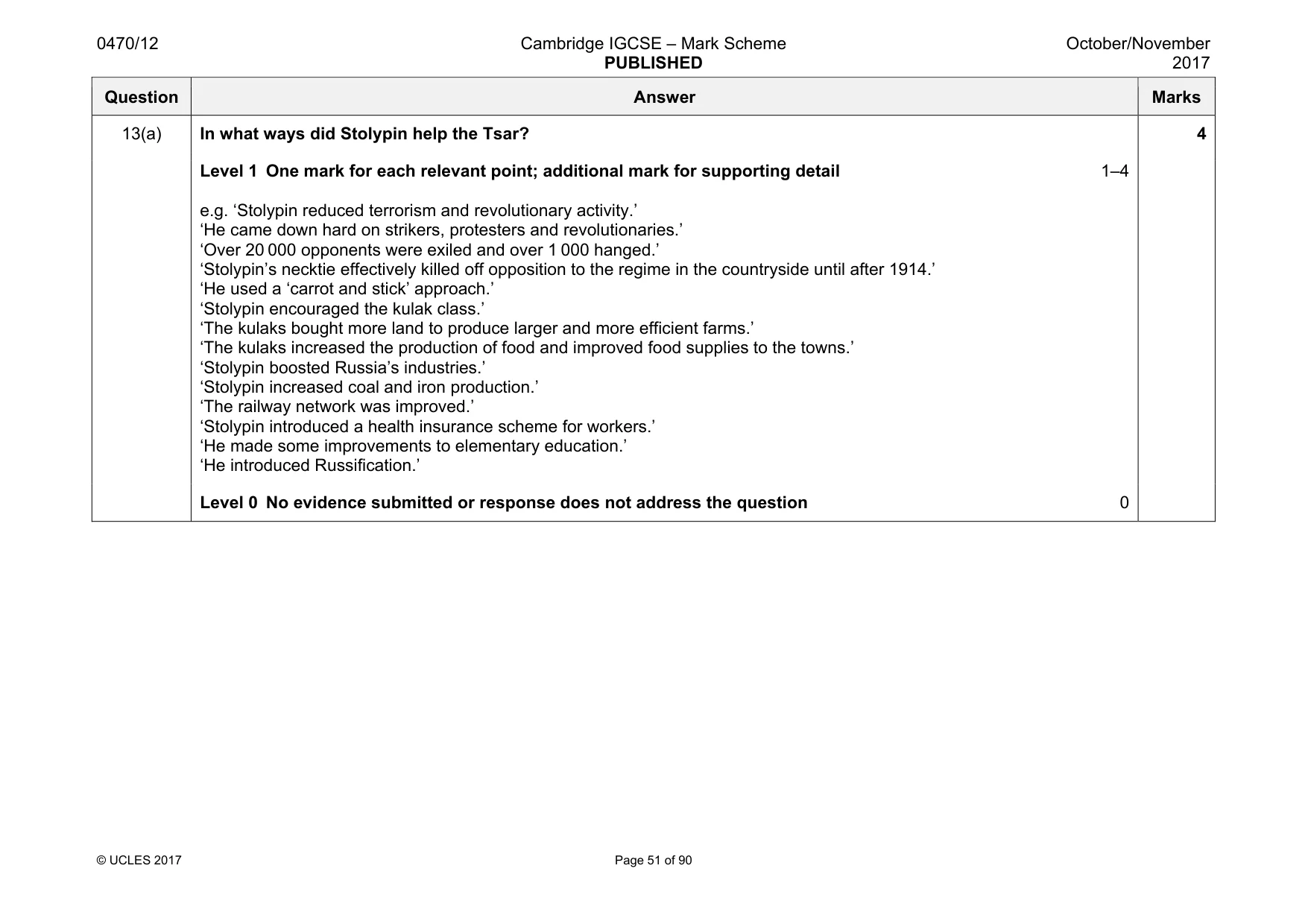
0470/12 Cambridge IGCSE – Mark Scheme PUBLISHED October/November 2017 © UCLES 2017 Page 51 of 90 Question Answer Marks 13(a) In what ways did Stolypin help the Tsar? 4 Level 1 One mark for each relevant point; additional mark for supporting detail 1–4 e.g. ‘Stolypin reduced terrorism and revolutionary activity.’ ‘He came down hard on strikers, protesters and revolutionaries.’ ‘Over 20 000 opponents were exiled and over 1 000 hanged.’ ‘Stolypin’s necktie effectively killed off opposition to the regime in the countryside until after 1914.’ ‘He used a ‘carrot and stick’ approach.’ ‘Stolypin encouraged the kulak class.’ ‘The kulaks bought more land to produce larger and more efficient farms.’ ‘The kulaks increased the production of food and improved food supplies to the towns.’ ‘Stolypin boosted Russia’s industries.’ ‘Stolypin increased coal and iron production.’ ‘The railway network was improved.’ ‘Stolypin introduced a health insurance scheme for workers.’ ‘He made some improvements to elementary education.’ ‘He introduced Russification.’ Level 0 No evidence submitted or response does not address the question 0
Mark scheme, page 52
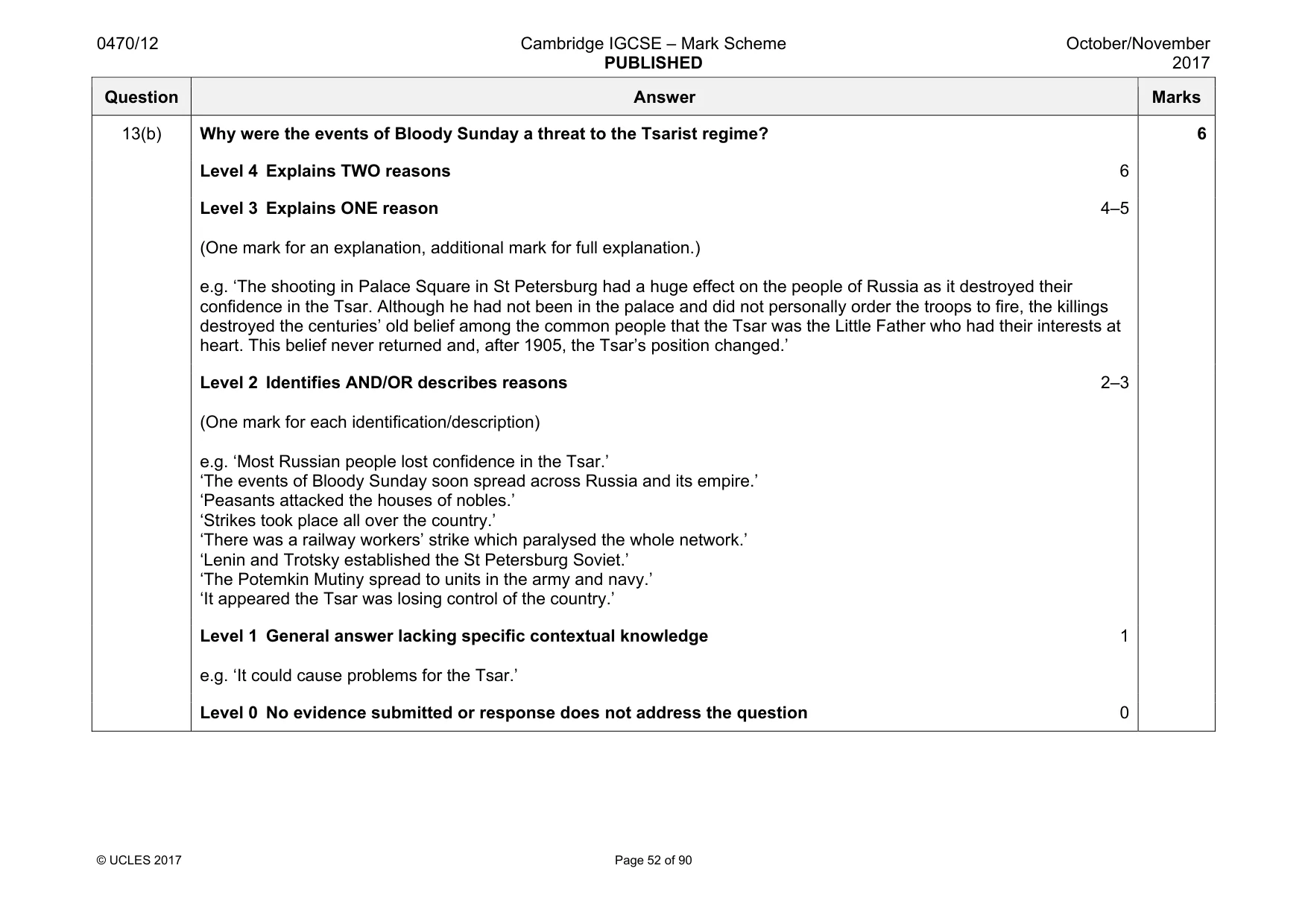
0470/12 Cambridge IGCSE – Mark Scheme PUBLISHED October/November 2017 © UCLES 2017 Page 52 of 90 Question Answer Marks 13(b) Why were the events of Bloody Sunday a threat to the Tsarist regime? 6 Level 4 Explains TWO reasons 6 Level 3 Explains ONE reason 4–5 (One mark for an explanation, additional mark for full explanation.) e.g. ‘The shooting in Palace Square in St Petersburg had a huge effect on the people of Russia as it destroyed their confidence in the Tsar. Although he had not been in the palace and did not personally order the troops to fire, the killings destroyed the centuries’ old belief among the common people that the Tsar was the Little Father who had their interests at heart. This belief never returned and, after 1905, the Tsar’s position changed.’ Level 2 Identifies AND/OR describes reasons 2–3 (One mark for each identification/description) e.g. ‘Most Russian people lost confidence in the Tsar.’ ‘The events of Bloody Sunday soon spread across Russia and its empire.’ ‘Peasants attacked the houses of nobles.’ ‘Strikes took place all over the country.’ ‘There was a railway workers’ strike which paralysed the whole network.’ ‘Lenin and Trotsky established the St Petersburg Soviet.’ ‘The Potemkin Mutiny spread to units in the army and navy.’ ‘It appeared the Tsar was losing control of the country.’ Level 1 General answer lacking specific contextual knowledge 1 e.g. ‘It could cause problems for the Tsar.’ Level 0 No evidence submitted or response does not address the question 0
Mark scheme, page 53
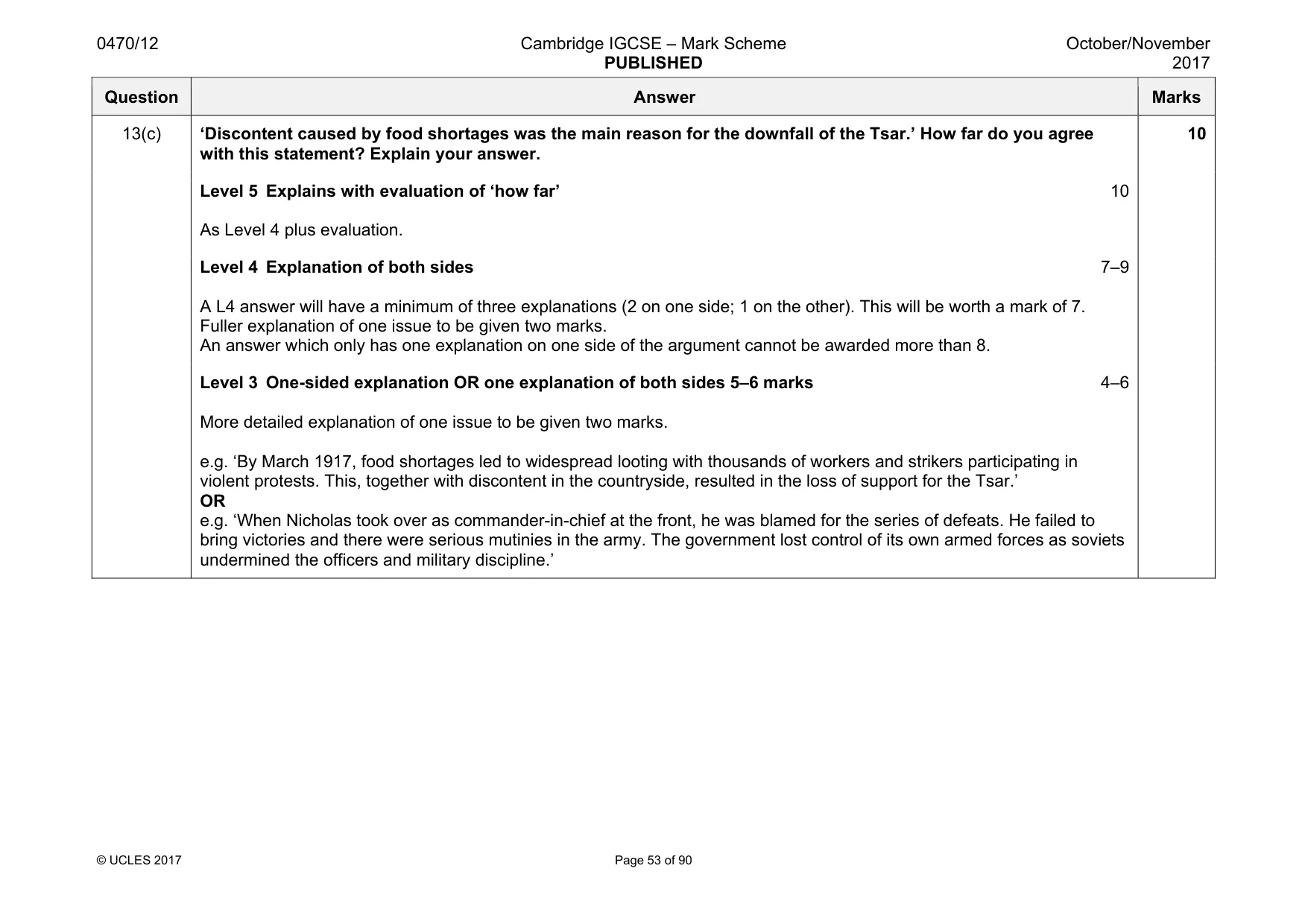
0470/12 Cambridge IGCSE – Mark Scheme PUBLISHED October/November 2017 © UCLES 2017 Page 53 of 90 Question Answer Marks 13(c) ‘Discontent caused by food shortages was the main reason for the downfall of the Tsar.’ How far do you agree with this statement? Explain your answer. 10 Level 5 Explains with evaluation of ‘how far’ 10 As Level 4 plus evaluation. Level 4 Explanation of both sides 7–9 A L4 answer will have a minimum of three explanations (2 on one side; 1 on the other). This will be worth a mark of 7. Fuller explanation of one issue to be given two marks. An answer which only has one explanation on one side of the argument cannot be awarded more than 8. Level 3 One-sided explanation OR one explanation of both sides 5–6 marks 4–6 More detailed explanation of one issue to be given two marks. e.g. ‘By March 1917, food shortages led to widespread looting with thousands of workers and strikers participating in violent protests. This, together with discontent in the countryside, resulted in the loss of support for the Tsar.’ OR e.g. ‘When Nicholas took over as commander-in-chief at the front, he was blamed for the series of defeats. He failed to bring victories and there were serious mutinies in the army. The government lost control of its own armed forces as soviets undermined the officers and military discipline.’
Mark scheme, page 54
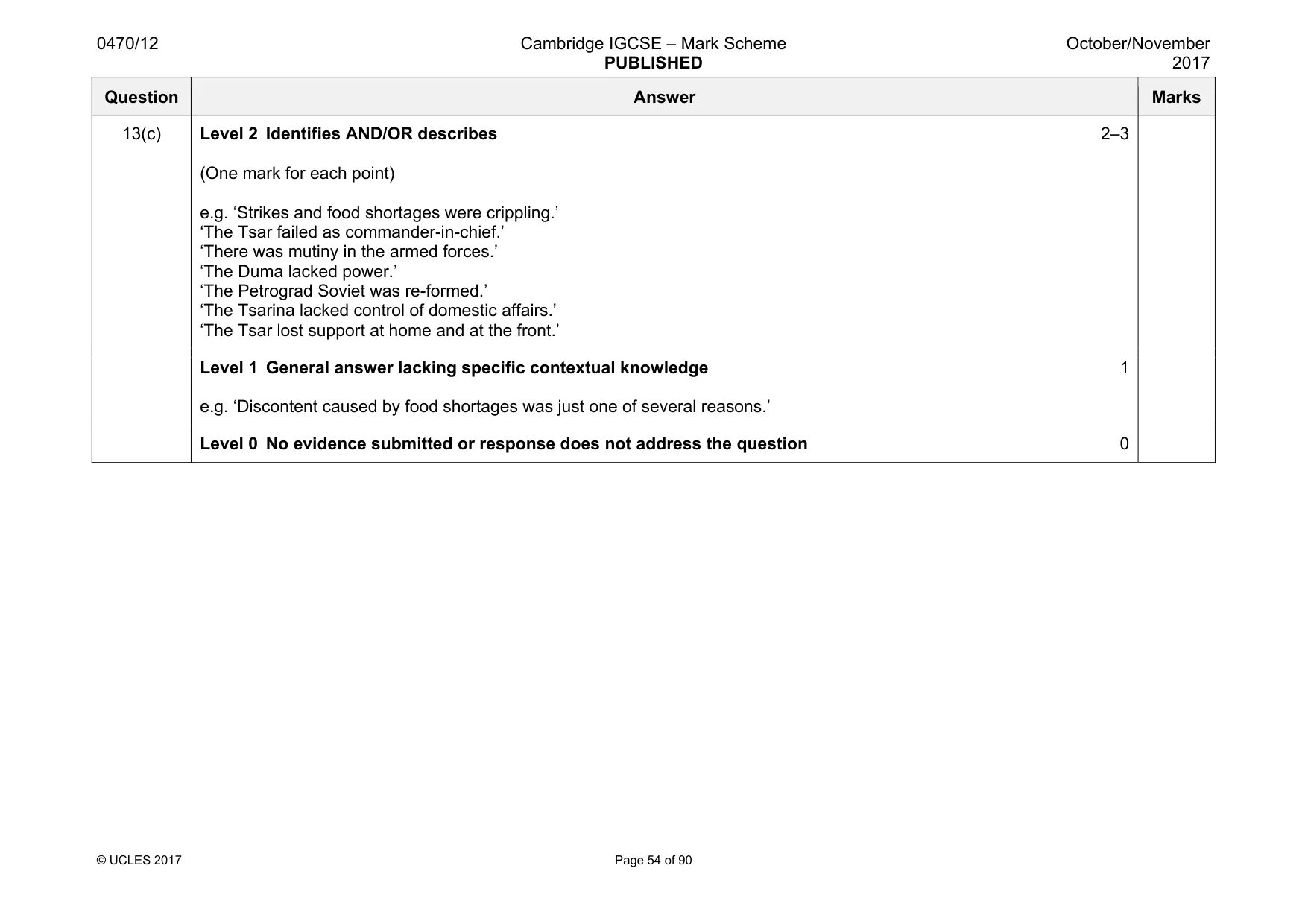
0470/12 Cambridge IGCSE – Mark Scheme PUBLISHED October/November 2017 © UCLES 2017 Page 54 of 90 Question Answer Marks 13(c) Level 2 Identifies AND/OR describes 2–3 (One mark for each point) e.g. ‘Strikes and food shortages were crippling.’ ‘The Tsar failed as commander-in-chief.’ ‘There was mutiny in the armed forces.’ ‘The Duma lacked power.’ ‘The Petrograd Soviet was re-formed.’ ‘The Tsarina lacked control of domestic affairs.’ ‘The Tsar lost support at home and at the front.’ Level 1 General answer lacking specific contextual knowledge 1 e.g. ‘Discontent caused by food shortages was just one of several reasons.’ Level 0 No evidence submitted or response does not address the question 0
Mark scheme, page 55
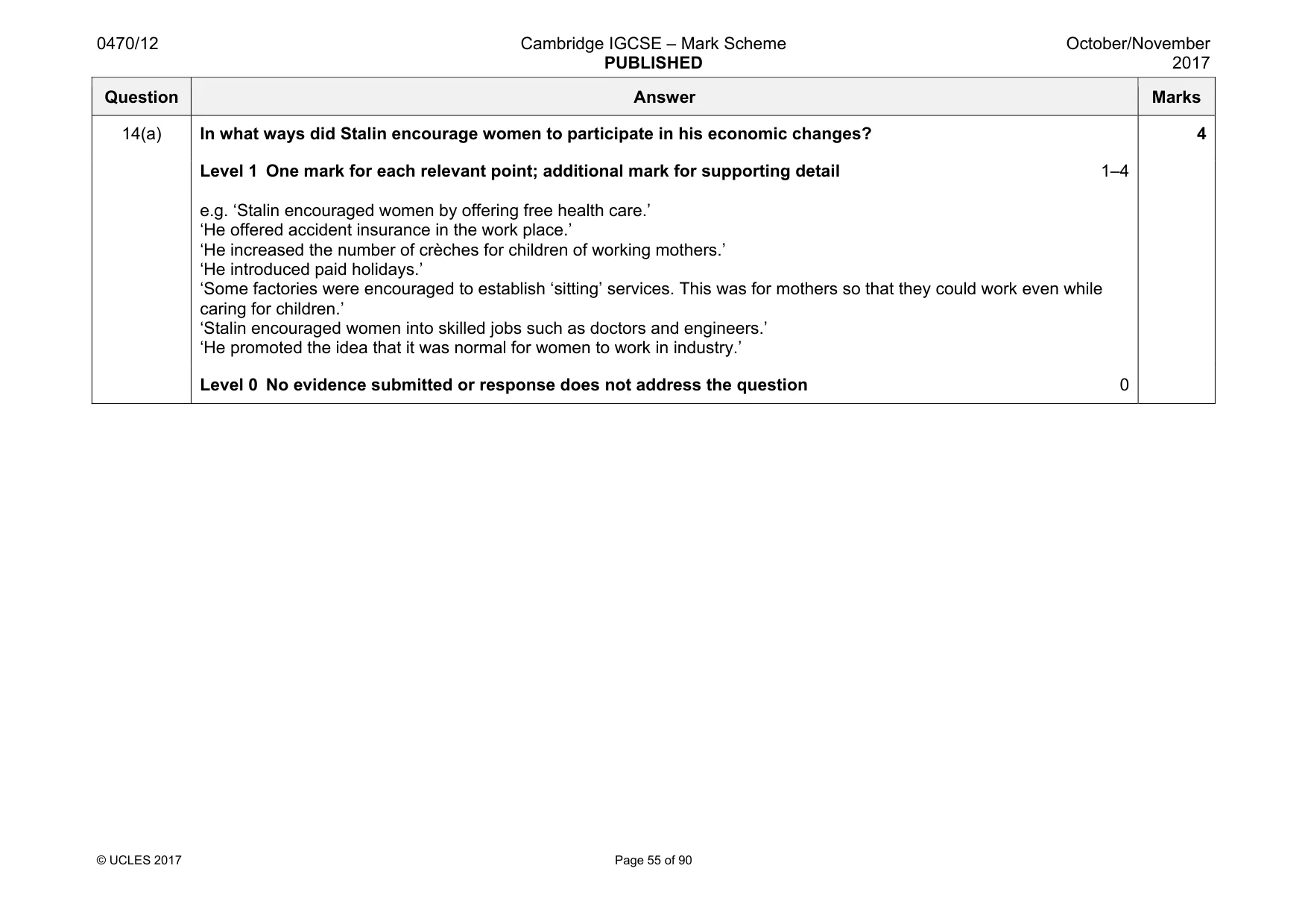
0470/12 Cambridge IGCSE – Mark Scheme PUBLISHED October/November 2017 © UCLES 2017 Page 55 of 90 Question Answer Marks 14(a) In what ways did Stalin encourage women to participate in his economic changes? 4 Level 1 One mark for each relevant point; additional mark for supporting detail 1–4 e.g. ‘Stalin encouraged women by offering free health care.’ ‘He offered accident insurance in the work place.’ ‘He increased the number of crèches for children of working mothers.’ ‘He introduced paid holidays.’ ‘Some factories were encouraged to establish ‘sitting’ services. This was for mothers so that they could work even while caring for children.’ ‘Stalin encouraged women into skilled jobs such as doctors and engineers.’ ‘He promoted the idea that it was normal for women to work in industry.’ Level 0 No evidence submitted or response does not address the question 0
Mark scheme, page 56
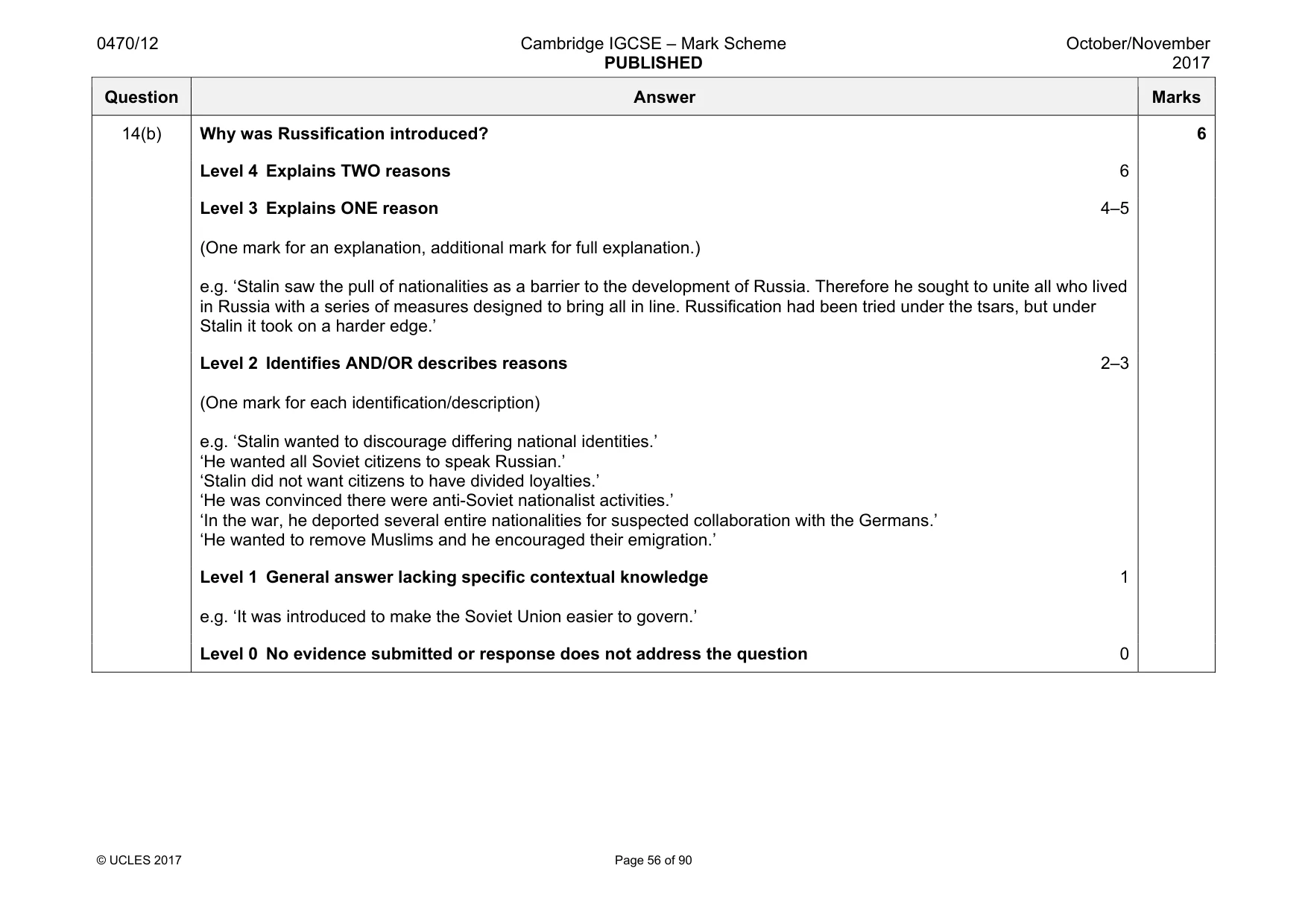
0470/12 Cambridge IGCSE – Mark Scheme PUBLISHED October/November 2017 © UCLES 2017 Page 56 of 90 Question Answer Marks 14(b) Why was Russification introduced? 6 Level 4 Explains TWO reasons 6 Level 3 Explains ONE reason 4–5 (One mark for an explanation, additional mark for full explanation.) e.g. ‘Stalin saw the pull of nationalities as a barrier to the development of Russia. Therefore he sought to unite all who lived in Russia with a series of measures designed to bring all in line. Russification had been tried under the tsars, but under Stalin it took on a harder edge.’ Level 2 Identifies AND/OR describes reasons 2–3 (One mark for each identification/description) e.g. ‘Stalin wanted to discourage differing national identities.’ ‘He wanted all Soviet citizens to speak Russian.’ ‘Stalin did not want citizens to have divided loyalties.’ ‘He was convinced there were anti-Soviet nationalist activities.’ ‘In the war, he deported several entire nationalities for suspected collaboration with the Germans.’ ‘He wanted to remove Muslims and he encouraged their emigration.’ Level 1 General answer lacking specific contextual knowledge 1 e.g. ‘It was introduced to make the Soviet Union easier to govern.’ Level 0 No evidence submitted or response does not address the question 0
Mark scheme, page 57
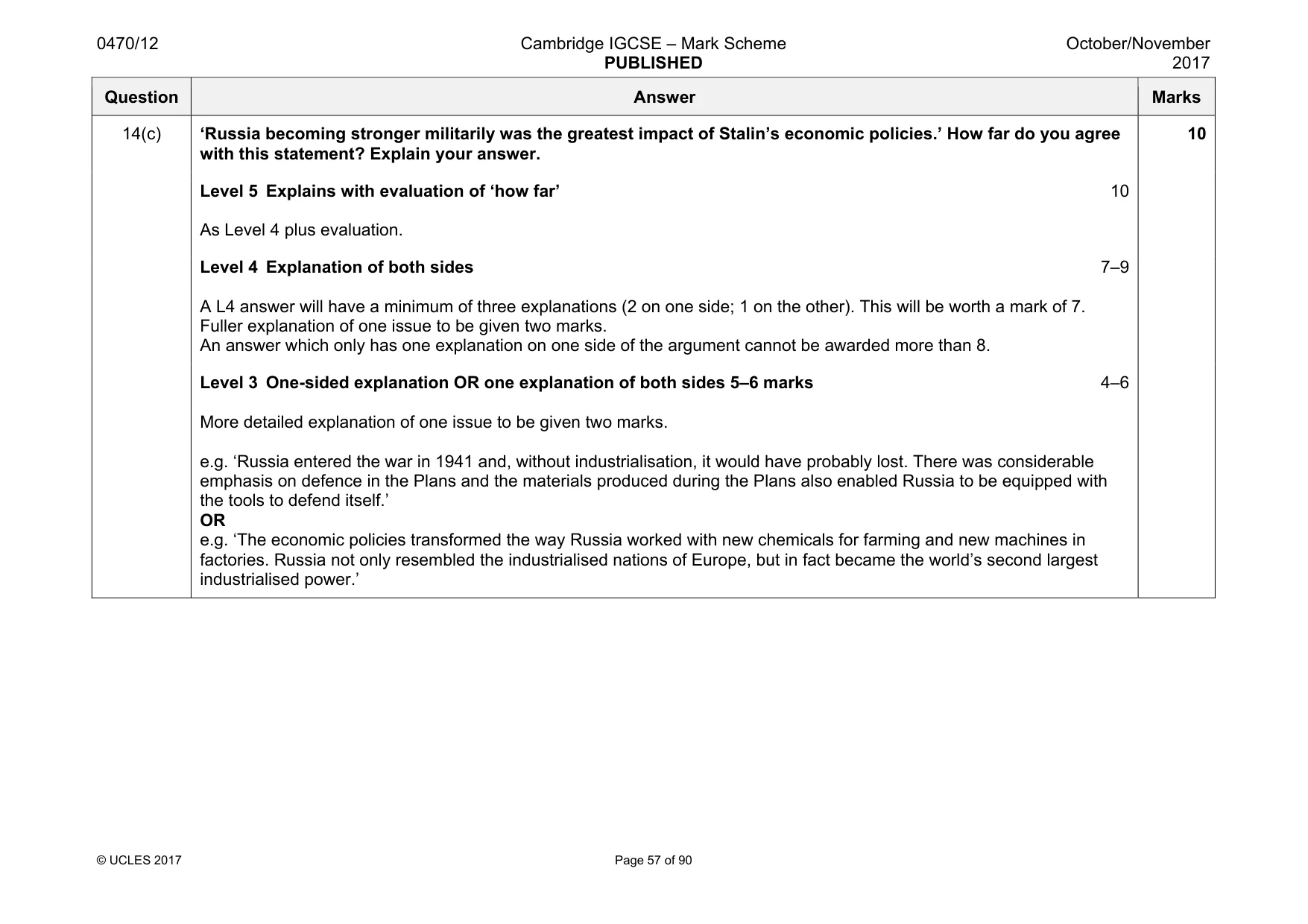
0470/12 Cambridge IGCSE – Mark Scheme PUBLISHED October/November 2017 © UCLES 2017 Page 57 of 90 Question Answer Marks 14(c) ‘Russia becoming stronger militarily was the greatest impact of Stalin’s economic policies.’ How far do you agree with this statement? Explain your answer. 10 Level 5 Explains with evaluation of ‘how far’ 10 As Level 4 plus evaluation. Level 4 Explanation of both sides 7–9 A L4 answer will have a minimum of three explanations (2 on one side; 1 on the other). This will be worth a mark of 7. Fuller explanation of one issue to be given two marks. An answer which only has one explanation on one side of the argument cannot be awarded more than 8. Level 3 One-sided explanation OR one explanation of both sides 5–6 marks 4–6 More detailed explanation of one issue to be given two marks. e.g. ‘Russia entered the war in 1941 and, without industrialisation, it would have probably lost. There was considerable emphasis on defence in the Plans and the materials produced during the Plans also enabled Russia to be equipped with the tools to defend itself.’ OR e.g. ‘The economic policies transformed the way Russia worked with new chemicals for farming and new machines in factories. Russia not only resembled the industrialised nations of Europe, but in fact became the world’s second largest industrialised power.’
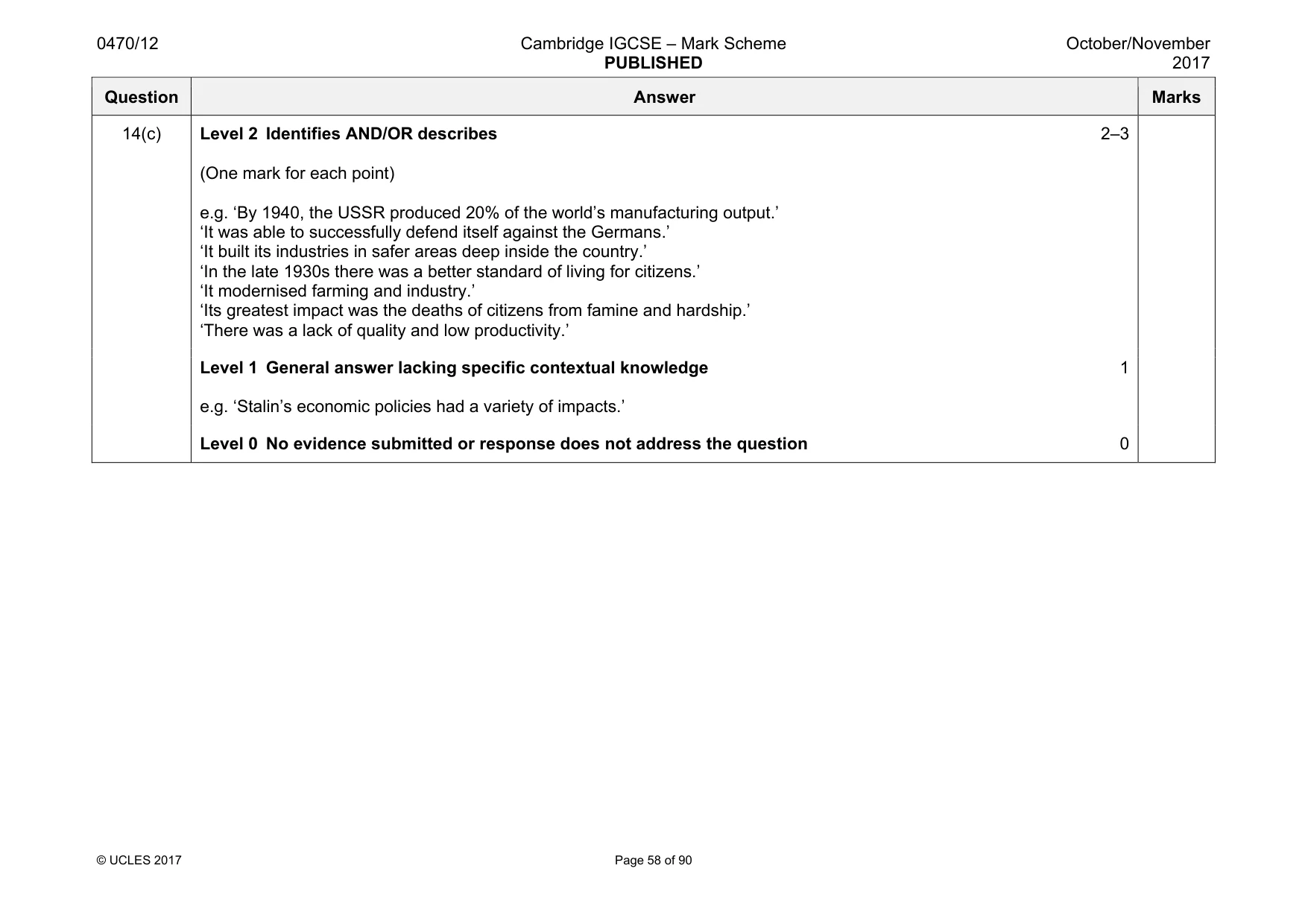
Mark scheme, page 58
0470/12 Cambridge IGCSE – Mark Scheme PUBLISHED October/November 2017 © UCLES 2017 Page 58 of 90 Question Answer Marks 14(c) Level 2 Identifies AND/OR describes 2–3 (One mark for each point) e.g. ‘By 1940, the USSR produced 20% of the world’s manufacturing output.’ ‘It was able to successfully defend itself against the Germans.’ ‘It built its industries in safer areas deep inside the country.’ ‘In the late 1930s there was a better standard of living for citizens.’ ‘It modernised farming and industry.’ ‘Its greatest impact was the deaths of citizens from famine and hardship.’ ‘There was a lack of quality and low productivity.’ Level 1 General answer lacking specific contextual knowledge 1 e.g. ‘Stalin’s economic policies had a variety of impacts.’ Level 0 No evidence submitted or response does not address the question 0
Mark scheme, page 59
0470/12 Cambridge IGCSE – Mark Scheme PUBLISHED October/November 2017 © UCLES 2017 Page 59 of 90 Question Answer Marks 15(a) What developments in mass media occurred in the 1920s? 4 Level 1 One mark for each relevant point; additional mark for supporting detail 1–4 e.g. ‘Newspapers benefited from the advancement in electronic communication.’ ‘Mass media was used for advertising.’ ‘Newspapers received stories from far afield and reported them quickly.’ ‘Many papers published multiple editions in a single day.’ ‘Radio’s first commercial broadcasts occurred during the 1920s.’ ‘In 1921, there was one licensed radio station, but by the end of 1922 there were 508.’ ‘In 1926, the first national network, NBC was set up.’ ‘Radio was used to broadcast light musical entertainment, producing an age of great dance bands.’ ‘Radio became important for transmitting news, often with live updates.’ ‘Cinema provided an opportunity for escapism for Americans.’ ‘Audiences doubled in the 1920s and reached 95 million by 1929.’ ‘Hollywood launched stars such as Charlie Chaplin and Mary Pickford.’ ‘In 1927, talkies arrived with the release of the ‘Jazz Singer’.’ ‘A code of practice was introduced to ban nudity and limit the length of kisses on screen.’ ‘There was a growth of newsreels, which were factual films about news events.’ Level 0 No evidence submitted or response does not address the question 0
Mark scheme, page 60
0470/12 Cambridge IGCSE – Mark Scheme PUBLISHED October/November 2017 © UCLES 2017 Page 60 of 90 Question Answer Marks 15(b) Why was there a revival of support for the Ku Klux Klan in the 1920s? 6 Level 4 Explains TWO reasons 6 Level 3 Explains ONE reason 4–5 (One mark for an explanation, additional mark for full explanation.) e.g. ‘The film, The Birth of a Nation, was released in 1915. It was set in the 1860s, just after the Civil War. This helped revive the Klan as it glorified the Klan as defenders of decent American values against immigrants, black Americans and corrupt businessmen.’ Level 2 Identifies AND/OR describes reasons 2–3 (One mark for each identification/description) e.g. ‘It was a response to the dislike of increased immigration.’ ‘It was a response by some Protestants to the influx of Jews and Catholics.’ ‘There was a fear of a communist revolution with the growing number of eastern European immigrants.’ ‘It was a reaction to the film The Birth of a Nation.’ ‘There was a feeling that decent American values had to be defended.’ ‘There was a national and state structure with full-time paid recruiters.’ ‘To defend jobs and the levels of pay.’ Level 1 General answer lacking specific contextual knowledge 1 e.g. ‘Many felt it was a way of expressing their views.’ Level 0 No evidence submitted or response does not address the question 0
Mark scheme, page 61
0470/12 Cambridge IGCSE – Mark Scheme PUBLISHED October/November 2017 © UCLES 2017 Page 61 of 90 Question Answer Marks 15(c) ‘Prohibition failed because it could not be enforced.’ How far do you agree with this statement? Explain your answer. 10 Level 5 Explains with evaluation of ‘how far’ 10 As Level 4 plus evaluation. Level 4 Explanation of both sides 7–9 A L4 answer will have a minimum of three explanations (2 on one side; 1 on the other). This will be worth a mark of 7. Fuller explanation of one issue to be given two marks. An answer which only has one explanation on one side of the argument cannot be awarded more than 8. Level 3 One-sided explanation OR one explanation of both sides 5–6 marks 4–6 More detailed explanation of one issue to be given two marks. e.g. ‘The government appointed several thousand enforcement agents but this was not enough and they were poorly paid. They were open to threats and bribes made by criminal gangs. State officials, judges, senior police officers and jury members were often bought off with bribes.’ OR e.g. ‘The biggest problem was that millions of Americans, especially in urban areas, were simply not prepared to obey this law. By 1925, there were more speakeasies in American cities than there had been saloons in 1919.’
Mark scheme, page 62
0470/12 Cambridge IGCSE – Mark Scheme PUBLISHED October/November 2017 © UCLES 2017 Page 62 of 90 Question Answer Marks 15(c) Level 2 Identifies AND/OR describes 2–3 (One mark for each point) e.g. ‘Prohibition made alcohol more attractive through illegal speakeasies.’ ‘Many urban Americans refused to obey the law on alcohol.’ ‘Many made their own alcohol, called ‘moonshine’.’ ‘The speakeasies were well supplied by bootleggers.’ ‘Two thirds of the illegal whisky came from Canada.’ ‘The border between the USA and Canada was almost impossible to patrol.’ ‘Rum was smuggled from the West Indies.’ ‘Organised gangs fought to control the manufacture and sale of alcohol.’ ‘Organised gangs bribed policemen, enforcement agents, judges and juries.’ Level 1 General answer lacking specific contextual knowledge 1 e.g. ‘Many people changed their minds about Prohibition.’ Level 0 No evidence submitted or response does not address the question 0
Mark scheme, page 63
0470/12 Cambridge IGCSE – Mark Scheme PUBLISHED October/November 2017 © UCLES 2017 Page 63 of 90 Question Answer Marks 16(a) Describe President Hoover’s reaction to the Bonus Marchers. 4 Level 1 One mark for each relevant point; additional mark for supporting detail 1–4 e.g. ‘He was not sympathetic to the Bonus Marchers’ demands.’ ‘Hoover refused to meet the marchers.’ ‘He considered the Bonus Army a revolutionary threat.’ ‘He pointed out that Congress had recently voted against issuing the bonds early.’ ‘He ordered the police to remove the Bonus Army from their camp.’ ‘Hoover ordered the Army to evict the Bonus Army from Washington.’ ‘Hoover put General Douglas MacArthur in charge of the operation.’ ‘Hoover instructed MacArthur to treat the veterans with respect.’ ‘Hoover told MacArthur to stop the assault on the Bonus Marchers.’ ‘Hoover did not give the Bonus Marchers their war pensions.’ Level 0 No evidence submitted or response does not address the question 0
Mark scheme, page 64
0470/12 Cambridge IGCSE – Mark Scheme PUBLISHED October/November 2017 © UCLES 2017 Page 64 of 90 Question Answer Marks 16(b) Why was the Wall Street Crash harmful to the American economy? 6 Level 4 Explains TWO reasons 6 Level 3 Explains ONE reason 4–5 (One mark for an explanation, additional mark for full explanation.) e.g. ‘The Crash had destroyed the one thing that was crucial to the prosperity of the 1920s and that was confidence. As a result, people kept their money instead of buying new goods or shares. The downward spiral was established. Businesses cut production further and laid off more workers. They reduced the wages of those who still worked for them. As workers were paid less or laid off, they bought even less.’ Level 2 Identifies AND/OR describes reasons 2–3 (One mark for each identification/description) e.g. ‘Businesses and banks went bust.’ ‘11 000 banks stopped trading.’ ‘The economy had to adjust to a general reduction in trade.’ ‘There was a reduction in demand for American goods at home and abroad.’ ‘Businesses had to reduce their operations by cutting production.’ ‘Workers were sacked or had their wages reduced.’ ‘Less money in the economy meant that people could not afford to buy goods.’ ‘Business confidence collapsed.’ ‘Any thought of business expansion had to be abandoned.’ ‘By 1933, the economy was producing only 20% of what it had in 1929.’ Level 1 General answer lacking specific contextual knowledge 1 e.g. ‘There was a downturn in the economy.’ Level 0 No evidence submitted or response does not address the question 0
Mark scheme, page 65
0470/12 Cambridge IGCSE – Mark Scheme PUBLISHED October/November 2017 © UCLES 2017 Page 65 of 90 Question Answer Marks 16(c) ‘Hoover’s idea of rugged individualism was the main reason he lost the 1932 election.’ How far do you agree with this statement? Explain your answer. 10 Level 5 Explains with evaluation of ‘how far’ 10 As Level 4 plus evaluation. Level 4 Explanation of both sides 7–9 A L4 answer will have a minimum of three explanations (2 on one side; 1 on the other). This will be worth a mark of 7. Fuller explanation of one issue to be given two marks. An answer which only has one explanation on one side of the argument cannot be awarded more than 8. Level 3 One-sided explanation OR one explanation of both sides 5–6 marks 4–6 More detailed explanation of one issue to be given two marks. e.g. ‘Hoover created an image of being heartless and uncaring by believing that government should stay out of business matters. He believed in ‘rugged individualism’, the idea that people should work hard for themselves and not expect the government to help them.’ OR e.g. ‘Roosevelt promised a ‘New Deal’ and this offered some hope. He came over as someone with energy and determination and people felt he was on their side. He promised government schemes for new jobs, measures to revive industry and agriculture, and relief for the poor and unemployed.’
Mark scheme, page 66
0470/12 Cambridge IGCSE – Mark Scheme PUBLISHED October/November 2017 © UCLES 2017 Page 66 of 90 Question Answer Marks 16(c) Level 2 Identifies AND/OR describes 2–3 (One mark for each point) e.g. ‘Republican policies seemed uncaring.’ ‘Republican policies wanted little government intervention.’ ‘Hoover himself seemed uncaring over the Bonus Army incident.’ ‘Roosevelt proposed a New Deal.’ ‘Roosevelt proposed government intervention.’ Level 1 General answer lacking specific contextual knowledge 1 e.g. ‘Hoover did not seem to offer much hope.’ Level 0 No evidence submitted or response does not address the question 0
Mark scheme, page 67
0470/12 Cambridge IGCSE – Mark Scheme PUBLISHED October/November 2017 © UCLES 2017 Page 67 of 90 Question Answer Marks 17(a) What problems faced the Chinese Communists before 1934? 4 Level 1 One mark for each relevant point; additional mark for supporting detail 1–4 e.g. ‘The Communists were part of the KMT, but in 1925 they were expelled.’ ‘The two rival groups clashed over control of China.’ ‘In 1927, Chiang ordered the arrest of leading communists in Shanghai. The Communist Party protested and Chiang ordered the army to take control.’ ‘Violent attacks led to 1000 arrests, 300 public executions and 5000 missing communists.’ ‘By the end of 1928, an estimated 300 000 people had been killed in anti-communist action.’ ‘Between 1930 and 1934, Chiang launched 5 extermination campaigns against the Jiangxi Soviet.’ ‘KMT troops attempted to wipe out Communist strongholds.’ Level 0 No evidence submitted or response does not address the question 0
Mark scheme, page 68
0470/12 Cambridge IGCSE – Mark Scheme PUBLISHED October/November 2017 © UCLES 2017 Page 68 of 90 Question Answer Marks 17(b) Why did the Second World War weaken the Nationalist government? 6 Level 4 Explains TWO reasons 6 Level 3 Explains ONE reason 4–5 (One mark for an explanation, additional mark for full explanation.) e.g. ‘Chiang Kai-shek was reluctant to engage the Japanese in military confrontation. Too often he adopted defensive positions and rarely attacked. This annoyed the Chinese population who saw the Communists, in contrast, use guerrilla- style tactics against the Japanese. The result was increasing support for the Communists and less support for the Nationalists, which proved decisive after the war.’ Level 2 Identifies AND/OR describes reasons 2–3 (One mark for each identification/description) e.g. ‘Chiang was keener on wiping out the Communists rather than the Japanese.’ ‘Chiang refused to engage with the Japanese which annoyed the Chinese population.’ ‘Public opinion was strongly anti-Japanese, but the Nationalists did not use this sentiment to their advantage.’ ‘The Chinese wanted the Nationalists to attack the Japanese and defend China.’ ‘The Nationalists were corrupt, misusing foreign war aid.’ ‘In contrast to the Nationalists, the Communists fought the Japanese.’ ‘The Communists organised local resistance groups to sabotage the enemy war effort.’ ‘The Chinese peasants were won over by the Communists’ attempts to defend their local areas and country.’ Level 1 General answer lacking specific contextual knowledge 1 e.g. ‘The Nationalists did not do enough to fight for China.’ Level 0 No evidence submitted or response does not address the question 0
Mark scheme, page 69
0470/12 Cambridge IGCSE – Mark Scheme PUBLISHED October/November 2017 © UCLES 2017 Page 69 of 90 Question Answer Marks 17(c) ‘The result of the Civil War was decided by the quality of leadership.’ How far do you agree with this statement? Explain your answer. 10 Level 5 Explains with evaluation of ‘how far’ 10 As Level 4 plus evaluation. Level 4 Explanation of both sides 7–9 A L4 answer will have a minimum of three explanations (2 on one side; 1 on the other). This will be worth a mark of 7. Fuller explanation of one issue to be given two marks. An answer which only has one explanation on one side of the argument cannot be awarded more than 8. Level 3 One-sided explanation OR one explanation of both sides 5–6 marks 4–6 More detailed explanation of one issue to be given two marks. e.g. ‘Mao insisted that the Communists kept the support of the peasants which had been gained during the war against Japan. Chiang led a corrupt regime which did not consider the needs of the ordinary Chinese peasant.’ OR e.g. ‘Mao had used guerrilla warfare against the Japanese. This had been successful, inflicting heavy casualties on the enemy. He continued these tactics in the Civil War, resisting fighting in pitched battles.’
Mark scheme, page 70
0470/12 Cambridge IGCSE – Mark Scheme PUBLISHED October/November 2017 © UCLES 2017 Page 70 of 90 Question Answer Marks 17(c) Level 2 Identifies AND/OR describes 2–3 (One mark for each point) e.g. ‘Mao was seen as looking after China’s interests.’ ‘Mao treated the peasants well.’ ‘Mao used guerrilla warfare.’ ‘People lost faith in the KMT to solve China’s economic problems.’ ‘Chiang was considered corrupt and not popular.’ ‘The USA withdrew aid to the KMT and remained neutral.’ ‘Mao won the hearts and minds of the peasantry.’ Level 1 General answer lacking specific contextual knowledge 1 e.g. ‘Mao was a good leader.’ Level 0 No evidence submitted or response does not address the question 0
Mark scheme, page 71
0470/12 Cambridge IGCSE – Mark Scheme PUBLISHED October/November 2017 © UCLES 2017 Page 71 of 90 Question Answer Marks 18(a) Describe the increased hostility between Communist China and Taiwan up to 1954. 4 Level 1 One mark for each relevant point; additional mark for supporting detail 1–4 e.g. ‘Chiang Kai-shek considered his government the legitimate Chinese government.’ ‘The USA supported the Nationalists and this was resented by Communist China.’ ‘Chiang kept Communist China out of the UN.’ ‘There was regular shelling between the two.’ ‘In 1950, the Communists attempted to seize control through an invasion of the island of Kinmen.’ ‘The Communists captured Hainan Island and Wanshan Islands.’ ‘The Taiwanese closed their ports to all foreign shipping.’ ‘There was a military clash in September 1954 known as the First Taiwan Strait crisis.’ ‘The US Congress voted extra arms and supplies to the Taiwanese government.’ ‘Both sides used propaganda showing the other to be suffering and living in poor conditions.’ Level 0 No evidence submitted or response does not address the question 0
Mark scheme, page 72
0470/12 Cambridge IGCSE – Mark Scheme PUBLISHED October/November 2017 © UCLES 2017 Page 72 of 90 Question Answer Marks 18(b) Why were Communist China’s relations with Tibet hostile? 6 Level 4 Explains TWO reasons 6 Level 3 Explains ONE reason 4–5 (One mark for an explanation, additional mark for full explanation.) e.g. ‘The Chinese invaded Tibet in 1950 and, by 1951, they were in control of Tibet. They had turned it into a province of China. The Chinese then began a prolonged campaign to destroy the Tibetan identity by undermining the local culture, religions and traditions. The area was deliberately flooded with Han settlers in order to outnumber the indigenous community.’ Level 2 Identifies AND/OR describes reasons 2–3 (One mark for each identification/description) e.g. ‘China invaded Tibet in 1950.’ ‘Tibet was made into a province of China.’ ‘Mao wanted total control of Tibet.’ ‘Mao wanted to remove Buddhism and the power of the Dalai Lama.’ ‘In 1958, there was a rebellion and the Tibetans declared independence. In the hostilities that followed, the Dalai Lama left Tibet for India.’ ‘Over 6,000 monasteries were destroyed between 1959 and 1961.’ ‘Land was re-allocated to Chinese ‘immigrants’ from the main Chinese states.’ ‘China encouraged a mass influx into Tibet of ‘non-ethnic’ Chinese.’ ‘China took over Tibet.’ Level 1 General answer lacking specific contextual knowledge 1 e.g. ‘They did not like each other.’ Level 0 No evidence submitted or response does not address the question 0
Mark scheme, page 73
0470/12 Cambridge IGCSE – Mark Scheme PUBLISHED October/November 2017 © UCLES 2017 Page 73 of 90 Question Answer Marks 18(c) ‘Trade was the main reason for China’s closer relations with the USA from 1970.’ How far do you agree with this statement? Explain your answer. 10 Level 5 Explains with evaluation of ‘how far’ 10 As Level 4 plus evaluation. Level 4 Explanation of both sides 7–9 A L4 answer will have a minimum of three explanations (2 on one side; 1 on the other). This will be worth a mark of 7. Fuller explanation of one issue to be given two marks. An answer which only has one explanation on one side of the argument cannot be awarded more than 8. Level 3 One-sided explanation OR one explanation of both sides 5–6 marks 4–6 More detailed explanation of one issue to be given two marks. e.g. ‘Both countries were keen to increase trade, which had been almost negligible because of poor relations during the Vietnam War. American envoy, Henry Kissinger, went to China in 1971 and negotiated a trade agreement.’ OR e.g. ‘China had given support to the regime in North Vietnam against the USA in the Vietnam War. In late 1969, the USA began to withdraw troops from Vietnam. This removed one of the main reasons not to have good relations with the USA.’
Mark scheme, page 74
0470/12 Cambridge IGCSE – Mark Scheme PUBLISHED October/November 2017 © UCLES 2017 Page 74 of 90 Question Answer Marks 18(c) Level 2 Identifies AND/OR describes 2–3 (One mark for each point) e.g. ‘The USA left Vietnam.’ ‘China joined the United Nations.’ ‘China was less friendly with the USSR.’ ‘The USA changed its foreign policy.’ ‘Trade developed between the USA and China.’ ‘There were sporting and cultural exchanges.’ Level 1 General answer lacking specific contextual knowledge 1 e.g. ‘World circumstances changed.’ Level 0 No evidence submitted or response does not address the question 0
Mark scheme, page 75
0470/12 Cambridge IGCSE – Mark Scheme PUBLISHED October/November 2017 © UCLES 2017 Page 75 of 90 Question Answer Marks 19(a) By 1945, in what ways was freedom of movement affected by the pass system? 4 Level 1 One mark for each relevant point; additional mark for supporting detail 1–4 e.g. ‘Movement around the country at will was severely limited.’ ‘Every black male over 16 years had to carry a pass.’ ‘The pass had to be presented on demand to the police.’ ‘The pass system enabled the authorities to monitor and control the movement of black Africans.’ ‘Passes ensured that blacks moved out of towns as soon as their work was complete.’ ‘White farmers used passes to ensure African labourers completed their work contracts.’ ‘It was illegal for black Africans to leave the farm without their passes.’ ‘Failure to produce a pass on demand could result in a jail sentence or deportation to a black reservation.’ Level 0 No evidence submitted or response does not address the question 0
Mark scheme, page 76
0470/12 Cambridge IGCSE – Mark Scheme PUBLISHED October/November 2017 © UCLES 2017 Page 76 of 90 Question Answer Marks 19(b) Why was the growth of manufacturing industry important for South Africa’s economic development by 1945? 6 Level 4 Explains TWO reasons 6 Level 3 Explains ONE reason 4–5 (One mark for an explanation, additional mark for full explanation.) e.g. ‘South Africa needed to balance its economy. It was too dependent on gold and diamond output which accounted for over 70% of its exports in value. Agriculture employed about 30% of the working population but produced only about 20% of the economy’s output. It was essential that manufacturing helped exports and gave employment, which it did. In 1910 manufacturing contributed 5% to the economy’s output, but by 1945 it had reached 20%. There was good growth in engineering and textiles.’ Level 2 Identifies AND/OR describes reasons 2–3 (One mark for each identification/description) e.g. ‘It needed to contribute more to the economy.’ ‘It needed to employ a higher percentage of the working population.’ ‘It needed to contribute more to exports.’ ‘More goods produced at home meant fewer goods to import.’ ‘It began to exploit the country’s rich resources such as coal and iron.’ ‘It began to produce cheap electricity to help other industries.’ Level 1 General answer lacking specific contextual knowledge 1 e.g. ‘Manufacturing began to take a larger share in South Africa’s economy.’ Level 0 No evidence submitted or response does not address the question 0
Mark scheme, page 77
0470/12 Cambridge IGCSE – Mark Scheme PUBLISHED October/November 2017 © UCLES 2017 Page 77 of 90 Question Answer Marks 19(c) ‘Government policies on land issues had a greater impact than employment policies on the non-white population.’ How true was this up to 1945? Explain your answer. 10 Level 5 Explains with evaluation of ‘how far’ 10 As Level 4 plus evaluation. Level 4 Explanation of both sides 7–9 A L4 answer will have a minimum of three explanations (2 on one side; 1 on the other). This will be worth a mark of 7. Fuller explanation of one issue to be given two marks. An answer which only has one explanation on one side of the argument cannot be awarded more than 8. Level 3 One-sided explanation OR one explanation of both sides 5–6 marks 4–6 More detailed explanation of one issue to be given two marks. e.g. ‘As a result of the Natives Land Act, farming gradually collapsed. The reserves were so over-populated that water- holes dried up and there was soil erosion. The reserves became a source of cheap, unskilled labour for white farmers and industrialists.’ OR e.g. ‘One of the main results of segregation in the workplace was that wages for non-whites were set substantially below those of the white population. In 1940, white income was ten times that of Africans.’
Mark scheme, page 78
0470/12 Cambridge IGCSE – Mark Scheme PUBLISHED October/November 2017 © UCLES 2017 Page 78 of 90 Question Answer Marks 19(c) Level 2 Identifies AND/OR describes 2–3 (One mark for each point) e.g. ‘90% of black people were forced to live in rural areas.’ ‘Black people were allocated 13% of the land in South Africa.’ ‘The reservations for black people had the least productive land.’ ‘Black people were not allowed to buy or rent land outside their reservations.’ ‘Black workers did not receive pensions or holidays.’ ‘Most black people could only afford the bare necessities of life.’ Level 1 General answer lacking specific contextual knowledge 1 e.g. ‘Both did not help non-whites have a good standard of living.’ Level 0 No evidence submitted or response does not address the question 0
Mark scheme, page 79
0470/12 Cambridge IGCSE – Mark Scheme PUBLISHED October/November 2017 © UCLES 2017 Page 79 of 90 Question Answer Marks 20(a) Describe the contribution of Desmond Tutu to the collapse of apartheid. 4 Level 1 One mark for each relevant point; additional mark for supporting detail 1–4 e.g. ‘Tutu was an articulate and tireless campaigner against apartheid.’ ‘He denounced apartheid as ‘evil and unchristian’.’ ‘He campaigned for equal rights for all South Africans.’ ‘He spoke in favour of a common education system.’ ‘He spoke against the pass laws and forced relocation to the Homelands.’ ‘Tutu used his positions, such as the Archbishop of Cape Town, to gain a worldwide audience.’ ‘His views were listened to on favouring economic sanctions and the peaceful reconciliation between all parties involved in apartheid.’ ‘He used his persuasive and charismatic personality towards the cause.’ ‘His contribution was recognised with the Nobel Peace Prize.’ ‘Tutu persuaded white people that they would not become victims of revenge in a new South Africa.’ Level 0 No evidence submitted or response does not address the question 0
Mark scheme, page 80
0470/12 Cambridge IGCSE – Mark Scheme PUBLISHED October/November 2017 © UCLES 2017 Page 80 of 90 Question Answer Marks 20(b) Why was reform legislation introduced by Botha’s government between 1979 and 1986 not as successful as he had hoped? 6 Level 4 Explains TWO reasons 6 Level 3 Explains ONE reason 4–5 (One mark for an explanation, additional mark for full explanation.) e.g. ‘If Botha hoped that the new constitution would look like power sharing and win the support of 2.6 million Coloureds or the 800 000 Asians, he was soon to be disappointed. Forty per cent of Coloureds and Asians could not be bothered to register and of those who did, only 30% of Coloureds and 20% of Asians voted in the first elections.’ Level 2 Identifies AND/OR describes reasons 2–3 (One mark for each identification/description) e.g. ‘Allowing black trade unions meant more strikes.’ ‘In joint sessions of the new parliament whites held a majority of 48.’ ‘Black Africans took no part in the new parliament, which soured relations.’ ‘Hard-line whites felt Botha was undermining the apartheid state.’ ‘There were breakaway parties like the Conservative Party and the Afrikaner Resistance Movement.’ Level 1 General answer lacking specific contextual knowledge 1 e.g. ‘The reforms raised expectations but nothing really happened.’ Level 0 No evidence submitted or response does not address the question 0
Mark scheme, page 81
0470/12 Cambridge IGCSE – Mark Scheme PUBLISHED October/November 2017 © UCLES 2017 Page 81 of 90 Question Answer Marks 20(c) ‘The transfer of power between 1990 and 1994 proceeded smoothly.’ How far do you agree with this statement? Explain your answer. 10 Level 5 Explains with evaluation of ‘how far’ 10 As Level 4 plus evaluation. Level 4 Explanation of both sides 7–9 A L4 answer will have a minimum of three explanations (2 on one side; 1 on the other). This will be worth a mark of 7. Fuller explanation of one issue to be given two marks. An answer which only has one explanation on one side of the argument cannot be awarded more than 8. Level 3 One-sided explanation OR one explanation of both sides 5–6 marks 4–6 More detailed explanation of one issue to be given two marks. e.g. ‘The talks between de Klerk and Mandela were conducted against a backdrop of continued violence and killings. Between 1990 and 1994 there were, on average, more than 3 200 deaths per year due to political violence.’ OR e.g. ‘De Klerk regained the initiative over his critics by holding a referendum, for and against the peace process, among the white electorate in March 1992. A clear majority of nearly 70% supported de Klerk’s policy.’
Mark scheme, page 82
0470/12 Cambridge IGCSE – Mark Scheme PUBLISHED October/November 2017 © UCLES 2017 Page 82 of 90 Question Answer Marks 20(c) Level 2 Identifies AND/OR describes 2–3 (One mark for each point) e.g. ‘The release of Mandela and unbanning the ANC brought progress.’ ‘De Klerk put the best interests of the country first.’ ‘There was persistent violence during the talks.’ ‘De Klerk’s security forces often took the law into their own hands.’ ‘Some members of the ANC wanted the armed struggle to continue.’ ‘Buthelezi wanted an independent Zulu nation.’ Level 1 General answer lacking specific contextual knowledge 1 e.g. ‘There was white and black opposition to the peace process.’ Level 0 No evidence submitted or response does not address the question 0
Mark scheme, page 83
0470/12 Cambridge IGCSE – Mark Scheme PUBLISHED October/November 2017 © UCLES 2017 Page 83 of 90 Question Answer Marks 21(a) In what ways did the British attempt to limit Jewish immigration to Palestine at the end of the Second World War? 4 Level 1 One mark for each relevant point; additional mark for supporting detail 1–4 e.g. ‘At the end of the war, Britain said that there would be no change in immigration policy.’ ‘A maximum of 10 000 Jewish immigrants would be allowed.’ ‘Britain rejected Ben Gurion’s demand for 100 000 Holocaust survivors to enter Palestine.’ ‘Britain transported many illegal Jewish immigrants back to Europe.’ ‘Many illegal Jewish immigrants were sent to an internment camp in Cyprus.’ ‘A ship called ‘The Exodus’ carrying 4 500 refugees from Europe was prevented from landing its passengers in Palestine.’ ‘The British authorities sent ‘The Exodus’ back to Europe.’ Level 0 No evidence submitted or response does not address the question 0
Mark scheme, page 84
0470/12 Cambridge IGCSE – Mark Scheme PUBLISHED October/November 2017 © UCLES 2017 Page 84 of 90 Question Answer Marks 21(b) Why was the Haganah more reluctant than other Jewish groups to use violence against the British? 6 Level 4 Explains TWO reasons 6 Level 3 Explains ONE reason 4–5 (One mark for an explanation, additional mark for full explanation.) e.g. ‘The Haganah had worked with the British forces during the Arab Revolt of 1936–39. They had been trained and led by Colonel Wingate. They had received some of their arms from the British Army. The Haganah appreciated the battle experience gained by working and training with the British.’ Level 2 Identifies AND/OR describes reasons 2–3 (One mark for each identification/description) e.g. ‘Many of the Haganah had been trained by the British.’ ‘They had received weapons from the British Army.’ ‘They had helped to protect British property in 1936–39.’ ‘Members of Haganah had been part of the British Army in North Africa.’ ‘The British trained the Palmach, an elite commando section of Haganah, members of which later took senior positions in the Israeli Army.’ ‘Haganah, with the British, tracked down the Lehi and Irgun members who assassinated Lord Moyne.’ Level 1 General answer lacking specific contextual knowledge 1 e.g. ‘Haganah had a history of working with the British.’ Level 0 No evidence submitted or response does not address the question 0
Mark scheme, page 85
0470/12 Cambridge IGCSE – Mark Scheme PUBLISHED October/November 2017 © UCLES 2017 Page 85 of 90 Question Answer Marks 21(c) ‘The main reason for Britain’s decision to withdraw from Palestine was the campaign of terrorism.’ How far do you agree with this statement? Explain your answer. 10 Level 5 Explains with evaluation of ‘how far’ 10 As Level 4 plus evaluation. Level 4 Explanation of both sides 7–9 A L4 answer will have a minimum of three explanations (2 on one side; 1 on the other). This will be worth a mark of 7. Fuller explanation of one issue to be given two marks. An answer which only has one explanation on one side of the argument cannot be awarded more than 8. Level 3 One-sided explanation OR one explanation of both sides 5–6 marks 4–6 More detailed explanation of one issue to be given two marks. e.g. ‘Irgun attacked British military camps and convoys. It occasionally captured British soldiers and executed them. This put the British government under pressure to ‘bring the boys home’, especially after having fought the Nazis and Japanese for six years.’ OR e.g. ‘The Second World War had been an exhausting and costly war for Britain. Britain had been left with huge debts. Britain found it too expensive to keep large numbers of troops in Palestine, especially as the Labour Government needed the finances for the Welfare State.’
Mark scheme, page 86
0470/12 Cambridge IGCSE – Mark Scheme PUBLISHED October/November 2017 © UCLES 2017 Page 86 of 90 Question Answer Marks 21(c) Level 2 Identifies AND/OR describes 2–3 (One mark for each point) e.g. ‘The Second World War left Britain with huge debts.’ ‘Britain could not cope with the numbers of Jews coming to Palestine.’ ‘There was considerable violence against the British.’ ‘The actions of Irgun proved to be decisive.’ ‘The Labour Government had different priorities.’ ‘There was a lack of support from the USA for two independent provinces.’ Level 1 General answer lacking specific contextual knowledge 1 e.g. ‘The Second World War left Britain exhausted.’ Level 0 No evidence submitted or response does not address the question 0
Mark scheme, page 87
0470/12 Cambridge IGCSE – Mark Scheme PUBLISHED October/November 2017 © UCLES 2017 Page 87 of 90 Question Answer Marks 22(a) Describe the role of the United Nations in the Arab-Israeli conflict between 1967 and 1982. 4 Level 1 One mark for each relevant point; additional mark for supporting detail 1–4 e.g. ‘A UN Emergency Force had been placed in Egypt after the Suez Crisis.’ ‘In 1967, Nasser insisted the UNEF was withdrawn from Egypt.’ ‘The UN General Assembly voted in July 1967 declaring Israel’s annexation of east Jerusalem to be illegal.’ ‘The UN attempted to restore peace after the Six Day War.’ ‘It passed Resolution 242 containing incentives for both sides to make peace.’ ‘In 1973, the UN returned to Egypt in a peace-keeping capacity.’ ‘After Israel’s invasion of Lebanon in 1982, UNIFIL stayed behind Israeli lines to provide protection and aid to the civilian population.’ ‘In 1982, the role of the UN declined in the country with the intervention of the US and a multinational force of peace- keepers.’ ‘The Security Council has concentrated on conflict resolution.’ ‘The General Assembly has passed many resolutions over the ‘Palestinian problem’.’ Level 0 No evidence submitted or response does not address the question 0
Mark scheme, page 88
0470/12 Cambridge IGCSE – Mark Scheme PUBLISHED October/November 2017 © UCLES 2017 Page 88 of 90 Question Answer Marks 22(b) Why did the Camp David accords not bring peace to the Middle East? 6 Level 4 Explains TWO reasons 6 Level 3 Explains ONE reason 4–5 (One mark for an explanation, additional mark for full explanation.) e.g. ‘Some Arab countries felt that Egypt had not demanded enough at Camp David to further the cause of the Palestinians. The peace treaty did not demand from Israel the recognition of the Palestinians’ right to self-determination. There was no provision in the Agreement for an independent Palestinian state centred on the West Bank.’ Level 2 Identifies AND/OR describes reasons 2–3 (One mark for each identification/description) e.g. ‘The Agreement did not remove Israeli occupation of the West Bank.’ ‘There was no agreement on an independent Palestinian state.’ ‘Jewish settlements could be built in the West Bank on Arab land.’ ‘Palestinians in the West Bank would be restricted in their movements.’ ‘There was a feeling that Egypt had broken a united front.’ Level 1 General answer lacking specific contextual knowledge 1 e.g. ‘The Agreement did not go far enough.’ Level 0 No evidence submitted or response does not address the question 0
Mark scheme, page 89
0470/12 Cambridge IGCSE – Mark Scheme PUBLISHED October/November 2017 © UCLES 2017 Page 89 of 90 Question Answer Marks 22(c) ‘Since 1993, the Palestinians have been more responsible than the Israelis for the failure of the peace process.’ How far do you agree with this statement? Explain your answer. 10 Level 5 Explains with evaluation of ‘how far’ 10 As Level 4 plus evaluation. Level 4 Explanation of both sides 7–9 A L4 answer will have a minimum of three explanations (2 on one side; 1 on the other). This will be worth a mark of 7. Fuller explanation of one issue to be given two marks. An answer which only has one explanation on one side of the argument cannot be awarded more than 8. Level 3 One-sided explanation OR one explanation of both sides 5–6 marks 4–6 More detailed explanation of one issue to be given two marks. e.g. ‘In 2006, Hamas won a majority in the Palestinian parliament. The Hamas majority in the parliament refused to recognise the state of Israel. As a result, Israel, the USA and European governments refused to have dealings with Hamas. The peace process stalled yet again.’ OR e.g. ‘The issue of Jewish settlements on the West Bank remains the greatest obstacle to peace. These continue to expand under both hard-line and more moderate Israeli governments. This is preventing the emergence of a viable Palestinian state.’
Mark scheme, page 90
0470/12 Cambridge IGCSE – Mark Scheme PUBLISHED October/November 2017 © UCLES 2017 Page 90 of 90 Question Answer Marks 22(c) Level 2 Identifies AND/OR describes 2–3 (One mark for each point) e.g. ‘The Israelis have continued building in the Occupied Territories.’ ‘Israeli troops remain in the West Bank.’ ‘Hamas has an aim to destroy the state of Israel.’ ‘Rockets have been fired from Gaza into Israel.’ ‘Israel has bombed Hamas targets in Gaza.’ ‘Israel has built a security wall and barrier around the West Bank.’ ‘The USA can have influence over Israel but has not chosen to use it.’ Level 1 General answer lacking specific contextual knowledge 1 e.g. ‘Views are entrenched on both sides.’ Level 0 No evidence submitted or response does not address the question 0
What you needed in this session
Cambridge’s own grade thresholds for 2017 Oct/Nov, Paper 1 · Variant 2. A higher threshold means an easier paper — the bar moves with how the cohort did.