Cambridge IGCSE History 0470 — 2017 Feb/March Paper 2 · Variant 2
0470/22/F/M/17 · 50 marks · ≈56 min
The question paper and its mark scheme, free to read here and free to download. This is Cambridge’s own paper, exactly as it was sat.
Question paper12 pages
Mark scheme9 pages
Answers below. Sit the paper first if you are practising.
Paper as text
Question paper, page 1
This document consists of 12 printed pages and 1 Insert. DC (NH/FD) 129021/2 © UCLES 2017 [Turn over * 9 9 9 3 5 5 7 5 7 7 * HISTORY 0470/22 Paper 2 February/March 2017 2 hours No Additional Materials are required. READ THESE INSTRUCTIONS FIRST An answer booklet is provided inside this question paper. You should follow the instructions on the front cover of the answer booklet. If you need additional answer paper ask the invigilator for a continuation booklet. This paper has two options. Choose one option, and answer all of the questions on that topic. Option A: 19th Century topic [p2–p7] Option B: 20th Century topic [p8–p12] The number of marks is given in brackets [ ] at the end of each question or part question. The syllabus is approved for use in England, Wales and Northern Ireland as a Cambridge International Level 1/Level 2 Certificate. Cambridge International Examinations Cambridge International General Certificate of Secondary Education
Question paper, page 2
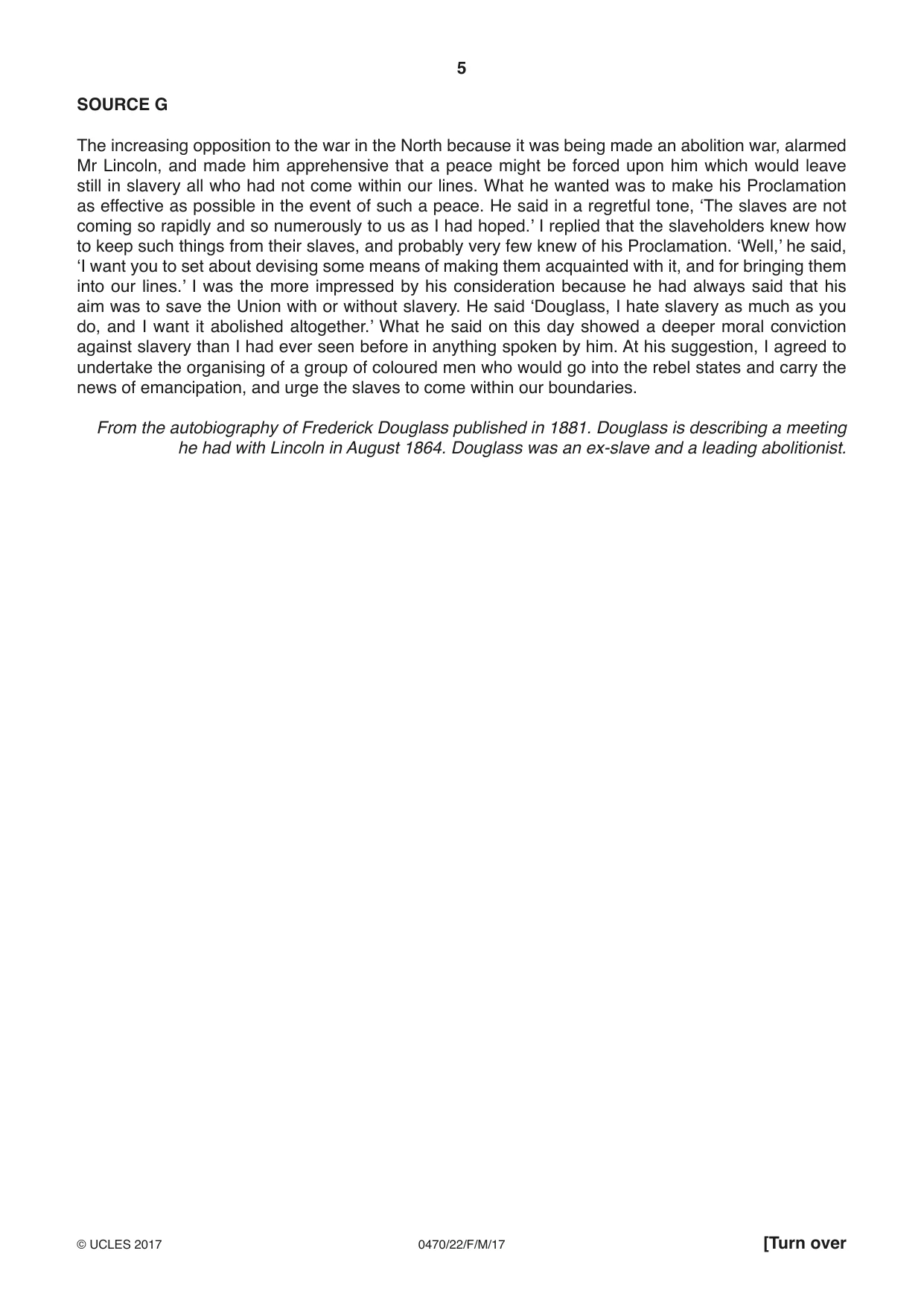
2 0470/22/F/M/17 © UCLES 2017 Option A: 19th Century topic WHAT WAS LINCOLN’S ATTITUDE TOWARDS EMANCIPATION OF SLAVES? Study the Background Information and the sources carefully, and then answer all the questions. Background Information Historians have disagreed about Abraham Lincoln’s real attitude towards emancipation of slaves. He is sometimes portrayed as a great hero who saw slavery as evil and was determined to bring about emancipation. Others see him as someone who was little interested in the issue of emancipation and who had to be pushed all the way to act. When the Emancipation Proclamation came into operation in January 1863 it only freed slaves in the Confederacy and some argued that it was introduced simply to help the North in the Civil War. However, in 1865 Lincoln forced through Congress the Thirteenth Amendment which abolished slavery throughout the USA. Did Lincoln really believe in emancipation? SOURCE A Lincoln’s career was a process of moral and political education and deepening antislavery conviction. Lincoln was strongly antislavery, but he was not an abolitionist or Radical Republican and never claimed to be one. He made a sharp distinction between his personal wish that ‘all men everywhere could be free’ and his official duties as legislator, congressman, and president in a legal and constitutional system that recognised the South’s right to property in slaves. Even after issuing the Emancipation Proclamation he continued to declare his preference for gradual abolition. While his racial views changed during the Civil War, he never became a principled egalitarian in the manner of abolitionists such as Frederick Douglass. Much of Lincoln’s career can be seen as an attempt to identify a workable mode of antislavery action in a political and constitutional system that erected seemingly impassable barriers to effective steps towards abolition. For most of his career, Lincoln had no real idea how to rid the United States of slavery, although he announced many times his desire to see it end. No one before the war anticipated what Lincoln would call its ‘astounding’ result, the emancipation of the slaves. From a history book published in 2010.
Question paper, page 3
3 0470/22/F/M/17 © UCLES 2017 [Turn over SOURCE B Lincoln was far too moderate on slavery. Although he believed slavery was wrong he never believed in racial equality. All he wanted at first was to stop slavery spreading to the new territories. He did not even propose forbidding slavery in the South. Radical Republicans like Charles Sumner were angry with him for not taking a strong stand against slavery. His ideas about slavery never really changed during his lifetime. During the early part of the Civil War Lincoln insisted that it was not about emancipation. He did not want to create new enemies in slave states such as Maryland and Kentucky and feared that emancipation would lead to the war degenerating into a ‘remorseless struggle’. His only concern was the Union, but he began to realise that freeing the slaves would weaken the South and would help him win the war and restore the Union. It was not until August 1862 that he even supported the idea of black soldiers in the Union army. He agreed to the Emancipation Proclamation reluctantly and under great pressure from abolitionists. Although he introduced it in July 1862, he postponed issuing it until 1863 and spent the time trying to persuade Black Americans to support the idea of colonisation. When issued, it did not liberate a single slave in states that his government controlled as it applied only to areas ruled by the Confederates. What it did, however, was weaken the Confederacy. When in 1865 all slaves were freed, it was clear that the Civil War had unexpectedly led to full emancipation. From a recent article about Lincoln. SOURCE C I hate the spread of slavery. I hate it because of the monstrous injustice of slavery itself. I hate it because it enables the enemies of free institutions to taunt us as hypocrites and causes the real friends of freedom to doubt our sincerity. I have no prejudice against the Southern people. They are just what we would be in their situation. If slavery did not now exist amongst them, they would not introduce it. If it did now exist amongst us, we should not instantly give it up. When it is said that the institution of slavery exists, and that it is very difficult to get rid of it, I can understand. I surely will not blame them for not doing what I should not know how to do myself. My first impulse would be to free all the slaves, and send them to Liberia – to their own native land. But a moment’s reflection would convince me that doing this immediately is impossible. If they were all landed there in a day, they would all perish in the next ten days. What then? Free them, and make them politically and socially our equals? My own feelings will not admit of this; and if mine would, we well know that those of the great mass of white people will not. From a speech given by Lincoln in Illinois in 1854. SOURCE D Now I ask you, are you in favour of conferring upon the negro the rights and privileges of citizenship? If you desire negro citizenship, if you desire them to come into the State and stay with white men, if you desire to let them vote, if you desire them to serve on juries and be judge of your rights then go with Mr Lincoln. I do not question Mr Lincoln’s belief that the negro was made his equal, and hence his brother. But for my own part I do not regard the negro as my equal. I believe that this new doctrine preached by Mr Lincoln and this Abolition party would dissolve the Union. From a speech by Stephen Douglas during the election campaign of 1858 in Illinois.
Question paper, page 4
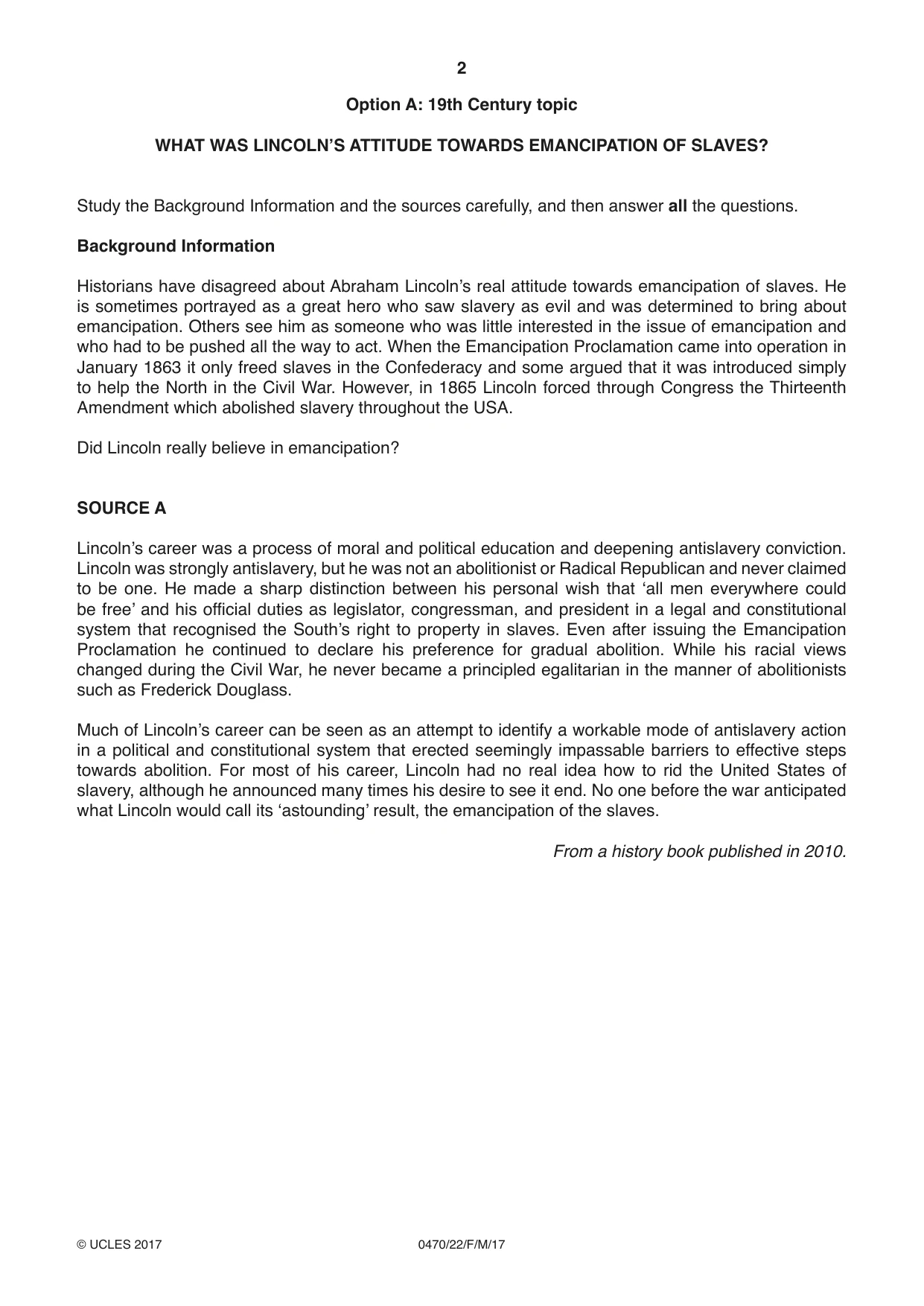
4 0470/22/F/M/17 © UCLES 2017 SOURCE E A cartoon published in an American magazine in October 1861. Lincoln is saying ‘I’m sorry to have to drop you, but this concern won’t carry us both!’ SOURCE F We complain that the Union cause is suffering immensely from a mistaken tolerance of Rebel Slavery. Had you, Sir, said in your first speech as President that if the Rebellion should be persisted in, no loyal person could be rightfully held in Slavery by a traitor, we believe the Rebellion would have suffered a staggering blow. Had you proclaimed that Rebellion would strike the chains from the slave of every traitor, the wealthy and the cautious in the South would have been supplied with a powerful reason to remain loyal. From an article entitled ‘The Prayer of Twenty Millions’ published in the important newspaper, the ‘New York Tribune’, August 1862. It was written by Horace Greeley, the editor of the newspaper and a leading abolitionist.
Question paper, page 5
5 0470/22/F/M/17 © UCLES 2017 [Turn over SOURCE G The increasing opposition to the war in the North because it was being made an abolition war, alarmed Mr Lincoln, and made him apprehensive that a peace might be forced upon him which would leave still in slavery all who had not come within our lines. What he wanted was to make his Proclamation as effective as possible in the event of such a peace. He said in a regretful tone, ‘The slaves are not coming so rapidly and so numerously to us as I had hoped.’ I replied that the slaveholders knew how to keep such things from their slaves, and probably very few knew of his Proclamation. ‘Well,’ he said, ‘I want you to set about devising some means of making them acquainted with it, and for bringing them into our lines.’ I was the more impressed by his consideration because he had always said that his aim was to save the Union with or without slavery. He said ‘Douglass, I hate slavery as much as you do, and I want it abolished altogether.’ What he said on this day showed a deeper moral conviction against slavery than I had ever seen before in anything spoken by him. At his suggestion, I agreed to undertake the organising of a group of coloured men who would go into the rebel states and carry the news of emancipation, and urge the slaves to come within our boundaries. From the autobiography of Frederick Douglass published in 1881. Douglass is describing a meeting he had with Lincoln in August 1864. Douglass was an ex-slave and a leading abolitionist.
Question paper, page 6
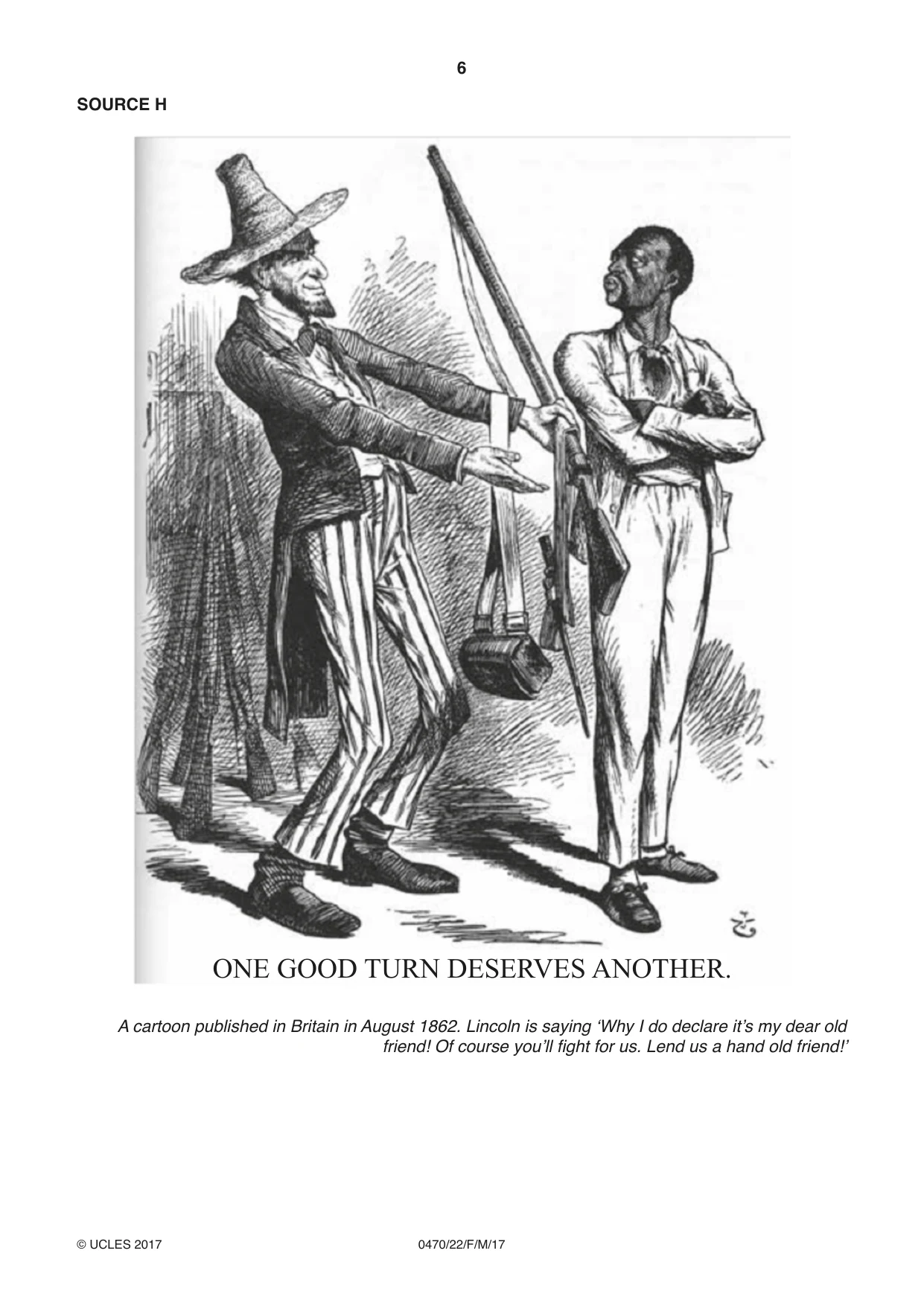
6 0470/22/F/M/17 © UCLES 2017 SOURCE H ONE GOOD TURN DESERVES ANOTHER. A cartoon published in Britain in August 1862. Lincoln is saying ‘Why I do declare it’s my dear old friend! Of course you’ll fight for us. Lend us a hand old friend!’
Question paper, page 7
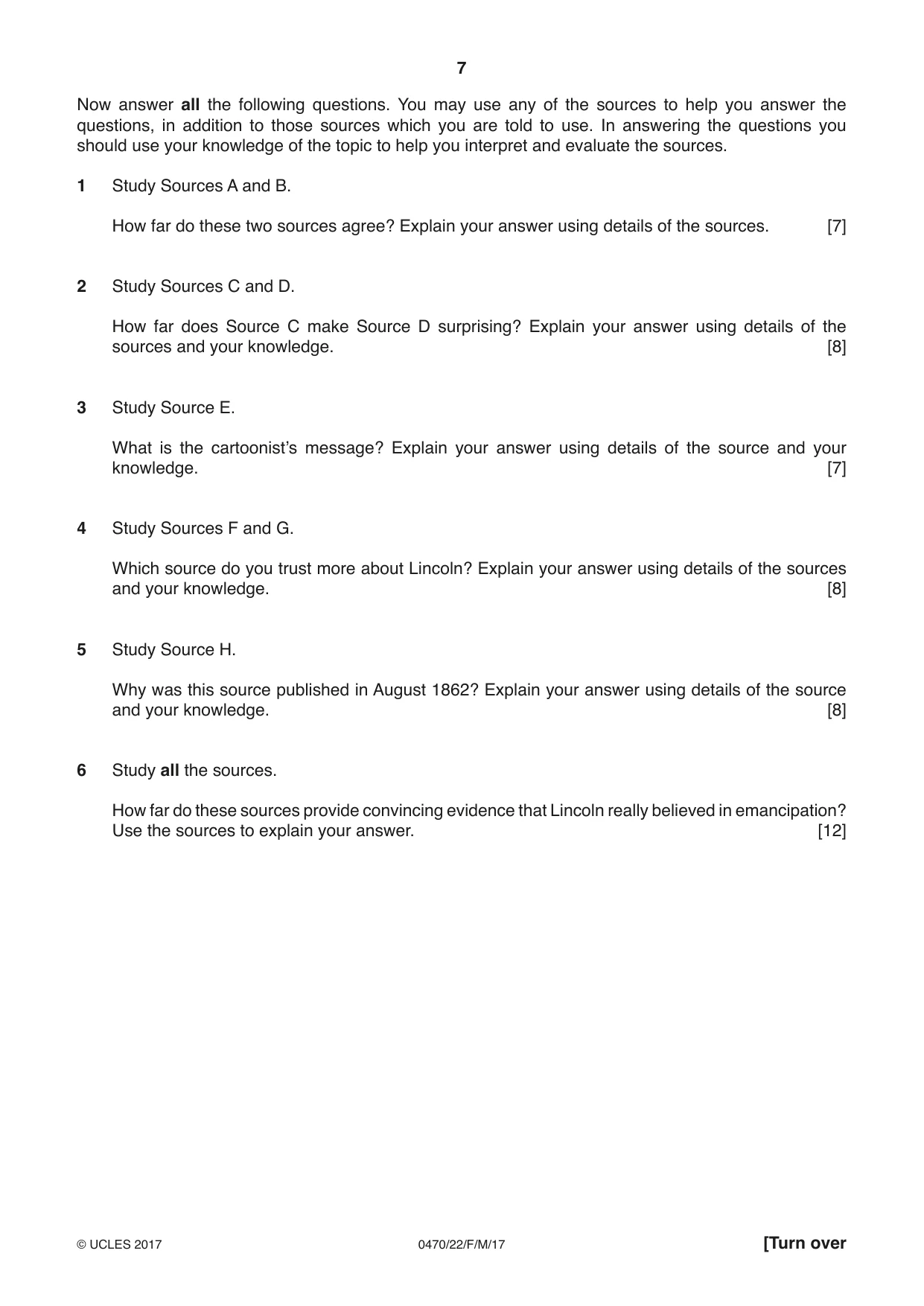
7 0470/22/F/M/17 © UCLES 2017 [Turn over Now answer all the following questions. You may use any of the sources to help you answer the questions, in addition to those sources which you are told to use. In answering the questions you should use your knowledge of the topic to help you interpret and evaluate the sources. 1 Study Sources A and B. How far do these two sources agree? Explain your answer using details of the sources. [7] 2 Study Sources C and D. How far does Source C make Source D surprising? Explain your answer using details of the sources and your knowledge. [8] 3 Study Source E. What is the cartoonist’s message? Explain your answer using details of the source and your knowledge. [7] 4 Study Sources F and G. Which source do you trust more about Lincoln? Explain your answer using details of the sources and your knowledge. [8] 5 Study Source H. Why was this source published in August 1862? Explain your answer using details of the source and your knowledge. [8] 6 Study all the sources. How far do these sources provide convincing evidence that Lincoln really believed in emancipation? Use the sources to explain your answer. [12]
Question paper, page 8
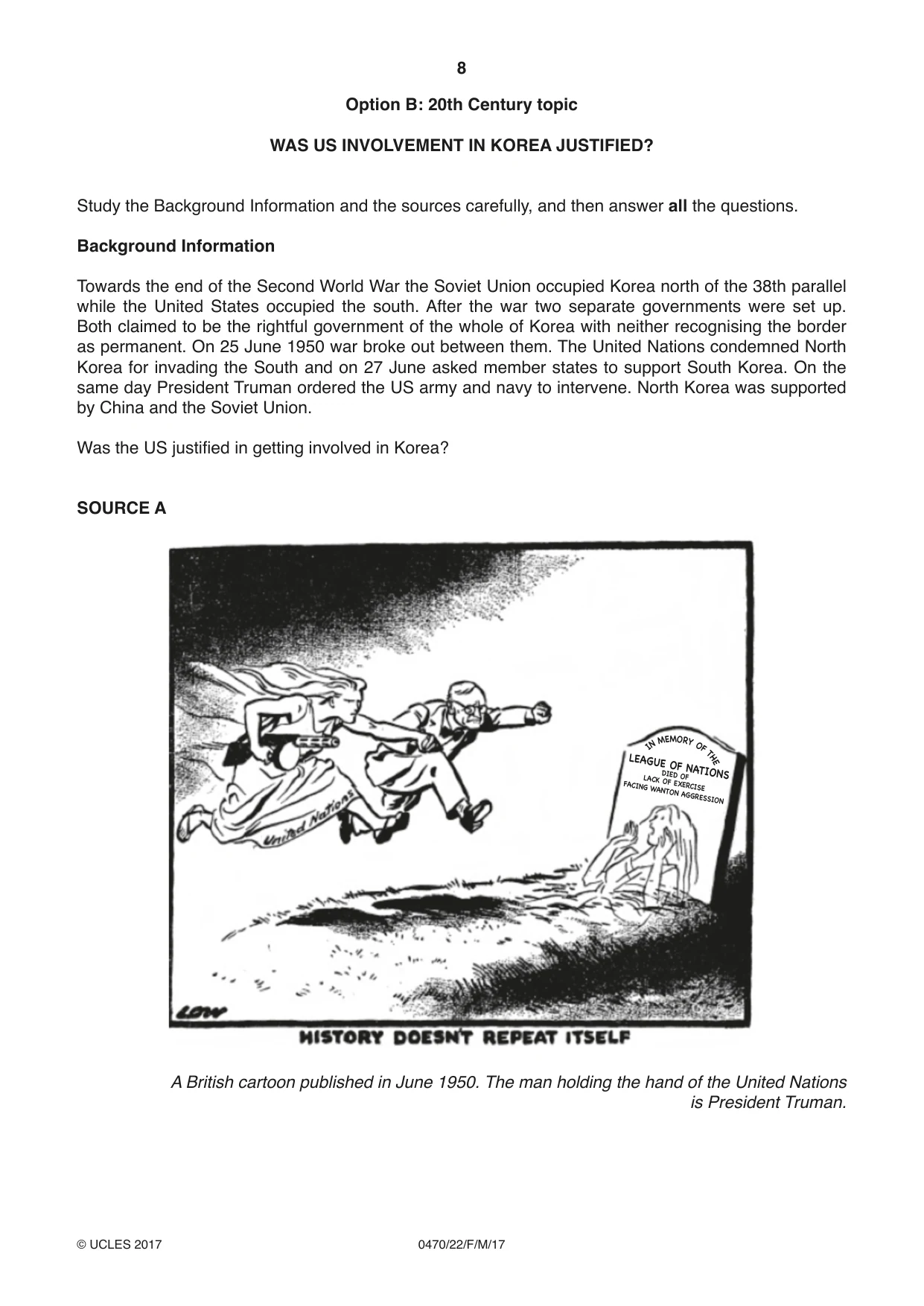
8 0470/22/F/M/17 © UCLES 2017 Option B: 20th Century topic WAS US INVOLVEMENT IN KOREA JUSTIFIED? Study the Background Information and the sources carefully, and then answer all the questions. Background Information Towards the end of the Second World War the Soviet Union occupied Korea north of the 38th parallel while the United States occupied the south. After the war two separate governments were set up. Both claimed to be the rightful government of the whole of Korea with neither recognising the border as permanent. On 25 June 1950 war broke out between them. The United Nations condemned North Korea for invading the South and on 27 June asked member states to support South Korea. On the same day President Truman ordered the US army and navy to intervene. North Korea was supported by China and the Soviet Union. Was the US justified in getting involved in Korea? SOURCE A LEAGUE OF NATIONS DIED OF LACK OF EXERCISE FACING WANTON AGGRESSION I N M E M O R Y O F T H E A British cartoon published in June 1950. The man holding the hand of the United Nations is President Truman.
Question paper, page 9
9 0470/22/F/M/17 © UCLES 2017 [Turn over SOURCE B I am reporting to the Congress on the situation which has been created in Korea, and on the actions which this Nation has taken to meet this situation. At four o’clock in the morning, 25 June, North Korean armed forces invaded the South. Just one day before the attack observers from the United Nations Commission had completed a routine tour. They stated that the army of the South was organised entirely for defence. They found no concentration of troops and no preparation to attack. Within a few hours after the invasion was launched the Commission reported to the United Nations that the attack had come without warning and without provocation. This report makes it clear that the attack was naked, deliberate, unprovoked aggression, without justification. This outright breach of the peace, in violation of the United Nations Charter, created a real danger to the security of every nation. This attack was, in addition, a demonstration of contempt for the United Nations, since it was an attempt to settle, by military aggression, a question which the United Nations had been working to settle by peaceful means. If this challenge had not been met squarely, the effectiveness of the United Nations would have been all but ended, and the hope of mankind that the United Nations would develop into an institution of world order would have been shattered. When the invaders took no notice of the Security Council resolution of 25 June, I ordered United States air and sea forces to give the South Korean government support. President Truman speaking to the US Congress, 30 June 1950. SOURCE C The events now taking place in Korea broke out on 25 June as the result of the actions of the South Korean authorities. This attack was planned in advance. From time to time Syngman Rhee had blurted out the fact that his gang had such a plan. As long ago as October 1949, in an interview given to an American journalist, he claimed his army could capture Pyongyang in three days. In May this year a member of the American government told the American Congress that 100 000 men of the South Korean Army, equipped with American weapons, could begin war at any time. These facts speak for themselves. The United States started armed intervention in Korea before the United Nations’ Security Council met on 27 June. From a statement by Andrei Gromyko, Soviet Deputy Minister of Foreign Affairs, 5 July 1950, published in Soviet News. Syngman Rhee was president of South Korea. Pyongyang was the capital city of North Korea. SOURCE D In connection with the forthcoming session of the General Assembly of the United Nations, we consider it advisable to recommend to the government of North Korea to send a statement to the General Assembly, on the basis of documents found in the President of South Korea’s archives in Seoul. This would show how Syngman Rhee and his gang prepared to attack the North and the illegality of the American intervention in Korea. It would also demand measures for the immediate ending of American intervention and the withdrawal from Korea of the troops of the foreign interventionists. A telegram to North Korea from the Soviet Ambassador to the United Nations, June 1950.
Question paper, page 10
10 0470/22/F/M/17 © UCLES 2017 SOURCE E The North Koreans wanted to prod South Korea with the point of a bayonet. Kim Il-sung said that the first poke would touch off an internal explosion in South Korea and that the power of the people would prevail. Kim told Stalin he was absolutely certain of success. We were inclined to think that if the war were fought swiftly then intervention by the USA could be avoided. The North Koreans occupied Seoul and we wished Kim every success because this was a war of national liberation. Then the strength of the North Korean army gave out and the enemy recovered. Stalin was partly to blame for the dangerous position the North Koreans were now in. It’s absolutely incomprehensible to me why he did it, but just before the North Koreans marched into South Korea Stalin had called back all of our advisors who were helping them. When I asked about this Stalin shouted, ‘It’s too dangerous. We don’t want there to be evidence for accusing us of taking part in this business.’ From Nikita Khrushchev’s memoirs published in 1971. In 1950 Khrushchev was head of the Communist Party in Moscow and one of Stalin’s advisors. SOURCE F In the final analysis I did this for the United Nations. I believed in the League of Nations. It failed. Lots of people thought it failed because we were not in it to support it. OK, now we started the UN. It was our idea, and in its first big test we just couldn’t let it down. From President Truman’s memoirs published in 1956. SOURCE G Clearly the invasion of South Korea was an open, undisguised challenge to America’s internationally accepted position as the protector of South Korea, an area of great importance to the security of American-occupied Japan. To back away from this challenge would be highly destructive of our strength and reputation. From Dean Acheson’s memoirs published in 1969. Acheson was a member of Truman’s government and in charge of American foreign policy.
Question paper, page 11
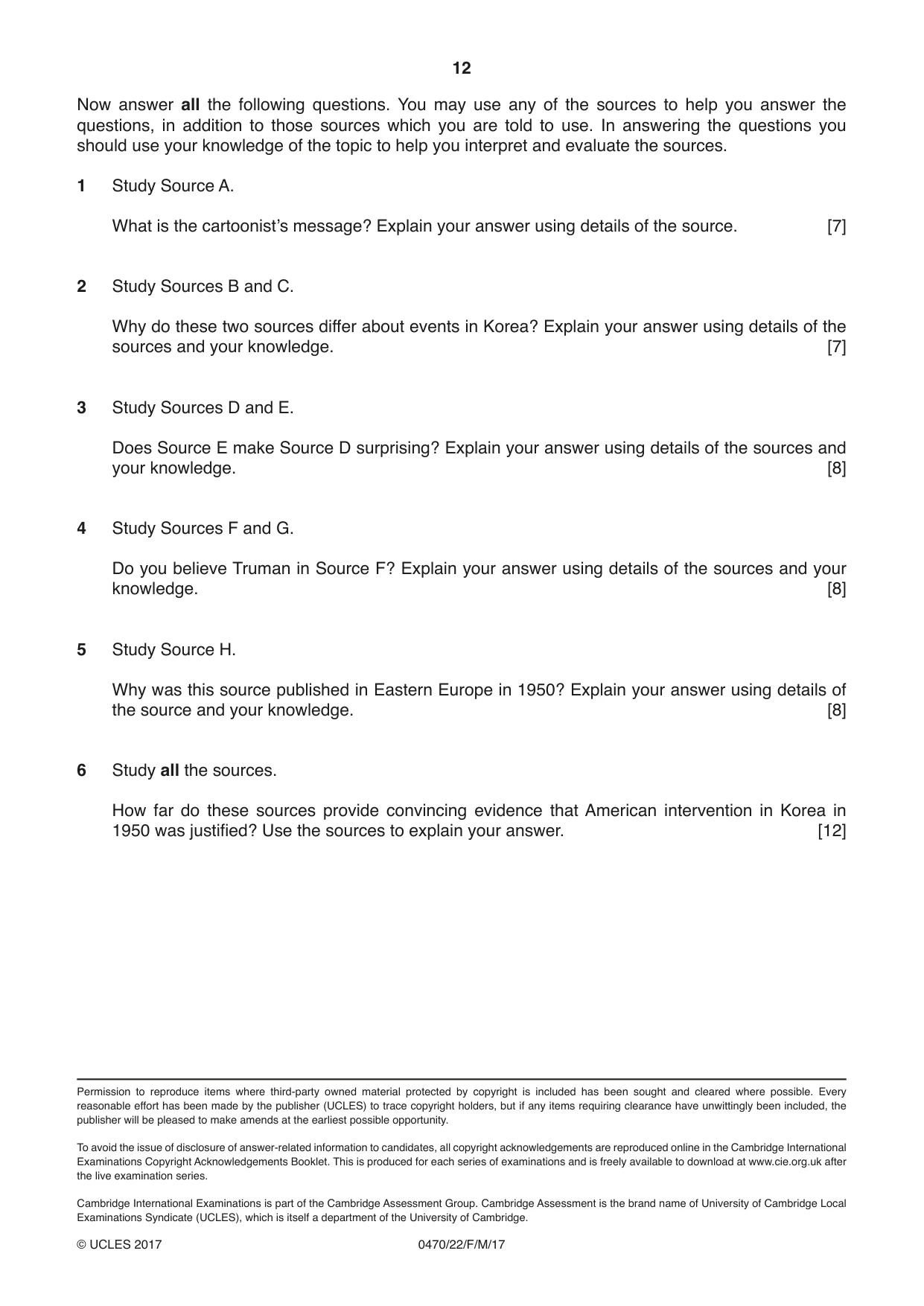
11 0470/22/F/M/17 © UCLES 2017 [Turn over SOURCE H A postcard published in 1950 in Eastern Europe. The figure is General MacArthur. The words on MacArthur’s cloak are ‘UN Flag’.
Question paper, page 12
12 0470/22/F/M/17 © UCLES 2017 Now answer all the following questions. You may use any of the sources to help you answer the questions, in addition to those sources which you are told to use. In answering the questions you should use your knowledge of the topic to help you interpret and evaluate the sources. 1 Study Source A. What is the cartoonist’s message? Explain your answer using details of the source. [7] 2 Study Sources B and C. Why do these two sources differ about events in Korea? Explain your answer using details of the sources and your knowledge. [7] 3 Study Sources D and E. Does Source E make Source D surprising? Explain your answer using details of the sources and your knowledge. [8] 4 Study Sources F and G. Do you believe Truman in Source F? Explain your answer using details of the sources and your knowledge. [8] 5 Study Source H. Why was this source published in Eastern Europe in 1950? Explain your answer using details of the source and your knowledge. [8] 6 Study all the sources. How far do these sources provide convincing evidence that American intervention in Korea in 1950 was justified? Use the sources to explain your answer. [12] Permission to reproduce items where third-party owned material protected by copyright is included has been sought and cleared where possible. Every reasonable effort has been made by the publisher (UCLES) to trace copyright holders, but if any items requiring clearance have unwittingly been included, the publisher will be pleased to make amends at the earliest possible opportunity. To avoid the issue of disclosure of answer-related information to candidates, all copyright acknowledgements are reproduced online in the Cambridge International Examinations Copyright Acknowledgements Booklet. This is produced for each series of examinations and is freely available to download at www.cie.org.uk after the live examination series. Cambridge International Examinations is part of the Cambridge Assessment Group. Cambridge Assessment is the brand name of University of Cambridge Local Examinations Syndicate (UCLES), which is itself a department of the University of Cambridge.
Mark scheme, page 1
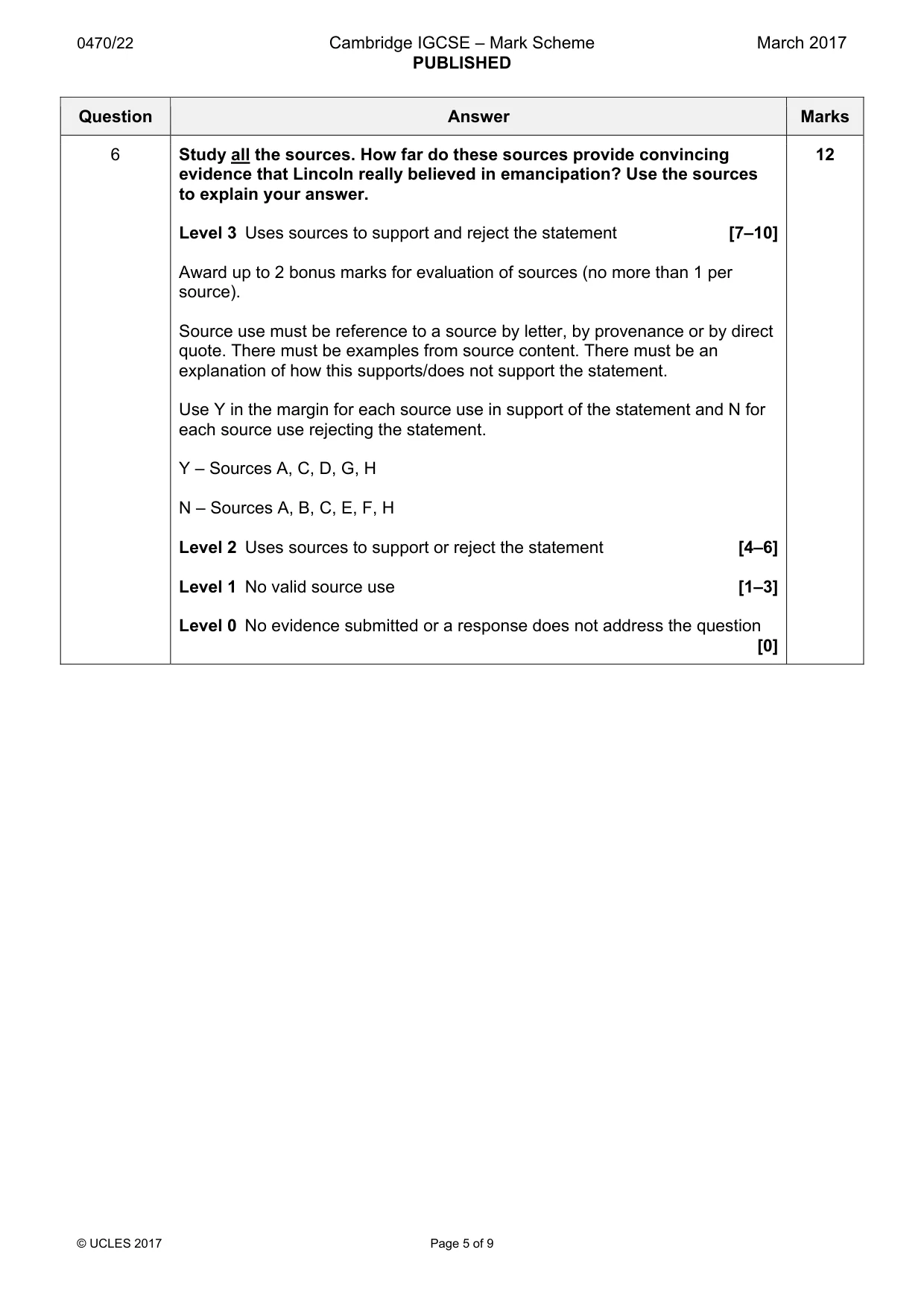
® IGCSE is a registered trademark. This syllabus is approved for use in England, Wales and Northern Ireland as a Cambridge International Level 1/Level 2 Certificate. This document consists of 9 printed pages. © UCLES 2017 [Turn over Cambridge International Examinations Cambridge International General Certificate of Secondary Education HISTORY 0470/22 Paper 2 March 2017 MARK SCHEME Maximum Mark: 50 Published This mark scheme is published as an aid to teachers and candidates, to indicate the requirements of the examination. It shows the basis on which Examiners were instructed to award marks. It does not indicate the details of the discussions that took place at an Examiners’ meeting before marking began, which would have considered the acceptability of alternative answers. Mark schemes should be read in conjunction with the question paper and the Principal Examiner Report for Teachers. Cambridge will not enter into discussions about these mark schemes. Cambridge is publishing the mark schemes for the March 2017 series for most Cambridge IGCSE®, Cambridge International A and AS Level components and some Cambridge O Level components.
Mark scheme, page 2
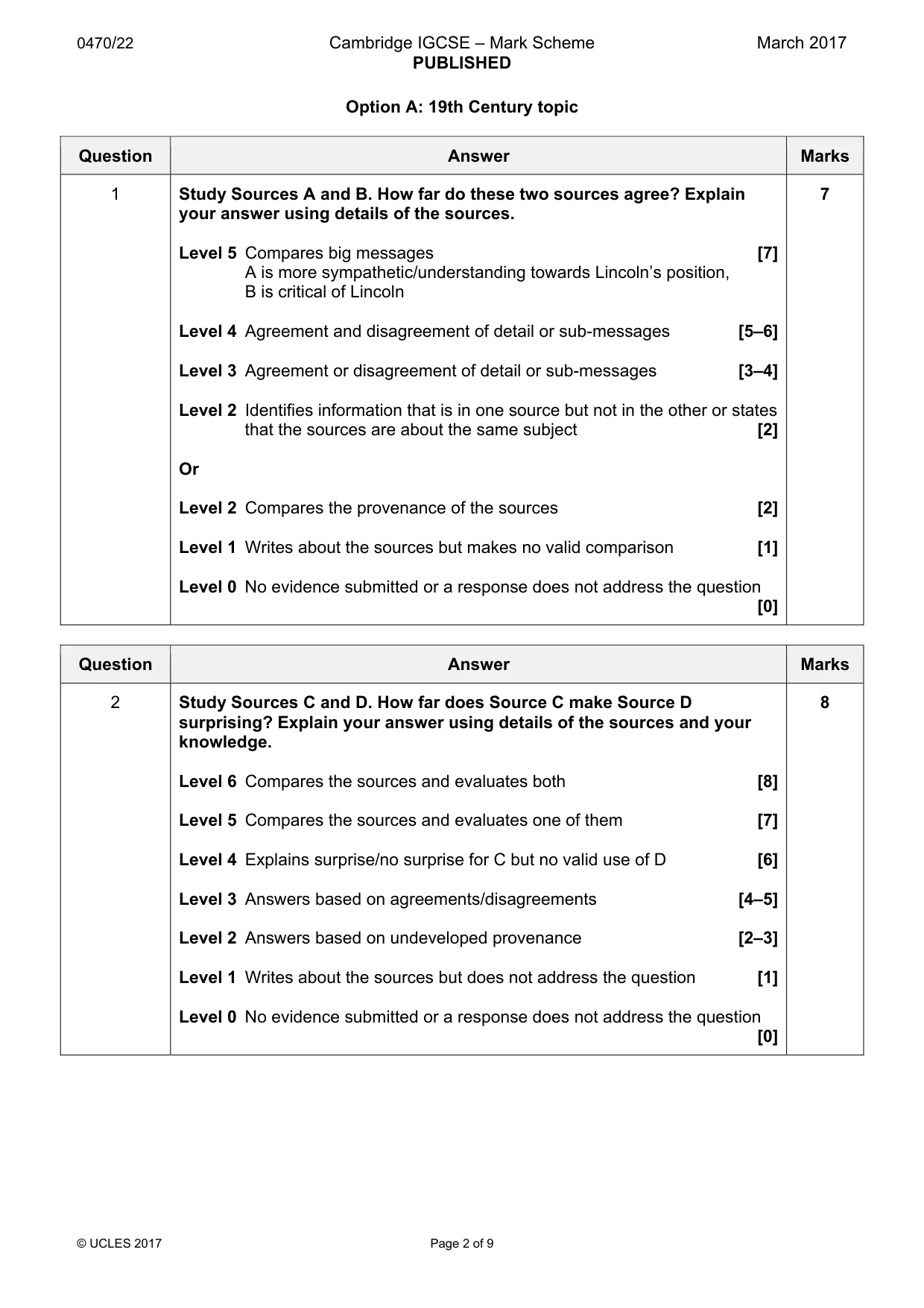
0470/22 Cambridge IGCSE – Mark Scheme PUBLISHED March 2017 © UCLES 2017 Page 2 of 9 Option A: 19th Century topic Question Answer Marks 1 Study Sources A and B. How far do these two sources agree? Explain your answer using details of the sources. Level 5 Compares big messages [7] A is more sympathetic/understanding towards Lincoln’s position, B is critical of Lincoln Level 4 Agreement and disagreement of detail or sub-messages [5–6] Level 3 Agreement or disagreement of detail or sub-messages [3–4] Level 2 Identifies information that is in one source but not in the other or states that the sources are about the same subject [2] Or Level 2 Compares the provenance of the sources [2] Level 1 Writes about the sources but makes no valid comparison [1] Level 0 No evidence submitted or a response does not address the question [0] 7 Question Answer Marks 2 Study Sources C and D. How far does Source C make Source D surprising? Explain your answer using details of the sources and your knowledge. Level 6 Compares the sources and evaluates both [8] Level 5 Compares the sources and evaluates one of them [7] Level 4 Explains surprise/no surprise for C but no valid use of D [6] Level 3 Answers based on agreements/disagreements [4–5] Level 2 Answers based on undeveloped provenance [2–3] Level 1 Writes about the sources but does not address the question [1] Level 0 No evidence submitted or a response does not address the question [0] 8
Mark scheme, page 3
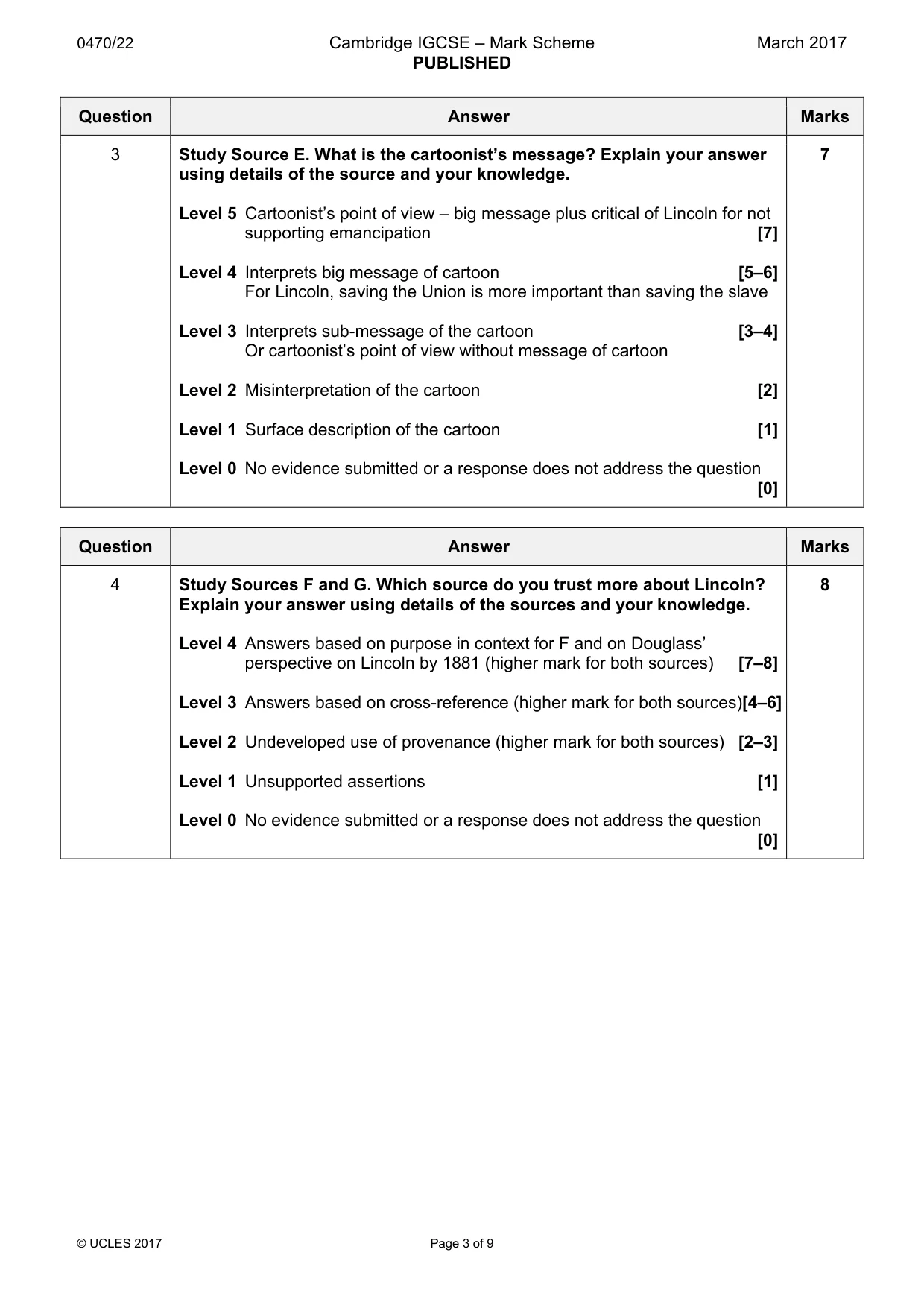
0470/22 Cambridge IGCSE – Mark Scheme PUBLISHED March 2017 © UCLES 2017 Page 3 of 9 Question Answer Marks 3 Study Source E. What is the cartoonist’s message? Explain your answer using details of the source and your knowledge. Level 5 Cartoonist’s point of view – big message plus critical of Lincoln for not supporting emancipation [7] Level 4 Interprets big message of cartoon [5–6] For Lincoln, saving the Union is more important than saving the slave Level 3 Interprets sub-message of the cartoon [3–4] Or cartoonist’s point of view without message of cartoon Level 2 Misinterpretation of the cartoon [2] Level 1 Surface description of the cartoon [1] Level 0 No evidence submitted or a response does not address the question [0] 7 Question Answer Marks 4 Study Sources F and G. Which source do you trust more about Lincoln? Explain your answer using details of the sources and your knowledge. Level 4 Answers based on purpose in context for F and on Douglass’ perspective on Lincoln by 1881 (higher mark for both sources) [7–8] Level 3 Answers based on cross-reference (higher mark for both sources)[4–6] Level 2 Undeveloped use of provenance (higher mark for both sources) [2–3] Level 1 Unsupported assertions [1] Level 0 No evidence submitted or a response does not address the question [0] 8
Mark scheme, page 4
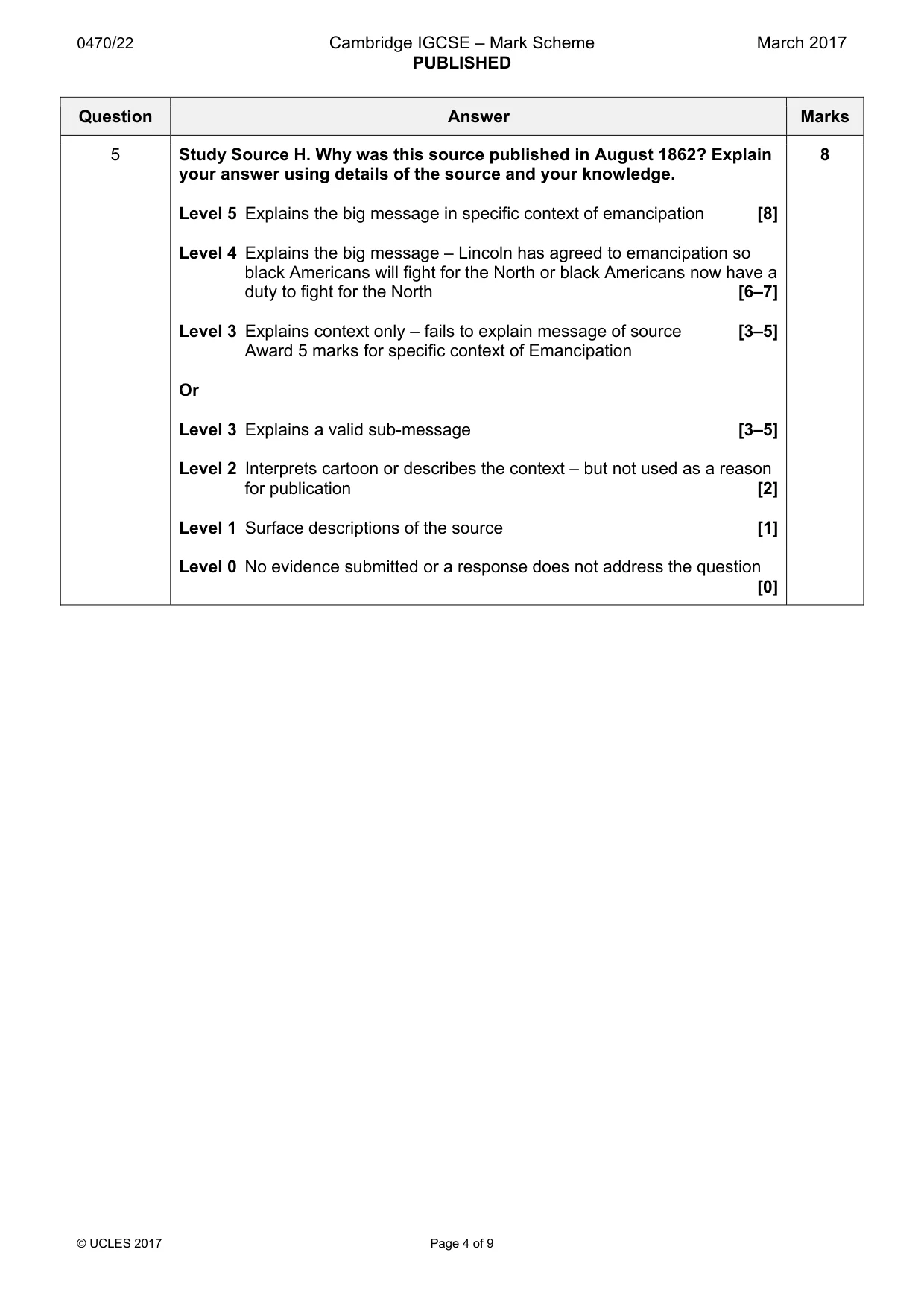
0470/22 Cambridge IGCSE – Mark Scheme PUBLISHED March 2017 © UCLES 2017 Page 4 of 9 Question Answer Marks 5 Study Source H. Why was this source published in August 1862? Explain your answer using details of the source and your knowledge. Level 5 Explains the big message in specific context of emancipation [8] Level 4 Explains the big message – Lincoln has agreed to emancipation so black Americans will fight for the North or black Americans now have a duty to fight for the North [6–7] Level 3 Explains context only – fails to explain message of source [3–5] Award 5 marks for specific context of Emancipation Or Level 3 Explains a valid sub-message [3–5] Level 2 Interprets cartoon or describes the context – but not used as a reason for publication [2] Level 1 Surface descriptions of the source [1] Level 0 No evidence submitted or a response does not address the question [0] 8
Mark scheme, page 5
0470/22 Cambridge IGCSE – Mark Scheme PUBLISHED March 2017 © UCLES 2017 Page 5 of 9 Question Answer Marks 6 Study all the sources. How far do these sources provide convincing evidence that Lincoln really believed in emancipation? Use the sources to explain your answer. Level 3 Uses sources to support and reject the statement [7–10] Award up to 2 bonus marks for evaluation of sources (no more than 1 per source). Source use must be reference to a source by letter, by provenance or by direct quote. There must be examples from source content. There must be an explanation of how this supports/does not support the statement. Use Y in the margin for each source use in support of the statement and N for each source use rejecting the statement. Y – Sources A, C, D, G, H N – Sources A, B, C, E, F, H Level 2 Uses sources to support or reject the statement [4–6] Level 1 No valid source use [1–3] Level 0 No evidence submitted or a response does not address the question [0] 12
Mark scheme, page 6
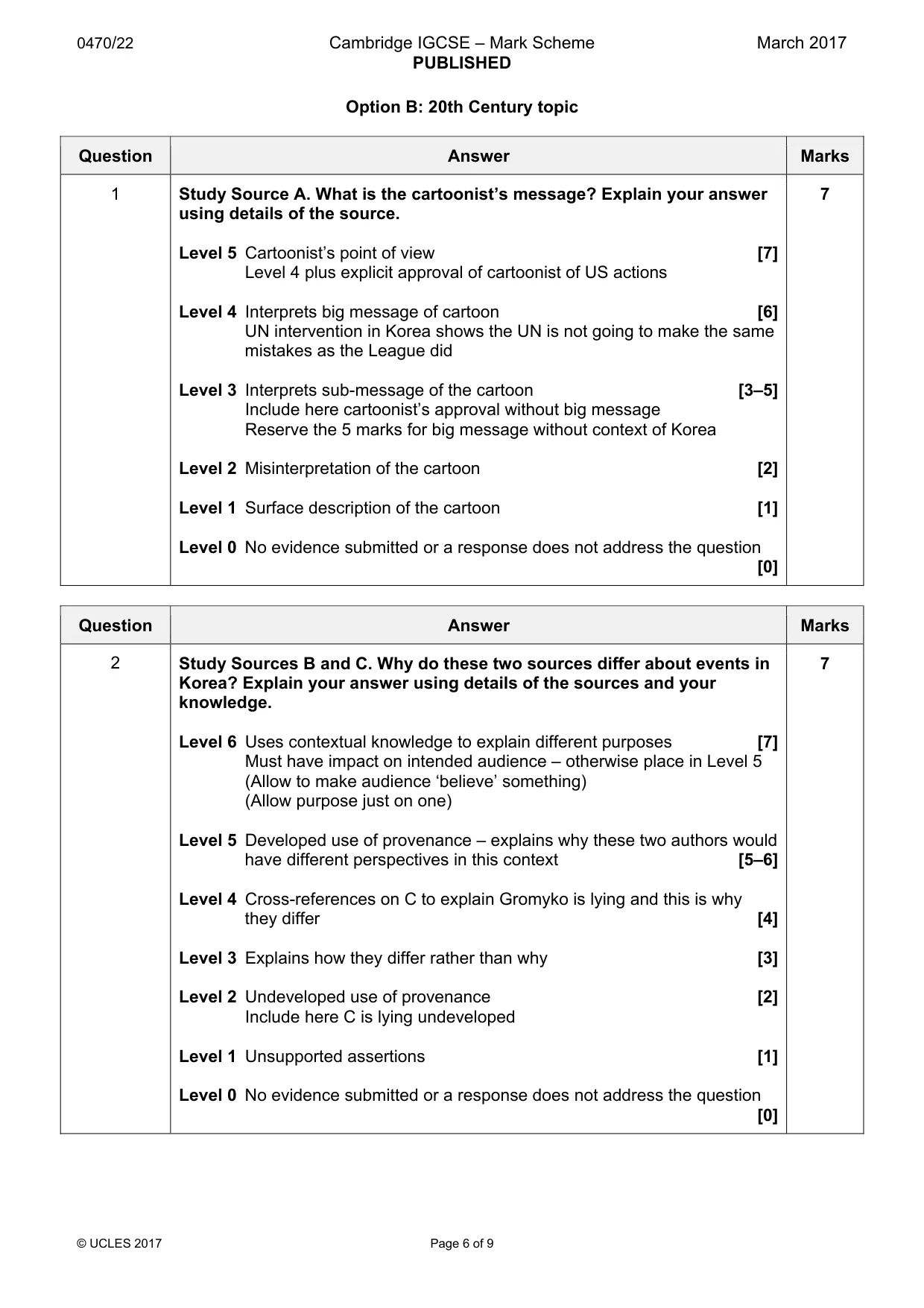
0470/22 Cambridge IGCSE – Mark Scheme PUBLISHED March 2017 © UCLES 2017 Page 6 of 9 Option B: 20th Century topic Question Answer Marks 1 Study Source A. What is the cartoonist’s message? Explain your answer using details of the source. Level 5 Cartoonist’s point of view [7] Level 4 plus explicit approval of cartoonist of US actions Level 4 Interprets big message of cartoon [6] UN intervention in Korea shows the UN is not going to make the same mistakes as the League did Level 3 Interprets sub-message of the cartoon [3–5] Include here cartoonist’s approval without big message Reserve the 5 marks for big message without context of Korea Level 2 Misinterpretation of the cartoon [2] Level 1 Surface description of the cartoon [1] Level 0 No evidence submitted or a response does not address the question [0] 7 Question Answer Marks 2 Study Sources B and C. Why do these two sources differ about events in Korea? Explain your answer using details of the sources and your knowledge. Level 6 Uses contextual knowledge to explain different purposes [7] Must have impact on intended audience – otherwise place in Level 5 (Allow to make audience ‘believe’ something) (Allow purpose just on one) Level 5 Developed use of provenance – explains why these two authors would have different perspectives in this context [5–6] Level 4 Cross-references on C to explain Gromyko is lying and this is why they differ [4] Level 3 Explains how they differ rather than why [3] Level 2 Undeveloped use of provenance [2] Include here C is lying undeveloped Level 1 Unsupported assertions [1] Level 0 No evidence submitted or a response does not address the question [0] 7
Mark scheme, page 7
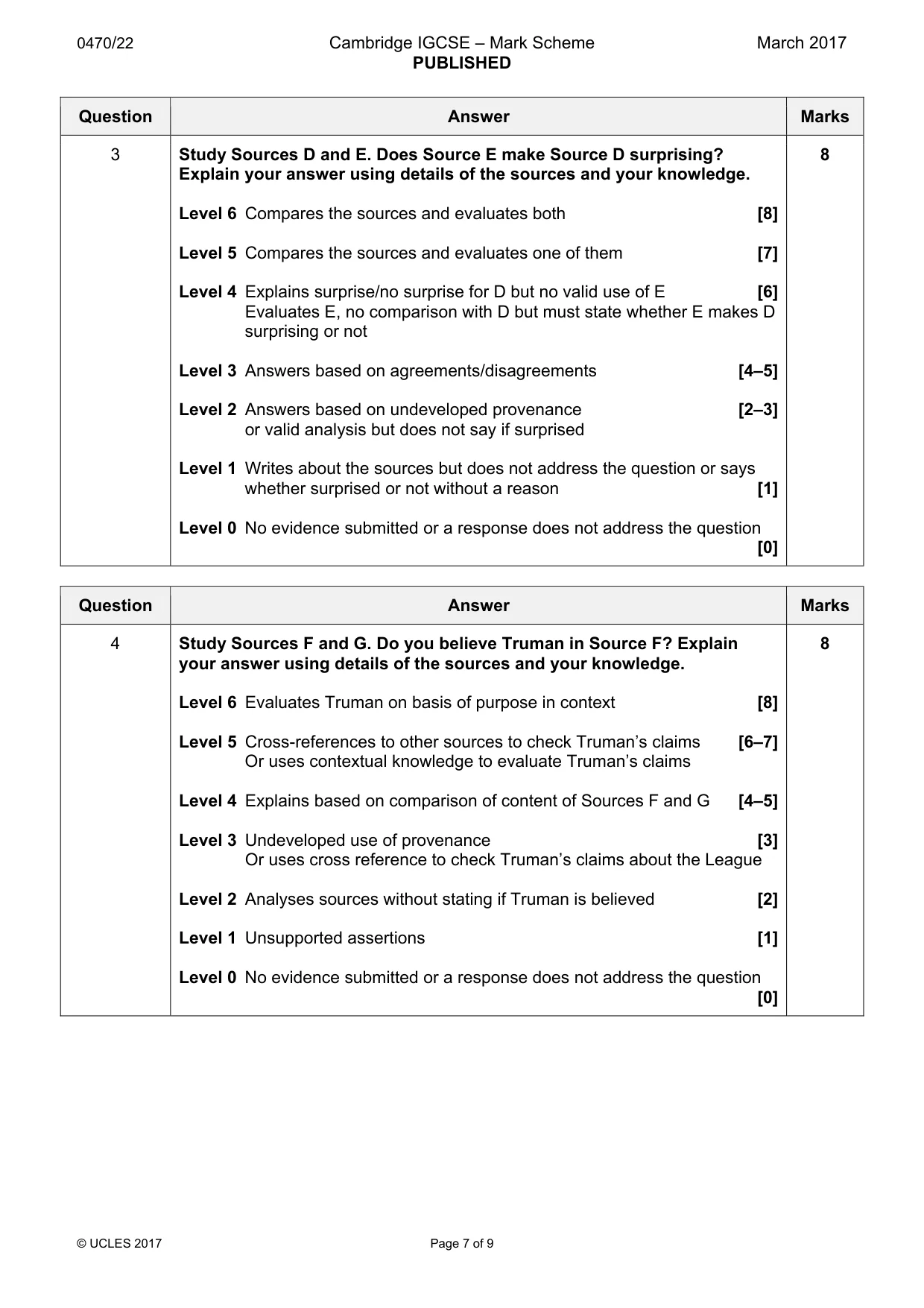
0470/22 Cambridge IGCSE – Mark Scheme PUBLISHED March 2017 © UCLES 2017 Page 7 of 9 Question Answer Marks 3 Study Sources D and E. Does Source E make Source D surprising? Explain your answer using details of the sources and your knowledge. Level 6 Compares the sources and evaluates both [8] Level 5 Compares the sources and evaluates one of them [7] Level 4 Explains surprise/no surprise for D but no valid use of E [6] Evaluates E, no comparison with D but must state whether E makes D surprising or not Level 3 Answers based on agreements/disagreements [4–5] Level 2 Answers based on undeveloped provenance [2–3] or valid analysis but does not say if surprised Level 1 Writes about the sources but does not address the question or says whether surprised or not without a reason [1] Level 0 No evidence submitted or a response does not address the question [0] 8 Question Answer Marks 4 Study Sources F and G. Do you believe Truman in Source F? Explain your answer using details of the sources and your knowledge. Level 6 Evaluates Truman on basis of purpose in context [8] Level 5 Cross-references to other sources to check Truman’s claims [6–7] Or uses contextual knowledge to evaluate Truman’s claims Level 4 Explains based on comparison of content of Sources F and G [4–5] Level 3 Undeveloped use of provenance [3] Or uses cross reference to check Truman’s claims about the League Level 2 Analyses sources without stating if Truman is believed [2] Level 1 Unsupported assertions [1] Level 0 No evidence submitted or a response does not address the question [0] 8
Mark scheme, page 8
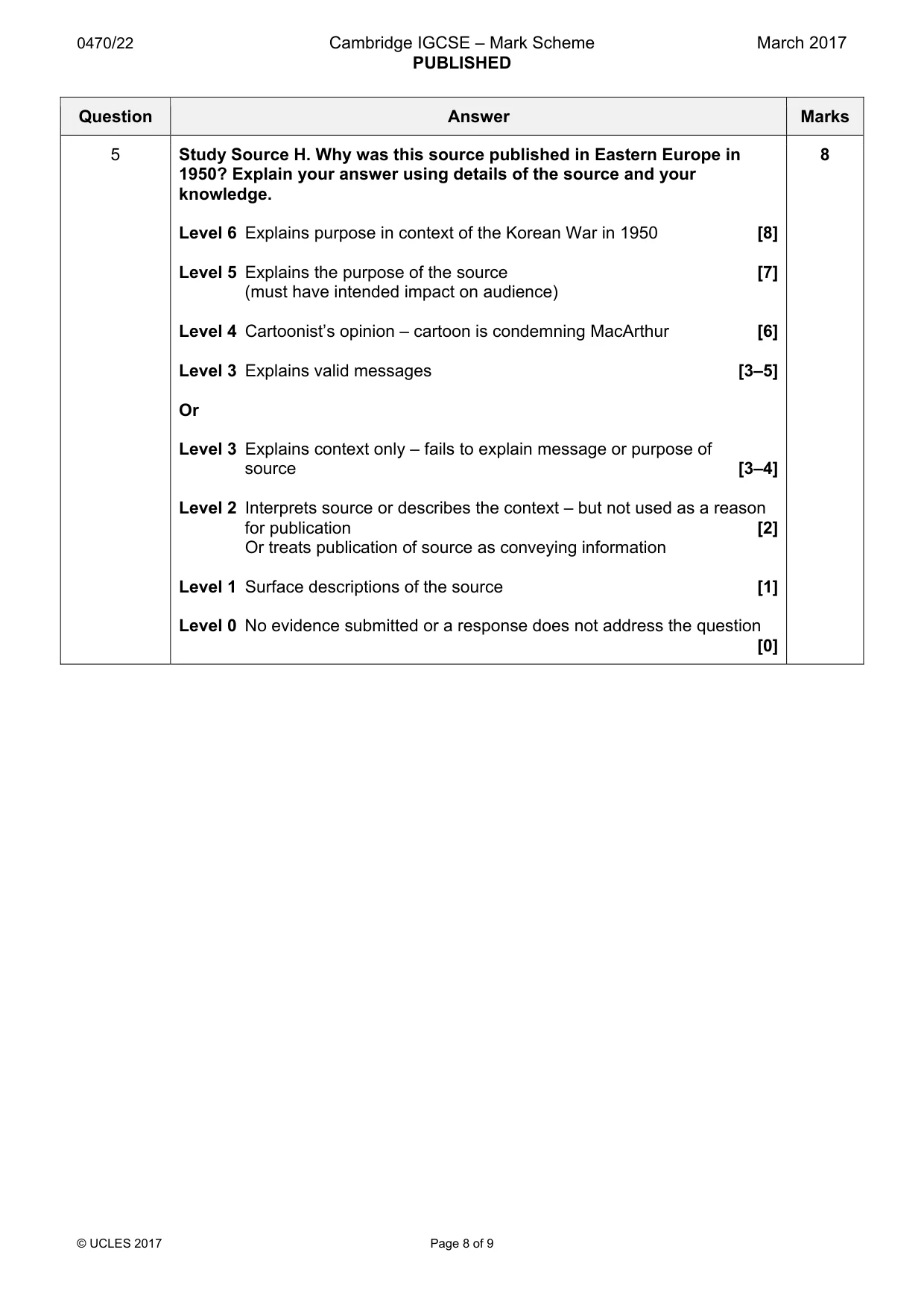
0470/22 Cambridge IGCSE – Mark Scheme PUBLISHED March 2017 © UCLES 2017 Page 8 of 9 Question Answer Marks 5 Study Source H. Why was this source published in Eastern Europe in 1950? Explain your answer using details of the source and your knowledge. Level 6 Explains purpose in context of the Korean War in 1950 [8] Level 5 Explains the purpose of the source [7] (must have intended impact on audience) Level 4 Cartoonist’s opinion – cartoon is condemning MacArthur [6] Level 3 Explains valid messages [3–5] Or Level 3 Explains context only – fails to explain message or purpose of source [3–4] Level 2 Interprets source or describes the context – but not used as a reason for publication [2] Or treats publication of source as conveying information Level 1 Surface descriptions of the source [1] Level 0 No evidence submitted or a response does not address the question [0] 8
Mark scheme, page 9
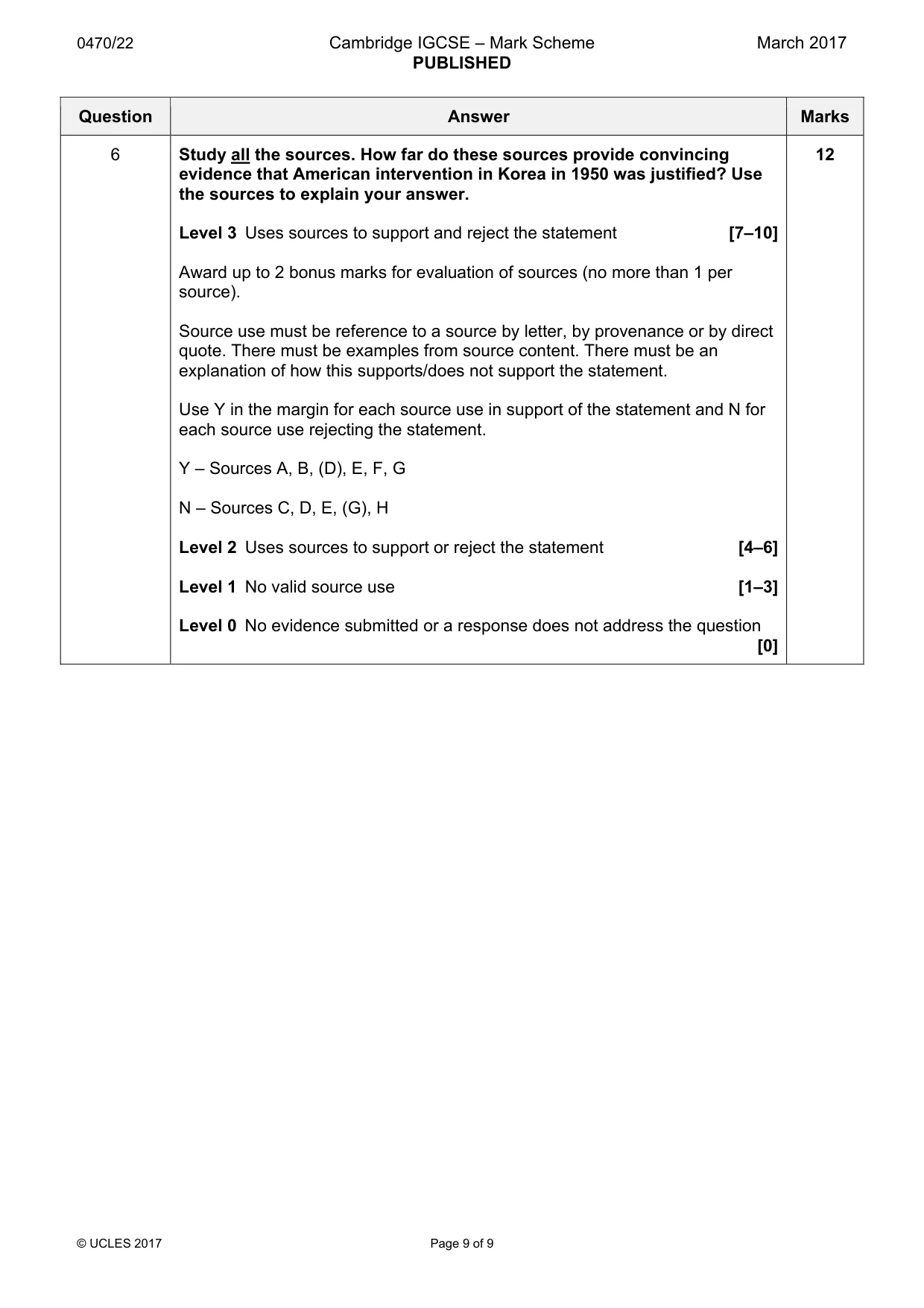
0470/22 Cambridge IGCSE – Mark Scheme PUBLISHED March 2017 © UCLES 2017 Page 9 of 9 Question Answer Marks 6 Study all the sources. How far do these sources provide convincing evidence that American intervention in Korea in 1950 was justified? Use the sources to explain your answer. Level 3 Uses sources to support and reject the statement [7–10] Award up to 2 bonus marks for evaluation of sources (no more than 1 per source). Source use must be reference to a source by letter, by provenance or by direct quote. There must be examples from source content. There must be an explanation of how this supports/does not support the statement. Use Y in the margin for each source use in support of the statement and N for each source use rejecting the statement. Y – Sources A, B, (D), E, F, G N – Sources C, D, E, (G), H Level 2 Uses sources to support or reject the statement [4–6] Level 1 No valid source use [1–3] Level 0 No evidence submitted or a response does not address the question [0] 12
What you needed in this session
Cambridge’s own grade thresholds for 2017 Feb/March, Paper 2 · Variant 2. A higher threshold means an easier paper — the bar moves with how the cohort did.