Cambridge IGCSE History 0470 — 2016 May/June Paper 2 · Variant 3
0470/23/M/J/16 · 50 marks · ≈56 min
The question paper and its mark scheme, free to read here and free to download. This is Cambridge’s own paper, exactly as it was sat.
Question paper16 pages
Mark scheme9 pages
Answers below. Sit the paper first if you are practising.
Paper as text
Question paper, page 1
This document consists of 13 printed pages, 3 blank pages and 1 insert. DC (LK/SW) 115139/3 © UCLES 2016 [Turn over Cambridge International Examinations Cambridge International General Certificate of Secondary Education * 7 3 4 3 6 5 2 3 7 8 * HISTORY 0470/23 Paper 2 May/June 2016 2 hours No Additional Materials are required. READ THESE INSTRUCTIONS FIRST An answer booklet is provided inside this question paper. You should follow the instructions on the front cover of the answer booklet. If you need additional answer paper ask the invigilator for a continuation booklet. This paper has two options. Choose one option, and then answer all of the questions on that topic. Option A: 19th Century topic [p2–p7] Option B: 20th Century topic [p8–p13] The number of marks is given in brackets [ ] at the end of each question or part question. The syllabus is approved for use in England, Wales and Northern Ireland as a Cambridge International Level 1/Level 2 Certificate.
Question paper, page 2
2 0470/23/M/J/16 © UCLES 2016 Option A: 19th Century topic WHO WAS TO BLAME FOR THE FIRST OPIUM WAR, 1839 – 1842? Study the Background Information and the sources carefully, and then answer all the questions. Background Information The First Opium War began in 1839. Demand for Chinese goods such as silk and tea grew enormously in Europe and America during the seventeenth and eighteenth centuries. However, China was largely self-sufficient and there was little that Europe could sell the Chinese, so the British East India Company began to sell opium to Chinese merchants. The Chinese Emperor opposed this trade because it was taking silver out of the country just when he needed money to pay for suppressing rebellion within China. He took a series of actions to stop it, including sending a letter of complaint to Queen Victoria, confiscating opium and holding British merchants hostage. War broke out in 1839 when British naval ships took action. SOURCE A The Opium War was an unjust and immoral contest because Britain was waging a war for the sake of selling a poisonous drug. The war was also fought to defend free trade and diplomatic and judicial equality with China. Guangzhou was the only port open to foreign commerce. Despite Chinese efforts to ban opium smoking, the East India Company (EIC), which had a monopoly of trade with India and China, began shipping the opium to China. It used Chinese pirates and bribery of Chinese officials in this trade. China was suffering badly from the British importing of opium. Smoking opium spread to 90% of Chinese males under the age of forty in the coastal regions, business activity was much reduced, the civil service ground to a halt and the standard of living fell. The opium trade was of considerable importance to Britain and America as the silver China used to buy opium exceeded the money the traders paid for Chinese tea. In 1834 the EIC monopoly of trade with China ended and the trade fell into the hands of more aggressive firms which saw China as a vast potential market. The Chinese government appointed Lin Zexu to deal with the opium problem, and he detained foreigners and forced them to surrender their stocks of the drug. Rather than submit to Chinese justice, the British abandoned Guangzhou and in September 1839 fired the first shots of the Opium War. It may seem surprising that the British conscience was not stirred by the Chinese opium problem. In Britain it was powerful economic interests, not moral considerations, that influenced the debate on opium and war. From a recent article about the First Opium War.
Question paper, page 3
3 0470/23/M/J/16 © UCLES 2016 [Turn over SOURCE B The Opium Wars were the direct result of China’s isolationist trade policy with the West. The Chinese government had imposed severe restrictions on foreign trade, and was both suspicious and contemptuous of foreigners. Prior to the 1830s there was only one port open to Western merchants, Guangzhou, and only one commodity the Chinese would accept in trade, silver. British and American merchants, anxious to address a trade imbalance with China, were determined to import the one product that the Chinese did not themselves have but which an ever-increasing number of them wanted: opium. With the British government’s cancellation in 1833 of the trade monopoly enjoyed by the East India Company, cheap opium flooded the market. China’s concern was not a moral one, it was purely economic – that their trade surplus was suddenly turned into a deficit, with enormous amounts of silver going to pay for the opium. Lin Zexu, the official sent in 1838 by the Emperor to confiscate and destroy all imports of opium, took swift action. Corrupt officials were making a lot of money by ignoring imperial orders, while British merchants were refusing to obey Chinese laws because of China’s routine use of torture. Lin Zexu’s swift actions took the two countries closer to war. He made 1600 arrests and confiscated 11 000 pounds of opium. Despite attempts by the British Superintendent of Trade, Charles Elliot, to negotiate a compromise, Lin Zexu held all foreign merchants under arrest until they surrendered 9 million dollars worth of opium, which he then had publicly burned. He then ordered the port of Guangzhou to be closed to all foreign merchants. This forced the British to take action. From a recent article about the First Opium War. SOURCE C The profit from trade has been enjoyed by you for two hundred years. This is the source from which your country has become known for its wealth. But there appears among the crowd of barbarians both good persons and bad. There are those who smuggle opium to harm the Chinese people. Such persons only care to profit themselves. His Majesty the Emperor is in a towering rage. He has sent me to investigate and settle this matter. All those people in China who sell opium or smoke opium will receive the death penalty. The harm done by those barbarians who have been selling opium justifies their execution. We presume that the ruler of your honourable country will instruct the various barbarians to observe the law with care. Your country is a long way from China. Yet there are barbarian ships that come here for the purpose of making a great profit. By what right do they in return use the poisonous drug to injure the Chinese people? Where is your conscience? I have heard that, because of the harm caused by opium, its smoking is forbidden by your country. So you should not let it be passed on to the harm of other countries. Of all that China exports to foreign countries, there is not a single thing which is not beneficial to people. Take tea, for example; the foreign countries cannot get along for a single day without it. From Lin Zexu’s ‘Letter of Advice’ to the British Queen Victoria, March 1839.
Question paper, page 4
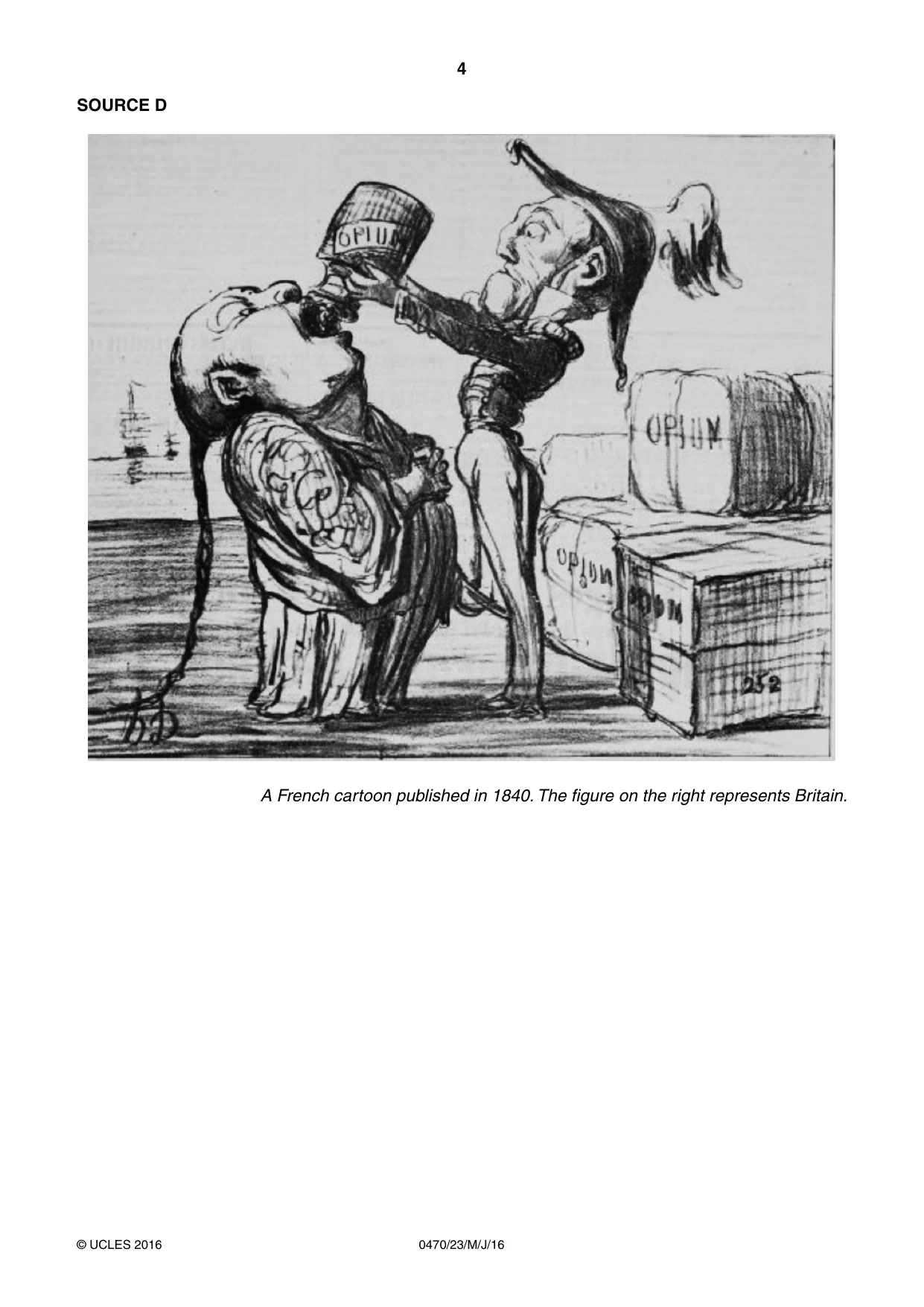
4 0470/23/M/J/16 © UCLES 2016 SOURCE D A French cartoon published in 1840. The figure on the right represents Britain.
Question paper, page 5
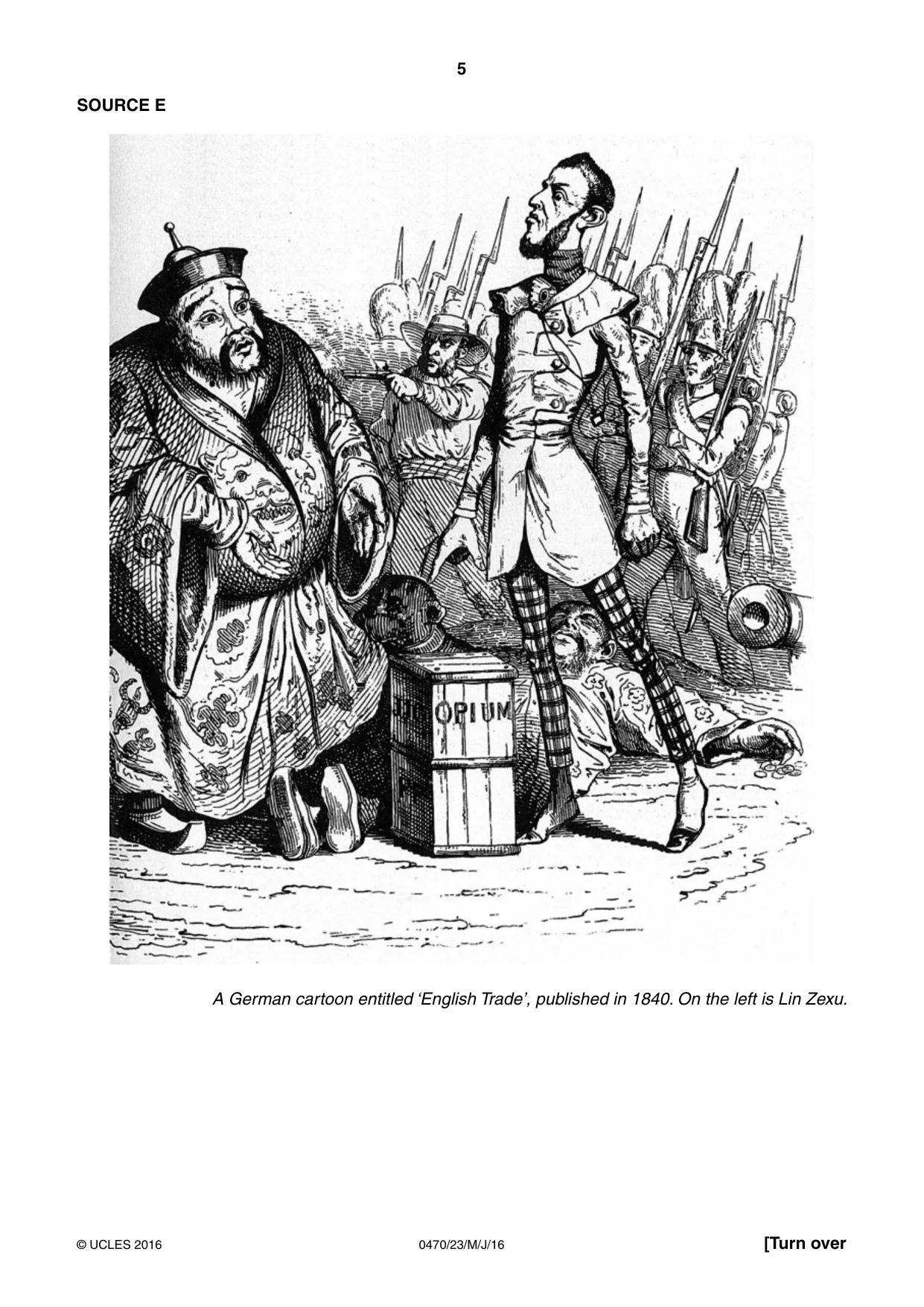
5 0470/23/M/J/16 © UCLES 2016 [Turn over SOURCE E A German cartoon entitled ‘English Trade’, published in 1840. On the left is Lin Zexu.
Question paper, page 6
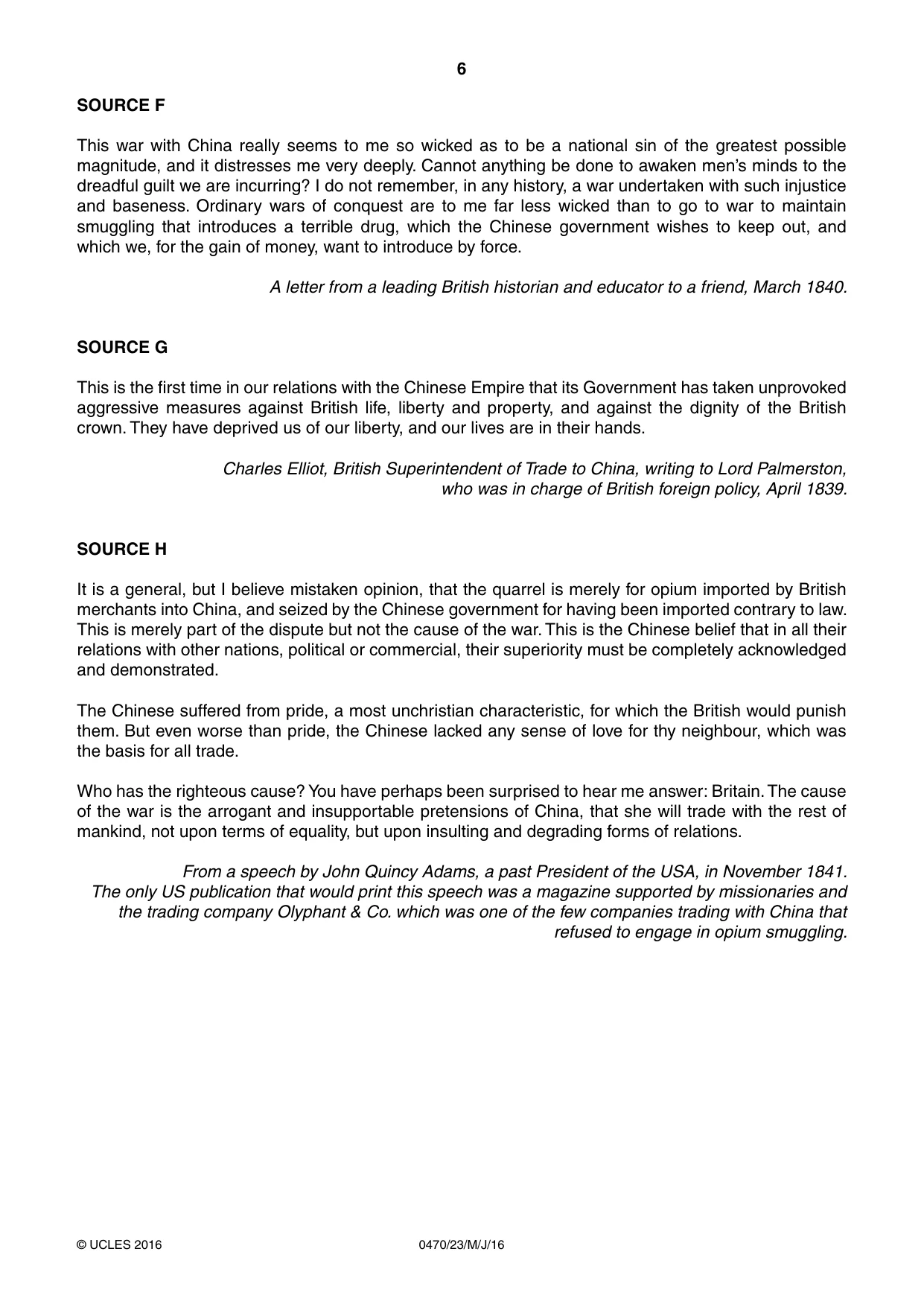
6 0470/23/M/J/16 © UCLES 2016 SOURCE F This war with China really seems to me so wicked as to be a national sin of the greatest possible magnitude, and it distresses me very deeply. Cannot anything be done to awaken men’s minds to the dreadful guilt we are incurring? I do not remember, in any history, a war undertaken with such injustice and baseness. Ordinary wars of conquest are to me far less wicked than to go to war to maintain smuggling that introduces a terrible drug, which the Chinese government wishes to keep out, and which we, for the gain of money, want to introduce by force. A letter from a leading British historian and educator to a friend, March 1840. SOURCE G This is the first time in our relations with the Chinese Empire that its Government has taken unprovoked aggressive measures against British life, liberty and property, and against the dignity of the British crown. They have deprived us of our liberty, and our lives are in their hands. Charles Elliot, British Superintendent of Trade to China, writing to Lord Palmerston, who was in charge of British foreign policy, April 1839. SOURCE H It is a general, but I believe mistaken opinion, that the quarrel is merely for opium imported by British merchants into China, and seized by the Chinese government for having been imported contrary to law. This is merely part of the dispute but not the cause of the war. This is the Chinese belief that in all their relations with other nations, political or commercial, their superiority must be completely acknowledged and demonstrated. The Chinese suffered from pride, a most unchristian characteristic, for which the British would punish them. But even worse than pride, the Chinese lacked any sense of love for thy neighbour, which was the basis for all trade. Who has the righteous cause? You have perhaps been surprised to hear me answer: Britain. The cause of the war is the arrogant and insupportable pretensions of China, that she will trade with the rest of mankind, not upon terms of equality, but upon insulting and degrading forms of relations. From a speech by John Quincy Adams, a past President of the USA, in November 1841. The only US publication that would print this speech was a magazine supported by missionaries and the trading company Olyphant & Co. which was one of the few companies trading with China that refused to engage in opium smuggling.
Question paper, page 7
7 0470/23/M/J/16 © UCLES 2016 [Turn over Now answer all the following questions. You may use any of the sources to help you answer the questions, in addition to those sources which you are told to use. In answering the questions you should use your knowledge of the topic to help you interpret and evaluate the sources. 1 Study Sources A and B. How different are these two sources? Explain your answer using details of the sources. [7] 2 Study Source C. How useful is this source as evidence about the First Opium War? Explain your answer using details of the source and your knowledge. [7] 3 Study Sources D and E. How similar are the messages of the two cartoonists? Explain your answer using details of the sources and your knowledge. [8] 4 Study Sources F and G. Does Source G prove that Source F is wrong? Explain your answer using details of the sources and your knowledge. [8] 5 Study Source H. Are you surprised by this source? Explain your answer using details of the source and your knowledge. [8] 6 Study all the sources. How far do these sources provide convincing evidence that China was to blame for the First Opium War? Use the sources to explain your answer. [12]
Question paper, page 8
8 0470/23/M/J/16 © UCLES 2016 Option B: 20th Century topic WHO WAS TO BLAME FOR THE GULF WAR? Study the Background Information and the sources carefully, and then answer all the questions. Background Information On 2 August 1990 Iraq invaded Kuwait. Although Saddam Hussein felt he had good reasons for this invasion it was met with general condemnation, including from most Arab countries. Saddam Hussein may have felt that the USA had indicated it would not interfere if he acted against Kuwait when, in July, the US Ambassador to Iraq had stated the USA had no interest in disputes between Arab nations. Within days President George Bush had announced he was sending troops to Saudi Arabia to protect it from an Iraqi attack. Later in the month the UN Security Council announced economic sanctions against Iraq. The USA then worked hard to create an international coalition and in November the UN Security Council gave Iraq until 15 January 1991 to withdraw from Kuwait, and authorised the use of force to make Iraq comply. On 17 January 1991 the Gulf War began. Some historians have claimed that the USA was not interested in a peaceful solution. They claim that it saw the Iraqi invasion of Kuwait as a chance to destroy the power of Iraq and gain more control over the oilfields in the Gulf. Others see Saddam Hussein’s actions as plain aggression that had to be dealt with to prevent him from invading other parts of the Gulf area. SOURCE A The Gulf War was a fraud. Saddam was first given the green light by the US Ambassador in Baghdad to invade Kuwait. Later, that invasion (even when Saddam had agreed to withdraw and had already started to do so) was used to attack and cripple Iraq. The whole world was fooled to justify the US-British war which aimed at destroying Iraq’s military capacity which the West itself had helped to build when Saddam was waging the West’s war on Iran. We have no sympathy at all for Saddam Hussein. He has troubled everyone: his countrymen, the Kurds, and his neighbours and beyond. Yet the fact remains that the Gulf War was waged to destroy and humiliate Iraq and not Saddam who, strangely enough, was left to survive. Iraq invaded Kuwait on 3 August 1990. The US President and his chief advisers met the same day. At that point, war was no more than a possibility. General Colin Powell said at the time, ‘I think we could go to war if they invaded Saudi Arabia. I doubt if we would go to war over Kuwait.’ Within days the mood at the top had hardened. By the early weeks of September, America and Britain were leading the march towards war. Somehow, almost without anybody noticing, the agenda was changing. Iraqi withdrawal from Kuwait alone was no longer acceptable. New resolutions had been adopted by the UN Security Council. Bush and British Prime Minister Thatcher had made up their minds. Their task was to convince the rest of the world that Saddam was going to swallow up Saudi Arabia, as well as Kuwait. To Iraq watchers, it didn’t add up. Although Saddam initially miscalculated the strength of Western reaction to an invasion of Kuwait, he soon realised his mistake. In July 1990 the US Ambassador had hinted that a small foray to snatch two oilfields would not cause too much trouble, but Saddam’s capture of Kuwait would not be tolerated. He got the message that he had gone too far. A Baghdad newspaper published a photograph of Iraqi soldiers pulling out of Kuwait and Saddam informed the Security Council that he intended to withdraw his troops. It was too late. Thatcher and Bush were on
Question paper, page 9
9 0470/23/M/J/16 © UCLES 2016 [Turn over a war footing. Even as late as January 1991, Iraq was involved in negotiations and was offering to withdraw from Kuwait. From a recent article about the causes of the Gulf War. SOURCE B Two hours ago, allied air forces began an attack on military targets in Iraq and Kuwait. Our dispute with Iraq started on 2 August when the dictator of Iraq invaded a helpless neighbour, Kuwait. This military action, taken in accord with United Nations resolutions, follows months of diplomatic activity by the United Nations, the United States and many other countries. Arab leaders sought an Arab solution, only to conclude that Saddam Hussein was unwilling to leave Kuwait. Others travelled to Baghdad in a variety of efforts to restore peace and justice. This past weekend, in a last-ditch effort, the Secretary-General of the United Nations went to the Middle East with peace in his heart. And he came back from Baghdad with no progress at all in getting Saddam Hussein to withdraw from Kuwait. Now the 28 countries with forces in the Gulf area have exhausted all reasonable efforts to reach a peaceful resolution and have no choice but to drive Saddam from Kuwait by force. We are determined to knock out Saddam Hussein’s nuclear bomb potential. We will also destroy his chemical weapons. Much of Saddam’s artillery and tanks will be destroyed. Our objectives are clear: Saddam Hussein’s forces will leave Kuwait. The legitimate government of Kuwait will be restored to its rightful place, and Kuwait will once again be free. When peace is restored, it is our hope that Iraq will live as a peaceful and cooperative member of the family of nations. Why act now? The world could wait no longer. Sanctions, though having some effect, showed no signs of accomplishing their objective. The United States, together with the United Nations, exhausted every means at our disposal to bring this crisis to a peaceful end. However, Saddam clearly felt that by stalling and threatening and defying the United Nations, he could weaken the forces arrayed against him. While the world waited, Saddam Hussein met every offer of peace with open contempt and he tried to make this a dispute between Iraq and the United States of America. Well, he failed. Tonight, 28 nations have forces in the Gulf area standing shoulder to shoulder against Saddam Hussein. We have no argument with the people of Iraq. Our goal is not the conquest of Iraq. It is the liberation of Kuwait. From a speech by President Bush, January 1991, as Operation Desert Storm was launched. SOURCE C Saddam told the Ambassador that the Kuwaiti Crown Prince will come to Baghdad for serious negotiations on 28, 29 or 30 July. ‘Nothing will happen before then’ Saddam promised. Saddam said that Iraq wants friendship with America. Iraq suffered hundreds of thousands of casualties and is now so poor that war orphan pensions will soon be cut, yet Kuwait will not even accept OPEC discipline. Iraq is sick of war but Kuwait has ignored diplomacy. Manoeuvres by the US government will encourage Kuwait to ignore normal diplomacy. If Iraq is humiliated by the USA, it will have no choice but to ‘respond’. A secret report by the US Ambassador in Iraq to the US government, 25 July 1990.
Question paper, page 10
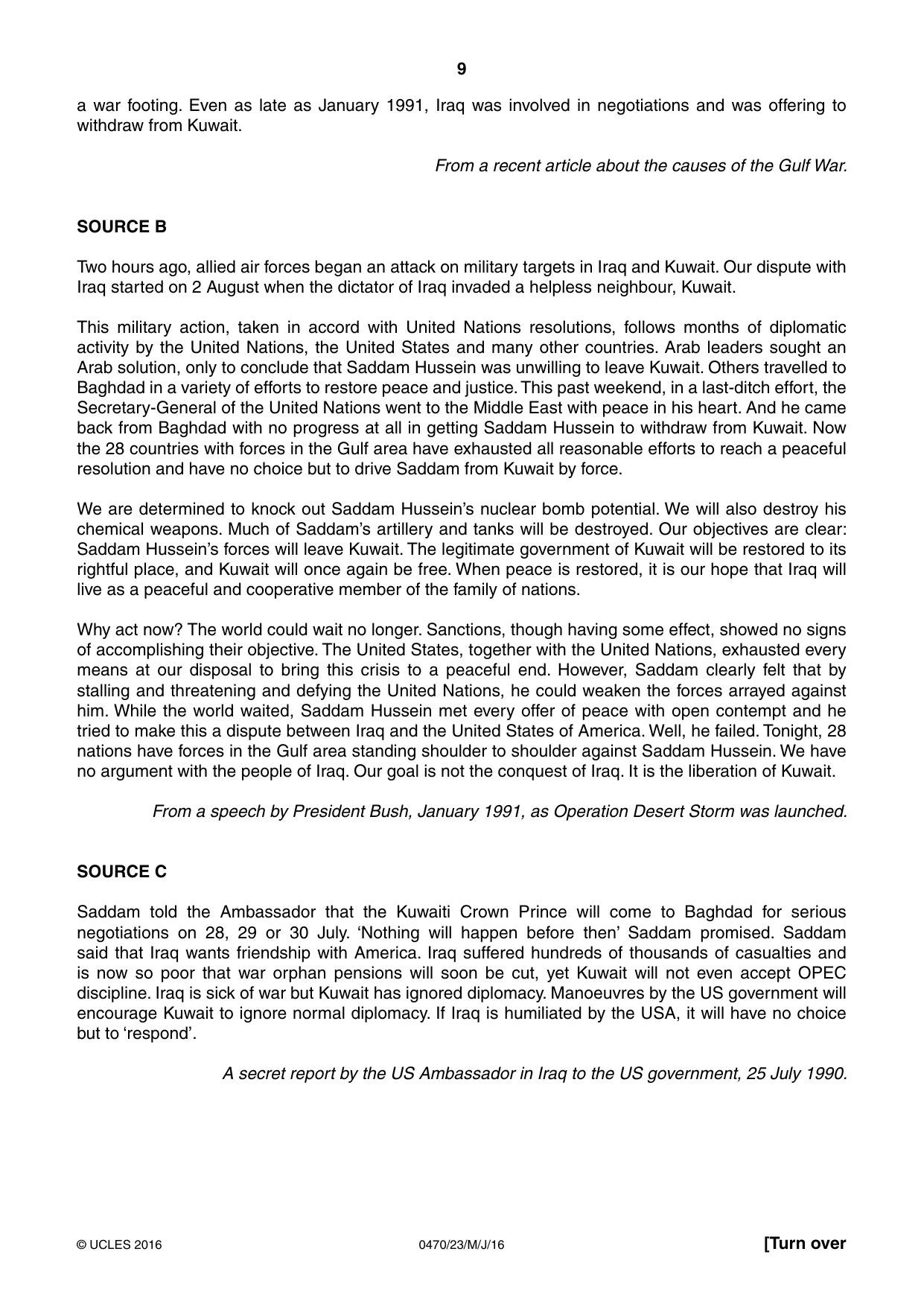
10 0470/23/M/J/16 © UCLES 2016 SOURCE D Iraq called today for negotiations on ending the Gulf Crisis, but did not offer to pull its troops out of Kuwait. The White House quickly responded that no talks were possible until Iraq carried out the United Nations’ demand that it withdraw its forces from Kuwait. The US government’s rapid rejection of the Iraqi proposal for opening diplomatic contacts grows out of a diplomatic concern that should it become involved in negotiations about the terms of an Iraqi withdrawal, America’s Arab allies might feel under pressure to give Saddam a few token gains in Kuwait to get him to roll back his invasion. Also underlying the USA’s tough stance is a growing feeling that the USA and its allies have the advantage over Iraq, that the sanctions and the military buildup are beginning to pinch Baghdad. The Iraqi leader is almost totally isolated and his economy is being strangled so the US government sees no reason to settle for anything less than an unconditional Iraqi pullout. From a US newspaper, 22 August 1990. SOURCE E A US cartoon, published near the end of 1990.
Question paper, page 11
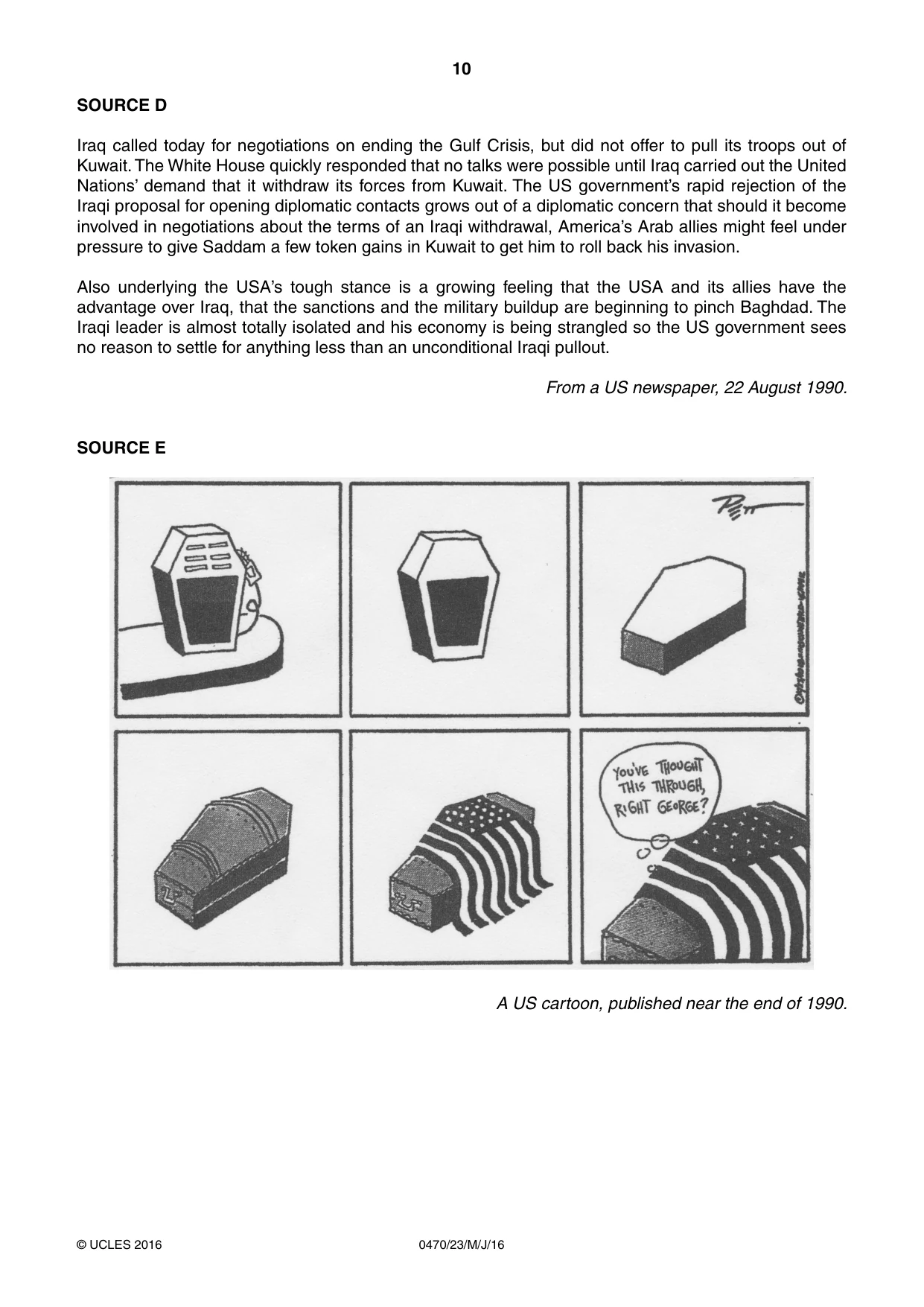
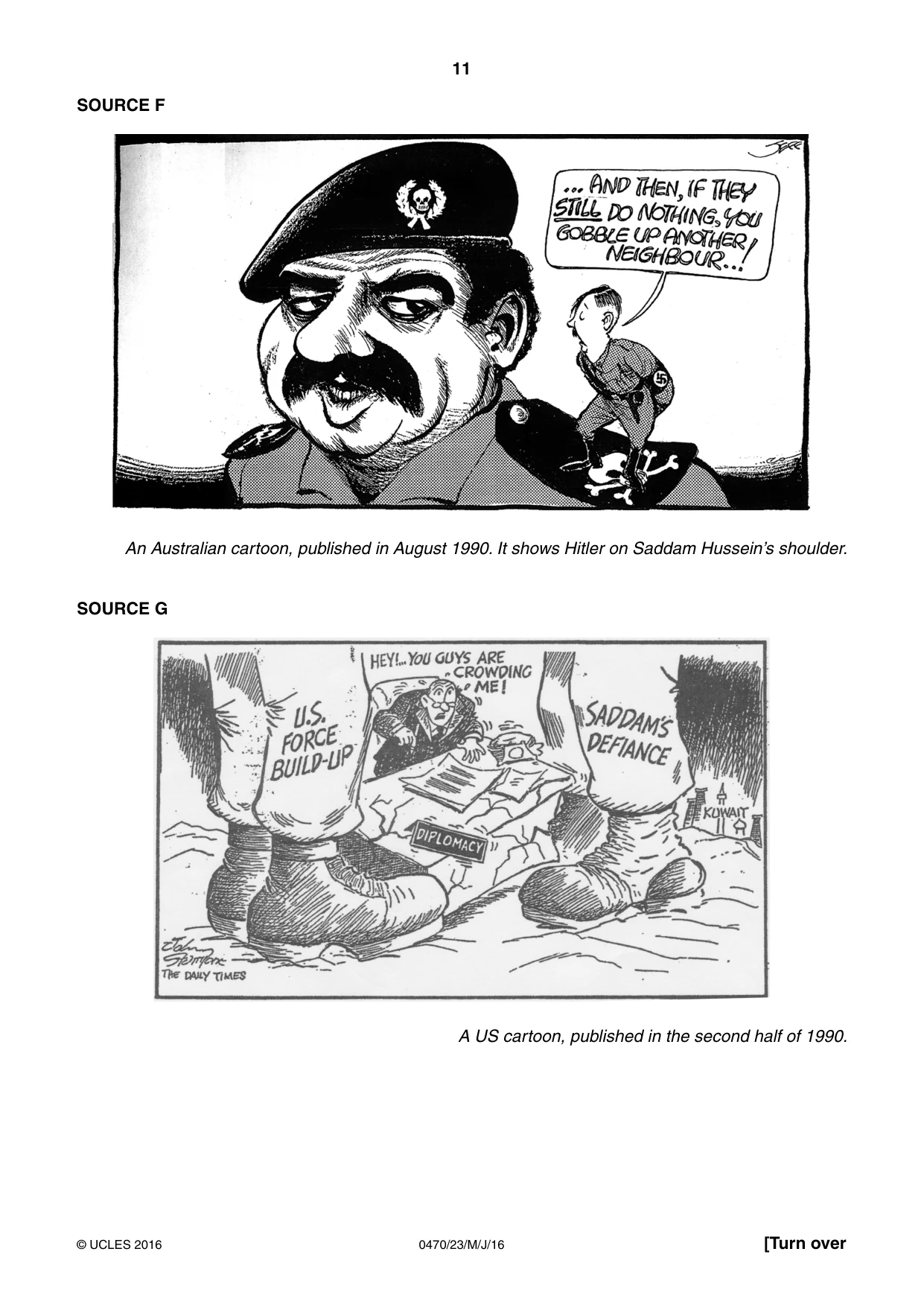
11 0470/23/M/J/16 © UCLES 2016 [Turn over SOURCE F An Australian cartoon, published in August 1990. It shows Hitler on Saddam Hussein’s shoulder. SOURCE G A US cartoon, published in the second half of 1990.
Question paper, page 12
12 0470/23/M/J/16 © UCLES 2016 SOURCE H American officials analysed the meeting between Secretary of State James Baker and Iraqi Foreign Minister Tariq Aziz. One senior American official, talking about Mr Aziz’s refusal to accept President Bush’s note to Saddam Hussein, said he did not believe that Mr Aziz had come with any authority to strike a deal, or signal even a partial withdrawal. He was there to assess America’s position, flash some steel teeth and report home. Mr Aziz said he could not receive the letter because ‘the language in the letter is not compatible with the language that should be used in correspondence between heads of state.’ After the meeting, American officials said they had had no expectation before the discussion that the Iraqi side would bend or waver. From a US newspaper, 11 January 1991.
Question paper, page 13
13 0470/23/M/J/16 © UCLES 2016 Now answer all the following questions. You may use any of the sources to help you answer the questions, in addition to those sources which you are told to use. In answering the questions you should use your knowledge of the topic to help you interpret and evaluate the sources. 1 Study Sources A and B. How different are these two sources? Explain your answer using details of the sources. [7] 2 Study Sources C and D. Does Source D make Source C surprising? Explain your answer using details of the sources and your knowledge. [8] 3 Study Source E. What is the message of this cartoon? Explain your answer using details of the source and your knowledge. [8] 4 Study Sources F and G. How far do these two cartoonists agree? Explain your answer using details of the sources and your knowledge. [8] 5 Study Source H. How useful is this source to a historian studying events in the Gulf in 1990–91? Explain your answer using details of the source and your knowledge. [7] 6 Study all the sources. How far do these sources provide convincing evidence that the USA was responsible for the outbreak of military hostilities in January 1991? Use the sources to explain your answer. [12]
Question paper, page 14
14 0470/23/M/J/16 © UCLES 2016 BLANK PAGE
Question paper, page 15
15 0470/23/M/J/16 © UCLES 2016 BLANK PAGE
Question paper, page 16
16 0470/23/M/J/16 © UCLES 2016 Permission to reproduce items where third-party owned material protected by copyright is included has been sought and cleared where possible. Every reasonable effort has been made by the publisher (UCLES) to trace copyright holders, but if any items requiring clearance have unwittingly been included, the publisher will be pleased to make amends at the earliest possible opportunity. To avoid the issue of disclosure of answer-related information to candidates, all copyright acknowledgements are reproduced online in the Cambridge International Examinations Copyright Acknowledgements Booklet. This is produced for each series of examinations and is freely available to download at www.cie.org.uk after the live examination series. Cambridge International Examinations is part of the Cambridge Assessment Group. Cambridge Assessment is the brand name of University of Cambridge Local Examinations Syndicate (UCLES), which is itself a department of the University of Cambridge. BLANK PAGE
Mark scheme, page 1
® IGCSE is the registered trademark of Cambridge International Examinations. This syllabus is approved for use in England, Wales and Northern Ireland as a Cambridge International Level 1/Level 2 Certificate. This document consists of 9 printed pages. © UCLES 2016 [Turn over Cambridge International Examinations Cambridge International General Certificate of Secondary Education HISTORY 0470/23 Paper 2 May/June 2016 MARK SCHEME Maximum Mark: 50 Published This mark scheme is published as an aid to teachers and candidates, to indicate the requirements of the examination. It shows the basis on which Examiners were instructed to award marks. It does not indicate the details of the discussions that took place at an Examiners’ meeting before marking began, which would have considered the acceptability of alternative answers. Mark schemes should be read in conjunction with the question paper and the Principal Examiner Report for Teachers. Cambridge will not enter into discussions about these mark schemes. Cambridge is publishing the mark schemes for the May/June 2016 series for most Cambridge IGCSE®, Cambridge International A and AS Level components and some Cambridge O Level components.
Mark scheme, page 2
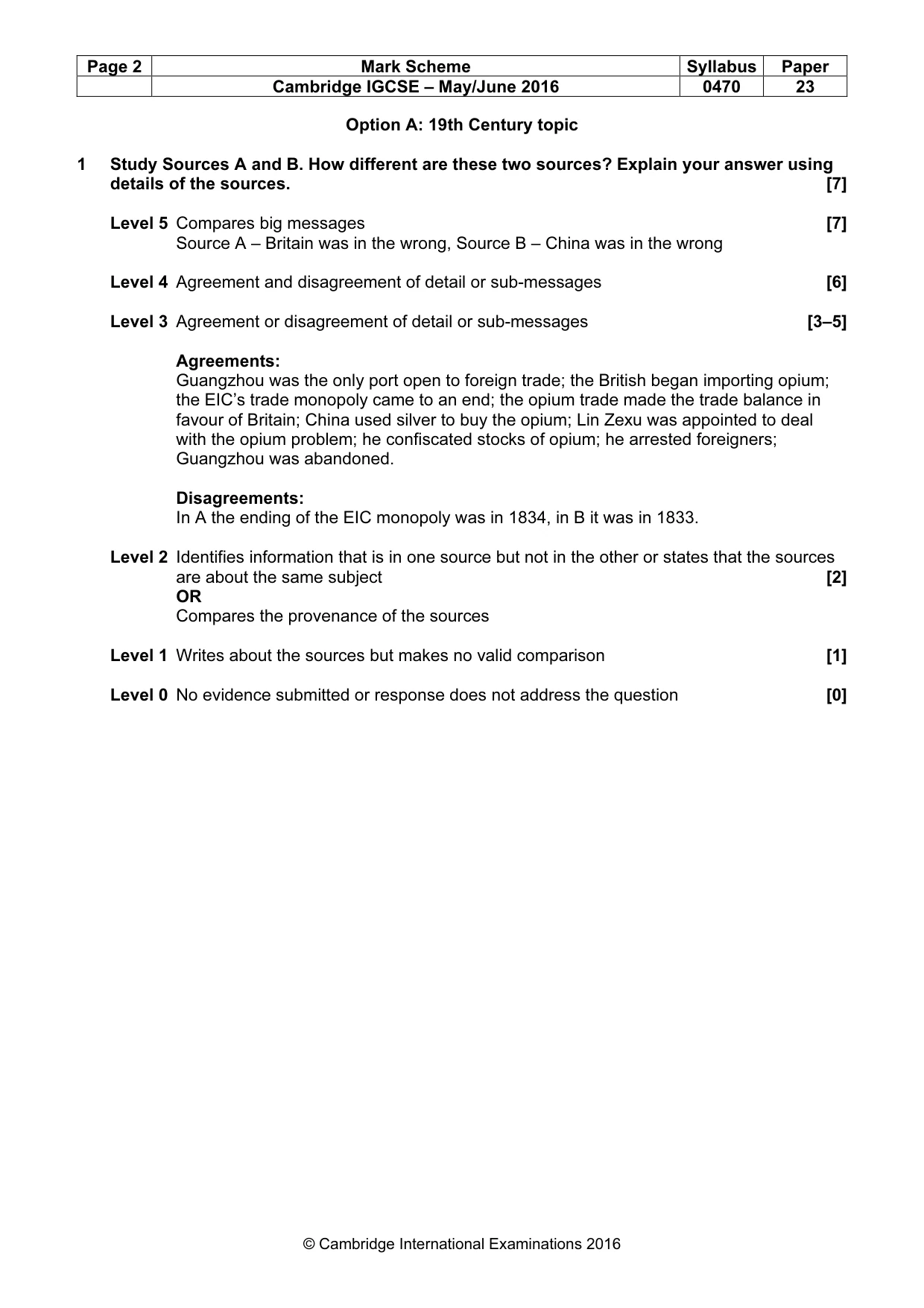
Page 2 Mark Scheme Syllabus Paper Cambridge IGCSE – May/June 2016 0470 23 © Cambridge International Examinations 2016 Option A: 19th Century topic 1 Study Sources A and B. How different are these two sources? Explain your answer using details of the sources. [7] Level 5 Compares big messages [7] Source A – Britain was in the wrong, Source B – China was in the wrong Level 4 Agreement and disagreement of detail or sub-messages [6] Level 3 Agreement or disagreement of detail or sub-messages [3–5] Agreements: Guangzhou was the only port open to foreign trade; the British began importing opium; the EIC’s trade monopoly came to an end; the opium trade made the trade balance in favour of Britain; China used silver to buy the opium; Lin Zexu was appointed to deal with the opium problem; he confiscated stocks of opium; he arrested foreigners; Guangzhou was abandoned. Disagreements: In A the ending of the EIC monopoly was in 1834, in B it was in 1833. Level 2 Identifies information that is in one source but not in the other or states that the sources are about the same subject [2] OR Compares the provenance of the sources Level 1 Writes about the sources but makes no valid comparison [1] Level 0 No evidence submitted or response does not address the question [0]
Mark scheme, page 3
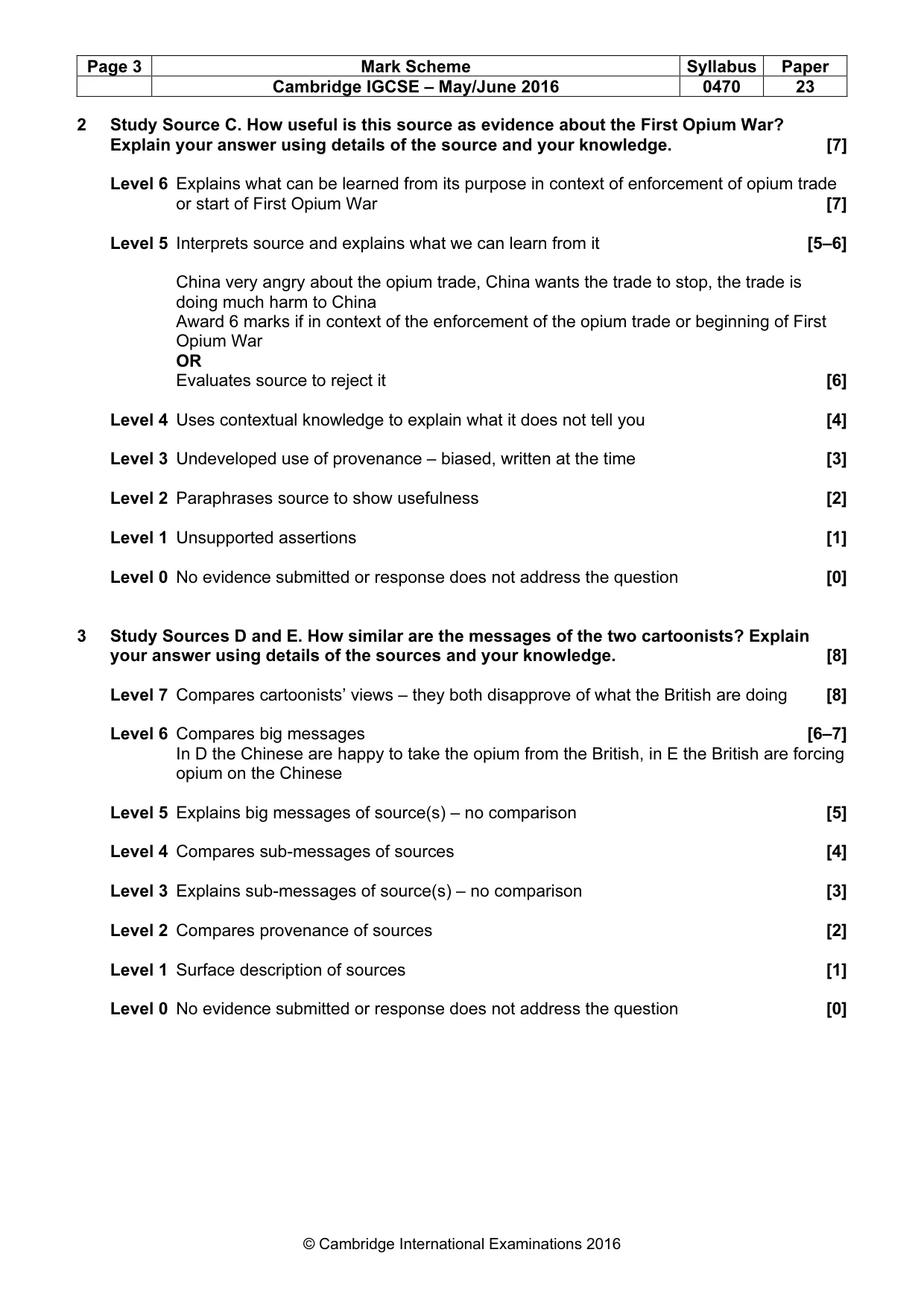
Page 3 Mark Scheme Syllabus Paper Cambridge IGCSE – May/June 2016 0470 23 © Cambridge International Examinations 2016 2 Study Source C. How useful is this source as evidence about the First Opium War? Explain your answer using details of the source and your knowledge. [7] Level 6 Explains what can be learned from its purpose in context of enforcement of opium trade or start of First Opium War [7] Level 5 Interprets source and explains what we can learn from it [5–6] China very angry about the opium trade, China wants the trade to stop, the trade is doing much harm to China Award 6 marks if in context of the enforcement of the opium trade or beginning of First Opium War OR Evaluates source to reject it [6] Level 4 Uses contextual knowledge to explain what it does not tell you [4] Level 3 Undeveloped use of provenance – biased, written at the time [3] Level 2 Paraphrases source to show usefulness [2] Level 1 Unsupported assertions [1] Level 0 No evidence submitted or response does not address the question [0] 3 Study Sources D and E. How similar are the messages of the two cartoonists? Explain your answer using details of the sources and your knowledge. [8] Level 7 Compares cartoonists’ views – they both disapprove of what the British are doing [8] Level 6 Compares big messages [6–7] In D the Chinese are happy to take the opium from the British, in E the British are forcing opium on the Chinese Level 5 Explains big messages of source(s) – no comparison [5] Level 4 Compares sub-messages of sources [4] Level 3 Explains sub-messages of source(s) – no comparison [3] Level 2 Compares provenance of sources [2] Level 1 Surface description of sources [1] Level 0 No evidence submitted or response does not address the question [0]
Mark scheme, page 4
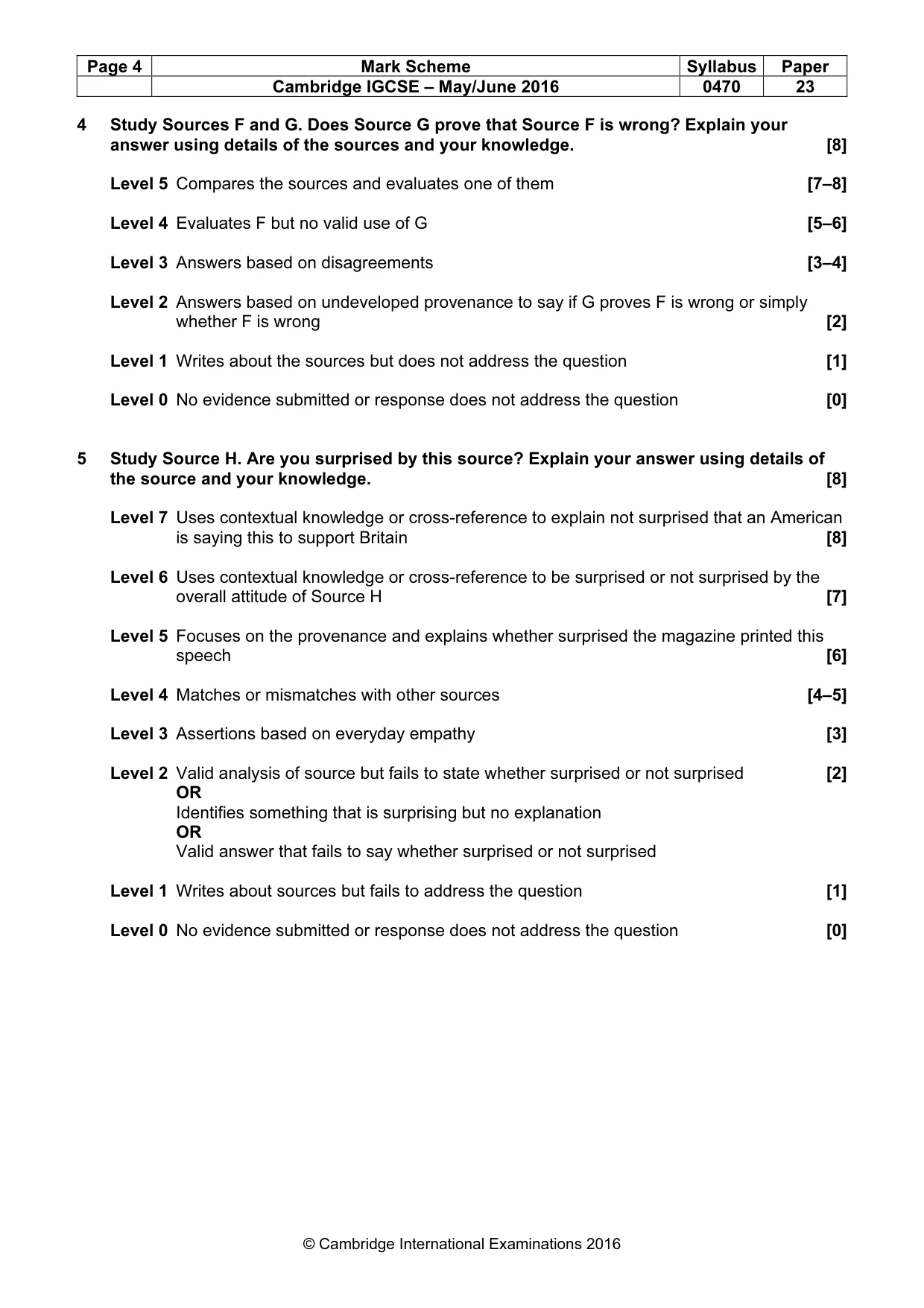
Page 4 Mark Scheme Syllabus Paper Cambridge IGCSE – May/June 2016 0470 23 © Cambridge International Examinations 2016 4 Study Sources F and G. Does Source G prove that Source F is wrong? Explain your answer using details of the sources and your knowledge. [8] Level 5 Compares the sources and evaluates one of them [7–8] Level 4 Evaluates F but no valid use of G [5–6] Level 3 Answers based on disagreements [3–4] Level 2 Answers based on undeveloped provenance to say if G proves F is wrong or simply whether F is wrong [2] Level 1 Writes about the sources but does not address the question [1] Level 0 No evidence submitted or response does not address the question [0] 5 Study Source H. Are you surprised by this source? Explain your answer using details of the source and your knowledge. [8] Level 7 Uses contextual knowledge or cross-reference to explain not surprised that an American is saying this to support Britain [8] Level 6 Uses contextual knowledge or cross-reference to be surprised or not surprised by the overall attitude of Source H [7] Level 5 Focuses on the provenance and explains whether surprised the magazine printed this speech [6] Level 4 Matches or mismatches with other sources [4–5] Level 3 Assertions based on everyday empathy [3] Level 2 Valid analysis of source but fails to state whether surprised or not surprised [2] OR Identifies something that is surprising but no explanation OR Valid answer that fails to say whether surprised or not surprised Level 1 Writes about sources but fails to address the question [1] Level 0 No evidence submitted or response does not address the question [0]
Mark scheme, page 5
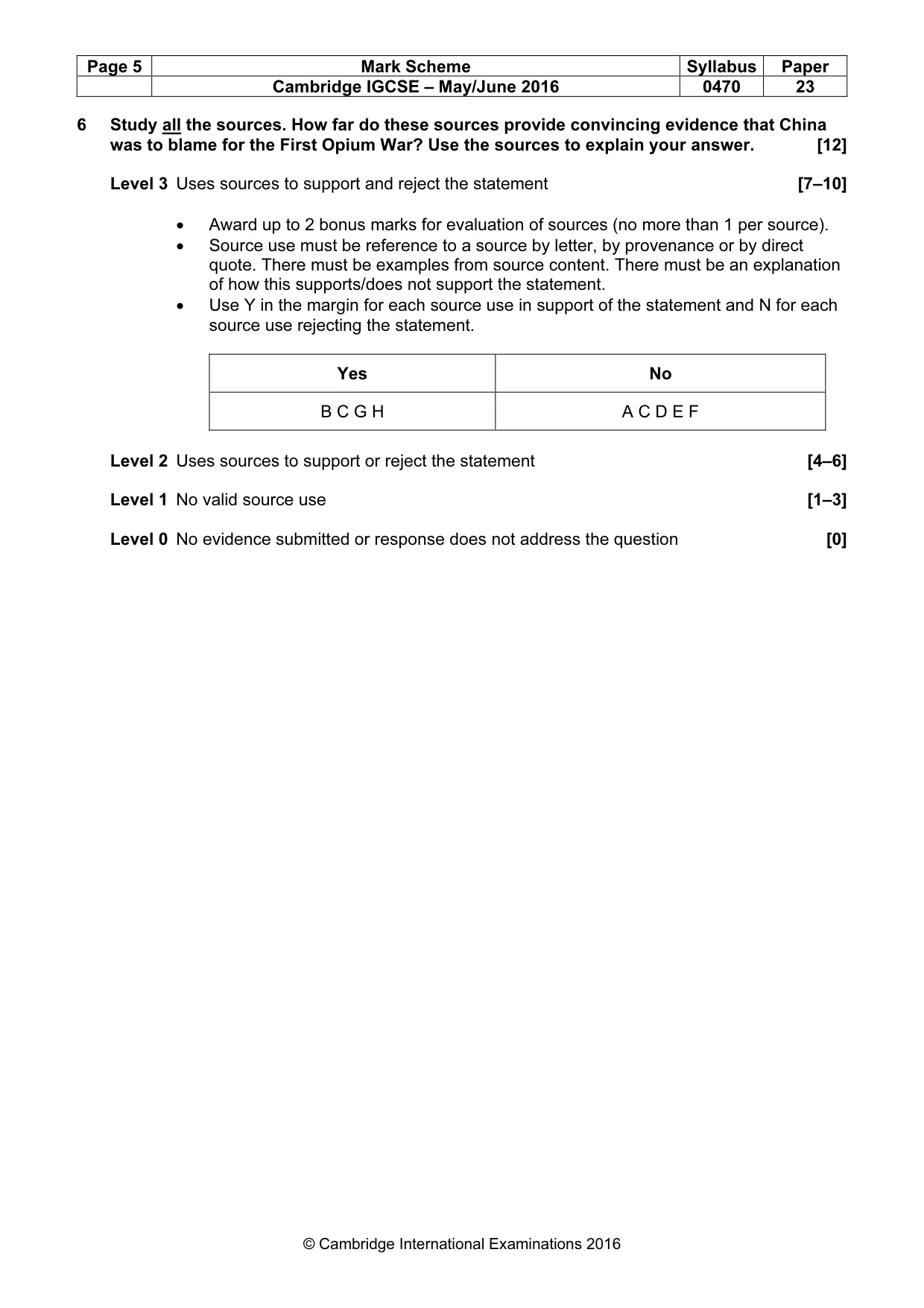
Page 5 Mark Scheme Syllabus Paper Cambridge IGCSE – May/June 2016 0470 23 © Cambridge International Examinations 2016 6 Study all the sources. How far do these sources provide convincing evidence that China was to blame for the First Opium War? Use the sources to explain your answer. [12] Level 3 Uses sources to support and reject the statement [7–10] • Award up to 2 bonus marks for evaluation of sources (no more than 1 per source). • Source use must be reference to a source by letter, by provenance or by direct quote. There must be examples from source content. There must be an explanation of how this supports/does not support the statement. • Use Y in the margin for each source use in support of the statement and N for each source use rejecting the statement. Yes No B C G H A C D E F Level 2 Uses sources to support or reject the statement [4–6] Level 1 No valid source use [1–3] Level 0 No evidence submitted or response does not address the question [0]
Mark scheme, page 6
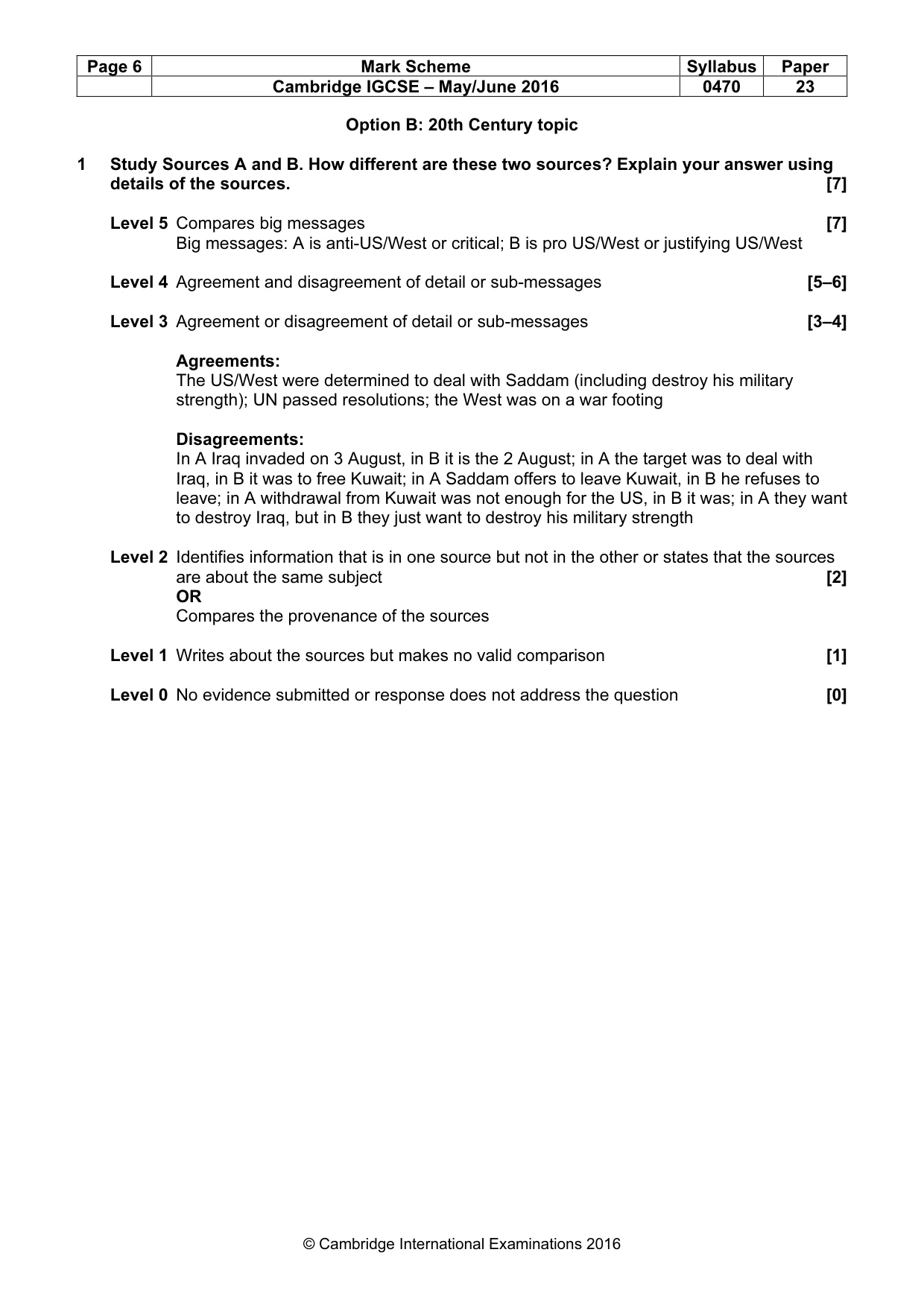
Page 6 Mark Scheme Syllabus Paper Cambridge IGCSE – May/June 2016 0470 23 © Cambridge International Examinations 2016 Option B: 20th Century topic 1 Study Sources A and B. How different are these two sources? Explain your answer using details of the sources. [7] Level 5 Compares big messages [7] Big messages: A is anti-US/West or critical; B is pro US/West or justifying US/West Level 4 Agreement and disagreement of detail or sub-messages [5–6] Level 3 Agreement or disagreement of detail or sub-messages [3–4] Agreements: The US/West were determined to deal with Saddam (including destroy his military strength); UN passed resolutions; the West was on a war footing Disagreements: In A Iraq invaded on 3 August, in B it is the 2 August; in A the target was to deal with Iraq, in B it was to free Kuwait; in A Saddam offers to leave Kuwait, in B he refuses to leave; in A withdrawal from Kuwait was not enough for the US, in B it was; in A they want to destroy Iraq, but in B they just want to destroy his military strength Level 2 Identifies information that is in one source but not in the other or states that the sources are about the same subject [2] OR Compares the provenance of the sources Level 1 Writes about the sources but makes no valid comparison [1] Level 0 No evidence submitted or response does not address the question [0]
Mark scheme, page 7
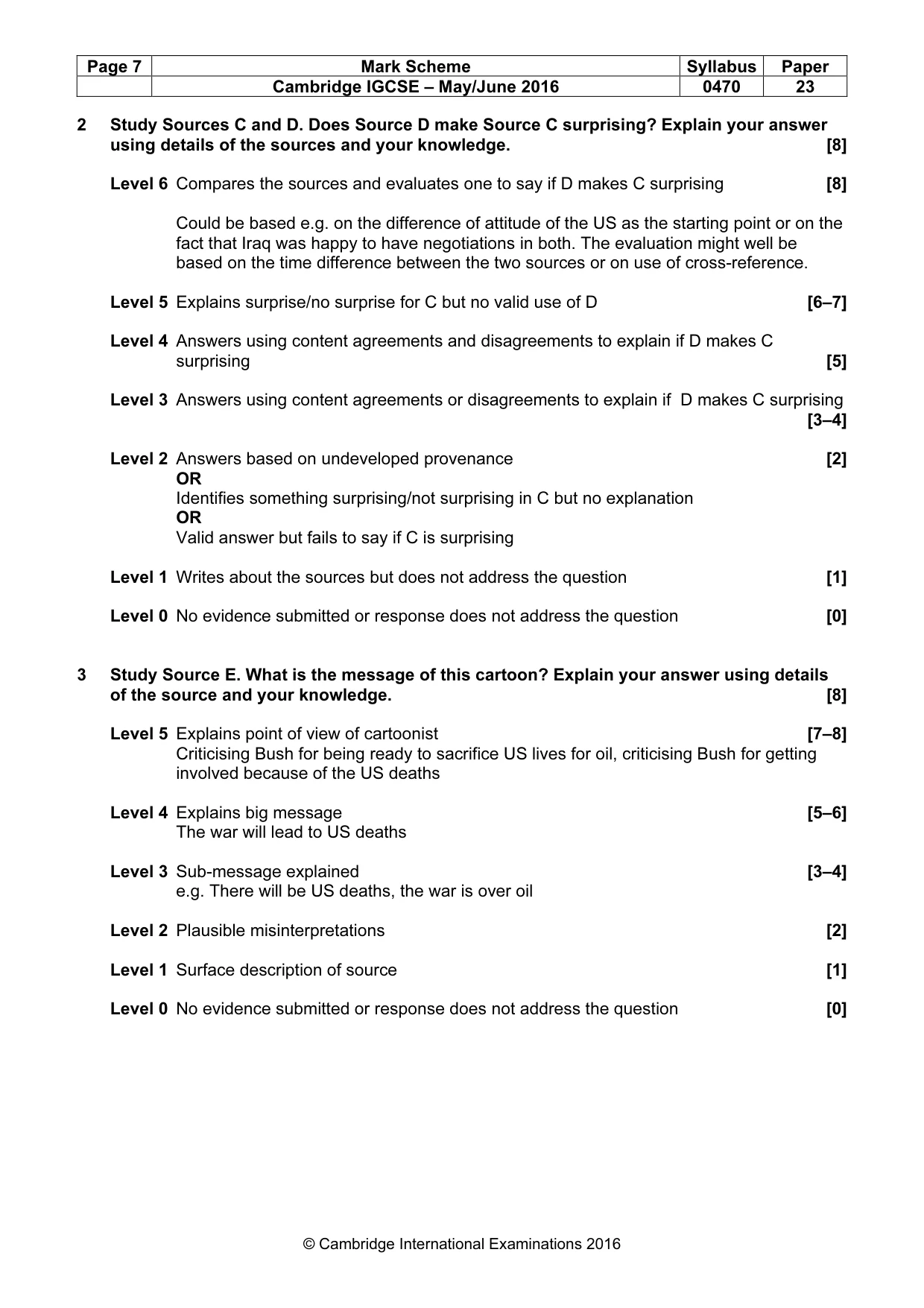
Page 7 Mark Scheme Syllabus Paper Cambridge IGCSE – May/June 2016 0470 23 © Cambridge International Examinations 2016 2 Study Sources C and D. Does Source D make Source C surprising? Explain your answer using details of the sources and your knowledge. [8] Level 6 Compares the sources and evaluates one to say if D makes C surprising [8] Could be based e.g. on the difference of attitude of the US as the starting point or on the fact that Iraq was happy to have negotiations in both. The evaluation might well be based on the time difference between the two sources or on use of cross-reference. Level 5 Explains surprise/no surprise for C but no valid use of D [6–7] Level 4 Answers using content agreements and disagreements to explain if D makes C surprising [5] Level 3 Answers using content agreements or disagreements to explain if D makes C surprising [3–4] Level 2 Answers based on undeveloped provenance [2] OR Identifies something surprising/not surprising in C but no explanation OR Valid answer but fails to say if C is surprising Level 1 Writes about the sources but does not address the question [1] Level 0 No evidence submitted or response does not address the question [0] 3 Study Source E. What is the message of this cartoon? Explain your answer using details of the source and your knowledge. [8] Level 5 Explains point of view of cartoonist [7–8] Criticising Bush for being ready to sacrifice US lives for oil, criticising Bush for getting involved because of the US deaths Level 4 Explains big message [5–6] The war will lead to US deaths Level 3 Sub-message explained [3–4] e.g. There will be US deaths, the war is over oil Level 2 Plausible misinterpretations [2] Level 1 Surface description of source [1] Level 0 No evidence submitted or response does not address the question [0]
Mark scheme, page 8
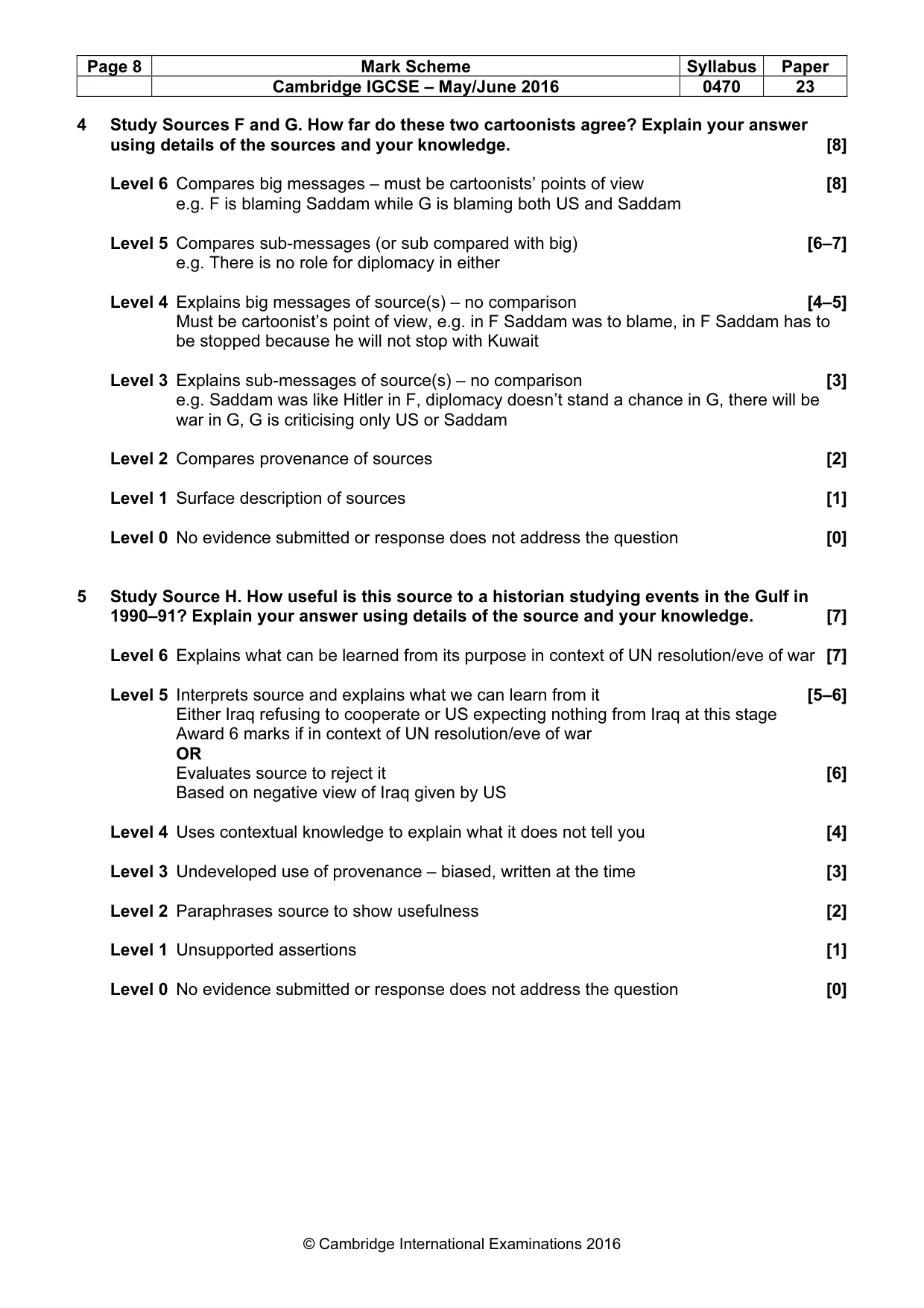
Page 8 Mark Scheme Syllabus Paper Cambridge IGCSE – May/June 2016 0470 23 © Cambridge International Examinations 2016 4 Study Sources F and G. How far do these two cartoonists agree? Explain your answer using details of the sources and your knowledge. [8] Level 6 Compares big messages – must be cartoonists’ points of view [8] e.g. F is blaming Saddam while G is blaming both US and Saddam Level 5 Compares sub-messages (or sub compared with big) [6–7] e.g. There is no role for diplomacy in either Level 4 Explains big messages of source(s) – no comparison [4–5] Must be cartoonist’s point of view, e.g. in F Saddam was to blame, in F Saddam has to be stopped because he will not stop with Kuwait Level 3 Explains sub-messages of source(s) – no comparison [3] e.g. Saddam was like Hitler in F, diplomacy doesn’t stand a chance in G, there will be war in G, G is criticising only US or Saddam Level 2 Compares provenance of sources [2] Level 1 Surface description of sources [1] Level 0 No evidence submitted or response does not address the question [0] 5 Study Source H. How useful is this source to a historian studying events in the Gulf in 1990–91? Explain your answer using details of the source and your knowledge. [7] Level 6 Explains what can be learned from its purpose in context of UN resolution/eve of war [7] Level 5 Interprets source and explains what we can learn from it [5–6] Either Iraq refusing to cooperate or US expecting nothing from Iraq at this stage Award 6 marks if in context of UN resolution/eve of war OR Evaluates source to reject it [6] Based on negative view of Iraq given by US Level 4 Uses contextual knowledge to explain what it does not tell you [4] Level 3 Undeveloped use of provenance – biased, written at the time [3] Level 2 Paraphrases source to show usefulness [2] Level 1 Unsupported assertions [1] Level 0 No evidence submitted or response does not address the question [0]
Mark scheme, page 9
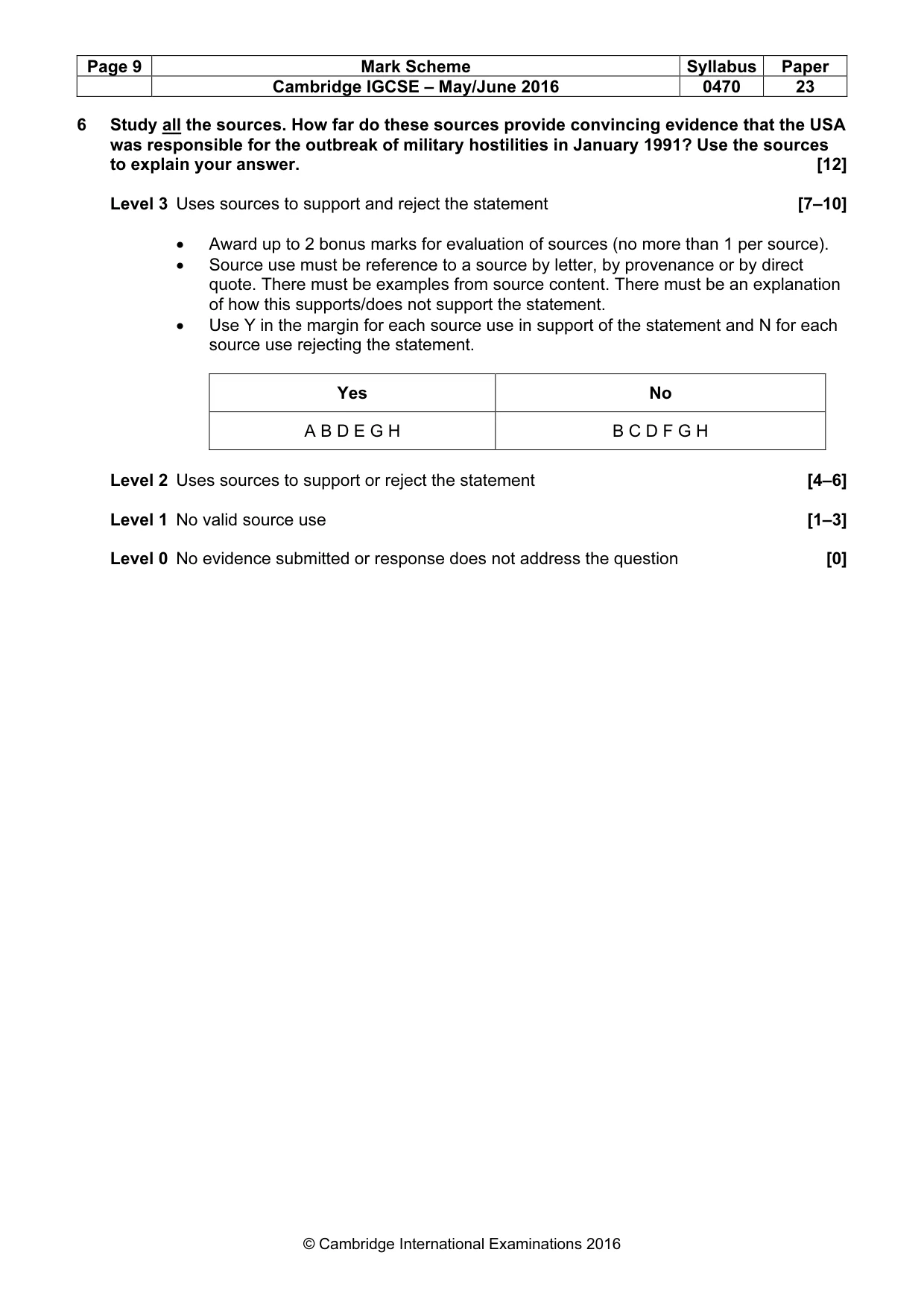
Page 9 Mark Scheme Syllabus Paper Cambridge IGCSE – May/June 2016 0470 23 © Cambridge International Examinations 2016 6 Study all the sources. How far do these sources provide convincing evidence that the USA was responsible for the outbreak of military hostilities in January 1991? Use the sources to explain your answer. [12] Level 3 Uses sources to support and reject the statement [7–10] • Award up to 2 bonus marks for evaluation of sources (no more than 1 per source). • Source use must be reference to a source by letter, by provenance or by direct quote. There must be examples from source content. There must be an explanation of how this supports/does not support the statement. • Use Y in the margin for each source use in support of the statement and N for each source use rejecting the statement. Yes No A B D E G H B C D F G H Level 2 Uses sources to support or reject the statement [4–6] Level 1 No valid source use [1–3] Level 0 No evidence submitted or response does not address the question [0]
What you needed in this session
Cambridge’s own grade thresholds for 2016 May/June, Paper 2 · Variant 3. A higher threshold means an easier paper — the bar moves with how the cohort did.