Cambridge IGCSE History 0470 — 2014 Oct/Nov Paper 2 · Variant 1
0470/21/O/N/14 · 50 marks · ≈56 min
The question paper and its mark scheme, free to read here and free to download. This is Cambridge’s own paper, exactly as it was sat.
Question paper16 pages

Mark scheme8 pages
Answers below. Sit the paper first if you are practising.

Paper as text
Question paper, page 1
This document consists of 14 printed pages, 2 blank pages and 1 insert. DC (NF/SW) 84787/5 © UCLES 2014 [Turn over Cambridge International Examinations Cambridge International General Certificate of Secondary Education * 6 8 4 9 6 3 8 6 4 1 * HISTORY 0470/21 Paper 2 October/November 2014 2 hours No Additional Materials are required. READ THESE INSTRUCTIONS FIRST An answer booklet is provided inside this question paper. You should follow the instructions on the front cover of the answer booklet. If you need additional answer paper ask the invigilator for a continuation booklet. This paper has two options. Choose one option, and answer all of the questions on that topic. Option A: 19th Century topic [p2–p7] Option B: 20th Century topic [p8–p14] The number of marks is given in brackets [ ] at the end of each question or part question.
Question paper, page 2
2 0470/21/O/N/14 © UCLES 2014 Option A: 19th Century topic DID THE JUNE DAYS UPRISING OF 1848 HAVE ANY CHANCE OF SUCCESS? Study the Background Information and the sources carefully, and then answer all the questions. Background Information In February 1848 King Louis Philippe of France was overthrown by revolution and the Second French Republic was established. The new government set up National Workshops to provide employment for the unemployed. People flocked to Paris from all over France and by May the workshops were employing 100 000 workers. The workshops were unpopular with rural farmers, who had to pay for them through increased land taxes, and with many people in Paris, who feared more radicalism. In June the recently elected Constituent Assembly closed the workshops. This was very unpopular with the unemployed and the poor, who rose up in rebellion. The following ‘June Days’ saw bitter fighting but after four days the rising had been defeated. Did the rising of the June Days really have any chance of succeeding? SOURCE A On 22 June it was announced that the National Workshops were to be closed. Workers were told, with an amazing lack of tact, that ‘if the workers do not want to leave, we will send them from Paris by force’. No effort was made to reassure the unemployed that poor relief provision would be made for them. This convinced many that with such an uncaring government there was no alternative but to recommence the Revolution. With the slogan ‘Liberty or Death’, a spontaneous revolt began with barricades being constructed in the poorer parts of Paris. About 40 000 to 50 000 demonstrators were involved. There was no overall plan, no collective leadership emerged, and the insurrection very rapidly became nothing more than a desperately-fought defence of isolated neighbourhoods. Contemporaries saw the conflict as one between the bourgeoisie and the working class. Against the demonstrators were the National Guard units from the wealthier areas of Paris, made up of property owners, shopkeepers, professional men, intellectuals and skilled workers. They were anxious to defend their own neighbourhoods and to make clear their commitment to a hierarchical society and to crush the threatened social revolution and the prospect of ‘anarchy’. Political differences were forgotten. Although many workers failed to report for duty, they still made up one-fifth of the National Guard. Many of them saw the insurrection as a threat to the Republic. A major role in the fighting was given to the Mobile Guard. They were organised from young, unemployed workers. They remained loyal to the government which paid them. Most important of all, in the work of repression, was the regular army which was to become in the eyes of the propertied classes, the ‘saviour of civilisation’. Overall command was put in the hands of General Cavaignac. He was anxious to concentrate his forces and this took time. This apparent inaction encouraged the insurgents to extend their network of barricades. However, once concentration had been achieved, the rising was smashed in three days of bitter street fighting, followed by 12 000 arrests. From a history book published in 1989.
Question paper, page 3
3 0470/21/O/N/14 © UCLES 2014 [Turn over SOURCE B After days of debate in the newly-elected Assembly it was decided on 24 May to close the workshops to new enrolment. Before long, thousands of unemployed workers were threatened with starvation, as shown by the numerous delegations begging for bread. Workmen gathered in large numbers in the evenings not knowing where to turn. The government appointed General Cavaignac as commander of the troops, the National Guard and the Mobile Guard. The 30 000 troops were demoralised and not entirely reliable. The huge National Guard was a doubtful asset because it was so socially mixed that there was no knowing how much it could be counted on to fight the workers. His most effective force was the new Mobile Guard, 15 000 strong, well-trained and tough. Hostilities began on 23 June, following the government’s decree dissolving the workshops. Barricades sprang up by the hundreds in the poorer sections of Paris. Soon, the entire east of the city was in the hands of the insurgents. The vast majority of the barricade fighters were destitute, unemployed workers who had been denied admission to the workshops. Most of them had recently come to Paris and were in a state of utter desperation. They were completely lacking in any ideas of political or social reform. The June insurrection, in which not a single radical leader participated, and which was an unplanned, disorganised outbreak, never had much chance of success. It was able to secure control of a large part of the city simply because Cavaignac refused to take action until all his forces were ready and concentrated in three places. Only 10 000 of the National Guard reported for duty but thousands of provincials, eager to defend society against anarchic ideas, arrived in Paris. On 24 June Cavaignac opened his offensive. Much of the fighting was done by the Mobile Guard, with the soldiers only fighting where success was certain. In four days of desperate fighting the insurgents had lost 400–500 men and were defeated. From a history book published in 1969.
Question paper, page 4
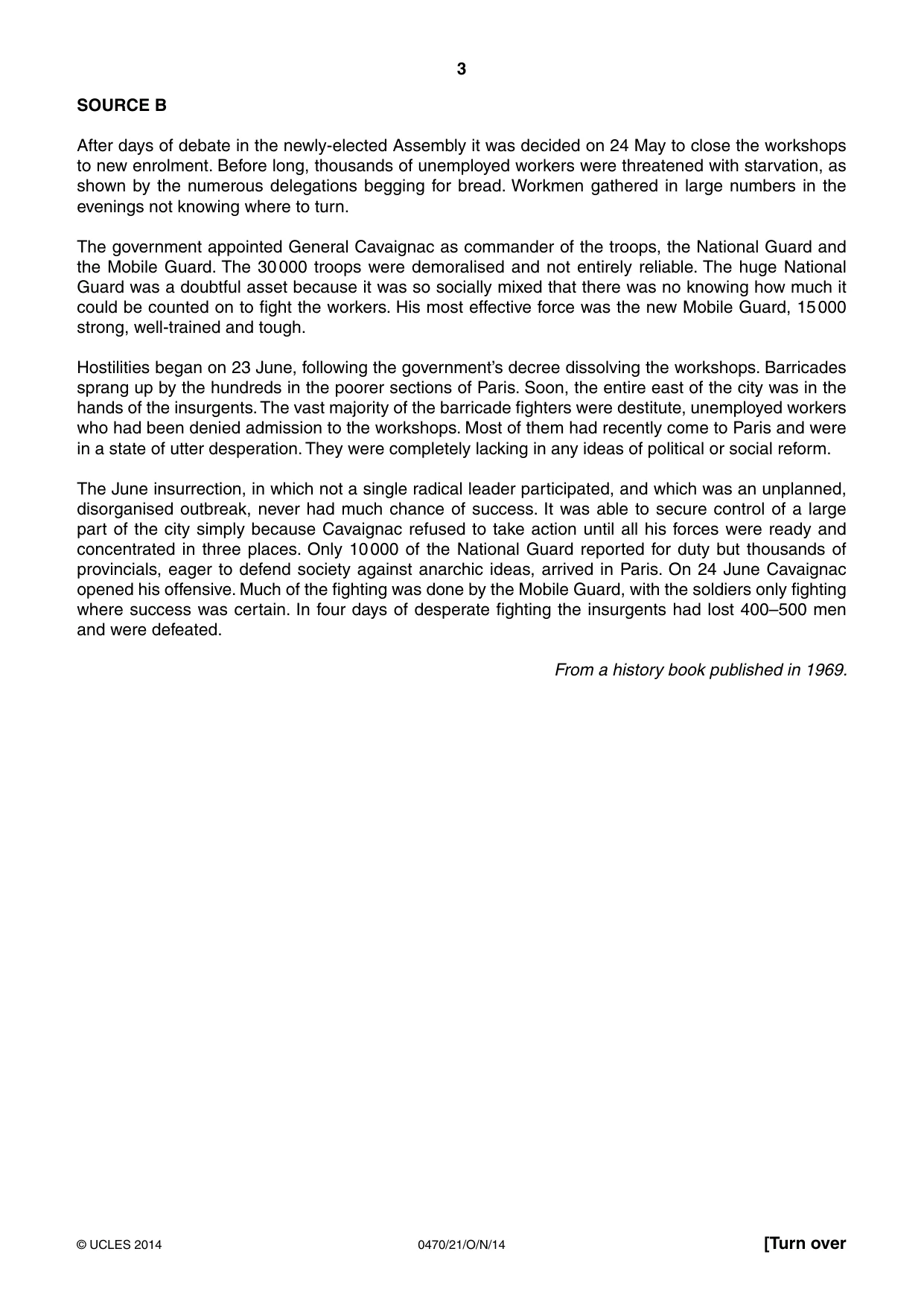
4 0470/21/O/N/14 © UCLES 2014 SOURCE C A photograph of barricades in Paris on 25 June 1848.
Question paper, page 5
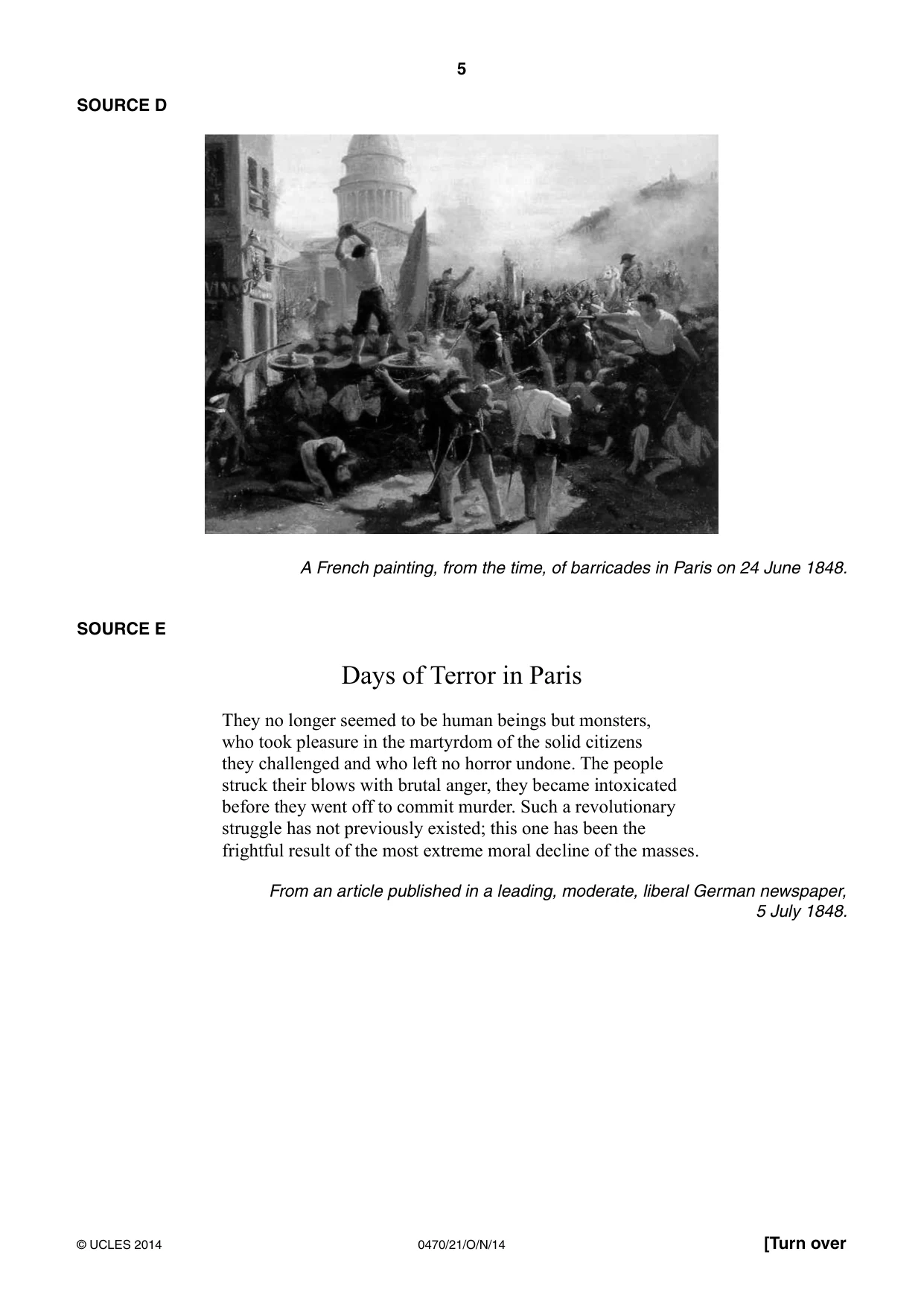
5 0470/21/O/N/14 © UCLES 2014 [Turn over SOURCE D A French painting, from the time, of barricades in Paris on 24 June 1848. SOURCE E Days of Terror in Paris They no longer seemed to be human beings but monsters, who took pleasure in the martyrdom of the solid citizens they challenged and who left no horror undone. The people struck their blows with brutal anger, they became intoxicated before they went off to commit murder. Such a revolutionary struggle has not previously existed; this one has been the frightful result of the most extreme moral decline of the masses. From an article published in a leading, moderate, liberal German newspaper, 5 July 1848.
Question paper, page 6
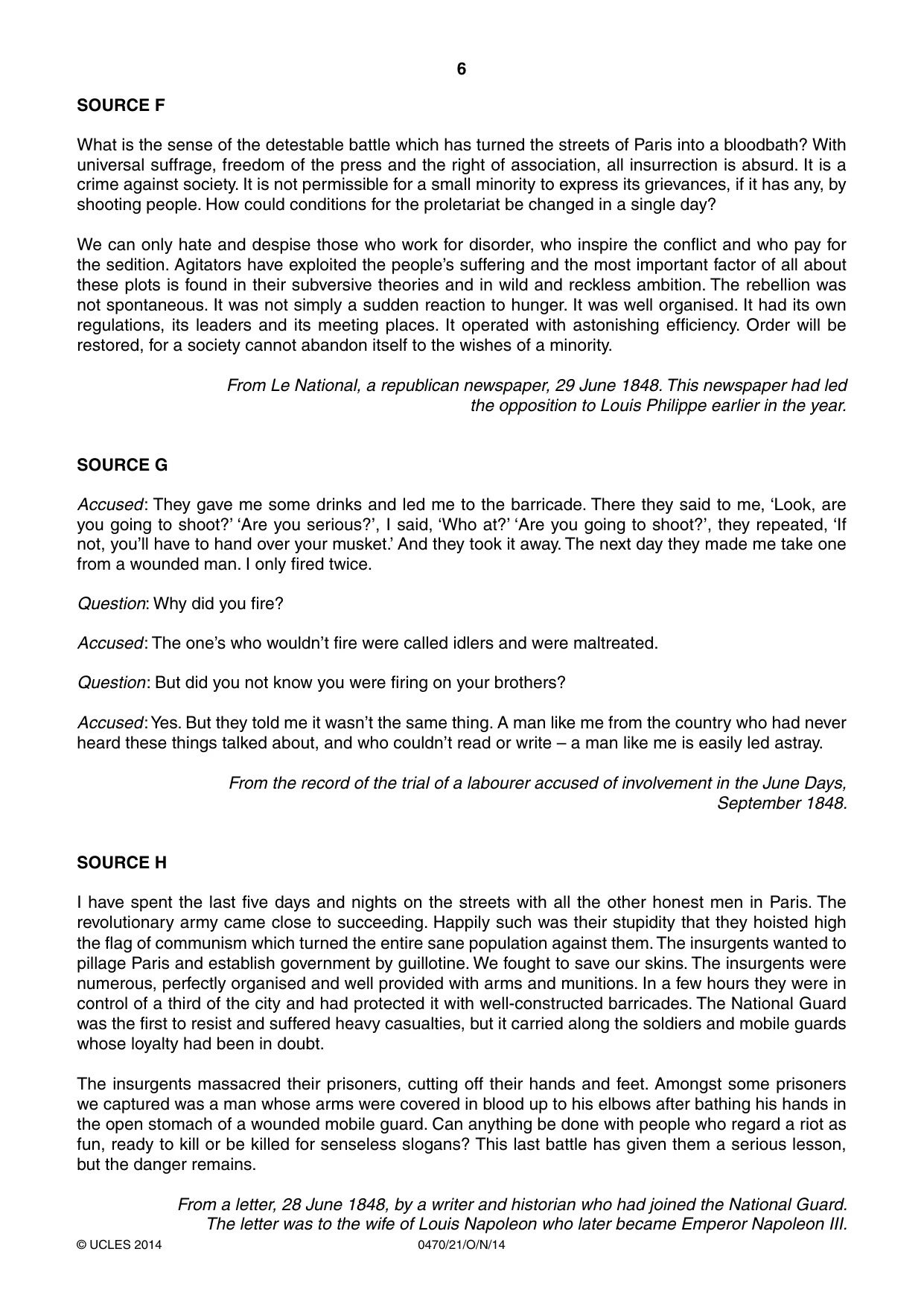
6 0470/21/O/N/14 © UCLES 2014 SOURCE F What is the sense of the detestable battle which has turned the streets of Paris into a bloodbath? With universal suffrage, freedom of the press and the right of association, all insurrection is absurd. It is a crime against society. It is not permissible for a small minority to express its grievances, if it has any, by shooting people. How could conditions for the proletariat be changed in a single day? We can only hate and despise those who work for disorder, who inspire the conflict and who pay for the sedition. Agitators have exploited the people’s suffering and the most important factor of all about these plots is found in their subversive theories and in wild and reckless ambition. The rebellion was not spontaneous. It was not simply a sudden reaction to hunger. It was well organised. It had its own regulations, its leaders and its meeting places. It operated with astonishing efficiency. Order will be restored, for a society cannot abandon itself to the wishes of a minority. From Le National, a republican newspaper, 29 June 1848. This newspaper had led the opposition to Louis Philippe earlier in the year. SOURCE G Accused: They gave me some drinks and led me to the barricade. There they said to me, ‘Look, are you going to shoot?’ ‘Are you serious?’, I said, ‘Who at?’ ‘Are you going to shoot?’, they repeated, ‘If not, you’ll have to hand over your musket.’ And they took it away. The next day they made me take one from a wounded man. I only fired twice. Question: Why did you fire? Accused: The one’s who wouldn’t fire were called idlers and were maltreated. Question: But did you not know you were firing on your brothers? Accused: Yes. But they told me it wasn’t the same thing. A man like me from the country who had never heard these things talked about, and who couldn’t read or write – a man like me is easily led astray. From the record of the trial of a labourer accused of involvement in the June Days, September 1848. SOURCE H I have spent the last five days and nights on the streets with all the other honest men in Paris. The revolutionary army came close to succeeding. Happily such was their stupidity that they hoisted high the flag of communism which turned the entire sane population against them. The insurgents wanted to pillage Paris and establish government by guillotine. We fought to save our skins. The insurgents were numerous, perfectly organised and well provided with arms and munitions. In a few hours they were in control of a third of the city and had protected it with well-constructed barricades. The National Guard was the first to resist and suffered heavy casualties, but it carried along the soldiers and mobile guards whose loyalty had been in doubt. The insurgents massacred their prisoners, cutting off their hands and feet. Amongst some prisoners we captured was a man whose arms were covered in blood up to his elbows after bathing his hands in the open stomach of a wounded mobile guard. Can anything be done with people who regard a riot as fun, ready to kill or be killed for senseless slogans? This last battle has given them a serious lesson, but the danger remains. From a letter, 28 June 1848, by a writer and historian who had joined the National Guard. The letter was to the wife of Louis Napoleon who later became Emperor Napoleon III.
Question paper, page 7
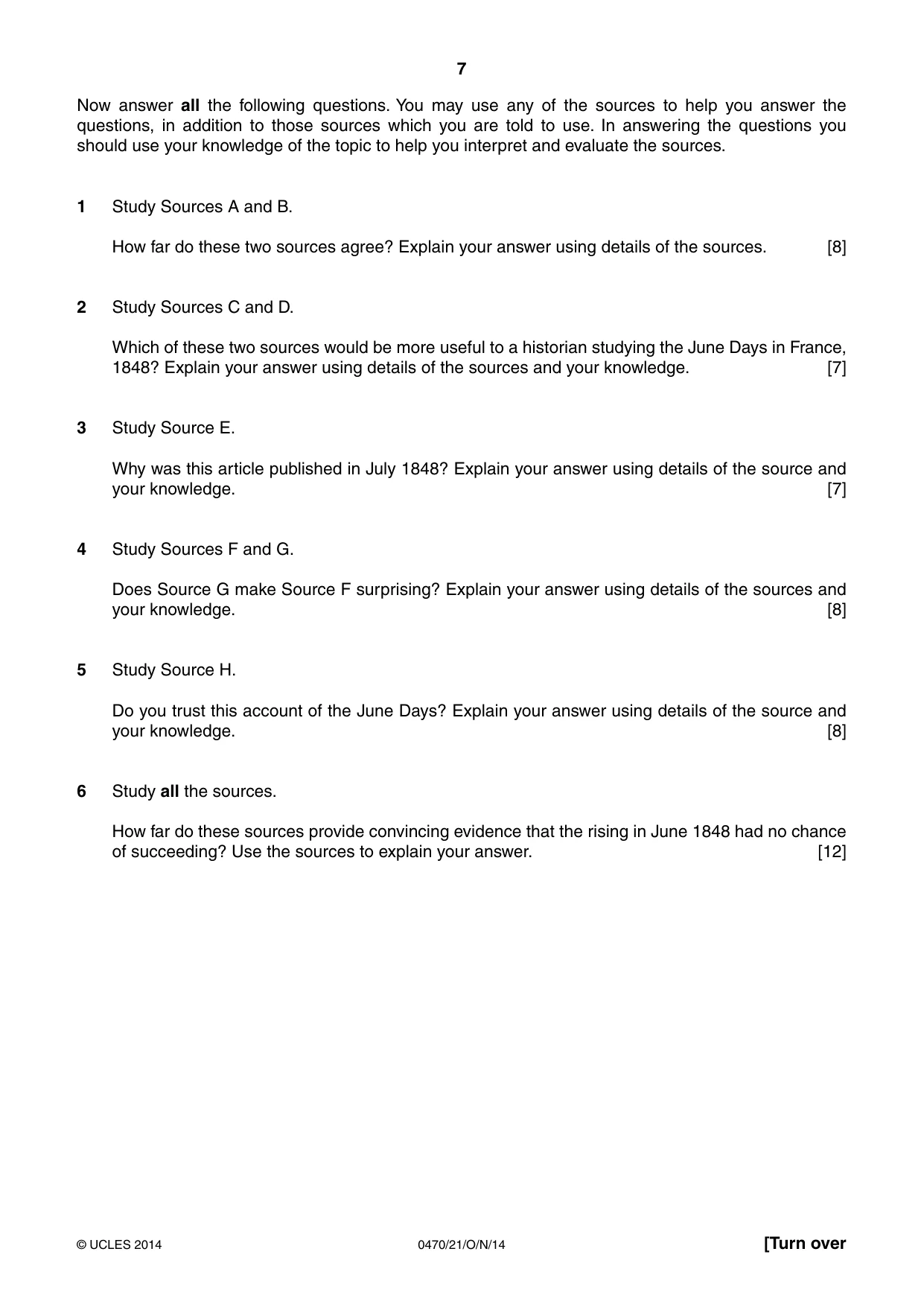
7 0470/21/O/N/14 © UCLES 2014 [Turn over Now answer all the following questions. You may use any of the sources to help you answer the questions, in addition to those sources which you are told to use. In answering the questions you should use your knowledge of the topic to help you interpret and evaluate the sources. 1 Study Sources A and B. How far do these two sources agree? Explain your answer using details of the sources. [8] 2 Study Sources C and D. Which of these two sources would be more useful to a historian studying the June Days in France, 1848? Explain your answer using details of the sources and your knowledge. [7] 3 Study Source E. Why was this article published in July 1848? Explain your answer using details of the source and your knowledge. [7] 4 Study Sources F and G. Does Source G make Source F surprising? Explain your answer using details of the sources and your knowledge. [8] 5 Study Source H. Do you trust this account of the June Days? Explain your answer using details of the source and your knowledge. [8] 6 Study all the sources. How far do these sources provide convincing evidence that the rising in June 1848 had no chance of succeeding? Use the sources to explain your answer. [12]
Question paper, page 8
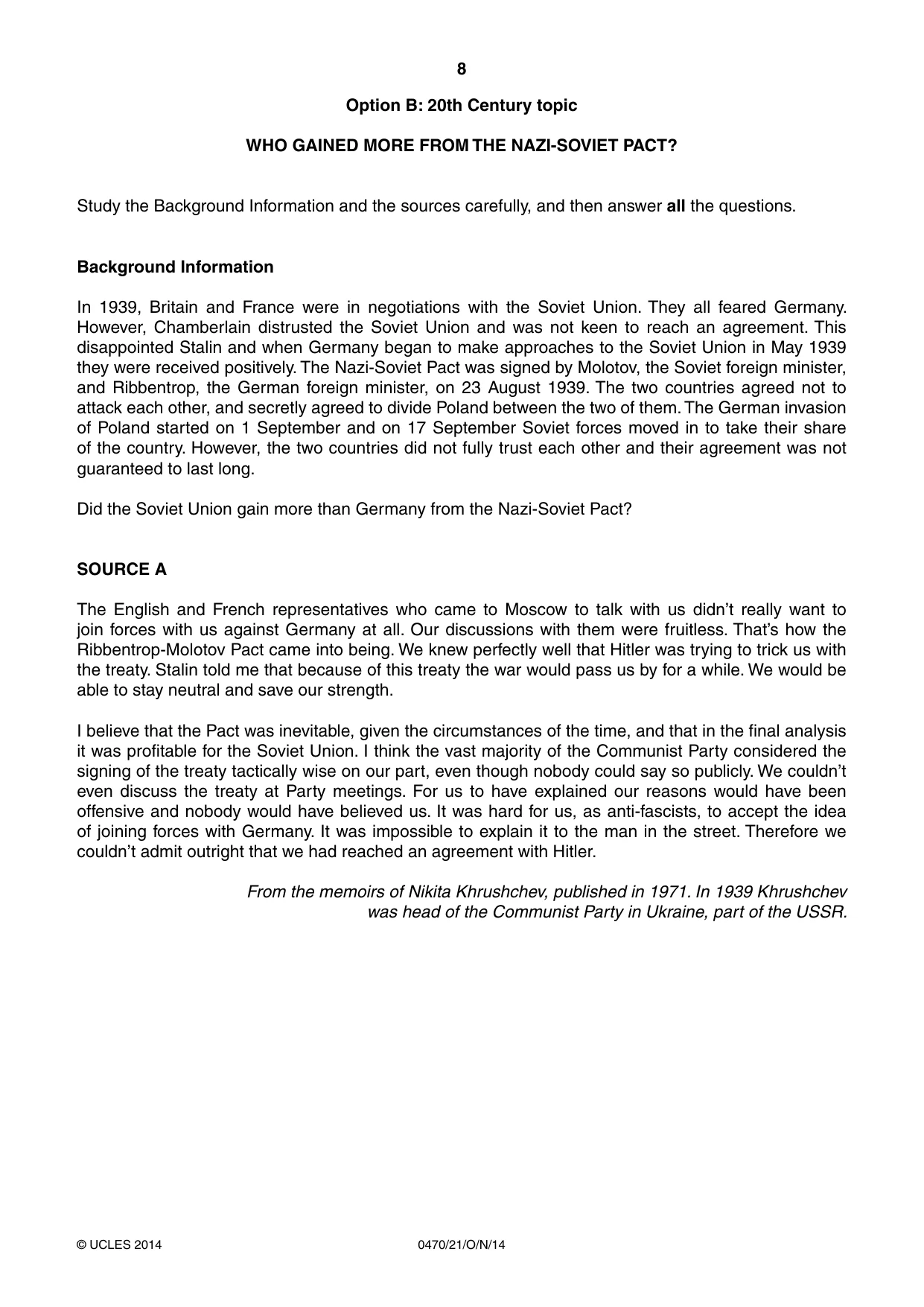
8 0470/21/O/N/14 © UCLES 2014 Option B: 20th Century topic WHO GAINED MORE FROM THE NAZI-SOVIET PACT? Study the Background Information and the sources carefully, and then answer all the questions. Background Information In 1939, Britain and France were in negotiations with the Soviet Union. They all feared Germany. However, Chamberlain distrusted the Soviet Union and was not keen to reach an agreement. This disappointed Stalin and when Germany began to make approaches to the Soviet Union in May 1939 they were received positively. The Nazi-Soviet Pact was signed by Molotov, the Soviet foreign minister, and Ribbentrop, the German foreign minister, on 23 August 1939. The two countries agreed not to attack each other, and secretly agreed to divide Poland between the two of them. The German invasion of Poland started on 1 September and on 17 September Soviet forces moved in to take their share of the country. However, the two countries did not fully trust each other and their agreement was not guaranteed to last long. Did the Soviet Union gain more than Germany from the Nazi-Soviet Pact? SOURCE A The English and French representatives who came to Moscow to talk with us didn’t really want to join forces with us against Germany at all. Our discussions with them were fruitless. That’s how the Ribbentrop-Molotov Pact came into being. We knew perfectly well that Hitler was trying to trick us with the treaty. Stalin told me that because of this treaty the war would pass us by for a while. We would be able to stay neutral and save our strength. I believe that the Pact was inevitable, given the circumstances of the time, and that in the final analysis it was profitable for the Soviet Union. I think the vast majority of the Communist Party considered the signing of the treaty tactically wise on our part, even though nobody could say so publicly. We couldn’t even discuss the treaty at Party meetings. For us to have explained our reasons would have been offensive and nobody would have believed us. It was hard for us, as anti-fascists, to accept the idea of joining forces with Germany. It was impossible to explain it to the man in the street. Therefore we couldn’t admit outright that we had reached an agreement with Hitler. From the memoirs of Nikita Khrushchev, published in 1971. In 1939 Khrushchev was head of the Communist Party in Ukraine, part of the USSR.
Question paper, page 9
9 0470/21/O/N/14 © UCLES 2014 [Turn over SOURCE B The announcement on 23 August about the Pact came like a thunderclap to the international communist movement. We were thrown into utter confusion. We looked hopefully for an escape clause in the Pact, but the official text provided none. For several days there was no clarification from Moscow and we communists were left painfully on our own. A national conference of the Communist Party in America had been scheduled for that weekend and it took place amid great anxiety. Eugene Dennis seemed to make the most sense, calling for a fight on two fronts: against the fascist enemy and against the appeasing democratic governments which could not be relied on to fight fascism. This attitude, a reasonable continuity with our former position, did not last long. Statements now began to come from Moscow which made clear a big change in policy was under way. The Soviet position was that British and French imperialists were responsible for the war, that this was an imperialist war and that neither side should be supported. The world communist movement followed behind these statements. Until then communist parties had been demanding that their governments fight against fascism. We now denounced this approach. We demanded that the war be ended; how this could be done without the military defeat of Hitler was left unclear. Some communist leaders in the west suggested a policy of working to establish governments that would energetically fight the fascists, but these leaders were removed. Actually, a good case could be made for the Pact. For years Moscow had tried to reach an agreement with the West against fascism. Instead, the West had come to an agreement with fascism at Munich and behind the back of the Soviet Union. After Munich, the Soviet Union had every reason to believe that the West was manoeuvring to push Hitler into an attack upon the USSR. The Soviet Union decided to protect itself through a non-aggression pact. The West had only itself to blame for what happened. The Soviet Union undoubtedly gained temporary safety and additional time to prepare for the inevitable onslaught. From the memoirs of John Gates, published in 1958. Gates was a leading communist in the USA.
Question paper, page 10
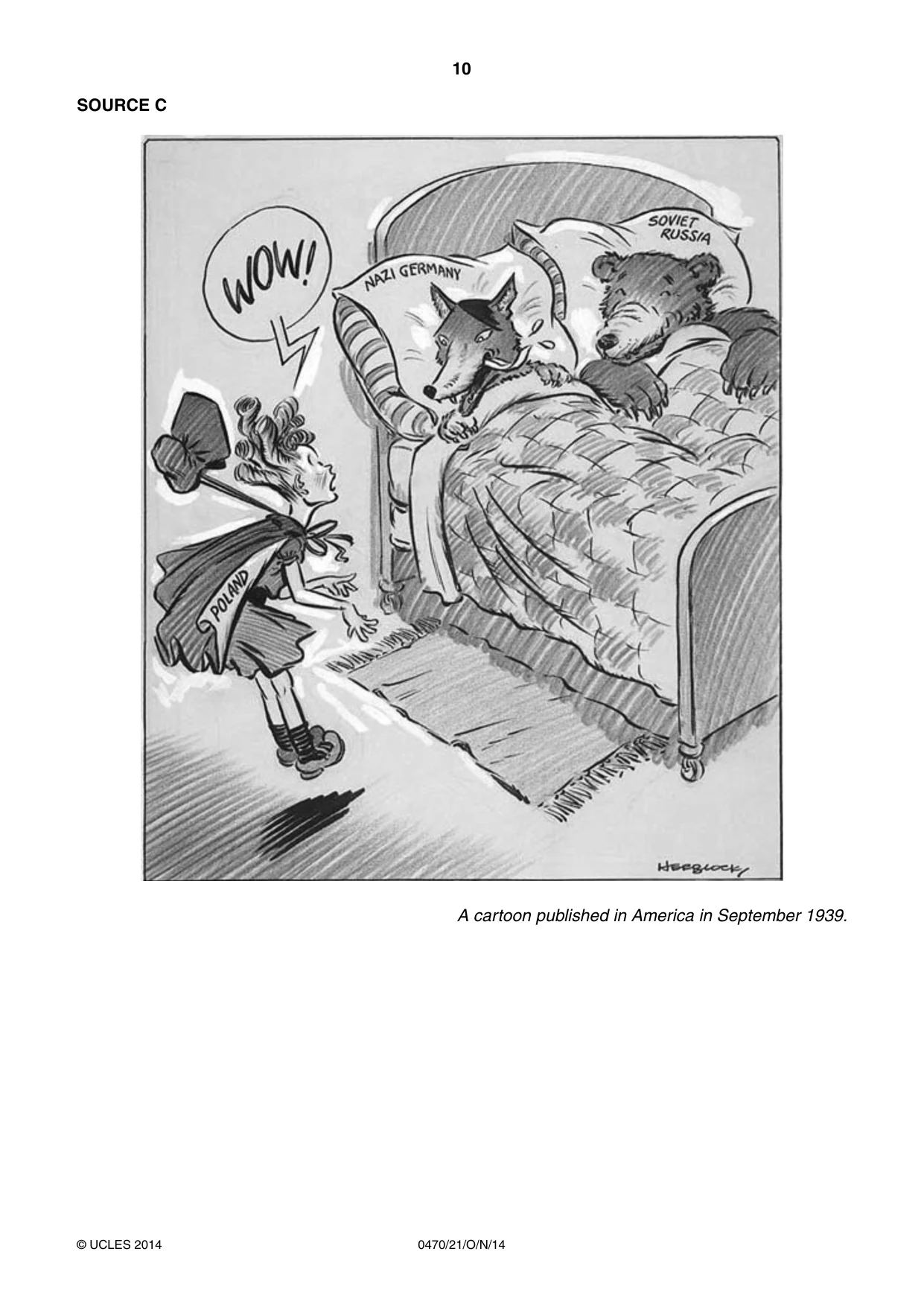
10 0470/21/O/N/14 © UCLES 2014 SOURCE C A cartoon published in America in September 1939.
Question paper, page 11
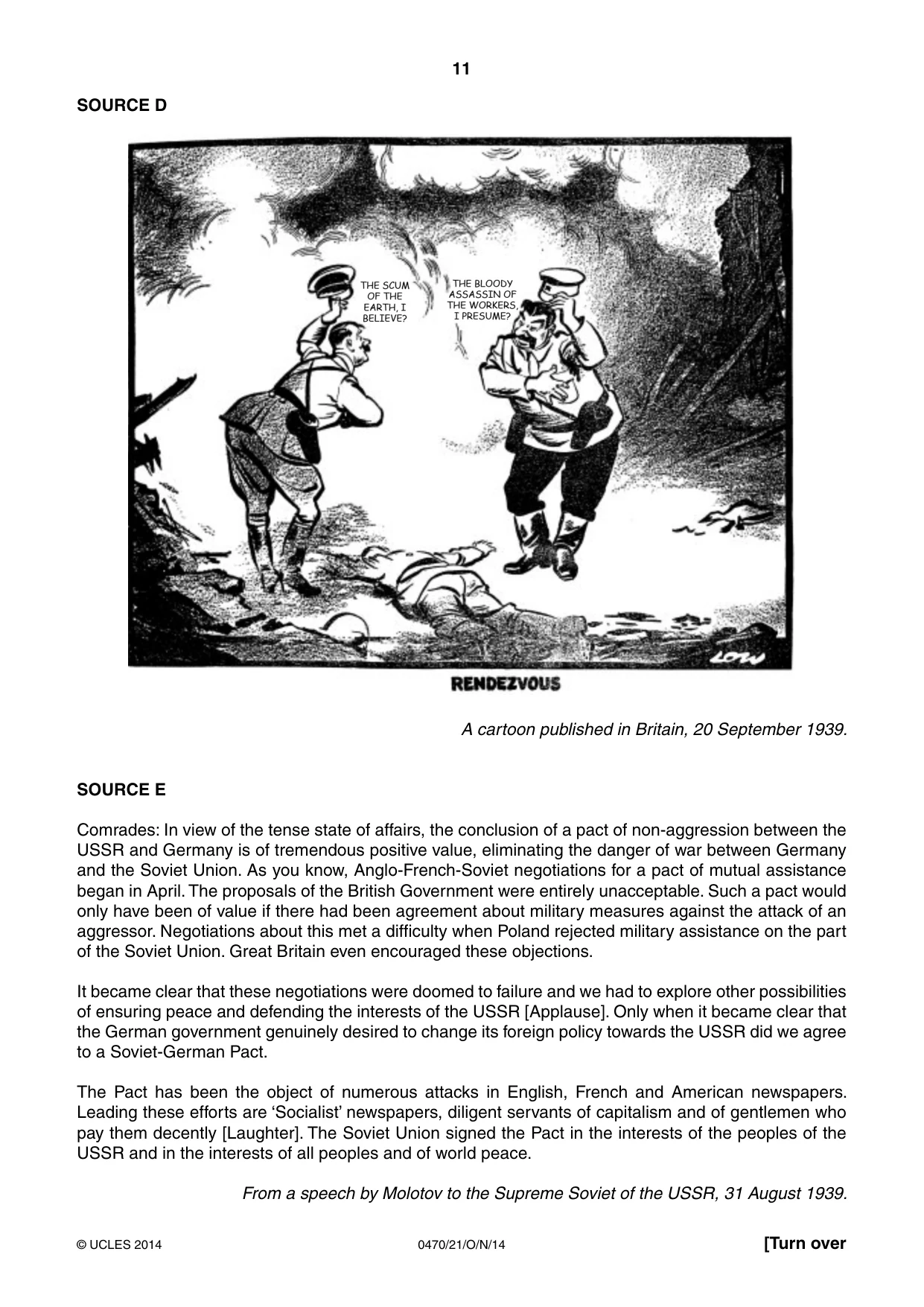
11 0470/21/O/N/14 © UCLES 2014 [Turn over SOURCE D A cartoon published in Britain, 20 September 1939. SOURCE E Comrades: In view of the tense state of affairs, the conclusion of a pact of non-aggression between the USSR and Germany is of tremendous positive value, eliminating the danger of war between Germany and the Soviet Union. As you know, Anglo-French-Soviet negotiations for a pact of mutual assistance began in April. The proposals of the British Government were entirely unacceptable. Such a pact would only have been of value if there had been agreement about military measures against the attack of an aggressor. Negotiations about this met a difficulty when Poland rejected military assistance on the part of the Soviet Union. Great Britain even encouraged these objections. It became clear that these negotiations were doomed to failure and we had to explore other possibilities of ensuring peace and defending the interests of the USSR [Applause]. Only when it became clear that the German government genuinely desired to change its foreign policy towards the USSR did we agree to a Soviet-German Pact. The Pact has been the object of numerous attacks in English, French and American newspapers. Leading these efforts are ‘Socialist’ newspapers, diligent servants of capitalism and of gentlemen who pay them decently [Laughter]. The Soviet Union signed the Pact in the interests of the peoples of the USSR and in the interests of all peoples and of world peace. From a speech by Molotov to the Supreme Soviet of the USSR, 31 August 1939.
Question paper, page 12
12 0470/21/O/N/14 © UCLES 2014 SOURCE F Of course it is all a game to see who can fool whom. I know what Hitler’s up to. He thinks he’s outsmarted me, but actually it is I who have tricked him! Stalin speaking to Beria and Khrushchev on 24 August 1939. Beria was the Soviet Commissioner for Internal Affairs. The speech was reported by Khrushchev in his memoirs. SOURCE G Since I realised Japan will not go with us unconditionally and that Mussolini is endangered by that idiot of a king, I decided to go with Stalin. As to what the weak western powers assert about me, that is of no account. I experienced those poor worms Daladier and Chamberlain at Munich. They will be too cowardly to attack. Poland will be depopulated and settled with Germans. My pact with the Poles was merely to gain time. The fate of Russia will be exactly the same. After Stalin’s death – he is a very sick man – we will break the Soviet Union. Then will begin the dawn of the German rule of the earth. From a speech by Hitler to his generals, 22 August 1939.
Question paper, page 13
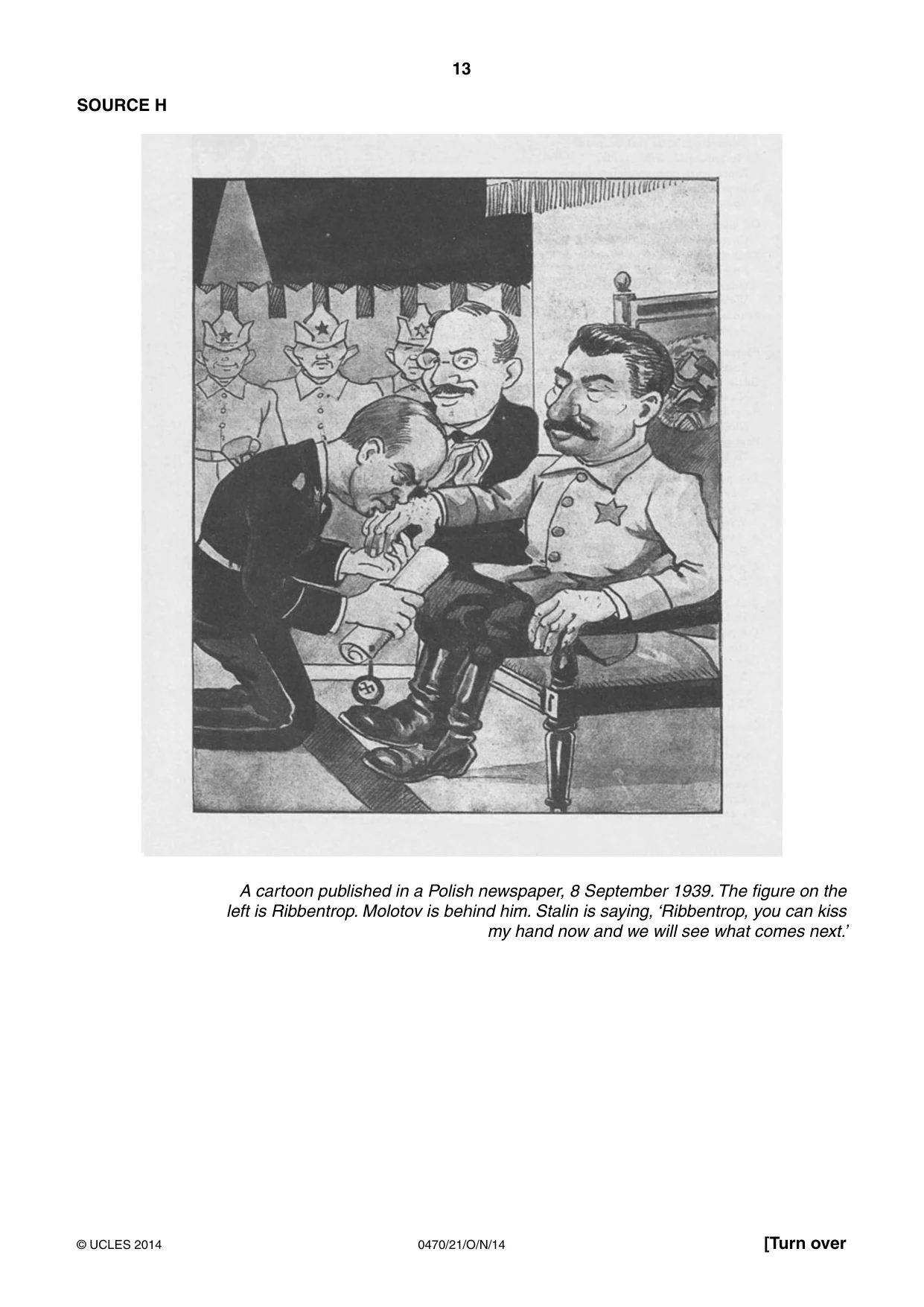
13 0470/21/O/N/14 © UCLES 2014 [Turn over SOURCE H A cartoon published in a Polish newspaper, 8 Se ptember 1939. The figure on the left is Ribbentrop. Molotov is behind him. Stalin is saying, ‘Ribbentrop, you can kiss my hand now and we will see what comes next.’
Question paper, page 14
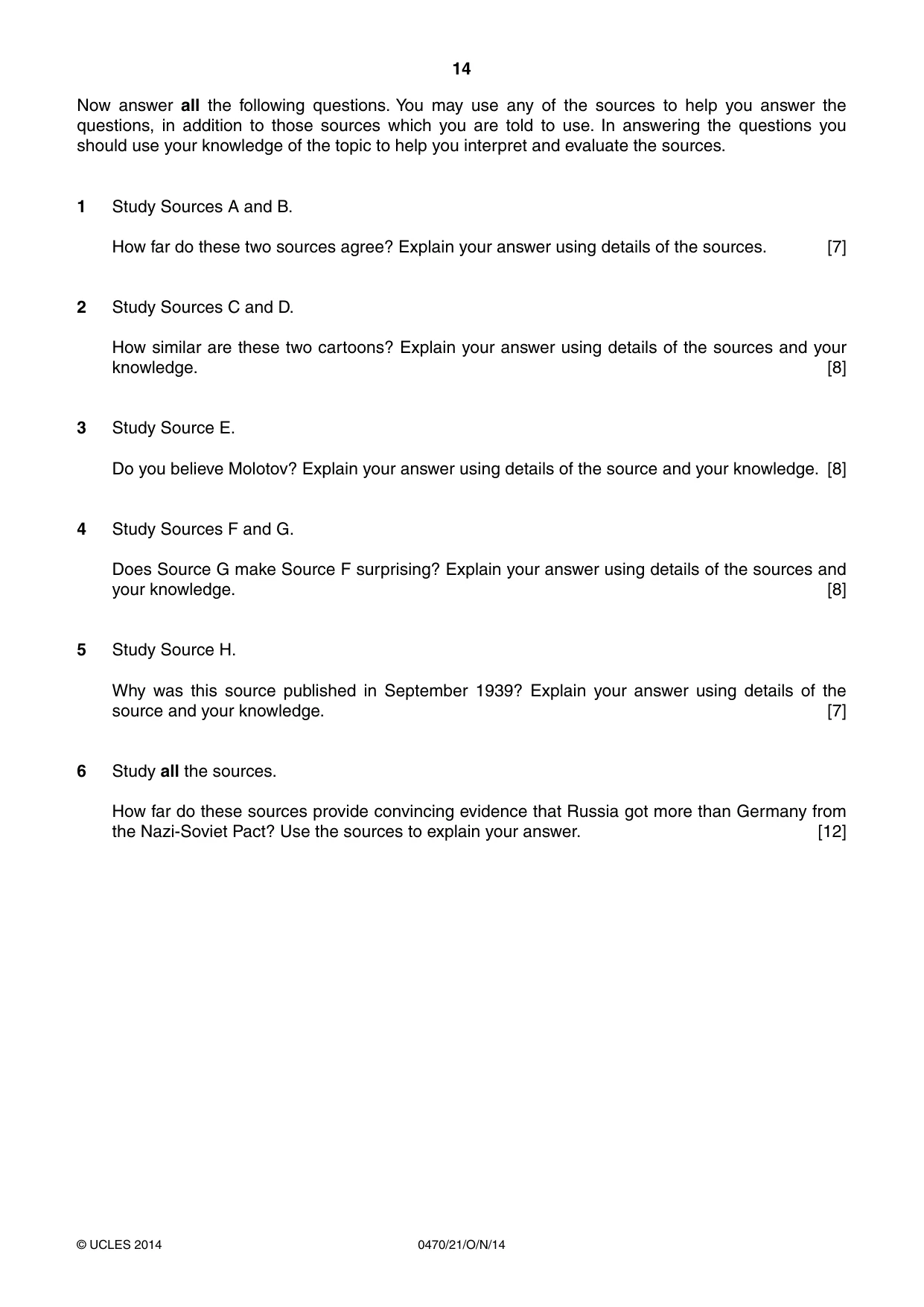
14 0470/21/O/N/14 © UCLES 2014 Now answer all the following questions. You may use any of the sources to help you answer the questions, in addition to those sources which you are told to use. In answering the questions you should use your knowledge of the topic to help you interpret and evaluate the sources. 1 Study Sources A and B. How far do these two sources agree? Explain your answer using details of the sources. [7] 2 Study Sources C and D. How similar are these two cartoons? Explain your answer using details of the sources and your knowledge. [8] 3 Study Source E. Do you believe Molotov? Explain your answer using details of the source and your knowledge. [8] 4 Study Sources F and G. Does Source G make Source F surprising? Explain your answer using details of the sources and your knowledge. [8] 5 Study Source H. Why was this source published in September 1939? Explain your answer using details of the source and your knowledge. [7] 6 Study all the sources. How far do these sources provide convincing evidence that Russia got more than Germany from the Nazi-Soviet Pact? Use the sources to explain your answer. [12]
Question paper, page 15
15 0470/21/O/N/14 © UCLES 2014 BLANK PAGE
Question paper, page 16
16 0470/21/O/N/14 © UCLES 2014 BLANK PAGE Copyright Acknowledgements: Option A Source A © Roger Price; The Revolutions of 1848; Humanities Press International; 1989. Option A Source B © William Langer; Political and Social Upheaval 1832 – 1852; Harper Torchbooks; 1969. Option A Source C © www.internationalpeaceandconflict/org/photo/paris-at-the-barricades; 8 April 2013. Option A Source D © Steve Art Gallery; www.steveartgallery.se; 8 April 2013. Option A Source E © Jonathan Sperber; The European Revolutions, 1848 – 1851; Cambridge University Press; 2005. Option A Source F © Roger Price; Documents of the French Revolution 1848; Macmillan Press; 1996. Option A Source G © Roger Price; Documents of the French Revolution 1848; Macmillan Press; 1996. Option A Source H © Roger Price; Documents of the French Revolution 1848; Macmillan Press; 1996. Option B Source A © Ed. Edward Crankshaw; Khrushchev Remembers; Andre Deutsch; 1971. Option B Source B © www.spartacus.schoolnet.co.uk; 8 April 2013. Option B Source C © www.johndclare.net; 8 April 2013. Option B Source D © David Low; Rendezvous; Evening Standard; 20 September 1939; Ref: LSE2692; www.cartoons.ac.uk. Option B Source E © V. M. Molotov; The Meaning of the Soviet-German Non-Aggression Pact; Workers Library Publishers; 1939. Option B Source F © Ed. Edward Crankshaw; Khrushchev Remembers; Andre Deutsch; 1971. Option B Source G © Frank McDonough; Hitler, Chamberlain and Appeasement; Cambridge University Press; 2002. Option B Source H © Wikipedia.org/nazi-soviet.pact; 9 April 2013. Permission to reproduce items where third-party owned material protected by copyright is included has been sought and cleared where possible. Every reasonable effort has been made by the publisher (UCLES) to trace copyright holders, but if any items requiring clearance have unwittingly been included, the publisher will be pleased to make amends at the earliest possible opportunity. Cambridge International Examinations is part of the Cambridge Assessment Group. Cambridge Assessment is the brand name of University of Cambridge Local Examinations Syndicate (UCLES), which is itself a department of the University of Cambridge.
Mark scheme, page 1
® IGCSE is the registered trademark of Cambridge International Examinations. CAMBRIDGE INTERNATIONAL EXAMINATIONS Cambridge International General Certificate of Secondary Education MARK SCHEME for the October/November 2014 series 0470 HISTORY 0470/21 Paper 2, maximum raw mark 50 This mark scheme is published as an aid to teachers and candidates, to indicate the requirements of the examination. It shows the basis on which Examiners were instructed to award marks. It does not indicate the details of the discussions that took place at an Examiners’ meeting before marking began, which would have considered the acceptability of alternative answers. Mark schemes should be read in conjunction with the question paper and the Principal Examiner Report for Teachers. Cambridge will not enter into discussions about these mark schemes. Cambridge is publishing the mark schemes for the October/November 2014 series for most Cambridge IGCSE®, Cambridge International A and AS Level components and some Cambridge O Level components.
Mark scheme, page 2
Page 2 Mark Scheme Syllabus Paper Cambridge IGCSE – October/November 2014 0470 21 © Cambridge International Examinations 2014 19th Century Topic 1 Study Sources A and B. How far do these two sources agree? Explain your answer using details of the sources. [8] Level 0 No evidence submitted or response does not address the question [0] Level 1 Writes about the sources but makes no valid comparison [1] Level 2 Identifies information that is in one source but not in the other or states that the sources are about the same subject [2] Level 3 Agreement or disagreement of detail or sub-messages [3–4] Agreements – national workshops closed; Cavaignac was the army commander; the mobile guard was important in both; Cavaignac delayed in acting; the authorities were strong in both; Disagreements – the regular army were effective, reliable in A but in B they were not effective; A says uprising defeated in 3 days, B says 4 days; in A the fighting was in isolated pockets but was more widespread in B. Level 4 Agreement and disagreement of detail or sub-messages [5–6] Level 5 Compares big messages – they agree that the rioters did not stand a chance. [7–8] 2 Study Sources C and D. Which of these two sources would be more useful to a historian studying the June Days in France, 1848? Explain your answer using details of the sources and your knowledge. [7] Level 0 No evidence submitted or response does not address the question [0] Level 1 Unsupported assertions [1] Level 2 Explains usefulness of one/both sources – no comparison [2] These answers are not using a common criterion to make the comparison or are only writing about one source Level 3 Surface comparison explained – based on source details [3] Level 4 Compares usefulness – explained – based on provenance [4] Level 5 Uses valid inferences about sources to compare usefulness Common criterion not necessary here. Allow if inference from one and surface/provenance on other [5] e.g. C – the level of organisation could create the barricades, D – the revolutionaries are being defeated Level 6 C more useful – compares usefulness based on the fact that D is not reliable because it only gives us someone’s impression while C is a factual statement [6] Level 7 D more useful – compares usefulness based on the fact that D tells us the impression someone wanted to create about the revolutionaries while C is just a factual statement. [7]
Mark scheme, page 3
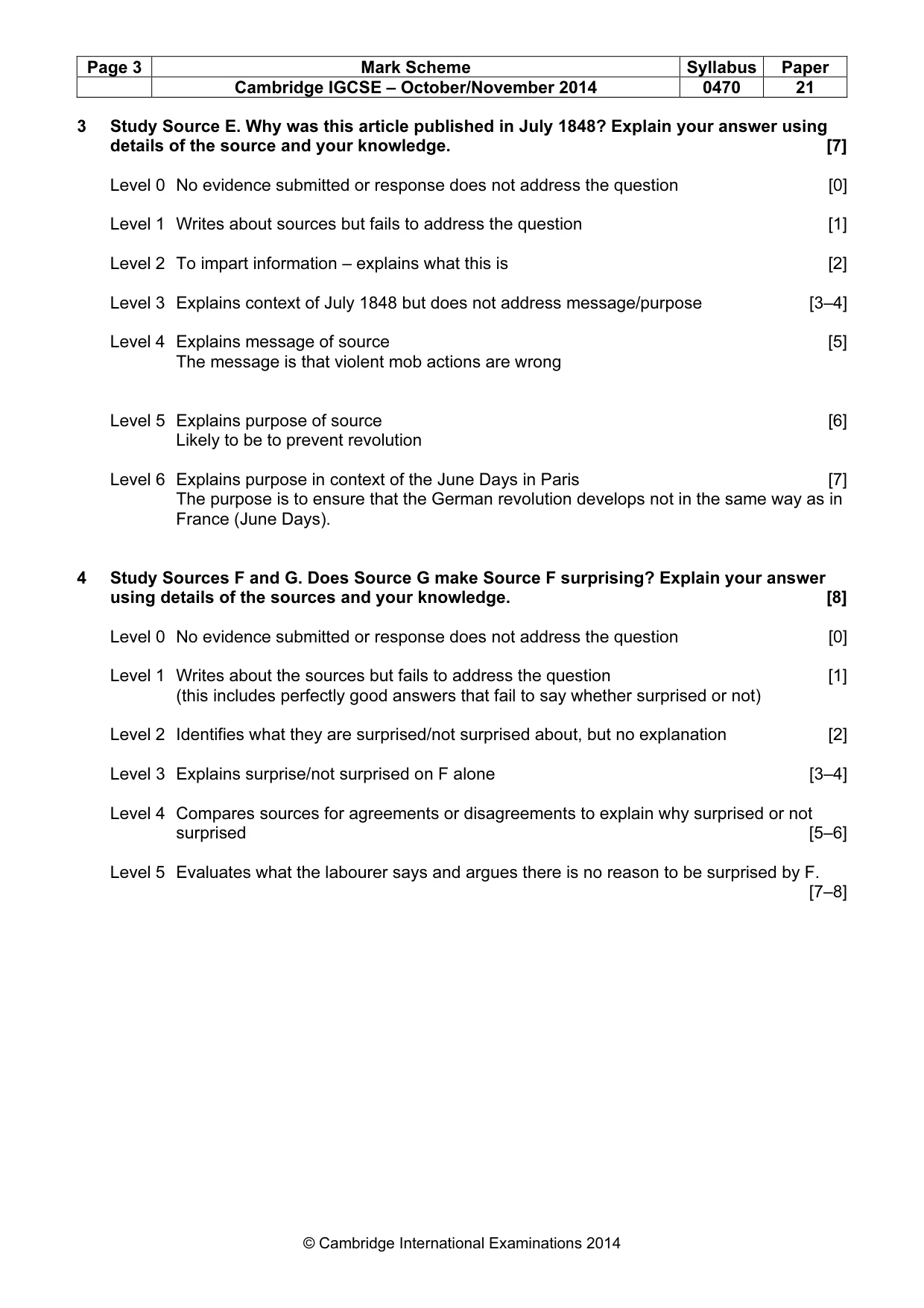
Page 3 Mark Scheme Syllabus Paper Cambridge IGCSE – October/November 2014 0470 21 © Cambridge International Examinations 2014 3 Study Source E. Why was this article published in July 1848? Explain your answer using details of the source and your knowledge. [7] Level 0 No evidence submitted or response does not address the question [0] Level 1 Writes about sources but fails to address the question [1] Level 2 To impart information – explains what this is [2] Level 3 Explains context of July 1848 but does not address message/purpose [3–4] Level 4 Explains message of source [5] The message is that violent mob actions are wrong Level 5 Explains purpose of source [6] Likely to be to prevent revolution Level 6 Explains purpose in context of the June Days in Paris [7] The purpose is to ensure that the German revolution develops not in the same way as in France (June Days). 4 Study Sources F and G. Does Source G make Source F surprising? Explain your answer using details of the sources and your knowledge. [8] Level 0 No evidence submitted or response does not address the question [0] Level 1 Writes about the sources but fails to address the question [1] (this includes perfectly good answers that fail to say whether surprised or not) Level 2 Identifies what they are surprised/not surprised about, but no explanation [2] Level 3 Explains surprise/not surprised on F alone [3–4] Level 4 Compares sources for agreements or disagreements to explain why surprised or not surprised [5–6] Level 5 Evaluates what the labourer says and argues there is no reason to be surprised by F. [7–8]
Mark scheme, page 4
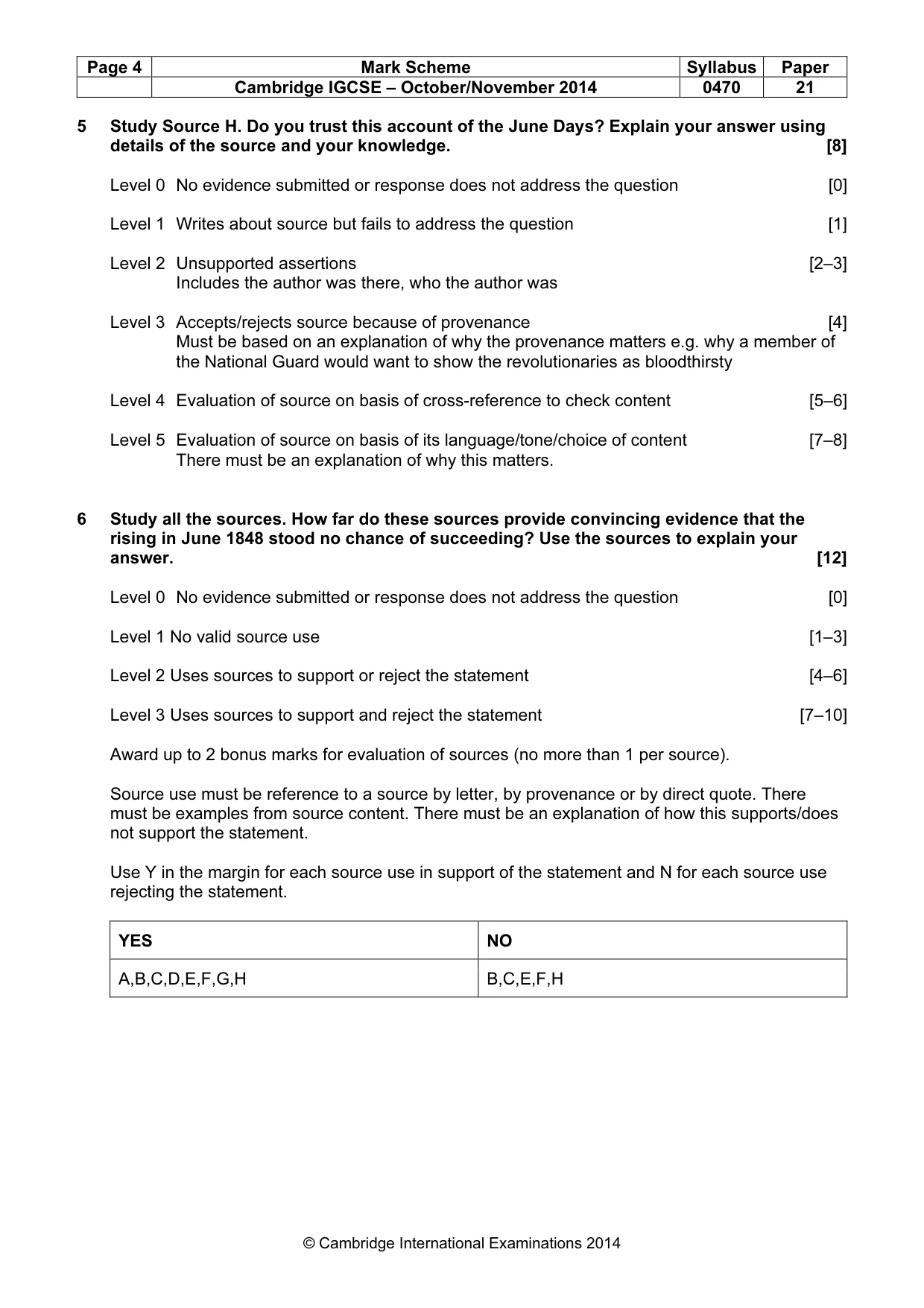
Page 4 Mark Scheme Syllabus Paper Cambridge IGCSE – October/November 2014 0470 21 © Cambridge International Examinations 2014 5 Study Source H. Do you trust this account of the June Days? Explain your answer using details of the source and your knowledge. [8] Level 0 No evidence submitted or response does not address the question [0] Level 1 Writes about source but fails to address the question [1] Level 2 Unsupported assertions [2–3] Includes the author was there, who the author was Level 3 Accepts/rejects source because of provenance [4] Must be based on an explanation of why the provenance matters e.g. why a member of the National Guard would want to show the revolutionaries as bloodthirsty Level 4 Evaluation of source on basis of cross-reference to check content [5–6] Level 5 Evaluation of source on basis of its language/tone/choice of content [7–8] There must be an explanation of why this matters. 6 Study all the sources. How far do these sources provide convincing evidence that the rising in June 1848 stood no chance of succeeding? Use the sources to explain your answer. [12] Level 0 No evidence submitted or response does not address the question [0] Level 1 No valid source use [1–3] Level 2 Uses sources to support or reject the statement [4–6] Level 3 Uses sources to support and reject the statement [7–10] Award up to 2 bonus marks for evaluation of sources (no more than 1 per source). Source use must be reference to a source by letter, by provenance or by direct quote. There must be examples from source content. There must be an explanation of how this supports/does not support the statement. Use Y in the margin for each source use in support of the statement and N for each source use rejecting the statement. YES NO A,B,C,D,E,F,G,H B,C,E,F,H
Mark scheme, page 5
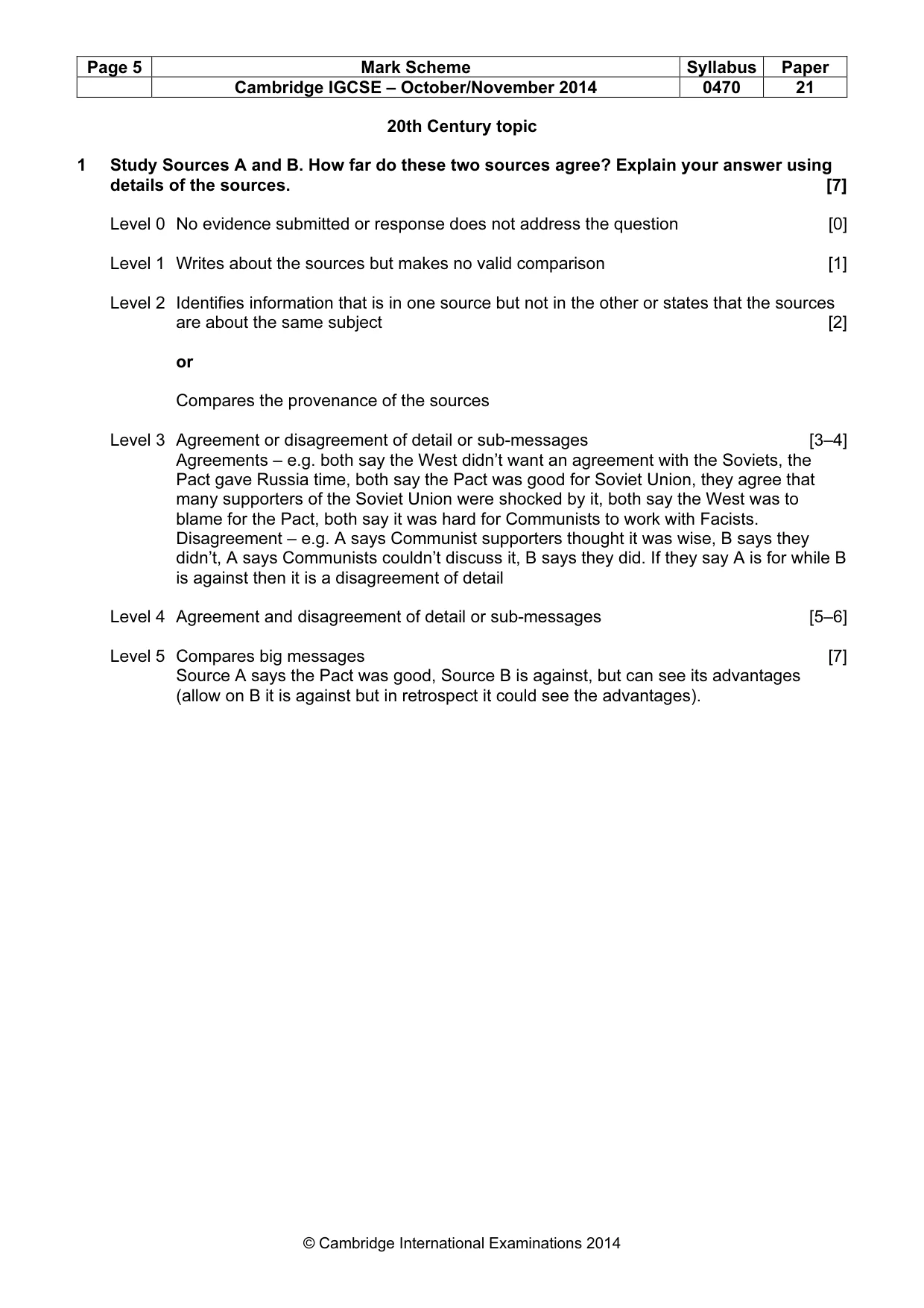
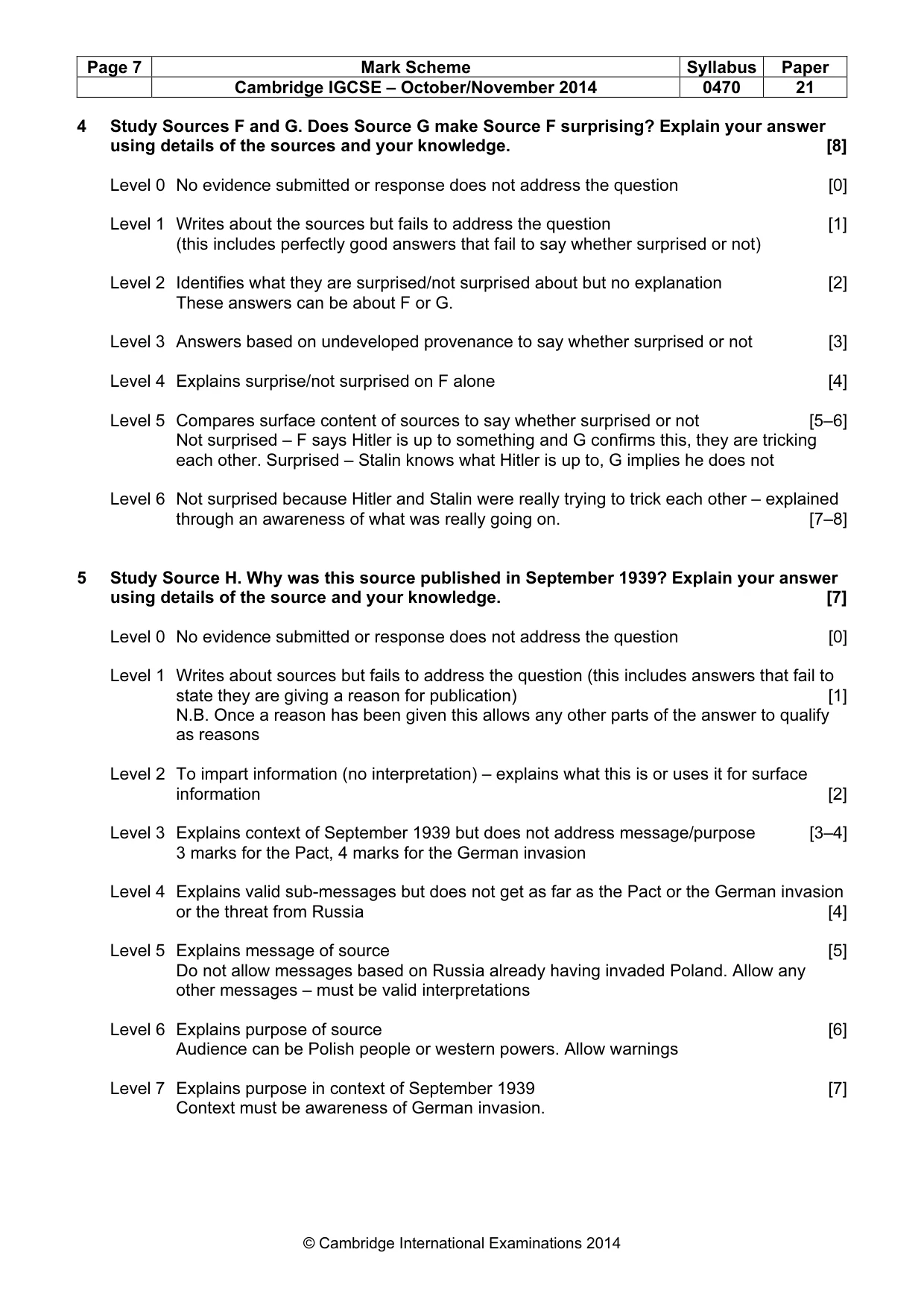
Page 5 Mark Scheme Syllabus Paper Cambridge IGCSE – October/November 2014 0470 21 © Cambridge International Examinations 2014 20th Century topic 1 Study Sources A and B. How far do these two sources agree? Explain your answer using details of the sources. [7] Level 0 No evidence submitted or response does not address the question [0] Level 1 Writes about the sources but makes no valid comparison [1] Level 2 Identifies information that is in one source but not in the other or states that the sources are about the same subject [2] or Compares the provenance of the sources Level 3 Agreement or disagreement of detail or sub-messages [3–4] Agreements – e.g. both say the West didn’t want an agreement with the Soviets, the Pact gave Russia time, both say the Pact was good for Soviet Union, they agree that many supporters of the Soviet Union were shocked by it, both say the West was to blame for the Pact, both say it was hard for Communists to work with Facists. Disagreement – e.g. A says Communist supporters thought it was wise, B says they didn’t, A says Communists couldn’t discuss it, B says they did. If they say A is for while B is against then it is a disagreement of detail Level 4 Agreement and disagreement of detail or sub-messages [5–6] Level 5 Compares big messages [7] Source A says the Pact was good, Source B is against, but can see its advantages (allow on B it is against but in retrospect it could see the advantages).
Mark scheme, page 6
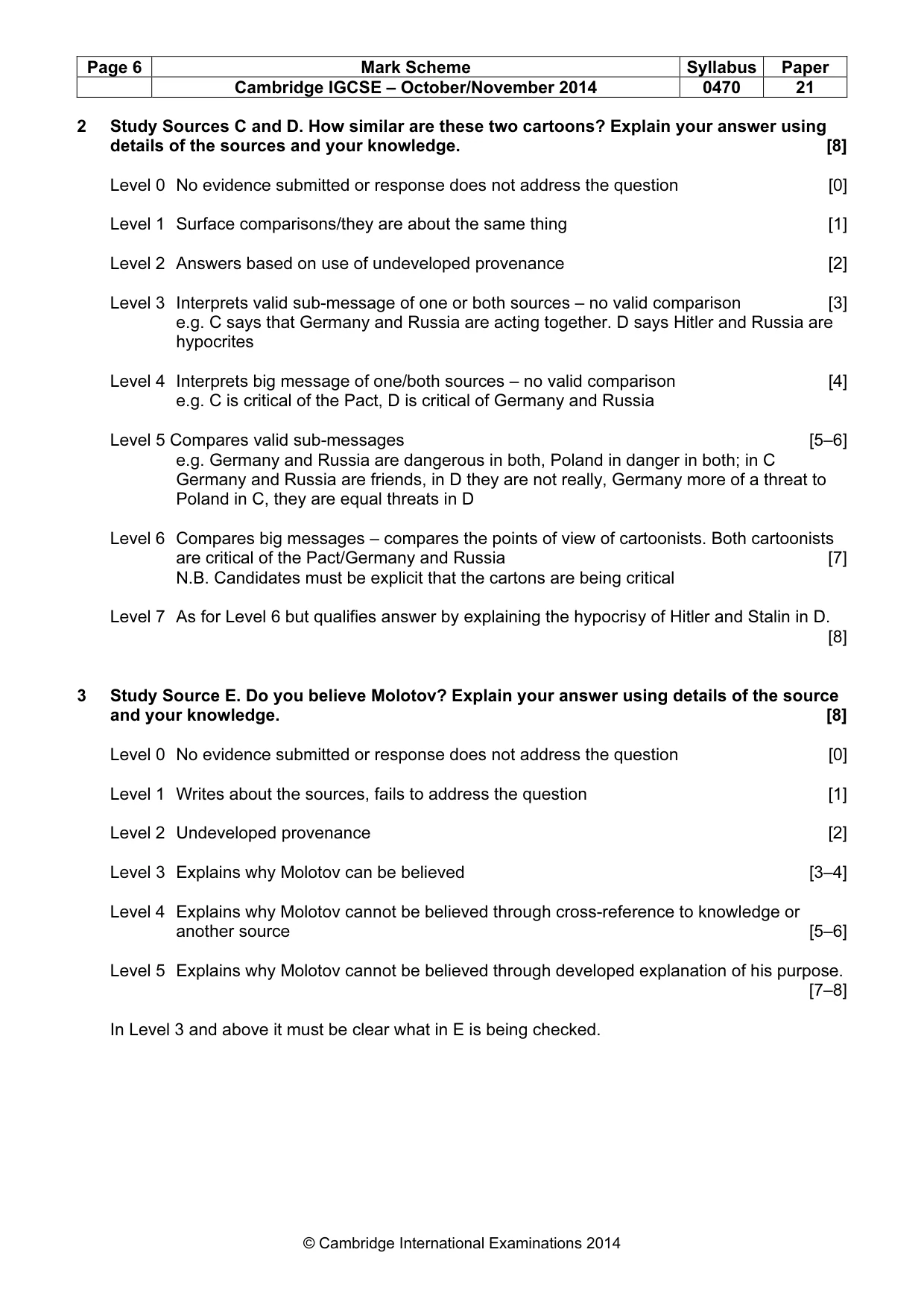
Page 6 Mark Scheme Syllabus Paper Cambridge IGCSE – October/November 2014 0470 21 © Cambridge International Examinations 2014 2 Study Sources C and D. How similar are these two cartoons? Explain your answer using details of the sources and your knowledge. [8] Level 0 No evidence submitted or response does not address the question [0] Level 1 Surface comparisons/they are about the same thing [1] Level 2 Answers based on use of undeveloped provenance [2] Level 3 Interprets valid sub-message of one or both sources – no valid comparison [3] e.g. C says that Germany and Russia are acting together. D says Hitler and Russia are hypocrites Level 4 Interprets big message of one/both sources – no valid comparison [4] e.g. C is critical of the Pact, D is critical of Germany and Russia Level 5 Compares valid sub-messages [5–6] e.g. Germany and Russia are dangerous in both, Poland in danger in both; in C Germany and Russia are friends, in D they are not really, Germany more of a threat to Poland in C, they are equal threats in D Level 6 Compares big messages – compares the points of view of cartoonists. Both cartoonists are critical of the Pact/Germany and Russia [7] N.B. Candidates must be explicit that the cartons are being critical Level 7 As for Level 6 but qualifies answer by explaining the hypocrisy of Hitler and Stalin in D. [8] 3 Study Source E. Do you believe Molotov? Explain your answer using details of the source and your knowledge. [8] Level 0 No evidence submitted or response does not address the question [0] Level 1 Writes about the sources, fails to address the question [1] Level 2 Undeveloped provenance [2] Level 3 Explains why Molotov can be believed [3–4] Level 4 Explains why Molotov cannot be believed through cross-reference to knowledge or another source [5–6] Level 5 Explains why Molotov cannot be believed through developed explanation of his purpose. [7–8] In Level 3 and above it must be clear what in E is being checked.
Mark scheme, page 7
Page 7 Mark Scheme Syllabus Paper Cambridge IGCSE – October/November 2014 0470 21 © Cambridge International Examinations 2014 4 Study Sources F and G. Does Source G make Source F surprising? Explain your answer using details of the sources and your knowledge. [8] Level 0 No evidence submitted or response does not address the question [0] Level 1 Writes about the sources but fails to address the question [1] (this includes perfectly good answers that fail to say whether surprised or not) Level 2 Identifies what they are surprised/not surprised about but no explanation [2] These answers can be about F or G. Level 3 Answers based on undeveloped provenance to say whether surprised or not [3] Level 4 Explains surprise/not surprised on F alone [4] Level 5 Compares surface content of sources to say whether surprised or not [5–6] Not surprised – F says Hitler is up to something and G confirms this, they are tricking each other. Surprised – Stalin knows what Hitler is up to, G implies he does not Level 6 Not surprised because Hitler and Stalin were really trying to trick each other – explained through an awareness of what was really going on. [7–8] 5 Study Source H. Why was this source published in September 1939? Explain your answer using details of the source and your knowledge. [7] Level 0 No evidence submitted or response does not address the question [0] Level 1 Writes about sources but fails to address the question (this includes answers that fail to state they are giving a reason for publication) [1] N.B. Once a reason has been given this allows any other parts of the answer to qualify as reasons Level 2 To impart information (no interpretation) – explains what this is or uses it for surface information [2] Level 3 Explains context of September 1939 but does not address message/purpose [3–4] 3 marks for the Pact, 4 marks for the German invasion Level 4 Explains valid sub-messages but does not get as far as the Pact or the German invasion or the threat from Russia [4] Level 5 Explains message of source [5] Do not allow messages based on Russia already having invaded Poland. Allow any other messages – must be valid interpretations Level 6 Explains purpose of source [6] Audience can be Polish people or western powers. Allow warnings Level 7 Explains purpose in context of September 1939 [7] Context must be awareness of German invasion.
Mark scheme, page 8
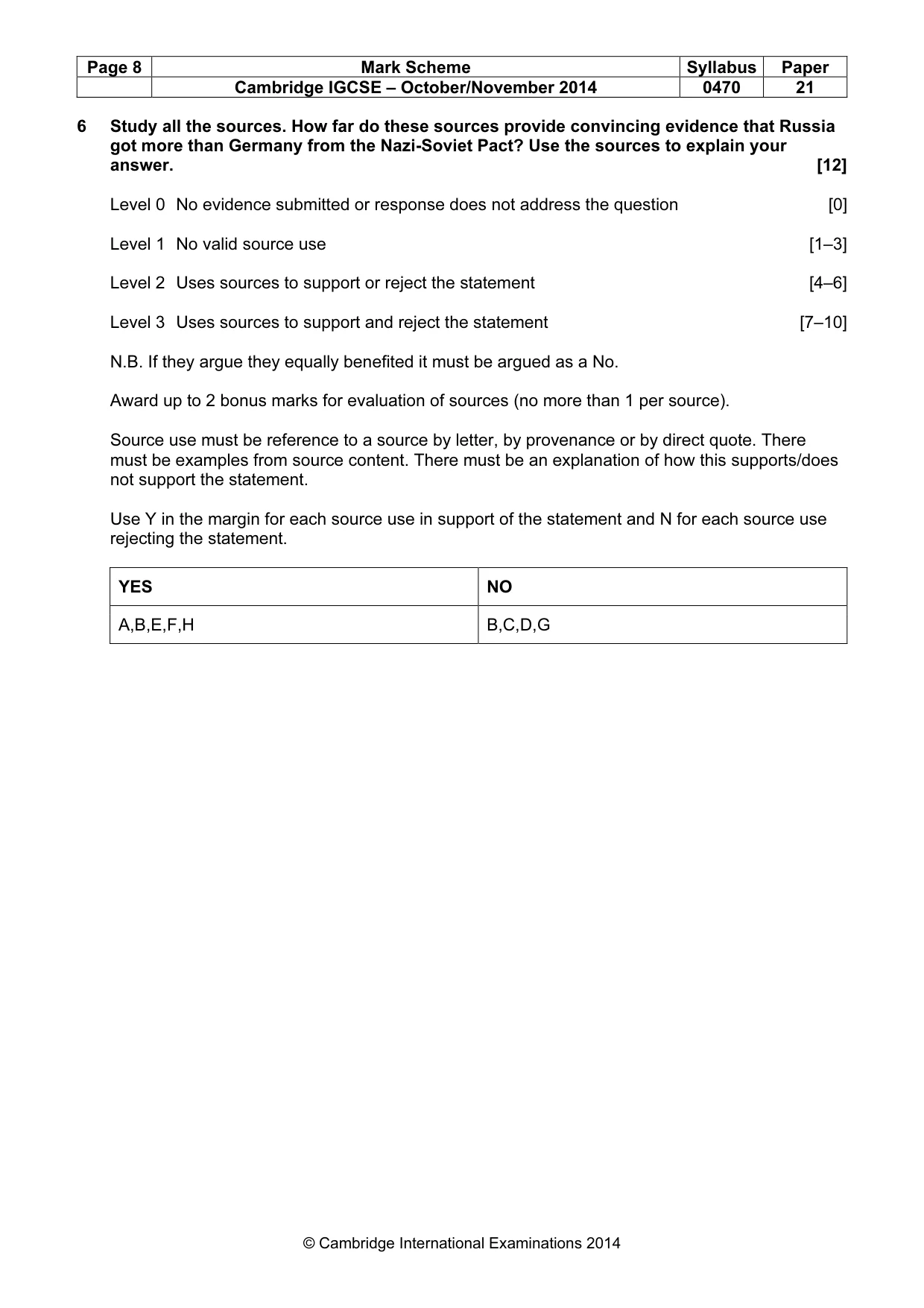
Page 8 Mark Scheme Syllabus Paper Cambridge IGCSE – October/November 2014 0470 21 © Cambridge International Examinations 2014 6 Study all the sources. How far do these sources provide convincing evidence that Russia got more than Germany from the Nazi-Soviet Pact? Use the sources to explain your answer. [12] Level 0 No evidence submitted or response does not address the question [0] Level 1 No valid source use [1–3] Level 2 Uses sources to support or reject the statement [4–6] Level 3 Uses sources to support and reject the statement [7–10] N.B. If they argue they equally benefited it must be argued as a No. Award up to 2 bonus marks for evaluation of sources (no more than 1 per source). Source use must be reference to a source by letter, by provenance or by direct quote. There must be examples from source content. There must be an explanation of how this supports/does not support the statement. Use Y in the margin for each source use in support of the statement and N for each source use rejecting the statement. YES NO A,B,E,F,H B,C,D,G
What you needed in this session
Cambridge’s own grade thresholds for 2014 Oct/Nov, Paper 2 · Variant 1. A higher threshold means an easier paper — the bar moves with how the cohort did.