Cambridge IGCSE History 0470 — 2013 Oct/Nov Paper 2 · Variant 2
0470/22/O/N/13 · 50 marks · ≈56 min
The question paper and its mark scheme, free to read here and free to download. This is Cambridge’s own paper, exactly as it was sat.
Question paper12 pages
Mark scheme7 pages
Answers below. Sit the paper first if you are practising.
Paper as text
Question paper, page 1
This document consists of 11 printed pages and 1 blank page. DC (LK/SW) 91405 © UCLES 2013 [Turn over UNIVERSITY OF CAMBRIDGE INTERNATIONAL EXAMINATIONS International General Certificate of Secondary Education * 5 9 0 0 0 9 9 0 1 0 * HISTORY 0470/22 Paper 2 October/November 2013 2 hours Additional Materials: Answer Booklet/Paper READ THESE INSTRUCTIONS FIRST If you have been given an Answer Booklet, follow the instructions on the front cover of the Booklet. Write your Centre number, candidate number and name on all the work you hand in. Write in dark blue or black pen. You may use a soft pencil for any diagrams, graphs or rough working. Do not use staples, paper clips, highlighters, glue or correction fluid. DO NOT WRITE IN ANY BARCODES. This paper has two options. Choose one option, and answer all of the questions on that topic. Option A: 19th Century topic [p2–p6] Option B: 20th Century topic [p7–p11] At the end of the examination, fasten all your work securely together. The number of marks is given in brackets [ ] at the end of each question or part question.
Question paper, page 2
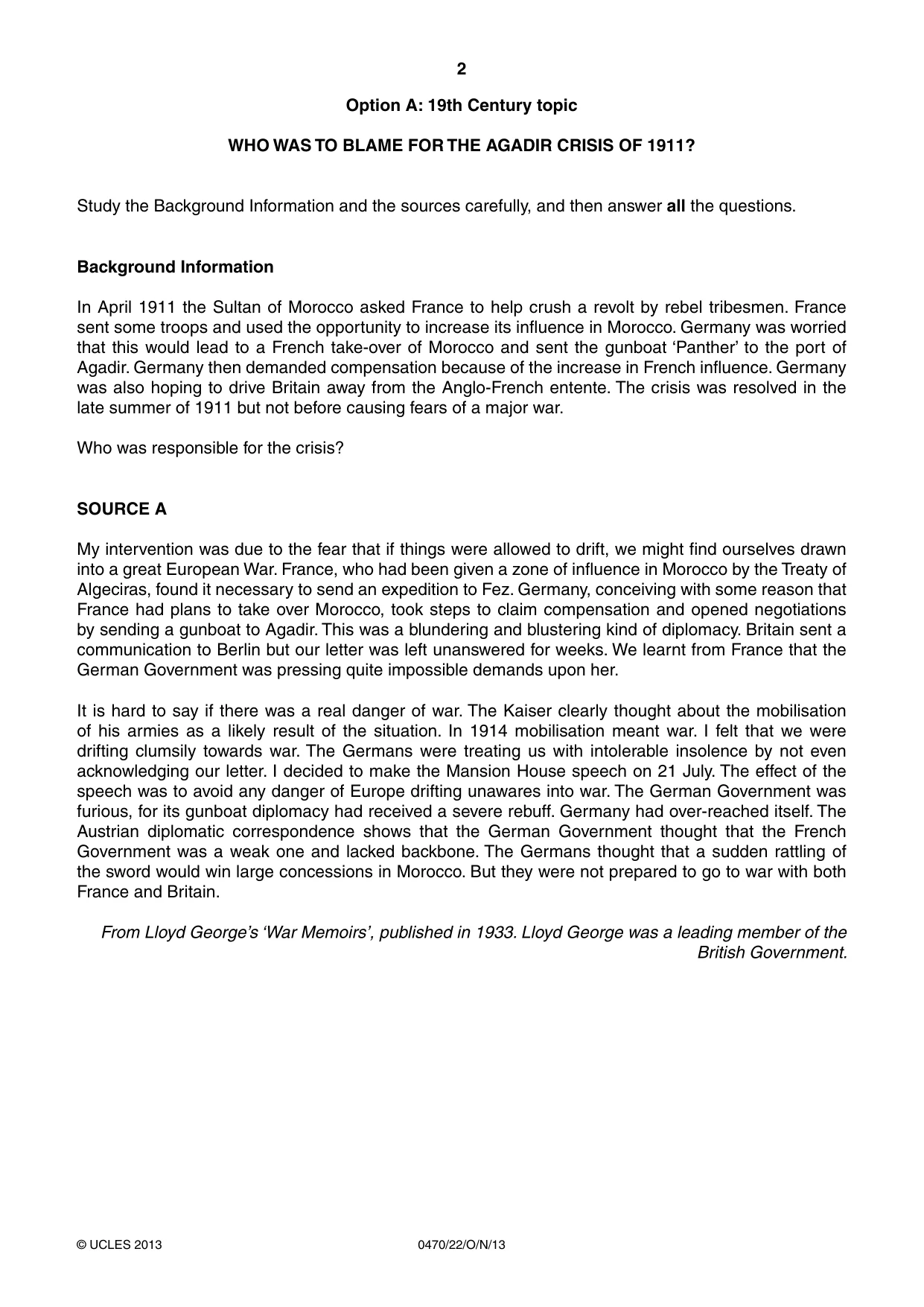
2 0470/22/O/N/13 © UCLES 2013 Option A: 19th Century topic WHO WAS TO BLAME FOR THE AGADIR CRISIS OF 1911? Study the Background Information and the sources carefully, and then answer all the questions. Background Information In April 1911 the Sultan of Morocco asked France to help crush a revolt by rebel tribesmen. France sent some troops and used the opportunity to increase its influence in Morocco. Germany was worried that this would lead to a French take-over of Morocco and sent the gunboat ‘Panther’ to the port of Agadir. Germany then demanded compensation because of the increase in French influence. Germany was also hoping to drive Britain away from the Anglo-French entente. The crisis was resolved in the late summer of 1911 but not before causing fears of a major war. Who was responsible for the crisis? SOURCE A My intervention was due to the fear that if things were allowed to drift, we might find ourselves drawn into a great European War. France, who had been given a zone of influence in Morocco by the Treaty of Algeciras, found it necessary to send an expedition to Fez. Germany, conceiving with some reason that France had plans to take over Morocco, took steps to claim compensation and opened negotiations by sending a gunboat to Agadir. This was a blundering and blustering kind of diplomacy. Britain sent a communication to Berlin but our letter was left unanswered for weeks. We learnt from France that the German Government was pressing quite impossible demands upon her. It is hard to say if there was a real danger of war. The Kaiser clearly thought about the mobilisation of his armies as a likely result of the situation. In 1914 mobilisation meant war. I felt that we were drifting clumsily towards war. The Germans were treating us with intolerable insolence by not even acknowledging our letter. I decided to make the Mansion House speech on 21 July. The effect of the speech was to avoid any danger of Europe drifting unawares into war. The German Government was furious, for its gunboat diplomacy had received a severe rebuff. Germany had over-reached itself. The Austrian diplomatic correspondence shows that the German Government thought that the French Government was a weak one and lacked backbone. The Germans thought that a sudden rattling of the sword would win large concessions in Morocco. But they were not prepared to go to war with both France and Britain. From Lloyd George’s ‘War Memoirs’, published in 1933. Lloyd George was a leading member of the British Government.
Question paper, page 3
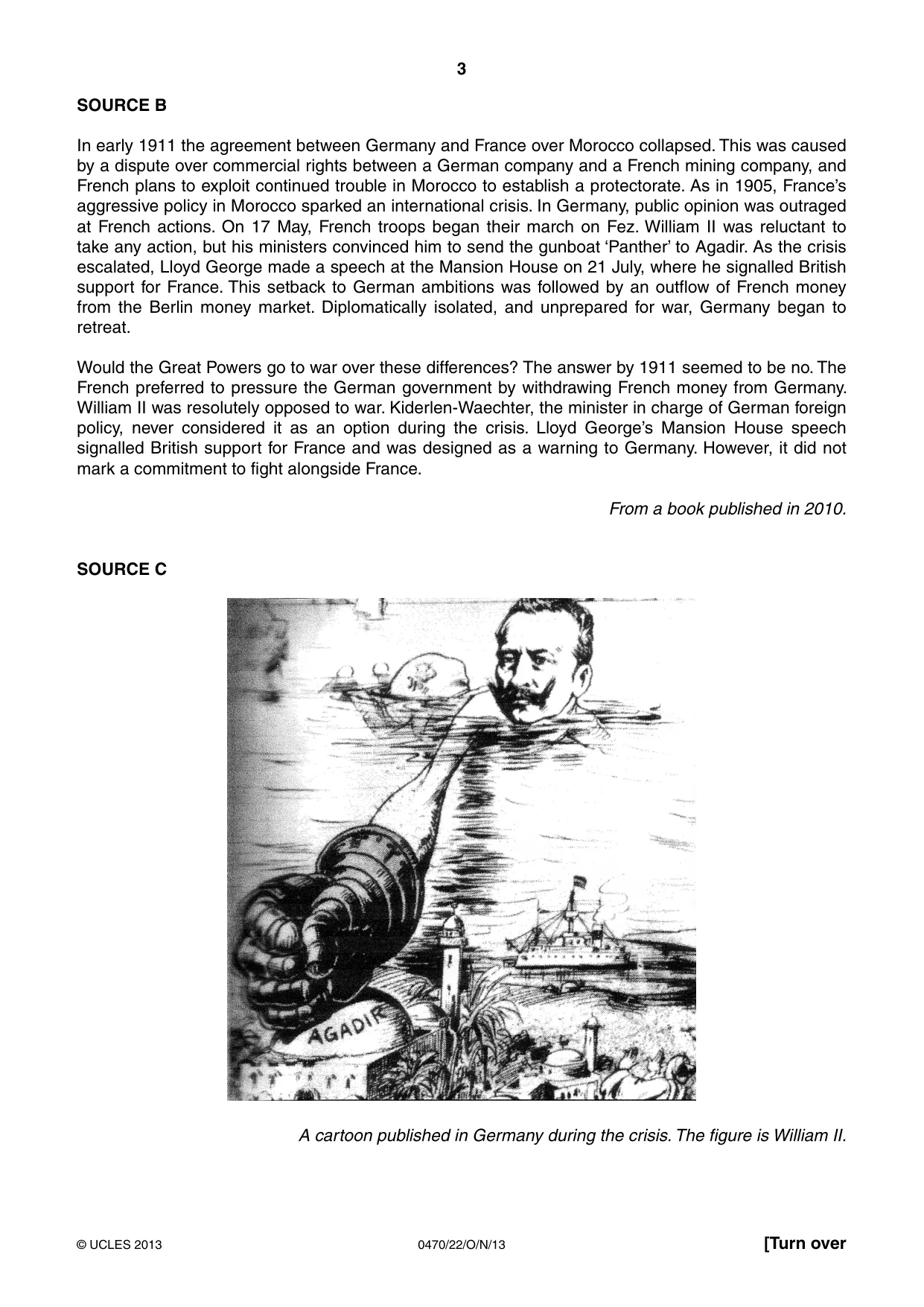
3 0470/22/O/N/13 © UCLES 2013 [Turn over SOURCE B In early 1911 the agreement between Germany and France over Morocco collapsed. This was caused by a dispute over commercial rights between a German company and a French mining company, and French plans to exploit continued trouble in Morocco to establish a protectorate. As in 1905, France’s aggressive policy in Morocco sparked an international crisis. In Germany, public opinion was outraged at French actions. On 17 May, French troops began their march on Fez. William II was reluctant to take any action, but his ministers convinced him to send the gunboat ‘Panther’ to Agadir. As the crisis escalated, Lloyd George made a speech at the Mansion House on 21 July, where he signalled British support for France. This setback to German ambitions was followed by an outflow of French money from the Berlin money market. Diplomatically isolated, and unprepared for war, Germany began to retreat. Would the Great Powers go to war over these differences? The answer by 1911 seemed to be no. The French preferred to pressure the German government by withdrawing French money from Germany. William II was resolutely opposed to war. Kiderlen-Waechter, the minister in charge of German foreign policy, never considered it as an option during the crisis. Lloyd George’s Mansion House speech signalled British support for France and was designed as a warning to Germany. However, it did not mark a commitment to fight alongside France. From a book published in 2010. SOURCE C A cartoon published in Germany during the crisis. The figure is William II.
Question paper, page 4
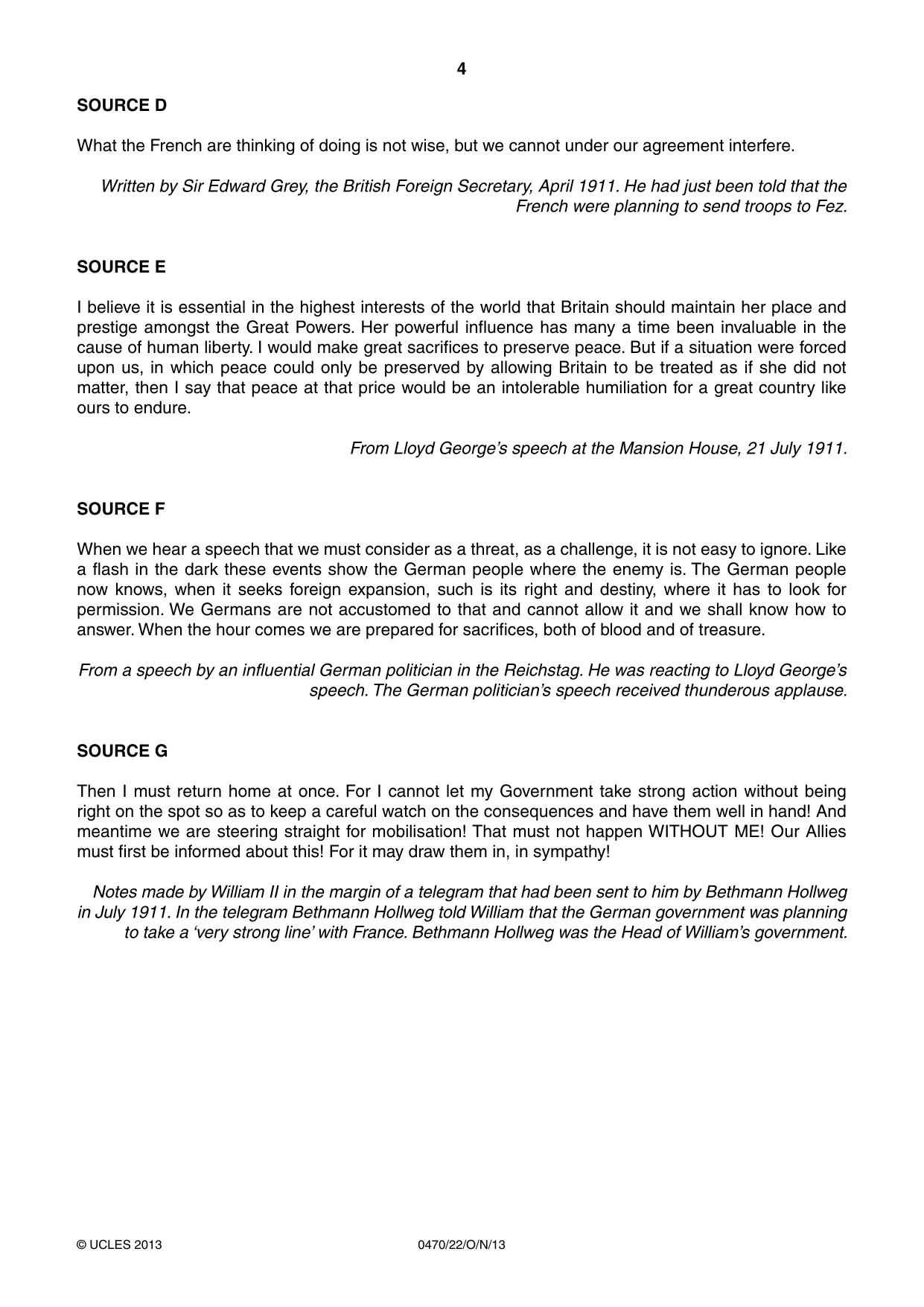
4 0470/22/O/N/13 © UCLES 2013 SOURCE D What the French are thinking of doing is not wise, but we cannot under our agreement interfere. Written by Sir Edward Grey, the British Foreign Secretary, April 1911. He had just been told that the French were planning to send troops to Fez. SOURCE E I believe it is essential in the highest interests of the world that Britain should maintain her place and prestige amongst the Great Powers. Her powerful influence has many a time been invaluable in the cause of human liberty. I would make great sacrifices to preserve peace. But if a situation were forced upon us, in which peace could only be preserved by allowing Britain to be treated as if she did not matter, then I say that peace at that price would be an intolerable humiliation for a great country like ours to endure. From Lloyd George’s speech at the Mansion House, 21 July 1911. SOURCE F When we hear a speech that we must consider as a threat, as a challenge, it is not easy to ignore. Like a flash in the dark these events show the German people where the enemy is. The German people now knows, when it seeks foreign expansion, such is its right and destiny, where it has to look for permission. We Germans are not accustomed to that and cannot allow it and we shall know how to answer. When the hour comes we are prepared for sacrifices, both of blood and of treasure. From a speech by an influential German politician in the Reichstag. He was reacting to Lloyd George’s speech. The German politician’s speech received thunderous applause. SOURCE G Then I must return home at once. For I cannot let my Government take strong action without being right on the spot so as to keep a careful watch on the consequences and have them well in hand! And meantime we are steering straight for mobilisation! That must not happen WITHOUT ME! Our Allies must first be informed about this! For it may draw them in, in sympathy! Notes made by William II in the margin of a telegram that had been sent to him by Bethmann Hollweg in July 1911. In the telegram Bethmann Hollweg told William that the German government was planning to take a ‘very strong line’ with France. Bethmann Hollweg was the Head of William’s government.
Question paper, page 5
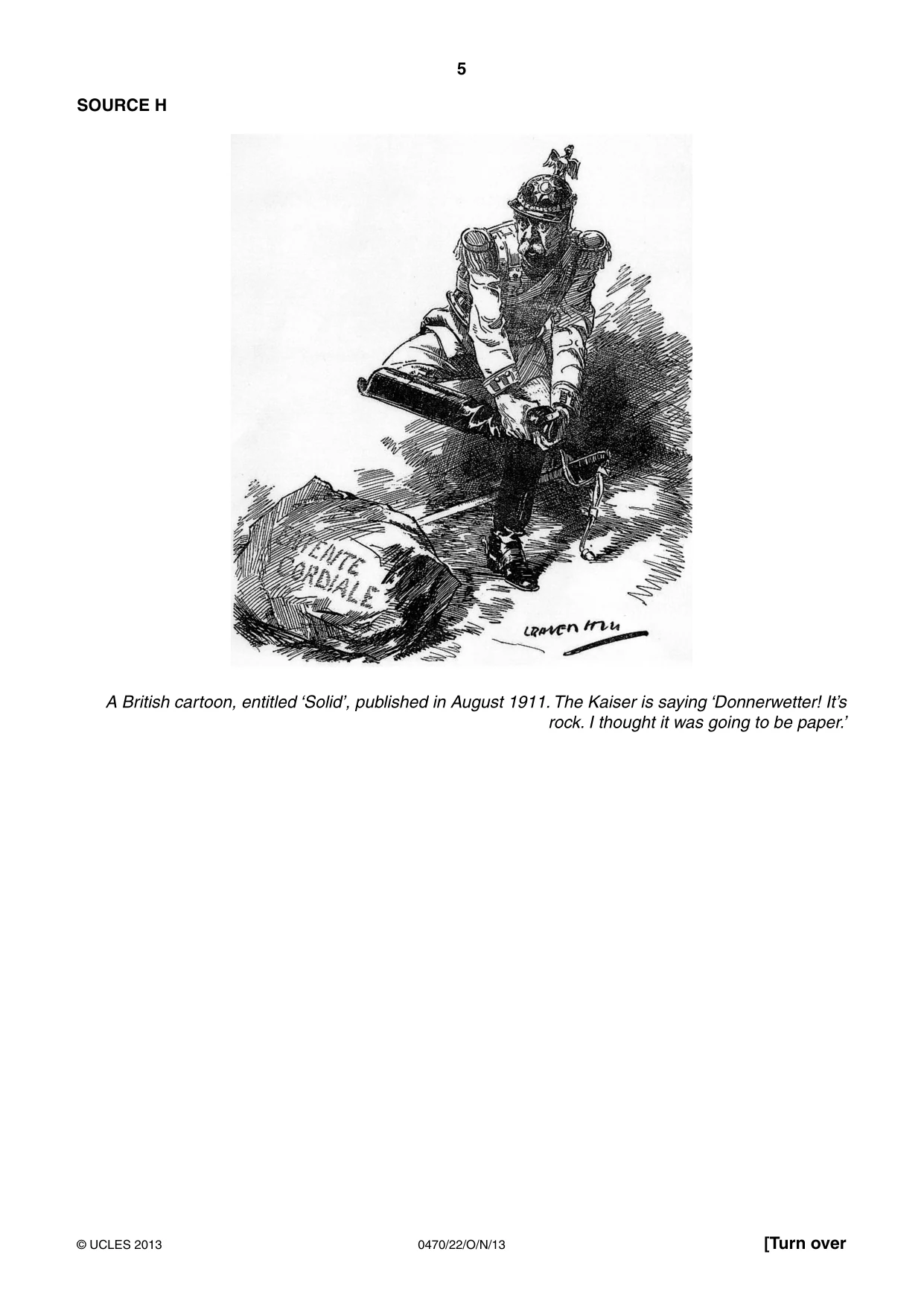
5 0470/22/O/N/13 © UCLES 2013 [Turn over SOURCE H A British cartoon, entitled ‘Solid’, published in August 1911. The Kaiser is saying ‘Donnerwetter! It’s rock. I thought it was going to be paper.’
Question paper, page 6
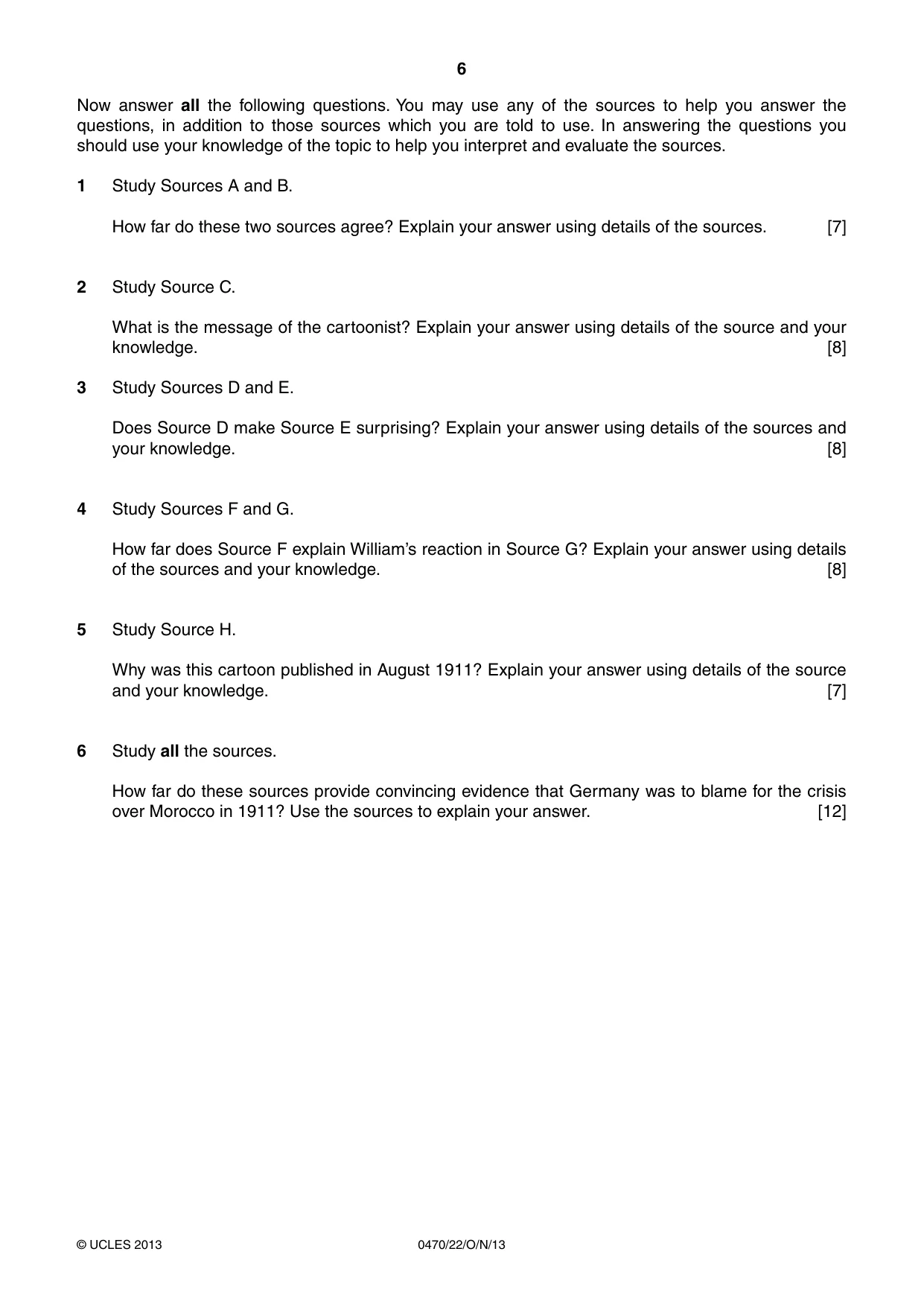
6 0470/22/O/N/13 © UCLES 2013 Now answer all the following questions. You may use any of the sources to help you answer the questions, in addition to those sources which you are told to use. In answering the questions you should use your knowledge of the topic to help you interpret and evaluate the sources. 1 Study Sources A and B. How far do these two sources agree? Explain your answer using details of the sources. [7] 2 Study Source C. What is the message of the cartoonist? Explain your answer using details of the source and your knowledge. [8] 3 Study Sources D and E. Does Source D make Source E surprising? Explain your answer using details of the sources and your knowledge. [8] 4 Study Sources F and G. How far does Source F explain William’s reaction in Source G? Explain your answer using details of the sources and your knowledge. [8] 5 Study Source H. Why was this cartoon published in August 1911? Explain your answer using details of the source and your knowledge. [7] 6 Study all the sources. How far do these sources provide convincing evidence that Germany was to blame for the crisis over Morocco in 1911? Use the sources to explain your answer. [12]
Question paper, page 7
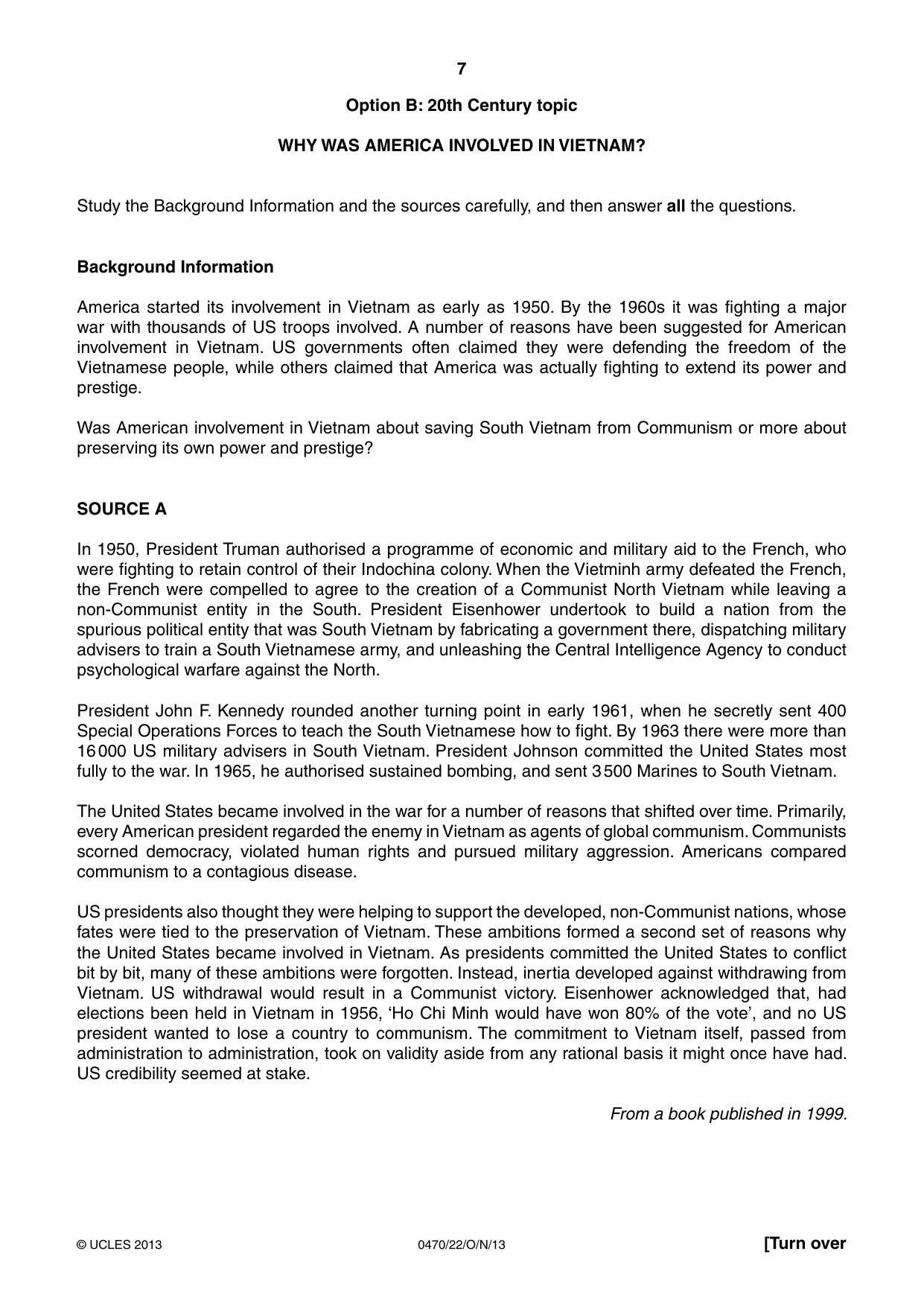
7 0470/22/O/N/13 © UCLES 2013 [Turn over Option B: 20th Century topic WHY WAS AMERICA INVOLVED IN VIETNAM? Study the Background Information and the sources carefully, and then answer all the questions. Background Information America started its involvement in Vietnam as early as 1950. By the 1960s it was fighting a major war with thousands of US troops involved. A number of reasons have been suggested for American involvement in Vietnam. US governments often claimed they were defending the freedom of the Vietnamese people, while others claimed that America was actually fighting to extend its power and prestige. Was American involvement in Vietnam about saving South Vietnam from Communism or more about preserving its own power and prestige? SOURCE A In 1950, President Truman authorised a programme of economic and military aid to the French, who were fighting to retain control of their Indochina colony. When the Vietminh army defeated the French, the French were compelled to agree to the creation of a Communist North Vietnam while leaving a non-Communist entity in the South. President Eisenhower undertook to build a nation from the spurious political entity that was South Vietnam by fabricating a government there, dispatching military advisers to train a South Vietnamese army, and unleashing the Central Intelligence Agency to conduct psychological warfare against the North. President John F. Kennedy rounded another turning point in early 1961, when he secretly sent 400 Special Operations Forces to teach the South Vietnamese how to fight. By 1963 there were more than 16 000 US military advisers in South Vietnam. President Johnson committed the United States most fully to the war. In 1965, he authorised sustained bombing, and sent 3 500 Marines to South Vietnam. The United States became involved in the war for a number of reasons that shifted over time. Primarily, every American president regarded the enemy in Vietnam as agents of global communism. Communists scorned democracy, violated human rights and pursued military aggression. Americans compared communism to a contagious disease. US presidents also thought they were helping to support the developed, non-Communist nations, whose fates were tied to the preservation of Vietnam. These ambitions formed a second set of reasons why the United States became involved in Vietnam. As presidents committed the United States to conflict bit by bit, many of these ambitions were forgotten. Instead, inertia developed against withdrawing from Vietnam. US withdrawal would result in a Communist victory. Eisenhower acknowledged that, had elections been held in Vietnam in 1956, ‘Ho Chi Minh would have won 80% of the vote’, and no US president wanted to lose a country to communism. The commitment to Vietnam itself, passed from administration to administration, took on validity aside from any rational basis it might once have had. US credibility seemed at stake. From a book published in 1999.
Question paper, page 8
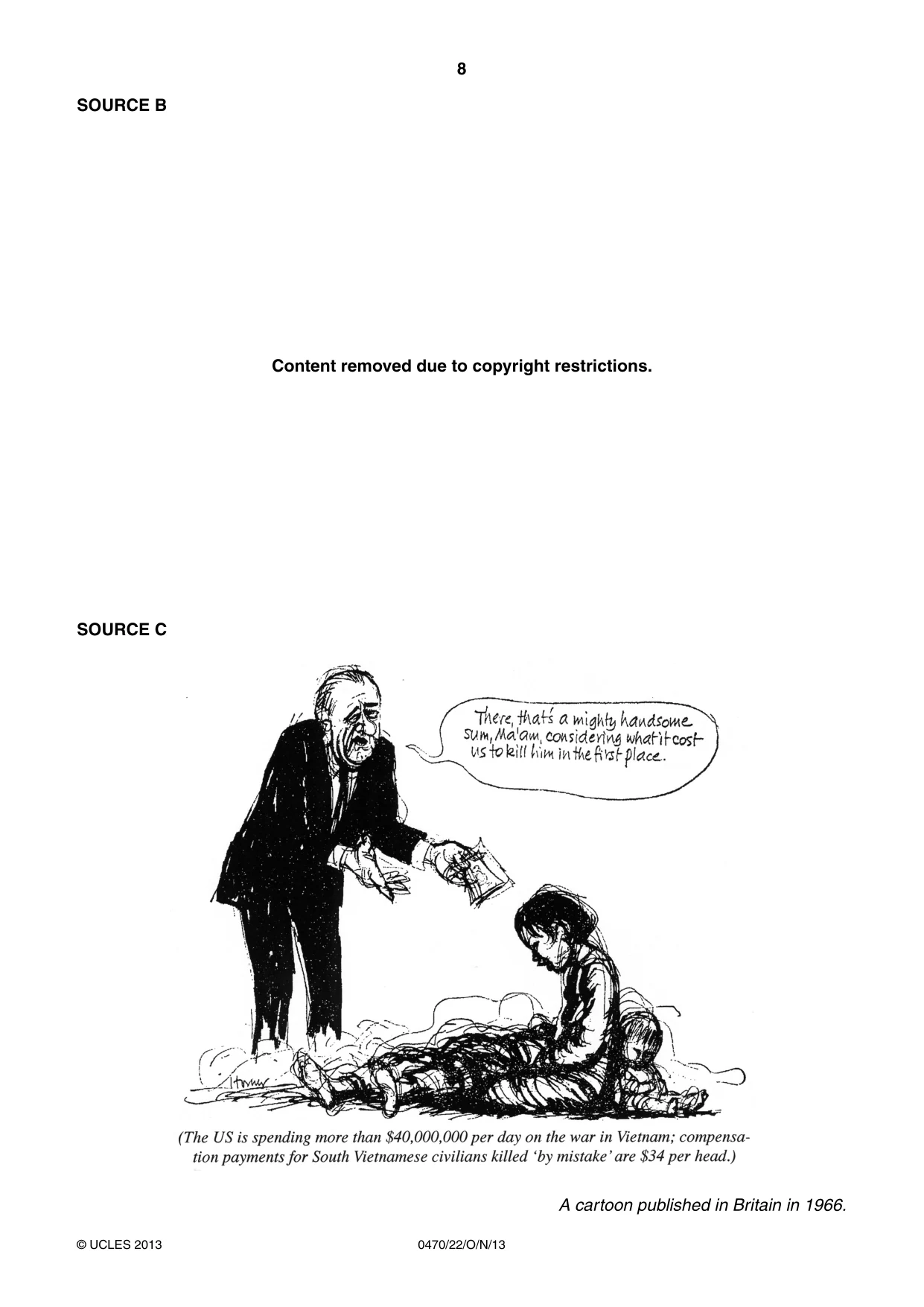
8 0470/22/O/N/13 © UCLES 2013 SOURCE B Content removed due to copyright restrictions. SOURCE C A cartoon published in Britain in 1966.
Question paper, page 9
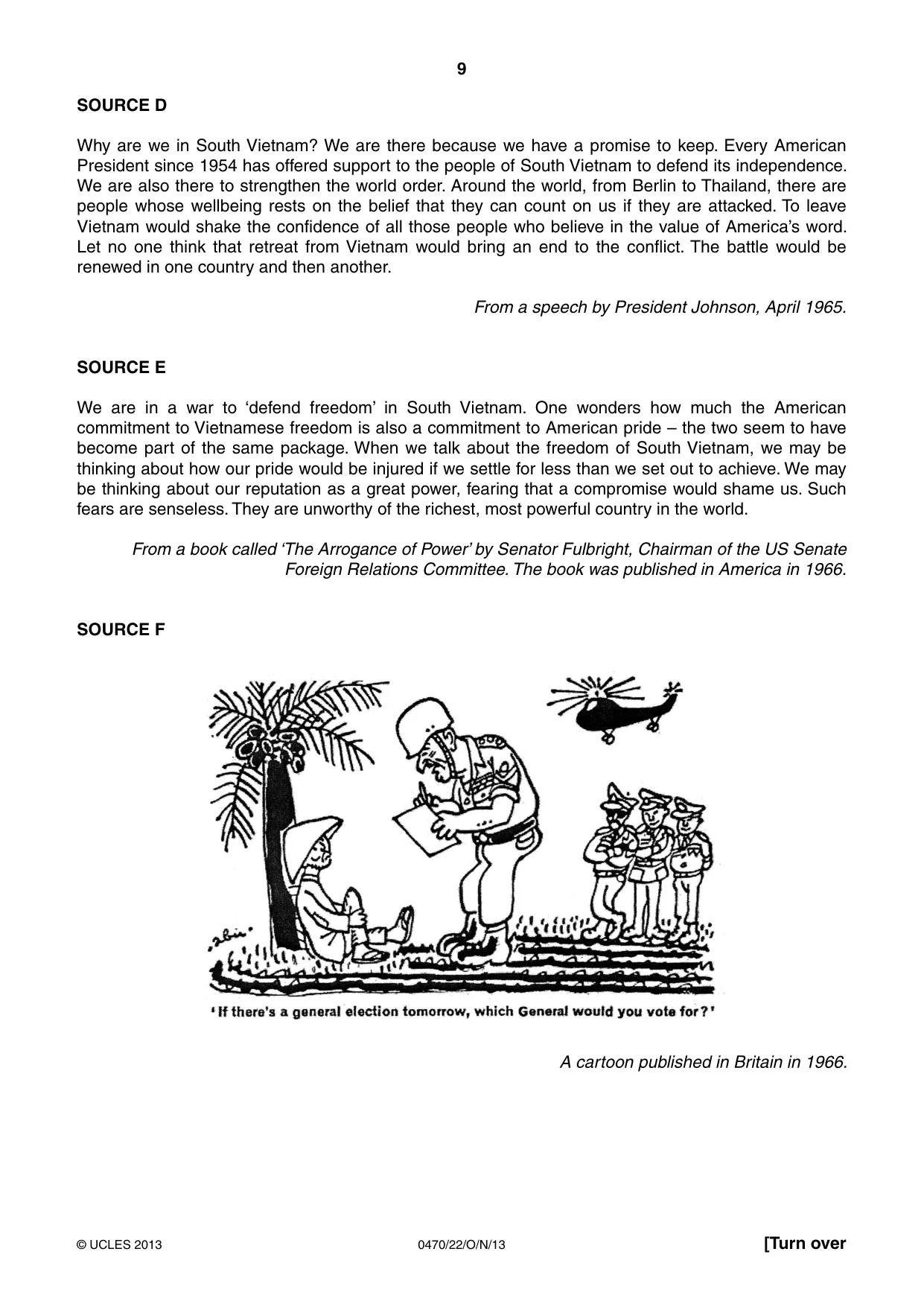
9 0470/22/O/N/13 © UCLES 2013 [Turn over SOURCE D Why are we in South Vietnam? We are there because we have a promise to keep. Every American President since 1954 has offered support to the people of South Vietnam to defend its independence. We are also there to strengthen the world order. Around the world, from Berlin to Thailand, there are people whose wellbeing rests on the belief that they can count on us if they are attacked. To leave Vietnam would shake the confidence of all those people who believe in the value of America’s word. Let no one think that retreat from Vietnam would bring an end to the conflict. The battle would be renewed in one country and then another. From a speech by President Johnson, April 1965. SOURCE E We are in a war to ‘defend freedom’ in South Vietnam. One wonders how much the American commitment to Vietnamese freedom is also a commitment to American pride – the two seem to have become part of the same package. When we talk about the freedom of South Vietnam, we may be thinking about how our pride would be injured if we settle for less than we set out to achieve. We may be thinking about our reputation as a great power, fearing that a compromise would shame us. Such fears are senseless. They are unworthy of the richest, most powerful country in the world. From a book called ‘The Arrogance of Power’ by Senator Fulbright, Chairman of the US Senate Foreign Relations Committee. The book was published in America in 1966. SOURCE F A cartoon published in Britain in 1966.
Question paper, page 10
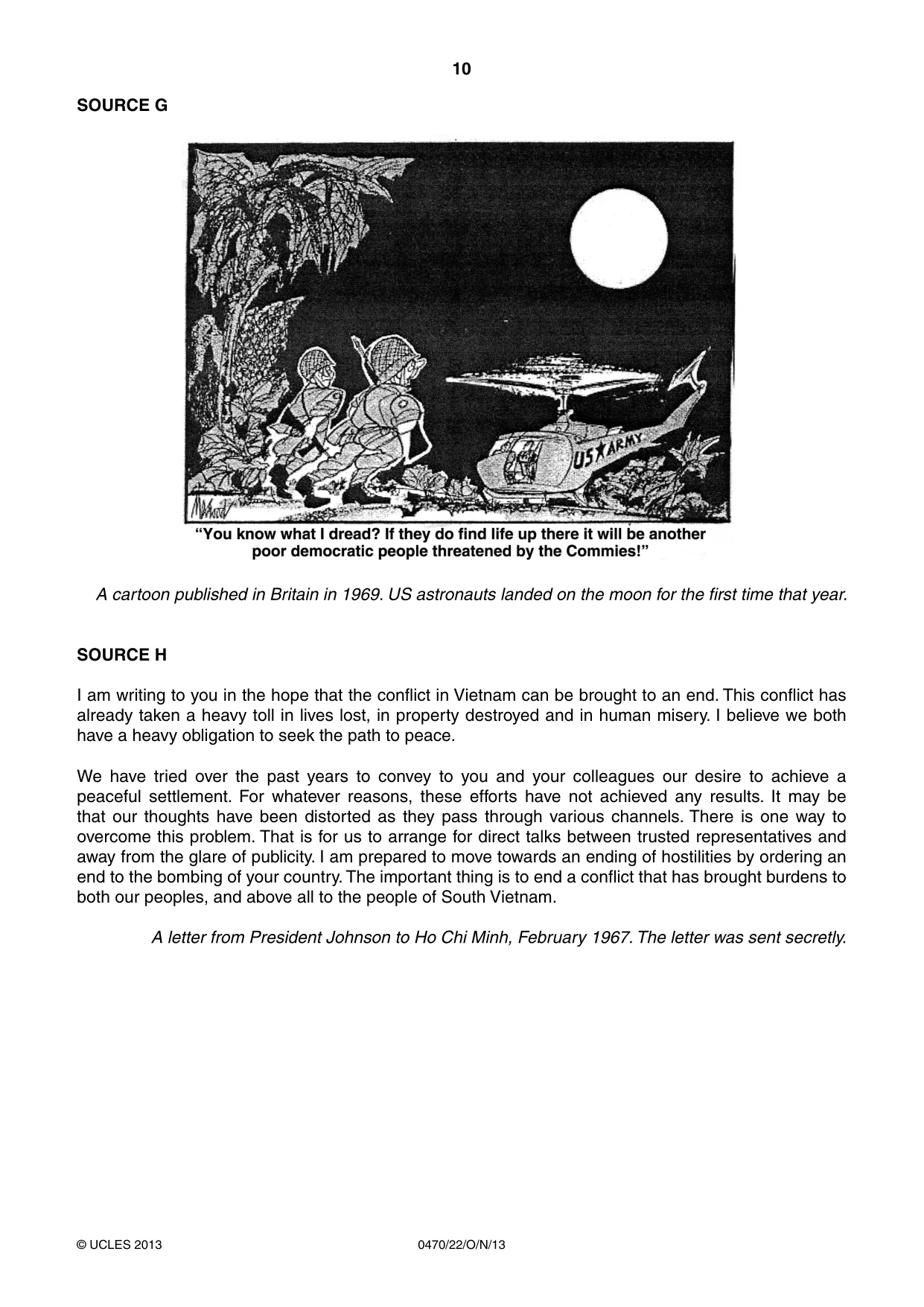
10 0470/22/O/N/13 © UCLES 2013 SOURCE G A cartoon published in Britain in 1969. US astronauts landed on the moon for the first time that year. SOURCE H I am writing to you in the hope that the conflict in Vietnam can be brought to an end. This conflict has already taken a heavy toll in lives lost, in property destroyed and in human misery. I believe we both have a heavy obligation to seek the path to peace. We have tried over the past years to convey to you and your colleagues our desire to achieve a peaceful settlement. For whatever reasons, these efforts have not achieved any results. It may be that our thoughts have been distorted as they pass through various channels. There is one way to overcome this problem. That is for us to arrange for direct talks between trusted representatives and away from the glare of publicity. I am prepared to move towards an ending of hostilities by ordering an end to the bombing of your country. The important thing is to end a conflict that has brought burdens to both our peoples, and above all to the people of South Vietnam. A letter from President Johnson to Ho Chi Minh, February 1967. The letter was sent secretly.
Question paper, page 11
11 0470/22/O/N/13 © UCLES 2013 Now answer all the following questions. You may use any of the sources to help you answer the questions, in addition to those sources which you are told to use. In answering the questions you should use your knowledge of the topic to help you interpret and evaluate the sources. 1 Study Sources A and B. How similar are these two sources? Explain your answer using details of the sources. [7] 2 Study Source C. Why was this cartoon published in 1966? Explain your answer using details of the source and your knowledge. [8] 3 Study Sources D and E. Does Source D prove that Source E is wrong? Explain your answer using details of the sources and your knowledge. [8] 4 Study Sources F and G. How far would these two cartoonists have agreed with each other? Explain your answer using details of the sources and your knowledge. [8] 5 Study Source H. How surprised are you by Source H? Explain your answer using details of the source and your knowledge. [7] 6 How far do these sources provide convincing evidence that the USA was involved in Vietnam to save South Vietnam from Communism? Use the sources to explain your answer. [12]
Question paper, page 12
12 0470/22/O/N/13 © UCLES 2013 BLANK PAGE Copyright Acknowledgements: Option A Source A © David Lloyd George; War Memoirs Vol I; Odhams Press Ltd; 1938. Option A Source B © William Mulligan; The Origins of the First World War ; Cambridge University Press; 2010. Option A Source C © Harry Mills; The Road to Sarajevo; Macmillan; 1996. Option A Source D © F. H. Hinsley; British Foreign Policy under Sir Edward Corey ; Cambridge University Press; 1977. Option A Source E © Harry Mills; The Road to Sarajevo; Macmillan; 1996. Option A Source F © J. H. Harkness, H. McMillan & D. Moore; Co-operation and Conflict: International Relations 1890–1930 ; Hodder & Stoughton Ltd; 1991. Option A Source G © David Lloyd George; War Memoirs Vol I ; Odhams Press Ltd; 1938. Option A Source H © Harry Mills; The Road to Sarajevo; Macmillan; 1996. Option B Source A © ed. John Whiteclay Chambers; The Oxford Companion to American Military History ; Oxford University Press; 1999. Option B Source B © Stanley Karnow; Vietnam, A History ; Century; 1983. Option B Source C © www.cartoons.ac.uk Option B Source D © Tony Lancaster & Derek Peaple; The Modern World ; Causeway Press; 1996. Option B Source E © John A. Garraty; The Story of America; Harcourt, Brace, Jovanovich Inc.; 1991. Option B Source F © www.cartoons.ac.uk Option B Source G © www.cartoons.ac.uk Option B Source H © John Clark Pratt; Vietnam Voices; Penguin Books Ltd; 1984. Permission to reproduce items where third-party owned material protected by copyright is included has been sought and cleared where possible. Every reasonable effort has been made by the publisher (UCLES) to trace copyright holders, but if any items requiring clearance have unwittingly been included, the publisher will be pleased to make amends at the earliest possible opportunity. University of Cambridge International Examinations is part of the Cambridge Assessment Group. Cambridge Assessment is the brand name of University of Cambridge Local Examinations Syndicate (UCLES), which is itself a department of the University of Cambridge.
Mark scheme, page 1
CAMBRIDGE INTERNATIONAL EXAMINATIONS International General Certificate of Secondary Education MARK SCHEME for the October/November 2013 series 0470 HISTORY 0470/22 Paper 2, maximum raw mark 50 This mark scheme is published as an aid to teachers and candidates, to indicate the requirements of the examination. It shows the basis on which Examiners were instructed to award marks. It does not indicate the details of the discussions that took place at an Examiners’ meeting before marking began, which would have considered the acceptability of alternative answers. Mark schemes should be read in conjunction with the question paper and the Principal Examiner Report for Teachers. Cambridge will not enter into discussions about these mark schemes. Cambridge is publishing the mark schemes for the October/November 2013 series for most IGCSE, GCE Advanced Level and Advanced Subsidiary Level components and some Ordinary Level components.
Mark scheme, page 2
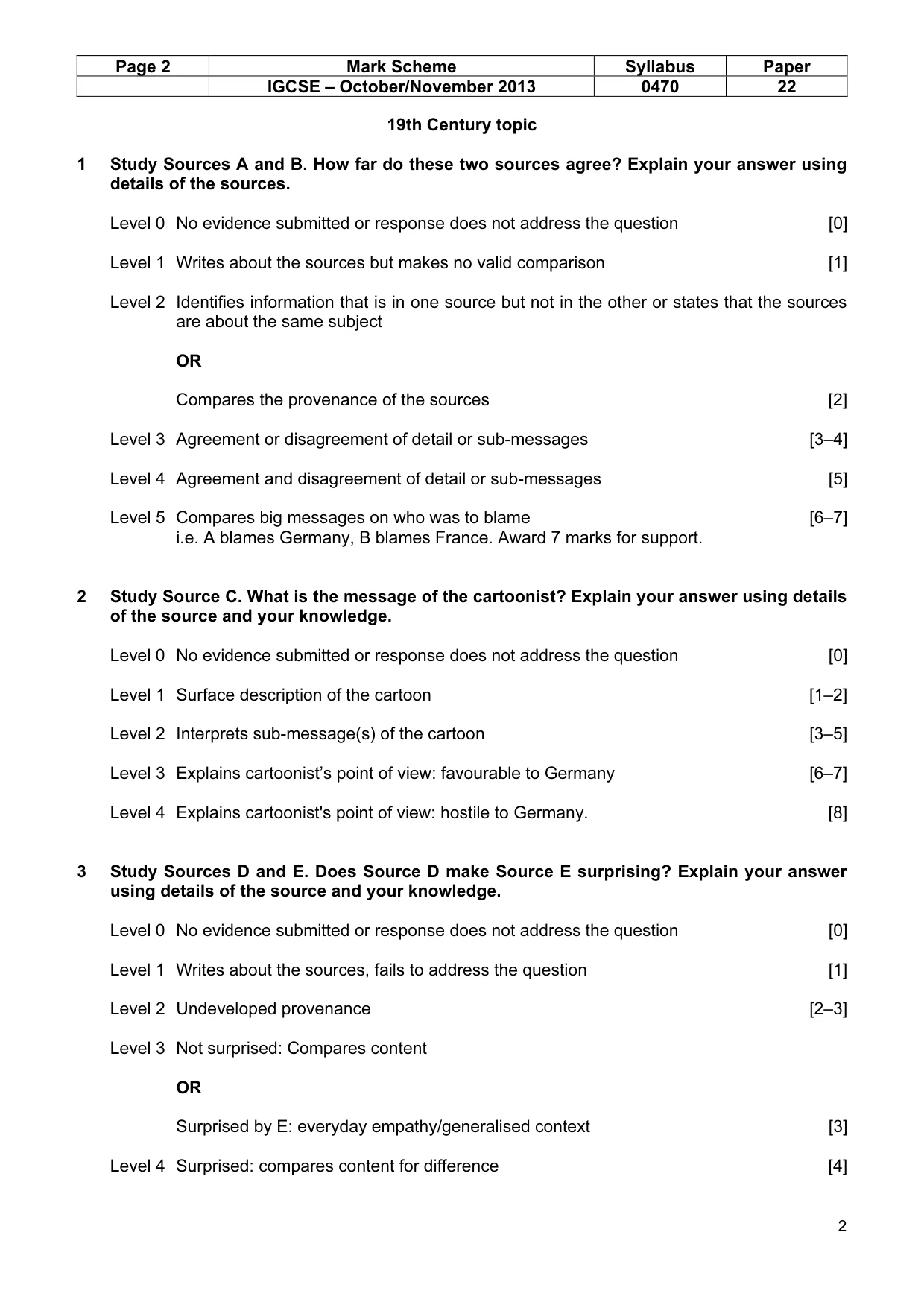
Page 2 Mark Scheme Syllabus Paper IGCSE – October/November 2013 0470 22 2 19th Century topic 1 Study Sources A and B. How far do these two sources agree? Explain your answer using details of the sources. Level 0 No evidence submitted or response does not address the question [0] Level 1 Writes about the sources but makes no valid comparison [1] Level 2 Identifies information that is in one source but not in the other or states that the sources are about the same subject OR Compares the provenance of the sources [2] Level 3 Agreement or disagreement of detail or sub-messages [3–4] Level 4 Agreement and disagreement of detail or sub-messages [5] Level 5 Compares big messages on who was to blame [6–7] i.e. A blames Germany, B blames France. Award 7 marks for support. 2 Study Source C. What is the message of the cartoonist? Explain your answer using details of the source and your knowledge. Level 0 No evidence submitted or response does not address the question [0] Level 1 Surface description of the cartoon [1–2] Level 2 Interprets sub-message(s) of the cartoon [3–5] Level 3 Explains cartoonist’s point of view: favourable to Germany [6–7] Level 4 Explains cartoonist's point of view: hostile to Germany. [8] 3 Study Sources D and E. Does Source D make Source E surprising? Explain your answer using details of the source and your knowledge. Level 0 No evidence submitted or response does not address the question [0] Level 1 Writes about the sources, fails to address the question [1] Level 2 Undeveloped provenance [2–3] Level 3 Not surprised: Compares content OR Surprised by E: everyday empathy/generalised context [3] Level 4 Surprised: compares content for difference [4]
Mark scheme, page 3
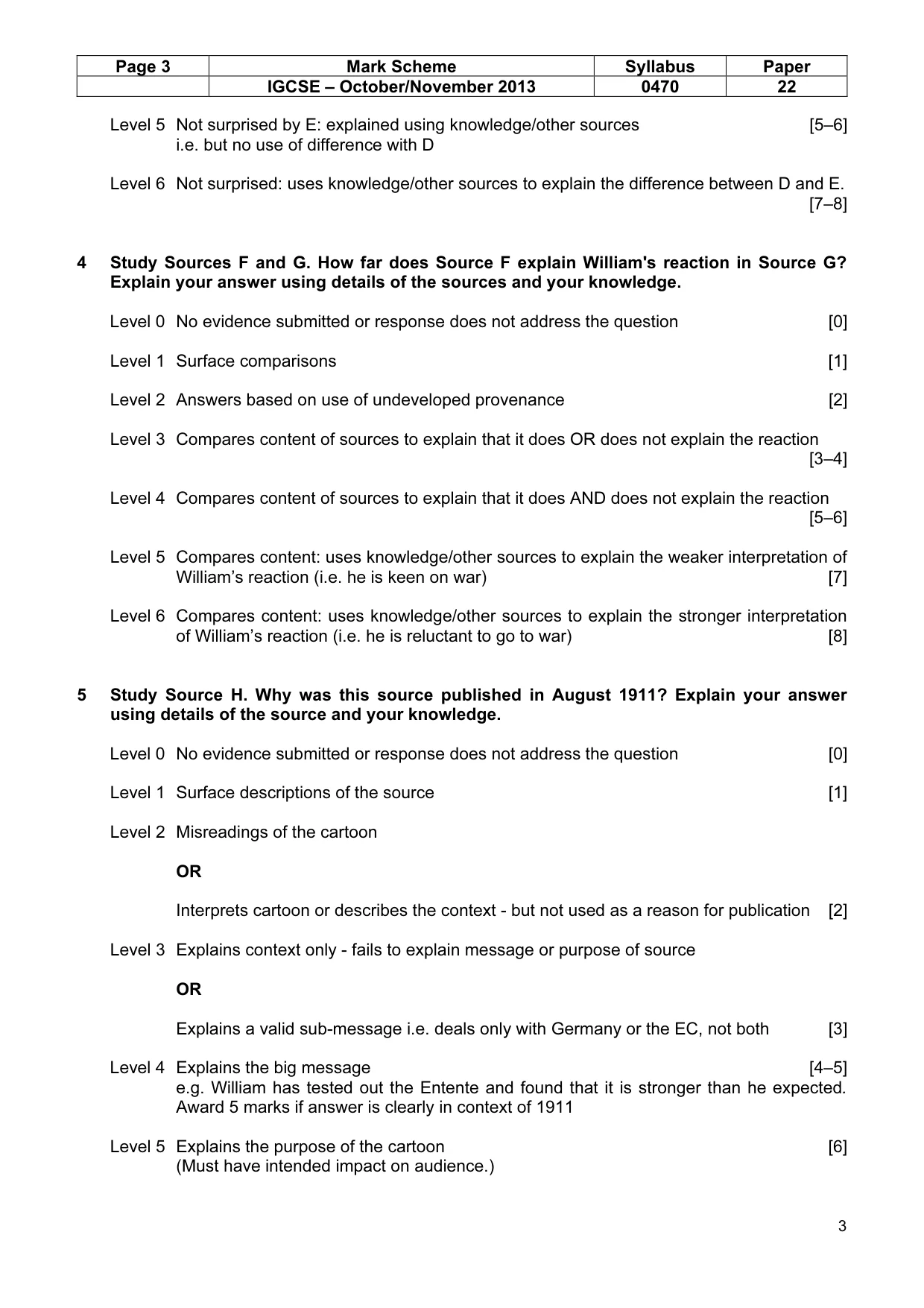
Page 3 Mark Scheme Syllabus Paper IGCSE – October/November 2013 0470 22 3 Level 5 Not surprised by E: explained using knowledge/other sources [5–6] i.e. but no use of difference with D Level 6 Not surprised: uses knowledge/other sources to explain the difference between D and E. [7–8] 4 Study Sources F and G. How far does Source F explain William's reaction in Source G? Explain your answer using details of the sources and your knowledge. Level 0 No evidence submitted or response does not address the question [0] Level 1 Surface comparisons [1] Level 2 Answers based on use of undeveloped provenance [2] Level 3 Compares content of sources to explain that it does OR does not explain the reaction [3–4] Level 4 Compares content of sources to explain that it does AND does not explain the reaction [5–6] Level 5 Compares content: uses knowledge/other sources to explain the weaker interpretation of William’s reaction (i.e. he is keen on war) [7] Level 6 Compares content: uses knowledge/other sources to explain the stronger interpretation of William’s reaction (i.e. he is reluctant to go to war) [8] 5 Study Source H. Why was this source published in August 1911? Explain your answer using details of the source and your knowledge. Level 0 No evidence submitted or response does not address the question [0] Level 1 Surface descriptions of the source [1] Level 2 Misreadings of the cartoon OR Interprets cartoon or describes the context - but not used as a reason for publication [2] Level 3 Explains context only - fails to explain message or purpose of source OR Explains a valid sub-message i.e. deals only with Germany or the EC, not both [3] Level 4 Explains the big message [4–5] e.g. William has tested out the Entente and found that it is stronger than he expected. Award 5 marks if answer is clearly in context of 1911 Level 5 Explains the purpose of the cartoon [6] (Must have intended impact on audience.)
Mark scheme, page 4
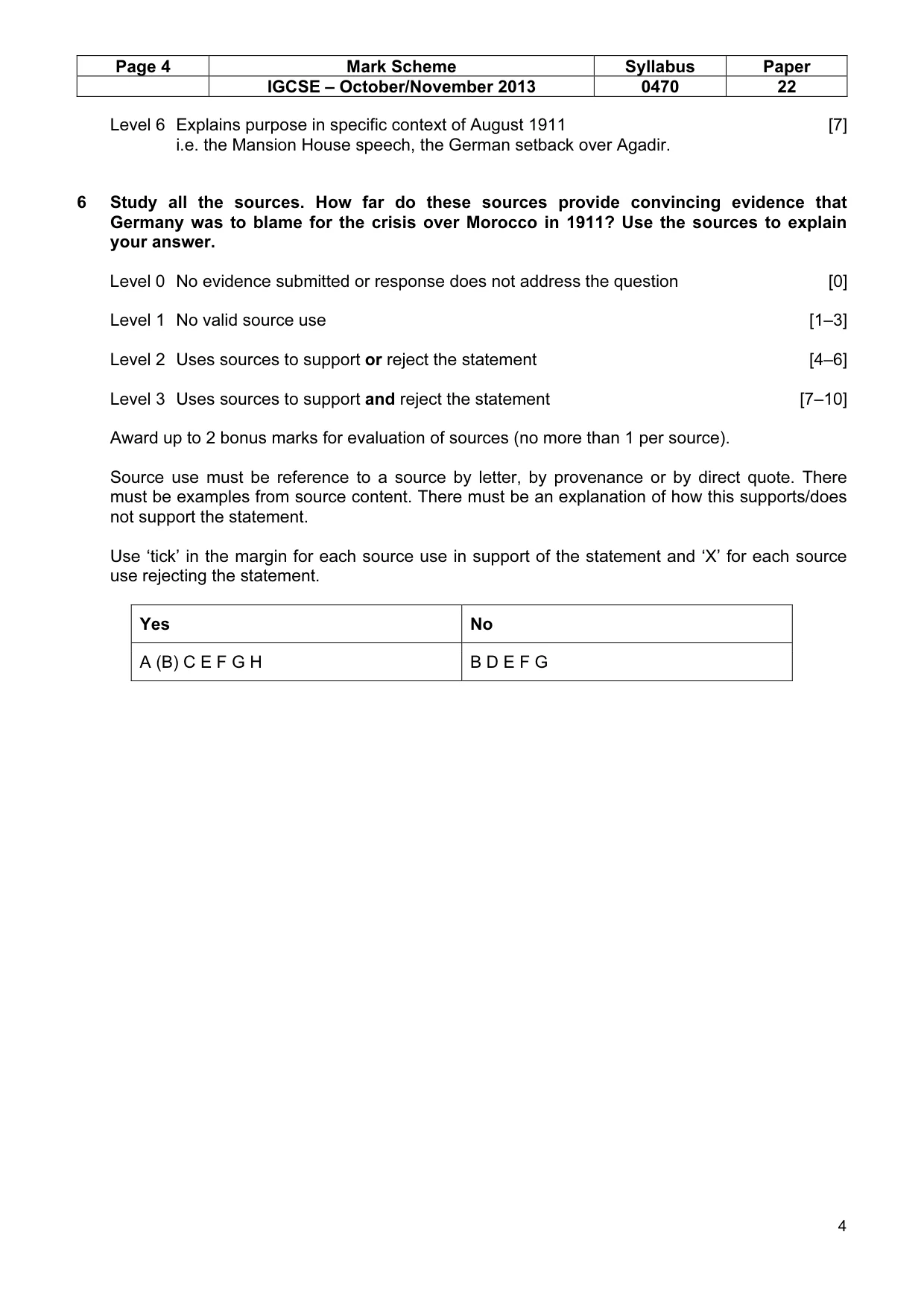
Page 4 Mark Scheme Syllabus Paper IGCSE – October/November 2013 0470 22 4 Level 6 Explains purpose in specific context of August 1911 [7] i.e. the Mansion House speech, the German setback over Agadir. 6 Study all the sources. How far do these sources provide convincing evidence that Germany was to blame for the crisis over Morocco in 1911? Use the sources to explain your answer. Level 0 No evidence submitted or response does not address the question [0] Level 1 No valid source use [1–3] Level 2 Uses sources to support or reject the statement [4–6] Level 3 Uses sources to support and reject the statement [7–10] Award up to 2 bonus marks for evaluation of sources (no more than 1 per source). Source use must be reference to a source by letter, by provenance or by direct quote. There must be examples from source content. There must be an explanation of how this supports/does not support the statement. Use ‘tick’ in the margin for each source use in support of the statement and ‘X’ for each source use rejecting the statement. Yes No A (B) C E F G H B D E F G
Mark scheme, page 5
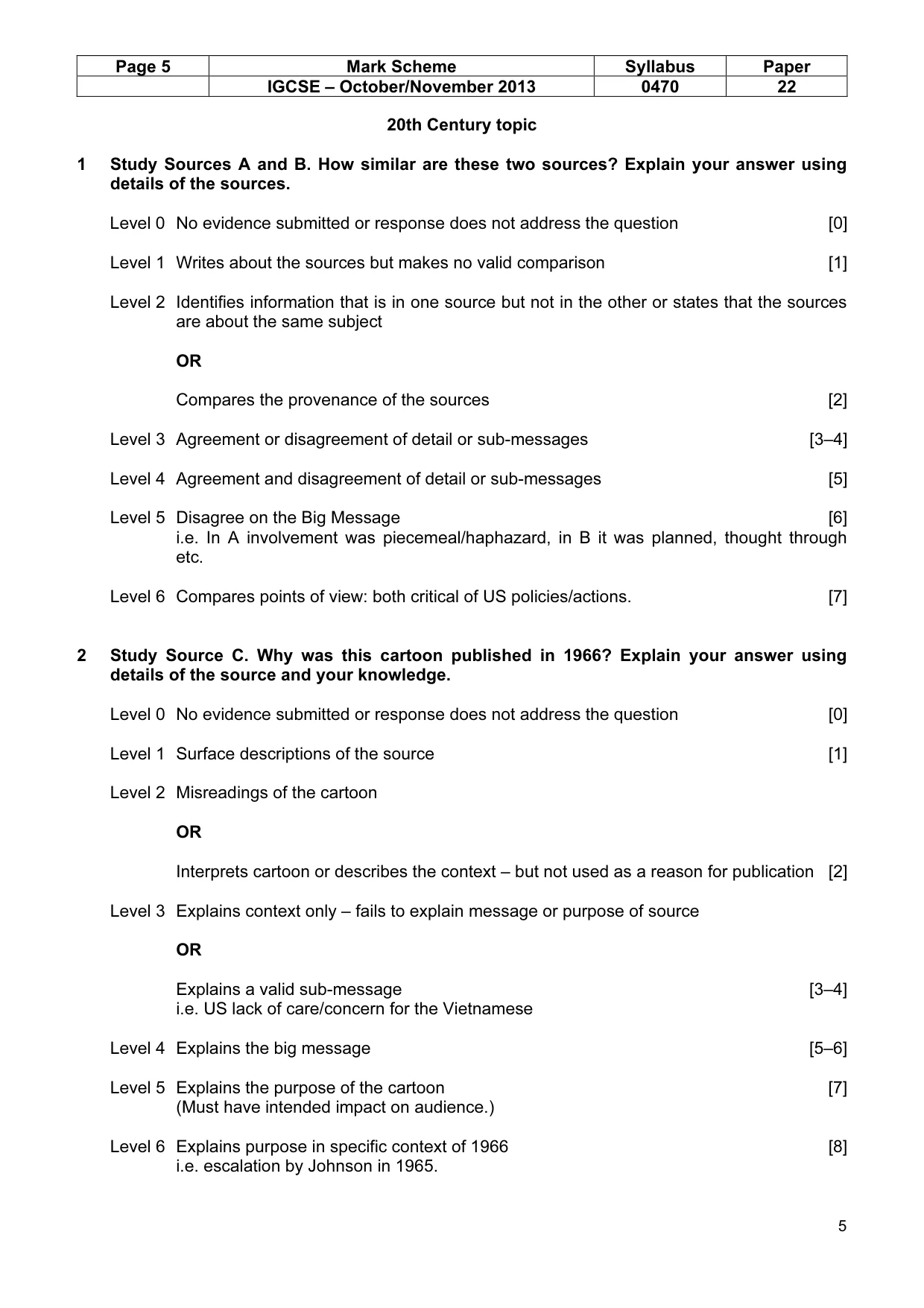
Page 5 Mark Scheme Syllabus Paper IGCSE – October/November 2013 0470 22 5 20th Century topic 1 Study Sources A and B. How similar are these two sources? Explain your answer using details of the sources. Level 0 No evidence submitted or response does not address the question [0] Level 1 Writes about the sources but makes no valid comparison [1] Level 2 Identifies information that is in one source but not in the other or states that the sources are about the same subject OR Compares the provenance of the sources [2] Level 3 Agreement or disagreement of detail or sub-messages [3–4] Level 4 Agreement and disagreement of detail or sub-messages [5] Level 5 Disagree on the Big Message [6] i.e. In A involvement was piecemeal/haphazard, in B it was planned, thought through etc. Level 6 Compares points of view: both critical of US policies/actions. [7] 2 Study Source C. Why was this cartoon published in 1966? Explain your answer using details of the source and your knowledge. Level 0 No evidence submitted or response does not address the question [0] Level 1 Surface descriptions of the source [1] Level 2 Misreadings of the cartoon OR Interprets cartoon or describes the context – but not used as a reason for publication [2] Level 3 Explains context only – fails to explain message or purpose of source OR Explains a valid sub-message [3–4] i.e. US lack of care/concern for the Vietnamese Level 4 Explains the big message [5–6] Level 5 Explains the purpose of the cartoon [7] (Must have intended impact on audience.) Level 6 Explains purpose in specific context of 1966 [8] i.e. escalation by Johnson in 1965.
Mark scheme, page 6
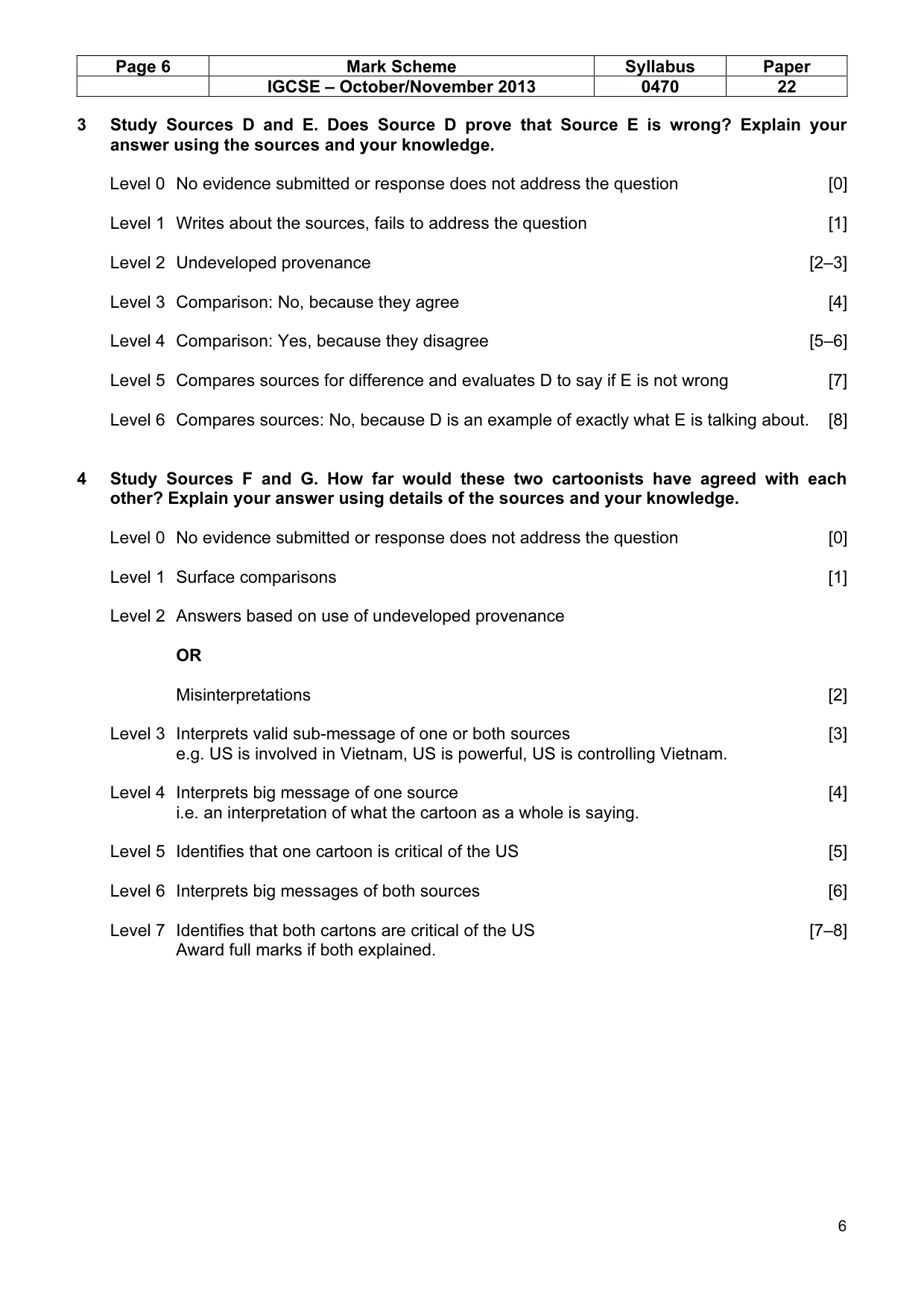
Page 6 Mark Scheme Syllabus Paper IGCSE – October/November 2013 0470 22 6 3 Study Sources D and E. Does Source D prove that Source E is wrong? Explain your answer using the sources and your knowledge. Level 0 No evidence submitted or response does not address the question [0] Level 1 Writes about the sources, fails to address the question [1] Level 2 Undeveloped provenance [2–3] Level 3 Comparison: No, because they agree [4] Level 4 Comparison: Yes, because they disagree [5–6] Level 5 Compares sources for difference and evaluates D to say if E is not wrong [7] Level 6 Compares sources: No, because D is an example of exactly what E is talking about. [8] 4 Study Sources F and G. How far would these two cartoonists have agreed with each other? Explain your answer using details of the sources and your knowledge. Level 0 No evidence submitted or response does not address the question [0] Level 1 Surface comparisons [1] Level 2 Answers based on use of undeveloped provenance OR Misinterpretations [2] Level 3 Interprets valid sub-message of one or both sources [3] e.g. US is involved in Vietnam, US is powerful, US is controlling Vietnam. Level 4 Interprets big message of one source [4] i.e. an interpretation of what the cartoon as a whole is saying. Level 5 Identifies that one cartoon is critical of the US [5] Level 6 Interprets big messages of both sources [6] Level 7 Identifies that both cartons are critical of the US [7–8] Award full marks if both explained.
Mark scheme, page 7
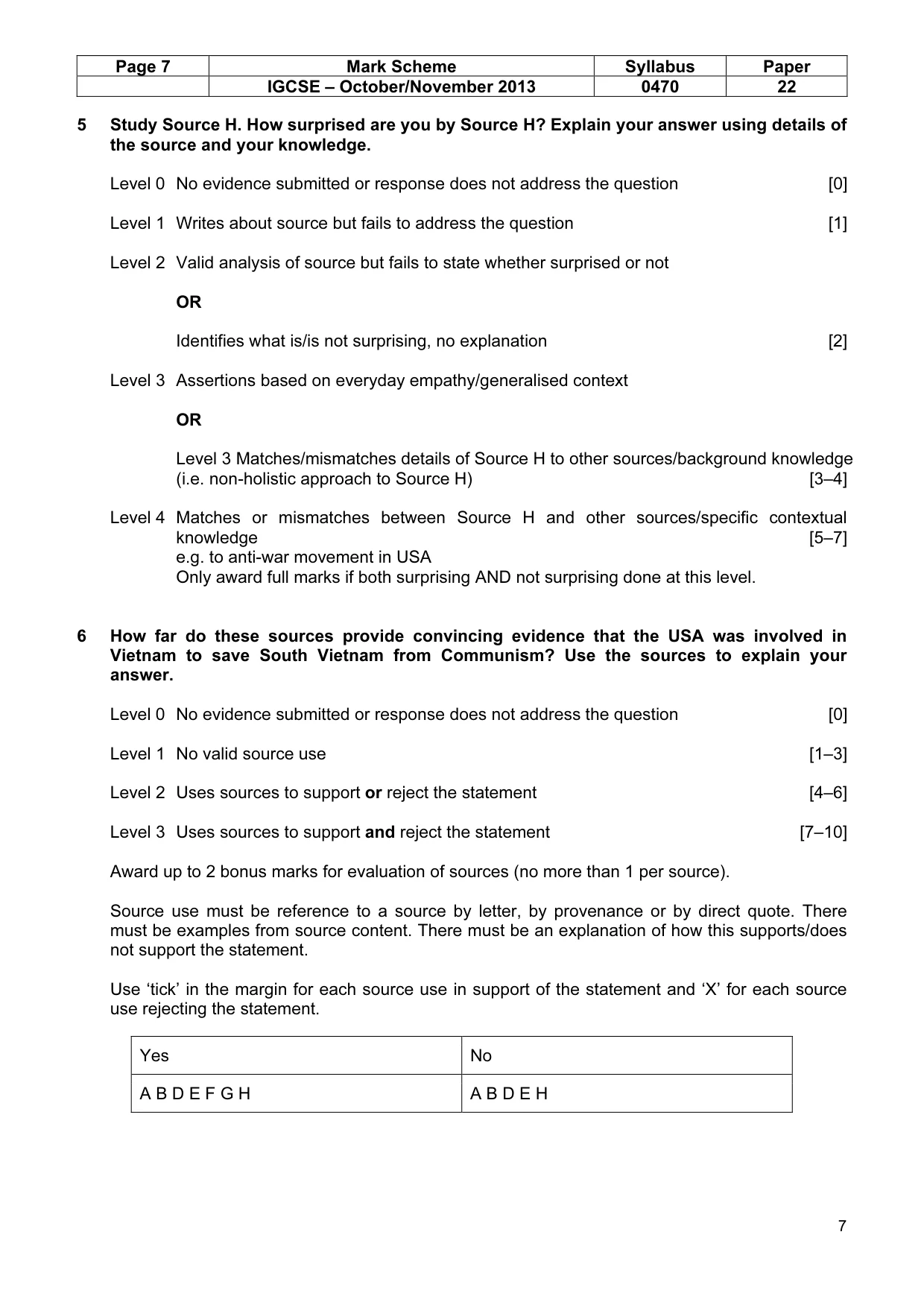
Page 7 Mark Scheme Syllabus Paper IGCSE – October/November 2013 0470 22 7 5 Study Source H. How surprised are you by Source H? Explain your answer using details of the source and your knowledge. Level 0 No evidence submitted or response does not address the question [0] Level 1 Writes about source but fails to address the question [1] Level 2 Valid analysis of source but fails to state whether surprised or not OR Identifies what is/is not surprising, no explanation [2] Level 3 Assertions based on everyday empathy/generalised context OR Level 3 Matches/mismatches details of Source H to other sources/background knowledge (i.e. non-holistic approach to Source H) [3–4] Level 4 Matches or mismatches between Source H and other sources/specific contextual knowledge [5–7] e.g. to anti-war movement in USA Only award full marks if both surprising AND not surprising done at this level. 6 How far do these sources provide convincing evidence that the USA was involved in Vietnam to save South Vietnam from Communism? Use the sources to explain your answer. Level 0 No evidence submitted or response does not address the question [0] Level 1 No valid source use [1–3] Level 2 Uses sources to support or reject the statement [4–6] Level 3 Uses sources to support and reject the statement [7–10] Award up to 2 bonus marks for evaluation of sources (no more than 1 per source). Source use must be reference to a source by letter, by provenance or by direct quote. There must be examples from source content. There must be an explanation of how this supports/does not support the statement. Use ‘tick’ in the margin for each source use in support of the statement and ‘X’ for each source use rejecting the statement. Yes No A B D E F G H A B D E H
What you needed in this session
Cambridge’s own grade thresholds for 2013 Oct/Nov, Paper 2 · Variant 2. A higher threshold means an easier paper — the bar moves with how the cohort did.