Cambridge IGCSE History 0470 — 2012 May/June Paper 2 · Variant 3
0470/23/M/J/12 · 50 marks · ≈56 min
The question paper and its mark scheme, free to read here and free to download. This is Cambridge’s own paper, exactly as it was sat.
Question paper12 pages
Mark scheme7 pages
Answers below. Sit the paper first if you are practising.
Paper as text
Question paper, page 1
This document consists of 11 printed pages and 1 blank page. DC (NS/SW) 51668/4 © UCLES 2012 [Turn over UNIVERSITY OF CAMBRIDGE INTERNATIONAL EXAMINATIONS International General Certificate of Secondary Education * 3 7 7 7 4 2 1 8 8 2 * HISTORY 0470/23 Paper 2 May/June 2012 2 hours Additional Materials: Answer Booklet/Paper READ THESE INSTRUCTIONS FIRST If you have been given an Answer Booklet, follow the instructions on the front cover of the Booklet. Write your Centre number, candidate number and name on all the work you hand in. Write in dark blue or black pen. You may use a soft pencil for any diagrams, graphs or rough working. Do not use staples, paper clips, highlighters, glue or correction fluid. This paper has two options. Choose one option, and then answer all of the questions on that topic. Option A: 19th Century topic [p2–p6] Option B: 20th Century topic [p7–p11] At the end of the examination, fasten all your work securely together. The number of marks is given in brackets [ ] at the end of each question or part question. www.XtremePapers.com
Question paper, page 2
2 0470/23/M/J/12 © UCLES 2012 Option A: 19th Century topic HOW FAR WAS THE KAISER TO BLAME FOR THE FIRST WORLD WAR? Study the Background Information and the sources carefully, and then answer all the questions. Background Information In 1890 the new Kaiser of Germany, Wilhelm II, dismissed Bismarck as Chancellor. Many historians argue that the Kaiser encouraged a new aggressive foreign policy often called ‘World Policy’ or ‘Weltpolitik’. It is sometimes claimed that the resulting German aggression both inside and outside Europe was a significant factor in causing the First World War. However, other historians have argued that other countries such as Britain and Russia should take a major part of the blame. How far should the Kaiser take personal responsibility for causing the First World War? SOURCE A After 1890 German energies were turned outwards against foreign powers. Every German gain, every advance of German exports, was transformed into a grievance that it was not more; and the enormous development of German industry served to demonstrate the denial of Germany’s ‘place in the sun’. Germany cried out for the possessions of others; convinced that if she could but ruin and destroy her neighbours she would be at last stable and contented. But there was no proper Plan. The government would pick up one scheme and then another, dropping them when they seemed to threaten a serious conflict. Germany renewed in 1898 its colonial ambitions in Africa and then, fearing to break with England, half dropped them; so it seized in 1897 a concession in China and then feared to play a serious part as a Far Eastern Power; and – most contradictory of all – it prompted and supported the project for a German railway across Turkey, yet shrank from the breach with Russia that this railway implied. The project of a huge German navy was the perfect expression of the spirit which made up the Germany of Wilhelm II and Bülow, the Germany of limitless ambition and contradiction. The great navy had no defensive purpose. It was not designed to defend Germany’s (worthless) colonial empire. The navy was purely a weapon of offence; and it is not surprising that the British drew the conclusion that the offence could be directed only against them. But this threat to England was not intended. It is difficult to find in the ceaseless outpouring of propaganda any sensible justification of the great building programme. Its supporters such as Tirpitz fell back on the argument that a great navy was an essential possession of a Great Power. German ‘world policy’ was a pretence. Germany had no vital interest in China. Her vital interest was security in Europe. From a history book published in 1945.
Question paper, page 3
3 0470/23/M/J/12 © UCLES 2012 [Turn over SOURCE B In 1897, Germany embarked on a ‘World Policy’ (Weltpolitik). Weltpolitik did not have a very precise meaning. In 1897 the Kaiser made two important changes in his ministers. Bülow was appointed to the foreign ministry and Admiral von Tirpitz to head the navy office. The latter signified that Germany was to begin the construction of a powerful battle fleet to challenge Britain’s naval supremacy. Bülow’s role was to improve Germany’s position on the world stage and satisfy the German people’s craving for ‘a place in the sun’. The Kaiser said in 1898, ‘Germany has great tasks to accomplish outside the narrow boundaries of old Europe.’ What these ‘great tasks’ were is not very obvious. As Germany’s army commander remarked around this time: ‘We are supposed to pursue Weltpolitik. If only we knew what it was supposed to mean.’ Behind the pursuit of Weltpolitik there lay a vague longing to be a World Power. By the end of 1904, few of the aims of German diplomacy had been achieved. Weltpolitik had added little to Germany’s overseas empire. Admittedly the navy programme was proving very popular in Germany; but the British Admiralty feared that the German fleet was designed for a possible conflict with Britain. To meet the challenge, Britain took counter-measures. From a history book published in 2001. SOURCE C A British cartoon published in October 1905.
Question paper, page 4
4 0470/23/M/J/12 © UCLES 2012 SOURCE D Now we know where our enemy stands. Like a flash of lightning in the night, these events have shown the German people where its enemy is. The German people now knows when it seeks its place in the sun, when it seeks the place it deserves, that Britain thinks it can decide the matter. When the hour of decision comes we are prepared for sacrifices, both of blood and of wealth. From a speech by a politician in the German parliament in November 1911. The speech was met with great applause. SOURCE E Great Britain as a world power stands and falls with her strength at sea. If we ourselves were responsible for the safeguarding of an empire like that of Great Britain, we should strive to maintain our sea-power in the same way. I am of the opinion that the solidarity of the Entente policy varies depending on England’s relations with Germany. To guard her security and influence in Europe, England will continue to insist on a balance of power and will hold a protecting hand over France. We are respected here, we are highly thought of, and from this feeling comes England’s wish to hem us in. This is quite a different thing from a wish to go to war with us. Our common interests are too great, our economic ties too close for that. And the people of Great Britain have grown too comfort-loving to want a war. From a letter by the German ambassador in London to Bethmann Hollweg, the German Chancellor, December 1912. SOURCE F Content removed due to copyright restrictions. A British cartoon published in May 1916. The caption reads: ‘The German Monster: “Heaven knows that I had to do this in self-defence. It was forced upon me.” (According to the Imperial Chancellor’s latest speech Germany is the deeply angered victim of British militarism).’
Question paper, page 5
5 0470/23/M/J/12 © UCLES 2012 [Turn over SOURCE G I frequently hear expressed here the wish that at last a final and fundamental reckoning should be had with the Serbs. Serbs should first be presented with a number of demands, and in case they should not accept these, energetic measures should be taken. I take every opportunity of every such occasion to advise quietly but very seriously against hasty action. First of all, the Austrian government must make sure what they want to do. Then the chances of every kind of action should be carefully weighed, and it should be kept in mind that Austria-Hungary does not stand alone in the world, that it is her duty to think not only of her allies, but to take into consideration the entire European situation, and especially to bear in mind the attitude of Italy and Roumania on all questions that concern Serbia. A report by Tschirschky, the German Ambassador in Austria, to the Kaiser, 30 July 1914. The notes on the left were added by the Kaiser. SOURCE H I began to mediate between your government and the Austro-Hungarian government. While this action was proceeding, your troops were mobilised on my eastern frontier. Responsibility for the safety of my empire forces preventative measures of defence upon me. The responsibility for the disaster now threatening the whole civilised world will not be placed on me. In this moment it still lies in your power to avert it. Nobody is threatening the honour or power of Russia. From a letter by Kaiser Wilhelm II to Tsar Nicholas II of Russia, 31 July 1914. SOURCE I A decisive statement on the part of the British government of its solidarity with France had in 1911 been sufficient to dispel the gathering storm clouds. I am convinced now that had the British government sided with Russia and France on the Serbian question from the first, Germany would not have encouraged Austria in its policy of aggression but would, on the contrary, have advised caution and moderation. From the memoirs of Serge Sazonov written in 1928. Sazonov was the member of the Russian government in charge of foreign policy in 1914. Now or never Who authorized him to act that way? That is very stupid! It is none of his business, as it is solely the affair of Austria, what she plans to do in this case. Later, if plans go wrong, it will be said that Germany did not want it! Let Tschirschky drop this nonsense. The Serbs must be disposed of, and soon!
Question paper, page 6
6 0470/23/M/J/12 © UCLES 2012 Now answer all the following questions. You may use any of the sources to help you answer the questions, in addition to those sources which you are told to use. In answering the questions you should use your knowledge of the topic to help you interpret and evaluate the sources. 1 Study Sources A and B. How far do these two sources agree? Explain your answer using details of the sources. [7] 2 Study Source C. Why was this cartoon published in 1905? Explain your answer using details of the source and your knowledge. [8] 3 Study Sources D and E. Does Source D prove that Source E was wrong? Explain your answer using details of the sources and your knowledge. [7] 4 Study Source F. What is the message of this cartoon? Explain your answer using details of the source and your knowledge. [8] 5 Study Sources G and H. Was the Kaiser lying in Source H? Explain your answer using details of the sources and your knowledge. [8] 6 Study all the sources. How far do these sources provide convincing evidence that the Kaiser was personally to blame for the First World War? Use the sources to explain your answer. [12]
Question paper, page 7
7 0470/23/M/J/12 © UCLES 2012 [Turn over Option B: 20th Century topic DID THE LEAGUE OF NATIONS HAVE A CHANCE OF SUCCEEDING? Study the Background Information and the sources carefully, and then answer all the questions. Background Information The last of President Wilson’s Fourteen Points was that ‘a general association of nations’ should be set up to ensure the ‘political independence and territorial integrity of great and small nations alike’. In 1920 the League of Nations was established. Its members agreed to protect all members against aggression and to try and resolve disputes peacefully through the League. During the 1920s, the League had to deal with several disputes, including ones over the Aaland Islands and Bulgaria. However, there were other disputes such as the crisis in 1923 over Corfu where the League was ineffective and in the 1930s the League struggled to deal with Japan’s aggression in Manchuria and Italy’s invasion of Abyssinia. By the late 1930s it was clear that the League had failed. Did it ever have a chance of succeeding or was it doomed from the start? SOURCE A If for idealists the League offered the chance of a new beginning, for the hard-headed French the League’s chief value lay not in its defence of a new international morality but in its capacity to defend the Versailles settlement against revision. French interests demanded a League with teeth. They made several attempts to create a military force at the League’s disposal, but failed to persuade the British. When Wilson failed to push American membership of the League through Congress, much of the League’s deterrent value slipped away. The League was certainly not unimportant; it provided an international forum for discussion, it was a source of influence, and helped tackle the kinds of problems – like the refugee crisis – where a coordinated international response was desirable. Even though it had very limited powers to intervene in the internal affairs of member states, it could help publicise abuses of minority groups and expose governments to the pressure of world opinion. Nevertheless, its influence depended on its members’ willingness to work through it. They were not bound by it, and could conduct diplomacy through other channels. Great Power politics was far from dead. Other more traditional, diplomatic forums remained important: the Conference of Ambassadors was chosen in preference to the League to settle crises in 1923 over Corfu and Vilna. Between 1934 and 1936 the European balance swung away from France and Britain. The British could not afford military commitments in Europe and government policy was affected by pacifism. As for the French, they had no offensive plans where Germany was concerned. These developments doomed the League of Nations. From a history book published in 1998.
Question paper, page 8
8 0470/23/M/J/12 © UCLES 2012 SOURCE B Despite its poor historical reputation the League should not be dismissed as a complete failure. Of sixty-six international disputes it had to deal with, it successfully resolved thirty-five and quite sensibly passed back twenty to the channels of traditional diplomacy. It failed to resolve just eleven conflicts. After the First World War Great Britain and France still laid down the law to all Europe. However, everything was soon overtaken in importance by the new institution which came out of the peace- conference: the League of Nations. It is true that there was a deep, underlying divergence between Britain and France as to the nature of the League. The French wanted the League to develop into a system of security directed against Germany; the British regarded it as a system of conciliation which would include Germany. The British and French governments were both too distracted by difficulties, domestic and foreign, to have a clear and consistent policy. When Abyssinia was attacked in October 1935, the members of the League responded. The impact of the League’s sanctions was weakened by Germany and the United States, the two Great Powers outside the League. But this was not serious. The real weakness was within the League. France applied sanctions but assured Mussolini that Italy’s oil supplies would not be interfered with. On 1 May 1936, the Emperor Haile Selassie left Abyssinia. A week later Mussolini proclaimed the foundation of a new Roman empire. This was a serious blow to the League. Fifty-two nations had combined to resist aggression; all they had accomplished was that Haile Selassie lost all his country instead of only half. The real death of the League was in December 1935, not in 1939 or 1945. One day it was a powerful body imposing sanctions, seemingly more effective than even before; the next day it was an empty sham. What killed the League was the publication of the Hoare-Laval plan. From a history book published in 1961. SOURCE C The League of Nations is our best hope, but the diplomats are all against it, regarding it as a toy to amuse and mislead the public, but intending all the time to carry on their old game just as before. Jan Smuts speaking at Versailles in 1919. Smuts served in the British War Cabinet in the First World War and represented South Africa at the peace talks at Versailles. In 1919 he became Prime Minister of South Africa. SOURCE D For the first time in history mankind is to be drawn together for the purpose of defending the rights and improving the conditions of working people – men, women and children – all over the world. Such a thing as that was never dreamed of before, and what you are asked to decide in discussing the League of Nations is the matter of seeing that this thing is not interfered with. There is no other way to do it than by a universal league of nations, and what is proposed is a universal league of nations. But the things prescribed in this treaty will not be fully carried out if any one of the great influences that brought that result about is withheld. Every great fighting nation in the world is on the list of those who are to constitute the League of Nations. I say every great nation, because America is going to be included among them, and the only choice, my fellow citizens, is whether we will go in now or come in later with Germany; whether we will go in as founders of this covenant of freedom or go in as those who are admitted after they have made a mistake and repented. From a speech by President Woodrow Wilson soon after he returned to the USA, September 1919.
Question paper, page 9
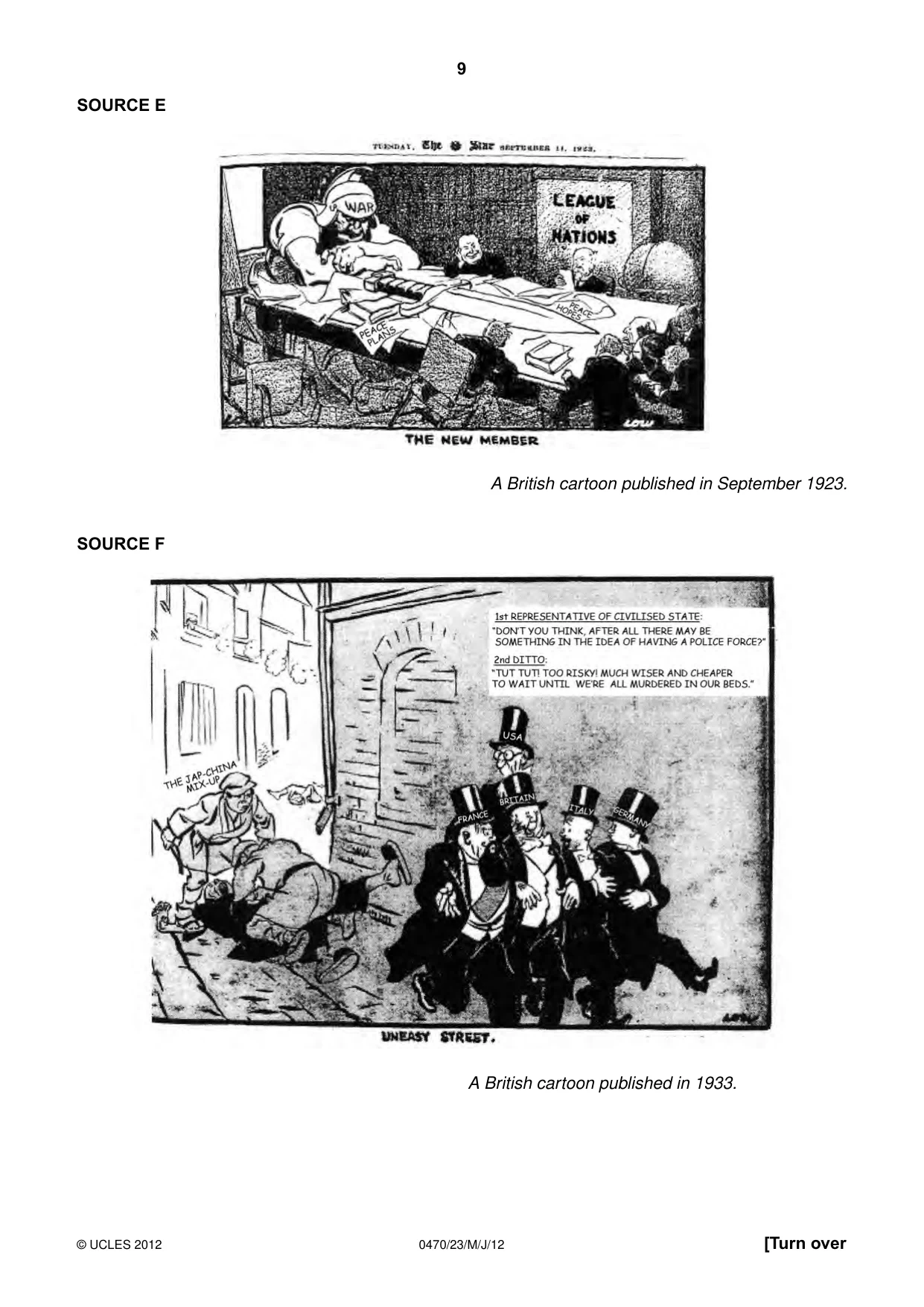
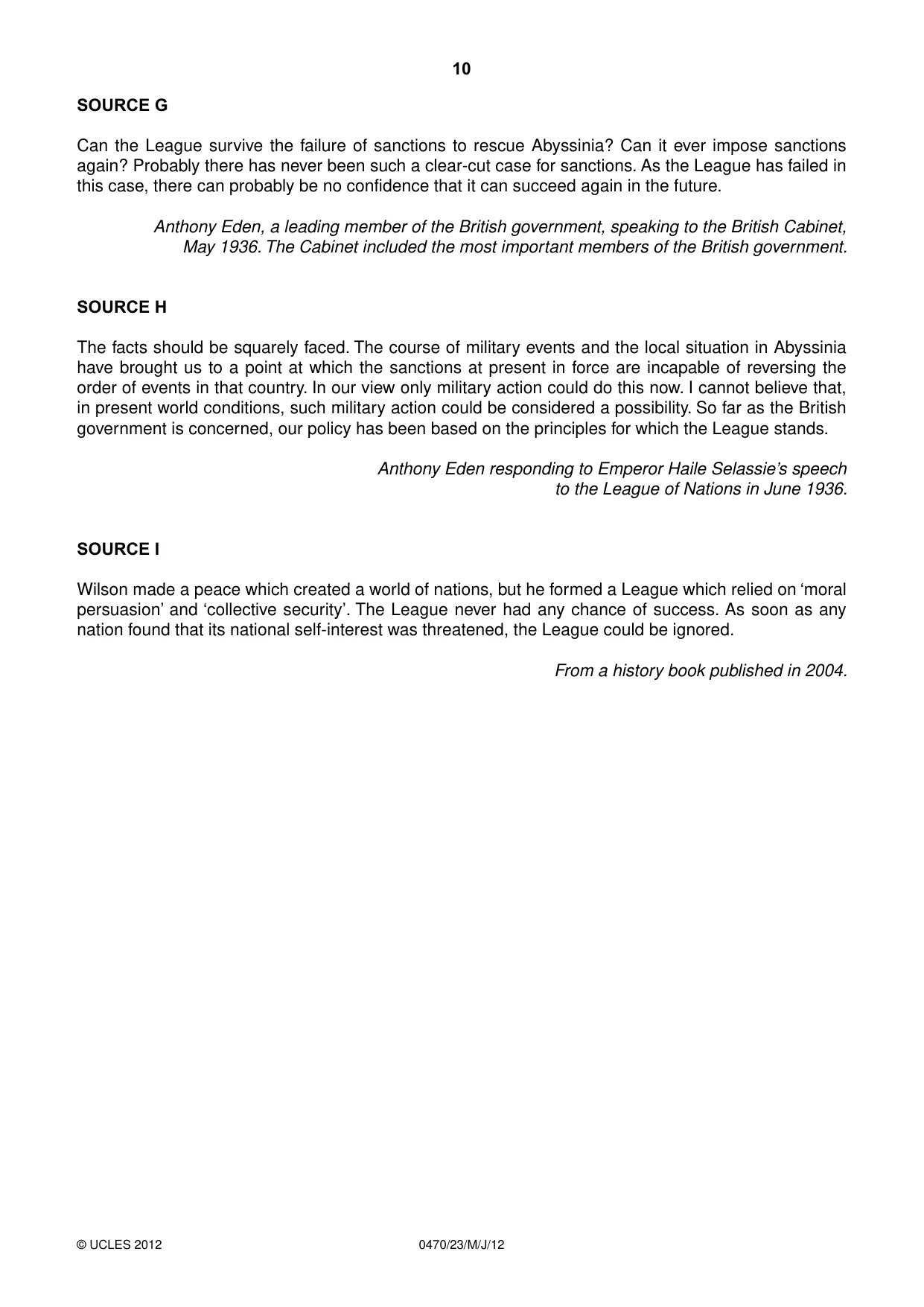
9 0470/23/M/J/12 © UCLES 2012 [Turn over SOURCE E A British cartoon published in September 1923. SOURCE F A British cartoon published in 1933.
Question paper, page 10
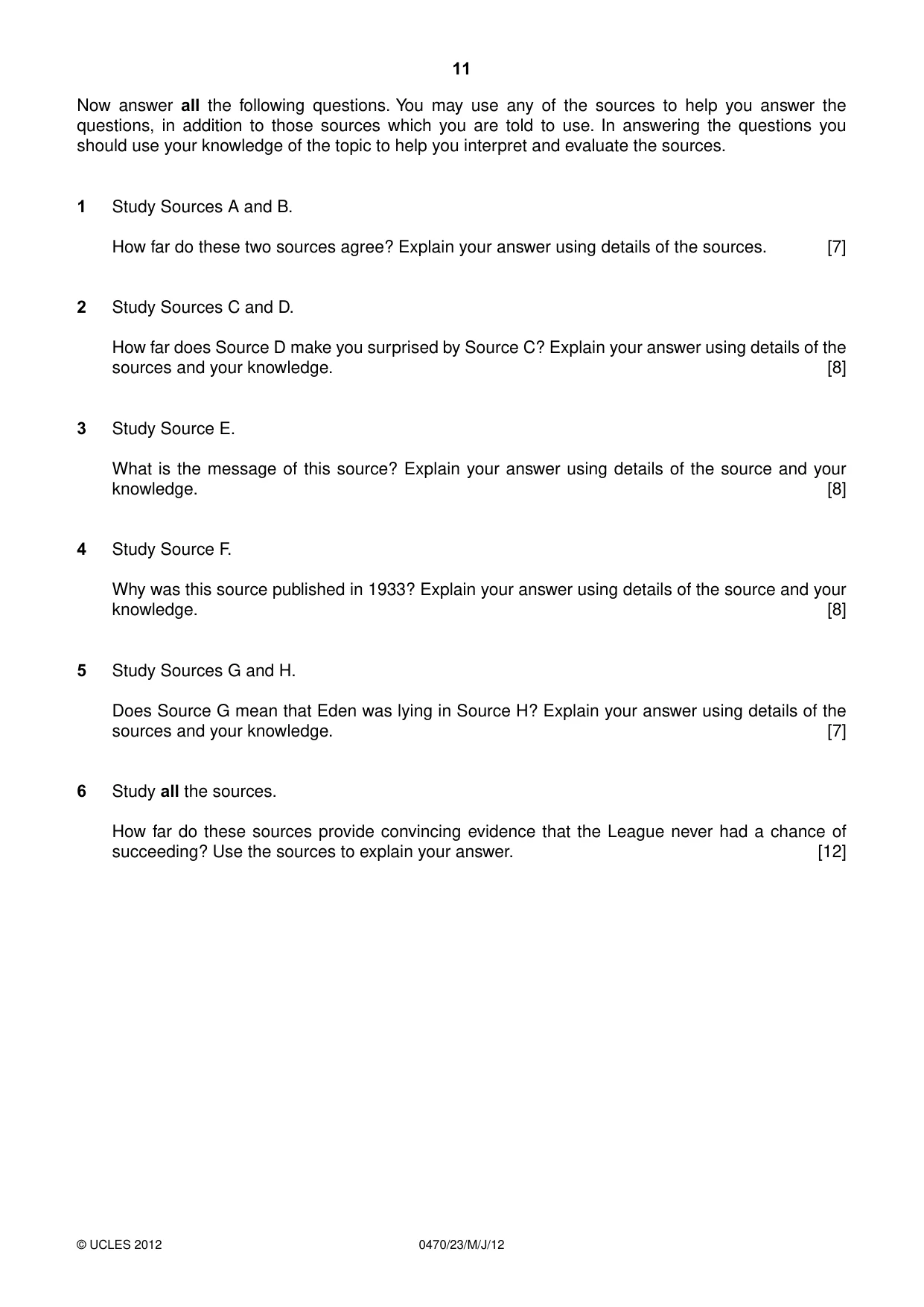
10 0470/23/M/J/12 © UCLES 2012 SOURCE G Can the League survive the failure of sanctions to rescue Abyssinia? Can it ever impose sanctions again? Probably there has never been such a clear-cut case for sanctions. As the League has failed in this case, there can probably be no confidence that it can succeed again in the future. Anthony Eden, a leading member of the British government, speaking to the British Cabinet, May 1936. The Cabinet included the most important members of the British government. SOURCE H The facts should be squarely faced. The course of military events and the local situation in Abyssinia have brought us to a point at which the sanctions at present in force are incapable of reversing the order of events in that country. In our view only military action could do this now. I cannot believe that, in present world conditions, such military action could be considered a possibility. So far as the British government is concerned, our policy has been based on the principles for which the League stands. Anthony Eden responding to Emperor Haile Selassie’s speech to the League of Nations in June 1936. SOURCE I Wilson made a peace which created a world of nations, but he formed a League which relied on ‘moral persuasion’ and ‘collective security’. The League never had any chance of success. As soon as any nation found that its national self-interest was threatened, the League could be ignored. From a history book published in 2004.
Question paper, page 11
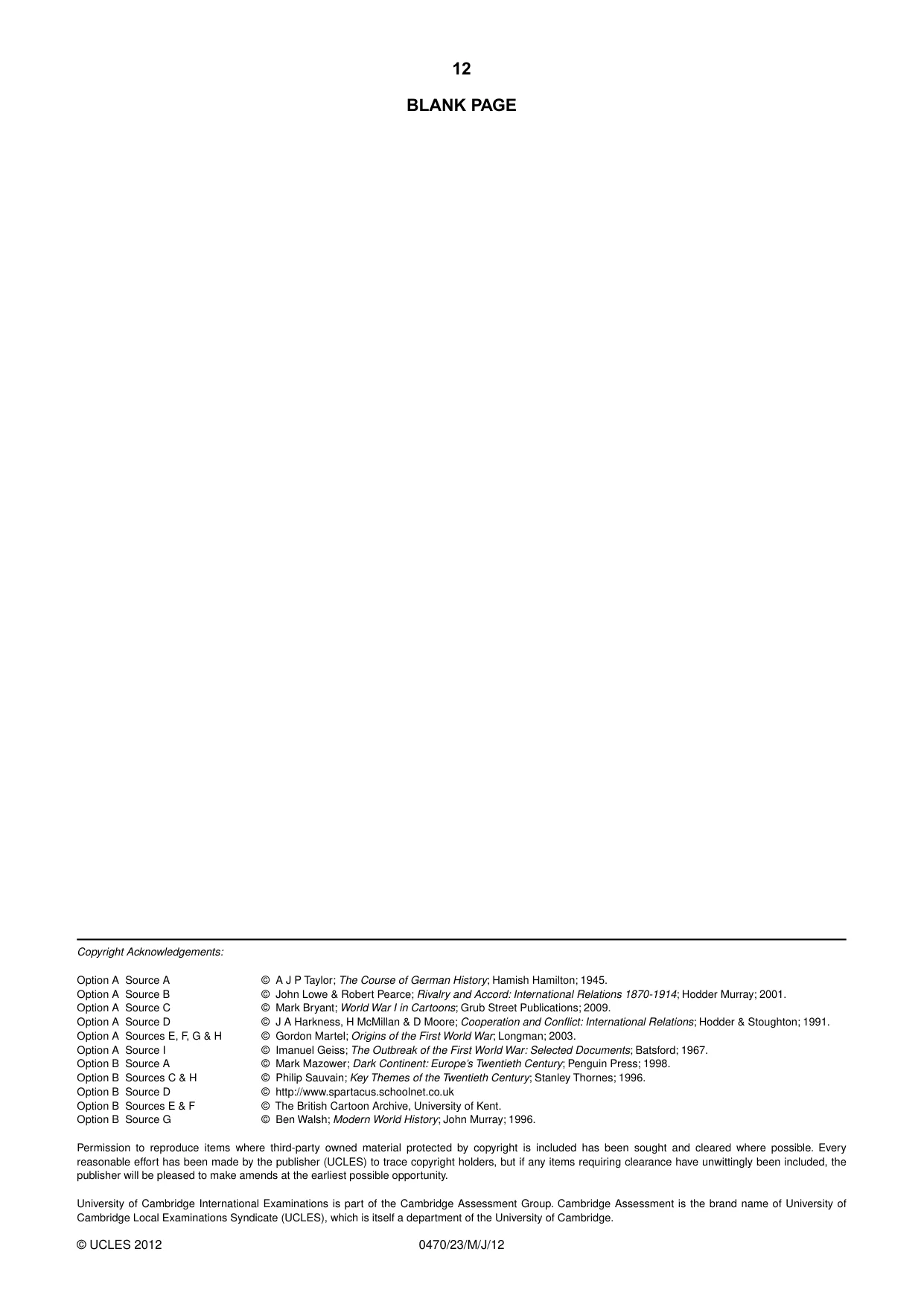
11 0470/23/M/J/12 © UCLES 2012 Now answer all the following questions. You may use any of the sources to help you answer the questions, in addition to those sources which you are told to use. In answering the questions you should use your knowledge of the topic to help you interpret and evaluate the sources. 1 Study Sources A and B. How far do these two sources agree? Explain your answer using details of the sources. [7] 2 Study Sources C and D. How far does Source D make you surprised by Source C? Explain your answer using details of the sources and your knowledge. [8] 3 Study Source E. What is the message of this source? Explain your answer using details of the source and your knowledge. [8] 4 Study Source F. Why was this source published in 1933? Explain your answer using details of the source and your knowledge. [8] 5 Study Sources G and H. Does Source G mean that Eden was lying in Source H? Explain your answer using details of the sources and your knowledge. [7] 6 Study all the sources. How far do these sources provide convincing evidence that the League never had a chance of succeeding? Use the sources to explain your answer. [12]
Question paper, page 12
12 0470/23/M/J/12 © UCLES 2012 BLANK PAGE Copyright Acknowledgements: Option A Source A © A J P Taylor; The Course of German History; Hamish Hamilton; 1945. Option A Source B © John Lowe & Robert Pearce; Rivalry and Accord: International Relations 1870-1914; Hodder Murray; 2001. Option A Source C © Mark Bryant; World War I in Cartoons; Grub Street Publications; 2009. Option A Source D © J A Harkness, H McMillan & D Moore; Cooperation and Conflict: International Relations; Hodder & Stoughton; 1991. Option A Sources E, F, G & H © Gordon Martel; Origins of the First World War; Longman; 2003. Option A Source I © Imanuel Geiss; The Outbreak of the First World War: Selected Documents; Batsford; 1967. Option B Source A © Mark Mazower; Dark Continent: Europe’s Twentieth Century; Penguin Press; 1998. Option B Sources C & H © Philip Sauvain; Key Themes of the Twentieth Century; Stanley Thornes; 1996. Option B Source D © http://www.spartacus.schoolnet.co.uk Option B Sources E & F © The British Cartoon Archive, University of Kent. Option B Source G © Ben Walsh; Modern World History; John Murray; 1996. Permission to reproduce items where third-party owned material protected by copyright is included has been sought and cleared where possible. Every reasonable effort has been made by the publisher (UCLES) to trace copyright holders, but if any items requiring clearance have unwittingly been included, the publisher will be pleased to make amends at the earliest possible opportunity. University of Cambridge International Examinations is part of the Cambridge Assessment Group. Cambridge Assessment is the brand name of University of Cambridge Local Examinations Syndicate (UCLES), which is itself a department of the University of Cambridge.
Mark scheme, page 1
UNIVERSITY OF CAMBRIDGE INTERNATIONAL EXAMINATIONS International General Certificate of Secondary Education MARK SCHEME for the May/June 2012 question paper for the guidance of teachers 0470 HISTORY 0470/23 Paper 2, maximum raw mark 50 This mark scheme is published as an aid to teachers and candidates, to indicate the requirements of the examination. It shows the basis on which Examiners were instructed to award marks. It does not indicate the details of the discussions that took place at an Examiners’ meeting before marking began, which would have considered the acceptability of alternative answers. Mark schemes must be read in conjunction with the question papers and the report on the examination. • Cambridge will not enter into discussions or correspondence in connection with these mark schemes. Cambridge is publishing the mark schemes for the May/June 2012 question papers for most IGCSE, GCE Advanced Level and Advanced Subsidiary Level syllabuses and some Ordinary Level syllabuses. www.XtremePapers.com
Mark scheme, page 2
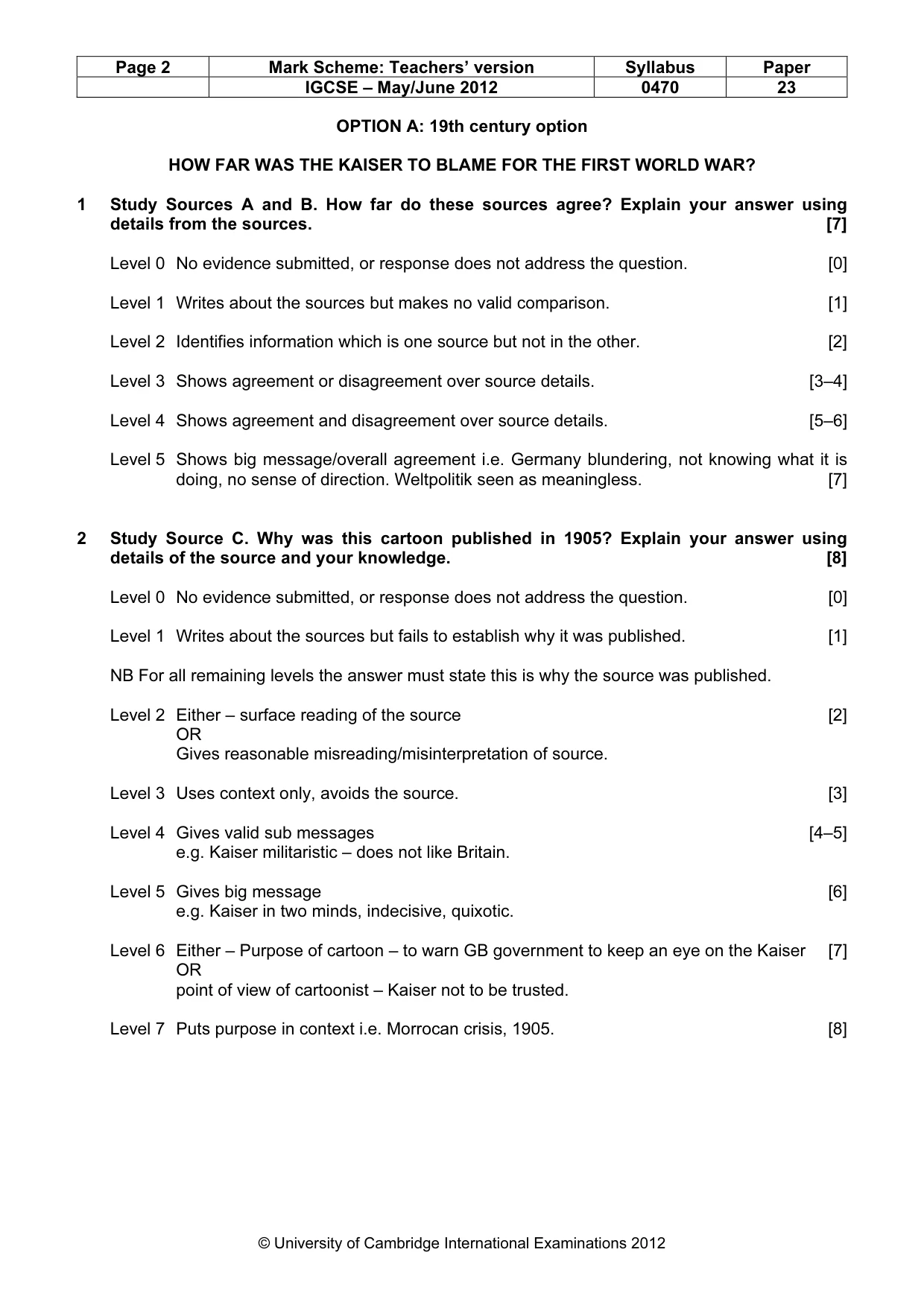
Page 2 Mark Scheme: Teachers’ version Syllabus Paper IGCSE – May/June 2012 0470 23 © University of Cambridge International Examinations 2012 OPTION A: 19th century option HOW FAR WAS THE KAISER TO BLAME FOR THE FIRST WORLD WAR? 1 Study Sources A and B. How far do these sources agree? Explain your answer using details from the sources. [7] Level 0 No evidence submitted, or response does not address the question. [0] Level 1 Writes about the sources but makes no valid comparison. [1] Level 2 Identifies information which is one source but not in the other. [2] Level 3 Shows agreement or disagreement over source details. [3–4] Level 4 Shows agreement and disagreement over source details. [5–6] Level 5 Shows big message/overall agreement i.e. Germany blundering, not knowing what it is doing, no sense of direction. Weltpolitik seen as meaningless. [7] 2 Study Source C. Why was this cartoon published in 1905? Explain your answer using details of the source and your knowledge. [8] Level 0 No evidence submitted, or response does not address the question. [0] Level 1 Writes about the sources but fails to establish why it was published. [1] NB For all remaining levels the answer must state this is why the source was published. Level 2 Either – surface reading of the source [2] OR Gives reasonable misreading/misinterpretation of source. Level 3 Uses context only, avoids the source. [3] Level 4 Gives valid sub messages [4–5] e.g. Kaiser militaristic – does not like Britain. Level 5 Gives big message [6] e.g. Kaiser in two minds, indecisive, quixotic. Level 6 Either – Purpose of cartoon – to warn GB government to keep an eye on the Kaiser [7] OR point of view of cartoonist – Kaiser not to be trusted. Level 7 Puts purpose in context i.e. Morrocan crisis, 1905. [8]
Mark scheme, page 3
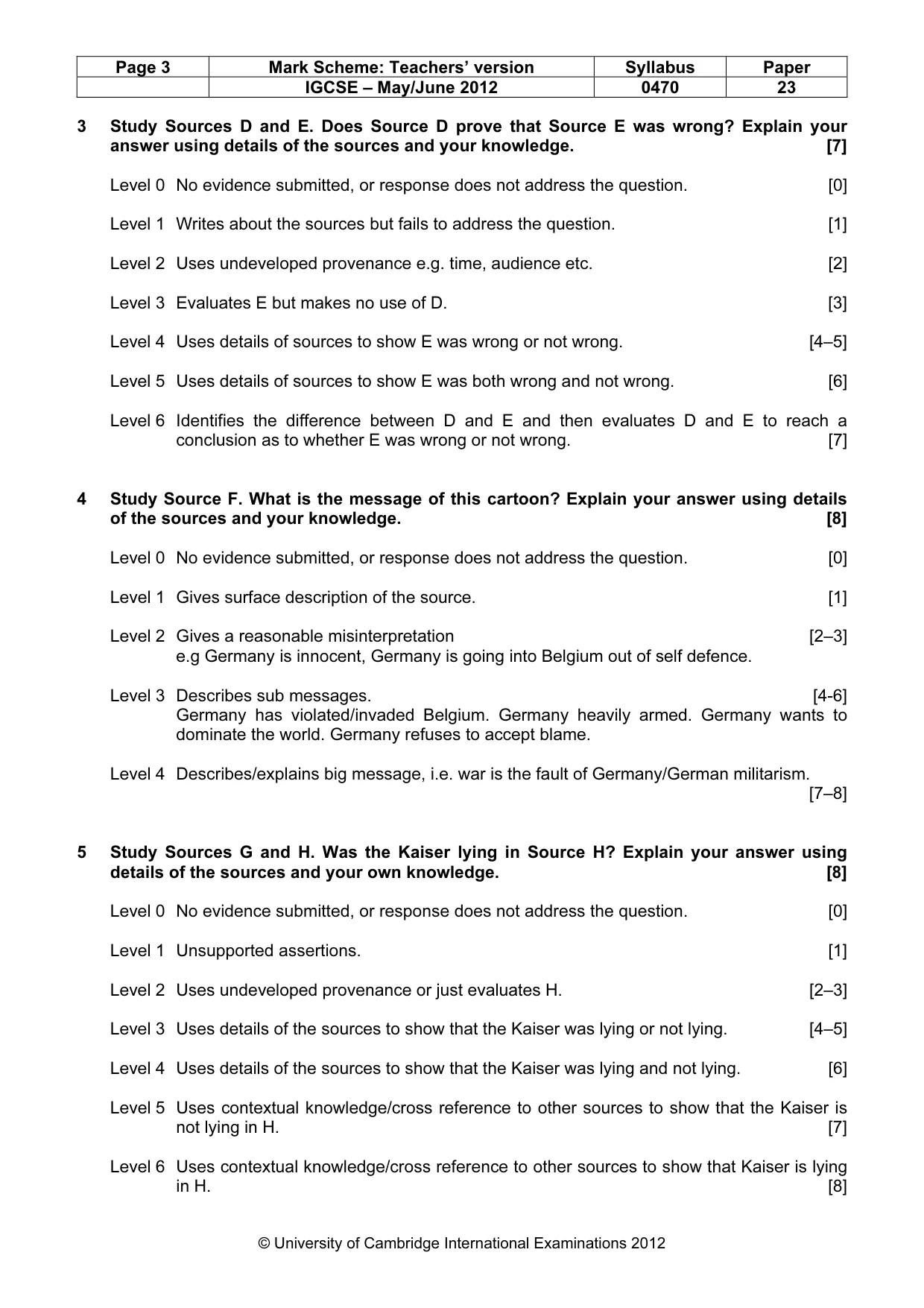
Page 3 Mark Scheme: Teachers’ version Syllabus Paper IGCSE – May/June 2012 0470 23 © University of Cambridge International Examinations 2012 3 Study Sources D and E. Does Source D prove that Source E was wrong? Explain your answer using details of the sources and your knowledge. [7] Level 0 No evidence submitted, or response does not address the question. [0] Level 1 Writes about the sources but fails to address the question. [1] Level 2 Uses undeveloped provenance e.g. time, audience etc. [2] Level 3 Evaluates E but makes no use of D. [3] Level 4 Uses details of sources to show E was wrong or not wrong. [4–5] Level 5 Uses details of sources to show E was both wrong and not wrong. [6] Level 6 Identifies the difference between D and E and then evaluates D and E to reach a conclusion as to whether E was wrong or not wrong. [7] 4 Study Source F. What is the message of this cartoon? Explain your answer using details of the sources and your knowledge. [8] Level 0 No evidence submitted, or response does not address the question. [0] Level 1 Gives surface description of the source. [1] Level 2 Gives a reasonable misinterpretation [2–3] e.g Germany is innocent, Germany is going into Belgium out of self defence. Level 3 Describes sub messages. [4-6] Germany has violated/invaded Belgium. Germany heavily armed. Germany wants to dominate the world. Germany refuses to accept blame. Level 4 Describes/explains big message, i.e. war is the fault of Germany/German militarism. [7–8] 5 Study Sources G and H. Was the Kaiser lying in Source H? Explain your answer using details of the sources and your own knowledge. [8] Level 0 No evidence submitted, or response does not address the question. [0] Level 1 Unsupported assertions. [1] Level 2 Uses undeveloped provenance or just evaluates H. [2–3] Level 3 Uses details of the sources to show that the Kaiser was lying or not lying. [4–5] Level 4 Uses details of the sources to show that the Kaiser was lying and not lying. [6] Level 5 Uses contextual knowledge/cross reference to other sources to show that the Kaiser is not lying in H. [7] Level 6 Uses contextual knowledge/cross reference to other sources to show that Kaiser is lying in H. [8]
Mark scheme, page 4
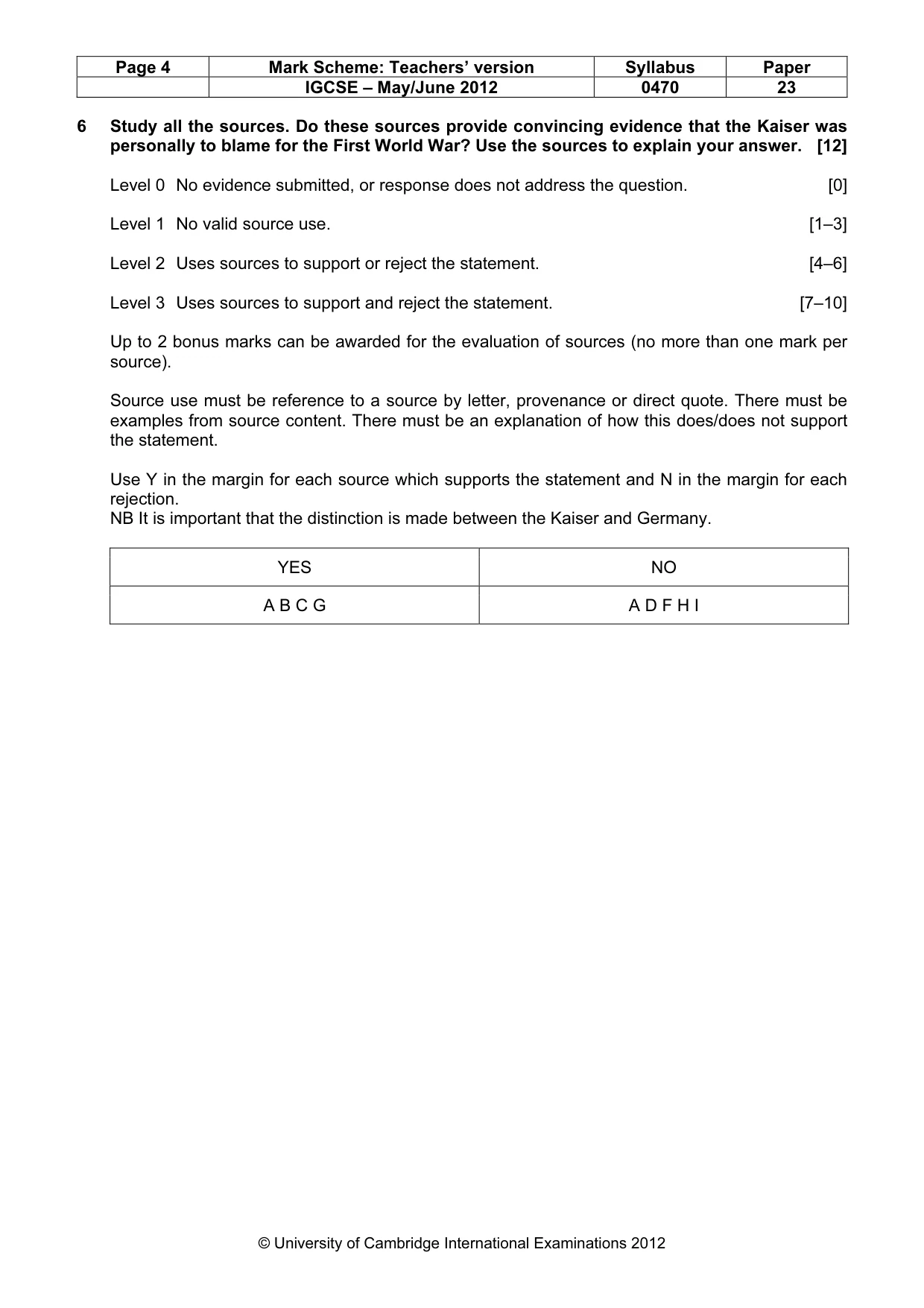
Page 4 Mark Scheme: Teachers’ version Syllabus Paper IGCSE – May/June 2012 0470 23 © University of Cambridge International Examinations 2012 6 Study all the sources. Do these sources provide convincing evidence that the Kaiser was personally to blame for the First World War? Use the sources to explain your answer. [12] Level 0 No evidence submitted, or response does not address the question. [0] Level 1 No valid source use. [1–3] Level 2 Uses sources to support or reject the statement. [4–6] Level 3 Uses sources to support and reject the statement. [7–10] Up to 2 bonus marks can be awarded for the evaluation of sources (no more than one mark per source). Source use must be reference to a source by letter, provenance or direct quote. There must be examples from source content. There must be an explanation of how this does/does not support the statement. Use Y in the margin for each source which supports the statement and N in the margin for each rejection. NB It is important that the distinction is made between the Kaiser and Germany. YES NO A B C G A D F H I
Mark scheme, page 5
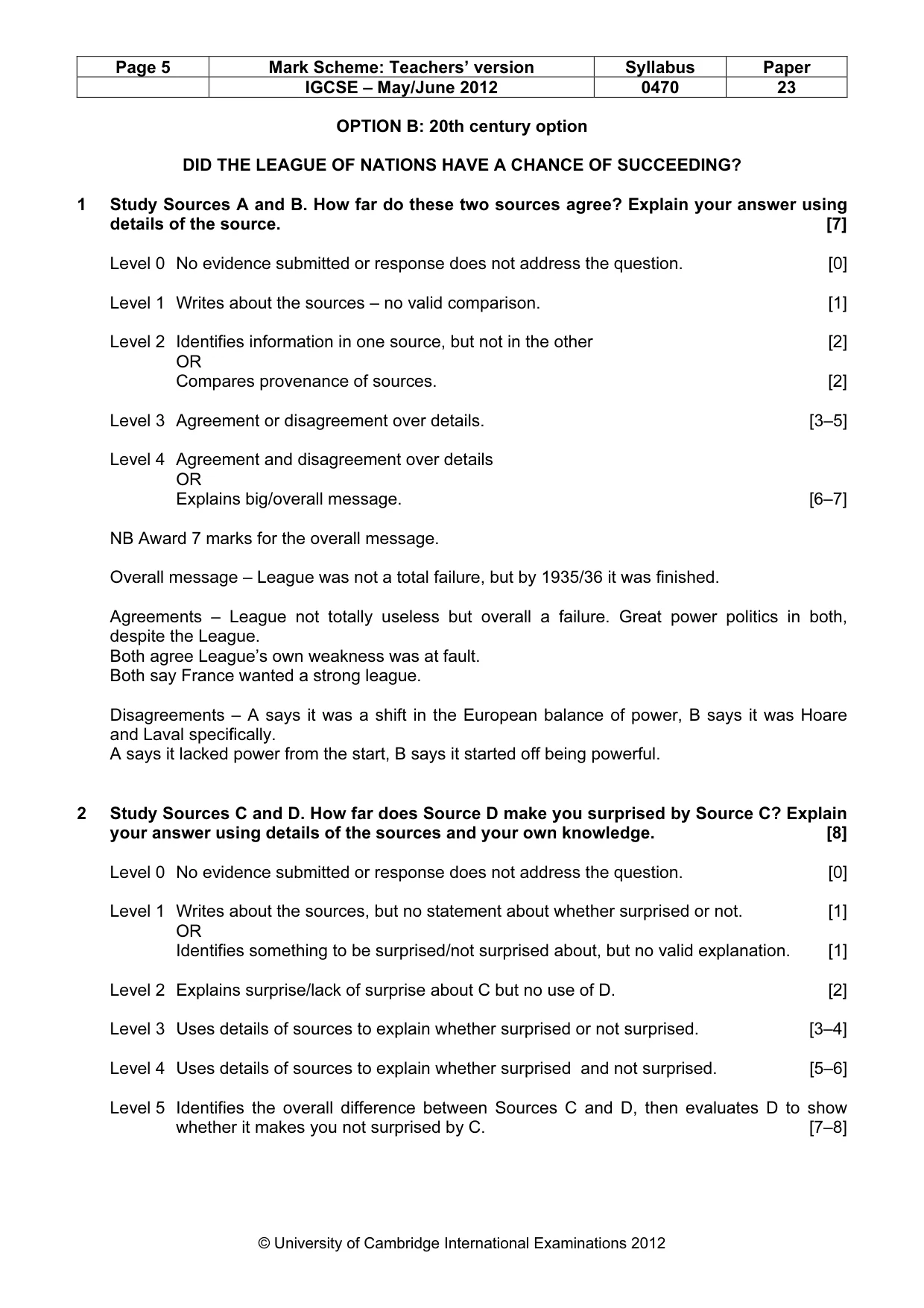
Page 5 Mark Scheme: Teachers’ version Syllabus Paper IGCSE – May/June 2012 0470 23 © University of Cambridge International Examinations 2012 OPTION B: 20th century option DID THE LEAGUE OF NATIONS HAVE A CHANCE OF SUCCEEDING? 1 Study Sources A and B. How far do these two sources agree? Explain your answer using details of the source. [7] Level 0 No evidence submitted or response does not address the question. [0] Level 1 Writes about the sources – no valid comparison. [1] Level 2 Identifies information in one source, but not in the other [2] OR Compares provenance of sources. [2] Level 3 Agreement or disagreement over details. [3–5] Level 4 Agreement and disagreement over details OR Explains big/overall message. [6–7] NB Award 7 marks for the overall message. Overall message – League was not a total failure, but by 1935/36 it was finished. Agreements – League not totally useless but overall a failure. Great power politics in both, despite the League. Both agree League’s own weakness was at fault. Both say France wanted a strong league. Disagreements – A says it was a shift in the European balance of power, B says it was Hoare and Laval specifically. A says it lacked power from the start, B says it started off being powerful. 2 Study Sources C and D. How far does Source D make you surprised by Source C? Explain your answer using details of the sources and your own knowledge. [8] Level 0 No evidence submitted or response does not address the question. [0] Level 1 Writes about the sources, but no statement about whether surprised or not. [1] OR Identifies something to be surprised/not surprised about, but no valid explanation. [1] Level 2 Explains surprise/lack of surprise about C but no use of D. [2] Level 3 Uses details of sources to explain whether surprised or not surprised. [3–4] Level 4 Uses details of sources to explain whether surprised and not surprised. [5–6] Level 5 Identifies the overall difference between Sources C and D, then evaluates D to show whether it makes you not surprised by C. [7–8]
Mark scheme, page 6
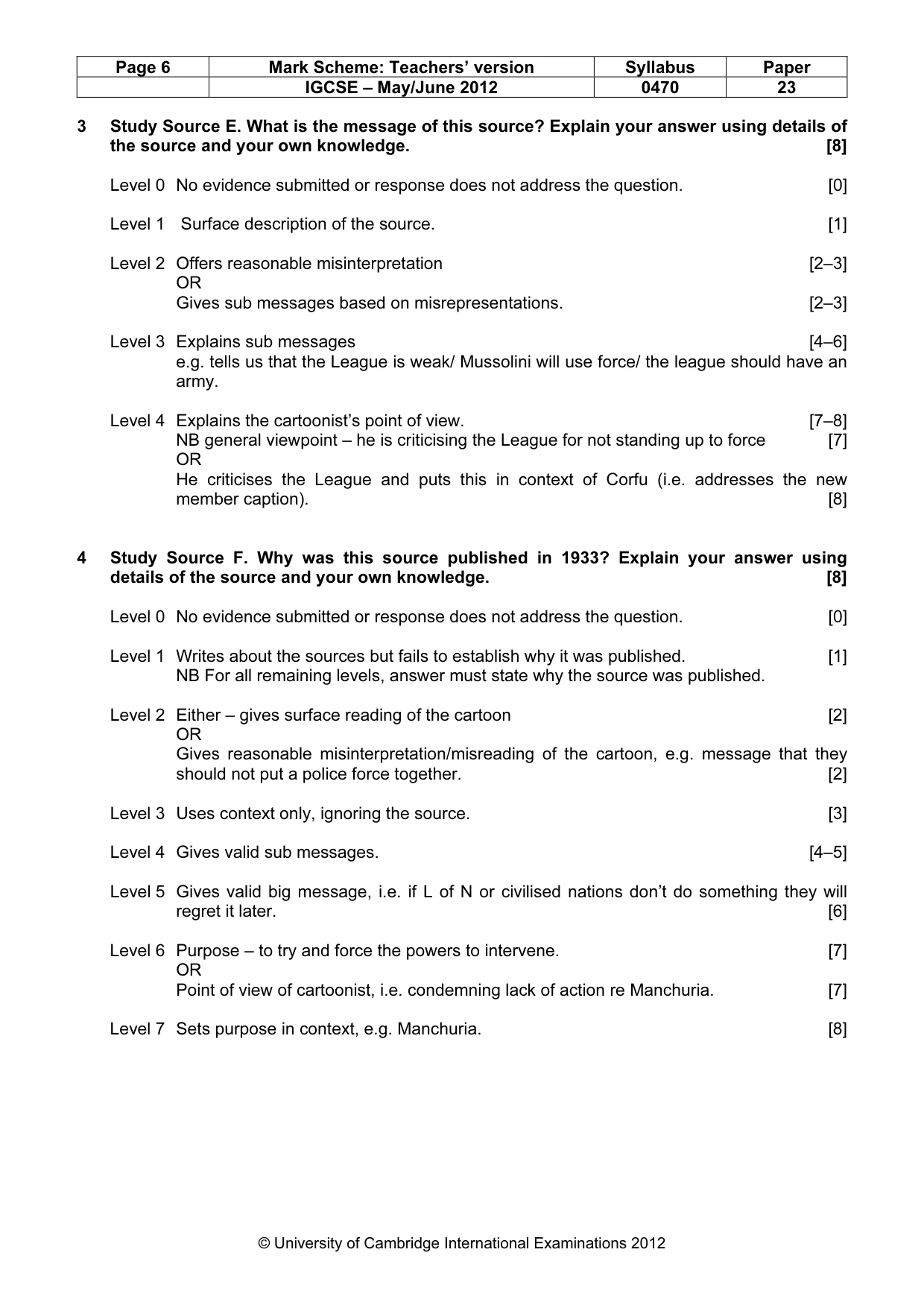
Page 6 Mark Scheme: Teachers’ version Syllabus Paper IGCSE – May/June 2012 0470 23 © University of Cambridge International Examinations 2012 3 Study Source E. What is the message of this source? Explain your answer using details of the source and your own knowledge. [8] Level 0 No evidence submitted or response does not address the question. [0] Level 1 Surface description of the source. [1] Level 2 Offers reasonable misinterpretation [2–3] OR Gives sub messages based on misrepresentations. [2–3] Level 3 Explains sub messages [4–6] e.g. tells us that the League is weak/ Mussolini will use force/ the league should have an army. Level 4 Explains the cartoonist’s point of view. [7–8] NB general viewpoint – he is criticising the League for not standing up to force [7] OR He criticises the League and puts this in context of Corfu (i.e. addresses the new member caption). [8] 4 Study Source F. Why was this source published in 1933? Explain your answer using details of the source and your own knowledge. [8] Level 0 No evidence submitted or response does not address the question. [0] Level 1 Writes about the sources but fails to establish why it was published. [1] NB For all remaining levels, answer must state why the source was published. Level 2 Either – gives surface reading of the cartoon [2] OR Gives reasonable misinterpretation/misreading of the cartoon, e.g. message that they should not put a police force together. [2] Level 3 Uses context only, ignoring the source. [3] Level 4 Gives valid sub messages. [4–5] Level 5 Gives valid big message, i.e. if L of N or civilised nations don’t do something they will regret it later. [6] Level 6 Purpose – to try and force the powers to intervene. [7] OR Point of view of cartoonist, i.e. condemning lack of action re Manchuria. [7] Level 7 Sets purpose in context, e.g. Manchuria. [8]
Mark scheme, page 7
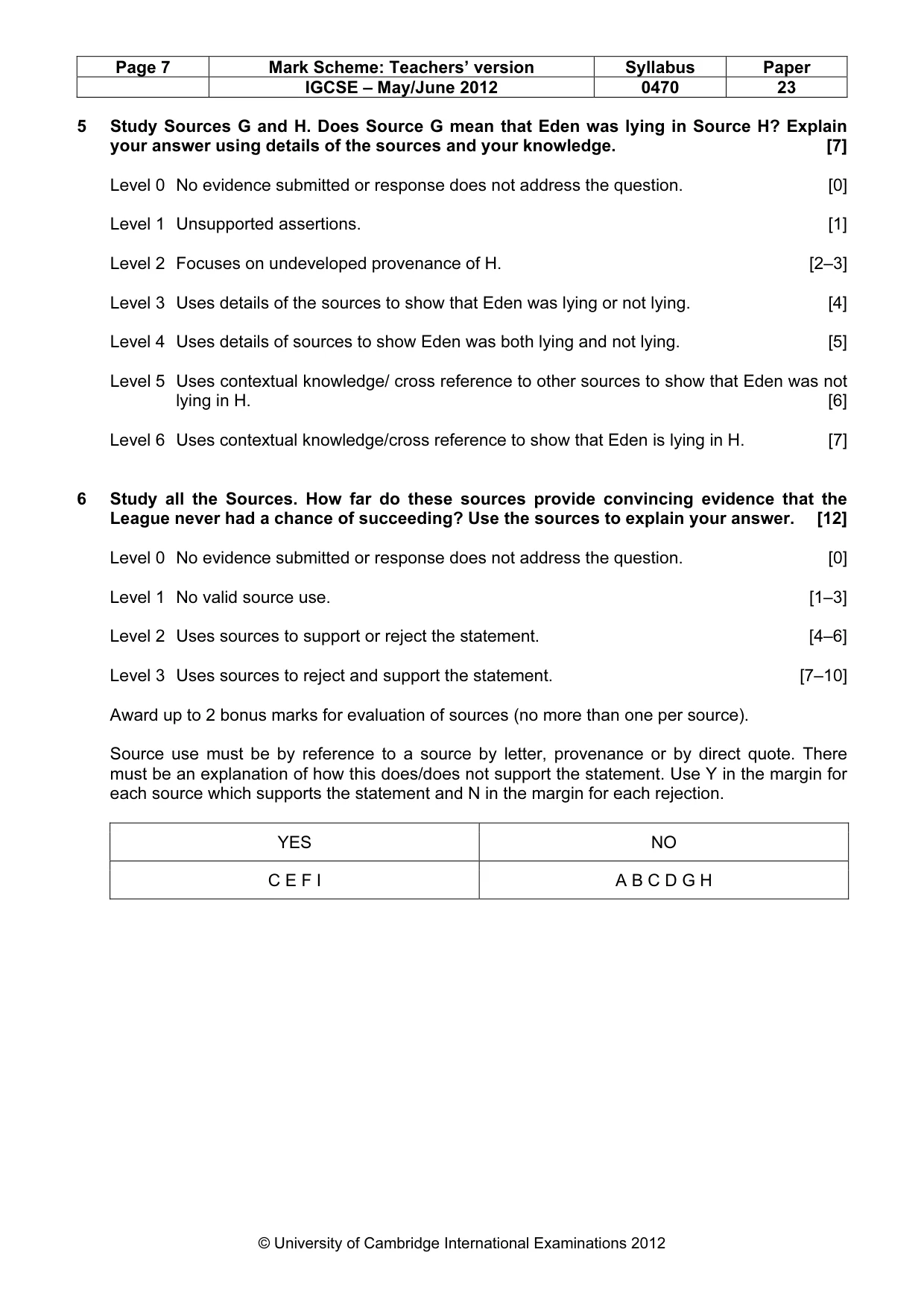
Page 7 Mark Scheme: Teachers’ version Syllabus Paper IGCSE – May/June 2012 0470 23 © University of Cambridge International Examinations 2012 5 Study Sources G and H. Does Source G mean that Eden was lying in Source H? Explain your answer using details of the sources and your knowledge. [7] Level 0 No evidence submitted or response does not address the question. [0] Level 1 Unsupported assertions. [1] Level 2 Focuses on undeveloped provenance of H. [2–3] Level 3 Uses details of the sources to show that Eden was lying or not lying. [4] Level 4 Uses details of sources to show Eden was both lying and not lying. [5] Level 5 Uses contextual knowledge/ cross reference to other sources to show that Eden was not lying in H. [6] Level 6 Uses contextual knowledge/cross reference to show that Eden is lying in H. [7] 6 Study all the Sources. How far do these sources provide convincing evidence that the League never had a chance of succeeding? Use the sources to explain your answer. [12] Level 0 No evidence submitted or response does not address the question. [0] Level 1 No valid source use. [1–3] Level 2 Uses sources to support or reject the statement. [4–6] Level 3 Uses sources to reject and support the statement. [7–10] Award up to 2 bonus marks for evaluation of sources (no more than one per source). Source use must be by reference to a source by letter, provenance or by direct quote. There must be an explanation of how this does/does not support the statement. Use Y in the margin for each source which supports the statement and N in the margin for each rejection. YES NO C E F I A B C D G H
What you needed in this session
Cambridge’s own grade thresholds for 2012 May/June, Paper 2 · Variant 3. A higher threshold means an easier paper — the bar moves with how the cohort did.