Cambridge IGCSE History 0470 — 2012 May/June Paper 1 · Variant 1
0470/11/M/J/12 · 60 marks · ≈68 min
The question paper and its mark scheme, free to read here and free to download. This is Cambridge’s own paper, exactly as it was sat.
Question paper20 pages


Mark scheme77 pages
Answers below. Sit the paper first if you are practising.
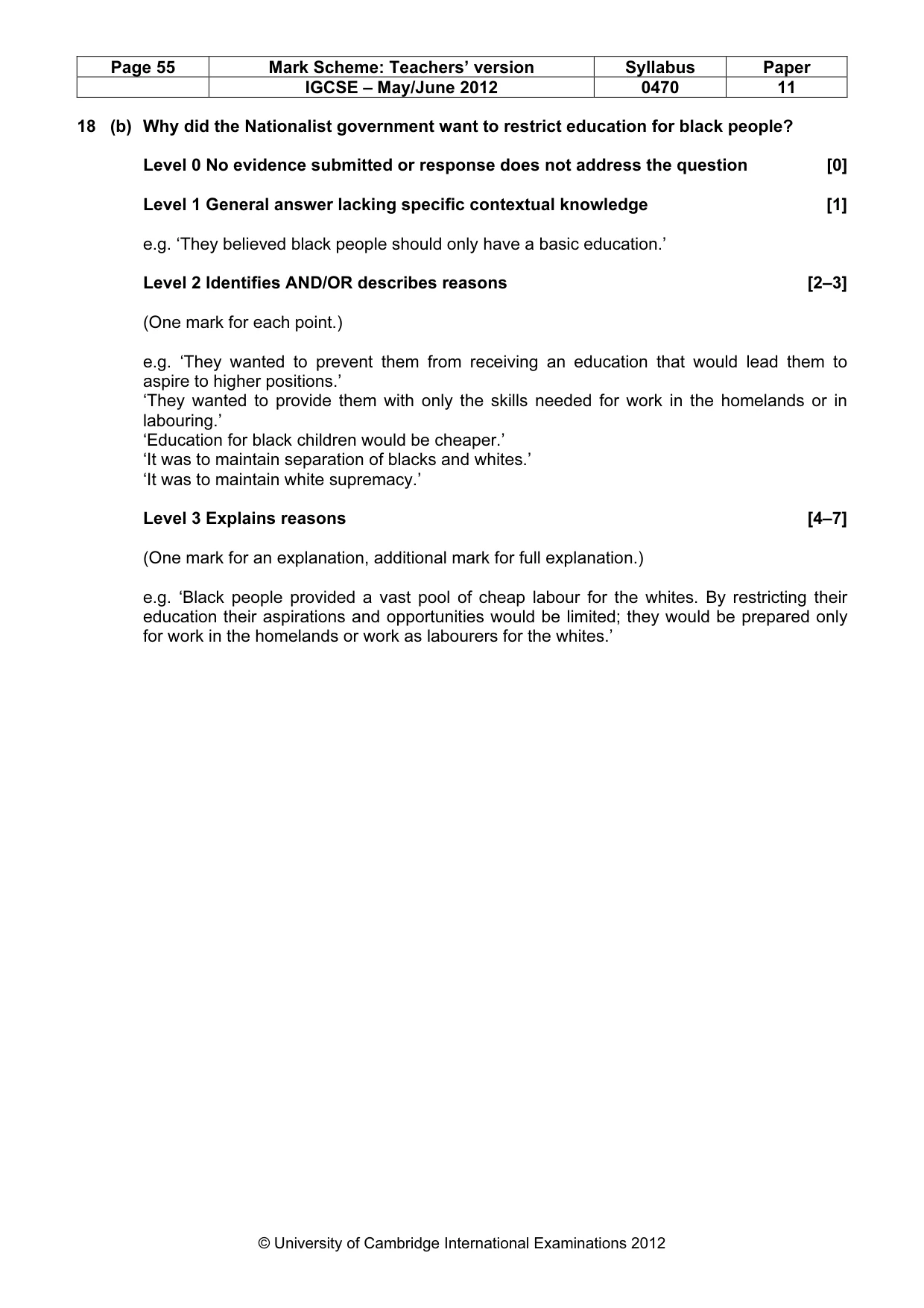
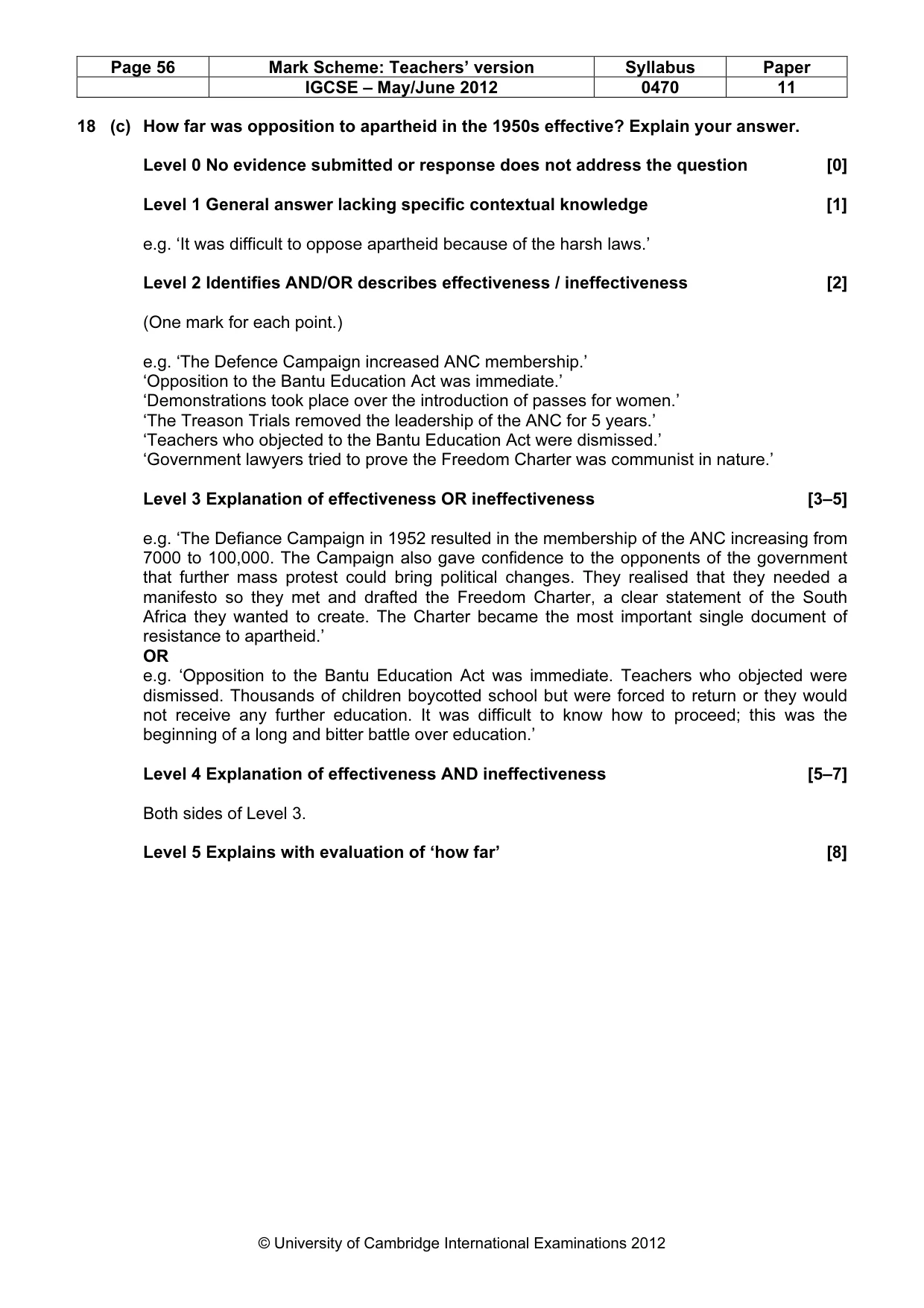
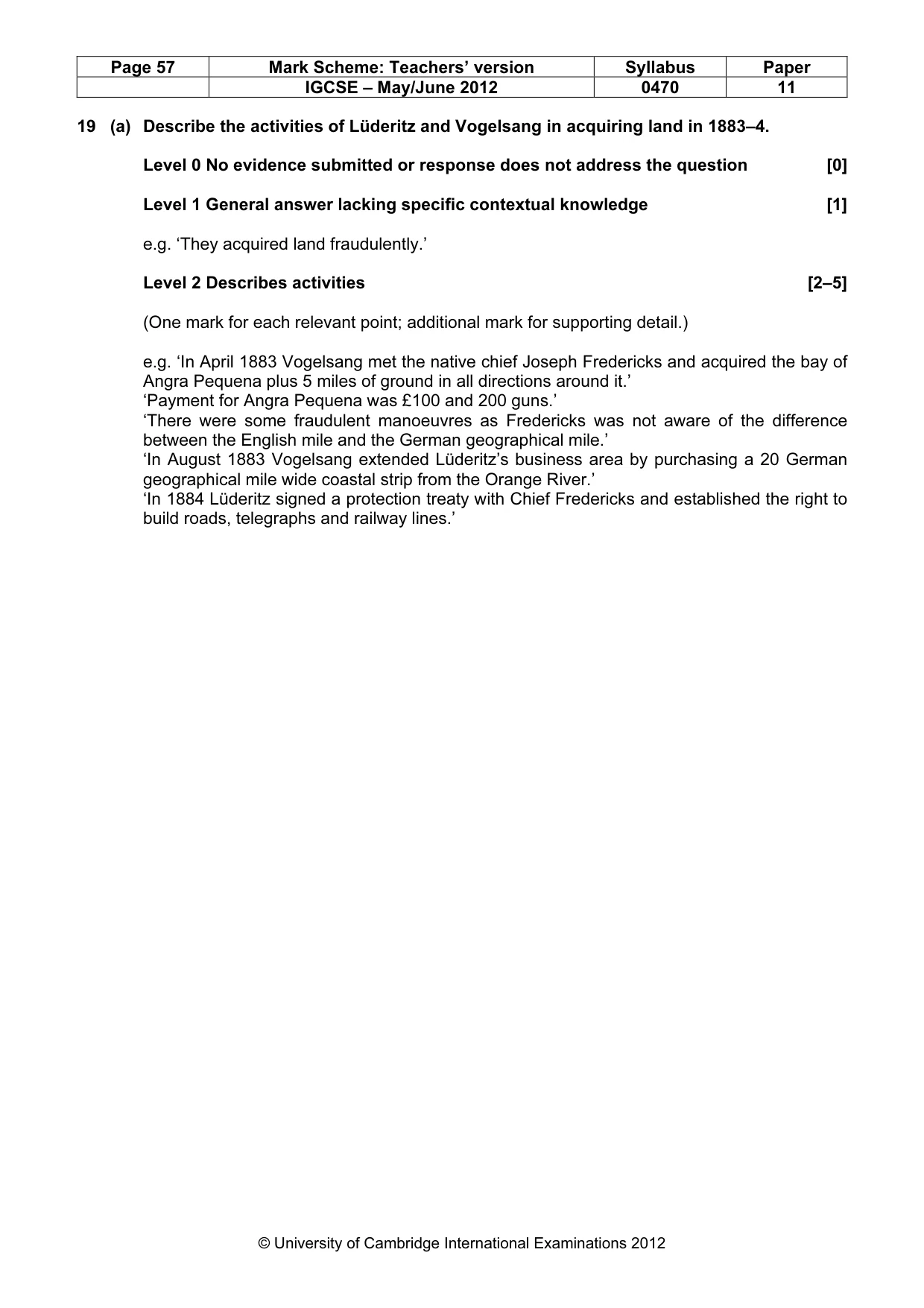
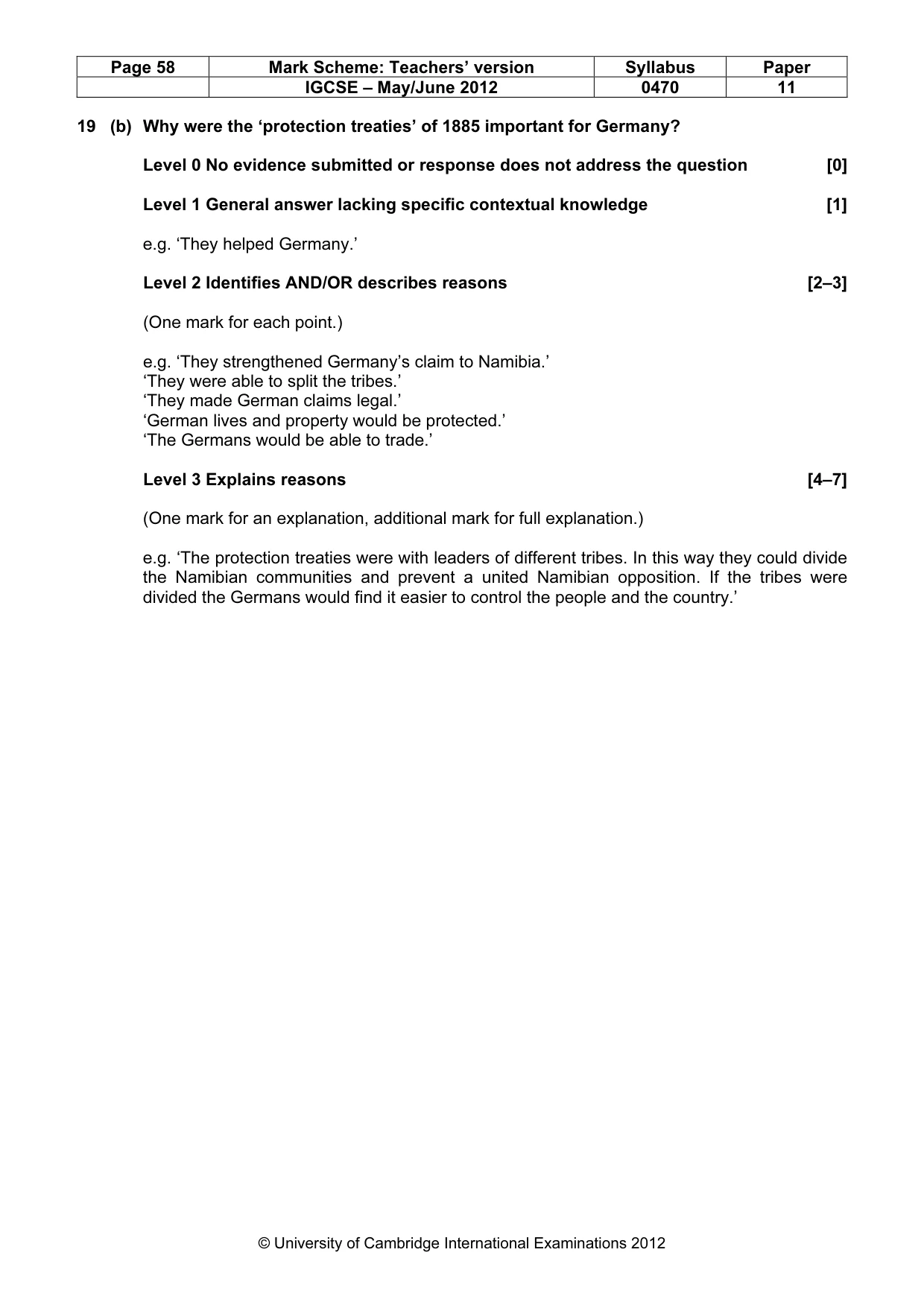
Paper as text
Question paper, page 1
This document consists of 17 printed pages and 3 blank pages. DC (NF/CGW) 50949/6 © UCLES 2012 [Turn over UNIVERSITY OF CAMBRIDGE INTERNATIONAL EXAMINATIONS International General Certificate of Secondary Education * 9 7 9 6 2 9 5 4 1 1 * HISTORY 0470/11 Paper 1 May/June 2012 2 hours Additional Materials: Answer Booklet/Paper READ THESE INSTRUCTIONS FIRST If you have been given an Answer Booklet, follow the instructions on the front cover of the Booklet. Write your Centre number, candidate number and name on all the work you hand in. Write in dark blue or black pen. You may use a soft pencil for any diagrams, graphs or rough working. Do not use staples, paper clips, highlighters, glue or correction fluid. Answer three questions. Section A (Core Content) Answer any two questions. Section B (Depth Studies) Answer any one question. At the end of the examination, fasten all your work securely together. The number of marks is given in brackets [ ] at the end of each question or part question. www.XtremePapers.com
Question paper, page 2
2 0470/11/M/J/12 © UCLES 2012 SECTION A: CORE CONTENT Answer any two questions from this Section. 1 Read the extract, and then answer the questions which follow. On 3 March 1848 Kossuth delivered a passionate speech to the Hungarian Diet. This inspirational and persuasive speech led to the passing of the ‘March Laws’. From a British history book published in 1992. (a) Describe the part played by Kossuth in the Hungarian Revolution in 1848–9. [5] (b) Why did Metternich leave Vienna? [7] (c) How successful were European revolutions in 1848–9 in achieving their aims? Explain your answer. [8] 2 Read the extract, and then answer the questions which follow. There was no Bismarck master plan. The chief characteristics of his policy were flexibility and the exploitation of opportunities. He always tried to keep alternative strategies in play. From a British history book published in 2007. (a) Describe the Schleswig-Holstein crisis of 1863–4. [5] (b) Why did France feel threatened by Germany before the Franco–Prussian War? [7] (c) How far was Bismarck responsible for German unification? Explain your answer. [8]
Question paper, page 3
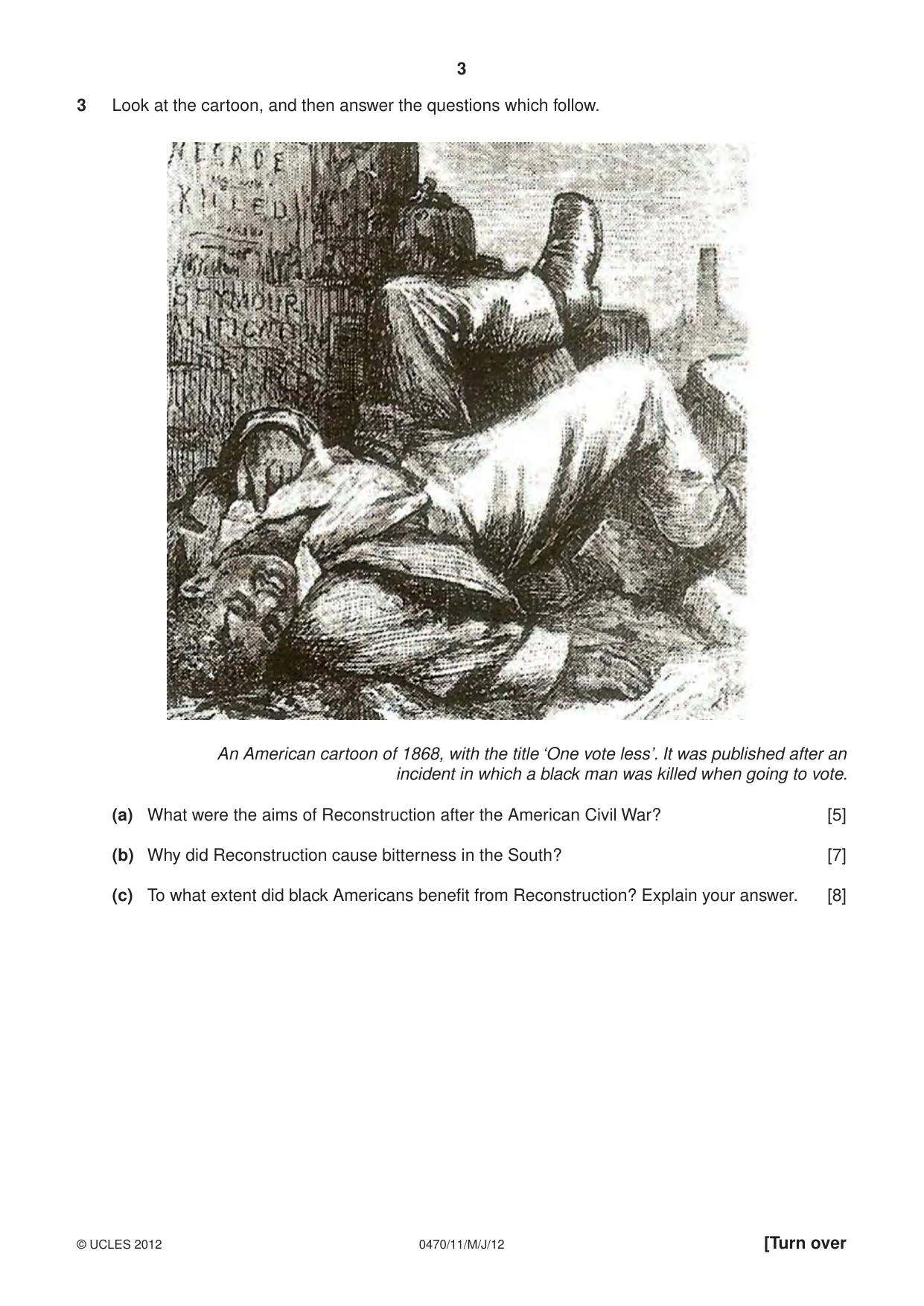
3 0470/11/M/J/12 © UCLES 2012 [Turn over 3 Look at the cartoon, and then answer the questions which follow. An American cartoon of 1868, with the title ‘One vote less’. It was published after an incident in which a black man was killed when going to vote. (a) What were the aims of Reconstruction after the American Civil War? [5] (b) Why did Reconstruction cause bitterness in the South? [7] (c) To what extent did black Americans benefit from Reconstruction? Explain your answer. [8]
Question paper, page 4
4 0470/11/M/J/12 © UCLES 2012 4 Read the extract, and then answer the questions which follow. The Americans sent an armed naval mission under Commodore Perry to negotiate with the Japanese. The Shogun was suitably impressed by the American show of force but did not know what to do. From a British history textbook published in 1985. (a) Describe Perry’s visits to Japan in 1853 and 1854. [5] (b) Why did Western countries want to establish links with Japan in the nineteenth century? [7] (c) How far did Japan accept the coming of Western influence? Explain your answer. [8] 5 Read the extract, and then answer the questions which follow. March 14, 1919. President Wilson arrived. He has started to annoy David (Lloyd George) already by talking about matters that have already been settled. Clemenceau cannot tolerate him at any price. March 28, 1919. A most unpleasant scene between Wilson and Clemenceau. From the diary of Frances Stevenson. Stevenson was secretary to Lloyd George. (a) What were the terms of the Treaty of Versailles in relation to territorial changes? [5] (b) Why was it difficult to make a peace settlement which would please all the Allies? [7] (c) ‘Most Germans were horrified by the terms of the Treaty.’ How justified was this reaction? Explain your answer. [8]
Question paper, page 5
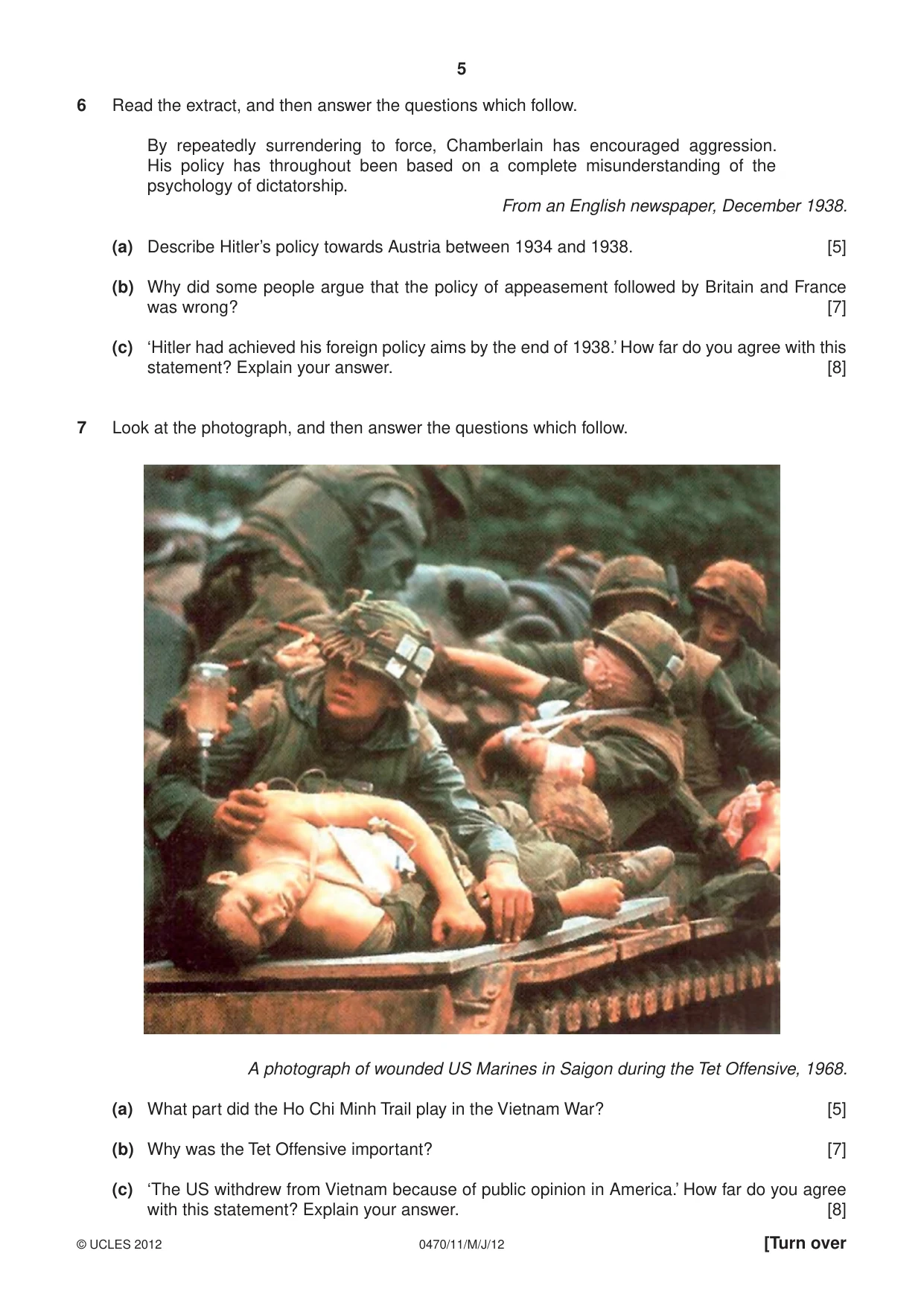
5 0470/11/M/J/12 © UCLES 2012 [Turn over 6 Read the extract, and then answer the questions which follow. By repeatedly surrendering to force, Chamberlain has encouraged aggression. His policy has throughout been based on a complete misunderstanding of the psychology of dictatorship. From an English newspaper, December 1938. (a) Describe Hitler’s policy towards Austria between 1934 and 1938. [5] (b) Why did some people argue that the policy of appeasement followed by Britain and France was wrong? [7] (c) ‘Hitler had achieved his foreign policy aims by the end of 1938.’ How far do you agree with this statement? Explain your answer. [8] 7 Look at the photograph, and then answer the questions which follow. A photograph of wounded US Marines in Saigon during the Tet Offensive, 1968. (a) What part did the Ho Chi Minh Trail play in the Vietnam War? [5] (b) Why was the Tet Offensive important? [7] (c) ‘The US withdrew from Vietnam because of public opinion in America.’ How far do you agree with this statement? Explain your answer. [8]
Question paper, page 6
6 0470/11/M/J/12 © UCLES 2012 8 Read the extract, and then answer the questions which follow. The Western powers in Berlin use it as a centre for spying against the GDR (East Germany). They smuggle their agents into the GDR to recruit spies and provoke disturbances. A Soviet explanation for the building of the Berlin Wall, 1961. (a) What actions by Nagy’s government in Hungary alarmed Khrushchev? [5] (b) Why was the Berlin Wall built in 1961? [7] (c) How far was the collapse of Soviet control over Eastern Europe due to the influence of ‘Solidarity’? Explain your answer. [8]
Question paper, page 7
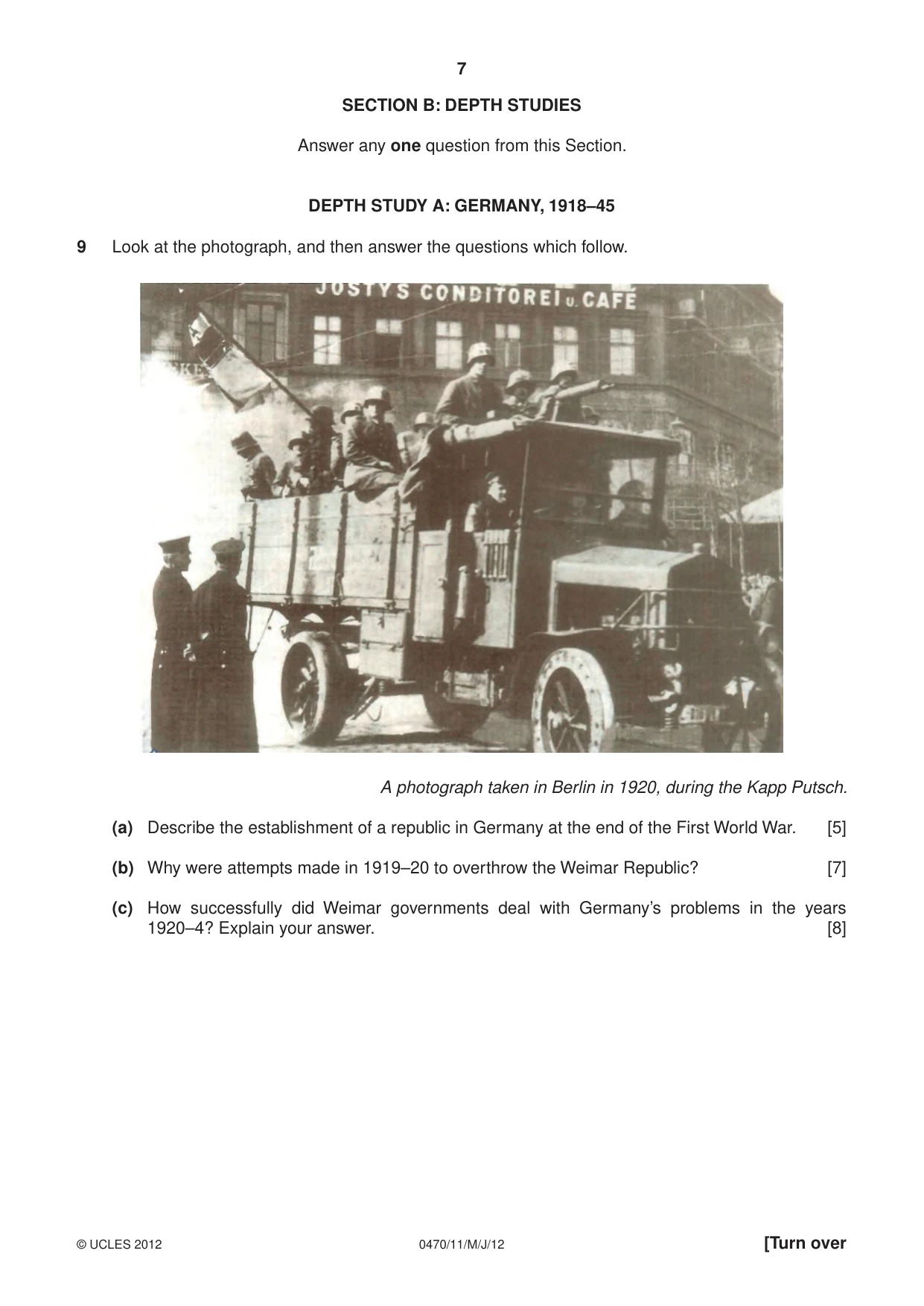
7 0470/11/M/J/12 © UCLES 2012 [Turn over SECTION B: DEPTH STUDIES Answer any one question from this Section. DEPTH STUDY A: GERMANY, 1918–45 9 Look at the photograph, and then answer the questions which follow. A photograph taken in Berlin in 1920, during the Kapp Putsch. (a) Describe the establishment of a republic in Germany at the end of the First World War. [5] (b) Why were attempts made in 1919–20 to overthrow the Weimar Republic? [7] (c) How successfully did Weimar governments deal with Germany’s problems in the years 1920–4? Explain your answer. [8]
Question paper, page 8
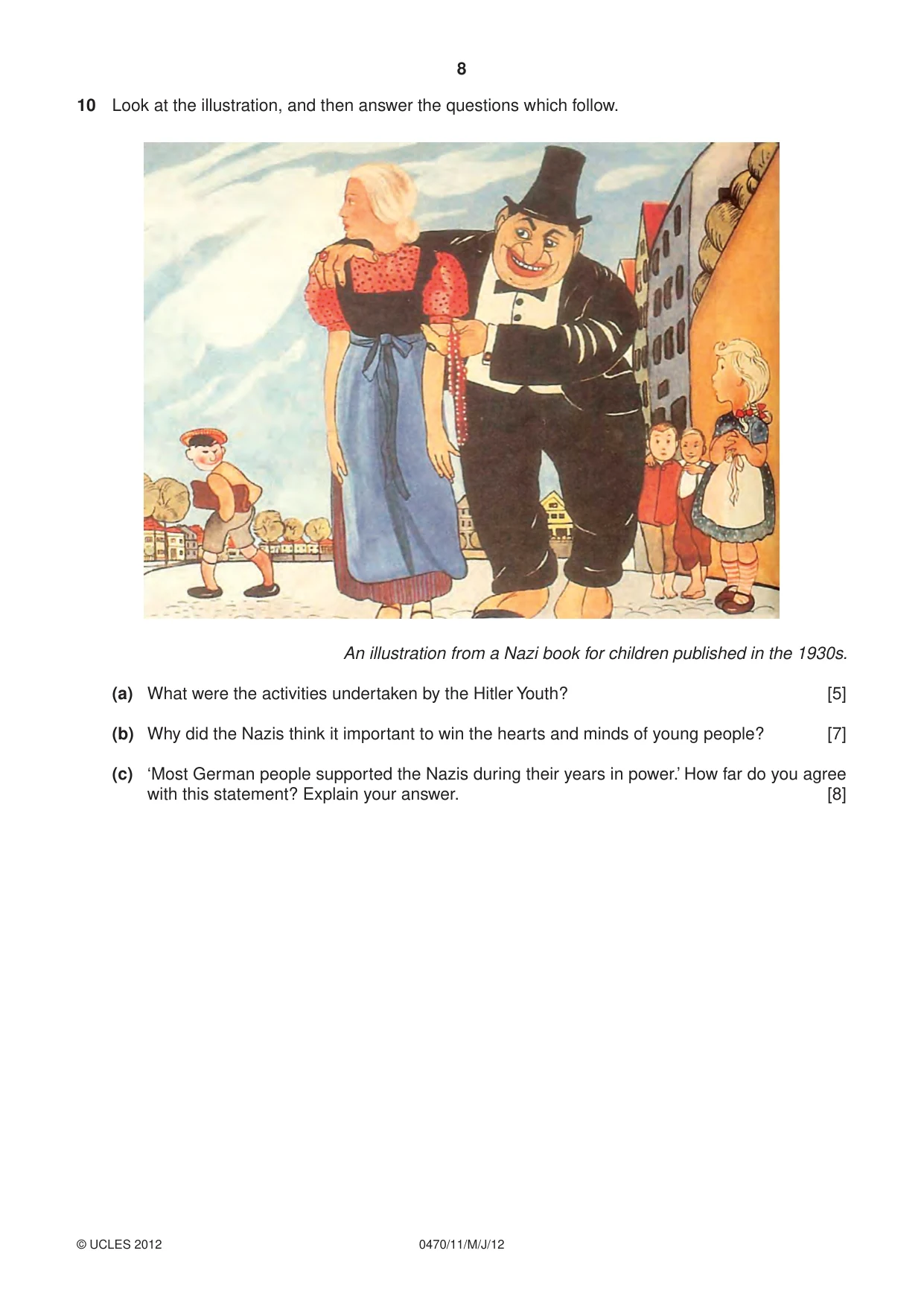
8 0470/11/M/J/12 © UCLES 2012 10 Look at the illustration, and then answer the questions which follow. An illustration from a Nazi book for children published in the 1930s. (a) What were the activities undertaken by the Hitler Youth? [5] (b) Why did the Nazis think it important to win the hearts and minds of young people? [7] (c) ‘Most German people supported the Nazis during their years in power.’ How far do you agree with this statement? Explain your answer. [8]
Question paper, page 9
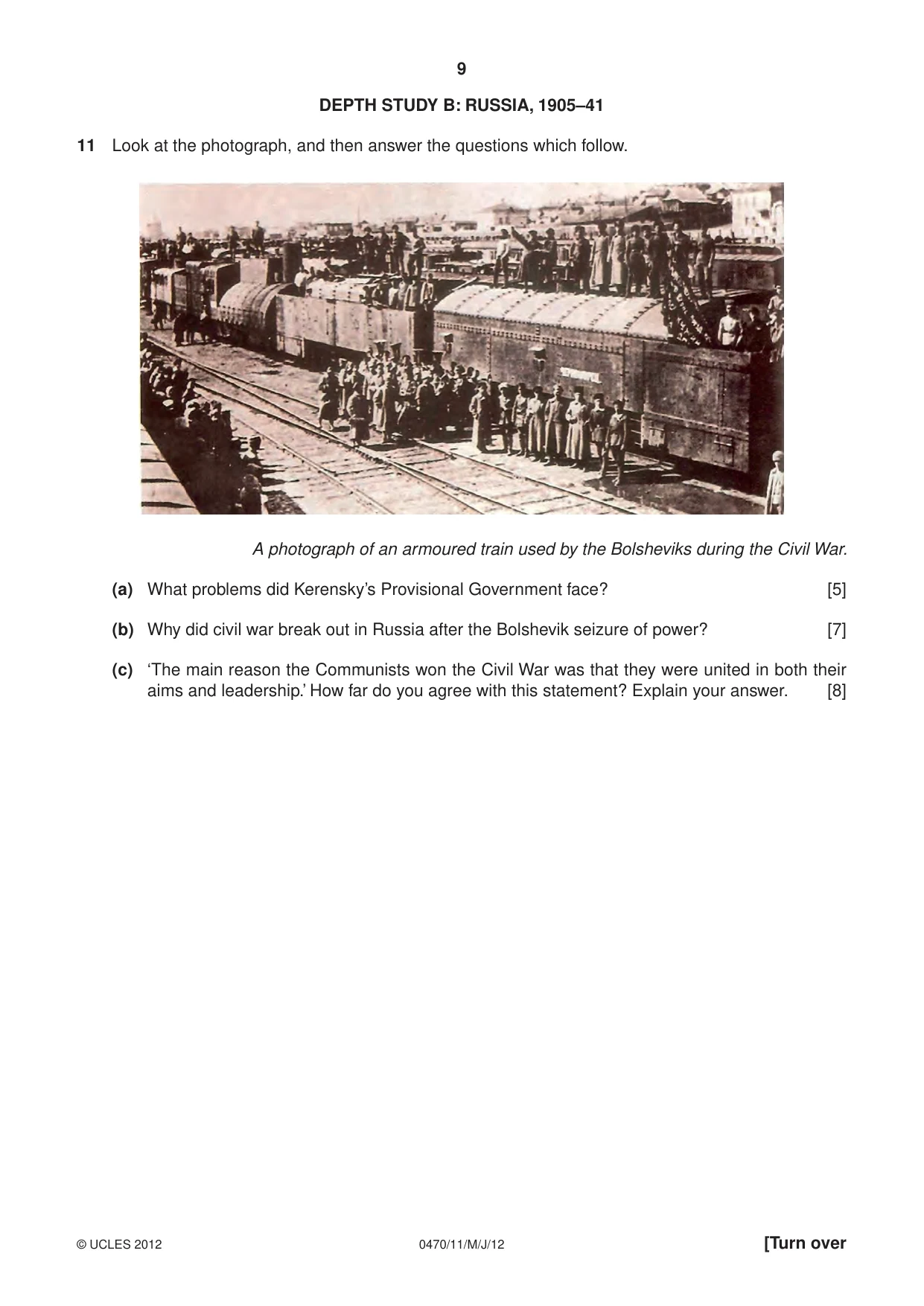
9 0470/11/M/J/12 © UCLES 2012 [Turn over DEPTH STUDY B: RUSSIA, 1905–41 11 Look at the photograph, and then answer the questions which follow. A photograph of an armoured train used by the Bolsheviks during the Civil War. (a) What problems did Kerensky’s Provisional Government face? [5] (b) Why did civil war break out in Russia after the Bolshevik seizure of power? [7] (c) ‘The main reason the Communists won the Civil War was that they were united in both their aims and leadership.’ How far do you agree with this statement? Explain your answer. [8]
Question paper, page 10
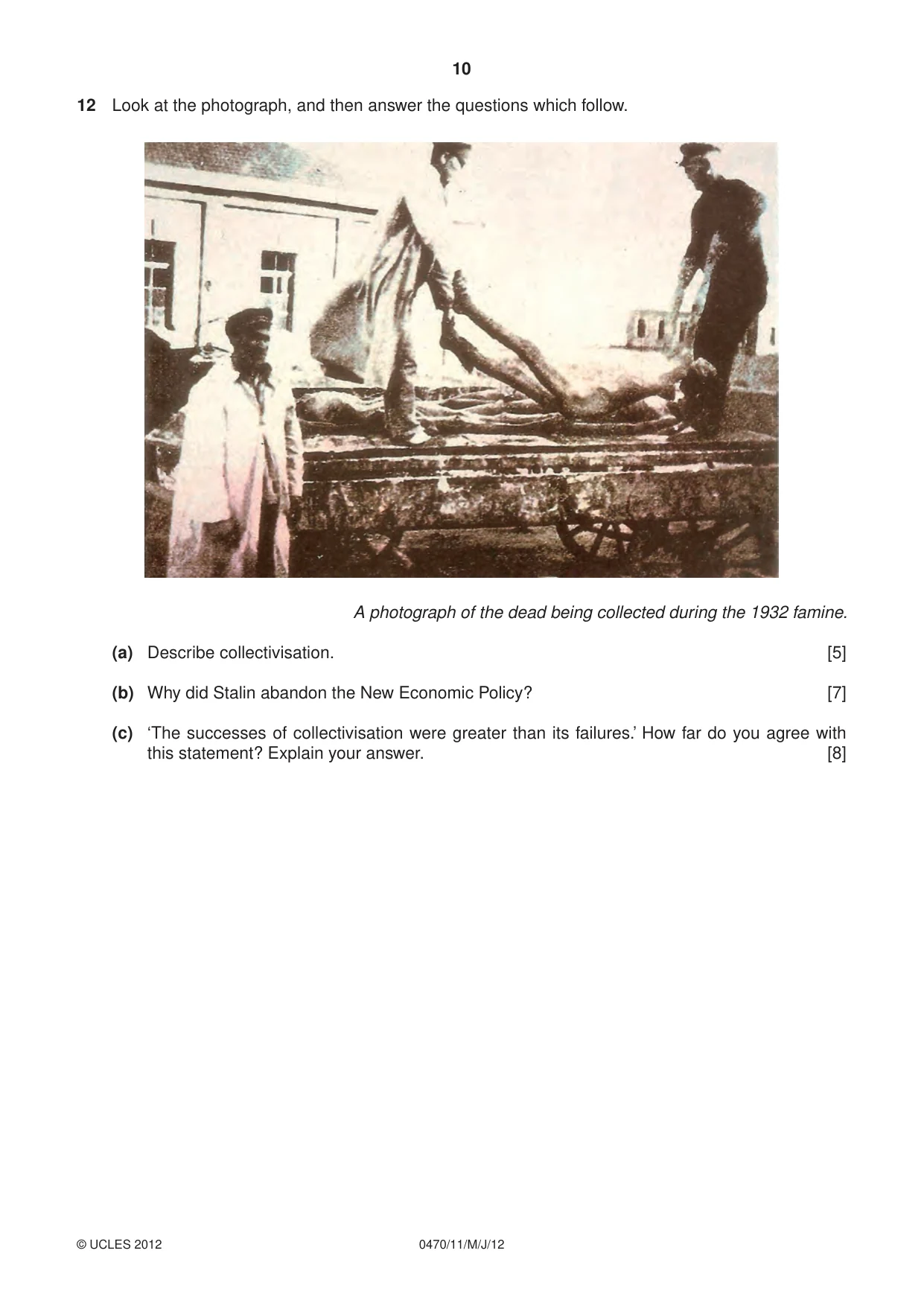
10 0470/11/M/J/12 © UCLES 2012 12 Look at the photograph, and then answer the questions which follow. A photograph of the dead being collected during the 1932 famine. (a) Describe collectivisation. [5] (b) Why did Stalin abandon the New Economic Policy? [7] (c) ‘The successes of collectivisation were greater than its failures.’ How far do you agree with this statement? Explain your answer. [8]
Question paper, page 11
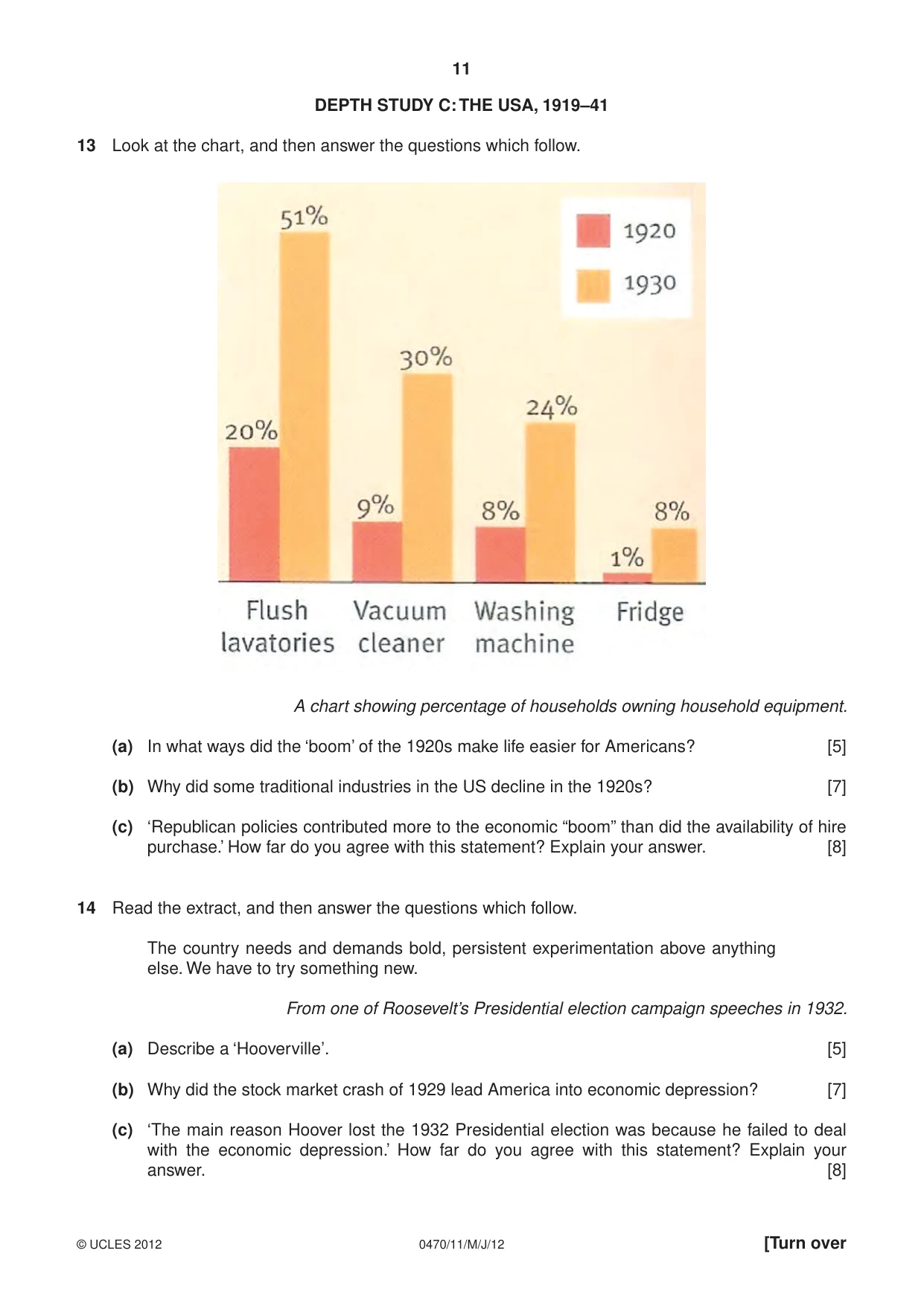
11 0470/11/M/J/12 © UCLES 2012 [Turn over DEPTH STUDY C: THE USA, 1919–41 13 Look at the chart, and then answer the questions which follow. A chart showing percentage of households owning household equipment. (a) In what ways did the ‘boom’ of the 1920s make life easier for Americans? [5] (b) Why did some traditional industries in the US decline in the 1920s? [7] (c) ‘Republican policies contributed more to the economic “boom” than did the availability of hire purchase.’ How far do you agree with this statement? Explain your answer. [8] 14 Read the extract, and then answer the questions which follow. The country needs and demands bold, persistent experimentation above anything else. We have to try something new. From one of Roosevelt’s Presidential election campaign speeches in 1932. (a) Describe a ‘Hooverville’. [5] (b) Why did the stock market crash of 1929 lead America into economic depression? [7] (c) ‘The main reason Hoover lost the 1932 Presidential election was because he failed to deal with the economic depression.’ How far do you agree with this statement? Explain your answer. [8]
Question paper, page 12
12 0470/11/M/J/12 © UCLES 2012 DEPTH STUDY D: CHINA, 1945–c.1990 15 Read the extract, and then answer the questions which follow. Nearly everyone in the Nationalist army was on the make. Officers fiddled their accounts, drawing pay for twice the men they really commanded and keeping the extra for themselves. Army stores were sold illegally to civilians. A former Nationalist army officer writing in 1945. He had left the Nationalists to join the Communists. (a) What impact did the Second World War have on the Nationalist army? [5] (b) Why was there widespread support for the Communists amongst the peasants during the Second World War? [7] (c) ‘Mao’s leadership was the main reason for the defeat of the Nationalists in the Civil War.’ How far do you agree with this statement? Explain your answer. [8] 16 Read the extract, and then answer the questions which follow. There can be no peace in Vietnam without the participation of the People’s Republic of China. That is why I have undertaken initiatives in several areas to open doors for more normal relations between our two countries. American President Richard Nixon speaking in 1971. (a) Describe what happened when Mao visited Stalin in 1949–50. [5] (b) Why did China’s relations with the Soviet Union worsen after 1956? [7] (c) ‘The tension between China and Russia was the most important reason for China’s improving relationship with the USA after 1970.’ How far do you agree with this statement? Explain your answer. [8]
Question paper, page 13
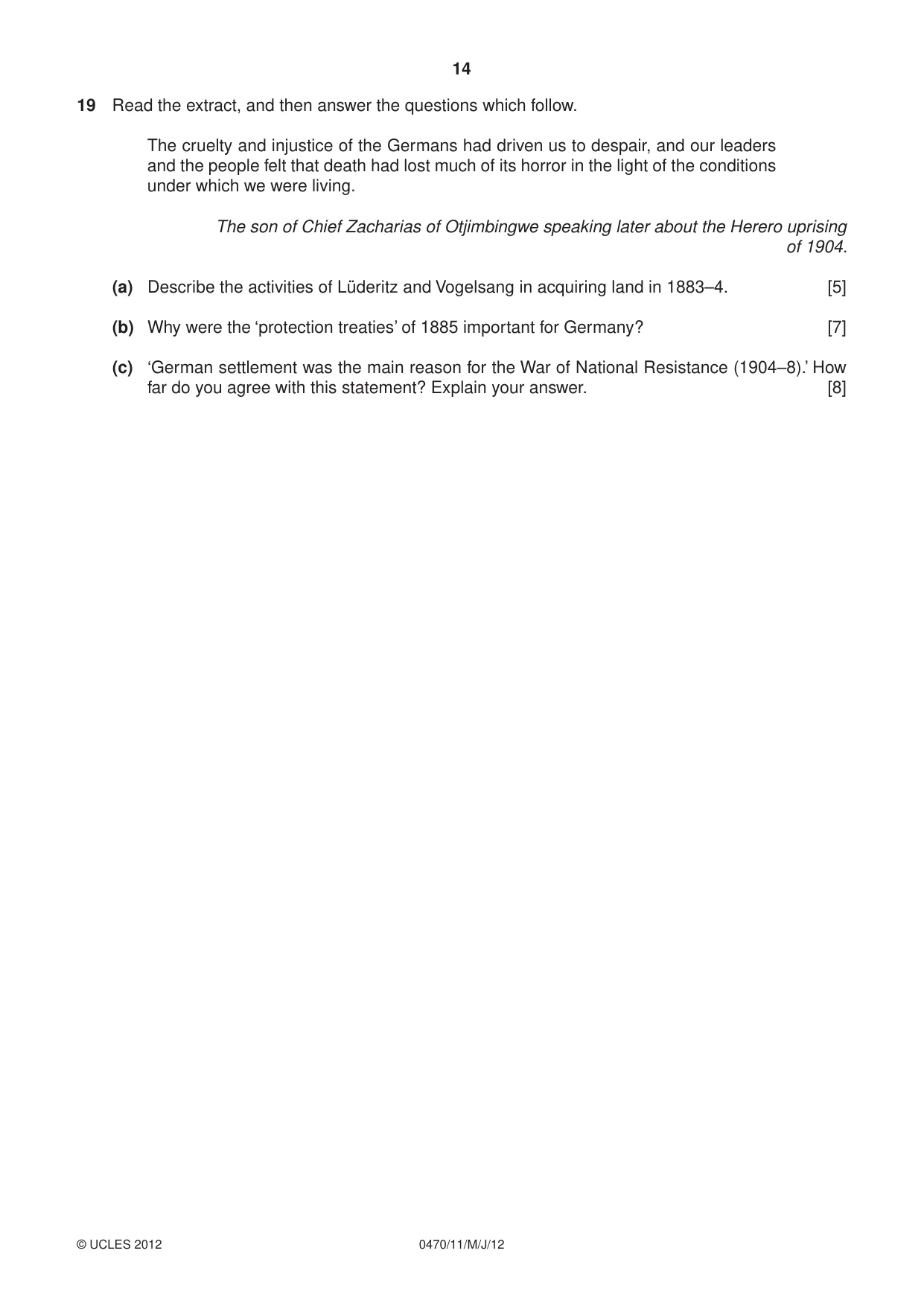
13 0470/11/M/J/12 © UCLES 2012 [Turn over DEPTH STUDY E: SOUTHERN AFRICA IN THE TWENTIETH CENTURY 17 Read the extract, and then answer the questions which follow. The 1913 Natives Land Act is considered by many people to be South Africa’s original political sin. The act, which became law on 19 June 1913, limited African land ownership and barred Africans from buying land in a significant part of South Africa set aside for white control. An historian writing in 2010. (a) Describe the formation of the Union of South Africa in 1910. [5] (b) Why were the Land Settlement Act (1912) and the Natives Land Act (1913) significant? [7] (c) ‘Development of the South African economy in the 1920s was only of benefit to the whites.’ How far do you agree with this statement? Explain your answer. [8] 18 Look at the photograph, and then answer the questions which follow. A photograph of women demonstrating against the pass laws in Johannesburg, 1955. (a) In what ways were black people restricted in movement and employment under apartheid? [5] (b) Why did the Nationalist government want to restrict education for black people? [7] (c) How far was opposition to apartheid in the 1950s effective? Explain your answer. [8]
Question paper, page 14
14 0470/11/M/J/12 © UCLES 2012 19 Read the extract, and then answer the questions which follow. The cruelty and injustice of the Germans had driven us to despair, and our leaders and the people felt that death had lost much of its horror in the light of the conditions under which we were living. The son of Chief Zacharias of Otjimbingwe speaking later about the Herero uprising of 1904. (a) Describe the activities of Lüderitz and Vogelsang in acquiring land in 1883–4. [5] (b) Why were the ‘protection treaties’ of 1885 important for Germany? [7] (c) ‘German settlement was the main reason for the War of National Resistance (1904–8).’ How far do you agree with this statement? Explain your answer. [8]
Question paper, page 15
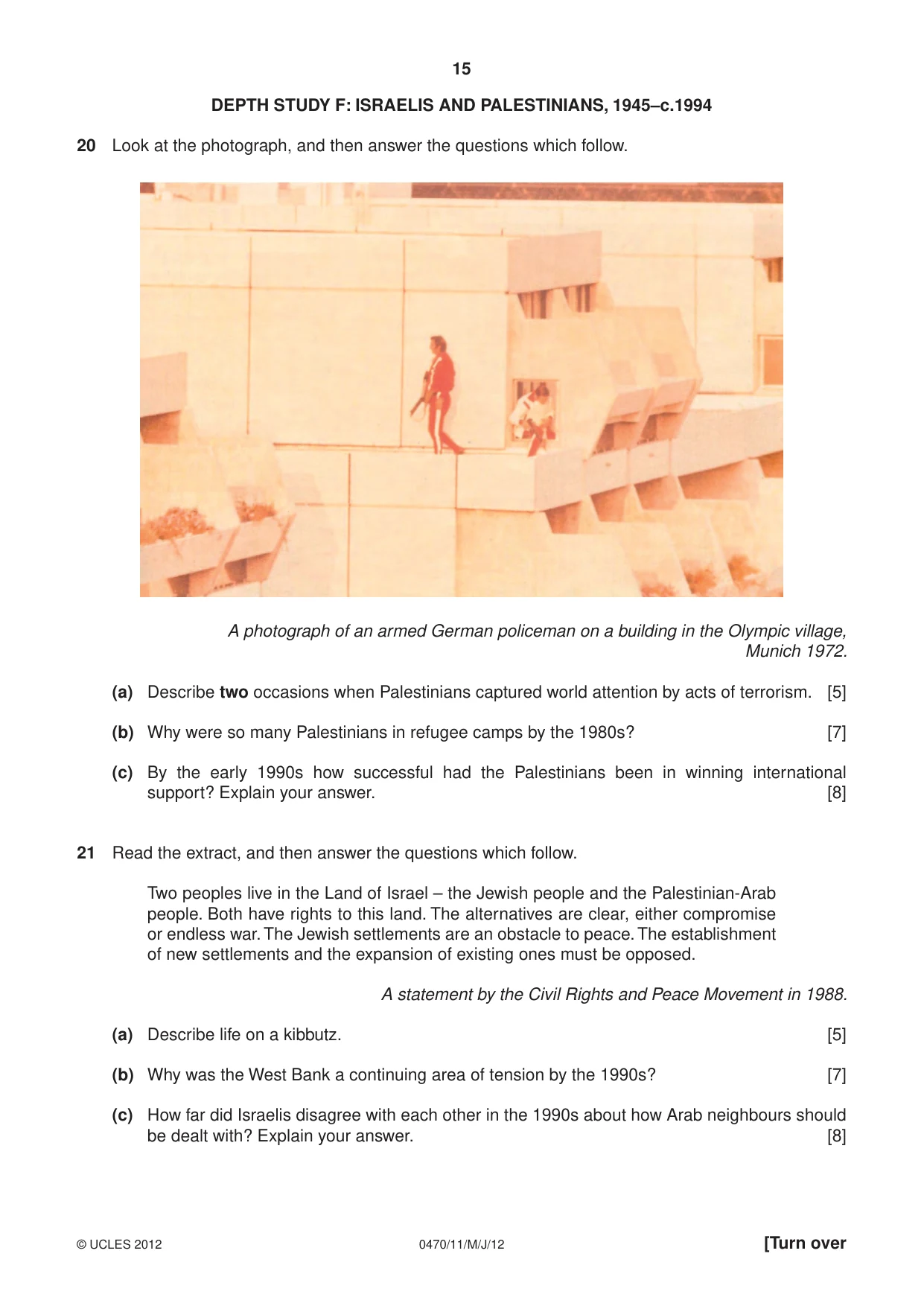
15 0470/11/M/J/12 © UCLES 2012 [Turn over DEPTH STUDY F: ISRAELIS AND PALESTINIANS, 1945–c.1994 20 Look at the photograph, and then answer the questions which follow. A photograph of an armed German policeman on a building in the Olympic village, Munich 1972. (a) Describe two occasions when Palestinians captured world attention by acts of terrorism. [5] (b) Why were so many Palestinians in refugee camps by the 1980s? [7] (c) By the early 1990s how successful had the Palestinians been in winning international support? Explain your answer. [8] 21 Read the extract, and then answer the questions which follow. Two peoples live in the Land of Israel – the Jewish people and the Palestinian-Arab people. Both have rights to this land. The alternatives are clear, either compromise or endless war. The Jewish settlements are an obstacle to peace. The establishment of new settlements and the expansion of existing ones must be opposed. A statement by the Civil Rights and Peace Movement in 1988. (a) Describe life on a kibbutz. [5] (b) Why was the West Bank a continuing area of tension by the 1990s? [7] (c) How far did Israelis disagree with each other in the 1990s about how Arab neighbours should be dealt with? Explain your answer. [8]
Question paper, page 16
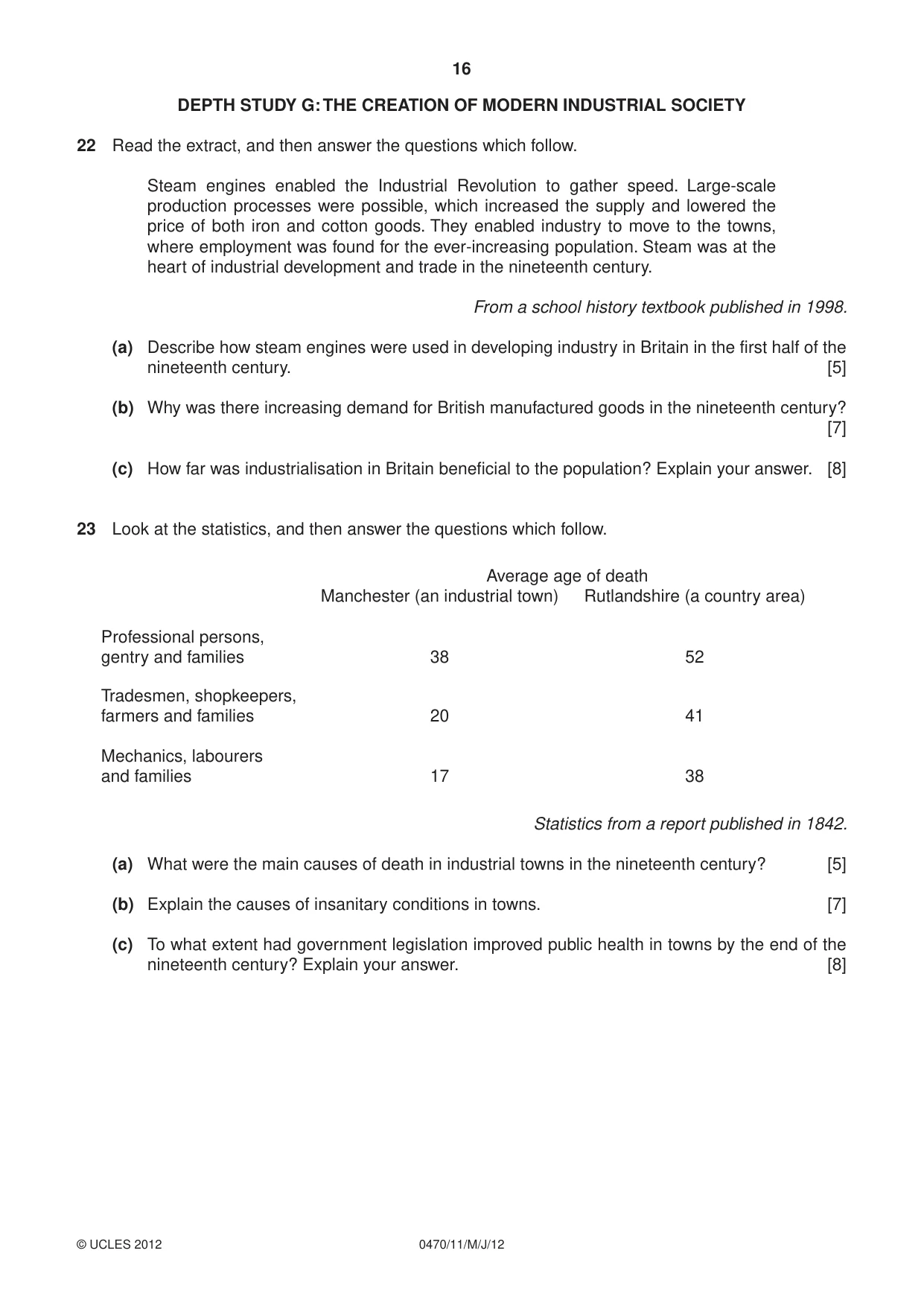
16 0470/11/M/J/12 © UCLES 2012 DEPTH STUDY G: THE CREATION OF MODERN INDUSTRIAL SOCIETY 22 Read the extract, and then answer the questions which follow. Steam engines enabled the Industrial Revolution to gather speed. Large-scale production processes were possible, which increased the supply and lowered the price of both iron and cotton goods. They enabled industry to move to the towns, where employment was found for the ever-increasing population. Steam was at the heart of industrial development and trade in the nineteenth century. From a school history textbook published in 1998. (a) Describe how steam engines were used in developing industry in Britain in the first half of the nineteenth century. [5] (b) Why was there increasing demand for British manufactured goods in the nineteenth century? [7] (c) How far was industrialisation in Britain beneficial to the population? Explain your answer. [8] 23 Look at the statistics, and then answer the questions which follow. Average age of death Manchester (an industrial town) Rutlandshire (a country area) Professional persons, gentry and families 38 52 Tradesmen, shopkeepers, farmers and families 20 41 Mechanics, labourers and families 17 38 Statistics from a report published in 1842. (a) What were the main causes of death in industrial towns in the nineteenth century? [5] (b) Explain the causes of insanitary conditions in towns. [7] (c) To what extent had government legislation improved public health in towns by the end of the nineteenth century? Explain your answer. [8]
Question paper, page 17
17 0470/11/M/J/12 © UCLES 2012 DEPTH STUDY H: THE IMPACT OF WESTERN IMPERIALISM IN THE NINETEENTH CENTURY 24 Read the extract, and then answer the questions which follow. In order to protect existing trade routes, particularly to India, and the development of new routes for imperial trade, it was necessary for the British navy to strengthen its strategic power on a global scale. In effect this meant having more territorial bases. From a British school textbook published in 2004. (a) What did nineteenth-century missionaries hope to achieve? [5] (b) Why did Britain have a large empire by the end of the nineteenth century? [7] (c) How far did imperialism benefit Britain more than its colonies? Explain your answer. [8] 25 Look at the photograph, and then answer the questions which follow. Victoria Railway Station, Bombay. (a) What proposals did Bentinck make to change India? [5] (b) Why were many Indians opposed to Bentinck’s proposals? [7] (c) How far did Britain try to govern India for the benefit of the Indians in the second half of the nineteenth century? Explain your answer. [8]
Question paper, page 18
18 0470/11/M/J/12 © UCLES 2012 BLANK PAGE
Question paper, page 19
19 0470/11/M/J/12 © UCLES 2012 BLANK PAGE
Question paper, page 20
20 0470/11/M/J/12 © UCLES 2012 BLANK PAGE Copyright Acknowledgements: Question 1 © Eric Wilmot; The Great Powers 1814–1914; Nelson Thornes; 1992. Question 2 © Alan Farmer & Andrina Stiles; The Unification of Germany 1815–1919; Hodder Education; 2007. Question 3 © E Wright; History of the Modern World; Chancellor Press; 1992. Question 4 © Philip Sauvain; European and World History 1815–1919; Hulton; 1985. Question 5 © Steven Waugh; Essential Modern World History; Nelson Thornes; 2001. Questions 6, 7, 8, 10 & 11 © Ben Walsh; GCSE Modern World History; Hodder Education; 2009. Question 9 © David Ferriby et al; Twentieth Century Depth Studies; Nelson Thornes; 2009. Question 12 © Terry Fiehn; Russia and the USSR 1905–1941; John Murray; 1996. Questions 13 & 14 © Alex Brodkin et al; Modern World History; Heinemann; 2009. Questions 15 & 16 © Ben Walsh; Modern World History; John Murray; 1996. Question 18 © Martin Roberts; South Africa 1948–1994; Longman; 1996. Question 19 © Nangolo Mbumba & Norbert H Noisser; Namibia in History; Zed Books; 1988. Questions 20 & 21 © Tony McAleavy; The Arab-Israeli Conflict; Cambridge University Press; 1998. Question 22 © Richard Staton, Ray Ennion & Wendy Moore; Three Centuries of Change; Collins Educational; 1998. Question 24 © John Aldred; British Imperial and Foreign Policy 1846–1980; Heinemann; 2004. Question 25 © http://www.probertencyclopaedia.com Date accessed 8 November 2010. Permission to reproduce items where third-party owned material protected by copyright is included has been sought and cleared where possible. Every reasonable effort has been made by the publisher (UCLES) to trace copyright holders, but if any items requiring clearance have unwittingly been included, the publisher will be pleased to make amends at the earliest possible opportunity. University of Cambridge International Examinations is part of the Cambridge Assessment Group. Cambridge Assessment is the brand name of University of Cambridge Local Examinations Syndicate (UCLES), which is itself a department of the University of Cambridge.
Mark scheme, page 1
UNIVERSITY OF CAMBRIDGE INTERNATIONAL EXAMINATIONS International General Certificate of Secondary Education MARK SCHEME for the May/June 2012 question paper for the guidance of teachers 0470 HISTORY 0470/11 Paper 1, maximum raw mark 60 This mark scheme is published as an aid to teachers and candidates, to indicate the requirements of the examination. It shows the basis on which Examiners were instructed to award marks. It does not indicate the details of the discussions that took place at an Examiners’ meeting before marking began, which would have considered the acceptability of alternative answers. Mark schemes must be read in conjunction with the question papers and the report on the examination. • Cambridge will not enter into discussions or correspondence in connection with these mark schemes. Cambridge is publishing the mark schemes for the May/June 2012 question papers for most IGCSE, GCE Advanced Level and Advanced Subsidiary Level syllabuses and some Ordinary Level syllabuses. www.XtremePapers.com
Mark scheme, page 2
Page 2 Mark Scheme: Teachers’ version Syllabus Paper IGCSE – May/June 2012 0470 11 © University of Cambridge International Examinations 2012 1 Use of the Mark Scheme 1.1 It is not possible to cover every possible type of response within a levels of response mark scheme and examiners are expected to use their professional judgement at all times in ensuring that responses are placed in the correct levels and given an appropriate mark within that level. 1.2 Marking must be positive. Marks must not be deducted for inaccurate or irrelevant answers. Half-marks must not be used. 1.3 The full range of marks should be used. Do not be afraid to award full marks or no marks. Failure to do this will seriously affect the distribution of marks. Be prepared to reward candidates who show any level of understanding. The mark scheme starts from basic acceptable response. 1.4 Be consistent from script to script and from batch to batch. 1.5 Indicate that all answers have been seen. 1.6 Do not transfer marks from one part of a question to another. 1.7 If a candidate reaches a particular level s/he must be rewarded with a mark within that level. It is not necessary to work through the levels. 1.8 Exhaustive lists of possible facts are not given in the mark scheme, as there is often a choice of factual knowledge that candidates may use. 1.9 WHERE EXAMPLES OF RESPONSES ARE GIVEN, THESE ARE NOT PRESCRIPTIVE, BUT ARE INTENDED AS A GUIDE. 1.10 Where a band of marks is indicated for a level these marks should be used with reference to the development of the answer within that level. 2 Marking 2.1 All marking should be in red. 2.2 The level, and mark awarded for each part question, MUST be shown clearly in the margin of the script towards the end of an answer, e.g. L3/8. 2.3 At the end of each question the total mark achieved by the candidate for that question MUST be indicated in a circle. 2.4 The total mark for each question should be transferred to the front page of the script. The marks for the three questions should be totalled and indicated. The final total for the script should then be circled. 2.5 It is not necessary to tick the body of an answer and examiners should refrain from doing so. 2.6 Examiners must indicate, in the body of the response, where a level has been achieved and, where appropriate, marks are gained. 3 Assessment Objectives 3.1 The Assessment Objectives being tested in each part of a question are: (a) recall, description (b) recall, explanation (c) recall, explanation and analysis.
Mark scheme, page 3
Page 3 Mark Scheme: Teachers’ version Syllabus Paper IGCSE – May/June 2012 0470 11 © University of Cambridge International Examinations 2012 1 (a) Describe the part played by Kossuth in the Hungarian Revolution in 1848–9. Level 0 No evidence submitted or response does not address the question [0] Level 1 General answer lacking specific contextual knowledge [1] e.g. ‘Kossuth was a leading figure.’ Level 2 Describes Kossuth’s role [2–5] (One mark for each relevant point; additional mark for supporting detail.) e.g. ‘In 1848 Kossuth addressed the Hungarian Diet and demanded independence for Hungary within the Empire.’ ‘Kossuth was a brilliant speaker with a sense of direction, able to inspire people into action.’ ‘Kossuth demanded the immediate implementation of the 1847 reforms which had already been agreed by the Diet.’ ‘Kossuth was a Magyar and believed that Croat and Slovak nationalism had no place in the new Hungary.’ ‘Kossuth declared Hungary an independent republic, with himself as president.’ ‘After the Hungarian surrender to Russia Kossuth fled.’
Mark scheme, page 4
Page 4 Mark Scheme: Teachers’ version Syllabus Paper IGCSE – May/June 2012 0470 11 © University of Cambridge International Examinations 2012 1 (b) Why did Metternich leave Vienna? Level 0 No evidence submitted or response does not address the question [0] Level 1 General answer lacking specific contextual knowledge [1] e.g. ‘He left Vienna because there were problems.’ Level 2 Identifies AND/OR describes reasons [2–3] (One mark for each point.) e.g. ‘Revolution in France contributed to revolution in Austria.’ ‘Kossuth’s speech inspired Austrians to demonstrate.’ ‘There were mass demonstrations in Vienna.’ ‘There was widespread looting in working class areas of Vienna.’ ‘There was a conspiracy within the Imperial Court to make Metternich resign.’ ‘Middle class liberals in Vienna wanted reform.’ Level 3 Explains reasons [4–7] (One mark for an explanation, additional mark for full explanation.) e.g. ‘Metternich was a symbol of the old order. Events in France had helped to spark revolution in Austria and there was an increasing demand for liberal reform. Middle class liberal opposition in Vienna wanted Metternich to resign.’
Mark scheme, page 5
Page 5 Mark Scheme: Teachers’ version Syllabus Paper IGCSE – May/June 2012 0470 11 © University of Cambridge International Examinations 2012 1 (c) How successful were European revolutions in 1848–9? Explain your answer. Level 0 No evidence submitted or response does not address the question [0] Level 1 General answer lacking specific contextual knowledge [1] e.g. ‘They achieved little because they failed.’ Level 2 Identifies AND/OR describes success/failure [2] (One mark for each point.) e.g. ‘In France revolutionaries overthrew the monarch.’ ‘King Frederick William IV of Prussia introduced some liberal reforms.’ ‘Charles Albert granted a constitution to the people of Piedmont-Sardinia.’ ‘They were not successful because demands were initially agreed to and then power regained.’ ‘The revolution led by Kossuth was brutally suppressed.’ Level 3 Explanation of success OR failure [3–5] e.g. ‘Long term the brief period of Magyar rule was not in vain. By 1867 Magyar was the official language of Hungary, the Diet had regained much of its old importance and the March Laws had been accepted. Hungary was now an equal partner with Austria.’ OR e.g. ‘Revolutions spread across Germany. Liberals and nationalists met to draft a new constitution but failed. Prussian attempts to become leader of a united Germany were quashed by Austria.’ Level 4 Explanation of success AND failure [5–7] Both sides of Level 3. Level 5 Explains with evaluation of ‘how successful’ [8]
Mark scheme, page 6
Page 6 Mark Scheme: Teachers’ version Syllabus Paper IGCSE – May/June 2012 0470 11 © University of Cambridge International Examinations 2012 2 (a) Describe the Schleswig-Holstein crisis of 1863–4. Level 0 No evidence submitted or response does not address the question [0] Level 1 General answer lacking specific contextual knowledge [1] e.g. ‘It was a dispute about who had a claim to Schleswig-Holstein.’ Level 2 Describes crisis [2–5] (One mark for each relevant point; additional mark for supporting detail.) e.g. ‘Government officials in Holstein refused to swear allegiance to Christian IX, the new King of Denmark.’ ‘The son of the Prince of Augustenburg claimed both Schleswig and Holstein on the grounds that his father had not signed away his rights to them.’ ‘In 1863 the new Danish King, Christian IX, tried to make Schleswig part of Denmark. This went against the 1852 Treaty of London.’ ‘In December 1863 the smaller states of the German Confederation sent an army into Holstein.’ ‘Austria and Prussia issued an ultimatum to Denmark, threatening to occupy Schleswig unless the new constitution was withdrawn within 48 hours. Denmark refused to do this.’ ‘In January 1864 a combined Prussian and Austrian army marched through Holstein and into Schleswig.’
Mark scheme, page 7
Page 7 Mark Scheme: Teachers’ version Syllabus Paper IGCSE – May/June 2012 0470 11 © University of Cambridge International Examinations 2012 2 (b) Why did France feel threatened by Germany before the Franco-Prussian War? Level 0 No evidence submitted or response does not address the question [0] Level 1 General answer lacking specific contextual knowledge [1] e.g. ‘Germany was becoming stronger.’ Level 2 Identifies AND/OR describes reasons [2–3] (One mark for each point.) e.g. ‘After 1866 Prussia controlled more than two-thirds of Germany.’ ‘After the Treaty of Prague the Zollverein now included the four German states.’ ‘The North German Confederation was much stronger than the old German Bund.’ ‘A powerful German state would pose a threat to French security.’ ‘France was concerned by the growing influence of Prussia, who was emerging as the leading German power.’ ‘The French were shocked by the Prussian defeat of the Austrians at Sadowa.’ Level 3 Explains reasons [4–7] (One mark for an explanation, additional mark for full explanation.) e.g. ‘After 1866 France was very concerned by the situation in Germany. Prussia now controlled more than two-thirds of Germany and France knew the remaining third was unlikely to remain independent for long. A powerful German state would pose a considerable threat to French security.’
Mark scheme, page 8
Page 8 Mark Scheme: Teachers’ version Syllabus Paper IGCSE – May/June 2012 0470 11 © University of Cambridge International Examinations 2012 2 (c) How far was Bismarck responsible for German unification? Explain your answer. Level 0 No evidence submitted or response does not address the question [0] Level 1 General answer lacking specific contextual knowledge [1] e.g. ‘There were other reasons besides Bismarck.’ Level 2 Identifies AND/OR describes Bismarck/other reasons [2] (One mark for each point.) e.g. ‘Bismarck’s diplomatic skills and opportunism were responsible.’ ‘Bismarck secured a promise of French neutrality in the event of war between Austria and Prussia.’ ‘Bismarck negotiated the Treaty of Prague.’ ‘The Zollverein provided economic union.’ ‘Middle class Germans supported national unity.’ ‘The economic growth of Prussia was important.’ Level 3 Explanation of Bismarck OR other reasons [3–5] e.g. ‘Bismarck used his diplomatic skills effectively. He came to an agreement with Italy which would result in Italy attacking Austria and keeping a large part of the Austrian army pinned down in the event of war between Austria and Prussia. He also gained a promise of French neutrality.’ OR e.g. ‘The development of an integrated economy in Prussia was also important. This was aided by the Zollverein. In Prussia there was rapid industrial growth using the natural resources of coal and iron ore. This industry enabled the development of a railway system giving rapid mobilisation of troops and equipment. The financial strength and physical resources were of great value on the battlefield against Austria.’ Level 4 Explanation of Bismarck AND other reasons [5–7] Both sides of Level 3. Level 5 Explains with evaluation of ‘how far’ [8]
Mark scheme, page 9
Page 9 Mark Scheme: Teachers’ version Syllabus Paper IGCSE – May/June 2012 0470 11 © University of Cambridge International Examinations 2012 3 (a) What were the aims of Reconstruction after the American Civil War? Level 0 No evidence submitted or response does not address the question [0] Level 1 General answer lacking specific contextual knowledge [1] e.g. ‘To help people.’ Level 2 Describes aims [2–5] (One mark for each relevant point; additional mark for supporting detail.) e.g. ‘To restore the Union as quickly as possible.’ ‘To prepare black Americans for a role as freedmen in society.’ ‘To ensure the rights of newly freed slaves were upheld.’ ‘To ensure that states ratified the 13th Amendment, freeing the slaves.’ ‘Supporters of radical reconstruction wanted to punish the South for its role in the Civil War.’ ‘Supporters of radical reconstruction wanted to ensure the same rights as white citizens for the newly freed slaves.’
Mark scheme, page 10
Page 10 Mark Scheme: Teachers’ version Syllabus Paper IGCSE – May/June 2012 0470 11 © University of Cambridge International Examinations 2012 3 (b) Why did Reconstruction cause bitterness in the South? Level 0 No evidence submitted or response does not address the question [0] Level 1 General answer lacking specific contextual knowledge [1] e.g. ‘The South felt victimised.’ Level 2 Identifies AND/OR describes reasons [2–3] (One mark for each point.) e.g. ‘Supporters of radical reconstruction wanted to punish the South.’ ‘The actions of the carpet-baggers caused bitterness.’ ‘They resented the Military Reconstruction Act.’ ‘The South did not keep pace with industrial progress elsewhere in America.’ ‘Southern Confederate representatives were prevented from sitting in Congress.’ Level 3 Explains reasons [4–7] (One mark for an explanation, additional mark for full explanation.) e.g. ‘Unscrupulous politicians from the North (known as carpet-baggers) entered the southern states. As they had the backing of Union troops they were able to take control of the state governments and impose their wishes on the people of the South. The carpet-bag state governments were often corrupt and spendthrift, at a time when southerners were trying to restore their towns and plantations to their former prosperity.’
Mark scheme, page 11
Page 11 Mark Scheme: Teachers’ version Syllabus Paper IGCSE – May/June 2012 0470 11 © University of Cambridge International Examinations 2012 3 (c) To what extent did black Americans benefit from Reconstruction? Explain your answer. Level 0 No evidence submitted or response does not address the question [0] Level 1 General answer lacking specific contextual knowledge [1] e.g. ‘The treatment of black Americans did not really improve.’ Level 2 Identifies AND/OR describes benefit/lack of benefit [2] (One mark for each point.) e.g. ‘Reconstruction did not counter long held beliefs about white superiority.’ ‘Many black Americans could only work as paid labourers or sharecroppers.’ ‘The Ku Klux Klan intimidated ex-slaves.’ ‘Black Americans were no longer slaves; they now had some control over their lives.’ ‘Education for black Americans became a reality.’ ‘Large numbers of black Americans were elected to the state legislature.’ Level 3 Explanation of benefit OR lack of benefit [3–5] e.g. ‘Black Americans now had their freedom – the most important benefit of all. They were able to live with their families and make decisions about their lives. They were supported by the Bureau of Refugees, Freedmen and Abandoned Lands, who set up schools and supplied work, clothes and food.’ OR e.g. ‘Much of Southern white society still believed whites were superior. The Ku Klux Klan was a continuation of this attitude; they would not accept black Americans as equal citizens. The Klan intimidated, beat and lynched black Americans.’ Level 4 Explanation of benefit AND lack of benefit [5–7] Both sides of Level 3. Level 5 Explains with evaluation of ‘to what extent’ [8]
Mark scheme, page 12
Page 12 Mark Scheme: Teachers’ version Syllabus Paper IGCSE – May/June 2012 0470 11 © University of Cambridge International Examinations 2012 4 (a) Describe Perry’s visits to Japan in 1853 and 1854. Level 0 No evidence submitted or response does not address the question [0] Level 1 General answer lacking specific contextual knowledge [1] e.g. ‘Perry wanted to find out about Japan.’ Level 2 Describes visits [2–5] (One mark for each relevant point; additional mark for supporting detail.) e.g. ‘The Americans sent an armed naval mission under Commodore Perry to negotiate with the Japanese.’ ‘Perry’s naval mission reached Jeddo Bay on 8 July 1853.’ ‘Perry presented a letter from the President of the United States to a member of the Emperor’s Cabinet.’ ‘Perry’s landing force was met on shore by between 4000 and 5000 Japanese troops.’ ‘In February 1854 Perry returned to Japan with eight ships.’ ‘On 31 March 1854 Perry signed the Treaty of Kanagawa with Japan.’
Mark scheme, page 13
Page 13 Mark Scheme: Teachers’ version Syllabus Paper IGCSE – May/June 2012 0470 11 © University of Cambridge International Examinations 2012 4 (b) Why did Western countries want to establish links with Japan in the nineteenth century? Level 0 No evidence submitted or response does not address the question [0] Level 1 General answer lacking specific contextual knowledge [1] e.g. ‘It was a country they knew little about.’ Level 2 Identifies AND/OR describes reasons [2–3] (One mark for each point.) e.g. ‘Japan was a potential future ally.’ ‘The Pacific was a sphere of interest for the Americans.’ ‘Japan had unusual products such as silk and porcelain.’ ‘Japan was interesting because of ‘the mystery of the east’.’ ‘Japan was potentially a valuable trading partner.’ Level 3 Explains reasons [4–7] (One mark for an explanation, additional mark for full explanation.) e.g. ‘Japan was ideally placed as a base for trading ships to take on provisions. It would be very convenient if American ships trading between China and San Francisco could take on fresh provisions in Japan, before crossing the Pacific. Yokohama, for example, was nearly 2000 kilometres nearer San Francisco than Shanghai.’
Mark scheme, page 14
Page 14 Mark Scheme: Teachers’ version Syllabus Paper IGCSE – May/June 2012 0470 11 © University of Cambridge International Examinations 2012 4 (c) How far did Japan accept the coming of Western influence? Explain your answer. Level 0 No evidence submitted or response does not address the question [0] Level 1 General answer lacking specific contextual knowledge [1] e.g. ‘Japan had changed rapidly.’ Level 2 Identifies AND/OR describes acceptance/ lack of acceptance [2] (One mark for each point.) e.g. ‘A new constitution was introduced.’ ‘Old customs related to feudalism were removed.’ ‘Iwakura Tonomi led a delegation in 1871–3 to learn more about the west.’ ‘Many Japanese feared western influence on their language, heritage and culture.’ ‘Supreme power rested with the Emperor.’ Level 3 Explanation of acceptance OR lack of acceptance [3–5] e.g. ‘Western influence was accepted as Japan removed the feudal system. To do this, they abolished the domains and privileges of the daimyo and the privileges of the samurai. This resulted in one army rather than a number of private ones and one strong government based in Tokyo, not a number of semi-independent regional governments.’ OR e.g. ‘The new constitution allowed a constitutional monarchy but the supreme power rested with the Emperor, with the head of government being responsible to the Emperor and not to the elected assembly. The Emperor continued to choose his prime minister and cabinet ministers from a small group of distinguished leaders.’ Level 4 Explanation of acceptance AND lack of acceptance [5–7] Both sides of Level 3. Level 5 Explains with evaluation of ‘how far’ [8]
Mark scheme, page 15
Page 15 Mark Scheme: Teachers’ version Syllabus Paper IGCSE – May/June 2012 0470 11 © University of Cambridge International Examinations 2012 5 (a) What were the terms of the Treaty of Versailles in relation to territorial changes? Level 0 No evidence submitted or response does not address the question [0] Level 1 General answer lacking specific contextual knowledge [1] e.g. ‘Germany lost land to other countries.’ Level 2 Describes terms [2–5] (One mark for each relevant point; additional mark for supporting detail.) e.g. ‘Alsace-Lorraine was returned to France.’ ‘Lithuania, Estonia and Latvia became independent states.’ ‘Danzig became a free city run by the League of Nations.’ ‘West Prussia and Posen were given to Poland.’ ‘Eupen and Malmedy were given to Belgium.’ Denmark gained North Schleswig after a plebiscite.’
Mark scheme, page 16
Page 16 Mark Scheme: Teachers’ version Syllabus Paper IGCSE – May/June 2012 0470 11 © University of Cambridge International Examinations 2012 5 (b) Why was it difficult to make a peace settlement which would please all the Allies? Level 0 No evidence submitted or response does not address the question [0] Level 1 General answer lacking specific contextual knowledge [1] e.g. ‘They all had different aims.’ Level 2 Identifies AND/OR describes reasons [2–3] (One mark for each point.) e.g. ‘Clemenceau wanted security for France.’ ‘The French wanted to punish Germany severely.’ ‘Lloyd George wanted to protect British interests.’ ‘Wilson wanted to use his Fourteen Points.’ Level 3 Explains reasons [4–7] (One mark for an explanation, additional mark for full explanation.) e.g. ‘The French wanted revenge on Germany for the destruction the war had caused and therefore wanted Germany to pay huge reparations. However, Lloyd George was unhappy about this; he did not want to treat Germany too harshly as he wanted Germany as a future trading partner.’
Mark scheme, page 17
Page 17 Mark Scheme: Teachers’ version Syllabus Paper IGCSE – May/June 2012 0470 11 © University of Cambridge International Examinations 2012 5 (c) ‘Most Germans were horrified by the terms of the Treaty.’ How justified was this reaction? Explain your answer. Level 0 No evidence submitted or response does not address the question [0] Level 1 General answer lacking specific contextual knowledge [1] e.g. ‘Their reaction was justified because the Treaty was too harsh.’ Level 2 Identifies AND/OR describes justification/lack of justification [2] (One mark for each point.) e.g. ‘Their reaction was justified because their armed forces were reduced.’ ‘Their reaction was justified because the reparations were very high.’ ‘Their reaction was justified because the war wasn’t Germany’s fault.’ ‘Their reaction was not justified because Germany treated Russia worse.’ ‘Their reaction was not justified because Germany had agreed to the terms of the Armistice.’ ‘Their reaction was not justified because Germany would have imposed a harsh treaty if they had won.’ Level 3 Explanation of justification OR lack of justification [3–5] e.g. ‘The German reaction was justified because Germany was forced to disarm to an extent that no other nation was. Their army was reduced to just 100,000 men, a very small number for a country of Germany’s size. The Germans felt this would leave them vulnerable to attack.’ OR e.g. ‘The German reaction was not justified because they had treated Russia more harshly in the Treaty of Brest-Litovsk. Under the terms of this treaty Russia lost 32% of their agricultural land and 54% of their industry, and was fined 300 million gold roubles. The Germans had little cause for complaint given their treatment of Russia.’ Level 4 Explanation of justification AND lack of justification [5–7] Both sides of Level 3. Level 5 Explains with evaluation of ‘how justified’ [8]
Mark scheme, page 18
Page 18 Mark Scheme: Teachers’ version Syllabus Paper IGCSE – May/June 2012 0470 11 © University of Cambridge International Examinations 2012 6 (a) Describe Hitler’s policy towards Austria between 1934 and 1938. Level 0 No evidence submitted or response does not address the question [0] Level 1 General answer lacking specific contextual knowledge [1] e.g. ‘Hitler tried to take over Austria.’ Level 2 Describes policy [2–5] (One mark for each relevant point; additional mark for supporting detail.) e.g. ‘Hitler believed Austria and Germany belonged together as one German nation.’ ‘Anschluss with Austria was essential to Hitler’s aim of creating a Greater Germany.’ ‘In 1934 Hitler used the Austrian Nazi Party to put pressure on the Austrian Chancellor Dollfuss.’ ‘In 1934 the Austrian Nazi Party murdered Dollfuss during an attempted takeover.’ ‘In 1938 Hitler encouraged the Nazis to stir up trouble for the Austrian government .They staged demonstrations calling for union with Germany and caused riots.’ ‘Hitler told the Austrian Chancellor Schuschnigg that only Anschluss could solve the problems of disorder in Austria.’
Mark scheme, page 19
Page 19 Mark Scheme: Teachers’ version Syllabus Paper IGCSE – May/June 2012 0470 11 © University of Cambridge International Examinations 2012 6 (b) Why did some people argue that the policy of appeasement followed by Britain and France was wrong? Level 0 No evidence submitted or response does not address the question [0] Level 1 General answer lacking specific contextual knowledge [1] e.g. ‘Appeasement helped Hitler.’ Level 2 Identifies AND/OR describes reasons [2–3] (One mark for each point.) e.g. ‘Appeasement encouraged Hitler to demand more.’ ‘Appeasement assumed that Hitler was a rational politician.’ ‘It meant opportunities to stop Hitler were missed.’ ‘Appeasement did not stop war coming in 1939.’ ‘Appeasement allowed Hitler to break international agreements.’ ‘Appeasement alienated the USSR.’ Level 3 Explains reasons [4–7] (One mark for an explanation, additional mark for full explanation.) e.g. ‘The appeasers believed they could trust Hitler. They completely misjudged his ruthlessness both in breaking agreements and in using force to get what he wanted. At Munich Hitler was granted the Sudetenland in Czechoslovakia and he promised that this was the end of his demands on Czechoslovakia. Yet just a few months later he took over the rest of Czechoslovakia.’
Mark scheme, page 20
Page 20 Mark Scheme: Teachers’ version Syllabus Paper IGCSE – May/June 2012 0470 11 © University of Cambridge International Examinations 2012 6 (c) ‘Hitler had achieved his foreign policy aims by the end of 1938.’ How far do you agree with this statement? Explain your answer. Level 0 No evidence submitted or response does not address the question [0] Level 1 General answer lacking specific contextual knowledge [1] e.g. ‘He achieved some of his foreign policy aims.’ Level 2 Identifies AND/OR describes achievement/lack of achievement [2] (One mark for each point.) e.g. ‘He had remilitarised the Rhineland.’ ‘He had achieved Anschluss with Austria.’ ‘He had overturned parts of the Treaty of Versailles.’ ‘He had not managed to destroy the USSR and communism.’ ‘He had not established a large empire in Eastern Europe for Lebensraum.’ Level 3 Explanation of achievement OR lack of achievement [3–5] e.g. ‘Hitler had achieved his aim of overturning the Treaty of Versailles. In 1933 he announced that the German army was to be increased to 300,000 men, in direct violation of the Versailles term which limited the German army to 100,000. Two years later he announced an increase in army numbers to 550,000 and introduced conscription; conscription had also been forbidden by the treaty.’ OR e.g. ‘Hitler had not achieved his aim of establishing a large empire in Eastern Europe for Lebensraum. To achieve this aim he would have to take over Poland and the USSR. By the end of 1938 Poland was still an independent country and Hitler had not yet made any moves towards the conquest of the USSR.’ Level 4 Explanation of achievement AND lack of achievement [5–7] Both sides of Level 3. Level 5 Explains with evaluation of ‘how far’ [8]
Mark scheme, page 21
Page 21 Mark Scheme: Teachers’ version Syllabus Paper IGCSE – May/June 2012 0470 11 © University of Cambridge International Examinations 2012 7 (a) What part did the Ho Chi Minh Trail play in the Vietnam War? Level 0 No evidence submitted or response does not address the question [0] Level 1 General answer lacking specific contextual knowledge [1] e.g. ‘It did not help the Americans.’ Level 2 Describes part played [2–5] (One mark for each relevant point; additional mark for supporting detail.) e.g. ‘The North Vietnamese used the Ho Chi Minh Trail to supply the Vietcong in South Vietnam.’ ‘It was used to send guerrillas, weapons, equipment and food to the Vietcong.’ ‘The supply lines of the Trail were vital to the Vietcong.’ ‘The Trail had dummy paths and depots to confuse the American planes.’ ‘The Trail ensured the Vietcong had replacements quickly when vehicles and other equipment were destroyed.’
Mark scheme, page 22
Page 22 Mark Scheme: Teachers’ version Syllabus Paper IGCSE – May/June 2012 0470 11 © University of Cambridge International Examinations 2012 7 (b) Why was the Tet Offensive important? Level 0 No evidence submitted or response does not address the question [0] Level 1 General answer lacking specific contextual knowledge [1] e.g. ‘Communist troops attacked.’ Level 2 Identifies AND/OR describes reasons [2–3] (One mark for each point.) e.g. ‘Communist troops attacked major South Vietnamese towns and American bases.’ ‘There was an attack on the American embassy in Saigon.’ ‘It changed American public opinion about the war.’ ‘It shattered the official view that America was actually winning the war.’ ‘It raised questions about the amount of money being spent on the war in Vietnam.’ Level 3 Explains reasons [4–7] (One mark for an explanation, additional mark for full explanation.) e.g. ‘The Tet Offensive was important because it proved to be a turning point in the war. There were nearly 500,000 American troops in Vietnam, with the war costing $20 billion annually. American citizens could not then understand how such a major offensive could have been launched, taking the American forces completely by surprise .They no longer believed victory for America was close.’
Mark scheme, page 23
Page 23 Mark Scheme: Teachers’ version Syllabus Paper IGCSE – May/June 2012 0470 11 © University of Cambridge International Examinations 2012 7 (c) ‘The US withdrew from Vietnam because of public opinion in America.’ How far do you agree with this statement? Explain your answer. Level 0 No evidence submitted or response does not address the question [0] Level 1 General answer lacking specific contextual knowledge [1] e.g. ‘Public opinion was important.’ Level 2 Identifies AND/OR describes public opinion/other reasons [2] (One mark for each point.) e.g. ‘The public was concerned about the high level of casualties.’ ‘The public thought too much money was being spent.’ ‘The public were upset by US atrocities against the Vietnamese people.’ ‘The Tet Offensive contributed.’ ‘The media played a part.’ ‘The Americans could not develop an effective response to the Vietcong’s guerrilla tactics.’ Level 3 Explanation of public opinion OR other reasons [3–5] e.g. ‘Public opinion increasingly turned against the war due to the atrocities committed against the Vietnamese people. Americans were horrified by events in the village of My Lai, where 300 villagers, mainly women and children, were gunned down by US troops.’ OR e.g. ‘The Americans could not develop an effective response to the Vietcong’s guerrilla tactics. The aim of guerrilla tactics was to wear down the enemy soldiers and destroy their morale. It was extremely effective, as the US soldiers lived in constant fear of booby traps and ambushes. If an effective response could not be found then the USA had little hope of victory.’ Level 4 Explanation of public opinion AND other reasons [5–7] Both sides of Level 3. Level 5 Explains with evaluation of ‘how far’ [8]
Mark scheme, page 24
Page 24 Mark Scheme: Teachers’ version Syllabus Paper IGCSE – May/June 2012 0470 11 © University of Cambridge International Examinations 2012 8 (a) What actions by Nagy’s government in Hungary alarmed Khrushchev? Level 0 No evidence submitted or response does not address the question [0] Level 1 General answer lacking specific contextual knowledge [1] e.g. ‘Nagy’s government threatened Soviet control.’ Level 2 Describes actions [2–5] (One mark for each relevant point; additional mark for supporting detail.) e.g. ‘Nagy’s government proposed to hold free democratic elections.’ ‘Nagy announced the end of one-party rule.’ ‘Nagy’s government included members of non-communist parties.’ ‘They wanted the complete withdrawal of the Soviet army from Hungary.’ ‘They planned to leave the Warsaw Pact.’ ‘Nagy’s government was going to declare Hungary to be neutral in the Cold War.’
Mark scheme, page 25
Page 25 Mark Scheme: Teachers’ version Syllabus Paper IGCSE – May/June 2012 0470 11 © University of Cambridge International Examinations 2012 8 (b) Why was the Berlin Wall built in 1961? Level 0 No evidence submitted or response does not address the question [0] Level 1 General answer lacking specific contextual knowledge [1] e.g. ‘It was built to make a barrier.’ Level 2 Identifies AND/OR describes reasons [2–3] (One mark for each point.) e.g. ‘To prevent people leaving East Germany.’ ‘To prevent East Germans going to West Berlin.’ ‘It was built because Khrushchev believed that West Berlin was a centre for spies.’ ‘It was the culmination of years of tension and rivalry between East and West.’ ‘To provide a physical barrier between East and West Berlin.’ ‘To test a new President.’ Level 3 Explains reasons [4–7] (One mark for an explanation, additional mark for full explanation.) e.g. ‘The Berlin Wall was built to prevent East Germans leaving East Germany and never coming back. Those leaving were often very highly skilled workers and well-qualified managers and the Communist government could not afford to lose them, both for economic reasons and because their departure undermined communism.’
Mark scheme, page 26
Page 26 Mark Scheme: Teachers’ version Syllabus Paper IGCSE – May/June 2012 0470 11 © University of Cambridge International Examinations 2012 8 (c) How far was the collapse of Soviet control over Eastern Europe due to the influence of ‘Solidarity’? Explain your answer. Level 0 No evidence submitted or response does not address the question [0] Level 1 General answer lacking specific contextual knowledge [1] e.g. ‘There were many reasons for the collapse and Solidarity was one reason.’ Level 2 Identifies AND/OR describes Solidarity/other reasons [2] (One mark for each point.) e.g. ‘Solidarity became a legitimate political party.’ ‘Solidarity set an example to other communist countries.’ ‘Solidarity gained support in the West.’ ‘Gorbachev introduced perestroika and glasnost.’ ‘Afghanistan was a major issue.’ ‘The support of the Red Army was withdrawn.’ Level 3 Explanation of Solidarity OR other reasons [3–5] e.g. ‘Solidarity had forced a strong communist government backed by the Soviet Union to give way by using non-violent methods. This acted as an example to other Eastern European countries, who felt that they too could stand up for their rights and freedom from Soviet control.’ OR e.g. ‘Gorbachev cut spending on defence and in 1988 he signalled an end to the Brezhnev Doctrine. Eastern European countries realised that this meant that communist governments could no longer expect support from the Red Army to deal with any disturbances.’ Level 4 Explanation of Solidarity AND other reasons [5–7] Both sides of Level 3. Level 5 Explains with evaluation of ‘how far’ [8]
Mark scheme, page 27
Page 27 Mark Scheme: Teachers’ version Syllabus Paper IGCSE – May/June 2012 0470 11 © University of Cambridge International Examinations 2012 9 (a) Describe the establishment of a republic in Germany at the end of the First World War. Level 0 No evidence submitted or response does not address the question [0] Level 1 General answer lacking specific contextual knowledge [1] e.g. ‘A head of state was appointed.’ Level 2 Describes establishment [2–5] (One mark for each relevant point; additional mark for supporting detail.) e.g. ‘The republic was a democracy.’ ‘All Germans aged 21 and over could vote.’ ‘There was a system of proportional representation.’ ‘The president was the head of state.’ ‘Article 48 said that in an emergency the president could dissolve the Reichstag and rule by himself.’ ‘The chancellor was the head of government.’ ‘The Kaiser had abdicated.’
Mark scheme, page 28
Page 28 Mark Scheme: Teachers’ version Syllabus Paper IGCSE – May/June 2012 0470 11 © University of Cambridge International Examinations 2012 9 (b) Why were attempts made in 1919–20 to overthrow the Weimar Republic? Level 0 No evidence submitted or response does not address the question [0] Level 1 General answer lacking specific contextual knowledge [1] e.g. ‘Some people were unhappy with the Weimar Republic.’ Level 2 Identifies AND/OR describes reasons [2–3] (One mark for each point.) e.g. ‘Army leaders blamed the Weimar government for the armistice of 1918.’ ‘Germans blamed the Weimar government for the humiliating peace terms of Versailles.’ ‘Extreme nationalists opposed democracy.’ ‘Some Germans wanted a return to the Germany of the Kaiser.’ ‘Some Germans wanted a system of government based on communism.’ ‘There was anger when the government tried to disband the Freikorps.’ Level 3 Explains reasons [4–7] (One mark for an explanation, additional mark for full explanation.) e.g. ‘In 1920 the Kapp Putsch was an attempt to overthrow the Weimar Republic. The army hated the restrictions placed upon it at Versailles and blamed the republic for having agreed to the terms. Many demobbed soldiers joined the Freikorps and when the Weimar government tried to disband the Freikorps they marched into Berlin under the leadership of Wolfgang Kapp and declared a new national government.’
Mark scheme, page 29
Page 29 Mark Scheme: Teachers’ version Syllabus Paper IGCSE – May/June 2012 0470 11 © University of Cambridge International Examinations 2012 9 (c) How successfully did Weimar governments deal with Germany’s problems in the years 1920–4? Explain your answer. Level 0 No evidence submitted or response does not address the question [0] Level 1 General answer lacking specific contextual knowledge [1] e.g. ‘There were some successes and some failures.’ Level 2 Identifies AND/OR describes success/failure [2] (One mark for each point.) e.g. ‘They negotiated the Dawes Plan.’ ‘Relations with some countries improved.’ ‘Attempts to overthrow the Weimar Republic were unsuccessful.’ ‘It was difficult to deal with the problem of reparations.’ ‘The occupation of the Ruhr was disastrous for Germany.’ ‘Political stability was not established.’ Level 3 Explanation of success OR failure [3–5] e.g. ‘The Weimar government dealt successfully with attempts to overthrow the republic. In 1920 support from the German people for the Republic meant that the Kapp Putsch failed when the industrial workers of Berlin declared a general strike which totally undermined the Putsch.’ OR e.g. ‘Weimar governments found it difficult to deal with the problem of paying reparations. By January 1923 Germany had fallen behind with payments and so French and Belgian troops marched into the Ruhr to take what was owed to them. The government ordered the workers to strike; the halt in industrial production then caused the collapse of the German economy.’ Level 4 Explanation of success AND failure [5–7] Both sides of Level 3. Level 5 Explains with evaluation of ‘how successfully’ [8]
Mark scheme, page 30
Page 30 Mark Scheme: Teachers’ version Syllabus Paper IGCSE – May/June 2012 0470 11 © University of Cambridge International Examinations 2012 10 (a) What were the activities undertaken by the Hitler Youth? Level 0 No evidence submitted or response does not address the question [0] Level 1 General answer lacking specific contextual knowledge [1] e.g. ‘The Hitler Youth offered a variety of activities.’ Level 2 Describes activities [2–5] (One mark for each relevant point; additional mark for supporting detail.) e.g. ‘An opportunity for boys and girls to enjoy weekend trips, walking and sports.’ ‘Children were prepared for adult roles, boys as soldiers and girls as wives and mothers.’ ‘Boys were prepared for the army with physical activity and military drill.’ ‘Girls learned home making.’ ‘There was indoctrination into accepting Nazi ideas with loyalty and obedience to Hitler.’
Mark scheme, page 31
Page 31 Mark Scheme: Teachers’ version Syllabus Paper IGCSE – May/June 2012 0470 11 © University of Cambridge International Examinations 2012 10 (b) Why did the Nazis think it important to win the hearts and minds of young people? Level 0 No evidence submitted or response does not address the question [0] Level 1 General answer lacking specific contextual knowledge [1] e.g. ‘They wanted to control them.’ Level 2 Identifies AND/OR describes reasons [2–3] (One mark for each point.) e.g. ‘They wanted to turn the young into loyal Nazis.’ ‘Young people were the future of Germany.’ ‘To ensure their loyalty to the Volk (German people), the Fuhrer (Hitler) and the Fatherland (Germany).’ ‘To ensure their total support as they reached adulthood.’ ‘To ensure Nazi policies would be followed without question.’ Level 3 Explains reasons [4–7] (One mark for an explanation, additional mark for full explanation.) e.g. ‘Hitler wanted to create a strong Germany where German people gave him their unquestioning loyalty. By winning the hearts and minds of young people Hitler would be securing the future because when these young people reached adulthood they would support Hitler’s policies without question.’
Mark scheme, page 32
Page 32 Mark Scheme: Teachers’ version Syllabus Paper IGCSE – May/June 2012 0470 11 © University of Cambridge International Examinations 2012 10 (c) ‘Most German people supported the Nazis during their twelve years in power’. How far do you agree with this statement? Explain your answer. Level 0 No evidence submitted or response does not address the question [0] Level 1 General answer lacking specific contextual knowledge [1] e.g. ‘Not everyone supported the Nazis.’ Level 2 Identifies AND/OR describes agreement/disagreement [2] (One mark for each point.) e.g. ‘People liked having jobs.’ ‘By 1939 over 7 million young Germans had joined the Hitler Youth.’ ‘German people felt positively about the Strength through Joy movement.’ ‘The Edelweiss Pirates did not support them.’ ‘The White Rose group distributed anti-Nazi leaflets.’ ‘Martin Niemoller and other church ministers criticised the Nazis.’ Level 3 Explanation of agreement OR disagreement [3–5] e.g. ‘Many German people supported the Nazis because Hitler had reduced unemployment. Rearmament and increased spending on public works such as autobahns meant that people had jobs and could feed their families.’ OR e.g. ‘The Edelweiss Pirates opposed the Nazis. They resented Nazi control of their lives and showed this by taunting and attacking members of the Hitler Youth. In Cologne they helped to shelter army deserters and escaped prisoners. They also stole armaments.’ Level 4 Explanation of agreement AND disagreement [5–7] Both sides of Level 3. Level 5 Explains with evaluation of ‘how far’ [8]
Mark scheme, page 33
Page 33 Mark Scheme: Teachers’ version Syllabus Paper IGCSE – May/June 2012 0470 11 © University of Cambridge International Examinations 2012 11 (a) What problems did Kerensky’s Provisional Government face? Level 0 No evidence submitted or response does not address the question [0] Level 1 General answer lacking specific contextual knowledge [1] e.g. ‘They had to deal with the demands of different groups.’ Level 2 Describes problems [2–5] (One mark for each relevant point; additional mark for supporting detail.) e.g. ‘If the war went badly the Provisional Government would lose support.’ ‘There were problems in the army; the rate of desertion was high and some soldiers killed their officers rather than fight.’ ‘The peasants were seizing land and livestock from private estates.’ ‘The Finns and the Poles wanted outright independence.’ ‘The railway system was in danger of breaking down.’ ‘Shortages of fuel and raw materials led to factory closures.’
Mark scheme, page 34
Page 34 Mark Scheme: Teachers’ version Syllabus Paper IGCSE – May/June 2012 0470 11 © University of Cambridge International Examinations 2012 11 (b) Why did civil war break out in Russia after the Bolshevik seizure of power? Level 0 No evidence submitted or response does not address the question [0] Level 1 General answer lacking specific contextual knowledge [1] e.g. ‘Some people did not like the Bolsheviks.’ Level 2 Identifies AND/OR describes reasons [2–3] (One mark for each point.) e.g. ‘The Kadets wanted the return of the Constituent Assembly.’ ‘Landowners wanted a return to the monarchy.’ ‘Church leaders opposed the seizure of church property.’ ‘National groups did not want to lose their independence.’ ‘Generals thought the Treaty of Brest-Litovsk was humiliating.’ ‘Anti-Bolshevik groups organised themselves to try to crush the Bolsheviks.’ Level 3 Explains reasons [4–7] (One mark for an explanation, additional mark for full explanation.) e.g. ‘Various national groups such as the Finns and the Estonians had won their independence from the Russian Empire at the Treaty of Brest-Litovsk. They were prepared to fight to ensure that the new Bolshevik government did not recapture these territories and take away their independence.’
Mark scheme, page 35
Page 35 Mark Scheme: Teachers’ version Syllabus Paper IGCSE – May/June 2012 0470 11 © University of Cambridge International Examinations 2012 11 (c) ‘The main reason the Communists won the Civil War was that they were united in both their aims and leadership.’ How far do you agree with this statement? Explain your answer. Level 0 No evidence submitted or response does not address the question [0] Level 1 General answer lacking specific contextual knowledge [1] e.g. ‘Communist aims and leadership were very important.’ Level 2 Identifies AND/OR describes Communist aims and leadership/other reasons [2] (One mark for each point.) e.g. ‘The Bolsheviks had a clear aim – the establishment of the first communist government in the world.’ ‘Trotsky’s leadership of the Red Army was crucial.’ ‘The communists had a single unified command structure.’ ‘The Whites were not united in their aims.’ ‘There was great indiscipline and corruption in the White armies.’ ‘The communists held the central area, including Petrograd and Moscow.’ Level 3 Explanation of Communist aims and leadership OR other reasons [3–5] e.g. ‘Trotsky’s leadership of the Red Army was vital to communist success. He enforced strict discipline, but he was also able to inspire and rally his men. He was personally brave, taking his special forces to places where the fighting was fiercest.’ OR e.g. ‘The White armies were geographically separated by large distances. This made communications difficult, especially moving men and weapons and co-ordinating the attacks of the different White armies.’ Level 4 Explanation of Communist aims and leadership AND other reasons [5–7] Both sides of Level 3. Level 5 Explains with evaluation of ‘how far’ [8]
Mark scheme, page 36
Page 36 Mark Scheme: Teachers’ version Syllabus Paper IGCSE – May/June 2012 0470 11 © University of Cambridge International Examinations 2012 12 (a) Describe collectivisation. Level 0 No evidence submitted or response does not address the question [0] Level 1 General answer lacking specific contextual knowledge [1] e.g. ‘It was a way of organising farms.’ Level 2 Describes collectivisation [2–5] One mark for each relevant point; additional mark for supporting detail. e.g. ‘It was when the state took over agricultural production.’ ‘Peasants had to put their lands together to form large joint farms.’ ‘Animals and tools were pooled.’ ‘It meant that large joint farms could make efficient use of tractors, fertilisers and other modern methods of farming.’ ‘Produce from collective farms would be sold to the state and the profits shared out. The remaining 10% of produce was to be used to feed the people in the collective.’
Mark scheme, page 37
Page 37 Mark Scheme: Teachers’ version Syllabus Paper IGCSE – May/June 2012 0470 11 © University of Cambridge International Examinations 2012 12 (b) Why did Stalin abandon the New Economic Policy? Level 0 No evidence submitted or response does not address the question [0] Level 1 General answer lacking specific contextual knowledge [1] e.g. ‘The NEP was causing problems.’ Level 2 Identifies AND/OR describes reasons [2–3] (One mark for each point.) e.g. ‘The NEP encouraged private markets and private enterprise.’ ‘The workers were suffering high unemployment rates and low wages.’ ‘Communist Party members wanted to establish a socialist society.’ ‘Lenin had always made it clear that the NEP was a temporary measure.’ ‘There was little industrial development considering the size of the country.’ ‘Stalin was well aware of the unpopularity of the NEP within the Party.’ Level 3 Explains reasons [4–7] (One mark for an explanation, additional mark for full explanation.) e.g. ‘The NEP was unpopular within the Communist Party. The NEP encouraged private enterprise and private markets, which were ideologically removed from the beliefs of the Party. They wanted to establish a truly socialist society and the NEP was too much like capitalism.’
Mark scheme, page 38
Page 38 Mark Scheme: Teachers’ version Syllabus Paper IGCSE – May/June 2012 0470 11 © University of Cambridge International Examinations 2012 12 (c) ‘The successes of collectivisation were greater than its failures.’ How far do you agree with this statement? Explain your answer. Level 0 No evidence submitted or response does not address the question [0] Level 1 General answer lacking specific contextual knowledge [1] e.g. ‘Collectivisation was a complete failure.’ Level 2 Identifies AND/OR describes success/failure [2] (One mark for each point.) e.g. ‘By 1937 93% of peasant households were in collectives.’ ‘Collectivisation meant the state could feed the industrial workforce.’ ‘The state gained control of the countryside.’ ‘In 1932–34 there was a famine in southern Russia.’ ‘Livestock numbers collapsed.’ ‘Grain harvests dropped dramatically in the early 1930s.’ Level 3 Explanation of success OR failure [3–5] e.g. ‘Collectivisation succeeded in its aim of providing the resources for industrialisation. The state could collect the grain it needed to feed the rapidly growing workforce and to sell abroad to pay for industrial equipment.’ OR e.g. ‘The human effects were disastrous. In 1932–33 there was a terrible famine in southern Russia, while food was being exported from Russia to pay for industrialisation. Between 5 and 7 million people died.’ Level 4 Explanation of success AND failure [5–7] Both sides of Level 3. Level 5 Explains with evaluation of ‘how far’ [8]
Mark scheme, page 39
Page 39 Mark Scheme: Teachers’ version Syllabus Paper IGCSE – May/June 2012 0470 11 © University of Cambridge International Examinations 2012 13 (a) In what ways did the ‘boom’ of the 1920s make life easier for Americans? Level 0 No evidence submitted or response does not address the question [0] Level 1 General answer lacking specific contextual knowledge [1] e.g. ‘They could buy more.’ Level 2 Describes ways [2–5] (One mark for each relevant point; additional mark for supporting detail.) e.g. ‘Mass production meant consumer goods such as fridges became widely available; Americans could now store food easily so there was less waste.’ ‘Labour saving devices such as washing machines and vacuum cleaners were available; this meant that women could do their household chores more quickly.’ ‘Industry was boosted, giving jobs and stability; many Americans could provide for their families without worries.’ ‘Mail order catalogues made consumer goods available to people in more remote areas; they would not need to travel to buy everything they needed.’ ‘Cars became more affordable, making it easier for people to travel.’
Mark scheme, page 40
Page 40 Mark Scheme: Teachers’ version Syllabus Paper IGCSE – May/June 2012 0470 11 © University of Cambridge International Examinations 2012 13 (b) Why did some traditional industries in the US decline in the 1920s? Level 0 No evidence submitted or response does not address the question [0] Level 1 General answer lacking specific contextual knowledge [1] e.g. ‘They were old – fashioned.’ Level 2 Identifies AND/OR describes reasons [2–3] (One mark for each point.) e.g. ‘They had traditional, labour intensive approaches.’ ‘Cleaner fuels were available.’ ‘Traditional industries faced competition from newer industries.’ ‘World trade declined.’ ‘There was greater use of oil for heating.’ ‘New products were cheaper.’ Level 3 Explains reasons [4–7] (One mark for an explanation, additional mark for full explanation.) e.g. ‘Too much coal was being produced and the market for coal was shrinking as oil, gas and electricity were increasingly used as alternatives. The least profitable mines had to close.’
Mark scheme, page 41
Page 41 Mark Scheme: Teachers’ version Syllabus Paper IGCSE – May/June 2012 0470 11 © University of Cambridge International Examinations 2012 13 (c) ‘Republican policies contributed more to the economic ‘boom’ than did the availability of hire purchase.’ How far do you agree with this statement? Explain your answer. Level 0 No evidence submitted or response does not address the question [0] Level 1 General answer lacking specific contextual knowledge [1] e.g. ‘They both helped to develop industry.’ Level 2 Identifies AND/OR describes Republican policies / hire purchase [2] (One mark for each point.) e.g. ‘The Republicans believed in laissez-faire.’ ‘Taxation was low.’ ‘Tariffs protected home-produced goods.’ ‘Hire purchase meant people could buy more goods.’ ‘Goods could be paid for in instalments.’ ‘People could buy goods even if they didn’t have enough money.’ Level 3 Explanation of Republican policies OR hire purchase [3–5] e.g. ‘The Republicans placed tariffs on foreign goods. This made imported goods more expensive than American produced goods and therefore Americans were more likely to buy American.’ OR e.g. ‘The introduction of hire purchase meant that people could buy the new consumer goods even if they did not have enough money for them. Hire purchase meant that goods could be paid for in instalments. Eight out of ten radios and six out of ten cars were purchased in this way.’ Level 4 Explanation of Republican policies AND hire purchase [5–7] Both sides of Level 3. Level 5 Explains with evaluation of ‘how far’ [8]
Mark scheme, page 42
Page 42 Mark Scheme: Teachers’ version Syllabus Paper IGCSE – May/June 2012 0470 11 © University of Cambridge International Examinations 2012 14 (a) Describe a ‘Hooverville.’ Level 0 No evidence submitted or response does not address the question [0] Level 1 General answer lacking specific contextual knowledge [1] e.g. ‘It was a place named after President Hoover.’ Level 2 Describes a ‘Hooverville’ [2–5] (One mark for each relevant point; additional mark for supporting detail.) e.g. ‘It was a shanty town.’ ‘A Hooverville was a camp built on the edge of a town or city to house people made homeless during the Depression.’ ‘It was a makeshift town of homes built of scrap metal, wood and cardboard.’ ‘Hoovervilles had no running water or sewage systems.’
Mark scheme, page 43
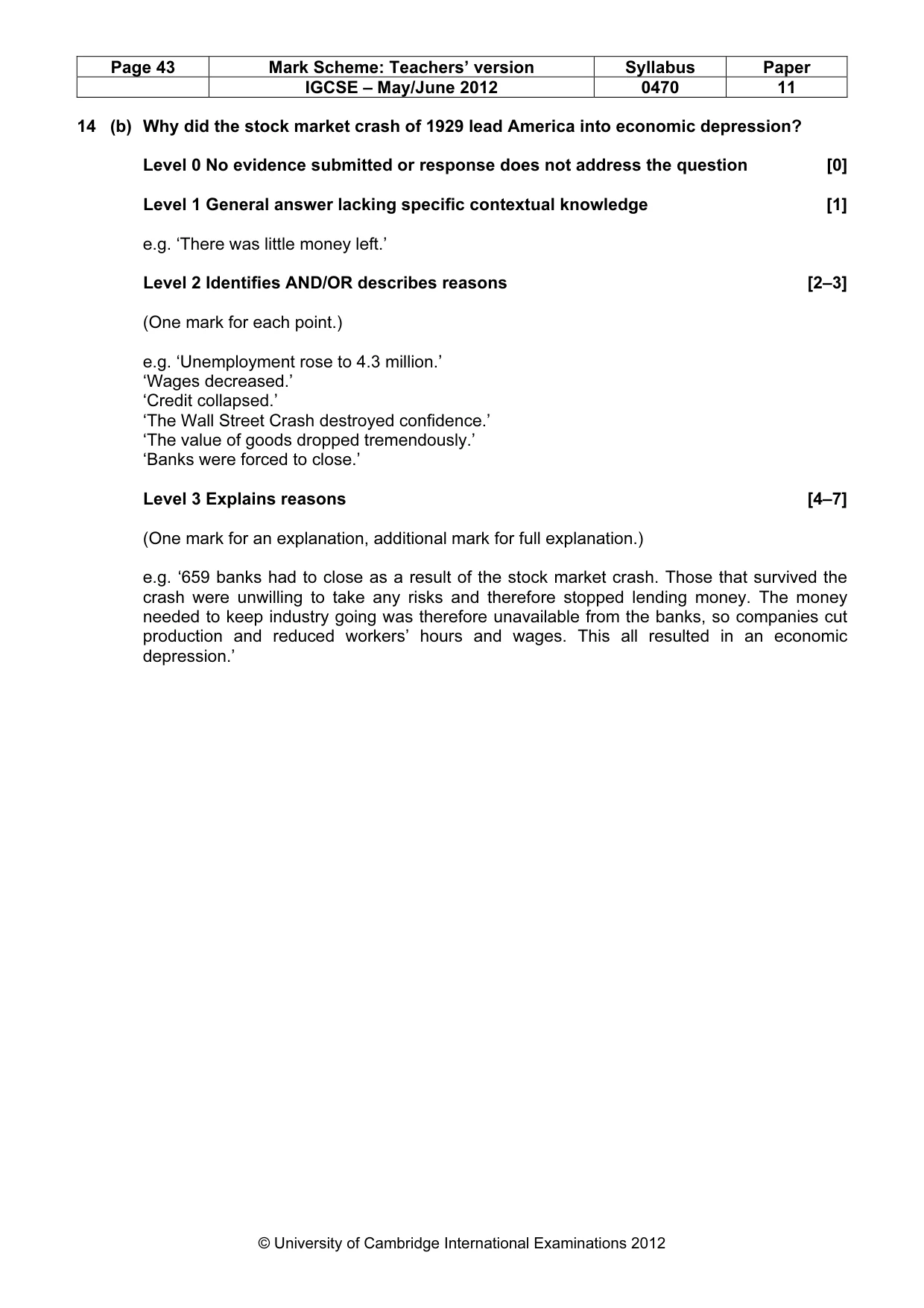
Page 43 Mark Scheme: Teachers’ version Syllabus Paper IGCSE – May/June 2012 0470 11 © University of Cambridge International Examinations 2012 14 (b) Why did the stock market crash of 1929 lead America into economic depression? Level 0 No evidence submitted or response does not address the question [0] Level 1 General answer lacking specific contextual knowledge [1] e.g. ‘There was little money left.’ Level 2 Identifies AND/OR describes reasons [2–3] (One mark for each point.) e.g. ‘Unemployment rose to 4.3 million.’ ‘Wages decreased.’ ‘Credit collapsed.’ ‘The Wall Street Crash destroyed confidence.’ ‘The value of goods dropped tremendously.’ ‘Banks were forced to close.’ Level 3 Explains reasons [4–7] (One mark for an explanation, additional mark for full explanation.) e.g. ‘659 banks had to close as a result of the stock market crash. Those that survived the crash were unwilling to take any risks and therefore stopped lending money. The money needed to keep industry going was therefore unavailable from the banks, so companies cut production and reduced workers’ hours and wages. This all resulted in an economic depression.’
Mark scheme, page 44
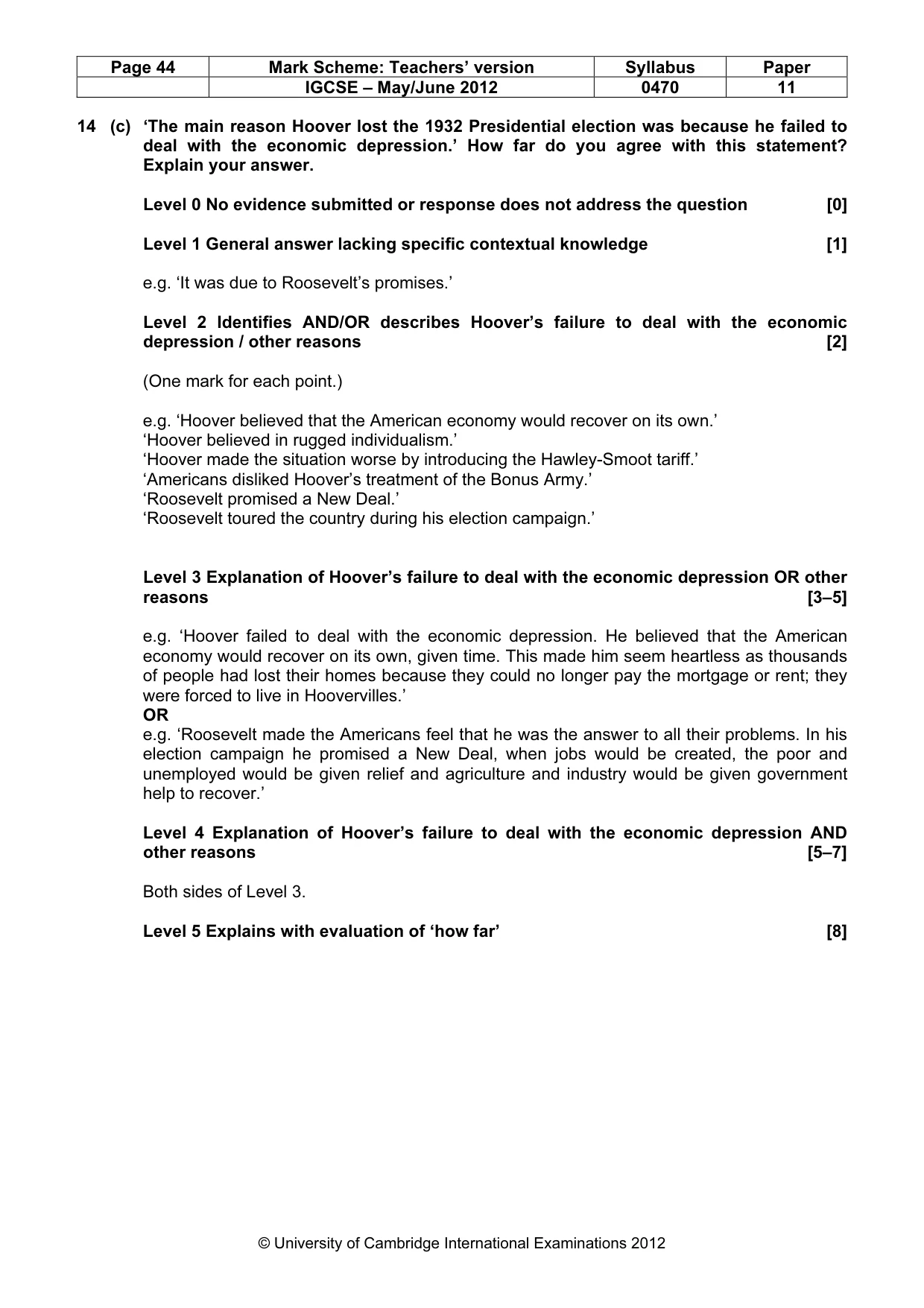
Page 44 Mark Scheme: Teachers’ version Syllabus Paper IGCSE – May/June 2012 0470 11 © University of Cambridge International Examinations 2012 14 (c) ‘The main reason Hoover lost the 1932 Presidential election was because he failed to deal with the economic depression.’ How far do you agree with this statement? Explain your answer. Level 0 No evidence submitted or response does not address the question [0] Level 1 General answer lacking specific contextual knowledge [1] e.g. ‘It was due to Roosevelt’s promises.’ Level 2 Identifies AND/OR describes Hoover’s failure to deal with the economic depression / other reasons [2] (One mark for each point.) e.g. ‘Hoover believed that the American economy would recover on its own.’ ‘Hoover believed in rugged individualism.’ ‘Hoover made the situation worse by introducing the Hawley-Smoot tariff.’ ‘Americans disliked Hoover’s treatment of the Bonus Army.’ ‘Roosevelt promised a New Deal.’ ‘Roosevelt toured the country during his election campaign.’ Level 3 Explanation of Hoover’s failure to deal with the economic depression OR other reasons [3–5] e.g. ‘Hoover failed to deal with the economic depression. He believed that the American economy would recover on its own, given time. This made him seem heartless as thousands of people had lost their homes because they could no longer pay the mortgage or rent; they were forced to live in Hoovervilles.’ OR e.g. ‘Roosevelt made the Americans feel that he was the answer to all their problems. In his election campaign he promised a New Deal, when jobs would be created, the poor and unemployed would be given relief and agriculture and industry would be given government help to recover.’ Level 4 Explanation of Hoover’s failure to deal with the economic depression AND other reasons [5–7] Both sides of Level 3. Level 5 Explains with evaluation of ‘how far’ [8]
Mark scheme, page 45
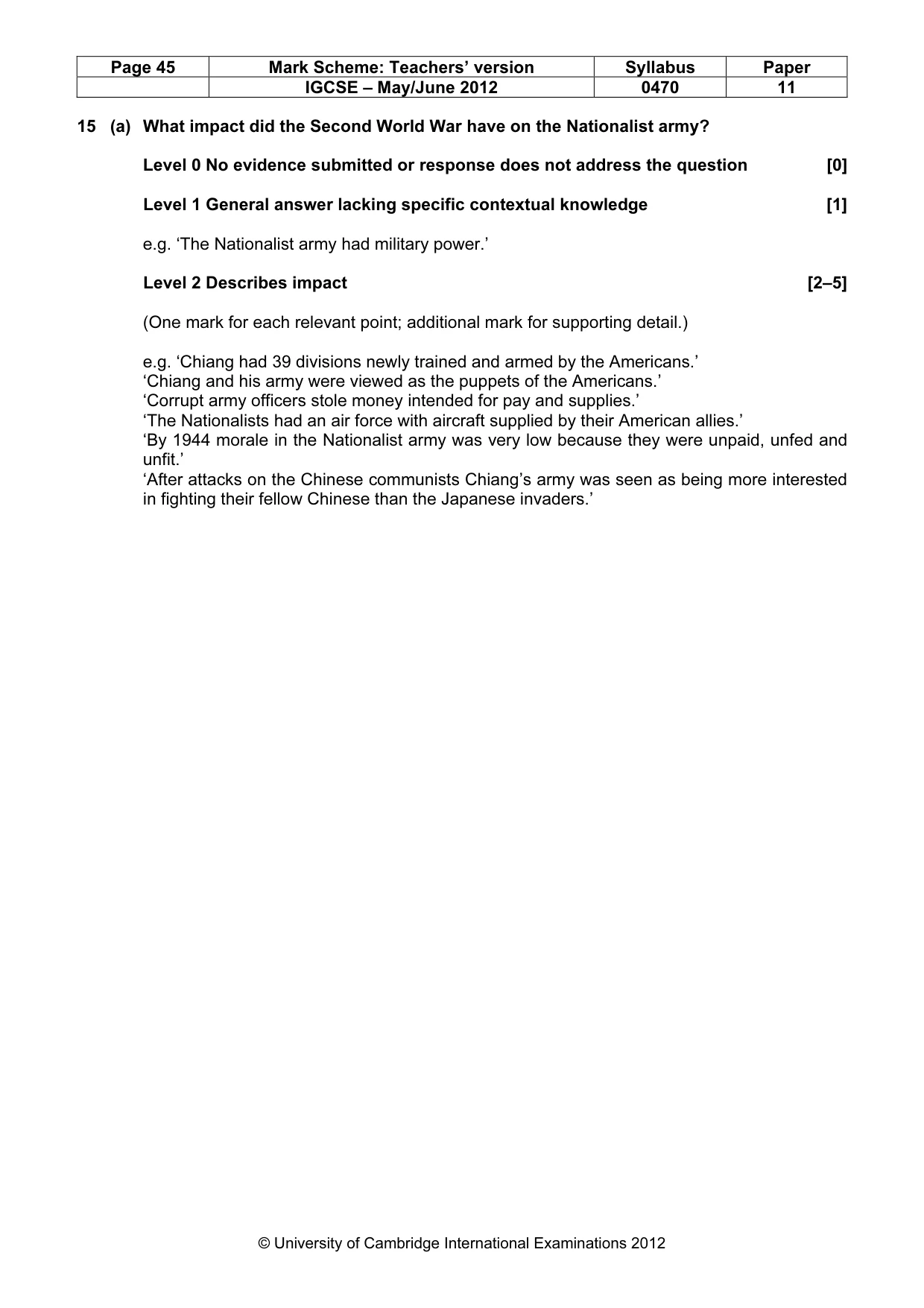
Page 45 Mark Scheme: Teachers’ version Syllabus Paper IGCSE – May/June 2012 0470 11 © University of Cambridge International Examinations 2012 15 (a) What impact did the Second World War have on the Nationalist army? Level 0 No evidence submitted or response does not address the question [0] Level 1 General answer lacking specific contextual knowledge [1] e.g. ‘The Nationalist army had military power.’ Level 2 Describes impact [2–5] (One mark for each relevant point; additional mark for supporting detail.) e.g. ‘Chiang had 39 divisions newly trained and armed by the Americans.’ ‘Chiang and his army were viewed as the puppets of the Americans.’ ‘Corrupt army officers stole money intended for pay and supplies.’ ‘The Nationalists had an air force with aircraft supplied by their American allies.’ ‘By 1944 morale in the Nationalist army was very low because they were unpaid, unfed and unfit.’ ‘After attacks on the Chinese communists Chiang’s army was seen as being more interested in fighting their fellow Chinese than the Japanese invaders.’
Mark scheme, page 46
Page 46 Mark Scheme: Teachers’ version Syllabus Paper IGCSE – May/June 2012 0470 11 © University of Cambridge International Examinations 2012 15 (b) Why was there widespread support for the Communists amongst the peasants during the Second World War? Level 0 No evidence submitted or response does not address the question [0] Level 1 General answer lacking specific contextual knowledge [1] e.g. ‘They were friendly to the peasants.’ Level 2 Identifies AND/OR describes reasons [2–3] (One mark for each point.) e.g. ‘Mao was seen as looking after Chinese interests.’ ‘The Communists cared for the peasants by promoting the rural economy.’ ‘The Communists reduced land rents and interest payments.’ ‘They opened schools and provided medical care.’ ‘The Communists helped in the fields and around the villages.’ ‘Mao was seen as a liberator.’ Level 3 Explains reasons [4–7] (One mark for an explanation, additional mark for full explanation.) e.g. ‘Mao was seen by the peasants as a liberator because of his guerrilla tactics against the Japanese. The peasants recognised that Mao was fighting to defend China’s national interests and they worked with him to drive the Japanese out of large areas of the Chinese countryside.’
Mark scheme, page 47
Page 47 Mark Scheme: Teachers’ version Syllabus Paper IGCSE – May/June 2012 0470 11 © University of Cambridge International Examinations 2012 15 (c) ‘Mao’s leadership was the main reason for the defeat of the Nationalists in the Civil War.’ How far do you agree with this statement? Explain your answer. Level 0 No evidence submitted or response does not address the question [0] Level 1 General answer lacking specific contextual knowledge [1] e.g. ‘It was due to the Nationalists’ mistakes.’ Level 2 Identifies AND/OR describes Mao’s leadership / other reasons [2] (One mark for each point.) e.g. ‘Mao had the support of the peasants.’ ‘Mao’s Red Army always treated the peasants fairly.’ ‘Mao decided on the strategy of guerrilla warfare early in the Civil War.’ ‘The leadership of the GMD forces was corrupt and inefficient.’ ‘Chiang increasingly behaved like a dictator.’ ‘The Nationalist government had failed to deliver on its promises.’ Level 3 Explanation of Mao’s leadership OR other reasons [3–5] e.g. ‘Mao impressed upon his troops the need for disciplined behaviour and the need to treat the civilian population with respect. The Red Army paid fairly for everything they bought and were polite and helpful. This ensured that the peasants continued to support him.’ OR e.g. ‘Chiang’s regime was corrupt and inefficient. Local officials abused their powers and made themselves rich by taking bribes and exhorting money from the local people.’ Level 4 Explanation of Mao’s leadership AND other reasons [5–7] Both sides of Level 3. Level 5 Explains with evaluation of ‘how far’ [8]
Mark scheme, page 48
Page 48 Mark Scheme: Teachers’ version Syllabus Paper IGCSE – May/June 2012 0470 11 © University of Cambridge International Examinations 2012 16 (a) Describe what happened when Mao visited Stalin in 1949–50. Level 0 No evidence submitted or response does not address the question [0] Level 1 General answer lacking specific contextual knowledge [1] e.g. ‘Mao and Stalin did not get on very well.’ Level 2 Describes events [2–5] (One mark for each relevant point; additional mark for supporting detail.) e.g. ‘Mao was treated with great respect in the public sessions such as Stalin’s 70th birthday celebrations.’ ‘Privately Mao spent long periods of time with nothing to do in one of Stalin’s dachas outside Moscow.’ ‘Mao and Stalin signed the Treaty of Friendship, Alliance and Mutual Assistance on 14 February 1950.This gave China the promise of aid in the event of attack and US$300 million in credits over 5 years.’ ‘They decided Outer Mongolia was to remain outside Chinese control as a Russian satellite.’ ‘Stalin gave Mao a list of all the Comintern agents in China reporting to Moscow.’
Mark scheme, page 49
Page 49 Mark Scheme: Teachers’ version Syllabus Paper IGCSE – May/June 2012 0470 11 © University of Cambridge International Examinations 2012 16 (b) Why did China’s relations with the Soviet Union worsen after 1956? Level 0 No evidence submitted or response does not address the question [0] Level 1 General answer lacking specific contextual knowledge [1] e.g. ‘It was due to a change in leader.’ Level 2 Identifies AND/OR describes reasons [2–3] (One mark for each point.) e.g. ‘In February 1956 Khrushchev denounced Stalin.’ ‘In 1958 the Russians asked to set up a long-wave radio station in China.’ ‘In 1958 the Russians suggested a joint Soviet-Chinese submarine fleet.’ ‘In July 1959 Khrushchev criticised the Great Leap Forward.’ ‘There were armed clashes between Soviet and Chinese troops along the Amur River.’ ‘In 1960 the Soviet government withdrew all Russian technicians from China.’ Level 3 Explains reasons [4–7] (One mark for an explanation, additional mark for full explanation.) e.g. ‘In 1958 the Russians asked to set up a long-wave radio station in China to control a planned Russian Pacific submarine fleet. They also suggested a joint Soviet-Chinese submarine fleet. These suggestions aroused all Mao’s suspicions about the Russians; he saw their requests as attempts to patronise and control him.’
Mark scheme, page 50
Page 50 Mark Scheme: Teachers’ version Syllabus Paper IGCSE – May/June 2012 0470 11 © University of Cambridge International Examinations 2012 16 (c) ‘The tension between China and Russia was the most important reason for China’s improving relationship with the USA after 1970.’ How far do you agree with this statement? Explain your answer. Level 0 No evidence submitted or response does not address the question [0] Level 1 General answer lacking specific contextual knowledge [1] e.g. ‘China was friendlier to the USA.’ Level 2 Identifies AND/OR describes tension / other reasons [2] (One mark for each point.) e.g. ‘In the 1960s there was a build-up of Soviet forces along China’s borders.’ ‘In 1969 the Soviet newspaper Pravda hinted that there could be a Russian strike to take out Chinese nuclear capabilities.’ ‘China joined the UNO.’ ‘The USA and the USSR were traditionally enemies.’ ‘In 1971 the Chinese government invited the American table tennis team to Beijing.’ ‘The USA began to withdraw troops from Vietnam in late 1969.’ Level 3 Explanation of tension OR other reasons [3–5] e.g. ‘As the Chinese relationship with the USSR deteriorated Mao believed that it was a good idea to cultivate a relationship with the USSR’s traditional enemy the USA. Mao believed in the principle that his enemy’s enemy should be his friend, and the provocative behaviour of the Russians made a positive relationship with the Americans even more attractive.’ OR e.g. ‘Several times it was proposed that China should be admitted to the UN, but each time the USA and its allies voted against this. In 1971 a majority of nations voted with the USA for the admission of China and the expulsion of Taiwan. This marked the end of China’s isolation.’ Level 4 Explanation of tension AND other reasons [5–7] Both sides of Level 3. Level 5 Explains with evaluation of ‘how far’ [8]
Mark scheme, page 51
Page 51 Mark Scheme: Teachers’ version Syllabus Paper IGCSE – May/June 2012 0470 11 © University of Cambridge International Examinations 2012 17 (a) Describe the formation of the Union of South Africa in 1910. Level 0 No evidence submitted or response does not address the question [0] Level 1 General answer lacking specific contextual knowledge [1] e.g. ‘The Union of South Africa remained under the British Crown.’ Level 2 Describes formation [2–5] (One mark for each relevant point; additional mark for supporting detail.) e.g. ‘The independent Boer Republics of the Transvaal and Orange Free State and the British colonies of the Cape and Natal formed the Union of South Africa.’ ‘The Union was under the British Crown as a self-governing dominion of the British Empire.’ ‘The monarch was represented by a Governor General, but effective rule was in the hands of the Prime Minister.’ ‘The Union was a unitary state not a federation.’ ‘Each colony had a provincial council.’ ‘The administrative capital was in Pretoria and the seat of Parliament was in Cape Town.’ ‘Parliament was elected from the white minority.’
Mark scheme, page 52
Page 52 Mark Scheme: Teachers’ version Syllabus Paper IGCSE – May/June 2012 0470 11 © University of Cambridge International Examinations 2012 17 (b) Why were the Land Settlement Act (1912) and the Natives Land Act (1913) significant? Level 0 No evidence submitted or response does not address the question [0] Level 1 General answer lacking specific contextual knowledge [1] e.g. ‘The Natives Land Act penalised black people.’ Level 2 Identifies AND/OR describes reasons [2–3] (One mark for each point.) e.g. ‘The Land Settlement Act set up a Land Board.’ ‘The Land Board allocated Crown lands for settlement purposes.’ ‘The 1913 Natives Land Act prevented black people from owning land.’ ‘Black people could only own land in the native reserves.’ ‘The 1913 Natives Land Act prevented black people from practising share – cropping.’ ‘The 1913 Act forced black people to seek work on white owned farms.’ ‘The 1913 Act led to the eviction of black share-croppers.’ Level 3 Explains reasons [4–7] (One mark for an explanation, additional mark for full explanation.) e.g. ‘The terms of the 1913 Natives Land Act prevented black people from practising share- cropping. Many black people were share-croppers. In the short term the 1913 Act was significant because many black share-croppers were evicted, causing them harsh suffering. In the long term the act simply turned black people into labourers for white farmers.’
Mark scheme, page 53
Page 53 Mark Scheme: Teachers’ version Syllabus Paper IGCSE – May/June 2012 0470 11 © University of Cambridge International Examinations 2012 17 (c) ‘Development of the South African economy in the 1920s was only of benefit to the whites.’ How far do you agree with this statement? Explain your answer. Level 0 No evidence submitted or response does not address the question [0] Level 1 General answer lacking specific contextual knowledge [1] e.g. ‘It benefitted some white people.’ Level 2 Identifies AND/OR describes agreement / disagreement [2] (One mark for each point.) e.g. ‘State corporations were established.’ ‘Inexpensive electricity and steel was provided for industrial use.’ ‘Import tariffs were imposed to protect local manufacturers.’ ‘Jobs were created for poor whites.’ ‘Black entrepreneurs were discouraged.’ ‘Some white skilled workers lost their jobs.’ ‘A large pool of low cost industrial labour from the black population was created.’ Level 3 Explanation of agreement OR disagreement [3–5] e.g. ‘In the 1920s Afrikaner farmers were hit by drought and disease. Many left the land to look for work in the cities. The response to the ‘poor whites’ was the creation of jobs, mainly on the railways, at the expense of the black workers.’ OR e.g. ‘Rising costs and a fixed gold price resulted in attempts to reduce labour costs .This was done by mechanisation and also by deskilling. Higher paid skilled white workers were replaced with lower paid semi-skilled black workers.’ Level 4 Explanation of agreement AND disagreement [5–7] Both sides of Level 3. Level 5 Explains with evaluation of ‘how far’ [8]
Mark scheme, page 54
Page 54 Mark Scheme: Teachers’ version Syllabus Paper IGCSE – May/June 2012 0470 11 © University of Cambridge International Examinations 2012 18 (a) In what ways were black people restricted in movement and employment under apartheid? Level 0 No evidence submitted or response does not address the question [0] Level 1 General answer lacking specific contextual knowledge [1] e.g. ‘Black people could not make choices about travel and jobs.’ Level 2 Describes restrictions [2–5] (One mark for each relevant point; additional mark for supporting detail.) e.g. ‘The government declared some areas for whites only and had the power to move blacks out, whether or not they wished to go.’ ‘The Native Laws Amendment Act controlled the movement of blacks in and out of towns and cities.’ ‘The Abolition of Passes Act of 1952 forced all black men living in white areas to carry a pass or reference book. Without a pass it was illegal for black people to live and work in a white area.’ ‘No black person could leave a rural area for an urban area without a permit from the local authorities.’ ‘The Bantu Building Workers Act allowed black people to be trained as artisans in the building trade but they had to work within an area designated for blacks.’ ‘It became a criminal offence for a black person to perform any skilled work in urban areas except in those sections designated for black occupation.’
Mark scheme, page 55
Page 55 Mark Scheme: Teachers’ version Syllabus Paper IGCSE – May/June 2012 0470 11 © University of Cambridge International Examinations 2012 18 (b) Why did the Nationalist government want to restrict education for black people? Level 0 No evidence submitted or response does not address the question [0] Level 1 General answer lacking specific contextual knowledge [1] e.g. ‘They believed black people should only have a basic education.’ Level 2 Identifies AND/OR describes reasons [2–3] (One mark for each point.) e.g. ‘They wanted to prevent them from receiving an education that would lead them to aspire to higher positions.’ ‘They wanted to provide them with only the skills needed for work in the homelands or in labouring.’ ‘Education for black children would be cheaper.’ ‘It was to maintain separation of blacks and whites.’ ‘It was to maintain white supremacy.’ Level 3 Explains reasons [4–7] (One mark for an explanation, additional mark for full explanation.) e.g. ‘Black people provided a vast pool of cheap labour for the whites. By restricting their education their aspirations and opportunities would be limited; they would be prepared only for work in the homelands or work as labourers for the whites.’
Mark scheme, page 56
Page 56 Mark Scheme: Teachers’ version Syllabus Paper IGCSE – May/June 2012 0470 11 © University of Cambridge International Examinations 2012 18 (c) How far was opposition to apartheid in the 1950s effective? Explain your answer. Level 0 No evidence submitted or response does not address the question [0] Level 1 General answer lacking specific contextual knowledge [1] e.g. ‘It was difficult to oppose apartheid because of the harsh laws.’ Level 2 Identifies AND/OR describes effectiveness / ineffectiveness [2] (One mark for each point.) e.g. ‘The Defence Campaign increased ANC membership.’ ‘Opposition to the Bantu Education Act was immediate.’ ‘Demonstrations took place over the introduction of passes for women.’ ‘The Treason Trials removed the leadership of the ANC for 5 years.’ ‘Teachers who objected to the Bantu Education Act were dismissed.’ ‘Government lawyers tried to prove the Freedom Charter was communist in nature.’ Level 3 Explanation of effectiveness OR ineffectiveness [3–5] e.g. ‘The Defiance Campaign in 1952 resulted in the membership of the ANC increasing from 7000 to 100,000. The Campaign also gave confidence to the opponents of the government that further mass protest could bring political changes. They realised that they needed a manifesto so they met and drafted the Freedom Charter, a clear statement of the South Africa they wanted to create. The Charter became the most important single document of resistance to apartheid.’ OR e.g. ‘Opposition to the Bantu Education Act was immediate. Teachers who objected were dismissed. Thousands of children boycotted school but were forced to return or they would not receive any further education. It was difficult to know how to proceed; this was the beginning of a long and bitter battle over education.’ Level 4 Explanation of effectiveness AND ineffectiveness [5–7] Both sides of Level 3. Level 5 Explains with evaluation of ‘how far’ [8]
Mark scheme, page 57
Page 57 Mark Scheme: Teachers’ version Syllabus Paper IGCSE – May/June 2012 0470 11 © University of Cambridge International Examinations 2012 19 (a) Describe the activities of Lüderitz and Vogelsang in acquiring land in 1883–4. Level 0 No evidence submitted or response does not address the question [0] Level 1 General answer lacking specific contextual knowledge [1] e.g. ‘They acquired land fraudulently.’ Level 2 Describes activities [2–5] (One mark for each relevant point; additional mark for supporting detail.) e.g. ‘In April 1883 Vogelsang met the native chief Joseph Fredericks and acquired the bay of Angra Pequena plus 5 miles of ground in all directions around it.’ ‘Payment for Angra Pequena was £100 and 200 guns.’ ‘There were some fraudulent manoeuvres as Fredericks was not aware of the difference between the English mile and the German geographical mile.’ ‘In August 1883 Vogelsang extended Lüderitz’s business area by purchasing a 20 German geographical mile wide coastal strip from the Orange River.’ ‘In 1884 Lüderitz signed a protection treaty with Chief Fredericks and established the right to build roads, telegraphs and railway lines.’
Mark scheme, page 58
Page 58 Mark Scheme: Teachers’ version Syllabus Paper IGCSE – May/June 2012 0470 11 © University of Cambridge International Examinations 2012 19 (b) Why were the ‘protection treaties’ of 1885 important for Germany? Level 0 No evidence submitted or response does not address the question [0] Level 1 General answer lacking specific contextual knowledge [1] e.g. ‘They helped Germany.’ Level 2 Identifies AND/OR describes reasons [2–3] (One mark for each point.) e.g. ‘They strengthened Germany’s claim to Namibia.’ ‘They were able to split the tribes.’ ‘They made German claims legal.’ ‘German lives and property would be protected.’ ‘The Germans would be able to trade.’ Level 3 Explains reasons [4–7] (One mark for an explanation, additional mark for full explanation.) e.g. ‘The protection treaties were with leaders of different tribes. In this way they could divide the Namibian communities and prevent a united Namibian opposition. If the tribes were divided the Germans would find it easier to control the people and the country.’
Mark scheme, page 59
Page 59 Mark Scheme: Teachers’ version Syllabus Paper IGCSE – May/June 2012 0470 11 © University of Cambridge International Examinations 2012 19 (c) ‘Loss of land to German settlers was the main reason for the War of National Resistance (1904–8).’ How far do you agree with this statement? Explain your answer. Level 0 No evidence submitted or response does not address the question [0] Level 1 General answer lacking specific contextual knowledge [1] e.g. ‘Loss of land to German settlers was important, but there were other reasons as well.’ Level 2 Identifies AND/OR describes loss of land to German settlers / other reasons [2] (One mark for each point.) e.g. ‘In 1898 a German decree ordered the setting up of reserves for Namibians.’ ‘The construction of a railway went through the heartland of the Hereros.’ ‘Namibians were forced to move without compensation.’ ‘Traders took cattle.’ ‘German rule was oppressive and cruel.’ ‘A new policy on debt collection was enforced in November 1903.’ Level 3 Explanation of loss of land to German settlers OR other reasons [3–5] e.g. ‘Large areas of land had been taken away from the Namibian communities in the centre and south and given to the increasing numbers of German settlers. In 1903 the construction of the railway to Otavi began and this railway went through the heartland of the Hereros. No notice was taken of the Namibian settlements; people were forced to move without any compensation. The Germans took a 20 kilometre strip of land on either side of the railway and also wanted complete control over the water in the area.’ OR e.g. ‘Cattle were a necessity of life for many Namibians. Without their land and their cattle it was difficult for them to survive. If they resisted the colonial authorities their cattle were taken by force. Cattle were also taken by traders to pay for debts for goods bought from the traders. The German police aided the traders rather than the Namibians.’ Level 4 Explanation of loss of land to German settlers AND other reasons [5–7] Both sides of Level 3. Level 5 Explains with evaluation of ‘how far’ [8]
Mark scheme, page 60
Page 60 Mark Scheme: Teachers’ version Syllabus Paper IGCSE – May/June 2012 0470 11 © University of Cambridge International Examinations 2012 20 (a) Describe two occasions when Palestinians captured world attention by acts of terrorism. Level 0 No evidence submitted or response does not address the question [0] Level 1 General answer lacking specific contextual knowledge [1] e.g. ‘They killed people.’ Level 2 Describes occasions [2–5] (One mark for each relevant point; additional mark for supporting detail.) e.g. ‘In 1970 five aircraft were hijacked and three of the aircraft were taken to an old RAF airstrip at Dawson’s Field in Jordan.’ ‘Pan Am flight 93 was hijacked but the passengers and crew were allowed to leave the aeroplane before the hijackers blew it up at Cairo Airport.’ ‘On 12 September 1970 the PLO blew up the three aeroplanes at Dawson’s Field.’ ‘On 5 September 1972 Palestinian guerrillas attacked Israeli athletes at the Olympic Games in Munich, Germany.’ ‘Two athletes were killed in the Olympic village and nine others held hostage.’ ‘The remaining nine Israeli athletes were killed as they sat in helicopters at an airport.’
Mark scheme, page 61
Page 61 Mark Scheme: Teachers’ version Syllabus Paper IGCSE – May/June 2012 0470 11 © University of Cambridge International Examinations 2012 20 (b) Why were so many Palestinians in refugee camps by the 1980s? Level 0 No evidence submitted or response does not address the question [0] Level 1 General answer lacking specific contextual knowledge [1] e.g. ‘They believed they had no choice.’ Level 2 Identifies AND/OR describes reasons [2–3] (One mark for each point.) e.g. ‘They were encouraged to go to refugee camps by their leaders.’ ‘They fled in terror due to the Deir Yassin massacre.’ ‘Other Arab countries did not help.’ ‘Israel developed as a strong force taking more land.’ ‘Offers of assistance had been rejected due to pride.’ Level 3 Explains reasons [4–7] (One mark for an explanation, additional mark for full explanation.) e.g. ‘In 1948 the refugee problem began when Arabs fled in fear from the fighting. They had been advised to do so by the Arab League. The Arabs were told they would be able to return when Israel had been defeated. Arabs also fled in terror due to the Deir Yassin massacre; they fled to avoid the same happening to them.’
Mark scheme, page 62
Page 62 Mark Scheme: Teachers’ version Syllabus Paper IGCSE – May/June 2012 0470 11 © University of Cambridge International Examinations 2012 20 (c) By the early 1990s how successful had the Palestinians been in winning international support? Explain your answer Level 0 No evidence submitted or response does not address the question [0] Level 1 General answer lacking specific contextual knowledge [1] e.g. ‘Some countries have supported them.’ Level 2 Identifies AND/OR success / failure [2] (One mark for each point.) e.g. ‘In 1974 Arafat was invited to speak at the United Nations.’ ‘In 1977 the United Nations Division for Palestinian rights was created.’ ‘In 1979 the USSR recognised the right of the Palestinians to have their own country.’ ‘The Palestinians were forced to leave Jordan.’ ‘The PLO was internationally condemned for the actions at the Munich Olympics.’ Level 3 Explanation of success OR failure [3–5] e.g. ‘In November 1974 Yasser Arafat spoke of the plight of the Palestinian people at the UN Assembly. This was a huge diplomatic success for him. It meant that, for the first time, the Palestinians as a nation were recognised by the international community.’ OR e.g. ‘In 1989 the USA granted Israel major non-NATO ally status and continued to support Israel financially and with weaponry for defence. The Palestinians viewed this as support for their adversaries.’ Level 4 Explanation of success AND failure [5–7] Both sides of Level 3. Level 5 Explains with evaluation of ‘how far’ [8]
Mark scheme, page 63
Page 63 Mark Scheme: Teachers’ version Syllabus Paper IGCSE – May/June 2012 0470 11 © University of Cambridge International Examinations 2012 21 (a) Describe life on a kibbutz. Level 0 No evidence submitted or response does not address the question [0] Level 1 General answer lacking specific contextual knowledge [1] e.g. ‘It was communal living.’ Level 2 Describes features [2–5] (One mark for each relevant point; additional mark for supporting detail.) e.g. ‘There were communal farms.’ ‘On the communal farms a number of families lived and worked together.’ ‘Families shared some aspects of child rearing.’ ‘There were communal facilities such as a dining hall and a laundry.’ ‘Day to day affairs were handled by an elected committee.’
Mark scheme, page 64
Page 64 Mark Scheme: Teachers’ version Syllabus Paper IGCSE – May/June 2012 0470 11 © University of Cambridge International Examinations 2012 21 (b) Why was the West Bank a continuing area of tension by the 1990s? Level 0 No evidence submitted or response does not address the question [0] Level 1 General answer lacking specific contextual knowledge [1] e.g. ‘Israelis and Arabs had disagreed about the West Bank.’ Level 2 Identifies AND/OR describes reasons [2–3] (One mark for each point.) e.g. ‘The West Bank was part of the British Mandate of Palestine after World War One.’ ‘The Israelis had captured the West Bank in the 1967 Six Day War.’ ‘Thousands of Palestinians lived in refugee camps on the West Bank.’ ‘Israel maintained checkpoints and roadblocks in the region.’ ‘The United Nations viewed the area as Palestinian territory occupied by Israel.’ ‘The Israelis believed the West Bank to be a disputed territory.’ Level 3 Explains reasons [4–7] (One mark for an explanation, additional mark for full explanation.) e.g. ‘The Israelis considered the West Bank to be a disputed territory and therefore believed they were justified in maintaining checkpoints and roadblocks in the area. However, the Palestinians viewed the territory as theirs and since 1979 the United Nations Security Council and General Assembly have both referred to the West Bank as Palestinian territory occupied by Israel.’
Mark scheme, page 65
Page 65 Mark Scheme: Teachers’ version Syllabus Paper IGCSE – May/June 2012 0470 11 © University of Cambridge International Examinations 2012 21 (c) How far did Israelis disagree with each other in the 1990s about how Arab neighbours should be dealt with? Explain your answer. Level 0 No evidence submitted or response does not address the question [0] Level 1 General answer lacking specific contextual knowledge [1] e.g. ‘There has been both agreement and disagreement.’ Level 2 Identifies AND/OR describes agreement /disagreement [2] (One mark for each point.) e.g. ‘Rabin’s Labour Party wanted to recognise the PLO.’ ‘In 1995 Rabin signed the Middle East Peace Accords with Yasser Arafat.’ ‘Shimon Peres worked with Rabin and Yasser Arafat.’ ‘Baruch Goldstein, a major in the Israeli army, shot dead 29 Palestinians in 1994.’ ‘Netanyahu did not want to give concessions to the Palestinians.’ ‘Rabin was assassinated in 1995 by Yigal Amir.’ Level 3 Explanation of agreement OR disagreement [3–5] e.g. ‘Shimon Peres and Yitzhak Rabin worked together with Yasser Arafat of the PLO and the Middle East Peace Accords were signed. The Palestinians were given home rule in Gaza and Jericho, although Jericho was not to grow beyond the confines specified by Israel and the Jewish settlement in Gaza would remain under Israeli control at all times. Many Israelis saw this as a major victory for Israel.’ OR e.g. ‘Netanyahu was the champion of the right wing Israeli nationalists who did not want to give any concessions to the Palestinians. He was supported by Jewish nationalists like Yigal Amir, who assassinated Prime Minister Rabin in November 1995; Amir was strongly opposed to the surrender of any land to the Palestinians.’ Level 4 Explanation of agreement AND disagreement [5–7] Both sides of Level 3. Level 5 Explains with evaluation of ‘how far’ [8]
Mark scheme, page 66
Page 66 Mark Scheme: Teachers’ version Syllabus Paper IGCSE – May/June 2012 0470 11 © University of Cambridge International Examinations 2012 22 (a) Describe how steam engines were used in developing industry in Britain in the first half of the nineteenth century. Level 0 No evidence submitted or response does not address the question [0] Level 1 General answer lacking specific contextual knowledge [1] e.g. ‘Steam engines were at the heart of the Industrial Revolution.’ Level 2 Describes uses [2–5] (One mark for each relevant point; additional mark for supporting detail.) e.g. ‘Steam engines pumped water so it could reach the bellows that blew air through the furnaces.’ ‘Steam engines drove tilt hammers and rolling mills.’ ‘Steam engines helped to keep coal mines free of flood water and to haul the coal to the surface.’ ‘Large scale production processes were possible due to steam engines. These increased the supply and lowered the price of iron and cotton goods.’ ‘Steam engines enabled industry to move away from the countryside rivers to the towns.’
Mark scheme, page 67
Page 67 Mark Scheme: Teachers’ version Syllabus Paper IGCSE – May/June 2012 0470 11 © University of Cambridge International Examinations 2012 22 (b) Why was there increasing demand for British manufactured goods in the nineteenth century? Level 0 No evidence submitted or response does not address the question [0] Level 1 General answer lacking specific contextual knowledge [1] e.g. ‘More people wanted British goods.’ Level 2 Identifies AND/OR describes reasons [2–3] (One mark for each point.) e.g. ‘In Britain increased wage earning opportunities for women and young people boosted family spending.’ ‘Changes in technology reduced the price of British manufactured goods.’ ‘New forms of marketing and retailing were available.’ ‘The Great Exhibition of 1851 displayed a huge range of British products.’ ‘It was due to the expansion of the British Empire.’ Level 3 Explains reasons [4–7] (One mark for an explanation, additional mark for full explanation.) e.g. ‘Increased demand resulted from the rising incomes of the middle classes in Britain. They wanted to have products like those of their social superiors, and therefore spent more money on china, cutlery and furniture.’
Mark scheme, page 68
Page 68 Mark Scheme: Teachers’ version Syllabus Paper IGCSE – May/June 2012 0470 11 © University of Cambridge International Examinations 2012 22 (c) How far was industrialisation in Britain beneficial to the population? Explain your answer. Level 0 No evidence submitted or response does not address the question [0] Level 1 General answer lacking specific contextual knowledge [1] e.g. ‘There were some benefits and some problems for the population.’ Level 2 Identifies AND/OR describes benefits / lack of benefits [2] (One mark for each point.) e.g. ‘There was an increased range of manufactured goods available.’ ‘There were increased job opportunities in the towns.’ ‘Roads were improved due to pressure from newly developing industry.’ ‘Disease spread rapidly in the industrial towns.’ ‘Working conditions in the factories were very poor.’ ‘There was overcrowding in the industrial towns and cities.’ Level 3 Explanation of benefits OR lack of benefits [3–5] e.g. ‘Wages for farm workers were very low and mechanisation had resulted in less jobs being available for labourers on farms. Industrialisation meant that thousands of workers were needed to work in the factories. Many farm labourers moved to the towns to take advantage of the job opportunities and higher wages.’ OR e.g. ‘Due to industrialisation thousands of people moved to the towns and cities. Houses were built at great speed to give these people a place to live, but the houses built were ‘back to back’ with no proper drainage, no clean water supply and nowhere to deposit rubbish. These were ideal conditions for the spread of disease.’ Level 4 Explanation of benefits AND lack of benefits [5–7] Both sides of Level 3. Level 5 Explains with evaluation of ‘how far’ [8]
Mark scheme, page 69
Page 69 Mark Scheme: Teachers’ version Syllabus Paper IGCSE – May/June 2012 0470 11 © University of Cambridge International Examinations 2012 23 (a) What were the main causes of death in industrial towns in the nineteenth century? Level 0 No evidence submitted or response does not address the question [0] Level 1 General answer lacking specific contextual knowledge [1] e.g. ‘Disease killed people.’ Level 2 Describes causes [2–5] (One mark for each relevant point; additional mark for supporting detail.) e.g. ‘Drinking contaminated water caused cholera.’ ‘Typhoid fever was a major killer.’ ‘Bronchitis and asthma exacerbated by the conditions in the factories were causes of death.’ ‘Accidents due to the lack of safety measures in factories caused fatal injuries.’ ‘Overcrowding and insanitary conditions ensured killer diseases such as cholera spread rapidly.’ ‘Contaminated food killed people.’
Mark scheme, page 70
Page 70 Mark Scheme: Teachers’ version Syllabus Paper IGCSE – May/June 2012 0470 11 © University of Cambridge International Examinations 2012 23 (b) Explain the causes of insanitary conditions in towns. Level 0 No evidence submitted or response does not address the question [0] Level 1 General answer lacking specific contextual knowledge [1] e.g. ‘There were too many people.’ Level 2 Identifies AND/OR describes reasons [2–3] (One mark for each point.) e.g. ‘There was overcrowding.’ ‘There was no planning.’ ‘Drains were often just open ditches.’ ‘There were not enough privies (very basic toilets) for everyone.’ ‘The government did not intervene.’ ‘Rubbish was left in the streets.’ Level 3 Explains reasons [4–7] (One mark for an explanation, additional mark for full explanation.) e.g. ‘Houses were built without any planning. Large numbers of back to back houses were built, with no proper drainage, no sewers and no clean water.’
Mark scheme, page 71
Page 71 Mark Scheme: Teachers’ version Syllabus Paper IGCSE – May/June 2012 0470 11 © University of Cambridge International Examinations 2012 23 (c) To what extent had government legislation improved public health in towns by the end of the nineteenth century? Explain your answer. Level 0 No evidence submitted or response does not address the question [0] Level 1 General answer lacking specific contextual knowledge [1] e.g. ‘Some government legislation made no difference.’ Level 2 Identifies AND/OR describes improvements / lack of improvements [2] (One mark for each point.) e.g. ‘The Public Health Act of 1875 was a major step forward.’ ‘The Artisans’ Dwellings Act of 1875 was important.’ ‘The Housing of the Working Classes Act of 1890 helped to improve public health.’ ‘The Public Health Act of 1848 was ineffective.’ ‘There was little money available to enforce legislation.’ ‘The Boards of Health could not force improvements in sanitation.’ Level 3 Explanation of improvements OR lack of improvements [3–5] e.g. ‘The Public Health Act of 1875 was a major step forward as it was compulsory. Every area had to have a Medical officer of Health and a sanitary inspector. Sewers and drains were built, the water supply controlled and refuse was collected.’ OR e.g. ‘The Public Health Act of 1848 made little difference because the Boards of Health did not have the powers to force towns to improve conditions. Only one-sixth of the population was actually covered by local Boards of Health by 1854.’ Level 4 Explanation of improvements AND lack of improvements [5–7] Both sides of Level 3. Level 5 Explains with evaluation of ‘to what extent’ [8]
Mark scheme, page 72
Page 72 Mark Scheme: Teachers’ version Syllabus Paper IGCSE – May/June 2012 0470 11 © University of Cambridge International Examinations 2012 24 (a) What did nineteenth-century missionaries hope to achieve? Level 0 No evidence submitted or response does not address the question [0] Level 1 General answer lacking specific contextual knowledge [1] e.g. ‘They wanted to help people.’ Level 2 Describes aims [2–5] (One mark for each relevant point; additional mark for supporting detail.) e.g. ‘They wanted to stamp out many of the ‘evils’ they encountered, such as slavery, barbaric punishments, sacrifices and heathen rites.’ ‘Missionaries genuinely believed they knew what was best and right for other people and so sought to impose their ideas.’ ‘They wanted to bring Christianity to heathen peoples.’ ‘Missionaries wanted to draw attention to the opportunities presented by previously unexplored territories.’
Mark scheme, page 73
Page 73 Mark Scheme: Teachers’ version Syllabus Paper IGCSE – May/June 2012 0470 11 © University of Cambridge International Examinations 2012 24 (b) Why did Britain have a large empire by the end of the nineteenth century? Level 0 No evidence submitted or response does not address the question [0] Level 1 General answer lacking specific contextual knowledge [1] e.g. ‘It was to show its importance.’ Level 2 Identifies AND/OR describes reasons [2–3] (One mark for each point.) e.g. ‘They believed a large empire was something to be proud of.’ ‘They wanted to have a market for their manufactured goods.’ ‘They wanted sources of raw materials.’ ‘It was for strategic reasons.’ ‘They wanted to spread their beliefs about Christianity.’ Level 3 Explains reasons [4–7] (One mark for an explanation, additional mark for full explanation.) e.g. ‘The large British Empire was good for the British economy. Colonies could contribute raw materials and food products, many of them unavailable in Britain, such as bananas, palm oil, rubber and tea. The colonies also provided outlets for manufactured goods, free of import tariff restrictions.’
Mark scheme, page 74
Page 74 Mark Scheme: Teachers’ version Syllabus Paper IGCSE – May/June 2012 0470 11 © University of Cambridge International Examinations 2012 24 (c) How far did imperialism benefit Britain more than its colonies? Explain your answer. Level 0 No evidence submitted or response does not address the question [0] Level 1 General answer lacking specific contextual knowledge [1] e.g. ‘There were benefits for Britain and for the colonies.’ Level 2 Identifies AND/OR describes benefits / lack of benefits [2] (One mark for each point.) e.g. ‘Britain gained raw materials and food products.’ ‘Britain gained markets for manufactured goods.’ ‘There were strategic benefits for Britain.’ ‘The British built railways in India.’ ‘The British developed plantations in Africa.’ ‘The British developed infrastructure in their colonies.’ Level 3 Explanation of benefits OR lack of benefits [3–5] e.g. ‘The British developed communications and infrastructure in their colonies. Roads, railways, hospitals, clinics, schools and other public buildings were all built and benefitted the local populations.’ OR e.g. ‘Plantations were developed in Africa by the British. However, instead of growing food to feed the peoples of Africa, the plantations were organised to produce crops for processing into luxury or semi-luxury goods for the European market, such as cocoa (chocolate) and palm oil (soap and margarine).’ Level 4 Explanation of benefits AND lack of benefits [5–7] Both sides of Level 3. Level 5 Explains with evaluation of ‘how far’ [8]
Mark scheme, page 75
Page 75 Mark Scheme: Teachers’ version Syllabus Paper IGCSE – May/June 2012 0470 11 © University of Cambridge International Examinations 2012 25 (a) What proposals did Bentinck make to change India? Level 0 No evidence submitted or response does not address the question [0] Level 1 General answer lacking specific contextual knowledge [1] e.g. ‘He wanted to change Indian customs.’ Level 2 Describes proposals [2–5] (One mark for each relevant point; additional mark for supporting detail.) e.g. ‘He proposed the ending of thuggee (ritual murder by robber gangs).’ ‘He wanted to end suttee (the burning of widows with the corpses of their husbands).’ ‘He proposed that English should be the language of the higher courts and of higher education.’ ‘He abolished provincial courts of appeal and circuit and substituted for them a civil and sessions judge in each district.’ ‘He proposed to suppress the practice of killing infant girls.’
Mark scheme, page 76
Page 76 Mark Scheme: Teachers’ version Syllabus Paper IGCSE – May/June 2012 0470 11 © University of Cambridge International Examinations 2012 25 (b) Why were many Indians opposed to Bentinck’s proposals? Level 0 No evidence submitted or response does not address the question [0] Level 1 General answer lacking specific contextual knowledge [1] e.g. ‘They resented British interference.’ Level 2 Identifies AND/OR describes reasons [2–3] (One mark for each point.) e.g. ‘His proposals attempted to westernise India.’ ‘Bentinck wanted to outlaw Indian traditions.’ ‘His proposals could be viewed as ignoring the main religions in India.’ ‘The English language was promoted above the languages used in India.’ Level 3 Explains reasons [4–7] (One mark for an explanation, additional mark for full explanation.) e.g. ‘Many Indians feared that Bentinck’s proposals were undermining long held traditions within Indian society. They believed that the introduction of English as the language of the higher courts and of higher education showed a lack of respect for the languages traditionally used by the Indian population. They felt that his proposals were unnecessary interference in the traditions and culture of the Indian population.’
Mark scheme, page 77
Page 77 Mark Scheme: Teachers’ version Syllabus Paper IGCSE – May/June 2012 0470 11 © University of Cambridge International Examinations 2012 25 (c) How far did Britain try to govern India for the benefit of the Indians in the second half of the nineteenth century? Explain your answer. Level 0 No evidence submitted or response does not address the question [0] Level 1 General answer lacking specific contextual knowledge [1] e.g. ‘Benefits were not prevalent in all aspects of life in India.’ Level 2 Identifies AND/OR describes benefits / lack of benefits [2] (One mark for each point.) e.g. ‘Railways were built.’ ‘Irrigation schemes were created.’ ‘Health care was improved.’ ‘There was still enormous poverty.’ ‘Queen Victoria took the title Empress of India.’ ‘Many senior posts were still given to Europeans.’ Level 3 Explanation of benefits OR lack of benefits [3–5] e.g. ‘The British made a genuine attempt to bring the benefits of western technology to India. Communications were greatly improved by the building of thousands of kilometres of railways and roads.’ OR e.g. ‘In 1885 the Indian National Congress was founded; however, the Indians felt that it was unfair that many of the senior administration posts in the Indian government were given to Europeans, not Indians.’ Level 4 Explanation of benefits AND lack of benefits [5–7] Both sides of Level 3. Level 5 Explains with evaluation of ‘how far’ [8]
What you needed in this session
Cambridge’s own grade thresholds for 2012 May/June, Paper 1 · Variant 1. A higher threshold means an easier paper — the bar moves with how the cohort did.