Cambridge IGCSE History 0470 — 2011 May/June Paper 2 · Variant 3
0470/23/M/J/11 · 50 marks · ≈56 min
The question paper and its mark scheme, free to read here and free to download. This is Cambridge’s own paper, exactly as it was sat.
Question paper12 pages
Mark scheme7 pages
Answers below. Sit the paper first if you are practising.
Paper as text
Question paper, page 1
This document consists of 11 printed pages and 1 blank page. DC (RCL (PL/DJ)) 35057/5 © UCLES 2011 [Turn over UNIVERSITY OF CAMBRIDGE INTERNATIONAL EXAMINATIONS International General Certificate of Secondary Education * 3 4 2 8 8 2 5 6 7 7 * HISTORY 0470/23 Paper 2 May/June 2011 2 hours Additional Materials: Answer Booklet/Paper READ THESE INSTRUCTIONS FIRST If you have been given an Answer Booklet, follow the instructions on the front cover of the Booklet. Write your Centre number, candidate number and name on all the work you hand in. Write in dark blue or black pen. You may use a soft pencil for any diagrams, graphs or rough working. Do not use staples, paper clips, highlighters, glue or correction fluid. This paper has two options. Choose one option, and then answer all of the questions on that topic. Option A: 19th Century topic [p2–p6] Option B: 20th Century topic [p7–p11] At the end of the examination, fasten all your work securely together. The number of marks is given in brackets [ ] at the end of each question or part question. www.XtremePapers.com
Question paper, page 2
2 0470/23/M/J/11 © UCLES 2011 Option A: 19th Century topic WHAT CAUSED THE 1848–9 REVOLUTIONS IN GERMANY? Study the Background Information and the sources carefully, and then answer all the questions. Background Information In 1848–9 there was a series of disturbances across Germany. There were large demonstrations, riots and even full-scale battles with the armies of the various states. However, by late 1848 the authorities began to assert their control. While these events were developing, a German National Assembly was elected and met in Frankfurt. In 1849 it agreed a constitution for a united Germany and offered Frederick William of Prussia the crown. He rejected this offer and the Frankfurt Parliament gradually disintegrated. It was finally dispersed by Württemberg troops. Were the events of 1848–9 caused by desperate unemployed people who wanted no more than jobs, and food with which to feed their families, or were they caused by a genuine desire for political change and by German nationalism? SOURCE A Germany’s population increased from 24 to 36 million between 1816 and 1848. Some areas found it difficult to sustain their populations. People left the land and drifted to the towns in search of work. Those who remained in the countryside found life very hard. They owed feudal dues to landowners and where peasants had become tenant farmers rents were very high. Many peasants were restless and resentful. In most towns there were insufficient jobs and housing. Living conditions were often atrocious. Working conditions were also grim. Many newcomers to the towns were unable to find work. Strikes and riots amongst the urban working class multiplied in the 1830s and 1840s. Marx argued that the 1848 revolutions were caused by the effect of industrialisation on the working class. Certainly, in Germany, it was often the workers who fought and died in the streets behind the barricades. However, it was not just the workers who made the German revolution. Others played a part, particularly the educated middle classes. The 1846 harvest was bad, resulting in disastrous consequences in 1847. There was distress and unrest and food riots broke out. The rioters demanded a better life for themselves with enough food, reasonable housing, a shorter working day and improved working conditions. Most were concerned with practical matters, not with politics and political theories. From a history book published in 2001.
Question paper, page 3
3 0470/23/M/J/11 © UCLES 2011 [Turn over SOURCE B The liberals who led the way in 1848 had learnt to be cautious and moderate. They had sat in the parliaments of the states and had come to believe that everything could be achieved by discussion and by peaceful persuasion. Behind them were the radicals, members of the same intellectual middle class. Though they appealed constantly to force, they possessed none. The radicals appealed constantly to the people and demanded the vote for everyone, but they had no connection with the people, no mass support, no contact with the masses, no understanding of their needs. Thus the revolution was played out on a carefully restricted stage: on the one side the ruling princes, on the other the educated middle classes. Yet the uneducated masses were discontented and restless. But the liberals had no social programme. The handicraft workers were being ruined by cheap, mass-produced English goods, and in the winter of 1847–8 an economic crisis devastated the larger German towns. The revolution of 18 March in Berlin was a riot by the unemployed. Yet there was no connection between the political leaders and this movement of the unemployed. For the middle classes the real revolutionary aims were votes for everyone, trial by jury, and so on. From a history book published in 1946. SOURCE C The Diet has so far not fulfilled the tasks set it in the areas of representations by estates, free trade, freedom of the press etc. On the contrary, the press is harassed by censorship; the discussions of the Diet are enveloped in secrecy. The only expression of the common German interest in existence is the Customs Union. We demand the liberation of the press, open court proceedings with juries, separation of the executive and judicial powers, freeing the soil and its tillers from medieval burdens etc. Particular attention should be given to possible ways of reducing poverty. A programme of reform drawn up at a meeting of liberal representatives of the south-western German states at Hippenhelm in 1847. It was immediately published in a recently established newspaper called ‘The German Newspaper’.
Question paper, page 4
4 0470/23/M/J/11 © UCLES 2011 SOURCE D The unfortunate weavers, when they were no longer able to support themselves by their usual occupation, were forced to work with cotton. This caused such an over-production of cotton that neither employers nor employees could survive. Numerous factories were forced to shut down. Heartless manufacturers oppressed the poor workers. This is perhaps the cause of those sad events which have recently taken place in Silesia. I believe it to be hunger, not communistic ideas. He who wants joy in life must have more than his daily bread. As long as there was a sure, and honest livelihood, none of the Silesian weavers paid any attention to communistic agitation. Despair was aroused among them by hunger. Prince Felix Lichnowsky, an aristocrat, speaking to the Prussian Diet in 1847. SOURCE E Content removed due to copyright restrictions.
Question paper, page 5
5 0470/23/M/J/11 © UCLES 2011 [Turn over SOURCE F Black, Red and Gold, these are the colours We Germans proudly bear on high; Black, Red and Gold, these are the colours For which in fight we gladly die. The Black betokens death to tyrants We laughing nailed to the tree; And Red’s the blood we poured as offering For justice and for Liberty. But Gold is freedom’s blessing That men, their duty done, may see, So fly on highways and on by-ways The sacred German colours three. Black, Red and Gold, these are the colours Fill every German eye with pride; Black, Red and Gold, with that fair harvest Teems all the German countryside. A song popular in Berlin in March 1848. SOURCE G About the crown which the Parliament has for sale. Every German nobleman is a hundred times too good to accept such a crown moulded out of the dirt and dregs of revolution, disloyalty and treason. If accepted, it demands from me enormous sacrifices and burdens me with heavy duties. The German National Assembly has counted on me in all things, which were calculated to establish the unity, power and glory of Germany. I feel honoured by their confidence but I should not justify that confidence if I, violating sacred rights, were without the voluntary assent of the crowned princes and free states of our Fatherland, to make a decision which must be of decisive importance to them and to the states which they rule. Frederick William’s response in April 1849 to the offer of the German crown, made to him by a deputation of the Frankfurt Parliament.
Question paper, page 6
6 0470/23/M/J/11 © UCLES 2011 Now answer all the following questions. You may use any of the sources to help you answer the questions, in addition to those sources which you are told to use. In answering the questions you should use your knowledge of the topic to help you interpret and evaluate the sources. 1 Study Sources A and B. How far do these two sources agree? Explain your answer using details of the sources. [7] 2 Study Sources C and D. Do you think Prince Lichnowsky (Source D) would have been happy with the announcement in Source C? Explain your answer using details of the sources and your knowledge. [8] 3 Study Source E. Why was this drawing published in 1848? Explain your answer using details of the source and your knowledge. [8] 4 Study Source F. How useful is this source? Explain your answer using details of the source and your knowledge. [7] 5 Study Source G. Are you surprised by this source? Explain your answer using details of the source and your knowledge. [8] 6 Study all the sources. How far do these sources provide convincing evidence that the revolutions in Germany in 1848–9 happened because of economic grievances such as poverty and unemployment? Use the sources to explain your answer. [12]
Question paper, page 7
7 0470/23/M/J/11 © UCLES 2011 [Turn over Option B: 20th Century topic WHO WAS TO BLAME FOR THE COLD WAR? Study the Background Information and the sources carefully, and then answer all the questions. Background Information During the Second World War the Soviet Union and the USA were allies in the struggle against Nazi Germany. However, the relationship was often an uneasy one and soon after the war ended the tensions between them grew. The United States’ Truman Doctrine and Marshall Plan upset the Russians, while the Americans were worried by the Soviets’ creation of Cominform and its increasing control over Eastern Europe. By 1947 the Cold War had started. Who was to blame? SOURCE A At the bottom of the Kremlin’s view of the world is a traditional Russian sense of insecurity. Russian rulers sense their rule is unable to stand comparison or contact with political systems of Western countries. For this reason they have always feared foreign penetration and what would happen if Russians learned the truth about the world outside Russia. They have learned to seek security only in deadly struggle for the total destruction of rival power, never in settlements and compromises with it. We have here a political force committed fanatically to the belief that there can be no agreement with the USA, and that it is necessary that the internal harmony of American society be disrupted, our traditional way of life destroyed, and the international authority of our state be broken, if Soviet power is to be secure. From the ‘Long Telegram’ sent by the American diplomat George Kennan to the American government in February 1946. Kennan was working in Moscow at the time. SOURCE B A shadow has fallen lately. Nobody knows what Soviet Russia and its communist international organisation intends to do in the immediate future, or what the limits, if any, are to their expansive tendencies. We understand the Russian need to feel secure on her western frontiers from any renewal of German aggression. From Stettin in the Baltic to Trieste in the Adriatic, an Iron Curtain has descended across the continent. Behind that line lie all the capitals of the states of Central and Eastern Europe. They lie in the Soviet sphere and all are subject not only to Soviet influence but to a very high and increasing measure of control from Moscow. What is needed is a settlement. From what I have seen of our Russian friends during the war there is nothing they admire so much as strength, and there is nothing for which they have less respect than military weakness. From a speech by Winston Churchill during a visit to the USA in March 1946.
Question paper, page 8
8 0470/23/M/J/11 © UCLES 2011 SOURCE C The ruling gang of American imperialists has taken the path of open expansion, of enslaving weakened capitalist countries. It has hatched new war plans against the Soviet Union. Imitating Hitler, the new aggressors are using blackmail. G. M. Malenkov, a Soviet politician, speaking in 1947 about the Marshall Plan. Malenkov was a trusted colleague of Stalin and deputy premier of the Soviet Union. SOURCE D The Marshall Plan was not about markets; we were concerned about preventing Soviet control of larger areas of the world than they already controlled. From an interview with Clark Clifford in 1972. Clifford was Truman’s most important advisor from 1946 to 1950. SOURCE E A British cartoon published in June 1947.
Question paper, page 9
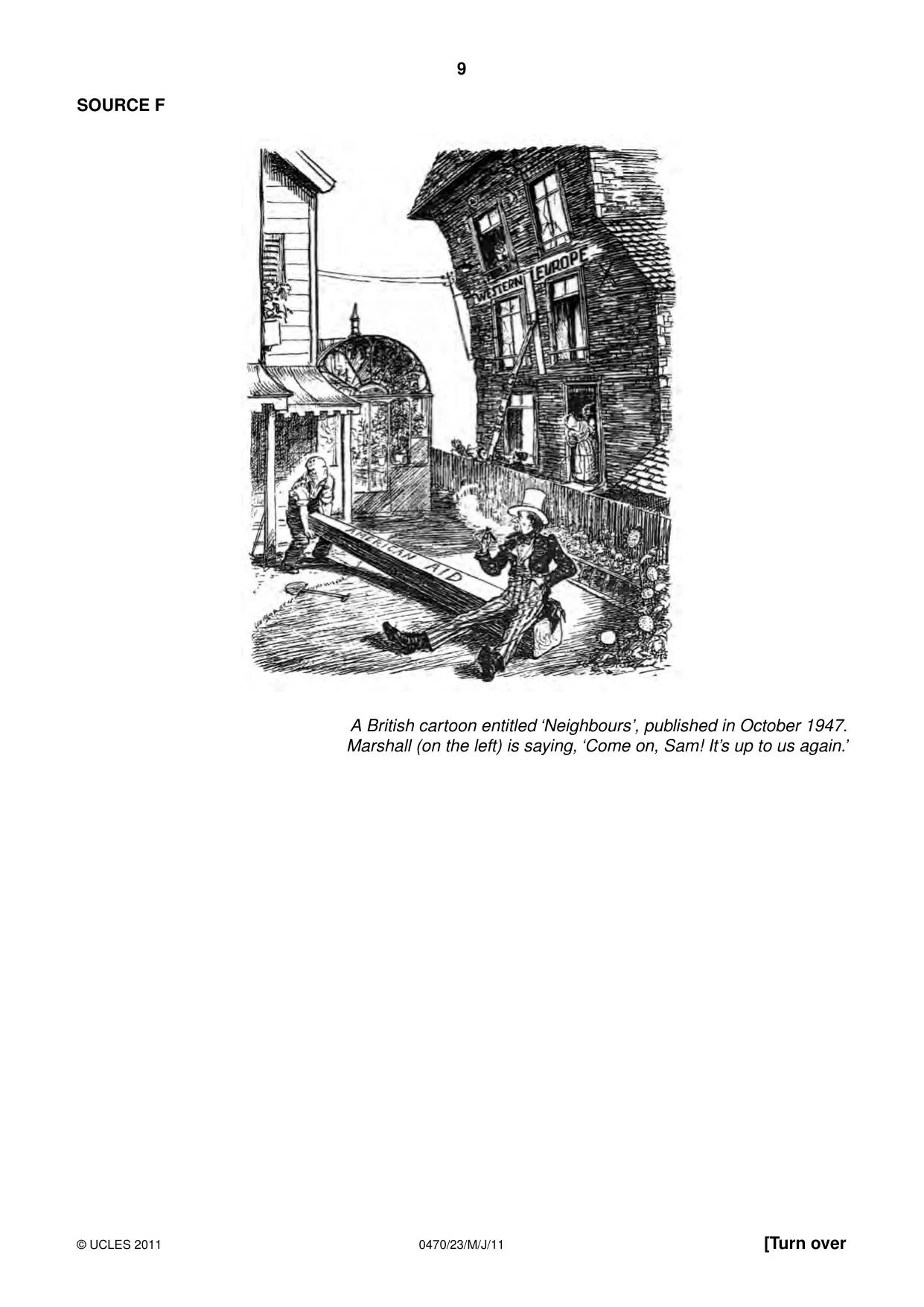
9 0470/23/M/J/11 © UCLES 2011 [Turn over SOURCE F A British cartoon entitled ‘Neighbours’, published in October 1947. Marshall (on the left) is saying, ‘Come on, Sam! It’s up to us again.’
Question paper, page 10
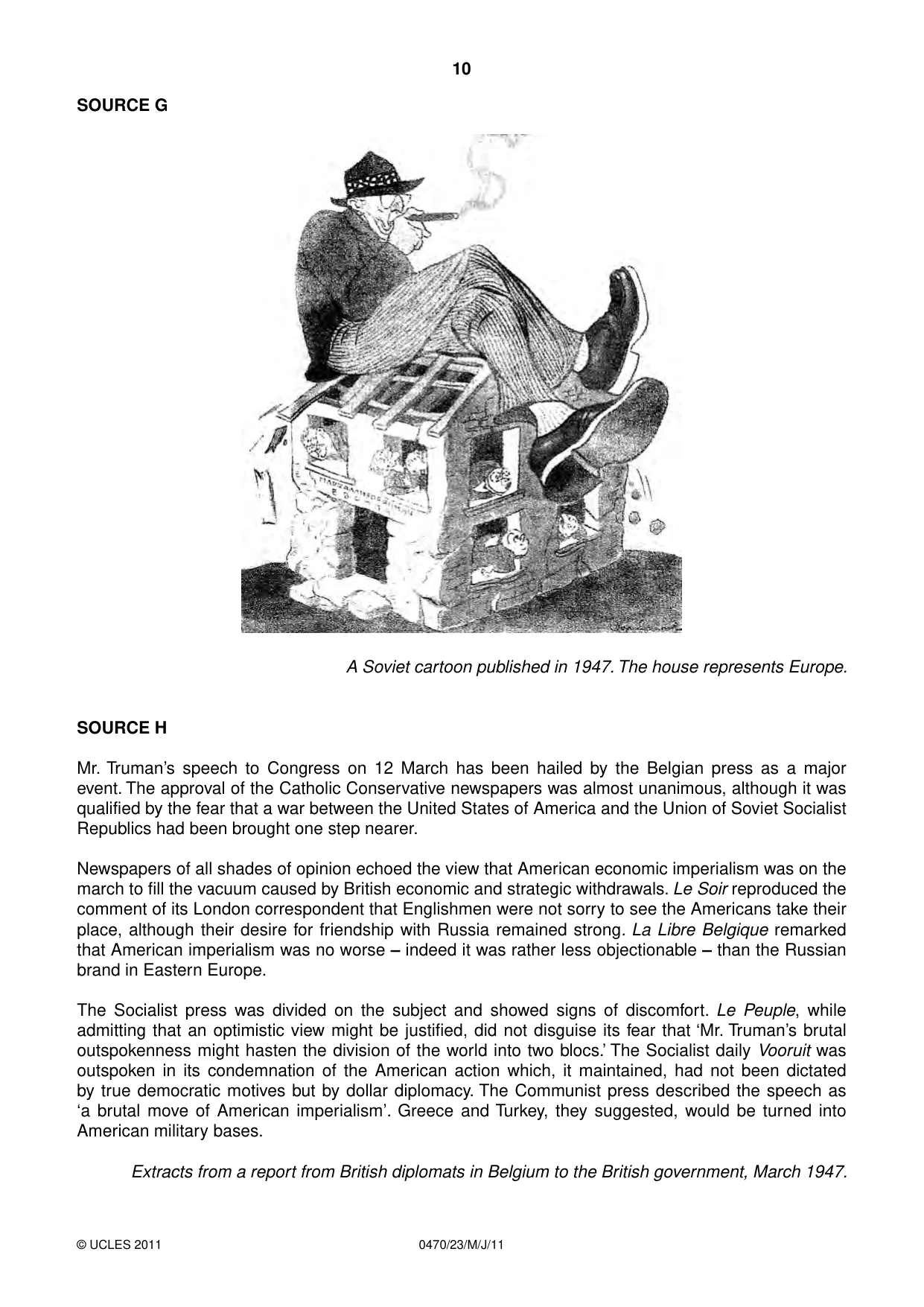
10 0470/23/M/J/11 © UCLES 2011 SOURCE G A Soviet cartoon published in 1947. The house represents Europe. SOURCE H Mr. Truman’s speech to Congress on 12 March has been hailed by the Belgian press as a major event. The approval of the Catholic Conservative newspapers was almost unanimous, although it was qualified by the fear that a war between the United States of America and the Union of Soviet Socialist Republics had been brought one step nearer. Newspapers of all shades of opinion echoed the view that American economic imperialism was on the march to fill the vacuum caused by British economic and strategic withdrawals. Le Soir reproduced the comment of its London correspondent that Englishmen were not sorry to see the Americans take their place, although their desire for friendship with Russia remained strong. La Libre Belgique remarked that American imperialism was no worse – indeed it was rather less objectionable – than the Russian brand in Eastern Europe. The Socialist press was divided on the subject and showed signs of discomfort. Le Peuple, while admitting that an optimistic view might be justified, did not disguise its fear that ‘Mr. Truman’s brutal outspokenness might hasten the division of the world into two blocs.’ The Socialist daily Vooruit was outspoken in its condemnation of the American action which, it maintained, had not been dictated by true democratic motives but by dollar diplomacy. The Communist press described the speech as ‘a brutal move of American imperialism’. Greece and Turkey, they suggested, would be turned into American military bases. Extracts from a report from British diplomats in Belgium to the British government, March 1947.
Question paper, page 11
11 0470/23/M/J/11 © UCLES 2011 Now answer all the following questions. You may use any of the sources to help you answer the questions, in addition to those sources which you are told to use. In answering the questions you should use your knowledge of the topic to help you interpret and evaluate the sources. 1 Study Sources A and B. How far do these two sources agree? Explain your answer using details of the sources. [6] 2 Study Sources C and D. Does Source D make Source C surprising? Explain your answer using details of the sources and your knowledge. [8] 3 Study Source E. What is the message of this cartoon? Explain your answer using details of the source and your knowledge. [8] 4 Study Sources F and G. How similar are these two cartoons? Explain your answer using details of the sources and your knowledge. [8] 5 Study Source H. Why do you think British diplomats in Belgium made this report to the British government? Explain your answer using details of the source and your knowledge. [8] 6 Study all the sources. How far do these sources provide convincing evidence that the Russians were to blame for starting the Cold War? Use the sources to explain your answer. [12]
Question paper, page 12
12 0470/23/M/J/11 © UCLES 2011 BLANK PAGE Copyright Acknowledgements: Option A Source A © Andrina Stiles and Alan Farmer; The Unification of Germany 1815-90 ; Hodder & Stoughton; 2001. Option A Source B © A J P Taylor; A Turning Point?; D C Heath & Co.; 1965. Option A Source E © Michael Gorman; The Unification of Germany; Cambridge University Press/Bildarchiv Preussischer Kulturbesitz; 1989. Option B Source B © D Merrill & T Patterson; Major Problems in American Foreign Relations Vol. II ; Houghton Mifflin; 2000. Option B Source D © www.johndclare.net/cold_war. Option B Source E © Tony Lancaster & Derek Peaple; The Modern World ; Causeway Press/Punch; 1996. Option B Source F © Nigel Kelly & Greg Lacey; Modern World History ; Heinemann/Punch; 1999. Option B Source G © Jeremy Isaacs & Taylor Downing; Cold War ; Bantam Press/Krokodil; 1998. Permission to reproduce items where third-party owned material protected by copyright is included has been sought and cleared where possible. Every reasonable effort has been made by the publisher (UCLES) to trace copyright holders, but if any items requiring clearance have unwittingly been included, the publisher will be pleased to make amends at the earliest possible opportunity. University of Cambridge International Examinations is part of the Cambridge Assessment Group. Cambridge Assessment is the brand name of University of Cambridge Local Examinations Syndicate (UCLES), which is itself a department of the University of Cambridge.
Mark scheme, page 1
UNIVERSITY OF CAMBRIDGE INTERNATIONAL EXAMINATIONS International General Certificate of Secondary Education MARK SCHEME for the May/June 2011 question paper for the guidance of teachers 0470 HISTORY 0470/23 Paper 2, maximum raw mark 50 This mark scheme is published as an aid to teachers and candidates, to indicate the requirements of the examination. It shows the basis on which Examiners were instructed to award marks. It does not indicate the details of the discussions that took place at an Examiners’ meeting before marking began, which would have considered the acceptability of alternative answers. Mark schemes must be read in conjunction with the question papers and the report on the examination. • Cambridge will not enter into discussions or correspondence in connection with these mark schemes. Cambridge is publishing the mark schemes for the May/June 2011 question papers for most IGCSE, GCE Advanced Level and Advanced Subsidiary Level syllabuses and some Ordinary Level syllabuses. www.XtremePapers.com
Mark scheme, page 2
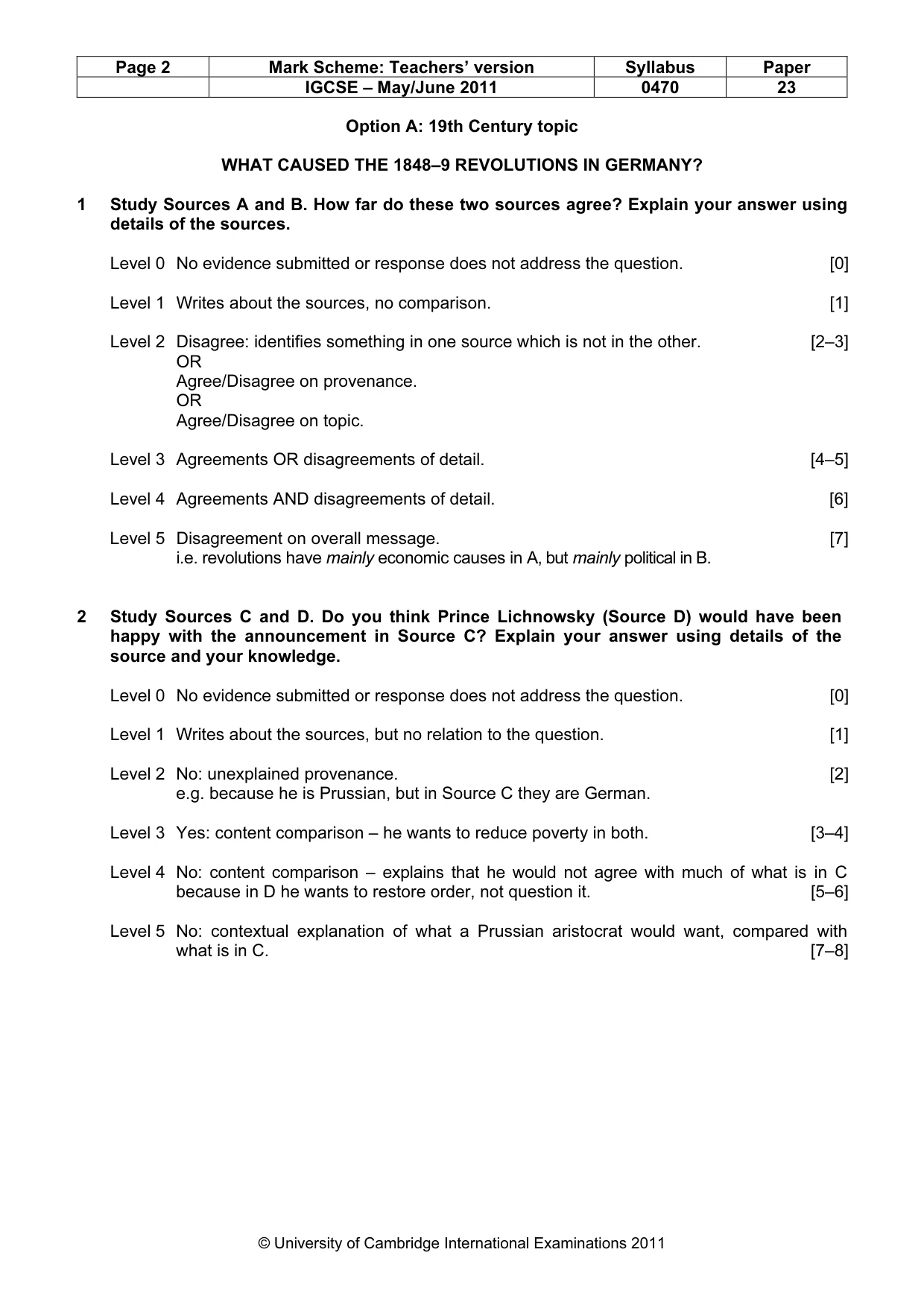
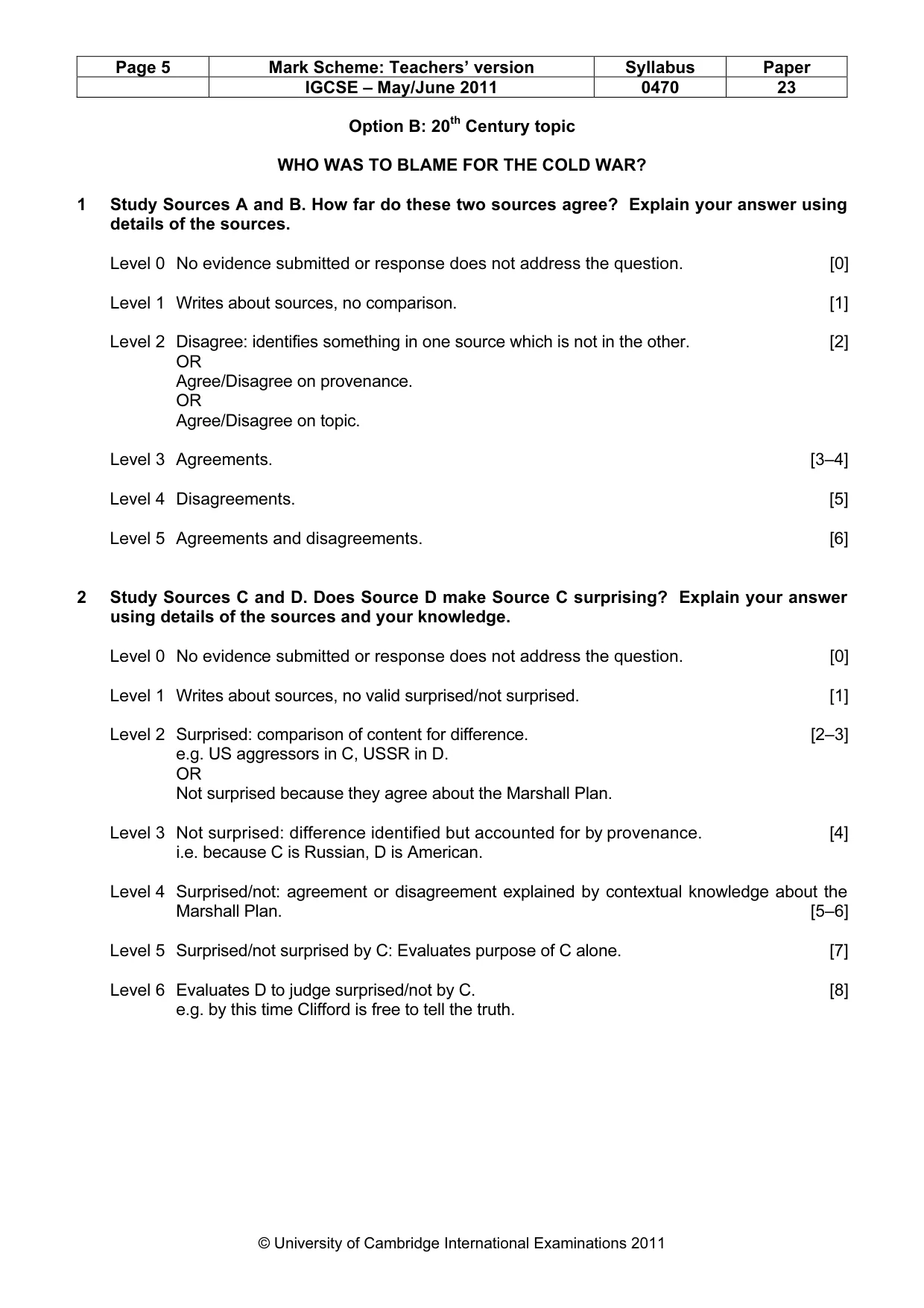
Page 2 Mark Scheme: Teachers’ version Syllabus Paper IGCSE – May/June 2011 0470 23 © University of Cambridge International Examinations 2011 Option A: 19th Century topic WHAT CAUSED THE 1848–9 REVOLUTIONS IN GERMANY? 1 Study Sources A and B. How far do these two sources agree? Explain your answer using details of the sources. Level 0 No evidence submitted or response does not address the question. [0] Level 1 Writes about the sources, no comparison. [1] Level 2 Disagree: identifies something in one source which is not in the other. [2–3] OR Agree/Disagree on provenance. OR Agree/Disagree on topic. Level 3 Agreements OR disagreements of detail. [4–5] Level 4 Agreements AND disagreements of detail. [6] Level 5 Disagreement on overall message. [7] i.e. revolutions have mainly economic causes in A, but mainly political in B. 2 Study Sources C and D. Do you think Prince Lichnowsky (Source D) would have been happy with the announcement in Source C? Explain your answer using details of the source and your knowledge. Level 0 No evidence submitted or response does not address the question. [0] Level 1 Writes about the sources, but no relation to the question. [1] Level 2 No: unexplained provenance. [2] e.g. because he is Prussian, but in Source C they are German. Level 3 Yes: content comparison – he wants to reduce poverty in both. [3–4] Level 4 No: content comparison – explains that he would not agree with much of what is in C because in D he wants to restore order, not question it. [5–6] Level 5 No: contextual explanation of what a Prussian aristocrat would want, compared with what is in C. [7–8]
Mark scheme, page 3
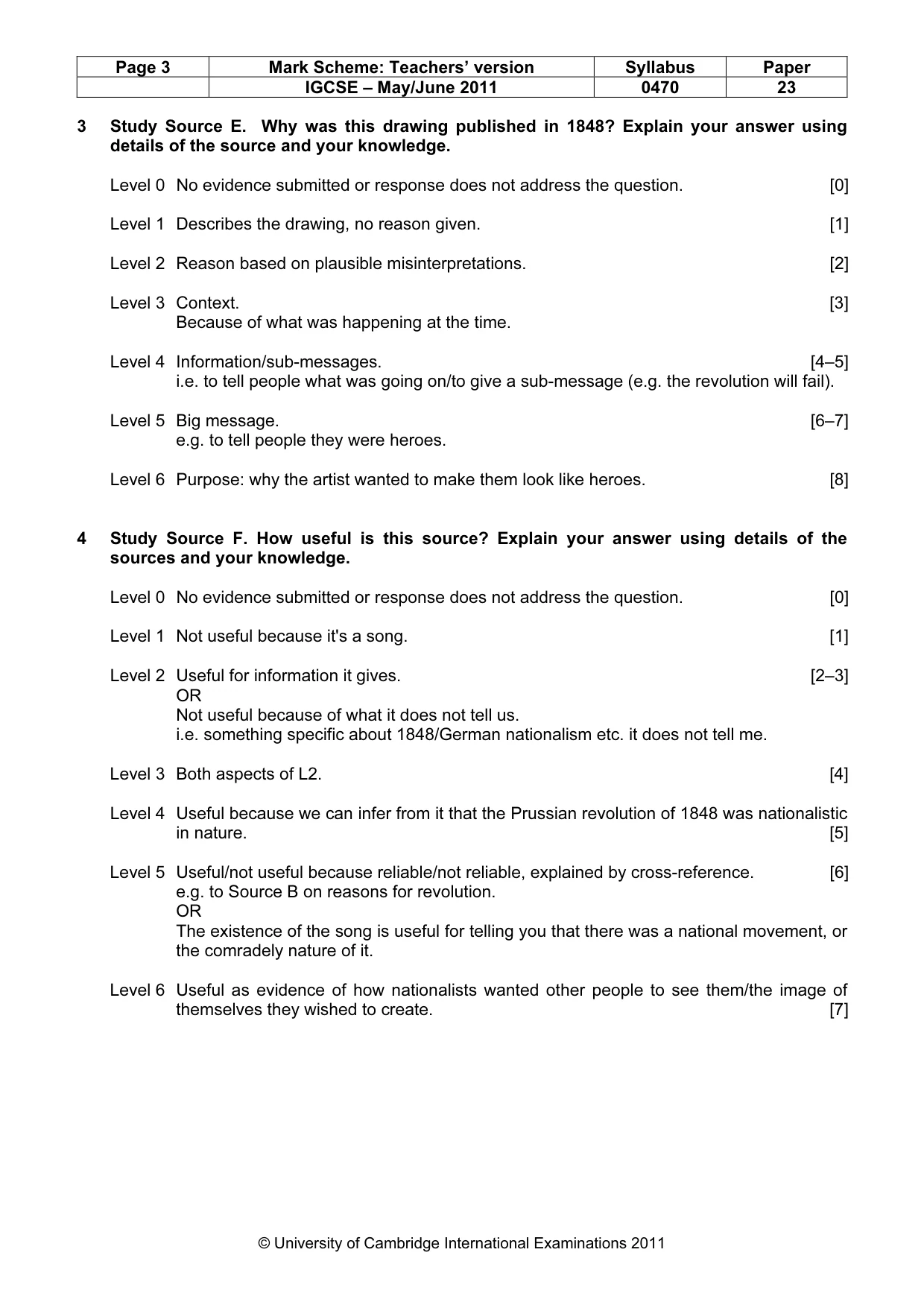
Page 3 Mark Scheme: Teachers’ version Syllabus Paper IGCSE – May/June 2011 0470 23 © University of Cambridge International Examinations 2011 3 Study Source E. Why was this drawing published in 1848? Explain your answer using details of the source and your knowledge. Level 0 No evidence submitted or response does not address the question. [0] Level 1 Describes the drawing, no reason given. [1] Level 2 Reason based on plausible misinterpretations. [2] Level 3 Context. [3] Because of what was happening at the time. Level 4 Information/sub-messages. [4–5] i.e. to tell people what was going on/to give a sub-message (e.g. the revolution will fail). Level 5 Big message. [6–7] e.g. to tell people they were heroes. Level 6 Purpose: why the artist wanted to make them look like heroes. [8] 4 Study Source F. How useful is this source? Explain your answer using details of the sources and your knowledge. Level 0 No evidence submitted or response does not address the question. [0] Level 1 Not useful because it's a song. [1] Level 2 Useful for information it gives. [2–3] OR Not useful because of what it does not tell us. i.e. something specific about 1848/German nationalism etc. it does not tell me. Level 3 Both aspects of L2. [4] Level 4 Useful because we can infer from it that the Prussian revolution of 1848 was nationalistic in nature. [5] Level 5 Useful/not useful because reliable/not reliable, explained by cross-reference. [6] e.g. to Source B on reasons for revolution. OR The existence of the song is useful for telling you that there was a national movement, or the comradely nature of it. Level 6 Useful as evidence of how nationalists wanted other people to see them/the image of themselves they wished to create. [7]
Mark scheme, page 4
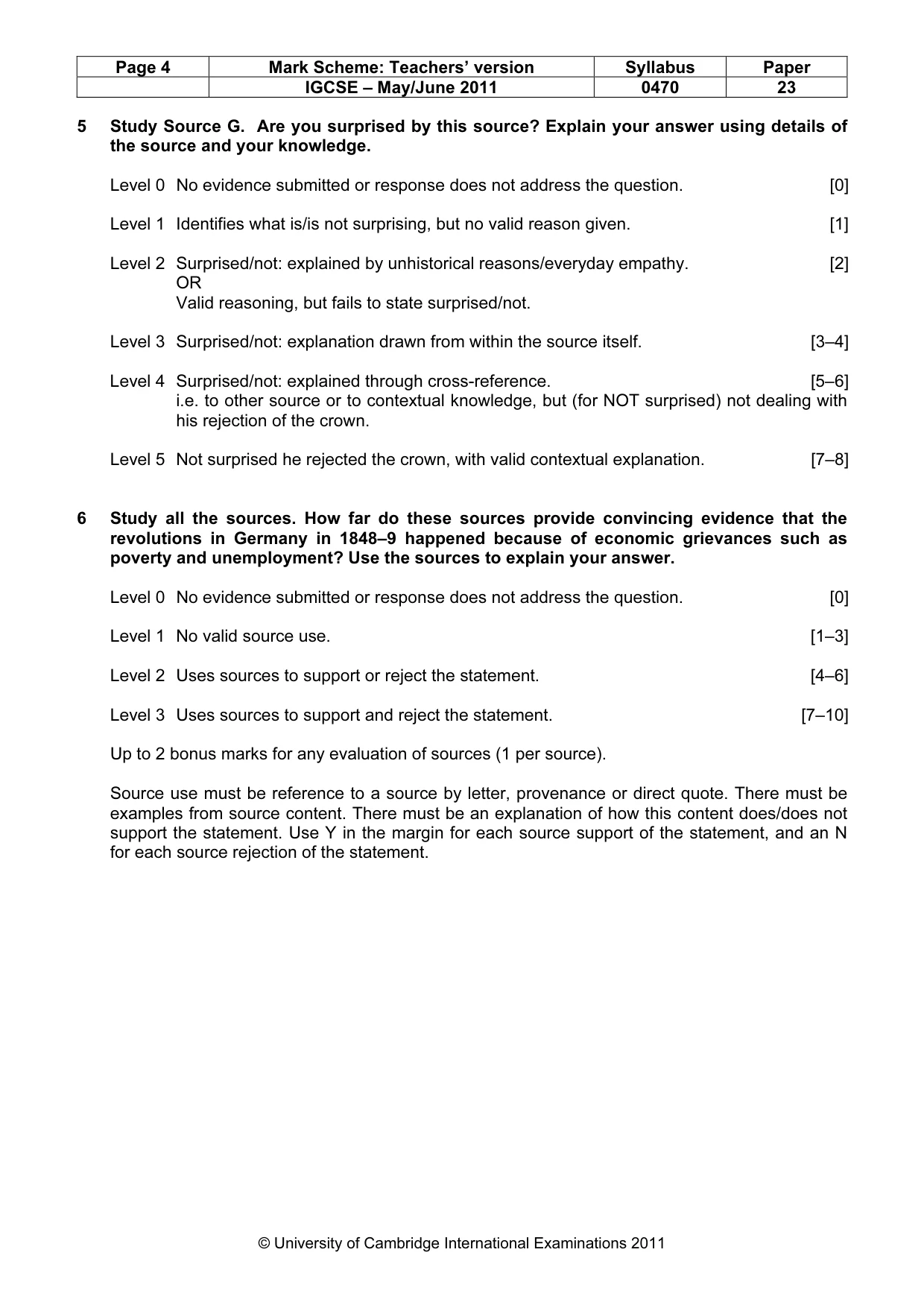
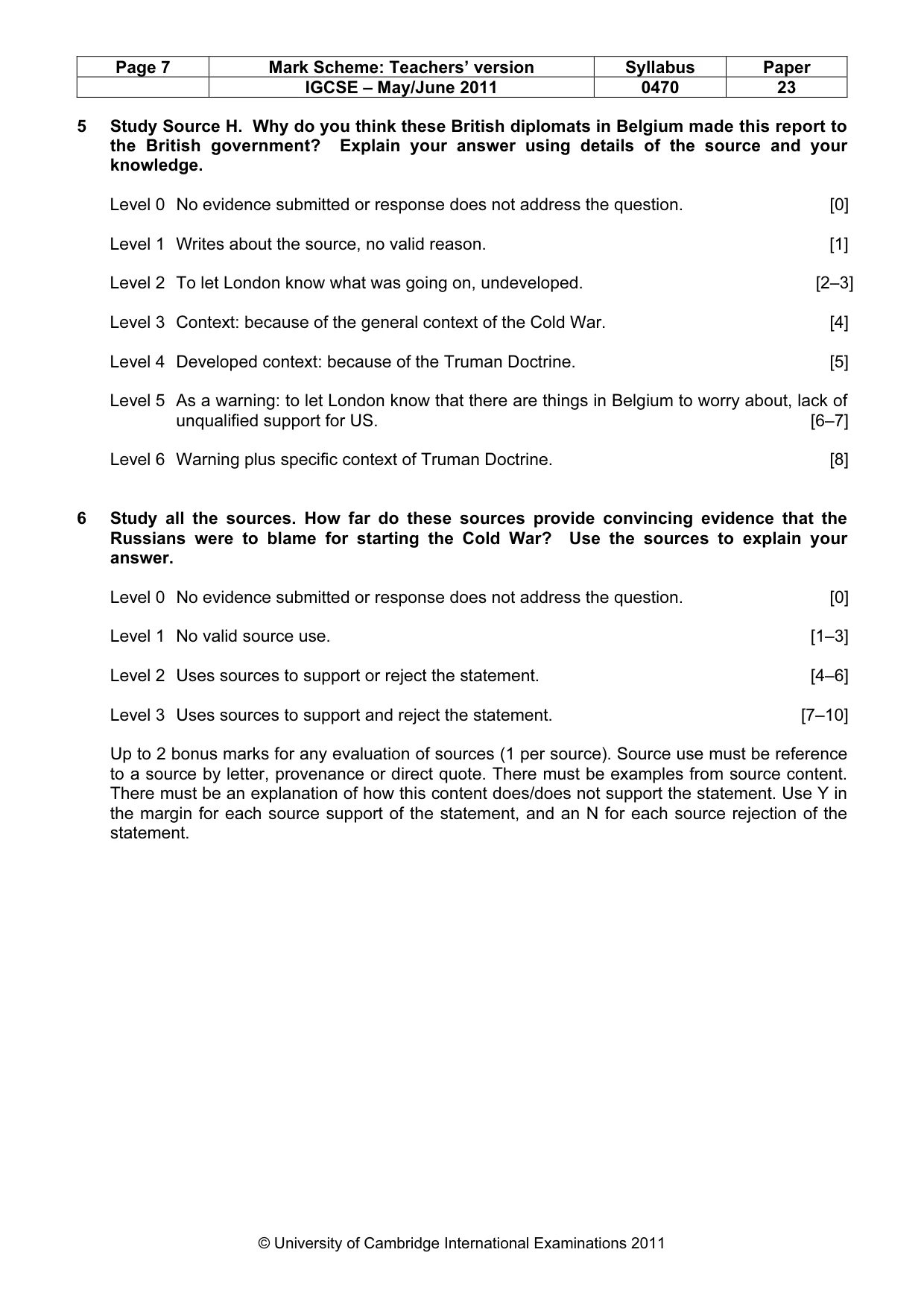
Page 4 Mark Scheme: Teachers’ version Syllabus Paper IGCSE – May/June 2011 0470 23 © University of Cambridge International Examinations 2011 5 Study Source G. Are you surprised by this source? Explain your answer using details of the source and your knowledge. Level 0 No evidence submitted or response does not address the question. [0] Level 1 Identifies what is/is not surprising, but no valid reason given. [1] Level 2 Surprised/not: explained by unhistorical reasons/everyday empathy. [2] OR Valid reasoning, but fails to state surprised/not. Level 3 Surprised/not: explanation drawn from within the source itself. [3–4] Level 4 Surprised/not: explained through cross-reference. [5–6] i.e. to other source or to contextual knowledge, but (for NOT surprised) not dealing with his rejection of the crown. Level 5 Not surprised he rejected the crown, with valid contextual explanation. [7–8] 6 Study all the sources. How far do these sources provide convincing evidence that the revolutions in Germany in 1848–9 happened because of economic grievances such as poverty and unemployment? Use the sources to explain your answer. Level 0 No evidence submitted or response does not address the question. [0] Level 1 No valid source use. [1–3] Level 2 Uses sources to support or reject the statement. [4–6] Level 3 Uses sources to support and reject the statement. [7–10] Up to 2 bonus marks for any evaluation of sources (1 per source). Source use must be reference to a source by letter, provenance or direct quote. There must be examples from source content. There must be an explanation of how this content does/does not support the statement. Use Y in the margin for each source support of the statement, and an N for each source rejection of the statement.
Mark scheme, page 5
Page 5 Mark Scheme: Teachers’ version Syllabus Paper IGCSE – May/June 2011 0470 23 © University of Cambridge International Examinations 2011 Option B: 20th Century topic WHO WAS TO BLAME FOR THE COLD WAR? 1 Study Sources A and B. How far do these two sources agree? Explain your answer using details of the sources. Level 0 No evidence submitted or response does not address the question. [0] Level 1 Writes about sources, no comparison. [1] Level 2 Disagree: identifies something in one source which is not in the other. [2] OR Agree/Disagree on provenance. OR Agree/Disagree on topic. Level 3 Agreements. [3–4] Level 4 Disagreements. [5] Level 5 Agreements and disagreements. [6] 2 Study Sources C and D. Does Source D make Source C surprising? Explain your answer using details of the sources and your knowledge. Level 0 No evidence submitted or response does not address the question. [0] Level 1 Writes about sources, no valid surprised/not surprised. [1] Level 2 Surprised: comparison of content for difference. [2–3] e.g. US aggressors in C, USSR in D. OR Not surprised because they agree about the Marshall Plan. Level 3 Not surprised: difference identified but accounted for by provenance. [4] i.e. because C is Russian, D is American. Level 4 Surprised/not: agreement or disagreement explained by contextual knowledge about the Marshall Plan. [5–6] Level 5 Surprised/not surprised by C: Evaluates purpose of C alone. [7] Level 6 Evaluates D to judge surprised/not by C. [8] e.g. by this time Clifford is free to tell the truth.
Mark scheme, page 6
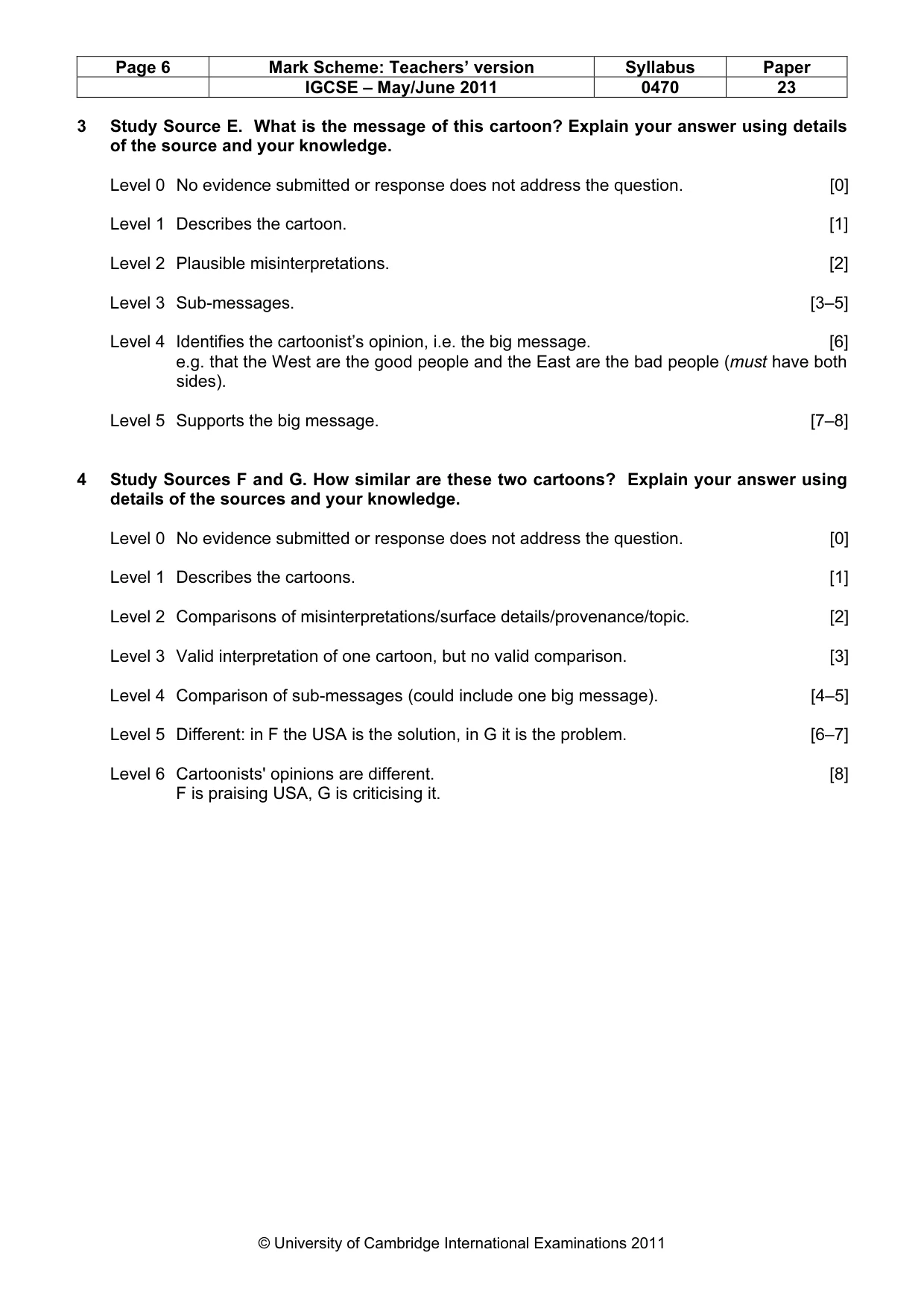
Page 6 Mark Scheme: Teachers’ version Syllabus Paper IGCSE – May/June 2011 0470 23 © University of Cambridge International Examinations 2011 3 Study Source E. What is the message of this cartoon? Explain your answer using details of the source and your knowledge. Level 0 No evidence submitted or response does not address the question. [0] Level 1 Describes the cartoon. [1] Level 2 Plausible misinterpretations. [2] Level 3 Sub-messages. [3–5] Level 4 Identifies the cartoonist’s opinion, i.e. the big message. [6] e.g. that the West are the good people and the East are the bad people (must have both sides). Level 5 Supports the big message. [7–8] 4 Study Sources F and G. How similar are these two cartoons? Explain your answer using details of the sources and your knowledge. Level 0 No evidence submitted or response does not address the question. [0] Level 1 Describes the cartoons. [1] Level 2 Comparisons of misinterpretations/surface details/provenance/topic. [2] Level 3 Valid interpretation of one cartoon, but no valid comparison. [3] Level 4 Comparison of sub-messages (could include one big message). [4–5] Level 5 Different: in F the USA is the solution, in G it is the problem. [6–7] Level 6 Cartoonists' opinions are different. [8] F is praising USA, G is criticising it.
Mark scheme, page 7
Page 7 Mark Scheme: Teachers’ version Syllabus Paper IGCSE – May/June 2011 0470 23 © University of Cambridge International Examinations 2011 5 Study Source H. Why do you think these British diplomats in Belgium made this report to the British government? Explain your answer using details of the source and your knowledge. Level 0 No evidence submitted or response does not address the question. [0] Level 1 Writes about the source, no valid reason. [1] Level 2 To let London know what was going on, undeveloped. [2–3] Level 3 Context: because of the general context of the Cold War. [4] Level 4 Developed context: because of the Truman Doctrine. [5] Level 5 As a warning: to let London know that there are things in Belgium to worry about, lack of unqualified support for US. [6–7] Level 6 Warning plus specific context of Truman Doctrine. [8] 6 Study all the sources. How far do these sources provide convincing evidence that the Russians were to blame for starting the Cold War? Use the sources to explain your answer. Level 0 No evidence submitted or response does not address the question. [0] Level 1 No valid source use. [1–3] Level 2 Uses sources to support or reject the statement. [4–6] Level 3 Uses sources to support and reject the statement. [7–10] Up to 2 bonus marks for any evaluation of sources (1 per source). Source use must be reference to a source by letter, provenance or direct quote. There must be examples from source content. There must be an explanation of how this content does/does not support the statement. Use Y in the margin for each source support of the statement, and an N for each source rejection of the statement.
What you needed in this session
Cambridge’s own grade thresholds for 2011 May/June, Paper 2 · Variant 3. A higher threshold means an easier paper — the bar moves with how the cohort did.