Cambridge IGCSE History 0470 — 2010 May/June Paper 2 · Variant 3
0470/23/M/J/10 · 50 marks · ≈56 min
The question paper and its mark scheme, free to read here and free to download. This is Cambridge’s own paper, exactly as it was sat.
Question paper12 pages
Mark scheme7 pages
Answers below. Sit the paper first if you are practising.
Paper as text
Question paper, page 1
This document consists of 12 printed pages. DC (CW/SW) 25129/3 © UCLES 2010 [Turn over UNIVERSITY OF CAMBRIDGE INTERNATIONAL EXAMINATIONS International General Certificate of Secondary Education READ THESE INSTRUCTIONS FIRST If you have been given an Answer Booklet, follow the instructions on the front cover of the Booklet. Write your Centre number, candidate number and name on all the work you hand in. Write in dark blue or black pen. You may use a soft pencil for any diagrams, graphs or rough working. Do not use staples, paper clips, highlighters, glue or correction fluid. This paper has two options. Choose one option, and then answer all of the questions on that topic. Option A: 19th Century topic [p2–p6] Option B: 20th Century topic [p7–p12] At the end of the examination, fasten all your work securely together. The number of marks is given in brackets [ ] at the end of each question or part question. * 5 5 7 5 9 2 9 3 3 6 * HISTORY 0470/23 Paper 2 May/June 2010 2 hours Additional Materials: Answer Booklet/Paper www.XtremePapers.com
Question paper, page 2
2 0470/23/M/J/10 © UCLES 2010 Option A: 19th Century topic DID THE SOUTH HAVE NO CHANCE OF WINNING THE AMERICAN CIVIL WAR? Study the Background Information and the sources carefully, and then answer all the questions. Background Information Historians disagree over whether the South ever had a chance of winning the Civil War. Some claim that it had many advantages at the beginning of the war. They argue that the South could have won but made mistakes and misjudgements, while the North was better led and had a clearer strategy. However, many historians have focused on the strength of the North at the beginning of the war and argue that a Northern victory was inevitable. Did the South really have no chance of winning the war? SOURCE A It is not too much to say that the South held – or appeared to hold – at least two of the main advantages in 1861. The Confederacy did not need to win in order to win; it was enough if it continued fighting long enough to weary the North. The North, in order to win, had to conquer the South – invade and hold an area so great as all western Europe. The Confederacy could afford to lose all the battles, if only it could persuade the North that the price of victory was too high. The second advantage was foreign intervention. The leaders of the Confederacy counted with confidence on the intervention of Britain and France on their behalf. The South also commanded interior lines and the ability to shift its smaller forces rapidly from one front to another. It was on the defensive, and that position more than made up for numerical inferiority. Why did the South lose? Was it because the Confederacy was hopelessly outnumbered? But it was, in fact, able to put as many soldiers into action in battle as the Union until 1864. Was it finances? The financial explanation merely begs the larger question: Why was the Confederacy without money? Was it transportation? The South had a much smaller railroad mileage than the North, but it enjoyed interior lines and had advantages in water communication. Southern transportation facilities were not, in fact, inadequate; the real question is why the South failed to utilize them, or permitted them to disintegrate. Or was the fault, perhaps, in Jefferson Davis, so temperamental, so arrogant? He took the conduct of the war into his own hands; he intervened in the military; he had favourites, he alienated State governors; he never won the affection of the Southern people. Yet on balance, Davis emerges as a good President – certainly as good as the Confederacy could have selected at that time: tireless, courageous, intelligent, right on most issues far more often than his critics were. From a history book published in 1960.
Question paper, page 3
3 0470/23/M/J/10 © UCLES 2010 [Turn over SOURCE B In leadership the Union was clearly superior. Lincoln was an abler and a stronger man than Davis. The North developed at an early stage an overall plan of strategy. The South was unable to accomplish this. We need to remind ourselves that ways of making war are always the product of cultures. For the nationalistic North it was comparatively easy to achieve a broad view of war. But it was natural for the localistic South to adopt a narrow view and to fight a conservative war. Confederate strategy was almost wholly defensive, and was designed to guard the whole of the country. Probably the South’s best chance to win its independence by a military decision was to attempt a mass offensive. But the restrictions of Southern culture prevented this. Just as defence was the worst strategy for the South, offence was the best strategy for the North. This was the strategy that Lincoln had pressed upon his generals almost from the beginning. For the North to win, it had to make good use of only a fraction of its economic potential. Its material strength was so much greater that it could almost defeat the South during the war years with one hand tied behind its back. The North actually grew in material strength, while the South wasted away. By 1864 the Confederacy was not yet beaten on the field of battle, but already economic exhaustion was setting in behind the lines. Economic rather than strictly military superiority was the basic reason for the ultimate victory of the North. Its vast economic power made the Union armies the best fed, the best clothed, the best cared for that the world had ever seen. The economic might made it possible for the North to field stronger forces when the final test came at every crucial point. From a history book published in 1960. SOURCE C We shall have the enormous advantage of fighting on our own territory and for our very existence. All the world over, are not one million men defending themselves at home against invasion, stronger in a mere military point of view, than five million invading a foreign country? Confederate diplomat, John Sidell, speaking in July 1861. SOURCE D You have no doubt wondered that I have not carried out that policy which I intended of fighting our battles on the fields of the enemy instead of allowing him to fight them on ours. This is the result of the power of the enemy. They had at their command all the wealth of seventy years – the military stores which had been laid up during that time. They had grown rich from the taxes paid by you. We have entered upon a conflict with a nation vastly superior to us in numbers. In face of the facts the wonder is that we have done so much. In the first year of the war our forces were sent into battle poorly armed, and were far inferior in numbers to the enemy. Thus in every battle it was necessary for us to adopt some action to enable us to maintain our ground. The only action was to call on our gallant men and nobly did they respond to the call. They asked that the men who had stayed at home should be forced to meet the enemy. From this resulted the conscription act. I regret to say there has been some prejudice excited against that act. If every young man must serve for two or three years in the army, he will be prepared when war comes to take his place in the ranks. To such a system I am sure there can be no objection. Confederate President, Jefferson Davis speaking in December 1862 to the Mississippi legislature. This was part of a speaking tour he was making through the whole of the Confederacy.
Question paper, page 4
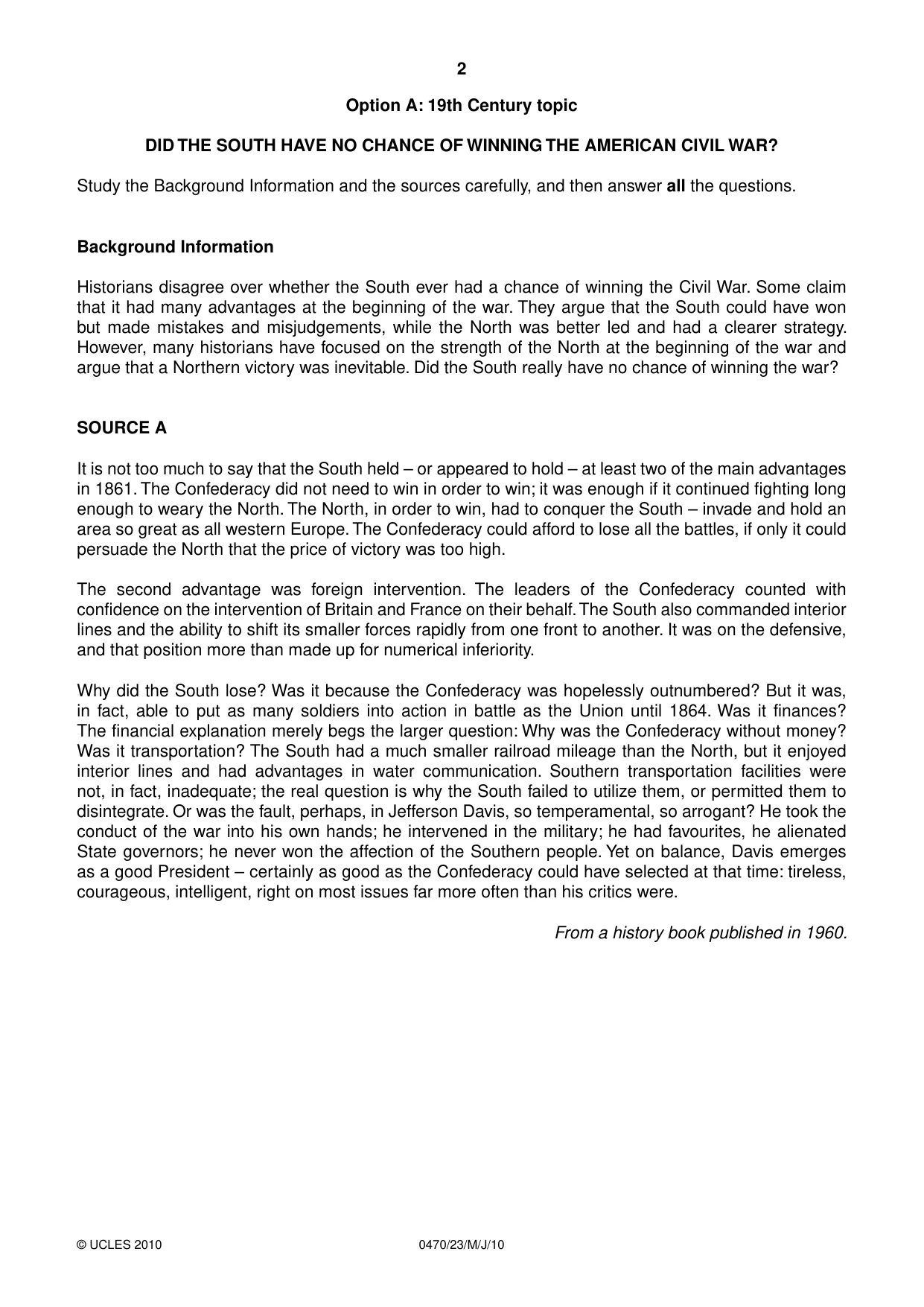
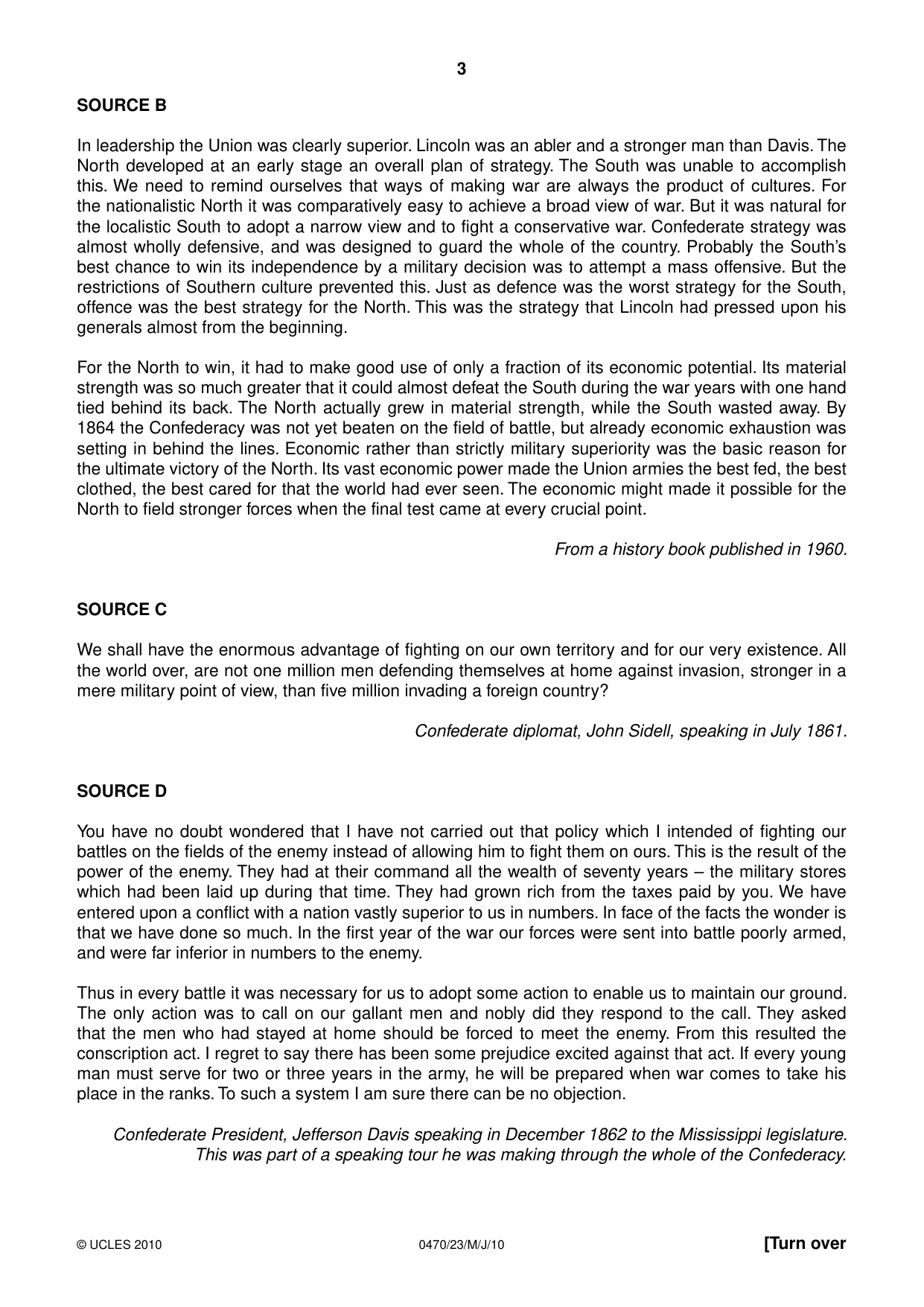
4 0470/23/M/J/10 © UCLES 2010 SOURCE E A cartoon published in a Northern magazine in 1864. The caption reads, ‘Final issue of the war – The longest purse wins.’ Some of the audience are saying, ‘Better give in Jeff. You have not a half a chance.’ SOURCE F An American cartoon published in April 1864. S. P. Chase was responsible for financing the war for the Union. The caption says, ‘Symptoms of spring – Uncle Abram’s crop begins to shoot.’
Question paper, page 5
5 0470/23/M/J/10 © UCLES 2010 [Turn over SOURCE G An American cartoon published in December 1864. The Southern Matron is saying, ‘Well father, you’ve got to go, I see. Jeff Davis had better take little Pete along too. You’d both be just the age for two soldiers. You’re sixty-nine years old, and he’s one. That’s exactly thirty-five on an average.’ SOURCE H After four year’s hard service, marked by unsurpassed courage, the Army of Northern Virginia has been compelled to yield to overwhelming numbers and resources. From Robert E Lee’s farewell speech to his troops when surrendering to Grant in April 1865. SOURCE I Davis had an uncontrollable tendency to slide away from the chief points to minor issues, so the amount of business accomplished bore little relation to the time consumed and frequently a cabinet meeting would exhaust four or five hours without deciding anything; while the desk of every chief of a Department was covered with papers demanding his attention. Stephen Mallory writing after the war about Jefferson Davis. Mallory had been in charge of the Confederate navy and had often been disappointed by the small amounts of money the Confederate government gave to the navy.
Question paper, page 6
6 0470/23/M/J/10 © UCLES 2010 Now answer all the following questions. You may use any of the sources to help you answer the questions, in addition to those sources which you are told to use. In answering the questions you should use your knowledge of the topic to help you interpret and evaluate the sources. 1 Study Sources A and B. How far do these two sources disagree? Explain your answer using details of the sources. [7] 2 Study Sources C and D. Would John Sidell (Source C) have been surprised by Source D? Explain your answer using details of the sources and your knowledge. [8] 3 Study Source E. Why was this cartoon published in 1864? Explain your answer using details of the source and your knowledge. [8] 4 Study Sources F and G. How far do the cartoonists of these two cartoons agree? Explain your answer using details of the sources and your knowledge. [7] 5 Study Sources H and I. Is one of these sources more reliable than the other? Explain your answer using details of the sources and your knowledge. [8] 6 Study all the sources. Do these sources provide convincing evidence that the South had no chance of winning the Civil War? Use the sources to explain your answer. [12]
Question paper, page 7
7 0470/23/M/J/10 © UCLES 2010 [Turn over Option B: 20th Century topic HOW IMPORTANT WAS LECH WALESA? Study the Background Information and the sources carefully, and then answer all the questions. Background Information Poland was always one of the most independent of the Soviet satellite states. This was partly due to a tradition of opposing invaders and to the strength of the Catholic Church in the country. There were major strikes and demonstrations in 1956 and 1970. Increases in food prices and a poor standard of living were constant grievances. From 1980, after a strike in the Gdansk shipyard, Solidarity, led by Walesa, became the first independent trade union in Eastern Europe and led the opposition to the Communist government. At the end of the 1980s Soviet and Communist power in Eastern Europe, including Poland, began to collapse. How crucial a factor was Walesa? SOURCE A From November 1980 until December 1981 Poland lived in an excited, uneasy condition. Walesa’s advisers – mindful of past mistakes and wary of provoking a backlash from the humiliated Communist leadership – urged caution. The self-imposed restraints paid off, up to a point. Political issues – disarmament, or foreign policy – were kept off Solidarity’s public agenda. But under Communism, even ‘non-political’ tactics were bound to run up against the Party’s reluctance to concede any real power. On 13 December 1981 Jaruzelski declared martial law in Poland. Solidarity’s leaders were swept up into prison. The rise of Solidarity appears as the opening shot in the final struggle against Communism. But the Polish ‘revolution’ of 1980–81 is better understood as the last of a series of workers protests that began in 1970. But that is all they were. Price increases, protest strikes, the sympathy and support of the Catholic Church, these were all familiar. They did not in themselves promise the downfall of Communist power. Communism might be eroded from within or below, but it could not be overthrown. Open confrontation would be catastrophic. Yes, martial law was an admission of a certain kind of failure on the part of the authorities. But Communism was about power, and power lay not in Warsaw but in Moscow. The developments in Poland were only an exciting introduction to the story of Communism’s collapse; they remained a sideshow. The real story was elsewhere. From a history book published in 2005.
Question paper, page 8
8 0470/23/M/J/10 © UCLES 2010 SOURCE B The strikes at Poland’s Gdansk shipyard and the formation of the Solidarity movement brought the sharpest challenge to the Soviet system in Eastern Europe since the Prague Spring of 1968. The power of Solidarity lay in its threefold aims. The opposition to higher food prices rallied widespread support. The two demands for legalising strikes and allowing the broadcast of the Roman Catholic Church mass over state radio each Sunday rallied the working class, the Church and its supporters. The readiness of the Polish government to compromise gave Solidarity room to mobilise. But, to put pressure on the Polish government, the Soviet army held some threatening military manoeuvres and the KGB made it clear it was seriously alarmed. The Soviets were reassured by the appointment of Jaruzelski as Prime Minister, but when Polish leaders visited Moscow in March 1981, the Soviet government issued a plain warning that ‘the Communist community is indivisible and its defence is the concern not just of each individual state, but of the Communist coalition as a whole.’ In December 1981 Jaruzelski imposed martial law and the Polish army struck at Solidarity. From a history book published in 1996. SOURCE C What I remember most vividly from the Lenin Shipyard is not the leaders, Lech Walesa or Andrzej, but the figure of one ordinary striker. He was in his mid-twenties, with short cropped hair and piercing eyes. It was young men like him who would come into their own in Solidarity, and give the movement its extraordinary youthful energy and fearlessness. Then I remembered quite a different figure, a shy elderly clerk in the dispatch department of the docks. He was obviously afraid of what the police and army might do. He was afraid, but had still come to volunteer his services as an interpreter. Above all I remember a sense of being carried along on some mighty river, which led, majestically and inevitably, to the Gdansk Agreement, and to Solidarity. From a book by a British historian who was in Poland in August 1980. The book was published in 1983.
Question paper, page 9
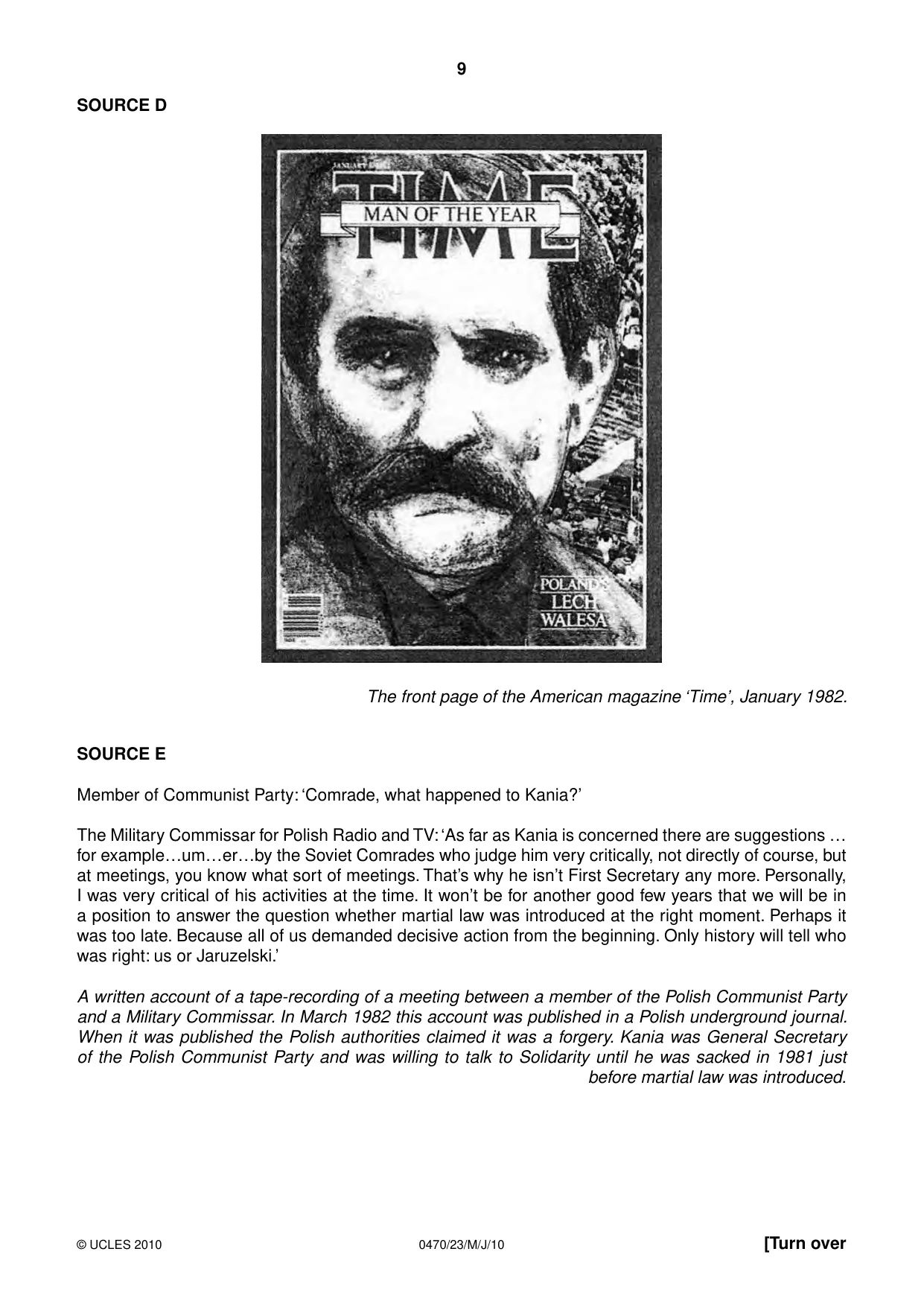
9 0470/23/M/J/10 © UCLES 2010 [Turn over SOURCE D The front page of the American magazine ‘Time’, January 1982. SOURCE E Member of Communist Party: ‘Comrade, what happened to Kania?’ The Military Commissar for Polish Radio and TV: ‘As far as Kania is concerned there are suggestions … for example…um…er…by the Soviet Comrades who judge him very critically, not directly of course, but at meetings, you know what sort of meetings. That’s why he isn’t First Secretary any more. Personally, I was very critical of his activities at the time. It won’t be for another good few years that we will be in a position to answer the question whether martial law was introduced at the right moment. Perhaps it was too late. Because all of us demanded decisive action from the beginning. Only history will tell who was right: us or Jaruzelski.’ A written account of a tape-recording of a meeting between a member of the Polish Communist Party and a Military Commissar. In March 1982 this account was published in a Polish underground journal. When it was published the Polish authorities claimed it was a forgery. Kania was General Secretary of the Polish Communist Party and was willing to talk to Solidarity until he was sacked in 1981 just before martial law was introduced.
Question paper, page 10
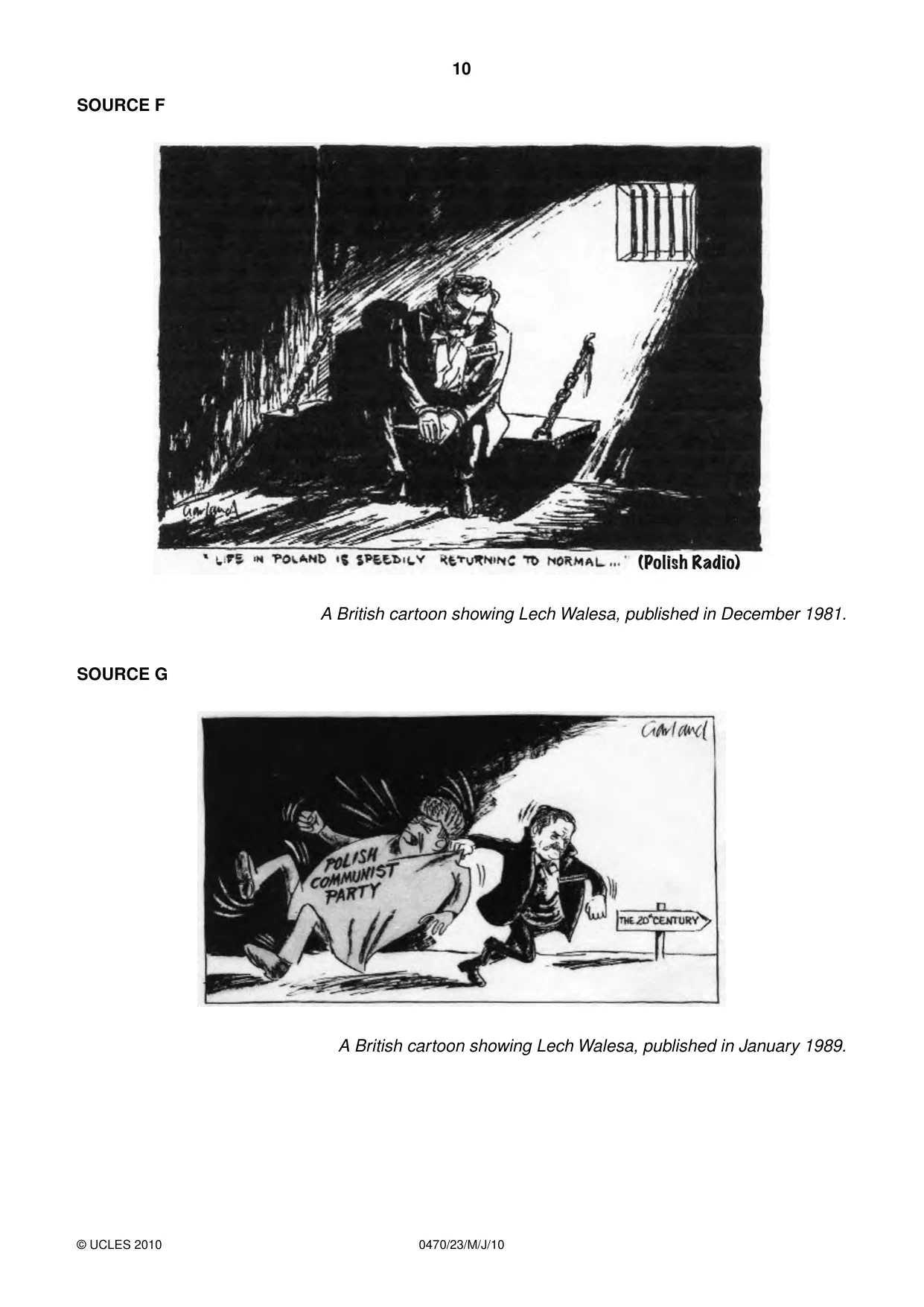
10 0470/23/M/J/10 © UCLES 2010 SOURCE F A British cartoon showing Lech Walesa, published in December 1981. SOURCE G A British cartoon showing Lech Walesa, published in January 1989.
Question paper, page 11
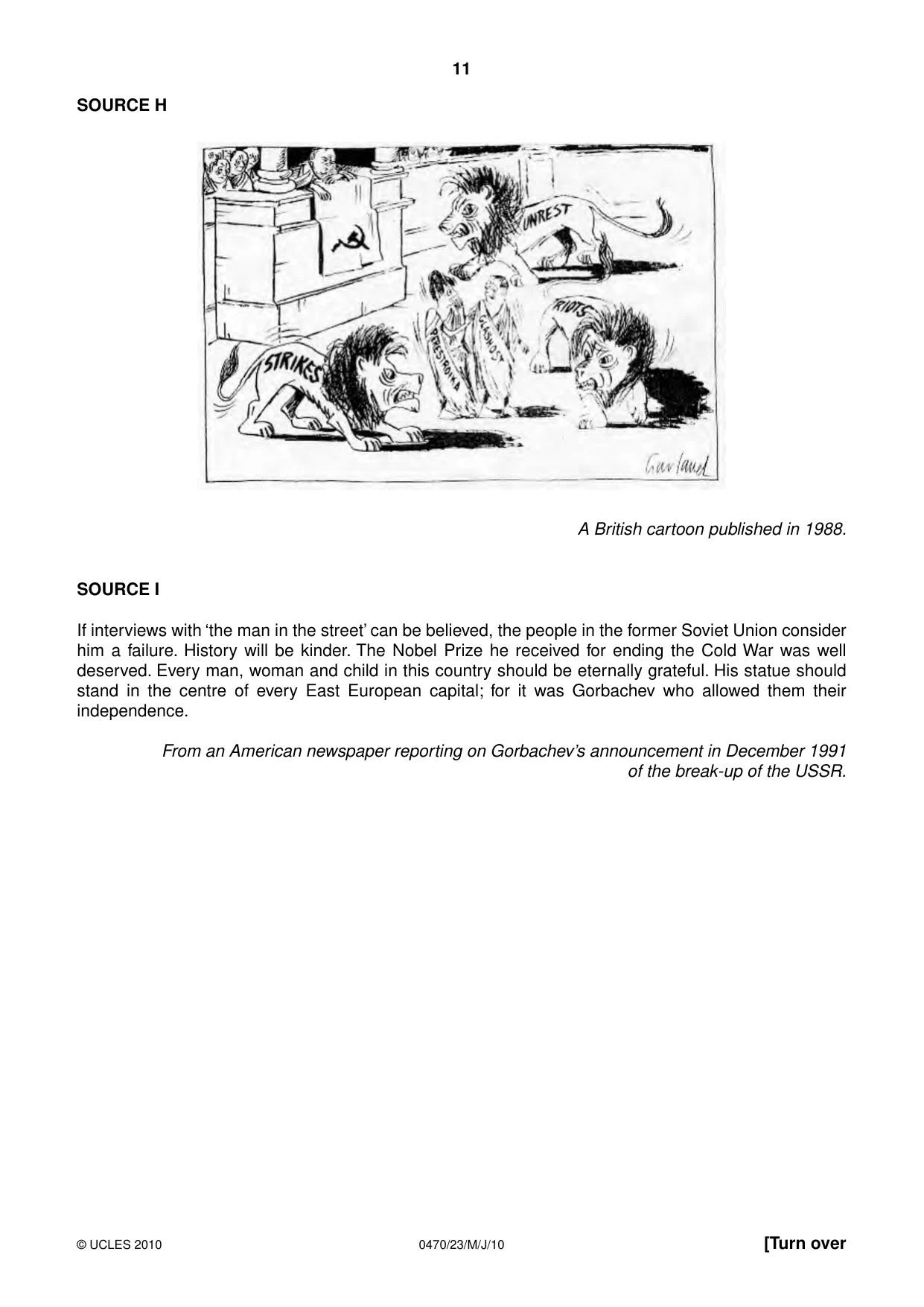
11 0470/23/M/J/10 © UCLES 2010 [Turn over SOURCE H A British cartoon published in 1988. SOURCE I If interviews with ‘the man in the street’ can be believed, the people in the former Soviet Union consider him a failure. History will be kinder. The Nobel Prize he received for ending the Cold War was well deserved. Every man, woman and child in this country should be eternally grateful. His statue should stand in the centre of every East European capital; for it was Gorbachev who allowed them their independence. From an American newspaper reporting on Gorbachev’s announcement in December 1991 of the break-up of the USSR.
Question paper, page 12
12 0470/23/M/J/10 © UCLES 2010 Now answer all the following questions. You may use any of the sources to help you answer the questions, in addition to those sources which you are told to use. In answering the questions you should use your knowledge of the topic to help you interpret and evaluate the sources. 1 Study Sources A and B. How far do these two sources agree? Explain your answer using details of the sources. [7] 2 Study Sources C and D. How do you explain the different impressions given by these two sources? Explain your answer using details of the sources and your knowledge. [8] 3 Study Source E. Do you think the authorities were worried by the content of this source? Explain your answer using details of the source and your knowledge. [7] 4 Study Sources F and G. How different are the messages of these two sources? Explain your answer using details of the sources and your knowledge. [8] 5 Study Sources H and I. Do these two sources prove that Gorbachev was a failure? Explain your answer using details of the sources and your knowledge. [8] 6 Study all the sources. How far do these sources provide convincing evidence that Walesa was the crucial factor in developments in Eastern Europe? Use the sources to explain your answer. [12] Copyright Acknowledgements: Option A Source A © David Herbert Donald, Why the North won the Civil War; Simon & Schuster, 1960. Option A Source B © David Herbert Donald, Why the North won the Civil War; Simon & Schuster, 1960. Option A Source C © Alan Farmer, The American Civil War 1861– 65; Hodder & Stoughton, 2002. Option A Source D © Reid Mitchell, The American Civil War 1861–1865; Longman, 2001. Option A Source E © Harpweek Abraham Lincoln Cartoons. Option A Source F © Harpweek Education. Option A Source G © Harpweek Abraham Lincoln. Option A Source H © Alan Farmer, The American Civil War 1861– 65; Hodder & Stoughton, 2002. Option A Source I © Alan Farmer, The American Civil War 1861– 65; Hodder & Stoughton, 2002. Option B Source A © Tony Judt, Postwar ; Pimlico, 2005. Option B Source B © Tony Lancaster & Derek Peaple, The Modern World; Causeway Press, 1996. Option B Source C © Timothy Garton Ash, The Polish Revolution; Jonathan Cape, 1983. Option B Source D © illustration, www.time.com/covers. Option B Source E © Timothy Garton Ash, The Polish Revolution; Jonathan Cape, 1983. Option B Source F © www.cartoons.ac.uk. Option B Source G © www.cartoons.ac.uk. Option B Source H © www.cartoons.ac.uk. Option B Source I © Ben Walsh, Essential Modern World History ; John Murray, 2002. Permission to reproduce items where third-party owned material protected by copyright is included has been sought and cleared where possible. Every reasonable effort has been made by the publisher (UCLES) to trace copyright holders, but if any items requiring clearance have unwittingly been included, the publisher will be pleased to make amends at the earliest possible opportunity. University of Cambridge International Examinations is part of the Cambridge Assessment Group. Cambridge Assessment is the brand name of University of Cambridge Local Examinations Syndicate (UCLES), which is itself a department of the University of Cambridge.
Mark scheme, page 1
UNIVERSITY OF CAMBRIDGE INTERNATIONAL EXAMINATIONS International General Certificate of Secondary Education MARK SCHEME for the May/June 2010 question paper for the guidance of teachers 0470 HISTORY 0470/23 Paper 23, maximum raw mark 50 This mark scheme is published as an aid to teachers and candidates, to indicate the requirements of the examination. It shows the basis on which Examiners were instructed to award marks. It does not indicate the details of the discussions that took place at an Examiners’ meeting before marking began, which would have considered the acceptability of alternative answers. Mark schemes must be read in conjunction with the question papers and the report on the examination. • CIE will not enter into discussions or correspondence in connection with these mark schemes. CIE is publishing the mark schemes for the May/June 2010 question papers for most IGCSE, GCE Advanced Level and Advanced Subsidiary Level syllabuses and some Ordinary Level syllabuses. www.XtremePapers.com
Mark scheme, page 2
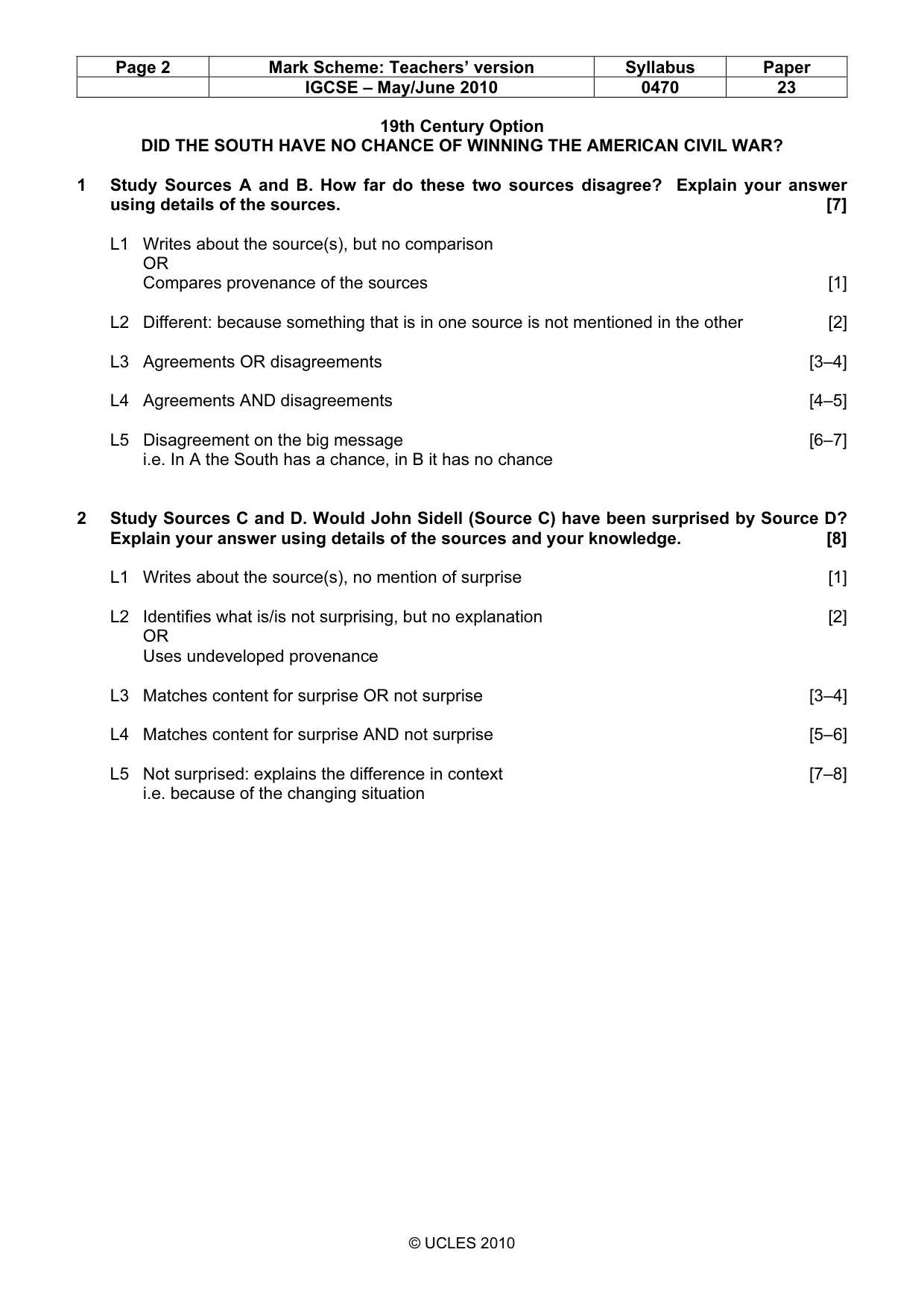
Page 2 Mark Scheme: Teachers’ version Syllabus Paper IGCSE – May/June 2010 0470 23 © UCLES 2010 19th Century Option DID THE SOUTH HAVE NO CHANCE OF WINNING THE AMERICAN CIVIL WAR? 1 Study Sources A and B. How far do these two sources disagree? Explain your answer using details of the sources. [7] L1 Writes about the source(s), but no comparison OR Compares provenance of the sources [1] L2 Different: because something that is in one source is not mentioned in the other [2] L3 Agreements OR disagreements [3–4] L4 Agreements AND disagreements [4–5] L5 Disagreement on the big message [6–7] i.e. In A the South has a chance, in B it has no chance 2 Study Sources C and D. Would John Sidell (Source C) have been surprised by Source D? Explain your answer using details of the sources and your knowledge. [8] L1 Writes about the source(s), no mention of surprise [1] L2 Identifies what is/is not surprising, but no explanation [2] OR Uses undeveloped provenance L3 Matches content for surprise OR not surprise [3–4] L4 Matches content for surprise AND not surprise [5–6] L5 Not surprised: explains the difference in context [7–8] i.e. because of the changing situation
Mark scheme, page 3
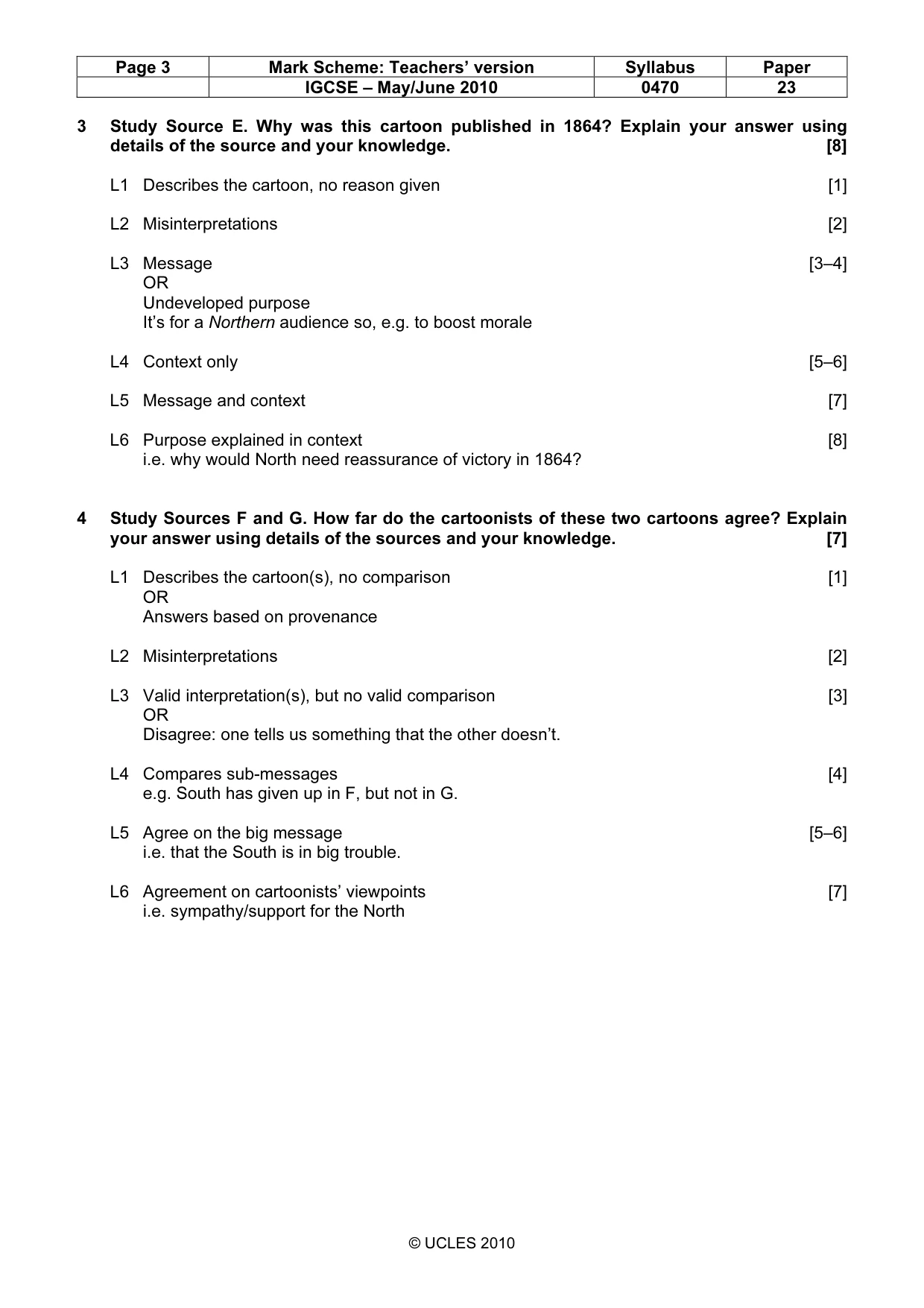
Page 3 Mark Scheme: Teachers’ version Syllabus Paper IGCSE – May/June 2010 0470 23 © UCLES 2010 3 Study Source E. Why was this cartoon published in 1864? Explain your answer using details of the source and your knowledge. [8] L1 Describes the cartoon, no reason given [1] L2 Misinterpretations [2] L3 Message [3–4] OR Undeveloped purpose It’s for a Northern audience so, e.g. to boost morale L4 Context only [5–6] L5 Message and context [7] L6 Purpose explained in context [8] i.e. why would North need reassurance of victory in 1864? 4 Study Sources F and G. How far do the cartoonists of these two cartoons agree? Explain your answer using details of the sources and your knowledge. [7] L1 Describes the cartoon(s), no comparison [1] OR Answers based on provenance L2 Misinterpretations [2] L3 Valid interpretation(s), but no valid comparison [3] OR Disagree: one tells us something that the other doesn’t. L4 Compares sub-messages [4] e.g. South has given up in F, but not in G. L5 Agree on the big message [5–6] i.e. that the South is in big trouble. L6 Agreement on cartoonists’ viewpoints [7] i.e. sympathy/support for the North
Mark scheme, page 4
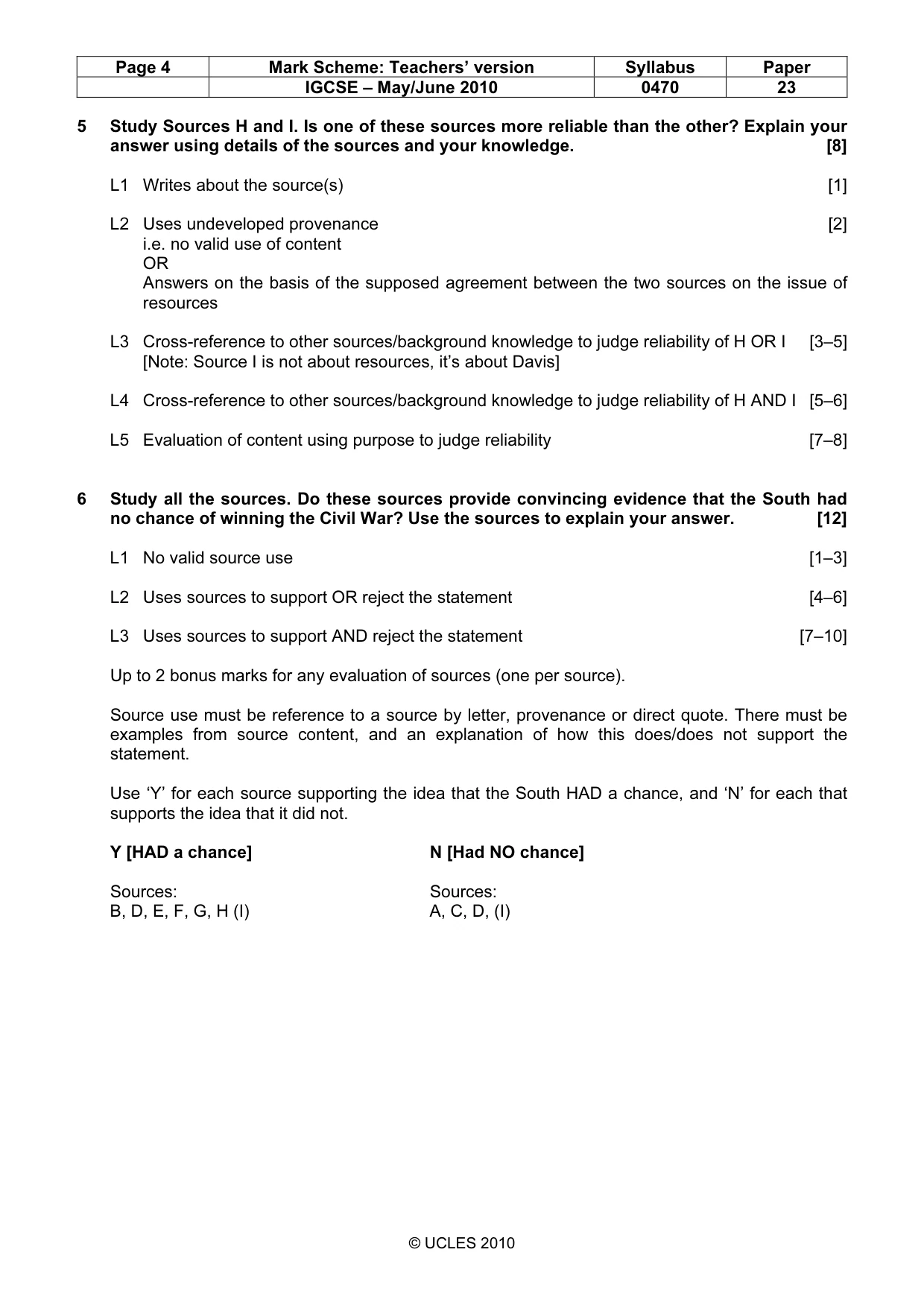
Page 4 Mark Scheme: Teachers’ version Syllabus Paper IGCSE – May/June 2010 0470 23 © UCLES 2010 5 Study Sources H and I. Is one of these sources more reliable than the other? Explain your answer using details of the sources and your knowledge. [8] L1 Writes about the source(s) [1] L2 Uses undeveloped provenance [2] i.e. no valid use of content OR Answers on the basis of the supposed agreement between the two sources on the issue of resources L3 Cross-reference to other sources/background knowledge to judge reliability of H OR I [3–5] [Note: Source I is not about resources, it’s about Davis] L4 Cross-reference to other sources/background knowledge to judge reliability of H AND I [5–6] L5 Evaluation of content using purpose to judge reliability [7–8] 6 Study all the sources. Do these sources provide convincing evidence that the South had no chance of winning the Civil War? Use the sources to explain your answer. [12] L1 No valid source use [1–3] L2 Uses sources to support OR reject the statement [4–6] L3 Uses sources to support AND reject the statement [7–10] Up to 2 bonus marks for any evaluation of sources (one per source). Source use must be reference to a source by letter, provenance or direct quote. There must be examples from source content, and an explanation of how this does/does not support the statement. Use ‘Y’ for each source supporting the idea that the South HAD a chance, and ‘N’ for each that supports the idea that it did not. Y [HAD a chance] N [Had NO chance] Sources: Sources: B, D, E, F, G, H (I) A, C, D, (I)
Mark scheme, page 5
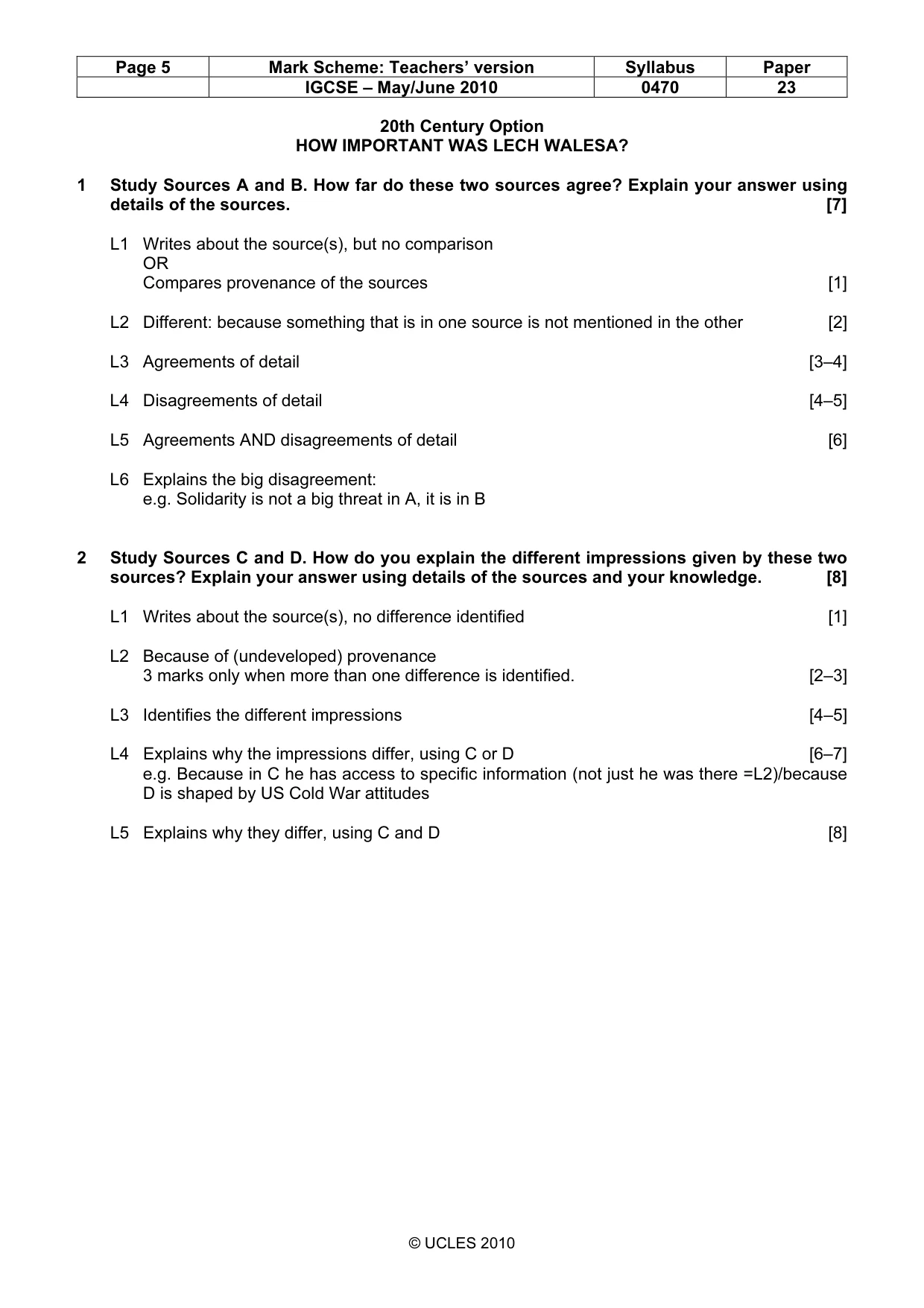
Page 5 Mark Scheme: Teachers’ version Syllabus Paper IGCSE – May/June 2010 0470 23 © UCLES 2010 20th Century Option HOW IMPORTANT WAS LECH WALESA? 1 Study Sources A and B. How far do these two sources agree? Explain your answer using details of the sources. [7] L1 Writes about the source(s), but no comparison OR Compares provenance of the sources [1] L2 Different: because something that is in one source is not mentioned in the other [2] L3 Agreements of detail [3–4] L4 Disagreements of detail [4–5] L5 Agreements AND disagreements of detail [6] L6 Explains the big disagreement: e.g. Solidarity is not a big threat in A, it is in B 2 Study Sources C and D. How do you explain the different impressions given by these two sources? Explain your answer using details of the sources and your knowledge. [8] L1 Writes about the source(s), no difference identified [1] L2 Because of (undeveloped) provenance 3 marks only when more than one difference is identified. [2–3] L3 Identifies the different impressions [4–5] L4 Explains why the impressions differ, using C or D [6–7] e.g. Because in C he has access to specific information (not just he was there =L2)/because D is shaped by US Cold War attitudes L5 Explains why they differ, using C and D [8]
Mark scheme, page 6
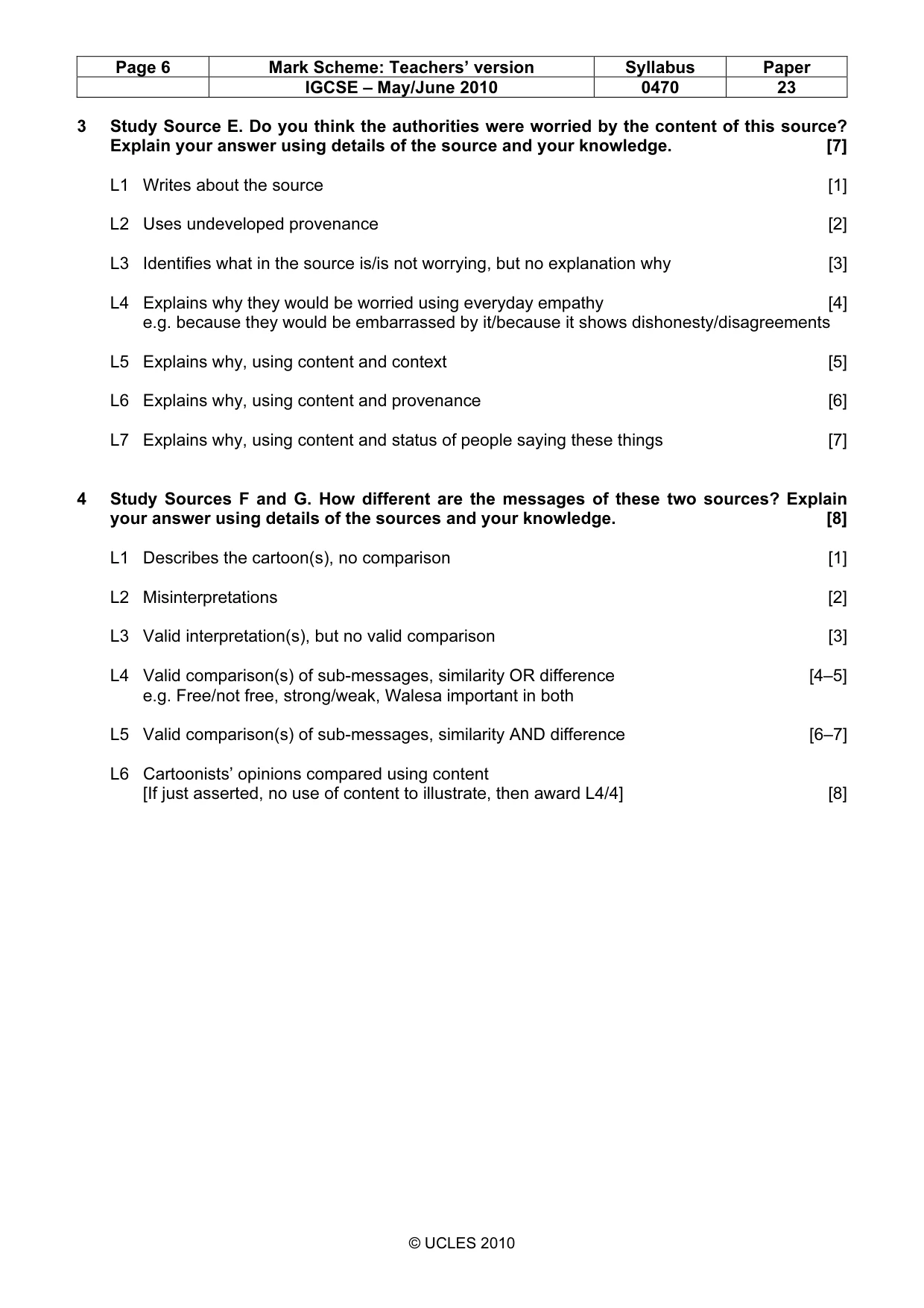
Page 6 Mark Scheme: Teachers’ version Syllabus Paper IGCSE – May/June 2010 0470 23 © UCLES 2010 3 Study Source E. Do you think the authorities were worried by the content of this source? Explain your answer using details of the source and your knowledge. [7] L1 Writes about the source [1] L2 Uses undeveloped provenance [2] L3 Identifies what in the source is/is not worrying, but no explanation why [3] L4 Explains why they would be worried using everyday empathy [4] e.g. because they would be embarrassed by it/because it shows dishonesty/disagreements L5 Explains why, using content and context [5] L6 Explains why, using content and provenance [6] L7 Explains why, using content and status of people saying these things [7] 4 Study Sources F and G. How different are the messages of these two sources? Explain your answer using details of the sources and your knowledge. [8] L1 Describes the cartoon(s), no comparison [1] L2 Misinterpretations [2] L3 Valid interpretation(s), but no valid comparison [3] L4 Valid comparison(s) of sub-messages, similarity OR difference [4–5] e.g. Free/not free, strong/weak, Walesa important in both L5 Valid comparison(s) of sub-messages, similarity AND difference [6–7] L6 Cartoonists’ opinions compared using content [If just asserted, no use of content to illustrate, then award L4/4] [8]
Mark scheme, page 7
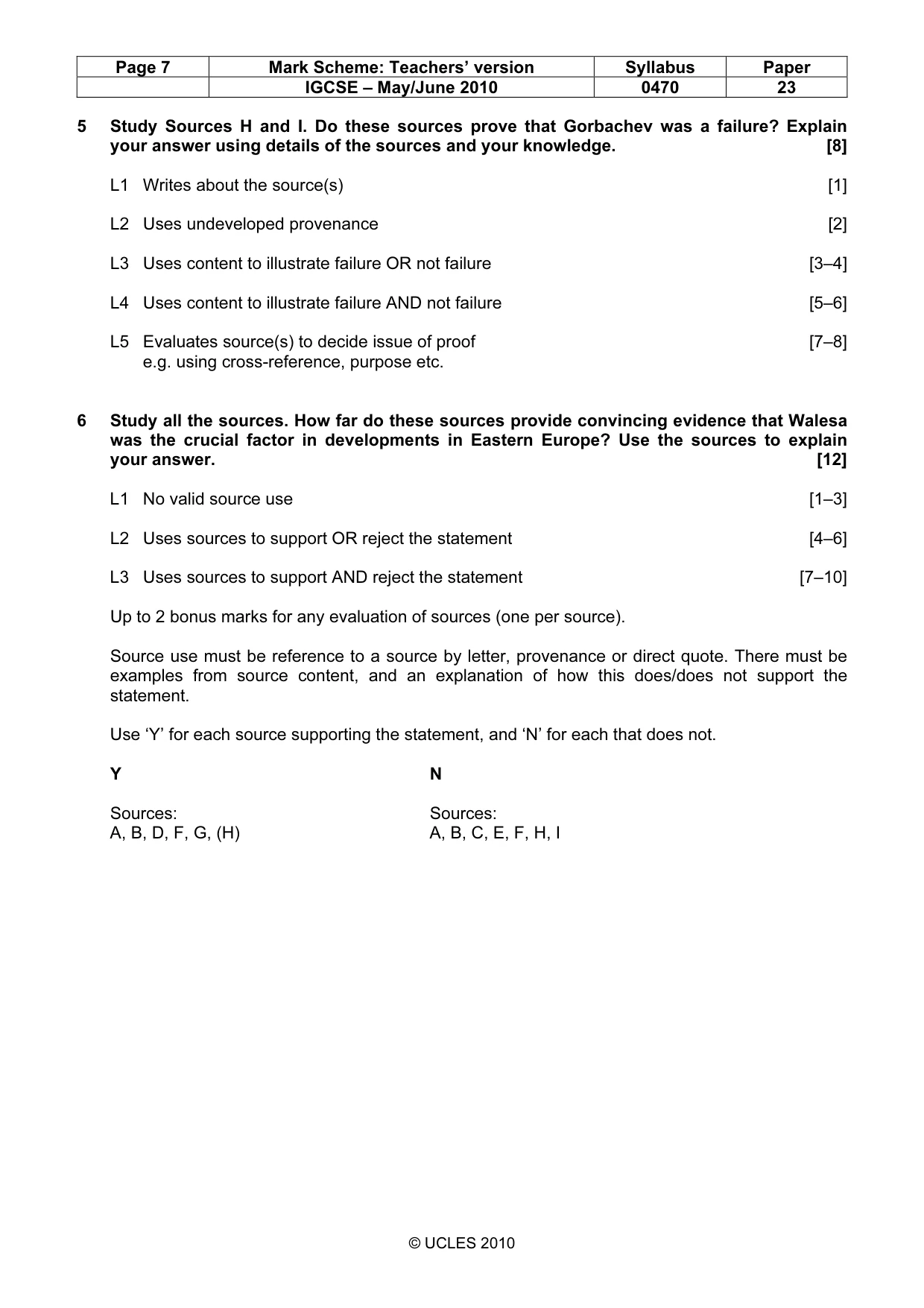
Page 7 Mark Scheme: Teachers’ version Syllabus Paper IGCSE – May/June 2010 0470 23 © UCLES 2010 5 Study Sources H and I. Do these sources prove that Gorbachev was a failure? Explain your answer using details of the sources and your knowledge. [8] L1 Writes about the source(s) [1] L2 Uses undeveloped provenance [2] L3 Uses content to illustrate failure OR not failure [3–4] L4 Uses content to illustrate failure AND not failure [5–6] L5 Evaluates source(s) to decide issue of proof [7–8] e.g. using cross-reference, purpose etc. 6 Study all the sources. How far do these sources provide convincing evidence that Walesa was the crucial factor in developments in Eastern Europe? Use the sources to explain your answer. [12] L1 No valid source use [1–3] L2 Uses sources to support OR reject the statement [4–6] L3 Uses sources to support AND reject the statement [7–10] Up to 2 bonus marks for any evaluation of sources (one per source). Source use must be reference to a source by letter, provenance or direct quote. There must be examples from source content, and an explanation of how this does/does not support the statement. Use ‘Y’ for each source supporting the statement, and ‘N’ for each that does not. Y N Sources: Sources: A, B, D, F, G, (H) A, B, C, E, F, H, I
What you needed in this session
Cambridge’s own grade thresholds for 2010 May/June, Paper 2 · Variant 3. A higher threshold means an easier paper — the bar moves with how the cohort did.