Cambridge IGCSE History 0470 — 2009 May/June Paper 2 · Variant 1
0470/21/M/J/09 · 50 marks · ≈56 min
The question paper and its mark scheme, free to read here and free to download. This is Cambridge’s own paper, exactly as it was sat.
Question paper12 pages
Mark scheme7 pages
Answers below. Sit the paper first if you are practising.
Paper as text
Question paper, page 1
This document consists of 12 printed pages. SP (SC/SW) T77736/4 © UCLES 2009 [Turn over UNIVERSITY OF CAMBRIDGE INTERNATIONAL EXAMINATIONS International General Certificate of Secondary Education READ THESE INSTRUCTIONS FIRST If you have been given an Answer Booklet, follow the instructions on the front cover of the Booklet. Write your Centre number, candidate number and name on all the work you hand in. Write in dark blue or black pen. You may use a soft pencil for any diagrams, graphs or rough working. Do not use staples, paper clips, highlighters, glue or correction fluid. This paper has two options. Choose one option, and then answer all of the questions on that topic. Option A: 19th Century topic [p2–p7] Option B: 20th Century topic [p8–p12] At the end of the examination, fasten all your work securely together. The number of marks is given in brackets [ ] at the end of each question or part question. * 0 7 4 3 1 9 3 0 1 8 * HISTORY 0470/02 Paper 2 May/June 2009 2 hours Additional Materials: Answer Booklet/Paper www.XtremePapers.com
Question paper, page 2
2 0470/02/M/J/09 © UCLES 2009 Option A: 19th Century topic DID JAPAN ADOPT WESTERN IDEAS UNCRITICALLY? Study the Background Information and the sources carefully, and then answer all the questions. Background Information The Shogunate regime of Japan was a feudal regime and discouraged change and contact with the West. After the arrival of Commodore Perry in 1853, anti-western feelings in Japan grew stronger. The Shogunate regime ended in 1867 when imperial rule was restored and the Meiji Emperor began a 45-year reign. Under the Emperor a programme of modernisation was begun. Government ministers visited Europe and America and soon Japanese society, industry and armed forces were undergoing major change. However, the Government had its critics. Some said that Japan was simply copying the surface features of western society without making real changes. Others wanted Japan to be modernised but did not want Japan westernised. They only wanted to take from the West what would benefit Japan and make it a stronger country. They also wanted to preserve the best of Japanese society and culture. Did the Meiji regime uncritically copy all that was western? SOURCE A History has never witnessed a more sudden change. We foreigners may no doubt sometimes regret the substitution of ordinary European ways for the glitter and the glamour of old Japan. Does not the whole experience of the last three hundred years go to prove that Japan could not hope to keep its territory free from Western aggression if it retained its traditional institutions? From the moment they realised that the Europeanisation of the country was a question of life and death, they have never ceased carrying on the work of reform and progress. A centralized bureaucracy was set up, Buddhism was disestablished, and telegraphs and railways were introduced. At the same time photography, meat-eating and other ‘Europeanisms’ came into fashion without official encouragement. 1885-87 were the years of the great ‘foreign fever’ when Japanese society was submerged in a flood of European card-playing, foreign dress for ladies, and dancing. But the cloud of discontent that has darkened industrialism in the West already begins to obscure the Japanese sky. We now hear of frequent strikes. Nothing can be imagined further from the mental attitude of the working class of seventeen years ago. For them, duties, not rights, were important. Written in 1890 by Basil Hall Chamberlain. He was British but lived in Japan from 1873 to 1911 and became a professor at Tokyo Imperial University.
Question paper, page 3
3 0470/02/M/J/09 © UCLES 2009 [Turn over SOURCE B By comparing the Japan of fifty years ago with the Japan of today, it will be seen that she has gained considerably in the extent of her territory, her government has become constitutional and her national education has achieved a high degree of excellence. In commerce and industry she has also made great progress. This leap forward is the result of coming into contact with Europe and America, and may well be regarded as an advantage of foreign contact. Yet we remain today politically unaltered under our Imperial House and Emperor that have descended in an unbroken line over a great length of time. This is proof that the Japanese are not a race of people who are given to loving all that is new and always running after passing fashions. They have always made a point of choosing the middle course in everything, and have aimed at being well balanced. Written in 1907 by Okuma Shigenobu. He was a member of the Japanese government until 1881 when he was dismissed because he called for more democracy. SOURCE C Now we must cope with the Foreigners of the West, where every country upholds the laws of Jesus. Everywhere they go they set fire to shrines and temples, deceive the people, and then invade and seize the country. Recently there has appeared what is known as Dutch Studies. The students who make a living from it have been taken in by the theories of the Western foreigners. They publish books about them in the hope of transforming our civilized life into that of the barbarians. If someday the treacherous foreigner should take advantage of this situation and lure ignorant people to his ways, our people will adopt such practices and no one will be able to stop it. From ‘The New Proposals’ published in Japan in 1825 by Mito scholars. Their slogan was ‘Revere the Emperor and Expel the Barbarians’. Some content has been removed due to copyright restrictions
Question paper, page 4
4 0470/02/M/J/09 © UCLES 2009 SOURCE E A cartoon of a street scene in Japan towards the end of the nineteenth century. It was published in a British magazine at the time. SOURCE F Japan’s attitude on adopting European culture was problematic in every respect. They did not adopt it wholesale but simply picked the bits they found attractive. As a result the people who brought western ideas into the country were widely admired. Even though western culture was not properly understood, Japanese scholars strutted about displaying their knowledge of Western things noisily and proudly. From a lecture given in 1893 at Tokyo Imperial University by Nishida Kitaro.
Question paper, page 5
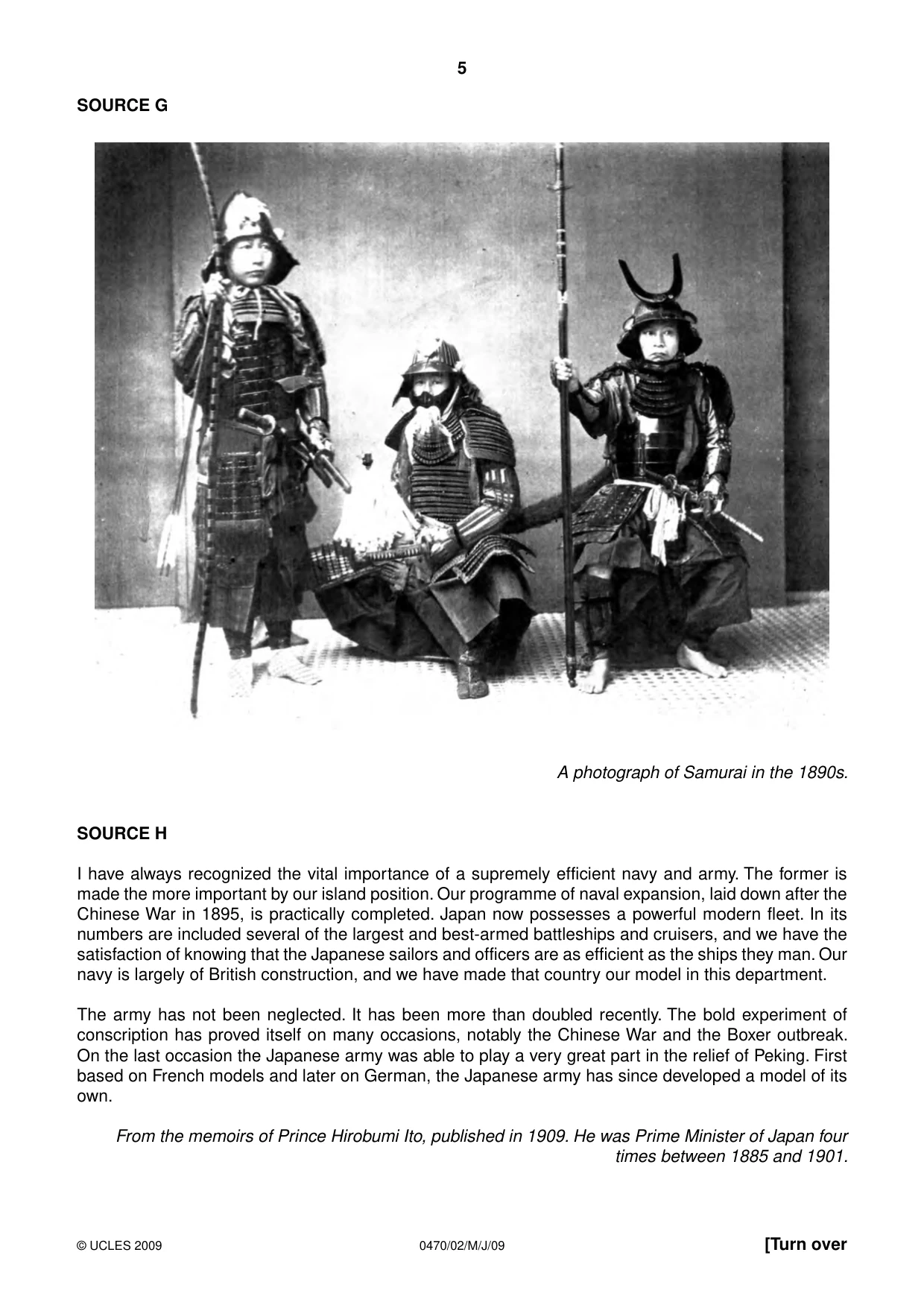
5 0470/02/M/J/09 © UCLES 2009 [Turn over SOURCE G A photograph of Samurai in the 1890s. SOURCE H I have always recognized the vital importance of a supremely efficient navy and army. The former is made the more important by our island position. Our programme of naval expansion, laid down after the Chinese War in 1895, is practically completed. Japan now possesses a powerful modern fleet. In its numbers are included several of the largest and best-armed battleships and cruisers, and we have the satisfaction of knowing that the Japanese sailors and officers are as efficient as the ships they man. Our navy is largely of British construction, and we have made that country our model in this department. The army has not been neglected. It has been more than doubled recently. The bold experiment of conscription has proved itself on many occasions, notably the Chinese War and the Boxer outbreak. On the last occasion the Japanese army was able to play a very great part in the relief of Peking. First based on French models and later on German, the Japanese army has since developed a model of its own. From the memoirs of Prince Hirobumi Ito, published in 1909. He was Prime Minister of Japan four times between 1885 and 1901.
Question paper, page 6
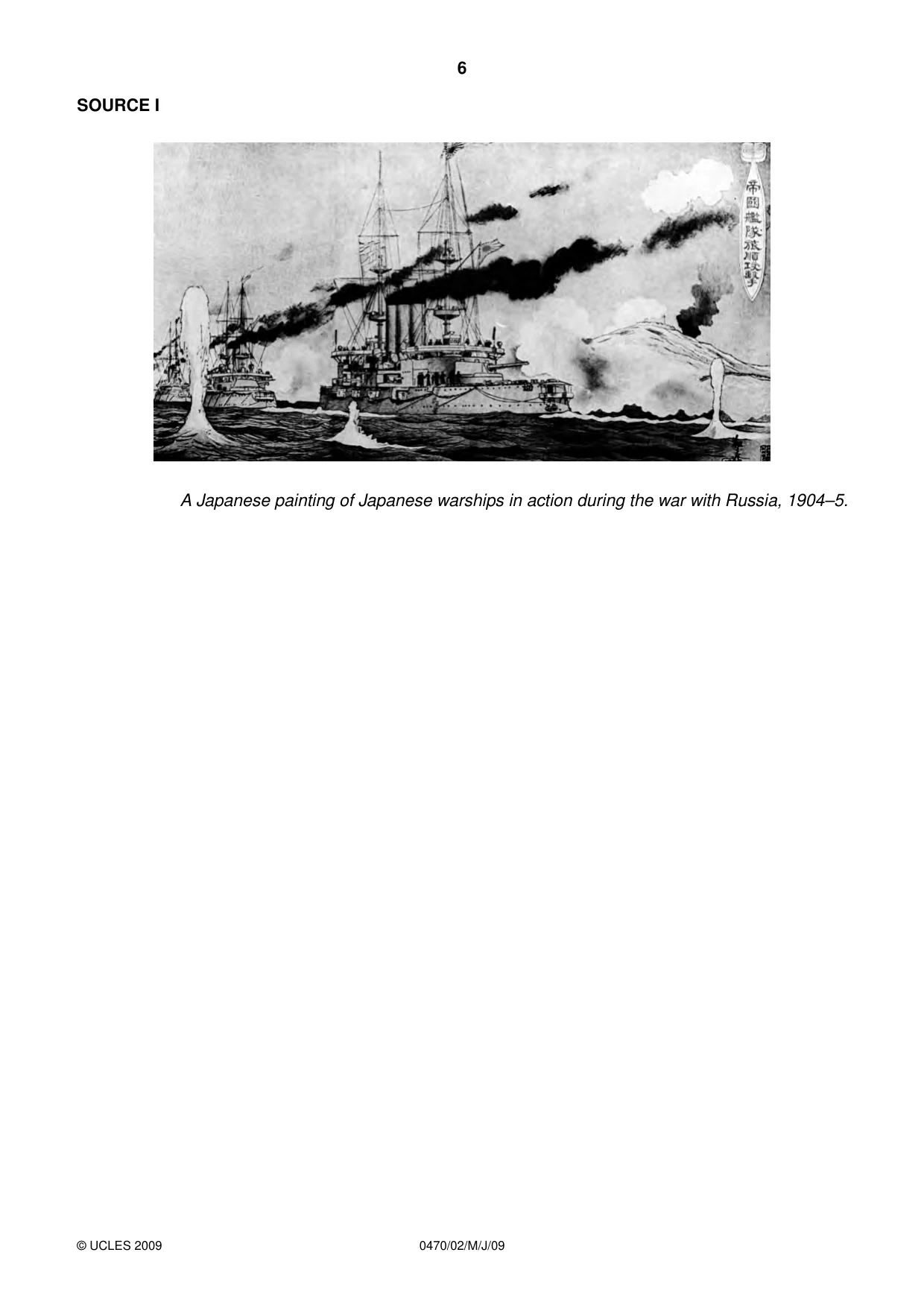
6 0470/02/M/J/09 © UCLES 2009 SOURCE I A Japanese painting of Japanese warships in action during the war with Russia, 1904–5.
Question paper, page 7
7 0470/02/M/J/09 © UCLES 2009 [Turn over Now answer all the following questions. You may use any of the sources to help you answer the questions, in addition to those sources which you are told to use. In answering the questions you should use your knowledge of the topic to help you interpret and evaluate the sources. 1 Study Sources A and B. How far do these two sources agree? Explain your answer using details of the sources. [7] 2 Study Sources C and D. How far do these two sources show that attitudes in Japan had not changed much between 1825 and 1855? Explain your answer using details of the sources and your knowledge. [8] 3 Study Sources E and F. How far does Source E prove that Source F is correct? Explain your answer using details of the sources and your knowledge. [7] 4 Study Source G. Why do you think this photograph was taken at this time? Explain your answer using the source and your knowledge. [8] 5 Study Sources H and I. Which source would be more useful to a historian studying the modernisation of Japan? Explain your answer using the sources and your knowledge. [8] 6 Study all the sources. Do these sources provide convincing evidence that Japan adopted western ideas uncritically? Use the sources to explain your answer. [12]
Question paper, page 8
8 0470/02/M/J/09 © UCLES 2009 Option B: 20th Century topic WHY WAS HITLER SO INTERESTED IN THE SPANISH CIVIL WAR? Study the Background Information and the sources carefully, and then answer all the questions. Background Information In February 1936 the Popular Front, a coalition of left-wing parties, won the general election in Spain. However, a few months later there was a military uprising against the new government. Spain was plunged into civil war. Both sides sought support from outside Spain. The Republicans (who supported the government) received support from the Soviet Union and from volunteers from many countries who formed the International Brigades. The Nationalists (who opposed the government) were led by General Franco and requested help from Germany and Italy. Franco needed this help desperately as his army was in Morocco and he had no transport to return him and his troops to Spain. Britain and France tried to get other countries to agree to a policy of ‘non-intervention’ and even persuaded 27 countries including Germany and Italy to sign a Non-Intervention Agreement. However, this did not stop Hitler and Mussolini providing the Nationalists with support. Historians have disagreed about why Hitler was interested in the Spanish Civil War. Some have suggested that this was because he saw an opportunity to give his soldiers experience and to try out new weapons and tactics, but others have argued that there were other reasons. SOURCE B Contrary to what has often been supposed, Germany’s primary motive for intervention in Spain was ideological - the desire to prevent the emergence of a Bolshevik regime. One myth created by the Spanish Civil War is the idea that Hitler’s main motives for intervention were economic and military. Most writers have seen in German intervention the outcome of a plot between Franco and agents of the Nazi Auslandsorganisation in Spain. Hitler’s aims, it is said were to secure Spanish iron ore for Germany’s war economy and to use Spain as ‘a testing ground’ for German armaments. In reality Hitler’s decision was quite unconnected with economic or military considerations. From a history book published in 1977. Some content has been removed due to copyright restrictions
Question paper, page 9
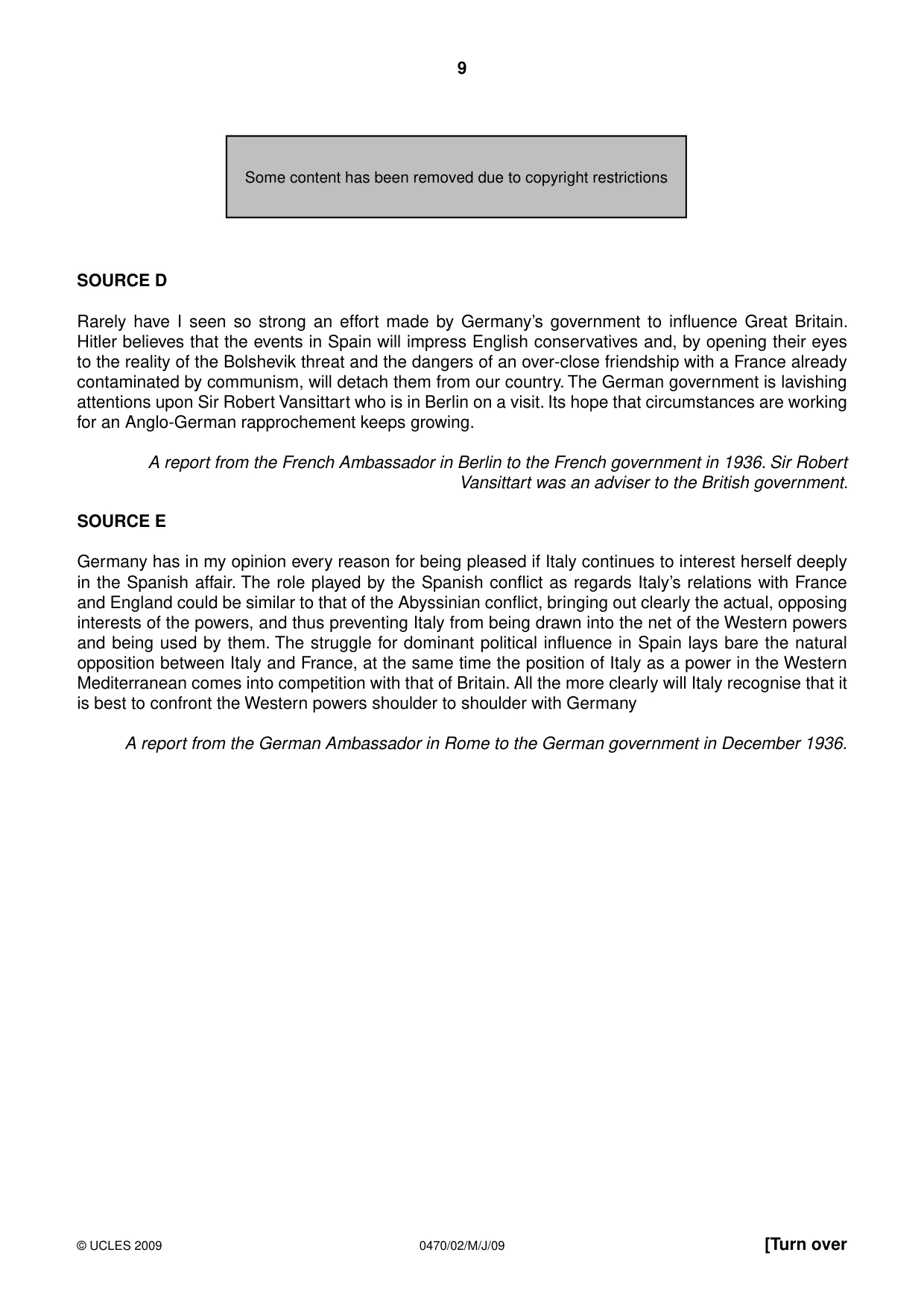
9 0470/02/M/J/09 © UCLES 2009 [Turn over SOURCE D Rarely have I seen so strong an effort made by Germany’s government to influence Great Britain. Hitler believes that the events in Spain will impress English conservatives and, by opening their eyes to the reality of the Bolshevik threat and the dangers of an over-close friendship with a France already contaminated by communism, will detach them from our country. The German government is lavishing attentions upon Sir Robert Vansittart who is in Berlin on a visit. Its hope that circumstances are working for an Anglo-German rapprochement keeps growing. A report from the French Ambassador in Berlin to the French government in 1936. Sir Robert Vansittart was an adviser to the British government. SOURCE E Germany has in my opinion every reason for being pleased if Italy continues to interest herself deeply in the Spanish affair. The role played by the Spanish conflict as regards Italy’s relations with France and England could be similar to that of the Abyssinian conflict, bringing out clearly the actual, opposing interests of the powers, and thus preventing Italy from being drawn into the net of the Western powers and being used by them. The struggle for dominant political influence in Spain lays bare the natural opposition between Italy and France, at the same time the position of Italy as a power in the Western Mediterranean comes into competition with that of Britain. All the more clearly will Italy recognise that it is best to confront the Western powers shoulder to shoulder with Germany A report from the German Ambassador in Rome to the German government in December 1936. Some content has been removed due to copyright restrictions
Question paper, page 10
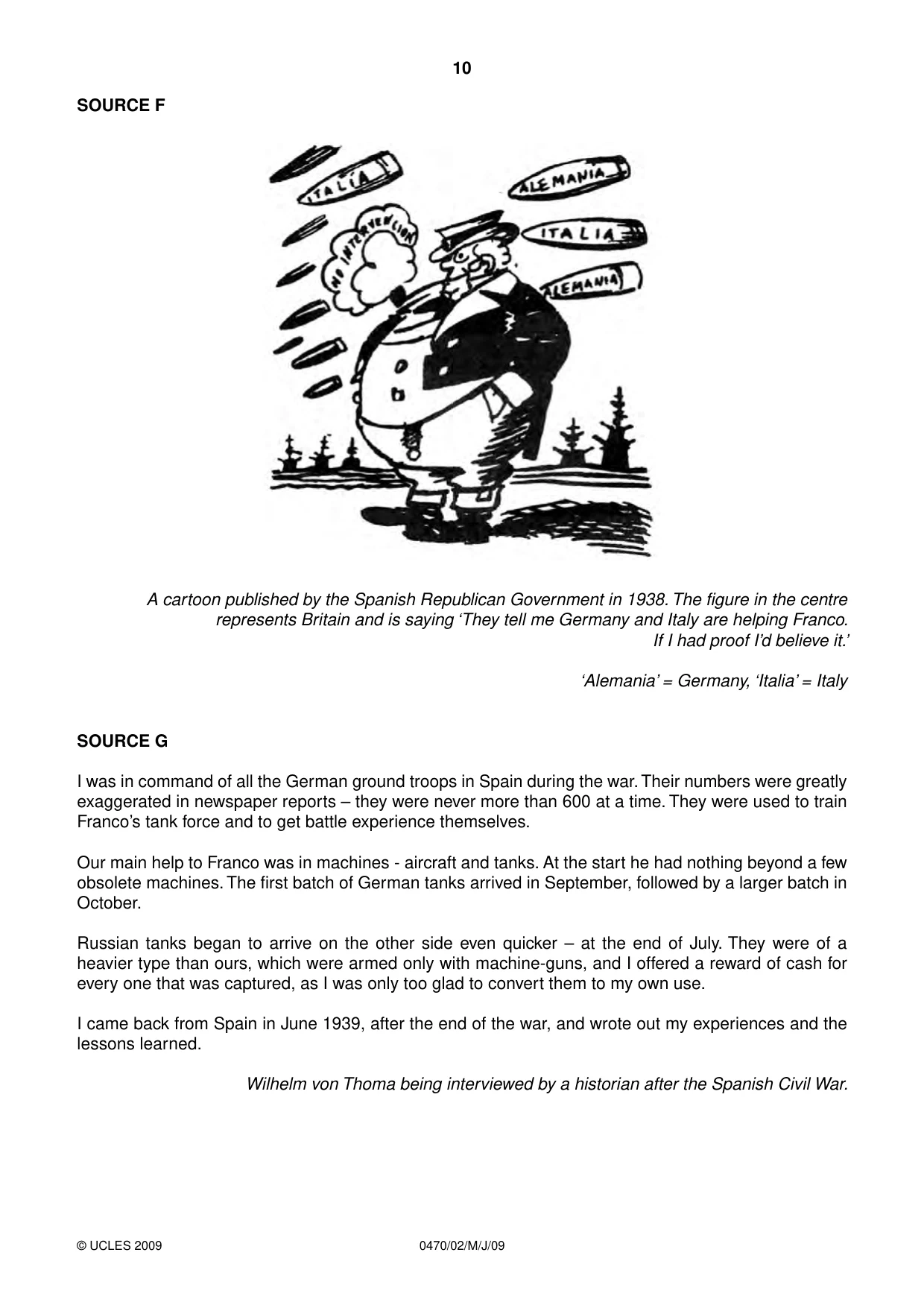
10 0470/02/M/J/09 © UCLES 2009 SOURCE F A cartoon published by the Spanish Republican Government in 1938. The figure in the centre represents Britain and is saying ‘They tell me Germany and Italy are helping Franco. If I had proof I’d believe it.’ ‘Alemania’ = Germany, ‘Italia’ = Italy SOURCE G I was in command of all the German ground troops in Spain during the war. Their numbers were greatly exaggerated in newspaper reports – they were never more than 600 at a time. They were used to train Franco’s tank force and to get battle experience themselves. Our main help to Franco was in machines - aircraft and tanks. At the start he had nothing beyond a few obsolete machines. The first batch of German tanks arrived in September, followed by a larger batch in October. Russian tanks began to arrive on the other side even quicker – at the end of July. They were of a heavier type than ours, which were armed only with machine-guns, and I offered a reward of cash for every one that was captured, as I was only too glad to convert them to my own use. I came back from Spain in June 1939, after the end of the war, and wrote out my experiences and the lessons learned. Wilhelm von Thoma being interviewed by a historian after the Spanish Civil War.
Question paper, page 11
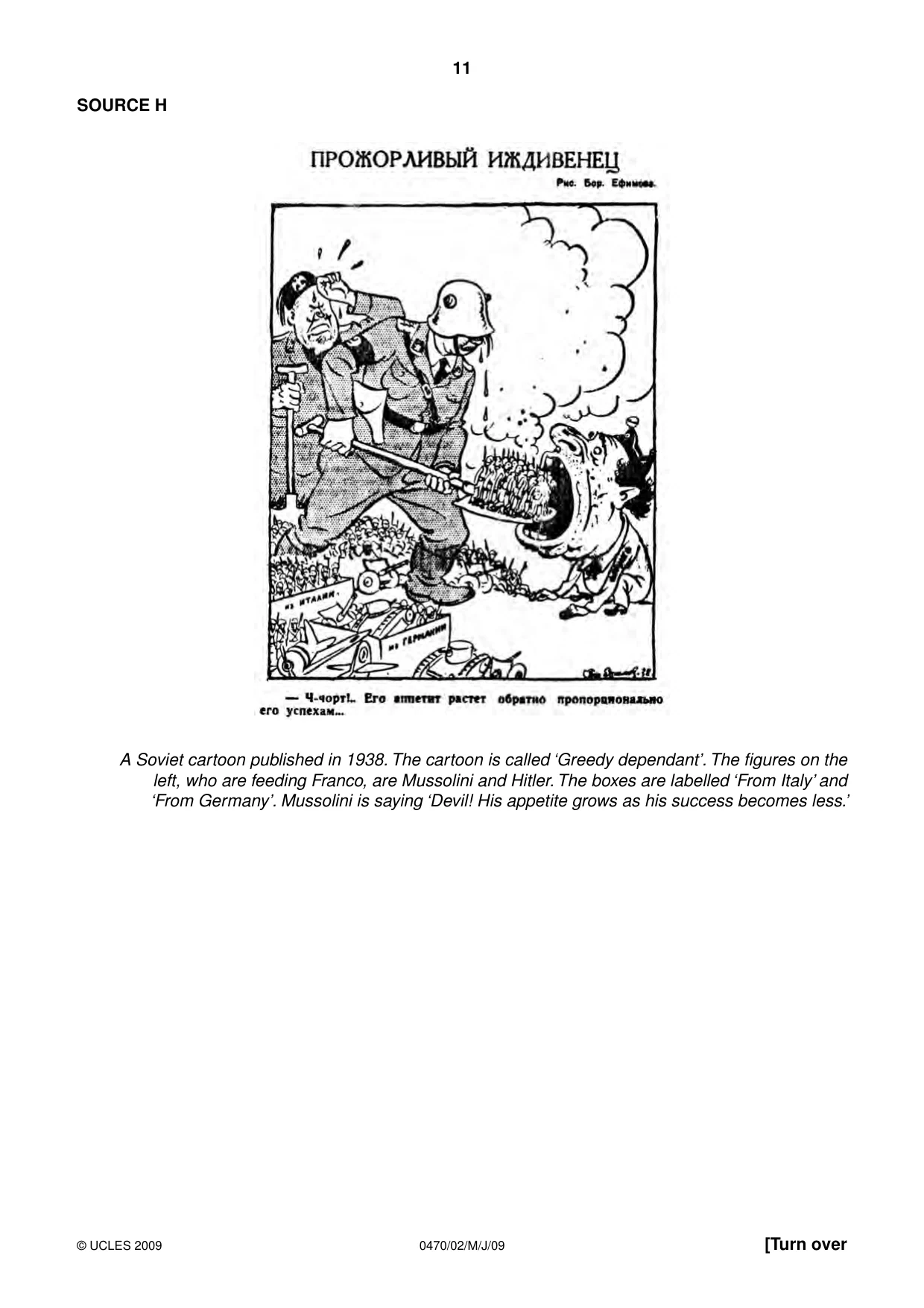
11 0470/02/M/J/09 © UCLES 2009 [Turn over SOURCE H A Soviet cartoon published in 1938. The cartoon is called ‘Greedy dependant’. The figures on the left, who are feeding Franco, are Mussolini and Hitler. The boxes are labelled ‘From Italy’ and ‘From Germany’. Mussolini is saying ‘Devil! His appetite grows as his success becomes less.’
Question paper, page 12
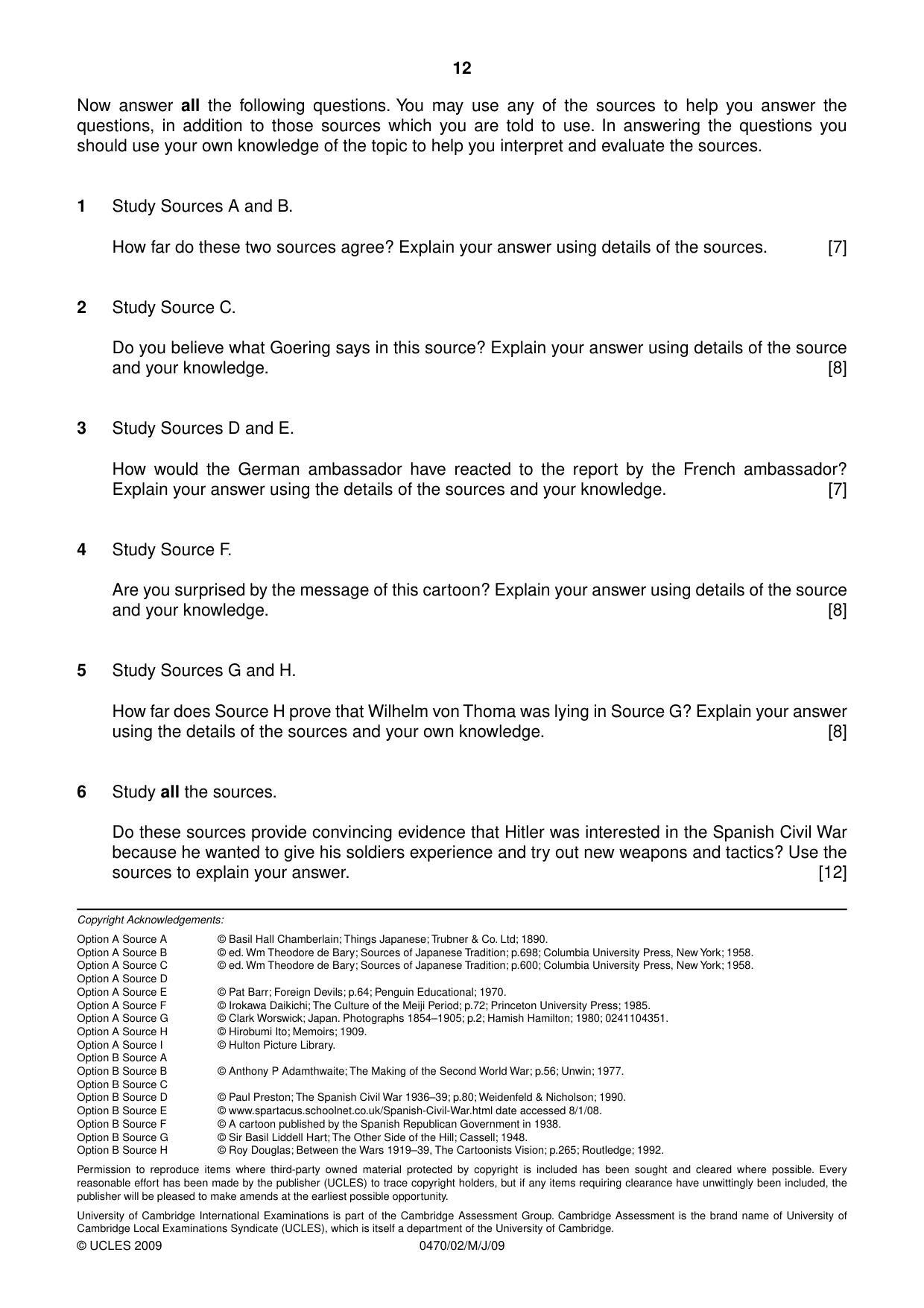
12 0470/02/M/J/09 © UCLES 2009 Now answer all the following questions. You may use any of the sources to help you answer the questions, in addition to those sources which you are told to use. In answering the questions you should use your own knowledge of the topic to help you interpret and evaluate the sources. 1 Study Sources A and B. How far do these two sources agree? Explain your answer using details of the sources. [7] 2 Study Source C. Do you believe what Goering says in this source? Explain your answer using details of the source and your knowledge. [8] 3 Study Sources D and E. How would the German ambassador have reacted to the report by the French ambassador? Explain your answer using the details of the sources and your knowledge. [7] 4 Study Source F. Are you surprised by the message of this cartoon? Explain your answer using details of the source and your knowledge. [8] 5 Study Sources G and H. How far does Source H prove that Wilhelm von Thoma was lying in Source G? Explain your answer using the details of the sources and your own knowledge. [8] 6 Study all the sources. Do these sources provide convincing evidence that Hitler was interested in the Spanish Civil War because he wanted to give his soldiers experience and try out new weapons and tactics? Use the sources to explain your answer. [12] Copyright Acknowledgements: Option A Source A © Basil Hall Chamberlain; Things Japanese; Trubner & Co. Ltd; 1890. Option A Source B © ed. Wm Theodore de Bary; Sources of Japanese Tradition; p.698; Columbia University Press, New York; 1958. Option A Source C © ed. Wm Theodore de Bary; Sources of Japanese Tradition; p.600; Columbia University Press, New York; 1958. Option A Source D Option A Source E © Pat Barr; Foreign Devils; p.64; Penguin Educational; 1970. Option A Source F © Irokawa Daikichi; The Culture of the Meiji Period; p.72; Princeton University Press; 1985. Option A Source G © Clark Worswick; Japan. Photographs 1854–1905; p.2; Hamish Hamilton; 1980; 0241104351. Option A Source H © Hirobumi Ito; Memoirs; 1909. Option A Source I © Hulton Picture Library. Option B Source A Option B Source B © Anthony P Adamthwaite; The Making of the Second World War; p.56; Unwin; 1977. Option B Source C Option B Source D © Paul Preston; The Spanish Civil War 1936–39; p.80; Weidenfeld & Nicholson; 1990. Option B Source E © www.spartacus.schoolnet.co.uk/Spanish-Civil-War.html date accessed 8/1/08. Option B Source F © A cartoon published by the Spanish Republican Government in 1938. Option B Source G © Sir Basil Liddell Hart; The Other Side of the Hill; Cassell; 1948. Option B Source H © Roy Douglas; Between the Wars 1919–39, The Cartoonists Vision; p.265; Routledge; 1992. Permission to reproduce items where third-party owned material protected by copyright is included has been sought and cleared where possible. Every reasonable effort has been made by the publisher (UCLES) to trace copyright holders, but if any items requiring clearance have unwittingly been included, the publisher will be pleased to make amends at the earliest possible opportunity. University of Cambridge International Examinations is part of the Cambridge Assessment Group. Cambridge Assessment is the brand name of University of Cambridge Local Examinations Syndicate (UCLES), which is itself a department of the University of Cambridge.
Mark scheme, page 1
UNIVERSITY OF CAMBRIDGE INTERNATIONAL EXAMINATIONS International General Certificate of Secondary Education MARK SCHEME for the May/June 2009 question paper for the guidance of teachers 0470 HISTORY 0470/02 Paper 2, maximum raw mark 50 This mark scheme is published as an aid to teachers and candidates, to indicate the requirements of the examination. It shows the basis on which Examiners were instructed to award marks. It does not indicate the details of the discussions that took place at an Examiners’ meeting before marking began, which would have considered the acceptability of alternative answers. Mark schemes must be read in conjunction with the question papers and the report on the examination. • CIE will not enter into discussions or correspondence in connection with these mark schemes. CIE is publishing the mark schemes for the May/June 2009 question papers for most IGCSE, GCE Advanced Level and Advanced Subsidiary Level syllabuses and some Ordinary Level syllabuses. www.XtremePapers.com
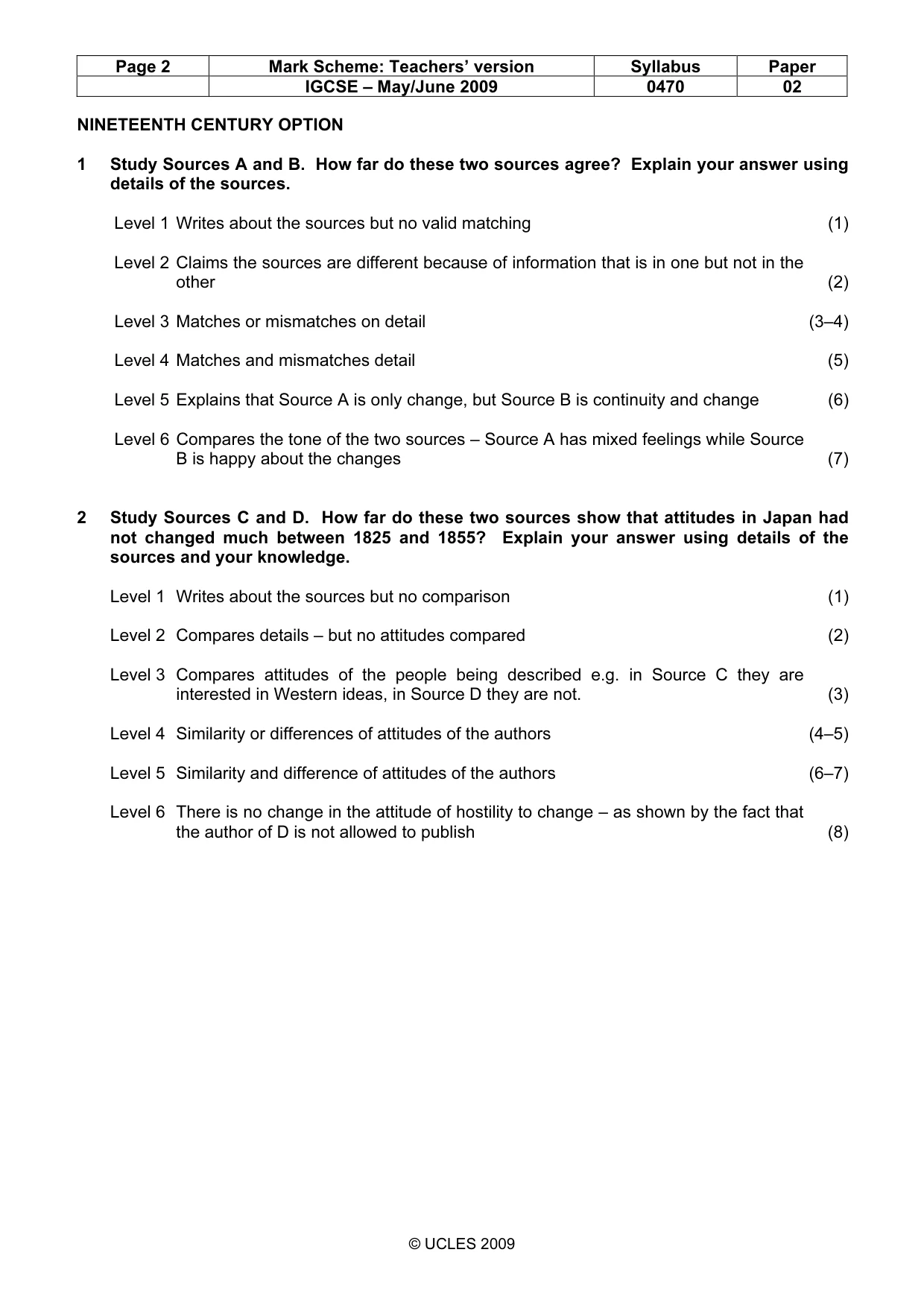
Mark scheme, page 2
Page 2 Mark Scheme: Teachers’ version Syllabus Paper IGCSE – May/June 2009 0470 02 © UCLES 2009 NINETEENTH CENTURY OPTION 1 Study Sources A and B. How far do these two sources agree? Explain your answer using details of the sources. Level 1 Writes about the sources but no valid matching (1) Level 2 Claims the sources are different because of information that is in one but not in the other (2) Level 3 Matches or mismatches on detail (3–4) Level 4 Matches and mismatches detail (5) Level 5 Explains that Source A is only change, but Source B is continuity and change (6) Level 6 Compares the tone of the two sources – Source A has mixed feelings while Source B is happy about the changes (7) 2 Study Sources C and D. How far do these two sources show that attitudes in Japan had not changed much between 1825 and 1855? Explain your answer using details of the sources and your knowledge. Level 1 Writes about the sources but no comparison (1) Level 2 Compares details – but no attitudes compared (2) Level 3 Compares attitudes of the people being described e.g. in Source C they are interested in Western ideas, in Source D they are not. (3) Level 4 Similarity or differences of attitudes of the authors (4–5) Level 5 Similarity and difference of attitudes of the authors (6–7) Level 6 There is no change in the attitude of hostility to change – as shown by the fact that the author of D is not allowed to publish (8)
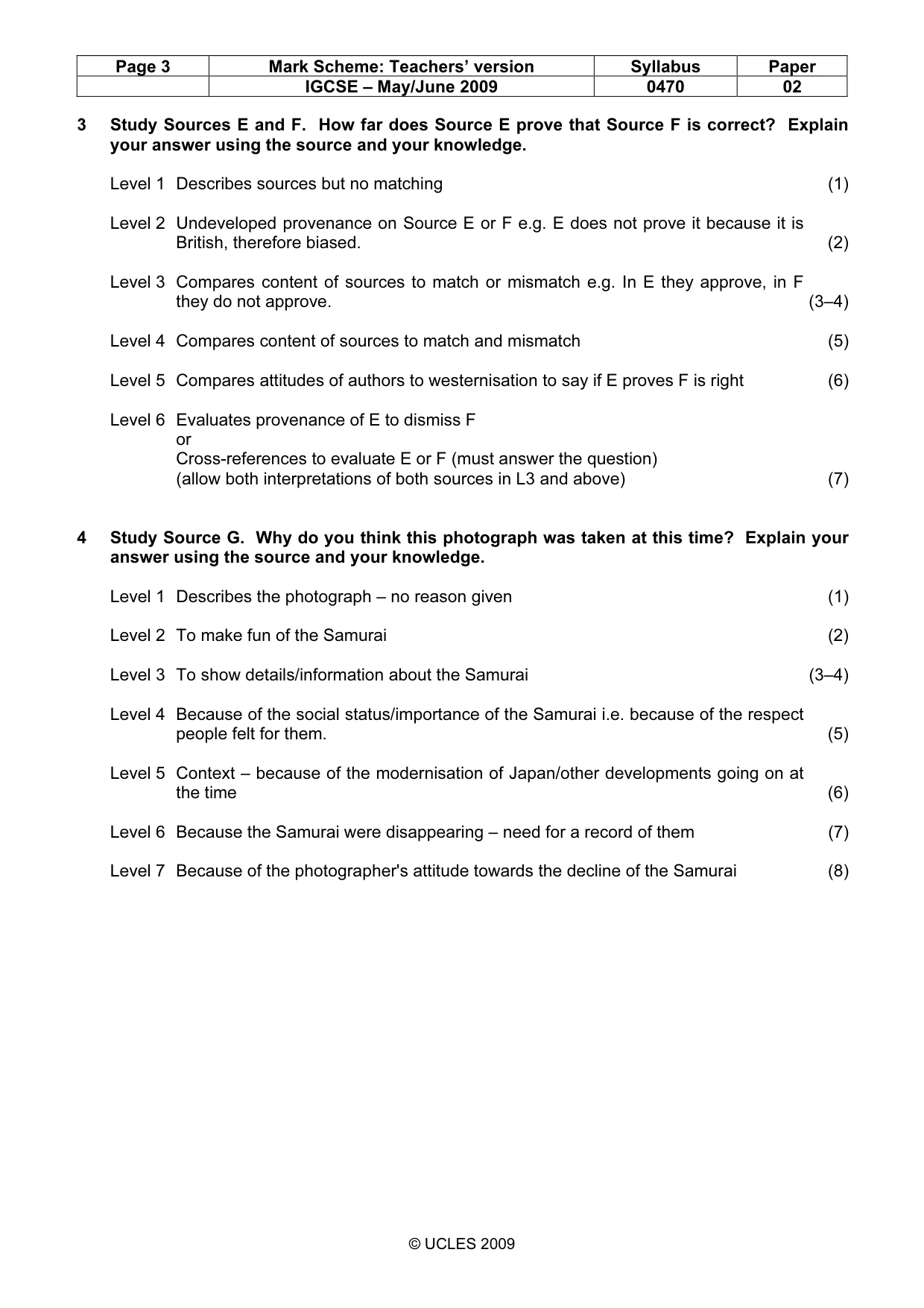
Mark scheme, page 3
Page 3 Mark Scheme: Teachers’ version Syllabus Paper IGCSE – May/June 2009 0470 02 © UCLES 2009 3 Study Sources E and F. How far does Source E prove that Source F is correct? Explain your answer using the source and your knowledge. Level 1 Describes sources but no matching (1) Level 2 Undeveloped provenance on Source E or F e.g. E does not prove it because it is British, therefore biased. (2) Level 3 Compares content of sources to match or mismatch e.g. In E they approve, in F they do not approve. (3–4) Level 4 Compares content of sources to match and mismatch (5) Level 5 Compares attitudes of authors to westernisation to say if E proves F is right (6) Level 6 Evaluates provenance of E to dismiss F or Cross-references to evaluate E or F (must answer the question) (allow both interpretations of both sources in L3 and above) (7) 4 Study Source G. Why do you think this photograph was taken at this time? Explain your answer using the source and your knowledge. Level 1 Describes the photograph – no reason given (1) Level 2 To make fun of the Samurai (2) Level 3 To show details/information about the Samurai (3–4) Level 4 Because of the social status/importance of the Samurai i.e. because of the respect people felt for them. (5) Level 5 Context – because of the modernisation of Japan/other developments going on at the time (6) Level 6 Because the Samurai were disappearing – need for a record of them (7) Level 7 Because of the photographer's attitude towards the decline of the Samurai (8)
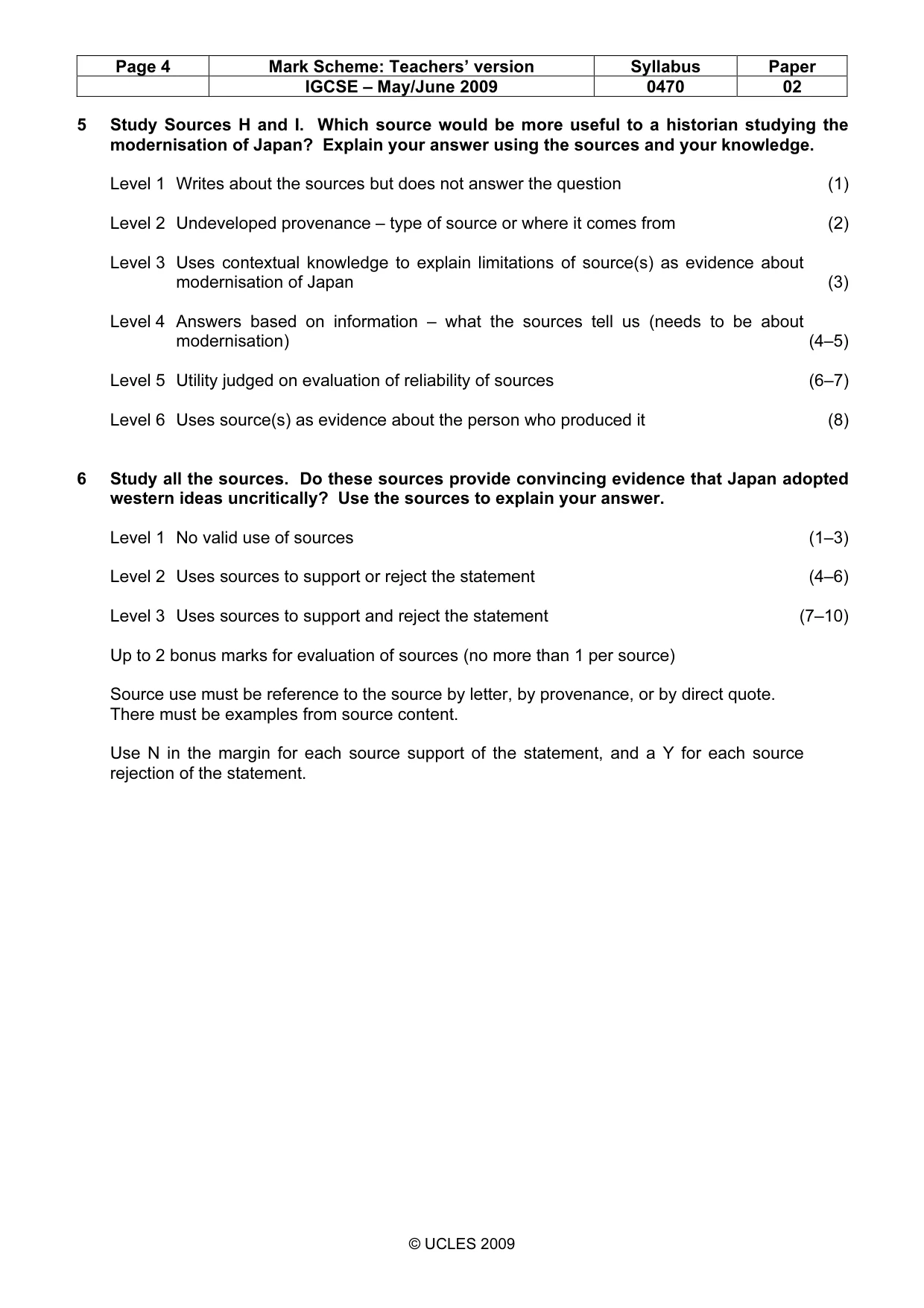
Mark scheme, page 4
Page 4 Mark Scheme: Teachers’ version Syllabus Paper IGCSE – May/June 2009 0470 02 © UCLES 2009 5 Study Sources H and I. Which source would be more useful to a historian studying the modernisation of Japan? Explain your answer using the sources and your knowledge. Level 1 Writes about the sources but does not answer the question (1) Level 2 Undeveloped provenance – type of source or where it comes from (2) Level 3 Uses contextual knowledge to explain limitations of source(s) as evidence about modernisation of Japan (3) Level 4 Answers based on information – what the sources tell us (needs to be about modernisation) (4–5) Level 5 Utility judged on evaluation of reliability of sources (6–7) Level 6 Uses source(s) as evidence about the person who produced it (8) 6 Study all the sources. Do these sources provide convincing evidence that Japan adopted western ideas uncritically? Use the sources to explain your answer. Level 1 No valid use of sources (1–3) Level 2 Uses sources to support or reject the statement (4–6) Level 3 Uses sources to support and reject the statement (7–10) Up to 2 bonus marks for evaluation of sources (no more than 1 per source) Source use must be reference to the source by letter, by provenance, or by direct quote. There must be examples from source content. Use N in the margin for each source support of the statement, and a Y for each source rejection of the statement.
Mark scheme, page 5
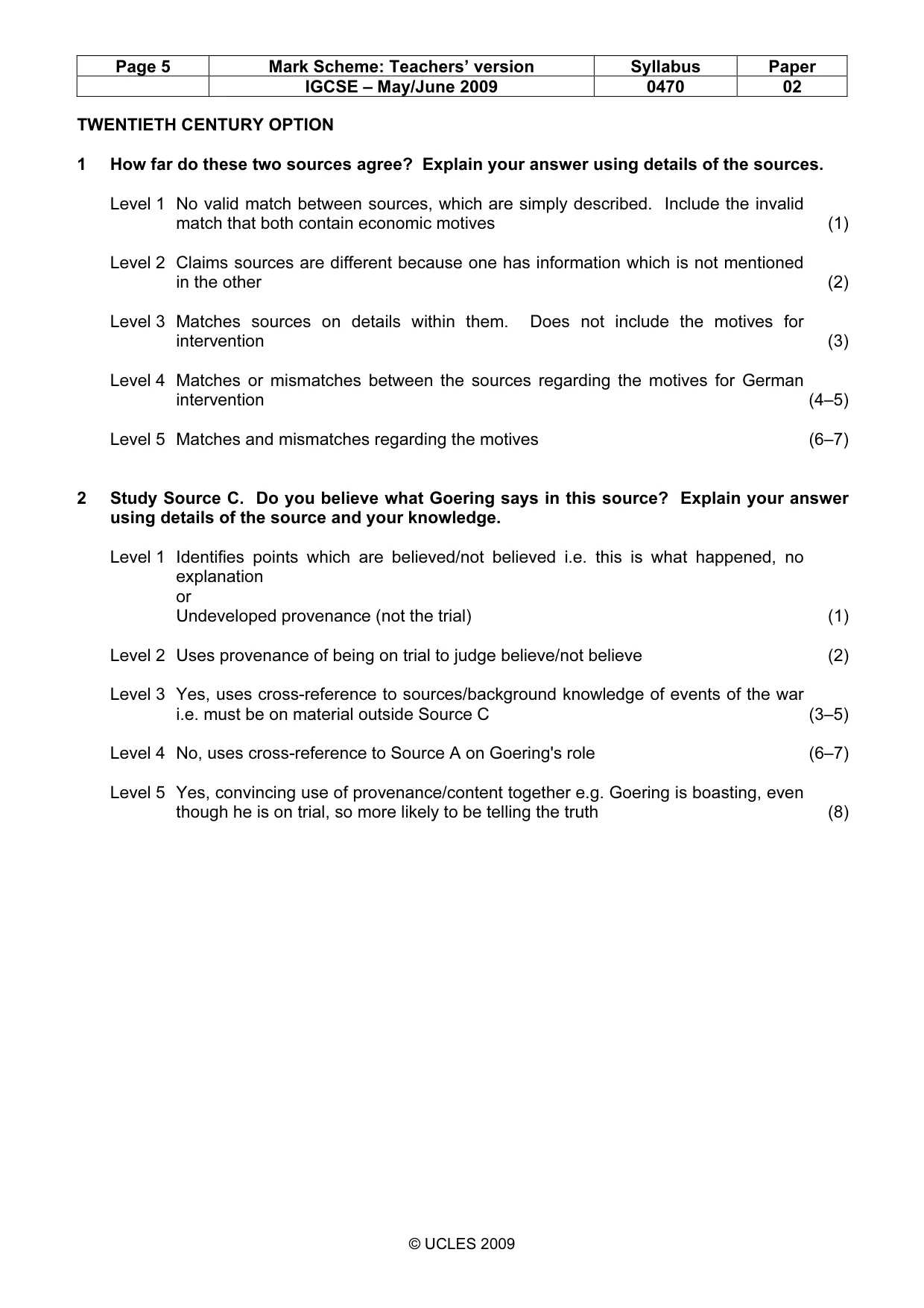
Page 5 Mark Scheme: Teachers’ version Syllabus Paper IGCSE – May/June 2009 0470 02 © UCLES 2009 TWENTIETH CENTURY OPTION 1 How far do these two sources agree? Explain your answer using details of the sources. Level 1 No valid match between sources, which are simply described. Include the invalid match that both contain economic motives (1) Level 2 Claims sources are different because one has information which is not mentioned in the other (2) Level 3 Matches sources on details within them. Does not include the motives for intervention (3) Level 4 Matches or mismatches between the sources regarding the motives for German intervention (4–5) Level 5 Matches and mismatches regarding the motives (6–7) 2 Study Source C. Do you believe what Goering says in this source? Explain your answer using details of the source and your knowledge. Level 1 Identifies points which are believed/not believed i.e. this is what happened, no explanation or Undeveloped provenance (not the trial) (1) Level 2 Uses provenance of being on trial to judge believe/not believe (2) Level 3 Yes, uses cross-reference to sources/background knowledge of events of the war i.e. must be on material outside Source C (3–5) Level 4 No, uses cross-reference to Source A on Goering's role (6–7) Level 5 Yes, convincing use of provenance/content together e.g. Goering is boasting, even though he is on trial, so more likely to be telling the truth (8)
Mark scheme, page 6
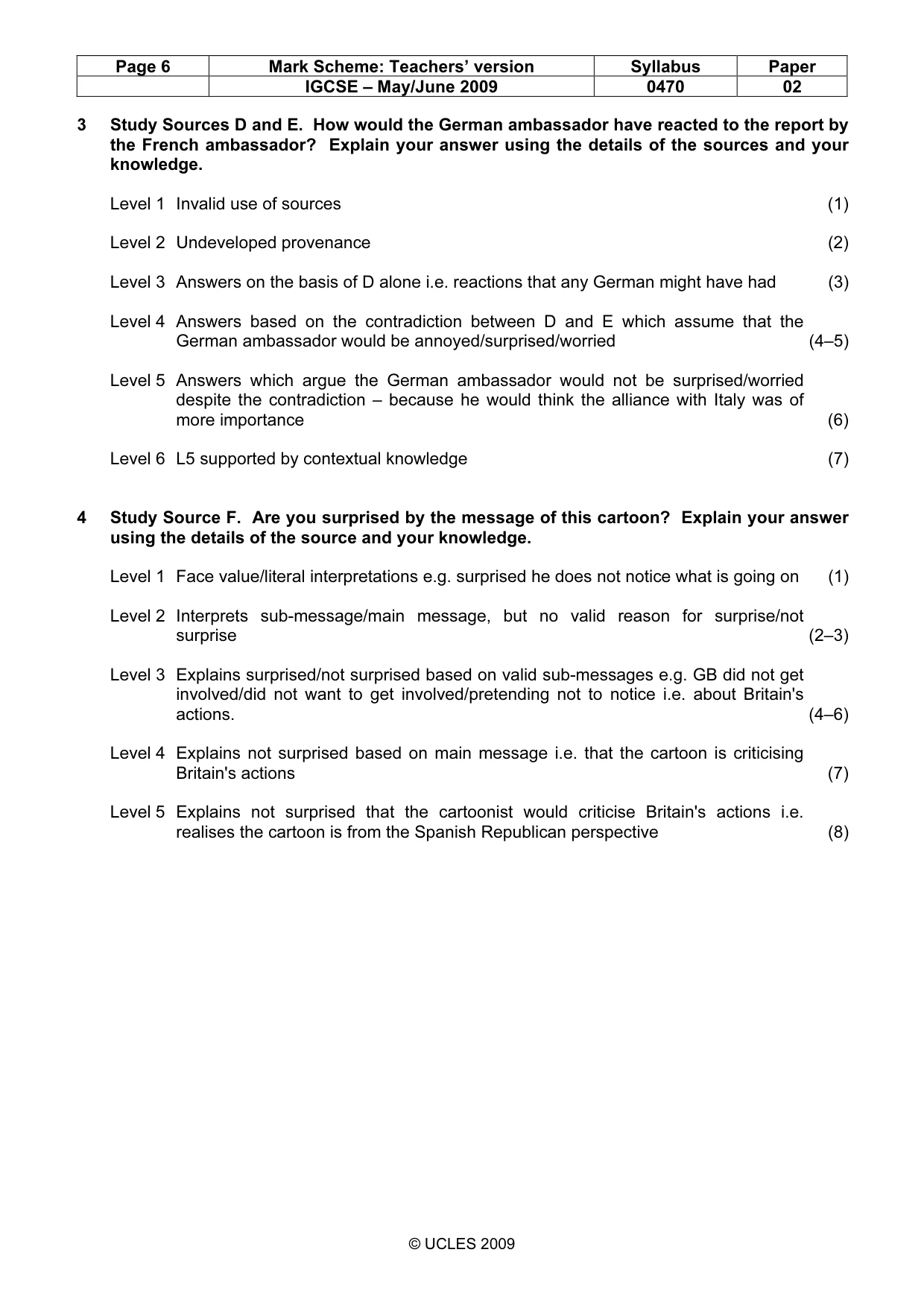
Page 6 Mark Scheme: Teachers’ version Syllabus Paper IGCSE – May/June 2009 0470 02 © UCLES 2009 3 Study Sources D and E. How would the German ambassador have reacted to the report by the French ambassador? Explain your answer using the details of the sources and your knowledge. Level 1 Invalid use of sources (1) Level 2 Undeveloped provenance (2) Level 3 Answers on the basis of D alone i.e. reactions that any German might have had (3) Level 4 Answers based on the contradiction between D and E which assume that the German ambassador would be annoyed/surprised/worried (4–5) Level 5 Answers which argue the German ambassador would not be surprised/worried despite the contradiction – because he would think the alliance with Italy was of more importance (6) Level 6 L5 supported by contextual knowledge (7) 4 Study Source F. Are you surprised by the message of this cartoon? Explain your answer using the details of the source and your knowledge. Level 1 Face value/literal interpretations e.g. surprised he does not notice what is going on (1) Level 2 Interprets sub-message/main message, but no valid reason for surprise/not surprise (2–3) Level 3 Explains surprised/not surprised based on valid sub-messages e.g. GB did not get involved/did not want to get involved/pretending not to notice i.e. about Britain's actions. (4–6) Level 4 Explains not surprised based on main message i.e. that the cartoon is criticising Britain's actions (7) Level 5 Explains not surprised that the cartoonist would criticise Britain's actions i.e. realises the cartoon is from the Spanish Republican perspective (8)
Mark scheme, page 7
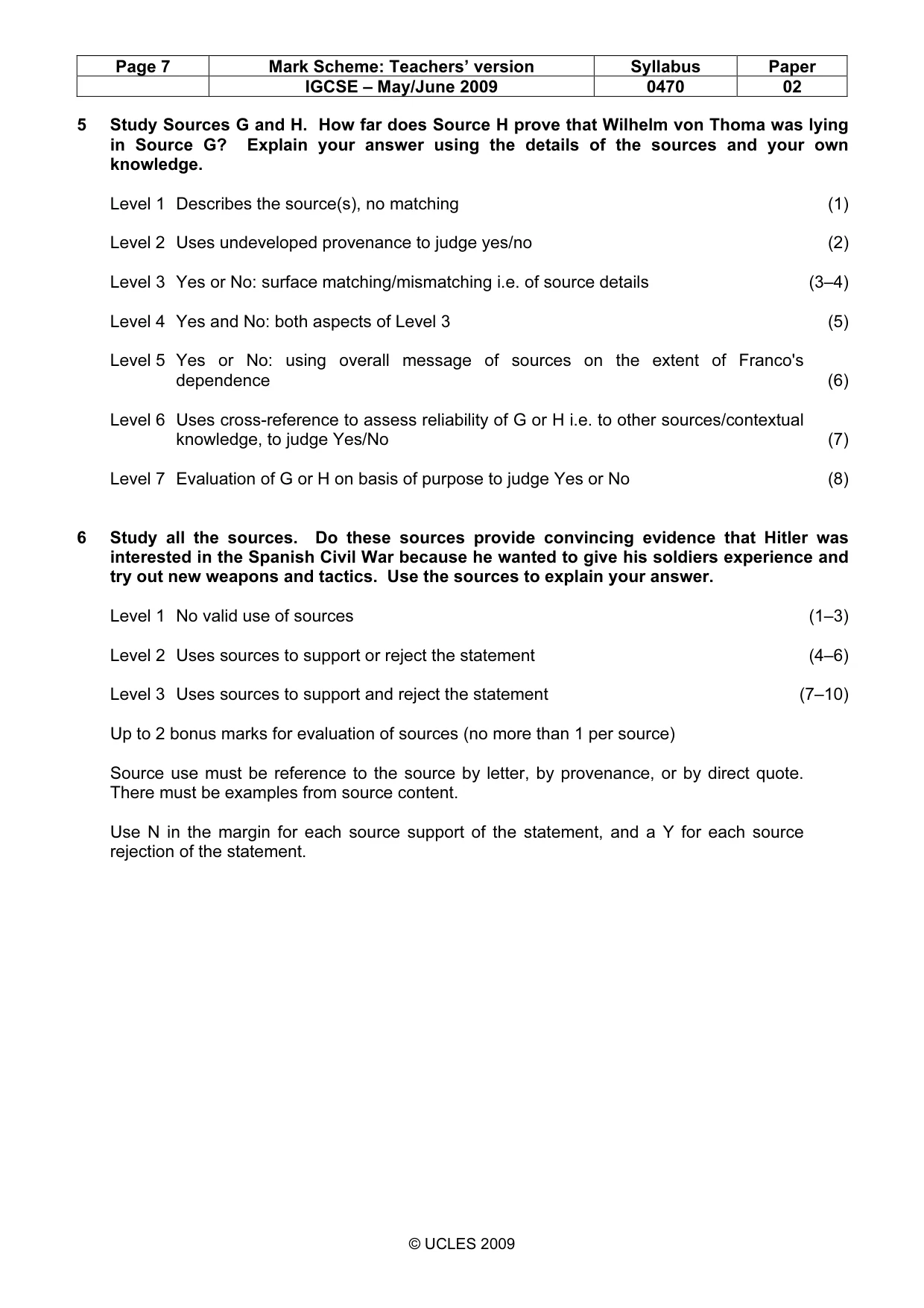
Page 7 Mark Scheme: Teachers’ version Syllabus Paper IGCSE – May/June 2009 0470 02 © UCLES 2009 5 Study Sources G and H. How far does Source H prove that Wilhelm von Thoma was lying in Source G? Explain your answer using the details of the sources and your own knowledge. Level 1 Describes the source(s), no matching (1) Level 2 Uses undeveloped provenance to judge yes/no (2) Level 3 Yes or No: surface matching/mismatching i.e. of source details (3–4) Level 4 Yes and No: both aspects of Level 3 (5) Level 5 Yes or No: using overall message of sources on the extent of Franco's dependence (6) Level 6 Uses cross-reference to assess reliability of G or H i.e. to other sources/contextual knowledge, to judge Yes/No (7) Level 7 Evaluation of G or H on basis of purpose to judge Yes or No (8) 6 Study all the sources. Do these sources provide convincing evidence that Hitler was interested in the Spanish Civil War because he wanted to give his soldiers experience and try out new weapons and tactics. Use the sources to explain your answer. Level 1 No valid use of sources (1–3) Level 2 Uses sources to support or reject the statement (4–6) Level 3 Uses sources to support and reject the statement (7–10) Up to 2 bonus marks for evaluation of sources (no more than 1 per source) Source use must be reference to the source by letter, by provenance, or by direct quote. There must be examples from source content. Use N in the margin for each source support of the statement, and a Y for each source rejection of the statement.
What you needed in this session
Cambridge’s own grade thresholds for 2009 May/June, Paper 2 · Variant 1. A higher threshold means an easier paper — the bar moves with how the cohort did.