Cambridge IGCSE History 0470 — 2008 Oct/Nov Paper 2 · Variant 1
0470/21/O/N/08 · 50 marks · ≈56 min
The question paper and its mark scheme, free to read here and free to download. This is Cambridge’s own paper, exactly as it was sat.
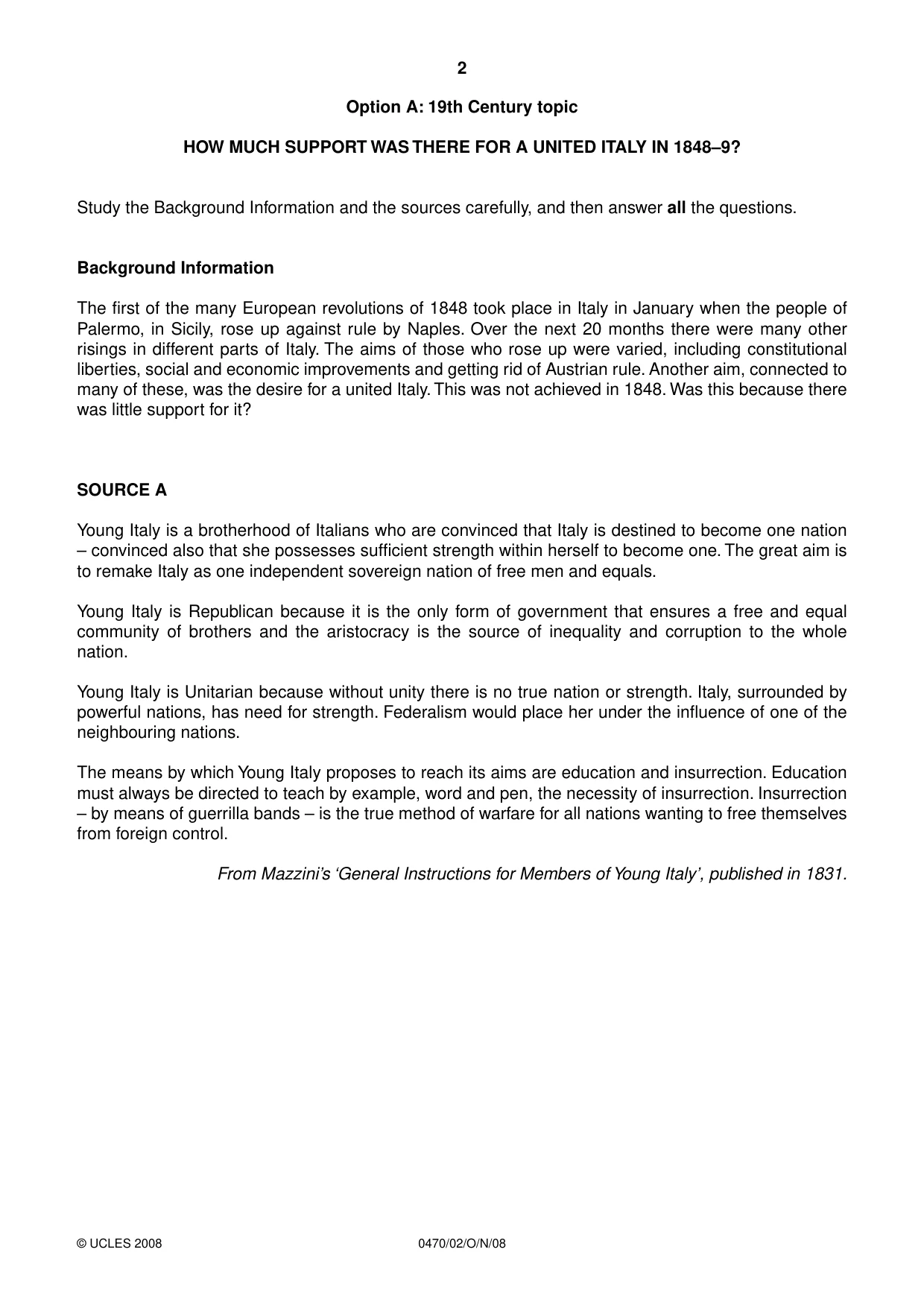
Question paper12 pages
Mark scheme6 pages
Answers below. Sit the paper first if you are practising.
Paper as text
Question paper, page 1
This document consists of 12 printed pages. SP (CW/CGW) T53045/6 © UCLES 2008 [Turn over UNIVERSITY OF CAMBRIDGE INTERNATIONAL EXAMINATIONS International General Certificate of Secondary Education READ THESE INSTRUCTIONS FIRST If you have been given an Answer Booklet, follow the instructions on the front cover of the Booklet. Write your Centre number, candidate number and name on all the work you hand in. Write in dark blue or black pen. You may use a soft pencil for any diagrams, graphs or rough working. Do not use staples, paper clips, highlighters, glue or correction fluid. This paper has two options. Choose one option, and answer all of the questions on that topic. Option A: 19th Century topic [p2–p6] Option B: 20th Century topic [p7–p12] At the end of the examination, fasten all your work securely together. The number of marks is given in brackets [ ] at the end of each question or part question. * 6 0 4 1 7 9 6 5 0 1 * HISTORY 0470/02 Paper 2 October/November 2008 2 hours Additional Materials: Answer Booklet/Paper www.XtremePapers.com
Question paper, page 2
2 0470/02/O/N/08 © UCLES 2008 Option A: 19th Century topic HOW MUCH SUPPORT WAS THERE FOR A UNITED ITALY IN 1848–9? Study the Background Information and the sources carefully, and then answer all the questions. Background Information The first of the many European revolutions of 1848 took place in Italy in January when the people of Palermo, in Sicily, rose up against rule by Naples. Over the next 20 months there were many other risings in different parts of Italy. The aims of those who rose up were varied, including constitutional liberties, social and economic improvements and getting rid of Austrian rule. Another aim, connected to many of these, was the desire for a united Italy. This was not achieved in 1848. Was this because there was little support for it? SOURCE A Young Italy is a brotherhood of Italians who are convinced that Italy is destined to become one nation – convinced also that she possesses sufficient strength within herself to become one. The great aim is to remake Italy as one independent sovereign nation of free men and equals. Young Italy is Republican because it is the only form of government that ensures a free and equal community of brothers and the aristocracy is the source of inequality and corruption to the whole nation. Young Italy is Unitarian because without unity there is no true nation or strength. Italy, surrounded by powerful nations, has need for strength. Federalism would place her under the influence of one of the neighbouring nations. The means by which Young Italy proposes to reach its aims are education and insurrection. Education must always be directed to teach by example, word and pen, the necessity of insurrection. Insurrection – by means of guerrilla bands – is the true method of warfare for all nations wanting to free themselves from foreign control. From Mazzini’s ‘General Instructions for Members of Young Italy’, published in 1831.
Question paper, page 3
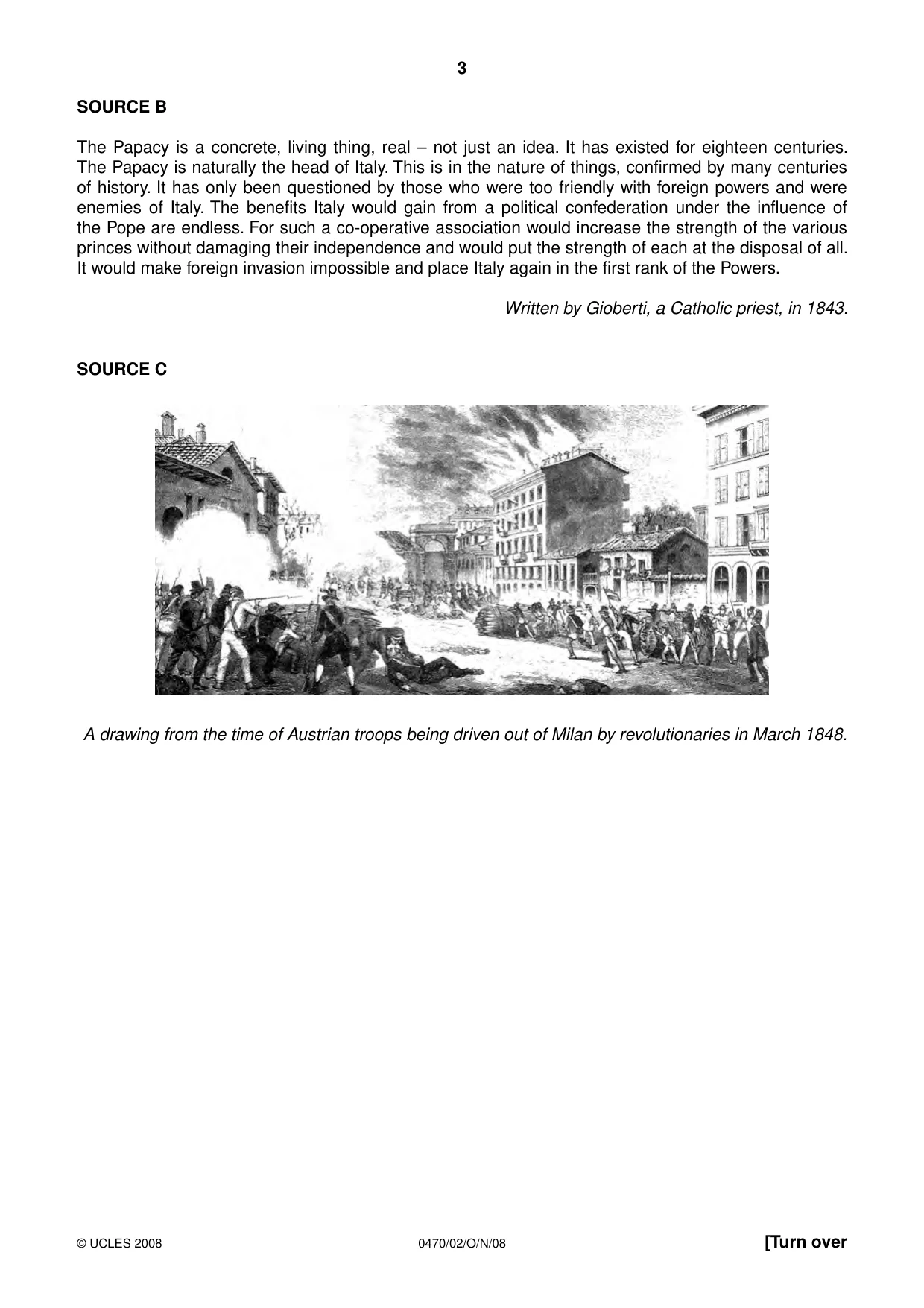
3 0470/02/O/N/08 © UCLES 2008 [Turn over SOURCE B The Papacy is a concrete, living thing, real – not just an idea. It has existed for eighteen centuries. The Papacy is naturally the head of Italy. This is in the nature of things, confirmed by many centuries of history. It has only been questioned by those who were too friendly with foreign powers and were enemies of Italy. The benefits Italy would gain from a political confederation under the influence of the Pope are endless. For such a co-operative association would increase the strength of the various princes without damaging their independence and would put the strength of each at the disposal of all. It would make foreign invasion impossible and place Italy again in the first rank of the Powers. Written by Gioberti, a Catholic priest, in 1843. SOURCE C A drawing from the time of Austrian troops being driven out of Milan by revolutionaries in March 1848.
Question paper, page 4
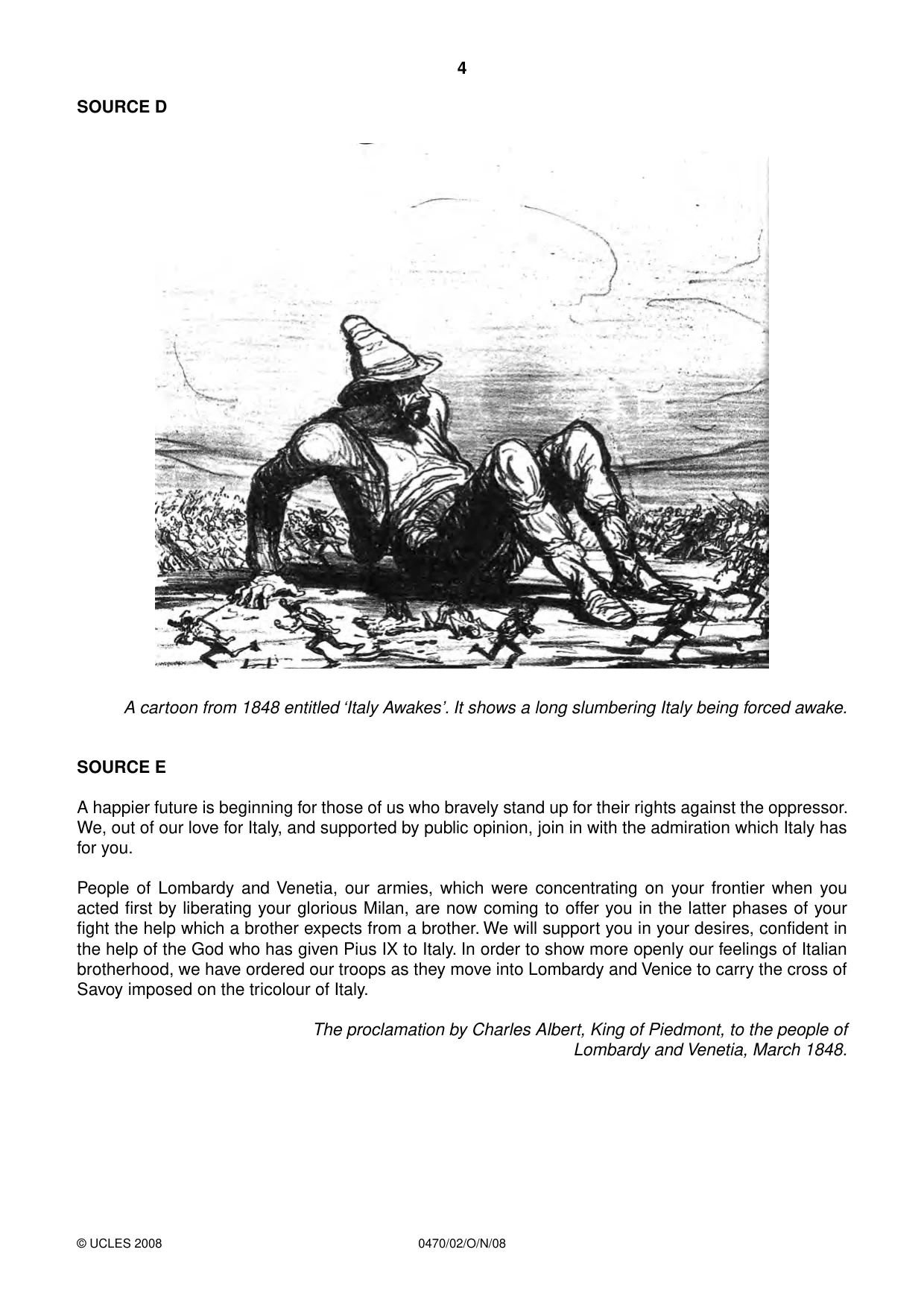
4 0470/02/O/N/08 © UCLES 2008 SOURCE D A cartoon from 1848 entitled ‘Italy Awakes’. It shows a long slumbering Italy being forced awake. SOURCE E A happier future is beginning for those of us who bravely stand up for their rights against the oppressor. We, out of our love for Italy, and supported by public opinion, join in with the admiration which Italy has for you. People of Lombardy and Venetia, our armies, which were concentrating on your frontier when you acted first by liberating your glorious Milan, are now coming to offer you in the latter phases of your fight the help which a brother expects from a brother. We will support you in your desires, confident in the help of the God who has given Pius IX to Italy. In order to show more openly our feelings of Italian brotherhood, we have ordered our troops as they move into Lombardy and Venice to carry the cross of Savoy imposed on the tricolour of Italy. The proclamation by Charles Albert, King of Piedmont, to the people of Lombardy and Venetia, March 1848.
Question paper, page 5
5 0470/02/O/N/08 © UCLES 2008 [Turn over SOURCE F My position was difficult and dangerous. I had to try and prevent Tuscany falling into anarchy. This would have been fatal for Tuscany itself, a dreadful example to the other states in Italy, and would have made the situation more difficult for everybody. Either I had to take part in the war, or go into exile and bring the government down. Tuscan neutrality was impossible. I had received no request to join my forces with those of the Austrian army. The Austrians did not offer their troops to Tuscany to suppress the revolution, and I could not believe that Austria was in a position to send any troops. I thought of my family, and the dangers that my dynasty might incur if the situation changed; I thought of the anarchy that was imminent in Tuscany. That evening, 29 March, I issued a decree which proclaimed war. I had already granted a free press, a Civic guard and a Constitution; now I granted war. I intended to raise 2,000 conscripts and nobody complained, not even about the extra cost, such was the popular enthusiasm. From the Memoirs of Leopold II, the Grand Duke of Tuscany, explaining why he joined Piedmont’s war against the Austrians. Leopold was related to the Austrian royal family. He wrote his memoirs in the 1860s after he abdicated. SOURCE G If my hands, used to fighting, would be acceptable to His Holiness the Pope, I most thankfully dedicate them to the service of him who has served the Church and the fatherland so well. Joyful indeed shall I and my companions in whose name I speak be, if we may be allowed to shed our blood in defence of His Holiness’s work of liberty. A letter from Garibaldi to Pope Pius IX, October 1847. SOURCE H Seeing that some people want us, along with the other princes of Italy and their subjects, to engage in war against the Austrians, we have thought it convenient to proclaim clearly and openly that we are not happy with such a plan. We reject the treacherous advice of those who would want me to be head of some sort of republic of the whole Italian people. Rather, on this occasion, moved by the love we bear them, we do urgently warn the Italian people to stay loyal to their sovereigns whose rule has so often benefited them. A public announcement by Pope Pius IX, April 1848. SOURCE I The word ‘Italy’ is a geographical expression. Though it is a term that slides easily off the tongue, it has none of the political implications which the revolutionaries are trying to attach to it – implications which would threaten the very existence of the individual states which make up the Italian peninsula. Metternich, the Austrian Chancellor, writing to an Austrian official in Italy, April 1847.
Question paper, page 6
6 0470/02/O/N/08 © UCLES 2008 SOURCE J There are not five Italies, or four Italies or three Italies. There is only one Italy. God, who in creating her, smiles upon her land, has awarded her the two most perfect frontiers in Europe, symbols of eternal strength – the Alps and the sea. Rome shall be the temple of your nation. Mazzini speaking to the Constituent Assembly in Rome, March 1849. Now answer all the following questions. You may use any of the sources to help you answer the questions, in addition to those sources which you are told to use. In answering the questions you should use your own knowledge of the topic to help you interpret and evaluate the sources. 1 Study Sources A and B. How far would the author of Source B have supported the ideas in Source A? Explain your answer using the sources and your knowledge. [8] 2 Study Sources C and D. How similar are these two sources? Explain your answer using the sources and your knowledge. [7] 3 Study Sources E and F. How far do these two sources prove that Charles Albert and Leopold were supporters of Italian nationalism? Explain your answer using the sources and your knowledge. [7] 4 Study Sources G and H. Does Source G make you surprised by what the Pope says in Source H? Explain your answer using the sources and your knowledge. [8] 5 Study Sources I and J. Why do you think these two sources disagree? Explain your answer using the sources and your knowledge. [8] 6 Study all the sources. How far do these sources support the view that by 1848 there was little enthusiasm for a united Italy? Use the sources to explain your answer. [12]
Question paper, page 7
7 0470/02/O/N/08 © UCLES 2008 [Turn over Option B: 20th Century topic WHY DID THE UNITED STATES LOSE THE WAR IN VIETNAM? Study the Background Information and the sources carefully, and then answer all the questions. Background Information American Presidents Eisenhower and Kennedy supported the government of South Vietnam by sending advisers. They knew that the government was corrupt and undemocratic but wanted to prevent the country from falling to the Communists. The Viet Cong, supplied by Communist North Vietnam, were conducting a guerrilla war against the government. In 1964 President Johnson decided to escalate the war. He ordered the bombing of North Vietnam and in 1965 sent 180 000 American troops. The war did not go well for the United States. More troops were sent and tens of thousands were killed. At the same time hundreds of thousands of South Vietnamese civilians were killed. By 1967 Robert McNamara, Secretary of Defence in both Kennedy’s and Johnson’s governments, had decided that the war was not winnable. He resigned in the following year. In 1973 President Nixon withdrew all remaining combat troops from South Vietnam, and in 1975 North Vietnam invaded and defeated the government of South Vietnam. Why did the United States lose the war in Vietnam? Was it because of what happened in Vietnam or was it more because of factors in the United States itself? SOURCE A The American soldier in Vietnam could rely on the latest equipment. He was transported to the battle scene by helicopter, and if wounded flown out by helicopter. Tanks and armoured cars supported any attack and he had the most up-to-date arms – mortars, machine guns, grenade and rocket launchers, and the M16, a fully automatic rifle. The Americans had air-to-surface missiles and bombs of every shape and size from napalm bombs that roasted their victims alive to cluster bombs whose hundreds of pellets burst out to rip deep into the body of anyone within range. They also had electronic instruments which detected guerrillas, and chemical weapons which could destroy jungles and crops. From a book about the Vietnam War by an American historian, published in 1983. SOURCE B The American story was that this was an example of the success of their bombing and shelling campaign. They told me that it showed that the Viet Cong were so demoralised that they were having to take refuge underground. Well I must confess that I believed that version of the story. It was only later when it was discovered how enormous the tunnel complex was and how skilfully the Viet Cong used it and how the tunnels actually extended under the American base camps, that I started to think for myself and I realised that this was not a sign of how demoralised the Viet Cong had become but how determined they were. A British journalist speaking on a television programme, 27 June 1993.
Question paper, page 8
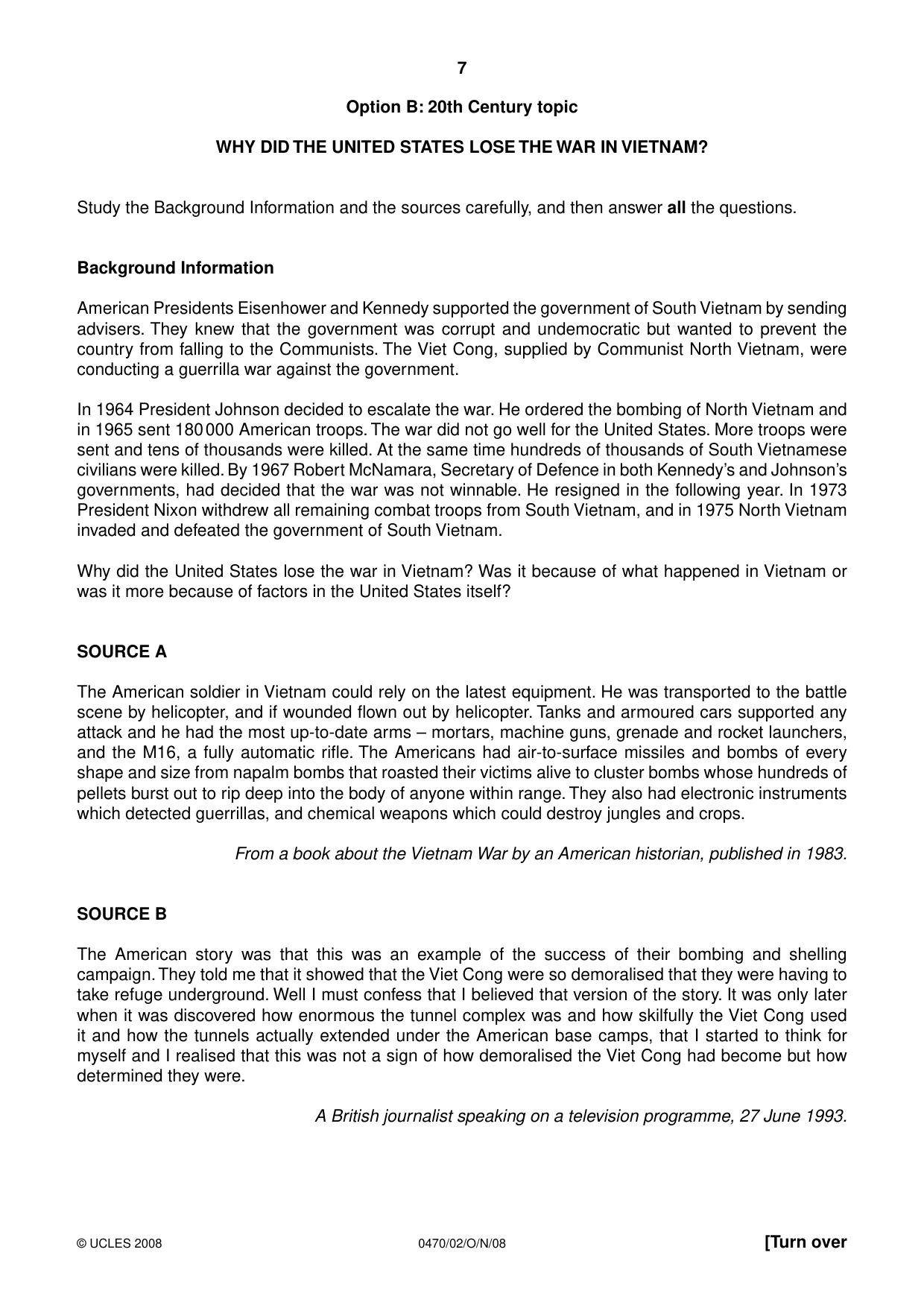
8 0470/02/O/N/08 © UCLES 2008 SOURCE C (The US is spending more than $40,000,000 per day on the war in Vietnam; compensa- tion payments for South Vietnamese civilians killed ʻby mistakeʼ are $34 per head.) A British cartoon published in October 1966.
Question paper, page 9
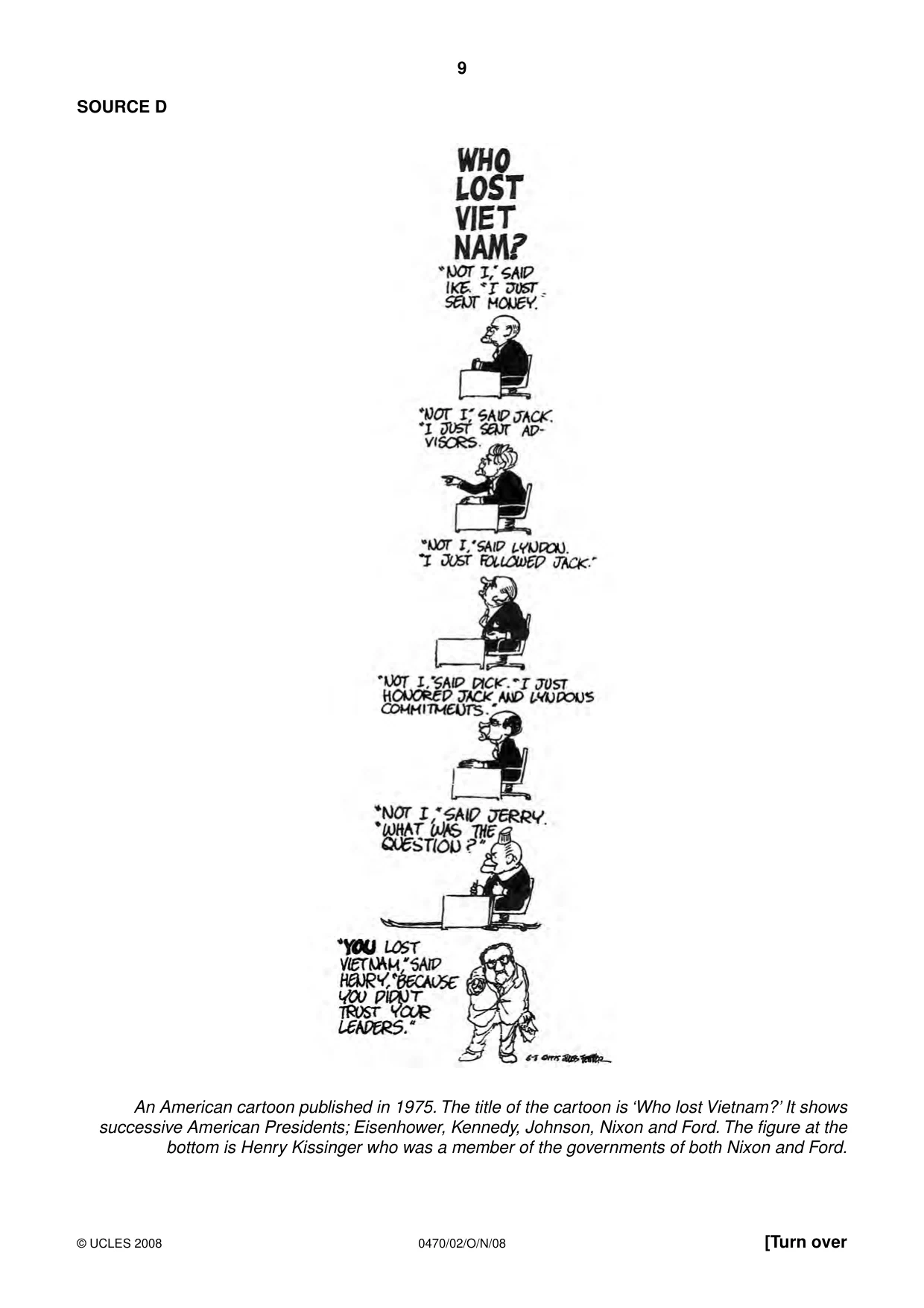
9 0470/02/O/N/08 © UCLES 2008 [Turn over SOURCE D An American cartoon published in 1975. The title of the cartoon is ‘Who lost Vietnam?’ It shows successive American Presidents; Eisenhower, Kennedy, Johnson, Nixon and Ford. The figure at the bottom is Henry Kissinger who was a member of the governments of both Nixon and Ford.
Question paper, page 10
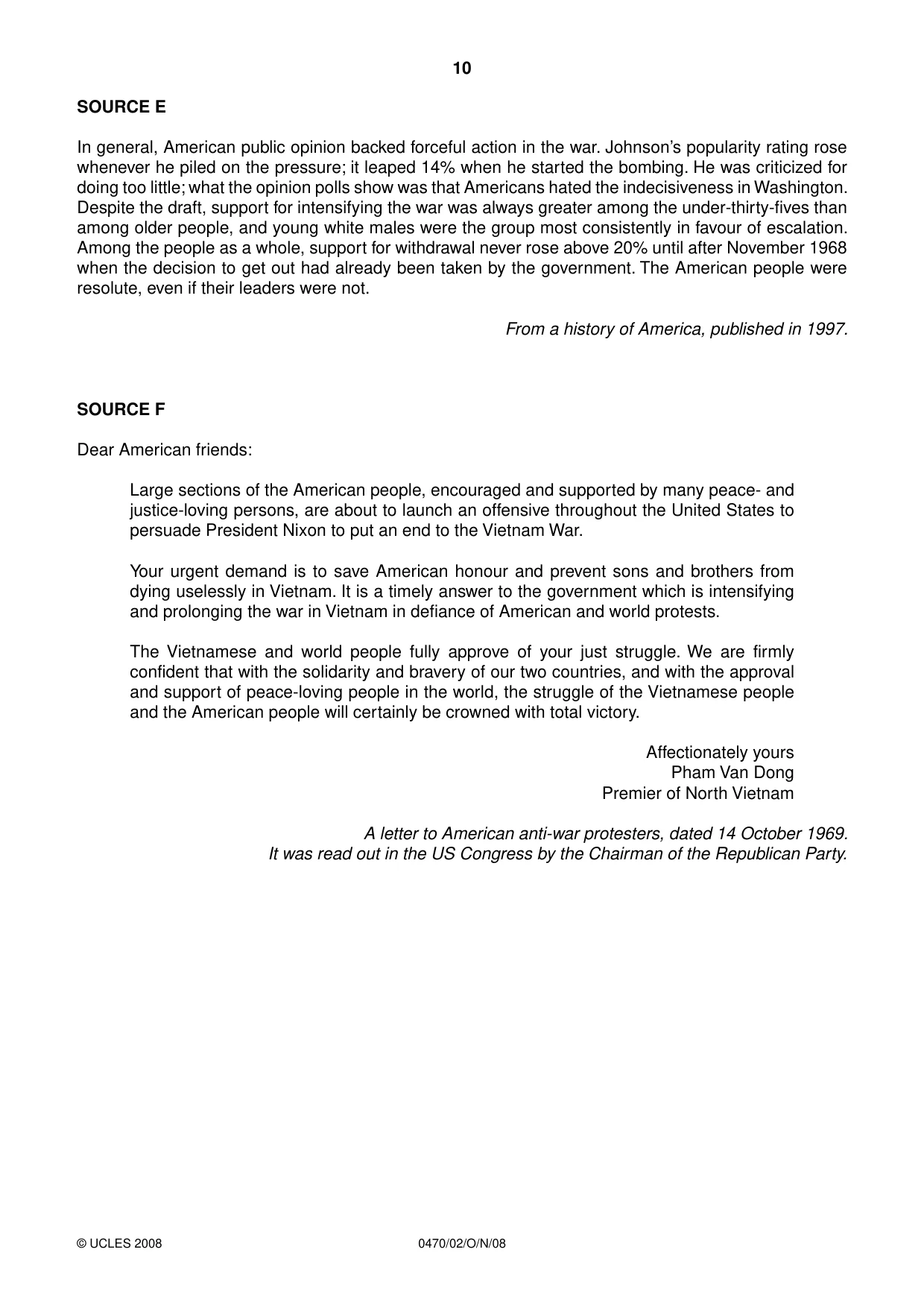
10 0470/02/O/N/08 © UCLES 2008 SOURCE E In general, American public opinion backed forceful action in the war. Johnson’s popularity rating rose whenever he piled on the pressure; it leaped 14% when he started the bombing. He was criticized for doing too little; what the opinion polls show was that Americans hated the indecisiveness in Washington. Despite the draft, support for intensifying the war was always greater among the under-thirty-fives than among older people, and young white males were the group most consistently in favour of escalation. Among the people as a whole, support for withdrawal never rose above 20% until after November 1968 when the decision to get out had already been taken by the government. The American people were resolute, even if their leaders were not. From a history of America, published in 1997. SOURCE F Dear American friends: Large sections of the American people, encouraged and supported by many peace- and justice-loving persons, are about to launch an offensive throughout the United States to persuade President Nixon to put an end to the Vietnam War. Your urgent demand is to save American honour and prevent sons and brothers from dying uselessly in Vietnam. It is a timely answer to the government which is intensifying and prolonging the war in Vietnam in defiance of American and world protests. The Vietnamese and world people fully approve of your just struggle. We are firmly confident that with the solidarity and bravery of our two countries, and with the approval and support of peace-loving people in the world, the struggle of the Vietnamese people and the American people will certainly be crowned with total victory. Affectionately yours Pham Van Dong Premier of North Vietnam A letter to American anti-war protesters, dated 14 October 1969. It was read out in the US Congress by the Chairman of the Republican Party.
Question paper, page 11
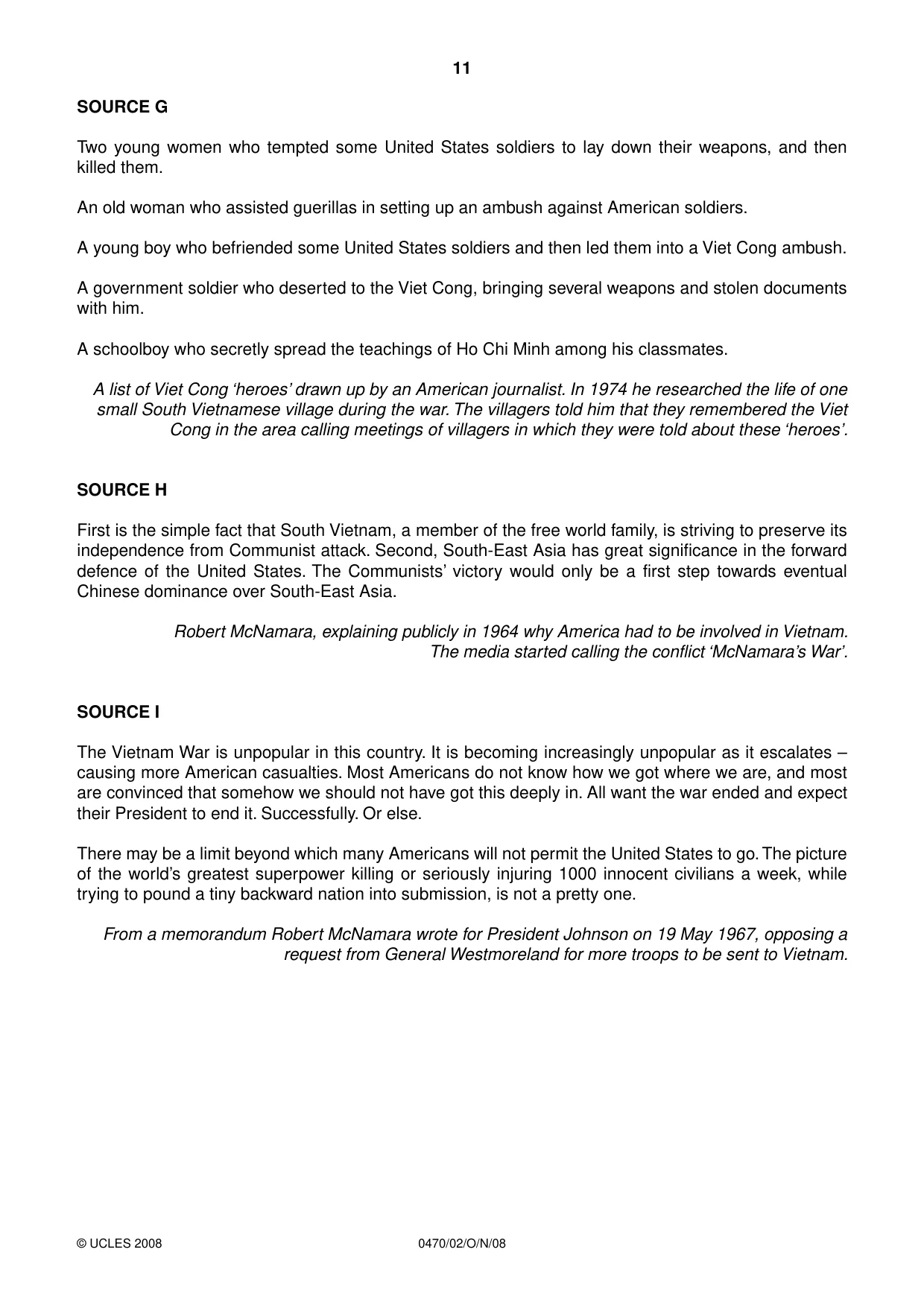
11 0470/02/O/N/08 © UCLES 2008 SOURCE G Two young women who tempted some United States soldiers to lay down their weapons, and then killed them. An old woman who assisted guerillas in setting up an ambush against American soldiers. A young boy who befriended some United States soldiers and then led them into a Viet Cong ambush. A government soldier who deserted to the Viet Cong, bringing several weapons and stolen documents with him. A schoolboy who secretly spread the teachings of Ho Chi Minh among his classmates. A list of Viet Cong ‘heroes’ drawn up by an American journalist. In 1974 he researched the life of one small South Vietnamese village during the war. The villagers told him that they remembered the Viet Cong in the area calling meetings of villagers in which they were told about these ‘heroes’. SOURCE H First is the simple fact that South Vietnam, a member of the free world family, is striving to preserve its independence from Communist attack. Second, South-East Asia has great significance in the forward defence of the United States. The Communists’ victory would only be a first step towards eventual Chinese dominance over South-East Asia. Robert McNamara, explaining publicly in 1964 why America had to be involved in Vietnam. The media started calling the conflict ‘McNamara’s War’. SOURCE I The Vietnam War is unpopular in this country. It is becoming increasingly unpopular as it escalates – causing more American casualties. Most Americans do not know how we got where we are, and most are convinced that somehow we should not have got this deeply in. All want the war ended and expect their President to end it. Successfully. Or else. There may be a limit beyond which many Americans will not permit the United States to go. The picture of the world’s greatest superpower killing or seriously injuring 1000 innocent civilians a week, while trying to pound a tiny backward nation into submission, is not a pretty one. From a memorandum Robert McNamara wrote for President Johnson on 19 May 1967, opposing a request from General Westmoreland for more troops to be sent to Vietnam.
Question paper, page 12
12 0470/02/O/N/08 © UCLES 2008 Now answer all the following questions. You may use any of the sources to help you answer the questions, in addition to those sources which you are told to use. In answering the questions you should use your knowledge of the topic to help you interpret and evaluate the sources. 1 Study Sources A and B. Does Source A make you surprised by the account in Source B? Explain your answer using the sources. [6] 2 Study Source C. What was the message of this cartoon? Explain your answer using the source and your knowledge. [8] 3 Study Sources D and E. How far would the author of Source E have agreed with the cartoonist (Source D)? Explain your answer using the sources and your knowledge. [7] 4 Study Sources F and G. Is one of these sources more useful than the other to a historian studying the Vietnam War? Explain your answer using the sources and your knowledge. [9] 5 Study Sources H and I. Was McNamara lying in one of these two sources? Explain your answer using the sources and your knowledge. [8] 6 Study all the sources. How far do these sources support the view that the United States lost the Vietnam War because of what was happening in America? Use the sources to explain your answer. [12] Copyright Acknowledgements: Option B Source A © From Vietnam: A History by Stanley Karnow, published by Century. Reprinted by permission of The Randon House Group Ltd. Option B Source D © Joanne De Pennington; Modern America: 1865 to the Present ; Hodder Murray; 2005. Option B Source E © Paul Johnson; A History of the American People, Weidenfeld & Nicholson, 1997. Permission to reproduce items where third-party owned material protected by copyright is included has been sought and cleared where possible. Every reasonable effort has been made by the publisher (UCLES) to trace copyright holders, but if any items requiring clearance have unwittingly been included, the publisher will be pleased to make amends at the earliest possible opportunity. University of Cambridge International Examinations is part of the Cambridge Assessment Group. Cambridge Assessment is the brand name of University of Cambridge Local Examinations Syndicate (UCLES), which is itself a department of the University of Cambridge.
Mark scheme, page 1
UNIVERSITY OF CAMBRIDGE INTERNATIONAL EXAMINATIONS International General Certificate of Secondary Education MARK SCHEME for the October/November 2008 question paper 0470 HISTORY 0470/02 Paper 2, maximum raw mark 50 This mark scheme is published as an aid to teachers and candidates, to indicate the requirements of the examination. It shows the basis on which Examiners were instructed to award marks. It does not indicate the details of the discussions that took place at an Examiners’ meeting before marking began. All Examiners are instructed that alternative correct answers and unexpected approaches in candidates’ scripts must be given marks that fairly reflect the relevant knowledge and skills demonstrated. Mark schemes must be read in conjunction with the question papers and the report on the examination. • CIE will not enter into discussions or correspondence in connection with these mark schemes. CIE is publishing the mark schemes for the October/November 2008 question papers for most IGCSE, GCE Advanced Level and Advanced Subsidiary Level syllabuses and some Ordinary Level syllabuses. www.XtremePapers.com
Mark scheme, page 2
Page 2 Mark Scheme Syllabus Paper IGCSE – October/November 2008 0470 02 © UCLES 2008 20th Century Topic 1 Study Sources A and B. Does Source A make you surprised by the account in Source B. Explain your answer using the sources. Level 1 Uses sources but makes no comparison. [1] Level 2 Compares sources but fails to say whether or not they are surprised. [2] Level 3 Matches details to express surprise or not surprised e.g. bombing in both. [3] OR Misreads Source B to argue not surprised e.g. the Americans were successful. OR Argues not surprised because A is only about the Americans, so does not explain the reactions of the Vietcong in B. Level 4 Not surprised because the Americans or the journalist in Source B would, in the light of Source A, have initially believed in American superiority. [4] Level 5 Surprised because the Viet Cong were prospering despite the bombing in Source A. [5–6] OR Not surprised because in Source B the Viet Cong were responding in a logical way to the what was happening in Source A. 2 Study Source C. What was the message of this cartoon? Explain your answer using the source and your knowledge. Level 1 Surface description of the cartoon. No inferences made. [1] Level 2 Misreadings of the cartoon. [2–3] e.g.It is pro-American because they are shown as generous, sorry. e.g.It is anti-American because the Americans are wasting money on compensation. e.g. the war is expensive, it costs a lot [no judgement about being pro-American only 2 marks]. Level 3 Valid Anti-American sub-messages explained. [4–7] e.g. they are killing civilians, they are more worried about money than about lives. 1 sub-message = 4-5, 2 sub-messages = 6-7. Level 4 The main message explained – the Americans were hypocrites. [8] Johnson (or America) is pretending to be one thing e.g. caring, when he is really another e.g. uncaring. 3 Study Sources D and E. How far would the author of Source E have agreed with the cartoonist (Source D)? Explain your answer using the sources and your knowledge. Level 1 Uses the sources but no comparison made between Sources D and E. [1] Level 2 He would have agreed because they both say the US lost the war. [2] Level 3 Answers based on a literal reading of Source D. D says the people were to blame so E would disagree. [3] Level 4 Answers based on matches of details of the two sources. [4–5] e.g. politicians’ indecisiveness – so he would agree.
Mark scheme, page 3
Page 3 Mark Scheme Syllabus Paper IGCSE – October/November 2008 0470 02 © UCLES 2008 e.g. Johnson did little – so he would agree. e.g. Johnson active/not active – so he would disagree. Level 5 Answers based on the fact that they agree either that the politicians lost the war OR that the people did not lose the war. [6] Level 6 Answers based on the fact that they agree that the politicians lost the war AND that the people did not lose the war. [7] 4 Study Sources F and G. Is one of these sources more useful than the other to a historian studying the Vietnam War? Explain your answer using the sources and your knowledge. Level 1 Writes about the sources but no valid comments about utility. [1] Level 2 Simple, undeveloped evaluation of sources for utility/reliability – based on provenance only. [2–3] e.g. F is from North Vietnam and so will be biased. G is American and so will be biased. G is based on what he was told, he did not see it for himself. Level 3 Answers based on the information in the sources. On what the sources say. [4–5] Level 4 Answers based on the reliability of the sources. They will either use cross-reference to contextual knowledge or to other sources OR they will explain the purpose of the sources. [5–6] Level 5 Valid evaluation of one source for utility. [7] e.g. Source F tells us about North Vietnamese/Republican propaganda; Source G tells us about Viet Cong propaganda. Level 6 As for Level 5 – both sources. [8] Level 7 As for Level 5 or 6 but explains it depends on what the historian wants to know. [9] If just asserts that usefulness of sources depend on what the historian wants to know = 2 marks. 5 Study Sources H and I. Was McNamara lying in one of these two sources? Explain your answer using the sources and your knowledge. Level 1 Unsupported assertions OR uses the sources but no answer to the question. [1] Level 2 Uses one or both sources separately and give undeveloped reasons [assertions]. [1–2] Level 3 Asserts that he changed his mind OR the situation changed OR that one is public, the other private. [2–3] Level 4 Uses one or both sources separately – explains or develops reasons for saying he was or was not lying. [4] Level 5 Explains he was lying – because of the differences between the two sources. [5–6] Level 6 Reconciles what the two sources say. [6–7]
Mark scheme, page 4
Page 4 Mark Scheme Syllabus Paper IGCSE – October/November 2008 0470 02 © UCLES 2008 Level 7 Uses both sources together. Uses cross-reference to contextual knowledge or other sources OR developed use of provenance to explain why he was/was not lying. Contextual knowledge must be specific, not general. [8] 6 Study all the sources. How far do these sources support the view that the US lost the Vietnam War because of what was happening in America? Use the sources to explain your answer. Level 1 No valid source use. [1–3] Level 2 Uses sources to support OR reject the statement. [4–6] Level 3 Uses the sources to support AND reject the statement. [7–10] Up to 2 bonus marks for any evaluation of sources (no more than 1 per source). Source use must be reference to a source by letter, by provenance or by direct quotation. There must be examples from source content. Use Y in the margin for each source support of the statement, and N for each source rejection. These must be explained. 19th Century Topic 1 Study Sources A and B. How far would the author of Source B have supported the ideas in Source A? Explain your answer using the sources and your knowledge. Level 1 Uses the sources but makes no comparison. [1] Level 2 Matches the sources for similarity or difference without any contextual understanding. [2–3] Level 3 Similarity or difference explained, implicitly or explicitly informed by a contextual understanding. [4–6] Level 4 Difference(s) explained as in Level 3, plus a similarity (this can be at Level 2). [7] Level 5 Addresses the issue of ‘How far?’ by explaining there is a basic disagreement over means but only a limited agreement over ends. [8] 2 Study Sources C and D. How similar are these two sources? Explain your answer using the sources and your knowledge. Level 1 Describes the sources but no valid comparison. [1] OR Compares surface details/dates. Level 2 Answers based on the claim that both sources are about the same thing e.g. they are both about events in Italy. [2]
Mark scheme, page 5
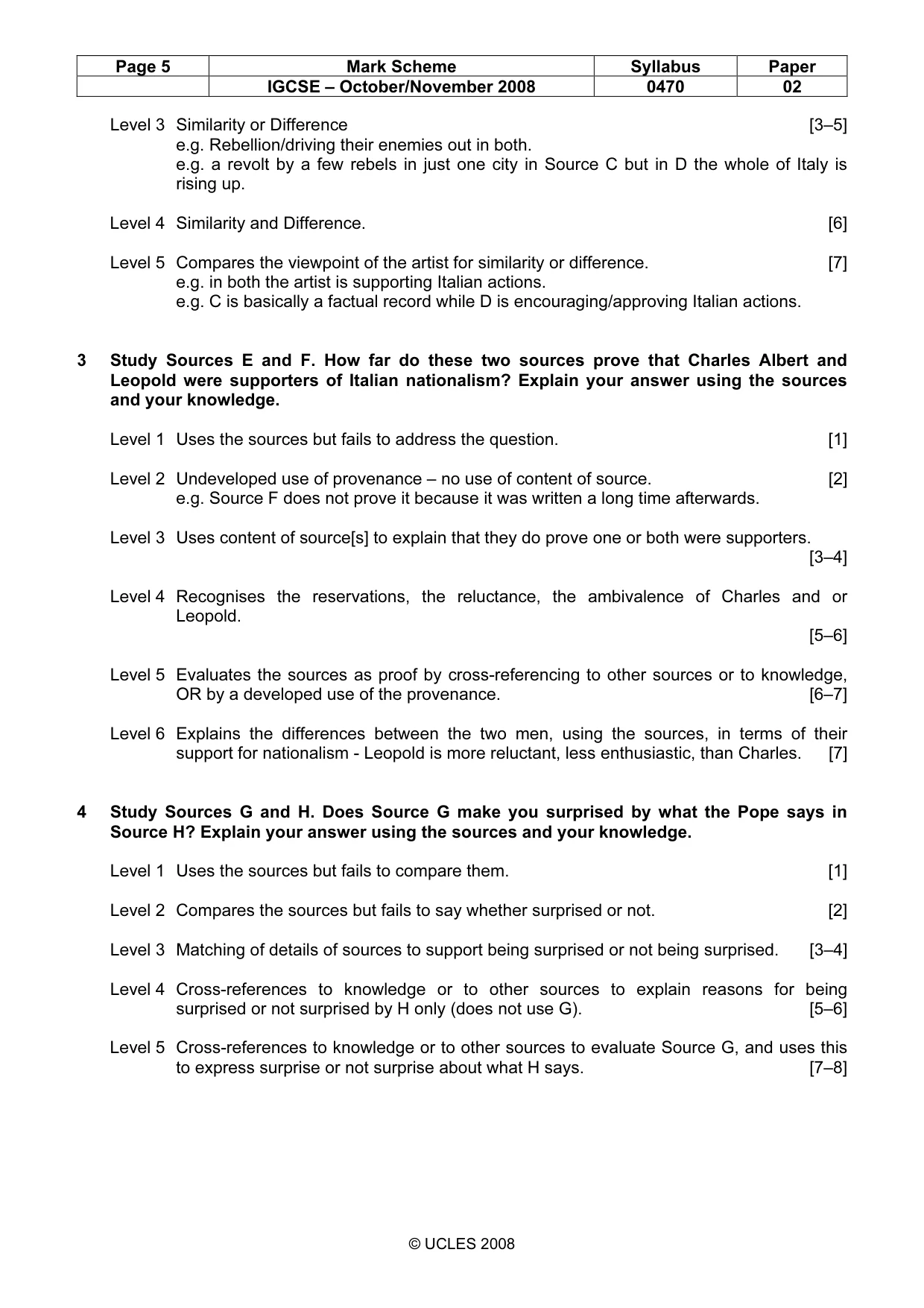
Page 5 Mark Scheme Syllabus Paper IGCSE – October/November 2008 0470 02 © UCLES 2008 Level 3 Similarity or Difference [3–5] e.g. Rebellion/driving their enemies out in both. e.g. a revolt by a few rebels in just one city in Source C but in D the whole of Italy is rising up. Level 4 Similarity and Difference. [6] Level 5 Compares the viewpoint of the artist for similarity or difference. [7] e.g. in both the artist is supporting Italian actions. e.g. C is basically a factual record while D is encouraging/approving Italian actions. 3 Study Sources E and F. How far do these two sources prove that Charles Albert and Leopold were supporters of Italian nationalism? Explain your answer using the sources and your knowledge. Level 1 Uses the sources but fails to address the question. [1] Level 2 Undeveloped use of provenance – no use of content of source. [2] e.g. Source F does not prove it because it was written a long time afterwards. Level 3 Uses content of source[s] to explain that they do prove one or both were supporters. [3–4] Level 4 Recognises the reservations, the reluctance, the ambivalence of Charles and or Leopold. [5–6] Level 5 Evaluates the sources as proof by cross-referencing to other sources or to knowledge, OR by a developed use of the provenance. [6–7] Level 6 Explains the differences between the two men, using the sources, in terms of their support for nationalism - Leopold is more reluctant, less enthusiastic, than Charles. [7] 4 Study Sources G and H. Does Source G make you surprised by what the Pope says in Source H? Explain your answer using the sources and your knowledge. Level 1 Uses the sources but fails to compare them. [1] Level 2 Compares the sources but fails to say whether surprised or not. [2] Level 3 Matching of details of sources to support being surprised or not being surprised. [3–4] Level 4 Cross-references to knowledge or to other sources to explain reasons for being surprised or not surprised by H only (does not use G). [5–6] Level 5 Cross-references to knowledge or to other sources to evaluate Source G, and uses this to express surprise or not surprise about what H says. [7–8]
Mark scheme, page 6
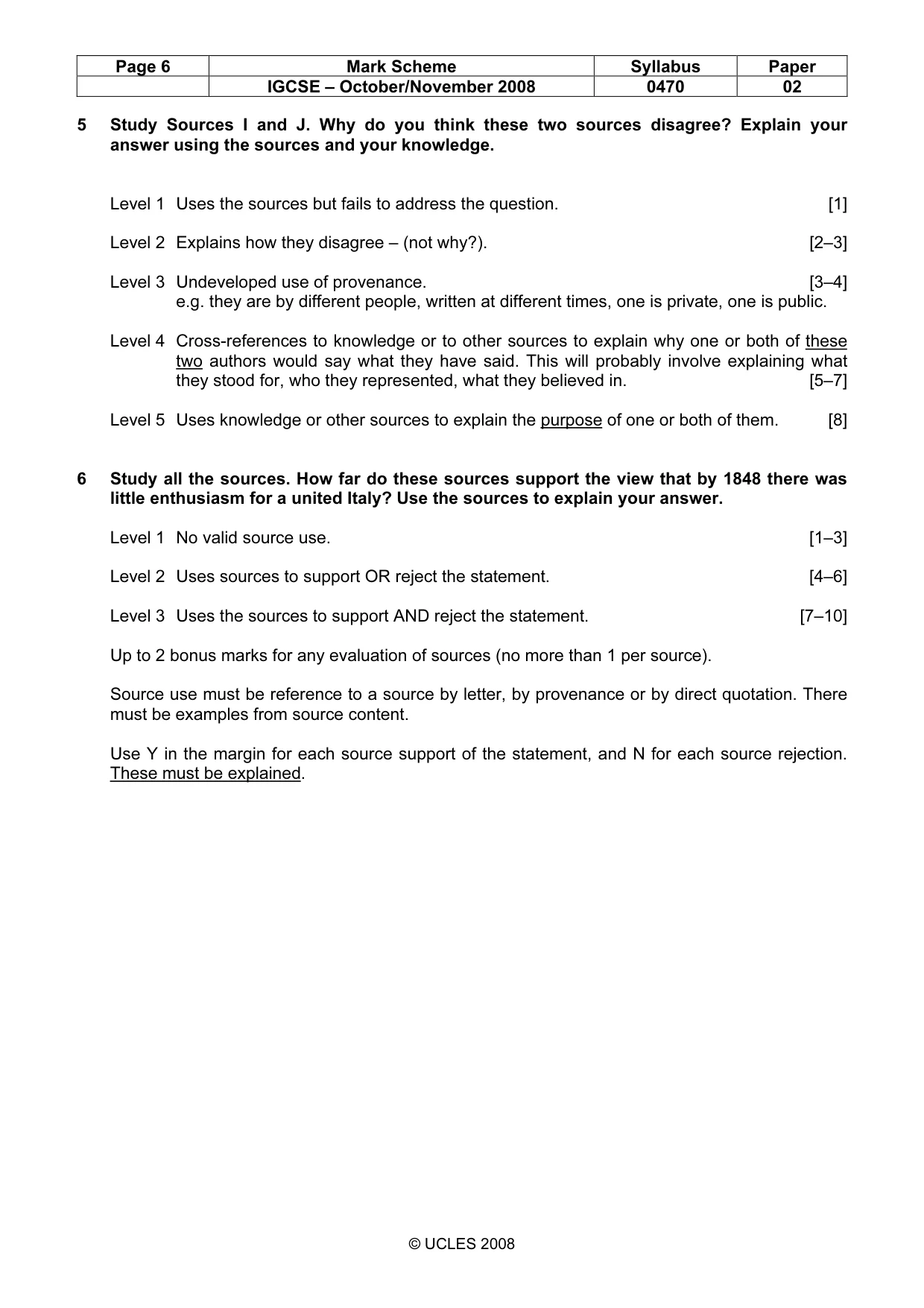
Page 6 Mark Scheme Syllabus Paper IGCSE – October/November 2008 0470 02 © UCLES 2008 5 Study Sources I and J. Why do you think these two sources disagree? Explain your answer using the sources and your knowledge. Level 1 Uses the sources but fails to address the question. [1] Level 2 Explains how they disagree – (not why?). [2–3] Level 3 Undeveloped use of provenance. [3–4] e.g. they are by different people, written at different times, one is private, one is public. Level 4 Cross-references to knowledge or to other sources to explain why one or both of these two authors would say what they have said. This will probably involve explaining what they stood for, who they represented, what they believed in. [5–7] Level 5 Uses knowledge or other sources to explain the purpose of one or both of them. [8] 6 Study all the sources. How far do these sources support the view that by 1848 there was little enthusiasm for a united Italy? Use the sources to explain your answer. Level 1 No valid source use. [1–3] Level 2 Uses sources to support OR reject the statement. [4–6] Level 3 Uses the sources to support AND reject the statement. [7–10] Up to 2 bonus marks for any evaluation of sources (no more than 1 per source). Source use must be reference to a source by letter, by provenance or by direct quotation. There must be examples from source content. Use Y in the margin for each source support of the statement, and N for each source rejection. These must be explained.
What you needed in this session
Cambridge’s own grade thresholds for 2008 Oct/Nov, Paper 2 · Variant 1. A higher threshold means an easier paper — the bar moves with how the cohort did.