Cambridge IGCSE History 0470 — 2008 May/June Paper 2 · Variant 1
0470/21/M/J/08 · 50 marks · ≈56 min
The question paper and its mark scheme, free to read here and free to download. This is Cambridge’s own paper, exactly as it was sat.
Question paper12 pages
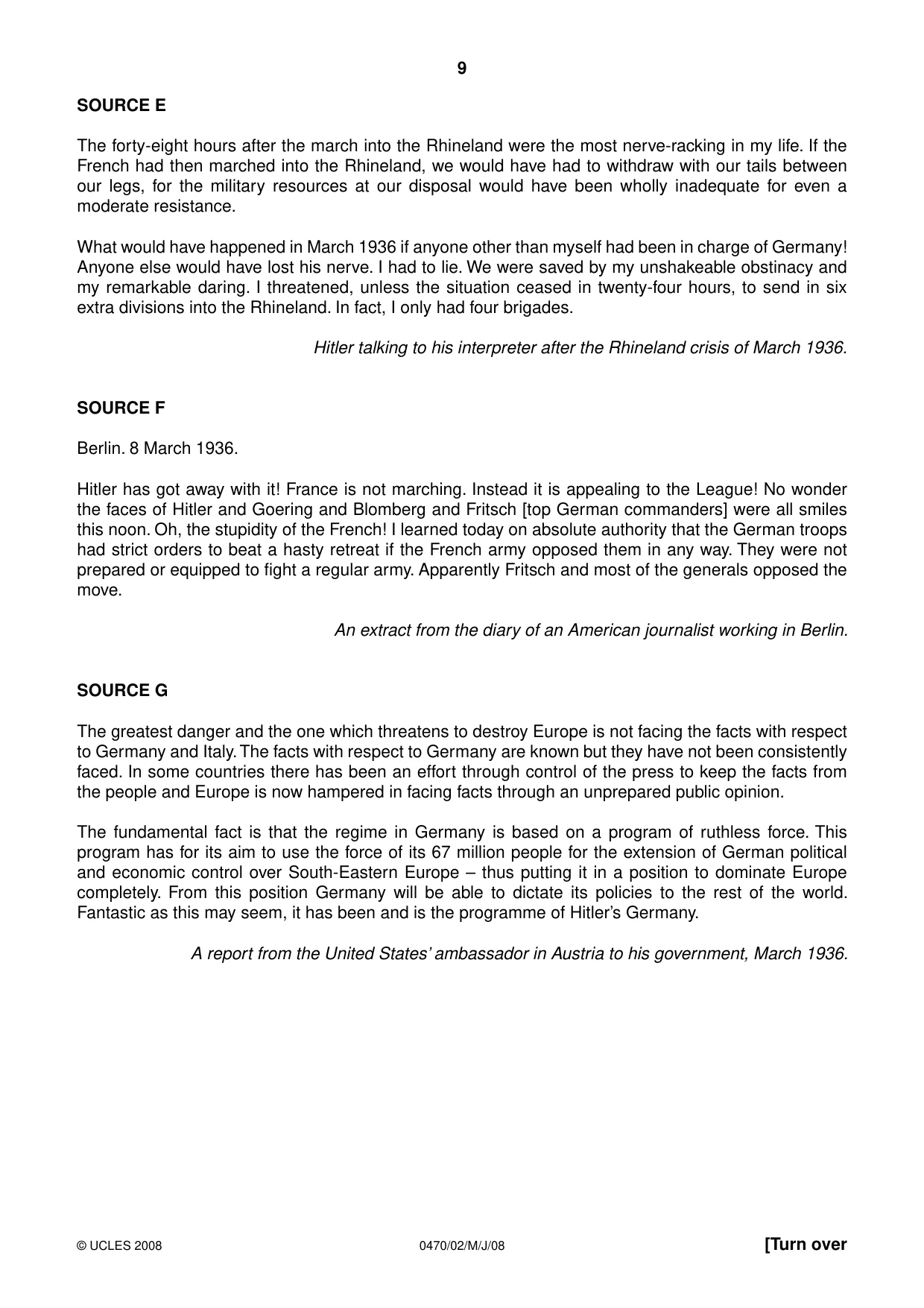
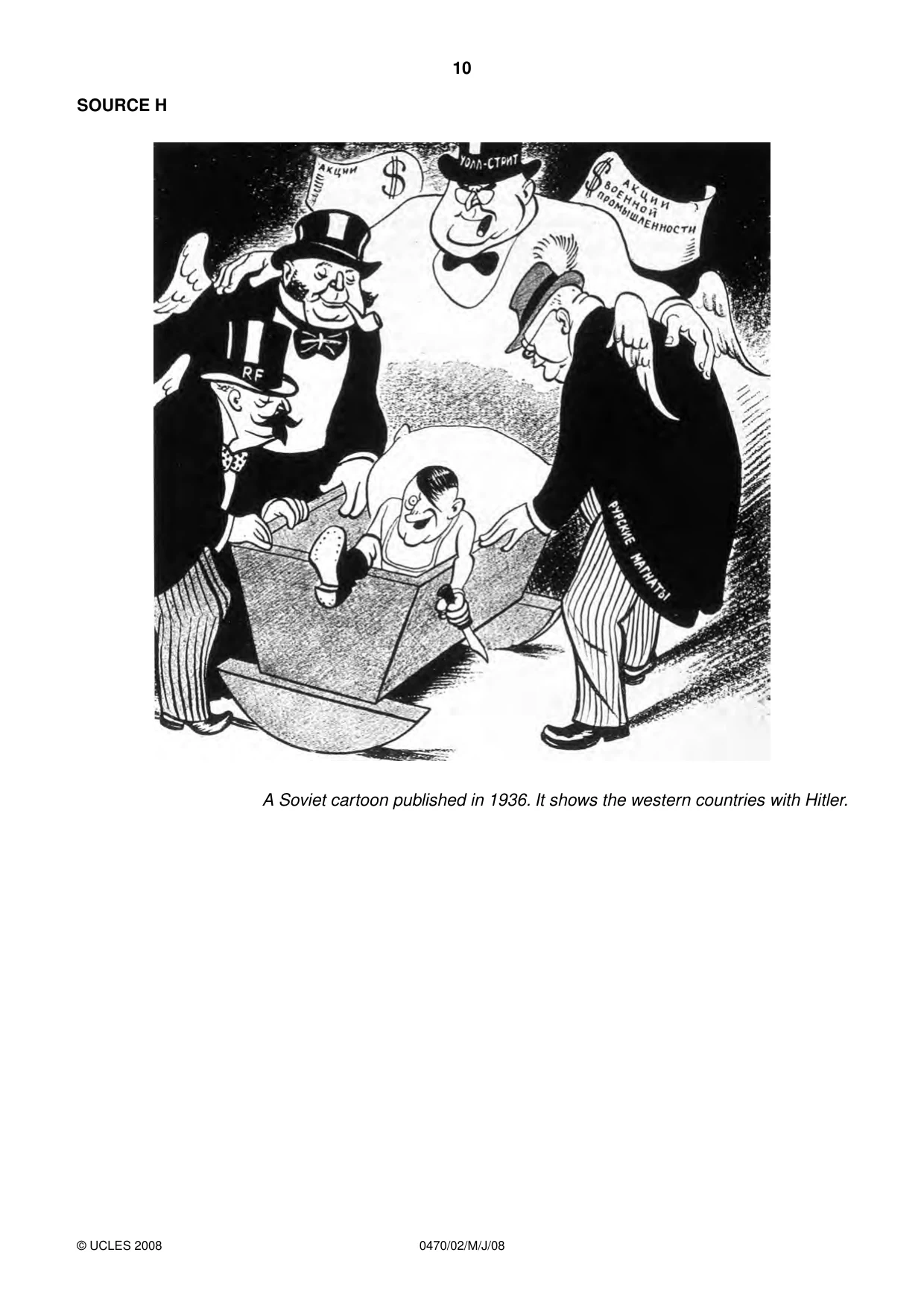
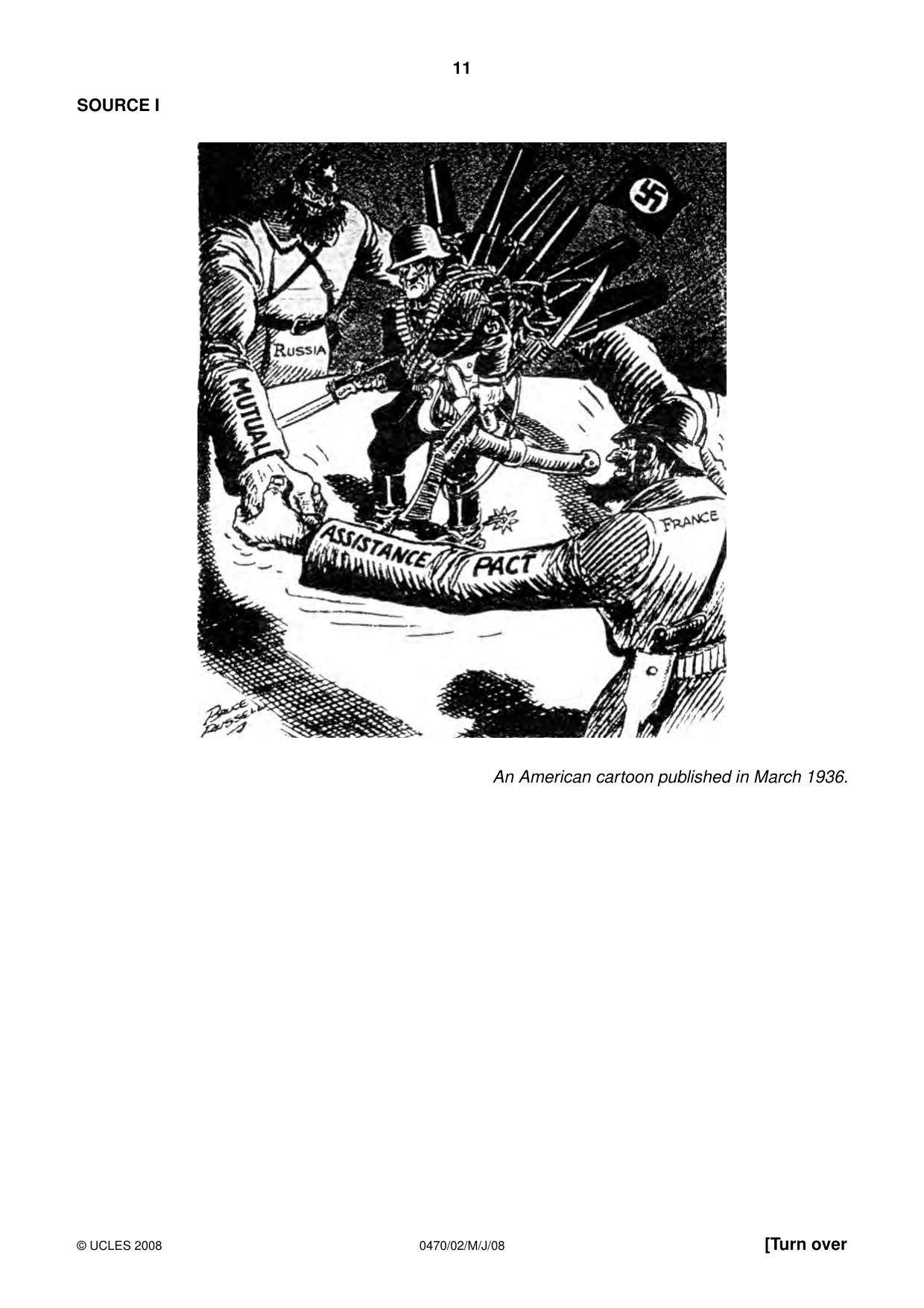
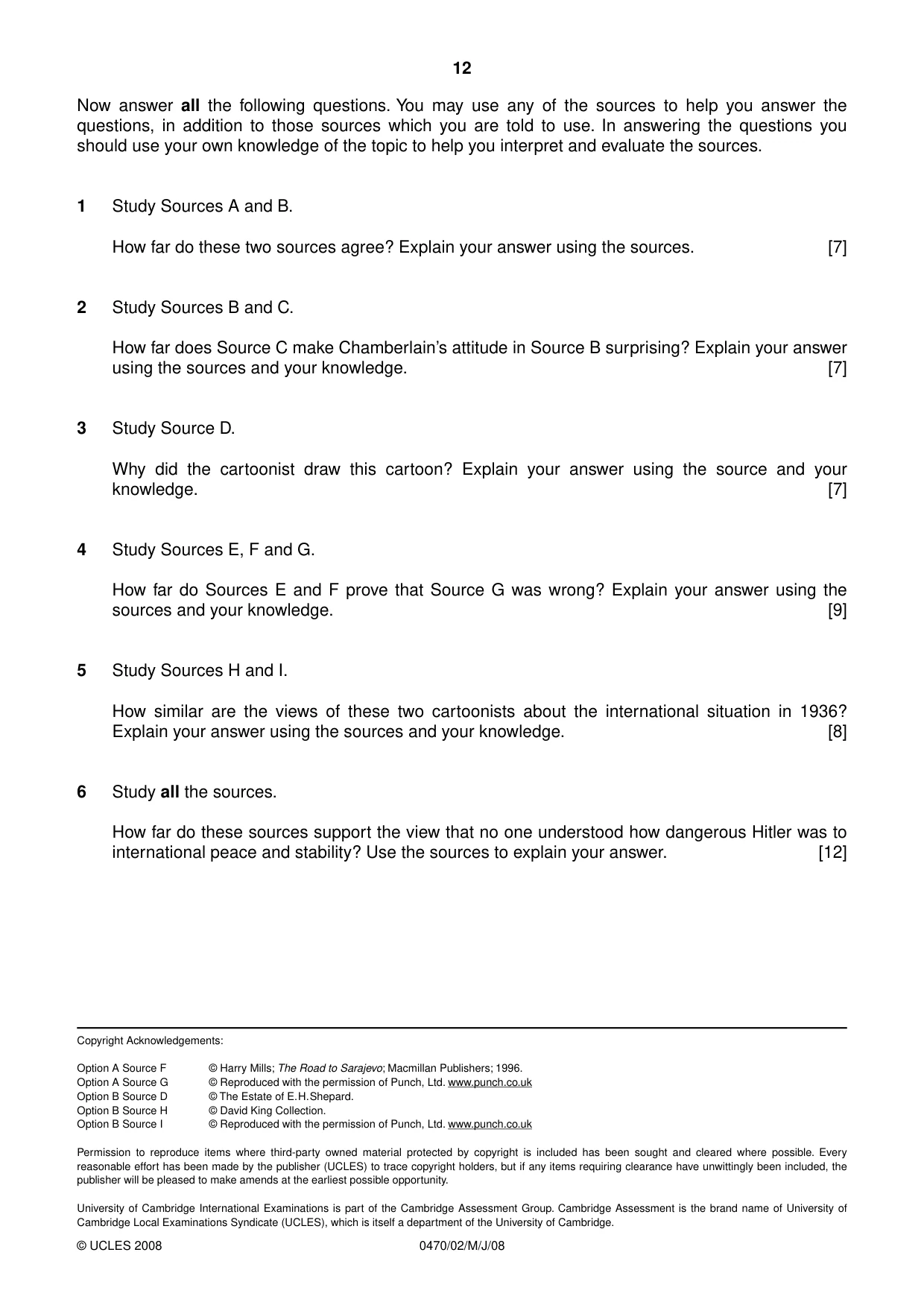
Mark scheme6 pages
Answers below. Sit the paper first if you are practising.
Paper as text
Question paper, page 1
This document consists of 12 printed pages. SP (NF/KS) T52471/2 © UCLES 2008 [Turn over UNIVERSITY OF CAMBRIDGE INTERNATIONAL EXAMINATIONS International General Certificate of Secondary Education READ THESE INSTRUCTIONS FIRST If you have been given an Answer Booklet, follow the instructions on the front cover of the Booklet. Write your Centre number, candidate number and name on all the work you hand in. Write in dark blue or black pen. You may use a soft pencil for any diagrams, graphs or rough working. Do not use staples, paper clips, highlighters, glue or correction fluid. This paper has two options. Choose one option, and then answer all of the questions on that topic. Option A: 19th Century topic [p2–p6] Option B: 20th Century topic [p7–p12] At the end of the examination, fasten all your work securely together. The number of marks is given in brackets [ ] at the end of each question or part question. * 1 0 0 5 9 8 7 1 7 7 * HISTORY 0470/02 Paper 2 May/June 2008 2 hours Additional Materials: Answer Booklet/Paper www.XtremePapers.com
Question paper, page 2
2 0470/02/M/J/08 © UCLES 2008 Option A: 19th Century topic WAS GERMAN FOREIGN POLICY IN THE EARLY TWENTIETH CENTURY AGGRESSIVE OR DEFENSIVE? Study the Background Information and the sources carefully, and then answer all the questions. Background Information In the years leading up to the First World War Germany often expressed two concerns. The first was the fear of being encircled as the result of the Entente Cordiale of 1904 and the Triple Entente of 1907; the second was the fact that Germany was alone amongst the great powers in not having a major overseas empire – Germany wanted its ‘place in the sun’. The Moroccan Crises of 1905–6 and 1911 involved both of these issues, with Germany trying to disrupt international alliances and attempting to maintain an influence in Morocco. In the years leading up to the First World War Germany claimed that it was merely responding to these two concerns and that it was acting defensively. However, other countries claimed that German foreign policy was aggressive and threatened peace in Europe. To support their views they pointed to extreme organisations in Germany like the Pan-German League that preached hatred of France, Britain and Russia and supported an aggressive policy of overseas expansion. Was German foreign policy as aggressive as they suggested? SOURCE A In the nineteenth century, England has increased its colonial empire – the largest the world has seen since the days of the Romans – further and further; the French have put down roots in North Africa and East Africa and created for themselves a new empire in the Far East; Russia has begun its mighty course of victory in Asia. The Sino-Japanese War has put things further in motion; it has led to great, momentous, far-reaching decisions, shaken old empires, and added new and serious upheaval. The English prime minister has said that the strong states were getting stronger and stronger and the weak ones weaker and weaker. We don’t want to step on the toes of any foreign power, but at the same time we don’t want our own feet trod on by any foreign power (Bravo!) and we don’t intend to be pushed aside by any foreign power, not in political nor in economic terms. (Lively applause.) To stand dreamily to one side while other people split up the pie, we cannot and we will not do that. (Applause.) We cannot for the simple reason that we now have interests in all parts of the world. If the English speak of a ‘Greater Britain’; if the French speak of a ‘Nouvelle France’; if the Russians open up Asia; then we, too, have the right to a greater Germany (Bravo! from the right, laughter from the left), not in the sense of conquest, but indeed in the sense of peaceful extension of our trade. But we’ll only be able to keep ourselves in front with power, a strong army and a strong fleet. (Very true! from the right; objections from the left.) In the coming century the German people will be the victors or the defeated. Bernhard von Bülow in a speech to the Reichstag on 11 December 1899. Bülow was a member of the German government and was in charge of foreign policy. The text in italics reports the reactions of the audience.
Question paper, page 3
3 0470/02/M/J/08 © UCLES 2008 [Turn over SOURCE B Morocco is a German concern owing to our increasing population and need of naval bases. If Germany does not make her claims, she will retire empty-handed from the partition of the world. Are the German people to get nothing? The time has come when Germany must secure Morocco. From a German newspaper in 1904. SOURCE C It is an insult to the German Empire to have been overlooked in the talks between Britain and France on the future of Morocco. Germany has been treated as a third-rate power. The reaction of the Pan-German League in 1904 to the Entente Cordiale. SOURCE D Before the ring of other Great Powers tightens around us, we must attempt with all our energies and with the utmost determination to break the ring. This is why the Kaiser visited Morocco. A German Government official speaking to a friend shortly after the Kaiser's visit to Morocco in 1905. SOURCE E 31 March, 1905 There was a grand reception for His Majesty by Moroccan officials and the German colony. Then a ride through the gaily decorated streets amid the indescribable joy of the natives and the European population. In the Embassy there was a reception of Germans, the diplomatic corps, and the Sultan’s envoy. In conversing with the French agent in Morocco, the Kaiser said that his visit meant that His Majesty wanted free trade for Germany and complete equality of rights with other countries. His Majesty said that he would like to work directly with the Sultan, the free ruler of an independent country, as an equal; that he himself would be able to make his just claims valid, and that he expected that these claims would also be recognized by France. The French agent became pale. He was about to respond, but was abruptly dismissed. He withdrew with his head down. His Majesty remarked that he looked upon the Sultan as the ruler of a free and independent empire subject to no foreign control; that he expected Germany to have advantages equal to those of other countries in trade and commerce; and that he himself would always negotiate directly with the Sultan. On the whole the brief visit of His Majesty came off splendidly without any unfortunate event. His Majesty was highly satisfied with the visit, especially with the confidential message of the Sultan, brought to His Majesty, that he would introduce no reforms without a previous understanding with the German Government. From a report by a German official to the German Foreign Office describing Kaiser Wilhelm's visit to Morocco in March 1905.
Question paper, page 4
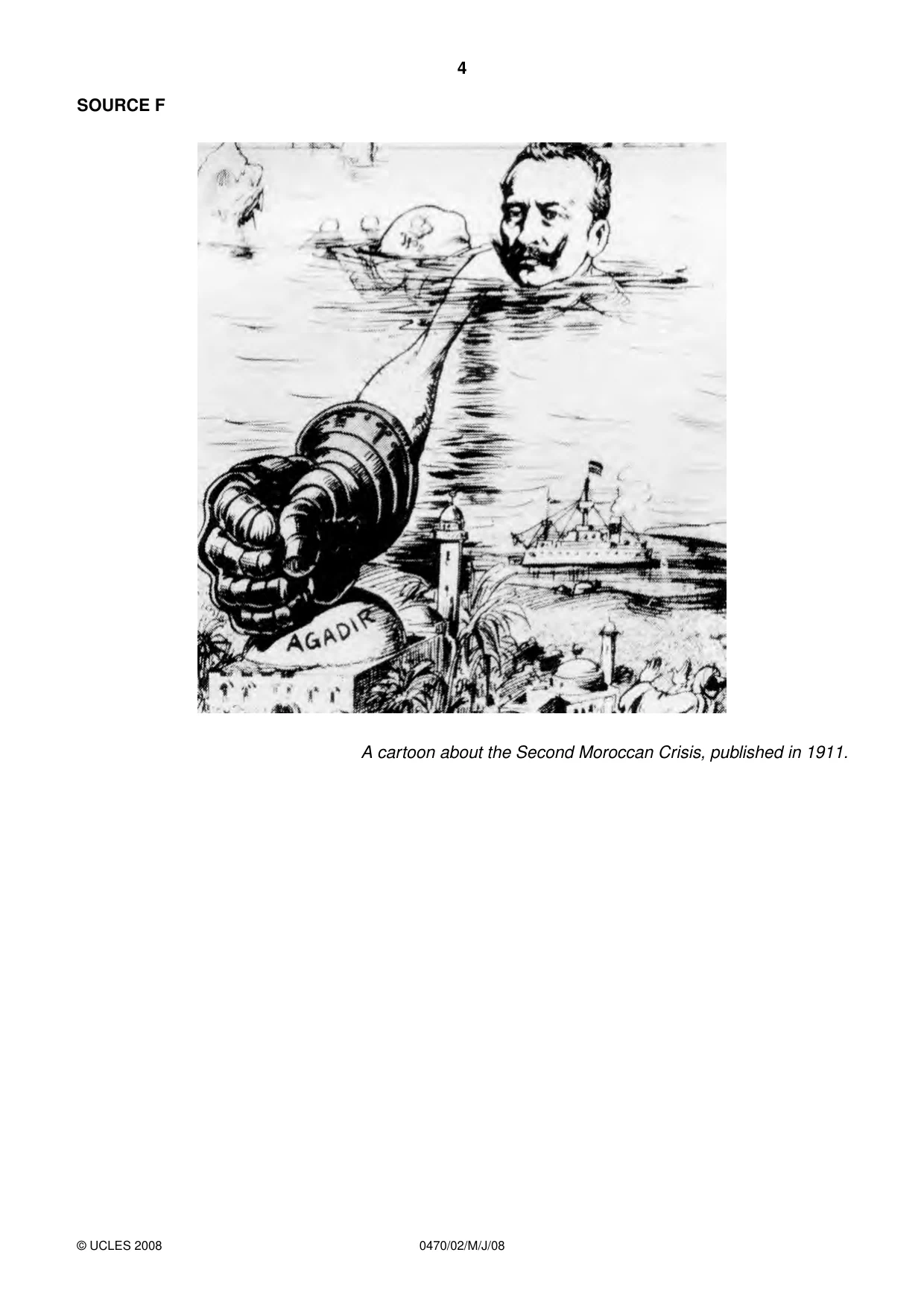
4 0470/02/M/J/08 © UCLES 2008 SOURCE F A cartoon about the Second Moroccan Crisis, published in 1911.
Question paper, page 5
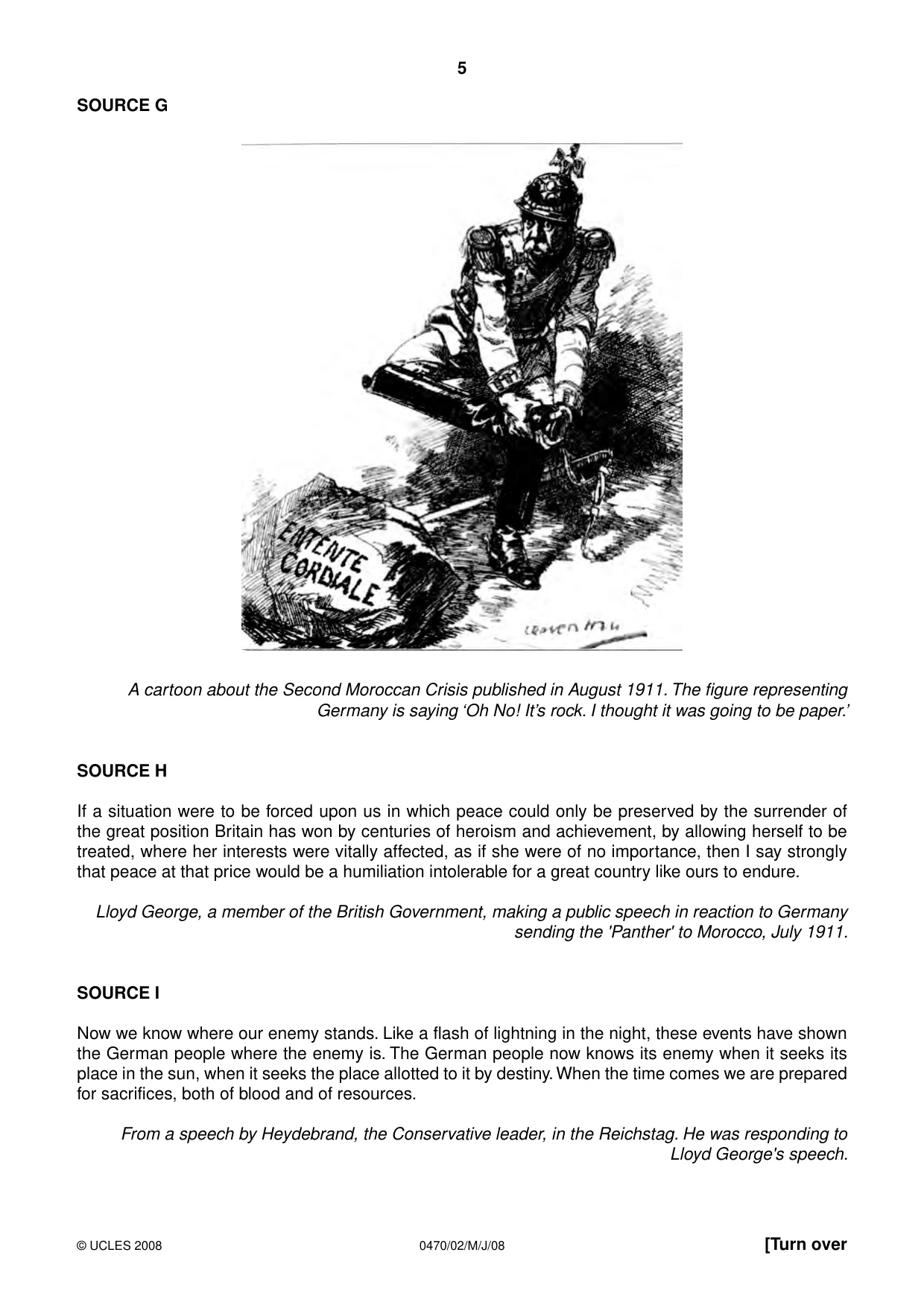
5 0470/02/M/J/08 © UCLES 2008 [Turn over SOURCE G A cartoon about the Second Moroccan Crisis published in August 1911. The figure representing Germany is saying ‘Oh No! It’s rock. I thought it was going to be paper.’ SOURCE H If a situation were to be forced upon us in which peace could only be preserved by the surrender of the great position Britain has won by centuries of heroism and achievement, by allowing herself to be treated, where her interests were vitally affected, as if she were of no importance, then I say strongly that peace at that price would be a humiliation intolerable for a great country like ours to endure. Lloyd George, a member of the British Government, making a public speech in reaction to Germany sending the 'Panther' to Morocco, July 1911. SOURCE I Now we know where our enemy stands. Like a flash of lightning in the night, these events have shown the German people where the enemy is. The German people now knows its enemy when it seeks its place in the sun, when it seeks the place allotted to it by destiny. When the time comes we are prepared for sacrifices, both of blood and of resources. From a speech by Heydebrand, the Conservative leader, in the Reichstag. He was responding to Lloyd George's speech.
Question paper, page 6
6 0470/02/M/J/08 © UCLES 2008 SOURCE J I am thoroughly fed up with this wretched Morocco affair. If once again we crawl out of this affair with our tail between our legs, if we cannot pluck up the courage to take a tough line which we are prepared to enforce with the sword, then I despair of the future of the German empire. Then I shall resign. Helmuth von Moltke, head of the German army, writing to his wife during the Second Moroccan Crisis. Now answer all the following questions. You may use any of the sources to help you answer the questions, in addition to those sources which you are told to use. In answering the questions you should use your own knowledge of the topic to help you interpret and evaluate the sources. 1 Study Source A. How useful is this source as evidence of German attitudes at the end of the nineteenth century? Explain your answer using the source and your knowledge. [7] 2 Study Sources, B, C and D. How far do these sources agree about German intervention in Morocco? Explain your answer using the sources and your knowledge. [6] 3 Study Source E. How reliable is this source about the Kaiser’s visit to Morocco? Explain your answer using the source and your knowledge. [8] 4 Study Sources F and G. Both of these cartoons are about the Second Moroccan Crisis. Which one is British and which is German? Explain your answer using the sources and your knowledge. [9] 5 Study Sources H, I and J. Are you surprised by the reactions in Sources I and J? Explain your answer using the sources and your knowledge. [8] 6 Study all the sources. Some historians have claimed that German foreign policy in the early twentieth century was aggressive, while others have claimed it was merely defending German interests. Which of these two views is better supported by these sources? Use the sources to explain your answer. [12]
Question paper, page 7
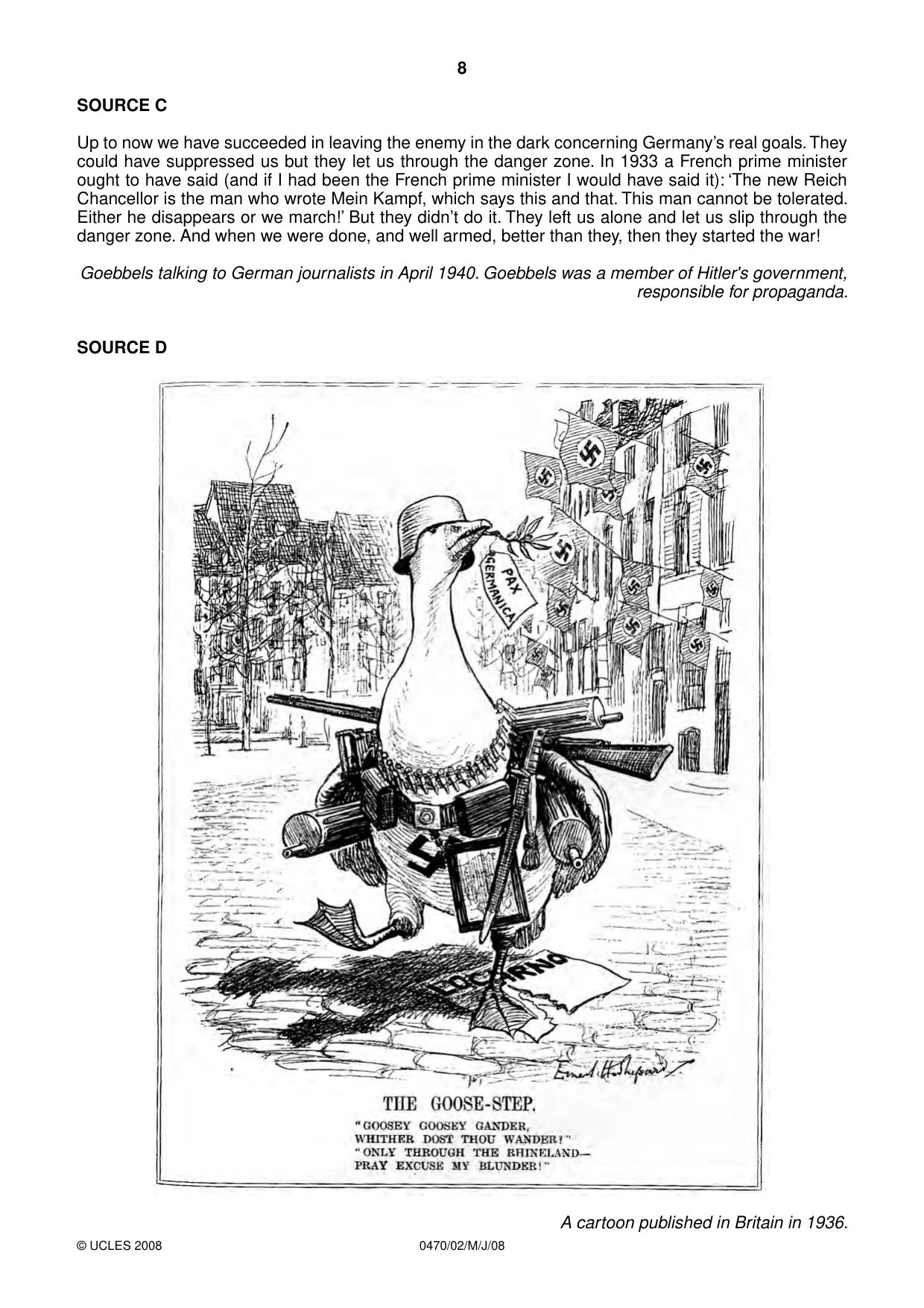
7 0470/02/M/J/08 © UCLES 2008 [Turn over Option B: 20th Century topic DID EVERYONE FAIL TO UNDERSTAND THAT HITLER WAS A SERIOUS THREAT? Study the Background Information and the sources carefully, and then answer all the questions. Background Information Soon after Hitler came to power he started to build up Germany’s armed forces. In 1935 he introduced conscription to the army. Both measures broke the terms of the Treaty of Versailles. The Treaty had also de-militarised the Rhineland, but in 1936 Hitler sent in his troops. He did this shortly after Russia and France reached an agreement to protect each other if they were attacked. Hitler claimed that Germany was under threat and should be able to defend itself. The fact that no country opposed the re-militarisation of the Rhineland gave Hitler confidence to go further. The Anschluss with Austria and the invasion of Czechoslovakia followed. Did no one see that Hitler was a serious threat? SOURCE A Well now, you may take it from me that the news from Germany is the very best news that we have had since the war. Ever since 1918 we, like all the other powers, have been behaving just as badly as we possibly could. Well now, when Germany was defeated, they went and sat on Germany’s head and they kept sitting on Germany’s head although it was quite clear to any sensible person, that they couldn’t go on like that forever. Then there came a very intelligent gentleman named Adolf Hitler and he, knowing perfectly well that the powers would not fight, snapped his fingers at the Treaty of Versailles. Just exactly as we would if we had been in the same position. There can be no peace in the world until there is peace between England, France, Germany, Russia and the United States and all the big powers of the West. Now take that home and think about it and don’t be frightened any more about the Germans. From a newsreel shown in cinemas all over Britain in 1935. It is commenting on Hitler's rearmament of Germany. SOURCE B When I think of those four terrible years, and I think of the 7 million young men who were cut off in their prime, the 13 million who were maimed and mutilated, the misery and suffering of the mothers and the fathers, and the sons and daughters, of those who were killed, then I have to say again what I have said before, and what I say now, not only to you, but to all the world – in war, whichever side may call itself victor, there are no winners, but all are losers. It is those thoughts which have made me feel that it is my first duty to strain every nerve to avoid a repetition of the Great World War in Europe. Neville Chamberlain, British Prime Minister, speaking to members of his own party in 1938.
Question paper, page 8
8 0470/02/M/J/08 © UCLES 2008 SOURCE C Up to now we have succeeded in leaving the enemy in the dark concerning Germany’s real goals. They could have suppressed us but they let us through the danger zone. In 1933 a French prime minister ought to have said (and if I had been the French prime minister I would have said it): ‘The new Reich Chancellor is the man who wrote Mein Kampf, which says this and that. This man cannot be tolerated. Either he disappears or we march!’ But they didn’t do it. They left us alone and let us slip through the danger zone. And when we were done, and well armed, better than they, then they started the war! Goebbels talking to German journalists in April 1940. Goebbels was a member of Hitler's government, responsible for propaganda. SOURCE D A cartoon published in Britain in 1936.
Question paper, page 9
9 0470/02/M/J/08 © UCLES 2008 [Turn over SOURCE E The forty-eight hours after the march into the Rhineland were the most nerve-racking in my life. If the French had then marched into the Rhineland, we would have had to withdraw with our tails between our legs, for the military resources at our disposal would have been wholly inadequate for even a moderate resistance. What would have happened in March 1936 if anyone other than myself had been in charge of Germany! Anyone else would have lost his nerve. I had to lie. We were saved by my unshakeable obstinacy and my remarkable daring. I threatened, unless the situation ceased in twenty-four hours, to send in six extra divisions into the Rhineland. In fact, I only had four brigades. Hitler talking to his interpreter after the Rhineland crisis of March 1936. SOURCE F Berlin. 8 March 1936. Hitler has got away with it! France is not marching. Instead it is appealing to the League! No wonder the faces of Hitler and Goering and Blomberg and Fritsch [top German commanders] were all smiles this noon. Oh, the stupidity of the French! I learned today on absolute authority that the German troops had strict orders to beat a hasty retreat if the French army opposed them in any way. They were not prepared or equipped to fight a regular army. Apparently Fritsch and most of the generals opposed the move. An extract from the diary of an American journalist working in Berlin. SOURCE G The greatest danger and the one which threatens to destroy Europe is not facing the facts with respect to Germany and Italy. The facts with respect to Germany are known but they have not been consistently faced. In some countries there has been an effort through control of the press to keep the facts from the people and Europe is now hampered in facing facts through an unprepared public opinion. The fundamental fact is that the regime in Germany is based on a program of ruthless force. This program has for its aim to use the force of its 67 million people for the extension of German political and economic control over South-Eastern Europe – thus putting it in a position to dominate Europe completely. From this position Germany will be able to dictate its policies to the rest of the world. Fantastic as this may seem, it has been and is the programme of Hitler’s Germany. A report from the United States’ ambassador in Austria to his government, March 1936.
Question paper, page 10
10 0470/02/M/J/08 © UCLES 2008 SOURCE H A Soviet cartoon published in 1936. It shows the western countries with Hitler.
Question paper, page 11
11 0470/02/M/J/08 © UCLES 2008 [Turn over SOURCE I An American cartoon published in March 1936.
Question paper, page 12
12 0470/02/M/J/08 © UCLES 2008 Now answer all the following questions. You may use any of the sources to help you answer the questions, in addition to those sources which you are told to use. In answering the questions you should use your own knowledge of the topic to help you interpret and evaluate the sources. 1 Study Sources A and B. How far do these two sources agree? Explain your answer using the sources. [7] 2 Study Sources B and C. How far does Source C make Chamberlain’s attitude in Source B surprising? Explain your answer using the sources and your knowledge. [7] 3 Study Source D. Why did the cartoonist draw this cartoon? Explain your answer using the source and your knowledge. [7] 4 Study Sources E, F and G. How far do Sources E and F prove that Source G was wrong? Explain your answer using the sources and your knowledge. [9] 5 Study Sources H and I. How similar are the views of these two cartoonists about the international situation in 1936? Explain your answer using the sources and your knowledge. [8] 6 Study all the sources. How far do these sources support the view that no one understood how dangerous Hitler was to international peace and stability? Use the sources to explain your answer. [12] Copyright Acknowledgements: Option A Source F © Harry Mills; The Road to Sarajevo; Macmillan Publishers; 1996. Option A Source G © Reproduced with the permission of Punch, Ltd. www.punch.co.uk Option B Source D © The Estate of E. H. Shepard. Option B Source H © David King Collection. Option B Source I © Reproduced with the permission of Punch, Ltd. www.punch.co.uk Permission to reproduce items where third-party owned material protected by copyright is included has been sought and cleared where possible. Every reasonable effort has been made by the publisher (UCLES) to trace copyright holders, but if any items requiring clearance have unwittingly been included, the publisher will be pleased to make amends at the earliest possible opportunity. University of Cambridge International Examinations is part of the Cambridge Assessment Group. Cambridge Assessment is the brand name of University of Cambridge Local Examinations Syndicate (UCLES), which is itself a department of the University of Cambridge.
Mark scheme, page 1
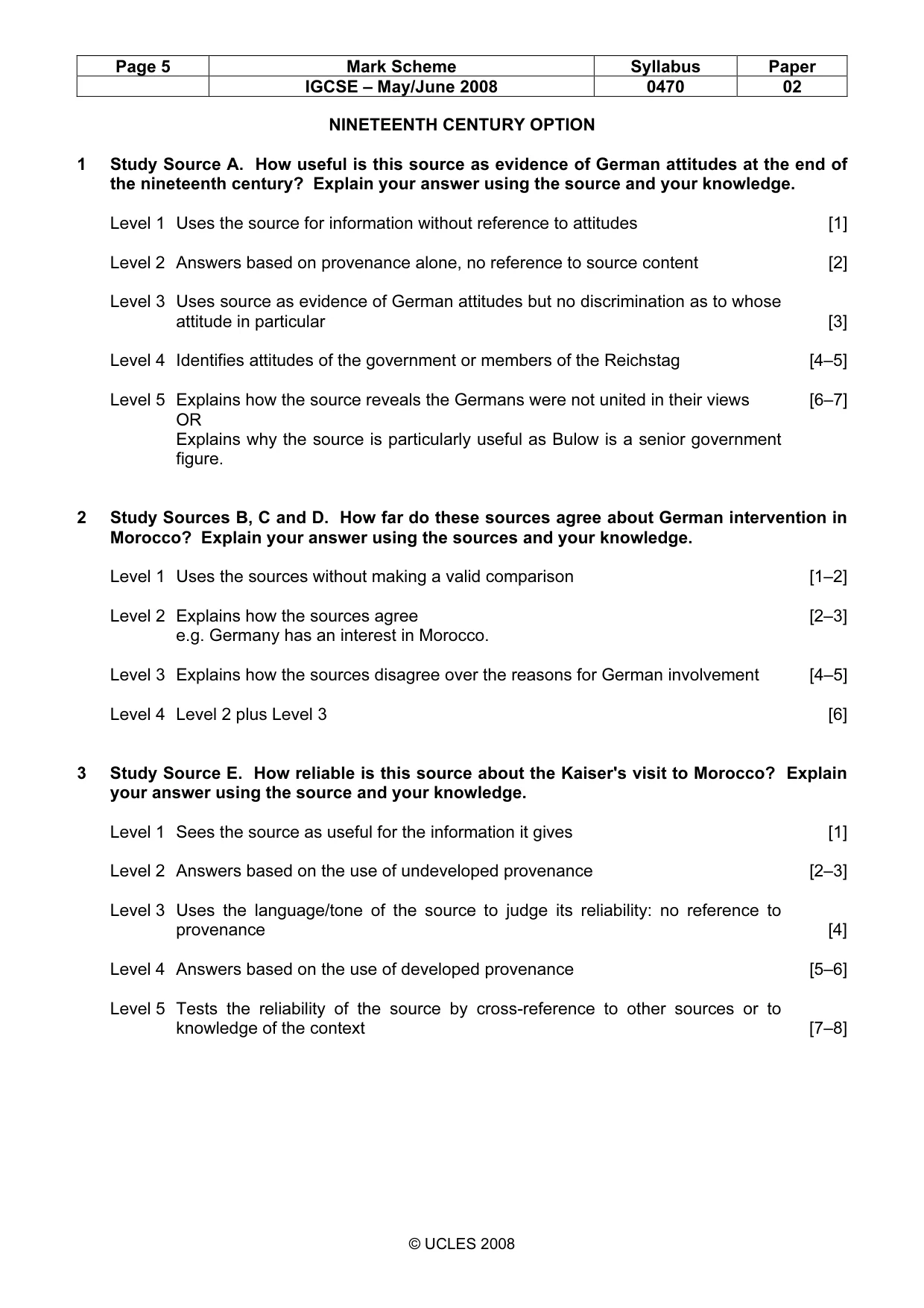
UNIVERSITY OF CAMBRIDGE INTERNATIONAL EXAMINATIONS International General Certificate of Secondary Education MARK SCHEME for the May/June 2008 question paper 0470 HISTORY 0470/02 Paper 2, maximum raw mark 50 This mark scheme is published as an aid to teachers and candidates, to indicate the requirements of the examination. It shows the basis on which Examiners were instructed to award marks. It does not indicate the details of the discussions that took place at an Examiners’ meeting before marking began. All Examiners are instructed that alternative correct answers and unexpected approaches in candidates’ scripts must be given marks that fairly reflect the relevant knowledge and skills demonstrated. Mark schemes must be read in conjunction with the question papers and the report on the examination. • CIE will not enter into discussions or correspondence in connection with these mark schemes. CIE is publishing the mark schemes for the May/June 2008 question papers for most IGCSE, GCE Advanced Level and Advanced Subsidiary Level syllabuses and some Ordinary Level syllabuses. www.XtremePapers.com
Mark scheme, page 2
Page 2 Mark Scheme Syllabus Paper IGCSE – May/June 2008 0470 02 © UCLES 2008 TWENTIETH CENTURY OPTION 1 Study Sources A and B. How far do these two sources agree? Explain your answer using the sources. Level 1 Uses the sources but no valid matching [1] Level 2 Identifies information that is in one source but not in the other – must state this explicitly [2] Level 3 Finds valid agreements – e.g. they both do not want war, Hitler should be appeased [3–4] Level 4 Finds valid disagreements [5–6] e.g. A does not expect war, B worried there will be one, A likes Hitler, B doesn't, or the sources give different reasons for why there should not be a war. Level 5 Finds valid agreements and disagreements [7] 2 Study Sources B and C. How far does Source C make Chamberlain's attitude in Source B surprising? Explain your answer using the sources and your knowledge. Level 1 Uses the sources but does not address the issue of surprise [1] Level 2 Uses provenance of C to decide if surprised or not surprised [2] e.g. not surprised because C is propaganda Level 3 Compares content of B and C to decide if surprised or not surprised [3–4] Level 4 Both aspects of Level 3 [5] Level 5 Cross-references to knowledge or to other sources to support surprised or not surprised. The cross-reference can be on B or C. Candidates must also compare content of B and C. [6–7] NB Candidates must answer the question i.e. they must say whether they are surprised or not. They must say whether they are surprised by Chamberlain's attitude – that war can be avoided, that Hitler can be appeased.
Mark scheme, page 3
Page 3 Mark Scheme Syllabus Paper IGCSE – May/June 2008 0470 02 © UCLES 2008 3 Study Source D. Why did the cartoonist draw this cartoon? Explain your answer using the source and your knowledge. Level 1 Surface description of the cartoon [1] Level 2 He drew it to show that the German army has marched into the Rhineland (events only) OR [2–3] He drew it because Germany had marched into the Rhineland OR Valid sub-messages of the cartoon NB In Level 2 award 2 marks only if fails to say this is why he was drawing it, award 3 marks if does say this. Level 3 Valid big-message explained [4–5] e.g. disapproves of Germany, criticising Allies for doing nothing, criticising appeasement. Level 4 Answers showing an awareness of audience [6–7] e.g. it was drawn as a warning to people that Germany will not stop there. NB In Level 3 and above candidates must say that this is why he was drawing the cartoon/aware of the role of the cartoonist. 4 Study Sources E, F and G. How far do Sources E and F prove that Source G was wrong? Explain your answer using the sources and your knowledge. Level 1 Uses the sources but fails to answer the question [1] Level 2 Simple use of provenance on at least one source to make a judgement on Source G [2] Level 3 Cross-references to evaluate claims in Source G (does not use E or F) [3] Level 4 Compares content of E and G or F and G (or E and F and G) and finds agreements or disagreement [4–6] e.g. Germany a threat, other governments to blame. Only award 6 marks if in addition evaluates G. Level 5 As for Level 4 but covers agreement and disagreement [6–8] Only award 8 marks if in addition evaluates Source G. Level 6 Cross-references to support or undermine E or F and then makes a judgement on G [8–9]
Mark scheme, page 4
Page 4 Mark Scheme Syllabus Paper IGCSE – May/June 2008 0470 02 © UCLES 2008 5 Study Sources H and I. How similar are the views of these two cartoonists about the international situation in 1936? Explain your answer using the sources and your knowledge. Level 1 Describes the cartoon(s) [1] Level 2 Valid interpretation(s) of the cartoon(s) but no comparison (can be sub-messages – allow misinterpretations of H as sub-message) [2–3] Level 3 Compares sub-messages for agreement or disagreement [4–5] Level 4 As for Level 3 but covers both agreement and disagreement [6–7] Level 5 Compares big messages [8] e.g. H – the role of Western powers in encouraging Germany to go east – using Germany against Russia, not aware of the danger to themselves from Germany; I – great powers restraining Germany. 6 Study all the sources. How far do these sources support the view that no one understood how dangerous Hitler was to international peace and stability? Use the sources to explain your answer. Level 1 No valid use of sources [1–3] Level 2 Uses sources to support or reject the statement [4–6] Level 3 Uses sources to support and reject the statement [7–10] Up to 2 bonus marks for evaluation of sources (no more than 1 per source) Source use must be reference to the source by letter, by provenance, or by direct quote. There must be examples from source content. Use N in the margin for each source support of the statement, and a Y for each source rejection of the statement.
Mark scheme, page 5
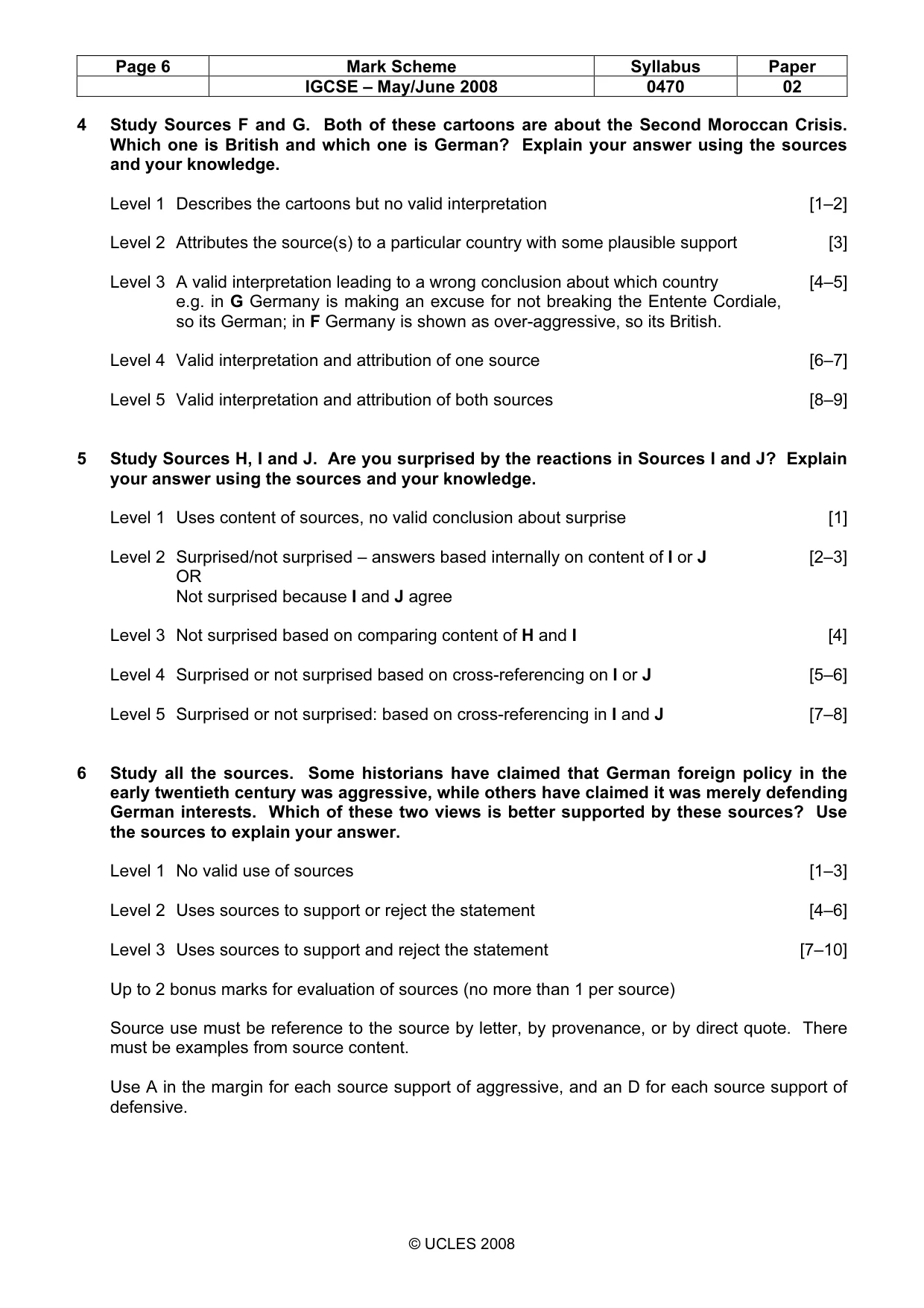
Page 5 Mark Scheme Syllabus Paper IGCSE – May/June 2008 0470 02 © UCLES 2008 NINETEENTH CENTURY OPTION 1 Study Source A. How useful is this source as evidence of German attitudes at the end of the nineteenth century? Explain your answer using the source and your knowledge. Level 1 Uses the source for information without reference to attitudes [1] Level 2 Answers based on provenance alone, no reference to source content [2] Level 3 Uses source as evidence of German attitudes but no discrimination as to whose attitude in particular [3] Level 4 Identifies attitudes of the government or members of the Reichstag [4–5] Level 5 Explains how the source reveals the Germans were not united in their views [6–7] OR Explains why the source is particularly useful as Bulow is a senior government figure. 2 Study Sources B, C and D. How far do these sources agree about German intervention in Morocco? Explain your answer using the sources and your knowledge. Level 1 Uses the sources without making a valid comparison [1–2] Level 2 Explains how the sources agree [2–3] e.g. Germany has an interest in Morocco. Level 3 Explains how the sources disagree over the reasons for German involvement [4–5] Level 4 Level 2 plus Level 3 [6] 3 Study Source E. How reliable is this source about the Kaiser's visit to Morocco? Explain your answer using the source and your knowledge. Level 1 Sees the source as useful for the information it gives [1] Level 2 Answers based on the use of undeveloped provenance [2–3] Level 3 Uses the language/tone of the source to judge its reliability: no reference to provenance [4] Level 4 Answers based on the use of developed provenance [5–6] Level 5 Tests the reliability of the source by cross-reference to other sources or to knowledge of the context [7–8]
Mark scheme, page 6
Page 6 Mark Scheme Syllabus Paper IGCSE – May/June 2008 0470 02 © UCLES 2008 4 Study Sources F and G. Both of these cartoons are about the Second Moroccan Crisis. Which one is British and which one is German? Explain your answer using the sources and your knowledge. Level 1 Describes the cartoons but no valid interpretation [1–2] Level 2 Attributes the source(s) to a particular country with some plausible support [3] Level 3 A valid interpretation leading to a wrong conclusion about which country [4–5] e.g. in G Germany is making an excuse for not breaking the Entente Cordiale, so its German; in F Germany is shown as over-aggressive, so its British. Level 4 Valid interpretation and attribution of one source [6–7] Level 5 Valid interpretation and attribution of both sources [8–9] 5 Study Sources H, I and J. Are you surprised by the reactions in Sources I and J? Explain your answer using the sources and your knowledge. Level 1 Uses content of sources, no valid conclusion about surprise [1] Level 2 Surprised/not surprised – answers based internally on content of I or J [2–3] OR Not surprised because I and J agree Level 3 Not surprised based on comparing content of H and I [4] Level 4 Surprised or not surprised based on cross-referencing on I or J [5–6] Level 5 Surprised or not surprised: based on cross-referencing in I and J [7–8] 6 Study all the sources. Some historians have claimed that German foreign policy in the early twentieth century was aggressive, while others have claimed it was merely defending German interests. Which of these two views is better supported by these sources? Use the sources to explain your answer. Level 1 No valid use of sources [1–3] Level 2 Uses sources to support or reject the statement [4–6] Level 3 Uses sources to support and reject the statement [7–10] Up to 2 bonus marks for evaluation of sources (no more than 1 per source) Source use must be reference to the source by letter, by provenance, or by direct quote. There must be examples from source content. Use A in the margin for each source support of aggressive, and an D for each source support of defensive.
What you needed in this session
Cambridge’s own grade thresholds for 2008 May/June, Paper 2 · Variant 1. A higher threshold means an easier paper — the bar moves with how the cohort did.