Cambridge IGCSE History 0470 — 2007 May/June Paper 2 · Variant 1
0470/21/M/J/07 · 50 marks · ≈56 min
The question paper and its mark scheme, free to read here and free to download. This is Cambridge’s own paper, exactly as it was sat.
Question paper12 pages
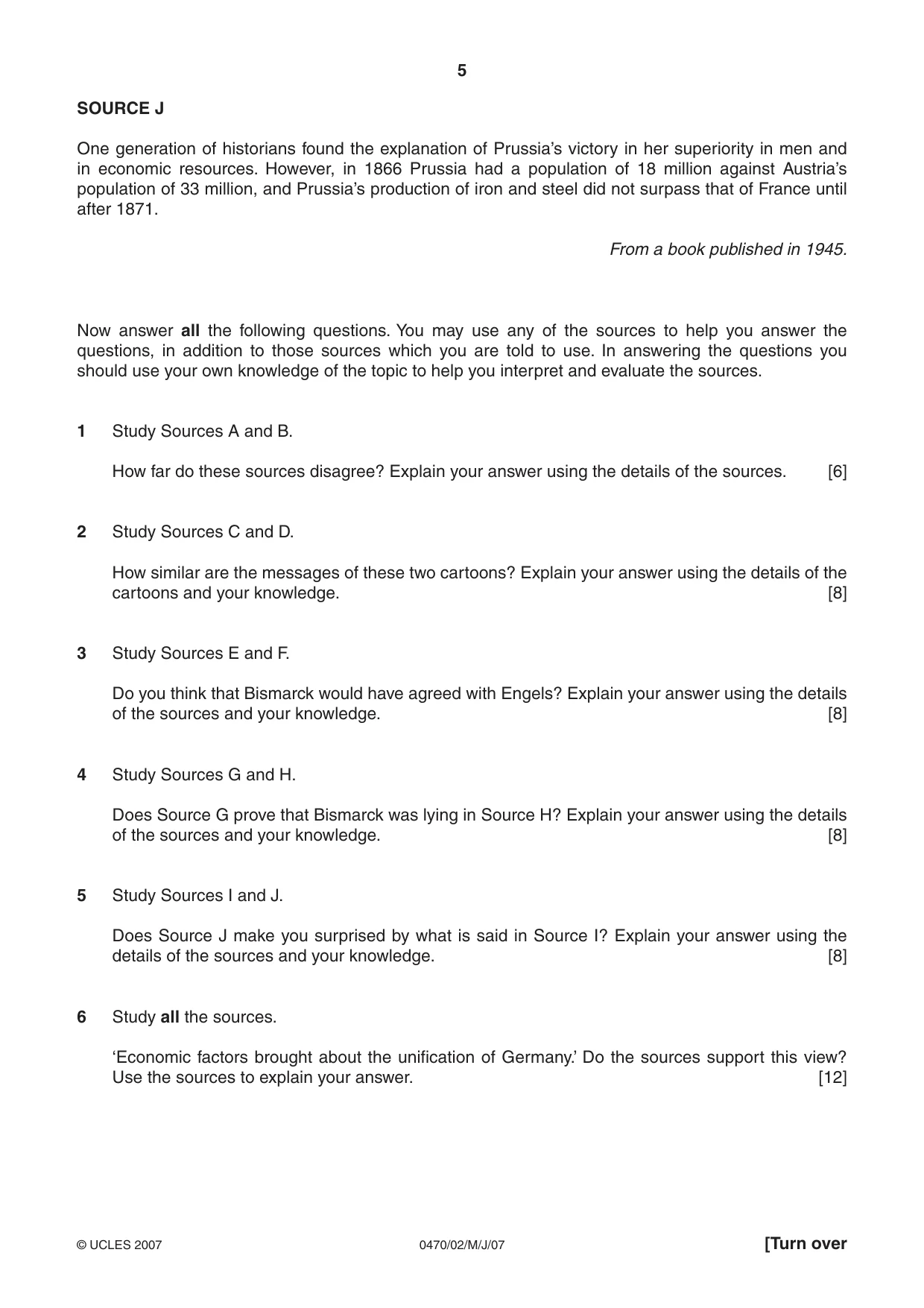
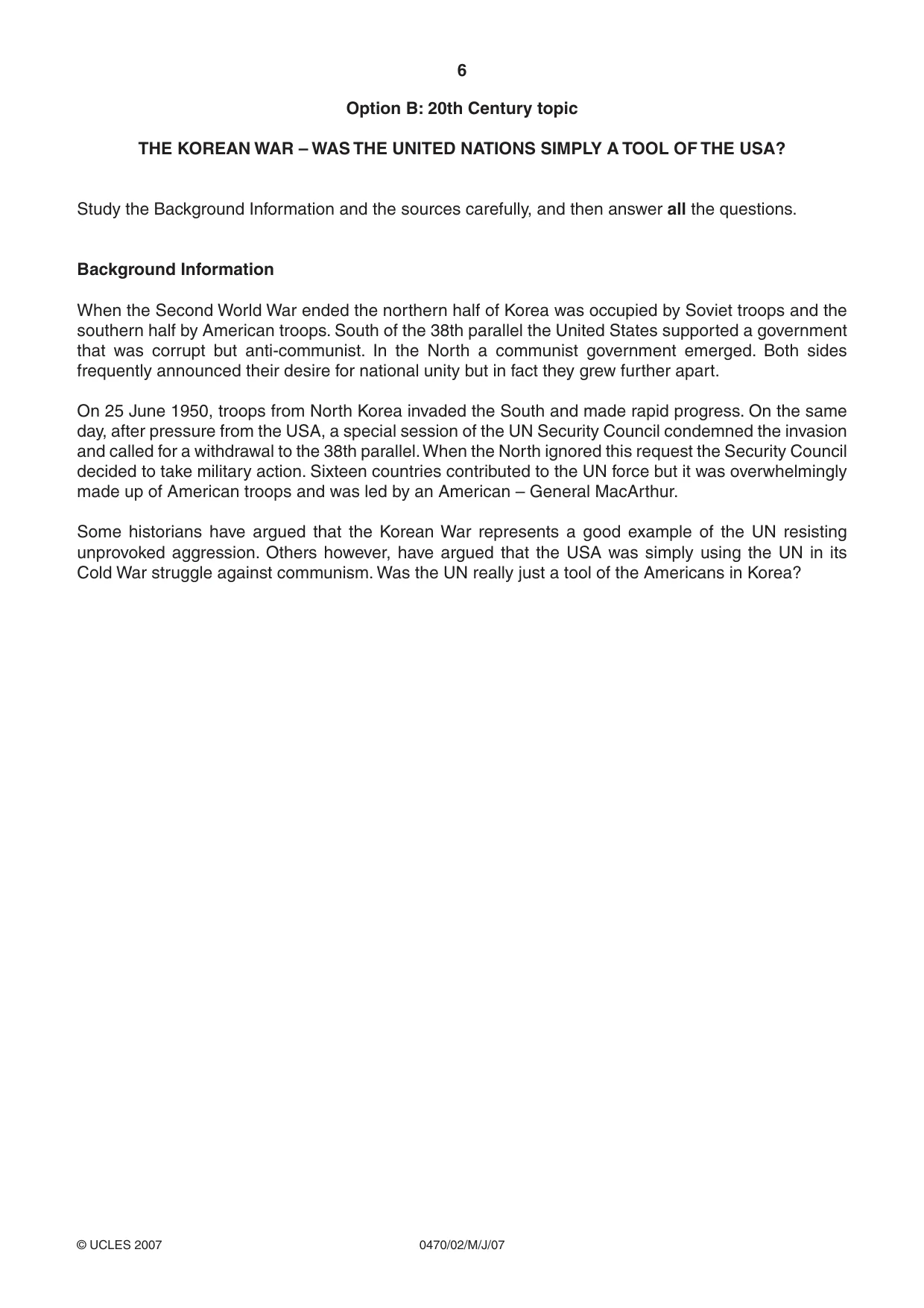
Mark scheme7 pages
Answers below. Sit the paper first if you are practising.
Paper as text
Question paper, page 1
This document consists of 11 printed pages and 1 blank page. SP (SM/KS) T30707/2 © UCLES 2007 [Turn over UNIVERSITY OF CAMBRIDGE INTERNATIONAL EXAMINATIONS International General Certificate of Secondary Education READ THESE INSTRUCTIONS FIRST If you have been given an Answer Booklet, follow the instructions on the front cover of the Booklet. Write your Centre number, candidate number and name on all the work you hand in. Write in dark blue or black pen. You may use a soft pencil for any diagrams, graphs or rough working. Do not use staples, paper clips, highlighters, glue or correction fluid. This paper has two options. Choose one option, and then answer all of the questions on that topic. Option A: 19th Century topic [p2–p5] Option B: 20th Century topic [p6–p11] At the end of the examination, fasten all your work securely together. The number of marks is given in brackets [ ] at the end of each question or part question. * 5 0 7 0 2 9 9 0 3 7 * HISTORY 0470/02 Paper 2 May/June 2007 2 hours Additional Materials: Answer Booklet/Paper www.XtremePapers.com
Question paper, page 2
2 0470/02/M/J/07 © UCLES 2007 Option A: 19th Century topic HOW FAR WAS THE UNIFICATION OF GERMANY BROUGHT ABOUT BY ECONOMIC FACTORS? Study the Background Information and the sources carefully, and then answer all the questions. Background Information In January 1871 a united Germany, without Austria, was proclaimed. Some historians have argued, as did Bismarck in his memoirs, that unification was the result of a master plan which he consistently followed. Others have seen Bismarck as simply reacting to opportunities as they arose. Another group of historians have stressed longer-term factors such as Prussia’s growing economic strength and have argued that the economic needs of the German states meant that unification would inevitably take place. SOURCE A Many modern historians support the view that from the 1830s onwards Prussia was using the Zollverein to achieve a Prussian solution to the German question. The argument is that those who found financial advantage in an economic union under Prussian leadership might be expected to take a favourable view of similar arrangements in a political union. The Zollverein was a force for unity in the 1840s and therefore a focal point for nationalist sentiments. As a result, Prussia, despite her reactionary political sympathies, came to be regarded by many as the natural leader of a united Germany. From a book published in 1986. SOURCE B Few would dispute that the Zollverein was a powerful factor in the eventual exclusion of Austria from a Prussian-dominated Germany, but it is also by no means clear that it could have achieved German unity unaided by other factors. The lesser German states clung to their independence, which was guaranteed by the rule that decisions within the Zollverein could only be taken unanimously, and blocked any attempts by Prussia to change this voting procedure. In 1866 the South German states were not deterred by their membership of the Zollverein from allying with Austria against Prussia. From a book published in 1986.
Question paper, page 3
3 0470/02/M/J/07 © UCLES 2007 [Turn over SOURCE C A cartoon from a German magazine published in 1852. The man on the left represents Prussia while the man on the right represents Austria. The animals represent those German states that did not belong to the Zollverein. SOURCE D A cartoon published shortly after the Austro-Prussian War in 1866. The helmet represents Prussia while the people represent Germany.
Question paper, page 4
4 0470/02/M/J/07 © UCLES 2007 SOURCE E German unity had become an economic necessity. It was the demand of the industrialist, arising out of direct business need, for the destruction of all the small states standing in the way of the free development of trade and entry into world markets. From a book by Friedrich Engels, published in 1895. Engels was a close friend of Karl Marx. SOURCE F If the Zollverein continues, the creation of a common legislative institution which can pass laws on tariff questions is unavoidable. I do not want to underrate the importance of such an institution in creating an economic community for the whole of Germany. It is difficult to believe that such an institution could avoid gradually taking on most areas of economic welfare and commerce, or could avoid bringing into use across the whole of Germany its rules in such matters. From a speech by Bismarck to the North German Confederation, 1867. SOURCE G In 1862 the Russian ambassador gave a dinner at which I was present. Among the guests was Bismarck who had a long conversation with Disraeli after dinner. The following is part of what Bismarck said which Disraeli repeated to me on the same evening: When the army has been brought to such a state as to command respect then I shall take the first opportunity to declare war with Austria, burst apart the German Confederation, bring the middle and smaller states into subjection and give Germany a national union under the leadership of Prussia. From the memoirs of Count von Eckstadt, written in 1886. Disraeli was an important British politician. SOURCE H I think it more useful to continue for a while the present marriage with Austria despite small domestic quarrels, and if a divorce becomes necessary, to take the prospects as they arise rather than to end the partnership now. Bismarck writing in 1865 about the Austro-Prussian alliance. SOURCE I The foundations of future Prussian greatness were being laid. More than any of the neighbouring states, Prussia had benefited from the Zollverein. Formed under Prussian domination, it had defeated all other attempts to create free trade areas within Germany by the end of 1833. Most of the other German states later joined but significantly, Austria remained outside. Prussian businessmen were given the opportunity of extending their interests throughout a wider area of Germany, and industrialisation was speeded up. Another important effect was that the German railway system came to be centred on Berlin, a factor which was eventually to give Prussia considerable advantages in time of war. Prussia’s vast mineral resources were opened up and production was revolutionized by the great ironmaster Alfred Krupp. From a book published in 1992.
Question paper, page 5
5 0470/02/M/J/07 © UCLES 2007 [Turn over SOURCE J One generation of historians found the explanation of Prussia’s victory in her superiority in men and in economic resources. However, in 1866 Prussia had a population of 18 million against Austria’s population of 33 million, and Prussia’s production of iron and steel did not surpass that of France until after 1871. From a book published in 1945. Now answer all the following questions. You may use any of the sources to help you answer the questions, in addition to those sources which you are told to use. In answering the questions you should use your own knowledge of the topic to help you interpret and evaluate the sources. 1 Study Sources A and B. How far do these sources disagree? Explain your answer using the details of the sources. [6] 2 Study Sources C and D. How similar are the messages of these two cartoons? Explain your answer using the details of the cartoons and your knowledge. [8] 3 Study Sources E and F. Do you think that Bismarck would have agreed with Engels? Explain your answer using the details of the sources and your knowledge. [8] 4 Study Sources G and H. Does Source G prove that Bismarck was lying in Source H? Explain your answer using the details of the sources and your knowledge. [8] 5 Study Sources I and J. Does Source J make you surprised by what is said in Source I? Explain your answer using the details of the sources and your knowledge. [8] 6 Study all the sources. ‘Economic factors brought about the unification of Germany.’ Do the sources support this view? Use the sources to explain your answer. [12]
Question paper, page 6
6 0470/02/M/J/07 © UCLES 2007 Option B: 20th Century topic THE KOREAN WAR – WAS THE UNITED NATIONS SIMPLY A TOOL OF THE USA? Study the Background Information and the sources carefully, and then answer all the questions. Background Information When the Second World War ended the northern half of Korea was occupied by Soviet troops and the southern half by American troops. South of the 38th parallel the United States supported a government that was corrupt but anti-communist. In the North a communist government emerged. Both sides frequently announced their desire for national unity but in fact they grew further apart. On 25 June 1950, troops from North Korea invaded the South and made rapid progress. On the same day, after pressure from the USA, a special session of the UN Security Council condemned the invasion and called for a withdrawal to the 38th parallel. When the North ignored this request the Security Council decided to take military action. Sixteen countries contributed to the UN force but it was overwhelmingly made up of American troops and was led by an American – General MacArthur. Some historians have argued that the Korean War represents a good example of the UN resisting unprovoked aggression. Others however, have argued that the USA was simply using the UN in its Cold War struggle against communism. Was the UN really just a tool of the Americans in Korea?
Question paper, page 7
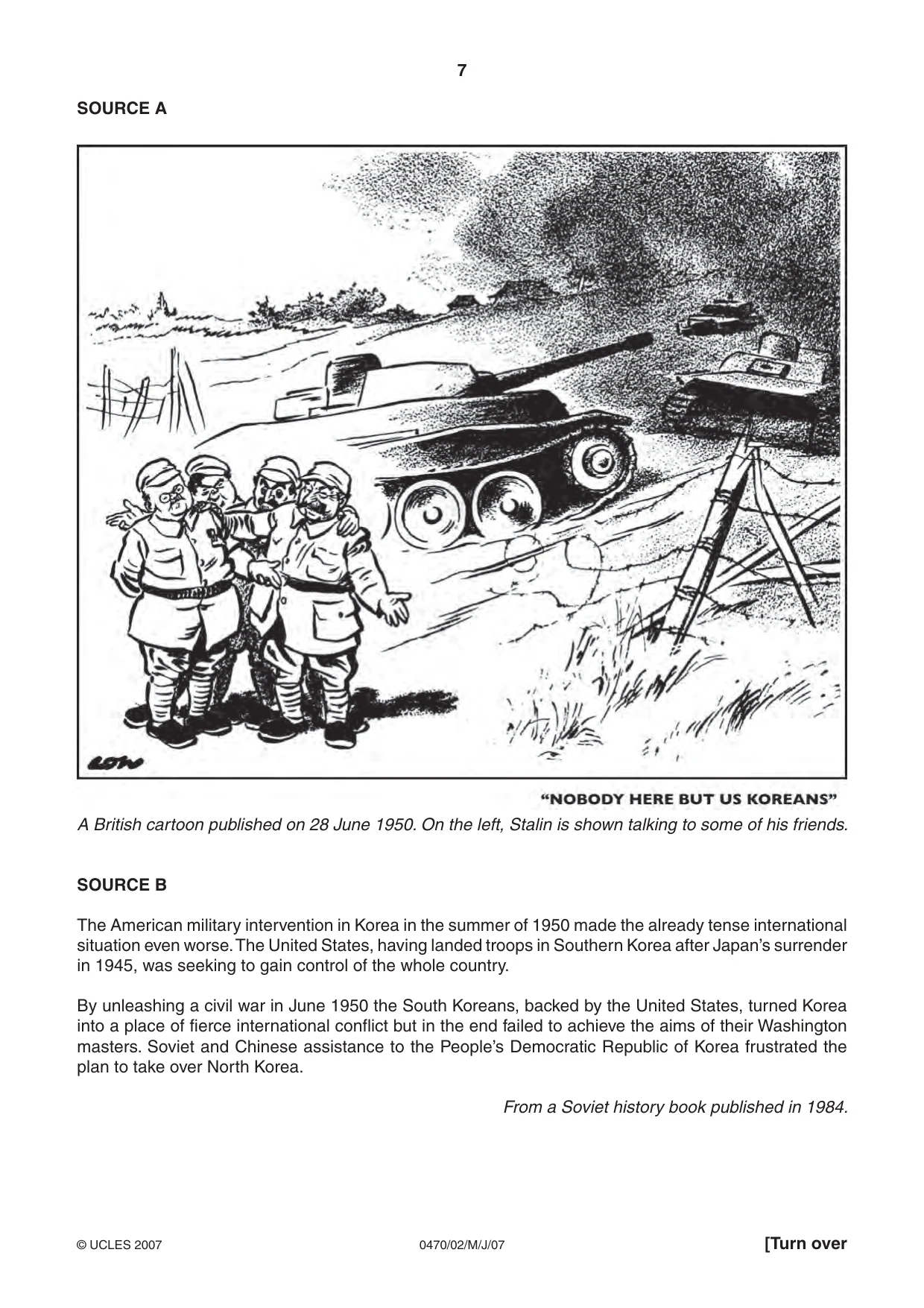
7 0470/02/M/J/07 © UCLES 2007 [Turn over SOURCE A A British cartoon published on 28 June 1950. On the left, Stalin is shown talking to some of his friends. SOURCE B The American military intervention in Korea in the summer of 1950 made the already tense international situation even worse. The United States, having landed troops in Southern Korea after Japan’s surrender in 1945, was seeking to gain control of the whole country. By unleashing a civil war in June 1950 the South Koreans, backed by the United States, turned Korea into a place of fierce international conflict but in the end failed to achieve the aims of their Washington masters. Soviet and Chinese assistance to the People’s Democratic Republic of Korea frustrated the plan to take over North Korea. From a Soviet history book published in 1984.
Question paper, page 8
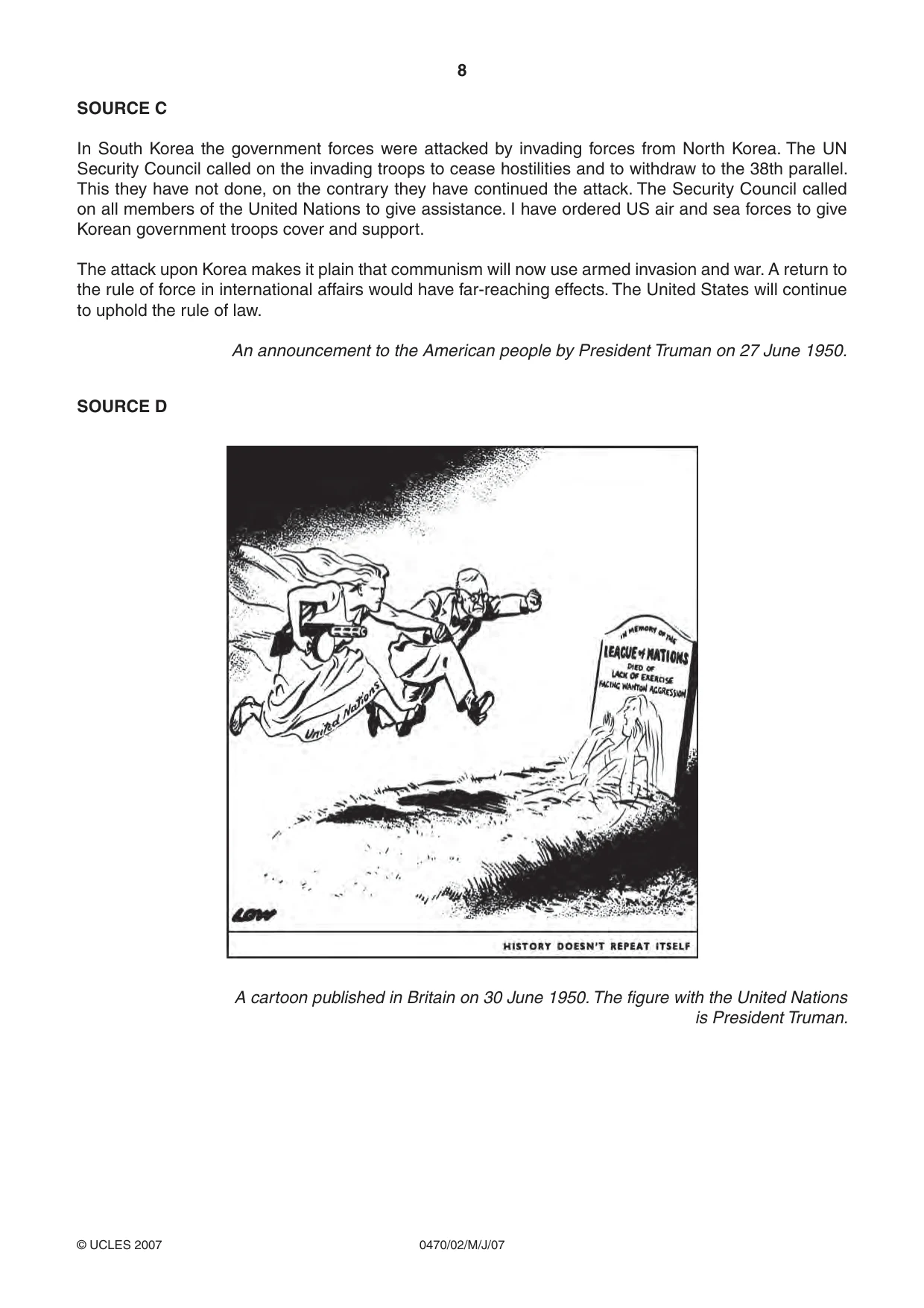
8 0470/02/M/J/07 © UCLES 2007 SOURCE C In South Korea the government forces were attacked by invading forces from North Korea. The UN Security Council called on the invading troops to cease hostilities and to withdraw to the 38th parallel. This they have not done, on the contrary they have continued the attack. The Security Council called on all members of the United Nations to give assistance. I have ordered US air and sea forces to give Korean government troops cover and support. The attack upon Korea makes it plain that communism will now use armed invasion and war. A return to the rule of force in international affairs would have far-reaching effects. The United States will continue to uphold the rule of law. An announcement to the American people by President Truman on 27 June 1950. SOURCE D A cartoon published in Britain on 30 June 1950. The figure with the United Nations is President Truman.
Question paper, page 9
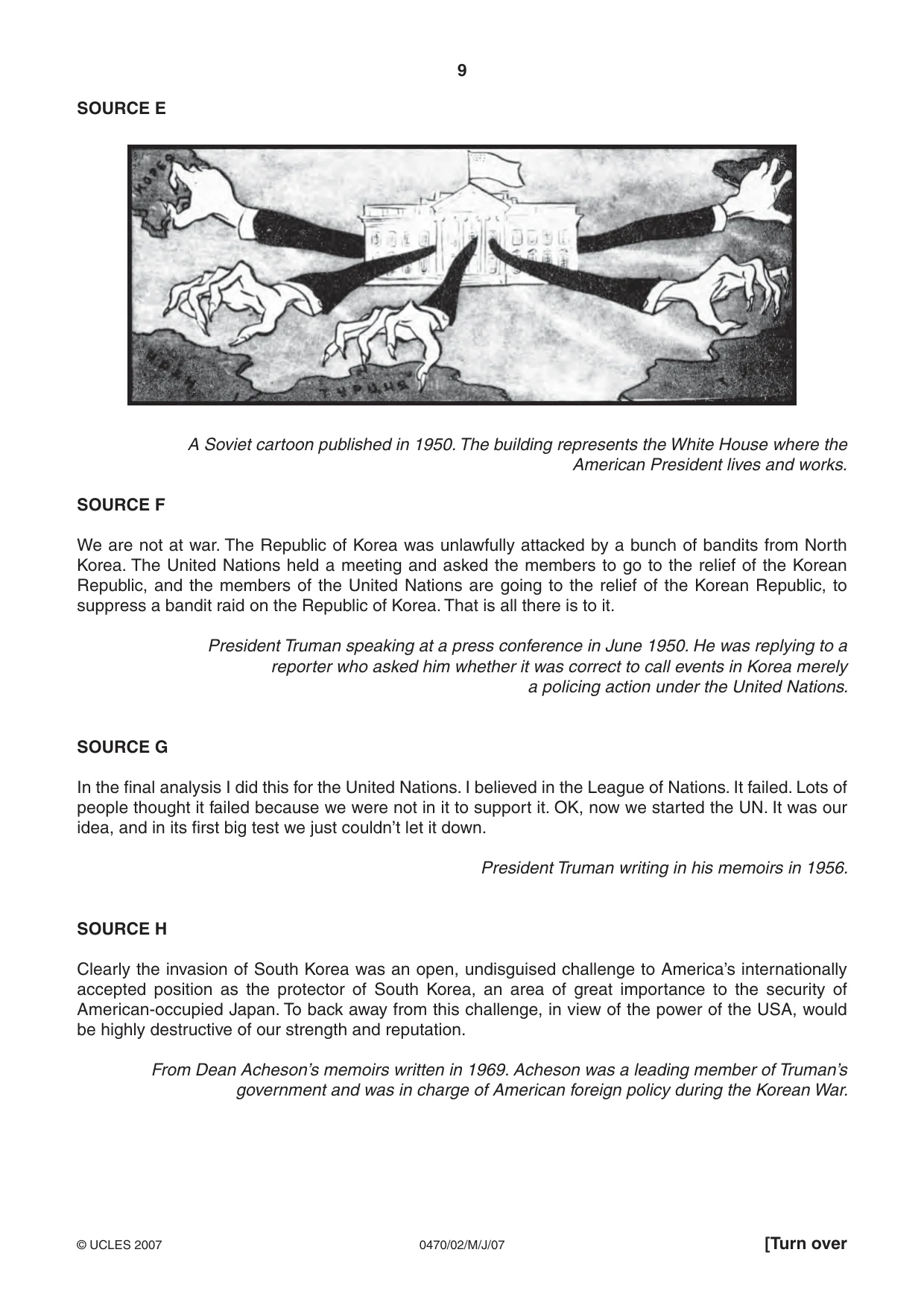
9 0470/02/M/J/07 © UCLES 2007 [Turn over SOURCE E A Soviet cartoon published in 1950. The building represents the White House where the American President lives and works. SOURCE F We are not at war. The Republic of Korea was unlawfully attacked by a bunch of bandits from North Korea. The United Nations held a meeting and asked the members to go to the relief of the Korean Republic, and the members of the United Nations are going to the relief of the Korean Republic, to suppress a bandit raid on the Republic of Korea. That is all there is to it. President Truman speaking at a press conference in June 1950. He was replying to a reporter who asked him whether it was correct to call events in Korea merely a policing action under the United Nations. SOURCE G In the final analysis I did this for the United Nations. I believed in the League of Nations. It failed. Lots of people thought it failed because we were not in it to support it. OK, now we started the UN. It was our idea, and in its first big test we just couldn’t let it down. President Truman writing in his memoirs in 1956. SOURCE H Clearly the invasion of South Korea was an open, undisguised challenge to America’s internationally accepted position as the protector of South Korea, an area of great importance to the security of American-occupied Japan. To back away from this challenge, in view of the power of the USA, would be highly destructive of our strength and reputation. From Dean Acheson’s memoirs written in 1969. Acheson was a leading member of Truman’s government and was in charge of American foreign policy during the Korean War.
Question paper, page 10
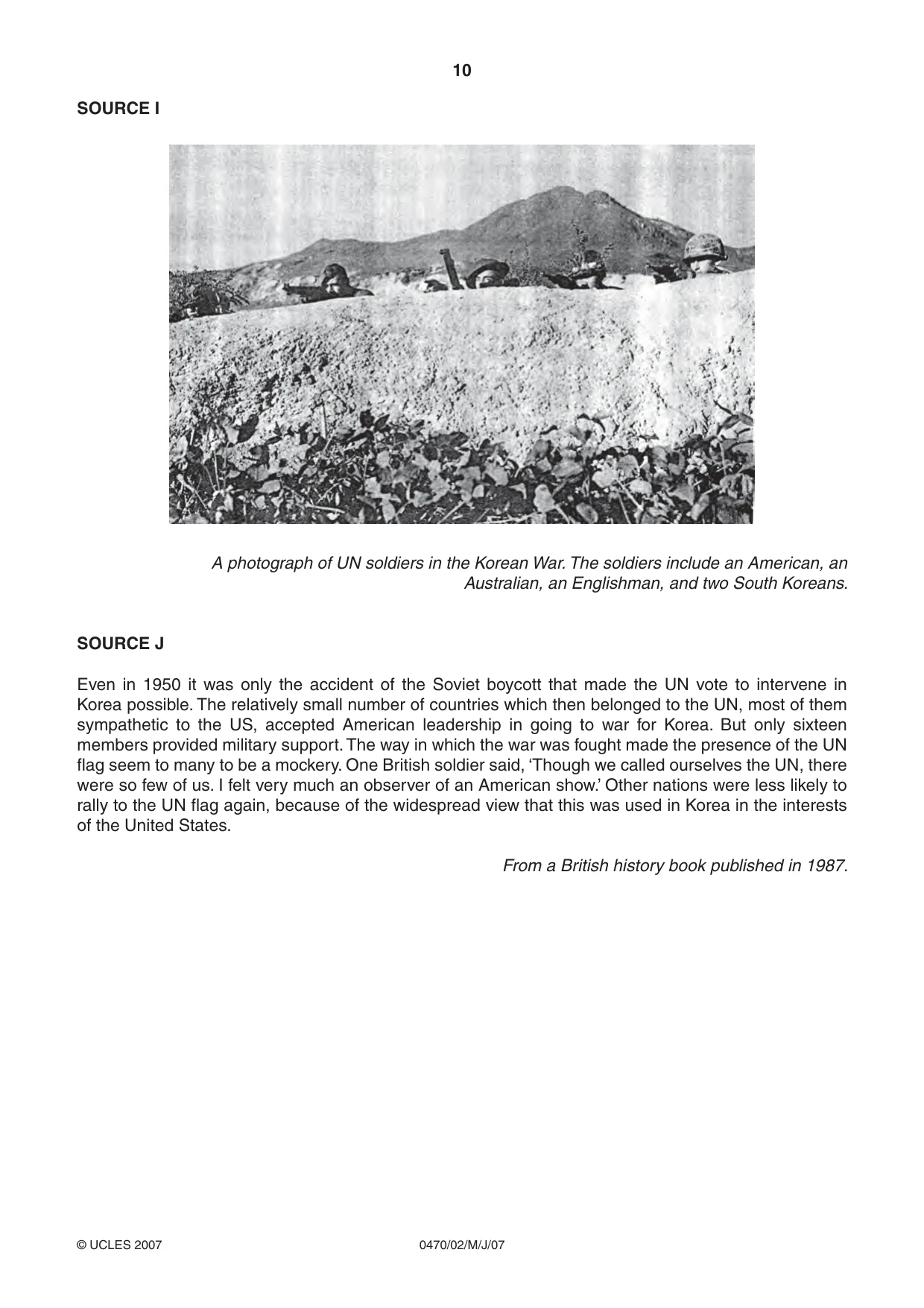
10 0470/02/M/J/07 © UCLES 2007 SOURCE I A photograph of UN soldiers in the Korean War. The soldiers include an American, an Australian, an Englishman, and two South Koreans. SOURCE J Even in 1950 it was only the accident of the Soviet boycott that made the UN vote to intervene in Korea possible. The relatively small number of countries which then belonged to the UN, most of them sympathetic to the US, accepted American leadership in going to war for Korea. But only sixteen members provided military support. The way in which the war was fought made the presence of the UN flag seem to many to be a mockery. One British soldier said, ‘Though we called ourselves the UN, there were so few of us. I felt very much an observer of an American show.’ Other nations were less likely to rally to the UN flag again, because of the widespread view that this was used in Korea in the interests of the United States. From a British history book published in 1987.
Question paper, page 11
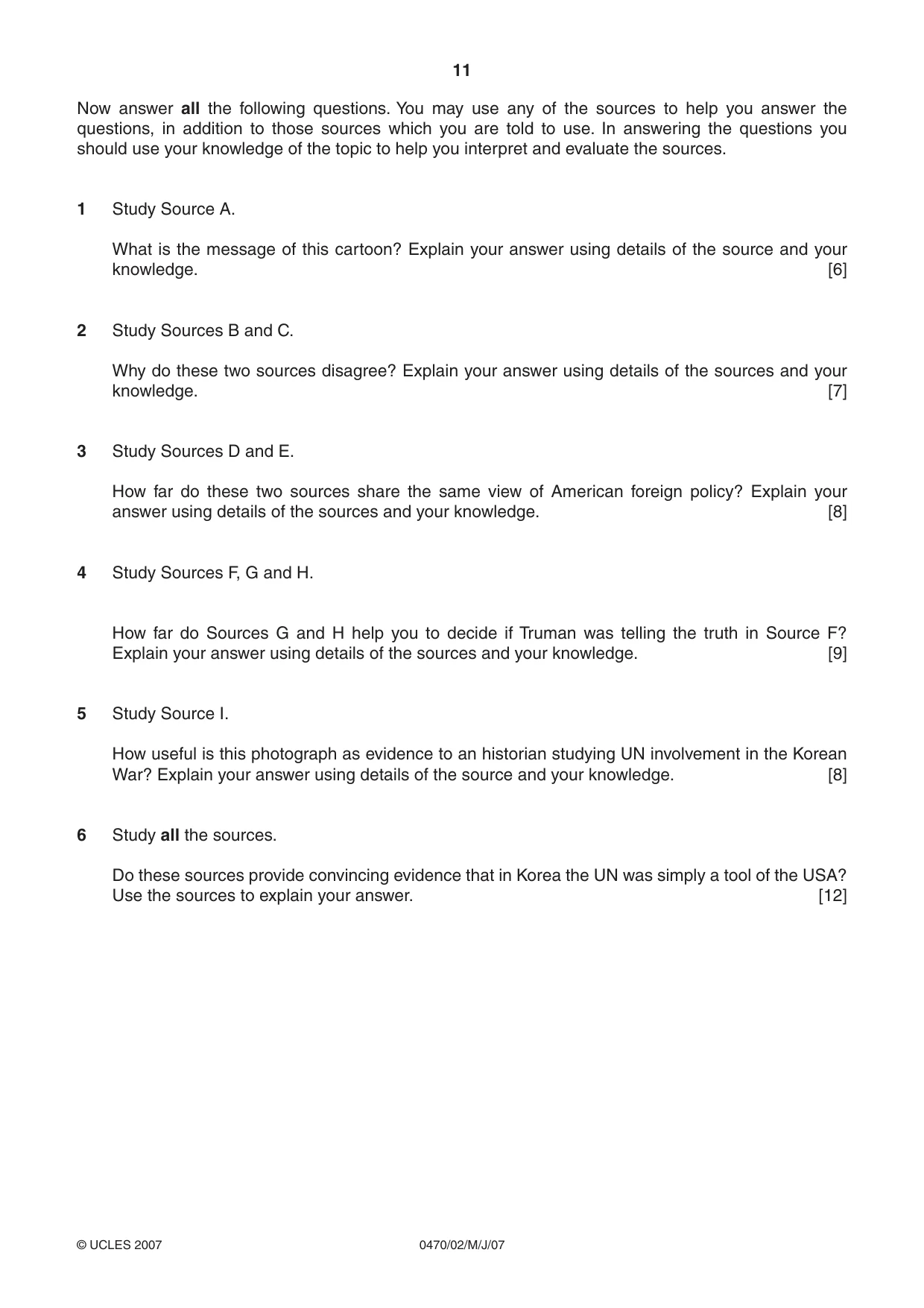
11 0470/02/M/J/07 © UCLES 2007 Now answer all the following questions. You may use any of the sources to help you answer the questions, in addition to those sources which you are told to use. In answering the questions you should use your knowledge of the topic to help you interpret and evaluate the sources. 1 Study Source A. What is the message of this cartoon? Explain your answer using details of the source and your knowledge. [6] 2 Study Sources B and C. Why do these two sources disagree? Explain your answer using details of the sources and your knowledge. [7] 3 Study Sources D and E. How far do these two sources share the same view of American foreign policy? Explain your answer using details of the sources and your knowledge. [8] 4 Study Sources F, G and H. How far do Sources G and H help you to decide if Truman was telling the truth in Source F? Explain your answer using details of the sources and your knowledge. [9] 5 Study Source I. How useful is this photograph as evidence to an historian studying UN involvement in the Korean War? Explain your answer using details of the source and your knowledge. [8] 6 Study all the sources. Do these sources provide convincing evidence that in Korea the UN was simply a tool of the USA? Use the sources to explain your answer. [12]
Question paper, page 12
12 0470/02/M/J/07 BLANK PAGE Copyright Acknowledgements: Option B Source A © Solo Syndication / Associated Newspapers. Option B Source D © Solo Syndication / Associated Newspapers. Permission to reproduce items where third-party owned material protected by copyright is included has been sought and cleared where possible. Every reasonable effort has been made by the publisher (UCLES) to trace copyright holders, but if any items requiring clearance have unwittingly been included, the publisher will be pleased to make amends at the earliest possible opportunity. University of Cambridge International Examinations is part of the Cambridge Assessment Group. Cambridge Assessment is the brand name of University of Cambridge Local Examinations Syndicate (UCLES), which is itself a department of the University of Cambridge.
Mark scheme, page 1
UNIVERSITY OF CAMBRIDGE INTERNATIONAL EXAMINATIONS International General Certificate of Secondary Education MARK SCHEME for the May/June 2007 question paper 0470 HISTORY 0470/02 Paper 2, maximum raw mark 50 This mark scheme is published as an aid to teachers and candidates, to indicate the requirements of the examination. It shows the basis on which Examiners were instructed to award marks. It does not indicate the details of the discussions that took place at an Examiners’ meeting before marking began. All Examiners are instructed that alternative correct answers and unexpected approaches in candidates’ scripts must be given marks that fairly reflect the relevant knowledge and skills demonstrated. Mark schemes must be read in conjunction with the question papers and the report on the examination. • CIE will not enter into discussions or correspondence in connection with these mark schemes. CIE is publishing the mark schemes for the May/June 2007 question papers for most IGCSE, GCE Advanced Level and Advanced Subsidiary Level syllabuses and some Ordinary Level syllabuses. www.XtremePapers.com
Mark scheme, page 2
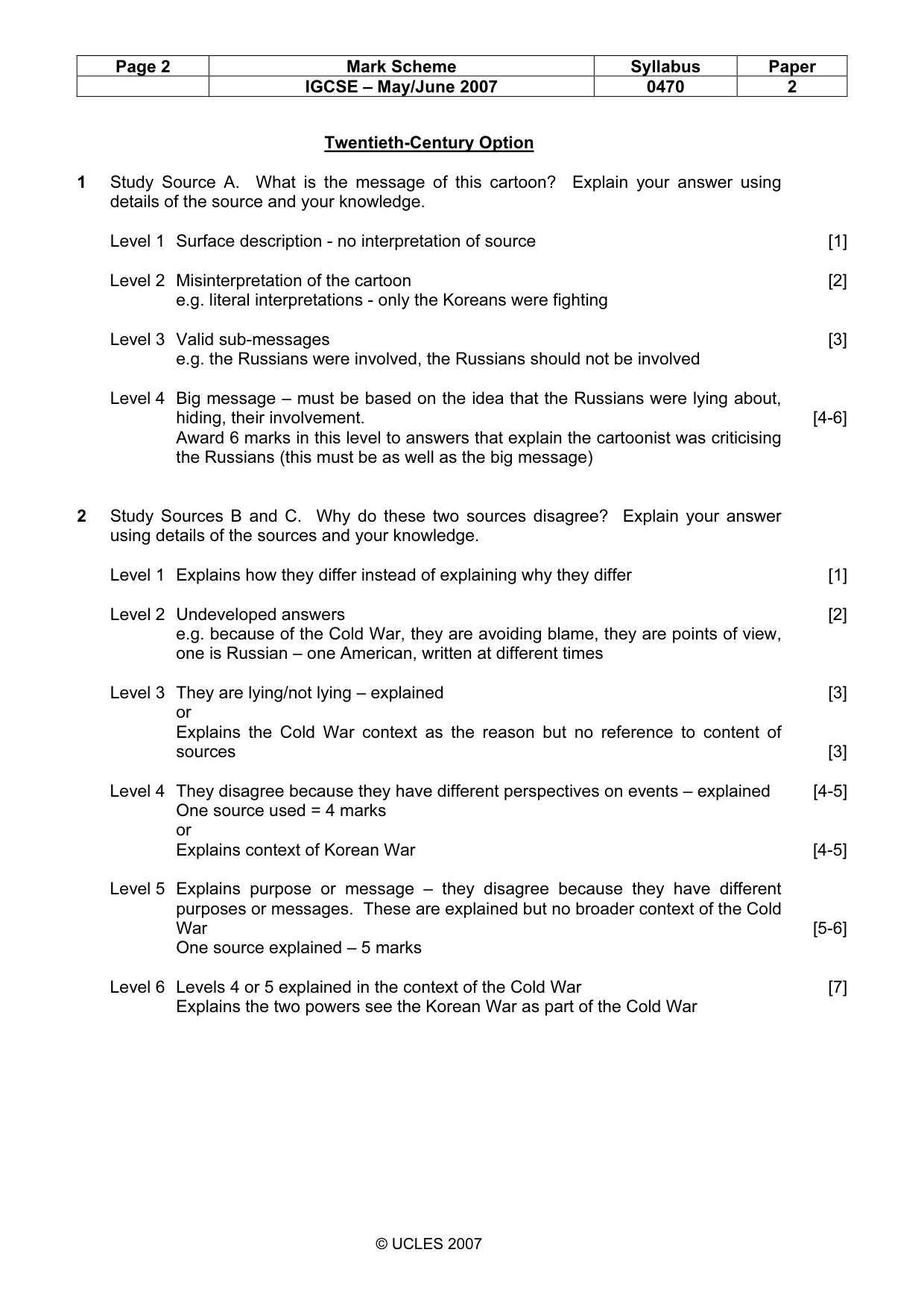
Page 2 Mark Scheme Syllabus Paper IGCSE – May/June 2007 0470 2 © UCLES 2007 Twentieth-Century Option 1 Study Source A. What is the message of this cartoon? Explain your answer using details of the source and your knowledge. Level 1 Surface description - no interpretation of source [1] Level 2 Misinterpretation of the cartoon [2] e.g. literal interpretations - only the Koreans were fighting Level 3 Valid sub-messages [3] e.g. the Russians were involved, the Russians should not be involved Level 4 Big message – must be based on the idea that the Russians were lying about, hiding, their involvement. [4-6] Award 6 marks in this level to answers that explain the cartoonist was criticising the Russians (this must be as well as the big message) 2 Study Sources B and C. Why do these two sources disagree? Explain your answer using details of the sources and your knowledge. Level 1 Explains how they differ instead of explaining why they differ [1] Level 2 Undeveloped answers [2] e.g. because of the Cold War, they are avoiding blame, they are points of view, one is Russian – one American, written at different times Level 3 They are lying/not lying – explained [3] or Explains the Cold War context as the reason but no reference to content of sources [3] Level 4 They disagree because they have different perspectives on events – explained [4-5] One source used = 4 marks or Explains context of Korean War [4-5] Level 5 Explains purpose or message – they disagree because they have different purposes or messages. These are explained but no broader context of the Cold War [5-6] One source explained – 5 marks Level 6 Levels 4 or 5 explained in the context of the Cold War [7] Explains the two powers see the Korean War as part of the Cold War
Mark scheme, page 3
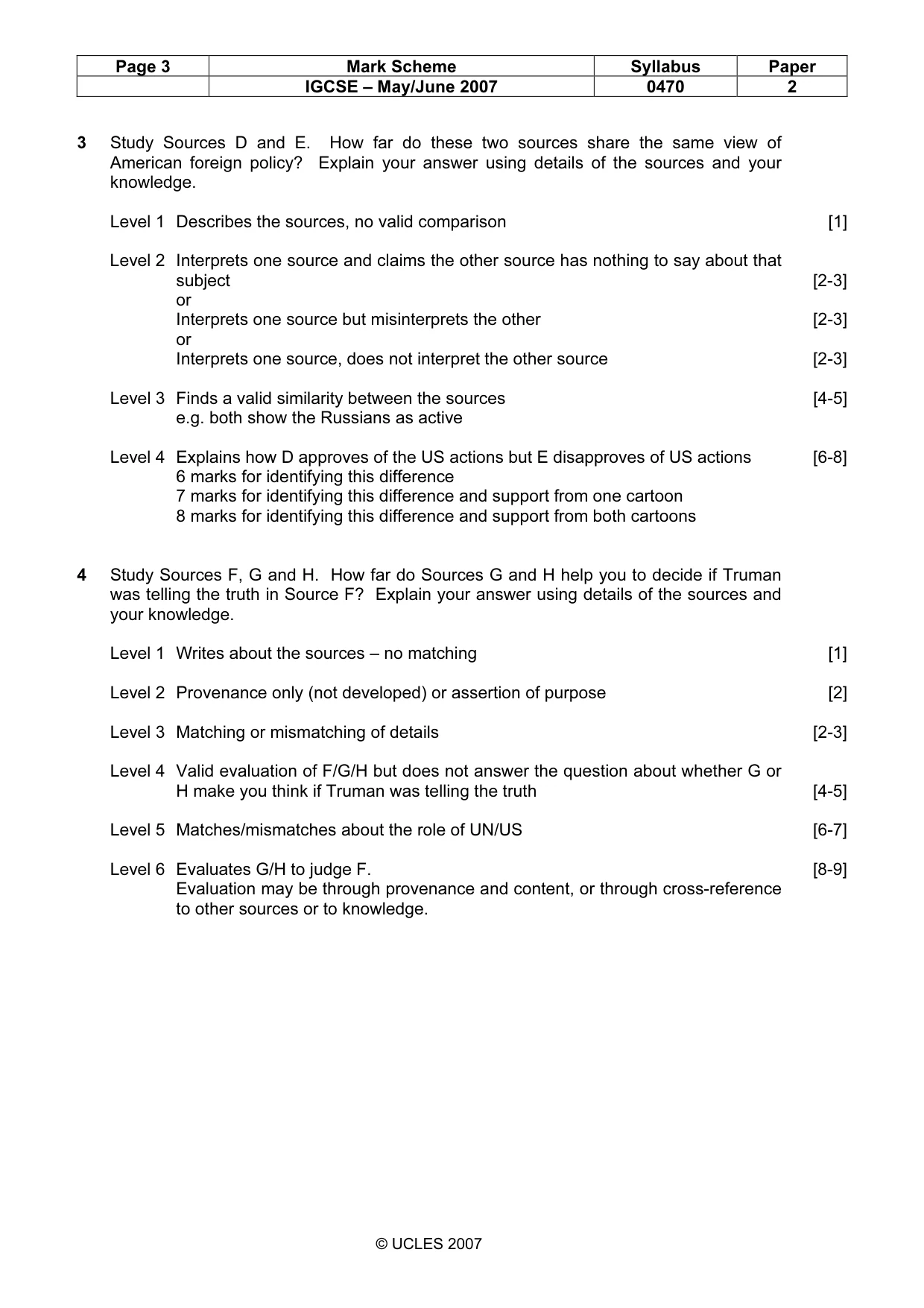
Page 3 Mark Scheme Syllabus Paper IGCSE – May/June 2007 0470 2 © UCLES 2007 3 Study Sources D and E. How far do these two sources share the same view of American foreign policy? Explain your answer using details of the sources and your knowledge. Level 1 Describes the sources, no valid comparison [1] Level 2 Interprets one source and claims the other source has nothing to say about that subject [2-3] or Interprets one source but misinterprets the other [2-3] or Interprets one source, does not interpret the other source [2-3] Level 3 Finds a valid similarity between the sources [4-5] e.g. both show the Russians as active Level 4 Explains how D approves of the US actions but E disapproves of US actions [6-8] 6 marks for identifying this difference 7 marks for identifying this difference and support from one cartoon 8 marks for identifying this difference and support from both cartoons 4 Study Sources F, G and H. How far do Sources G and H help you to decide if Truman was telling the truth in Source F? Explain your answer using details of the sources and your knowledge. Level 1 Writes about the sources – no matching [1] Level 2 Provenance only (not developed) or assertion of purpose [2] Level 3 Matching or mismatching of details [2-3] Level 4 Valid evaluation of F/G/H but does not answer the question about whether G or H make you think if Truman was telling the truth [4-5] Level 5 Matches/mismatches about the role of UN/US [6-7] Level 6 Evaluates G/H to judge F. [8-9] Evaluation may be through provenance and content, or through cross-reference to other sources or to knowledge.
Mark scheme, page 4
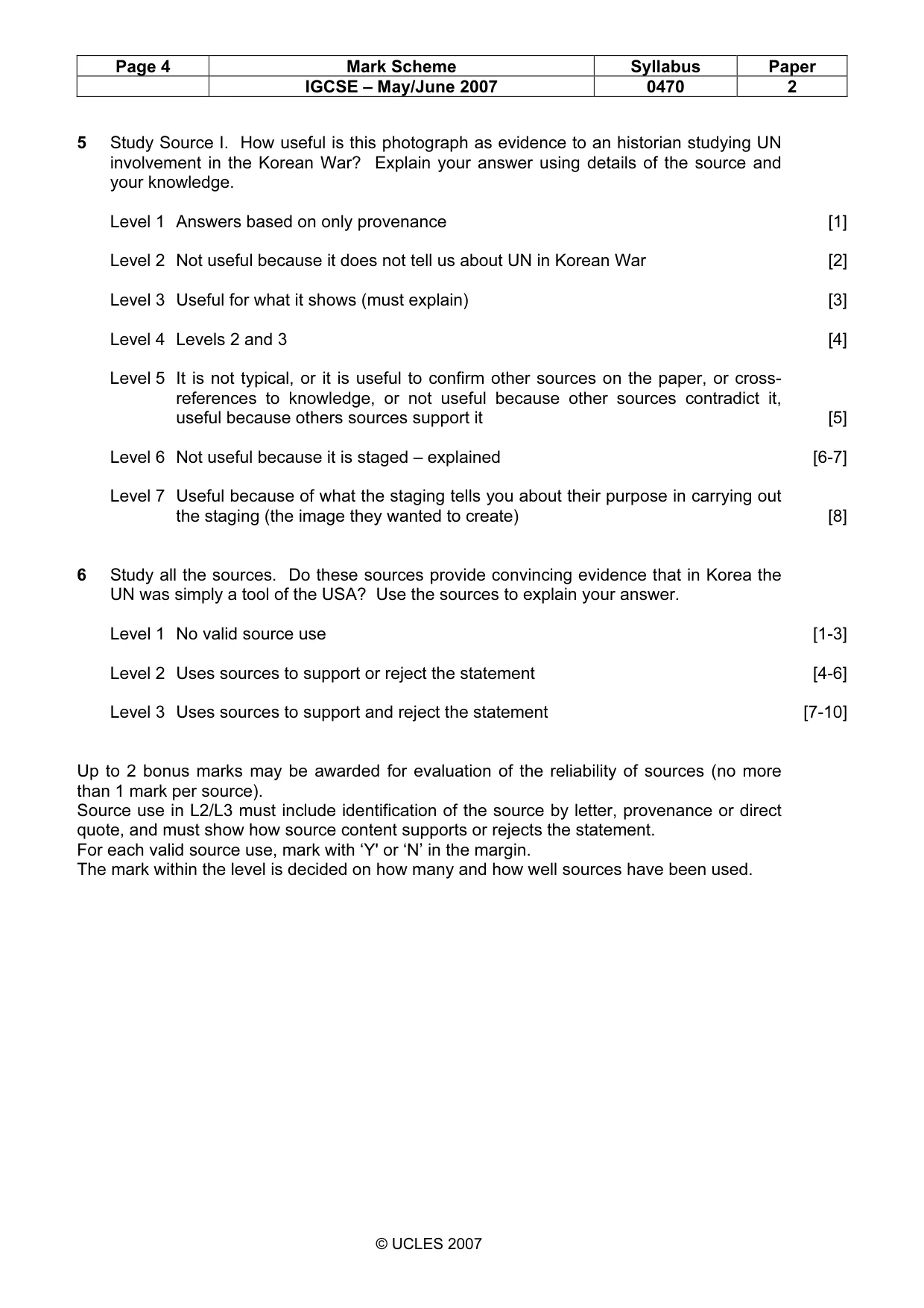
Page 4 Mark Scheme Syllabus Paper IGCSE – May/June 2007 0470 2 © UCLES 2007 5 Study Source I. How useful is this photograph as evidence to an historian studying UN involvement in the Korean War? Explain your answer using details of the source and your knowledge. Level 1 Answers based on only provenance [1] Level 2 Not useful because it does not tell us about UN in Korean War [2] Level 3 Useful for what it shows (must explain) [3] Level 4 Levels 2 and 3 [4] Level 5 It is not typical, or it is useful to confirm other sources on the paper, or cross- references to knowledge, or not useful because other sources contradict it, useful because others sources support it [5] Level 6 Not useful because it is staged – explained [6-7] Level 7 Useful because of what the staging tells you about their purpose in carrying out the staging (the image they wanted to create) [8] 6 Study all the sources. Do these sources provide convincing evidence that in Korea the UN was simply a tool of the USA? Use the sources to explain your answer. Level 1 No valid source use [1-3] Level 2 Uses sources to support or reject the statement [4-6] Level 3 Uses sources to support and reject the statement [7-10] Up to 2 bonus marks may be awarded for evaluation of the reliability of sources (no more than 1 mark per source). Source use in L2/L3 must include identification of the source by letter, provenance or direct quote, and must show how source content supports or rejects the statement. For each valid source use, mark with ‘Y' or ‘N’ in the margin. The mark within the level is decided on how many and how well sources have been used.
Mark scheme, page 5
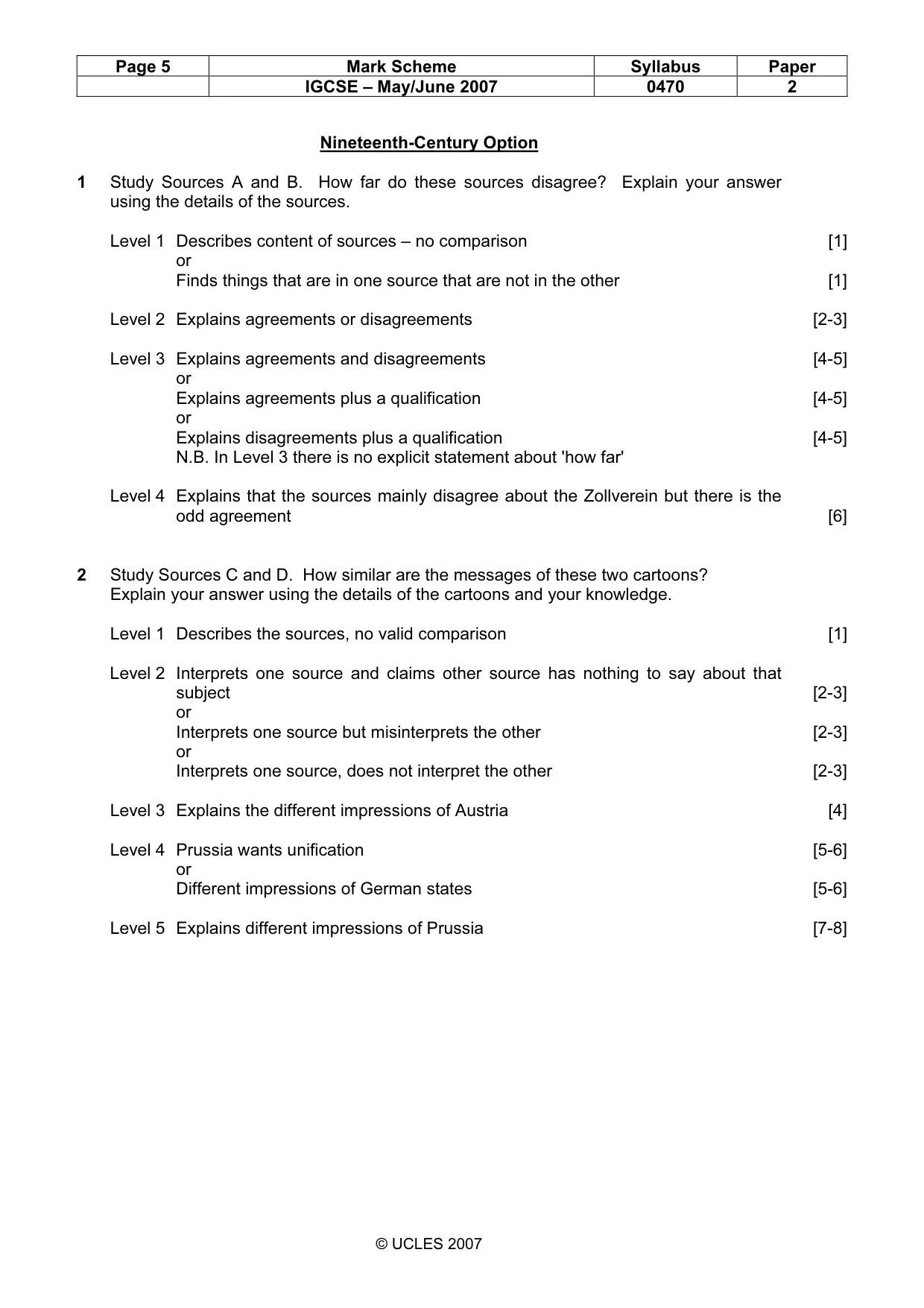
Page 5 Mark Scheme Syllabus Paper IGCSE – May/June 2007 0470 2 © UCLES 2007 Nineteenth-Century Option 1 Study Sources A and B. How far do these sources disagree? Explain your answer using the details of the sources. Level 1 Describes content of sources – no comparison [1] or Finds things that are in one source that are not in the other [1] Level 2 Explains agreements or disagreements [2-3] Level 3 Explains agreements and disagreements [4-5] or Explains agreements plus a qualification [4-5] or Explains disagreements plus a qualification [4-5] N.B. In Level 3 there is no explicit statement about 'how far' Level 4 Explains that the sources mainly disagree about the Zollverein but there is the odd agreement [6] 2 Study Sources C and D. How similar are the messages of these two cartoons? Explain your answer using the details of the cartoons and your knowledge. Level 1 Describes the sources, no valid comparison [1] Level 2 Interprets one source and claims other source has nothing to say about that subject [2-3] or Interprets one source but misinterprets the other [2-3] or Interprets one source, does not interpret the other [2-3] Level 3 Explains the different impressions of Austria [4] Level 4 Prussia wants unification [5-6] or Different impressions of German states [5-6] Level 5 Explains different impressions of Prussia [7-8]
Mark scheme, page 6
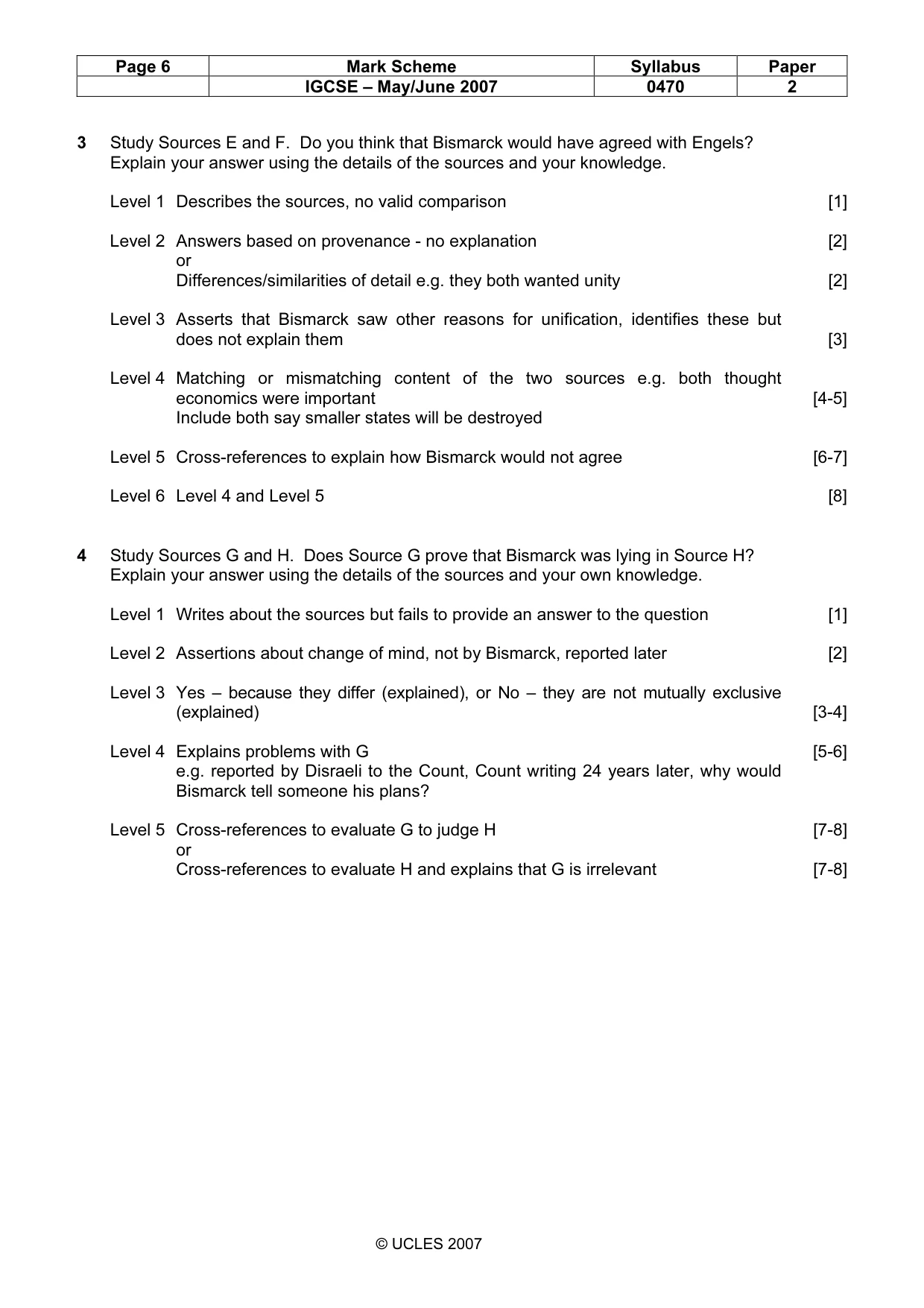
Page 6 Mark Scheme Syllabus Paper IGCSE – May/June 2007 0470 2 © UCLES 2007 3 Study Sources E and F. Do you think that Bismarck would have agreed with Engels? Explain your answer using the details of the sources and your knowledge. Level 1 Describes the sources, no valid comparison [1] Level 2 Answers based on provenance - no explanation [2] or Differences/similarities of detail e.g. they both wanted unity [2] Level 3 Asserts that Bismarck saw other reasons for unification, identifies these but does not explain them [3] Level 4 Matching or mismatching content of the two sources e.g. both thought economics were important [4-5] Include both say smaller states will be destroyed Level 5 Cross-references to explain how Bismarck would not agree [6-7] Level 6 Level 4 and Level 5 [8] 4 Study Sources G and H. Does Source G prove that Bismarck was lying in Source H? Explain your answer using the details of the sources and your own knowledge. Level 1 Writes about the sources but fails to provide an answer to the question [1] Level 2 Assertions about change of mind, not by Bismarck, reported later [2] Level 3 Yes – because they differ (explained), or No – they are not mutually exclusive (explained) [3-4] Level 4 Explains problems with G [5-6] e.g. reported by Disraeli to the Count, Count writing 24 years later, why would Bismarck tell someone his plans? Level 5 Cross-references to evaluate G to judge H [7-8] or Cross-references to evaluate H and explains that G is irrelevant [7-8]
Mark scheme, page 7
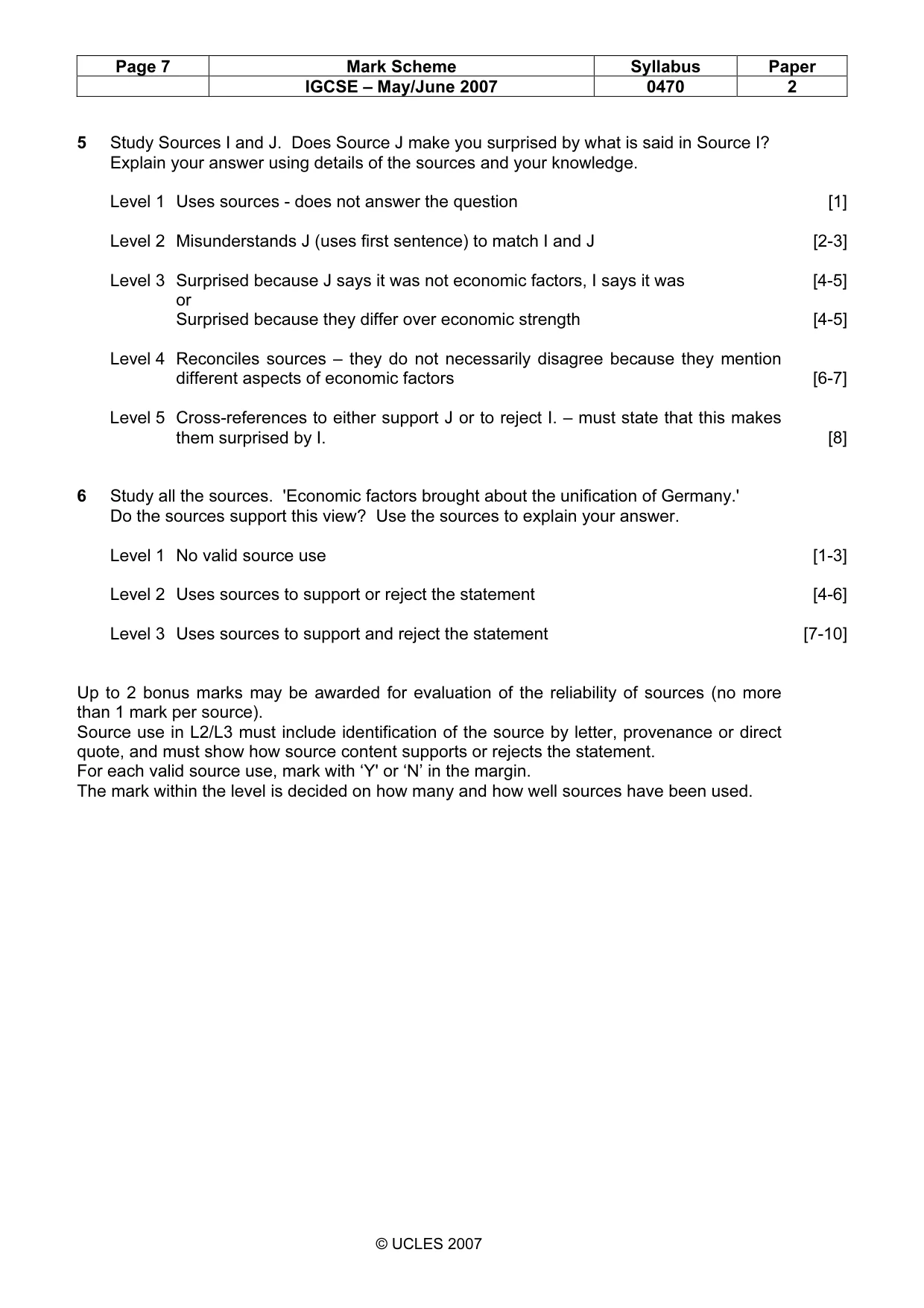
Page 7 Mark Scheme Syllabus Paper IGCSE – May/June 2007 0470 2 © UCLES 2007 5 Study Sources I and J. Does Source J make you surprised by what is said in Source I? Explain your answer using details of the sources and your knowledge. Level 1 Uses sources - does not answer the question [1] Level 2 Misunderstands J (uses first sentence) to match I and J [2-3] Level 3 Surprised because J says it was not economic factors, I says it was [4-5] or Surprised because they differ over economic strength [4-5] Level 4 Reconciles sources – they do not necessarily disagree because they mention different aspects of economic factors [6-7] Level 5 Cross-references to either support J or to reject I. – must state that this makes them surprised by I. [8] 6 Study all the sources. 'Economic factors brought about the unification of Germany.' Do the sources support this view? Use the sources to explain your answer. Level 1 No valid source use [1-3] Level 2 Uses sources to support or reject the statement [4-6] Level 3 Uses sources to support and reject the statement [7-10] Up to 2 bonus marks may be awarded for evaluation of the reliability of sources (no more than 1 mark per source). Source use in L2/L3 must include identification of the source by letter, provenance or direct quote, and must show how source content supports or rejects the statement. For each valid source use, mark with ‘Y' or ‘N’ in the margin. The mark within the level is decided on how many and how well sources have been used.
What you needed in this session
Cambridge’s own grade thresholds for 2007 May/June, Paper 2 · Variant 1. A higher threshold means an easier paper — the bar moves with how the cohort did.