Cambridge IGCSE History 0470 — 2006 Oct/Nov Paper 2 · Variant 1
0470/21/O/N/06 · 50 marks · ≈56 min
The question paper and its mark scheme, free to read here and free to download. This is Cambridge’s own paper, exactly as it was sat.
Question paper12 pages
Mark scheme13 pages
Answers below. Sit the paper first if you are practising.
Paper as text
Question paper, page 1
This document consists of 11 printed pages and 1 blank page. SP (NF/CGW) T06785/2 © UCLES 2006 [Turn over UNIVERSITY OF CAMBRIDGE INTERNATIONAL EXAMINATIONS International General Certificate of Secondary Education HISTORY 0470/02 Paper 2 October/November 2006 2 hours Additional Materials: Answer Booklet/Paper READ THESE INSTRUCTIONS FIRST If you have been given an Answer Booklet, follow the instructions on the front cover of the Booklet. Write your Centre number, candidate number and name on all the work you hand in. Write in dark blue or black pen. You may use a soft pencil for any diagrams, graphs or rough working. Do not use staples, paper clips, highlighters, glue or correction fluid. The paper has two options. Option A: 19th Century topic [p2–p6] Option B: 20th Century topic [p7– p11] Choose one of these options, and then answer all the questions on that topic. The number of marks is given in brackets [ ] at the end of each question or part question. At the end of the examination, fasten all your work securely together. www.XtremePapers.com
Question paper, page 2
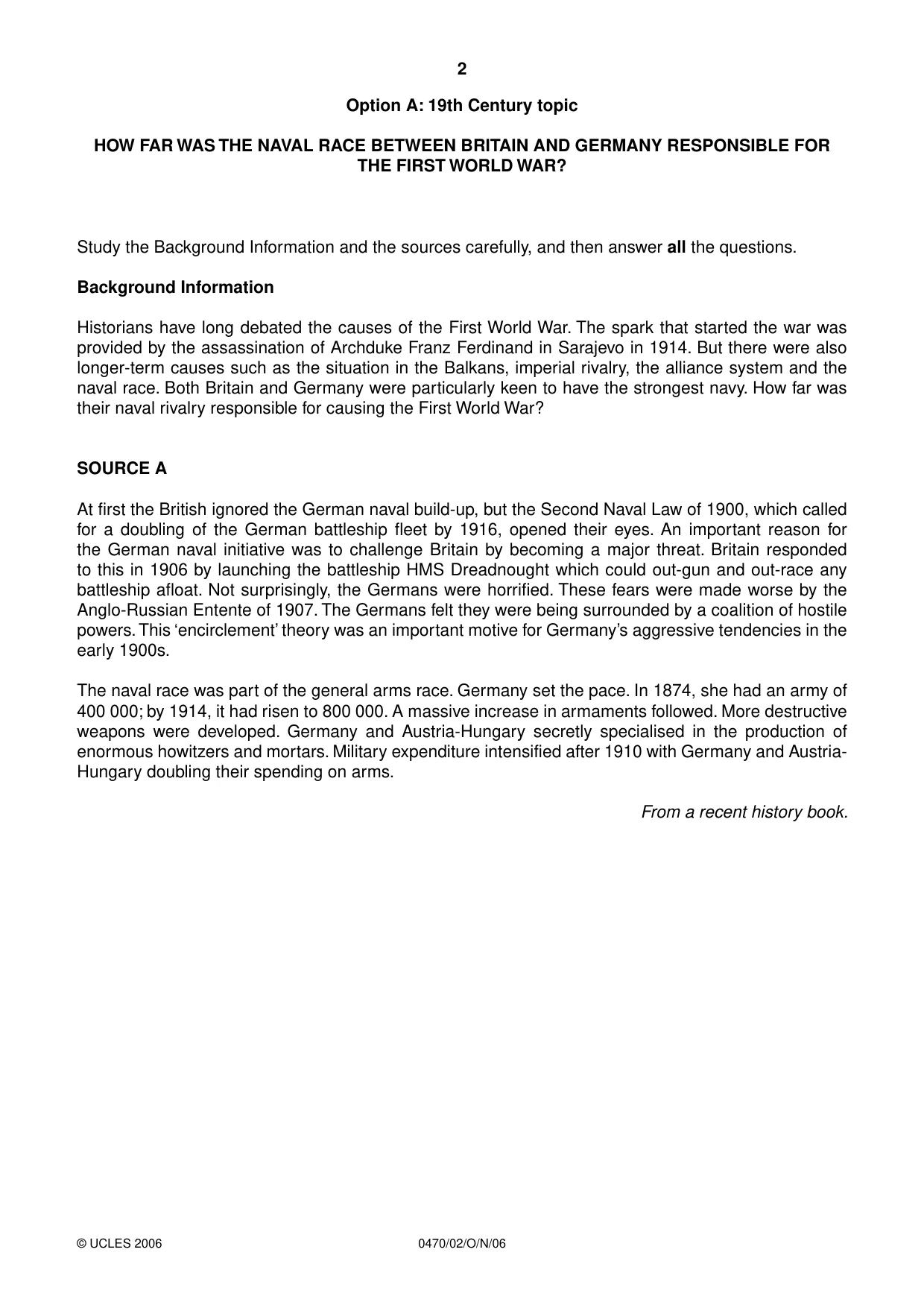
2 0470/02/O/N/06 © UCLES 2006 Option A: 19th Century topic HOW FAR WAS THE NAVAL RACE BETWEEN BRITAIN AND GERMANY RESPONSIBLE FOR THE FIRST WORLD WAR? Study the Background Information and the sources carefully, and then answer all the questions. Background Information Historians have long debated the causes of the First World War. The spark that started the war was provided by the assassination of Archduke Franz Ferdinand in Sarajevo in 1914. But there were also longer-term causes such as the situation in the Balkans, imperial rivalry, the alliance system and the naval race. Both Britain and Germany were particularly keen to have the strongest navy. How far was their naval rivalry responsible for causing the First World War? SOURCE A At first the British ignored the German naval build-up, but the Second Naval Law of 1900, which called for a doubling of the German battleship fleet by 1916, opened their eyes. An important reason for the German naval initiative was to challenge Britain by becoming a major threat. Britain responded to this in 1906 by launching the battleship HMS Dreadnought which could out-gun and out-race any battleship afloat. Not surprisingly, the Germans were horrified. These fears were made worse by the Anglo-Russian Entente of 1907. The Germans felt they were being surrounded by a coalition of hostile powers. This ‘encirclement’ theory was an important motive for Germany’s aggressive tendencies in the early 1900s. The naval race was part of the general arms race. Germany set the pace. In 1874, she had an army of 400 000; by 1914, it had risen to 800 000. A massive increase in armaments followed. More destructive weapons were developed. Germany and Austria-Hungary secretly specialised in the production of enormous howitzers and mortars. Military expenditure intensified after 1910 with Germany and Austria- Hungary doubling their spending on arms. From a recent history book.
Question paper, page 3
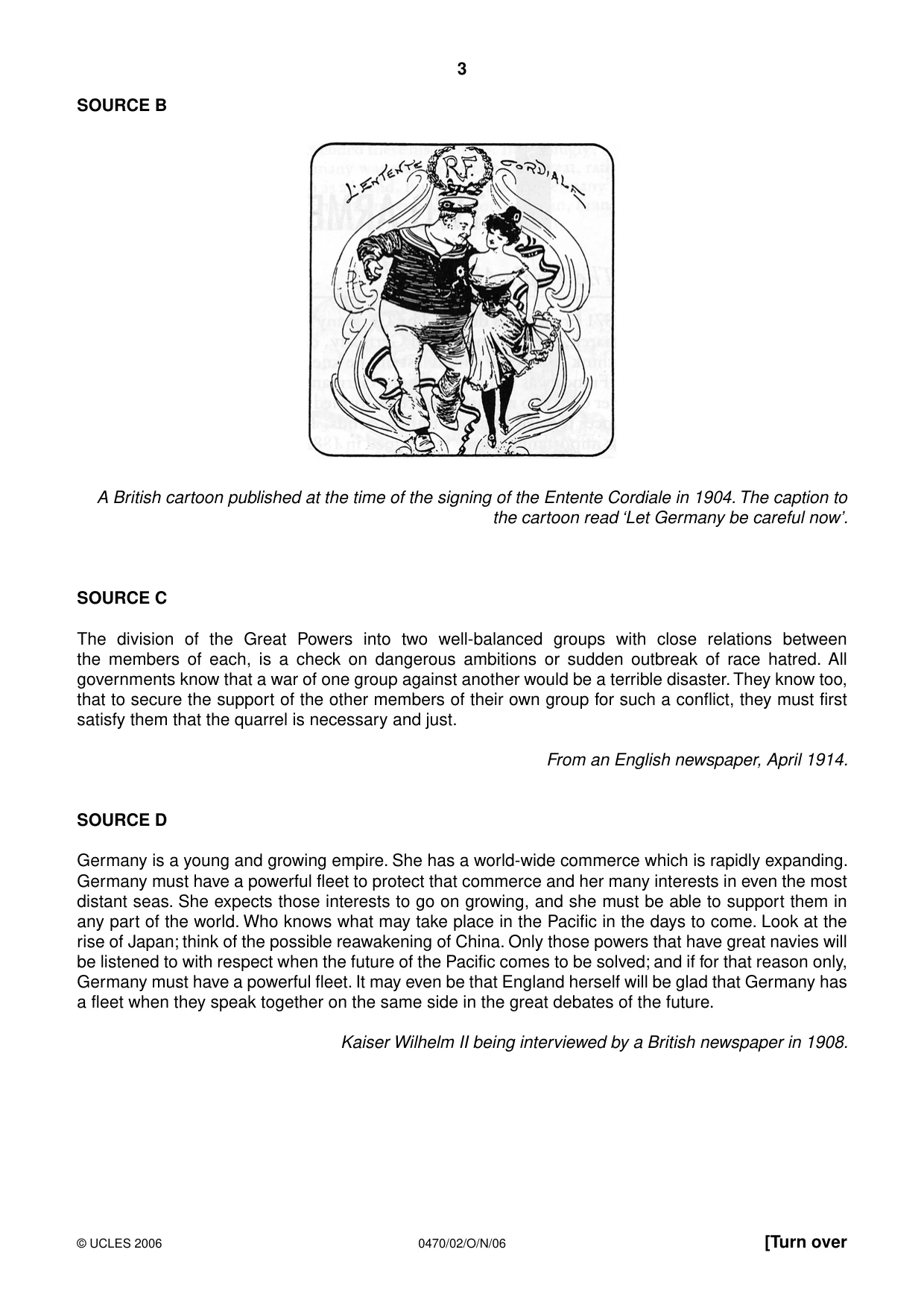
3 0470/02/O/N/06 © UCLES 2006 [Turn over SOURCE B A British cartoon published at the time of the signing of the Entente Cordiale in 1904. The caption to the cartoon read ‘Let Germany be careful now’. SOURCE C The division of the Great Powers into two well-balanced groups with close relations between the members of each, is a check on dangerous ambitions or sudden outbreak of race hatred. All governments know that a war of one group against another would be a terrible disaster. They know too, that to secure the support of the other members of their own group for such a conflict, they must first satisfy them that the quarrel is necessary and just. From an English newspaper, April 1914. SOURCE D Germany is a young and growing empire. She has a world-wide commerce which is rapidly expanding. Germany must have a powerful fleet to protect that commerce and her many interests in even the most distant seas. She expects those interests to go on growing, and she must be able to support them in any part of the world. Who knows what may take place in the Pacific in the days to come. Look at the rise of Japan; think of the possible reawakening of China. Only those powers that have great navies will be listened to with respect when the future of the Pacific comes to be solved; and if for that reason only, Germany must have a powerful fleet. It may even be that England herself will be glad that Germany has a fleet when they speak together on the same side in the great debates of the future. Kaiser Wilhelm II being interviewed by a British newspaper in 1908.
Question paper, page 4
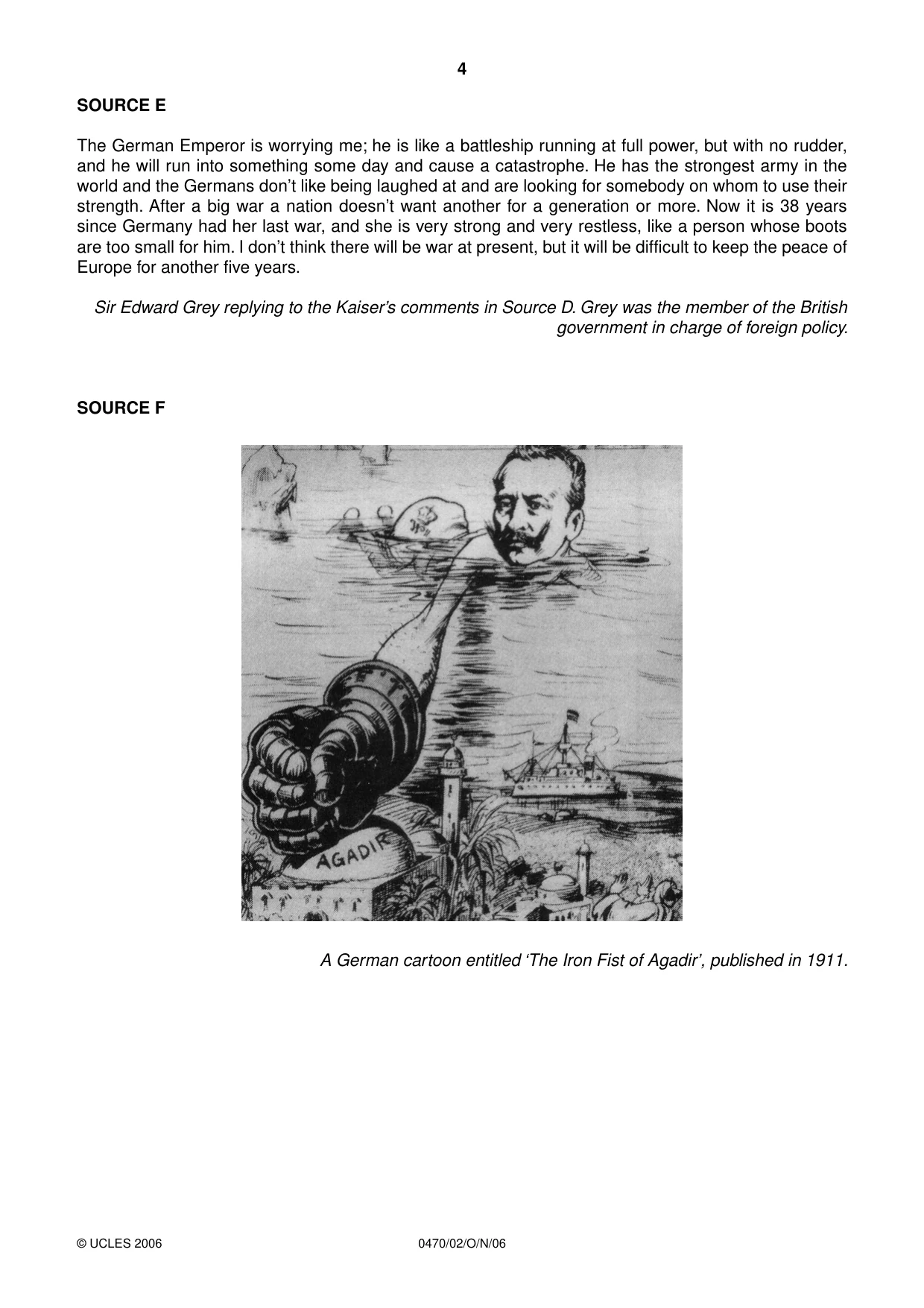
4 0470/02/O/N/06 © UCLES 2006 SOURCE E The German Emperor is worrying me; he is like a battleship running at full power, but with no rudder, and he will run into something some day and cause a catastrophe. He has the strongest army in the world and the Germans don’t like being laughed at and are looking for somebody on whom to use their strength. After a big war a nation doesn’t want another for a generation or more. Now it is 38 years since Germany had her last war, and she is very strong and very restless, like a person whose boots are too small for him. I don’t think there will be war at present, but it will be difficult to keep the peace of Europe for another five years. Sir Edward Grey replying to the Kaiser’s comments in Source D. Grey was the member of the British government in charge of foreign policy. SOURCE F A German cartoon entitled ‘The Iron Fist of Agadir’, published in 1911.
Question paper, page 5
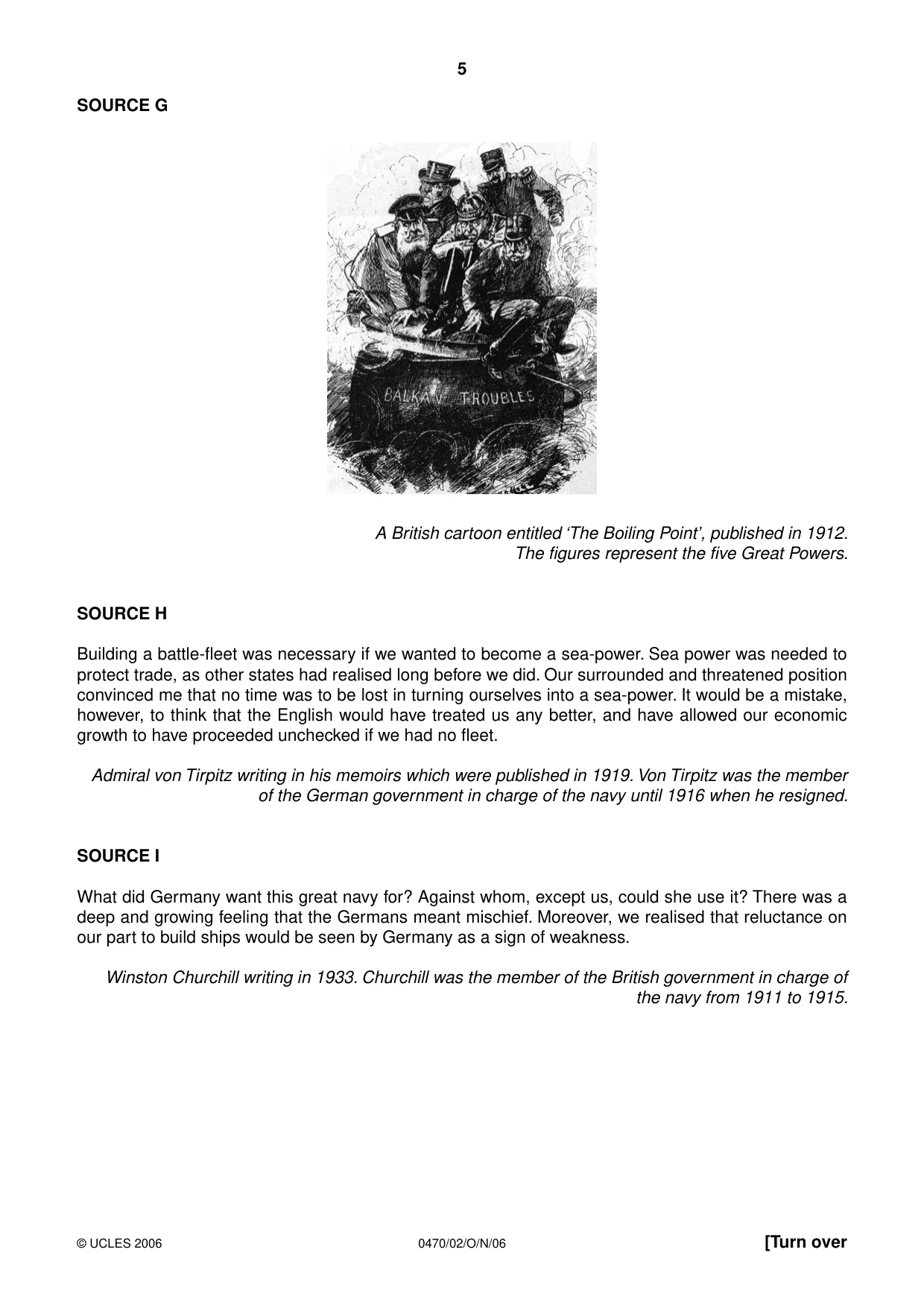
5 0470/02/O/N/06 © UCLES 2006 [Turn over SOURCE G A British cartoon entitled ‘The Boiling Point’, published in 1912. The figures represent the five Great Powers. SOURCE H Building a battle-fleet was necessary if we wanted to become a sea-power. Sea power was needed to protect trade, as other states had realised long before we did. Our surrounded and threatened position convinced me that no time was to be lost in turning ourselves into a sea-power. It would be a mistake, however, to think that the English would have treated us any better, and have allowed our economic growth to have proceeded unchecked if we had no fleet. Admiral von Tirpitz writing in his memoirs which were published in 1919. Von Tirpitz was the member of the German government in charge of the navy until 1916 when he resigned. SOURCE I What did Germany want this great navy for? Against whom, except us, could she use it? There was a deep and growing feeling that the Germans meant mischief. Moreover, we realised that reluctance on our part to build ships would be seen by Germany as a sign of weakness. Winston Churchill writing in 1933. Churchill was the member of the British government in charge of the navy from 1911 to 1915.
Question paper, page 6
6 0470/02/O/N/06 © UCLES 2006 Now answer all the following questions. You may use any of the sources to help you answer the questions, in addition to those sources which you are told to use. In answering the questions you should use your own knowledge of the topic to help you interpret and evaluate the sources. 1 Study Source A. Who does the author of this source think was responsible for the increasing tension between Britain and Germany? Explain your answer using the source. [6] 2 Study Sources B and C. Does Source C make you surprised by the message of the cartoon (Source B)? Explain your answer using the sources and your knowledge. [8] 3 Study Sources D and E. These two sources are biased. Does this mean they cannot be believed? Explain your answer using the sources and your knowledge. [8] 4 Study Sources F and G. How similar are these two cartoons? Explain your answer using the sources and your knowledge. [8] 5 Study Sources H and I. Is one of these sources more reliable than the other? Explain your answer using the sources and your knowledge. [8] 6 Study all the sources. How far do these sources support the idea that the naval race was the major cause of the First World War? Use the sources to explain your answer. [12]
Question paper, page 7
7 0470/02/O/N/06 © UCLES 2006 [Turn over Option B: 20th Century topic WHAT WERE THE AIMS OF THE PEACEMAKERS AT VERSAILLES? Study the Background Information and the sources carefully, and then answer all the questions. Background Information The Paris Peace Conference in 1919 was dominated by the ‘Big Four’: Clemenceau of France, Lloyd George of Britain, Orlando of Italy and Wilson of the USA. Were they meeting simply to punish Germany or did they have other aims? SOURCE A Severe as the Treaty of Versailles seemed to many Germans, it should be remembered that Germany might easily have fared much worse. If, instead of being restrained by Britain and the USA, Clemenceau had had his way, the Rhineland would have become an independent state, the Saarland would have been given to France and Danzig would have become an integral part of Poland. However, the Germans as a nation were not inclined to count their blessings in 1919. Most of all they resented being forced to accept war-guilt. Finally, the fact that the treaty was not negotiated but dictated to Germany and signed in humiliating circumstances made it certain that the German people would accept no responsibility for carrying out its terms. From a history book published in 1985. SOURCE B The fundamental significance of Versailles was emotional. Allied statesmen, urged on by pressure of public opinion, had made peace in a spirit of revenge. The cries of ‘Hang the Kaiser’ and ‘squeezing the German lemon until the pips squeak’ were typical of the desire not merely for a guarantee of future security, but for the national humiliation of Germany. The Germans saw every difficulty in later years as a further punishment that they alone must suffer as a result of the hated Treaty of Versailles. From a history book published in 1986. SOURCE C It must be a peace without victory. Victory would mean peace forced upon the loser, a victor’s terms imposed upon the defeated. It would be accepted in humiliation, and would leave resentment and a bitter memory upon which terms of peace would rest, not permanently, but only as if built on sand. Peace without victory was the only sort of peace that the peoples of America could join in guaranteeing. President Wilson speaking to the American Senate in January 1917.
Question paper, page 8
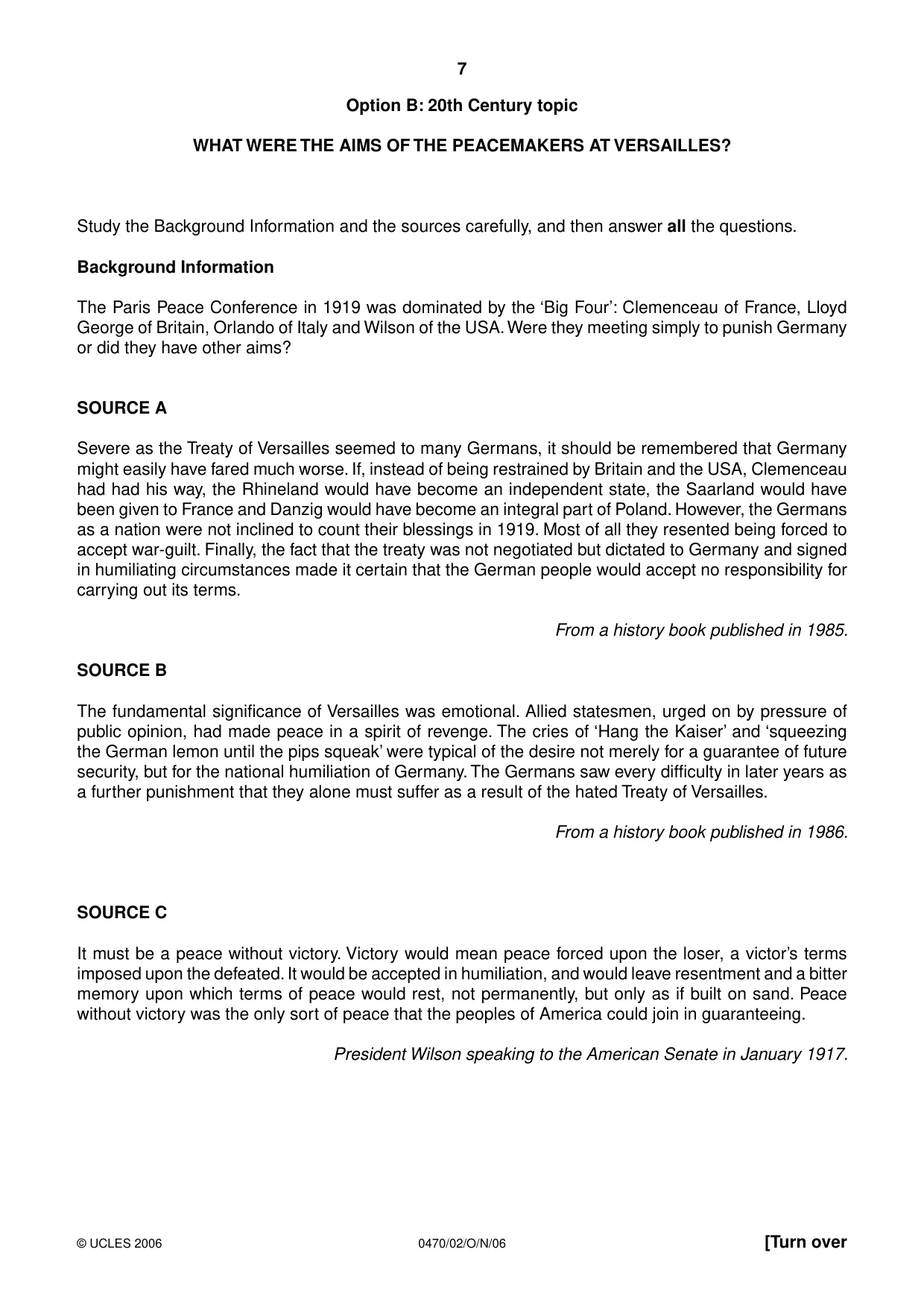
8 0470/02/O/N/06 © UCLES 2006 SOURCE D A cartoon from a British newspaper, May 1919. It shows the waiting room of a dentist. SOURCE E There will be strong attempts to persuade the government to depart from the strict principles of justice, in order to satisfy some shameful principles of either revenge or greed. We must resist that. Lloyd George speaking at a meeting during the 1918 election campaign in Britain. SOURCE F We propose to demand the whole cost of the war from Germany. Lloyd George speaking in January 1919. SOURCE G He was especially interested in the question of reparations, and said that if I would help him out in this direction, he would be extremely grateful. By ‘helping him out’ he meant to give a plausible reason to his people for having misled them about the question of war costs, reparations etc. He admitted that he knew Germany could not pay anything like the amount of reparations which the British and French demanded. An American delegate’s note of a conversation with Lloyd George during the peace negotiations in 1919.
Question paper, page 9
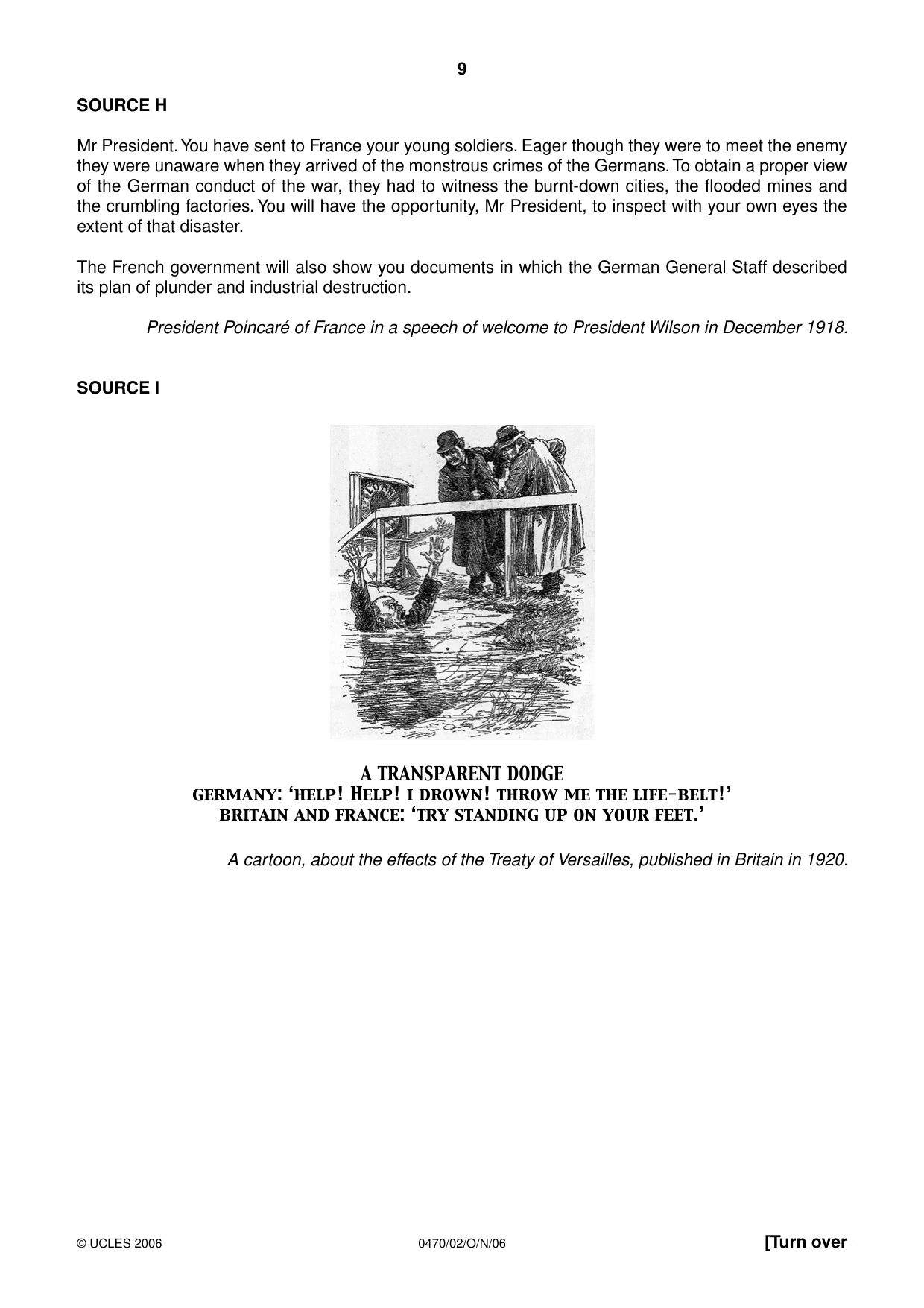
9 0470/02/O/N/06 © UCLES 2006 [Turn over SOURCE H Mr President. You have sent to France your young soldiers. Eager though they were to meet the enemy they were unaware when they arrived of the monstrous crimes of the Germans. To obtain a proper view of the German conduct of the war, they had to witness the burnt-down cities, the flooded mines and the crumbling factories. You will have the opportunity, Mr President, to inspect with your own eyes the extent of that disaster. The French government will also show you documents in which the German General Staff described its plan of plunder and industrial destruction. President Poincaré of France in a speech of welcome to President Wilson in December 1918. SOURCE I A TRANSPARENT DODGE germany: ‘help! Help! i drown! throw me the life-belt!’ britain and france: ‘try standing up on your feet.’ A cartoon, about the effects of the Treaty of Versailles, published in Britain in 1920.
Question paper, page 10
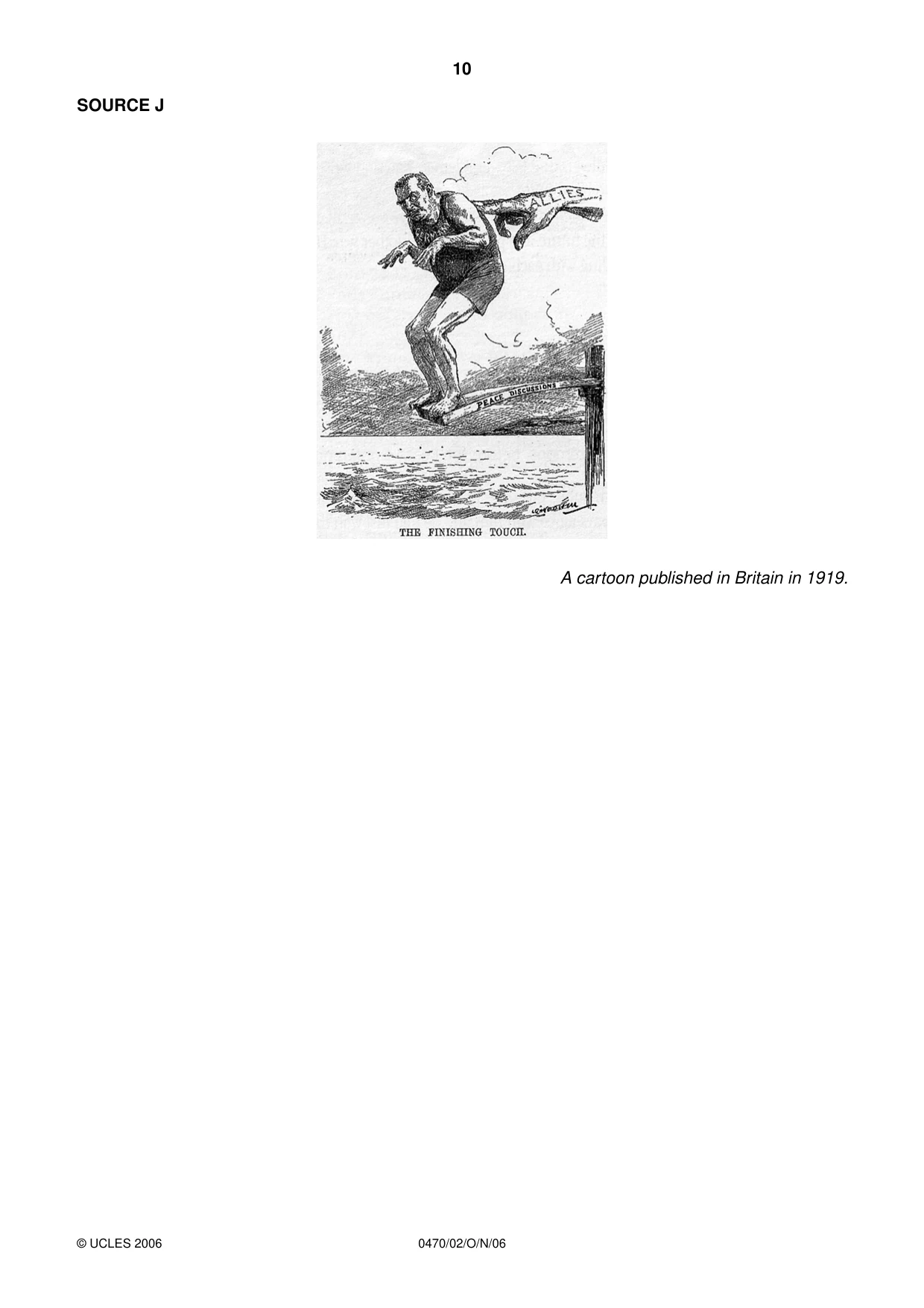
10 0470/02/O/N/06 © UCLES 2006 SOURCE J A cartoon published in Britain in 1919.
Question paper, page 11
11 0470/02/O/N/06 © UCLES 2006 Now answer all the following questions. You may use any of the sources to help you answer the questions, in addition to those sources which you are told to use. In answering the questions you should use your knowledge of the topic to help you interpret and evaluate the sources. 1 Study Sources A and B. How far do these two sources agree? Explain your answer using the sources. [7] 2 Study Sources C and D. Does Source C make you surprised by what is shown in the cartoon (Source D)? Explain your answer using the sources and your knowledge. [8] 3 Study Sources E, F and G. Do you agree that these three sources prove that Lloyd George could not be trusted? Explain your answer using the sources and your knowledge. [8] 4 Study Source H. Do you think President Wilson would have been happy with this welcome? Explain your answer using the sources and your knowledge. [7] 5 Study Sources I and J. How similar are these two cartoons? Explain your answer using the sources and your knowledge. [8] 6 Study all the sources. How far do these sources show that the peacemakers at Versailles wanted to treat Germany harshly? Use the sources to explain your answer. [12]
Question paper, page 12
12 0470/02/O/N/06 BLANK PAGE Copyright Acknowledgements: Option A Source A © Henry Mills, Graham Bean & John Pipe; The Road to Sarajevo; Macmillan; 1996. Option A Source G Leonard Ravenhill; Boiling Point © Punch. Permission to reproduce items where third-party owned material protected by copyright is included has been sought and cleared where possible. Every reasonable effort has been made by the publisher (UCLES) to trace copyright holders, but if any items requiring clearance have unwittingly been included, the publisher will be pleased to make amends at the earliest possible opportunity. University of Cambridge International Examinations is part of the University of Cambridge Local Examinations Syndicate (UCLES), which is itself a department of the University of Cambridge.
Mark scheme, page 1
UNIVERSITY OF CAMBRIDGE INTERNATIONAL EXAMINATIONS International General Certificate of Secondary Education MARK SCHEME for the October/November 2006 question paper 0470 HISTORY 0470/02 Paper 2, maximum raw mark 50 This mark scheme is published as an aid to teachers and students, to indicate the requirements of the examination. It shows the basis on which Examiners were instructed to award marks. It does not indicate the details of the discussions that took place at an Examiners’ meeting before marking began. All Examiners are instructed that alternative correct answers and unexpected approaches in candidates’ scripts must be given marks that fairly reflect the relevant knowledge and skills demonstrated. Mark schemes must be read in conjunction with the question papers and the report on the examination. The grade thresholds for various grades are published in the report on the examination for most IGCSE, GCE Advanced Level and Advanced Subsidiary Level syllabuses. • CIE will not enter into discussions or correspondence in connection with these mark schemes. CIE is publishing the mark schemes for the October/November 2006 question papers for most IGCSE, GCE Advanced Level and Advanced Subsidiary Level syllabuses and some Ordinary Level syllabuses. www.XtremePapers.com
Mark scheme, page 2
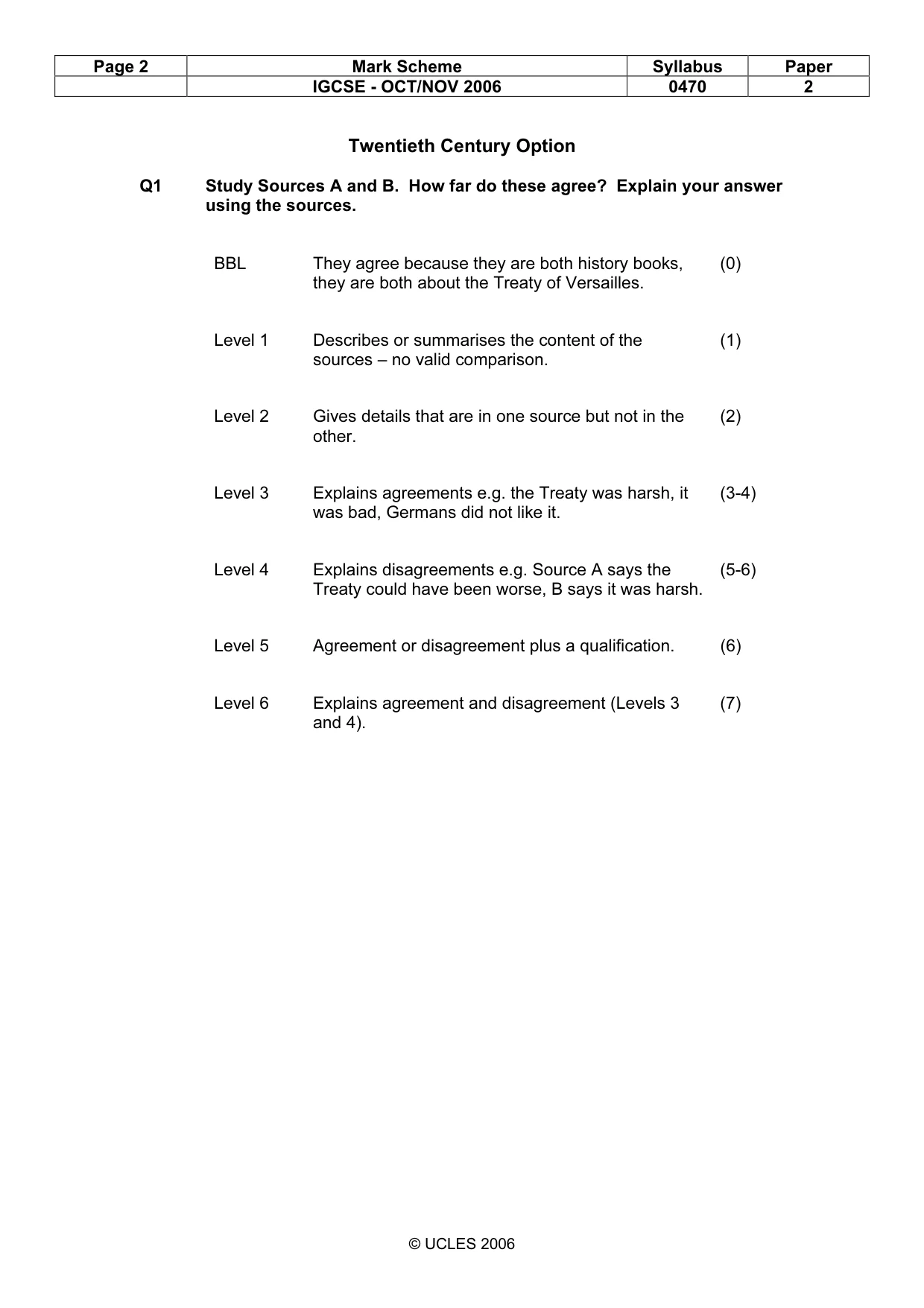
Page 2 Mark Scheme Syllabus Paper IGCSE - OCT/NOV 2006 0470 2 © UCLES 2006 Twentieth Century Option Q1 Study Sources A and B. How far do these agree? Explain your answer using the sources. BBL They agree because they are both history books, they are both about the Treaty of Versailles. (0) Level 1 Describes or summarises the content of the sources – no valid comparison. (1) Level 2 Gives details that are in one source but not in the other. (2) Level 3 Explains agreements e.g. the Treaty was harsh, it was bad, Germans did not like it. (3-4) Level 4 Explains disagreements e.g. Source A says the Treaty could have been worse, B says it was harsh. (5-6) Level 5 Agreement or disagreement plus a qualification. (6) Level 6 Explains agreement and disagreement (Levels 3 and 4). (7)
Mark scheme, page 3
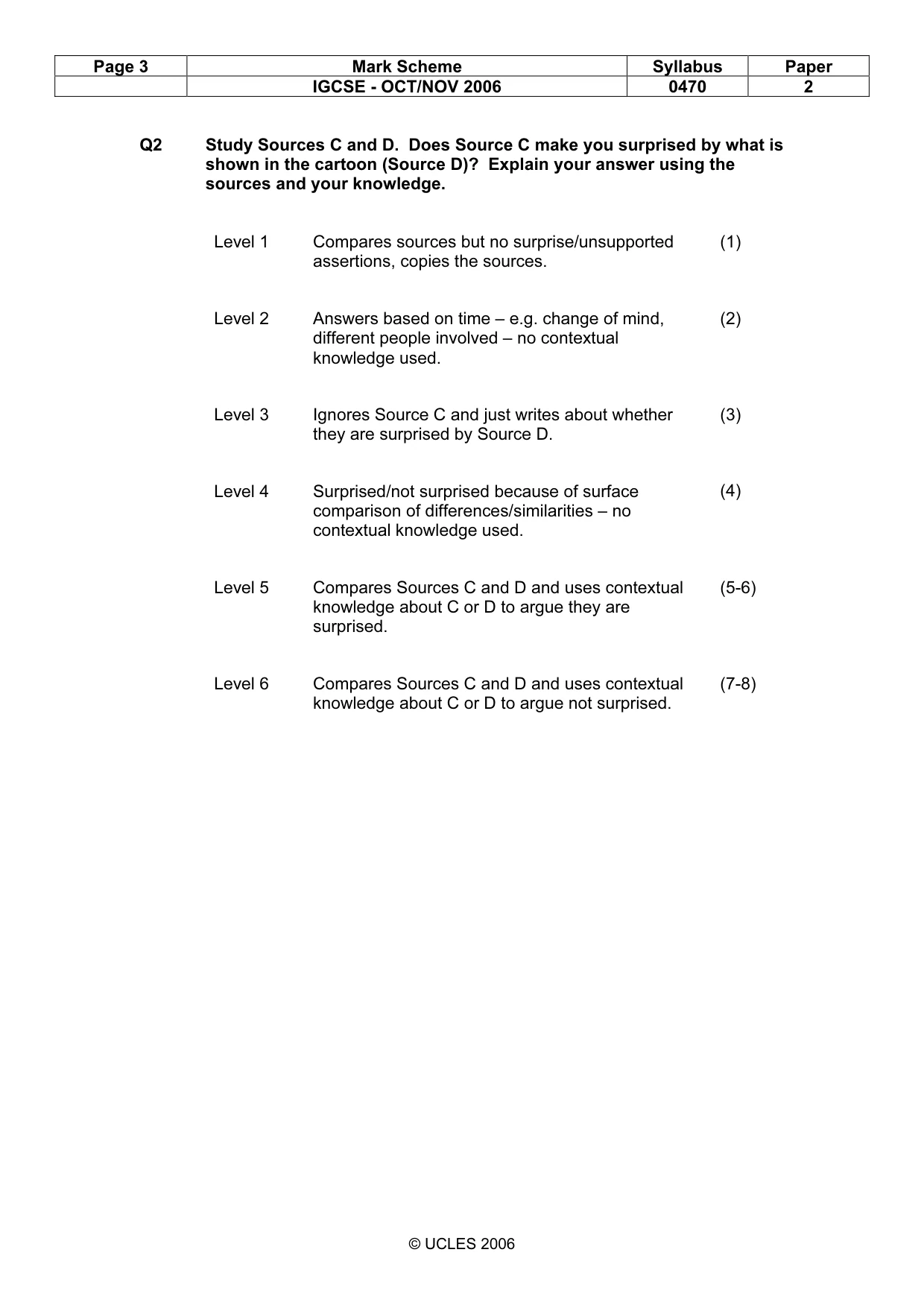
Page 3 Mark Scheme Syllabus Paper IGCSE - OCT/NOV 2006 0470 2 © UCLES 2006 Q2 Study Sources C and D. Does Source C make you surprised by what is shown in the cartoon (Source D)? Explain your answer using the sources and your knowledge. Level 1 Compares sources but no surprise/unsupported assertions, copies the sources. (1) Level 2 Answers based on time – e.g. change of mind, different people involved – no contextual knowledge used. (2) Level 3 Ignores Source C and just writes about whether they are surprised by Source D. (3) Level 4 Surprised/not surprised because of surface comparison of differences/similarities – no contextual knowledge used. (4) Level 5 Compares Sources C and D and uses contextual knowledge about C or D to argue they are surprised. (5-6) Level 6 Compares Sources C and D and uses contextual knowledge about C or D to argue not surprised. (7-8)
Mark scheme, page 4
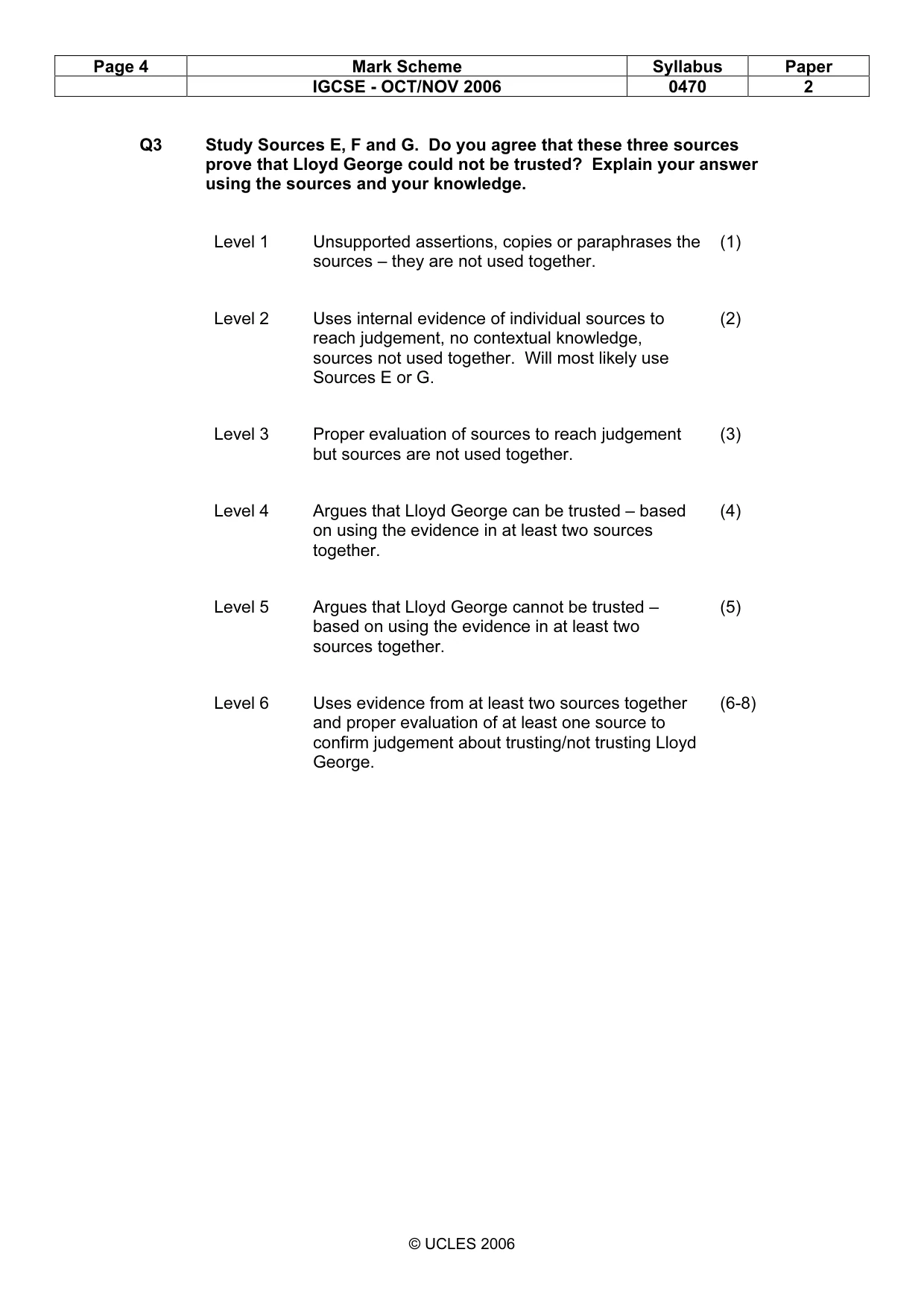
Page 4 Mark Scheme Syllabus Paper IGCSE - OCT/NOV 2006 0470 2 © UCLES 2006 Q3 Study Sources E, F and G. Do you agree that these three sources prove that Lloyd George could not be trusted? Explain your answer using the sources and your knowledge. Level 1 Unsupported assertions, copies or paraphrases the sources – they are not used together. (1) Level 2 Uses internal evidence of individual sources to reach judgement, no contextual knowledge, sources not used together. Will most likely use Sources E or G. (2) Level 3 Proper evaluation of sources to reach judgement but sources are not used together. (3) Level 4 Argues that Lloyd George can be trusted – based on using the evidence in at least two sources together. (4) Level 5 Argues that Lloyd George cannot be trusted – based on using the evidence in at least two sources together. (5) Level 6 Uses evidence from at least two sources together and proper evaluation of at least one source to confirm judgement about trusting/not trusting Lloyd George. (6-8)
Mark scheme, page 5
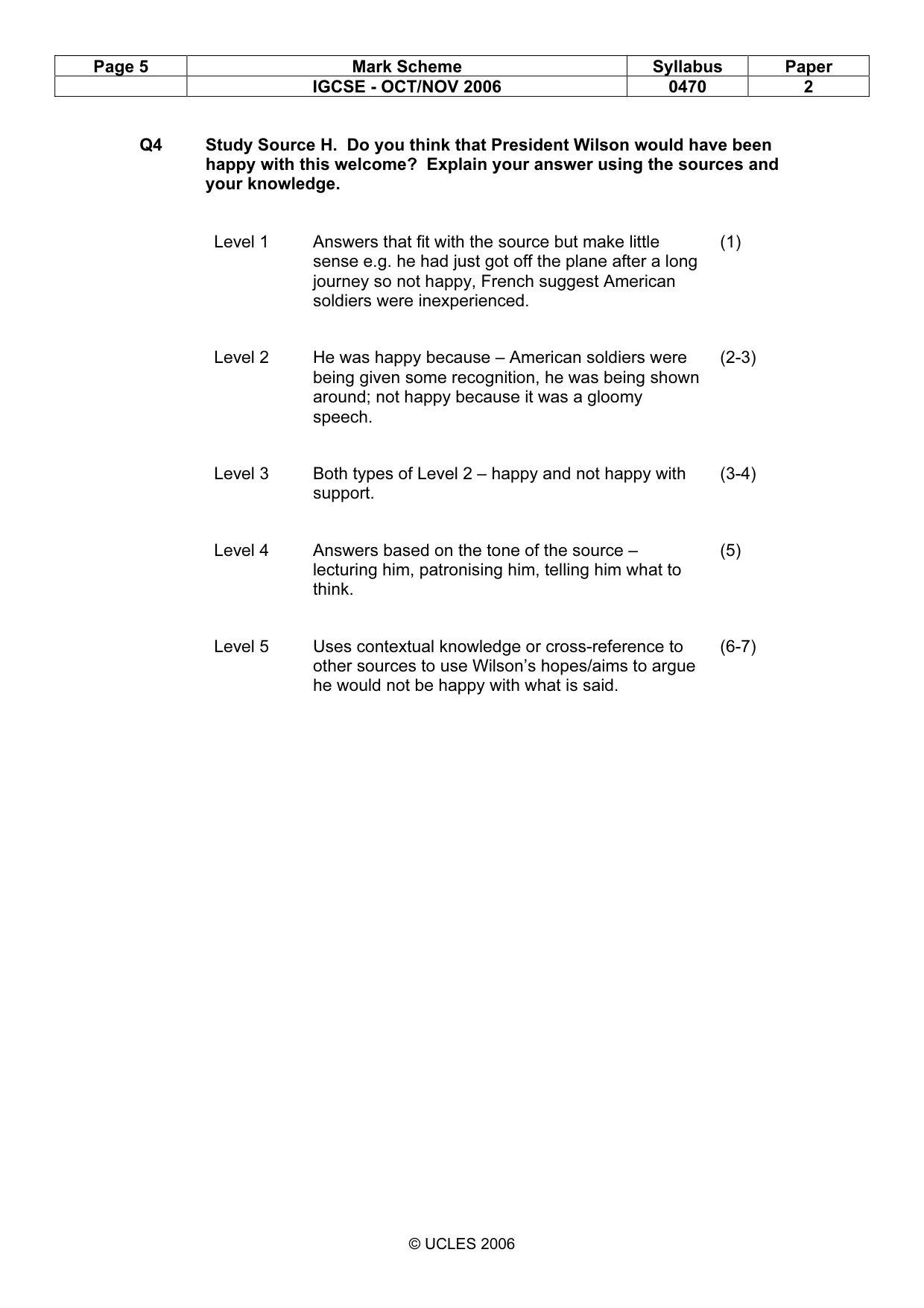
Page 5 Mark Scheme Syllabus Paper IGCSE - OCT/NOV 2006 0470 2 © UCLES 2006 Q4 Study Source H. Do you think that President Wilson would have been happy with this welcome? Explain your answer using the sources and your knowledge. Level 1 Answers that fit with the source but make little sense e.g. he had just got off the plane after a long journey so not happy, French suggest American soldiers were inexperienced. (1) Level 2 He was happy because – American soldiers were being given some recognition, he was being shown around; not happy because it was a gloomy speech. (2-3) Level 3 Both types of Level 2 – happy and not happy with support. (3-4) Level 4 Answers based on the tone of the source – lecturing him, patronising him, telling him what to think. (5) Level 5 Uses contextual knowledge or cross-reference to other sources to use Wilson’s hopes/aims to argue he would not be happy with what is said. (6-7)
Mark scheme, page 6
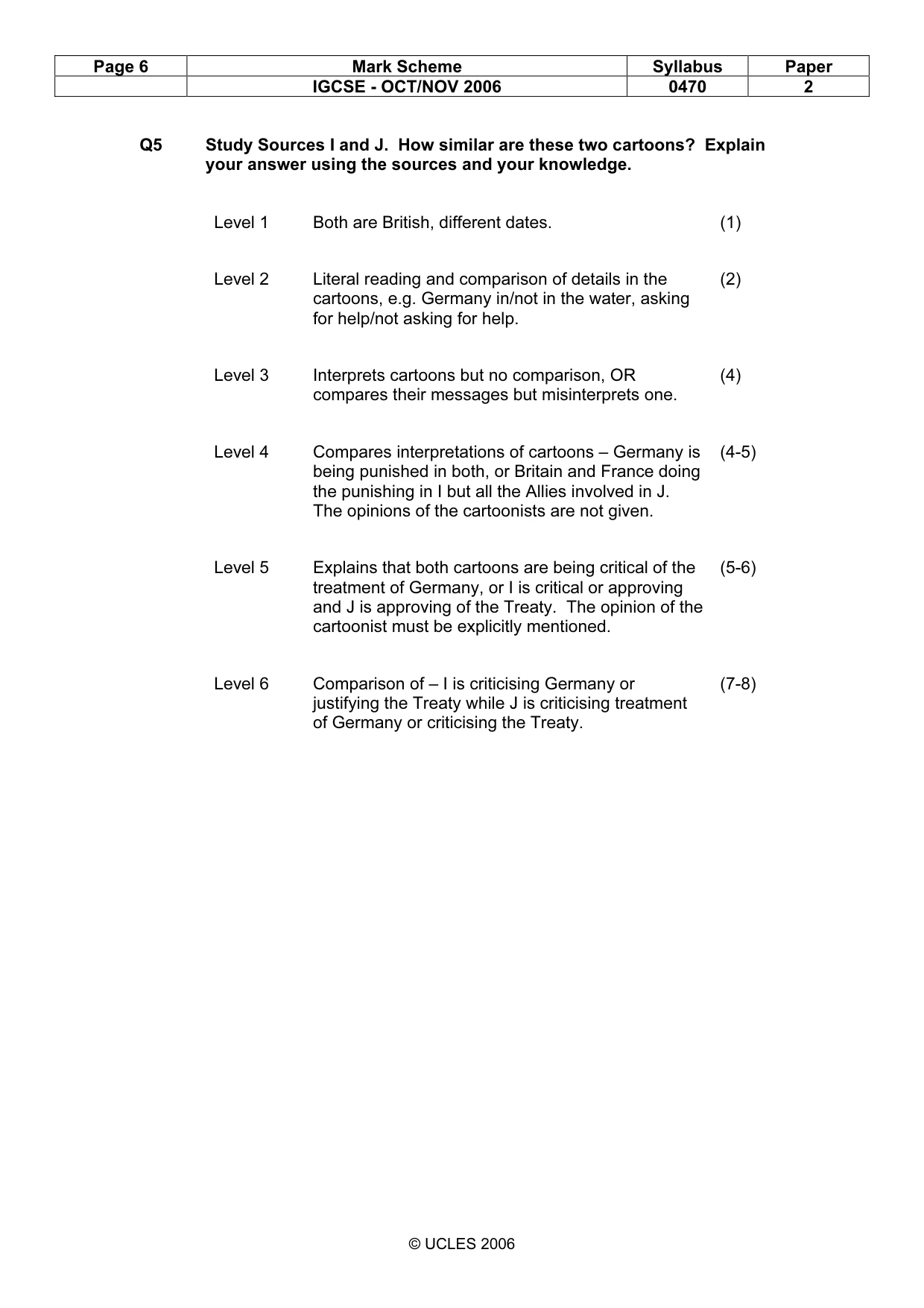
Page 6 Mark Scheme Syllabus Paper IGCSE - OCT/NOV 2006 0470 2 © UCLES 2006 Q5 Study Sources I and J. How similar are these two cartoons? Explain your answer using the sources and your knowledge. Level 1 Both are British, different dates. (1) Level 2 Literal reading and comparison of details in the cartoons, e.g. Germany in/not in the water, asking for help/not asking for help. (2) Level 3 Interprets cartoons but no comparison, OR compares their messages but misinterprets one. (4) Level 4 Compares interpretations of cartoons – Germany is being punished in both, or Britain and France doing the punishing in I but all the Allies involved in J. The opinions of the cartoonists are not given. (4-5) Level 5 Explains that both cartoons are being critical of the treatment of Germany, or I is critical or approving and J is approving of the Treaty. The opinion of the cartoonist must be explicitly mentioned. (5-6) Level 6 Comparison of – I is criticising Germany or justifying the Treaty while J is criticising treatment of Germany or criticising the Treaty. (7-8)
Mark scheme, page 7
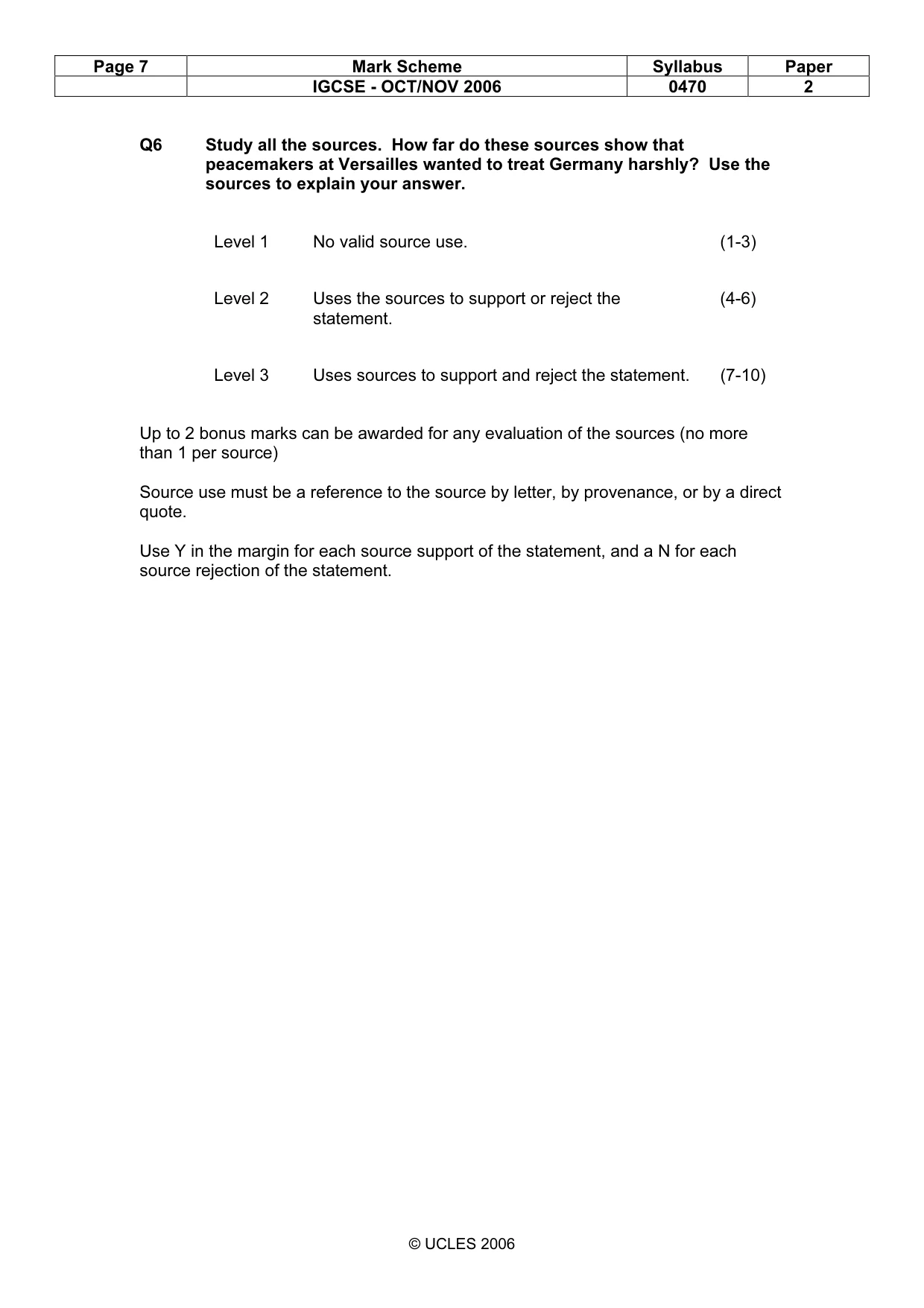
Page 7 Mark Scheme Syllabus Paper IGCSE - OCT/NOV 2006 0470 2 © UCLES 2006 Q6 Study all the sources. How far do these sources show that peacemakers at Versailles wanted to treat Germany harshly? Use the sources to explain your answer. Level 1 No valid source use. (1-3) Level 2 Uses the sources to support or reject the statement. (4-6) Level 3 Uses sources to support and reject the statement. (7-10) Up to 2 bonus marks can be awarded for any evaluation of the sources (no more than 1 per source) Source use must be a reference to the source by letter, by provenance, or by a direct quote. Use Y in the margin for each source support of the statement, and a N for each source rejection of the statement.
Mark scheme, page 8
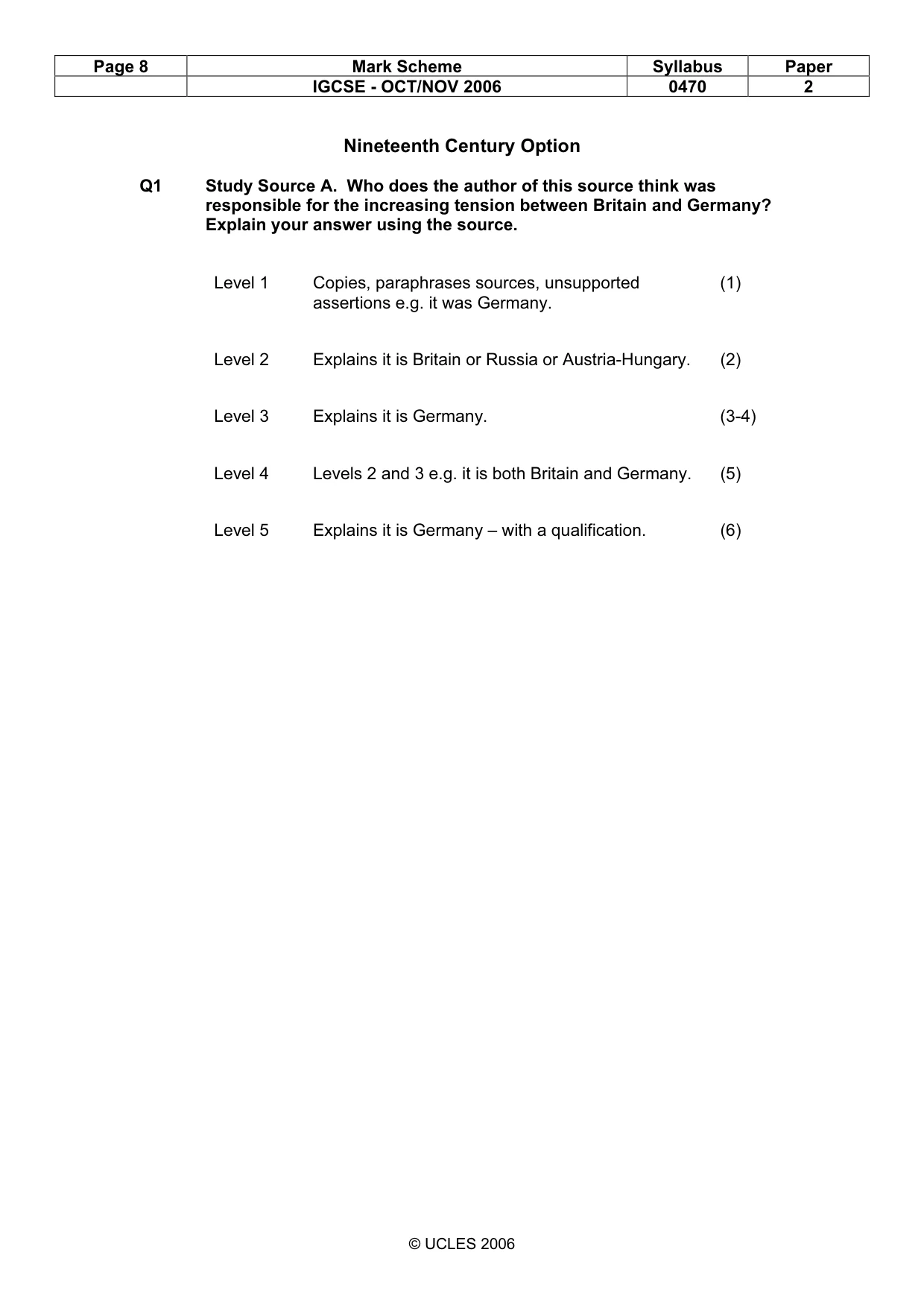
Page 8 Mark Scheme Syllabus Paper IGCSE - OCT/NOV 2006 0470 2 © UCLES 2006 Nineteenth Century Option Q1 Study Source A. Who does the author of this source think was responsible for the increasing tension between Britain and Germany? Explain your answer using the source. Level 1 Copies, paraphrases sources, unsupported assertions e.g. it was Germany. (1) Level 2 Explains it is Britain or Russia or Austria-Hungary. (2) Level 3 Explains it is Germany. (3-4) Level 4 Levels 2 and 3 e.g. it is both Britain and Germany. (5) Level 5 Explains it is Germany – with a qualification. (6)
Mark scheme, page 9
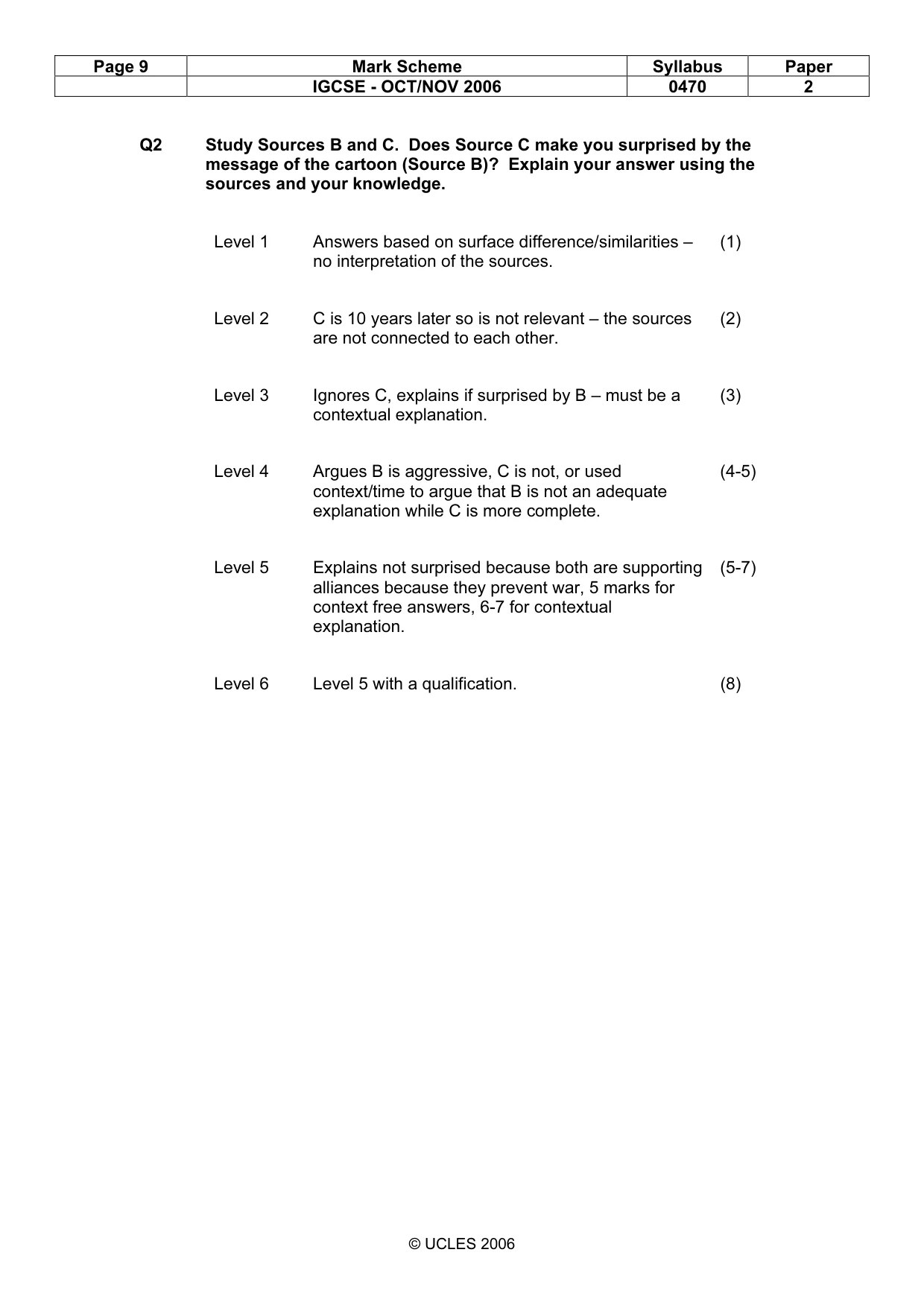
Page 9 Mark Scheme Syllabus Paper IGCSE - OCT/NOV 2006 0470 2 © UCLES 2006 Q2 Study Sources B and C. Does Source C make you surprised by the message of the cartoon (Source B)? Explain your answer using the sources and your knowledge. Level 1 Answers based on surface difference/similarities – no interpretation of the sources. (1) Level 2 C is 10 years later so is not relevant – the sources are not connected to each other. (2) Level 3 Ignores C, explains if surprised by B – must be a contextual explanation. (3) Level 4 Argues B is aggressive, C is not, or used context/time to argue that B is not an adequate explanation while C is more complete. (4-5) Level 5 Explains not surprised because both are supporting alliances because they prevent war, 5 marks for context free answers, 6-7 for contextual explanation. (5-7) Level 6 Level 5 with a qualification. (8)
Mark scheme, page 10
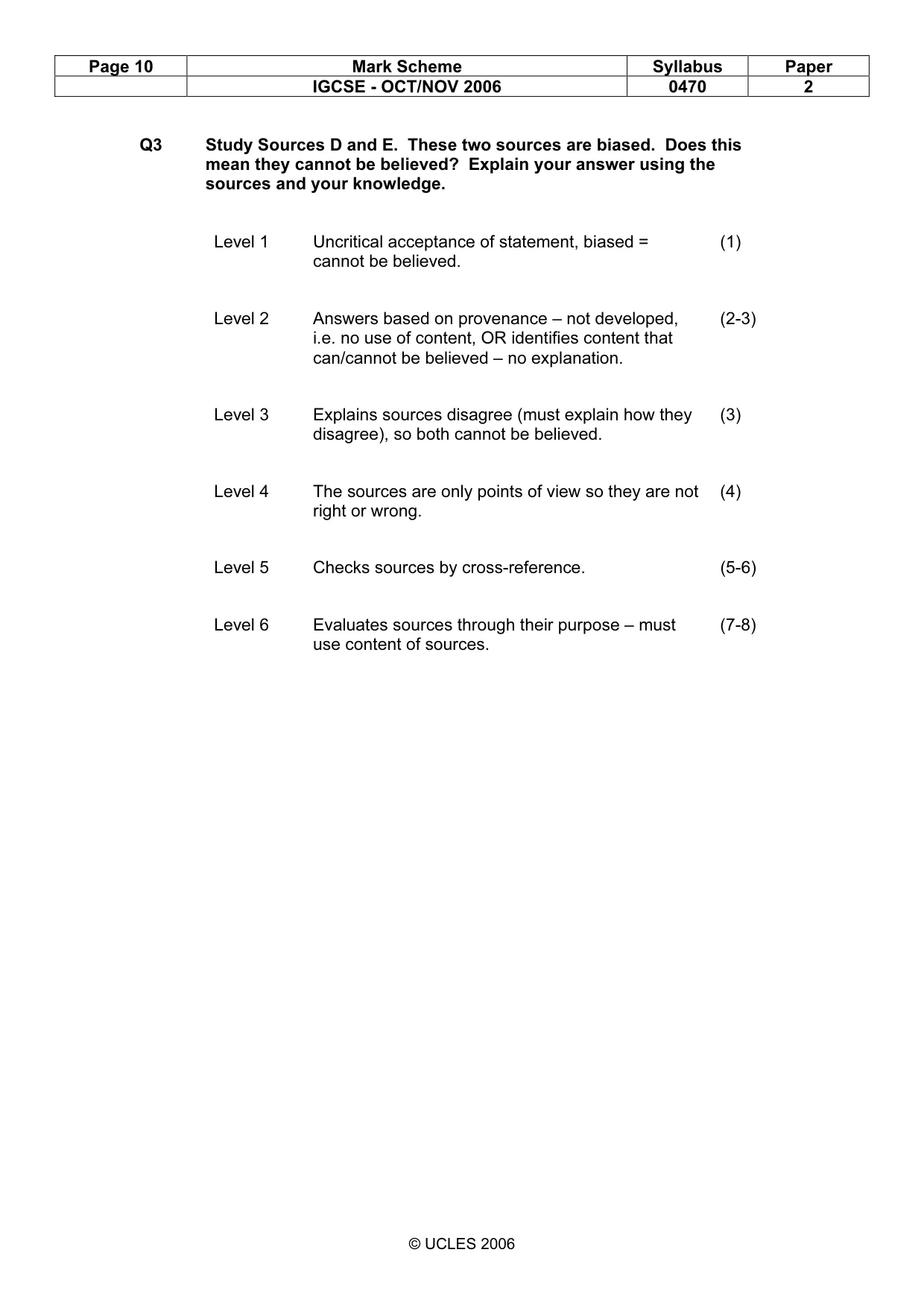
Page 10 Mark Scheme Syllabus Paper IGCSE - OCT/NOV 2006 0470 2 © UCLES 2006 Q3 Study Sources D and E. These two sources are biased. Does this mean they cannot be believed? Explain your answer using the sources and your knowledge. Level 1 Uncritical acceptance of statement, biased = cannot be believed. (1) Level 2 Answers based on provenance – not developed, i.e. no use of content, OR identifies content that can/cannot be believed – no explanation. (2-3) Level 3 Explains sources disagree (must explain how they disagree), so both cannot be believed. (3) Level 4 The sources are only points of view so they are not right or wrong. (4) Level 5 Checks sources by cross-reference. (5-6) Level 6 Evaluates sources through their purpose – must use content of sources. (7-8)
Mark scheme, page 11
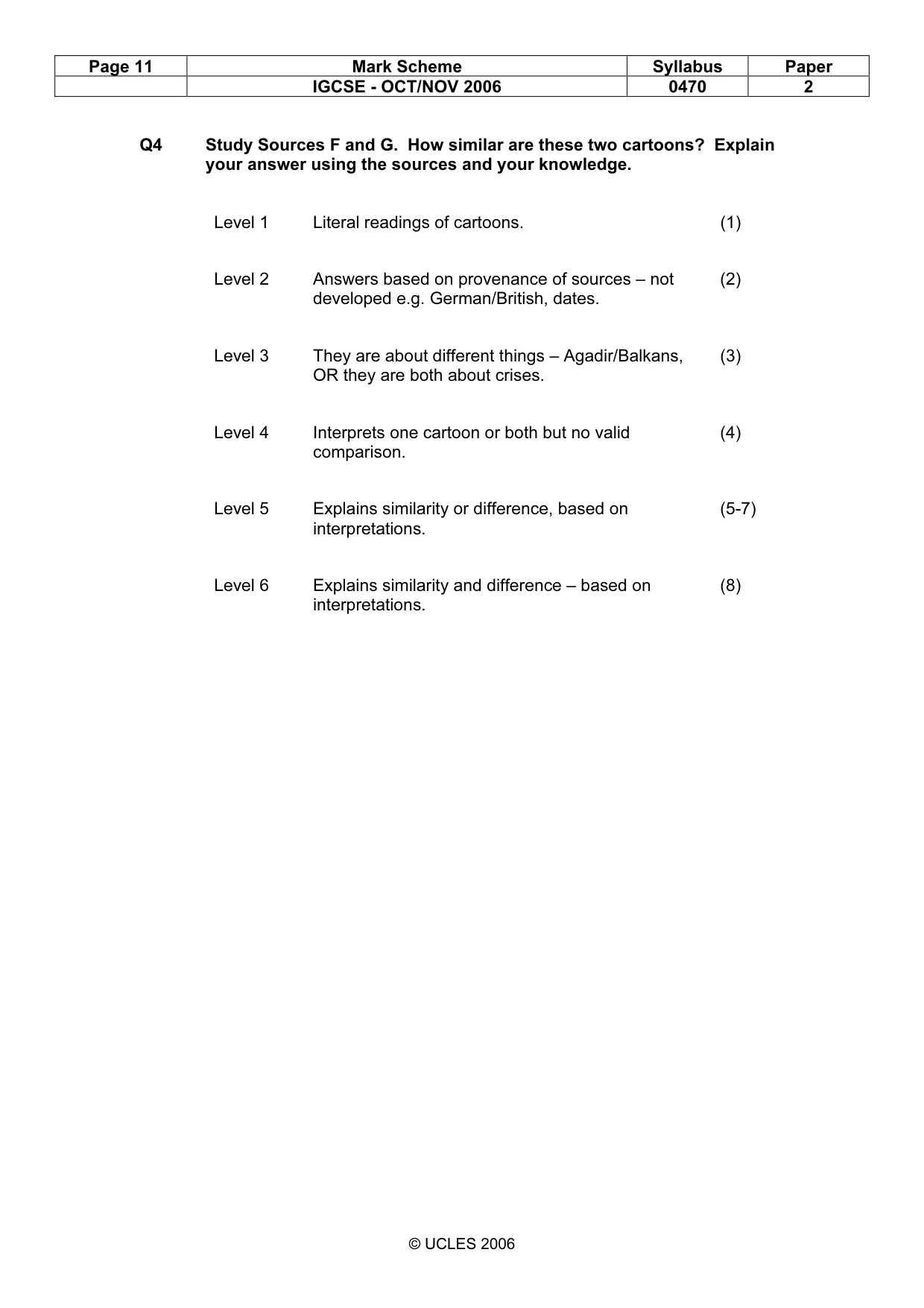
Page 11 Mark Scheme Syllabus Paper IGCSE - OCT/NOV 2006 0470 2 © UCLES 2006 Q4 Study Sources F and G. How similar are these two cartoons? Explain your answer using the sources and your knowledge. Level 1 Literal readings of cartoons. (1) Level 2 Answers based on provenance of sources – not developed e.g. German/British, dates. (2) Level 3 They are about different things – Agadir/Balkans, OR they are both about crises. (3) Level 4 Interprets one cartoon or both but no valid comparison. (4) Level 5 Explains similarity or difference, based on interpretations. (5-7) Level 6 Explains similarity and difference – based on interpretations. (8)
Mark scheme, page 12
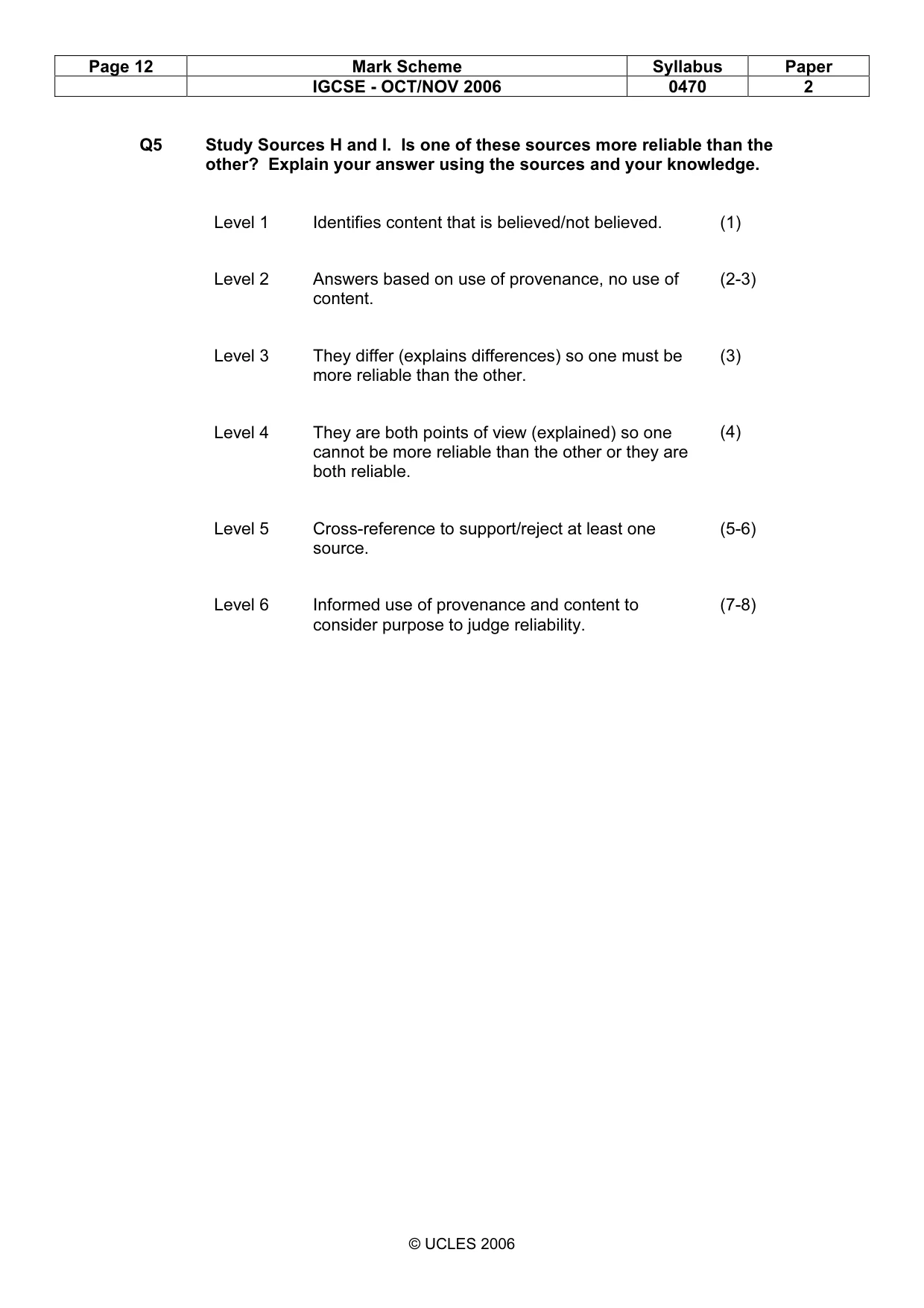
Page 12 Mark Scheme Syllabus Paper IGCSE - OCT/NOV 2006 0470 2 © UCLES 2006 Q5 Study Sources H and I. Is one of these sources more reliable than the other? Explain your answer using the sources and your knowledge. Level 1 Identifies content that is believed/not believed. (1) Level 2 Answers based on use of provenance, no use of content. (2-3) Level 3 They differ (explains differences) so one must be more reliable than the other. (3) Level 4 They are both points of view (explained) so one cannot be more reliable than the other or they are both reliable. (4) Level 5 Cross-reference to support/reject at least one source. (5-6) Level 6 Informed use of provenance and content to consider purpose to judge reliability. (7-8)
Mark scheme, page 13
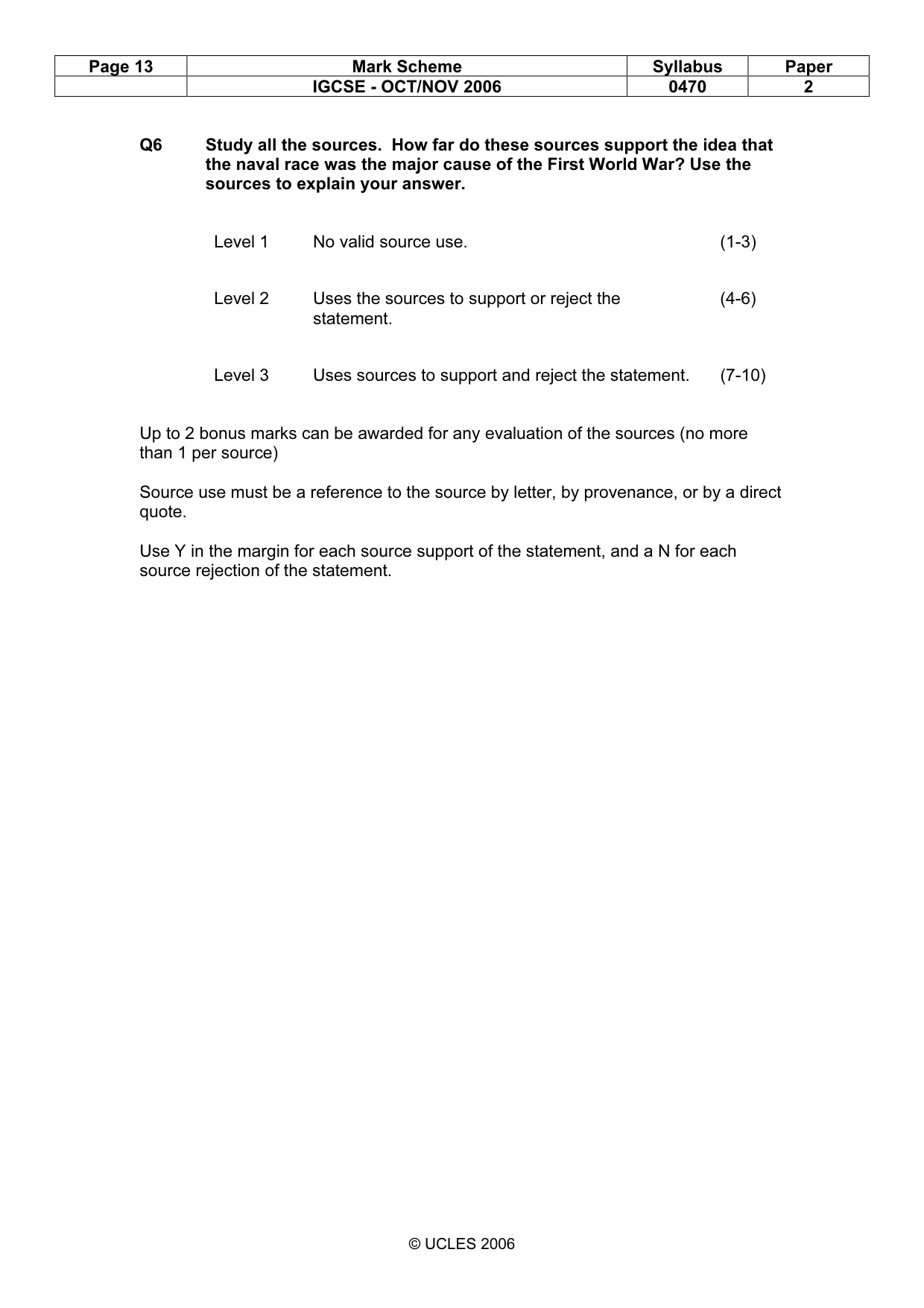
Page 13 Mark Scheme Syllabus Paper IGCSE - OCT/NOV 2006 0470 2 © UCLES 2006 Q6 Study all the sources. How far do these sources support the idea that the naval race was the major cause of the First World War? Use the sources to explain your answer. Level 1 No valid source use. (1-3) Level 2 Uses the sources to support or reject the statement. (4-6) Level 3 Uses sources to support and reject the statement. (7-10) Up to 2 bonus marks can be awarded for any evaluation of the sources (no more than 1 per source) Source use must be a reference to the source by letter, by provenance, or by a direct quote. Use Y in the margin for each source support of the statement, and a N for each source rejection of the statement.
What you needed in this session
Cambridge’s own grade thresholds for 2006 Oct/Nov, Paper 2 · Variant 1. A higher threshold means an easier paper — the bar moves with how the cohort did.