Cambridge IGCSE History 0470 — 2006 May/June Paper 2 · Variant 1
0470/21/M/J/06 · 50 marks · ≈56 min
The question paper and its mark scheme, free to read here and free to download. This is Cambridge’s own paper, exactly as it was sat.
Question paper12 pages
Mark scheme4 pages
Answers below. Sit the paper first if you are practising.
Paper as text
Question paper, page 1
This document consists of 11 printed pages and 1 blank page. SP (NF/CGW) T06786/2 © UCLES 2006 [Turn over UNIVERSITY OF CAMBRIDGE INTERNATIONAL EXAMINATIONS International General Certificate of Secondary Education HISTORY 0470/02 Paper 2 May/June 2006 2 hours Additional Materials: Answer Booklet/Paper READ THESE INSTRUCTIONS FIRST If you have been given an Answer Booklet, follow the instructions on the front cover of the Booklet. Write your Centre number, candidate number and name on all the work you hand in. Write in dark blue or black pen. You may use a soft pencil for any diagrams, graphs or rough working. Do not use staples, paper clips, highlighters, glue or correction fluid. This paper has two options. Option A: 19th Century topic [p2–p6] Option B: 20th Century topic [p7–p11] Choose one of these options, and then answer all the questions on that topic. At the end of the examination, fasten all your work securely together. The number of marks is given in brackets [ ] at the end of each question or part question. www.XtremePapers.com
Question paper, page 2
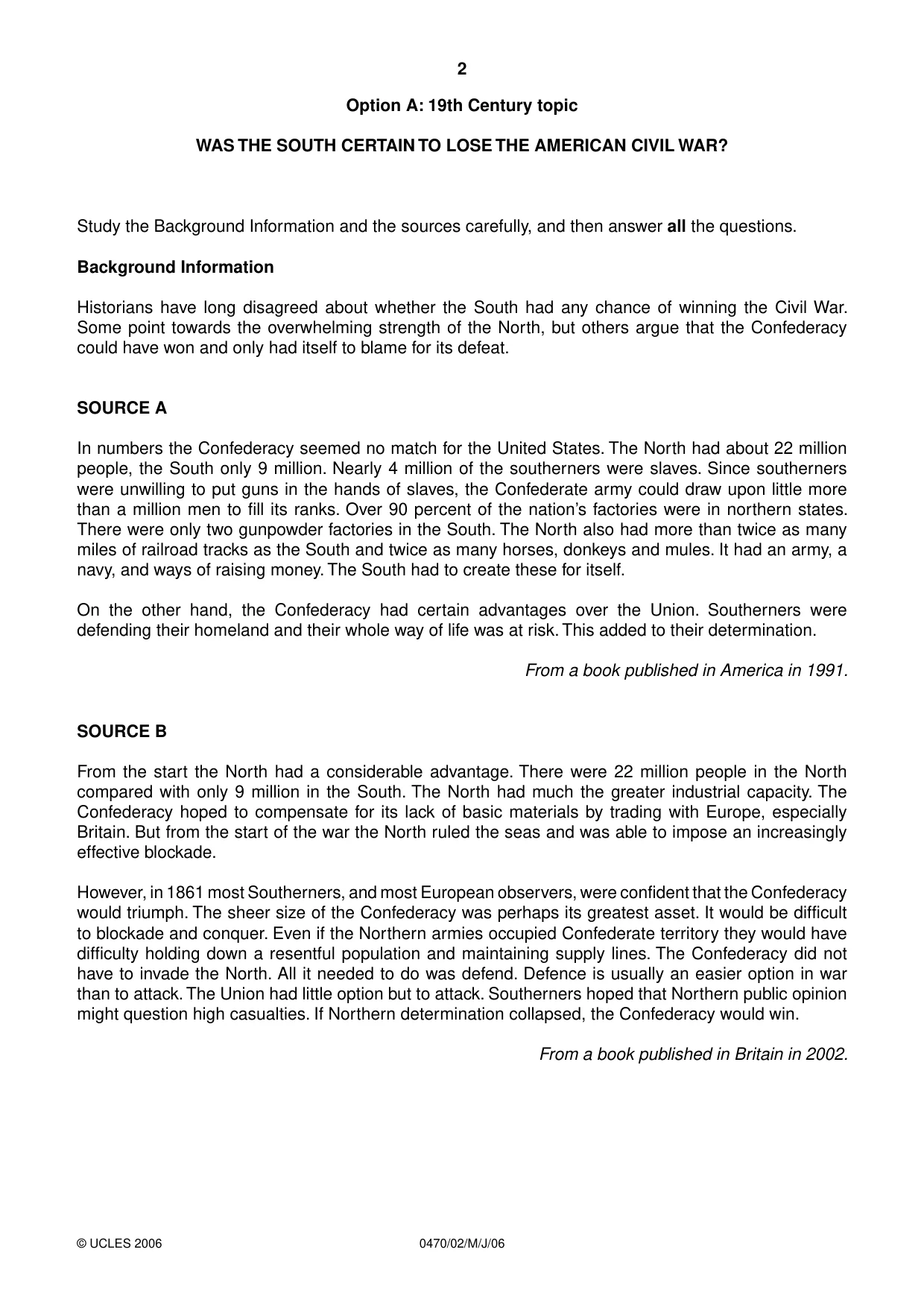
2 0470/02/M/J/06 © UCLES 2006 Option A: 19th Century topic WAS THE SOUTH CERTAIN TO LOSE THE AMERICAN CIVIL WAR? Study the Background Information and the sources carefully, and then answer all the questions. Background Information Historians have long disagreed about whether the South had any chance of winning the Civil War. Some point towards the overwhelming strength of the North, but others argue that the Confederacy could have won and only had itself to blame for its defeat. SOURCE A In numbers the Confederacy seemed no match for the United States. The North had about 22 million people, the South only 9 million. Nearly 4 million of the southerners were slaves. Since southerners were unwilling to put guns in the hands of slaves, the Confederate army could draw upon little more than a million men to fill its ranks. Over 90 percent of the nation’s factories were in northern states. There were only two gunpowder factories in the South. The North also had more than twice as many miles of railroad tracks as the South and twice as many horses, donkeys and mules. It had an army, a navy, and ways of raising money. The South had to create these for itself. On the other hand, the Confederacy had certain advantages over the Union. Southerners were defending their homeland and their whole way of life was at risk. This added to their determination. From a book published in America in 1991. SOURCE B From the start the North had a considerable advantage. There were 22 million people in the North compared with only 9 million in the South. The North had much the greater industrial capacity. The Confederacy hoped to compensate for its lack of basic materials by trading with Europe, especially Britain. But from the start of the war the North ruled the seas and was able to impose an increasingly effective blockade. However, in 1861 most Southerners, and most European observers, were confident that the Confederacy would triumph. The sheer size of the Confederacy was perhaps its greatest asset. It would be difficult to blockade and conquer. Even if the Northern armies occupied Confederate territory they would have difficulty holding down a resentful population and maintaining supply lines. The Confederacy did not have to invade the North. All it needed to do was defend. Defence is usually an easier option in war than to attack. The Union had little option but to attack. Southerners hoped that Northern public opinion might question high casualties. If Northern determination collapsed, the Confederacy would win. From a book published in Britain in 2002.
Question paper, page 3
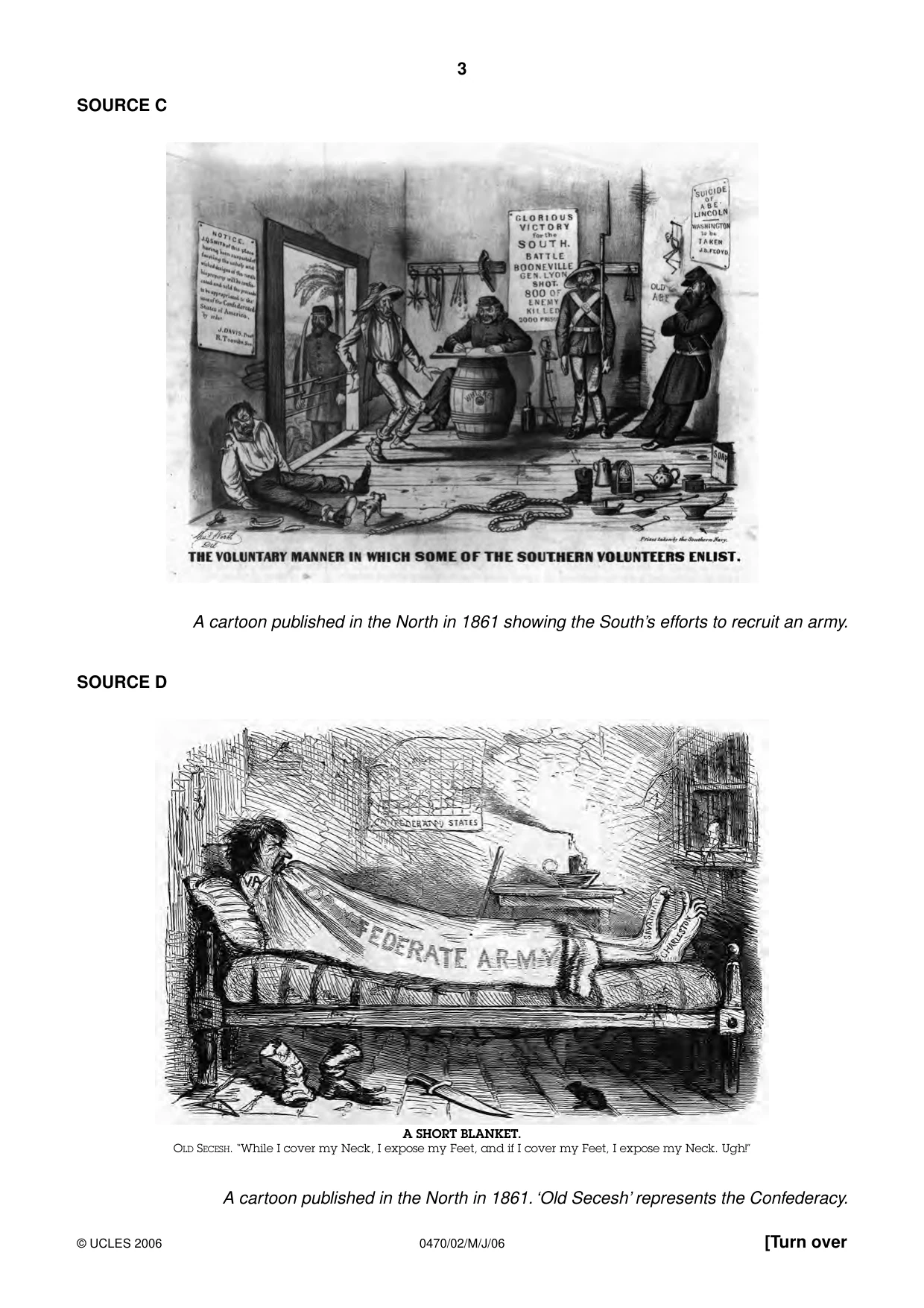
3 0470/02/M/J/06 © UCLES 2006 [Turn over SOURCE C A cartoon published in the North in 1861 showing the South’s efforts to recruit an army. SOURCE D A SHORT BLANKET. OLD SECESH. “While I cover my Neck, I expose my Feet, and if I cover my Feet, I expose my Neck. Ugh!” A cartoon published in the North in 1861. ‘Old Secesh’ represents the Confederacy.
Question paper, page 4
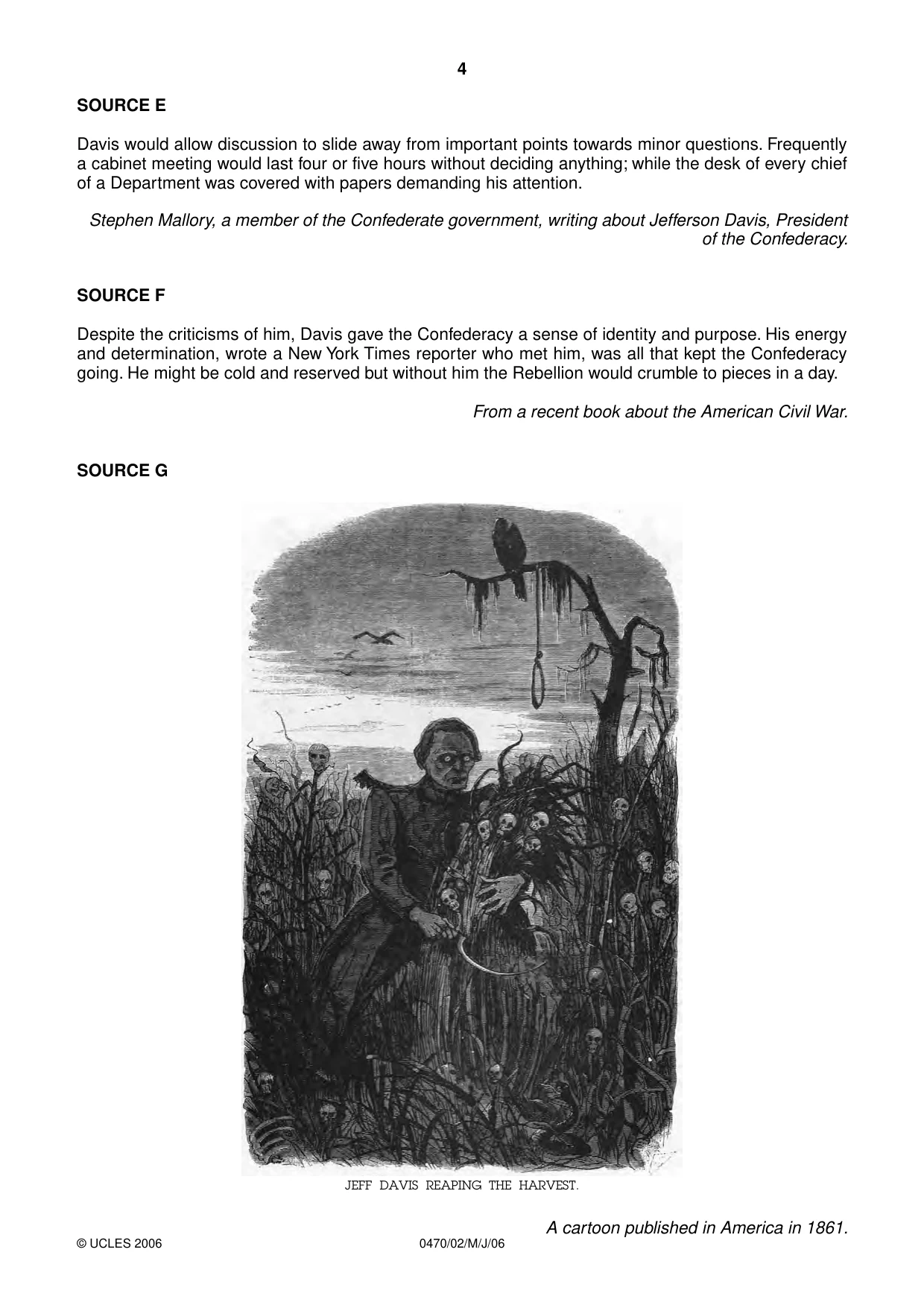
4 0470/02/M/J/06 © UCLES 2006 SOURCE E Davis would allow discussion to slide away from important points towards minor questions. Frequently a cabinet meeting would last four or five hours without deciding anything; while the desk of every chief of a Department was covered with papers demanding his attention. Stephen Mallory, a member of the Confederate government, writing about Jefferson Davis, President of the Confederacy. SOURCE F Despite the criticisms of him, Davis gave the Confederacy a sense of identity and purpose. His energy and determination, wrote a New York Times reporter who met him, was all that kept the Confederacy going. He might be cold and reserved but without him the Rebellion would crumble to pieces in a day. From a recent book about the American Civil War. SOURCE G JEFF DAVIS REAPING THE HARVEST. A cartoon published in America in 1861.
Question paper, page 5
5 0470/02/M/J/06 © UCLES 2006 [Turn over SOURCE H The army did all it could. I fear I asked it to achieve the impossible. When a military commander fails he should be removed. I have read criticism of me in the newspapers. I do not know how far this feeling extends in the army. My brother officers have been too kind to report it and so far the troops have been too generous to report it. It is fair, however, to suppose that it does exist. Everything, therefore, points to the advantage of having a new commander. I know he will have as gallant and brave an army as ever existed to support his efforts. From a letter by General Lee to President Davis, 8 July 1863 (five days after the Battle of Gettysburg). SOURCE I Events have succeeded one another with disastrous speed. One brief month ago we were apparently at the point of success. Lee was in Pennsylvania threatening Harrisburg and even Philadelphia. Now the picture is just as dark as it was bright then. It seems incredible that human power could bring about such a change in so brief a time. Then we were at the height of our success – today we face absolute ruin. The Confederacy is stumbling to its destruction. Josiah Gorgas’ entry in his diary for 28 July 1863. Gorgas was in charge of supplying the Confederate army.
Question paper, page 6
6 0470/02/M/J/06 © UCLES 2006 Now answer all the following questions. You may use any of the sources to help you answer the questions, in addition to those sources which you are told to use. In answering the questions you should use your own knowledge of the topic to help you interpret and evaluate the sources. 1 Study Sources A and B. How far do these two sources agree? Explain your answer using the sources and your knowledge. [7] 2 Study Sources C and D. How similar are the messages of these two cartoons? Explain your answer using the sources and your knowledge. [8] 3 Study Sources E and F. Does Source E prove that Source F is wrong about Davis? Explain your answer using the sources and your knowledge. [8] 4 Study Source G. Why do you think this cartoon was drawn? Explain your answer using the source and your knowledge. [7] 5 Study Sources H and I. Are you surprised by what Lee says in his letter? Explain your answer using the sources and your knowledge. [8] 6 Study all the sources. How far do these sources support the view that, as early as 1861, it was certain the South would lose? Use the sources to explain your answer. [12]
Question paper, page 7
7 0470/02/M/J/06 © UCLES 2006 [Turn over Option B: 20th Century topic WAS THE CUBAN MISSILE CRISIS SIMPLY A TRIAL OF STRENGTH BETWEEN KENNEDY AND KHRUSHCHEV? Study the Background Information and the sources carefully, and then answer all the questions. Background Information In 1962 the Soviet Union started to build missile sites in Cuba from which nuclear warheads could be launched at America. In October an American U-2 spy plane photographed the sites being constructed. President Kennedy demanded that the sites be dismantled, but Khrushchev refused. For thirteen days the world held its breath while the two superpowers faced each other. For some people at the time this crisis was simply a personal trial of strength between President Kennedy and Chairman Khrushchev, whilst for others it had a wider significance. SOURCE A I’ve got two problems. First to figure out why Khrushchev acted in such a hostile way. And second, to figure out what we can do about it. I think the first part is pretty easy to explain. I think he did it because of the Bay of Pigs. He thought that anyone who was so young and inexperienced as to get into that mess could be beaten; and anyone who got into it and didn’t see it through had no guts. So he just beat the hell out of me. If he thinks I’m inexperienced and have no guts, until we remove those ideas we won’t get anywhere with him. Kennedy speaking to a reporter in 1961 shortly after a meeting with Khrushchev. In the meeting Khrushchev had been very unfriendly to Kennedy.
Question paper, page 8
8 0470/02/M/J/06 © UCLES 2006 SOURCE B A cartoon published in a British newspaper in October 1962. Kennedy and Khrushchev are shown as gunslingers. Castro is on the donkey. SOURCE C A cartoon published in Britain in 1962.
Question paper, page 9
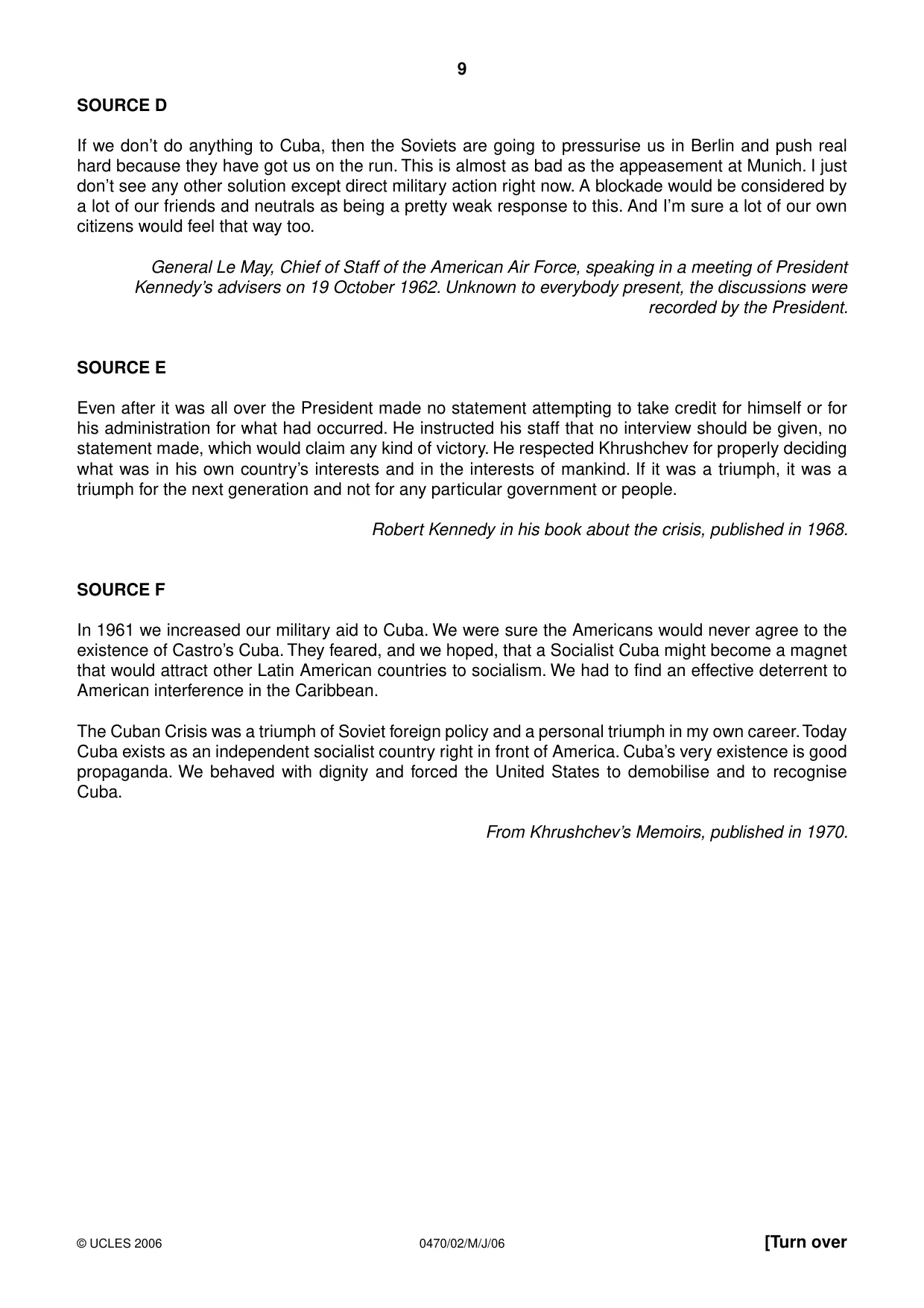
9 0470/02/M/J/06 © UCLES 2006 [Turn over SOURCE D If we don’t do anything to Cuba, then the Soviets are going to pressurise us in Berlin and push real hard because they have got us on the run. This is almost as bad as the appeasement at Munich. I just don’t see any other solution except direct military action right now. A blockade would be considered by a lot of our friends and neutrals as being a pretty weak response to this. And I’m sure a lot of our own citizens would feel that way too. General Le May, Chief of Staff of the American Air Force, speaking in a meeting of President Kennedy’s advisers on 19 October 1962. Unknown to everybody present, the discussions were recorded by the President. SOURCE E Even after it was all over the President made no statement attempting to take credit for himself or for his administration for what had occurred. He instructed his staff that no interview should be given, no statement made, which would claim any kind of victory. He respected Khrushchev for properly deciding what was in his own country’s interests and in the interests of mankind. If it was a triumph, it was a triumph for the next generation and not for any particular government or people. Robert Kennedy in his book about the crisis, published in 1968. SOURCE F In 1961 we increased our military aid to Cuba. We were sure the Americans would never agree to the existence of Castro’s Cuba. They feared, and we hoped, that a Socialist Cuba might become a magnet that would attract other Latin American countries to socialism. We had to find an effective deterrent to American interference in the Caribbean. The Cuban Crisis was a triumph of Soviet foreign policy and a personal triumph in my own career. Today Cuba exists as an independent socialist country right in front of America. Cuba’s very existence is good propaganda. We behaved with dignity and forced the United States to demobilise and to recognise Cuba. From Khrushchev’s Memoirs, published in 1970.
Question paper, page 10
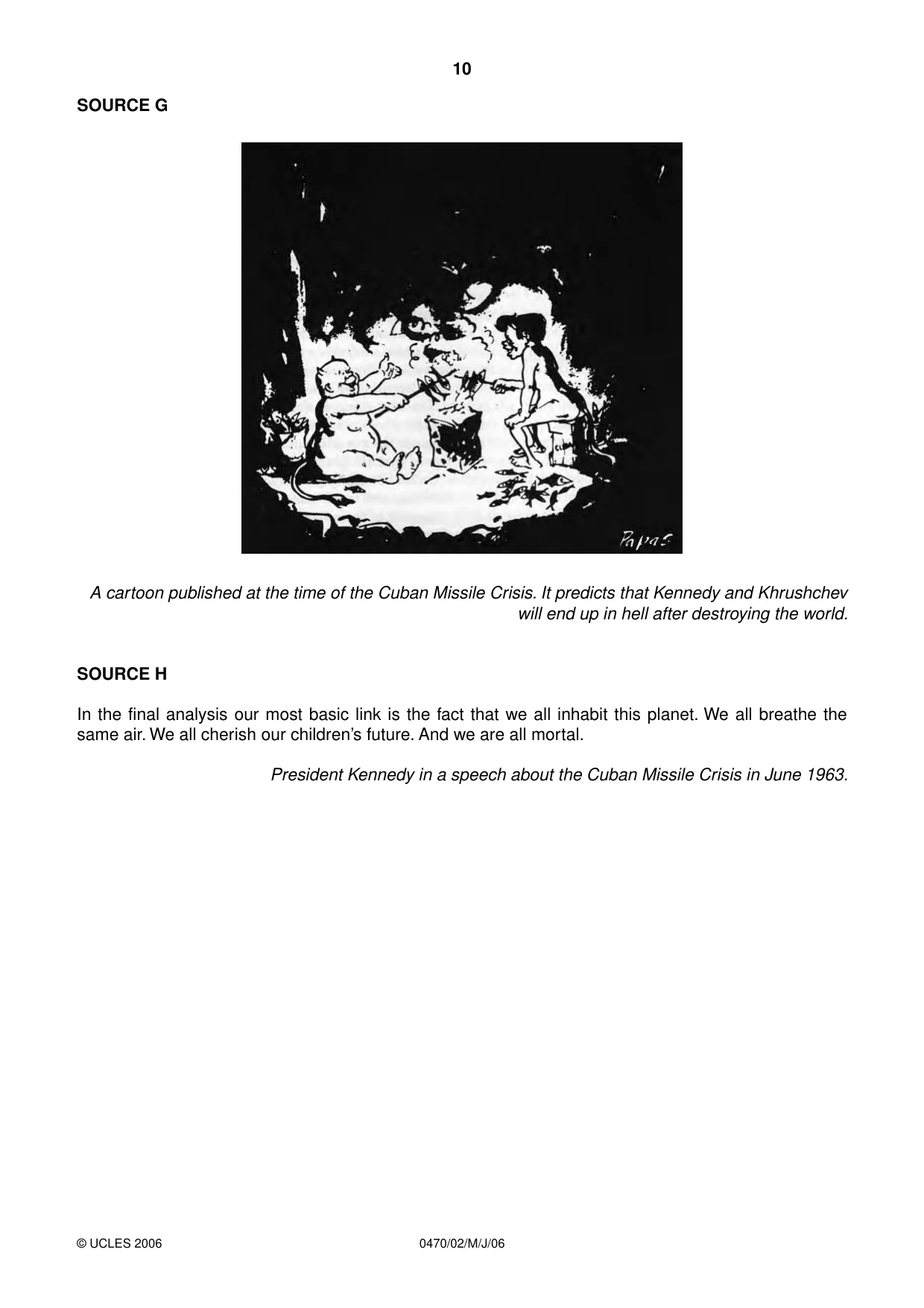
10 0470/02/M/J/06 © UCLES 2006 SOURCE G A cartoon published at the time of the Cuban Missile Crisis. It predicts that Kennedy and Khrushchev will end up in hell after destroying the world. SOURCE H In the final analysis our most basic link is the fact that we all inhabit this planet. We all breathe the same air. We all cherish our children’s future. And we are all mortal. President Kennedy in a speech about the Cuban Missile Crisis in June 1963.
Question paper, page 11
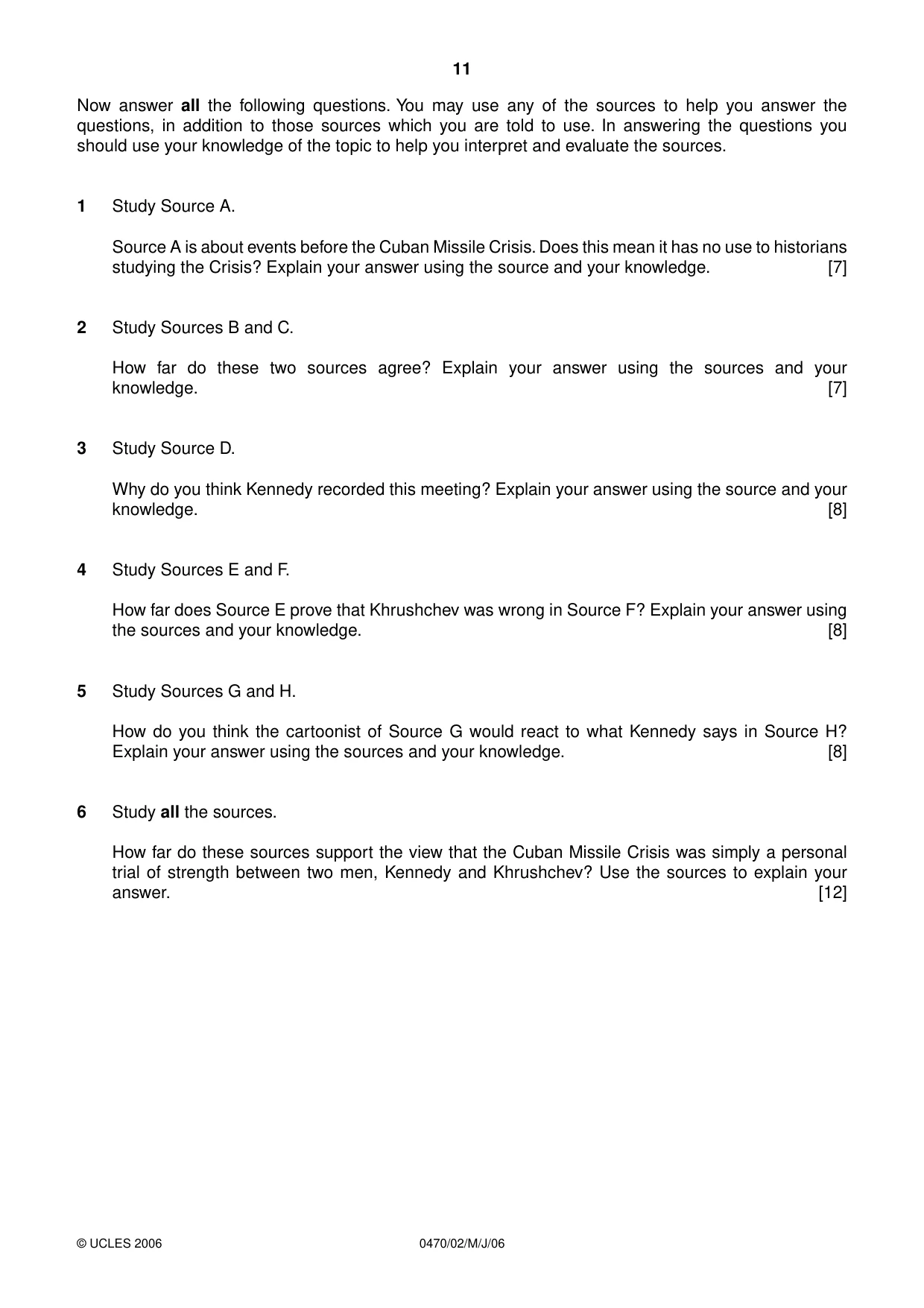
11 0470/02/M/J/06 © UCLES 2006 Now answer all the following questions. You may use any of the sources to help you answer the questions, in addition to those sources which you are told to use. In answering the questions you should use your knowledge of the topic to help you interpret and evaluate the sources. 1 Study Source A. Source A is about events before the Cuban Missile Crisis. Does this mean it has no use to historians studying the Crisis? Explain your answer using the source and your knowledge. [7] 2 Study Sources B and C. How far do these two sources agree? Explain your answer using the sources and your knowledge. [7] 3 Study Source D. Why do you think Kennedy recorded this meeting? Explain your answer using the source and your knowledge. [8] 4 Study Sources E and F. How far does Source E prove that Khrushchev was wrong in Source F? Explain your answer using the sources and your knowledge. [8] 5 Study Sources G and H. How do you think the cartoonist of Source G would react to what Kennedy says in Source H? Explain your answer using the sources and your knowledge. [8] 6 Study all the sources. How far do these sources support the view that the Cuban Missile Crisis was simply a personal trial of strength between two men, Kennedy and Khrushchev? Use the sources to explain your answer. [12]
Question paper, page 12
12 0470/02/M/J/06 BLANK PAGE Copyright Acknowledgements: Option A Source A © John Garraty; Story of America; Holt, Rinehart & Winston; 1991. Source B © Alan Farmer; The American Civil War 1861–65; Hodder Murray; 2002. Source E © Alan Farmer; The American Civil War 1861–65; Hodder Murray; 2002. Source F © Alan Farmer; The American Civil War 1861–65; Hodder Murray; 2002. Option B Source A © B O’Callaghan; A History of the Twentieth Century; Longman; 1987. Source B © Express Picture Library. Source E From THIRTEEN DAYS: A MEMOIR OF THE CUBAN MISSILE CRISIS by Robert F. Kennedy. Copyright © 1968 by McCall Corporation. Used by permission of W. W. Norton & Company, Inc. Source G William Elias Papas © The Guardian. Permission to reproduce items where third-party owned material protected by copyright is included has been sought and cleared where possible. Every reasonable effort has been made by the publisher (UCLES) to trace copyright holders, but if any items requiring clearance have unwittingly been included, the publisher will be pleased to make amends at the earliest possible opportunity. University of Cambridge International Examinations is part of the University of Cambridge Local Examinations Syndicate (UCLES), which is itself a department of the University of Cambridge.
Mark scheme, page 1
UNIVERSITY OF CAMBRIDGE INTERNATIONAL EXAMINATIONS International General Certificate of Secondary Education MARK SCHEME for the May/June 2006 question paper 0470 HISTORY 0470/02 Paper 2, maximum raw mark 50 These mark schemes are published as an aid to teachers and students, to indicate the requirements of the examination. They show the basis on which Examiners were initially instructed to award marks. They do not indicate the details of the discussions that took place at an Examiners’ meeting before marking began. Any substantial changes to the mark scheme that arose from these discussions will be recorded in the published Report on the Examination. All Examiners are instructed that alternative correct answers and unexpected approaches in candidates’ scripts must be given marks that fairly reflect the relevant knowledge and skills demonstrated. Mark schemes must be read in conjunction with the question papers and the Report on the Examination. The minimum marks in these components needed for various grades were previously published with these mark schemes, but are now instead included in the Report on the Examination for this session. • CIE will not enter into discussion or correspondence in connection with these mark schemes. CIE is publishing the mark schemes for the May/June 2006 question papers for most IGCSE and GCE Advanced Level and Advanced Subsidiary Level syllabuses and some Ordinary Level syllabuses. www.XtremePapers.com
Mark scheme, page 2
Page 1 Mark Scheme Syllabus Paper IGCSE – May/June 2006 0470 02 © University of Cambridge International Examinations 2006 Option A: 19th century topic 1 Study Sources A and B. How far do these two sources agree? Explain your answer using the sources. Level 1 Unsupported assertions, copies/paraphrases sources - no matching (1) Level 2 Identifies points that are in one source but not in the other (2-3) Level 3 Identifies/explains similarities or differences (3-5) Level 4 Identifies/explains similarities and differences (6-7) 2 Study Sources C and D. How similar are the messages of these two cartoons? Explain your answer using the sources and your knowledge. Level 1 Unsupported assertions/describes sources, no comparison (1) Level 2 Comparison of surface details - no interpretation (2) Level 3 Interprets cartoons but no comparison (3-4) Level 4 Explains differences (4) Level 5 Explains similarities (5-6) Level 6 Level 5 with qualification (8) 3 Study Sources E and F. Does Source E prove that Source F is wrong about Davis? Explain your answer using the sources and your own knowledge. Level 1 Unsupported assertions/paraphrases the sources (1) Level 2 Knee-jerk evaluation used to dismiss source(s) (2-3) Level 3 No - claims they are about different things (3) Level 4 Yes - explains how they differ (4-5) Level 5 As Level 4 but with qualification - based on cold and reserved (6) Level 6 Contextual knowledge used to evaluate the sources (7-8) 4 Study Source G. Why do you think this cartoon was drawn ? Explain your answer using the source and your knowledge. Level 1 Unsupported assertions/describes the source (1) Level 2 To criticise southern politicians - not explained (2-3) Level 3 Interprets the cartoon (4-6) Level 4 Contextual knowledge used to consider purpose of cartoon (7) 5 Study Sources H and I. Are you surprised by what Lee says in his letter? Explain your answer using the sources and your knowledge. Level 1 Unsupported assertions/paraphrases sources (1) Level 2 Yes because he is resigning - not explained (2-3) Level 3 No because of the reasons given in H (4-5) Level 4 Sees differences between the two sources (6) Level 5 Levels 3 and 4 (7) Level 6 Uses contextual knowledge to explain Lee’s reaction (7-8)
Mark scheme, page 3
Page 2 Mark Scheme Syllabus Paper IGCSE – May/June 2006 0470 02 © University of Cambridge International Examinations 2006 6 Study all the sources. How far do these sources support the view that, as early as 1861, it was certain the South would lose? Use the sources to explain your answer. Level 1 No valid source use (1-3) Level 2 Uses sources to support or reject the statement (4-6) Level 3 Uses sources to support AND reject the statement (7-10) Up to 2 bonus marks for any evaluation of sources (no more than 1 per source). Source use must be reference to a source by letter, by provenance, or by a direct quote. There must be examples from source content. Use Y in the margin for each source support of the statement, and a N for each source rejection of statement. Option B: 20th century topic 1 Source A is about events before the Cuban Missile Crisis. Does this mean it has no use to historians studying the Crisis? Explain your answer using the source and your knowledge. Level 1 Agrees, explains why it is of no use (1) Level 2 Shows the two men were not on good terms, shows US/USSR rivalry (2-3) Level 3 Shows possible motives for Khrushchev or Kennedy in CMC (4-5) Level 4 Shows possible motives for Khrushchev and Kennedy in CMC (6-7) 2 Study Sources B and C. How far do these two sources agree? Explain your answer using the sources and your knowledge. Level 1 Unsupported assertions, describes cartoons - no comparison (1) Level 2 Compares surface details (2) Level 3 Interprets sources but no comparison (3) Level 4 Compares sub-messages, probably for differences (4) Level 5 Asserts they both show it was about personal rivalry – not supported (5) Level 6 Explains how they both show it as personal rivalry (6) Level 7 As Level 6 but with a qualification about a difference (7) 3 Study Source D. Why do you think Kennedy recorded this meeting? Explain your answer using the sources and your knowledge. Level 1 Practical purposes, in case people forgot, so he could refer to it (1-2) Level 2 He did not tell anyone - so up to something underhand (3) Level 3 Doing it so people/historians in the future could understand what happened (4-5) Level 4 To justify his actions, to put the blame on other people (6) Level 5 Level 4 but in context of CMC - explains how crucial/important to the existence of the world these decisions were (7-8) Level 6 Explains Kennedy knew in advance the military would give this advice - so to cover himself (8)
Mark scheme, page 4
Page 3 Mark Scheme Syllabus Paper IGCSE – May/June 2006 0470 02 © University of Cambridge International Examinations 2006 4 Study Sources E and F. How far does Source E prove that Khrushchev was wrong in Source F? Explain your answer using the sources and your knowledge. Level 1 Unsupported assertions/paraphrases the sources (1) Level 2 Evaluates F on basis of language/tone - no context (2-3) Level 3 Explains ways in which E shows he was wrong in F, e.g. not a triumph for anyone - based on differences between E and F (3-4) Level 4 Shows Khrushchev was wrong because shows Kennedy in a good light, Khrushchev in a bad light (5) Level 5 Uses context to evaluate F - e.g. purpose (6-7) Level 6 Shows Khrushchev was right, Kennedy keeping it low key because he knows he has lost (8) 5 Study Sources G and H. How do you think the cartoonist of Source G would react to what Kennedy says in Source H? Explain your answer using the sources and your knowledge. Level 1 Unsupported assertions, describes sources, paraphrases - no comparison (1) Level 2 Interprets sources - no comparison (2-3) Level 3 Interprets G as criticising Khrushchev, so would not necessarily be critical of Kennedy (4-5) Level 4 Explains how G and H have opposite messages (6-7) Level 5 Level 4 but also explains how the cartoonist would see Kennedy as hypocrite or as trying to justify himself (7-8) 6 Study all the sources. How far do these sources support the view that the Cuban Missile Crisis was simply a personal trial of strength between two men, Kennedy and Khrushchev? Use the sources to explain your answer. Level 1 No valid source use (1-3) Level 2 Uses sources to support or reject the statement (4-6) Level 3 Uses sources to support AND reject the statement (7-10) Up to 2 bonus marks for any evaluation of sources (no more than 1 per source). Source use must be reference to a source by letter, by provenance, or by a direct quote. There must be examples from source content. Use Y in the margin for each source support of the statement, and a N for each source rejection of statement.
What you needed in this session
Cambridge’s own grade thresholds for 2006 May/June, Paper 2 · Variant 1. A higher threshold means an easier paper — the bar moves with how the cohort did.