Cambridge IGCSE History 0470 — 2005 Oct/Nov Paper 2 · Variant 1
0470/21/O/N/05
The question paper and its mark scheme, free to read here and free to download. This is Cambridge’s own paper, exactly as it was sat.
Question paper12 pages
Mark scheme4 pages
Answers below. Sit the paper first if you are practising.
Paper as text
Question paper, page 1
This document consists of 12 printed pages. SP (NF/KS) S81335/6 © UCLES 2005 [Turn over UNIVERSITY OF CAMBRIDGE INTERNATIONAL EXAMINATIONS International General Certificate of Secondary Education HISTORY 0470/02 Paper 2 October/November 2005 2 hours Additional Materials: Answer Booklet/Paper READ THESE INSTRUCTIONS FIRST If you have been given an Answer Booklet, follow the instructions on the front cover of the Booklet. Write your Centre number, candidate number and name on all the work you hand in. Write in dark blue or black pen on both sides of the paper. You may use a soft pencil for any diagrams, graphs or rough working. Do not use staples, paper clips, highlighters, glue or correction fluid. The paper has two options. Option A: 19th Century topic [p2–p7] Option B: 20th Century topic [p8– p12] Choose one of these options, and then answer all the questions on that topic. The number of marks is given in brackets [ ] at the end of each question or part question. At the end of the examination, fasten all your work securely together. www.XtremePapers.com
Question paper, page 2
2 0470/02/O/N/05 Option A: 19th Century topic WHY DID RECONSTRUCTION FAIL? Study the Background Information and the sources carefully, and then answer all the questions. Background Information In 1865 the victorious federal government was faced with the problem of making peace and integrating the former Confederate states back into the Union. Some historians have claimed that this period of Reconstruction was a time when the South was cruelly oppressed by the North. Others disagree with this view and argue that Reconstruction was extraordinarily lenient with black Americans remaining second-class citizens in the South. The issue is confused by the fact that many white Southerners were seething with resentment while Northerners were divided over what to do. During the Reconstruction period America had three Presidents; Lincoln, Johnson and Grant – all with different views. By the early 1870s Reconstruction was already failing. Why? SOURCE A The governments imposed on the Southern states by the North proved hopelessly inefficient and corrupt. The blacks formed the majority of the voters, and in theory occupied most of the key offices. But the real power was in the hands of Northern ‘carpetbaggers’ and a few Southern white renegades called ‘scalawags’. No laws could be passed without bribes, and no verdicts in the courts obtained without money being passed to the judges. The South, its whites united in hatred of the governments, hit back by force. The years 1866–71 saw the birth of the Ku Klux Klan. They terrorised the black community and where terror failed they used the whip and the noose. And they murdered carpetbaggers too. The whites learned how to hate blacks. A different kind of society came into being, based on racial hatred. Within a decade of its establishment reconstruction had been destroyed. The new white regimes set about legislating blacks into a lowly place in the scheme of things. The North, having had quite enough of the South and its blacks, turned its attention to other things. From a history book published in 1997. SOURCE B I spent most of the afternoon in a political meeting, held for the purpose of considering the necessity for a new Cabinet and a firmer policy than Mr Lincoln’s. While everybody was shocked at his murder, the feeling of nearly everybody was that the accession of Johnson to the Presidency would prove a godsend to the country. As well as Mr Lincoln’s known policy of tenderness to the Rebels, his views on Reconstruction were also distasteful to Radical Republicans. G W Julian, a Radical, describing what he did on the day Lincoln was assassinated (15 April 1865). © UCLES 2005
Question paper, page 3
3 0470/02/O/N/05 [Turn over SOURCE C In May 1865 President Johnson extended recognition to the Southern governments created under Lincoln’s administration, none of which had given blacks the vote. The same month he issued a general amnesty to most Southerners as long as they were prepared to swear an oath of allegiance and support emancipation. Johnson also ordered that confiscated land be returned to pardoned Southerners. Why Johnson so quickly abandoned the idea of punishing ex-Confederates is something of a mystery. There were rumours at that time that some Southerners used bribery to win pardons. Others suspected that flattery by Southern planters and their wives played upon the President’s ego. More likely, Johnson simply came to view co-operation with the Southern elite as essential to the maintenance of white supremacy in the South and to his own re-election as President in 1868. From a history book published in 1997. SOURCE D With malice towards none, with charity for all, with God as our guide, let us strive to finish the work we are in, to heal the nation’s wounds, to care for him who shall have borne the battle and for his widow and his orphan, to do all which may achieve a just and lasting peace among ourselves. From a speech by President Lincoln in March 1865. SOURCE E Unless the rebel States should be made republican in spirit, and placed under the guardianship of loyal men, all our blood and money will have been spent in vain. Having these States entirely within the power of Congress, it is our duty to take care that no injustice shall remain in their laws. There is more reason why black voters should be given the vote in rebel States than in the Territories. In the States they form the great mass of the loyal men. The white Union men are in a great minority in each of those States. With them the blacks would act in a body. Thaddeus Stevens, a Radical, speaking in Congress in January 1867. © UCLES 2005
Question paper, page 4
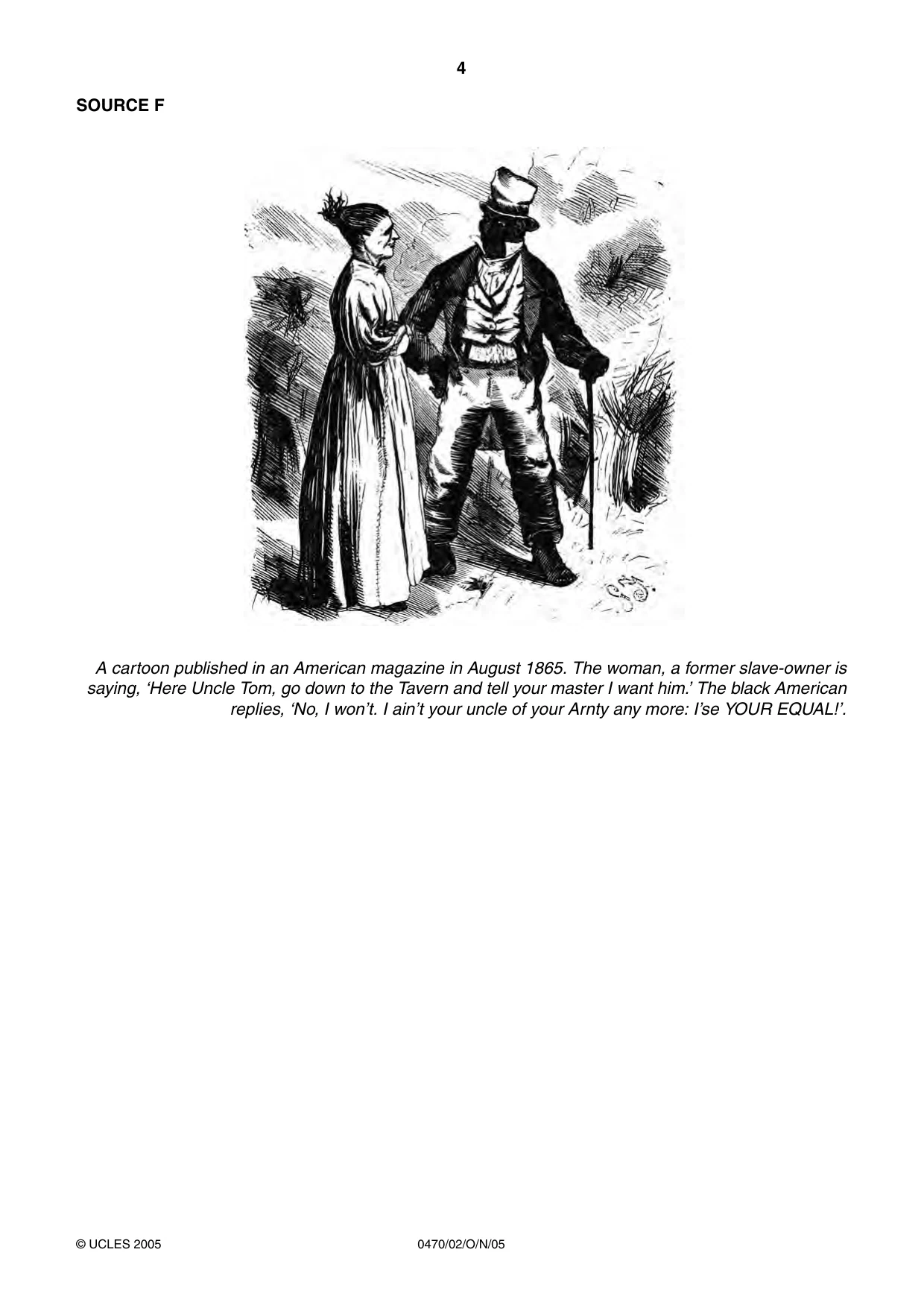
4 0470/02/O/N/05 SOURCE F A cartoon published in an American magazine in August 1865. The woman, a former slave-owner is saying, ‘Here Uncle Tom, go down to the Tavern and tell your master I want him.’ The black American replies, ‘No, I won’t. I ain’t your uncle of your Arnty any more: I’se YOUR EQUAL!’. © UCLES 2005
Question paper, page 5
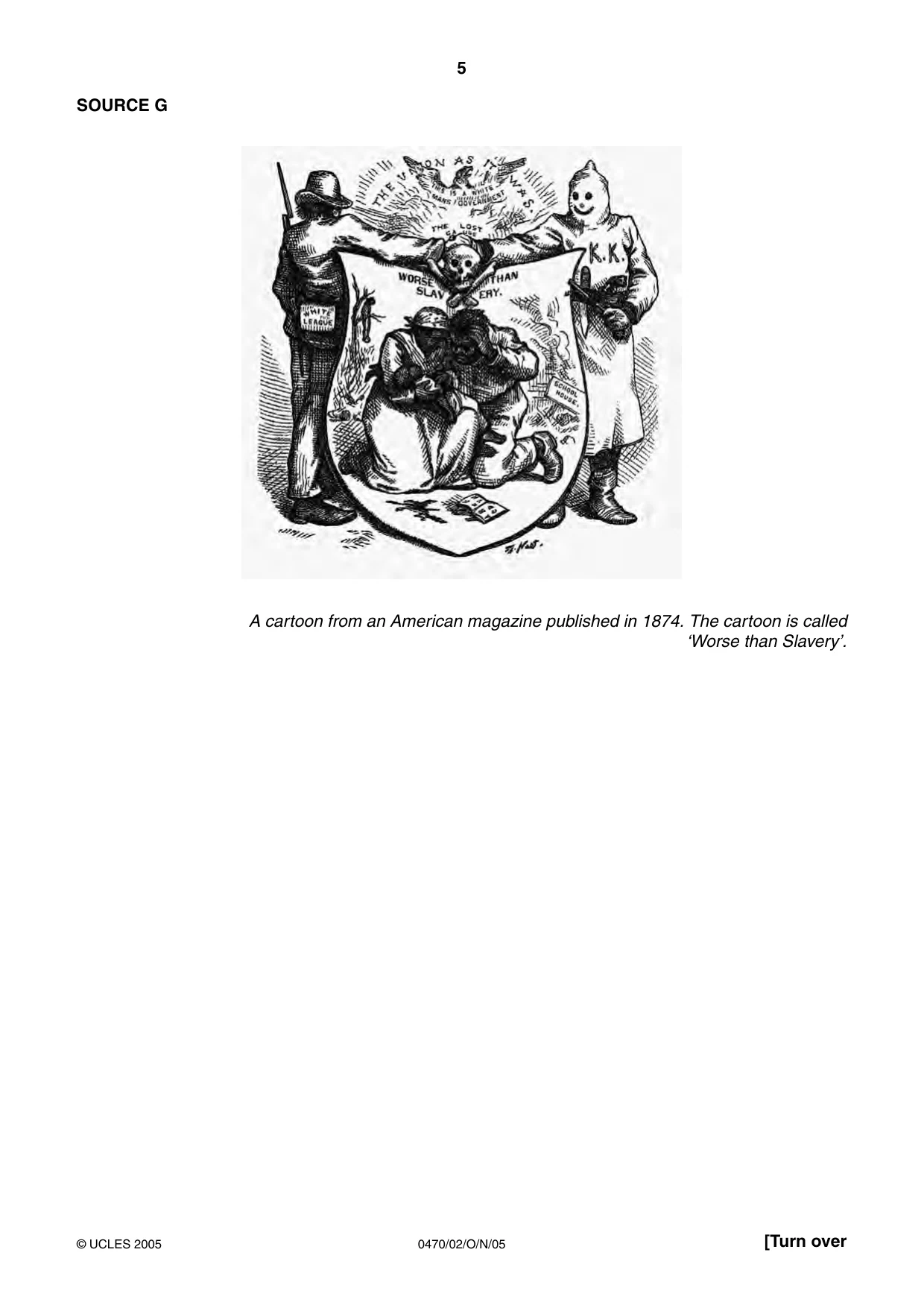
5 0470/02/O/N/05 [Turn over SOURCE G A cartoon from an American magazine published in 1874. The cartoon is called ‘Worse than Slavery’. © UCLES 2005
Question paper, page 6
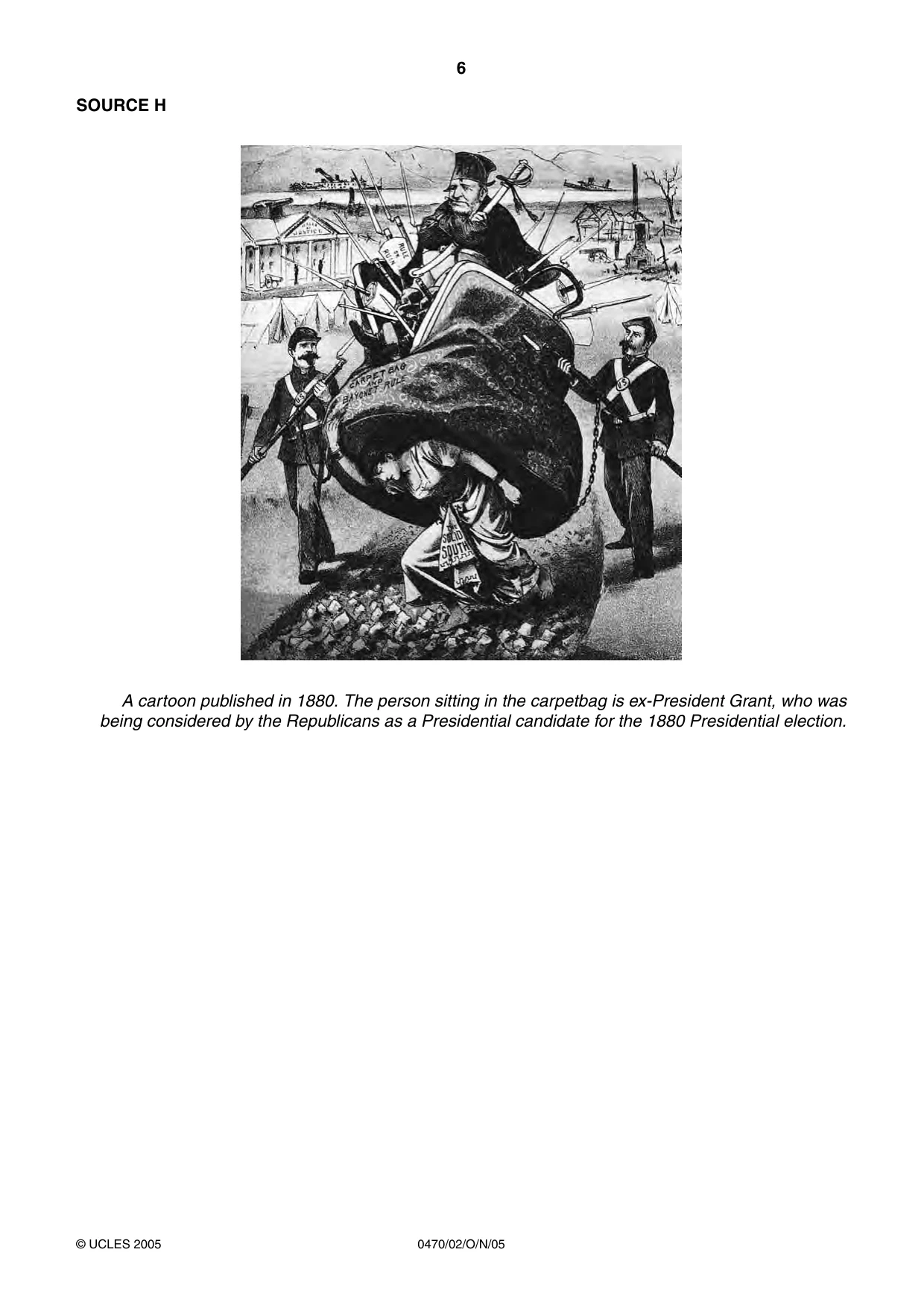
6 0470/02/O/N/05 SOURCE H A cartoon published in 1880. The person sitting in the carpetbag is ex-President Grant, who was being considered by the Republicans as a Presidential candidate for the 1880 Presidential election. © UCLES 2005
Question paper, page 7
7 0470/02/O/N/05 [Turn over Now answer all the following questions. You may use any of the sources to help you answer the questions, in addition to those sources which you are told to use. In answering the questions you should use your knowledge of the topic to help you interpret and evaluate the sources. 1 Study Source A. Do you think this author is biased in favour of either the North or the South? Explain your answer using details from the source. [6] 2 Study Sources B and C. Are you surprised by Johnson’s policies described in Source C? Explain your answer using the sources and your own knowledge. [7] 3 Study Sources D and E. Do you think that Lincoln and Stevens would have agreed about Reconstruction? Explain your answer using the sources and your own knowledge. [8] 4 Study Sources F and G. How far do these sources differ about the situation in the South? Explain your answer using details from the sources and your own knowledge. [9] 5 Study Source H. Explain the meaning of this cartoon. Explain your answer using details from the source and your own knowledge. [8] 6 Study all the sources. ‘The North was to blame for the failure of Reconstruction.’ How far do these sources provide convincing evidence for this statement? Use the sources to explain your answer. [12] © UCLES 2005
Question paper, page 8
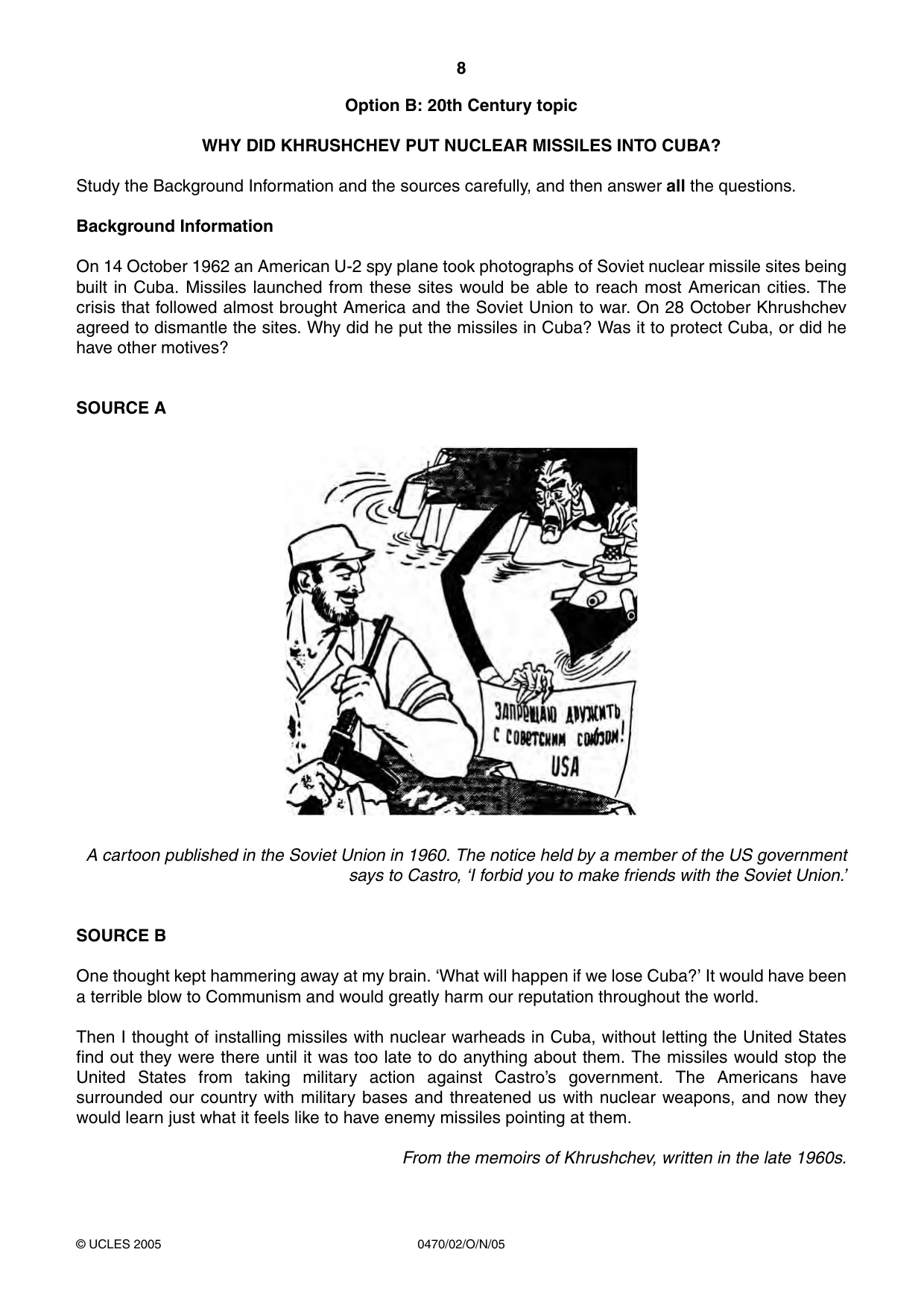
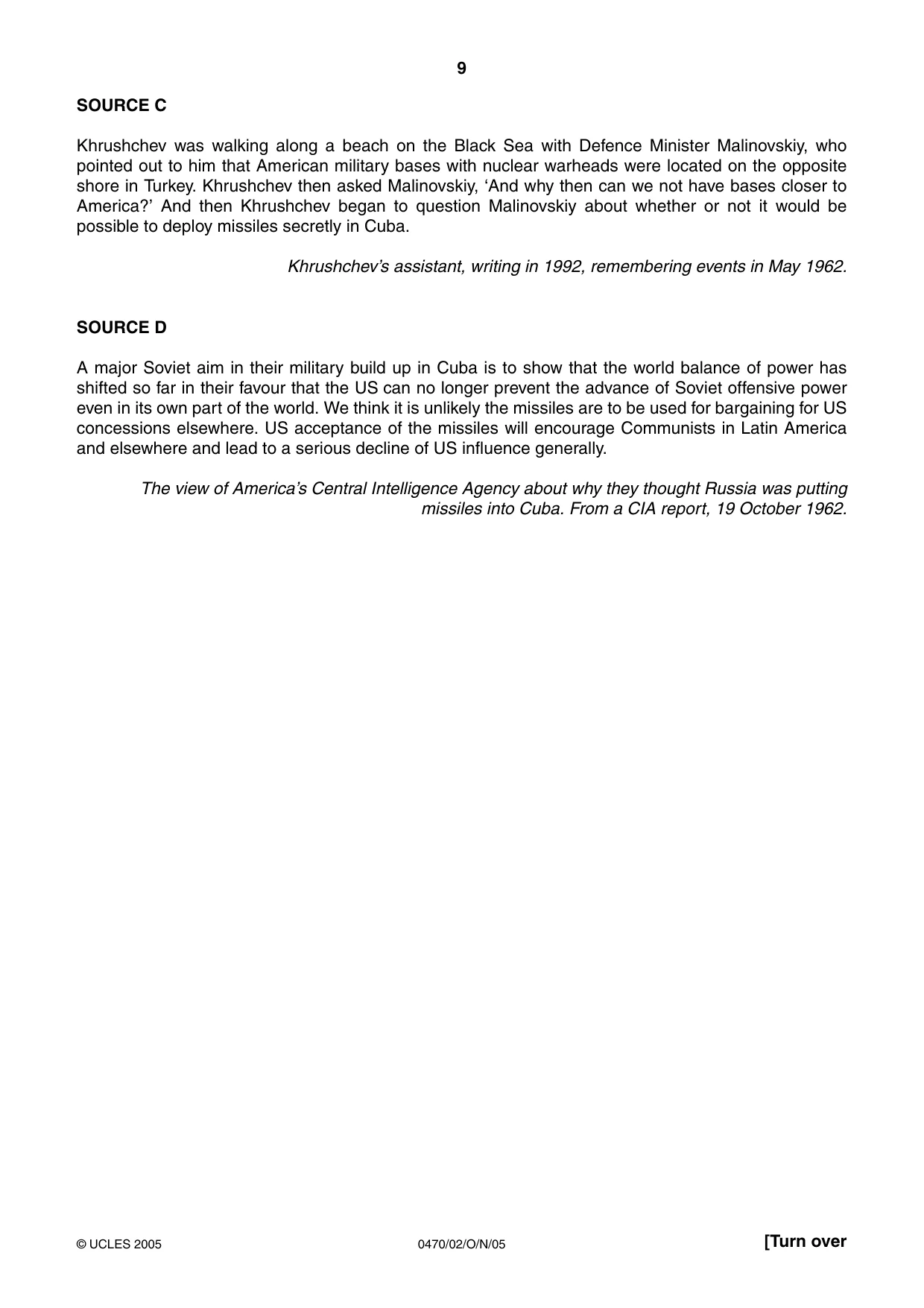
8 0470/02/O/N/05 Option B: 20th Century topic WHY DID KHRUSHCHEV PUT NUCLEAR MISSILES INTO CUBA? Study the Background Information and the sources carefully, and then answer all the questions. Background Information On 14 October 1962 an American U-2 spy plane took photographs of Soviet nuclear missile sites being built in Cuba. Missiles launched from these sites would be able to reach most American cities. The crisis that followed almost brought America and the Soviet Union to war. On 28 October Khrushchev agreed to dismantle the sites. Why did he put the missiles in Cuba? Was it to protect Cuba, or did he have other motives? SOURCE A A cartoon published in the Soviet Union in 1960. The notice held by a member of the US government says to Castro, ‘I forbid you to make friends with the Soviet Union.’ SOURCE B One thought kept hammering away at my brain. ‘What will happen if we lose Cuba?’ It would have been a terrible blow to Communism and would greatly harm our reputation throughout the world. Then I thought of installing missiles with nuclear warheads in Cuba, without letting the United States find out they were there until it was too late to do anything about them. The missiles would stop the United States from taking military action against Castro’s government. The Americans have surrounded our country with military bases and threatened us with nuclear weapons, and now they would learn just what it feels like to have enemy missiles pointing at them. From the memoirs of Khrushchev, written in the late 1960s. © UCLES 2005
Question paper, page 9
9 0470/02/O/N/05 [Turn over SOURCE C Khrushchev was walking along a beach on the Black Sea with Defence Minister Malinovskiy, who pointed out to him that American military bases with nuclear warheads were located on the opposite shore in Turkey. Khrushchev then asked Malinovskiy, ‘And why then can we not have bases closer to America?’ And then Khrushchev began to question Malinovskiy about whether or not it would be possible to deploy missiles secretly in Cuba. Khrushchev’s assistant, writing in 1992, remembering events in May 1962. SOURCE D A major Soviet aim in their military build up in Cuba is to show that the world balance of power has shifted so far in their favour that the US can no longer prevent the advance of Soviet offensive power even in its own part of the world. We think it is unlikely the missiles are to be used for bargaining for US concessions elsewhere. US acceptance of the missiles will encourage Communists in Latin America and elsewhere and lead to a serious decline of US influence generally. The view of America’s Central Intelligence Agency about why they thought Russia was putting missiles into Cuba. From a CIA report, 19 October 1962. © UCLES 2005
Question paper, page 10
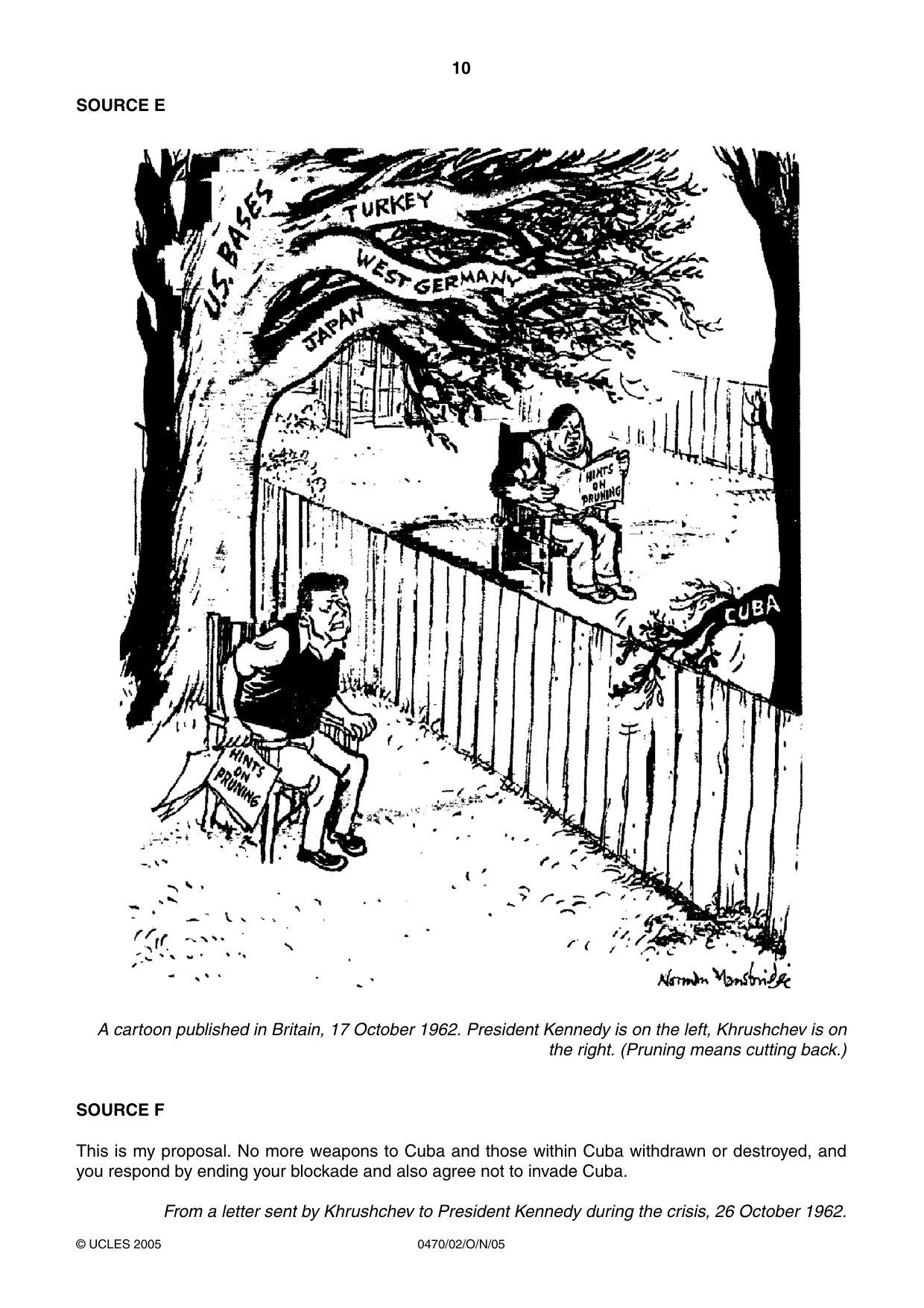
10 0470/02/O/N/05 SOURCE E A cartoon published in Britain, 17 October 1962. President Kennedy is on the left, Khrushchev is on the right. (Pruning means cutting back.) SOURCE F This is my proposal. No more weapons to Cuba and those within Cuba withdrawn or destroyed, and you respond by ending your blockade and also agree not to invade Cuba. From a letter sent by Khrushchev to President Kennedy during the crisis, 26 October 1962. © UCLES 2005
Question paper, page 11
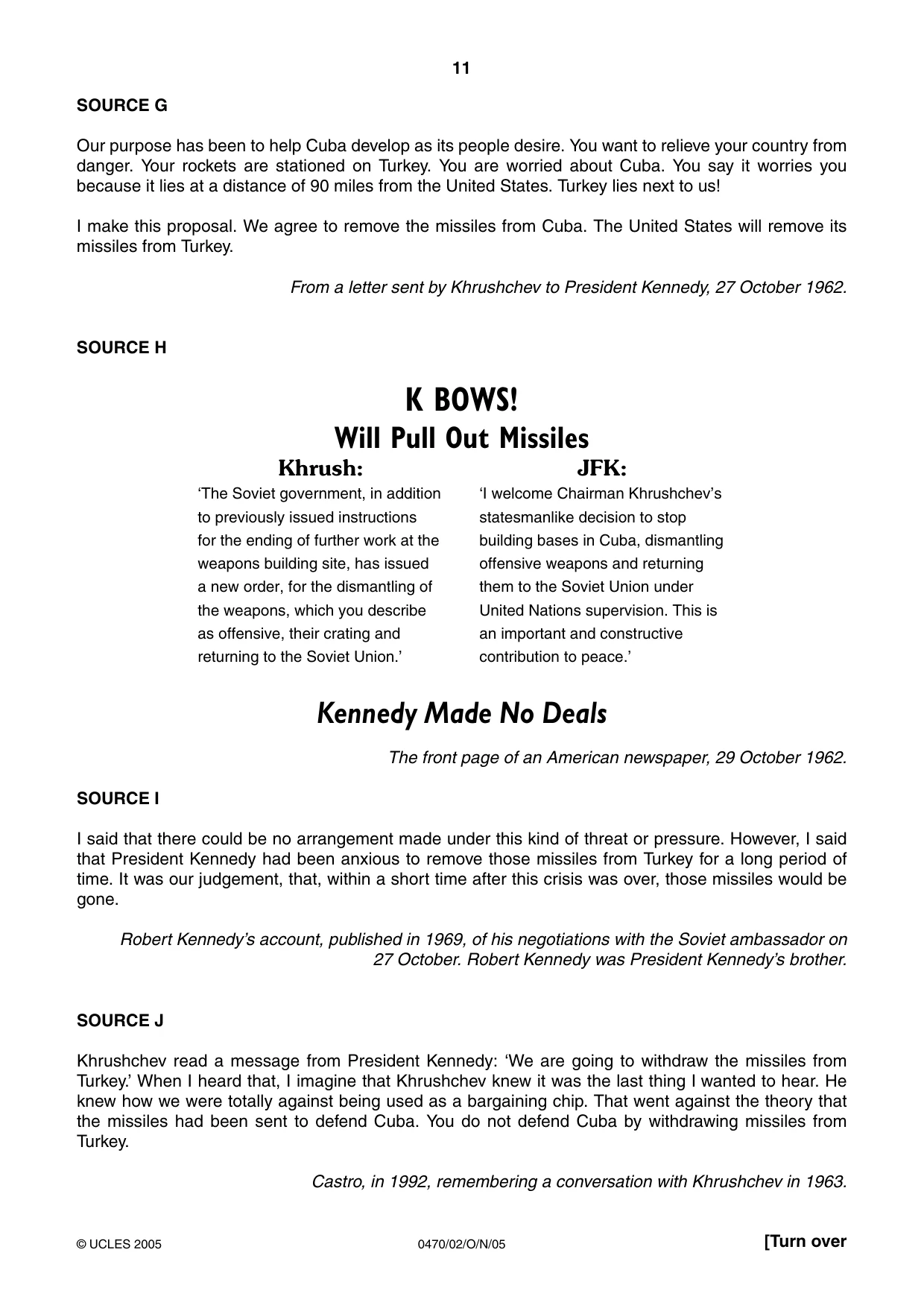
11 0470/02/O/N/05 [Turn over SOURCE G Our purpose has been to help Cuba develop as its people desire. You want to relieve your country from danger. Your rockets are stationed on Turkey. You are worried about Cuba. You say it worries you because it lies at a distance of 90 miles from the United States. Turkey lies next to us! I make this proposal. We agree to remove the missiles from Cuba. The United States will remove its missiles from Turkey. From a letter sent by Khrushchev to President Kennedy, 27 October 1962. SOURCE H K BOWS! Will Pull Out Missiles Kennedy Made No Deals The front page of an American newspaper, 29 October 1962. SOURCE I I said that there could be no arrangement made under this kind of threat or pressure. However, I said that President Kennedy had been anxious to remove those missiles from Turkey for a long period of time. It was our judgement, that, within a short time after this crisis was over, those missiles would be gone. Robert Kennedy’s account, published in 1969, of his negotiations with the Soviet ambassador on 27 October. Robert Kennedy was President Kennedy’s brother. SOURCE J Khrushchev read a message from President Kennedy: ‘We are going to withdraw the missiles from Turkey.’ When I heard that, I imagine that Khrushchev knew it was the last thing I wanted to hear. He knew how we were totally against being used as a bargaining chip. That went against the theory that the missiles had been sent to defend Cuba. You do not defend Cuba by withdrawing missiles from Turkey. Castro, in 1992, remembering a conversation with Khrushchev in 1963. Khrush: ‘The Soviet government, in addition to previously issued instructions for the ending of further work at the weapons building site, has issued a new order, for the dismantling of the weapons, which you describe as offensive, their crating and returning to the Soviet Union.’ JFK: ‘I welcome Chairman Khrushchev’s statesmanlike decision to stop building bases in Cuba, dismantling offensive weapons and returning them to the Soviet Union under United Nations supervision. This is an important and constructive contribution to peace.’ © UCLES 2005
Question paper, page 12
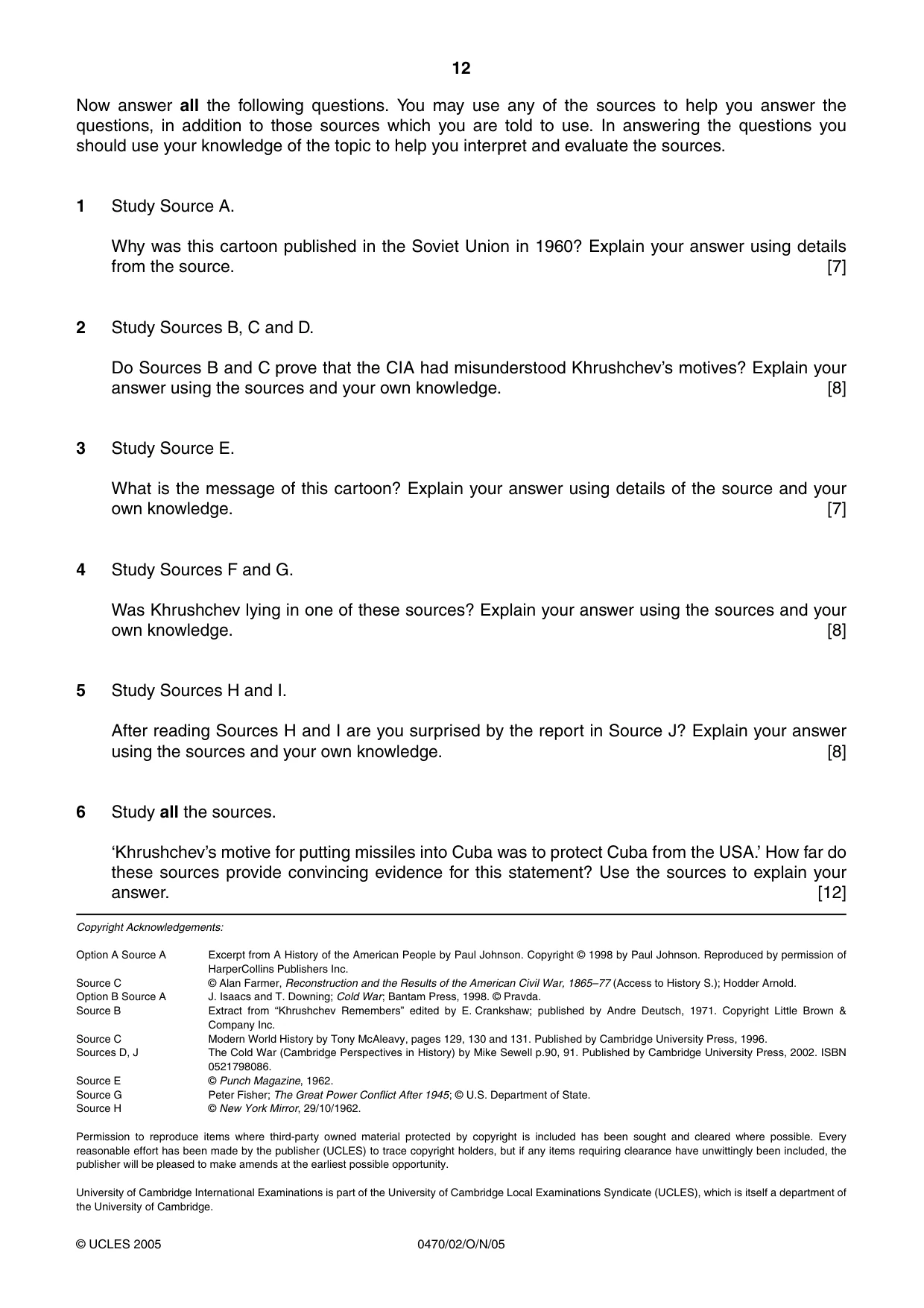
12 0470/02/O/N/05 Now answer all the following questions. You may use any of the sources to help you answer the questions, in addition to those sources which you are told to use. In answering the questions you should use your knowledge of the topic to help you interpret and evaluate the sources. 1 Study Source A. Why was this cartoon published in the Soviet Union in 1960? Explain your answer using details from the source. [7] 2 Study Sources B, C and D. Do Sources B and C prove that the CIA had misunderstood Khrushchev’s motives? Explain your answer using the sources and your own knowledge. [8] 3 Study Source E. What is the message of this cartoon? Explain your answer using details of the source and your own knowledge. [7] 4 Study Sources F and G. Was Khrushchev lying in one of these sources? Explain your answer using the sources and your own knowledge. [8] 5 Study Sources H and I. After reading Sources H and I are you surprised by the report in Source J? Explain your answer using the sources and your own knowledge. [8] 6 Study all the sources. ‘Khrushchev’s motive for putting missiles into Cuba was to protect Cuba from the USA.’ How far do these sources provide convincing evidence for this statement? Use the sources to explain your answer. [12] © UCLES 2005 Copyright Acknowledgements: Option A Source A Excerpt from A History of the American People by Paul Johnson. Copyright © 1998 by Paul Johnson. Reproduced by permission of HarperCollins Publishers Inc. Source C © Alan Farmer, Reconstruction and the Results of the American Civil War, 1865–77 (Access to History S.); Hodder Arnold. Option B Source A J. Isaacs and T. Downing; Cold War; Bantam Press, 1998. © Pravda. Source B Extract from “Khrushchev Remembers” edited by E. Crankshaw; published by Andre Deutsch, 1971. Copyright Little Brown & Company Inc. Source C Modern World History by Tony McAleavy, pages 129, 130 and 131. Published by Cambridge University Press, 1996. Sources D, J The Cold War (Cambridge Perspectives in History) by Mike Sewell p.90, 91. Published by Cambridge University Press, 2002. ISBN 0521798086. Source E © Punch Magazine, 1962. Source G Peter Fisher; The Great Power Conflict After 1945; © U.S. Department of State. Source H © New York Mirror, 29/10/1962. Permission to reproduce items where third-party owned material protected by copyright is included has been sought and cleared where possible. Every reasonable effort has been made by the publisher (UCLES) to trace copyright holders, but if any items requiring clearance have unwittingly been included, the publisher will be pleased to make amends at the earliest possible opportunity. University of Cambridge International Examinations is part of the University of Cambridge Local Examinations Syndicate (UCLES), which is itself a department of the University of Cambridge.
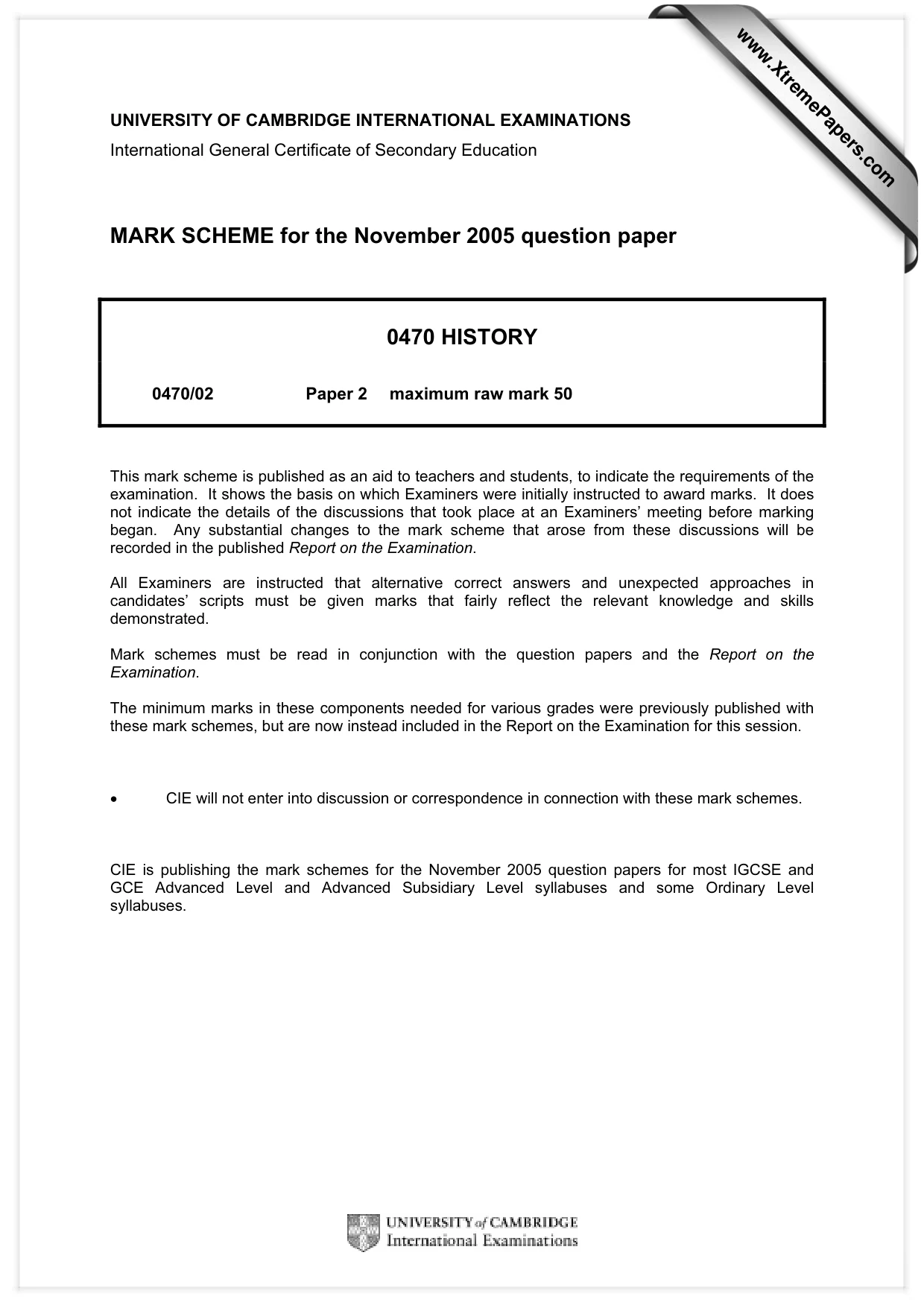
Mark scheme, page 1
UNIVERSITY OF CAMBRIDGE INTERNATIONAL EXAMINATIONS International General Certificate of Secondary Education MARK SCHEME for the November 2005 question paper 0470 HISTORY 0470/02 Paper 2 maximum raw mark 50 This mark scheme is published as an aid to teachers and students, to indicate the requirements of the examination. It shows the basis on which Examiners were initially instructed to award marks. It does not indicate the details of the discussions that took place at an Examiners’ meeting before marking began. Any substantial changes to the mark scheme that arose from these discussions will be recorded in the published Report on the Examination. All Examiners are instructed that alternative correct answers and unexpected approaches in candidates’ scripts must be given marks that fairly reflect the relevant knowledge and skills demonstrated. Mark schemes must be read in conjunction with the question papers and the Report on the Examination. The minimum marks in these components needed for various grades were previously published with these mark schemes, but are now instead included in the Report on the Examination for this session. • CIE will not enter into discussion or correspondence in connection with these mark schemes. CIE is publishing the mark schemes for the November 2005 question papers for most IGCSE and GCE Advanced Level and Advanced Subsidiary Level syllabuses and some Ordinary Level syllabuses. www.XtremePapers.com
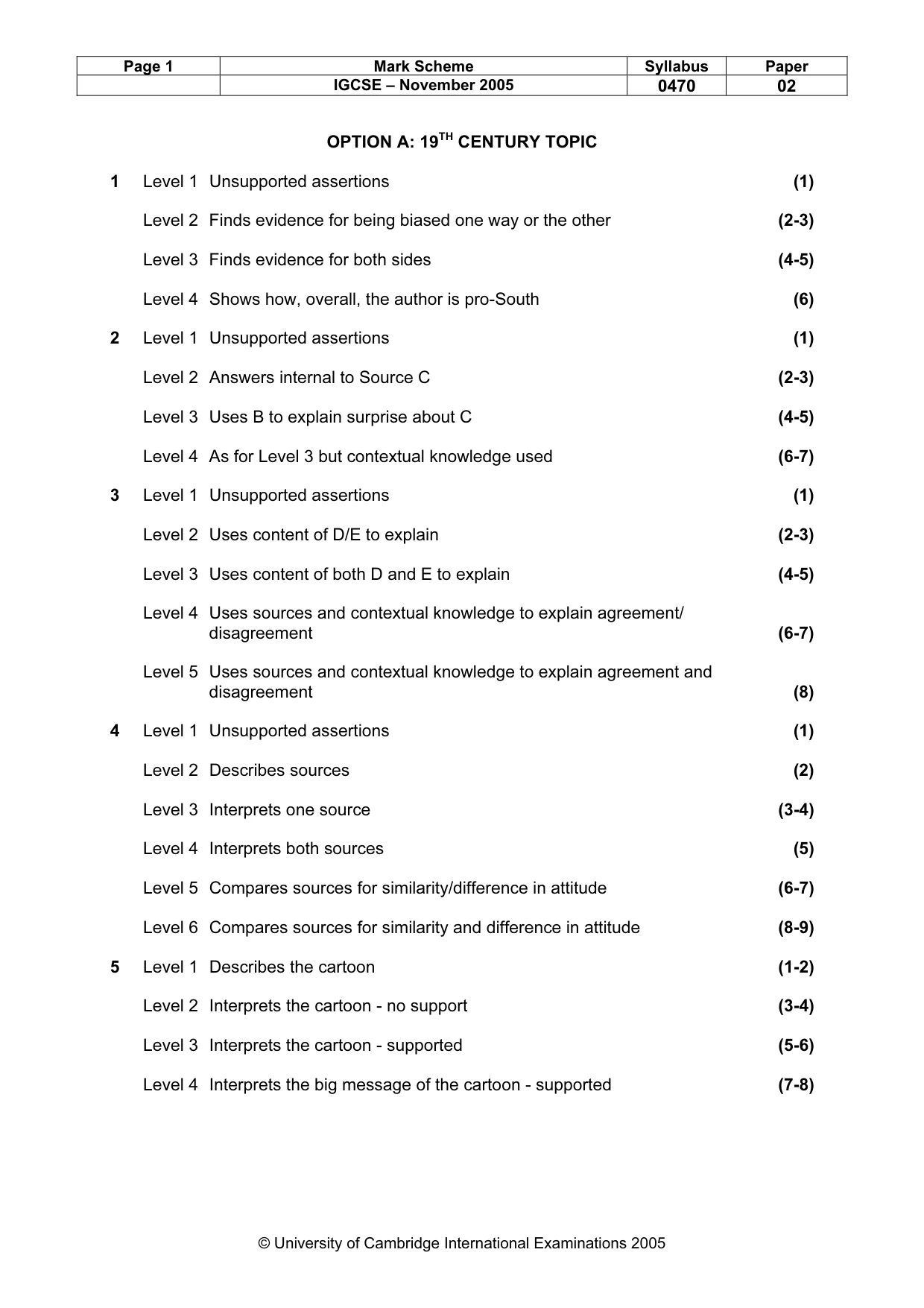
Mark scheme, page 2
Page 1 Mark Scheme Syllabus Paper IGCSE – November 2005 0470 02 © University of Cambridge International Examinations 2005 OPTION A: 19TH CENTURY TOPIC 1 Level 1 Unsupported assertions (1) Level 2 Finds evidence for being biased one way or the other (2-3) Level 3 Finds evidence for both sides (4-5) Level 4 Shows how, overall, the author is pro-South (6) 2 Level 1 Unsupported assertions (1) Level 2 Answers internal to Source C (2-3) Level 3 Uses B to explain surprise about C (4-5) Level 4 As for Level 3 but contextual knowledge used (6-7) 3 Level 1 Unsupported assertions (1) Level 2 Uses content of D/E to explain (2-3) Level 3 Uses content of both D and E to explain (4-5) Level 4 Uses sources and contextual knowledge to explain agreement/ disagreement (6-7) Level 5 Uses sources and contextual knowledge to explain agreement and disagreement (8) 4 Level 1 Unsupported assertions (1) Level 2 Describes sources (2) Level 3 Interprets one source (3-4) Level 4 Interprets both sources (5) Level 5 Compares sources for similarity/difference in attitude (6-7) Level 6 Compares sources for similarity and difference in attitude (8-9) 5 Level 1 Describes the cartoon (1-2) Level 2 Interprets the cartoon - no support (3-4) Level 3 Interprets the cartoon - supported (5-6) Level 4 Interprets the big message of the cartoon - supported (7-8)
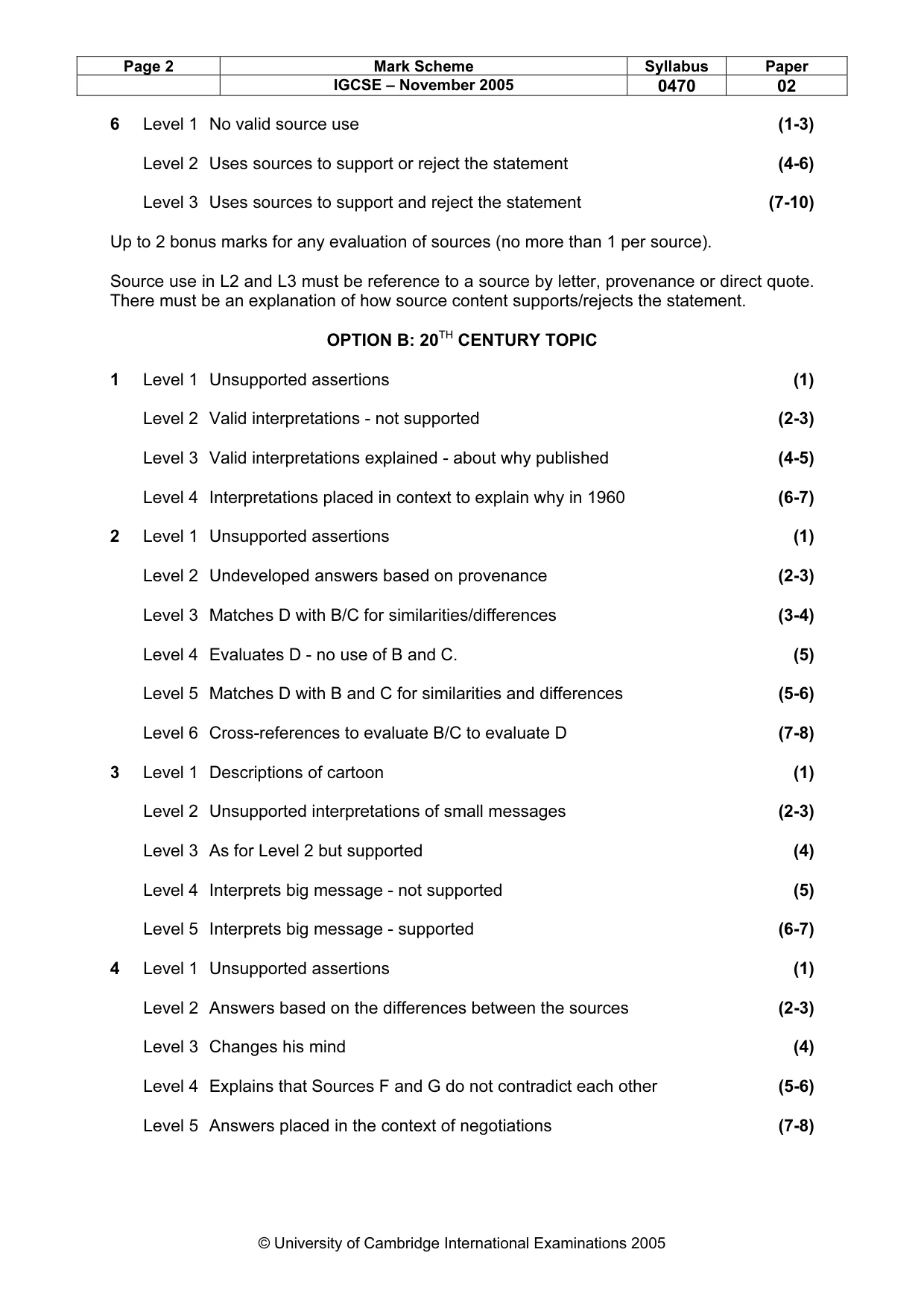
Mark scheme, page 3
Page 2 Mark Scheme Syllabus Paper IGCSE – November 2005 0470 02 © University of Cambridge International Examinations 2005 6 Level 1 No valid source use (1-3) Level 2 Uses sources to support or reject the statement (4-6) Level 3 Uses sources to support and reject the statement (7-10) Up to 2 bonus marks for any evaluation of sources (no more than 1 per source). Source use in L2 and L3 must be reference to a source by letter, provenance or direct quote. There must be an explanation of how source content supports/rejects the statement. OPTION B: 20TH CENTURY TOPIC 1 Level 1 Unsupported assertions (1) Level 2 Valid interpretations - not supported (2-3) Level 3 Valid interpretations explained - about why published (4-5) Level 4 Interpretations placed in context to explain why in 1960 (6-7) 2 Level 1 Unsupported assertions (1) Level 2 Undeveloped answers based on provenance (2-3) Level 3 Matches D with B/C for similarities/differences (3-4) Level 4 Evaluates D - no use of B and C. (5) Level 5 Matches D with B and C for similarities and differences (5-6) Level 6 Cross-references to evaluate B/C to evaluate D (7-8) 3 Level 1 Descriptions of cartoon (1) Level 2 Unsupported interpretations of small messages (2-3) Level 3 As for Level 2 but supported (4) Level 4 Interprets big message - not supported (5) Level 5 Interprets big message - supported (6-7) 4 Level 1 Unsupported assertions (1) Level 2 Answers based on the differences between the sources (2-3) Level 3 Changes his mind (4) Level 4 Explains that Sources F and G do not contradict each other (5-6) Level 5 Answers placed in the context of negotiations (7-8)
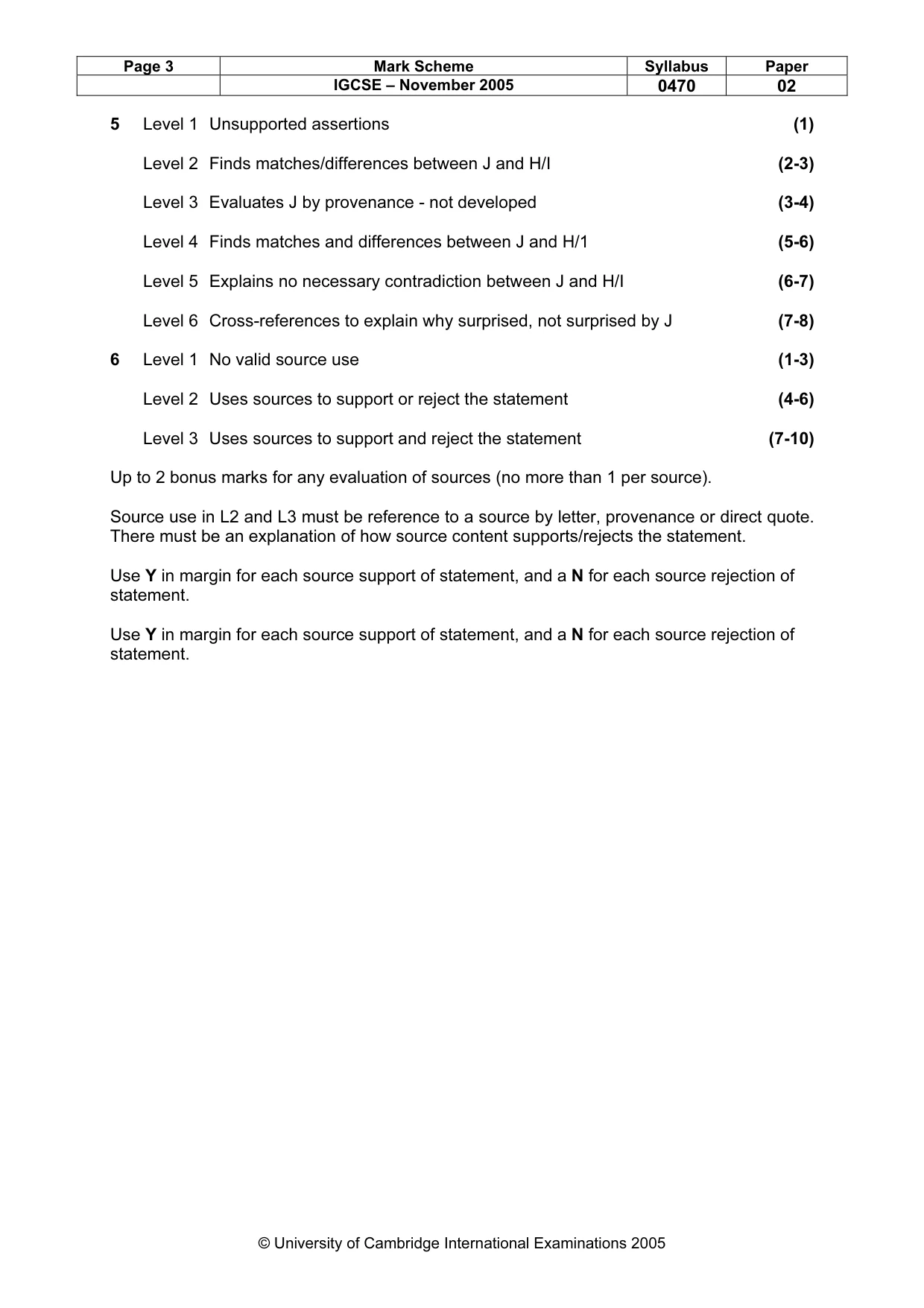
Mark scheme, page 4
Page 3 Mark Scheme Syllabus Paper IGCSE – November 2005 0470 02 © University of Cambridge International Examinations 2005 5 Level 1 Unsupported assertions (1) Level 2 Finds matches/differences between J and H/I (2-3) Level 3 Evaluates J by provenance - not developed (3-4) Level 4 Finds matches and differences between J and H/1 (5-6) Level 5 Explains no necessary contradiction between J and H/I (6-7) Level 6 Cross-references to explain why surprised, not surprised by J (7-8) 6 Level 1 No valid source use (1-3) Level 2 Uses sources to support or reject the statement (4-6) Level 3 Uses sources to support and reject the statement (7-10) Up to 2 bonus marks for any evaluation of sources (no more than 1 per source). Source use in L2 and L3 must be reference to a source by letter, provenance or direct quote. There must be an explanation of how source content supports/rejects the statement. Use Y in margin for each source support of statement, and a N for each source rejection of statement. Use Y in margin for each source support of statement, and a N for each source rejection of statement.