Cambridge IGCSE History 0470 — 2005 May/June Paper 2 · Variant 1
0470/21/M/J/05
The question paper and its mark scheme, free to read here and free to download. This is Cambridge’s own paper, exactly as it was sat.
Question paper16 pages
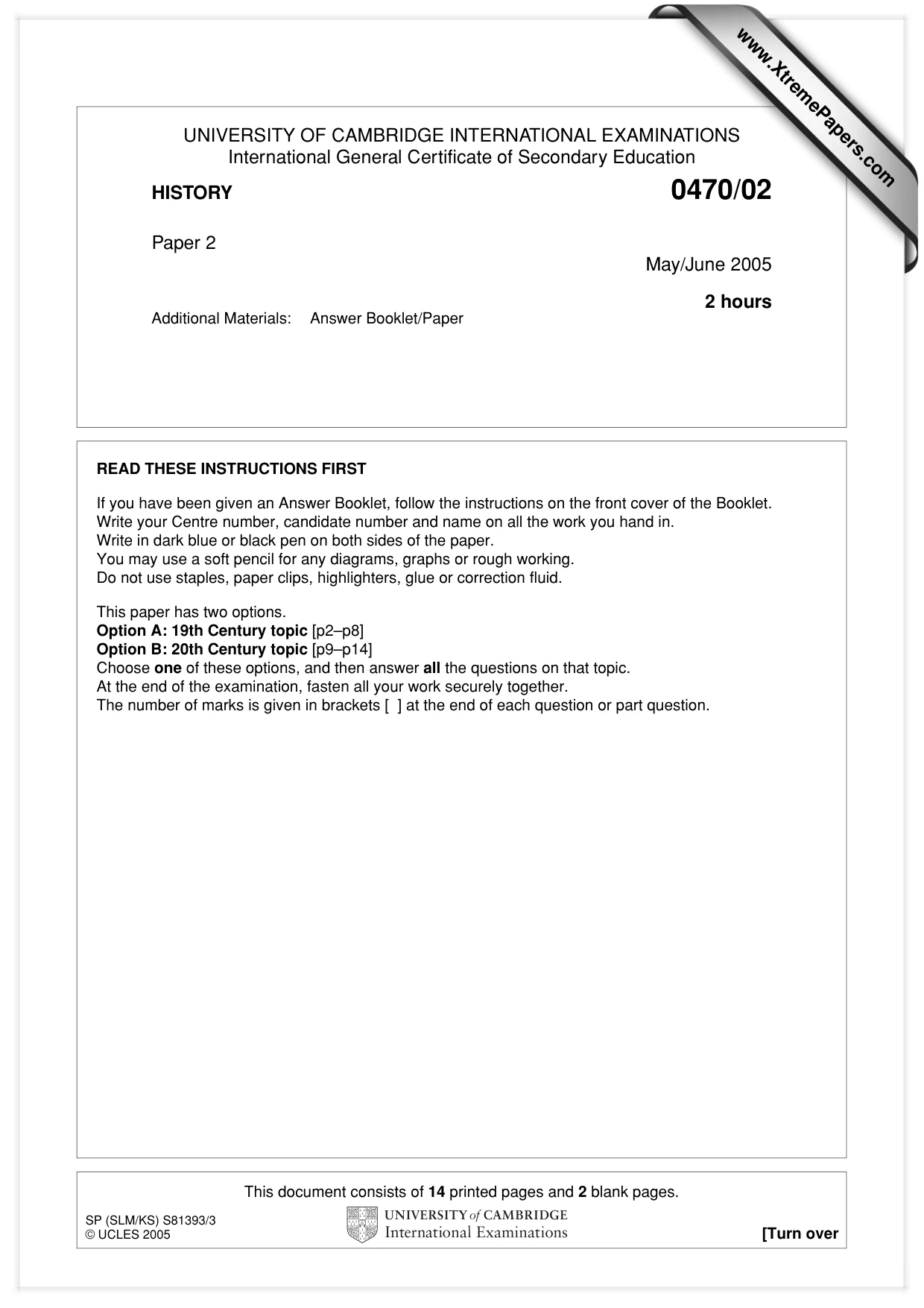

Mark scheme9 pages
Answers below. Sit the paper first if you are practising.
Paper as text
Question paper, page 1
This document consists of 14 printed pages and 2 blank pages. SP (SLM/KS) S81393/3 © UCLES 2005 [Turn over UNIVERSITY OF CAMBRIDGE INTERNATIONAL EXAMINATIONS International General Certificate of Secondary Education HISTORY 0470/02 Paper 2 May/June 2005 2 hours Additional Materials: Answer Booklet/Paper READ THESE INSTRUCTIONS FIRST If you have been given an Answer Booklet, follow the instructions on the front cover of the Booklet. Write your Centre number, candidate number and name on all the work you hand in. Write in dark blue or black pen on both sides of the paper. You may use a soft pencil for any diagrams, graphs or rough working. Do not use staples, paper clips, highlighters, glue or correction fluid. This paper has two options. Option A: 19th Century topic [p2–p8] Option B: 20th Century topic [p9–p14] Choose one of these options, and then answer all the questions on that topic. At the end of the examination, fasten all your work securely together. The number of marks is given in brackets [ ] at the end of each question or part question. www.XtremePapers.com
Question paper, page 2
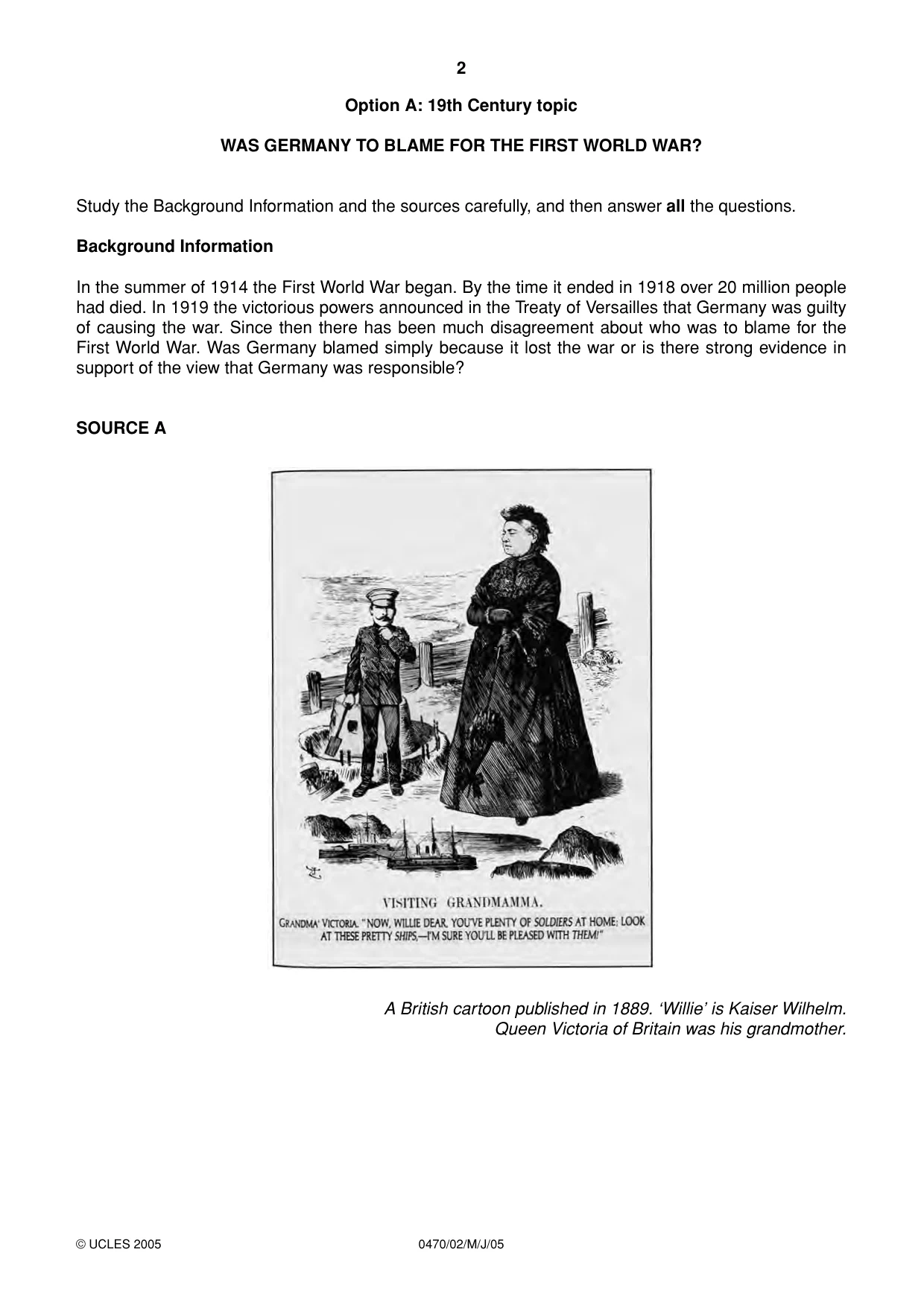
2 0470/02/M/J/05 © UCLES 2005 Option A: 19th Century topic WAS GERMANY TO BLAME FOR THE FIRST WORLD WAR? Study the Background Information and the sources carefully, and then answer all the questions. Background Information In the summer of 1914 the First World War began. By the time it ended in 1918 over 20 million people had died. In 1919 the victorious powers announced in the Treaty of Versailles that Germany was guilty of causing the war. Since then there has been much disagreement about who was to blame for the First World War. Was Germany blamed simply because it lost the war or is there strong evidence in support of the view that Germany was responsible? SOURCE A A British cartoon published in 1889. ‘Willie’ is Kaiser Wilhelm. Queen Victoria of Britain was his grandmother.
Question paper, page 3
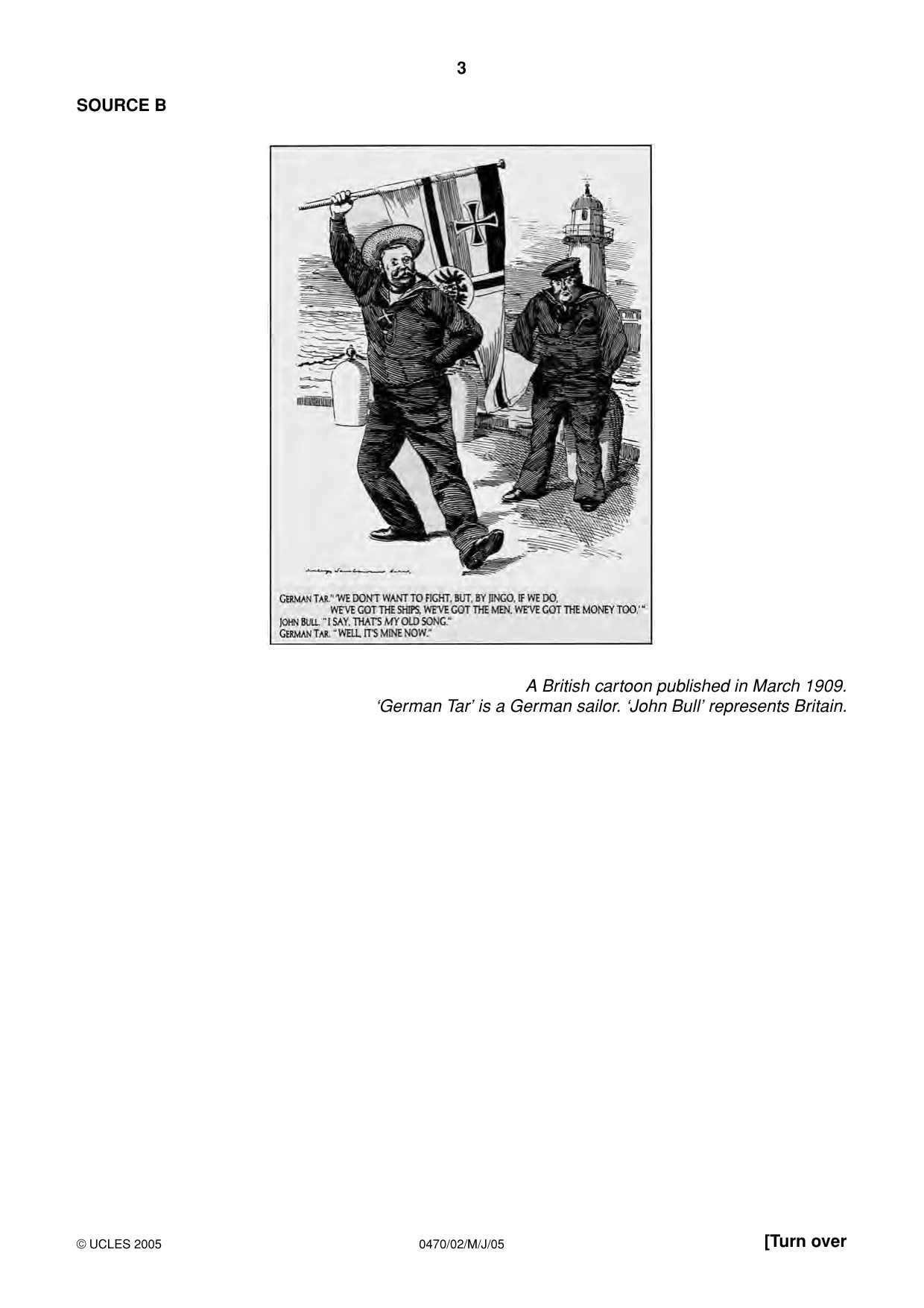
3 0470/02/M/J/05 © UCLES 2005 [Turn over SOURCE B A British cartoon published in March 1909. ‘German Tar’ is a German sailor. ‘John Bull’ represents Britain.
Question paper, page 4
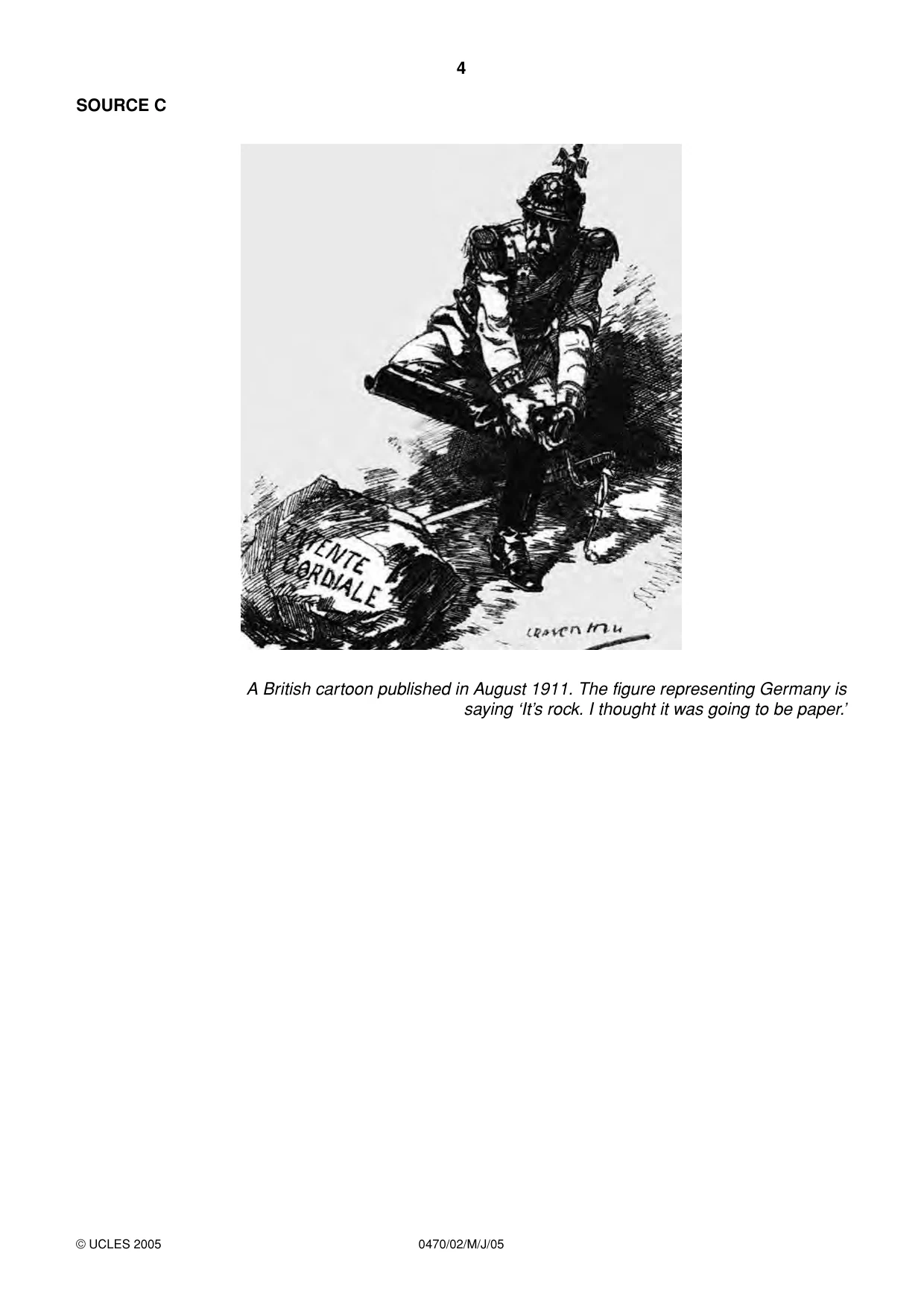
4 0470/02/M/J/05 © UCLES 2005 SOURCE C A British cartoon published in August 1911. The figure representing Germany is saying ‘It’s rock. I thought it was going to be paper.’
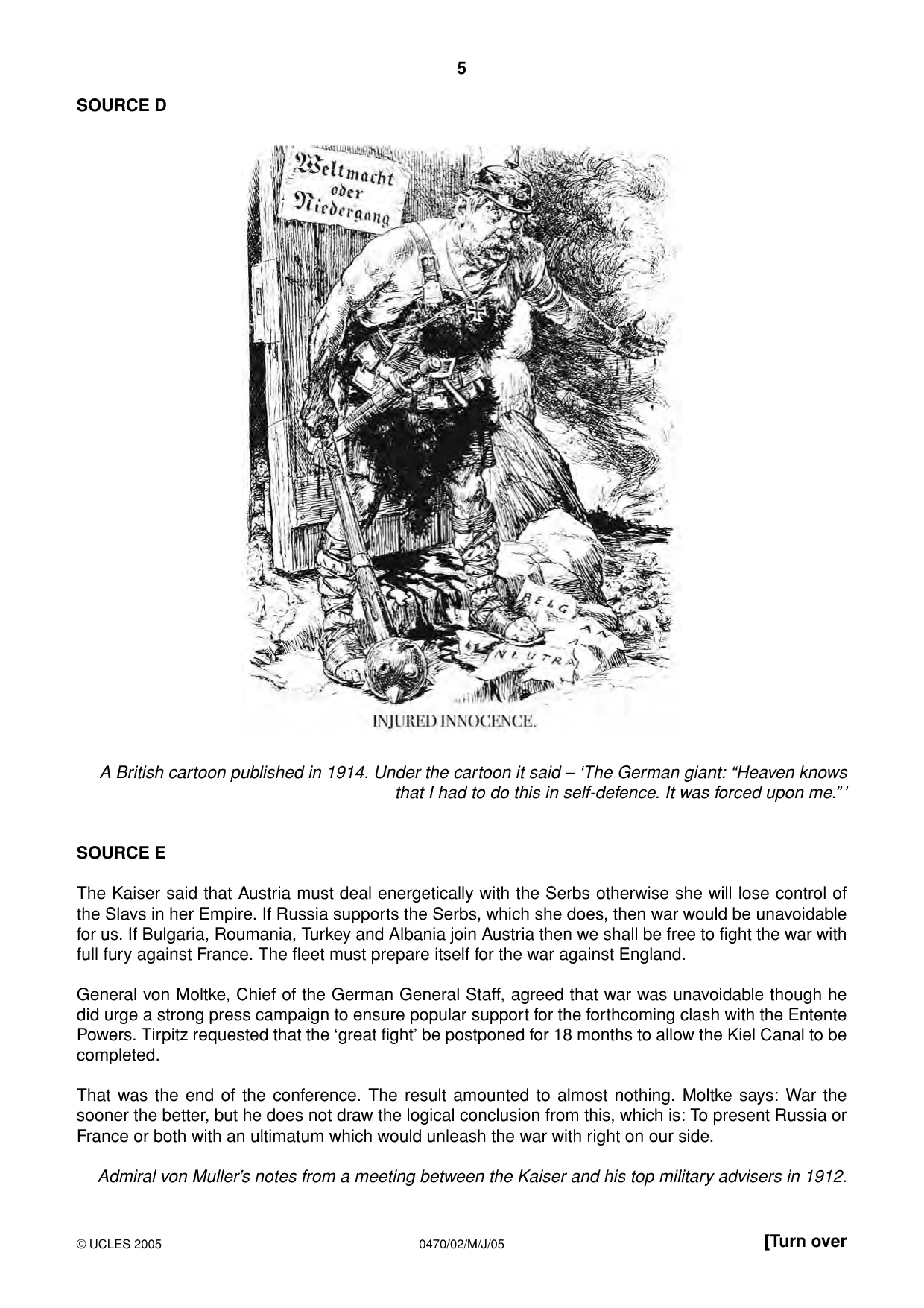
Question paper, page 5
5 0470/02/M/J/05 © UCLES 2005 [Turn over SOURCE D A British cartoon published in 1914. Under the cartoon it said – ‘The German giant: “Heaven knows that I had to do this in self-defence. It was forced upon me.” ’ SOURCE E The Kaiser said that Austria must deal energetically with the Serbs otherwise she will lose control of the Slavs in her Empire. If Russia supports the Serbs, which she does, then war would be unavoidable for us. If Bulgaria, Roumania, Turkey and Albania join Austria then we shall be free to fight the war with full fury against France. The fleet must prepare itself for the war against England. General von Moltke, Chief of the German General Staff, agreed that war was unavoidable though he did urge a strong press campaign to ensure popular support for the forthcoming clash with the Entente Powers. Tirpitz requested that the ‘great fight’ be postponed for 18 months to allow the Kiel Canal to be completed. That was the end of the conference. The result amounted to almost nothing. Moltke says: War the sooner the better, but he does not draw the logical conclusion from this, which is: To present Russia or France or both with an ultimatum which would unleash the war with right on our side. Admiral von Muller’s notes from a meeting between the Kaiser and his top military advisers in 1912.
Question paper, page 6
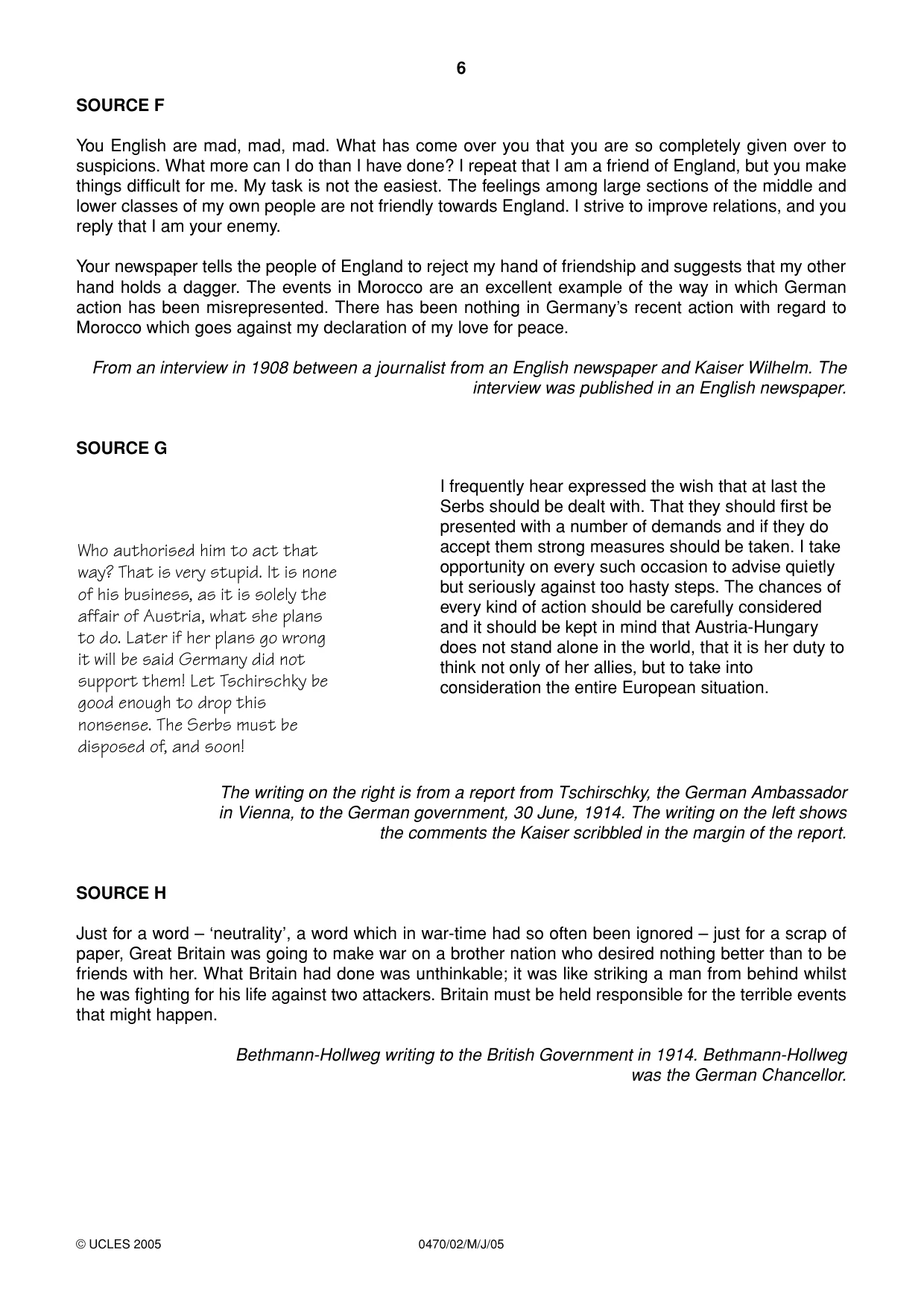
6 0470/02/M/J/05 © UCLES 2005 SOURCE F You English are mad, mad, mad. What has come over you that you are so completely given over to suspicions. What more can I do than I have done? I repeat that I am a friend of England, but you make things difficult for me. My task is not the easiest. The feelings among large sections of the middle and lower classes of my own people are not friendly towards England. I strive to improve relations, and you reply that I am your enemy. Your newspaper tells the people of England to reject my hand of friendship and suggests that my other hand holds a dagger. The events in Morocco are an excellent example of the way in which German action has been misrepresented. There has been nothing in Germany’s recent action with regard to Morocco which goes against my declaration of my love for peace. From an interview in 1908 between a journalist from an English newspaper and Kaiser Wilhelm. The interview was published in an English newspaper. SOURCE G The writing on the right is from a report from Tschirschky, the German Ambassador in Vienna, to the German government, 30 June, 1914. The writing on the left shows the comments the Kaiser scribbled in the margin of the report. SOURCE H Just for a word – ‘neutrality’, a word which in war-time had so often been ignored – just for a scrap of paper, Great Britain was going to make war on a brother nation who desired nothing better than to be friends with her. What Britain had done was unthinkable; it was like striking a man from behind whilst he was fighting for his life against two attackers. Britain must be held responsible for the terrible events that might happen. Bethmann-Hollweg writing to the British Government in 1914. Bethmann-Hollweg was the German Chancellor. I frequently hear expressed the wish that at last the Serbs should be dealt with. That they should first be presented with a number of demands and if they do accept them strong measures should be taken. I take opportunity on every such occasion to advise quietly but seriously against too hasty steps. The chances of every kind of action should be carefully considered and it should be kept in mind that Austria-Hungary does not stand alone in the world, that it is her duty to think not only of her allies, but to take into consideration the entire European situation. Who authorised him to act that way? That is very stupid. It is none of his business, as it is solely the affair of Austria, what she plans to do. Later if her plans go wrong it will be said Germany did not support them! Let Tschirschky be good enough to drop this nonsense. The Serbs must be disposed of, and soon!
Question paper, page 7
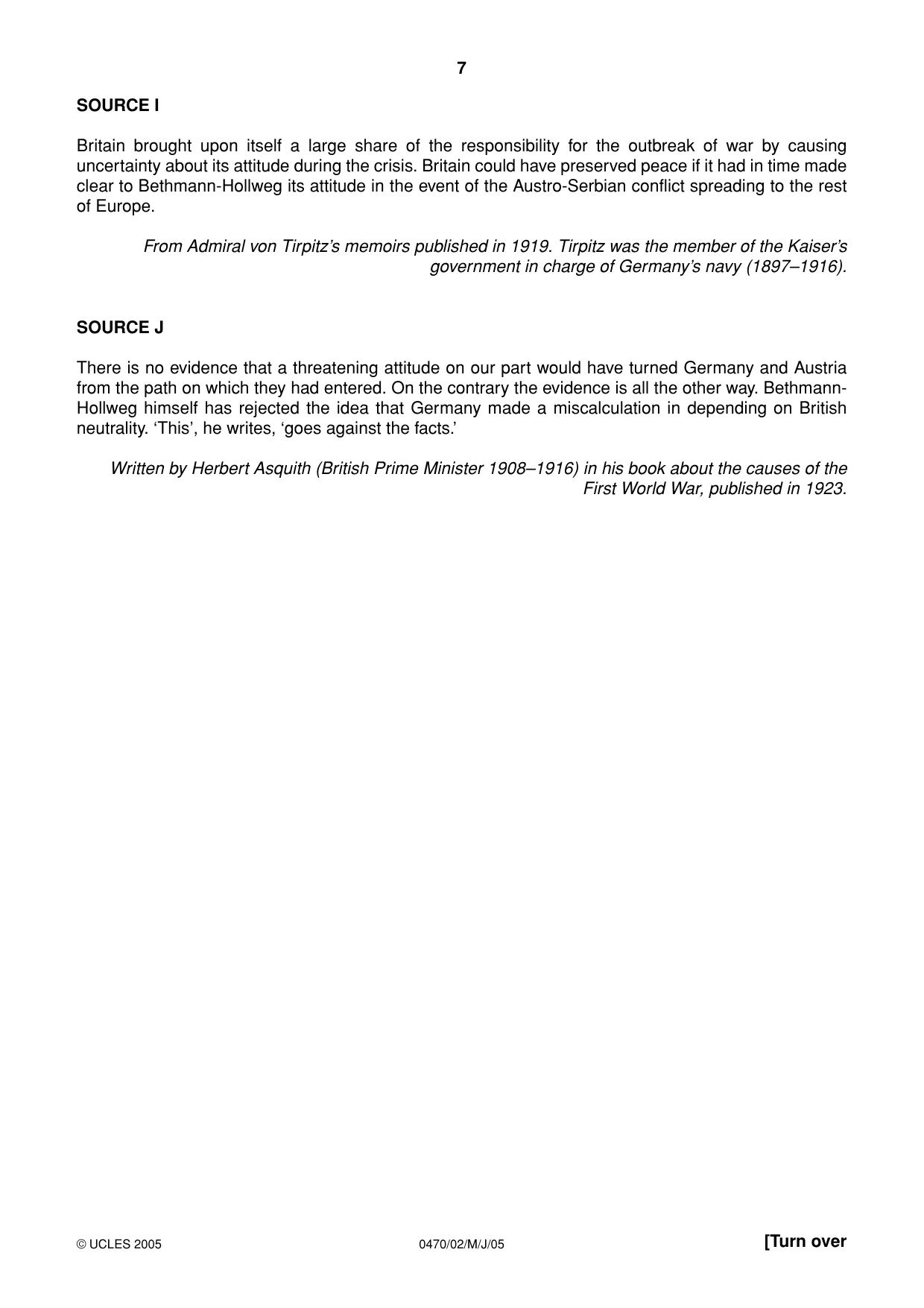
7 0470/02/M/J/05 © UCLES 2005 [Turn over SOURCE I Britain brought upon itself a large share of the responsibility for the outbreak of war by causing uncertainty about its attitude during the crisis. Britain could have preserved peace if it had in time made clear to Bethmann-Hollweg its attitude in the event of the Austro-Serbian conflict spreading to the rest of Europe. From Admiral von Tirpitz’s memoirs published in 1919. Tirpitz was the member of the Kaiser’s government in charge of Germany’s navy (1897–1916). SOURCE J There is no evidence that a threatening attitude on our part would have turned Germany and Austria from the path on which they had entered. On the contrary the evidence is all the other way. Bethmann- Hollweg himself has rejected the idea that Germany made a miscalculation in depending on British neutrality. ‘This’, he writes, ‘goes against the facts.’ Written by Herbert Asquith (British Prime Minister 1908–1916) in his book about the causes of the First World War, published in 1923.
Question paper, page 8
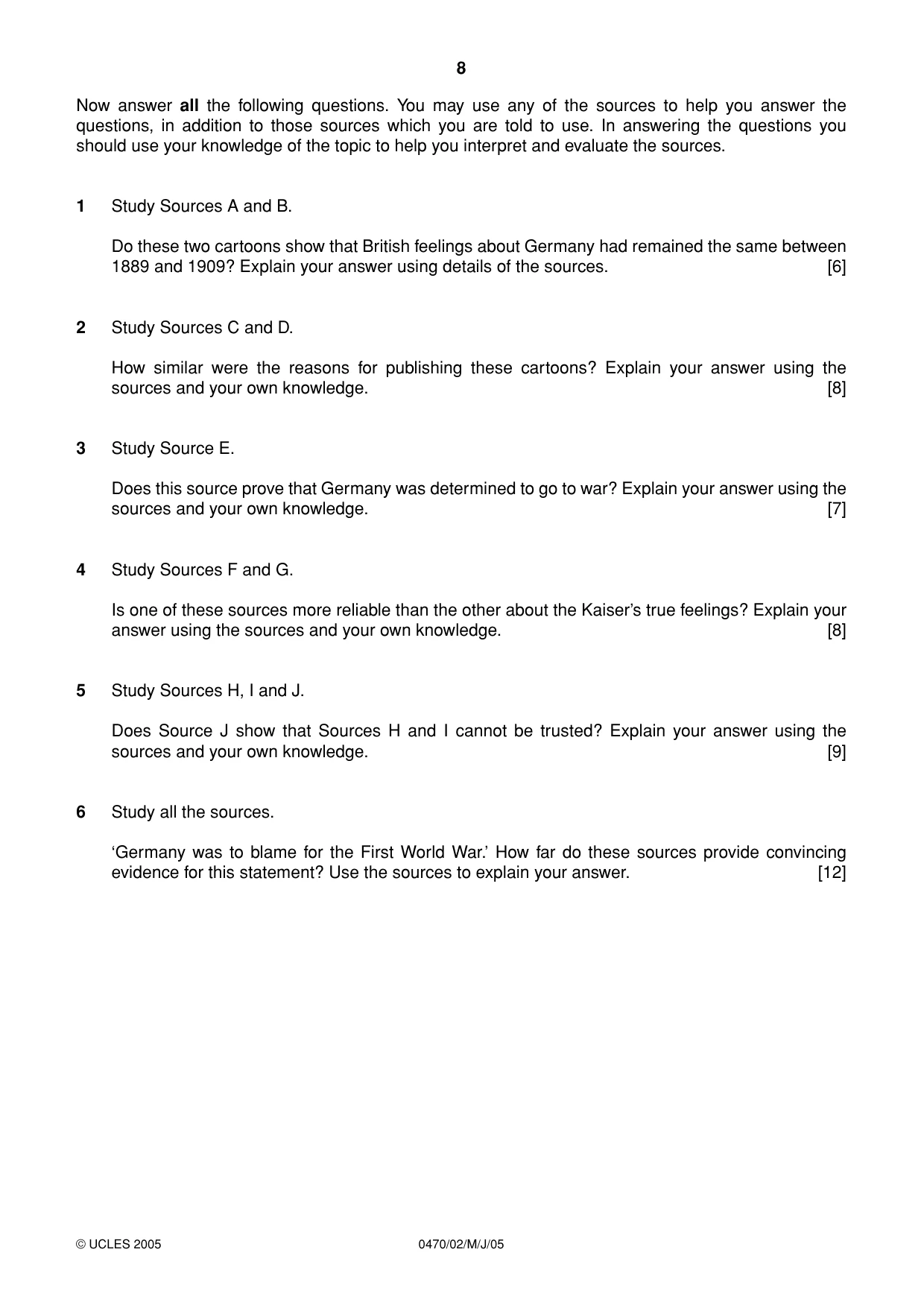
8 0470/02/M/J/05 © UCLES 2005 Now answer all the following questions. You may use any of the sources to help you answer the questions, in addition to those sources which you are told to use. In answering the questions you should use your knowledge of the topic to help you interpret and evaluate the sources. 1 Study Sources A and B. Do these two cartoons show that British feelings about Germany had remained the same between 1889 and 1909? Explain your answer using details of the sources. [6] 2 Study Sources C and D. How similar were the reasons for publishing these cartoons? Explain your answer using the sources and your own knowledge. [8] 3 Study Source E. Does this source prove that Germany was determined to go to war? Explain your answer using the sources and your own knowledge. [7] 4 Study Sources F and G. Is one of these sources more reliable than the other about the Kaiser’s true feelings? Explain your answer using the sources and your own knowledge. [8] 5 Study Sources H, I and J. Does Source J show that Sources H and I cannot be trusted? Explain your answer using the sources and your own knowledge. [9] 6 Study all the sources. ‘Germany was to blame for the First World War.’ How far do these sources provide convincing evidence for this statement? Use the sources to explain your answer. [12]
Question paper, page 9
9 0470/02/M/J/05 © UCLES 2005 [Turn over Option B: 20th Century topic WAS THE TREATY OF VERSAILLES FAIR AND JUST? Study the Background Information and the sources carefully, and then answer all the questions. Background Information The Paris Peace Conference opened on 18 January 1919. The Treaty of Versailles, which dealt with Germany, was signed on 28 June 1919. The Allies were divided over what to do about Germany and their discussions contained much arguing. Was the treaty that resulted from these discussions fair and just? SOURCE A An American representative at Versailles wrote in his diary ‘What a dreadful mess it is.’ Georges Clemenceau was under attack in France for being outwitted by the English. Lloyd George knew that he was heading for a storm of criticism for his failure to obtain the huge reparation payments from the Germans which he had promised the British public. But Lloyd George had deeper concerns. He had come to fear that the treaty was too harsh, that perhaps it condemned Europe to another gigantic war. Woodrow Wilson had first come to Paris with great hopes – the conference represented the opportunity he had always dreamed of – to completely remake the world according to the liberal and democratic ideas to which he had dedicated his life. But he had found the task so dominated with conflicting claims, hatreds, fears and greeds, that he was forced to settle for a compromise that satisfied no one. A recent historian’s description of the Big Three on the day after the Treaty of Versailles was signed. SOURCE B None of the Big Three lasted long after the Peace Conference. French voters thought that Clemenceau had not done enough and that Germany had been left alarmingly strong. Lloyd George lost the support of voters and never held office after 1922. Wilson returned to the USA to campaign for active American involvement in world affairs but America rejected the League of Nations. However, the peace settlement addressed most problems. If organisations like the League of Nations did not work as successfully as the peacemakers hoped, the fault lay less with them than with the next generation of politicians. A recent judgement about the Treaty of Versailles. SOURCE C What is difficult is to draw up a peace that will not provoke a struggle when those who took part in the war have passed away. If Germany feels unjustly treated, she will find ways of getting revenge. Injustice or arrogance in the hour of triumph will never be forgiven or forgotten. I am strongly opposed to transferring more Germans to the rule of some other nation than can possibly be helped. From some private notes written by Lloyd George during the peace negotiations, March 1919.
Question paper, page 10
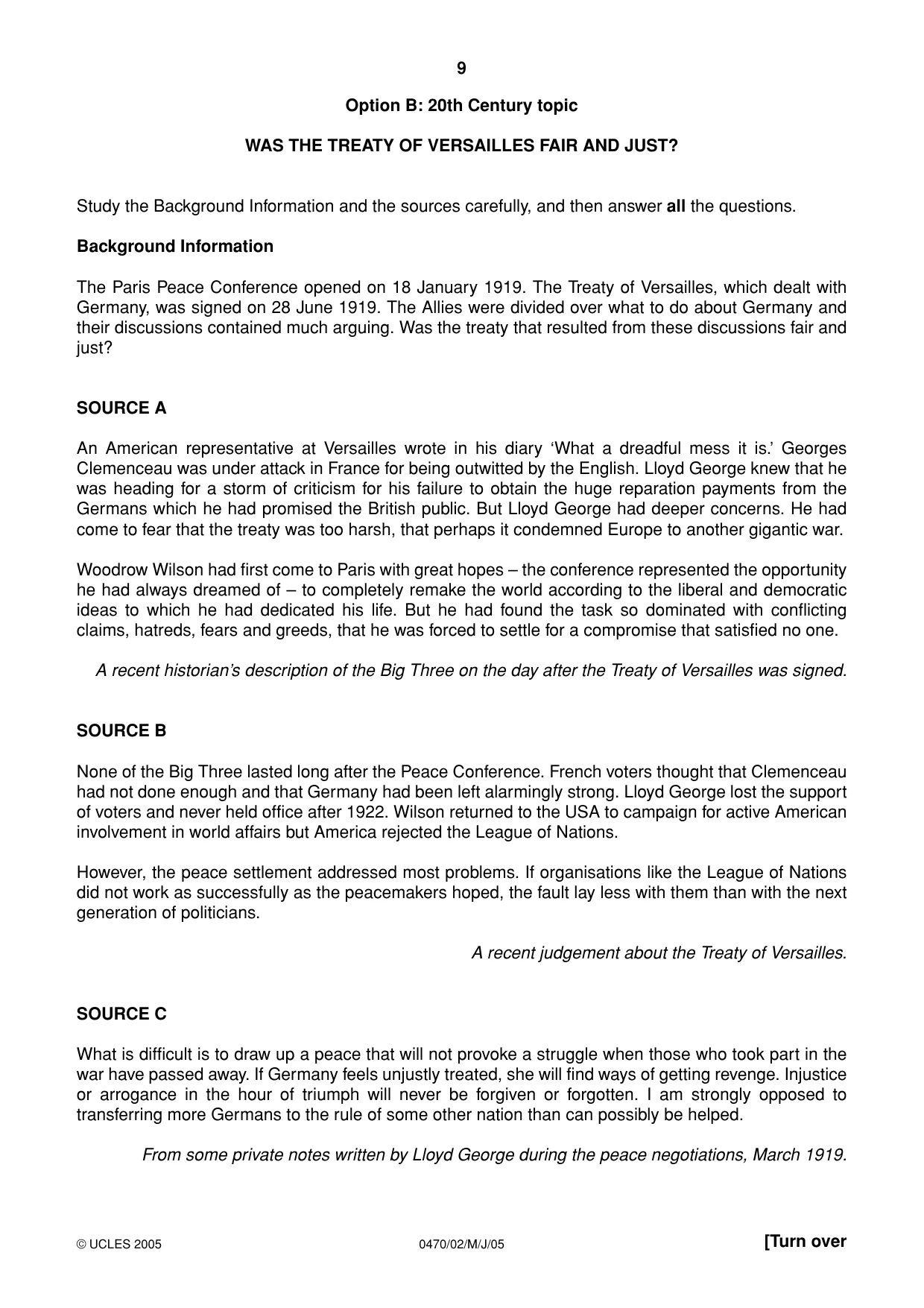
10 0470/02/M/J/05 © UCLES 2005 SOURCE D We have organised reparations where damage and injury have been inflicted, and we have established guarantees against the repetition of those crimes and horrors from which the world is just emerging. We have disarmed Germany; we have punished Germany. We have demonstrated that you cannot trample on national rights and liberties. This is the task we set ourselves, and I claim that this treaty will be a warning to nations not to repeat the actions by which Germany destroyed itself. Lloyd George speaking to the British Parliament in July 1919. SOURCE E A cartoon about the Treaty of Versailles published in a British newspaper, May 1919. ‘Der Tag’ means ‘The Day’. People in Britain believed that German soldiers before 1914 celebrated ‘The Day’ when they would start on a victorious war against Britain.
Question paper, page 11
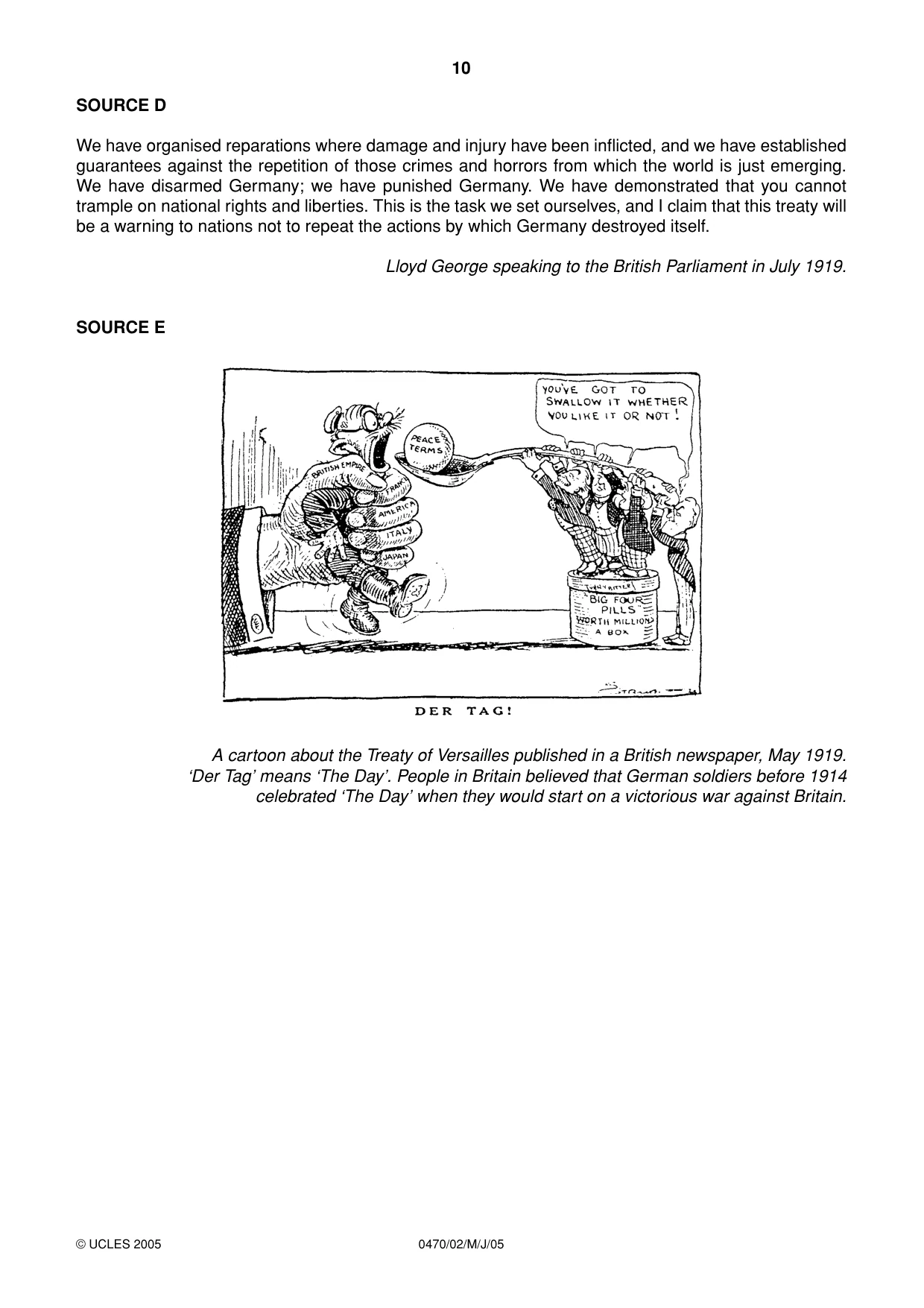
11 0470/02/M/J/05 © UCLES 2005 [Turn over SOURCE F A German cartoon from 1919 about the Treaty of Versailles. The figure with his hands tied represents Germany. SOURCE G One principle runs through the whole program. It is the principle of justice to all peoples and all nationalities, whether they be strong or weak. Without this principle there can be no international justice. President Wilson speaking about the Fourteen Points in January 1918.
Question paper, page 12
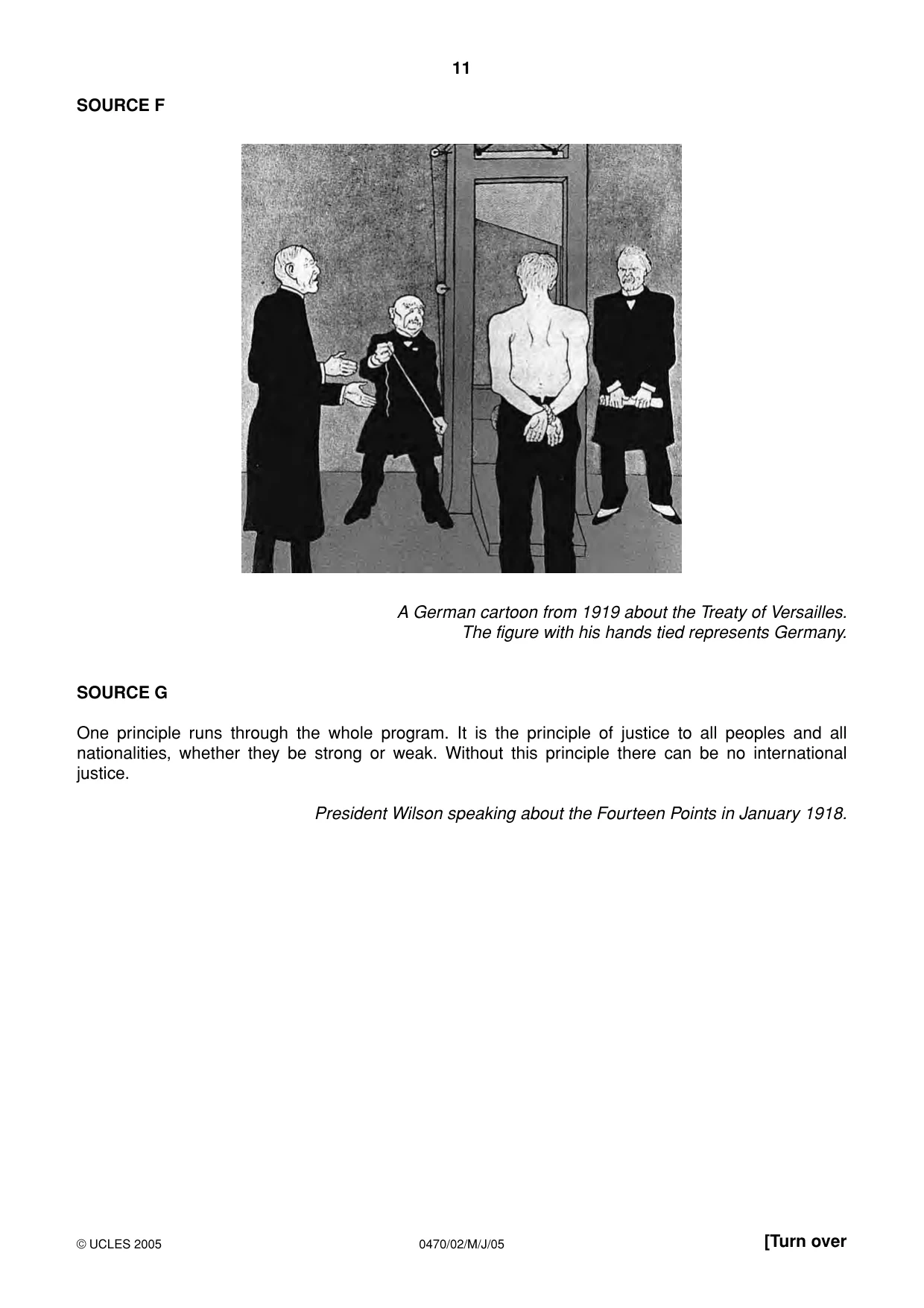
12 0470/02/M/J/05 © UCLES 2005 SOURCE H A cartoon published in an American magazine on 30 August 1919. The person doing the conducting is President Wilson.
Question paper, page 13
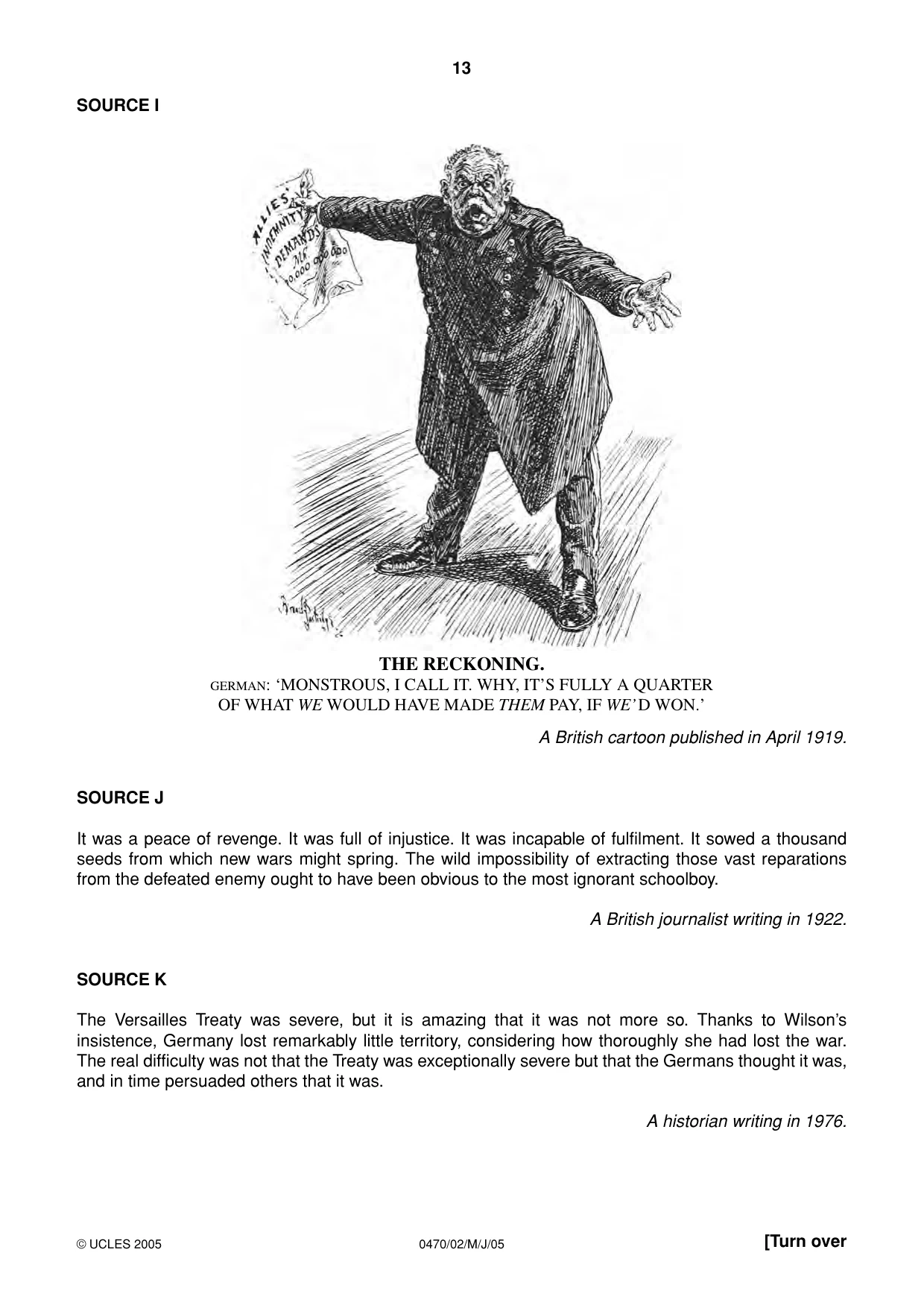
13 0470/02/M/J/05 © UCLES 2005 [Turn over SOURCE I THE RECKONING. GERMAN: ‘MONSTROUS, I CALL IT. WHY, IT’S FULLY A QUARTER OF WHAT WE WOULD HAVE MADE THEM PAY, IF WE’D WON.’ A British cartoon published in April 1919. SOURCE J It was a peace of revenge. It was full of injustice. It was incapable of fulfilment. It sowed a thousand seeds from which new wars might spring. The wild impossibility of extracting those vast reparations from the defeated enemy ought to have been obvious to the most ignorant schoolboy. A British journalist writing in 1922. SOURCE K The Versailles Treaty was severe, but it is amazing that it was not more so. Thanks to Wilson’s insistence, Germany lost remarkably little territory, considering how thoroughly she had lost the war. The real difficulty was not that the Treaty was exceptionally severe but that the Germans thought it was, and in time persuaded others that it was. A historian writing in 1976.
Question paper, page 14
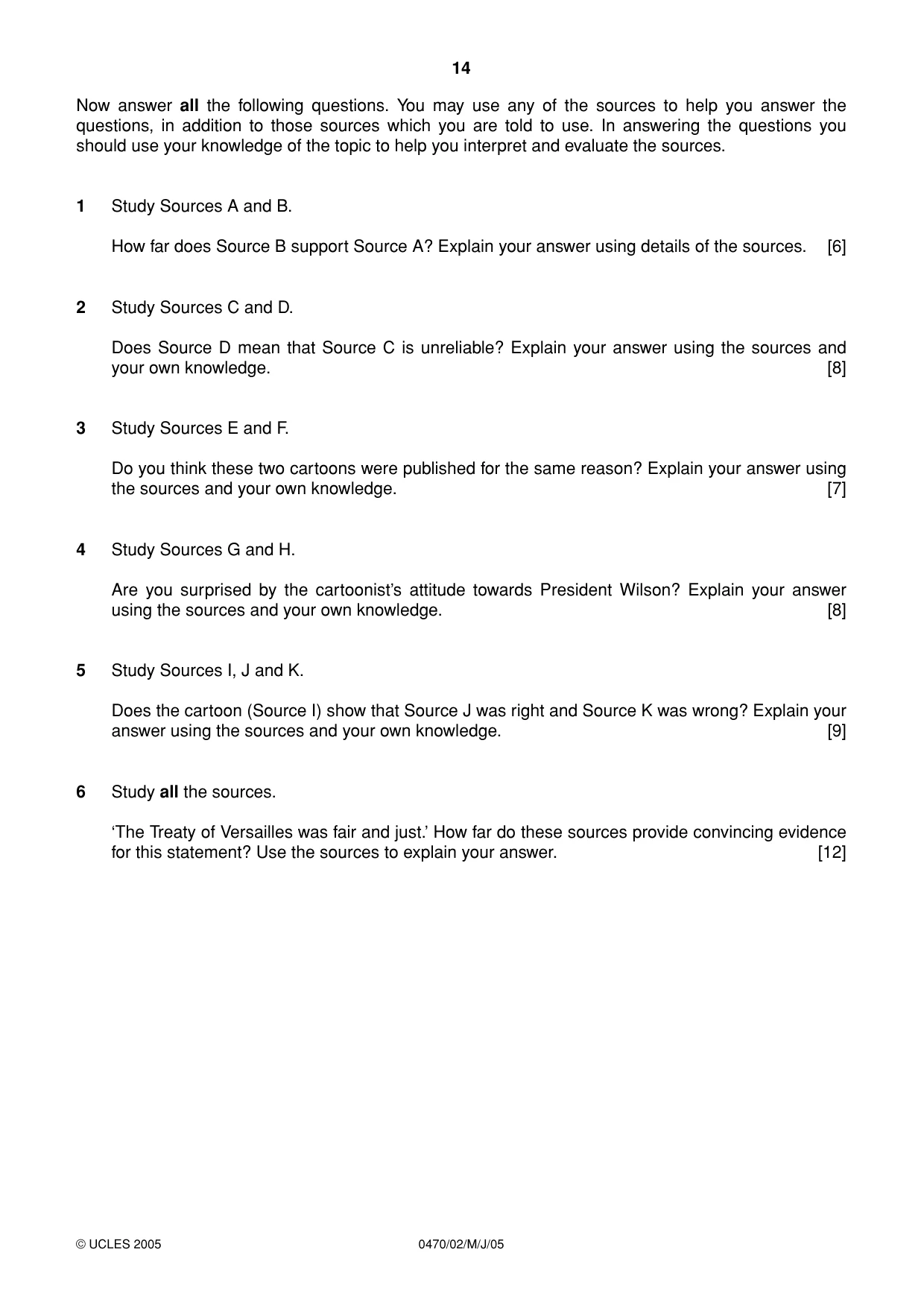
14 0470/02/M/J/05 © UCLES 2005 Now answer all the following questions. You may use any of the sources to help you answer the questions, in addition to those sources which you are told to use. In answering the questions you should use your knowledge of the topic to help you interpret and evaluate the sources. 1 Study Sources A and B. How far does Source B support Source A? Explain your answer using details of the sources. [6] 2 Study Sources C and D. Does Source D mean that Source C is unreliable? Explain your answer using the sources and your own knowledge. [8] 3 Study Sources E and F. Do you think these two cartoons were published for the same reason? Explain your answer using the sources and your own knowledge. [7] 4 Study Sources G and H. Are you surprised by the cartoonist’s attitude towards President Wilson? Explain your answer using the sources and your own knowledge. [8] 5 Study Sources I, J and K. Does the cartoon (Source I) show that Source J was right and Source K was wrong? Explain your answer using the sources and your own knowledge. [9] 6 Study all the sources. ‘The Treaty of Versailles was fair and just.’ How far do these sources provide convincing evidence for this statement? Use the sources to explain your answer. [12]
Question paper, page 16
16 0470/02/M/J/05 BLANK PAGE Copyright Acknowledgements: Option A Sources A–D © Punch Publications Ltd. Sources I–K © J A Harkness et al., Cooperation and Conflict: International Relations; Hodder & Stoughton, 1991. Option B Source A © Richard M. Watt; The Kings Depart; Weidenfield & Nicolson, a division of the Orion Publishing Group. Source B © J Watson; 20th Century World Affairs; John Murray 1974. Source C © T Lancaster and D Pearle, The Modern World; Causeway Press, 1996. Source D; N Kelly and G Lacey; Modern World History; Harcourt Education. Source E; The Cartoonists Vision 1919–1939, Routledge. Copyright © Express Newspapers Ltd. Sources F–G © T McAleavy; Modern World History; Cambridge University Press; 1996. Source I © Punch Publications Ltd. Source J © K Shephard; International Relations; Simon & Schuster Education 1992. Source K © T McAleavy; Modern World History; Cambridge University Press; 1996. Permission to reproduce items where third-party owned material protected by copyright is included has been sought and cleared where possible. Every reasonable effort has been made by the publisher (UCLES) to trace copyright holders, but if any items requiring clearance have unwittingly been included, the publisher will be pleased to make amends at the earliest possible opportunity. University of Cambridge International Examinations is part of the University of Cambridge Local Examinations Syndicate (UCLES), which is itself a department of the University of Cambridge.
Mark scheme, page 1
UNIVERSITY OF CAMBRIDGE INTERNATIONAL EXAMINATIONS International General Certificate of Secondary Education MARK SCHEME for the June 2005 question paper 0470 HISTORY 0470/02 Paper 2, maximum raw mark 50 This mark scheme is published as an aid to teachers and students, to indicate the requirements of the examination. It shows the basis on which Examiners were initially instructed to award marks. It does not indicate the details of the discussions that took place at an Examiners’ meeting before marking began. Any substantial changes to the mark scheme that arose from these discussions will be recorded in the published Report on the Examination. All Examiners are instructed that alternative correct answers and unexpected approaches in candidates’ scripts must be given marks that fairly reflect the relevant knowledge and skills demonstrated. Mark schemes must be read in conjunction with the question papers and the Report on the Examination. • CIE will not enter into discussion or correspondence in connection with these mark schemes. CIE is publishing the mark schemes for the June 2005 question papers for most IGCSE and GCE Advanced Level and Advanced Subsidiary Level syllabuses and some Ordinary Level syllabuses. www.XtremePapers.com
Mark scheme, page 2
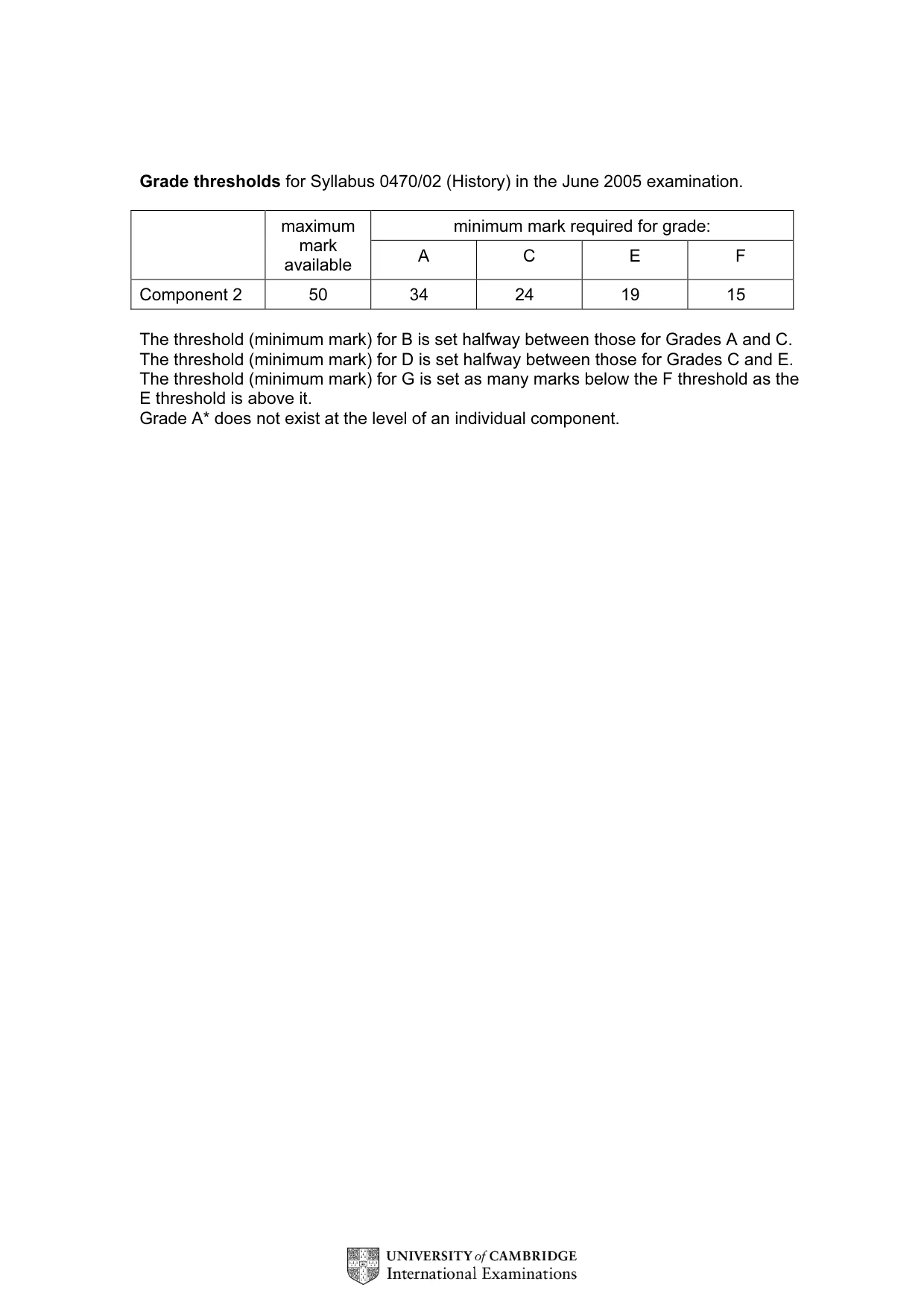
Grade thresholds for Syllabus 0470/02 (History) in the June 2005 examination. minimum mark required for grade: maximum mark available A C E F Component 2 50 34 24 19 15 The threshold (minimum mark) for B is set halfway between those for Grades A and C. The threshold (minimum mark) for D is set halfway between those for Grades C and E. The threshold (minimum mark) for G is set as many marks below the F threshold as the E threshold is above it. Grade A* does not exist at the level of an individual component.
Mark scheme, page 3
June 2005 IGCSE MARK SCHEME MAXIMUM MARK: 50 SYLLABUS/COMPONENT: 0470/02 HISTORY Paper 2
Mark scheme, page 4
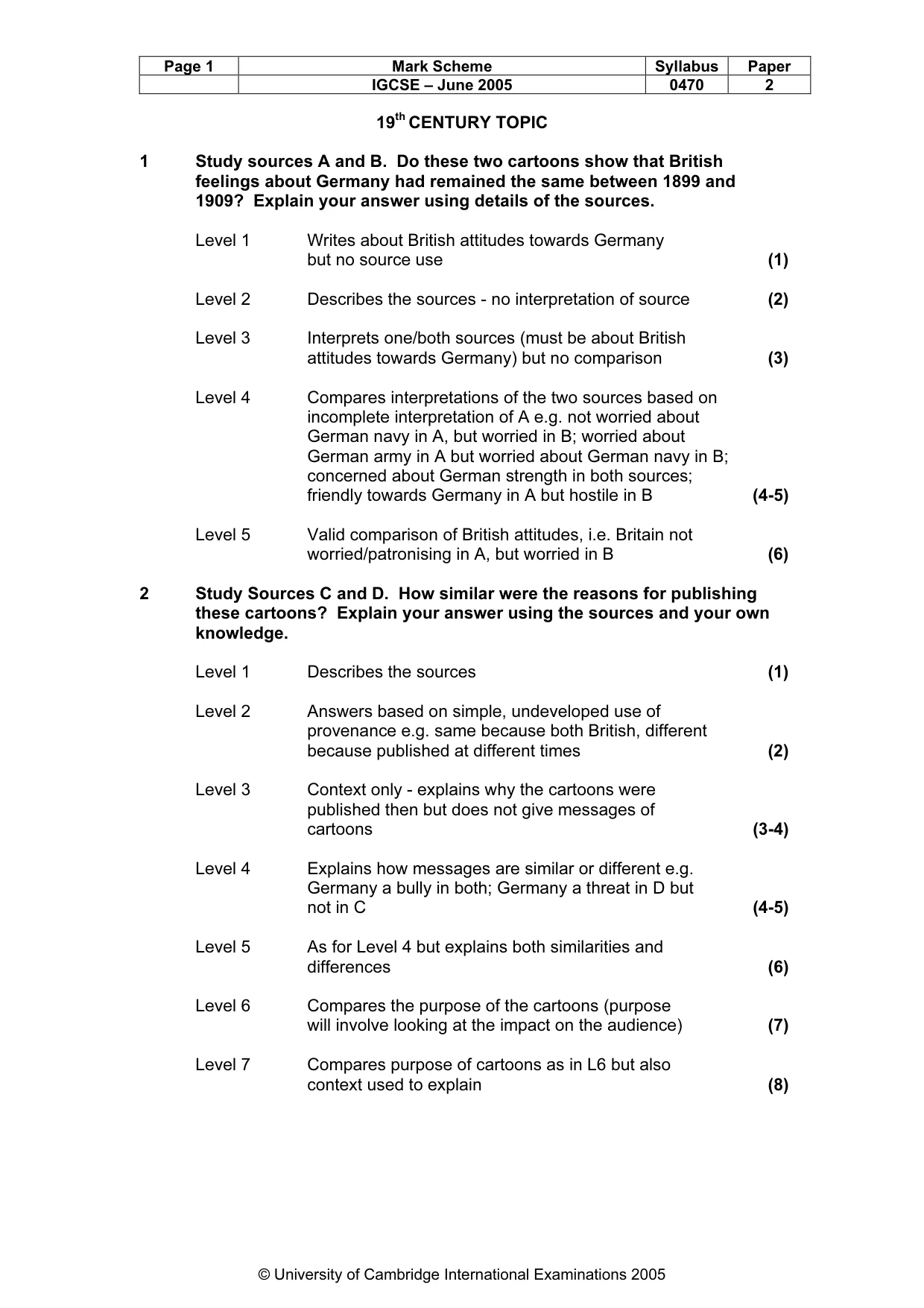
Page 1 Mark Scheme Syllabus Paper IGCSE – June 2005 0470 2 © University of Cambridge International Examinations 2005 19th CENTURY TOPIC 1 Study sources A and B. Do these two cartoons show that British feelings about Germany had remained the same between 1899 and 1909? Explain your answer using details of the sources. Level 1 Writes about British attitudes towards Germany but no source use (1) Level 2 Describes the sources - no interpretation of source (2) Level 3 Interprets one/both sources (must be about British attitudes towards Germany) but no comparison (3) Level 4 Compares interpretations of the two sources based on incomplete interpretation of A e.g. not worried about German navy in A, but worried in B; worried about German army in A but worried about German navy in B; concerned about German strength in both sources; friendly towards Germany in A but hostile in B (4-5) Level 5 Valid comparison of British attitudes, i.e. Britain not worried/patronising in A, but worried in B (6) 2 Study Sources C and D. How similar were the reasons for publishing these cartoons? Explain your answer using the sources and your own knowledge. Level 1 Describes the sources (1) Level 2 Answers based on simple, undeveloped use of provenance e.g. same because both British, different because published at different times (2) Level 3 Context only - explains why the cartoons were published then but does not give messages of cartoons (3-4) Level 4 Explains how messages are similar or different e.g. Germany a bully in both; Germany a threat in D but not in C (4-5) Level 5 As for Level 4 but explains both similarities and differences (6) Level 6 Compares the purpose of the cartoons (purpose will involve looking at the impact on the audience) (7) Level 7 Compares purpose of cartoons as in L6 but also context used to explain (8)
Mark scheme, page 5
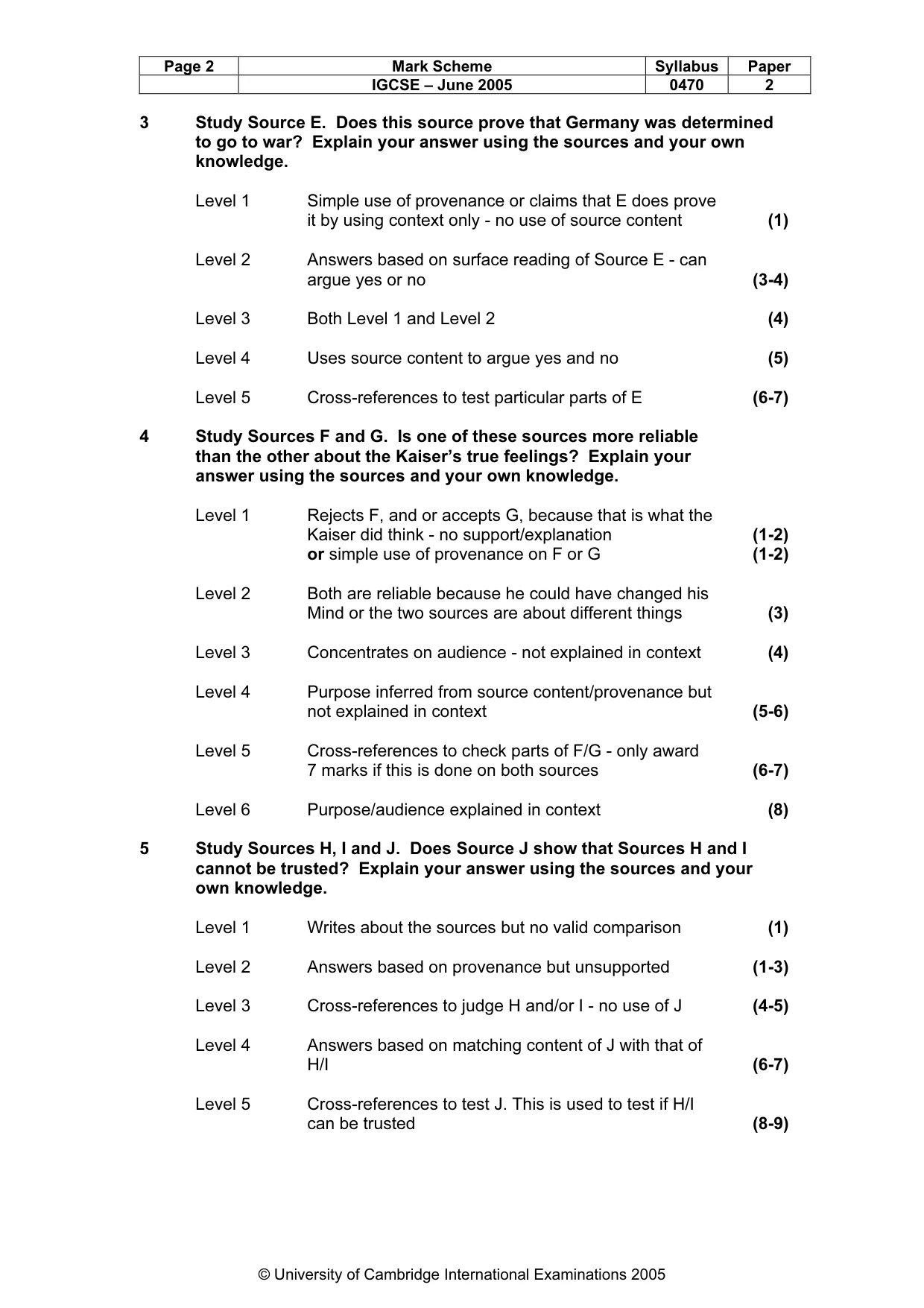
Page 2 Mark Scheme Syllabus Paper IGCSE – June 2005 0470 2 © University of Cambridge International Examinations 2005 3 Study Source E. Does this source prove that Germany was determined to go to war? Explain your answer using the sources and your own knowledge. Level 1 Simple use of provenance or claims that E does prove it by using context only - no use of source content (1) Level 2 Answers based on surface reading of Source E - can argue yes or no (3-4) Level 3 Both Level 1 and Level 2 (4) Level 4 Uses source content to argue yes and no (5) Level 5 Cross-references to test particular parts of E (6-7) 4 Study Sources F and G. Is one of these sources more reliable than the other about the Kaiser’s true feelings? Explain your answer using the sources and your own knowledge. Level 1 Rejects F, and or accepts G, because that is what the Kaiser did think - no support/explanation (1-2) or simple use of provenance on F or G (1-2) Level 2 Both are reliable because he could have changed his Mind or the two sources are about different things (3) Level 3 Concentrates on audience - not explained in context (4) Level 4 Purpose inferred from source content/provenance but not explained in context (5-6) Level 5 Cross-references to check parts of F/G - only award 7 marks if this is done on both sources (6-7) Level 6 Purpose/audience explained in context (8) 5 Study Sources H, I and J. Does Source J show that Sources H and I cannot be trusted? Explain your answer using the sources and your own knowledge. Level 1 Writes about the sources but no valid comparison (1) Level 2 Answers based on provenance but unsupported (1-3) Level 3 Cross-references to judge H and/or I - no use of J (4-5) Level 4 Answers based on matching content of J with that of H/I (6-7) Level 5 Cross-references to test J. This is used to test if H/I can be trusted (8-9)
Mark scheme, page 6
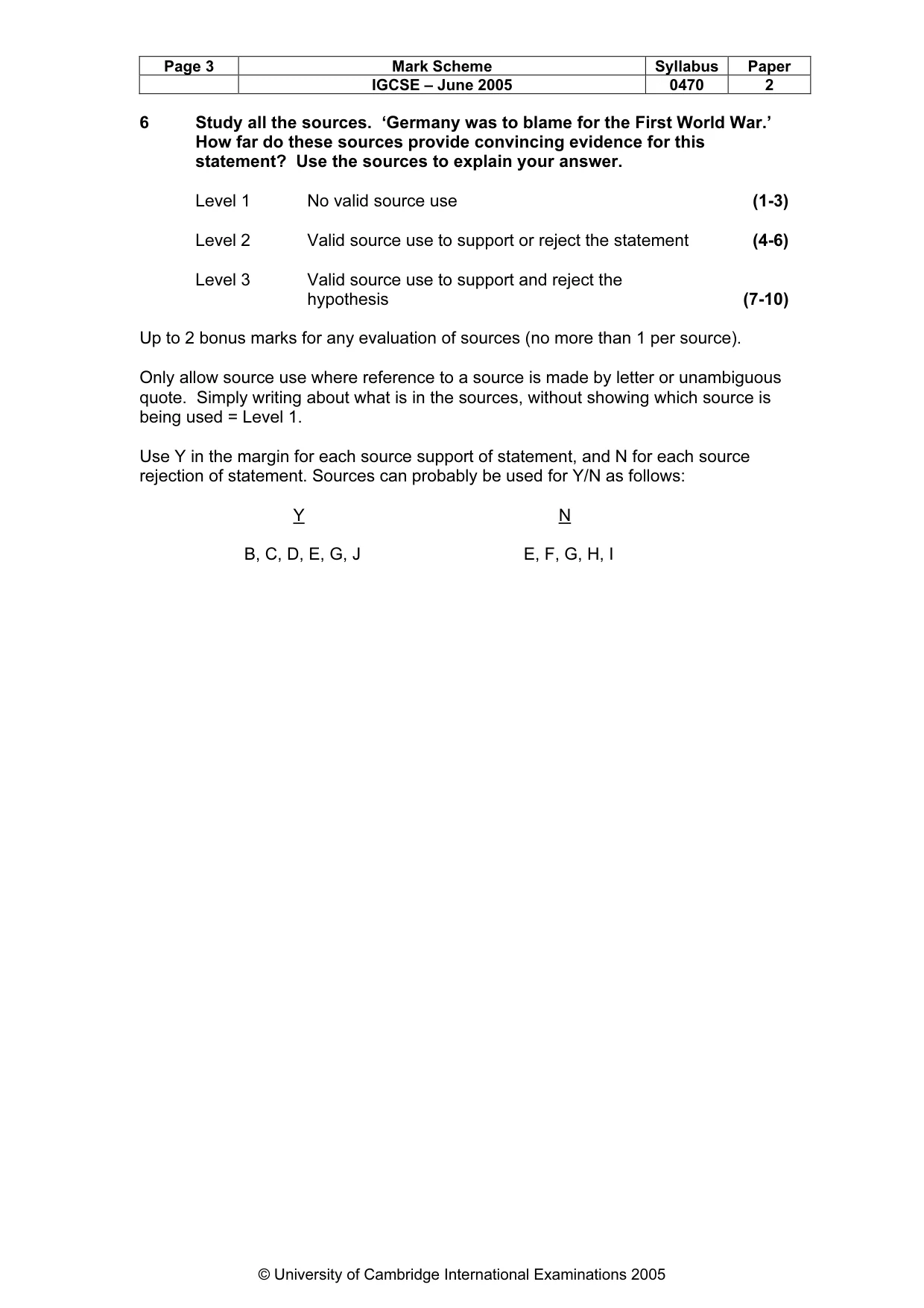
Page 3 Mark Scheme Syllabus Paper IGCSE – June 2005 0470 2 © University of Cambridge International Examinations 2005 6 Study all the sources. ‘Germany was to blame for the First World War.’ How far do these sources provide convincing evidence for this statement? Use the sources to explain your answer. Level 1 No valid source use (1-3) Level 2 Valid source use to support or reject the statement (4-6) Level 3 Valid source use to support and reject the hypothesis (7-10) Up to 2 bonus marks for any evaluation of sources (no more than 1 per source). Only allow source use where reference to a source is made by letter or unambiguous quote. Simply writing about what is in the sources, without showing which source is being used = Level 1. Use Y in the margin for each source support of statement, and N for each source rejection of statement. Sources can probably be used for Y/N as follows: Y N B, C, D, E, G, J E, F, G, H, I
Mark scheme, page 7
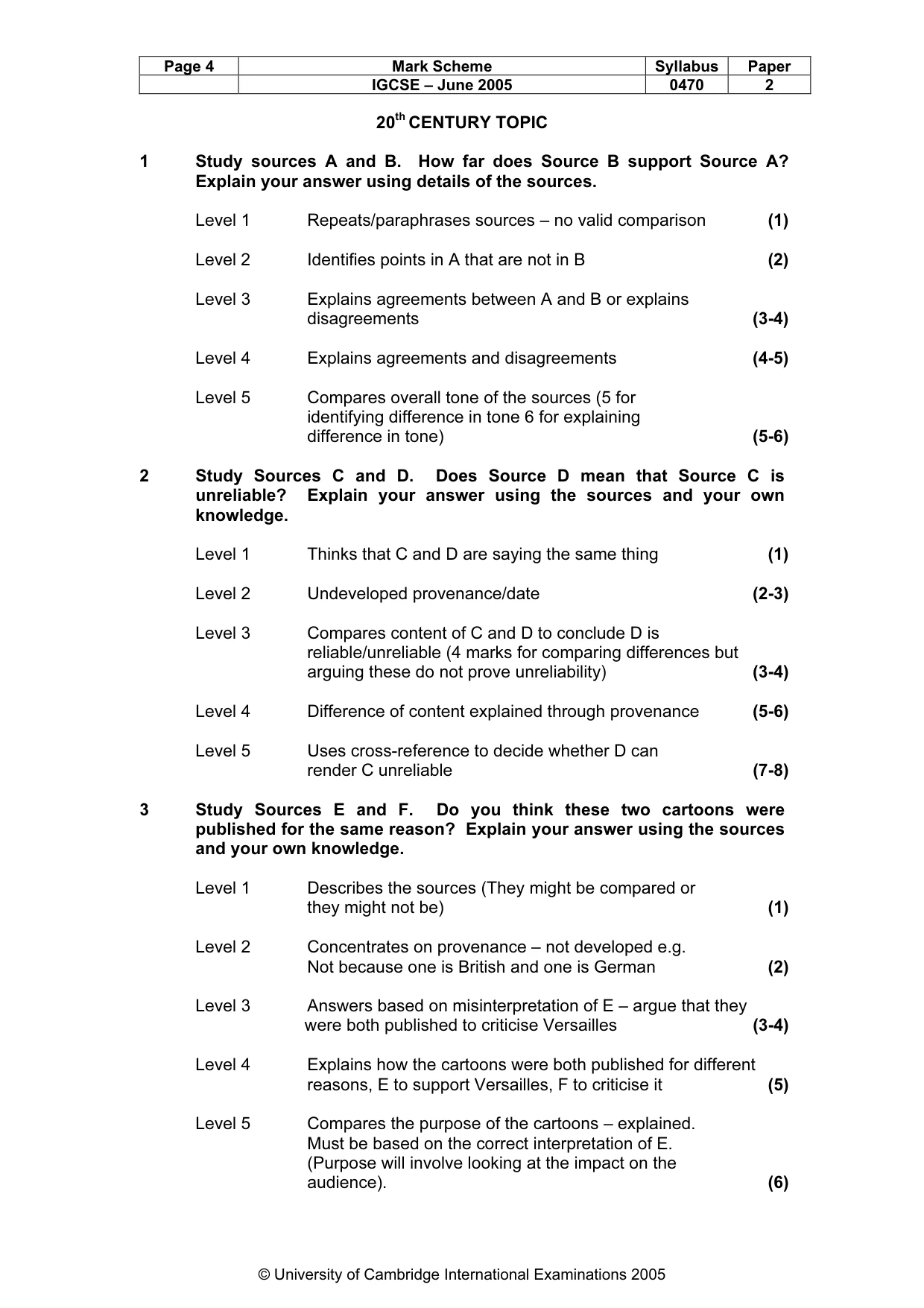
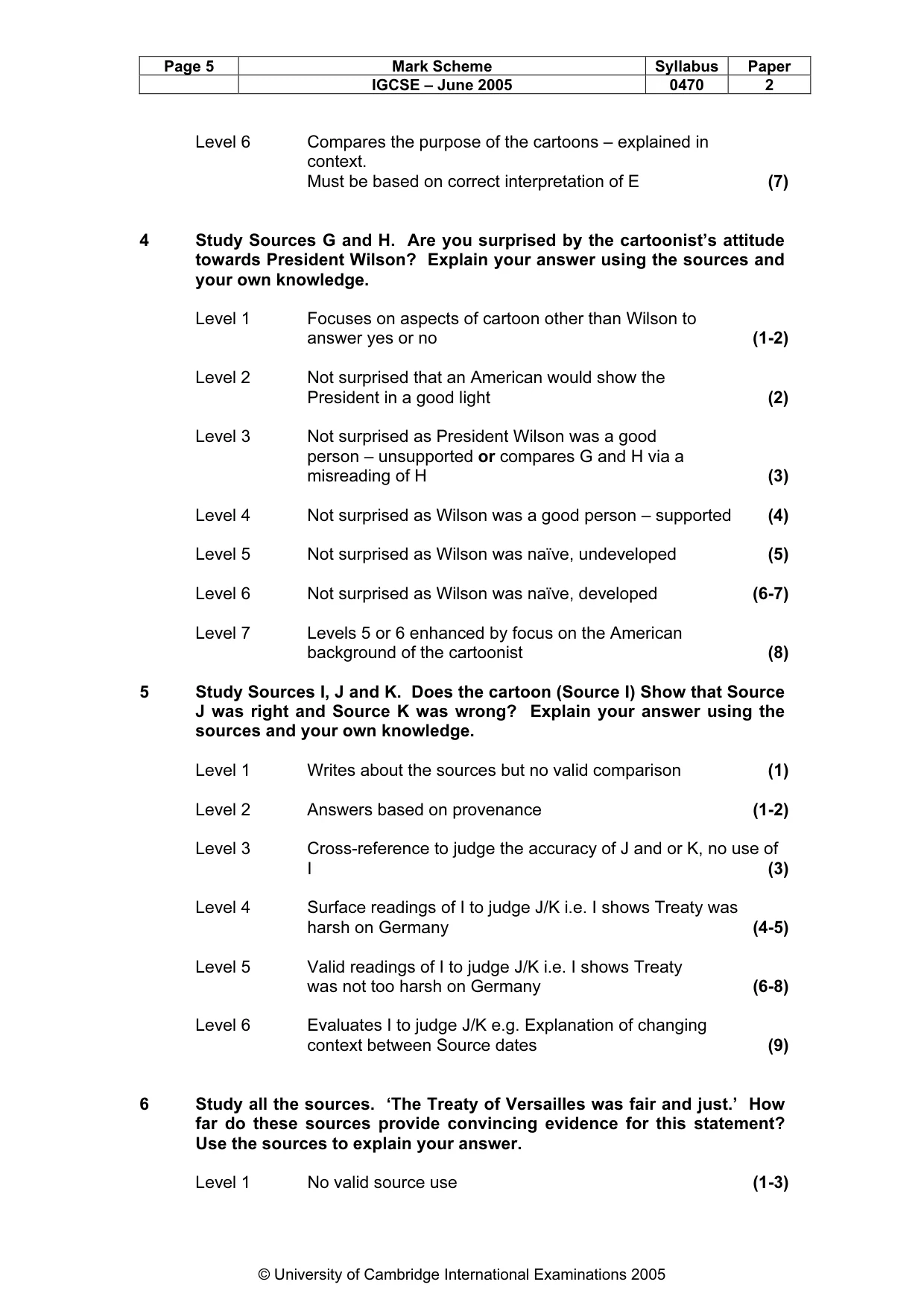
Page 4 Mark Scheme Syllabus Paper IGCSE – June 2005 0470 2 © University of Cambridge International Examinations 2005 20th CENTURY TOPIC 1 Study sources A and B. How far does Source B support Source A? Explain your answer using details of the sources. Level 1 Repeats/paraphrases sources – no valid comparison (1) Level 2 Identifies points in A that are not in B (2) Level 3 Explains agreements between A and B or explains disagreements (3-4) Level 4 Explains agreements and disagreements (4-5) Level 5 Compares overall tone of the sources (5 for identifying difference in tone 6 for explaining difference in tone) (5-6) 2 Study Sources C and D. Does Source D mean that Source C is unreliable? Explain your answer using the sources and your own knowledge. Level 1 Thinks that C and D are saying the same thing (1) Level 2 Undeveloped provenance/date (2-3) Level 3 Compares content of C and D to conclude D is reliable/unreliable (4 marks for comparing differences but arguing these do not prove unreliability) (3-4) Level 4 Difference of content explained through provenance (5-6) Level 5 Uses cross-reference to decide whether D can render C unreliable (7-8) 3 Study Sources E and F. Do you think these two cartoons were published for the same reason? Explain your answer using the sources and your own knowledge. Level 1 Describes the sources (They might be compared or they might not be) (1) Level 2 Concentrates on provenance – not developed e.g. Not because one is British and one is German (2) Level 3 Answers based on misinterpretation of E – argue that they were both published to criticise Versailles (3-4) Level 4 Explains how the cartoons were both published for different reasons, E to support Versailles, F to criticise it (5) Level 5 Compares the purpose of the cartoons – explained. Must be based on the correct interpretation of E. (Purpose will involve looking at the impact on the audience). (6)
Mark scheme, page 8
Page 5 Mark Scheme Syllabus Paper IGCSE – June 2005 0470 2 © University of Cambridge International Examinations 2005 Level 6 Compares the purpose of the cartoons – explained in context. Must be based on correct interpretation of E (7) 4 Study Sources G and H. Are you surprised by the cartoonist’s attitude towards President Wilson? Explain your answer using the sources and your own knowledge. Level 1 Focuses on aspects of cartoon other than Wilson to answer yes or no (1-2) Level 2 Not surprised that an American would show the President in a good light (2) Level 3 Not surprised as President Wilson was a good person – unsupported or compares G and H via a misreading of H (3) Level 4 Not surprised as Wilson was a good person – supported (4) Level 5 Not surprised as Wilson was naïve, undeveloped (5) Level 6 Not surprised as Wilson was naïve, developed (6-7) Level 7 Levels 5 or 6 enhanced by focus on the American background of the cartoonist (8) 5 Study Sources I, J and K. Does the cartoon (Source I) Show that Source J was right and Source K was wrong? Explain your answer using the sources and your own knowledge. Level 1 Writes about the sources but no valid comparison (1) Level 2 Answers based on provenance (1-2) Level 3 Cross-reference to judge the accuracy of J and or K, no use of I (3) Level 4 Surface readings of I to judge J/K i.e. I shows Treaty was harsh on Germany (4-5) Level 5 Valid readings of I to judge J/K i.e. I shows Treaty was not too harsh on Germany (6-8) Level 6 Evaluates I to judge J/K e.g. Explanation of changing context between Source dates (9) 6 Study all the sources. ‘The Treaty of Versailles was fair and just.’ How far do these sources provide convincing evidence for this statement? Use the sources to explain your answer. Level 1 No valid source use (1-3)
Mark scheme, page 9
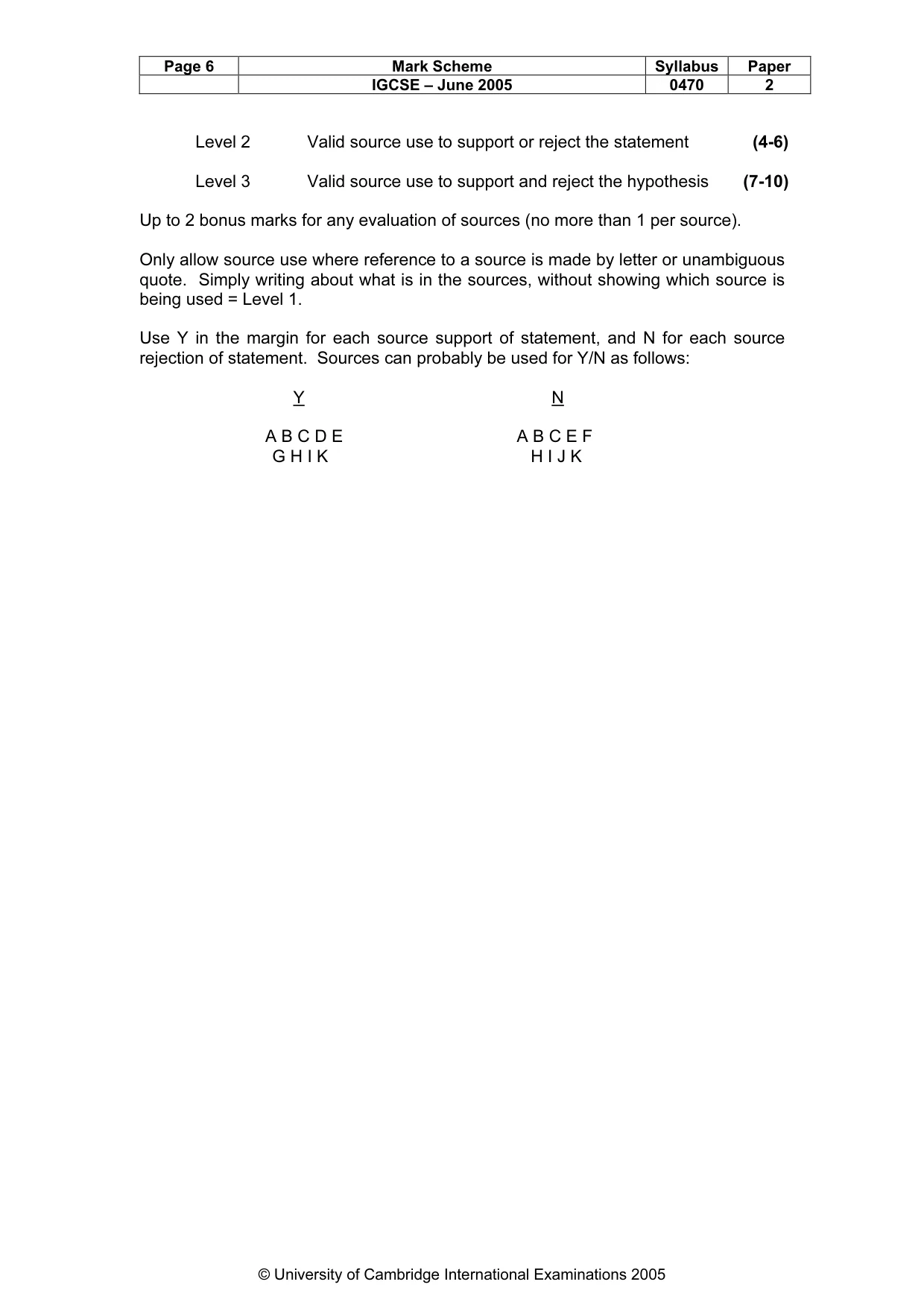
Page 6 Mark Scheme Syllabus Paper IGCSE – June 2005 0470 2 © University of Cambridge International Examinations 2005 Level 2 Valid source use to support or reject the statement (4-6) Level 3 Valid source use to support and reject the hypothesis (7-10) Up to 2 bonus marks for any evaluation of sources (no more than 1 per source). Only allow source use where reference to a source is made by letter or unambiguous quote. Simply writing about what is in the sources, without showing which source is being used = Level 1. Use Y in the margin for each source support of statement, and N for each source rejection of statement. Sources can probably be used for Y/N as follows: Y N A B C D E A B C E F G H I K H I J K