Cambridge IGCSE History 0470 — 2002 Oct/Nov Paper 1 · Variant 1
0470/11/O/N/02
The question paper and its mark scheme, free to read here and free to download. This is Cambridge’s own paper, exactly as it was sat.
Question paper20 pages
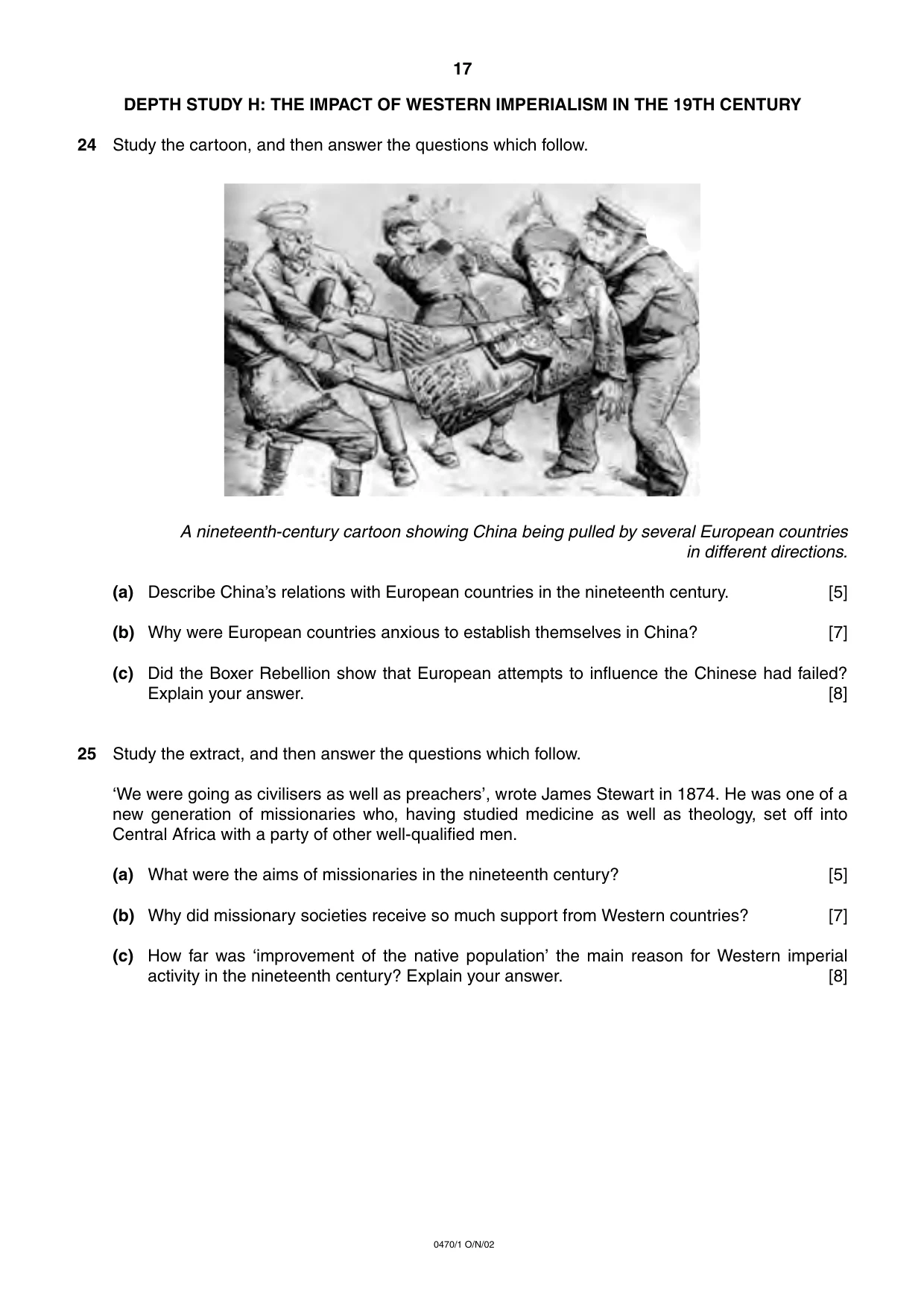


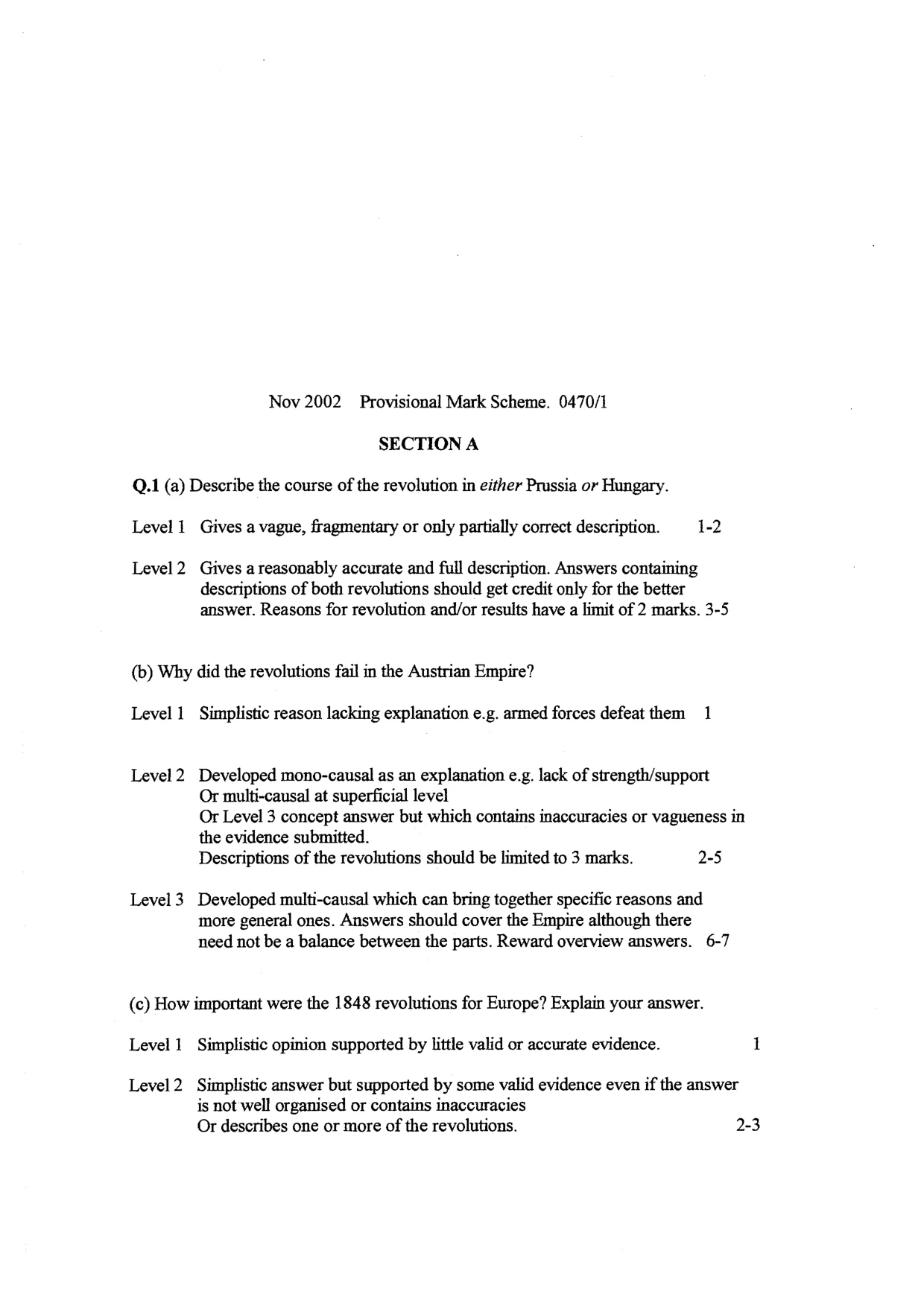
Mark scheme26 pages
Answers below. Sit the paper first if you are practising.
Paper as text
Question paper, page 1
TIME 1 hour 45 minutes INSTRUCTIONS TO CANDIDATES Write your name, Centre number and candidate number in the spaces provided on the answer paper/ answer booklet. Answer three questions. Section A: Answer two questions. Section B: Answer one question. Write your answers on the separate answer paper provided. If you use more than one sheet of paper, fasten the sheets together. INFORMATION FOR CANDIDATES The number of marks is given in brackets [ ] at the end of each question or part question. International General Certificate of Secondary Education CAMBRIDGE INTERNATIONAL EXAMINATIONS HISTORY 0470/1 PAPER 1 OCTOBER/NOVEMBER SESSION 2002 1 hour 45 minutes Additional materials: Answer paper. This question paper consists of 18 printed pages and 2 blank pages. SPA (NH) S18629/3 © CIE 2002 [Turn over www.XtremePapers.com
Question paper, page 2
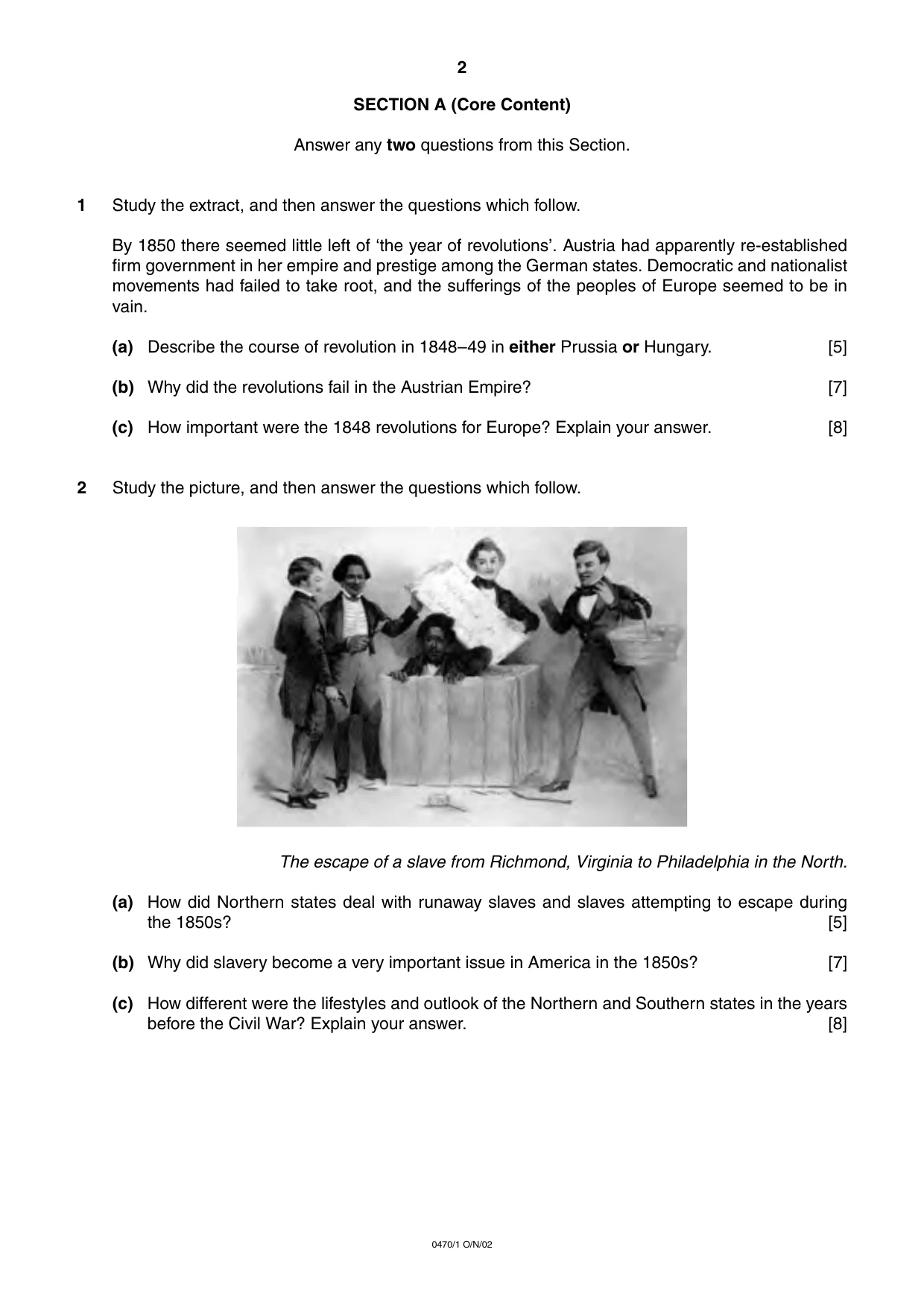
2 0470/1 O/N/02 SECTION A (Core Content) Answer any two questions from this Section. 1 Study the extract, and then answer the questions which follow. By 1850 there seemed little left of ‘the year of revolutions’. Austria had apparently re-established firm government in her empire and prestige among the German states. Democratic and nationalist movements had failed to take root, and the sufferings of the peoples of Europe seemed to be in vain. (a) Describe the course of revolution in 1848–49 in either Prussia or Hungary. [5] (b) Why did the revolutions fail in the Austrian Empire? [7] (c) How important were the 1848 revolutions for Europe? Explain your answer. [8] 2 Study the picture, and then answer the questions which follow. The escape of a slave from Richmond, Virginia to Philadelphia in the North. (a) How did Northern states deal with runaway slaves and slaves attempting to escape during the 1850s? [5] (b) Why did slavery become a very important issue in America in the 1850s? [7] (c) How different were the lifestyles and outlook of the Northern and Southern states in the years before the Civil War? Explain your answer. [8]
Question paper, page 3
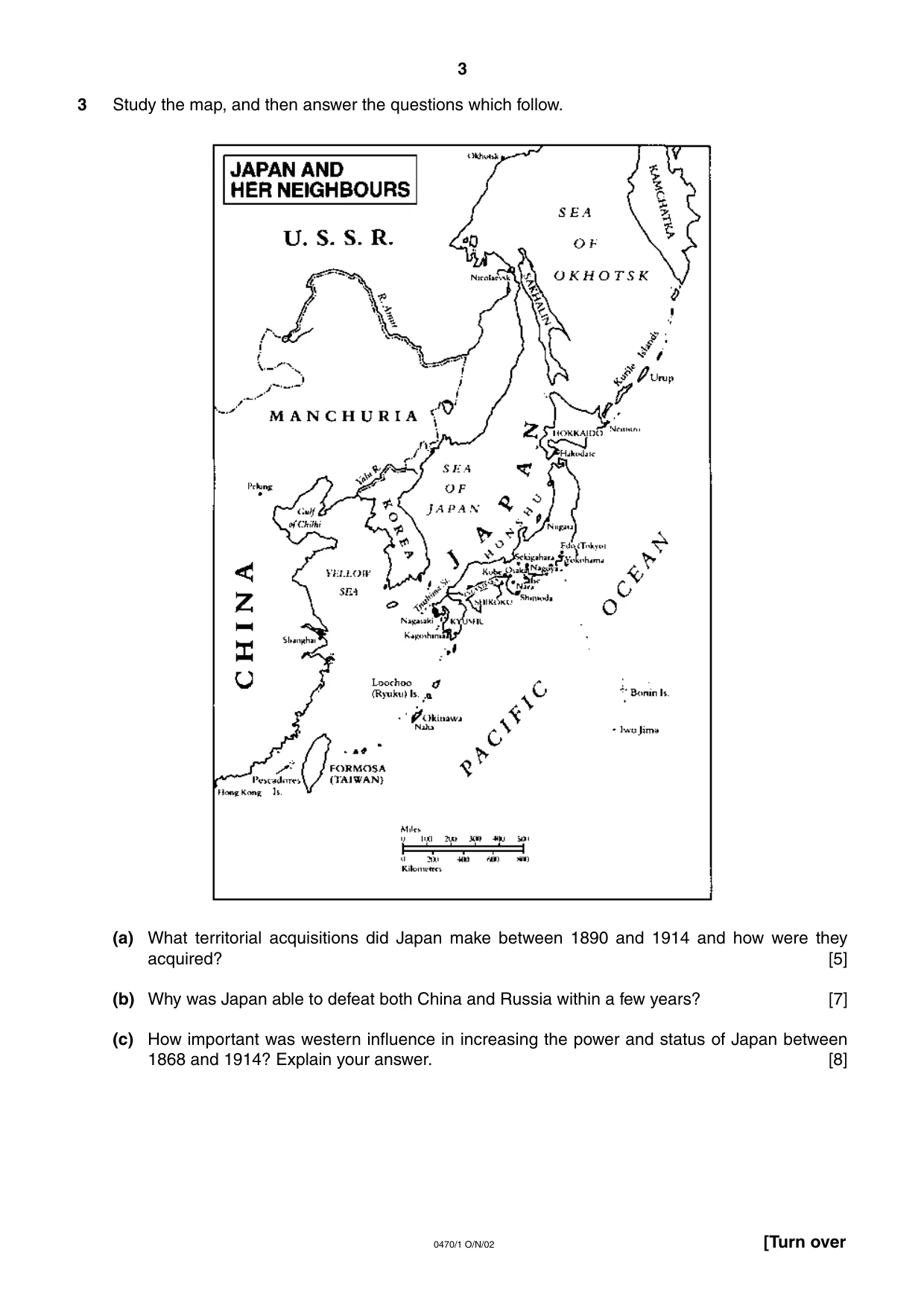
3 0470/1 O/N/02 [Turn over 3 Study the map, and then answer the questions which follow. (a) What territorial acquisitions did Japan make between 1890 and 1914 and how were they acquired? [5] (b) Why was Japan able to defeat both China and Russia within a few years? [7] (c) How important was western influence in increasing the power and status of Japan between 1868 and 1914? Explain your answer. [8]
Question paper, page 4
4 0470/1 O/N/02 4 Study the extract, and then answer the questions which follow. The crime against my nephew is the direct consequence of the agitation carried on by Serbian Pan-Slavists whose sole aim is to weaken the Triple Alliance and shatter my Empire. The bloody deed was not the work of a single individual but a well-organised plot. Though it may be impossible to prove the involvement of the Serbian Government, there can be no doubt that its policy of uniting all Southern Slavs under the Serbian flag encourages such crimes. What would German policy be if Austria decided to punish this centre of terrorism in Belgrade? Extract from a letter from Emperor Franz Josef to Kaiser Wilhelm on 5 July 1914 about the assassination of the Archduke Ferdinand and his wife. (a) Describe the events of 28 June 1914 leading to the assassination of the Archduke Ferdinand and his wife in Sarajevo. [5] (b) Why did Austria want to take action against Serbia? [7] (c) Did the assassination of the Archduke Ferdinand make European war inevitable? Explain your answer. [8] 5 Study the extract, and then answer the questions which follow. The League may be a difficult scheme to work, but the significant thing is that the Powers have promised to make it work. Mankind has, in the short space of ten years, jumped from the old order to the new. We are witnessing one of the great miracles of history. From a speech made in 1930. (a) Describe two successes the League of Nations had in the 1920s in solving disputes. [5] (b) Why was the League of Nations quite successful in the first ten years of its existence? [7] (c) ‘The good work of the League was destroyed by the Depression of the 1930s.’ Do you agree? Explain your answer. [8]
Question paper, page 5
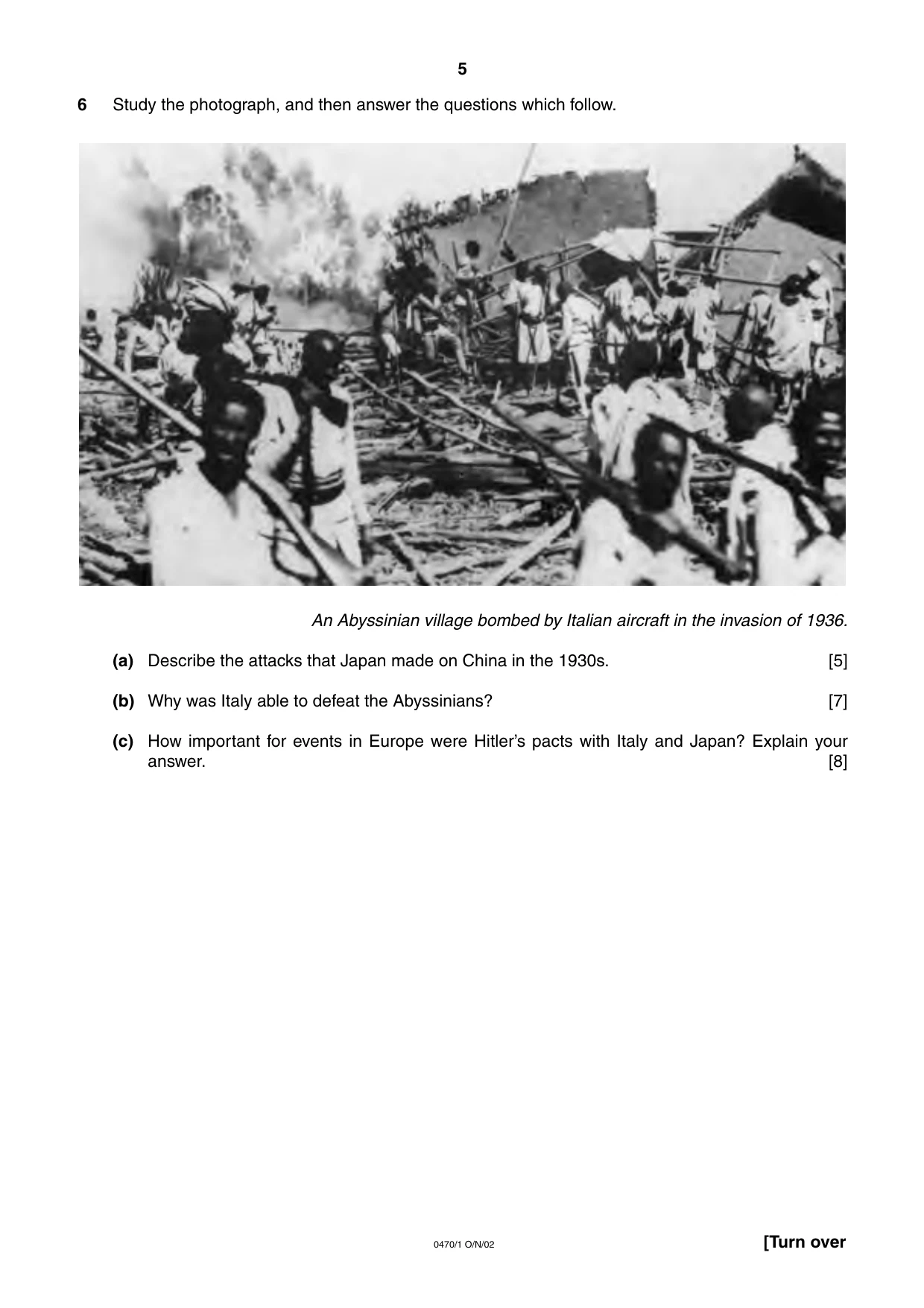
5 0470/1 O/N/02 [Turn over 6 Study the photograph, and then answer the questions which follow. An Abyssinian village bombed by Italian aircraft in the invasion of 1936. (a) Describe the attacks that Japan made on China in the 1930s. [5] (b) Why was Italy able to defeat the Abyssinians? [7] (c) How important for events in Europe were Hitler’s pacts with Italy and Japan? Explain your answer. [8]
Question paper, page 6
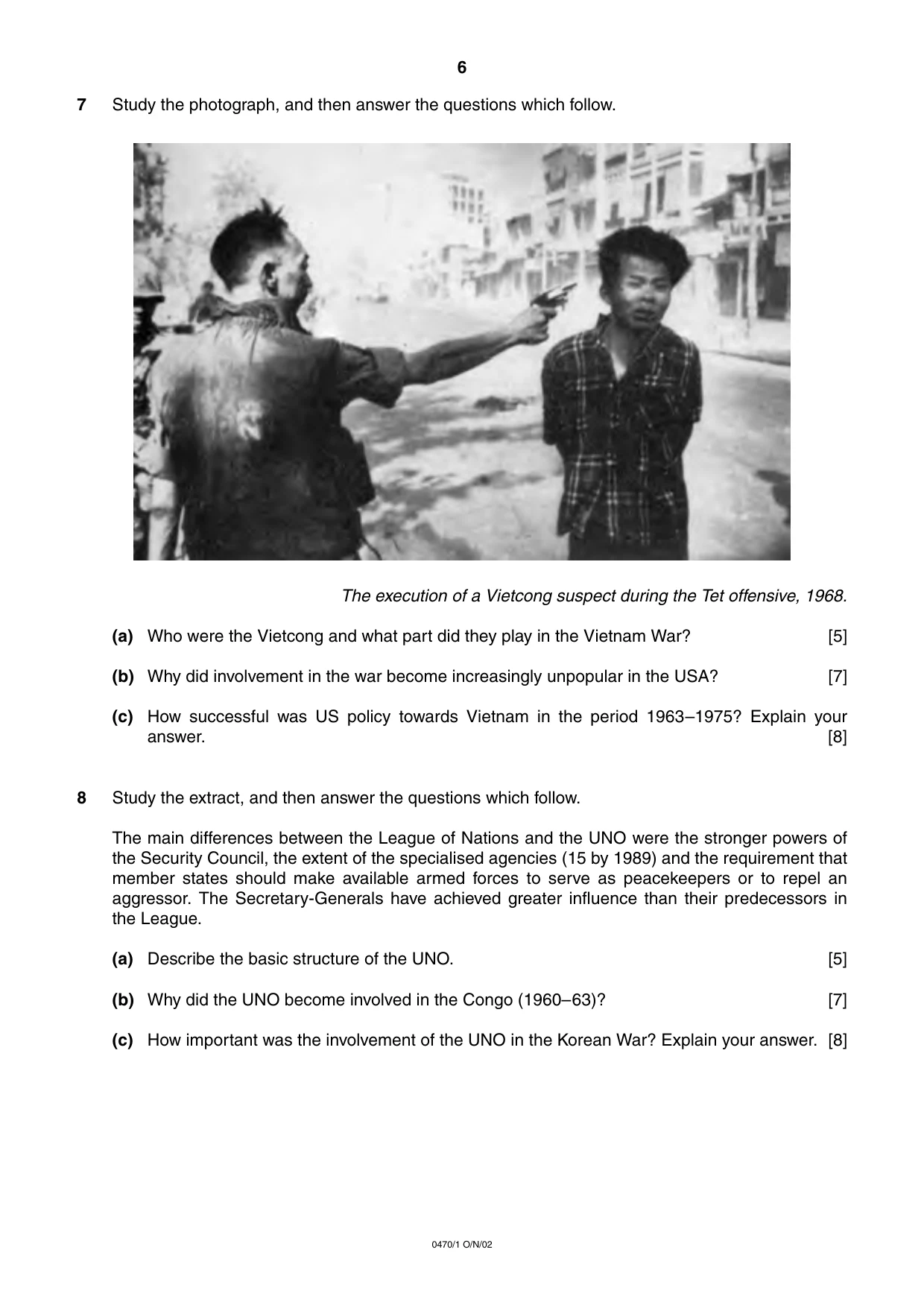
6 0470/1 O/N/02 7 Study the photograph, and then answer the questions which follow. The execution of a Vietcong suspect during the Tet offensive, 1968. (a) Who were the Vietcong and what part did they play in the Vietnam War? [5] (b) Why did involvement in the war become increasingly unpopular in the USA? [7] (c) How successful was US policy towards Vietnam in the period 1963–1975? Explain your answer. [8] 8 Study the extract, and then answer the questions which follow. The main differences between the League of Nations and the UNO were the stronger powers of the Security Council, the extent of the specialised agencies (15 by 1989) and the requirement that member states should make available armed forces to serve as peacekeepers or to repel an aggressor. The Secretary-Generals have achieved greater influence than their predecessors in the League. (a) Describe the basic structure of the UNO. [5] (b) Why did the UNO become involved in the Congo (1960–63)? [7] (c) How important was the involvement of the UNO in the Korean War? Explain your answer. [8]
Question paper, page 7
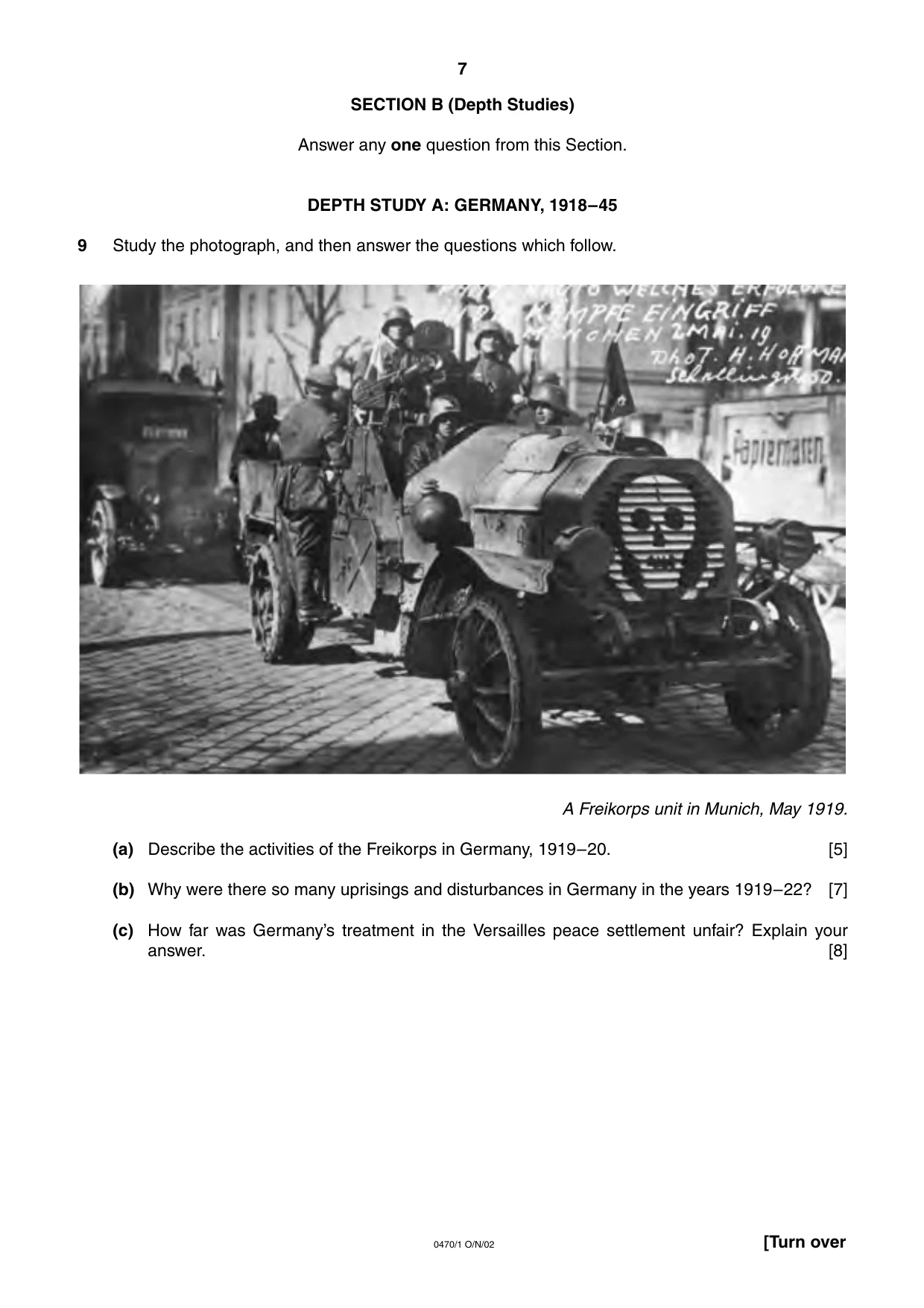
7 0470/1 O/N/02 [Turn over SECTION B (Depth Studies) Answer any one question from this Section. DEPTH STUDY A: GERMANY, 1918–45 9 Study the photograph, and then answer the questions which follow. A Freikorps unit in Munich, May 1919. (a) Describe the activities of the Freikorps in Germany, 1919–20. [5] (b) Why were there so many uprisings and disturbances in Germany in the years 1919–22? [7] (c) How far was Germany’s treatment in the Versailles peace settlement unfair? Explain your answer. [8]
Question paper, page 8
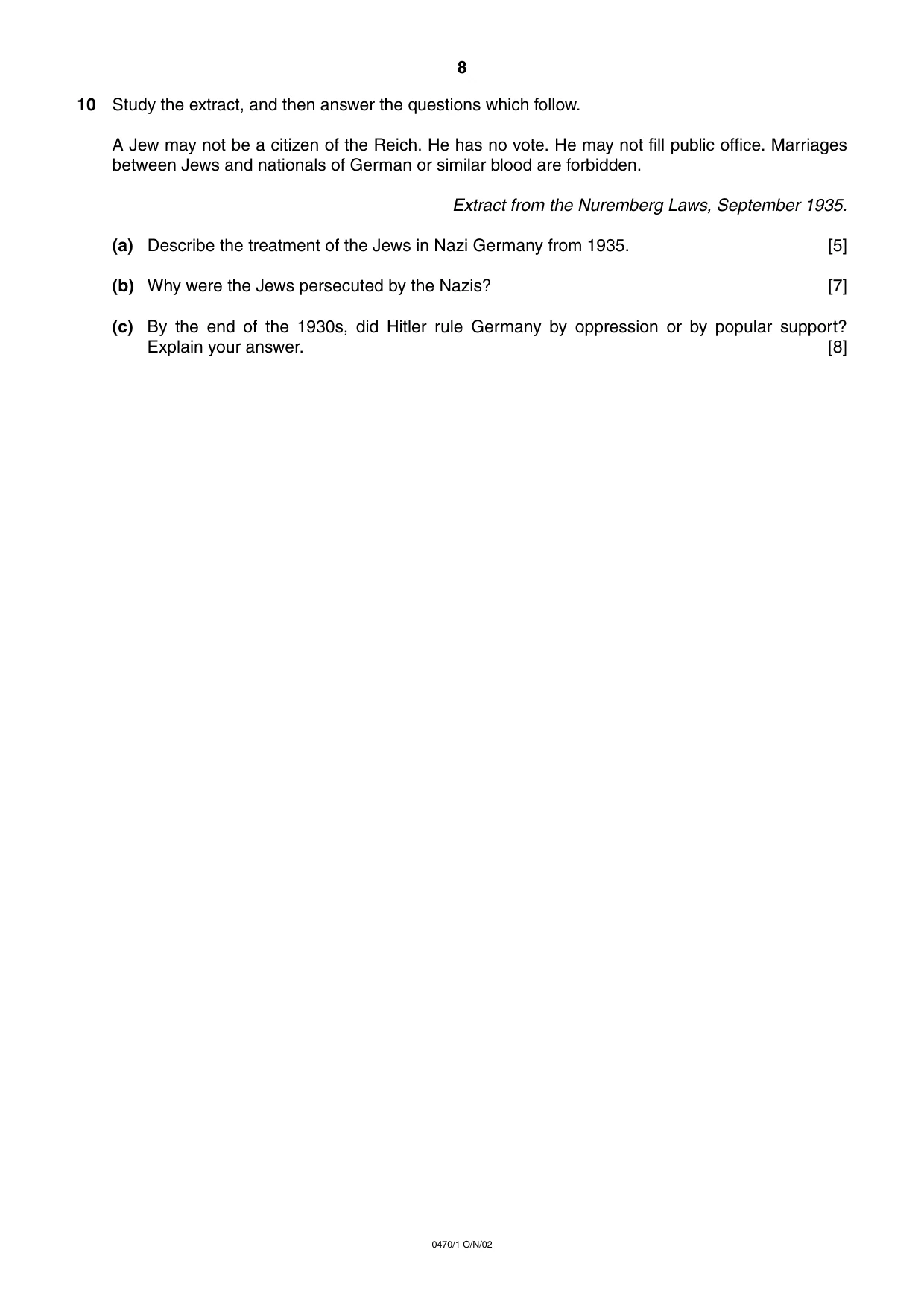
8 0470/1 O/N/02 10 Study the extract, and then answer the questions which follow. A Jew may not be a citizen of the Reich. He has no vote. He may not fill public office. Marriages between Jews and nationals of German or similar blood are forbidden. Extract from the Nuremberg Laws, September 1935. (a) Describe the treatment of the Jews in Nazi Germany from 1935. [5] (b) Why were the Jews persecuted by the Nazis? [7] (c) By the end of the 1930s, did Hitler rule Germany by oppression or by popular support? Explain your answer. [8]
Question paper, page 9
9 0470/1 O/N/02 [Turn over DEPTH STUDY B: RUSSIA, 1905–41 11 Study the extract, and then answer the questions which follow. War! We knew the meaning of it now. There were no cheering crowds in the streets, no flags carried round. Only silent crowds reading the telegrams of the war in shop windows, nurses hurrying to duty, men with grave faces discussing the situation, women in mourning and groups of wounded soldiers being taken around the town. The daughter of the British ambassador to Russia writing in December 1914. (a) Describe the reforms of Stolypin (1906–11). [5] (b) Why was there growing discontent in Russia between 1914 and 1917? [7] (c) How important was Lenin in bringing about revolution in Russia in October 1917? Explain your answer. [8] 12 Study the extract, and then answer the questions which follow. Trotsky and his friends argued that the Soviet Union would only be really safe from its enemies when other states had become Communist and thus friendly to her. Trotsky favoured world revolution. Stalin said that the interests of the Soviet Union must come first. The main task was to create a strong Soviet Union by developing industries and a powerful army that could protect the country from foreign powers. (a) What part did Trotsky play in the Bolshevik Revolution to 1925? [5] (b) Why was Stalin able to become dictator of Russia by 1929? [7] (c) ‘Stalin only kept control in Russia by oppression and the elimination of opponents.’ Do you agree? Explain your answer. [8]
Question paper, page 10
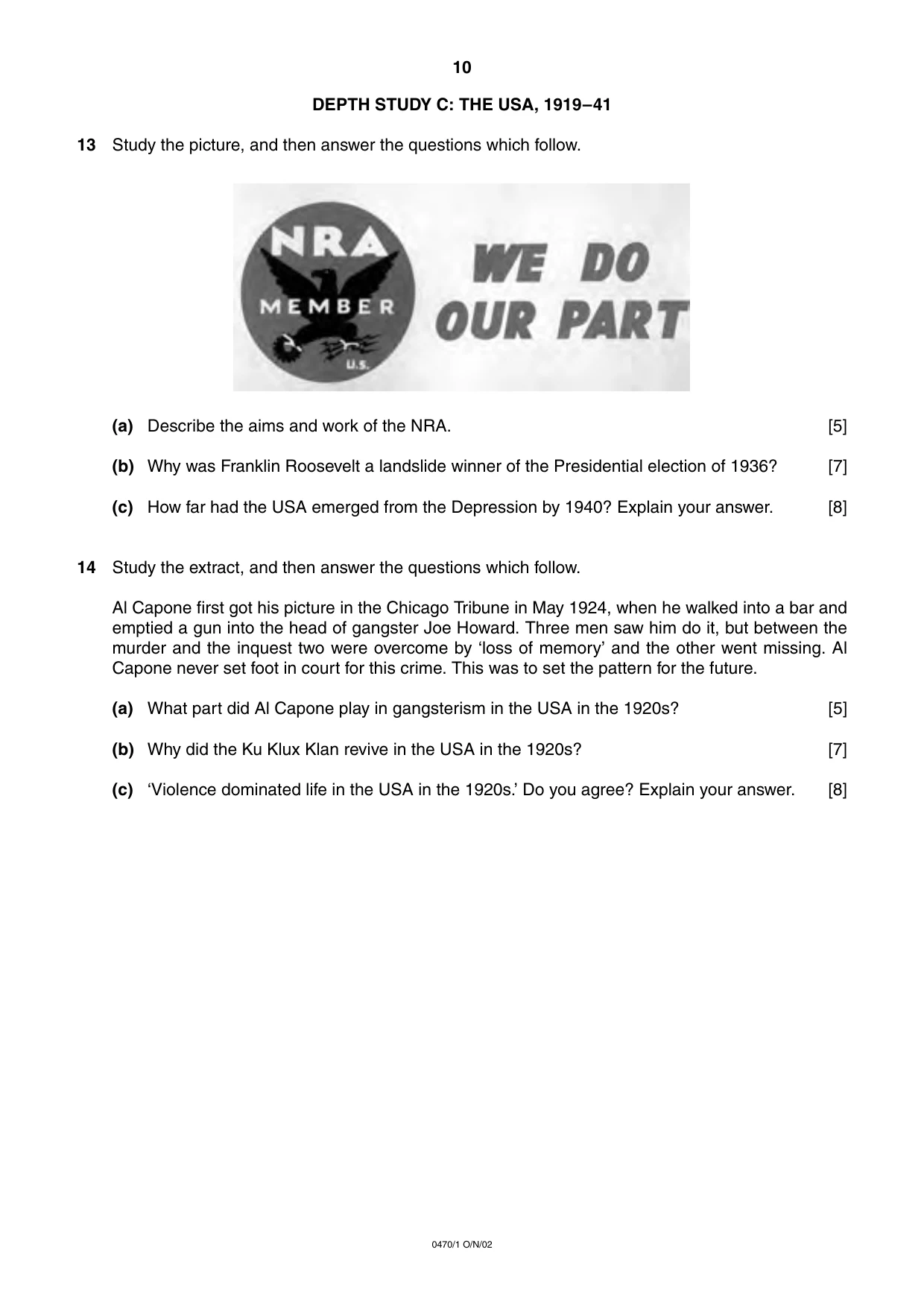
10 0470/1 O/N/02 DEPTH STUDY C: THE USA, 1919–41 13 Study the picture, and then answer the questions which follow. (a) Describe the aims and work of the NRA. [5] (b) Why was Franklin Roosevelt a landslide winner of the Presidential election of 1936? [7] (c) How far had the USA emerged from the Depression by 1940? Explain your answer. [8] 14 Study the extract, and then answer the questions which follow. Al Capone first got his picture in the Chicago Tribune in May 1924, when he walked into a bar and emptied a gun into the head of gangster Joe Howard. Three men saw him do it, but between the murder and the inquest two were overcome by ‘loss of memory’ and the other went missing. Al Capone never set foot in court for this crime. This was to set the pattern for the future. (a) What part did Al Capone play in gangsterism in the USA in the 1920s? [5] (b) Why did the Ku Klux Klan revive in the USA in the 1920s? [7] (c) ‘Violence dominated life in the USA in the 1920s.’ Do you agree? Explain your answer. [8]
Question paper, page 11
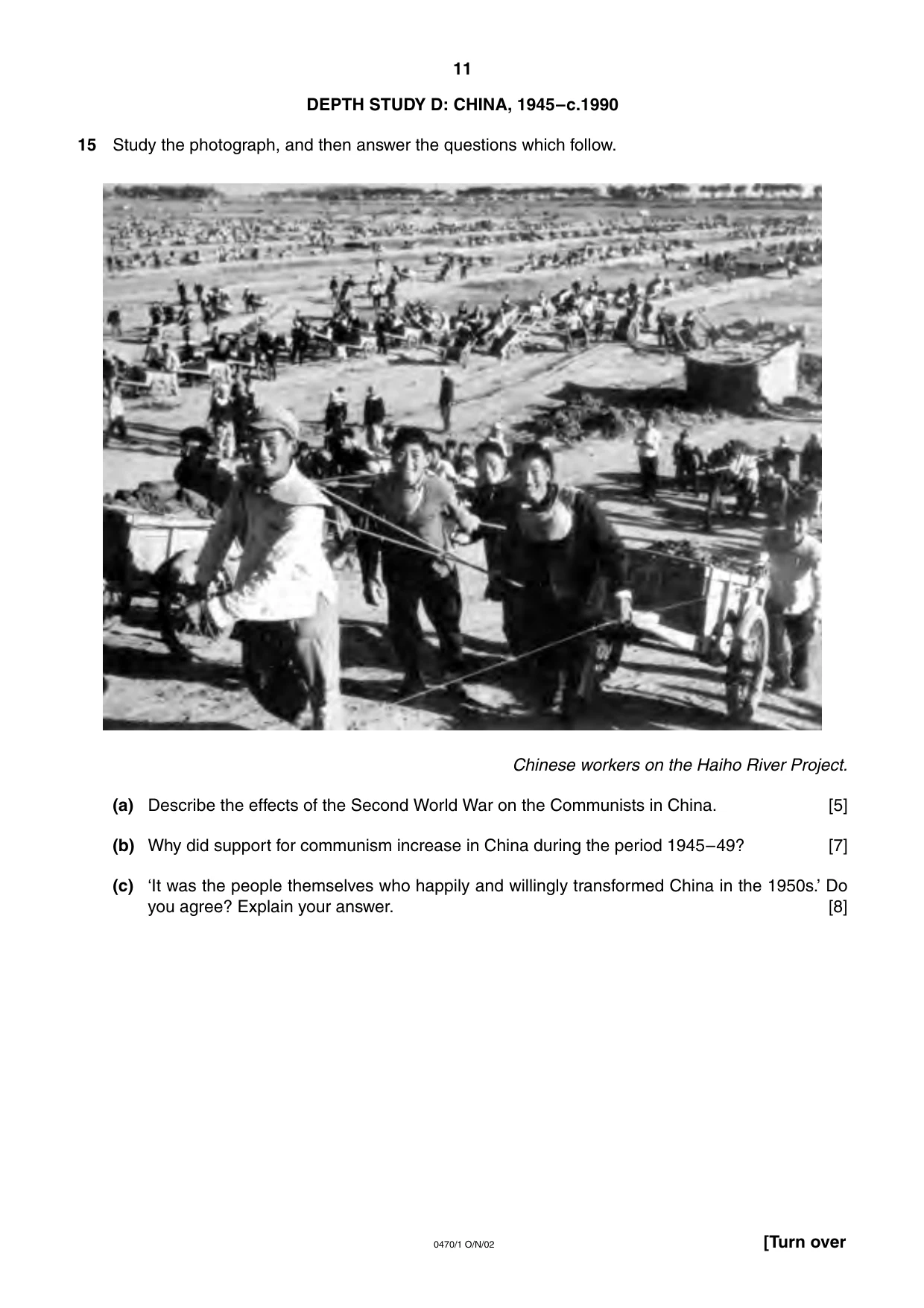
11 0470/1 O/N/02 [Turn over DEPTH STUDY D: CHINA, 1945–c.1990 15 Study the photograph, and then answer the questions which follow. Chinese workers on the Haiho River Project. (a) Describe the effects of the Second World War on the Communists in China. [5] (b) Why did support for communism increase in China during the period 1945–49? [7] (c) ‘It was the people themselves who happily and willingly transformed China in the 1950s.’ Do you agree? Explain your answer. [8]
Question paper, page 12
12 0470/1 O/N/02 16 Study the extract, and then answer the questions which follow. The Cultural Revolution was really a good thing. In the 1950s the Chinese were very simple. They believed in the communists – like my mother. She’s a teacher. Whatever the communists said she thought was great. Then, in the Cultural Revolution, they locked her up for a year and a half because her father was a well-known scholar whom they said was a ‘capitalist’. Some Red Guards in her school made her kneel on broken glass in front of all the students. For an intelligent person it was about the worst thing that could happen – to be made to feel so small. Her eyes were opened by the Cultural Revolution. She then saw through the communists. A Chinese woman, writing in 1980, gives her version of the Cultural Revolution. (a) In the Cultural Revolution, who were the Red Guards and what did they do? [5] (b) Why was the Cultural Revolution greeted enthusiastically in China at first but became unpopular later? [7] (c) How far did Mao improve life for the majority of Chinese between 1949 and his death in 1976? Explain your answer. [8]
Question paper, page 13
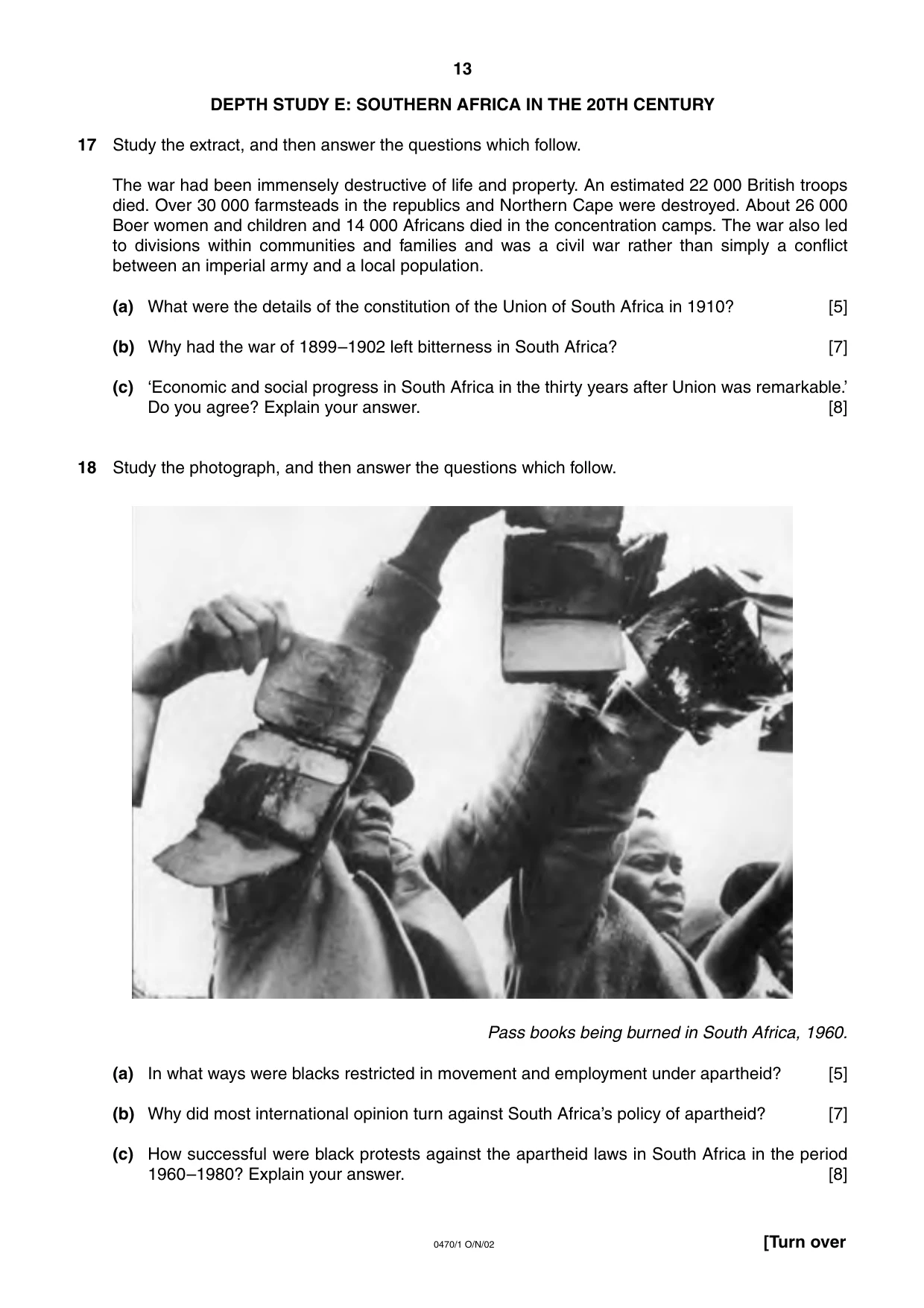
13 0470/1 O/N/02 [Turn over DEPTH STUDY E: SOUTHERN AFRICA IN THE 20TH CENTURY 17 Study the extract, and then answer the questions which follow. The war had been immensely destructive of life and property. An estimated 22 000 British troops died. Over 30 000 farmsteads in the republics and Northern Cape were destroyed. About 26 000 Boer women and children and 14 000 Africans died in the concentration camps. The war also led to divisions within communities and families and was a civil war rather than simply a conflict between an imperial army and a local population. (a) What were the details of the constitution of the Union of South Africa in 1910? [5] (b) Why had the war of 1899–1902 left bitterness in South Africa? [7] (c) ‘Economic and social progress in South Africa in the thirty years after Union was remarkable.’ Do you agree? Explain your answer. [8] 18 Study the photograph, and then answer the questions which follow. Pass books being burned in South Africa, 1960. (a) In what ways were blacks restricted in movement and employment under apartheid? [5] (b) Why did most international opinion turn against South Africa’s policy of apartheid? [7] (c) How successful were black protests against the apartheid laws in South Africa in the period 1960–1980? Explain your answer. [8]
Question paper, page 14
14 0470/1 O/N/02 19 Study the extract, and then answer the questions which follow. In 1953 there was not a single mile of well-surfaced road in Namibia. By 1966, however, over 800 miles out of the 20 000 miles of principal roads had been improved. The territory’s railway system has been joined with that of the South African Railways and Harbours Administration which provides money for it. The tracks are all in the Southern Sector. For the foreseeable future, despite progress already made, the territory is likely to continue to remain dependent upon a few primary products – minerals, fishing and agriculture. From an article written about Namibia in 1973. (a) Describe how South Africa came to be governing Namibia. [5] (b) Why was Namibia still largely an undeveloped area by the end of the 1960s? [7] (c) How far did life for the black population improve in Namibia in the period 1945–1975? Explain your answer. [8]
Question paper, page 15
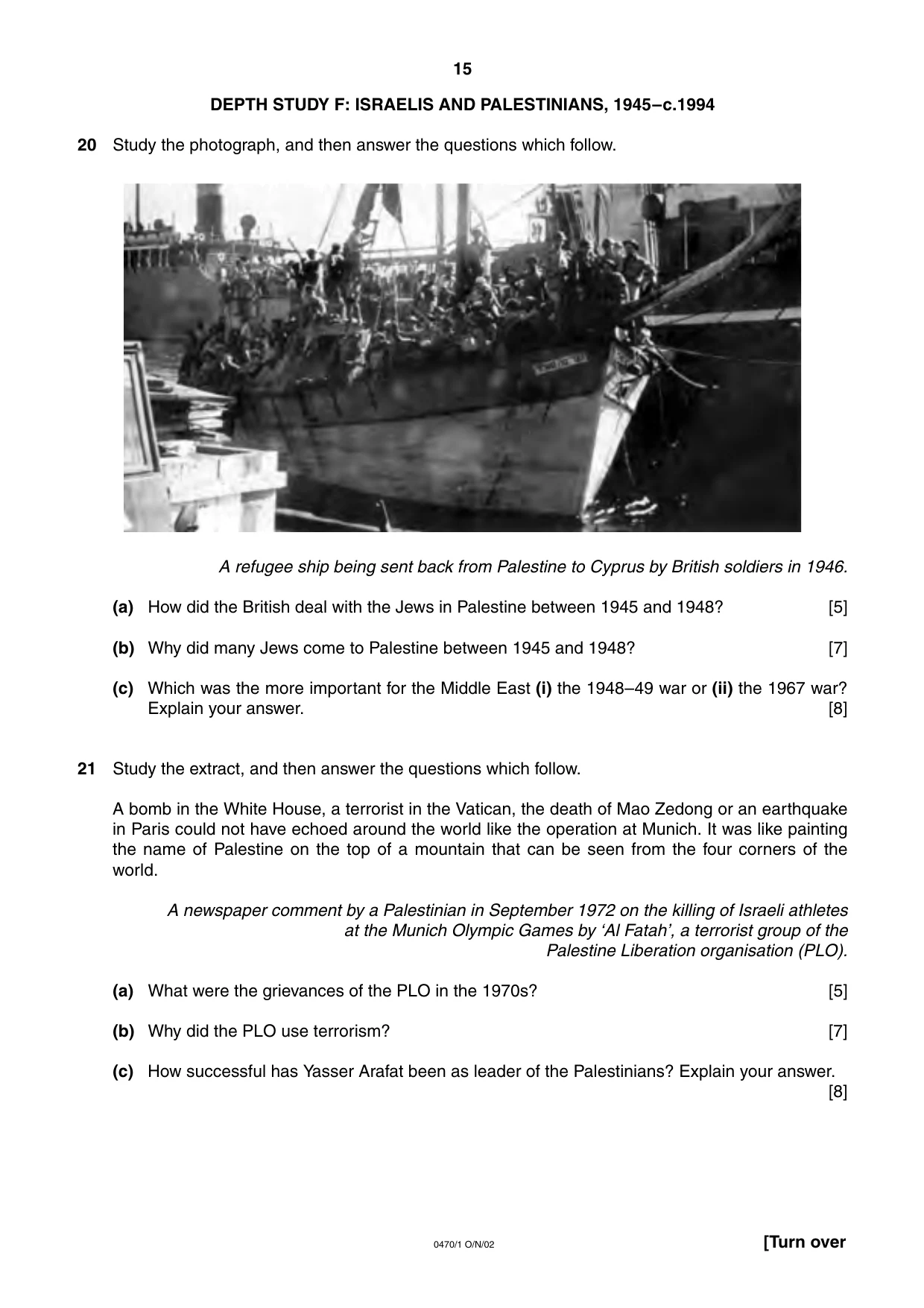
15 0470/1 O/N/02 [Turn over DEPTH STUDY F: ISRAELIS AND PALESTINIANS, 1945–c.1994 20 Study the photograph, and then answer the questions which follow. A refugee ship being sent back from Palestine to Cyprus by British soldiers in 1946. (a) How did the British deal with the Jews in Palestine between 1945 and 1948? [5] (b) Why did many Jews come to Palestine between 1945 and 1948? [7] (c) Which was the more important for the Middle East (i) the 1948–49 war or (ii) the 1967 war? Explain your answer. [8] 21 Study the extract, and then answer the questions which follow. A bomb in the White House, a terrorist in the Vatican, the death of Mao Zedong or an earthquake in Paris could not have echoed around the world like the operation at Munich. It was like painting the name of Palestine on the top of a mountain that can be seen from the four corners of the world. A newspaper comment by a Palestinian in September 1972 on the killing of Israeli athletes at the Munich Olympic Games by ‘Al Fatah’, a terrorist group of the Palestine Liberation organisation (PLO). (a) What were the grievances of the PLO in the 1970s? [5] (b) Why did the PLO use terrorism? [7] (c) How successful has Yasser Arafat been as leader of the Palestinians? Explain your answer. [8]
Question paper, page 16
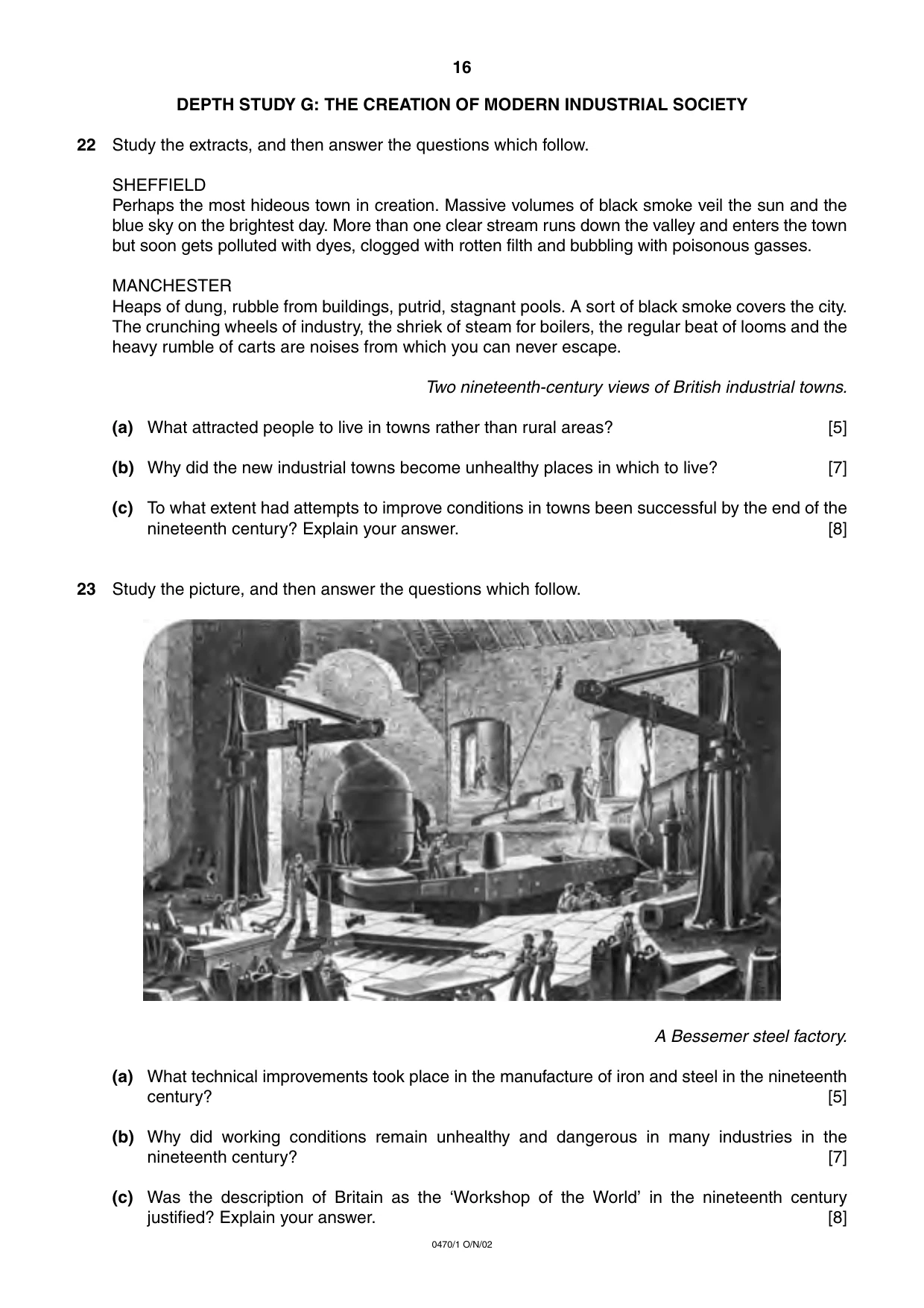
16 0470/1 O/N/02 DEPTH STUDY G: THE CREATION OF MODERN INDUSTRIAL SOCIETY 22 Study the extracts, and then answer the questions which follow. SHEFFIELD Perhaps the most hideous town in creation. Massive volumes of black smoke veil the sun and the blue sky on the brightest day. More than one clear stream runs down the valley and enters the town but soon gets polluted with dyes, clogged with rotten filth and bubbling with poisonous gasses. MANCHESTER Heaps of dung, rubble from buildings, putrid, stagnant pools. A sort of black smoke covers the city. The crunching wheels of industry, the shriek of steam for boilers, the regular beat of looms and the heavy rumble of carts are noises from which you can never escape. Two nineteenth-century views of British industrial towns. (a) What attracted people to live in towns rather than rural areas? [5] (b) Why did the new industrial towns become unhealthy places in which to live? [7] (c) To what extent had attempts to improve conditions in towns been successful by the end of the nineteenth century? Explain your answer. [8] 23 Study the picture, and then answer the questions which follow. A Bessemer steel factory. (a) What technical improvements took place in the manufacture of iron and steel in the nineteenth century? [5] (b) Why did working conditions remain unhealthy and dangerous in many industries in the nineteenth century? [7] (c) Was the description of Britain as the ‘Workshop of the World’ in the nineteenth century justified? Explain your answer. [8]
Question paper, page 17
17 0470/1 O/N/02 DEPTH STUDY H: THE IMPACT OF WESTERN IMPERIALISM IN THE 19TH CENTURY 24 Study the cartoon, and then answer the questions which follow. A nineteenth-century cartoon showing China being pulled by several European countries in different directions. (a) Describe China’s relations with European countries in the nineteenth century. [5] (b) Why were European countries anxious to establish themselves in China? [7] (c) Did the Boxer Rebellion show that European attempts to influence the Chinese had failed? Explain your answer. [8] 25 Study the extract, and then answer the questions which follow. ‘We were going as civilisers as well as preachers’, wrote James Stewart in 1874. He was one of a new generation of missionaries who, having studied medicine as well as theology, set off into Central Africa with a party of other well-qualified men. (a) What were the aims of missionaries in the nineteenth century? [5] (b) Why did missionary societies receive so much support from Western countries? [7] (c) How far was ‘improvement of the native population’ the main reason for Western imperial activity in the nineteenth century? Explain your answer. [8]
Question paper, page 20
20 0470/1 O/N/02 Copyright Acknowledgements: Question 1 E. Wright. Illustrated History of the Modern World. 1992 Question 2 Chronicles of America. Chronicle Publishing. Question 3 Michael Montgomery. Imperialist Japan. Christopher Helm Publishers. Reproduced by permission of A C Black ©. Question 5 E. Wright. Illustrated History of the Modern World. 1992 Question 6 R. Wolfson. From Peace to War. Published by Arnold. © Associated Press. Question 7 P. Mantin. 20th Century World – Questions of Evidence. © Associated Press. Question 8 The Penguin Dictionary of Twentieth Century History (3rd Edition) by Alan Palmer (Pe Question 9 J. Brooman. Weimar Germany. Published by Longman. © Bildarchiv. Question 10 T. Edwards. History in Broadsheets No. 15. Reproduced by permission of Heinemann Publishers ©. Question 12 D. Killingray. Stalin. Published by Harrap. Question 13 Chronicle of America. Chronicles Publications. Question 14 Extract from The American Century by Harold Evans published by Jonathon Cape. Used by permission of The Random House Group Limited. Question 15 C. Fitzgerald and M. Roper. China: A World so Changed. Published by Nelson. Question 16 C. MacDonald. Modern China. Published by Blackwell. Question 17 N. Worden. The Making of Modern South Africa. Published by Blackwell. Question 18 J. Ray and J. Hagerty. The 20th Century World. Published by Hutchinson. Question 19 Encyclopaedia Britannica. Question 20 C. Culpin. Making History. Published by Collins. © Imperial War Museum. Photograph courtesy of the Imperial War Museum, London. Cambridge International Examinations has made every effort to trace copyright holders, but if we have inadvertently overlooked any we will be pleased to make the necessary arrangements at the first opportunity.
Mark scheme, page 1
CAMBRIDGE INTERNATIONAL EXAMINATIONS International General Certificate of Secondary Education MARK SCHEME FOR the November 2002 question papers 0470 HISTORY 0470/1 Paper 1 (Written), maximum raw mark 60 0470/2 Paper 2 (Written), maximum raw mark 50 0470/4 Paper 4 (Alternative to Coursework), maximum raw mark 40 These mark schemes are published as an aid to teachers and students, to indicate the requirements of the examination. They show the basis on which Examiners were initially instructed to award marks. They do not indicate the details of the discussions that took place at an Examiners’ meeting before marking began. Any substantial changes to the mark scheme that arose from these discussions will be recorded in the published Report on the Examination. All Examiners are instructed that alternative correct answers and unexpected approaches in candidates’ scripts must be given marks that fairly reflect the relevant knowledge and skills demonstrated. Mark schemes must be read in conjunction with the question papers and the Report on the Examination. . CIE will not enter into discussions or correspondence in connection with these mark schemes. CIE is publishing the mark schemes for the November 2002 question papers for most IGCSE and GCE Advanced Subsidiary (AS) Level syllabuses. UNIVERSITY of CAMBRIDGE Local Examinations Syndicate
Mark scheme, page 2
Nov 2002 Provisional Mark Scheme. 0470/1 SECTION A Q.1 (a) Describe the course of the revolution in either Prussia or Hungary. Level 1 Gives a vague, fragmentary or only partially correct description. 1-2 Level 2 Gives a reasonably accurate and full description. Answers containing descriptions of both revolutions should get credit only for the better answer. Reasons for revolution and/or results have a limit of 2 marks. 3-5 (b) Why did the revolutions fail in the Austrian Empire? Level 1 Simplistic reason lacking explanation e.g. armed forces defeat them 1 Level 2 Developed mono-causal as an explanation e.g. lack of strength/support Or multi-causal at superficial level Or Level 3 concept answer but which contains inaccuracies or vagueness in the evidence submitted. Descriptions of the revolutions should be limited to 3 marks. 2-5 Level 3 Developed multi-causal which can bring together specific reasons and more general ones. Answers should cover the Empire although there need not be a balance between the parts. Reward overview answers. 6-7 (c) How important were the 1848 revolutions for Europe? Explain your answer. Level 1 Simplistic opinion supported by little valid or accurate evidence. 1 Level2 Simplistic answer but supported by some valid evidence even if the answer is not well organised or contains inaccuracies Or describes one or more of the revolutions. 2-3
Mark scheme, page 3
Level 3 Will probably try to show effects of revolution on different countries and thus indicate importance. 4-6 Level 4 These will try to look at the overall importance of the revolutions although inevitably there will be reflection on individual countries as well. There must be clear attempt to assess ‘importance’ for Europe overall — and this should deal with the abstract as well as the physical. 7-8 Q.2 (a) How did Northern states deal with runaway slaves and slaves attempting to escape during the 1850s? Level 1 Gives a vague, fragmentary or only partially correct description. 1-2 Level 2 Gives a reasonably accurate and full description. 3-5 (b) Why did slavery become a very important issue in America in the 1850s? Level 1 Simplistic reason lacking explanation e.g. the emancipation movement 1 Level 2. Developed mono-causal as an explanation e.g. new areas of America had to decide. Or multi-causal at superficial level Or Level 3 concept answer but which contains inaccuracies or vagueness in the evidence submitted . 2-5 Level 3 Developed multi-causal which demonstrates a good understanding of the various components and is aware of the political, economic and social aspects. 6-7 (c) How different were the lifestyles and outlook of the Northern and Southern states in the years before the Civil War? Explain your answer. Level 1 Simplistic opinion supported by little valid or accurate evidence. 1 Level 2 Simplistic answer but supported by some valid evidence even if the answer is not well organised or contains inaccuracies Or describes life in North or South only. 2-3 Level 3. Most will describe the lifestyle in each and then try to pick out differences. Better ones will also look at attitudes or outlook. 4-6 Level 4 These answers will try to look at differences and similarities in order to assess ‘how different’. Candidates should show awareness of changing moods as well as entrenched ideas in both areas. Reward clear and coherent arguments. 7-8
Mark scheme, page 4
Q.3 (a) What territorial acquisitions did Japan make between 1890 and 1914 and how were they acquired? Level 1 Gives a vague, fragmentary or only partially correct answer. Generally give 1 mark for an acquisition and 2 for how acquired. 1-2 Level 2 Gives areasonably accurate and full description. Full marks can be earned by dealing with two well. 3-5 (b) Why was Japan able to defeat both China and Russia within a few years? Level 1 Simplistic reason lacking explanation e.g. stronger military forces 1 Level 2 Developed mono-causal as an explanation e.g. weakness of opposition Or multi-causal at superficial level Or Level 3 concept answer but which contains inaccuracies or vagueness in the evidence submitted . Descriptions of the wars may earn up to 3 marks in total. 2-5 Level 3 Developed multi-causal which is able to bring together the positive and negative reasons into a coherent whole. The way in which Japan had in- creased her strength internally and externally should receive proper credit. 6-7 (c) How important was Western influence in increasing the power and status of Japan between 1868 and 1914? Explain your answer. Level 1 Simplistic opinion supported by little valid or accurate evidence. 1 Level 2 Simplistic answer but supported by some valid evidence even if the answer is not well organised or contains inaccuracies Or describes westernisation. 2-3 Level 3 The tendency will be to show how the army/navy were strengthened by the West and that economically Japan was strengthened by contact with West. This will usually lead to simple or inferred conclusion that this influence ‘was important. 4-6 Level 4 The emphasis will be on evaluating ‘how important’ the influence of the West was and this can be done by selection of evidence of what was done militarily and economically but should also regard ‘influence’ as affecting less obvious features. 7-8
Mark scheme, page 5
Q.4 (a) Describe the events of June 28" 1914 leading to the assassination of the Archduke Ferdinand and his wife in Sarajevo. Level 1 Gives a vague, fragmentary or only partially correct description. 1-2 Level 2. Gives areasonably accurate and full description. 3-5 (b) Why did Austria want to take action against Serbia? Level 1 Simplistic reason lacking explanation e.g. because of the murder; to control her. 1 Level 2 Developed mono-causal as an explanation e.g. feared Serbia as a rival Or multi-causal at superficial level * Or Level 3 concept answer but which contains inaccuracies or vagueness in the evidence submitted A good paraphrase of the stimulus can earn 2 marks. 2-5 Level 3 Developed multi-causal which can bring together the immediate and longer term causes in a coherent whole. Some grading of the varied importance of causes might appear here. 6-7 (c) Did the assassination of the Archduke Ferdinand make European war inevitable? Explain your answer. Level 1 Simplistic opinion supported by little valid or accurate evidence. 1 Level 2 Simplistic answer but supported by some valid evidence even if the answer is not well organised or contains inaccuracies Or describes the outbreak of war. 2-3 Level 3 Answers may well start by saying yes or no and then go on to try to make a case for their choice. Some may go into the varied causes of war to show that one event could not have caused it. Some may follow the line that once the murder had taken place the sequence of events thereafter did in fact bring war although that is not quite the same as ‘inevitable’. 4-6 Level 4 Answers should focus on the assassination and look at the part that played in bringing war. This should be placed in the context of the tensions existing in Europe at that time showing that one without the other was not an inevitable cause. 7-8
Mark scheme, page 6
Q.5 (a) Describe two successes the League of Nations had in the 1920s in solving disputes. Level 1 Gives a vague, fragmentary or only partially correct description. 1-2 Level 2 Gives areasonably accurate and full description. A very good description of just one may score up to 4 marks. The answers may contain reasons for the dispute, and this ok here, and results may be used to show success. 3-5 (b) Why was the League of Nations quite successful in the first ten years of its existence? Level 1 Simplistic reason lacking explanation e.g. small disputes only; goodwill 1 Level 2 . Developed mono-causal as an explanation e.g. nations willing to accept Or multi-causal at superficial level Or Level 3 concept answer but which contains inaccuracies or vagueness in The evidence submitted . Descriptions of successes should be limited to 2 marks. 2-5 Level 3 Developed multi-causal which is wide-ranging in its scope covering its setting up, solving of disputes, agency work and Commissions. Although the question assumes success it is permissible for answers to challenge this but the answer must not be turned into that. 6-7 (c) ‘The good work of the League was destroyed byt the Depression of the 1930s.’ Do you agree? Explain your answer. . Level 1 Simplistic opinion supported by little valid or accurate evidence. 1 Level 2 Simplistic answer but supported by some valid evidence even if the answer is not well organised or contains inaccuracies Or describes ‘good work’ or events of the 1930s. 2-3 Level 3 Candidates may have difficulty in organising this so reward creditable attempts. All answers need to look at the effects of the depression on the League and then perhaps compare those with other factors. Long descriptions of ‘good work’ are not required but some reference is needed in order to show if these continued through the 1930s e.g. work of some agencies. 4-6 Level 4 A well organised and presented argument, even if not full, should score here. The emphasis should be on seeing what, of the League, was ‘destroyed’ in the 1930s and how far that was due to the Depression. 7-8
Mark scheme, page 7
Q.6 (a) Describe the attacks that Japan made on China in the 1930s. Level 1 Gives a vague, fragmentary or only partially correct description. Mukden Marco Polo Bridge are permissible. 1-2 Level 2 Gives a reasonably accurate and full description. A good description of just one should be limited to 3 marks. 3-5 (b) Why was Italy able to defeat the Abyssinians? Level 1 Simplistic reason lacking explanation e.g. used modern weapons 1 Level 2 Developed mono-causal as an explanation e.g. lack of support for Abyss. Or multi-causal at superficial level Or Level 3 concept answer but which contains inaccuracies or vagueness in the evidence submitted. Descriptions of the attack and methods can score 4 marks here. 2-5 Level 3 Developed multi-causal which gives attention to both the positive e.g. Italy’s comparative strength and the negative e.g. the primitive Abyss. forces. There should be some attempt to give an overview or composite review. 6-7 (c) How important for events in Europe were Hitler’s pacts with Italy and Japan? Explain your answer. Level 1 Simplistic opinion supported by little valid or accurate evidence. 1 Level 2 Simplistic answer but supported by some valid evidence even if the answer is not well organised or contains inaccuracies Or describes the pacts. 2-3 Level3 Answers will tend to try to assess the importance by recounting the agree- ments and their results/effects. Some may pick on specific events in Europe e.g. the Anschluss and show whether or not the pacts affected it. 4-6 Level 4 Answers will demonstrate ability to link aspects of the pacts with events and so arrive at some conclusion about ‘how important’. Answers should try to look at the whole European scene and not just that of individual countries. 7-8
Mark scheme, page 8
Q.7 (a) Who were the Vietcong and what part did they play in the Vietnam War? Level 1 Gives a vague, fragmentary or only partially correct accounts. 1-2 Level2 Gives a reasonably accurate and full description. Work on basis of max. of 3 marks for either part. 3-5 (b) Why did the US involvement in the war become increasingly unpopular in the USA? Level 1 Simplistic reason lacking explanation e.g. casualties increase; TV coverage 1 ~ Level2 Developed mono-causal as an explanation e.g. no sign of end to it/drain on men and resources Or multi-causal at superficial level Or Level 3 concept answer but which contains inaccuracies or vagueness in The evidence submitted. Description of the war alone should be limited to 3 marks although some aspects of it may properly be used to illustrate reasons for dislike. 2-5 Level 3 Developed multi-causal which traces clearly the growth of unpopularity due to specific events and to a change in attitudes. The effects of outside Factors should not be ignored. 6-7 (c) How successful was US policy towards Vietnam in the period 1963-75? Explain your answer. Level 1 Simplistic opinion supported by little valid or accurate evidence. 1 Level2 Simplistic answer but supported by some valid evidence even if the answer is not well organised or contains inaccuracies Or describes the policy. 2-3 Level 3 Answers will generally describe the policy and by reference to events and results show whether or not it was successful, mainly, I suspect, not successful. There will be little or no assessment of “how successful’ or on simple level. 4-6 Level 4 Candidates will show that they know how to measure ‘successful’-by-referring to aims and circumstances and opinion. This will lead to a measured argument and a considered assessment of ‘how successful’. 7-8
Mark scheme, page 9
Q.8 (a) Describe the basic structure of the UNO. Level 1 Gives a vague, fragmentary or only partially correct description. 1-2 Level 2 Gives a reasonably accurate and full description. 3-5 (b) Why did the UNO become involved in the Congo (1960-63)? Level 1 Simplistic reason lacking explanation e.g. they were asked to intervene. 1 Level 2 Developed mono-causal as an explanation e.g. to prevent civil war/chaos Or multi-causal at superficial level Or Level 3 concept answer but which contains inaccuracies or vagueness in the evidence submitted Descriptions of the operation may score up to 3 marks. 2-5 Level 3 Developed multi-causal which can link the immediate and ostensible reasons with another agenda Answers should be able to present an overview. 6-7 (c) How important was the UN involvement in the Korean War? Explain your answer. Level 1 Simplistic opinion supported by little valid or accurate evidence. 1 Level 2 Simplistic answer but supported by some valid evidence even if the answer is not well organised or contains inaccuracies Or describes the involvement/part played in the Korean War. 2-3. Level3 Answers will concentrate on showing how the UN forces contributed to the progress of the war and link importance to that. There may be some simple assertions about the wider implications for the role of the UN. 4-6 Level 4 Answers here will see that the nub of the answer must be on an assessment, in all aspects, of the local and global importance of the involvement. The aims and principles of the UN and the influence of the major powers, like the USA, should be dealt with. 7-8
Mark scheme, page 10
DEPTH STUDIES. GERMANY 1918-45. Q.9 (a) Describe the activities of the Freikorps in Germany 1919-20. Level 1 Gives a vague, fragmentary or only partially correct description. 1-2 Level 2 Gives a reasonably accurate and full description. 3-5 (b) Why were there so many uprisings and disturbances in Germany in the years 1919- 22? Level 1 Simplistic reason lacking explanation e.g. dislike of Versailles 1 Level 2 Developed mono-causal as an explanation e.g. new republic not yet consolidated Or multi-causal at superficial level Or Level 3 concept answer but which contains inaccuracies or vagueness in the evidence submitted Descriptions of one or more should be limited to 3 marks. 2-5 Level 3 Developed multi-causal which recognises the special features of the period and gets beyond the specific reasons for any one uprising. The effects of situations outside Germany should be included. 6-7 (c) How far was Germany’s treatment in the Versailles peace settlement unfair? Explain your answer. Level 1 Simplistic opinion supported by little valid or accurate evidence. 1 Level 2 Simplistic answer but supported by some valid evidence even if the answer is not well organised or contains inaccuracies Or describes terms of the treaty. 2-3 Level 3 Most will follow the line of detailing those clauses which might be regarded as unfair but will make no distinctions between Germany’s view and that of others in the contemporary situation. Some may take the view that as Germany was defeated and had caused great damage to others the terms could not be unfair. This deserves credit if correctly argued and illustrated. 4-6
Mark scheme, page 11
10 Level 4 Answers will try to present a balanced appraisal and point out that any Judgement depends on where you are standing. This topic is well rehearsed and so look for some sophistication and genuine understanding for highest mark. 7-8 Q.10 (a) Describe the treatment of Jews in Nazi Germany from 1935. Level 1 Gives a vague, fragmentary or only partially correct description. Allow up to 2 for any aspect well done. 1-2 Level 2 Gives a reasonably accurate and full description. 3-5 (b) Why were the Jews persecuted by the Nazis? Level 1 Simplistic reason lacking explanation e.g. wanted pure Aryan race 1 Level 2 Developed mono-causal as an explanation e.g. used as scapegoats Or multi-causal at superficial level Or Level 3 concept answer but which contains inaccuracies or vagueness in the evidence submitted Descriptions of persecution should be limited to 2 marks. 2-5 Level 3 Developed multi-causal which gets beyond the obvious and show that this was part of a broader policy against minorities and opponents. Look for mature answers for highest mark. 6-7 (c) By the end of the 1930s, did Hitler rule Germany by oppression or by popular support? Explain your answer. Level 1 Simplistic opinion supported by little valid or accurate evidence. 1 Level 2 Simplistic answer but supported by some valid evidence even if the answer is not well organised or contains inaccuracies Or describes the oppression of the Nazis. 2-3 Level 3. Most will show something of the measures taken by Hitler/the Nazis to secure and consolidate power and probably link that to oppression. Some will also try to refute ‘popular support’ or show some evidence of it. 4-6 Level 4 These will make some comparison between the popular and the oppressive measures of Hitler and try to come a conclusion about which was the more important or even if they were closely intertwined. 7-8
Mark scheme, page 12
11 RUSSIA 1905-41. Q.11 (a) Describe the reforms of Stolypin (1906-11). Level 1 Gives a vague, fragmentary or only partially correct description. 1-2 Level 2 Gives a reasonably accurate and full description. Any one reform well detailed may score up to 3 marks. Some may describe what the reforms were trying to achieve and this is ok. Reasons for reforms should be limited to 3 marks. 3-5 (b) Why was there growing discontent in Russia between 1914 and 1917? Level 1 Simplistic reason lacking explanation e.g. the war went badly 1 Level 2 Developed mono-causal as an explanation e.g. the privations of the war; the conduct of the war Or multi-causal at superficial level Or Level 3 concept answer but which contains inaccuracies or vagueness in the evidence submitted Descriptions of the manifestation of discontent can score up to 4 marks if there is implied causation. 2-5 Level 3 Developed multi-causal which brings the various strands of discontent e.g. military, economic, social, political, monarchical together in a coherent whole. Best answers will show reasons why discontent which was present before 1914 grew and how outside factors assisted this. 6-7 (c) How important was Lenin in bringing about revolution in Russia in October 1917? Explain your answer. Level 1 Simplistic opinion supported by little valid or accurate evidence. 1 Level 2 Simplistic answer but supported by some valid evidence even if the answer is not well organised or contains inaccuracies Or describes the October revolution. 2-3 Level 3 Most will describe Lenin’s part and then make a simple assertion as to his importance but no yardsticks will have been used in this. Some may give reasons for the success of the revolution including Lenin’s part as the answer. 4-6 level 4 Answers will concentrate on trying to assess the importance of Lenin which will largely be done by comparing his importance with that of other people/ factors. 7-8
Mark scheme, page 13
12 Q.12 (a) What part did Trotsky play in the Bolshevik Revolution to 1925? Level 1 Gives a vague, fragmentary or only partially correct description. 1-2 Level 2 Gives areasonably accurate and full description. No assessment of his part is required but allow up to 2 marks if this is done in valid fashion. 3-4 (b) Why was Stalin able to become dictator of Russia by 1929? Level 1 Simplistic reason lacking explanation e.g. he removed rivals 1 Level 2 Developed mono-causal as an explanation e.g. his manipulation of the Party Or multi-causal at superficial level Or Level 3 concept answer but which contains inaccuracies or vagueness in the evidence submitted 2-5 Level 3 Developed multi-causal which is able to reconcile what Stalin did with the circumstances that existed and which presented opportunities. 6-7 (c) ‘Stalin only kept control in Russia by oppression and the elimination of opponents.’ Do you agree? Explain your answer. Level 1 Simplistic opinion supported by little valid or accurate evidence. 1 Level 2 Simplistic answer but supported by some valid evidence even if the answer is not well organised or contains inaccuracies Or describes Stalin’s purges. 2-3 Level 3 Most will concentrate on describing Stalin’s methods of reducing opposition and thus conclude that that is why he kept power. 4-6 Level4 These answers will try to balance what Stalin did in terms of oppression with what he did to try to improve life. They should provide some evidence of popularity so that a proper conclusion can be drawn about the validity of the hypothesis in the question. 7-8
Mark scheme, page 14
13 THE USA 1919-41. Q.13 (a) Describe the aims and work of the NRA. Level 1 Gives a vague, fragmentary or only partially correct description. 1-2 Level 2 Gives areasonably accurate and full description. The aims or the work can score up to 3 marks. Reasons for the NRA go up to 2 marks, 3-5 (b) Why was Franklin Roosevelt a landslide winner of the Presidential election of 1936? Level 1 Simplistic reason lacking explanation e.g. success of policies 1 Level 2 Developed mono-causal as an explanation e.g. had gained confidence of many Americans Or multi-causal at superficial level Or Level 3 concept answer but which contains inaccuracies or vagueness in the evidence submitted . 2-5 Level 3 Developed multi-causal which shows a good understanding of the attitudes and events in the USA at that time, and can coalesce the specific and back- ground reasons into that understanding. 6-7 (c) How far had the USA emerged from the Depression by 1940? Explain your answer. Level 1 Simplistic opinion supported by little valid or accurate evidence. 1 Level 2 Simplistic answer but supported by some valid evidence even if the answer is not well organised or contains inaccuracies . Or describes the New Deal. 2-3 Level 3 Mostly these will show what Roosevelt did to get America working in the 1930s and conclude that this was successful/not very successful/unsuccessful. Conclusions generally will have little material in them on which to judge ‘how Far’. 4-6 Level4 The answers will put the emphasis on where the USA stood in terms of unemployment and prosperity in 1940 compared with earlier and proceed to make some assessment of ‘how far’ the USA had emerged from the Depression. It is likely that many will show that it was the war in Europe which finished off any emergence. 7-8
Mark scheme, page 15
14 Q.14 (a) What part did Al Capone play in gangsterism in the USA in the 1920s? Level 1 Gives a vague, fragmentary or only partially correct description. Answers may follow the line of specific examples or the general effect his activities and methods had. 1-2 Level 2 Gives a reasonably accurate and full description. 3-5 (b) Why did the Ku Klux Klan revive in the USA in the 1920s? Level 1 Simplistic reason lacking explanation e.g. reaction of whites in the South 1 Level 2 Developed mono-causal as an explanation e.g. part of a revival of intolerance of minorities and non conformists after the war Or multi-causal at superficial level Or Level 3 concept answer but which contains inaccuracies or vagueness in the evidence submitted. Descriptions of the activities of the KKK should score no more than 2 marks. 2-5 Level 3 Developed multi-causal which can fit the specific reasons for action against Negroes into the general atmosphere and background prevalent in some parts of the USA. 6-7 (c) ‘Violence dominated life in the USA in the 1920s.’ Do you agree? Explain your answer. Level 1 Simplistic opinion supported by little valid or accurate evidence. 1 Level 2 Simplistic answer but supported by some valid evidence even if the answer is not well organised or contains inaccuracies Or describes examples of violence. 2-3 Level 3 Answers will mainly show the types of violence which existed and perhaps try estimate its prevalence or to show whether or not it was widespread. There may well be simple conclusions based on that. 4-6 Level4 The emphasis will be on trying to equate the amount of reported violence with its effects on the lives of most Americans in order to reach a conclusion about ‘domination’. 7-8
Mark scheme, page 16
15 CHINA 1945-1990. Q.15 (a) Describe the effects of the Second World War on the Communists in China. Level 1 Gives a vague, fragmentary or only partially correct description. 1-2 Level 2 Gives a reasonably accurate and full description. 3-5 (b) Why did support for communism increase in China during the period 1945-49? Level 1 Simplistic reason lacking explanation e.g. promised land reform 1 Level 2 Developed mono-causal as an explanation e.g. the mistakes of the opposition Or multi-causal at superficial level Or Level 3 concept answer but which contains inaccuracies or vagueness in the evidence submitted. Descriptions of the progress in the Civil War should be limited to 3 marks. 2-5 Level 3. Developed multi-causal which shows appreciation of the ‘push’ and ‘pull’ factors and can give some balance to the answer. This is a well-known area and some degree of sophistication should be expected in these answers. 6-7 (c) ‘It was the people themselves who happily and willingly transformed China in the 1950s.’ Do you agree? Explain your answer. Level 1 Simplistic opinion supported by little valid or accurate evidence. 1 Level 2 Simplistic answer but supported by some valid evidence even if the answer is not well organised or contains inaccuracies Or describes some of'the measures of ‘transformation’. 2-3 Level 3 Answers will probably place emphasis on how China was changed and the part played in these changes by the people e.g. in land reform, communes. Any analysis of ‘happily’ or ‘willingly’ will be on a simple level. 4-6 Level 4 Answers should focus on ‘happily’ and ‘willingly’ and try to show what the mood of the people was during this time and how far that was spontaneous and how far forced upon them by the new regime. The answers will show far more thought on this than those in Level 3. 7-8
Mark scheme, page 17
16 Q.16 (a) In the Cultural Revolution, who were the Red Guards, and what did they do? Level 1 Gives a vague, fragmentary or only partially correct description. 1-2 Level 2 Gives a reasonably accurate and full description. Allow up to 4 marks for either part if well done. Reasons are subsumed in the first part. 3-5 (b) Why was the Cultural Revolution greeted enthusiastically in China at first but became unpopular later? Level 1 Simplistic reason lacking explanation e.g. became too extreme. 1 Level 2 Developed mono-causal as an explanation e.g. its objectives became blurred Or multi-causal at superficial level Or Level 3 concept answer but which contains inaccuracies or vagueness in the evidence submitted. Descriptions of the revolution should be limited to 2 marks unless used to illustrate reasons for unpopularity. 2-5 Level 3 Developed multi-causal which can show the clear distinction between the early days and later and be able to show the changing attitudes. Good answers will show that different sections of society reacted differently. 6-7 (c) How far did Mao improve life for the majority of Chinese between 1949 and his death in 1976? Explain your answer. Level 1 Simplistic opinion supported by little valid or accurate evidence. 1 Level 2 Simplistic answer but supported by some valid evidence even if the answer is not well organised or contains inaccuracies Or describes life in China at any time. 2-3 Level 3 Candidates may have some difficulty in organising an argument here so reward those who create a coherent argument with valid evidence. Most will probably describe the benefits/disadvantages of the communist reforms and come to some simple conclusions as a result. 4-6 Level 4 These answers will demonstrate some grip on the question and understand its demands. There will be focus on ‘how far’ and ‘majority’ in the answer. 7-8
Mark scheme, page 18
17 SOUTHERN AFRICA IN THE 20° CENTURY. Q.17 (a) What were the details of the constitution of the Union of South Africa in 1910? Level 1 Gives a vague, fragmentary or only partially correct description. 1-2 Level 2 Gives a reasonably accurate and full description. Reasons for the Union and/or descriptions of how it came about may score up to 3 marks. 3-5 (b) Why had the war of 1899-1902 left bitterness in South Africa? Level 1 Simplistic reason lacking explanation e.g. concentration camps; loss of life 1 Level 2 Developed mono-causal as an explanation e.g. for many it had been like a civil war; unnecessary actions by both sides; costs. Or multi-causal at superficial level Or Level 3 concept answer but which contains inaccuracies or vagueness in the evidence submitted. Descriptions of the war should be limited to 3 marks unless used to illustrate why bitterness. 2-5 Level 3 Developed multi-causal which covers both sides well and shows a good understanding of the issues involved. 6-7 (c) ‘Economic and social progress in South Africa in the thirty years after Union was remarkable.’ Do you agree? Explain your answer. Level 1 Simplistic opinion supported by little valid or accurate evidence. 1 Level 2 Simplistic answer but supported by some valid evidence even if the answer is not well organised or contains inaccuracies Or describes some of the progress without comment. 2-3 Level 3 These will largely describe any known economic and social changes of the period and draw a conclusion from that. There will be no real consideration of ‘remarkable’. No credit for answers dealing with post-1945. 4-6 Level 4 There will focus on ‘remarkable’ and any social or economic changes noted or described will be linked to that word. There should be good consideration of the background of South Africa in that period and sense of context. 7-8
Mark scheme, page 19
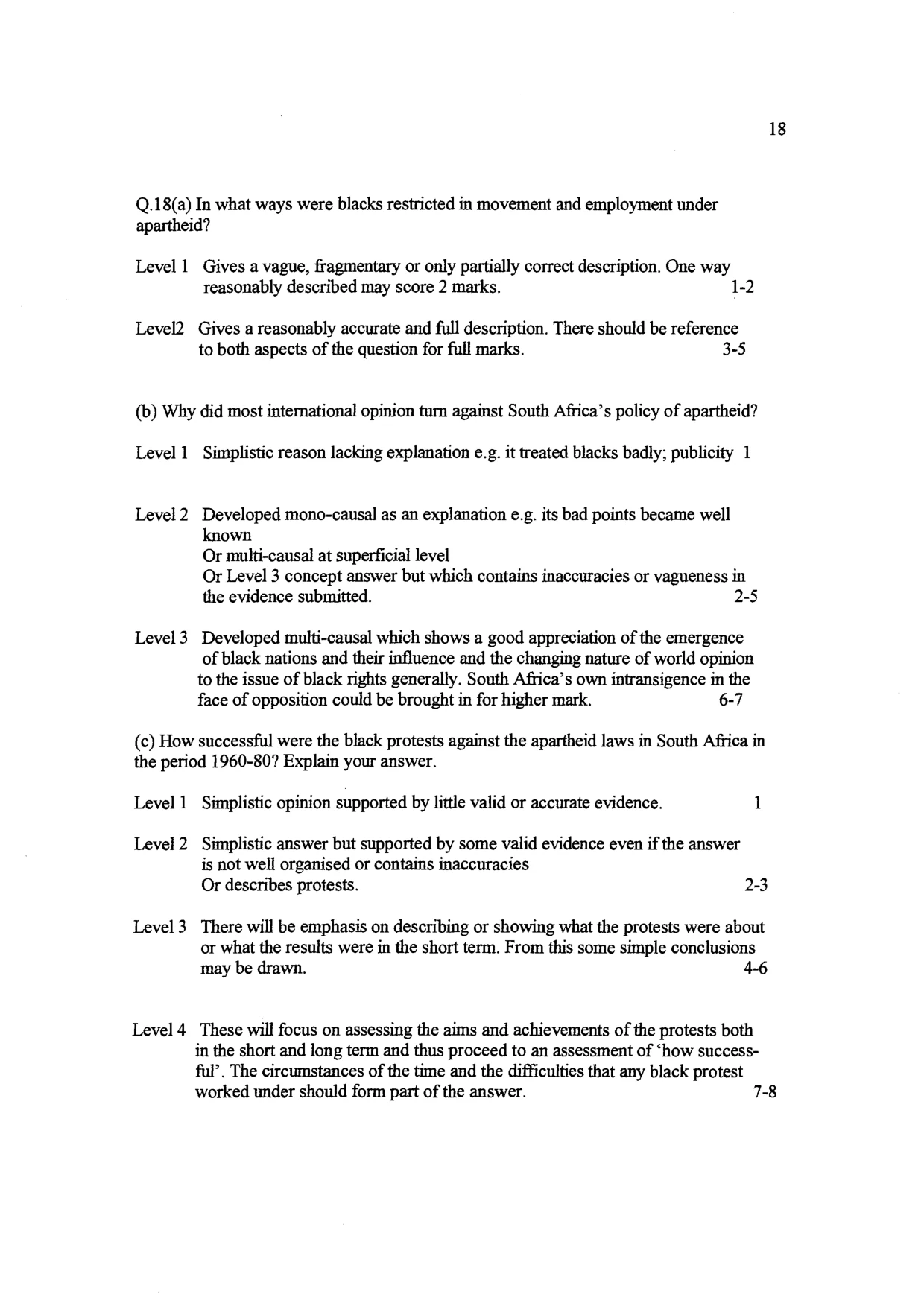
18 Q.18(a) In what ways were blacks restricted in movement and employment under apartheid? Level 1 Gives a vague, fragmentary or only partially correct description. One way reasonably described may score 2 marks. 1-2 Level2 Gives a reasonably accurate and full description. There should be reference to both aspects of the question for full marks. 3-5 (b) Why did most international opinion turn against South Africa’s policy of apartheid? Level 1 Simplistic reason lacking explanation e.g. it treated blacks badly; publicity 1 Level 2 Developed mono-causal as an explanation e.g. its bad points became well known Or multi-causal at superficial level Or Level 3 concept answer but which contains inaccuracies or vagueness in the evidence submitted. 2-5 Level 3 Developed multi-causal which shows a good appreciation of the emergence of black nations and their influence and the changing nature of world opinion to the issue of black rights generally. South Africa’s own intransigence in the face of opposition could be brought in for higher mark. 6-7 (c) How successful were the black protests against the apartheid laws in South Africa in the period 1960-80? Explain your answer. Level 1 Simplistic opinion supported by little valid or accurate evidence. 1 Level 2 Simplistic answer but supported by some valid evidence even if the answer is not well organised or contains inaccuracies Or describes protests. 2-3 Level 3 There will be emphasis on describing or showing what the protests were about or what the results were in the short term. From this some simple conclusions may be drawn. 4-6 Level 4 These will focus on assessing the aims and achievements of the protests both in the short and long term and thus proceed to an assessment of ‘how success- ful’. The circumstances of the time and the difficulties that any black protest worked under should form part of the answer. 7-8
Mark scheme, page 20
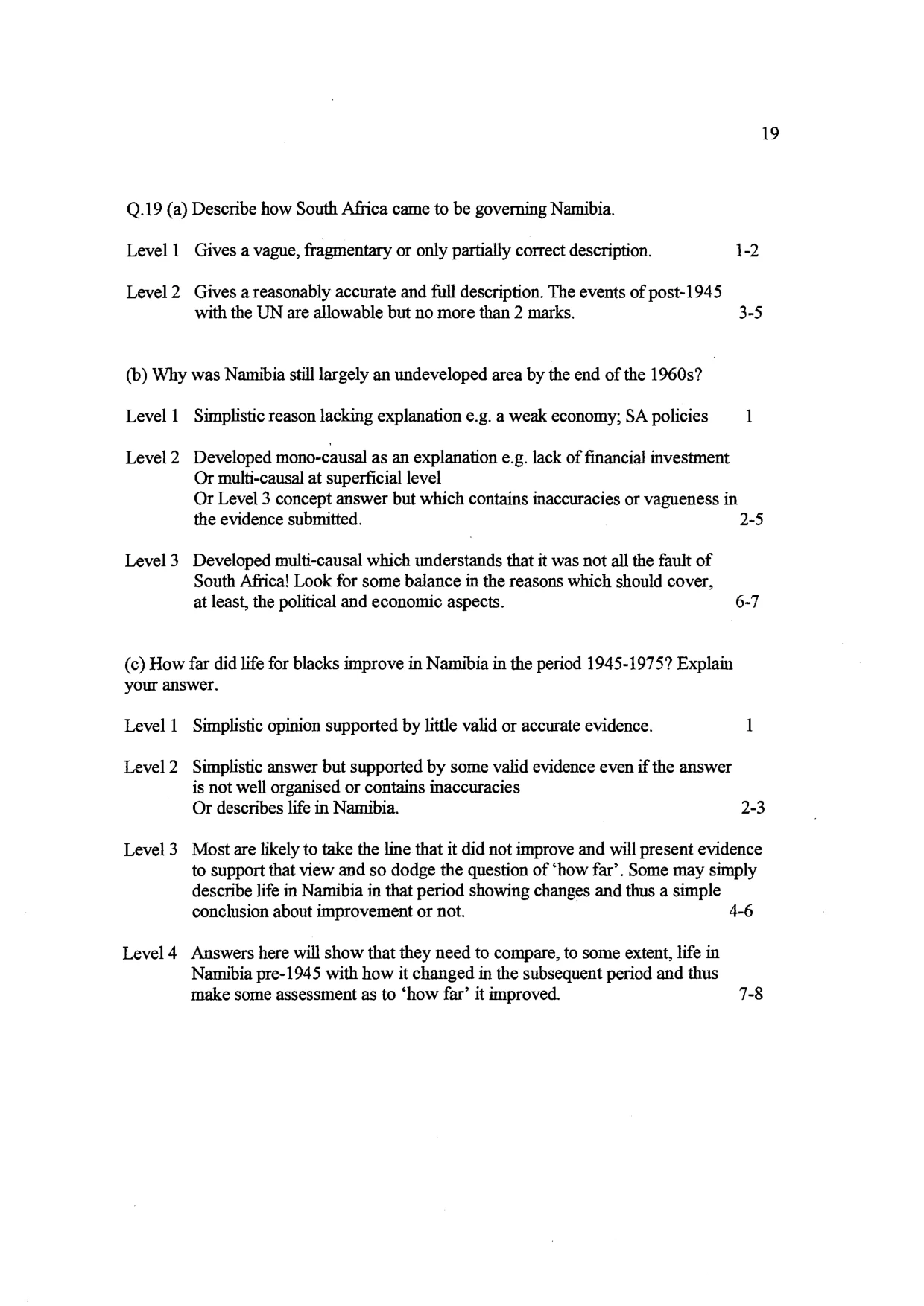
19 Q.19 (a) Describe how South Africa came to be governing Namibia. Level 1 Gives a vague, fragmentary or only partially correct description. 1-2 Level 2 Gives a reasonably accurate and full description. The events of post-1945 with the UN are allowable but no more than 2 marks. 3-5 (b) Why was Namibia still largely an undeveloped area by the end of the 1960s? Level 1 Simplistic reason lacking explanation e.g. a weak economy; SA policies 1 Level 2 Developed mono-causal as an explanation e.g. lack of financial investment Or multi-causal at superficial level Or Level 3 concept answer but which contains inaccuracies or vagueness in the evidence submitted. 2-5 Level 3 Developed multi-causal which understands that it was not all the fault of South Africa! Look for some balance in the reasons which should cover, at least, the political and economic aspects. 6-7 (c) How far did life for blacks improve in Namibia in the period 1945-1975? Explain your answer. Level 1 Simplistic opinion supported by little valid or accurate evidence. 1 Level 2 Simplistic answer but supported by some valid evidence even if the answer is not well organised or contains inaccuracies Or describes life in Namibia. 2-3 Level 3 Most are likely to take the line that it did not improve and will present evidence to support that view and so dodge the question of ‘how far’. Some may simply describe life in Namibia in that period showing changes and thus a simple conclusion about improvement or not. 4-6 Level 4 Answers here will show that they need to compare, to some extent, life in Namibia pre-1945 with how it changed in the subsequent period and thus make some assessment as to ‘how far’ it improved. 7-8
Mark scheme, page 21
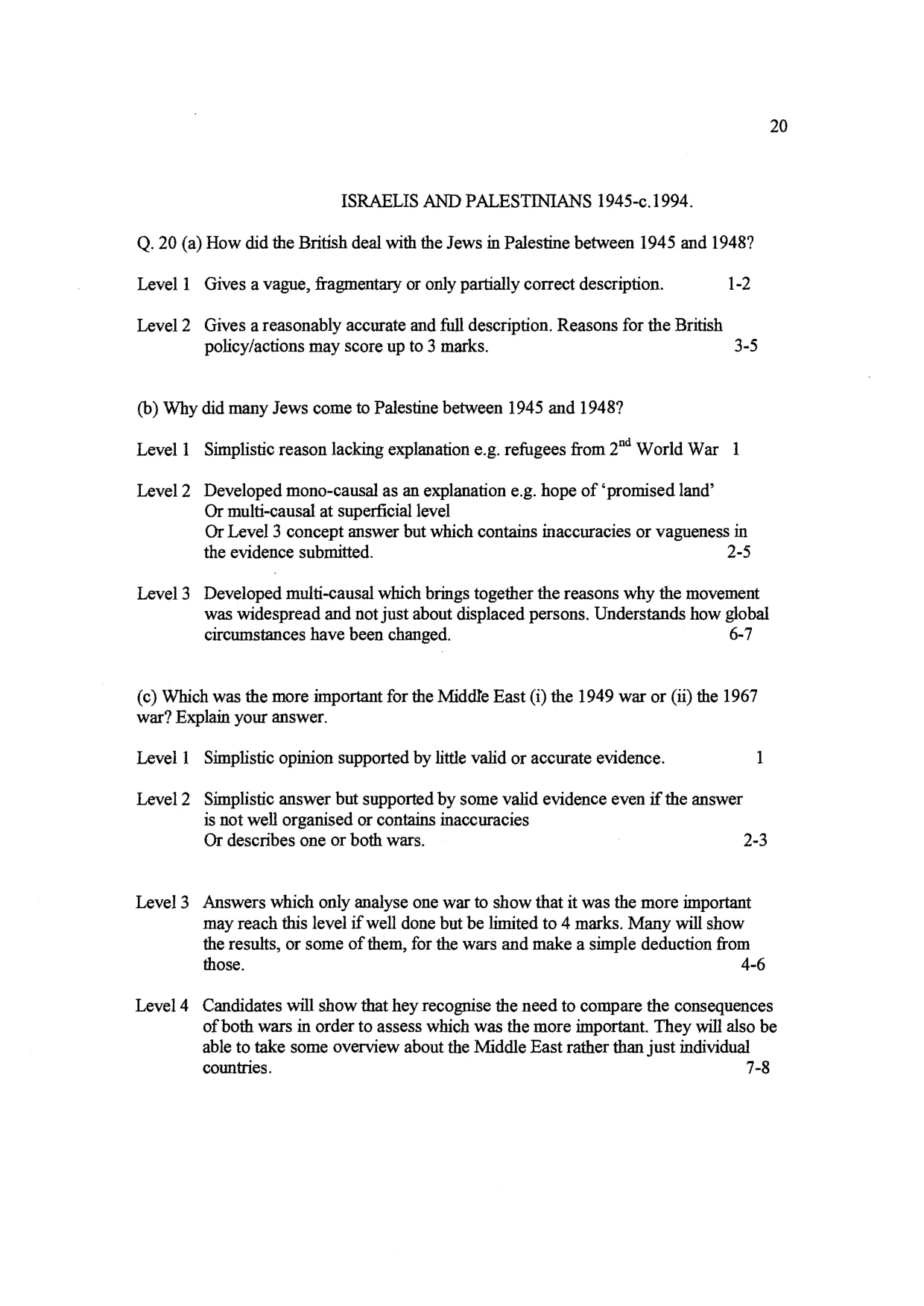
20 ISRAELIS AND PALESTINIANS 1945-c.1994. Q. 20 (a) How did the British deal with the Jews in Palestine between 1945 and 1948? Level 1 Gives a vague, fragmentary or only partially correct description. 1-2 Level 2 Gives a reasonably accurate and full description. Reasons for the British policy/actions may score up to 3 marks. 3-5 (b) Why did many Jews come to Palestine between 1945 and 1948? Level 1 Simplistic reason lacking explanation e.g. refugees from 2 World War 1 Level 2 Developed mono-causal as an explanation e.g. hope of ‘promised land’ Or multi-causal at superficial level Or Level 3 concept answer but which contains inaccuracies or vagueness in the evidence submitted. 2-5 Level 3 Developed multi-causal which brings together the reasons why the movement was widespread and not just about displaced persons. Understands how global circumstances have been changed. 6-7 (c) Which was the more important for the Middle East (i) the 1949 war or (ii) the 1967 war? Explain your answer. Level 1 Simplistic opinion supported by little valid or accurate evidence. 1 Level2 Simplistic answer but supported by some valid evidence even if the answer is not well organised or contains inaccuracies Or describes one or both wars. 2-3 Level 3 Answers which only analyse one war to show that it was the more important may reach this level if well done but be limited to 4 marks. Many will show the results, or some of them, for the wars and make a simple deduction from those. 4-6 Level 4 Candidates will show that hey recognise the need to compare the consequences of both wars in order to assess which was the more important. They will also be able to take some overview about the Middle East rather than just individual countries. 7-8
Mark scheme, page 22
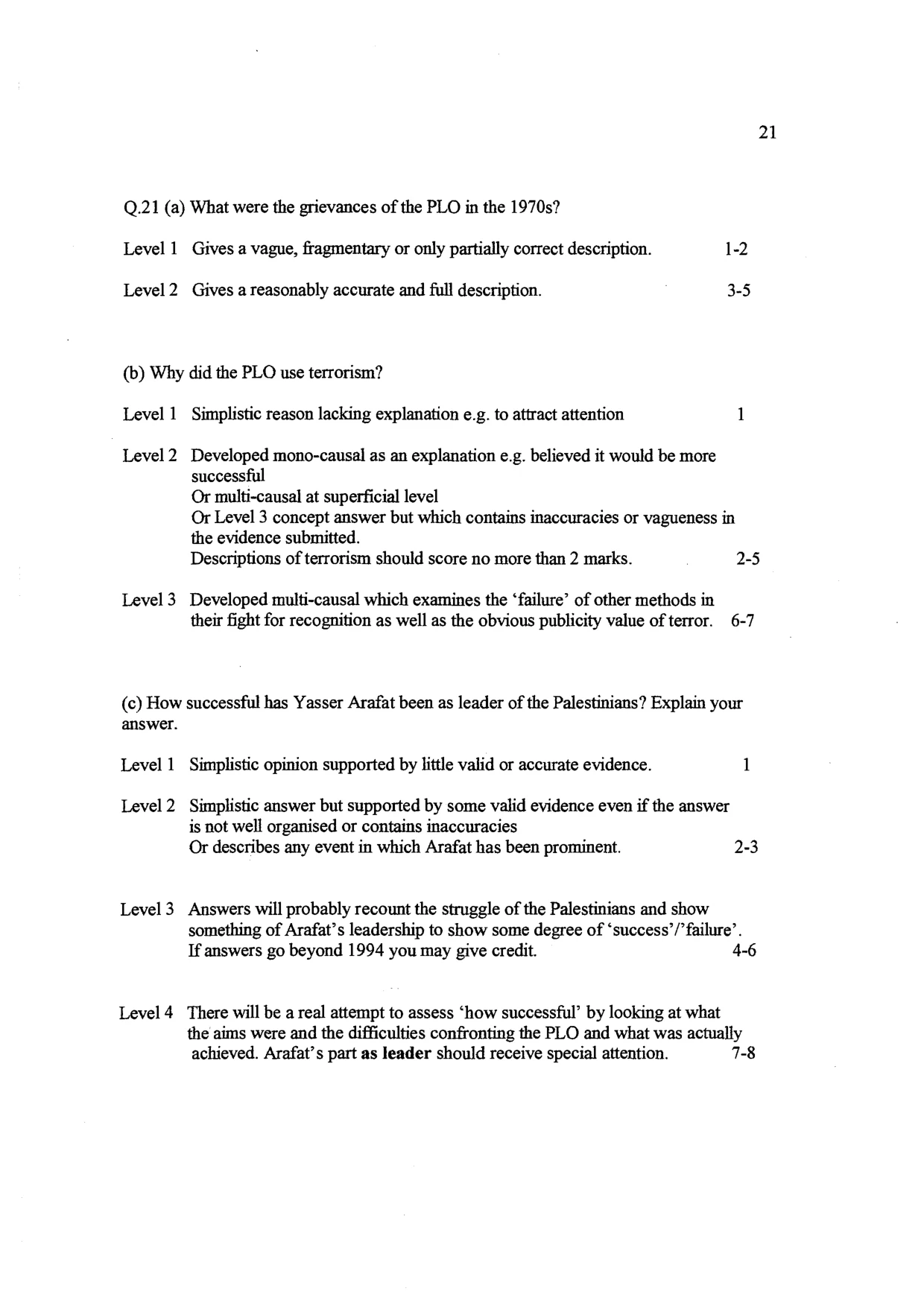
21 Q.21 (a) What were the grievances of the PLO in the 1970s? Level 1 Gives a vague, fragmentary or only partially correct description. 1-2 Level 2 Gives a reasonably accurate and full description. 3-5 (b) Why did the PLO use terrorism? Level 1 Simplistic reason lacking explanation e.g. to attract attention 1 Level 2 Developed mono-causal as an explanation e.g. believed it would be more successful Or multi-causal at superficial level Or Level 3 concept answer but which contains inaccuracies or vagueness in the evidence submitted. Descriptions of terrorism should score no more than 2 marks. 2-5 Level 3 Developed multi-causal which examines the ‘failure’ of other methods in their fight for recognition as well as the obvious publicity value of terror. 6-7 (c) How successful has Yasser Arafat been as leader of the Palestinians? Explain your answer. Level 1 Simplistic opinion supported by little valid or accurate evidence. 1 Level 2 Simplistic answer but supported by some valid evidence even if the answer is not well organised or contains inaccuracies Or describes any event in which Arafat has been prominent. 2-3 Level 3 Answers will probably recount the struggle of the Palestinians and show something of Arafat’s leadership to show some degree of ‘success’/’failure’. If answers go beyond 1994 you may give credit. 4-6 Level 4 There will be a real attempt to assess ‘how successful’ by looking at what the aims were and the difficulties confronting the PLO and what was actually achieved. Arafat’s part as leader should receive special attention. 7-8
Mark scheme, page 23
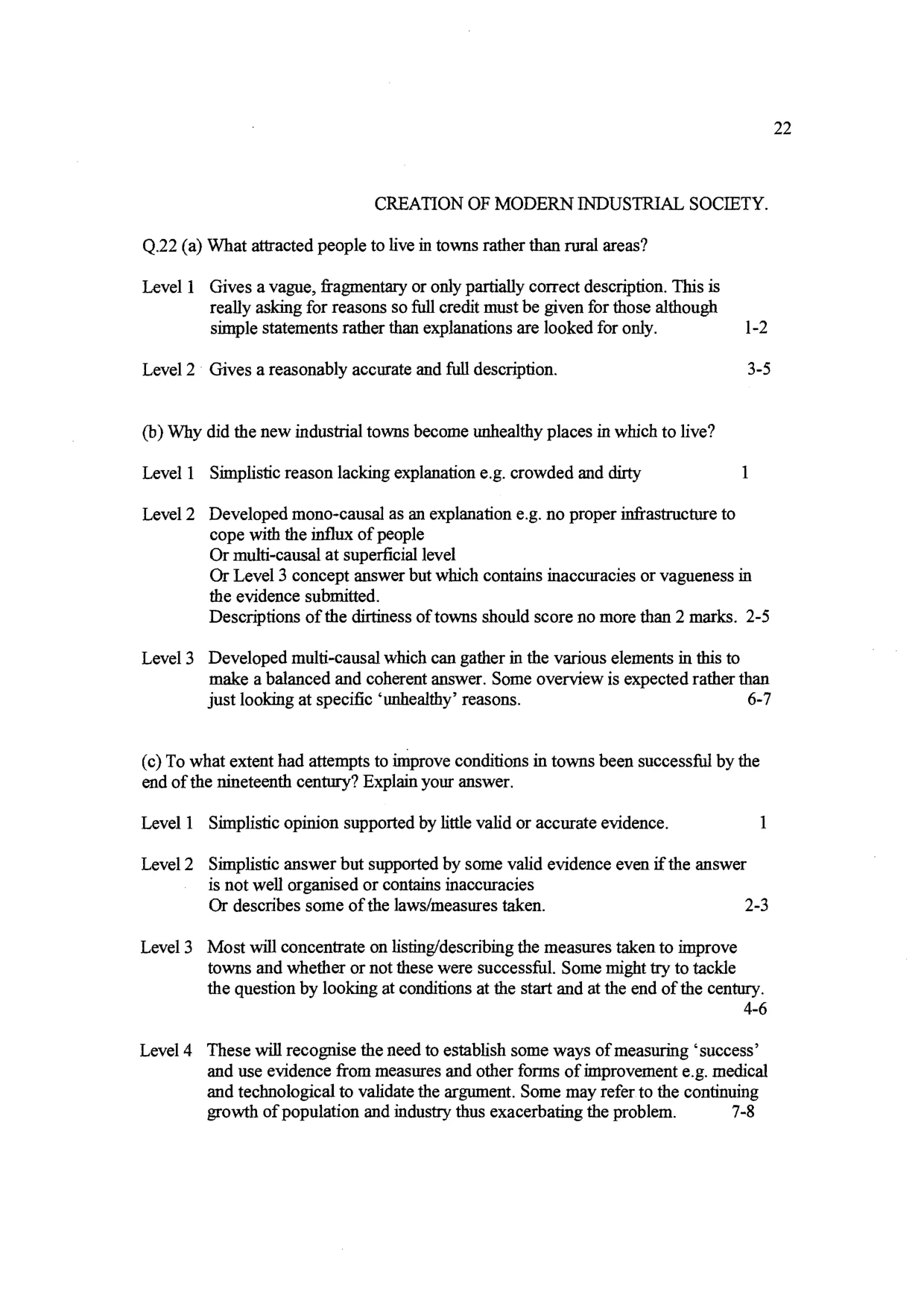
22 CREATION OF MODERN INDUSTRIAL SOCIETY. Q.22 (a) What attracted people to live in towns rather than rural areas? Level 1 Gives a vague, fragmentary or only partially correct description. This is really asking for reasons so full credit must be given for those although simple statements rather than explanations are looked for only. 1-2 Level 2» Gives a reasonably accurate and full description. 3-5 (b) Why did the new industrial towns become unhealthy places in which to live? Level 1 Simplistic reason lacking explanation e.g. crowded and dirty 1 Level 2 Developed mono-causal as an explanation e.g. no proper infrastructure to cope with the influx of people Or multi-causal at superficial level Or Level 3 concept answer but which contains inaccuracies or vagueness in the evidence submitted. Descriptions of the dirtiness of towns should score no more than 2 marks. 2-5 Level 3 Developed multi-causal which can gather in the various elements in this to make a balanced and coherent answer. Some overview is expected rather than just looking at specific ‘unhealthy’ reasons. 6-7 (c) To what extent had attempts to improve conditions in towns been successful by the end of the nineteenth century? Explain your answer. Level 1 Simplistic opinion supported by little valid or accurate evidence. 1 Level 2 Simplistic answer but supported by some valid evidence even if the answer is not well organised or contains inaccuracies Or describes some of the laws/measures taken. 2-3 Level 3 Most will concentrate on listing/describing the measures taken to improve towns and whether or not these were successful. Some might try to tackle the question by looking at conditions at the start and at the end of the century. 4-6 Level 4 These will recognise the need to establish some ways of measuring ‘success’ and use evidence from measures and other forms of improvement e.g. medical and technological to validate the argument. Some may refer to the continuing growth of population and industry thus exacerbating the problem. 7-8
Mark scheme, page 24
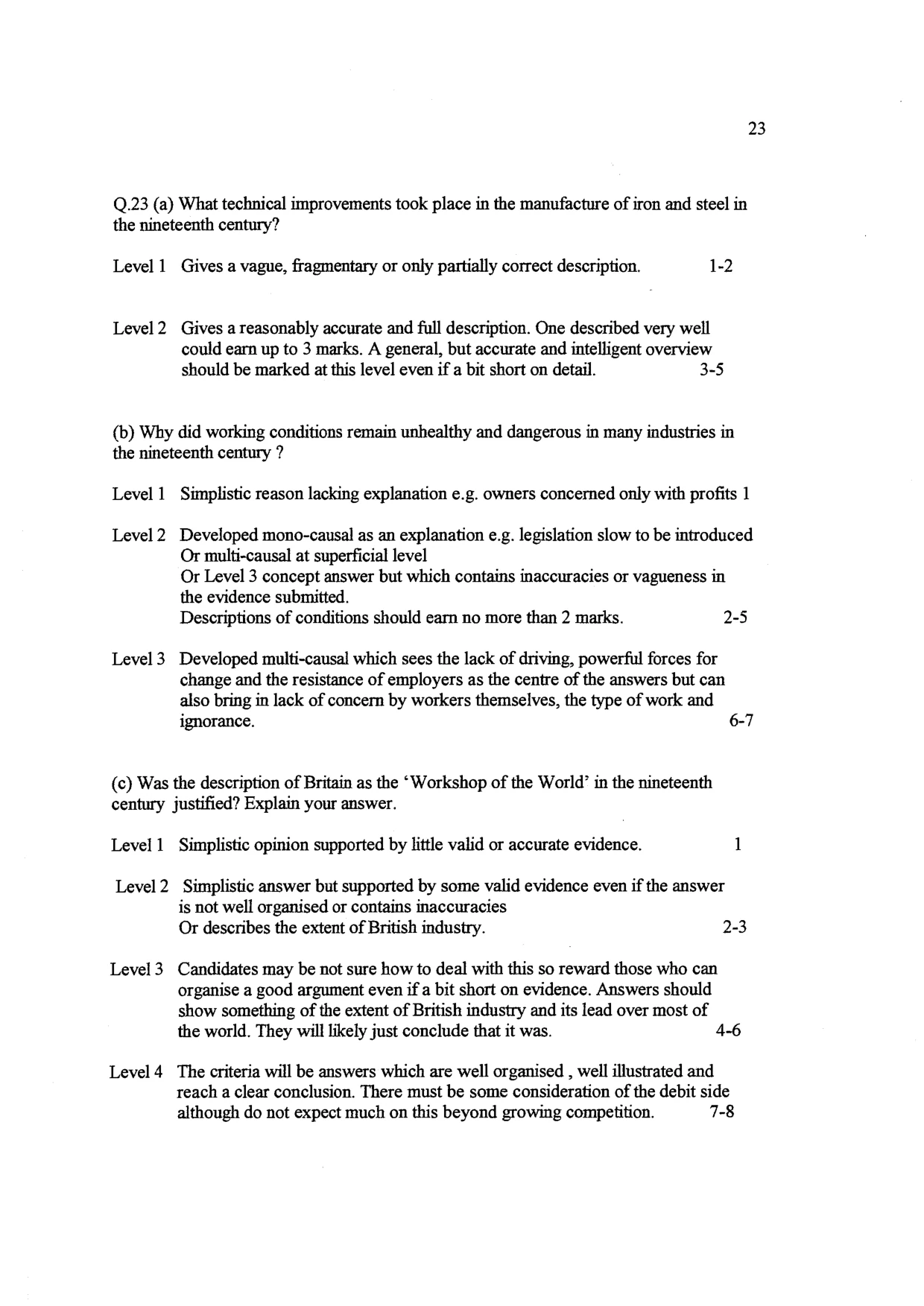
23 Q.23 (a) What technical improvements took place in the manufacture of iron and steel in the nineteenth century? Level 1 Gives a vague, fragmentary or only partially correct description. 1-2 Level 2 Gives a reasonably accurate and full description. One described very well could earn up to 3 marks. A general, but accurate and intelligent overview should be marked at this level even if a bit short on detail. 3-5 (b) Why did working conditions remain unhealthy and dangerous in many industries in the nineteenth century ? Level 1 Simplistic reason lacking explanation e.g. owners concerned only with profits 1 Level 2 Developed mono-causal as an explanation e.g. legislation slow to be introduced Or multi-causal at superficial level Or Level 3 concept answer but which contains inaccuracies or vagueness in the evidence submitted. Descriptions of conditions should earn no more than 2 marks. 2-5 Level 3 Developed multi-causal which sees the lack of driving, powerful forces for change and the resistance of employers as the centre of the answers but can also bring in lack of concern by workers themselves, the type of work and ignorance. 6-7 (c) Was the description of Britain as the ‘Workshop of the World’ in the nineteenth century justified? Explain your answer. Level 1 Simplistic opinion supported by little valid or accurate evidence. 1 Level2 Simplistic answer but supported by some valid evidence even if the answer is not well organised or contains inaccuracies Or describes the extent of British industry. 2-3 Level 3 Candidates may be not sure how to deal with this so reward those who can organise a good argument even if a bit short on evidence. Answers should show something of the extent of British industry and its lead over most of the world. They will likely just conclude that it was. 4-6 Level 4 The criteria will be answers which are well organised , well illustrated and reach a clear conclusion. There must be some consideration of the debit side although do not expect much on this beyond growing competition. 7-8
Mark scheme, page 25
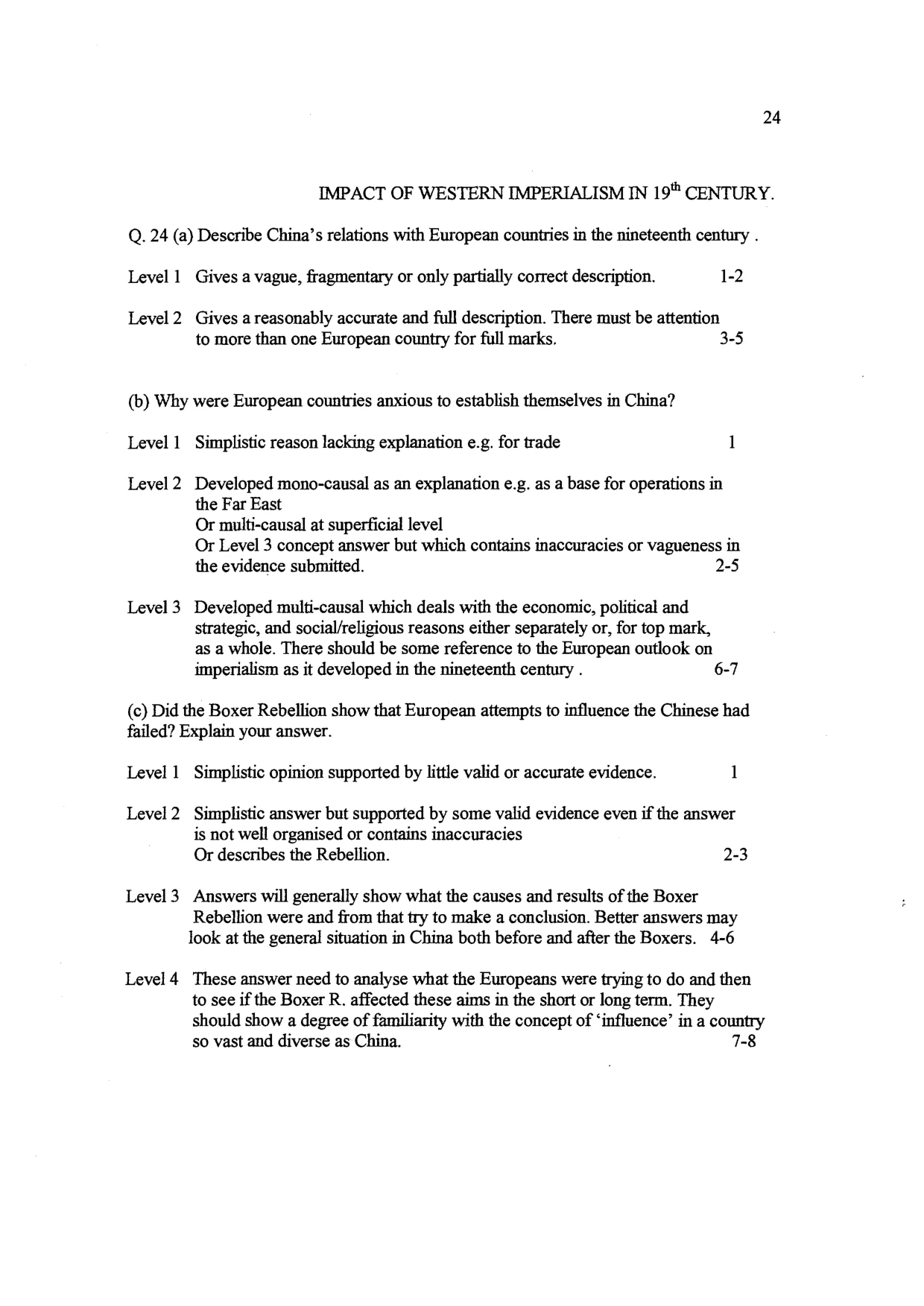
24 IMPACT OF WESTERN IMPERIALISM IN 19 CENTURY. Q. 24 (a) Describe China’s relations with European countries in the nineteenth century . Level 1 Gives a vague, fragmentary or only partially correct description. 1-2 Level 2 Gives a reasonably accurate and full description. There must be attention to more than one European country for full marks. 3-5 (b) Why were European countries anxious to establish themselves in China? Level 1 Simplistic reason lacking explanation e.g. for trade 1 Level 2 Developed mono-causal as an explanation e.g. as a base for operations in the Far East Or multi-causal at superficial level Or Level 3 concept answer but which contains inaccuracies or vagueness in the evidence submitted. 2-5 Level 3 Developed multi-causal which deals with the economic, political and strategic, and social/religious reasons either separately or, for top mark, as a whole. There should be some reference to the European outlook on imperialism as it developed in the nineteenth century . 6-7 (c) Did the Boxer Rebellion show that European attempts to influence the Chinese had failed? Explain your answer. Level 1 Simplistic opinion supported by little valid or accurate evidence. 1 Level 2 Simplistic answer but supported by some valid evidence even if the answer is not well organised or contains inaccuracies Or describes the Rebellion. 2-3 Level 3. Answers will generally show what the causes and results of the Boxer Rebellion were and from that try to make a conclusion. Better answers may look at the general situation in China both before and after the Boxers. 4-6 Level 4 These answer need to analyse what the Europeans were trying to do and then to see if the Boxer R. affected these aims in the short or long term. They should show a degree of familiarity with the concept of ‘influence’ in a country so vast and diverse as China. 7-8
Mark scheme, page 26
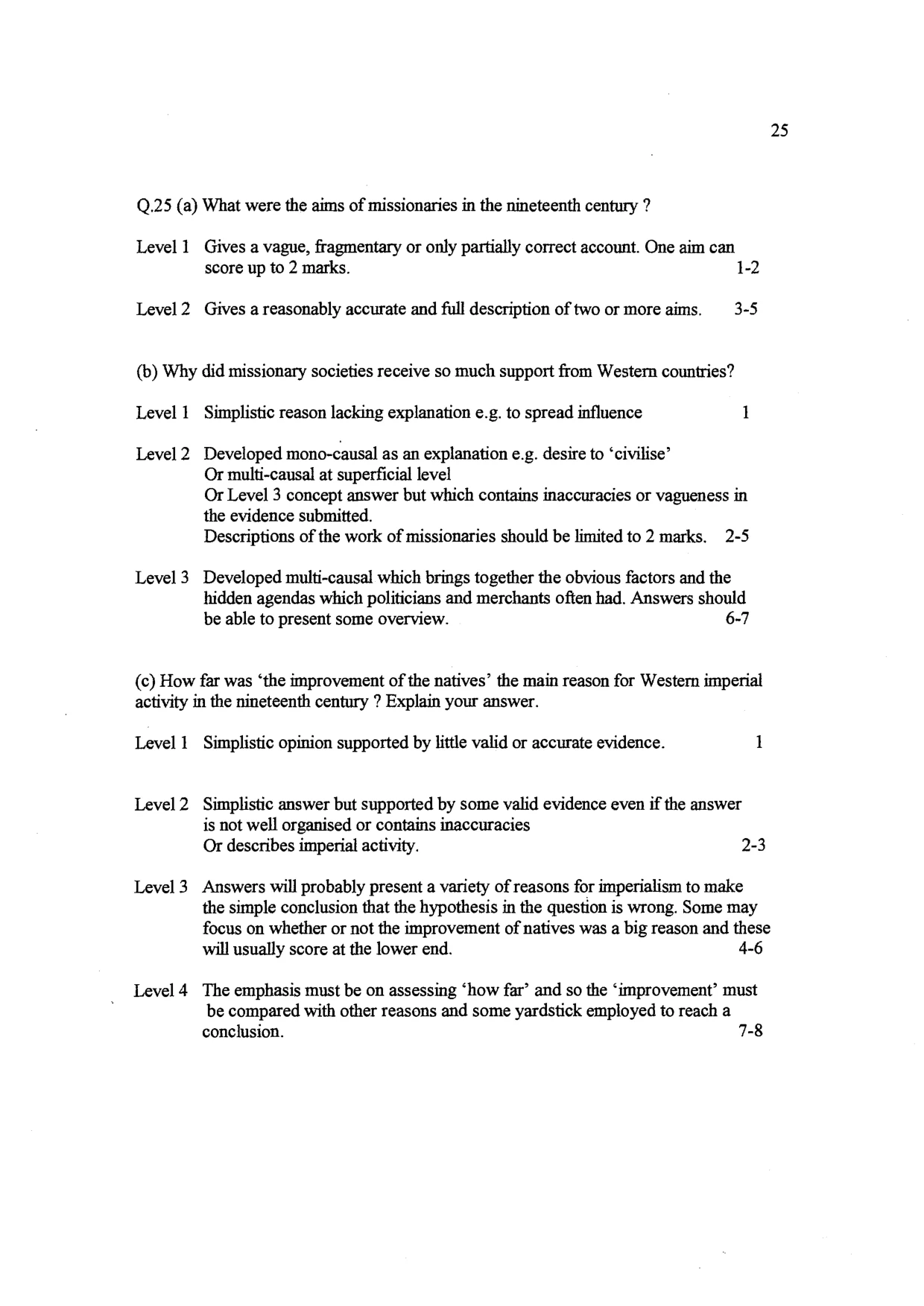
25 Q.25 (a) What were the aims of missionaries in the nineteenth century ? Level 1 Gives a vague, fragmentary or only partially correct account. One aim can score up to 2 marks. 1-2 Level 2 Gives a reasonably accurate and full description of two or more aims. 3-5 (b) Why did missionary societies receive so much support from Wester countries? Level 1 Simplistic reason lacking explanation e.g. to spread influence 1 Level 2 Developed mono-causal as an explanation e.g. desire to ‘civilise’ Or multi-causal at superficial level Or Level 3 concept answer but which contains inaccuracies or vagueness in the evidence submitted. Descriptions of the work of missionaries should be limited to 2 marks. 2-5 Level 3 Developed multi-causal which brings together the obvious factors and the hidden agendas which politicians and merchants often had. Answers should be able to present some overview. 6-7 (c) How far was ‘the improvement of the natives’ the main reason for Western imperial activity in the nineteenth century ? Explain your answer. Level 1 Simplistic opinion supported by little valid or accurate evidence. 1 Level 2 Simplistic answer but supported by some valid evidence even if the answer is not well organised or contains inaccuracies Or describes imperial activity. 2-3 Level 3 Answers will probably present a variety of reasons for imperialism to make the simple conclusion that the hypothesis in the question is wrong. Some may focus on whether or not the improvement of natives was a big reason and these will usually score at the lower end. 4-6 Level 4 The emphasis must be on assessing ‘how far’ and so the ‘improvement’ must be compared with other reasons and some yardstick employed to reach a conclusion. 7-8