Cambridge IGCSE German - Foreign Language 0525 — 2022 Oct/Nov Paper 2 · Variant 2
0525/22/O/N/22 · 45 marks · ≈51 min
The question paper and its mark scheme, free to read here and free to download. This is Cambridge’s own paper, exactly as it was sat.
Question paper12 pages

Mark scheme14 pages
Answers below. Sit the paper first if you are practising.
Paper as text
Question paper, page 1
This document has 12 pages. Any blank pages are indicated. [Turn over Cambridge IGCSE™ GERMAN 0525/22 Paper 2 Reading October/November 2022 1 hour You must answer on the question paper. No additional materials are needed. INSTRUCTIONS ● Answer all questions. ● Use a black or dark blue pen. ● Write your name, centre number and candidate number in the boxes at the top of the page. ● Write your answer to each question in the space provided. ● Do not use an erasable pen or correction fluid. ● Do not write on any bar codes. ● Dictionaries are not allowed. INFORMATION ● The total mark for this paper is 45. ● The number of marks for each question or part question is shown in brackets [ ]. * 6 1 1 5 2 7 1 4 8 7 * DC (CE/FC) 303381/3 © UCLES 2022
Question paper, page 2
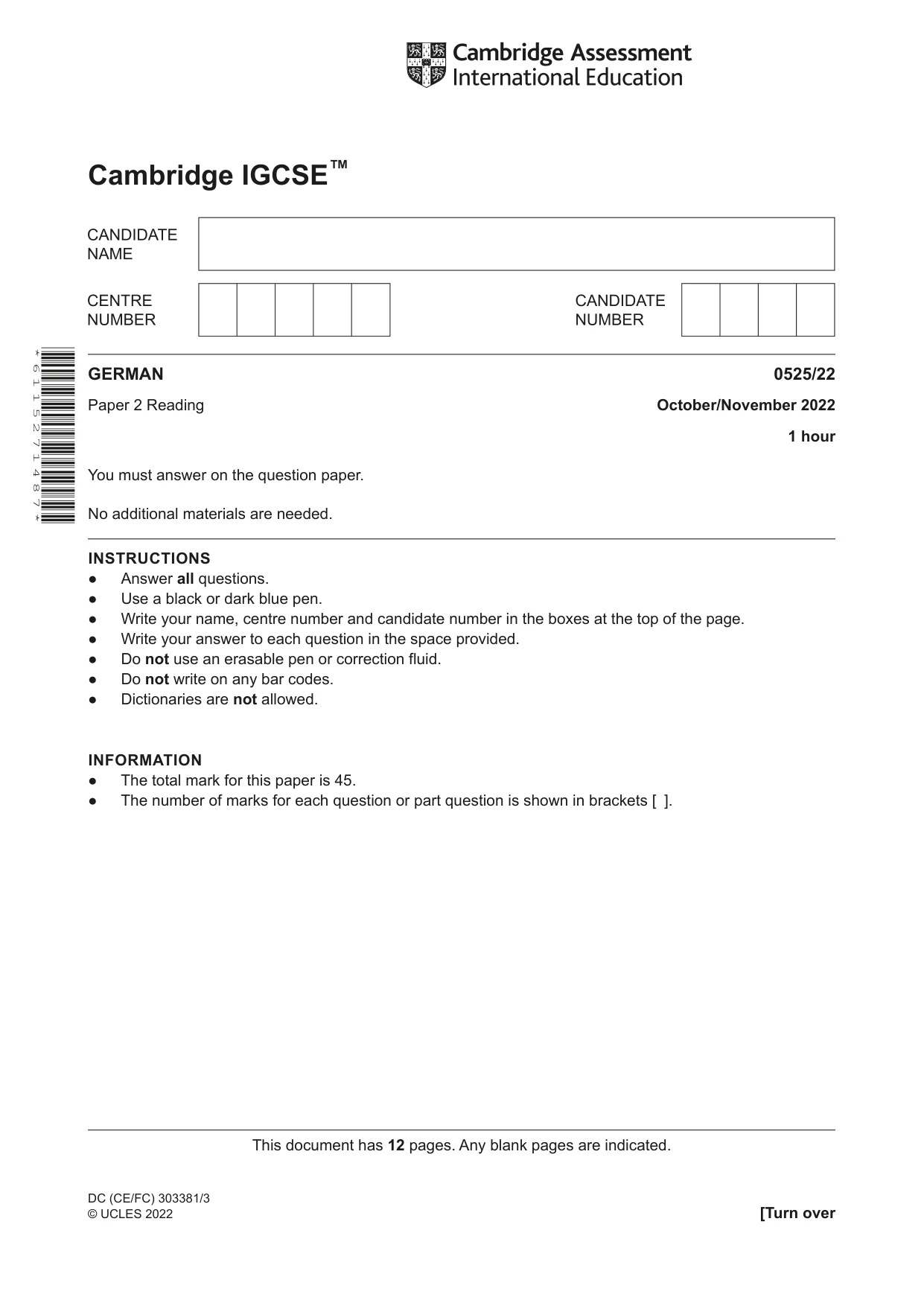
2 0525/22/ O/ N/22 © UCLES 2022 1 Sehen Sie sich die Bilder an. A B C D E F Für jede Aussage tragen Sie die richtigen Buchstaben (A–F) in die Kästchen ein. (a) Heute Nachmittag gehe ich in die Apotheke. [1] (b) Der Zahnarzt kann dir helfen. [1] (c) Du musst im Bett bleiben. [1] (d) Du kannst diese Tabletten nehmen. [1] (e) Ich muss den Doktor anrufen. [1] [Gesamtpunktzahl: 5]
Question paper, page 3
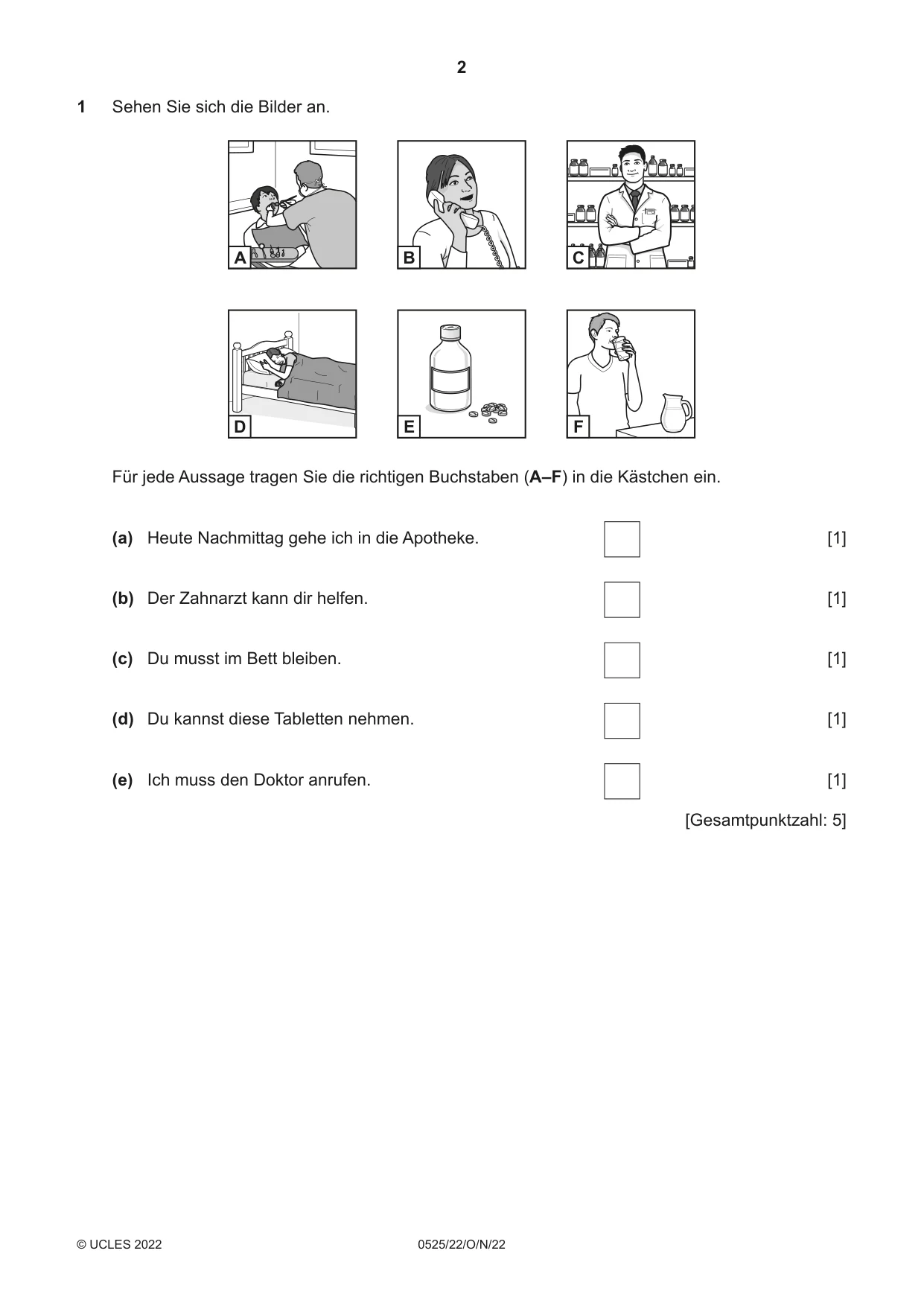
3 0525/22/O/N/22 © UCLES 2022 [Turn over 2 Sehen Sie sich die Schilder an. Freizeit Zoo Café Spielplatz Diskothek Kino Schwimmbad Eishalle Stadion A B C D E F G H Für jede Aussage tragen Sie die richtigen Buchstaben (A–H) in die Kästchen ein. (a) Samstags gehen wir tanzen. [1] (b) Sonntags sehen wir uns ein Fußballspiel an. [1] (c) Meine kleine Schwester spielt gerne im Sand. [1] (d) Nach der Schule trinken sie eine heiße Schokolade. [1] (e) Am liebsten gehe ich zu den Giraffen. [1] [Gesamtpunktzahl: 5]
Question paper, page 4
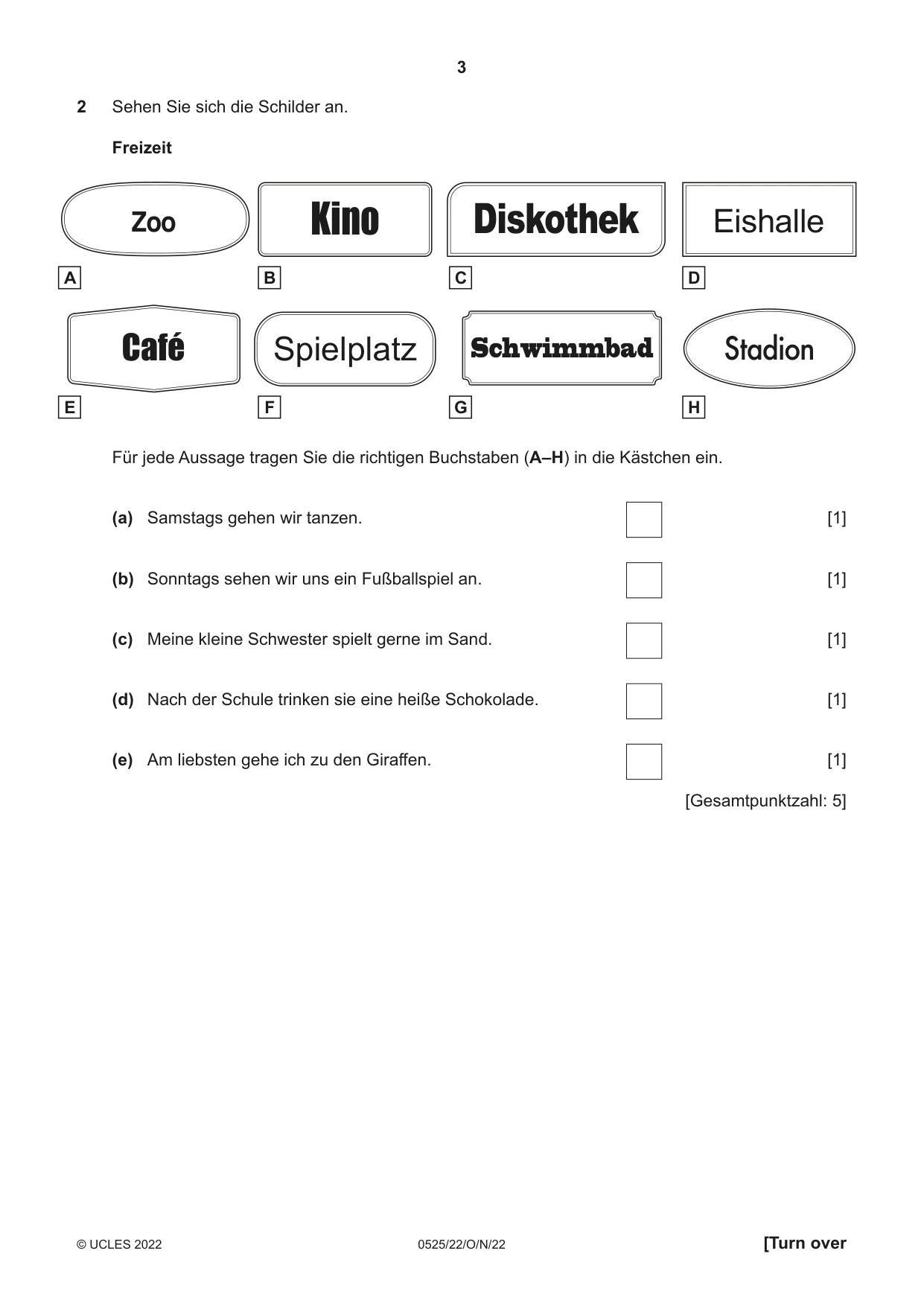
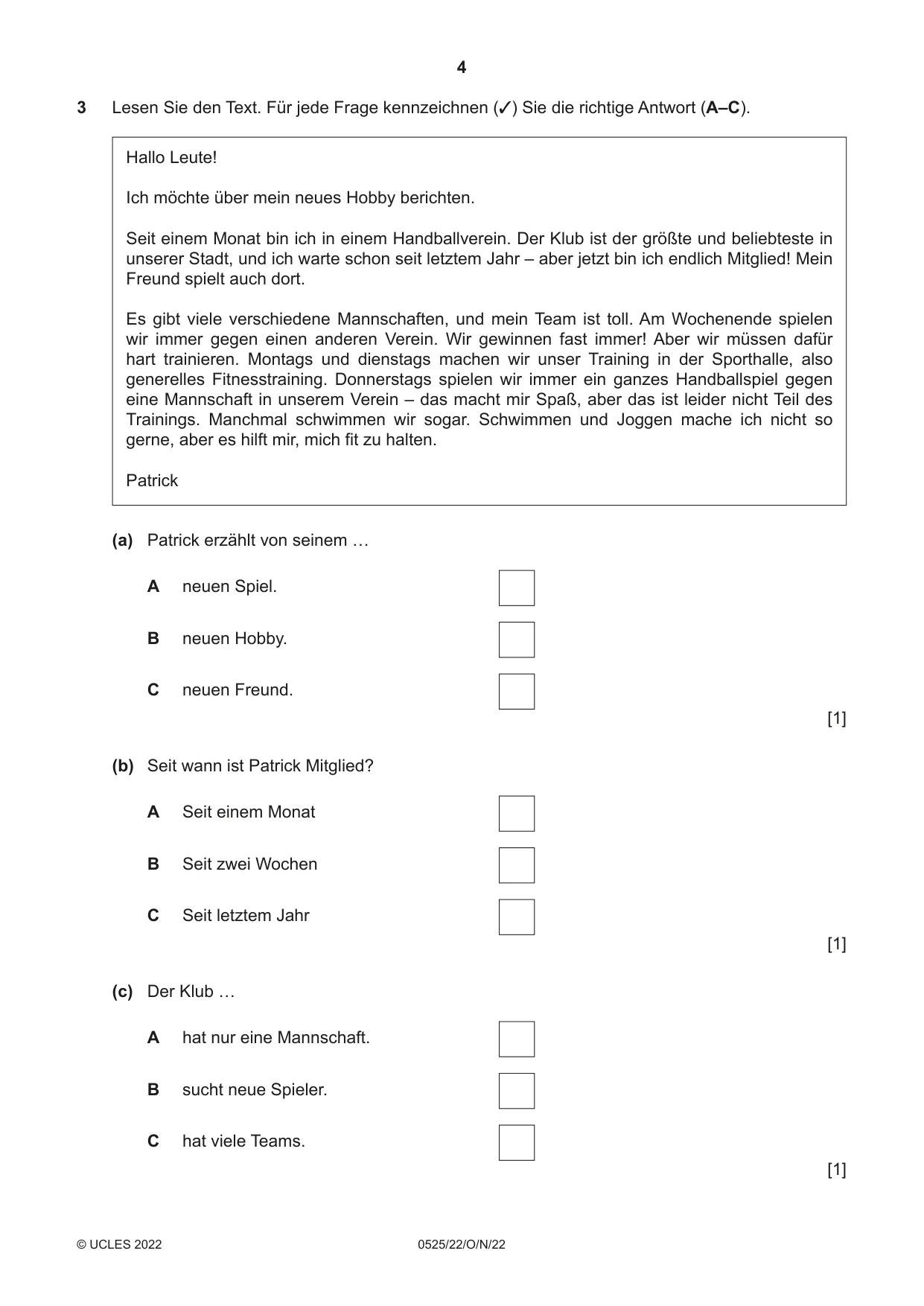
4 0525/22/O/N/22 © UCLES 2022 3 Lesen Sie den Text. Für jede Frage kennzeichnen (3) Sie die richtige Antwort (A–C). Hallo Leute! Ich möchte über mein neues Hobby berichten. Seit einem Monat bin ich in einem Handballverein. Der Klub ist der größte und beliebteste in unserer Stadt, und ich warte schon seit letztem Jahr – aber jetzt bin ich endlich Mitglied! Mein Freund spielt auch dort. Es gibt viele verschiedene Mannschaften, und mein Team ist toll. Am Wochenende spielen wir immer gegen einen anderen Verein. Wir gewinnen fast immer! Aber wir müssen dafür hart trainieren. Montags und dienstags machen wir unser Training in der Sporthalle, also generelles Fitnesstraining. Donnerstags spielen wir immer ein ganzes Handballspiel gegen eine Mannschaft in unserem Verein – das macht mir Spaß, aber das ist leider nicht Teil des Trainings. Manchmal schwimmen wir sogar. Schwimmen und Joggen mache ich nicht so gerne, aber es hilft mir, mich fit zu halten. Patrick (a) Patrick erzählt von seinem … A neuen Spiel. B neuen Hobby. C neuen Freund. [1] (b) Seit wann ist Patrick Mitglied? A Seit einem Monat B Seit zwei Wochen C Seit letztem Jahr [1] (c) Der Klub … A hat nur eine Mannschaft. B sucht neue Spieler. C hat viele Teams. [1]
Question paper, page 5
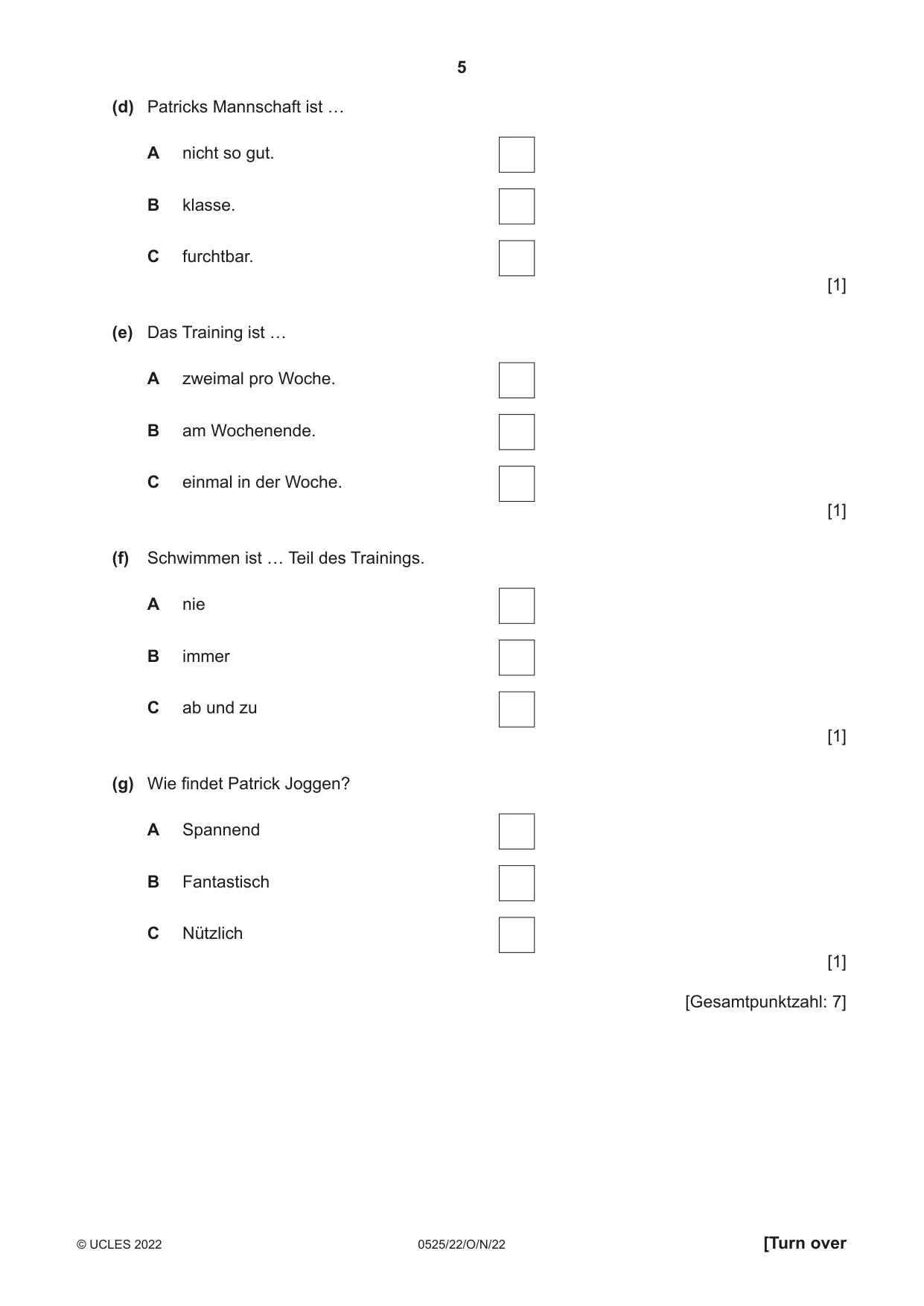
5 0525/22/O/N/22 © UCLES 2022 [Turn over (d) Patricks Mannschaft ist … A nicht so gut. B klasse. C furchtbar. [1] (e) Das Training ist … A zweimal pro Woche. B am Wochenende. C einmal in der Woche. [1] (f) Schwimmen ist … Teil des Trainings. A nie B immer C ab und zu [1] (g) Wie findet Patrick Joggen? A Spannend B Fantastisch C Nützlich [1] [Gesamtpunktzahl: 7]
Question paper, page 6
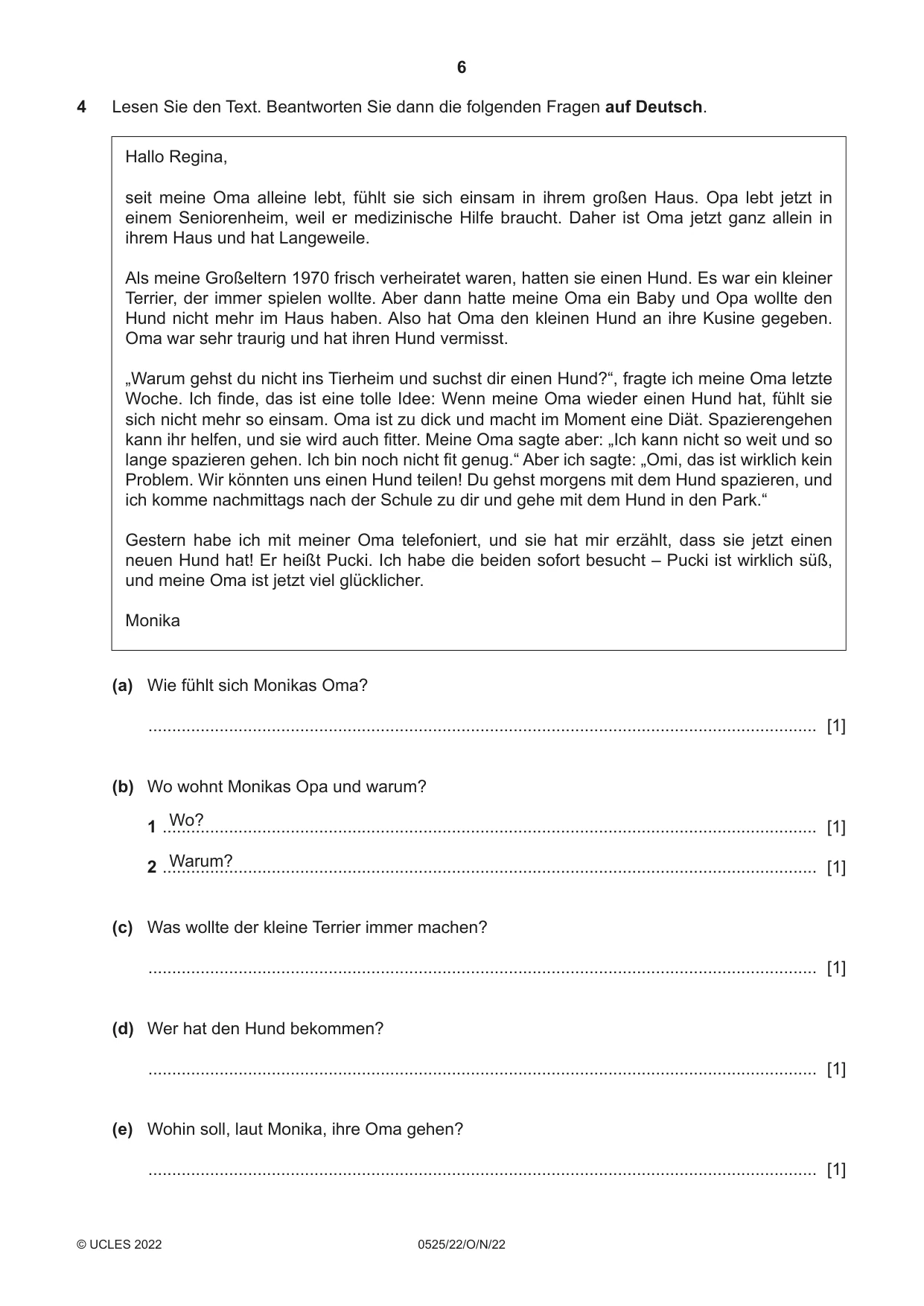
6 0525/22/O/N/22 © UCLES 2022 4 Lesen Sie den Text. Beantworten Sie dann die folgenden Fragen auf Deutsch. Hallo Regina, seit meine Oma alleine lebt, fühlt sie sich einsam in ihrem großen Haus. Opa lebt jetzt in einem Seniorenheim, weil er medizinische Hilfe braucht. Daher ist Oma jetzt ganz allein in ihrem Haus und hat Langeweile. Als meine Großeltern 1970 frisch verheiratet waren, hatten sie einen Hund. Es war ein kleiner Terrier, der immer spielen wollte. Aber dann hatte meine Oma ein Baby und Opa wollte den Hund nicht mehr im Haus haben. Also hat Oma den kleinen Hund an ihre Kusine gegeben. Oma war sehr traurig und hat ihren Hund vermisst. „Warum gehst du nicht ins Tierheim und suchst dir einen Hund?“, fragte ich meine Oma letzte Woche. Ich finde, das ist eine tolle Idee: Wenn meine Oma wieder einen Hund hat, fühlt sie sich nicht mehr so einsam. Oma ist zu dick und macht im Moment eine Diät. Spazierengehen kann ihr helfen, und sie wird auch fitter. Meine Oma sagte aber: „Ich kann nicht so weit und so lange spazieren gehen. Ich bin noch nicht fit genug.“ Aber ich sagte: „Omi, das ist wirklich kein Problem. Wir könnten uns einen Hund teilen! Du gehst morgens mit dem Hund spazieren, und ich komme nachmittags nach der Schule zu dir und gehe mit dem Hund in den Park.“ Gestern habe ich mit meiner Oma telefoniert, und sie hat mir erzählt, dass sie jetzt einen neuen Hund hat! Er heißt Pucki. Ich habe die beiden sofort besucht – Pucki ist wirklich süß, und meine Oma ist jetzt viel glücklicher. Monika (a) Wie fühlt sich Monikas Oma? … [1] (b) Wo wohnt Monikas Opa und warum? Wo? 1 … [1] Warum? 2 … [1] (c) Was wollte der kleine Terrier immer machen? … [1] (d) Wer hat den Hund bekommen? … [1] (e) Wohin soll, laut Monika, ihre Oma gehen? … [1]
Question paper, page 7
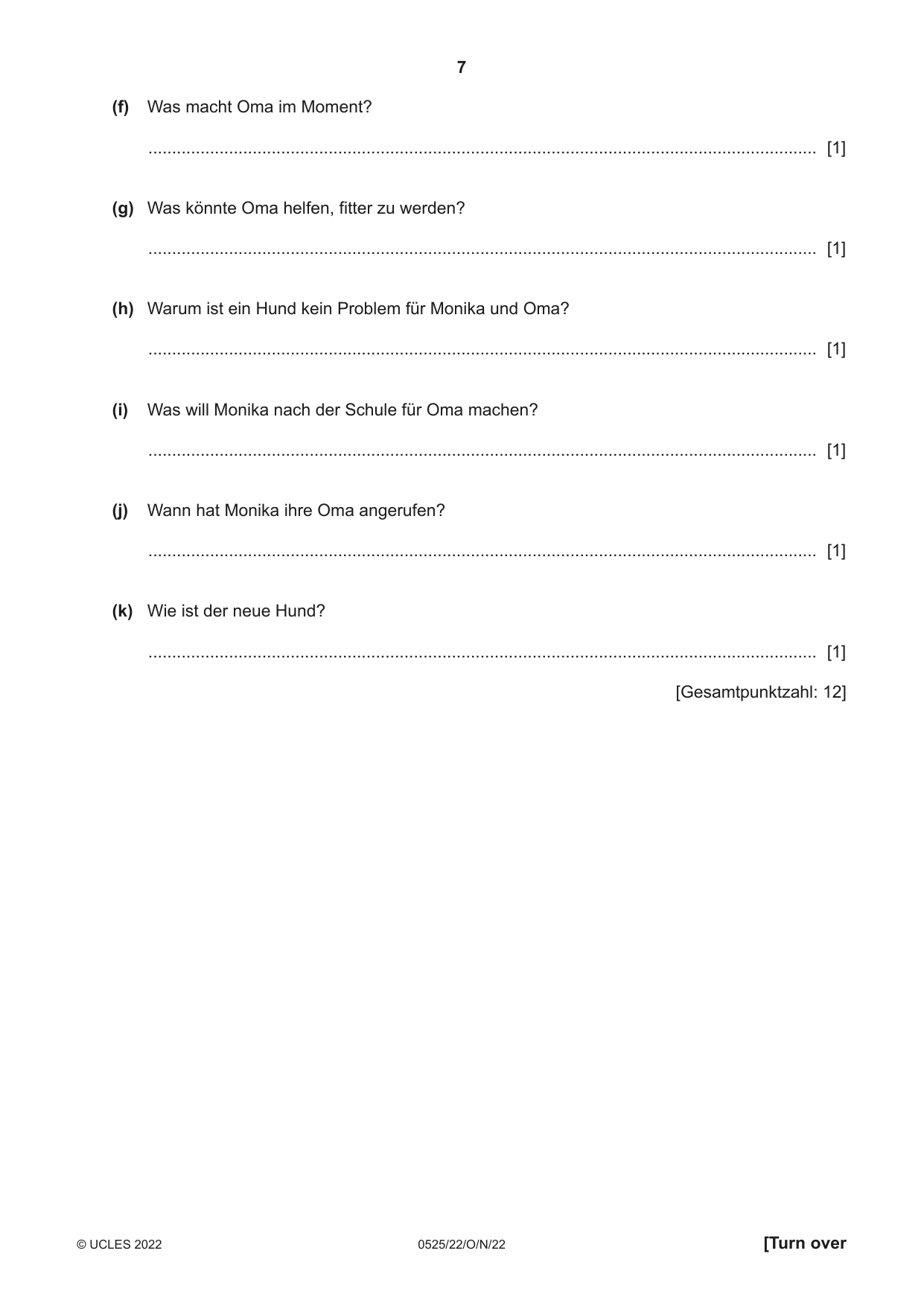
7 0525/22/O/N/22 © UCLES 2022 [Turn over (f) Was macht Oma im Moment? … [1] (g) Was könnte Oma helfen, fitter zu werden? … [1] (h) Warum ist ein Hund kein Problem für Monika und Oma? … [1] (i) Was will Monika nach der Schule für Oma machen? … [1] (j) Wann hat Monika ihre Oma angerufen? … [1] (k) Wie ist der neue Hund? … [1] [Gesamtpunktzahl: 12]
Question paper, page 8
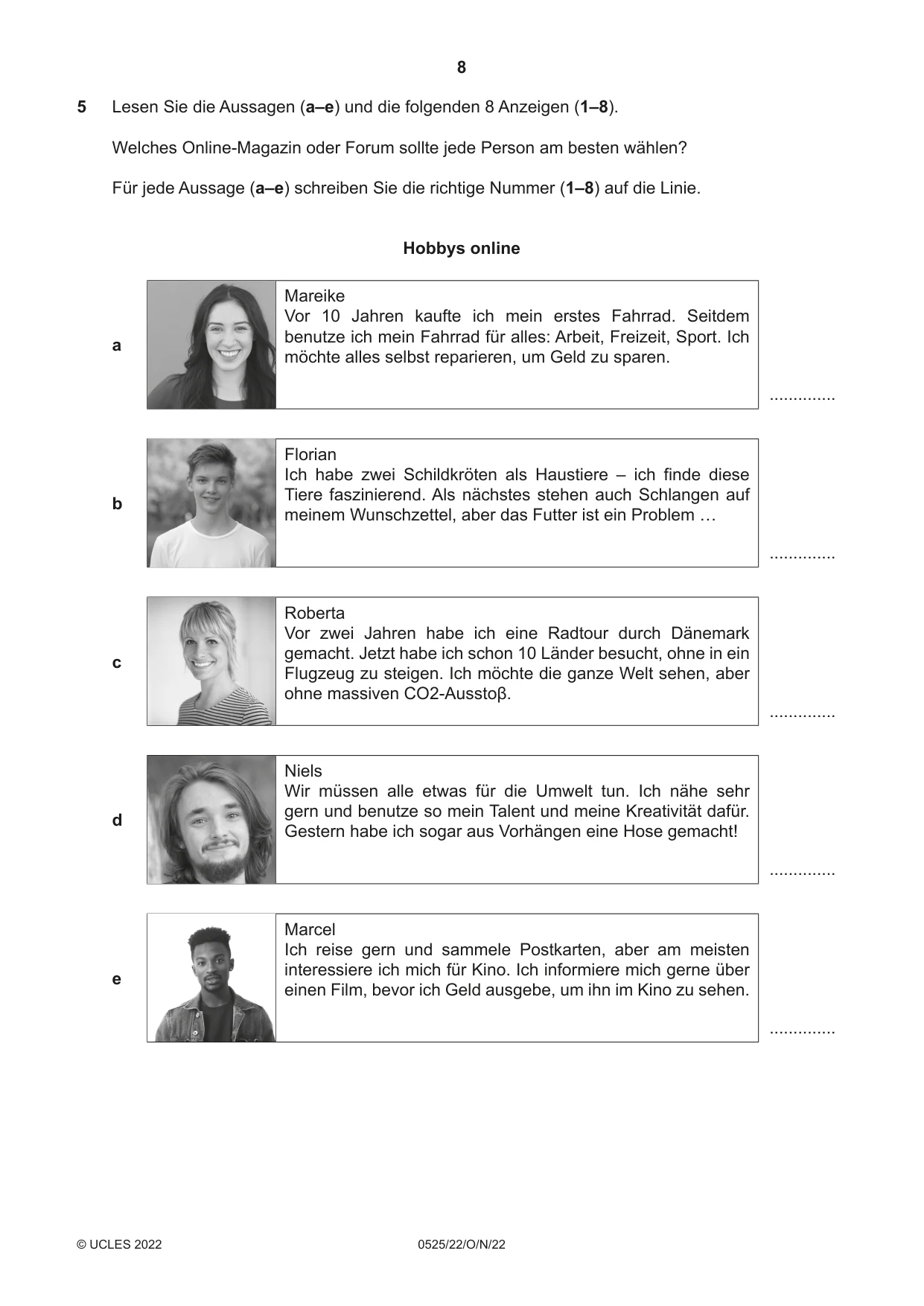
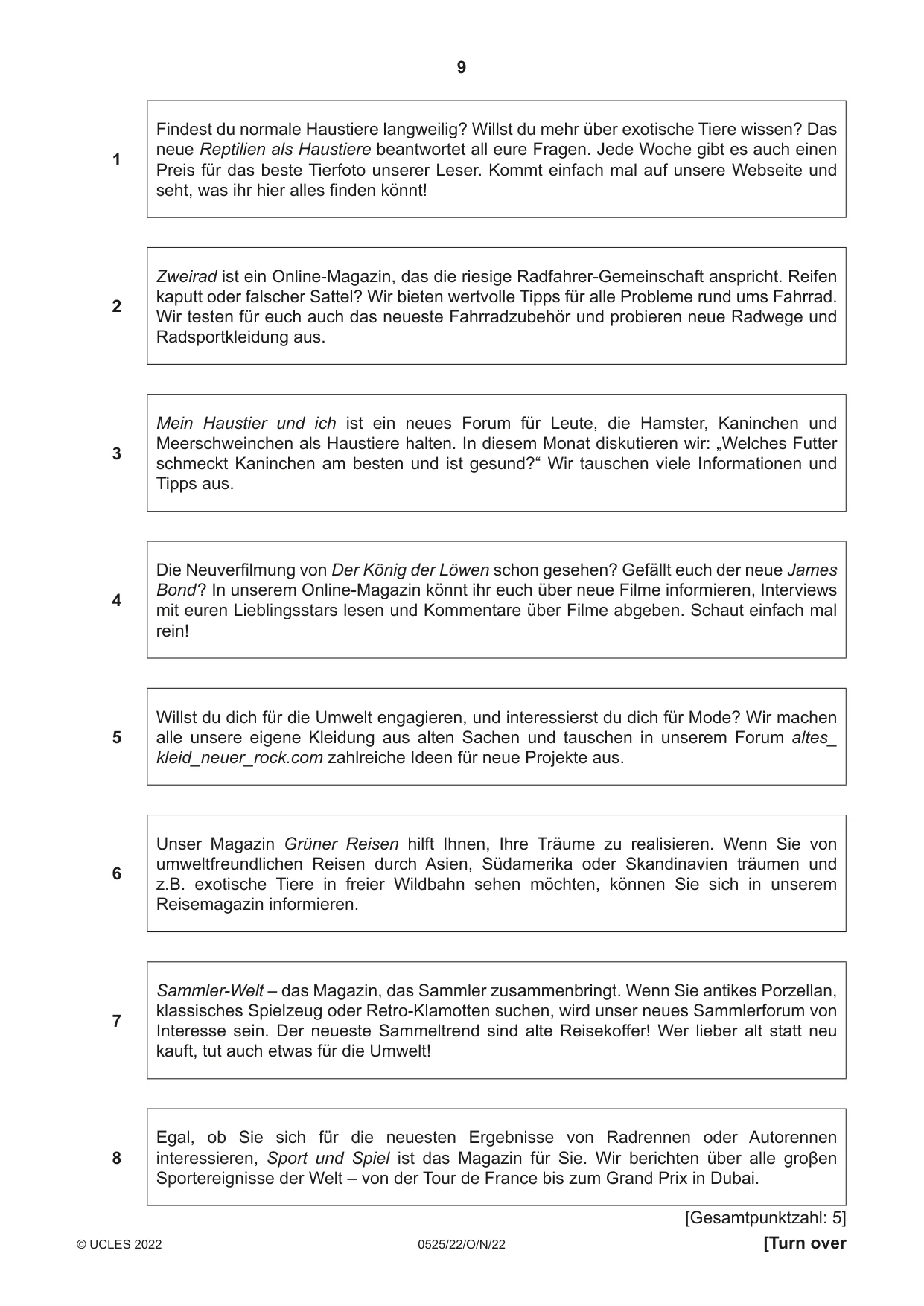
8 0525/22/O/N/22 © UCLES 2022 5 Lesen Sie die Aussagen (a–e) und die folgenden 8 Anzeigen (1–8). Welches Online-Magazin oder Forum sollte jede Person am besten wählen? Für jede Aussage (a–e) schreiben Sie die richtige Nummer (1–8) auf die Linie. Hobbys online a Mareike Vor 10 Jahren kaufte ich mein erstes Fahrrad. Seitdem benutze ich mein Fahrrad für alles: Arbeit, Freizeit, Sport. Ich möchte alles selbst reparieren, um Geld zu sparen. … b Florian Ich habe zwei Schildkröten als Haustiere – ich finde diese Tiere faszinierend. Als nächstes stehen auch Schlangen auf meinem Wunschzettel, aber das Futter ist ein Problem … … c Roberta Vor zwei Jahren habe ich eine Radtour durch Dänemark gemacht. Jetzt habe ich schon 10 Länder besucht, ohne in ein Flugzeug zu steigen. Ich möchte die ganze Welt sehen, aber ohne massiven CO2-Ausstoβ. … d Niels Wir müssen alle etwas für die Umwelt tun. Ich nähe sehr gern und benutze so mein Talent und meine Kreativität dafür. Gestern habe ich sogar aus Vorhängen eine Hose gemacht! … e Marcel Ich reise gern und sammele Postkarten, aber am meisten interessiere ich mich für Kino. Ich informiere mich gerne über einen Film, bevor ich Geld ausgebe, um ihn im Kino zu sehen. …
Question paper, page 9
9 0525/22/O/N/22 © UCLES 2022 [Turn over 1 Findest du normale Haustiere langweilig? Willst du mehr über exotische Tiere wissen? Das neue Reptilien als Haustiere beantwortet all eure Fragen. Jede Woche gibt es auch einen Preis für das beste Tierfoto unserer Leser. Kommt einfach mal auf unsere Webseite und seht, was ihr hier alles finden könnt! 2 Zweirad ist ein Online-Magazin, das die riesige Radfahrer-Gemeinschaft anspricht. Reifen kaputt oder falscher Sattel? Wir bieten wertvolle Tipps für alle Probleme rund ums Fahrrad. Wir testen für euch auch das neueste Fahrradzubehör und probieren neue Radwege und Radsportkleidung aus. 3 Mein Haustier und ich ist ein neues Forum für Leute, die Hamster, Kaninchen und Meerschweinchen als Haustiere halten. In diesem Monat diskutieren wir: „Welches Futter schmeckt Kaninchen am besten und ist gesund?“ Wir tauschen viele Informationen und Tipps aus. 4 Die Neuverfilmung von Der König der Löwen schon gesehen? Gefällt euch der neue James Bond ? In unserem Online-Magazin könnt ihr euch über neue Filme informieren, Interviews mit euren Lieblingsstars lesen und Kommentare über Filme abgeben. Schaut einfach mal rein! 5 Willst du dich für die Umwelt engagieren, und interessierst du dich für Mode? Wir machen alle unsere eigene Kleidung aus alten Sachen und tauschen in unserem Forum altes_ kleid_neuer_rock.com zahlreiche Ideen für neue Projekte aus. 6 Unser Magazin Grüner Reisen hilft Ihnen, Ihre Träume zu realisieren. Wenn Sie von umweltfreundlichen Reisen durch Asien, Südamerika oder Skandinavien träumen und z.B. exotische Tiere in freier Wildbahn sehen möchten, können Sie sich in unserem Reisemagazin informieren. 7 Sammler-Welt – das Magazin, das Sammler zusammenbringt. Wenn Sie antikes Porzellan, klassisches Spielzeug oder Retro-Klamotten suchen, wird unser neues Sammlerforum von Interesse sein. Der neueste Sammeltrend sind alte Reisekoffer! Wer lieber alt statt neu kauft, tut auch etwas für die Umwelt! 8 Egal, ob Sie sich für die neuesten Ergebnisse von Radrennen oder Autorennen interessieren, Sport und Spiel ist das Magazin für Sie. Wir berichten über alle groβen Sportereignisse der Welt – von der Tour de France bis zum Grand Prix in Dubai. [Gesamtpunktzahl: 5]
Question paper, page 10
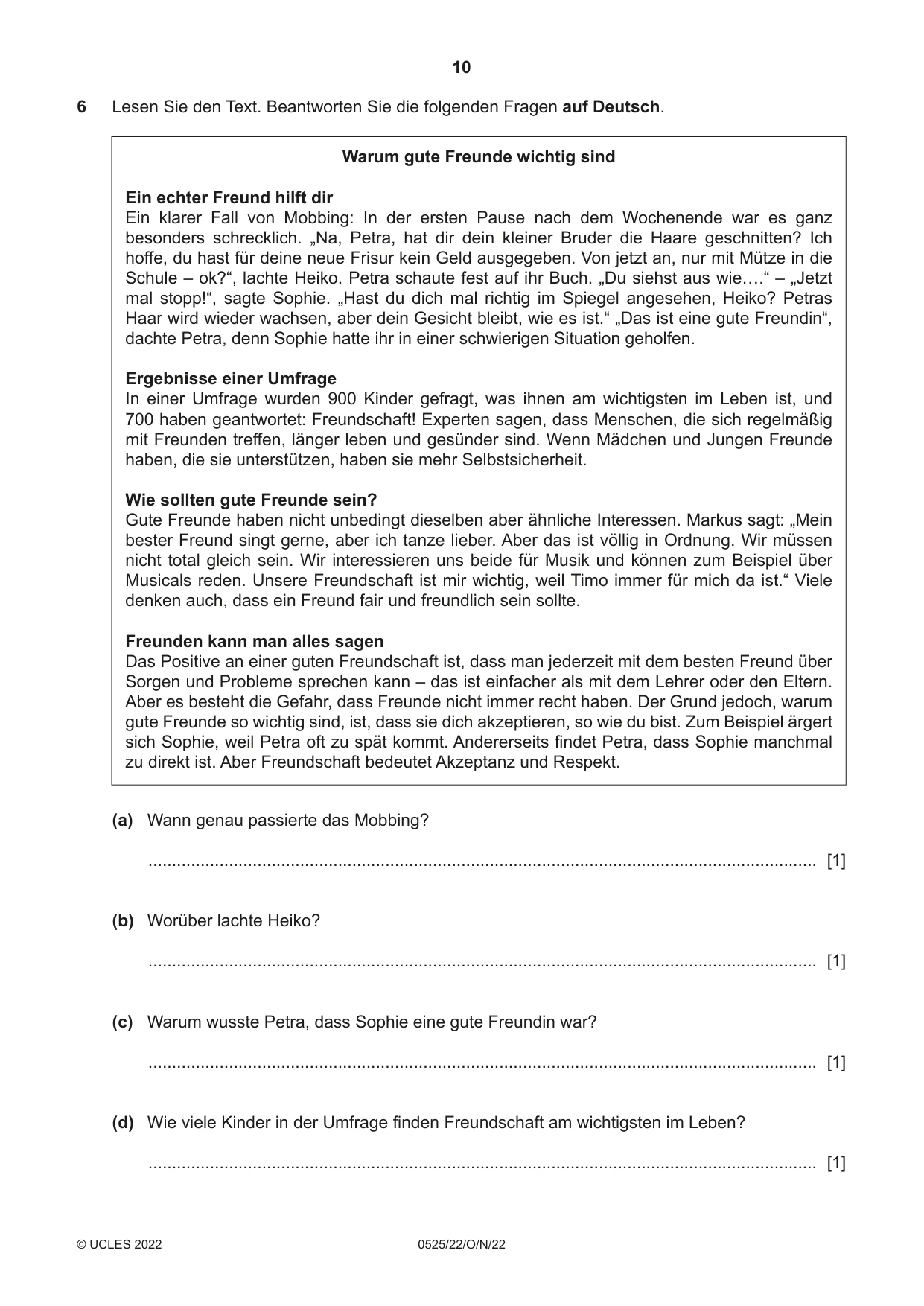
10 0525/22/O/N/22 © UCLES 2022 6 Lesen Sie den Text. Beantworten Sie die folgenden Fragen auf Deutsch. Warum gute Freunde wichtig sind Ein echter Freund hilft dir Ein klarer Fall von Mobbing: In der ersten Pause nach dem Wochenende war es ganz besonders schrecklich. „Na, Petra, hat dir dein kleiner Bruder die Haare geschnitten? Ich hoffe, du hast für deine neue Frisur kein Geld ausgegeben. Von jetzt an, nur mit Mütze in die Schule – ok?“, lachte Heiko. Petra schaute fest auf ihr Buch. „Du siehst aus wie….“ – „Jetzt mal stopp!“, sagte Sophie. „Hast du dich mal richtig im Spiegel angesehen, Heiko? Petras Haar wird wieder wachsen, aber dein Gesicht bleibt, wie es ist.“ „Das ist eine gute Freundin“, dachte Petra, denn Sophie hatte ihr in einer schwierigen Situation geholfen. Ergebnisse einer Umfrage In einer Umfrage wurden 900 Kinder gefragt, was ihnen am wichtigsten im Leben ist, und 700 haben geantwortet: Freundschaft! Experten sagen, dass Menschen, die sich regelmäßig mit Freunden treffen, länger leben und gesünder sind. Wenn Mädchen und Jungen Freunde haben, die sie unterstützen, haben sie mehr Selbstsicherheit. Wie sollten gute Freunde sein? Gute Freunde haben nicht unbedingt dieselben aber ähnliche Interessen. Markus sagt: „Mein bester Freund singt gerne, aber ich tanze lieber. Aber das ist völlig in Ordnung. Wir müssen nicht total gleich sein. Wir interessieren uns beide für Musik und können zum Beispiel über Musicals reden. Unsere Freundschaft ist mir wichtig, weil Timo immer für mich da ist.“ Viele denken auch, dass ein Freund fair und freundlich sein sollte. Freunden kann man alles sagen Das Positive an einer guten Freundschaft ist, dass man jederzeit mit dem besten Freund über Sorgen und Probleme sprechen kann – das ist einfacher als mit dem Lehrer oder den Eltern. Aber es besteht die Gefahr, dass Freunde nicht immer recht haben. Der Grund jedoch, warum gute Freunde so wichtig sind, ist, dass sie dich akzeptieren, so wie du bist. Zum Beispiel ärgert sich Sophie, weil Petra oft zu spät kommt. Andererseits findet Petra, dass Sophie manchmal zu direkt ist. Aber Freundschaft bedeutet Akzeptanz und Respekt. (a) Wann genau passierte das Mobbing? … [1] (b) Worüber lachte Heiko? … [1] (c) Warum wusste Petra, dass Sophie eine gute Freundin war? … [1] (d) Wie viele Kinder in der Umfrage finden Freundschaft am wichtigsten im Leben? … [1]
Question paper, page 11
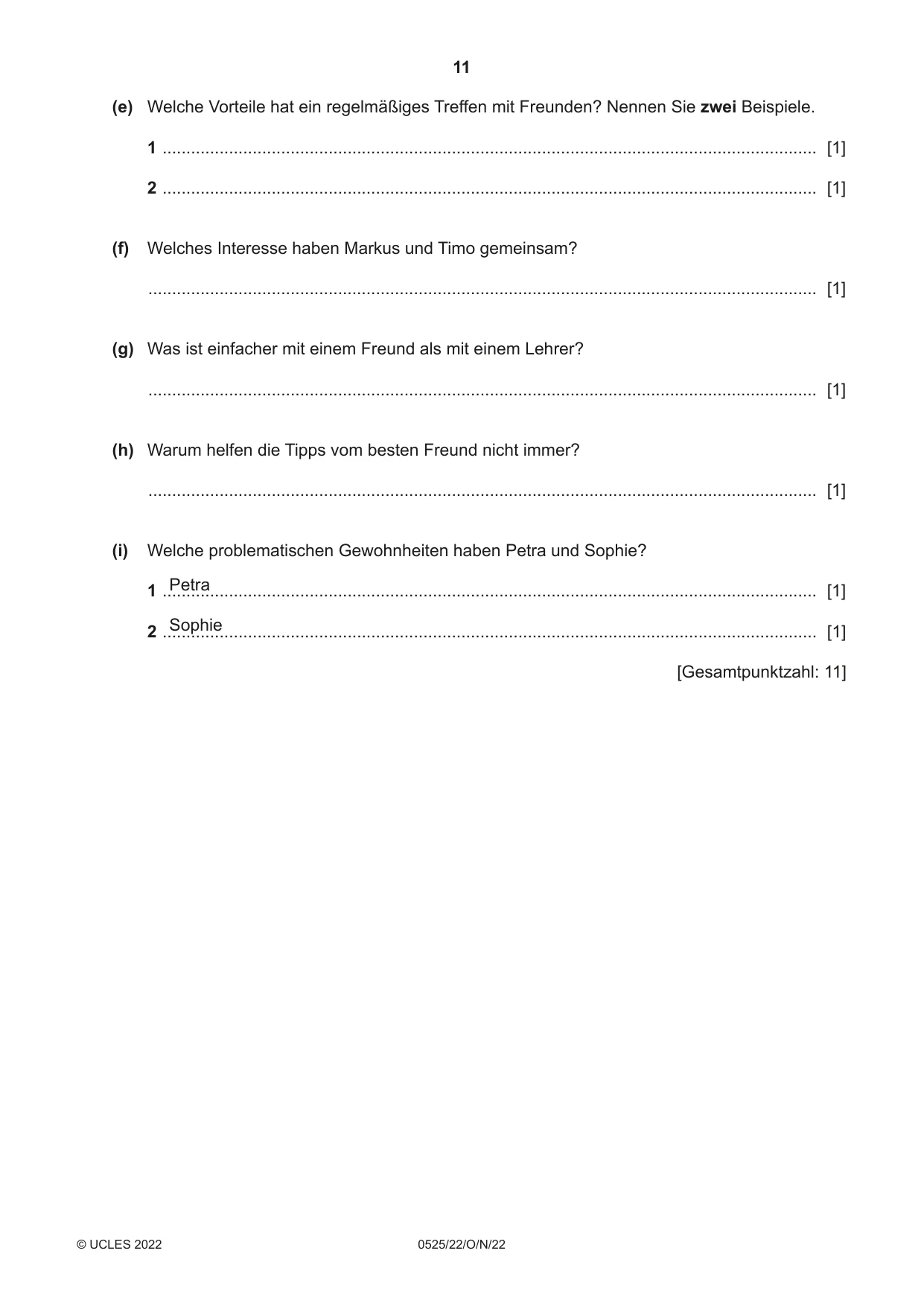
11 0525/22/O/N/22 © UCLES 2022 (e) Welche Vorteile hat ein regelmäßiges Treffen mit Freunden? Nennen Sie zwei Beispiele. 1 … [1] 2 … [1] (f) Welches Interesse haben Markus und Timo gemeinsam? … [1] (g) Was ist einfacher mit einem Freund als mit einem Lehrer? … [1] (h) Warum helfen die Tipps vom besten Freund nicht immer? … [1] (i) Welche problematischen Gewohnheiten haben Petra und Sophie? Petra 1 … [1] Sophie 2 … [1] [Gesamtpunktzahl: 11]
Question paper, page 12
12 0525/22/O/N/22 © UCLES 2022 Permission to reproduce items where third-party owned material protected by copyright is included has been sought and cleared where possible. Every reasonable effort has been made by the publisher (UCLES) to trace copyright holders, but if any items requiring clearance have unwittingly been included, the publisher will be pleased to make amends at the earliest possible opportunity. To avoid the issue of disclosure of answer-related information to candidates, all copyright acknowledgements are reproduced online in the Cambridge Assessment International Education Copyright Acknowledgements Booklet. This is produced for each series of examinations and is freely available to download at www.cambridgeinternational.org after the live examination series. Cambridge Assessment International Education is part of Cambridge Assessment. Cambridge Assessment is the brand name of the University of Cambridge Local Examinations Syndicate (UCLES), which is a department of the University of Cambridge. BLANK PAGE
Mark scheme, page 1
This document consists of 14 printed pages. © UCLES 2022 [Turn over Cambridge IGCSE™ GERMAN 0525/22 Paper 2 Reading October/November 2022 MARK SCHEME Maximum Mark: 45 Published This mark scheme is published as an aid to teachers and candidates, to indicate the requirements of the examination. It shows the basis on which Examiners were instructed to award marks. It does not indicate the details of the discussions that took place at an Examiners’ meeting before marking began, which would have considered the acceptability of alternative answers. Mark schemes should be read in conjunction with the question paper and the Principal Examiner Report for Teachers. Cambridge International will not enter into discussions about these mark schemes. Cambridge International is publishing the mark schemes for the October/November 2022 series for most Cambridge IGCSE™, Cambridge International A and AS Level components and some Cambridge O Level components.
Mark scheme, page 2
0525/22 Cambridge IGCSE – Mark Scheme PUBLISHED October/November 2022 © UCLES 2022 Page 2 of 14 Generic Marking Principles These general marking principles must be applied by all examiners when marking candidate answers. They should be applied alongside the specific content of the mark scheme or generic level descriptors for a question. Each question paper and mark scheme will also comply with these marking principles. GENERIC MARKING PRINCIPLE 1: Marks must be awarded in line with: • the specific content of the mark scheme or the generic level descriptors for the question • the specific skills defined in the mark scheme or in the generic level descriptors for the question • the standard of response required by a candidate as exemplified by the standardisation scripts. GENERIC MARKING PRINCIPLE 2: Marks awarded are always whole marks (not half marks, or other fractions). GENERIC MARKING PRINCIPLE 3: Marks must be awarded positively: • marks are awarded for correct/valid answers, as defined in the mark scheme. However, credit is given for valid answers which go beyond the scope of the syllabus and mark scheme, referring to your Team Leader as appropriate • marks are awarded when candidates clearly demonstrate what they know and can do • marks are not deducted for errors • marks are not deducted for omissions • answers should only be judged on the quality of spelling, punctuation and grammar when these features are specifically assessed by the question as indicated by the mark scheme. The meaning, however, should be unambiguous. GENERIC MARKING PRINCIPLE 4: Rules must be applied consistently, e.g. in situations where candidates have not followed instructions or in the application of generic level descriptors.
Mark scheme, page 3
0525/22 Cambridge IGCSE – Mark Scheme PUBLISHED October/November 2022 © UCLES 2022 Page 3 of 14 GENERIC MARKING PRINCIPLE 5: Marks should be awarded using the full range of marks defined in the mark scheme for the question (however; the use of the full mark range may be limited according to the quality of the candidate responses seen). GENERIC MARKING PRINCIPLE 6: Marks awarded are based solely on the requirements as defined in the mark scheme. Marks should not be awarded with grade thresholds or grade descriptors in mind.
Mark scheme, page 4
0525/22 Cambridge IGCSE – Mark Scheme PUBLISHED October/November 2022 © UCLES 2022 Page 4 of 14 Additional Guidance The following guidance underpins the detailed instructions provided in the mark scheme. Where a decision is taken to deviate from this guidance for a particular question, this will be specified in the mark scheme. Often the additional guidance points will have to be weighed up against each other, e.g. the answer might look or sound like the intended word/phrase in German, but if what the candidate has written means something different in German from what is expected, the mark cannot be awarded. It is not possible to list all acceptable alternatives in the mark scheme. If you encounter an answer which is not covered by the mark scheme, you will need to make a decision about whether it communicates the required elements (in consultation with your Team Leader if necessary, or with your Product Manager if you are a single examiner), and award marks accordingly. • Crossing out: (a) If a candidate changes his/her mind about an answer and crosses out an attempt, award a mark if the final attempt is correct. (b) If a candidate crosses out an answer to a whole question but makes no second attempt at it, mark the crossed out work. • More than the stipulated number of boxes ticked/crossed by the candidate: (a) If more than one attempt is visible but the candidate has clearly indicated which attempt is his/her final answer (e.g. by crossing out other attempts or by annotating the script in some way), mark in the usual way. (b) If two attempts are visible (e.g. two boxes ticked instead of the one box stipulated), and neither has been crossed out/discounted by the candidate, no mark can be awarded. • For questions requiring more than one element for the answer, 1 and 2, where the answers are interchangeable: (a) Both of the correct answers are on line 1 and line 2 blank (or vice versa) = 2 marks (b) Both correct answers on line 1 and line 2 contains a wrong answer (or vice versa) = 1 mark
Mark scheme, page 5
0525/22 Cambridge IGCSE – Mark Scheme PUBLISHED October/November 2022 © UCLES 2022 Page 5 of 14 • Mark for communication: Answers requiring the use of German (rather than a non-verbal response) should be marked for communication. Tolerate inaccuracies provided that the message is clear. However, do not accept incorrect German if the word written by the candidate means something else in German (unless the mark scheme specifies otherwise). (a) If you read aloud what the candidate has written, does it sound like the correct answer? Would a native speaker of German understand it? (b) Does what the candidate has written look like the correct answer, e.g. one letter missing or added but no other word created? Would a native speaker of German understand it? (c) The subject needs to be unambiguous. Possessives and personal pronouns need to be used in such a way as to make the answer unambiguous. Unless indicated otherwise in relation to a specific question do not accept sein for ihr or vice versa. Incorrect German which constitutes a word in any language other than German is marked (i) on the basis of whether it is accepted or rejected in the mark scheme and (ii) if it is not mentioned in the mark scheme, on the basis of points (a) to (d) above. • Annotations used in the mark scheme: (a) INV = invalidation. This is used when the additional material included by the candidate is judged to invalidate an otherwise correct answer and therefore prevents him/her from scoring the mark. (INV = 0) (b) Refuse: …. tc = ‘tout court’. This means that, on its own, the material is not sufficient to score the mark. Accept: …. tc = ’tout court’. In this context, it means that this material alone is a valid answer. (c) HA = harmless addition. This means that the candidate has included additional material which, in conjunction with the correct answer, does not prevent him/her from scoring the mark.
Mark scheme, page 6
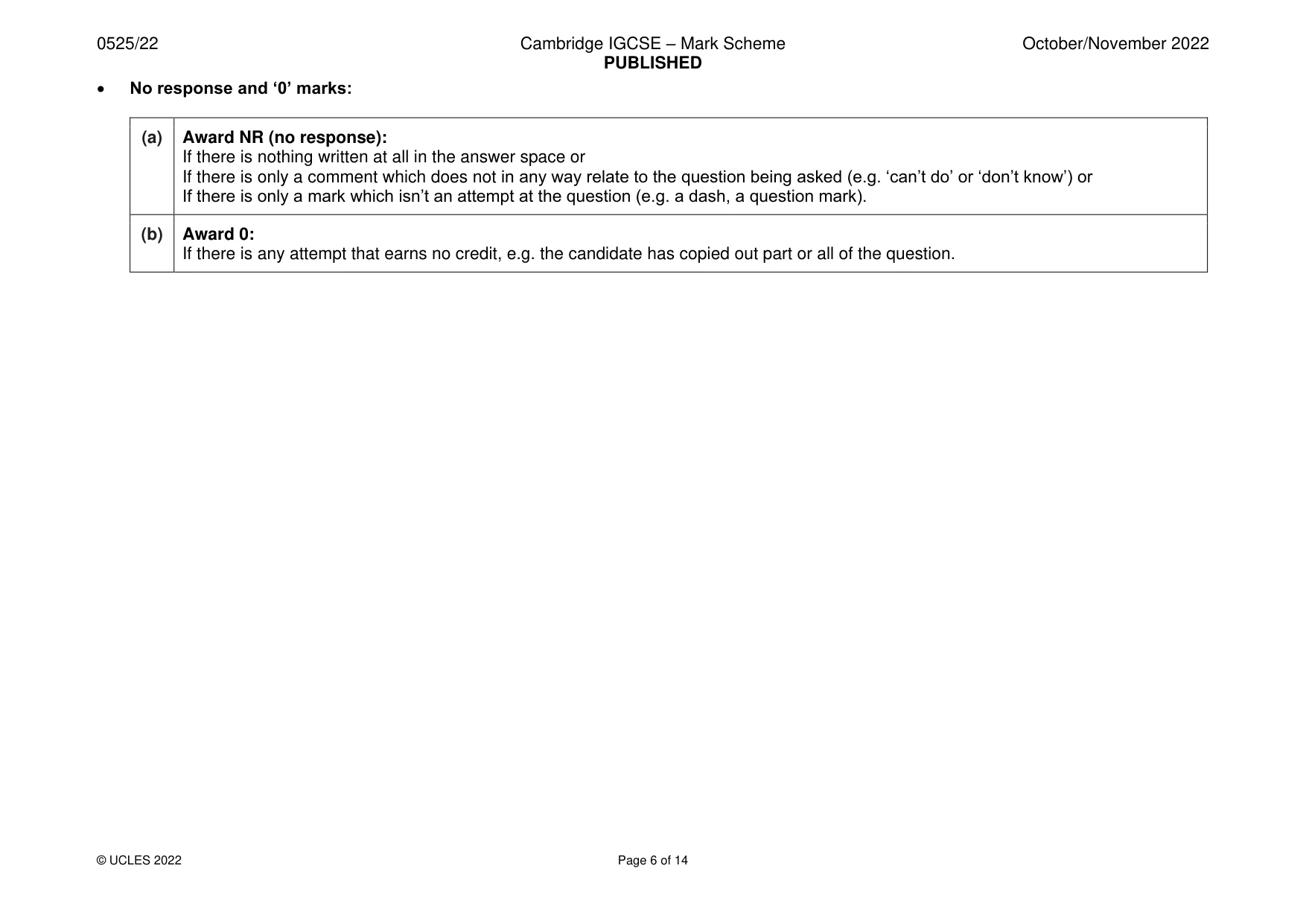
0525/22 Cambridge IGCSE – Mark Scheme PUBLISHED October/November 2022 © UCLES 2022 Page 6 of 14 • No response and ‘0’ marks: (a) Award NR (no response): If there is nothing written at all in the answer space or If there is only a comment which does not in any way relate to the question being asked (e.g. ‘can’t do’ or ‘don’t know’) or If there is only a mark which isn’t an attempt at the question (e.g. a dash, a question mark). (b) Award 0: If there is any attempt that earns no credit, e.g. the candidate has copied out part or all of the question.
Mark scheme, page 7
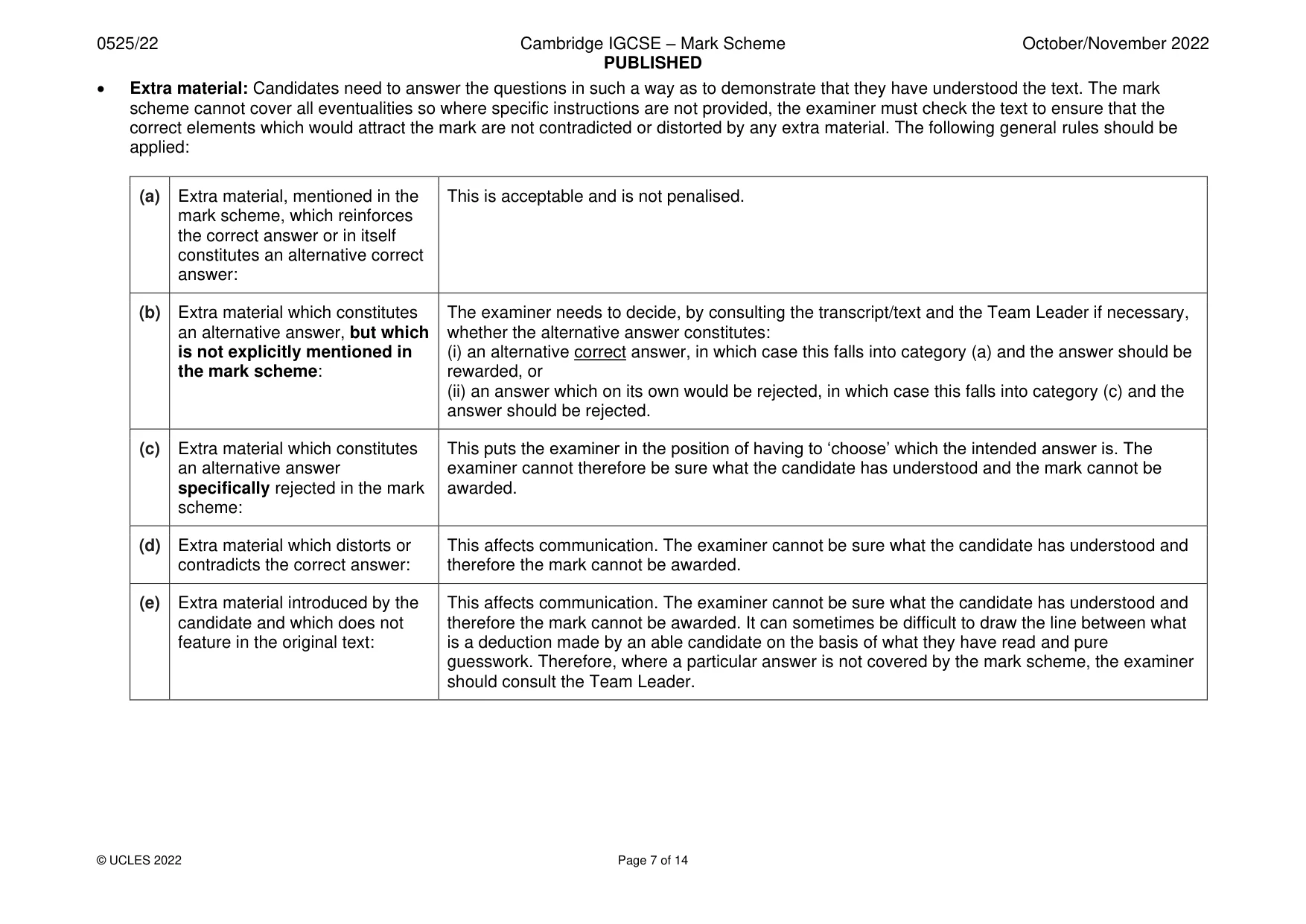
0525/22 Cambridge IGCSE – Mark Scheme PUBLISHED October/November 2022 © UCLES 2022 Page 7 of 14 • Extra material: Candidates need to answer the questions in such a way as to demonstrate that they have understood the text. The mark scheme cannot cover all eventualities so where specific instructions are not provided, the examiner must check the text to ensure that the correct elements which would attract the mark are not contradicted or distorted by any extra material. The following general rules should be applied: (a) Extra material, mentioned in the mark scheme, which reinforces the correct answer or in itself constitutes an alternative correct answer: This is acceptable and is not penalised. (b) Extra material which constitutes an alternative answer, but which is not explicitly mentioned in the mark scheme: The examiner needs to decide, by consulting the transcript/text and the Team Leader if necessary, whether the alternative answer constitutes: (i) an alternative correct answer, in which case this falls into category (a) and the answer should be rewarded, or (ii) an answer which on its own would be rejected, in which case this falls into category (c) and the answer should be rejected. (c) Extra material which constitutes an alternative answer specifically rejected in the mark scheme: This puts the examiner in the position of having to ‘choose’ which the intended answer is. The examiner cannot therefore be sure what the candidate has understood and the mark cannot be awarded. (d) Extra material which distorts or contradicts the correct answer: This affects communication. The examiner cannot be sure what the candidate has understood and therefore the mark cannot be awarded. (e) Extra material introduced by the candidate and which does not feature in the original text: This affects communication. The examiner cannot be sure what the candidate has understood and therefore the mark cannot be awarded. It can sometimes be difficult to draw the line between what is a deduction made by an able candidate on the basis of what they have read and pure guesswork. Therefore, where a particular answer is not covered by the mark scheme, the examiner should consult the Team Leader.
Mark scheme, page 8
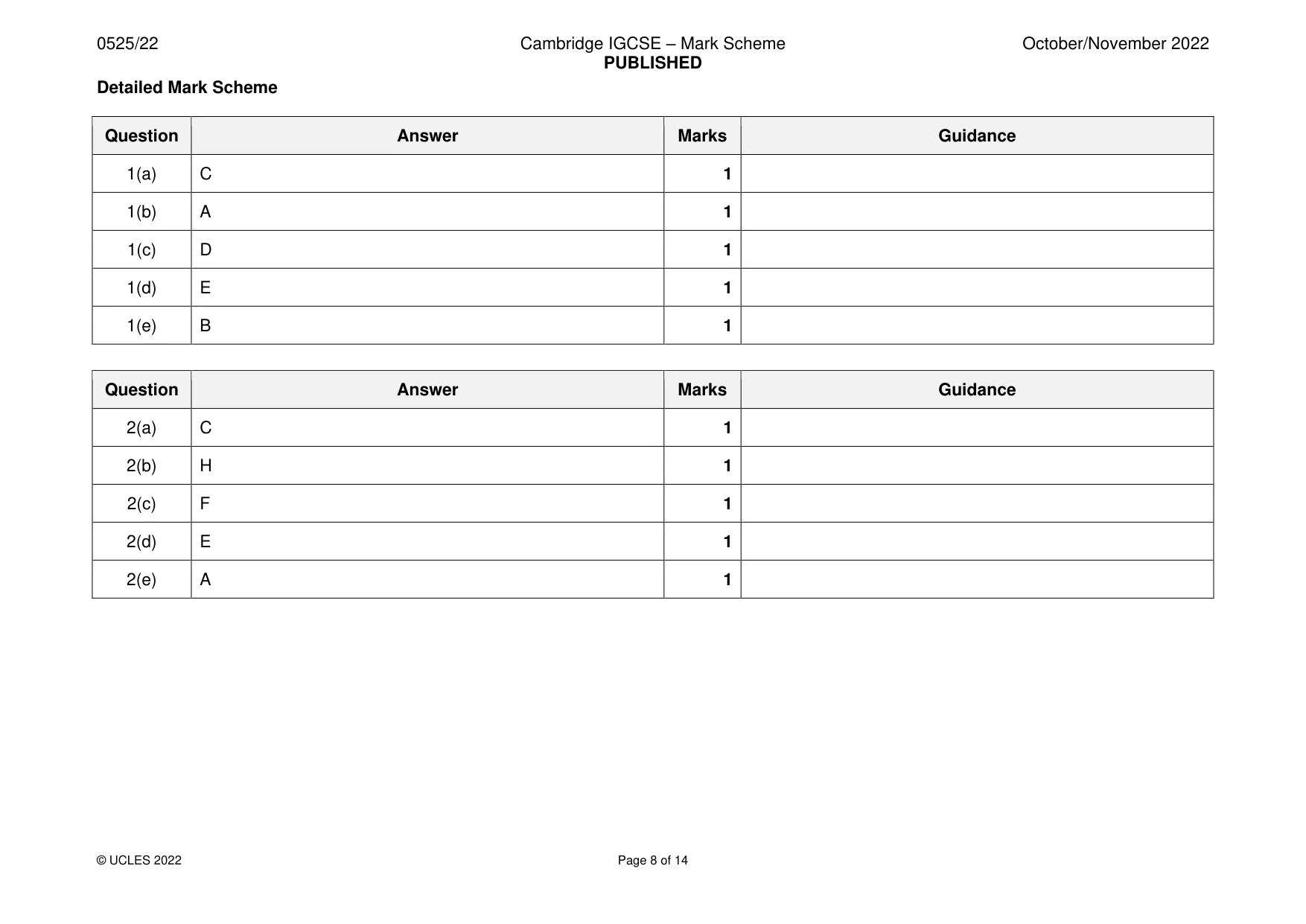
0525/22 Cambridge IGCSE – Mark Scheme PUBLISHED October/November 2022 © UCLES 2022 Page 8 of 14 Detailed Mark Scheme Question Answer Marks Guidance 1(a) C 1 1(b) A 1 1(c) D 1 1(d) E 1 1(e) B 1 Question Answer Marks Guidance 2(a) C 1 2(b) H 1 2(c) F 1 2(d) E 1 2(e) A 1
Mark scheme, page 9
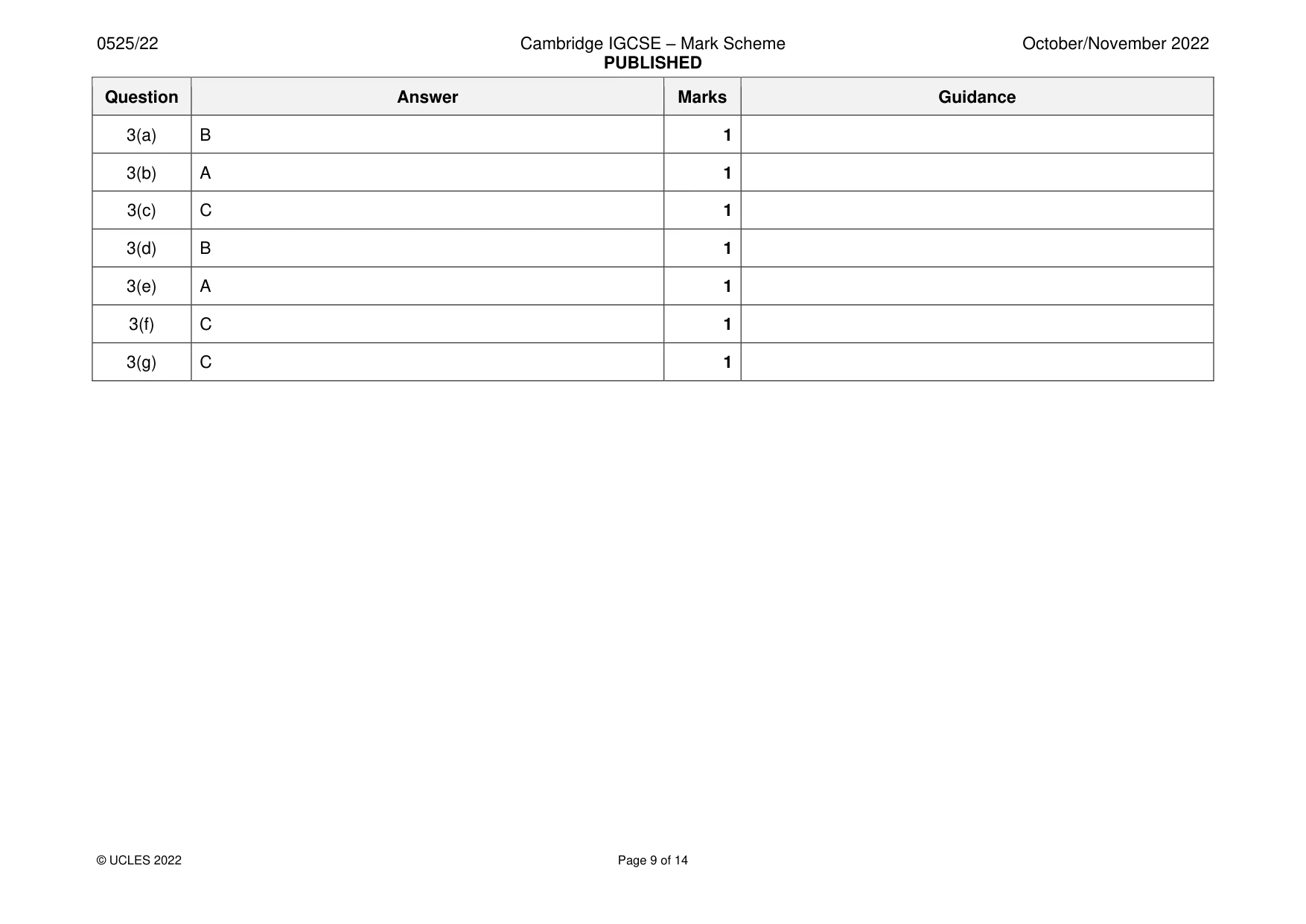
0525/22 Cambridge IGCSE – Mark Scheme PUBLISHED October/November 2022 © UCLES 2022 Page 9 of 14 Question Answer Marks Guidance 3(a) B 1 3(b) A 1 3(c) C 1 3(d) B 1 3(e) A 1 3(f) C 1 3(g) C 1
Mark scheme, page 10
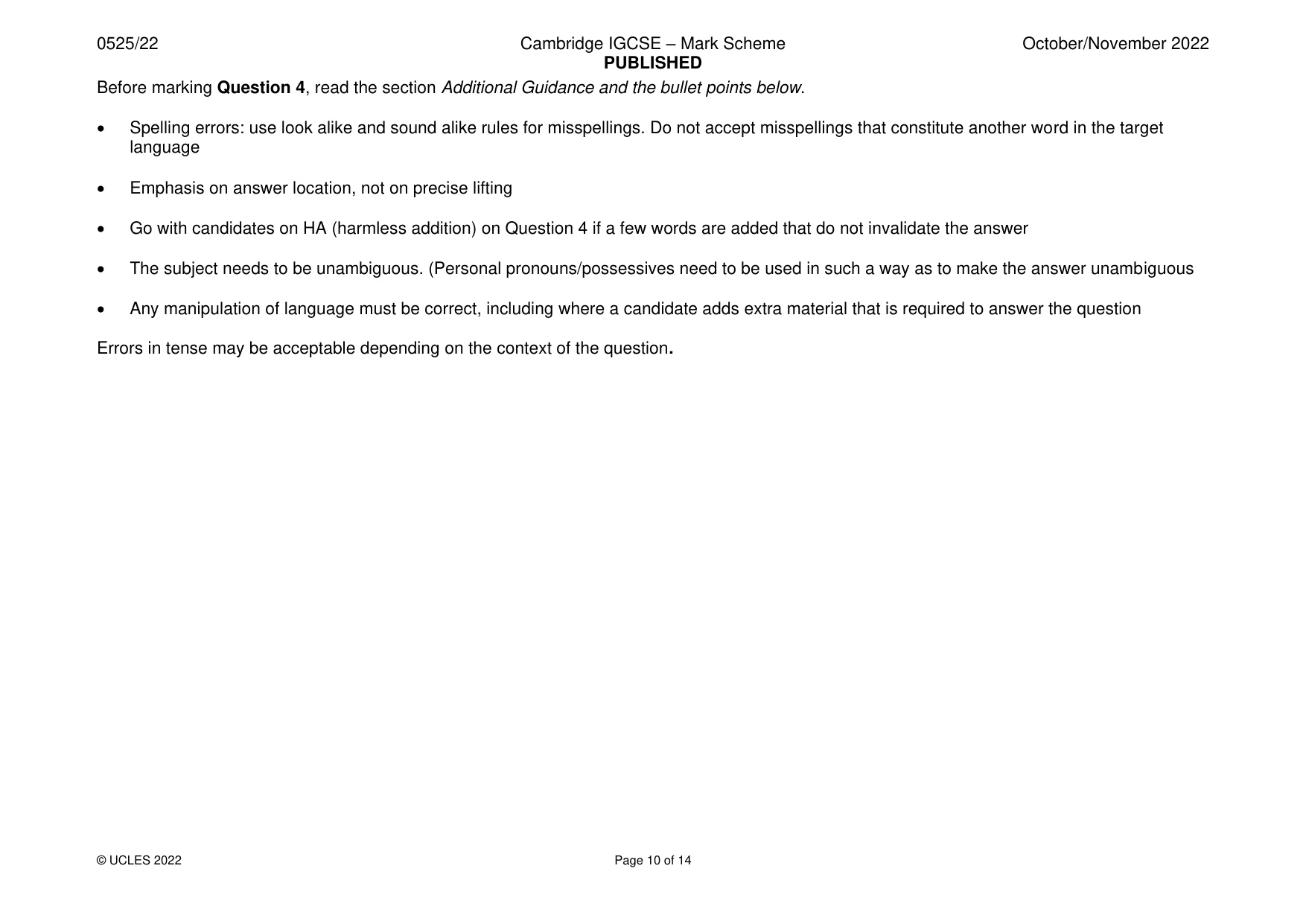
0525/22 Cambridge IGCSE – Mark Scheme PUBLISHED October/November 2022 © UCLES 2022 Page 10 of 14 Before marking Question 4, read the section Additional Guidance and the bullet points below. • Spelling errors: use look alike and sound alike rules for misspellings. Do not accept misspellings that constitute another word in the target language • Emphasis on answer location, not on precise lifting • Go with candidates on HA (harmless addition) on Question 4 if a few words are added that do not invalidate the answer • The subject needs to be unambiguous. (Personal pronouns/possessives need to be used in such a way as to make the answer unambiguous • Any manipulation of language must be correct, including where a candidate adds extra material that is required to answer the question Errors in tense may be acceptable depending on the context of the question.
Mark scheme, page 11
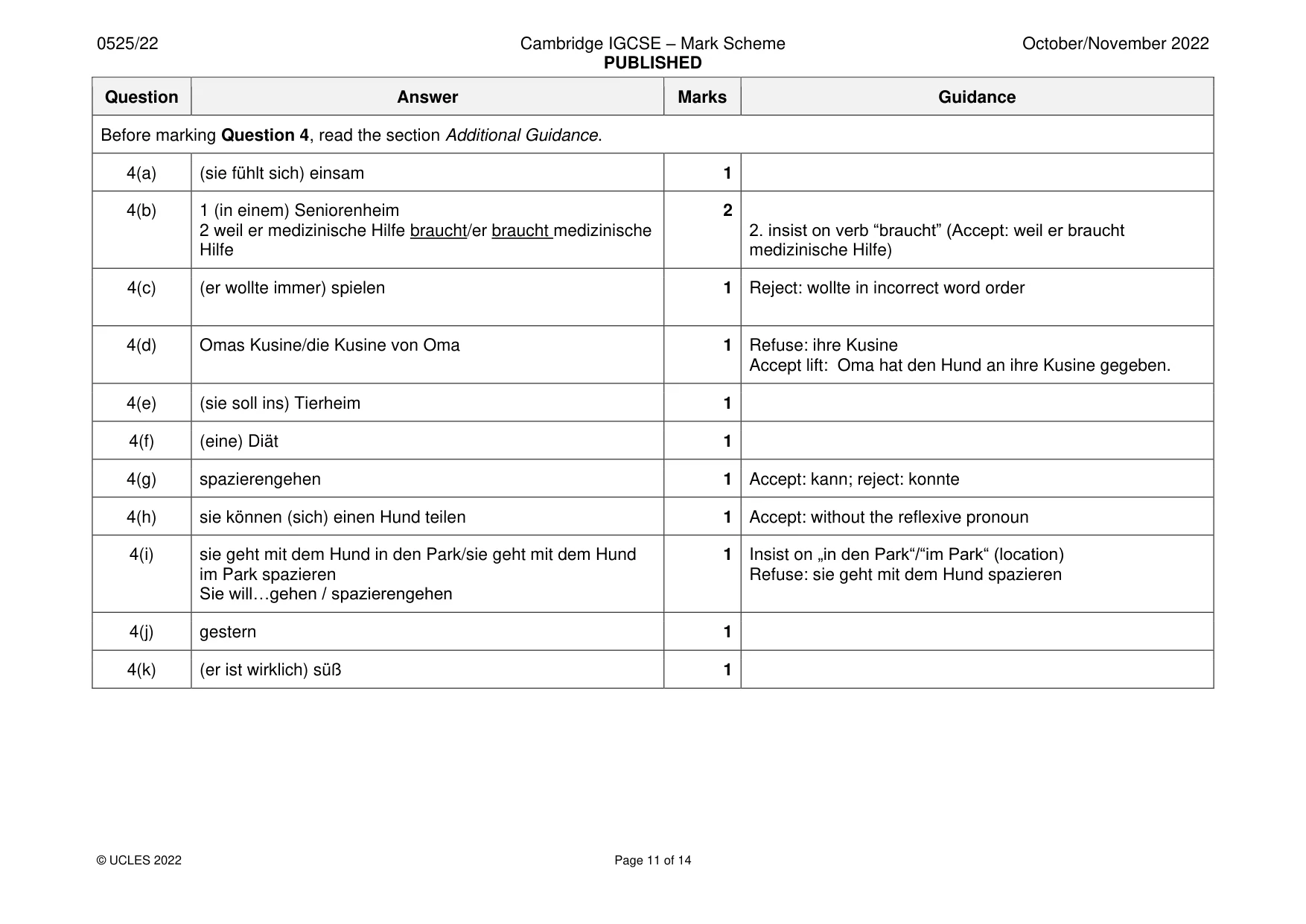
0525/22 Cambridge IGCSE – Mark Scheme PUBLISHED October/November 2022 © UCLES 2022 Page 11 of 14 Question Answer Marks Guidance Before marking Question 4, read the section Additional Guidance. 4(a) (sie fühlt sich) einsam 1 4(b) 1 (in einem) Seniorenheim 2 weil er medizinische Hilfe braucht/er braucht medizinische Hilfe 2 2. insist on verb “braucht” (Accept: weil er braucht medizinische Hilfe) 4(c) (er wollte immer) spielen 1 Reject: wollte in incorrect word order 4(d) Omas Kusine/die Kusine von Oma 1 Refuse: ihre Kusine Accept lift: Oma hat den Hund an ihre Kusine gegeben. 4(e) (sie soll ins) Tierheim 1 4(f) (eine) Diät 1 4(g) spazierengehen 1 Accept: kann; reject: konnte 4(h) sie können (sich) einen Hund teilen 1 Accept: without the reflexive pronoun 4(i) sie geht mit dem Hund in den Park/sie geht mit dem Hund im Park spazieren Sie will…gehen / spazierengehen 1 Insist on „in den Park“/“im Park“ (location) Refuse: sie geht mit dem Hund spazieren 4(j) gestern 1 4(k) (er ist wirklich) süß 1
Mark scheme, page 12
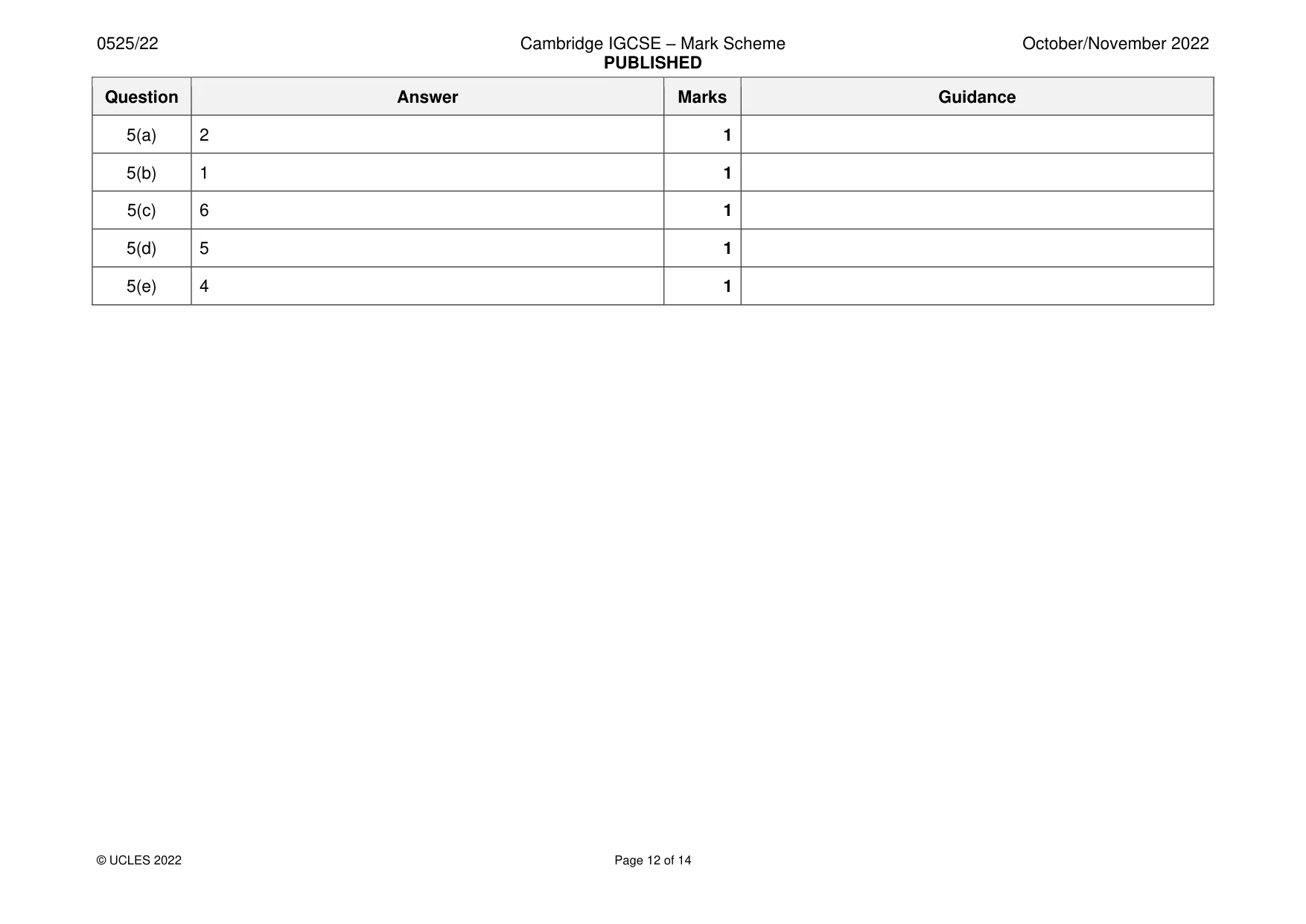
0525/22 Cambridge IGCSE – Mark Scheme PUBLISHED October/November 2022 © UCLES 2022 Page 12 of 14 Question Answer Marks Guidance 5(a) 2 1 5(b) 1 1 5(c) 6 1 5(d) 5 1 5(e) 4 1
Mark scheme, page 13
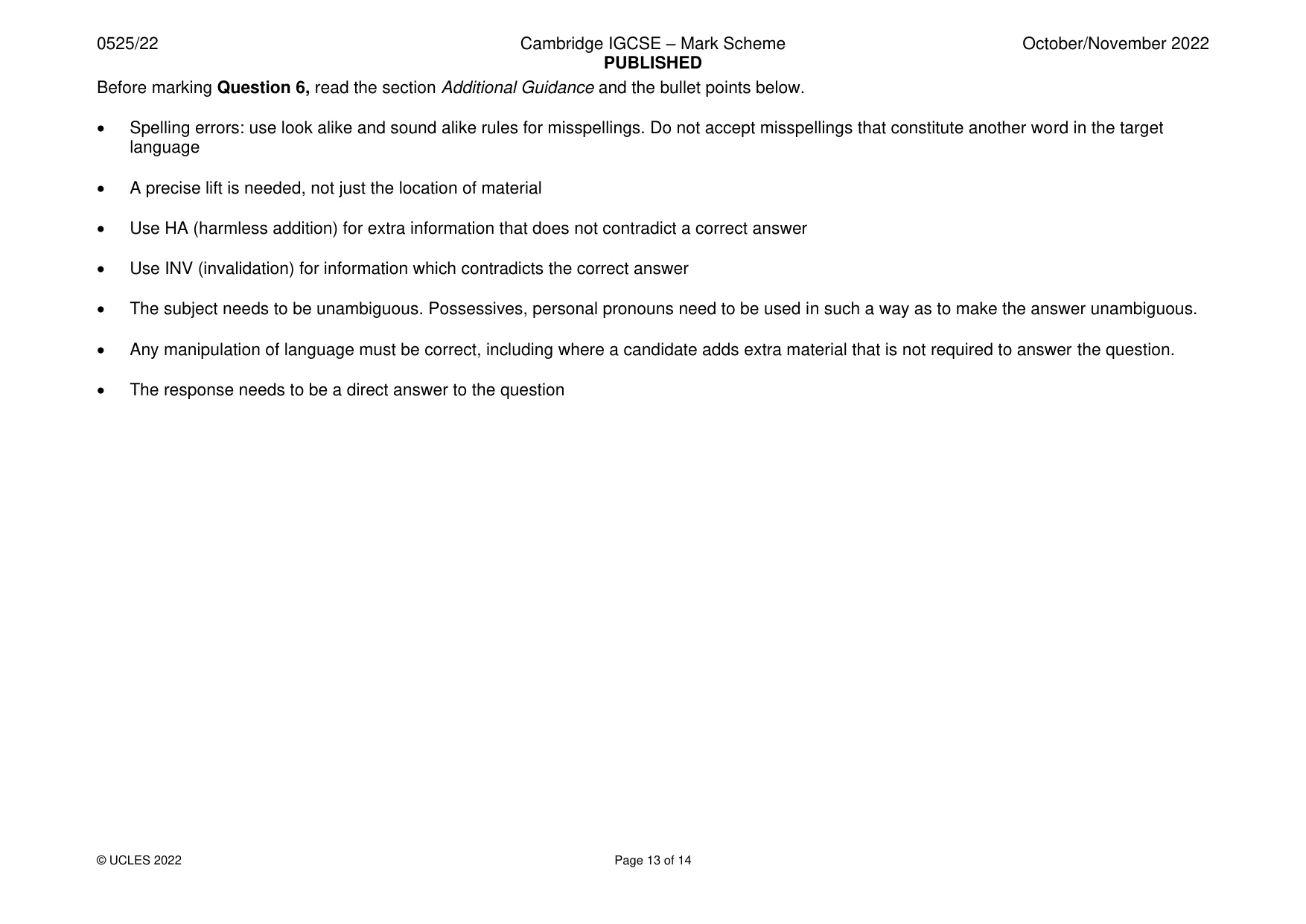
0525/22 Cambridge IGCSE – Mark Scheme PUBLISHED October/November 2022 © UCLES 2022 Page 13 of 14 Before marking Question 6, read the section Additional Guidance and the bullet points below. • Spelling errors: use look alike and sound alike rules for misspellings. Do not accept misspellings that constitute another word in the target language • A precise lift is needed, not just the location of material • Use HA (harmless addition) for extra information that does not contradict a correct answer • Use INV (invalidation) for information which contradicts the correct answer • The subject needs to be unambiguous. Possessives, personal pronouns need to be used in such a way as to make the answer unambiguous. • Any manipulation of language must be correct, including where a candidate adds extra material that is not required to answer the question. • The response needs to be a direct answer to the question
Mark scheme, page 14
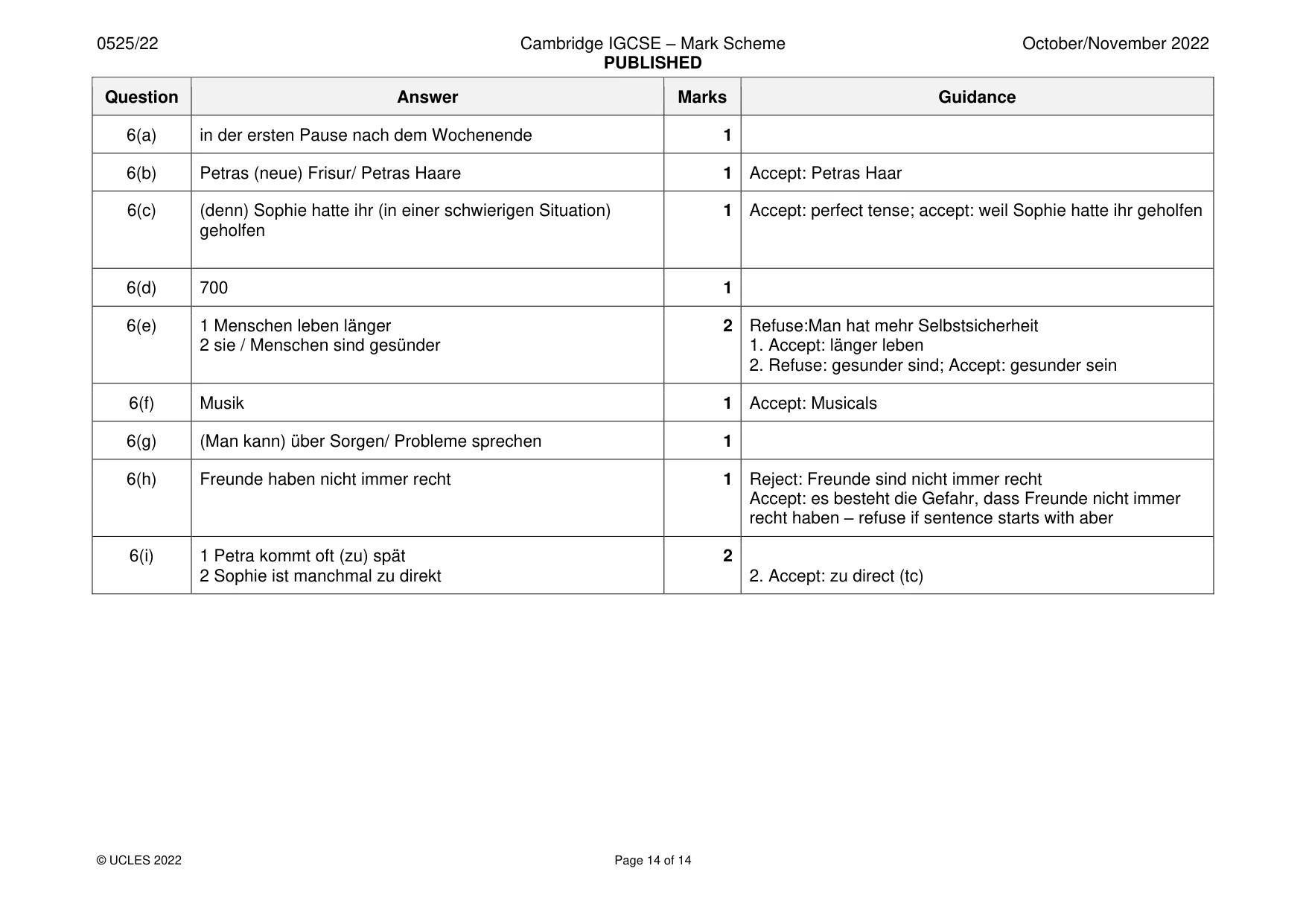
0525/22 Cambridge IGCSE – Mark Scheme PUBLISHED October/November 2022 © UCLES 2022 Page 14 of 14 Question Answer Marks Guidance 6(a) in der ersten Pause nach dem Wochenende 1 6(b) Petras (neue) Frisur/ Petras Haare 1 Accept: Petras Haar 6(c) (denn) Sophie hatte ihr (in einer schwierigen Situation) geholfen 1 Accept: perfect tense; accept: weil Sophie hatte ihr geholfen 6(d) 700 1 6(e) 1 Menschen leben länger 2 sie / Menschen sind gesünder 2 Refuse:Man hat mehr Selbstsicherheit 1. Accept: länger leben 2. Refuse: gesunder sind; Accept: gesunder sein 6(f) Musik 1 Accept: Musicals 6(g) (Man kann) über Sorgen/ Probleme sprechen 1 6(h) Freunde haben nicht immer recht 1 Reject: Freunde sind nicht immer recht Accept: es besteht die Gefahr, dass Freunde nicht immer recht haben – refuse if sentence starts with aber 6(i) 1 Petra kommt oft (zu) spät 2 Sophie ist manchmal zu direkt 2 2. Accept: zu direct (tc)
What you needed in this session
Cambridge’s own grade thresholds for 2022 Oct/Nov, Paper 2 · Variant 2. A higher threshold means an easier paper — the bar moves with how the cohort did.