Cambridge IGCSE Geography 0460 — 2021 Oct/Nov Paper 1 · Variant 1
0460/11/O/N/21 · 75 marks · ≈84 min
The question paper and its mark scheme, free to read here and free to download. This is Cambridge’s own paper, exactly as it was sat.
Question paper32 pages







Mark scheme19 pages
Answers below. Sit the paper first if you are practising.
Paper as text
Question paper, page 1
This document has 32 pages. Any blank pages are indicated. Cambridge IGCSE™ DC (DH/FC) 199597/6 © UCLES 2021 [Turn over * 2 7 2 2 4 6 1 4 6 7 * GEOGRAPHY 0460/11 Paper 1 Geographical Themes October/November 2021 1 hour 45 minutes You must answer on the question paper. You will need: Insert (enclosed) Calculator Ruler INSTRUCTIONS ● Answer three questions in total, one from each section. ● Use a black or dark blue pen. You may use an HB pencil for any diagrams or graphs. ● Write your name, centre number and candidate number in the boxes at the top of the page. ● Write your answer to each question in the space provided. ● Do not use an erasable pen or correction fluid. ● Do not write on any bar codes. ● If additional space is needed, you should use the lined pages at the end of this booklet; the question number or numbers must be clearly shown. INFORMATION ● The total mark for this paper is 75. ● The number of marks for each question or part question is shown in brackets [ ]. ● The insert contains additional resources referred to in the questions. Definitions MEDCs – More Economically Developed Countries LEDCs – Less Economically Developed Countries
Question paper, page 2
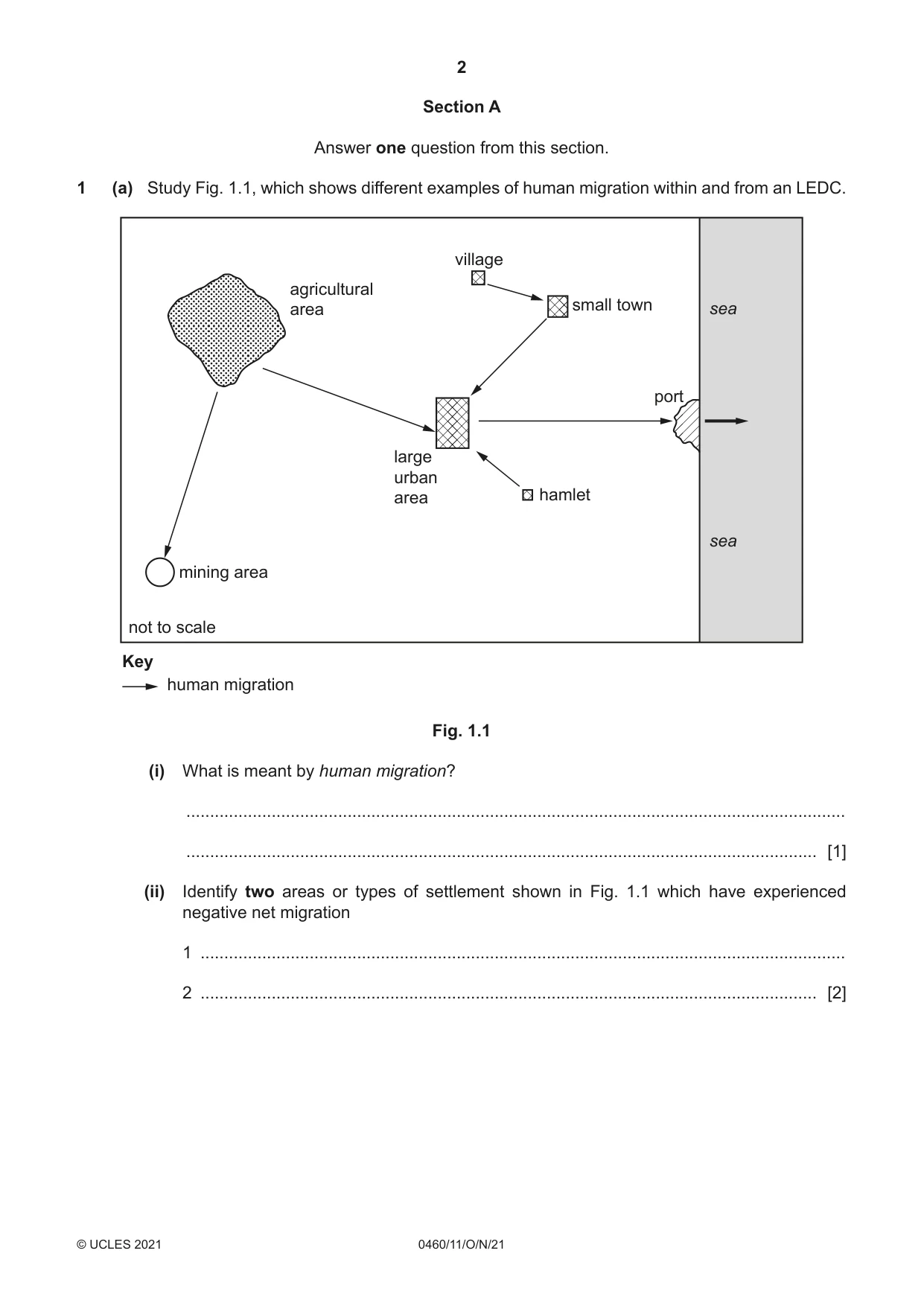
2 0460/11/O/N/21 © UCLES 2021 Section A Answer one question from this section. 1 (a) Study Fig. 1.1, which shows different examples of human migration within and from an LEDC. agricultural area mining area not to scale human migration Key hamlet small town village sea port sea large urban area Fig. 1.1 (i) What is meant by human migration? … … [1] (ii) Identify two areas or types of settlement shown in Fig. 1.1 which have experienced negative net migration 1 … 2 … [2]
Question paper, page 3
3 0460/11/O/N/21 © UCLES 2021 [Turn over (iii) Give three different reasons why international migration takes place from LEDCs. 1 … … 2 … … 3 … … [3] (iv) Explain why some countries encourage immigration to them but other countries limit the number of immigrants entering the country. … … … … … … … … [4]
Question paper, page 4
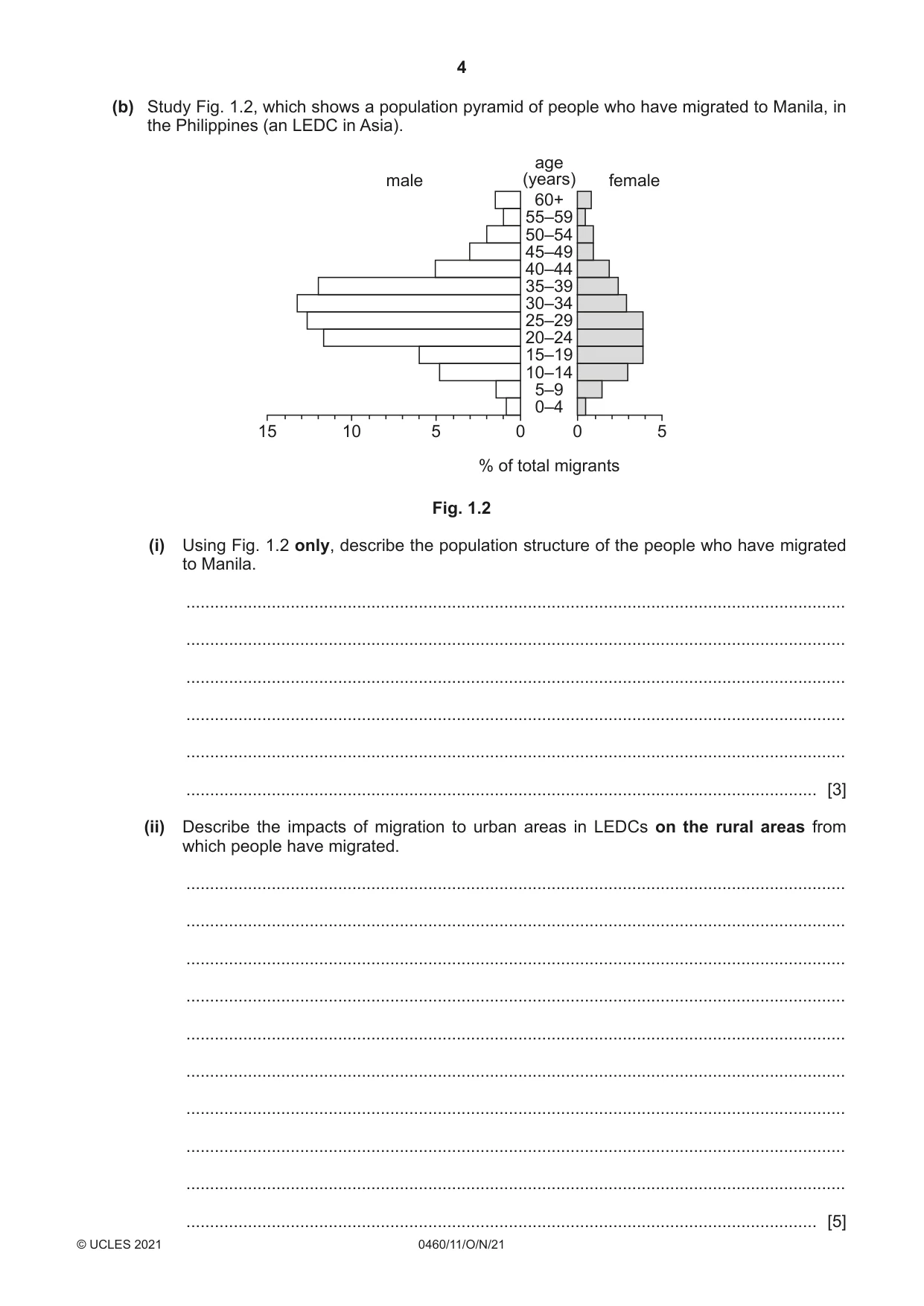
4 0460/11/O/N/21 © UCLES 2021 (b) Study Fig. 1.2, which shows a population pyramid of people who have migrated to Manila, in the Philippines (an LEDC in Asia). 0 5 10 15 5 0 age (years) % of total migrants male female 0–4 5–9 10–14 15–19 20–24 25–29 30–34 35–39 40–44 45–49 50–54 55–59 60+ Fig. 1.2 (i) Using Fig. 1.2 only, describe the population structure of the people who have migrated to Manila. … … … … … … [3] (ii) Describe the impacts of migration to urban areas in LEDCs on the rural areas from which people have migrated. … … … … … … … … … … [5]
Question paper, page 5
5 0460/11/O/N/21 © UCLES 2021 [Turn over (c) For an example of international migration you have studied, describe the difficulties faced by migrants when moving to, and settling in, a new country. Migration from … to … … … … … … … … … … … … … … … … … … … … … … … … … … [7] [Total: 25]
Question paper, page 6
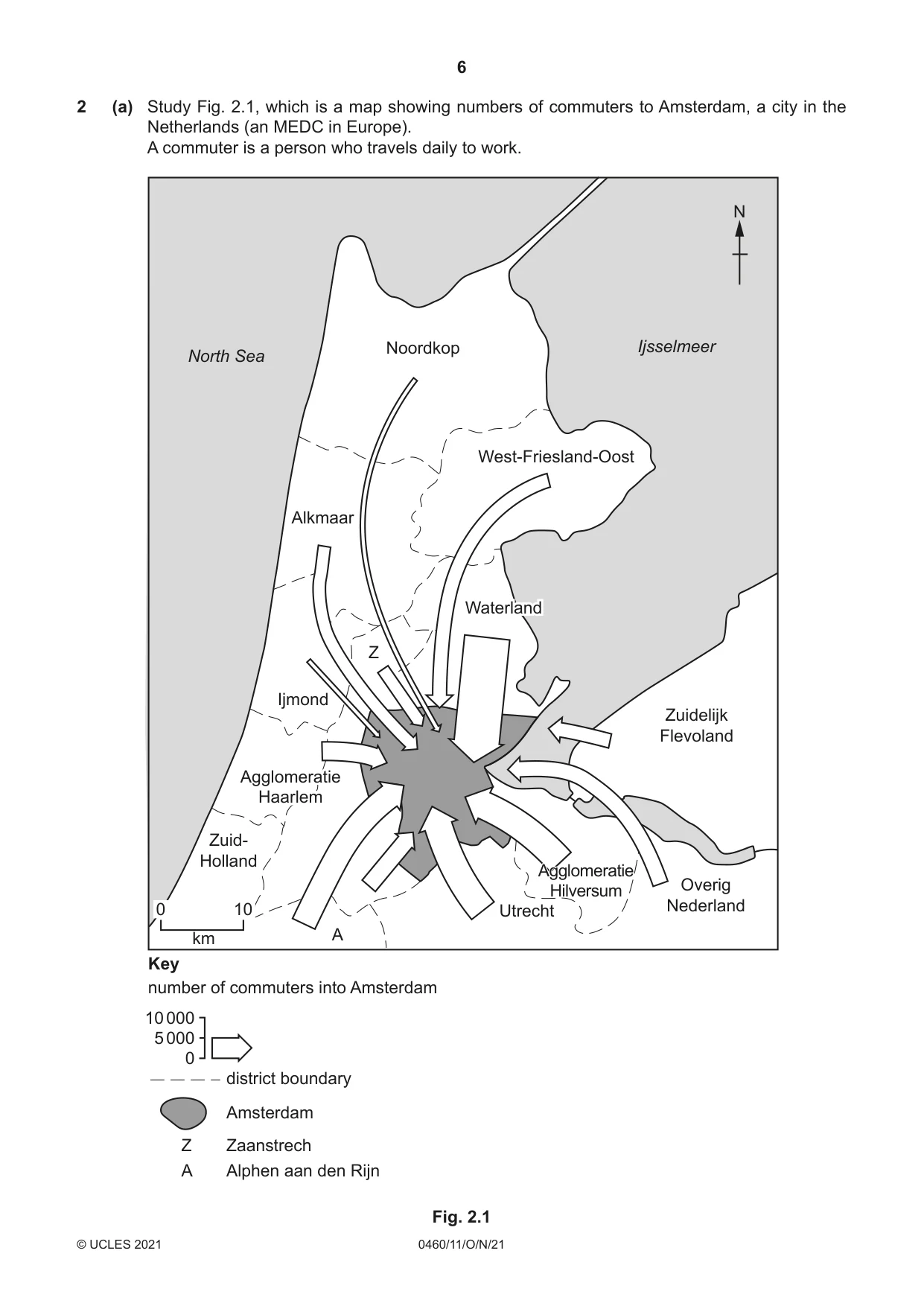
6 0460/11/O/N/21 © UCLES 2021 2 (a) Study Fig. 2.1, which is a map showing numbers of commuters to Amsterdam, a city in the Netherlands (an MEDC in Europe). A commuter is a person who travels daily to work. Key A number of commuters into Amsterdam district boundary Overig Nederland Agglomeratie Hilversum Agglomeratie Hilversum Utrecht Zuid- Holland Agglomeratie Haarlem Agglomeratie Haarlem Ijmond Waterland Waterland Alkmaar West-Friesland-Oost Noordkop Ijsselmeer North Sea 0 10 km Zuidelijk Flevoland Amsterdam Zaanstrech Z Alphen aan den Rijn A Z 10 000 5 000 0 N Fig. 2.1
Question paper, page 7
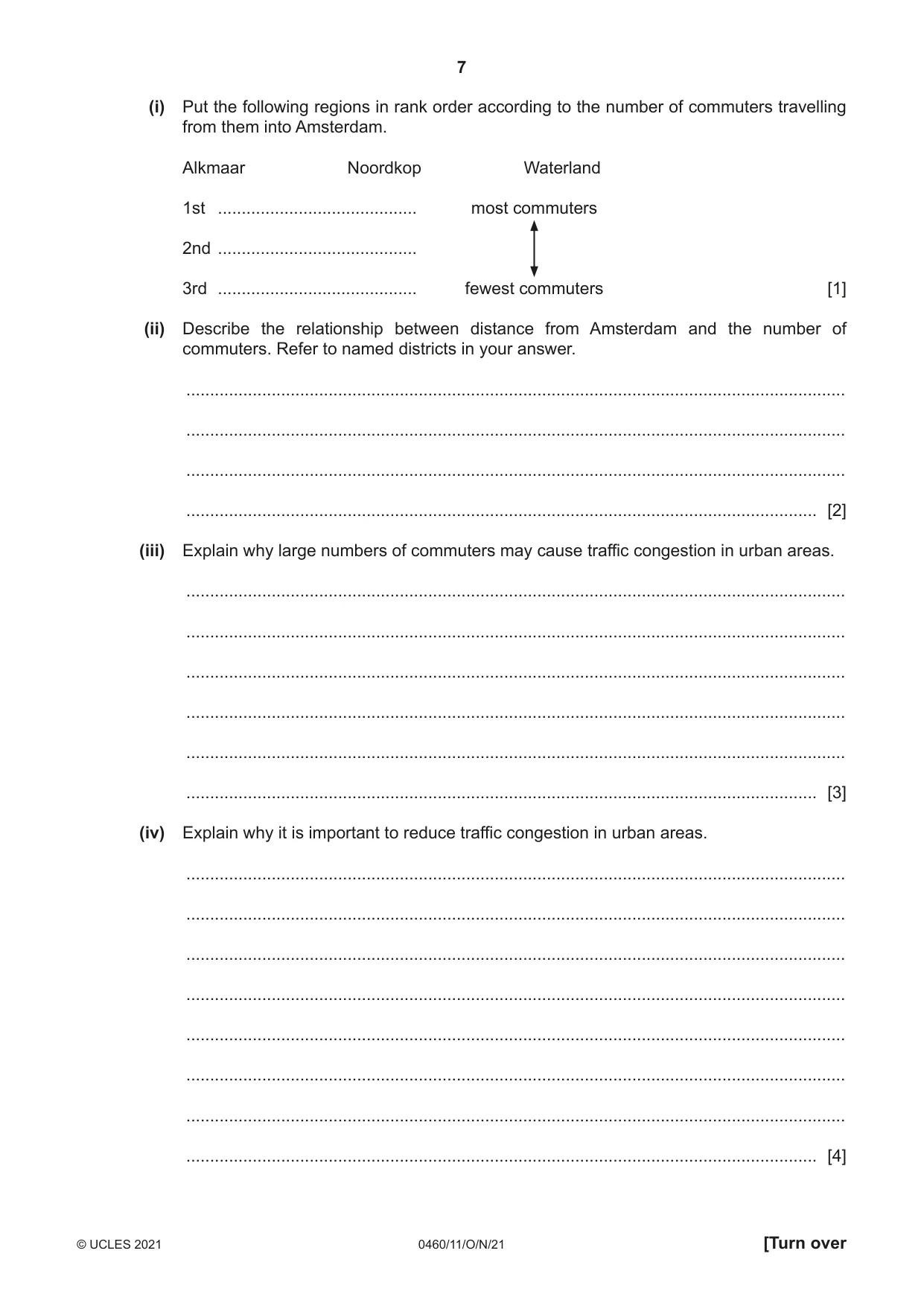
7 0460/11/O/N/21 © UCLES 2021 [Turn over (i) Put the following regions in rank order according to the number of commuters travelling from them into Amsterdam. Alkmaar Noordkop Waterland 1st … most commuters 2nd … 3rd … fewest commuters [1] (ii) Describe the relationship between distance from Amsterdam and the number of commuters. Refer to named districts in your answer. … … … … [2] (iii) Explain why large numbers of commuters may cause traffic congestion in urban areas. … … … … … … [3] (iv) Explain why it is important to reduce traffic congestion in urban areas. … … … … … … … … [4]
Question paper, page 8
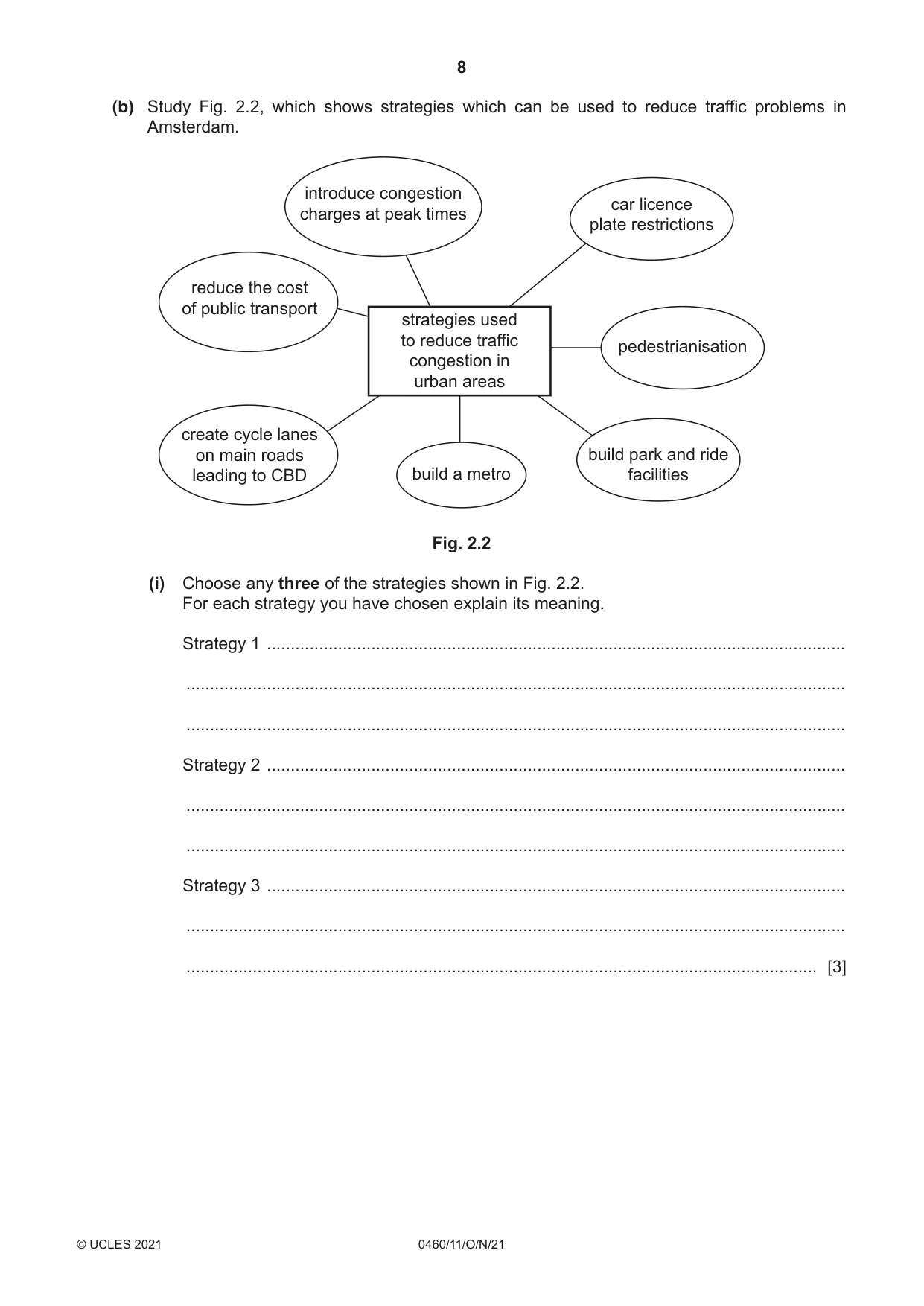
8 0460/11/O/N/21 © UCLES 2021 (b) Study Fig. 2.2, which shows strategies which can be used to reduce traffic problems in Amsterdam. introduce congestion charges at peak times car licence plate restrictions pedestrianisation build park and ride facilities build a metro create cycle lanes on main roads leading to CBD reduce the cost of public transport strategies used to reduce traffic congestion in urban areas Fig. 2.2 (i) Choose any three of the strategies shown in Fig. 2.2. For each strategy you have chosen explain its meaning. Strategy 1 … … … Strategy 2 … … … Strategy 3 … … … [3]
Question paper, page 9
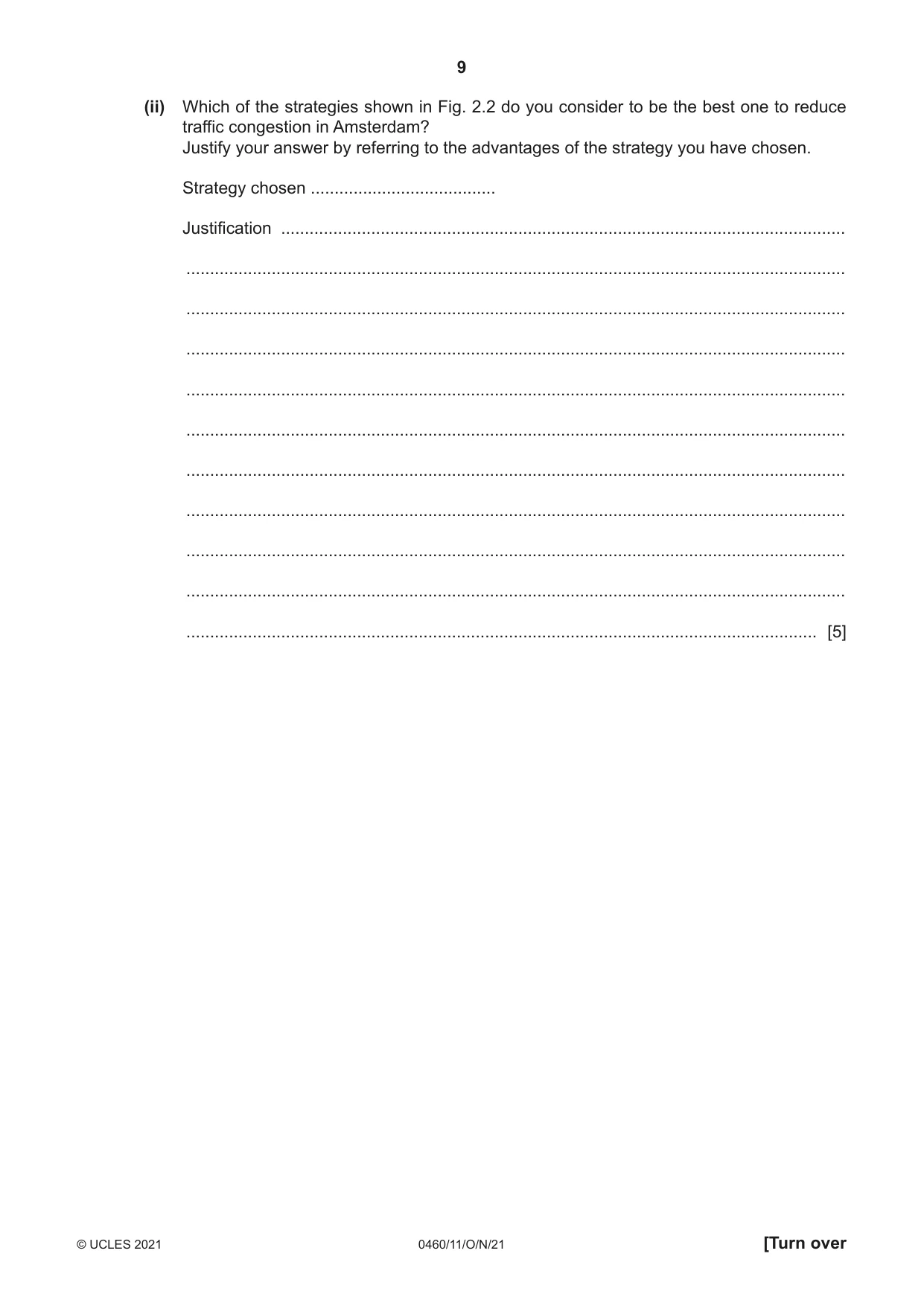
9 0460/11/O/N/21 © UCLES 2021 [Turn over (ii) Which of the strategies shown in Fig. 2.2 do you consider to be the best one to reduce traffic congestion in Amsterdam? Justify your answer by referring to the advantages of the strategy you have chosen. Strategy chosen … Justification … … … … … … … … … … … [5]
Question paper, page 10
10 0460/11/O/N/21 © UCLES 2021 (c) For a named urban area you have studied, describe the problems caused by urban sprawl. Name of urban area … … … … … … … … … … … … … … … … … … … … … … … … … … … [7] [Total: 25]
Question paper, page 11
11 0460/11/O/N/21 © UCLES 2021 [Turn over TURN PAGE FOR QUESTION 3
Question paper, page 12
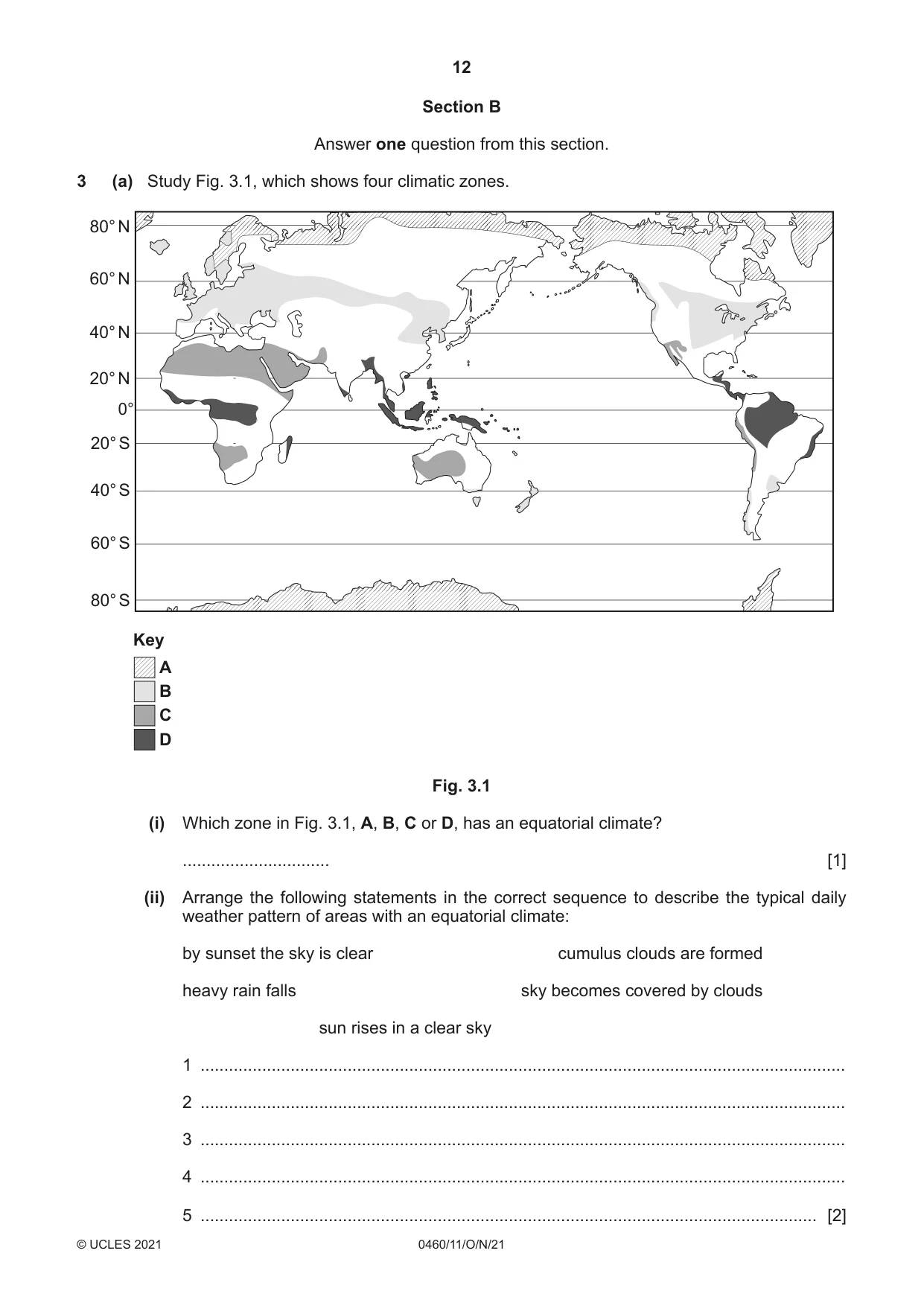
12 0460/11/O/N/21 © UCLES 2021 Section B Answer one question from this section. 3 (a) Study Fig. 3.1, which shows four climatic zones. 80° N 60° N 40° N 20° N 0° 20° S 40° S 60° S 80° S D C B A Key Fig. 3.1 (i) Which zone in Fig. 3.1, A, B, C or D, has an equatorial climate? … [1] (ii) Arrange the following statements in the correct sequence to describe the typical daily weather pattern of areas with an equatorial climate: by sunset the sky is clear cumulus clouds are formed heavy rain falls sky becomes covered by clouds sun rises in a clear sky 1 … 2 … 3 … 4 … 5 … [2]
Question paper, page 13
13 0460/11/O/N/21 © UCLES 2021 [Turn over (iii) Explain why there is little seasonal variation in climate in equatorial areas. … … … … … … [3] (iv) Describe the processes which result in convectional rainfall in equatorial areas. … … … … … … … … [4]
Question paper, page 14
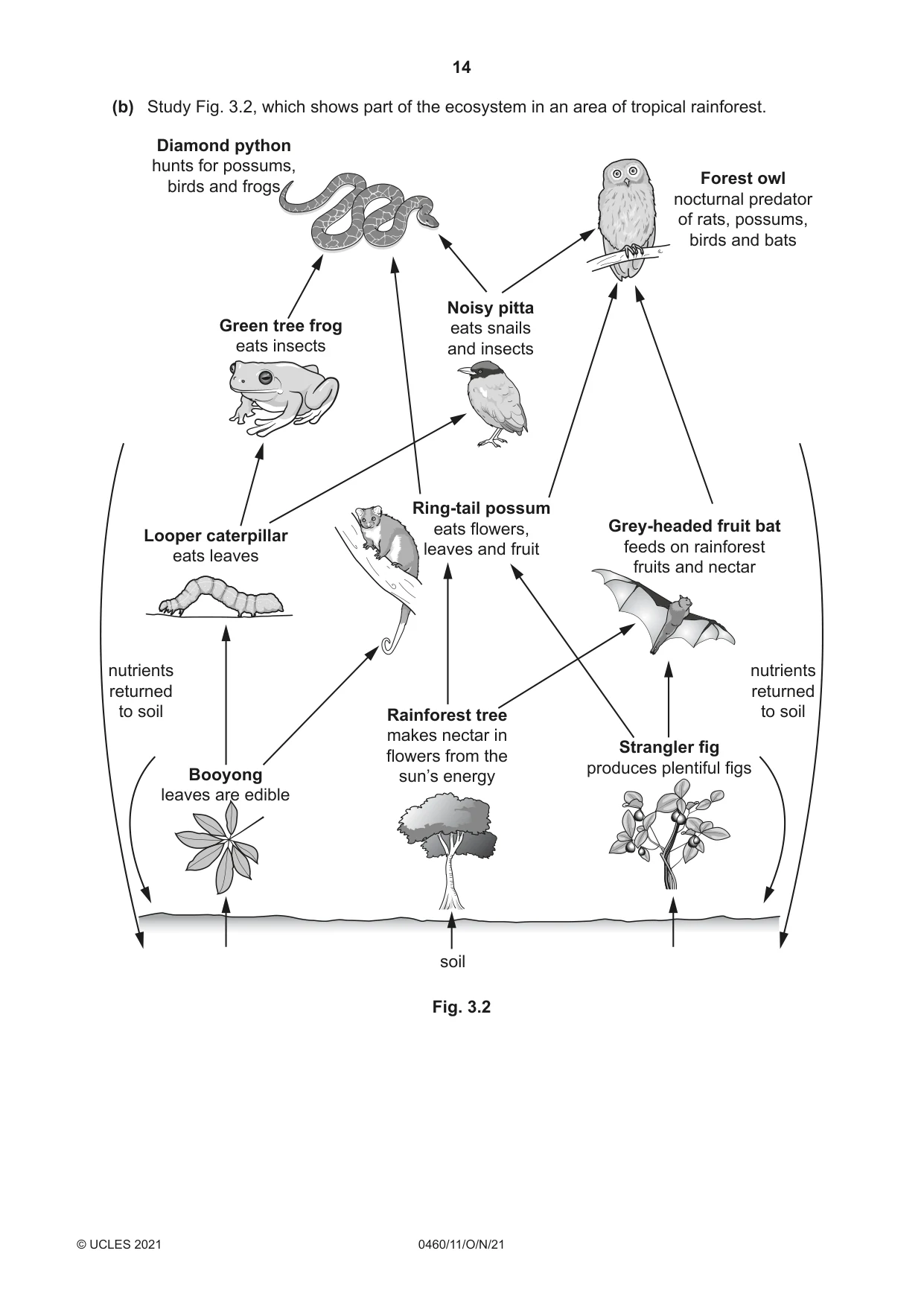
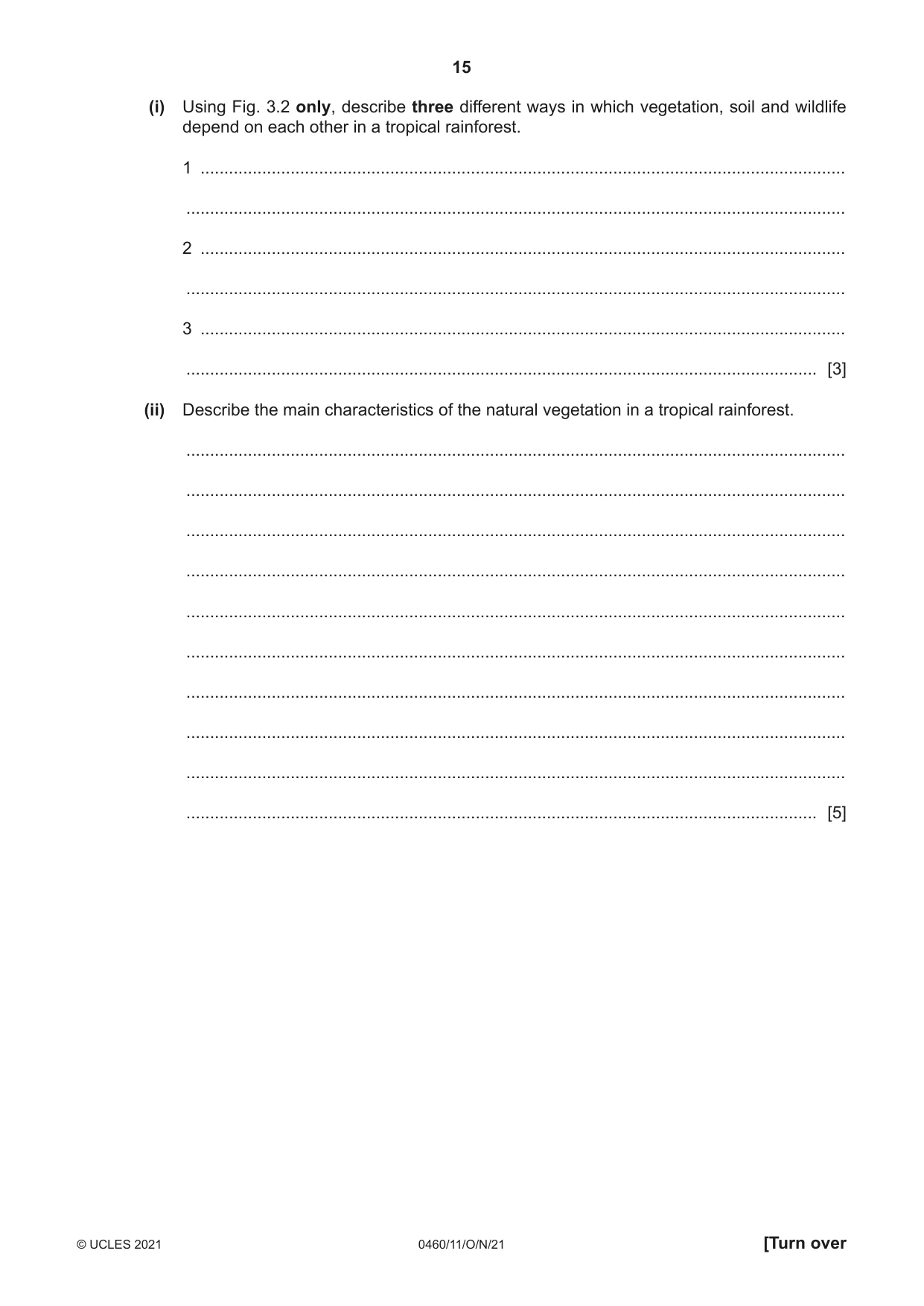
14 0460/11/O/N/21 © UCLES 2021 (b) Study Fig. 3.2, which shows part of the ecosystem in an area of tropical rainforest. soil Booyong leaves are edible Rainforest tree makes nectar in flowers from the sun’s energy nutrients returned to soil nutrients returned to soil Strangler fig produces plentiful figs Grey-headed fruit bat feeds on rainforest fruits and nectar Ring-tail possum eats flowers, leaves and fruit Green tree frog eats insects Noisy pitta eats snails and insects Diamond python hunts for possums, birds and frogs Forest owl nocturnal predator of rats, possums, birds and bats Looper caterpillar eats leaves Fig. 3.2
Question paper, page 15
15 0460/11/O/N/21 © UCLES 2021 [Turn over (i) Using Fig. 3.2 only, describe three different ways in which vegetation, soil and wildlife depend on each other in a tropical rainforest. 1 … … 2 … … 3 … … [3] (ii) Describe the main characteristics of the natural vegetation in a tropical rainforest. … … … … … … … … … … [5]
Question paper, page 16
16 0460/11/O/N/21 © UCLES 2021 (c) For an area of tropical rainforest you have studied, explain why deforestation is taking place. Area of tropical rainforest … … … … … … … … … … … … … … … … … … … … … … … … … … … [7] [Total: 25]
Question paper, page 17
17 0460/11/O/N/21 © UCLES 2021 [Turn over TURN PAGE FOR QUESTION 4
Question paper, page 18
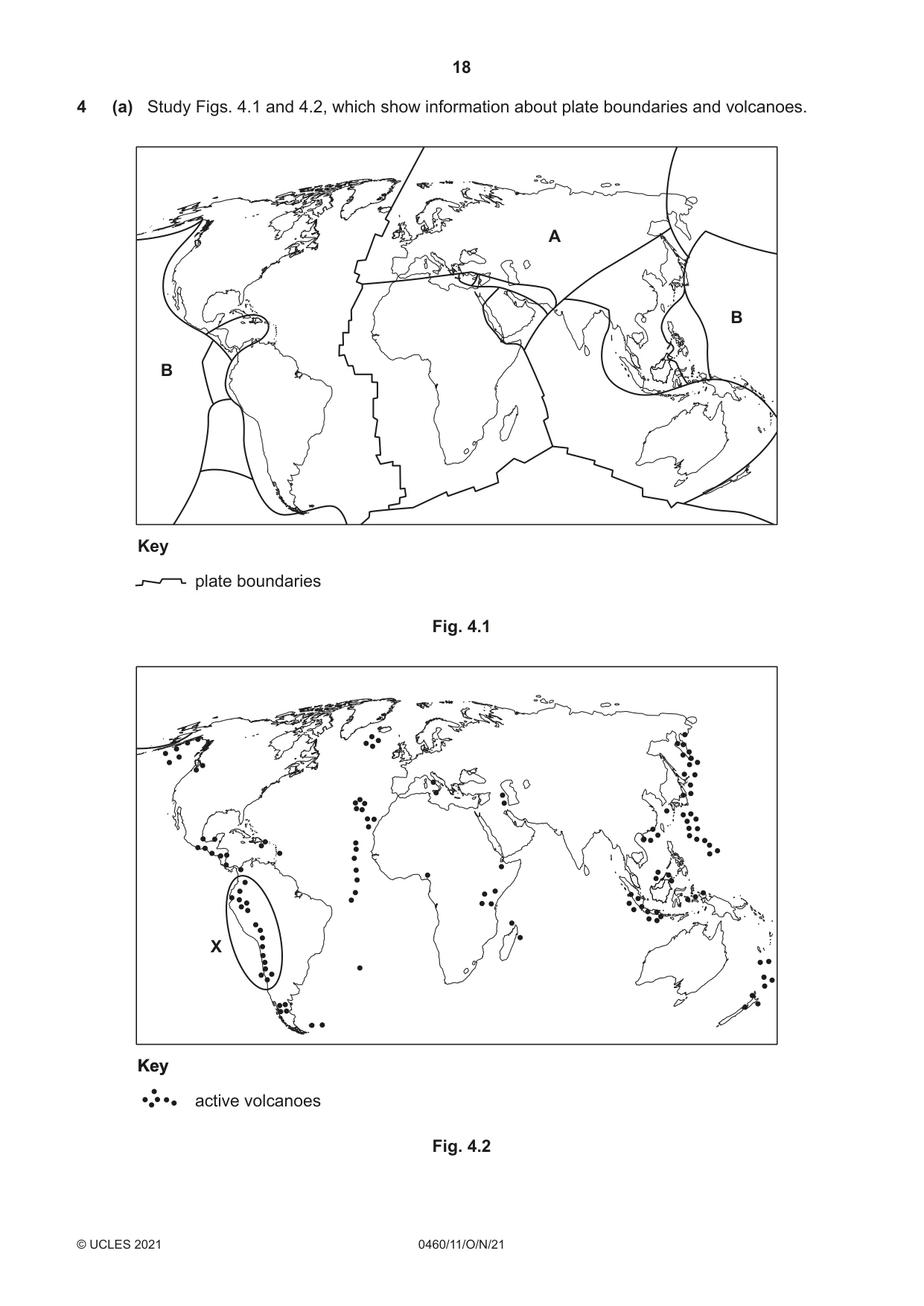
18 0460/11/O/N/21 © UCLES 2021 4 (a) Study Figs. 4.1 and 4.2, which show information about plate boundaries and volcanoes. B A B Key plate boundaries Fig. 4.1 X Key active volcanoes Key Fig. 4.2
Question paper, page 19
19 0460/11/O/N/21 © UCLES 2021 [Turn over (i) Using Fig. 4.1, define the term plate. … … [1] (ii) Name the plates labelled A and B in Fig. 4.1. Choose from the following list. African Plate Caribbean Plate Eurasian Plate Indo-Australian Plate Nazca Plate Pacific Plate A … B … [2] (iii) Describe the distribution of the active volcanoes shown in Fig. 4.2. … … … … … … [3] (iv) Area X on Fig. 4.2 is a destructive (convergent) plate boundary. Explain why there are active volcanoes in the area labelled X. … … … … … … … … [4]
Question paper, page 20
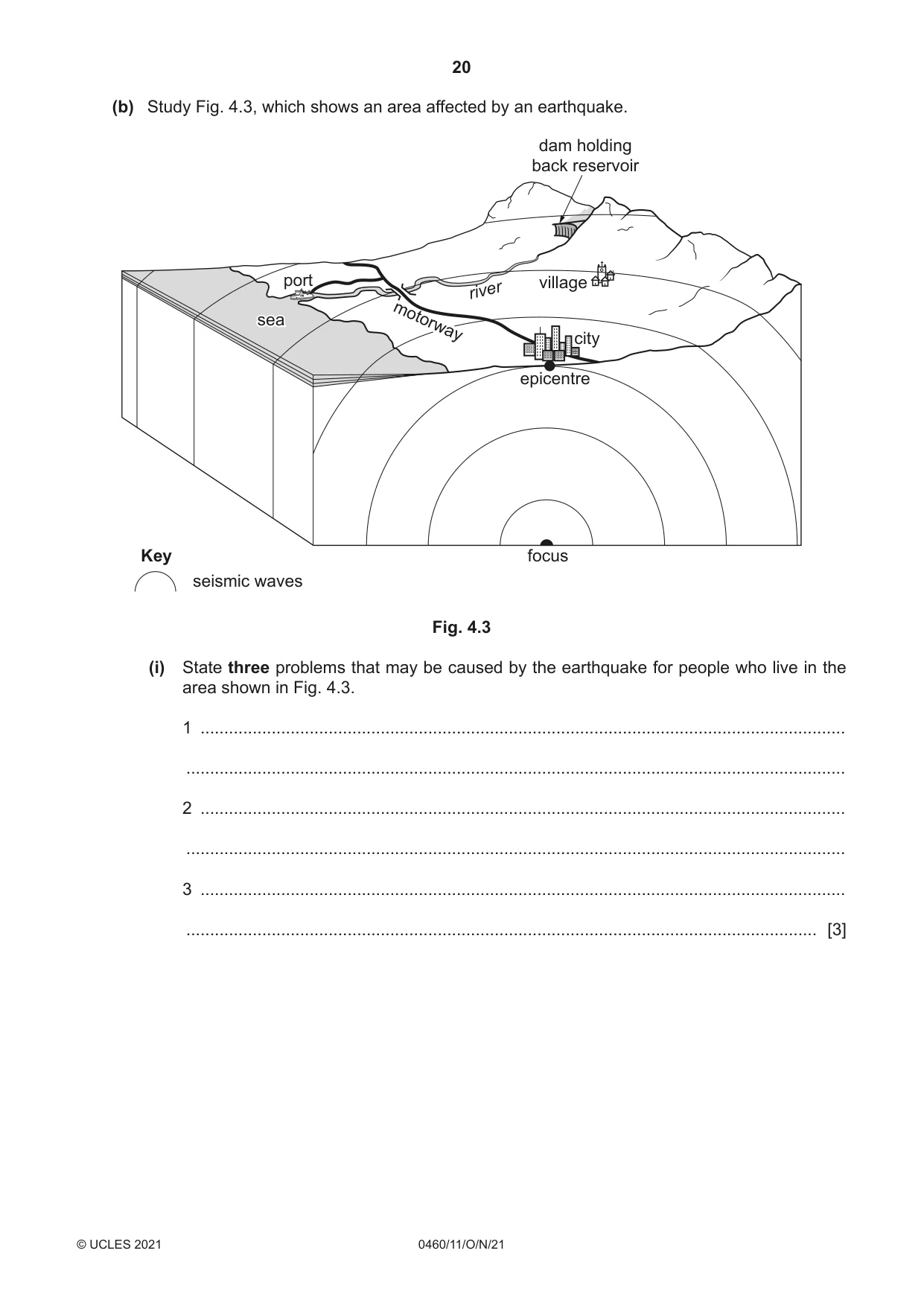
20 0460/11/O/N/21 © UCLES 2021 (b) Study Fig. 4.3, which shows an area affected by an earthquake. epicentre seismic waves focus Key city village dam holding back reservoir port sea sea river motorway Fig. 4.3 (i) State three problems that may be caused by the earthquake for people who live in the area shown in Fig. 4.3. 1 … … 2 … … 3 … … [3]
Question paper, page 21
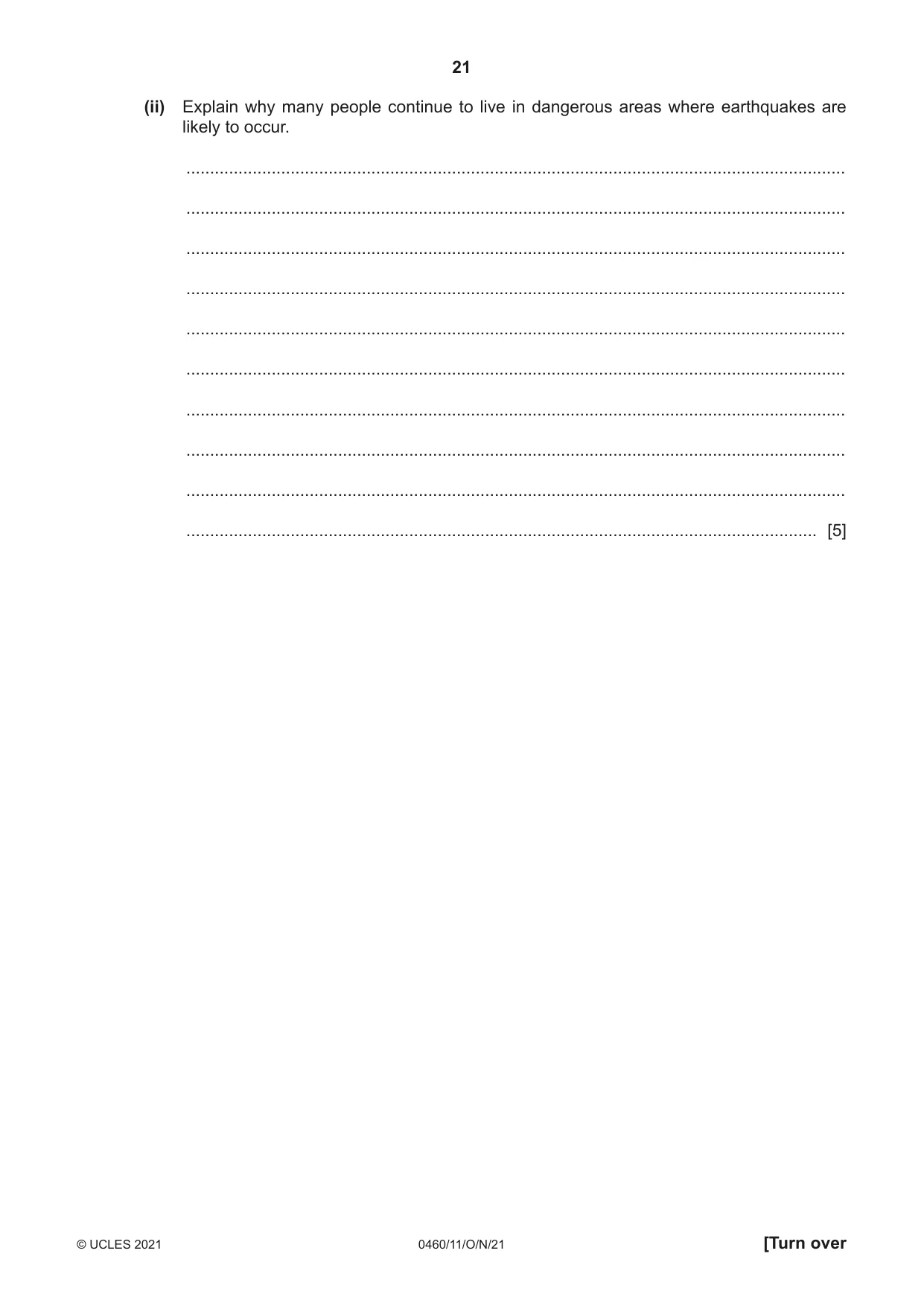
21 0460/11/O/N/21 © UCLES 2021 [Turn over (ii) Explain why many people continue to live in dangerous areas where earthquakes are likely to occur. … … … … … … … … … … [5]
Question paper, page 22
22 0460/11/O/N/21 © UCLES 2021 (c) Describe the positive and negative impacts of volcanic activity for people living close to a named volcano you have studied. Name of volcano … … … … … … … … … … … … … … … … … … … … … … … … … … [7] [Total: 25]
Question paper, page 23
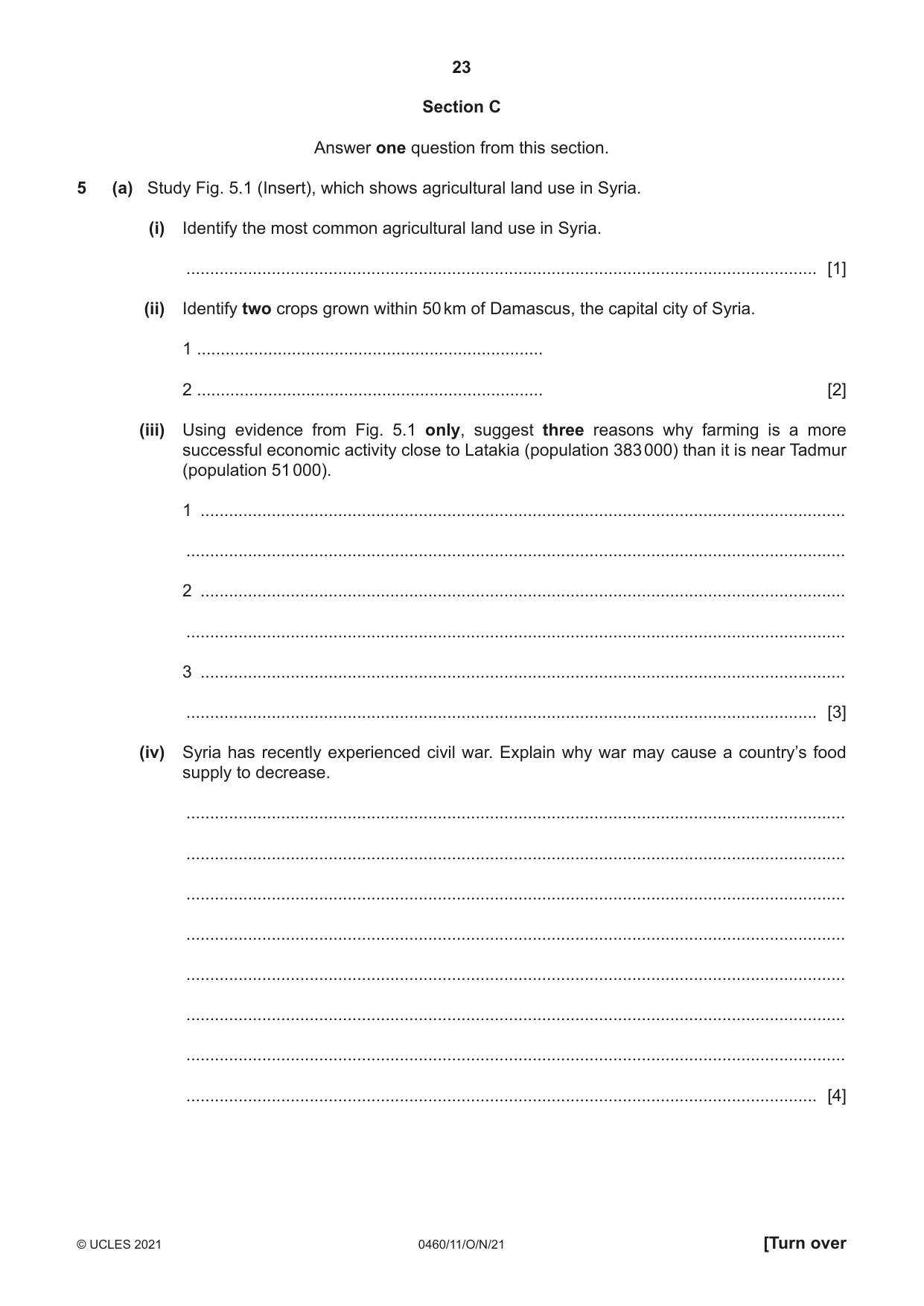
23 0460/11/O/N/21 © UCLES 2021 [Turn over Section C Answer one question from this section. 5 (a) Study Fig. 5.1 (Insert), which shows agricultural land use in Syria. (i) Identify the most common agricultural land use in Syria. … [1] (ii) Identify two crops grown within 50 km of Damascus, the capital city of Syria. 1 … 2 … [2] (iii) Using evidence from Fig. 5.1 only, suggest three reasons why farming is a more successful economic activity close to Latakia (population 383 000) than it is near Tadmur (population 51 000). 1 … … 2 … … 3 … … [3] (iv) Syria has recently experienced civil war. Explain why war may cause a country’s food supply to decrease. … … … … … … … … [4]
Question paper, page 24
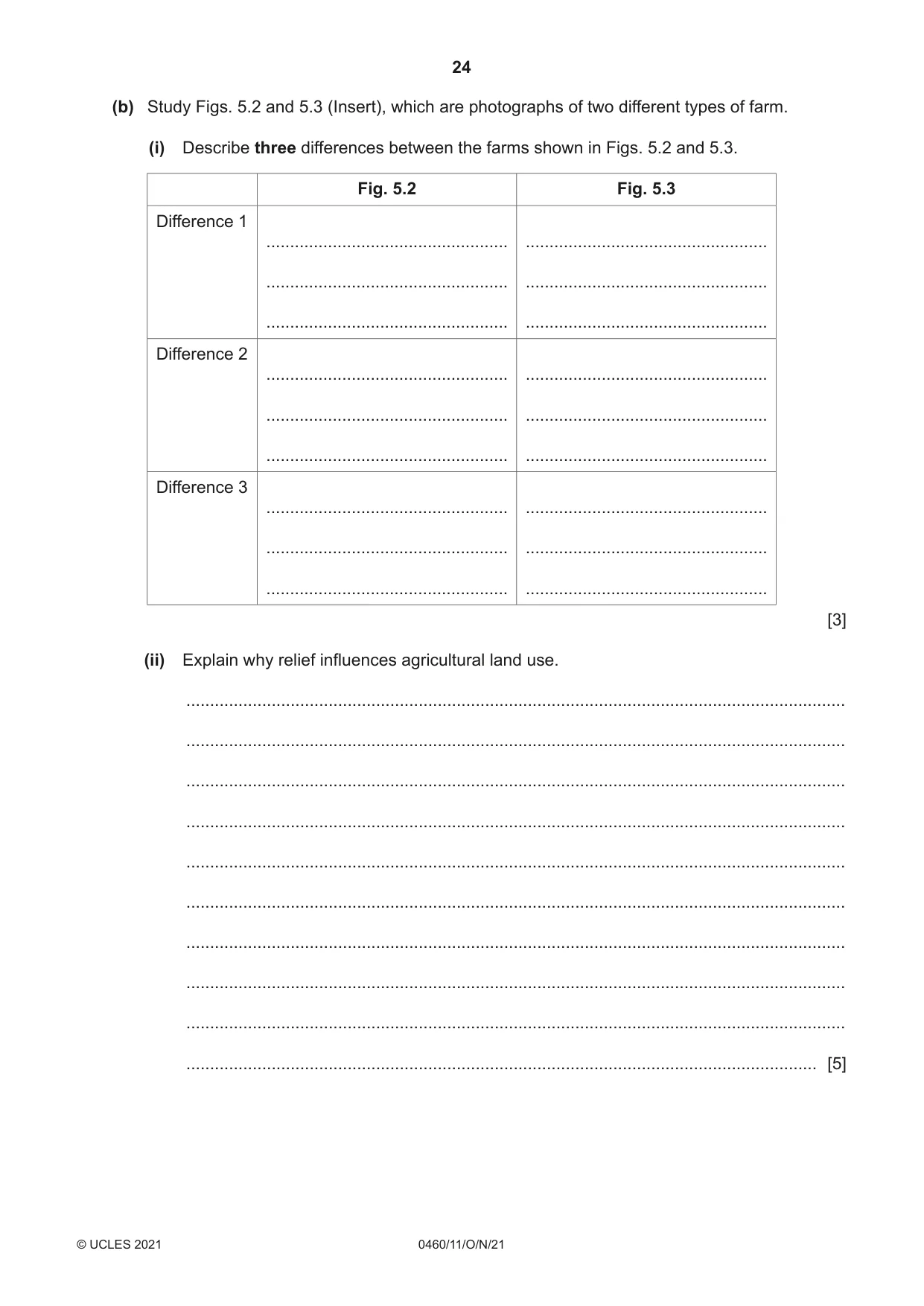
24 0460/11/O/N/21 © UCLES 2021 (b) Study Figs. 5.2 and 5.3 (Insert), which are photographs of two different types of farm. (i) Describe three differences between the farms shown in Figs. 5.2 and 5.3. Fig. 5.2 Fig. 5.3 Difference 1 … … … … … … Difference 2 … … … … … … Difference 3 … … … … … … [3] (ii) Explain why relief influences agricultural land use. … … … … … … … … … … [5]
Question paper, page 25
25 0460/11/O/N/21 © UCLES 2021 [Turn over (c) For a named country or region you have studied, describe the effects of food shortages. Name of country or region … … … … … … … … … … … … … … … … … … … … … … … … … … … [7] [Total: 25]
Question paper, page 26
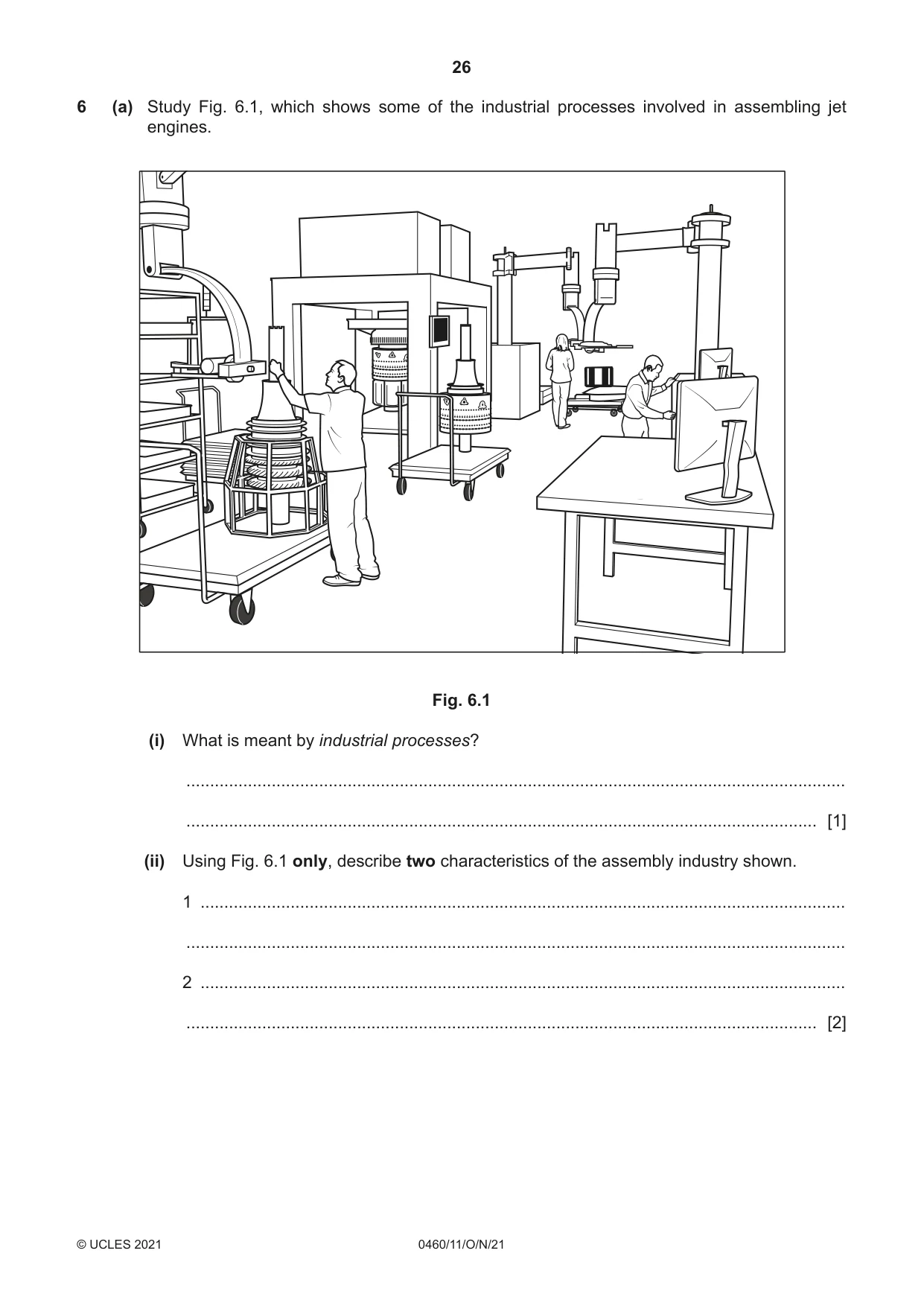
26 0460/11/O/N/21 © UCLES 2021 6 (a) Study Fig. 6.1, which shows some of the industrial processes involved in assembling jet engines. Fig. 6.1 (i) What is meant by industrial processes? … … [1] (ii) Using Fig. 6.1 only, describe two characteristics of the assembly industry shown. 1 … … 2 … … [2]
Question paper, page 27
27 0460/11/O/N/21 © UCLES 2021 [Turn over (iii) Suggest reasons why assembly industries such as that shown in Fig. 6.1 might cause fewer problems for the local natural environment than manufacturing and processing industries. … … … … … … [3] (b) Study Figs. 6.2 and 6.3 (Insert), which are photographs of two different factories. (i) Describe three differences between the factories shown in Figs. 6.2 and 6.3. Fig. 6.2 Fig. 6.3 Difference 1 … … … … … … Difference 2 … … … … … … Difference 3 … … … … … … [3]
Question paper, page 28
28 0460/11/O/N/21 © UCLES 2021 (ii) Explain why raw materials and markets may influence the location of manufacturing industry. … … … … … … … … [4] (iii) The owner of the factory shown in Fig. 6.2 is considering moving the industry to a different location. Suggest reasons for this. … … … … … … … … … … [5]
Question paper, page 29
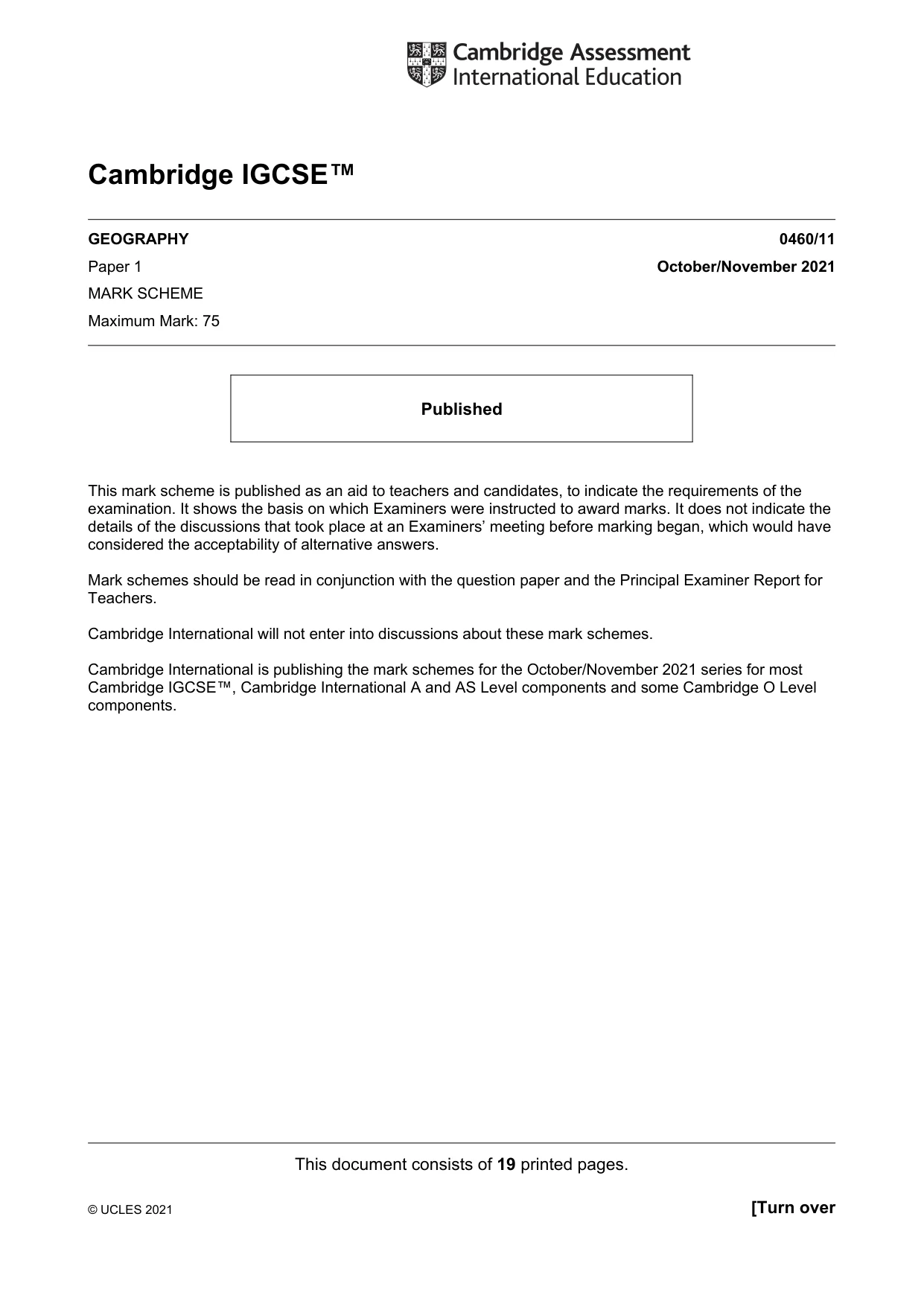
29 0460/11/O/N/21 © UCLES 2021 (c) For an economic activity in a named area you have studied, describe how the environmental risks are being managed. Name of area … Economic activity … … … … … … … … … … … … … … … … … … … … … … … … … [7] [Total: 25]
Question paper, page 30
30 0460/11/O/N/21 © UCLES 2021 Additional Pages If you use the following lined pages to complete the answer(s) to any question(s), the question number(s) must be clearly shown. … … … … … … … … … … … … … … … … … … … … … … … … … …
Question paper, page 31
31 0460/11/O/N/21 © UCLES 2021 … … … … … … … … … … … … … … … … … … … … … … … … … … … …
Question paper, page 32
32 0460/11/O/N/21 © UCLES 2021 BLANK PAGE The boundaries and names shown, the designations used and the presentation of material on any maps contained in this question paper/insert do not imply official endorsement or acceptance by Cambridge Assessment International Education concerning the legal status of any country, territory, or area or any of its authorities, or of the delimitation of its frontiers or boundaries. Permission to reproduce items where third-party owned material protected by copyright is included has been sought and cleared where possible. Every reasonable effort has been made by the publisher (UCLES) to trace copyright holders, but if any items requiring clearance have unwittingly been included, the publisher will be pleased to make amends at the earliest possible opportunity. To avoid the issue of disclosure of answer-related information to candidates, all copyright acknowledgements are reproduced online in the Cambridge Assessment International Education Copyright Acknowledgements Booklet. This is produced for each series of examinations and is freely available to download at www.cambridgeinternational.org after the live examination series. Cambridge Assessment International Education is part of the Cambridge Assessment Group. Cambridge Assessment is the brand name of the University of Cambridge Local Examinations Syndicate (UCLES), which itself is a department of the University of Cambridge.
Mark scheme, page 1
This document consists of 19 printed pages. © UCLES 2021 [Turn over Cambridge IGCSE™ GEOGRAPHY 0460/11 Paper 1 October/November 2021 MARK SCHEME Maximum Mark: 75 Published This mark scheme is published as an aid to teachers and candidates, to indicate the requirements of the examination. It shows the basis on which Examiners were instructed to award marks. It does not indicate the details of the discussions that took place at an Examiners’ meeting before marking began, which would have considered the acceptability of alternative answers. Mark schemes should be read in conjunction with the question paper and the Principal Examiner Report for Teachers. Cambridge International will not enter into discussions about these mark schemes. Cambridge International is publishing the mark schemes for the October/November 2021 series for most Cambridge IGCSE™, Cambridge International A and AS Level components and some Cambridge O Level components.
Mark scheme, page 2
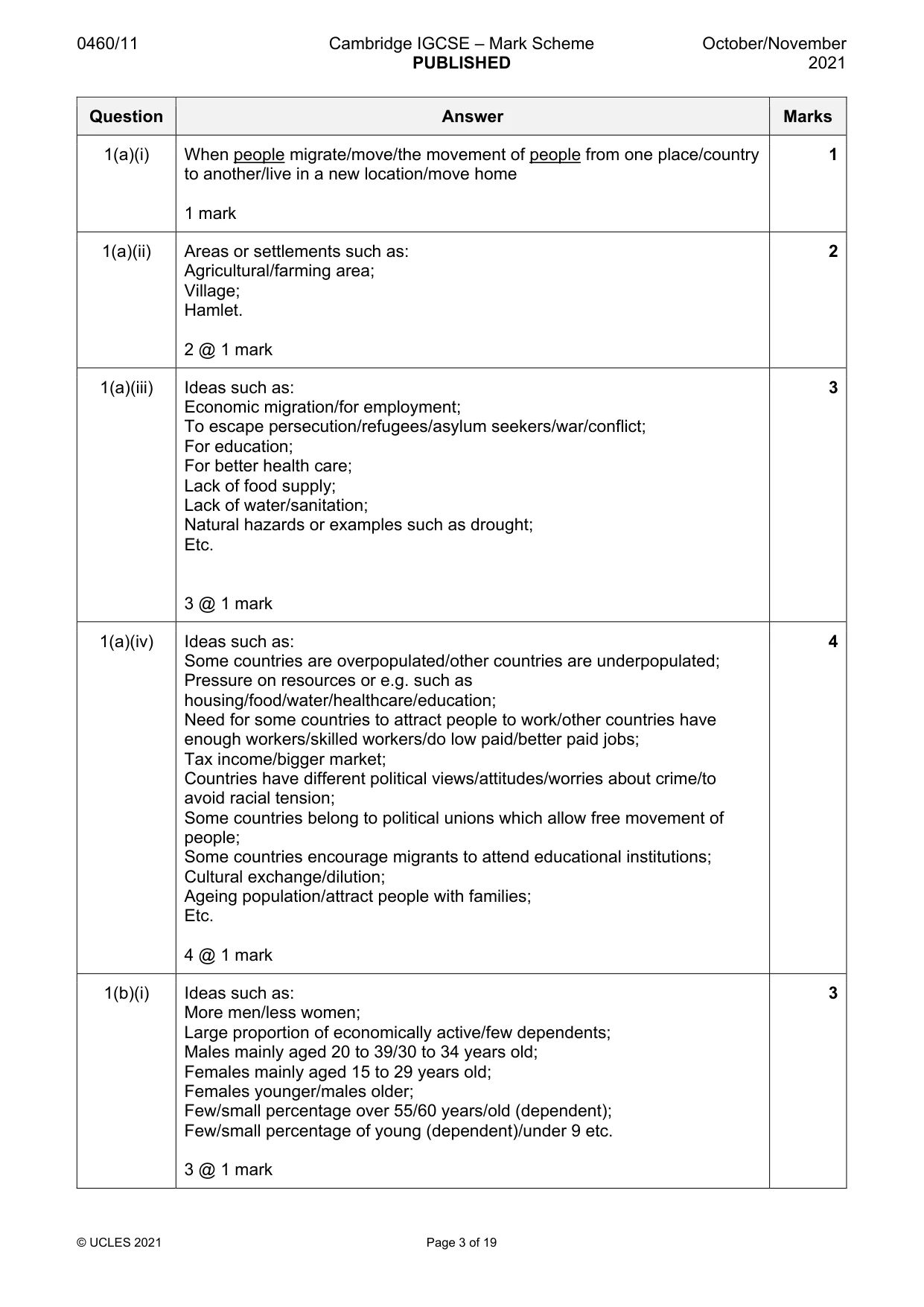
0460/11 Cambridge IGCSE – Mark Scheme PUBLISHED October/November 2021 © UCLES 2021 Page 2 of 19 Generic Marking Principles These general marking principles must be applied by all examiners when marking candidate answers. They should be applied alongside the specific content of the mark scheme or generic level descriptors for a question. Each question paper and mark scheme will also comply with these marking principles. GENERIC MARKING PRINCIPLE 1: Marks must be awarded in line with: • the specific content of the mark scheme or the generic level descriptors for the question • the specific skills defined in the mark scheme or in the generic level descriptors for the question • the standard of response required by a candidate as exemplified by the standardisation scripts. GENERIC MARKING PRINCIPLE 2: Marks awarded are always whole marks (not half marks, or other fractions). GENERIC MARKING PRINCIPLE 3: Marks must be awarded positively: • marks are awarded for correct/valid answers, as defined in the mark scheme. However, credit is given for valid answers which go beyond the scope of the syllabus and mark scheme, referring to your Team Leader as appropriate • marks are awarded when candidates clearly demonstrate what they know and can do • marks are not deducted for errors • marks are not deducted for omissions • answers should only be judged on the quality of spelling, punctuation and grammar when these features are specifically assessed by the question as indicated by the mark scheme. The meaning, however, should be unambiguous. GENERIC MARKING PRINCIPLE 4: Rules must be applied consistently, e.g. in situations where candidates have not followed instructions or in the application of generic level descriptors. GENERIC MARKING PRINCIPLE 5: Marks should be awarded using the full range of marks defined in the mark scheme for the question (however; the use of the full mark range may be limited according to the quality of the candidate responses seen). GENERIC MARKING PRINCIPLE 6: Marks awarded are based solely on the requirements as defined in the mark scheme. Marks should not be awarded with grade thresholds or grade descriptors in mind.
Mark scheme, page 3
0460/11 Cambridge IGCSE – Mark Scheme PUBLISHED October/November 2021 © UCLES 2021 Page 3 of 19 Question Answer Marks 1(a)(i) When people migrate/move/the movement of people from one place/country to another/live in a new location/move home 1 mark 1 1(a)(ii) Areas or settlements such as: Agricultural/farming area; Village; Hamlet. 2 @ 1 mark 2 1(a)(iii) Ideas such as: Economic migration/for employment; To escape persecution/refugees/asylum seekers/war/conflict; For education; For better health care; Lack of food supply; Lack of water/sanitation; Natural hazards or examples such as drought; Etc. 3 @ 1 mark 3 1(a)(iv) Ideas such as: Some countries are overpopulated/other countries are underpopulated; Pressure on resources or e.g. such as housing/food/water/healthcare/education; Need for some countries to attract people to work/other countries have enough workers/skilled workers/do low paid/better paid jobs; Tax income/bigger market; Countries have different political views/attitudes/worries about crime/to avoid racial tension; Some countries belong to political unions which allow free movement of people; Some countries encourage migrants to attend educational institutions; Cultural exchange/dilution; Ageing population/attract people with families; Etc. 4 @ 1 mark 4 1(b)(i) Ideas such as: More men/less women; Large proportion of economically active/few dependents; Males mainly aged 20 to 39/30 to 34 years old; Females mainly aged 15 to 29 years old; Females younger/males older; Few/small percentage over 55/60 years/old (dependent); Few/small percentage of young (dependent)/under 9 etc. 3 @ 1 mark 3
Mark scheme, page 4
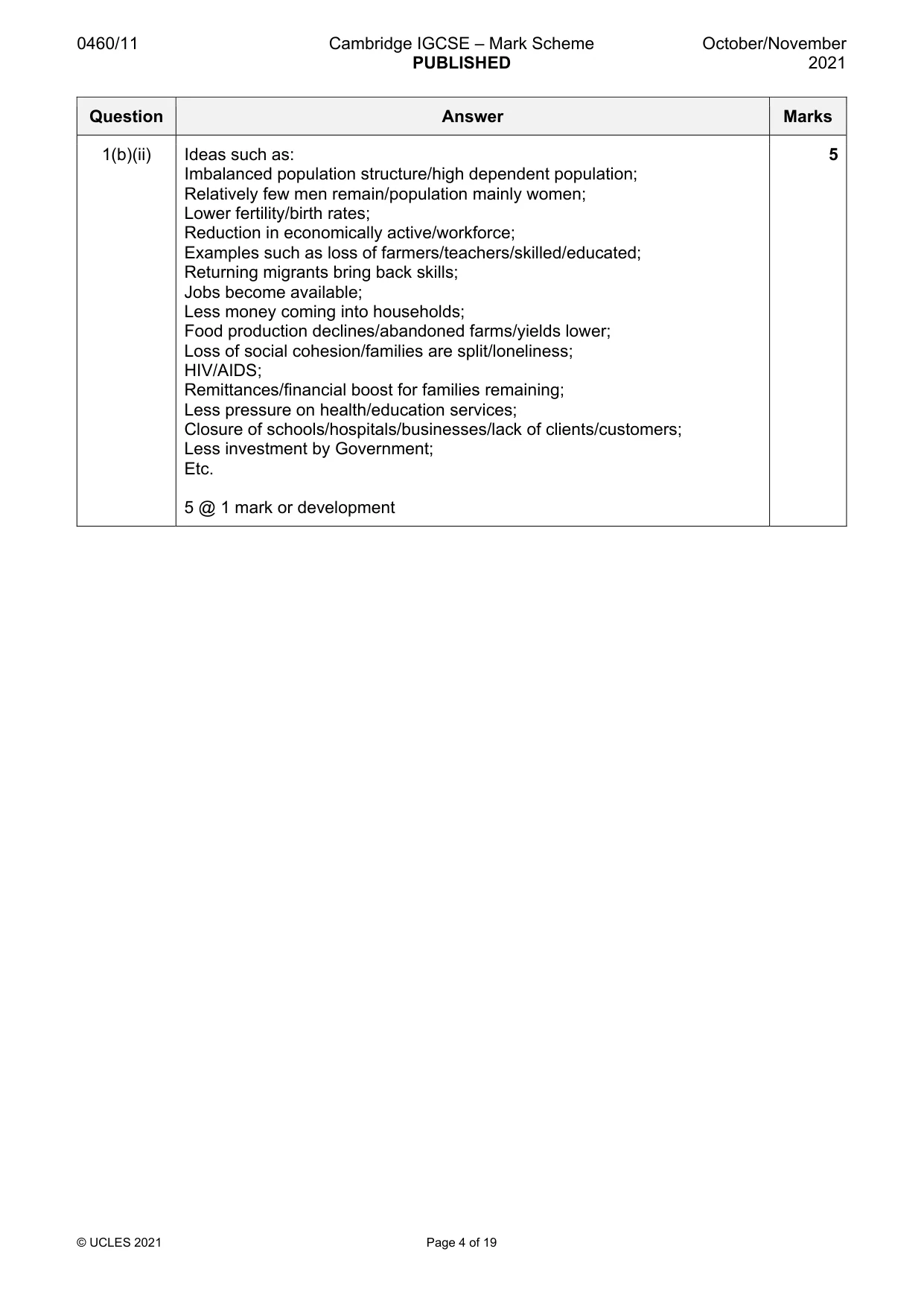
0460/11 Cambridge IGCSE – Mark Scheme PUBLISHED October/November 2021 © UCLES 2021 Page 4 of 19 Question Answer Marks 1(b)(ii) Ideas such as: Imbalanced population structure/high dependent population; Relatively few men remain/population mainly women; Lower fertility/birth rates; Reduction in economically active/workforce; Examples such as loss of farmers/teachers/skilled/educated; Returning migrants bring back skills; Jobs become available; Less money coming into households; Food production declines/abandoned farms/yields lower; Loss of social cohesion/families are split/loneliness; HIV/AIDS; Remittances/financial boost for families remaining; Less pressure on health/education services; Closure of schools/hospitals/businesses/lack of clients/customers; Less investment by Government; Etc. 5 @ 1 mark or development 5
Mark scheme, page 5
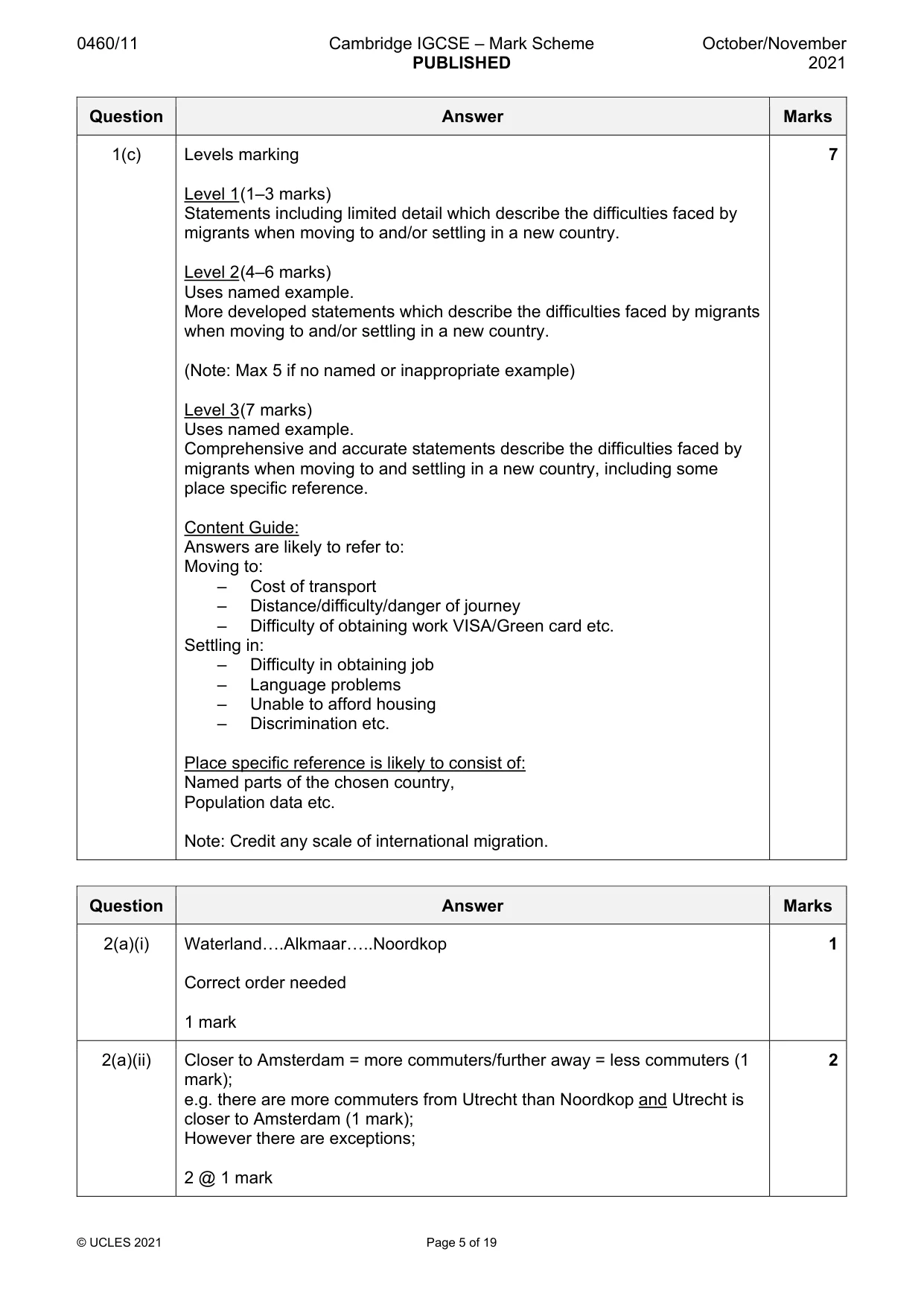
0460/11 Cambridge IGCSE – Mark Scheme PUBLISHED October/November 2021 © UCLES 2021 Page 5 of 19 Question Answer Marks 1(c) Levels marking Level 1 (1–3 marks) Statements including limited detail which describe the difficulties faced by migrants when moving to and/or settling in a new country. Level 2 (4–6 marks) Uses named example. More developed statements which describe the difficulties faced by migrants when moving to and/or settling in a new country. (Note: Max 5 if no named or inappropriate example) Level 3 (7 marks) Uses named example. Comprehensive and accurate statements describe the difficulties faced by migrants when moving to and settling in a new country, including some place specific reference. Content Guide: Answers are likely to refer to: Moving to: – Cost of transport – Distance/difficulty/danger of journey – Difficulty of obtaining work VISA/Green card etc. Settling in: – Difficulty in obtaining job – Language problems – Unable to afford housing – Discrimination etc. Place specific reference is likely to consist of: Named parts of the chosen country, Population data etc. Note: Credit any scale of international migration. 7 Question Answer Marks 2(a)(i) Waterland….Alkmaar…..Noordkop Correct order needed 1 mark 1 2(a)(ii) Closer to Amsterdam = more commuters/further away = less commuters (1 mark); e.g. there are more commuters from Utrecht than Noordkop and Utrecht is closer to Amsterdam (1 mark); However there are exceptions; 2 @ 1 mark 2
Mark scheme, page 6
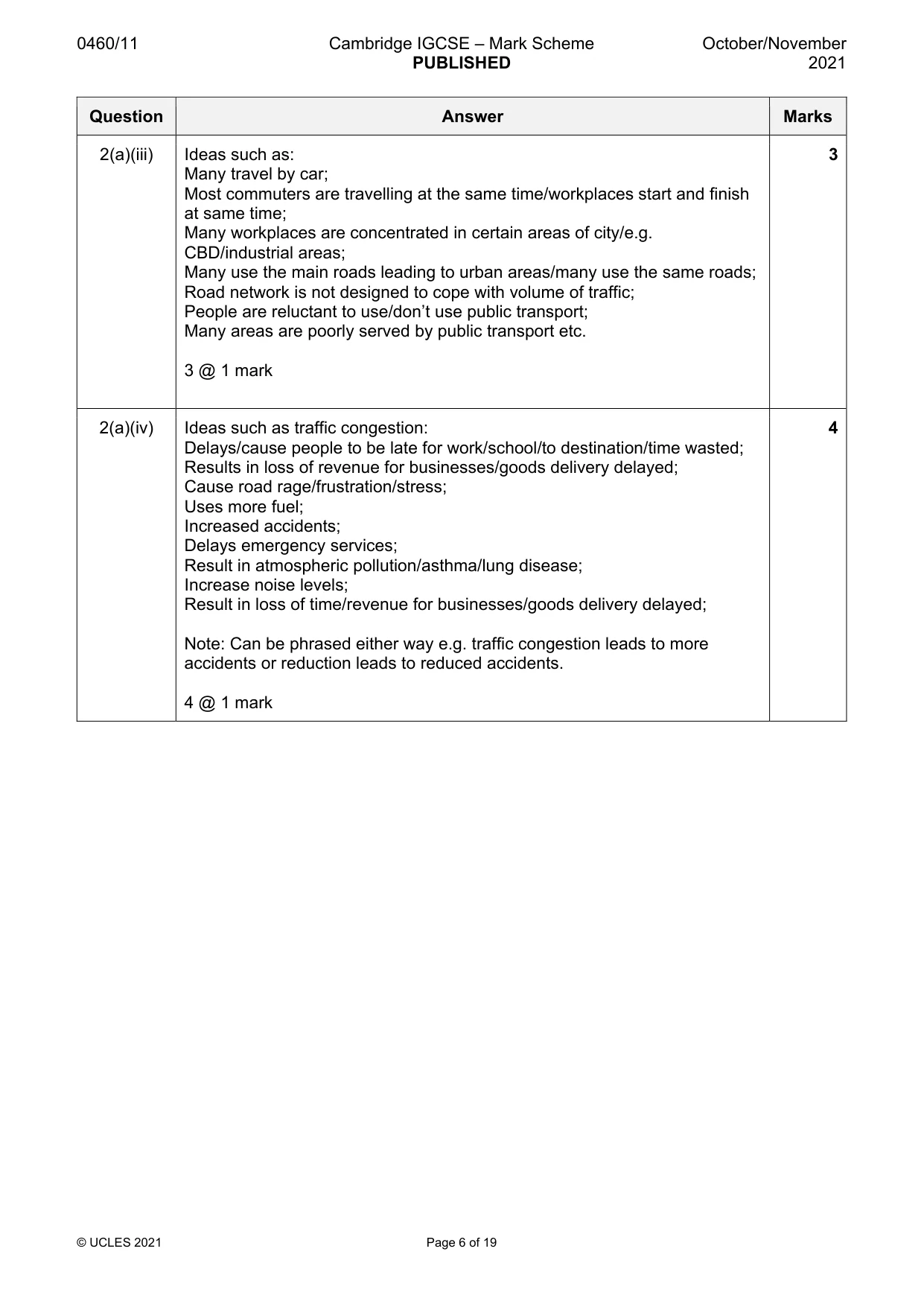
0460/11 Cambridge IGCSE – Mark Scheme PUBLISHED October/November 2021 © UCLES 2021 Page 6 of 19 Question Answer Marks 2(a)(iii) Ideas such as: Many travel by car; Most commuters are travelling at the same time/workplaces start and finish at same time; Many workplaces are concentrated in certain areas of city/e.g. CBD/industrial areas; Many use the main roads leading to urban areas/many use the same roads; Road network is not designed to cope with volume of traffic; People are reluctant to use/don’t use public transport; Many areas are poorly served by public transport etc. 3 @ 1 mark 3 2(a)(iv) Ideas such as traffic congestion: Delays/cause people to be late for work/school/to destination/time wasted; Results in loss of revenue for businesses/goods delivery delayed; Cause road rage/frustration/stress; Uses more fuel; Increased accidents; Delays emergency services; Result in atmospheric pollution/asthma/lung disease; Increase noise levels; Result in loss of time/revenue for businesses/goods delivery delayed; Note: Can be phrased either way e.g. traffic congestion leads to more accidents or reduction leads to reduced accidents. 4 @ 1 mark 4
Mark scheme, page 7
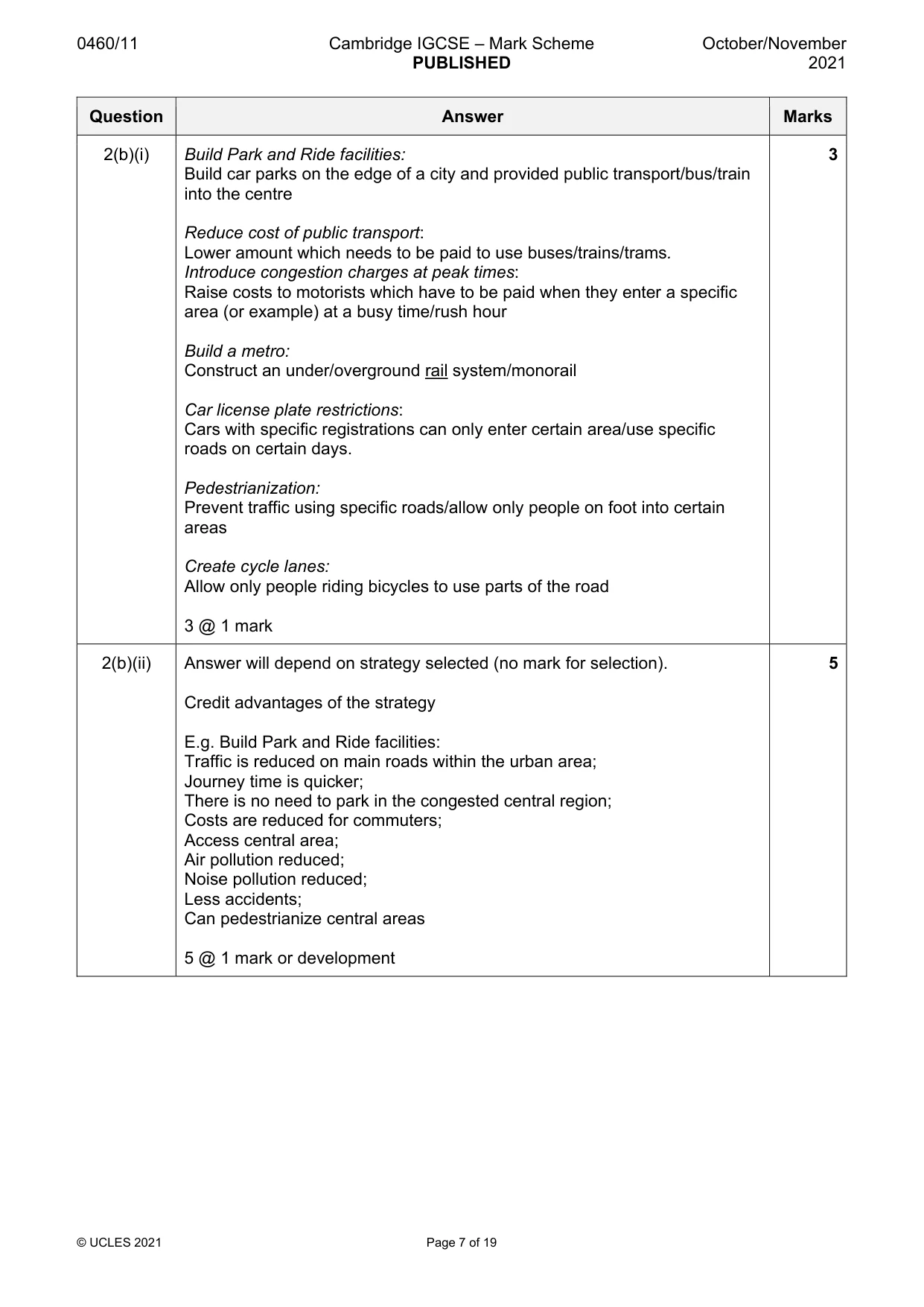
0460/11 Cambridge IGCSE – Mark Scheme PUBLISHED October/November 2021 © UCLES 2021 Page 7 of 19 Question Answer Marks 2(b)(i) Build Park and Ride facilities: Build car parks on the edge of a city and provided public transport/bus/train into the centre Reduce cost of public transport: Lower amount which needs to be paid to use buses/trains/trams. Introduce congestion charges at peak times: Raise costs to motorists which have to be paid when they enter a specific area (or example) at a busy time/rush hour Build a metro: Construct an under/overground rail system/monorail Car license plate restrictions: Cars with specific registrations can only enter certain area/use specific roads on certain days. Pedestrianization: Prevent traffic using specific roads/allow only people on foot into certain areas Create cycle lanes: Allow only people riding bicycles to use parts of the road 3 @ 1 mark 3 2(b)(ii) Answer will depend on strategy selected (no mark for selection). Credit advantages of the strategy E.g. Build Park and Ride facilities: Traffic is reduced on main roads within the urban area; Journey time is quicker; There is no need to park in the congested central region; Costs are reduced for commuters; Access central area; Air pollution reduced; Noise pollution reduced; Less accidents; Can pedestrianize central areas 5 @ 1 mark or development 5
Mark scheme, page 8
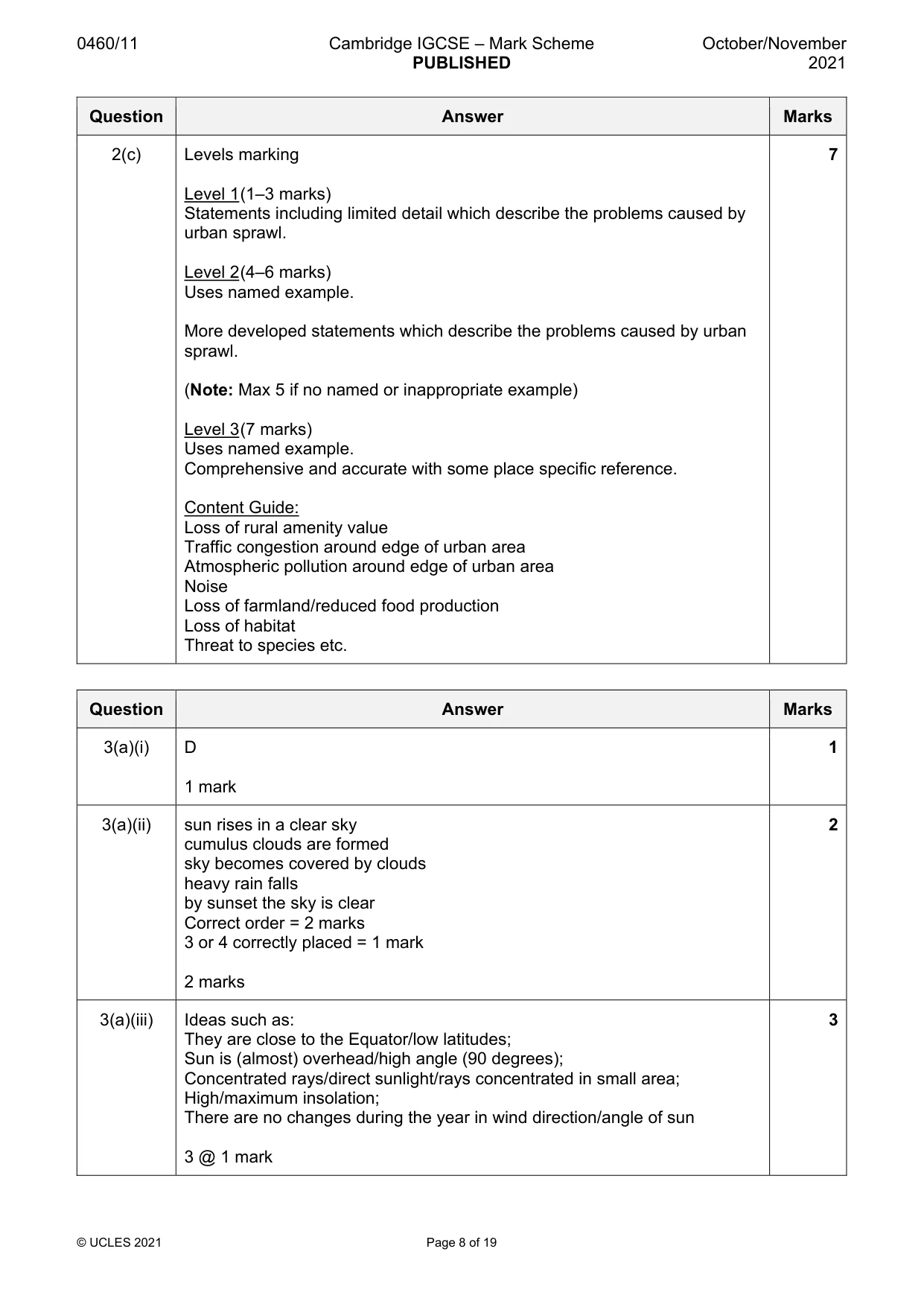
0460/11 Cambridge IGCSE – Mark Scheme PUBLISHED October/November 2021 © UCLES 2021 Page 8 of 19 Question Answer Marks 2(c) Levels marking Level 1 (1–3 marks) Statements including limited detail which describe the problems caused by urban sprawl. Level 2 (4–6 marks) Uses named example. More developed statements which describe the problems caused by urban sprawl. (Note: Max 5 if no named or inappropriate example) Level 3 (7 marks) Uses named example. Comprehensive and accurate with some place specific reference. Content Guide: Loss of rural amenity value Traffic congestion around edge of urban area Atmospheric pollution around edge of urban area Noise Loss of farmland/reduced food production Loss of habitat Threat to species etc. 7 Question Answer Marks 3(a)(i) D 1 mark 1 3(a)(ii) sun rises in a clear sky cumulus clouds are formed sky becomes covered by clouds heavy rain falls by sunset the sky is clear Correct order = 2 marks 3 or 4 correctly placed = 1 mark 2 marks 2 3(a)(iii) Ideas such as: They are close to the Equator/low latitudes; Sun is (almost) overhead/high angle (90 degrees); Concentrated rays/direct sunlight/rays concentrated in small area; High/maximum insolation; There are no changes during the year in wind direction/angle of sun 3 @ 1 mark 3
Mark scheme, page 9
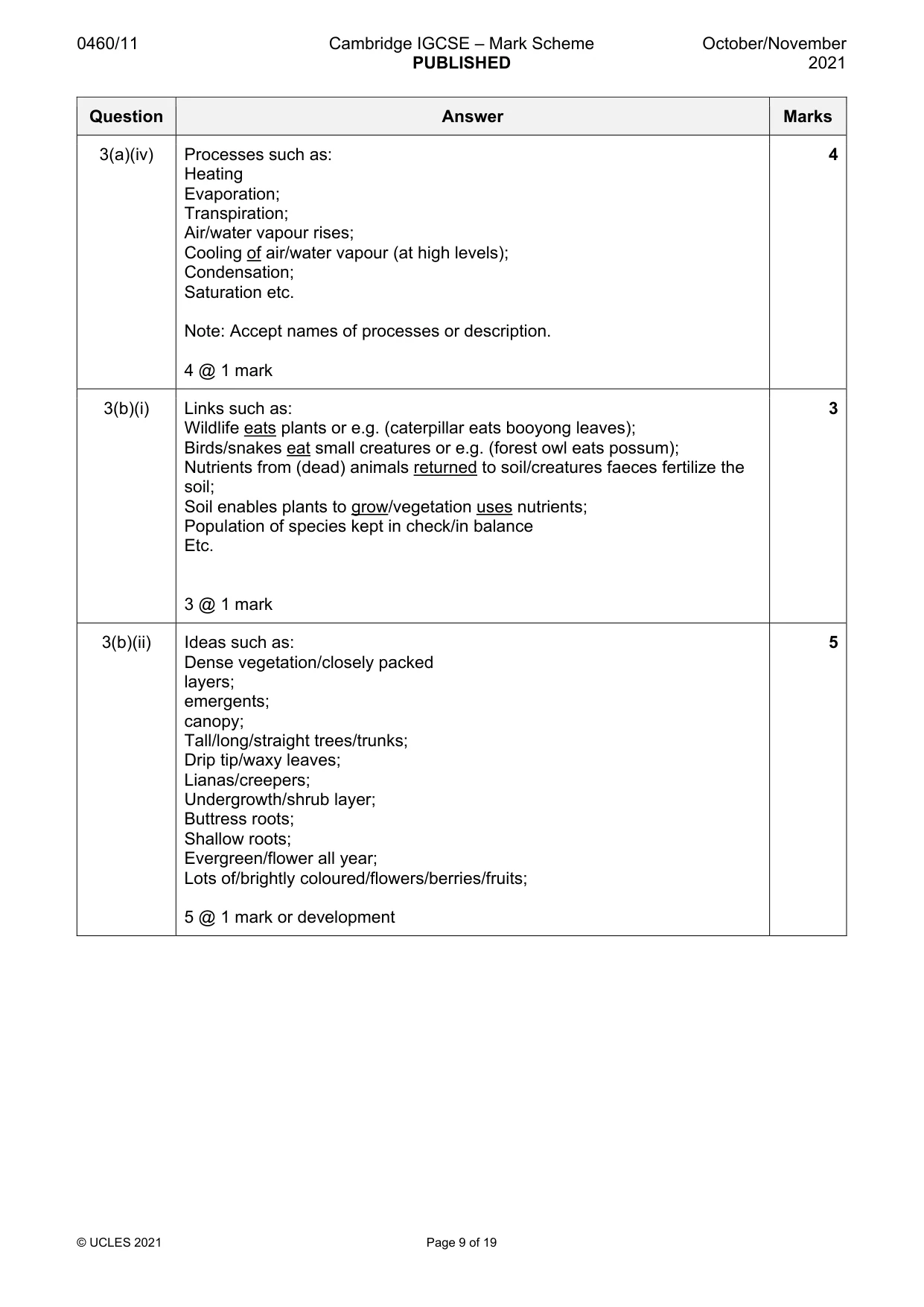
0460/11 Cambridge IGCSE – Mark Scheme PUBLISHED October/November 2021 © UCLES 2021 Page 9 of 19 Question Answer Marks 3(a)(iv) Processes such as: Heating Evaporation; Transpiration; Air/water vapour rises; Cooling of air/water vapour (at high levels); Condensation; Saturation etc. Note: Accept names of processes or description. 4 @ 1 mark 4 3(b)(i) Links such as: Wildlife eats plants or e.g. (caterpillar eats booyong leaves); Birds/snakes eat small creatures or e.g. (forest owl eats possum); Nutrients from (dead) animals returned to soil/creatures faeces fertilize the soil; Soil enables plants to grow/vegetation uses nutrients; Population of species kept in check/in balance Etc. 3 @ 1 mark 3 3(b)(ii) Ideas such as: Dense vegetation/closely packed layers; emergents; canopy; Tall/long/straight trees/trunks; Drip tip/waxy leaves; Lianas/creepers; Undergrowth/shrub layer; Buttress roots; Shallow roots; Evergreen/flower all year; Lots of/brightly coloured/flowers/berries/fruits; 5 @ 1 mark or development 5
Mark scheme, page 10
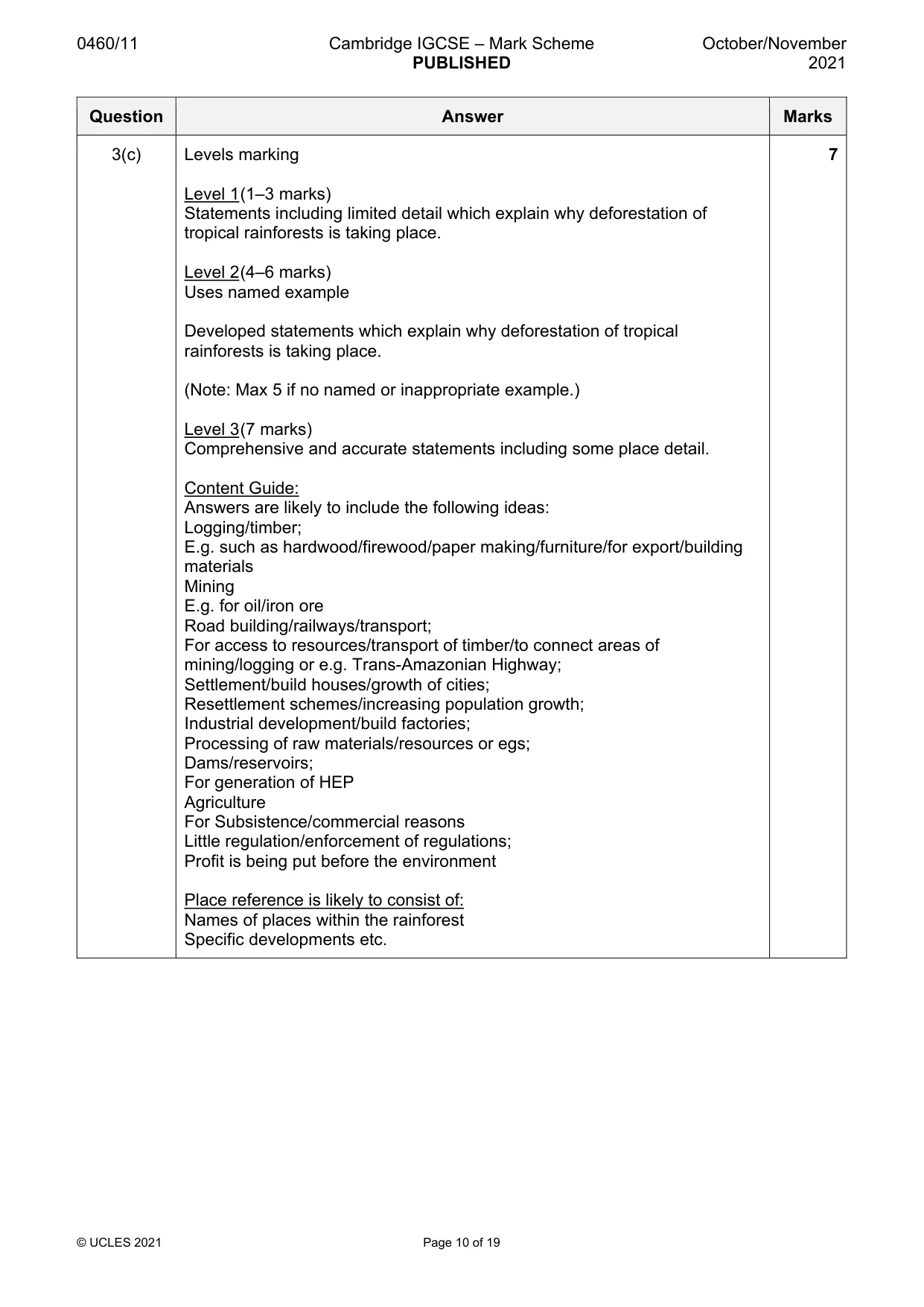
0460/11 Cambridge IGCSE – Mark Scheme PUBLISHED October/November 2021 © UCLES 2021 Page 10 of 19 Question Answer Marks 3(c) Levels marking Level 1 (1–3 marks) Statements including limited detail which explain why deforestation of tropical rainforests is taking place. Level 2 (4–6 marks) Uses named example Developed statements which explain why deforestation of tropical rainforests is taking place. (Note: Max 5 if no named or inappropriate example.) Level 3 (7 marks) Comprehensive and accurate statements including some place detail. Content Guide: Answers are likely to include the following ideas: Logging/timber; E.g. such as hardwood/firewood/paper making/furniture/for export/building materials Mining E.g. for oil/iron ore Road building/railways/transport; For access to resources/transport of timber/to connect areas of mining/logging or e.g. Trans-Amazonian Highway; Settlement/build houses/growth of cities; Resettlement schemes/increasing population growth; Industrial development/build factories; Processing of raw materials/resources or egs; Dams/reservoirs; For generation of HEP Agriculture For Subsistence/commercial reasons Little regulation/enforcement of regulations; Profit is being put before the environment Place reference is likely to consist of: Names of places within the rainforest Specific developments etc. 7
Mark scheme, page 11
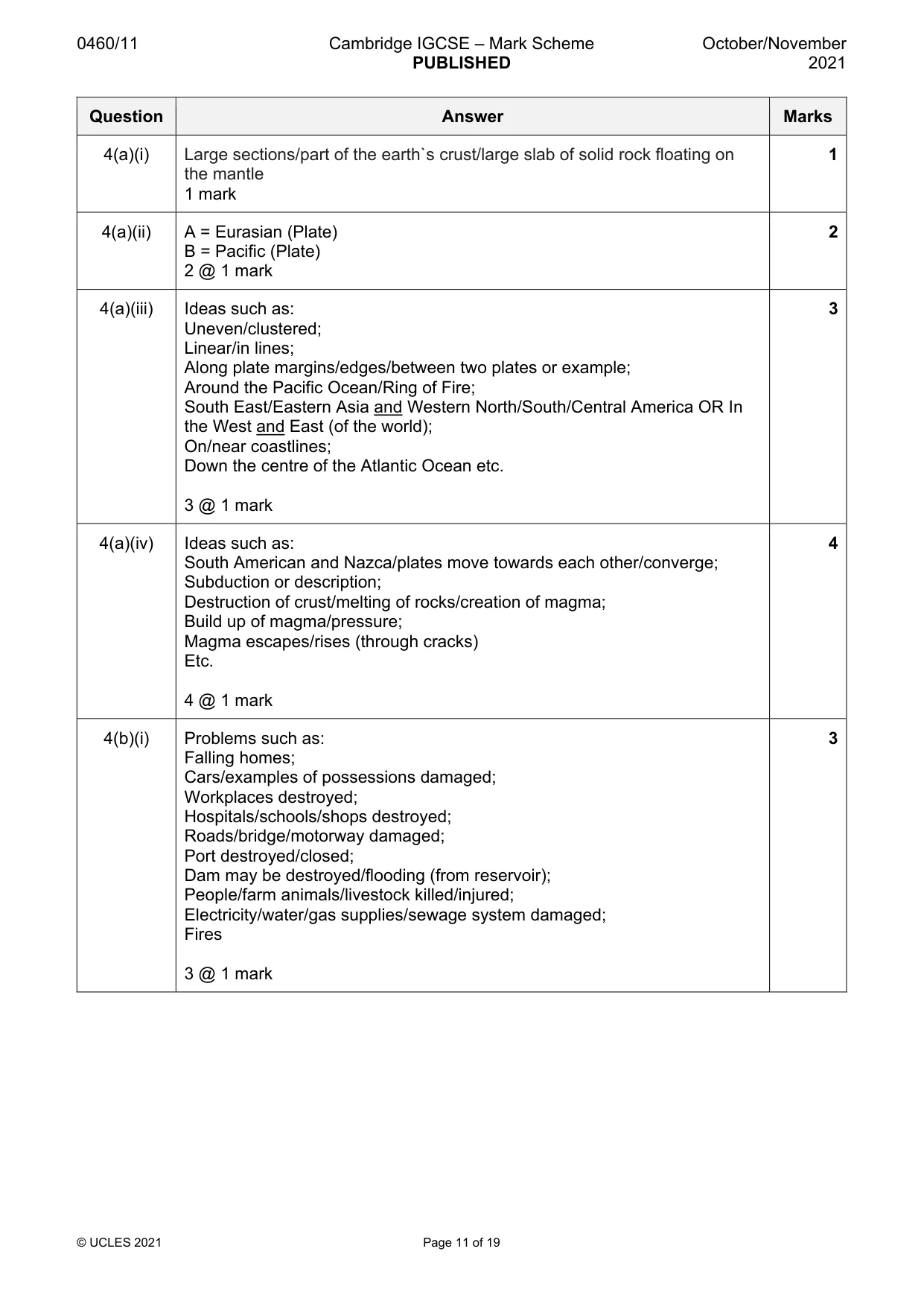
0460/11 Cambridge IGCSE – Mark Scheme PUBLISHED October/November 2021 © UCLES 2021 Page 11 of 19 Question Answer Marks 4(a)(i) Large sections/part of the earth`s crust/large slab of solid rock floating on the mantle 1 mark 1 4(a)(ii) A = Eurasian (Plate) B = Pacific (Plate) 2 @ 1 mark 2 4(a)(iii) Ideas such as: Uneven/clustered; Linear/in lines; Along plate margins/edges/between two plates or example; Around the Pacific Ocean/Ring of Fire; South East/Eastern Asia and Western North/South/Central America OR In the West and East (of the world); On/near coastlines; Down the centre of the Atlantic Ocean etc. 3 @ 1 mark 3 4(a)(iv) Ideas such as: South American and Nazca/plates move towards each other/converge; Subduction or description; Destruction of crust/melting of rocks/creation of magma; Build up of magma/pressure; Magma escapes/rises (through cracks) Etc. 4 @ 1 mark 4 4(b)(i) Problems such as: Falling homes; Cars/examples of possessions damaged; Workplaces destroyed; Hospitals/schools/shops destroyed; Roads/bridge/motorway damaged; Port destroyed/closed; Dam may be destroyed/flooding (from reservoir); People/farm animals/livestock killed/injured; Electricity/water/gas supplies/sewage system damaged; Fires 3 @ 1 mark 3
Mark scheme, page 12
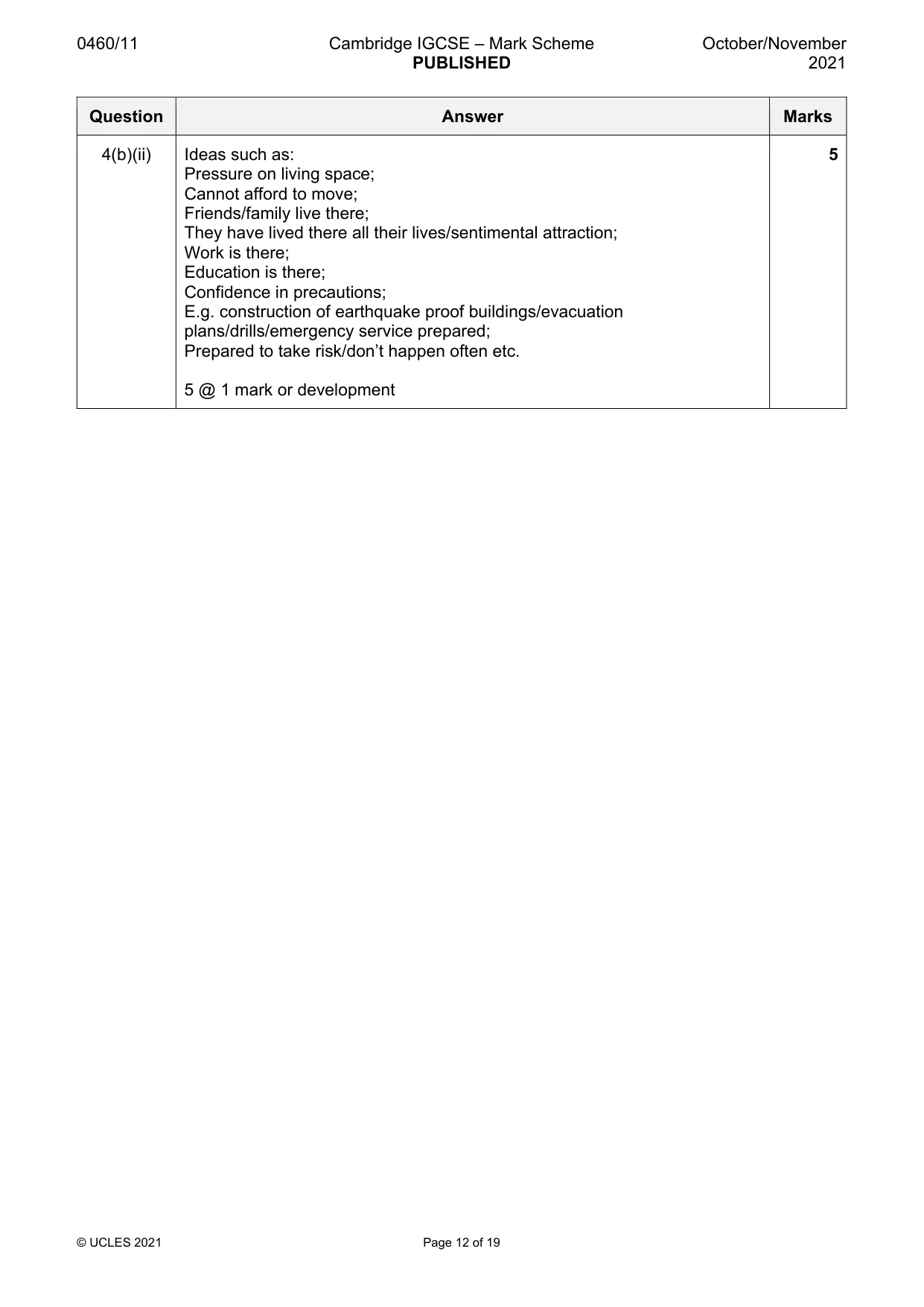
0460/11 Cambridge IGCSE – Mark Scheme PUBLISHED October/November 2021 © UCLES 2021 Page 12 of 19 Question Answer Marks 4(b)(ii) Ideas such as: Pressure on living space; Cannot afford to move; Friends/family live there; They have lived there all their lives/sentimental attraction; Work is there; Education is there; Confidence in precautions; E.g. construction of earthquake proof buildings/evacuation plans/drills/emergency service prepared; Prepared to take risk/don’t happen often etc. 5 @ 1 mark or development 5
Mark scheme, page 13
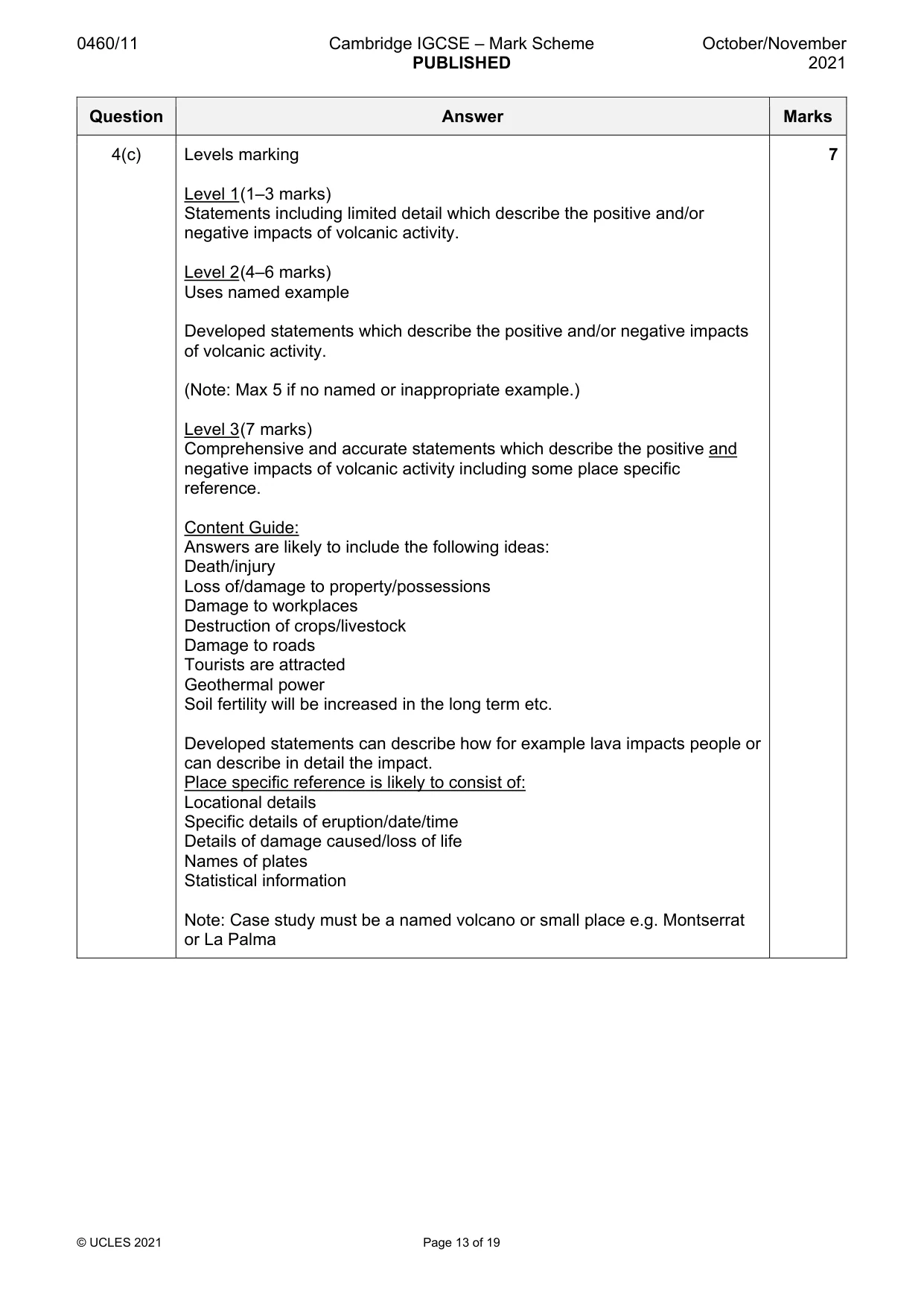
0460/11 Cambridge IGCSE – Mark Scheme PUBLISHED October/November 2021 © UCLES 2021 Page 13 of 19 Question Answer Marks 4(c) Levels marking Level 1 (1–3 marks) Statements including limited detail which describe the positive and/or negative impacts of volcanic activity. Level 2 (4–6 marks) Uses named example Developed statements which describe the positive and/or negative impacts of volcanic activity. (Note: Max 5 if no named or inappropriate example.) Level 3 (7 marks) Comprehensive and accurate statements which describe the positive and negative impacts of volcanic activity including some place specific reference. Content Guide: Answers are likely to include the following ideas: Death/injury Loss of/damage to property/possessions Damage to workplaces Destruction of crops/livestock Damage to roads Tourists are attracted Geothermal power Soil fertility will be increased in the long term etc. Developed statements can describe how for example lava impacts people or can describe in detail the impact. Place specific reference is likely to consist of: Locational details Specific details of eruption/date/time Details of damage caused/loss of life Names of plates Statistical information Note: Case study must be a named volcano or small place e.g. Montserrat or La Palma 7
Mark scheme, page 14
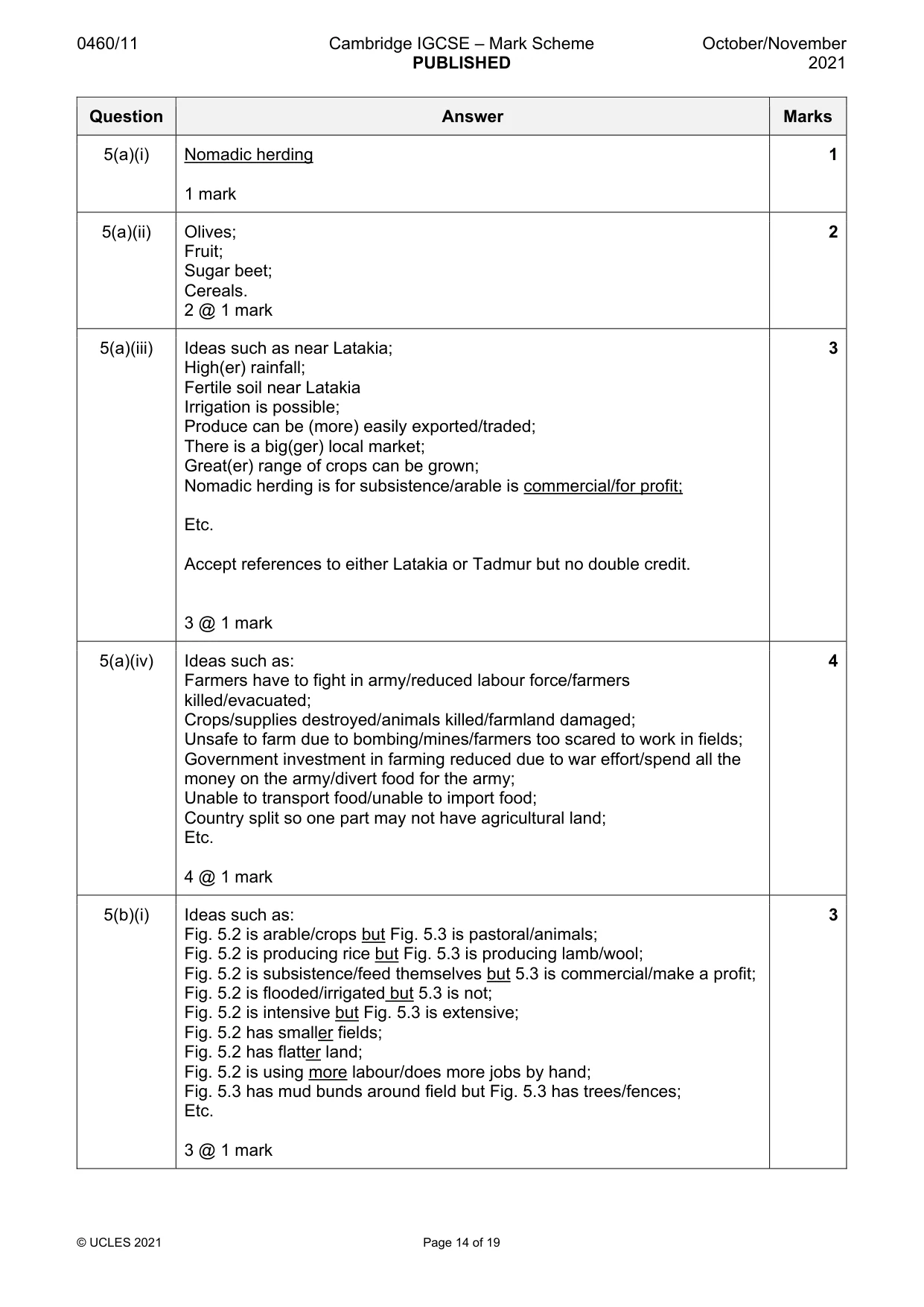
0460/11 Cambridge IGCSE – Mark Scheme PUBLISHED October/November 2021 © UCLES 2021 Page 14 of 19 Question Answer Marks 5(a)(i) Nomadic herding 1 mark 1 5(a)(ii) Olives; Fruit; Sugar beet; Cereals. 2 @ 1 mark 2 5(a)(iii) Ideas such as near Latakia; High(er) rainfall; Fertile soil near Latakia Irrigation is possible; Produce can be (more) easily exported/traded; There is a big(ger) local market; Great(er) range of crops can be grown; Nomadic herding is for subsistence/arable is commercial/for profit; Etc. Accept references to either Latakia or Tadmur but no double credit. 3 @ 1 mark 3 5(a)(iv) Ideas such as: Farmers have to fight in army/reduced labour force/farmers killed/evacuated; Crops/supplies destroyed/animals killed/farmland damaged; Unsafe to farm due to bombing/mines/farmers too scared to work in fields; Government investment in farming reduced due to war effort/spend all the money on the army/divert food for the army; Unable to transport food/unable to import food; Country split so one part may not have agricultural land; Etc. 4 @ 1 mark 4 5(b)(i) Ideas such as: Fig. 5.2 is arable/crops but Fig. 5.3 is pastoral/animals; Fig. 5.2 is producing rice but Fig. 5.3 is producing lamb/wool; Fig. 5.2 is subsistence/feed themselves but 5.3 is commercial/make a profit; Fig. 5.2 is flooded/irrigated but 5.3 is not; Fig. 5.2 is intensive but Fig. 5.3 is extensive; Fig. 5.2 has smaller fields; Fig. 5.2 has flatter land; Fig. 5.2 is using more labour/does more jobs by hand; Fig. 5.3 has mud bunds around field but Fig. 5.3 has trees/fences; Etc. 3 @ 1 mark 3
Mark scheme, page 15
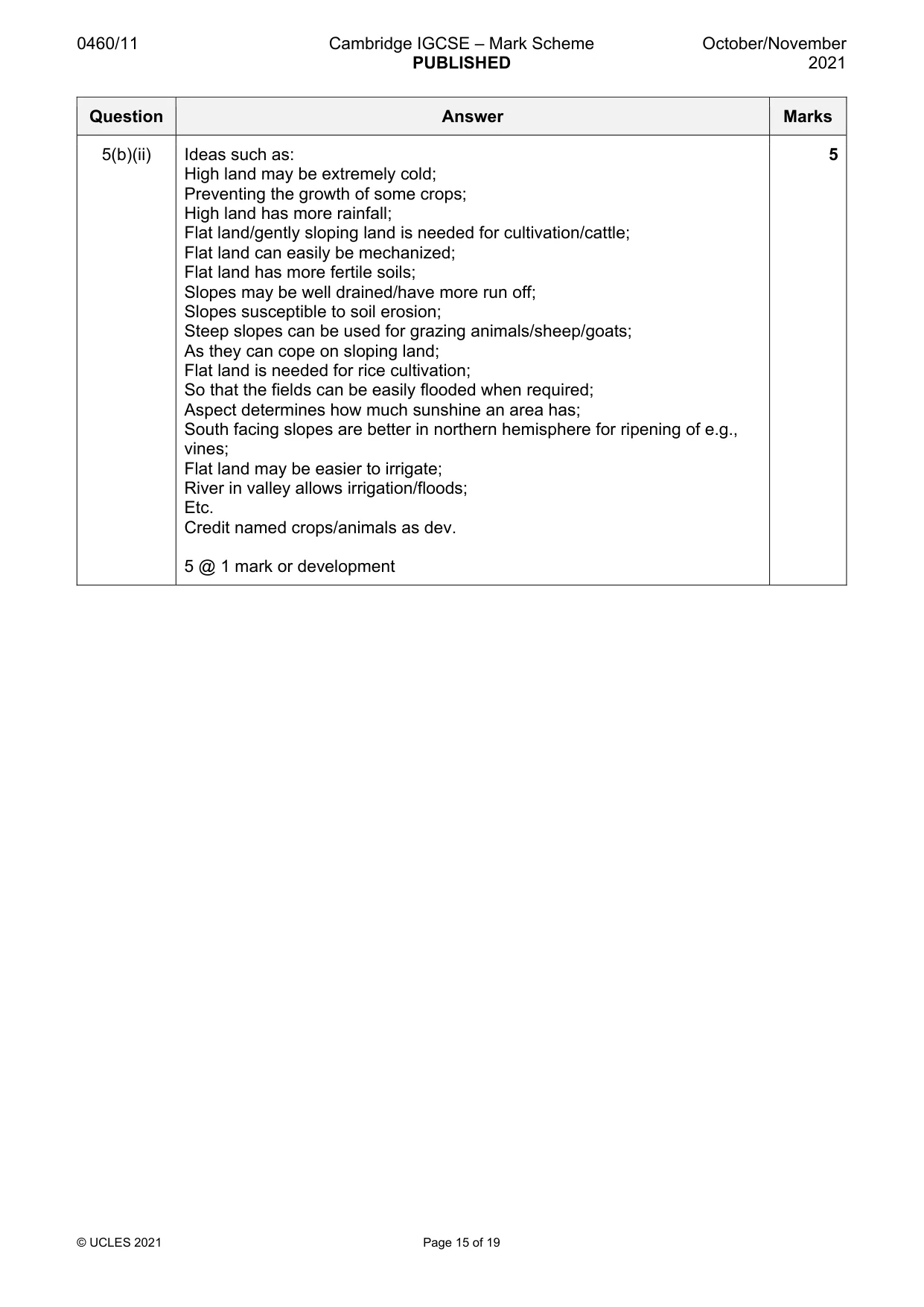
0460/11 Cambridge IGCSE – Mark Scheme PUBLISHED October/November 2021 © UCLES 2021 Page 15 of 19 Question Answer Marks 5(b)(ii) Ideas such as: High land may be extremely cold; Preventing the growth of some crops; High land has more rainfall; Flat land/gently sloping land is needed for cultivation/cattle; Flat land can easily be mechanized; Flat land has more fertile soils; Slopes may be well drained/have more run off; Slopes susceptible to soil erosion; Steep slopes can be used for grazing animals/sheep/goats; As they can cope on sloping land; Flat land is needed for rice cultivation; So that the fields can be easily flooded when required; Aspect determines how much sunshine an area has; South facing slopes are better in northern hemisphere for ripening of e.g., vines; Flat land may be easier to irrigate; River in valley allows irrigation/floods; Etc. Credit named crops/animals as dev. 5 @ 1 mark or development 5
Mark scheme, page 16
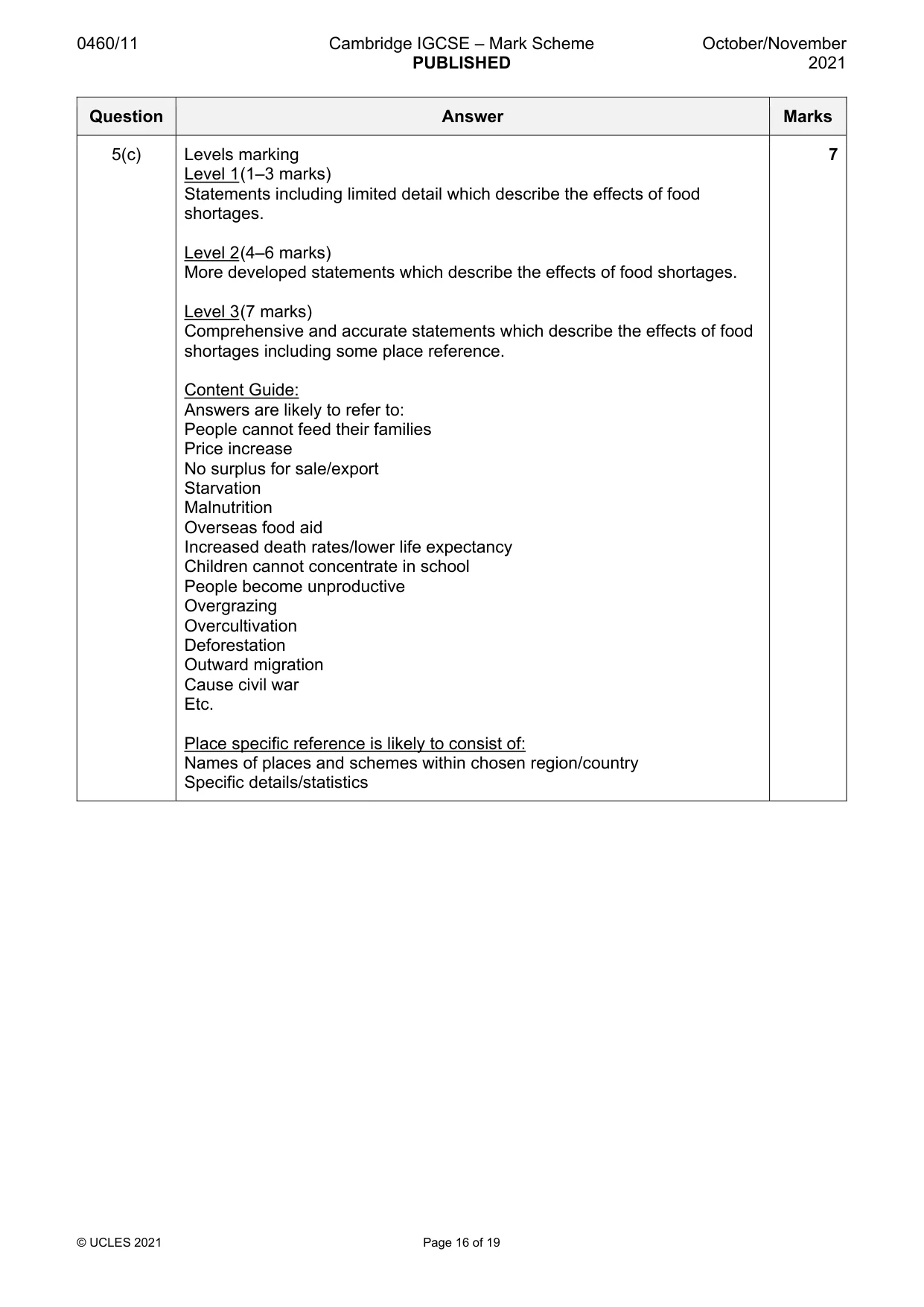
0460/11 Cambridge IGCSE – Mark Scheme PUBLISHED October/November 2021 © UCLES 2021 Page 16 of 19 Question Answer Marks 5(c) Levels marking Level 1 (1–3 marks) Statements including limited detail which describe the effects of food shortages. Level 2 (4–6 marks) More developed statements which describe the effects of food shortages. Level 3 (7 marks) Comprehensive and accurate statements which describe the effects of food shortages including some place reference. Content Guide: Answers are likely to refer to: People cannot feed their families Price increase No surplus for sale/export Starvation Malnutrition Overseas food aid Increased death rates/lower life expectancy Children cannot concentrate in school People become unproductive Overgrazing Overcultivation Deforestation Outward migration Cause civil war Etc. Place specific reference is likely to consist of: Names of places and schemes within chosen region/country Specific details/statistics 7
Mark scheme, page 17
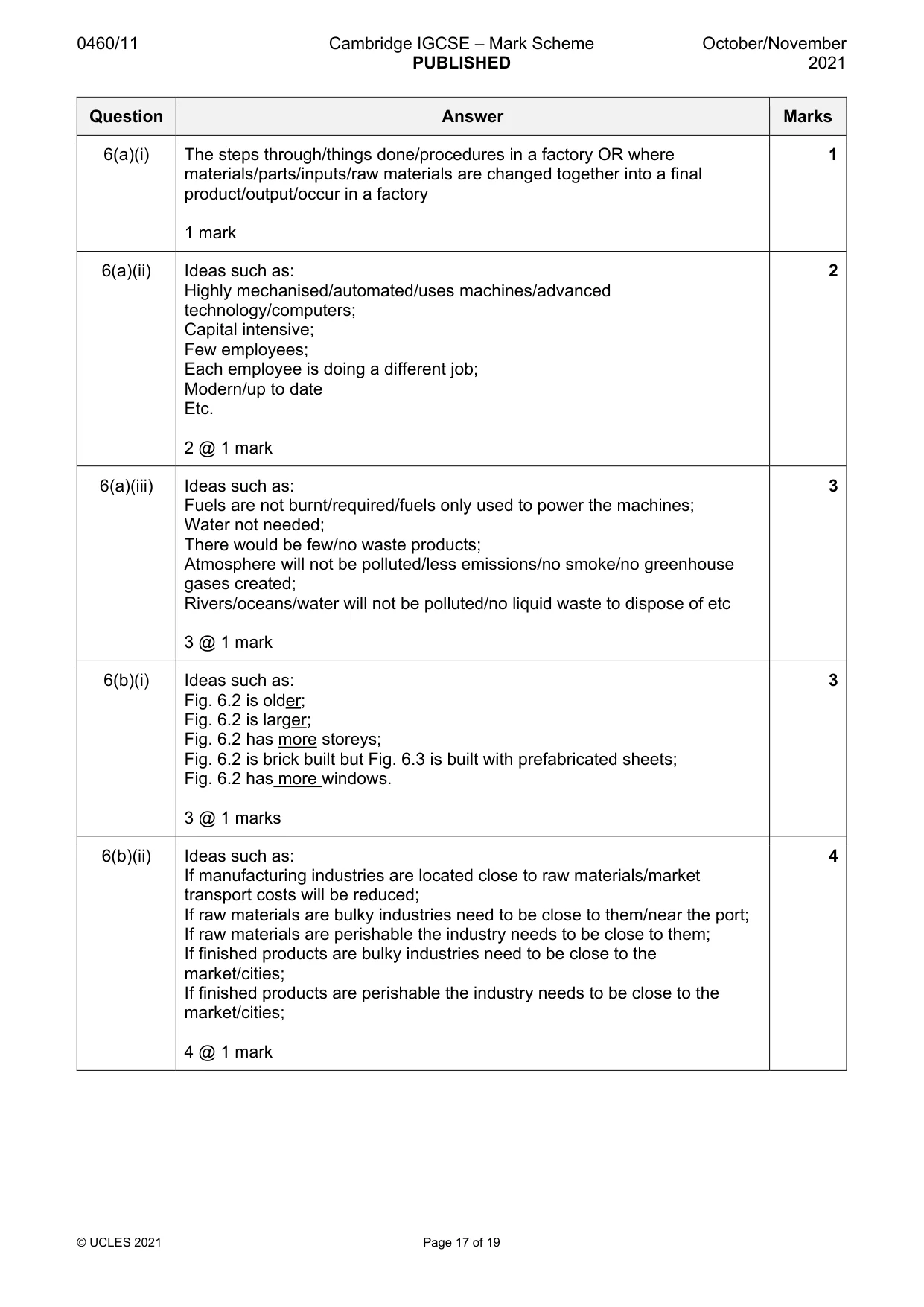
0460/11 Cambridge IGCSE – Mark Scheme PUBLISHED October/November 2021 © UCLES 2021 Page 17 of 19 Question Answer Marks 6(a)(i) The steps through/things done/procedures in a factory OR where materials/parts/inputs/raw materials are changed together into a final product/output/occur in a factory 1 mark 1 6(a)(ii) Ideas such as: Highly mechanised/automated/uses machines/advanced technology/computers; Capital intensive; Few employees; Each employee is doing a different job; Modern/up to date Etc. 2 @ 1 mark 2 6(a)(iii) Ideas such as: Fuels are not burnt/required/fuels only used to power the machines; Water not needed; There would be few/no waste products; Atmosphere will not be polluted/less emissions/no smoke/no greenhouse gases created; Rivers/oceans/water will not be polluted/no liquid waste to dispose of etc 3 @ 1 mark 3 6(b)(i) Ideas such as: Fig. 6.2 is older; Fig. 6.2 is larger; Fig. 6.2 has more storeys; Fig. 6.2 is brick built but Fig. 6.3 is built with prefabricated sheets; Fig. 6.2 has more windows. 3 @ 1 marks 3 6(b)(ii) Ideas such as: If manufacturing industries are located close to raw materials/market transport costs will be reduced; If raw materials are bulky industries need to be close to them/near the port; If raw materials are perishable the industry needs to be close to them; If finished products are bulky industries need to be close to the market/cities; If finished products are perishable the industry needs to be close to the market/cities; 4 @ 1 mark 4
Mark scheme, page 18
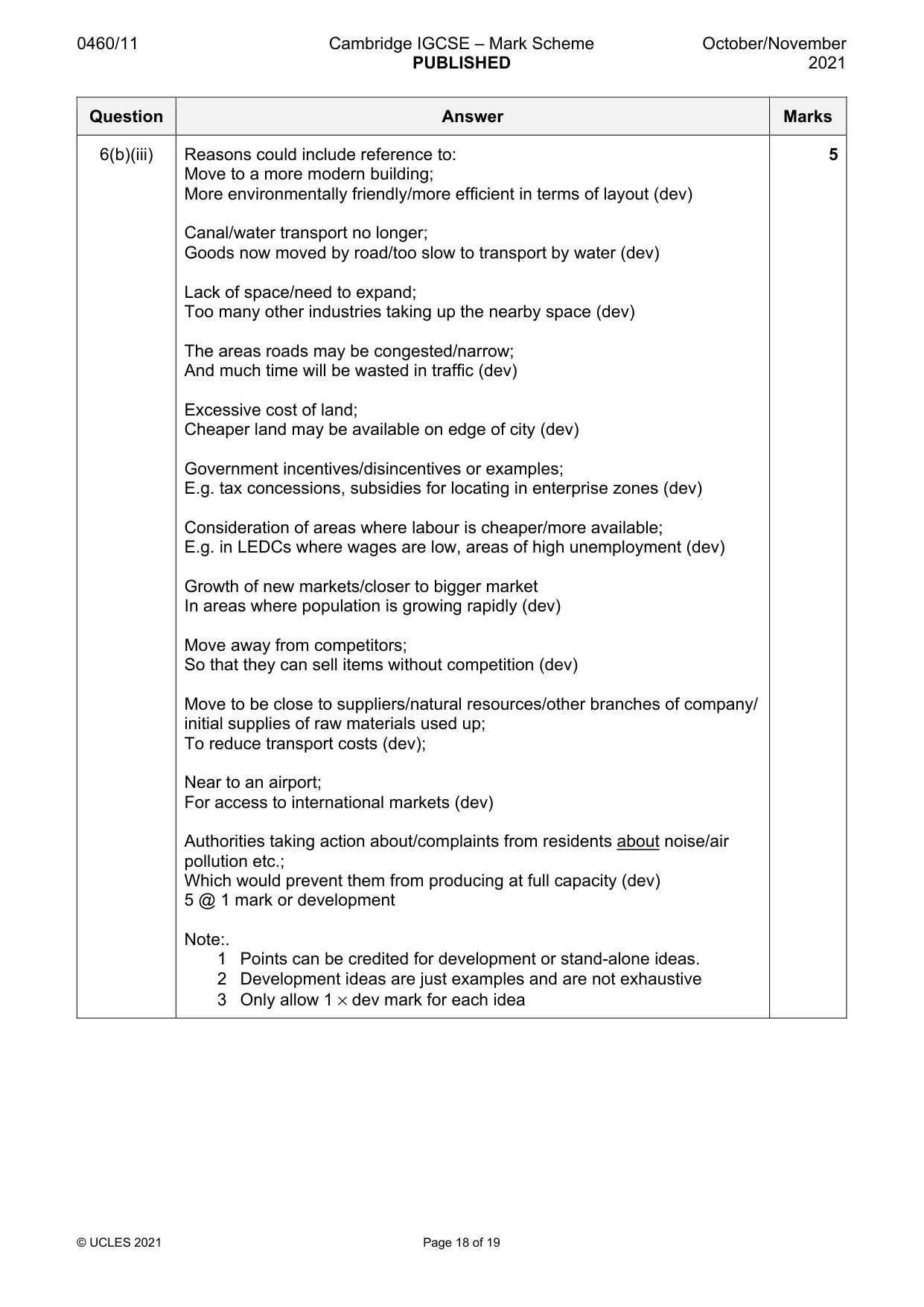
0460/11 Cambridge IGCSE – Mark Scheme PUBLISHED October/November 2021 © UCLES 2021 Page 18 of 19 Question Answer Marks 6(b)(iii) Reasons could include reference to: Move to a more modern building; More environmentally friendly/more efficient in terms of layout (dev) Canal/water transport no longer; Goods now moved by road/too slow to transport by water (dev) Lack of space/need to expand; Too many other industries taking up the nearby space (dev) The areas roads may be congested/narrow; And much time will be wasted in traffic (dev) Excessive cost of land; Cheaper land may be available on edge of city (dev) Government incentives/disincentives or examples; E.g. tax concessions, subsidies for locating in enterprise zones (dev) Consideration of areas where labour is cheaper/more available; E.g. in LEDCs where wages are low, areas of high unemployment (dev) Growth of new markets/closer to bigger market In areas where population is growing rapidly (dev) Move away from competitors; So that they can sell items without competition (dev) Move to be close to suppliers/natural resources/other branches of company/ initial supplies of raw materials used up; To reduce transport costs (dev); Near to an airport; For access to international markets (dev) Authorities taking action about/complaints from residents about noise/air pollution etc.; Which would prevent them from producing at full capacity (dev) 5 @ 1 mark or development Note:. 1 Points can be credited for development or stand-alone ideas. 2 Development ideas are just examples and are not exhaustive 3 Only allow 1 × dev mark for each idea 5
Mark scheme, page 19
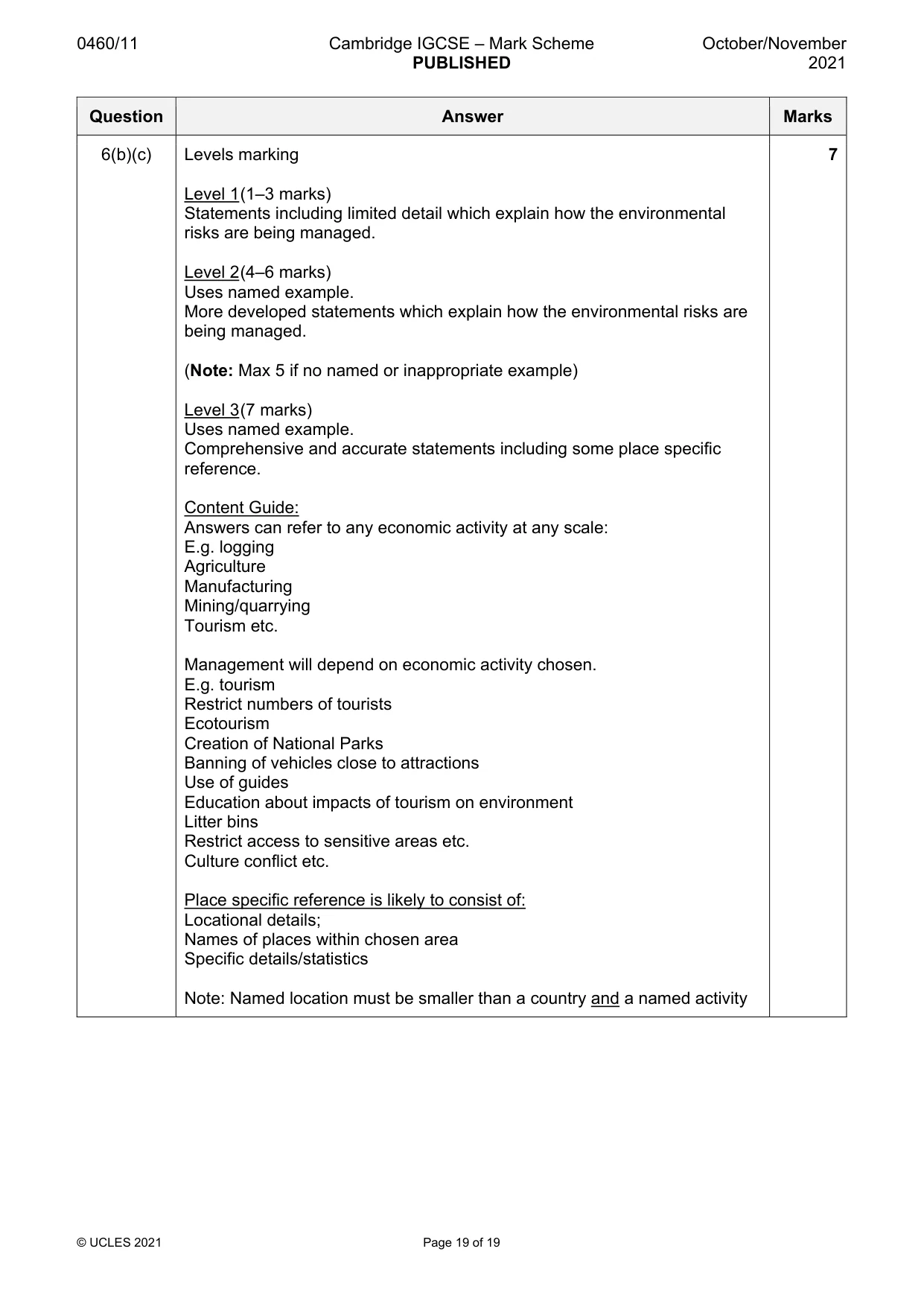
0460/11 Cambridge IGCSE – Mark Scheme PUBLISHED October/November 2021 © UCLES 2021 Page 19 of 19 Question Answer Marks 6(b)(c) Levels marking Level 1 (1–3 marks) Statements including limited detail which explain how the environmental risks are being managed. Level 2 (4–6 marks) Uses named example. More developed statements which explain how the environmental risks are being managed. (Note: Max 5 if no named or inappropriate example) Level 3 (7 marks) Uses named example. Comprehensive and accurate statements including some place specific reference. Content Guide: Answers can refer to any economic activity at any scale: E.g. logging Agriculture Manufacturing Mining/quarrying Tourism etc. Management will depend on economic activity chosen. E.g. tourism Restrict numbers of tourists Ecotourism Creation of National Parks Banning of vehicles close to attractions Use of guides Education about impacts of tourism on environment Litter bins Restrict access to sensitive areas etc. Culture conflict etc. Place specific reference is likely to consist of: Locational details; Names of places within chosen area Specific details/statistics Note: Named location must be smaller than a country and a named activity 7
What you needed in this session
Cambridge’s own grade thresholds for 2021 Oct/Nov, Paper 1 · Variant 1. A higher threshold means an easier paper — the bar moves with how the cohort did.