Cambridge IGCSE Geography 0460 — 2023 Oct/Nov Paper 1 · Variant 1
0460/11/O/N/23 · 75 marks · ≈84 min
The question paper and its mark scheme, free to read here and free to download. This is Cambridge’s own paper, exactly as it was sat.
Question paper28 pages




Mark scheme21 pages
Answers below. Sit the paper first if you are practising.
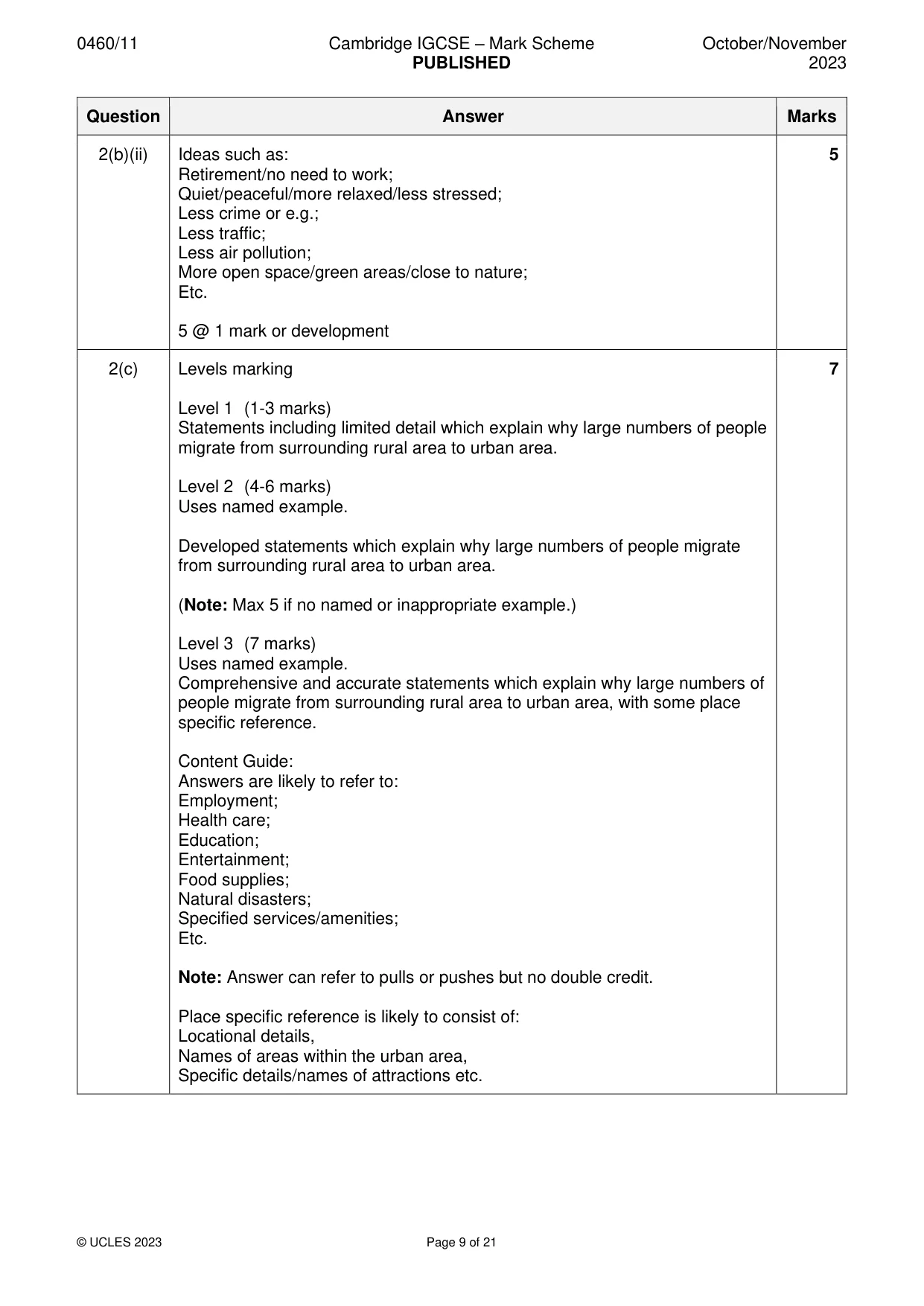
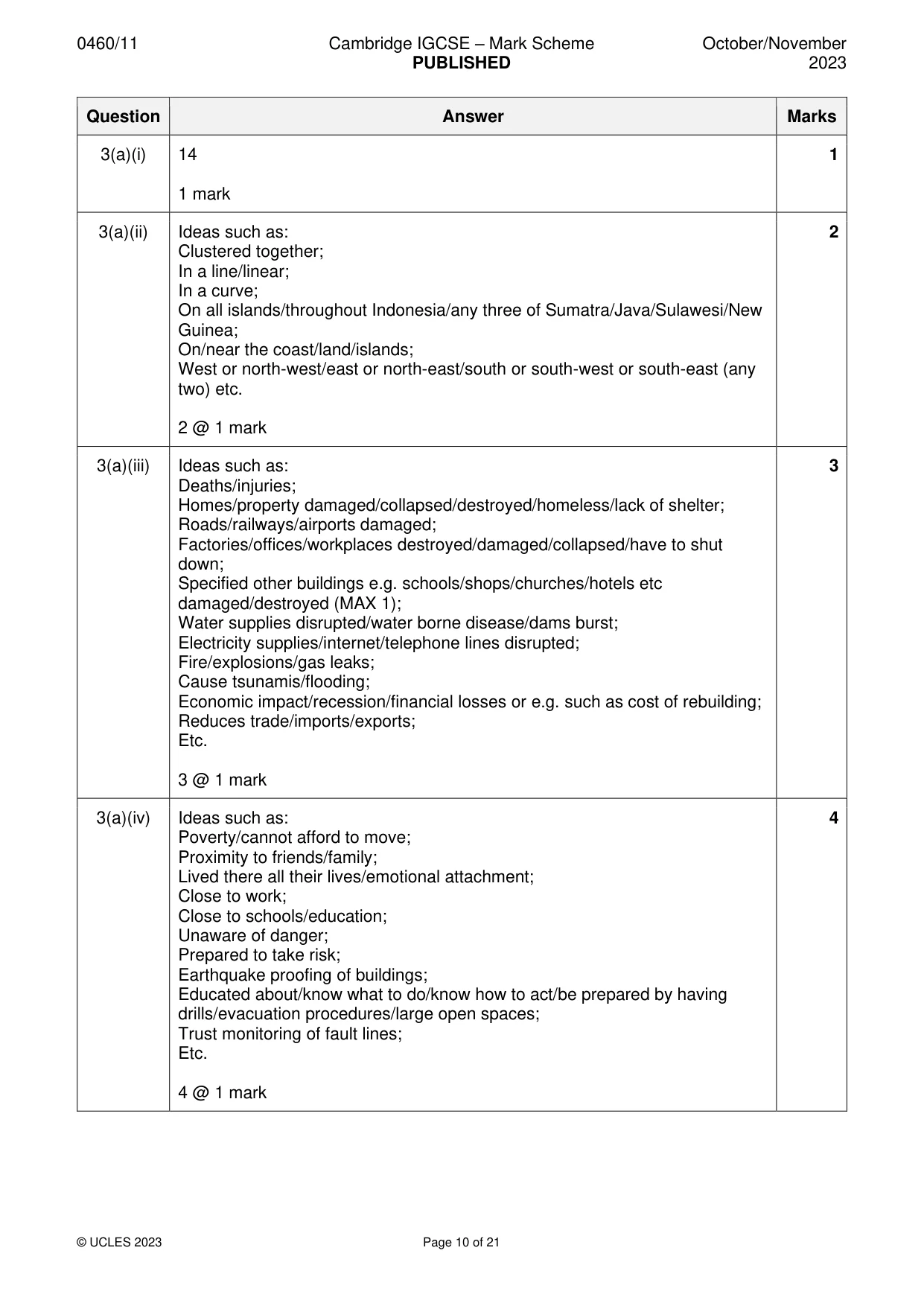
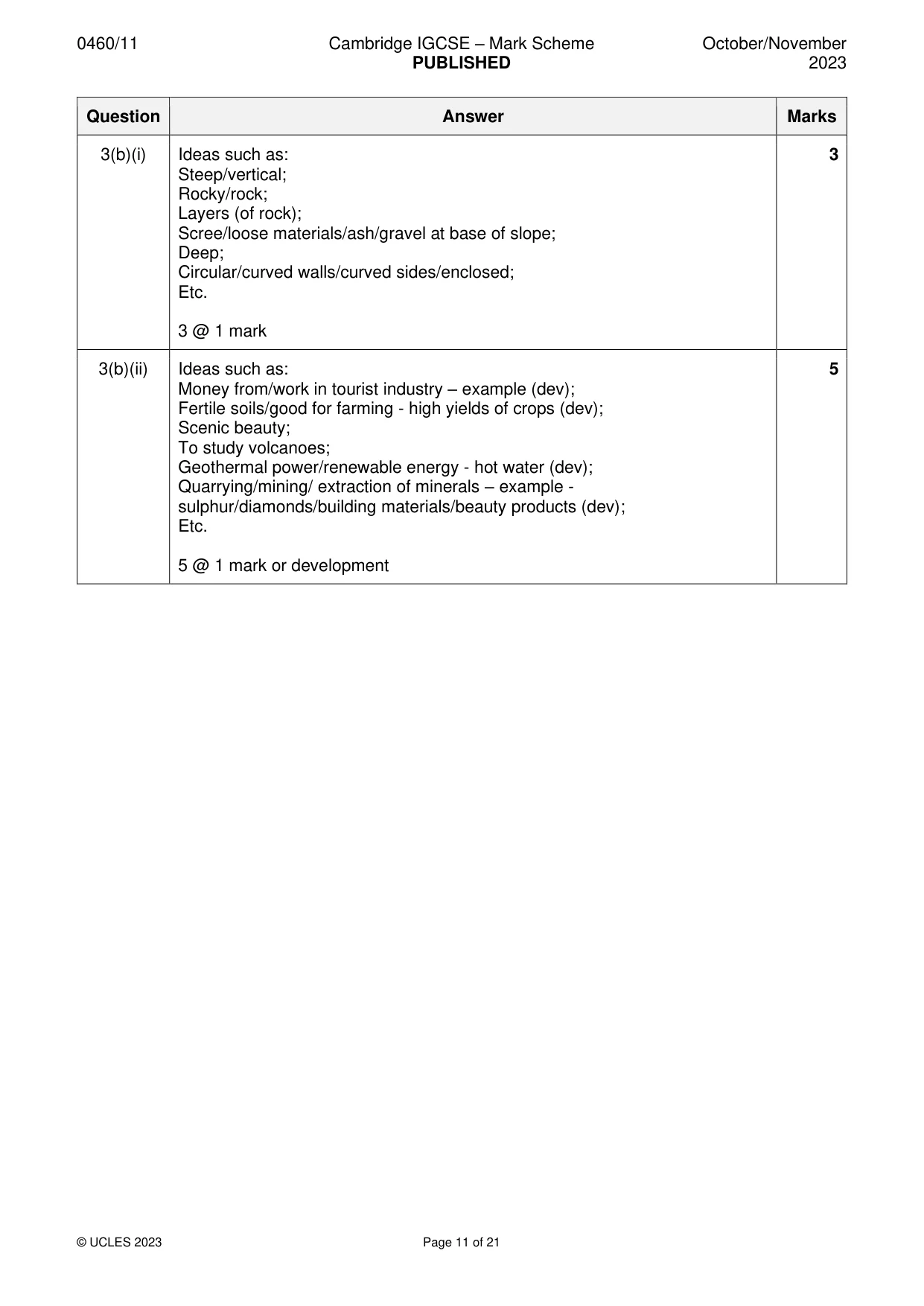
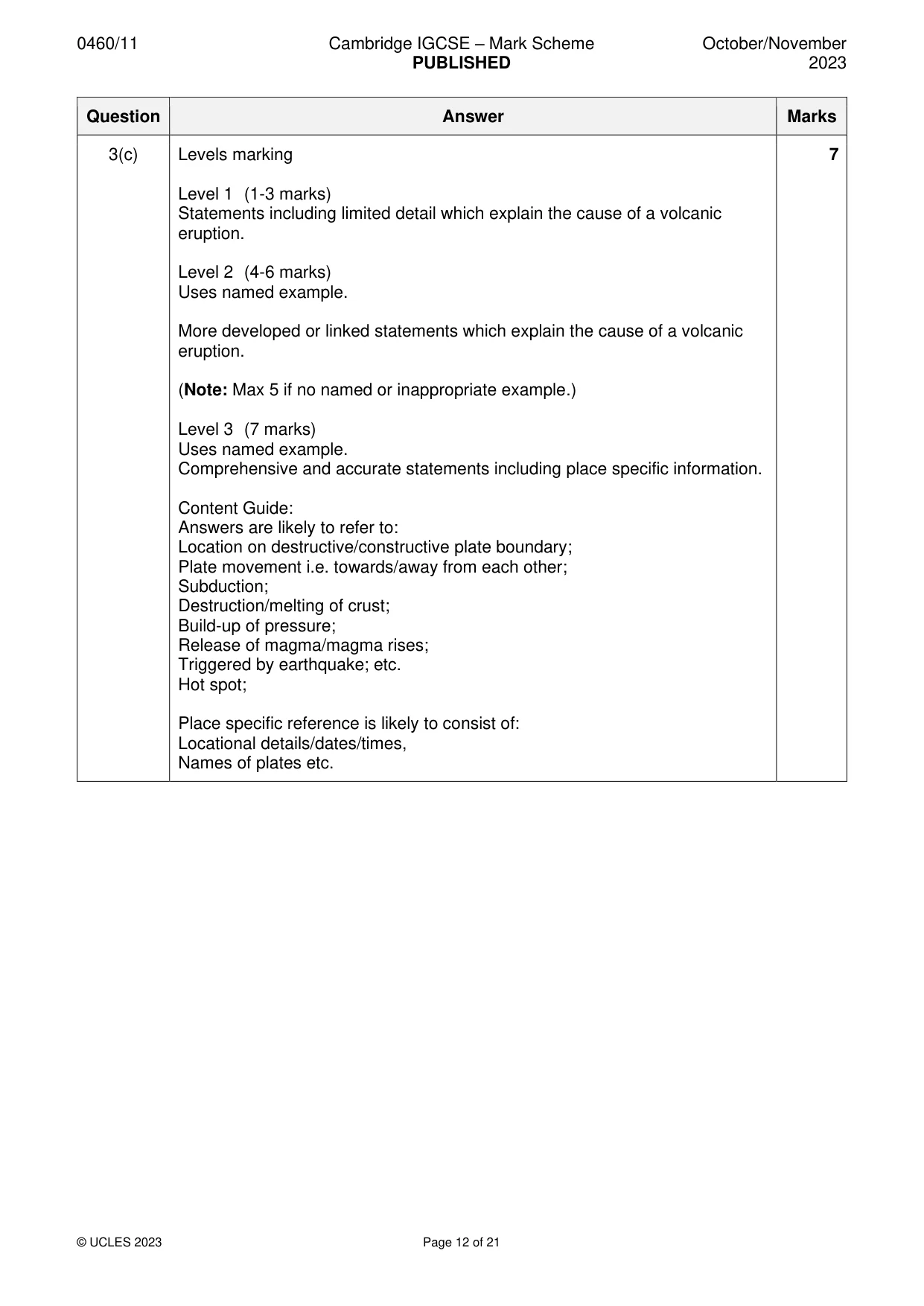
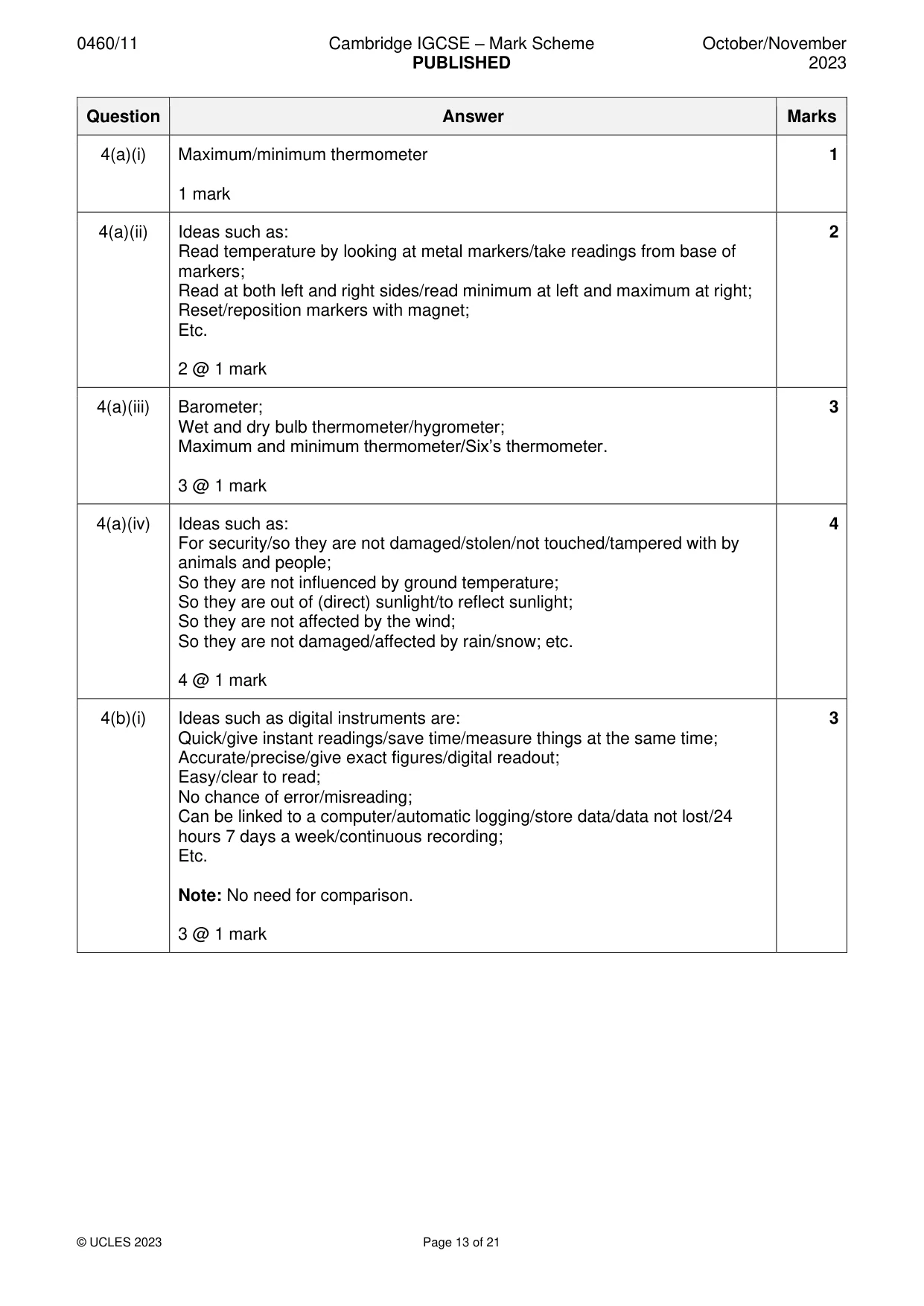
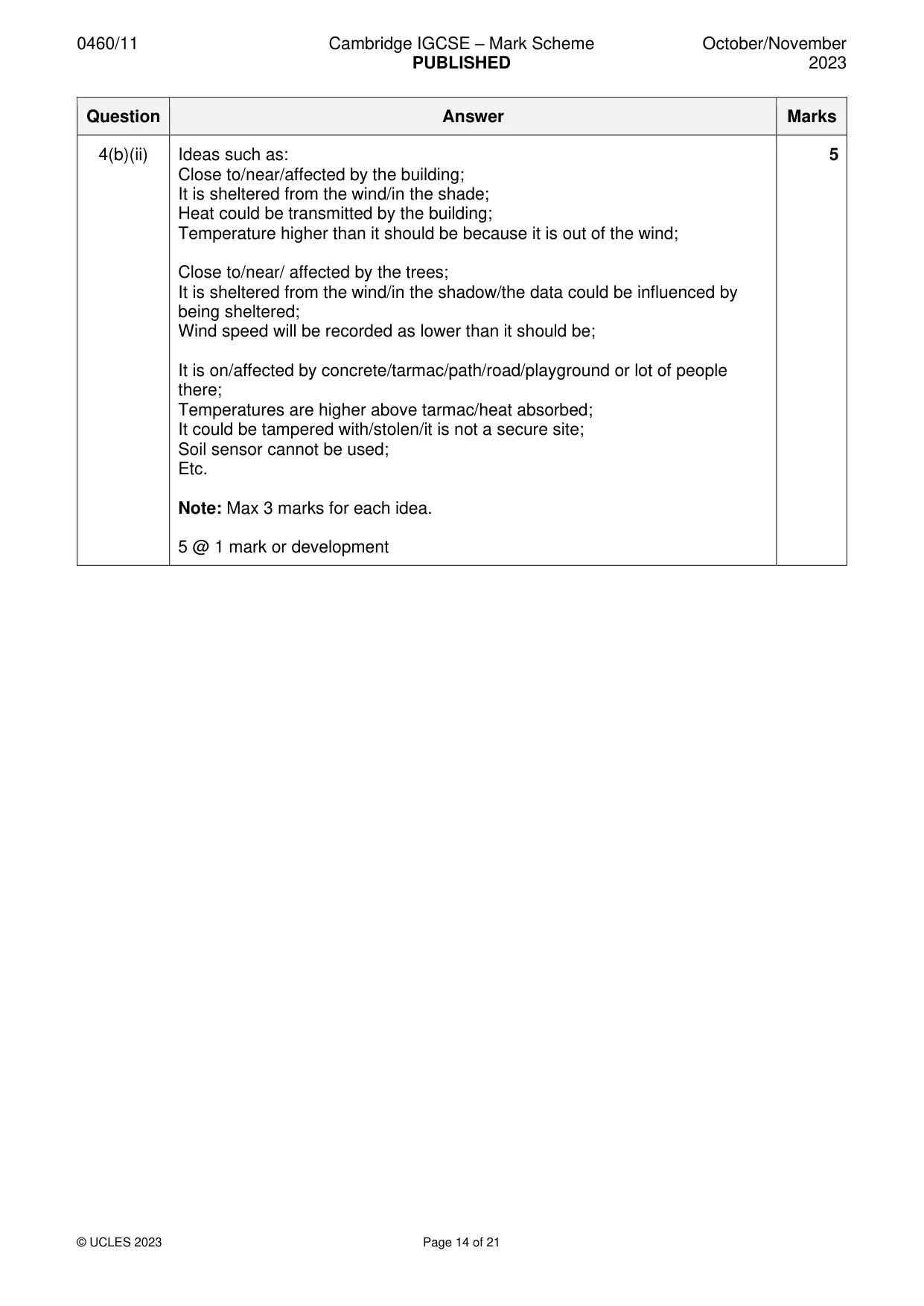
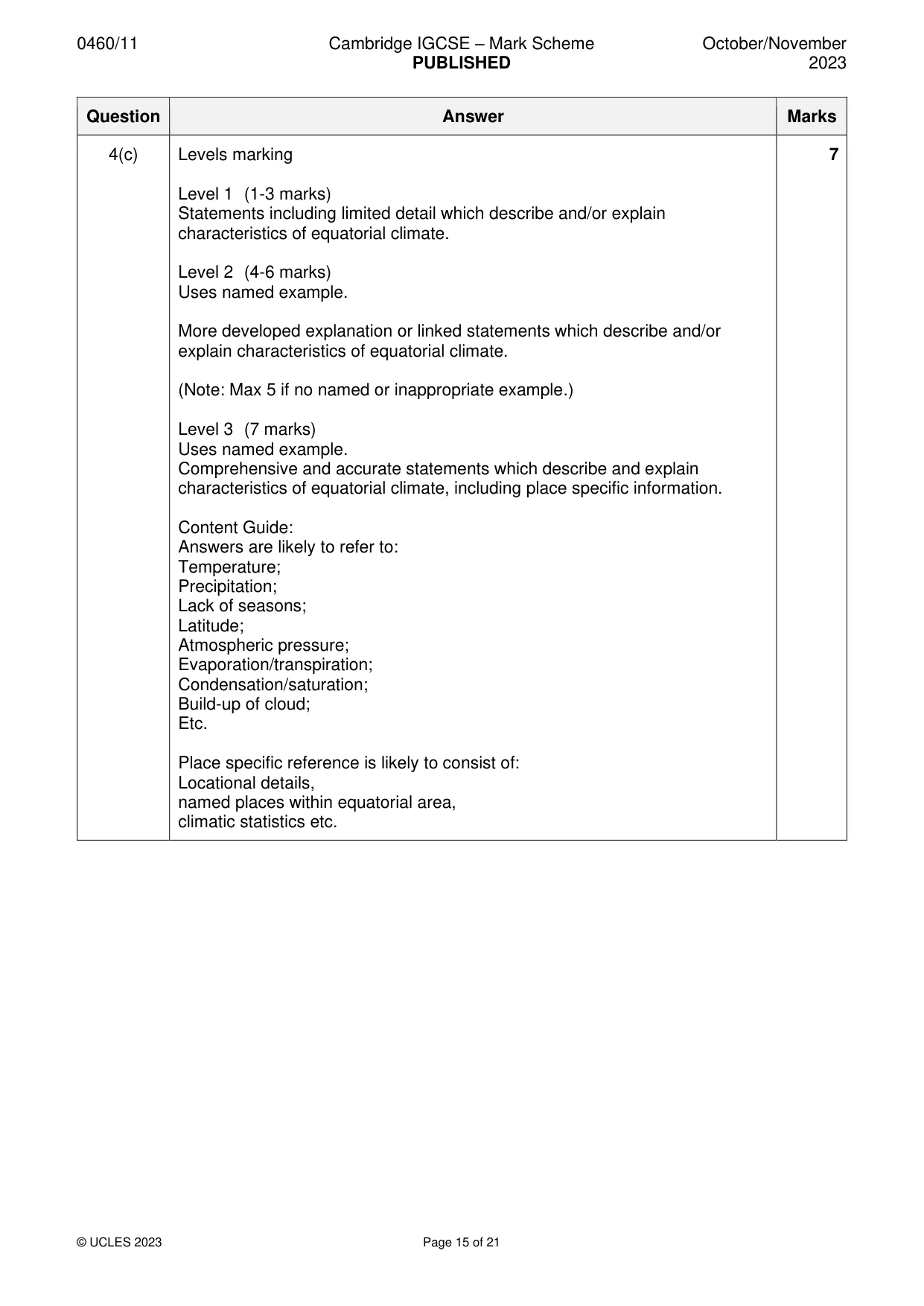
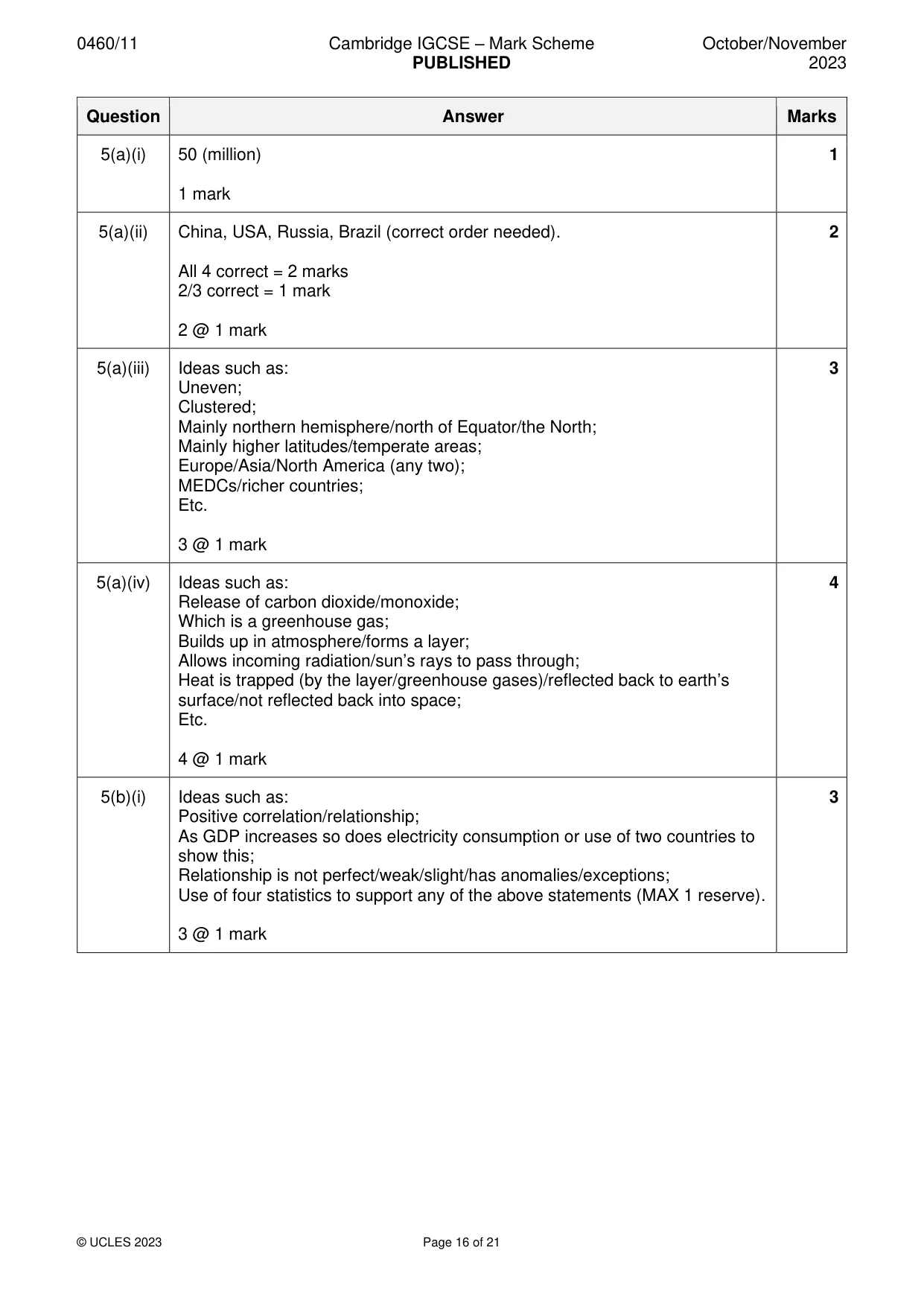
Paper as text
Question paper, page 1
This document has 28 pages. Any blank pages are indicated. [Turn over Cambridge IGCSE™ GEOGRAPHY 0460/11 Paper 1 Geographical Themes October/November 2023 1 hour 45 minutes You must answer on the question paper. You will need: Insert (enclosed) Calculator Ruler INSTRUCTIONS ● Answer three questions in total, one from each section. ● Use a black or dark blue pen. You may use an HB pencil for any diagrams or graphs. ● Write your name, centre number and candidate number in the boxes at the top of the page. ● Write your answer to each question in the space provided. ● Do not use an erasable pen or correction fluid. ● Do not write on any bar codes. ● If additional space is needed, you should use the lined pages at the end of this booklet; the question number or numbers must be clearly shown. INFORMATION ● The total mark for this paper is 75. ● The number of marks for each question or part question is shown in brackets [ ]. ● The insert contains additional resources referred to in the questions. Definitions MEDCs – More Economically Developed Countries LEDCs – Less Economically Developed Countries * 0 4 1 7 3 5 4 4 2 9 * DC (PQ/SW) 312729/3 © UCLES 2023
Question paper, page 2
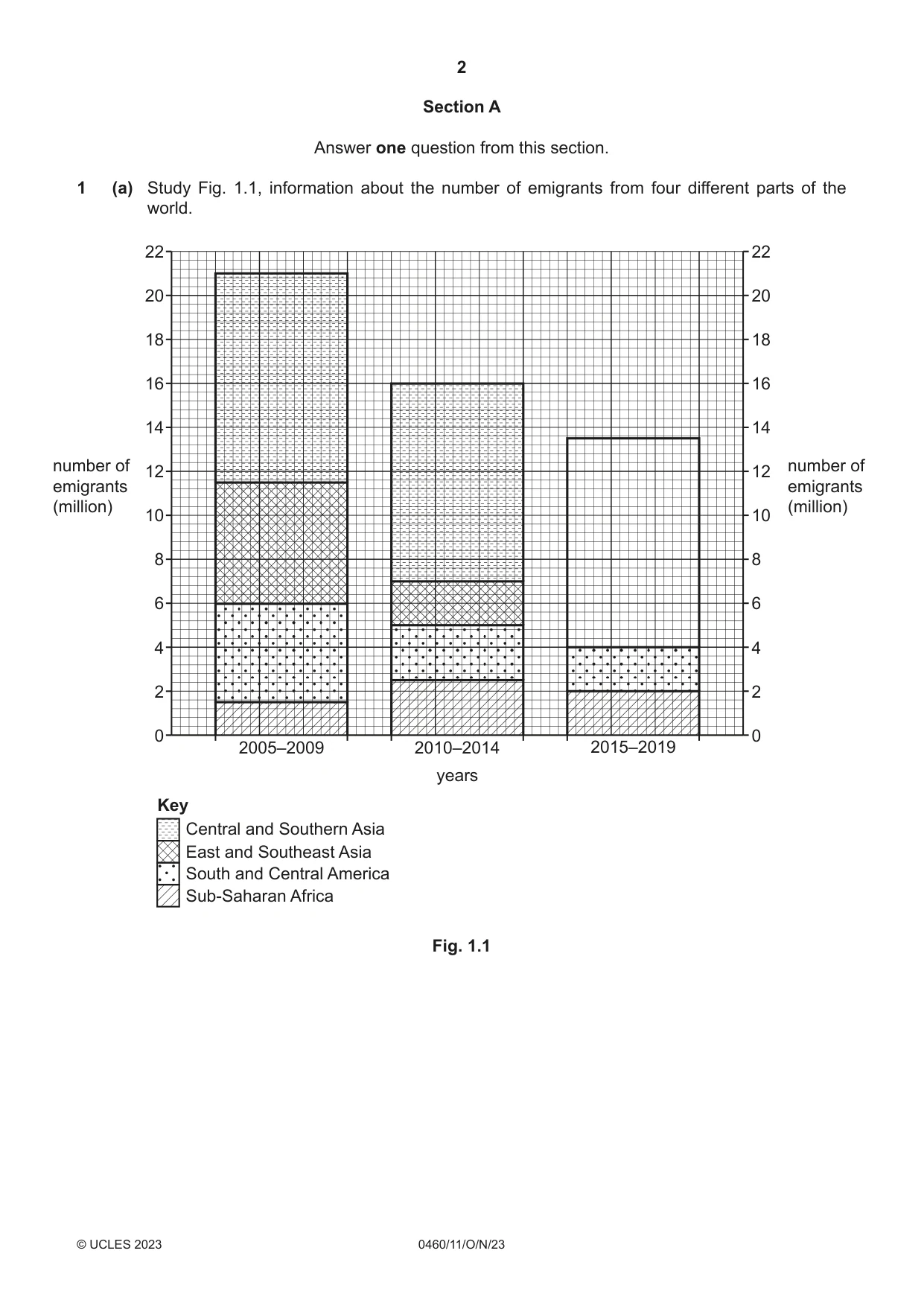
2 0460/11/O/N/23 © UCLES 2023 Section A Answer one question from this section. 1 (a) Study Fig. 1.1, information about the number of emigrants from four different parts of the world. 0 2005–2009 2010–2014 years 2015–2019 2 4 6 8 10 12 number of emigrants (million) number of emigrants (million) 14 16 18 20 22 0 2 4 6 8 10 12 14 16 18 20 22 Sub-Saharan Africa Key South and Central America East and Southeast Asia Central and Southern Asia Fig. 1.1
Question paper, page 3
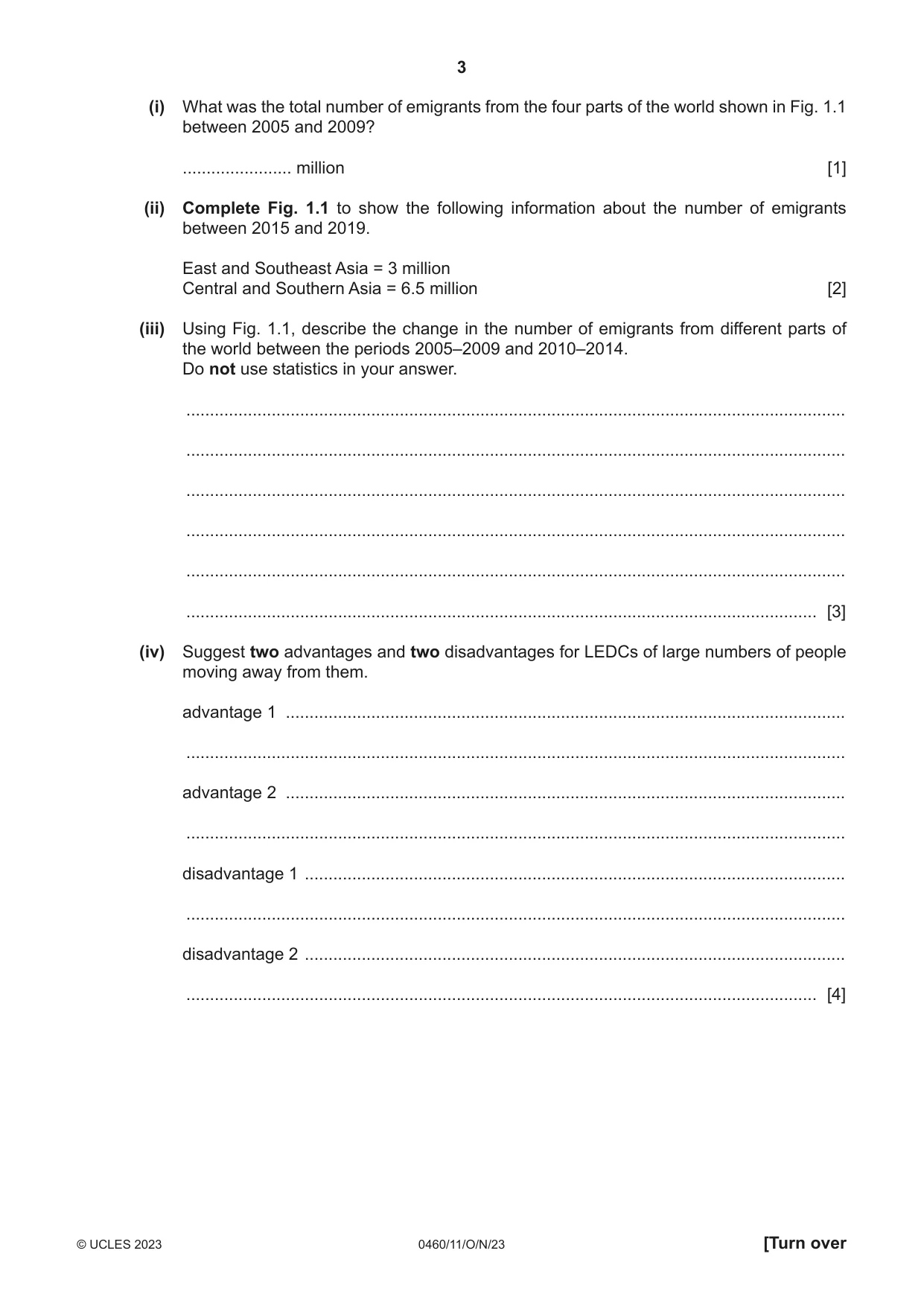
3 0460/11/O/N/23 © UCLES 2023 [Turn over (i) What was the total number of emigrants from the four parts of the world shown in Fig. 1.1 between 2005 and 2009? … million [1] (ii) Complete Fig. 1.1 to show the following information about the number of emigrants between 2015 and 2019. East and Southeast Asia = 3 million Central and Southern Asia = 6.5 million [2] (iii) Using Fig. 1.1, describe the change in the number of emigrants from different parts of the world between the periods 2005–2009 and 2010–2014. Do not use statistics in your answer. … … … … … … [3] (iv) Suggest two advantages and two disadvantages for LEDCs of large numbers of people moving away from them. advantage 1 … … advantage 2 … … disadvantage 1 … … disadvantage 2 … … [4]
Question paper, page 4
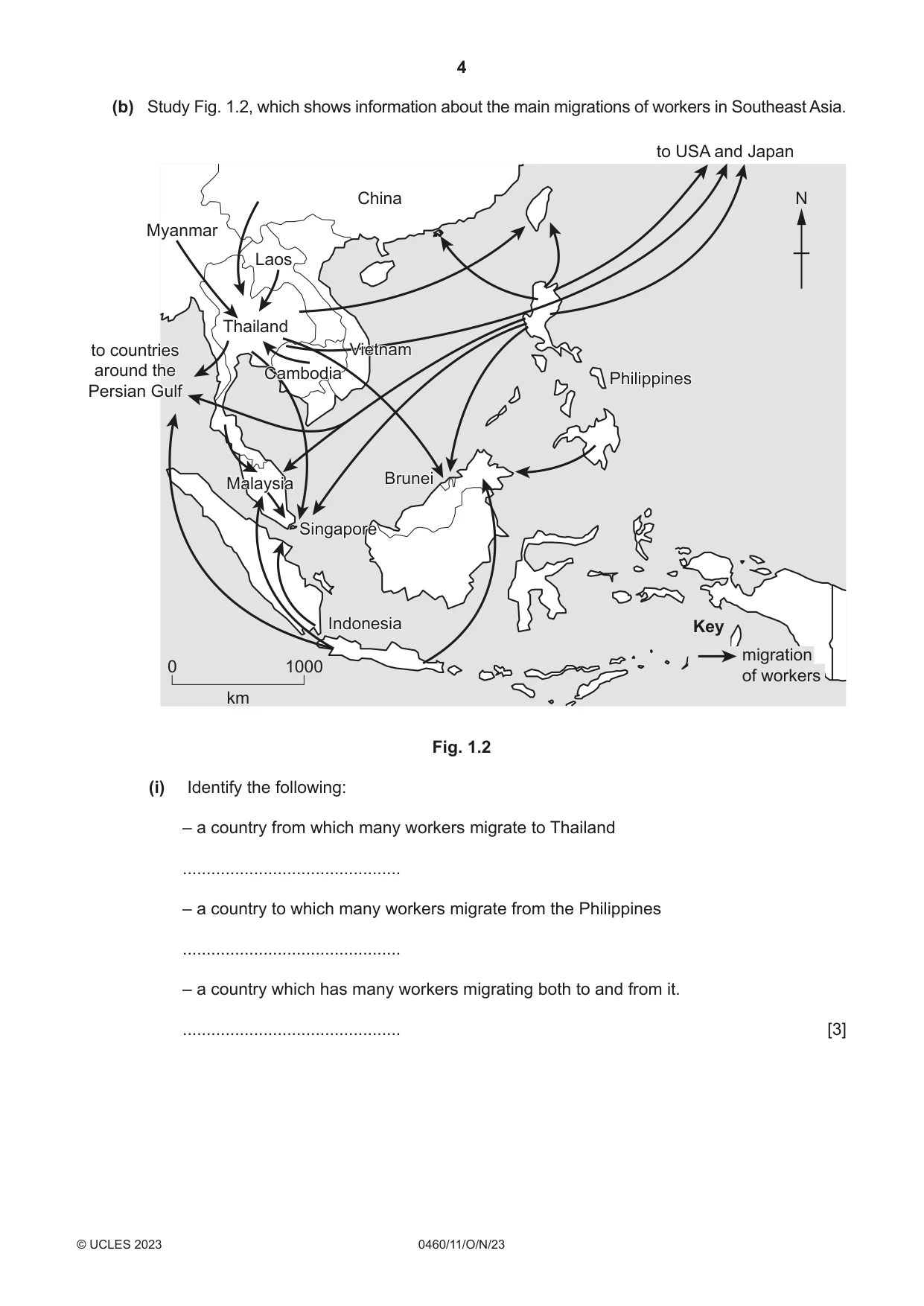
4 0460/11/O/N/23 © UCLES 2023 (b) Study Fig. 1.2, which shows information about the main migrations of workers in Southeast Asia. Thailand Laos Myanmar Brunei Singapore Indonesia Malaysia to countries around the Persian Gulf Cambodia Vietnam China to USA and Japan Philippines 0 1000 km N migration of workers Key Fig. 1.2 (i) Identify the following: – a country from which many workers migrate to Thailand … – a country to which many workers migrate from the Philippines … – a country which has many workers migrating both to and from it. … [3]
Question paper, page 5
5 0460/11/O/N/23 © UCLES 2023 [Turn over (ii) Suggest reasons why many workers and their families move away from LEDCs such as the Philippines. … … … … … … … … … … [5]
Question paper, page 6
6 0460/11/O/N/23 © UCLES 2023 (c) For a named country or area you have studied, explain why it has a low population density. Name of country or area … … … … … … … … … … … … … … … … … … … … … … … … … … [7] [Total: 25]
Question paper, page 7
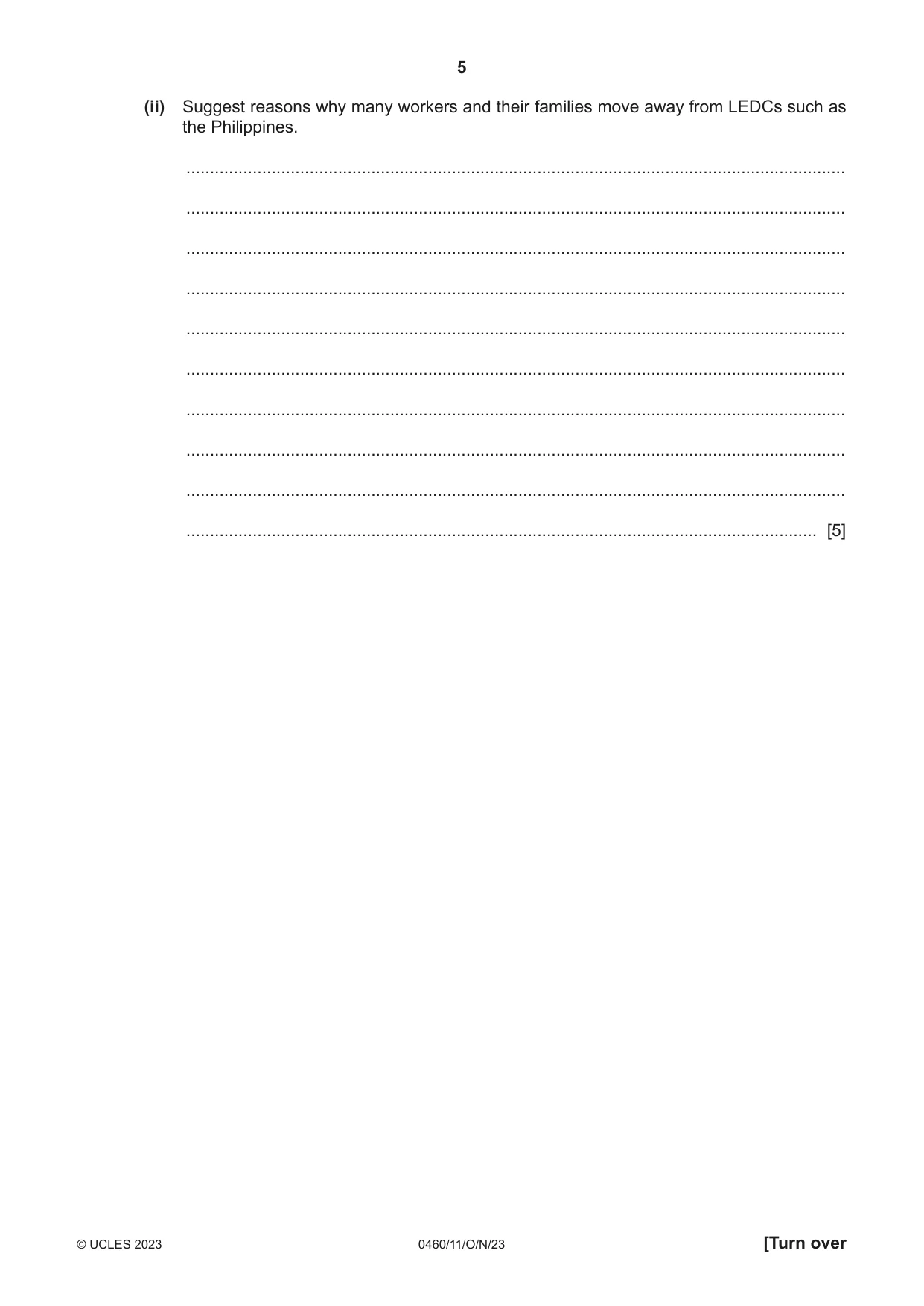
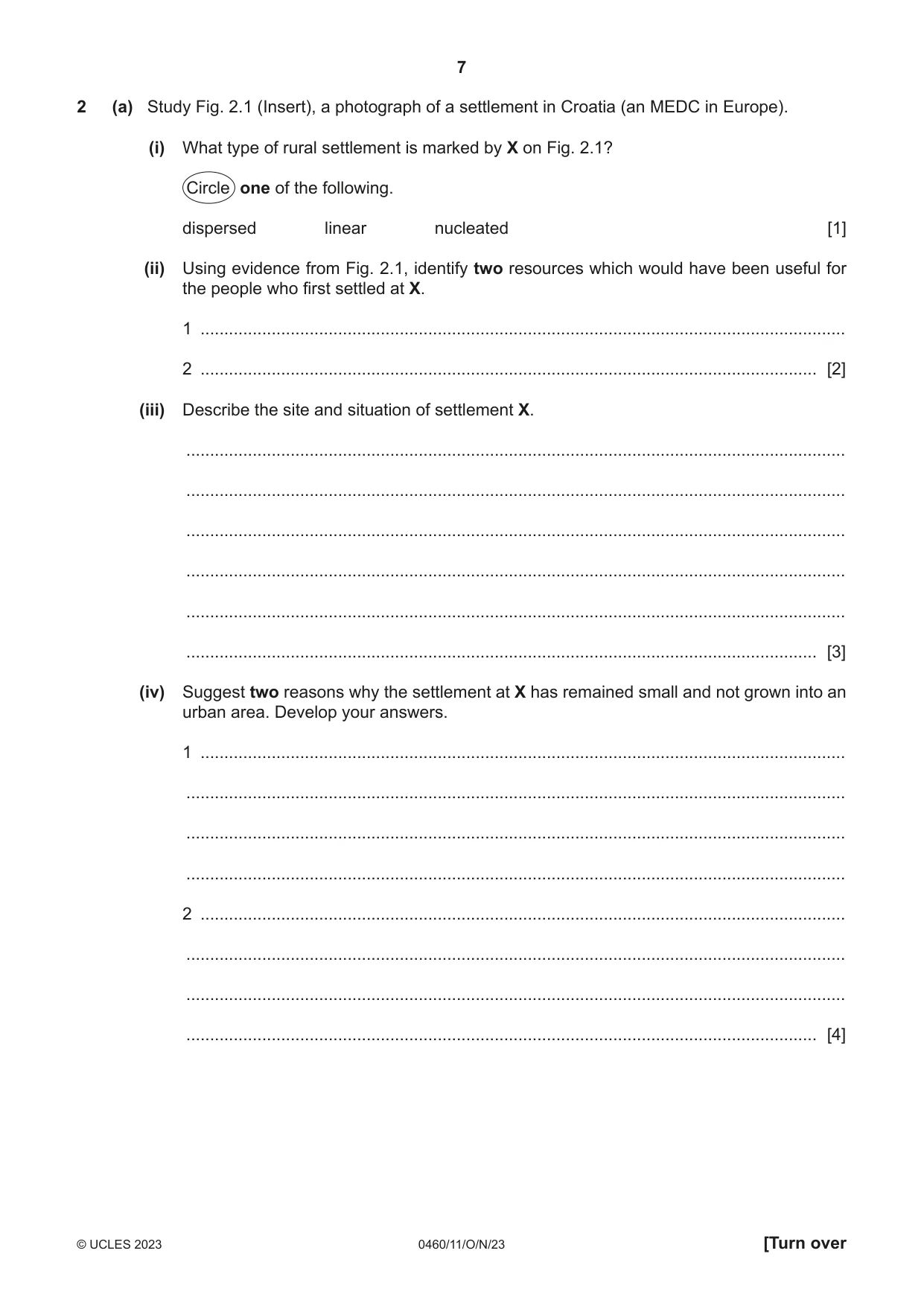
7 0460/11/O/N/23 © UCLES 2023 [Turn over 2 (a) Study Fig. 2.1 (Insert), a photograph of a settlement in Croatia (an MEDC in Europe). (i) What type of rural settlement is marked by X on Fig. 2.1? Circle one of the following. dispersed linear nucleated [1] (ii) Using evidence from Fig. 2.1, identify two resources which would have been useful for the people who first settled at X. 1 … 2 … [2] (iii) Describe the site and situation of settlement X. … … … … … … [3] (iv) Suggest two reasons why the settlement at X has remained small and not grown into an urban area. Develop your answers. 1 … … … … 2 … … … … [4]
Question paper, page 8
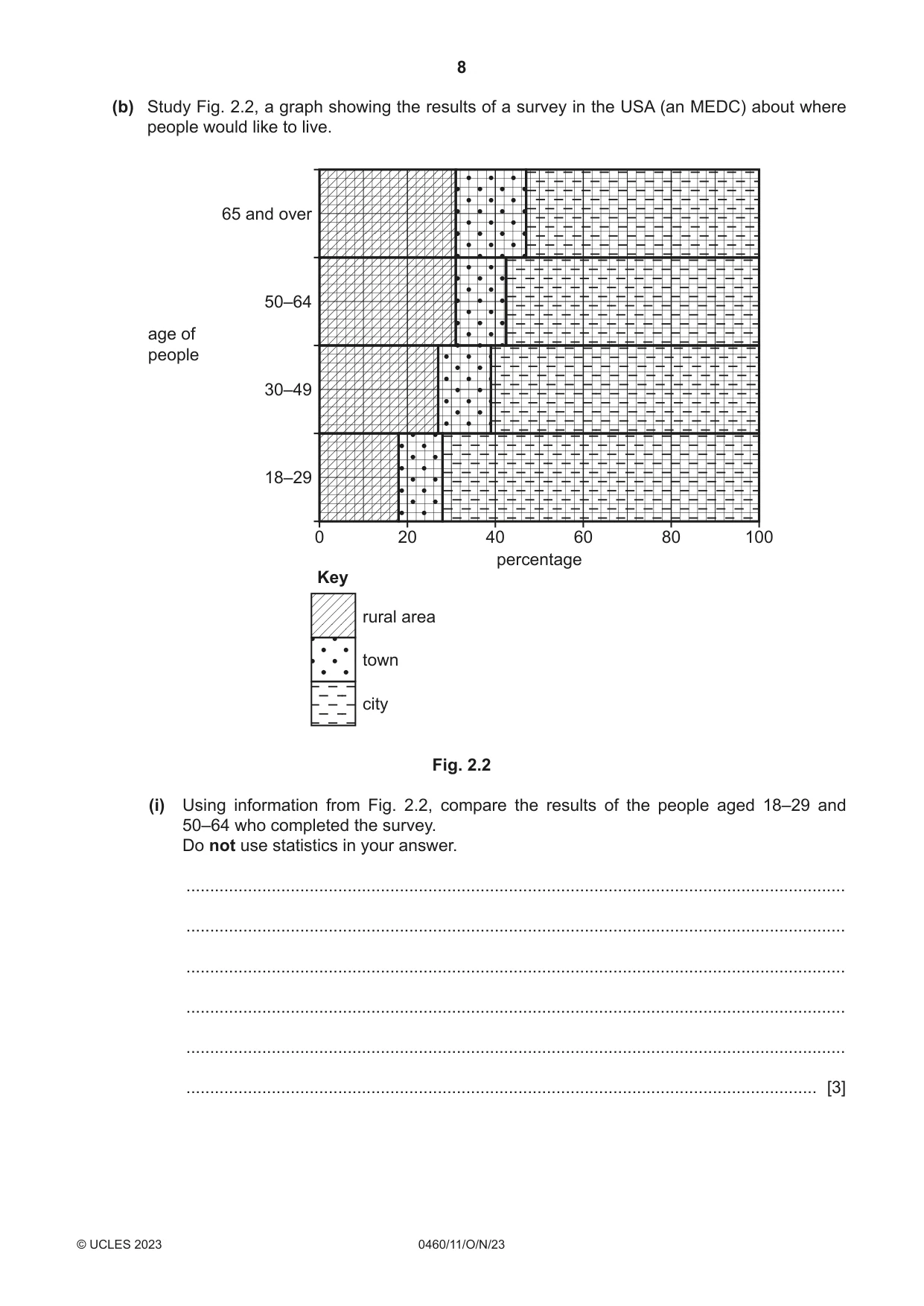
8 0460/11/O/N/23 © UCLES 2023 (b) Study Fig. 2.2, a graph showing the results of a survey in the USA (an MEDC) about where people would like to live. 18–29 30–49 50–64 65 and over age of people 0 20 40 60 percentage 80 100 rural area Key town city Fig. 2.2 (i) Using information from Fig. 2.2, compare the results of the people aged 18–29 and 50–64 who completed the survey. Do not use statistics in your answer. … … … … … … [3]
Question paper, page 9
9 0460/11/O/N/23 © UCLES 2023 [Turn over (ii) Suggest reasons why many people aged 65 and over would like to live in a rural area. … … … … … … … … … … [5]
Question paper, page 10
10 0460/11/O/N/23 © UCLES 2023 (c) For a named urban area you have studied in an LEDC, explain why large numbers of people migrate to it from surrounding rural areas. Name of urban area … … … … … … … … … … … … … … … … … … … … … … … … … … [7] [Total: 25]
Question paper, page 11
11 0460/11/O/N/23 © UCLES 2023 [Turn over BLANK PAGE
Question paper, page 12
12 0460/11/O/N/23 © UCLES 2023 Section B Answer one question from this section. 3 (a) Study Fig. 3.1 (Insert), information about earthquakes which have occurred in and around Indonesia (an LEDC in Southeast Asia) between 1900 and 2019. (i) How many earthquakes of a magnitude between 8.0 and 8.9 occurred in the area shown on Fig. 3.1 between 1900 and 2019? … [1] (ii) Using Fig. 3.1, describe the distribution of earthquakes. … … … … [2] (iii) Suggest three likely impacts of earthquakes in Indonesia. 1 … … 2 … … 3 … … [3] (iv) Explain why many people still live in areas where earthquakes occur. … … … … … … … … [4]
Question paper, page 13
13 0460/11/O/N/23 © UCLES 2023 [Turn over (b) Study Fig. 3.2 (Insert), a photograph of the main crater of Mount Vesuvius, a volcano in Italy. (i) Describe the landscape of the crater shown in Fig. 3.2. … … … … … … [3] (ii) Explain the advantages of living close to a volcano such as Mount Vesuvius. … … … … … … … … … … [5]
Question paper, page 14
14 0460/11/O/N/23 © UCLES 2023 (c) For a named example of a volcano you have studied, explain why it has erupted. Name of volcano … … … … … … … … … … … … … … … … … … … … … … … … … … [7] [Total: 25]
Question paper, page 15
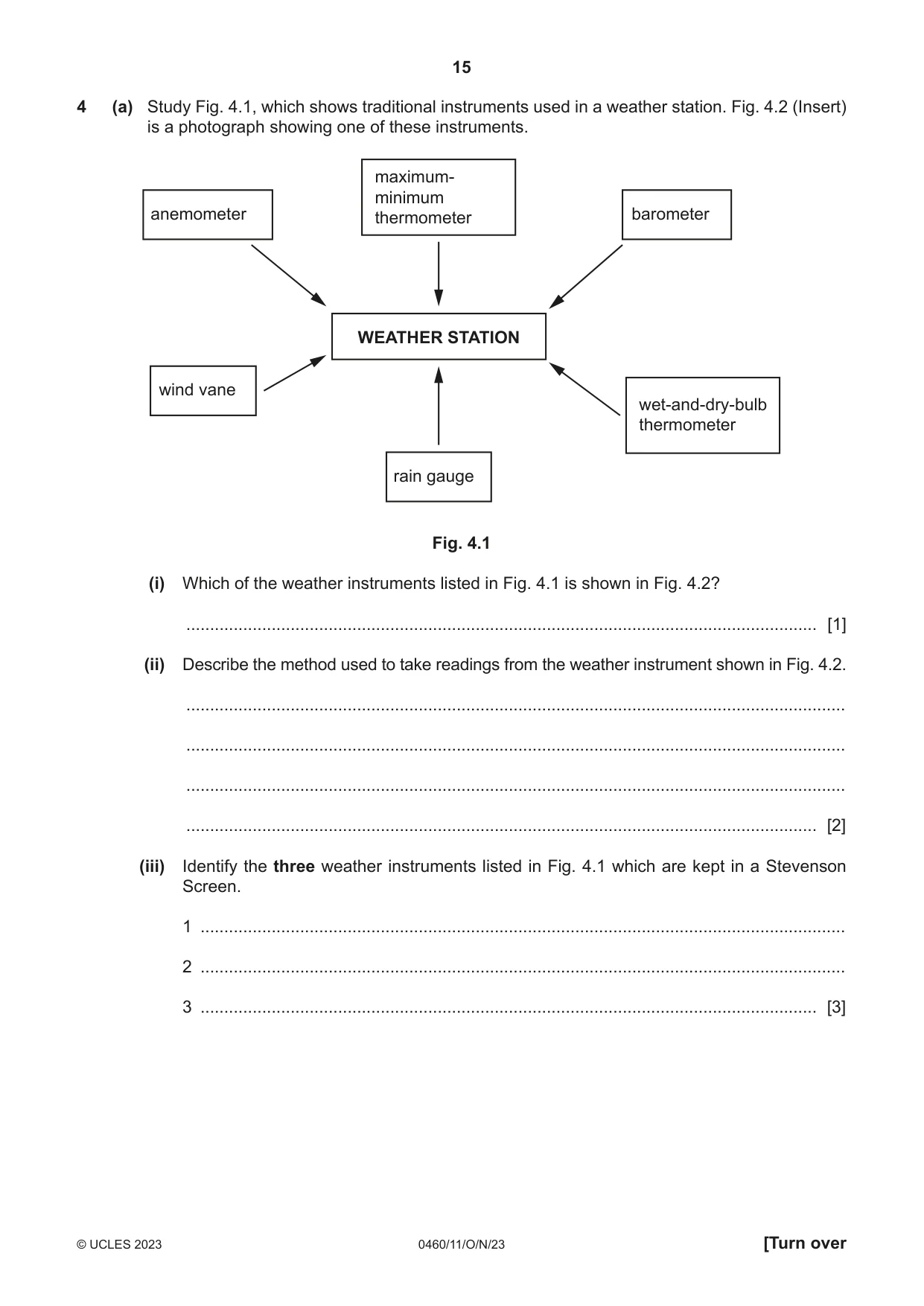
15 0460/11/O/N/23 © UCLES 2023 [Turn over 4 (a) Study Fig. 4.1, which shows traditional instruments used in a weather station. Fig. 4.2 (Insert) is a photograph showing one of these instruments. WEATHER STATION rain gauge wind vane barometer anemometer maximum- minimum thermometer wet-and-dry-bulb thermometer Fig. 4.1 (i) Which of the weather instruments listed in Fig. 4.1 is shown in Fig. 4.2? … [1] (ii) Describe the method used to take readings from the weather instrument shown in Fig. 4.2. … … … … [2] (iii) Identify the three weather instruments listed in Fig. 4.1 which are kept in a Stevenson Screen. 1 … 2 … 3 … [3]
Question paper, page 16
16 0460/11/O/N/23 © UCLES 2023 (iv) Explain why some weather instruments are kept in a Stevenson Screen. … … … … … … … … [4] (b) Study Fig. 4.3, a diagram of a digital weather station which has been bought by a school. Fig. 4.4 (Insert) is a photograph showing where the weather station is going to be located. Fig. 4.3 Content removed due to copyright restrictions.
Question paper, page 17
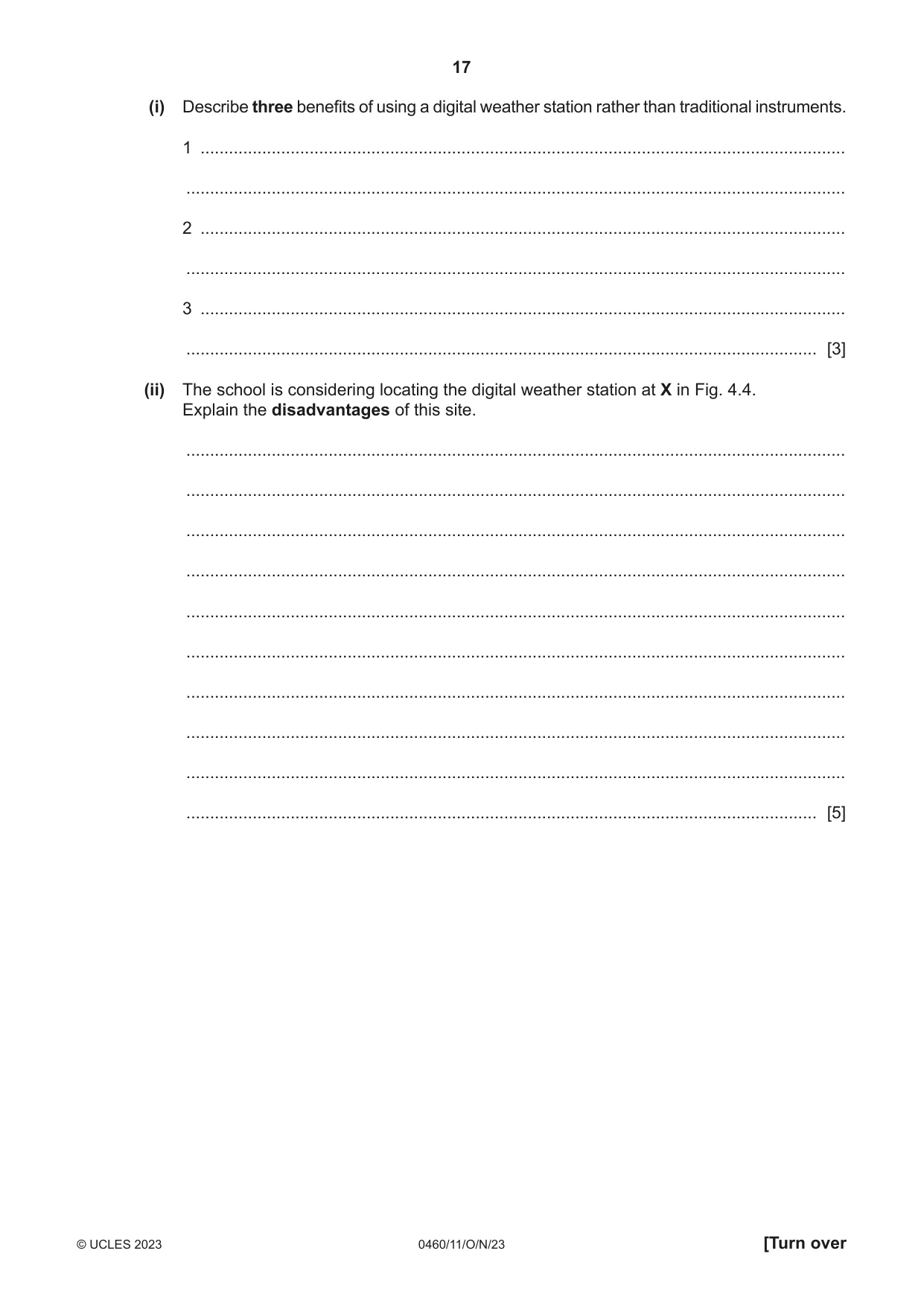
17 0460/11/O/N/23 © UCLES 2023 [Turn over (i) Describe three benefits of using a digital weather station rather than traditional instruments. 1 … … 2 … … 3 … … [3] (ii) The school is considering locating the digital weather station at X in Fig. 4.4. Explain the disadvantages of this site. … … … … … … … … … … [5]
Question paper, page 18
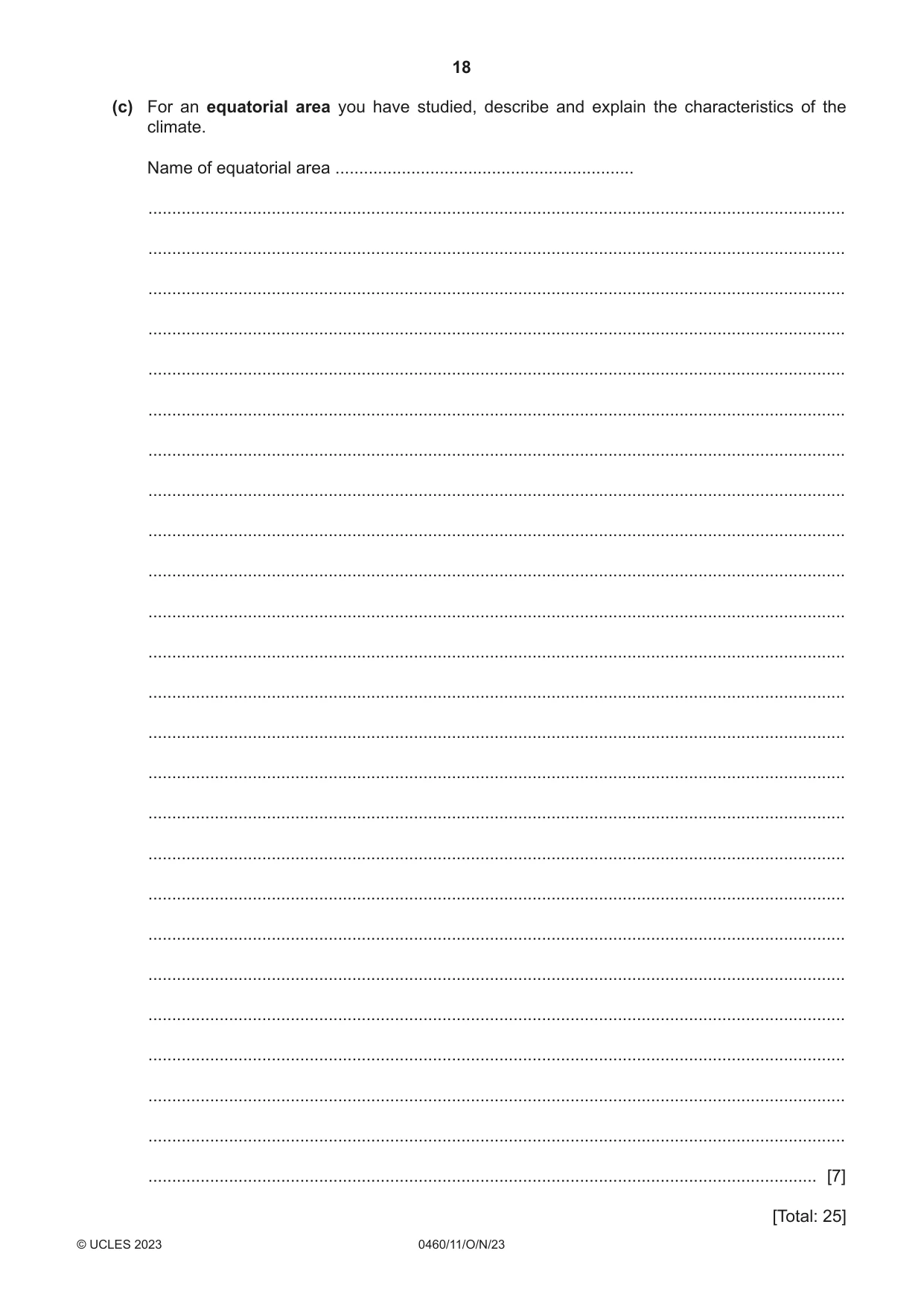
18 0460/11/O/N/23 © UCLES 2023 (c) For an equatorial area you have studied, describe and explain the characteristics of the climate. Name of equatorial area … … … … … … … … … … … … … … … … … … … … … … … … … … [7] [Total: 25]
Question paper, page 19
19 0460/11/O/N/23 © UCLES 2023 [Turn over BLANK PAGE
Question paper, page 20
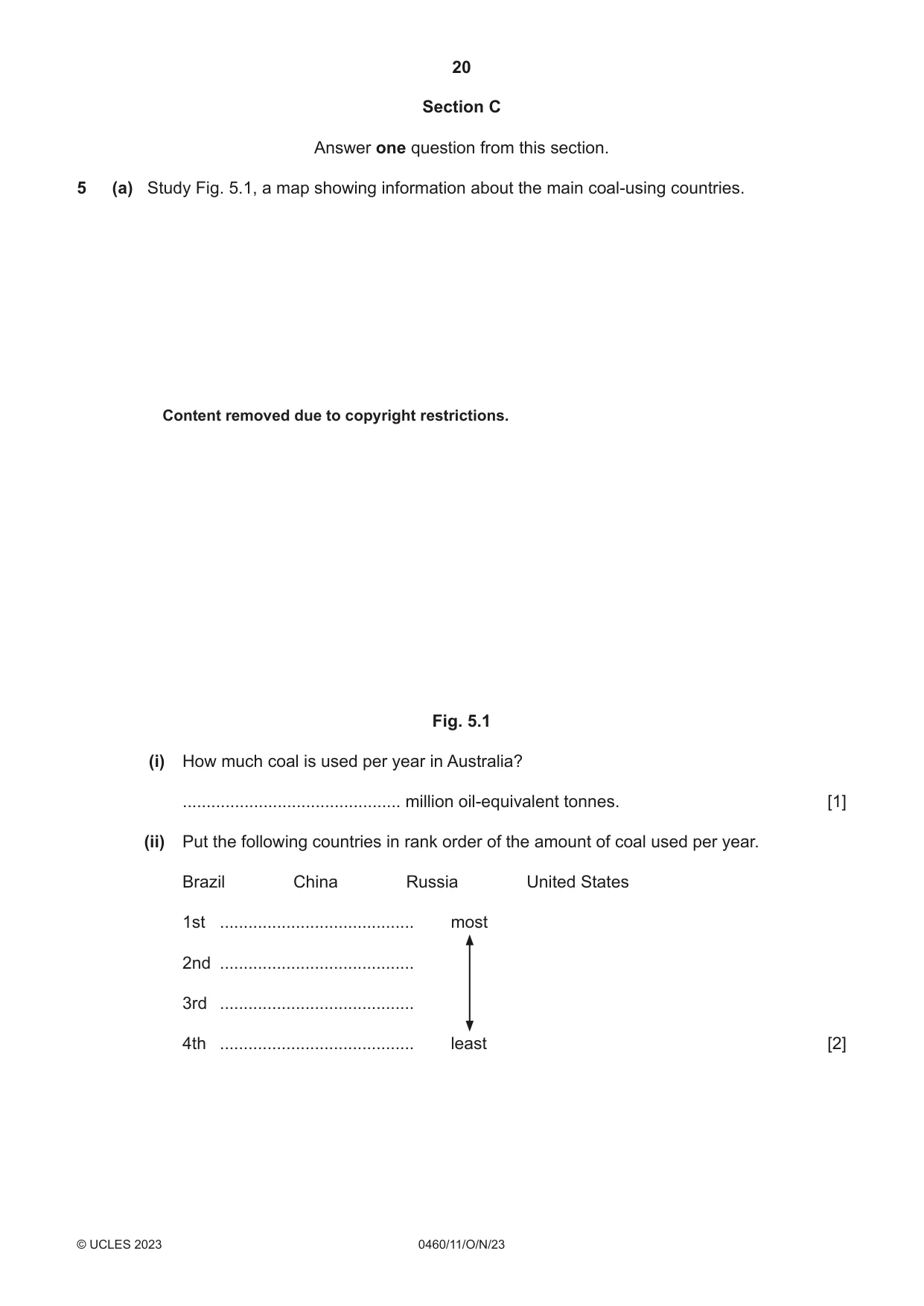
20 0460/11/O/N/23 © UCLES 2023 Section C Answer one question from this section. 5 (a) Study Fig. 5.1, a map showing information about the main coal-using countries. Fig. 5.1 (i) How much coal is used per year in Australia? … million oil-equivalent tonnes. [1] (ii) Put the following countries in rank order of the amount of coal used per year. Brazil China Russia United States 1st … most 2nd … 3rd … 4th … least [2] Content removed due to copyright restrictions.
Question paper, page 21
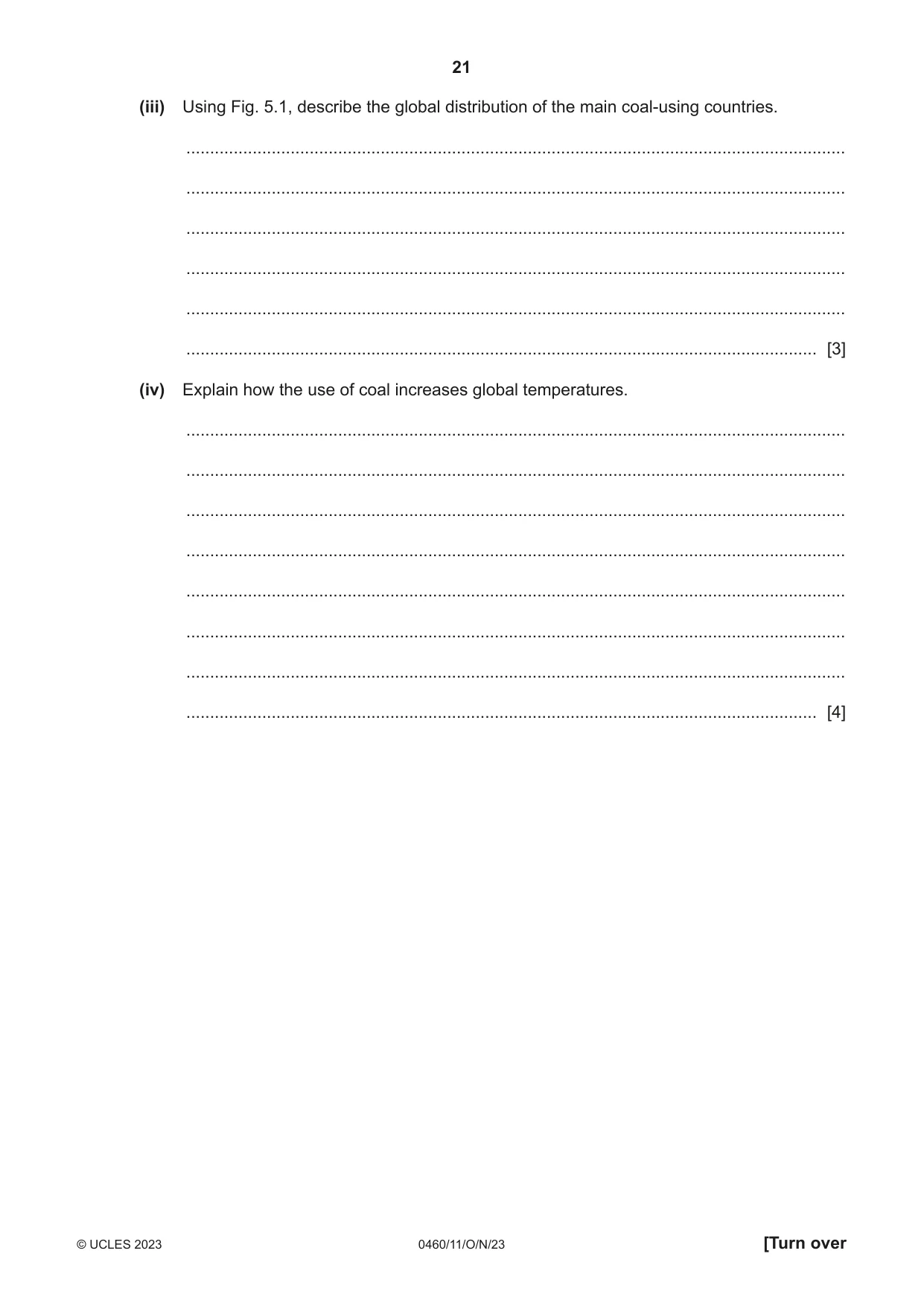
21 0460/11/O/N/23 © UCLES 2023 [Turn over (iii) Using Fig. 5.1, describe the global distribution of the main coal-using countries. … … … … … … [3] (iv) Explain how the use of coal increases global temperatures. … … … … … … … … [4]
Question paper, page 22
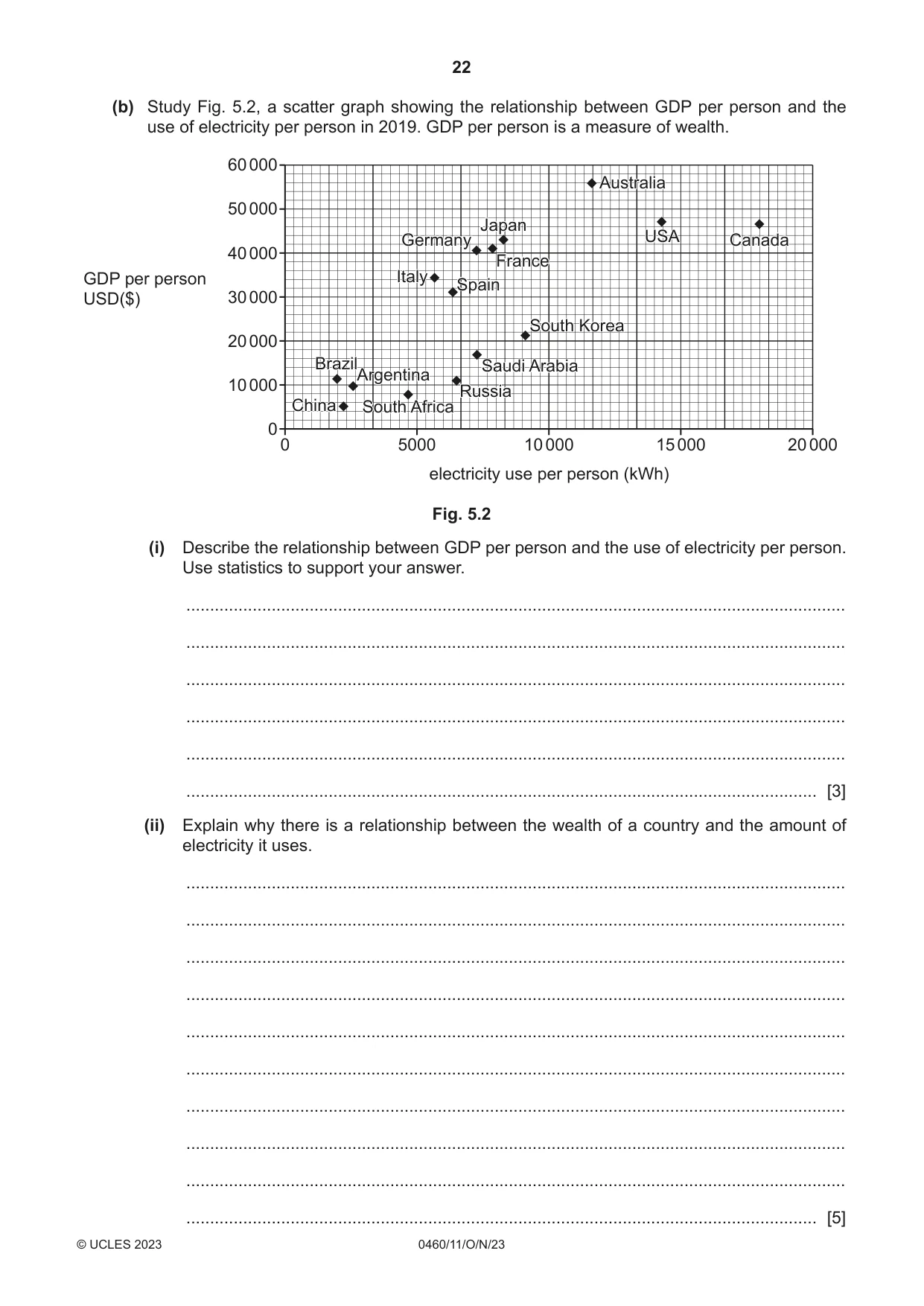
22 0460/11/O/N/23 © UCLES 2023 (b) Study Fig. 5.2, a scatter graph showing the relationship between GDP per person and the use of electricity per person in 2019. GDP per person is a measure of wealth. 0 20 000 40 000 60 000 10 000 30 000 50 000 GDP per person USD($) 0 5000 10 000 15 000 electricity use per person (kWh) 20 000 USA Japan Japan France South Korea Saudi Arabia Russia South Africa Argentina Brazil China Spain Italy Germany Canada Australia Fig. 5.2 (i) Describe the relationship between GDP per person and the use of electricity per person. Use statistics to support your answer. … … … … … … [3] (ii) Explain why there is a relationship between the wealth of a country and the amount of electricity it uses. … … … … … … … … … … [5]
Question paper, page 23
23 0460/11/O/N/23 © UCLES 2023 [Turn over (c) For a named country you have studied, describe and explain the importance of renewable energy supplies. Name of country … … … … … … … … … … … … … … … … … … … … … … … … … … [7] [Total: 25]
Question paper, page 24
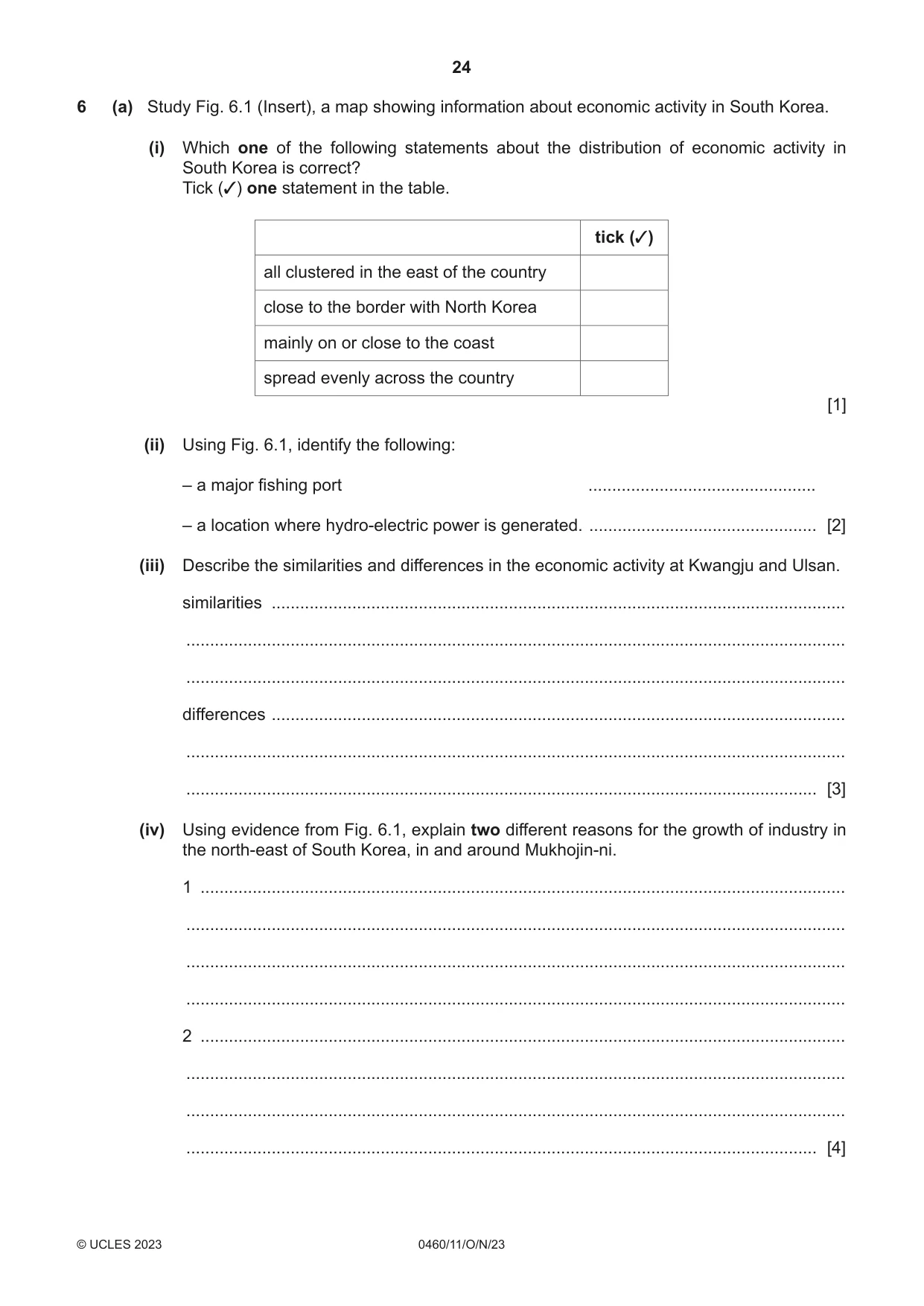
24 0460/11/O/N/23 © UCLES 2023 6 (a) Study Fig. 6.1 (Insert), a map showing information about economic activity in South Korea. (i) Which one of the following statements about the distribution of economic activity in South Korea is correct? Tick (3) one statement in the table. tick (3) all clustered in the east of the country close to the border with North Korea mainly on or close to the coast spread evenly across the country [1] (ii) Using Fig. 6.1, identify the following: – a major fishing port … – a location where hydro-electric power is generated. … [2] (iii) Describe the similarities and differences in the economic activity at Kwangju and Ulsan. similarities … … … differences … … … [3] (iv) Using evidence from Fig. 6.1, explain two different reasons for the growth of industry in the north-east of South Korea, in and around Mukhojin-ni. 1 … … … … 2 … … … … [4]
Question paper, page 25
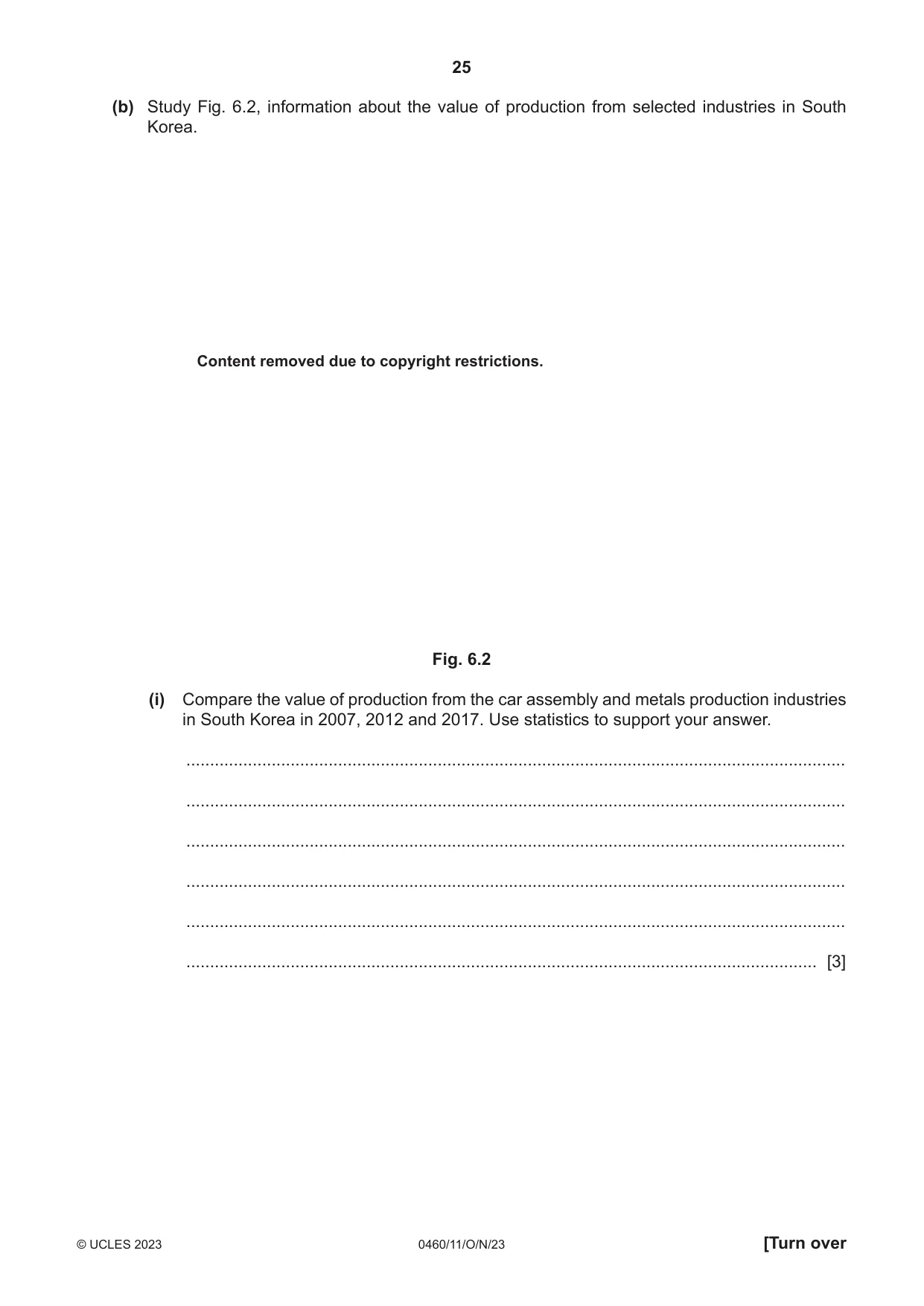
25 0460/11/O/N/23 © UCLES 2023 [Turn over (b) Study Fig. 6.2, information about the value of production from selected industries in South Korea. Fig. 6.2 (i) Compare the value of production from the car assembly and metals production industries in South Korea in 2007, 2012 and 2017. Use statistics to support your answer. … … … … … … [3] Content removed due to copyright restrictions.
Question paper, page 26
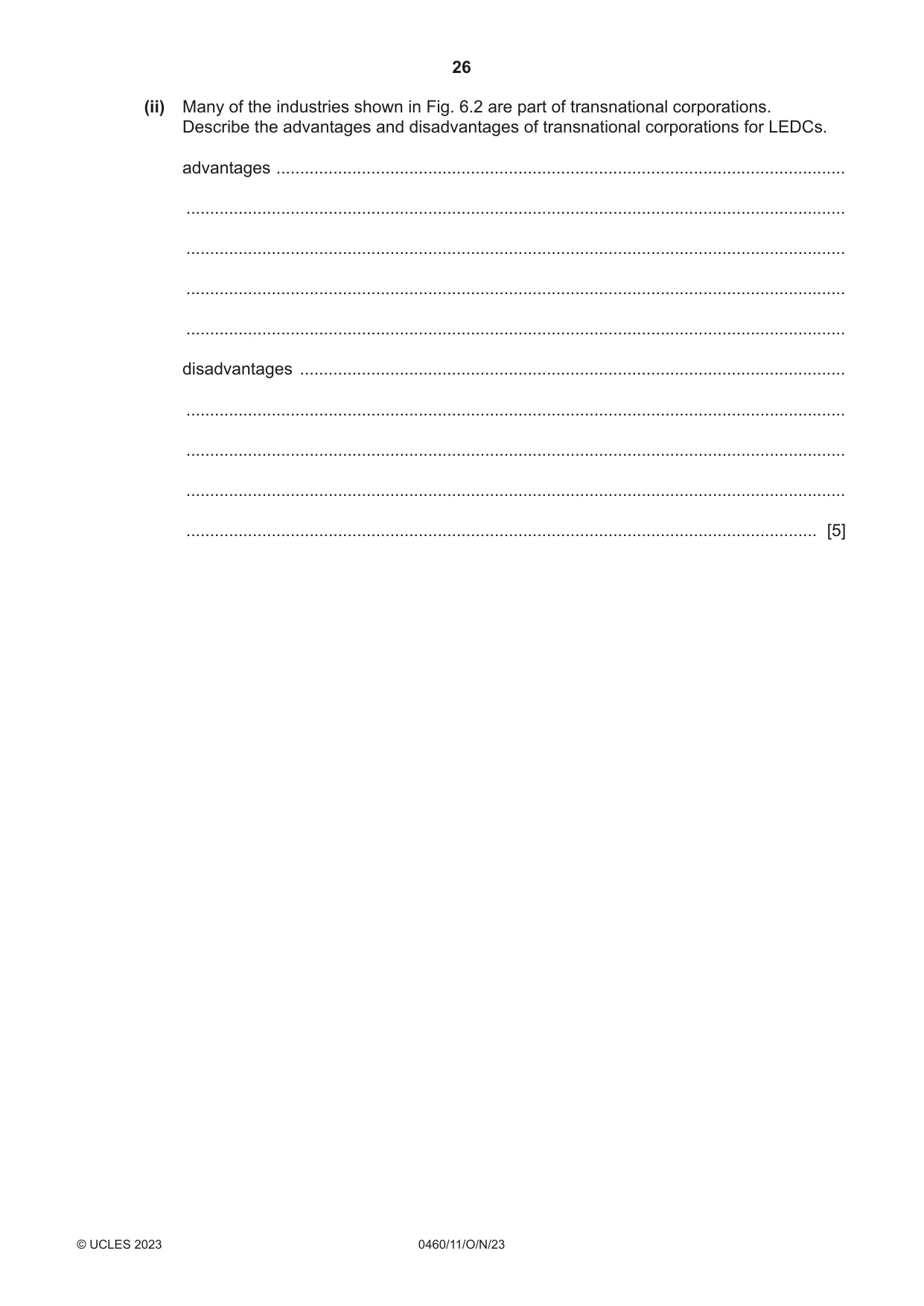
26 0460/11/O/N/23 © UCLES 2023 (ii) Many of the industries shown in Fig. 6.2 are part of transnational corporations. Describe the advantages and disadvantages of transnational corporations for LEDCs. advantages … … … … … disadvantages … … … … … [5]
Question paper, page 27
27 0460/11/O/N/23 © UCLES 2023 (c) Name and locate an economic activity you have studied. Explain how this economic activity threatens the natural environment. Name of economic activity … Location … … … … … … … … … … … … … … … … … … … … … … … … … [7] [Total: 25]
Question paper, page 28
28 0460/11/O/N/23 © UCLES 2023 The boundaries and names shown, the designations used and the presentation of material on any maps contained in this question paper/insert do not imply official endorsement or acceptance by Cambridge Assessment International Education concerning the legal status of any country, territory, or area or any of its authorities, or of the delimitation of its frontiers or boundaries. Permission to reproduce items where third-party owned material protected by copyright is included has been sought and cleared where possible. Every reasonable effort has been made by the publisher (UCLES) to trace copyright holders, but if any items requiring clearance have unwittingly been included, the publisher will be pleased to make amends at the earliest possible opportunity. To avoid the issue of disclosure of answer-related information to candidates, all copyright acknowledgements are reproduced online in the Cambridge Assessment International Education Copyright Acknowledgements Booklet. This is produced for each series of examinations and is freely available to download at www.cambridgeinternational.org after the live examination series. Cambridge Assessment International Education is part of Cambridge Assessment. Cambridge Assessment is the brand name of the University of Cambridge Local Examinations Syndicate (UCLES), which is a department of the University of Cambridge. Additional page If you use the following page to complete the answer to any question, the question number must be clearly shown. … … … … … … … … … … … … … … … … … … … …
Mark scheme, page 1
This document consists of 21 printed pages. © UCLES 2023 [Turn over Cambridge IGCSE™ GEOGRAPHY 0460/11 Paper 1 Geographical Themes October/November 2023 MARK SCHEME Maximum Mark: 75 Published This mark scheme is published as an aid to teachers and candidates, to indicate the requirements of the examination. It shows the basis on which Examiners were instructed to award marks. It does not indicate the details of the discussions that took place at an Examiners’ meeting before marking began, which would have considered the acceptability of alternative answers. Mark schemes should be read in conjunction with the question paper and the Principal Examiner Report for Teachers. Cambridge International will not enter into discussions about these mark schemes. Cambridge International is publishing the mark schemes for the October/November 2023 series for most Cambridge IGCSE, Cambridge International A and AS Level components, and some Cambridge O Level components.
Mark scheme, page 2
0460/11 Cambridge IGCSE – Mark Scheme PUBLISHED October/November 2023 © UCLES 2023 Page 2 of 21 Generic Marking Principles These general marking principles must be applied by all examiners when marking candidate answers. They should be applied alongside the specific content of the mark scheme or generic level descriptors for a question. Each question paper and mark scheme will also comply with these marking principles. GENERIC MARKING PRINCIPLE 1: Marks must be awarded in line with: • the specific content of the mark scheme or the generic level descriptors for the question • the specific skills defined in the mark scheme or in the generic level descriptors for the question • the standard of response required by a candidate as exemplified by the standardisation scripts. GENERIC MARKING PRINCIPLE 2: Marks awarded are always whole marks (not half marks, or other fractions). GENERIC MARKING PRINCIPLE 3: Marks must be awarded positively: • marks are awarded for correct/valid answers, as defined in the mark scheme. However, credit is given for valid answers which go beyond the scope of the syllabus and mark scheme, referring to your Team Leader as appropriate • marks are awarded when candidates clearly demonstrate what they know and can do • marks are not deducted for errors • marks are not deducted for omissions • answers should only be judged on the quality of spelling, punctuation and grammar when these features are specifically assessed by the question as indicated by the mark scheme. The meaning, however, should be unambiguous. GENERIC MARKING PRINCIPLE 4: Rules must be applied consistently, e.g. in situations where candidates have not followed instructions or in the application of generic level descriptors. GENERIC MARKING PRINCIPLE 5: Marks should be awarded using the full range of marks defined in the mark scheme for the question (however; the use of the full mark range may be limited according to the quality of the candidate responses seen). GENERIC MARKING PRINCIPLE 6: Marks awarded are based solely on the requirements as defined in the mark scheme. Marks should not be awarded with grade thresholds or grade descriptors in mind.
Mark scheme, page 3
0460/11 Cambridge IGCSE – Mark Scheme PUBLISHED October/November 2023 © UCLES 2023 Page 3 of 21 Each question carries 25 marks. Candidates cannot earn above the maximum marks available within each sub section. The marking scheme attempts to give guidance about the requirements of each answer and lists a number of responses, which will earn marks along with the general principles to be applied when marking each question. It should be noted that candidates can earn marks if their answers are phrased differently provided they convey the same meaning as those in the mark scheme. THE CANDIDATES DO NOT NEED TO USE THE SAME WORDING TO EARN MARKS. The notation ‘etc.’ at the end of an answer in the mark scheme signifies that there may well be other correct responses or examples that can be given credit. Providing the statement is true, relevant to the question asked and not repetition of a previous point made credit should be given. A point made within one sub-section which is an answer to the question set in a different sub-section should not be given credit as each sub-section asks different questions which require independent answers. The mark scheme uses semi colons (;) to separate marks and diagonals to separate alternative answers. During coordination the mark scheme is modified to add points agreed after discussion or to delete any points not allowed. All examiners should ensure that their modified scheme is fully up-to-date before marking begins. Marking Mechanics. Point marking is used for sections (a) and (b) of each question, although marks are available in specified questions for development of appropriate points. Ticks should be used to clearly indicate where a mark has been allowed. Where a development point has been allowed the symbol “DEV” should be placed adjacent to the tick. The number of ticks should always be equal to the total number of marks awarded. Only one development mark for each mark scheme point please. Where a candidate makes a point which is not quite sufficient for credit an upturned ‘V’ insert symbol should be used. If after careful consideration a mark is awarded which gives ‘benefit of doubt’ to the candidate, the letter ‘J’ should be placed adjacent to the tick (i.e. the candidate has ‘just’ achieved the mark). Crosses are acceptable to signify wrong answers and the letters ‘IR/IRRL’ should be used to indicate those which are irrelevant. Levels of response marking is used for section (c) of each question. Thus, it is the quality of the response that determines which level an answer has achieved rather than the quantity of statements contained within it. However, once assigned to a level the mark achieved within that level is determined by the number of points made. Levels 1 and 2 are distinguished by whether statements are simple (level 1) or developed/elaborated (level 2). A candidate can immediately enter L2 by making developed points without making any L1 statements. In order to achieve L3 a candidate must have already reached the top end of L2 – in addition their answer should have a clear example and if the answer is place specific as well (7 marks). Highlight place specific detail. Where statements are assigned levels by the examiner this should be indicated by the use of L1 and L2 next to the statements. Ticks should not be used on answers that are marked using levels of response marking. L1 annotation should be removed once a L2 is awarded for an answer. L3 annotation is not used. There is no need for a summary level at the end of a response.
Mark scheme, page 4
0460/11 Cambridge IGCSE – Mark Scheme PUBLISHED October/November 2023 © UCLES 2023 Page 4 of 21 Summary: Level 1 (1 to 3 marks): 1 simple statement (1 mark) 2 simple statements (2 marks) 3 simple statements (3 marks) Level 2 (4 to 6 marks): 1 developed statement (4 marks) 2 developed statements (5 marks) 3 or more developed statements with e.g. (6 marks) Level 3 (7 marks) 3 or more developed statements + named example with at least one piece of place specific detail. Note. The following guidelines apply when case studies are required in part (c) questions: 1 Level 2 statements must be developed/elaborated or related relevant ideas need to be linked. 2 The use of statistics is not an acceptable form of development, thus a simple statement with statistics is a Level 1 statement. The use of statistics alone cannot be credited as an alternative to a L1 written statement. 3 Place specific information is required as part of the criteria to achieve a Level 3 answer. This could relate to the location of the case study chosen or aspects of the study which make it authentic rather than simply generic (e.g. named places within the area, other specific factual detail, relevant statistics etc.). Requirements of each study will vary and your Team Leader will provide guidance. Please note that: – if the case study requires a country name the name of the continent in which it is located is not sufficient for the place specific requirement, however with more precision it would be acceptable (e.g. ‘Nigeria, located in Africa…’ is not sufficient but ‘Nigeria, located in West Africa’ is sufficient.) – if the case study requires the name of an area/town or city the name of the country in which it is located is not sufficient for the place specific requirement, however with more precision it would be acceptable (e.g. ‘Mumbai, located in India…’ is not sufficient but ‘Mumbai, located in Western India’ is sufficient.)
Mark scheme, page 5
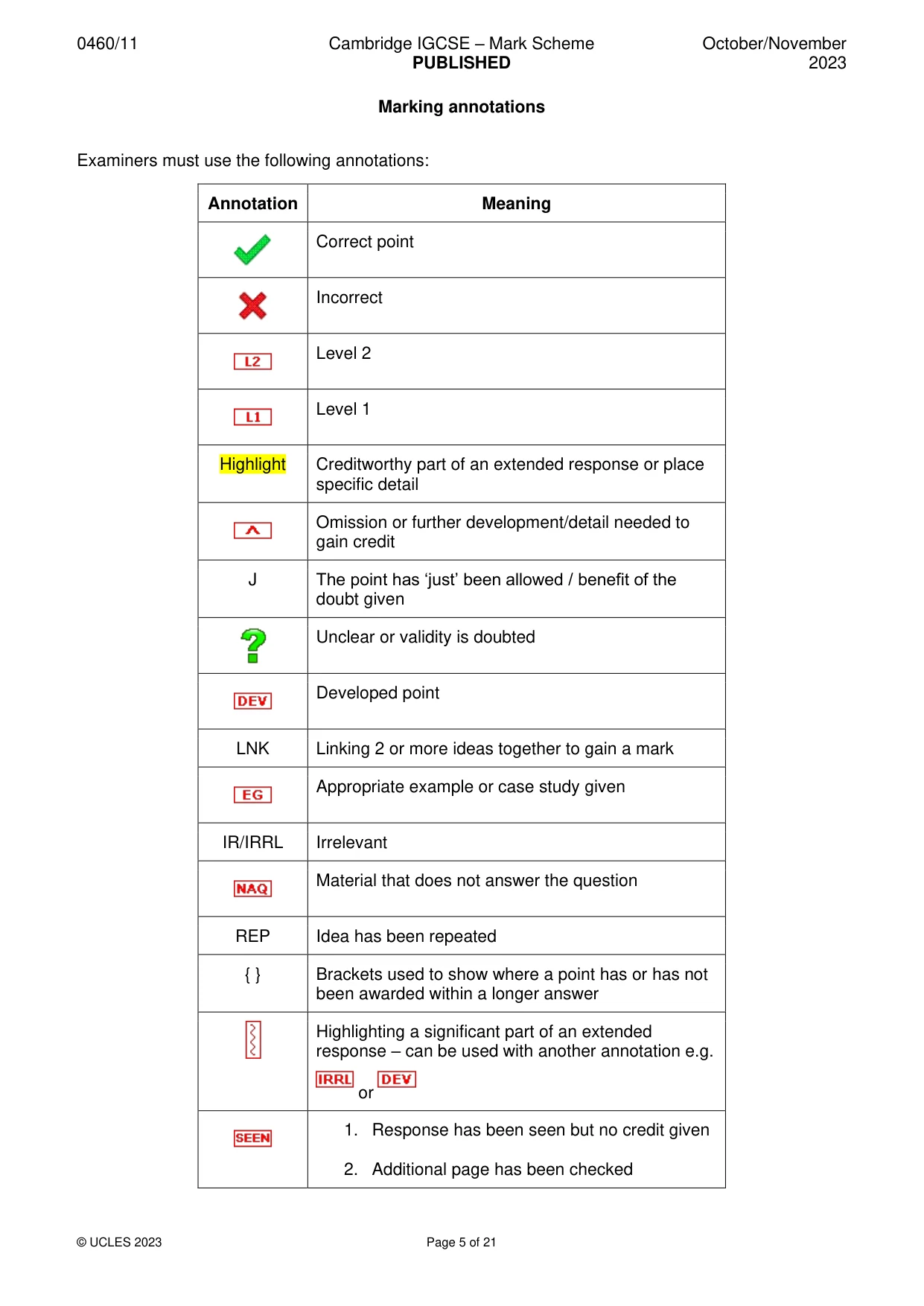
0460/11 Cambridge IGCSE – Mark Scheme PUBLISHED October/November 2023 © UCLES 2023 Page 5 of 21 Marking annotations Examiners must use the following annotations: Annotation Meaning Correct point Incorrect Level 2 Level 1 Highlight Creditworthy part of an extended response or place specific detail Omission or further development/detail needed to gain credit J The point has ‘just’ been allowed / benefit of the doubt given Unclear or validity is doubted Developed point LNK Linking 2 or more ideas together to gain a mark Appropriate example or case study given IR/IRRL Irrelevant Material that does not answer the question REP Idea has been repeated { } Brackets used to show where a point has or has not been awarded within a longer answer Highlighting a significant part of an extended response – can be used with another annotation e.g. or 1. Response has been seen but no credit given 2. Additional page has been checked
Mark scheme, page 6
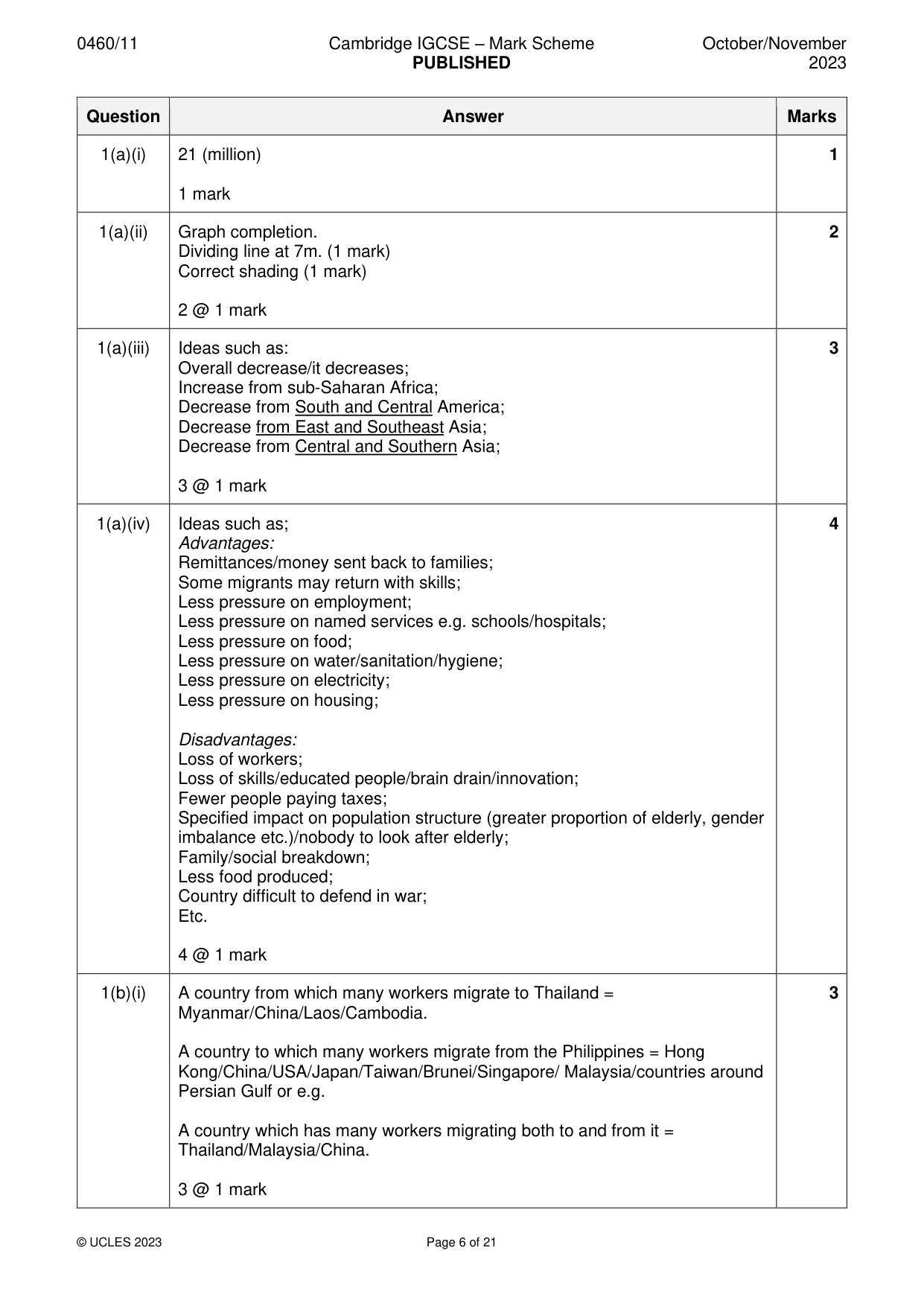
0460/11 Cambridge IGCSE – Mark Scheme PUBLISHED October/November 2023 © UCLES 2023 Page 6 of 21 Question Answer Marks 1(a)(i) 21 (million) 1 mark 1 1(a)(ii) Graph completion. Dividing line at 7m. (1 mark) Correct shading (1 mark) 2 @ 1 mark 2 1(a)(iii) Ideas such as: Overall decrease/it decreases; Increase from sub-Saharan Africa; Decrease from South and Central America; Decrease from East and Southeast Asia; Decrease from Central and Southern Asia; 3 @ 1 mark 3 1(a)(iv) Ideas such as; Advantages: Remittances/money sent back to families; Some migrants may return with skills; Less pressure on employment; Less pressure on named services e.g. schools/hospitals; Less pressure on food; Less pressure on water/sanitation/hygiene; Less pressure on electricity; Less pressure on housing; Disadvantages: Loss of workers; Loss of skills/educated people/brain drain/innovation; Fewer people paying taxes; Specified impact on population structure (greater proportion of elderly, gender imbalance etc.)/nobody to look after elderly; Family/social breakdown; Less food produced; Country difficult to defend in war; Etc. 4 @ 1 mark 4 1(b)(i) A country from which many workers migrate to Thailand = Myanmar/China/Laos/Cambodia. A country to which many workers migrate from the Philippines = Hong Kong/China/USA/Japan/Taiwan/Brunei/Singapore/ Malaysia/countries around Persian Gulf or e.g. A country which has many workers migrating both to and from it = Thailand/Malaysia/China. 3 @ 1 mark 3
Mark scheme, page 7
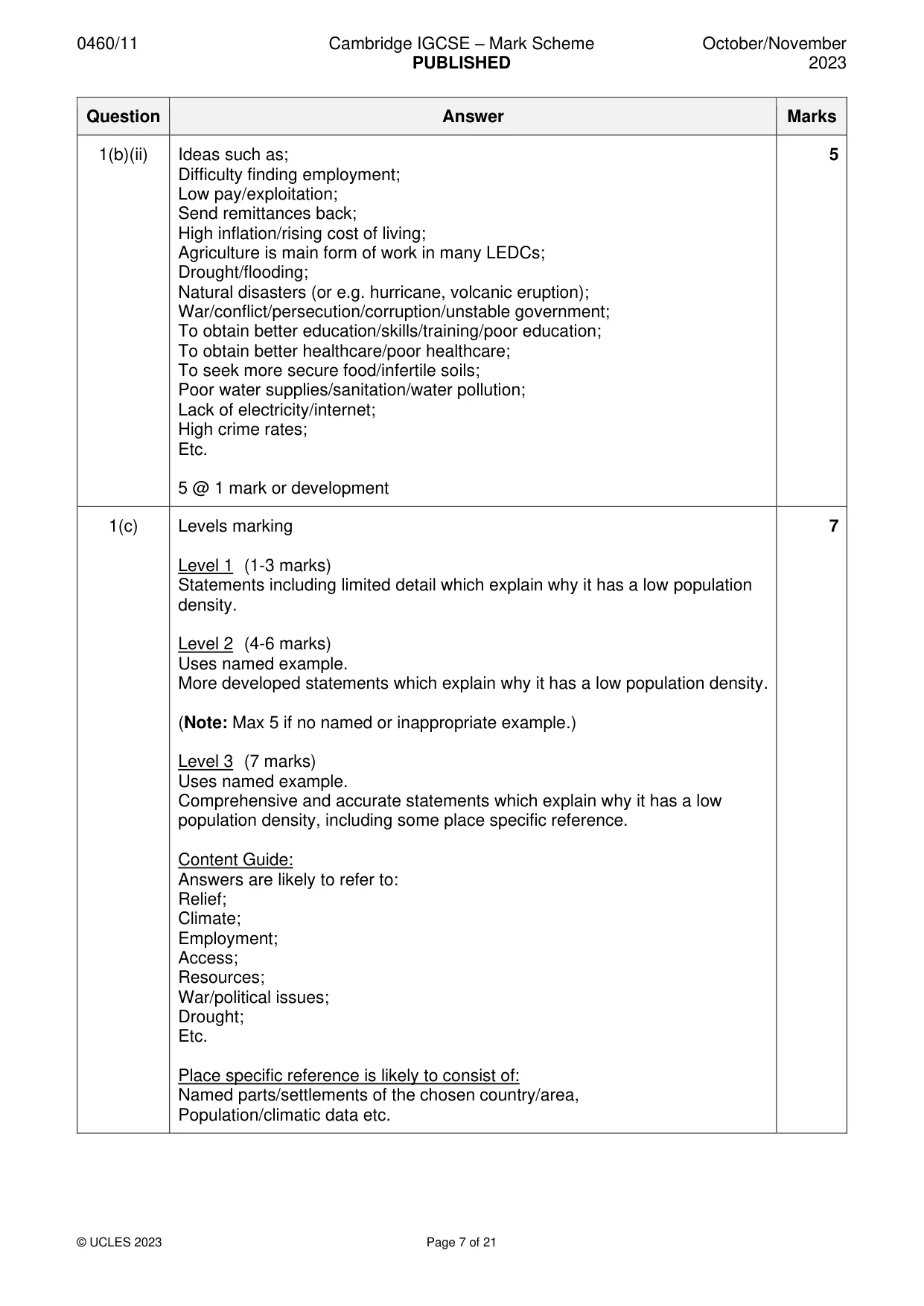
0460/11 Cambridge IGCSE – Mark Scheme PUBLISHED October/November 2023 © UCLES 2023 Page 7 of 21 Question Answer Marks 1(b)(ii) Ideas such as; Difficulty finding employment; Low pay/exploitation; Send remittances back; High inflation/rising cost of living; Agriculture is main form of work in many LEDCs; Drought/flooding; Natural disasters (or e.g. hurricane, volcanic eruption); War/conflict/persecution/corruption/unstable government; To obtain better education/skills/training/poor education; To obtain better healthcare/poor healthcare; To seek more secure food/infertile soils; Poor water supplies/sanitation/water pollution; Lack of electricity/internet; High crime rates; Etc. 5 @ 1 mark or development 5 1(c) Levels marking Level 1 (1-3 marks) Statements including limited detail which explain why it has a low population density. Level 2 (4-6 marks) Uses named example. More developed statements which explain why it has a low population density. (Note: Max 5 if no named or inappropriate example.) Level 3 (7 marks) Uses named example. Comprehensive and accurate statements which explain why it has a low population density, including some place specific reference. Content Guide: Answers are likely to refer to: Relief; Climate; Employment; Access; Resources; War/political issues; Drought; Etc. Place specific reference is likely to consist of: Named parts/settlements of the chosen country/area, Population/climatic data etc. 7
Mark scheme, page 8
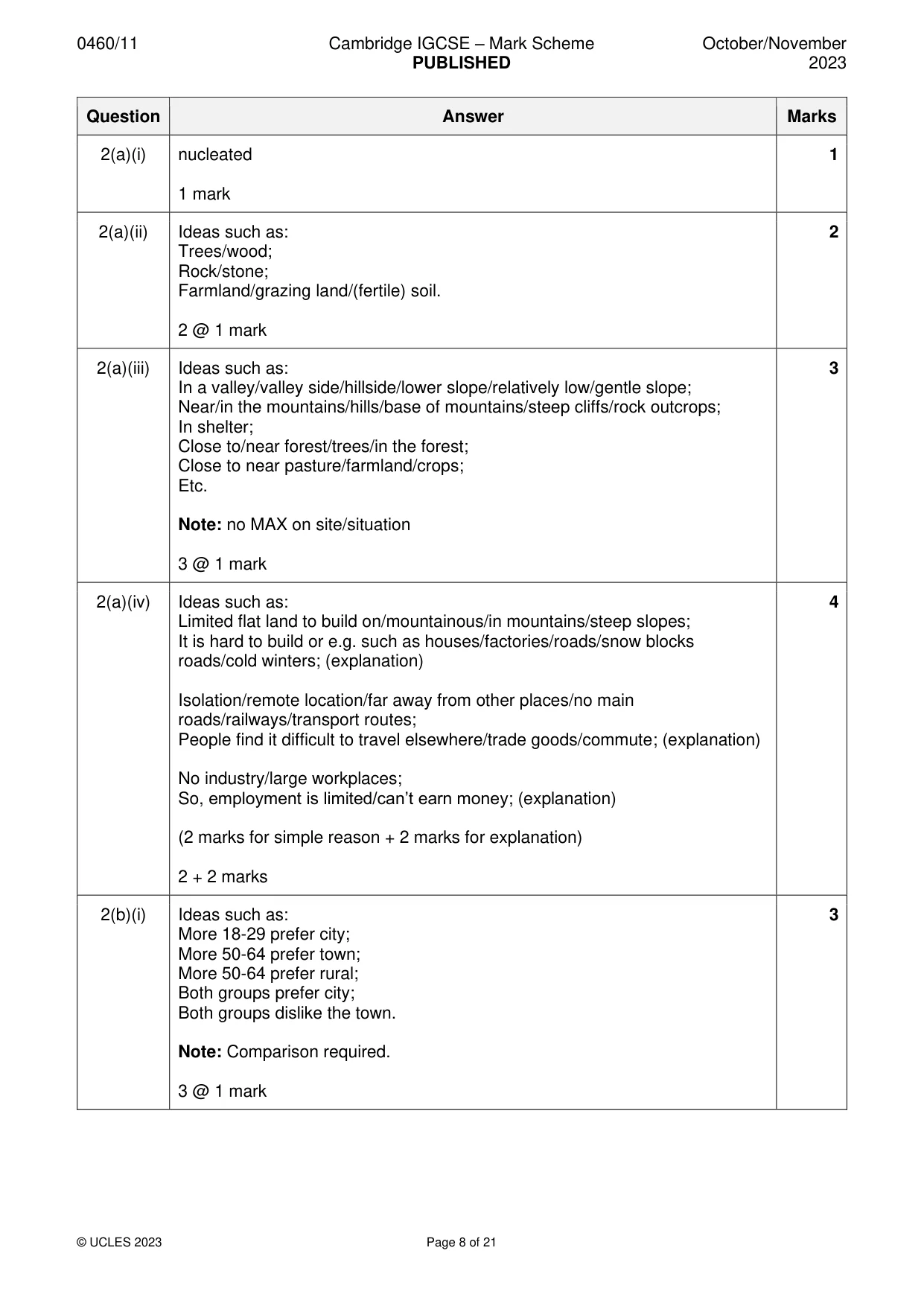
0460/11 Cambridge IGCSE – Mark Scheme PUBLISHED October/November 2023 © UCLES 2023 Page 8 of 21 Question Answer Marks 2(a)(i) nucleated 1 mark 1 2(a)(ii) Ideas such as: Trees/wood; Rock/stone; Farmland/grazing land/(fertile) soil. 2 @ 1 mark 2 2(a)(iii) Ideas such as: In a valley/valley side/hillside/lower slope/relatively low/gentle slope; Near/in the mountains/hills/base of mountains/steep cliffs/rock outcrops; In shelter; Close to/near forest/trees/in the forest; Close to near pasture/farmland/crops; Etc. Note: no MAX on site/situation 3 @ 1 mark 3 2(a)(iv) Ideas such as: Limited flat land to build on/mountainous/in mountains/steep slopes; It is hard to build or e.g. such as houses/factories/roads/snow blocks roads/cold winters; (explanation) Isolation/remote location/far away from other places/no main roads/railways/transport routes; People find it difficult to travel elsewhere/trade goods/commute; (explanation) No industry/large workplaces; So, employment is limited/can’t earn money; (explanation) (2 marks for simple reason + 2 marks for explanation) 2 + 2 marks 4 2(b)(i) Ideas such as: More 18-29 prefer city; More 50-64 prefer town; More 50-64 prefer rural; Both groups prefer city; Both groups dislike the town. Note: Comparison required. 3 @ 1 mark 3
Mark scheme, page 9
0460/11 Cambridge IGCSE – Mark Scheme PUBLISHED October/November 2023 © UCLES 2023 Page 9 of 21 Question Answer Marks 2(b)(ii) Ideas such as: Retirement/no need to work; Quiet/peaceful/more relaxed/less stressed; Less crime or e.g.; Less traffic; Less air pollution; More open space/green areas/close to nature; Etc. 5 @ 1 mark or development 5 2(c) Levels marking Level 1 (1-3 marks) Statements including limited detail which explain why large numbers of people migrate from surrounding rural area to urban area. Level 2 (4-6 marks) Uses named example. Developed statements which explain why large numbers of people migrate from surrounding rural area to urban area. (Note: Max 5 if no named or inappropriate example.) Level 3 (7 marks) Uses named example. Comprehensive and accurate statements which explain why large numbers of people migrate from surrounding rural area to urban area, with some place specific reference. Content Guide: Answers are likely to refer to: Employment; Health care; Education; Entertainment; Food supplies; Natural disasters; Specified services/amenities; Etc. Note: Answer can refer to pulls or pushes but no double credit. Place specific reference is likely to consist of: Locational details, Names of areas within the urban area, Specific details/names of attractions etc. 7
Mark scheme, page 10
0460/11 Cambridge IGCSE – Mark Scheme PUBLISHED October/November 2023 © UCLES 2023 Page 10 of 21 Question Answer Marks 3(a)(i) 14 1 mark 1 3(a)(ii) Ideas such as: Clustered together; In a line/linear; In a curve; On all islands/throughout Indonesia/any three of Sumatra/Java/Sulawesi/New Guinea; On/near the coast/land/islands; West or north-west/east or north-east/south or south-west or south-east (any two) etc. 2 @ 1 mark 2 3(a)(iii) Ideas such as: Deaths/injuries; Homes/property damaged/collapsed/destroyed/homeless/lack of shelter; Roads/railways/airports damaged; Factories/offices/workplaces destroyed/damaged/collapsed/have to shut down; Specified other buildings e.g. schools/shops/churches/hotels etc damaged/destroyed (MAX 1); Water supplies disrupted/water borne disease/dams burst; Electricity supplies/internet/telephone lines disrupted; Fire/explosions/gas leaks; Cause tsunamis/flooding; Economic impact/recession/financial losses or e.g. such as cost of rebuilding; Reduces trade/imports/exports; Etc. 3 @ 1 mark 3 3(a)(iv) Ideas such as: Poverty/cannot afford to move; Proximity to friends/family; Lived there all their lives/emotional attachment; Close to work; Close to schools/education; Unaware of danger; Prepared to take risk; Earthquake proofing of buildings; Educated about/know what to do/know how to act/be prepared by having drills/evacuation procedures/large open spaces; Trust monitoring of fault lines; Etc. 4 @ 1 mark 4
Mark scheme, page 11
0460/11 Cambridge IGCSE – Mark Scheme PUBLISHED October/November 2023 © UCLES 2023 Page 11 of 21 Question Answer Marks 3(b)(i) Ideas such as: Steep/vertical; Rocky/rock; Layers (of rock); Scree/loose materials/ash/gravel at base of slope; Deep; Circular/curved walls/curved sides/enclosed; Etc. 3 @ 1 mark 3 3(b)(ii) Ideas such as: Money from/work in tourist industry – example (dev); Fertile soils/good for farming - high yields of crops (dev); Scenic beauty; To study volcanoes; Geothermal power/renewable energy - hot water (dev); Quarrying/mining/ extraction of minerals – example - sulphur/diamonds/building materials/beauty products (dev); Etc. 5 @ 1 mark or development 5
Mark scheme, page 12
0460/11 Cambridge IGCSE – Mark Scheme PUBLISHED October/November 2023 © UCLES 2023 Page 12 of 21 Question Answer Marks 3(c) Levels marking Level 1 (1-3 marks) Statements including limited detail which explain the cause of a volcanic eruption. Level 2 (4-6 marks) Uses named example. More developed or linked statements which explain the cause of a volcanic eruption. (Note: Max 5 if no named or inappropriate example.) Level 3 (7 marks) Uses named example. Comprehensive and accurate statements including place specific information. Content Guide: Answers are likely to refer to: Location on destructive/constructive plate boundary; Plate movement i.e. towards/away from each other; Subduction; Destruction/melting of crust; Build-up of pressure; Release of magma/magma rises; Triggered by earthquake; etc. Hot spot; Place specific reference is likely to consist of: Locational details/dates/times, Names of plates etc. 7
Mark scheme, page 13
0460/11 Cambridge IGCSE – Mark Scheme PUBLISHED October/November 2023 © UCLES 2023 Page 13 of 21 Question Answer Marks 4(a)(i) Maximum/minimum thermometer 1 mark 1 4(a)(ii) Ideas such as: Read temperature by looking at metal markers/take readings from base of markers; Read at both left and right sides/read minimum at left and maximum at right; Reset/reposition markers with magnet; Etc. 2 @ 1 mark 2 4(a)(iii) Barometer; Wet and dry bulb thermometer/hygrometer; Maximum and minimum thermometer/Six’s thermometer. 3 @ 1 mark 3 4(a)(iv) Ideas such as: For security/so they are not damaged/stolen/not touched/tampered with by animals and people; So they are not influenced by ground temperature; So they are out of (direct) sunlight/to reflect sunlight; So they are not affected by the wind; So they are not damaged/affected by rain/snow; etc. 4 @ 1 mark 4 4(b)(i) Ideas such as digital instruments are: Quick/give instant readings/save time/measure things at the same time; Accurate/precise/give exact figures/digital readout; Easy/clear to read; No chance of error/misreading; Can be linked to a computer/automatic logging/store data/data not lost/24 hours 7 days a week/continuous recording; Etc. Note: No need for comparison. 3 @ 1 mark 3
Mark scheme, page 14
0460/11 Cambridge IGCSE – Mark Scheme PUBLISHED October/November 2023 © UCLES 2023 Page 14 of 21 Question Answer Marks 4(b)(ii) Ideas such as: Close to/near/affected by the building; It is sheltered from the wind/in the shade; Heat could be transmitted by the building; Temperature higher than it should be because it is out of the wind; Close to/near/ affected by the trees; It is sheltered from the wind/in the shadow/the data could be influenced by being sheltered; Wind speed will be recorded as lower than it should be; It is on/affected by concrete/tarmac/path/road/playground or lot of people there; Temperatures are higher above tarmac/heat absorbed; It could be tampered with/stolen/it is not a secure site; Soil sensor cannot be used; Etc. Note: Max 3 marks for each idea. 5 @ 1 mark or development 5
Mark scheme, page 15
0460/11 Cambridge IGCSE – Mark Scheme PUBLISHED October/November 2023 © UCLES 2023 Page 15 of 21 Question Answer Marks 4(c) Levels marking Level 1 (1-3 marks) Statements including limited detail which describe and/or explain characteristics of equatorial climate. Level 2 (4-6 marks) Uses named example. More developed explanation or linked statements which describe and/or explain characteristics of equatorial climate. (Note: Max 5 if no named or inappropriate example.) Level 3 (7 marks) Uses named example. Comprehensive and accurate statements which describe and explain characteristics of equatorial climate, including place specific information. Content Guide: Answers are likely to refer to: Temperature; Precipitation; Lack of seasons; Latitude; Atmospheric pressure; Evaporation/transpiration; Condensation/saturation; Build-up of cloud; Etc. Place specific reference is likely to consist of: Locational details, named places within equatorial area, climatic statistics etc. 7
Mark scheme, page 16
0460/11 Cambridge IGCSE – Mark Scheme PUBLISHED October/November 2023 © UCLES 2023 Page 16 of 21 Question Answer Marks 5(a)(i) 50 (million) 1 mark 1 5(a)(ii) China, USA, Russia, Brazil (correct order needed). All 4 correct = 2 marks 2/3 correct = 1 mark 2 @ 1 mark 2 5(a)(iii) Ideas such as: Uneven; Clustered; Mainly northern hemisphere/north of Equator/the North; Mainly higher latitudes/temperate areas; Europe/Asia/North America (any two); MEDCs/richer countries; Etc. 3 @ 1 mark 3 5(a)(iv) Ideas such as: Release of carbon dioxide/monoxide; Which is a greenhouse gas; Builds up in atmosphere/forms a layer; Allows incoming radiation/sun’s rays to pass through; Heat is trapped (by the layer/greenhouse gases)/reflected back to earth’s surface/not reflected back into space; Etc. 4 @ 1 mark 4 5(b)(i) Ideas such as: Positive correlation/relationship; As GDP increases so does electricity consumption or use of two countries to show this; Relationship is not perfect/weak/slight/has anomalies/exceptions; Use of four statistics to support any of the above statements (MAX 1 reserve). 3 @ 1 mark 3
Mark scheme, page 17
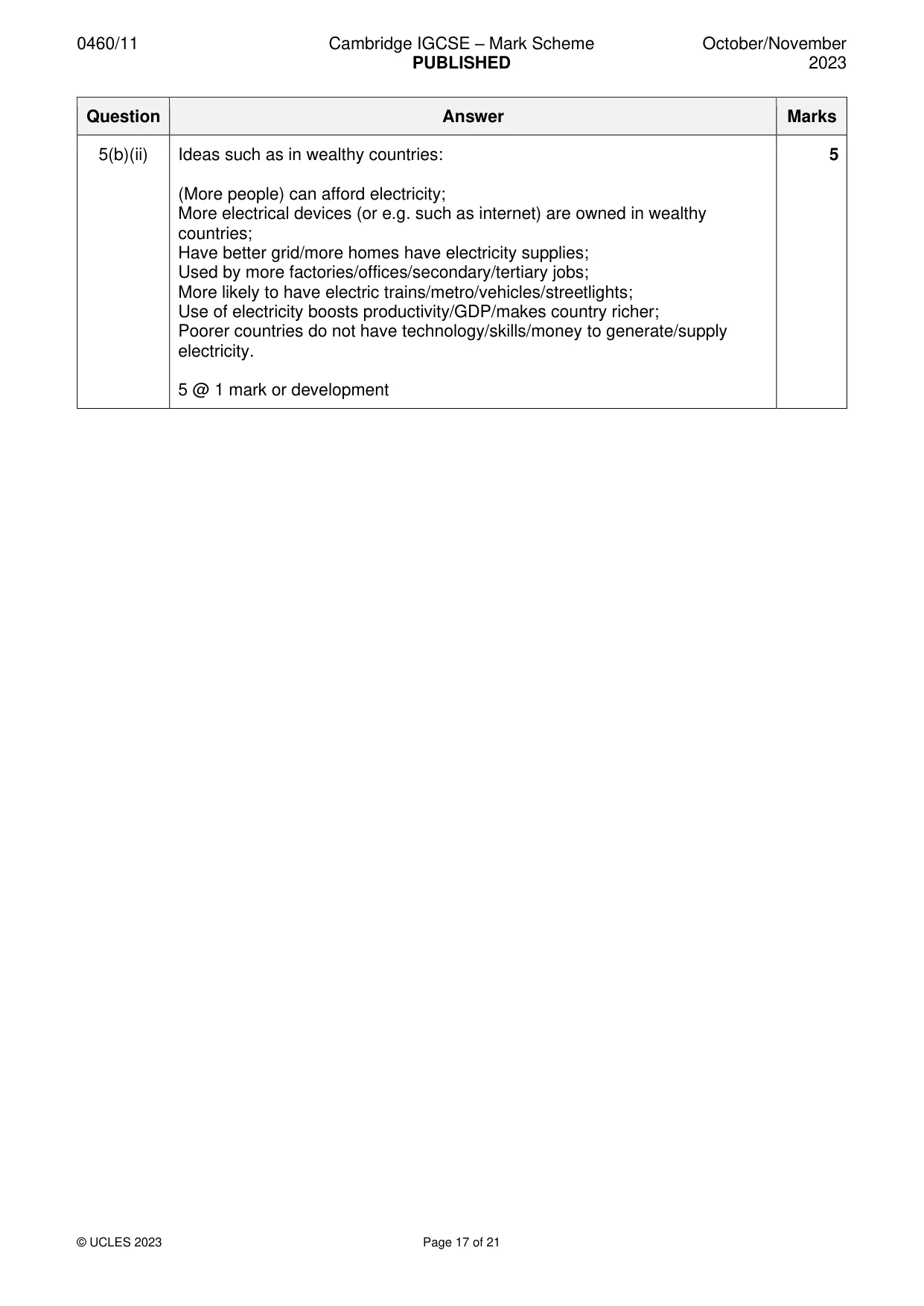
0460/11 Cambridge IGCSE – Mark Scheme PUBLISHED October/November 2023 © UCLES 2023 Page 17 of 21 Question Answer Marks 5(b)(ii) Ideas such as in wealthy countries: (More people) can afford electricity; More electrical devices (or e.g. such as internet) are owned in wealthy countries; Have better grid/more homes have electricity supplies; Used by more factories/offices/secondary/tertiary jobs; More likely to have electric trains/metro/vehicles/streetlights; Use of electricity boosts productivity/GDP/makes country richer; Poorer countries do not have technology/skills/money to generate/supply electricity. 5 @ 1 mark or development 5
Mark scheme, page 18
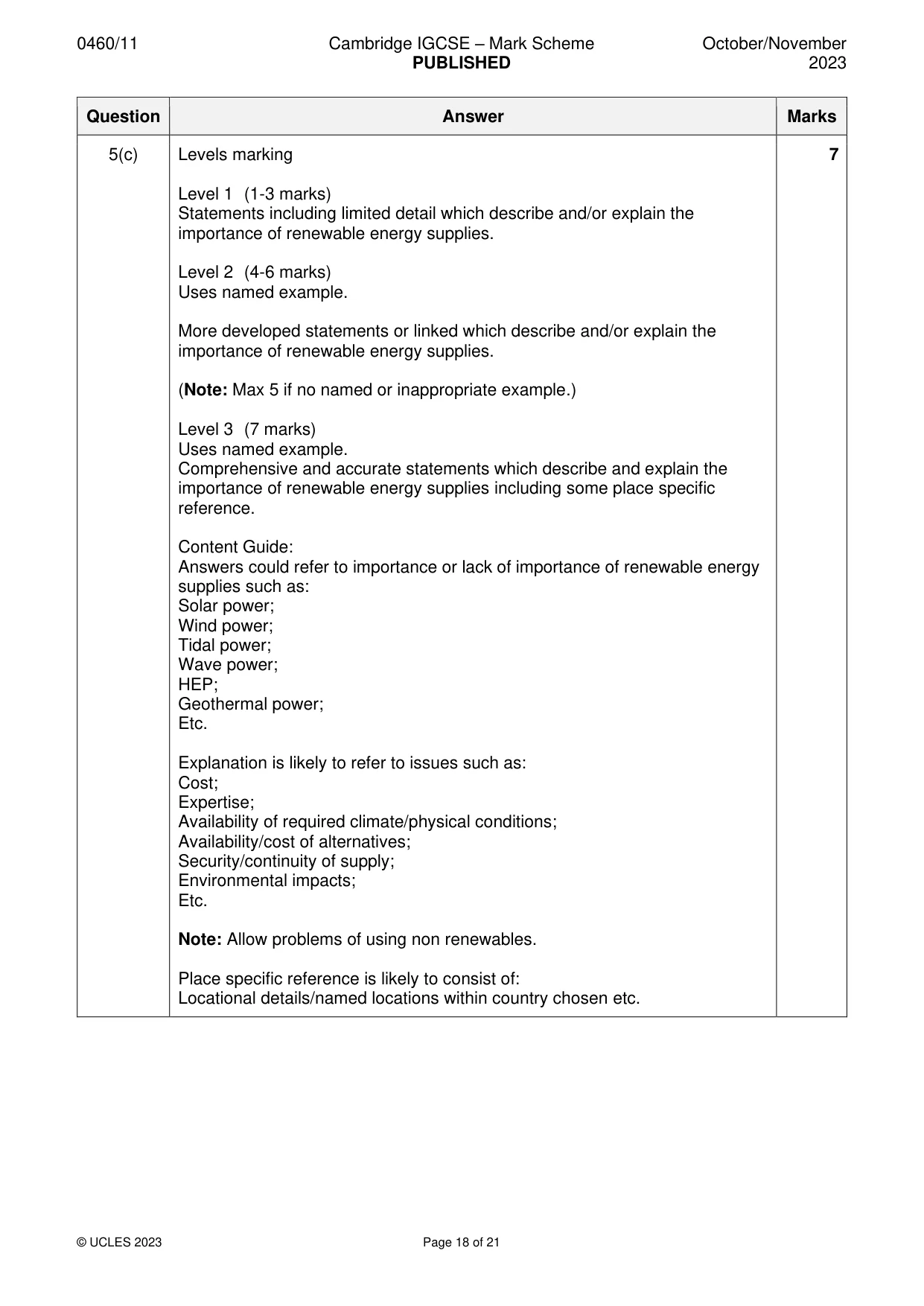
0460/11 Cambridge IGCSE – Mark Scheme PUBLISHED October/November 2023 © UCLES 2023 Page 18 of 21 Question Answer Marks 5(c) Levels marking Level 1 (1-3 marks) Statements including limited detail which describe and/or explain the importance of renewable energy supplies. Level 2 (4-6 marks) Uses named example. More developed statements or linked which describe and/or explain the importance of renewable energy supplies. (Note: Max 5 if no named or inappropriate example.) Level 3 (7 marks) Uses named example. Comprehensive and accurate statements which describe and explain the importance of renewable energy supplies including some place specific reference. Content Guide: Answers could refer to importance or lack of importance of renewable energy supplies such as: Solar power; Wind power; Tidal power; Wave power; HEP; Geothermal power; Etc. Explanation is likely to refer to issues such as: Cost; Expertise; Availability of required climate/physical conditions; Availability/cost of alternatives; Security/continuity of supply; Environmental impacts; Etc. Note: Allow problems of using non renewables. Place specific reference is likely to consist of: Locational details/named locations within country chosen etc. 7
Mark scheme, page 19
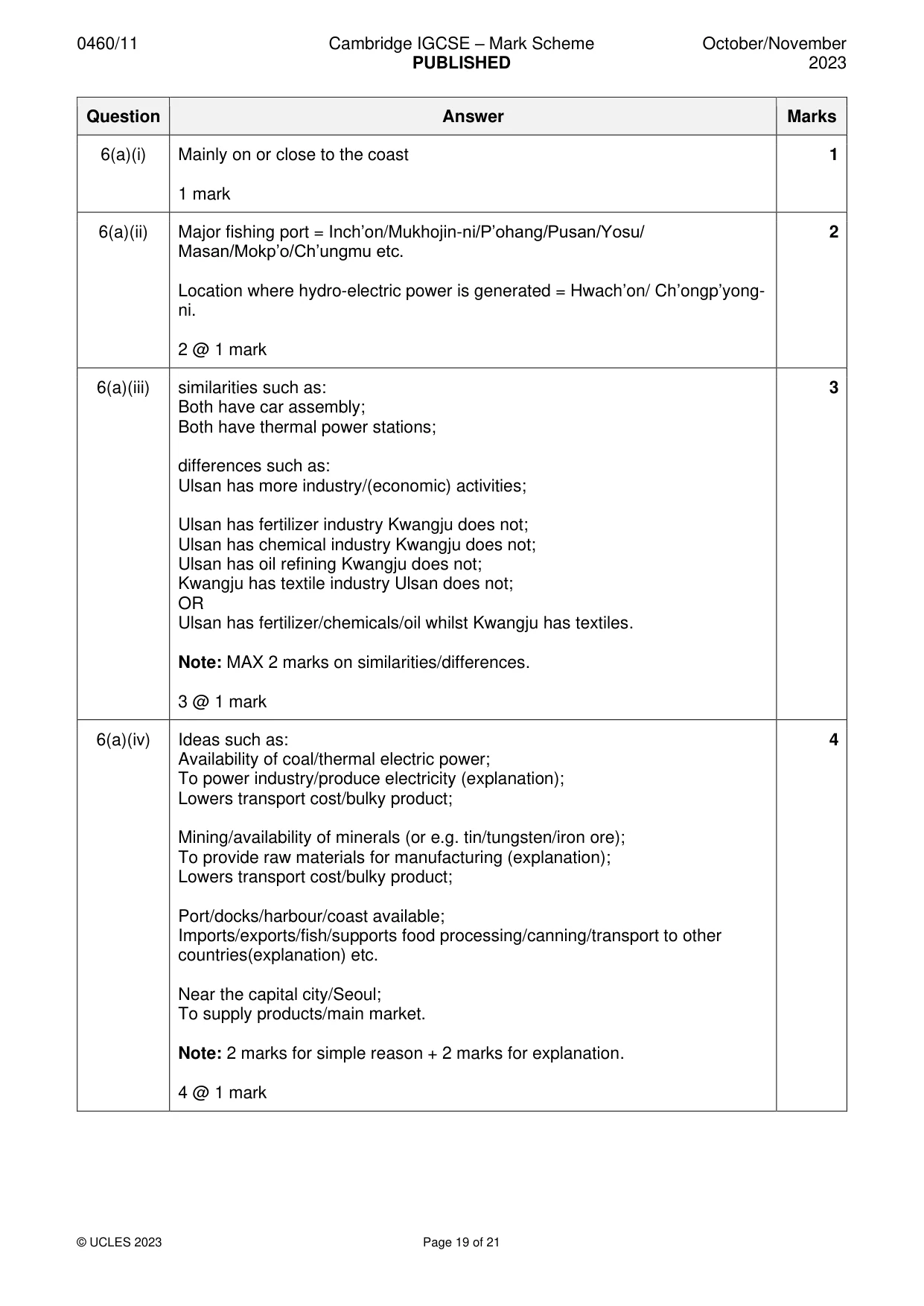
0460/11 Cambridge IGCSE – Mark Scheme PUBLISHED October/November 2023 © UCLES 2023 Page 19 of 21 Question Answer Marks 6(a)(i) Mainly on or close to the coast 1 mark 1 6(a)(ii) Major fishing port = Inch’on/Mukhojin-ni/P’ohang/Pusan/Yosu/ Masan/Mokp’o/Ch’ungmu etc. Location where hydro-electric power is generated = Hwach’on/ Ch’ongp’yong- ni. 2 @ 1 mark 2 6(a)(iii) similarities such as: Both have car assembly; Both have thermal power stations; differences such as: Ulsan has more industry/(economic) activities; Ulsan has fertilizer industry Kwangju does not; Ulsan has chemical industry Kwangju does not; Ulsan has oil refining Kwangju does not; Kwangju has textile industry Ulsan does not; OR Ulsan has fertilizer/chemicals/oil whilst Kwangju has textiles. Note: MAX 2 marks on similarities/differences. 3 @ 1 mark 3 6(a)(iv) Ideas such as: Availability of coal/thermal electric power; To power industry/produce electricity (explanation); Lowers transport cost/bulky product; Mining/availability of minerals (or e.g. tin/tungsten/iron ore); To provide raw materials for manufacturing (explanation); Lowers transport cost/bulky product; Port/docks/harbour/coast available; Imports/exports/fish/supports food processing/canning/transport to other countries(explanation) etc. Near the capital city/Seoul; To supply products/main market. Note: 2 marks for simple reason + 2 marks for explanation. 4 @ 1 mark 4
Mark scheme, page 20
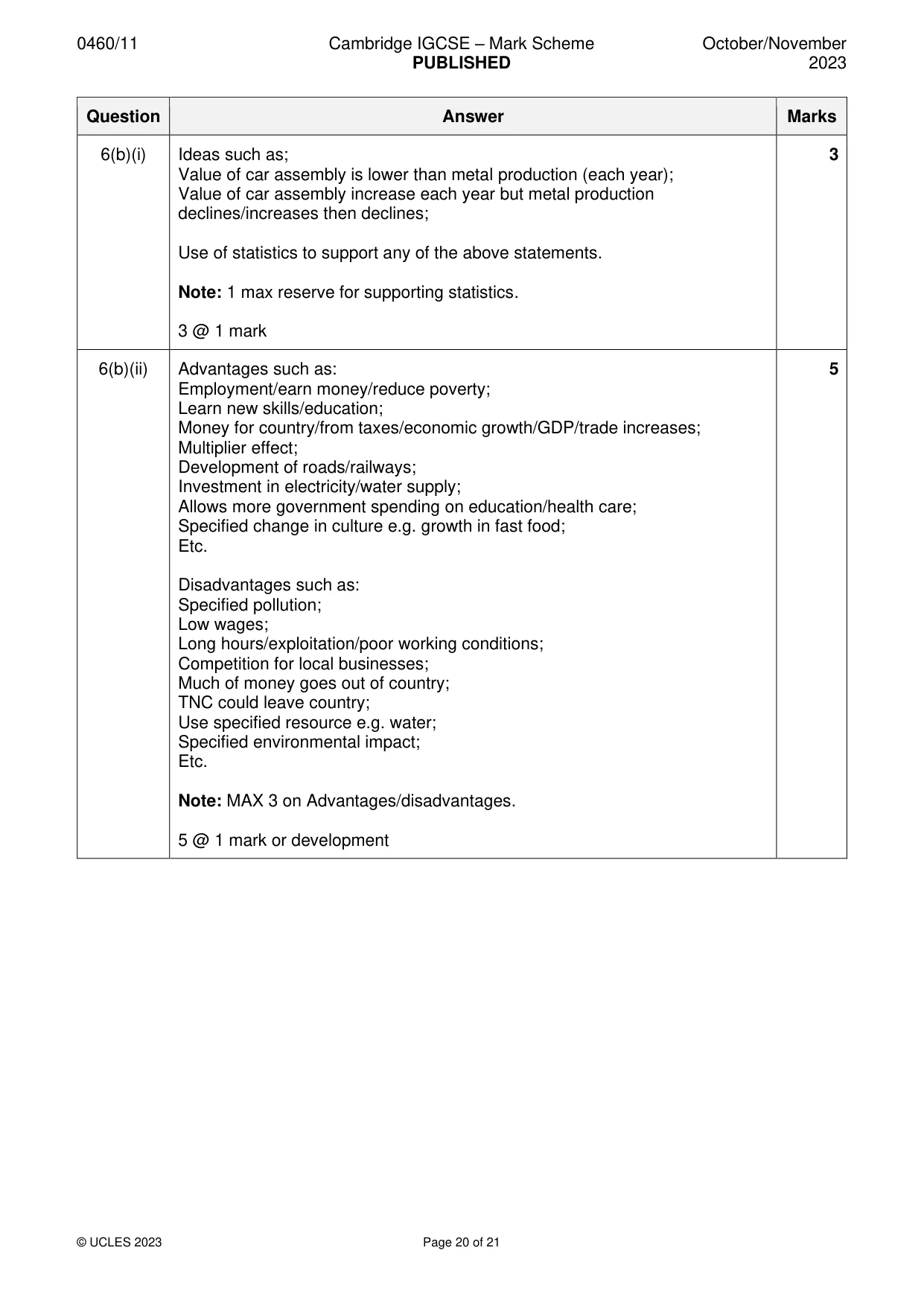
0460/11 Cambridge IGCSE – Mark Scheme PUBLISHED October/November 2023 © UCLES 2023 Page 20 of 21 Question Answer Marks 6(b)(i) Ideas such as; Value of car assembly is lower than metal production (each year); Value of car assembly increase each year but metal production declines/increases then declines; Use of statistics to support any of the above statements. Note: 1 max reserve for supporting statistics. 3 @ 1 mark 3 6(b)(ii) Advantages such as: Employment/earn money/reduce poverty; Learn new skills/education; Money for country/from taxes/economic growth/GDP/trade increases; Multiplier effect; Development of roads/railways; Investment in electricity/water supply; Allows more government spending on education/health care; Specified change in culture e.g. growth in fast food; Etc. Disadvantages such as: Specified pollution; Low wages; Long hours/exploitation/poor working conditions; Competition for local businesses; Much of money goes out of country; TNC could leave country; Use specified resource e.g. water; Specified environmental impact; Etc. Note: MAX 3 on Advantages/disadvantages. 5 @ 1 mark or development 5
Mark scheme, page 21
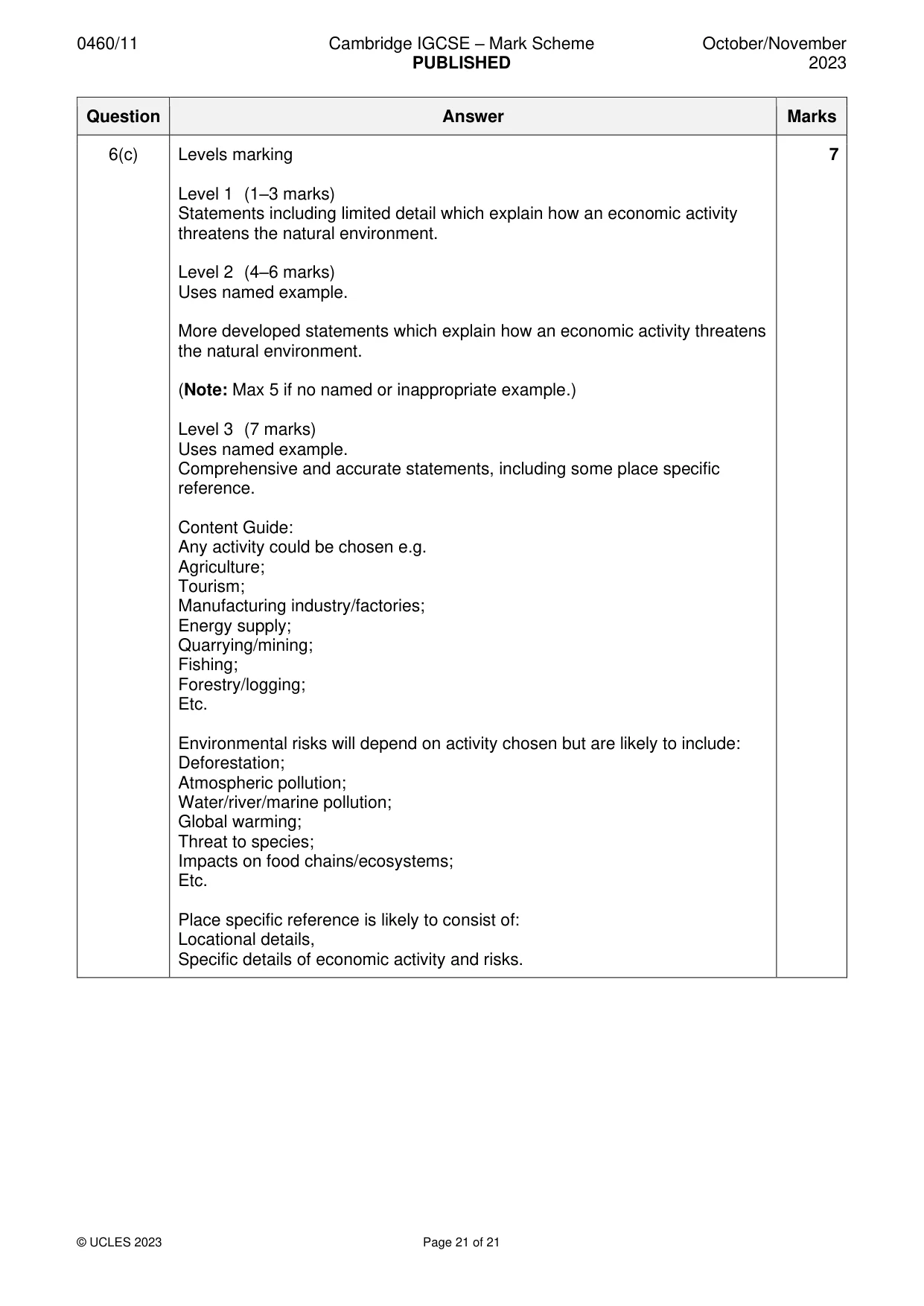
0460/11 Cambridge IGCSE – Mark Scheme PUBLISHED October/November 2023 © UCLES 2023 Page 21 of 21 Question Answer Marks 6(c) Levels marking Level 1 (1–3 marks) Statements including limited detail which explain how an economic activity threatens the natural environment. Level 2 (4–6 marks) Uses named example. More developed statements which explain how an economic activity threatens the natural environment. (Note: Max 5 if no named or inappropriate example.) Level 3 (7 marks) Uses named example. Comprehensive and accurate statements, including some place specific reference. Content Guide: Any activity could be chosen e.g. Agriculture; Tourism; Manufacturing industry/factories; Energy supply; Quarrying/mining; Fishing; Forestry/logging; Etc. Environmental risks will depend on activity chosen but are likely to include: Deforestation; Atmospheric pollution; Water/river/marine pollution; Global warming; Threat to species; Impacts on food chains/ecosystems; Etc. Place specific reference is likely to consist of: Locational details, Specific details of economic activity and risks. 7
What you needed in this session
Cambridge’s own grade thresholds for 2023 Oct/Nov, Paper 1 · Variant 1. A higher threshold means an easier paper — the bar moves with how the cohort did.