Cambridge IGCSE Geography 0460 — 2023 May/June Paper 1 · Variant 1
0460/11/M/J/23 · 75 marks · ≈84 min
The question paper and its mark scheme, free to read here and free to download. This is Cambridge’s own paper, exactly as it was sat.
Question paper24 pages

Mark scheme19 pages
Answers below. Sit the paper first if you are practising.
Paper as text
Question paper, page 1
This document has 24 pages. Any blank pages are indicated. [Turn over Cambridge IGCSE™ GEOGRAPHY 0460/11 Paper 1 Geographical Themes May/June 2023 1 hour 45 minutes You must answer on the question paper. You will need: Insert (enclosed) Ruler Calculator Protractor INSTRUCTIONS ● Answer three questions in total, one from each section. ● Use a black or dark blue pen. You may use an HB pencil for any diagrams or graphs. ● Write your name, centre number and candidate number in the boxes at the top of the page. ● Write your answer to each question in the space provided. ● Do not use an erasable pen or correction fluid. ● Do not write on any bar codes. ● If additional space is needed, you should use the lined pages at the end of this booklet; the question number or numbers must be clearly shown. INFORMATION ● The total mark for this paper is 75. ● The number of marks for each question or part question is shown in brackets [ ]. ● The insert contains additional resources referred to in the questions. Definitions MEDCs – More Economically Developed Countries LEDCs – Less Economically Developed Countries * 9 0 1 4 3 1 6 3 1 8 * DC (PQ/CT) 312253/3 © UCLES 2023
Question paper, page 2
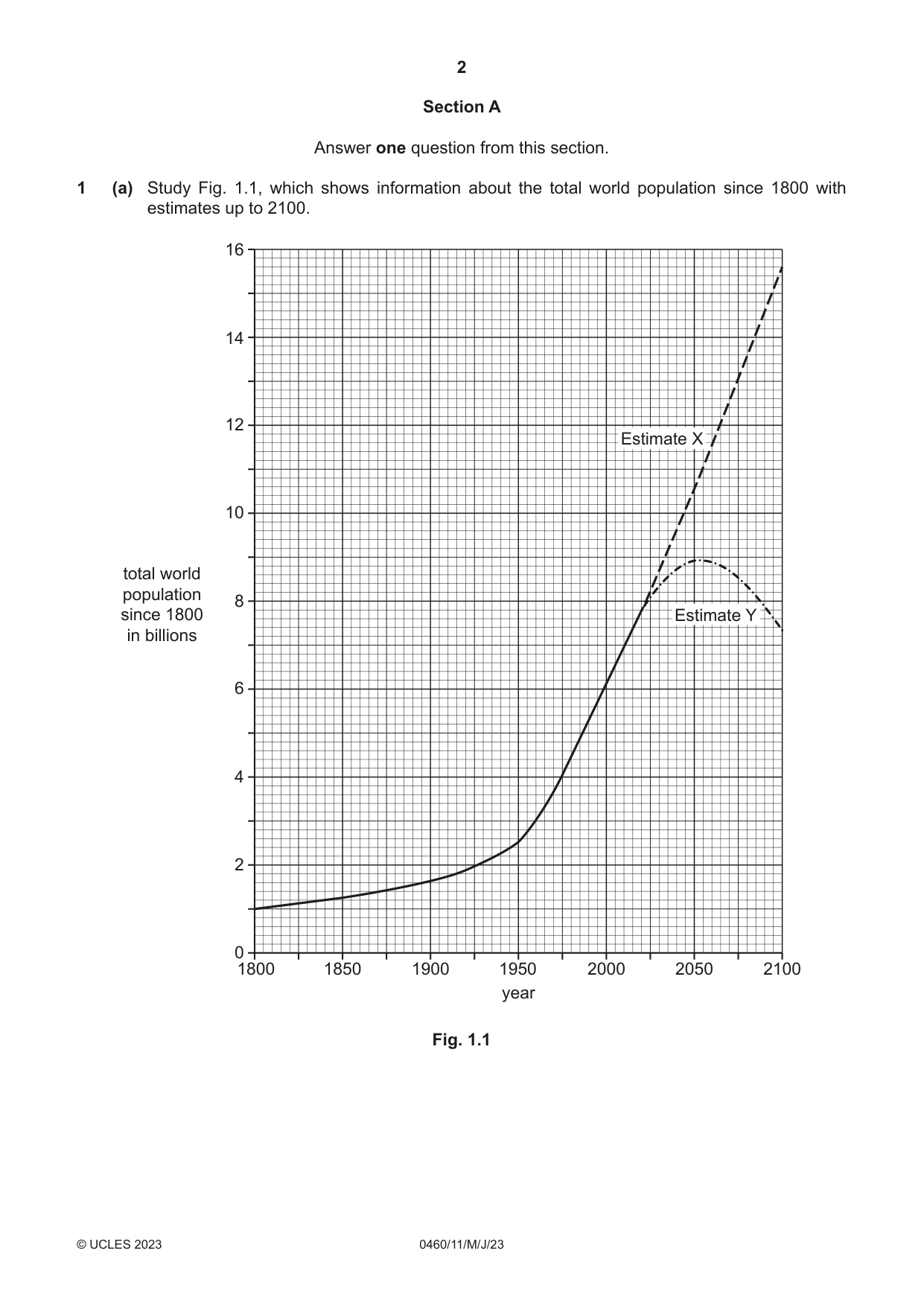
2 0460/11/M/J/23 © UCLES 2023 Section A Answer one question from this section. 1 (a) Study Fig. 1.1, which shows information about the total world population since 1800 with estimates up to 2100. 1800 1850 1900 1950 2000 2050 2100 year total world population since 1800 in billions 0 2 4 6 8 10 12 14 16 Estimate X Estimate Y Fig. 1.1
Question paper, page 3
3 0460/11/M/J/23 © UCLES 2023 [Turn over (i) What was the total population of the world in 2020? … billions [1] (ii) Compare the growth of the world’s population from 1800 to 1950 with the growth between 1950 and 2020. Use statistics in your answer. … … … … [2] (iii) Which of the two estimates for future population growth do you think is most likely, X or Y? Give reasons for your choice. Estimate … Reasons … … … … … … [3] (iv) Some countries are under-populated. Describe the problems caused by under-population. … … … … … … … … [4]
Question paper, page 4
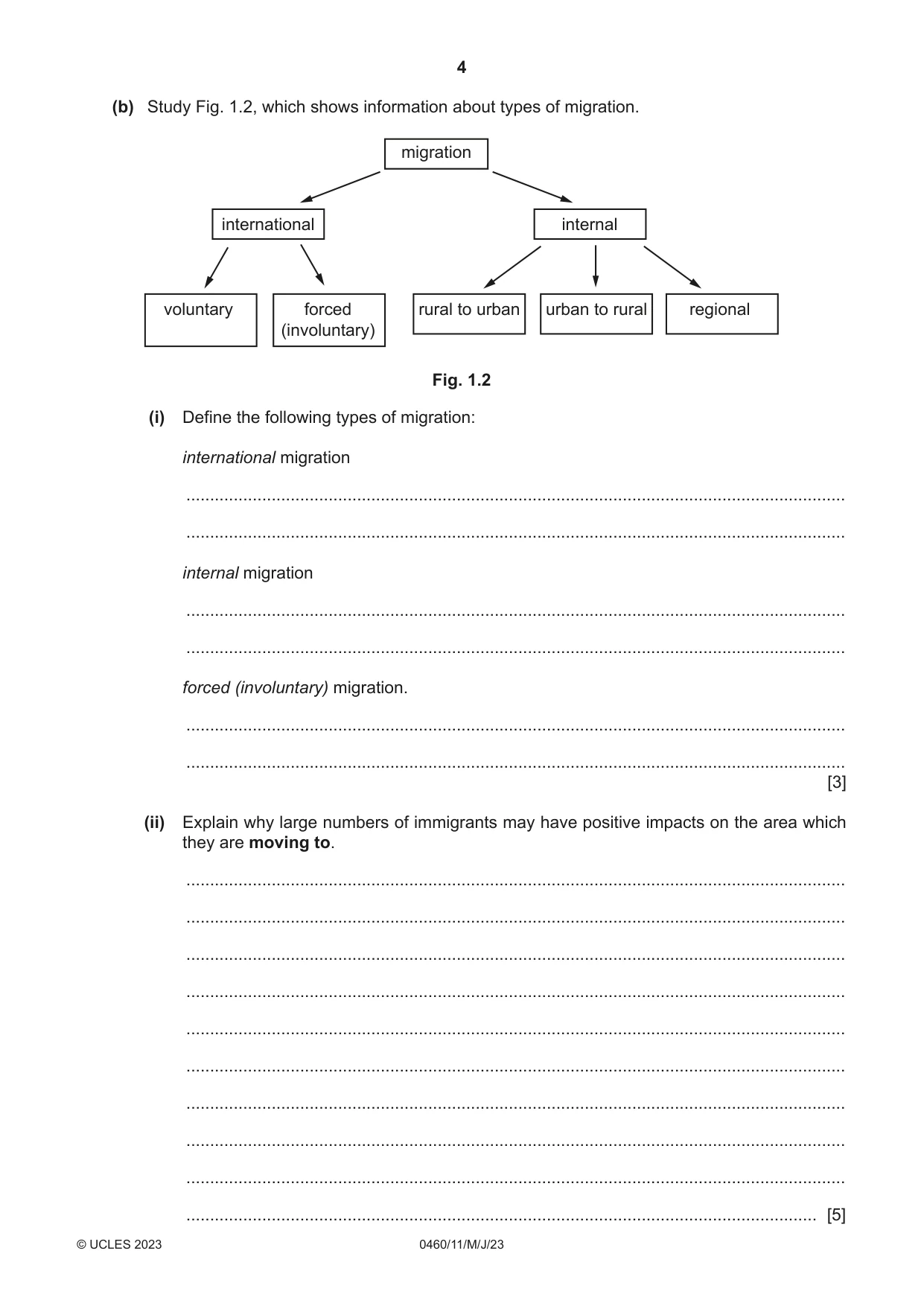
4 0460/11/M/J/23 © UCLES 2023 (b) Study Fig. 1.2, which shows information about types of migration. migration international internal voluntary forced (involuntary) rural to urban urban to rural regional Fig. 1.2 (i) Define the following types of migration: international migration … … internal migration … … forced (involuntary) migration. … … [3] (ii) Explain why large numbers of immigrants may have positive impacts on the area which they are moving to. … … … … … … … … … … [5]
Question paper, page 5
5 0460/11/M/J/23 © UCLES 2023 [Turn over (c) For an example you have studied, explain why migration of large numbers of people has taken place. You should refer to push and pull factors. Migration from … to … Explanation … … … … … … … … … … … … … … … … … … … … … … … … [7] [Total: 25]
Question paper, page 6
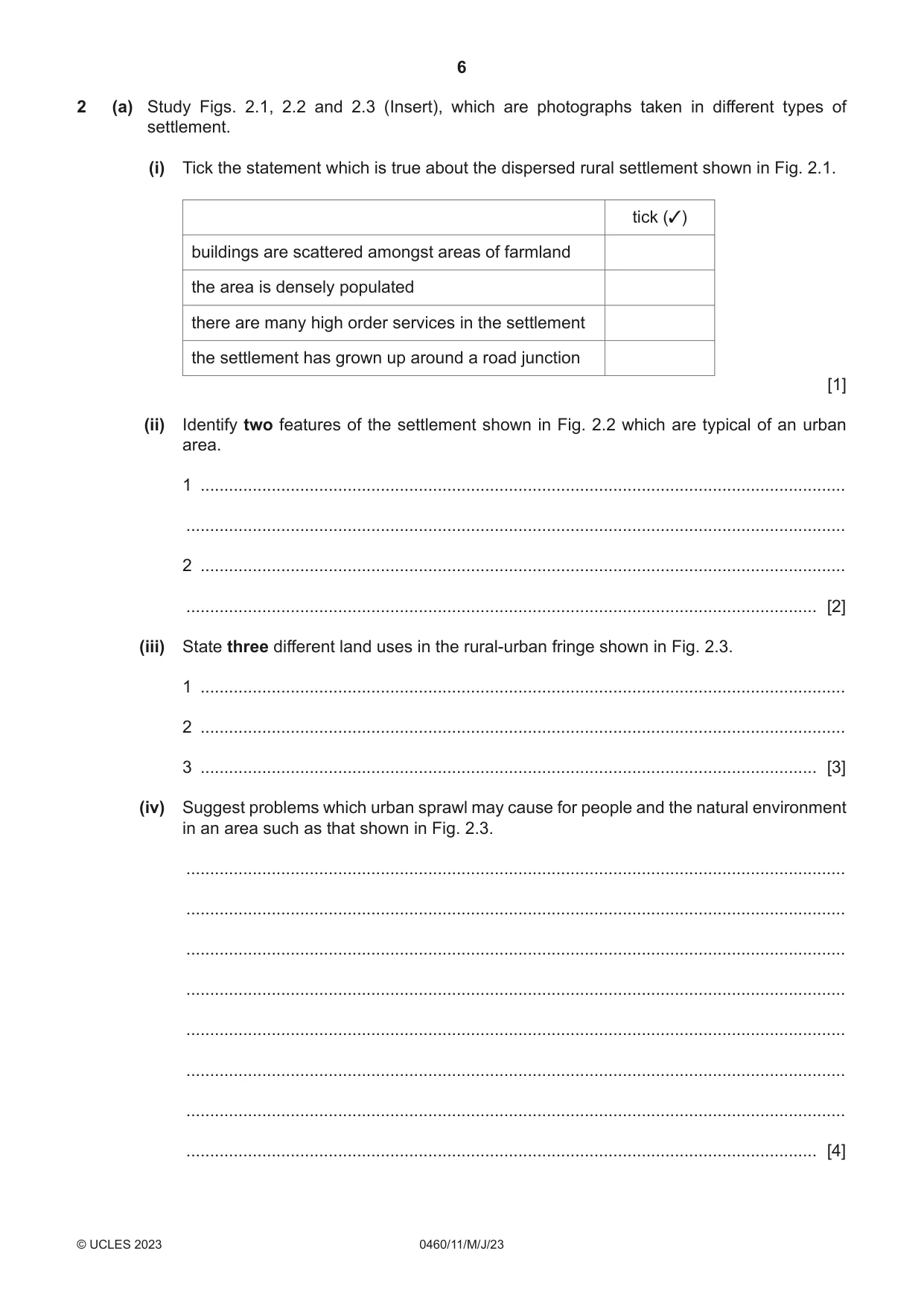
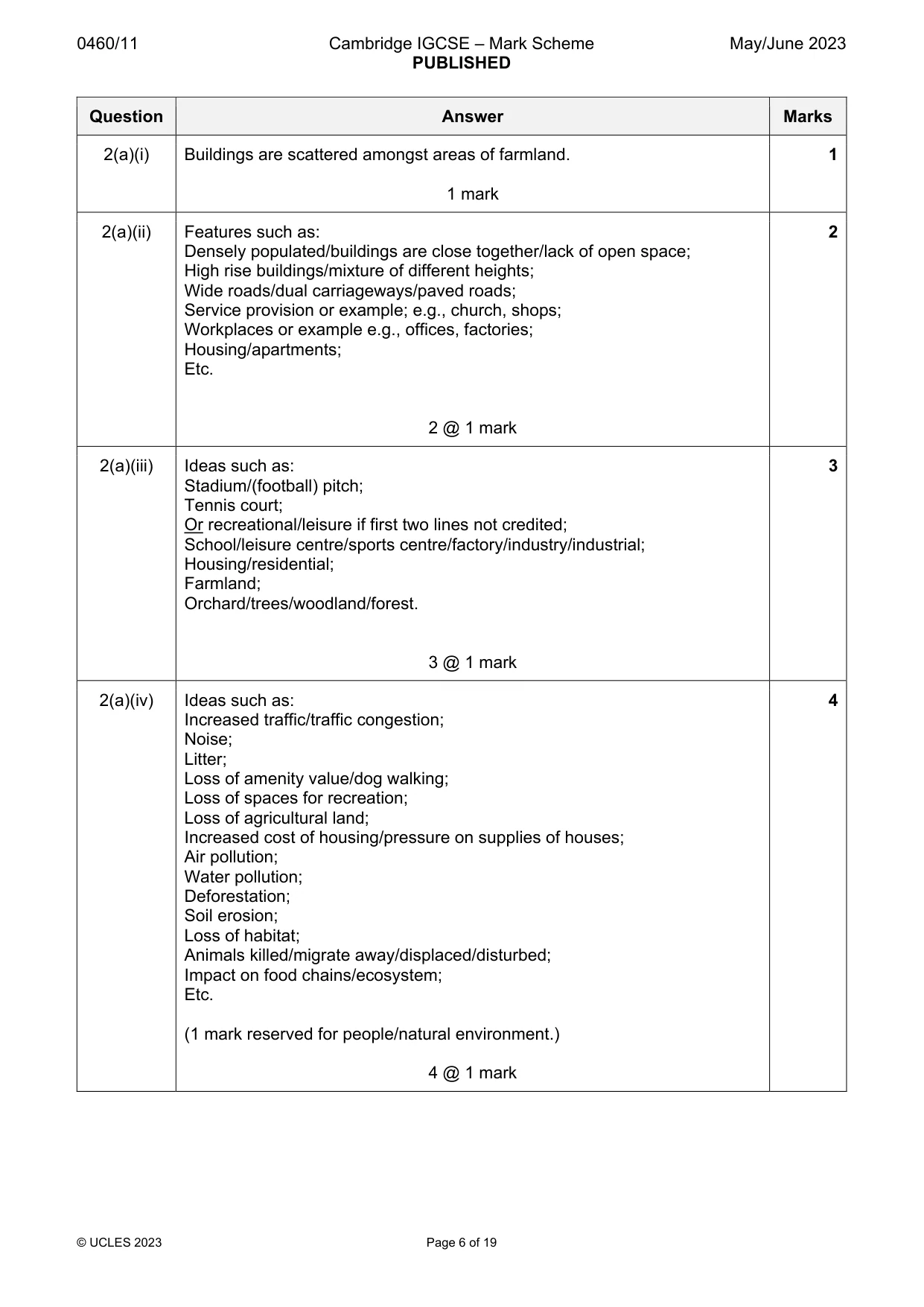
6 0460/11/M/J/23 © UCLES 2023 2 (a) Study Figs. 2.1, 2.2 and 2.3 (Insert), which are photographs taken in different types of settlement. (i) Tick the statement which is true about the dispersed rural settlement shown in Fig. 2.1. tick (3) buildings are scattered amongst areas of farmland the area is densely populated there are many high order services in the settlement the settlement has grown up around a road junction [1] (ii) Identify two features of the settlement shown in Fig. 2.2 which are typical of an urban area. 1 … … 2 … … [2] (iii) State three different land uses in the rural-urban fringe shown in Fig. 2.3. 1 … 2 … 3 … [3] (iv) Suggest problems which urban sprawl may cause for people and the natural environment in an area such as that shown in Fig. 2.3. … … … … … … … … [4]
Question paper, page 7
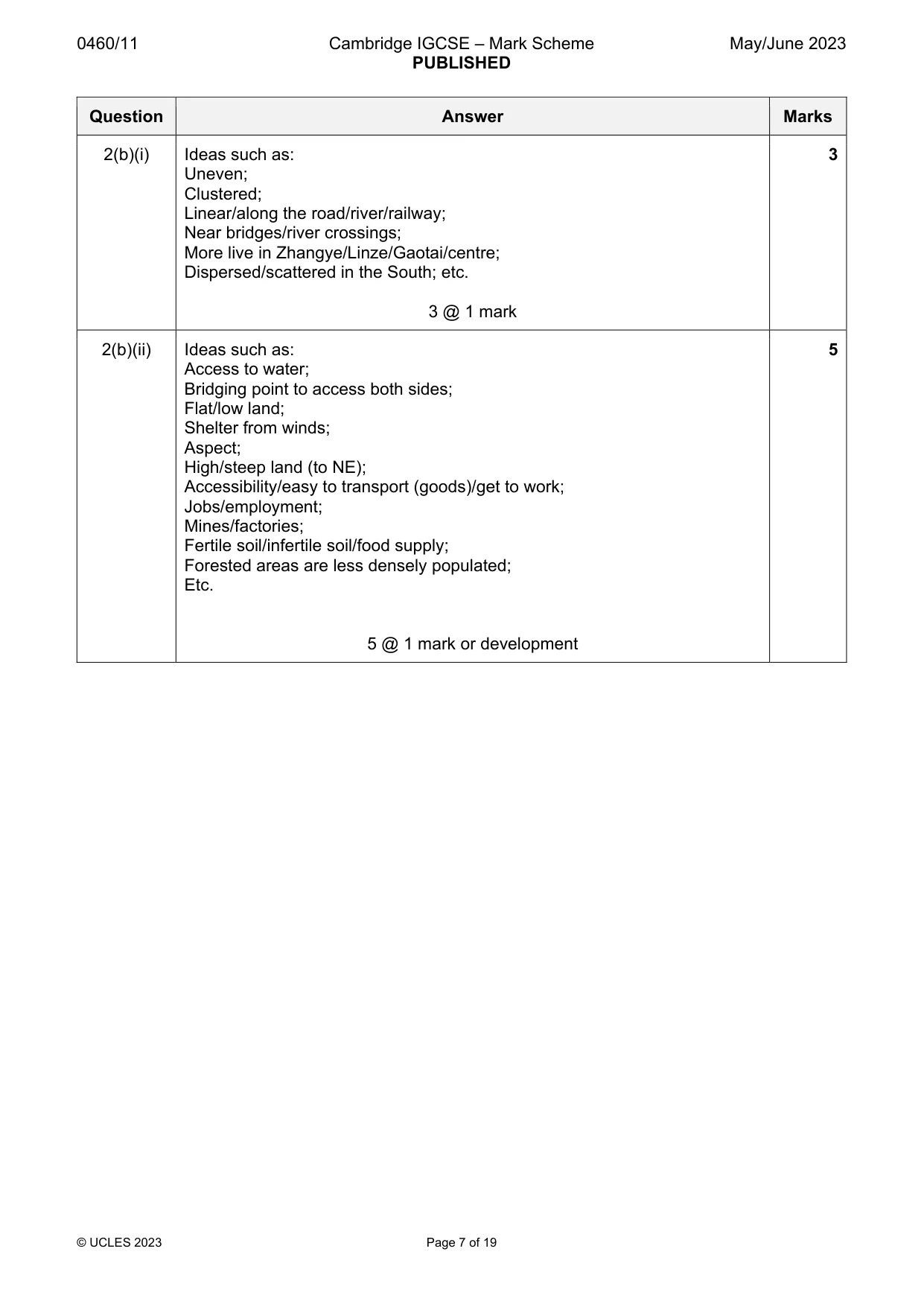
7 0460/11/M/J/23 © UCLES 2023 [Turn over (b) Study Fig. 2.4 (Insert), which is a map showing settlement in the basin of the Heihe River in north west China. (i) Describe the distribution of settlement in the area shown in Fig. 2.4 (Insert). … … … … … … [3] (ii) Suggest different reasons for the distribution of settlement in the area shown in Fig. 2.4 (Insert). … … … … … … … … … … [5]
Question paper, page 8
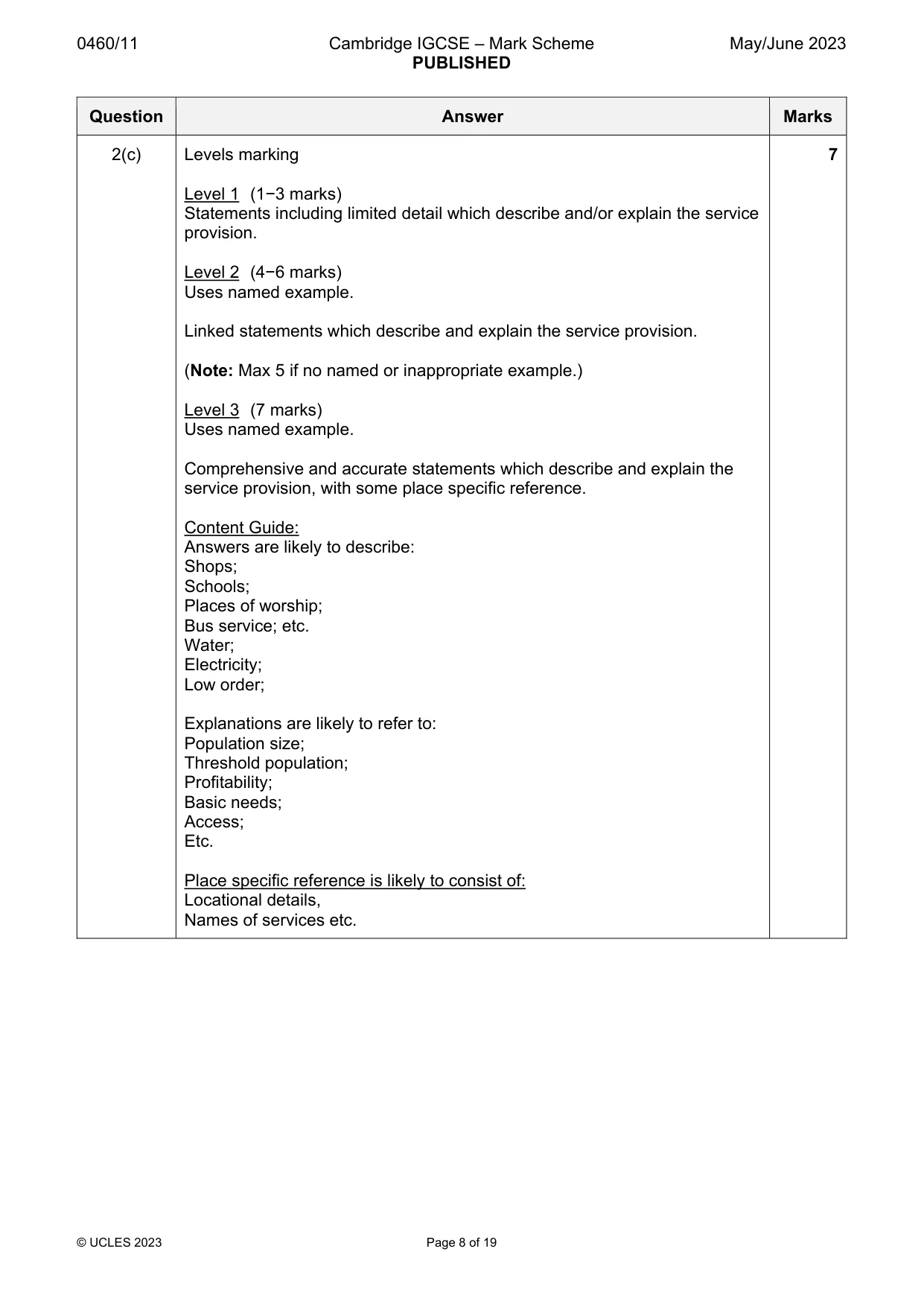
8 0460/11/M/J/23 © UCLES 2023 (c) For a named rural area or rural settlement in a country you have studied, describe and explain the service provision. Name of area or settlement … Country … … … … … … … … … … … … … … … … … … … … … … … … … [7] [Total: 25]
Question paper, page 9
9 0460/11/M/J/23 © UCLES 2023 [Turn over BLANK PAGE
Question paper, page 10
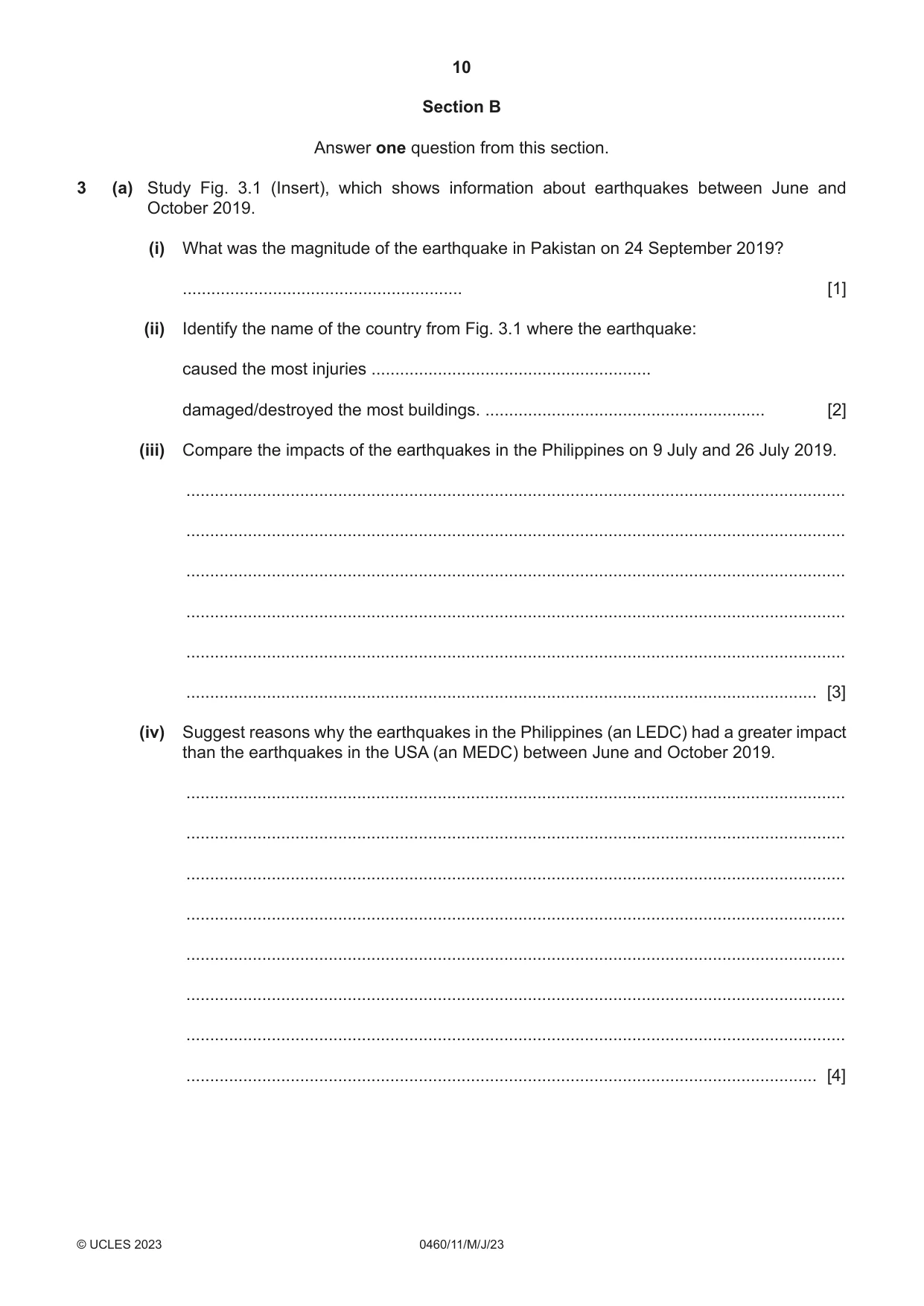
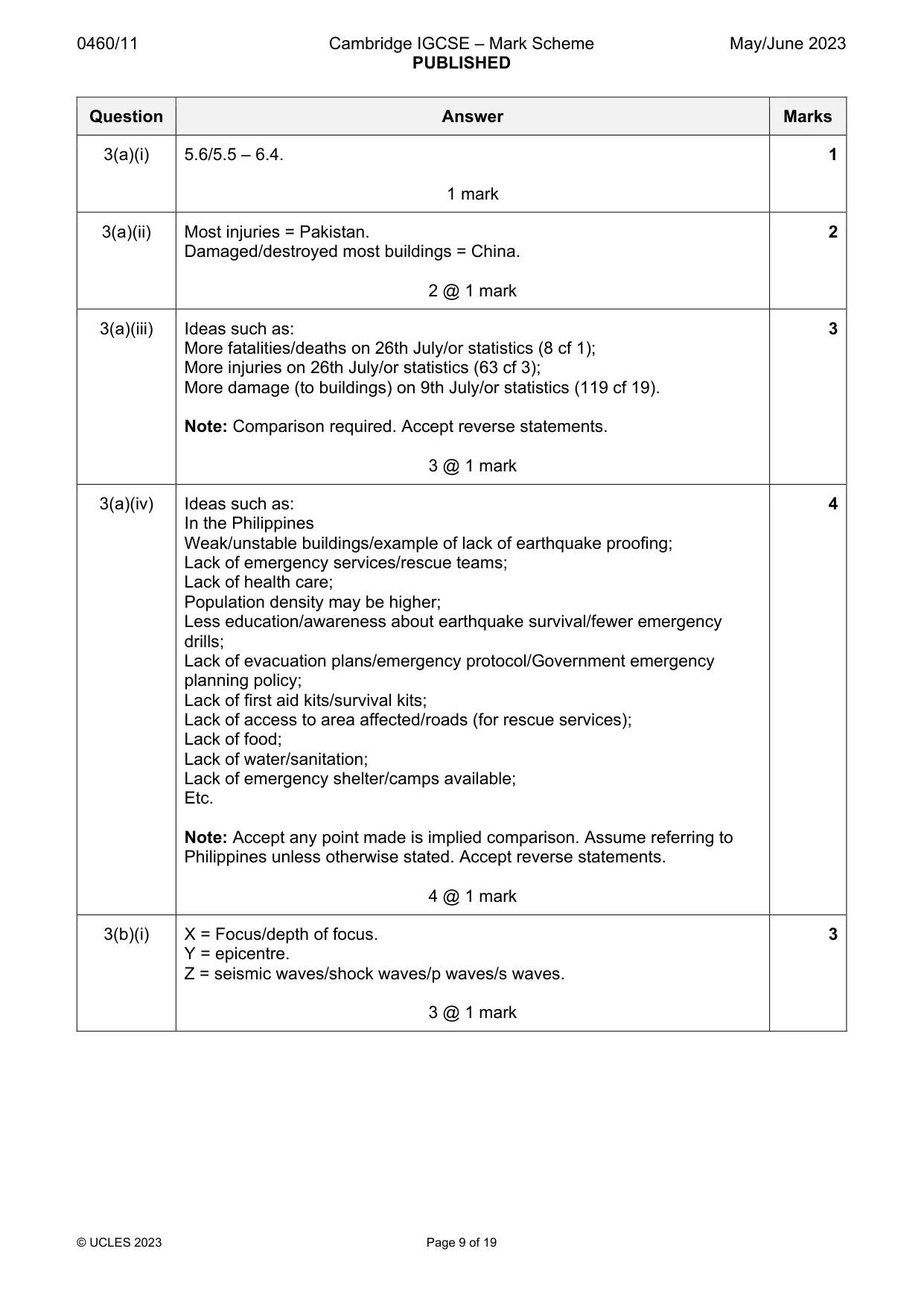
10 0460/11/M/J/23 © UCLES 2023 Section B Answer one question from this section. 3 (a) Study Fig. 3.1 (Insert), which shows information about earthquakes between June and October 2019. (i) What was the magnitude of the earthquake in Pakistan on 24 September 2019? … [1] (ii) Identify the name of the country from Fig. 3.1 where the earthquake: caused the most injuries … damaged/destroyed the most buildings. … [2] (iii) Compare the impacts of the earthquakes in the Philippines on 9 July and 26 July 2019. … … … … … … [3] (iv) Suggest reasons why the earthquakes in the Philippines (an LEDC) had a greater impact than the earthquakes in the USA (an MEDC) between June and October 2019. … … … … … … … … [4]
Question paper, page 11
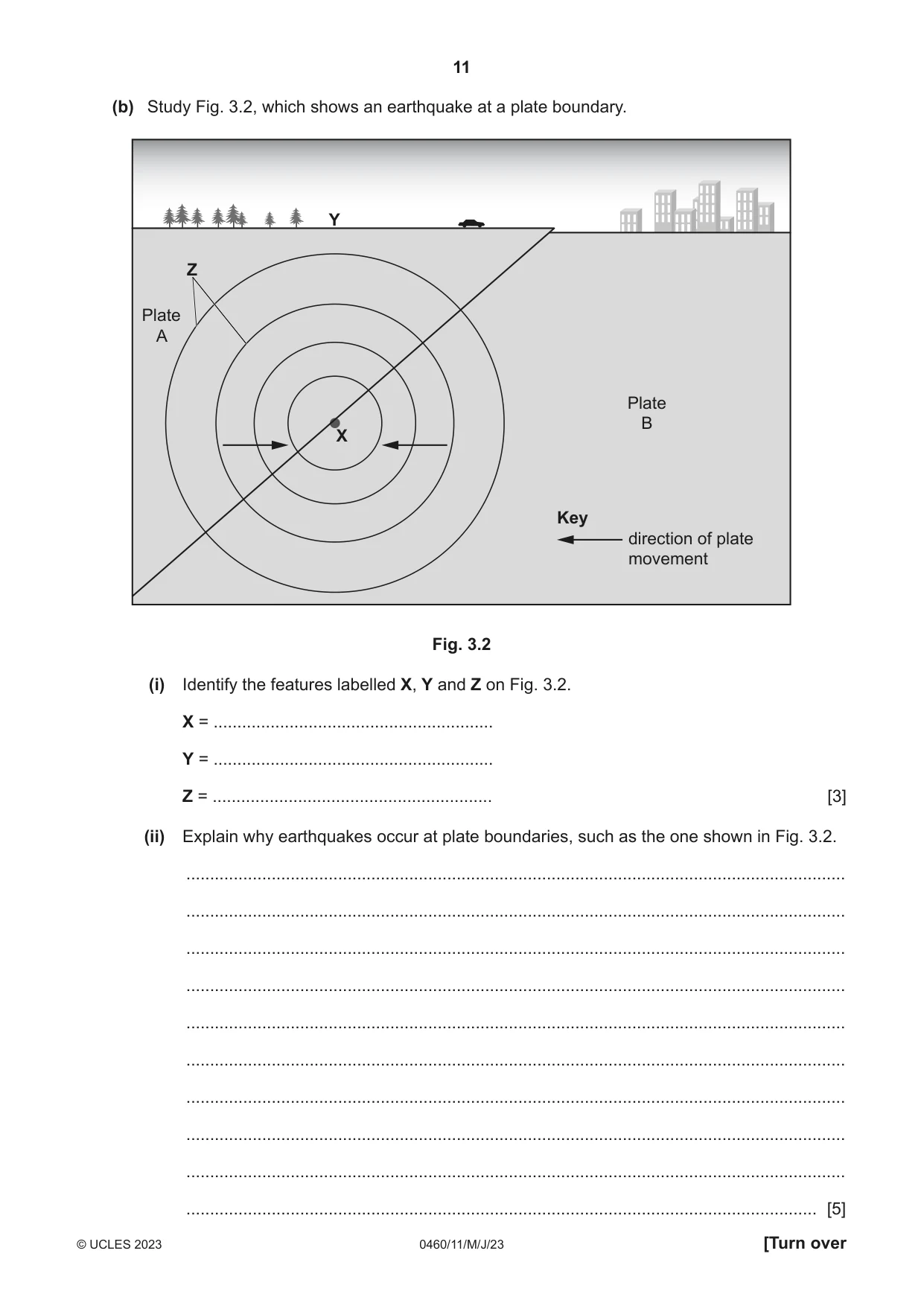
11 0460/11/M/J/23 © UCLES 2023 [Turn over (b) Study Fig. 3.2, which shows an earthquake at a plate boundary. X Y Z Plate A Plate B Key direction of plate movement Fig. 3.2 (i) Identify the features labelled X, Y and Z on Fig. 3.2. X = … Y = … Z = … [3] (ii) Explain why earthquakes occur at plate boundaries, such as the one shown in Fig. 3.2. … … … … … … … … … … [5]
Question paper, page 12
12 0460/11/M/J/23 © UCLES 2023 (c) For a named example you have studied, describe the problems caused by a volcanic eruption. Name of volcano … … … … … … … … … … … … … … … … … … … … … … … … … [7] [Total: 25]
Question paper, page 13
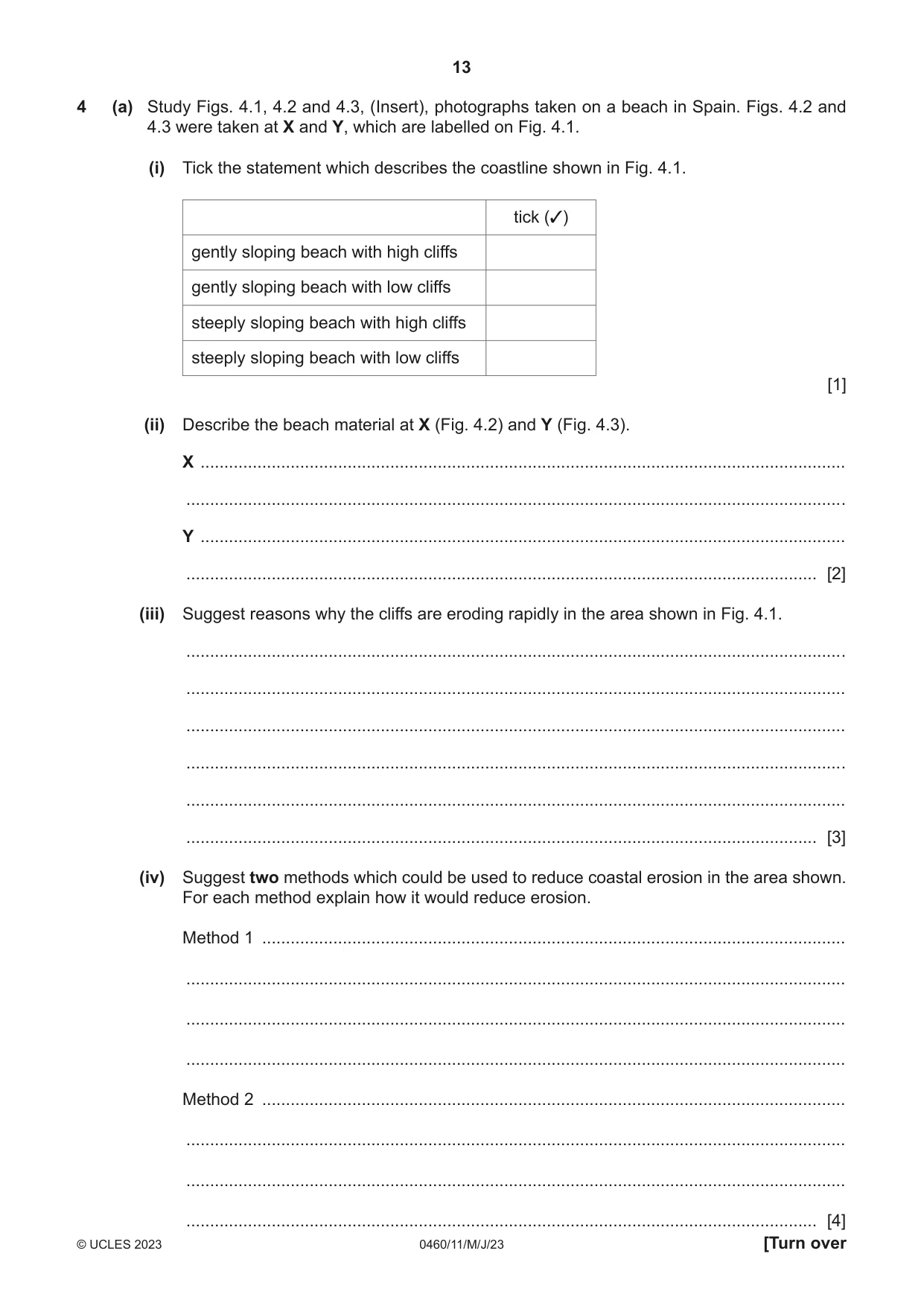
13 0460/11/M/J/23 © UCLES 2023 [Turn over 4 (a) Study Figs. 4.1, 4.2 and 4.3, (Insert), photographs taken on a beach in Spain. Figs. 4.2 and 4.3 were taken at X and Y, which are labelled on Fig. 4.1. (i) Tick the statement which describes the coastline shown in Fig. 4.1. tick (3) gently sloping beach with high cliffs gently sloping beach with low cliffs steeply sloping beach with high cliffs steeply sloping beach with low cliffs [1] (ii) Describe the beach material at X (Fig. 4.2) and Y (Fig. 4.3). X … … Y … … [2] (iii) Suggest reasons why the cliffs are eroding rapidly in the area shown in Fig. 4.1. … … … … … … [3] (iv) Suggest two methods which could be used to reduce coastal erosion in the area shown. For each method explain how it would reduce erosion. Method 1 … … … … Method 2 … … … … [4]
Question paper, page 14
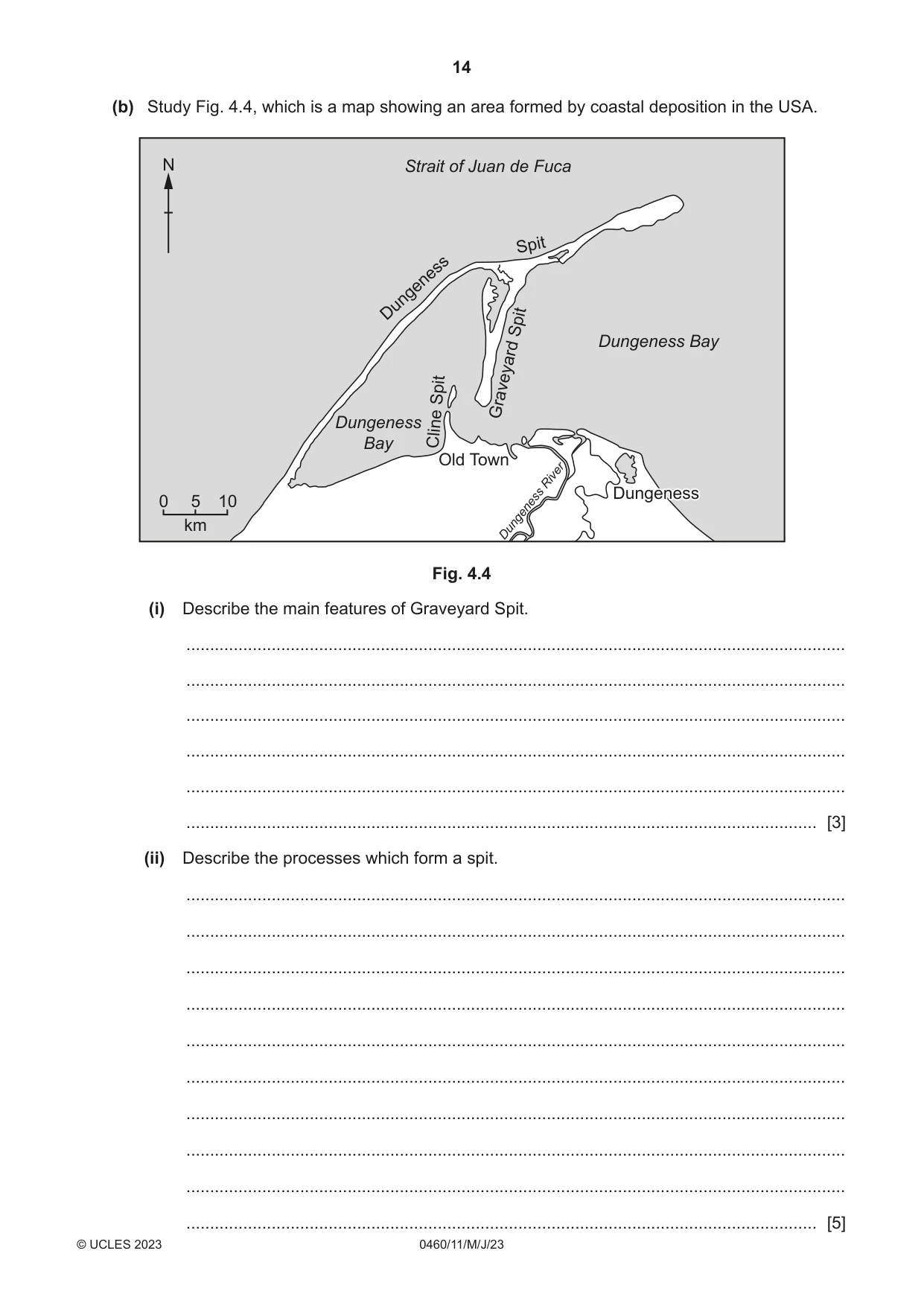
14 0460/11/M/J/23 © UCLES 2023 (b) Study Fig. 4.4, which is a map showing an area formed by coastal deposition in the USA. km 0 5 10 N Strait of Juan de Fuca Dungeness Bay Dungeness River Dungeness Bay Dungeness Dungeness Dungeness Old Town Spit Graveyard Spit Cline Spit Fig. 4.4 (i) Describe the main features of Graveyard Spit. … … … … … … [3] (ii) Describe the processes which form a spit. … … … … … … … … … … [5]
Question paper, page 15
15 0460/11/M/J/23 © UCLES 2023 [Turn over (c) Explain why many people live in a named coastal area which you have studied. Name of coastal area … … … … … … … … … … … … … … … … … … … … … … … … … [7] [Total: 25]
Question paper, page 16
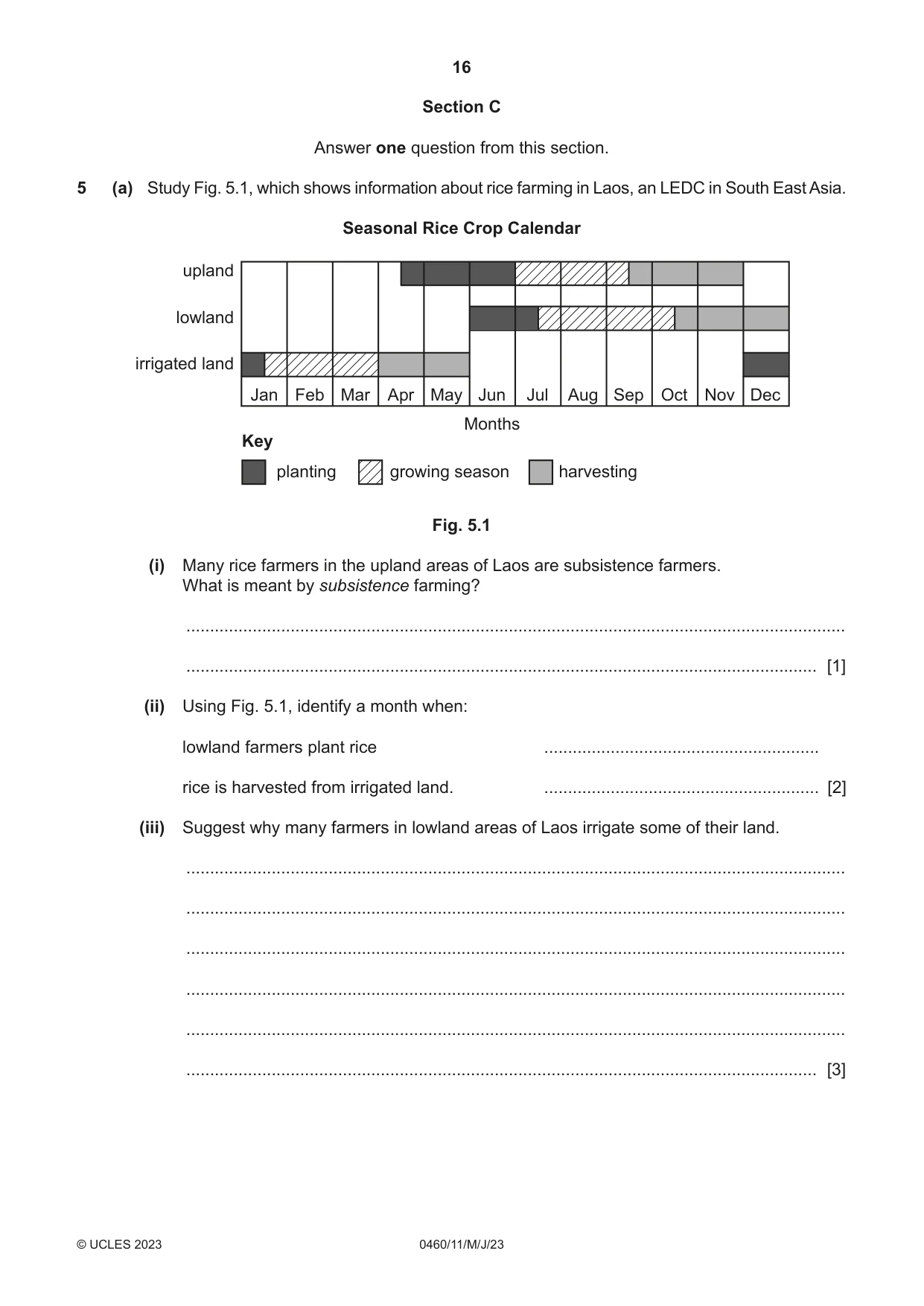
16 0460/11/M/J/23 © UCLES 2023 Section C Answer one question from this section. 5 (a) Study Fig. 5.1, which shows information about rice farming in Laos, an LEDC in South East Asia. Seasonal Rice Crop Calendar Jan Feb Mar Apr May Jun Months Jul Aug Sep Oct Nov Dec upland lowland irrigated land planting growing season harvesting Key Fig. 5.1 (i) Many rice farmers in the upland areas of Laos are subsistence farmers. What is meant by subsistence farming? … … [1] (ii) Using Fig. 5.1, identify a month when: lowland farmers plant rice … rice is harvested from irrigated land. … [2] (iii) Suggest why many farmers in lowland areas of Laos irrigate some of their land. … … … … … … [3]
Question paper, page 17
17 0460/11/M/J/23 © UCLES 2023 [Turn over (iv) Rice farmers in some areas in Laos keep some animals on their farms. Explain two advantages of growing crops and keeping animals on the same farm. 1 … … … … 2 … … … … [4] (b) Study Fig. 5.2 (Insert), which shows information about food consumption in different parts of the world. (i) Using information from Fig. 5.2, suggest where shortage of food is most likely. … … … … … … [3] (ii) Explain why many people in some parts of the world do not have enough food to eat. … … … … … … … … … … [5]
Question paper, page 18
18 0460/11/M/J/23 © UCLES 2023 (c) Describe and explain the land use of a named farm or agricultural system you have studied. Named farm or agricultural system … … … … … … … … … … … … … … … … … … … … … … … … … [7] [Total: 25]
Question paper, page 19
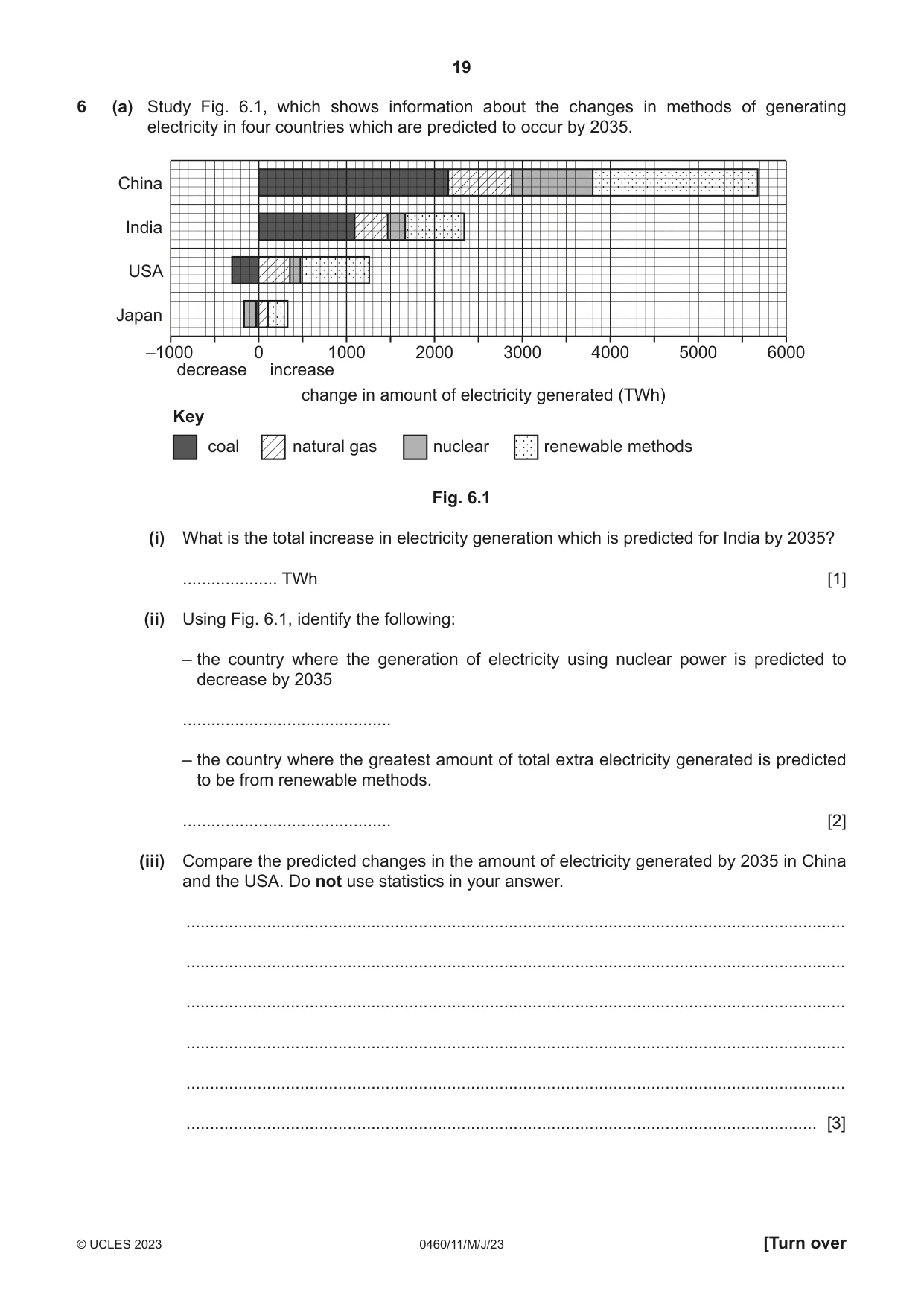
19 0460/11/M/J/23 © UCLES 2023 [Turn over 6 (a) Study Fig. 6.1, which shows information about the changes in methods of generating electricity in four countries which are predicted to occur by 2035. coal natural gas nuclear renewable methods Key Japan USA India China 0 1000 –1000 2000 3000 4000 5000 6000 change in amount of electricity generated (TWh) decrease increase Fig. 6.1 (i) What is the total increase in electricity generation which is predicted for India by 2035? … TWh [1] (ii) Using Fig. 6.1, identify the following: – the country where the generation of electricity using nuclear power is predicted to decrease by 2035 … – the country where the greatest amount of total extra electricity generated is predicted to be from renewable methods. … [2] (iii) Compare the predicted changes in the amount of electricity generated by 2035 in China and the USA. Do not use statistics in your answer. … … … … … … [3]
Question paper, page 20
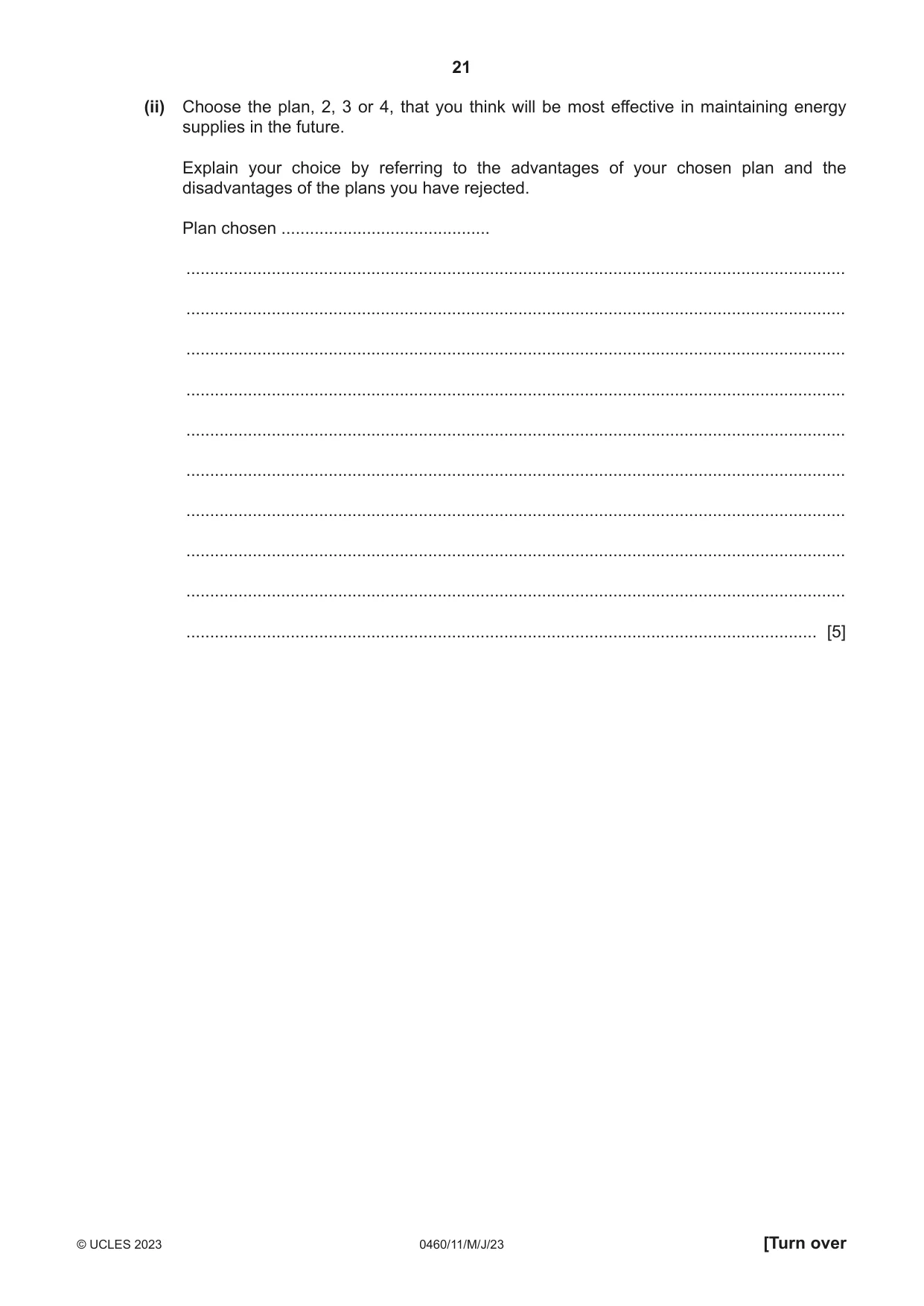
20 0460/11/M/J/23 © UCLES 2023 (iv) Explain why the generation of electricity is predicted to increase in many countries. … … … … … … … … [4] (b) Study Fig. 6.2, which shows four plans which the government of an MEDC in Europe is considering to maintain energy supplies in the future. Plan 1 Build a new nuclear power station. Plan 2 Increase the amount of wind generators offshore and in the mountains. Plan 3 Search for oil and gas in offshore areas. Plan 4 Import large amounts of coal from China. Fig. 6.2 (i) Give three reasons why some people in the country may object to Plan 1. 1 … … 2 … … 3 … … [3]
Question paper, page 21
21 0460/11/M/J/23 © UCLES 2023 [Turn over (ii) Choose the plan, 2, 3 or 4, that you think will be most effective in maintaining energy supplies in the future. Explain your choice by referring to the advantages of your chosen plan and the disadvantages of the plans you have rejected. Plan chosen … … … … … … … … … … … [5]
Question paper, page 22
22 0460/11/M/J/23 © UCLES 2023 (c) For a country you have studied, describe the methods used to supply water. Country … … … … … … … … … … … … … … … … … … … … … … … … … [7] [Total: 25]
Question paper, page 23
23 0460/11/M/J/23 © UCLES 2023 Additional page If you use the following page to complete the answer to any question, the question number must be clearly shown. … … … … … … … … … … … … … … … … … … … … … … … … … …
Question paper, page 24
24 0460/11/M/J/23 © UCLES 2023 The boundaries and names shown, the designations used and the presentation of material on any maps contained in this question paper/insert do not imply official endorsement or acceptance by Cambridge Assessment International Education concerning the legal status of any country, territory, or area or any of its authorities, or of the delimitation of its frontiers or boundaries. Permission to reproduce items where third-party owned material protected by copyright is included has been sought and cleared where possible. Every reasonable effort has been made by the publisher (UCLES) to trace copyright holders, but if any items requiring clearance have unwittingly been included, the publisher will be pleased to make amends at the earliest possible opportunity. To avoid the issue of disclosure of answer-related information to candidates, all copyright acknowledgements are reproduced online in the Cambridge Assessment International Education Copyright Acknowledgements Booklet. This is produced for each series of examinations and is freely available to download at www.cambridgeinternational.org after the live examination series. Cambridge Assessment International Education is part of Cambridge Assessment. Cambridge Assessment is the brand name of the University of Cambridge Local Examinations Syndicate (UCLES), which is a department of the University of Cambridge. Additional page If you use the following page to complete the answer to any question, the question number must be clearly shown. … … … … … … … … … … … … … … … … … … … …
Mark scheme, page 1
This document consists of 19 printed pages. © UCLES 2023 [Turn over Cambridge IGCSE™ GEOGRAPHY 0460/11 Paper 1 Geographical Themes May/June 2023 MARK SCHEME Maximum Mark: 75 Published This mark scheme is published as an aid to teachers and candidates, to indicate the requirements of the examination. It shows the basis on which Examiners were instructed to award marks. It does not indicate the details of the discussions that took place at an Examiners’ meeting before marking began, which would have considered the acceptability of alternative answers. Mark schemes should be read in conjunction with the question paper and the Principal Examiner Report for Teachers. Cambridge International will not enter into discussions about these mark schemes. Cambridge International is publishing the mark schemes for the May/June 2023 series for most Cambridge IGCSE, Cambridge International A and AS Level and Cambridge Pre-U components, and some Cambridge O Level components.
Mark scheme, page 2
0460/11 Cambridge IGCSE – Mark Scheme PUBLISHED May/June 2023 © UCLES 2023 Page 2 of 19 Generic Marking Principles These general marking principles must be applied by all examiners when marking candidate answers. They should be applied alongside the specific content of the mark scheme or generic level descriptors for a question. Each question paper and mark scheme will also comply with these marking principles. GENERIC MARKING PRINCIPLE 1: Marks must be awarded in line with: the specific content of the mark scheme or the generic level descriptors for the question the specific skills defined in the mark scheme or in the generic level descriptors for the question the standard of response required by a candidate as exemplified by the standardisation scripts. GENERIC MARKING PRINCIPLE 2: Marks awarded are always whole marks (not half marks, or other fractions). GENERIC MARKING PRINCIPLE 3: Marks must be awarded positively: marks are awarded for correct/valid answers, as defined in the mark scheme. However, credit is given for valid answers which go beyond the scope of the syllabus and mark scheme, referring to your Team Leader as appropriate marks are awarded when candidates clearly demonstrate what they know and can do marks are not deducted for errors marks are not deducted for omissions answers should only be judged on the quality of spelling, punctuation, and grammar when these features are specifically assessed by the question as indicated by the mark scheme. The meaning, however, should be unambiguous. GENERIC MARKING PRINCIPLE 4: Rules must be applied consistently, e.g., in situations where candidates have not followed instructions or in the application of generic level descriptors. GENERIC MARKING PRINCIPLE 5: Marks should be awarded using the full range of marks defined in the mark scheme for the question (however; the use of the full mark range may be limited according to the quality of the candidate responses seen). GENERIC MARKING PRINCIPLE 6: Marks awarded are based solely on the requirements as defined in the mark scheme. Marks should not be awarded with grade thresholds or grade descriptors in mind.
Mark scheme, page 3
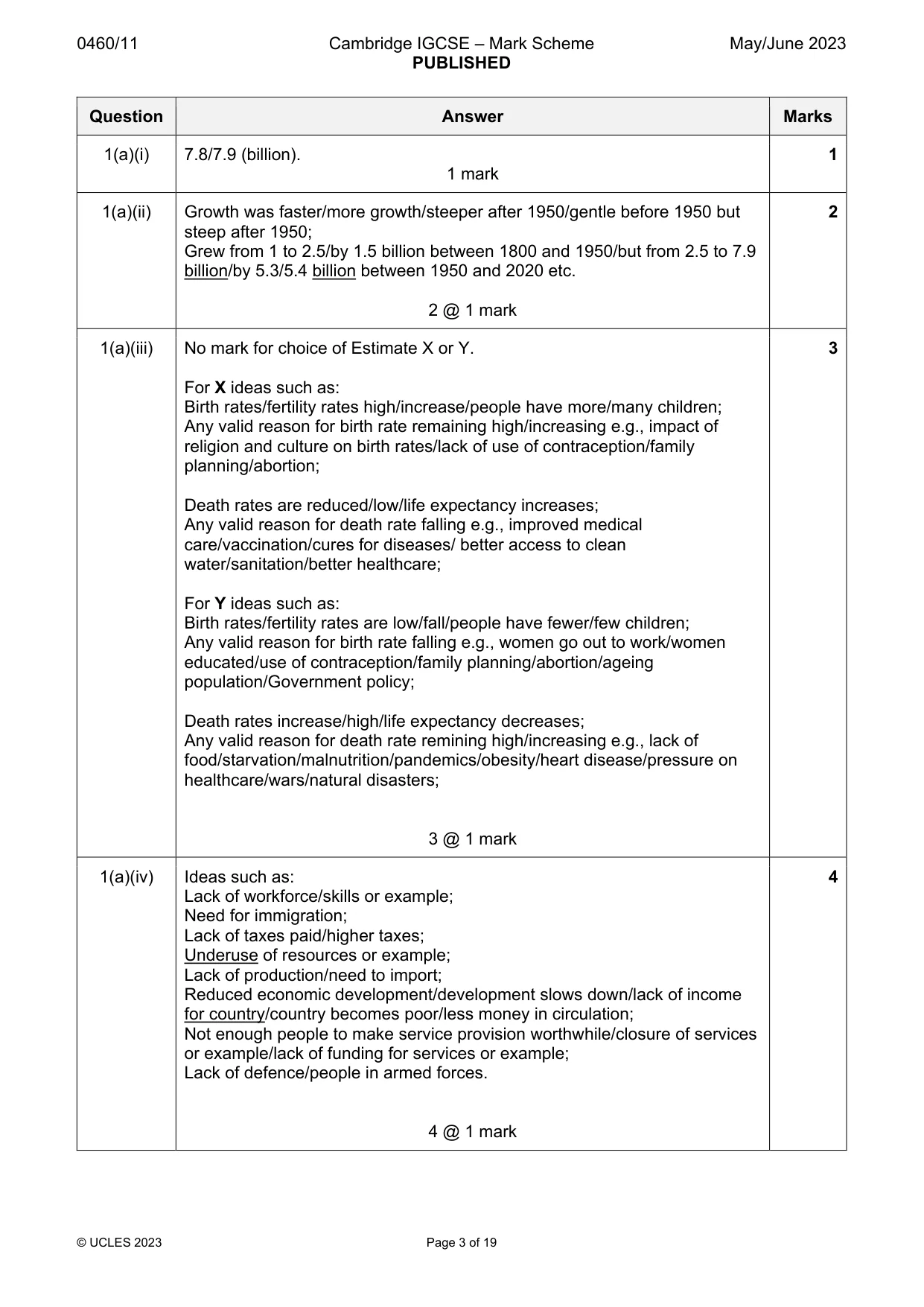
0460/11 Cambridge IGCSE – Mark Scheme PUBLISHED May/June 2023 © UCLES 2023 Page 3 of 19 Question Answer Marks 1(a)(i) 7.8/7.9 (billion). 1 mark 1 1(a)(ii) Growth was faster/more growth/steeper after 1950/gentle before 1950 but steep after 1950; Grew from 1 to 2.5/by 1.5 billion between 1800 and 1950/but from 2.5 to 7.9 billion/by 5.3/5.4 billion between 1950 and 2020 etc. 2 @ 1 mark 2 1(a)(iii) No mark for choice of Estimate X or Y. For X ideas such as: Birth rates/fertility rates high/increase/people have more/many children; Any valid reason for birth rate remaining high/increasing e.g., impact of religion and culture on birth rates/lack of use of contraception/family planning/abortion; Death rates are reduced/low/life expectancy increases; Any valid reason for death rate falling e.g., improved medical care/vaccination/cures for diseases/ better access to clean water/sanitation/better healthcare; For Y ideas such as: Birth rates/fertility rates are low/fall/people have fewer/few children; Any valid reason for birth rate falling e.g., women go out to work/women educated/use of contraception/family planning/abortion/ageing population/Government policy; Death rates increase/high/life expectancy decreases; Any valid reason for death rate remining high/increasing e.g., lack of food/starvation/malnutrition/pandemics/obesity/heart disease/pressure on healthcare/wars/natural disasters; 3 @ 1 mark 3 1(a)(iv) Ideas such as: Lack of workforce/skills or example; Need for immigration; Lack of taxes paid/higher taxes; Underuse of resources or example; Lack of production/need to import; Reduced economic development/development slows down/lack of income for country/country becomes poor/less money in circulation; Not enough people to make service provision worthwhile/closure of services or example/lack of funding for services or example; Lack of defence/people in armed forces. 4 @ 1 mark 4
Mark scheme, page 4
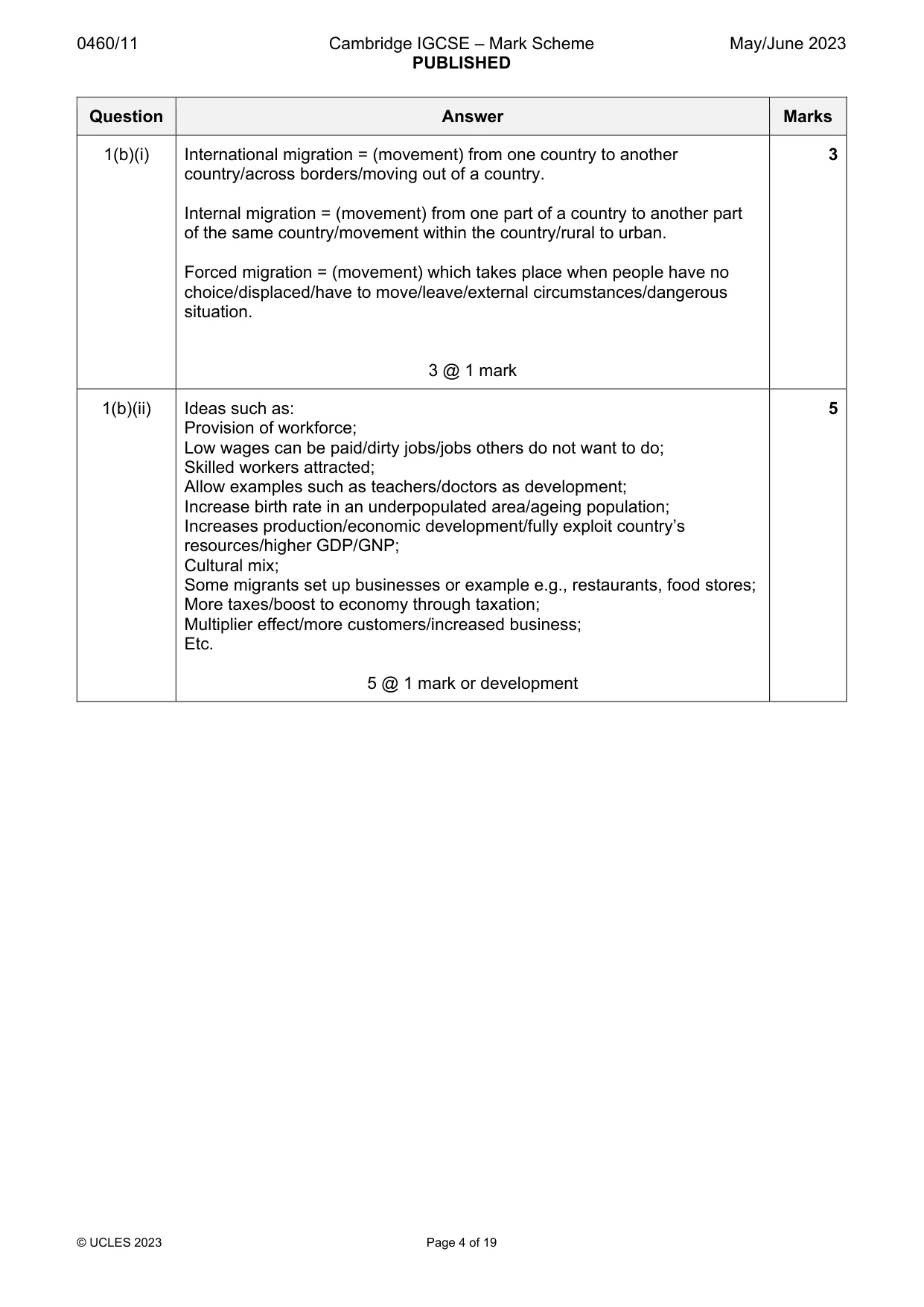
0460/11 Cambridge IGCSE – Mark Scheme PUBLISHED May/June 2023 © UCLES 2023 Page 4 of 19 Question Answer Marks 1(b)(i) International migration = (movement) from one country to another country/across borders/moving out of a country. Internal migration = (movement) from one part of a country to another part of the same country/movement within the country/rural to urban. Forced migration = (movement) which takes place when people have no choice/displaced/have to move/leave/external circumstances/dangerous situation. 3 @ 1 mark 3 1(b)(ii) Ideas such as: Provision of workforce; Low wages can be paid/dirty jobs/jobs others do not want to do; Skilled workers attracted; Allow examples such as teachers/doctors as development; Increase birth rate in an underpopulated area/ageing population; Increases production/economic development/fully exploit country’s resources/higher GDP/GNP; Cultural mix; Some migrants set up businesses or example e.g., restaurants, food stores; More taxes/boost to economy through taxation; Multiplier effect/more customers/increased business; Etc. 5 @ 1 mark or development 5
Mark scheme, page 5
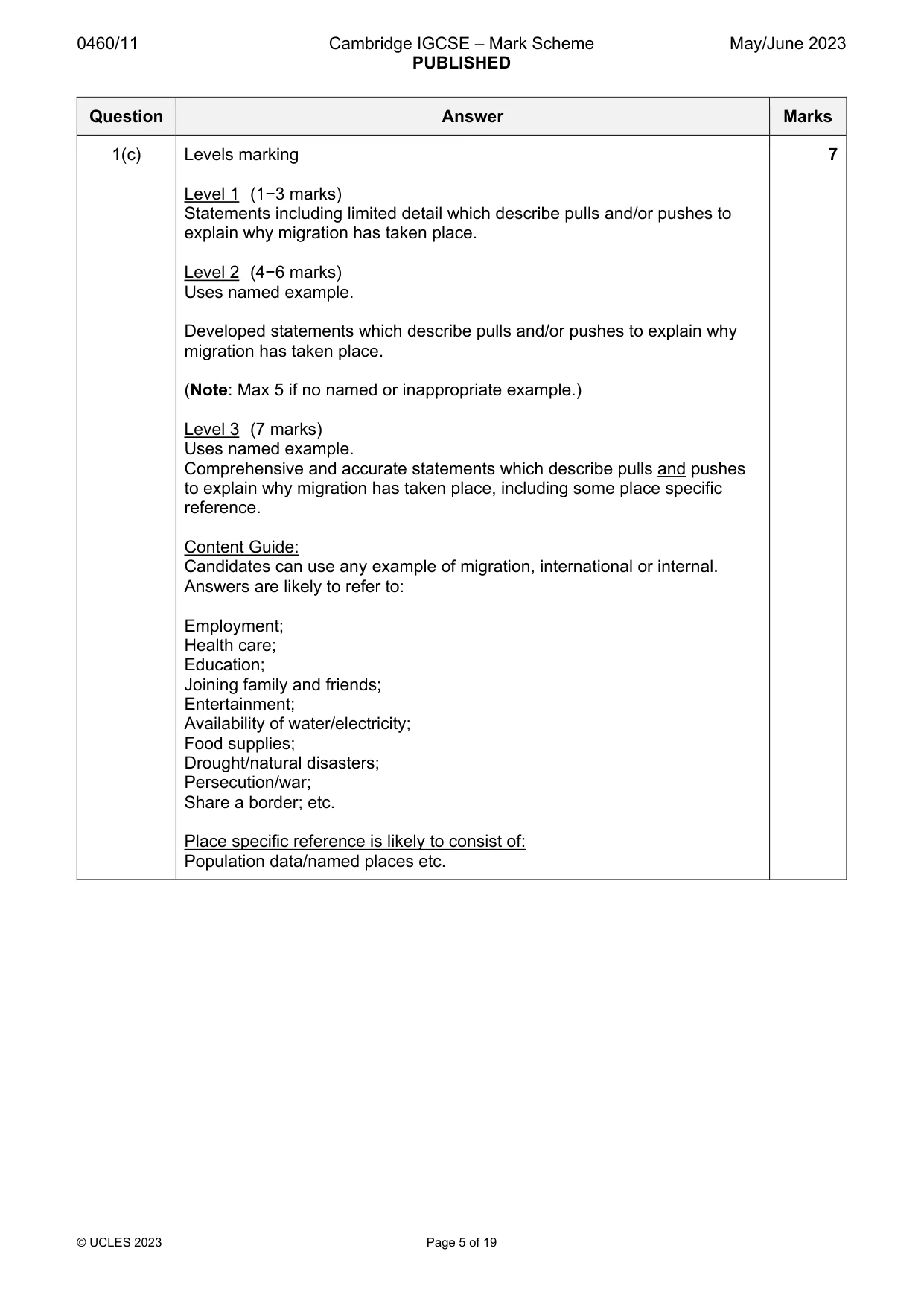
0460/11 Cambridge IGCSE – Mark Scheme PUBLISHED May/June 2023 © UCLES 2023 Page 5 of 19 Question Answer Marks 1(c) Levels marking Level 1 (1−3 marks) Statements including limited detail which describe pulls and/or pushes to explain why migration has taken place. Level 2 (4−6 marks) Uses named example. Developed statements which describe pulls and/or pushes to explain why migration has taken place. (Note: Max 5 if no named or inappropriate example.) Level 3 (7 marks) Uses named example. Comprehensive and accurate statements which describe pulls and pushes to explain why migration has taken place, including some place specific reference. Content Guide: Candidates can use any example of migration, international or internal. Answers are likely to refer to: Employment; Health care; Education; Joining family and friends; Entertainment; Availability of water/electricity; Food supplies; Drought/natural disasters; Persecution/war; Share a border; etc. Place specific reference is likely to consist of: Population data/named places etc. 7
Mark scheme, page 6
0460/11 Cambridge IGCSE – Mark Scheme PUBLISHED May/June 2023 © UCLES 2023 Page 6 of 19 Question Answer Marks 2(a)(i) Buildings are scattered amongst areas of farmland. 1 mark 1 2(a)(ii) Features such as: Densely populated/buildings are close together/lack of open space; High rise buildings/mixture of different heights; Wide roads/dual carriageways/paved roads; Service provision or example; e.g., church, shops; Workplaces or example e.g., offices, factories; Housing/apartments; Etc. 2 @ 1 mark 2 2(a)(iii) Ideas such as: Stadium/(football) pitch; Tennis court; Or recreational/leisure if first two lines not credited; School/leisure centre/sports centre/factory/industry/industrial; Housing/residential; Farmland; Orchard/trees/woodland/forest. 3 @ 1 mark 3 2(a)(iv) Ideas such as: Increased traffic/traffic congestion; Noise; Litter; Loss of amenity value/dog walking; Loss of spaces for recreation; Loss of agricultural land; Increased cost of housing/pressure on supplies of houses; Air pollution; Water pollution; Deforestation; Soil erosion; Loss of habitat; Animals killed/migrate away/displaced/disturbed; Impact on food chains/ecosystem; Etc. (1 mark reserved for people/natural environment.) 4 @ 1 mark 4
Mark scheme, page 7
0460/11 Cambridge IGCSE – Mark Scheme PUBLISHED May/June 2023 © UCLES 2023 Page 7 of 19 Question Answer Marks 2(b)(i) Ideas such as: Uneven; Clustered; Linear/along the road/river/railway; Near bridges/river crossings; More live in Zhangye/Linze/Gaotai/centre; Dispersed/scattered in the South; etc. 3 @ 1 mark 3 2(b)(ii) Ideas such as: Access to water; Bridging point to access both sides; Flat/low land; Shelter from winds; Aspect; High/steep land (to NE); Accessibility/easy to transport (goods)/get to work; Jobs/employment; Mines/factories; Fertile soil/infertile soil/food supply; Forested areas are less densely populated; Etc. 5 @ 1 mark or development 5
Mark scheme, page 8
0460/11 Cambridge IGCSE – Mark Scheme PUBLISHED May/June 2023 © UCLES 2023 Page 8 of 19 Question Answer Marks 2(c) Levels marking Level 1 (1−3 marks) Statements including limited detail which describe and/or explain the service provision. Level 2 (4−6 marks) Uses named example. Linked statements which describe and explain the service provision. (Note: Max 5 if no named or inappropriate example.) Level 3 (7 marks) Uses named example. Comprehensive and accurate statements which describe and explain the service provision, with some place specific reference. Content Guide: Answers are likely to describe: Shops; Schools; Places of worship; Bus service; etc. Water; Electricity; Low order; Explanations are likely to refer to: Population size; Threshold population; Profitability; Basic needs; Access; Etc. Place specific reference is likely to consist of: Locational details, Names of services etc. 7
Mark scheme, page 9
0460/11 Cambridge IGCSE – Mark Scheme PUBLISHED May/June 2023 © UCLES 2023 Page 9 of 19 Question Answer Marks 3(a)(i) 5.6/5.5 – 6.4. 1 mark 1 3(a)(ii) Most injuries = Pakistan. Damaged/destroyed most buildings = China. 2 @ 1 mark 2 3(a)(iii) Ideas such as: More fatalities/deaths on 26th July/or statistics (8 cf 1); More injuries on 26th July/or statistics (63 cf 3); More damage (to buildings) on 9th July/or statistics (119 cf 19). Note: Comparison required. Accept reverse statements. 3 @ 1 mark 3 3(a)(iv) Ideas such as: In the Philippines Weak/unstable buildings/example of lack of earthquake proofing; Lack of emergency services/rescue teams; Lack of health care; Population density may be higher; Less education/awareness about earthquake survival/fewer emergency drills; Lack of evacuation plans/emergency protocol/Government emergency planning policy; Lack of first aid kits/survival kits; Lack of access to area affected/roads (for rescue services); Lack of food; Lack of water/sanitation; Lack of emergency shelter/camps available; Etc. Note: Accept any point made is implied comparison. Assume referring to Philippines unless otherwise stated. Accept reverse statements. 4 @ 1 mark 4 3(b)(i) X = Focus/depth of focus. Y = epicentre. Z = seismic waves/shock waves/p waves/s waves. 3 @ 1 mark 3
Mark scheme, page 10
0460/11 Cambridge IGCSE – Mark Scheme PUBLISHED May/June 2023 © UCLES 2023 Page 10 of 19 Question Answer Marks 3(b)(ii) Ideas such as: Convection currents; Plates are converging/moving towards each other/convergent boundary; Subduction/one plate goes under the other; The place which goes under is heavier/more dense; Friction; Pressure/energy build up/plates stick; Pressure/tension/energy release; Jolting/plates slip; Etc. 5 @ 1 mark or development 5 3(c) Levels marking Level 1 (1−3 marks) Statements including limited detail which describe the problems of a volcanic eruption. Level 2 (4−6 marks) Uses named example. More developed statements which describe the problems of a volcanic eruption. (Note: Max 5 if no named or inappropriate example.) Level 3 (7 marks) Uses named example. Comprehensive and accurate statements including place specific information. Content Guide: Answers are likely to refer to: Deaths/injuries; Damage to buildings; Damage/destruction of farms/crops; Roads destroyed/blocked; Flights disrupted; Pollution of atmosphere; Specified impacts on flora/fauna; etc. Place specific reference is likely to consist of: Locational details, Specific details of the volcano/impacts Statistics/date etc. 7
Mark scheme, page 11
0460/11 Cambridge IGCSE – Mark Scheme PUBLISHED May/June 2023 © UCLES 2023 Page 11 of 19 Question Answer Marks 4(a)(i) Gently sloping beach with low cliffs. 1 mark 1 4(a)(ii) Ideas such as: X/Fig. 4.2 is mainly pebbles/stones/rocks/mixture of different sized material/pebbles and sand/coarse; Y/Fig. 4.3 is mainly sand/fine material etc. 2 @ 1 mark 2 4(a)(iii) Ideas such as: Clay/soft material/unconsolidated; Hydraulic action or description of process; Abrasion/corrasion or description of process; There is no protection (or example – groyne/sea wall etc.); Waves can reach them/wave attack/destructive waves/large waves/large fetch; 3 @ 1 mark 3 4(a)(iv) One mark for identification of a method, second mark for explanation of how it will protect the coast. E.g. Sea wall; Revetment; Gabion; Riprap; Rock armour; Offshore barrier; Resists wave attack/reduces wave energy/absorbs wave energy; Strengthens cliff/stops waves from directly hitting cliff; Reflects wave energy; Groynes; Retain/increases beach material/builds up beach to reduce power of waves/prevents longshore drift; Beach replenishment; Offshore barrier; Resists wave attack/reduces wave energy/absorbs wave energy; Plant vegetation on sand dunes/cliff face; Insert drainage pipes in cliffs; Increase cliff stability/stops slumping; etc. Reduces erosion or example such as hydraulic action; 2 2 marks 4
Mark scheme, page 12
0460/11 Cambridge IGCSE – Mark Scheme PUBLISHED May/June 2023 © UCLES 2023 Page 12 of 19 Question Answer Marks 4(b)(i) Ideas such as: Attached to/sheltered by a/the/other/spit; N-S orientation/extends to the south; Long and thin; 20−24 km long; 1−2 km width; Wider at the end/tip; Splits in two/has extra ‘attachment’; etc. 3 @ 1 mark 3 4(b)(ii) Ideas such as: Formed by longshore drift; Prevailing winds blow at angle to land; Wave approach/swash at an angle; Backwash at right angles/straight back down beach; Beach materials moved with waves/swash and backwash; Zigzag movement; Materials move along beach; Materials deposited at change in direction of coast/river mouth/bay; End curved by winds approaching from different direction etc. Note: Accept correct labelling of the processes listed on a diagram but no double credit. 5 @ 1 mark or development 5
Mark scheme, page 13
0460/11 Cambridge IGCSE – Mark Scheme PUBLISHED May/June 2023 © UCLES 2023 Page 13 of 19 Question Answer Marks 4(c) Levels marking Level 1 (1−3 marks) Statements including limited detail which explain why many people live in coastal area. Level 2 (4−6 marks) Uses named example. More developed explanation or linked statements which explain why many people live in coastal area. (Note: Max 5 if no named or inappropriate example.) Level 3 (7 marks) Uses named example. Comprehensive and accurate statements including place specific information. Content Guide: Answers are likely to refer to: Work in tourist industry; Fishing; Port development/trade; Industrial development; Scenic beauty; Fresh air; Flat land; Moderating influence of sea on climate; Ease of communications etc. Specified climate; Activities – individual activities max 3 L1. Place specific reference is likely to consist of: Locational details, named places within coastal area, specific details of attractions to settlement etc. 7
Mark scheme, page 14
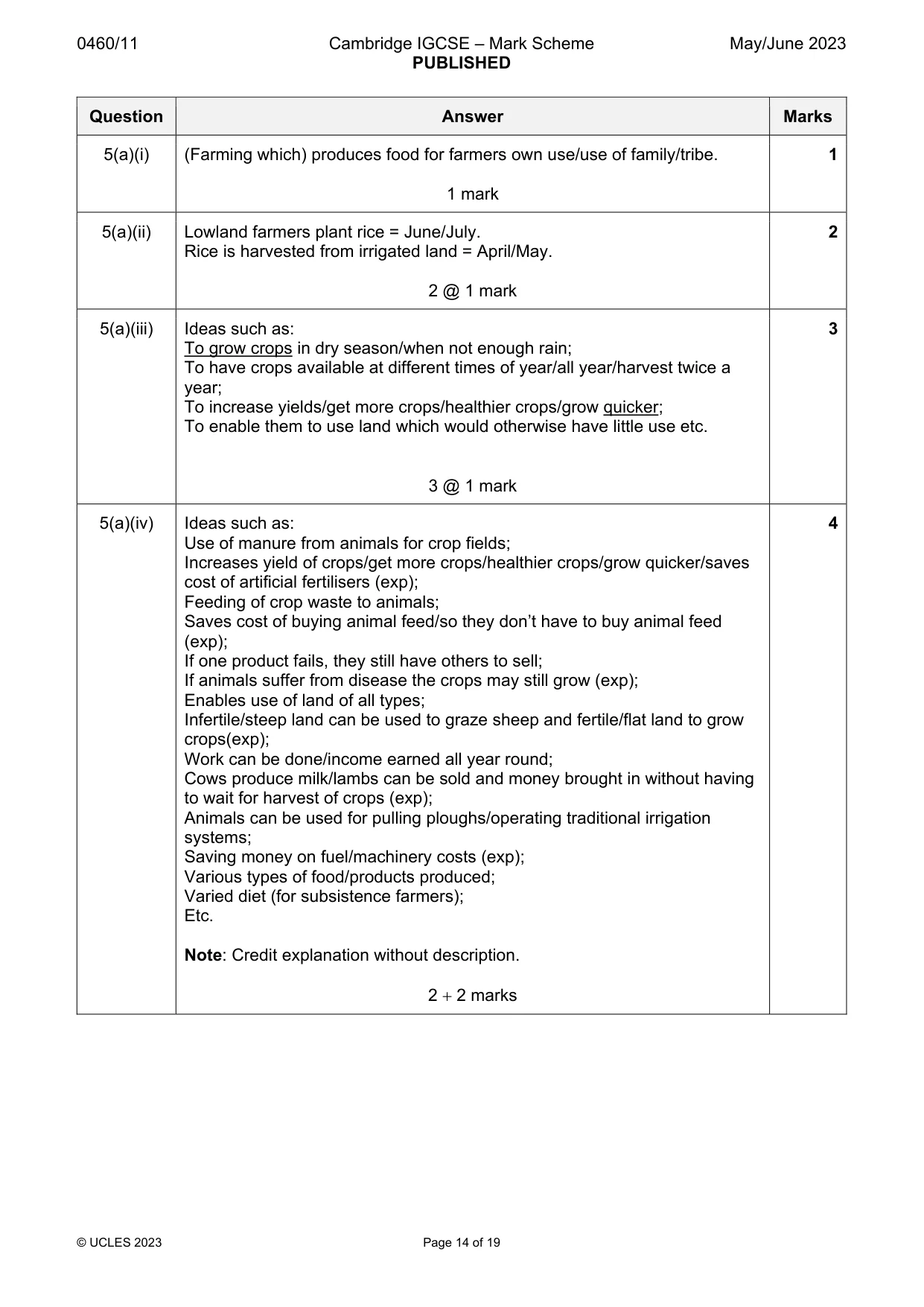
0460/11 Cambridge IGCSE – Mark Scheme PUBLISHED May/June 2023 © UCLES 2023 Page 14 of 19 Question Answer Marks 5(a)(i) (Farming which) produces food for farmers own use/use of family/tribe. 1 mark 1 5(a)(ii) Lowland farmers plant rice = June/July. Rice is harvested from irrigated land = April/May. 2 @ 1 mark 2 5(a)(iii) Ideas such as: To grow crops in dry season/when not enough rain; To have crops available at different times of year/all year/harvest twice a year; To increase yields/get more crops/healthier crops/grow quicker; To enable them to use land which would otherwise have little use etc. 3 @ 1 mark 3 5(a)(iv) Ideas such as: Use of manure from animals for crop fields; Increases yield of crops/get more crops/healthier crops/grow quicker/saves cost of artificial fertilisers (exp); Feeding of crop waste to animals; Saves cost of buying animal feed/so they don’t have to buy animal feed (exp); If one product fails, they still have others to sell; If animals suffer from disease the crops may still grow (exp); Enables use of land of all types; Infertile/steep land can be used to graze sheep and fertile/flat land to grow crops(exp); Work can be done/income earned all year round; Cows produce milk/lambs can be sold and money brought in without having to wait for harvest of crops (exp); Animals can be used for pulling ploughs/operating traditional irrigation systems; Saving money on fuel/machinery costs (exp); Various types of food/products produced; Varied diet (for subsistence farmers); Etc. Note: Credit explanation without description. 2 2 marks 4
Mark scheme, page 15
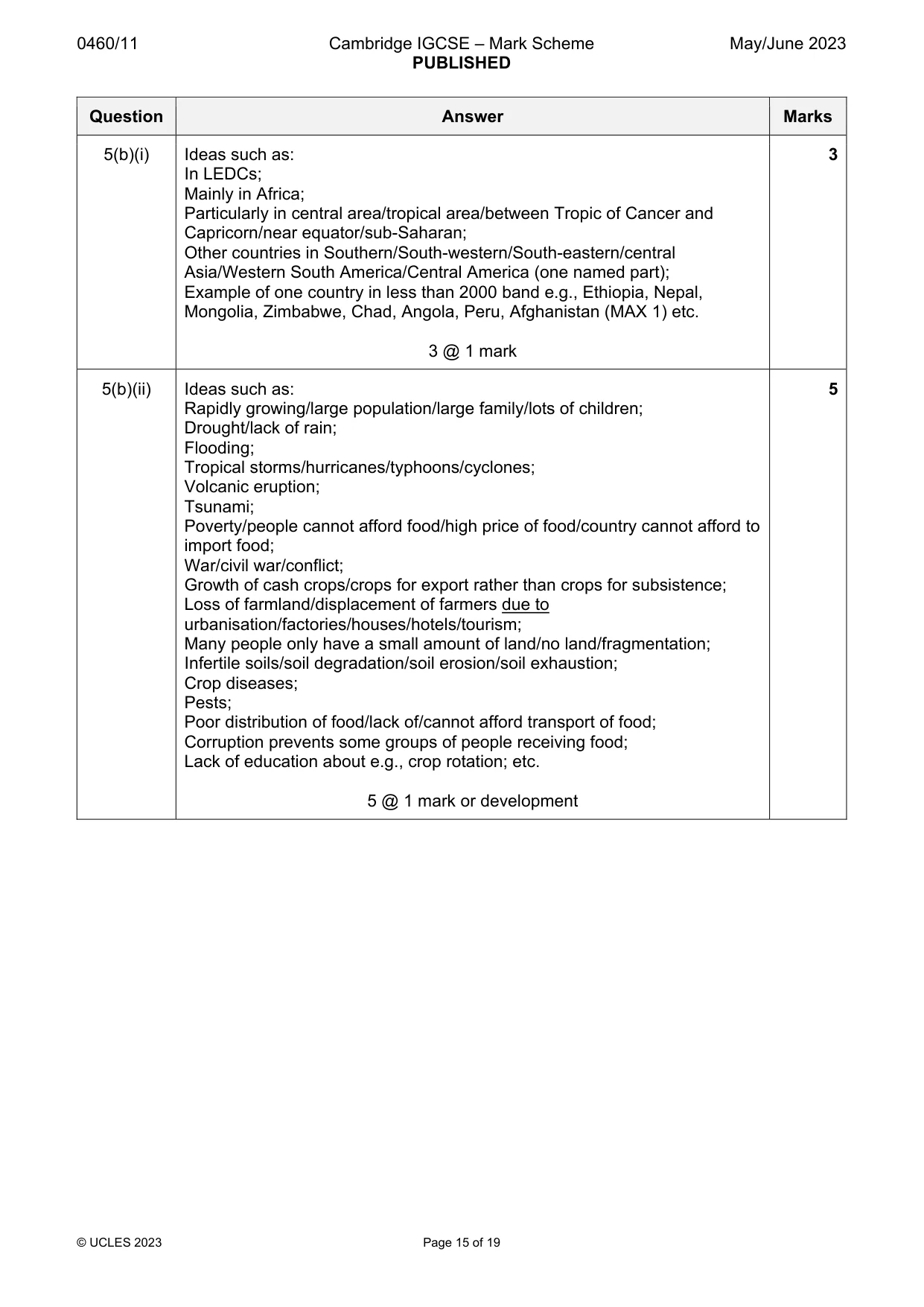
0460/11 Cambridge IGCSE – Mark Scheme PUBLISHED May/June 2023 © UCLES 2023 Page 15 of 19 Question Answer Marks 5(b)(i) Ideas such as: In LEDCs; Mainly in Africa; Particularly in central area/tropical area/between Tropic of Cancer and Capricorn/near equator/sub-Saharan; Other countries in Southern/South-western/South-eastern/central Asia/Western South America/Central America (one named part); Example of one country in less than 2000 band e.g., Ethiopia, Nepal, Mongolia, Zimbabwe, Chad, Angola, Peru, Afghanistan (MAX 1) etc. 3 @ 1 mark 3 5(b)(ii) Ideas such as: Rapidly growing/large population/large family/lots of children; Drought/lack of rain; Flooding; Tropical storms/hurricanes/typhoons/cyclones; Volcanic eruption; Tsunami; Poverty/people cannot afford food/high price of food/country cannot afford to import food; War/civil war/conflict; Growth of cash crops/crops for export rather than crops for subsistence; Loss of farmland/displacement of farmers due to urbanisation/factories/houses/hotels/tourism; Many people only have a small amount of land/no land/fragmentation; Infertile soils/soil degradation/soil erosion/soil exhaustion; Crop diseases; Pests; Poor distribution of food/lack of/cannot afford transport of food; Corruption prevents some groups of people receiving food; Lack of education about e.g., crop rotation; etc. 5 @ 1 mark or development 5
Mark scheme, page 16
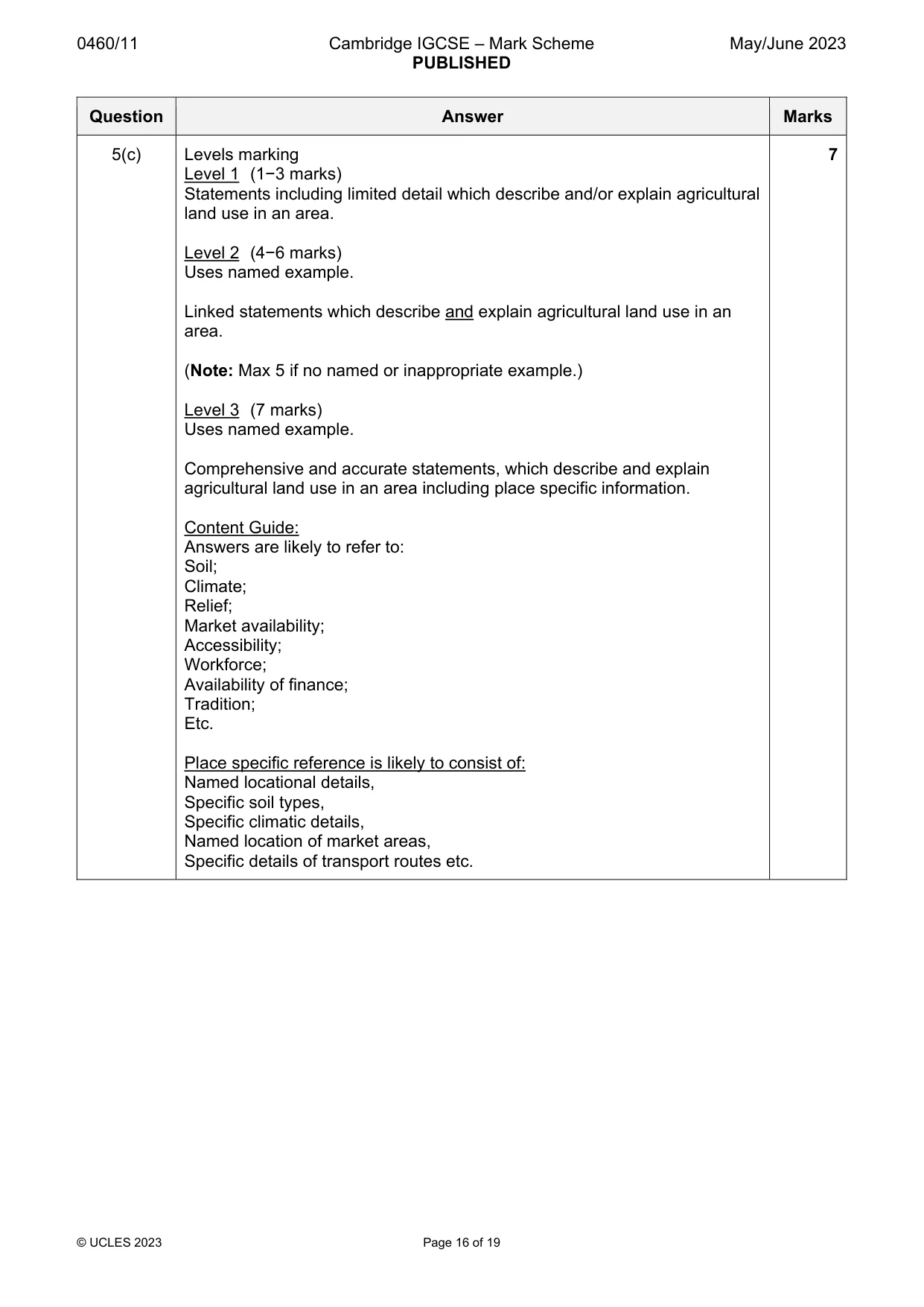
0460/11 Cambridge IGCSE – Mark Scheme PUBLISHED May/June 2023 © UCLES 2023 Page 16 of 19 Question Answer Marks 5(c) Levels marking Level 1 (1−3 marks) Statements including limited detail which describe and/or explain agricultural land use in an area. Level 2 (4−6 marks) Uses named example. Linked statements which describe and explain agricultural land use in an area. (Note: Max 5 if no named or inappropriate example.) Level 3 (7 marks) Uses named example. Comprehensive and accurate statements, which describe and explain agricultural land use in an area including place specific information. Content Guide: Answers are likely to refer to: Soil; Climate; Relief; Market availability; Accessibility; Workforce; Availability of finance; Tradition; Etc. Place specific reference is likely to consist of: Named locational details, Specific soil types, Specific climatic details, Named location of market areas, Specific details of transport routes etc. 7
Mark scheme, page 17
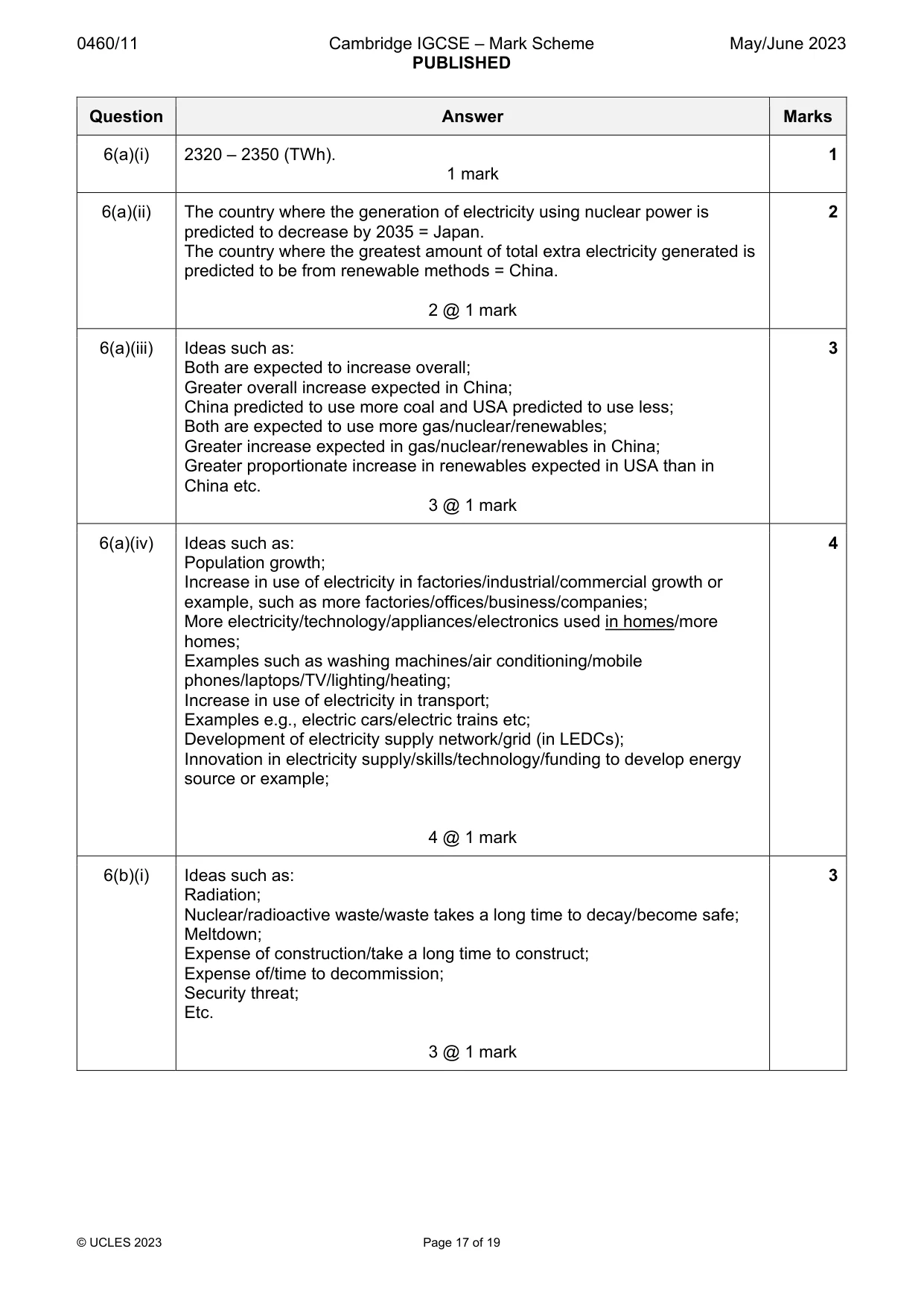
0460/11 Cambridge IGCSE – Mark Scheme PUBLISHED May/June 2023 © UCLES 2023 Page 17 of 19 Question Answer Marks 6(a)(i) 2320 – 2350 (TWh). 1 mark 1 6(a)(ii) The country where the generation of electricity using nuclear power is predicted to decrease by 2035 = Japan. The country where the greatest amount of total extra electricity generated is predicted to be from renewable methods = China. 2 @ 1 mark 2 6(a)(iii) Ideas such as: Both are expected to increase overall; Greater overall increase expected in China; China predicted to use more coal and USA predicted to use less; Both are expected to use more gas/nuclear/renewables; Greater increase expected in gas/nuclear/renewables in China; Greater proportionate increase in renewables expected in USA than in China etc. 3 @ 1 mark 3 6(a)(iv) Ideas such as: Population growth; Increase in use of electricity in factories/industrial/commercial growth or example, such as more factories/offices/business/companies; More electricity/technology/appliances/electronics used in homes/more homes; Examples such as washing machines/air conditioning/mobile phones/laptops/TV/lighting/heating; Increase in use of electricity in transport; Examples e.g., electric cars/electric trains etc; Development of electricity supply network/grid (in LEDCs); Innovation in electricity supply/skills/technology/funding to develop energy source or example; 4 @ 1 mark 4 6(b)(i) Ideas such as: Radiation; Nuclear/radioactive waste/waste takes a long time to decay/become safe; Meltdown; Expense of construction/take a long time to construct; Expense of/time to decommission; Security threat; Etc. 3 @ 1 mark 3
Mark scheme, page 18
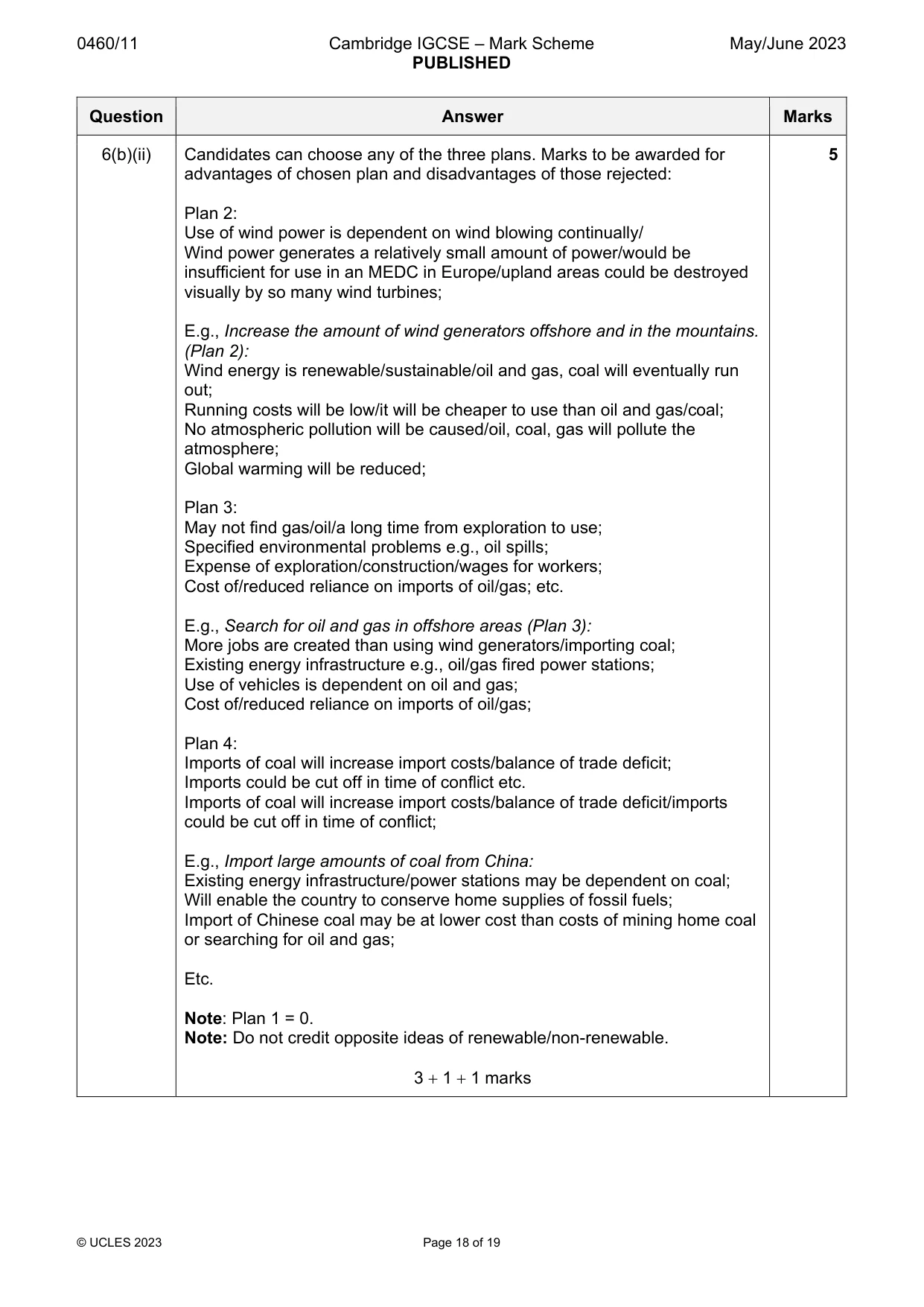
0460/11 Cambridge IGCSE – Mark Scheme PUBLISHED May/June 2023 © UCLES 2023 Page 18 of 19 Question Answer Marks 6(b)(ii) Candidates can choose any of the three plans. Marks to be awarded for advantages of chosen plan and disadvantages of those rejected: Plan 2: Use of wind power is dependent on wind blowing continually/ Wind power generates a relatively small amount of power/would be insufficient for use in an MEDC in Europe/upland areas could be destroyed visually by so many wind turbines; E.g., Increase the amount of wind generators offshore and in the mountains. (Plan 2): Wind energy is renewable/sustainable/oil and gas, coal will eventually run out; Running costs will be low/it will be cheaper to use than oil and gas/coal; No atmospheric pollution will be caused/oil, coal, gas will pollute the atmosphere; Global warming will be reduced; Plan 3: May not find gas/oil/a long time from exploration to use; Specified environmental problems e.g., oil spills; Expense of exploration/construction/wages for workers; Cost of/reduced reliance on imports of oil/gas; etc. E.g., Search for oil and gas in offshore areas (Plan 3): More jobs are created than using wind generators/importing coal; Existing energy infrastructure e.g., oil/gas fired power stations; Use of vehicles is dependent on oil and gas; Cost of/reduced reliance on imports of oil/gas; Plan 4: Imports of coal will increase import costs/balance of trade deficit; Imports could be cut off in time of conflict etc. Imports of coal will increase import costs/balance of trade deficit/imports could be cut off in time of conflict; E.g., Import large amounts of coal from China: Existing energy infrastructure/power stations may be dependent on coal; Will enable the country to conserve home supplies of fossil fuels; Import of Chinese coal may be at lower cost than costs of mining home coal or searching for oil and gas; Etc. Note: Plan 1 = 0. Note: Do not credit opposite ideas of renewable/non-renewable. 3 1 1 marks 5
Mark scheme, page 19
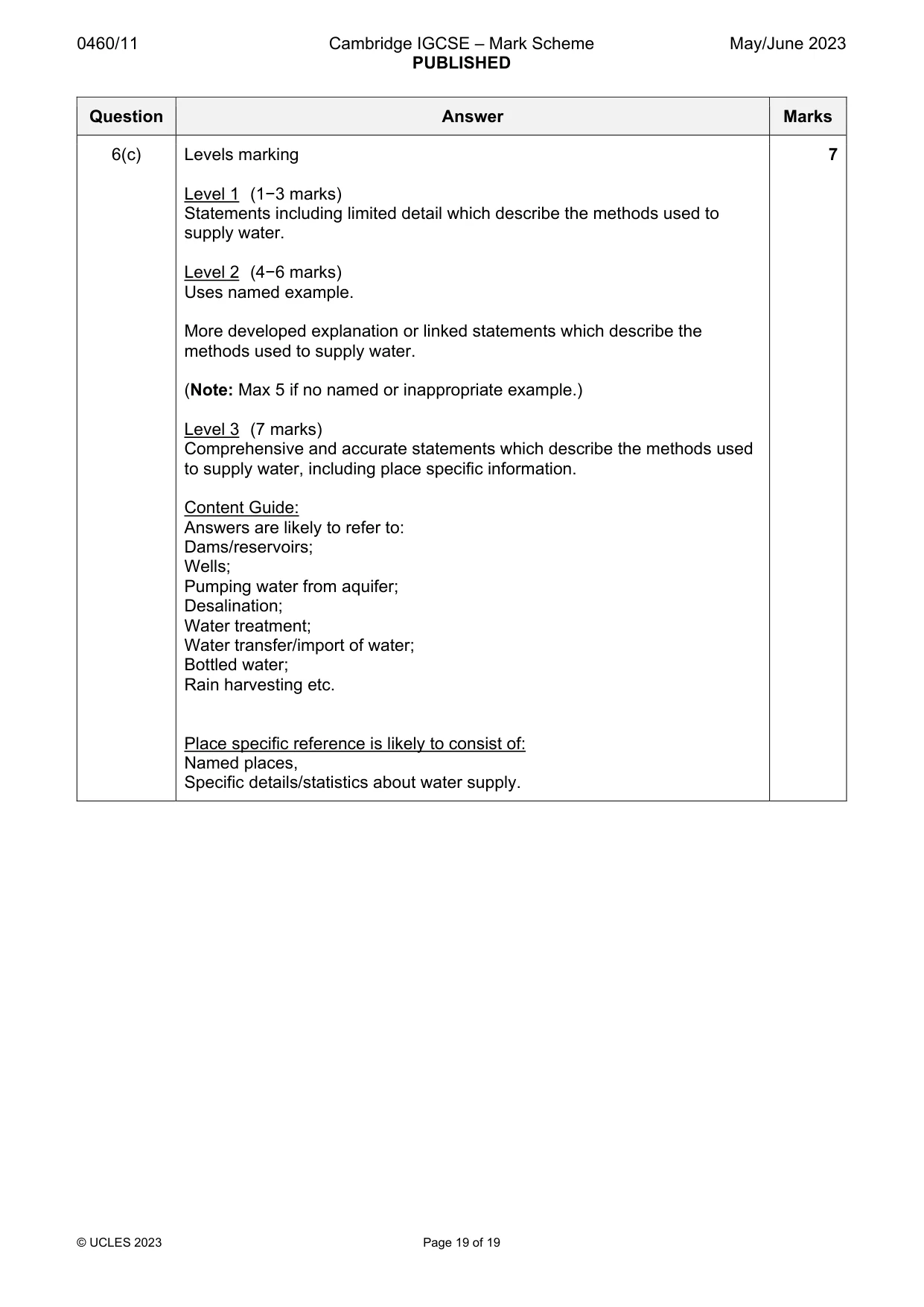
0460/11 Cambridge IGCSE – Mark Scheme PUBLISHED May/June 2023 © UCLES 2023 Page 19 of 19 Question Answer Marks 6(c) Levels marking Level 1 (1−3 marks) Statements including limited detail which describe the methods used to supply water. Level 2 (4−6 marks) Uses named example. More developed explanation or linked statements which describe the methods used to supply water. (Note: Max 5 if no named or inappropriate example.) Level 3 (7 marks) Comprehensive and accurate statements which describe the methods used to supply water, including place specific information. Content Guide: Answers are likely to refer to: Dams/reservoirs; Wells; Pumping water from aquifer; Desalination; Water treatment; Water transfer/import of water; Bottled water; Rain harvesting etc. Place specific reference is likely to consist of: Named places, Specific details/statistics about water supply. 7
What you needed in this session
Cambridge’s own grade thresholds for 2023 May/June, Paper 1 · Variant 1. A higher threshold means an easier paper — the bar moves with how the cohort did.