Cambridge IGCSE Geography 0460 — 2024 May/June Paper 1 · Variant 1
0460/11/M/J/24 · 75 marks · ≈84 min
The question paper and its mark scheme, free to read here and free to download. This is Cambridge’s own paper, exactly as it was sat.
Question paper28 pages
Mark scheme24 pages
Answers below. Sit the paper first if you are practising.
Paper as text
Question paper, page 1
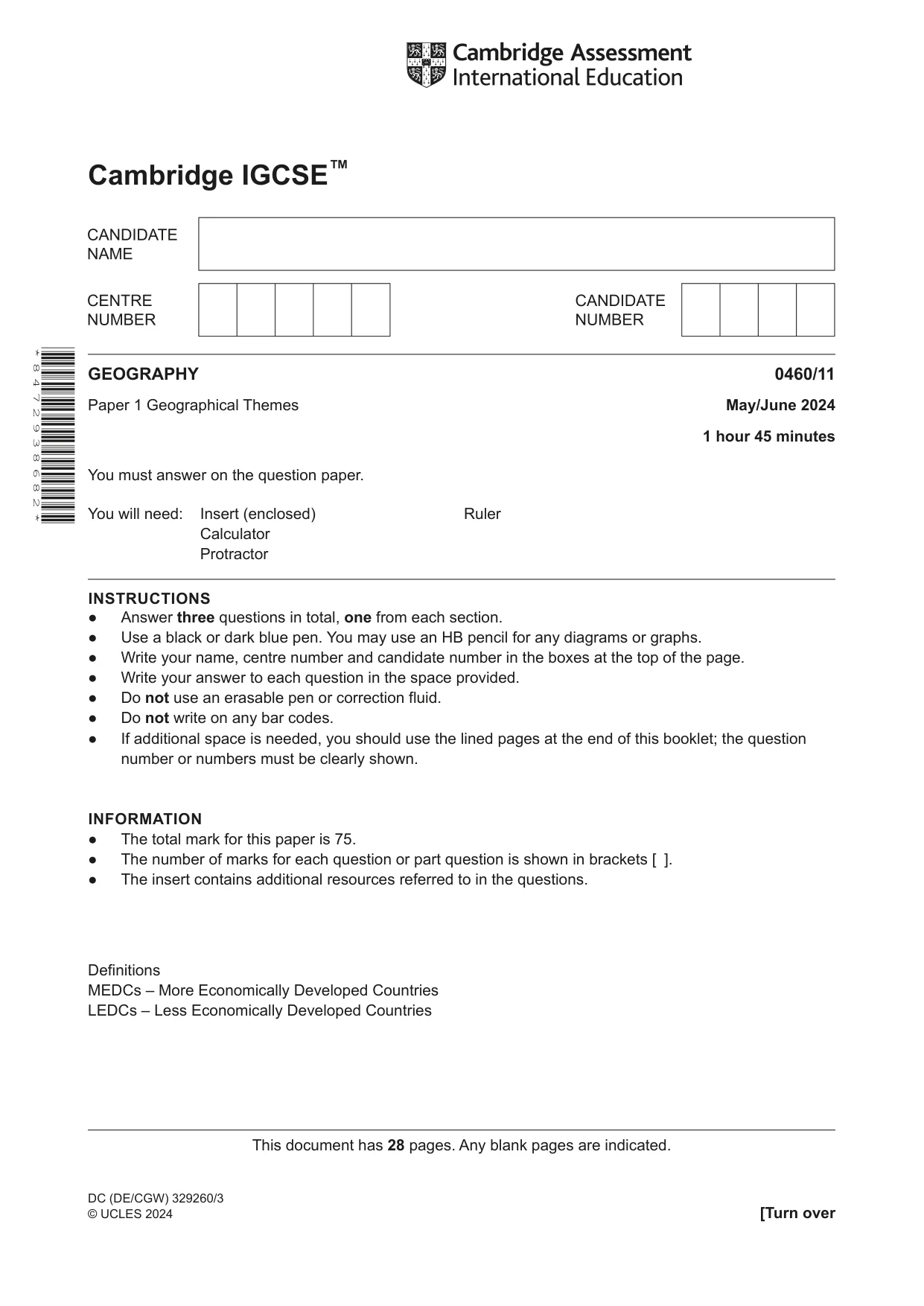
This document has 28 pages. Any blank pages are indicated. [Turn over * 8 4 7 2 9 3 8 6 8 2 * Cambridge IGCSE™ DC (DE/CGW) 329260/3 © UCLES 2024 GEOGRAPHY 0460/11 Paper 1 Geographical Themes May/June 2024 1 hour 45 minutes You must answer on the question paper. You will need: Insert (enclosed) Ruler Calculator Protractor INSTRUCTIONS ● Answer three questions in total, one from each section. ● Use a black or dark blue pen. You may use an HB pencil for any diagrams or graphs. ● Write your name, centre number and candidate number in the boxes at the top of the page. ● Write your answer to each question in the space provided. ● Do not use an erasable pen or correction fluid. ● Do not write on any bar codes. ● If additional space is needed, you should use the lined pages at the end of this booklet; the question number or numbers must be clearly shown. INFORMATION ● The total mark for this paper is 75. ● The number of marks for each question or part question is shown in brackets [ ]. ● The insert contains additional resources referred to in the questions. Definitions MEDCs – More Economically Developed Countries LEDCs – Less Economically Developed Countries
Question paper, page 2
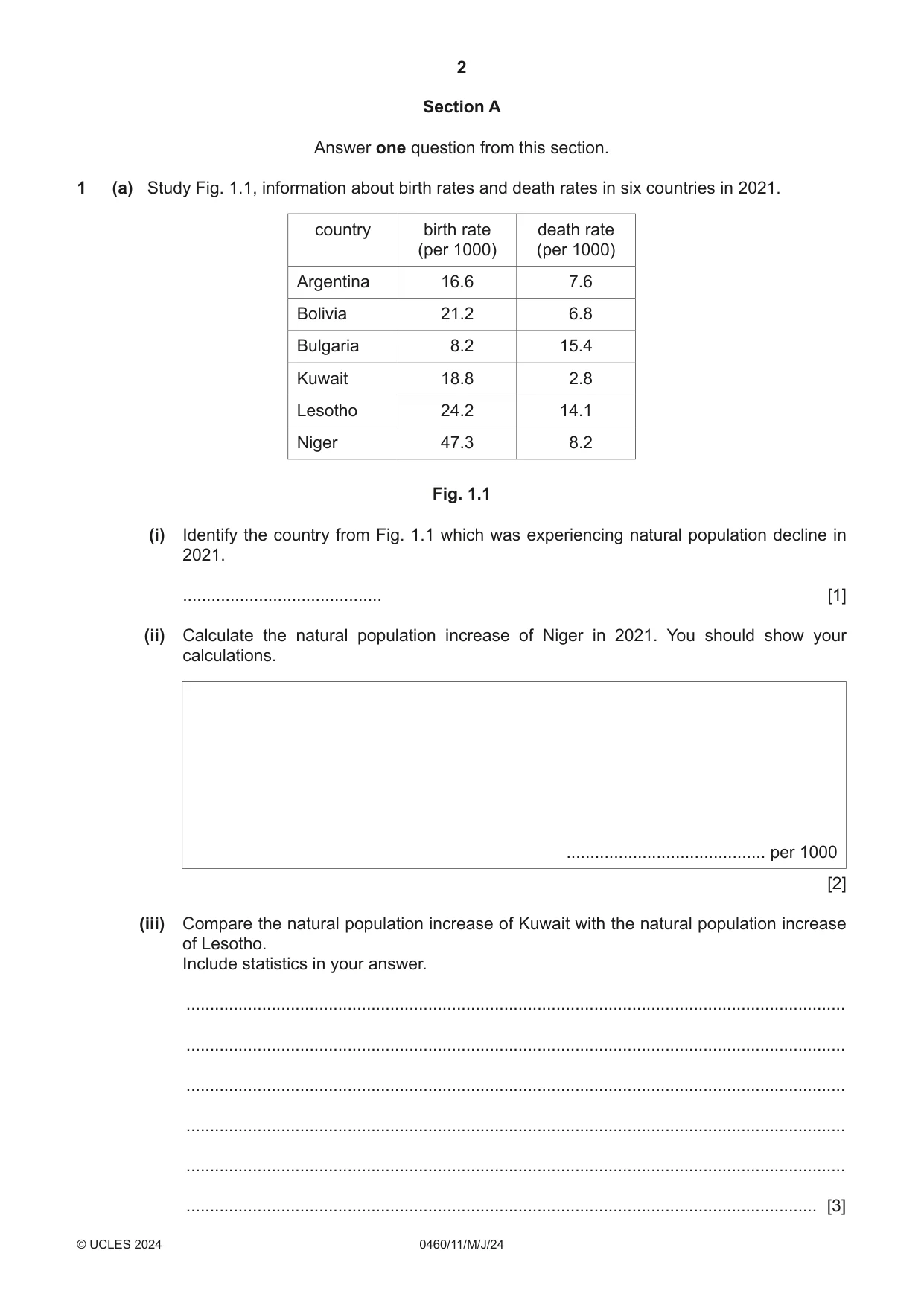
2 0460/11/M/J/24 © UCLES 2024 Section A Answer one question from this section. 1 (a) Study Fig. 1.1, information about birth rates and death rates in six countries in 2021. country birth rate (per 1000) death rate (per 1000) Argentina 16.6 7.6 Bolivia 21.2 6.8 Bulgaria 8.2 15.4 Kuwait 18.8 2.8 Lesotho 24.2 14.1 Niger 47.3 8.2 Fig. 1.1 (i) Identify the country from Fig. 1.1 which was experiencing natural population decline in 2021. … [1] (ii) Calculate the natural population increase of Niger in 2021. You should show your calculations. … per 1000 [2] (iii) Compare the natural population increase of Kuwait with the natural population increase of Lesotho. Include statistics in your answer. … … … … … … [3]
Question paper, page 3
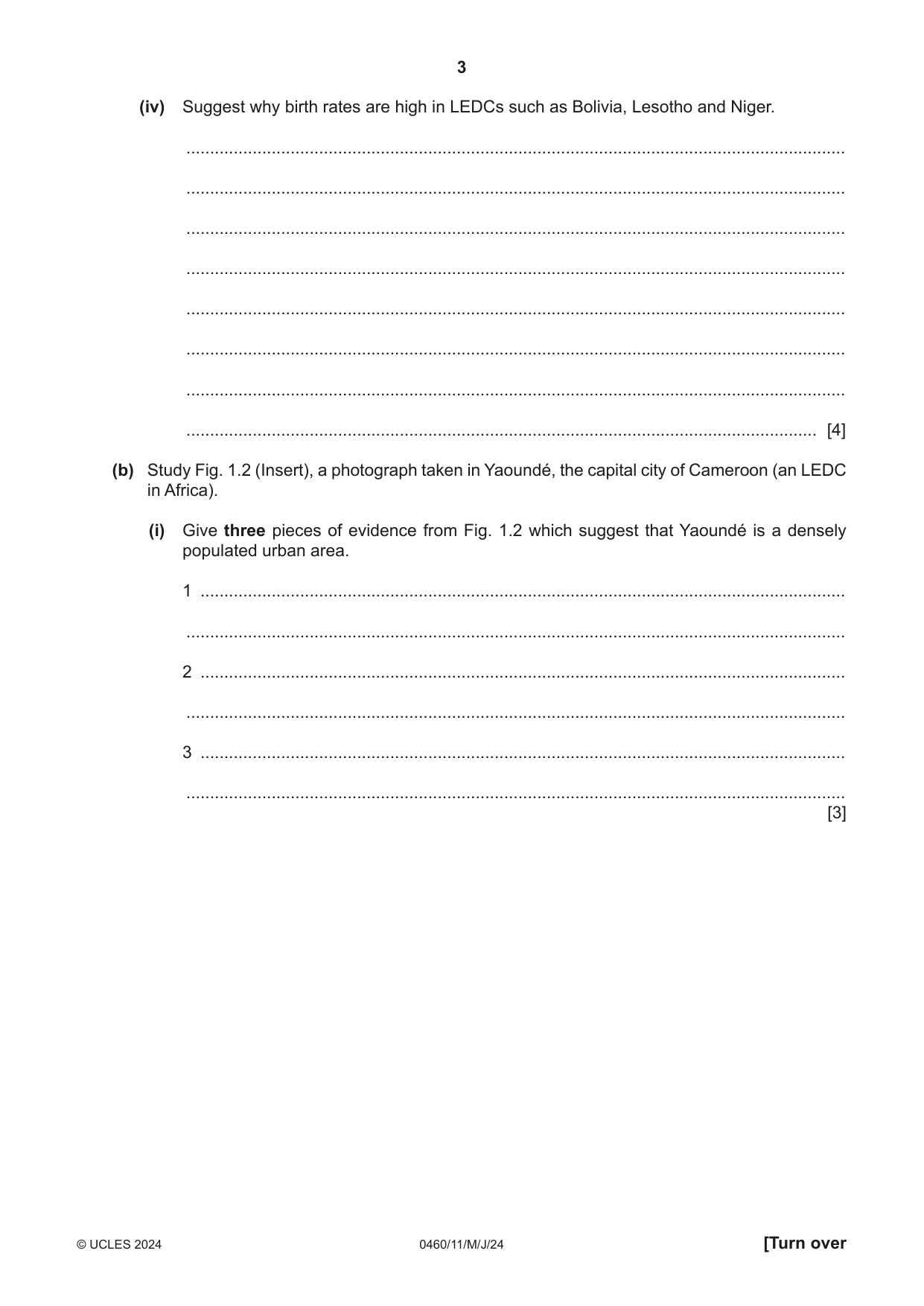
3 0460/11/M/J/24 © UCLES 2024 [Turn over (iv) Suggest why birth rates are high in LEDCs such as Bolivia, Lesotho and Niger. … … … … … … … … [4] (b) Study Fig. 1.2 (Insert), a photograph taken in Yaoundé, the capital city of Cameroon (an LEDC in Africa). (i) Give three pieces of evidence from Fig. 1.2 which suggest that Yaoundé is a densely populated urban area. 1 … … 2 … … 3 … … [3]
Question paper, page 4
4 0460/11/M/J/24 © UCLES 2024 (ii) Describe the problems experienced by people living in urban areas with a high population density, such as Yaoundé. … … … … … … … … … … [5]
Question paper, page 5
5 0460/11/M/J/24 © UCLES 2024 [Turn over (c) For a country or area you have studied explain why it is sparsely populated. Name of country or area … … … … … … … … … … … … … … … … … … … … … … … … … … [7] [Total: 25]
Question paper, page 6
6 0460/11/M/J/24 © UCLES 2024 2 (a) Study Fig. 2.1 (Insert), a map showing urban zones in Bangkok, the capital city of Thailand (a country in Asia). (i) What is the direction from point X in the CBD of Bangkok to the government buildings at Y? … [1] (ii) Using Fig. 2.1, describe the location of the high-density residential zones in Bangkok. … … … … [2] (iii) The residential area in the rural-urban fringe marked Z on Fig. 2.1 has been recently developed. Give three advantages of living in the rural-urban fringe. 1 … … 2 … … 3 … … [3] (iv) Describe the impacts of urban sprawl on the natural environment. … … … … … … … … [4]
Question paper, page 7
7 0460/11/M/J/24 © UCLES 2024 [Turn over (b) Study Fig. 2.2 (Insert), a photograph taken in Hat Yai, an urban area in Thailand. (i) Describe three characteristics of the buildings shown in Fig. 2.2. 1 … … 2 … … 3 … … [3] (ii) Describe the causes and effects of one named type of pollution likely to be experienced by the people living in the area shown in Fig. 2.2. type of pollution … causes … … … … … effects … … … … … [5]
Question paper, page 8
8 0460/11/M/J/24 © UCLES 2024 (c) For a named urban area you have studied, describe the strategies used to reduce traffic congestion. Name of urban area … … … … … … … … … … … … … … … … … … … … … … … … … … [7] [Total: 25]
Question paper, page 9
9 0460/11/M/J/24 © UCLES 2024 [Turn over BLANK PAGE
Question paper, page 10
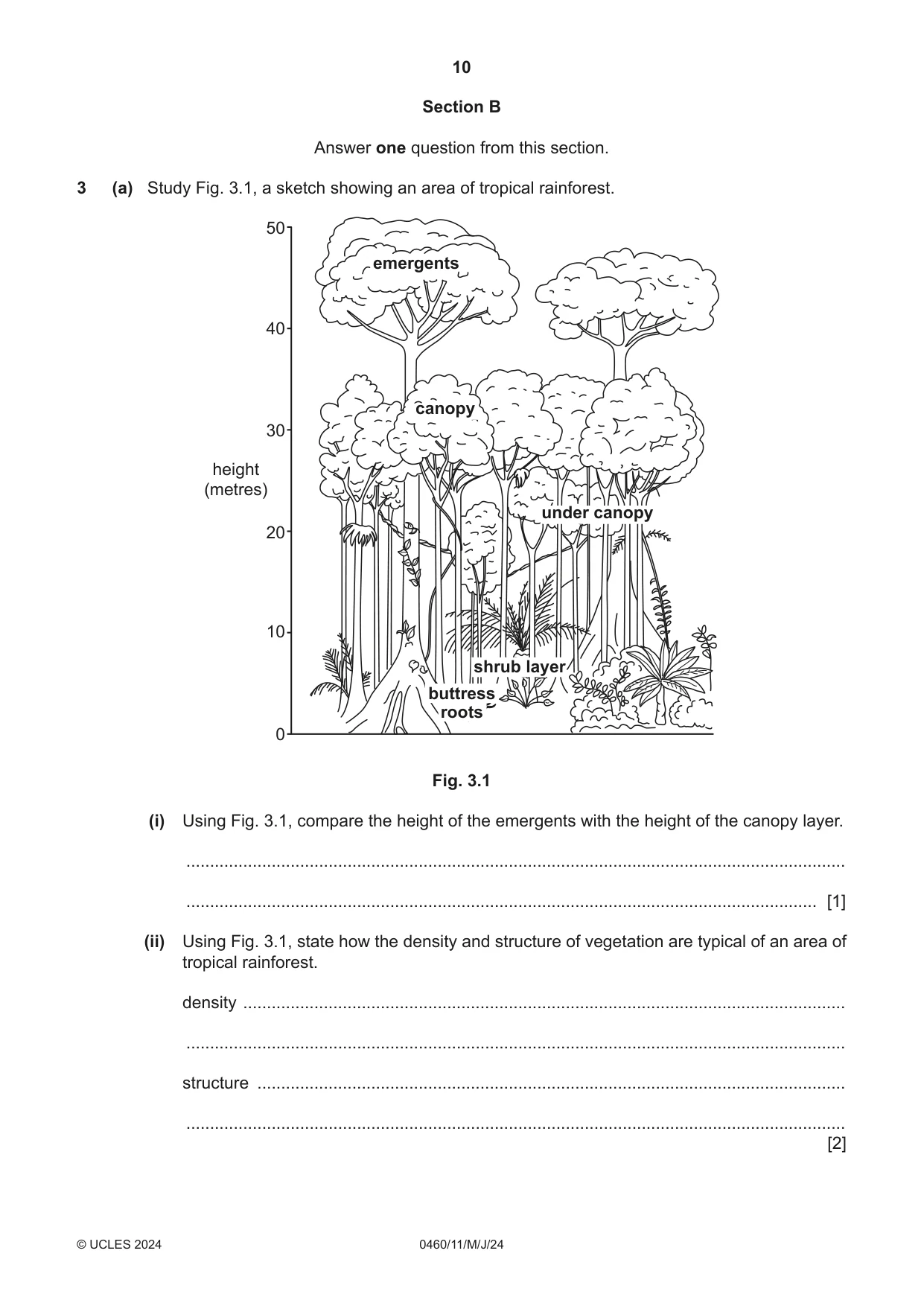
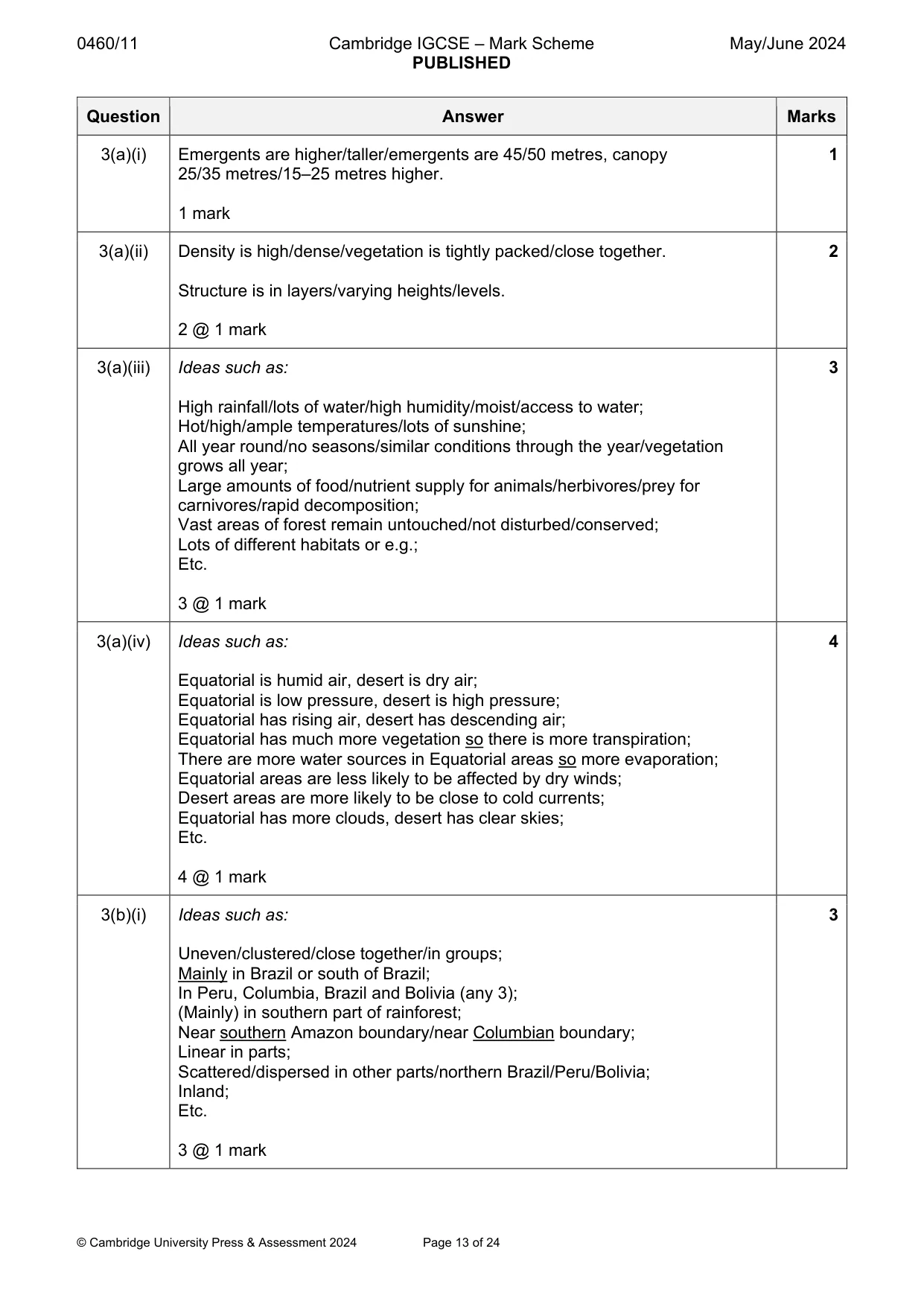
10 0460/11/M/J/24 © UCLES 2024 Section B Answer one question from this section. 3 (a) Study Fig. 3.1, a sketch showing an area of tropical rainforest. 50 40 30 20 height (metres) 10 0 emergents canopy under canopy shrub layer buttress roots Fig. 3.1 (i) Using Fig. 3.1, compare the height of the emergents with the height of the canopy layer. … … [1] (ii) Using Fig. 3.1, state how the density and structure of vegetation are typical of an area of tropical rainforest. density … … structure … … [2]
Question paper, page 11
11 0460/11/M/J/24 © UCLES 2024 [Turn over (iii) There are many different species of plants and animals in many areas of tropical rainforest. Give three reasons for this high biodiversity. 1 … … 2 … … 3 … … [3] (iv) Explain why equatorial and hot desert climates have different amounts of rainfall. … … … … … … … … [4]
Question paper, page 12
12 0460/11/M/J/24 © UCLES 2024 (b) Study Fig. 3.2 (Insert), information about deforestation in the Amazon rainforest in 2021. (i) Using Fig. 3.2, describe the distribution of high deforestation in the Amazon rainforest in 2021. … … … … … … [3] (ii) Suggest reasons to explain the distribution of deforestation in the Amazon rainforest. … … … … … … … … … … [5]
Question paper, page 13
13 0460/11/M/J/24 © UCLES 2024 [Turn over (c) Describe the local and global impacts of large-scale deforestation of tropical rainforests on people. You should refer to named places. … … … … … … … … … … … … … … … … … … … … … … … … … [7] [Total: 25]
Question paper, page 14
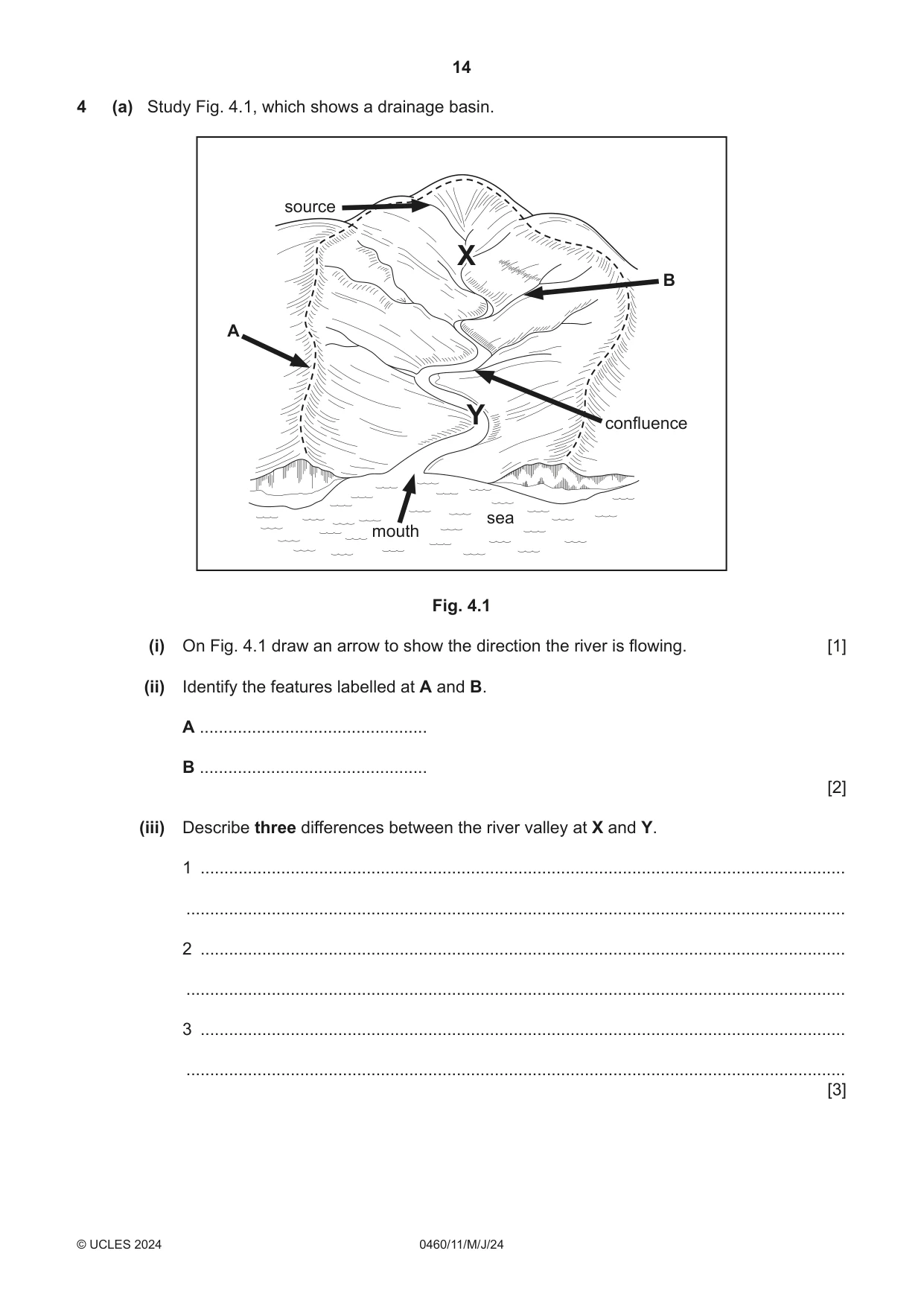
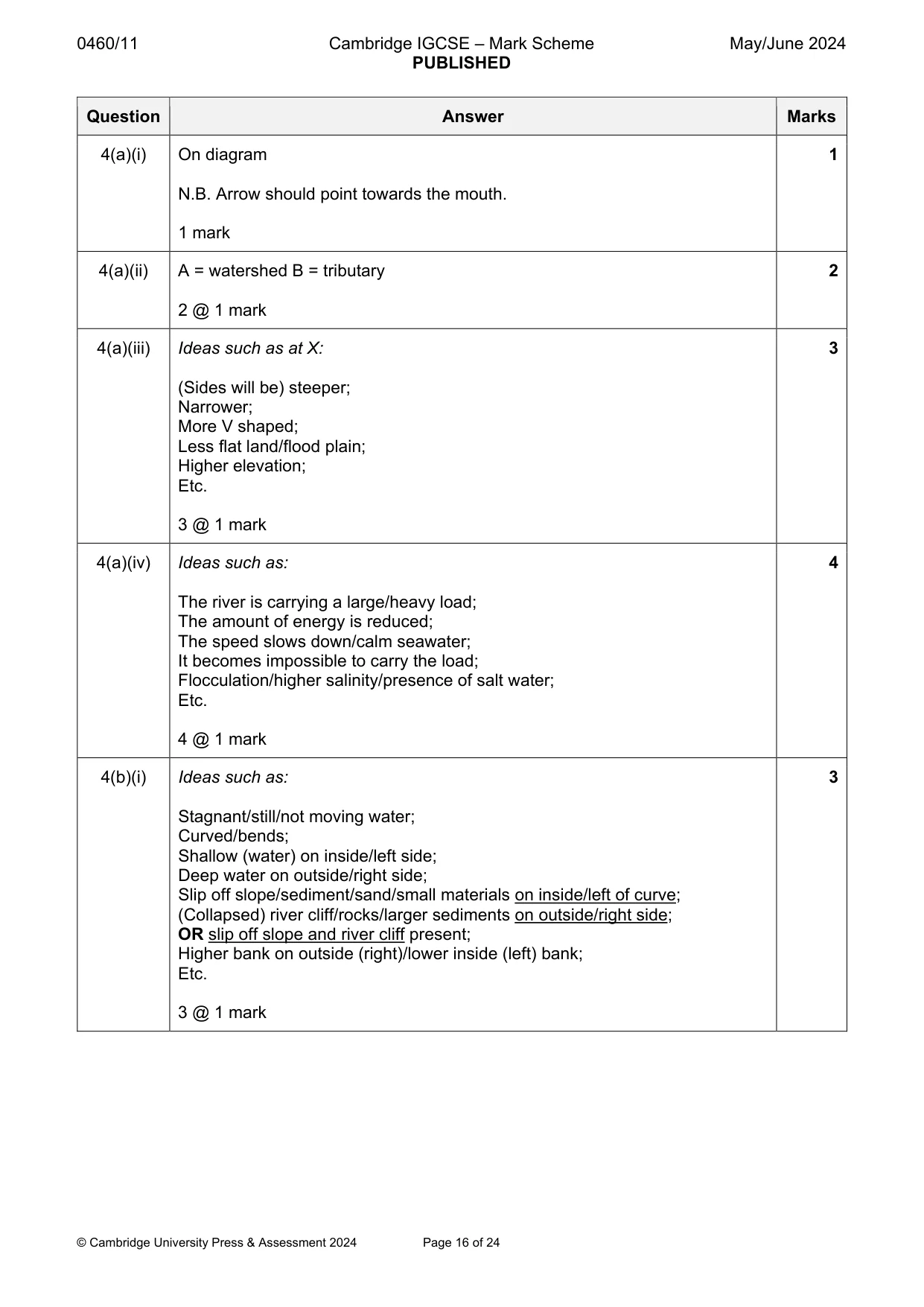
14 0460/11/M/J/24 © UCLES 2024 4 (a) Study Fig. 4.1, which shows a drainage basin. A X Y B confluence mouth source sea Fig. 4.1 (i) On Fig. 4.1 draw an arrow to show the direction the river is flowing. [1] (ii) Identify the features labelled at A and B. A … B … [2] (iii) Describe three differences between the river valley at X and Y. 1 … … 2 … … 3 … … [3]
Question paper, page 15
15 0460/11/M/J/24 © UCLES 2024 [Turn over (iv) Explain why deposition occurs where the river enters the sea. … … … … … … … … [4] (b) Study Fig. 4.2 (Insert), a photograph of part of an oxbow lake. (i) Describe the characteristics of the oxbow lake shown in Fig. 4.2. … … … … … … [3]
Question paper, page 16
16 0460/11/M/J/24 © UCLES 2024 (ii) Explain how an oxbow lake is formed. You may use a labelled diagram. … … … … … … … … … … [5]
Question paper, page 17
17 0460/11/M/J/24 © UCLES 2024 [Turn over (c) For a river you have studied, describe the impacts of a flood. Name of river … … … … … … … … … … … … … … … … … … … … … … … … … … [7] [Total: 25]
Question paper, page 18
18 0460/11/M/J/24 © UCLES 2024 Section C Answer one question from this section. 5 (a) Study Fig. 5.1 (Insert), a map showing the importance of different industries in Austria (an MEDC in Europe). (i) What is meant by food processing industry? … … [1] (ii) Name two places where food processing industries are located. 1 … 2 … [2] (iii) Describe the distribution of industry in Austria. … … … … … … [3] (iv) Compare the importance of different industries in Linz and Graz. … … … … … … … … [4]
Question paper, page 19
19 0460/11/M/J/24 © UCLES 2024 [Turn over (b) Study Fig. 5.2, a flow diagram of a dairy. A dairy is an example of a food processing industry. Fig. 5.2 (i) Identify one input, one process and one output of the dairy shown in Fig. 5.2. input … process … output … [3] (ii) Suggest reasons why many dairies are located in rural areas. … … … … … … … … … … [5] Content removed due to copyright restrictions.
Question paper, page 20
20 0460/11/M/J/24 © UCLES 2024 (c) Explain how a named economic activity in an area you have studied is managed to reduce risks to the natural environment. Name of area … Economic activity … … … … … … … … … … … … … … … … … … … … … … … … … [7] [Total: 25]
Question paper, page 21
21 0460/11/M/J/24 © UCLES 2024 [Turn over BLANK PAGE
Question paper, page 22
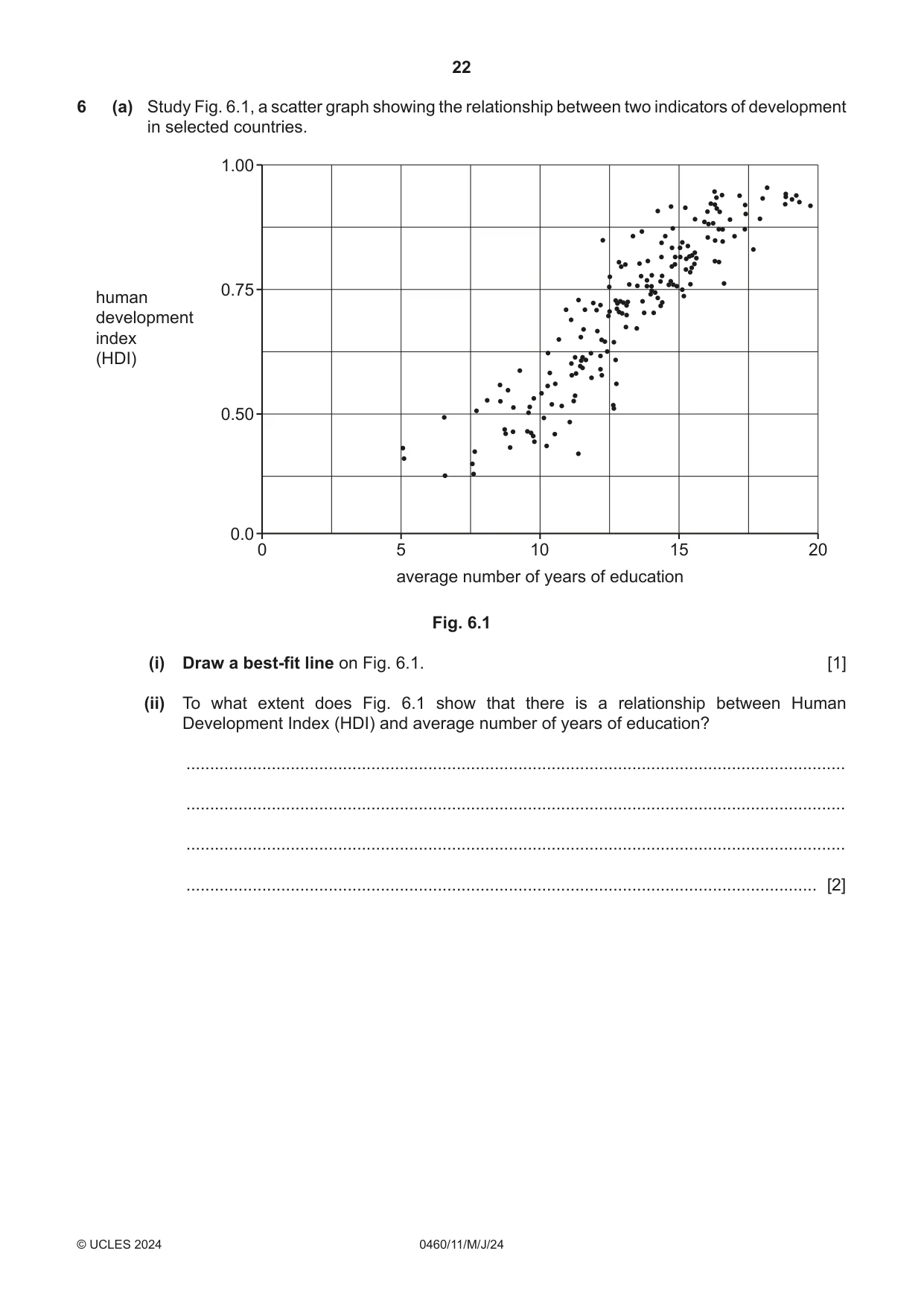
22 0460/11/M/J/24 © UCLES 2024 6 (a) Study Fig. 6.1, a scatter graph showing the relationship between two indicators of development in selected countries. 1.00 5 0 10 15 average number of years of education 20 0.75 0.50 0.0 human development index (HDI) Fig. 6.1 (i) Draw a best-fit line on Fig. 6.1. [1] (ii) To what extent does Fig. 6.1 show that there is a relationship between Human Development Index (HDI) and average number of years of education? … … … … [2]
Question paper, page 23
23 0460/11/M/J/24 © UCLES 2024 [Turn over (iii) Explain why there is a relationship between HDI and average number of years of education. … … … … … … [3] (iv) Compare the usefulness of HDI and the total GNP (Gross National Product) of a country as indicators of its level of development. … … … … … … … … [4]
Question paper, page 24
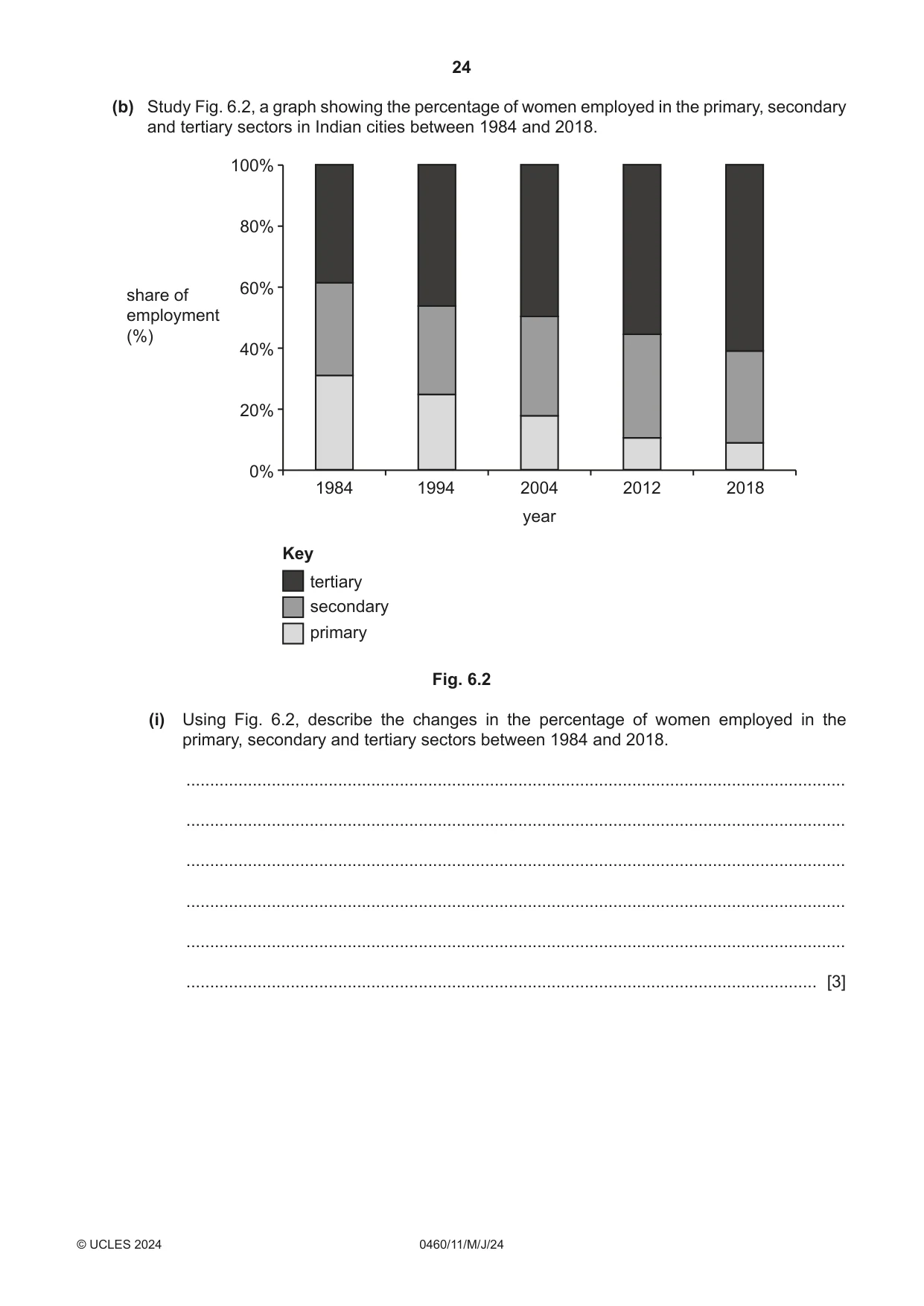
24 0460/11/M/J/24 © UCLES 2024 (b) Study Fig. 6.2, a graph showing the percentage of women employed in the primary, secondary and tertiary sectors in Indian cities between 1984 and 2018. 1984 0% 20% 40% 60% share of employment (%) 80% 100% 1994 2004 year tertiary secondary primary Key 2012 2018 Fig. 6.2 (i) Using Fig. 6.2, describe the changes in the percentage of women employed in the primary, secondary and tertiary sectors between 1984 and 2018. … … … … … … [3]
Question paper, page 25
25 0460/11/M/J/24 © UCLES 2024 [Turn over (ii) Suggest reasons why the percentage of women employed in the tertiary sector in cities in India has changed between 1984 and 2018. … … … … … … … … … … [5]
Question paper, page 26
26 0460/11/M/J/24 © UCLES 2024 (c) Explain why globalisation has occurred. You should refer to named examples. … … … … … … … … … … … … … … … … … … … … … … … … … [7] [Total: 25]
Question paper, page 27
27 0460/11/M/J/24 © UCLES 2024 Additional pages If you use the following page to complete the answer to any question, the question number must be clearly shown. … … … … … … … … … … … … … … … … … … … … … … … … … …
Question paper, page 28
28 0460/11/M/J/24 © UCLES 2024 The boundaries and names shown, the designations used and the presentation of material on any maps contained in this question paper/insert do not imply official endorsement or acceptance by Cambridge Assessment International Education concerning the legal status of any country, territory, or area or any of its authorities, or of the delimitation of its frontiers or boundaries. Permission to reproduce items where third-party owned material protected by copyright is included has been sought and cleared where possible. Every reasonable effort has been made by the publisher (UCLES) to trace copyright holders, but if any items requiring clearance have unwittingly been included, the publisher will be pleased to make amends at the earliest possible opportunity. To avoid the issue of disclosure of answer-related information to candidates, all copyright acknowledgements are reproduced online in the Cambridge Assessment International Education Copyright Acknowledgements Booklet. This is produced for each series of examinations and is freely available to download at www.cambridgeinternational.org after the live examination series. Cambridge Assessment International Education is part of Cambridge Assessment. Cambridge Assessment is the brand name of the University of Cambridge Local Examinations Syndicate (UCLES), which is a department of the University of Cambridge. Additional pages If you use the following page to complete the answer to any question, the question number must be clearly shown. … … … … … … … … … … … … … … … … … … … …
Mark scheme, page 1
This document consists of 24 printed pages. © Cambridge University Press & Assessment 2024 [Turn over Cambridge IGCSE™ GEOGRAPHY 0460/11 Paper 1 Geographical Themes May/June 2024 MARK SCHEME Maximum Mark: 75 Published This mark scheme is published as an aid to teachers and candidates, to indicate the requirements of the examination. It shows the basis on which Examiners were instructed to award marks. It does not indicate the details of the discussions that took place at an Examiners’ meeting before marking began, which would have considered the acceptability of alternative answers. Mark schemes should be read in conjunction with the question paper and the Principal Examiner Report for Teachers. Cambridge International will not enter into discussions about these mark schemes. Cambridge International is publishing the mark schemes for the May/June 2024 series for most Cambridge IGCSE, Cambridge International A and AS Level and Cambridge Pre-U components, and some Cambridge O Level components.
Mark scheme, page 2
0460/11 Cambridge IGCSE – Mark Scheme PUBLISHED May/June 2024 © Cambridge University Press & Assessment 2024 Page 2 of 24 Generic Marking Principles These general marking principles must be applied by all examiners when marking candidate answers. They should be applied alongside the specific content of the mark scheme or generic level descriptions for a question. Each question paper and mark scheme will also comply with these marking principles. GENERIC MARKING PRINCIPLE 1: Marks must be awarded in line with: the specific content of the mark scheme or the generic level descriptors for the question the specific skills defined in the mark scheme or in the generic level descriptors for the question the standard of response required by a candidate as exemplified by the standardisation scripts. GENERIC MARKING PRINCIPLE 2: Marks awarded are always whole marks (not half marks, or other fractions). GENERIC MARKING PRINCIPLE 3: Marks must be awarded positively: marks are awarded for correct/valid answers, as defined in the mark scheme. However, credit is given for valid answers which go beyond the scope of the syllabus and mark scheme, referring to your Team Leader as appropriate marks are awarded when candidates clearly demonstrate what they know and can do marks are not deducted for errors marks are not deducted for omissions answers should only be judged on the quality of spelling, punctuation and grammar when these features are specifically assessed by the question as indicated by the mark scheme. The meaning, however, should be unambiguous. GENERIC MARKING PRINCIPLE 4: Rules must be applied consistently, e.g. in situations where candidates have not followed instructions or in the application of generic level descriptors. GENERIC MARKING PRINCIPLE 5: Marks should be awarded using the full range of marks defined in the mark scheme for the question (however; the use of the full mark range may be limited according to the quality of the candidate responses seen). GENERIC MARKING PRINCIPLE 6: Marks awarded are based solely on the requirements as defined in the mark scheme. Marks should not be awarded with grade thresholds or grade descriptors in mind.
Mark scheme, page 3
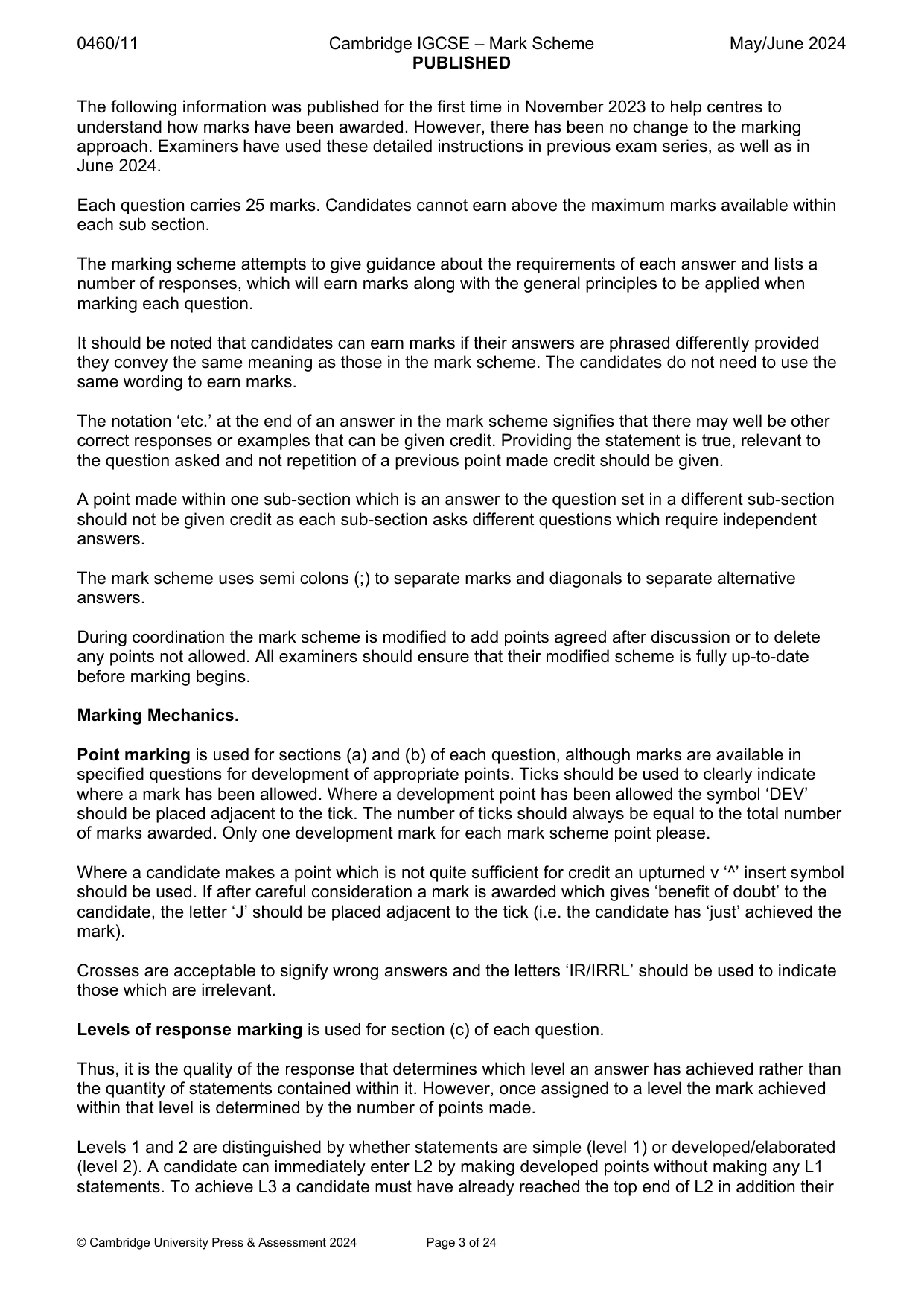
0460/11 Cambridge IGCSE – Mark Scheme PUBLISHED May/June 2024 © Cambridge University Press & Assessment 2024 Page 3 of 24 The following information was published for the first time in November 2023 to help centres to understand how marks have been awarded. However, there has been no change to the marking approach. Examiners have used these detailed instructions in previous exam series, as well as in June 2024. Each question carries 25 marks. Candidates cannot earn above the maximum marks available within each sub section. The marking scheme attempts to give guidance about the requirements of each answer and lists a number of responses, which will earn marks along with the general principles to be applied when marking each question. It should be noted that candidates can earn marks if their answers are phrased differently provided they convey the same meaning as those in the mark scheme. The candidates do not need to use the same wording to earn marks. The notation ‘etc.’ at the end of an answer in the mark scheme signifies that there may well be other correct responses or examples that can be given credit. Providing the statement is true, relevant to the question asked and not repetition of a previous point made credit should be given. A point made within one sub-section which is an answer to the question set in a different sub-section should not be given credit as each sub-section asks different questions which require independent answers. The mark scheme uses semi colons (;) to separate marks and diagonals to separate alternative answers. During coordination the mark scheme is modified to add points agreed after discussion or to delete any points not allowed. All examiners should ensure that their modified scheme is fully up-to-date before marking begins. Marking Mechanics. Point marking is used for sections (a) and (b) of each question, although marks are available in specified questions for development of appropriate points. Ticks should be used to clearly indicate where a mark has been allowed. Where a development point has been allowed the symbol ‘DEV’ should be placed adjacent to the tick. The number of ticks should always be equal to the total number of marks awarded. Only one development mark for each mark scheme point please. Where a candidate makes a point which is not quite sufficient for credit an upturned v ‘^’ insert symbol should be used. If after careful consideration a mark is awarded which gives ‘benefit of doubt’ to the candidate, the letter ‘J’ should be placed adjacent to the tick (i.e. the candidate has ‘just’ achieved the mark). Crosses are acceptable to signify wrong answers and the letters ‘IR/IRRL’ should be used to indicate those which are irrelevant. Levels of response marking is used for section (c) of each question. Thus, it is the quality of the response that determines which level an answer has achieved rather than the quantity of statements contained within it. However, once assigned to a level the mark achieved within that level is determined by the number of points made. Levels 1 and 2 are distinguished by whether statements are simple (level 1) or developed/elaborated (level 2). A candidate can immediately enter L2 by making developed points without making any L1 statements. To achieve L3 a candidate must have already reached the top end of L2 in addition their
Mark scheme, page 4
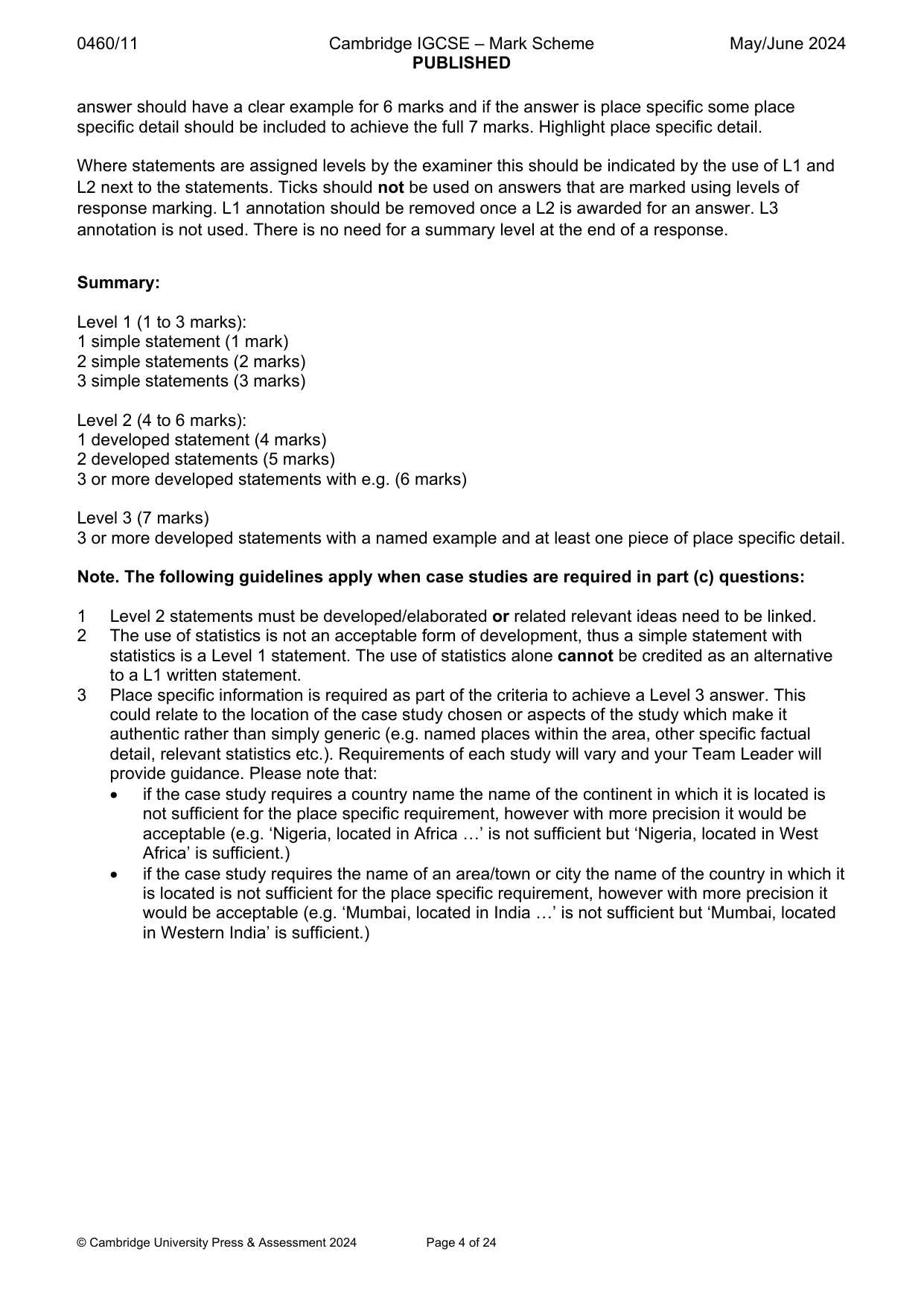
0460/11 Cambridge IGCSE – Mark Scheme PUBLISHED May/June 2024 © Cambridge University Press & Assessment 2024 Page 4 of 24 answer should have a clear example for 6 marks and if the answer is place specific some place specific detail should be included to achieve the full 7 marks. Highlight place specific detail. Where statements are assigned levels by the examiner this should be indicated by the use of L1 and L2 next to the statements. Ticks should not be used on answers that are marked using levels of response marking. L1 annotation should be removed once a L2 is awarded for an answer. L3 annotation is not used. There is no need for a summary level at the end of a response. Summary: Level 1 (1 to 3 marks): 1 simple statement (1 mark) 2 simple statements (2 marks) 3 simple statements (3 marks) Level 2 (4 to 6 marks): 1 developed statement (4 marks) 2 developed statements (5 marks) 3 or more developed statements with e.g. (6 marks) Level 3 (7 marks) 3 or more developed statements with a named example and at least one piece of place specific detail. Note. The following guidelines apply when case studies are required in part (c) questions: 1 Level 2 statements must be developed/elaborated or related relevant ideas need to be linked. 2 The use of statistics is not an acceptable form of development, thus a simple statement with statistics is a Level 1 statement. The use of statistics alone cannot be credited as an alternative to a L1 written statement. 3 Place specific information is required as part of the criteria to achieve a Level 3 answer. This could relate to the location of the case study chosen or aspects of the study which make it authentic rather than simply generic (e.g. named places within the area, other specific factual detail, relevant statistics etc.). Requirements of each study will vary and your Team Leader will provide guidance. Please note that: if the case study requires a country name the name of the continent in which it is located is not sufficient for the place specific requirement, however with more precision it would be acceptable (e.g. ‘Nigeria, located in Africa …’ is not sufficient but ‘Nigeria, located in West Africa’ is sufficient.) if the case study requires the name of an area/town or city the name of the country in which it is located is not sufficient for the place specific requirement, however with more precision it would be acceptable (e.g. ‘Mumbai, located in India …’ is not sufficient but ‘Mumbai, located in Western India’ is sufficient.)
Mark scheme, page 5
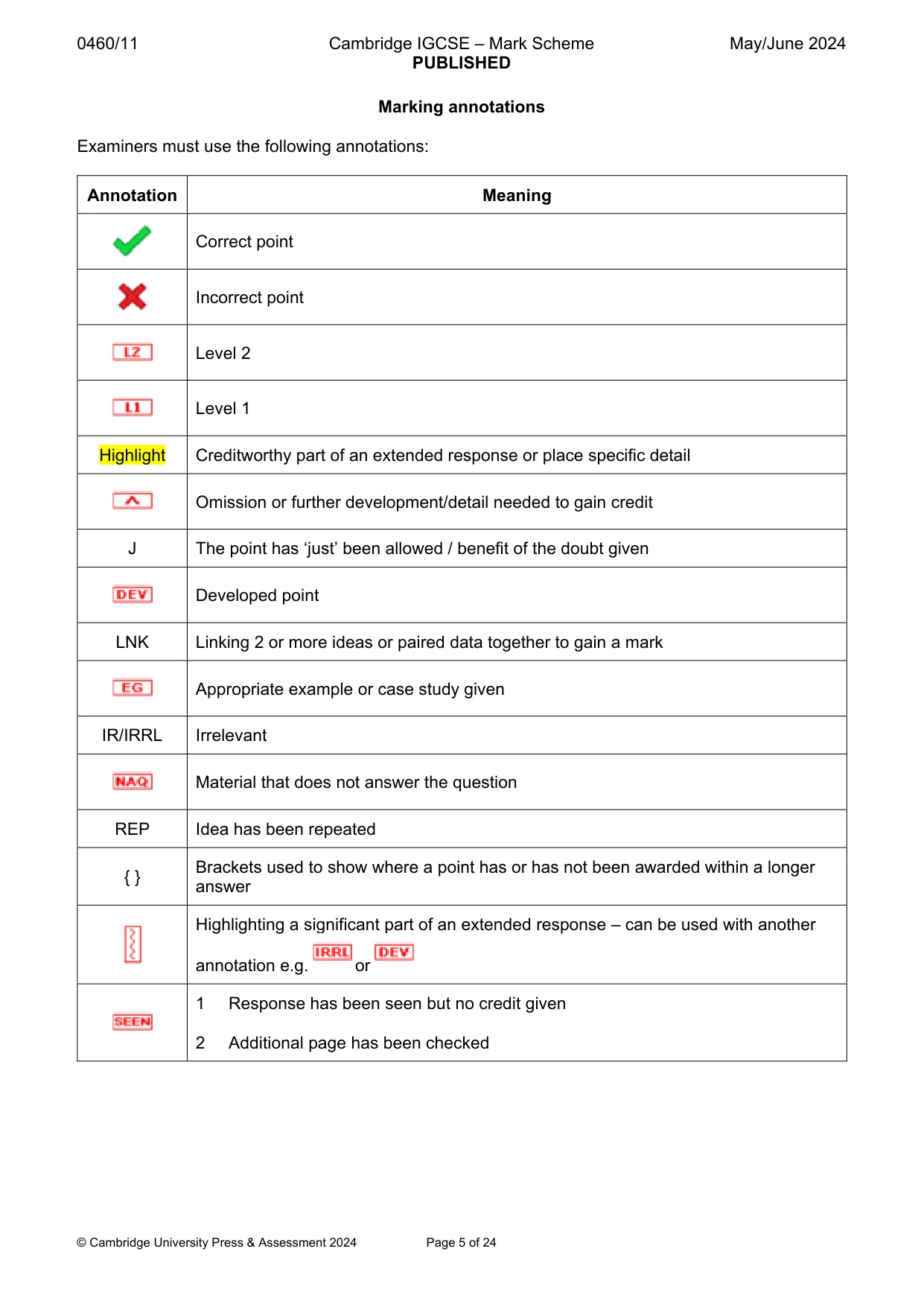
0460/11 Cambridge IGCSE – Mark Scheme PUBLISHED May/June 2024 © Cambridge University Press & Assessment 2024 Page 5 of 24 Marking annotations Examiners must use the following annotations: Annotation Meaning Correct point Incorrect point Level 2 Level 1 Highlight Creditworthy part of an extended response or place specific detail Omission or further development/detail needed to gain credit J The point has ‘just’ been allowed / benefit of the doubt given Developed point LNK Linking 2 or more ideas or paired data together to gain a mark Appropriate example or case study given IR/IRRL Irrelevant Material that does not answer the question REP Idea has been repeated { } Brackets used to show where a point has or has not been awarded within a longer answer Highlighting a significant part of an extended response – can be used with another annotation e.g. or 1 Response has been seen but no credit given 2 Additional page has been checked
Mark scheme, page 6
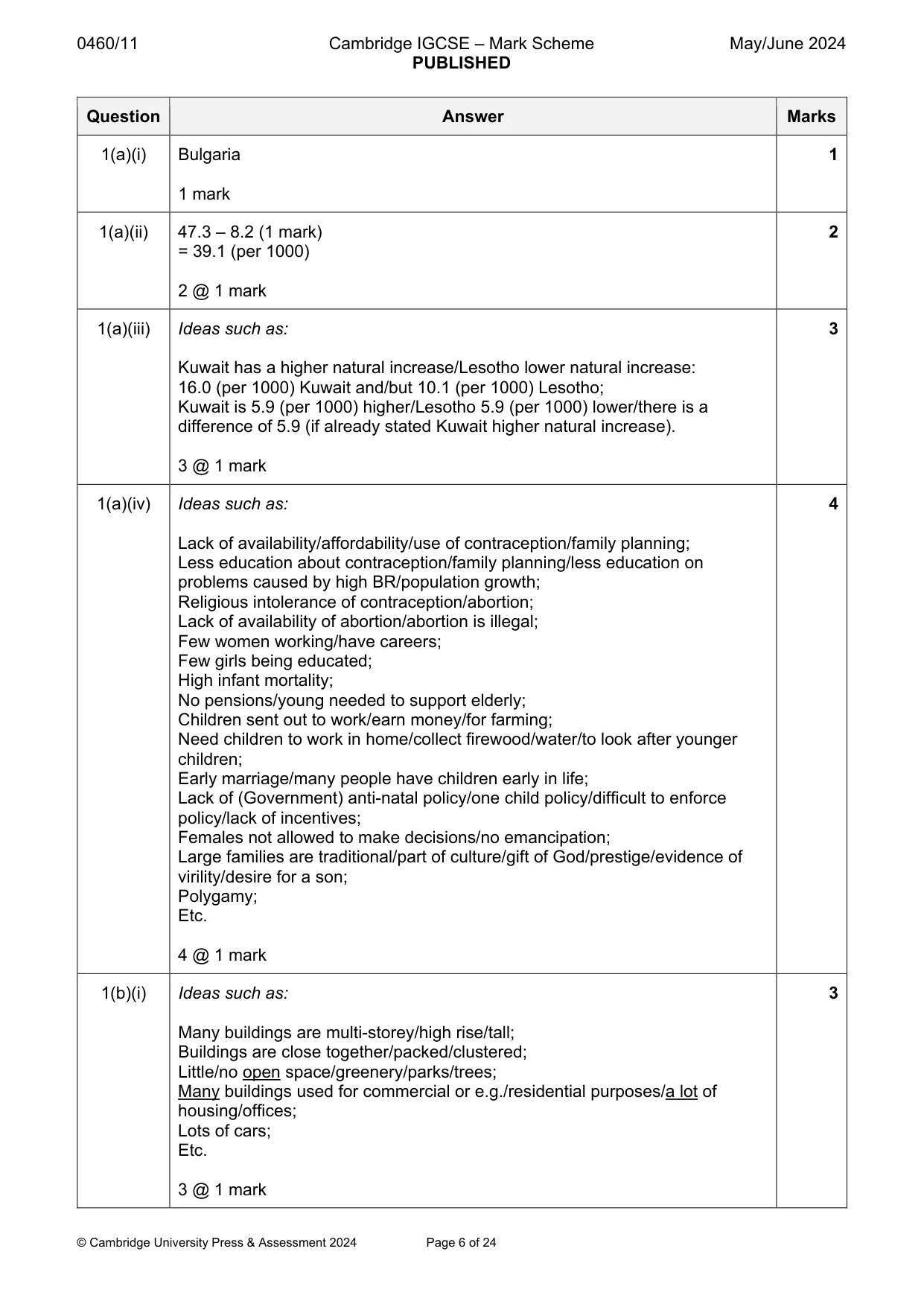
0460/11 Cambridge IGCSE – Mark Scheme PUBLISHED May/June 2024 © Cambridge University Press & Assessment 2024 Page 6 of 24 Question Answer Marks 1(a)(i) Bulgaria 1 mark 1 1(a)(ii) 47.3 – 8.2 (1 mark) = 39.1 (per 1000) 2 @ 1 mark 2 1(a)(iii) Ideas such as: Kuwait has a higher natural increase/Lesotho lower natural increase: 16.0 (per 1000) Kuwait and/but 10.1 (per 1000) Lesotho; Kuwait is 5.9 (per 1000) higher/Lesotho 5.9 (per 1000) lower/there is a difference of 5.9 (if already stated Kuwait higher natural increase). 3 @ 1 mark 3 1(a)(iv) Ideas such as: Lack of availability/affordability/use of contraception/family planning; Less education about contraception/family planning/less education on problems caused by high BR/population growth; Religious intolerance of contraception/abortion; Lack of availability of abortion/abortion is illegal; Few women working/have careers; Few girls being educated; High infant mortality; No pensions/young needed to support elderly; Children sent out to work/earn money/for farming; Need children to work in home/collect firewood/water/to look after younger children; Early marriage/many people have children early in life; Lack of (Government) anti-natal policy/one child policy/difficult to enforce policy/lack of incentives; Females not allowed to make decisions/no emancipation; Large families are traditional/part of culture/gift of God/prestige/evidence of virility/desire for a son; Polygamy; Etc. 4 @ 1 mark 4 1(b)(i) Ideas such as: Many buildings are multi-storey/high rise/tall; Buildings are close together/packed/clustered; Little/no open space/greenery/parks/trees; Many buildings used for commercial or e.g./residential purposes/a lot of housing/offices; Lots of cars; Etc. 3 @ 1 mark 3
Mark scheme, page 7
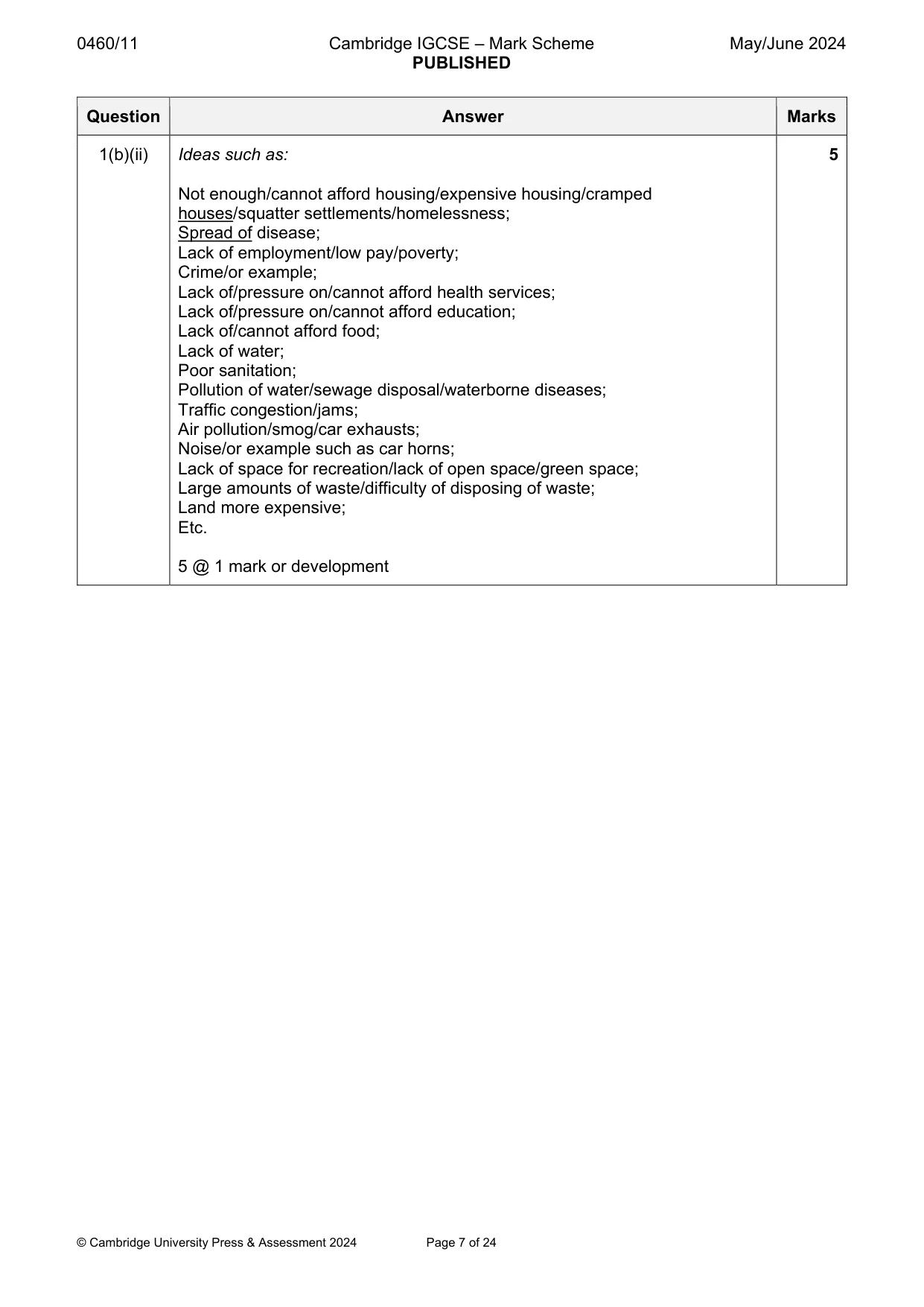
0460/11 Cambridge IGCSE – Mark Scheme PUBLISHED May/June 2024 © Cambridge University Press & Assessment 2024 Page 7 of 24 Question Answer Marks 1(b)(ii) Ideas such as: Not enough/cannot afford housing/expensive housing/cramped houses/squatter settlements/homelessness; Spread of disease; Lack of employment/low pay/poverty; Crime/or example; Lack of/pressure on/cannot afford health services; Lack of/pressure on/cannot afford education; Lack of/cannot afford food; Lack of water; Poor sanitation; Pollution of water/sewage disposal/waterborne diseases; Traffic congestion/jams; Air pollution/smog/car exhausts; Noise/or example such as car horns; Lack of space for recreation/lack of open space/green space; Large amounts of waste/difficulty of disposing of waste; Land more expensive; Etc. 5 @ 1 mark or development 5
Mark scheme, page 8
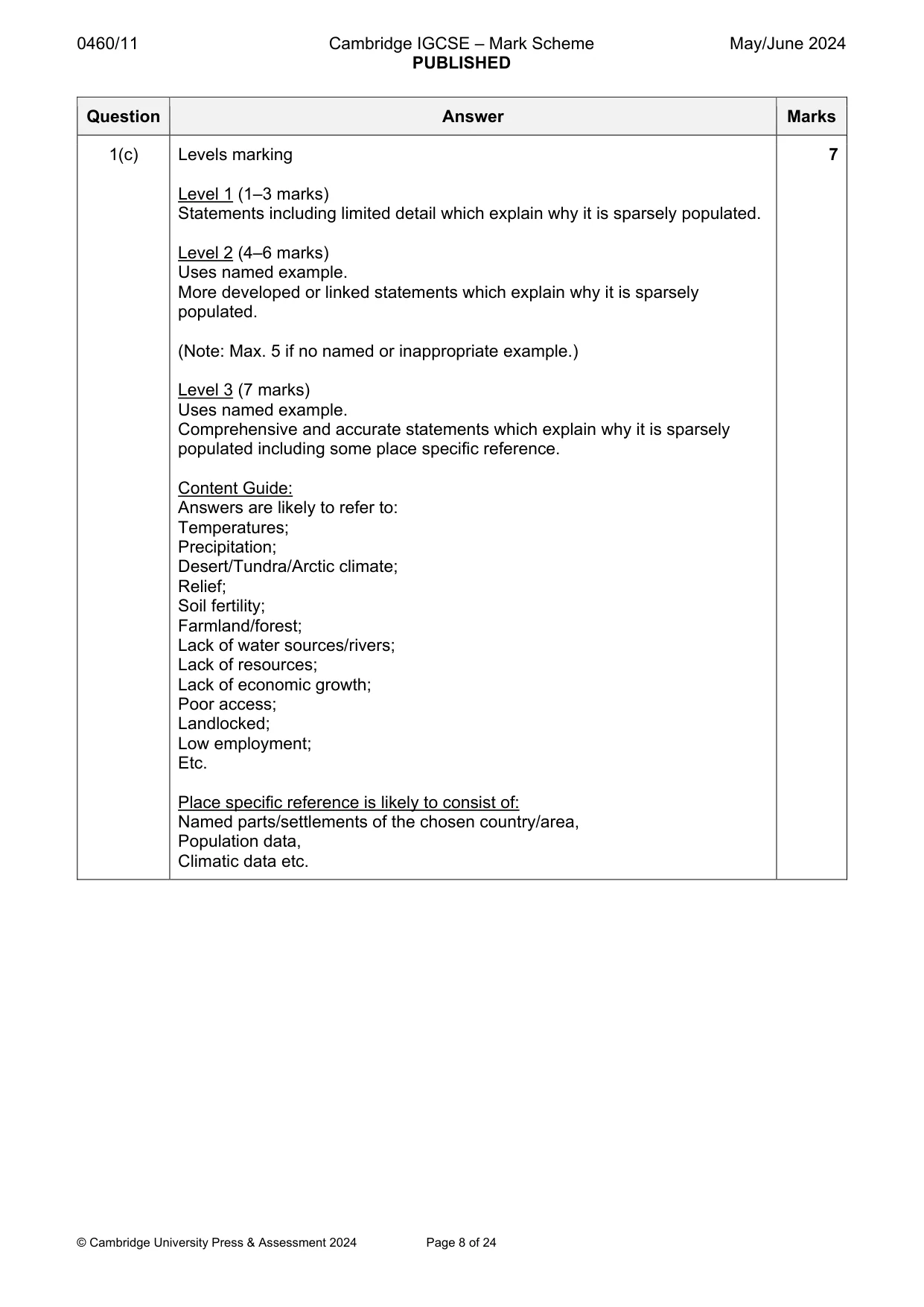
0460/11 Cambridge IGCSE – Mark Scheme PUBLISHED May/June 2024 © Cambridge University Press & Assessment 2024 Page 8 of 24 Question Answer Marks 1(c) Levels marking Level 1 (1–3 marks) Statements including limited detail which explain why it is sparsely populated. Level 2 (4–6 marks) Uses named example. More developed or linked statements which explain why it is sparsely populated. (Note: Max. 5 if no named or inappropriate example.) Level 3 (7 marks) Uses named example. Comprehensive and accurate statements which explain why it is sparsely populated including some place specific reference. Content Guide: Answers are likely to refer to: Temperatures; Precipitation; Desert/Tundra/Arctic climate; Relief; Soil fertility; Farmland/forest; Lack of water sources/rivers; Lack of resources; Lack of economic growth; Poor access; Landlocked; Low employment; Etc. Place specific reference is likely to consist of: Named parts/settlements of the chosen country/area, Population data, Climatic data etc. 7
Mark scheme, page 9
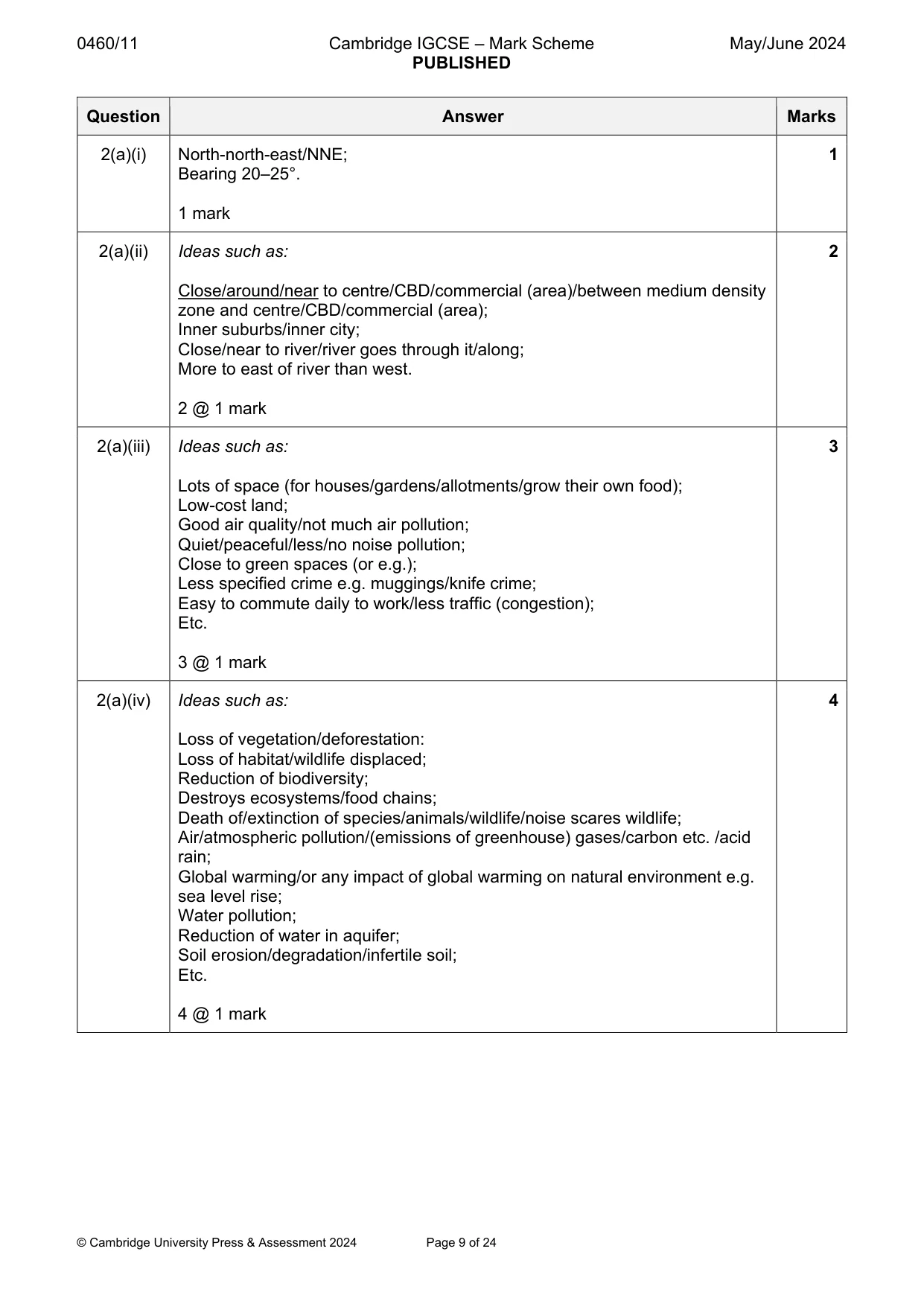
0460/11 Cambridge IGCSE – Mark Scheme PUBLISHED May/June 2024 © Cambridge University Press & Assessment 2024 Page 9 of 24 Question Answer Marks 2(a)(i) North-north-east/NNE; Bearing 20–25°. 1 mark 1 2(a)(ii) Ideas such as: Close/around/near to centre/CBD/commercial (area)/between medium density zone and centre/CBD/commercial (area); Inner suburbs/inner city; Close/near to river/river goes through it/along; More to east of river than west. 2 @ 1 mark 2 2(a)(iii) Ideas such as: Lots of space (for houses/gardens/allotments/grow their own food); Low-cost land; Good air quality/not much air pollution; Quiet/peaceful/less/no noise pollution; Close to green spaces (or e.g.); Less specified crime e.g. muggings/knife crime; Easy to commute daily to work/less traffic (congestion); Etc. 3 @ 1 mark 3 2(a)(iv) Ideas such as: Loss of vegetation/deforestation: Loss of habitat/wildlife displaced; Reduction of biodiversity; Destroys ecosystems/food chains; Death of/extinction of species/animals/wildlife/noise scares wildlife; Air/atmospheric pollution/(emissions of greenhouse) gases/carbon etc. /acid rain; Global warming/or any impact of global warming on natural environment e.g. sea level rise; Water pollution; Reduction of water in aquifer; Soil erosion/degradation/infertile soil; Etc. 4 @ 1 mark 4
Mark scheme, page 10
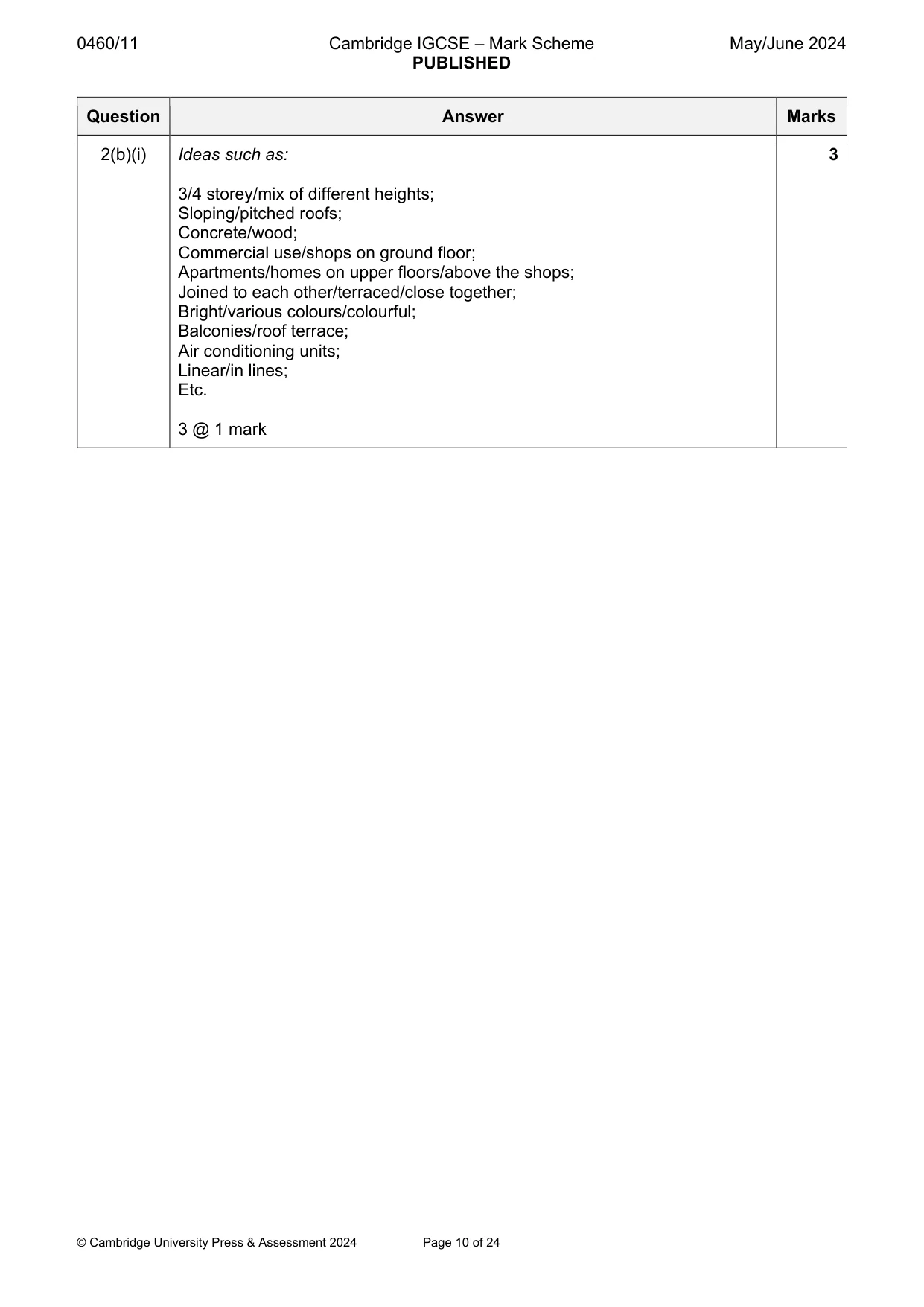
0460/11 Cambridge IGCSE – Mark Scheme PUBLISHED May/June 2024 © Cambridge University Press & Assessment 2024 Page 10 of 24 Question Answer Marks 2(b)(i) Ideas such as: 3/4 storey/mix of different heights; Sloping/pitched roofs; Concrete/wood; Commercial use/shops on ground floor; Apartments/homes on upper floors/above the shops; Joined to each other/terraced/close together; Bright/various colours/colourful; Balconies/roof terrace; Air conditioning units; Linear/in lines; Etc. 3 @ 1 mark 3
Mark scheme, page 11
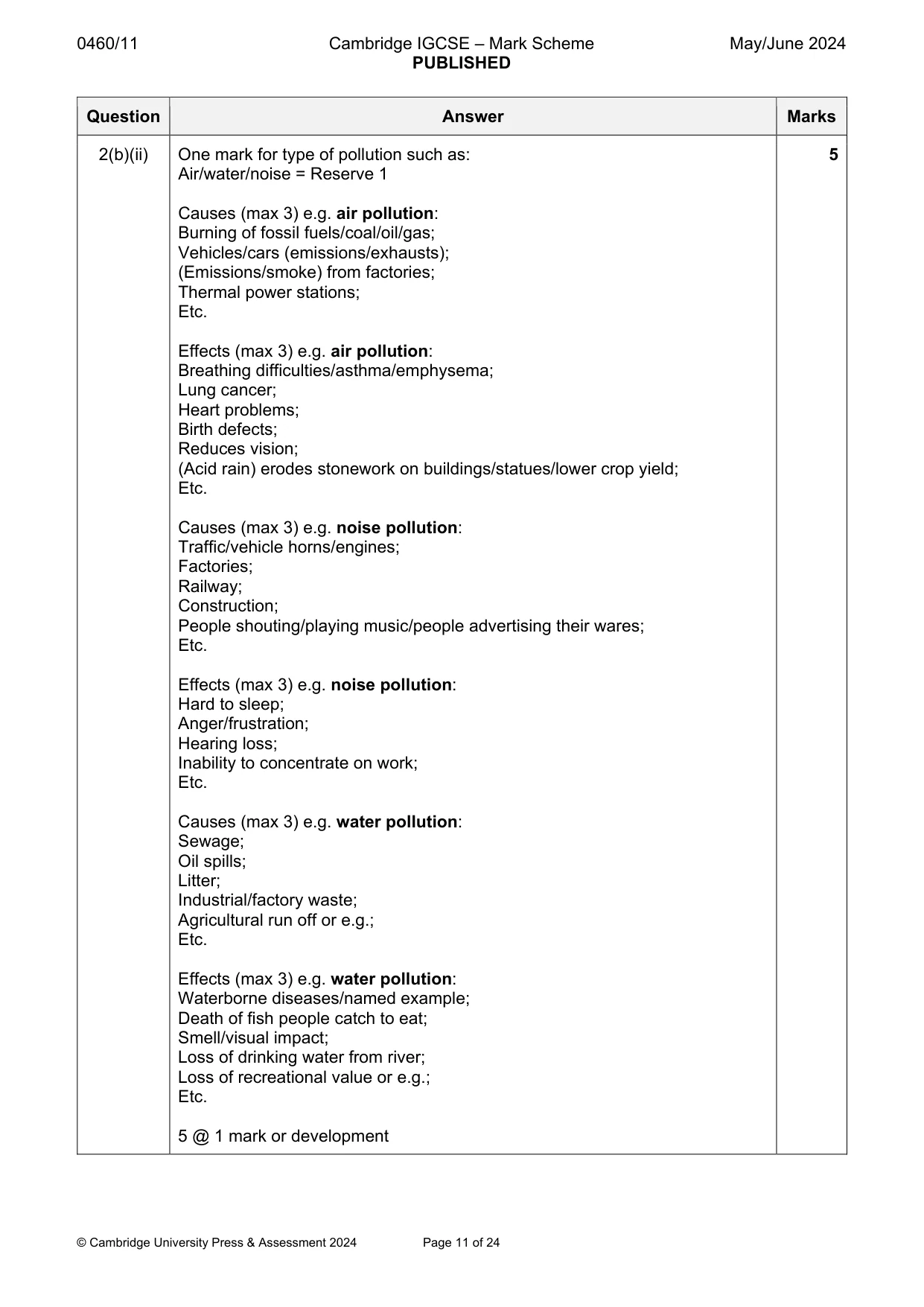
0460/11 Cambridge IGCSE – Mark Scheme PUBLISHED May/June 2024 © Cambridge University Press & Assessment 2024 Page 11 of 24 Question Answer Marks 2(b)(ii) One mark for type of pollution such as: Air/water/noise = Reserve 1 Causes (max 3) e.g. air pollution: Burning of fossil fuels/coal/oil/gas; Vehicles/cars (emissions/exhausts); (Emissions/smoke) from factories; Thermal power stations; Etc. Effects (max 3) e.g. air pollution: Breathing difficulties/asthma/emphysema; Lung cancer; Heart problems; Birth defects; Reduces vision; (Acid rain) erodes stonework on buildings/statues/lower crop yield; Etc. Causes (max 3) e.g. noise pollution: Traffic/vehicle horns/engines; Factories; Railway; Construction; People shouting/playing music/people advertising their wares; Etc. Effects (max 3) e.g. noise pollution: Hard to sleep; Anger/frustration; Hearing loss; Inability to concentrate on work; Etc. Causes (max 3) e.g. water pollution: Sewage; Oil spills; Litter; Industrial/factory waste; Agricultural run off or e.g.; Etc. Effects (max 3) e.g. water pollution: Waterborne diseases/named example; Death of fish people catch to eat; Smell/visual impact; Loss of drinking water from river; Loss of recreational value or e.g.; Etc. 5 @ 1 mark or development 5
Mark scheme, page 12
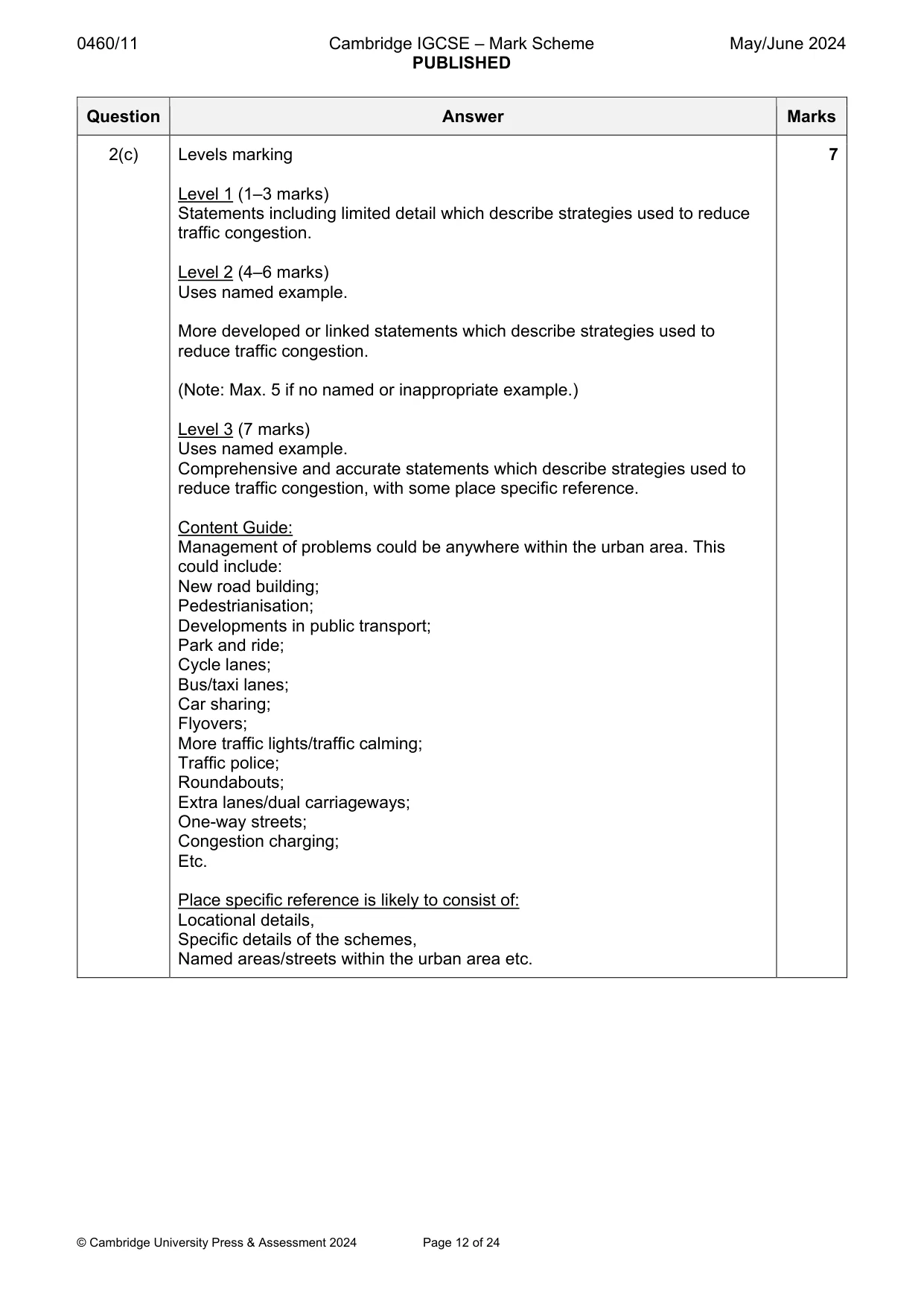
0460/11 Cambridge IGCSE – Mark Scheme PUBLISHED May/June 2024 © Cambridge University Press & Assessment 2024 Page 12 of 24 Question Answer Marks 2(c) Levels marking Level 1 (1–3 marks) Statements including limited detail which describe strategies used to reduce traffic congestion. Level 2 (4–6 marks) Uses named example. More developed or linked statements which describe strategies used to reduce traffic congestion. (Note: Max. 5 if no named or inappropriate example.) Level 3 (7 marks) Uses named example. Comprehensive and accurate statements which describe strategies used to reduce traffic congestion, with some place specific reference. Content Guide: Management of problems could be anywhere within the urban area. This could include: New road building; Pedestrianisation; Developments in public transport; Park and ride; Cycle lanes; Bus/taxi lanes; Car sharing; Flyovers; More traffic lights/traffic calming; Traffic police; Roundabouts; Extra lanes/dual carriageways; One-way streets; Congestion charging; Etc. Place specific reference is likely to consist of: Locational details, Specific details of the schemes, Named areas/streets within the urban area etc. 7
Mark scheme, page 13
0460/11 Cambridge IGCSE – Mark Scheme PUBLISHED May/June 2024 © Cambridge University Press & Assessment 2024 Page 13 of 24 Question Answer Marks 3(a)(i) Emergents are higher/taller/emergents are 45/50 metres, canopy 25/35 metres/15–25 metres higher. 1 mark 1 3(a)(ii) Density is high/dense/vegetation is tightly packed/close together. Structure is in layers/varying heights/levels. 2 @ 1 mark 2 3(a)(iii) Ideas such as: High rainfall/lots of water/high humidity/moist/access to water; Hot/high/ample temperatures/lots of sunshine; All year round/no seasons/similar conditions through the year/vegetation grows all year; Large amounts of food/nutrient supply for animals/herbivores/prey for carnivores/rapid decomposition; Vast areas of forest remain untouched/not disturbed/conserved; Lots of different habitats or e.g.; Etc. 3 @ 1 mark 3 3(a)(iv) Ideas such as: Equatorial is humid air, desert is dry air; Equatorial is low pressure, desert is high pressure; Equatorial has rising air, desert has descending air; Equatorial has much more vegetation so there is more transpiration; There are more water sources in Equatorial areas so more evaporation; Equatorial areas are less likely to be affected by dry winds; Desert areas are more likely to be close to cold currents; Equatorial has more clouds, desert has clear skies; Etc. 4 @ 1 mark 4 3(b)(i) Ideas such as: Uneven/clustered/close together/in groups; Mainly in Brazil or south of Brazil; In Peru, Columbia, Brazil and Bolivia (any 3); (Mainly) in southern part of rainforest; Near southern Amazon boundary/near Columbian boundary; Linear in parts; Scattered/dispersed in other parts/northern Brazil/Peru/Bolivia; Inland; Etc. 3 @ 1 mark 3
Mark scheme, page 14
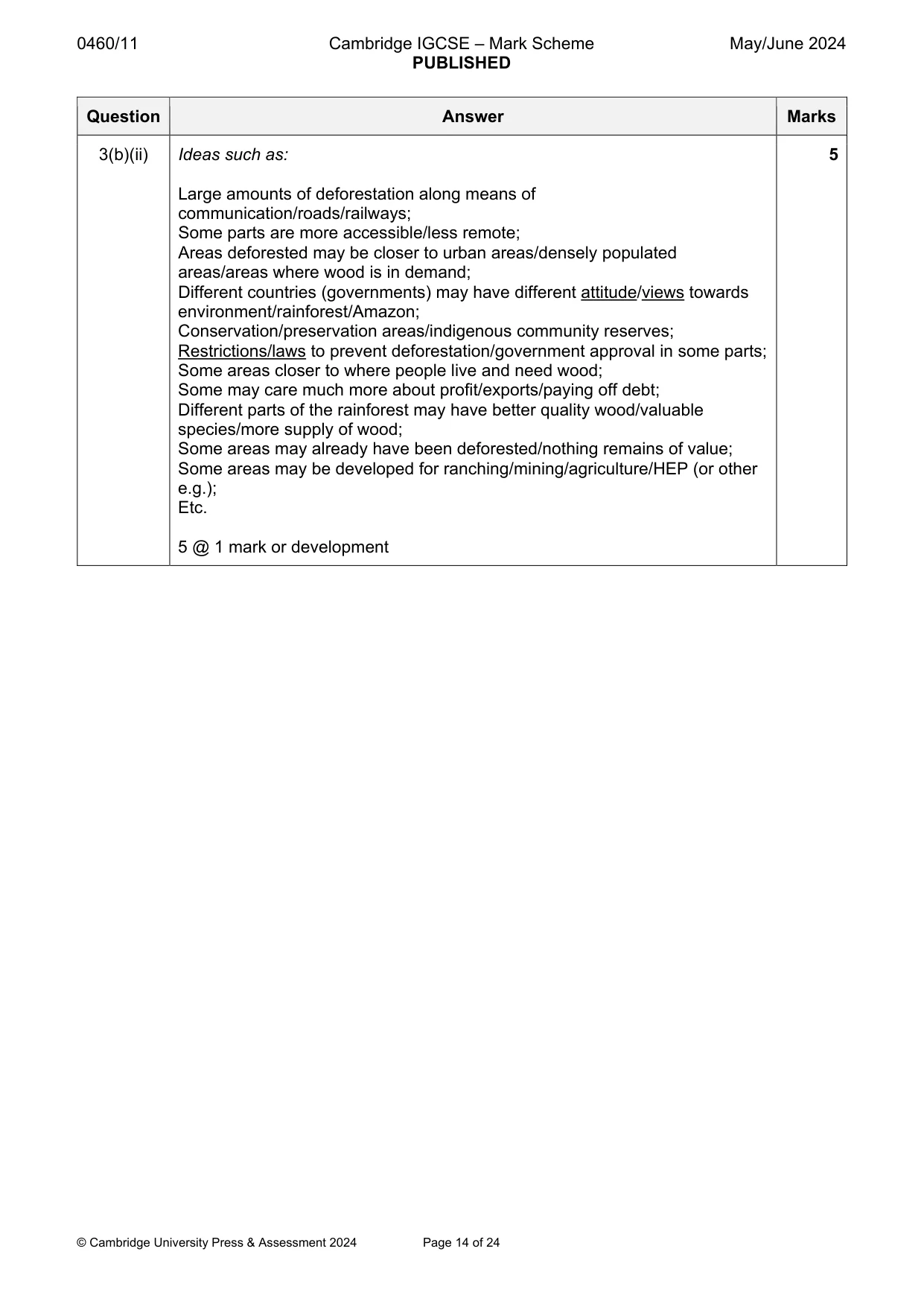
0460/11 Cambridge IGCSE – Mark Scheme PUBLISHED May/June 2024 © Cambridge University Press & Assessment 2024 Page 14 of 24 Question Answer Marks 3(b)(ii) Ideas such as: Large amounts of deforestation along means of communication/roads/railways; Some parts are more accessible/less remote; Areas deforested may be closer to urban areas/densely populated areas/areas where wood is in demand; Different countries (governments) may have different attitude/views towards environment/rainforest/Amazon; Conservation/preservation areas/indigenous community reserves; Restrictions/laws to prevent deforestation/government approval in some parts; Some areas closer to where people live and need wood; Some may care much more about profit/exports/paying off debt; Different parts of the rainforest may have better quality wood/valuable species/more supply of wood; Some areas may already have been deforested/nothing remains of value; Some areas may be developed for ranching/mining/agriculture/HEP (or other e.g.); Etc. 5 @ 1 mark or development 5
Mark scheme, page 15
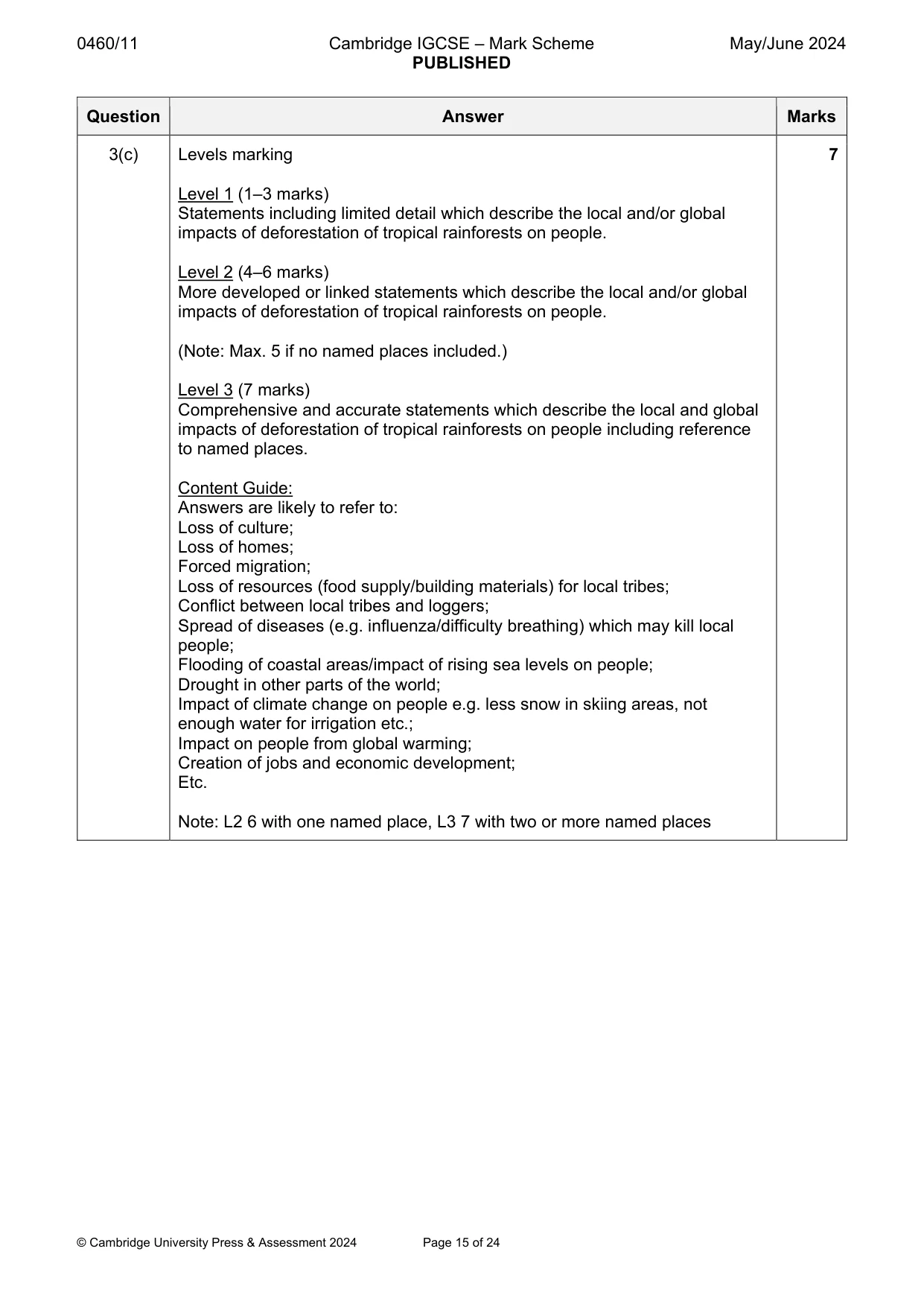
0460/11 Cambridge IGCSE – Mark Scheme PUBLISHED May/June 2024 © Cambridge University Press & Assessment 2024 Page 15 of 24 Question Answer Marks 3(c) Levels marking Level 1 (1–3 marks) Statements including limited detail which describe the local and/or global impacts of deforestation of tropical rainforests on people. Level 2 (4–6 marks) More developed or linked statements which describe the local and/or global impacts of deforestation of tropical rainforests on people. (Note: Max. 5 if no named places included.) Level 3 (7 marks) Comprehensive and accurate statements which describe the local and global impacts of deforestation of tropical rainforests on people including reference to named places. Content Guide: Answers are likely to refer to: Loss of culture; Loss of homes; Forced migration; Loss of resources (food supply/building materials) for local tribes; Conflict between local tribes and loggers; Spread of diseases (e.g. influenza/difficulty breathing) which may kill local people; Flooding of coastal areas/impact of rising sea levels on people; Drought in other parts of the world; Impact of climate change on people e.g. less snow in skiing areas, not enough water for irrigation etc.; Impact on people from global warming; Creation of jobs and economic development; Etc. Note: L2 6 with one named place, L3 7 with two or more named places 7
Mark scheme, page 16
0460/11 Cambridge IGCSE – Mark Scheme PUBLISHED May/June 2024 © Cambridge University Press & Assessment 2024 Page 16 of 24 Question Answer Marks 4(a)(i) On diagram N.B. Arrow should point towards the mouth. 1 mark 1 4(a)(ii) A = watershed B = tributary 2 @ 1 mark 2 4(a)(iii) Ideas such as at X: (Sides will be) steeper; Narrower; More V shaped; Less flat land/flood plain; Higher elevation; Etc. 3 @ 1 mark 3 4(a)(iv) Ideas such as: The river is carrying a large/heavy load; The amount of energy is reduced; The speed slows down/calm seawater; It becomes impossible to carry the load; Flocculation/higher salinity/presence of salt water; Etc. 4 @ 1 mark 4 4(b)(i) Ideas such as: Stagnant/still/not moving water; Curved/bends; Shallow (water) on inside/left side; Deep water on outside/right side; Slip off slope/sediment/sand/small materials on inside/left of curve; (Collapsed) river cliff/rocks/larger sediments on outside/right side; OR slip off slope and river cliff present; Higher bank on outside (right)/lower inside (left) bank; Etc. 3 @ 1 mark 3
Mark scheme, page 17
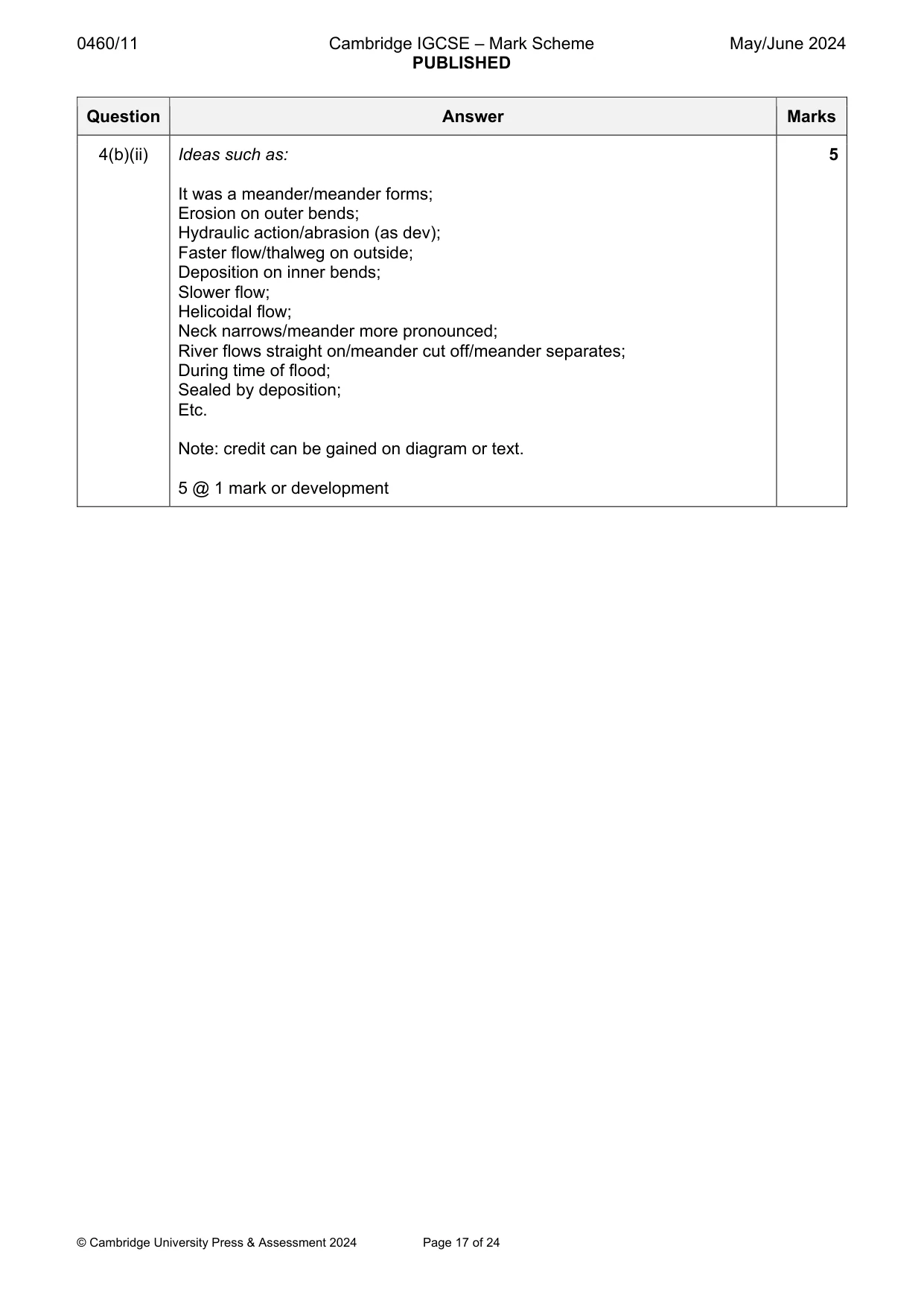
0460/11 Cambridge IGCSE – Mark Scheme PUBLISHED May/June 2024 © Cambridge University Press & Assessment 2024 Page 17 of 24 Question Answer Marks 4(b)(ii) Ideas such as: It was a meander/meander forms; Erosion on outer bends; Hydraulic action/abrasion (as dev); Faster flow/thalweg on outside; Deposition on inner bends; Slower flow; Helicoidal flow; Neck narrows/meander more pronounced; River flows straight on/meander cut off/meander separates; During time of flood; Sealed by deposition; Etc. Note: credit can be gained on diagram or text. 5 @ 1 mark or development 5
Mark scheme, page 18
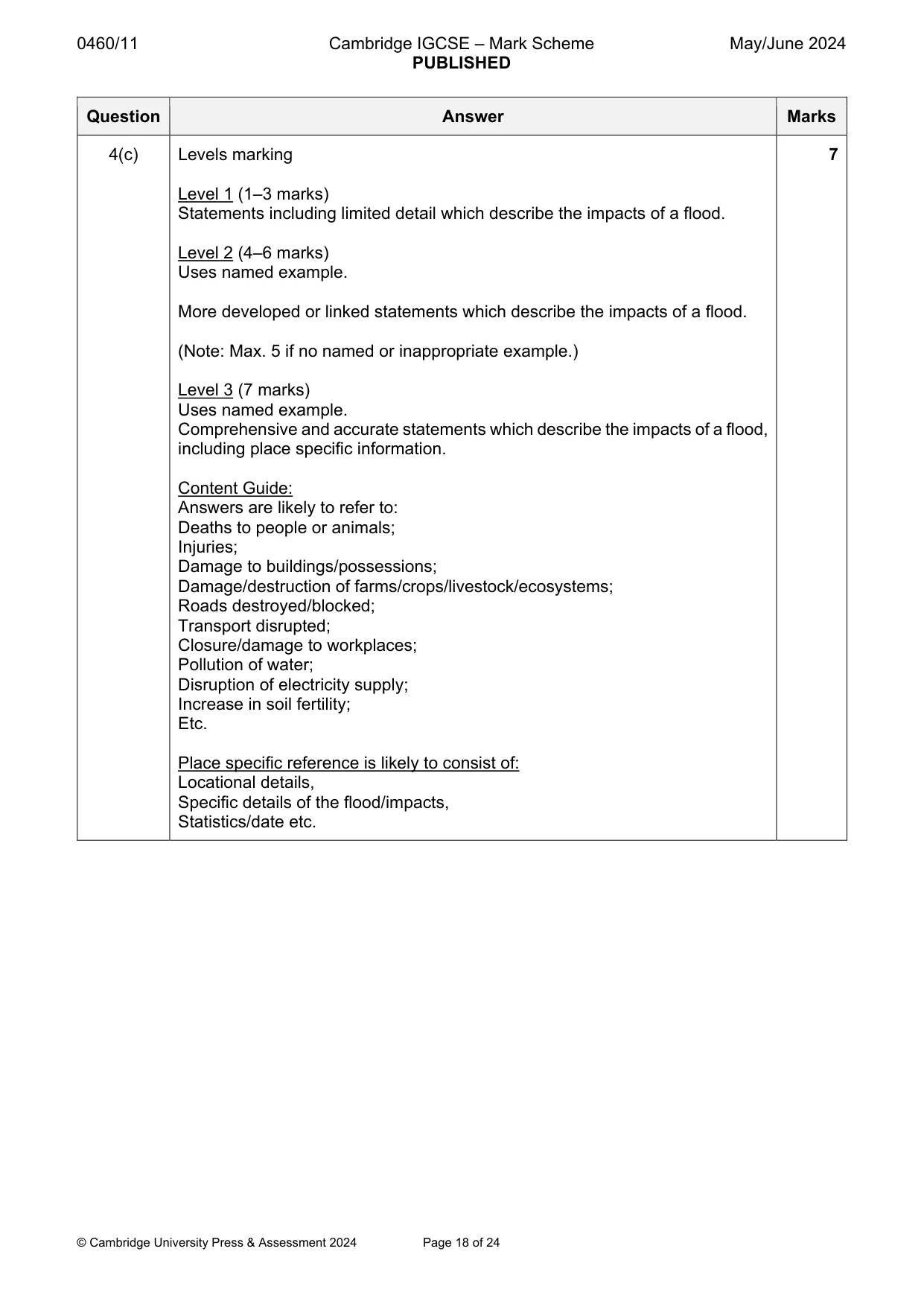
0460/11 Cambridge IGCSE – Mark Scheme PUBLISHED May/June 2024 © Cambridge University Press & Assessment 2024 Page 18 of 24 Question Answer Marks 4(c) Levels marking Level 1 (1–3 marks) Statements including limited detail which describe the impacts of a flood. Level 2 (4–6 marks) Uses named example. More developed or linked statements which describe the impacts of a flood. (Note: Max. 5 if no named or inappropriate example.) Level 3 (7 marks) Uses named example. Comprehensive and accurate statements which describe the impacts of a flood, including place specific information. Content Guide: Answers are likely to refer to: Deaths to people or animals; Injuries; Damage to buildings/possessions; Damage/destruction of farms/crops/livestock/ecosystems; Roads destroyed/blocked; Transport disrupted; Closure/damage to workplaces; Pollution of water; Disruption of electricity supply; Increase in soil fertility; Etc. Place specific reference is likely to consist of: Locational details, Specific details of the flood/impacts, Statistics/date etc. 7
Mark scheme, page 19
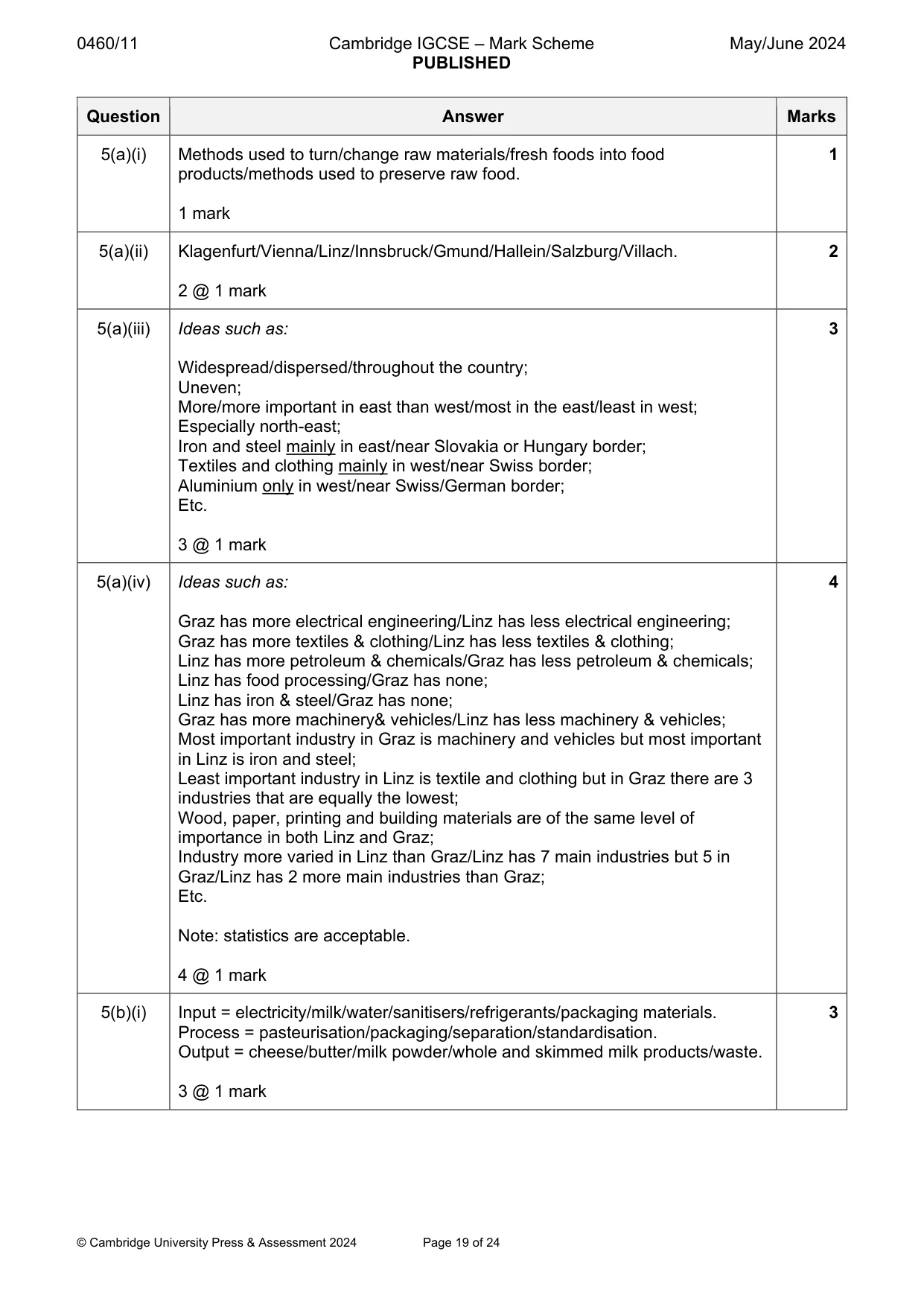
0460/11 Cambridge IGCSE – Mark Scheme PUBLISHED May/June 2024 © Cambridge University Press & Assessment 2024 Page 19 of 24 Question Answer Marks 5(a)(i) Methods used to turn/change raw materials/fresh foods into food products/methods used to preserve raw food. 1 mark 1 5(a)(ii) Klagenfurt/Vienna/Linz/Innsbruck/Gmund/Hallein/Salzburg/Villach. 2 @ 1 mark 2 5(a)(iii) Ideas such as: Widespread/dispersed/throughout the country; Uneven; More/more important in east than west/most in the east/least in west; Especially north-east; Iron and steel mainly in east/near Slovakia or Hungary border; Textiles and clothing mainly in west/near Swiss border; Aluminium only in west/near Swiss/German border; Etc. 3 @ 1 mark 3 5(a)(iv) Ideas such as: Graz has more electrical engineering/Linz has less electrical engineering; Graz has more textiles & clothing/Linz has less textiles & clothing; Linz has more petroleum & chemicals/Graz has less petroleum & chemicals; Linz has food processing/Graz has none; Linz has iron & steel/Graz has none; Graz has more machinery& vehicles/Linz has less machinery & vehicles; Most important industry in Graz is machinery and vehicles but most important in Linz is iron and steel; Least important industry in Linz is textile and clothing but in Graz there are 3 industries that are equally the lowest; Wood, paper, printing and building materials are of the same level of importance in both Linz and Graz; Industry more varied in Linz than Graz/Linz has 7 main industries but 5 in Graz/Linz has 2 more main industries than Graz; Etc. Note: statistics are acceptable. 4 @ 1 mark 4 5(b)(i) Input = electricity/milk/water/sanitisers/refrigerants/packaging materials. Process = pasteurisation/packaging/separation/standardisation. Output = cheese/butter/milk powder/whole and skimmed milk products/waste. 3 @ 1 mark 3
Mark scheme, page 20
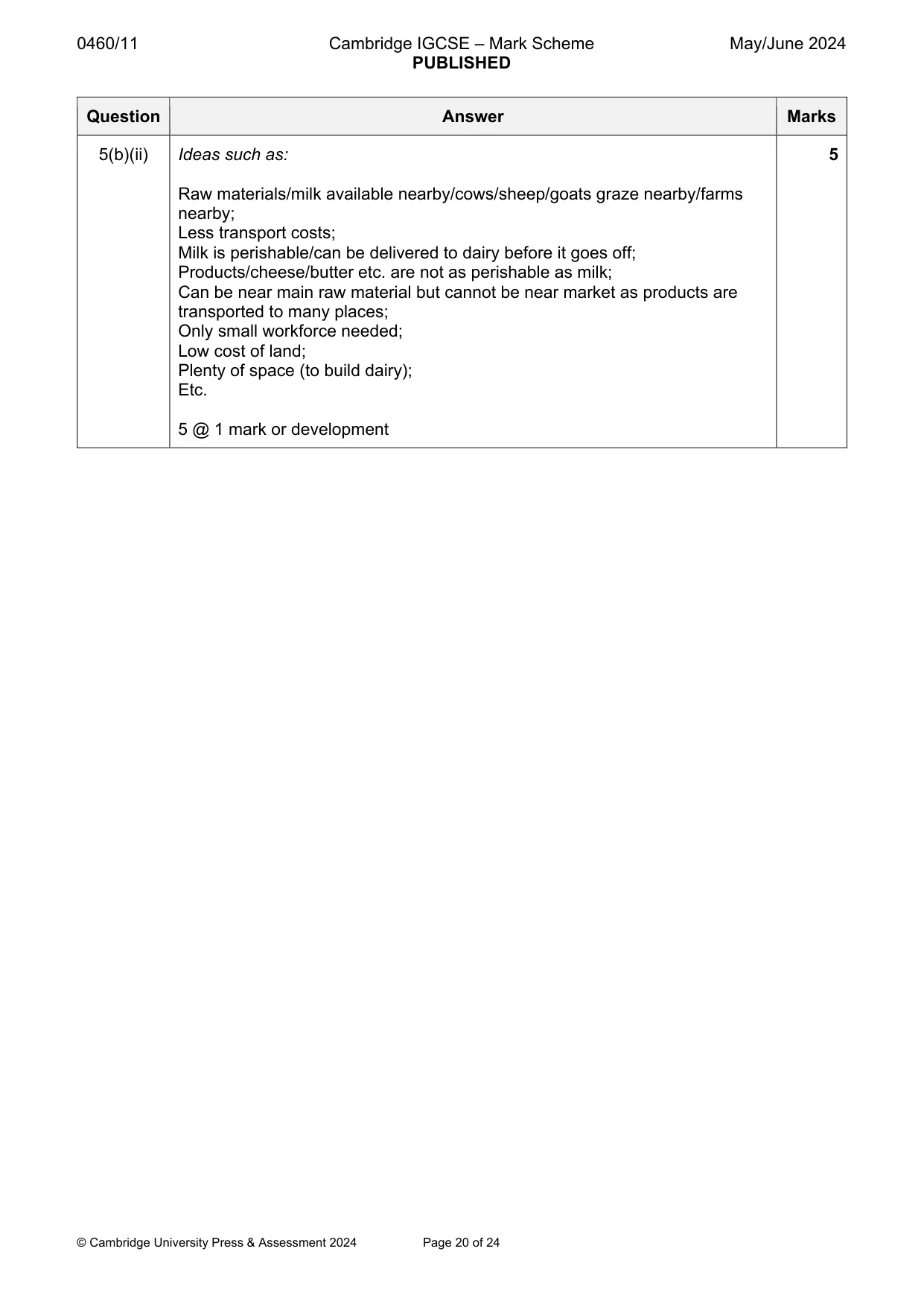
0460/11 Cambridge IGCSE – Mark Scheme PUBLISHED May/June 2024 © Cambridge University Press & Assessment 2024 Page 20 of 24 Question Answer Marks 5(b)(ii) Ideas such as: Raw materials/milk available nearby/cows/sheep/goats graze nearby/farms nearby; Less transport costs; Milk is perishable/can be delivered to dairy before it goes off; Products/cheese/butter etc. are not as perishable as milk; Can be near main raw material but cannot be near market as products are transported to many places; Only small workforce needed; Low cost of land; Plenty of space (to build dairy); Etc. 5 @ 1 mark or development 5
Mark scheme, page 21
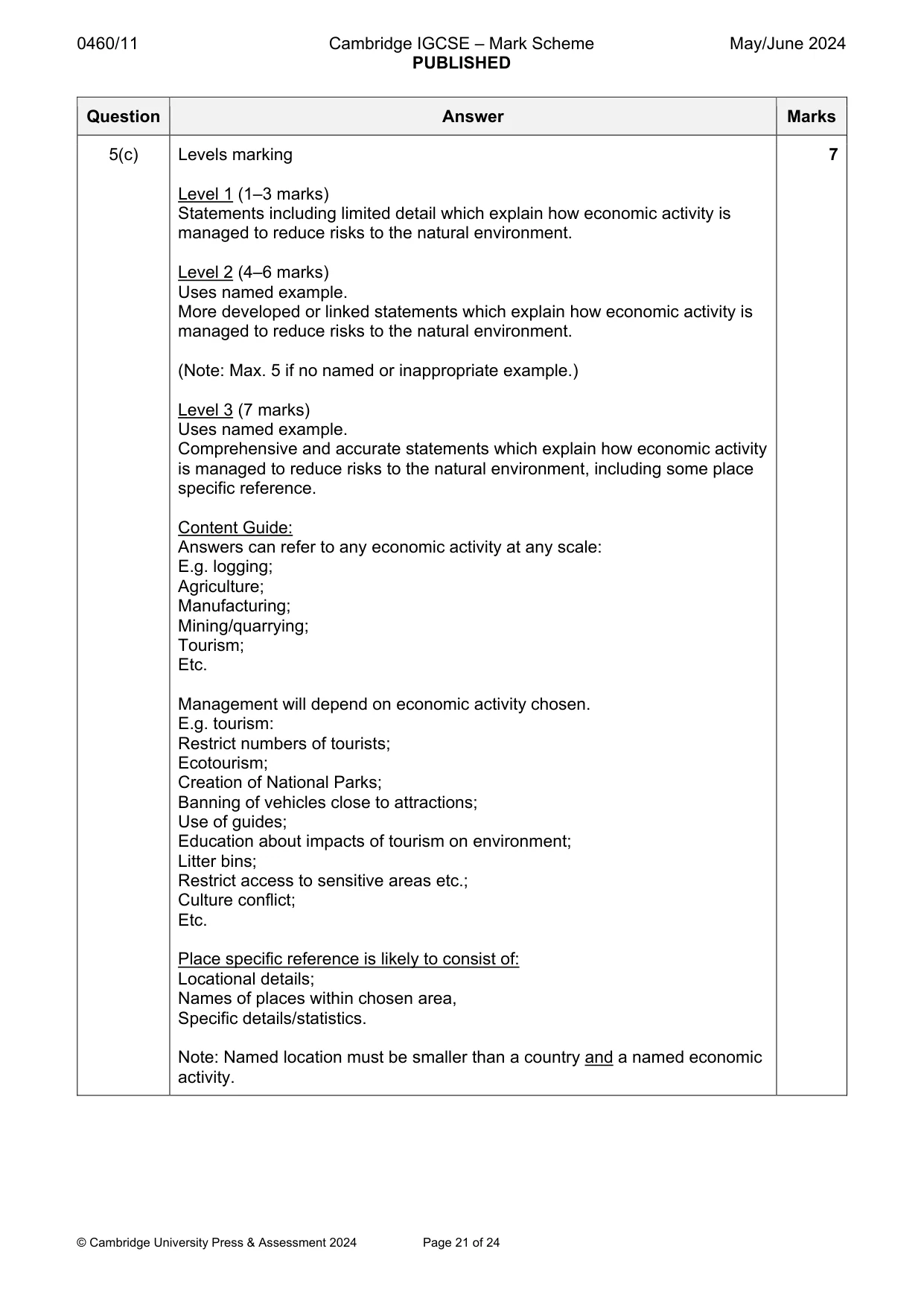
0460/11 Cambridge IGCSE – Mark Scheme PUBLISHED May/June 2024 © Cambridge University Press & Assessment 2024 Page 21 of 24 Question Answer Marks 5(c) Levels marking Level 1 (1–3 marks) Statements including limited detail which explain how economic activity is managed to reduce risks to the natural environment. Level 2 (4–6 marks) Uses named example. More developed or linked statements which explain how economic activity is managed to reduce risks to the natural environment. (Note: Max. 5 if no named or inappropriate example.) Level 3 (7 marks) Uses named example. Comprehensive and accurate statements which explain how economic activity is managed to reduce risks to the natural environment, including some place specific reference. Content Guide: Answers can refer to any economic activity at any scale: E.g. logging; Agriculture; Manufacturing; Mining/quarrying; Tourism; Etc. Management will depend on economic activity chosen. E.g. tourism: Restrict numbers of tourists; Ecotourism; Creation of National Parks; Banning of vehicles close to attractions; Use of guides; Education about impacts of tourism on environment; Litter bins; Restrict access to sensitive areas etc.; Culture conflict; Etc. Place specific reference is likely to consist of: Locational details; Names of places within chosen area, Specific details/statistics. Note: Named location must be smaller than a country and a named economic activity. 7
Mark scheme, page 22
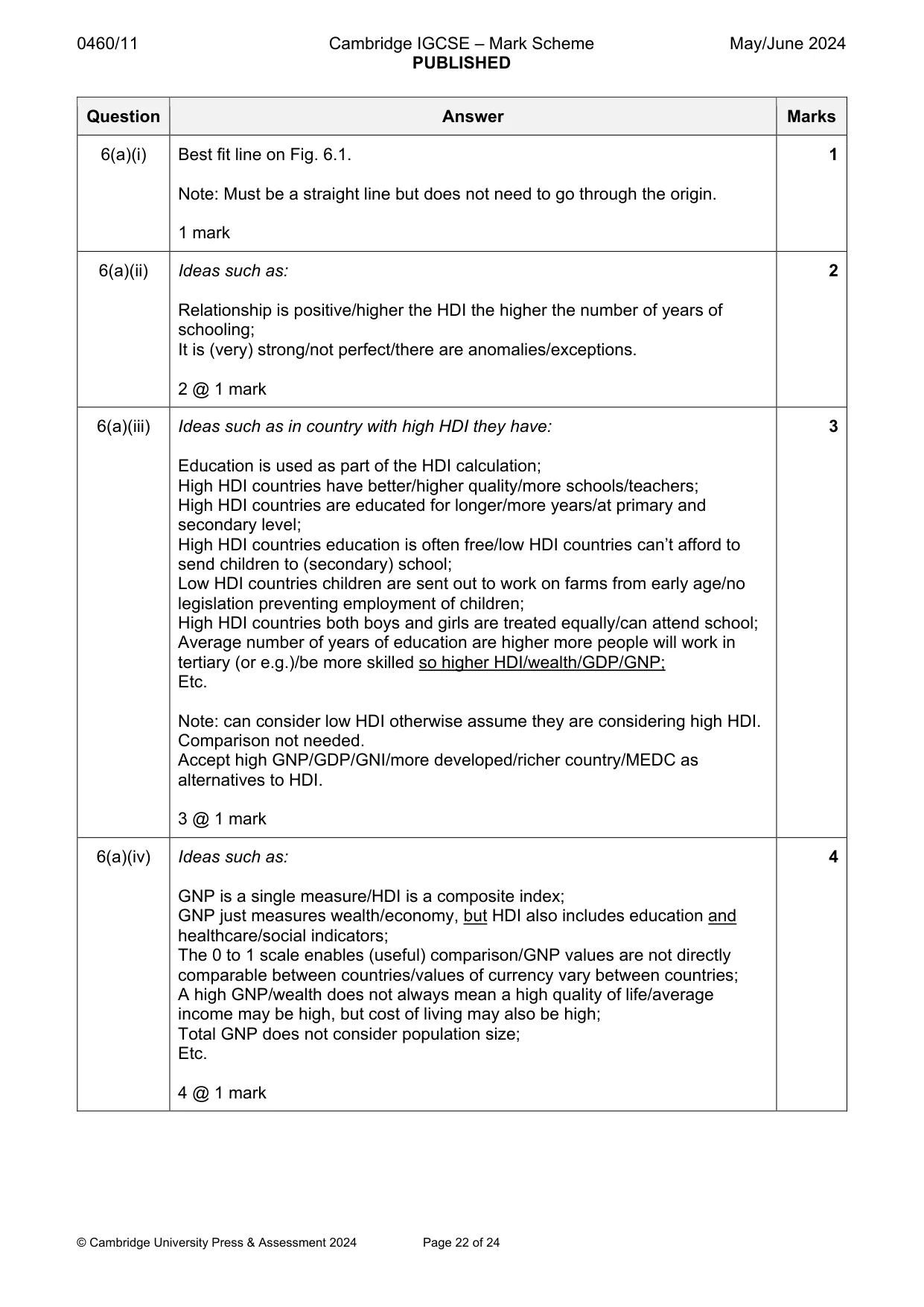
0460/11 Cambridge IGCSE – Mark Scheme PUBLISHED May/June 2024 © Cambridge University Press & Assessment 2024 Page 22 of 24 Question Answer Marks 6(a)(i) Best fit line on Fig. 6.1. Note: Must be a straight line but does not need to go through the origin. 1 mark 1 6(a)(ii) Ideas such as: Relationship is positive/higher the HDI the higher the number of years of schooling; It is (very) strong/not perfect/there are anomalies/exceptions. 2 @ 1 mark 2 6(a)(iii) Ideas such as in country with high HDI they have: Education is used as part of the HDI calculation; High HDI countries have better/higher quality/more schools/teachers; High HDI countries are educated for longer/more years/at primary and secondary level; High HDI countries education is often free/low HDI countries can’t afford to send children to (secondary) school; Low HDI countries children are sent out to work on farms from early age/no legislation preventing employment of children; High HDI countries both boys and girls are treated equally/can attend school; Average number of years of education are higher more people will work in tertiary (or e.g.)/be more skilled so higher HDI/wealth/GDP/GNP; Etc. Note: can consider low HDI otherwise assume they are considering high HDI. Comparison not needed. Accept high GNP/GDP/GNI/more developed/richer country/MEDC as alternatives to HDI. 3 @ 1 mark 3 6(a)(iv) Ideas such as: GNP is a single measure/HDI is a composite index; GNP just measures wealth/economy, but HDI also includes education and healthcare/social indicators; The 0 to 1 scale enables (useful) comparison/GNP values are not directly comparable between countries/values of currency vary between countries; A high GNP/wealth does not always mean a high quality of life/average income may be high, but cost of living may also be high; Total GNP does not consider population size; Etc. 4 @ 1 mark 4
Mark scheme, page 23
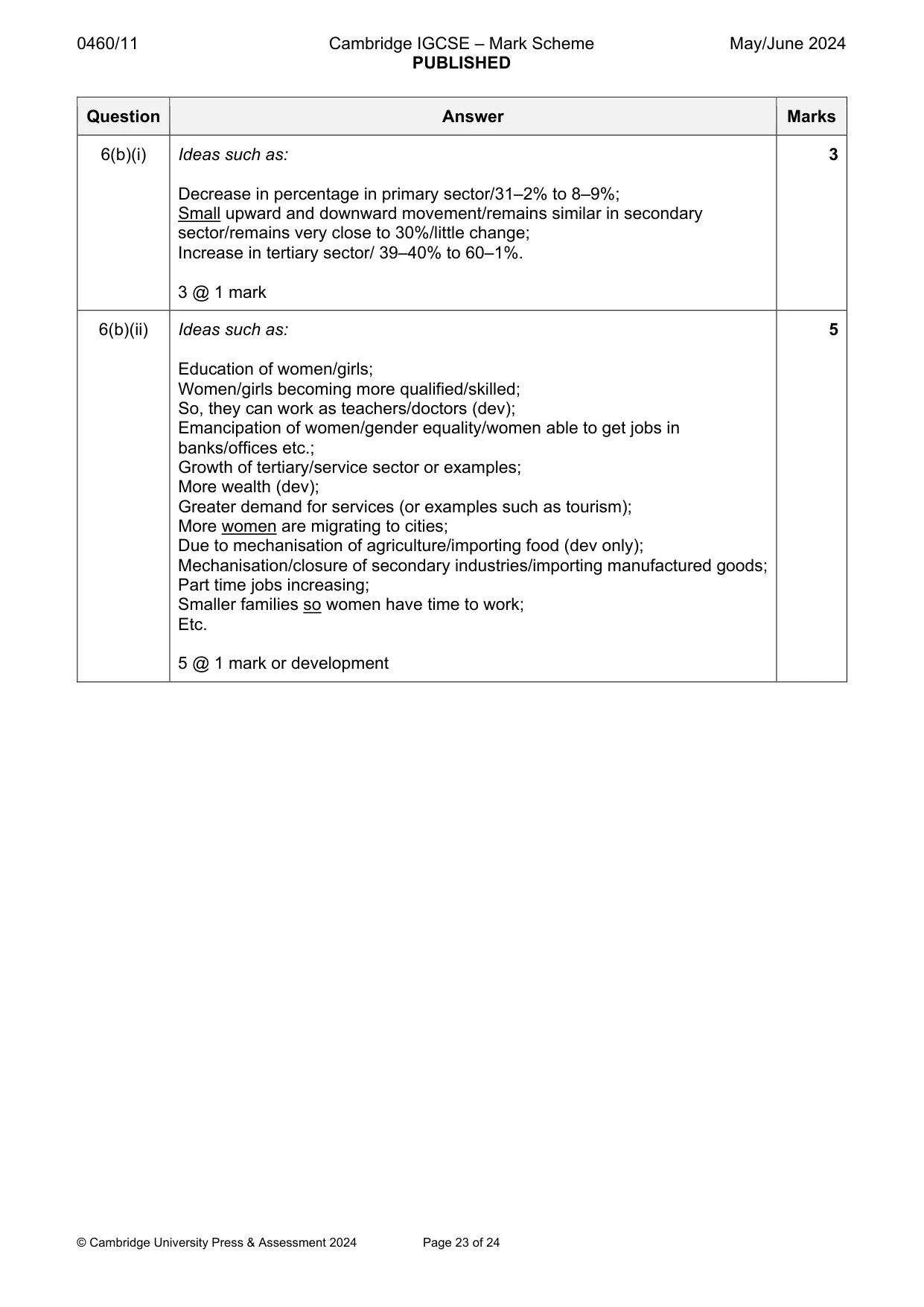
0460/11 Cambridge IGCSE – Mark Scheme PUBLISHED May/June 2024 © Cambridge University Press & Assessment 2024 Page 23 of 24 Question Answer Marks 6(b)(i) Ideas such as: Decrease in percentage in primary sector/31–2% to 8–9%; Small upward and downward movement/remains similar in secondary sector/remains very close to 30%/little change; Increase in tertiary sector/ 39–40% to 60–1%. 3 @ 1 mark 3 6(b)(ii) Ideas such as: Education of women/girls; Women/girls becoming more qualified/skilled; So, they can work as teachers/doctors (dev); Emancipation of women/gender equality/women able to get jobs in banks/offices etc.; Growth of tertiary/service sector or examples; More wealth (dev); Greater demand for services (or examples such as tourism); More women are migrating to cities; Due to mechanisation of agriculture/importing food (dev only); Mechanisation/closure of secondary industries/importing manufactured goods; Part time jobs increasing; Smaller families so women have time to work; Etc. 5 @ 1 mark or development 5
Mark scheme, page 24
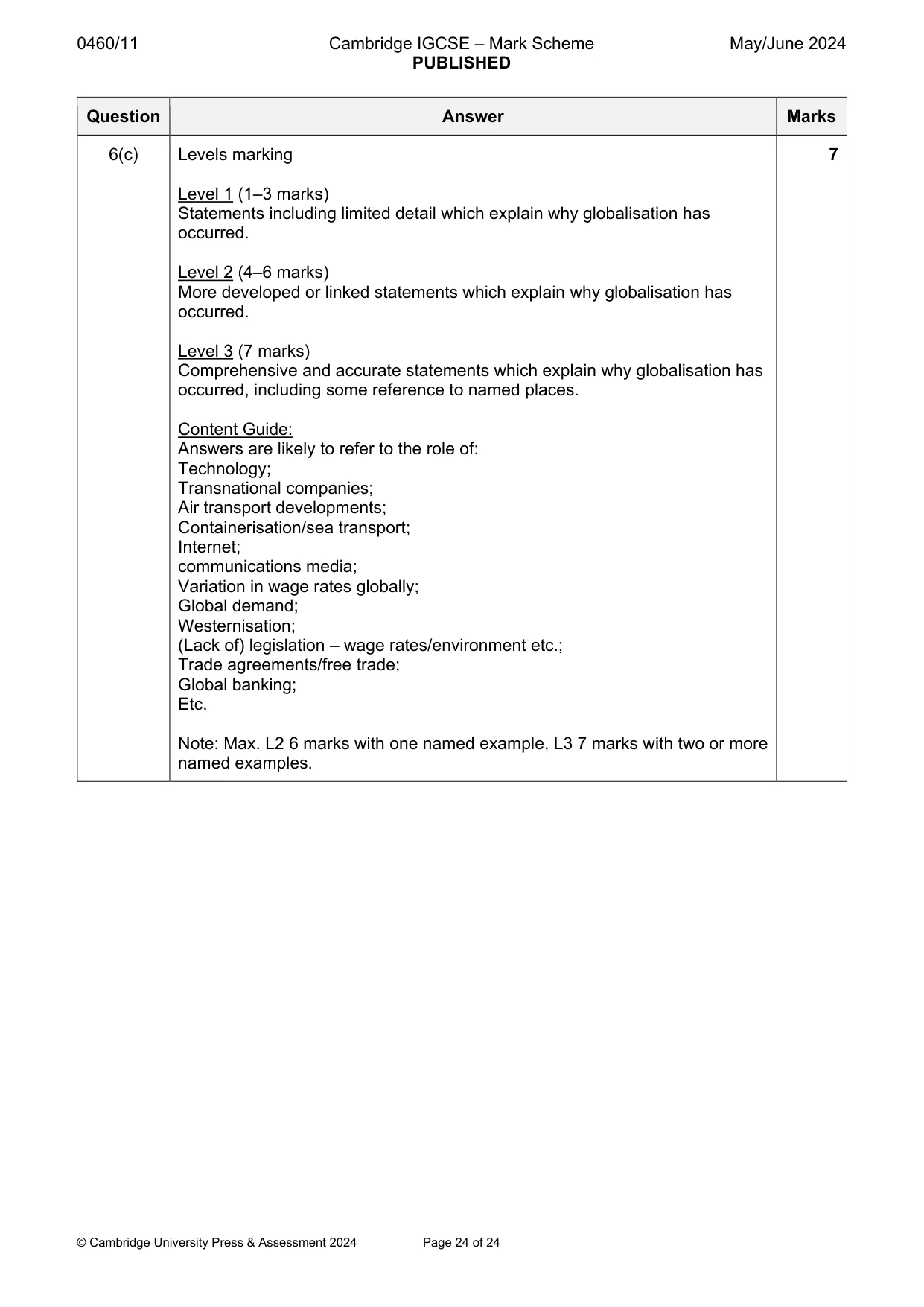
0460/11 Cambridge IGCSE – Mark Scheme PUBLISHED May/June 2024 © Cambridge University Press & Assessment 2024 Page 24 of 24 Question Answer Marks 6(c) Levels marking Level 1 (1–3 marks) Statements including limited detail which explain why globalisation has occurred. Level 2 (4–6 marks) More developed or linked statements which explain why globalisation has occurred. Level 3 (7 marks) Comprehensive and accurate statements which explain why globalisation has occurred, including some reference to named places. Content Guide: Answers are likely to refer to the role of: Technology; Transnational companies; Air transport developments; Containerisation/sea transport; Internet; communications media; Variation in wage rates globally; Global demand; Westernisation; (Lack of) legislation – wage rates/environment etc.; Trade agreements/free trade; Global banking; Etc. Note: Max. L2 6 marks with one named example, L3 7 marks with two or more named examples. 7
What you needed in this session
Cambridge’s own grade thresholds for 2024 May/June, Paper 1 · Variant 1. A higher threshold means an easier paper — the bar moves with how the cohort did.