Cambridge IGCSE Geography 0460 — 2018 Oct/Nov Paper 1 · Variant 1
0460/11/O/N/18 · 75 marks · ≈84 min
The question paper and its mark scheme, free to read here and free to download. This is Cambridge’s own paper, exactly as it was sat.
Question paper32 pages






Mark scheme16 pages
Answers below. Sit the paper first if you are practising.
Paper as text
Question paper, page 1
* 1 8 3 2 3 8 9 3 9 7 * This syllabus is approved for use in England, Wales and Northern Ireland as a Cambridge International Level 1/Level 2 Certificate. This document consists of 29 printed pages, 3 blank pages and 1 Insert. DC (ST/JG) 154021/6 © UCLES 2018 [Turn over Cambridge International Examinations Cambridge International General Certificate of Secondary Education GEOGRAPHY 0460/11 Paper 1 October/November 2018 1 hour 45 minutes Candidates answer on the Question Paper. Additional Materials: Ruler Calculator READ THESE INSTRUCTIONS FIRST Write your Centre number, candidate number and name in the spaces provided. Write in dark blue or black pen. You may use an HB pencil for any diagrams or graphs. Do not use staples, paper clips, glue or correction fluid. DO NOT WRITE IN ANY BARCODES. Write your answer to each question in the space provided. If additional space is required, you should use the lined pages at the end of this booklet. The question number(s) must be clearly shown. Answer three questions, one from each section. The Insert contains Fig. 2.2 for Question 2, Figs. 5.3 and 5.4 for Question 5 and Figs. 6.2 and 6.3 for Question 6. The Insert is not required by the Examiner. Sketch maps and diagrams should be drawn whenever they serve to illustrate an answer. At the end of the examination, fasten all your work securely together. The number of marks is given in brackets [ ] at the end of each question or part question. Definitions MEDCs – More Economically Developed Countries LEDCs – Less Economically Developed Countries
Question paper, page 2
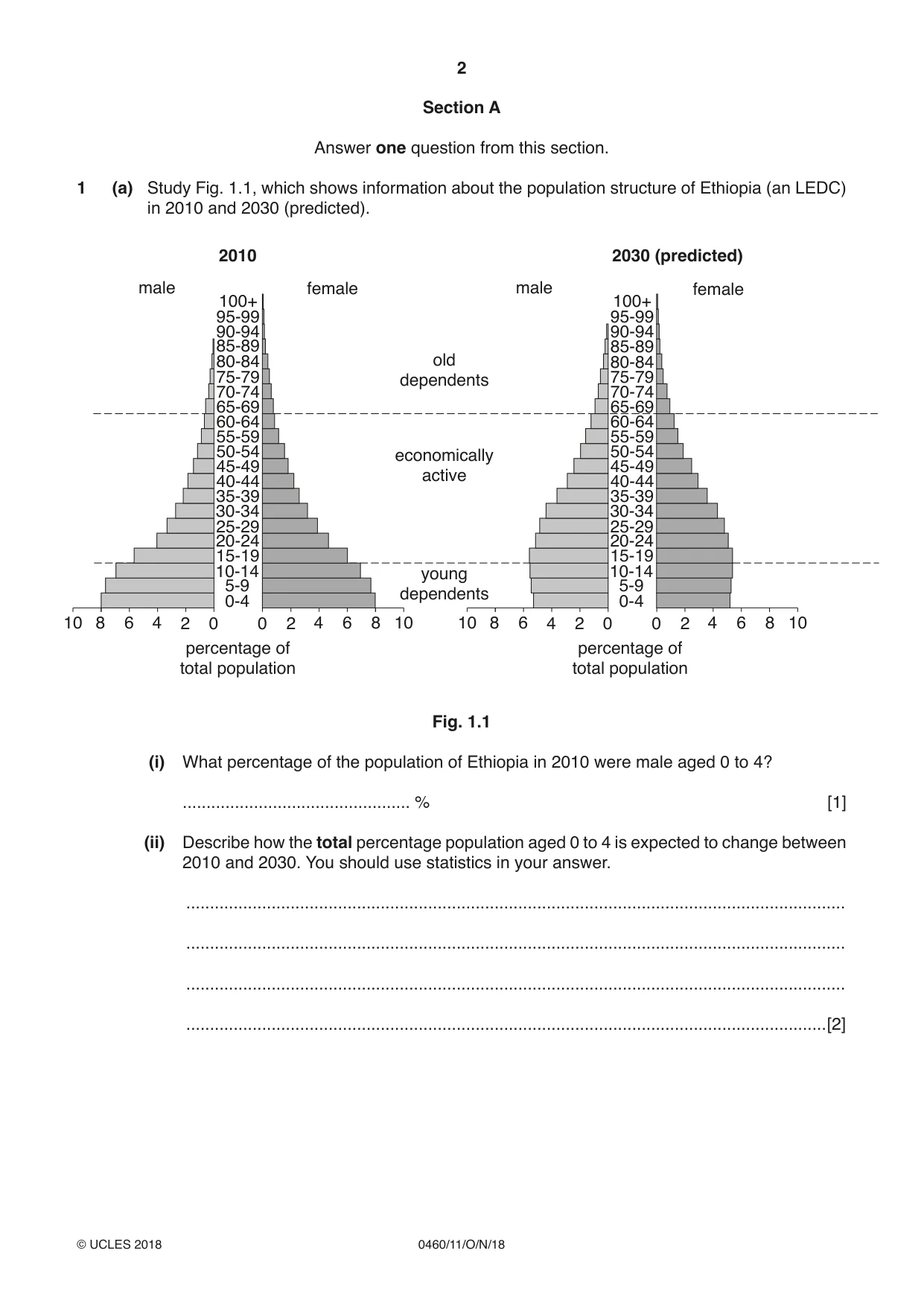
2 0460/11/O/N/18 © UCLES 2018 Section A Answer one question from this section. 1 (a) Study Fig. 1.1, which shows information about the population structure of Ethiopia (an LEDC) in 2010 and 2030 (predicted). male female 8 10 8 10 6 6 4 4 2 2 0 0 40-44 45-49 50-54 55-59 60-64 65-69 70-74 75-79 80-84 85-89 90-94 95-99 100+ 80-84 85-89 90-94 95-99 100+ 35-39 30-34 25-29 20-24 15-19 10-14 5-9 0-4 percentage of total population percentage of total population 2010 male female 8 8 10 10 6 6 4 4 2 2 0 0 40-44 45-49 50-54 55-59 60-64 65-69 70-74 75-79 35-39 30-34 25-29 20-24 15-19 10-14 5-9 0-4 2030 (predicted) old dependents economically active young dependents Fig. 1.1 (i) What percentage of the population of Ethiopia in 2010 were male aged 0 to 4? … % [1] (ii) Describe how the total percentage population aged 0 to 4 is expected to change between 2010 and 2030. You should use statistics in your answer. … … … …[2]
Question paper, page 3
3 0460/11/O/N/18 © UCLES 2018 [Turn over (iii) Suggest how the population structure of Ethiopia is likely to change after 2030. Young dependents … … Old dependents … … Economically active … …[3] (iv) Suggest reasons for the expected changes in the percentage of young and old dependents in Ethiopia. Young dependents … … … … Old dependents … … … …[4]
Question paper, page 4
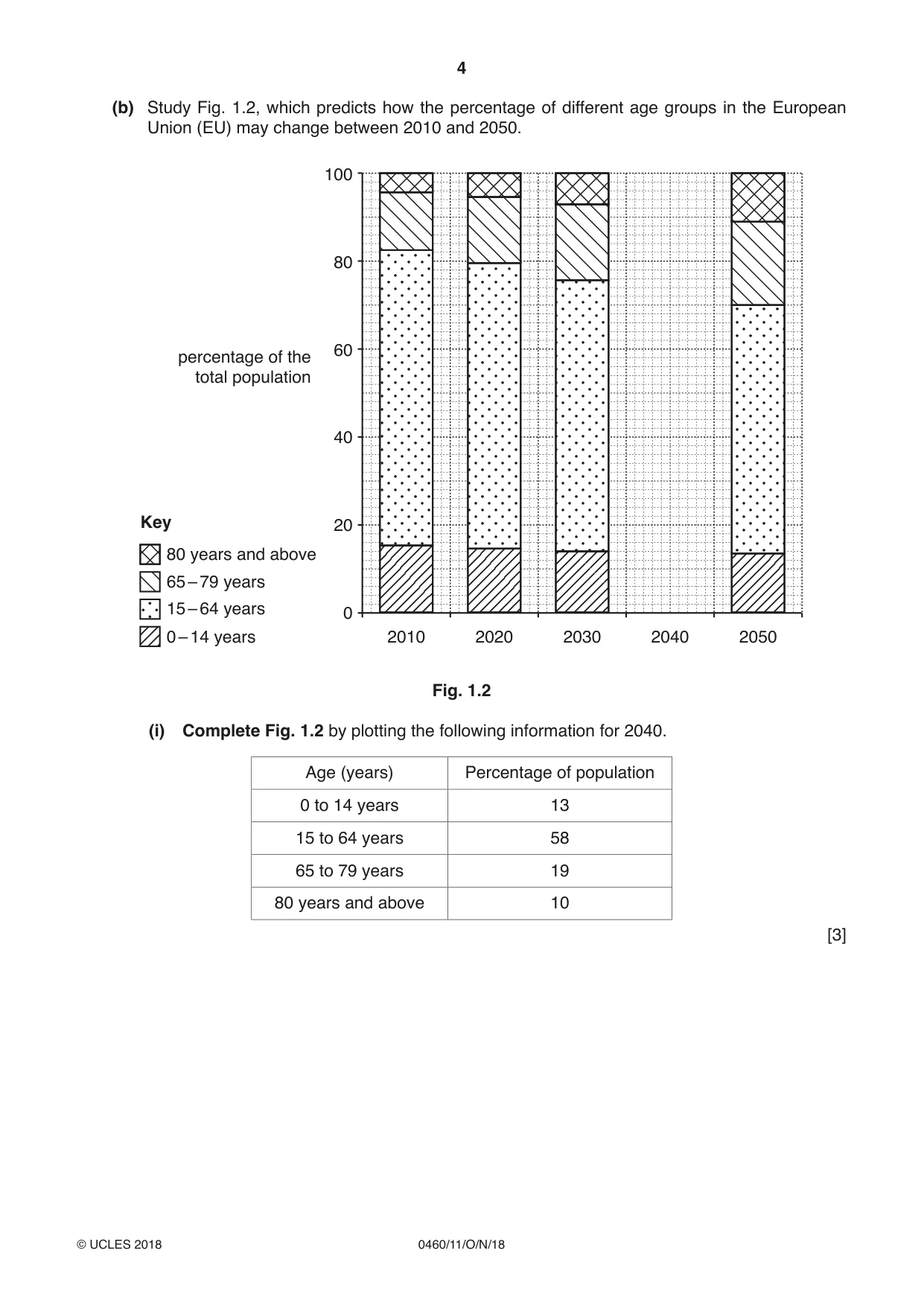
4 0460/11/O/N/18 © UCLES 2018 (b) Study Fig. 1.2, which predicts how the percentage of different age groups in the European Union (EU) may change between 2010 and 2050. percentage of the total population 0 – 14 years 15 – 64 years 65 – 79 years 80 years and above 2010 0 20 40 60 80 100 2020 2030 2040 2050 Key Fig. 1.2 (i) Complete Fig. 1.2 by plotting the following information for 2040. Age (years) Percentage of population 0 to 14 years 13 15 to 64 years 58 65 to 79 years 19 80 years and above 10 [3]
Question paper, page 5
5 0460/11/O/N/18 © UCLES 2018 [Turn over (ii) Describe the challenges faced by MEDCs as the percentage of old dependents in their population increases. … … … … … … … … … …[5]
Question paper, page 6
6 0460/11/O/N/18 © UCLES 2018 (c) For a named country you have studied, describe the impacts of overpopulation. Name of country … … … … … … … … … … … … … … … … … … … … … … … … …[7] [Total: 25]
Question paper, page 7
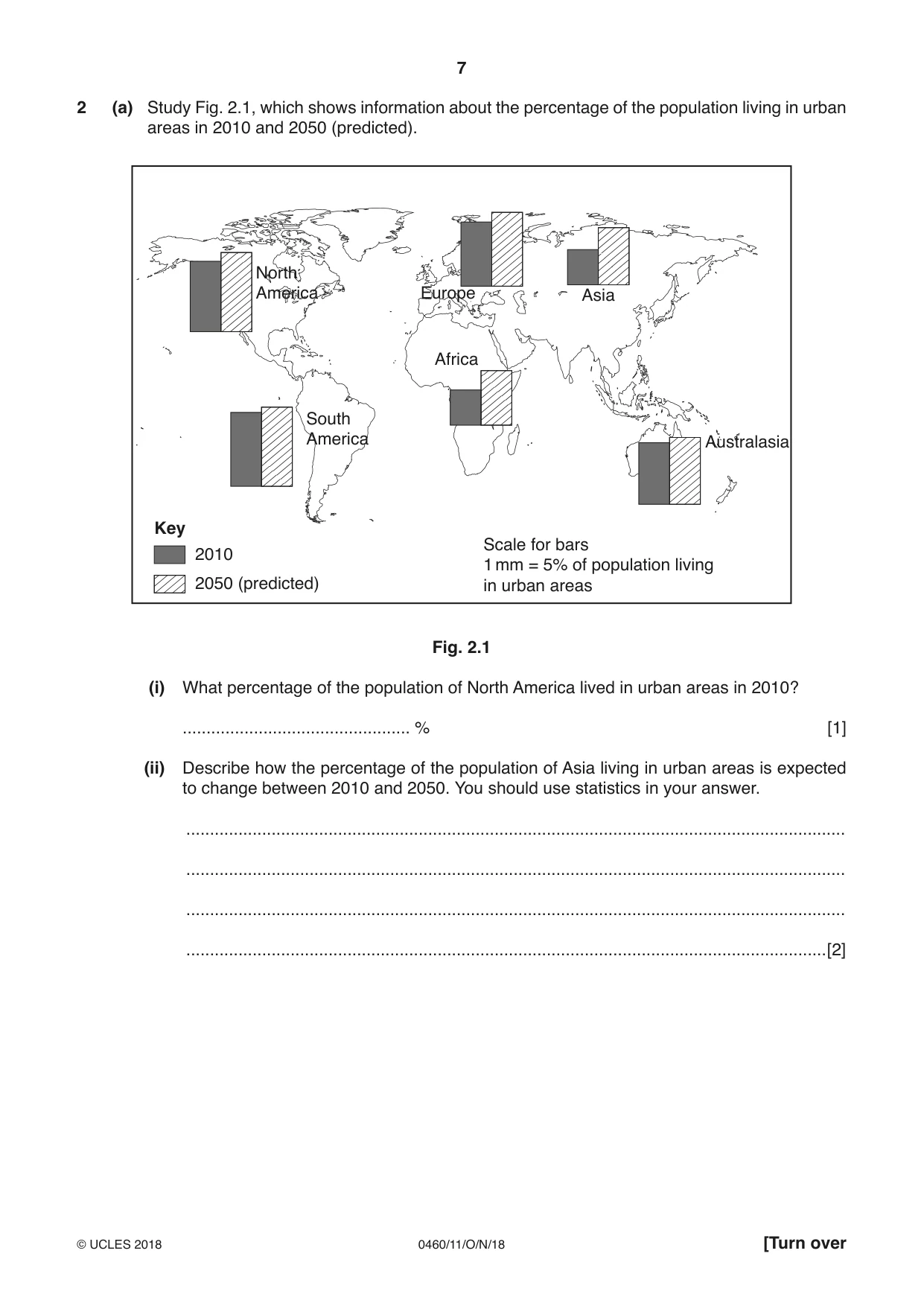
7 0460/11/O/N/18 © UCLES 2018 [Turn over 2 (a) Study Fig. 2.1, which shows information about the percentage of the population living in urban areas in 2010 and 2050 (predicted). Australasia Asia Europe Africa South America North America 2010 2050 (predicted) Key Scale for bars 1 mm = 5% of population living in urban areas Fig. 2.1 (i) What percentage of the population of North America lived in urban areas in 2010? … % [1] (ii) Describe how the percentage of the population of Asia living in urban areas is expected to change between 2010 and 2050. You should use statistics in your answer. … … … …[2]
Question paper, page 8
8 0460/11/O/N/18 © UCLES 2018 (iii) Suggest reasons why a larger percentage of the population lived in urban areas in North America than in Africa in 2010. … … … … … …[3] (iv) Explain why urbanisation is taking place in LEDCs. … … … … … … … …[4]
Question paper, page 9
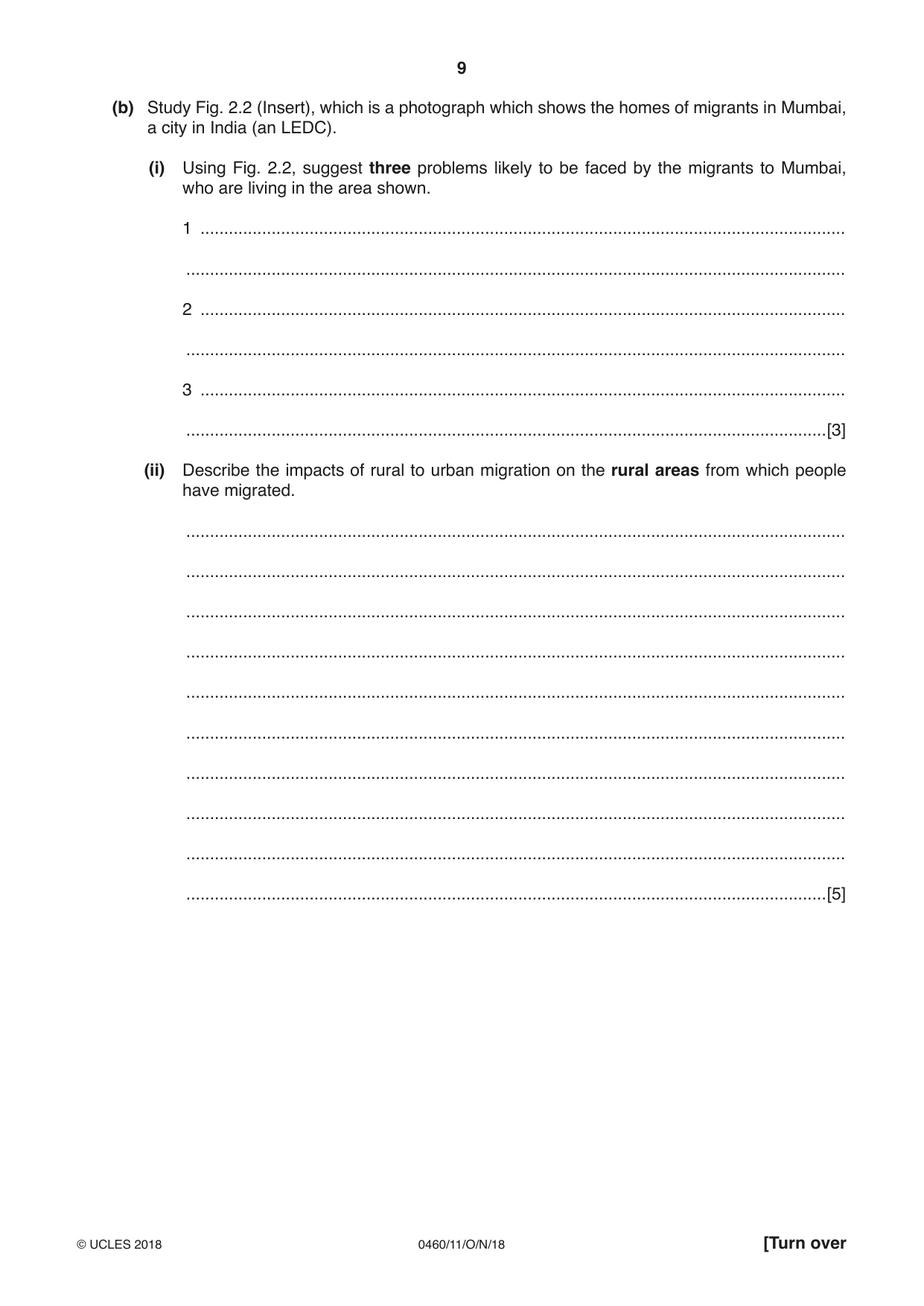
9 0460/11/O/N/18 © UCLES 2018 [Turn over (b) Study Fig. 2.2 (Insert), which is a photograph which shows the homes of migrants in Mumbai, a city in India (an LEDC). (i) Using Fig. 2.2, suggest three problems likely to be faced by the migrants to Mumbai, who are living in the area shown. 1 … … 2 … … 3 … …[3] (ii) Describe the impacts of rural to urban migration on the rural areas from which people have migrated. … … … … … … … … … …[5]
Question paper, page 10
10 0460/11/O/N/18 © UCLES 2018 (c) For a named urban area you have studied, describe the strategies which have been used to reduce the problems caused by rural to urban migration. Name of urban area … … … … … … … … … … … … … … … … … … … … … … … … …[7] [Total: 25]
Question paper, page 11
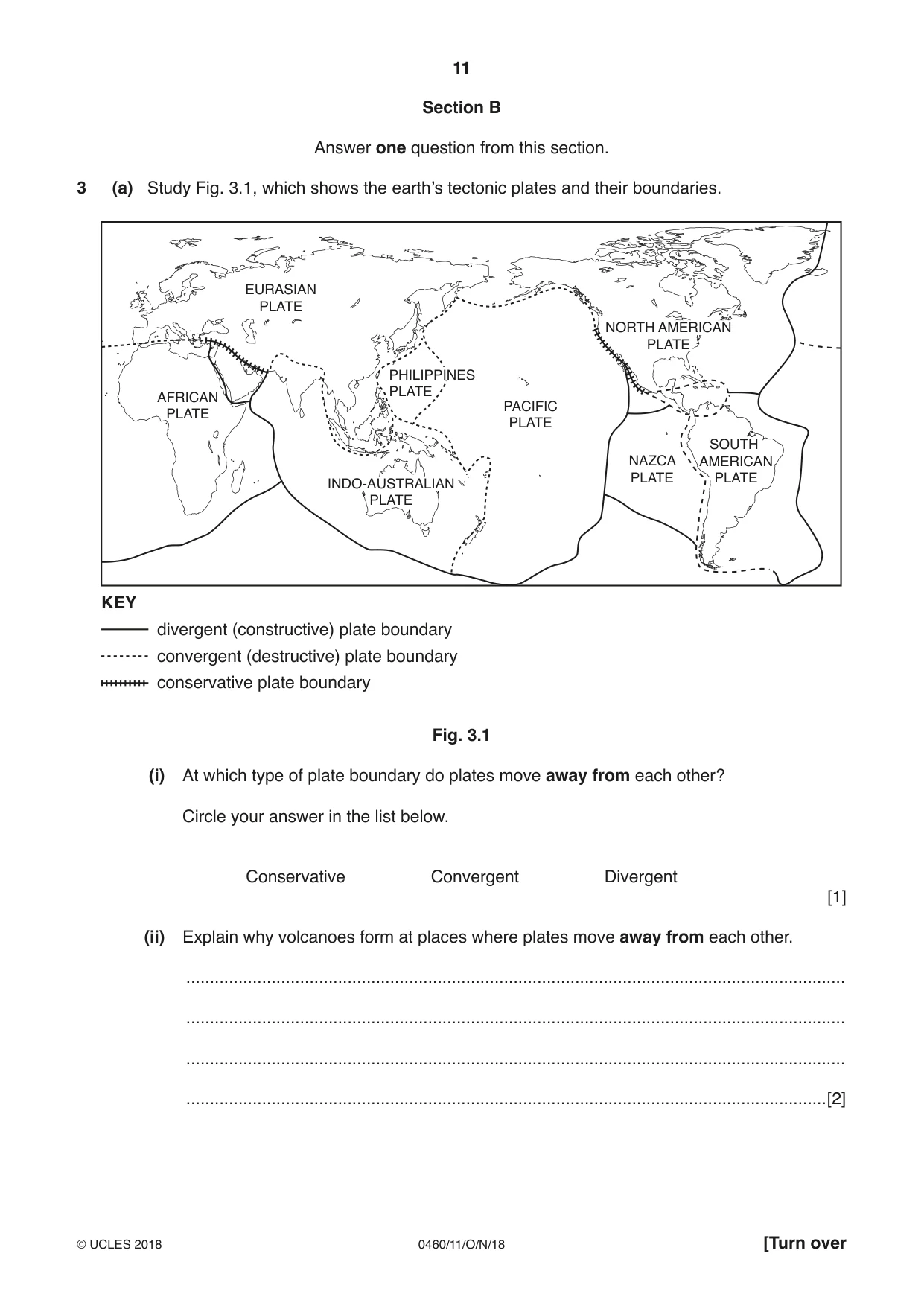
11 0460/11/O/N/18 © UCLES 2018 [Turn over Section B Answer one question from this section. 3 (a) Study Fig. 3.1, which shows the earth’s tectonic plates and their boundaries. EURASIAN PLATE PACIFIC PLATE NAZCA PLATE AFRICAN PLATE INDO-AUSTRALIAN PLATE NORTH AMERICAN PLATE SOUTH AMERICAN PLATE PHILIPPINES PLATE KEY divergent (constructive) plate boundary convergent (destructive) plate boundary conservative plate boundary Fig. 3.1 (i) At which type of plate boundary do plates move away from each other? Circle your answer in the list below. Conservative Convergent Divergent [1] (ii) Explain why volcanoes form at places where plates move away from each other. … … … …[2]
Question paper, page 12
12 0460/11/O/N/18 © UCLES 2018 (iii) Explain why volcanoes form at places where plates move towards each other. … … … … … …[3] (iv) Explain why earthquakes occur at plate boundaries. … … … … … … … …[4]
Question paper, page 13
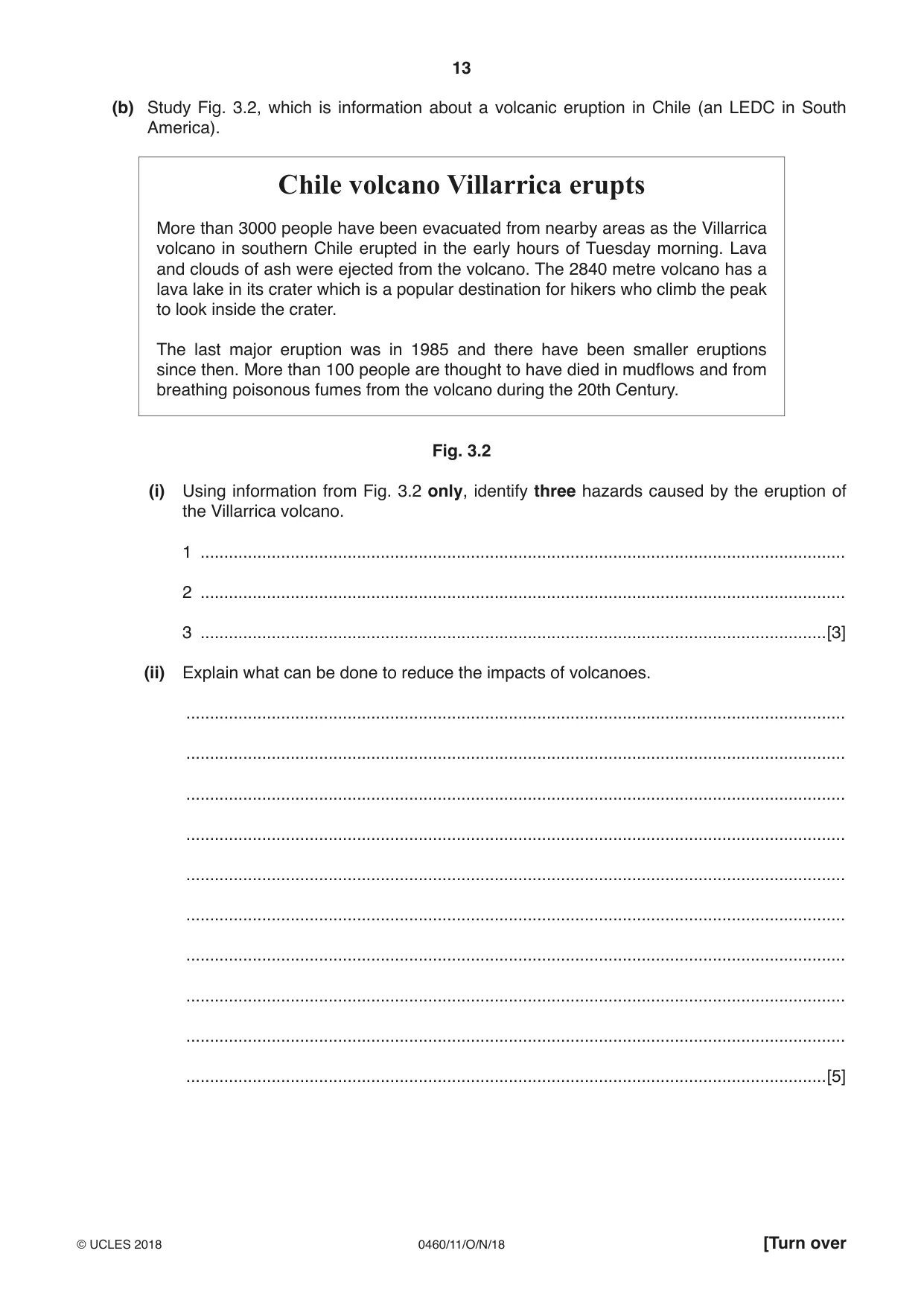
13 0460/11/O/N/18 © UCLES 2018 [Turn over (b) Study Fig. 3.2, which is information about a volcanic eruption in Chile (an LEDC in South America). Chile volcano Villarrica erupts More than 3000 people have been evacuated from nearby areas as the Villarrica volcano in southern Chile erupted in the early hours of Tuesday morning. Lava and clouds of ash were ejected from the volcano. The 2840 metre volcano has a lava lake in its crater which is a popular destination for hikers who climb the peak to look inside the crater. The last major eruption was in 1985 and there have been smaller eruptions since then. More than 100 people are thought to have died in mudflows and from breathing poisonous fumes from the volcano during the 20th Century. Fig. 3.2 (i) Using information from Fig. 3.2 only, identify three hazards caused by the eruption of the Villarrica volcano. 1 … 2 … 3 …[3] (ii) Explain what can be done to reduce the impacts of volcanoes. … … … … … … … … … …[5]
Question paper, page 14
14 0460/11/O/N/18 © UCLES 2018 (c) Explain why people live close to a named volcano you have studied. Name of volcano … … … … … … … … … … … … … … … … … … … … … … … … …[7] [Total: 25]
Question paper, page 15
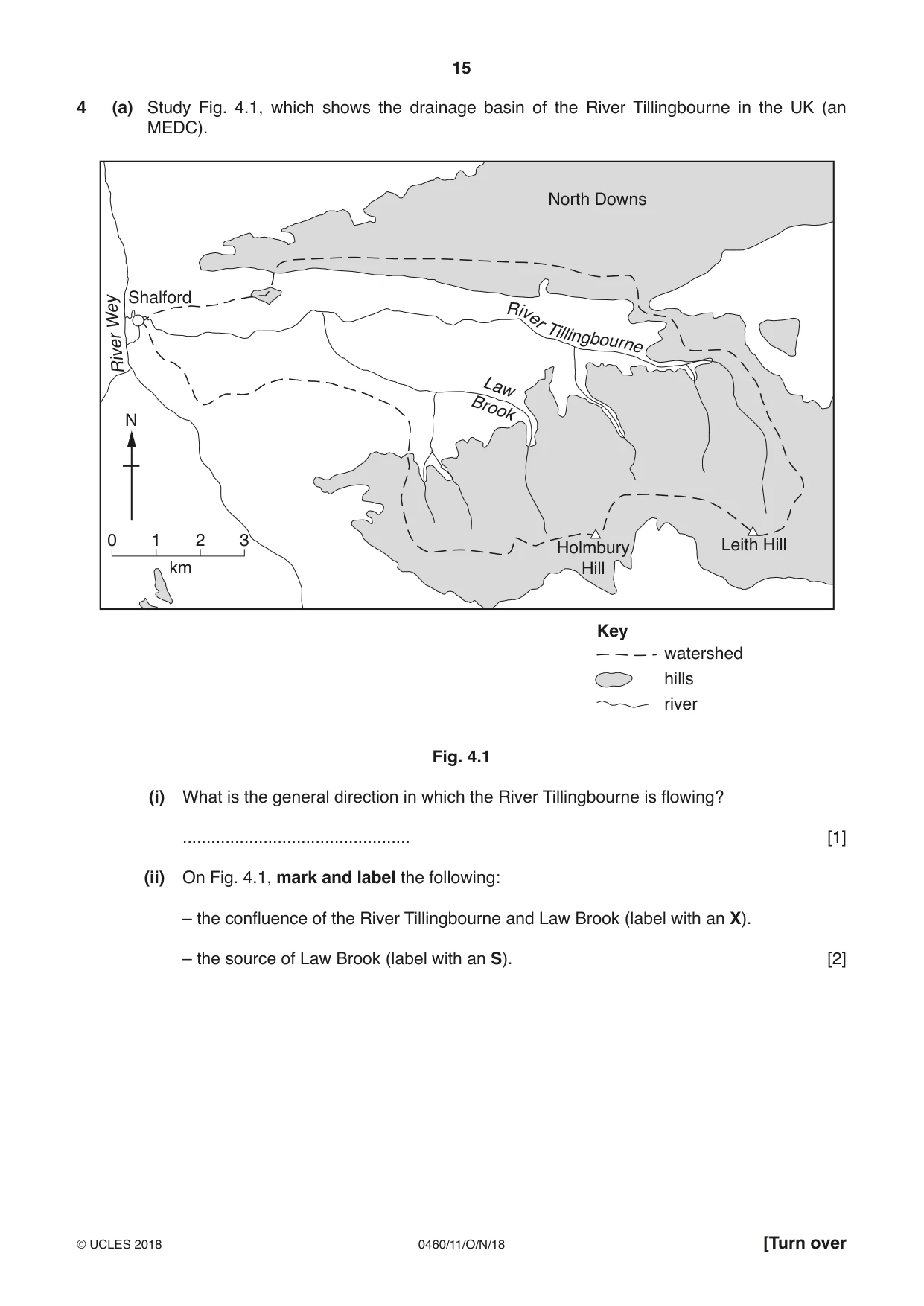
15 0460/11/O/N/18 © UCLES 2018 [Turn over 4 (a) Study Fig. 4.1, which shows the drainage basin of the River Tillingbourne in the UK (an MEDC). 0 1 2 N 3 km Shalford North Downs Holmbury Hill Leith Hill River Wey Law Brook watershed hills river Key R i v er T ill i ngbo u r n e Fig. 4.1 (i) What is the general direction in which the River Tillingbourne is flowing? … [1] (ii) On Fig. 4.1, mark and label the following: – the confluence of the River Tillingbourne and Law Brook (label with an X). – the source of Law Brook (label with an S). [2]
Question paper, page 16
16 0460/11/O/N/18 © UCLES 2018 (iii) Suggest three reasons why the River Tillingbourne is more likely to flood than Law Brook. 1 … … 2 … … 3 … …[3] (iv) Shalford is a large village with a population of 4100. Describe the problems which flooding may cause in Shalford. … … … … … … … …[4]
Question paper, page 17
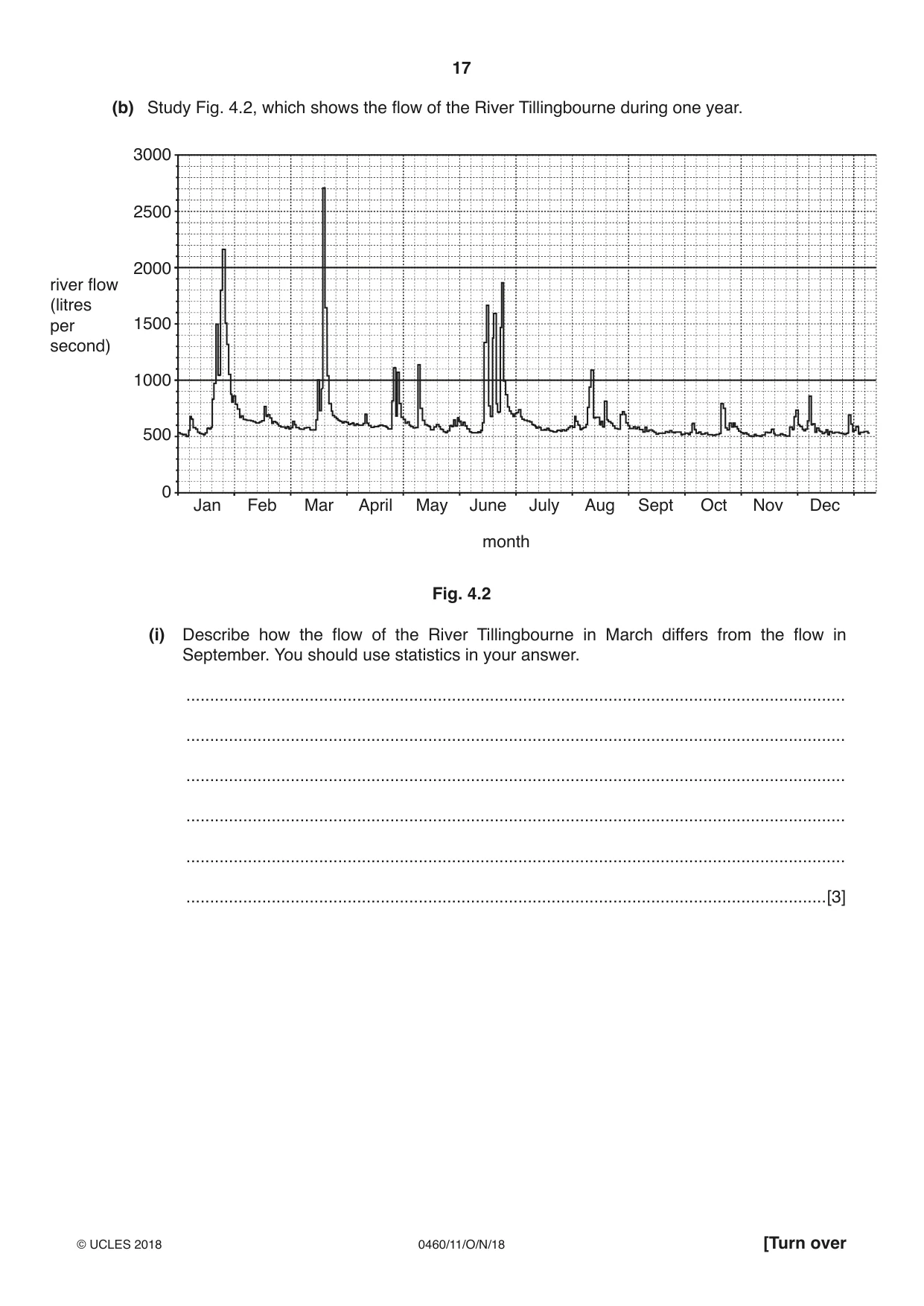
17 0460/11/O/N/18 © UCLES 2018 [Turn over (b) Study Fig. 4.2, which shows the flow of the River Tillingbourne during one year. river flow (litres per second) 500 0 Jan Feb Mar April May June July Aug Sept Oct Nov Dec 1000 1500 2000 2500 3000 month Fig. 4.2 (i) Describe how the flow of the River Tillingbourne in March differs from the flow in September. You should use statistics in your answer. … … … … … …[3]
Question paper, page 18
18 0460/11/O/N/18 © UCLES 2018 (ii) Suggest reasons why the flow of the River Tillingbourne varies during the year. … … … … … … … … … …[5]
Question paper, page 19
19 0460/11/O/N/18 © UCLES 2018 [Turn over (c) For a named river you have studied, describe how it is managed to reduce the risk of flooding. Name of river … … … … … … … … … … … … … … … … … … … … … … … … …[7] [Total: 25]
Question paper, page 20
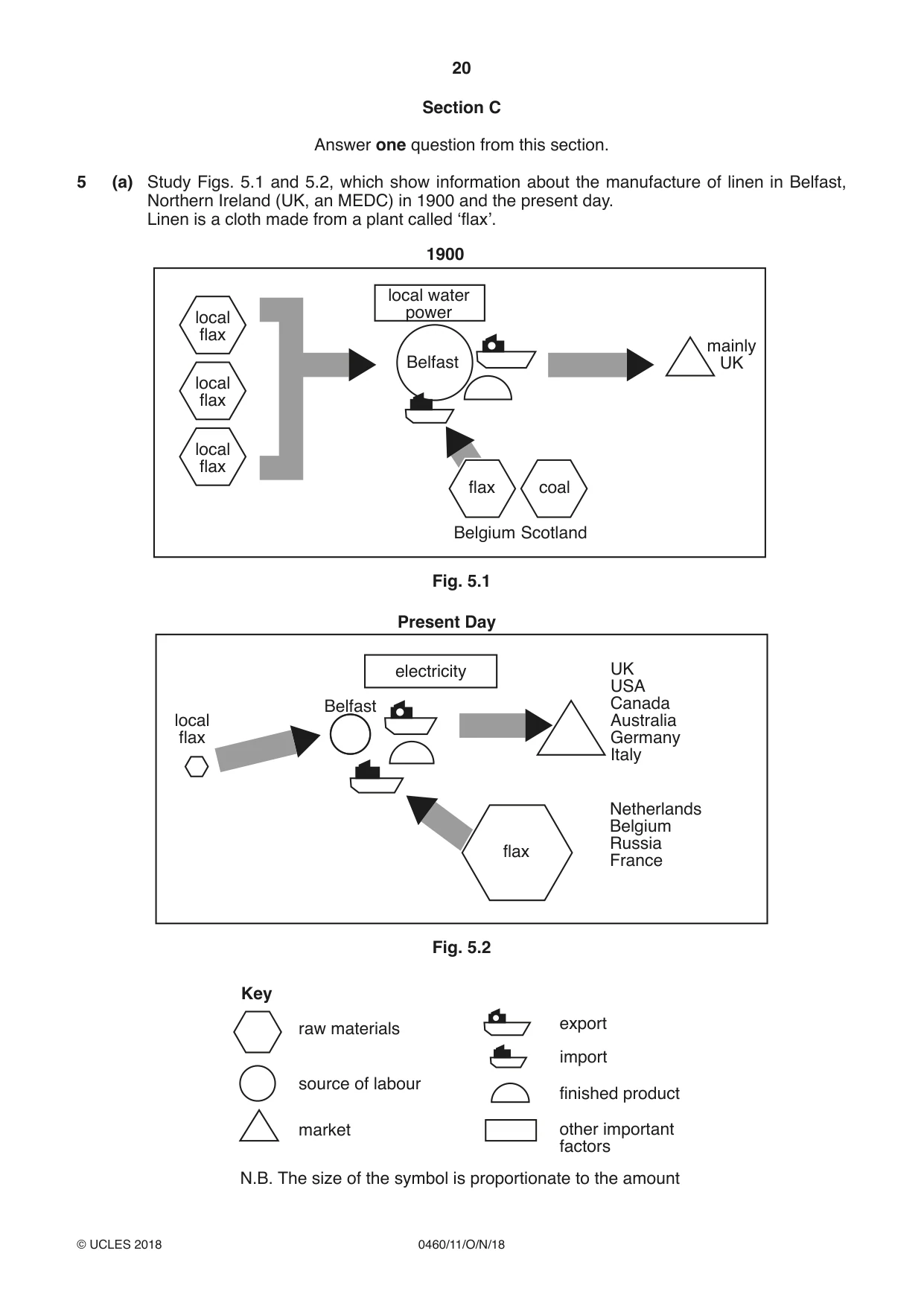
20 0460/11/O/N/18 © UCLES 2018 Section C Answer one question from this section. 5 (a) Study Figs. 5.1 and 5.2, which show information about the manufacture of linen in Belfast, Northern Ireland (UK, an MEDC) in 1900 and the present day. Linen is a cloth made from a plant called ‘flax’. local flax local water power local flax flax coal local flax Belfast mainly UK Belgium Scotland 1900 Fig. 5.1 Netherlands Belgium Russia France electricity local flax flax Belfast UK USA Canada Australia Germany Italy Present Day Fig. 5.2 export import finished product other important factors market N.B. The size of the symbol is proportionate to the amount source of labour raw materials Key
Question paper, page 21
21 0460/11/O/N/18 © UCLES 2018 [Turn over (i) What is meant by manufacturing industry? … …[1] (ii) Using Fig. 5.1 only, identify: – the main source of labour in 1900 … – the main market for linen in 1900. …[2] (iii) Using Figs. 5.1 and 5.2, describe three ways in which the linen industry in Northern Ireland has changed between 1900 and the present day. 1 … … 2 … … 3 … …[3] (iv) Explain why manufacturing industries remain important in some areas even though the original advantages of those locations no longer exist. … … … … … … … …[4]
Question paper, page 22
22 0460/11/O/N/18 © UCLES 2018 (b) Study Figs. 5.3 and 5.4 (Insert), which are photographs showing a manufacturing industry in Corfu, Greece (an MEDC). (i) Describe the processes shown in Figs. 5.3 and 5.4. … … … … … …[3] (ii) Explain why the percentage of the population employed in manufacturing industry changes as a country develops. … … … … … … … … … …[5]
Question paper, page 23
23 0460/11/O/N/18 © UCLES 2018 [Turn over (c) Describe the positive impacts of a named transnational corporation (TNC) at a local and at a national scale. Name of transnational corporation (TNC) … … … … … … … … … … … … … … … … … … … … … … … … …[7] [Total: 25]
Question paper, page 24
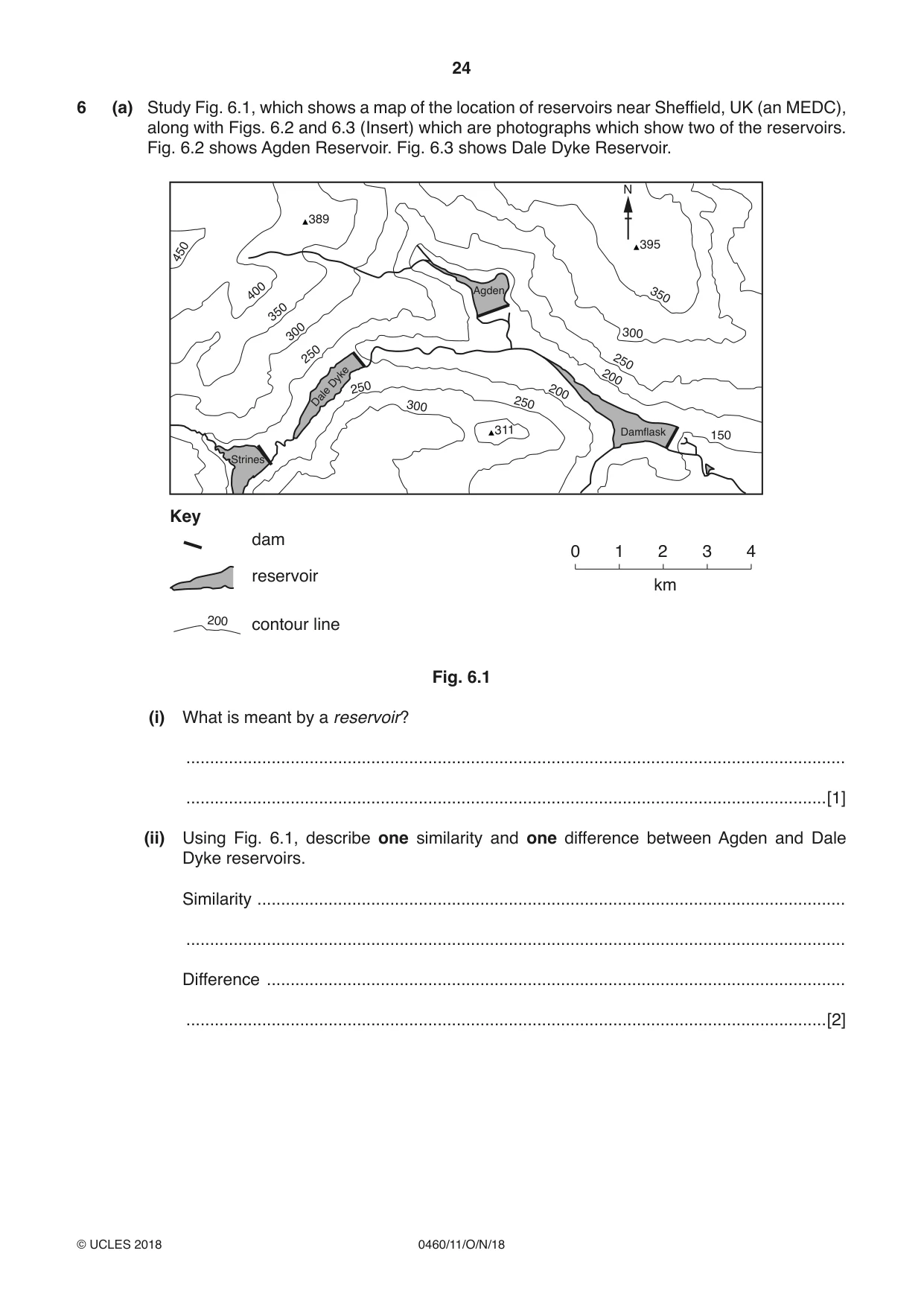
24 0460/11/O/N/18 © UCLES 2018 6 (a) Study Fig. 6.1, which shows a map of the location of reservoirs near Sheffield, UK (an MEDC), along with Figs. 6.2 and 6.3 (Insert) which are photographs which show two of the reservoirs. Fig. 6.2 shows Agden Reservoir. Fig. 6.3 shows Dale Dyke Reservoir. km 0 dam reservoir contour line 1 2 3 4 Key 200 450 400 350 300 250 250 250 200 200 250 350 300 300 311 395 389 150 N Agden Damflask Strines Dale Dyke Fig. 6.1 (i) What is meant by a reservoir? … …[1] (ii) Using Fig. 6.1, describe one similarity and one difference between Agden and Dale Dyke reservoirs. Similarity … … Difference … …[2]
Question paper, page 25
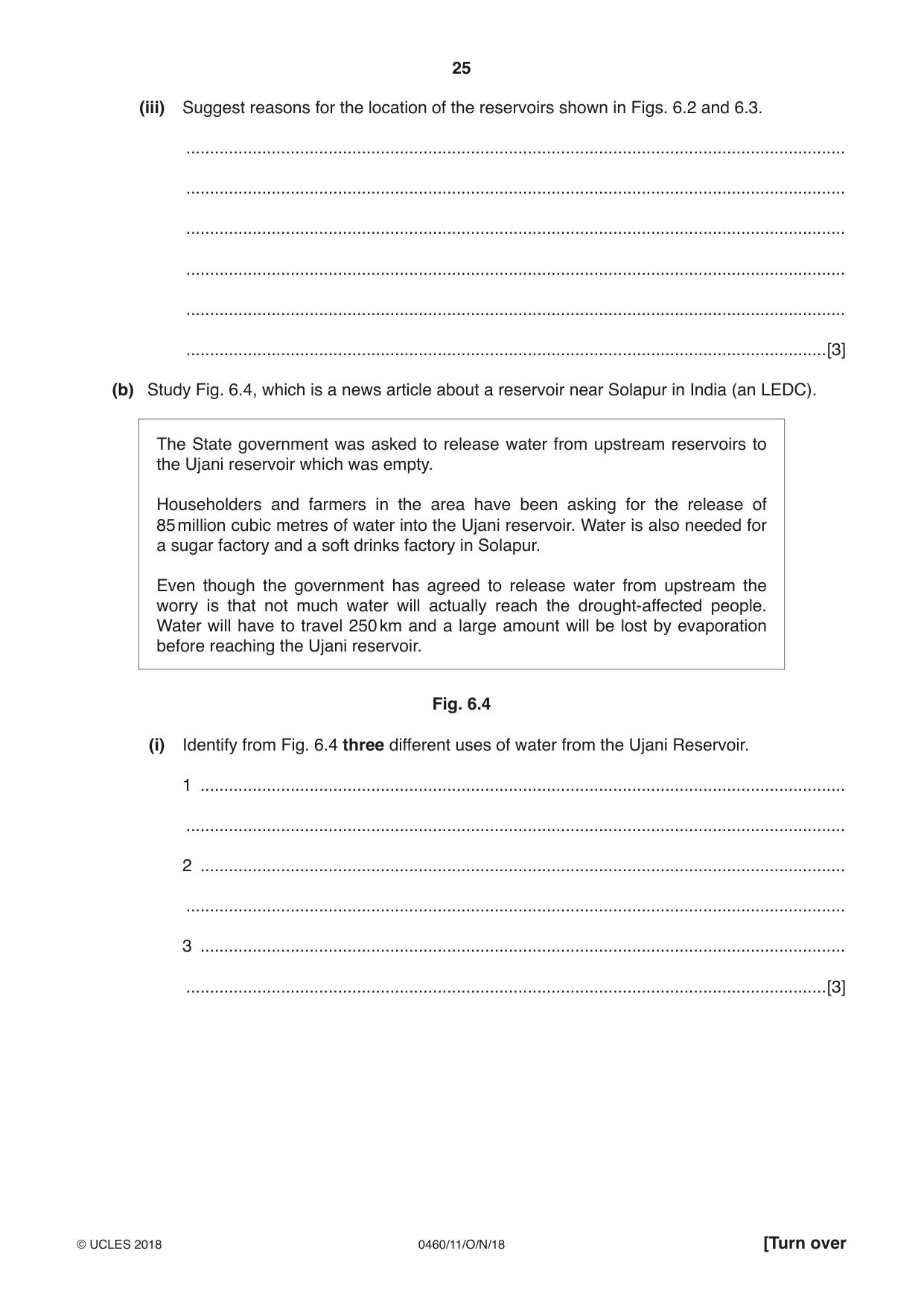
25 0460/11/O/N/18 © UCLES 2018 [Turn over (iii) Suggest reasons for the location of the reservoirs shown in Figs. 6.2 and 6.3. … … … … … …[3] (b) Study Fig. 6.4, which is a news article about a reservoir near Solapur in India (an LEDC). The State government was asked to release water from upstream reservoirs to the Ujani reservoir which was empty. Householders and farmers in the area have been asking for the release of 85 million cubic metres of water into the Ujani reservoir. Water is also needed for a sugar factory and a soft drinks factory in Solapur. Even though the government has agreed to release water from upstream the worry is that not much water will actually reach the drought-affected people. Water will have to travel 250 km and a large amount will be lost by evaporation before reaching the Ujani reservoir. Fig. 6.4 (i) Identify from Fig. 6.4 three different uses of water from the Ujani Reservoir. 1 … … 2 … … 3 … …[3]
Question paper, page 26
26 0460/11/O/N/18 © UCLES 2018 (ii) Explain why water shortages cause more problems in LEDCs, such as India, than in MEDCs. … … … … … … … …[4] (iii) Describe methods other than reservoirs which can be used to supply people with enough safe water. … … … … … … … … … …[5]
Question paper, page 27
27 0460/11/O/N/18 © UCLES 2018 (c) Describe the environmental risks of an economic activity which takes place in a named area you have studied. Name of area … Economic activity … … … … … … … … … … … … … … … … … … … … … … … … …[7] [Total: 25]
Question paper, page 28
28 0460/11/O/N/18 © UCLES 2018 Additional Pages If you use the following lined pages to complete the answer(s) to any question(s), the question number(s) must be clearly shown. … … … … … … … … … … … … … … … … … … … … … … … … … …
Question paper, page 29
29 0460/11/O/N/18 © UCLES 2018 … … … … … … … … … … … … … … … … … … … … … … … … … … … …
Question paper, page 30
30 0460/11/O/N/18 © UCLES 2018 BLANK PAGE
Question paper, page 31
31 0460/11/O/N/18 © UCLES 2018 BLANK PAGE
Question paper, page 32
32 0460/11/O/N/18 © UCLES 2018 Permission to reproduce items where third-party owned material protected by copyright is included has been sought and cleared where possible. Every reasonable effort has been made by the publisher (UCLES) to trace copyright holders, but if any items requiring clearance have unwittingly been included, the publisher will be pleased to make amends at the earliest possible opportunity. To avoid the issue of disclosure of answer-related information to candidates, all copyright acknowledgements are reproduced online in the Cambridge International Examinations Copyright Acknowledgements Booklet. This is produced for each series of examinations and is freely available to download at www.cie.org.uk after the live examination series. Cambridge International Examinations is part of the Cambridge Assessment Group. Cambridge Assessment is the brand name of University of Cambridge Local Examinations Syndicate (UCLES), which is itself a department of the University of Cambridge. BLANK PAGE
Mark scheme, page 1
This syllabus is approved for use in England, Wales and Northern Ireland as a Cambridge International Level 1/Level 2 Certificate. This document consists of 16 printed pages. © UCLES 2018 [Turn over Cambridge Assessment International Education Cambridge International General Certificate of Secondary Education GEOGRAPHY 0460/11 Paper 1 October/November 2018 MARK SCHEME Maximum Mark: 75 Published This mark scheme is published as an aid to teachers and candidates, to indicate the requirements of the examination. It shows the basis on which Examiners were instructed to award marks. It does not indicate the details of the discussions that took place at an Examiners’ meeting before marking began, which would have considered the acceptability of alternative answers. Mark schemes should be read in conjunction with the question paper and the Principal Examiner Report for Teachers. Cambridge International will not enter into discussions about these mark schemes. Cambridge International is publishing the mark schemes for the October/November 2018 series for most Cambridge IGCSE™, Cambridge International A and AS Level components and some Cambridge O Level components.
Mark scheme, page 2
0460/11 Cambridge IGCSE – Mark Scheme PUBLISHED October/November 2018 © UCLES 2018 Page 2 of 16 Generic Marking Principles These general marking principles must be applied by all examiners when marking candidate answers. They should be applied alongside the specific content of the mark scheme or generic level descriptors for a question. Each question paper and mark scheme will also comply with these marking principles. GENERIC MARKING PRINCIPLE 1: Marks must be awarded in line with: • the specific content of the mark scheme or the generic level descriptors for the question • the specific skills defined in the mark scheme or in the generic level descriptors for the question • the standard of response required by a candidate as exemplified by the standardisation scripts. GENERIC MARKING PRINCIPLE 2: Marks awarded are always whole marks (not half marks, or other fractions). GENERIC MARKING PRINCIPLE 3: Marks must be awarded positively: • marks are awarded for correct/valid answers, as defined in the mark scheme. However, credit is given for valid answers which go beyond the scope of the syllabus and mark scheme, referring to your Team Leader as appropriate • marks are awarded when candidates clearly demonstrate what they know and can do • marks are not deducted for errors • marks are not deducted for omissions • answers should only be judged on the quality of spelling, punctuation and grammar when these features are specifically assessed by the question as indicated by the mark scheme. The meaning, however, should be unambiguous. GENERIC MARKING PRINCIPLE 4: Rules must be applied consistently e.g. in situations where candidates have not followed instructions or in the application of generic level descriptors. GENERIC MARKING PRINCIPLE 5: Marks should be awarded using the full range of marks defined in the mark scheme for the question (however; the use of the full mark range may be limited according to the quality of the candidate responses seen). GENERIC MARKING PRINCIPLE 6: Marks awarded are based solely on the requirements as defined in the mark scheme. Marks should not be awarded with grade thresholds or grade descriptors in mind.
Mark scheme, page 3
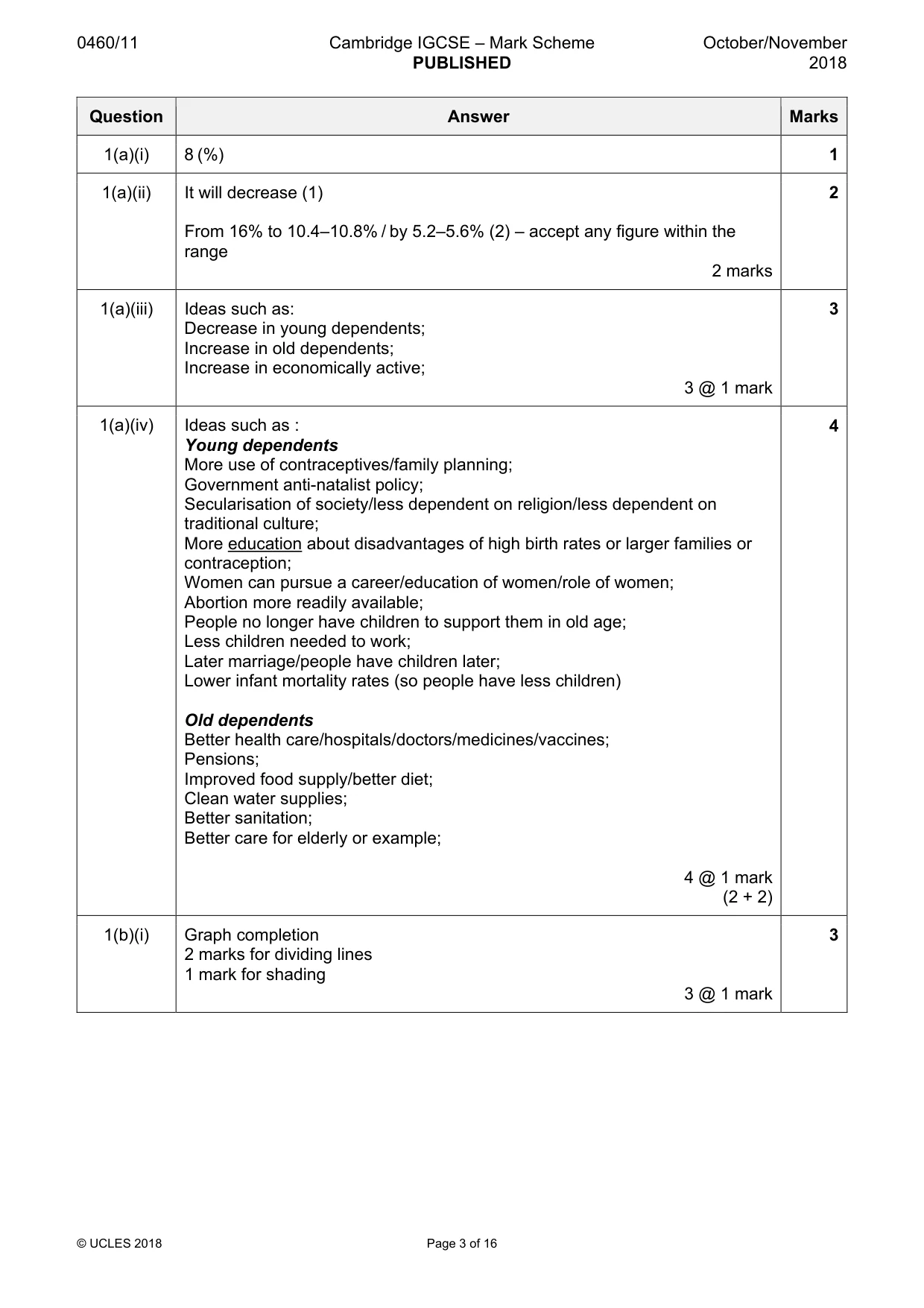
0460/11 Cambridge IGCSE – Mark Scheme PUBLISHED October/November 2018 © UCLES 2018 Page 3 of 16 Question Answer Marks 1(a)(i) 8 (%) 1 1(a)(ii) It will decrease (1) From 16% to 10.4–10.8% / by 5.2–5.6% (2) – accept any figure within the range 2 marks 2 1(a)(iii) Ideas such as: Decrease in young dependents; Increase in old dependents; Increase in economically active; 3 @ 1 mark 3 1(a)(iv) Ideas such as : Young dependents More use of contraceptives/family planning; Government anti-natalist policy; Secularisation of society/less dependent on religion/less dependent on traditional culture; More education about disadvantages of high birth rates or larger families or contraception; Women can pursue a career/education of women/role of women; Abortion more readily available; People no longer have children to support them in old age; Less children needed to work; Later marriage/people have children later; Lower infant mortality rates (so people have less children) Old dependents Better health care/hospitals/doctors/medicines/vaccines; Pensions; Improved food supply/better diet; Clean water supplies; Better sanitation; Better care for elderly or example; 4 @ 1 mark (2 + 2) 4 1(b)(i) Graph completion 2 marks for dividing lines 1 mark for shading 3 @ 1 mark 3
Mark scheme, page 4
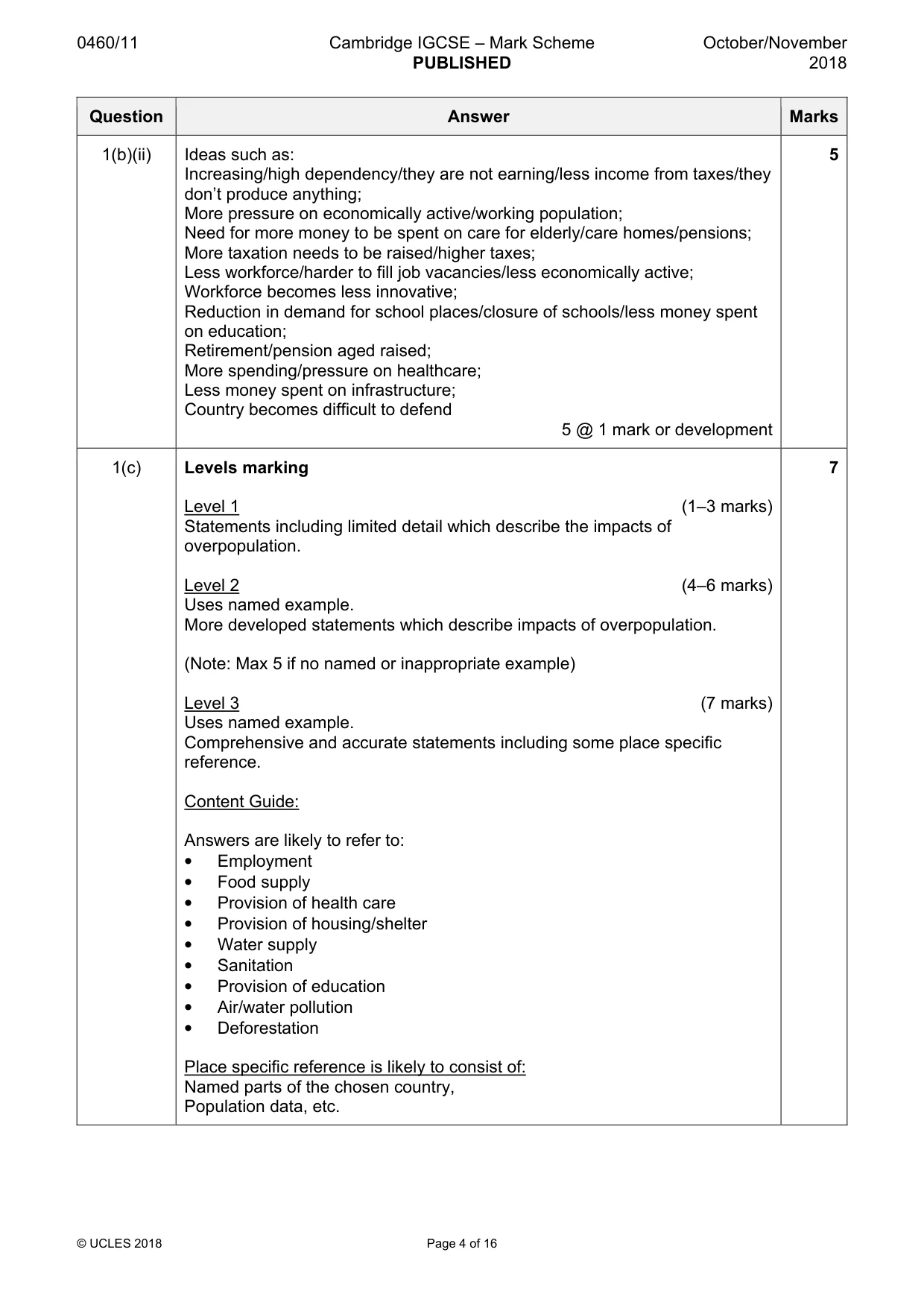
0460/11 Cambridge IGCSE – Mark Scheme PUBLISHED October/November 2018 © UCLES 2018 Page 4 of 16 Question Answer Marks 1(b)(ii) Ideas such as: Increasing/high dependency/they are not earning/less income from taxes/they don’t produce anything; More pressure on economically active/working population; Need for more money to be spent on care for elderly/care homes/pensions; More taxation needs to be raised/higher taxes; Less workforce/harder to fill job vacancies/less economically active; Workforce becomes less innovative; Reduction in demand for school places/closure of schools/less money spent on education; Retirement/pension aged raised; More spending/pressure on healthcare; Less money spent on infrastructure; Country becomes difficult to defend 5 @ 1 mark or development 5 1(c) Levels marking Level 1 (1–3 marks) Statements including limited detail which describe the impacts of overpopulation. Level 2 (4–6 marks) Uses named example. More developed statements which describe impacts of overpopulation. (Note: Max 5 if no named or inappropriate example) Level 3 (7 marks) Uses named example. Comprehensive and accurate statements including some place specific reference. Content Guide: Answers are likely to refer to: • Employment • Food supply • Provision of health care • Provision of housing/shelter • Water supply • Sanitation • Provision of education • Air/water pollution • Deforestation Place specific reference is likely to consist of: Named parts of the chosen country, Population data, etc. 7
Mark scheme, page 5
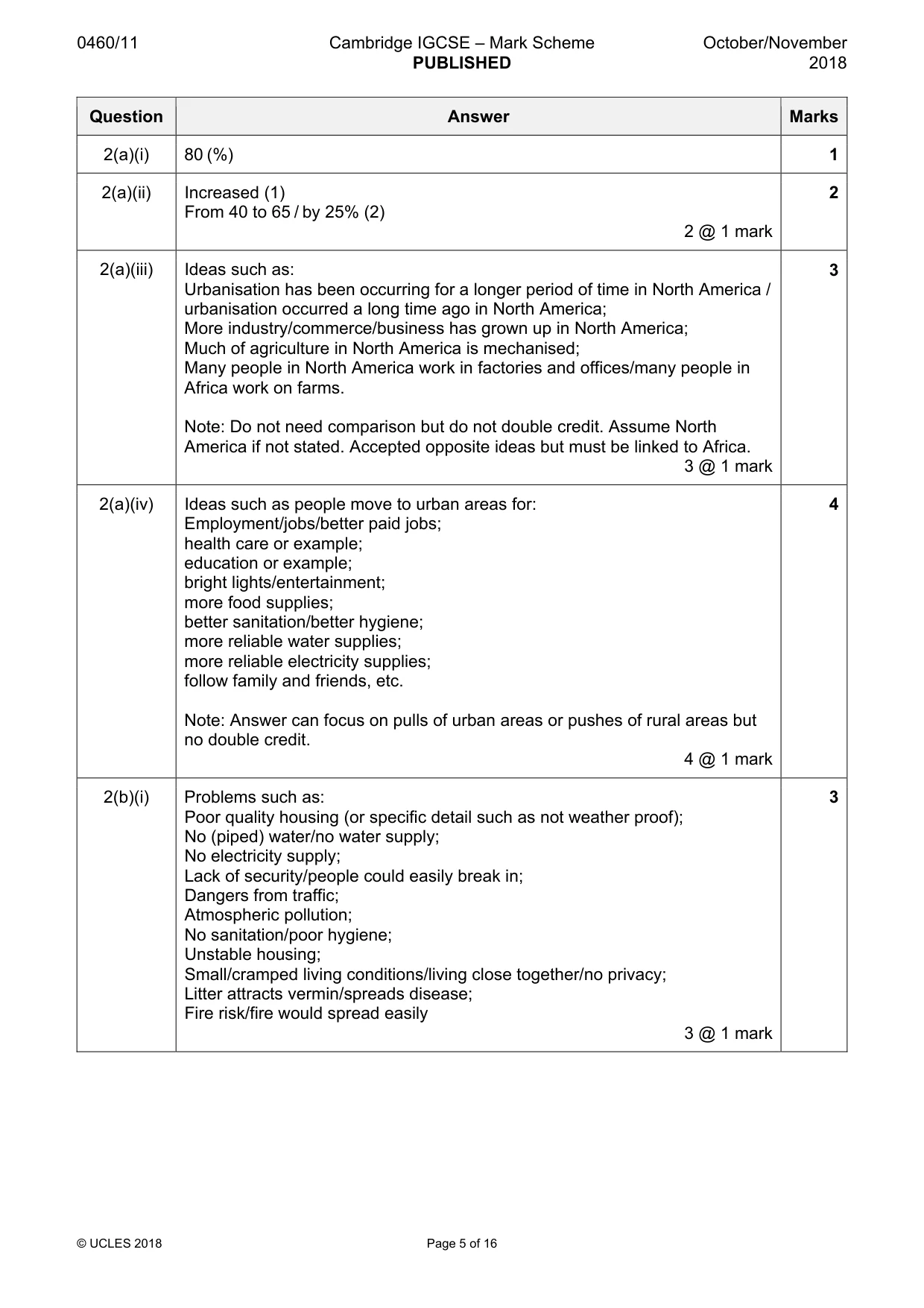
0460/11 Cambridge IGCSE – Mark Scheme PUBLISHED October/November 2018 © UCLES 2018 Page 5 of 16 Question Answer Marks 2(a)(i) 80 (%) 1 2(a)(ii) Increased (1) From 40 to 65 / by 25% (2) 2 @ 1 mark 2 2(a)(iii) Ideas such as: Urbanisation has been occurring for a longer period of time in North America / urbanisation occurred a long time ago in North America; More industry/commerce/business has grown up in North America; Much of agriculture in North America is mechanised; Many people in North America work in factories and offices/many people in Africa work on farms. Note: Do not need comparison but do not double credit. Assume North America if not stated. Accepted opposite ideas but must be linked to Africa. 3 @ 1 mark 3 2(a)(iv) Ideas such as people move to urban areas for: Employment/jobs/better paid jobs; health care or example; education or example; bright lights/entertainment; more food supplies; better sanitation/better hygiene; more reliable water supplies; more reliable electricity supplies; follow family and friends, etc. Note: Answer can focus on pulls of urban areas or pushes of rural areas but no double credit. 4 @ 1 mark 4 2(b)(i) Problems such as: Poor quality housing (or specific detail such as not weather proof); No (piped) water/no water supply; No electricity supply; Lack of security/people could easily break in; Dangers from traffic; Atmospheric pollution; No sanitation/poor hygiene; Unstable housing; Small/cramped living conditions/living close together/no privacy; Litter attracts vermin/spreads disease; Fire risk/fire would spread easily 3 @ 1 mark 3
Mark scheme, page 6
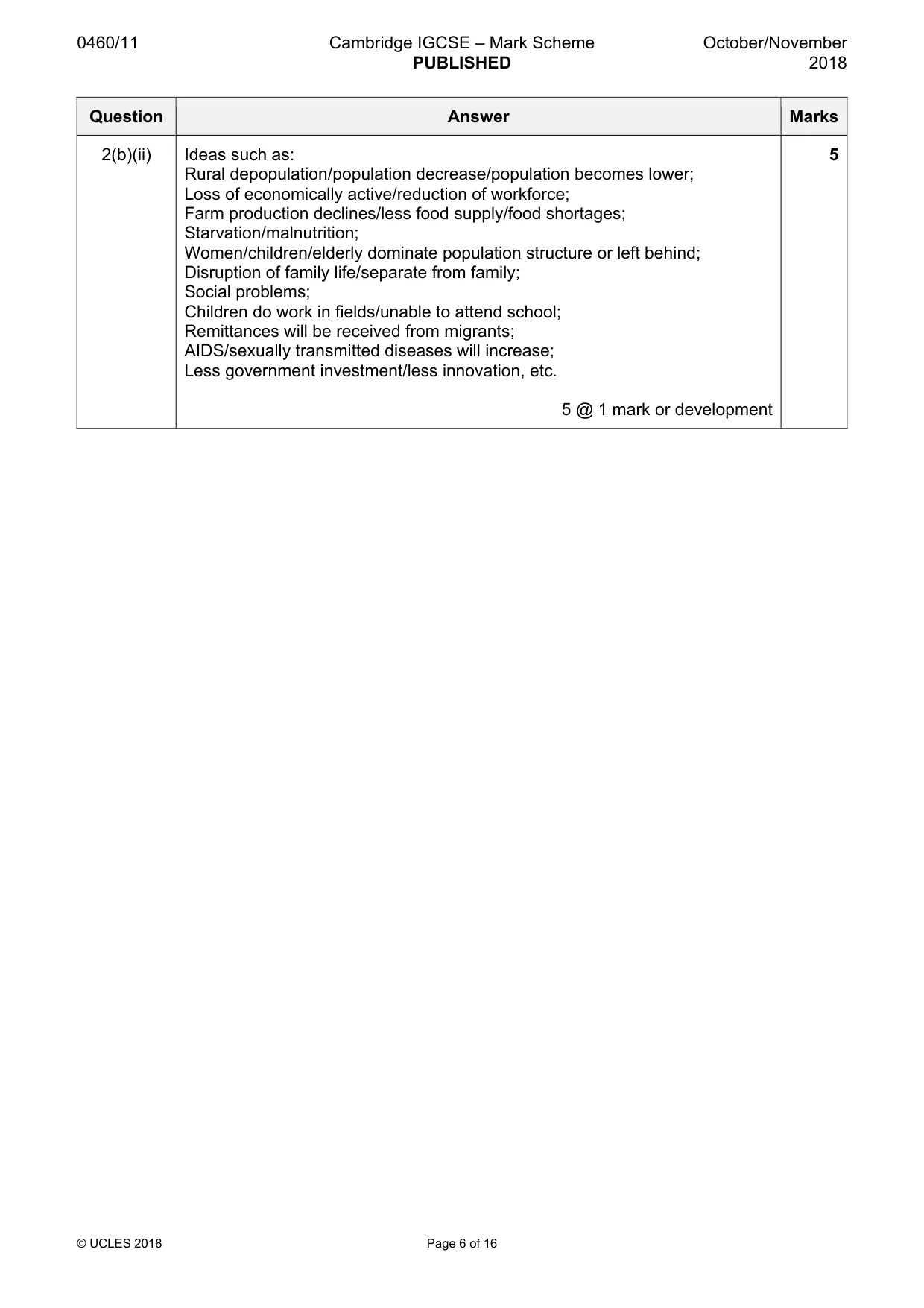
0460/11 Cambridge IGCSE – Mark Scheme PUBLISHED October/November 2018 © UCLES 2018 Page 6 of 16 Question Answer Marks 2(b)(ii) Ideas such as: Rural depopulation/population decrease/population becomes lower; Loss of economically active/reduction of workforce; Farm production declines/less food supply/food shortages; Starvation/malnutrition; Women/children/elderly dominate population structure or left behind; Disruption of family life/separate from family; Social problems; Children do work in fields/unable to attend school; Remittances will be received from migrants; AIDS/sexually transmitted diseases will increase; Less government investment/less innovation, etc. 5 @ 1 mark or development 5
Mark scheme, page 7
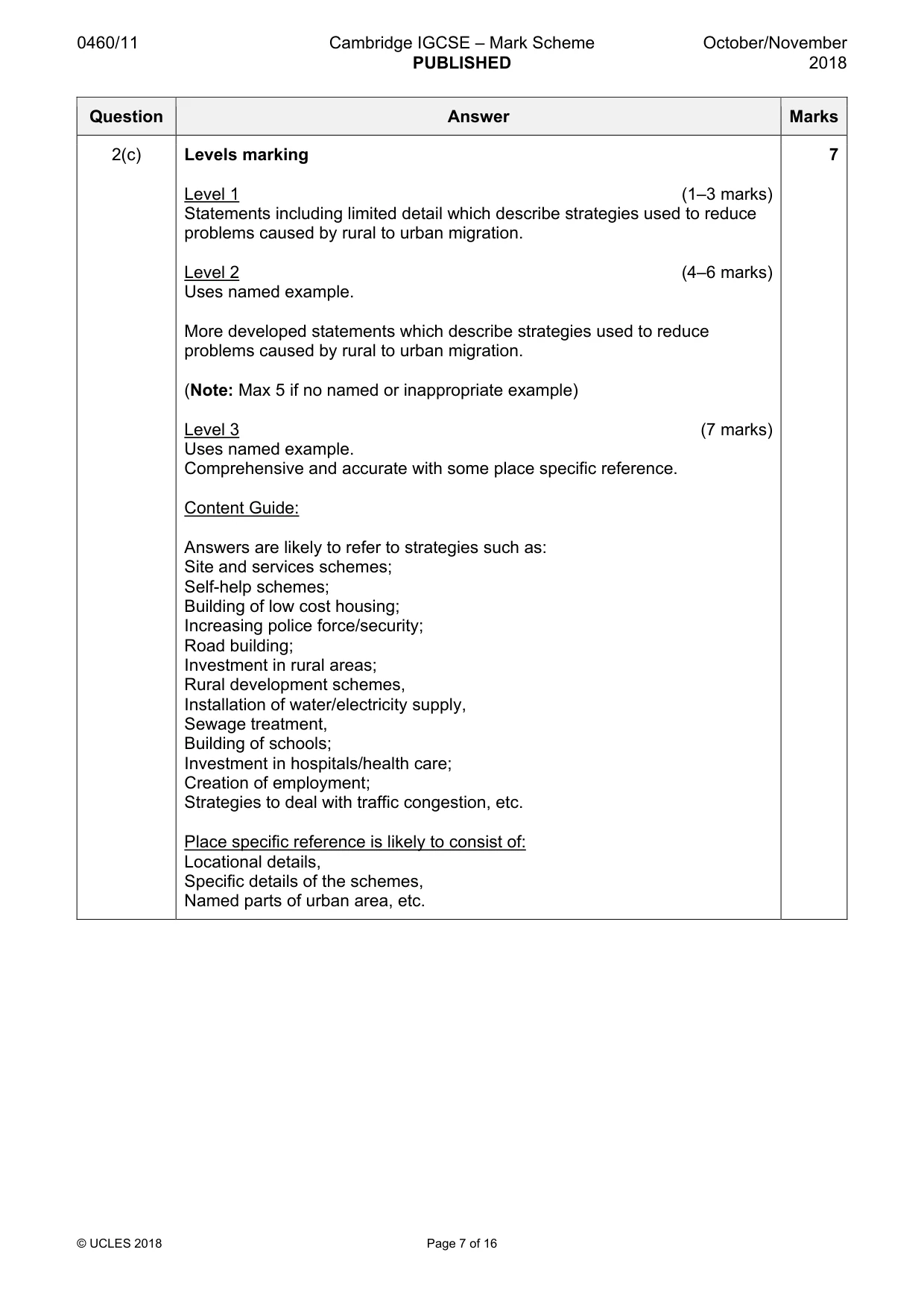
0460/11 Cambridge IGCSE – Mark Scheme PUBLISHED October/November 2018 © UCLES 2018 Page 7 of 16 Question Answer Marks 2(c) Levels marking Level 1 (1–3 marks) Statements including limited detail which describe strategies used to reduce problems caused by rural to urban migration. Level 2 (4–6 marks) Uses named example. More developed statements which describe strategies used to reduce problems caused by rural to urban migration. (Note: Max 5 if no named or inappropriate example) Level 3 (7 marks) Uses named example. Comprehensive and accurate with some place specific reference. Content Guide: Answers are likely to refer to strategies such as: Site and services schemes; Self-help schemes; Building of low cost housing; Increasing police force/security; Road building; Investment in rural areas; Rural development schemes, Installation of water/electricity supply, Sewage treatment, Building of schools; Investment in hospitals/health care; Creation of employment; Strategies to deal with traffic congestion, etc. Place specific reference is likely to consist of: Locational details, Specific details of the schemes, Named parts of urban area, etc. 7
Mark scheme, page 8
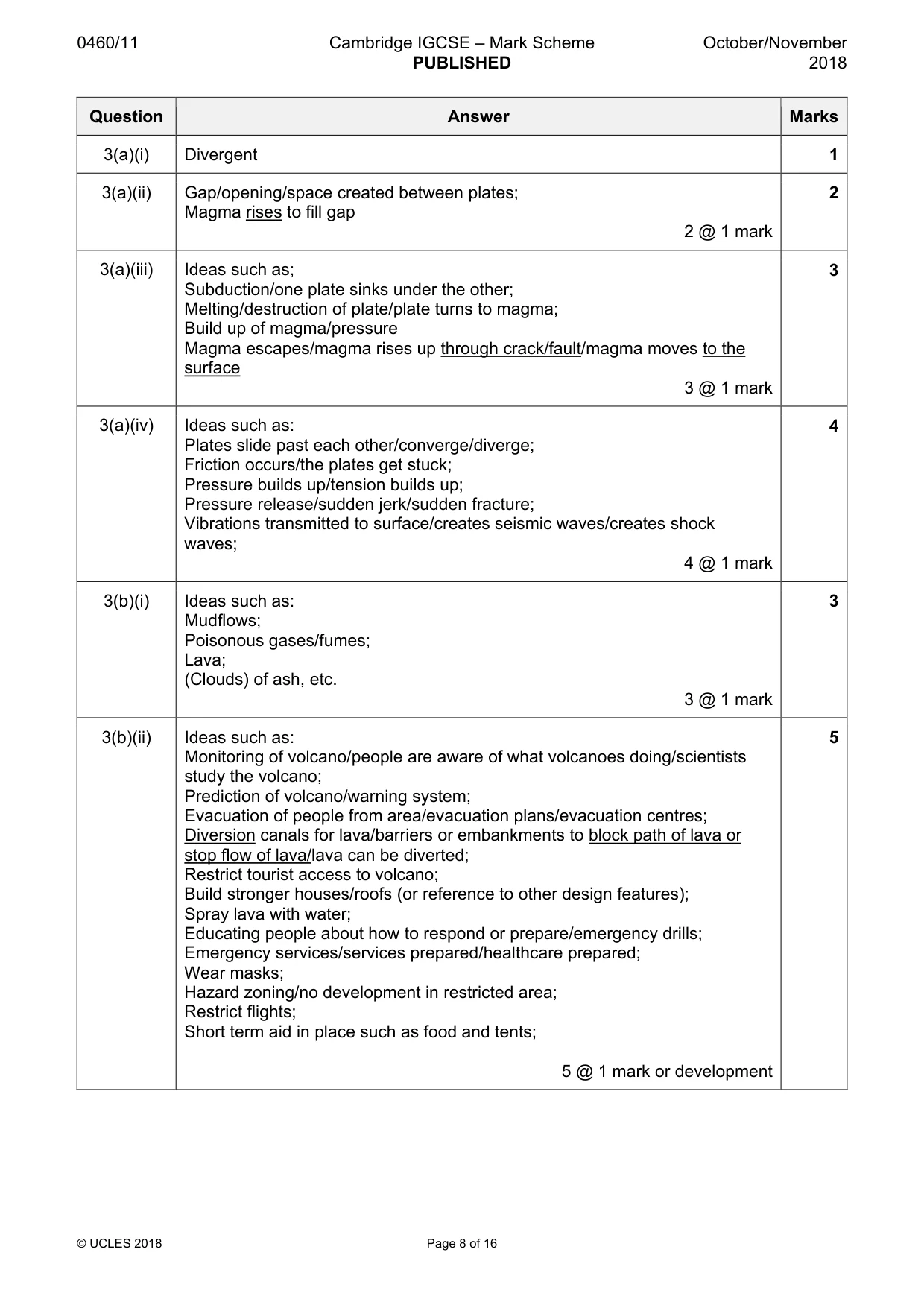
0460/11 Cambridge IGCSE – Mark Scheme PUBLISHED October/November 2018 © UCLES 2018 Page 8 of 16 Question Answer Marks 3(a)(i) Divergent 1 3(a)(ii) Gap/opening/space created between plates; Magma rises to fill gap 2 @ 1 mark 2 3(a)(iii) Ideas such as; Subduction/one plate sinks under the other; Melting/destruction of plate/plate turns to magma; Build up of magma/pressure Magma escapes/magma rises up through crack/fault/magma moves to the surface 3 @ 1 mark 3 3(a)(iv) Ideas such as: Plates slide past each other/converge/diverge; Friction occurs/the plates get stuck; Pressure builds up/tension builds up; Pressure release/sudden jerk/sudden fracture; Vibrations transmitted to surface/creates seismic waves/creates shock waves; 4 @ 1 mark 4 3(b)(i) Ideas such as: Mudflows; Poisonous gases/fumes; Lava; (Clouds) of ash, etc. 3 @ 1 mark 3 3(b)(ii) Ideas such as: Monitoring of volcano/people are aware of what volcanoes doing/scientists study the volcano; Prediction of volcano/warning system; Evacuation of people from area/evacuation plans/evacuation centres; Diversion canals for lava/barriers or embankments to block path of lava or stop flow of lava/lava can be diverted; Restrict tourist access to volcano; Build stronger houses/roofs (or reference to other design features); Spray lava with water; Educating people about how to respond or prepare/emergency drills; Emergency services/services prepared/healthcare prepared; Wear masks; Hazard zoning/no development in restricted area; Restrict flights; Short term aid in place such as food and tents; 5 @ 1 mark or development 5
Mark scheme, page 9
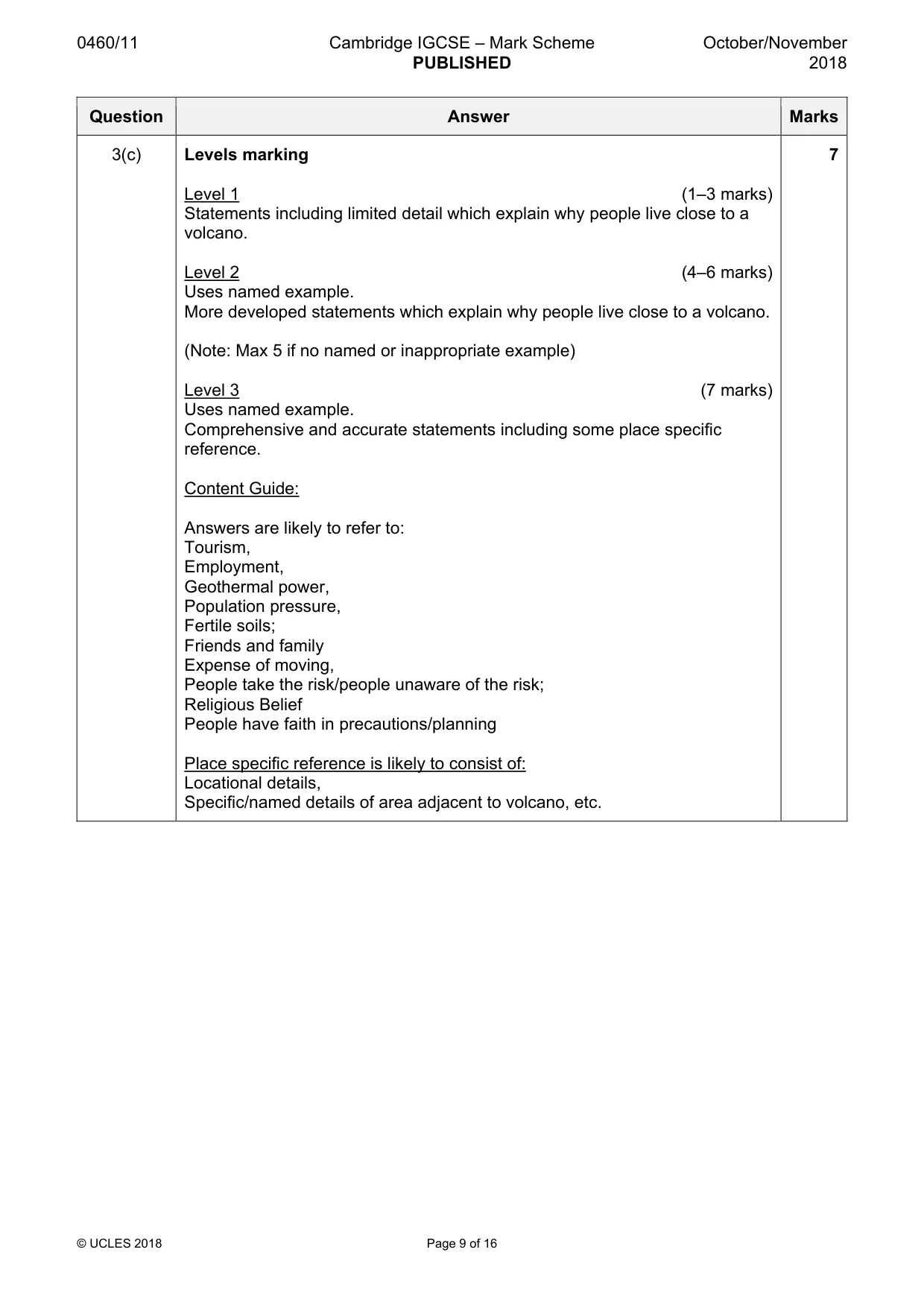
0460/11 Cambridge IGCSE – Mark Scheme PUBLISHED October/November 2018 © UCLES 2018 Page 9 of 16 Question Answer Marks 3(c) Levels marking Level 1 (1–3 marks) Statements including limited detail which explain why people live close to a volcano. Level 2 (4–6 marks) Uses named example. More developed statements which explain why people live close to a volcano. (Note: Max 5 if no named or inappropriate example) Level 3 (7 marks) Uses named example. Comprehensive and accurate statements including some place specific reference. Content Guide: Answers are likely to refer to: Tourism, Employment, Geothermal power, Population pressure, Fertile soils; Friends and family Expense of moving, People take the risk/people unaware of the risk; Religious Belief People have faith in precautions/planning Place specific reference is likely to consist of: Locational details, Specific/named details of area adjacent to volcano, etc. 7
Mark scheme, page 10
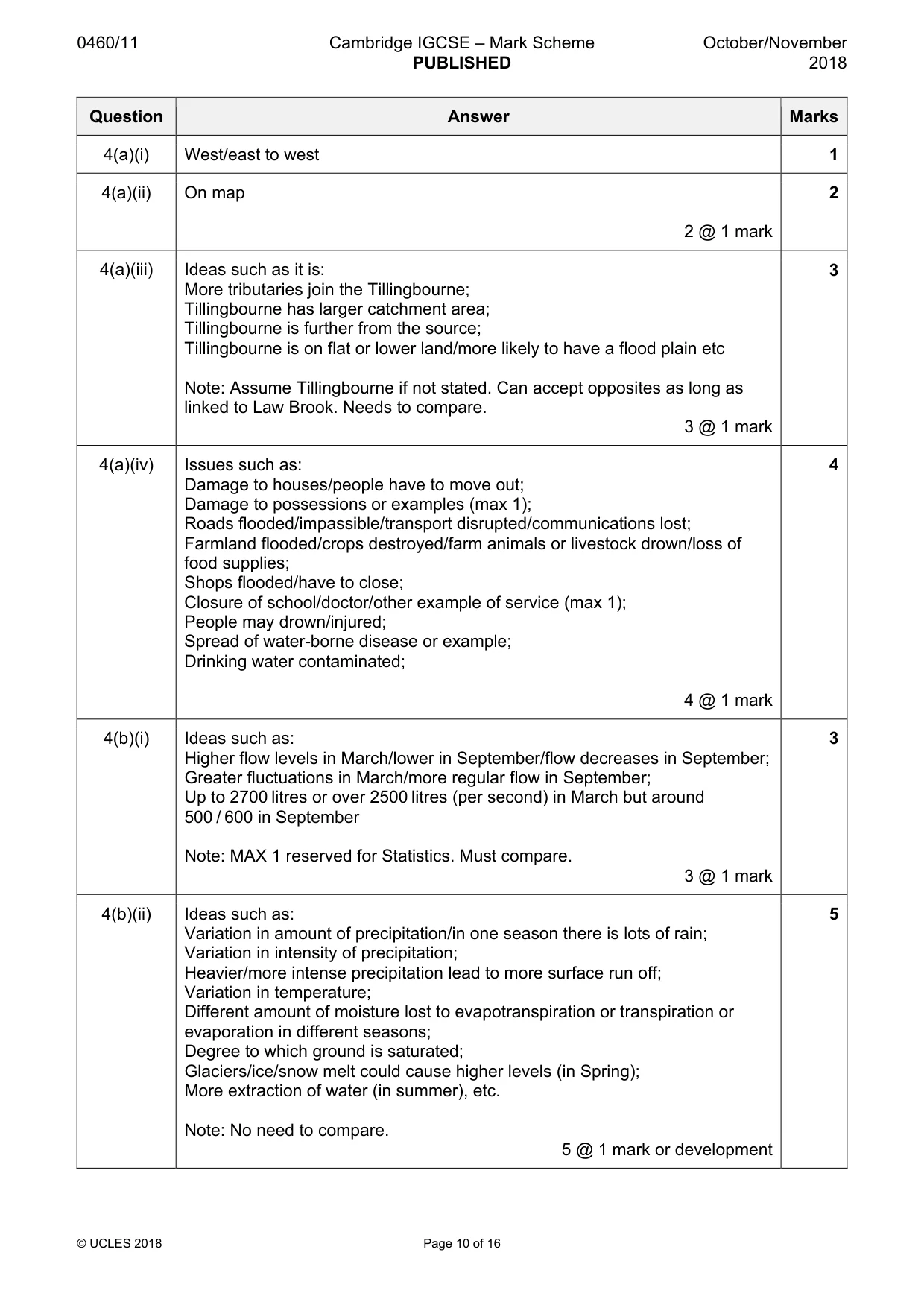
0460/11 Cambridge IGCSE – Mark Scheme PUBLISHED October/November 2018 © UCLES 2018 Page 10 of 16 Question Answer Marks 4(a)(i) West/east to west 1 4(a)(ii) On map 2 @ 1 mark 2 4(a)(iii) Ideas such as it is: More tributaries join the Tillingbourne; Tillingbourne has larger catchment area; Tillingbourne is further from the source; Tillingbourne is on flat or lower land/more likely to have a flood plain etc Note: Assume Tillingbourne if not stated. Can accept opposites as long as linked to Law Brook. Needs to compare. 3 @ 1 mark 3 4(a)(iv) Issues such as: Damage to houses/people have to move out; Damage to possessions or examples (max 1); Roads flooded/impassible/transport disrupted/communications lost; Farmland flooded/crops destroyed/farm animals or livestock drown/loss of food supplies; Shops flooded/have to close; Closure of school/doctor/other example of service (max 1); People may drown/injured; Spread of water-borne disease or example; Drinking water contaminated; 4 @ 1 mark 4 4(b)(i) Ideas such as: Higher flow levels in March/lower in September/flow decreases in September; Greater fluctuations in March/more regular flow in September; Up to 2700 litres or over 2500 litres (per second) in March but around 500 / 600 in September Note: MAX 1 reserved for Statistics. Must compare. 3 @ 1 mark 3 4(b)(ii) Ideas such as: Variation in amount of precipitation/in one season there is lots of rain; Variation in intensity of precipitation; Heavier/more intense precipitation lead to more surface run off; Variation in temperature; Different amount of moisture lost to evapotranspiration or transpiration or evaporation in different seasons; Degree to which ground is saturated; Glaciers/ice/snow melt could cause higher levels (in Spring); More extraction of water (in summer), etc. Note: No need to compare. 5 @ 1 mark or development 5
Mark scheme, page 11
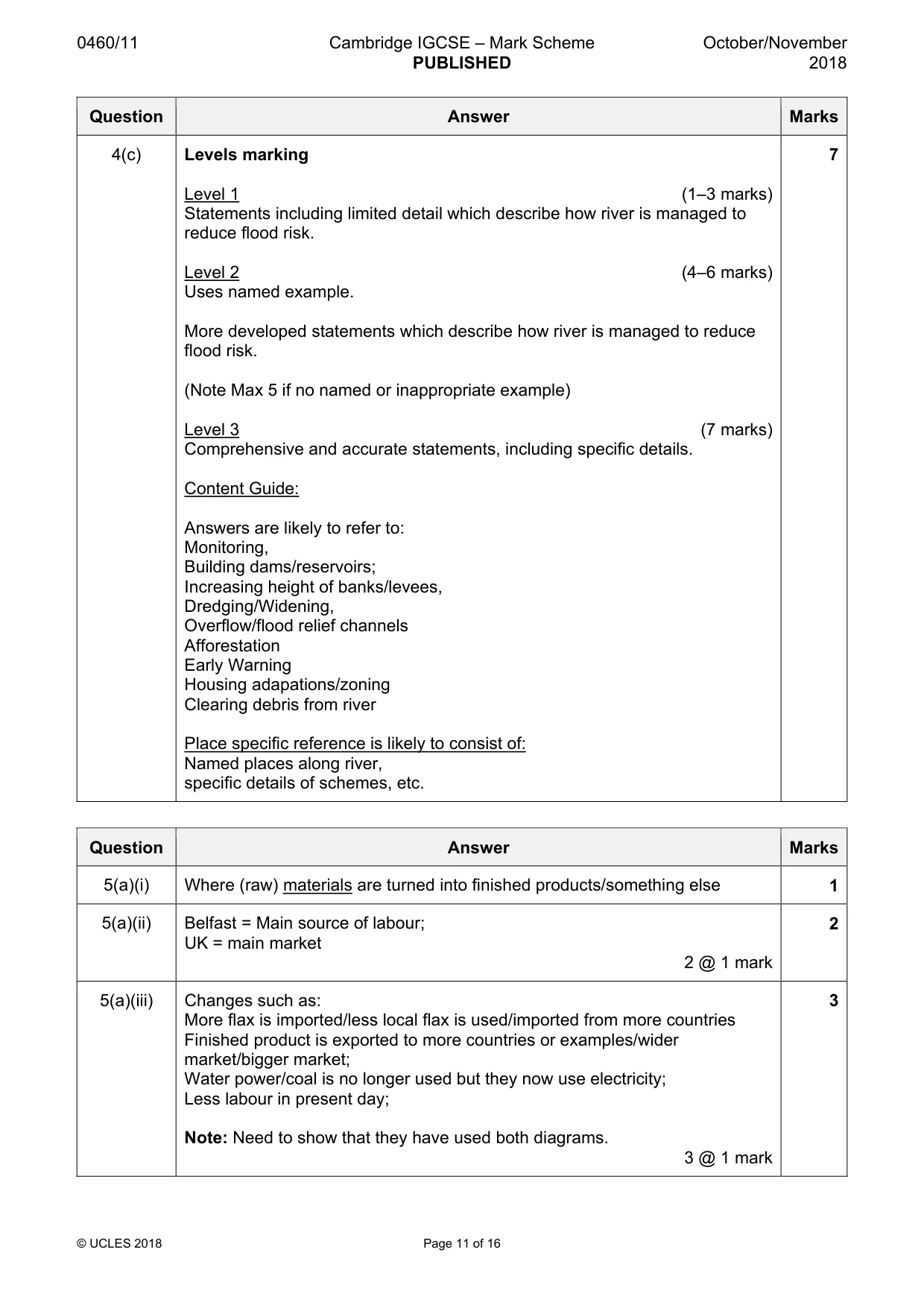
0460/11 Cambridge IGCSE – Mark Scheme PUBLISHED October/November 2018 © UCLES 2018 Page 11 of 16 Question Answer Marks 4(c) Levels marking Level 1 (1–3 marks) Statements including limited detail which describe how river is managed to reduce flood risk. Level 2 (4–6 marks) Uses named example. More developed statements which describe how river is managed to reduce flood risk. (Note Max 5 if no named or inappropriate example) Level 3 (7 marks) Comprehensive and accurate statements, including specific details. Content Guide: Answers are likely to refer to: Monitoring, Building dams/reservoirs; Increasing height of banks/levees, Dredging/Widening, Overflow/flood relief channels Afforestation Early Warning Housing adapations/zoning Clearing debris from river Place specific reference is likely to consist of: Named places along river, specific details of schemes, etc. 7 Question Answer Marks 5(a)(i) Where (raw) materials are turned into finished products/something else 1 5(a)(ii) Belfast = Main source of labour; UK = main market 2 @ 1 mark 2 5(a)(iii) Changes such as: More flax is imported/less local flax is used/imported from more countries Finished product is exported to more countries or examples/wider market/bigger market; Water power/coal is no longer used but they now use electricity; Less labour in present day; Note: Need to show that they have used both diagrams. 3 @ 1 mark 3
Mark scheme, page 12
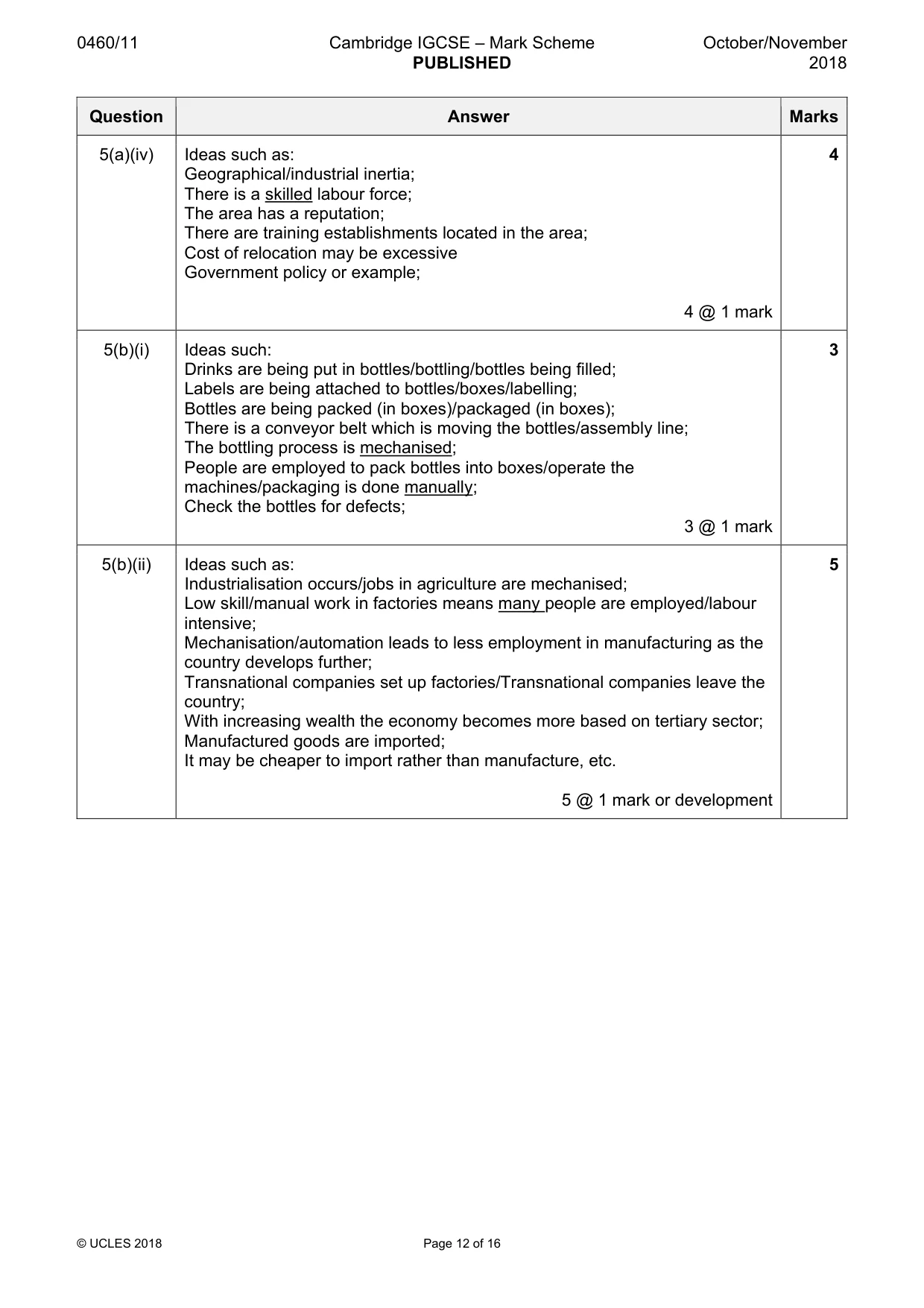
0460/11 Cambridge IGCSE – Mark Scheme PUBLISHED October/November 2018 © UCLES 2018 Page 12 of 16 Question Answer Marks 5(a)(iv) Ideas such as: Geographical/industrial inertia; There is a skilled labour force; The area has a reputation; There are training establishments located in the area; Cost of relocation may be excessive Government policy or example; 4 @ 1 mark 4 5(b)(i) Ideas such: Drinks are being put in bottles/bottling/bottles being filled; Labels are being attached to bottles/boxes/labelling; Bottles are being packed (in boxes)/packaged (in boxes); There is a conveyor belt which is moving the bottles/assembly line; The bottling process is mechanised; People are employed to pack bottles into boxes/operate the machines/packaging is done manually; Check the bottles for defects; 3 @ 1 mark 3 5(b)(ii) Ideas such as: Industrialisation occurs/jobs in agriculture are mechanised; Low skill/manual work in factories means many people are employed/labour intensive; Mechanisation/automation leads to less employment in manufacturing as the country develops further; Transnational companies set up factories/Transnational companies leave the country; With increasing wealth the economy becomes more based on tertiary sector; Manufactured goods are imported; It may be cheaper to import rather than manufacture, etc. 5 @ 1 mark or development 5
Mark scheme, page 13
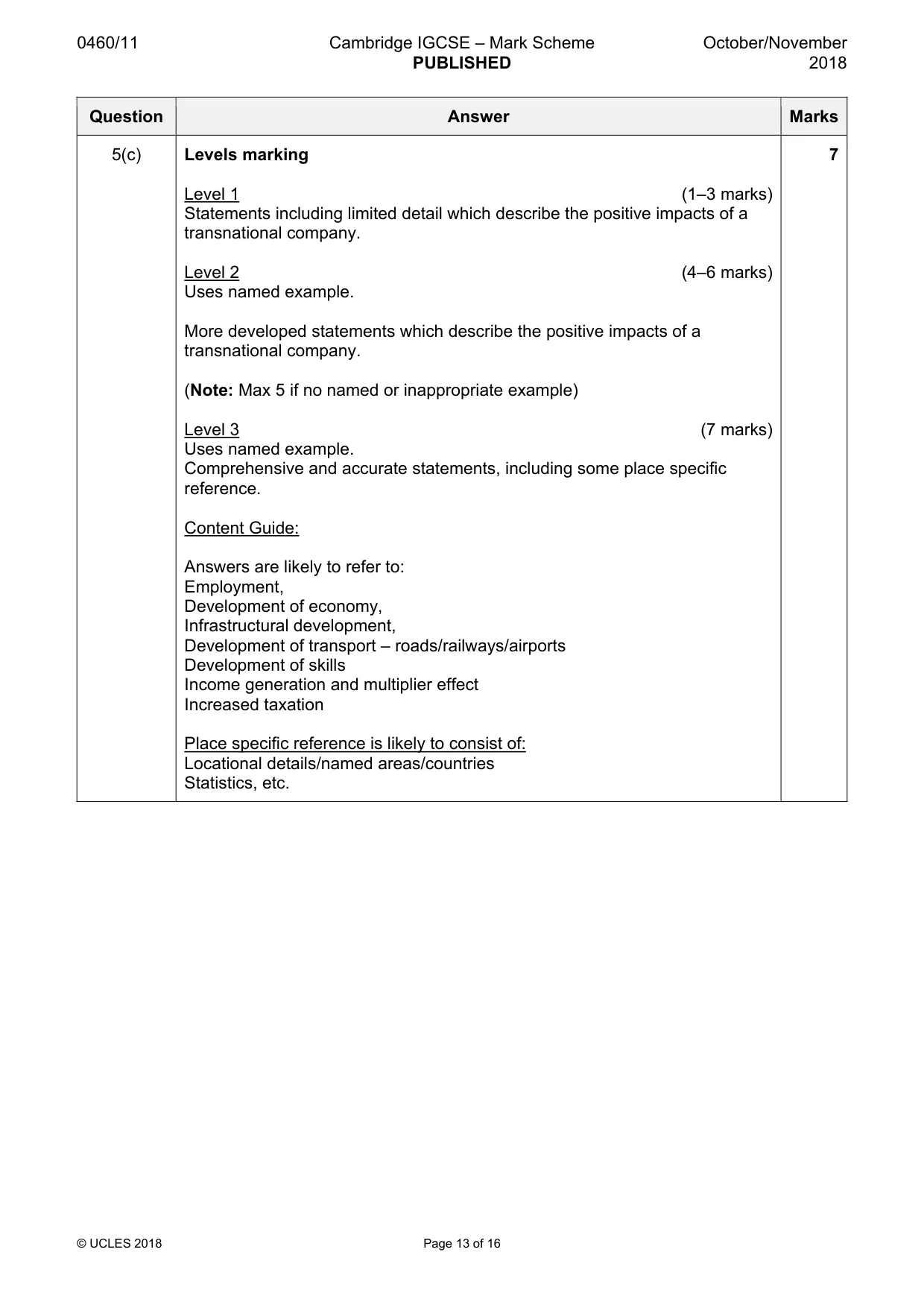
0460/11 Cambridge IGCSE – Mark Scheme PUBLISHED October/November 2018 © UCLES 2018 Page 13 of 16 Question Answer Marks 5(c) Levels marking Level 1 (1–3 marks) Statements including limited detail which describe the positive impacts of a transnational company. Level 2 (4–6 marks) Uses named example. More developed statements which describe the positive impacts of a transnational company. (Note: Max 5 if no named or inappropriate example) Level 3 (7 marks) Uses named example. Comprehensive and accurate statements, including some place specific reference. Content Guide: Answers are likely to refer to: Employment, Development of economy, Infrastructural development, Development of transport – roads/railways/airports Development of skills Income generation and multiplier effect Increased taxation Place specific reference is likely to consist of: Locational details/named areas/countries Statistics, etc. 7
Mark scheme, page 14
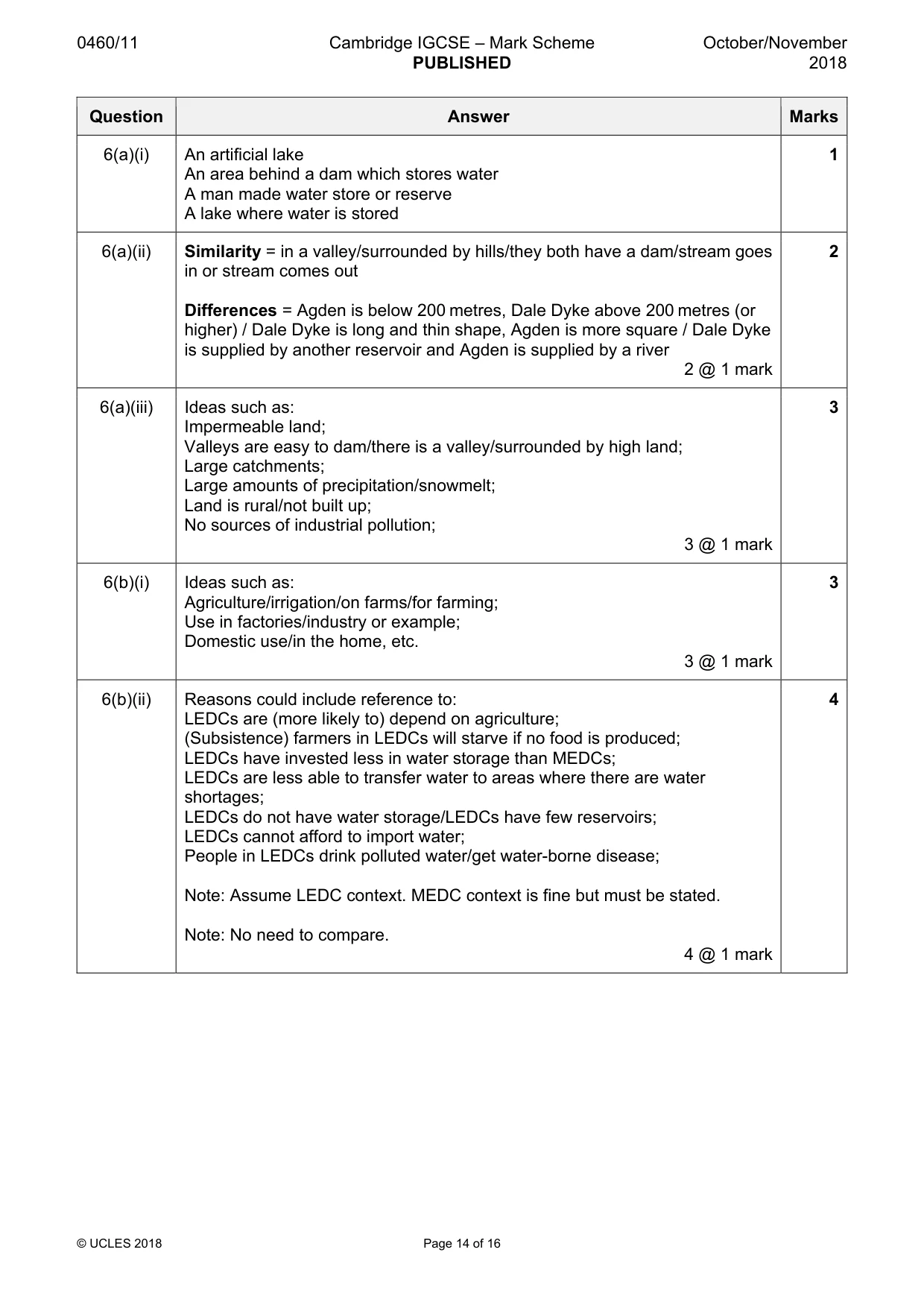
0460/11 Cambridge IGCSE – Mark Scheme PUBLISHED October/November 2018 © UCLES 2018 Page 14 of 16 Question Answer Marks 6(a)(i) An artificial lake An area behind a dam which stores water A man made water store or reserve A lake where water is stored 1 6(a)(ii) Similarity = in a valley/surrounded by hills/they both have a dam/stream goes in or stream comes out Differences = Agden is below 200 metres, Dale Dyke above 200 metres (or higher) / Dale Dyke is long and thin shape, Agden is more square / Dale Dyke is supplied by another reservoir and Agden is supplied by a river 2 @ 1 mark 2 6(a)(iii) Ideas such as: Impermeable land; Valleys are easy to dam/there is a valley/surrounded by high land; Large catchments; Large amounts of precipitation/snowmelt; Land is rural/not built up; No sources of industrial pollution; 3 @ 1 mark 3 6(b)(i) Ideas such as: Agriculture/irrigation/on farms/for farming; Use in factories/industry or example; Domestic use/in the home, etc. 3 @ 1 mark 3 6(b)(ii) Reasons could include reference to: LEDCs are (more likely to) depend on agriculture; (Subsistence) farmers in LEDCs will starve if no food is produced; LEDCs have invested less in water storage than MEDCs; LEDCs are less able to transfer water to areas where there are water shortages; LEDCs do not have water storage/LEDCs have few reservoirs; LEDCs cannot afford to import water; People in LEDCs drink polluted water/get water-borne disease; Note: Assume LEDC context. MEDC context is fine but must be stated. Note: No need to compare. 4 @ 1 mark 4
Mark scheme, page 15
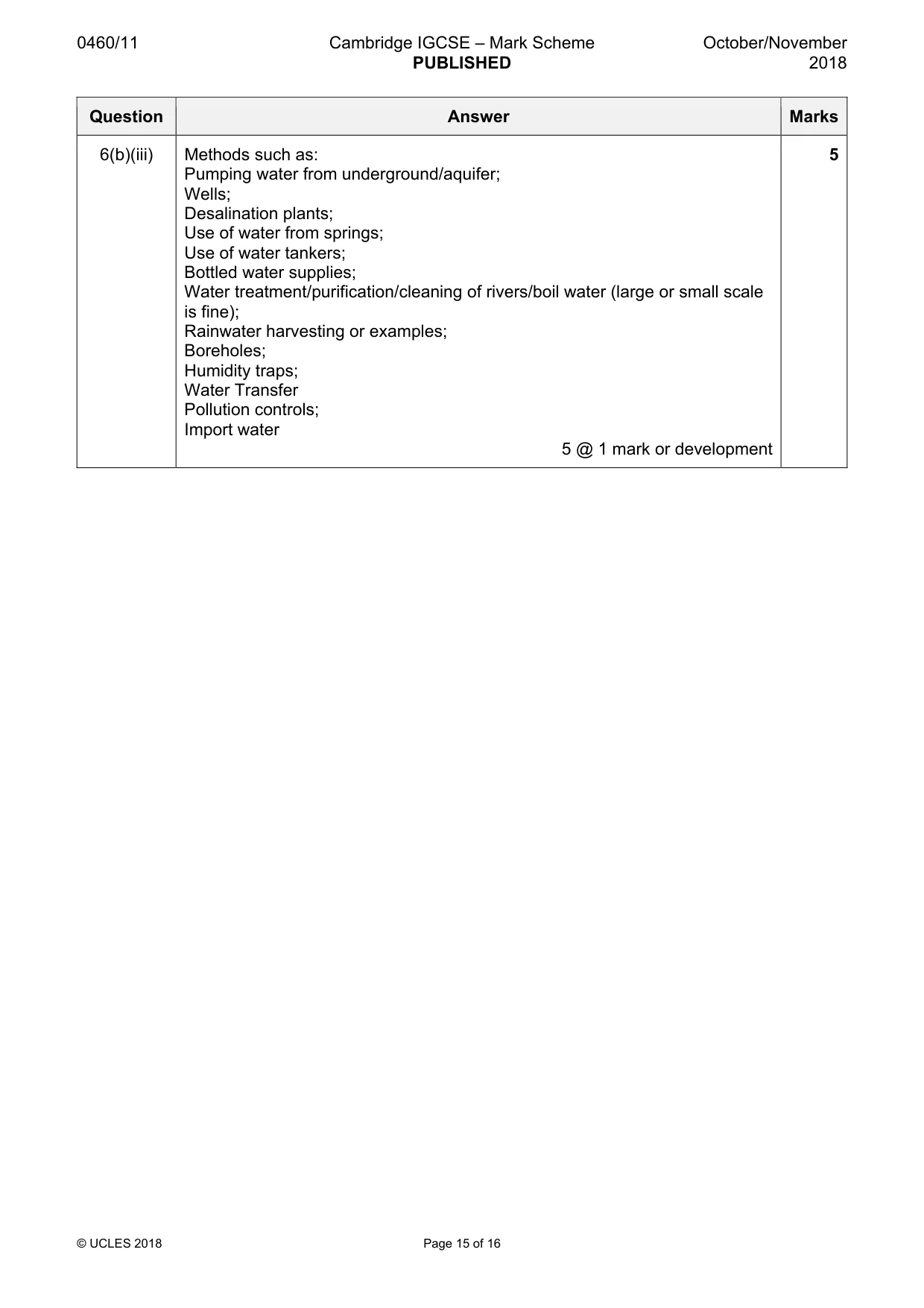
0460/11 Cambridge IGCSE – Mark Scheme PUBLISHED October/November 2018 © UCLES 2018 Page 15 of 16 Question Answer Marks 6(b)(iii) Methods such as: Pumping water from underground/aquifer; Wells; Desalination plants; Use of water from springs; Use of water tankers; Bottled water supplies; Water treatment/purification/cleaning of rivers/boil water (large or small scale is fine); Rainwater harvesting or examples; Boreholes; Humidity traps; Water Transfer Pollution controls; Import water 5 @ 1 mark or development 5
Mark scheme, page 16
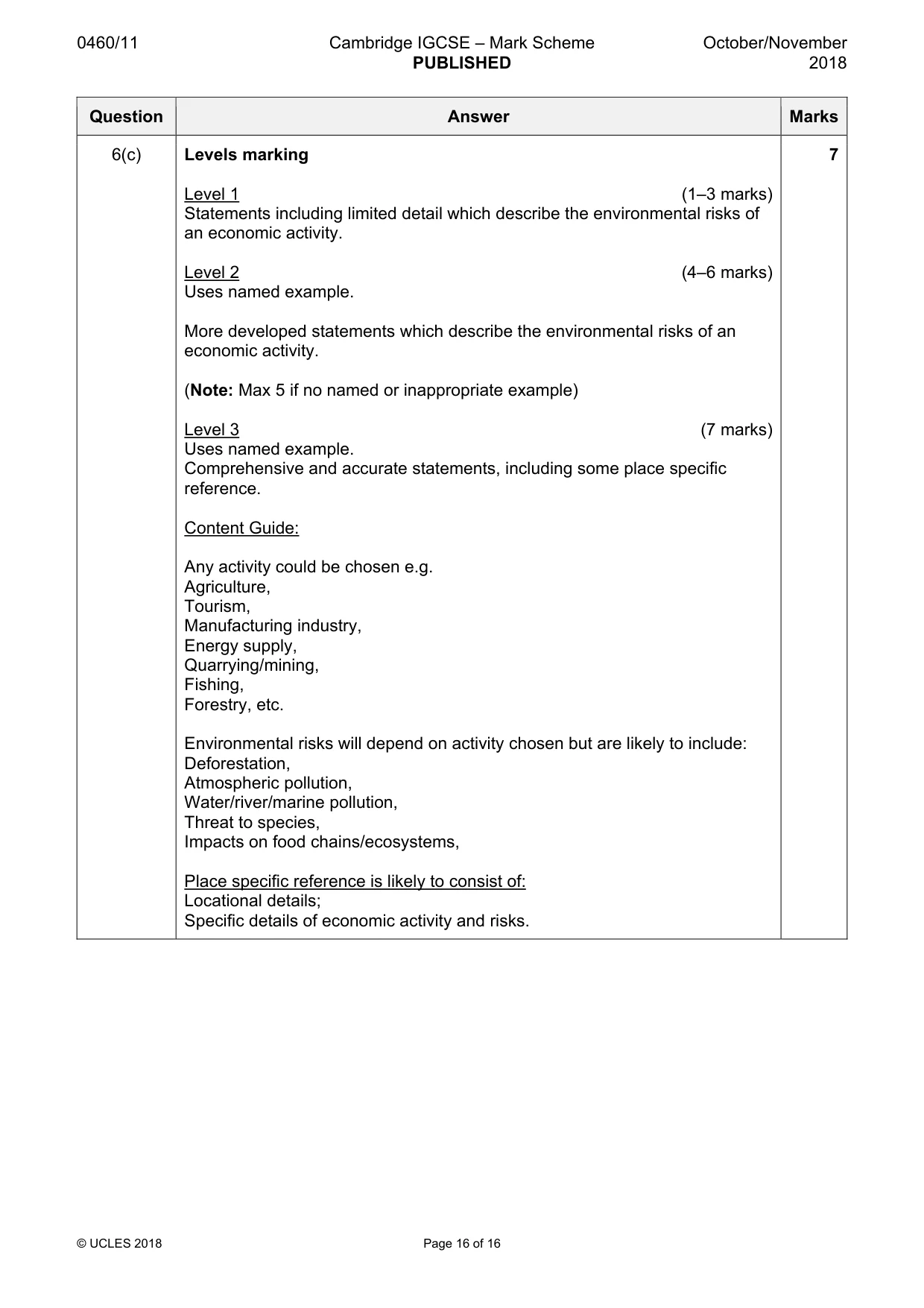
0460/11 Cambridge IGCSE – Mark Scheme PUBLISHED October/November 2018 © UCLES 2018 Page 16 of 16 Question Answer Marks 6(c) Levels marking Level 1 (1–3 marks) Statements including limited detail which describe the environmental risks of an economic activity. Level 2 (4–6 marks) Uses named example. More developed statements which describe the environmental risks of an economic activity. (Note: Max 5 if no named or inappropriate example) Level 3 (7 marks) Uses named example. Comprehensive and accurate statements, including some place specific reference. Content Guide: Any activity could be chosen e.g. Agriculture, Tourism, Manufacturing industry, Energy supply, Quarrying/mining, Fishing, Forestry, etc. Environmental risks will depend on activity chosen but are likely to include: Deforestation, Atmospheric pollution, Water/river/marine pollution, Threat to species, Impacts on food chains/ecosystems, Place specific reference is likely to consist of: Locational details; Specific details of economic activity and risks. 7
What you needed in this session
Cambridge’s own grade thresholds for 2018 Oct/Nov, Paper 1 · Variant 1. A higher threshold means an easier paper — the bar moves with how the cohort did.