Cambridge IGCSE Geography 0460 — 2018 Oct/Nov Paper 1 · Variant 2
0460/12/O/N/18 · 75 marks · ≈84 min
The question paper and its mark scheme, free to read here and free to download. This is Cambridge’s own paper, exactly as it was sat.
Question paper32 pages







Mark scheme18 pages
Answers below. Sit the paper first if you are practising.
Paper as text
Question paper, page 1
This document consists of 31 printed pages, 1 blank page and 1 Insert. DC (NH/CGW) 154059/7 © UCLES 2018 [Turn over * 7 2 9 8 4 4 4 0 8 2 * GEOGRAPHY 0460/12 Paper 1 October/November 2018 1 hour 45 minutes Candidates answer on the Question Paper. Additional Materials: Ruler Calculator READ THESE INSTRUCTIONS FIRST Write your Centre number, candidate number and name in the spaces provided. Write in dark blue or black pen. You may use an HB pencil for any diagrams or graphs. Do not use staples, paper clips, glue or correction fluid. DO NOT WRITE IN ANY BARCODES. Write your answer to each question in the space provided. If additional space is required, you should use the lined pages at the end of this booklet. The question number(s) must be clearly shown. Answer three questions, one from each section. The Insert contains Figs. 3.2, 3.3 and 3.4 for Question 3, Fig. 5.2 for Question 5, and Figs. 6.2, 6.3, 6.4 and 6.5 for Question 6. The Insert is not required by the Examiner. Sketch maps and diagrams should be drawn whenever they serve to illustrate an answer. At the end of the examination, fasten all your work securely together. The number of marks is given in brackets [ ] at the end of each question or part question. Definitions MEDCs – More Economically Developed Countries LEDCs – Less Economically Developed Countries This syllabus is approved for use in England, Wales and Northern Ireland as a Cambridge International Level 1/Level 2 Certificate. Cambridge International Examinations Cambridge International General Certificate of Secondary Education
Question paper, page 2
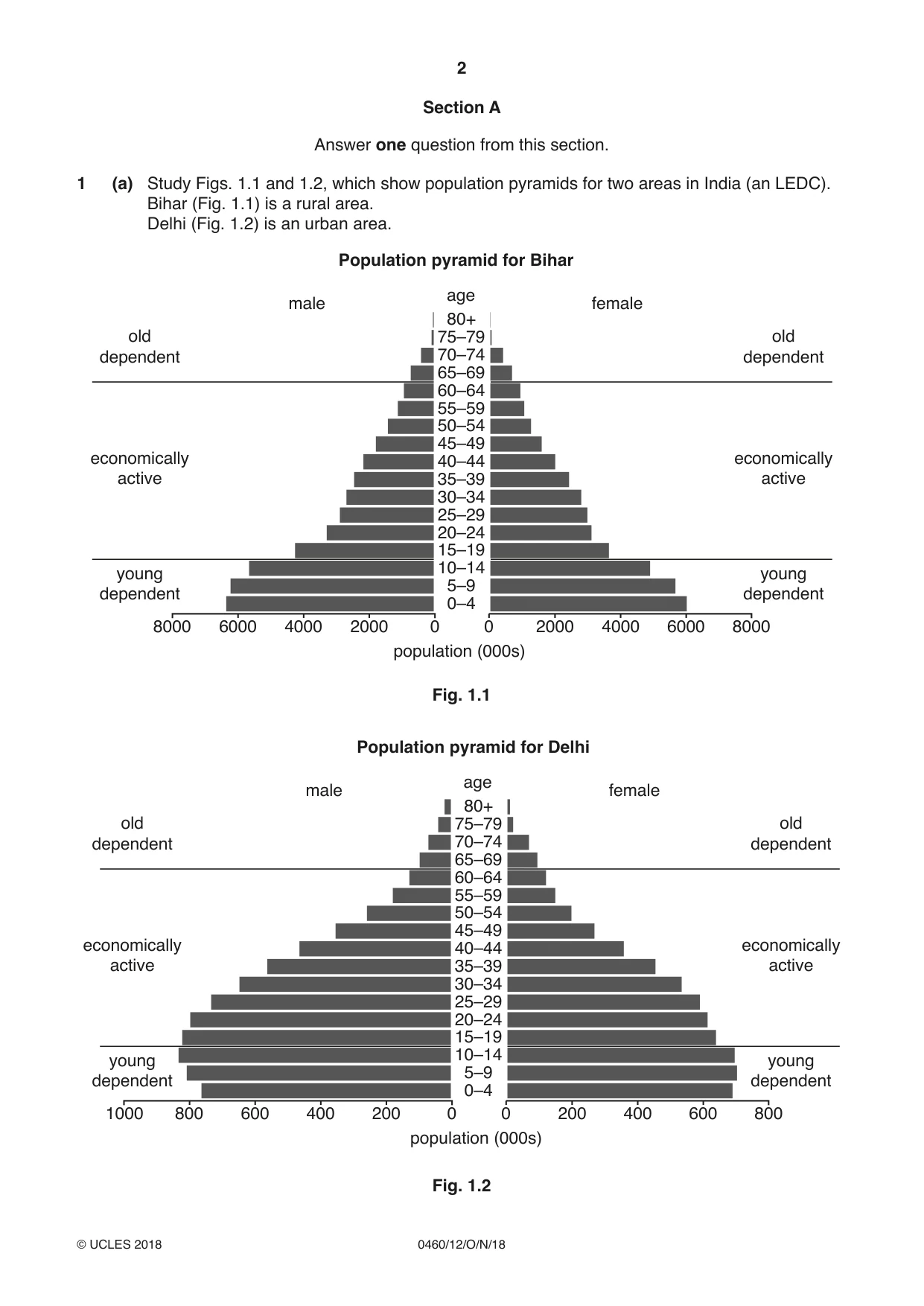
2 0460/12/O/N/18 © UCLES 2018 Section A Answer one question from this section. 1 (a) Study Figs. 1.1 and 1.2, which show population pyramids for two areas in India (an LEDC). Bihar (Fig. 1.1) is a rural area. Delhi (Fig. 1.2) is an urban area. 0 2000 4000 6000 8000 female Population pyramid for Bihar male 0 2000 4000 8000 6000 80+ 75–79 70–74 65–69 60–64 55–59 50–54 45–49 40–44 35–39 30–34 25–29 20–24 15–19 10–14 5–9 0–4 economically active young dependent old dependent economically active young dependent old dependent population (000s) age Fig. 1.1 0 200 400 600 800 female economically active young dependent old dependent economically active young dependent old dependent Population pyramid for Delhi population (000s) male 0 200 400 800 1000 600 80+ 75–79 70–74 65–69 60–64 55–59 50–54 45–49 40–44 35–39 30–34 25–29 20–24 15–19 10–14 5–9 0–4 age Fig. 1.2
Question paper, page 3
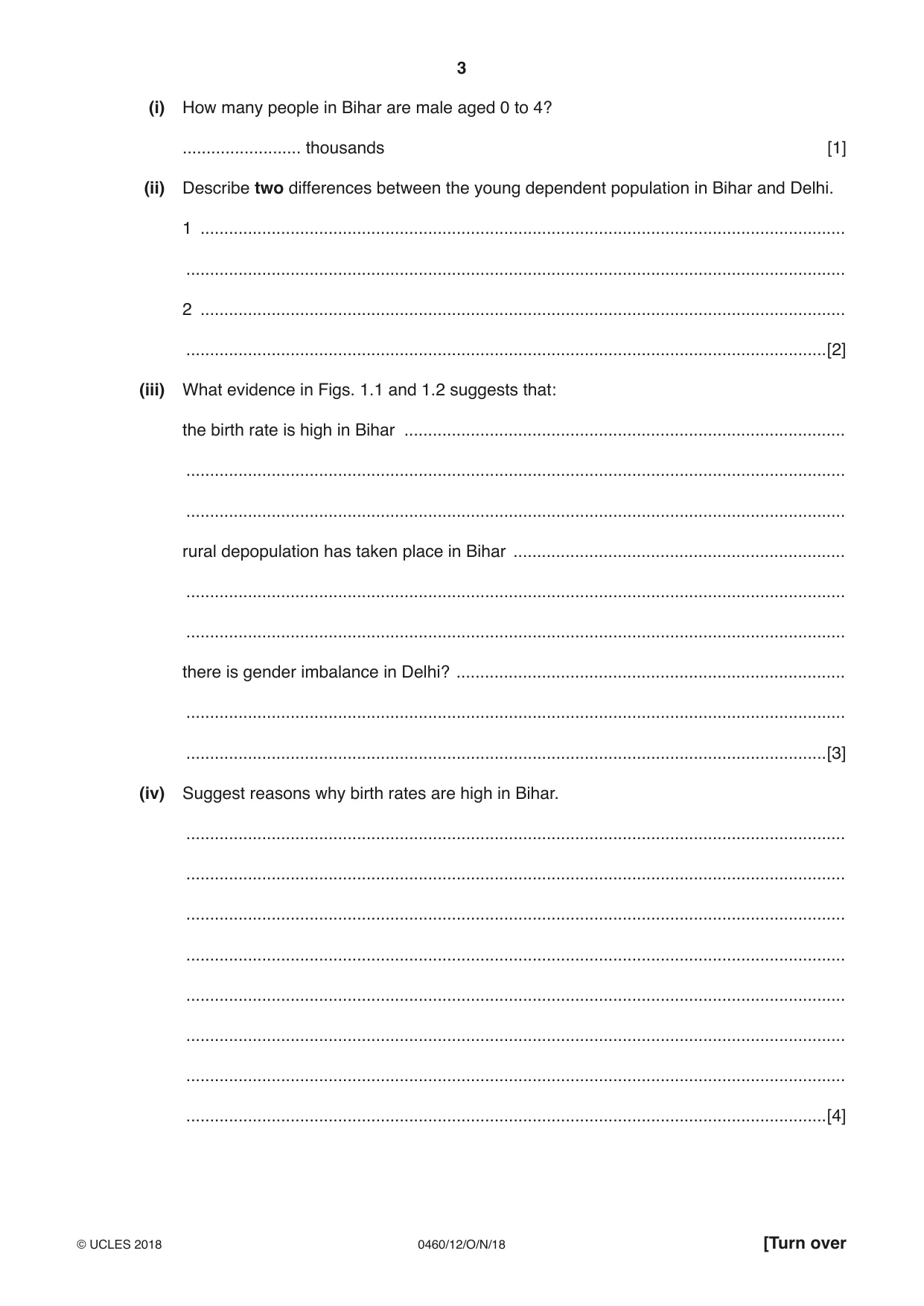
3 0460/12/O/N/18 © UCLES 2018 [Turn over (i) How many people in Bihar are male aged 0 to 4? … thousands [1] (ii) Describe two differences between the young dependent population in Bihar and Delhi. 1 … … 2 … …[2] (iii) What evidence in Figs. 1.1 and 1.2 suggests that: the birth rate is high in Bihar … … … rural depopulation has taken place in Bihar … … … there is gender imbalance in Delhi? … … …[3] (iv) Suggest reasons why birth rates are high in Bihar. … … … … … … … …[4]
Question paper, page 4
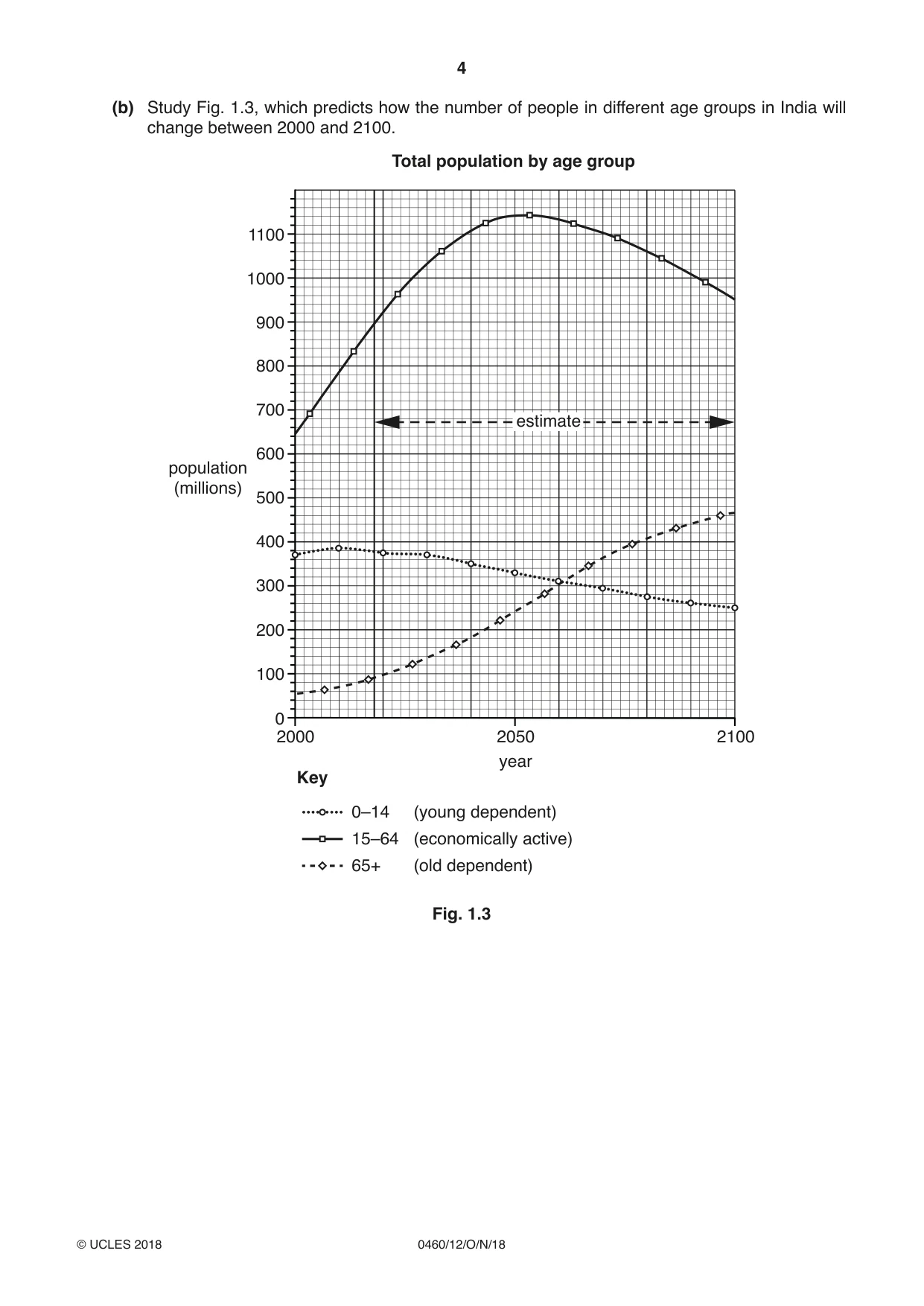
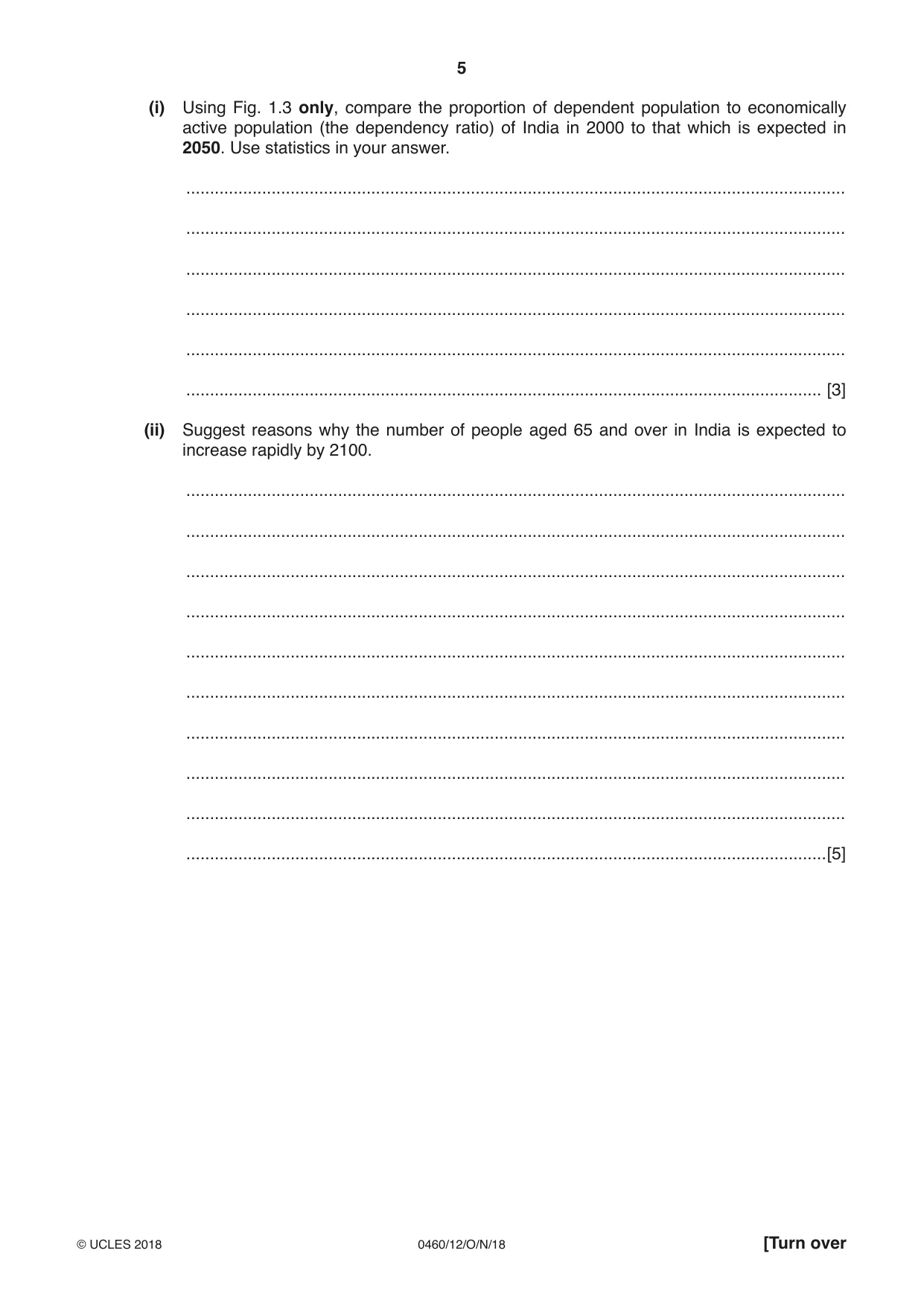
4 0460/12/O/N/18 © UCLES 2018 (b) Study Fig. 1.3, which predicts how the number of people in different age groups in India will change between 2000 and 2100. 2000 0 100 200 300 400 500 600 700 800 900 1000 1100 Total population by age group Key 15–64 0–14 65+ (young dependent) (economically active) (old dependent) 2050 year population (millions) 2100 estimate Fig. 1.3
Question paper, page 5
5 0460/12/O/N/18 © UCLES 2018 [Turn over (i) Using Fig. 1.3 only, compare the proportion of dependent population to economically active population (the dependency ratio) of India in 2000 to that which is expected in 2050. Use statistics in your answer. … … … … … … [3] (ii) Suggest reasons why the number of people aged 65 and over in India is expected to increase rapidly by 2100. … … … … … … … … … …[5]
Question paper, page 6
6 0460/12/O/N/18 © UCLES 2018 (c) For a named country you have studied, describe the problems caused by an increase in its dependent population. Name of country … … … … … … … … … … … … … … … … … … … … … … … … …[7] [Total: 25]
Question paper, page 7
7 0460/12/O/N/18 © UCLES 2018 [Turn over TURN PAGE FOR QUESTION 2
Question paper, page 8
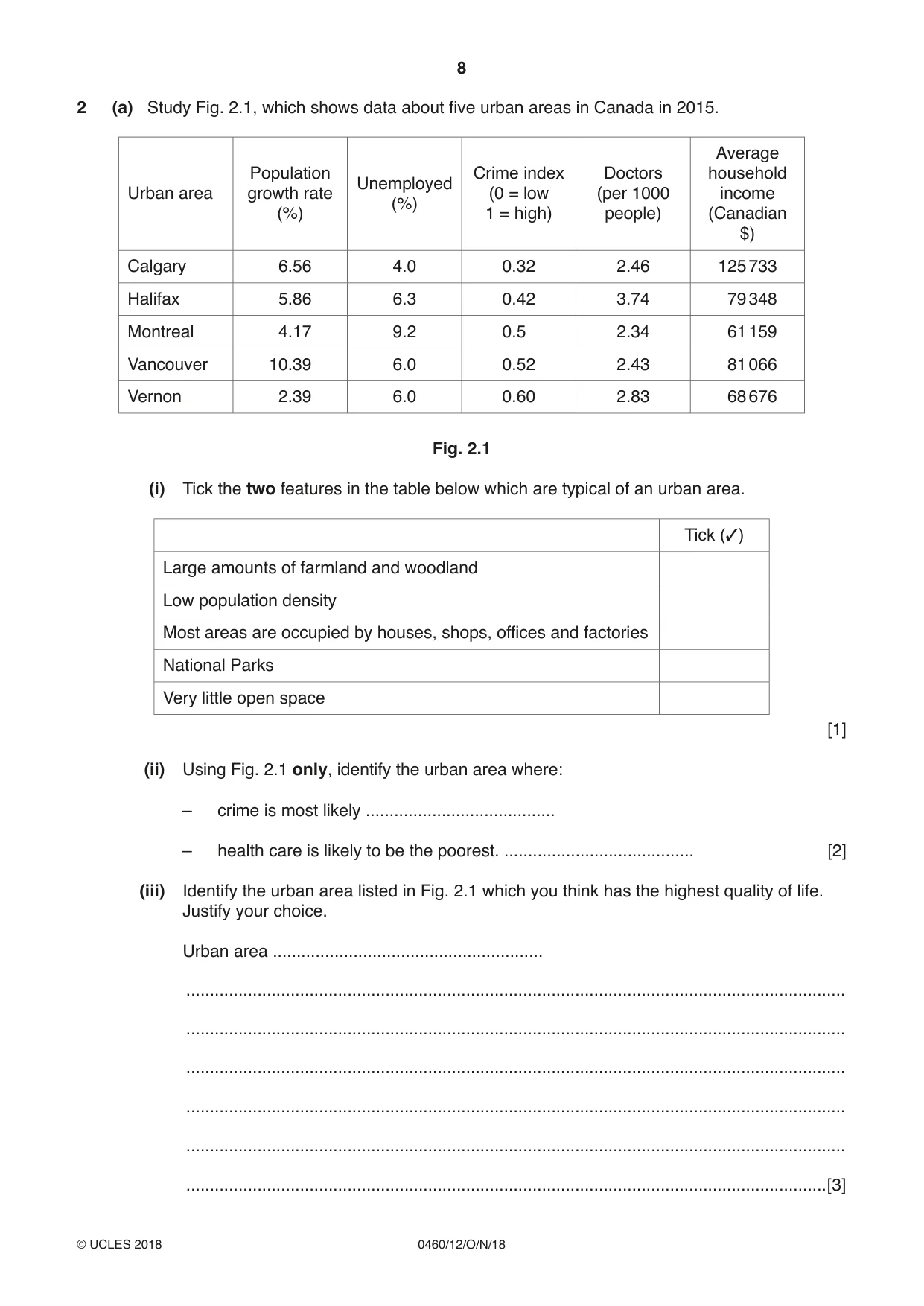
8 0460/12/O/N/18 © UCLES 2018 2 (a) Study Fig. 2.1, which shows data about five urban areas in Canada in 2015. Urban area Population growth rate (%) Unemployed (%) Crime index (0 = low 1 = high) Doctors (per 1000 people) Average household income (Canadian $) Calgary 6.56 4.0 0.32 2.46 125 733 Halifax 5.86 6.3 0.42 3.74 79 348 Montreal 4.17 9.2 0.50 2.34 61 159 Vancouver 10.39 6.0 0.52 2.43 81 066 Vernon 2.39 6.0 0.60 2.83 68 676 Fig. 2.1 (i) Tick the two features in the table below which are typical of an urban area. Tick (3) Large amounts of farmland and woodland Low population density Most areas are occupied by houses, shops, offices and factories National Parks Very little open space [1] (ii) Using Fig. 2.1 only, identify the urban area where: – crime is most likely … – health care is likely to be the poorest. … [2] (iii) Identify the urban area listed in Fig. 2.1 which you think has the highest quality of life. Justify your choice. Urban area … … … … … … …[3]
Question paper, page 9
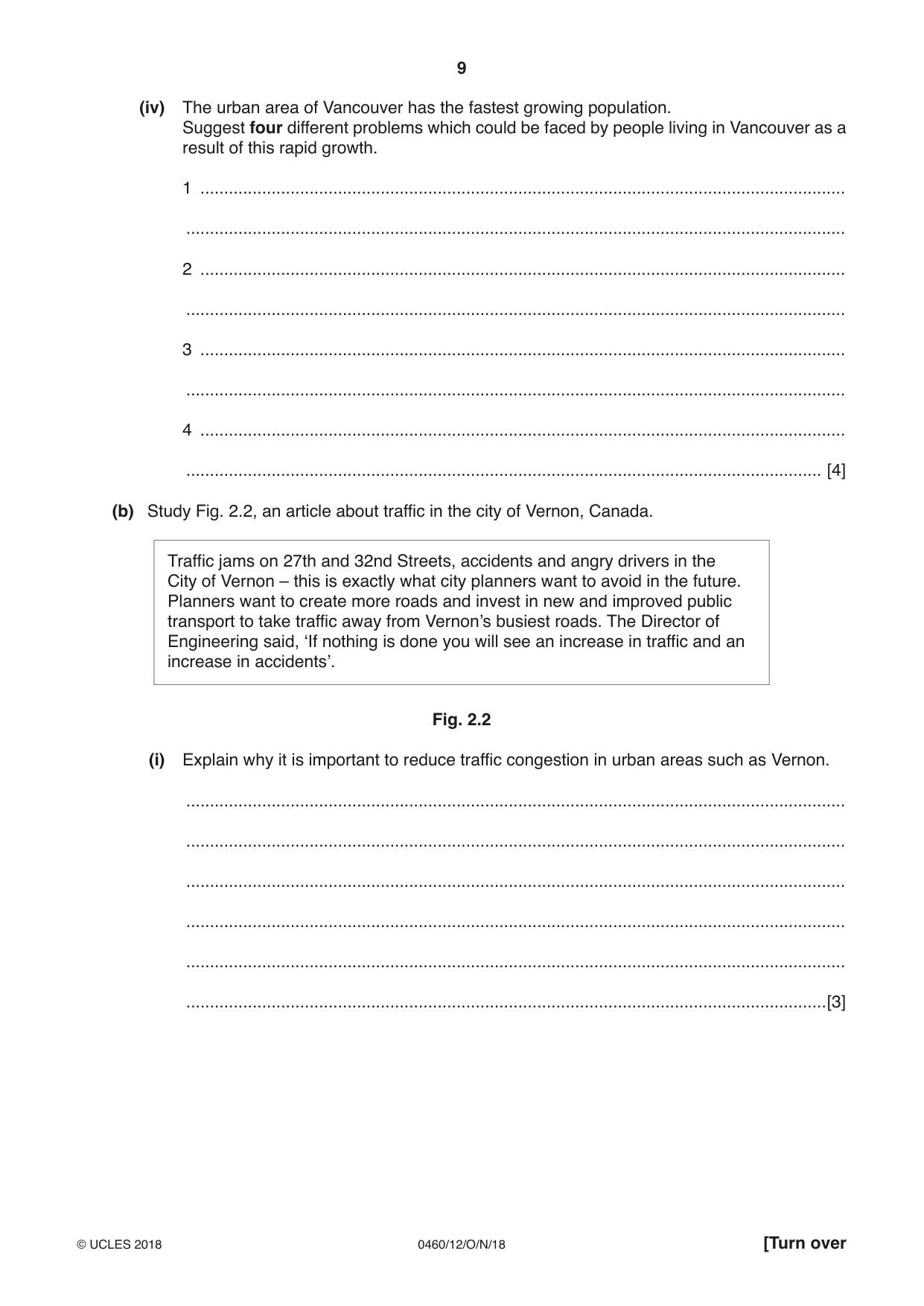
9 0460/12/O/N/18 © UCLES 2018 [Turn over (iv) The urban area of Vancouver has the fastest growing population. Suggest four different problems which could be faced by people living in Vancouver as a result of this rapid growth. 1 … … 2 … … 3 … … 4 … … [4] (b) Study Fig. 2.2, an article about traffic in the city of Vernon, Canada. Traffic jams on 27th and 32nd Streets, accidents and angry drivers in the City of Vernon – this is exactly what city planners want to avoid in the future. Planners want to create more roads and invest in new and improved public transport to take traffic away from Vernon’s busiest roads. The Director of Engineering said, ‘If nothing is done you will see an increase in traffic and an increase in accidents’. Fig. 2.2 (i) Explain why it is important to reduce traffic congestion in urban areas such as Vernon. … … … … … …[3]
Question paper, page 10
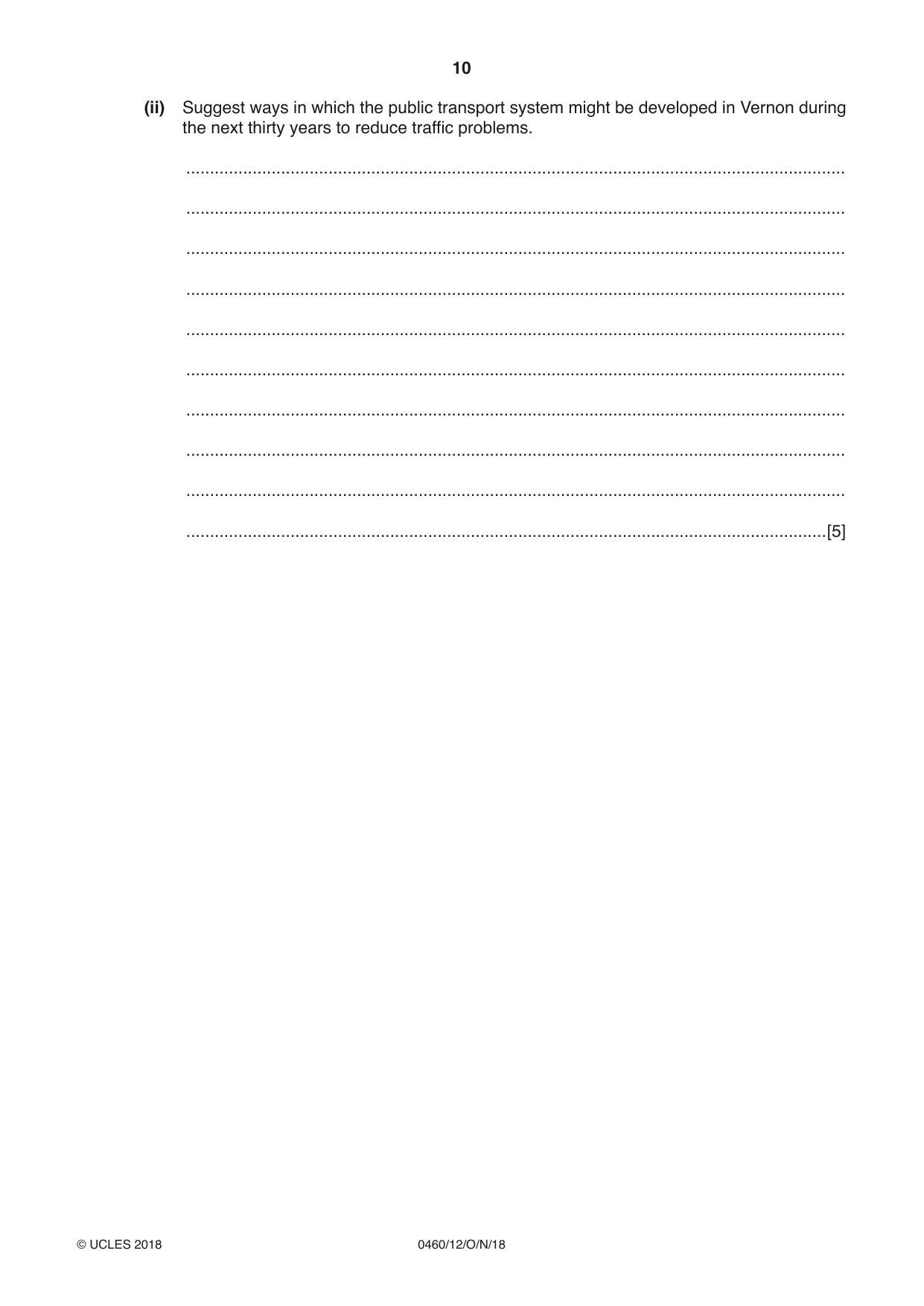
10 0460/12/O/N/18 © UCLES 2018 (ii) Suggest ways in which the public transport system might be developed in Vernon during the next thirty years to reduce traffic problems. … … … … … … … … … …[5]
Question paper, page 11
11 0460/12/O/N/18 © UCLES 2018 [Turn over (c) For a named urban area you have studied, describe a change in land use and explain why this change in land use has caused conflict. Name of urban area … … … … … … … … … … … … … … … … … … … … … … … … …[7] [Total: 25]
Question paper, page 12
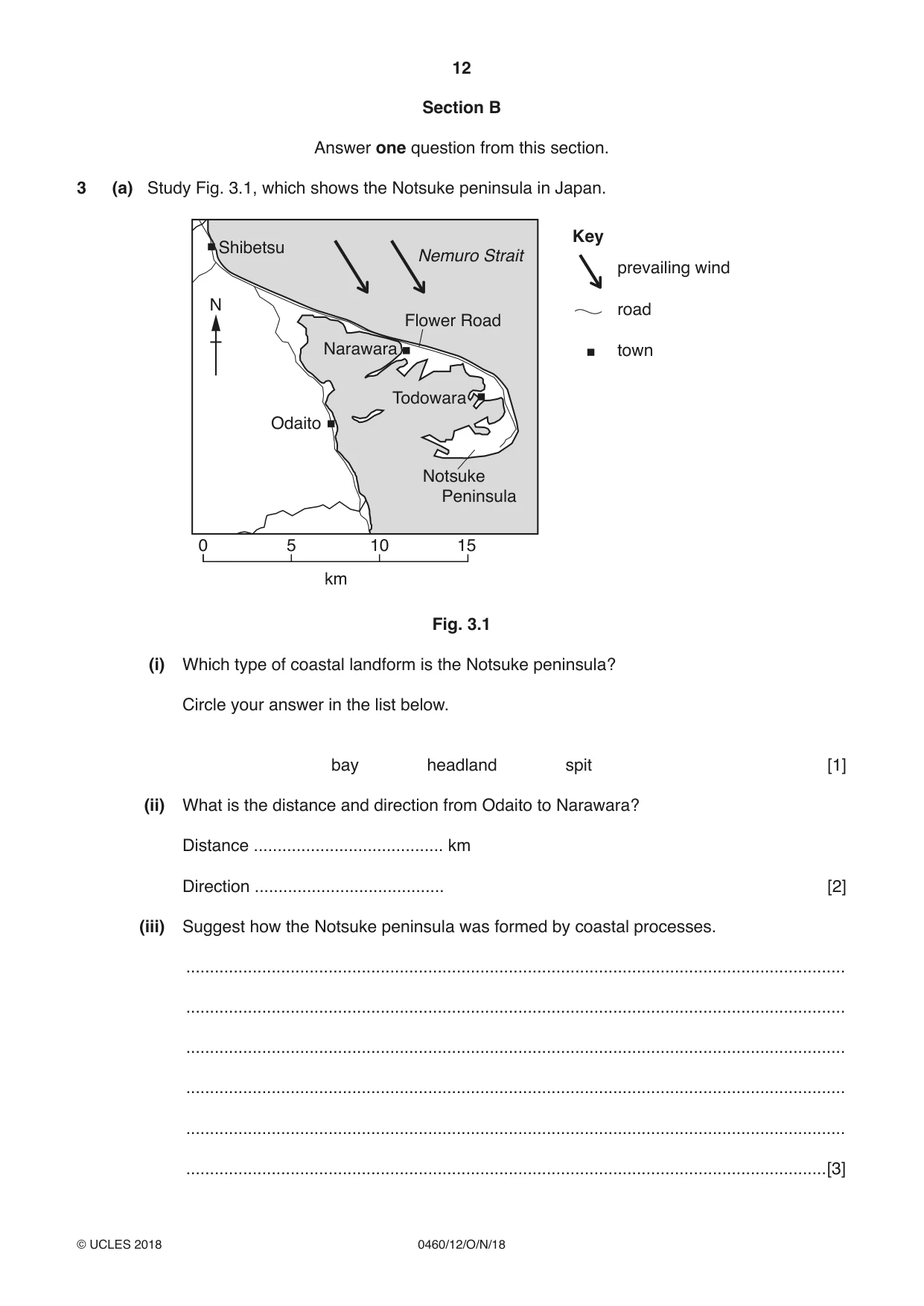
12 0460/12/O/N/18 © UCLES 2018 Section B Answer one question from this section. 3 (a) Study Fig. 3.1, which shows the Notsuke peninsula in Japan. Shibetsu Odaito Narawara Todowara 0 5 10 km 15 Notsuke Peninsula Flower Road prevailing wind road town Key Nemuro Strait N Fig. 3.1 (i) Which type of coastal landform is the Notsuke peninsula? Circle your answer in the list below. bay headland spit [1] (ii) What is the distance and direction from Odaito to Narawara? Distance … km Direction … [2] (iii) Suggest how the Notsuke peninsula was formed by coastal processes. … … … … … …[3]
Question paper, page 13
13 0460/12/O/N/18 © UCLES 2018 [Turn over (iv) There are large areas of sand dunes on the Notsuke peninsula. Explain how sand dunes are formed. … … … … … … … …[4] (b) Study Figs. 3.2, 3.3 and 3.4 (Insert), which are photographs taken on a coastline. (i) Using information from Figs. 3.2, 3.3 and 3.4 only, identify three opportunities which coastlines provide for people. 1 … … 2 … … 3 … …[3] (ii) Coastlines experience hazards such as coastal erosion and tropical storms. Describe the problems which may be faced by people as a result of these hazards. Coastal erosion … … … … … Tropical storms … … … … …[5]
Question paper, page 14
14 0460/12/O/N/18 © UCLES 2018 (c) Explain the formation of a cliff and wave-cut platform. You should include a labelled diagram or series of diagrams. … … … … … … … … … … … … … … [7] [Total: 25]
Question paper, page 15
15 0460/12/O/N/18 © UCLES 2018 [Turn over TURN PAGE FOR QUESTION 4
Question paper, page 16
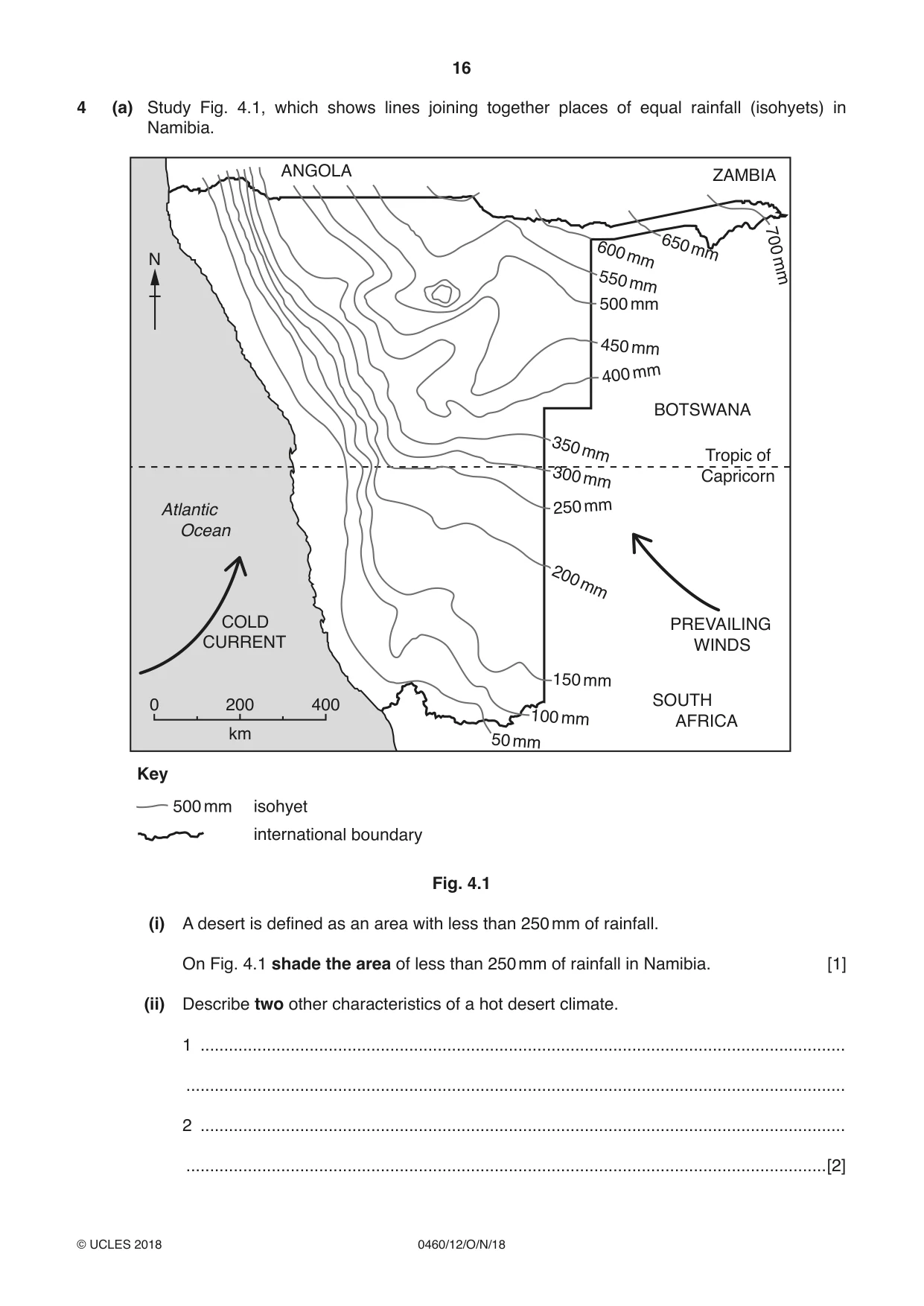
16 0460/12/O/N/18 © UCLES 2018 4 (a) Study Fig. 4.1, which shows lines joining together places of equal rainfall (isohyets) in Namibia. 400 mm 300 mm 350 mm 250 mm 200 mm 150 mm 100 mm 50 mm 450 mm 500 mm 550 mm 600 mm 650 mm 700 mm ZAMBIA Tropic of Capricorn Atlantic Ocean BOTSWANA COLD CURRENT PREVAILING WINDS SOUTH AFRICA 0 200 km 400 ANGOLA N 500 mm isohyet international boundary Key Fig. 4.1 (i) A desert is defined as an area with less than 250 mm of rainfall. On Fig. 4.1 shade the area of less than 250 mm of rainfall in Namibia. [1] (ii) Describe two other characteristics of a hot desert climate. 1 … … 2 … …[2]
Question paper, page 17
17 0460/12/O/N/18 © UCLES 2018 [Turn over (iii) Explain why there is a large area of hot desert in Namibia by referring to the following factors shown in Fig. 4.1: latitude … … … the prevailing winds … … … the ocean current. … … …[3] (iv) Explain why a hot desert may form near mountains (in a rain shadow). … … … … … … … …[4]
Question paper, page 18
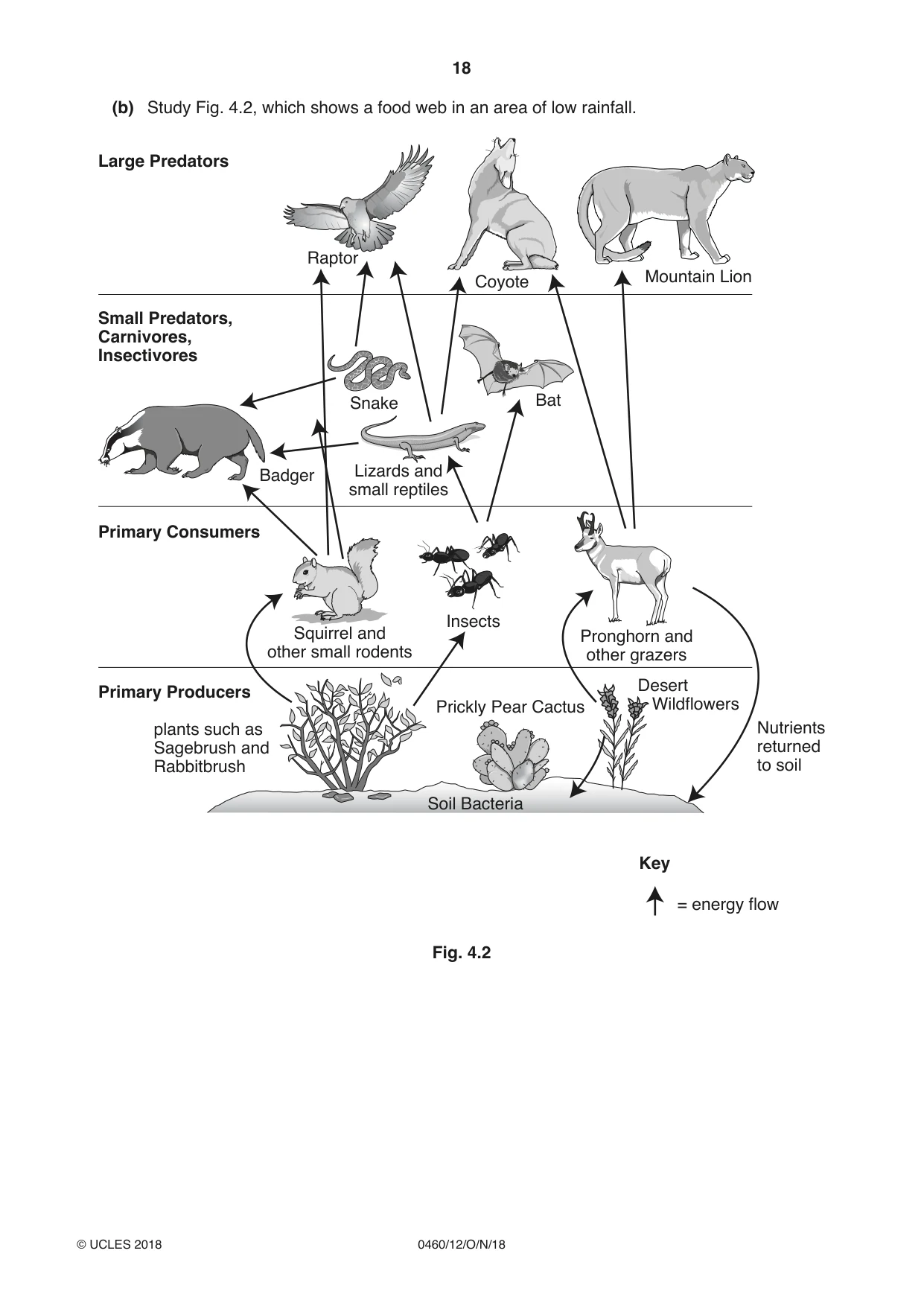
18 0460/12/O/N/18 © UCLES 2018 (b) Study Fig. 4.2, which shows a food web in an area of low rainfall. Badger Raptor Coyote Mountain Lion Snake Small Predators, Carnivores, Insectivores Large Predators Primary Consumers Lizards and small reptiles Squirrel and other small rodents plants such as Sagebrush and Rabbitbrush = energy flow Soil Bacteria Prickly Pear Cactus Nutrients returned to soil Desert Wildflowers Insects Pronghorn and other grazers Bat Primary Producers Key Fig. 4.2
Question paper, page 19
19 0460/12/O/N/18 © UCLES 2018 [Turn over (i) Using Fig. 4.2, describe three different ways in which the natural vegetation, soil and wildlife are dependent on each other. 1 … … 2 … … 3 … …[3] (ii) Describe the characteristics of vegetation which make it able to survive in areas where rainfall is low. … … … … … … … … … …[5]
Question paper, page 20
20 0460/12/O/N/18 © UCLES 2018 (c) For a named area of tropical rainforest you have studied, describe and explain the characteristics of the vegetation. Name of area of tropical rainforest … … … … … … … … … … … … … … … … … … … … … … … …[7] [Total: 25]
Question paper, page 21
21 0460/12/O/N/18 © UCLES 2018 [Turn over TURN PAGE FOR QUESTION 5
Question paper, page 22
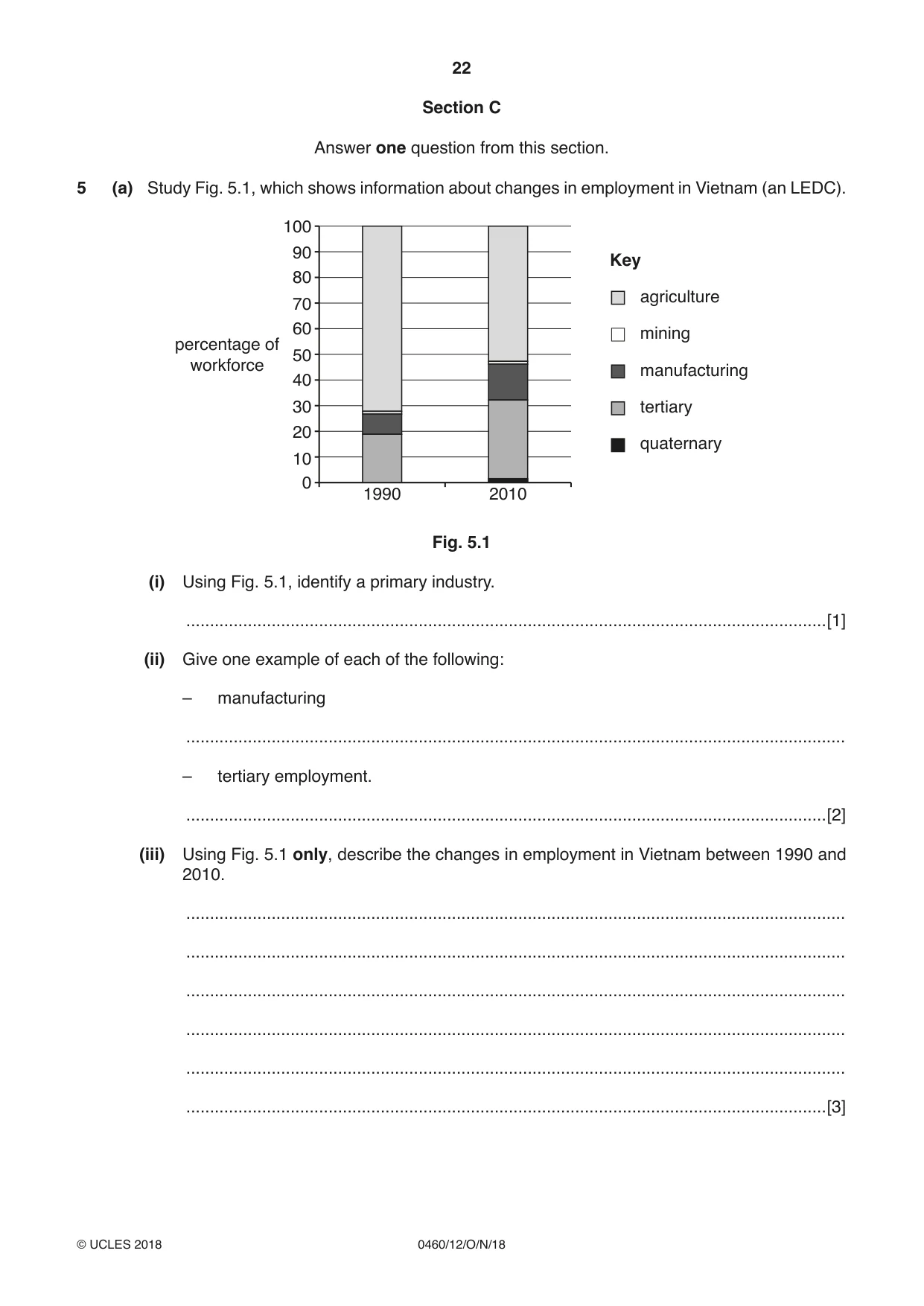
22 0460/12/O/N/18 © UCLES 2018 Section C Answer one question from this section. 5 (a) Study Fig. 5.1, which shows information about changes in employment in Vietnam (an LEDC). 100 90 80 70 60 50 percentage of workforce 40 20 10 1990 2010 0 30 agriculture Key mining manufacturing tertiary quaternary Fig. 5.1 (i) Using Fig. 5.1, identify a primary industry. …[1] (ii) Give one example of each of the following: – manufacturing … – tertiary employment. …[2] (iii) Using Fig. 5.1 only, describe the changes in employment in Vietnam between 1990 and 2010. … … … … … …[3]
Question paper, page 23
23 0460/12/O/N/18 © UCLES 2018 [Turn over (iv) Explain why the employment structure of a country changes as it develops. … … … … … … … …[4]
Question paper, page 24
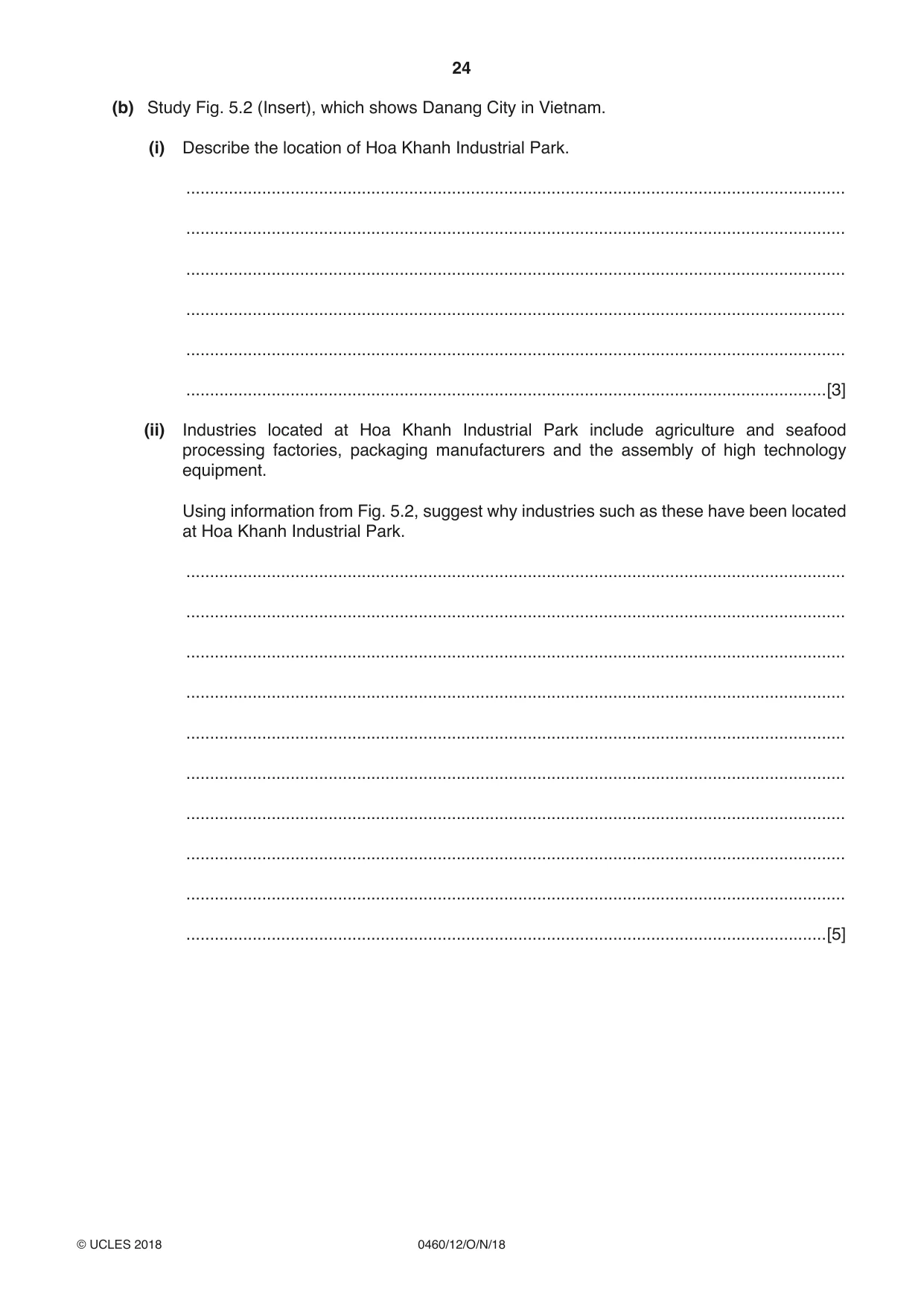
24 0460/12/O/N/18 © UCLES 2018 (b) Study Fig. 5.2 (Insert), which shows Danang City in Vietnam. (i) Describe the location of Hoa Khanh Industrial Park. … … … … … …[3] (ii) Industries located at Hoa Khanh Industrial Park include agriculture and seafood processing factories, packaging manufacturers and the assembly of high technology equipment. Using information from Fig. 5.2, suggest why industries such as these have been located at Hoa Khanh Industrial Park. … … … … … … … … … …[5]
Question paper, page 25
25 0460/12/O/N/18 © UCLES 2018 [Turn over (c) For a country or area which you have studied, describe the importance of different methods of energy supply. Name of country or area … … … … … … … … … … … … … … … … … … … … … … …[7] [Total: 25]
Question paper, page 26
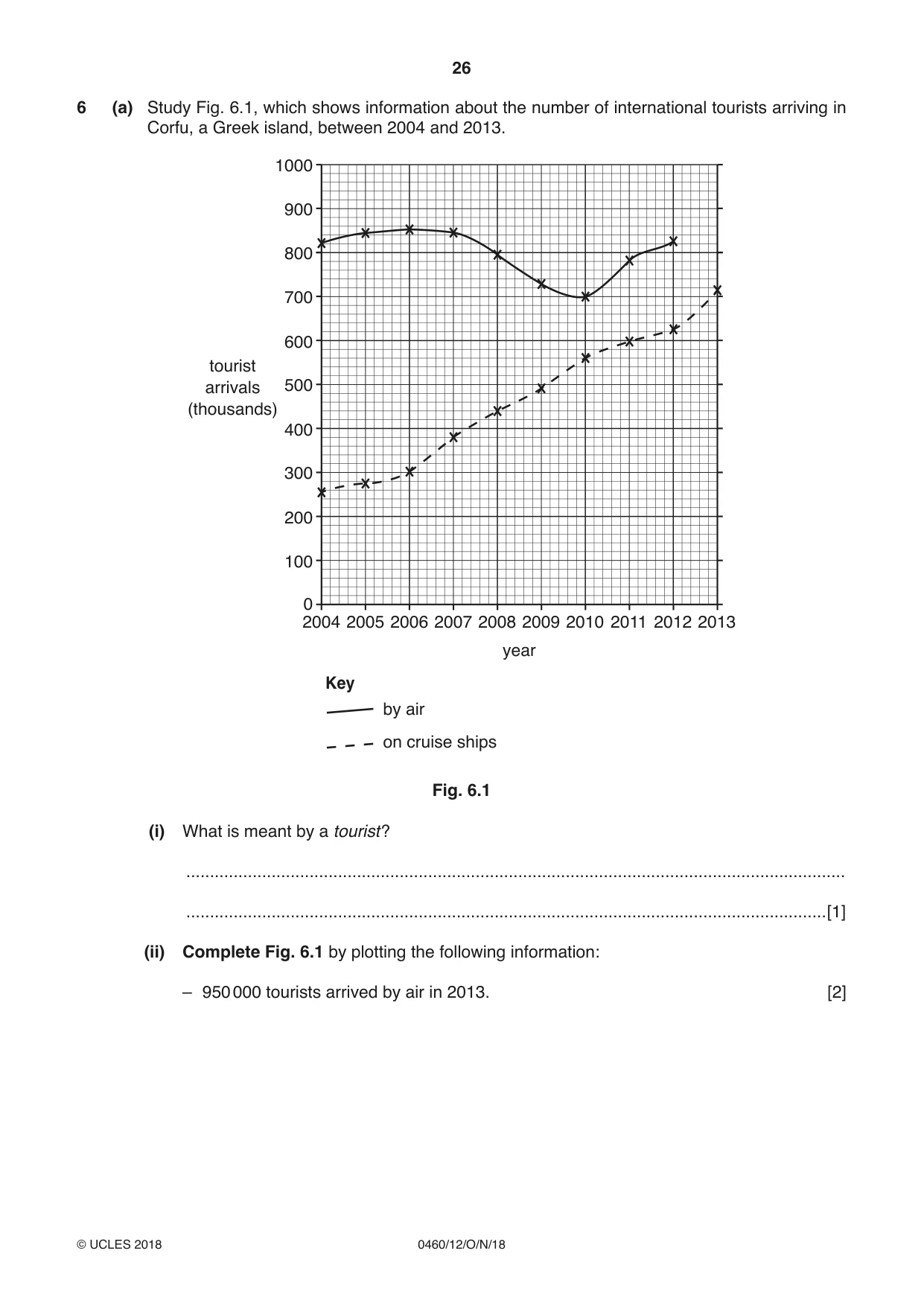
26 0460/12/O/N/18 © UCLES 2018 6 (a) Study Fig. 6.1, which shows information about the number of international tourists arriving in Corfu, a Greek island, between 2004 and 2013. 1000 900 800 700 tourist arrivals (thousands) 600 500 400 300 200 100 2004 2005 2006 2007 2008 year by air on cruise ships Key 2009 2010 2011 2012 2013 0 Fig. 6.1 (i) What is meant by a tourist? … …[1] (ii) Complete Fig. 6.1 by plotting the following information: – 950 000 tourists arrived by air in 2013. [2]
Question paper, page 27
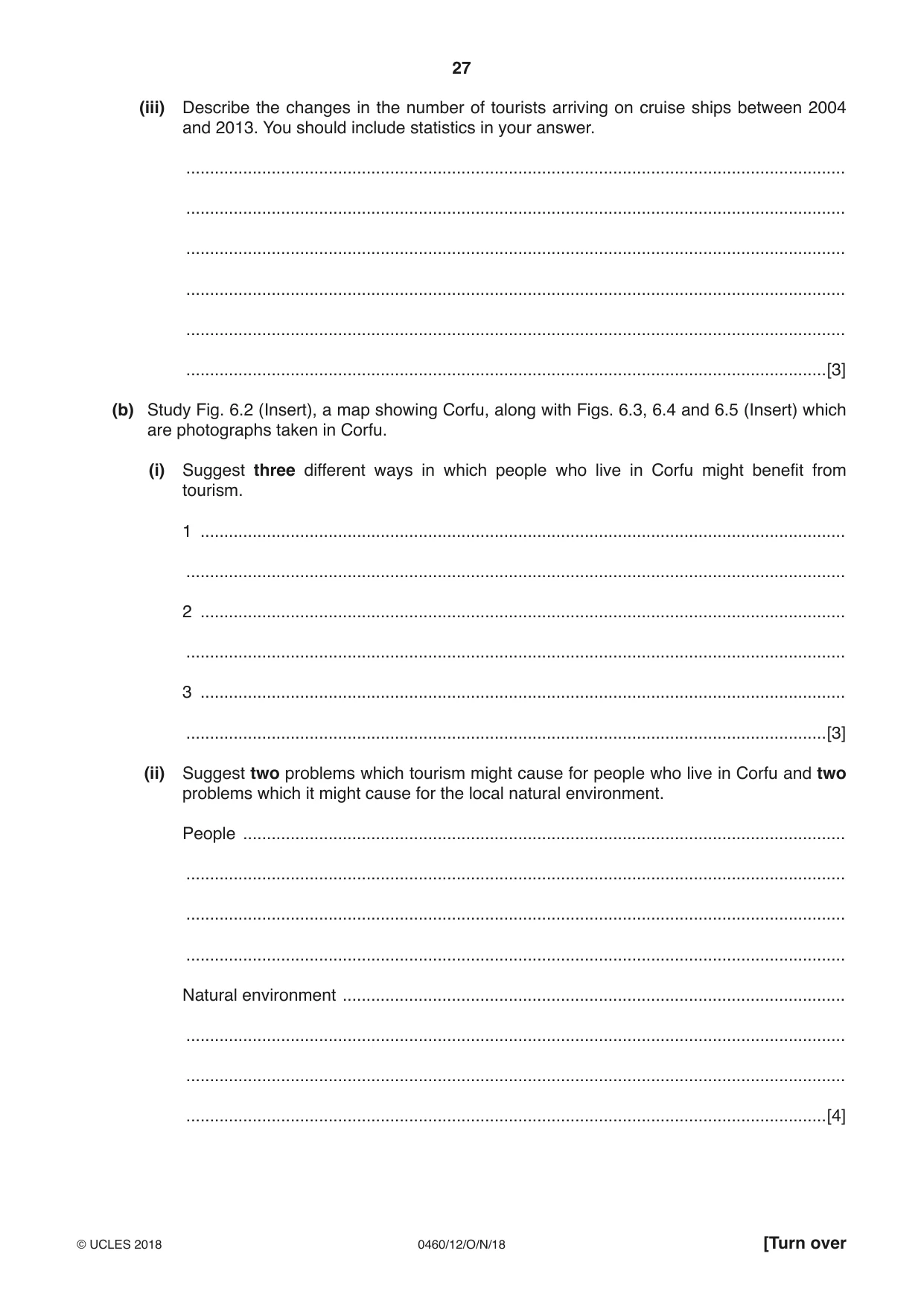
27 0460/12/O/N/18 © UCLES 2018 [Turn over (iii) Describe the changes in the number of tourists arriving on cruise ships between 2004 and 2013. You should include statistics in your answer. … … … … … …[3] (b) Study Fig. 6.2 (Insert), a map showing Corfu, along with Figs. 6.3, 6.4 and 6.5 (Insert) which are photographs taken in Corfu. (i) Suggest three different ways in which people who live in Corfu might benefit from tourism. 1 … … 2 … … 3 … …[3] (ii) Suggest two problems which tourism might cause for people who live in Corfu and two problems which it might cause for the local natural environment. People … … … … Natural environment … … … …[4]
Question paper, page 28
28 0460/12/O/N/18 © UCLES 2018 (iii) Using evidence from Figs. 6.2, 6.3, 6.4 and 6.5 only, explain why Corfu attracts tourists. … … … … … … … … … …[5]
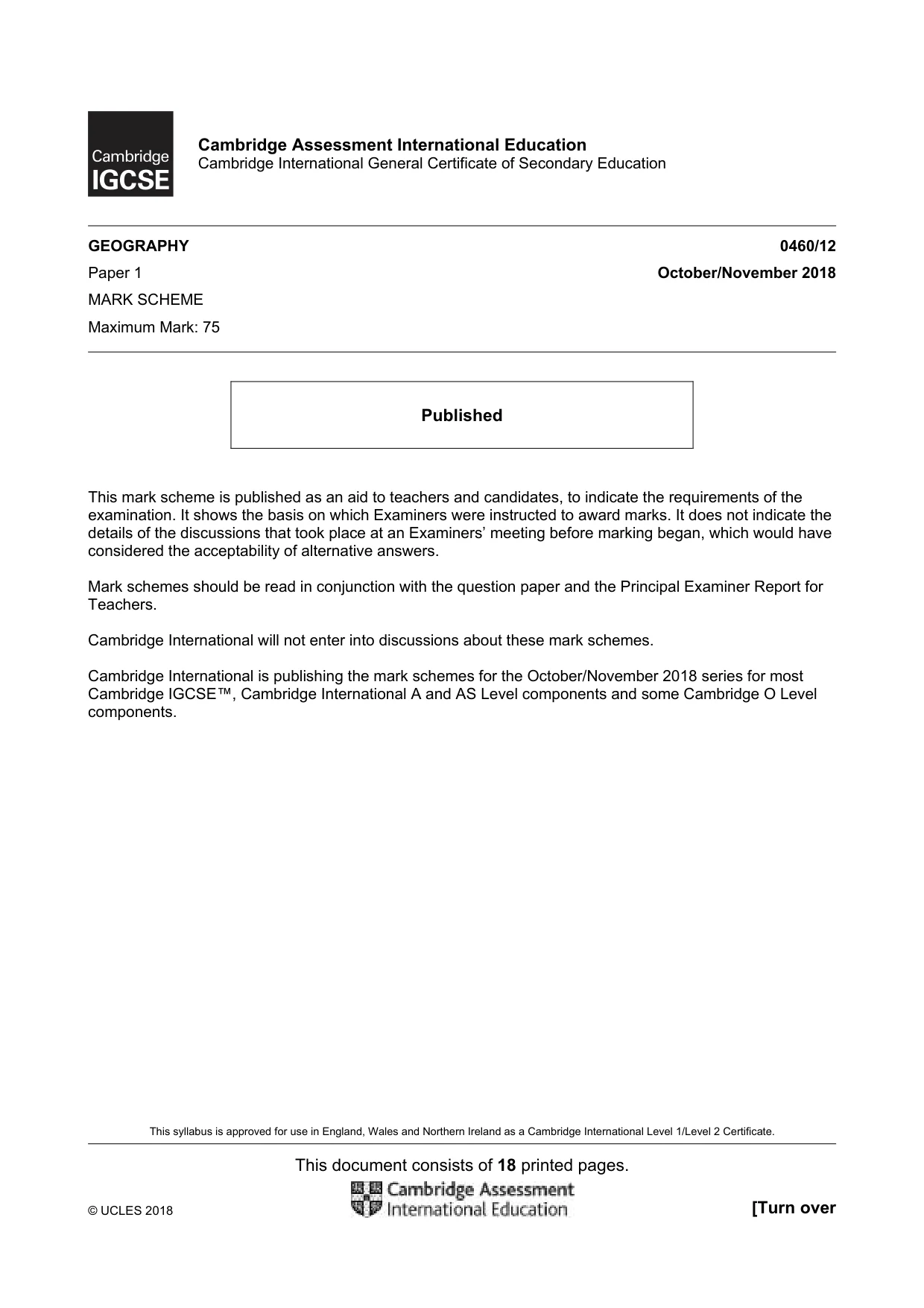
Question paper, page 29
29 0460/12/O/N/18 © UCLES 2018 (c) For a named area where tourism is important, explain how the negative impacts of tourism are managed. Name of area … … … … … … … … … … … … … … … … … … … … … … …[7] [Total: 25]
Question paper, page 30
30 0460/12/O/N/18 © UCLES 2018 Additional Pages If you use the following lined pages to complete the answer(s) to any question(s), the question number(s) must be clearly shown. … … … … … … … … … … … … … … … … … … … … … … … … … …
Question paper, page 31
31 0460/12/O/N/18 © UCLES 2018 … … … … … … … … … … … … … … … … … … … … … … … … … … … …
Question paper, page 32
32 0460/12/O/N/18 © UCLES 2018 Permission to reproduce items where third-party owned material protected by copyright is included has been sought and cleared where possible. Every reasonable effort has been made by the publisher (UCLES) to trace copyright holders, but if any items requiring clearance have unwittingly been included, the publisher will be pleased to make amends at the earliest possible opportunity. To avoid the issue of disclosure of answer-related information to candidates, all copyright acknowledgements are reproduced online in the Cambridge International Examinations Copyright Acknowledgements Booklet. This is produced for each series of examinations and is freely available to download at www.cie.org.uk after the live examination series. Cambridge International Examinations is part of the Cambridge Assessment Group. Cambridge Assessment is the brand name of University of Cambridge Local Examinations Syndicate (UCLES), which is itself a department of the University of Cambridge. BLANK PAGE
Mark scheme, page 1
This syllabus is approved for use in England, Wales and Northern Ireland as a Cambridge International Level 1/Level 2 Certificate. This document consists of 18 printed pages. © UCLES 2018 [Turn over Cambridge Assessment International Education Cambridge International General Certificate of Secondary Education GEOGRAPHY 0460/12 Paper 1 October/November 2018 MARK SCHEME Maximum Mark: 75 Published This mark scheme is published as an aid to teachers and candidates, to indicate the requirements of the examination. It shows the basis on which Examiners were instructed to award marks. It does not indicate the details of the discussions that took place at an Examiners’ meeting before marking began, which would have considered the acceptability of alternative answers. Mark schemes should be read in conjunction with the question paper and the Principal Examiner Report for Teachers. Cambridge International will not enter into discussions about these mark schemes. Cambridge International is publishing the mark schemes for the October/November 2018 series for most Cambridge IGCSE™, Cambridge International A and AS Level components and some Cambridge O Level components.
Mark scheme, page 2
0460/12 Cambridge IGCSE – Mark Scheme PUBLISHED October/November 2018 © UCLES 2018 Page 2 of 18 Generic Marking Principles These general marking principles must be applied by all examiners when marking candidate answers. They should be applied alongside the specific content of the mark scheme or generic level descriptors for a question. Each question paper and mark scheme will also comply with these marking principles. GENERIC MARKING PRINCIPLE 1: Marks must be awarded in line with: • the specific content of the mark scheme or the generic level descriptors for the question • the specific skills defined in the mark scheme or in the generic level descriptors for the question • the standard of response required by a candidate as exemplified by the standardisation scripts. GENERIC MARKING PRINCIPLE 2: Marks awarded are always whole marks (not half marks, or other fractions). GENERIC MARKING PRINCIPLE 3: Marks must be awarded positively: • marks are awarded for correct/valid answers, as defined in the mark scheme. However, credit is given for valid answers which go beyond the scope of the syllabus and mark scheme, referring to your Team Leader as appropriate • marks are awarded when candidates clearly demonstrate what they know and can do • marks are not deducted for errors • marks are not deducted for omissions • answers should only be judged on the quality of spelling, punctuation and grammar when these features are specifically assessed by the question as indicated by the mark scheme. The meaning, however, should be unambiguous. GENERIC MARKING PRINCIPLE 4: Rules must be applied consistently e.g. in situations where candidates have not followed instructions or in the application of generic level descriptors. GENERIC MARKING PRINCIPLE 5: Marks should be awarded using the full range of marks defined in the mark scheme for the question (however; the use of the full mark range may be limited according to the quality of the candidate responses seen). GENERIC MARKING PRINCIPLE 6: Marks awarded are based solely on the requirements as defined in the mark scheme. Marks should not be awarded with grade thresholds or grade descriptors in mind.
Mark scheme, page 3
0460/12 Cambridge IGCSE – Mark Scheme PUBLISHED October/November 2018 © UCLES 2018 Page 3 of 18 Question Answer Marks 1(a)(i) 6400–6500 1 1(a)(ii) In Bihar there are more/greater percentage of young dependents/less young dependents in Delhi; In Bihar there are decreasing numbers from 0 to 14 but in Delhi there are increasing numbers from 0 to 14/0 to 4 is highest in Bihar but 10–14 is highest in Delhi/0 to 4 is lowest in Delhi but 10–14 is lowest in Bihar; Answer must be comparative. Assume answer is about Bihar unless otherwise stated. 2 @ 1 mark 2 1(a)(iii) Birth rate is high in Bihar: The base of the pyramid is wide; There are large numbers of young dependents/lots of babies/children/0–4 year olds; Note: Do not credit reference to 5–9/10–14 years Rural depopulation has taken place in Bihar: There is a (big) drop/less/not as wide in population of 15–29/15–19/20–24 /economically active/more young dependents than economically active There is gender imbalance in Delhi: There are more males/less females; 3 @ 1 mark 3 1(a)(iv) Ideas such as: Lack of/no/cannot afford contraception/family planning; Not educated about birth control/do not know how to use contraceptives/not aware of impacts of large families; Abortions not available; High infant mortality rates; Have babies until a boy is born; Need children to send out to work/work on farms/for labour; Need children to work in house/collect firewood/water/to look after younger children; No pensions/children needed to look after elderly; Large families are traditional/culture/gift of god/prestige/evidence of virility; Religious opposition to contraception/family planning; Lack of education for women; Many women don’t have careers; Early marriages/have children at a young age; Polygamy; Etc. 4 @ 1 mark 4
Mark scheme, page 4
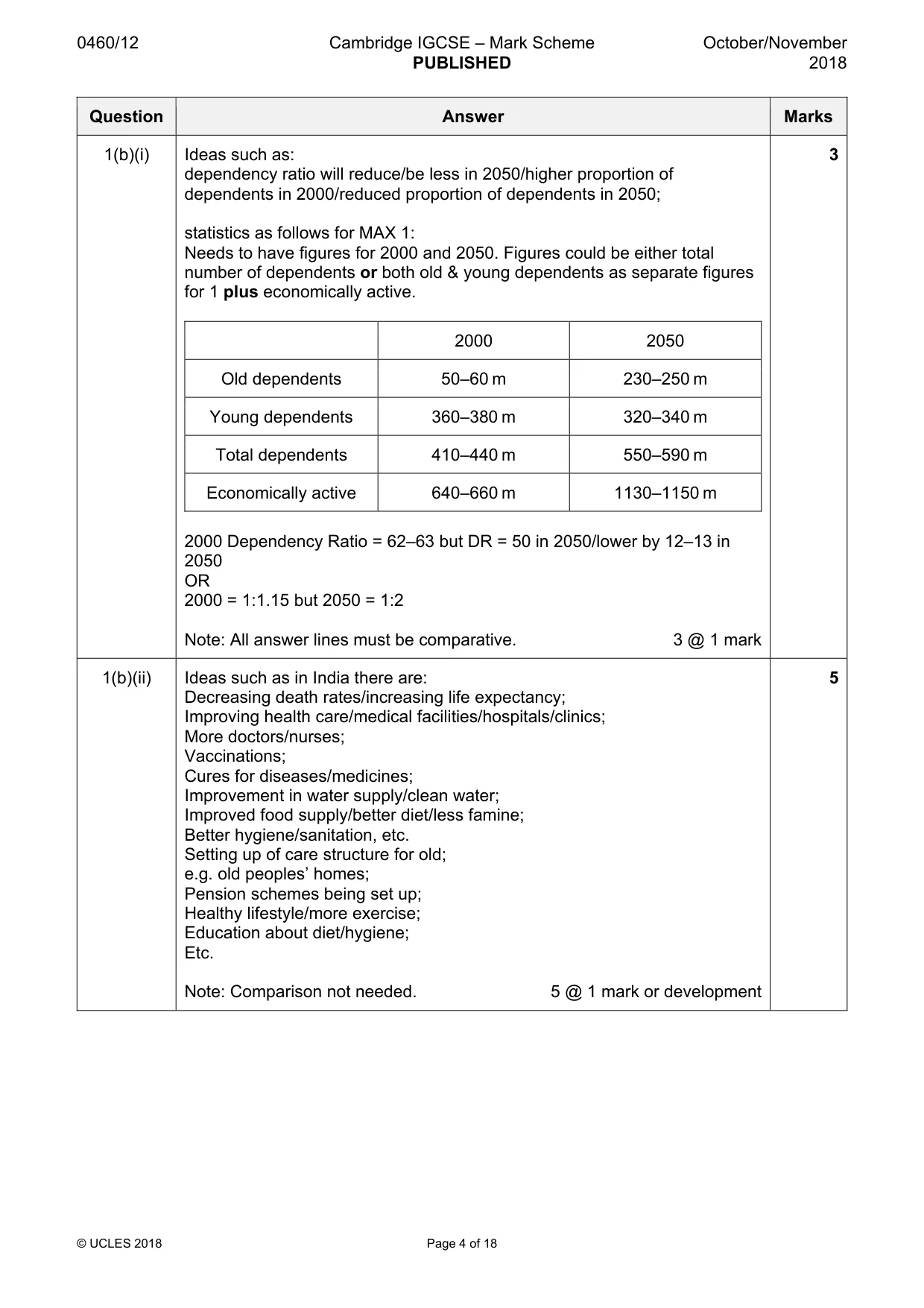
0460/12 Cambridge IGCSE – Mark Scheme PUBLISHED October/November 2018 © UCLES 2018 Page 4 of 18 Question Answer Marks 1(b)(i) Ideas such as: dependency ratio will reduce/be less in 2050/higher proportion of dependents in 2000/reduced proportion of dependents in 2050; statistics as follows for MAX 1: Needs to have figures for 2000 and 2050. Figures could be either total number of dependents or both old & young dependents as separate figures for 1 plus economically active. 2000 2050 Old dependents 50–60 m 230–250 m Young dependents 360–380 m 320–340 m Total dependents 410–440 m 550–590 m Economically active 640–660 m 1130–1150 m 2000 Dependency Ratio = 62–63 but DR = 50 in 2050/lower by 12–13 in 2050 OR 2000 = 1:1.15 but 2050 = 1:2 Note: All answer lines must be comparative. 3 @ 1 mark 3 1(b)(ii) Ideas such as in India there are: Decreasing death rates/increasing life expectancy; Improving health care/medical facilities/hospitals/clinics; More doctors/nurses; Vaccinations; Cures for diseases/medicines; Improvement in water supply/clean water; Improved food supply/better diet/less famine; Better hygiene/sanitation, etc. Setting up of care structure for old; e.g. old peoples’ homes; Pension schemes being set up; Healthy lifestyle/more exercise; Education about diet/hygiene; Etc. Note: Comparison not needed. 5 @ 1 mark or development 5
Mark scheme, page 5
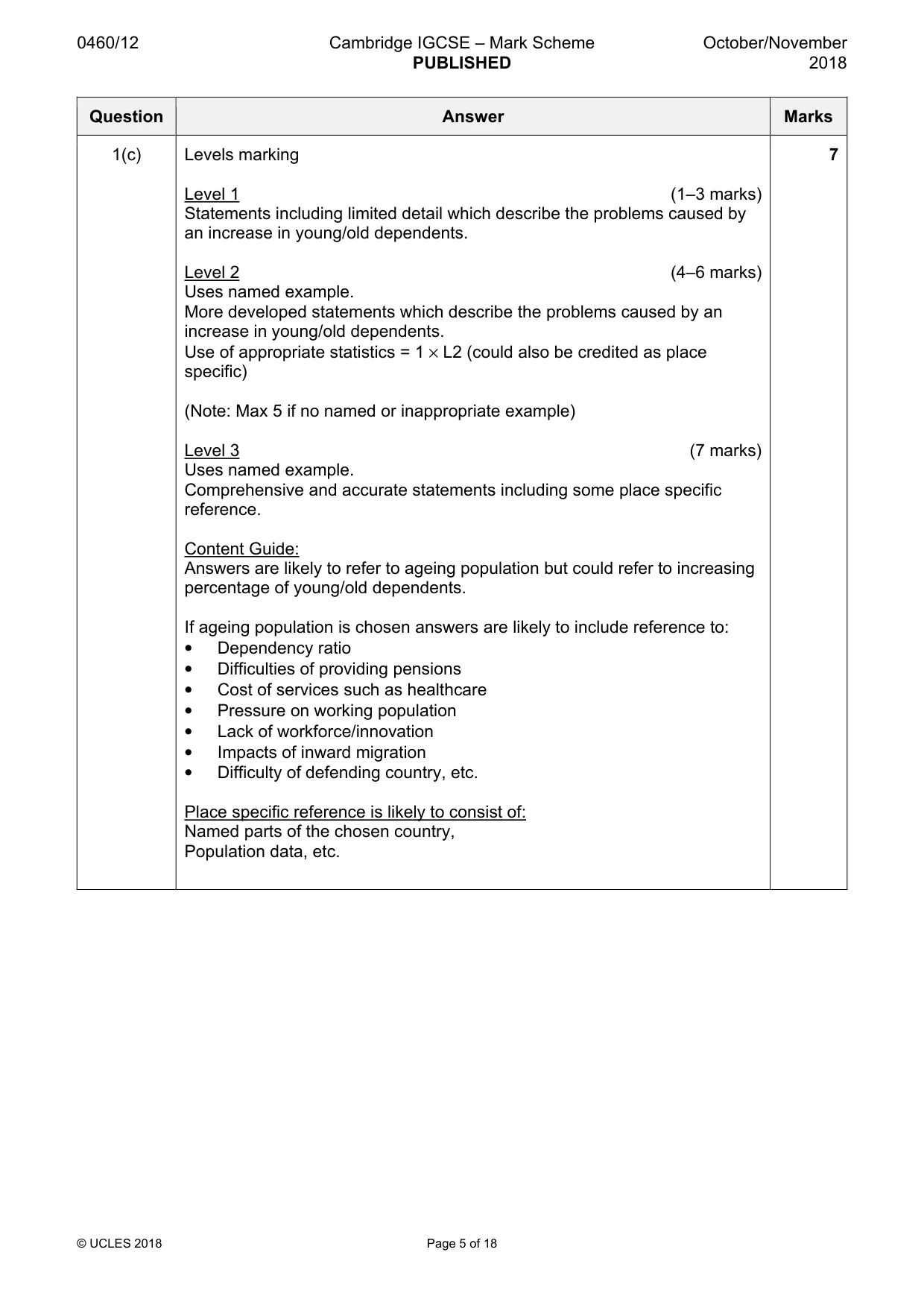
0460/12 Cambridge IGCSE – Mark Scheme PUBLISHED October/November 2018 © UCLES 2018 Page 5 of 18 Question Answer Marks 1(c) Levels marking Level 1 (1–3 marks) Statements including limited detail which describe the problems caused by an increase in young/old dependents. Level 2 (4–6 marks) Uses named example. More developed statements which describe the problems caused by an increase in young/old dependents. Use of appropriate statistics = 1 × L2 (could also be credited as place specific) (Note: Max 5 if no named or inappropriate example) Level 3 (7 marks) Uses named example. Comprehensive and accurate statements including some place specific reference. Content Guide: Answers are likely to refer to ageing population but could refer to increasing percentage of young/old dependents. If ageing population is chosen answers are likely to include reference to: • Dependency ratio • Difficulties of providing pensions • Cost of services such as healthcare • Pressure on working population • Lack of workforce/innovation • Impacts of inward migration • Difficulty of defending country, etc. Place specific reference is likely to consist of: Named parts of the chosen country, Population data, etc. 7
Mark scheme, page 6
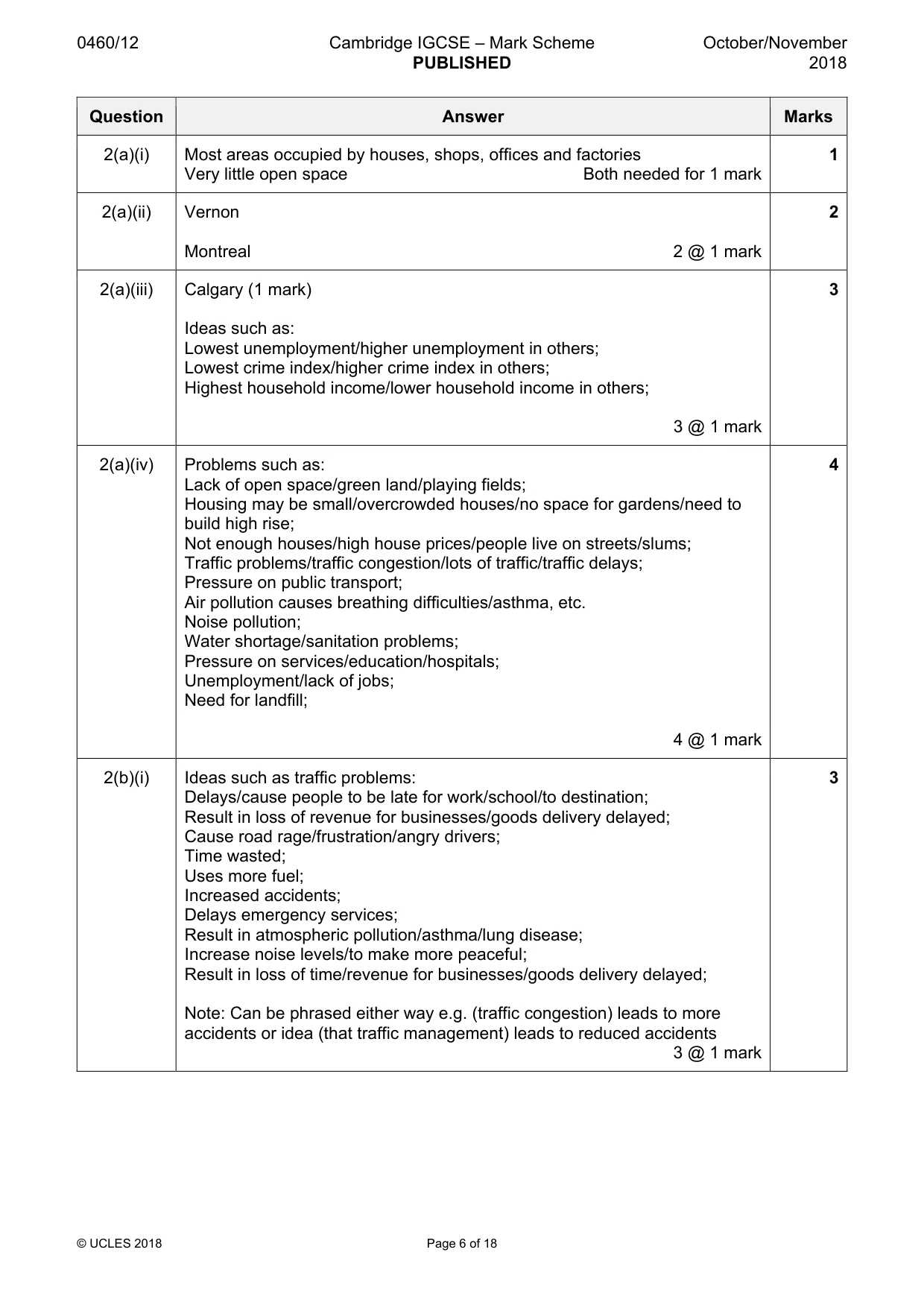
0460/12 Cambridge IGCSE – Mark Scheme PUBLISHED October/November 2018 © UCLES 2018 Page 6 of 18 Question Answer Marks 2(a)(i) Most areas occupied by houses, shops, offices and factories Very little open space Both needed for 1 mark 1 2(a)(ii) Vernon Montreal 2 @ 1 mark 2 2(a)(iii) Calgary (1 mark) Ideas such as: Lowest unemployment/higher unemployment in others; Lowest crime index/higher crime index in others; Highest household income/lower household income in others; 3 @ 1 mark 3 2(a)(iv) Problems such as: Lack of open space/green land/playing fields; Housing may be small/overcrowded houses/no space for gardens/need to build high rise; Not enough houses/high house prices/people live on streets/slums; Traffic problems/traffic congestion/lots of traffic/traffic delays; Pressure on public transport; Air pollution causes breathing difficulties/asthma, etc. Noise pollution; Water shortage/sanitation problems; Pressure on services/education/hospitals; Unemployment/lack of jobs; Need for landfill; 4 @ 1 mark 4 2(b)(i) Ideas such as traffic problems: Delays/cause people to be late for work/school/to destination; Result in loss of revenue for businesses/goods delivery delayed; Cause road rage/frustration/angry drivers; Time wasted; Uses more fuel; Increased accidents; Delays emergency services; Result in atmospheric pollution/asthma/lung disease; Increase noise levels/to make more peaceful; Result in loss of time/revenue for businesses/goods delivery delayed; Note: Can be phrased either way e.g. (traffic congestion) leads to more accidents or idea (that traffic management) leads to reduced accidents 3 @ 1 mark 3
Mark scheme, page 7
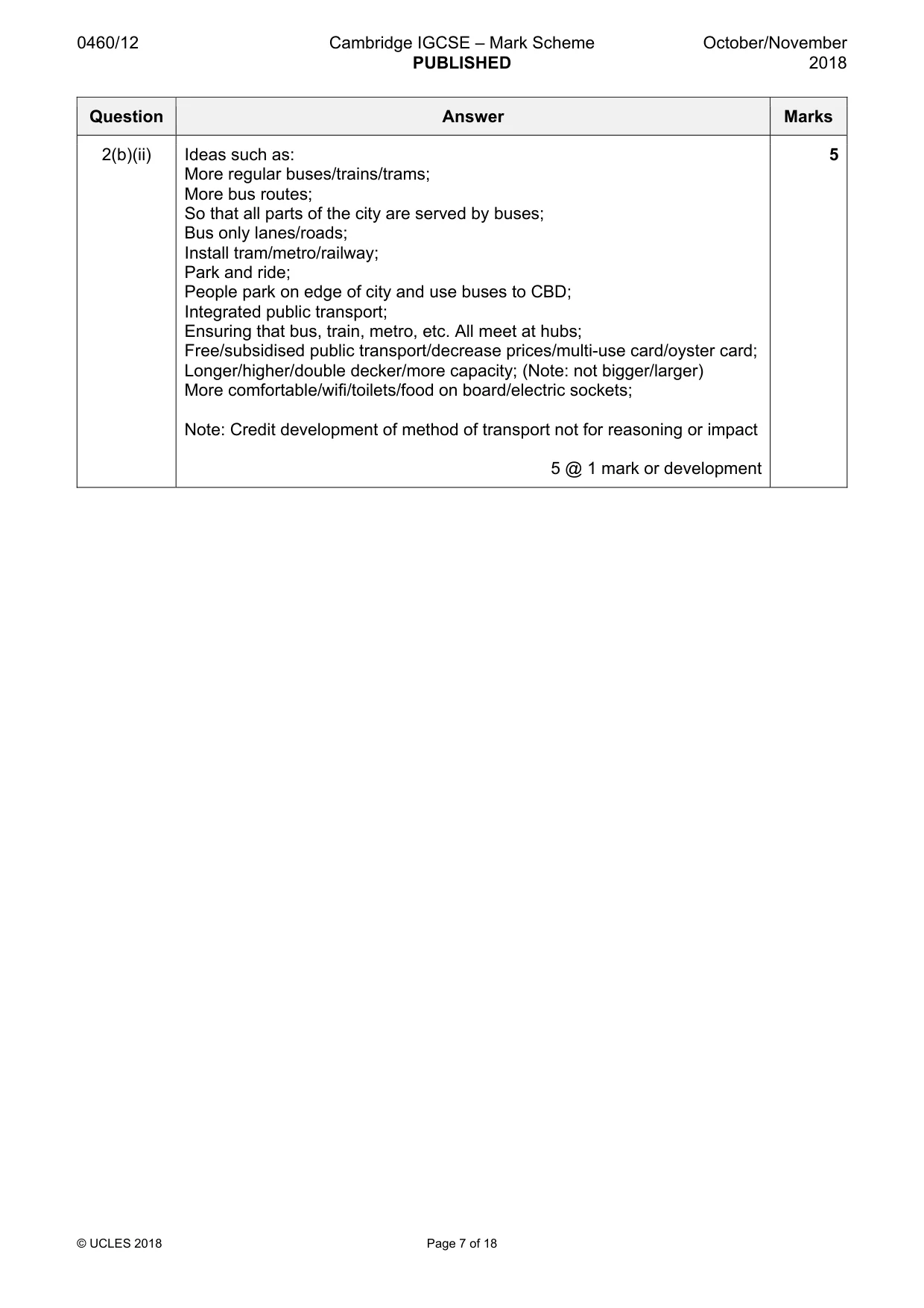
0460/12 Cambridge IGCSE – Mark Scheme PUBLISHED October/November 2018 © UCLES 2018 Page 7 of 18 Question Answer Marks 2(b)(ii) Ideas such as: More regular buses/trains/trams; More bus routes; So that all parts of the city are served by buses; Bus only lanes/roads; Install tram/metro/railway; Park and ride; People park on edge of city and use buses to CBD; Integrated public transport; Ensuring that bus, train, metro, etc. All meet at hubs; Free/subsidised public transport/decrease prices/multi-use card/oyster card; Longer/higher/double decker/more capacity; (Note: not bigger/larger) More comfortable/wifi/toilets/food on board/electric sockets; Note: Credit development of method of transport not for reasoning or impact 5 @ 1 mark or development 5
Mark scheme, page 8
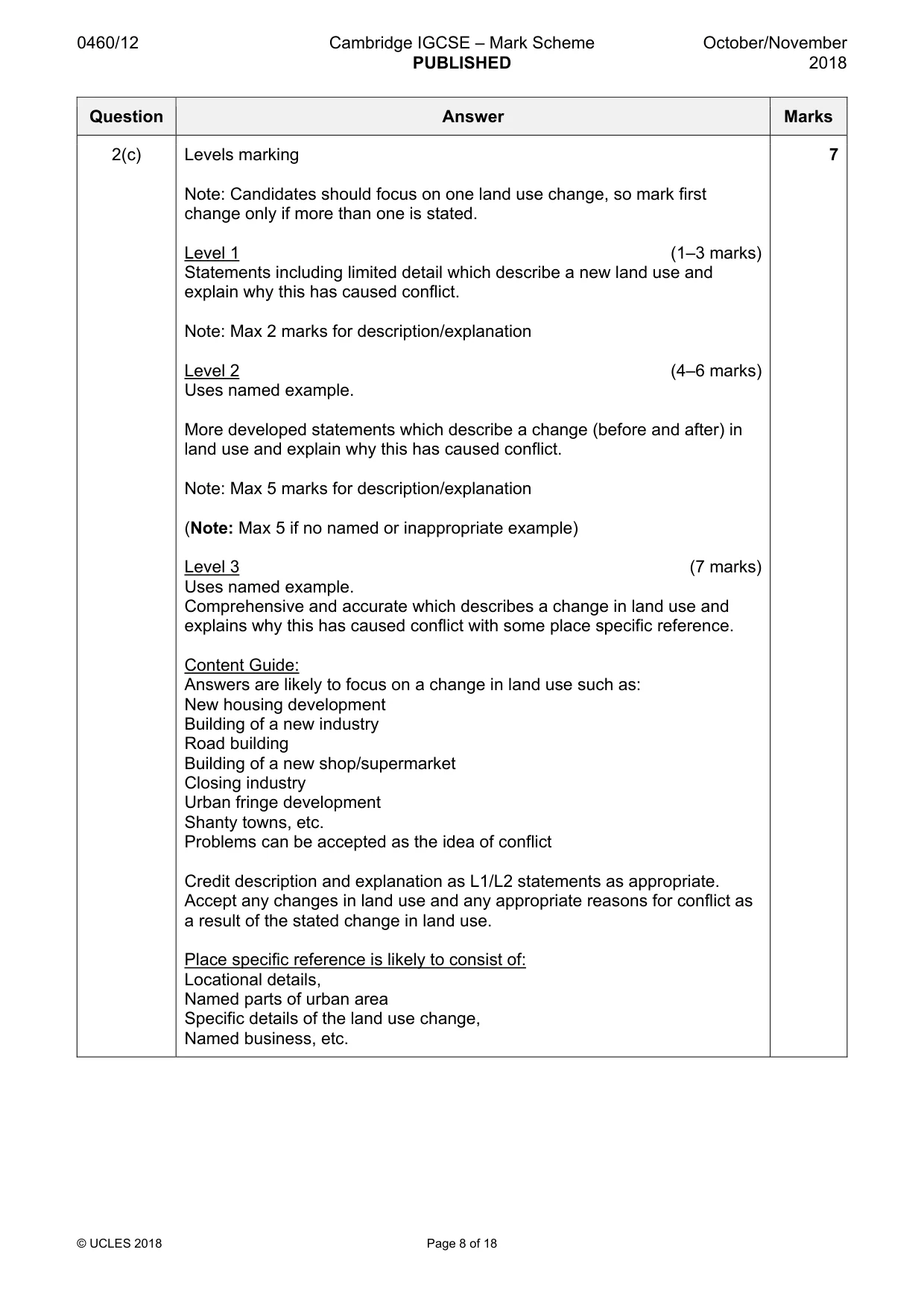
0460/12 Cambridge IGCSE – Mark Scheme PUBLISHED October/November 2018 © UCLES 2018 Page 8 of 18 Question Answer Marks 2(c) Levels marking Note: Candidates should focus on one land use change, so mark first change only if more than one is stated. Level 1 (1–3 marks) Statements including limited detail which describe a new land use and explain why this has caused conflict. Note: Max 2 marks for description/explanation Level 2 (4–6 marks) Uses named example. More developed statements which describe a change (before and after) in land use and explain why this has caused conflict. Note: Max 5 marks for description/explanation (Note: Max 5 if no named or inappropriate example) Level 3 (7 marks) Uses named example. Comprehensive and accurate which describes a change in land use and explains why this has caused conflict with some place specific reference. Content Guide: Answers are likely to focus on a change in land use such as: New housing development Building of a new industry Road building Building of a new shop/supermarket Closing industry Urban fringe development Shanty towns, etc. Problems can be accepted as the idea of conflict Credit description and explanation as L1/L2 statements as appropriate. Accept any changes in land use and any appropriate reasons for conflict as a result of the stated change in land use. Place specific reference is likely to consist of: Locational details, Named parts of urban area Specific details of the land use change, Named business, etc. 7
Mark scheme, page 9
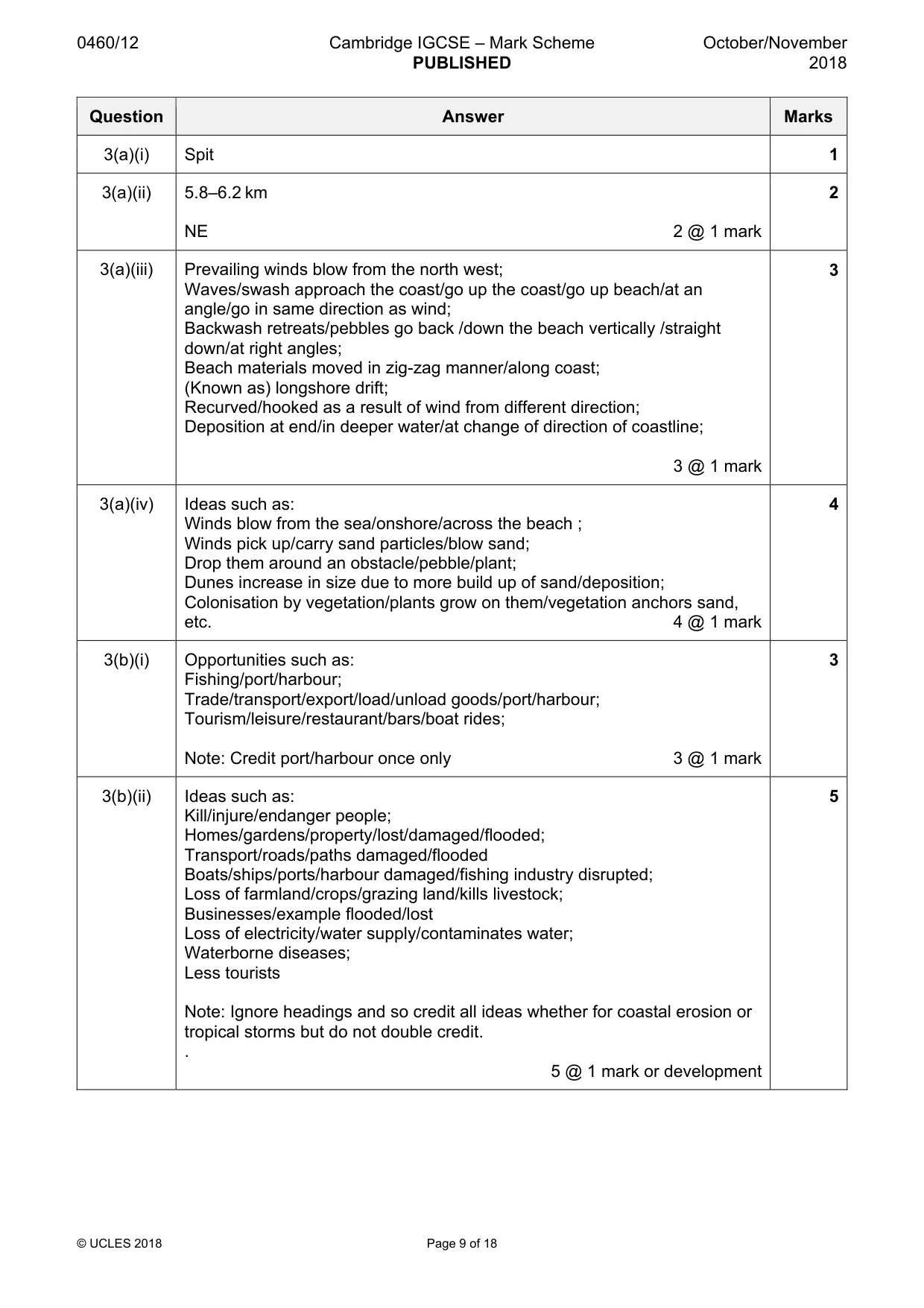
0460/12 Cambridge IGCSE – Mark Scheme PUBLISHED October/November 2018 © UCLES 2018 Page 9 of 18 Question Answer Marks 3(a)(i) Spit 1 3(a)(ii) 5.8–6.2 km NE 2 @ 1 mark 2 3(a)(iii) Prevailing winds blow from the north west; Waves/swash approach the coast/go up the coast/go up beach/at an angle/go in same direction as wind; Backwash retreats/pebbles go back /down the beach vertically /straight down/at right angles; Beach materials moved in zig-zag manner/along coast; (Known as) longshore drift; Recurved/hooked as a result of wind from different direction; Deposition at end/in deeper water/at change of direction of coastline; 3 @ 1 mark 3 3(a)(iv) Ideas such as: Winds blow from the sea/onshore/across the beach ; Winds pick up/carry sand particles/blow sand; Drop them around an obstacle/pebble/plant; Dunes increase in size due to more build up of sand/deposition; Colonisation by vegetation/plants grow on them/vegetation anchors sand, etc. 4 @ 1 mark 4 3(b)(i) Opportunities such as: Fishing/port/harbour; Trade/transport/export/load/unload goods/port/harbour; Tourism/leisure/restaurant/bars/boat rides; Note: Credit port/harbour once only 3 @ 1 mark 3 3(b)(ii) Ideas such as: Kill/injure/endanger people; Homes/gardens/property/lost/damaged/flooded; Transport/roads/paths damaged/flooded Boats/ships/ports/harbour damaged/fishing industry disrupted; Loss of farmland/crops/grazing land/kills livestock; Businesses/example flooded/lost Loss of electricity/water supply/contaminates water; Waterborne diseases; Less tourists Note: Ignore headings and so credit all ideas whether for coastal erosion or tropical storms but do not double credit. . 5 @ 1 mark or development 5
Mark scheme, page 10
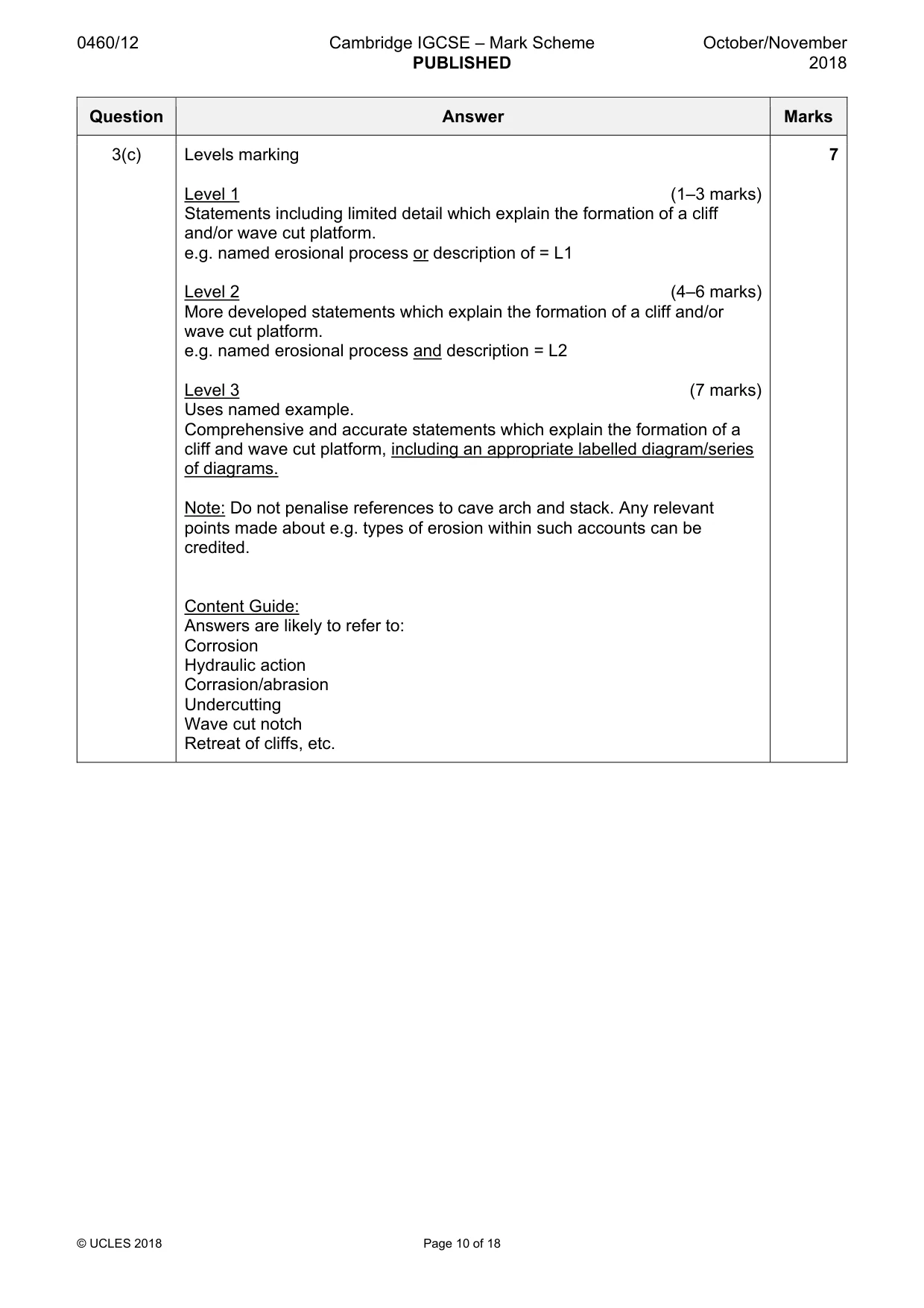
0460/12 Cambridge IGCSE – Mark Scheme PUBLISHED October/November 2018 © UCLES 2018 Page 10 of 18 Question Answer Marks 3(c) Levels marking Level 1 (1–3 marks) Statements including limited detail which explain the formation of a cliff and/or wave cut platform. e.g. named erosional process or description of = L1 Level 2 (4–6 marks) More developed statements which explain the formation of a cliff and/or wave cut platform. e.g. named erosional process and description = L2 Level 3 (7 marks) Uses named example. Comprehensive and accurate statements which explain the formation of a cliff and wave cut platform, including an appropriate labelled diagram/series of diagrams. Note: Do not penalise references to cave arch and stack. Any relevant points made about e.g. types of erosion within such accounts can be credited. Content Guide: Answers are likely to refer to: Corrosion Hydraulic action Corrasion/abrasion Undercutting Wave cut notch Retreat of cliffs, etc. 7
Mark scheme, page 11
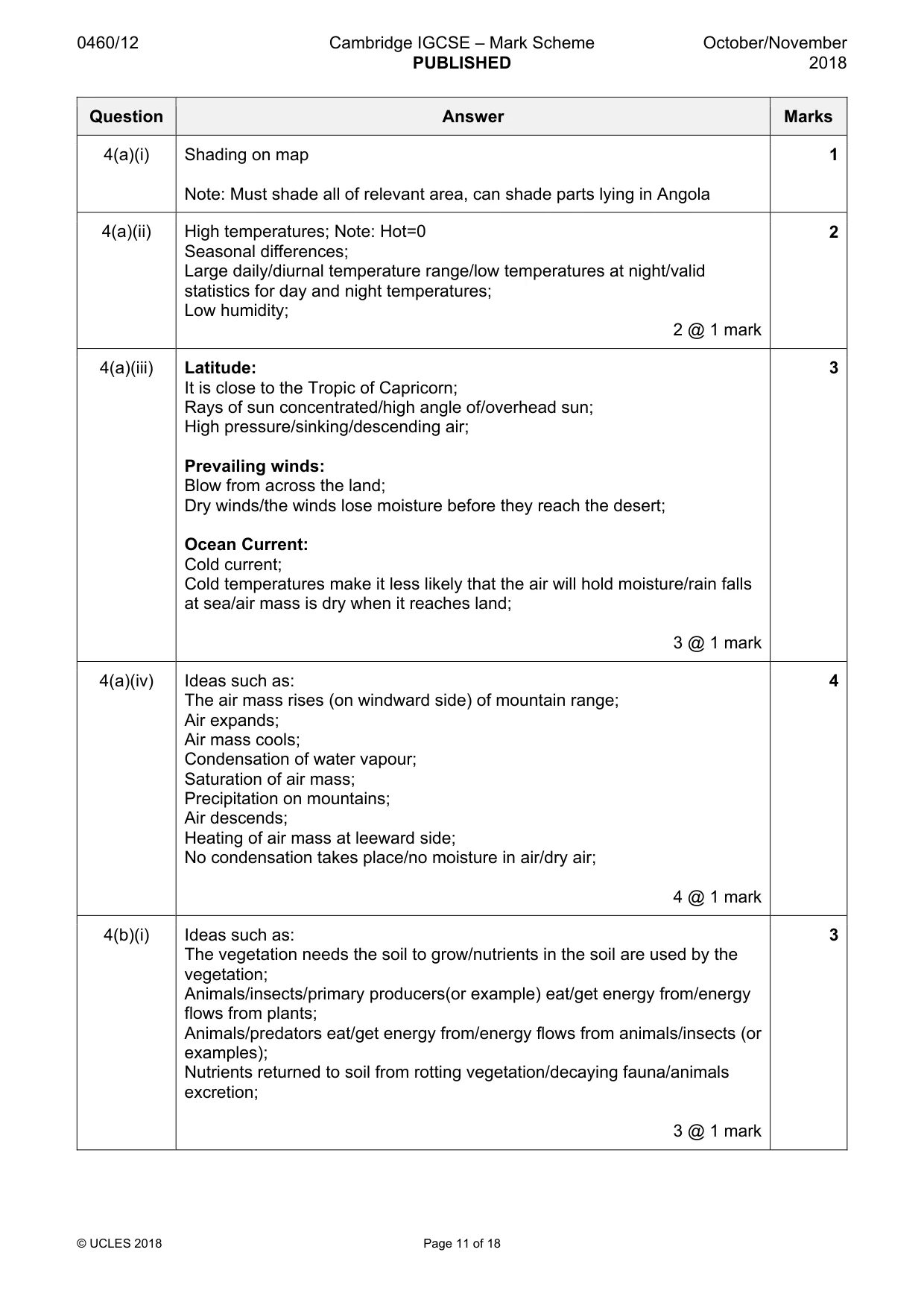
0460/12 Cambridge IGCSE – Mark Scheme PUBLISHED October/November 2018 © UCLES 2018 Page 11 of 18 Question Answer Marks 4(a)(i) Shading on map Note: Must shade all of relevant area, can shade parts lying in Angola 1 4(a)(ii) High temperatures; Note: Hot=0 Seasonal differences; Large daily/diurnal temperature range/low temperatures at night/valid statistics for day and night temperatures; Low humidity; 2 @ 1 mark 2 4(a)(iii) Latitude: It is close to the Tropic of Capricorn; Rays of sun concentrated/high angle of/overhead sun; High pressure/sinking/descending air; Prevailing winds: Blow from across the land; Dry winds/the winds lose moisture before they reach the desert; Ocean Current: Cold current; Cold temperatures make it less likely that the air will hold moisture/rain falls at sea/air mass is dry when it reaches land; 3 @ 1 mark 3 4(a)(iv) Ideas such as: The air mass rises (on windward side) of mountain range; Air expands; Air mass cools; Condensation of water vapour; Saturation of air mass; Precipitation on mountains; Air descends; Heating of air mass at leeward side; No condensation takes place/no moisture in air/dry air; 4 @ 1 mark 4 4(b)(i) Ideas such as: The vegetation needs the soil to grow/nutrients in the soil are used by the vegetation; Animals/insects/primary producers(or example) eat/get energy from/energy flows from plants; Animals/predators eat/get energy from/energy flows from animals/insects (or examples); Nutrients returned to soil from rotting vegetation/decaying fauna/animals excretion; 3 @ 1 mark 3
Mark scheme, page 12
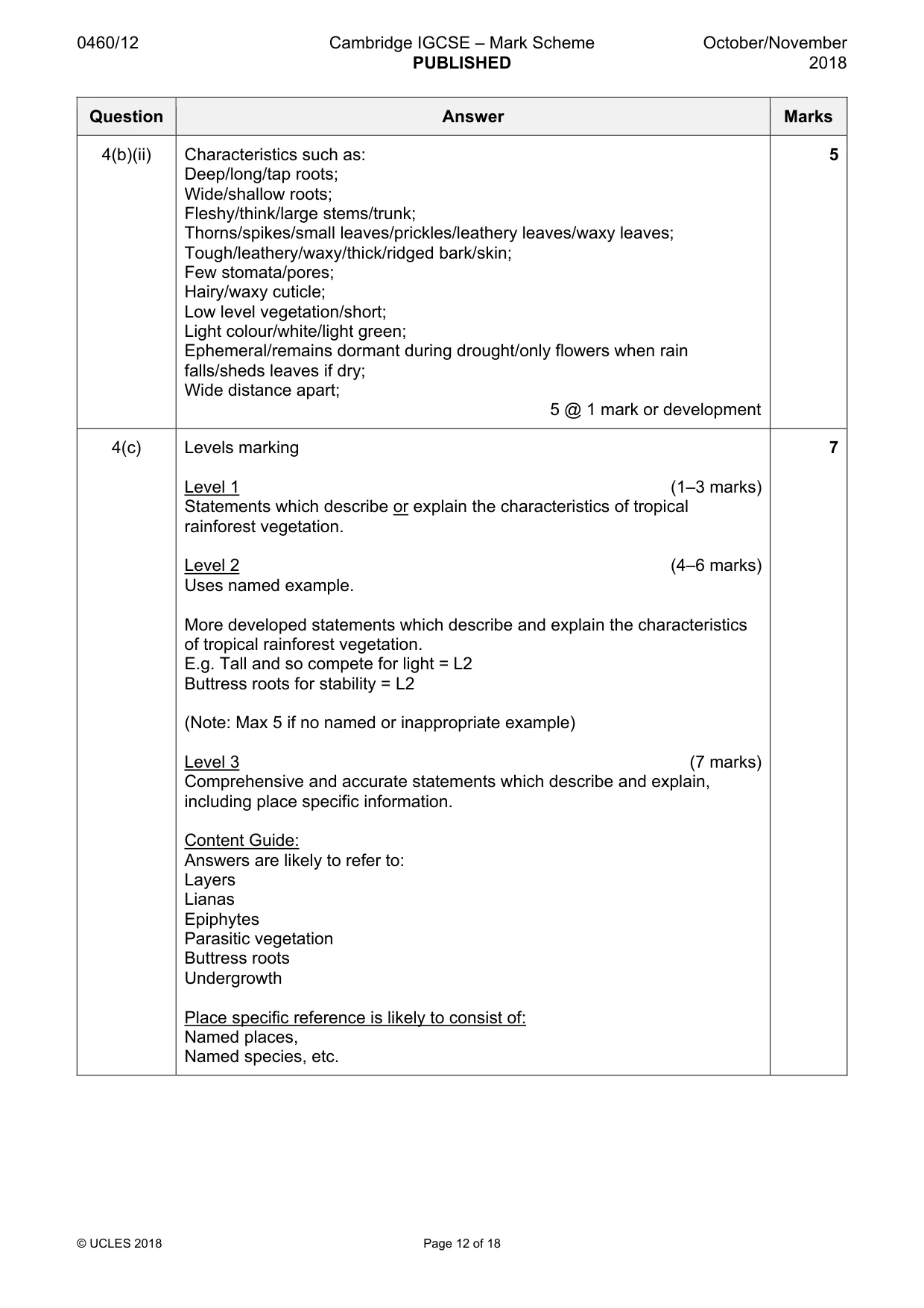
0460/12 Cambridge IGCSE – Mark Scheme PUBLISHED October/November 2018 © UCLES 2018 Page 12 of 18 Question Answer Marks 4(b)(ii) Characteristics such as: Deep/long/tap roots; Wide/shallow roots; Fleshy/think/large stems/trunk; Thorns/spikes/small leaves/prickles/leathery leaves/waxy leaves; Tough/leathery/waxy/thick/ridged bark/skin; Few stomata/pores; Hairy/waxy cuticle; Low level vegetation/short; Light colour/white/light green; Ephemeral/remains dormant during drought/only flowers when rain falls/sheds leaves if dry; Wide distance apart; 5 @ 1 mark or development 5 4(c) Levels marking Level 1 (1–3 marks) Statements which describe or explain the characteristics of tropical rainforest vegetation. Level 2 (4–6 marks) Uses named example. More developed statements which describe and explain the characteristics of tropical rainforest vegetation. E.g. Tall and so compete for light = L2 Buttress roots for stability = L2 (Note: Max 5 if no named or inappropriate example) Level 3 (7 marks) Comprehensive and accurate statements which describe and explain, including place specific information. Content Guide: Answers are likely to refer to: Layers Lianas Epiphytes Parasitic vegetation Buttress roots Undergrowth Place specific reference is likely to consist of: Named places, Named species, etc. 7
Mark scheme, page 13
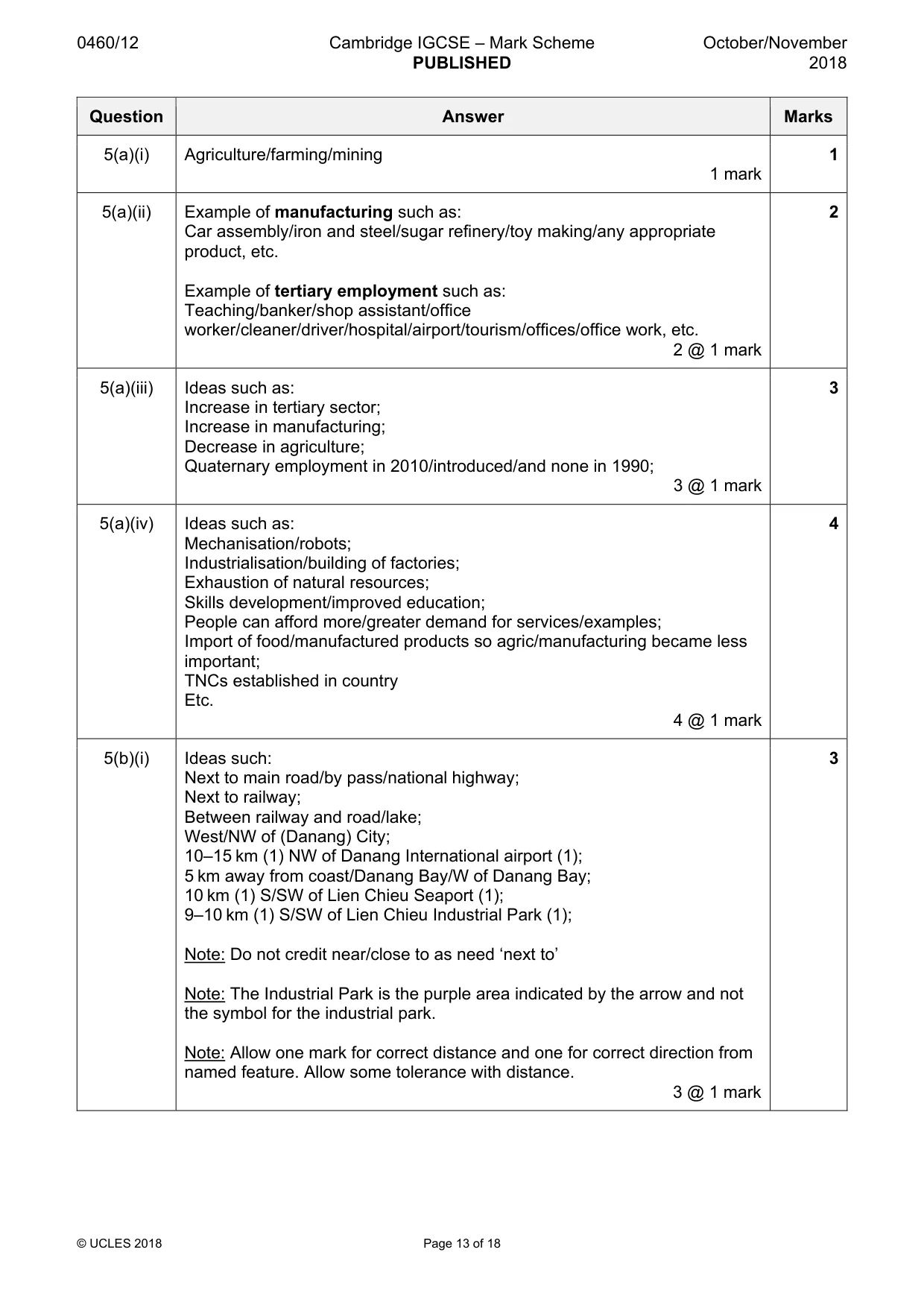
0460/12 Cambridge IGCSE – Mark Scheme PUBLISHED October/November 2018 © UCLES 2018 Page 13 of 18 Question Answer Marks 5(a)(i) Agriculture/farming/mining 1 mark 1 5(a)(ii) Example of manufacturing such as: Car assembly/iron and steel/sugar refinery/toy making/any appropriate product, etc. Example of tertiary employment such as: Teaching/banker/shop assistant/office worker/cleaner/driver/hospital/airport/tourism/offices/office work, etc. 2 @ 1 mark 2 5(a)(iii) Ideas such as: Increase in tertiary sector; Increase in manufacturing; Decrease in agriculture; Quaternary employment in 2010/introduced/and none in 1990; 3 @ 1 mark 3 5(a)(iv) Ideas such as: Mechanisation/robots; Industrialisation/building of factories; Exhaustion of natural resources; Skills development/improved education; People can afford more/greater demand for services/examples; Import of food/manufactured products so agric/manufacturing became less important; TNCs established in country Etc. 4 @ 1 mark 4 5(b)(i) Ideas such: Next to main road/by pass/national highway; Next to railway; Between railway and road/lake; West/NW of (Danang) City; 10–15 km (1) NW of Danang International airport (1); 5 km away from coast/Danang Bay/W of Danang Bay; 10 km (1) S/SW of Lien Chieu Seaport (1); 9–10 km (1) S/SW of Lien Chieu Industrial Park (1); Note: Do not credit near/close to as need ‘next to’ Note: The Industrial Park is the purple area indicated by the arrow and not the symbol for the industrial park. Note: Allow one mark for correct distance and one for correct direction from named feature. Allow some tolerance with distance. 3 @ 1 mark 3
Mark scheme, page 14
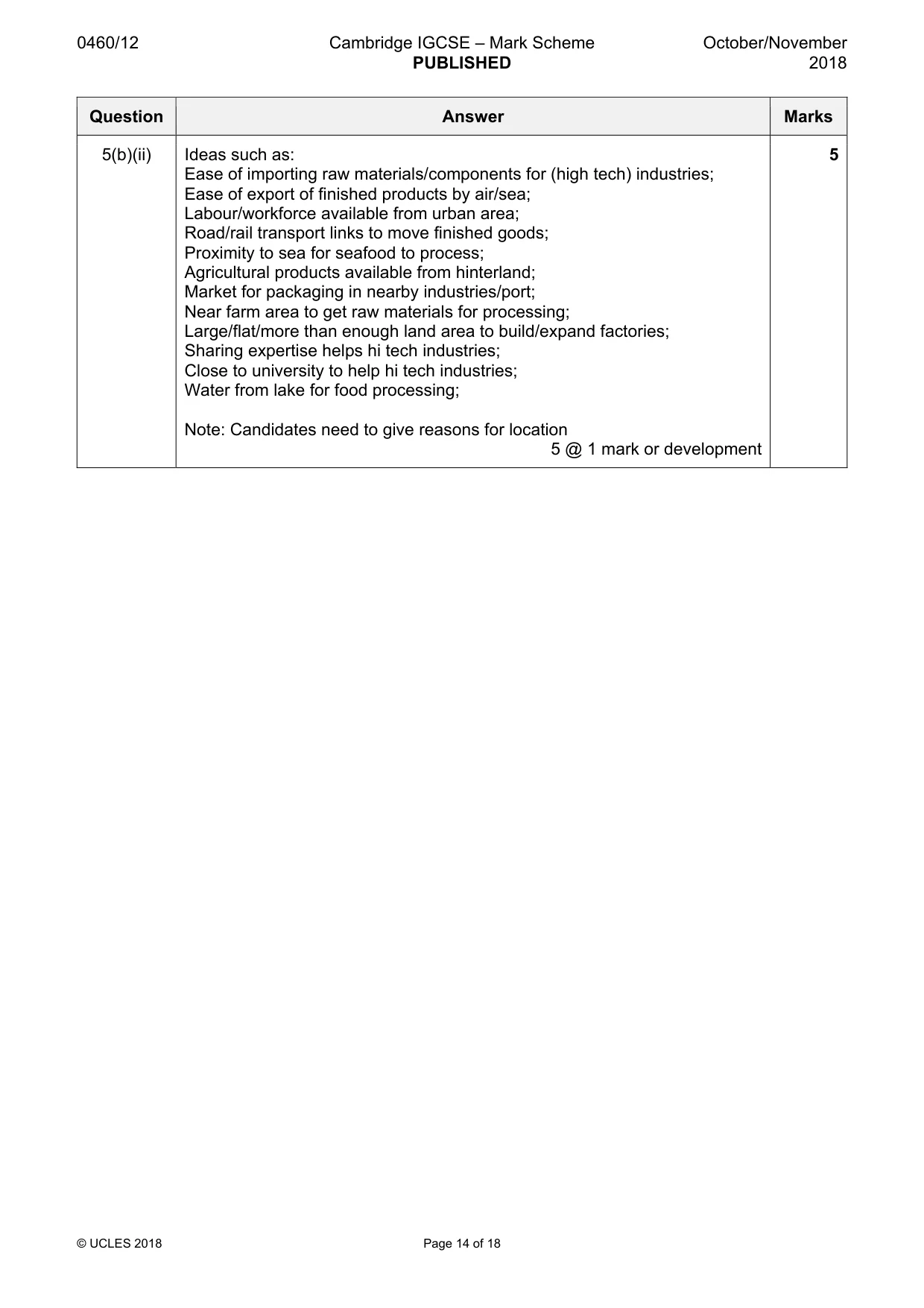
0460/12 Cambridge IGCSE – Mark Scheme PUBLISHED October/November 2018 © UCLES 2018 Page 14 of 18 Question Answer Marks 5(b)(ii) Ideas such as: Ease of importing raw materials/components for (high tech) industries; Ease of export of finished products by air/sea; Labour/workforce available from urban area; Road/rail transport links to move finished goods; Proximity to sea for seafood to process; Agricultural products available from hinterland; Market for packaging in nearby industries/port; Near farm area to get raw materials for processing; Large/flat/more than enough land area to build/expand factories; Sharing expertise helps hi tech industries; Close to university to help hi tech industries; Water from lake for food processing; Note: Candidates need to give reasons for location 5 @ 1 mark or development 5
Mark scheme, page 15
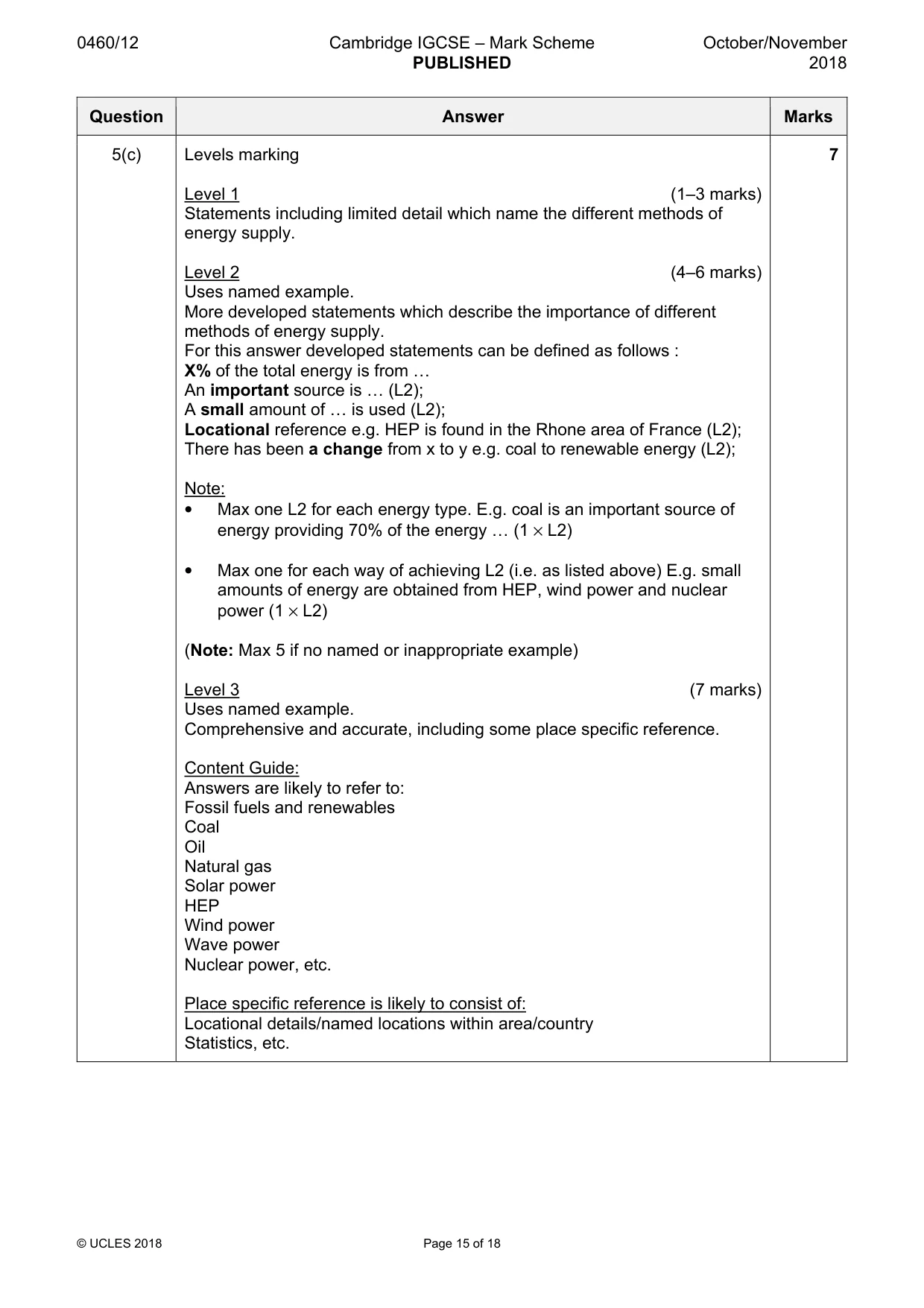
0460/12 Cambridge IGCSE – Mark Scheme PUBLISHED October/November 2018 © UCLES 2018 Page 15 of 18 Question Answer Marks 5(c) Levels marking Level 1 (1–3 marks) Statements including limited detail which name the different methods of energy supply. Level 2 (4–6 marks) Uses named example. More developed statements which describe the importance of different methods of energy supply. For this answer developed statements can be defined as follows : X% of the total energy is from « An important source is « (L2); A small amount of « is used (L2); Locational reference e.g. HEP is found in the Rhone area of France (L2); There has been a change from x to y e.g. coal to renewable energy (L2); Note: • Max one L2 for each energy type. E.g. coal is an important source of energy providing 70% of the energy « (1 × L2) • Max one for each way of achieving L2 (i.e. as listed above) E.g. small amounts of energy are obtained from HEP, wind power and nuclear power (1 × L2) (Note: Max 5 if no named or inappropriate example) Level 3 (7 marks) Uses named example. Comprehensive and accurate, including some place specific reference. Content Guide: Answers are likely to refer to: Fossil fuels and renewables Coal Oil Natural gas Solar power HEP Wind power Wave power Nuclear power, etc. Place specific reference is likely to consist of: Locational details/named locations within area/country Statistics, etc. 7
Mark scheme, page 16
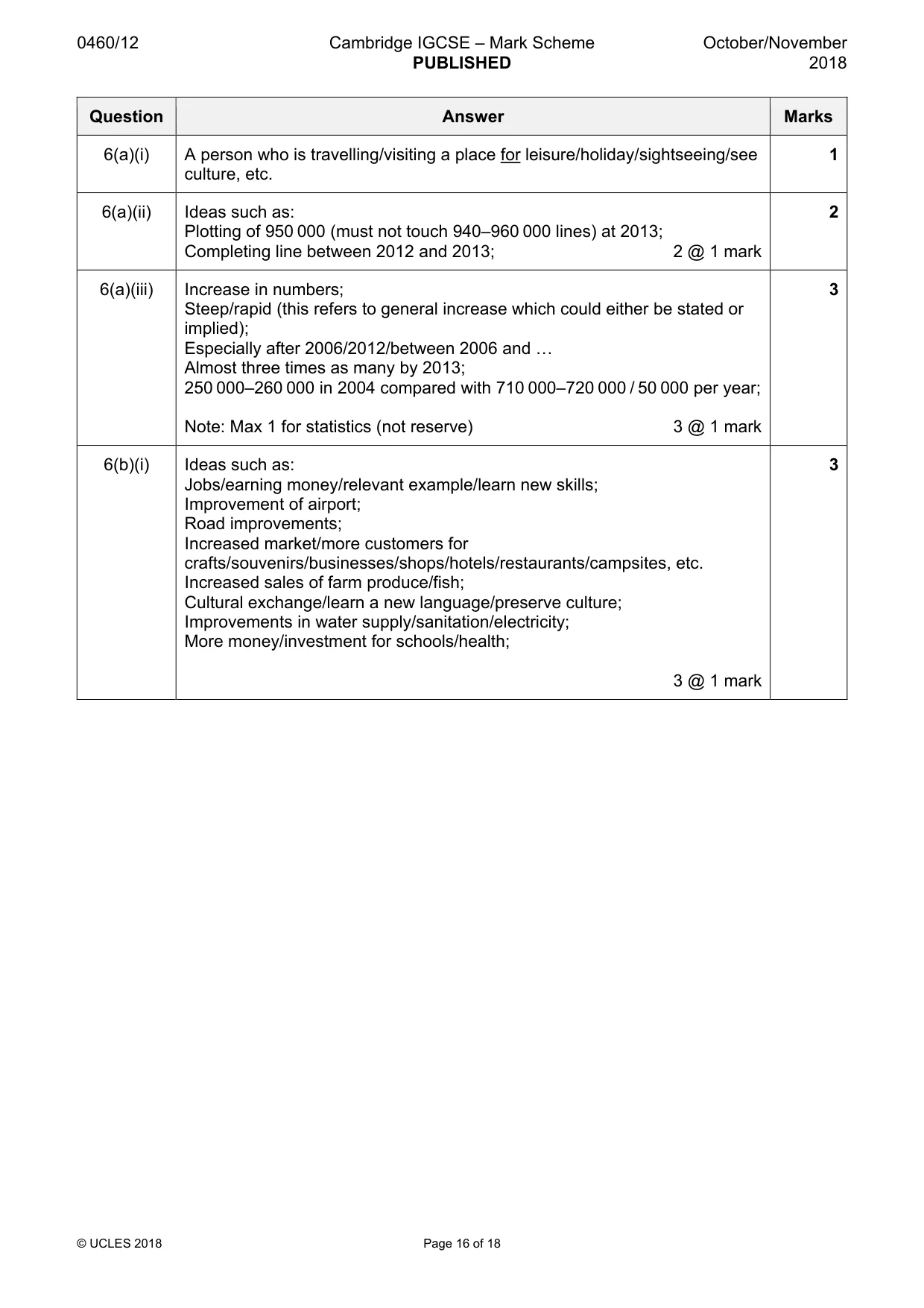
0460/12 Cambridge IGCSE – Mark Scheme PUBLISHED October/November 2018 © UCLES 2018 Page 16 of 18 Question Answer Marks 6(a)(i) A person who is travelling/visiting a place for leisure/holiday/sightseeing/see culture, etc. 1 6(a)(ii) Ideas such as: Plotting of 950 000 (must not touch 940–960 000 lines) at 2013; Completing line between 2012 and 2013; 2 @ 1 mark 2 6(a)(iii) Increase in numbers; Steep/rapid (this refers to general increase which could either be stated or implied); Especially after 2006/2012/between 2006 and « Almost three times as many by 2013; 250 000–260 000 in 2004 compared with 710 000–720 000 / 50 000 per year; Note: Max 1 for statistics (not reserve) 3 @ 1 mark 3 6(b)(i) Ideas such as: Jobs/earning money/relevant example/learn new skills; Improvement of airport; Road improvements; Increased market/more customers for crafts/souvenirs/businesses/shops/hotels/restaurants/campsites, etc. Increased sales of farm produce/fish; Cultural exchange/learn a new language/preserve culture; Improvements in water supply/sanitation/electricity; More money/investment for schools/health; 3 @ 1 mark 3
Mark scheme, page 17
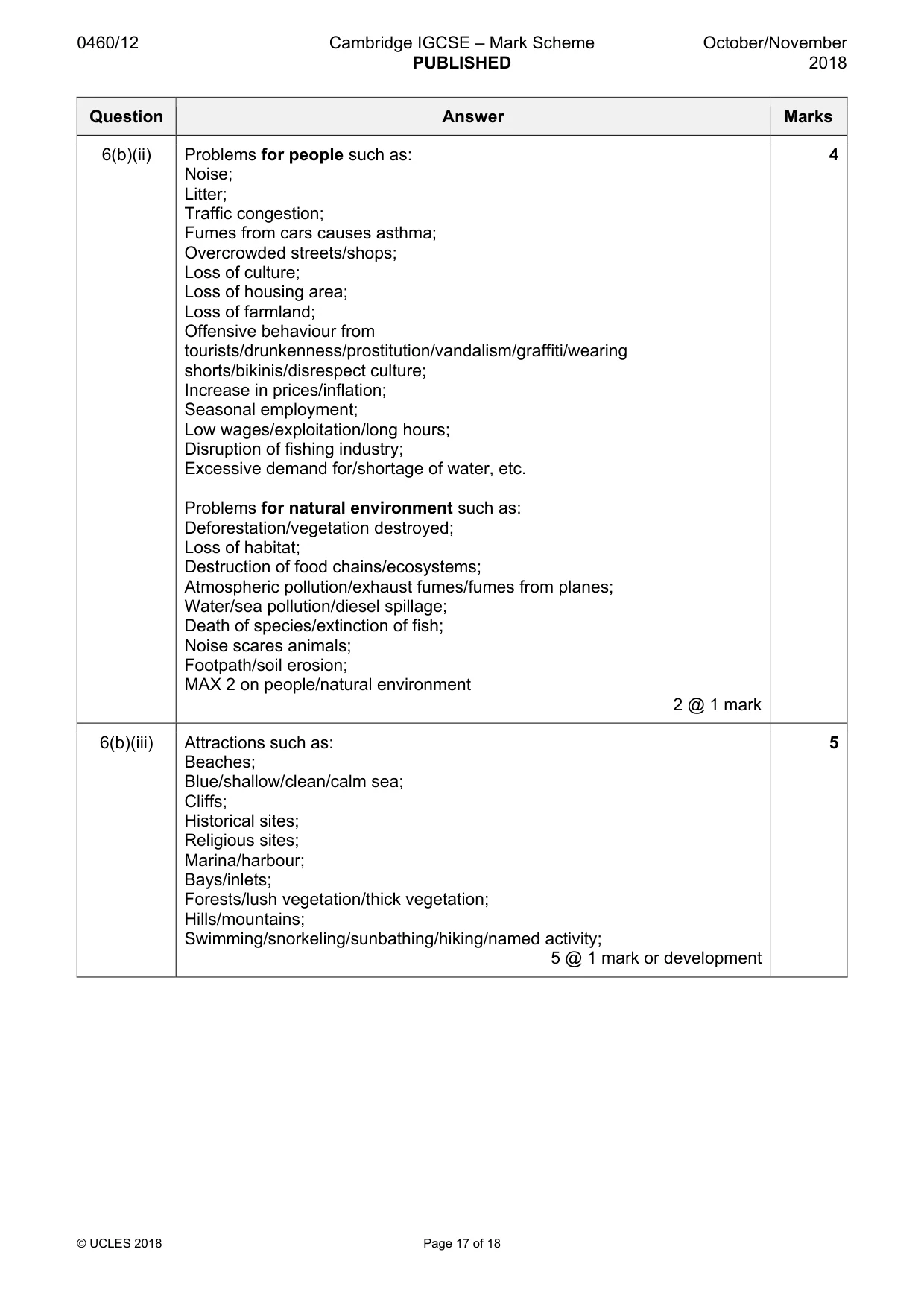
0460/12 Cambridge IGCSE – Mark Scheme PUBLISHED October/November 2018 © UCLES 2018 Page 17 of 18 Question Answer Marks 6(b)(ii) Problems for people such as: Noise; Litter; Traffic congestion; Fumes from cars causes asthma; Overcrowded streets/shops; Loss of culture; Loss of housing area; Loss of farmland; Offensive behaviour from tourists/drunkenness/prostitution/vandalism/graffiti/wearing shorts/bikinis/disrespect culture; Increase in prices/inflation; Seasonal employment; Low wages/exploitation/long hours; Disruption of fishing industry; Excessive demand for/shortage of water, etc. Problems for natural environment such as: Deforestation/vegetation destroyed; Loss of habitat; Destruction of food chains/ecosystems; Atmospheric pollution/exhaust fumes/fumes from planes; Water/sea pollution/diesel spillage; Death of species/extinction of fish; Noise scares animals; Footpath/soil erosion; MAX 2 on people/natural environment 2 @ 1 mark 4 6(b)(iii) Attractions such as: Beaches; Blue/shallow/clean/calm sea; Cliffs; Historical sites; Religious sites; Marina/harbour; Bays/inlets; Forests/lush vegetation/thick vegetation; Hills/mountains; Swimming/snorkeling/sunbathing/hiking/named activity; 5 @ 1 mark or development 5
Mark scheme, page 18
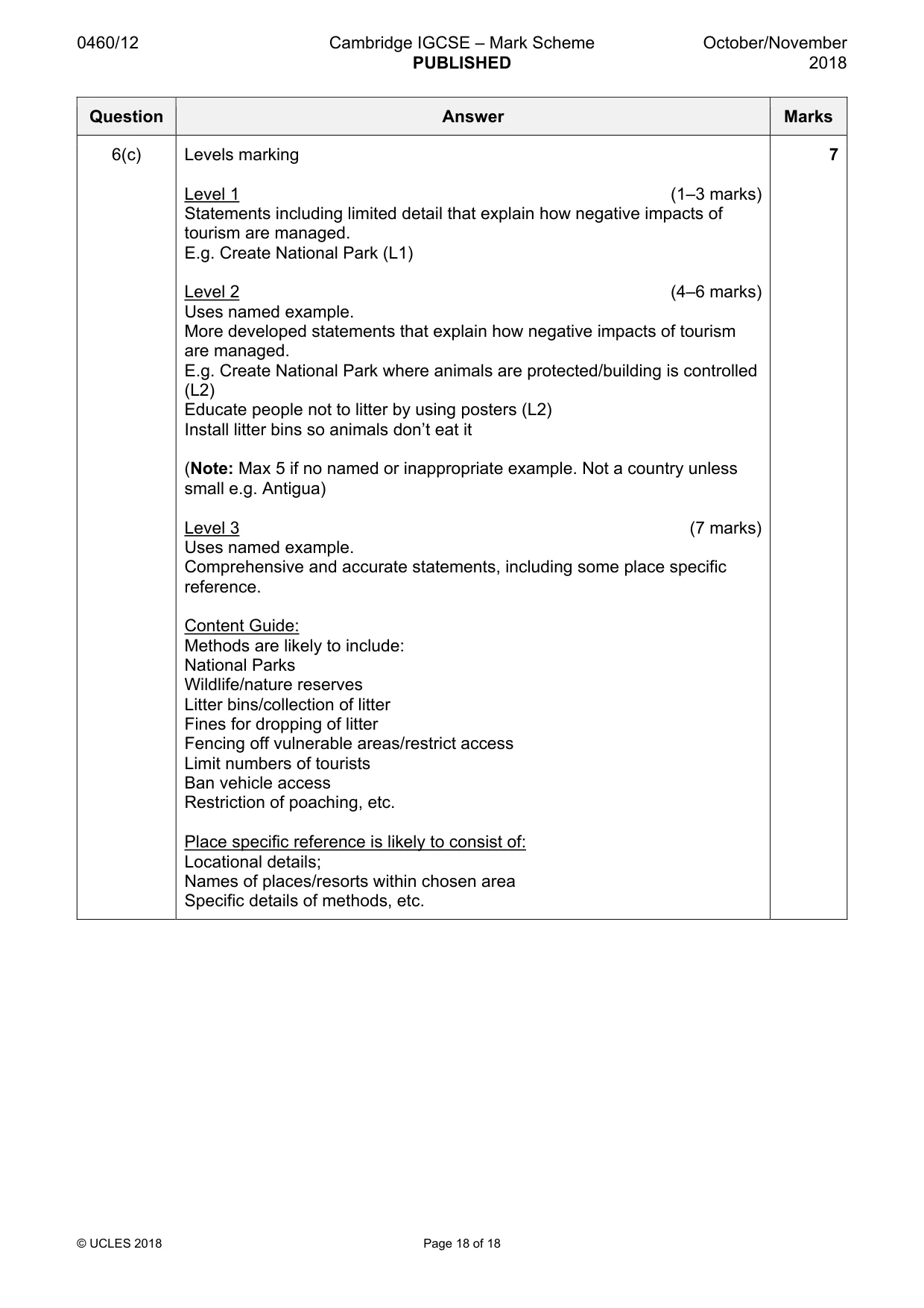
0460/12 Cambridge IGCSE – Mark Scheme PUBLISHED October/November 2018 © UCLES 2018 Page 18 of 18 Question Answer Marks 6(c) Levels marking Level 1 (1–3 marks) Statements including limited detail that explain how negative impacts of tourism are managed. E.g. Create National Park (L1) Level 2 (4–6 marks) Uses named example. More developed statements that explain how negative impacts of tourism are managed. E.g. Create National Park where animals are protected/building is controlled (L2) Educate people not to litter by using posters (L2) Install litter bins so animals don’t eat it (Note: Max 5 if no named or inappropriate example. Not a country unless small e.g. Antigua) Level 3 (7 marks) Uses named example. Comprehensive and accurate statements, including some place specific reference. Content Guide: Methods are likely to include: National Parks Wildlife/nature reserves Litter bins/collection of litter Fines for dropping of litter Fencing off vulnerable areas/restrict access Limit numbers of tourists Ban vehicle access Restriction of poaching, etc. Place specific reference is likely to consist of: Locational details; Names of places/resorts within chosen area Specific details of methods, etc. 7
What you needed in this session
Cambridge’s own grade thresholds for 2018 Oct/Nov, Paper 1 · Variant 2. A higher threshold means an easier paper — the bar moves with how the cohort did.