Cambridge IGCSE Geography 0460 — 2018 May/June Paper 1 · Variant 1
0460/11/M/J/18 · 75 marks · ≈84 min
The question paper and its mark scheme, free to read here and free to download. This is Cambridge’s own paper, exactly as it was sat.
Question paper28 pages





Mark scheme16 pages
Answers below. Sit the paper first if you are practising.
Paper as text
Question paper, page 1
* 5 5 5 2 1 9 4 8 0 8 * This syllabus is approved for use in England, Wales and Northern Ireland as a Cambridge International Level 1/Level 2 Certificate. This document consists of 28 printed pages and 1 Insert. DC (SC/SW) 148530/5 © UCLES 2018 [Turn over Cambridge International Examinations Cambridge International General Certificate of Secondary Education GEOGRAPHY 0460/11 Paper 1 May/June 2018 1 hour 45 minutes Candidates answer on the Question Paper. Additional Materials: Ruler Calculator READ THESE INSTRUCTIONS FIRST Write your Centre number, candidate number and name in the spaces provided. Write in dark blue or black pen. You may use an HB pencil for any diagrams or graphs. Do not use staples, paper clips, glue or correction fluid. DO NOT WRITE IN ANY BARCODES. Write your answer to each question in the space provided. If additional space is required, you should use the lined pages at the end of this booklet. The question number(s) must be clearly shown. Answer three questions, one from each section. The Insert contains Fig. 2.1 for Question 2, Figs. 4.1, 4.2, 4.3 and 4.4 for Question 4, and Fig. 6.2 for Question 6. The Insert is not required by the Examiner. Sketch maps and diagrams should be drawn whenever they serve to illustrate an answer. At the end of the examination, fasten all your work securely together. The number of marks is given in brackets [ ] at the end of each question or part question. Definitions MEDCs – More Economically Developed Countries LEDCs – Less Economically Developed Countries
Question paper, page 2
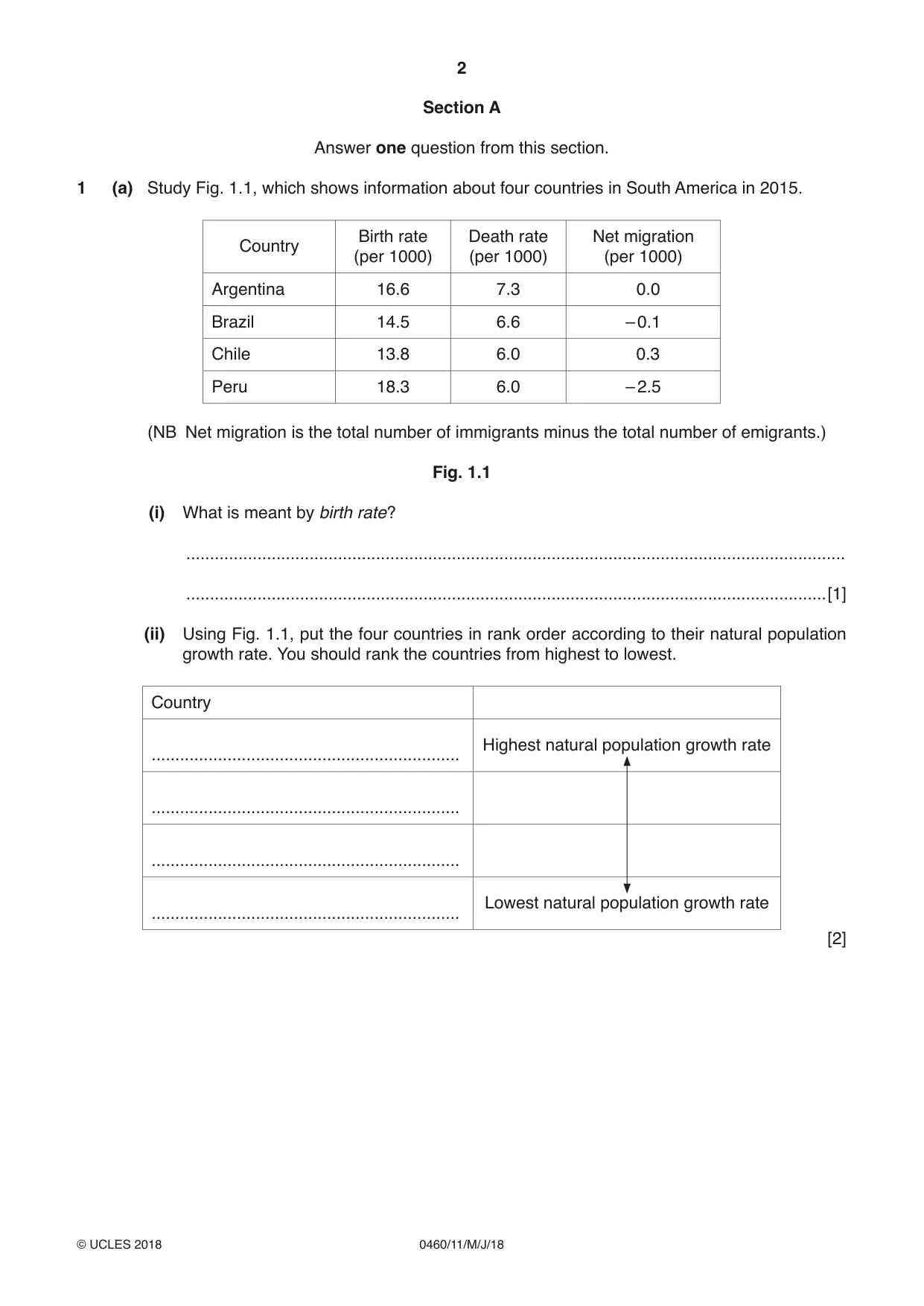
2 0460/11/M/J/18 © UCLES 2018 Section A Answer one question from this section. 1 (a) Study Fig. 1.1, which shows information about four countries in South America in 2015. Country Birth rate (per 1000) Death rate (per 1000) Net migration (per 1000) Argentina 16.6 7.3 0.0 Brazil 14.5 6.6 – 0.1 Chile 13.8 6.0 0.3 Peru 18.3 6.0 – 2.5 (NB Net migration is the total number of immigrants minus the total number of emigrants.) Fig. 1.1 (i) What is meant by birth rate? … …[1] (ii) Using Fig. 1.1, put the four countries in rank order according to their natural population growth rate. You should rank the countries from highest to lowest. Country … Highest natural population growth rate … … … Lowest natural population growth rate [2]
Question paper, page 3
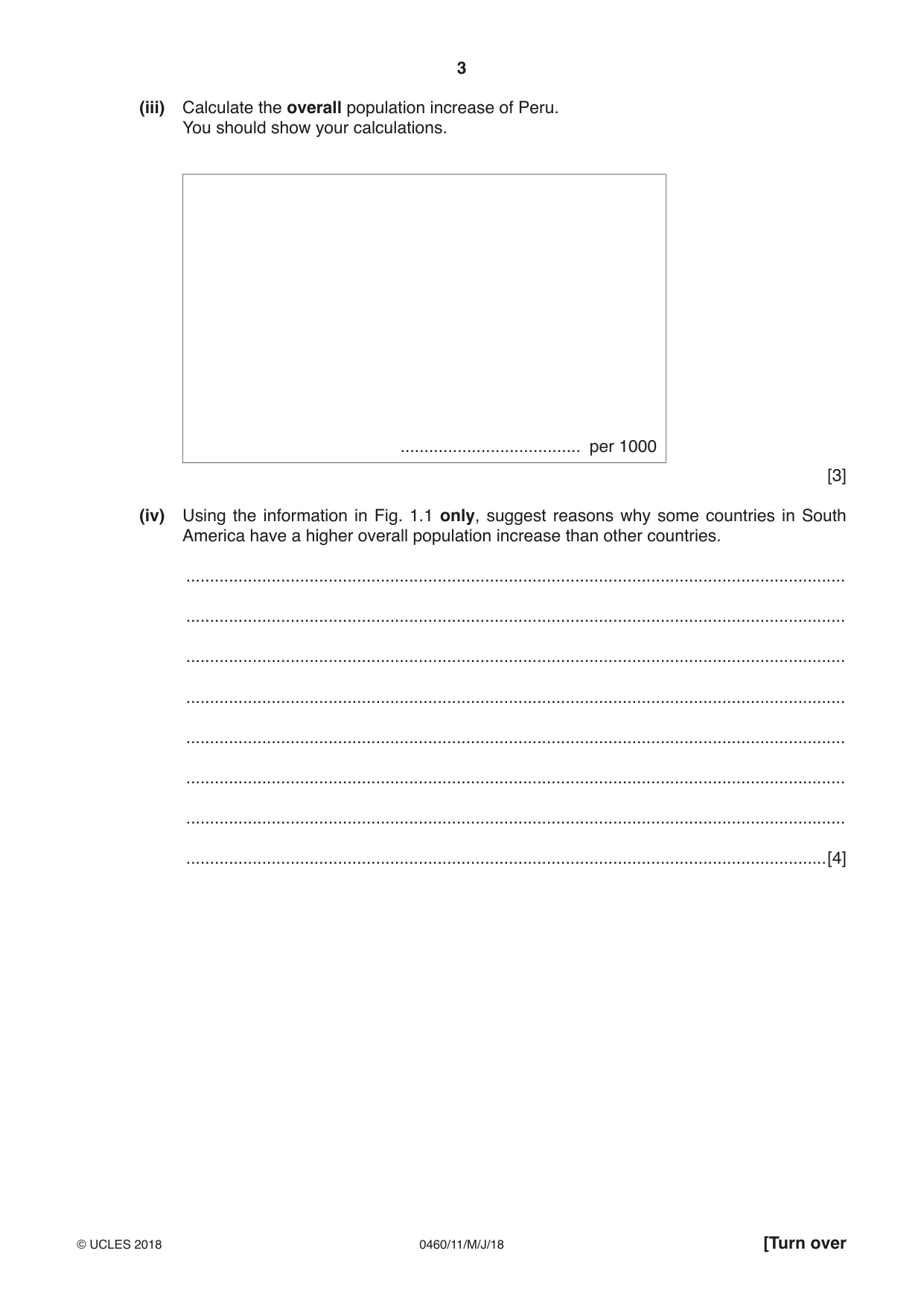
3 0460/11/M/J/18 © UCLES 2018 [Turn over (iii) Calculate the overall population increase of Peru. You should show your calculations. … per 1000 [3] (iv) Using the information in Fig. 1.1 only, suggest reasons why some countries in South America have a higher overall population increase than other countries. … … … … … … … …[4]
Question paper, page 4
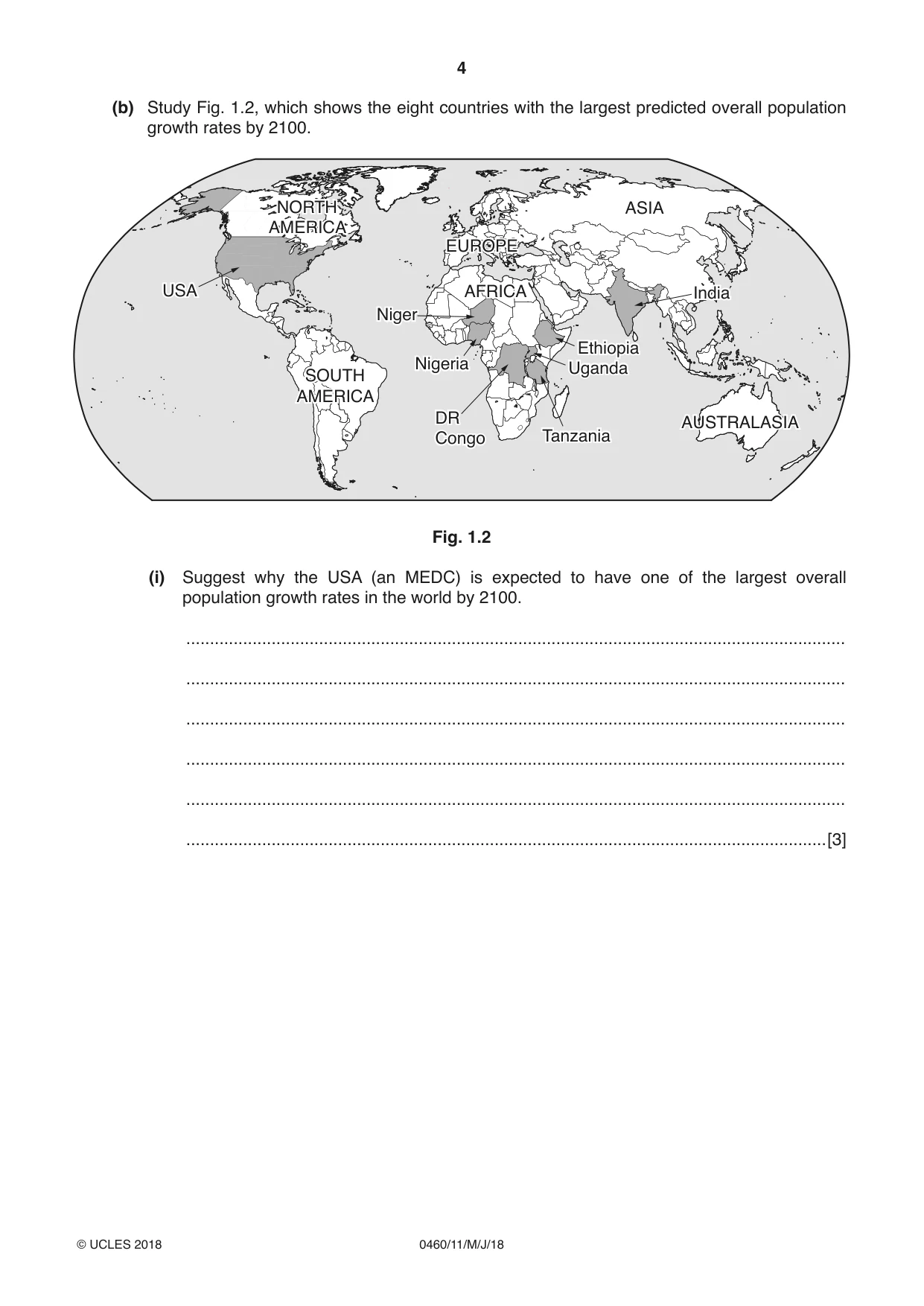
4 0460/11/M/J/18 © UCLES 2018 (b) Study Fig. 1.2, which shows the eight countries with the largest predicted overall population growth rates by 2100. NORTH AMERICA SOUTH AMERICA AFRICA EUROPE AUSTRALASIA India Tanzania DR Congo Nigeria Niger USA Uganda Ethiopia ASIA Fig. 1.2 (i) Suggest why the USA (an MEDC) is expected to have one of the largest overall population growth rates in the world by 2100. … … … … … …[3]
Question paper, page 5
5 0460/11/M/J/18 © UCLES 2018 [Turn over (ii) Suggest reasons why the countries in Africa (LEDCs) such as those labelled in Fig. 1.2 are expected to have large population growth rates by 2100. … … … … … … … … … …[5]
Question paper, page 6
6 0460/11/M/J/18 © UCLES 2018 (c) For a named country you have studied, describe and explain the problems caused by over‑population. Name of country … … … … … … … … … … … … … … … … … … … … … … … … …[7] [Total: 25]
Question paper, page 7
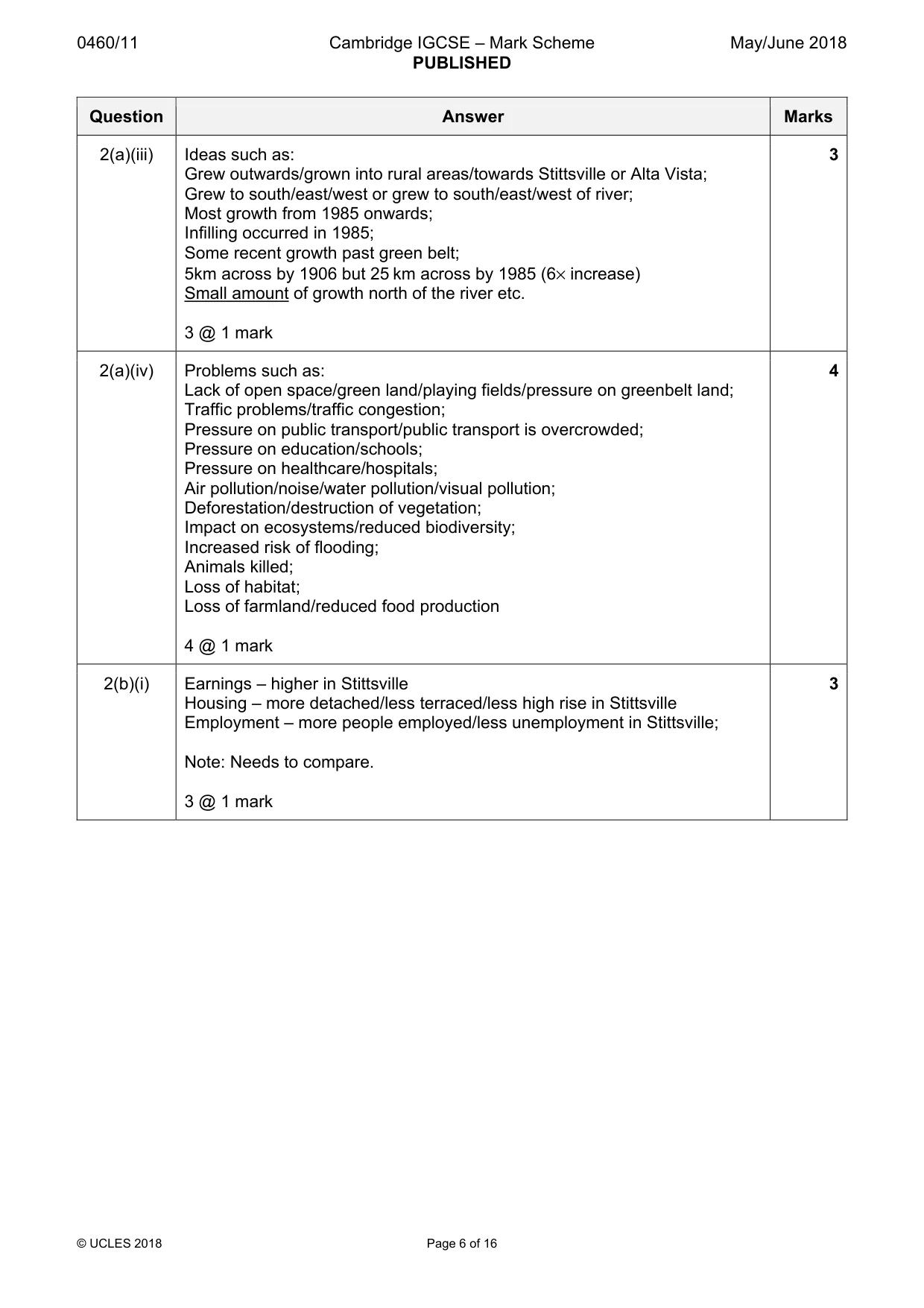
7 0460/11/M/J/18 © UCLES 2018 [Turn over 2 (a) Study Fig. 2.1 (Insert), which shows the urban area and surrounding rural-urban fringe of Ottawa in Canada (an MEDC). (i) What is meant by rural-urban fringe? … …[1] (ii) Suggest two likely differences between the housing in areas X and Y. 1 … … 2 … …[2] (iii) Using evidence from Fig. 2.1, describe how the urban area of Ottawa has grown in size since 1900. … … … … … …[3] (iv) Suggest problems that are likely to have been caused by the growth of Ottawa’s urban area. … … … … … … … …[4]
Question paper, page 8
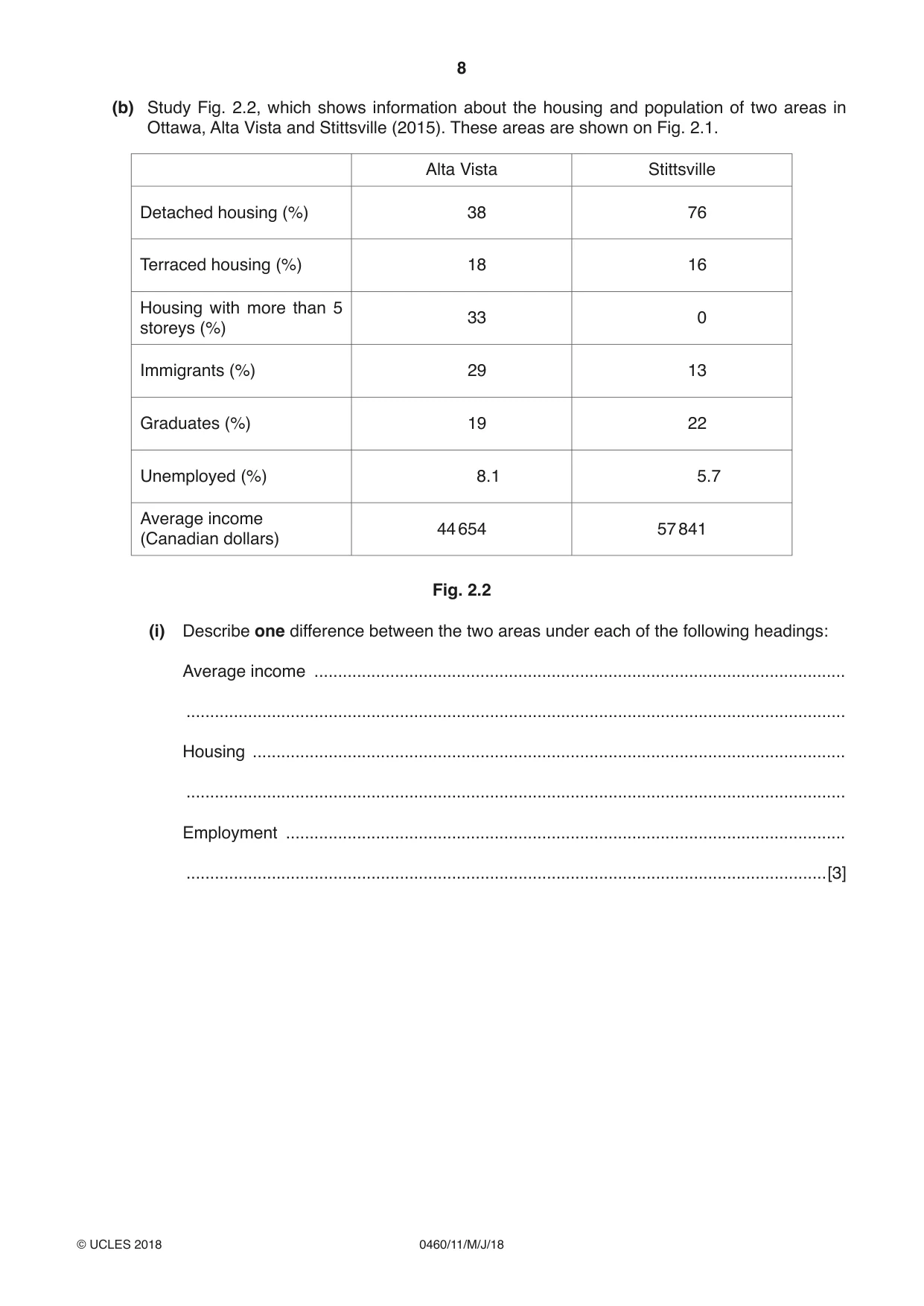
8 0460/11/M/J/18 © UCLES 2018 (b) Study Fig. 2.2, which shows information about the housing and population of two areas in Ottawa, Alta Vista and Stittsville (2015). These areas are shown on Fig. 2.1. Alta Vista Stittsville Detached housing (%) 38 76 Terraced housing (%) 18 16 Housing with more than 5 storeys (%) 33 0 Immigrants (%) 29 13 Graduates (%) 19 22 Unemployed (%) 8.1 5.7 Average income (Canadian dollars) 44 654 57 841 Fig. 2.2 (i) Describe one difference between the two areas under each of the following headings: Average income … … Housing … … Employment … …[3]
Question paper, page 9
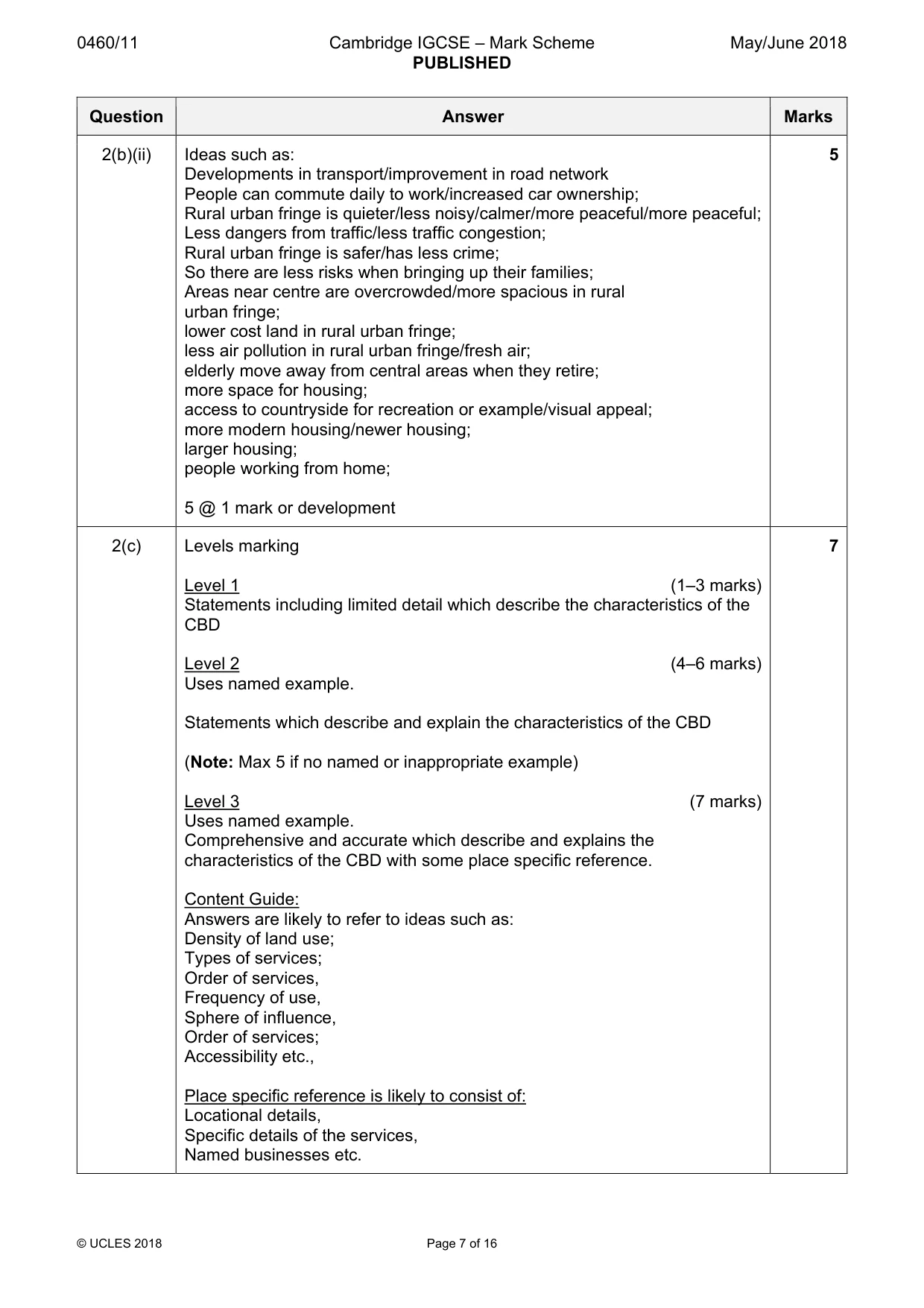
9 0460/11/M/J/18 © UCLES 2018 [Turn over (ii) Explain why many people are moving from areas close to the centre of cities in MEDCs to areas close to the rural-urban fringe. … … … … … … … … … …[5]
Question paper, page 10
10 0460/11/M/J/18 © UCLES 2018 (c) For a named urban area you have studied, describe and explain the characteristics of the CBD. Name of urban area … … … … … … … … … … … … … … … … … … … … … … … … …[7] [Total: 25]
Question paper, page 11
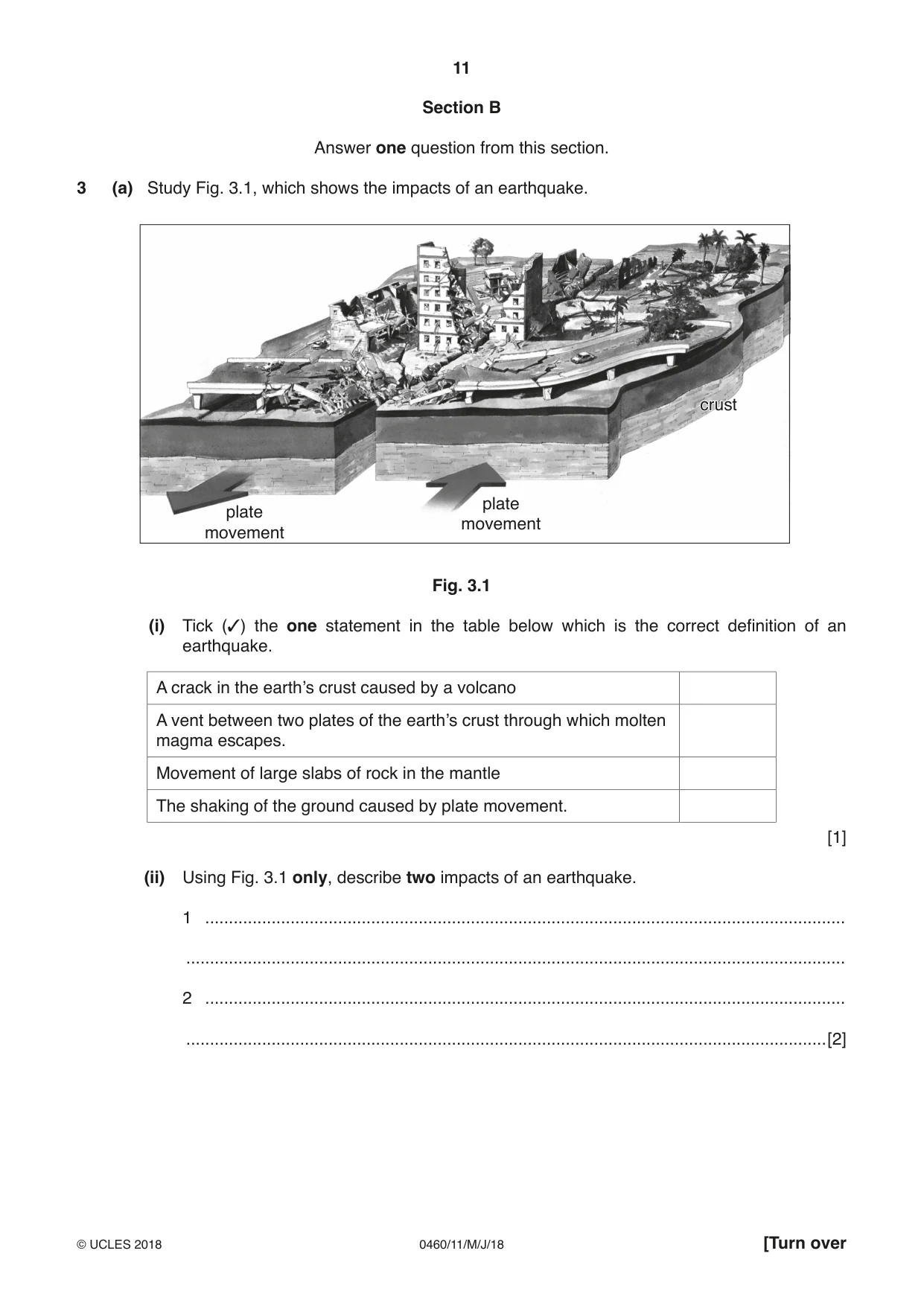
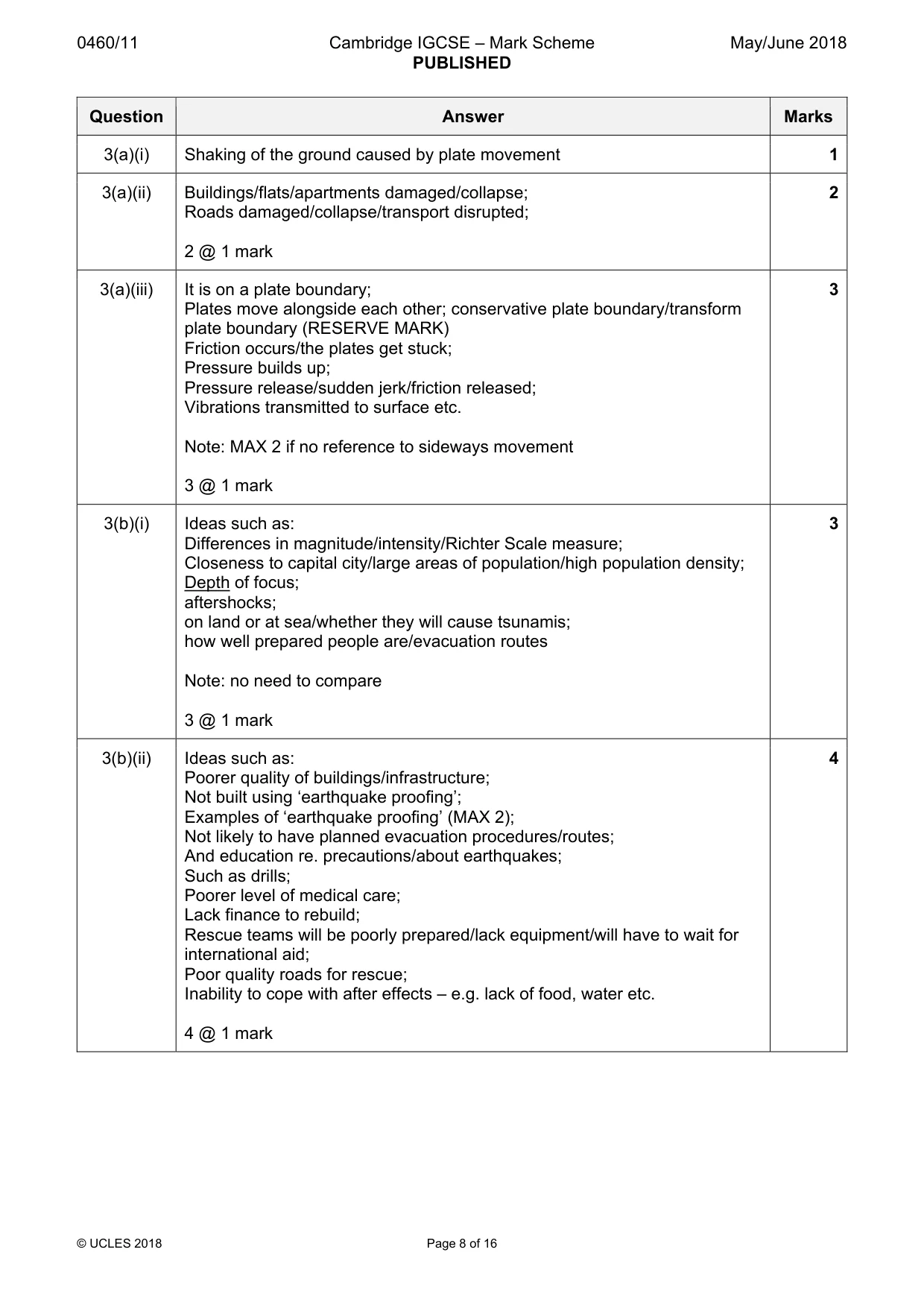
11 0460/11/M/J/18 © UCLES 2018 [Turn over Section B Answer one question from this section. 3 (a) Study Fig. 3.1, which shows the impacts of an earthquake. plate movement plate movement crust Fig. 3.1 (i) Tick (✓) the one statement in the table below which is the correct definition of an earthquake. A crack in the earth’s crust caused by a volcano A vent between two plates of the earth’s crust through which molten magma escapes. Movement of large slabs of rock in the mantle The shaking of the ground caused by plate movement. [1] (ii) Using Fig. 3.1 only, describe two impacts of an earthquake. 1 … … 2 … …[2]
Question paper, page 12
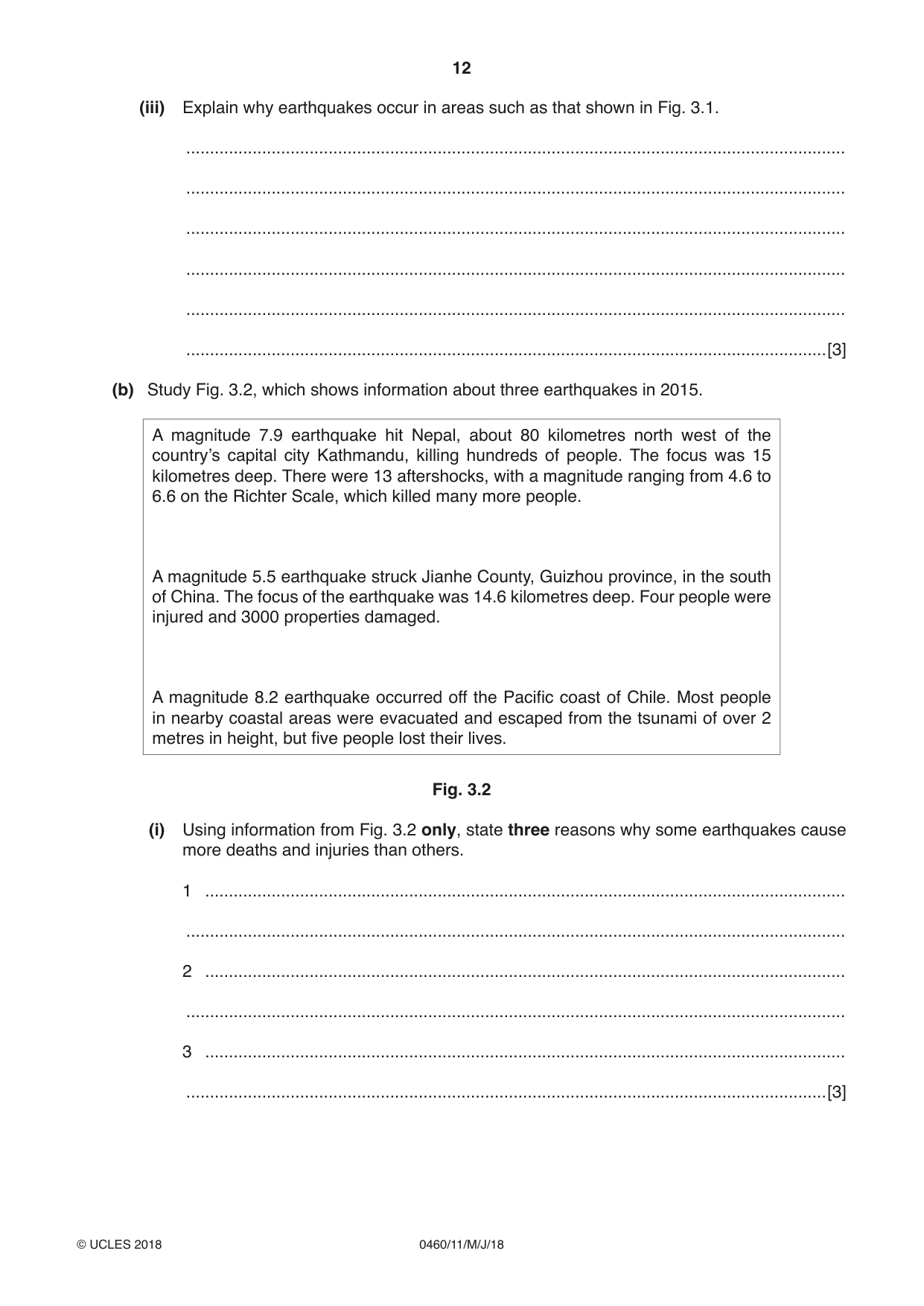
12 0460/11/M/J/18 © UCLES 2018 (iii) Explain why earthquakes occur in areas such as that shown in Fig. 3.1. … … … … … …[3] (b) Study Fig. 3.2, which shows information about three earthquakes in 2015. A magnitude 7.9 earthquake hit Nepal, about 80 kilometres north west of the country’s capital city Kathmandu, killing hundreds of people. The focus was 15 kilometres deep. There were 13 aftershocks, with a magnitude ranging from 4.6 to 6.6 on the Richter Scale, which killed many more people. A magnitude 5.5 earthquake struck Jianhe County, Guizhou province, in the south of China. The focus of the earthquake was 14.6 kilometres deep. Four people were injured and 3000 properties damaged. A magnitude 8.2 earthquake occurred off the Pacific coast of Chile. Most people in nearby coastal areas were evacuated and escaped from the tsunami of over 2 metres in height, but five people lost their lives. Fig. 3.2 (i) Using information from Fig. 3.2 only, state three reasons why some earthquakes cause more deaths and injuries than others. 1 … … 2 … … 3 … …[3]
Question paper, page 13
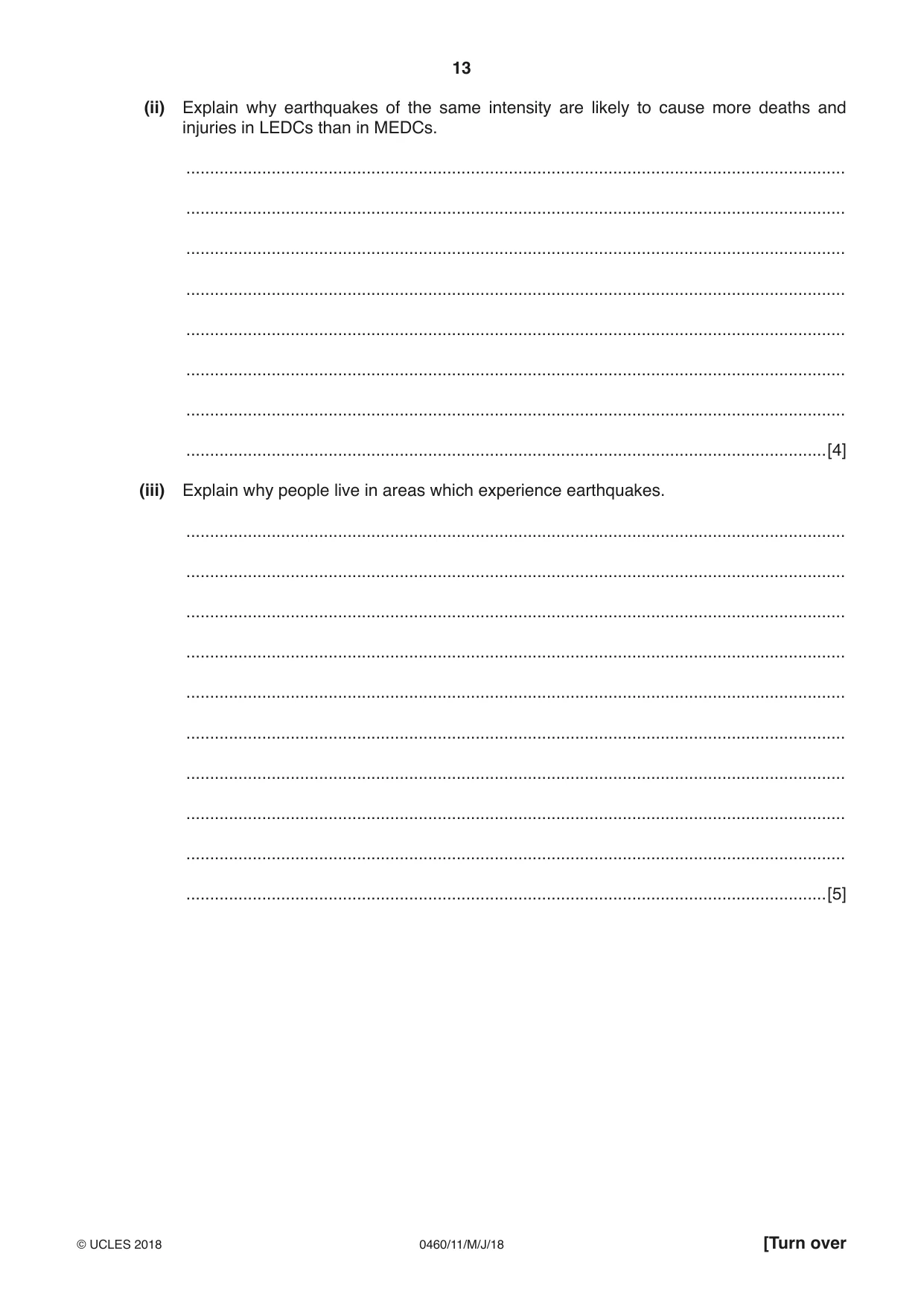
13 0460/11/M/J/18 © UCLES 2018 [Turn over (ii) Explain why earthquakes of the same intensity are likely to cause more deaths and injuries in LEDCs than in MEDCs. … … … … … … … …[4] (iii) Explain why people live in areas which experience earthquakes. … … … … … … … … … …[5]
Question paper, page 14
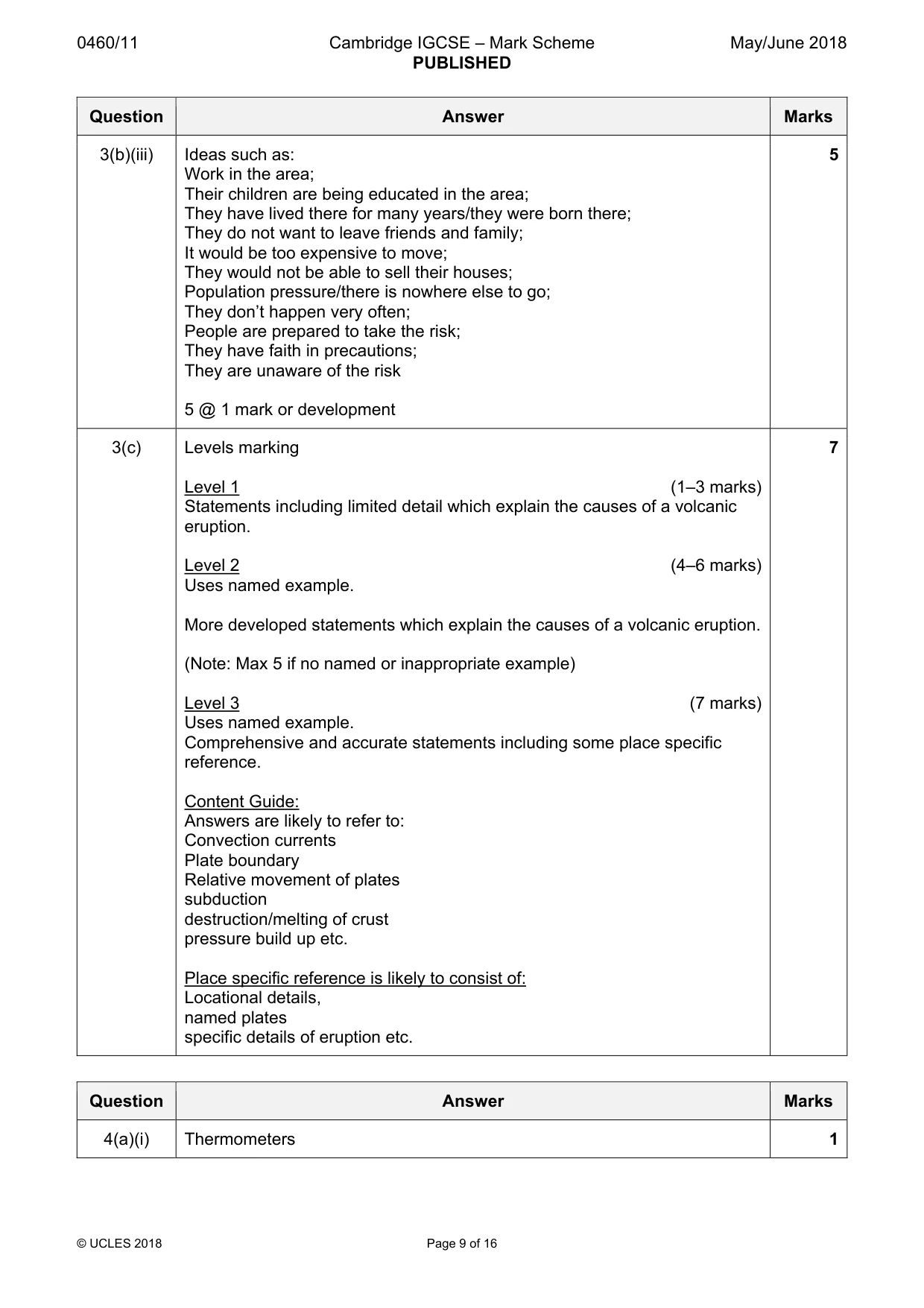
14 0460/11/M/J/18 © UCLES 2018 (c) Explain the causes of an eruption of a named volcano. Name of volcano … … … … … … … … … … … … … … … … … … … … … … … … …[7] [Total: 25]
Question paper, page 15
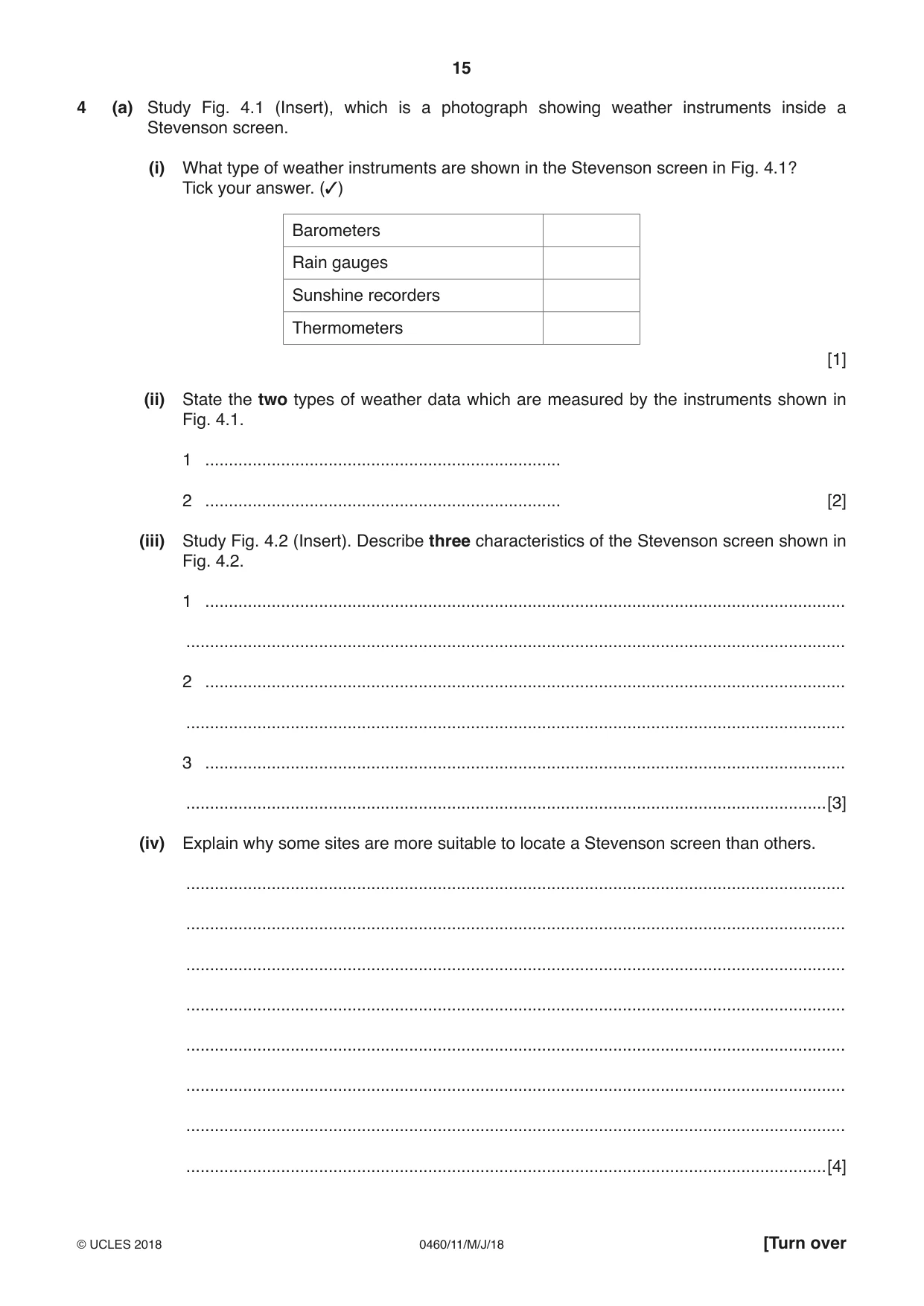
15 0460/11/M/J/18 © UCLES 2018 [Turn over 4 (a) Study Fig. 4.1 (Insert), which is a photograph showing weather instruments inside a Stevenson screen. (i) What type of weather instruments are shown in the Stevenson screen in Fig. 4.1? Tick your answer. (✓) Barometers Rain gauges Sunshine recorders Thermometers [1] (ii) State the two types of weather data which are measured by the instruments shown in Fig. 4.1. 1 … 2 … [2] (iii) Study Fig. 4.2 (Insert). Describe three characteristics of the Stevenson screen shown in Fig. 4.2. 1 … … 2 … … 3 … …[3] (iv) Explain why some sites are more suitable to locate a Stevenson screen than others. … … … … … … … …[4]
Question paper, page 16
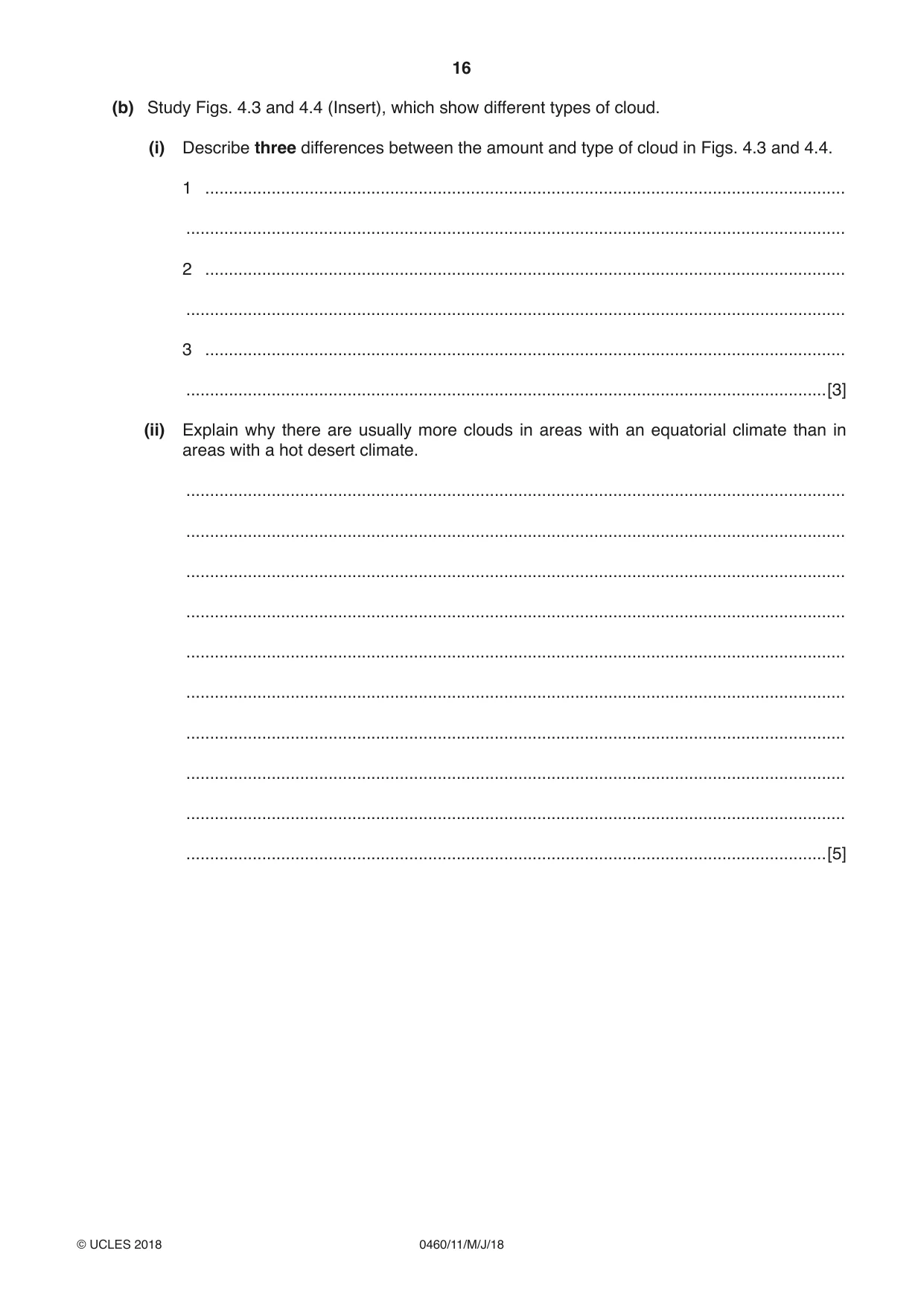
16 0460/11/M/J/18 © UCLES 2018 (b) Study Figs. 4.3 and 4.4 (Insert), which show different types of cloud. (i) Describe three differences between the amount and type of cloud in Figs. 4.3 and 4.4. 1 … … 2 … … 3 … …[3] (ii) Explain why there are usually more clouds in areas with an equatorial climate than in areas with a hot desert climate. … … … … … … … … … …[5]
Question paper, page 17
17 0460/11/M/J/18 © UCLES 2018 [Turn over (c) Describe the impacts of large-scale deforestation of tropical rainforests on the global natural environment. … … … … … … … … … … … … … … … … … … … … … … … …[7] [Total: 25]
Question paper, page 18
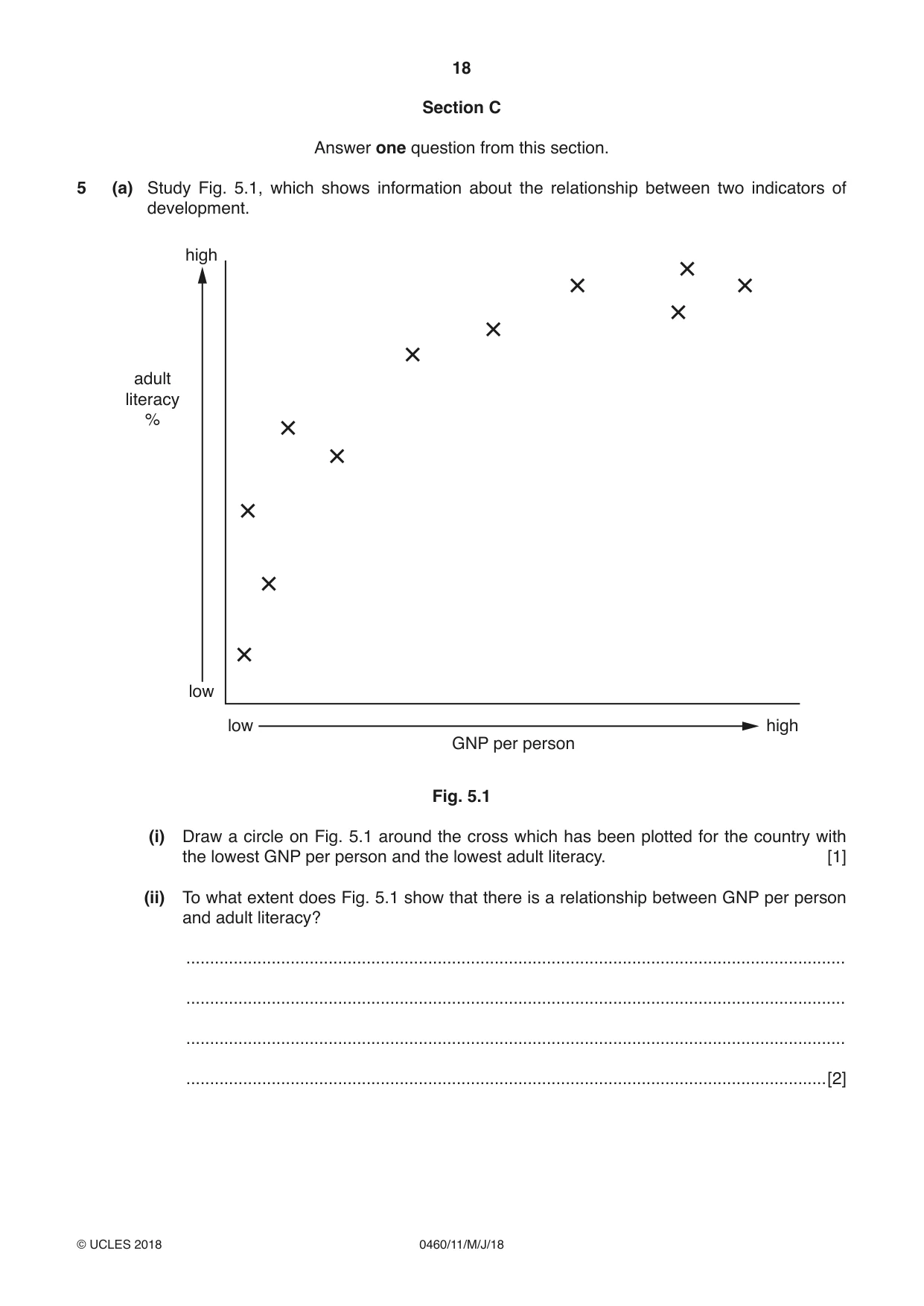
18 0460/11/M/J/18 © UCLES 2018 Section C Answer one question from this section. 5 (a) Study Fig. 5.1, which shows information about the relationship between two indicators of development. low low high adult literacy % GNP per person high Fig. 5.1 (i) Draw a circle on Fig. 5.1 around the cross which has been plotted for the country with the lowest GNP per person and the lowest adult literacy. [1] (ii) To what extent does Fig. 5.1 show that there is a relationship between GNP per person and adult literacy? … … … …[2]
Question paper, page 19
19 0460/11/M/J/18 © UCLES 2018 [Turn over (iii) Explain why there is a relationship between GNP per person and adult literacy. … … … … … …[3] (iv) Another indicator of development is employment structure. Explain how employment structure can be used to assess the level of development of a country. … … … … … … … …[4]
Question paper, page 20
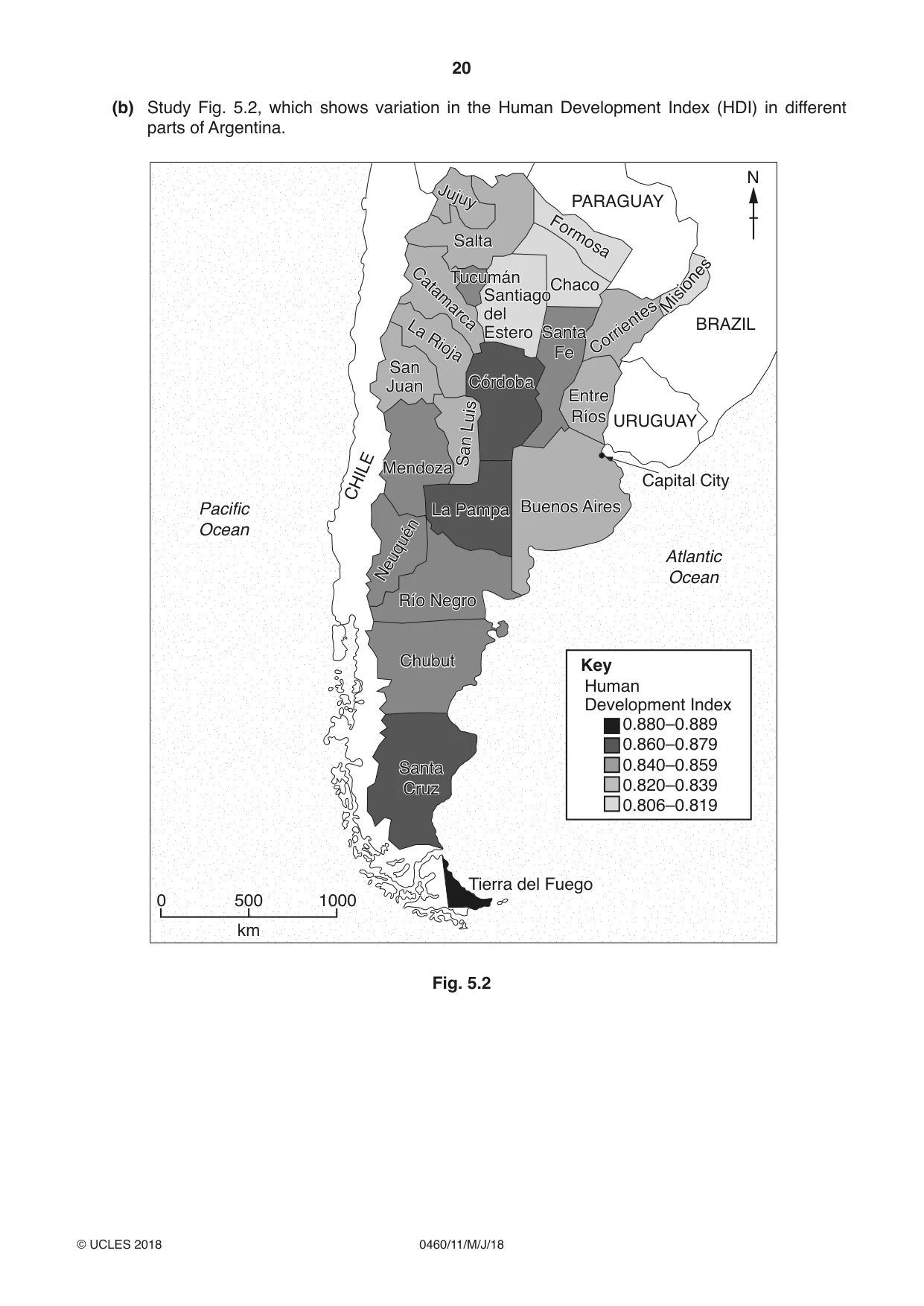
20 0460/11/M/J/18 © UCLES 2018 (b) Study Fig. 5.2, which shows variation in the Human Development Index (HDI) in different parts of Argentina. 0 500 km 1000 Capital City PARAGUAY CHILE BRAZIL URUGUAY Pacific Ocean Atlantic Ocean Salta Santa Cruz Tierra del Fuego Chubut Río Negro La Pampa Mendoza Buenos Aires Córdoba Santa Fe Entre Ríos Corrientes Misiones Chaco Santiago del Estero Tucumán Jujuy Formosa San Juan San Luis La Rioja Catamarca Neuquén Human Development Index 0.880–0.889 0.860–0.879 0.840–0.859 0.820–0.839 0.806–0.819 Key N Fig. 5.2
Question paper, page 21
21 0460/11/M/J/18 © UCLES 2018 [Turn over (i) Using Fig. 5.2 only, describe the variation in HDI within Argentina. … … … … … …[3] (ii) Explain why there are inequalities in development within countries. … … … … … … … … … …[5]
Question paper, page 22
22 0460/11/M/J/18 © UCLES 2018 (c) Describe a named transnational corporation (TNC) you have studied and its global links. Name of transnational corporation (TNC) … … … … … … … … … … … … … … … … … … … … … … … … …[7] [Total: 25]
Question paper, page 23
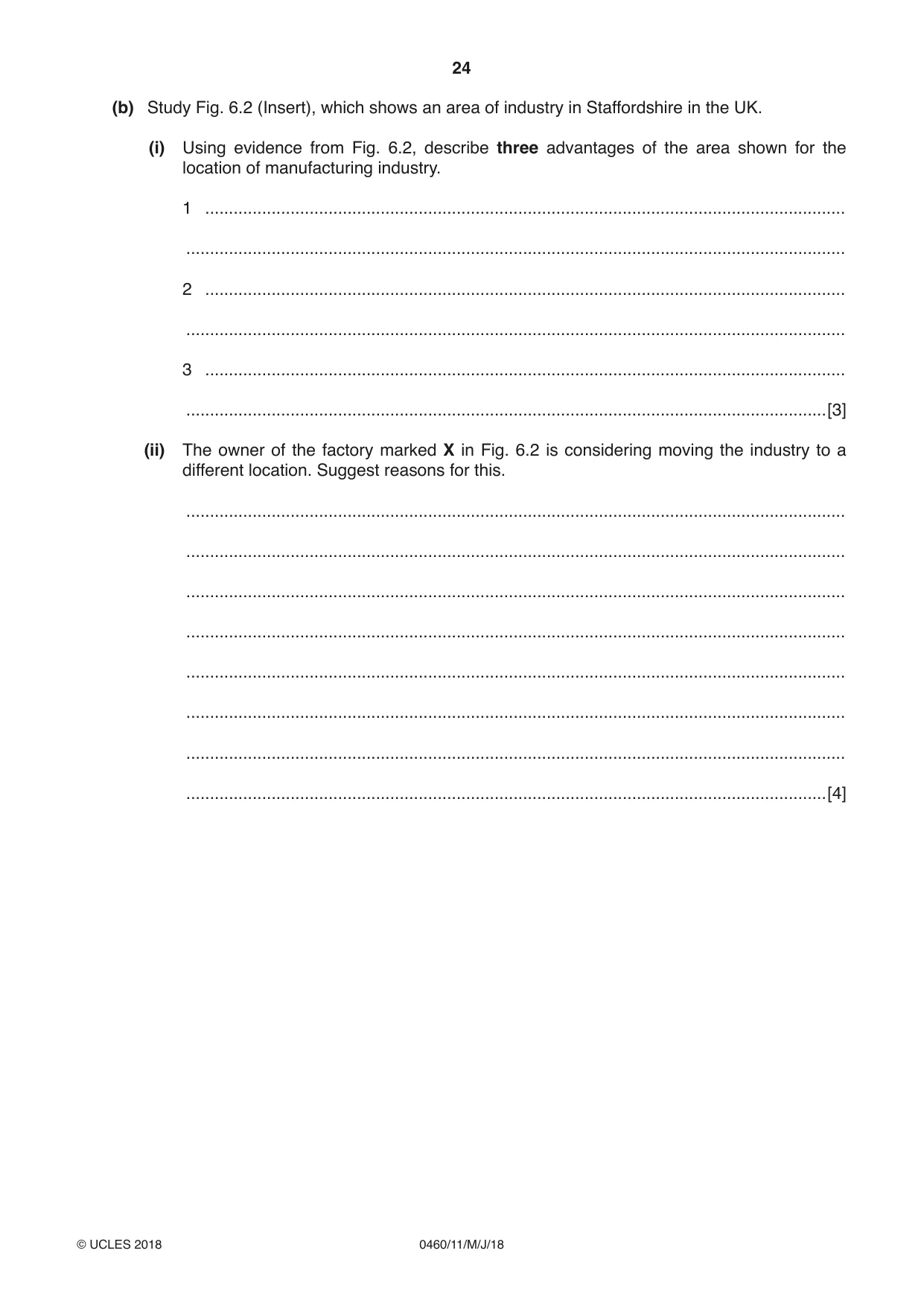
23 0460/11/M/J/18 © UCLES 2018 [Turn over 6 (a) Study Fig. 6.1, which shows some of the stages involved in assembling cars. Fig. 6.1 (i) What is meant by an assembly industry? … …[1] (ii) Using Fig. 6.1 only, give two pieces of evidence that car assembly is highly mechanised. 1 … … 2 … …[2] (iii) Car assembly is an industrial system with inputs, processes and outputs. Define the following terms. Inputs … … Processes … … Outputs … …[3]
Question paper, page 24
24 0460/11/M/J/18 © UCLES 2018 (b) Study Fig. 6.2 (Insert), which shows an area of industry in Staffordshire in the UK. (i) Using evidence from Fig. 6.2, describe three advantages of the area shown for the location of manufacturing industry. 1 … … 2 … … 3 … …[3] (ii) The owner of the factory marked X in Fig. 6.2 is considering moving the industry to a different location. Suggest reasons for this. … … … … … … … …[4]
Question paper, page 25
25 0460/11/M/J/18 © UCLES 2018 [Turn over (iii) Suggest how the manufacturing industries shown in Fig. 6.2 might cause problems for the local natural environment. … … … … … … … … … …[5]
Question paper, page 26
26 0460/11/M/J/18 © UCLES 2018 (c) For a named country you have studied, describe the methods used to supply energy. Name of country … … … … … … … … … … … … … … … … … … … … … … … … …[7] [Total: 25]
Question paper, page 27
27 0460/11/M/J/18 © UCLES 2018 Additional Pages If you use the following lined pages to complete the answer(s) to any question(s), the question number(s) must be clearly shown. … … … … … … … … … … … … … … … … … … … … … … … … … …
Question paper, page 28
28 0460/11/M/J/18 © UCLES 2018 … … … … … … … … … … … … … … … … … … … … … … … … Permission to reproduce items where third-party owned material protected by copyright is included has been sought and cleared where possible. Every reasonable effort has been made by the publisher (UCLES) to trace copyright holders, but if any items requiring clearance have unwittingly been included, the publisher will be pleased to make amends at the earliest possible opportunity. To avoid the issue of disclosure of answer-related information to candidates, all copyright acknowledgements are reproduced online in the Cambridge International Examinations Copyright Acknowledgements Booklet. This is produced for each series of examinations and is freely available to download at www.cie.org.uk after the live examination series. Cambridge International Examinations is part of the Cambridge Assessment Group. Cambridge Assessment is the brand name of University of Cambridge Local Examinations Syndicate (UCLES), which is itself a department of the University of Cambridge.
Mark scheme, page 1
IGCSE™ is a registered trademark. This syllabus is approved for use in England, Wales and Northern Ireland as a Cambridge International Level 1/Level 2 Certificate. This document consists of 16 printed pages. © UCLES 2018 [Turn over Cambridge Assessment International Education Cambridge International General Certificate of Secondary Education GEOGRAPHY 0460/11 Paper 1 May/June 2018 MARK SCHEME Maximum Mark: 75 Published This mark scheme is published as an aid to teachers and candidates, to indicate the requirements of the examination. It shows the basis on which Examiners were instructed to award marks. It does not indicate the details of the discussions that took place at an Examiners’ meeting before marking began, which would have considered the acceptability of alternative answers. Mark schemes should be read in conjunction with the question paper and the Principal Examiner Report for Teachers. Cambridge International will not enter into discussions about these mark schemes. Cambridge International is publishing the mark schemes for the May/June 2018 series for most Cambridge IGCSE™, Cambridge International A and AS Level and Cambridge Pre-U components, and some Cambridge O Level components.
Mark scheme, page 2
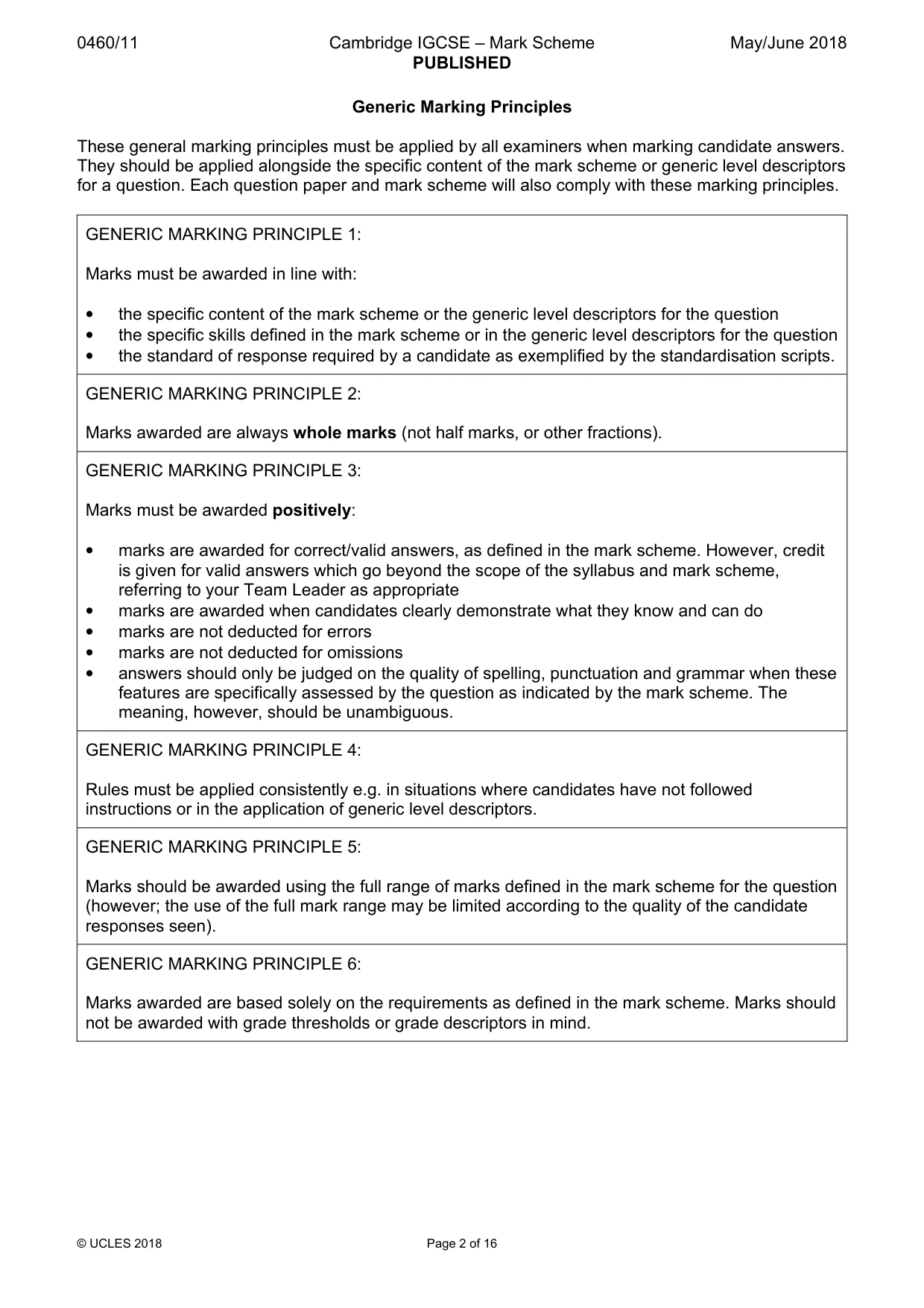
0460/11 Cambridge IGCSE – Mark Scheme PUBLISHED May/June 2018 © UCLES 2018 Page 2 of 16 Generic Marking Principles These general marking principles must be applied by all examiners when marking candidate answers. They should be applied alongside the specific content of the mark scheme or generic level descriptors for a question. Each question paper and mark scheme will also comply with these marking principles. GENERIC MARKING PRINCIPLE 1: Marks must be awarded in line with: • the specific content of the mark scheme or the generic level descriptors for the question • the specific skills defined in the mark scheme or in the generic level descriptors for the question • the standard of response required by a candidate as exemplified by the standardisation scripts. GENERIC MARKING PRINCIPLE 2: Marks awarded are always whole marks (not half marks, or other fractions). GENERIC MARKING PRINCIPLE 3: Marks must be awarded positively: • marks are awarded for correct/valid answers, as defined in the mark scheme. However, credit is given for valid answers which go beyond the scope of the syllabus and mark scheme, referring to your Team Leader as appropriate • marks are awarded when candidates clearly demonstrate what they know and can do • marks are not deducted for errors • marks are not deducted for omissions • answers should only be judged on the quality of spelling, punctuation and grammar when these features are specifically assessed by the question as indicated by the mark scheme. The meaning, however, should be unambiguous. GENERIC MARKING PRINCIPLE 4: Rules must be applied consistently e.g. in situations where candidates have not followed instructions or in the application of generic level descriptors. GENERIC MARKING PRINCIPLE 5: Marks should be awarded using the full range of marks defined in the mark scheme for the question (however; the use of the full mark range may be limited according to the quality of the candidate responses seen). GENERIC MARKING PRINCIPLE 6: Marks awarded are based solely on the requirements as defined in the mark scheme. Marks should not be awarded with grade thresholds or grade descriptors in mind.
Mark scheme, page 3
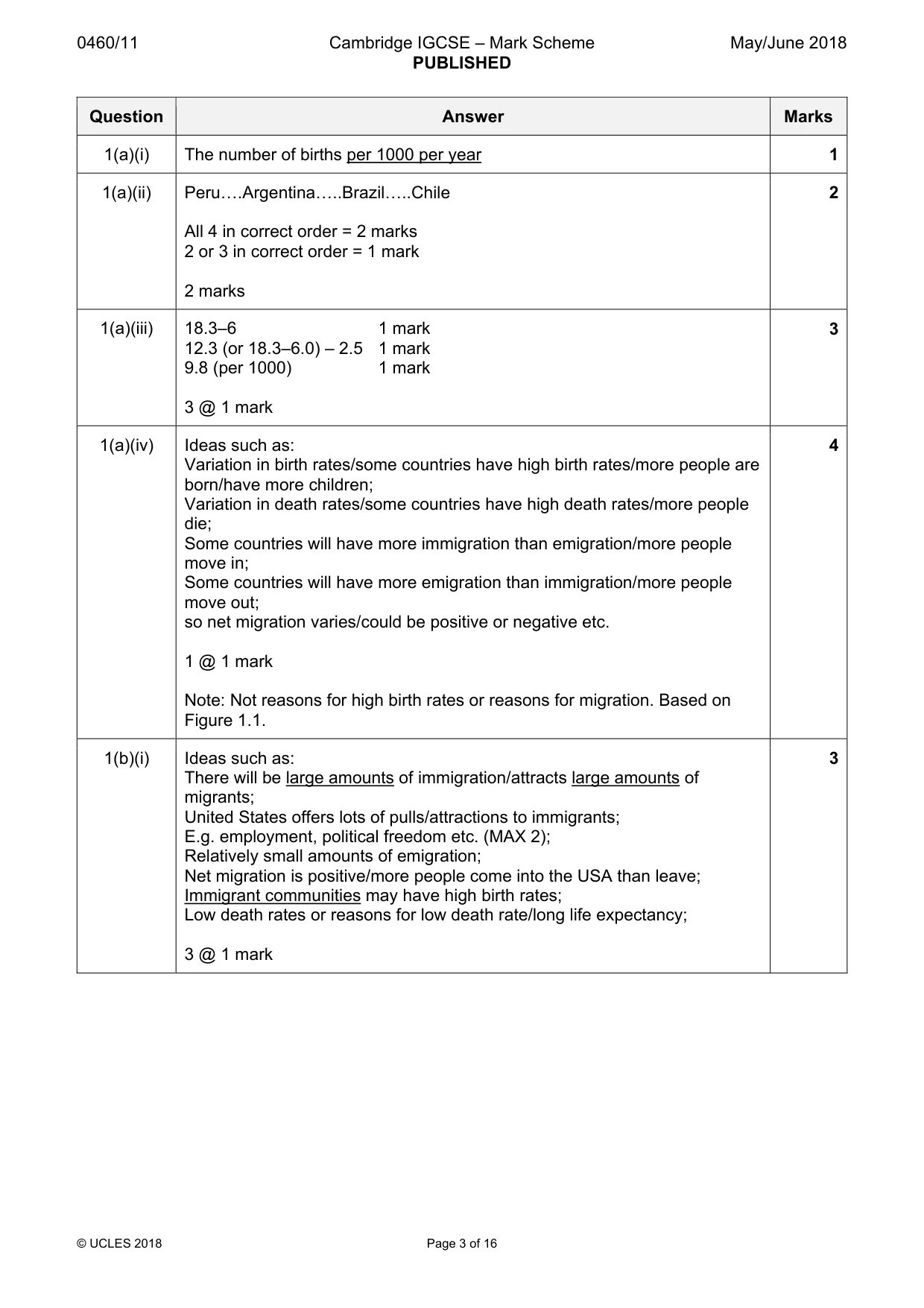
0460/11 Cambridge IGCSE – Mark Scheme PUBLISHED May/June 2018 © UCLES 2018 Page 3 of 16 Question Answer Marks 1(a)(i) The number of births per 1000 per year 1 1(a)(ii) Peru«.Argentina«..Brazil«..Chile All 4 in correct order = 2 marks 2 or 3 in correct order = 1 mark 2 marks 2 1(a)(iii) 18.3–6 1 mark 12.3 (or 18.3–6.0) – 2.5 1 mark 9.8 (per 1000) 1 mark 3 @ 1 mark 3 1(a)(iv) Ideas such as: Variation in birth rates/some countries have high birth rates/more people are born/have more children; Variation in death rates/some countries have high death rates/more people die; Some countries will have more immigration than emigration/more people move in; Some countries will have more emigration than immigration/more people move out; so net migration varies/could be positive or negative etc. 1 @ 1 mark Note: Not reasons for high birth rates or reasons for migration. Based on Figure 1.1. 4 1(b)(i) Ideas such as: There will be large amounts of immigration/attracts large amounts of migrants; United States offers lots of pulls/attractions to immigrants; E.g. employment, political freedom etc. (MAX 2); Relatively small amounts of emigration; Net migration is positive/more people come into the USA than leave; Immigrant communities may have high birth rates; Low death rates or reasons for low death rate/long life expectancy; 3 @ 1 mark 3
Mark scheme, page 4
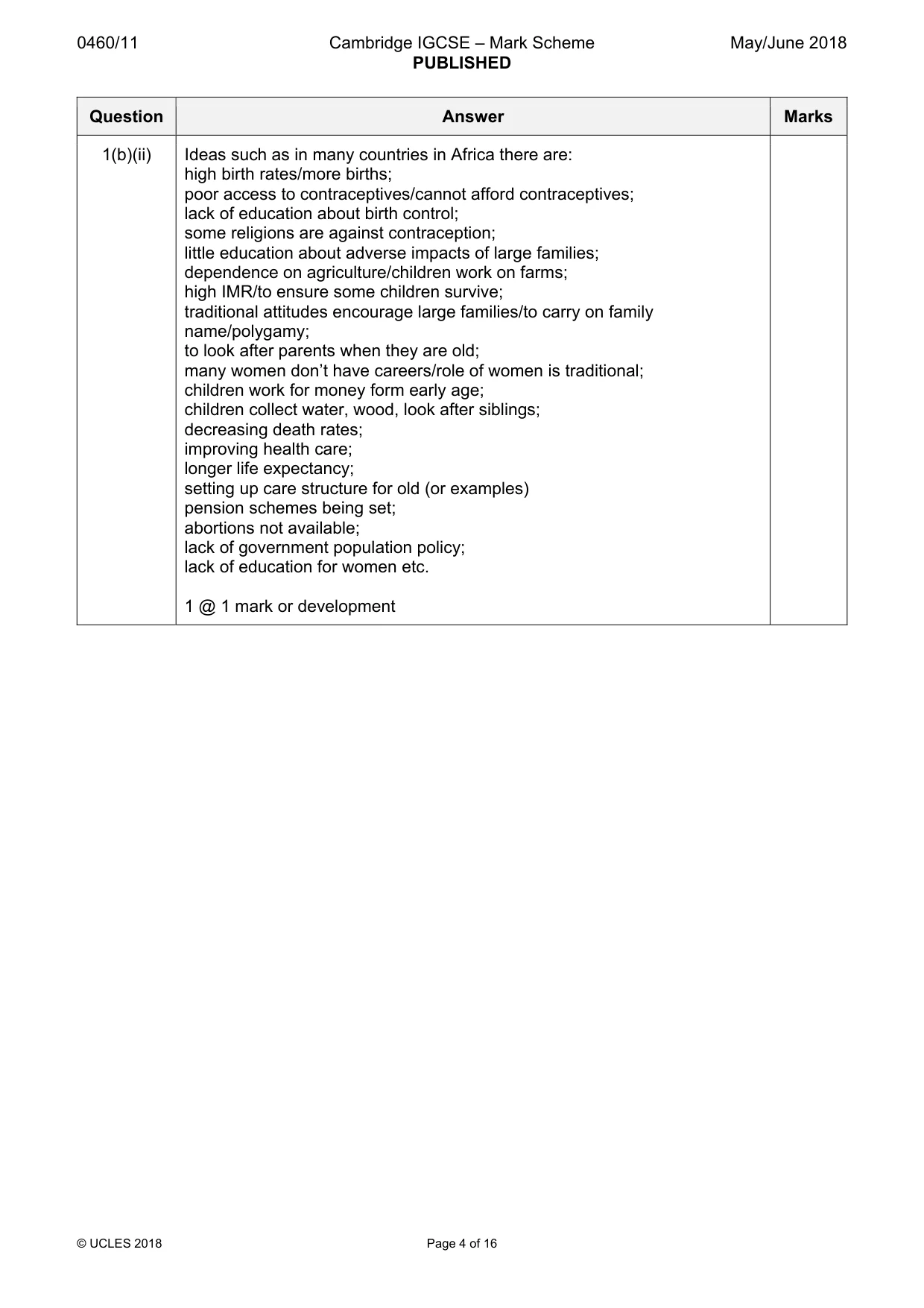
0460/11 Cambridge IGCSE – Mark Scheme PUBLISHED May/June 2018 © UCLES 2018 Page 4 of 16 Question Answer Marks 1(b)(ii) Ideas such as in many countries in Africa there are: high birth rates/more births; poor access to contraceptives/cannot afford contraceptives; lack of education about birth control; some religions are against contraception; little education about adverse impacts of large families; dependence on agriculture/children work on farms; high IMR/to ensure some children survive; traditional attitudes encourage large families/to carry on family name/polygamy; to look after parents when they are old; many women don’t have careers/role of women is traditional; children work for money form early age; children collect water, wood, look after siblings; decreasing death rates; improving health care; longer life expectancy; setting up care structure for old (or examples) pension schemes being set; abortions not available; lack of government population policy; lack of education for women etc. 1 @ 1 mark or development
Mark scheme, page 5
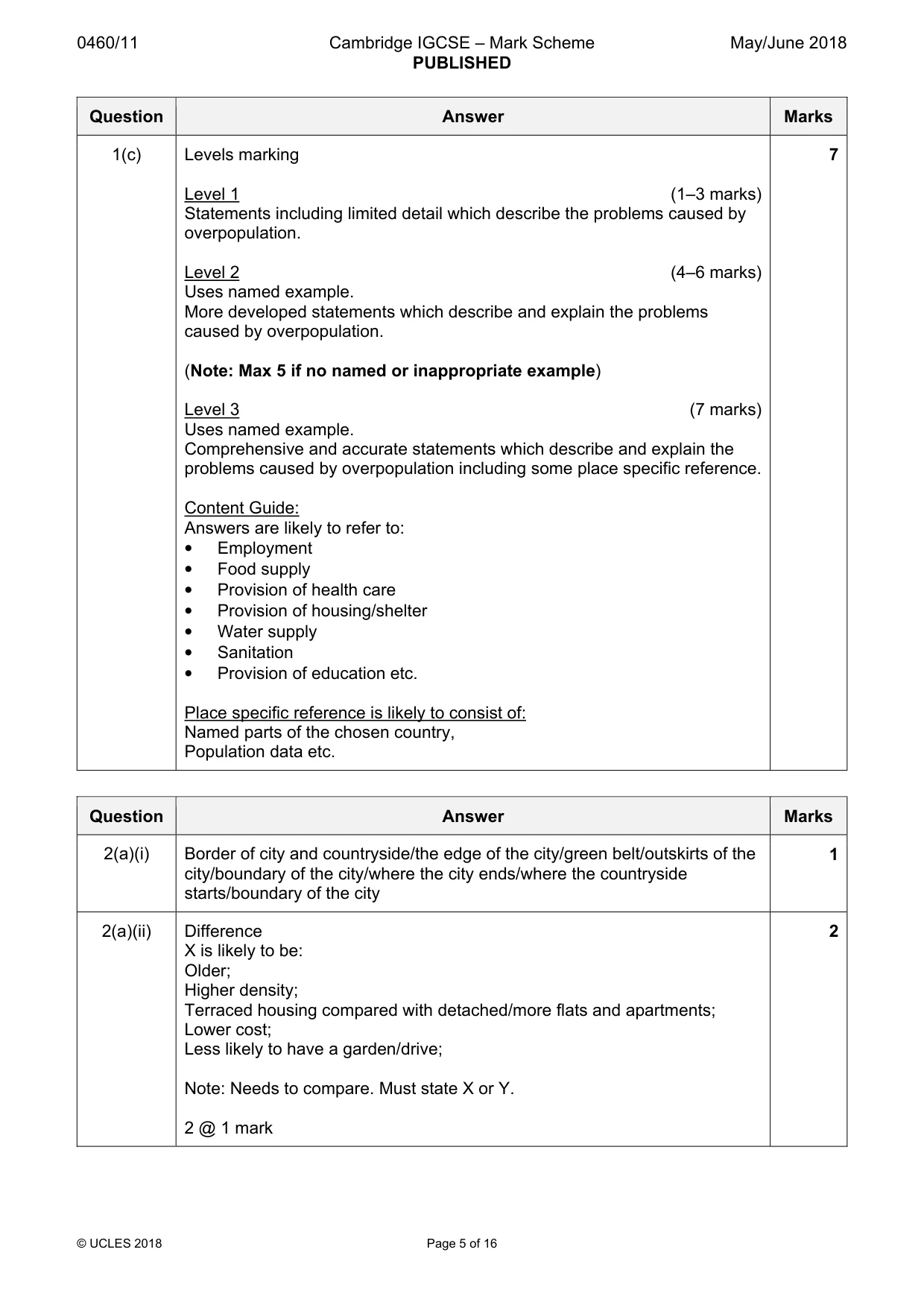
0460/11 Cambridge IGCSE – Mark Scheme PUBLISHED May/June 2018 © UCLES 2018 Page 5 of 16 Question Answer Marks 1(c) Levels marking Level 1 (1–3 marks) Statements including limited detail which describe the problems caused by overpopulation. Level 2 (4–6 marks) Uses named example. More developed statements which describe and explain the problems caused by overpopulation. (Note: Max 5 if no named or inappropriate example) Level 3 (7 marks) Uses named example. Comprehensive and accurate statements which describe and explain the problems caused by overpopulation including some place specific reference. Content Guide: Answers are likely to refer to: • Employment • Food supply • Provision of health care • Provision of housing/shelter • Water supply • Sanitation • Provision of education etc. Place specific reference is likely to consist of: Named parts of the chosen country, Population data etc. 7 Question Answer Marks 2(a)(i) Border of city and countryside/the edge of the city/green belt/outskirts of the city/boundary of the city/where the city ends/where the countryside starts/boundary of the city 1 2(a)(ii) Difference X is likely to be: Older; Higher density; Terraced housing compared with detached/more flats and apartments; Lower cost; Less likely to have a garden/drive; Note: Needs to compare. Must state X or Y. 2 @ 1 mark 2
Mark scheme, page 6
0460/11 Cambridge IGCSE – Mark Scheme PUBLISHED May/June 2018 © UCLES 2018 Page 6 of 16 Question Answer Marks 2(a)(iii) Ideas such as: Grew outwards/grown into rural areas/towards Stittsville or Alta Vista; Grew to south/east/west or grew to south/east/west of river; Most growth from 1985 onwards; Infilling occurred in 1985; Some recent growth past green belt; 5km across by 1906 but 25 km across by 1985 (6× increase) Small amount of growth north of the river etc. 3 @ 1 mark 3 2(a)(iv) Problems such as: Lack of open space/green land/playing fields/pressure on greenbelt land; Traffic problems/traffic congestion; Pressure on public transport/public transport is overcrowded; Pressure on education/schools; Pressure on healthcare/hospitals; Air pollution/noise/water pollution/visual pollution; Deforestation/destruction of vegetation; Impact on ecosystems/reduced biodiversity; Increased risk of flooding; Animals killed; Loss of habitat; Loss of farmland/reduced food production 4 @ 1 mark 4 2(b)(i) Earnings – higher in Stittsville Housing – more detached/less terraced/less high rise in Stittsville Employment – more people employed/less unemployment in Stittsville; Note: Needs to compare. 3 @ 1 mark 3
Mark scheme, page 7
0460/11 Cambridge IGCSE – Mark Scheme PUBLISHED May/June 2018 © UCLES 2018 Page 7 of 16 Question Answer Marks 2(b)(ii) Ideas such as: Developments in transport/improvement in road network People can commute daily to work/increased car ownership; Rural urban fringe is quieter/less noisy/calmer/more peaceful/more peaceful; Less dangers from traffic/less traffic congestion; Rural urban fringe is safer/has less crime; So there are less risks when bringing up their families; Areas near centre are overcrowded/more spacious in rural urban fringe; lower cost land in rural urban fringe; less air pollution in rural urban fringe/fresh air; elderly move away from central areas when they retire; more space for housing; access to countryside for recreation or example/visual appeal; more modern housing/newer housing; larger housing; people working from home; 5 @ 1 mark or development 5 2(c) Levels marking Level 1 (1–3 marks) Statements including limited detail which describe the characteristics of the CBD Level 2 (4–6 marks) Uses named example. Statements which describe and explain the characteristics of the CBD (Note: Max 5 if no named or inappropriate example) Level 3 (7 marks) Uses named example. Comprehensive and accurate which describe and explains the characteristics of the CBD with some place specific reference. Content Guide: Answers are likely to refer to ideas such as: Density of land use; Types of services; Order of services, Frequency of use, Sphere of influence, Order of services; Accessibility etc., Place specific reference is likely to consist of: Locational details, Specific details of the services, Named businesses etc. 7
Mark scheme, page 8
0460/11 Cambridge IGCSE – Mark Scheme PUBLISHED May/June 2018 © UCLES 2018 Page 8 of 16 Question Answer Marks 3(a)(i) Shaking of the ground caused by plate movement 1 3(a)(ii) Buildings/flats/apartments damaged/collapse; Roads damaged/collapse/transport disrupted; 2 @ 1 mark 2 3(a)(iii) It is on a plate boundary; Plates move alongside each other; conservative plate boundary/transform plate boundary (RESERVE MARK) Friction occurs/the plates get stuck; Pressure builds up; Pressure release/sudden jerk/friction released; Vibrations transmitted to surface etc. Note: MAX 2 if no reference to sideways movement 3 @ 1 mark 3 3(b)(i) Ideas such as: Differences in magnitude/intensity/Richter Scale measure; Closeness to capital city/large areas of population/high population density; Depth of focus; aftershocks; on land or at sea/whether they will cause tsunamis; how well prepared people are/evacuation routes Note: no need to compare 3 @ 1 mark 3 3(b)(ii) Ideas such as: Poorer quality of buildings/infrastructure; Not built using ‘earthquake proofing’; Examples of ‘earthquake proofing’ (MAX 2); Not likely to have planned evacuation procedures/routes; And education re. precautions/about earthquakes; Such as drills; Poorer level of medical care; Lack finance to rebuild; Rescue teams will be poorly prepared/lack equipment/will have to wait for international aid; Poor quality roads for rescue; Inability to cope with after effects – e.g. lack of food, water etc. 4 @ 1 mark 4
Mark scheme, page 9
0460/11 Cambridge IGCSE – Mark Scheme PUBLISHED May/June 2018 © UCLES 2018 Page 9 of 16 Question Answer Marks 3(b)(iii) Ideas such as: Work in the area; Their children are being educated in the area; They have lived there for many years/they were born there; They do not want to leave friends and family; It would be too expensive to move; They would not be able to sell their houses; Population pressure/there is nowhere else to go; They don’t happen very often; People are prepared to take the risk; They have faith in precautions; They are unaware of the risk 5 @ 1 mark or development 5 3(c) Levels marking Level 1 (1–3 marks) Statements including limited detail which explain the causes of a volcanic eruption. Level 2 (4–6 marks) Uses named example. More developed statements which explain the causes of a volcanic eruption. (Note: Max 5 if no named or inappropriate example) Level 3 (7 marks) Uses named example. Comprehensive and accurate statements including some place specific reference. Content Guide: Answers are likely to refer to: Convection currents Plate boundary Relative movement of plates subduction destruction/melting of crust pressure build up etc. Place specific reference is likely to consist of: Locational details, named plates specific details of eruption etc. 7 Question Answer Marks 4(a)(i) Thermometers 1
Mark scheme, page 10
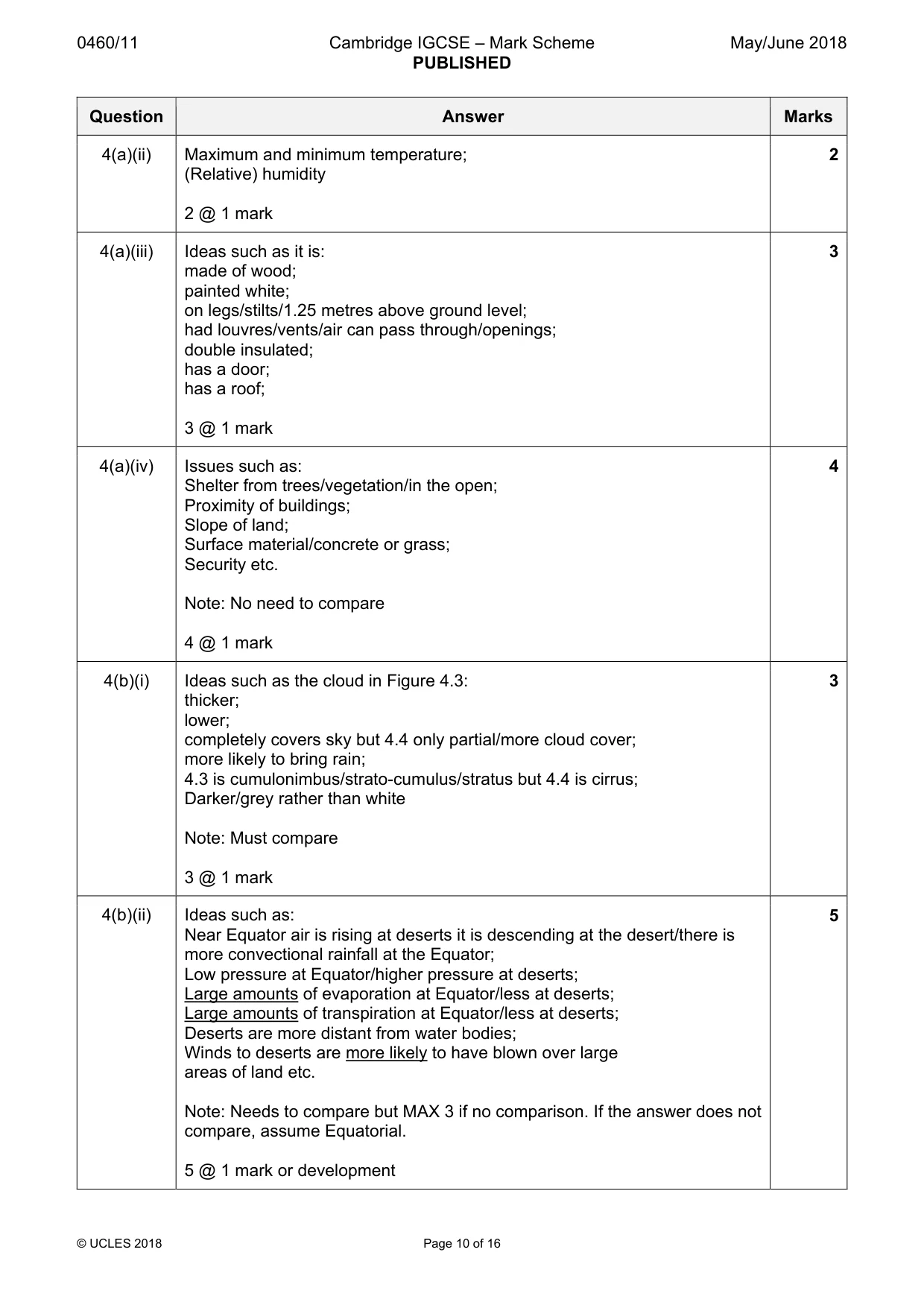
0460/11 Cambridge IGCSE – Mark Scheme PUBLISHED May/June 2018 © UCLES 2018 Page 10 of 16 Question Answer Marks 4(a)(ii) Maximum and minimum temperature; (Relative) humidity 2 @ 1 mark 2 4(a)(iii) Ideas such as it is: made of wood; painted white; on legs/stilts/1.25 metres above ground level; had louvres/vents/air can pass through/openings; double insulated; has a door; has a roof; 3 @ 1 mark 3 4(a)(iv) Issues such as: Shelter from trees/vegetation/in the open; Proximity of buildings; Slope of land; Surface material/concrete or grass; Security etc. Note: No need to compare 4 @ 1 mark 4 4(b)(i) Ideas such as the cloud in Figure 4.3: thicker; lower; completely covers sky but 4.4 only partial/more cloud cover; more likely to bring rain; 4.3 is cumulonimbus/strato-cumulus/stratus but 4.4 is cirrus; Darker/grey rather than white Note: Must compare 3 @ 1 mark 3 4(b)(ii) Ideas such as: Near Equator air is rising at deserts it is descending at the desert/there is more convectional rainfall at the Equator; Low pressure at Equator/higher pressure at deserts; Large amounts of evaporation at Equator/less at deserts; Large amounts of transpiration at Equator/less at deserts; Deserts are more distant from water bodies; Winds to deserts are more likely to have blown over large areas of land etc. Note: Needs to compare but MAX 3 if no comparison. If the answer does not compare, assume Equatorial. 5 @ 1 mark or development 5
Mark scheme, page 11
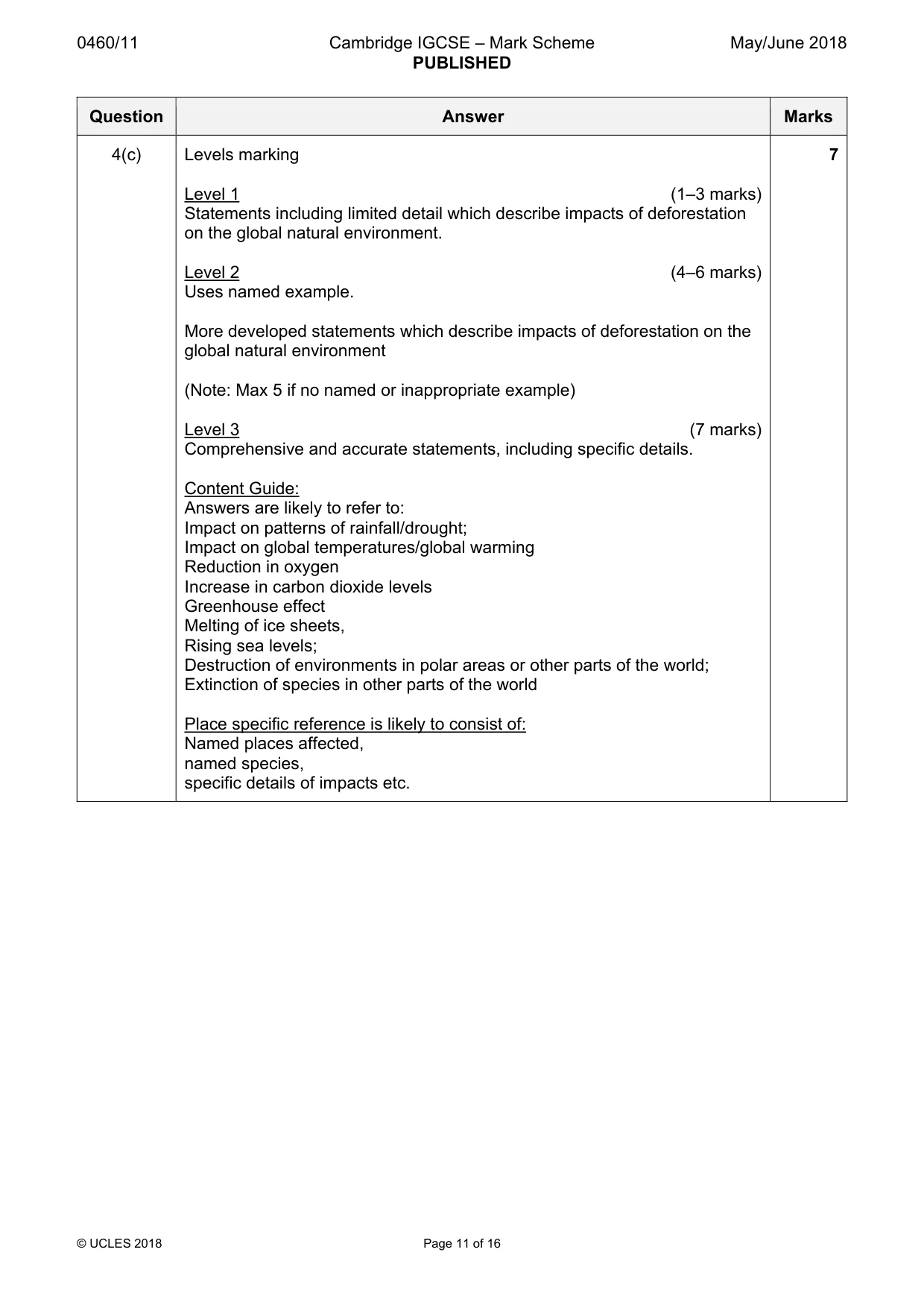
0460/11 Cambridge IGCSE – Mark Scheme PUBLISHED May/June 2018 © UCLES 2018 Page 11 of 16 Question Answer Marks 4(c) Levels marking Level 1 (1–3 marks) Statements including limited detail which describe impacts of deforestation on the global natural environment. Level 2 (4–6 marks) Uses named example. More developed statements which describe impacts of deforestation on the global natural environment (Note: Max 5 if no named or inappropriate example) Level 3 (7 marks) Comprehensive and accurate statements, including specific details. Content Guide: Answers are likely to refer to: Impact on patterns of rainfall/drought; Impact on global temperatures/global warming Reduction in oxygen Increase in carbon dioxide levels Greenhouse effect Melting of ice sheets, Rising sea levels; Destruction of environments in polar areas or other parts of the world; Extinction of species in other parts of the world Place specific reference is likely to consist of: Named places affected, named species, specific details of impacts etc. 7
Mark scheme, page 12
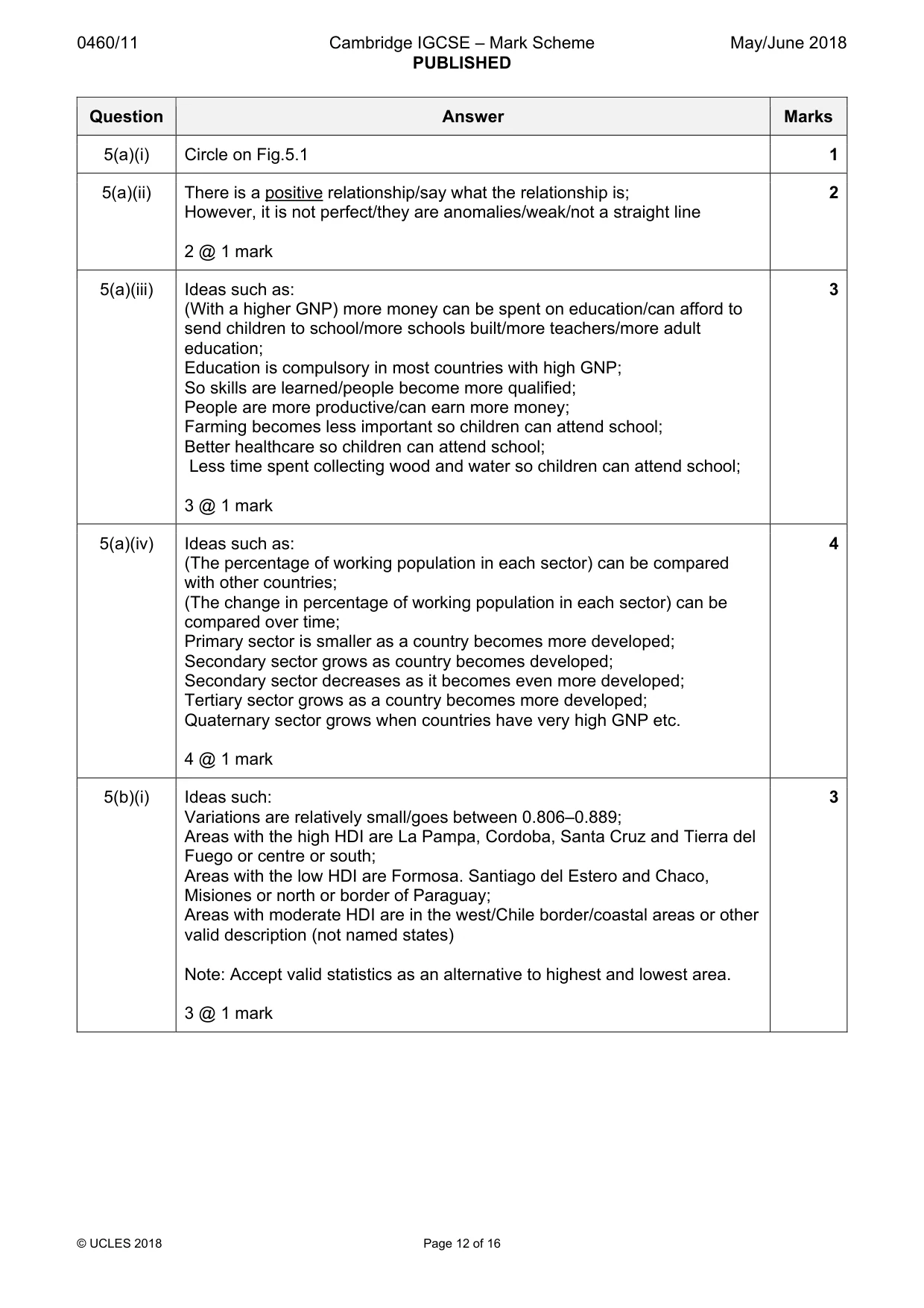
0460/11 Cambridge IGCSE – Mark Scheme PUBLISHED May/June 2018 © UCLES 2018 Page 12 of 16 Question Answer Marks 5(a)(i) Circle on Fig.5.1 1 5(a)(ii) There is a positive relationship/say what the relationship is; However, it is not perfect/they are anomalies/weak/not a straight line 2 @ 1 mark 2 5(a)(iii) Ideas such as: (With a higher GNP) more money can be spent on education/can afford to send children to school/more schools built/more teachers/more adult education; Education is compulsory in most countries with high GNP; So skills are learned/people become more qualified; People are more productive/can earn more money; Farming becomes less important so children can attend school; Better healthcare so children can attend school; Less time spent collecting wood and water so children can attend school; 3 @ 1 mark 3 5(a)(iv) Ideas such as: (The percentage of working population in each sector) can be compared with other countries; (The change in percentage of working population in each sector) can be compared over time; Primary sector is smaller as a country becomes more developed; Secondary sector grows as country becomes developed; Secondary sector decreases as it becomes even more developed; Tertiary sector grows as a country becomes more developed; Quaternary sector grows when countries have very high GNP etc. 4 @ 1 mark 4 5(b)(i) Ideas such: Variations are relatively small/goes between 0.806–0.889; Areas with the high HDI are La Pampa, Cordoba, Santa Cruz and Tierra del Fuego or centre or south; Areas with the low HDI are Formosa. Santiago del Estero and Chaco, Misiones or north or border of Paraguay; Areas with moderate HDI are in the west/Chile border/coastal areas or other valid description (not named states) Note: Accept valid statistics as an alternative to highest and lowest area. 3 @ 1 mark 3
Mark scheme, page 13
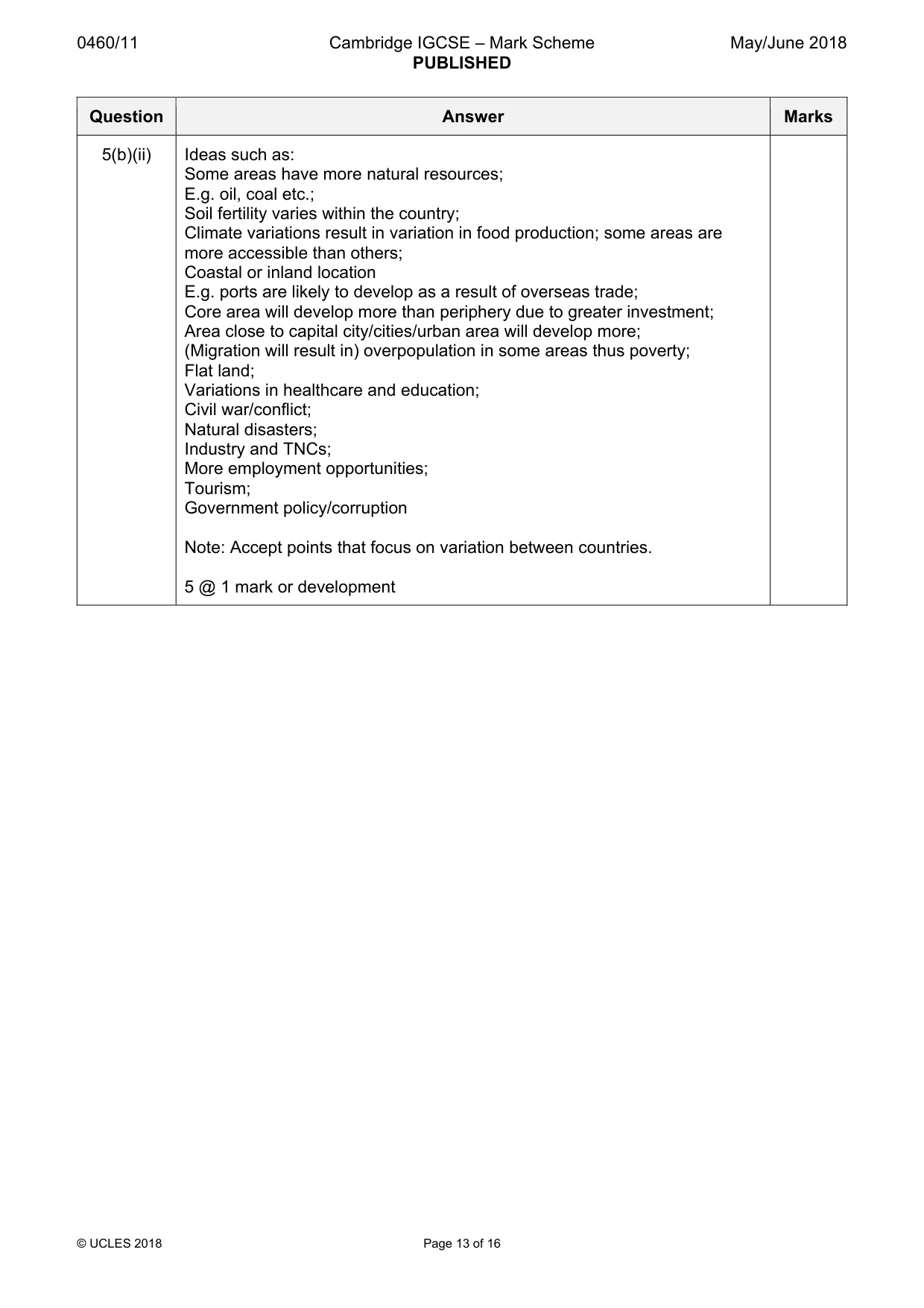
0460/11 Cambridge IGCSE – Mark Scheme PUBLISHED May/June 2018 © UCLES 2018 Page 13 of 16 Question Answer Marks 5(b)(ii) Ideas such as: Some areas have more natural resources; E.g. oil, coal etc.; Soil fertility varies within the country; Climate variations result in variation in food production; some areas are more accessible than others; Coastal or inland location E.g. ports are likely to develop as a result of overseas trade; Core area will develop more than periphery due to greater investment; Area close to capital city/cities/urban area will develop more; (Migration will result in) overpopulation in some areas thus poverty; Flat land; Variations in healthcare and education; Civil war/conflict; Natural disasters; Industry and TNCs; More employment opportunities; Tourism; Government policy/corruption Note: Accept points that focus on variation between countries. 5 @ 1 mark or development
Mark scheme, page 14
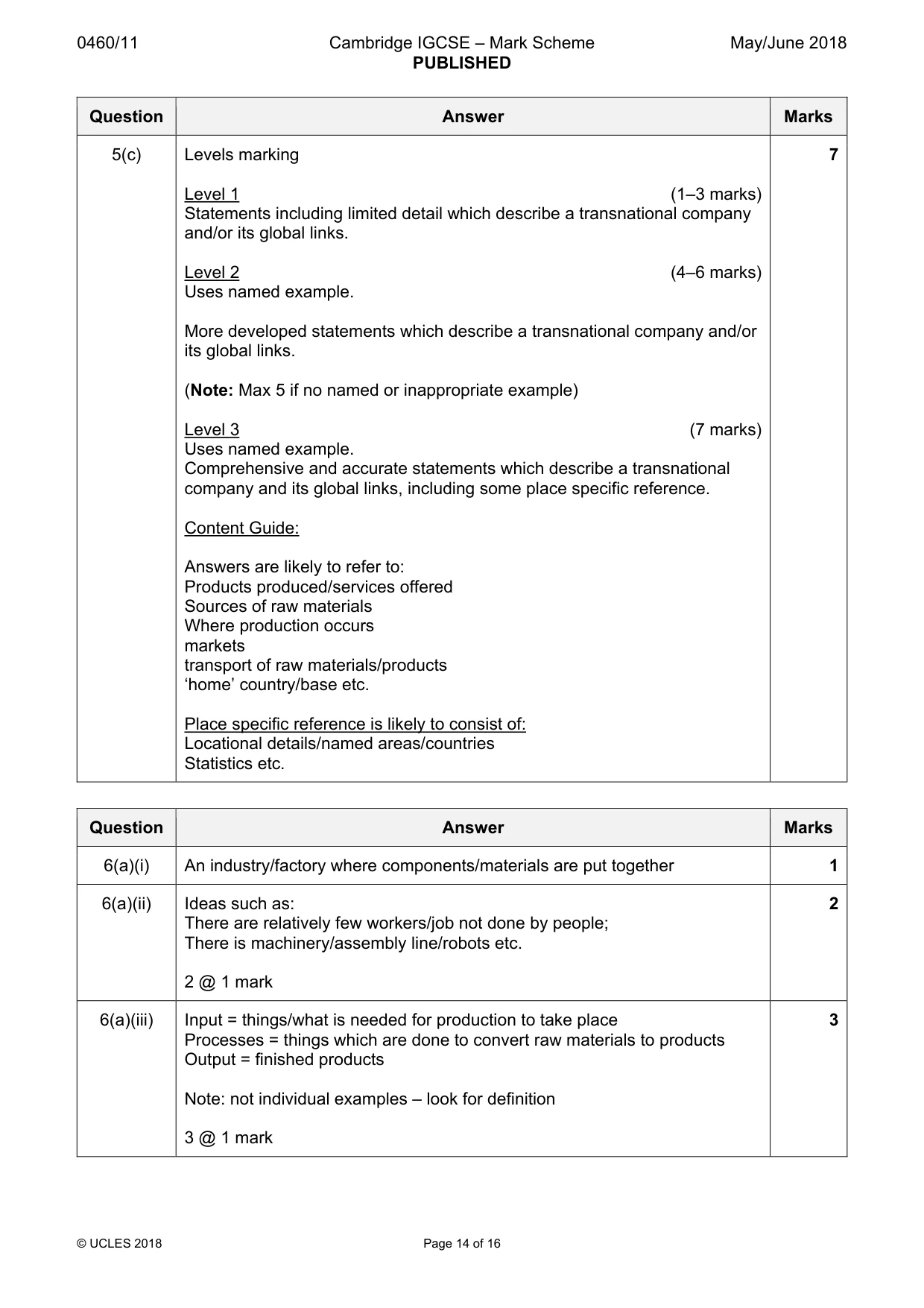
0460/11 Cambridge IGCSE – Mark Scheme PUBLISHED May/June 2018 © UCLES 2018 Page 14 of 16 Question Answer Marks 5(c) Levels marking Level 1 (1–3 marks) Statements including limited detail which describe a transnational company and/or its global links. Level 2 (4–6 marks) Uses named example. More developed statements which describe a transnational company and/or its global links. (Note: Max 5 if no named or inappropriate example) Level 3 (7 marks) Uses named example. Comprehensive and accurate statements which describe a transnational company and its global links, including some place specific reference. Content Guide: Answers are likely to refer to: Products produced/services offered Sources of raw materials Where production occurs markets transport of raw materials/products ‘home’ country/base etc. Place specific reference is likely to consist of: Locational details/named areas/countries Statistics etc. 7 Question Answer Marks 6(a)(i) An industry/factory where components/materials are put together 1 6(a)(ii) Ideas such as: There are relatively few workers/job not done by people; There is machinery/assembly line/robots etc. 2 @ 1 mark 2 6(a)(iii) Input = things/what is needed for production to take place Processes = things which are done to convert raw materials to products Output = finished products Note: not individual examples – look for definition 3 @ 1 mark 3
Mark scheme, page 15
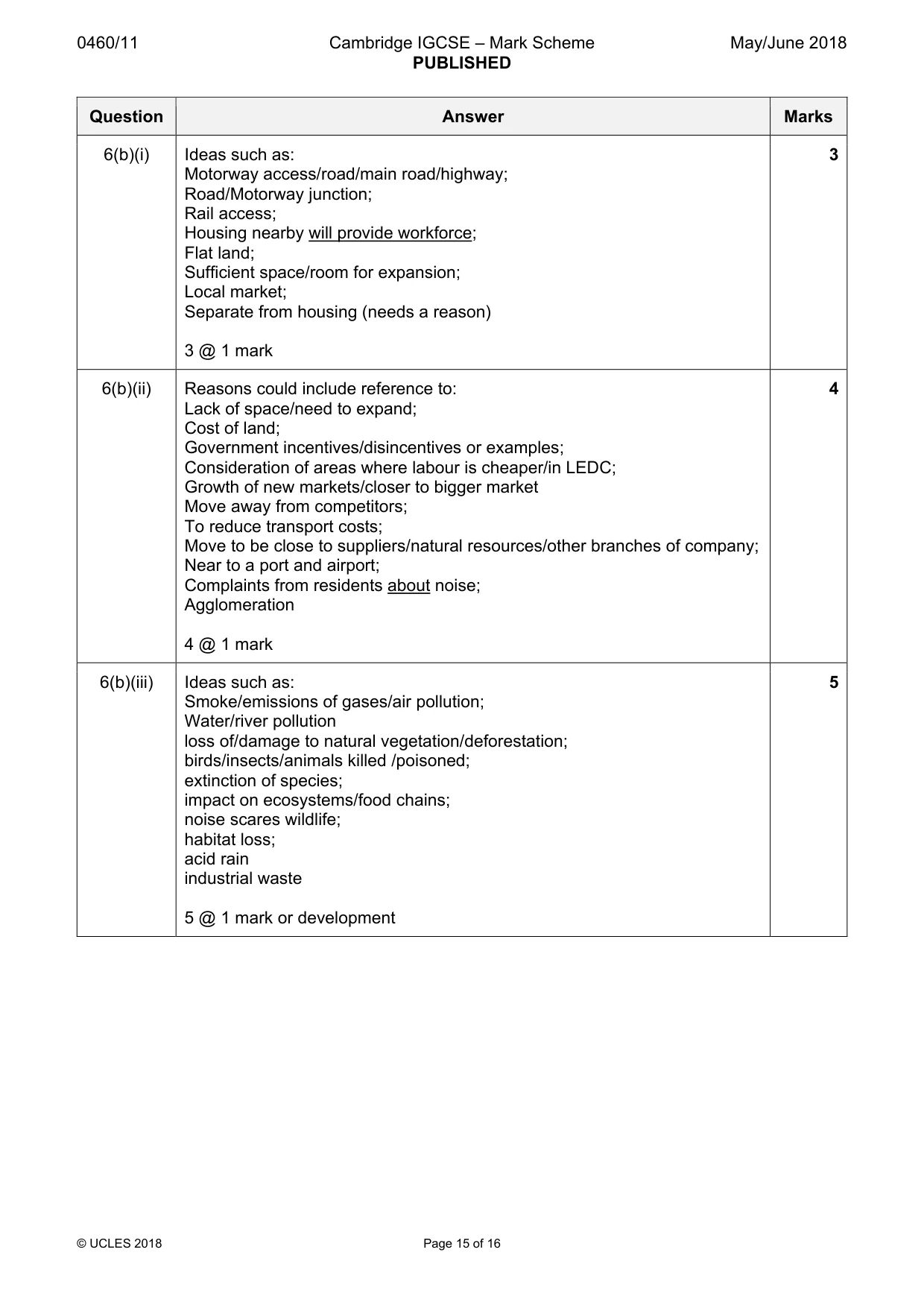
0460/11 Cambridge IGCSE – Mark Scheme PUBLISHED May/June 2018 © UCLES 2018 Page 15 of 16 Question Answer Marks 6(b)(i) Ideas such as: Motorway access/road/main road/highway; Road/Motorway junction; Rail access; Housing nearby will provide workforce; Flat land; Sufficient space/room for expansion; Local market; Separate from housing (needs a reason) 3 @ 1 mark 3 6(b)(ii) Reasons could include reference to: Lack of space/need to expand; Cost of land; Government incentives/disincentives or examples; Consideration of areas where labour is cheaper/in LEDC; Growth of new markets/closer to bigger market Move away from competitors; To reduce transport costs; Move to be close to suppliers/natural resources/other branches of company; Near to a port and airport; Complaints from residents about noise; Agglomeration 4 @ 1 mark 4 6(b)(iii) Ideas such as: Smoke/emissions of gases/air pollution; Water/river pollution loss of/damage to natural vegetation/deforestation; birds/insects/animals killed /poisoned; extinction of species; impact on ecosystems/food chains; noise scares wildlife; habitat loss; acid rain industrial waste 5 @ 1 mark or development 5
Mark scheme, page 16
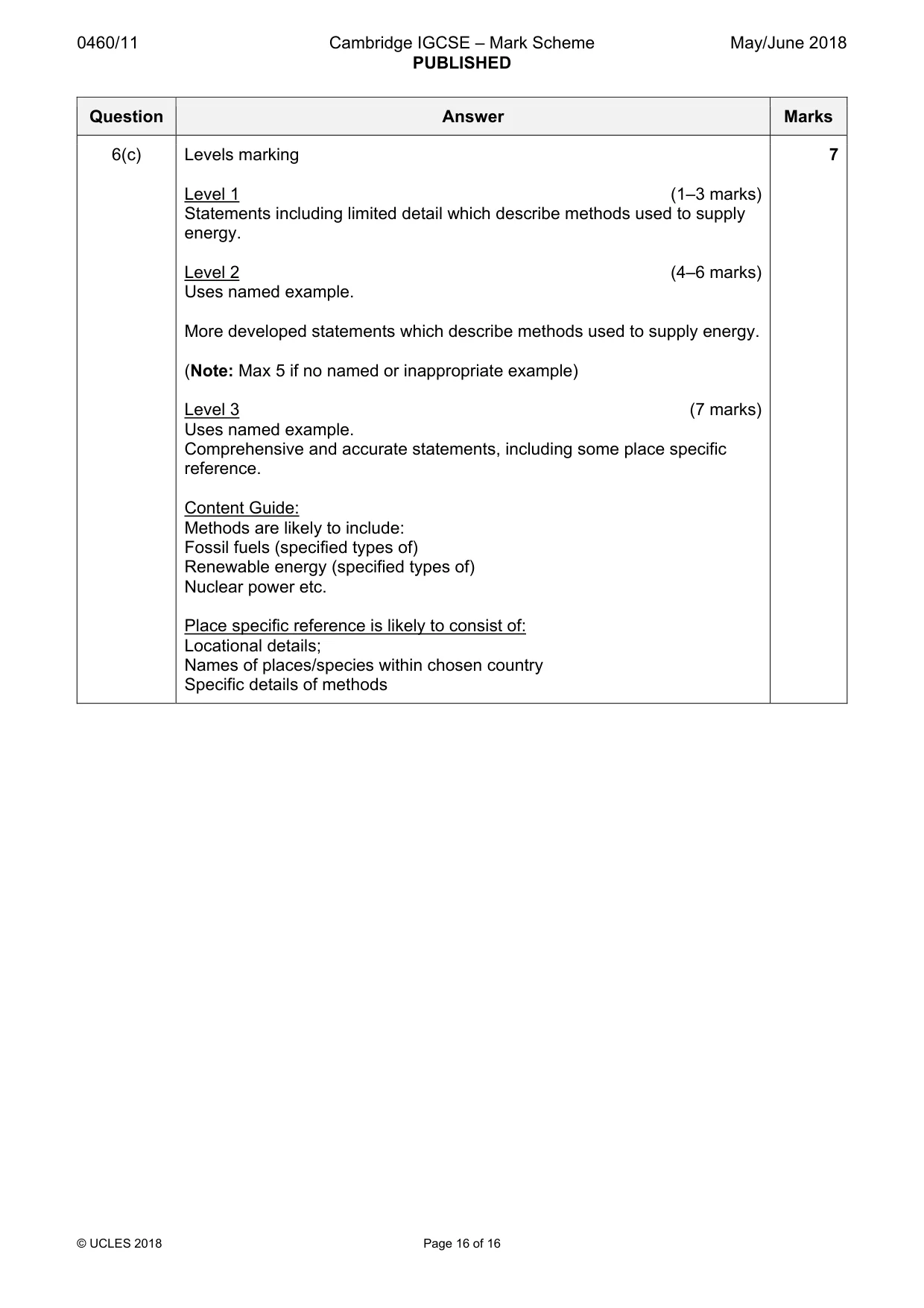
0460/11 Cambridge IGCSE – Mark Scheme PUBLISHED May/June 2018 © UCLES 2018 Page 16 of 16 Question Answer Marks 6(c) Levels marking Level 1 (1–3 marks) Statements including limited detail which describe methods used to supply energy. Level 2 (4–6 marks) Uses named example. More developed statements which describe methods used to supply energy. (Note: Max 5 if no named or inappropriate example) Level 3 (7 marks) Uses named example. Comprehensive and accurate statements, including some place specific reference. Content Guide: Methods are likely to include: Fossil fuels (specified types of) Renewable energy (specified types of) Nuclear power etc. Place specific reference is likely to consist of: Locational details; Names of places/species within chosen country Specific details of methods 7
What you needed in this session
Cambridge’s own grade thresholds for 2018 May/June, Paper 1 · Variant 1. A higher threshold means an easier paper — the bar moves with how the cohort did.