Cambridge IGCSE Environmental Management 0680 — 2022 Feb/March Paper 2 · Variant 2
0680/22/F/M/22 · 4 questions · 80 marks · ≈90 min
The question paper and its mark scheme, free to read here and free to download. This is Cambridge’s own paper, exactly as it was sat.
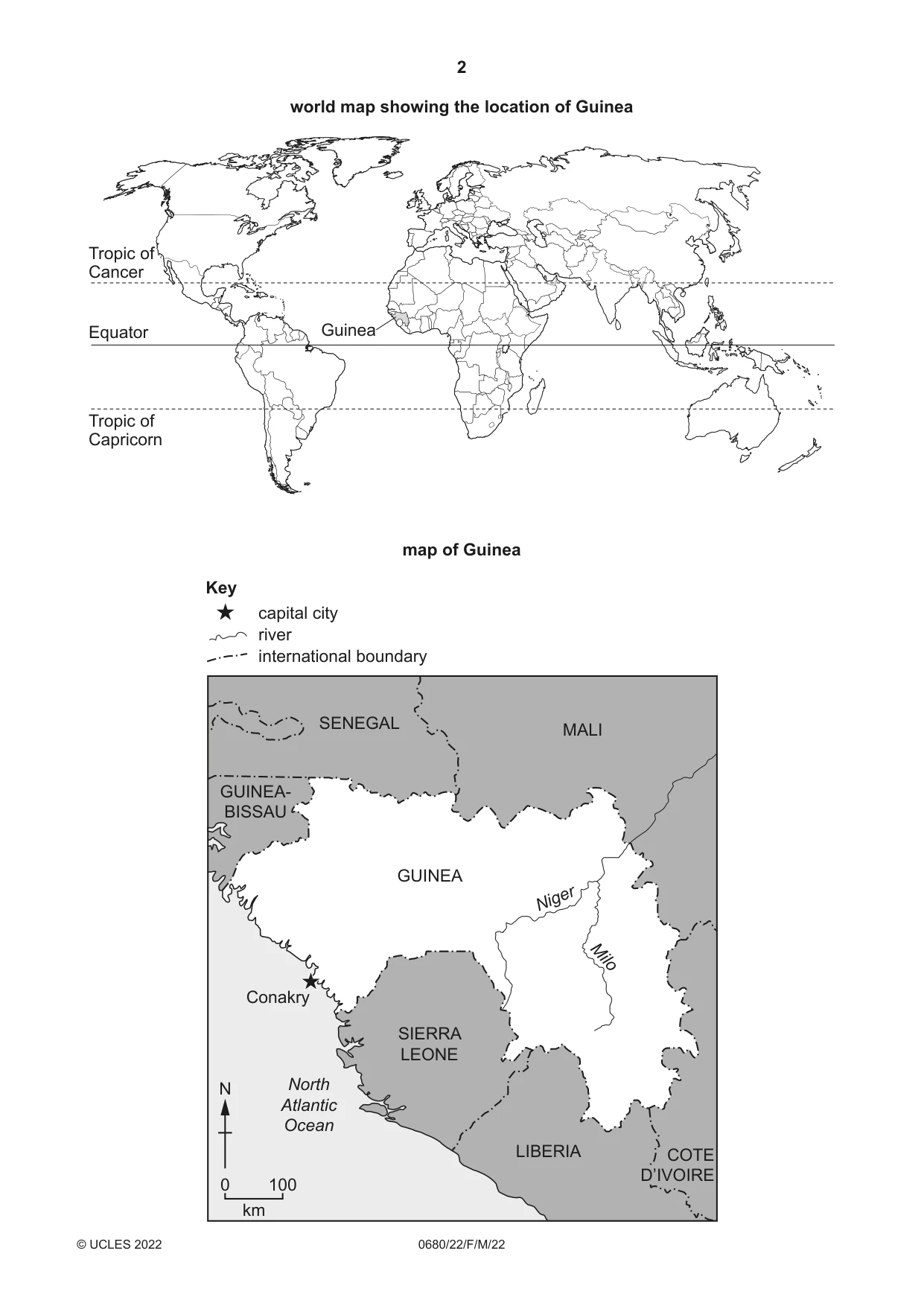
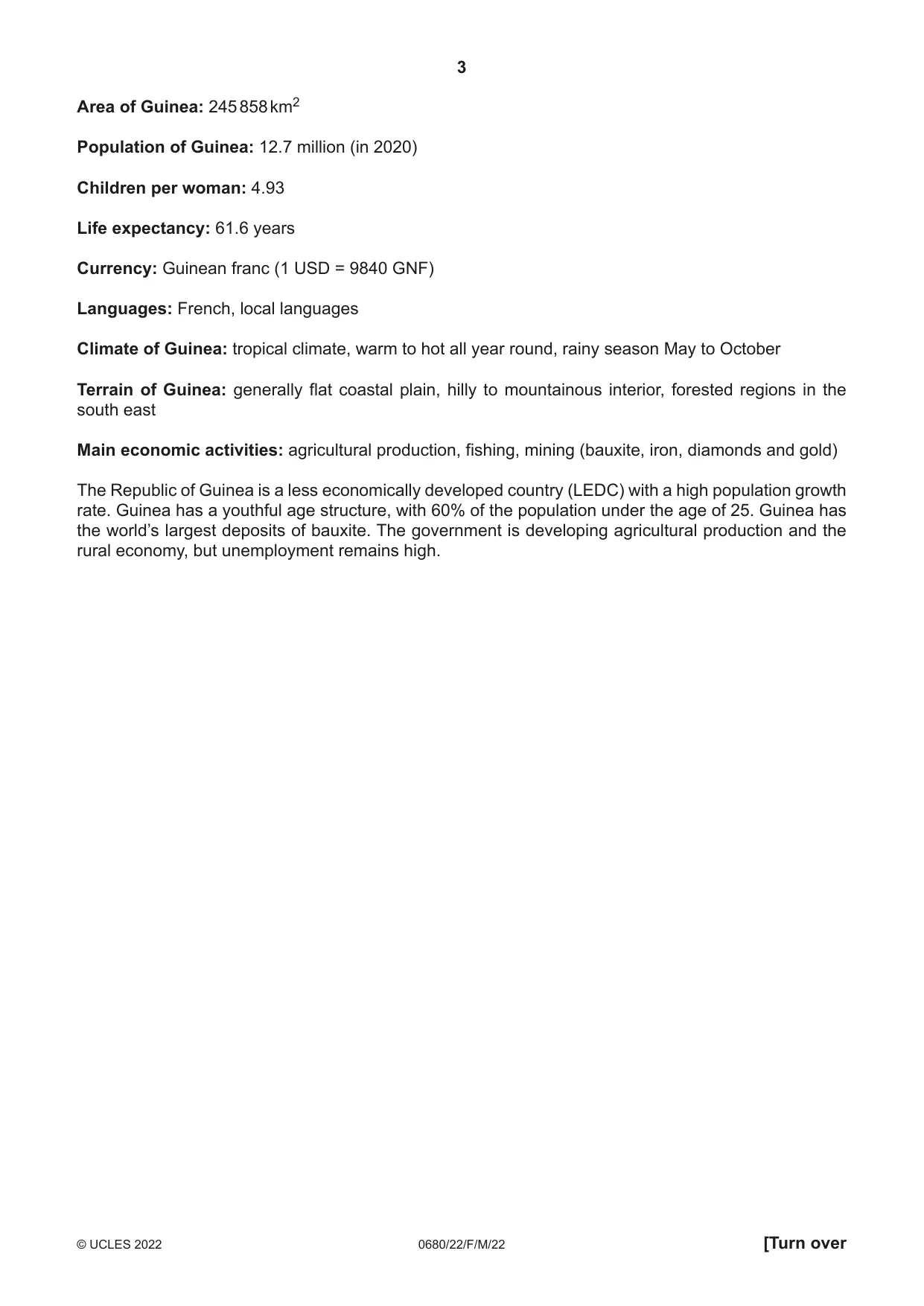
Question paper20 pages

Mark scheme12 pages
Answers below. Sit the paper first if you are practising.
Questions as text
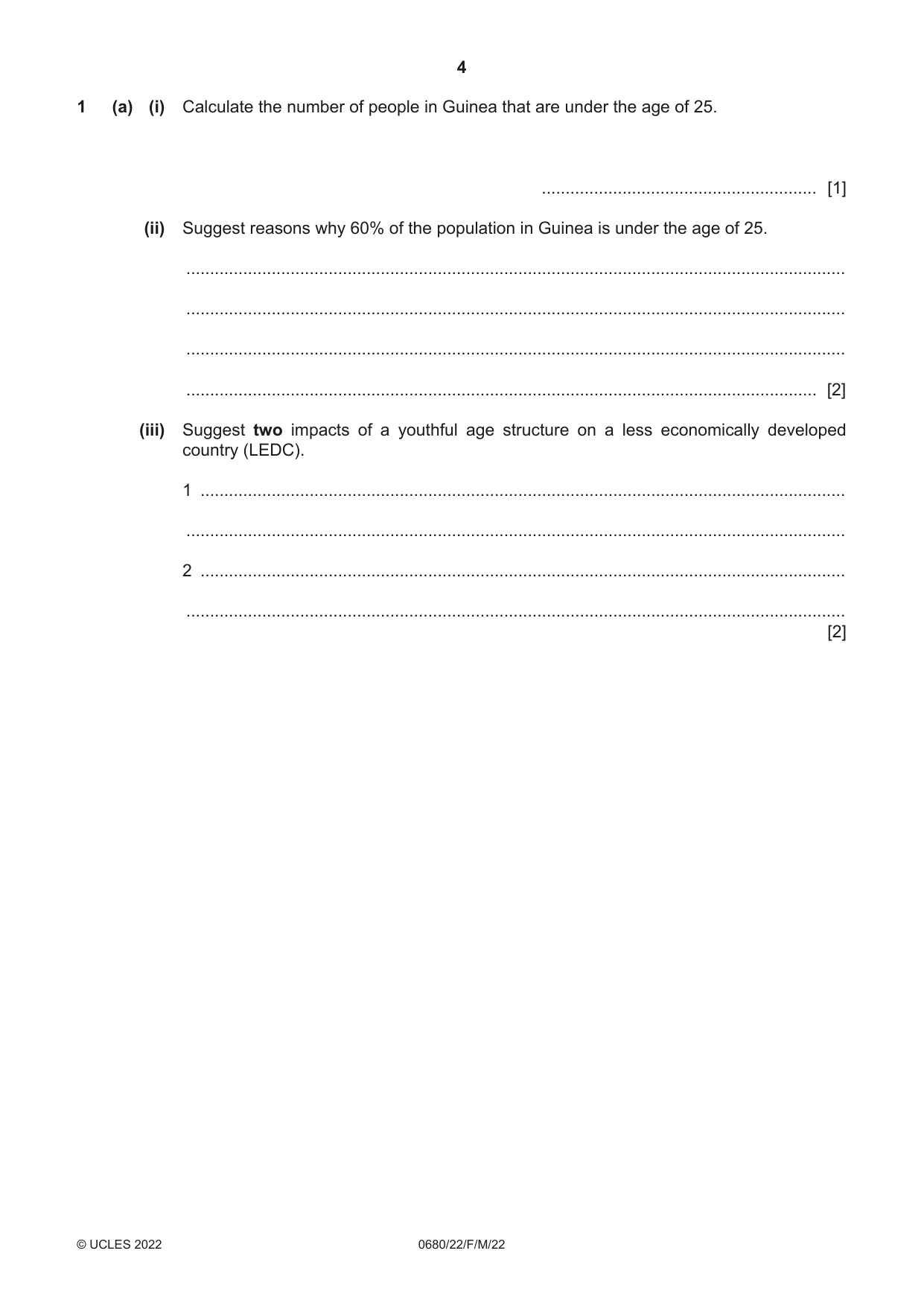
Q1 · Calculate the number of people in Guinea that are under the age of 25
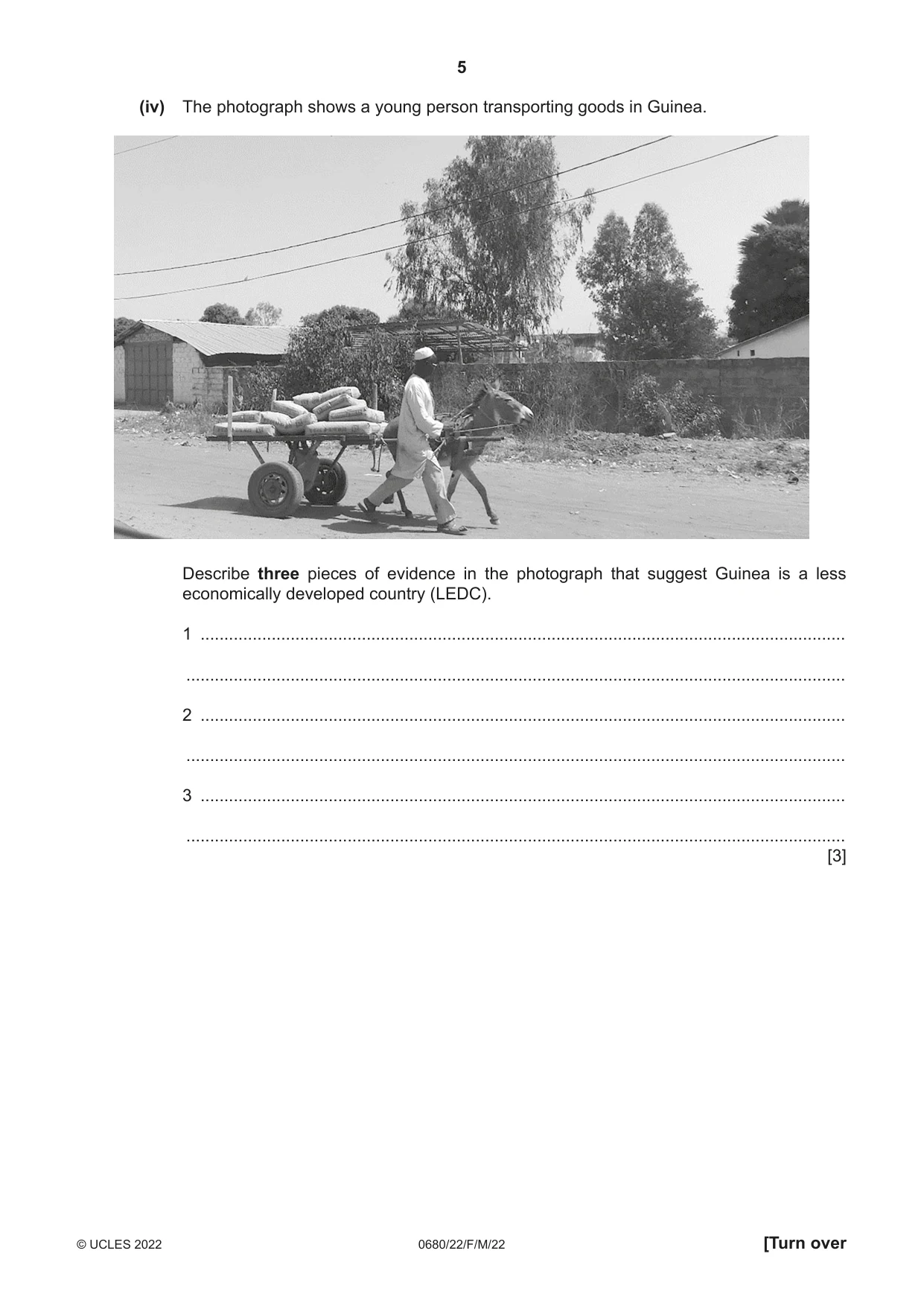
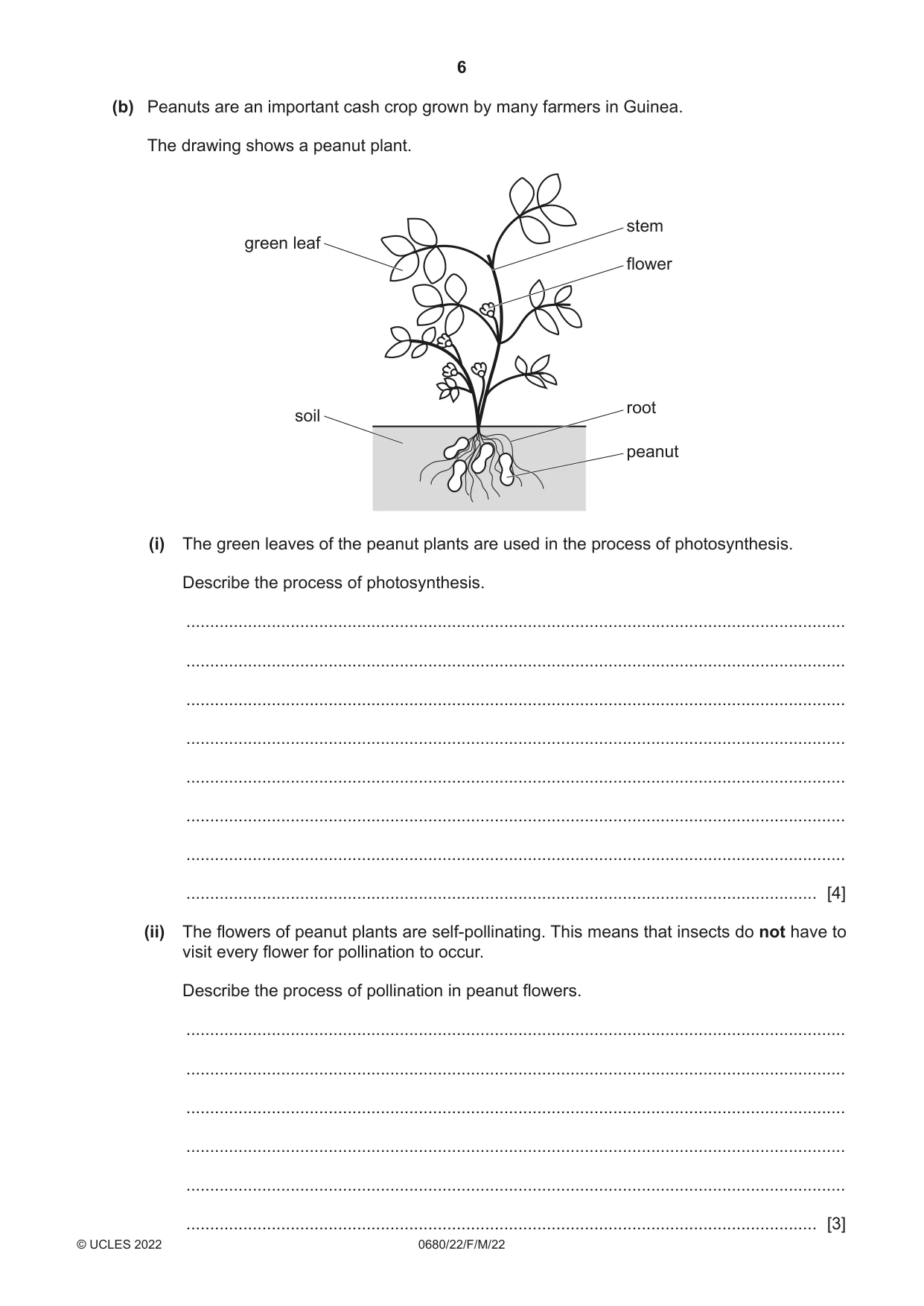
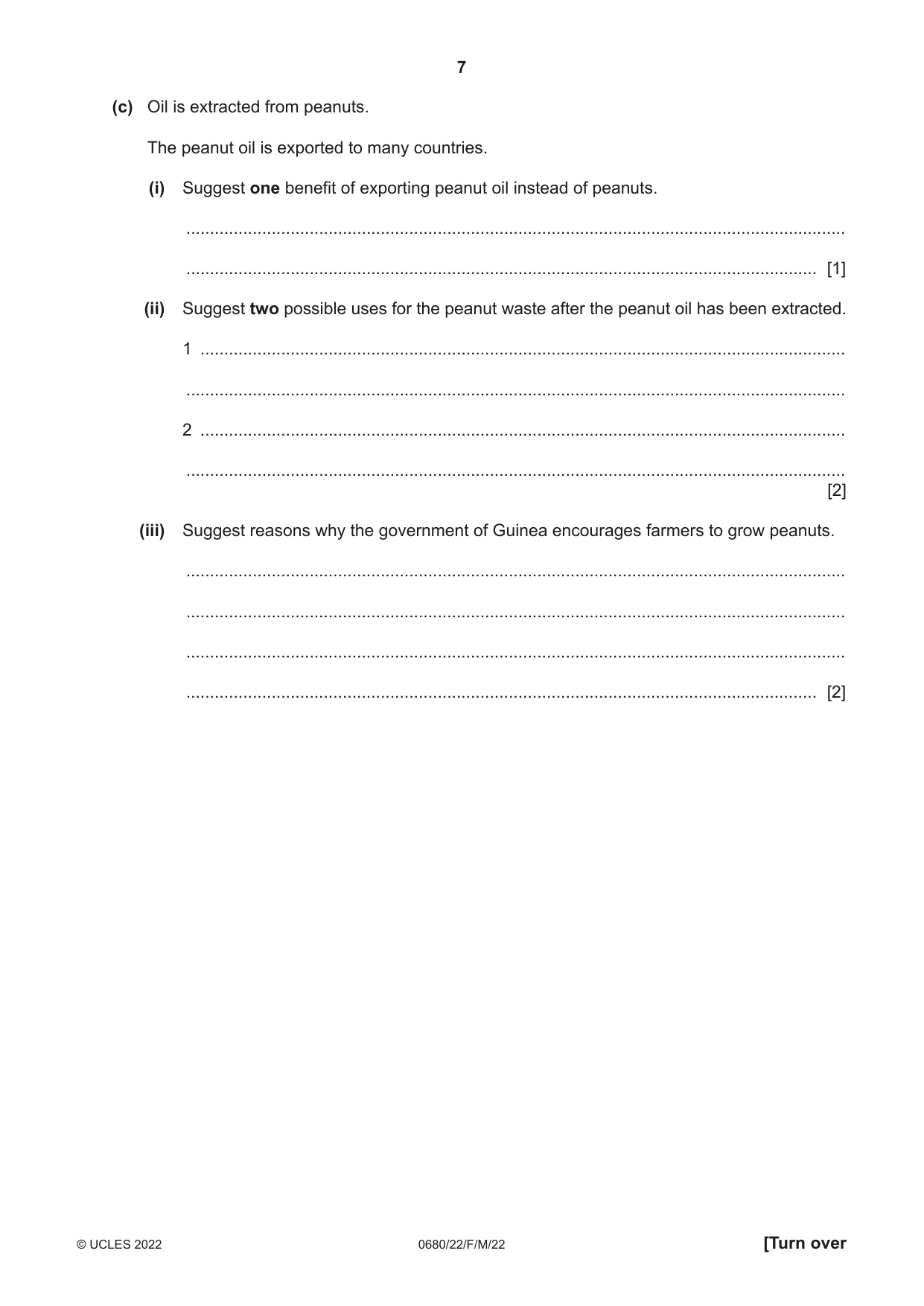
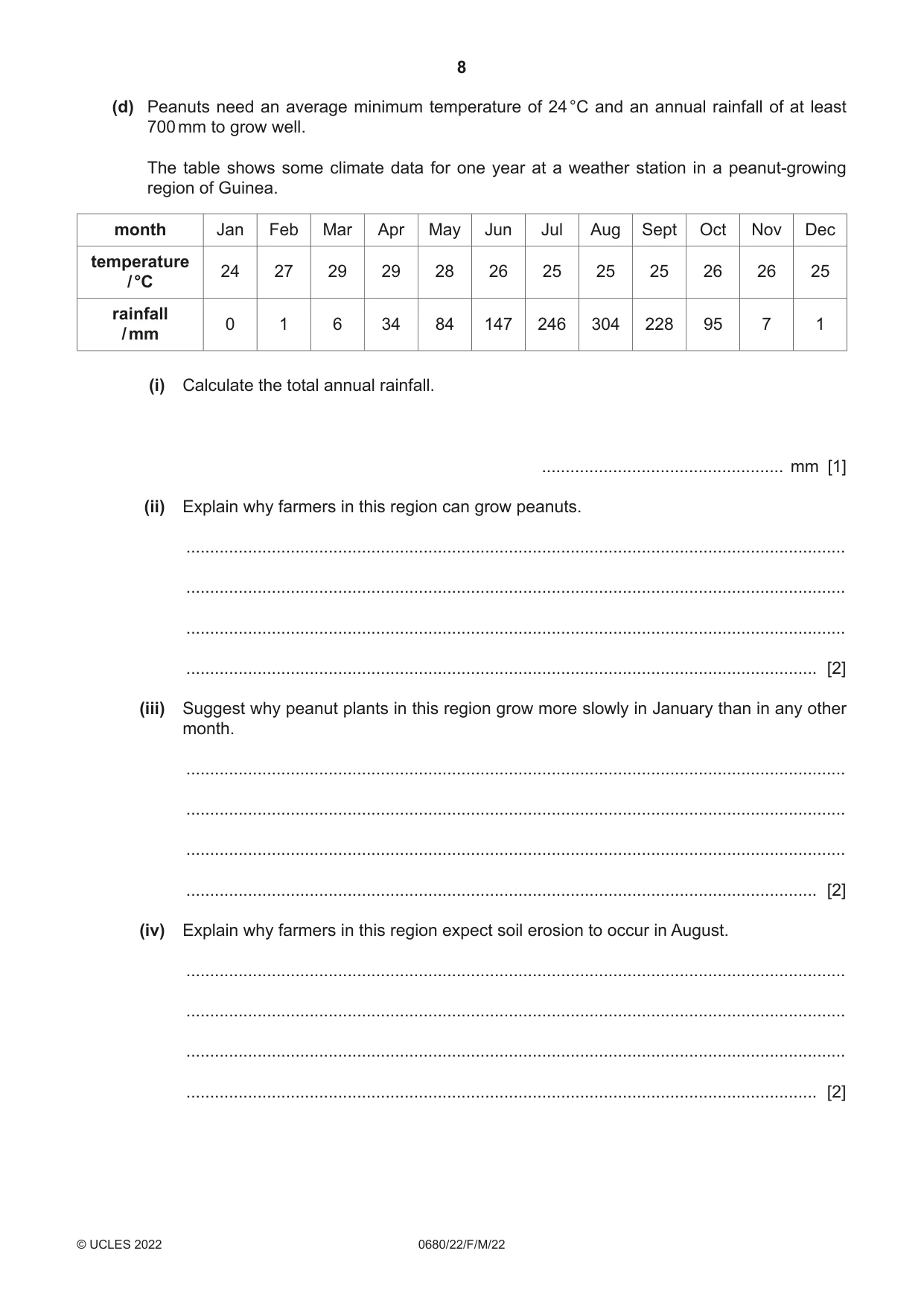
1 (a) (i) Calculate the number of people in Guinea that are under the age of 25. .......................................................... [1] (ii) Suggest reasons why 60% of the population in Guinea is under the age of 25. ........................................................................................................................................... ........................................................................................................................................... ........................................................................................................................................... ..................................................................................................................................... [2] (iii) Suggest two impacts of a youthful age structure on a less economically developed country (LEDC). 1 ........................................................................................................................................ ........................................................................................................................................... 2 ........................................................................................................................................ ........................................................................................................................................... [2] (iv) The photograph shows a young person transporting goods in Guinea. Describe three pieces of evidence in the photograph that suggest Guinea is a less economically developed country (LEDC). 1 ........................................................................................................................................ ........................................................................................................................................... 2 ........................................................................................................................................ ........................................................................................................................................... 3 ........................................................................................................................................ ........................................................................................................................................... [3] (b) Peanuts are an important cash crop grown by many farmers in Guinea. The drawing shows a peanut plant. stem green leaf flower root soil peanut (i) The green leaves of the peanut plants are used in the process of photosynthesis. Describe the process of photosynthesis. ........................................................................................................................................... ........................................................................................................................................... ........................................................................................................................................... ........................................................................................................................................... ........................................................................................................................................... ........................................................................................................................................... ........................................................................................................................................... ..................................................................................................................................... [4] (ii) The flowers of peanut plants are self-pollinating. This means that insects do not have to visit every flower for pollination to occur. Describe the process of pollination in peanut flowers. ........................................................................................................................................... ........................................................................................................................................... ........................................................................................................................................... ........................................................................................................................................... ........................................................................................................................................... ..................................................................................................................................... [3] (c) Oil is extracted from peanuts. The peanut oil is exported to many countries. (i) Suggest one benefit of exporting peanut oil instead of peanuts. ........................................................................................................................................... ..................................................................................................................................... [1] (ii) Suggest two possible uses for the peanut waste after the peanut oil has been extracted. 1 ........................................................................................................................................ ........................................................................................................................................... 2 ........................................................................................................................................ ........................................................................................................................................... [2] (iii) Suggest reasons why the government of Guinea encourages farmers to grow peanuts. ........................................................................................................................................... ........................................................................................................................................... ........................................................................................................................................... ..................................................................................................................................... [2] (d) Peanuts need an average minimum temperature of 24 °C and an annual rainfall of at least 700 mm to grow well. The table shows some climate data for one year at a weather station in a peanut-growing region of Guinea. month Jan Feb Mar Apr May Jun Jul Aug Sept Oct Nov Dec temperature 24 27 29 29 28 26 25 25 25 26 26 25 / °C rainfall 0 1 6 34 84 147 246 304 228 95 7 1 / mm (i) Calculate the total annual rainfall. ................................................... mm [1] (ii) Explain why farmers in this region can grow peanuts. ........................................................................................................................................... ........................................................................................................................................... ........................................................................................................................................... ..................................................................................................................................... [2] (iii) Suggest why peanut plants in this region grow more slowly in January than in any other month. ........................................................................................................................................... ........................................................................................................................................... ........................................................................................................................................... ..................................................................................................................................... [2] (iv) Explain why farmers in this region expect soil erosion to occur in August. ........................................................................................................................................... ........................................................................................................................................... ........................................................................................................................................... ..................................................................................................................................... [2] (e) The farmers use the same fields to grow peanuts each year. (i) Suggest why the farmers expect the yield of peanuts to go down after several years. ........................................................................................................................................... ........................................................................................................................................... ........................................................................................................................................... ..................................................................................................................................... [2] (ii) The stems and leaves of the peanut plants can be used to feed livestock. Suggest how this helps make peanut farming a sustainable activity. ........................................................................................................................................... ........................................................................................................................................... ........................................................................................................................................... ..................................................................................................................................... [2] (iii) Some peanut farmers are not able to keep livestock. Suggest other ways these farmers can make their farming sustainable. ........................................................................................................................................... ........................................................................................................................................... ........................................................................................................................................... ..................................................................................................................................... [2] [Total: 33]
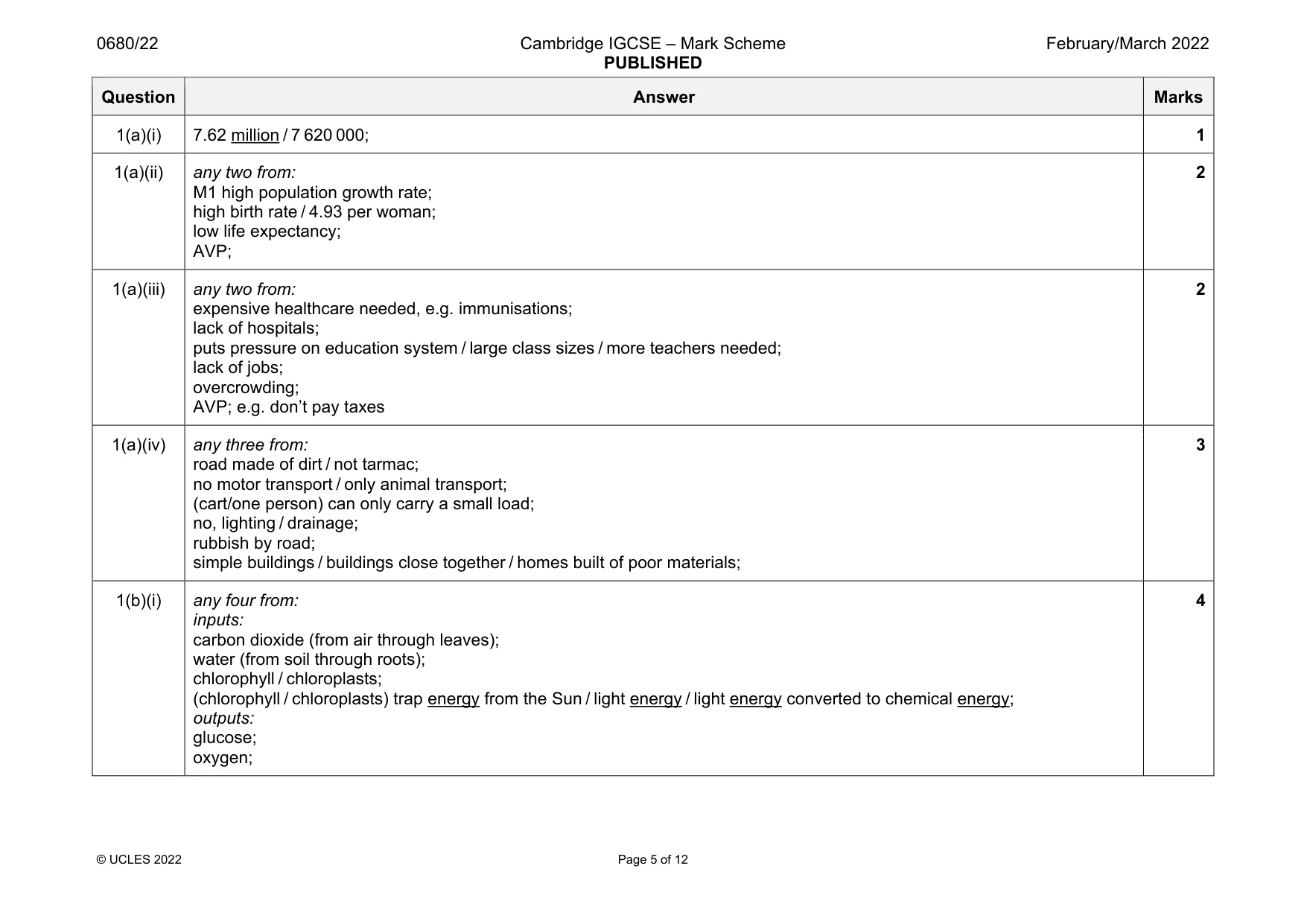
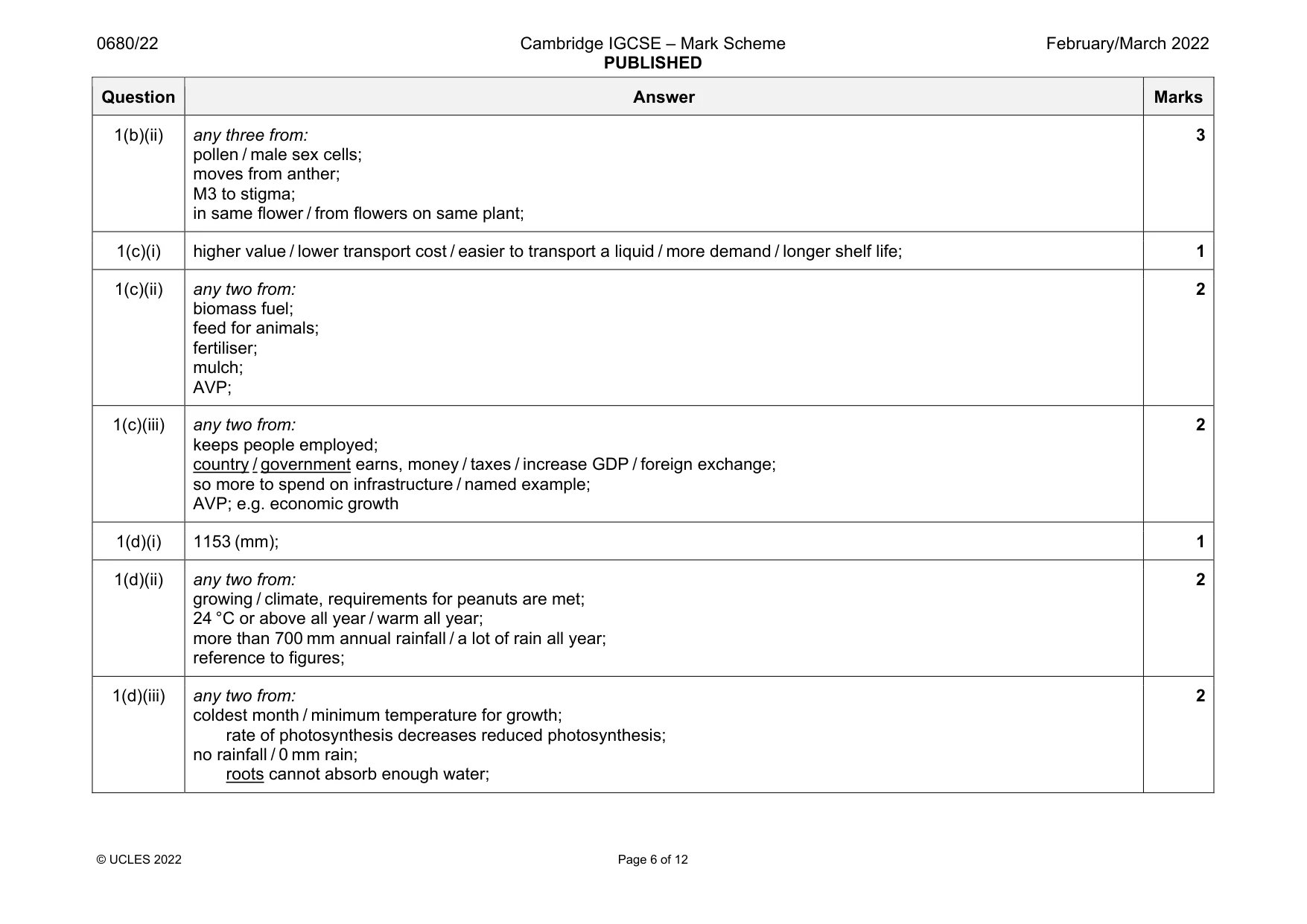
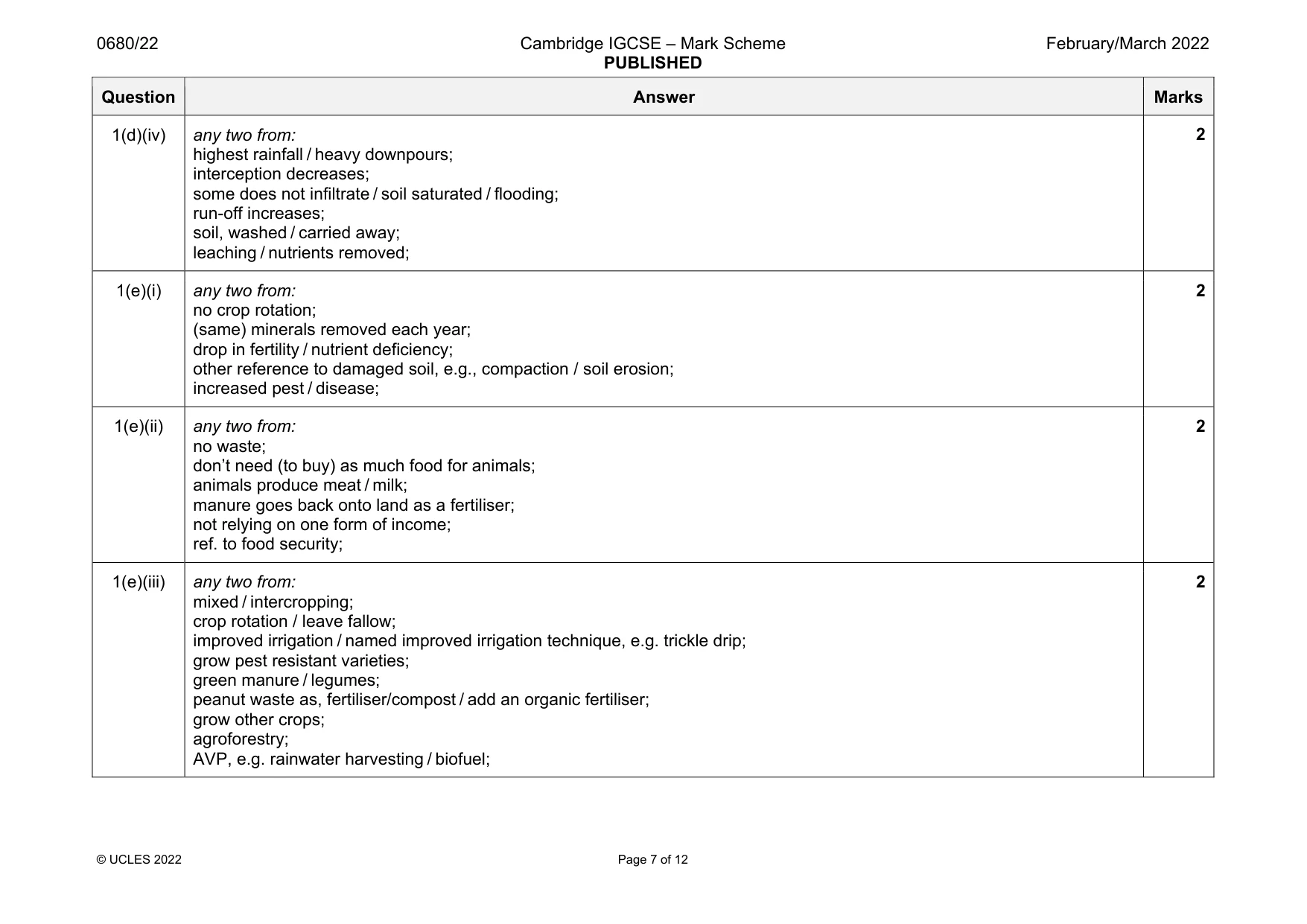
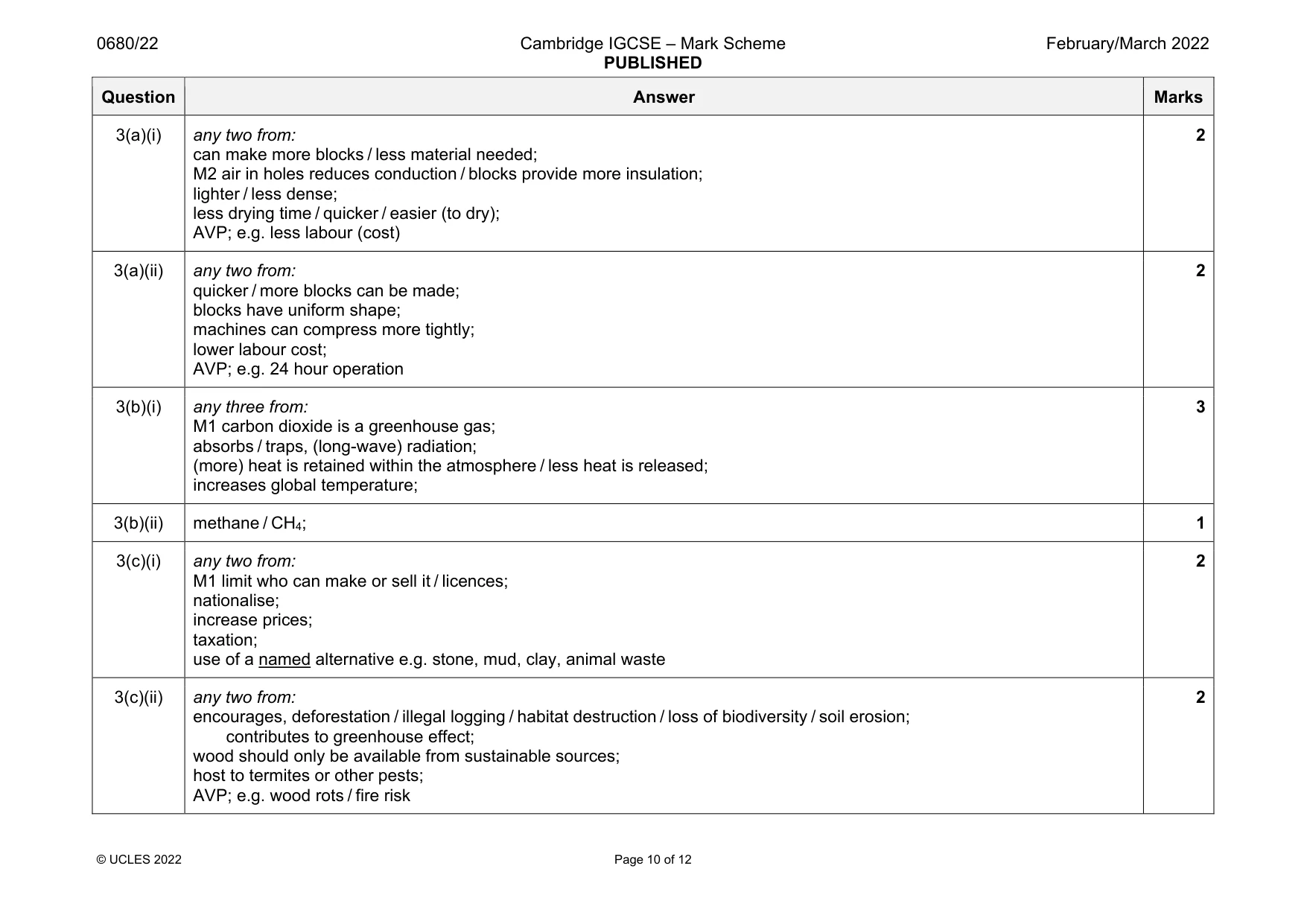
Mark scheme: 1(a)(i) 7.62 million / 7 620 000; 1 1(a)(ii) any two from: M1 high population growth rate; high birth rate / 4.93 per woman; low life expectancy; AVP; 2 1(a)(iii) any two from: expensive healthcare needed, e.g. immunisations; lack of hospitals; puts pressure on education system / large class sizes / more teachers needed; lack of jobs; overcrowding; AVP; e.g. don’t pay taxes 2 1(a)(iv) any three from: road made of dirt / not tarmac; no motor transport / only animal transport; (cart/one person) can only carry a small load; no, lighting / drainage; rubbish by road; simple buildings / buildings close together / homes built of poor materials; 3 1(b)(i) any four from: inputs: carbon dioxide (from air through leaves); water (from soil through roots); chlorophyll / chloroplasts; (chlorophyll / chloroplasts) trap energy from the Sun / light energy / light energy converted to chemical energy; outputs: glucose; oxygen; 4 Question Answer Marks 1(b)(ii) any three from: pollen / male sex cells; moves from anther; M3 to stigma; in same flower / from flowers on same plant; 3 1(c)(i) higher value / lower transport cost / easier to transport a liquid / more demand / longer shelf life; 1 1(c)(ii) any two from: biomass fuel; feed for animals; fertiliser; mulch; AVP; 2 1(c)(iii) any two from: keeps people employed; country / government earns, money / taxes / increase GDP / foreign exchange; so more to spend on infrastructure / named example; AVP; e.g. economic growth 2 1(d)(i) 1153 (mm); 1 1(d)(ii) any two from: growing / climate, requirements for peanuts are met; 24 °C or above all year / warm all year; more than 700 mm annual rainfall / a lot of rain all year; reference to figures; 2 1(d)(iii) any two from: coldest month / minimum temperature for growth; rate of photosynthesis decreases reduced photosynthesis; no rainfall / 0 mm rain; roots cannot absorb enough water; 2 Question Answer Marks 1(d)(iv) any two from: highest rainfall / heavy downpours; interception decreases; some does not infiltrate / soil saturated / flooding; run-off increases; soil, washed / carried away; leaching / nutrients removed; 2 1(e)(i) any two from: no crop rotation; (same) minerals removed each year; drop in fertility / nutrient deficiency; other reference to damaged soil, e.g., compaction / soil erosion; increased pest / disease; 2 1(e)(ii) any two from: no waste; don’t need (to buy) as much food for animals; animals produce meat / milk; manure goes back onto land as a fertiliser; not relying on one form of income; ref. to food security; 2 1(e)(iii) any two from: mixed / intercropping; crop rotation / leave fallow; improved irrigation / named improved irrigation technique, e.g. trickle drip; grow pest resistant varieties; green manure / legumes; peanut waste as, fertiliser/compost / add an organic fertiliser; grow other crops; agroforestry; AVP, e.g. rainwater harvesting / biofuel; 2
Q2 · A student talks to a peanut farmer
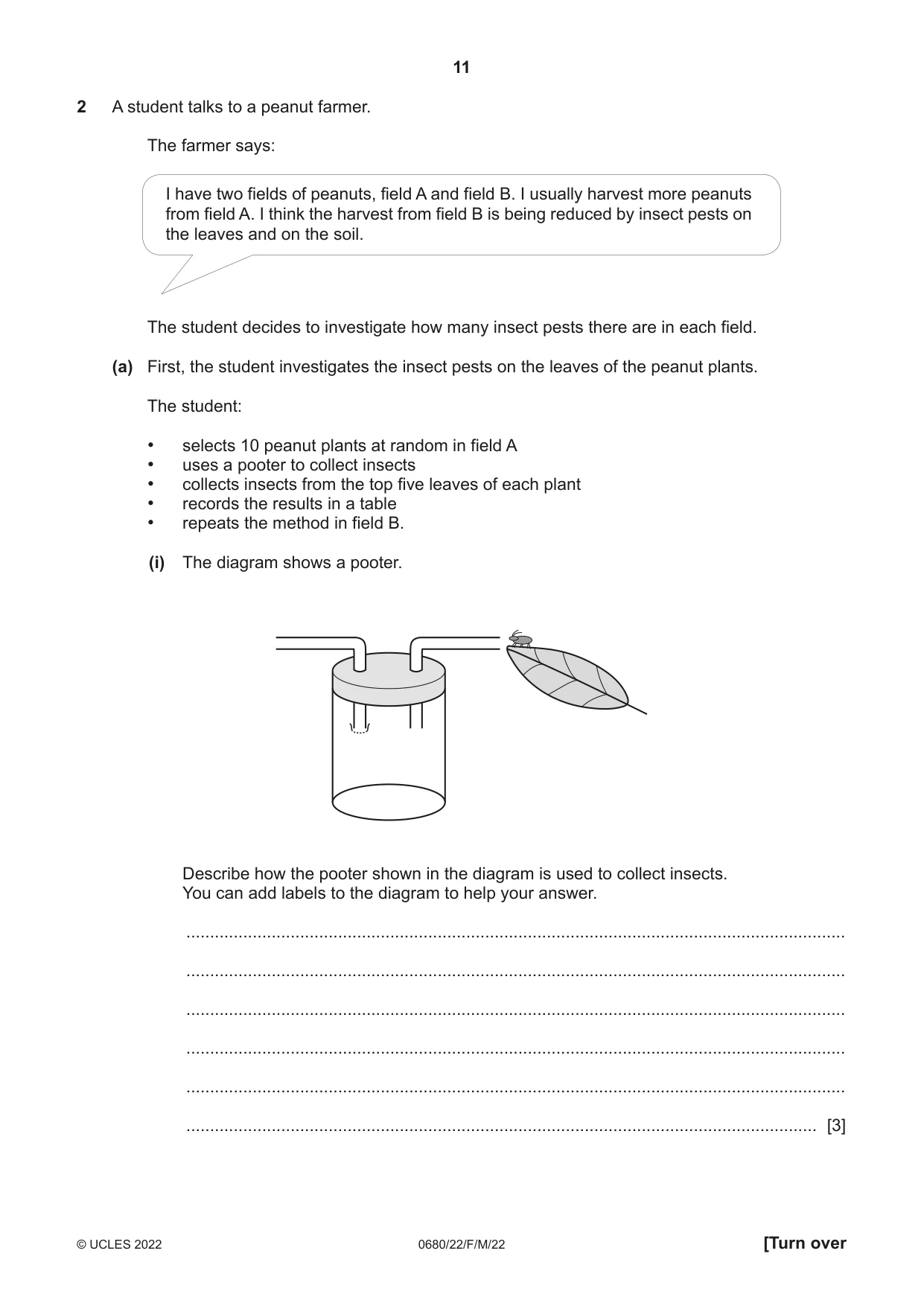
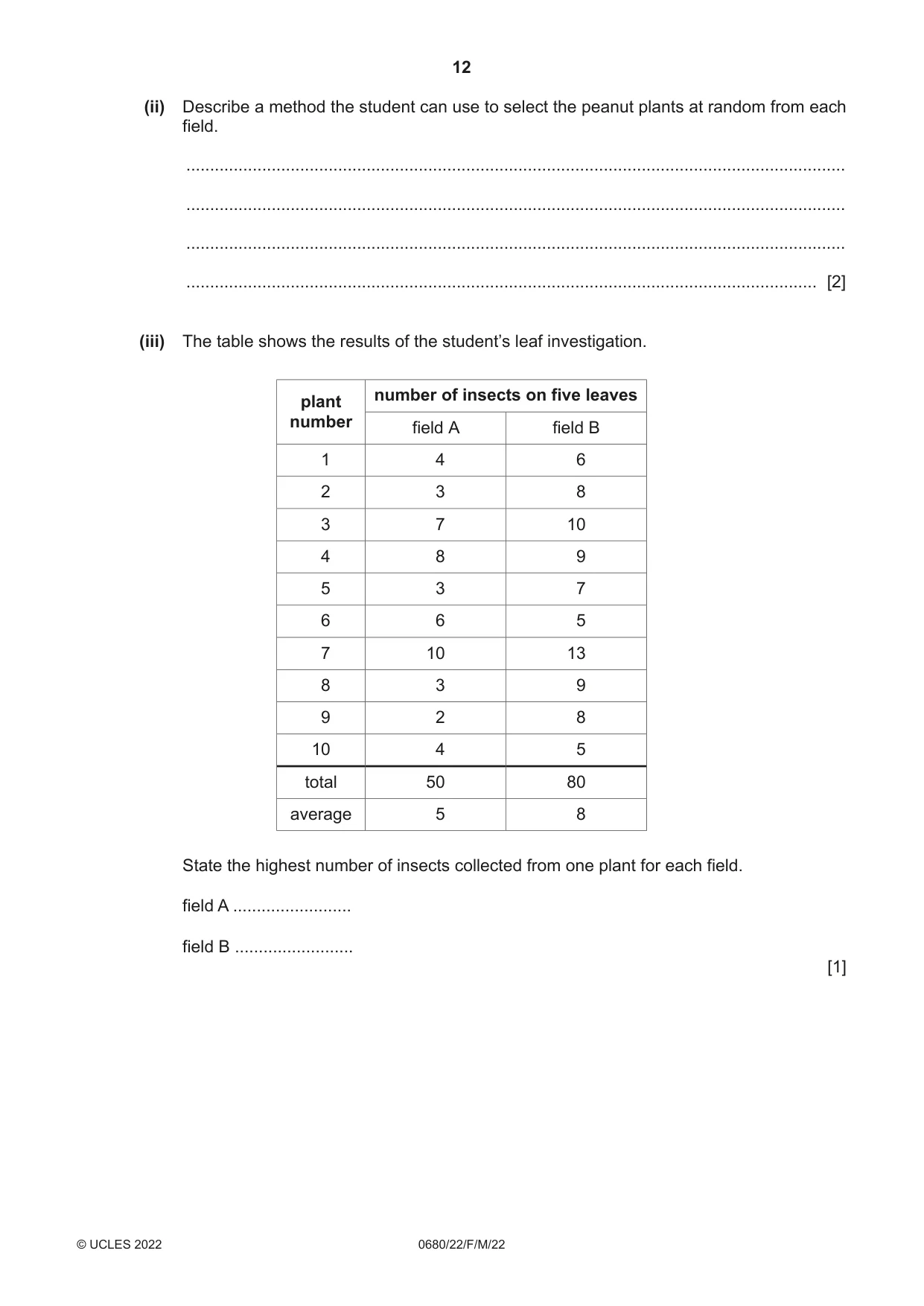
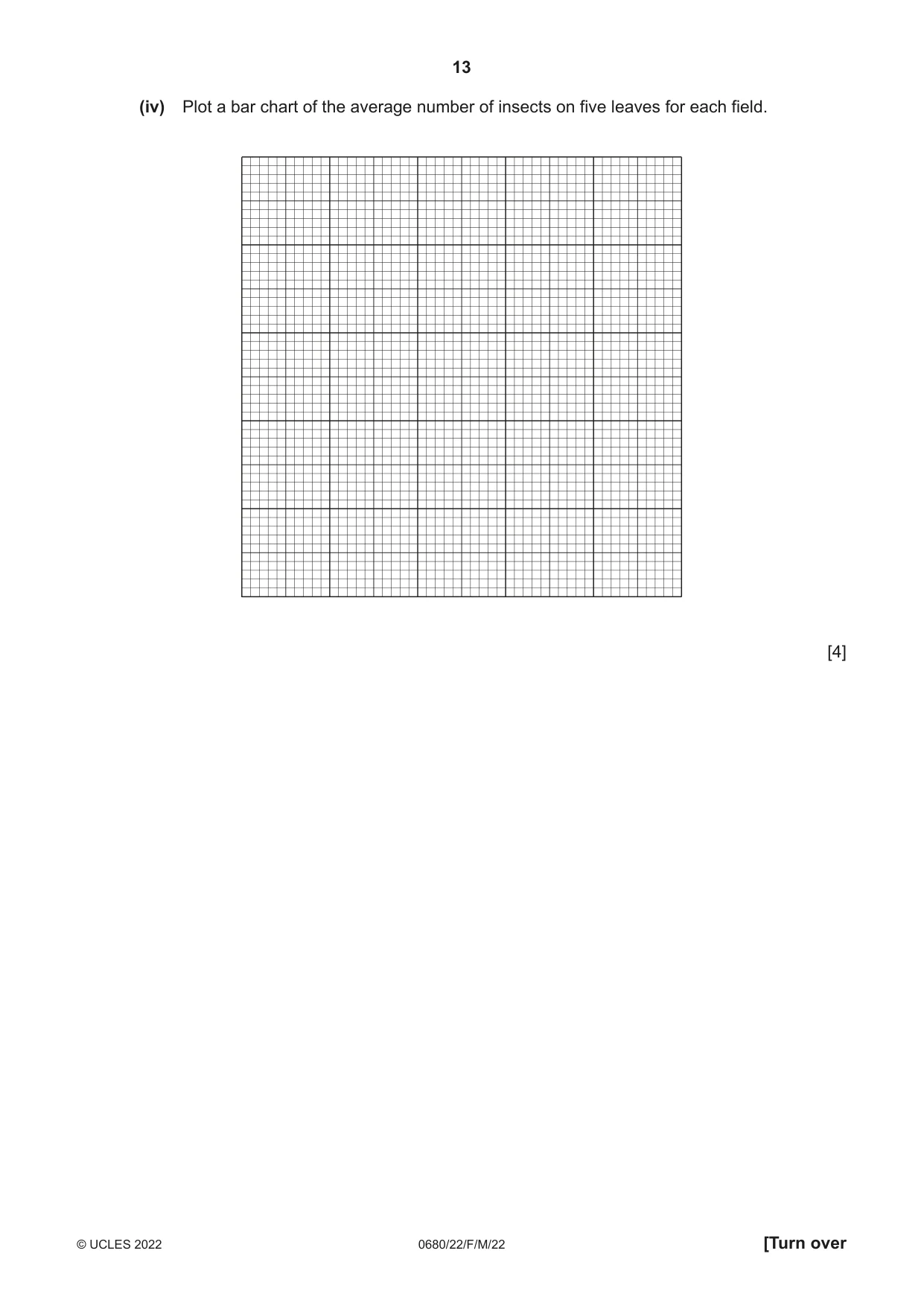
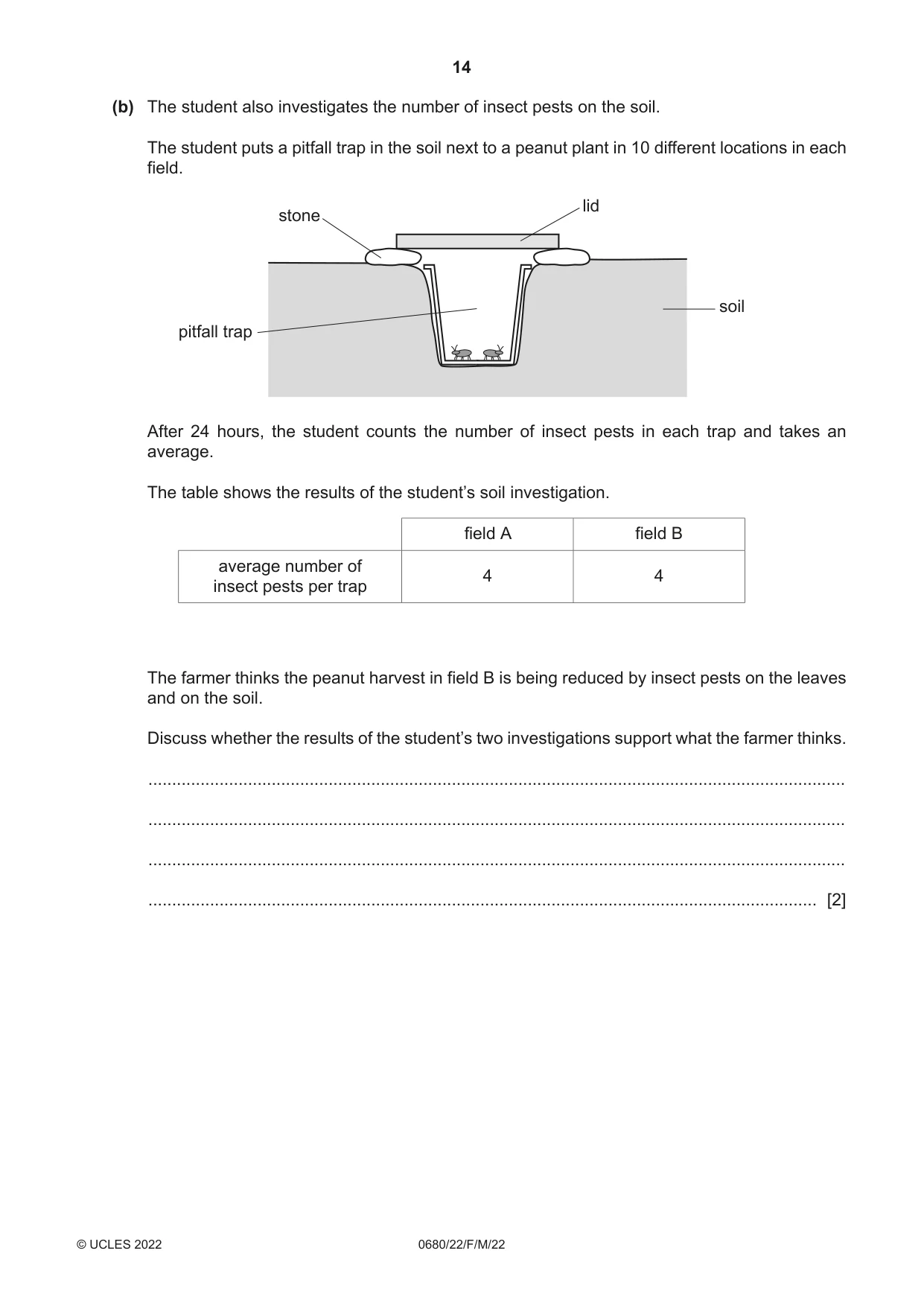
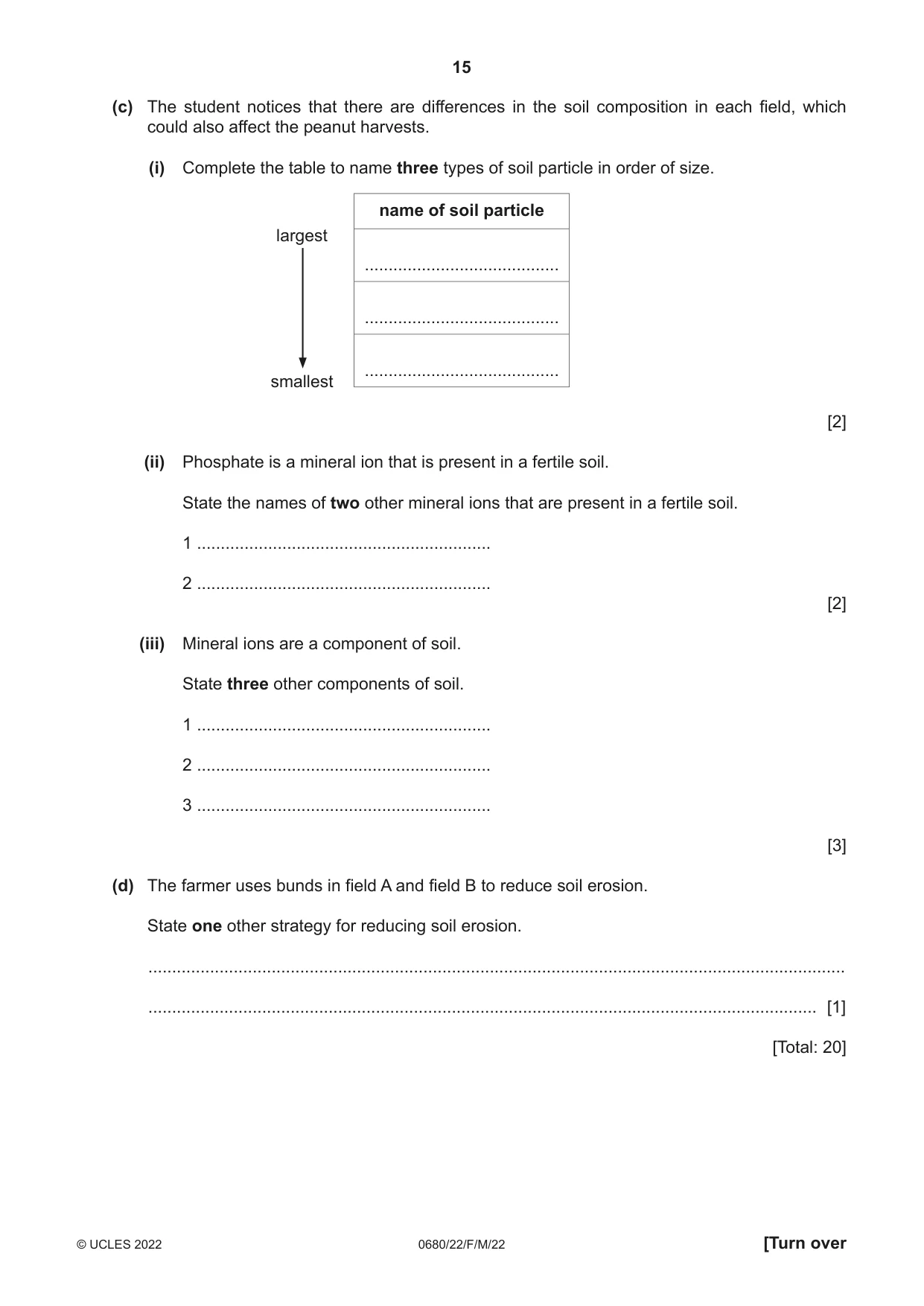
2 A student talks to a peanut farmer. The farmer says: I have two fields of peanuts, field A and field B. I usually harvest more peanuts from field A. I think the harvest from field B is being reduced by insect pests on the leaves and on the soil. The student decides to investigate how many insect pests there are in each field. (a) First, the student investigates the insect pests on the leaves of the peanut plants. The student: • selects 10 peanut plants at random in field A • uses a pooter to collect insects • collects insects from the top five leaves of each plant • records the results in a table • repeats the method in field B. (i) The diagram shows a pooter. Describe how the pooter shown in the diagram is used to collect insects. You can add labels to the diagram to help your answer. ........................................................................................................................................... ........................................................................................................................................... ........................................................................................................................................... ........................................................................................................................................... ........................................................................................................................................... ..................................................................................................................................... [3] (ii) Describe a method the student can use to select the peanut plants at random from each field. ........................................................................................................................................... ........................................................................................................................................... ........................................................................................................................................... ..................................................................................................................................... [2] (iii) The table shows the results of the student’s leaf investigation. number of insects on five leaves plant number field A field B 1 4 6 2 3 8 3 7 10 4 8 9 5 3 7 6 6 5 7 10 13 8 3 9 9 2 8 10 4 5 total 50 80 average 5 8 State the highest number of insects collected from one plant for each field. field A ......................... field B ......................... [1] (iv) Plot a bar chart of the average number of insects on five leaves for each field. [4] (b) The student also investigates the number of insect pests on the soil. The student puts a pitfall trap in the soil next to a peanut plant in 10 different locations in each field. lid stone soil pitfall trap After 24 hours, the student counts the number of insect pests in each trap and takes an average. The table shows the results of the student’s soil investigation. field A field B average number of 4 4 insect pests per trap The farmer thinks the peanut harvest in field B is being reduced by insect pests on the leaves and on the soil. Discuss whether the results of the student’s two investigations support what the farmer thinks. ................................................................................................................................................... ................................................................................................................................................... ................................................................................................................................................... ............................................................................................................................................. [2] (c) The student notices that there are differences in the soil composition in each field, which could also affect the peanut harvests. (i) Complete the table to name three types of soil particle in order of size. name of soil particle largest ......................................... ......................................... ......................................... smallest [2] (ii) Phosphate is a mineral ion that is present in a fertile soil. State the names of two other mineral ions that are present in a fertile soil. 1 .............................................................. 2 .............................................................. [2] (iii) Mineral ions are a component of soil. State three other components of soil. 1 .............................................................. 2 .............................................................. 3 .............................................................. [3] (d) The farmer uses bunds in field A and field B to reduce soil erosion. State one other strategy for reducing soil erosion. ................................................................................................................................................... ............................................................................................................................................. [1] [Total: 20]
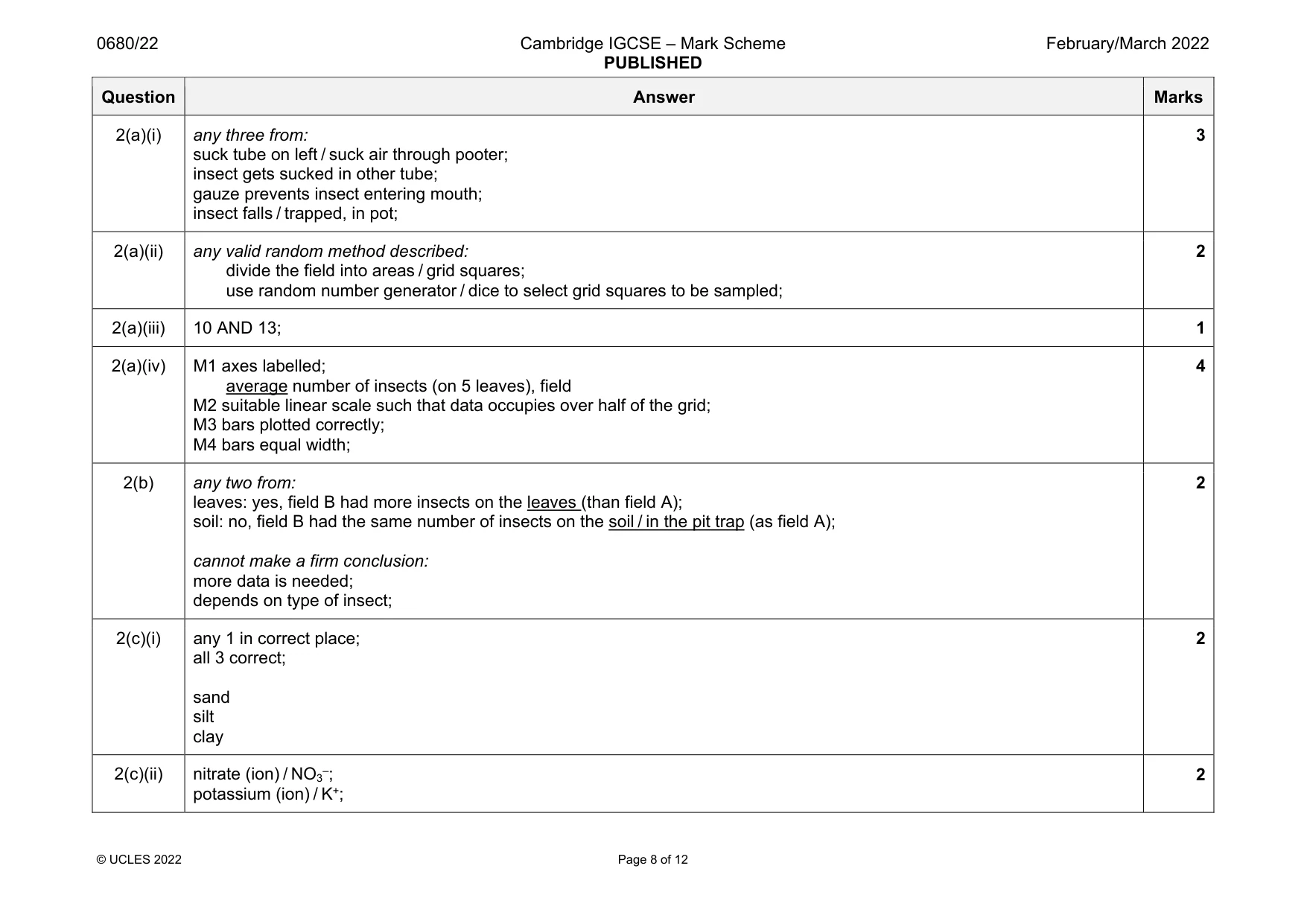
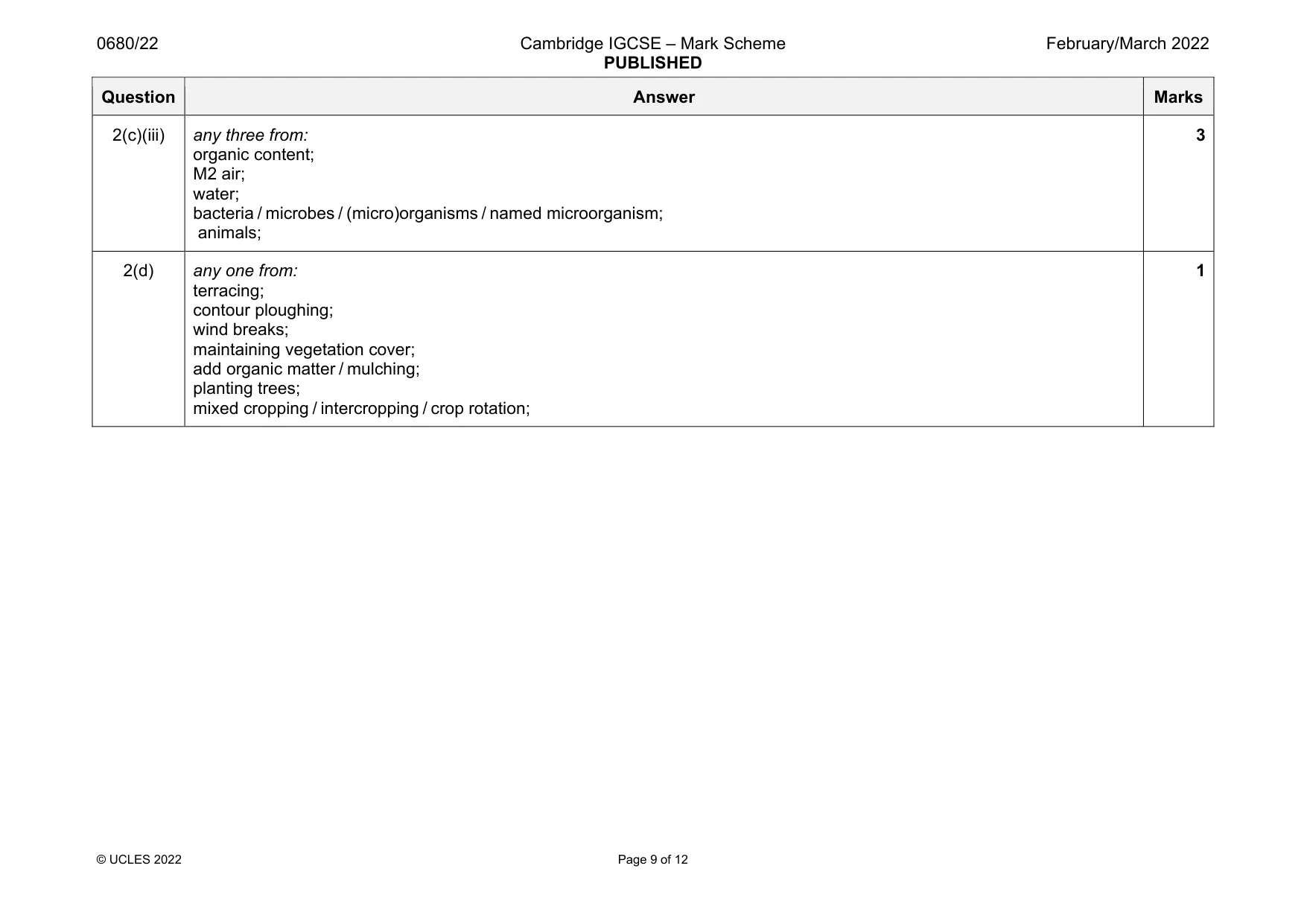
Mark scheme: 2(a)(i) any three from: suck tube on left / suck air through pooter; insect gets sucked in other tube; gauze prevents insect entering mouth; insect falls / trapped, in pot; 3 2(a)(ii) any valid random method described: divide the field into areas / grid squares; use random number generator / dice to select grid squares to be sampled; 2 2(a)(iii) 10 AND 13; 1 2(a)(iv) M1 axes labelled; average number of insects (on 5 leaves), field M2 suitable linear scale such that data occupies over half of the grid; M3 bars plotted correctly; M4 bars equal width; 4 2(b) any two from: leaves: yes, field B had more insects on the leaves (than field A); soil: no, field B had the same number of insects on the soil / in the pit trap (as field A); cannot make a firm conclusion: more data is needed; depends on type of insect; 2 2(c)(i) any 1 in correct place; all 3 correct; sand silt clay 2 2(c)(ii) nitrate (ion) / NO3–; potassium (ion) / K+; 2 Question Answer Marks 2(c)(iii) any three from: organic content; M2 air; water; bacteria / microbes / (micro)organisms / named microorganism; animals; 3 2(d) any one from: terracing; contour ploughing; wind breaks; maintaining vegetation cover; add organic matter / mulching; planting trees; mixed cropping / intercropping / crop rotation; 1
Q3 · The photograph shows some compressed earth building blocks
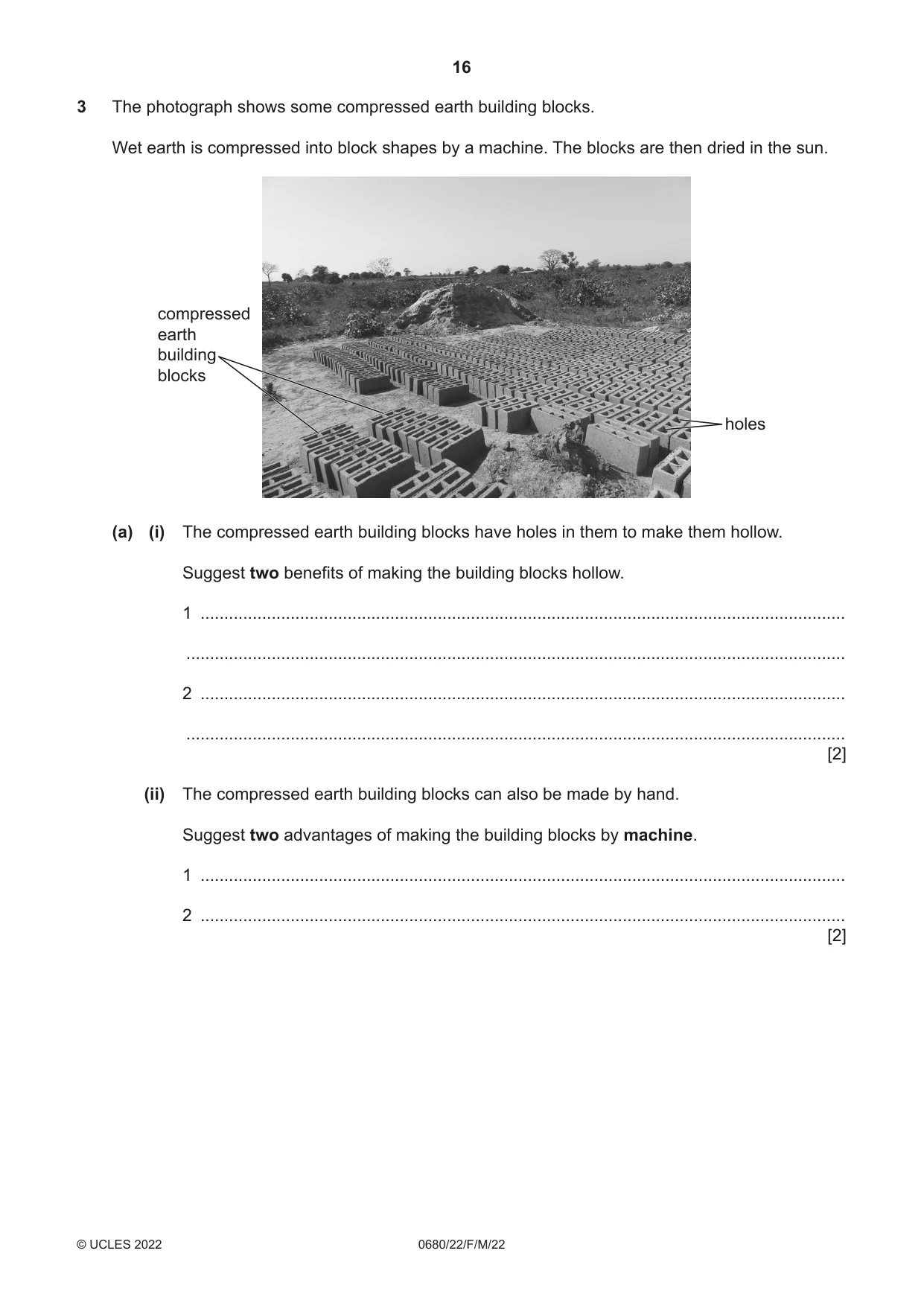
3 The photograph shows some compressed earth building blocks. Wet earth is compressed into block shapes by a machine. The blocks are then dried in the sun. compressed earth building blocks holes (a) (i) The compressed earth building blocks have holes in them to make them hollow. Suggest two benefits of making the building blocks hollow. 1 ........................................................................................................................................ ........................................................................................................................................... 2 ........................................................................................................................................ ........................................................................................................................................... [2] (ii) The compressed earth building blocks can also be made by hand. Suggest two advantages of making the building blocks by machine. 1 ........................................................................................................................................ 2 ........................................................................................................................................ [2] (b) Hollow building blocks are also made from cement. The process of making cement releases carbon dioxide into the atmosphere. (i) Explain how releasing carbon dioxide into the atmosphere contributes to the enhanced greenhouse effect. ........................................................................................................................................... ........................................................................................................................................... ........................................................................................................................................... ........................................................................................................................................... ........................................................................................................................................... ..................................................................................................................................... [3] (ii) State the name of one gas, other than carbon dioxide, that contributes to the enhanced greenhouse effect. ..................................................................................................................................... [1] (c) Wood can also be used for building. An advantage of using wood for building is that it limits the use of cement. (i) Suggest two other ways the government of Guinea can limit the use of cement. 1 ........................................................................................................................................ ........................................................................................................................................... 2 ........................................................................................................................................ ........................................................................................................................................... [2] (ii) Suggest two disadvantages of using wood for building. 1 ........................................................................................................................................ ........................................................................................................................................... 2 ........................................................................................................................................ ........................................................................................................................................... [2] [Total: 12]
Mark scheme: 3(a)(i) any two from: can make more blocks / less material needed; M2 air in holes reduces conduction / blocks provide more insulation; lighter / less dense; less drying time / quicker / easier (to dry); AVP; e.g. less labour (cost) 2 3(a)(ii) any two from: quicker / more blocks can be made; blocks have uniform shape; machines can compress more tightly; lower labour cost; AVP; e.g. 24 hour operation 2 3(b)(i) any three from: M1 carbon dioxide is a greenhouse gas; absorbs / traps, (long-wave) radiation; (more) heat is retained within the atmosphere / less heat is released; increases global temperature; 3 3(b)(ii) methane / CH4; 1 3(c)(i) any two from: M1 limit who can make or sell it / licences; nationalise; increase prices; taxation; use of a named alternative e.g. stone, mud, clay, animal waste 2 3(c)(ii) any two from: encourages, deforestation / illegal logging / habitat destruction / loss of biodiversity / soil erosion; contributes to greenhouse effect; wood should only be available from sustainable sources; host to termites or other pests; AVP; e.g. wood rots / fire risk 2
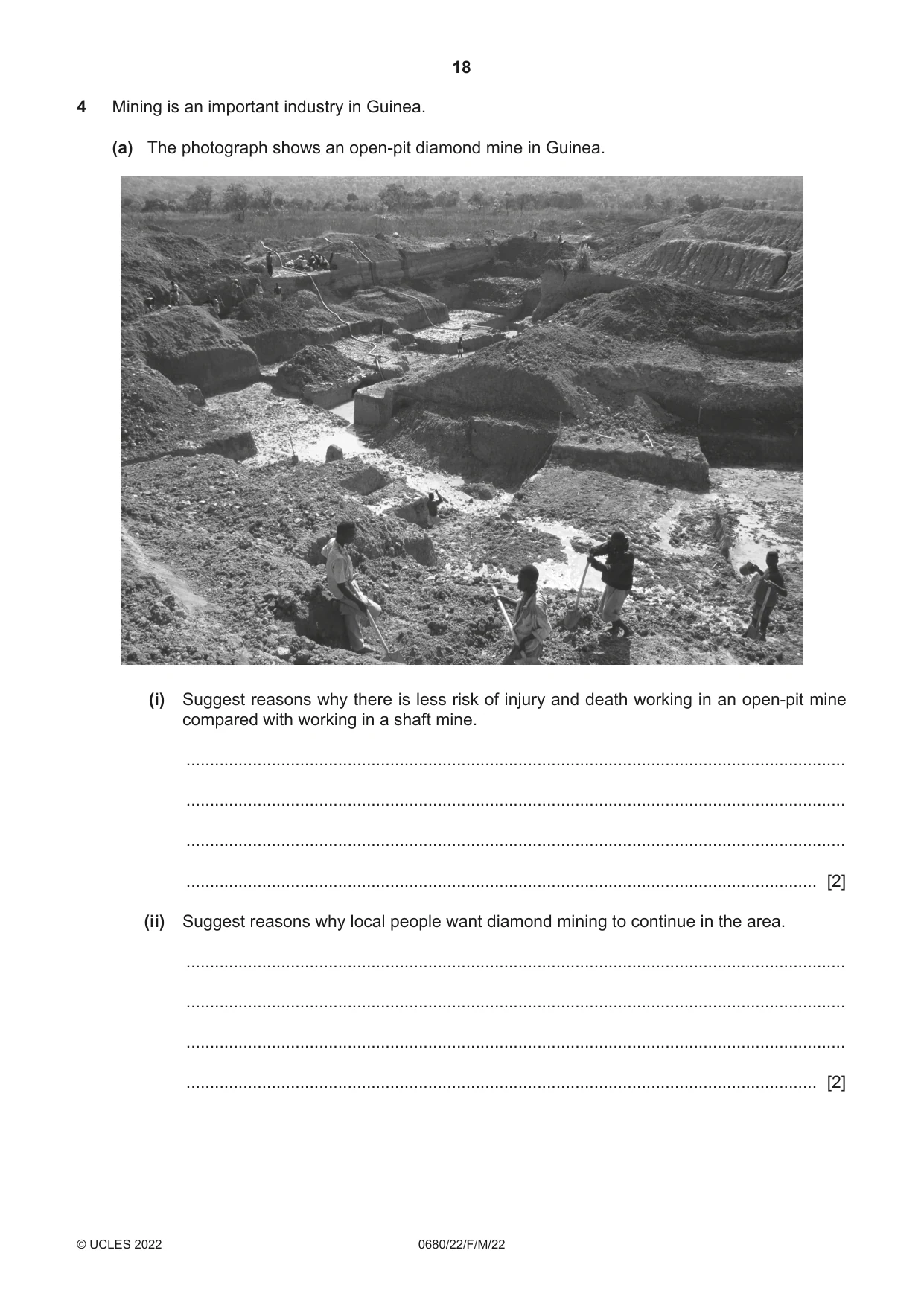
Q4 · Mining is an important industry in Guinea
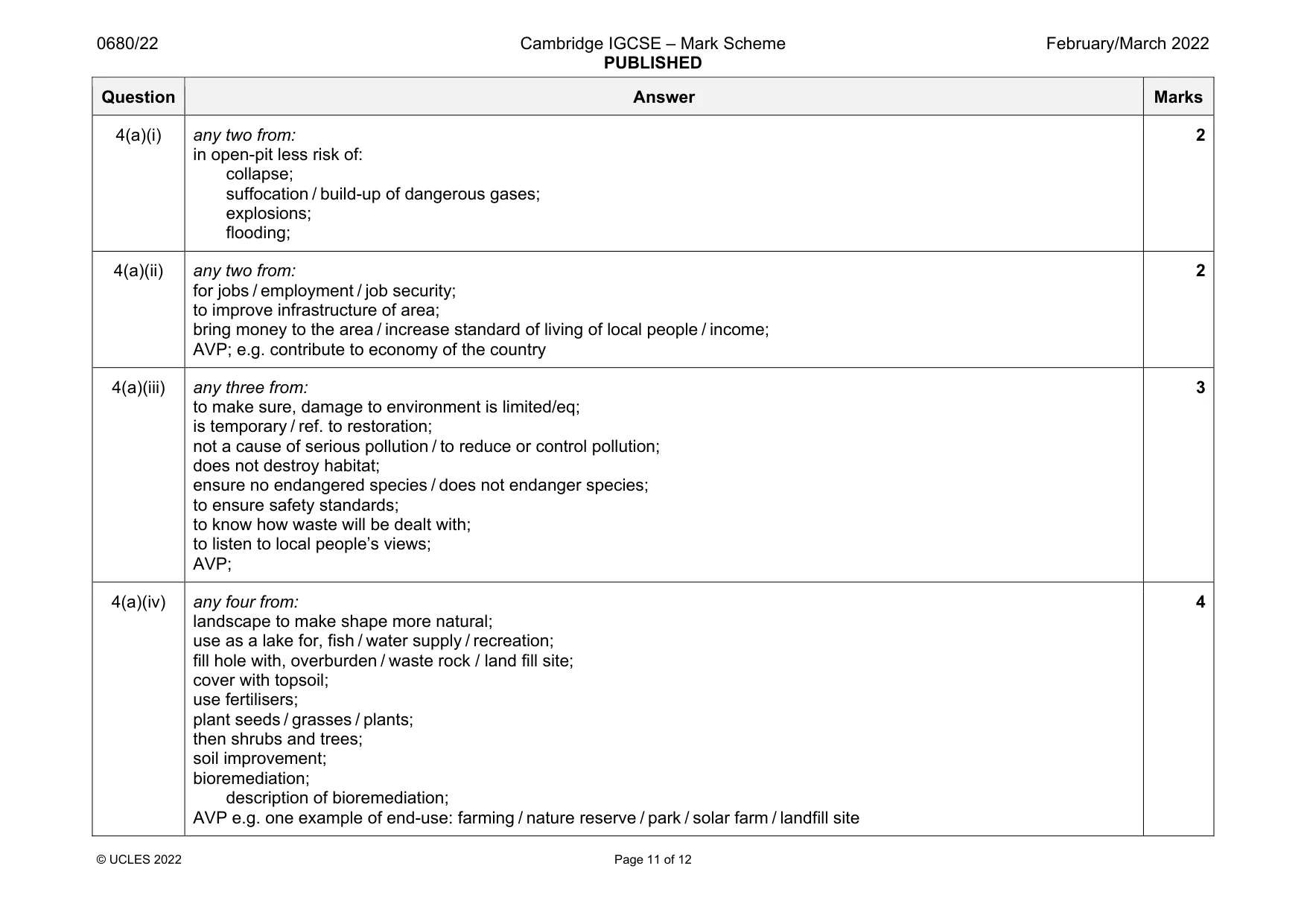
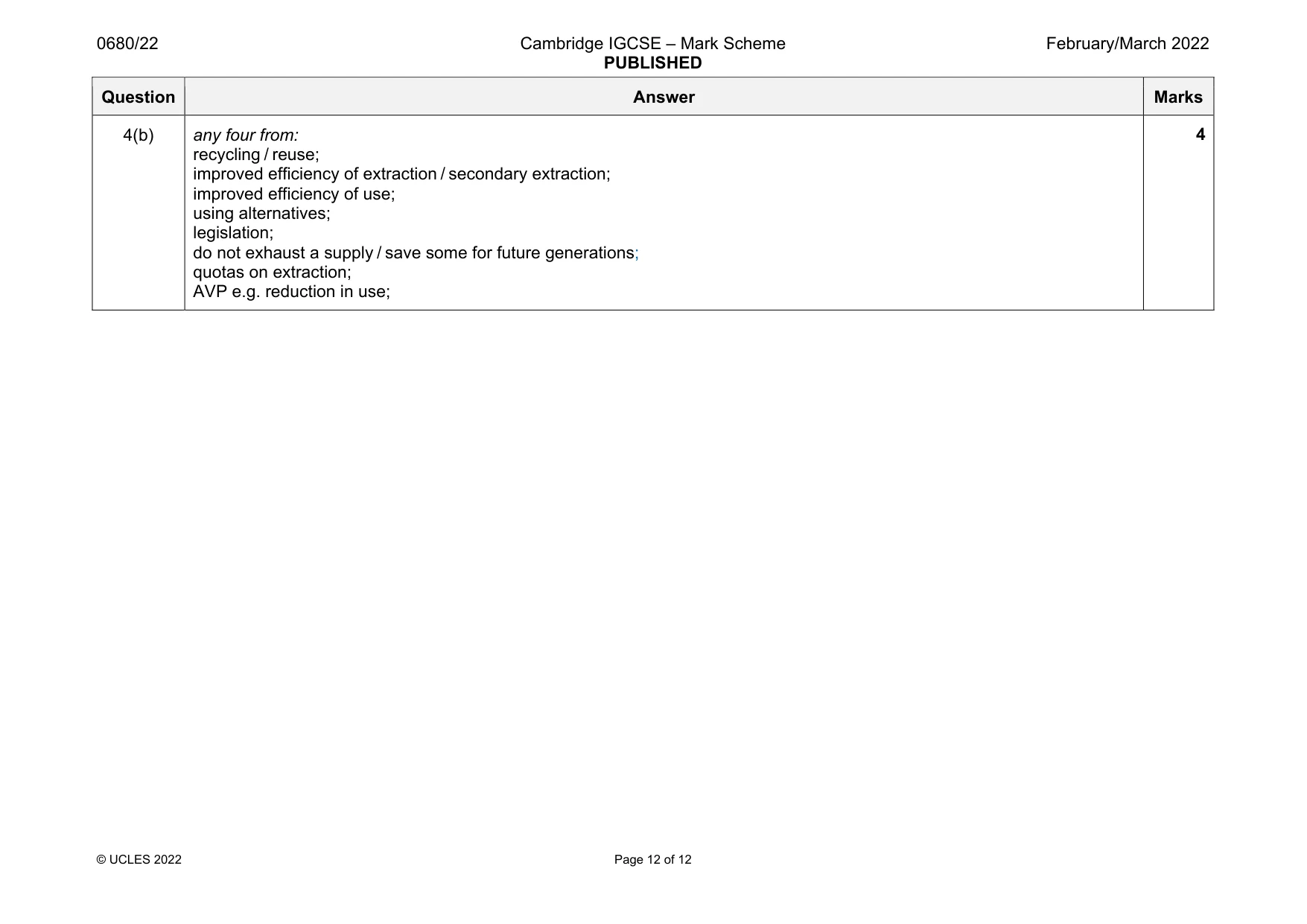
4 Mining is an important industry in Guinea. (a) The photograph shows an open-pit diamond mine in Guinea. (i) Suggest reasons why there is less risk of injury and death working in an open-pit mine compared with working in a shaft mine. ........................................................................................................................................... ........................................................................................................................................... ........................................................................................................................................... ..................................................................................................................................... [2] (ii) Suggest reasons why local people want diamond mining to continue in the area. ........................................................................................................................................... ........................................................................................................................................... ........................................................................................................................................... ..................................................................................................................................... [2] (iii) Explain why an environmental impact assessment must be completed before a mining licence can be issued. ........................................................................................................................................... ........................................................................................................................................... ........................................................................................................................................... ........................................................................................................................................... ........................................................................................................................................... ..................................................................................................................................... [3] (iv) Describe ways the landscape shown in the photograph can be restored after all the mining is finished. ........................................................................................................................................... ........................................................................................................................................... ........................................................................................................................................... ........................................................................................................................................... ........................................................................................................................................... ........................................................................................................................................... ........................................................................................................................................... ..................................................................................................................................... [4] (b) There is a large global demand for rocks and minerals. Describe strategies for the sustainable use of rocks and minerals. ................................................................................................................................................... ................................................................................................................................................... ................................................................................................................................................... ................................................................................................................................................... ................................................................................................................................................... ................................................................................................................................................... ................................................................................................................................................... ............................................................................................................................................. [4] [Total: 15]
Mark scheme: 4(a)(i) any two from: in open-pit less risk of: collapse; suffocation / build-up of dangerous gases; explosions; flooding; 2 4(a)(ii) any two from: for jobs / employment / job security; to improve infrastructure of area; bring money to the area / increase standard of living of local people / income; AVP; e.g. contribute to economy of the country 2 4(a)(iii) any three from: to make sure, damage to environment is limited/eq; is temporary / ref. to restoration; not a cause of serious pollution / to reduce or control pollution; does not destroy habitat; ensure no endangered species / does not endanger species; to ensure safety standards; to know how waste will be dealt with; to listen to local people’s views; AVP; 3 4(a)(iv) any four from: landscape to make shape more natural; use as a lake for, fish / water supply / recreation; fill hole with, overburden / waste rock / land fill site; cover with topsoil; use fertilisers; plant seeds / grasses / plants; then shrubs and trees; soil improvement; bioremediation; description of bioremediation; AVP e.g. one example of end-use: farming / nature reserve / park / solar farm / landfill site 4 Question Answer Marks 4(b) any four from: recycling / reuse; improved efficiency of extraction / secondary extraction; improved efficiency of use; using alternatives; legislation; do not exhaust a supply / save some for future generations; quotas on extraction; AVP e.g. reduction in use; 4
What was in this paper
The subtopics covered by these 4 questions, and how many questions each got. Open one in a new tab to see every Cambridge question on it.
What you needed in this session
Cambridge’s own grade thresholds for 2022 Feb/March, Paper 2 · Variant 2. A higher threshold means an easier paper — the bar moves with how the cohort did.