Cambridge IGCSE Environmental Management 0680 — 2021 Feb/March Paper 2 · Variant 2
0680/22/F/M/21 · 4 questions · 80 marks · ≈90 min
The question paper and its mark scheme, free to read here and free to download. This is Cambridge’s own paper, exactly as it was sat.
Question paper20 pages
Mark scheme14 pages
Answers below. Sit the paper first if you are practising.
Questions as text
Q1 · In 2019, the population of Tegucigalpa was 1.12 million people and the population of San…
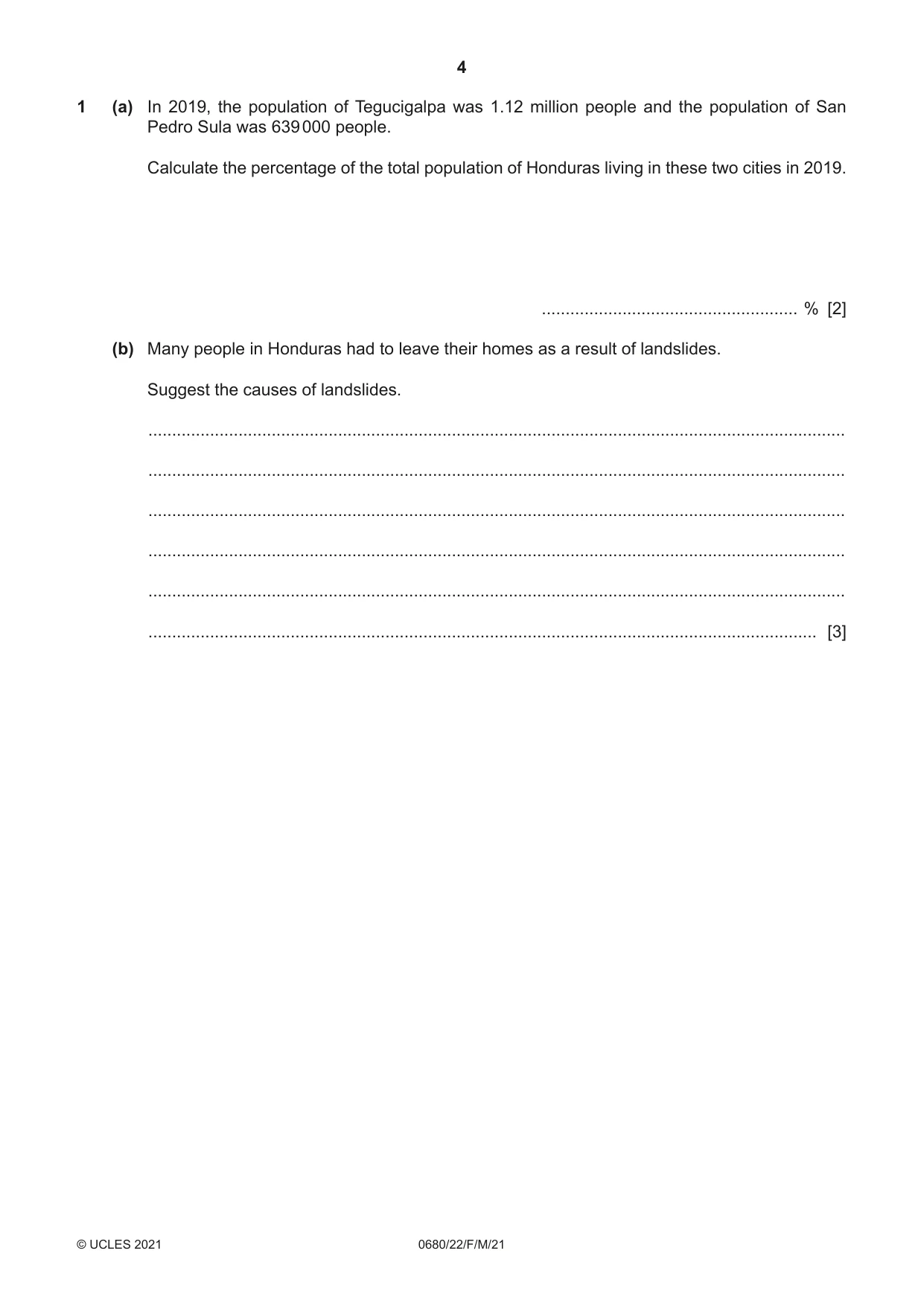
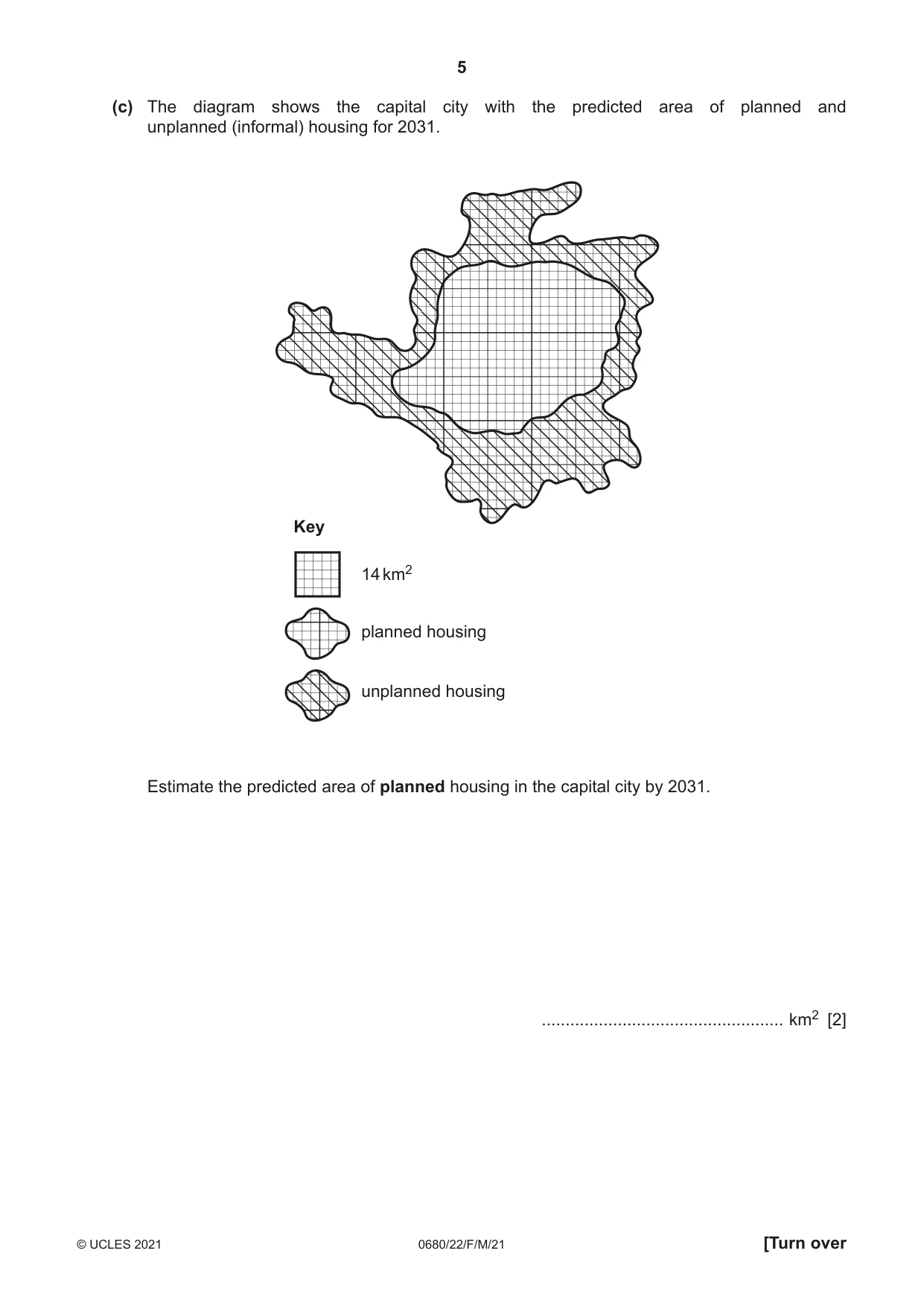
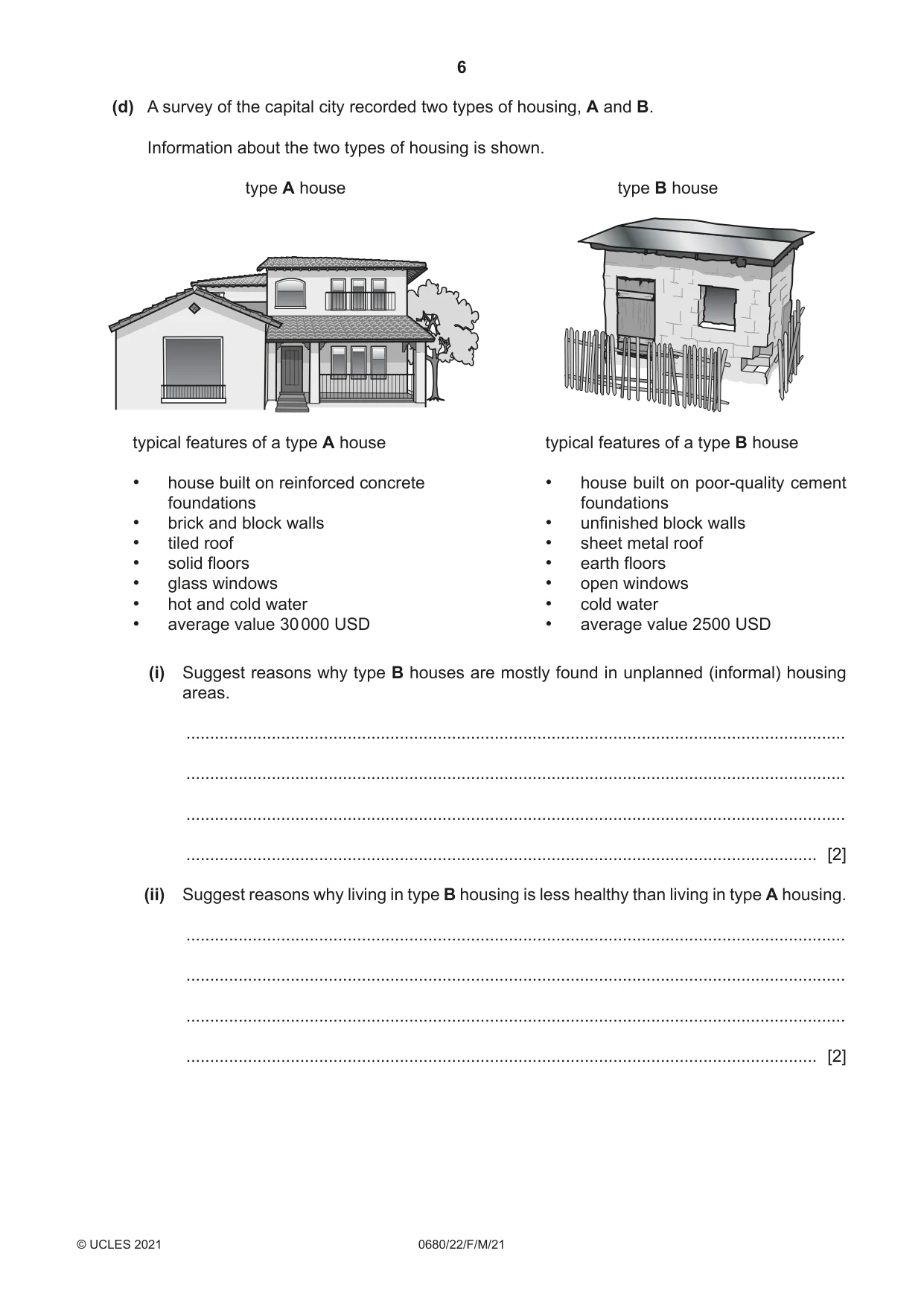
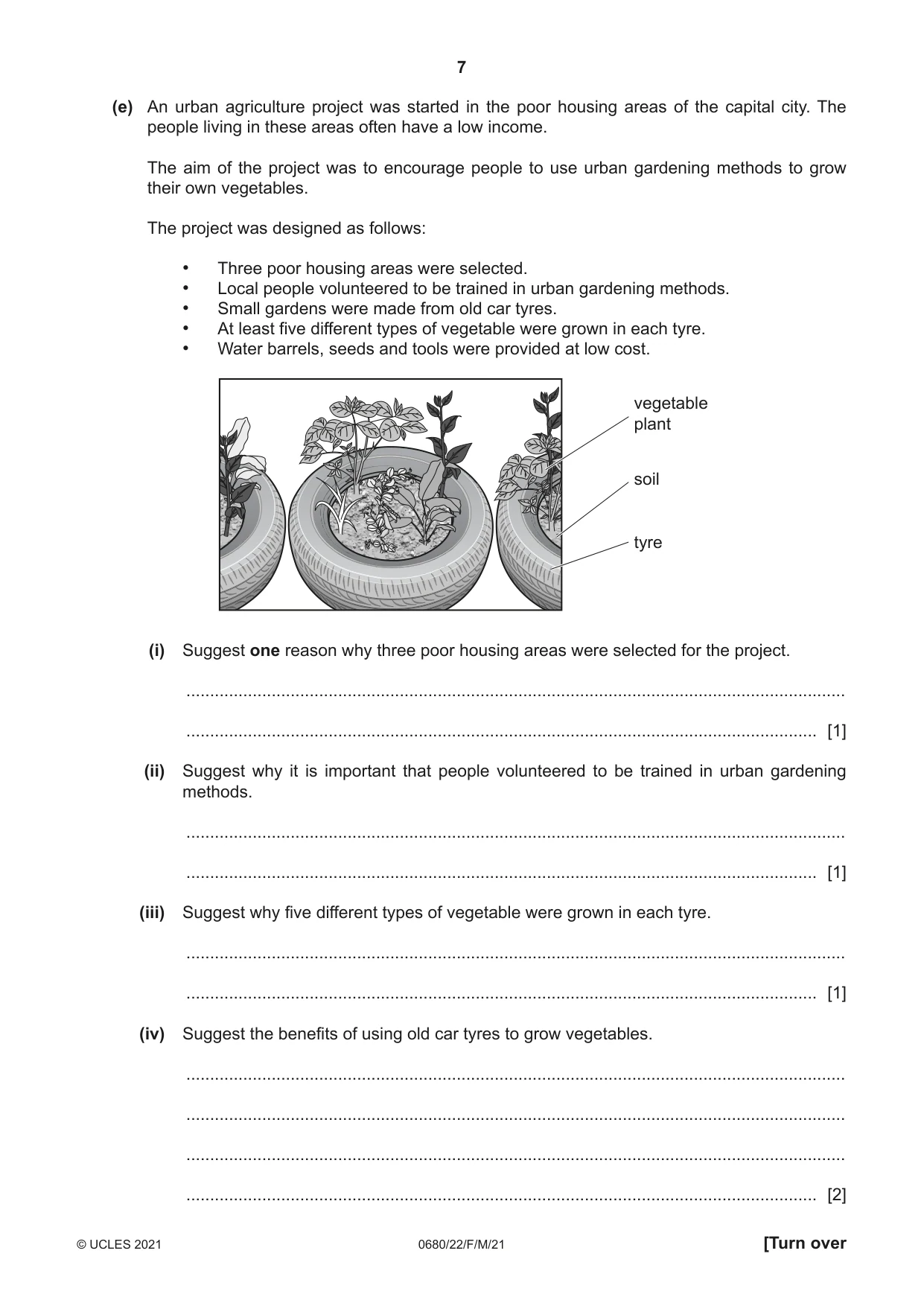
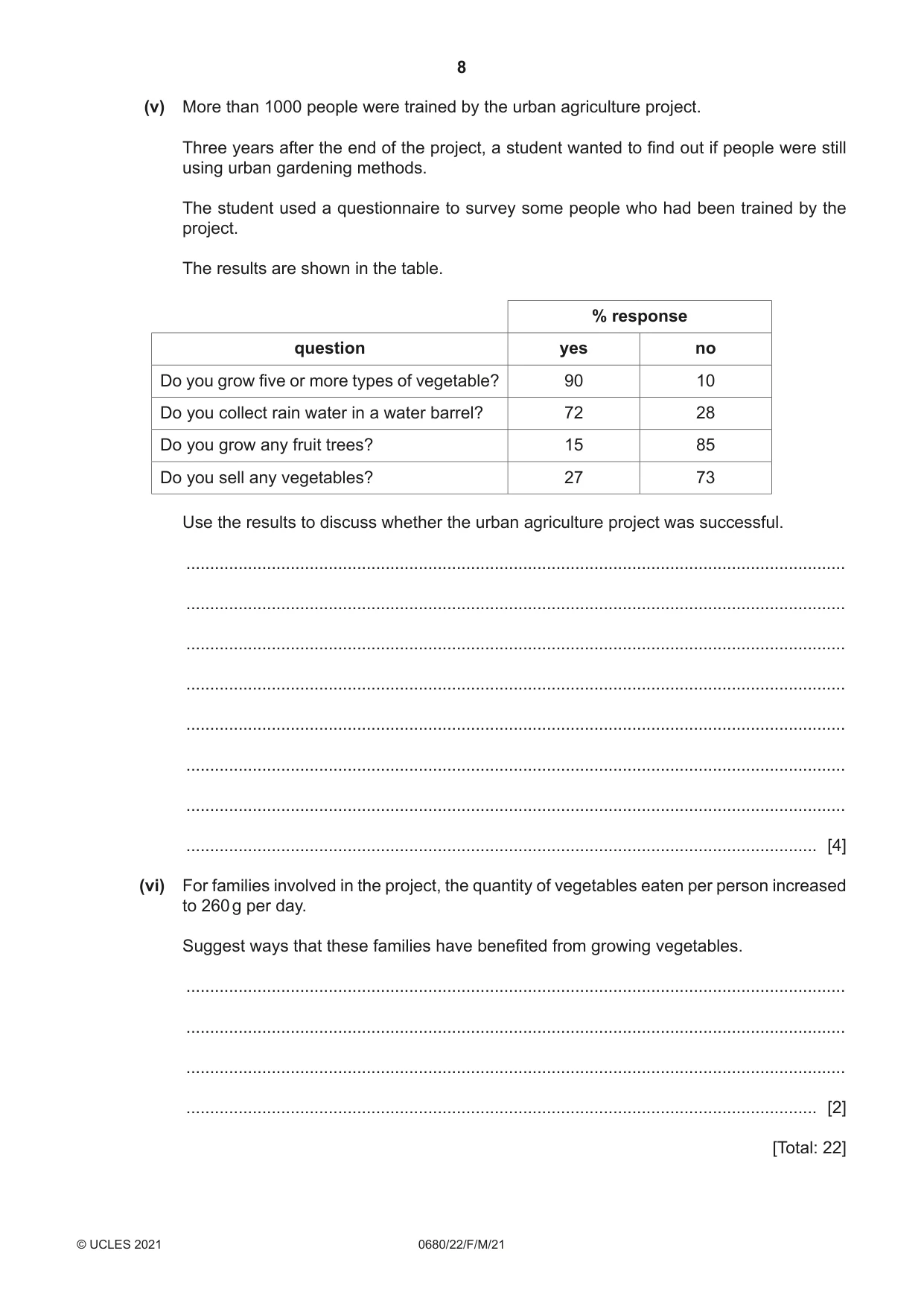
1 (a) In 2019, the population of Tegucigalpa was 1.12 million people and the population of San Pedro Sula was 639 000 people. Calculate the percentage of the total population of Honduras living in these two cities in 2019. ...................................................... % [2] (b) Many people in Honduras had to leave their homes as a result of landslides. Suggest the causes of landslides. ................................................................................................................................................... ................................................................................................................................................... ................................................................................................................................................... ................................................................................................................................................... ................................................................................................................................................... ............................................................................................................................................. [3] (c) The diagram shows the capital city with the predicted area of planned and unplanned (informal) housing for 2031. Key 14 km2 planned housing unplanned housing Estimate the predicted area of planned housing in the capital city by 2031. ................................................... km2 [2] (d) A survey of the capital city recorded two types of housing, A and B. Information about the two types of housing is shown. type A house type B house typical features of a type A house typical features of a type B house • house built on reinforced concrete • house built on poor‑quality cement foundations foundations • brick and block walls • unfinished block walls • tiled roof • sheet metal roof • solid floors • earth floors • glass windows • open windows • hot and cold water • cold water • average value 30 000 USD • average value 2500 USD (i) Suggest reasons why type B houses are mostly found in unplanned (informal) housing areas. ........................................................................................................................................... ........................................................................................................................................... ........................................................................................................................................... ..................................................................................................................................... [2] (ii) Suggest reasons why living in type B housing is less healthy than living in type A housing. ........................................................................................................................................... ........................................................................................................................................... ........................................................................................................................................... ..................................................................................................................................... [2] (e) An urban agriculture project was started in the poor housing areas of the capital city. The people living in these areas often have a low income. The aim of the project was to encourage people to use urban gardening methods to grow their own vegetables. The project was designed as follows: • Three poor housing areas were selected. • Local people volunteered to be trained in urban gardening methods. • Small gardens were made from old car tyres. • At least five different types of vegetable were grown in each tyre. • Water barrels, seeds and tools were provided at low cost. vegetable plant soil tyre (i) Suggest one reason why three poor housing areas were selected for the project. ........................................................................................................................................... ..................................................................................................................................... [1] (ii) Suggest why it is important that people volunteered to be trained in urban gardening methods. ........................................................................................................................................... ..................................................................................................................................... [1] (iii) Suggest why five different types of vegetable were grown in each tyre. ........................................................................................................................................... ..................................................................................................................................... [1] (iv) Suggest the benefits of using old car tyres to grow vegetables. ........................................................................................................................................... ........................................................................................................................................... ........................................................................................................................................... ..................................................................................................................................... [2] (v) More than 1000 people were trained by the urban agriculture project. Three years after the end of the project, a student wanted to find out if people were still using urban gardening methods. The student used a questionnaire to survey some people who had been trained by the project. The results are shown in the table. % response question yes no Do you grow five or more types of vegetable? 90 10 Do you collect rain water in a water barrel? 72 28 Do you grow any fruit trees? 15 85 Do you sell any vegetables? 27 73 Use the results to discuss whether the urban agriculture project was successful. ........................................................................................................................................... ........................................................................................................................................... ........................................................................................................................................... ........................................................................................................................................... ........................................................................................................................................... ........................................................................................................................................... ........................................................................................................................................... ..................................................................................................................................... [4] (vi) For families involved in the project, the quantity of vegetables eaten per person increased to 260 g per day. Suggest ways that these families have benefited from growing vegetables. ........................................................................................................................................... ........................................................................................................................................... ........................................................................................................................................... ..................................................................................................................................... [2] [Total: 22]
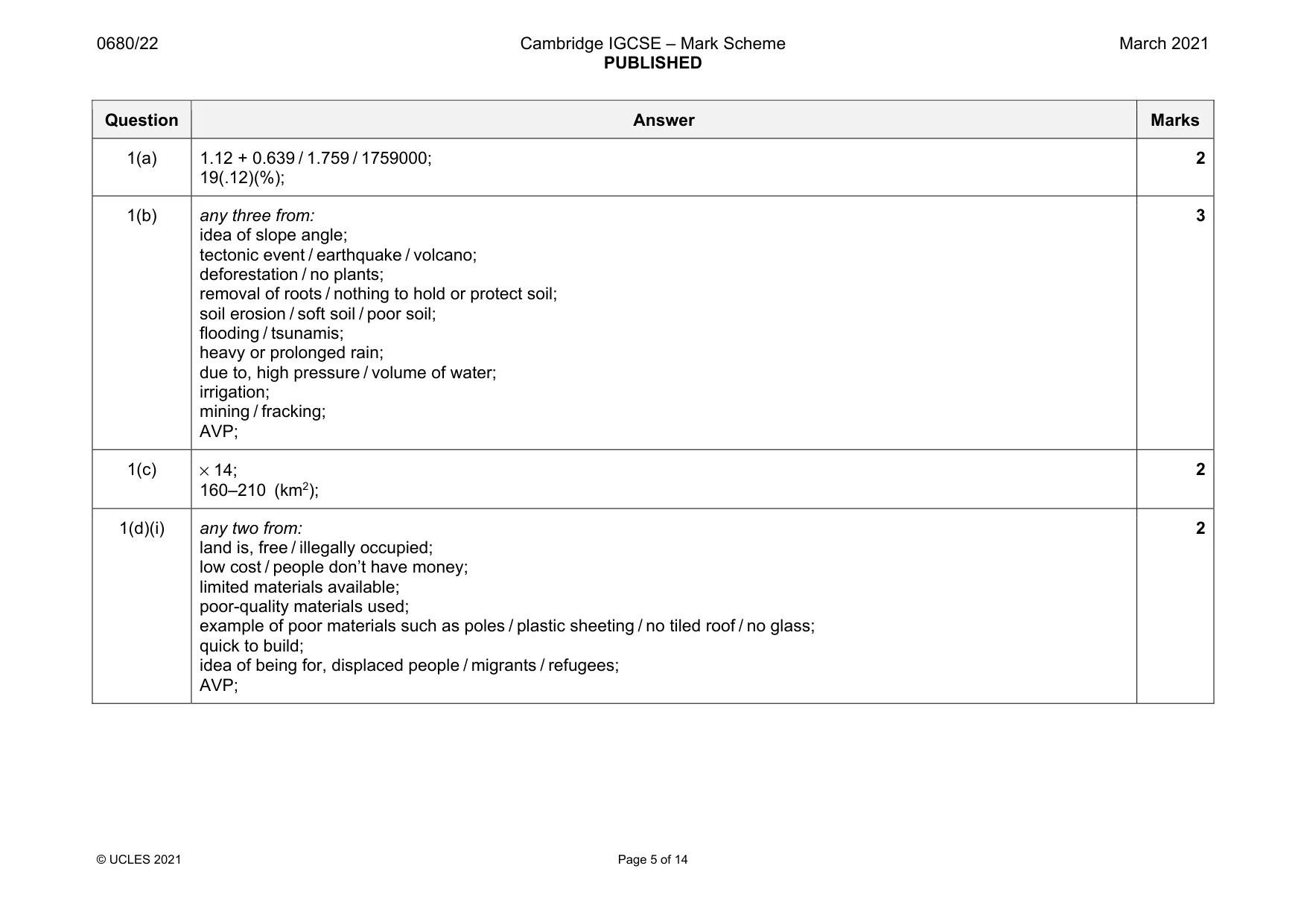
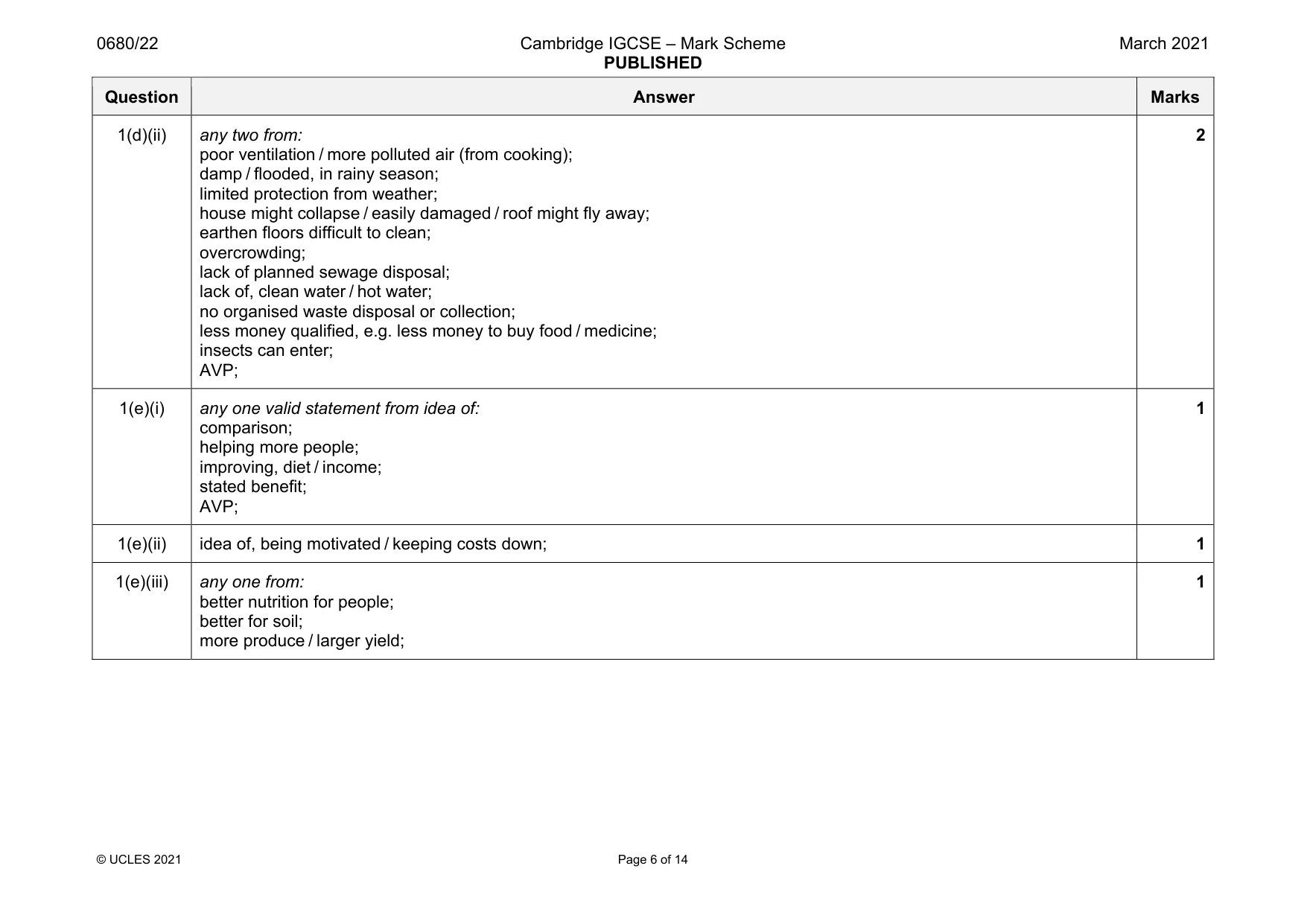
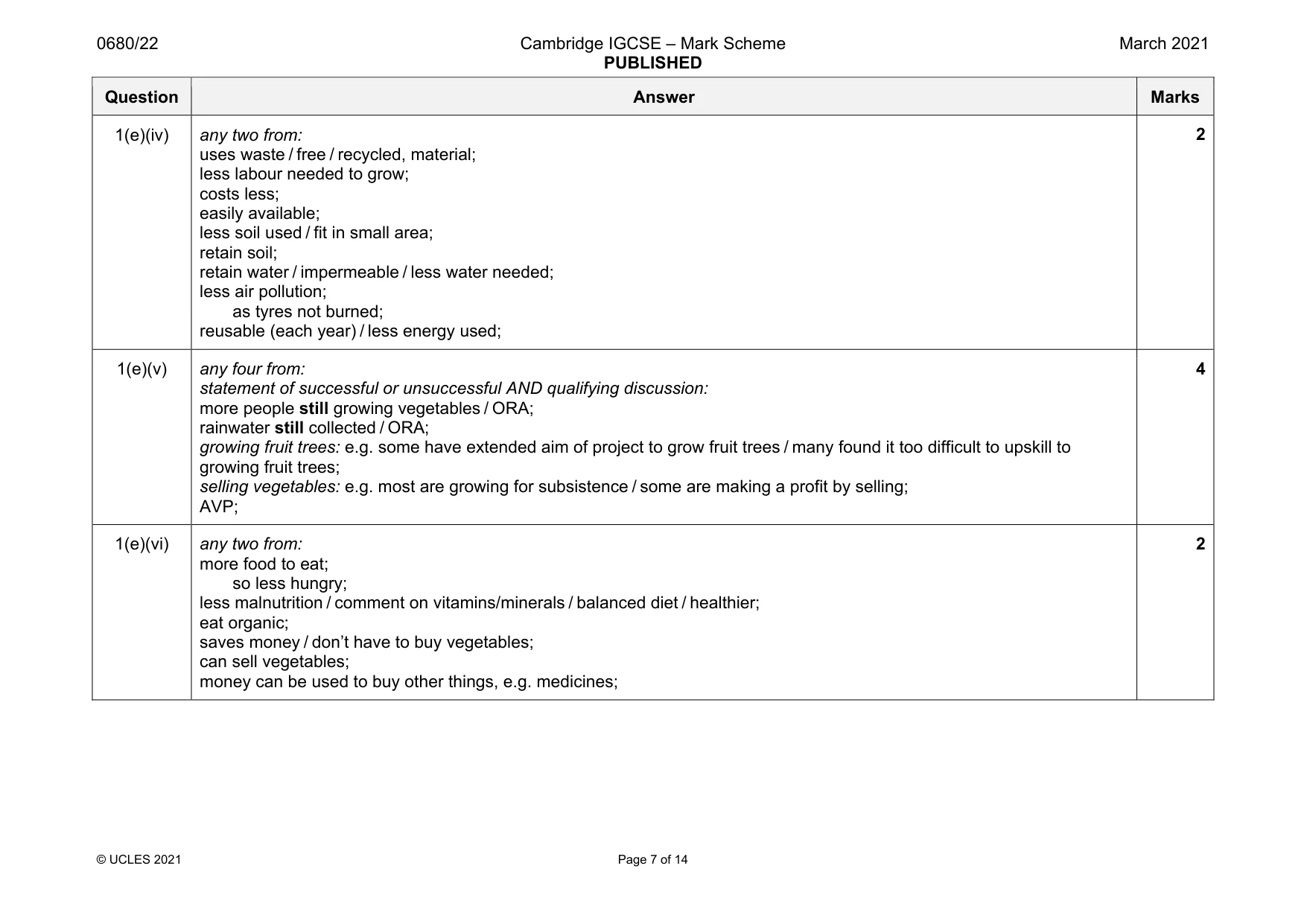
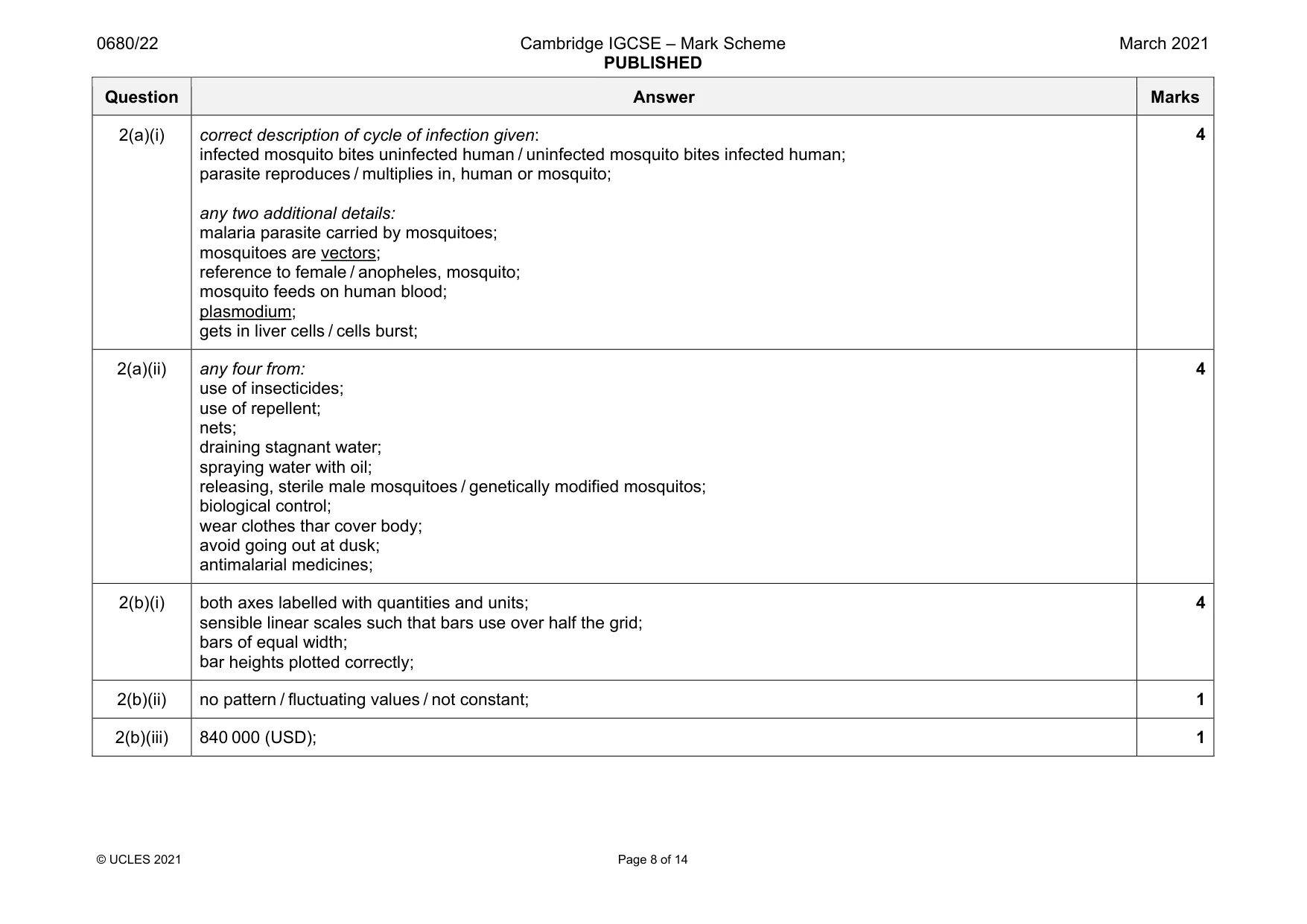
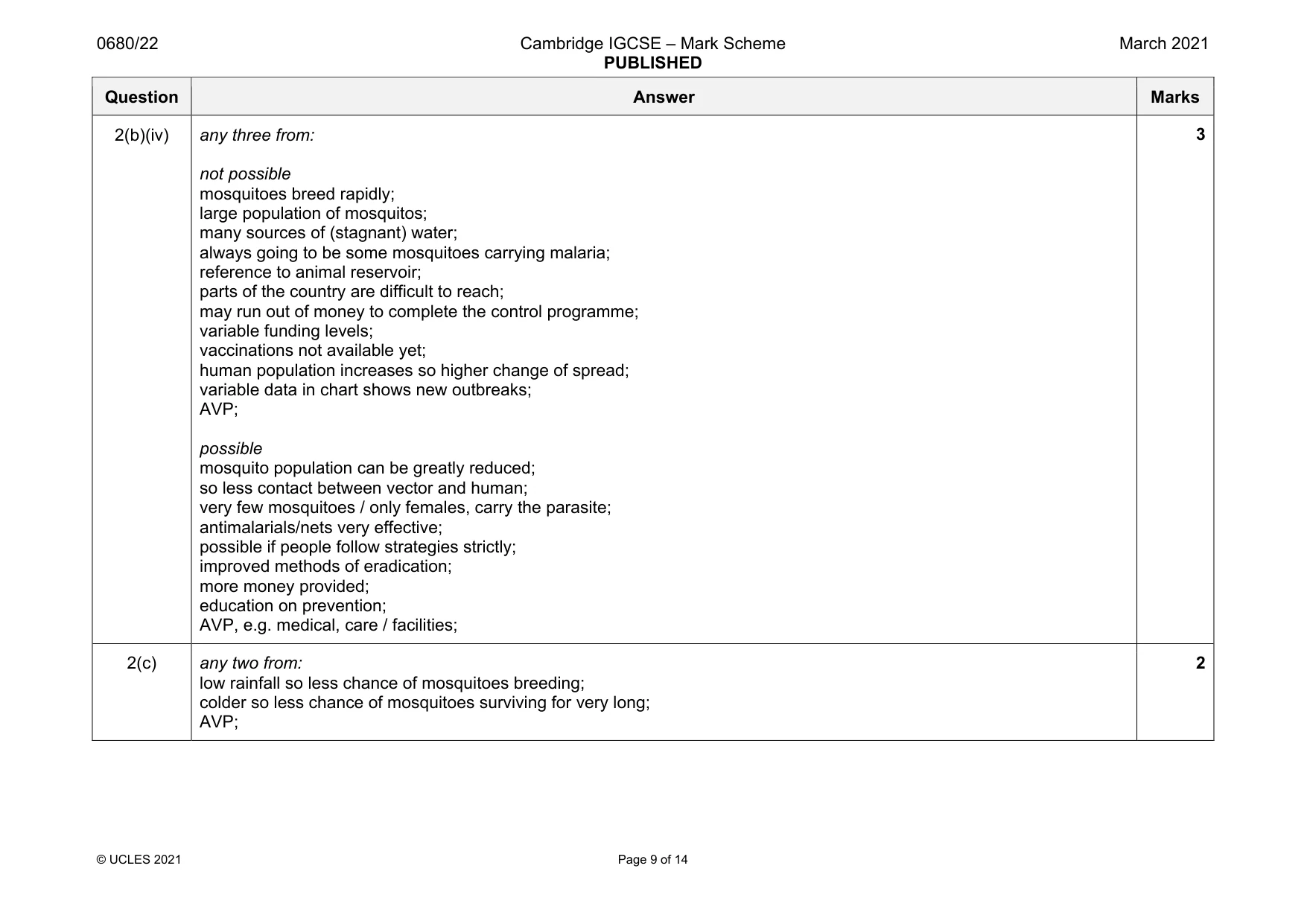
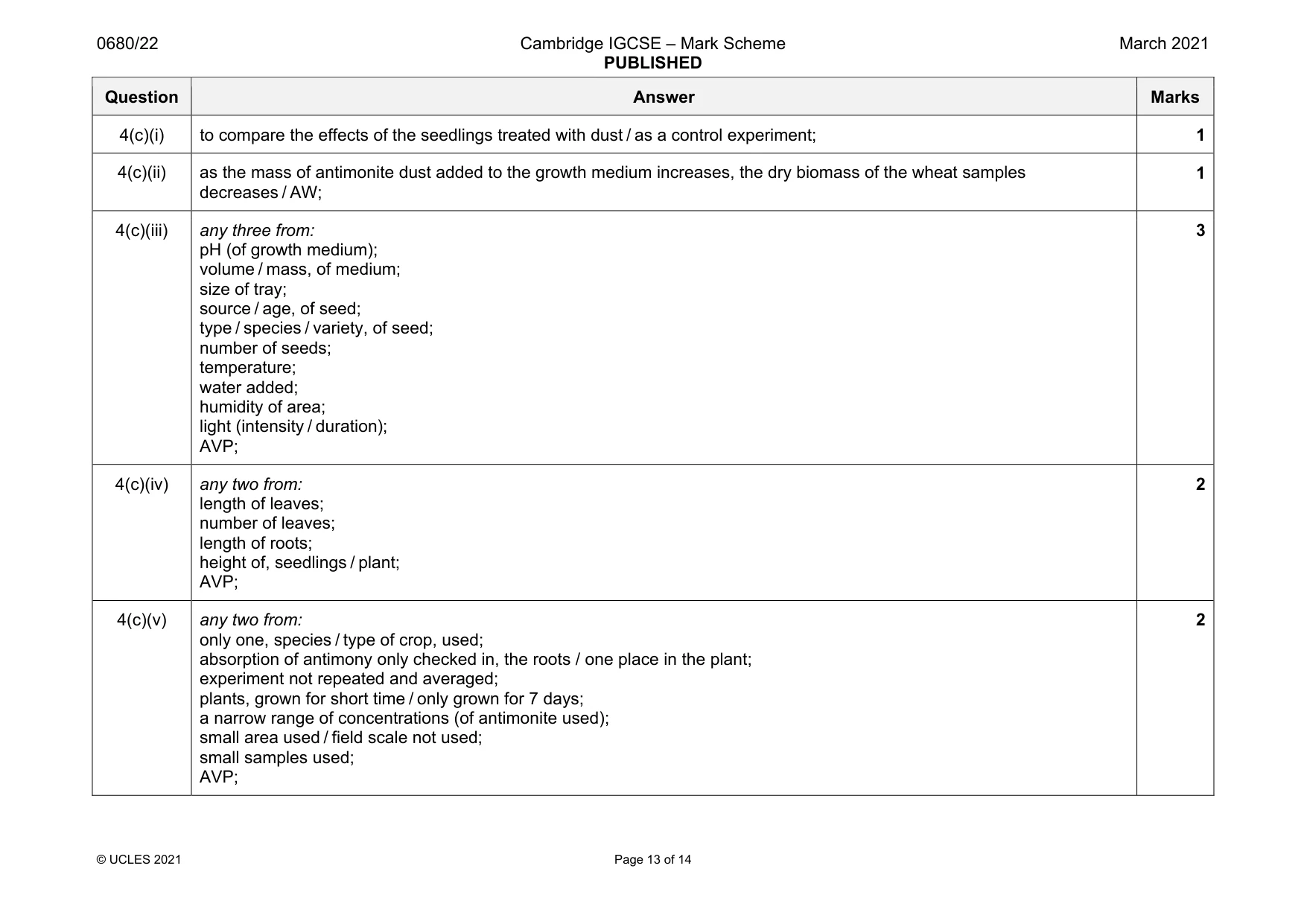
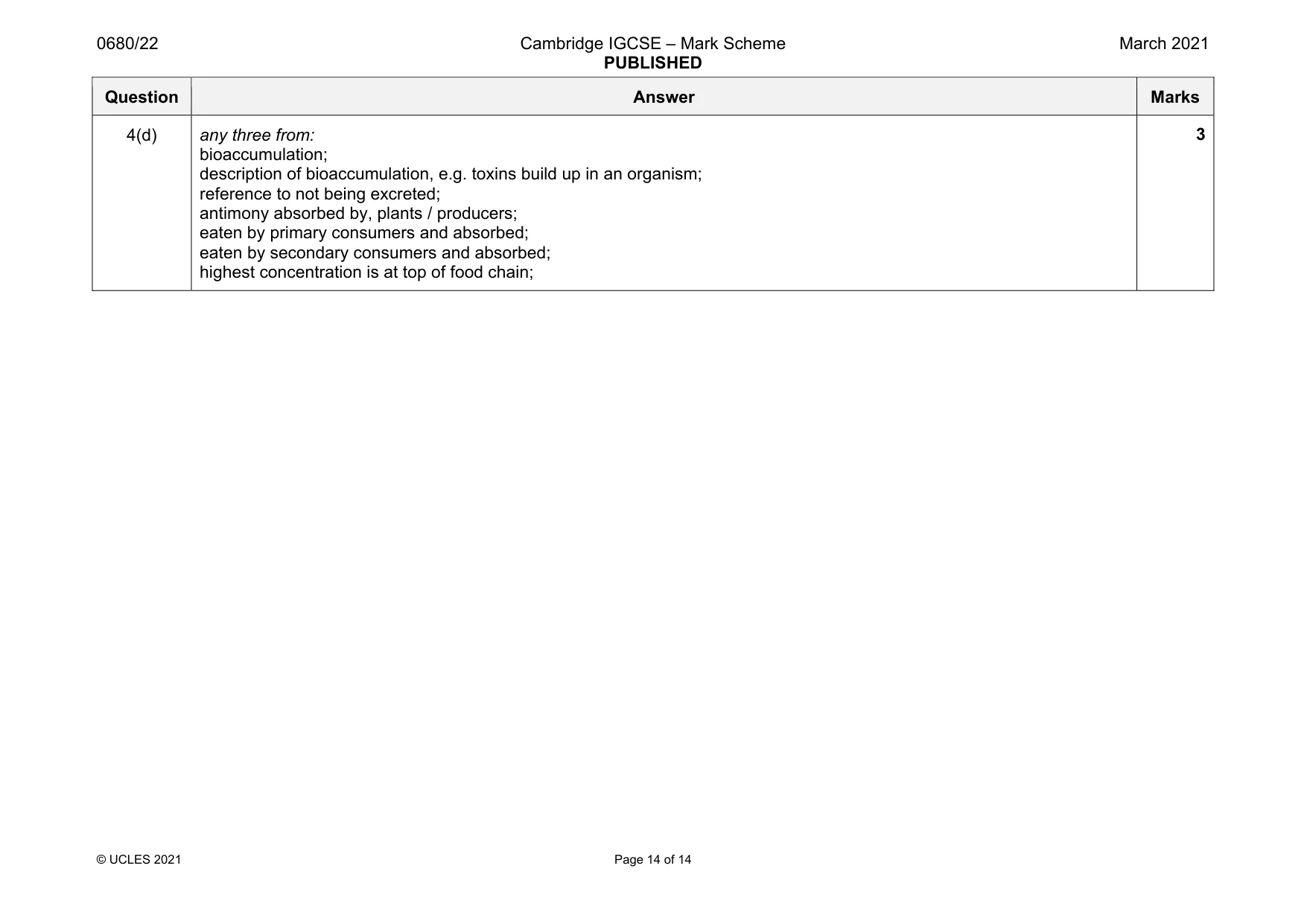
Mark scheme: 1(a) 1.12 + 0.639 / 1.759 / 1759000; 19(.12)(%); 2 1(b) any three from: idea of slope angle; tectonic event / earthquake / volcano; deforestation / no plants; removal of roots / nothing to hold or protect soil; soil erosion / soft soil / poor soil; flooding / tsunamis; heavy or prolonged rain; due to, high pressure / volume of water; irrigation; mining / fracking; AVP; 3 1(c) × 14; 160–210 (km2); 2 1(d)(i) any two from: land is, free / illegally occupied; low cost / people don’t have money; limited materials available; poor-quality materials used; example of poor materials such as poles / plastic sheeting / no tiled roof / no glass; quick to build; idea of being for, displaced people / migrants / refugees; AVP; 2 Question Answer Marks 1(d)(ii) any two from: poor ventilation / more polluted air (from cooking); damp / flooded, in rainy season; limited protection from weather; house might collapse / easily damaged / roof might fly away; earthen floors difficult to clean; overcrowding; lack of planned sewage disposal; lack of, clean water / hot water; no organised waste disposal or collection; less money qualified, e.g. less money to buy food / medicine; insects can enter; AVP; 2 1(e)(i) any one valid statement from idea of: comparison; helping more people; improving, diet / income; stated benefit; AVP; 1 1(e)(ii) idea of, being motivated / keeping costs down; 1 1(e)(iii) any one from: better nutrition for people; better for soil; more produce / larger yield; 1 Question Answer Marks 1(e)(iv) any two from: uses waste / free / recycled, material; less labour needed to grow; costs less; easily available; less soil used / fit in small area; retain soil; retain water / impermeable / less water needed; less air pollution; as tyres not burned; reusable (each year) / less energy used; 2 1(e)(v) any four from: statement of successful or unsuccessful AND qualifying discussion: more people still growing vegetables / ORA; rainwater still collected / ORA; growing fruit trees: e.g. some have extended aim of project to grow fruit trees / many found it too difficult to upskill to growing fruit trees; selling vegetables: e.g. most are growing for subsistence / some are making a profit by selling; AVP; 4 1(e)(vi) any two from: more food to eat; so less hungry; less malnutrition / comment on vitamins/minerals / balanced diet / healthier; eat organic; saves money / don’t have to buy vegetables; can sell vegetables; money can be used to buy other things, e.g. medicines; 2
Q2 · The map shows the location of the Mosquito Coast area in Honduras
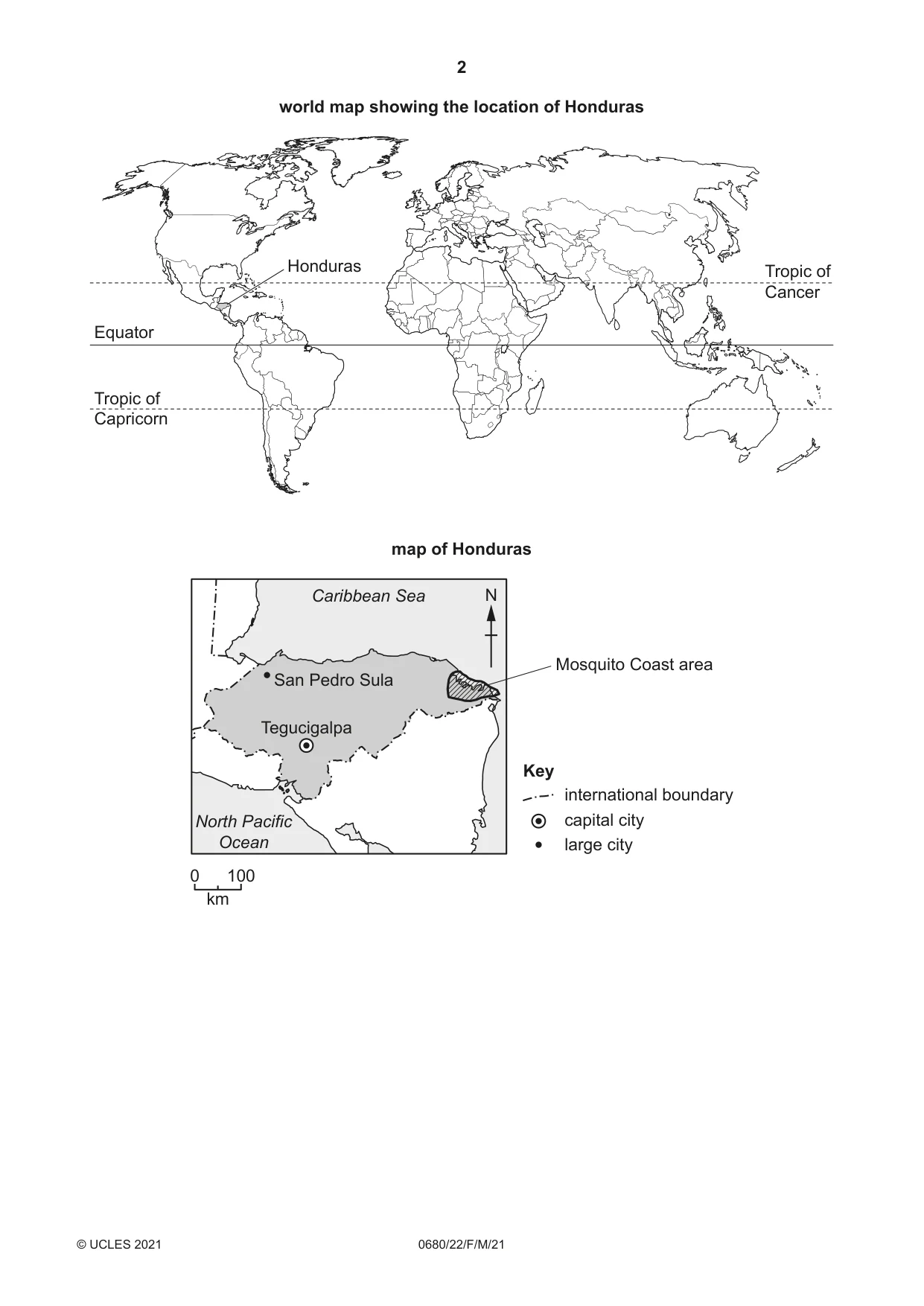
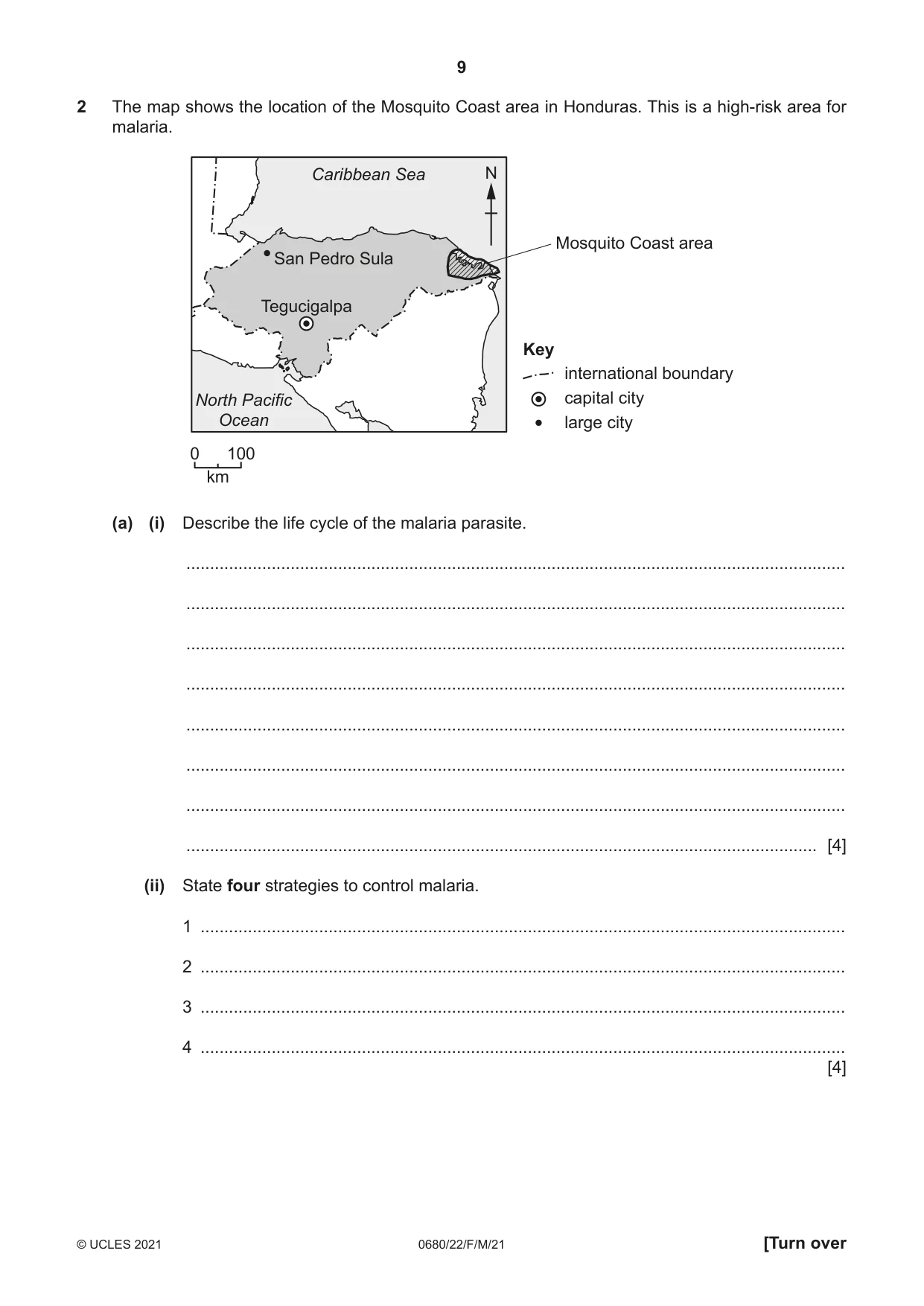
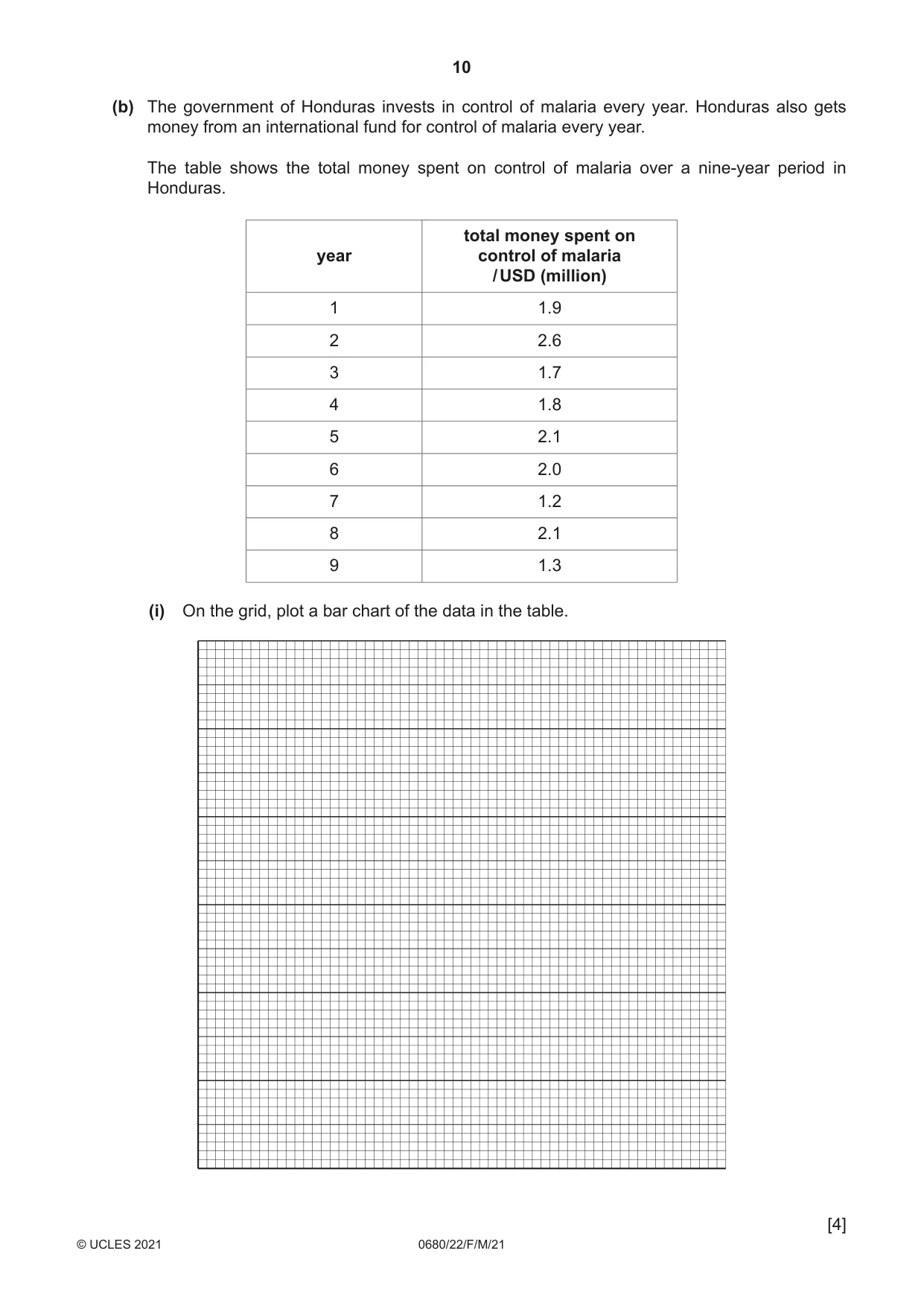
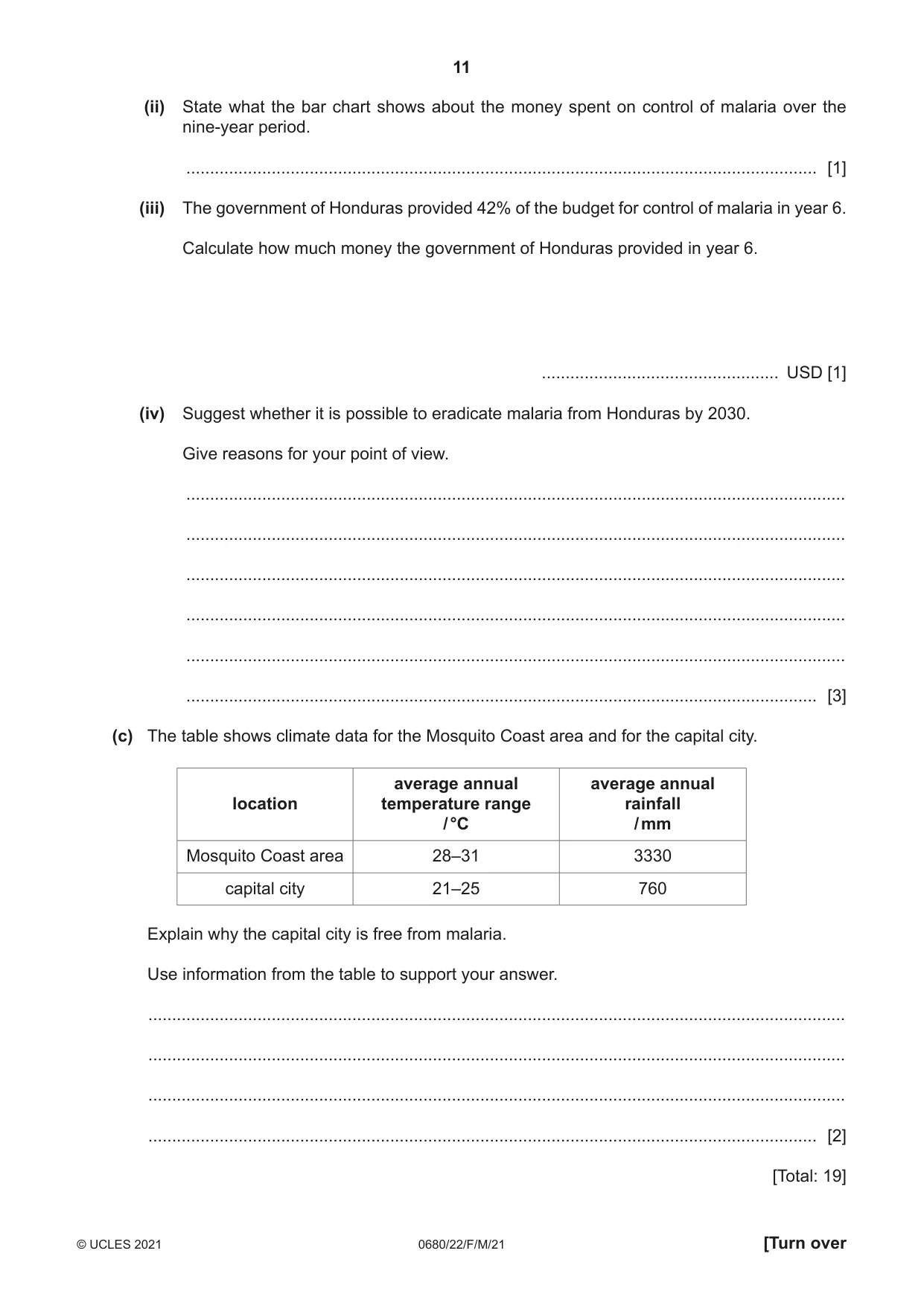
2 The map shows the location of the Mosquito Coast area in Honduras. This is a high‑risk area for malaria. Caribbean Sea N Mosquito Coast area San Pedro Sula Tegucigalpa Key international boundary North Pacific capital city Ocean large city 0 100 km (a) (i) Describe the life cycle of the malaria parasite. ........................................................................................................................................... ........................................................................................................................................... ........................................................................................................................................... ........................................................................................................................................... ........................................................................................................................................... ........................................................................................................................................... ........................................................................................................................................... ..................................................................................................................................... [4] (ii) State four strategies to control malaria. 1 ........................................................................................................................................ 2 ........................................................................................................................................ 3 ........................................................................................................................................ 4 ........................................................................................................................................ [4] (b) The government of Honduras invests in control of malaria every year. Honduras also gets money from an international fund for control of malaria every year. The table shows the total money spent on control of malaria over a nine‑year period in Honduras. total money spent on year control of malaria / USD (million) 1 1.9 2 2.6 3 1.7 4 1.8 5 2.1 6 2.0 7 1.2 8 2.1 9 1.3 (i) On the grid, plot a bar chart of the data in the table. [4] (ii) State what the bar chart shows about the money spent on control of malaria over the nine‑year period. ..................................................................................................................................... [1] (iii) The government of Honduras provided 42% of the budget for control of malaria in year 6. Calculate how much money the government of Honduras provided in year 6. .................................................. USD [1] (iv) Suggest whether it is possible to eradicate malaria from Honduras by 2030. Give reasons for your point of view. ........................................................................................................................................... ........................................................................................................................................... ........................................................................................................................................... ........................................................................................................................................... ........................................................................................................................................... ..................................................................................................................................... [3] (c) The table shows climate data for the Mosquito Coast area and for the capital city. average annual average annual location temperature range rainfall / °C / mm Mosquito Coast area 28–31 3330 capital city 21–25 760 Explain why the capital city is free from malaria. Use information from the table to support your answer. ................................................................................................................................................... ................................................................................................................................................... ................................................................................................................................................... ............................................................................................................................................. [2] [Total: 19]
Mark scheme: 2(a)(i) correct description of cycle of infection given: infected mosquito bites uninfected human / uninfected mosquito bites infected human; parasite reproduces / multiplies in, human or mosquito; any two additional details: malaria parasite carried by mosquitoes; mosquitoes are vectors; reference to female / anopheles, mosquito; mosquito feeds on human blood; plasmodium; gets in liver cells / cells burst; 2(a)(ii) any four from: use of insecticides; use of repellent; nets; draining stagnant water; spraying water with oil; releasing, sterile male mosquitoes / genetically modified mosquitos; biological control; wear clothes thar cover body; avoid going out at dusk; antimalarial medicines; 4 2(b)(i) both axes labelled with quantities and units; sensible linear scales such that bars use over half the grid; bars of equal width; bar heights plotted correctly; 4 2(b)(ii) no pattern / fluctuating values / not constant; 1 2(b)(iii) 840 000 (USD); 1 Question Answer Marks 2(b)(iv) any three from: not possible mosquitoes breed rapidly; large population of mosquitos; many sources of (stagnant) water; always going to be some mosquitoes carrying malaria; reference to animal reservoir; parts of the country are difficult to reach; may run out of money to complete the control programme; variable funding levels; vaccinations not available yet; human population increases so higher change of spread; variable data in chart shows new outbreaks; AVP; possible mosquito population can be greatly reduced; so less contact between vector and human; very few mosquitoes / only females, carry the parasite; antimalarials/nets very effective; possible if people follow strategies strictly; improved methods of eradication; more money provided; education on prevention; AVP, e.g. medical, care / facilities; 3 2(c) any two from: low rainfall so less chance of mosquitoes breeding; colder so less chance of mosquitoes surviving for very long; AVP; 2
Q3 · The government of Honduras wants 95% of the country’s electricity to come from renewable…
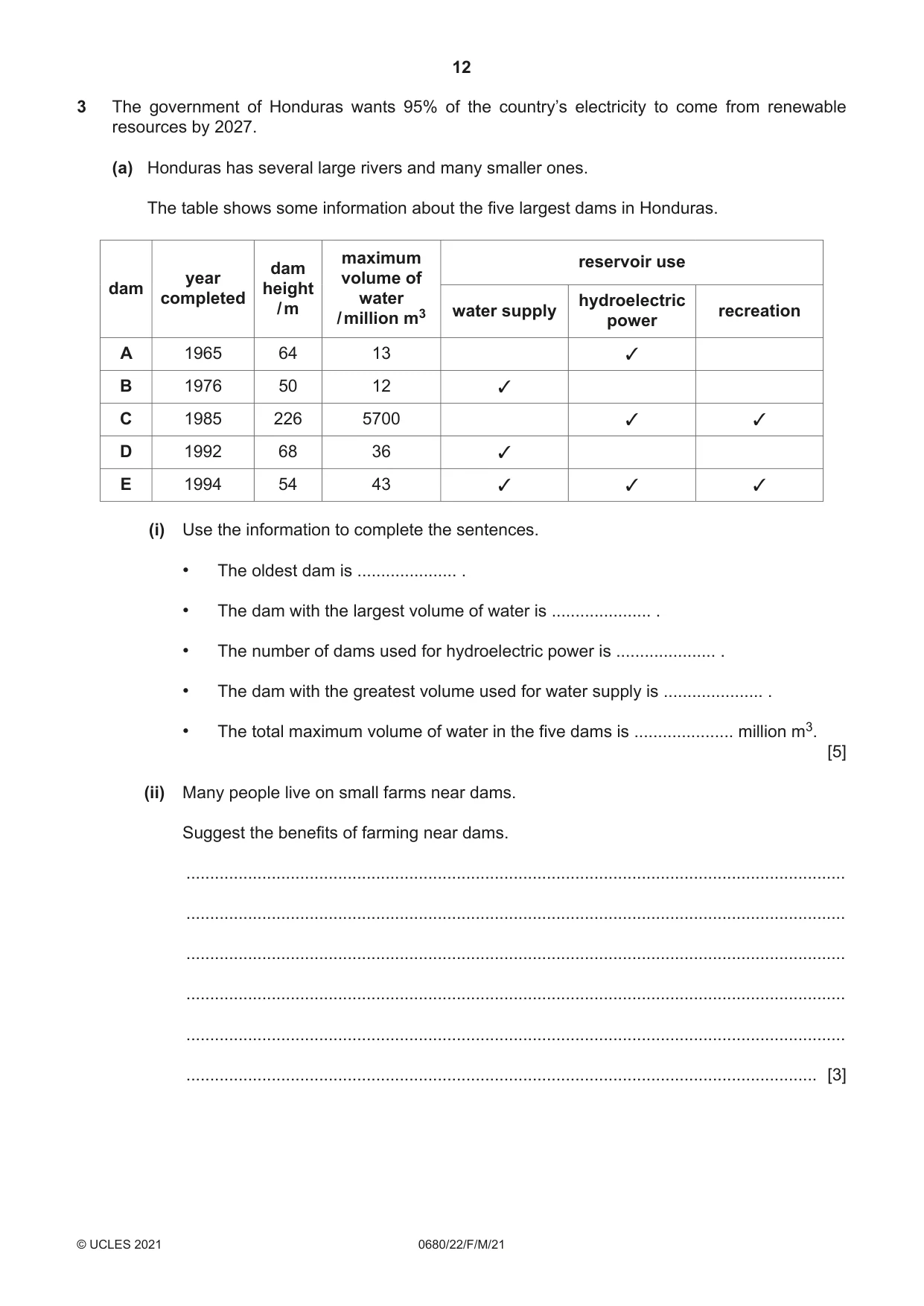
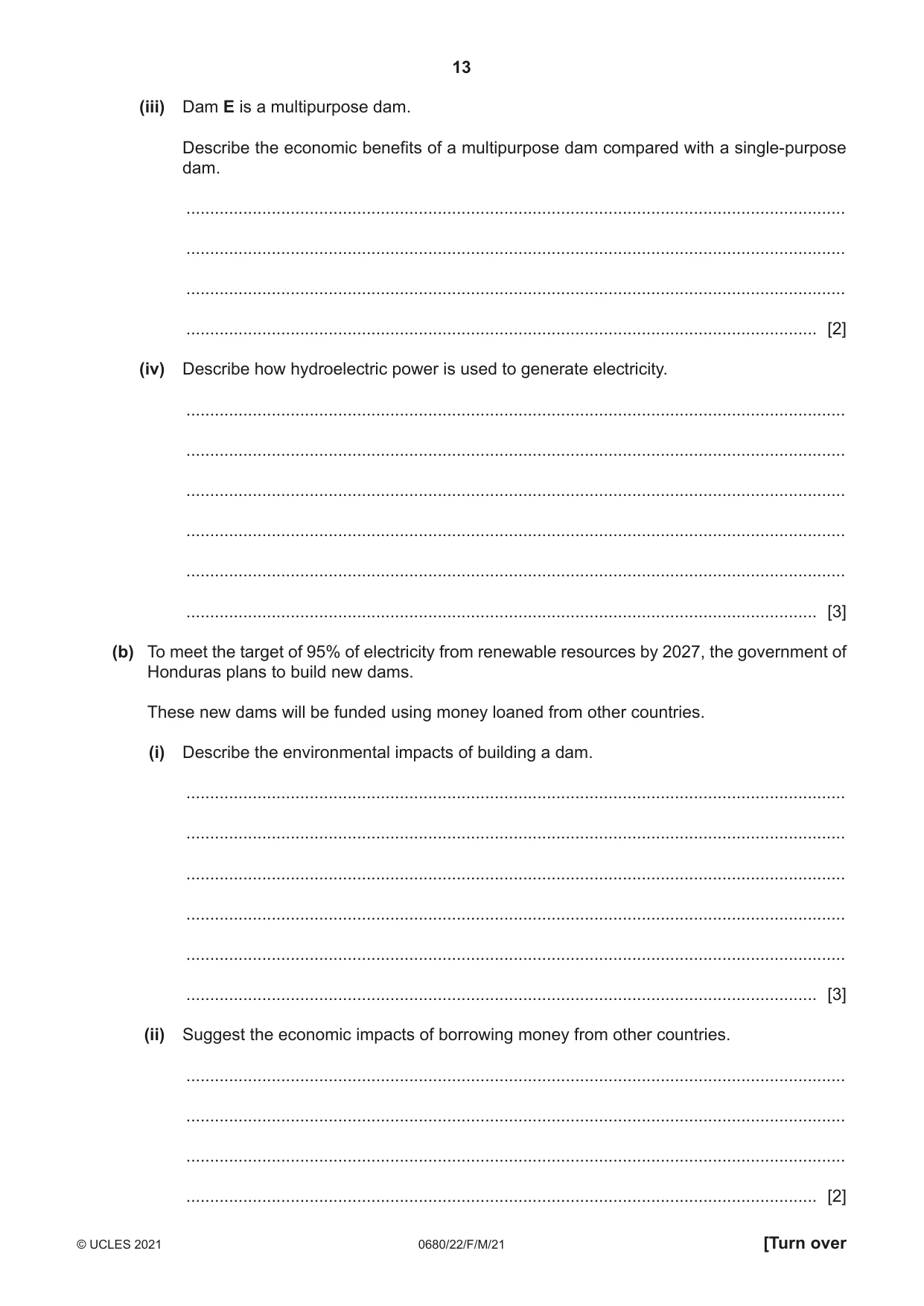
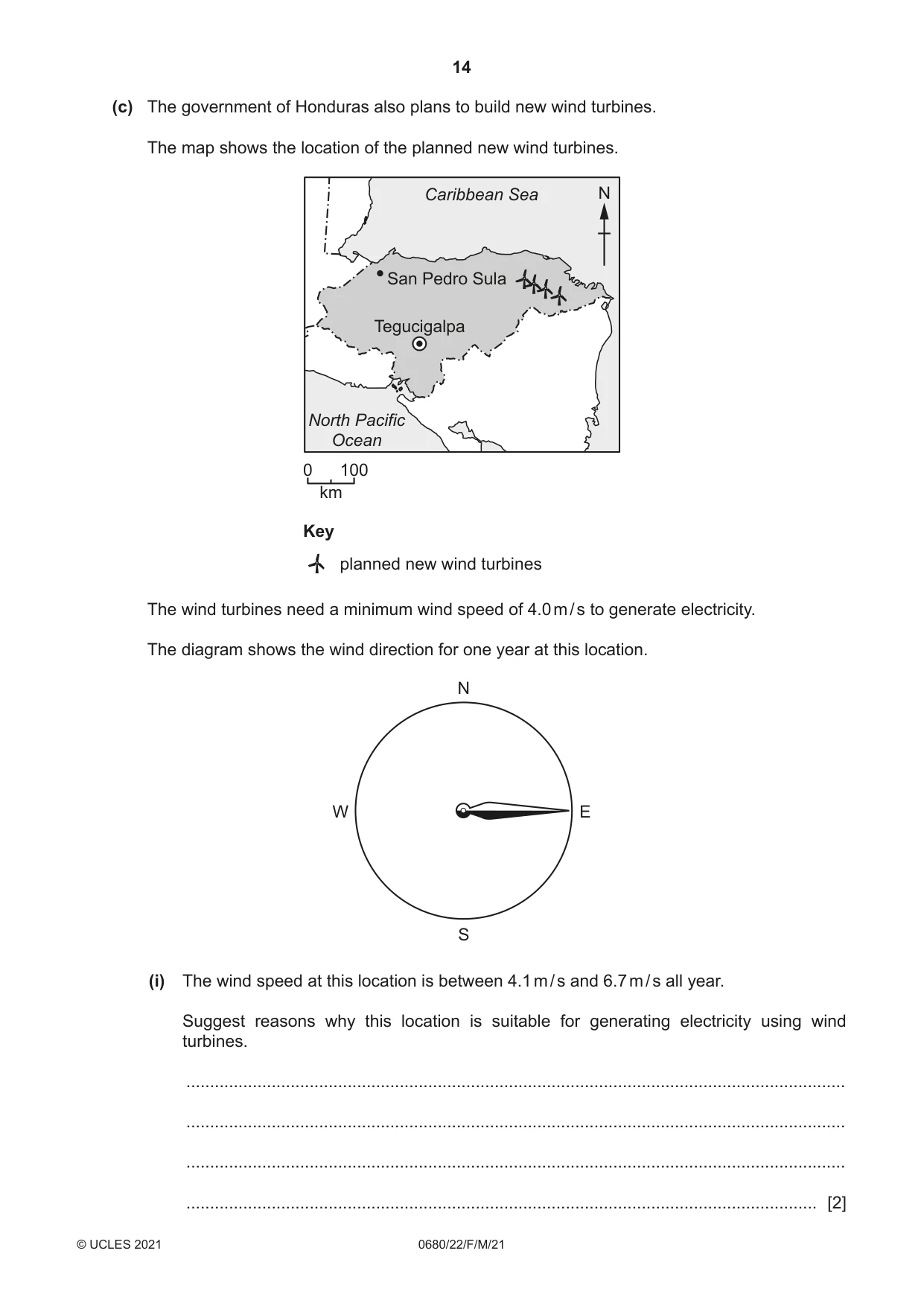
3 The government of Honduras wants 95% of the country’s electricity to come from renewable resources by 2027. (a) Honduras has several large rivers and many smaller ones. The table shows some information about the five largest dams in Honduras. maximum reservoir use dam year volume of dam height completed water hydroelectric / m water supply recreation / million m3 power A 1965 64 13 3 B 1976 50 12 3 C 1985 226 5700 3 3 D 1992 68 36 3 E 1994 54 43 3 3 3 (i) Use the information to complete the sentences. • The oldest dam is ..................... . • The dam with the largest volume of water is ..................... . • The number of dams used for hydroelectric power is ..................... . • The dam with the greatest volume used for water supply is ..................... . • The total maximum volume of water in the five dams is ..................... million m3. [5] (ii) Many people live on small farms near dams. Suggest the benefits of farming near dams. ........................................................................................................................................... ........................................................................................................................................... ........................................................................................................................................... ........................................................................................................................................... ........................................................................................................................................... ..................................................................................................................................... [3] (iii) Dam E is a multipurpose dam. Describe the economic benefits of a multipurpose dam compared with a single‑purpose dam. ........................................................................................................................................... ........................................................................................................................................... ........................................................................................................................................... ..................................................................................................................................... [2] (iv) Describe how hydroelectric power is used to generate electricity. ........................................................................................................................................... ........................................................................................................................................... ........................................................................................................................................... ........................................................................................................................................... ........................................................................................................................................... ..................................................................................................................................... [3] (b) To meet the target of 95% of electricity from renewable resources by 2027, the government of Honduras plans to build new dams. These new dams will be funded using money loaned from other countries. (i) Describe the environmental impacts of building a dam. ........................................................................................................................................... ........................................................................................................................................... ........................................................................................................................................... ........................................................................................................................................... ........................................................................................................................................... ..................................................................................................................................... [3] (ii) Suggest the economic impacts of borrowing money from other countries. ........................................................................................................................................... ........................................................................................................................................... ........................................................................................................................................... ..................................................................................................................................... [2] (c) The government of Honduras also plans to build new wind turbines. The map shows the location of the planned new wind turbines. Caribbean Sea N San Pedro Sula Tegucigalpa North Pacific Ocean 0 100 km Key planned new wind turbines The wind turbines need a minimum wind speed of 4.0 m / s to generate electricity. The diagram shows the wind direction for one year at this location. N W E S (i) The wind speed at this location is between 4.1 m / s and 6.7 m / s all year. Suggest reasons why this location is suitable for generating electricity using wind turbines. ........................................................................................................................................... ........................................................................................................................................... ........................................................................................................................................... ..................................................................................................................................... [2] (ii) Suggest one problem with using this location for the site of the wind turbines. ........................................................................................................................................... ..................................................................................................................................... [1] (iii) State two renewable energy resources other than hydroelectric and wind power. 1 ........................................................................................................................................ 2 ........................................................................................................................................ [2] [Total: 23]
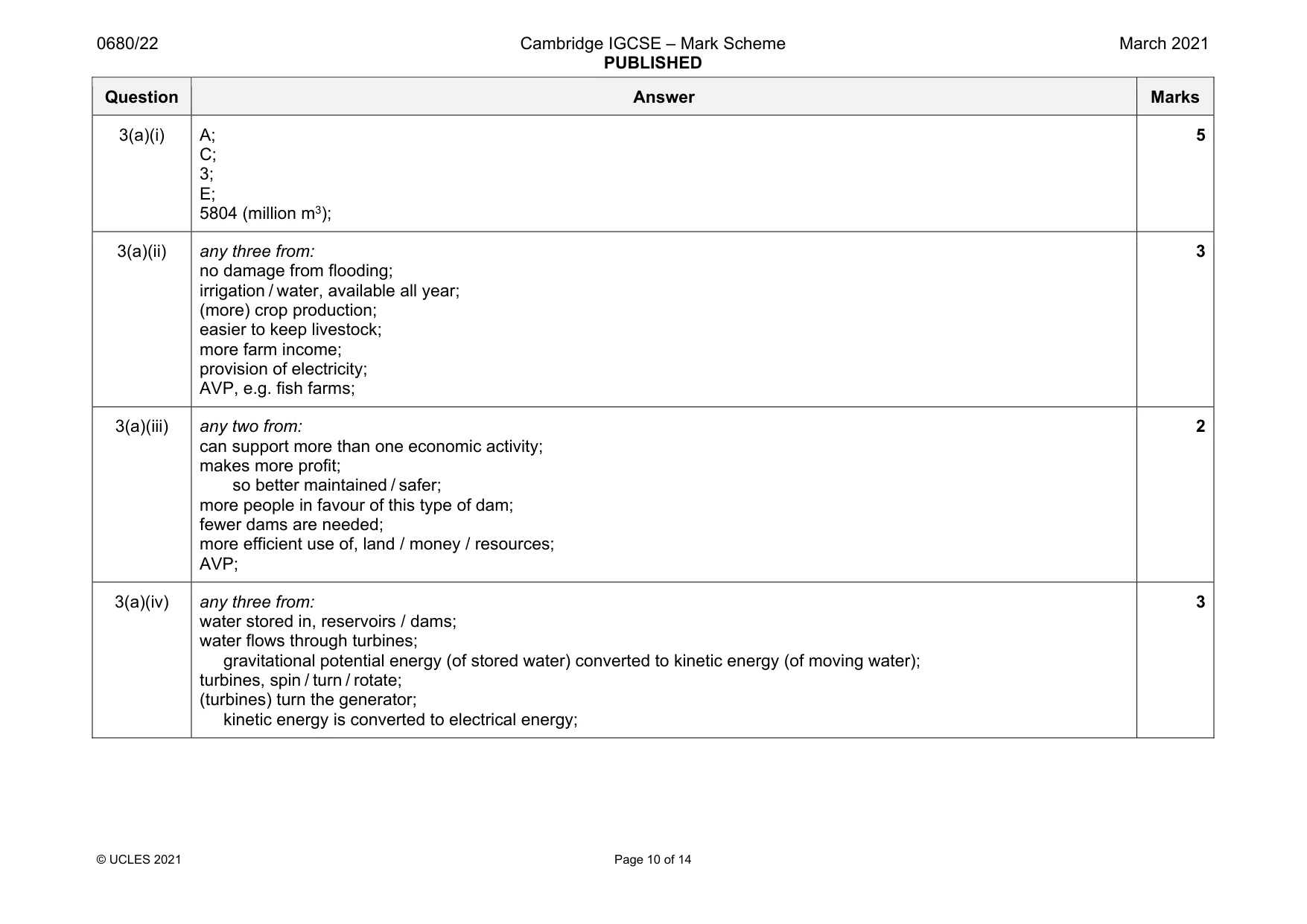
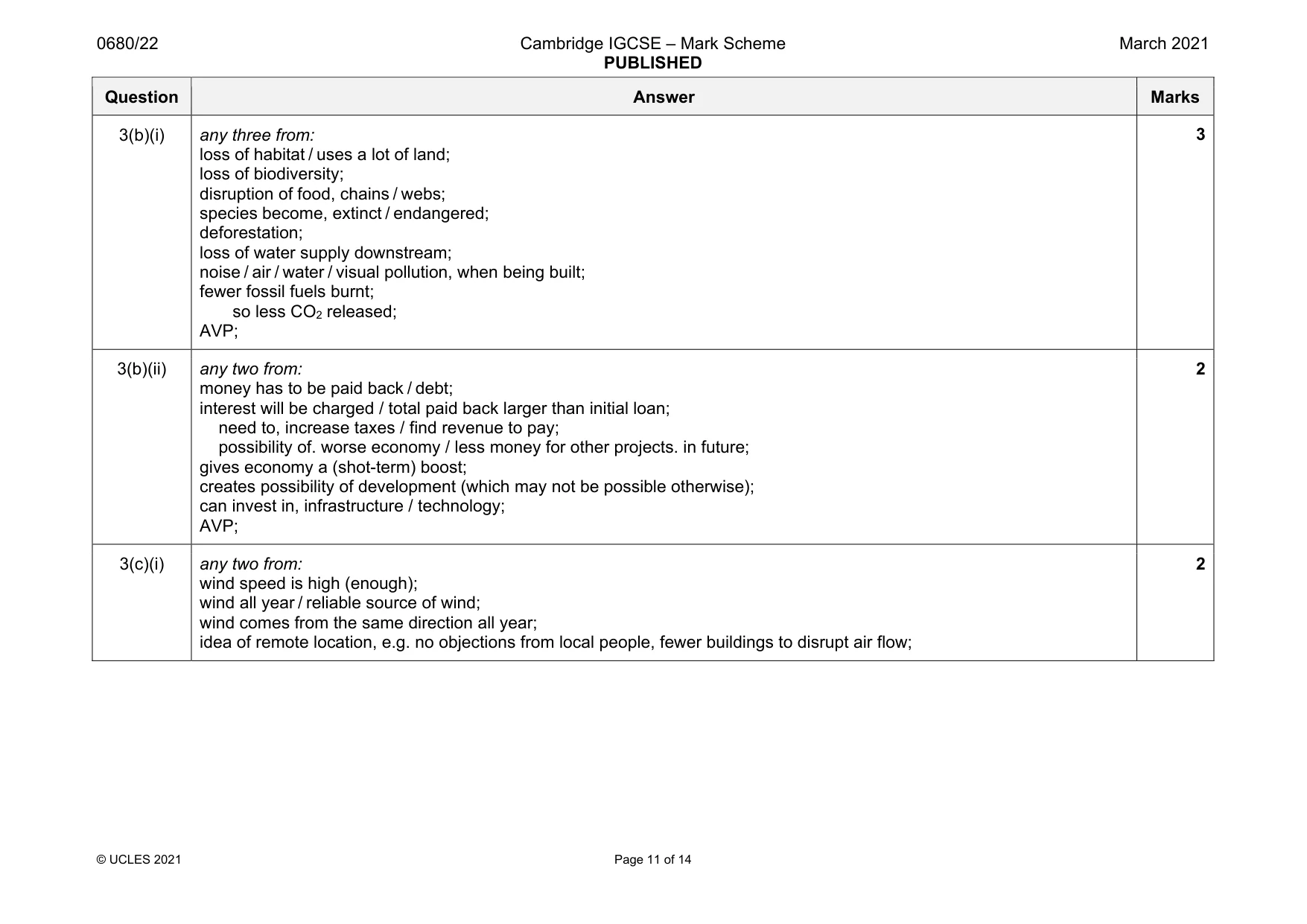
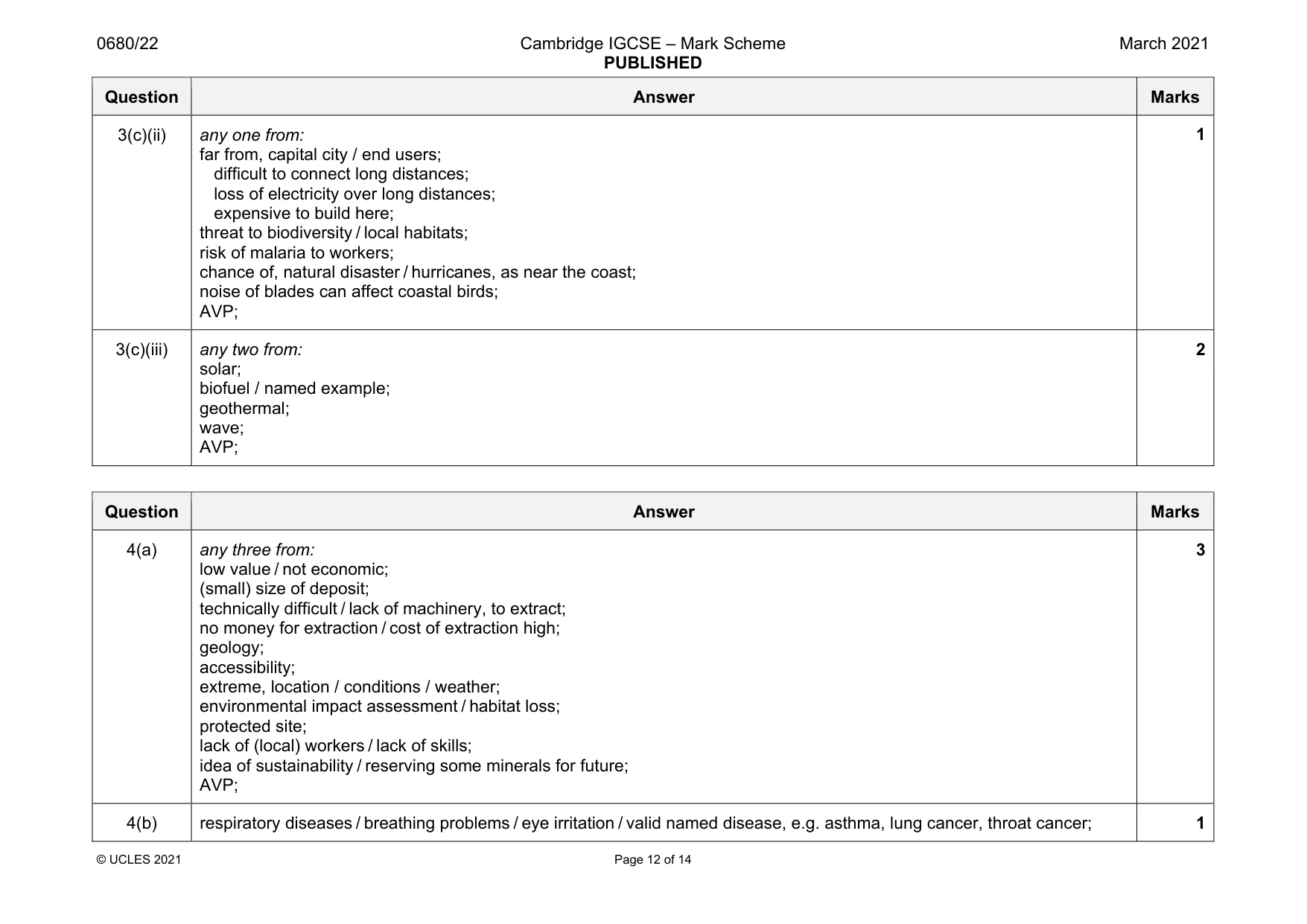
Mark scheme: 3(a)(i) A; C; 3; E; 5804 (million m3); 5 3(a)(ii) any three from: no damage from flooding; irrigation / water, available all year; (more) crop production; easier to keep livestock; more farm income; provision of electricity; AVP, e.g. fish farms; 3 3(a)(iii) any two from: can support more than one economic activity; makes more profit; so better maintained / safer; more people in favour of this type of dam; fewer dams are needed; more efficient use of, land / money / resources; AVP; 2 3(a)(iv) any three from: water stored in, reservoirs / dams; water flows through turbines; gravitational potential energy (of stored water) converted to kinetic energy (of moving water); turbines, spin / turn / rotate; (turbines) turn the generator; kinetic energy is converted to electrical energy; 3 Question Answer Marks 3(b)(i) any three from: loss of habitat / uses a lot of land; loss of biodiversity; disruption of food, chains / webs; species become, extinct / endangered; deforestation; loss of water supply downstream; noise / air / water / visual pollution, when being built; fewer fossil fuels burnt; so less CO2 released; AVP; 3 3(b)(ii) any two from: money has to be paid back / debt; interest will be charged / total paid back larger than initial loan; need to, increase taxes / find revenue to pay; possibility of. worse economy / less money for other projects. in future; gives economy a (shot-term) boost; creates possibility of development (which may not be possible otherwise); can invest in, infrastructure / technology; AVP; 2 3(c)(i) any two from: wind speed is high (enough); wind all year / reliable source of wind; wind comes from the same direction all year; idea of remote location, e.g. no objections from local people, fewer buildings to disrupt air flow; 2 Question Answer Marks 3(c)(ii) any one from: far from, capital city / end users; difficult to connect long distances; loss of electricity over long distances; expensive to build here; threat to biodiversity / local habitats; risk of malaria to workers; chance of, natural disaster / hurricanes, as near the coast; noise of blades can affect coastal birds; AVP; 1 3(c)(iii) any two from: solar; biofuel / named example; geothermal; wave; AVP; 2
Q4 · Honduras has many mineral resources, including antimonite
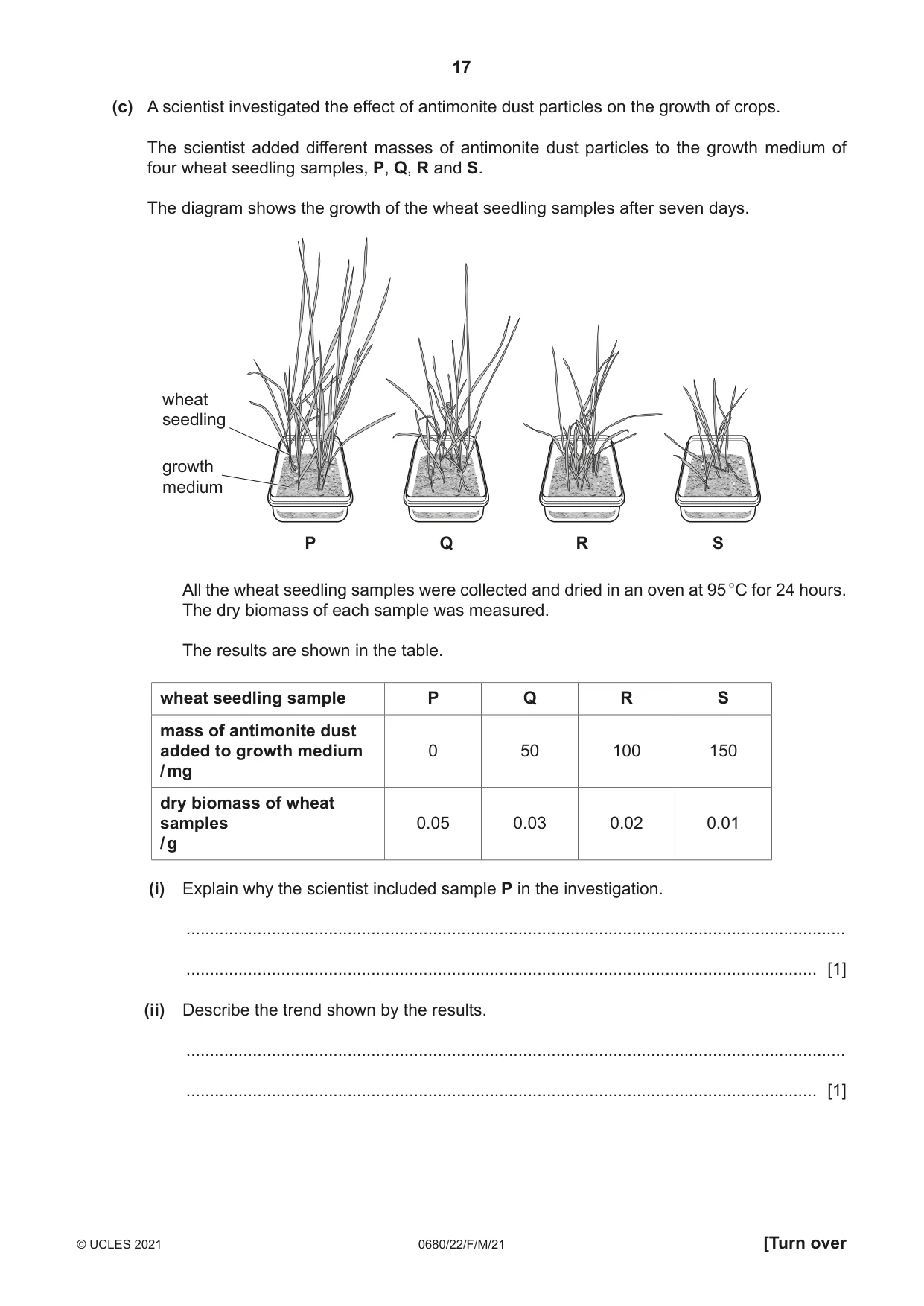
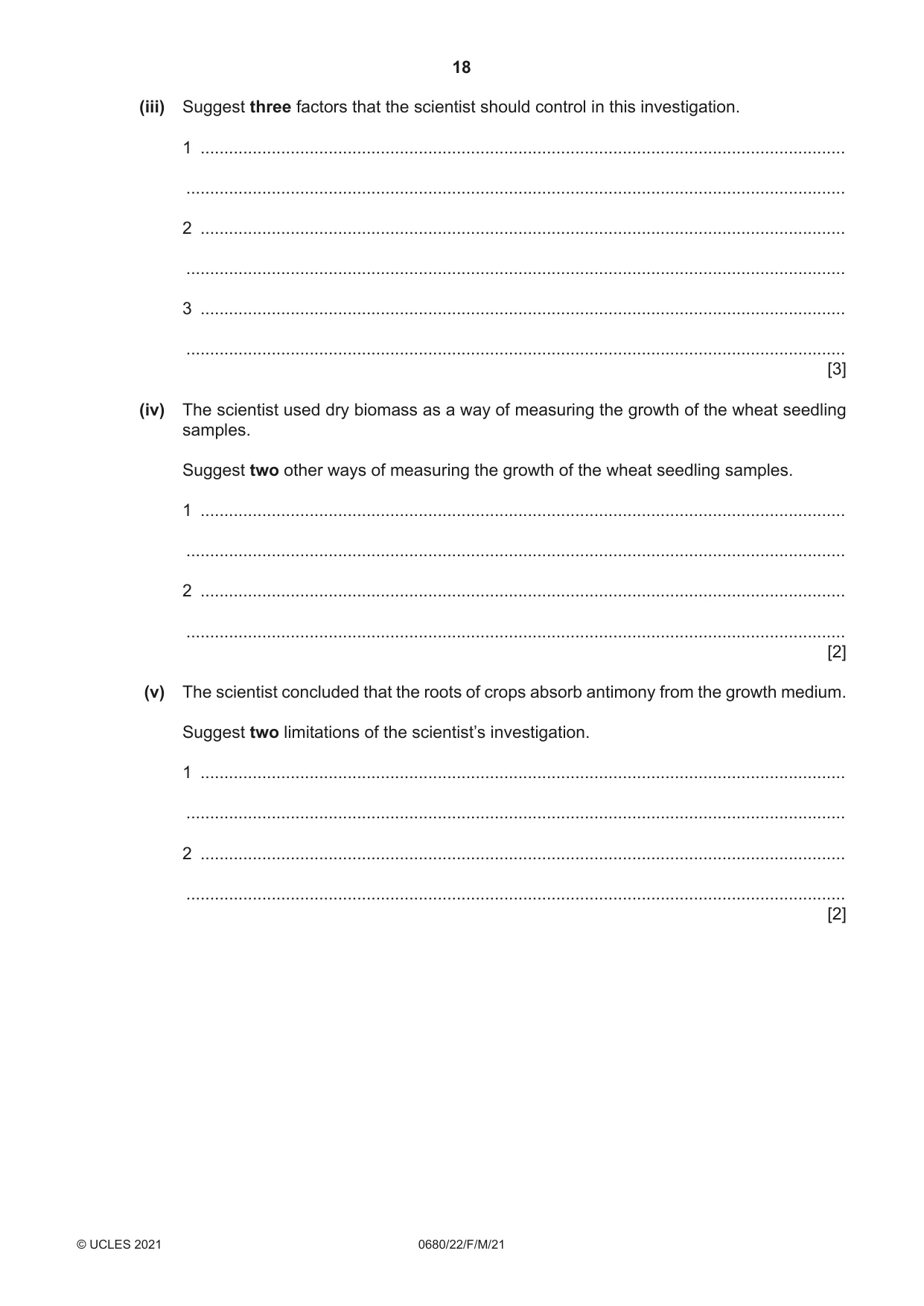
4 Honduras has many mineral resources, including antimonite. Antimonite is a metal ore that is processed to obtain the metal antimony. The world demand for antimony is increasing. (a) Several known deposits of antimonite in Honduras have not been extracted. Give reasons why some known deposits of minerals are not extracted. ................................................................................................................................................... ................................................................................................................................................... ................................................................................................................................................... ................................................................................................................................................... ................................................................................................................................................... ............................................................................................................................................. [3] (b) The dust particles from antimonite can damage the health of humans. Suggest one risk to the health of humans from these dust particles. ............................................................................................................................................. [1] (c) A scientist investigated the effect of antimonite dust particles on the growth of crops. The scientist added different masses of antimonite dust particles to the growth medium of four wheat seedling samples, P, Q, R and S. The diagram shows the growth of the wheat seedling samples after seven days. wheat seedling growth medium P Q R S All the wheat seedling samples were collected and dried in an oven at 95 °C for 24 hours. The dry biomass of each sample was measured. The results are shown in the table. wheat seedling sample P Q R S mass of antimonite dust added to growth medium 0 50 100 150 / mg dry biomass of wheat samples 0.05 0.03 0.02 0.01 / g (i) Explain why the scientist included sample P in the investigation. ........................................................................................................................................... ..................................................................................................................................... [1] (ii) Describe the trend shown by the results. ........................................................................................................................................... ..................................................................................................................................... [1] (iii) Suggest three factors that the scientist should control in this investigation. 1 ........................................................................................................................................ ........................................................................................................................................... 2 ........................................................................................................................................ ........................................................................................................................................... 3 ........................................................................................................................................ ........................................................................................................................................... [3] (iv) The scientist used dry biomass as a way of measuring the growth of the wheat seedling samples. Suggest two other ways of measuring the growth of the wheat seedling samples. 1 ........................................................................................................................................ ........................................................................................................................................... 2 ........................................................................................................................................ ........................................................................................................................................... [2] (v) The scientist concluded that the roots of crops absorb antimony from the growth medium. Suggest two limitations of the scientist’s investigation. 1 ........................................................................................................................................ ........................................................................................................................................... 2 ........................................................................................................................................ ........................................................................................................................................... [2]
Mark scheme: 4(a) any three from: low value / not economic; (small) size of deposit; technically difficult / lack of machinery, to extract; no money for extraction / cost of extraction high; geology; accessibility; extreme, location / conditions / weather; environmental impact assessment / habitat loss; protected site; lack of (local) workers / lack of skills; idea of sustainability / reserving some minerals for future; AVP; 4(b) respiratory diseases / breathing problems / eye irritation / valid named disease, e.g. asthma, lung cancer, throat cancer; 1 Question Answer Marks 4(c)(i) to compare the effects of the seedlings treated with dust / as a control experiment; 1 4(c)(ii) as the mass of antimonite dust added to the growth medium increases, the dry biomass of the wheat samples decreases / AW; 1 4(c)(iii) any three from: pH (of growth medium); volume / mass, of medium; size of tray; source / age, of seed; type / species / variety, of seed; number of seeds; temperature; water added; humidity of area; light (intensity / duration); AVP; 3 4(c)(iv) any two from: length of leaves; number of leaves; length of roots; height of, seedlings / plant; AVP; 2 4(c)(v) any two from: only one, species / type of crop, used; absorption of antimony only checked in, the roots / one place in the plant; experiment not repeated and averaged; plants, grown for short time / only grown for 7 days; a narrow range of concentrations (of antimonite used); small area used / field scale not used; small samples used; AVP; 2 Question Answer Marks 4(d) any three from: bioaccumulation; description of bioaccumulation, e.g. toxins build up in an organism; reference to not being excreted; antimony absorbed by, plants / producers; eaten by primary consumers and absorbed; eaten by secondary consumers and absorbed; highest concentration is at top of food chain; 3
What was in this paper
The subtopics covered by these 4 questions, and how many questions each got. Open one in a new tab to see every Cambridge question on it.
What you needed in this session
Cambridge’s own grade thresholds for 2021 Feb/March, Paper 2 · Variant 2. A higher threshold means an easier paper — the bar moves with how the cohort did.