Cambridge IGCSE Environmental Management 0680 — 2020 Oct/Nov Paper 2 · Variant 1
0680/21/O/N/20 · 80 marks · ≈90 min
The question paper and its mark scheme, free to read here and free to download. This is Cambridge’s own paper, exactly as it was sat.
Question paper24 pages


Mark scheme12 pages
Answers below. Sit the paper first if you are practising.
Paper as text
Question paper, page 1
Cambridge IGCSE™ This document has 24 pages. Blank pages are indicated. DC (LK/FC) 193257/3 © UCLES 2020 [Turn over ENVIRONMENTAL MANAGEMENT 0680/21 Paper 2 Management in Context October/November 2020 1 hour 45 minutes You must answer on the question paper. No additional materials are needed. INSTRUCTIONS ● Answer all questions. ● Use a black or dark blue pen. You may use an HB pencil for any diagrams or graphs. ● Write your name, centre number and candidate number in the boxes at the top of the page. ● Write your answer to each question in the space provided. ● Do not use an erasable pen or correction fluid. ● Do not write on any bar codes. ● You may use a calculator. ● You should show all your working and use appropriate units. INFORMATION ● The total mark for this paper is 80. ● The number of marks for each question or part question is shown in brackets [ ]. * 9 9 8 7 1 5 5 0 0 9 *
Question paper, page 2
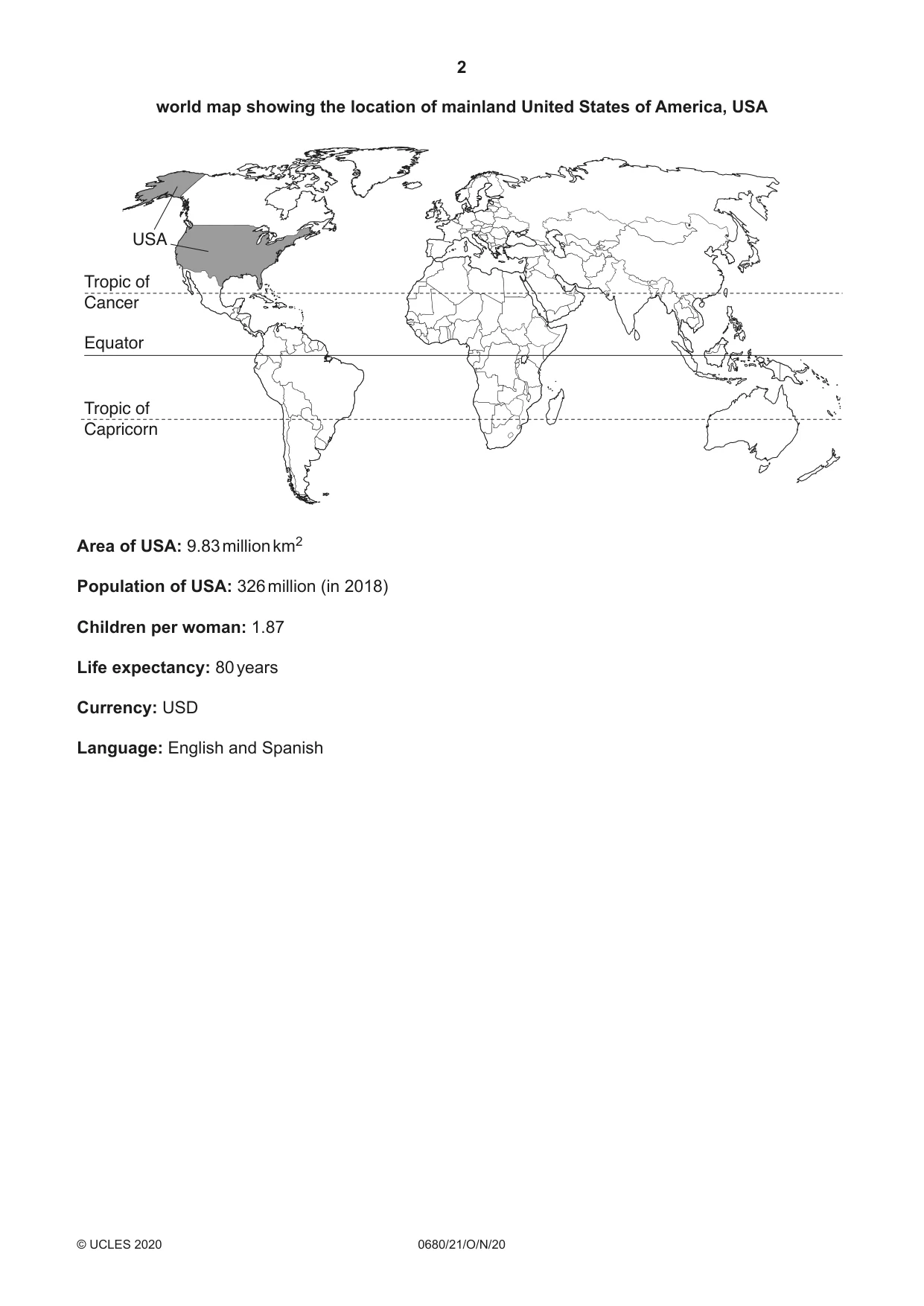
2 0680/21/O/N/20 © UCLES 2020 world map showing the location of mainland United States of America, USA Equator Tropic of Capricorn Tropic of Cancer USA Area of USA: 9.83 million km2 Population of USA: 326 million (in 2018) Children per woman: 1.87 Life expectancy: 80 years Currency: USD Language: English and Spanish
Question paper, page 3
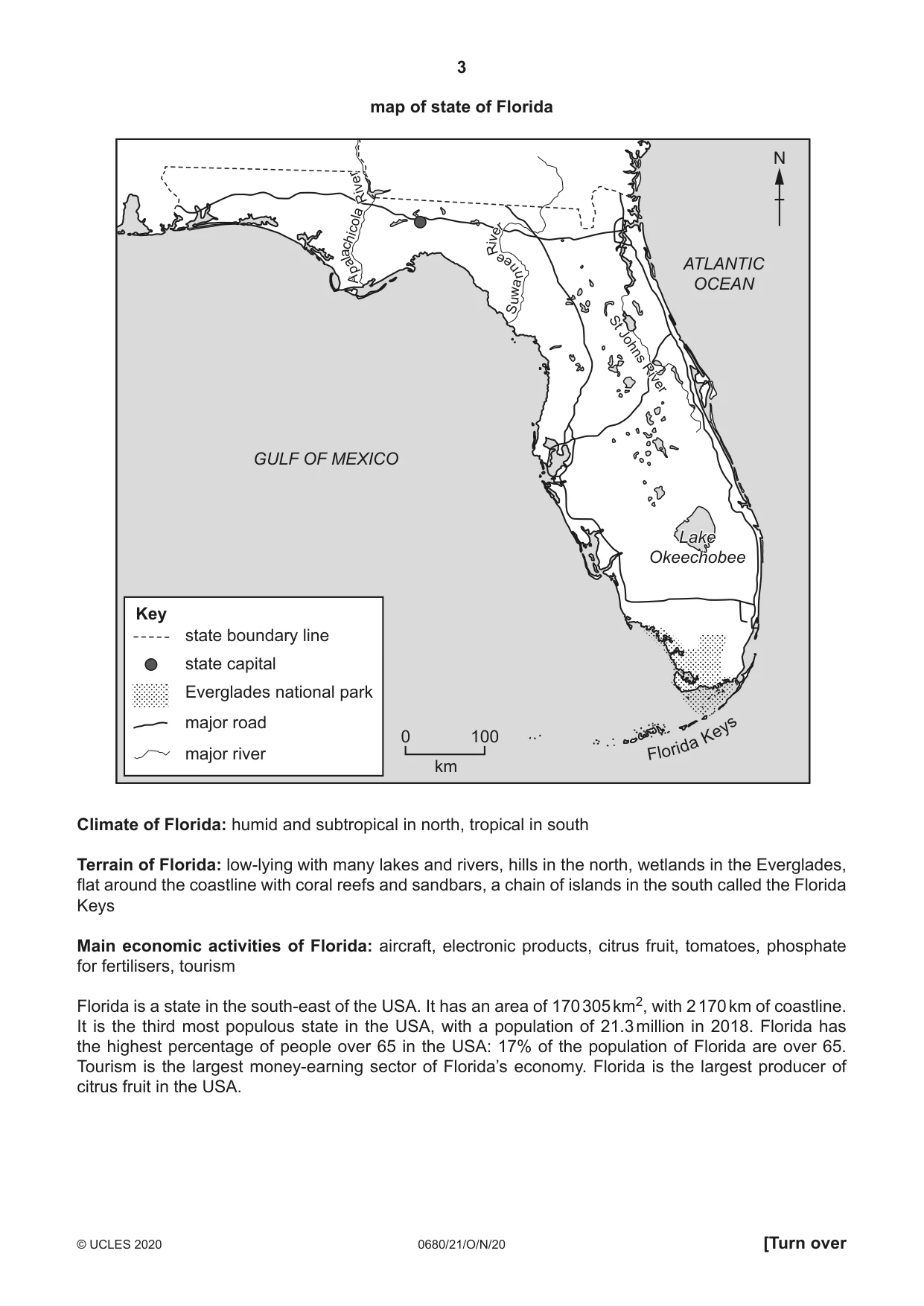
3 0680/21/O/N/20 © UCLES 2020 [Turn over map of state of Florida N 0 100 km GULF OF MEXICO ATLANTIC OCEAN Lake Okeechobee Lake Okeechobee Fl or id a K e y s Key state capital Everglades national park state boundary line major road major river A p a l a c h i col a R ive r A p a l a c h i col a R ive r S uw a n n ee R i v e r S uw a n n ee R i v e r St Johns River St Johns River Climate of Florida: humid and subtropical in north, tropical in south Terrain of Florida: low-lying with many lakes and rivers, hills in the north, wetlands in the Everglades, flat around the coastline with coral reefs and sandbars, a chain of islands in the south called the Florida Keys Main economic activities of Florida: aircraft, electronic products, citrus fruit, tomatoes, phosphate for fertilisers, tourism Florida is a state in the south-east of the USA. It has an area of 170 305 km2, with 2 170 km of coastline. It is the third most populous state in the USA, with a population of 21.3 million in 2018. Florida has the highest percentage of people over 65 in the USA: 17% of the population of Florida are over 65. Tourism is the largest money-earning sector of Florida’s economy. Florida is the largest producer of citrus fruit in the USA.
Question paper, page 4
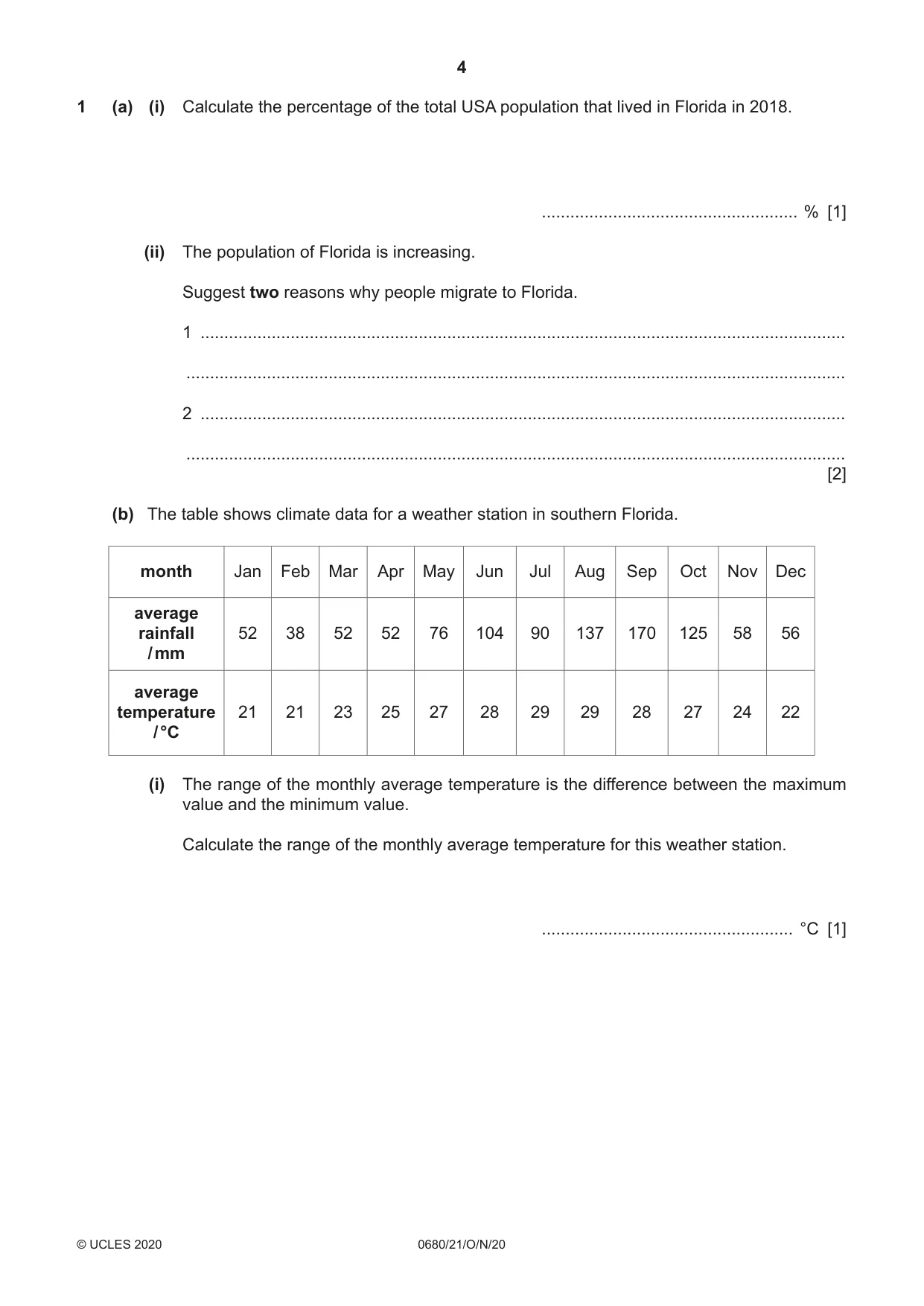
4 0680/21/O/N/20 © UCLES 2020 1 (a) (i) Calculate the percentage of the total USA population that lived in Florida in 2018. … % [1] (ii) The population of Florida is increasing. Suggest two reasons why people migrate to Florida. 1 … … 2 … … [2] (b) The table shows climate data for a weather station in southern Florida. month Jan Feb Mar Apr May Jun Jul Aug Sep Oct Nov Dec average rainfall / mm 52 38 52 52 76 104 90 137 170 125 58 56 average temperature / °C 21 21 23 25 27 28 29 29 28 27 24 22 (i) The range of the monthly average temperature is the difference between the maximum value and the minimum value. Calculate the range of the monthly average temperature for this weather station. … °C [1]
Question paper, page 5
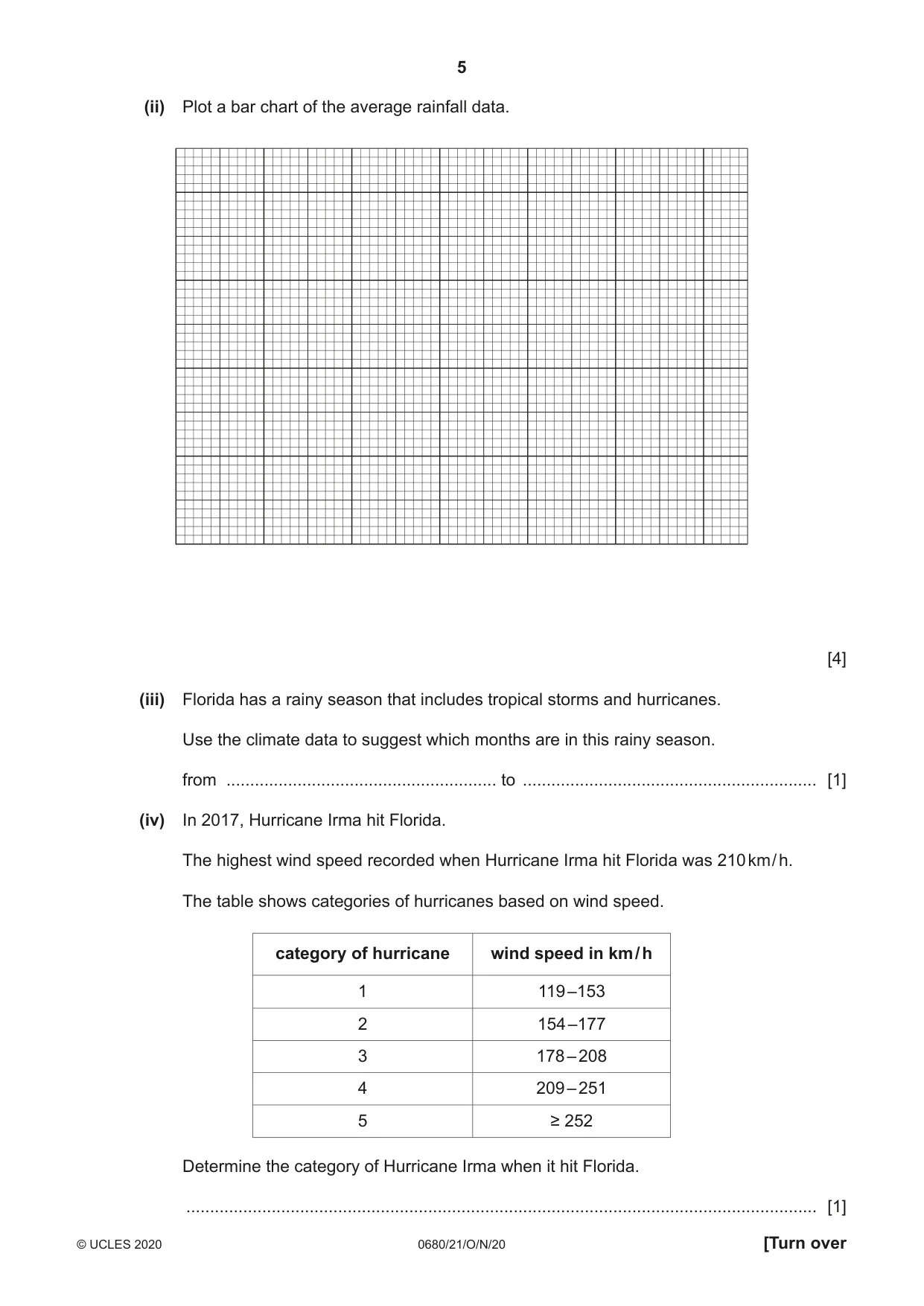
5 0680/21/O/N/20 © UCLES 2020 [Turn over (ii) Plot a bar chart of the average rainfall data. [4] (iii) Florida has a rainy season that includes tropical storms and hurricanes. Use the climate data to suggest which months are in this rainy season. from … to … [1] (iv) In 2017, Hurricane Irma hit Florida. The highest wind speed recorded when Hurricane Irma hit Florida was 210 km / h. The table shows categories of hurricanes based on wind speed. category of hurricane wind speed in km / h 1 119 –153 2 154 –177 3 178 – 208 4 209 – 251 5 ≥ 252 Determine the category of Hurricane Irma when it hit Florida. … [1]
Question paper, page 6
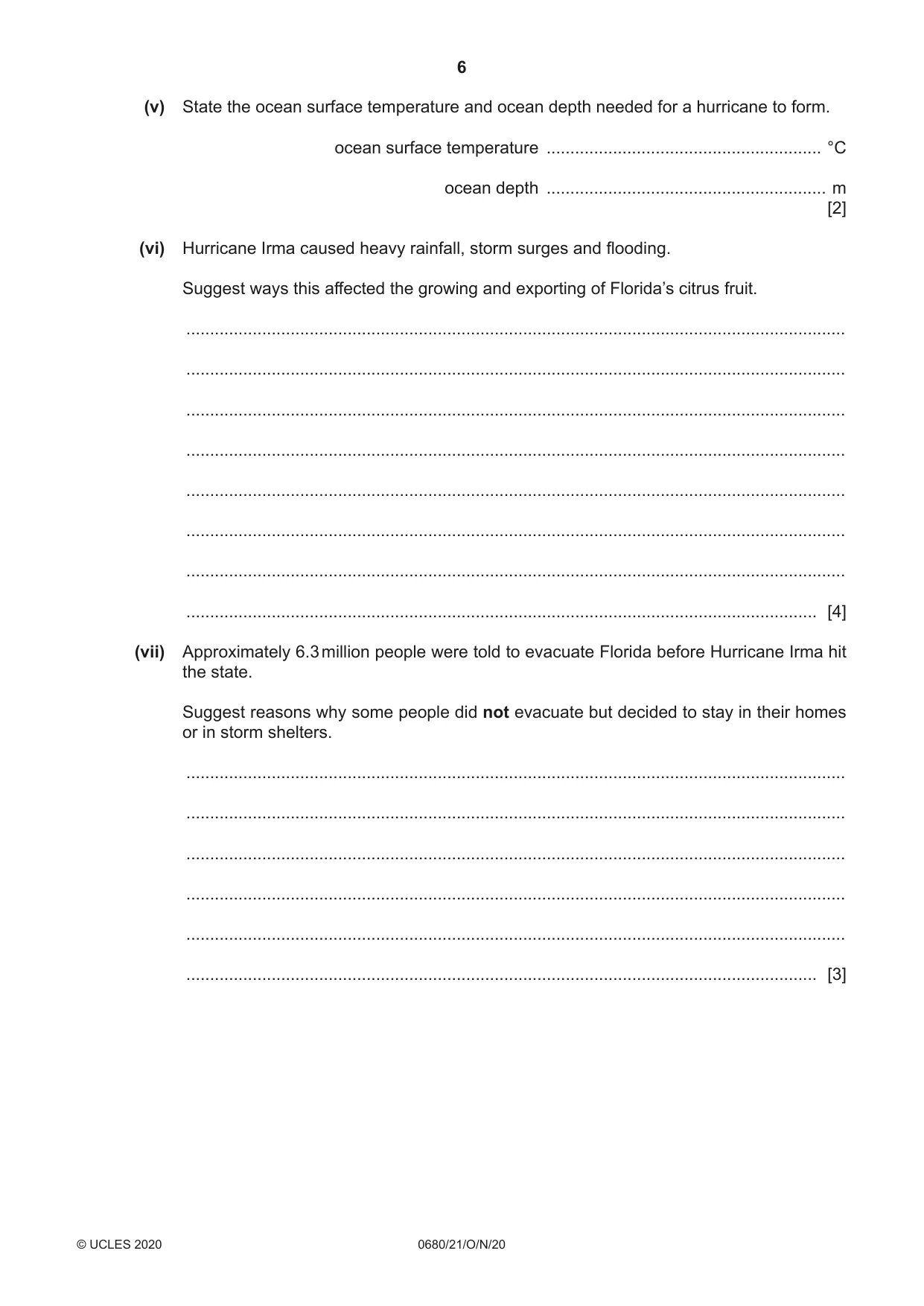
6 0680/21/O/N/20 © UCLES 2020 (v) State the ocean surface temperature and ocean depth needed for a hurricane to form. ocean surface temperature … °C ocean depth … m [2] (vi) Hurricane Irma caused heavy rainfall, storm surges and flooding. Suggest ways this affected the growing and exporting of Florida’s citrus fruit. … … … … … … … … [4] (vii) Approximately 6.3 million people were told to evacuate Florida before Hurricane Irma hit the state. Suggest reasons why some people did not evacuate but decided to stay in their homes or in storm shelters. … … … … … … [3]
Question paper, page 7
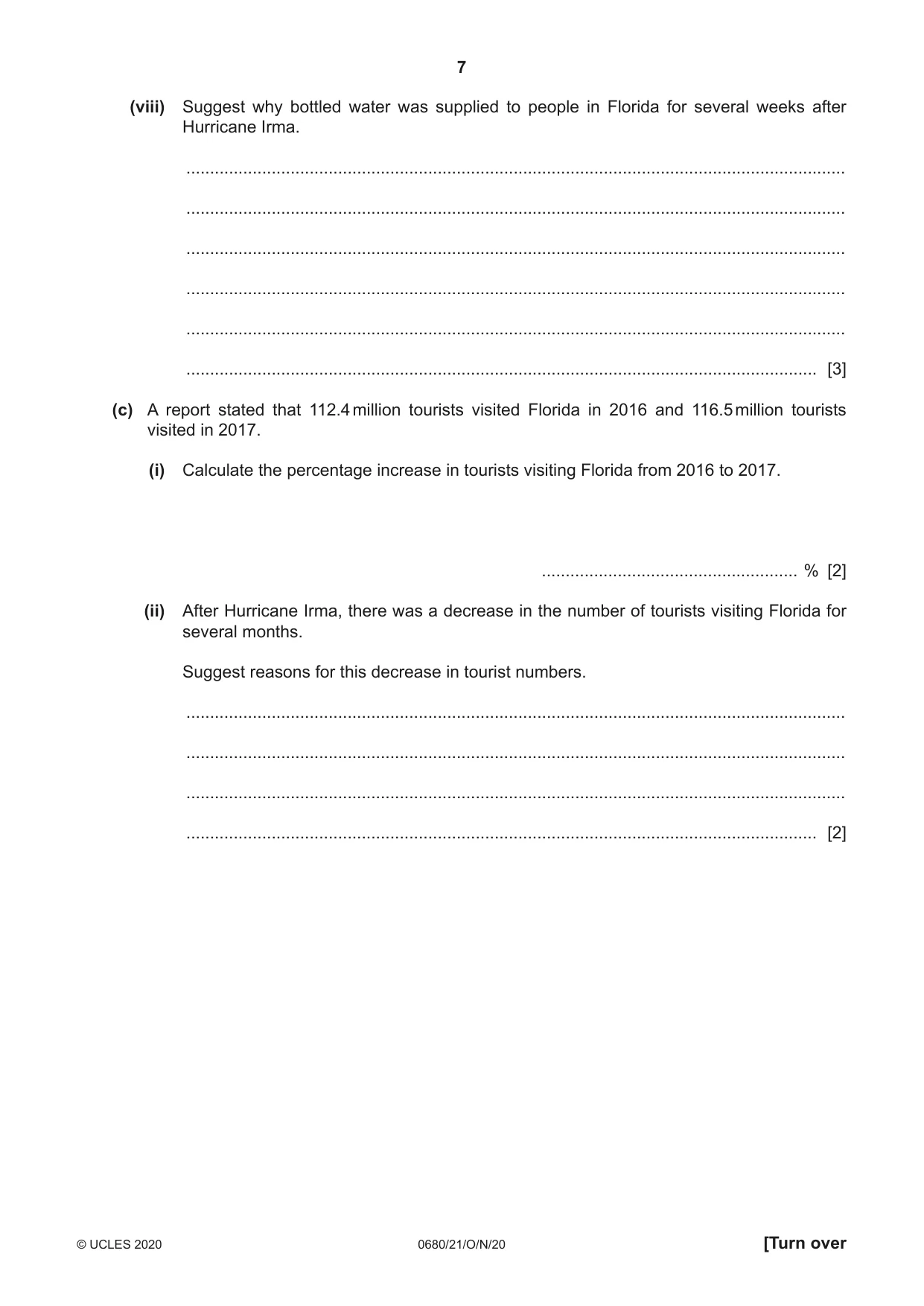
7 0680/21/O/N/20 © UCLES 2020 [Turn over (viii) Suggest why bottled water was supplied to people in Florida for several weeks after Hurricane Irma. … … … … … … [3] (c) A report stated that 112.4 million tourists visited Florida in 2016 and 116.5 million tourists visited in 2017. (i) Calculate the percentage increase in tourists visiting Florida from 2016 to 2017. … % [2] (ii) After Hurricane Irma, there was a decrease in the number of tourists visiting Florida for several months. Suggest reasons for this decrease in tourist numbers. … … … … [2]
Question paper, page 8
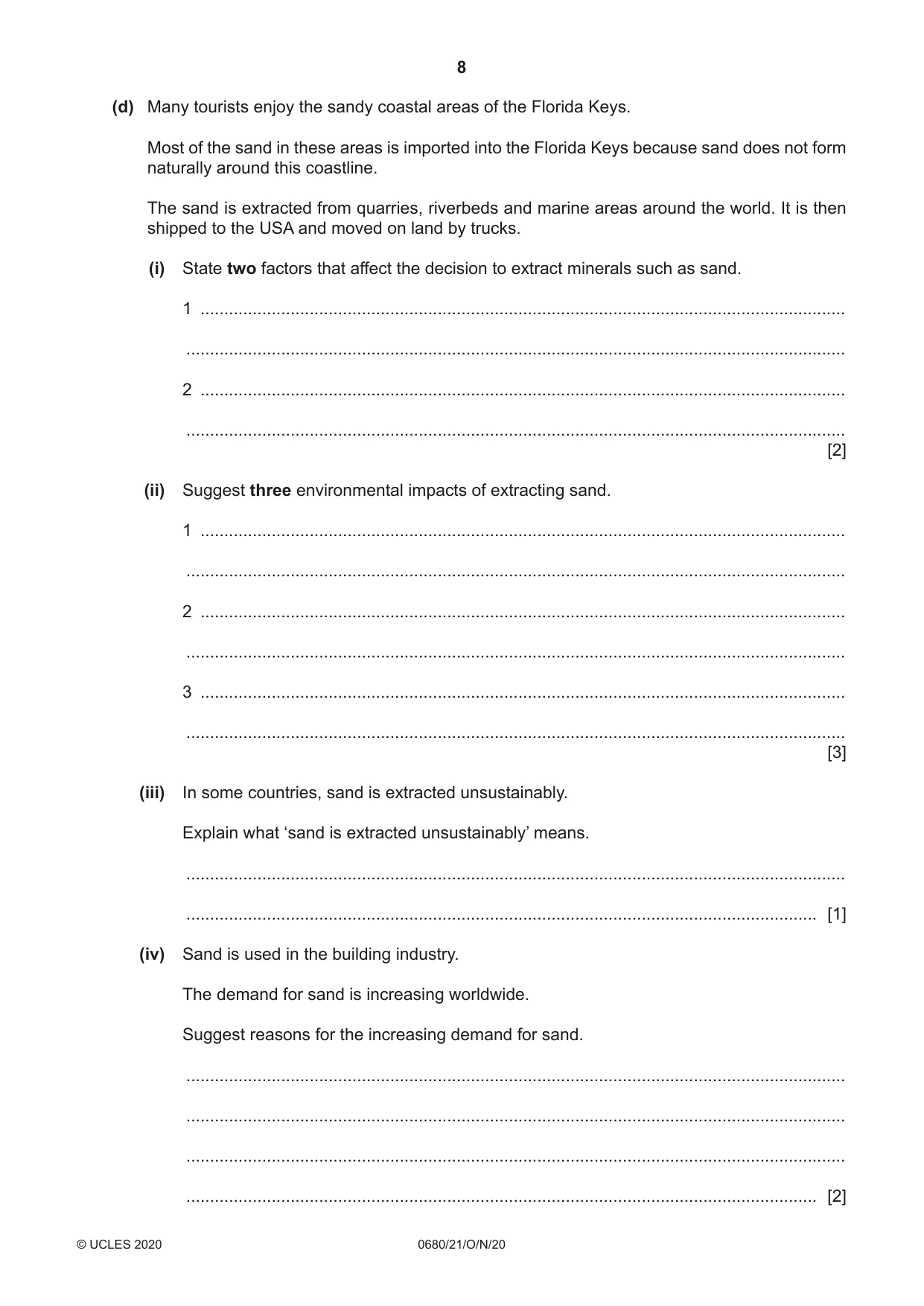
8 0680/21/O/N/20 © UCLES 2020 (d) Many tourists enjoy the sandy coastal areas of the Florida Keys. Most of the sand in these areas is imported into the Florida Keys because sand does not form naturally around this coastline. The sand is extracted from quarries, riverbeds and marine areas around the world. It is then shipped to the USA and moved on land by trucks. (i) State two factors that affect the decision to extract minerals such as sand. 1 … … 2 … … [2] (ii) Suggest three environmental impacts of extracting sand. 1 … … 2 … … 3 … … [3] (iii) In some countries, sand is extracted unsustainably. Explain what ‘sand is extracted unsustainably’ means. … … [1] (iv) Sand is used in the building industry. The demand for sand is increasing worldwide. Suggest reasons for the increasing demand for sand. … … … … [2]
Question paper, page 9
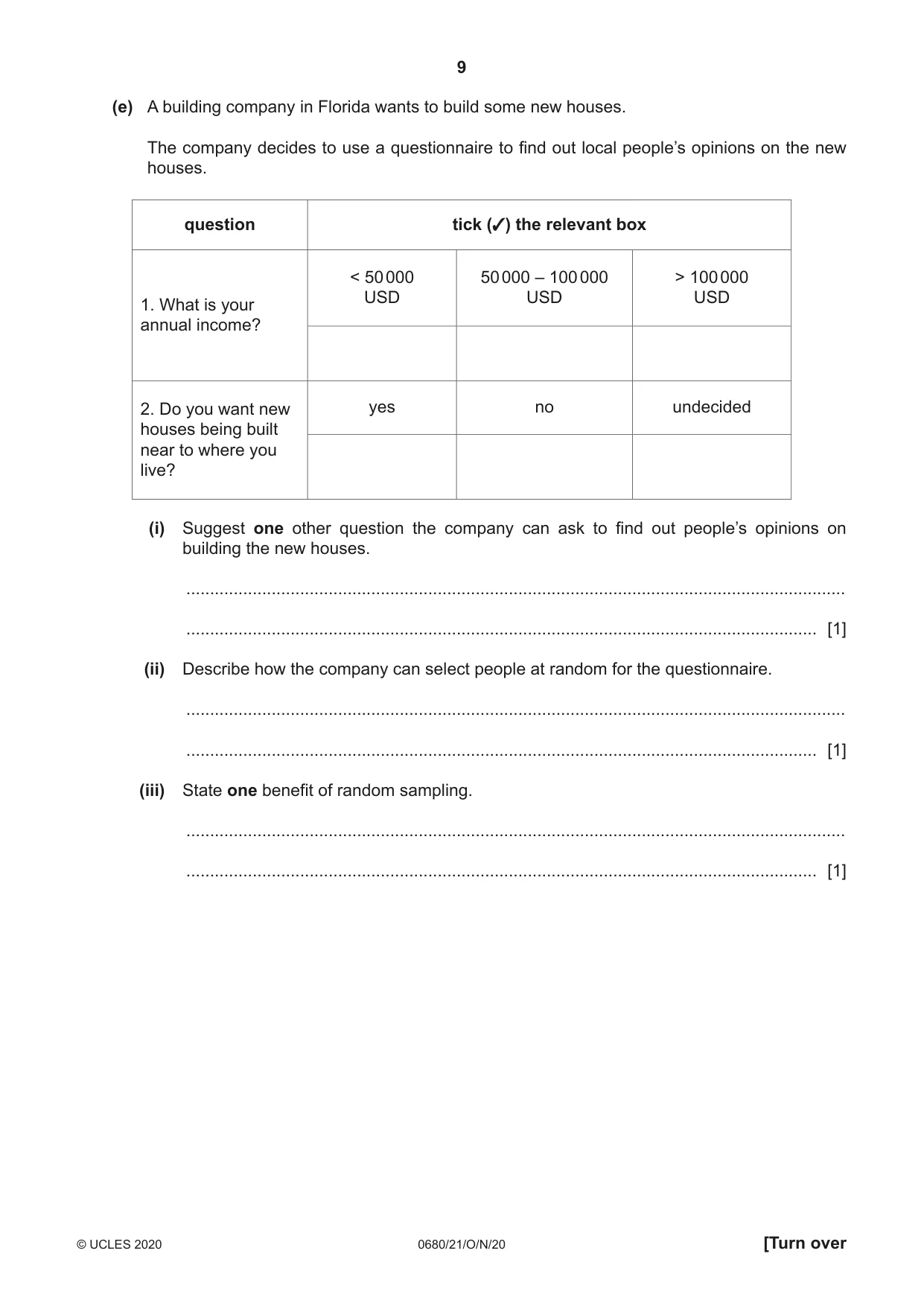
9 0680/21/O/N/20 © UCLES 2020 [Turn over (e) A building company in Florida wants to build some new houses. The company decides to use a questionnaire to find out local people’s opinions on the new houses. question tick (3) the relevant box 1. What is your annual income? < 50 000 USD 50 000 – 100 000 USD > 100 000 USD 2. Do you want new houses being built near to where you live? yes no undecided (i) Suggest one other question the company can ask to find out people’s opinions on building the new houses. … … [1] (ii) Describe how the company can select people at random for the questionnaire. … … [1] (iii) State one benefit of random sampling. … … [1]
Question paper, page 10
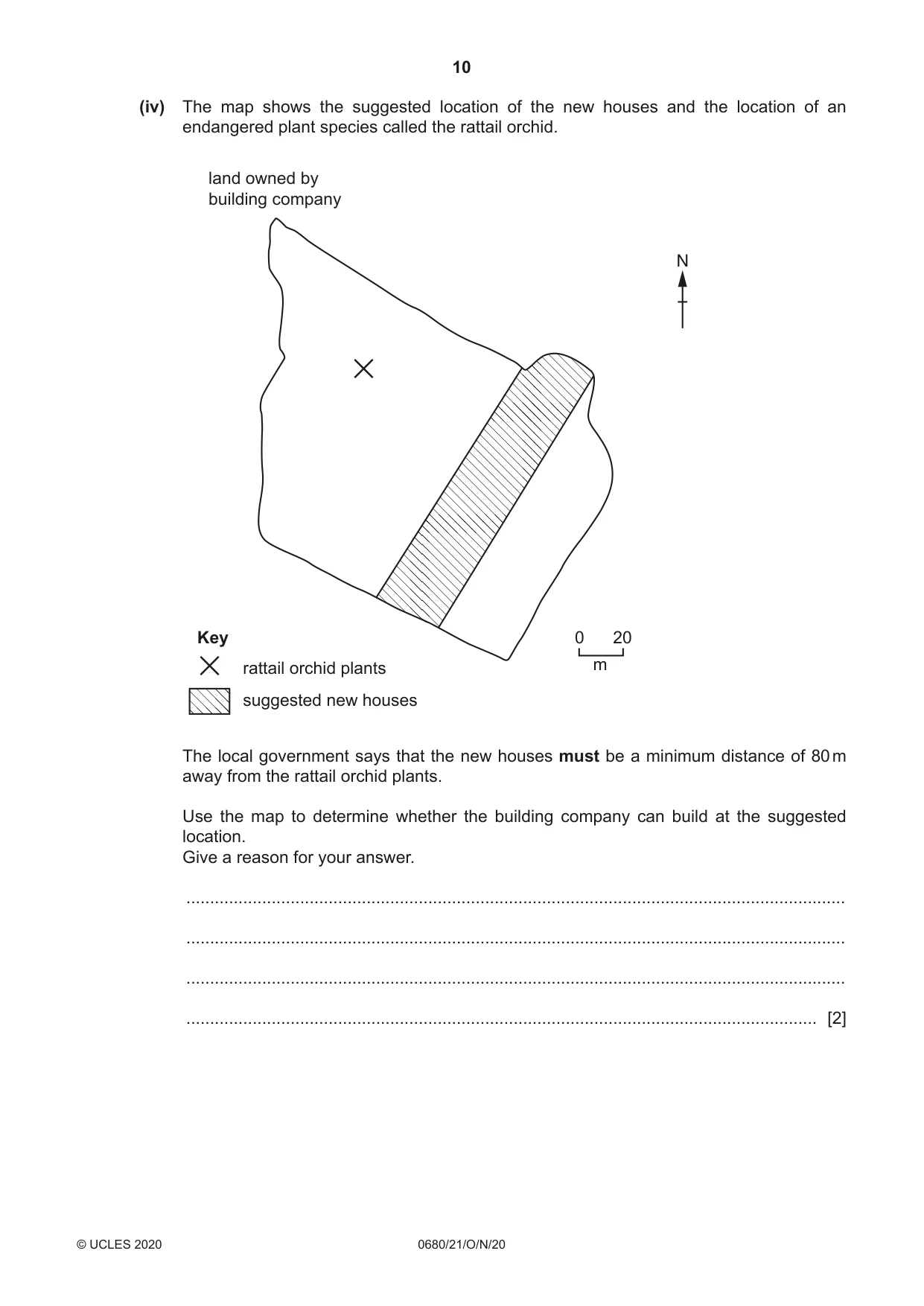
10 0680/21/O/N/20 © UCLES 2020 (iv) The map shows the suggested location of the new houses and the location of an endangered plant species called the rattail orchid. 0 20 m Key rattail orchid plants land owned by building company suggested new houses N The local government says that the new houses must be a minimum distance of 80 m away from the rattail orchid plants. Use the map to determine whether the building company can build at the suggested location. Give a reason for your answer. … … … … [2]
Question paper, page 11
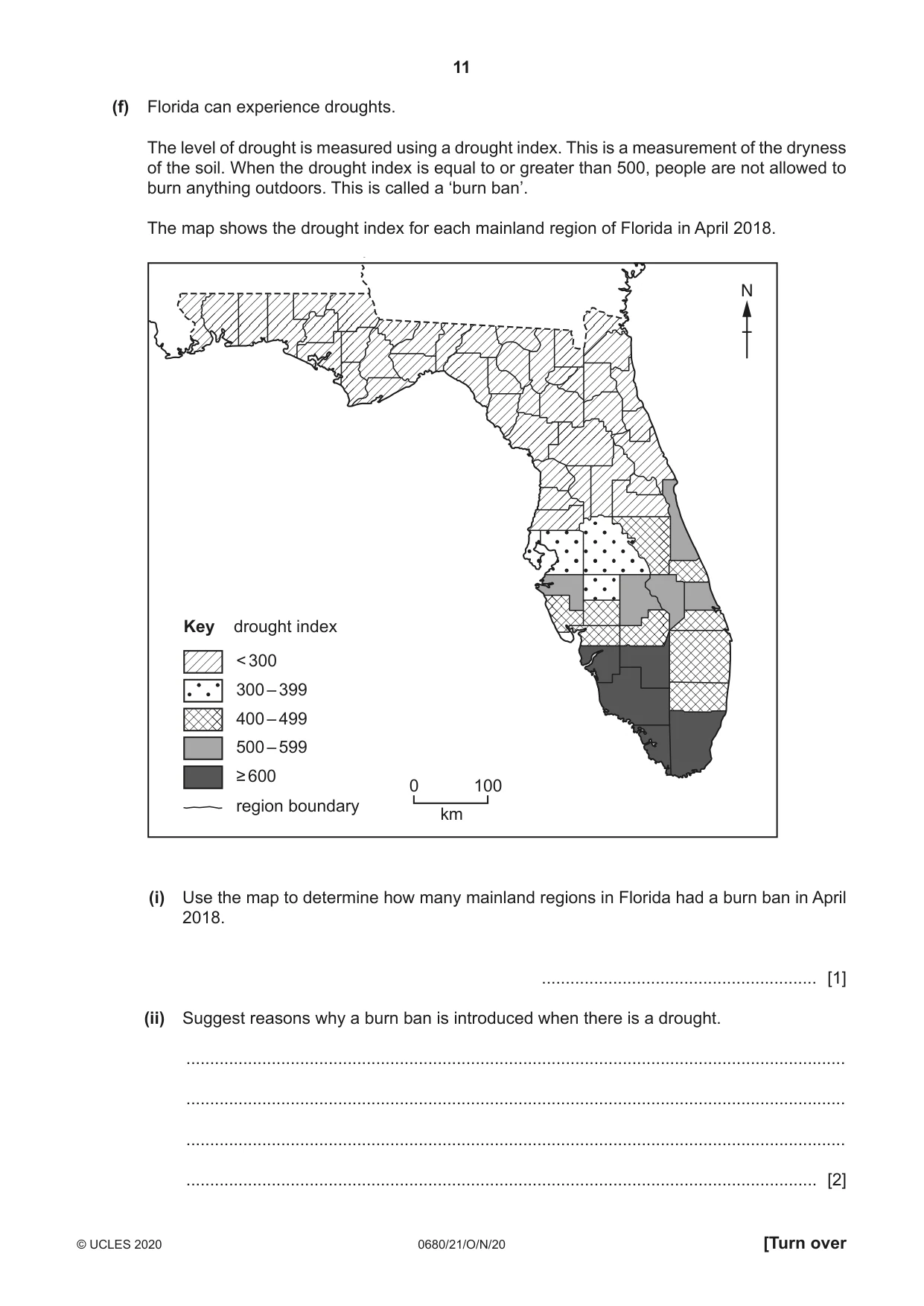
11 0680/21/O/N/20 © UCLES 2020 [Turn over (f) Florida can experience droughts. The level of drought is measured using a drought index. This is a measurement of the dryness of the soil. When the drought index is equal to or greater than 500, people are not allowed to burn anything outdoors. This is called a ‘burn ban’. The map shows the drought index for each mainland region of Florida in April 2018. N 0 100 km Key drought index < 300 300 – 399 region boundary 400 – 499 500 – 599 ≥ 600 (i) Use the map to determine how many mainland regions in Florida had a burn ban in April 2018. … [1] (ii) Suggest reasons why a burn ban is introduced when there is a drought. … … … … [2]
Question paper, page 12
12 0680/21/O/N/20 © UCLES 2020 (iii) Describe strategies, other than burn bans, for managing the impacts of drought. … … … … … … [3] (iv) State one way human activities can increase the risk of drought. … … [1] [Total: 46]
Question paper, page 13
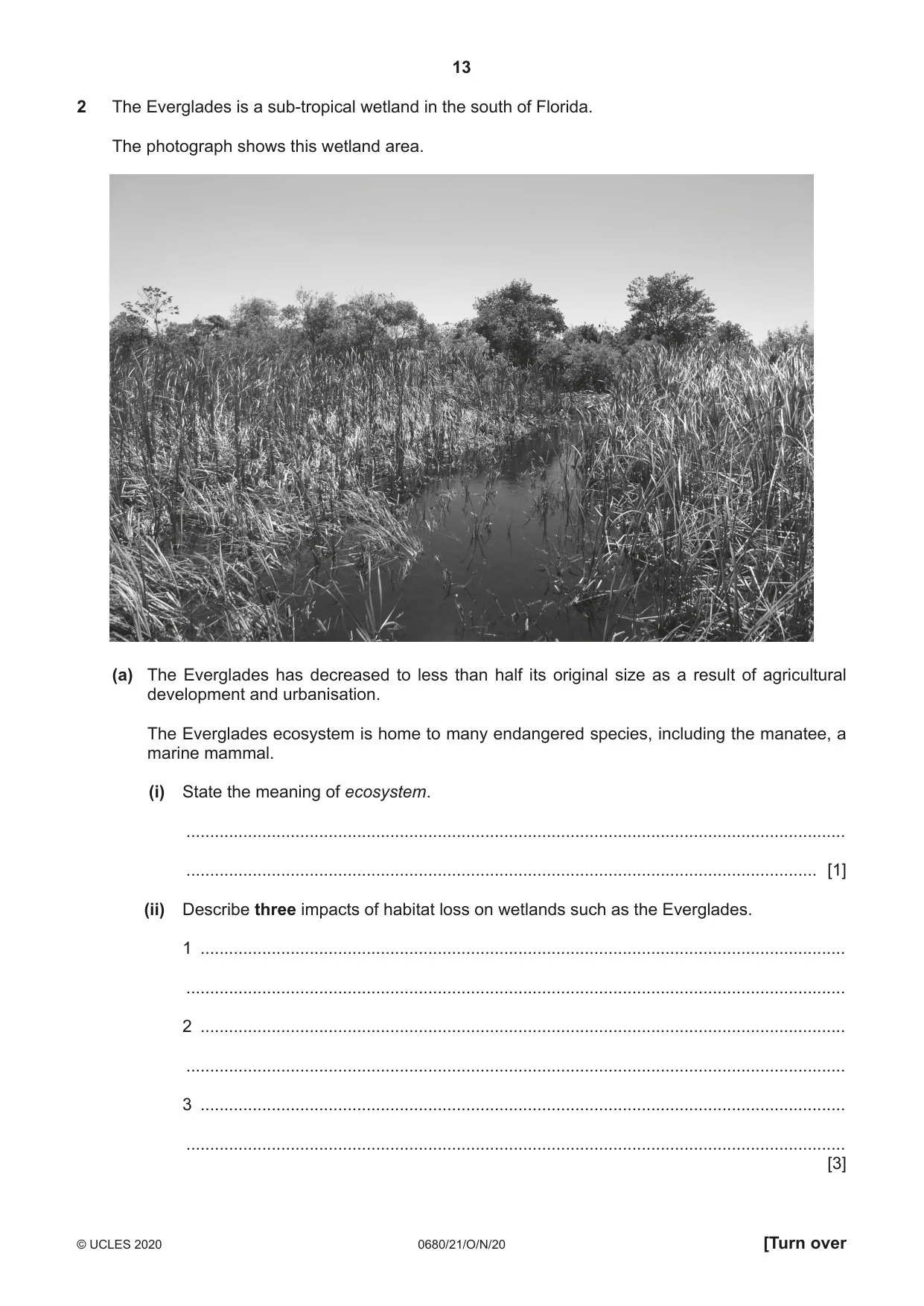
13 0680/21/O/N/20 © UCLES 2020 [Turn over 2 The Everglades is a sub-tropical wetland in the south of Florida. The photograph shows this wetland area. (a) The Everglades has decreased to less than half its original size as a result of agricultural development and urbanisation. The Everglades ecosystem is home to many endangered species, including the manatee, a marine mammal. (i) State the meaning of ecosystem. … … [1] (ii) Describe three impacts of habitat loss on wetlands such as the Everglades. 1 … … 2 … … 3 … … [3]
Question paper, page 14
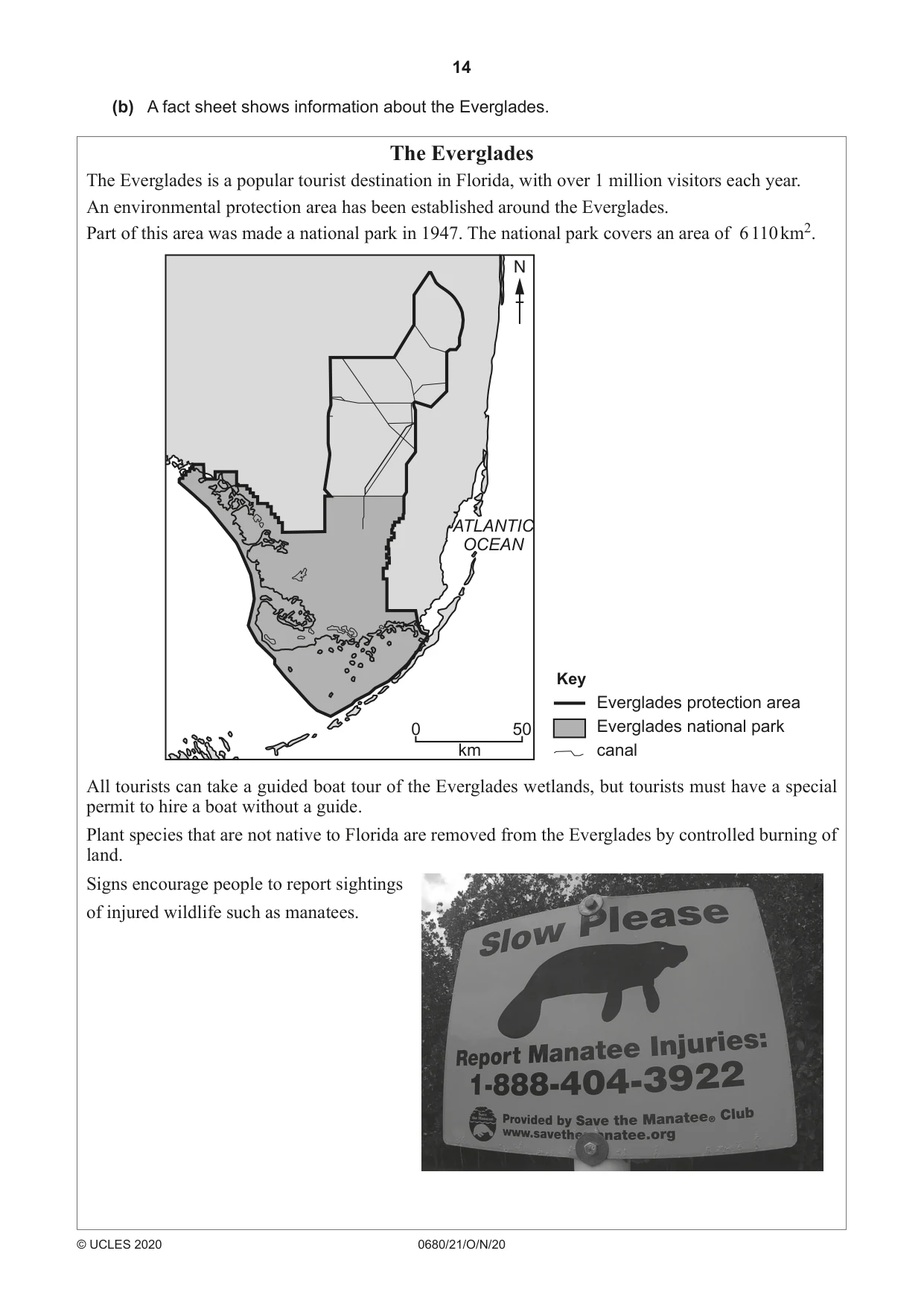
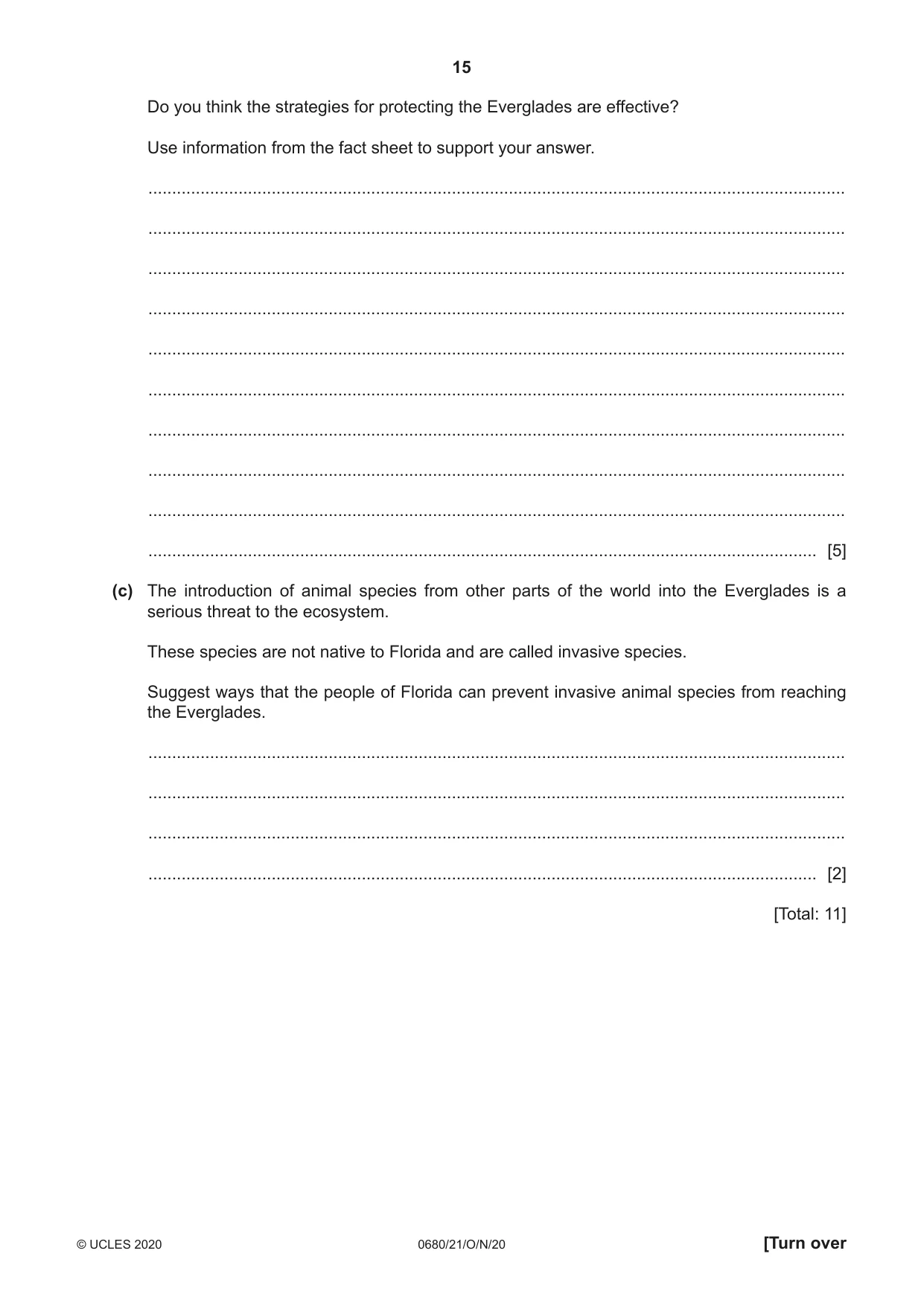
14 0680/21/O/N/20 © UCLES 2020 (b) A fact sheet shows information about the Everglades. The Everglades The Everglades is a popular tourist destination in Florida, with over 1 million visitors each year. An environmental protection area has been established around the Everglades. Part of this area was made a national park in 1947. The national park covers an area of 6 110 km2. 0 ATLANTIC OCEAN 50 km N Key Everglades protection area Everglades national park canal All tourists can take a guided boat tour of the Everglades wetlands, but tourists must have a special permit to hire a boat without a guide. Plant species that are not native to Florida are removed from the Everglades by controlled burning of land. Signs encourage people to report sightings of injured wildlife such as manatees.
Question paper, page 15
15 0680/21/O/N/20 © UCLES 2020 [Turn over Do you think the strategies for protecting the Everglades are effective? Use information from the fact sheet to support your answer. … … … … … … … … … … [5] (c) The introduction of animal species from other parts of the world into the Everglades is a serious threat to the ecosystem. These species are not native to Florida and are called invasive species. Suggest ways that the people of Florida can prevent invasive animal species from reaching the Everglades. … … … … [2] [Total: 11]
Question paper, page 16
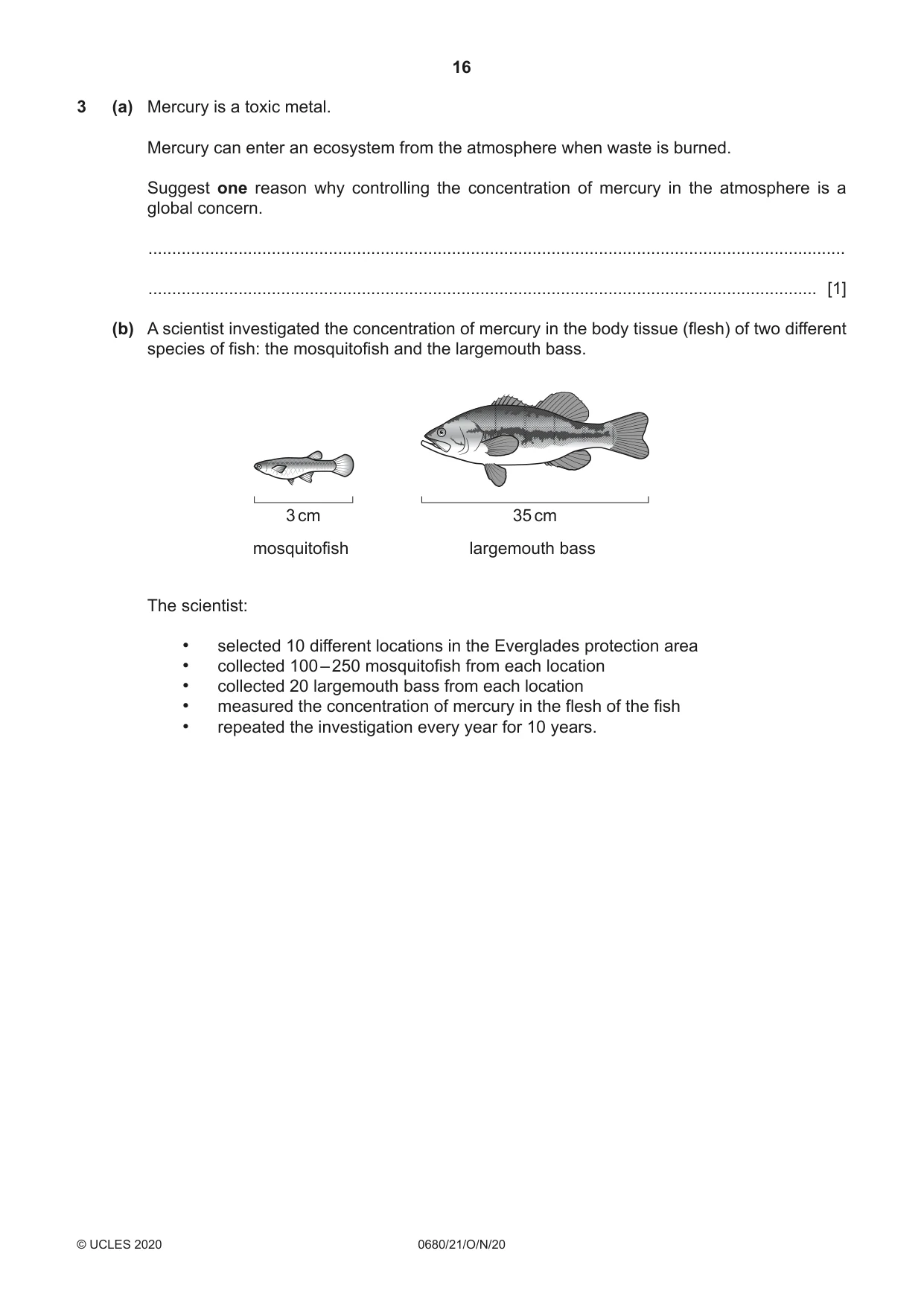
16 0680/21/O/N/20 © UCLES 2020 3 (a) Mercury is a toxic metal. Mercury can enter an ecosystem from the atmosphere when waste is burned. Suggest one reason why controlling the concentration of mercury in the atmosphere is a global concern. … … [1] (b) A scientist investigated the concentration of mercury in the body tissue (flesh) of two different species of fish: the mosquitofish and the largemouth bass. mosquitofish 3 cm largemouth bass 35 cm The scientist: • selected 10 different locations in the Everglades protection area • collected 100 – 250 mosquitofish from each location • collected 20 largemouth bass from each location • measured the concentration of mercury in the flesh of the fish • repeated the investigation every year for 10 years.
Question paper, page 17
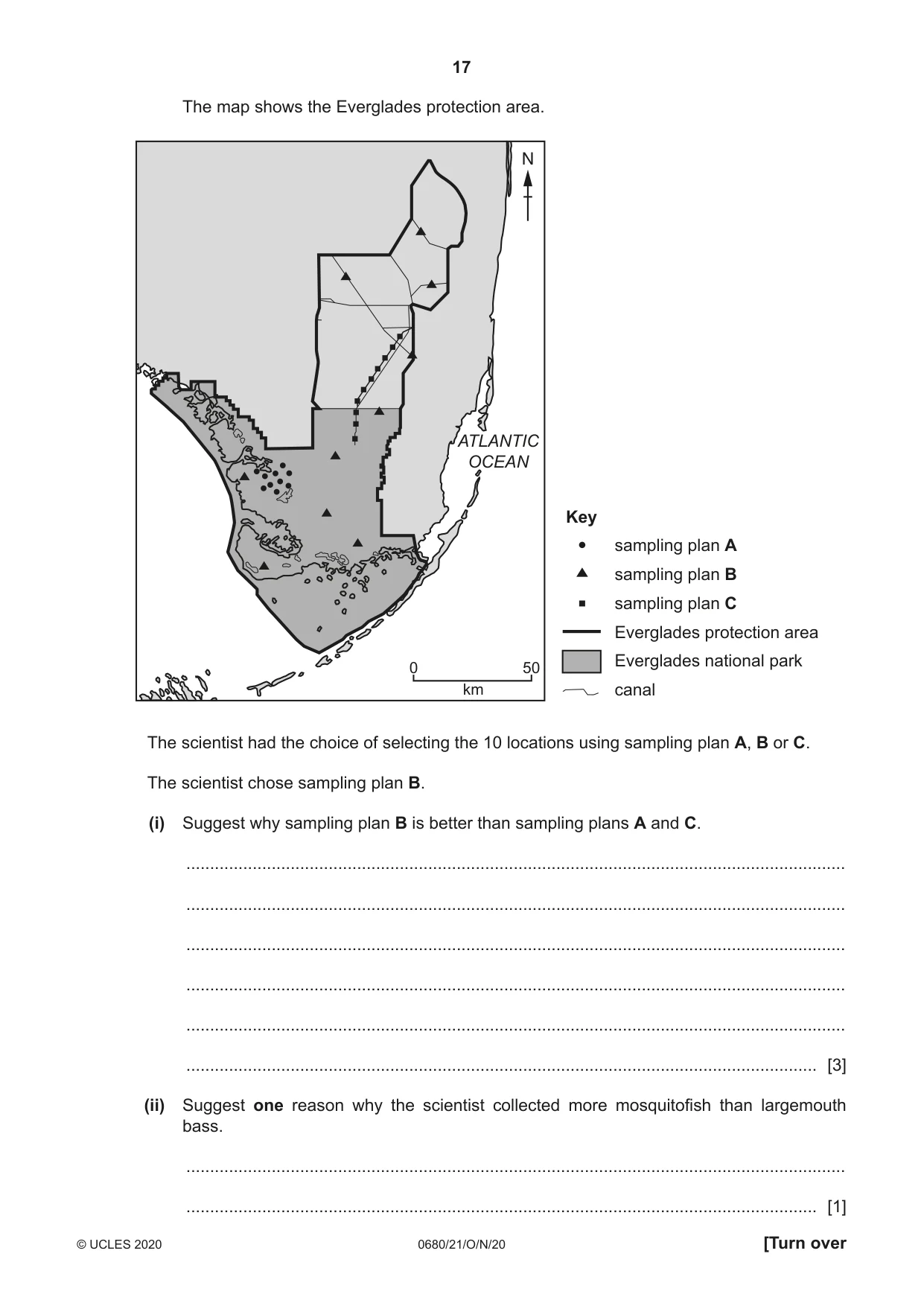
17 0680/21/O/N/20 © UCLES 2020 [Turn over The map shows the Everglades protection area. 0 50 km Key Everglades protection area Everglades national park canal sampling plan A sampling plan B sampling plan C ATLANTIC OCEAN N The scientist had the choice of selecting the 10 locations using sampling plan A, B or C. The scientist chose sampling plan B. (i) Suggest why sampling plan B is better than sampling plans A and C. … … … … … … [3] (ii) Suggest one reason why the scientist collected more mosquitofish than largemouth bass. … … [1]
Question paper, page 18
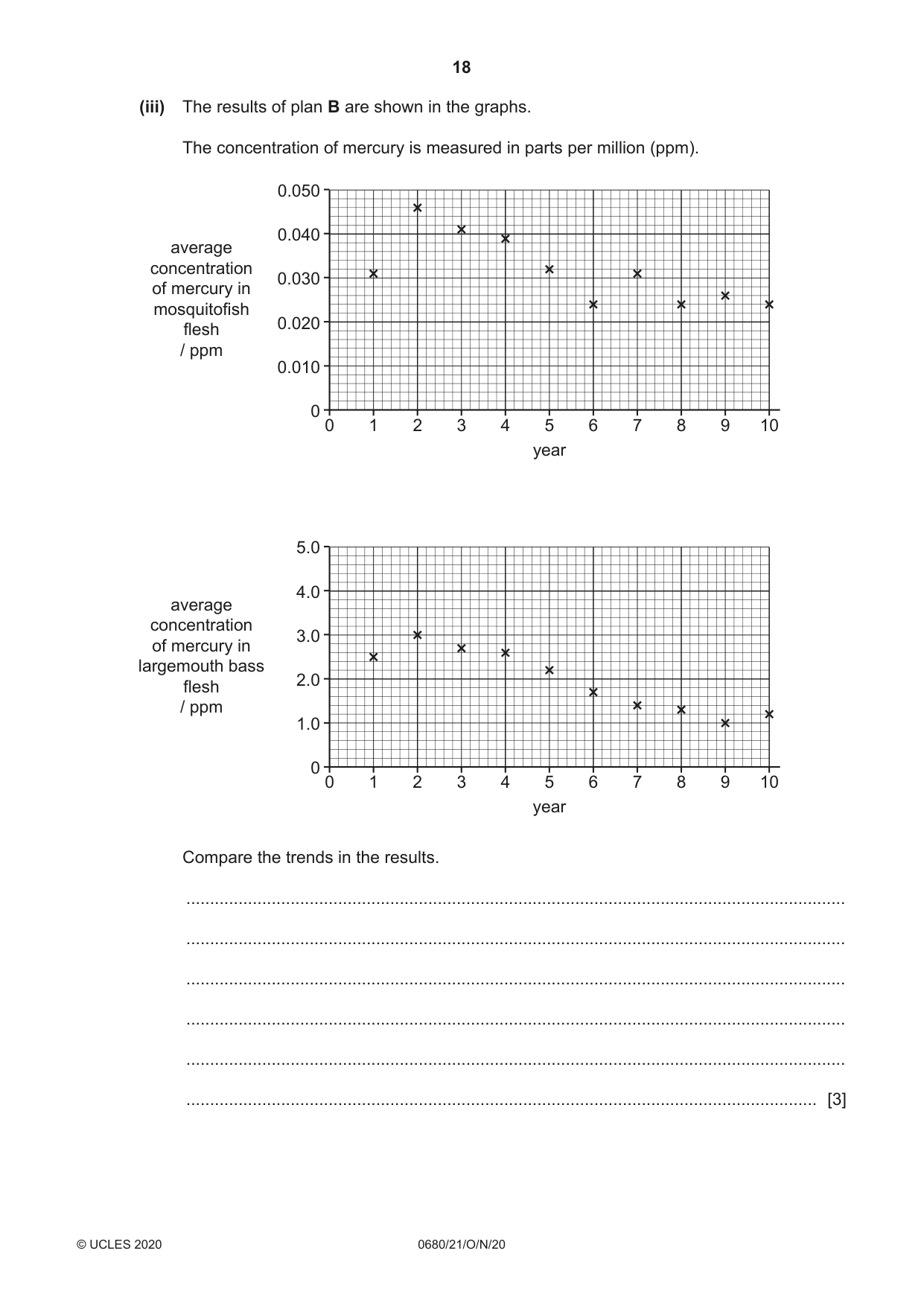
18 0680/21/O/N/20 © UCLES 2020 (iii) The results of plan B are shown in the graphs. The concentration of mercury is measured in parts per million (ppm). 0 0 0.010 0.020 0.030 average concentration of mercury in mosquitofish flesh / ppm 0.040 0.050 1 2 3 4 5 year 6 7 8 9 10 0 0 1.0 2.0 3.0 average concentration of mercury in largemouth bass flesh / ppm 4.0 5.0 1 2 3 4 5 year 6 7 8 9 10 Compare the trends in the results. … … … … … … [3]
Question paper, page 19
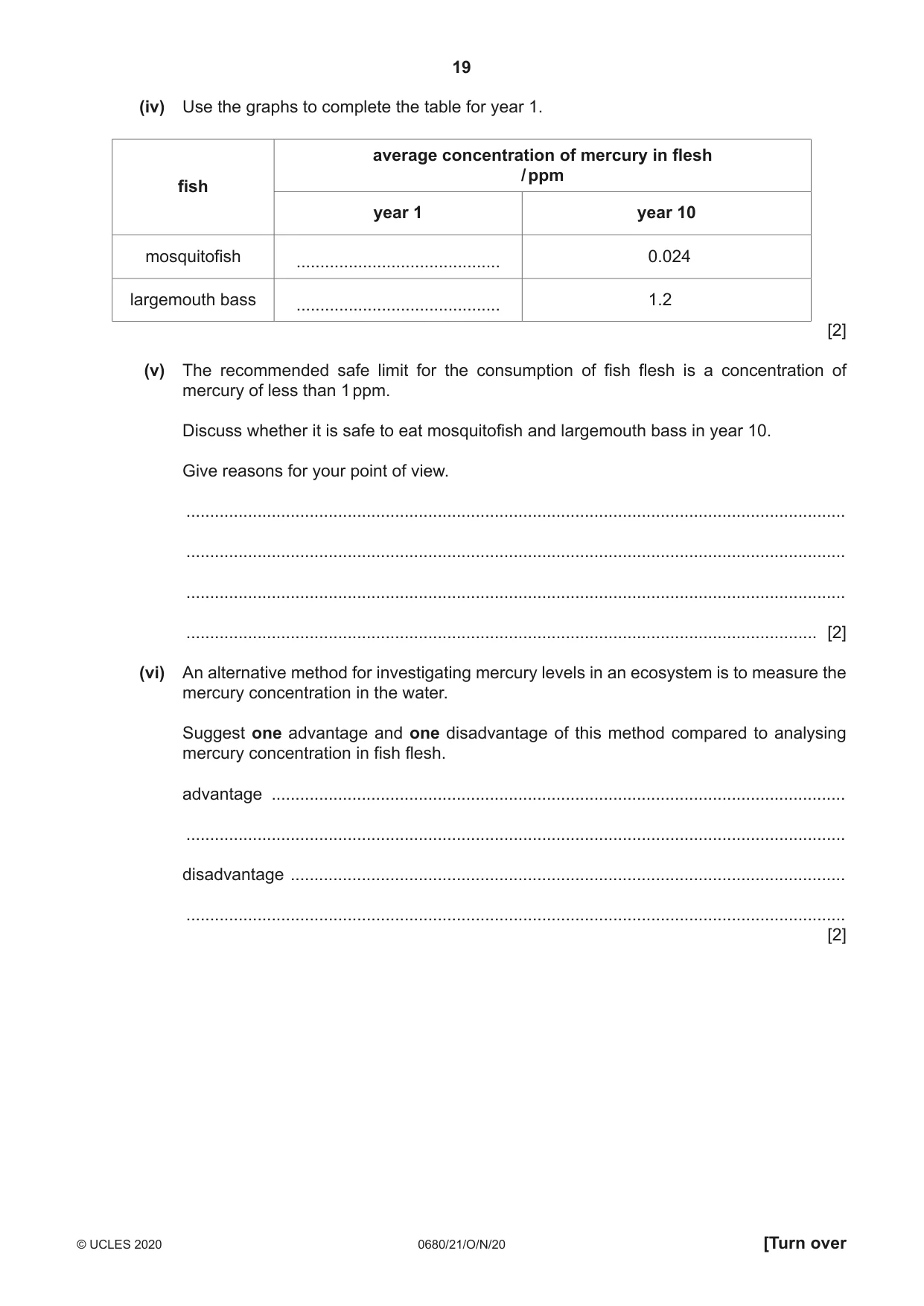
19 0680/21/O/N/20 © UCLES 2020 [Turn over (iv) Use the graphs to complete the table for year 1. fish average concentration of mercury in flesh / ppm year 1 year 10 mosquitofish … 0.024 largemouth bass … 1.2 [2] (v) The recommended safe limit for the consumption of fish flesh is a concentration of mercury of less than 1 ppm. Discuss whether it is safe to eat mosquitofish and largemouth bass in year 10. Give reasons for your point of view. … … … … [2] (vi) An alternative method for investigating mercury levels in an ecosystem is to measure the mercury concentration in the water. Suggest one advantage and one disadvantage of this method compared to analysing mercury concentration in fish flesh. advantage … … disadvantage … … [2]
Question paper, page 20
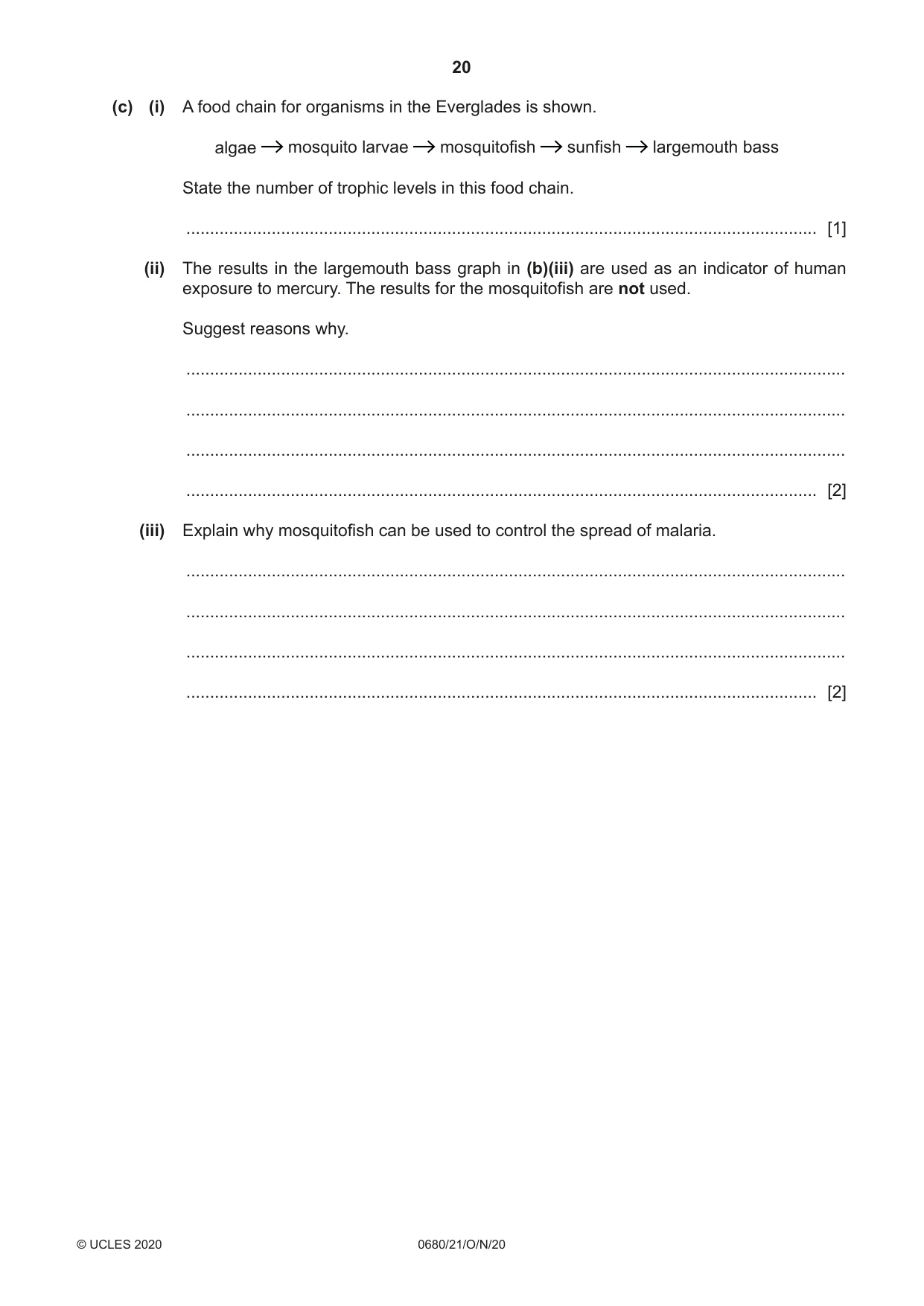
20 0680/21/O/N/20 © UCLES 2020 (c) (i) A food chain for organisms in the Everglades is shown. algae mosquito larvae mosquitofish sunfish largemouth bass State the number of trophic levels in this food chain. … [1] (ii) The results in the largemouth bass graph in (b)(iii) are used as an indicator of human exposure to mercury. The results for the mosquitofish are not used. Suggest reasons why. … … … … [2] (iii) Explain why mosquitofish can be used to control the spread of malaria. … … … … [2]
Question paper, page 21
21 0680/21/O/N/20 © UCLES 2020 (d) The land around the Everglades is used for growing citrus fruit crops such as oranges. Farmers use fertilisers on their crops. Overuse of fertilisers can lead to nutrient enrichment of water in rivers and lakes. Describe how nutrient enrichment of water leads to the depletion of oxygen in rivers and lakes. … … … … … … … … [4] [Total: 23]
Question paper, page 22
22 0680/21/O/N/20 © UCLES 2020 BLANK PAGE
Question paper, page 23
23 0680/21/O/N/20 © UCLES 2020 BLANK PAGE
Question paper, page 24
24 0680/21/O/N/20 © UCLES 2020 BLANK PAGE The boundaries and names shown, the designations used and the presentation of material on the maps contained in this question paper/insert do not imply official endorsement or acceptance by Cambridge Assessment International Education concerning the legal status of any country, territory, or area or any of its authorities, or of the delimitation of its frontiers or boundaries. Permission to reproduce items where third-party owned material protected by copyright is included has been sought and cleared where possible. Every reasonable effort has been made by the publisher (UCLES) to trace copyright holders, but if any items requiring clearance have unwittingly been included, the publisher will be pleased to make amends at the earliest possible opportunity. To avoid the issue of disclosure of answer-related information to candidates, all copyright acknowledgements are reproduced online in the Cambridge Assessment International Education Copyright Acknowledgements Booklet. This is produced for each series of examinations and is freely available to download at www.cambridgeinternational.org after the live examination series. Cambridge Assessment International Education is part of the Cambridge Assessment Group. Cambridge Assessment is the brand name of the University of Cambridge Local Examinations Syndicate (UCLES), which itself is a department of the University of Cambridge.
Mark scheme, page 1
This document consists of 12 printed pages. © UCLES 2020 [Turn over Cambridge IGCSE™ ENVIRONMENTAL MANAGEMENT 0680/21 Paper 2 Management in Context October/November 2020 MARK SCHEME Maximum Mark: 80 Published This mark scheme is published as an aid to teachers and candidates, to indicate the requirements of the examination. It shows the basis on which Examiners were instructed to award marks. It does not indicate the details of the discussions that took place at an Examiners’ meeting before marking began, which would have considered the acceptability of alternative answers. Mark schemes should be read in conjunction with the question paper and the Principal Examiner Report for Teachers. Cambridge International will not enter into discussions about these mark schemes. Cambridge International is publishing the mark schemes for the October/November 2020 series for most Cambridge IGCSE™, Cambridge International A and AS Level and Cambridge Pre-U components, and some Cambridge O Level components.
Mark scheme, page 2
0680/21 Cambridge IGCSE – Mark Scheme PUBLISHED October/November 2020 © UCLES 2020 Page 2 of 12 Generic Marking Principles These general marking principles must be applied by all examiners when marking candidate answers. They should be applied alongside the specific content of the mark scheme or generic level descriptors for a question. Each question paper and mark scheme will also comply with these marking principles. GENERIC MARKING PRINCIPLE 1: Marks must be awarded in line with: • the specific content of the mark scheme or the generic level descriptors for the question • the specific skills defined in the mark scheme or in the generic level descriptors for the question • the standard of response required by a candidate as exemplified by the standardisation scripts. GENERIC MARKING PRINCIPLE 2: Marks awarded are always whole marks (not half marks, or other fractions). GENERIC MARKING PRINCIPLE 3: Marks must be awarded positively: • marks are awarded for correct/valid answers, as defined in the mark scheme. However, credit is given for valid answers which go beyond the scope of the syllabus and mark scheme, referring to your Team Leader as appropriate • marks are awarded when candidates clearly demonstrate what they know and can do • marks are not deducted for errors • marks are not deducted for omissions • answers should only be judged on the quality of spelling, punctuation and grammar when these features are specifically assessed by the question as indicated by the mark scheme. The meaning, however, should be unambiguous. GENERIC MARKING PRINCIPLE 4: Rules must be applied consistently, e.g. in situations where candidates have not followed instructions or in the application of generic level descriptors.
Mark scheme, page 3
0680/21 Cambridge IGCSE – Mark Scheme PUBLISHED October/November 2020 © UCLES 2020 Page 3 of 12 GENERIC MARKING PRINCIPLE 5: Marks should be awarded using the full range of marks defined in the mark scheme for the question (however; the use of the full mark range may be limited according to the quality of the candidate responses seen). GENERIC MARKING PRINCIPLE 6: Marks awarded are based solely on the requirements as defined in the mark scheme. Marks should not be awarded with grade thresholds or grade descriptors in mind. Science-Specific Marking Principles 1 Examiners should consider the context and scientific use of any keywords when awarding marks. Although keywords may be present, marks should not be awarded if the keywords are used incorrectly. 2 The examiner should not choose between contradictory statements given in the same question part, and credit should not be awarded for any correct statement that is contradicted within the same question part. Wrong science that is irrelevant to the question should be ignored. 3 Although spellings do not have to be correct, spellings of syllabus terms must allow for clear and unambiguous separation from other syllabus terms with which they may be confused (e.g. ethane / ethene, glucagon / glycogen, refraction / reflection). 4 The error carried forward (ecf) principle should be applied, where appropriate. If an incorrect answer is subsequently used in a scientifically correct way, the candidate should be awarded these subsequent marking points. Further guidance will be included in the mark scheme where necessary and any exceptions to this general principle will be noted. 5 ‘List rule’ guidance For questions that require n responses (e.g. State two reasons …): • The response should be read as continuous prose, even when numbered answer spaces are provided. • Any response marked ignore in the mark scheme should not count towards n. • Incorrect responses should not be awarded credit but will still count towards n. • Read the entire response to check for any responses that contradict those that would otherwise be credited. Credit should not be awarded for any responses that are contradicted within the rest of the response. Where two responses contradict one another, this should be treated as a single incorrect response. • Non-contradictory responses after the first n responses may be ignored even if they include incorrect science.
Mark scheme, page 4
0680/21 Cambridge IGCSE – Mark Scheme PUBLISHED October/November 2020 © UCLES 2020 Page 4 of 12 6 Calculation specific guidance Correct answers to calculations should be given full credit even if there is no working or incorrect working, unless the question states ‘show your working’. For questions in which the number of significant figures required is not stated, credit should be awarded for correct answers when rounded by the examiner to the number of significant figures given in the mark scheme. This may not apply to measured values. For answers given in standard form (e.g. a × 10n) in which the convention of restricting the value of the coefficient (a) to a value between 1 and 10 is not followed, credit may still be awarded if the answer can be converted to the answer given in the mark scheme. Unless a separate mark is given for a unit, a missing or incorrect unit will normally mean that the final calculation mark is not awarded. Exceptions to this general principle will be noted in the mark scheme. 7 Guidance for chemical equations Multiples / fractions of coefficients used in chemical equations are acceptable unless stated otherwise in the mark scheme. State symbols given in an equation should be ignored unless asked for in the question or stated otherwise in the mark scheme.
Mark scheme, page 5
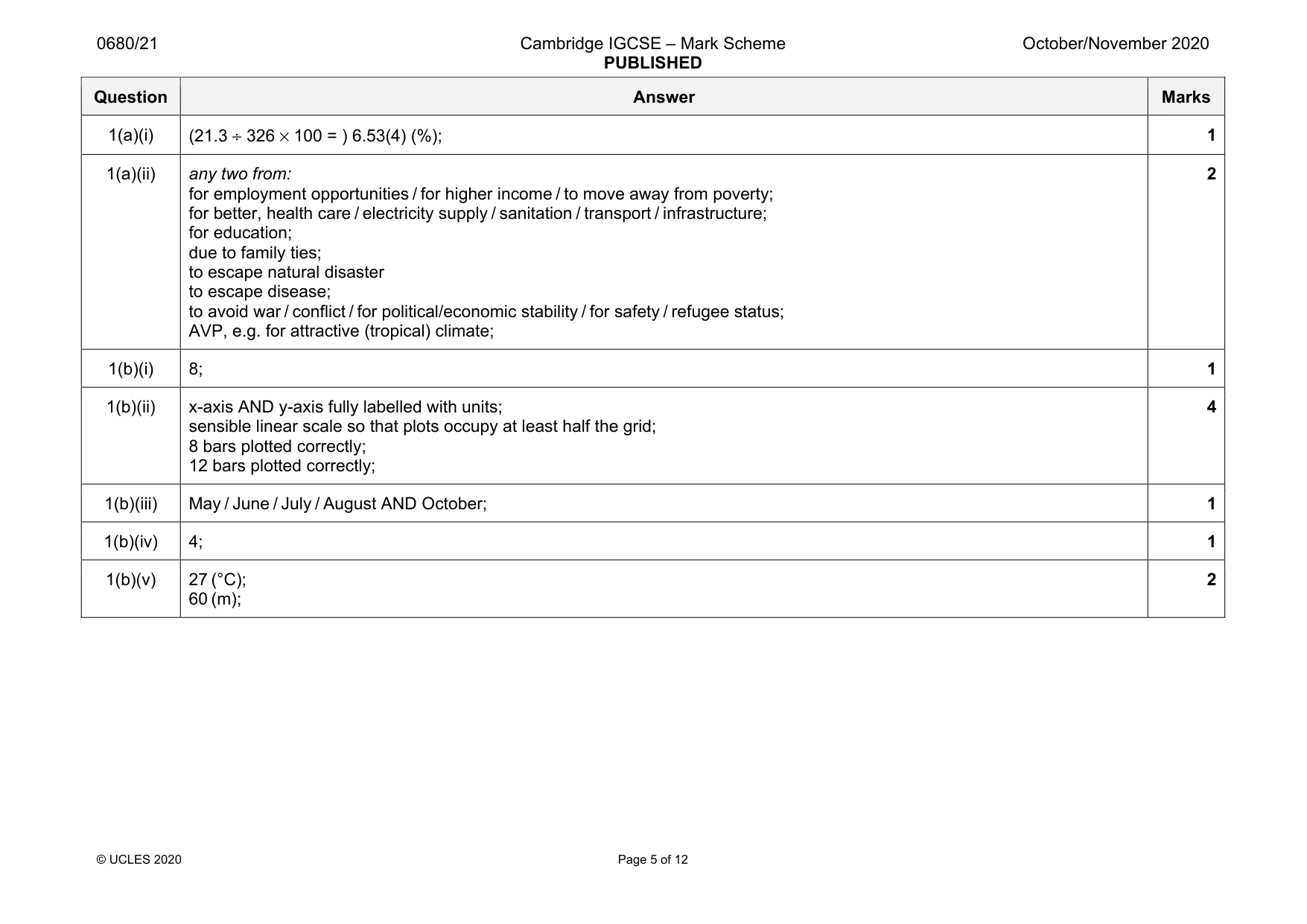
0680/21 Cambridge IGCSE – Mark Scheme PUBLISHED October/November 2020 © UCLES 2020 Page 5 of 12 Question Answer Marks 1(a)(i) (21.3 ÷ 326 × 100 = ) 6.53(4) (%); 1 1(a)(ii) any two from: for employment opportunities / for higher income / to move away from poverty; for better, health care / electricity supply / sanitation / transport / infrastructure; for education; due to family ties; to escape natural disaster to escape disease; to avoid war / conflict / for political/economic stability / for safety / refugee status; AVP, e.g. for attractive (tropical) climate; 2 1(b)(i) 8; 1 1(b)(ii) x-axis AND y-axis fully labelled with units; sensible linear scale so that plots occupy at least half the grid; 8 bars plotted correctly; 12 bars plotted correctly; 4 1(b)(iii) May / June / July / August AND October; 1 1(b)(iv) 4; 1 1(b)(v) 27 (°C); 60 (m); 2
Mark scheme, page 6
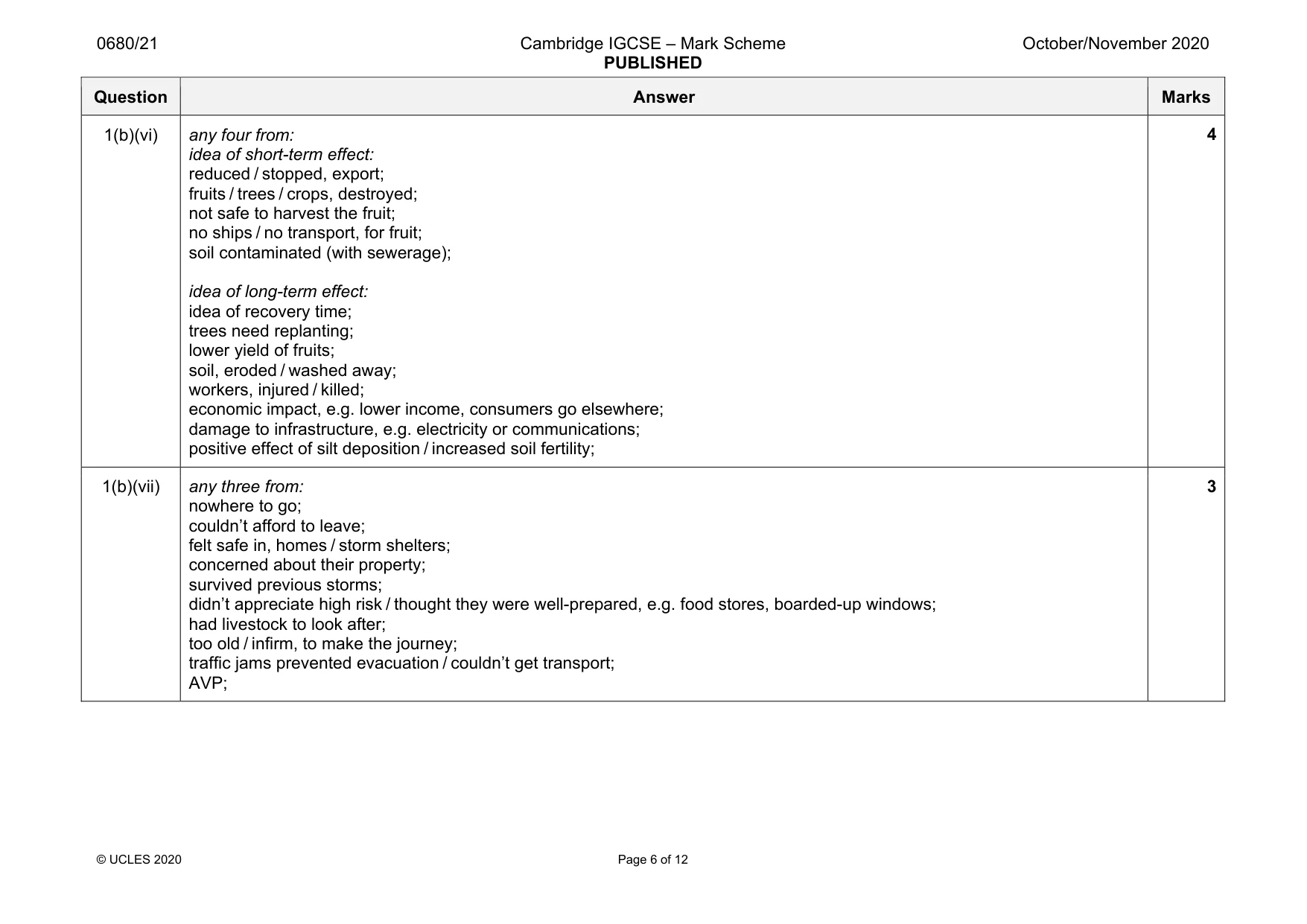
0680/21 Cambridge IGCSE – Mark Scheme PUBLISHED October/November 2020 © UCLES 2020 Page 6 of 12 Question Answer Marks 1(b)(vi) any four from: idea of short-term effect: reduced / stopped, export; fruits / trees / crops, destroyed; not safe to harvest the fruit; no ships / no transport, for fruit; soil contaminated (with sewerage); idea of long-term effect: idea of recovery time; trees need replanting; lower yield of fruits; soil, eroded / washed away; workers, injured / killed; economic impact, e.g. lower income, consumers go elsewhere; damage to infrastructure, e.g. electricity or communications; positive effect of silt deposition / increased soil fertility; 4 1(b)(vii) any three from: nowhere to go; couldn’t afford to leave; felt safe in, homes / storm shelters; concerned about their property; survived previous storms; didn’t appreciate high risk / thought they were well-prepared, e.g. food stores, boarded-up windows; had livestock to look after; too old / infirm, to make the journey; traffic jams prevented evacuation / couldn’t get transport; AVP; 3
Mark scheme, page 7
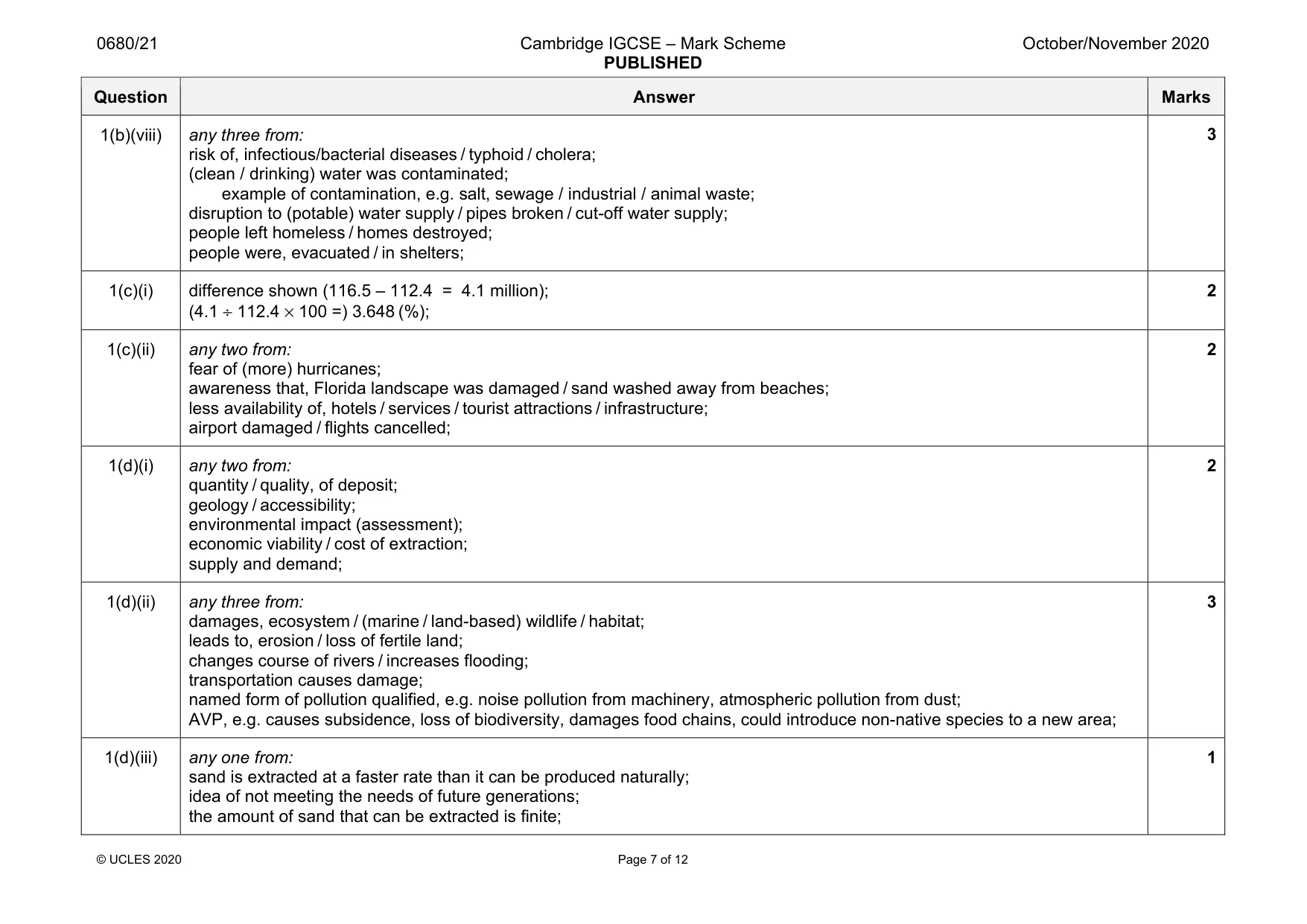
0680/21 Cambridge IGCSE – Mark Scheme PUBLISHED October/November 2020 © UCLES 2020 Page 7 of 12 Question Answer Marks 1(b)(viii) any three from: risk of, infectious/bacterial diseases / typhoid / cholera; (clean / drinking) water was contaminated; example of contamination, e.g. salt, sewage / industrial / animal waste; disruption to (potable) water supply / pipes broken / cut-off water supply; people left homeless / homes destroyed; people were, evacuated / in shelters; 3 1(c)(i) difference shown (116.5 – 112.4 = 4.1 million); (4.1 ÷ 112.4 × 100 =) 3.648 (%); 2 1(c)(ii) any two from: fear of (more) hurricanes; awareness that, Florida landscape was damaged / sand washed away from beaches; less availability of, hotels / services / tourist attractions / infrastructure; airport damaged / flights cancelled; 2 1(d)(i) any two from: quantity / quality, of deposit; geology / accessibility; environmental impact (assessment); economic viability / cost of extraction; supply and demand; 2 1(d)(ii) any three from: damages, ecosystem / (marine / land-based) wildlife / habitat; leads to, erosion / loss of fertile land; changes course of rivers / increases flooding; transportation causes damage; named form of pollution qualified, e.g. noise pollution from machinery, atmospheric pollution from dust; AVP, e.g. causes subsidence, loss of biodiversity, damages food chains, could introduce non-native species to a new area; 3 1(d)(iii) any one from: sand is extracted at a faster rate than it can be produced naturally; idea of not meeting the needs of future generations; the amount of sand that can be extracted is finite; 1
Mark scheme, page 8
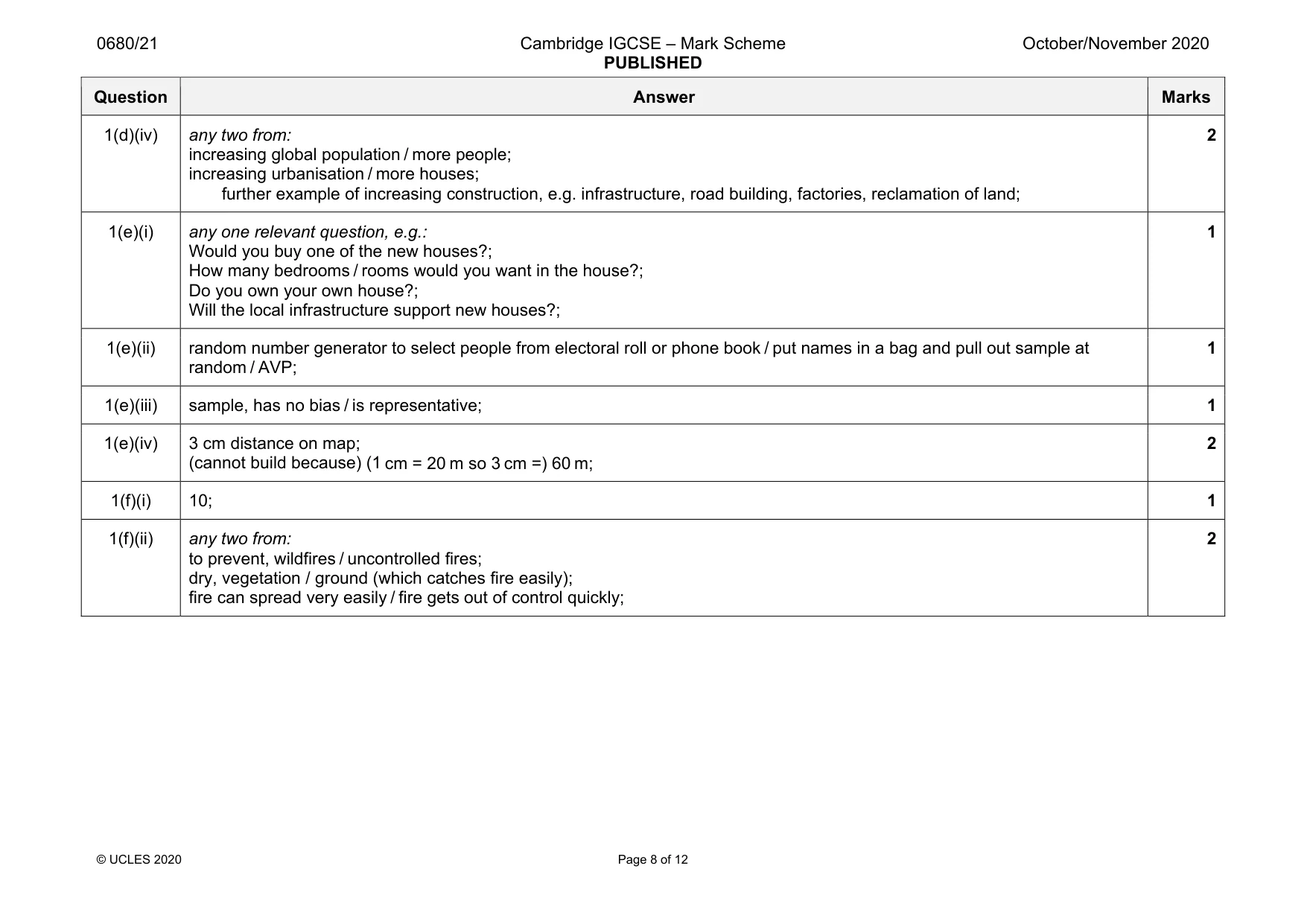
0680/21 Cambridge IGCSE – Mark Scheme PUBLISHED October/November 2020 © UCLES 2020 Page 8 of 12 Question Answer Marks 1(d)(iv) any two from: increasing global population / more people; increasing urbanisation / more houses; further example of increasing construction, e.g. infrastructure, road building, factories, reclamation of land; 2 1(e)(i) any one relevant question, e.g.: Would you buy one of the new houses?; How many bedrooms / rooms would you want in the house?; Do you own your own house?; Will the local infrastructure support new houses?; 1 1(e)(ii) random number generator to select people from electoral roll or phone book / put names in a bag and pull out sample at random / AVP; 1 1(e)(iii) sample, has no bias / is representative; 1 1(e)(iv) 3 cm distance on map; (cannot build because) (1 cm = 20 m so 3 cm =) 60 m; 2 1(f)(i) 10; 1 1(f)(ii) any two from: to prevent, wildfires / uncontrolled fires; dry, vegetation / ground (which catches fire easily); fire can spread very easily / fire gets out of control quickly; 2
Mark scheme, page 9
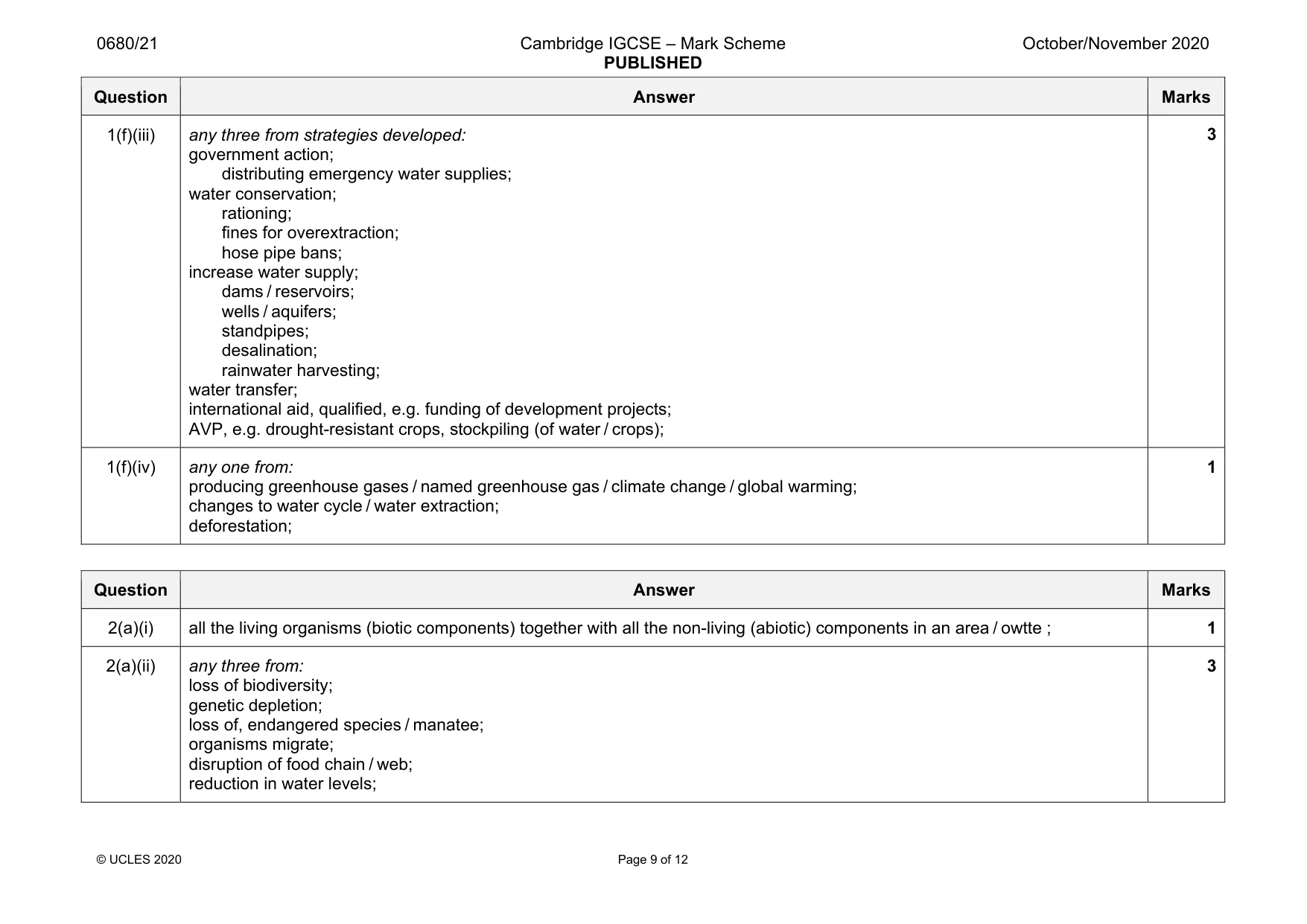
0680/21 Cambridge IGCSE – Mark Scheme PUBLISHED October/November 2020 © UCLES 2020 Page 9 of 12 Question Answer Marks 1(f)(iii) any three from strategies developed: government action; distributing emergency water supplies; water conservation; rationing; fines for overextraction; hose pipe bans; increase water supply; dams / reservoirs; wells / aquifers; standpipes; desalination; rainwater harvesting; water transfer; international aid, qualified, e.g. funding of development projects; AVP, e.g. drought-resistant crops, stockpiling (of water / crops); 3 1(f)(iv) any one from: producing greenhouse gases / named greenhouse gas / climate change / global warming; changes to water cycle / water extraction; deforestation; 1 Question Answer Marks 2(a)(i) all the living organisms (biotic components) together with all the non-living (abiotic) components in an area / owtte ; 1 2(a)(ii) any three from: loss of biodiversity; genetic depletion; loss of, endangered species / manatee; organisms migrate; disruption of food chain / web; reduction in water levels; 3
Mark scheme, page 10
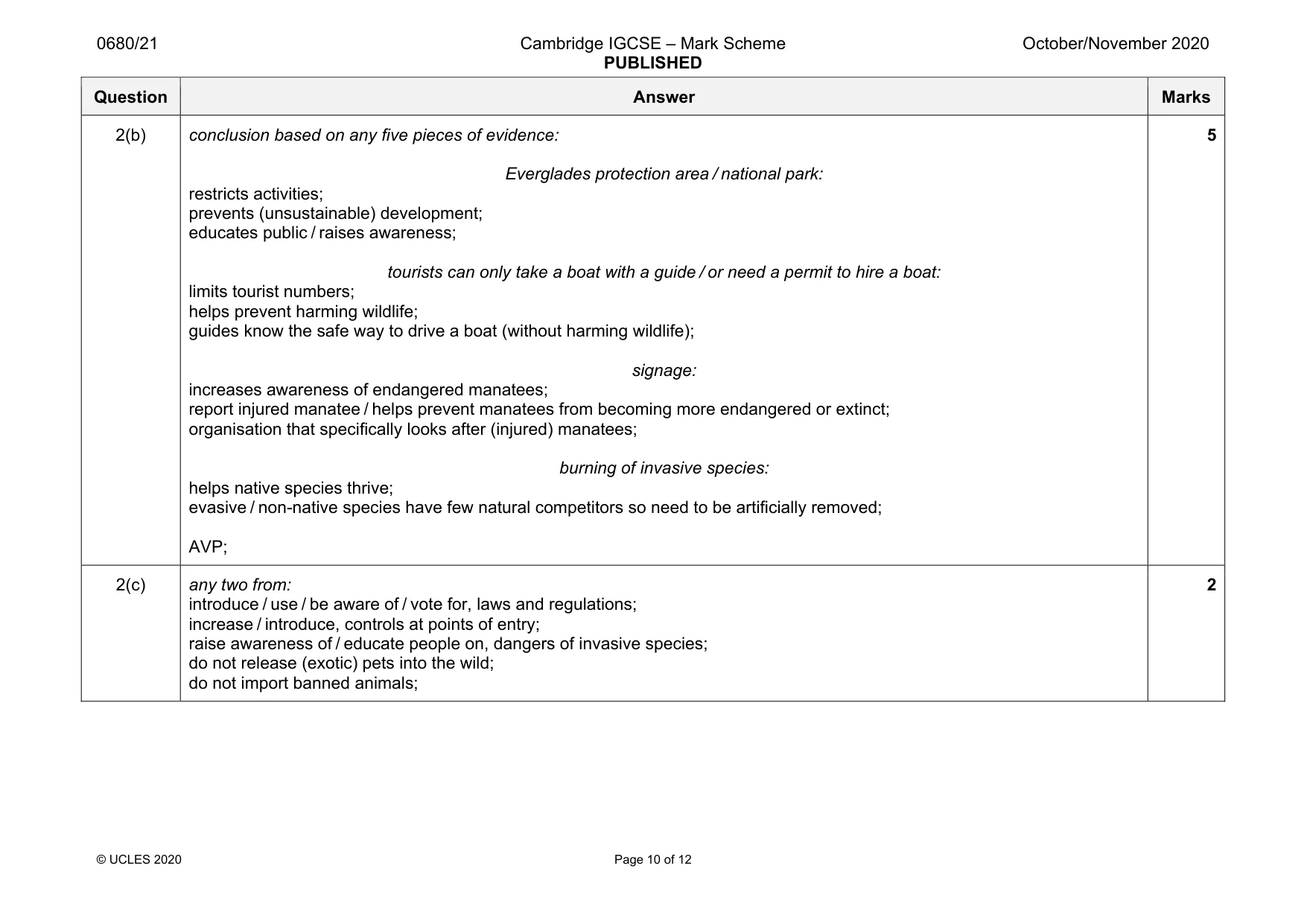
0680/21 Cambridge IGCSE – Mark Scheme PUBLISHED October/November 2020 © UCLES 2020 Page 10 of 12 Question Answer Marks 2(b) conclusion based on any five pieces of evidence: Everglades protection area / national park: restricts activities; prevents (unsustainable) development; educates public / raises awareness; tourists can only take a boat with a guide / or need a permit to hire a boat: limits tourist numbers; helps prevent harming wildlife; guides know the safe way to drive a boat (without harming wildlife); signage: increases awareness of endangered manatees; report injured manatee / helps prevent manatees from becoming more endangered or extinct; organisation that specifically looks after (injured) manatees; burning of invasive species: helps native species thrive; evasive / non-native species have few natural competitors so need to be artificially removed; AVP; 5 2(c) any two from: introduce / use / be aware of / vote for, laws and regulations; increase / introduce, controls at points of entry; raise awareness of / educate people on, dangers of invasive species; do not release (exotic) pets into the wild; do not import banned animals; 2
Mark scheme, page 11
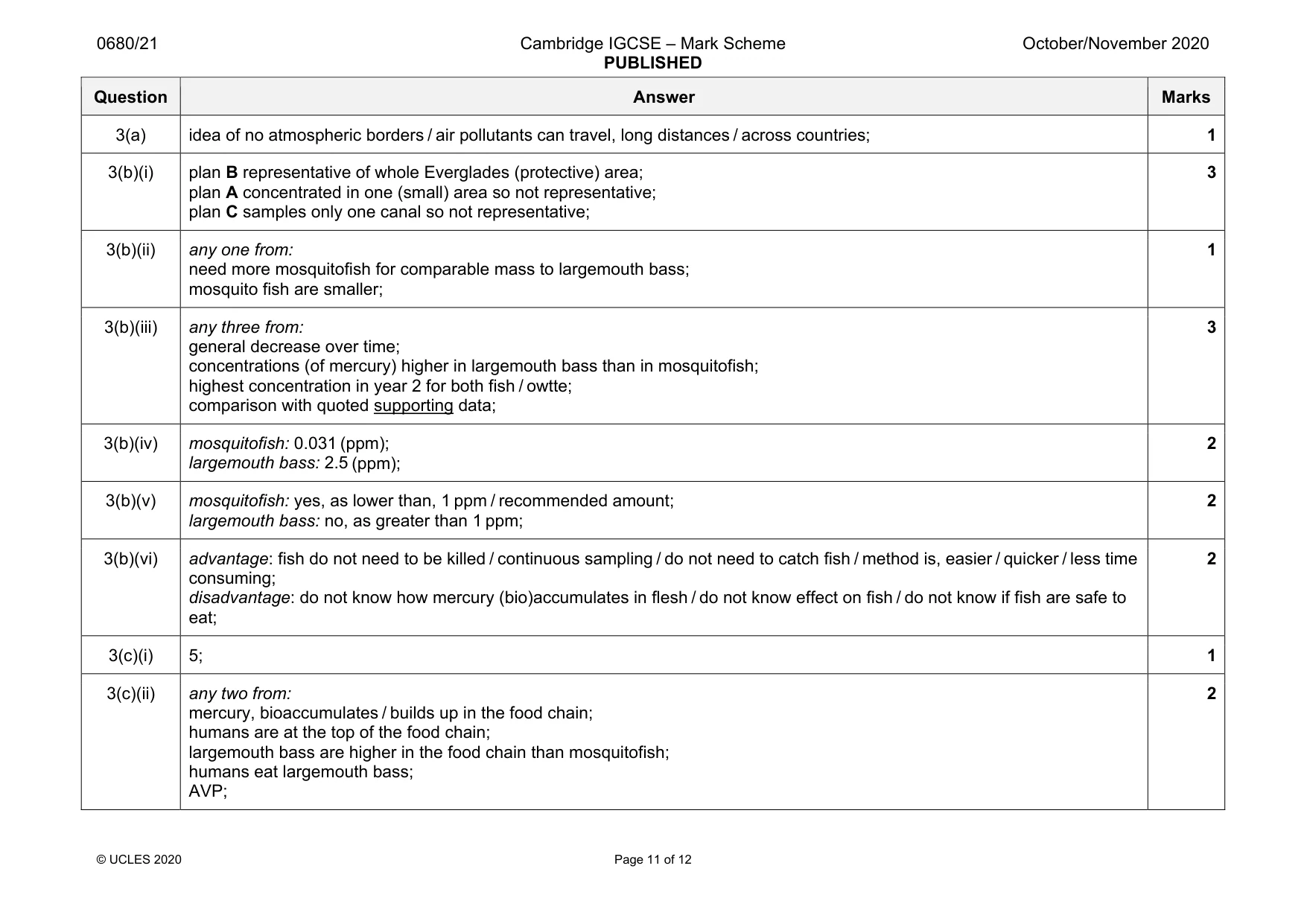
0680/21 Cambridge IGCSE – Mark Scheme PUBLISHED October/November 2020 © UCLES 2020 Page 11 of 12 Question Answer Marks 3(a) idea of no atmospheric borders / air pollutants can travel, long distances / across countries; 1 3(b)(i) plan B representative of whole Everglades (protective) area; plan A concentrated in one (small) area so not representative; plan C samples only one canal so not representative; 3 3(b)(ii) any one from: need more mosquitofish for comparable mass to largemouth bass; mosquito fish are smaller; 1 3(b)(iii) any three from: general decrease over time; concentrations (of mercury) higher in largemouth bass than in mosquitofish; highest concentration in year 2 for both fish / owtte; comparison with quoted supporting data; 3 3(b)(iv) mosquitofish: 0.031 (ppm); largemouth bass: 2.5 (ppm); 2 3(b)(v) mosquitofish: yes, as lower than, 1 ppm / recommended amount; largemouth bass: no, as greater than 1 ppm; 2 3(b)(vi) advantage: fish do not need to be killed / continuous sampling / do not need to catch fish / method is, easier / quicker / less time consuming; disadvantage: do not know how mercury (bio)accumulates in flesh / do not know effect on fish / do not know if fish are safe to eat; 2 3(c)(i) 5; 1 3(c)(ii) any two from: mercury, bioaccumulates / builds up in the food chain; humans are at the top of the food chain; largemouth bass are higher in the food chain than mosquitofish; humans eat largemouth bass; AVP; 2
Mark scheme, page 12
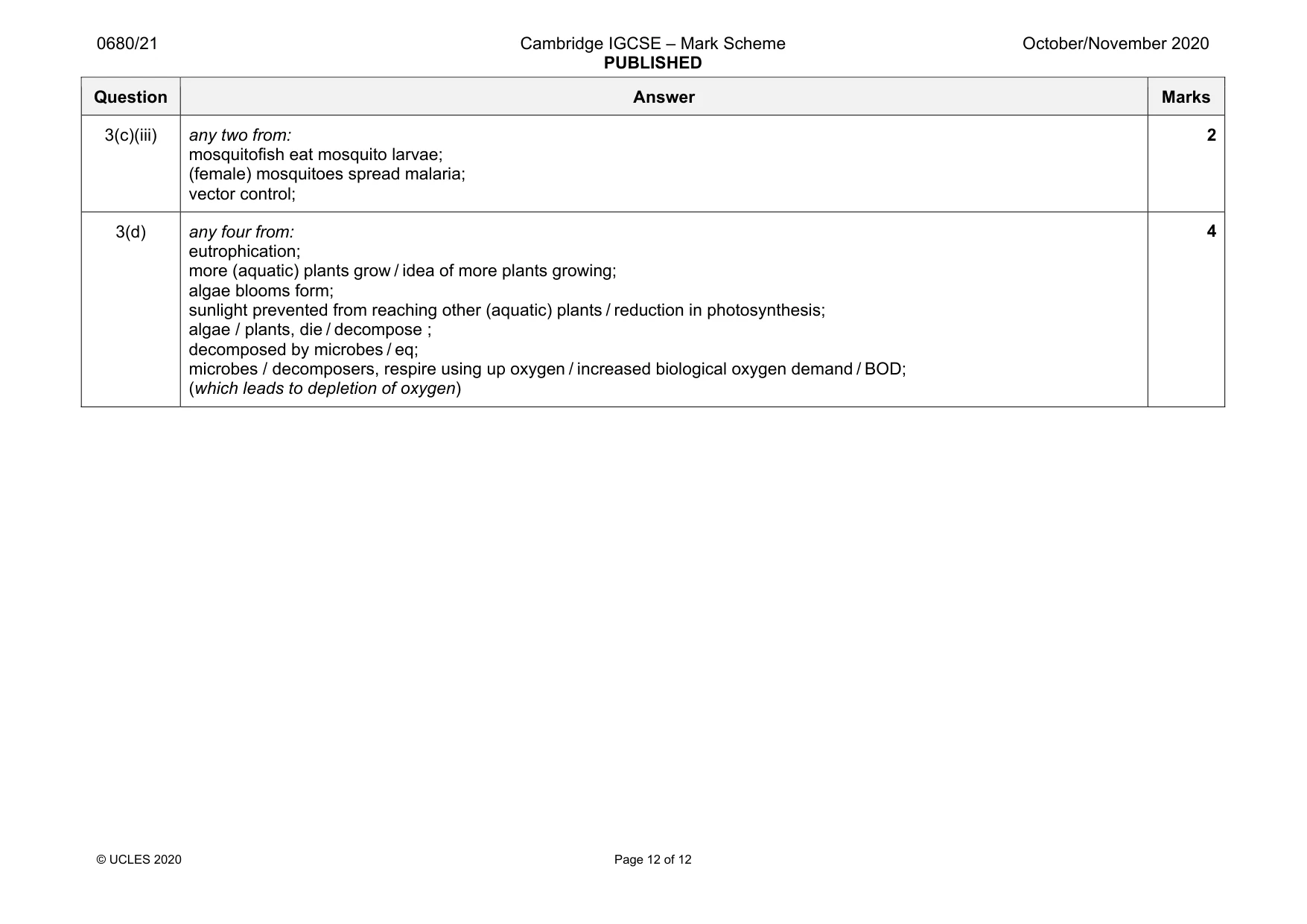
0680/21 Cambridge IGCSE – Mark Scheme PUBLISHED October/November 2020 © UCLES 2020 Page 12 of 12 Question Answer Marks 3(c)(iii) any two from: mosquitofish eat mosquito larvae; (female) mosquitoes spread malaria; vector control; 2 3(d) any four from: eutrophication; more (aquatic) plants grow / idea of more plants growing; algae blooms form; sunlight prevented from reaching other (aquatic) plants / reduction in photosynthesis; algae / plants, die / decompose ; decomposed by microbes / eq; microbes / decomposers, respire using up oxygen / increased biological oxygen demand / BOD; (which leads to depletion of oxygen) 4
What you needed in this session
Cambridge’s own grade thresholds for 2020 Oct/Nov, Paper 2 · Variant 1. A higher threshold means an easier paper — the bar moves with how the cohort did.