Cambridge IGCSE Environmental Management 0680 — 2020 Feb/March Paper 2 · Variant 2
0680/22/F/M/20 · 3 questions · 80 marks · ≈90 min
The question paper and its mark scheme, free to read here and free to download. This is Cambridge’s own paper, exactly as it was sat.
Question paper20 pages
Mark scheme11 pages
Answers below. Sit the paper first if you are practising.
Questions as text
Q1 · In Ghana, 20% of the population are involved in agricultural production
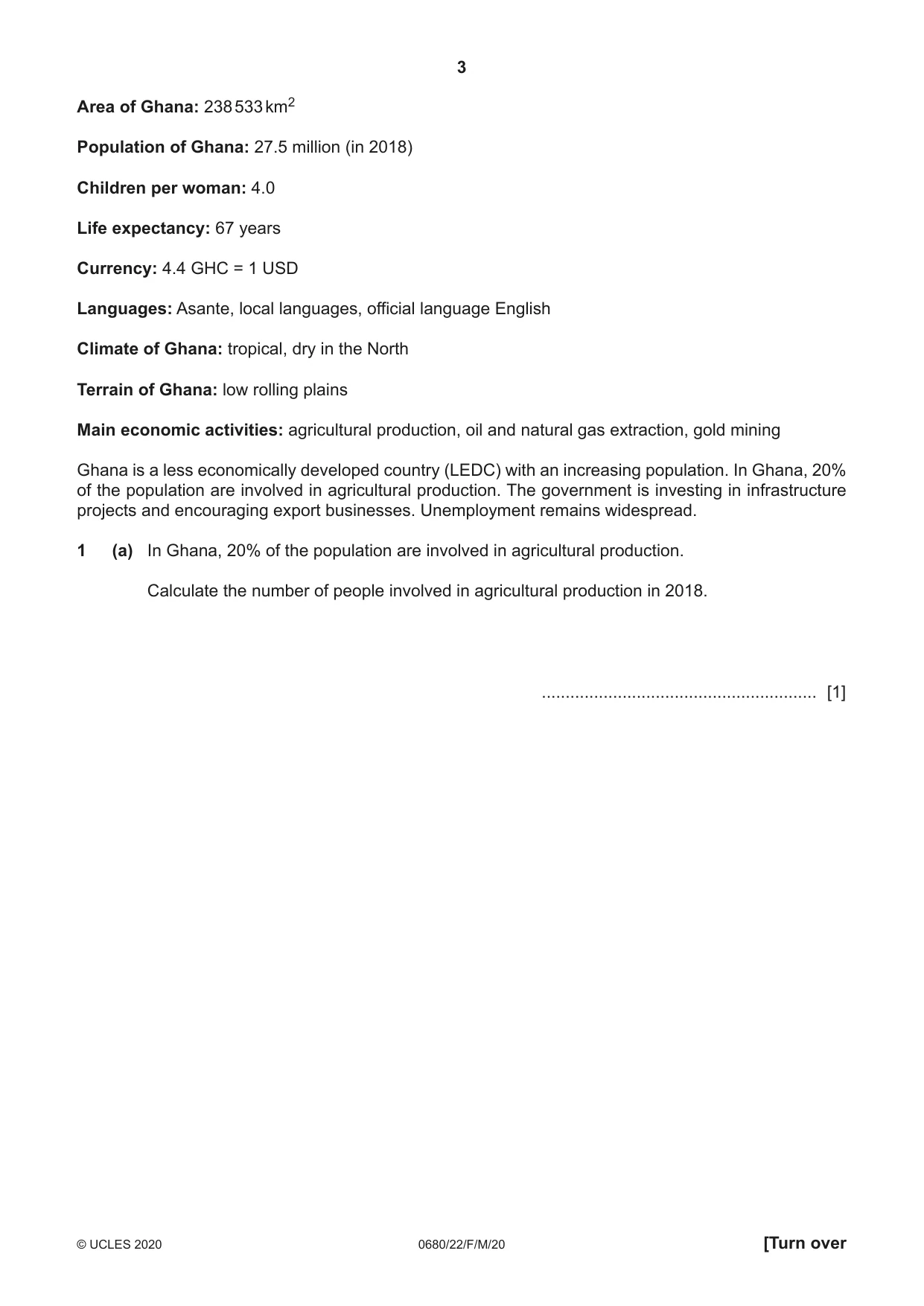
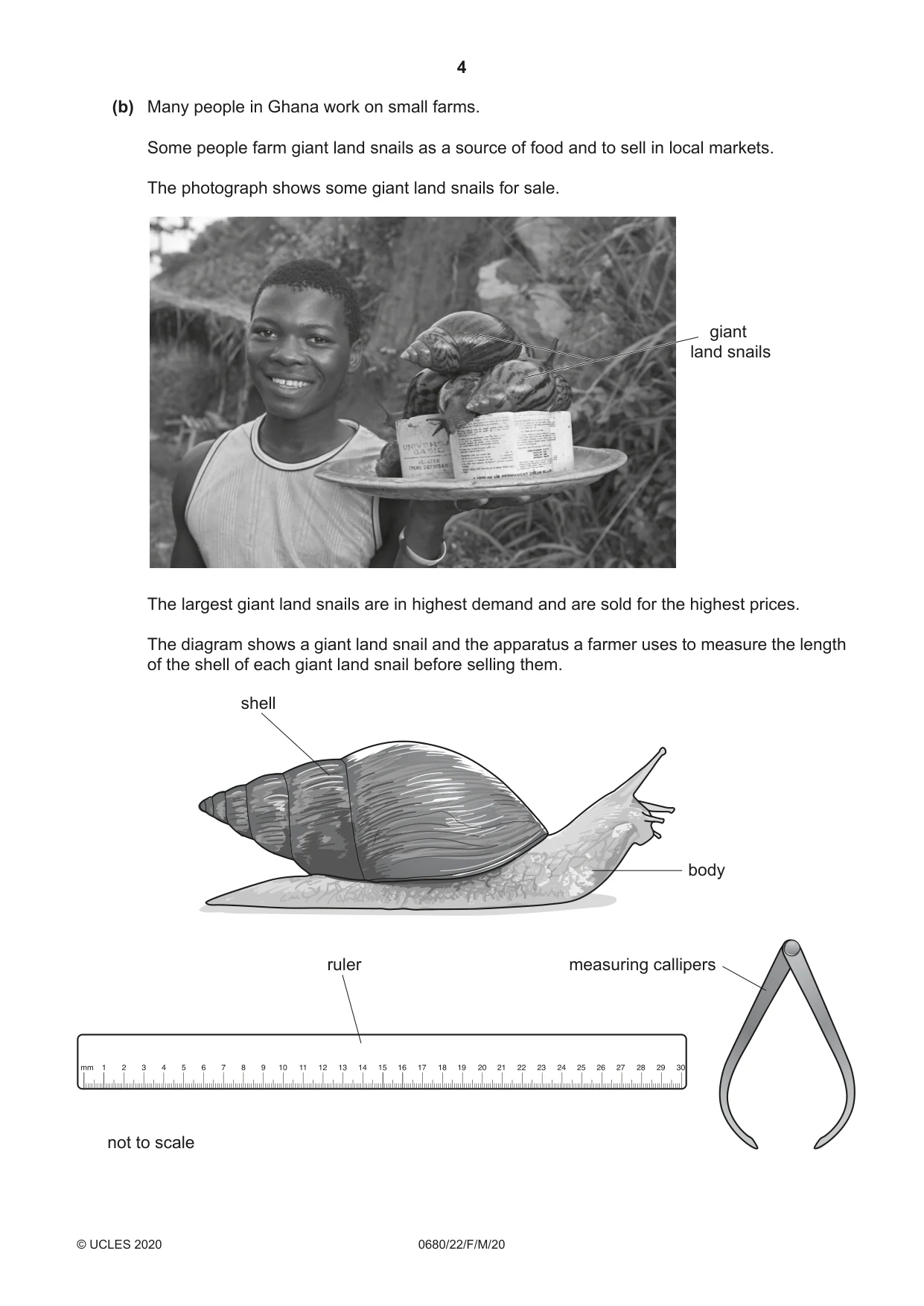
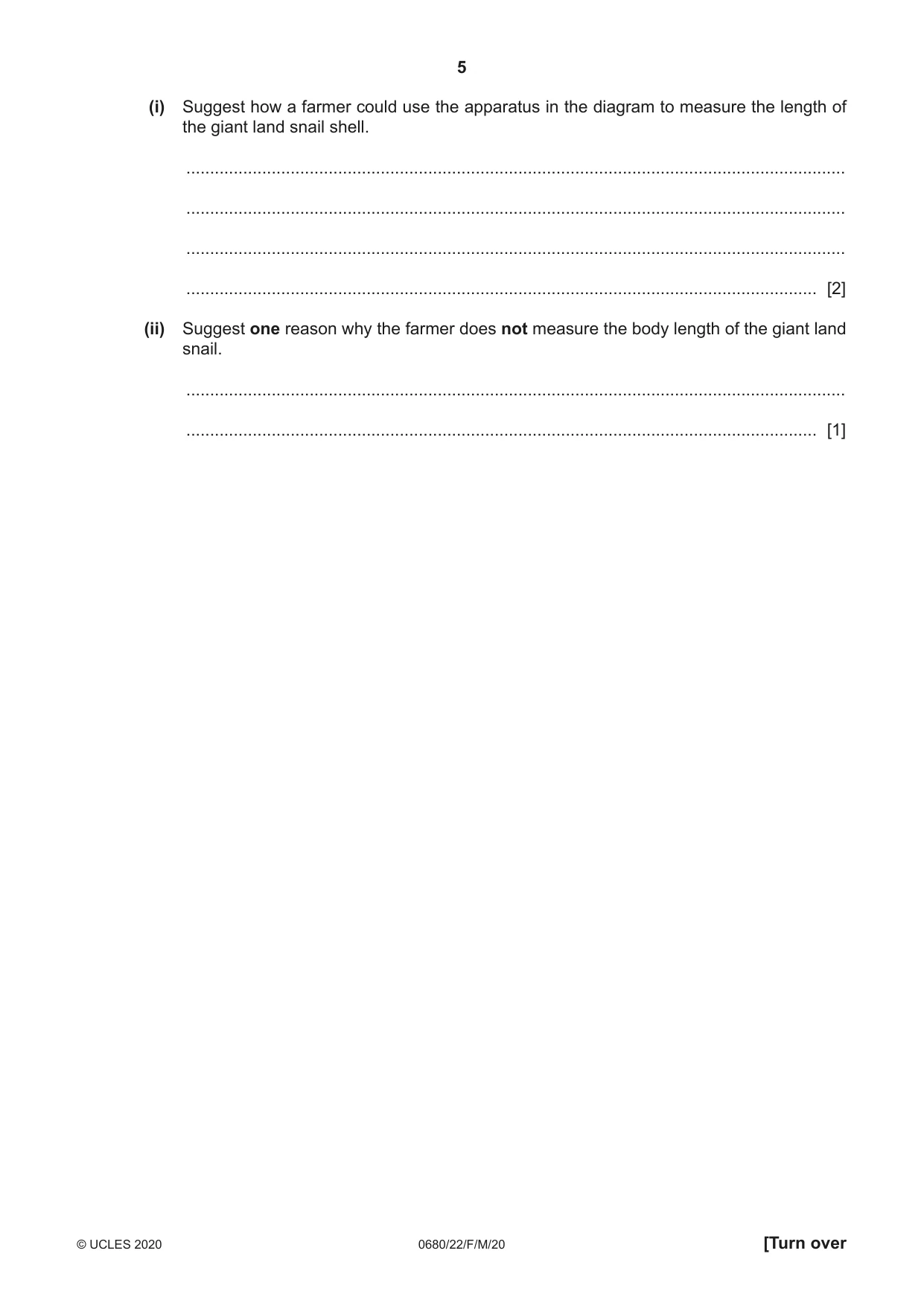
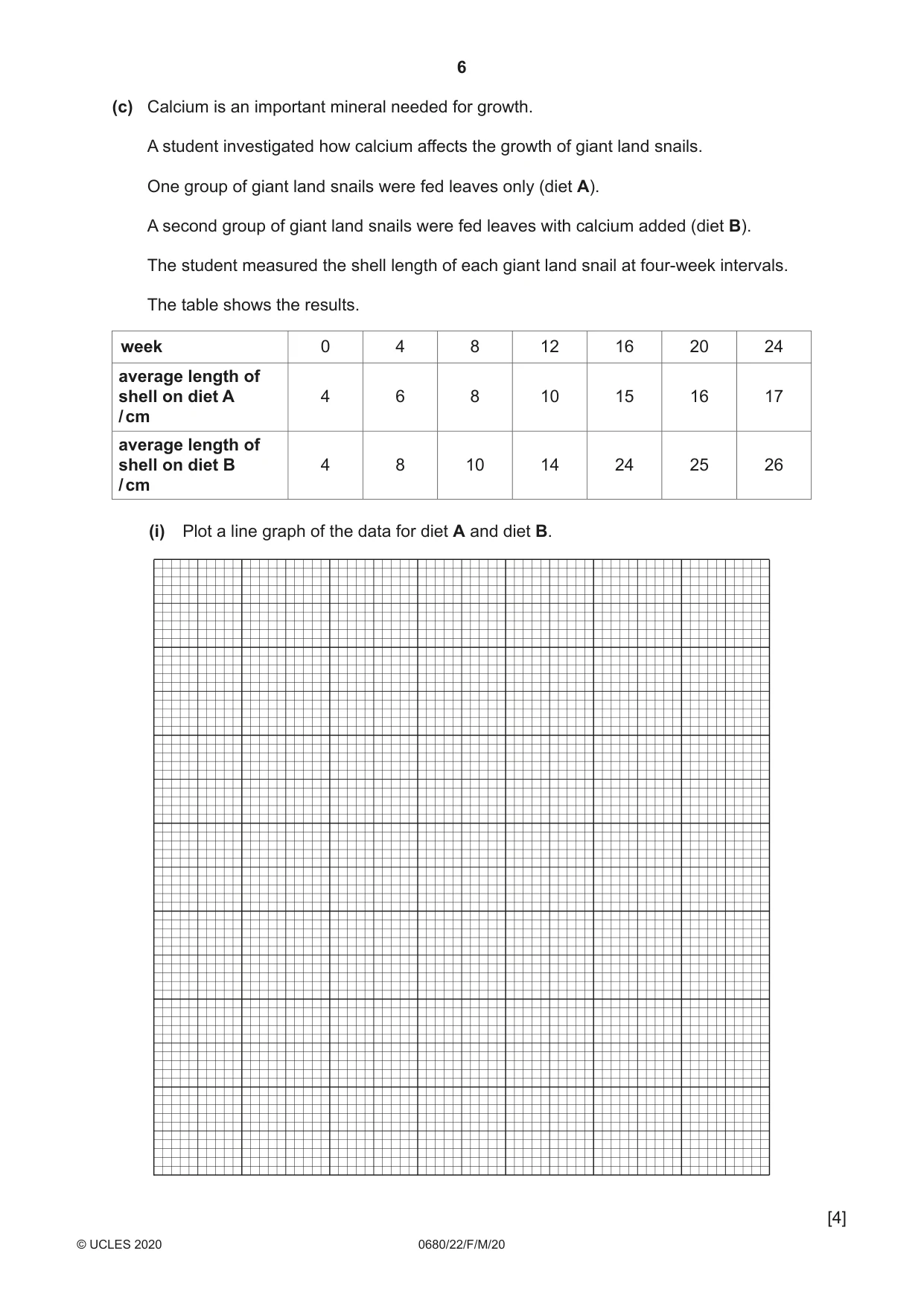
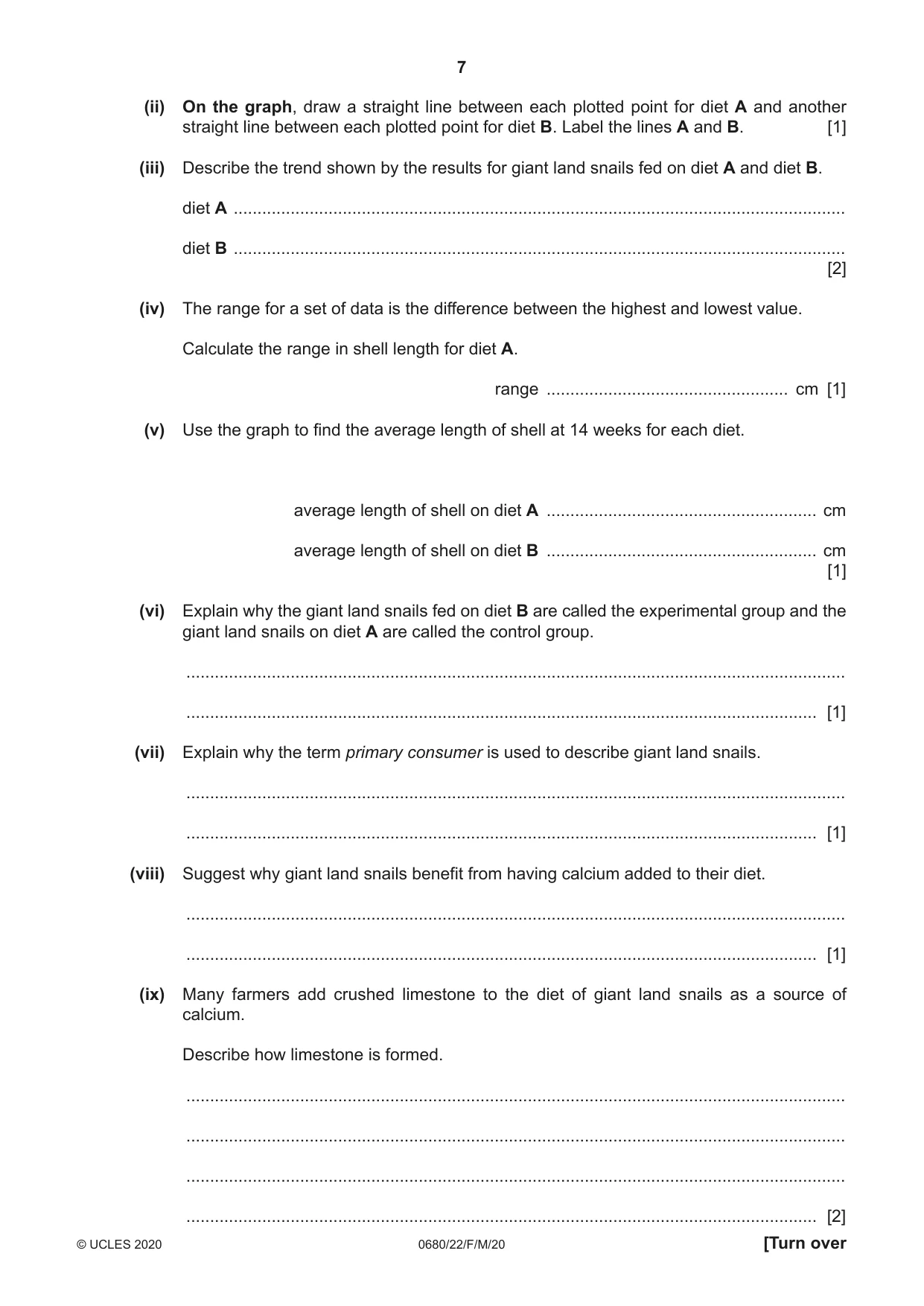
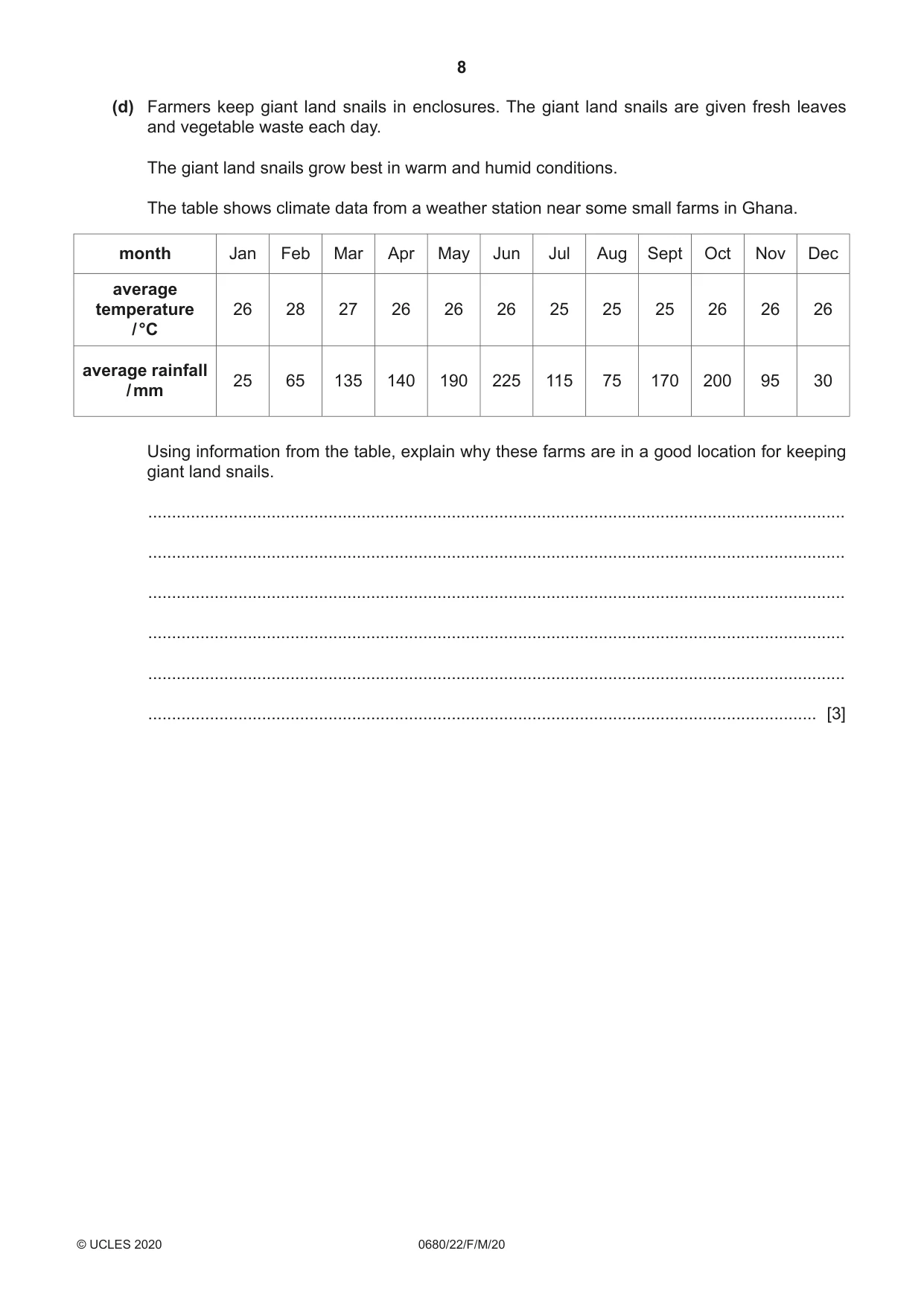
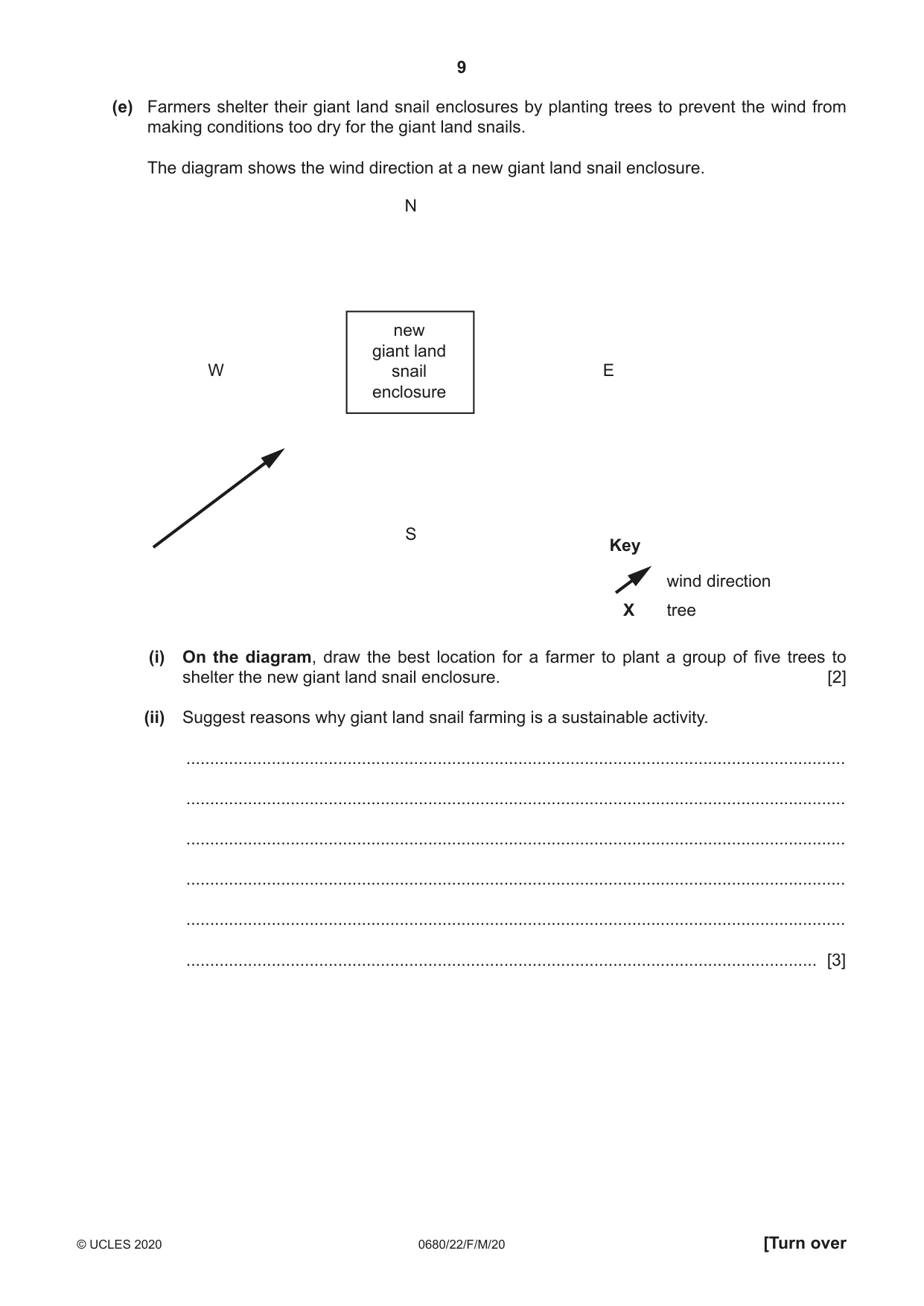
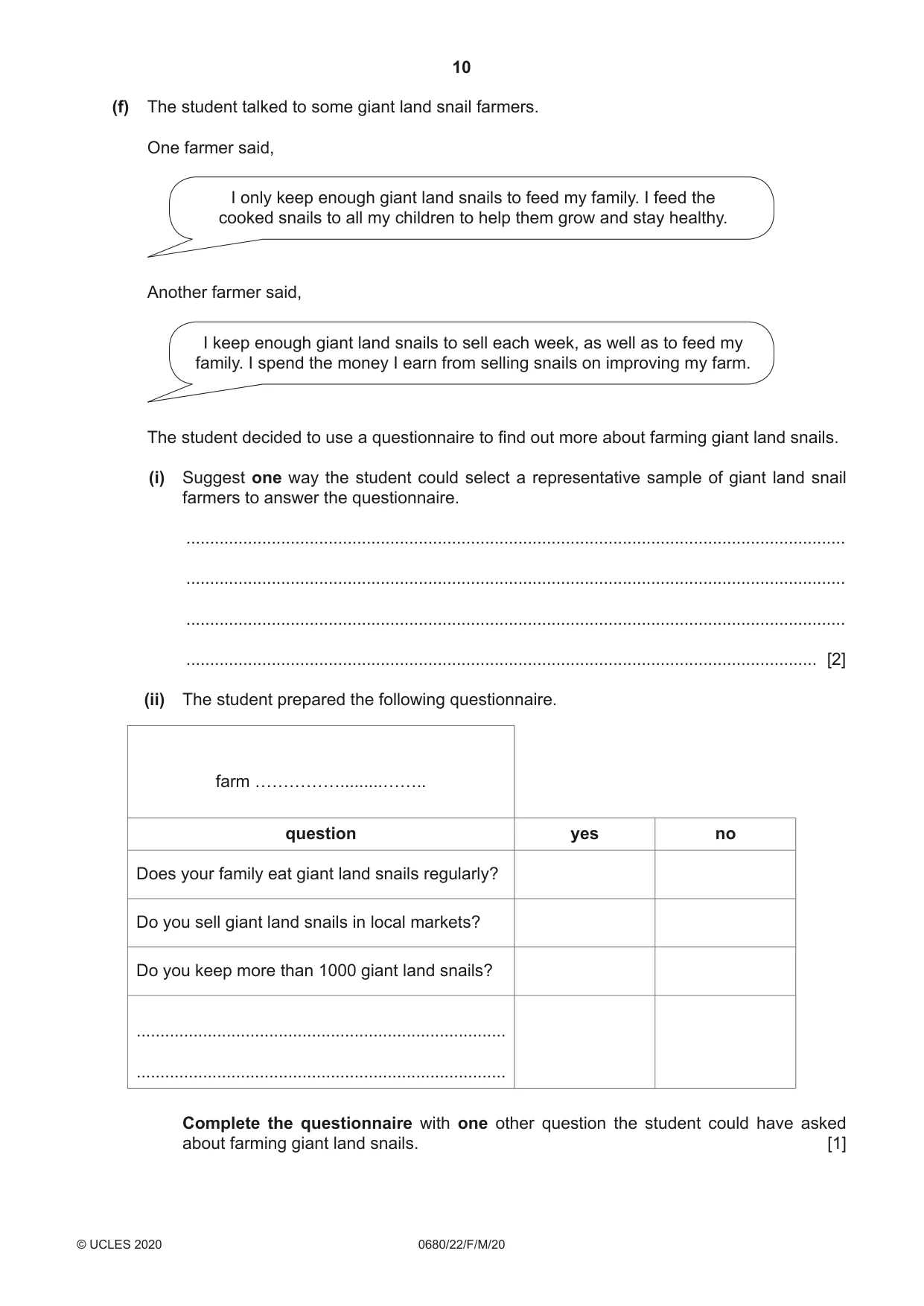
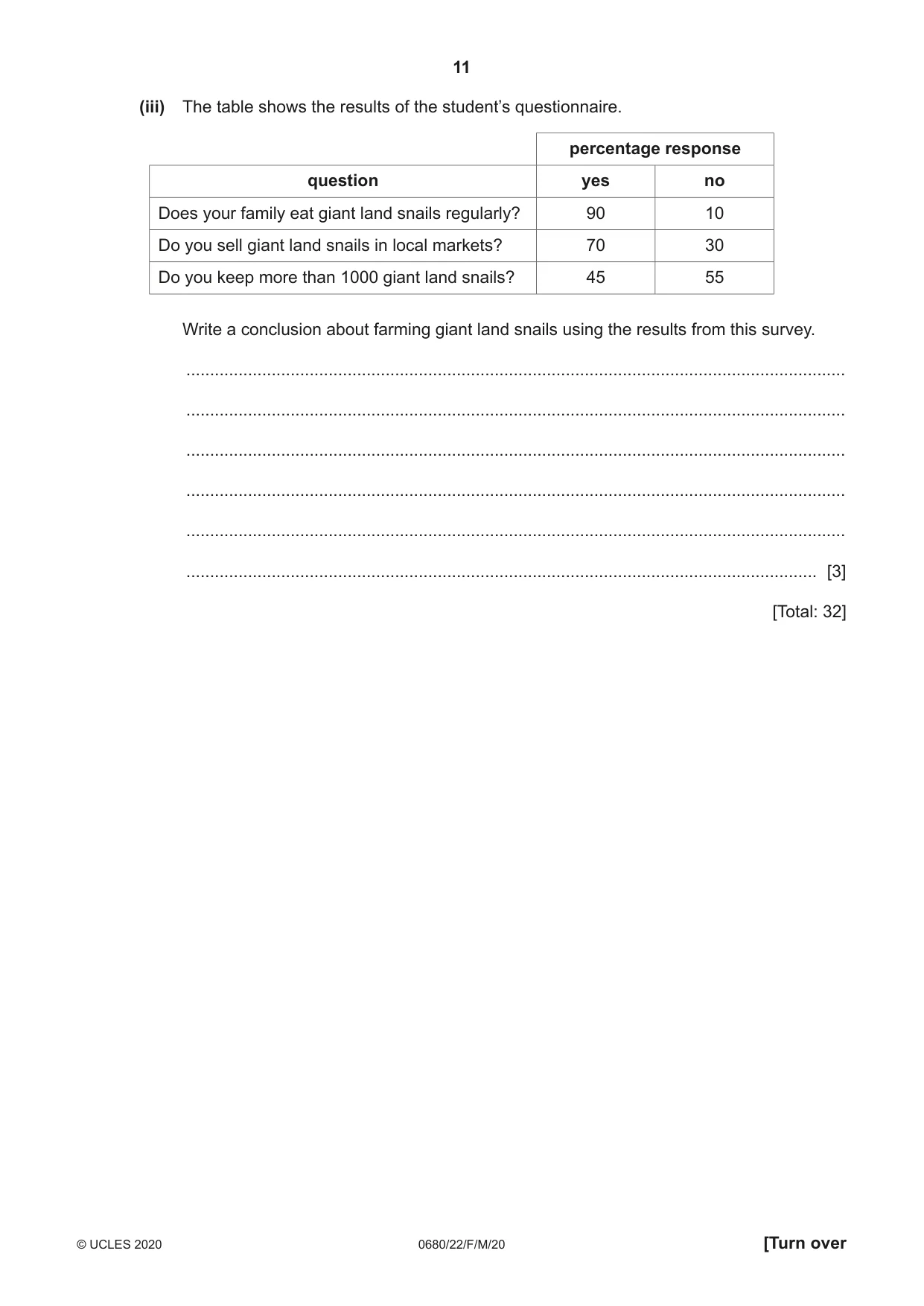
1 (a) In Ghana, 20% of the population are involved in agricultural production. Calculate the number of people involved in agricultural production in 2018. .......................................................... [1] (b) Many people in Ghana work on small farms. Some people farm giant land snails as a source of food and to sell in local markets. The photograph shows some giant land snails for sale. giant land snails The largest giant land snails are in highest demand and are sold for the highest prices. The diagram shows a giant land snail and the apparatus a farmer uses to measure the length of the shell of each giant land snail before selling them. shell body ruler measuring callipers not to scale (i) Suggest how a farmer could use the apparatus in the diagram to measure the length of the giant land snail shell. ........................................................................................................................................... ........................................................................................................................................... ........................................................................................................................................... ..................................................................................................................................... [2] (ii) Suggest one reason why the farmer does not measure the body length of the giant land snail. ........................................................................................................................................... ..................................................................................................................................... [1] (c) Calcium is an important mineral needed for growth. A student investigated how calcium affects the growth of giant land snails. One group of giant land snails were fed leaves only (diet A). A second group of giant land snails were fed leaves with calcium added (diet B). The student measured the shell length of each giant land snail at four-week intervals. The table shows the results. week 0 4 8 12 16 20 24 average length of shell on diet A 4 6 8 10 15 16 17 / cm average length of shell on diet B 4 8 10 14 24 25 26 / cm (i) Plot a line graph of the data for diet A and diet B. [4] (ii) On the graph, draw a straight line between each plotted point for diet A and another straight line between each plotted point for diet B. Label the lines A and B. [1] (iii) Describe the trend shown by the results for giant land snails fed on diet A and diet B. diet A ................................................................................................................................. diet B ................................................................................................................................. [2] (iv) The range for a set of data is the difference between the highest and lowest value. Calculate the range in shell length for diet A. range ................................................... cm [1] (v) Use the graph to find the average length of shell at 14 weeks for each diet. average length of shell on diet A ......................................................... cm average length of shell on diet B ......................................................... cm [1] (vi) Explain why the giant land snails fed on diet B are called the experimental group and the giant land snails on diet A are called the control group. ........................................................................................................................................... ..................................................................................................................................... [1] (vii) Explain why the term primary consumer is used to describe giant land snails. ........................................................................................................................................... ..................................................................................................................................... [1] (viii) Suggest why giant land snails benefit from having calcium added to their diet. ........................................................................................................................................... ..................................................................................................................................... [1] (ix) Many farmers add crushed limestone to the diet of giant land snails as a source of calcium. Describe how limestone is formed. ........................................................................................................................................... ........................................................................................................................................... ........................................................................................................................................... ..................................................................................................................................... [2] (d) Farmers keep giant land snails in enclosures. The giant land snails are given fresh leaves and vegetable waste each day. The giant land snails grow best in warm and humid conditions. The table shows climate data from a weather station near some small farms in Ghana. month Jan Feb Mar Apr May Jun Jul Aug Sept Oct Nov Dec average temperature 26 28 27 26 26 26 25 25 25 26 26 26 / °C average rainfall 25 65 135 140 190 225 115 75 170 200 95 30 / mm Using information from the table, explain why these farms are in a good location for keeping giant land snails. ................................................................................................................................................... ................................................................................................................................................... ................................................................................................................................................... ................................................................................................................................................... ................................................................................................................................................... ............................................................................................................................................. [3] (e) Farmers shelter their giant land snail enclosures by planting trees to prevent the wind from making conditions too dry for the giant land snails. The diagram shows the wind direction at a new giant land snail enclosure. N new giant land W snail E enclosure S Key wind direction X tree (i) On the diagram, draw the best location for a farmer to plant a group of five trees to shelter the new giant land snail enclosure. [2] (ii) Suggest reasons why giant land snail farming is a sustainable activity. ........................................................................................................................................... ........................................................................................................................................... ........................................................................................................................................... ........................................................................................................................................... ........................................................................................................................................... ..................................................................................................................................... [3] (f) The student talked to some giant land snail farmers. One farmer said, I only keep enough giant land snails to feed my family. I feed the cooked snails to all my children to help them grow and stay healthy. Another farmer said, I keep enough giant land snails to sell each week, as well as to feed my family. I spend the money I earn from selling snails on improving my farm. The student decided to use a questionnaire to find out more about farming giant land snails. (i) Suggest one way the student could select a representative sample of giant land snail farmers to answer the questionnaire. ........................................................................................................................................... ........................................................................................................................................... ........................................................................................................................................... ..................................................................................................................................... [2] (ii) The student prepared the following questionnaire. farm …………….........…….. question yes no Does your family eat giant land snails regularly? Do you sell giant land snails in local markets? Do you keep more than 1000 giant land snails? .............................................................................. .............................................................................. Complete the questionnaire with one other question the student could have asked about farming giant land snails. [1] (iii) The table shows the results of the student’s questionnaire. percentage response question yes no Does your family eat giant land snails regularly? 90 10 Do you sell giant land snails in local markets? 70 30 Do you keep more than 1000 giant land snails? 45 55 Write a conclusion about farming giant land snails using the results from this survey. ........................................................................................................................................... ........................................................................................................................................... ........................................................................................................................................... ........................................................................................................................................... ........................................................................................................................................... ..................................................................................................................................... [3] [Total: 32]
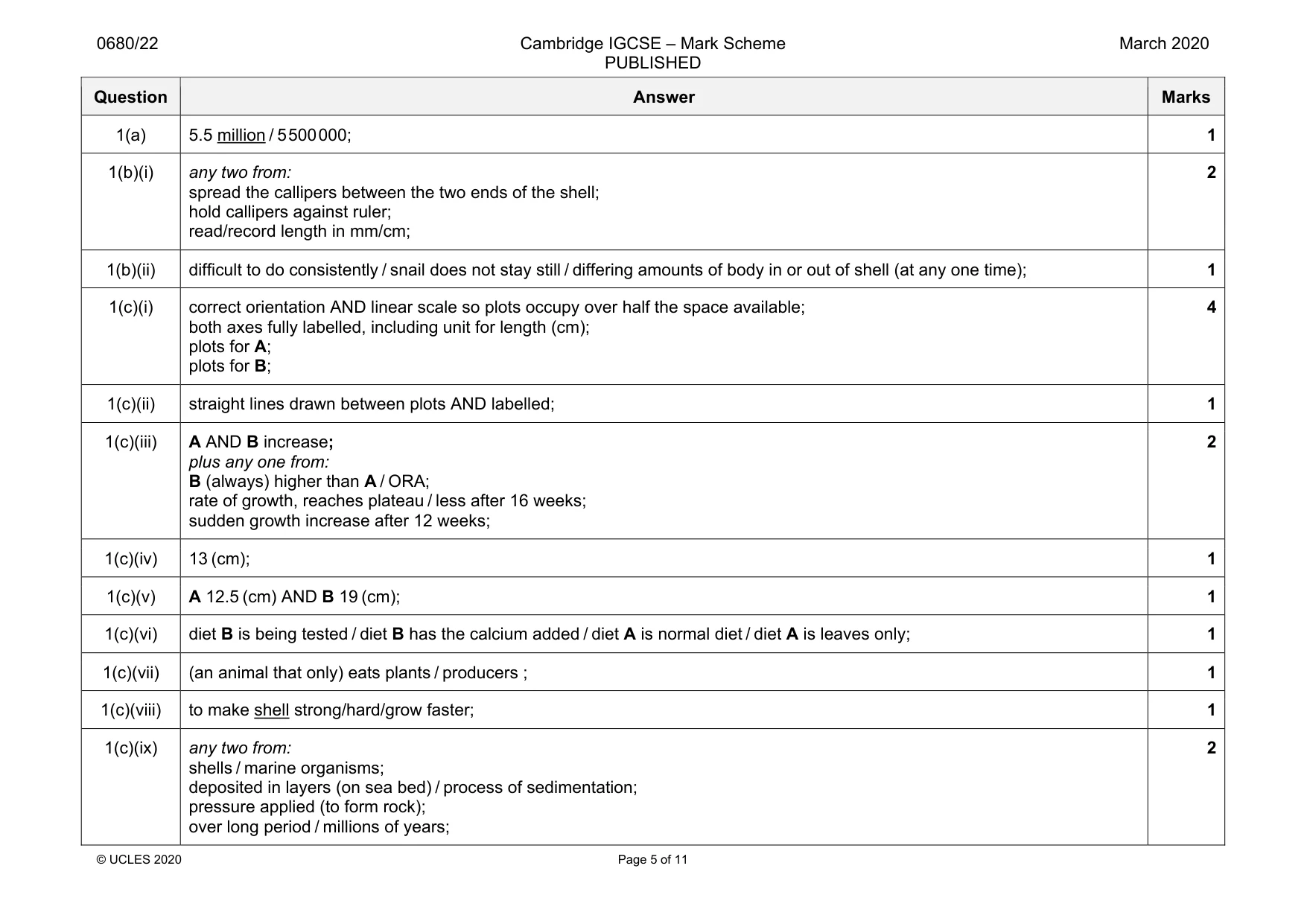
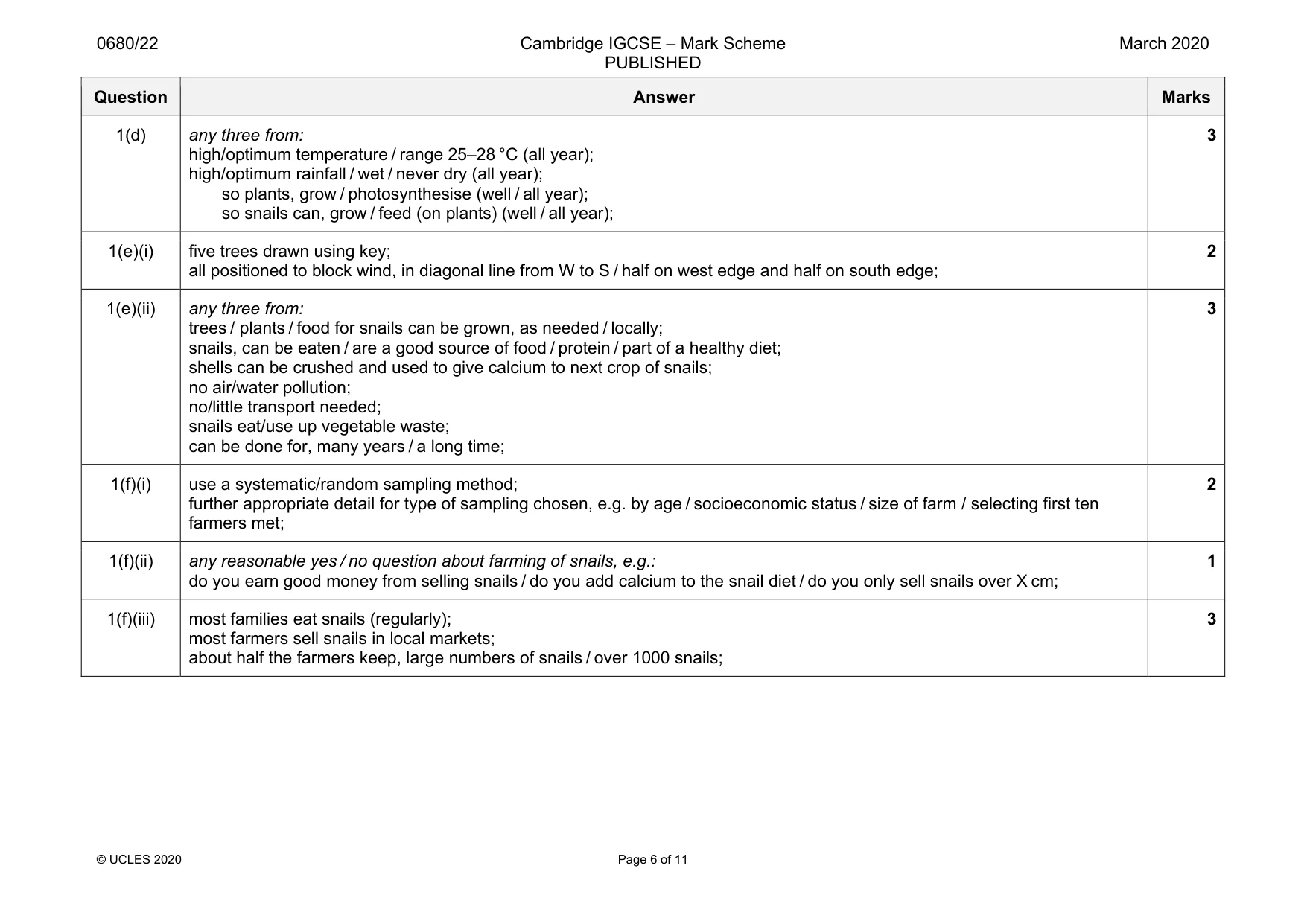
Mark scheme: 1(a) 5.5 million / 5 500 000; 1 1(b)(i) any two from: spread the callipers between the two ends of the shell; hold callipers against ruler; read/record length in mm/cm; 2 1(b)(ii) difficult to do consistently / snail does not stay still / differing amounts of body in or out of shell (at any one time); 1 1(c)(i) correct orientation AND linear scale so plots occupy over half the space available; both axes fully labelled, including unit for length (cm); plots for A; plots for B; 4 1(c)(ii) straight lines drawn between plots AND labelled; 1 1(c)(iii) A AND B increase; plus any one from: B (always) higher than A / ORA; rate of growth, reaches plateau / less after 16 weeks; sudden growth increase after 12 weeks; 2 1(c)(iv) 13 (cm); 1 1(c)(v) A 12.5 (cm) AND B 19 (cm); 1 1(c)(vi) diet B is being tested / diet B has the calcium added / diet A is normal diet / diet A is leaves only; 1 1(c)(vii) (an animal that only) eats plants / producers ; 1 1(c)(viii) to make shell strong/hard/grow faster; 1 1(c)(ix) any two from: shells / marine organisms; deposited in layers (on sea bed) / process of sedimentation; pressure applied (to form rock); over long period / millions of years; 2 Question Answer Marks 1(d) any three from: high/optimum temperature / range 25–28 °C (all year); high/optimum rainfall / wet / never dry (all year); so plants, grow / photosynthesise (well / all year); so snails can, grow / feed (on plants) (well / all year); 3 1(e)(i) five trees drawn using key; all positioned to block wind, in diagonal line from W to S / half on west edge and half on south edge; 2 1(e)(ii) any three from: trees / plants / food for snails can be grown, as needed / locally; snails, can be eaten / are a good source of food / protein / part of a healthy diet; shells can be crushed and used to give calcium to next crop of snails; no air/water pollution; no/little transport needed; snails eat/use up vegetable waste; can be done for, many years / a long time; 3 1(f)(i) use a systematic/random sampling method; further appropriate detail for type of sampling chosen, e.g. by age / socioeconomic status / size of farm / selecting first ten farmers met; 2 1(f)(ii) any reasonable yes / no question about farming of snails, e.g.: do you earn good money from selling snails / do you add calcium to the snail diet / do you only sell snails over X cm; 1 1(f)(iii) most families eat snails (regularly); most farmers sell snails in local markets; about half the farmers keep, large numbers of snails / over 1000 snails; 3
Q2 · The demand for energy in Ghana is increasing
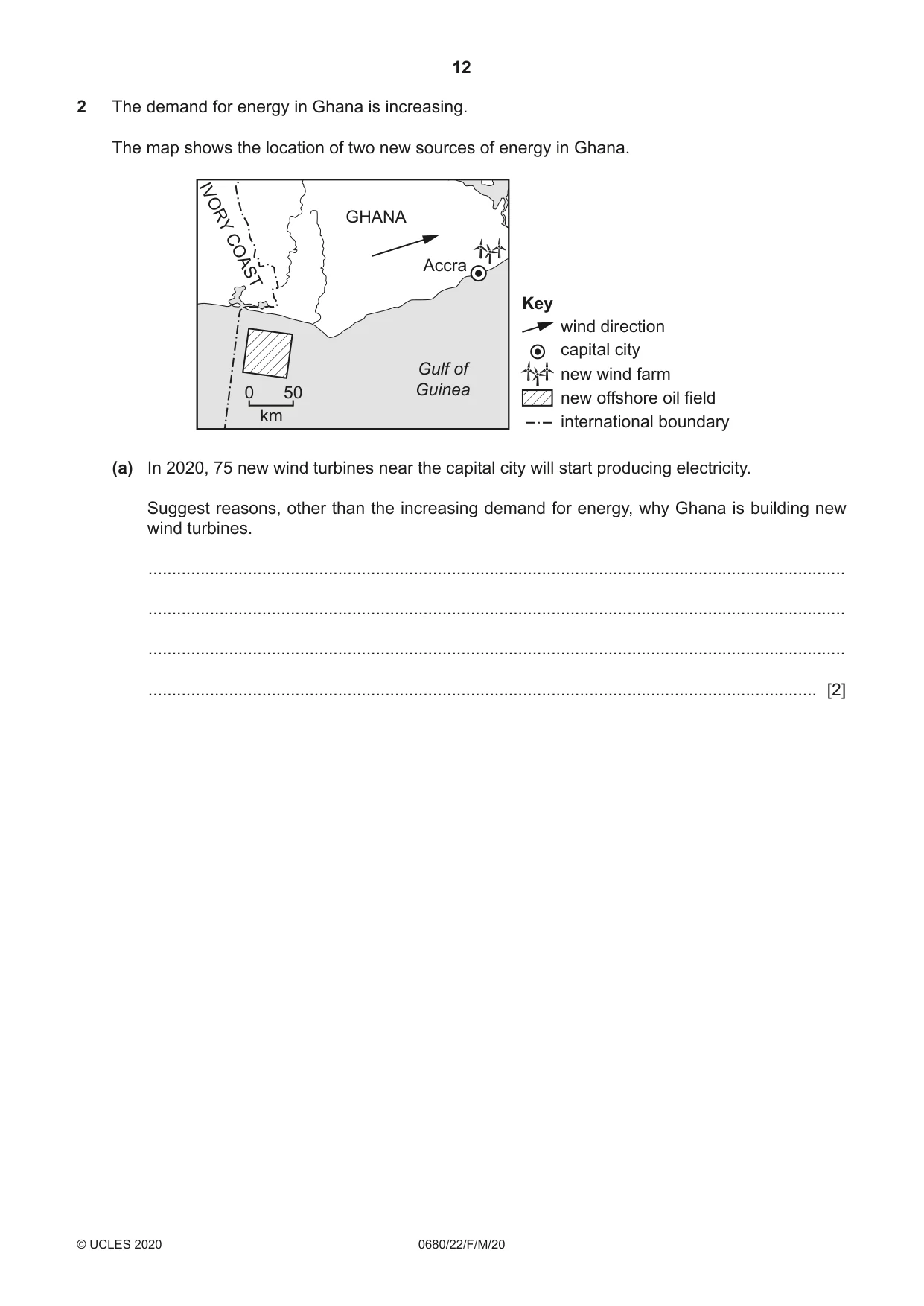
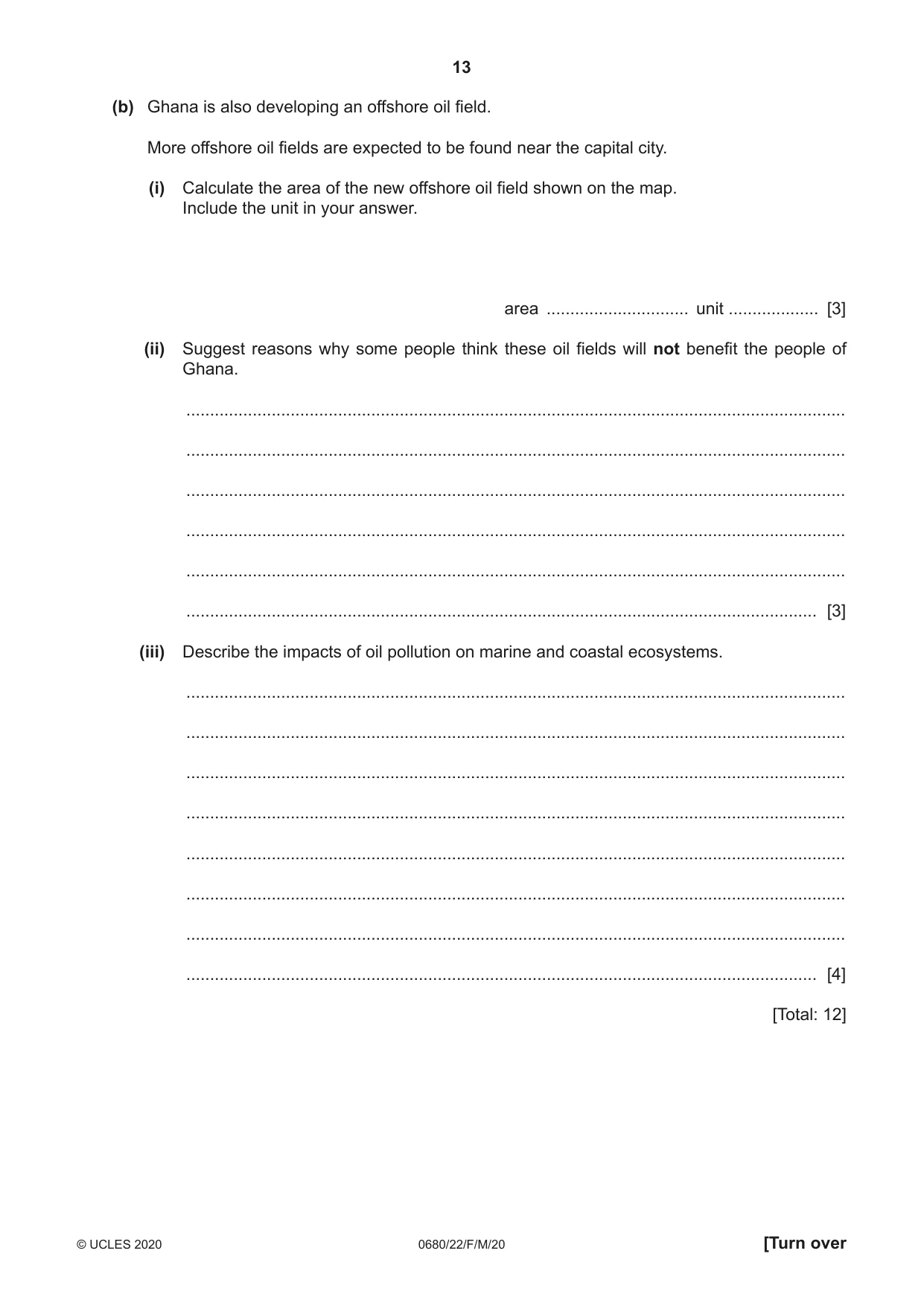
2 The demand for energy in Ghana is increasing. The map shows the location of two new sources of energy in Ghana. GHANA IVORY Accra COAST Key wind direction capital city Gulf of new wind farm 0 50 Guinea new offshore oil field km international boundary (a) In 2020, 75 new wind turbines near the capital city will start producing electricity. Suggest reasons, other than the increasing demand for energy, why Ghana is building new wind turbines. ................................................................................................................................................... ................................................................................................................................................... ................................................................................................................................................... ............................................................................................................................................. [2] (b) Ghana is also developing an offshore oil field. More offshore oil fields are expected to be found near the capital city. (i) Calculate the area of the new offshore oil field shown on the map. Include the unit in your answer. area .............................. unit ................... [3] (ii) Suggest reasons why some people think these oil fields will not benefit the people of Ghana. ........................................................................................................................................... ........................................................................................................................................... ........................................................................................................................................... ........................................................................................................................................... ........................................................................................................................................... ..................................................................................................................................... [3] (iii) Describe the impacts of oil pollution on marine and coastal ecosystems. ........................................................................................................................................... ........................................................................................................................................... ........................................................................................................................................... ........................................................................................................................................... ........................................................................................................................................... ........................................................................................................................................... ........................................................................................................................................... ..................................................................................................................................... [4] [Total: 12]
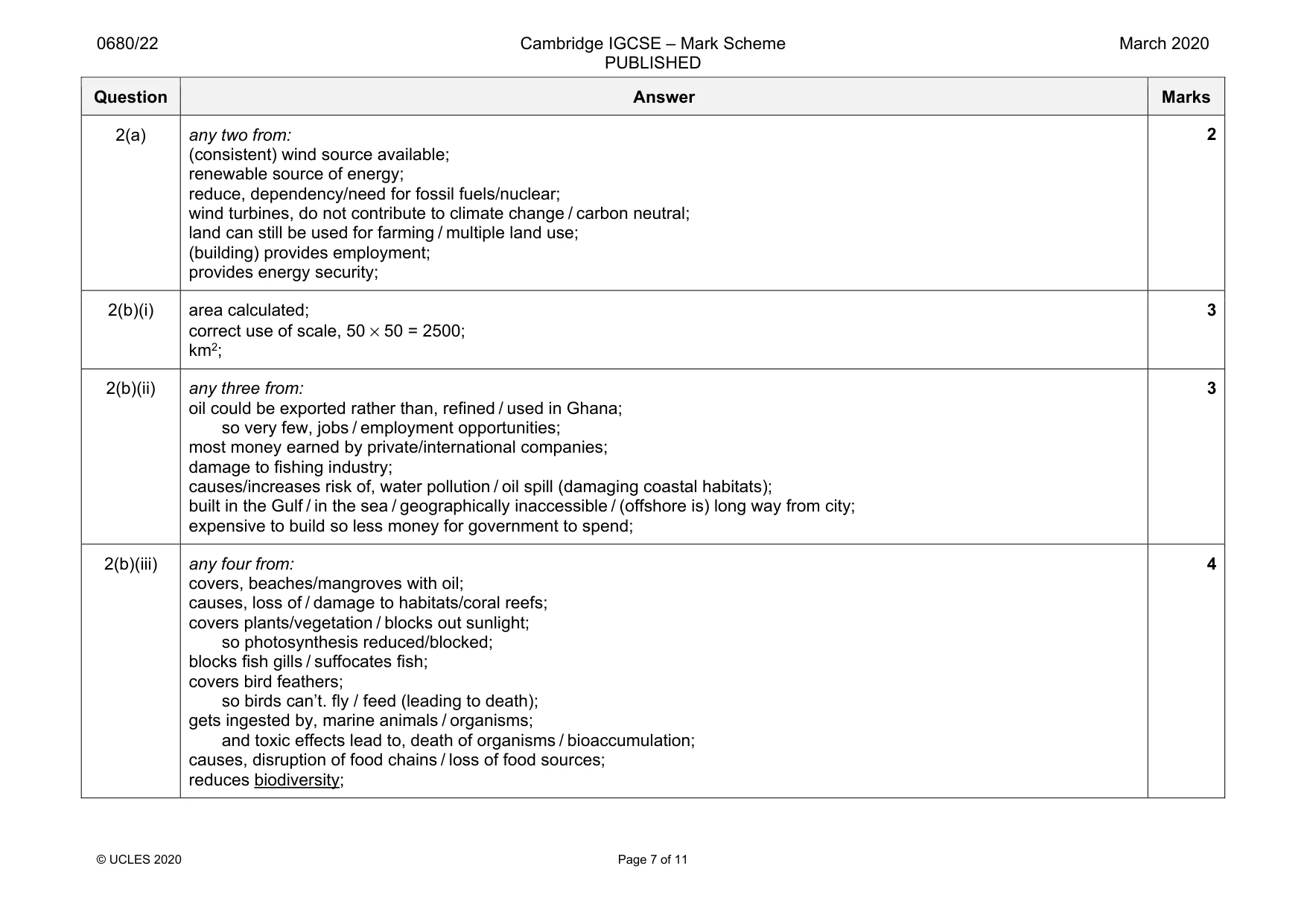
Mark scheme: 2(a) any two from: (consistent) wind source available; renewable source of energy; reduce, dependency/need for fossil fuels/nuclear; wind turbines, do not contribute to climate change / carbon neutral; land can still be used for farming / multiple land use; (building) provides employment; provides energy security; 2(b)(i) area calculated; correct use of scale, 50 × 50 = 2500; km2; 3 2(b)(ii) any three from: oil could be exported rather than, refined / used in Ghana; so very few, jobs / employment opportunities; most money earned by private/international companies; damage to fishing industry; causes/increases risk of, water pollution / oil spill (damaging coastal habitats); built in the Gulf / in the sea / geographically inaccessible / (offshore is) long way from city; expensive to build so less money for government to spend; 3 2(b)(iii) any four from: covers, beaches/mangroves with oil; causes, loss of / damage to habitats/coral reefs; covers plants/vegetation / blocks out sunlight; so photosynthesis reduced/blocked; blocks fish gills / suffocates fish; covers bird feathers; so birds can’t. fly / feed (leading to death); gets ingested by, marine animals / organisms; and toxic effects lead to, death of organisms / bioaccumulation; causes, disruption of food chains / loss of food sources; reduces biodiversity; 4
Q3 · The capital city, Accra, has grown rapidly
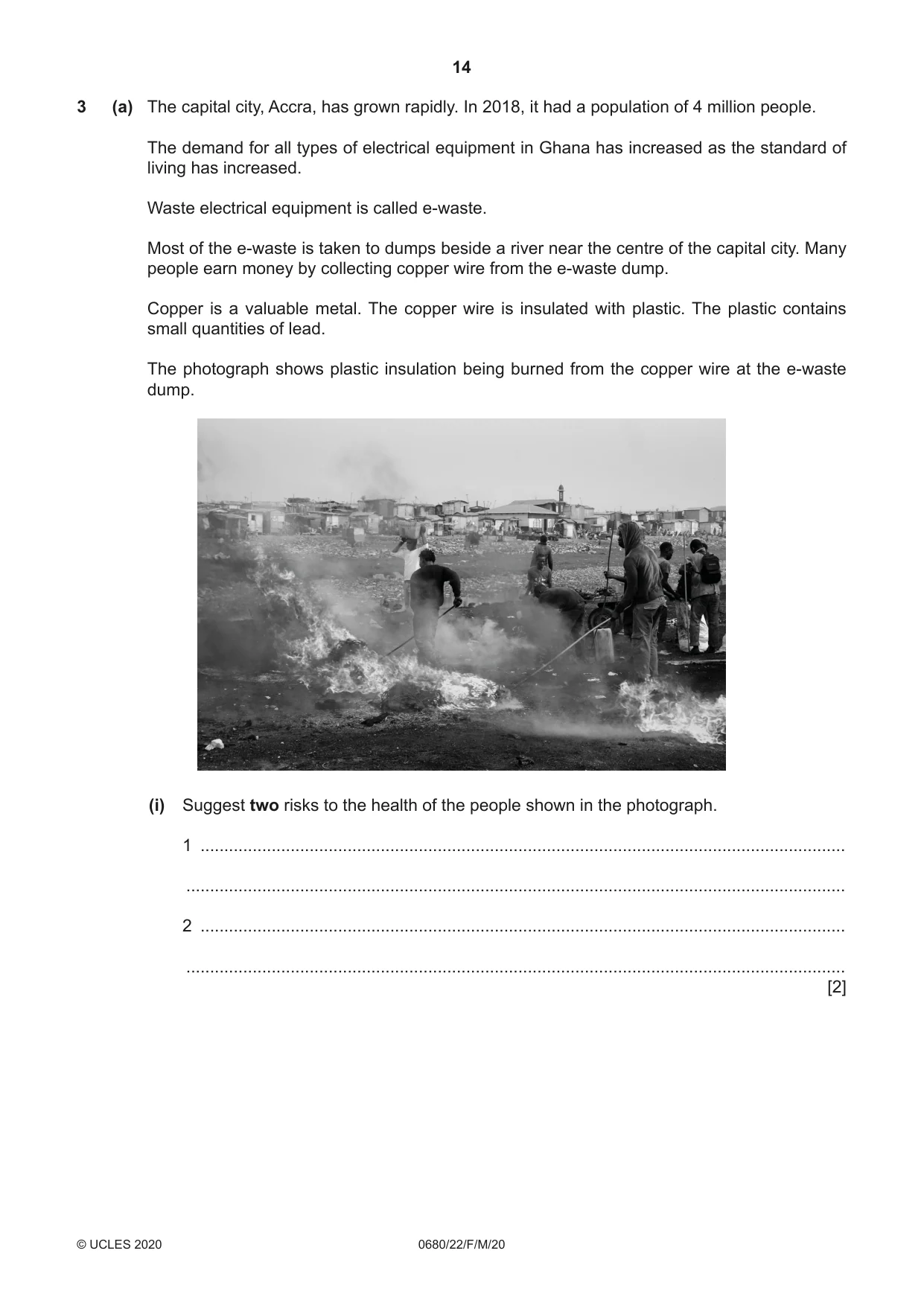
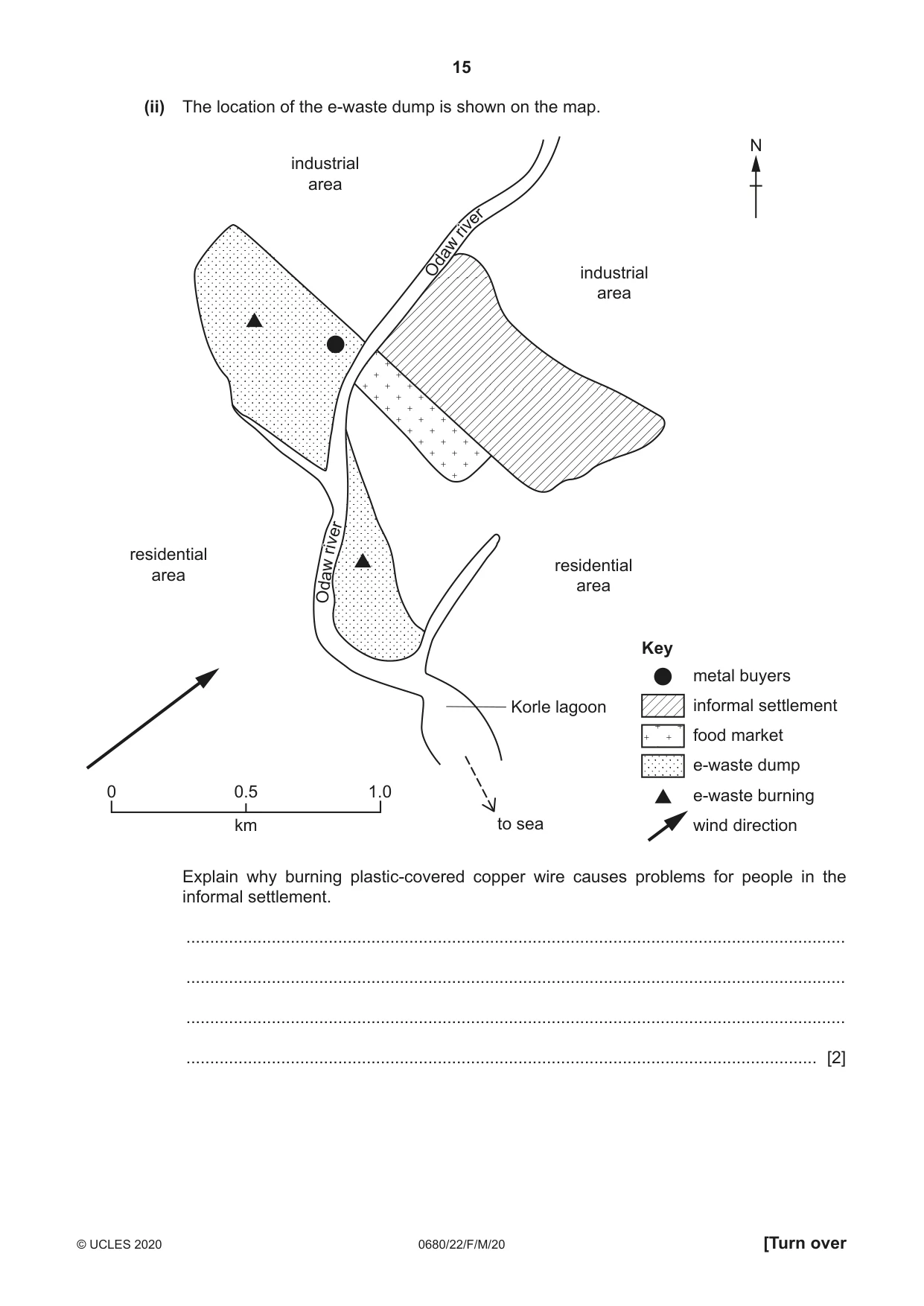
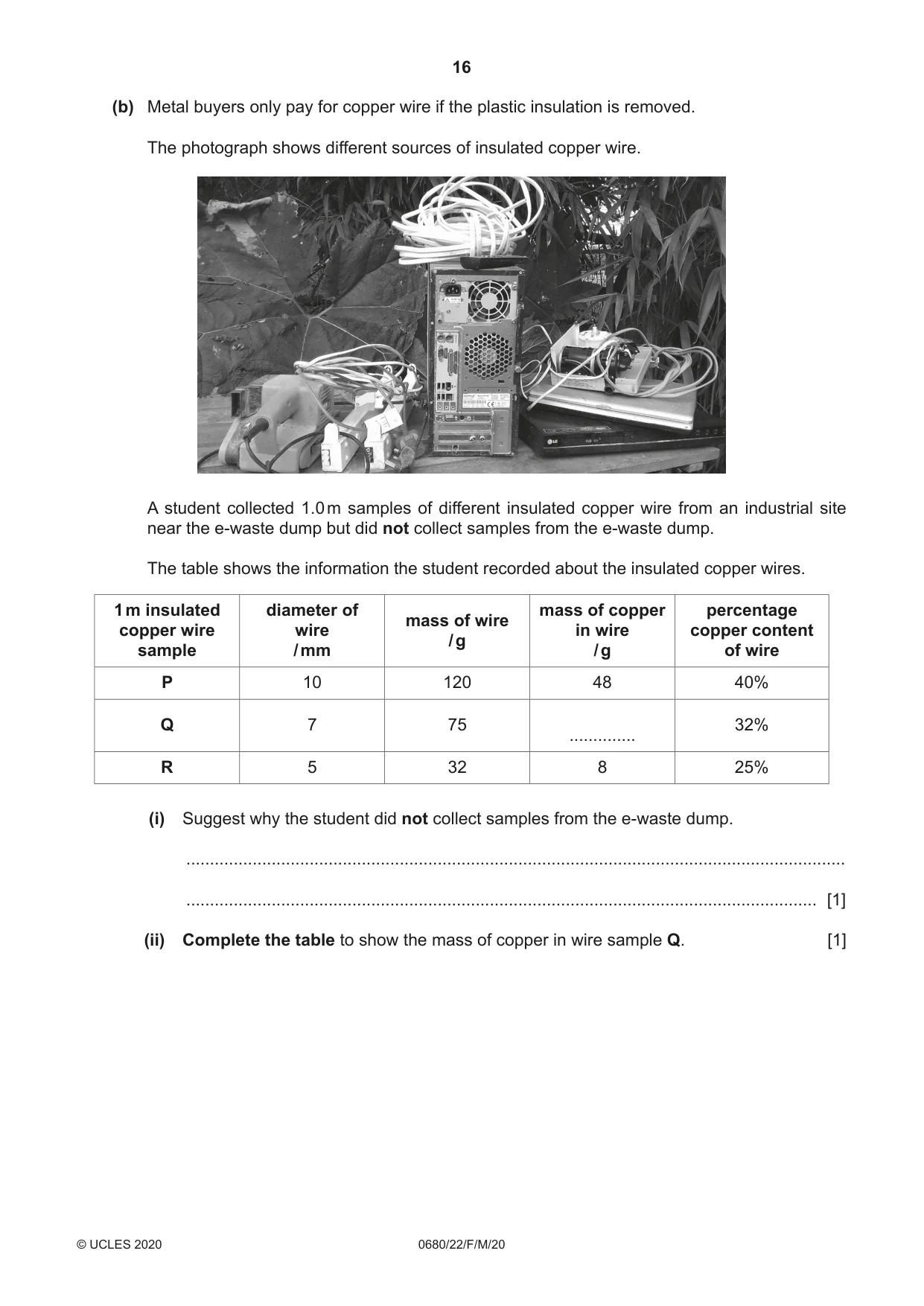
3 (a) The capital city, Accra, has grown rapidly. In 2018, it had a population of 4 million people. The demand for all types of electrical equipment in Ghana has increased as the standard of living has increased. Waste electrical equipment is called e-waste. Most of the e-waste is taken to dumps beside a river near the centre of the capital city. Many people earn money by collecting copper wire from the e-waste dump. Copper is a valuable metal. The copper wire is insulated with plastic. The plastic contains small quantities of lead. The photograph shows plastic insulation being burned from the copper wire at the e-waste dump. (i) Suggest two risks to the health of the people shown in the photograph. 1 ........................................................................................................................................ ........................................................................................................................................... 2 ........................................................................................................................................ ........................................................................................................................................... [2] (ii) The location of the e-waste dump is shown on the map. N industrial area erer vv riri dawdaw OO industrial area erer vv residential riri residential area dawdaw area OO Key metal buyers Korle lagoon informal settlement food market e-waste dump 0 0.5 1.0 e-waste burning km to sea wind direction Explain why burning plastic-covered copper wire causes problems for people in the informal settlement. ........................................................................................................................................... ........................................................................................................................................... ........................................................................................................................................... ..................................................................................................................................... [2] (b) Metal buyers only pay for copper wire if the plastic insulation is removed. The photograph shows different sources of insulated copper wire. A student collected 1.0 m samples of different insulated copper wire from an industrial site near the e-waste dump but did not collect samples from the e-waste dump. The table shows the information the student recorded about the insulated copper wires. 1 m insulated diameter of mass of copper percentage mass of wire copper wire wire in wire copper content / g sample / mm / g of wire P 10 120 48 40% Q 7 75 32% .............. R 5 32 8 25% (i) Suggest why the student did not collect samples from the e-waste dump. ........................................................................................................................................... ..................................................................................................................................... [1] (ii) Complete the table to show the mass of copper in wire sample Q. [1]
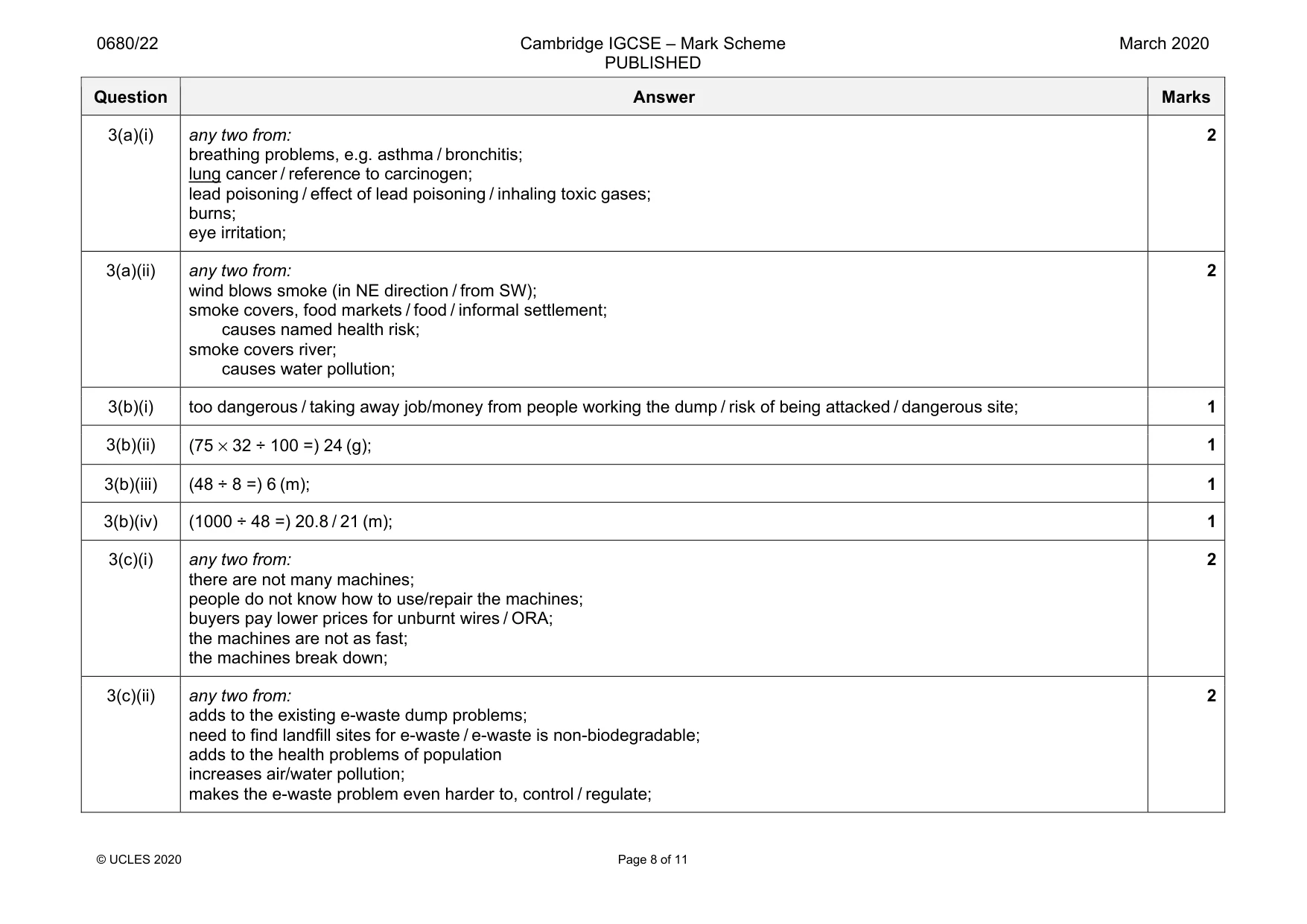
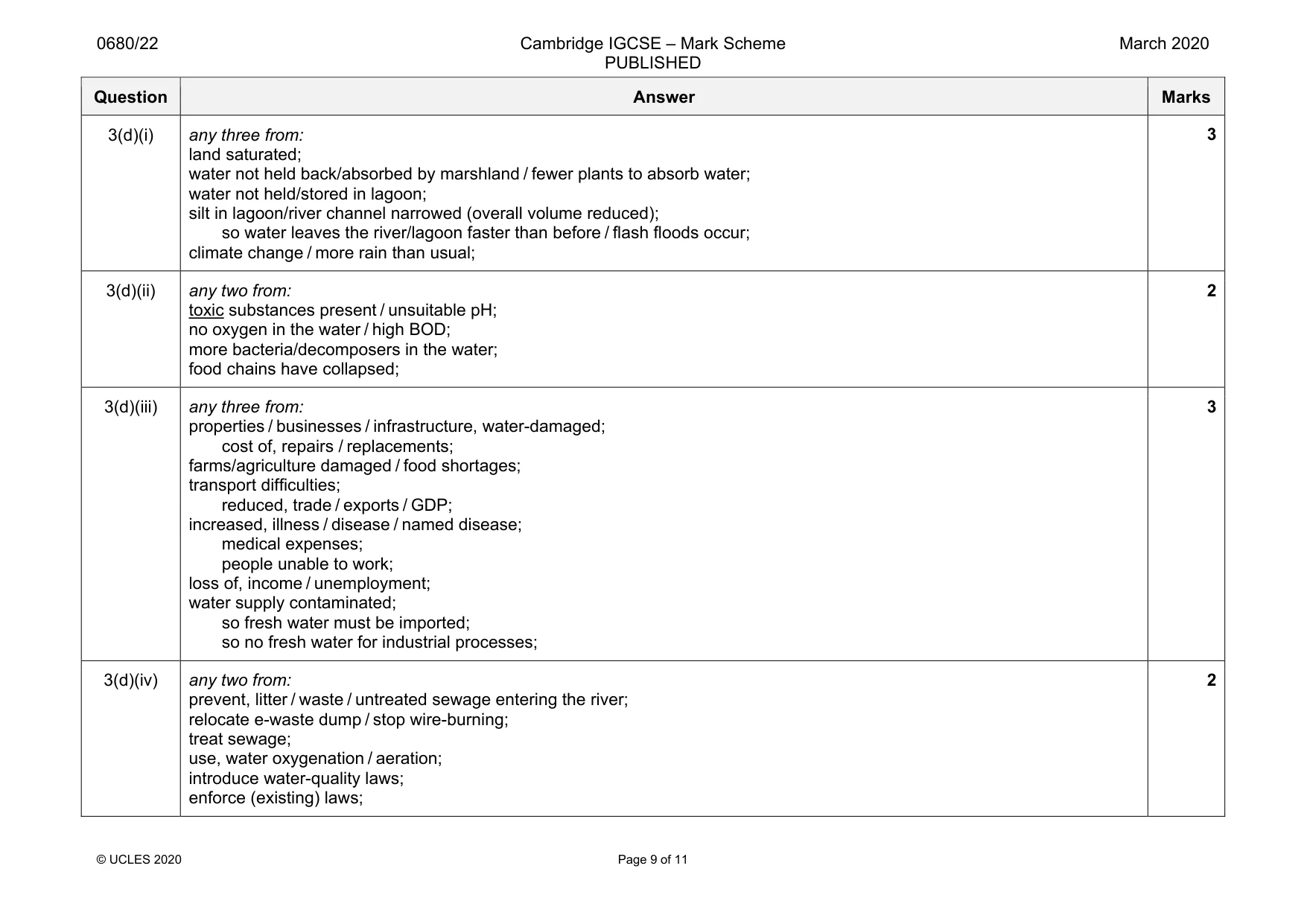
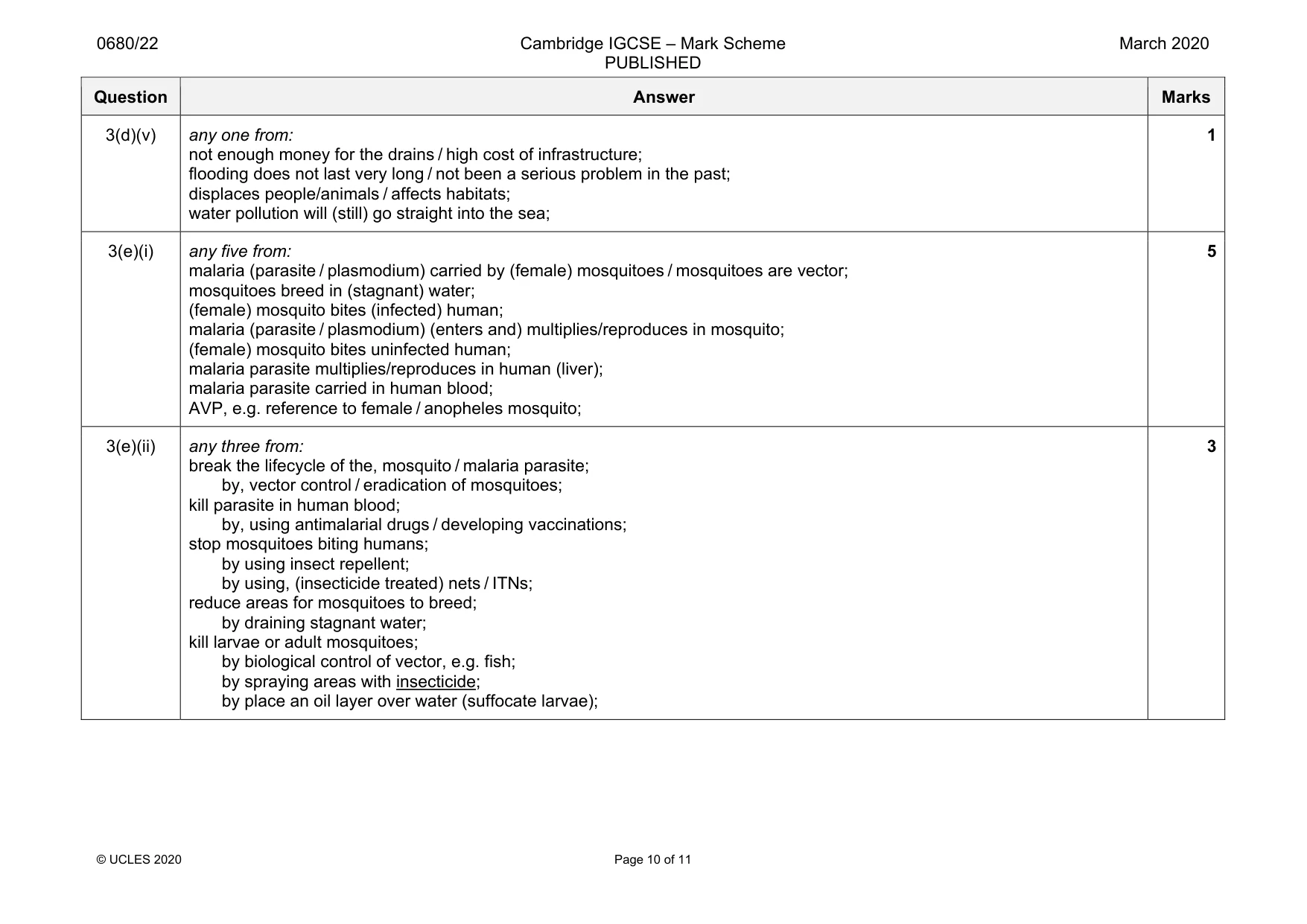
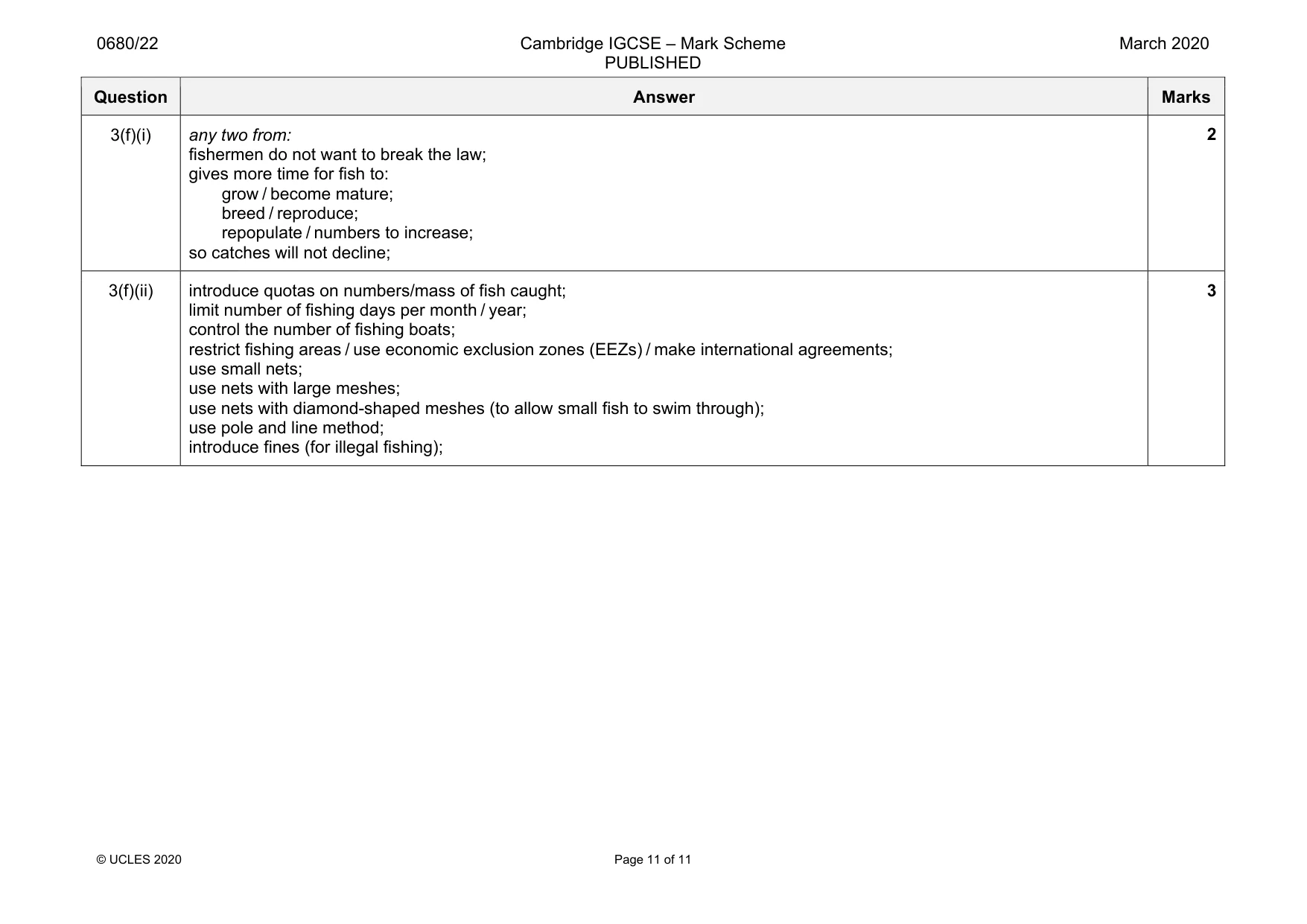
Mark scheme: 3(a)(i) any two from: breathing problems, e.g. asthma / bronchitis; lung cancer / reference to carcinogen; lead poisoning / effect of lead poisoning / inhaling toxic gases; burns; eye irritation; 2 3(a)(ii) any two from: wind blows smoke (in NE direction / from SW); smoke covers, food markets / food / informal settlement; causes named health risk; smoke covers river; causes water pollution; 2 3(b)(i) too dangerous / taking away job/money from people working the dump / risk of being attacked / dangerous site; 1 3(b)(ii) (75 × 32 ÷ 100 =) 24 (g); 1 3(b)(iii) (48 ÷ 8 =) 6 (m); 1 3(b)(iv) (1000 ÷ 48 =) 20.8 / 21 (m); 1 3(c)(i) any two from: there are not many machines; people do not know how to use/repair the machines; buyers pay lower prices for unburnt wires / ORA; the machines are not as fast; the machines break down; 2 3(c)(ii) any two from: adds to the existing e-waste dump problems; need to find landfill sites for e-waste / e-waste is non-biodegradable; adds to the health problems of population increases air/water pollution; makes the e-waste problem even harder to, control / regulate; 2 Question Answer Marks 3(d)(i) any three from: land saturated; water not held back/absorbed by marshland / fewer plants to absorb water; water not held/stored in lagoon; silt in lagoon/river channel narrowed (overall volume reduced); so water leaves the river/lagoon faster than before / flash floods occur; climate change / more rain than usual; 3 3(d)(ii) any two from: toxic substances present / unsuitable pH; no oxygen in the water / high BOD; more bacteria/decomposers in the water; food chains have collapsed; 2 3(d)(iii) any three from: properties / businesses / infrastructure, water-damaged; cost of, repairs / replacements; farms/agriculture damaged / food shortages; transport difficulties; reduced, trade / exports / GDP; increased, illness / disease / named disease; medical expenses; people unable to work; loss of, income / unemployment; water supply contaminated; so fresh water must be imported; so no fresh water for industrial processes; 3 3(d)(iv) any two from: prevent, litter / waste / untreated sewage entering the river; relocate e-waste dump / stop wire-burning; treat sewage; use, water oxygenation / aeration; introduce water-quality laws; enforce (existing) laws; 2 Question Answer Marks 3(d)(v) any one from: not enough money for the drains / high cost of infrastructure; flooding does not last very long / not been a serious problem in the past; displaces people/animals / affects habitats; water pollution will (still) go straight into the sea; 1 3(e)(i) any five from: malaria (parasite / plasmodium) carried by (female) mosquitoes / mosquitoes are vector; mosquitoes breed in (stagnant) water; (female) mosquito bites (infected) human; malaria (parasite / plasmodium) (enters and) multiplies/reproduces in mosquito; (female) mosquito bites uninfected human; malaria parasite multiplies/reproduces in human (liver); malaria parasite carried in human blood; AVP, e.g. reference to female / anopheles mosquito; 5 3(e)(ii) any three from: break the lifecycle of the, mosquito / malaria parasite; by, vector control / eradication of mosquitoes; kill parasite in human blood; by, using antimalarial drugs / developing vaccinations; stop mosquitoes biting humans; by using insect repellent; by using, (insecticide treated) nets / ITNs; reduce areas for mosquitoes to breed; by draining stagnant water; kill larvae or adult mosquitoes; by biological control of vector, e.g. fish; by spraying areas with insecticide; by place an oil layer over water (suffocate larvae); 3 Question Answer Marks 3(f)(i) any two from: fishermen do not want to break the law; gives more time for fish to: grow / become mature; breed / reproduce; repopulate / numbers to increase; so catches will not decline; 2 3(f)(ii) introduce quotas on numbers/mass of fish caught; limit number of fishing days per month / year; control the number of fishing boats; restrict fishing areas / use economic exclusion zones (EEZs) / make international agreements; use small nets; use nets with large meshes; use nets with diamond-shaped meshes (to allow small fish to swim through); use pole and line method; introduce fines (for illegal fishing); 3
What was in this paper
The subtopics covered by these 3 questions, and how many questions each got. Open one in a new tab to see every Cambridge question on it.
What you needed in this session
Cambridge’s own grade thresholds for 2020 Feb/March, Paper 2 · Variant 2. A higher threshold means an easier paper — the bar moves with how the cohort did.