Cambridge IGCSE Environmental Management 0680 — 2013 Oct/Nov Paper 4 · Variant 3
0680/43/O/N/13 · 60 marks · ≈68 min
The question paper and its mark scheme, free to read here and free to download. This is Cambridge’s own paper, exactly as it was sat.
Question paper16 pages

Mark scheme3 pages
Answers below. Sit the paper first if you are practising.

Paper as text
Question paper, page 1
This document consists of 15 printed pages and 1 blank page. DC (NF/SW) 67706/3 © UCLES 2013 [Turn over UNIVERSITY OF CAMBRIDGE INTERNATIONAL EXAMINATIONS International General Certificate of Secondary Education * 3 2 2 1 1 3 6 6 7 8 * ENVIRONMENTAL MANAGEMENT 0680/43 Alternative to Coursework October/November 2013 1 hour 30 minutes Candidates answer on the Question Paper. Additional Materials: Ruler READ THESE INSTRUCTIONS FIRST Write your Centre number, candidate number and name on all the work you hand in. Write in dark blue or black pen. You may use a pencil for any diagrams, graphs or rough working. Do not use staples, paper clips, highlighters, glue or correction fluid. DO NOT WRITE IN ANY BARCODES. Answer all questions. Electronic calculators may be used. You may lose marks if you do not show your working or if you do not use appropriate units. Study the appropriate source materials before you start to write your answers. Credit will be given for appropriate selection and use of data in your answers and for relevant interpretation of these data. Suggestions for data sources are given in some questions. You may use the source data to draw diagrams and graphs or to do calculations to illustrate your answers. At the end of the examination, fasten all your work securely together. The number of marks is given in brackets [ ] at the end of each question or part question. For Examiner’s Use 1 2 Total
Question paper, page 2
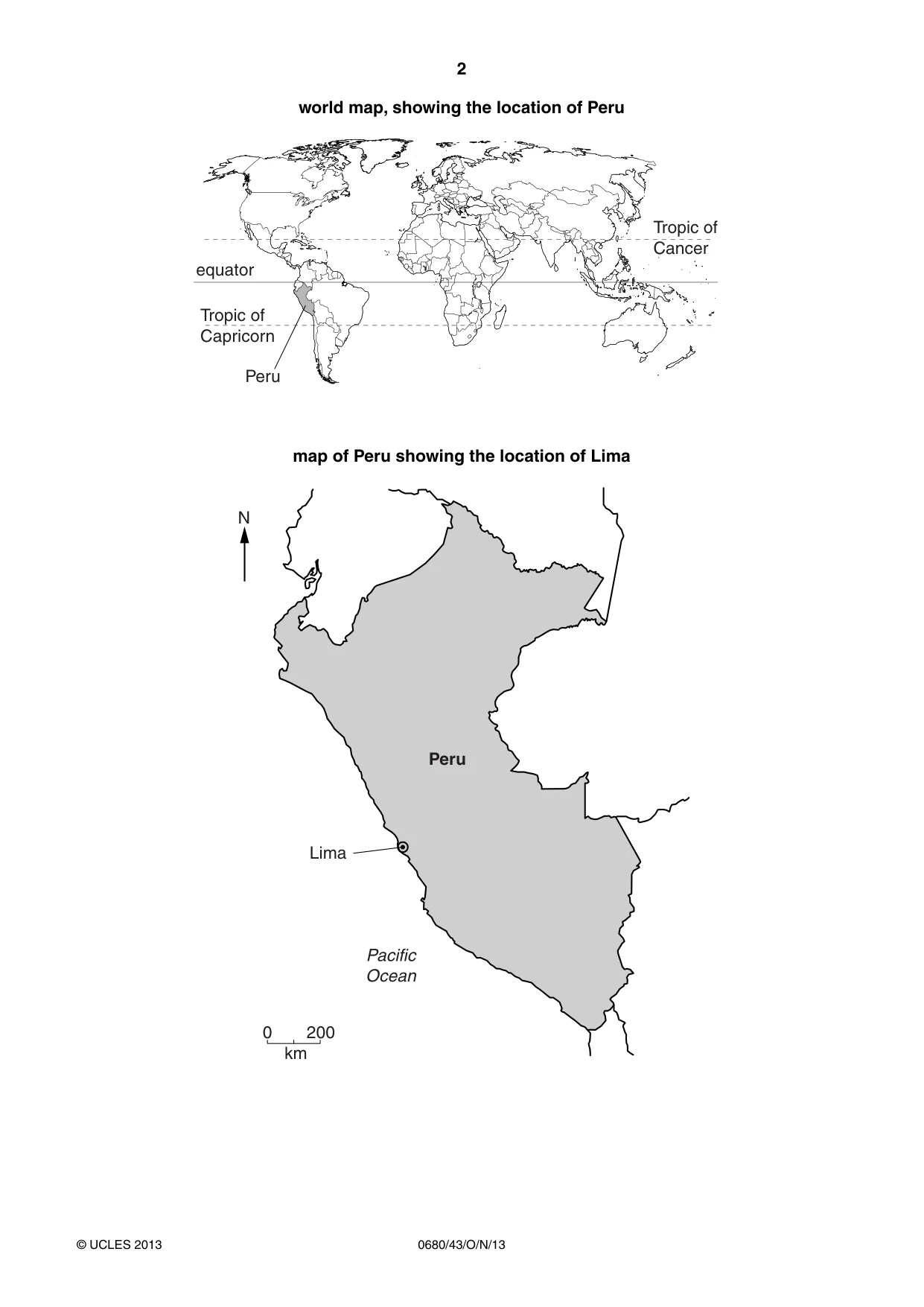
2 0680/43/O/N/13 © UCLES 2013 world map, showing the location of Peru Tropic of Cancer Tropic of Capricorn Peru equator map of Peru showing the location of Lima Peru Lima Pacific Ocean km 0 200 N
Question paper, page 3
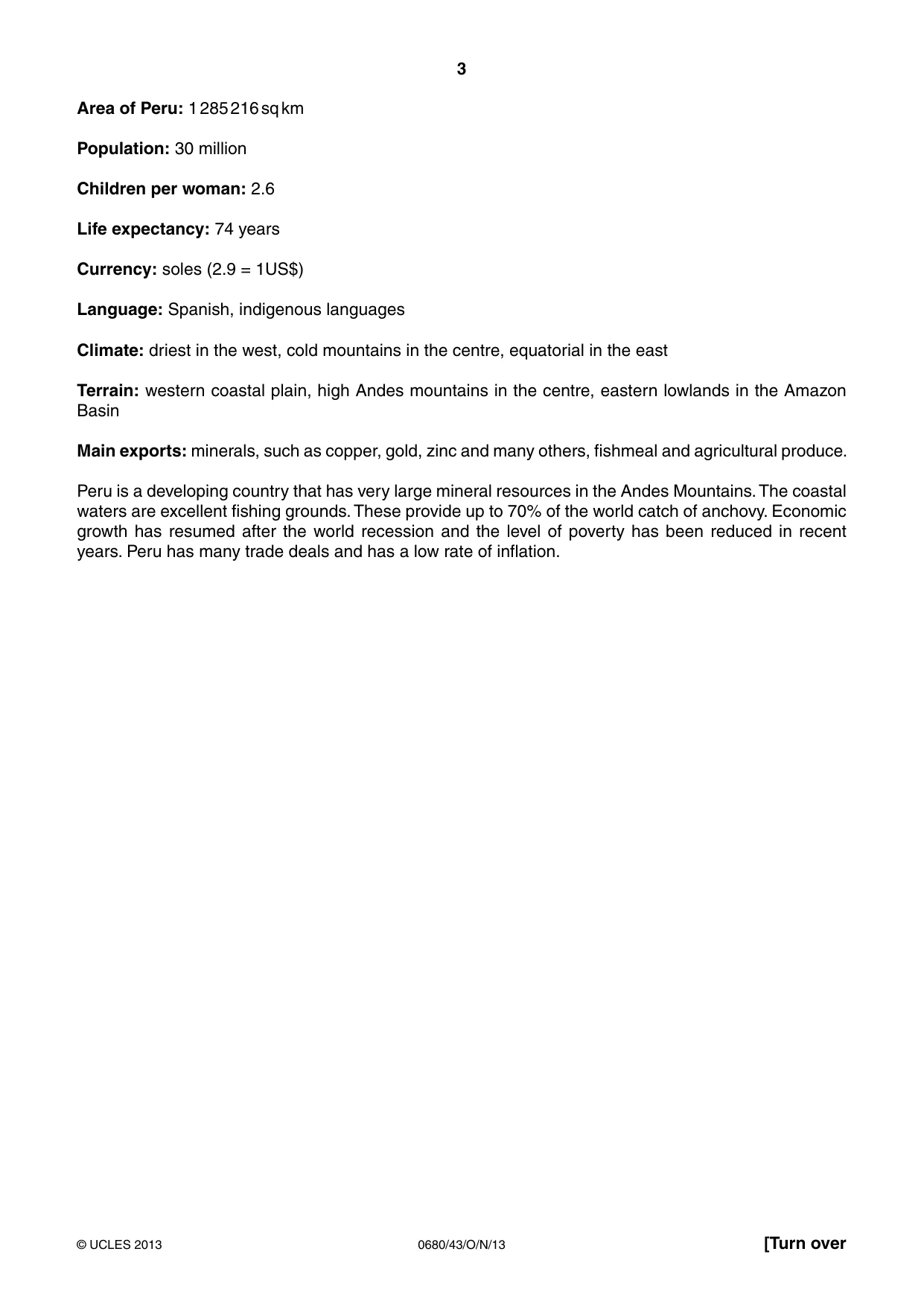
3 0680/43/O/N/13 © UCLES 2013 [Turn over Area of Peru: 1 285 216 sq km Population: 30 million Children per woman: 2.6 Life expectancy: 74 years Currency: soles (2.9 = 1US$) Language: Spanish, indigenous languages Climate: driest in the west, cold mountains in the centre, equatorial in the east Terrain: western coastal plain, high Andes mountains in the centre, eastern lowlands in the Amazon Basin Main exports: minerals, such as copper, gold, zinc and many others, fishmeal and agricultural produce. Peru is a developing country that has very large mineral resources in the Andes Mountains. The coastal waters are excellent fishing grounds. These provide up to 70% of the world catch of anchovy. Economic growth has resumed after the world recession and the level of poverty has been reduced in recent years. Peru has many trade deals and has a low rate of inflation.
Question paper, page 4
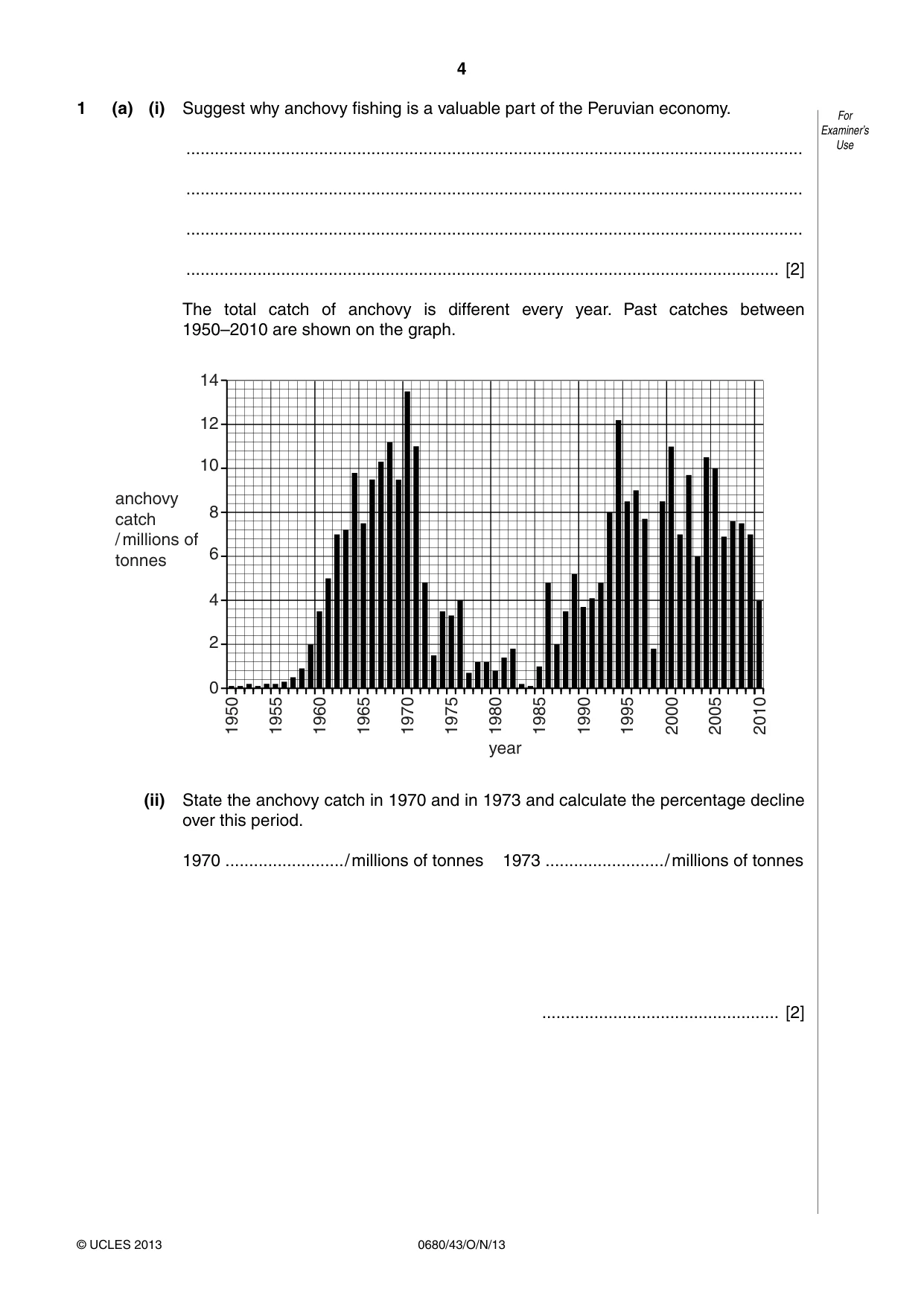
4 0680/43/O/N/13 © UCLES 2013 For Examiner’s Use 1 (a) (i) Suggest why anchovy fishing is a valuable part of the Peruvian economy. … … … … [2] The total catch of anchovy is different every year. Past catches between 1950–2010 are shown on the graph. 0 1950 1955 1960 1965 1970 1975 1980 1985 1990 1995 2000 2005 2010 4 8 year anchovy catch / millions of tonnes 12 14 2 6 10 (ii) State the anchovy catch in 1970 and in 1973 and calculate the percentage decline over this period. 1970 … / millions of tonnes 1973 … / millions of tonnes … [2]
Question paper, page 5
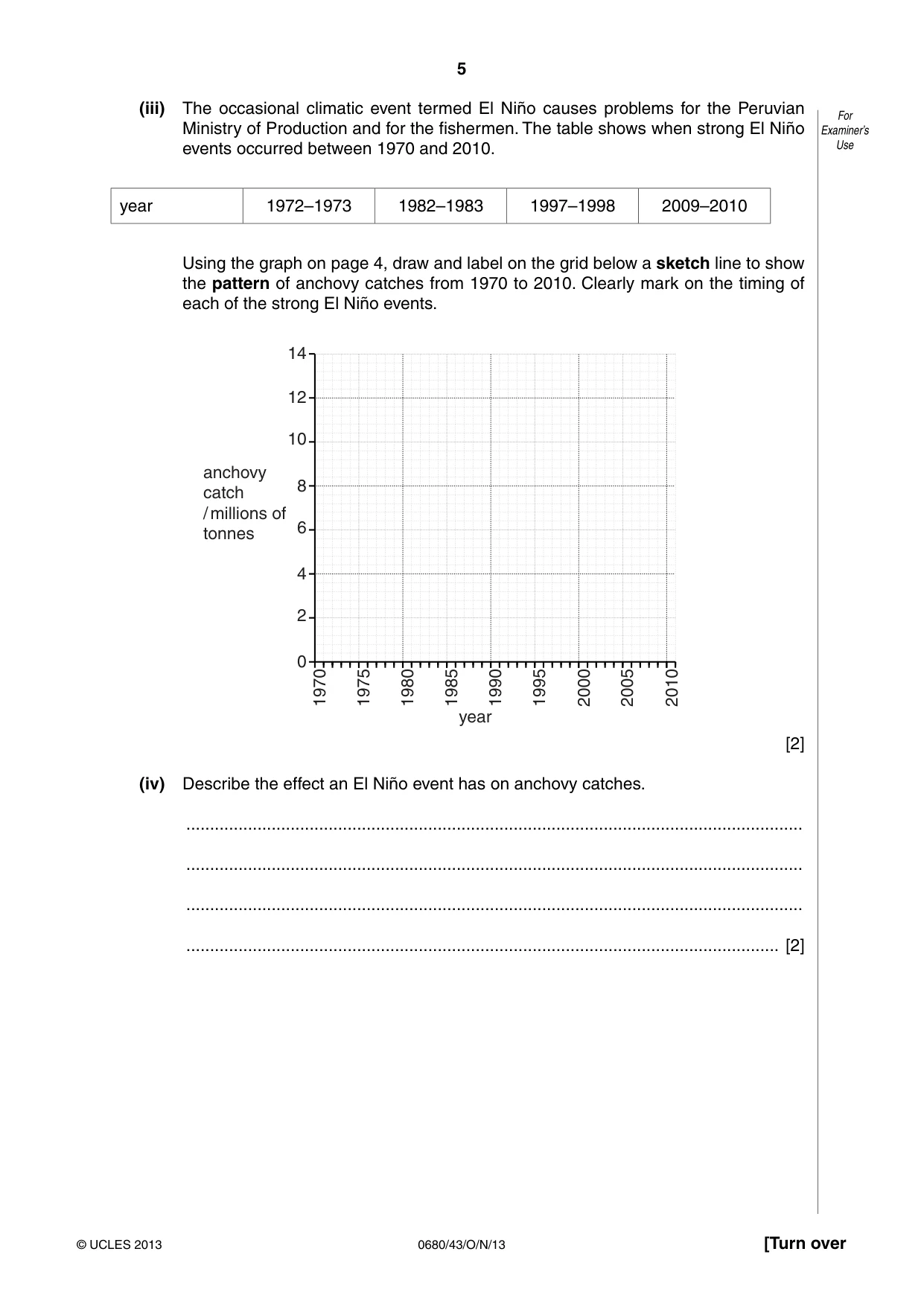
5 0680/43/O/N/13 © UCLES 2013 [Turn over For Examiner’s Use (iii) The occasional climatic event termed El Niño causes problems for the Peruvian Ministry of Production and for the fishermen. The table shows when strong El Niño events occurred between 1970 and 2010. year 1972–1973 1982–1983 1997–1998 2009–2010 Using the graph on page 4, draw and label on the grid below a sketch line to show the pattern of anchovy catches from 1970 to 2010. Clearly mark on the timing of each of the strong El Niño events. 0 1970 1975 1980 1985 1990 1995 2000 2005 2010 4 8 year anchovy catch / millions of tonnes 12 14 2 6 10 [2] (iv) Describe the effect an El Niño event has on anchovy catches. … … … … [2]
Question paper, page 6
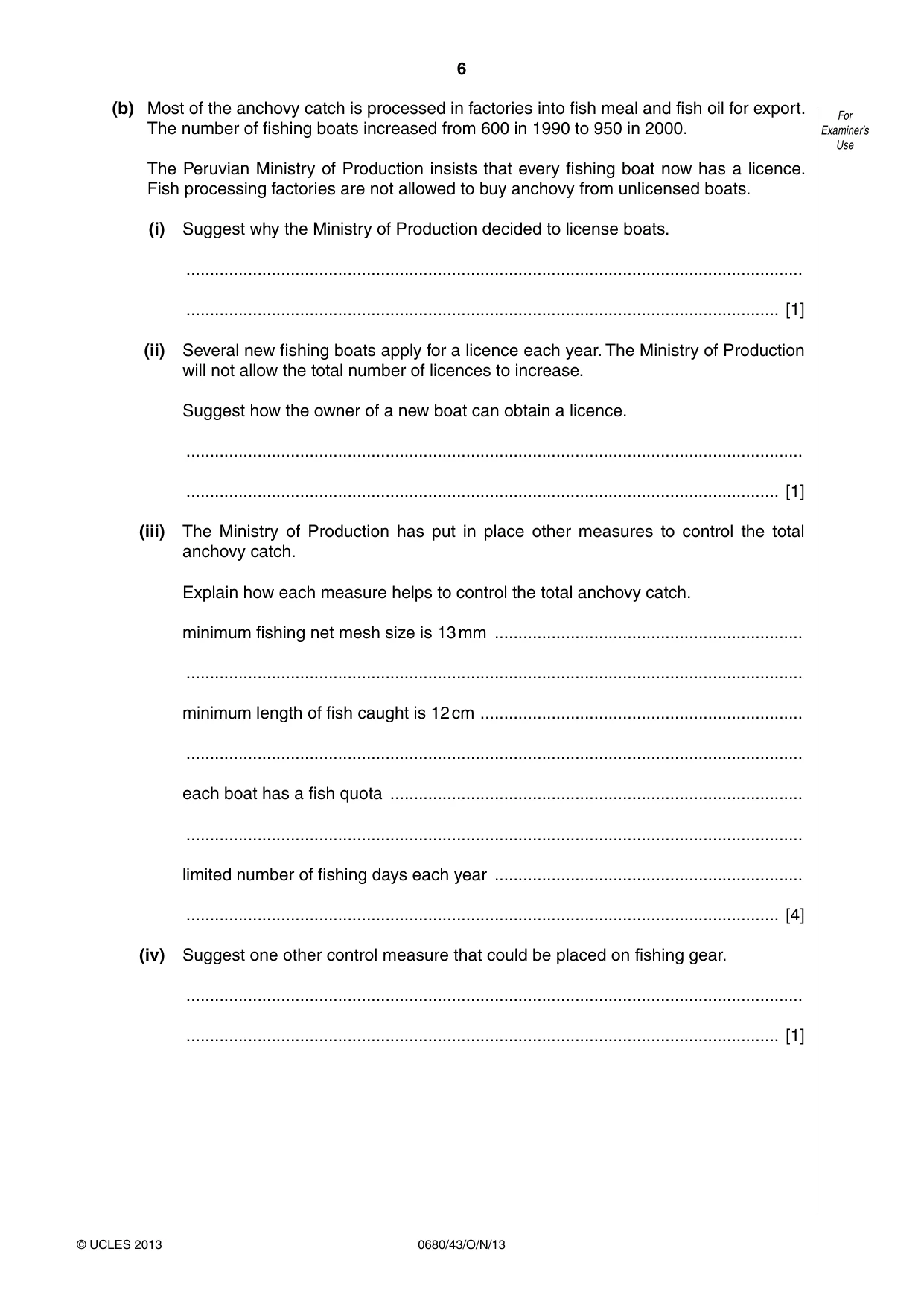
6 0680/43/O/N/13 © UCLES 2013 For Examiner’s Use (b) Most of the anchovy catch is processed in factories into fish meal and fish oil for export. The number of fishing boats increased from 600 in 1990 to 950 in 2000. The Peruvian Ministry of Production insists that every fishing boat now has a licence. Fish processing factories are not allowed to buy anchovy from unlicensed boats. (i) Suggest why the Ministry of Production decided to license boats. … … [1] (ii) Several new fishing boats apply for a licence each year. The Ministry of Production will not allow the total number of licences to increase. Suggest how the owner of a new boat can obtain a licence. … … [1] (iii) The Ministry of Production has put in place other measures to control the total anchovy catch. Explain how each measure helps to control the total anchovy catch. minimum fishing net mesh size is 13 mm … … minimum length of fish caught is 12 cm … … each boat has a fish quota … … limited number of fishing days each year … … [4] (iv) Suggest one other control measure that could be placed on fishing gear. … … [1]
Question paper, page 7
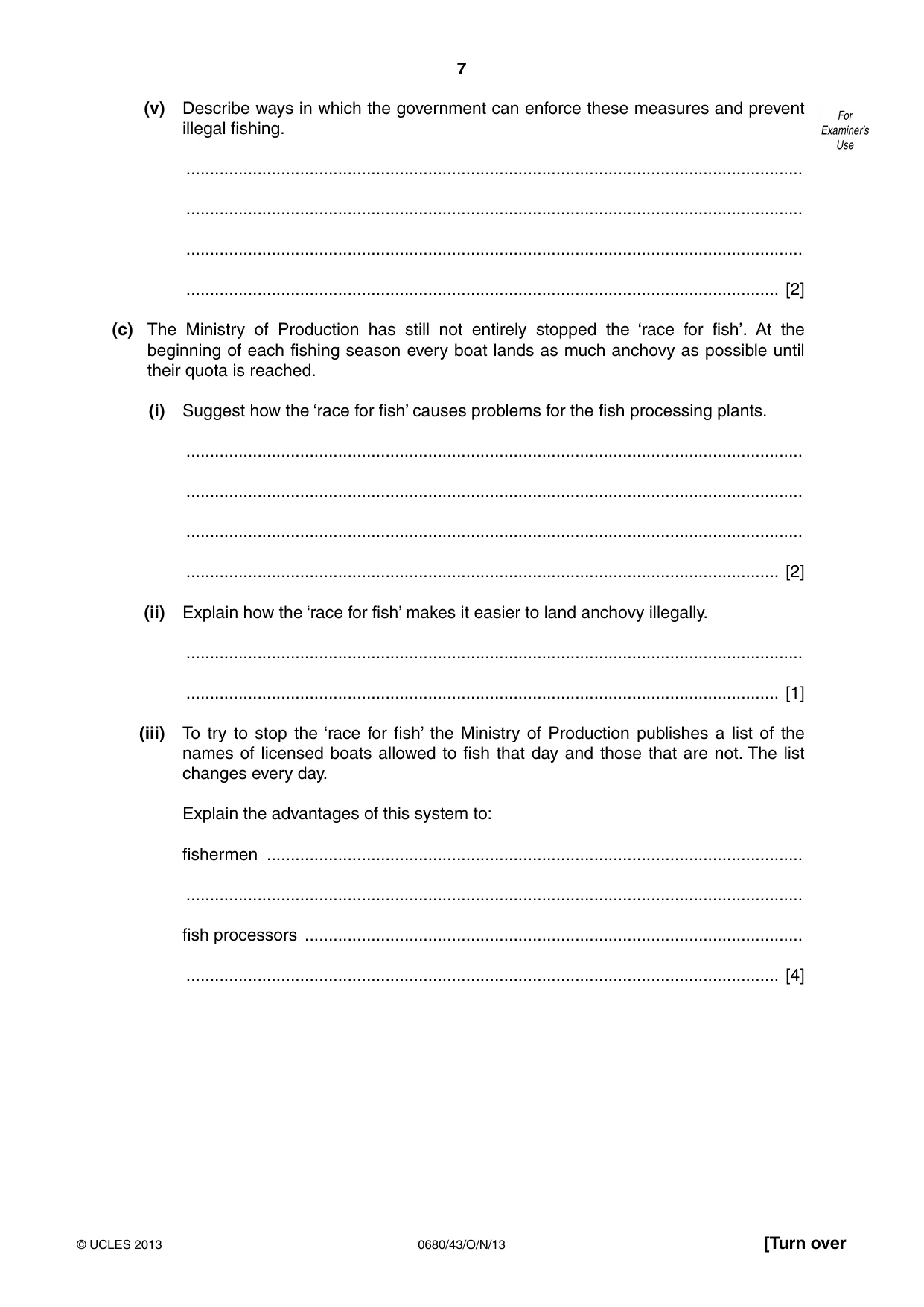
7 0680/43/O/N/13 © UCLES 2013 [Turn over For Examiner’s Use (v) Describe ways in which the government can enforce these measures and prevent illegal fishing. … … … … [2] (c) The Ministry of Production has still not entirely stopped the ‘race for fish’. At the beginning of each fishing season every boat lands as much anchovy as possible until their quota is reached. (i) Suggest how the ‘race for fish’ causes problems for the fish processing plants. … … … … [2] (ii) Explain how the ‘race for fish’ makes it easier to land anchovy illegally. … … [1] (iii) To try to stop the ‘race for fish’ the Ministry of Production publishes a list of the names of licensed boats allowed to fish that day and those that are not. The list changes every day. Explain the advantages of this system to: fishermen … … fish processors … … [4]
Question paper, page 8
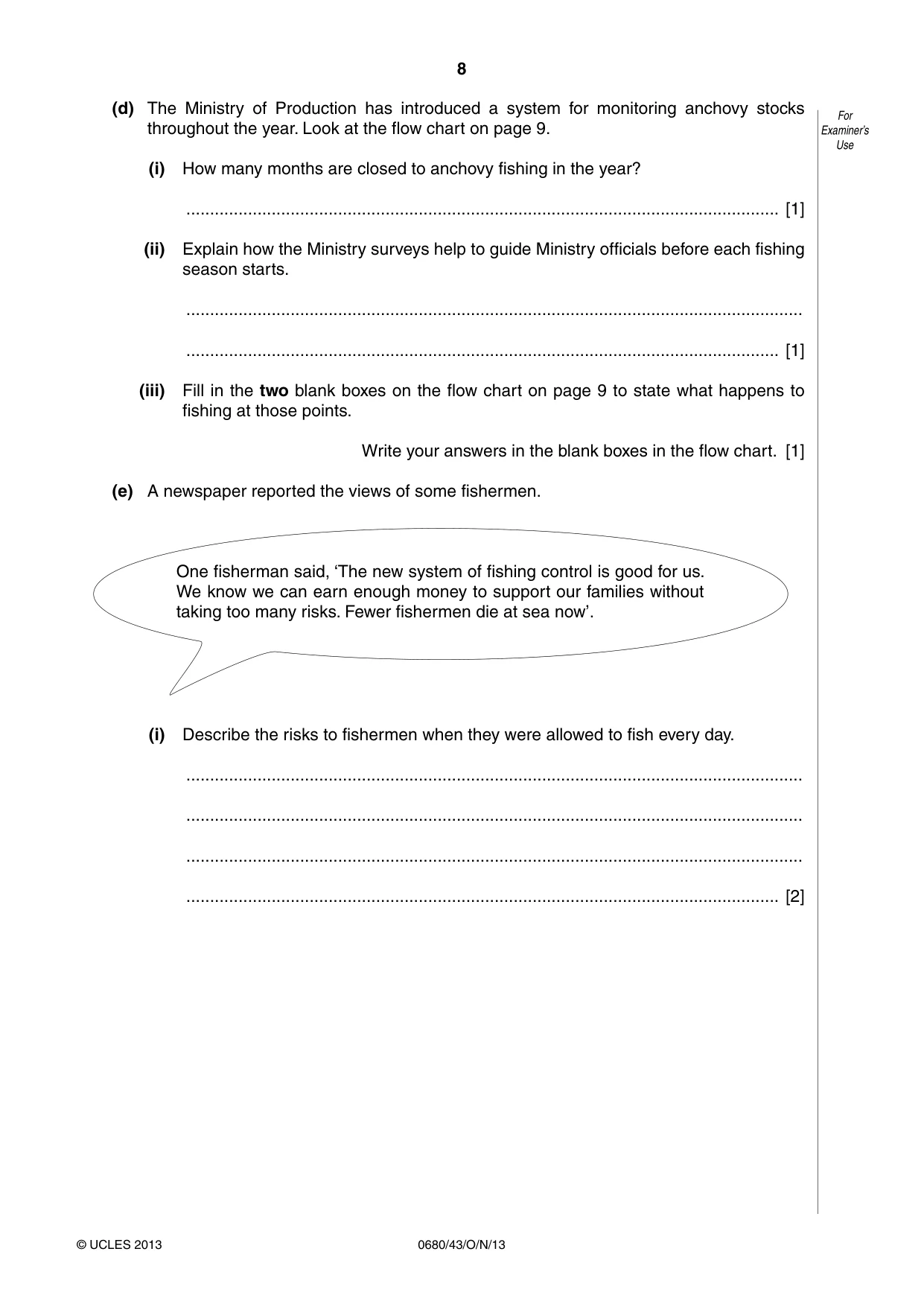
8 0680/43/O/N/13 © UCLES 2013 For Examiner’s Use (d) The Ministry of Production has introduced a system for monitoring anchovy stocks throughout the year. Look at the flow chart on page 9. (i) How many months are closed to anchovy fishing in the year? … [1] (ii) Explain how the Ministry surveys help to guide Ministry officials before each fishing season starts. … … [1] (iii) Fill in the two blank boxes on the flow chart on page 9 to state what happens to fishing at those points. Write your answers in the blank boxes in the flow chart. [1] (e) A newspaper reported the views of some fishermen. One fisherman said, ‘The new system of fishing control is good for us. We know we can earn enough money to support our families without taking too many risks. Fewer fishermen die at sea now’. (i) Describe the risks to fishermen when they were allowed to fish every day. … … … … [2]
Question paper, page 9
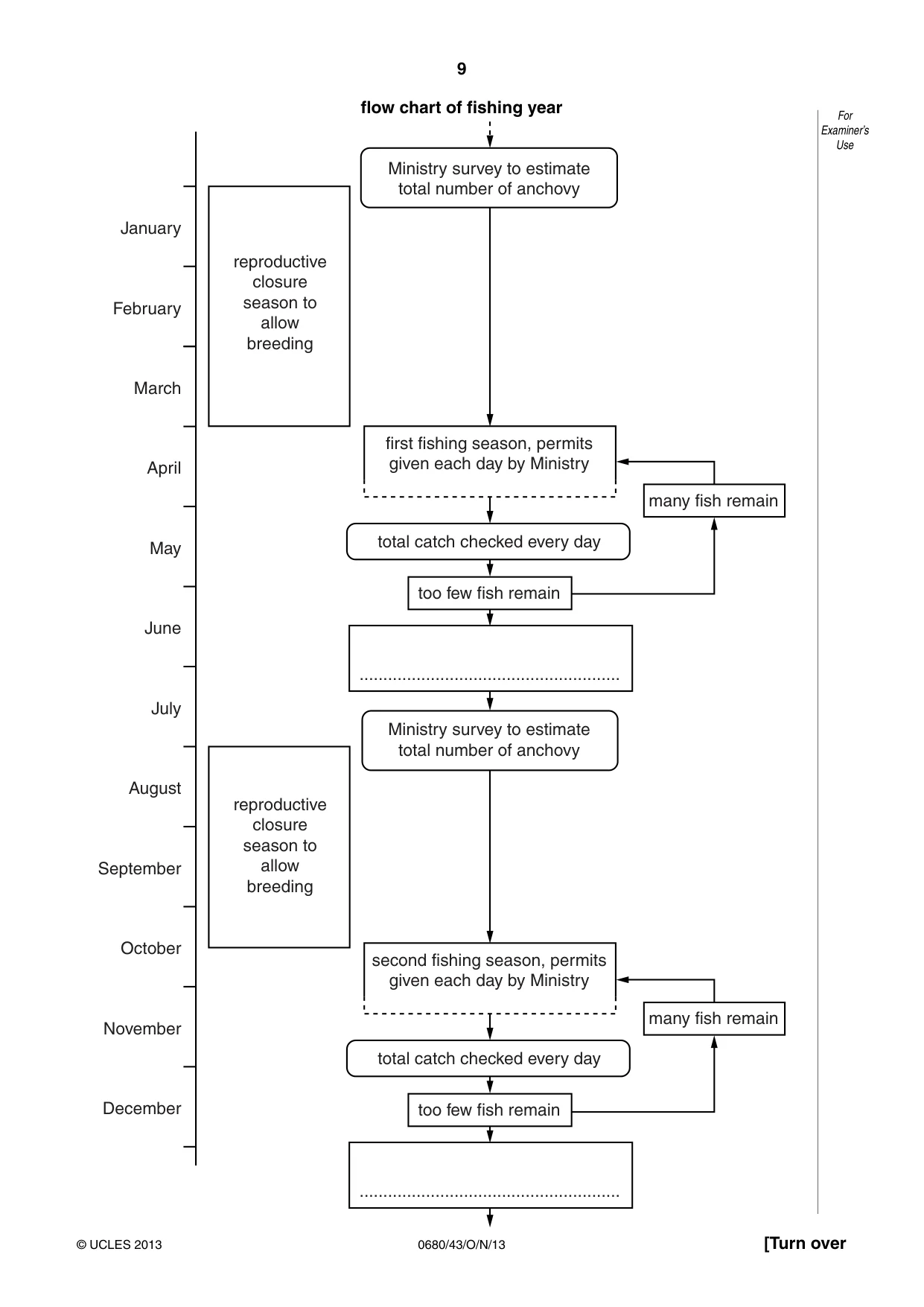
9 0680/43/O/N/13 © UCLES 2013 [Turn over For Examiner’s Use flow chart of fishing year January reproductive closure season to allow breeding Ministry survey to estimate total number of anchovy first fishing season, permits given each day by Ministry Ministry survey to estimate total number of anchovy total catch checked every day too few fish remain … February March April May June July August September October November December reproductive closure season to allow breeding second fishing season, permits given each day by Ministry total catch checked every day too few fish remain … many fish remain many fish remain
Question paper, page 10
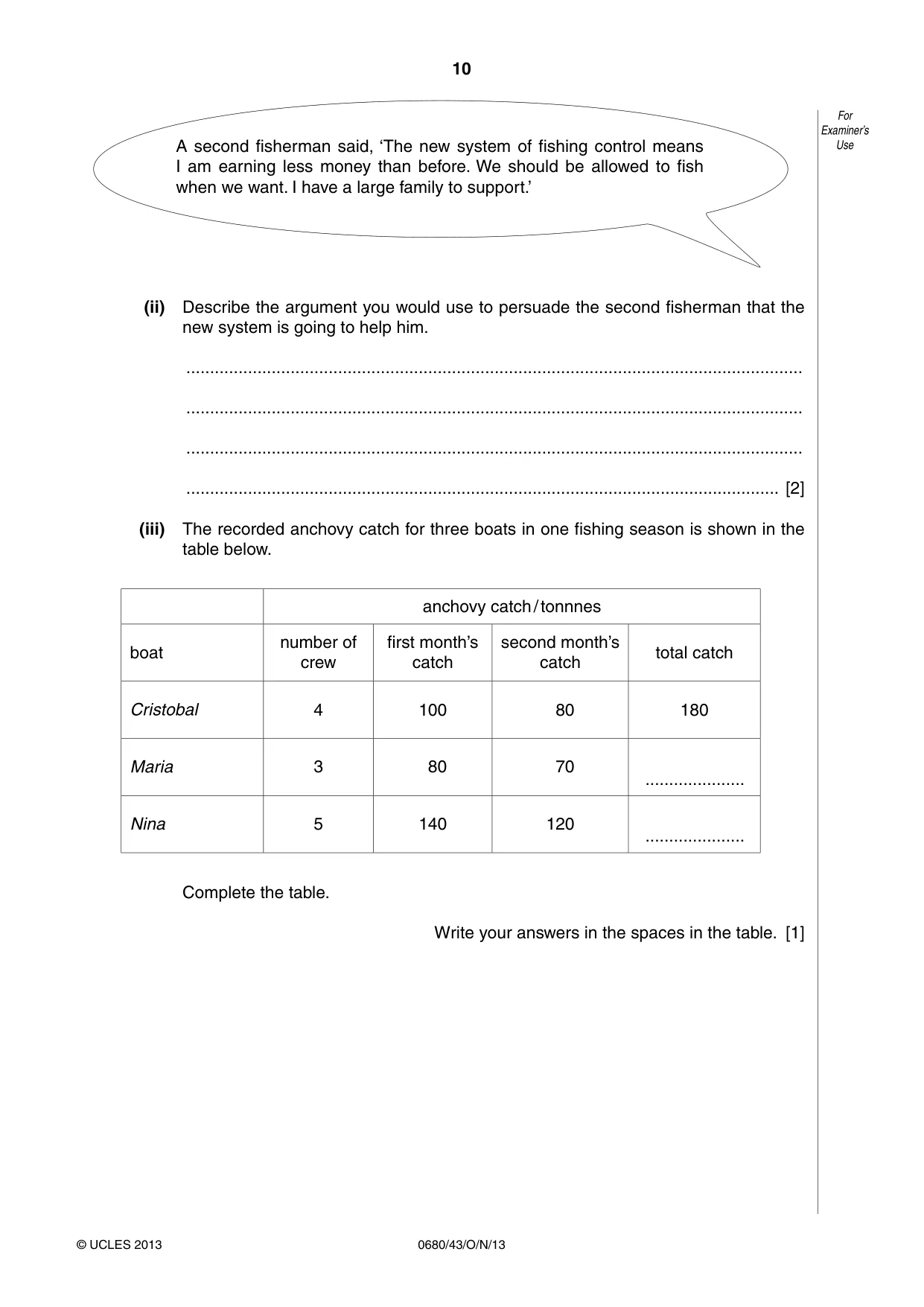
10 0680/43/O/N/13 © UCLES 2013 For Examiner’s Use A second fisherman said, ‘The new system of fishing control means I am earning less money than before. We should be allowed to fish when we want. I have a large family to support.’ (ii) Describe the argument you would use to persuade the second fisherman that the new system is going to help him. … … … … [2] (iii) The recorded anchovy catch for three boats in one fishing season is shown in the table below. anchovy catch / tonnnes boat number of crew first month’s catch second month’s catch total catch Cristobal 4 100 80 180 Maria 3 80 70 … Nina 5 140 120 … Complete the table. Write your answers in the spaces in the table. [1]
Question paper, page 11
11 0680/43/O/N/13 © UCLES 2013 [Turn over For Examiner’s Use (iv) The profits are shared equally between the people in the crew. Calculate which boat gave the highest and lowest pay for each person. Show your working in each case. boat with highest pay … boat with lowest pay … [2] (v) Recently, the Peruvian fishing industry was ranked ‘best in the world for sustainability’. Suggest why. … … … … [2] [Total: 36]
Question paper, page 12
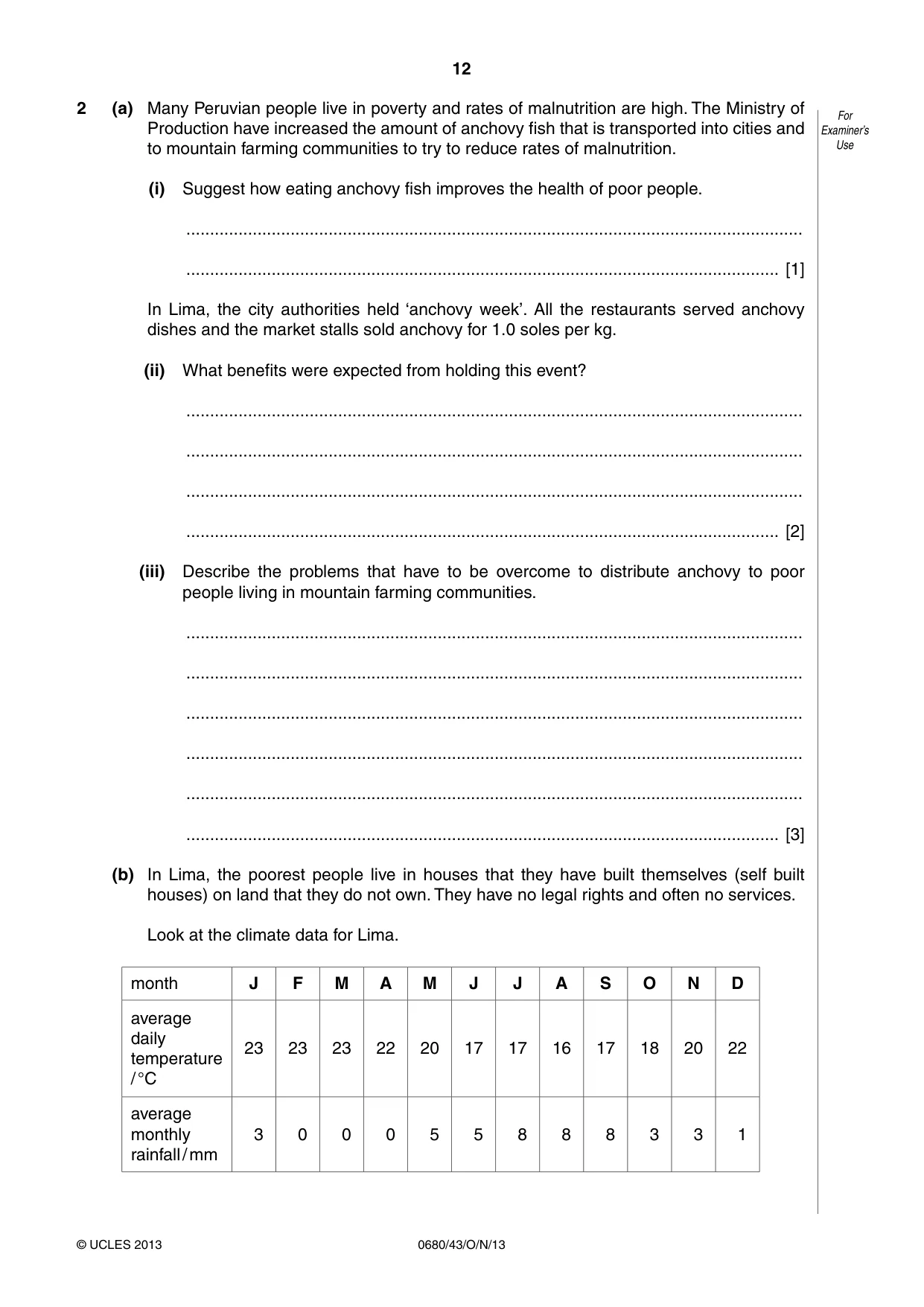
12 0680/43/O/N/13 © UCLES 2013 For Examiner’s Use 2 (a) Many Peruvian people live in poverty and rates of malnutrition are high. The Ministry of Production have increased the amount of anchovy fish that is transported into cities and to mountain farming communities to try to reduce rates of malnutrition. (i) Suggest how eating anchovy fish improves the health of poor people. … … [1] In Lima, the city authorities held ‘anchovy week’. All the restaurants served anchovy dishes and the market stalls sold anchovy for 1.0 soles per kg. (ii) What benefits were expected from holding this event? … … … … [2] (iii) Describe the problems that have to be overcome to distribute anchovy to poor people living in mountain farming communities. … … … … … … [3] (b) In Lima, the poorest people live in houses that they have built themselves (self built houses) on land that they do not own. They have no legal rights and often no services. Look at the climate data for Lima. month J F M A M J J A S O N D average daily temperature / °C 23 23 23 22 20 17 17 16 17 18 20 22 average monthly rainfall / mm 3 0 0 0 5 5 8 8 8 3 3 1
Question paper, page 13
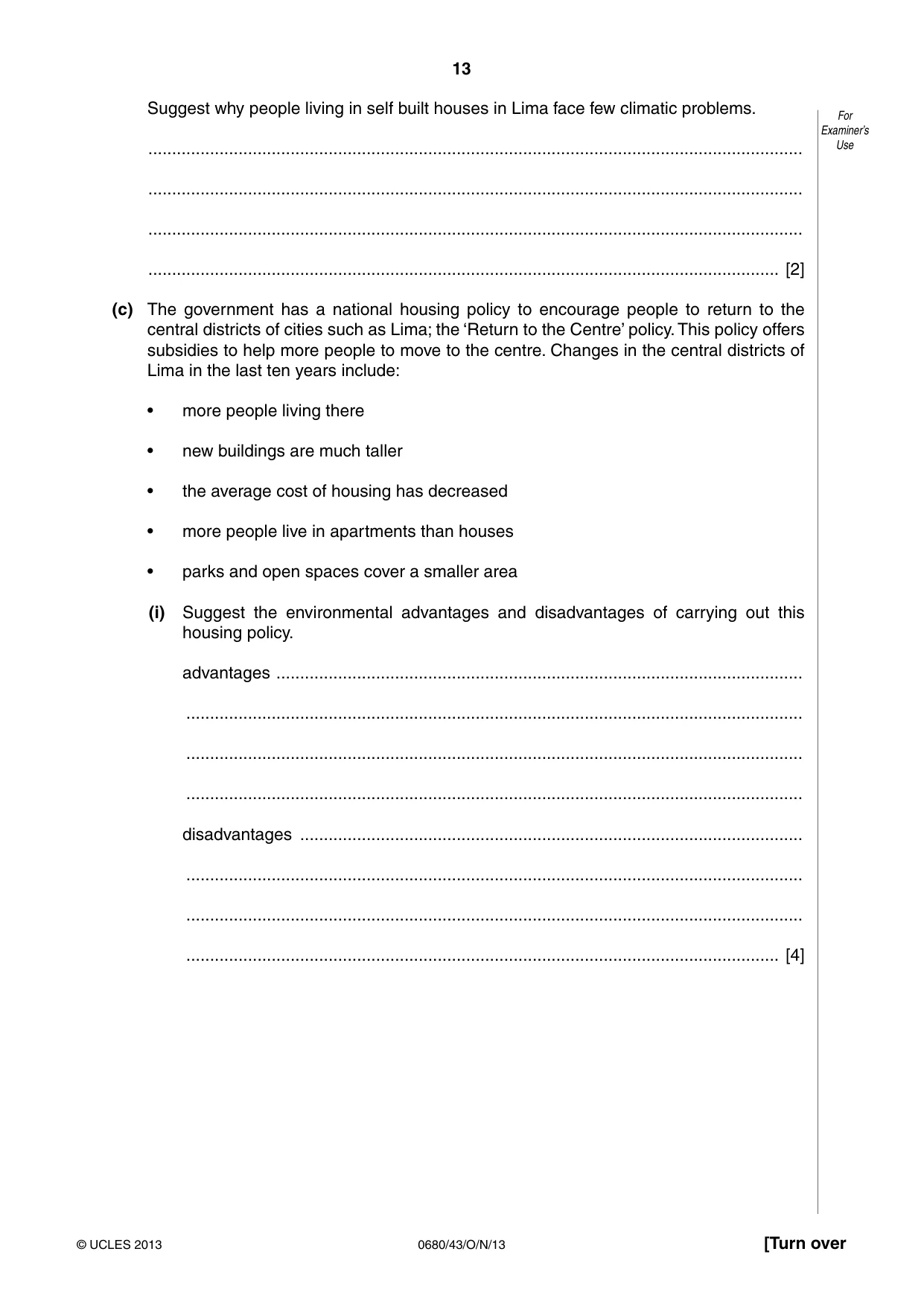
13 0680/43/O/N/13 © UCLES 2013 [Turn over For Examiner’s Use Suggest why people living in self built houses in Lima face few climatic problems. … … … … [2] (c) The government has a national housing policy to encourage people to return to the central districts of cities such as Lima; the ‘Return to the Centre’ policy. This policy offers subsidies to help more people to move to the centre. Changes in the central districts of Lima in the last ten years include: • more people living there • new buildings are much taller • the average cost of housing has decreased • more people live in apartments than houses • parks and open spaces cover a smaller area (i) Suggest the environmental advantages and disadvantages of carrying out this housing policy. advantages … … … … disadvantages … … … … [4]
Question paper, page 14
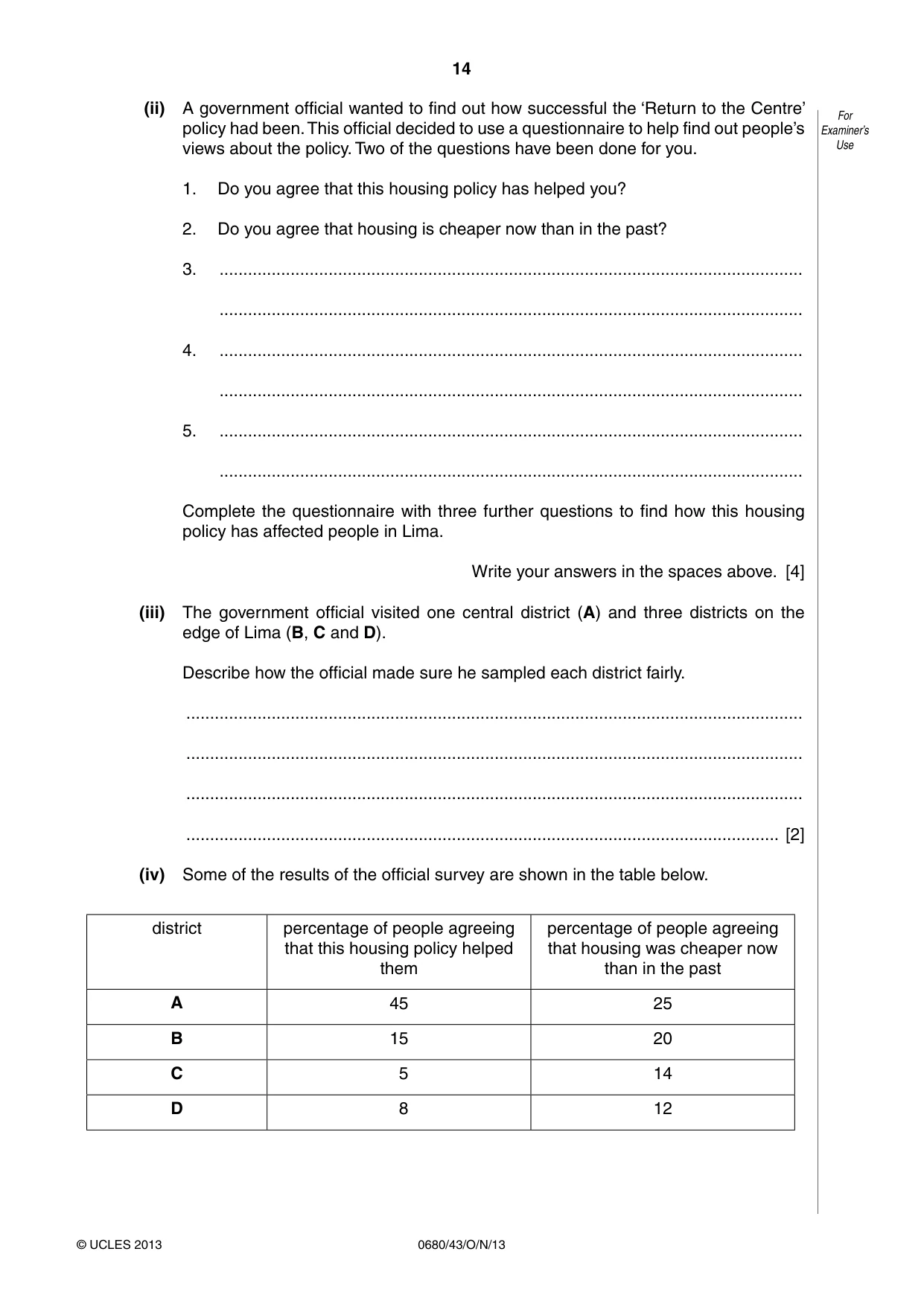
14 0680/43/O/N/13 © UCLES 2013 For Examiner’s Use (ii) A government official wanted to find out how successful the ‘Return to the Centre’ policy had been. This official decided to use a questionnaire to help find out people’s views about the policy. Two of the questions have been done for you. 1. Do you agree that this housing policy has helped you? 2. Do you agree that housing is cheaper now than in the past? 3. … … 4. … … 5. … … Complete the questionnaire with three further questions to find how this housing policy has affected people in Lima. Write your answers in the spaces above. [4] (iii) The government official visited one central district (A) and three districts on the edge of Lima (B, C and D). Describe how the official made sure he sampled each district fairly. … … … … [2] (iv) Some of the results of the official survey are shown in the table below. district percentage of people agreeing that this housing policy helped them percentage of people agreeing that housing was cheaper now than in the past A 45 25 B 15 20 C 5 14 D 8 12
Question paper, page 15
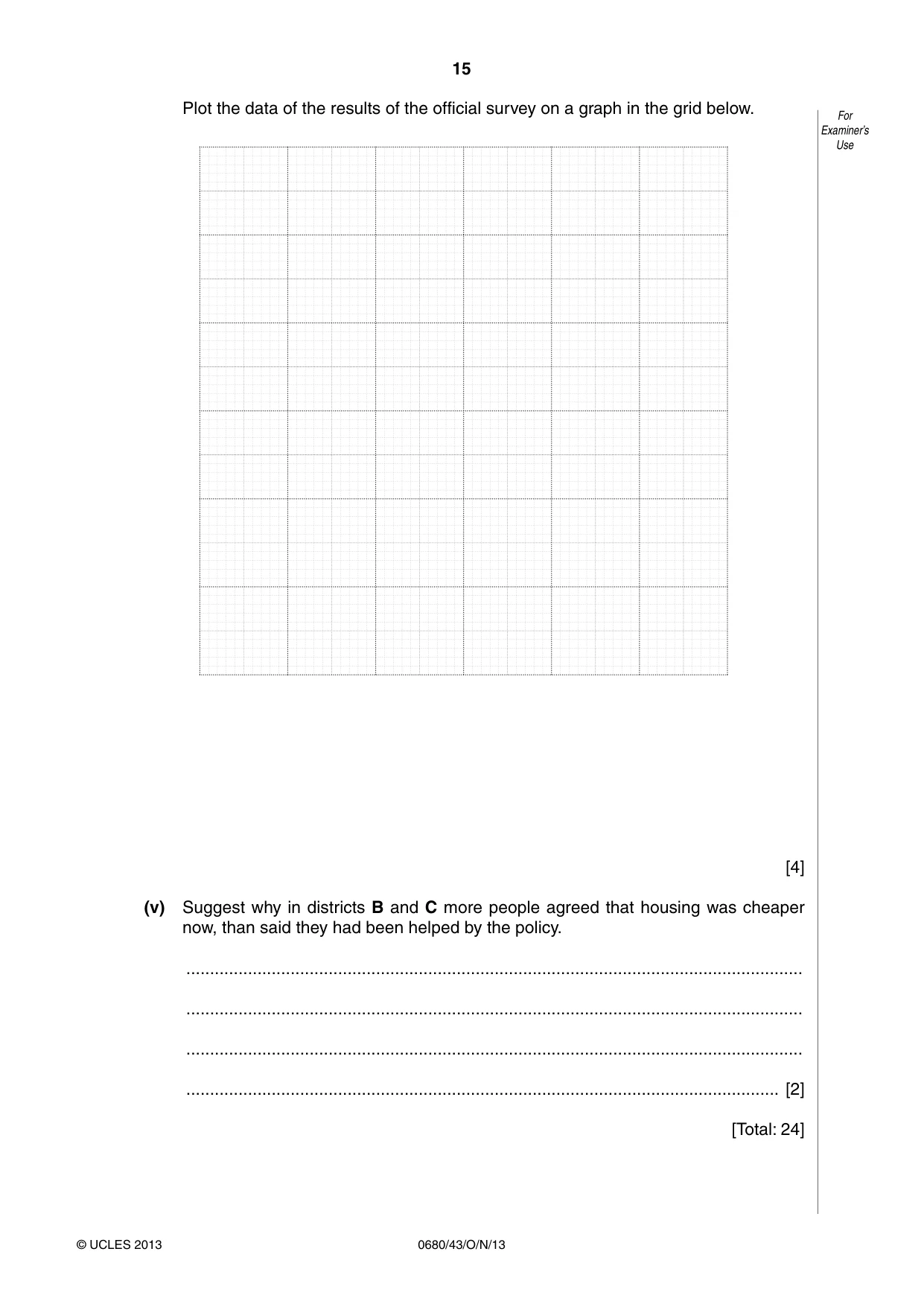
15 0680/43/O/N/13 © UCLES 2013 For Examiner’s Use Plot the data of the results of the official survey on a graph in the grid below. [4] (v) Suggest why in districts B and C more people agreed that housing was cheaper now, than said they had been helped by the policy. … … … … [2] [Total: 24]
Question paper, page 16
16 0680/43/O/N/13 © UCLES 2013 Permission to reproduce items where third-party owned material protected by copyright is included has been sought and cleared where possible. Every reasonable effort has been made by the publisher (UCLES) to trace copyright holders, but if any items requiring clearance have unwittingly been included, the publisher will be pleased to make amends at the earliest possible opportunity. University of Cambridge International Examinations is part of the Cambridge Assessment Group. Cambridge Assessment is the brand name of University of Cambridge Local Examinations Syndicate (UCLES), which is itself a department of the University of Cambridge. BLANK PAGE
Mark scheme, page 1
CAMBRIDGE INTERNATIONAL EXAMINATIONS International General Certificate of Secondary Education MARK SCHEME for the October/November 2013 series 0680 ENVIRONMENTAL MANAGEMENT 0680/43 Paper 4 (Alternative to Coursework), maximum raw mark 60 This mark scheme is published as an aid to teachers and candidates, to indicate the requirements of the examination. It shows the basis on which Examiners were instructed to award marks. It does not indicate the details of the discussions that took place at an Examiners’ meeting before marking began, which would have considered the acceptability of alternative answers. Mark schemes should be read in conjunction with the question paper and the Principal Examiner Report for Teachers. Cambridge will not enter into discussions about these mark schemes. Cambridge is publishing the mark schemes for the October/November 2013 series for most IGCSE, GCE Advanced Level and Advanced Subsidiary Level components and some Ordinary Level components.
Mark scheme, page 2
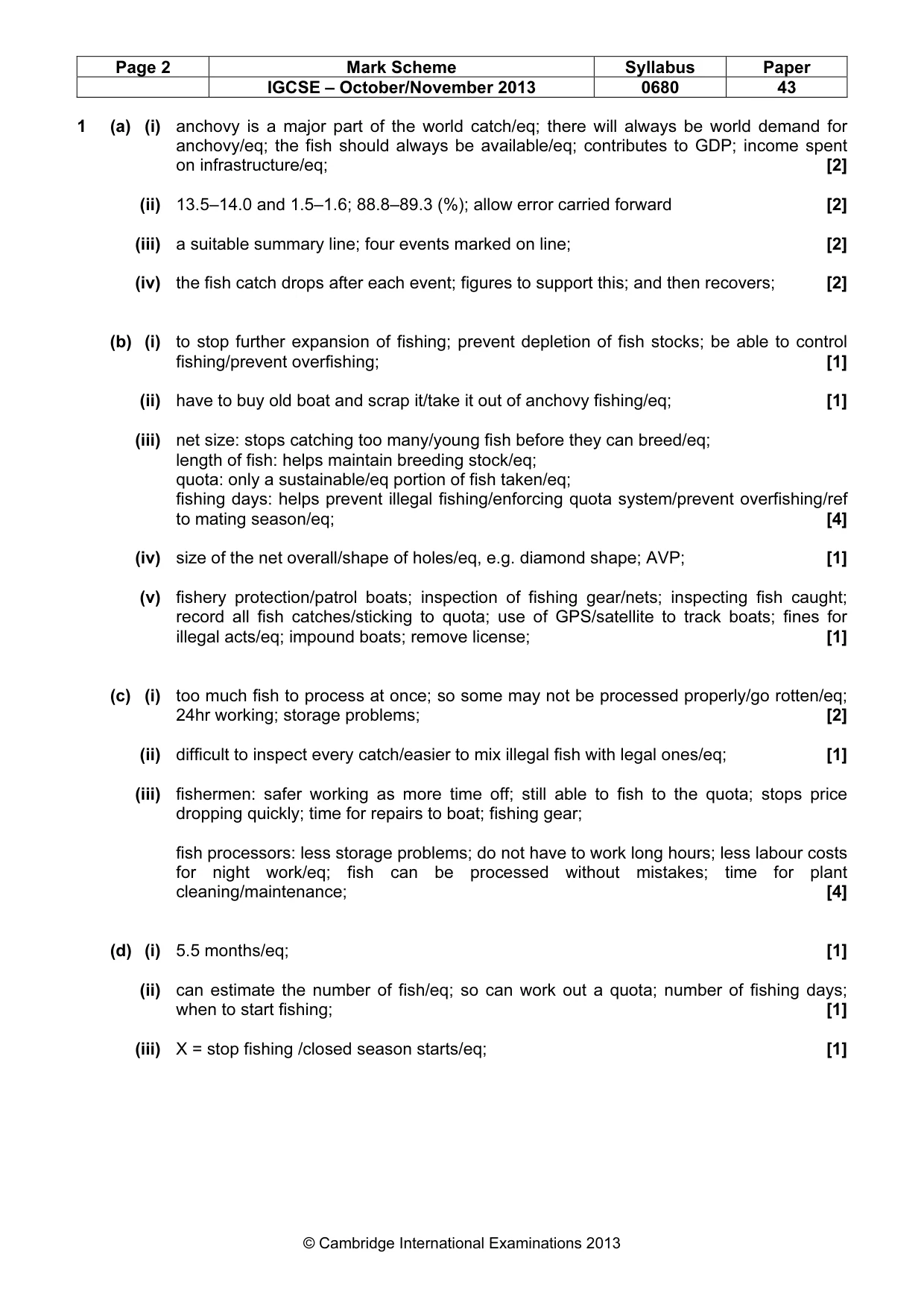
Page 2 Mark Scheme Syllabus Paper IGCSE – October/November 2013 0680 43 © Cambridge International Examinations 2013 1 (a) (i) anchovy is a major part of the world catch/eq; there will always be world demand for anchovy/eq; the fish should always be available/eq; contributes to GDP; income spent on infrastructure/eq; [2] (ii) 13.5–14.0 and 1.5–1.6; 88.8–89.3 (%); allow error carried forward [2] (iii) a suitable summary line; four events marked on line; [2] (iv) the fish catch drops after each event; figures to support this; and then recovers; [2] (b) (i) to stop further expansion of fishing; prevent depletion of fish stocks; be able to control fishing/prevent overfishing; [1] (ii) have to buy old boat and scrap it/take it out of anchovy fishing/eq; [1] (iii) net size: stops catching too many/young fish before they can breed/eq; length of fish: helps maintain breeding stock/eq; quota: only a sustainable/eq portion of fish taken/eq; fishing days: helps prevent illegal fishing/enforcing quota system/prevent overfishing/ref to mating season/eq; [4] (iv) size of the net overall/shape of holes/eq, e.g. diamond shape; AVP; [1] (v) fishery protection/patrol boats; inspection of fishing gear/nets; inspecting fish caught; record all fish catches/sticking to quota; use of GPS/satellite to track boats; fines for illegal acts/eq; impound boats; remove license; [1] (c) (i) too much fish to process at once; so some may not be processed properly/go rotten/eq; 24hr working; storage problems; [2] (ii) difficult to inspect every catch/easier to mix illegal fish with legal ones/eq; [1] (iii) fishermen: safer working as more time off; still able to fish to the quota; stops price dropping quickly; time for repairs to boat; fishing gear; fish processors: less storage problems; do not have to work long hours; less labour costs for night work/eq; fish can be processed without mistakes; time for plant cleaning/maintenance; [4] (d) (i) 5.5 months/eq; [1] (ii) can estimate the number of fish/eq; so can work out a quota; number of fishing days; when to start fishing; [1] (iii) X = stop fishing /closed season starts/eq; [1]
Mark scheme, page 3
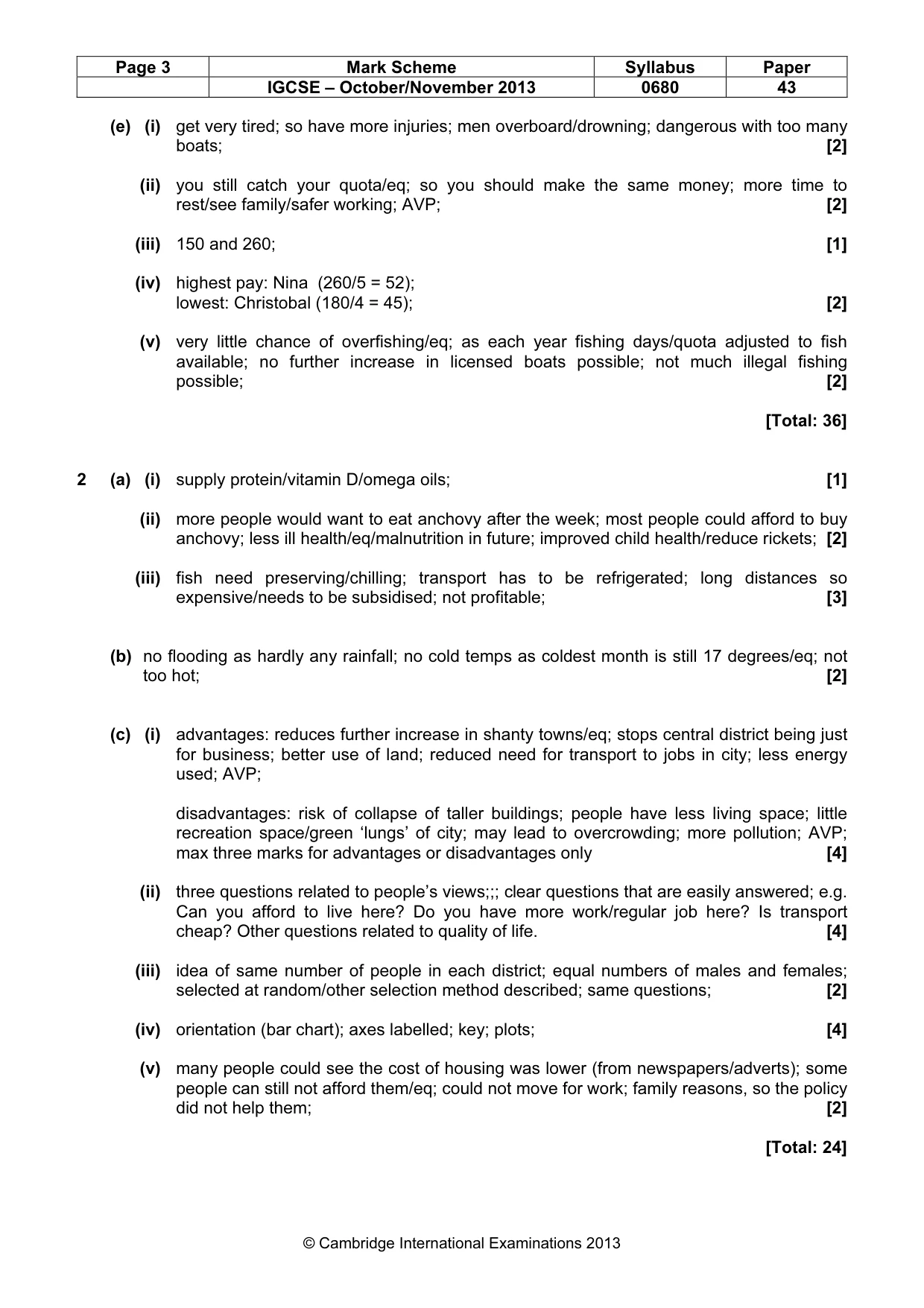
Page 3 Mark Scheme Syllabus Paper IGCSE – October/November 2013 0680 43 © Cambridge International Examinations 2013 (e) (i) get very tired; so have more injuries; men overboard/drowning; dangerous with too many boats; [2] (ii) you still catch your quota/eq; so you should make the same money; more time to rest/see family/safer working; AVP; [2] (iii) 150 and 260; [1] (iv) highest pay: Nina (260/5 = 52); lowest: Christobal (180/4 = 45); [2] (v) very little chance of overfishing/eq; as each year fishing days/quota adjusted to fish available; no further increase in licensed boats possible; not much illegal fishing possible; [2] [Total: 36] 2 (a) (i) supply protein/vitamin D/omega oils; [1] (ii) more people would want to eat anchovy after the week; most people could afford to buy anchovy; less ill health/eq/malnutrition in future; improved child health/reduce rickets; [2] (iii) fish need preserving/chilling; transport has to be refrigerated; long distances so expensive/needs to be subsidised; not profitable; [3] (b) no flooding as hardly any rainfall; no cold temps as coldest month is still 17 degrees/eq; not too hot; [2] (c) (i) advantages: reduces further increase in shanty towns/eq; stops central district being just for business; better use of land; reduced need for transport to jobs in city; less energy used; AVP; disadvantages: risk of collapse of taller buildings; people have less living space; little recreation space/green ‘lungs’ of city; may lead to overcrowding; more pollution; AVP; max three marks for advantages or disadvantages only [4] (ii) three questions related to people’s views;;; clear questions that are easily answered; e.g. Can you afford to live here? Do you have more work/regular job here? Is transport cheap? Other questions related to quality of life. [4] (iii) idea of same number of people in each district; equal numbers of males and females; selected at random/other selection method described; same questions; [2] (iv) orientation (bar chart); axes labelled; key; plots; [4] (v) many people could see the cost of housing was lower (from newspapers/adverts); some people can still not afford them/eq; could not move for work; family reasons, so the policy did not help them; [2] [Total: 24]
What you needed in this session
Cambridge’s own grade thresholds for 2013 Oct/Nov, Paper 4 · Variant 3. A higher threshold means an easier paper — the bar moves with how the cohort did.