Cambridge IGCSE Environmental Management 0680 — 2012 May/June Paper 4 · Variant 2
0680/42/M/J/12 · 60 marks · ≈68 min
The question paper and its mark scheme, free to read here and free to download. This is Cambridge’s own paper, exactly as it was sat.
Question paper12 pages
Mark scheme6 pages
Answers below. Sit the paper first if you are practising.
Paper as text
Question paper, page 1
This document consists of 12 printed pages. DC (AC/SW) 48009/2 © UCLES 2012 [Turn over UNIVERSITY OF CAMBRIDGE INTERNATIONAL EXAMINATIONS International General Certificate of Secondary Education * 8 9 1 8 9 2 3 6 3 2 * ENVIRONMENTAL MANAGEMENT 0680/42 Alternative to Coursework May/June 2012 1 hour 30 minutes Candidates answer on the Question Paper Additional Materials: Ruler READ THESE INSTRUCTIONS FIRST Write your Centre number, candidate number and name on all the work you hand in. Write in dark blue or black pen. You may use a soft pencil for any diagrams, graphs or rough working. Do not use staples, paper clips, highlighters, glue or correction fluid. DO NOT WRITE IN ANY BARCODES. Answer all questions. Study the appropriate Source materials before you start to write your answers. Credit will be given for appropriate selection and use of data in your answers and for relevant interpretation of these data. Suggestions for data sources are given in some questions. You may use the source data to draw diagrams and graphs or to do calculations to illustrate your answers. At the end of the examination, fasten all your work securely together. The number of marks is given in brackets [ ] at the end of each question or part question. For Examiner’s Use www.XtremePapers.com
Question paper, page 2
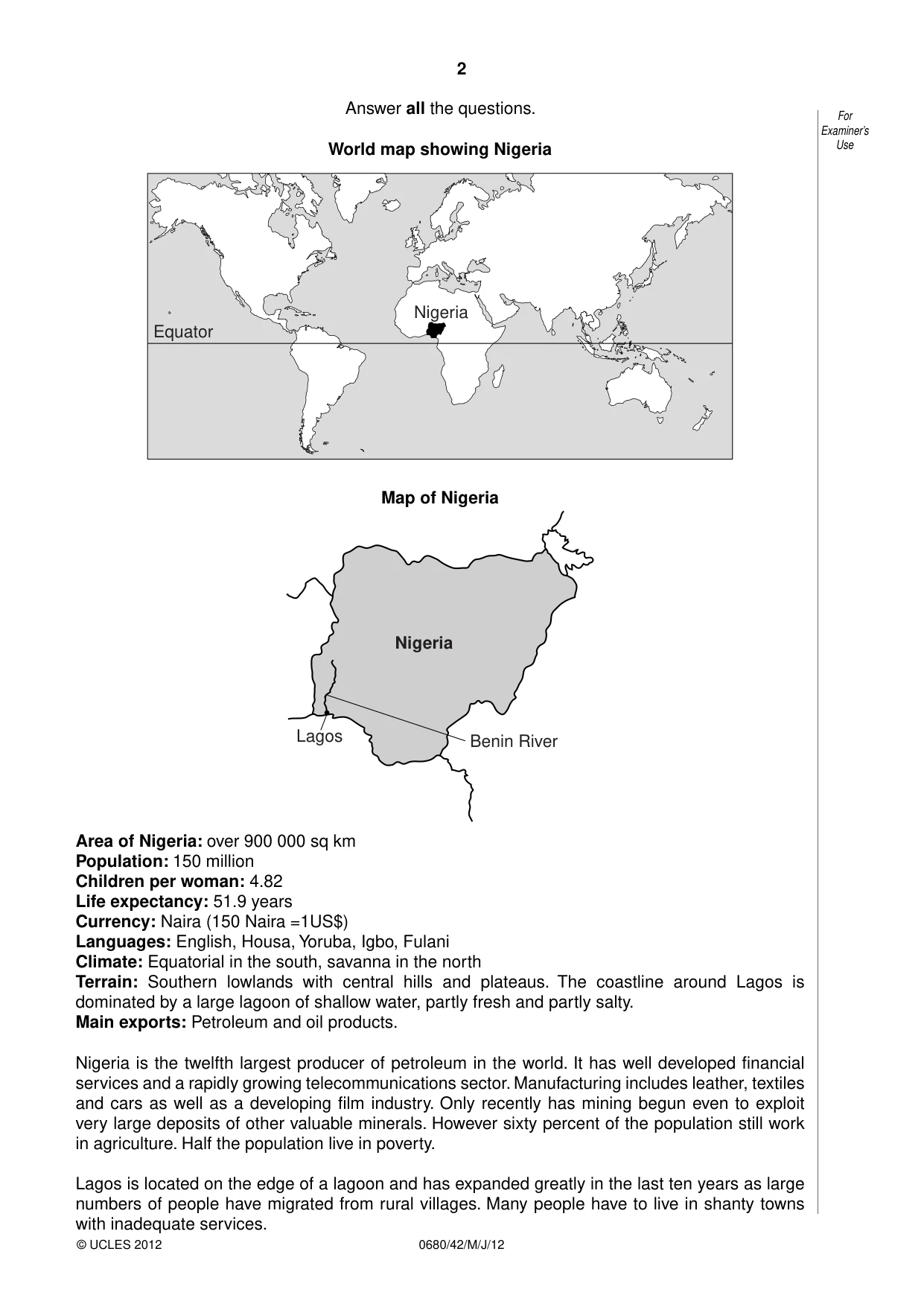
2 0680/42/M/J/12 © UCLES 2012 For Examiner’s Use Answer all the questions. World map showing Nigeria Equator Nigeria Map of Nigeria Nigeria Lagos Benin River Area of Nigeria: over 900 000 sq km Population: 150 million Children per woman: 4.82 Life expectancy: 51.9 years Currency: Naira (150 Naira =1US$) Languages: English, Housa, Yoruba, Igbo, Fulani Climate: Equatorial in the south, savanna in the north Terrain: Southern lowlands with central hills and plateaus. The coastline around Lagos is dominated by a large lagoon of shallow water, partly fresh and partly salty. Main exports: Petroleum and oil products. Nigeria is the twelfth largest producer of petroleum in the world. It has well developed financial services and a rapidly growing telecommunications sector. Manufacturing includes leather, textiles and cars as well as a developing film industry. Only recently has mining begun even to exploit very large deposits of other valuable minerals. However sixty percent of the population still work in agriculture. Half the population live in poverty. Lagos is located on the edge of a lagoon and has expanded greatly in the last ten years as large numbers of people have migrated from rural villages. Many people have to live in shanty towns with inadequate services.
Question paper, page 3
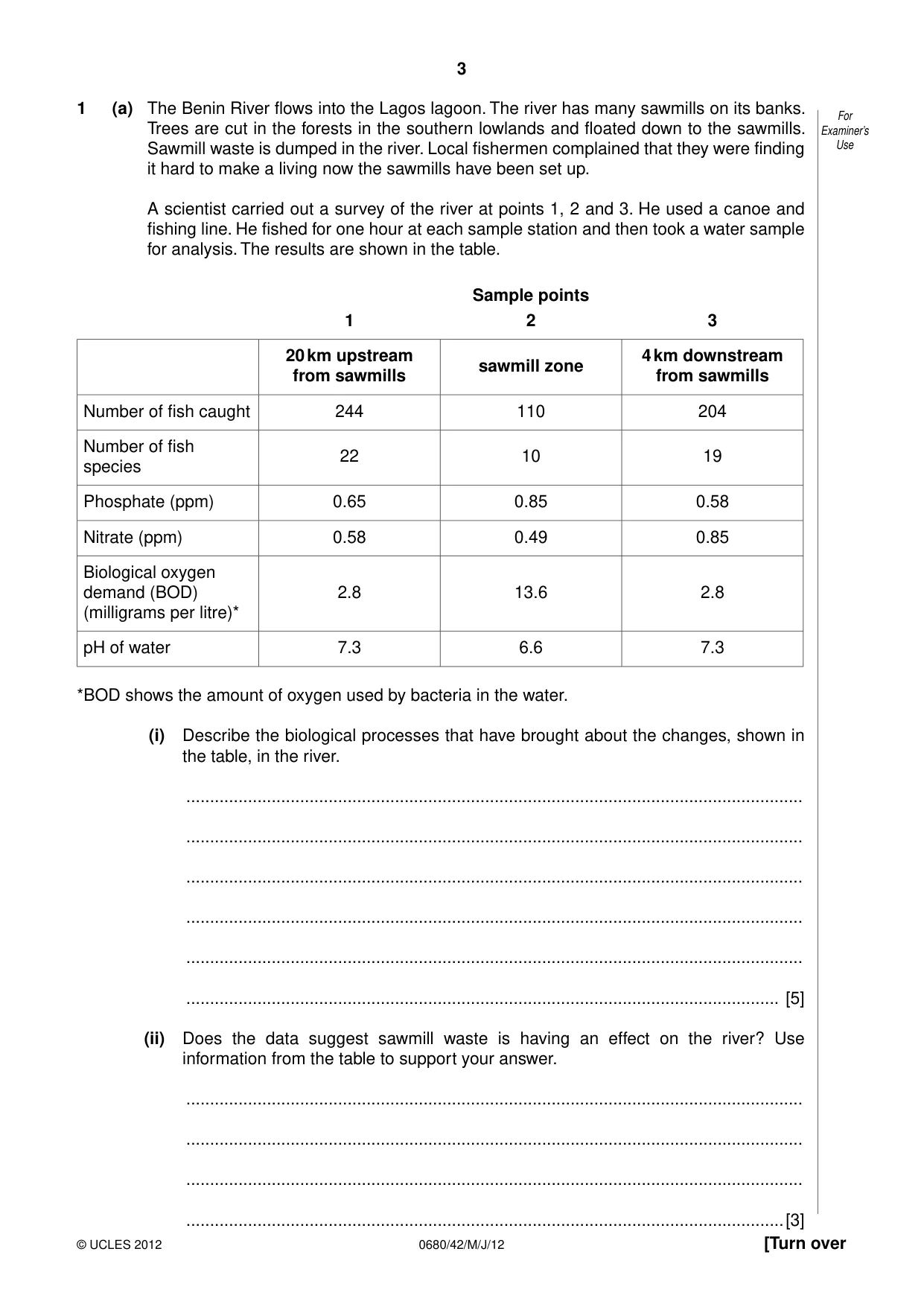
3 0680/42/M/J/12 © UCLES 2012 [Turn over For Examiner’s Use 1 (a) The Benin River flows into the Lagos lagoon. The river has many sawmills on its banks. Trees are cut in the forests in the southern lowlands and floated down to the sawmills. Sawmill waste is dumped in the river. Local fishermen complained that they were finding it hard to make a living now the sawmills have been set up. A scientist carried out a survey of the river at points 1, 2 and 3. He used a canoe and fishing line. He fished for one hour at each sample station and then took a water sample for analysis. The results are shown in the table. Sample points 1 2 3 20 km upstream from sawmills sawmill zone 4 km downstream from sawmills Number of fish caught 244 110 204 Number of fish species 22 10 19 Phosphate (ppm) 0.65 0.85 0.58 Nitrate (ppm) 0.58 0.49 0.85 Biological oxygen demand (BOD) (milligrams per litre)* 2.8 13.6 2.8 pH of water 7.3 6.6 7.3 *BOD shows the amount of oxygen used by bacteria in the water. (i) Describe the biological processes that have brought about the changes, shown in the table, in the river. … … … … … … [5] (ii) Does the data suggest sawmill waste is having an effect on the river? Use information from the table to support your answer. … … … …[3]
Question paper, page 4
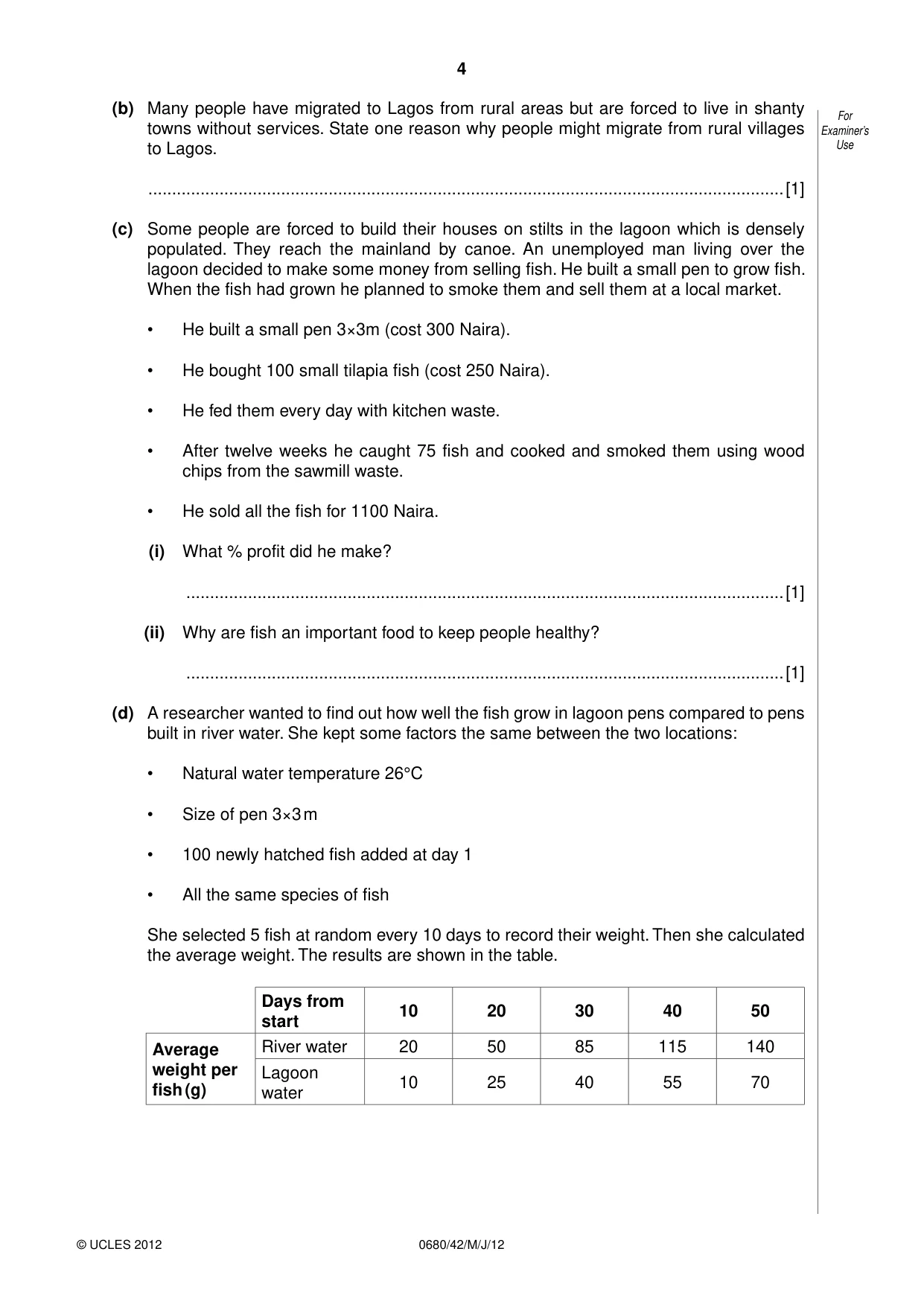
4 0680/42/M/J/12 © UCLES 2012 For Examiner’s Use (b) Many people have migrated to Lagos from rural areas but are forced to live in shanty towns without services. State one reason why people might migrate from rural villages to Lagos. …[1] (c) Some people are forced to build their houses on stilts in the lagoon which is densely populated. They reach the mainland by canoe. An unemployed man living over the lagoon decided to make some money from selling fish. He built a small pen to grow fish. When the fish had grown he planned to smoke them and sell them at a local market. • He built a small pen 3×3m (cost 300 Naira). • He bought 100 small tilapia fish (cost 250 Naira). • He fed them every day with kitchen waste. • After twelve weeks he caught 75 fish and cooked and smoked them using wood chips from the sawmill waste. • He sold all the fish for 1100 Naira. (i) What % profit did he make? …[1] (ii) Why are fish an important food to keep people healthy? …[1] (d) A researcher wanted to find out how well the fish grow in lagoon pens compared to pens built in river water. She kept some factors the same between the two locations: • Natural water temperature 26°C • Size of pen 3×3 m • 100 newly hatched fish added at day 1 • All the same species of fish She selected 5 fish at random every 10 days to record their weight. Then she calculated the average weight. The results are shown in the table. Days from start 10 20 30 40 50 Average weight per fish (g) River water 20 50 85 115 140 Lagoon water 10 25 40 55 70
Question paper, page 5
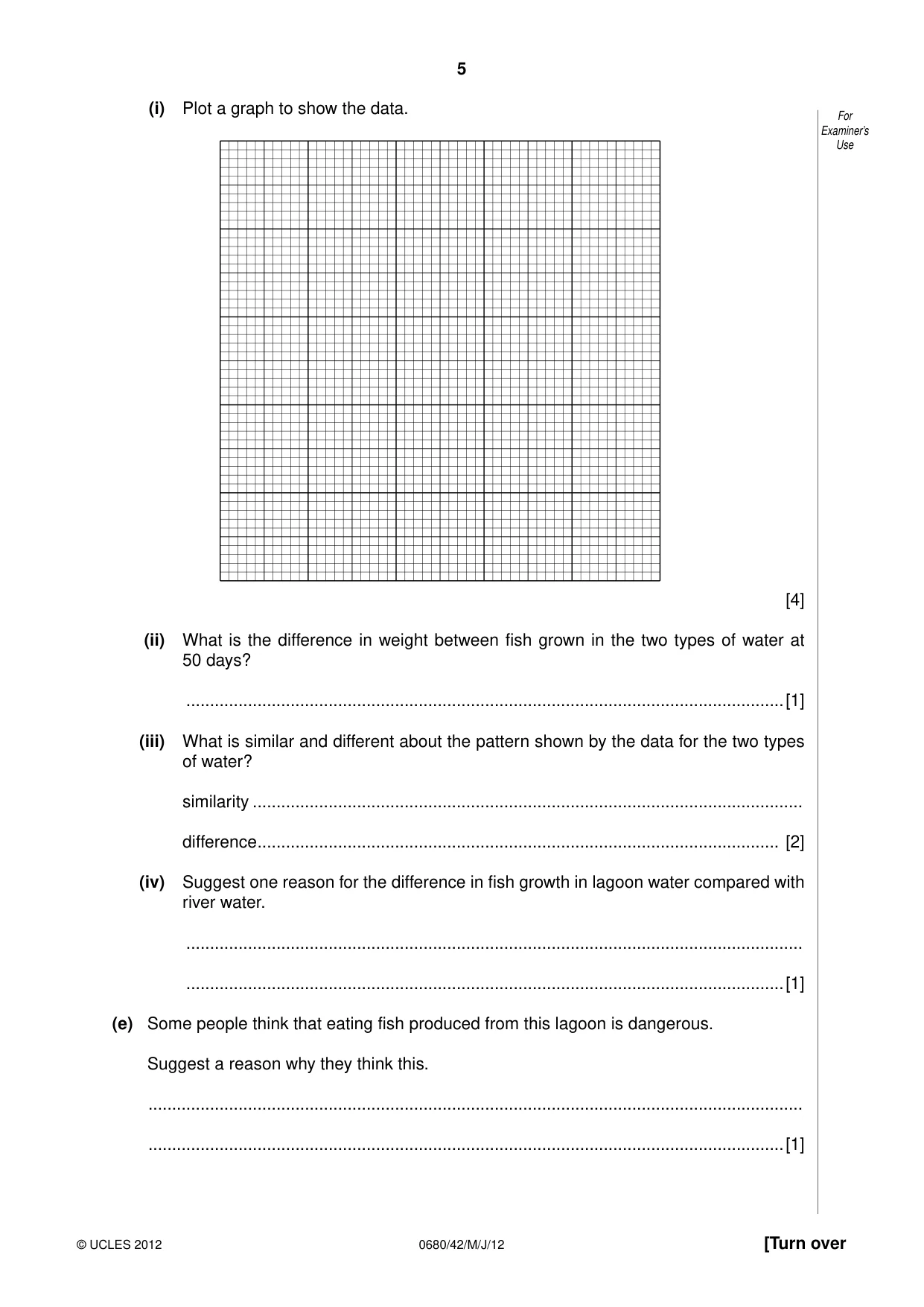
5 0680/42/M/J/12 © UCLES 2012 [Turn over For Examiner’s Use (i) Plot a graph to show the data. [4] (ii) What is the difference in weight between fish grown in the two types of water at 50 days? …[1] (iii) What is similar and different about the pattern shown by the data for the two types of water? similarity … difference … [2] (iv) Suggest one reason for the difference in fish growth in lagoon water compared with river water. … …[1] (e) Some people think that eating fish produced from this lagoon is dangerous. Suggest a reason why they think this. … …[1]
Question paper, page 6
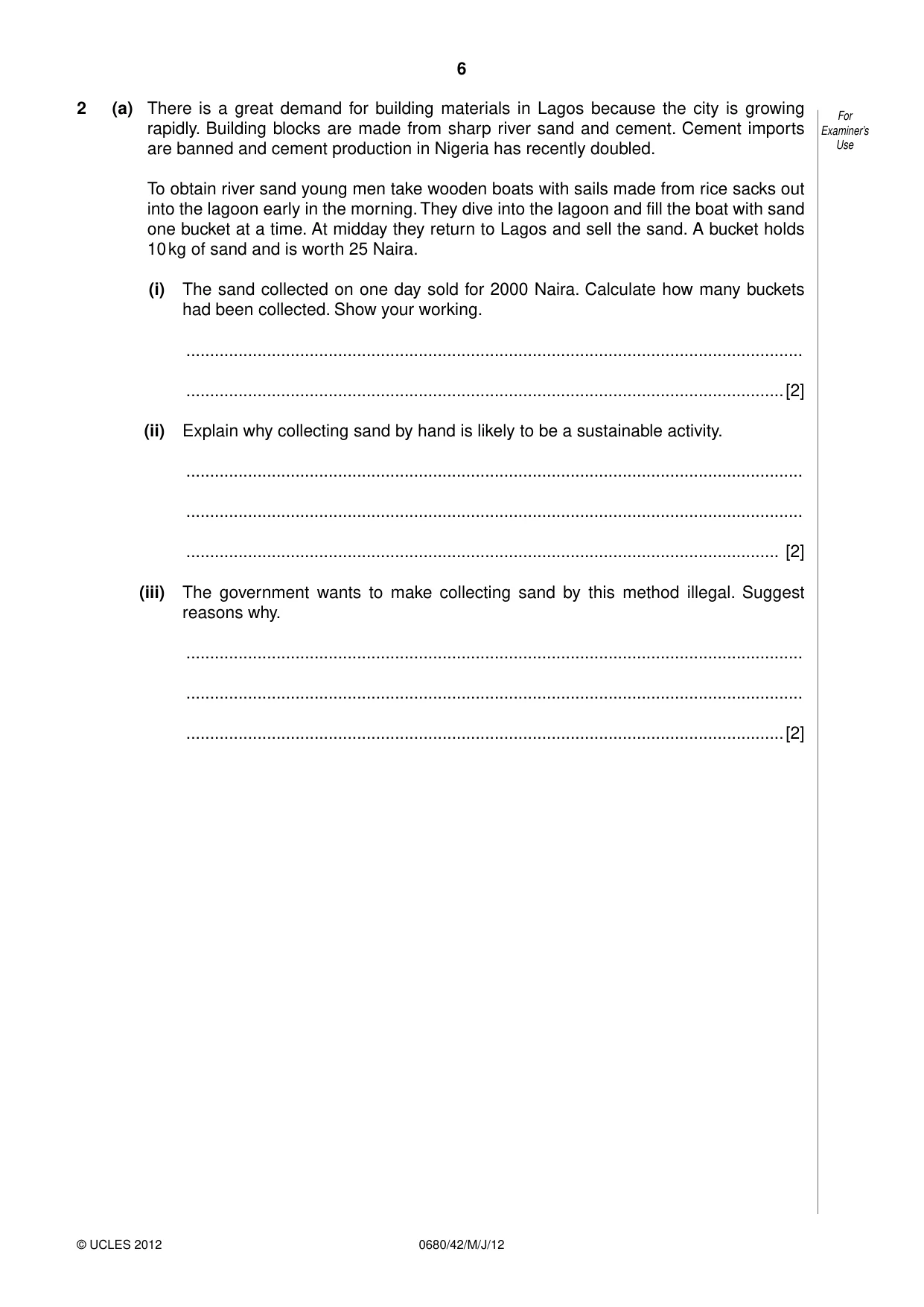
6 0680/42/M/J/12 © UCLES 2012 For Examiner’s Use 2 (a) There is a great demand for building materials in Lagos because the city is growing rapidly. Building blocks are made from sharp river sand and cement. Cement imports are banned and cement production in Nigeria has recently doubled. To obtain river sand young men take wooden boats with sails made from rice sacks out into the lagoon early in the morning. They dive into the lagoon and fill the boat with sand one bucket at a time. At midday they return to Lagos and sell the sand. A bucket holds 10 kg of sand and is worth 25 Naira. (i) The sand collected on one day sold for 2000 Naira. Calculate how many buckets had been collected. Show your working. … …[2] (ii) Explain why collecting sand by hand is likely to be a sustainable activity. … … … [2] (iii) The government wants to make collecting sand by this method illegal. Suggest reasons why. … … …[2]
Question paper, page 7
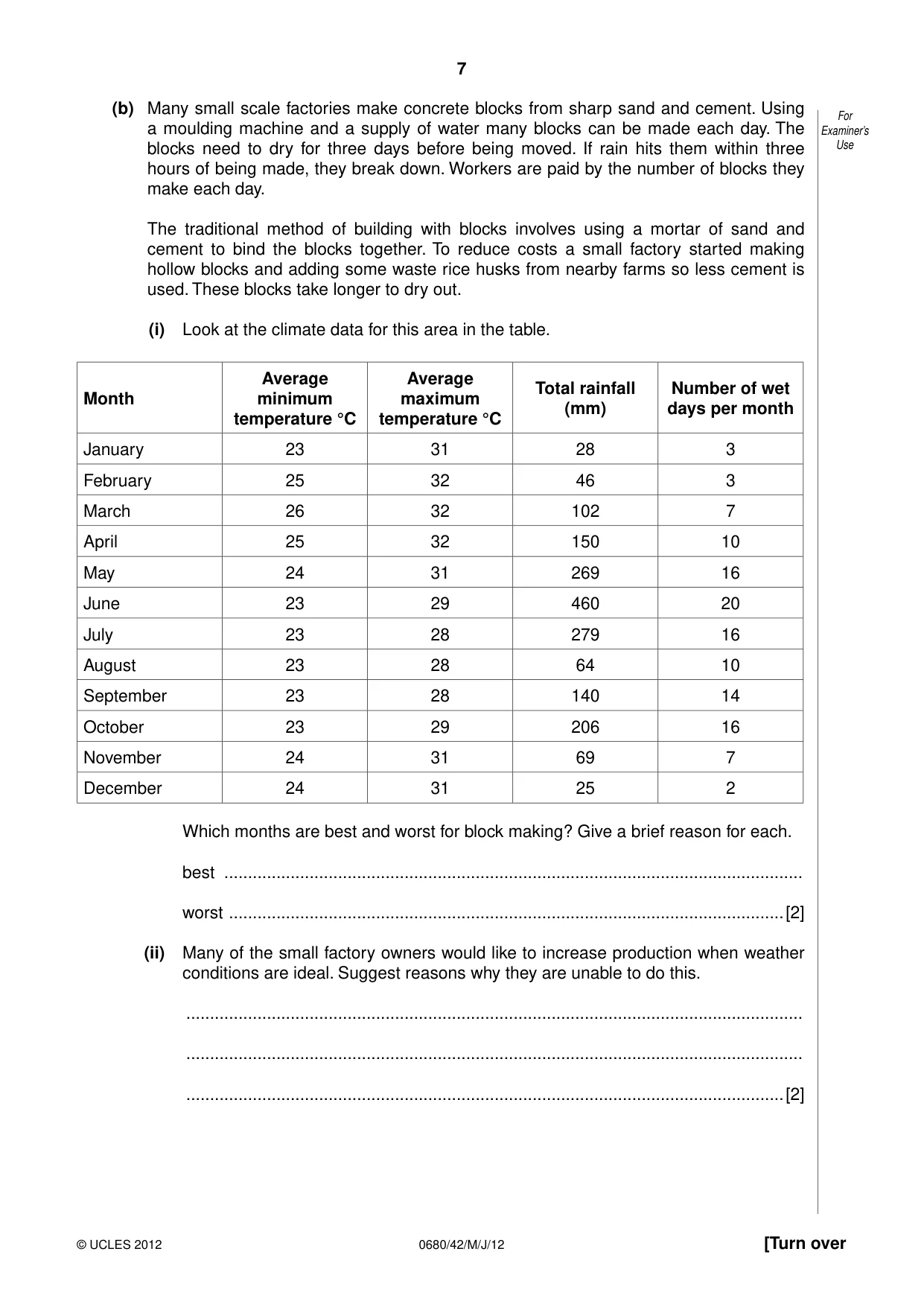
7 0680/42/M/J/12 © UCLES 2012 [Turn over For Examiner’s Use (b) Many small scale factories make concrete blocks from sharp sand and cement. Using a moulding machine and a supply of water many blocks can be made each day. The blocks need to dry for three days before being moved. If rain hits them within three hours of being made, they break down. Workers are paid by the number of blocks they make each day. The traditional method of building with blocks involves using a mortar of sand and cement to bind the blocks together. To reduce costs a small factory started making hollow blocks and adding some waste rice husks from nearby farms so less cement is used. These blocks take longer to dry out. (i) Look at the climate data for this area in the table. Month Average minimum temperature °C Average maximum temperature °C Total rainfall (mm) Number of wet days per month January 23 31 28 3 February 25 32 46 3 March 26 32 102 7 April 25 32 150 10 May 24 31 269 16 June 23 29 460 20 July 23 28 279 16 August 23 28 64 10 September 23 28 140 14 October 23 29 206 16 November 24 31 69 7 December 24 31 25 2 Which months are best and worst for block making? Give a brief reason for each. best … worst …[2] (ii) Many of the small factory owners would like to increase production when weather conditions are ideal. Suggest reasons why they are unable to do this. … … …[2]
Question paper, page 8
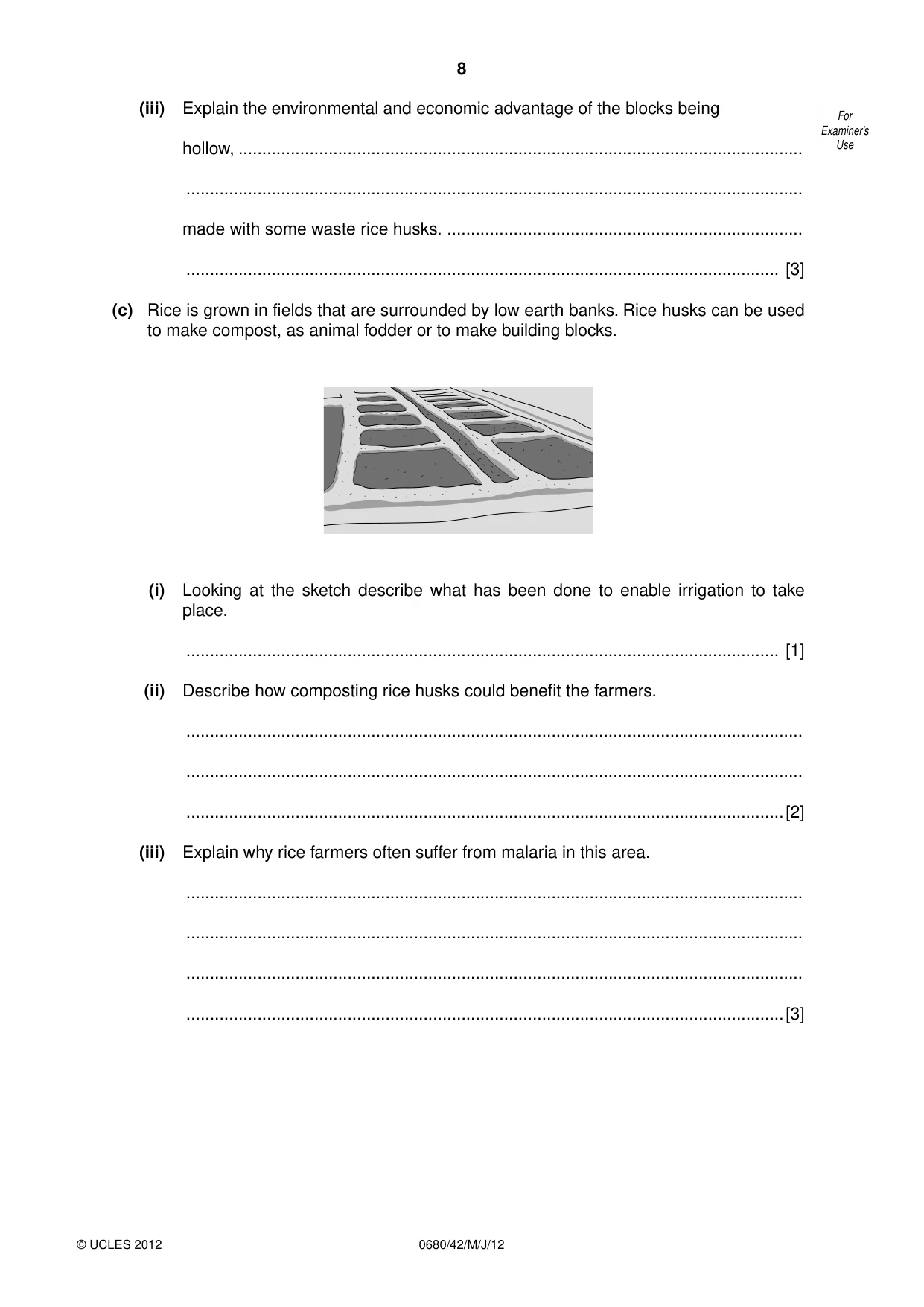
8 0680/42/M/J/12 © UCLES 2012 For Examiner’s Use (iii) Explain the environmental and economic advantage of the blocks being hollow, … … made with some waste rice husks. … … [3] (c) Rice is grown in fields that are surrounded by low earth banks. Rice husks can be used to make compost, as animal fodder or to make building blocks. (i) Looking at the sketch describe what has been done to enable irrigation to take place. … [1] (ii) Describe how composting rice husks could benefit the farmers. … … …[2] (iii) Explain why rice farmers often suffer from malaria in this area. … … … …[3]
Question paper, page 9
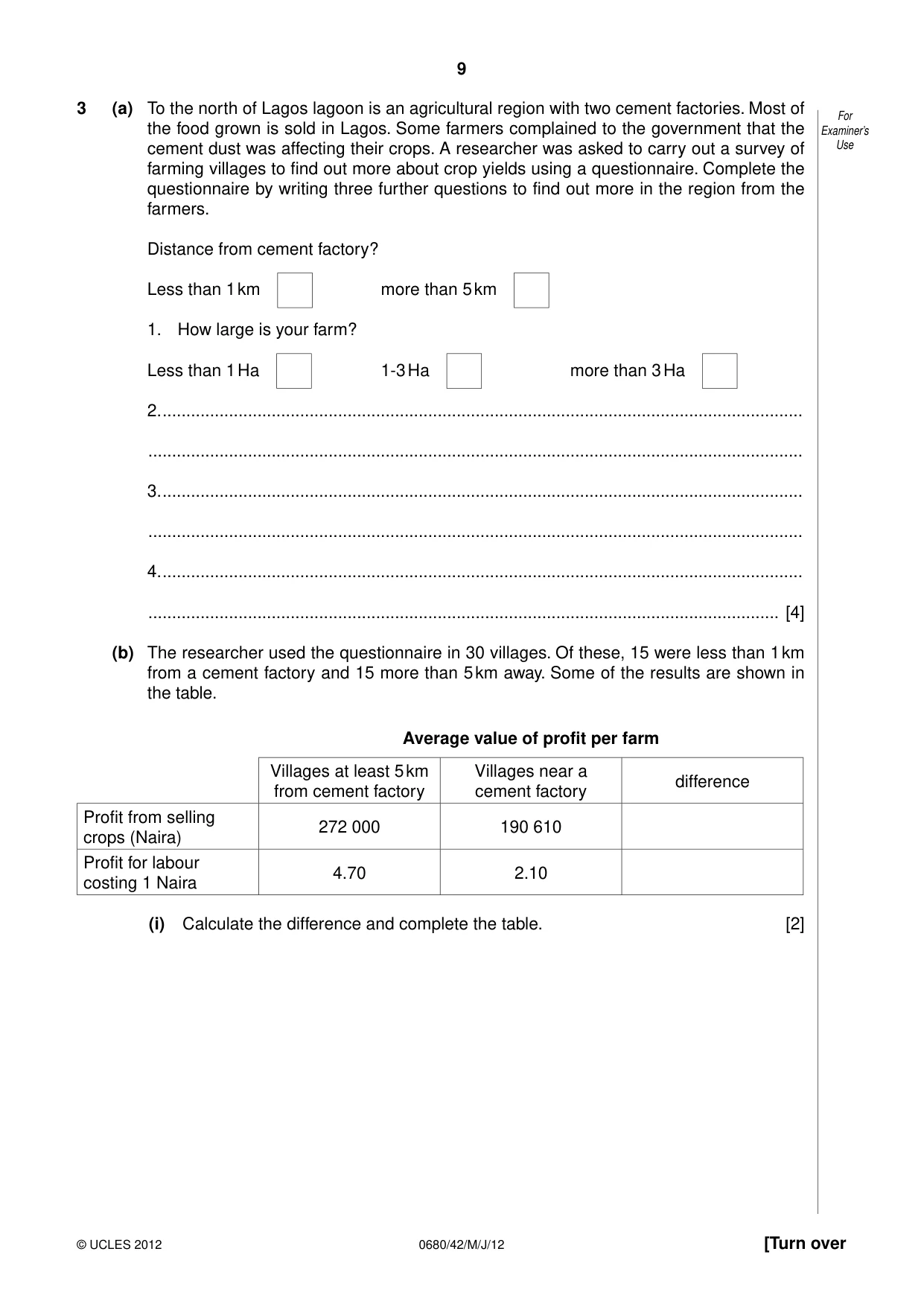
9 0680/42/M/J/12 © UCLES 2012 [Turn over For Examiner’s Use 3 (a) To the north of Lagos lagoon is an agricultural region with two cement factories. Most of the food grown is sold in Lagos. Some farmers complained to the government that the cement dust was affecting their crops. A researcher was asked to carry out a survey of farming villages to find out more about crop yields using a questionnaire. Complete the questionnaire by writing three further questions to find out more in the region from the farmers. Distance from cement factory? Less than 1 km more than 5 km 1. How large is your farm? Less than 1 Ha 1-3 Ha more than 3 Ha 2. … … 3. … … 4. … … [4] (b) The researcher used the questionnaire in 30 villages. Of these, 15 were less than 1 km from a cement factory and 15 more than 5 km away. Some of the results are shown in the table. Average value of profit per farm Villages at least 5 km from cement factory Villages near a cement factory difference Profit from selling crops (Naira) 272 000 190 610 Profit for labour costing 1 Naira 4.70 2.10 (i) Calculate the difference and complete the table. [2]
Question paper, page 10
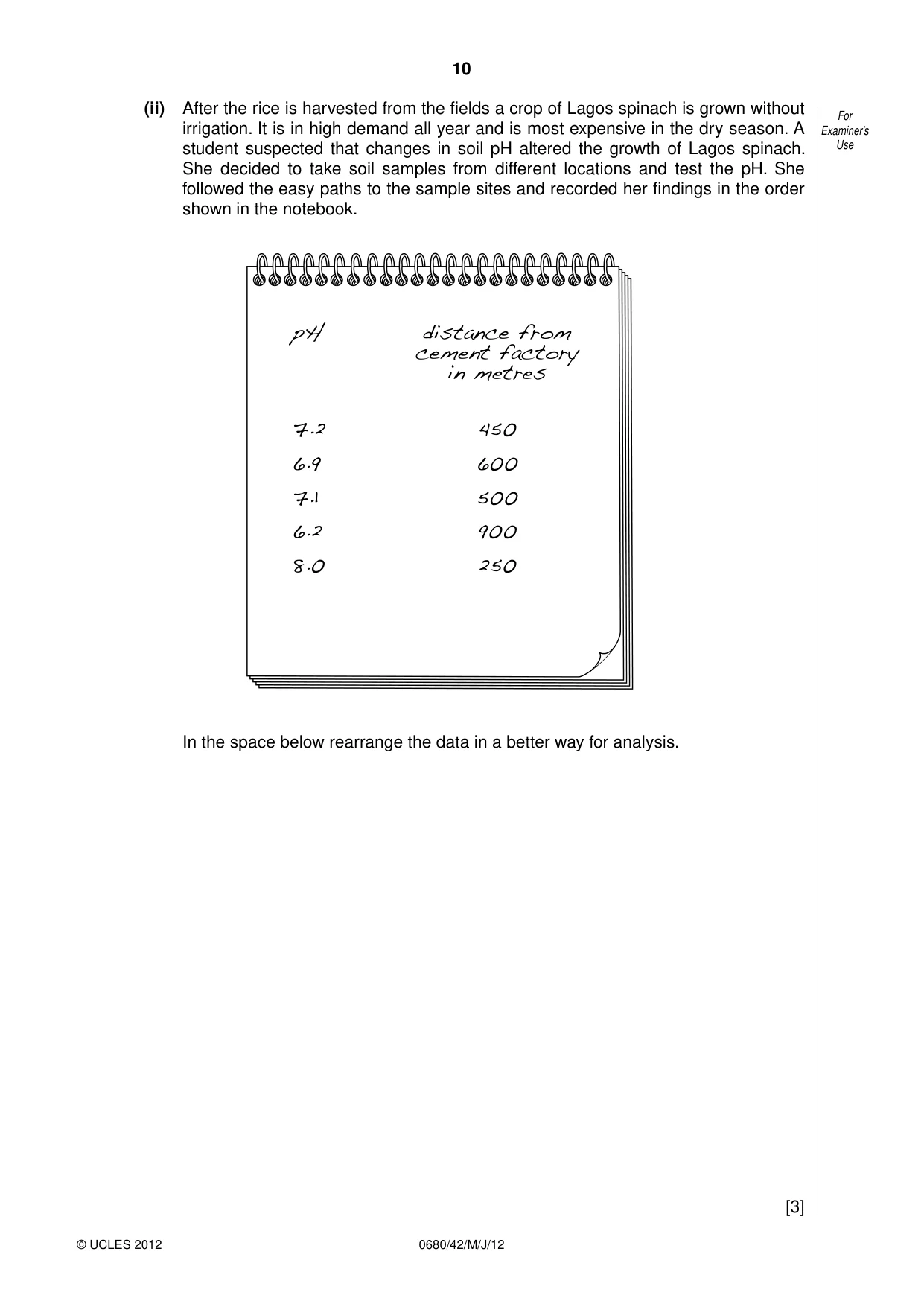
10 0680/42/M/J/12 © UCLES 2012 For Examiner’s Use (ii) After the rice is harvested from the fields a crop of Lagos spinach is grown without irrigation. It is in high demand all year and is most expensive in the dry season. A student suspected that changes in soil pH altered the growth of Lagos spinach. She decided to take soil samples from different locations and test the pH. She followed the easy paths to the sample sites and recorded her findings in the order shown in the notebook. In the space below rearrange the data in a better way for analysis. [3] pH distance from cement factory in metres 7.2 450 6.9 600 7.1 500 6.2 900 8.0 250
Question paper, page 11
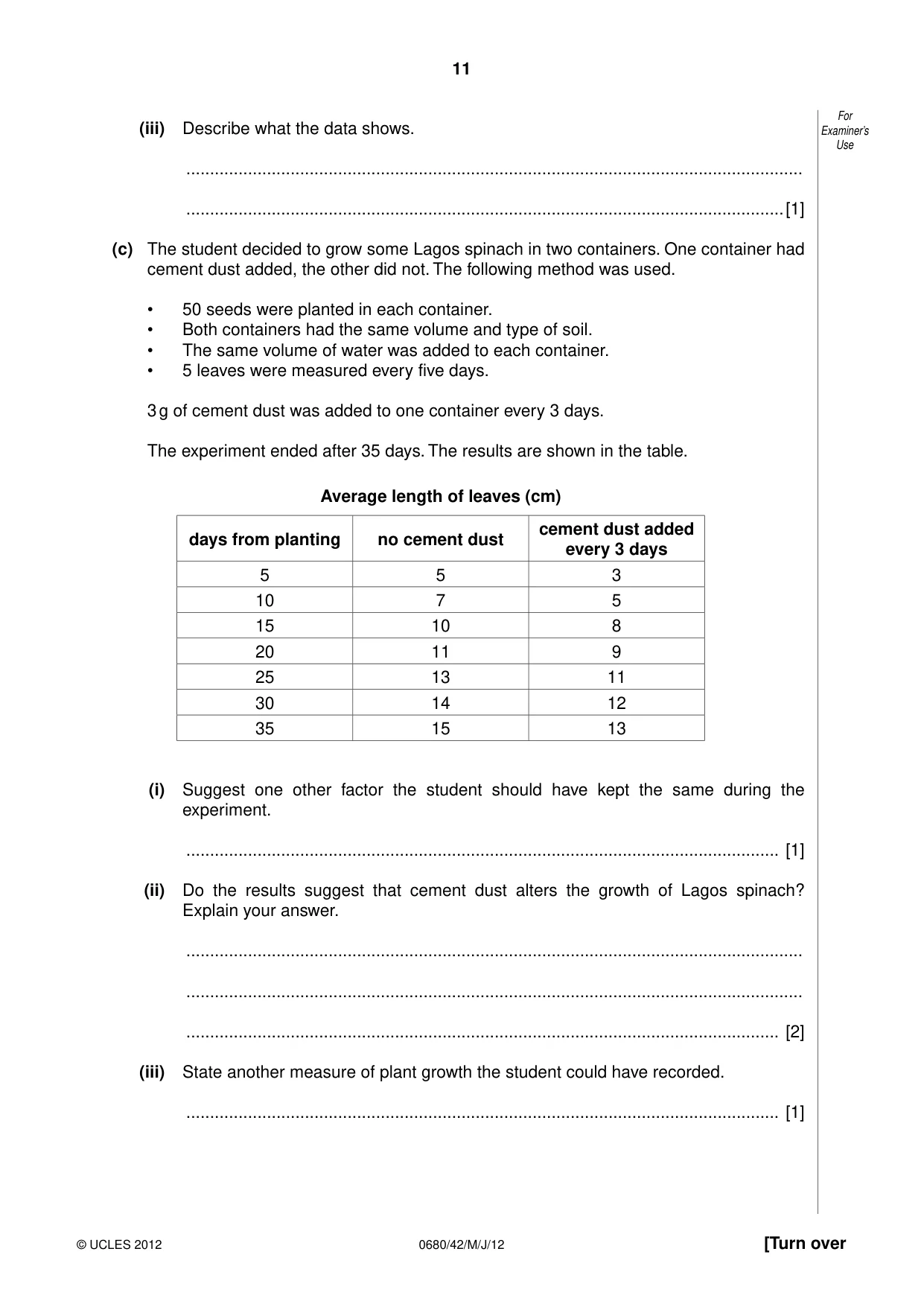
11 0680/42/M/J/12 © UCLES 2012 [Turn over For Examiner’s Use (iii) Describe what the data shows. … …[1] (c) The student decided to grow some Lagos spinach in two containers. One container had cement dust added, the other did not. The following method was used. • 50 seeds were planted in each container. • Both containers had the same volume and type of soil. • The same volume of water was added to each container. • 5 leaves were measured every five days. 3 g of cement dust was added to one container every 3 days. The experiment ended after 35 days. The results are shown in the table. Average length of leaves (cm) days from planting no cement dust cement dust added every 3 days 5 5 3 10 7 5 15 10 8 20 11 9 25 13 11 30 14 12 35 15 13 (i) Suggest one other factor the student should have kept the same during the experiment. … [1] (ii) Do the results suggest that cement dust alters the growth of Lagos spinach? Explain your answer. … … … [2] (iii) State another measure of plant growth the student could have recorded. … [1]
Question paper, page 12
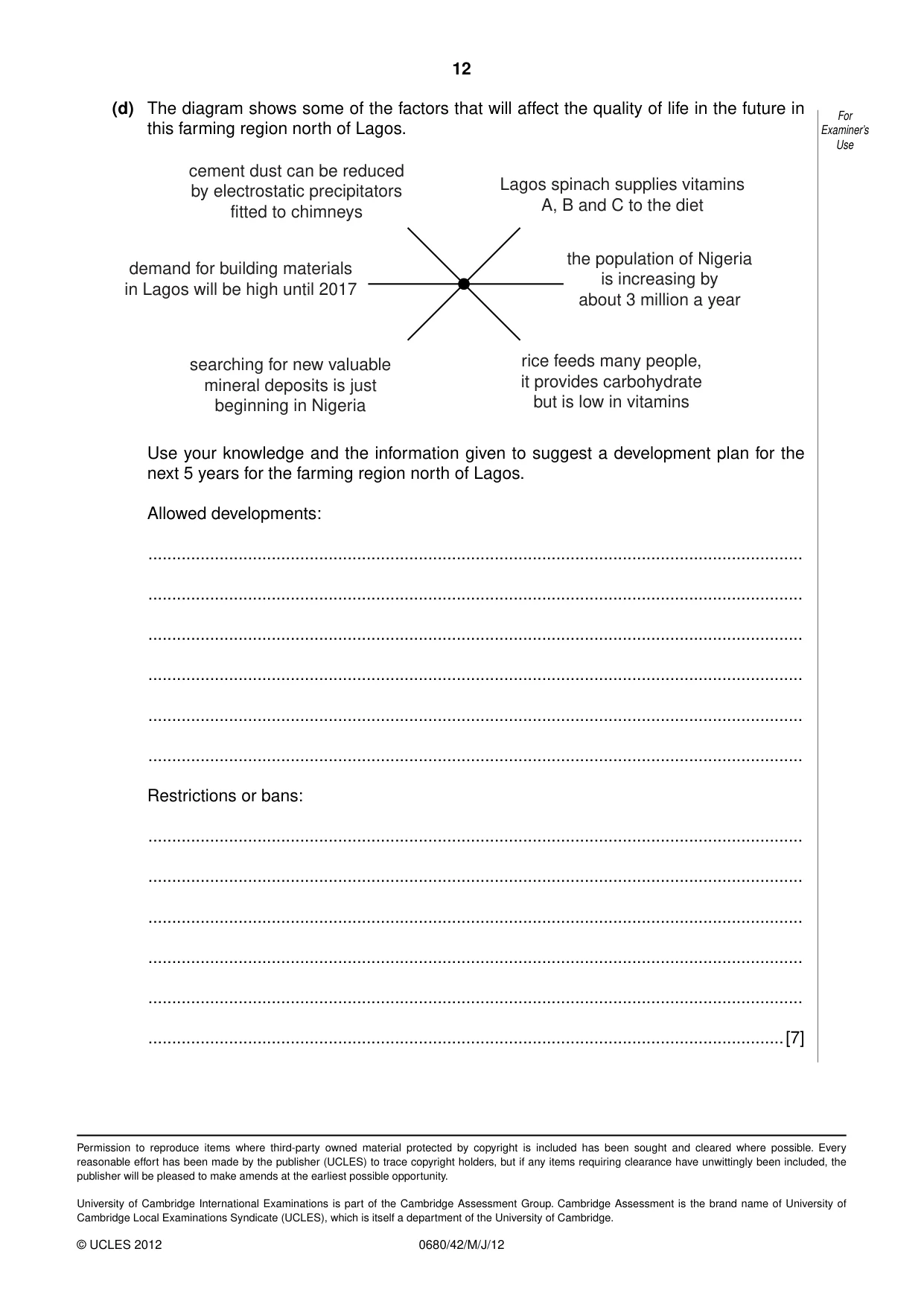
12 0680/42/M/J/12 © UCLES 2012 For Examiner’s Use (d) The diagram shows some of the factors that will affect the quality of life in the future in this farming region north of Lagos. cement dust can be reduced by electrostatic precipitators fitted to chimneys demand for building materials in Lagos will be high until 2017 searching for new valuable mineral deposits is just beginning in Nigeria Lagos spinach supplies vitamins A, B and C to the diet the population of Nigeria is increasing by about 3 million a year rice feeds many people, it provides carbohydrate but is low in vitamins Use your knowledge and the information given to suggest a development plan for the next 5 years for the farming region north of Lagos. Allowed developments: … … … … … … Restrictions or bans: … … … … … …[7] Permission to reproduce items where third-party owned material protected by copyright is included has been sought and cleared where possible. Every reasonable effort has been made by the publisher (UCLES) to trace copyright holders, but if any items requiring clearance have unwittingly been included, the publisher will be pleased to make amends at the earliest possible opportunity. University of Cambridge International Examinations is part of the Cambridge Assessment Group. Cambridge Assessment is the brand name of University of Cambridge Local Examinations Syndicate (UCLES), which is itself a department of the University of Cambridge.
Mark scheme, page 1
UNIVERSITY OF CAMBRIDGE INTERNATIONAL EXAMINATIONS International General Certificate of Secondary Education MARK SCHEME for the May/June 2012 question paper for the guidance of teachers 0680 ENVIRONMENTAL MANAGEMENT 0680/42 Paper 4 (Alternative to Coursework), maximum raw mark 60 This mark scheme is published as an aid to teachers and candidates, to indicate the requirements of the examination. It shows the basis on which Examiners were instructed to award marks. It does not indicate the details of the discussions that took place at an Examiners’ meeting before marking began, which would have considered the acceptability of alternative answers. Mark schemes must be read in conjunction with the question papers and the report on the examination. • Cambridge will not enter into discussions or correspondence in connection with these mark schemes. Cambridge is publishing the mark schemes for the May/June 2012 question papers for most IGCSE, GCE Advanced Level and Advanced Subsidiary Level syllabuses and some Ordinary Level syllabuses. www.XtremePapers.com
Mark scheme, page 2
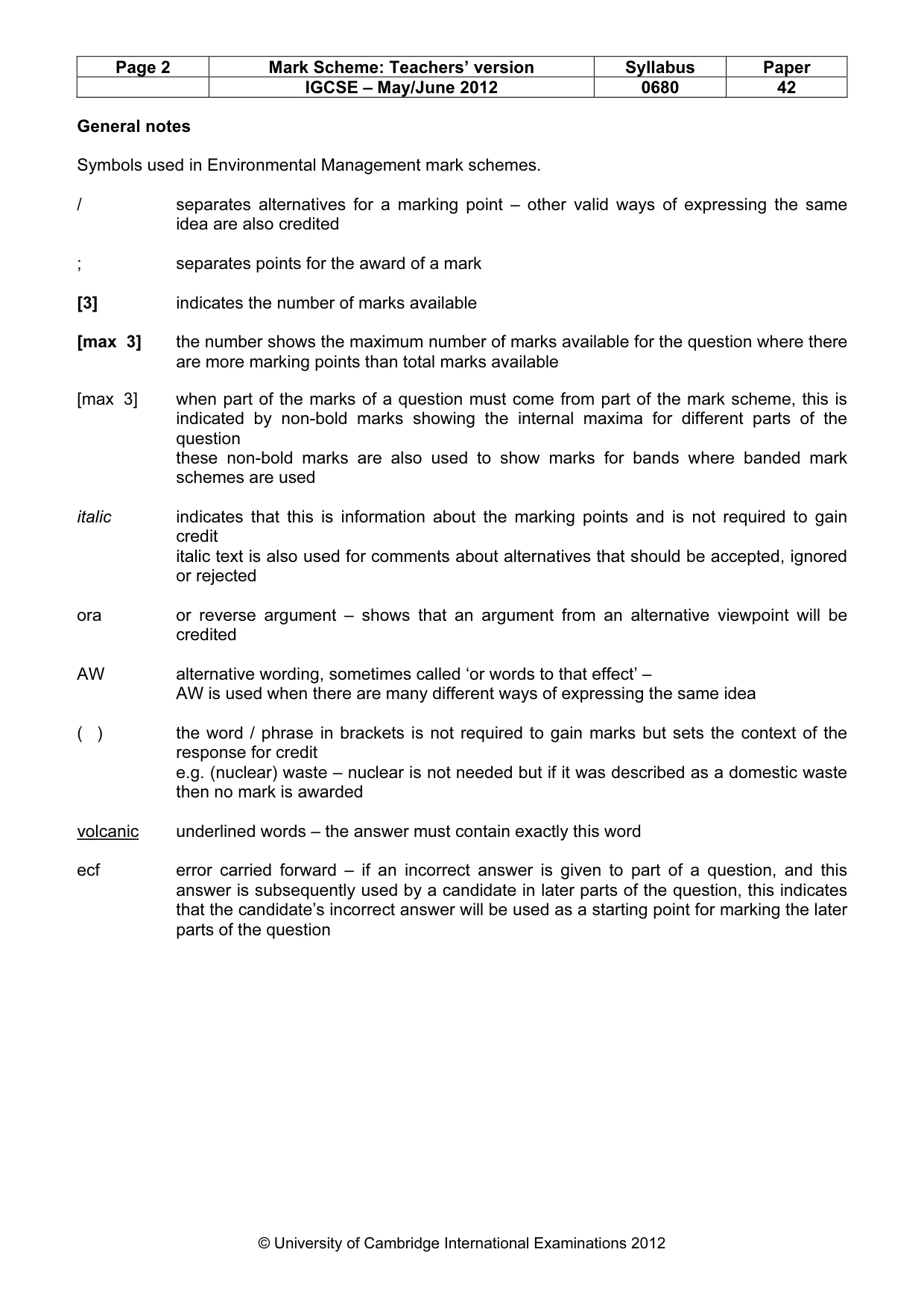
Page 2 Mark Scheme: Teachers’ version Syllabus Paper IGCSE – May/June 2012 0680 42 © University of Cambridge International Examinations 2012 General notes Symbols used in Environmental Management mark schemes. / separates alternatives for a marking point – other valid ways of expressing the same idea are also credited ; separates points for the award of a mark [3] indicates the number of marks available [max 3] the number shows the maximum number of marks available for the question where there are more marking points than total marks available [max 3] when part of the marks of a question must come from part of the mark scheme, this is indicated by non-bold marks showing the internal maxima for different parts of the question these non-bold marks are also used to show marks for bands where banded mark schemes are used italic indicates that this is information about the marking points and is not required to gain credit italic text is also used for comments about alternatives that should be accepted, ignored or rejected ora or reverse argument – shows that an argument from an alternative viewpoint will be credited AW alternative wording, sometimes called ‘or words to that effect’ – AW is used when there are many different ways of expressing the same idea ( ) the word / phrase in brackets is not required to gain marks but sets the context of the response for credit e.g. (nuclear) waste – nuclear is not needed but if it was described as a domestic waste then no mark is awarded volcanic underlined words – the answer must contain exactly this word ecf error carried forward – if an incorrect answer is given to part of a question, and this answer is subsequently used by a candidate in later parts of the question, this indicates that the candidate’s incorrect answer will be used as a starting point for marking the later parts of the question
Mark scheme, page 3
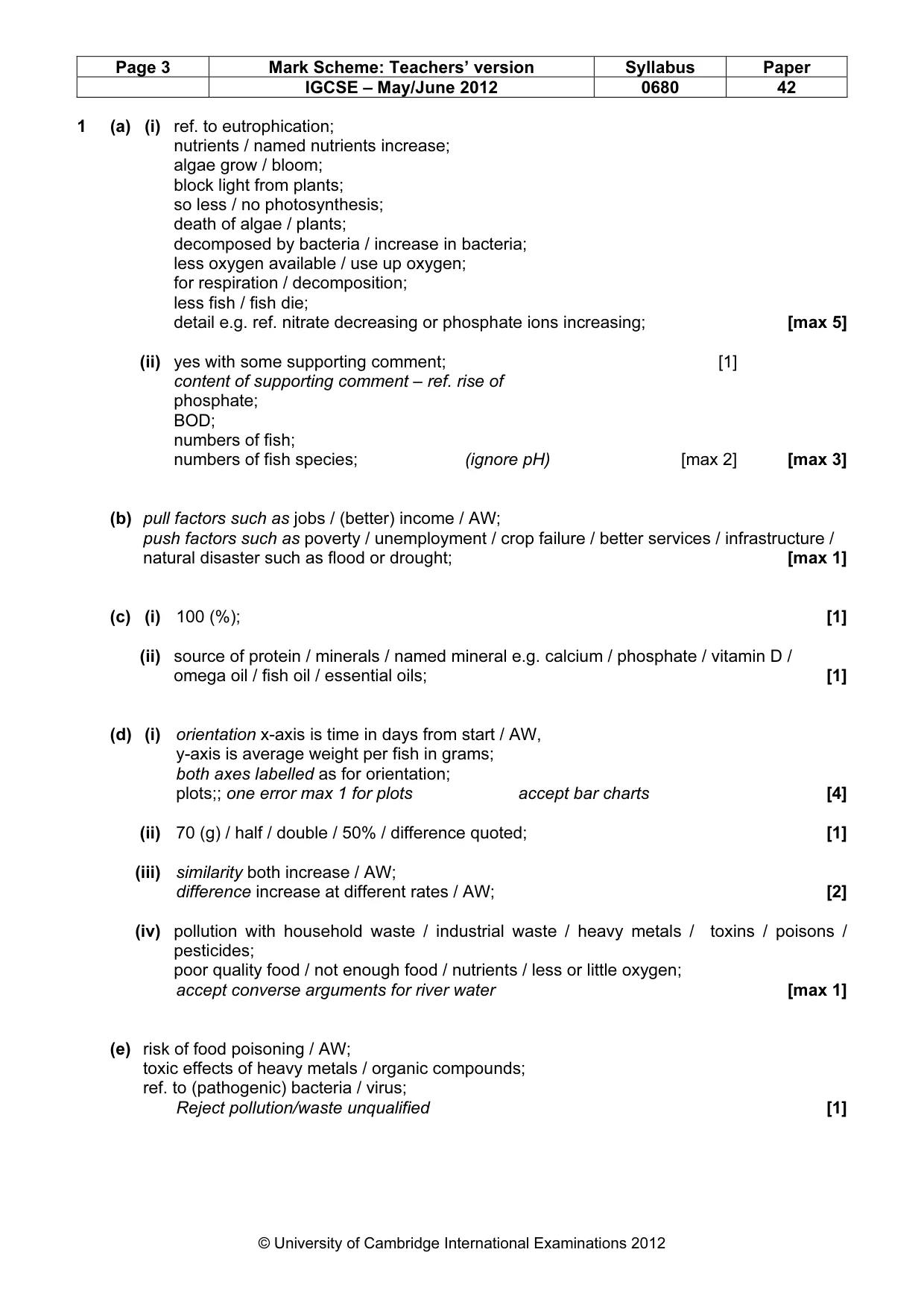
Page 3 Mark Scheme: Teachers’ version Syllabus Paper IGCSE – May/June 2012 0680 42 © University of Cambridge International Examinations 2012 1 (a) (i) ref. to eutrophication; nutrients / named nutrients increase; algae grow / bloom; block light from plants; so less / no photosynthesis; death of algae / plants; decomposed by bacteria / increase in bacteria; less oxygen available / use up oxygen; for respiration / decomposition; less fish / fish die; detail e.g. ref. nitrate decreasing or phosphate ions increasing; [max 5] (ii) yes with some supporting comment; [1] content of supporting comment – ref. rise of phosphate; BOD; numbers of fish; numbers of fish species; (ignore pH) [max 2] [max 3] (b) pull factors such as jobs / (better) income / AW; push factors such as poverty / unemployment / crop failure / better services / infrastructure / natural disaster such as flood or drought; [max 1] (c) (i) 100 (%); [1] (ii) source of protein / minerals / named mineral e.g. calcium / phosphate / vitamin D / omega oil / fish oil / essential oils; [1] (d) (i) orientation x-axis is time in days from start / AW, y-axis is average weight per fish in grams; both axes labelled as for orientation; plots;; one error max 1 for plots accept bar charts [4] (ii) 70 (g) / half / double / 50% / difference quoted; [1] (iii) similarity both increase / AW; difference increase at different rates / AW; [2] (iv) pollution with household waste / industrial waste / heavy metals / toxins / poisons / pesticides; poor quality food / not enough food / nutrients / less or little oxygen; accept converse arguments for river water [max 1] (e) risk of food poisoning / AW; toxic effects of heavy metals / organic compounds; ref. to (pathogenic) bacteria / virus; Reject pollution/waste unqualified [1]
Mark scheme, page 4
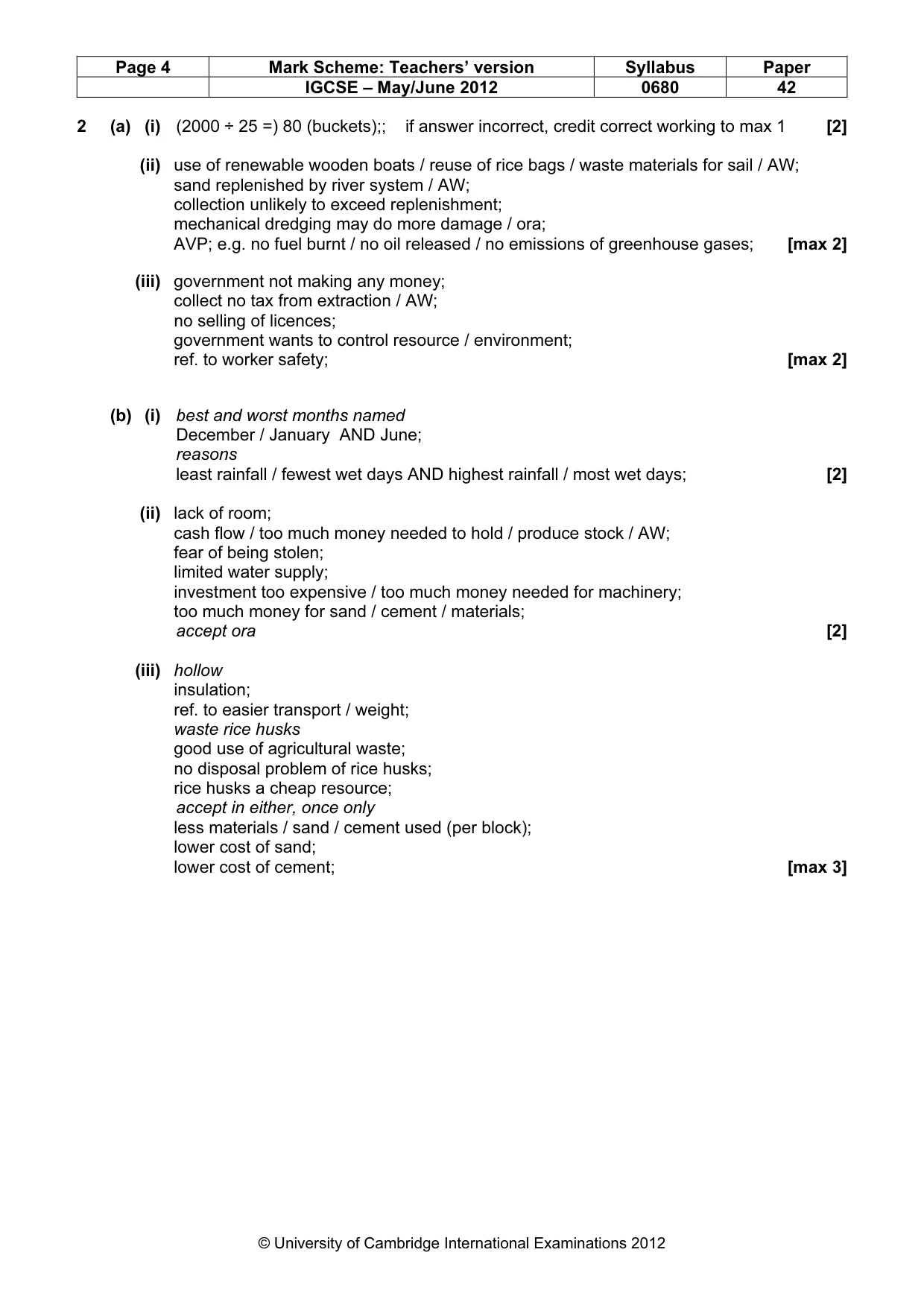
Page 4 Mark Scheme: Teachers’ version Syllabus Paper IGCSE – May/June 2012 0680 42 © University of Cambridge International Examinations 2012 2 (a) (i) (2000 ÷ 25 =) 80 (buckets);; if answer incorrect, credit correct working to max 1 [2] (ii) use of renewable wooden boats / reuse of rice bags / waste materials for sail / AW; sand replenished by river system / AW; collection unlikely to exceed replenishment; mechanical dredging may do more damage / ora; AVP; e.g. no fuel burnt / no oil released / no emissions of greenhouse gases; [max 2] (iii) government not making any money; collect no tax from extraction / AW; no selling of licences; government wants to control resource / environment; ref. to worker safety; [max 2] (b) (i) best and worst months named December / January AND June; reasons least rainfall / fewest wet days AND highest rainfall / most wet days; [2] (ii) lack of room; cash flow / too much money needed to hold / produce stock / AW; fear of being stolen; limited water supply; investment too expensive / too much money needed for machinery; too much money for sand / cement / materials; accept ora [2] (iii) hollow insulation; ref. to easier transport / weight; waste rice husks good use of agricultural waste; no disposal problem of rice husks; rice husks a cheap resource; accept in either, once only less materials / sand / cement used (per block); lower cost of sand; lower cost of cement; [max 3]
Mark scheme, page 5
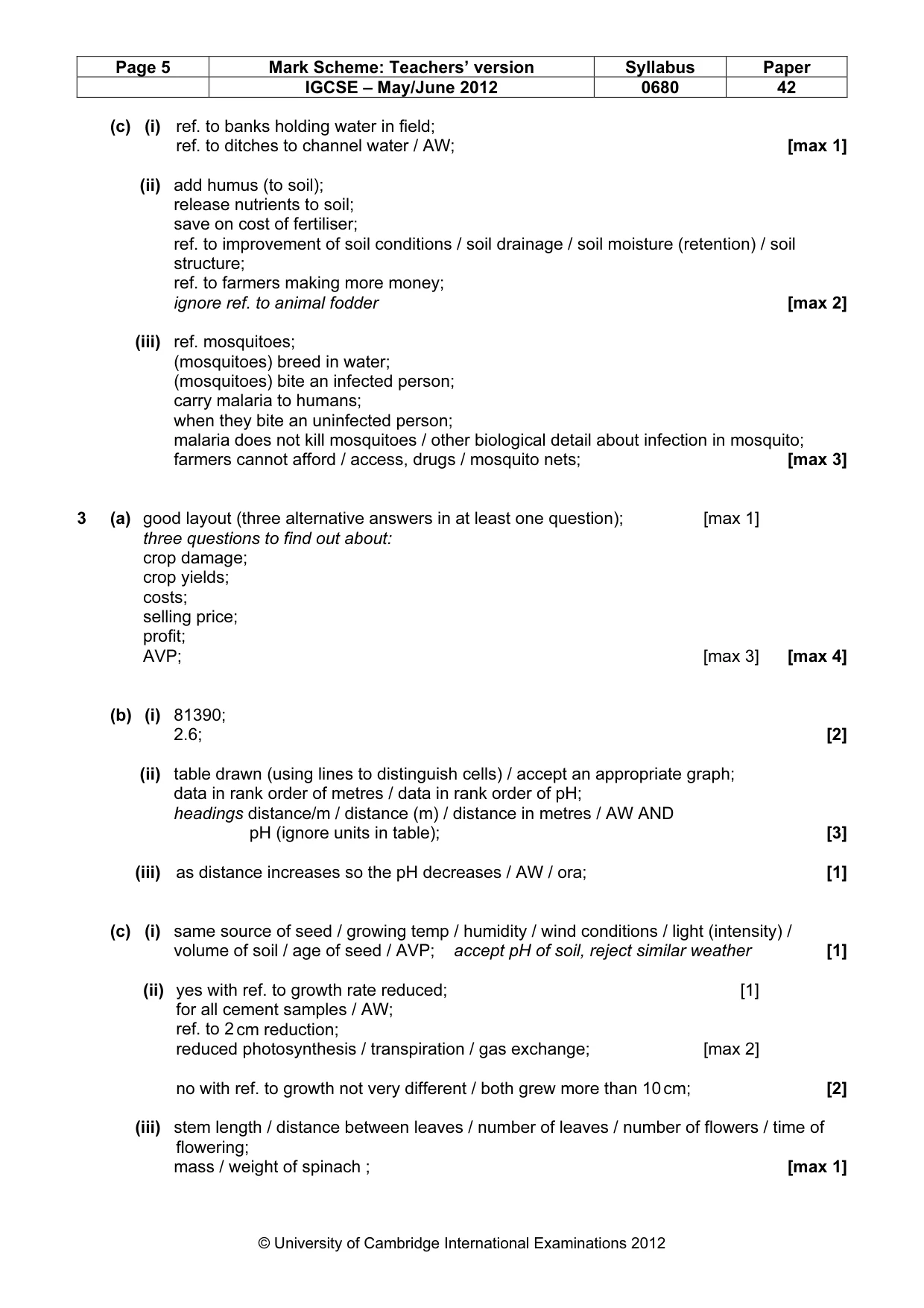
Page 5 Mark Scheme: Teachers’ version Syllabus Paper IGCSE – May/June 2012 0680 42 © University of Cambridge International Examinations 2012 (c) (i) ref. to banks holding water in field; ref. to ditches to channel water / AW; [max 1] (ii) add humus (to soil); release nutrients to soil; save on cost of fertiliser; ref. to improvement of soil conditions / soil drainage / soil moisture (retention) / soil structure; ref. to farmers making more money; ignore ref. to animal fodder [max 2] (iii) ref. mosquitoes; (mosquitoes) breed in water; (mosquitoes) bite an infected person; carry malaria to humans; when they bite an uninfected person; malaria does not kill mosquitoes / other biological detail about infection in mosquito; farmers cannot afford / access, drugs / mosquito nets; [max 3] 3 (a) good layout (three alternative answers in at least one question); [max 1] three questions to find out about: crop damage; crop yields; costs; selling price; profit; AVP; [max 3] [max 4] (b) (i) 81390; 2.6; [2] (ii) table drawn (using lines to distinguish cells) / accept an appropriate graph; data in rank order of metres / data in rank order of pH; headings distance/m / distance (m) / distance in metres / AW AND pH (ignore units in table); [3] (iii) as distance increases so the pH decreases / AW / ora; [1] (c) (i) same source of seed / growing temp / humidity / wind conditions / light (intensity) / volume of soil / age of seed / AVP; accept pH of soil, reject similar weather [1] (ii) yes with ref. to growth rate reduced; [1] for all cement samples / AW; ref. to 2 cm reduction; reduced photosynthesis / transpiration / gas exchange; [max 2] no with ref. to growth not very different / both grew more than 10 cm; [2] (iii) stem length / distance between leaves / number of leaves / number of flowers / time of flowering; mass / weight of spinach ; [max 1]
Mark scheme, page 6
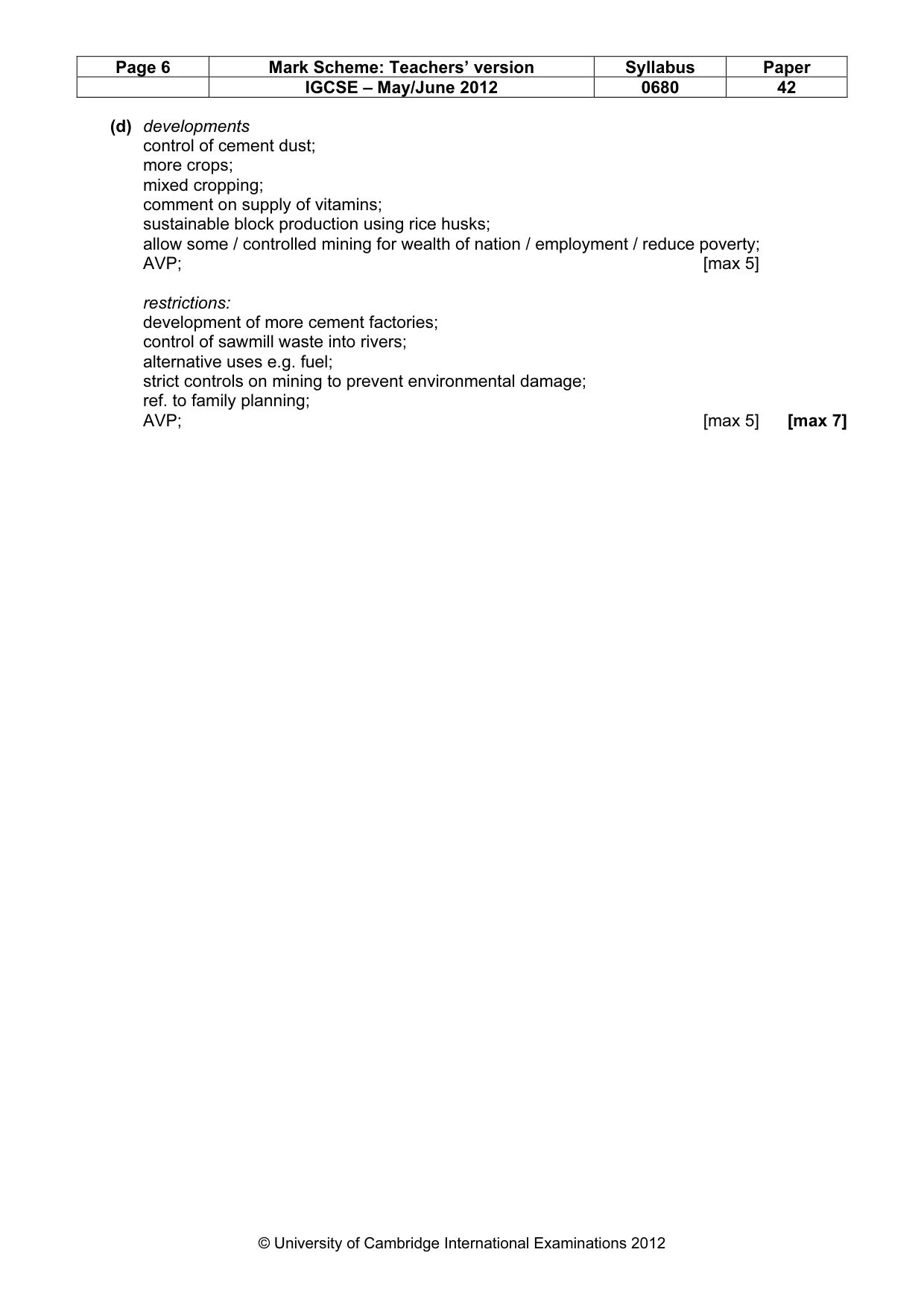
Page 6 Mark Scheme: Teachers’ version Syllabus Paper IGCSE – May/June 2012 0680 42 © University of Cambridge International Examinations 2012 (d) developments control of cement dust; more crops; mixed cropping; comment on supply of vitamins; sustainable block production using rice husks; allow some / controlled mining for wealth of nation / employment / reduce poverty; AVP; [max 5] restrictions: development of more cement factories; control of sawmill waste into rivers; alternative uses e.g. fuel; strict controls on mining to prevent environmental damage; ref. to family planning; AVP; [max 5] [max 7]
What you needed in this session
Cambridge’s own grade thresholds for 2012 May/June, Paper 4 · Variant 2. A higher threshold means an easier paper — the bar moves with how the cohort did.