Cambridge IGCSE Environmental Management 0680 — 2011 Oct/Nov Paper 4 · Variant 3
0680/43/O/N/11 · 60 marks · ≈68 min
The question paper and its mark scheme, free to read here and free to download. This is Cambridge’s own paper, exactly as it was sat.
Question paper16 pages
Mark scheme4 pages
Answers below. Sit the paper first if you are practising.
Paper as text
Question paper, page 1
This document consists of 16 printed pages. DC (NF/DJ) 47566 © UCLES 2011 [Turn over UNIVERSITY OF CAMBRIDGE INTERNATIONAL EXAMINATIONS International General Certificate of Secondary Education * 8 6 2 7 2 2 0 6 0 4 * ENVIRONMENTAL MANAGEMENT 0680/43 Alternative to Coursework October/November 2011 1 hour 30 minutes Candidates answer on the Question Paper. Additional Materials: Ruler READ THESE INSTRUCTIONS FIRST Write your Centre number, candidate number and name on all the work you hand in. Write in dark blue or black pen. You may use a soft pencil for any diagrams, graphs or rough working. Do not use staples, paper clips, highlighters, glue or correction fluid. DO NOT WRITE IN ANY BARCODES. Answer all questions. Study the appropriate Source materials before you start to write your answers. Credit will be given for appropriate selection and use of data in your answers and for relevant interpretation of these data. Suggestions for data sources are given in some questions. You may use the source data to draw diagrams and graphs or to do calculations to illustrate your answers. At the end of the examination, fasten all your work securely together. The number of marks is given in brackets [ ] at the end of each question or part question. For Examiner’s Use www.XtremePapers.com
Question paper, page 2
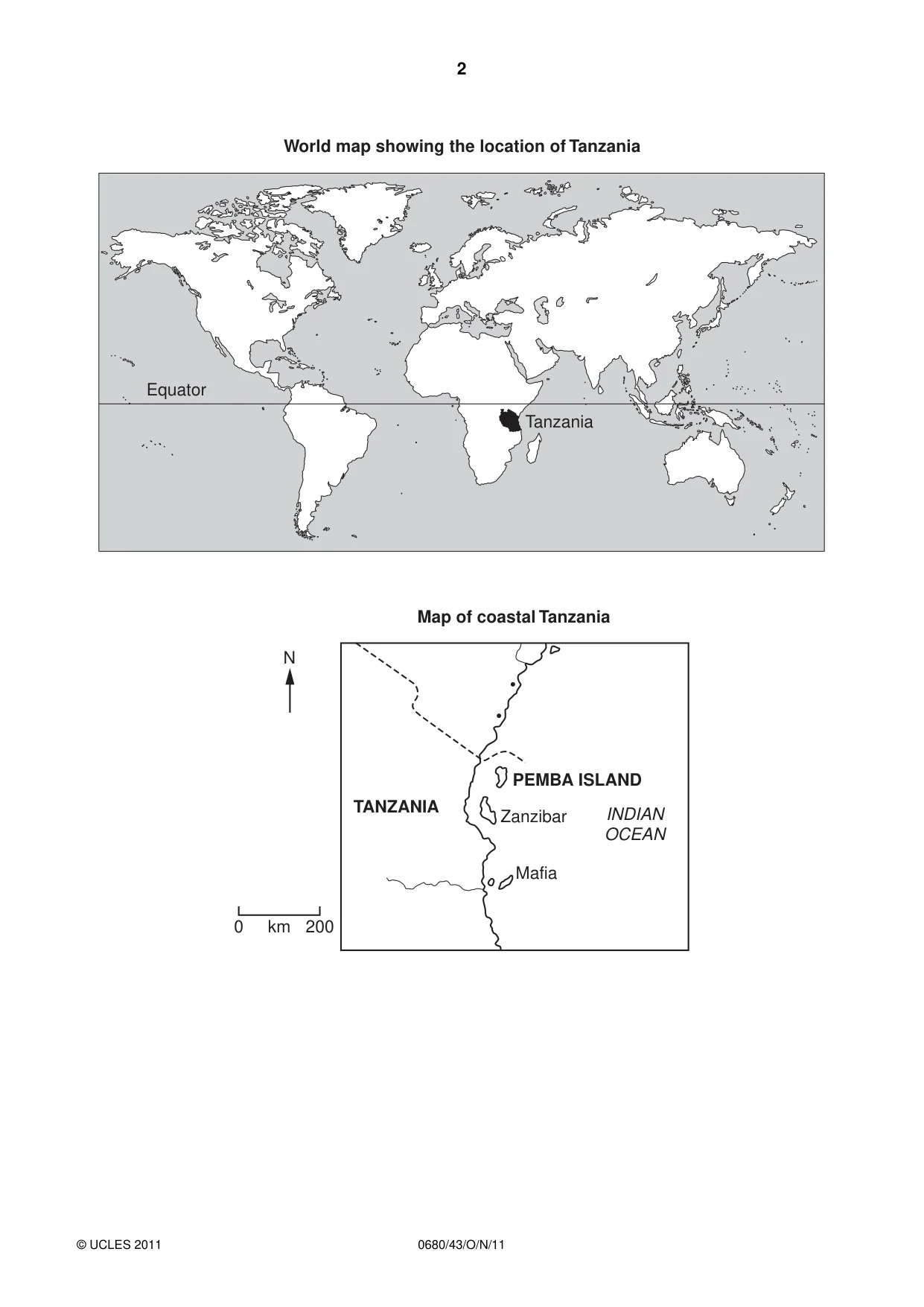
2 0680/43/O/N/11 © UCLES 2011 Equator Tanzania World map showing the location of Tanzania TANZANIA Map of coastal Tanzania PEMBA ISLAND Zanzibar N Mafia 0 km 200 INDIAN OCEAN
Question paper, page 3
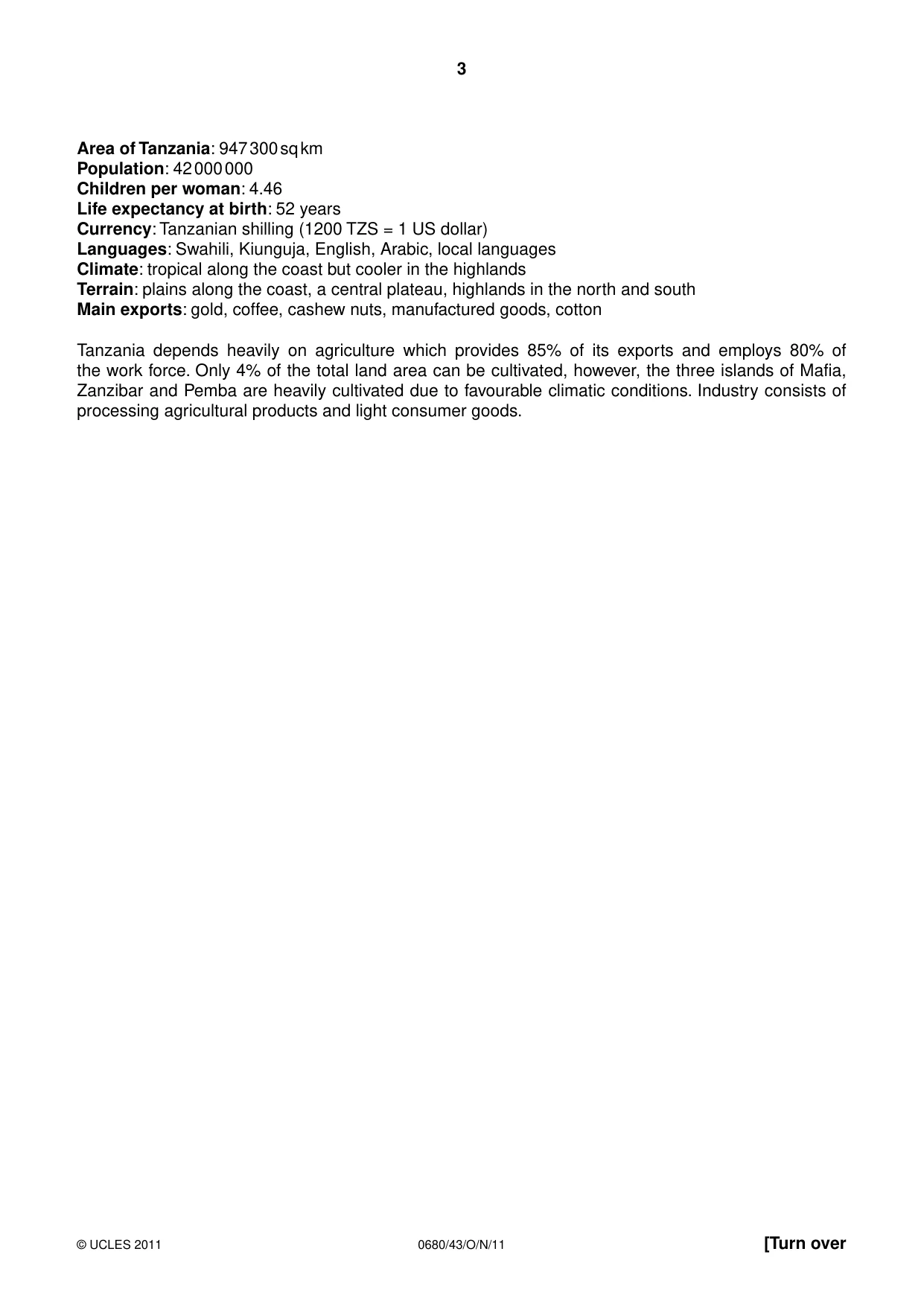
3 0680/43/O/N/11 © UCLES 2011 [Turn over Area of Tanzania: 947 300 sq km Population: 42 000 000 Children per woman: 4.46 Life expectancy at birth: 52 years Currency: Tanzanian shilling (1200 TZS = 1 US dollar) Languages: Swahili, Kiunguja, English, Arabic, local languages Climate: tropical along the coast but cooler in the highlands Terrain: plains along the coast, a central plateau, highlands in the north and south Main exports: gold, coffee, cashew nuts, manufactured goods, cotton Tanzania depends heavily on agriculture which provides 85% of its exports and employs 80% of the work force. Only 4% of the total land area can be cultivated, however, the three islands of Mafia, Zanzibar and Pemba are heavily cultivated due to favourable climatic conditions. Industry consists of processing agricultural products and light consumer goods.
Question paper, page 4
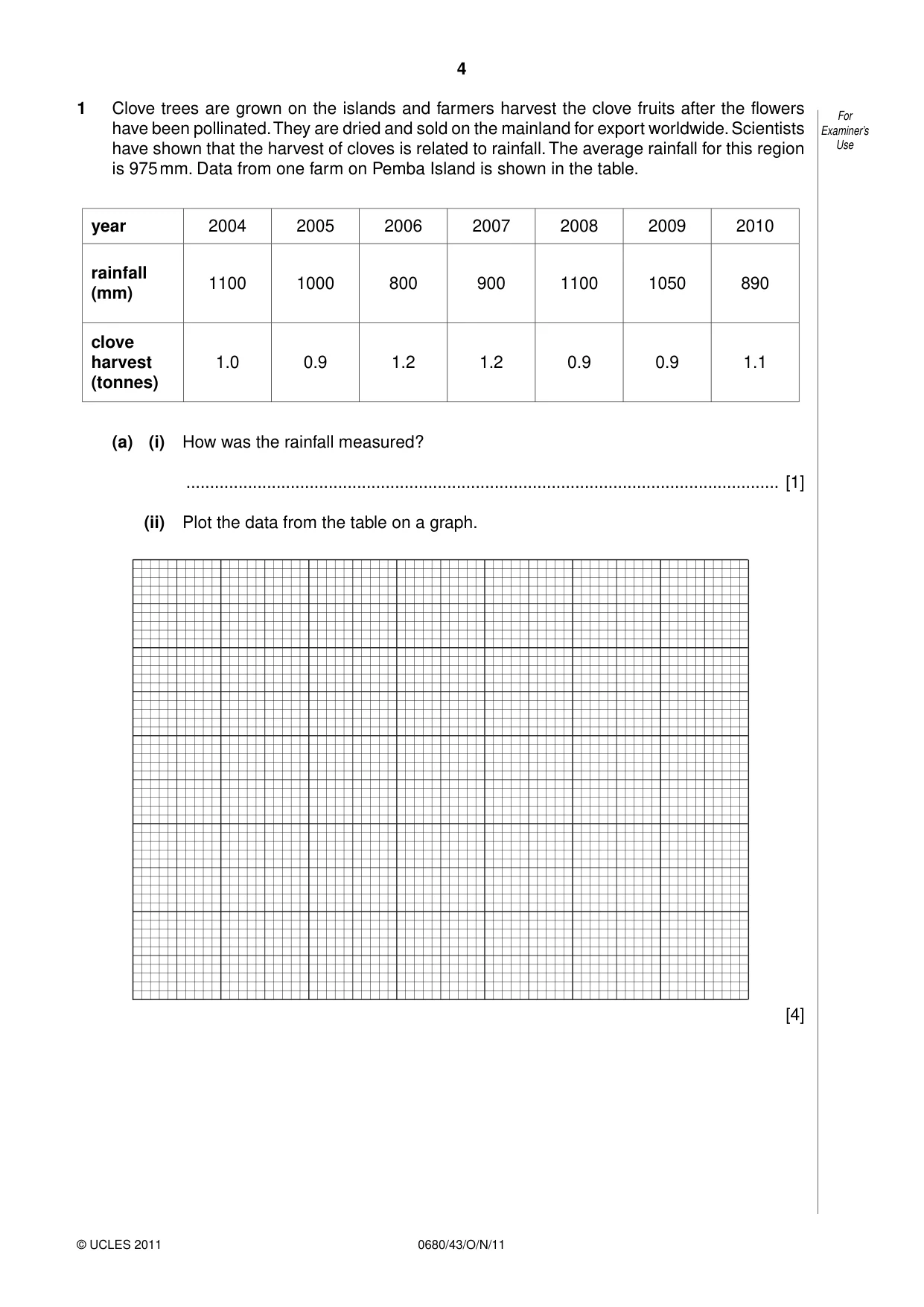
4 0680/43/O/N/11 © UCLES 2011 For Examiner’s Use 1 Clove trees are grown on the islands and farmers harvest the clove fruits after the flowers have been pollinated. They are dried and sold on the mainland for export worldwide. Scientists have shown that the harvest of cloves is related to rainfall. The average rainfall for this region is 975 mm. Data from one farm on Pemba Island is shown in the table. year 2004 2005 2006 2007 2008 2009 2010 rainfall (mm) 1100 1000 800 900 1100 1050 890 clove harvest (tonnes) 1.0 0.9 1.2 1.2 0.9 0.9 1.1 (a) (i) How was the rainfall measured? … [1] (ii) Plot the data from the table on a graph. [4]
Question paper, page 5
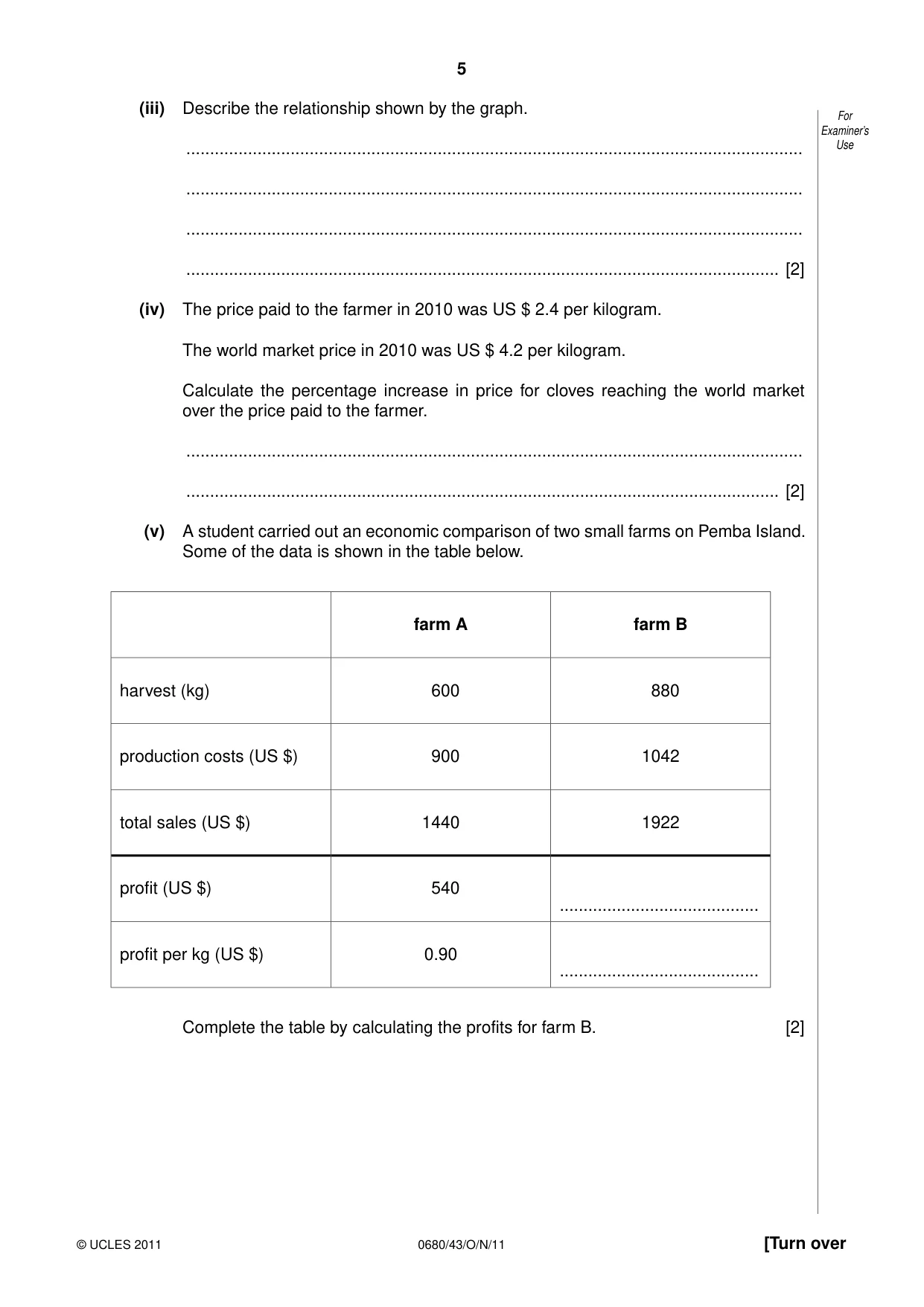
5 0680/43/O/N/11 © UCLES 2011 [Turn over For Examiner’s Use (iii) Describe the relationship shown by the graph. … … … … [2] (iv) The price paid to the farmer in 2010 was US $ 2.4 per kilogram. The world market price in 2010 was US $ 4.2 per kilogram. Calculate the percentage increase in price for cloves reaching the world market over the price paid to the farmer. … … [2] (v) A student carried out an economic comparison of two small farms on Pemba Island. Some of the data is shown in the table below. farm A farm B harvest (kg) 600 880 production costs (US $) 900 1042 total sales (US $) 1440 1922 profit (US $) 540 … profit per kg (US $) 0.90 … Complete the table by calculating the profits for farm B. [2]
Question paper, page 6
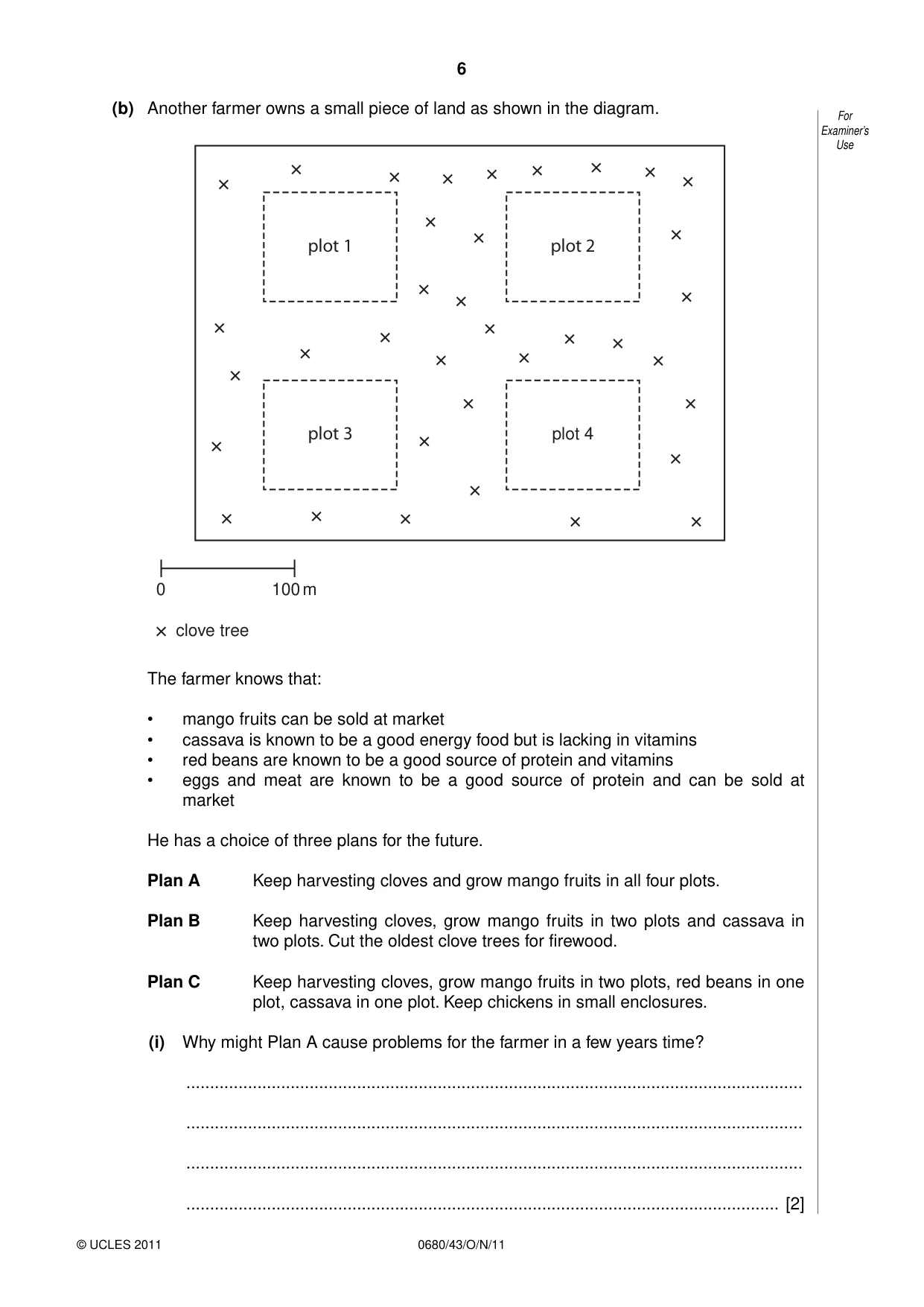
6 0680/43/O/N/11 © UCLES 2011 For Examiner’s Use (b) Another farmer owns a small piece of land as shown in the diagram. plot 1 plot 2 plot 3 plot 4 0 clove tree 100 m The farmer knows that: • mango fruits can be sold at market • cassava is known to be a good energy food but is lacking in vitamins • red beans are known to be a good source of protein and vitamins • eggs and meat are known to be a good source of protein and can be sold at market He has a choice of three plans for the future. Plan A Keep harvesting cloves and grow mango fruits in all four plots. Plan B Keep harvesting cloves, grow mango fruits in two plots and cassava in two plots. Cut the oldest clove trees for firewood. Plan C Keep harvesting cloves, grow mango fruits in two plots, red beans in one plot, cassava in one plot. Keep chickens in small enclosures. (i) Why might Plan A cause problems for the farmer in a few years time? … … … … [2]
Question paper, page 7
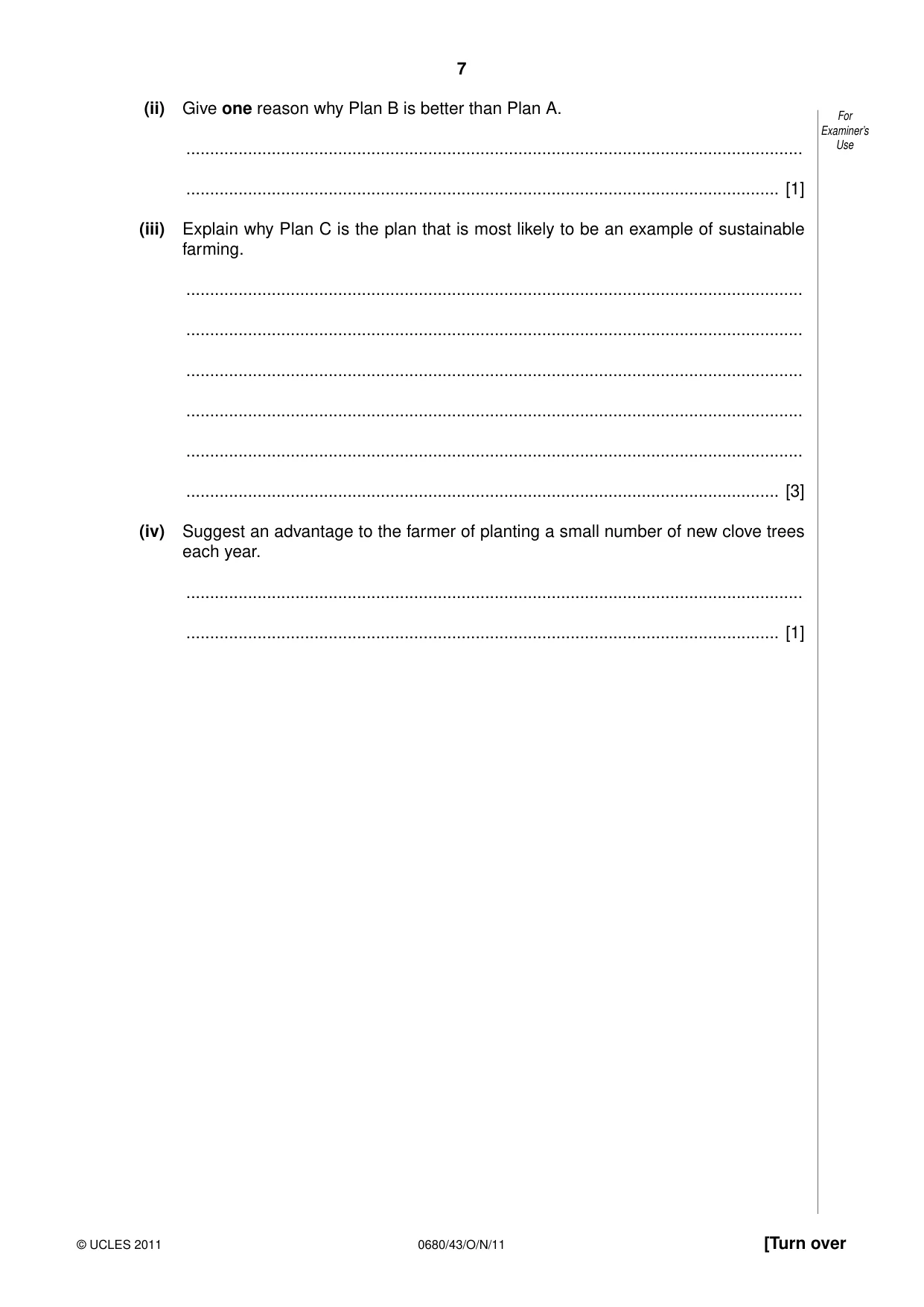
7 0680/43/O/N/11 © UCLES 2011 [Turn over For Examiner’s Use (ii) Give one reason why Plan B is better than Plan A. … … [1] (iii) Explain why Plan C is the plan that is most likely to be an example of sustainable farming. … … … … … … [3] (iv) Suggest an advantage to the farmer of planting a small number of new clove trees each year. … … [1]
Question paper, page 8
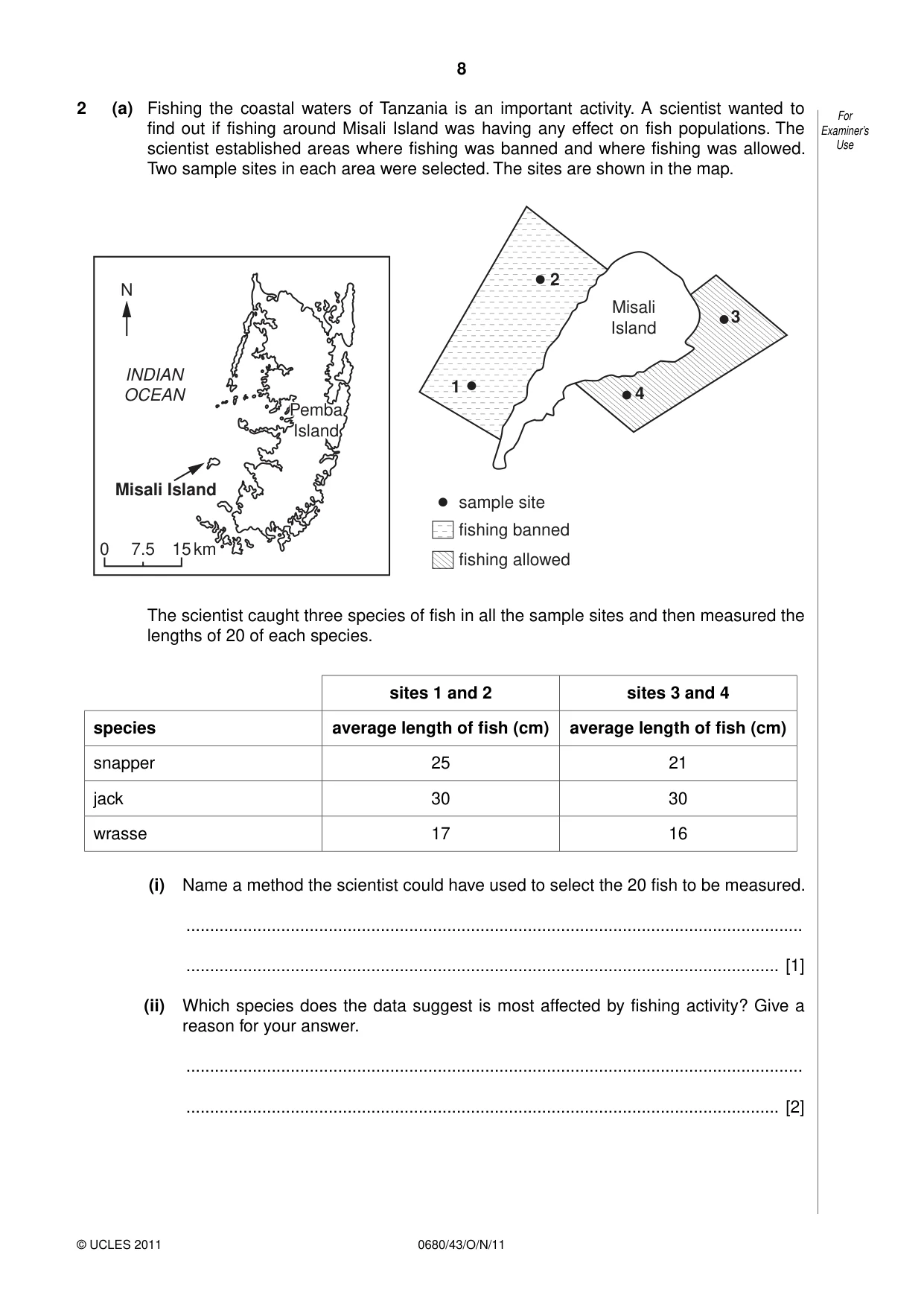
8 0680/43/O/N/11 © UCLES 2011 For Examiner’s Use 2 (a) Fishing the coastal waters of Tanzania is an important activity. A scientist wanted to find out if fishing around Misali Island was having any effect on fish populations. The scientist established areas where fishing was banned and where fishing was allowed. Two sample sites in each area were selected. The sites are shown in the map. N INDIAN OCEAN Misali Island 0 7.5 15 km 1 2 4 3 sample site fishing banned Misali Island fishing allowed Pemba Pemba Island Island Pemba Island The scientist caught three species of fish in all the sample sites and then measured the lengths of 20 of each species. sites 1 and 2 sites 3 and 4 species average length of fish (cm) average length of fish (cm) snapper 25 21 jack 30 30 wrasse 17 16 (i) Name a method the scientist could have used to select the 20 fish to be measured. … … [1] (ii) Which species does the data suggest is most affected by fishing activity? Give a reason for your answer. … … [2]
Question paper, page 9
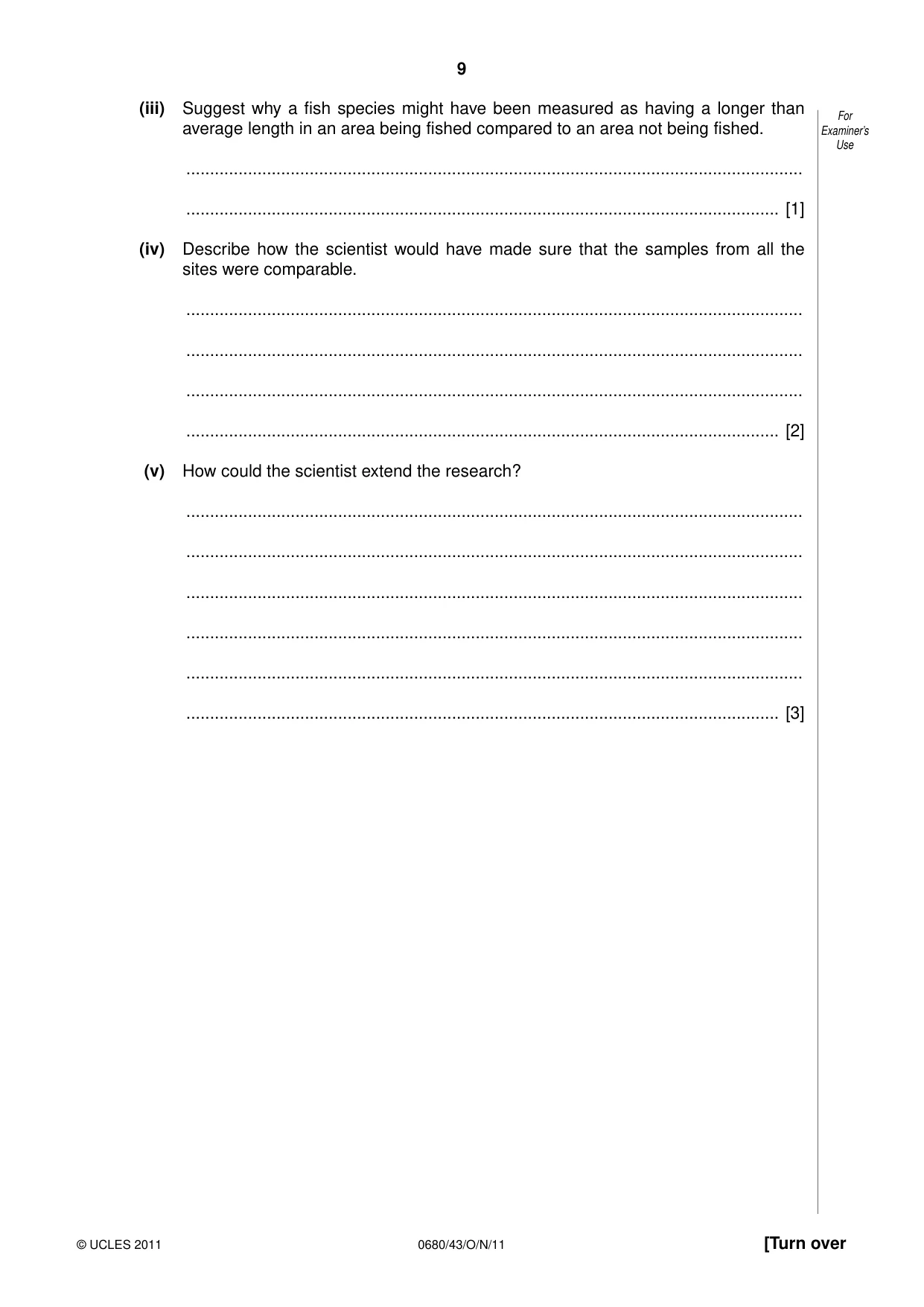
9 0680/43/O/N/11 © UCLES 2011 [Turn over For Examiner’s Use (iii) Suggest why a fish species might have been measured as having a longer than average length in an area being fished compared to an area not being fished. … … [1] (iv) Describe how the scientist would have made sure that the samples from all the sites were comparable. … … … … [2] (v) How could the scientist extend the research? … … … … … … [3]
Question paper, page 10
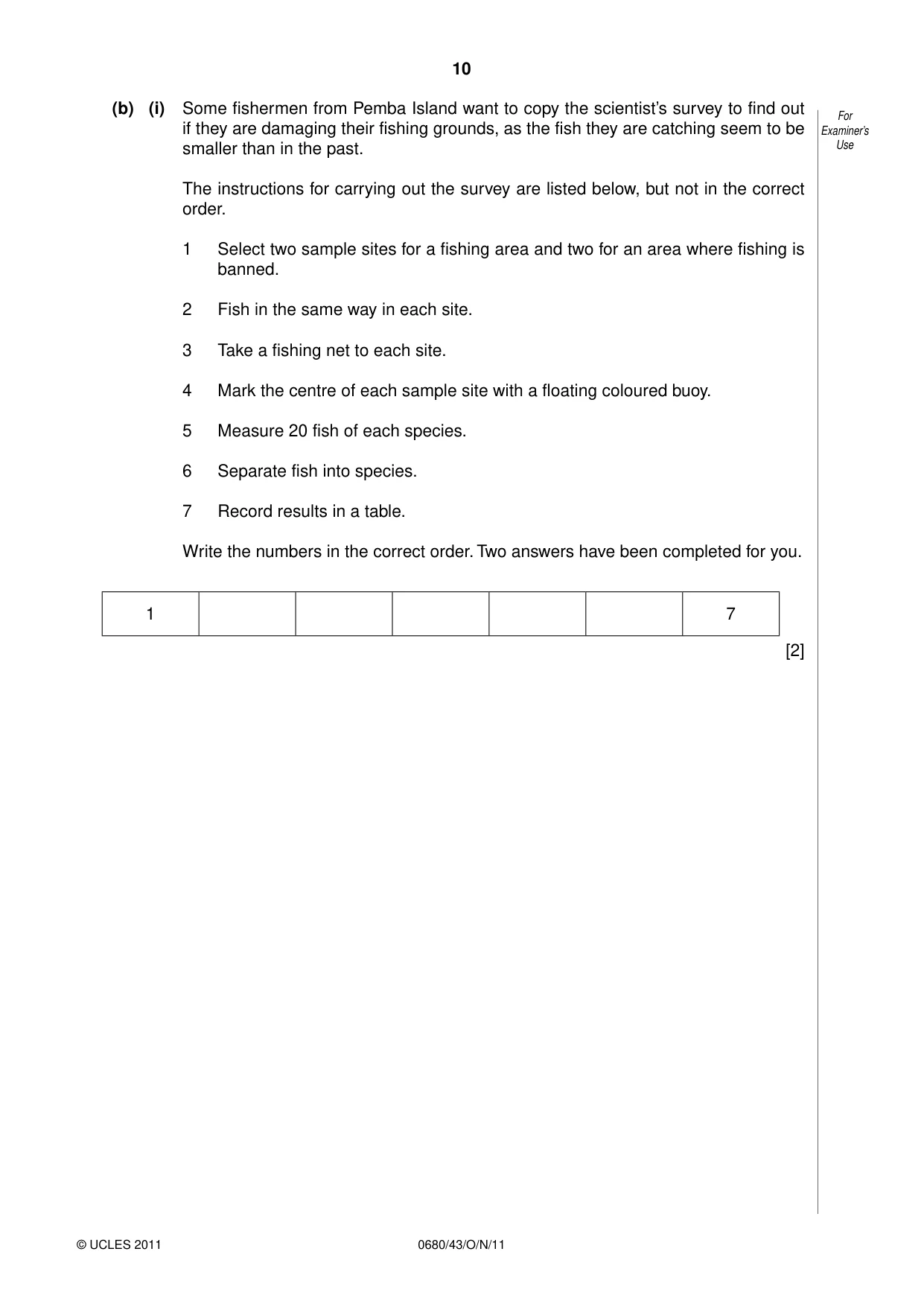
10 0680/43/O/N/11 © UCLES 2011 For Examiner’s Use (b) (i) Some fishermen from Pemba Island want to copy the scientist’s survey to find out if they are damaging their fishing grounds, as the fish they are catching seem to be smaller than in the past. The instructions for carrying out the survey are listed below, but not in the correct order. 1 Select two sample sites for a fishing area and two for an area where fishing is banned. 2 Fish in the same way in each site. 3 Take a fishing net to each site. 4 Mark the centre of each sample site with a floating coloured buoy. 5 Measure 20 fish of each species. 6 Separate fish into species. 7 Record results in a table. Write the numbers in the correct order. Two answers have been completed for you. 1 7 [2]
Question paper, page 11
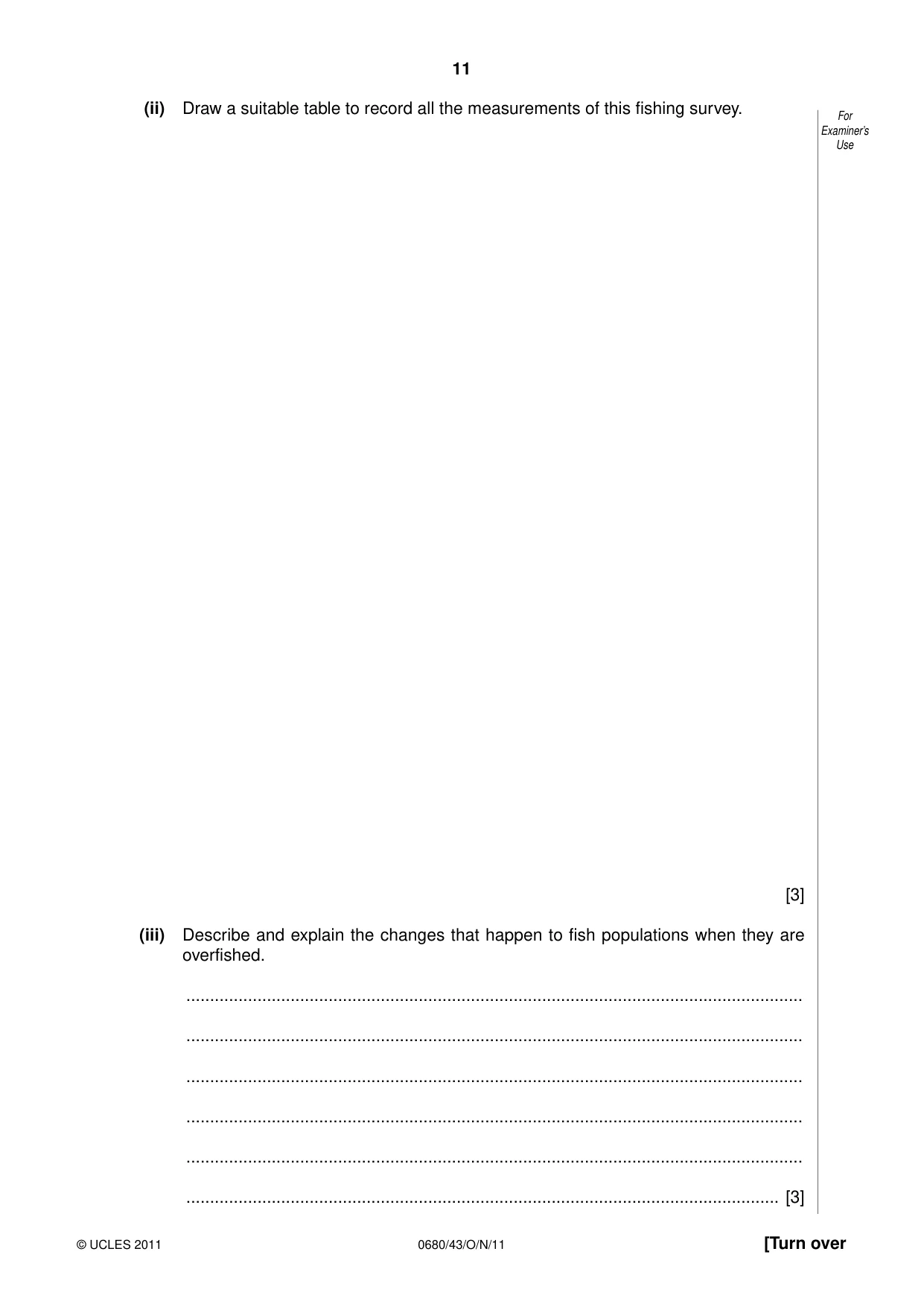
11 0680/43/O/N/11 © UCLES 2011 [Turn over For Examiner’s Use (ii) Draw a suitable table to record all the measurements of this fishing survey. [3] (iii) Describe and explain the changes that happen to fish populations when they are overfished. … … … … … … [3]
Question paper, page 12
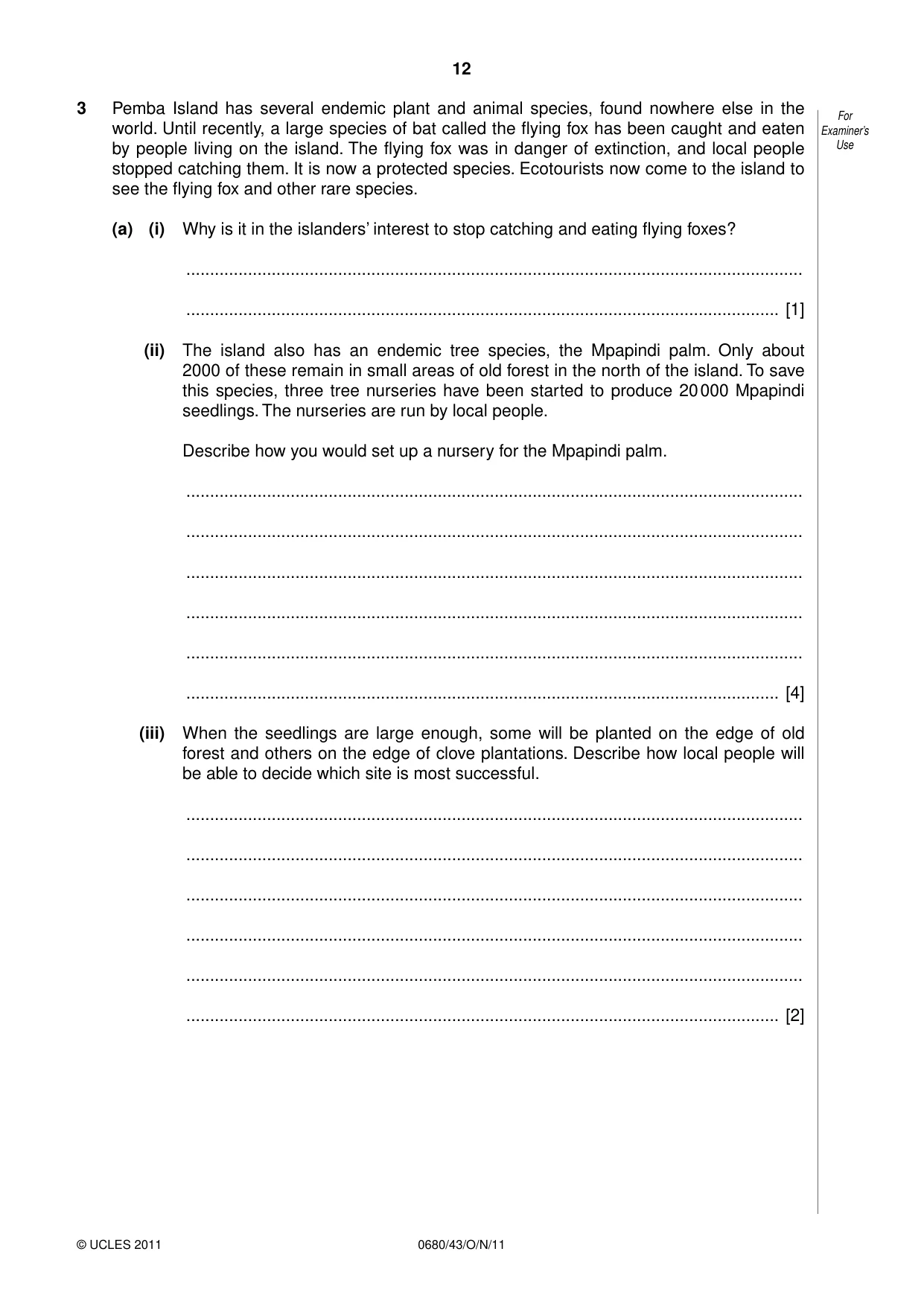
12 0680/43/O/N/11 © UCLES 2011 For Examiner’s Use 3 Pemba Island has several endemic plant and animal species, found nowhere else in the world. Until recently, a large species of bat called the flying fox has been caught and eaten by people living on the island. The flying fox was in danger of extinction, and local people stopped catching them. It is now a protected species. Ecotourists now come to the island to see the flying fox and other rare species. (a) (i) Why is it in the islanders’ interest to stop catching and eating flying foxes? … … [1] (ii) The island also has an endemic tree species, the Mpapindi palm. Only about 2000 of these remain in small areas of old forest in the north of the island. To save this species, three tree nurseries have been started to produce 20 000 Mpapindi seedlings. The nurseries are run by local people. Describe how you would set up a nursery for the Mpapindi palm. … … … … … … [4] (iii) When the seedlings are large enough, some will be planted on the edge of old forest and others on the edge of clove plantations. Describe how local people will be able to decide which site is most successful. … … … … … … [2]
Question paper, page 13
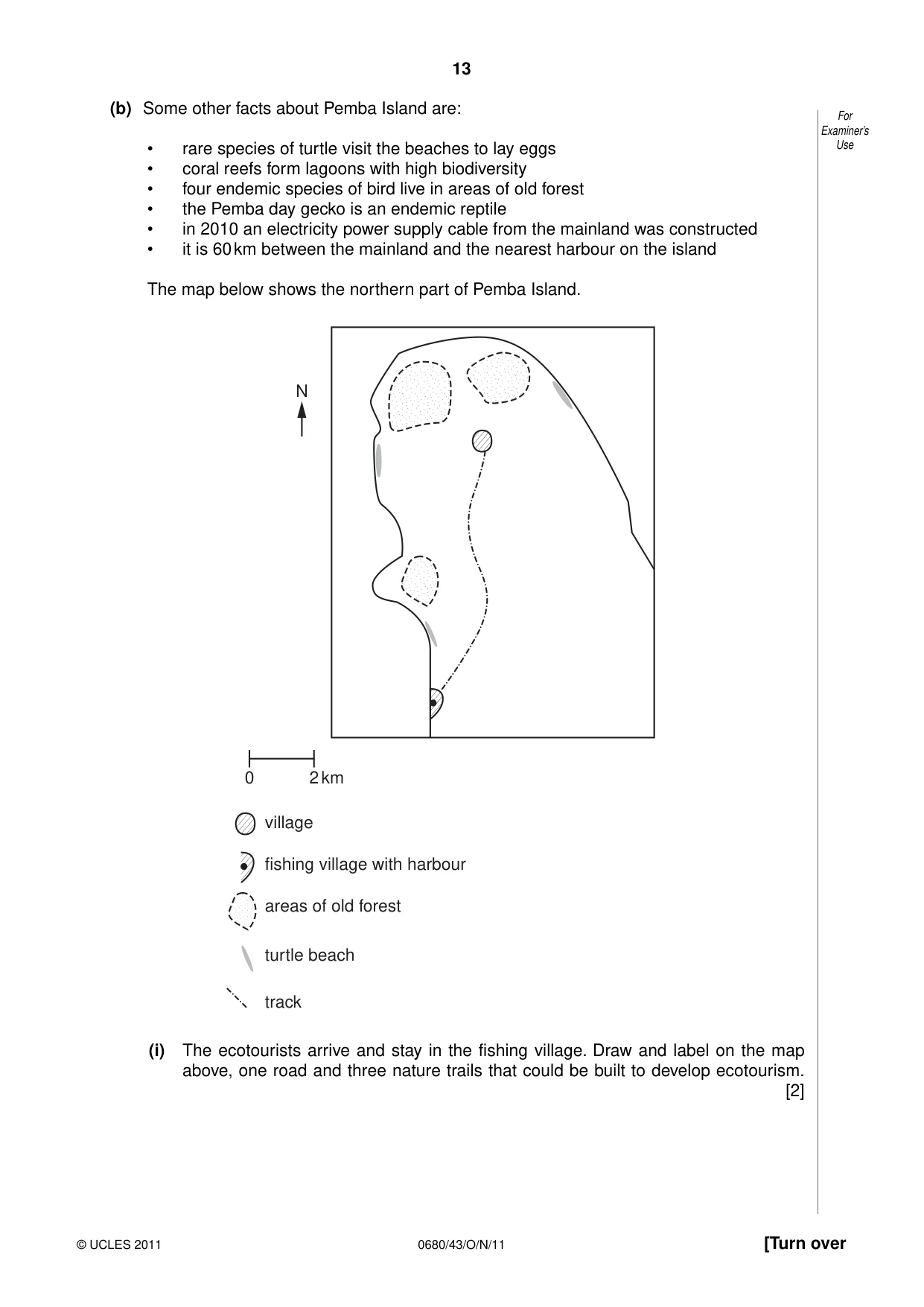
13 0680/43/O/N/11 © UCLES 2011 [Turn over For Examiner’s Use (b) Some other facts about Pemba Island are: • rare species of turtle visit the beaches to lay eggs • coral reefs form lagoons with high biodiversity • four endemic species of bird live in areas of old forest • the Pemba day gecko is an endemic reptile • in 2010 an electricity power supply cable from the mainland was constructed • it is 60 km between the mainland and the nearest harbour on the island The map below shows the northern part of Pemba Island. N 0 village fishing village with harbour areas of old forest turtle beach track 2 km (i) The ecotourists arrive and stay in the fishing village. Draw and label on the map above, one road and three nature trails that could be built to develop ecotourism. [2]
Question paper, page 14
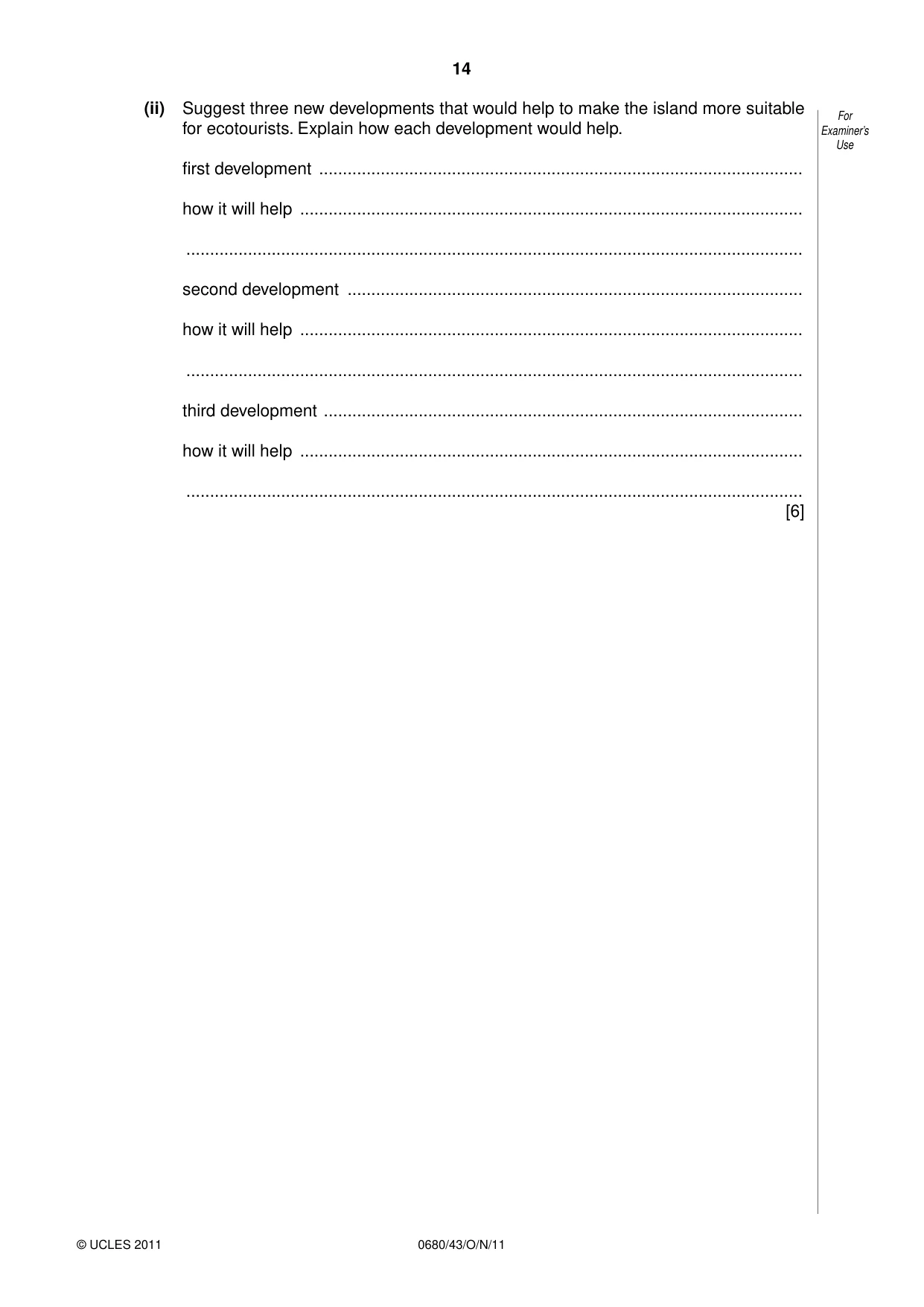
14 0680/43/O/N/11 © UCLES 2011 For Examiner’s Use (ii) Suggest three new developments that would help to make the island more suitable for ecotourists. Explain how each development would help. first development … how it will help … … second development … how it will help … … third development … how it will help … … [6]
Question paper, page 15
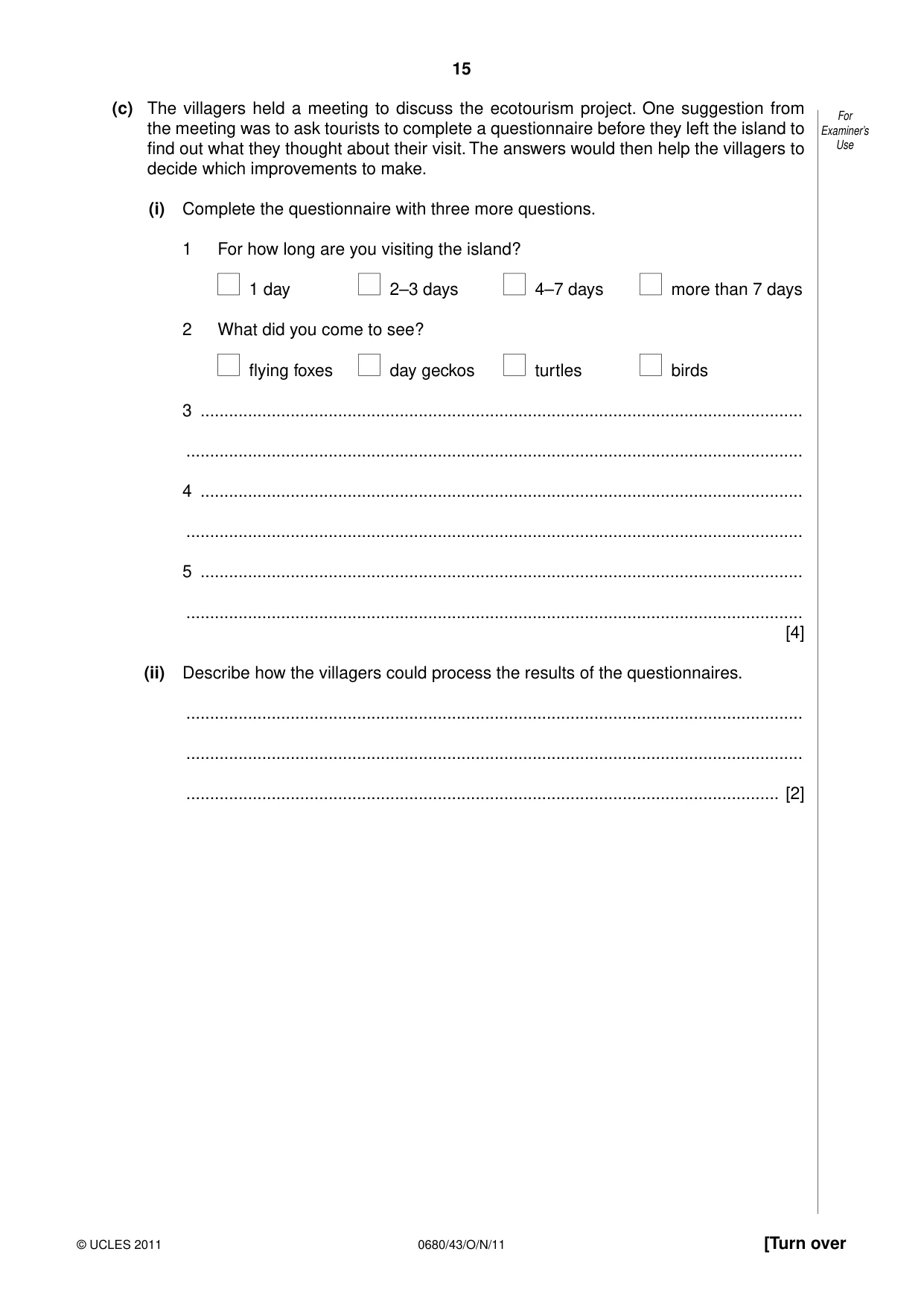
15 0680/43/O/N/11 © UCLES 2011 [Turn over For Examiner’s Use (c) The villagers held a meeting to discuss the ecotourism project. One suggestion from the meeting was to ask tourists to complete a questionnaire before they left the island to find out what they thought about their visit. The answers would then help the villagers to decide which improvements to make. (i) Complete the questionnaire with three more questions. 1 For how long are you visiting the island? 1 day 2–3 days 4–7 days more than 7 days 2 What did you come to see? flying foxes day geckos turtles birds 3 … … 4 … … 5 … … [4] (ii) Describe how the villagers could process the results of the questionnaires. … … … [2]
Question paper, page 16
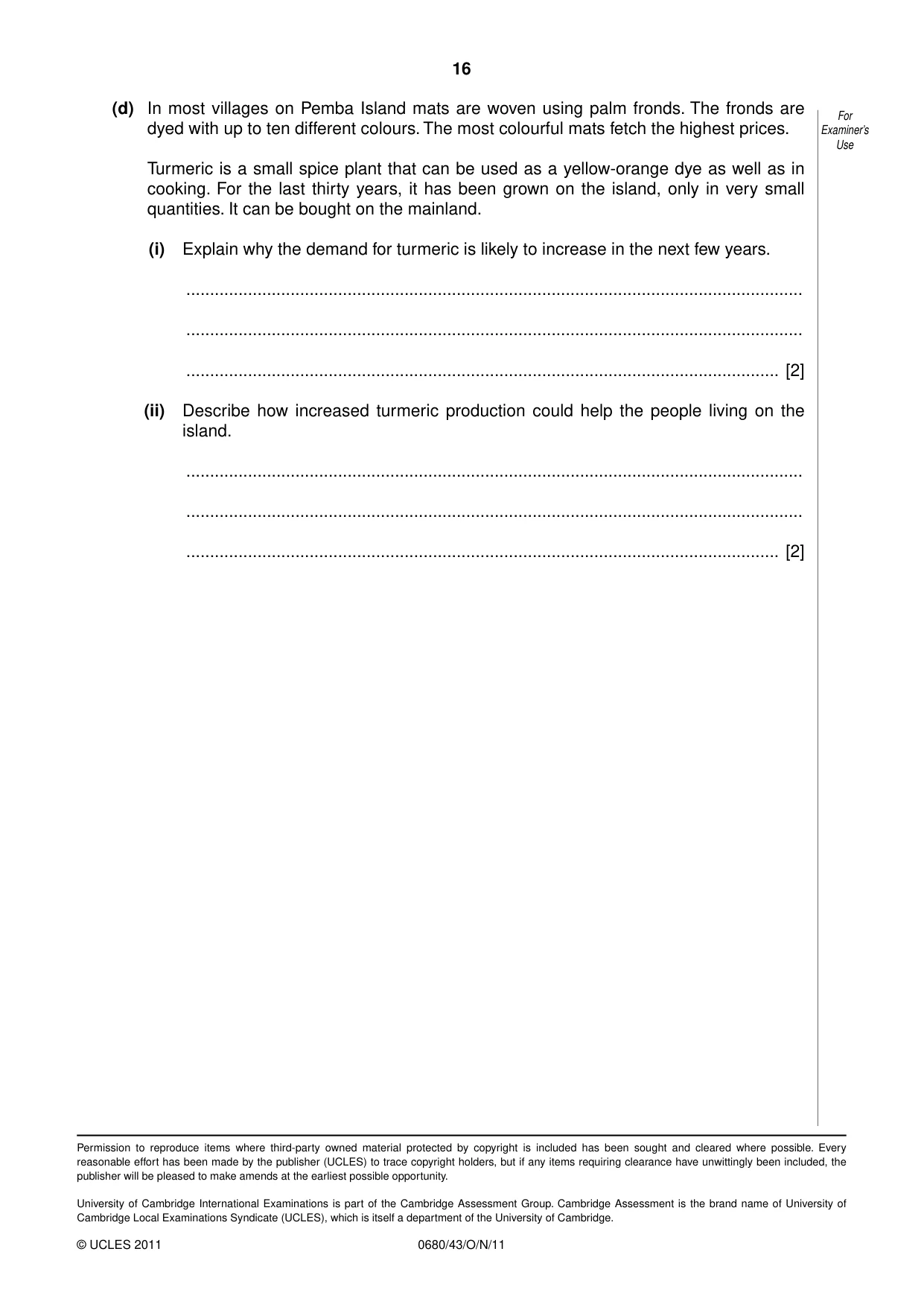
16 0680/43/O/N/11 © UCLES 2011 For Examiner’s Use (d) In most villages on Pemba Island mats are woven using palm fronds. The fronds are dyed with up to ten different colours. The most colourful mats fetch the highest prices. Turmeric is a small spice plant that can be used as a yellow-orange dye as well as in cooking. For the last thirty years, it has been grown on the island, only in very small quantities. It can be bought on the mainland. (i) Explain why the demand for turmeric is likely to increase in the next few years. … … … [2] (ii) Describe how increased turmeric production could help the people living on the island. … … … [2] Permission to reproduce items where third-party owned material protected by copyright is included has been sought and cleared where possible. Every reasonable effort has been made by the publisher (UCLES) to trace copyright holders, but if any items requiring clearance have unwittingly been included, the publisher will be pleased to make amends at the earliest possible opportunity. University of Cambridge International Examinations is part of the Cambridge Assessment Group. Cambridge Assessment is the brand name of University of Cambridge Local Examinations Syndicate (UCLES), which is itself a department of the University of Cambridge.
Mark scheme, page 1
UNIVERSITY OF CAMBRIDGE INTERNATIONAL EXAMINATIONS International General Certificate of Secondary Education MARK SCHEME for the October/November 2011 question paper for the guidance of teachers 0680 ENVIRONMENTAL MANAGEMENT 0680/43 Paper 4 (Alternative to Coursework), maximum raw mark 60 This mark scheme is published as an aid to teachers and candidates, to indicate the requirements of the examination. It shows the basis on which Examiners were instructed to award marks. It does not indicate the details of the discussions that took place at an Examiners’ meeting before marking began, which would have considered the acceptability of alternative answers. Mark schemes must be read in conjunction with the question papers and the report on the examination. • Cambridge will not enter into discussions or correspondence in connection with these mark schemes. Cambridge is publishing the mark schemes for the October/November 2011 question papers for most IGCSE, GCE Advanced Level and Advanced Subsidiary Level syllabuses and some Ordinary Level syllabuses. www.XtremePapers.com
Mark scheme, page 2
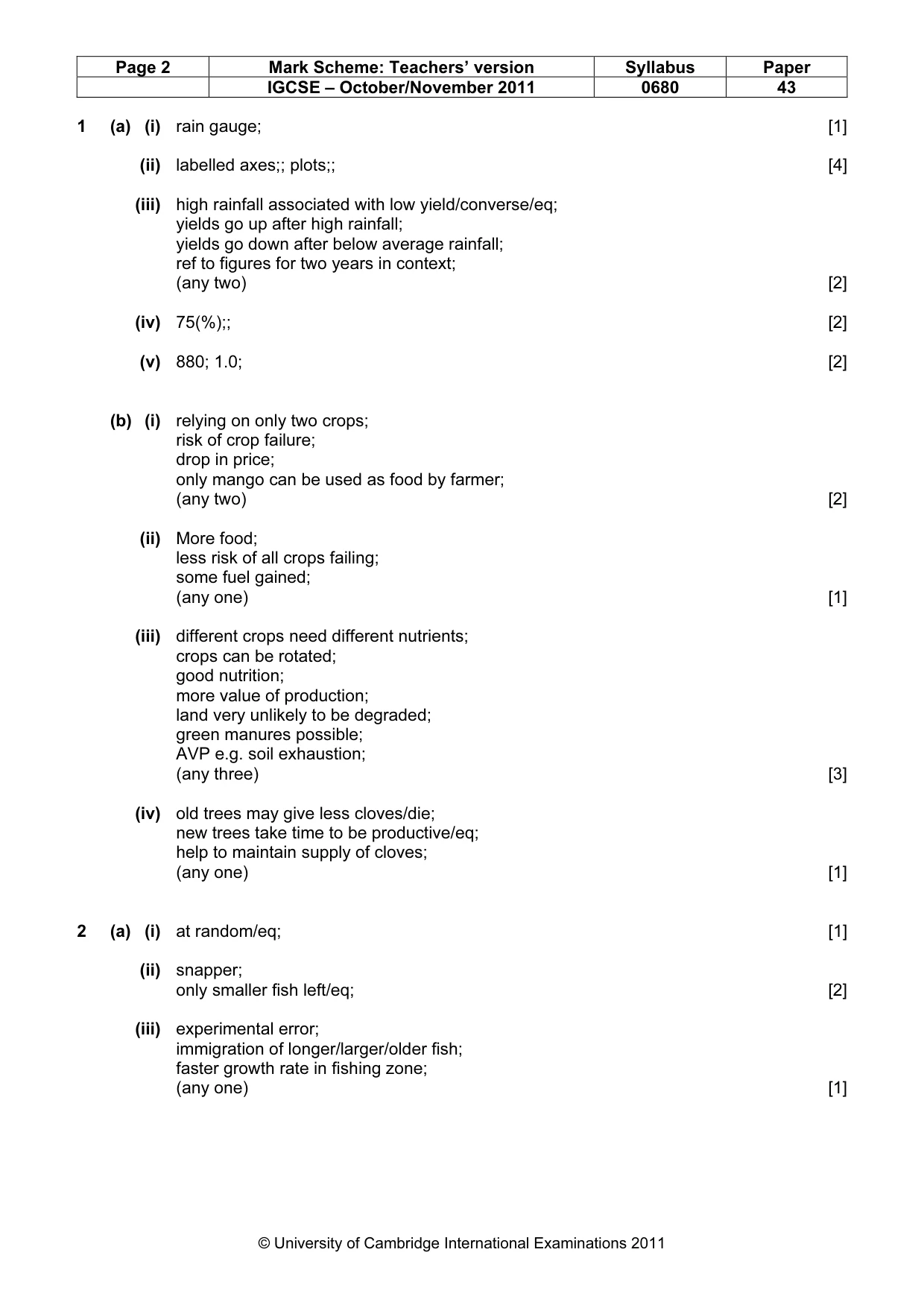
Page 2 Mark Scheme: Teachers’ version Syllabus Paper IGCSE – October/November 2011 0680 43 © University of Cambridge International Examinations 2011 1 (a) (i) rain gauge; [1] (ii) labelled axes;; plots;; [4] (iii) high rainfall associated with low yield/converse/eq; yields go up after high rainfall; yields go down after below average rainfall; ref to figures for two years in context; (any two) [2] (iv) 75(%);; [2] (v) 880; 1.0; [2] (b) (i) relying on only two crops; risk of crop failure; drop in price; only mango can be used as food by farmer; (any two) [2] (ii) More food; less risk of all crops failing; some fuel gained; (any one) [1] (iii) different crops need different nutrients; crops can be rotated; good nutrition; more value of production; land very unlikely to be degraded; green manures possible; AVP e.g. soil exhaustion; (any three) [3] (iv) old trees may give less cloves/die; new trees take time to be productive/eq; help to maintain supply of cloves; (any one) [1] 2 (a) (i) at random/eq; [1] (ii) snapper; only smaller fish left/eq; [2] (iii) experimental error; immigration of longer/larger/older fish; faster growth rate in fishing zone; (any one) [1]
Mark scheme, page 3
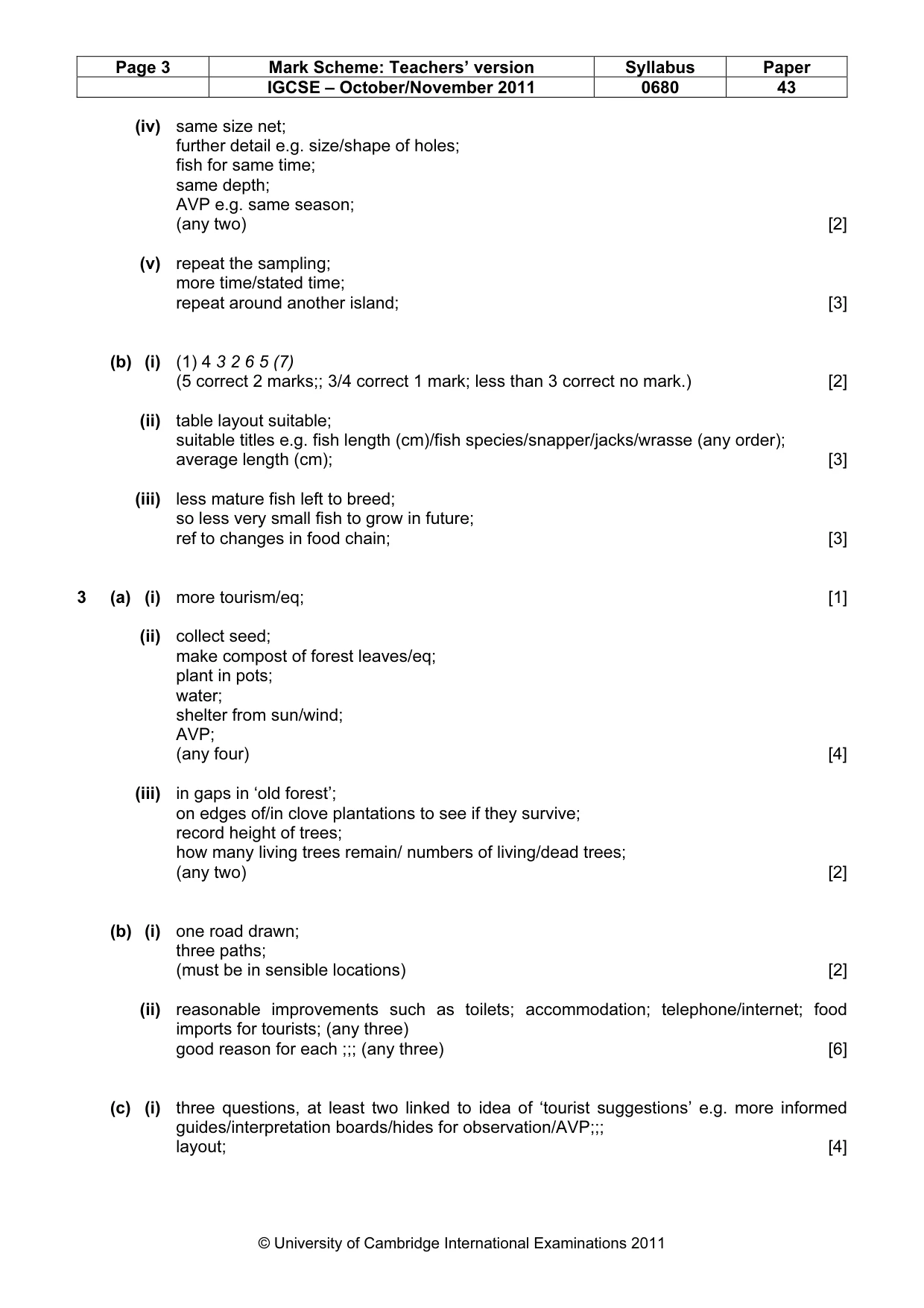
Page 3 Mark Scheme: Teachers’ version Syllabus Paper IGCSE – October/November 2011 0680 43 © University of Cambridge International Examinations 2011 (iv) same size net; further detail e.g. size/shape of holes; fish for same time; same depth; AVP e.g. same season; (any two) [2] (v) repeat the sampling; more time/stated time; repeat around another island; [3] (b) (i) (1) 4 3 2 6 5 (7) (5 correct 2 marks;; 3/4 correct 1 mark; less than 3 correct no mark.) [2] (ii) table layout suitable; suitable titles e.g. fish length (cm)/fish species/snapper/jacks/wrasse (any order); average length (cm); [3] (iii) less mature fish left to breed; so less very small fish to grow in future; ref to changes in food chain; [3] 3 (a) (i) more tourism/eq; [1] (ii) collect seed; make compost of forest leaves/eq; plant in pots; water; shelter from sun/wind; AVP; (any four) [4] (iii) in gaps in ‘old forest’; on edges of/in clove plantations to see if they survive; record height of trees; how many living trees remain/ numbers of living/dead trees; (any two) [2] (b) (i) one road drawn; three paths; (must be in sensible locations) [2] (ii) reasonable improvements such as toilets; accommodation; telephone/internet; food imports for tourists; (any three) good reason for each ;;; (any three) [6] (c) (i) three questions, at least two linked to idea of ‘tourist suggestions’ e.g. more informed guides/interpretation boards/hides for observation/AVP;;; layout; [4]
Mark scheme, page 4
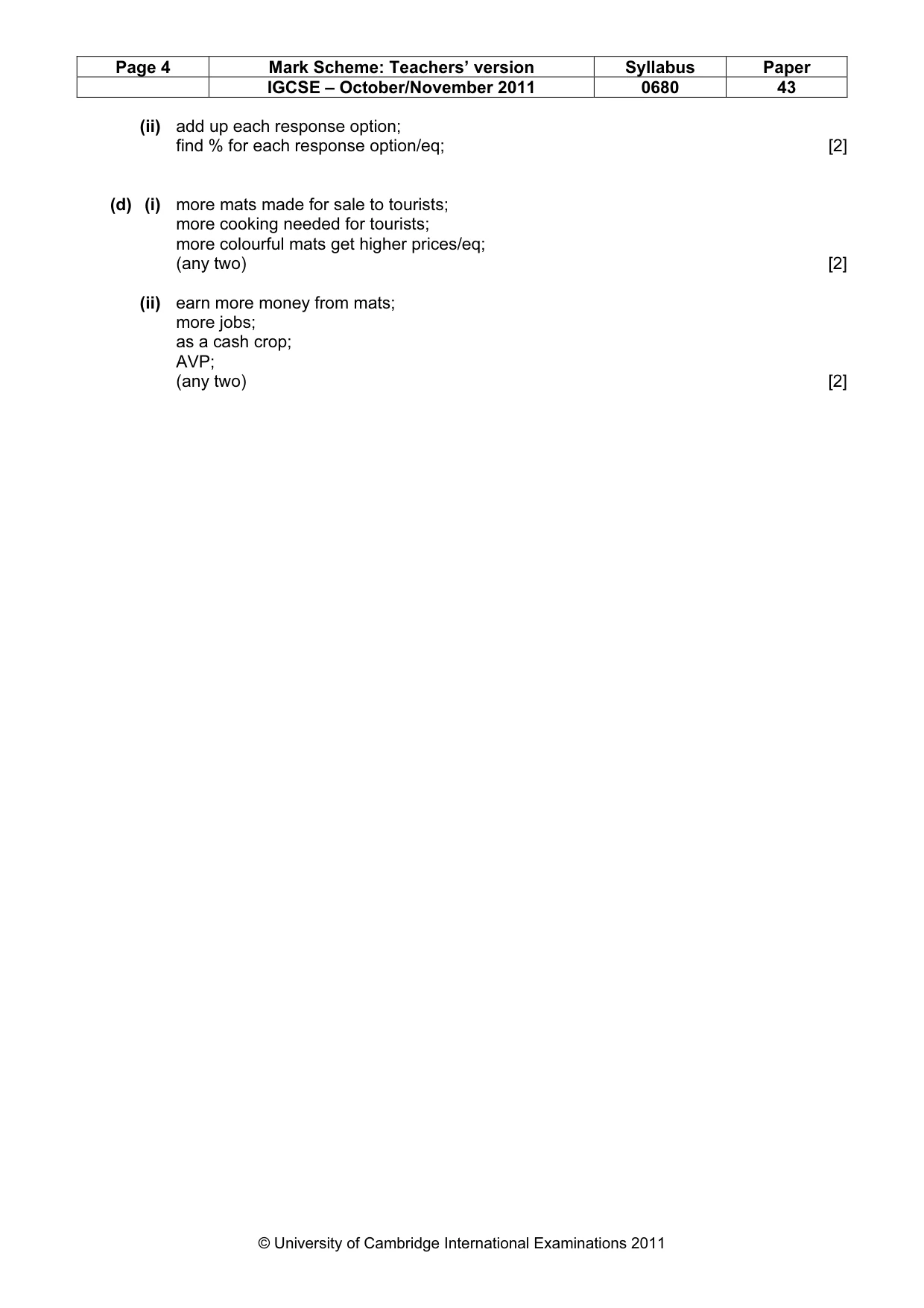
Page 4 Mark Scheme: Teachers’ version Syllabus Paper IGCSE – October/November 2011 0680 43 © University of Cambridge International Examinations 2011 (ii) add up each response option; find % for each response option/eq; [2] (d) (i) more mats made for sale to tourists; more cooking needed for tourists; more colourful mats get higher prices/eq; (any two) [2] (ii) earn more money from mats; more jobs; as a cash crop; AVP; (any two) [2]
What you needed in this session
Cambridge’s own grade thresholds for 2011 Oct/Nov, Paper 4 · Variant 3. A higher threshold means an easier paper — the bar moves with how the cohort did.