Cambridge IGCSE Environmental Management 0680 — 2011 Oct/Nov Paper 4 · Variant 1
0680/41/O/N/11 · 60 marks · ≈68 min
The question paper and its mark scheme, free to read here and free to download. This is Cambridge’s own paper, exactly as it was sat.
Question paper16 pages
Mark scheme4 pages
Answers below. Sit the paper first if you are practising.
Paper as text
Question paper, page 1
This document consists of 16 printed pages. DC (NF/JG) 33997/1 © UCLES 2011 [Turn over UNIVERSITY OF CAMBRIDGE INTERNATIONAL EXAMINATIONS International General Certificate of Secondary Education * 2 4 8 8 9 4 8 8 1 7 * ENVIRONMENTAL MANAGEMENT 0680/41 Alternative to Coursework October/November 2011 1 hour 30 minutes Candidates answer on the Question Paper. Additional Materials: Ruler READ THESE INSTRUCTIONS FIRST Write your Centre number, candidate number and name on all the work you hand in. Write in dark blue or black pen. You may use a soft pencil for any diagrams, graphs or rough working. Do not use staples, paper clips, highlighters, glue or correction fluid. DO NOT WRITE IN ANY BARCODES. Answer all questions. Study the appropriate Source materials before you start to write your answers. Credit will be given for appropriate selection and use of data in your answers and for relevant interpretation of these data. Suggestions for data sources are given in some questions. You may use the source data to draw diagrams and graphs or to do calculations to illustrate your answers. At the end of the examination, fasten all your work securely together. The number of marks is given in brackets [ ] at the end of each question or part question. For Examiner’s Use www.XtremePapers.com
Question paper, page 2
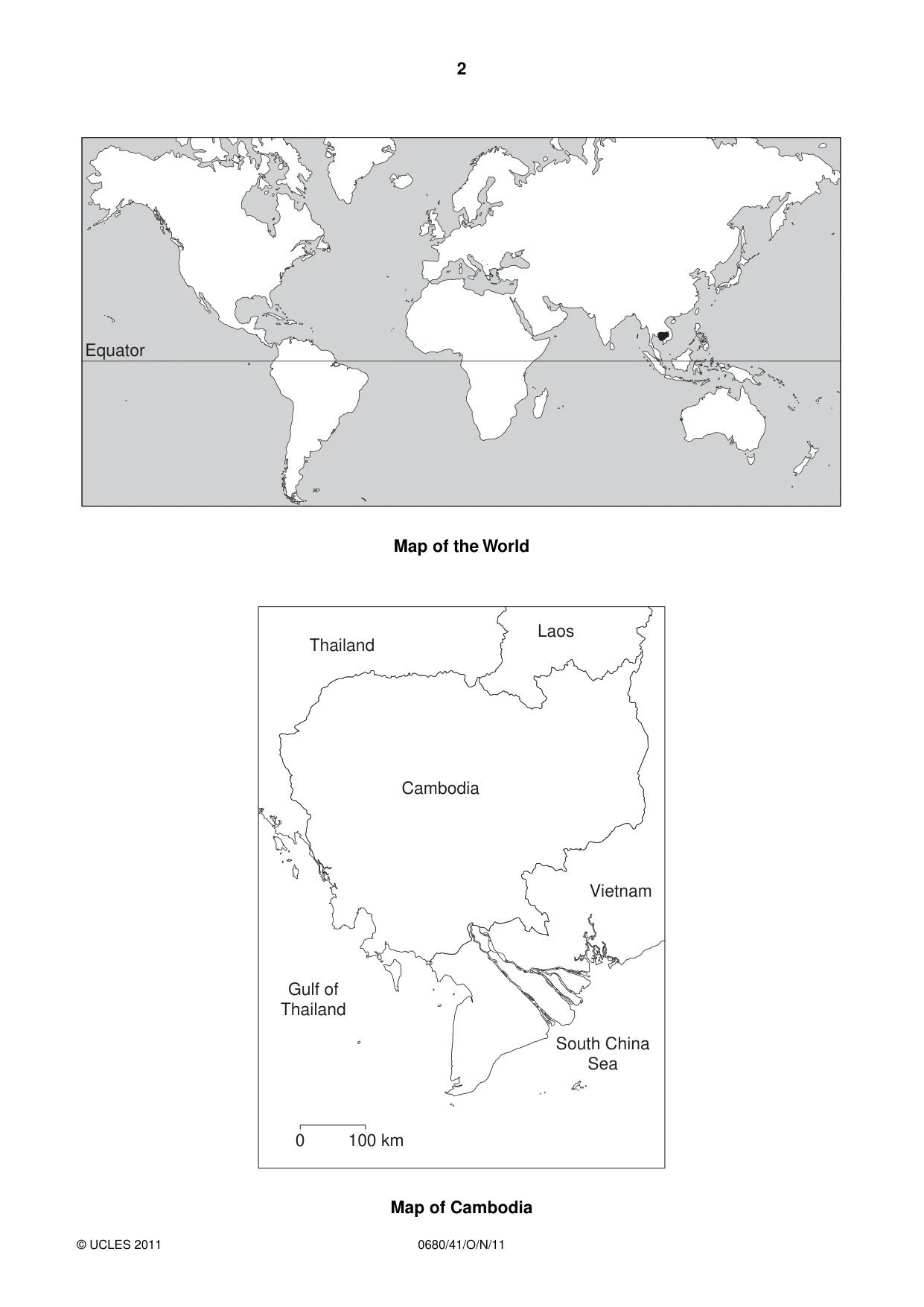
2 0680/41/O/N/11 © UCLES 2011 Equator Map of the World 0 100 km Gulf of Thailand South China Sea Thailand Laos Vietnam Cambodia Map of Cambodia
Question paper, page 3
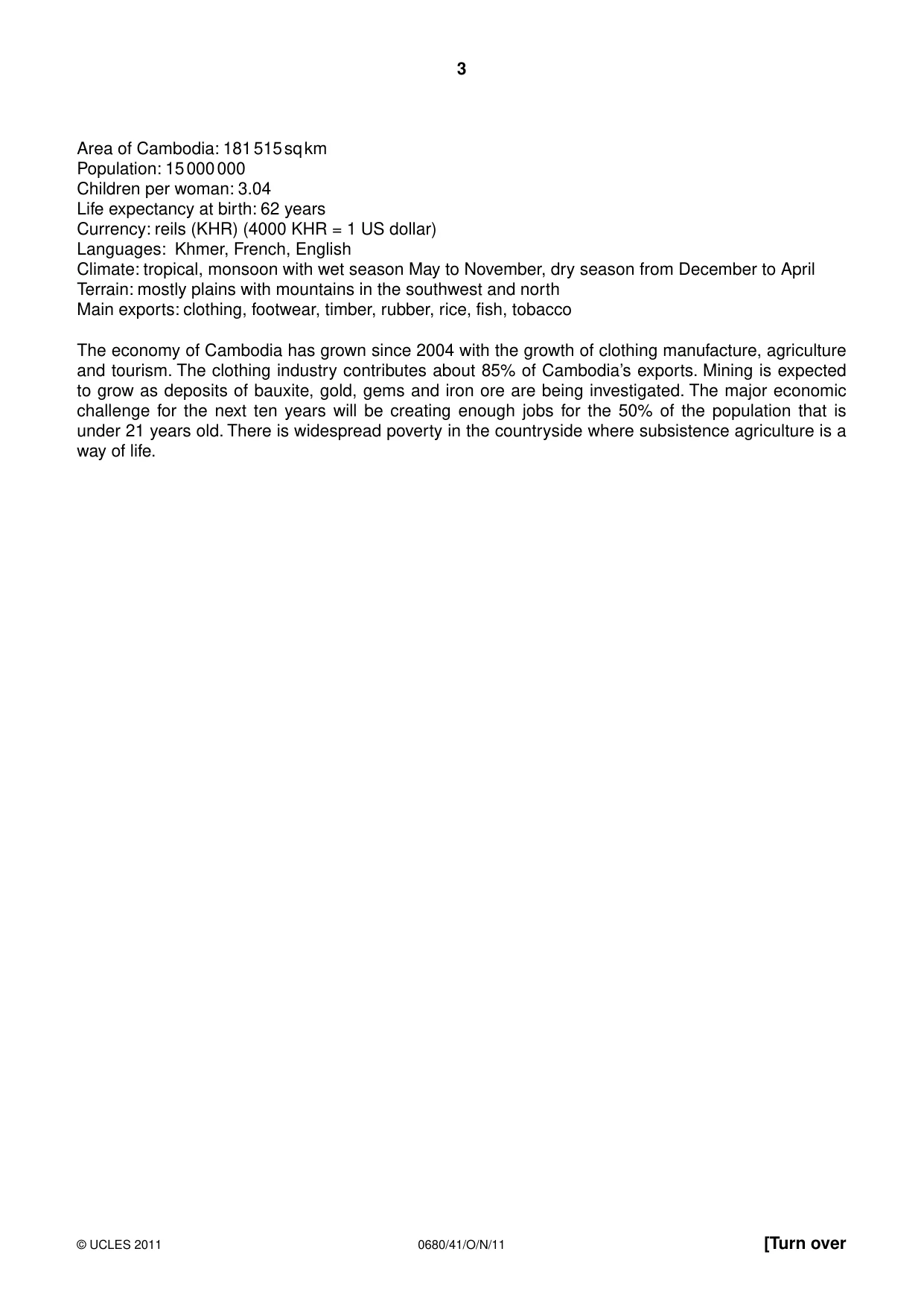
3 0680/41/O/N/11 © UCLES 2011 [Turn over Area of Cambodia: 181 515 sq km Population: 15 000 000 Children per woman: 3.04 Life expectancy at birth: 62 years Currency: reils (KHR) (4000 KHR = 1 US dollar) Languages: Khmer, French, English Climate: tropical, monsoon with wet season May to November, dry season from December to April Terrain: mostly plains with mountains in the southwest and north Main exports: clothing, footwear, timber, rubber, rice, fish, tobacco The economy of Cambodia has grown since 2004 with the growth of clothing manufacture, agriculture and tourism. The clothing industry contributes about 85% of Cambodia’s exports. Mining is expected to grow as deposits of bauxite, gold, gems and iron ore are being investigated. The major economic challenge for the next ten years will be creating enough jobs for the 50% of the population that is under 21 years old. There is widespread poverty in the countryside where subsistence agriculture is a way of life.
Question paper, page 4
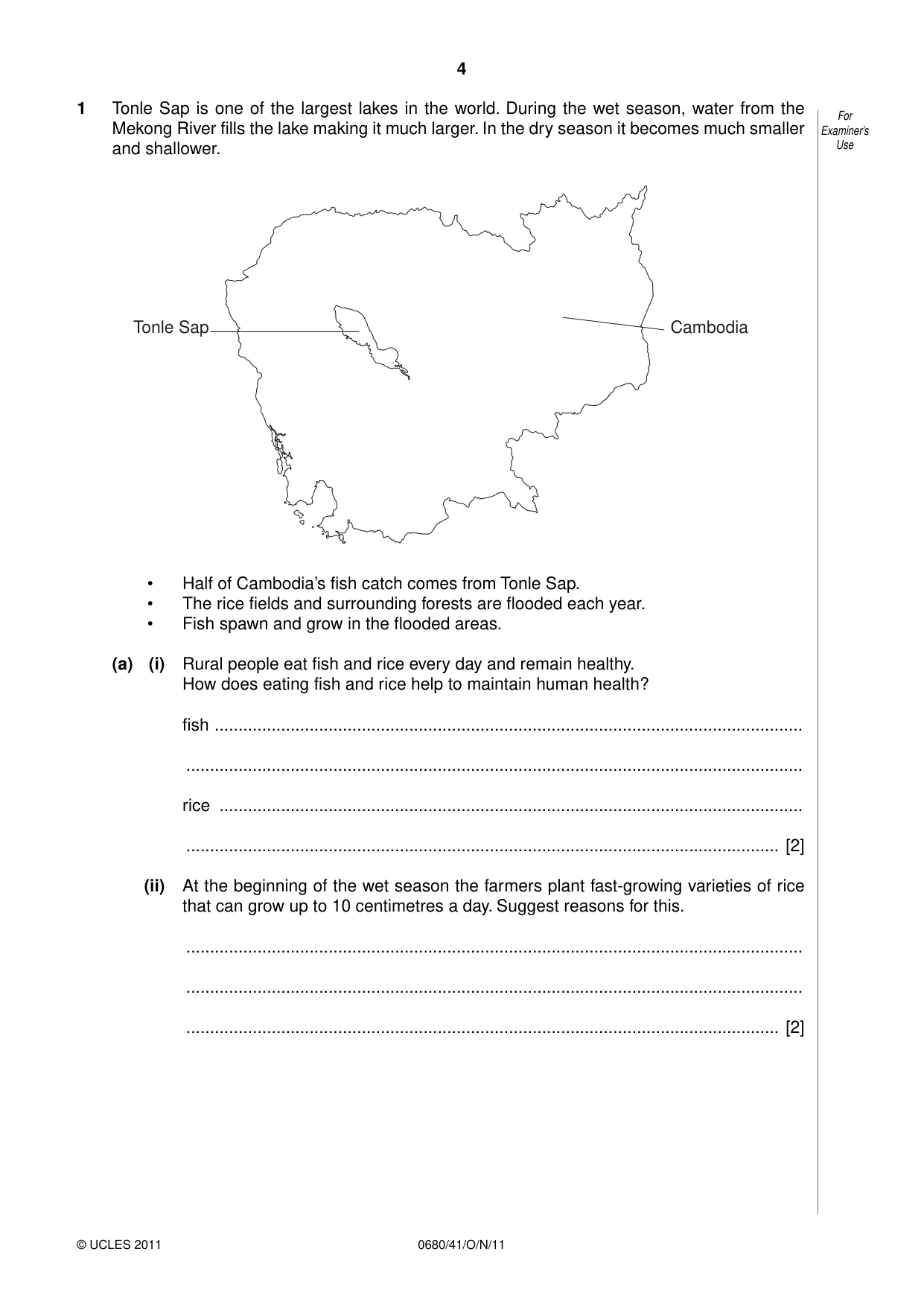
4 0680/41/O/N/11 © UCLES 2011 For Examiner’s Use 1 Tonle Sap is one of the largest lakes in the world. During the wet season, water from the Mekong River fills the lake making it much larger. In the dry season it becomes much smaller and shallower. Tonle Sap Cambodia Half of Cambodia’s fish catch comes from Tonle Sap. • The rice fields and surrounding forests are flooded each year. • Fish spawn and grow in the flooded areas. • (a) (i) Rural people eat fish and rice every day and remain healthy. How does eating fish and rice help to maintain human health? fish … … rice … … [2] (ii) At the beginning of the wet season the farmers plant fast-growing varieties of rice that can grow up to 10 centimetres a day. Suggest reasons for this. … … … [2]
Question paper, page 5
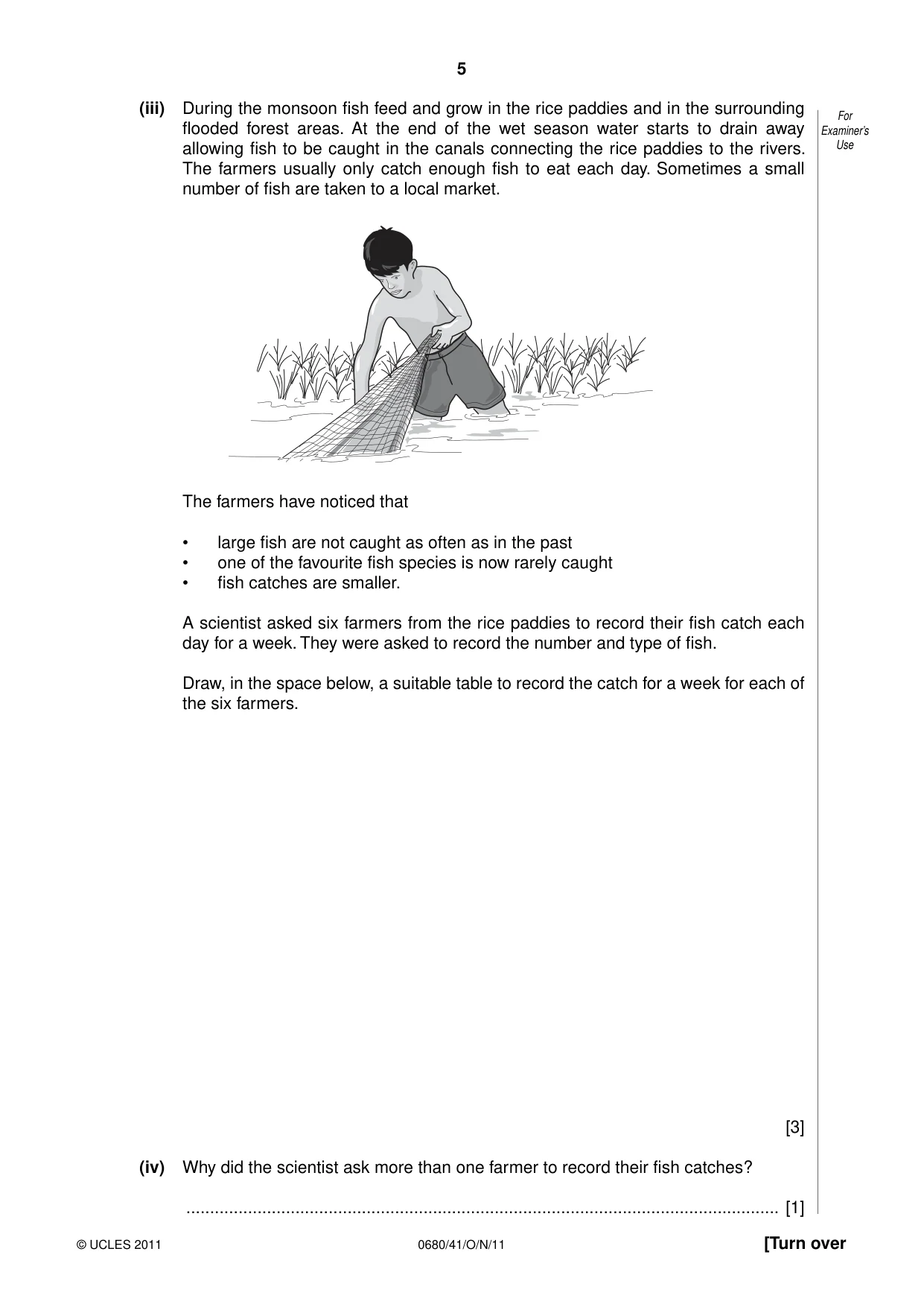
5 0680/41/O/N/11 © UCLES 2011 [Turn over For Examiner’s Use (iii) During the monsoon fish feed and grow in the rice paddies and in the surrounding flooded forest areas. At the end of the wet season water starts to drain away allowing fish to be caught in the canals connecting the rice paddies to the rivers. The farmers usually only catch enough fish to eat each day. Sometimes a small number of fish are taken to a local market. The farmers have noticed that large fish are not caught as often as in the past • one of the favourite fish species is now rarely caught • fish catches are smaller. • A scientist asked six farmers from the rice paddies to record their fish catch each day for a week. They were asked to record the number and type of fish. Draw, in the space below, a suitable table to record the catch for a week for each of the six farmers. [3] (iv) Why did the scientist ask more than one farmer to record their fish catches? … [1]
Question paper, page 6
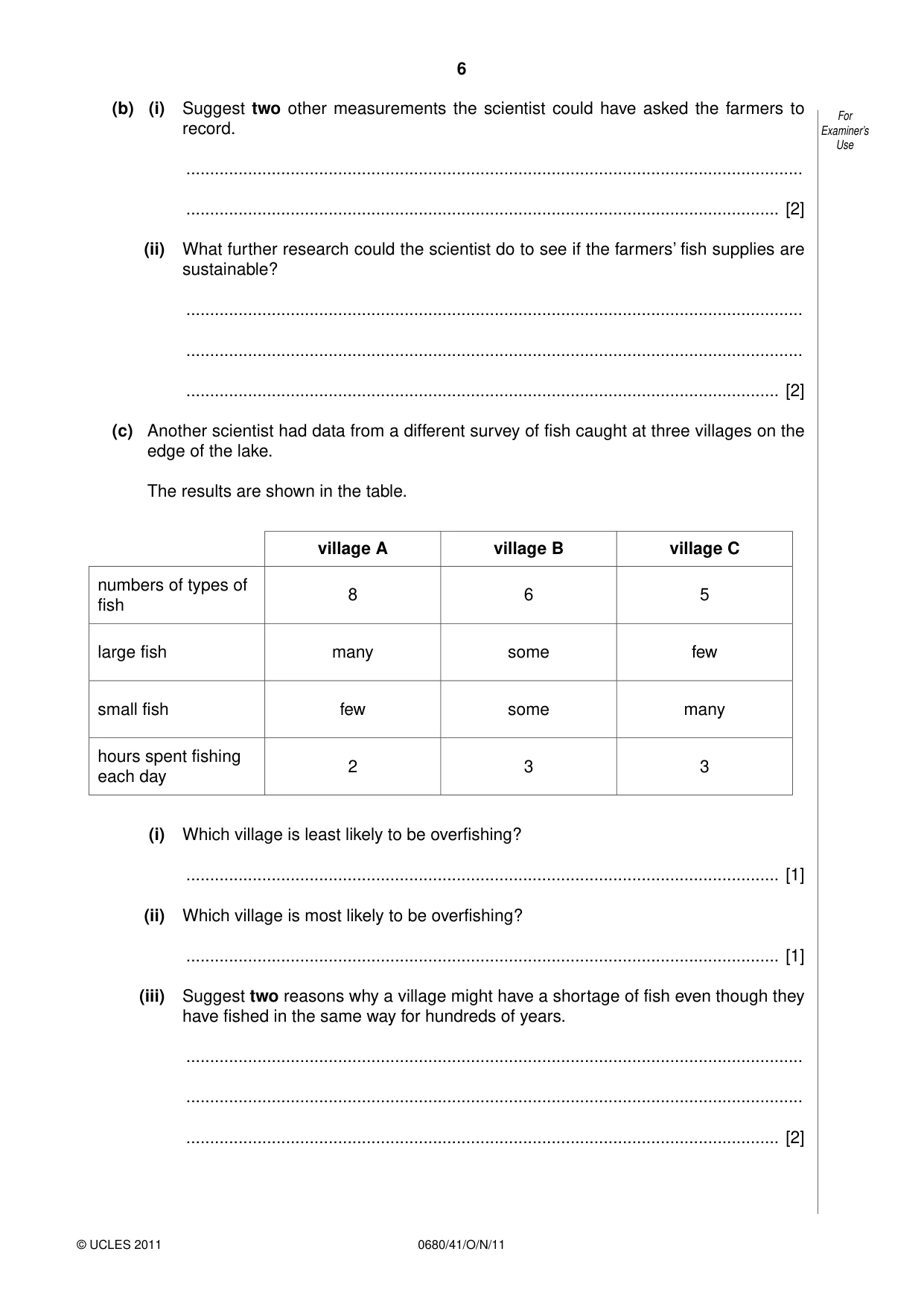
6 0680/41/O/N/11 © UCLES 2011 For Examiner’s Use (b) (i) Suggest two other measurements the scientist could have asked the farmers to record. … … [2] (ii) What further research could the scientist do to see if the farmers’ fish supplies are sustainable? … … … [2] (c) Another scientist had data from a different survey of fish caught at three villages on the edge of the lake. The results are shown in the table. village A village B village C numbers of types of fish 8 6 5 large fish many some few small fish few some many hours spent fishing each day 2 3 3 (i) Which village is least likely to be overfishing? … [1] (ii) Which village is most likely to be overfishing? … [1] (iii) Suggest two reasons why a village might have a shortage of fish even though they have fished in the same way for hundreds of years. … … … [2]
Question paper, page 7
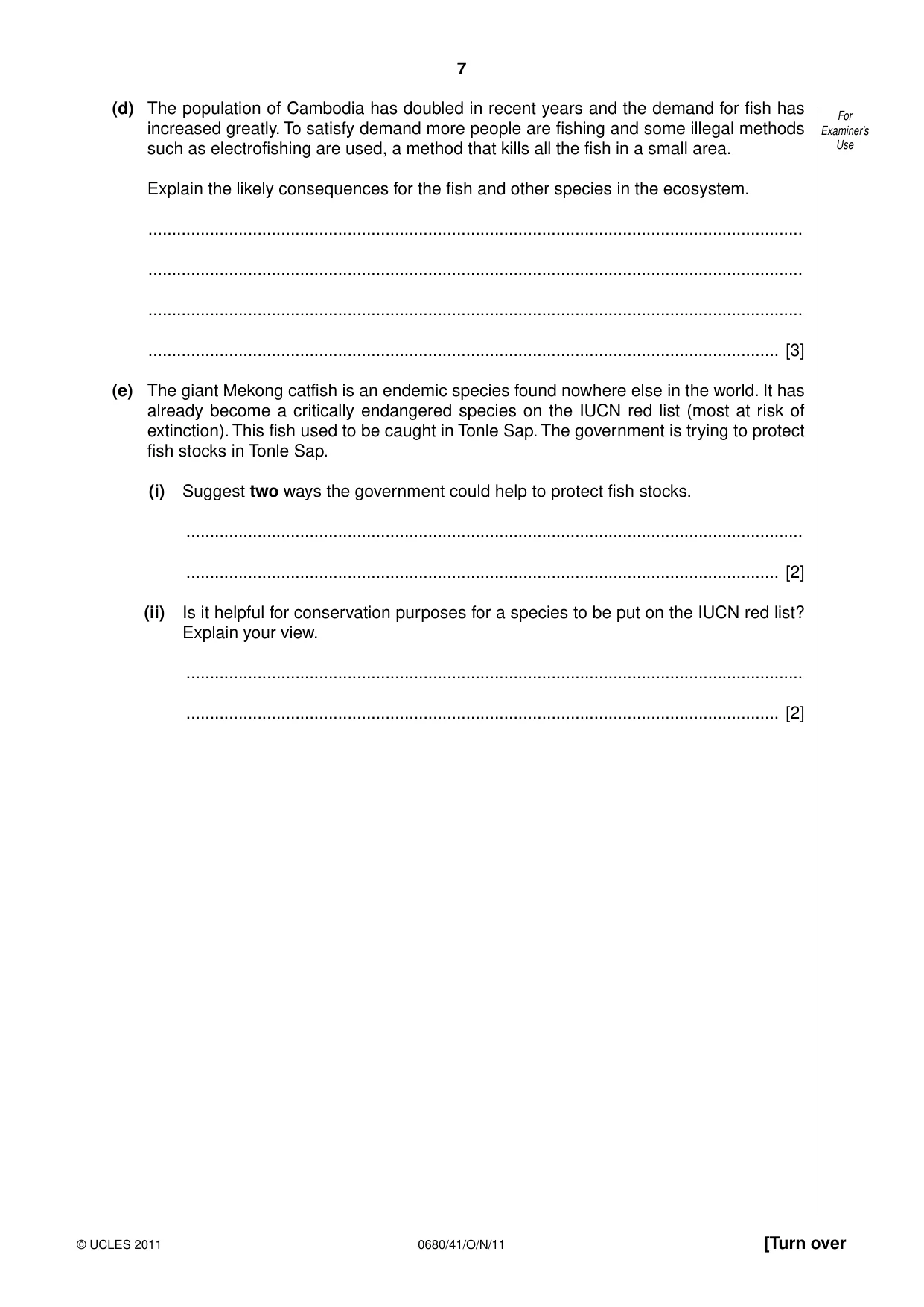
7 0680/41/O/N/11 © UCLES 2011 [Turn over For Examiner’s Use (d) The population of Cambodia has doubled in recent years and the demand for fish has increased greatly. To satisfy demand more people are fishing and some illegal methods such as electrofishing are used, a method that kills all the fish in a small area. Explain the likely consequences for the fish and other species in the ecosystem. … … … … [3] (e) The giant Mekong catfish is an endemic species found nowhere else in the world. It has already become a critically endangered species on the IUCN red list (most at risk of extinction). This fish used to be caught in Tonle Sap. The government is trying to protect fish stocks in Tonle Sap. (i) Suggest two ways the government could help to protect fish stocks. … … [2] (ii) Is it helpful for conservation purposes for a species to be put on the IUCN red list? Explain your view. … … [2]
Question paper, page 8
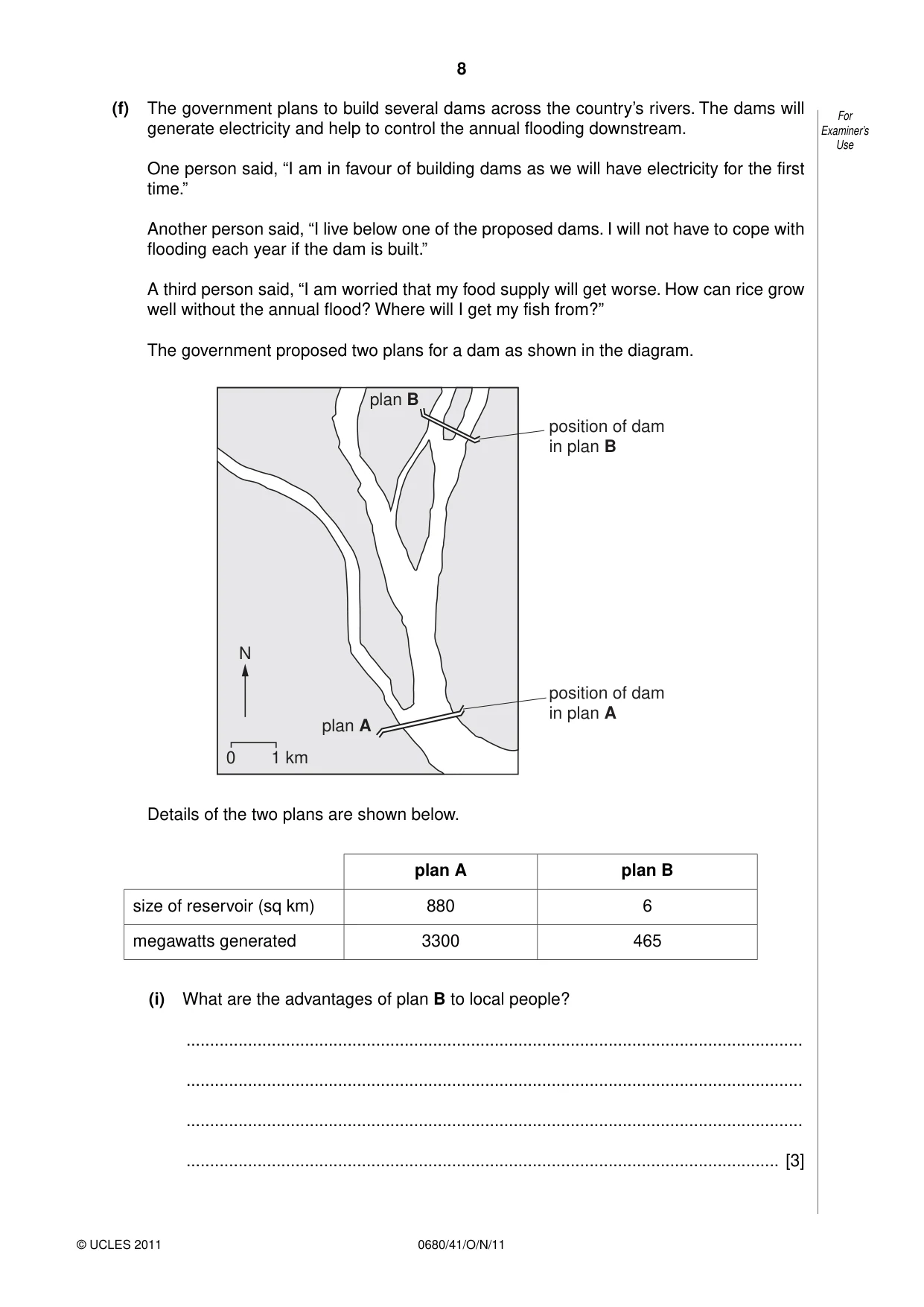
8 0680/41/O/N/11 © UCLES 2011 For Examiner’s Use (f) The government plans to build several dams across the country’s rivers. The dams will generate electricity and help to control the annual flooding downstream. One person said, “I am in favour of building dams as we will have electricity for the first time.” Another person said, “I live below one of the proposed dams. I will not have to cope with flooding each year if the dam is built.” A third person said, “I am worried that my food supply will get worse. How can rice grow well without the annual flood? Where will I get my fish from?” The government proposed two plans for a dam as shown in the diagram. 0 N plan A plan B position of dam in plan B position of dam in plan A 1 km Details of the two plans are shown below. plan A plan B size of reservoir (sq km) 880 6 megawatts generated 3300 465 (i) What are the advantages of plan B to local people? … … … … [3]
Question paper, page 9
9 0680/41/O/N/11 © UCLES 2011 [Turn over For Examiner’s Use (ii) Suggest reasons why the government prefers plan A. … … … [2]
Question paper, page 10
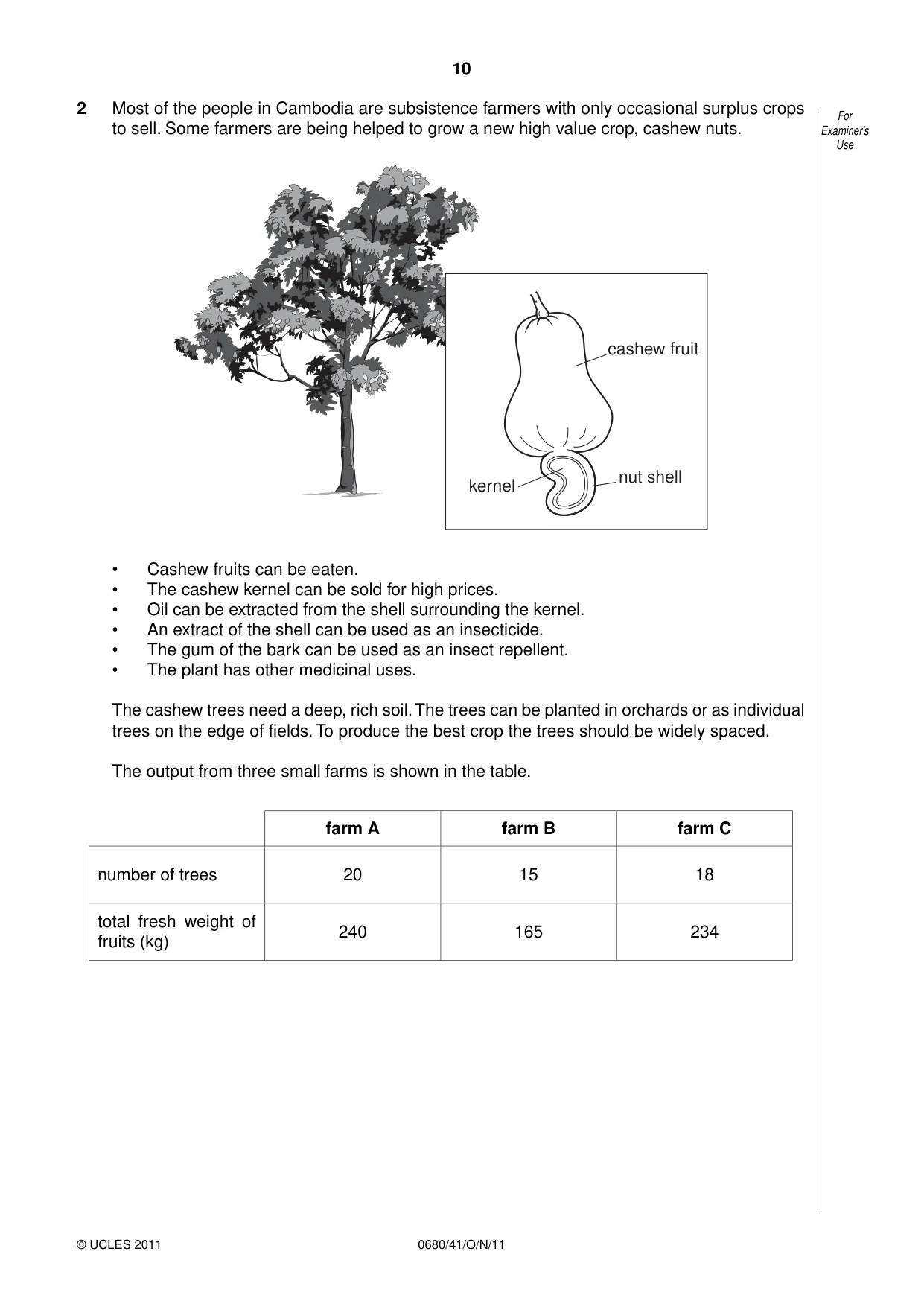
10 0680/41/O/N/11 © UCLES 2011 For Examiner’s Use 2 Most of the people in Cambodia are subsistence farmers with only occasional surplus crops to sell. Some farmers are being helped to grow a new high value crop, cashew nuts. cashew fruit nut shell kernel Cashew fruits can be eaten. • The cashew kernel can be sold for high prices. • Oil can be extracted from the shell surrounding the kernel. • An extract of the shell can be used as an insecticide. • The gum of the bark can be used as an insect repellent. • The plant has other medicinal uses. • The cashew trees need a deep, rich soil. The trees can be planted in orchards or as individual trees on the edge of fields. To produce the best crop the trees should be widely spaced. The output from three small farms is shown in the table. farm A farm B farm C number of trees 20 15 18 total fresh weight of fruits (kg) 240 165 234
Question paper, page 11
11 0680/41/O/N/11 © UCLES 2011 [Turn over For Examiner’s Use (a) (i) Work out which farms produce the most and least fruits per tree. Show your working. most … least … [3]
Question paper, page 12
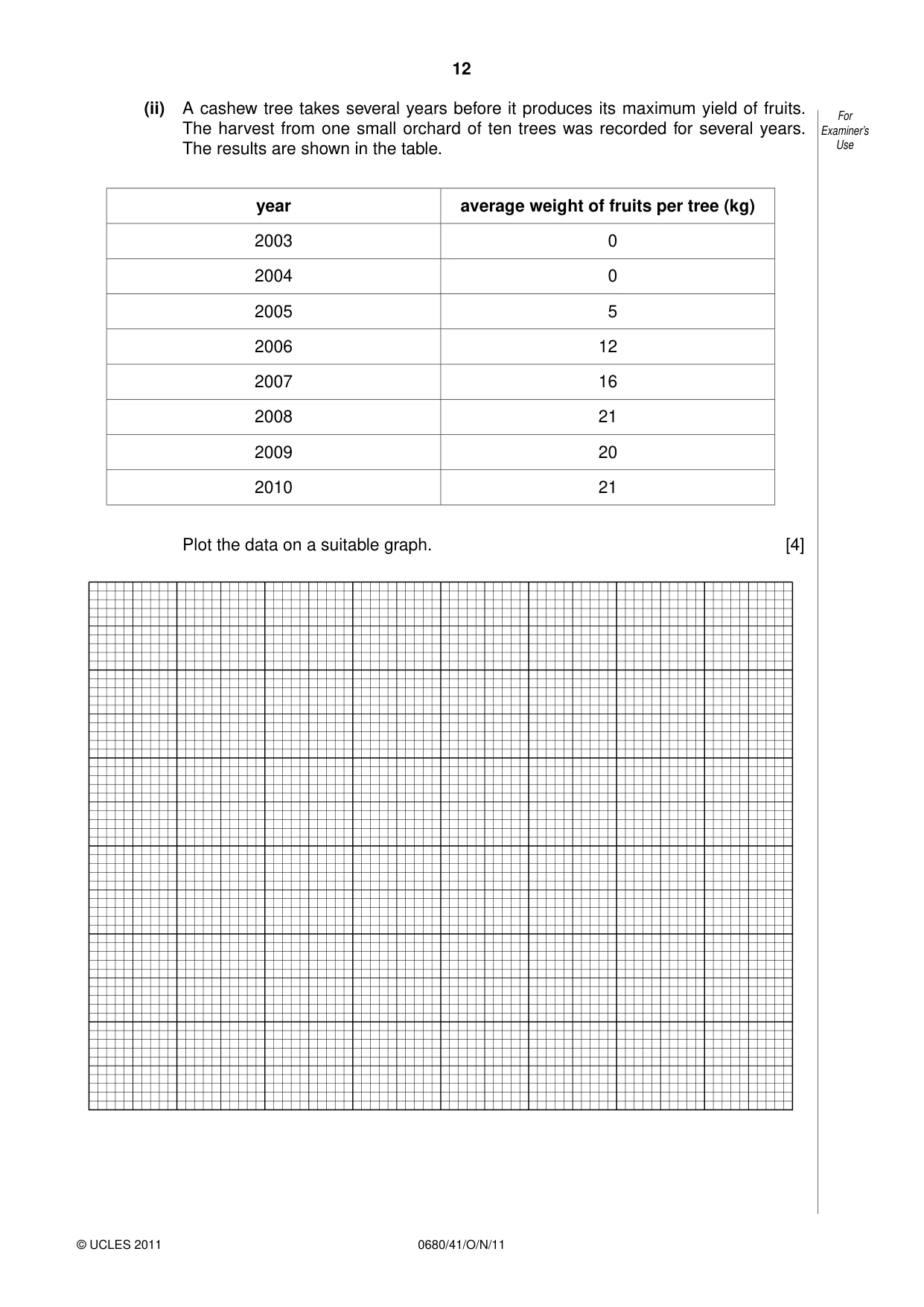
12 0680/41/O/N/11 © UCLES 2011 For Examiner’s Use (ii) A cashew tree takes several years before it produces its maximum yield of fruits. The harvest from one small orchard of ten trees was recorded for several years. The results are shown in the table. year average weight of fruits per tree (kg) 2003 0 2004 0 2005 5 2006 12 2007 16 2008 21 2009 20 2010 21 Plot the data on a suitable graph. [4]
Question paper, page 13
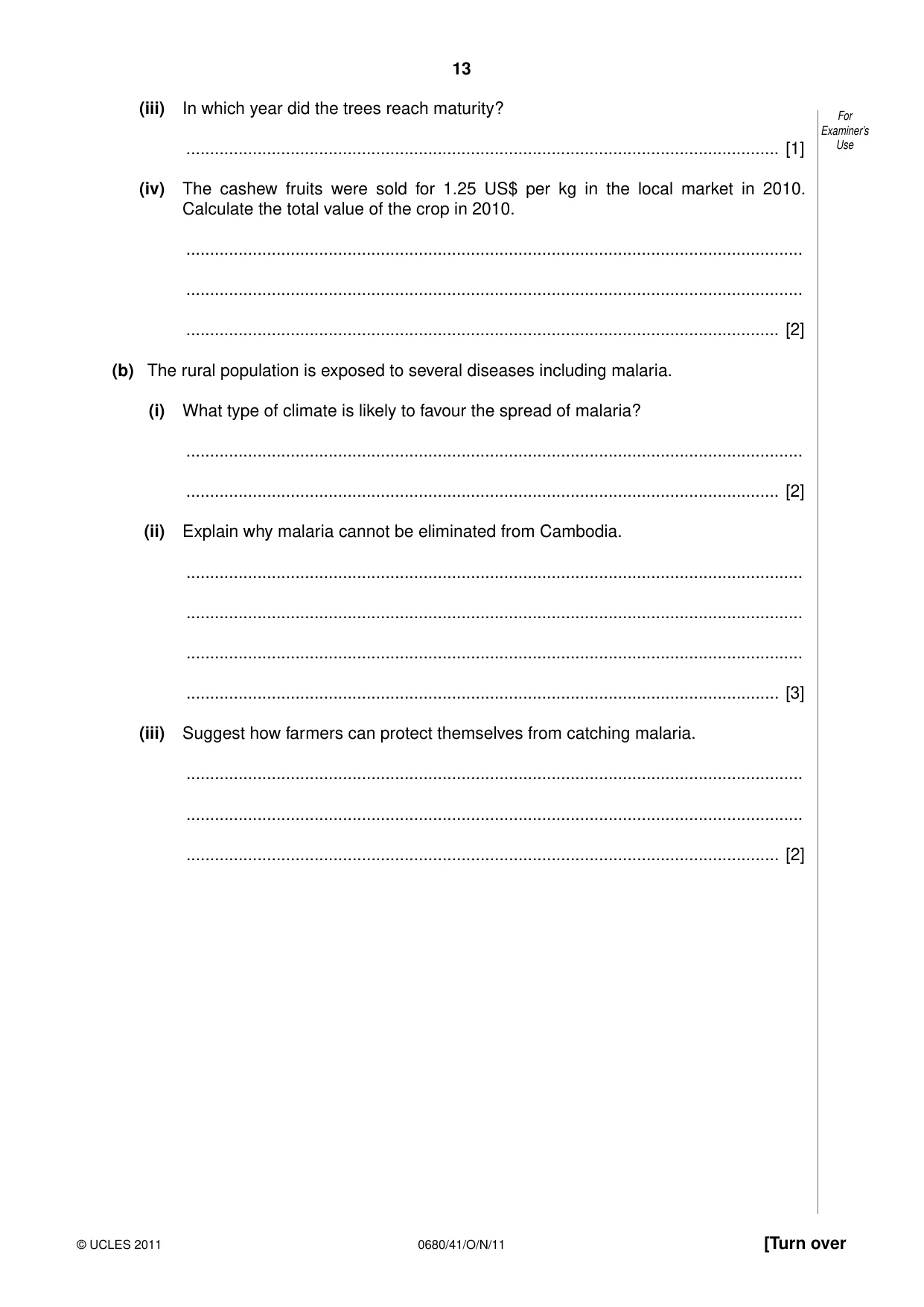
13 0680/41/O/N/11 © UCLES 2011 [Turn over For Examiner’s Use (iii) In which year did the trees reach maturity? … [1] (iv) The cashew fruits were sold for 1.25 US$ per kg in the local market in 2010. Calculate the total value of the crop in 2010. … … … [2] (b) The rural population is exposed to several diseases including malaria. (i) What type of climate is likely to favour the spread of malaria? … … [2] (ii) Explain why malaria cannot be eliminated from Cambodia. … … … … [3] (iii) Suggest how farmers can protect themselves from catching malaria. … … … [2]
Question paper, page 14
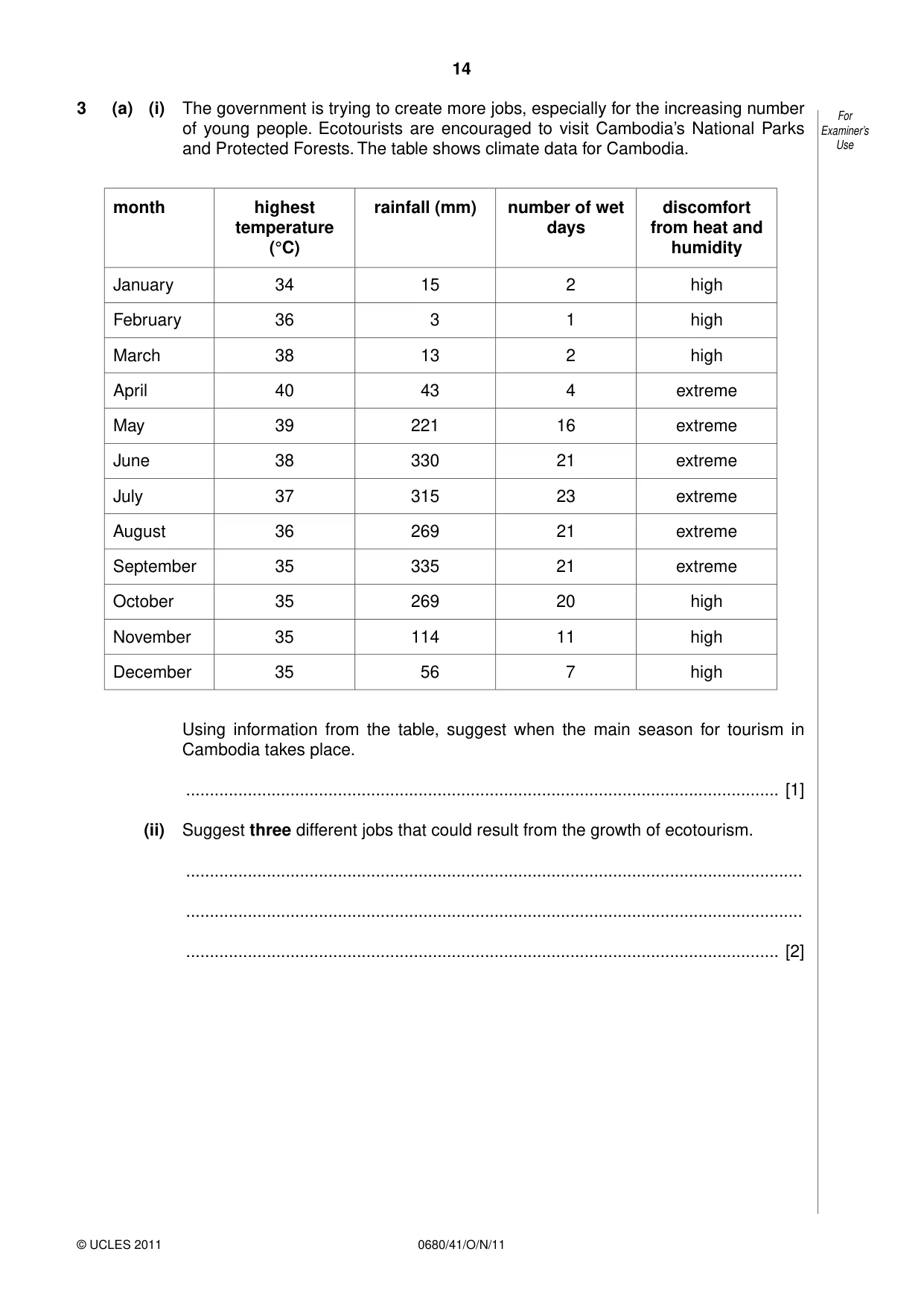
14 0680/41/O/N/11 © UCLES 2011 For Examiner’s Use 3 (a) (i) The government is trying to create more jobs, especially for the increasing number of young people. Ecotourists are encouraged to visit Cambodia’s National Parks and Protected Forests. The table shows climate data for Cambodia. month highest temperature (°C) rainfall (mm) number of wet days discomfort from heat and humidity January 34 15 2 high February 36 3 1 high March 38 13 2 high April 40 43 4 extreme May 39 221 16 extreme June 38 330 21 extreme July 37 315 23 extreme August 36 269 21 extreme September 35 335 21 extreme October 35 269 20 high November 35 114 11 high December 35 56 7 high Using information from the table, suggest when the main season for tourism in Cambodia takes place. … [1] (ii) Suggest three different jobs that could result from the growth of ecotourism. … … … [2]
Question paper, page 15
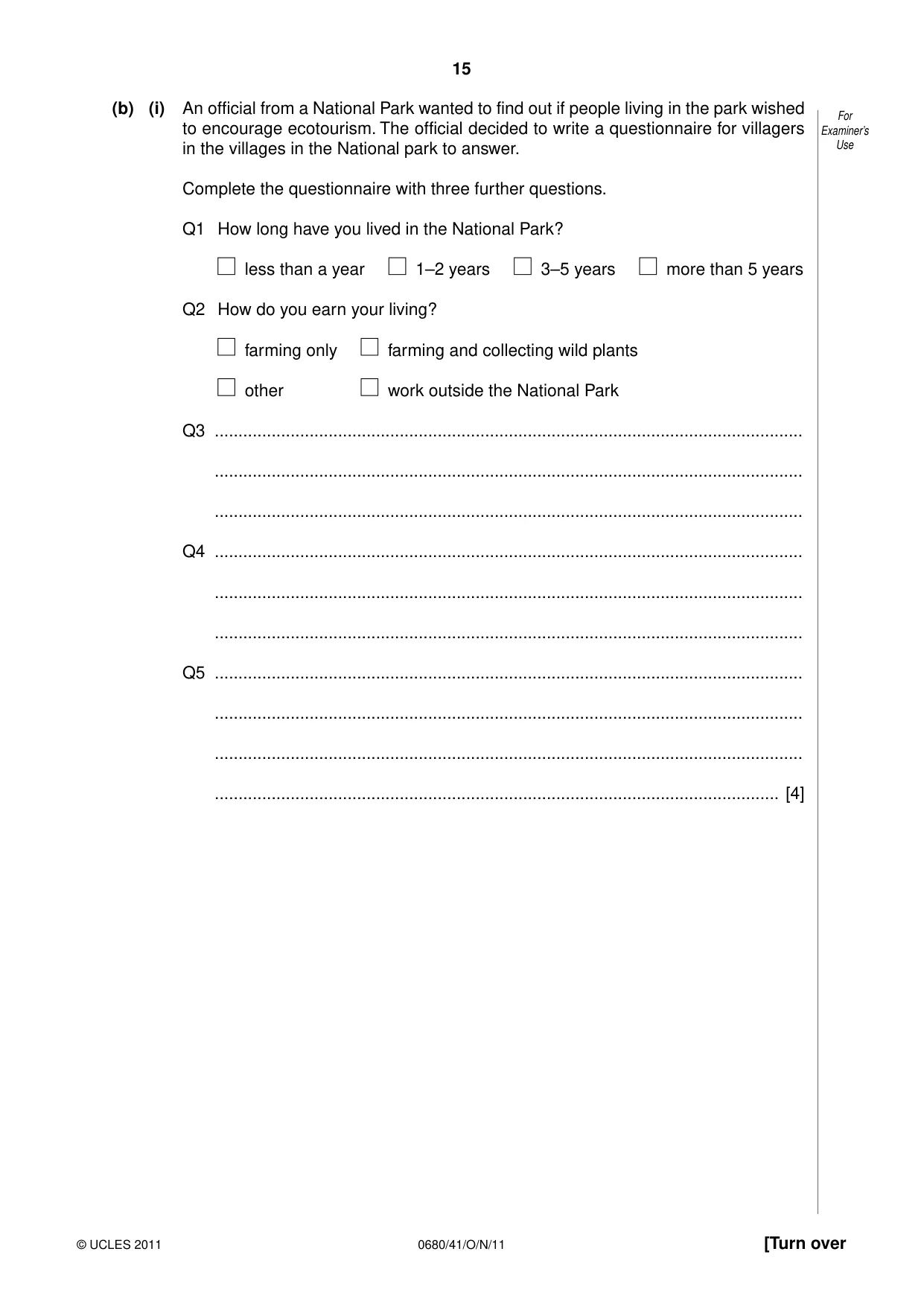
15 0680/41/O/N/11 © UCLES 2011 [Turn over For Examiner’s Use (b) (i) An official from a National Park wanted to find out if people living in the park wished to encourage ecotourism. The official decided to write a questionnaire for villagers in the villages in the National park to answer. Complete the questionnaire with three further questions. Q1 How long have you lived in the National Park? less than a year 1–2 years 3–5 years more than 5 years Q2 How do you earn your living? farming only farming and collecting wild plants other work outside the National Park Q3 … … … Q4 … … … Q5 … … … … [4]
Question paper, page 16
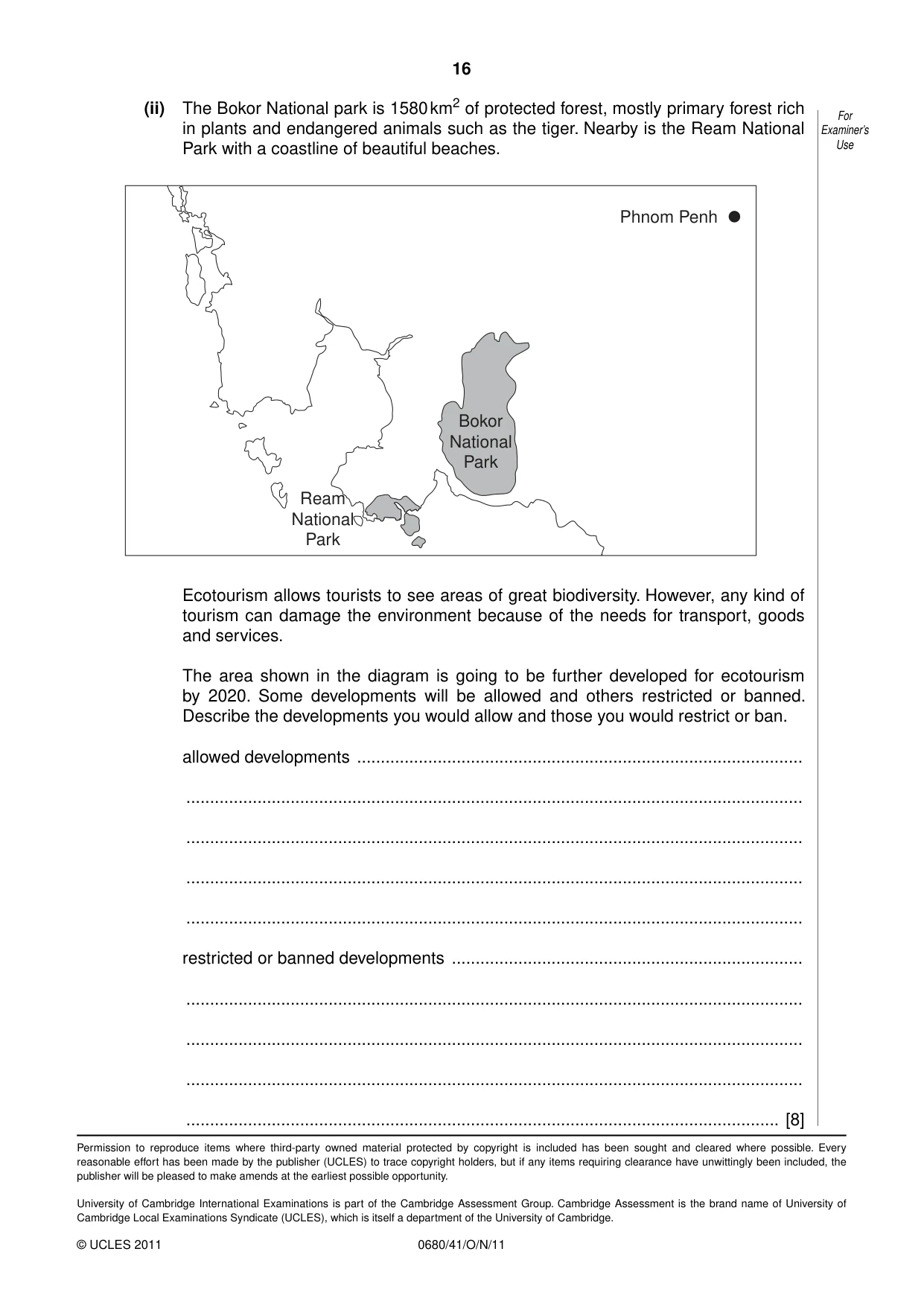
16 0680/41/O/N/11 © UCLES 2011 For Examiner’s Use Permission to reproduce items where third-party owned material protected by copyright is included has been sought and cleared where possible. Every reasonable effort has been made by the publisher (UCLES) to trace copyright holders, but if any items requiring clearance have unwittingly been included, the publisher will be pleased to make amends at the earliest possible opportunity. University of Cambridge International Examinations is part of the Cambridge Assessment Group. Cambridge Assessment is the brand name of University of Cambridge Local Examinations Syndicate (UCLES), which is itself a department of the University of Cambridge. (ii) The Bokor National park is 1580 km2 of protected forest, mostly primary forest rich in plants and endangered animals such as the tiger. Nearby is the Ream National Park with a coastline of beautiful beaches. Ream National Park Bokor National Park Phnom Penh Ecotourism allows tourists to see areas of great biodiversity. However, any kind of tourism can damage the environment because of the needs for transport, goods and services. The area shown in the diagram is going to be further developed for ecotourism by 2020. Some developments will be allowed and others restricted or banned. Describe the developments you would allow and those you would restrict or ban. allowed developments … … … … … restricted or banned developments … … … … … [8]
Mark scheme, page 1
UNIVERSITY OF CAMBRIDGE INTERNATIONAL EXAMINATIONS International General Certificate of Secondary Education MARK SCHEME for the October/November 2011 question paper for the guidance of teachers 0680 ENVIRONMENTAL MANAGEMENT 0680/41 Paper 4 (Alternative to Coursework), maximum raw mark 60 This mark scheme is published as an aid to teachers and candidates, to indicate the requirements of the examination. It shows the basis on which Examiners were instructed to award marks. It does not indicate the details of the discussions that took place at an Examiners’ meeting before marking began, which would have considered the acceptability of alternative answers. Mark schemes must be read in conjunction with the question papers and the report on the examination. • Cambridge will not enter into discussions or correspondence in connection with these mark schemes. Cambridge is publishing the mark schemes for the October/November 2011 question papers for most IGCSE, GCE Advanced Level and Advanced Subsidiary Level syllabuses and some Ordinary Level syllabuses. www.XtremePapers.com
Mark scheme, page 2
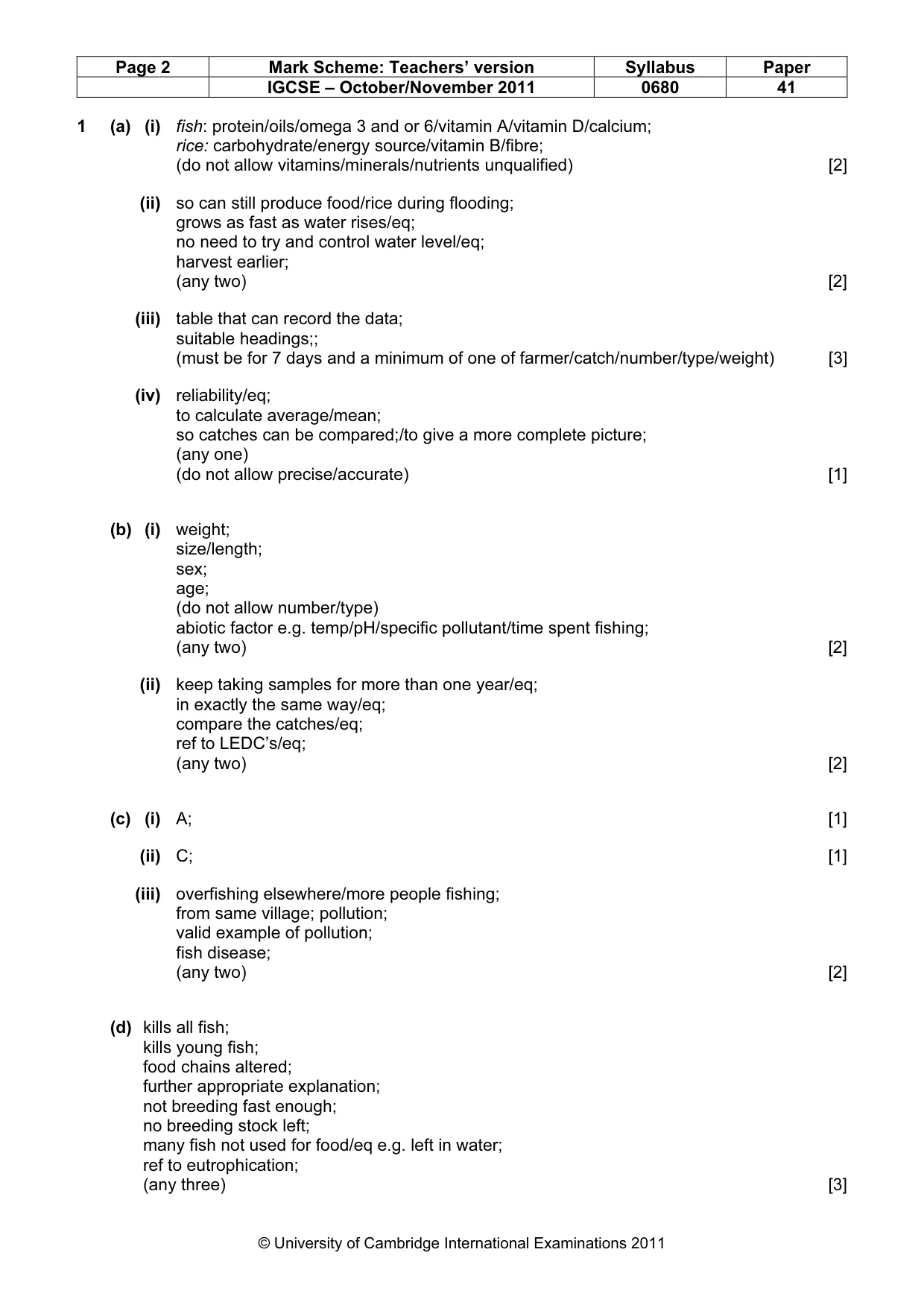
Page 2 Mark Scheme: Teachers’ version Syllabus Paper IGCSE – October/November 2011 0680 41 © University of Cambridge International Examinations 2011 1 (a) (i) fish: protein/oils/omega 3 and or 6/vitamin A/vitamin D/calcium; rice: carbohydrate/energy source/vitamin B/fibre; (do not allow vitamins/minerals/nutrients unqualified) [2] (ii) so can still produce food/rice during flooding; grows as fast as water rises/eq; no need to try and control water level/eq; harvest earlier; (any two) [2] (iii) table that can record the data; suitable headings;; (must be for 7 days and a minimum of one of farmer/catch/number/type/weight) [3] (iv) reliability/eq; to calculate average/mean; so catches can be compared;/to give a more complete picture; (any one) (do not allow precise/accurate) [1] (b) (i) weight; size/length; sex; age; (do not allow number/type) abiotic factor e.g. temp/pH/specific pollutant/time spent fishing; (any two) [2] (ii) keep taking samples for more than one year/eq; in exactly the same way/eq; compare the catches/eq; ref to LEDC’s/eq; (any two) [2] (c) (i) A; [1] (ii) C; [1] (iii) overfishing elsewhere/more people fishing; from same village; pollution; valid example of pollution; fish disease; (any two) [2] (d) kills all fish; kills young fish; food chains altered; further appropriate explanation; not breeding fast enough; no breeding stock left; many fish not used for food/eq e.g. left in water; ref to eutrophication; (any three) [3]
Mark scheme, page 3
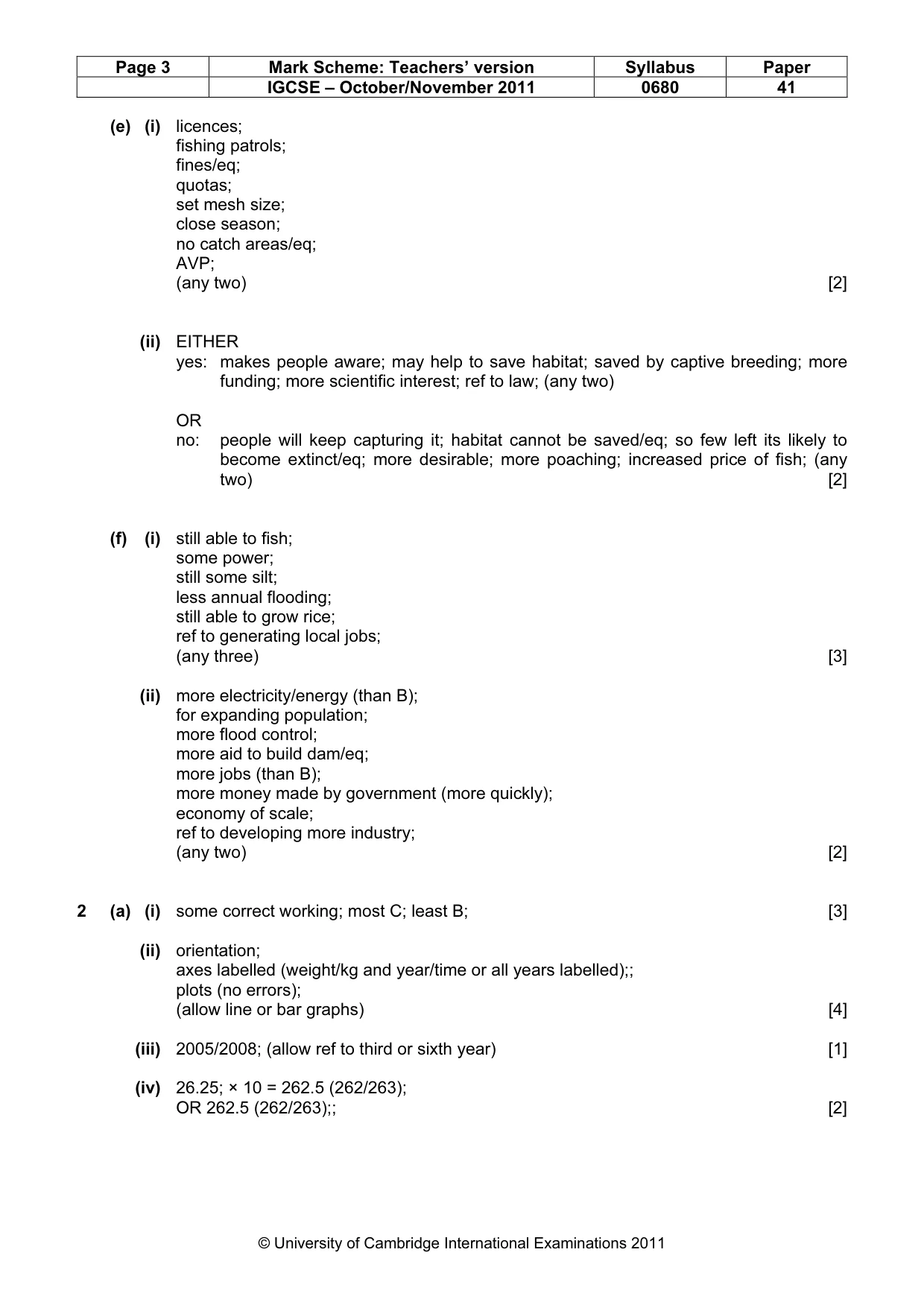
Page 3 Mark Scheme: Teachers’ version Syllabus Paper IGCSE – October/November 2011 0680 41 © University of Cambridge International Examinations 2011 (e) (i) licences; fishing patrols; fines/eq; quotas; set mesh size; close season; no catch areas/eq; AVP; (any two) [2] (ii) EITHER yes: makes people aware; may help to save habitat; saved by captive breeding; more funding; more scientific interest; ref to law; (any two) OR no: people will keep capturing it; habitat cannot be saved/eq; so few left its likely to become extinct/eq; more desirable; more poaching; increased price of fish; (any two) [2] (f) (i) still able to fish; some power; still some silt; less annual flooding; still able to grow rice; ref to generating local jobs; (any three) [3] (ii) more electricity/energy (than B); for expanding population; more flood control; more aid to build dam/eq; more jobs (than B); more money made by government (more quickly); economy of scale; ref to developing more industry; (any two) [2] 2 (a) (i) some correct working; most C; least B; [3] (ii) orientation; axes labelled (weight/kg and year/time or all years labelled);; plots (no errors); (allow line or bar graphs) [4] (iii) 2005/2008; (allow ref to third or sixth year) [1] (iv) 26.25; × 10 = 262.5 (262/263); OR 262.5 (262/263);; [2]
Mark scheme, page 4
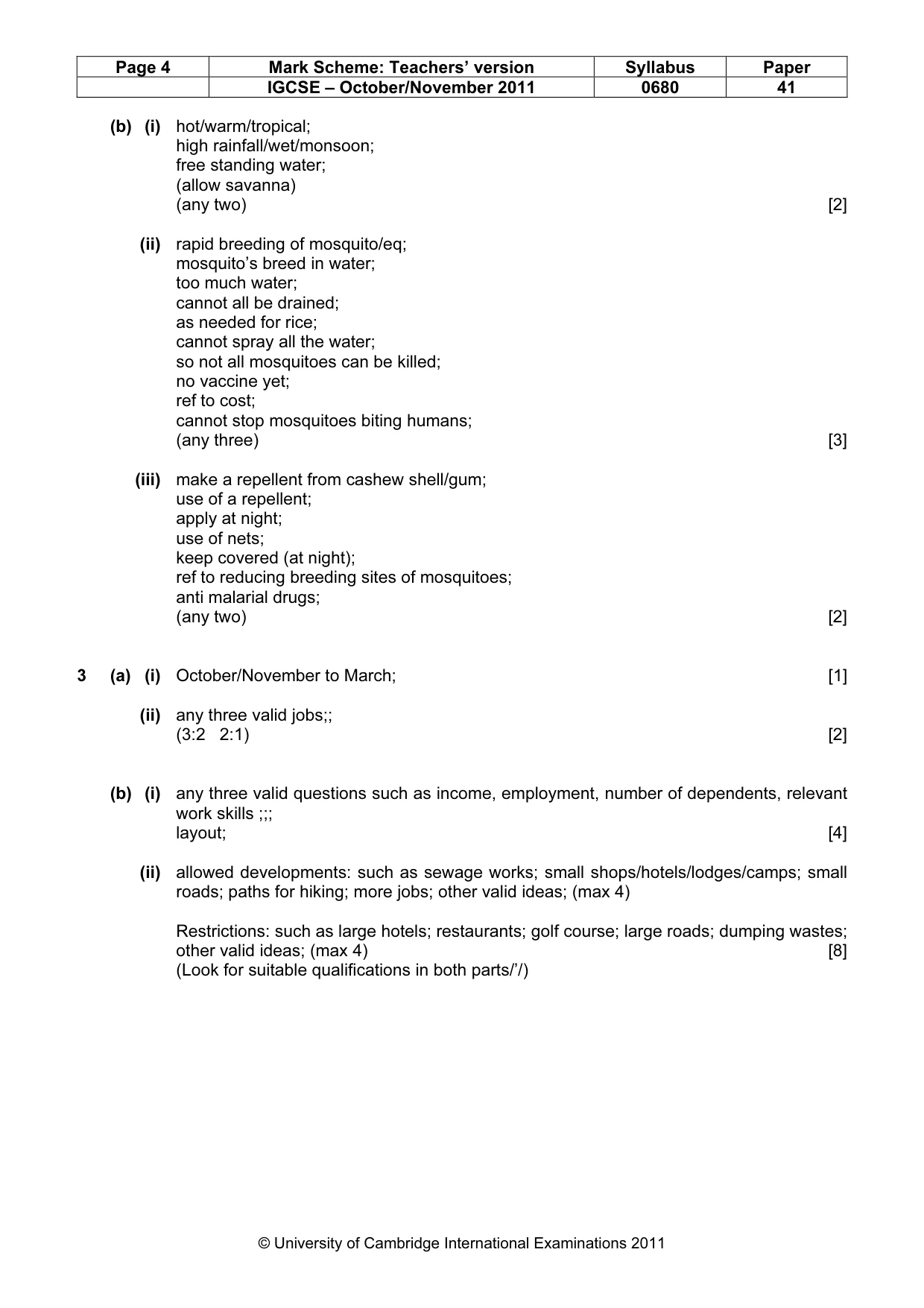
Page 4 Mark Scheme: Teachers’ version Syllabus Paper IGCSE – October/November 2011 0680 41 © University of Cambridge International Examinations 2011 (b) (i) hot/warm/tropical; high rainfall/wet/monsoon; free standing water; (allow savanna) (any two) [2] (ii) rapid breeding of mosquito/eq; mosquito’s breed in water; too much water; cannot all be drained; as needed for rice; cannot spray all the water; so not all mosquitoes can be killed; no vaccine yet; ref to cost; cannot stop mosquitoes biting humans; (any three) [3] (iii) make a repellent from cashew shell/gum; use of a repellent; apply at night; use of nets; keep covered (at night); ref to reducing breeding sites of mosquitoes; anti malarial drugs; (any two) [2] 3 (a) (i) October/November to March; [1] (ii) any three valid jobs;; (3:2 2:1) [2] (b) (i) any three valid questions such as income, employment, number of dependents, relevant work skills ;;; layout; [4] (ii) allowed developments: such as sewage works; small shops/hotels/lodges/camps; small roads; paths for hiking; more jobs; other valid ideas; (max 4) Restrictions: such as large hotels; restaurants; golf course; large roads; dumping wastes; other valid ideas; (max 4) [8] (Look for suitable qualifications in both parts/’/)
What you needed in this session
Cambridge’s own grade thresholds for 2011 Oct/Nov, Paper 4 · Variant 1. A higher threshold means an easier paper — the bar moves with how the cohort did.