Cambridge IGCSE Environmental Management 0680 — 2011 May/June Paper 4 · Variant 2
0680/42/M/J/11 · 60 marks · ≈68 min
The question paper and its mark scheme, free to read here and free to download. This is Cambridge’s own paper, exactly as it was sat.
Question paper16 pages
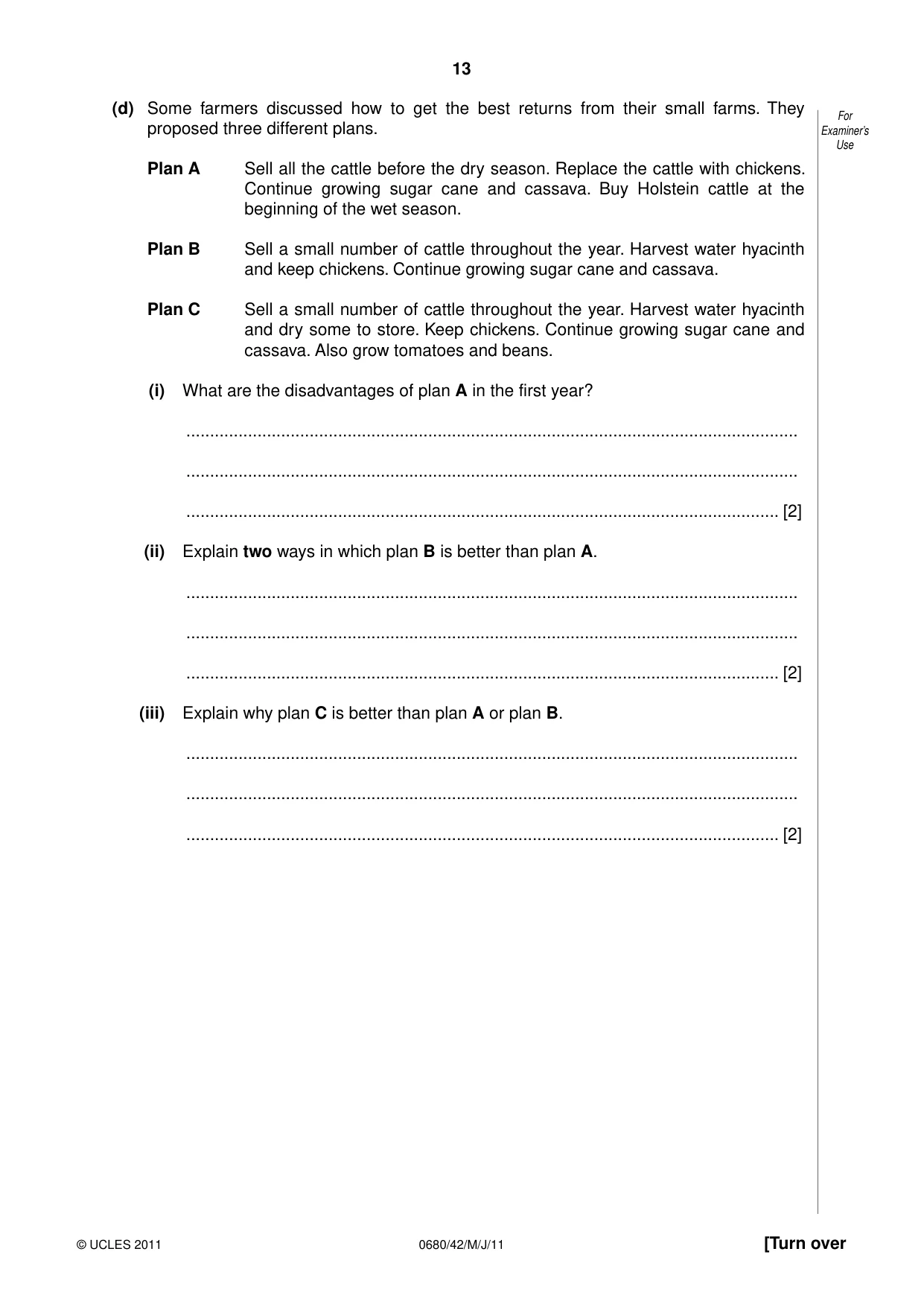
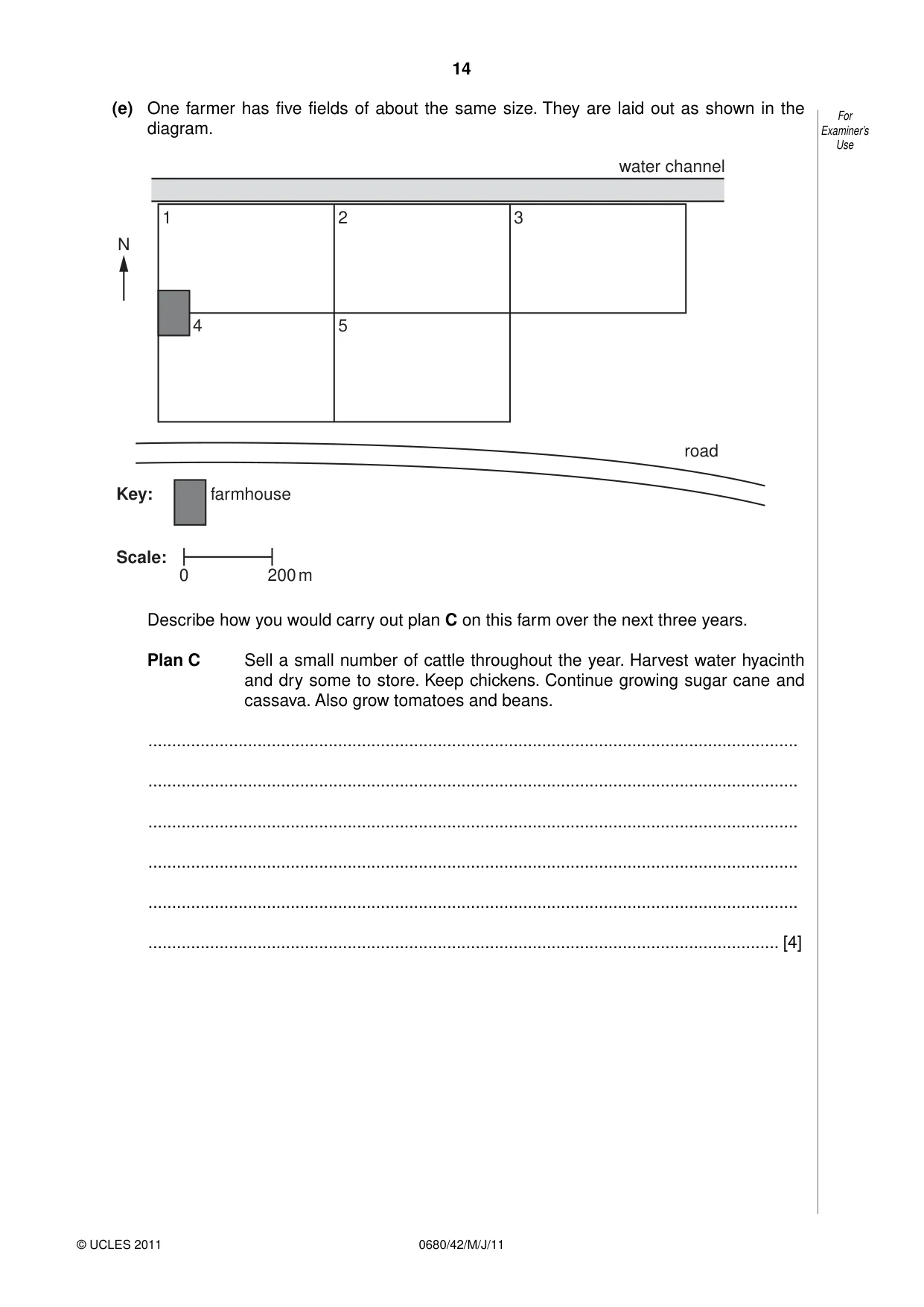


Mark scheme4 pages
Answers below. Sit the paper first if you are practising.
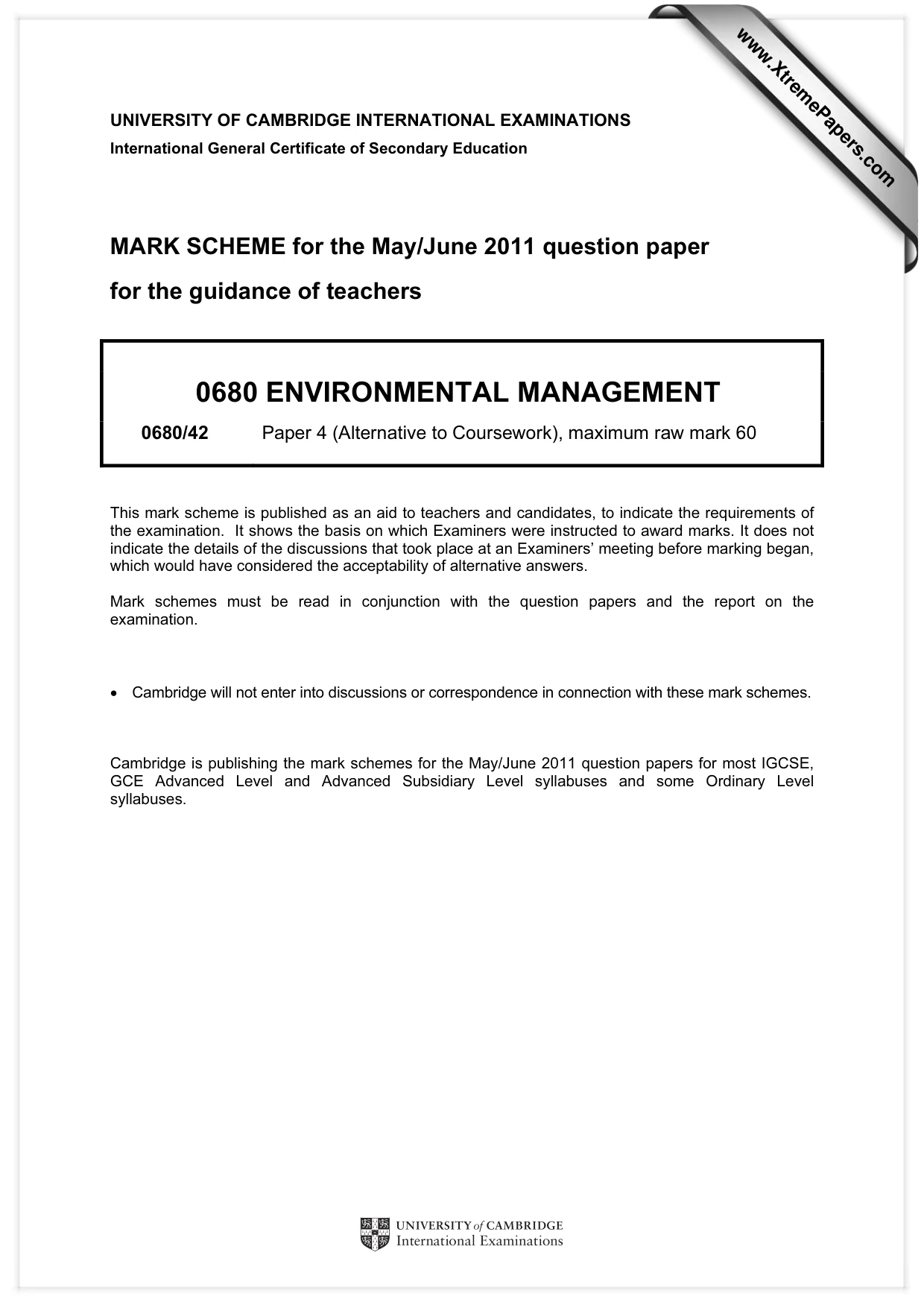
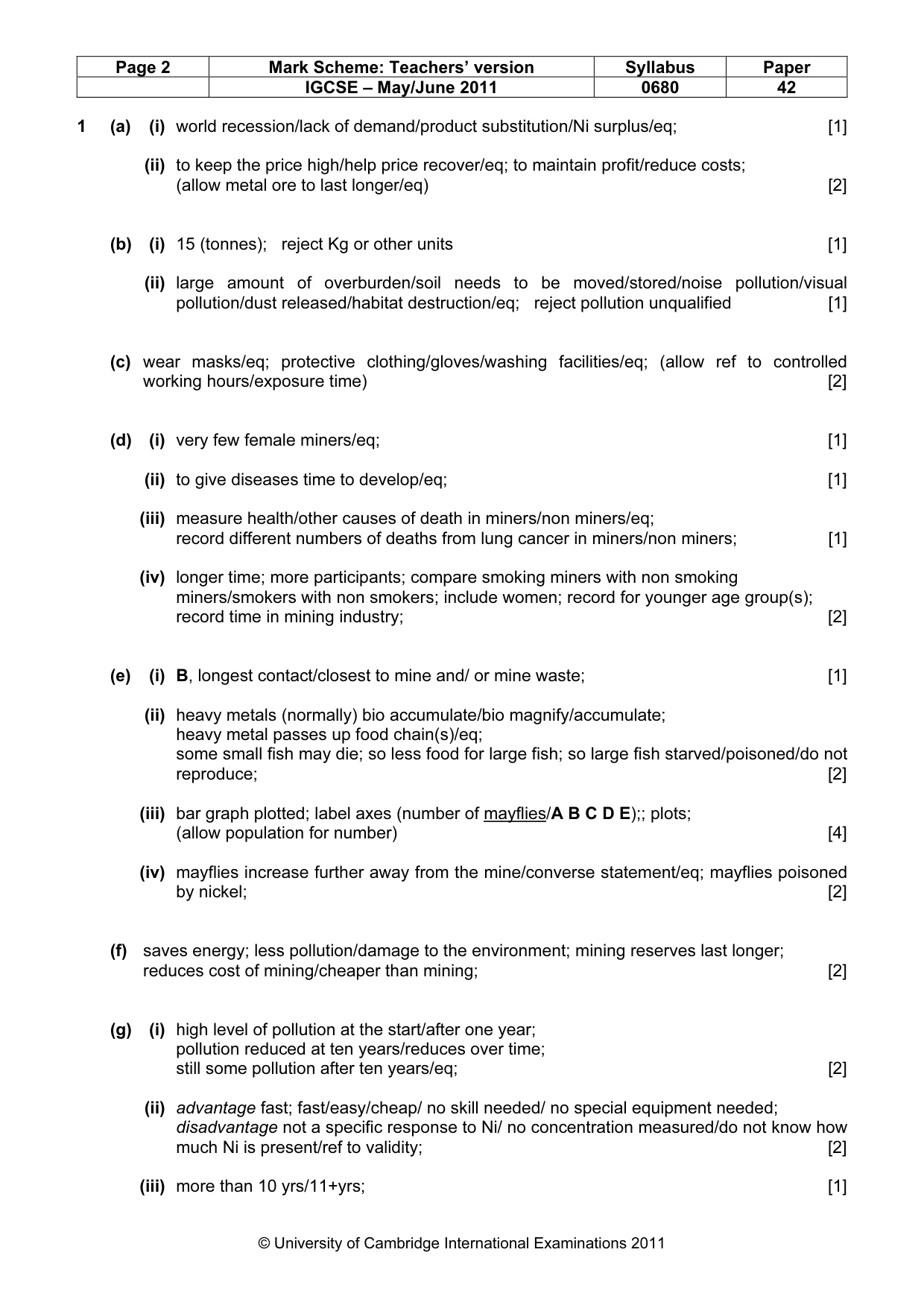
Paper as text
Question paper, page 1
This document consists of 14 printed pages and 2 blank pages. DC (LEO/DJ) 33944/2 © UCLES 2011 [Turn over UNIVERSITY OF CAMBRIDGE INTERNATIONAL EXAMINATIONS International General Certificate of Secondary Education READ THESE INSTRUCTIONS FIRST Write your Centre number, candidate number and name on all the work you hand in. Write in dark blue or black pen. You may use a soft pencil for any diagrams, graphs or rough working. Do not use staples, paper clips, highlighters, glue or correction fluid. DO NOT WRITE IN ANY BARCODES. Answer all questions. Study the appropriate Source materials before you start to write your answers. Credit will be given for appropriate selection and use of data in your answers and for relevant interpretation of these data. Suggestions for data sources are given in some questions. You may use the source data to draw diagrams and graphs or to do calculations to illustrate your answers. At the end of the examination, fasten all your work securely together. The number of marks is given in brackets [ ] at the end of each question or part question. * 2 2 9 8 0 5 4 5 1 3 * ENVIRONMENTAL MANAGEMENT 0680/42 Alternative to Coursework May/June 2011 1 hour 30 minutes Candidates answer on the Question Paper. Additional Materials: Ruler For Examiner’s Use 1 2 Total www.XtremePapers.com
Question paper, page 2
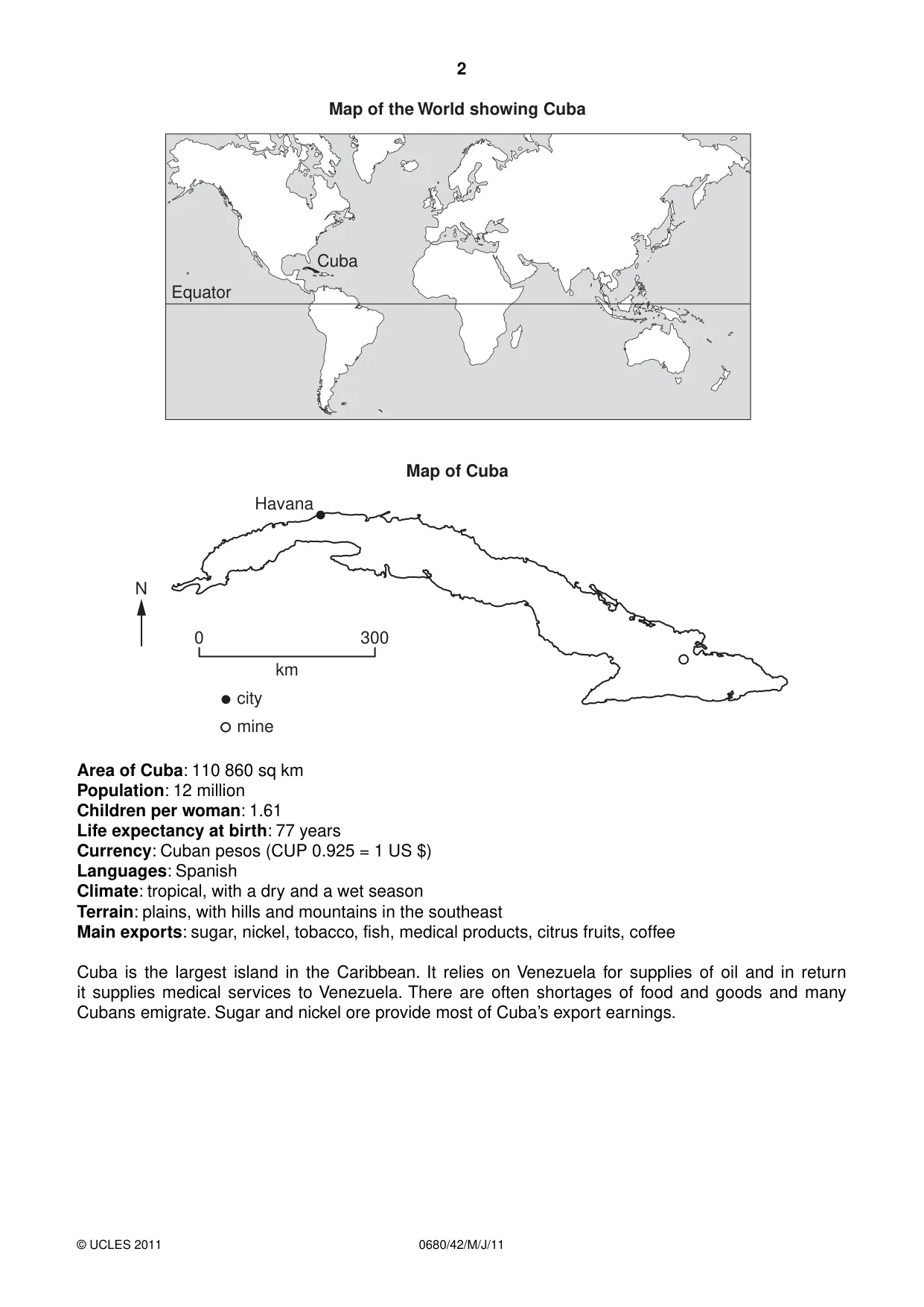
2 0680/42/M/J/11 © UCLES 2011 Cuba Equator Map of the World showing Cuba Map of Cuba Havana N 0 300 km city mine Area of Cuba: 110 860 sq km Population: 12 million Children per woman: 1.61 Life expectancy at birth: 77 years Currency: Cuban pesos (CUP 0.925 = 1 US $) Languages: Spanish Climate: tropical, with a dry and a wet season Terrain: plains, with hills and mountains in the southeast Main exports: sugar, nickel, tobacco, fish, medical products, citrus fruits, coffee Cuba is the largest island in the Caribbean. It relies on Venezuela for supplies of oil and in return it supplies medical services to Venezuela. There are often shortages of food and goods and many Cubans emigrate. Sugar and nickel ore provide most of Cuba’s export earnings.
Question paper, page 3
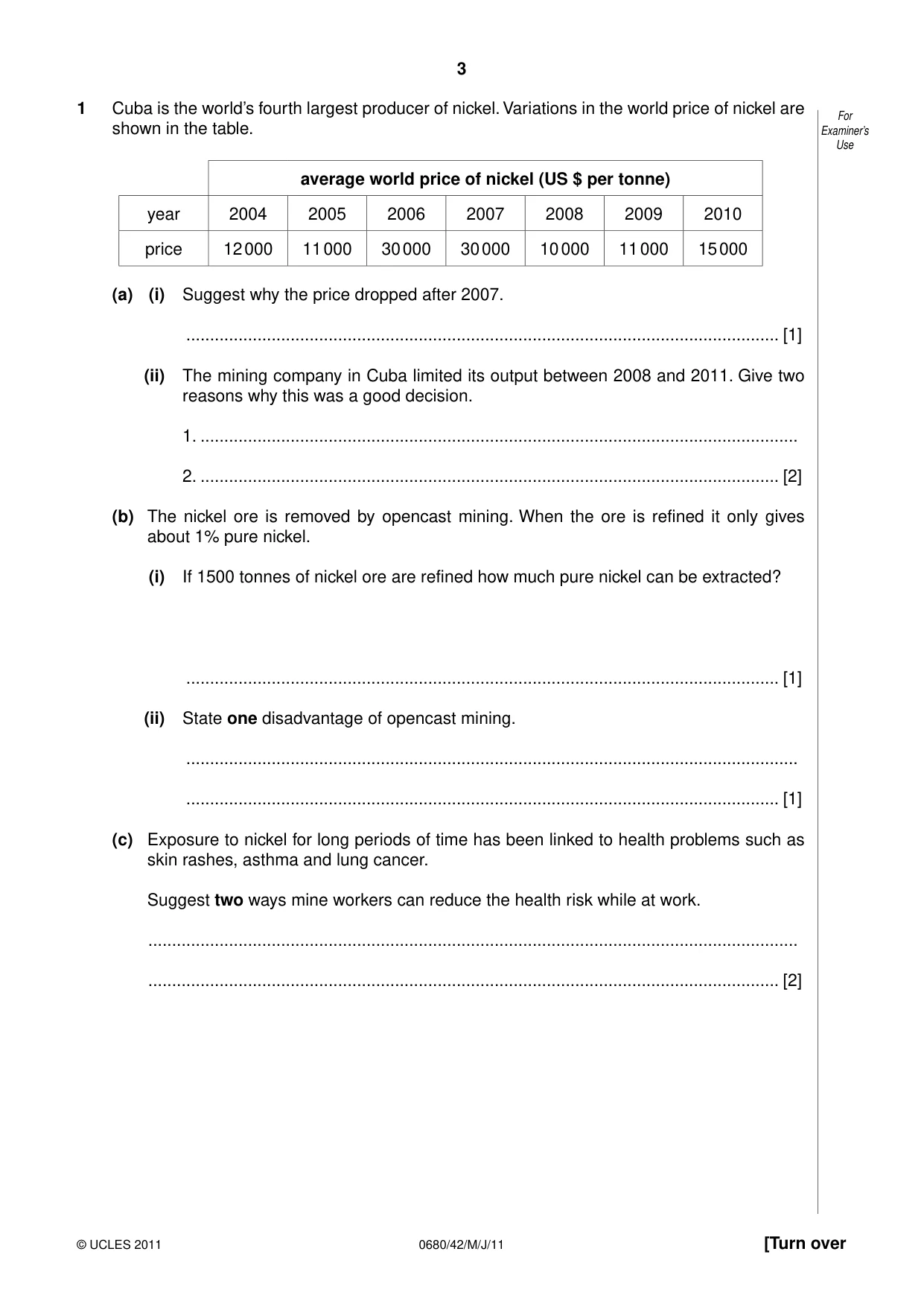
3 0680/42/M/J/11 © UCLES 2011 [Turn over For Examiner’s Use 1 Cuba is the world’s fourth largest producer of nickel. Variations in the world price of nickel are shown in the table. average world price of nickel (US $ per tonne) year 2004 2005 2006 2007 2008 2009 2010 price 12 000 11 000 30 000 30 000 10 000 11 000 15 000 (a) (i) Suggest why the price dropped after 2007. … [1] (ii) The mining company in Cuba limited its output between 2008 and 2011. Give two reasons why this was a good decision. 1. … 2. … [2] (b) The nickel ore is removed by opencast mining. When the ore is refined it only gives about 1% pure nickel. (i) If 1500 tonnes of nickel ore are refined how much pure nickel can be extracted? … [1] (ii) State one disadvantage of opencast mining. … … [1] (c) Exposure to nickel for long periods of time has been linked to health problems such as skin rashes, asthma and lung cancer. Suggest two ways mine workers can reduce the health risk while at work. … … [2]
Question paper, page 4
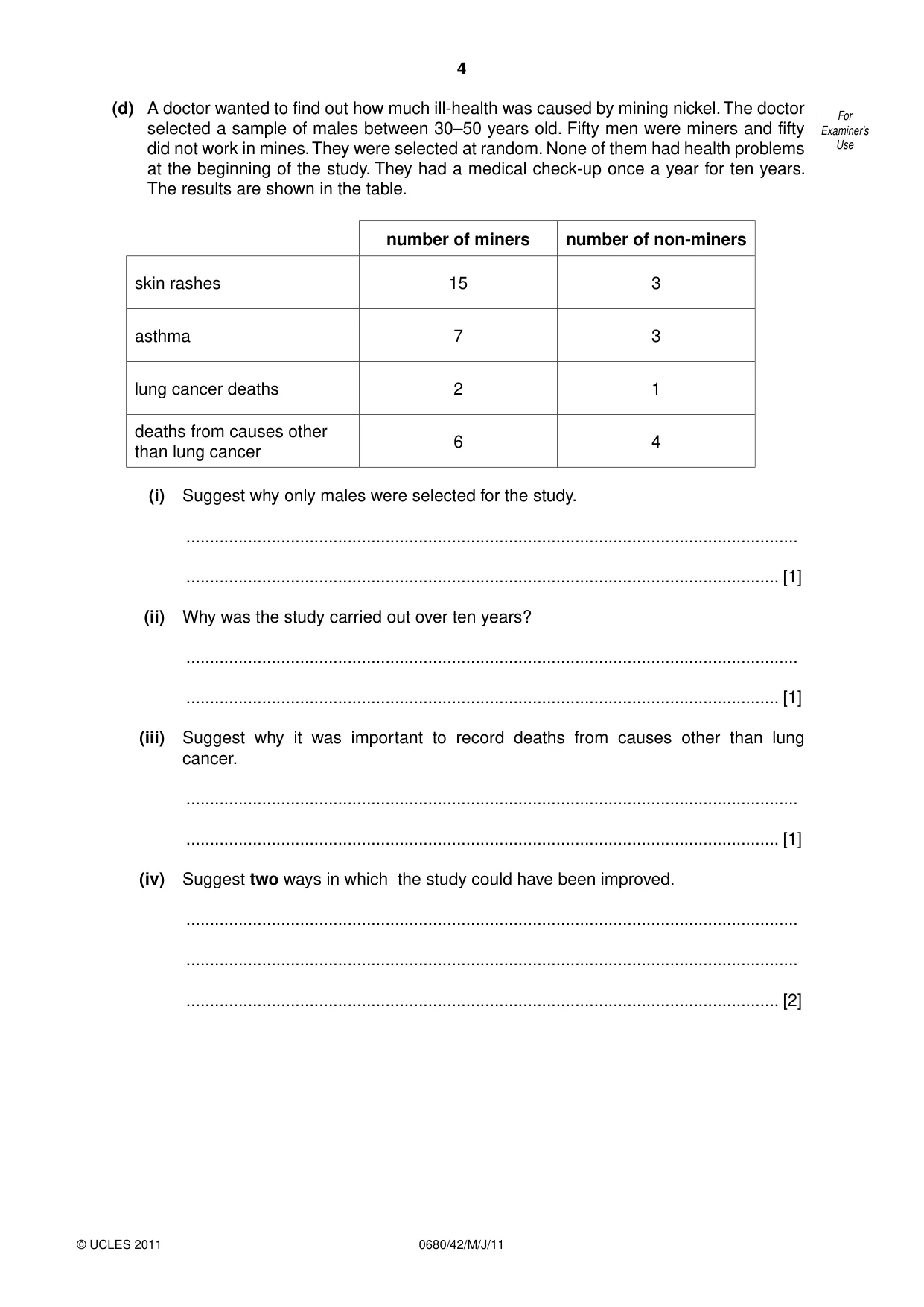
4 0680/42/M/J/11 © UCLES 2011 For Examiner’s Use (d) A doctor wanted to find out how much ill-health was caused by mining nickel. The doctor selected a sample of males between 30–50 years old. Fifty men were miners and fifty did not work in mines. They were selected at random. None of them had health problems at the beginning of the study. They had a medical check-up once a year for ten years. The results are shown in the table. number of miners number of non-miners skin rashes 15 3 asthma 7 3 lung cancer deaths 2 1 deaths from causes other than lung cancer 6 4 (i) Suggest why only males were selected for the study. … … [1] (ii) Why was the study carried out over ten years? … … [1] (iii) Suggest why it was important to record deaths from causes other than lung cancer. … … [1] (iv) Suggest two ways in which the study could have been improved. … … … [2]
Question paper, page 5
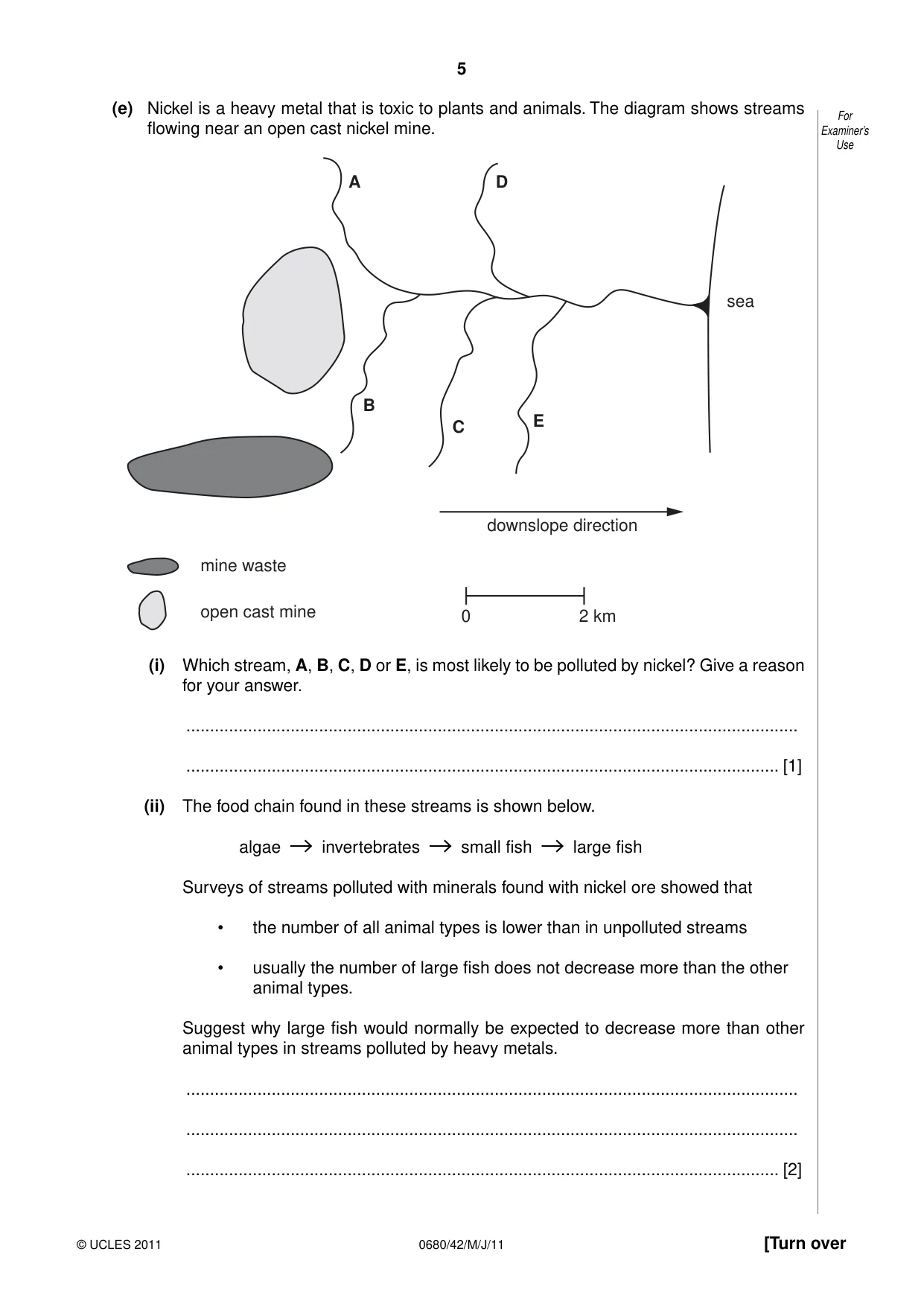
5 0680/42/M/J/11 © UCLES 2011 [Turn over For Examiner’s Use (e) Nickel is a heavy metal that is toxic to plants and animals. The diagram shows streams flowing near an open cast nickel mine. A D B C E downslope direction 0 2 km sea mine waste open cast mine (i) Which stream, A, B, C, D or E, is most likely to be polluted by nickel? Give a reason for your answer. … … [1] (ii) The food chain found in these streams is shown below. algae invertebrates small fish large fish Surveys of streams polluted with minerals found with nickel ore showed that • the number of all animal types is lower than in unpolluted streams • usually the number of large fish does not decrease more than the other animal types. Suggest why large fish would normally be expected to decrease more than other animal types in streams polluted by heavy metals. … … … [2]
Question paper, page 6
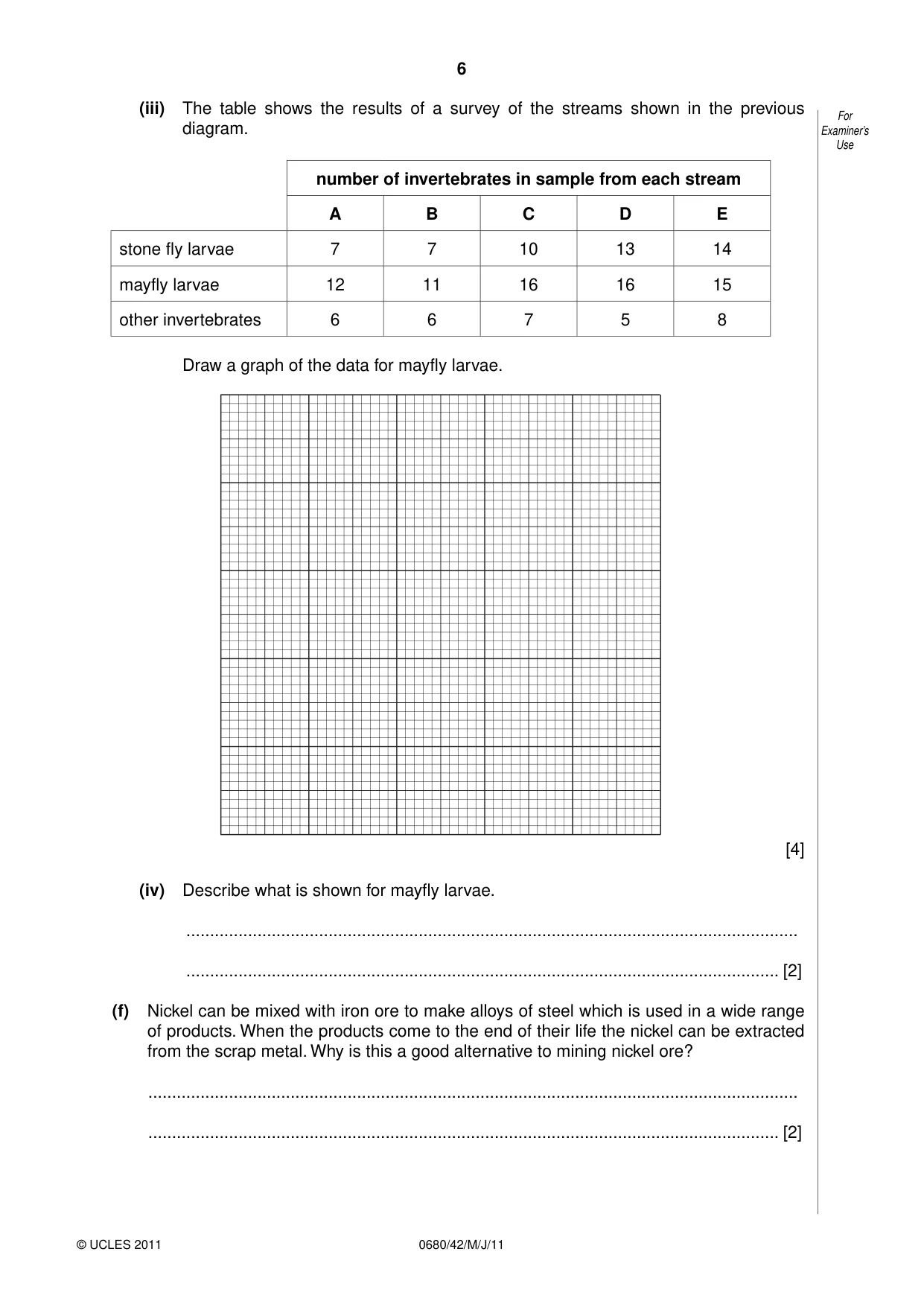
6 0680/42/M/J/11 © UCLES 2011 For Examiner’s Use (iii) The table shows the results of a survey of the streams shown in the previous diagram. number of invertebrates in sample from each stream A B C D E stone fly larvae 7 7 10 13 14 mayfly larvae 12 11 16 16 15 other invertebrates 6 6 7 5 8 Draw a graph of the data for mayfly larvae. [4] (iv) Describe what is shown for mayfly larvae. … … [2] (f) Nickel can be mixed with iron ore to make alloys of steel which is used in a wide range of products. When the products come to the end of their life the nickel can be extracted from the scrap metal. Why is this a good alternative to mining nickel ore? … … [2]
Question paper, page 7
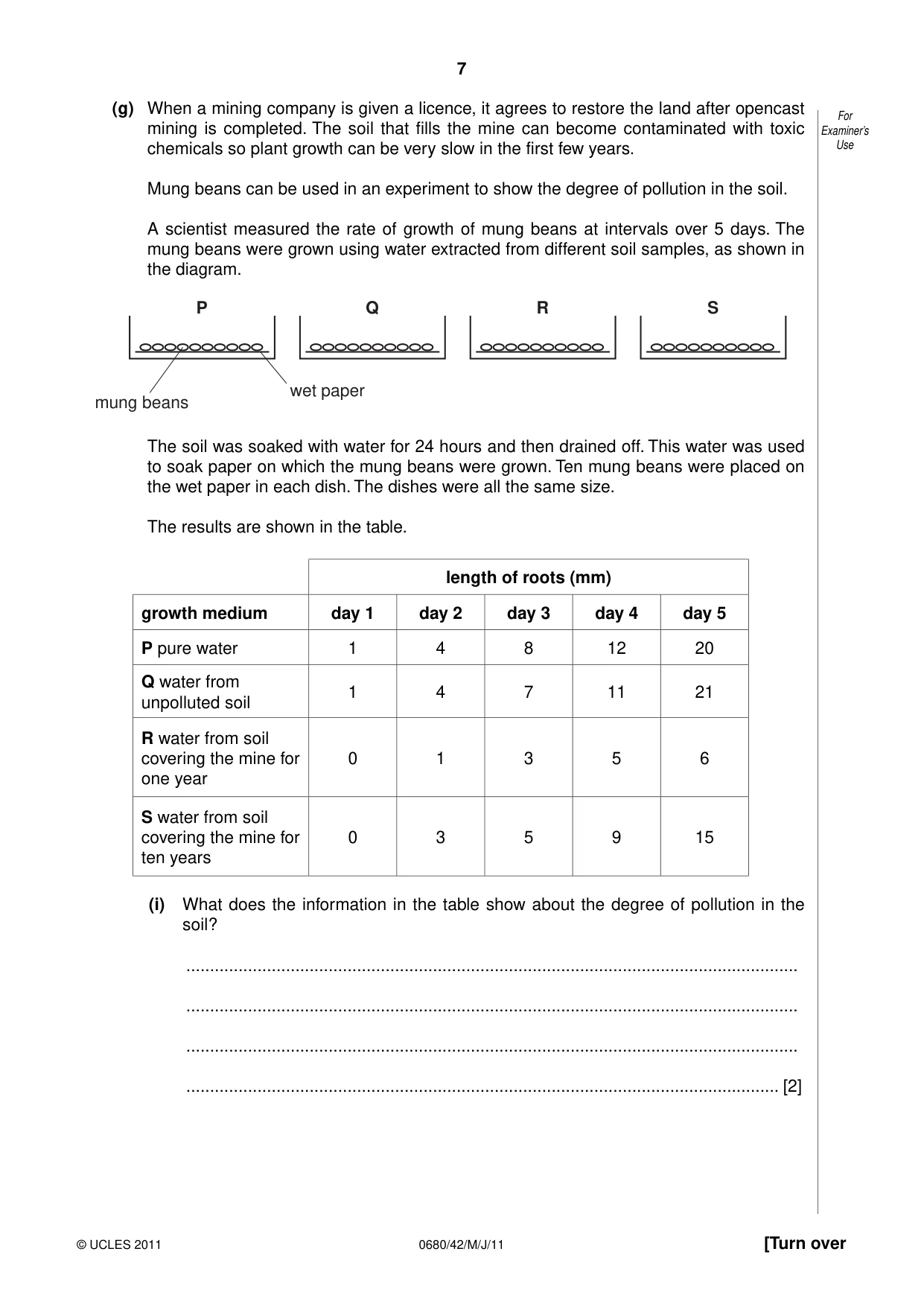
7 0680/42/M/J/11 © UCLES 2011 [Turn over For Examiner’s Use (g) When a mining company is given a licence, it agrees to restore the land after opencast mining is completed. The soil that fills the mine can become contaminated with toxic chemicals so plant growth can be very slow in the first few years. Mung beans can be used in an experiment to show the degree of pollution in the soil. A scientist measured the rate of growth of mung beans at intervals over 5 days. The mung beans were grown using water extracted from different soil samples, as shown in the diagram. P Q R S mung beans wet paper The soil was soaked with water for 24 hours and then drained off. This water was used to soak paper on which the mung beans were grown. Ten mung beans were placed on the wet paper in each dish. The dishes were all the same size. The results are shown in the table. length of roots (mm) growth medium day 1 day 2 day 3 day 4 day 5 P pure water 1 4 8 12 20 Q water from unpolluted soil 1 4 7 11 21 R water from soil covering the mine for one year 0 1 3 5 6 S water from soil covering the mine for ten years 0 3 5 9 15 (i) What does the information in the table show about the degree of pollution in the soil? … … … … [2]
Question paper, page 8
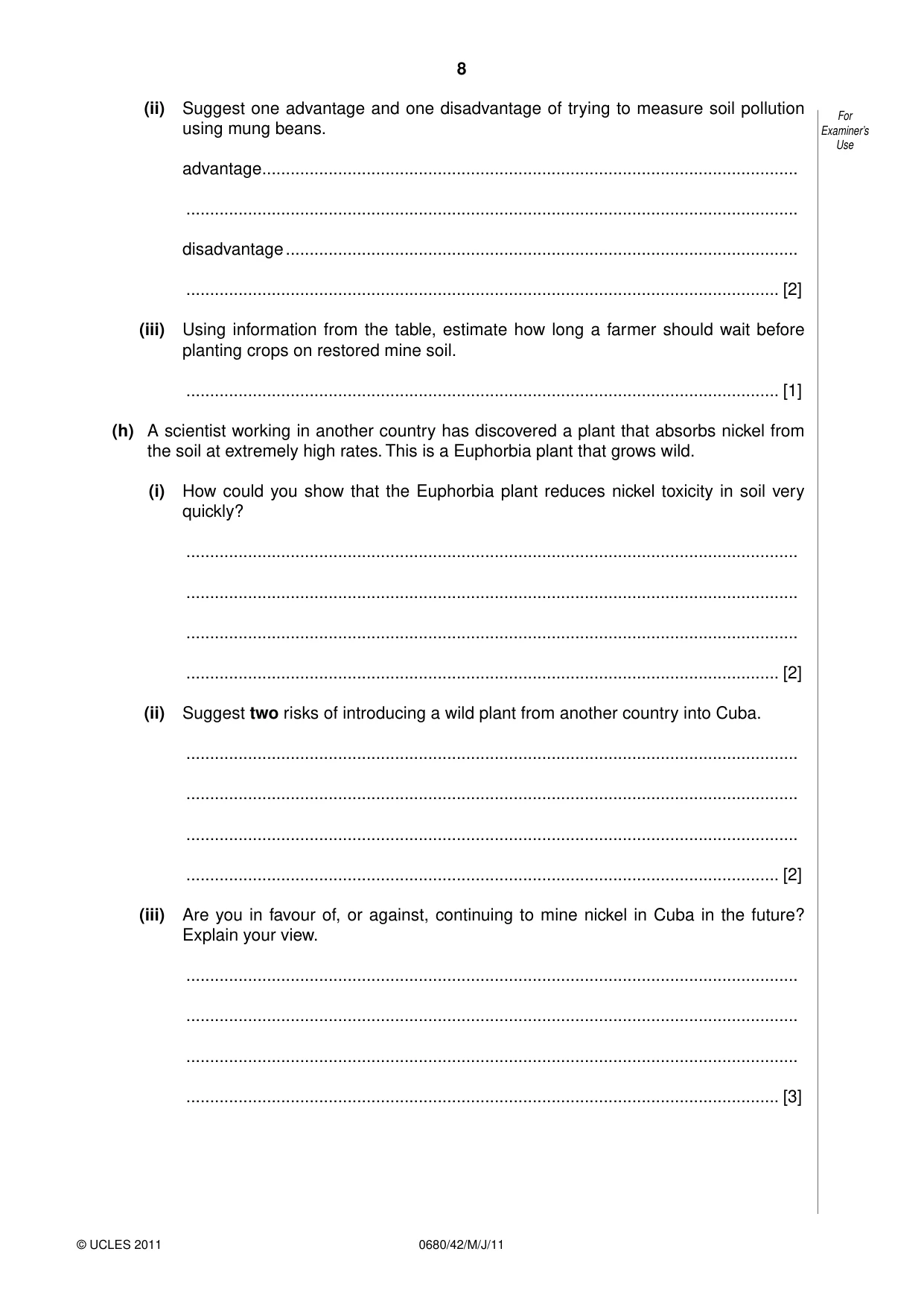
8 0680/42/M/J/11 © UCLES 2011 For Examiner’s Use (ii) Suggest one advantage and one disadvantage of trying to measure soil pollution using mung beans. advantage … … disadvantage … … [2] (iii) Using information from the table, estimate how long a farmer should wait before planting crops on restored mine soil. … [1] (h) A scientist working in another country has discovered a plant that absorbs nickel from the soil at extremely high rates. This is a Euphorbia plant that grows wild. (i) How could you show that the Euphorbia plant reduces nickel toxicity in soil very quickly? … … … … [2] (ii) Suggest two risks of introducing a wild plant from another country into Cuba. … … … … [2] (iii) Are you in favour of, or against, continuing to mine nickel in Cuba in the future? Explain your view. … … … … [3]
Question paper, page 9
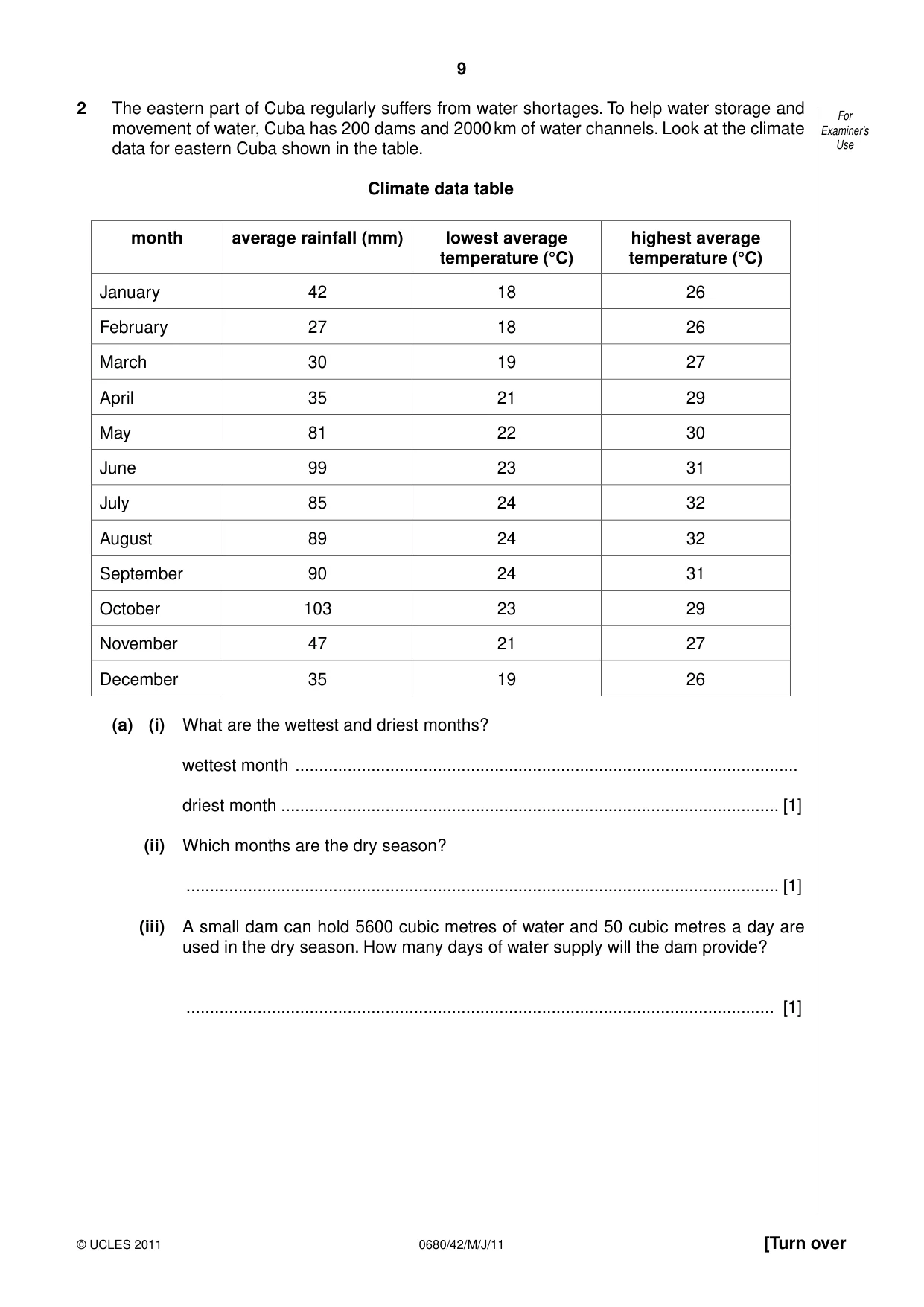
9 0680/42/M/J/11 © UCLES 2011 [Turn over For Examiner’s Use 2 The eastern part of Cuba regularly suffers from water shortages. To help water storage and movement of water, Cuba has 200 dams and 2000 km of water channels. Look at the climate data for eastern Cuba shown in the table. Climate data table month average rainfall (mm) lowest average temperature (°C) highest average temperature (°C) January 42 18 26 February 27 18 26 March 30 19 27 April 35 21 29 May 81 22 30 June 99 23 31 July 85 24 32 August 89 24 32 September 90 24 31 October 103 23 29 November 47 21 27 December 35 19 26 (a) (i) What are the wettest and driest months? wettest month … driest month … [1] (ii) Which months are the dry season? … [1] (iii) A small dam can hold 5600 cubic metres of water and 50 cubic metres a day are used in the dry season. How many days of water supply will the dam provide? … [1]
Question paper, page 10
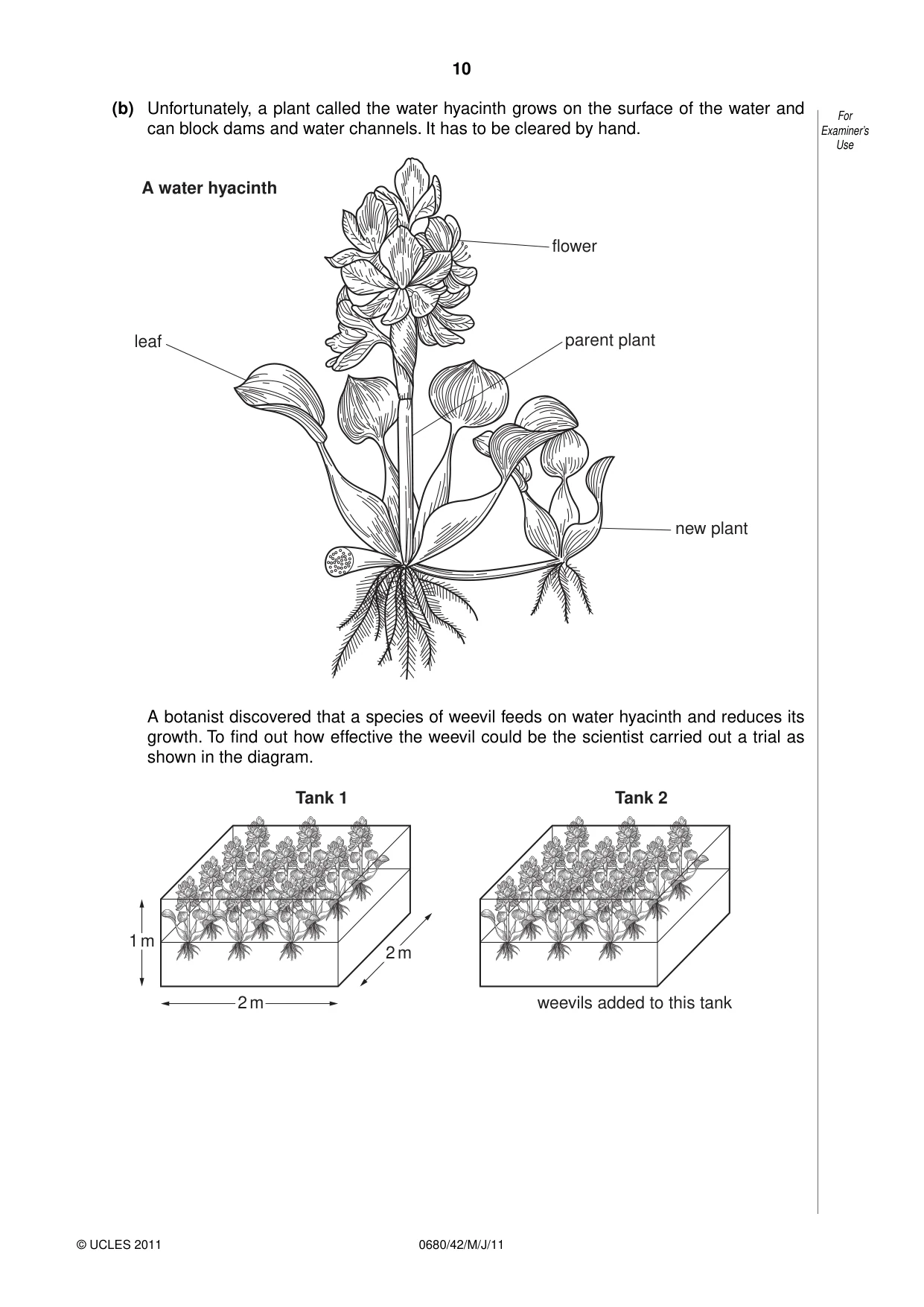
10 0680/42/M/J/11 © UCLES 2011 For Examiner’s Use (b) Unfortunately, a plant called the water hyacinth grows on the surface of the water and can block dams and water channels. It has to be cleared by hand. flower parent plant new plant leaf A water hyacinth A botanist discovered that a species of weevil feeds on water hyacinth and reduces its growth. To find out how effective the weevil could be the scientist carried out a trial as shown in the diagram. Tank 1 1 m Tank 2 weevils added to this tank 2 m 2 m
Question paper, page 11
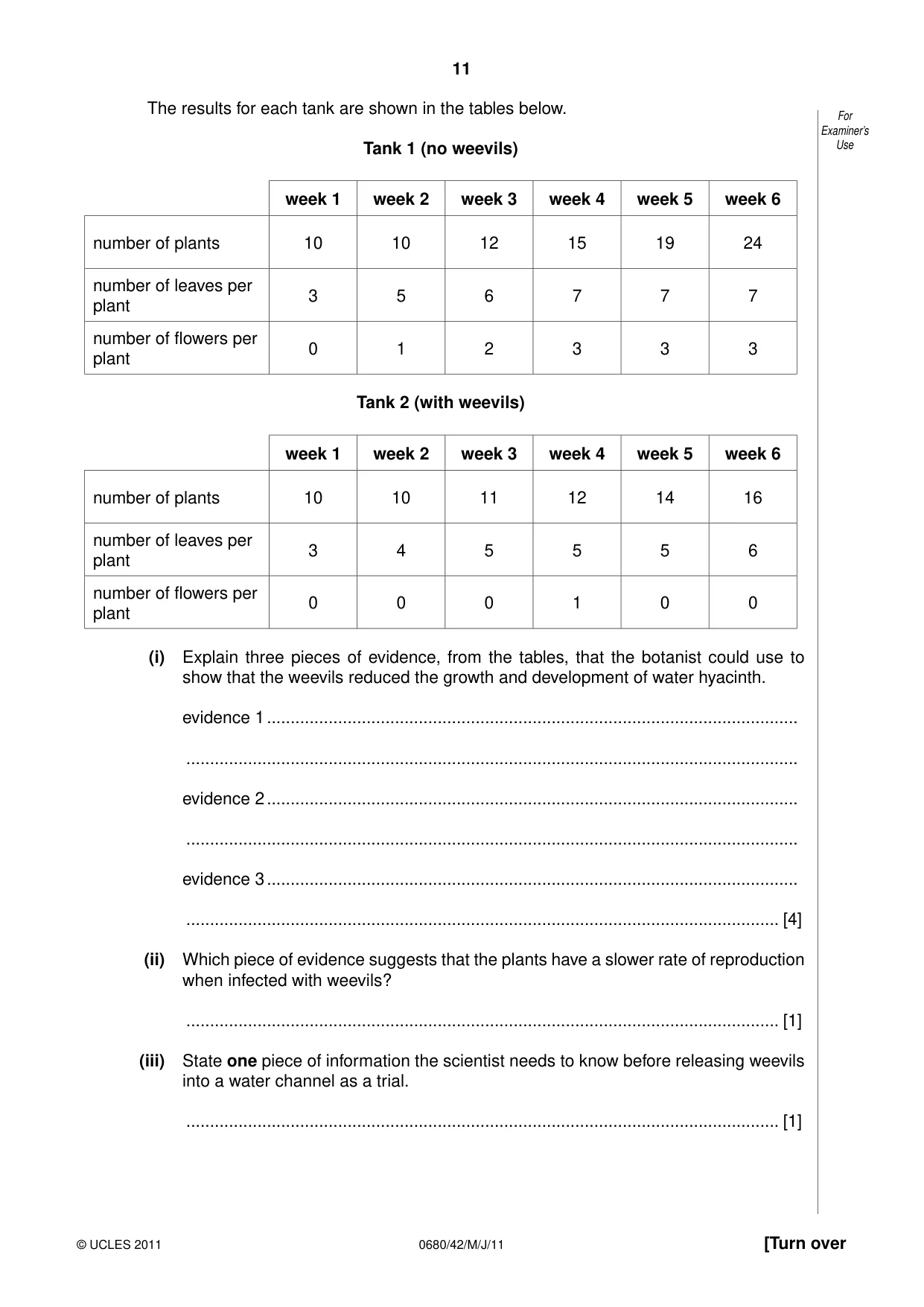
11 0680/42/M/J/11 © UCLES 2011 [Turn over For Examiner’s Use The results for each tank are shown in the tables below. Tank 1 (no weevils) week 1 week 2 week 3 week 4 week 5 week 6 number of plants 10 10 12 15 19 24 number of leaves per plant 3 5 6 7 7 7 number of flowers per plant 0 1 2 3 3 3 Tank 2 (with weevils) week 1 week 2 week 3 week 4 week 5 week 6 number of plants 10 10 11 12 14 16 number of leaves per plant 3 4 5 5 5 6 number of flowers per plant 0 0 0 1 0 0 (i) Explain three pieces of evidence, from the tables, that the botanist could use to show that the weevils reduced the growth and development of water hyacinth. evidence 1 … … evidence 2 … … evidence 3 … … [4] (ii) Which piece of evidence suggests that the plants have a slower rate of reproduction when infected with weevils? … [1] (iii) State one piece of information the scientist needs to know before releasing weevils into a water channel as a trial. … [1]
Question paper, page 12
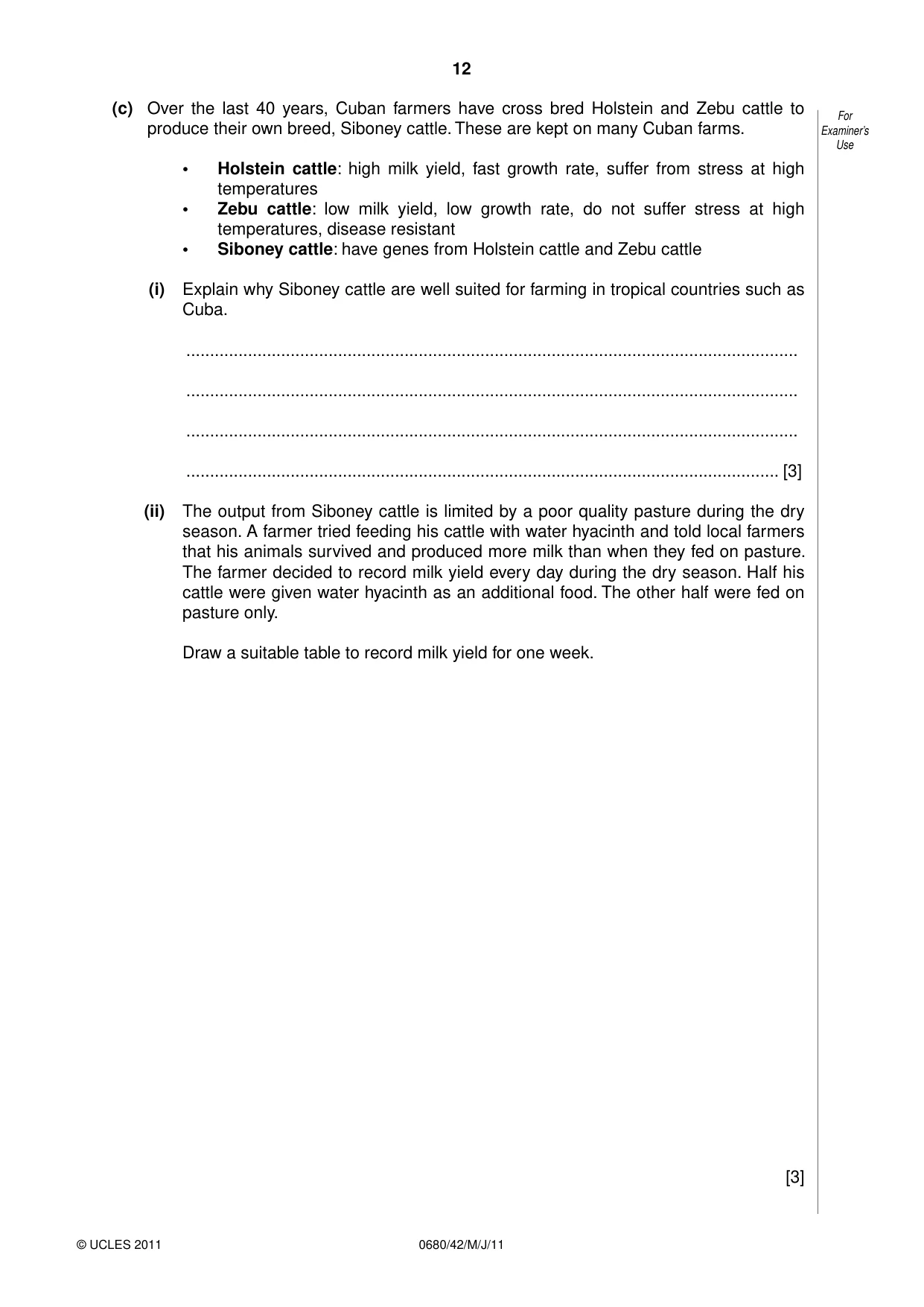
12 0680/42/M/J/11 © UCLES 2011 For Examiner’s Use (c) Over the last 40 years, Cuban farmers have cross bred Holstein and Zebu cattle to produce their own breed, Siboney cattle. These are kept on many Cuban farms. • Holstein cattle: high milk yield, fast growth rate, suffer from stress at high temperatures • Zebu cattle: low milk yield, low growth rate, do not suffer stress at high temperatures, disease resistant • Siboney cattle: have genes from Holstein cattle and Zebu cattle (i) Explain why Siboney cattle are well suited for farming in tropical countries such as Cuba. … … … … [3] (ii) The output from Siboney cattle is limited by a poor quality pasture during the dry season. A farmer tried feeding his cattle with water hyacinth and told local farmers that his animals survived and produced more milk than when they fed on pasture. The farmer decided to record milk yield every day during the dry season. Half his cattle were given water hyacinth as an additional food. The other half were fed on pasture only. Draw a suitable table to record milk yield for one week. [3]
Question paper, page 13
13 0680/42/M/J/11 © UCLES 2011 [Turn over For Examiner’s Use (d) Some farmers discussed how to get the best returns from their small farms. They proposed three different plans. Plan A Sell all the cattle before the dry season. Replace the cattle with chickens. Continue growing sugar cane and cassava. Buy Holstein cattle at the beginning of the wet season. Plan B Sell a small number of cattle throughout the year. Harvest water hyacinth and keep chickens. Continue growing sugar cane and cassava. Plan C Sell a small number of cattle throughout the year. Harvest water hyacinth and dry some to store. Keep chickens. Continue growing sugar cane and cassava. Also grow tomatoes and beans. (i) What are the disadvantages of plan A in the first year? … … … [2] (ii) Explain two ways in which plan B is better than plan A. … … … [2] (iii) Explain why plan C is better than plan A or plan B. … … … [2]
Question paper, page 14
14 0680/42/M/J/11 © UCLES 2011 For Examiner’s Use (e) One farmer has five fields of about the same size. They are laid out as shown in the diagram. 1 2 3 5 4 road water channel farmhouse Key: Scale: 0 200 m N Describe how you would carry out plan C on this farm over the next three years. Plan C Sell a small number of cattle throughout the year. Harvest water hyacinth and dry some to store. Keep chickens. Continue growing sugar cane and cassava. Also grow tomatoes and beans. … … … … … … [4]
Question paper, page 15
15 0680/42/M/J/11 © UCLES 2011 BLANK PAGE
Question paper, page 16
16 0680/42/M/J/11 © UCLES 2011 BLANK PAGE Permission to reproduce items where third-party owned material protected by copyright is included has been sought and cleared where possible. Every reasonable effort has been made by the publisher (UCLES) to trace copyright holders, but if any items requiring clearance have unwittingly been included, the publisher will be pleased to make amends at the earliest possible opportunity. University of Cambridge International Examinations is part of the Cambridge Assessment Group. Cambridge Assessment is the brand name of University of Cambridge Local Examinations Syndicate (UCLES), which is itself a department of the University of Cambridge.
Mark scheme, page 1
UNIVERSITY OF CAMBRIDGE INTERNATIONAL EXAMINATIONS International General Certificate of Secondary Education MARK SCHEME for the May/June 2011 question paper for the guidance of teachers 0680 ENVIRONMENTAL MANAGEMENT 0680/42 Paper 4 (Alternative to Coursework), maximum raw mark 60 This mark scheme is published as an aid to teachers and candidates, to indicate the requirements of the examination. It shows the basis on which Examiners were instructed to award marks. It does not indicate the details of the discussions that took place at an Examiners’ meeting before marking began, which would have considered the acceptability of alternative answers. Mark schemes must be read in conjunction with the question papers and the report on the examination. • Cambridge will not enter into discussions or correspondence in connection with these mark schemes. Cambridge is publishing the mark schemes for the May/June 2011 question papers for most IGCSE, GCE Advanced Level and Advanced Subsidiary Level syllabuses and some Ordinary Level syllabuses. www.XtremePapers.com
Mark scheme, page 2
Page 2 Mark Scheme: Teachers’ version Syllabus Paper IGCSE – May/June 2011 0680 42 © University of Cambridge International Examinations 2011 1 (a) (i) world recession/lack of demand/product substitution/Ni surplus/eq; [1] (ii) to keep the price high/help price recover/eq; to maintain profit/reduce costs; (allow metal ore to last longer/eq) [2] (b) (i) 15 (tonnes); reject Kg or other units [1] (ii) large amount of overburden/soil needs to be moved/stored/noise pollution/visual pollution/dust released/habitat destruction/eq; reject pollution unqualified [1] (c) wear masks/eq; protective clothing/gloves/washing facilities/eq; (allow ref to controlled working hours/exposure time) [2] (d) (i) very few female miners/eq; [1] (ii) to give diseases time to develop/eq; [1] (iii) measure health/other causes of death in miners/non miners/eq; record different numbers of deaths from lung cancer in miners/non miners; [1] (iv) longer time; more participants; compare smoking miners with non smoking miners/smokers with non smokers; include women; record for younger age group(s); record time in mining industry; [2] (e) (i) B, longest contact/closest to mine and/ or mine waste; [1] (ii) heavy metals (normally) bio accumulate/bio magnify/accumulate; heavy metal passes up food chain(s)/eq; some small fish may die; so less food for large fish; so large fish starved/poisoned/do not reproduce; [2] (iii) bar graph plotted; label axes (number of mayflies/A B C D E);; plots; (allow population for number) [4] (iv) mayflies increase further away from the mine/converse statement/eq; mayflies poisoned by nickel; [2] (f) saves energy; less pollution/damage to the environment; mining reserves last longer; reduces cost of mining/cheaper than mining; [2] (g) (i) high level of pollution at the start/after one year; pollution reduced at ten years/reduces over time; still some pollution after ten years/eq; [2] (ii) advantage fast; fast/easy/cheap/ no skill needed/ no special equipment needed; disadvantage not a specific response to Ni/ no concentration measured/do not know how much Ni is present/ref to validity; [2] (iii) more than 10 yrs/11+yrs; [1]
Mark scheme, page 3
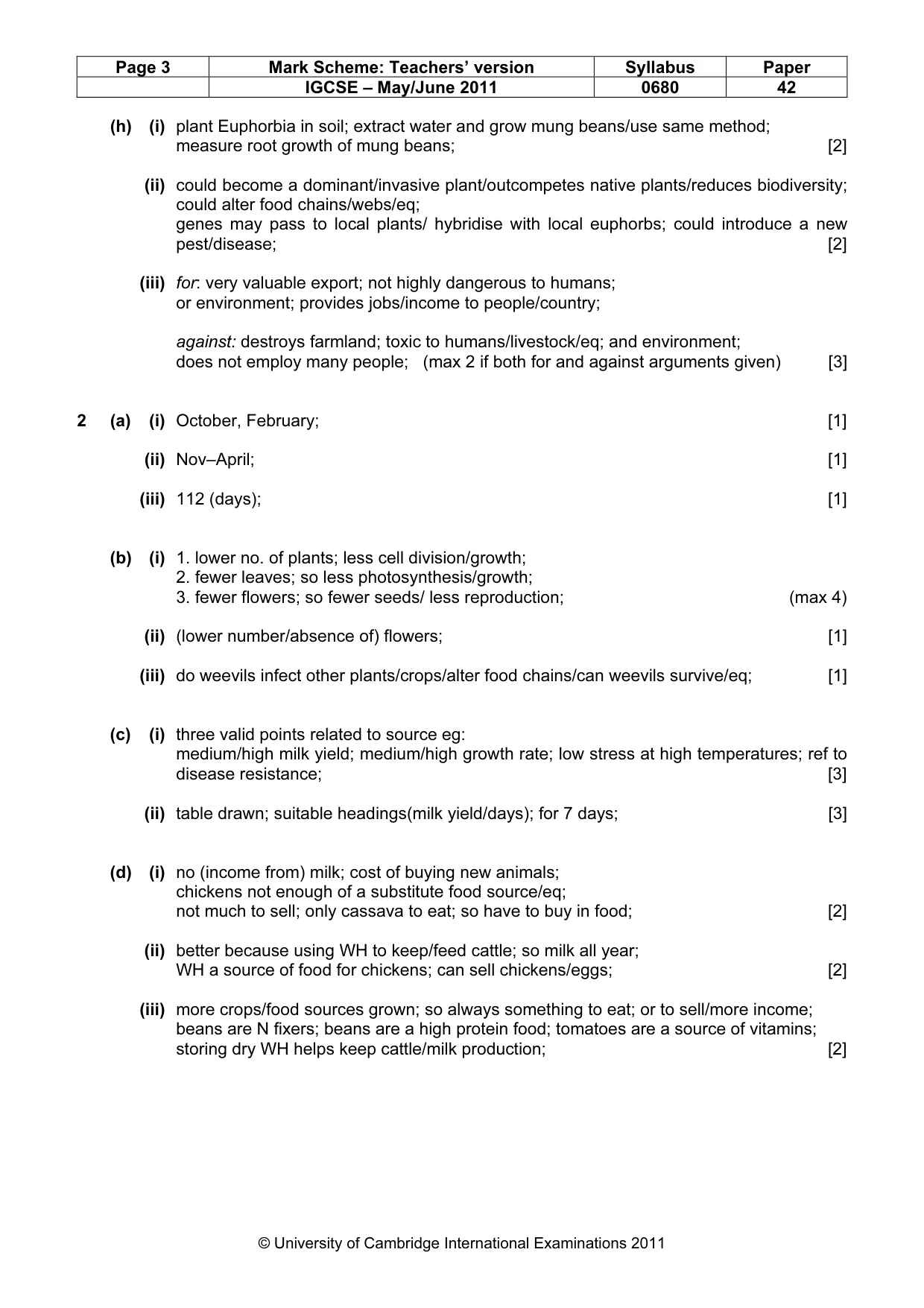
Page 3 Mark Scheme: Teachers’ version Syllabus Paper IGCSE – May/June 2011 0680 42 © University of Cambridge International Examinations 2011 (h) (i) plant Euphorbia in soil; extract water and grow mung beans/use same method; measure root growth of mung beans; [2] (ii) could become a dominant/invasive plant/outcompetes native plants/reduces biodiversity; could alter food chains/webs/eq; genes may pass to local plants/ hybridise with local euphorbs; could introduce a new pest/disease; [2] (iii) for: very valuable export; not highly dangerous to humans; or environment; provides jobs/income to people/country; against: destroys farmland; toxic to humans/livestock/eq; and environment; does not employ many people; (max 2 if both for and against arguments given) [3] 2 (a) (i) October, February; [1] (ii) Nov–April; [1] (iii) 112 (days); [1] (b) (i) 1. lower no. of plants; less cell division/growth; 2. fewer leaves; so less photosynthesis/growth; 3. fewer flowers; so fewer seeds/ less reproduction; (max 4) (ii) (lower number/absence of) flowers; [1] (iii) do weevils infect other plants/crops/alter food chains/can weevils survive/eq; [1] (c) (i) three valid points related to source eg: medium/high milk yield; medium/high growth rate; low stress at high temperatures; ref to disease resistance; [3] (ii) table drawn; suitable headings(milk yield/days); for 7 days; [3] (d) (i) no (income from) milk; cost of buying new animals; chickens not enough of a substitute food source/eq; not much to sell; only cassava to eat; so have to buy in food; [2] (ii) better because using WH to keep/feed cattle; so milk all year; WH a source of food for chickens; can sell chickens/eggs; [2] (iii) more crops/food sources grown; so always something to eat; or to sell/more income; beans are N fixers; beans are a high protein food; tomatoes are a source of vitamins; storing dry WH helps keep cattle/milk production; [2]
Mark scheme, page 4
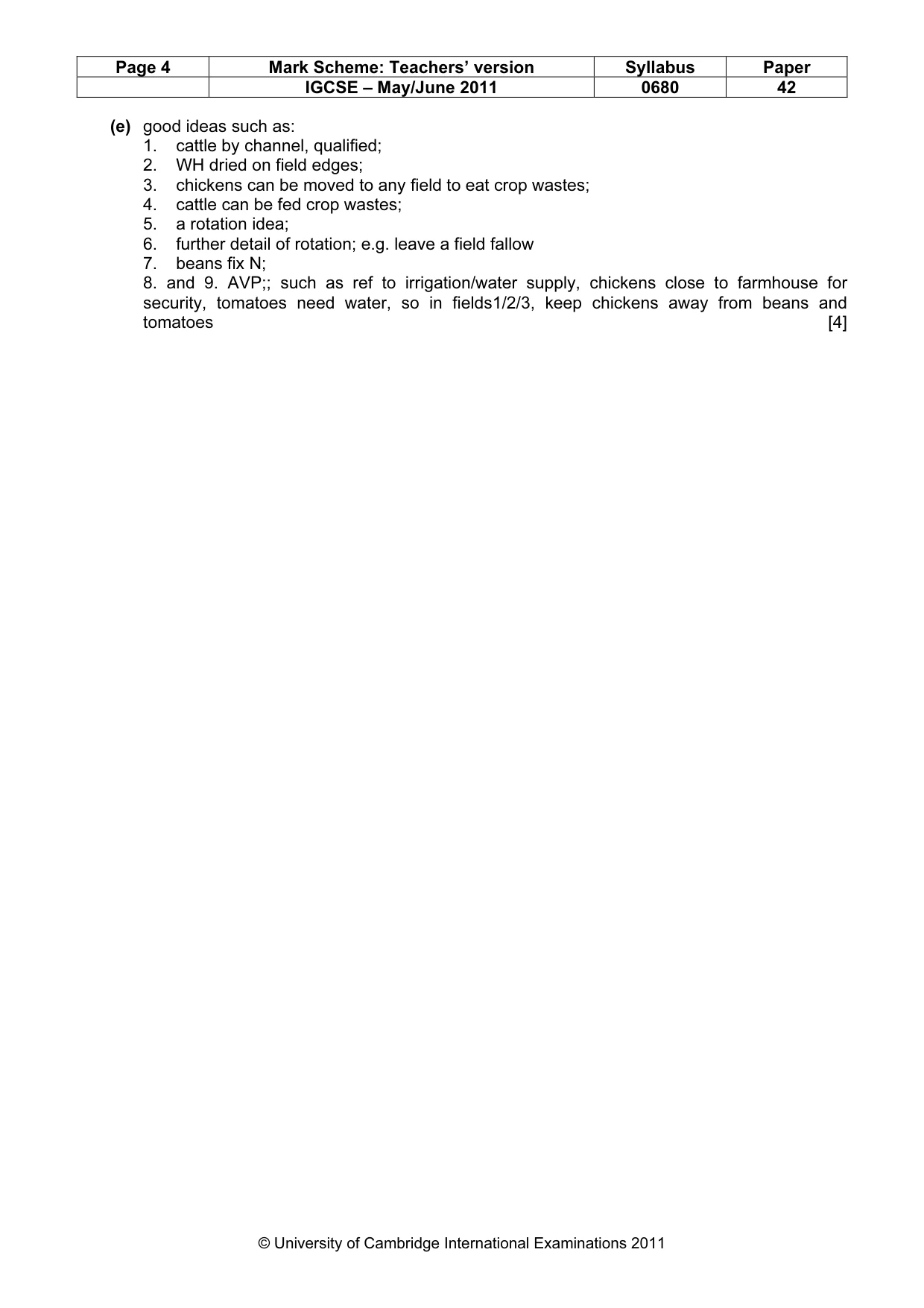
Page 4 Mark Scheme: Teachers’ version Syllabus Paper IGCSE – May/June 2011 0680 42 © University of Cambridge International Examinations 2011 (e) good ideas such as: 1. cattle by channel, qualified; 2. WH dried on field edges; 3. chickens can be moved to any field to eat crop wastes; 4. cattle can be fed crop wastes; 5. a rotation idea; 6. further detail of rotation; e.g. leave a field fallow 7. beans fix N; 8. and 9. AVP;; such as ref to irrigation/water supply, chickens close to farmhouse for security, tomatoes need water, so in fields1/2/3, keep chickens away from beans and tomatoes [4]
What you needed in this session
Cambridge’s own grade thresholds for 2011 May/June, Paper 4 · Variant 2. A higher threshold means an easier paper — the bar moves with how the cohort did.