Cambridge IGCSE Environmental Management 0680 — 2011 May/June Paper 4 · Variant 1
0680/41/M/J/11 · 60 marks · ≈68 min
The question paper and its mark scheme, free to read here and free to download. This is Cambridge’s own paper, exactly as it was sat.
Question paper16 pages



Mark scheme3 pages
Answers below. Sit the paper first if you are practising.
Paper as text
Question paper, page 1
This document consists of 14 printed pages and 2 blank pages. DC (SJF/CGW) 32640/3 © UCLES 2011 [Turn over UNIVERSITY OF CAMBRIDGE INTERNATIONAL EXAMINATIONS International General Certificate of Secondary Education READ THESE INSTRUCTIONS FIRST Write your Centre number, candidate number and name on all the work you hand in. Write in dark blue or black pen. You may use a soft pencil for any diagrams, graphs or rough working. Do not use staples, paper clips, highlighters, glue or correction fluid. DO NOT WRITE IN ANY BARCODES. Answer all questions. Study the appropriate Source materials before you start to write your answers. Credit will be given for appropriate selection and use of data in your answers and for relevant interpretation of these data. Suggestions for data sources are given in some questions. You may use the source data to draw diagrams and graphs or to do calculations to illustrate your answers. At the end of the examination, fasten all your work securely together. The number of marks is given in brackets [ ] at the end of each question or part question. * 1 5 9 8 0 8 4 2 4 4 * ENVIRONMENTAL MANAGEMENT 0680/41 Alternative to Coursework May/June 2011 1 hour 30 minutes Candidates answer on the Question Paper. Additional Materials: Ruler For Examiner’s Use 1 2 3 Total www.XtremePapers.com
Question paper, page 2
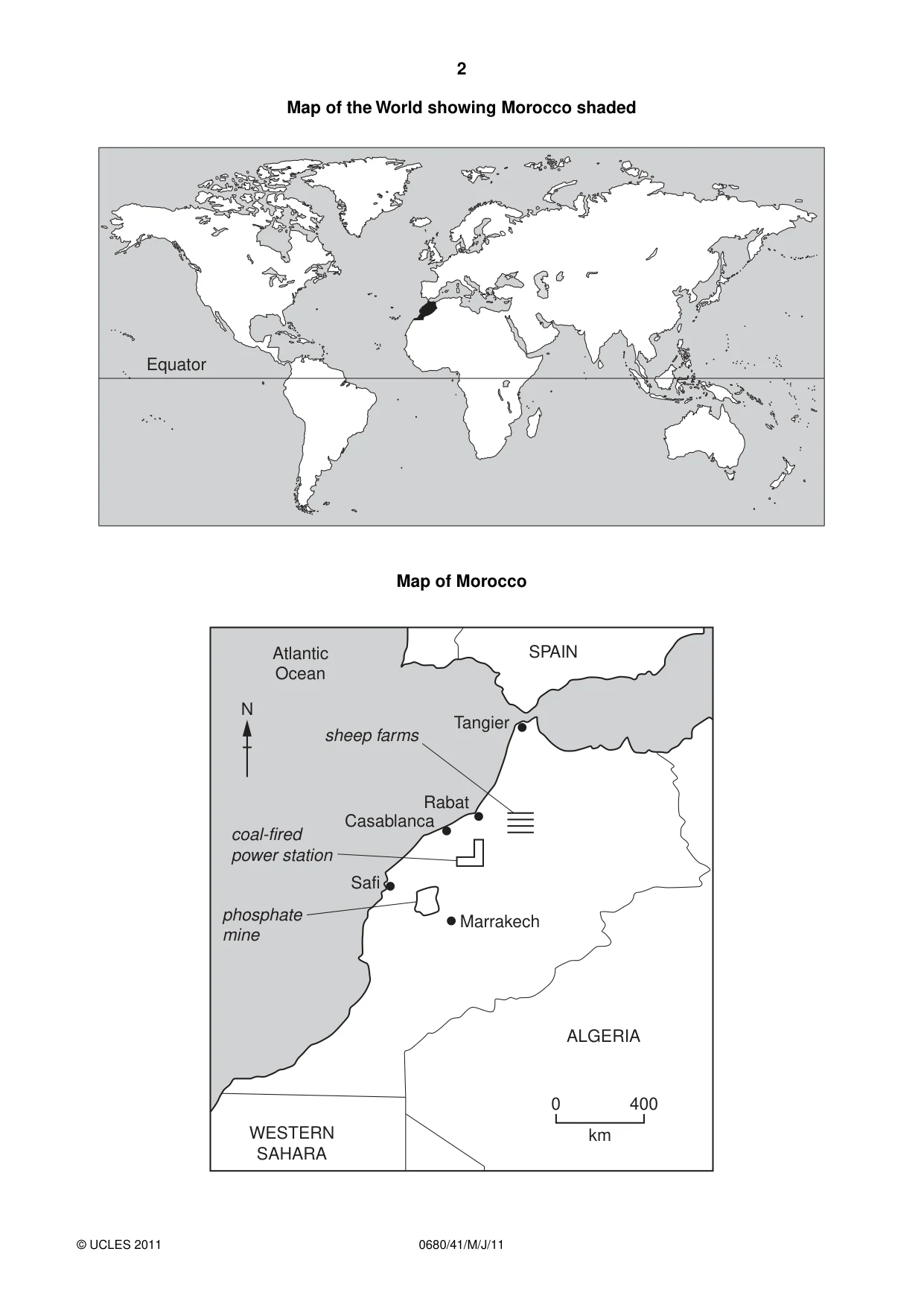
2 0680/41/M/J/11 © UCLES 2011 Map of the World showing Morocco shaded Equator Map of Morocco Atlantic Ocean N Tangier Rabat Casablanca Safi Marrakech SPAIN ALGERIA 0 400 km WESTERN SAHARA phosphate mine coal-fired power station sheep farms
Question paper, page 3
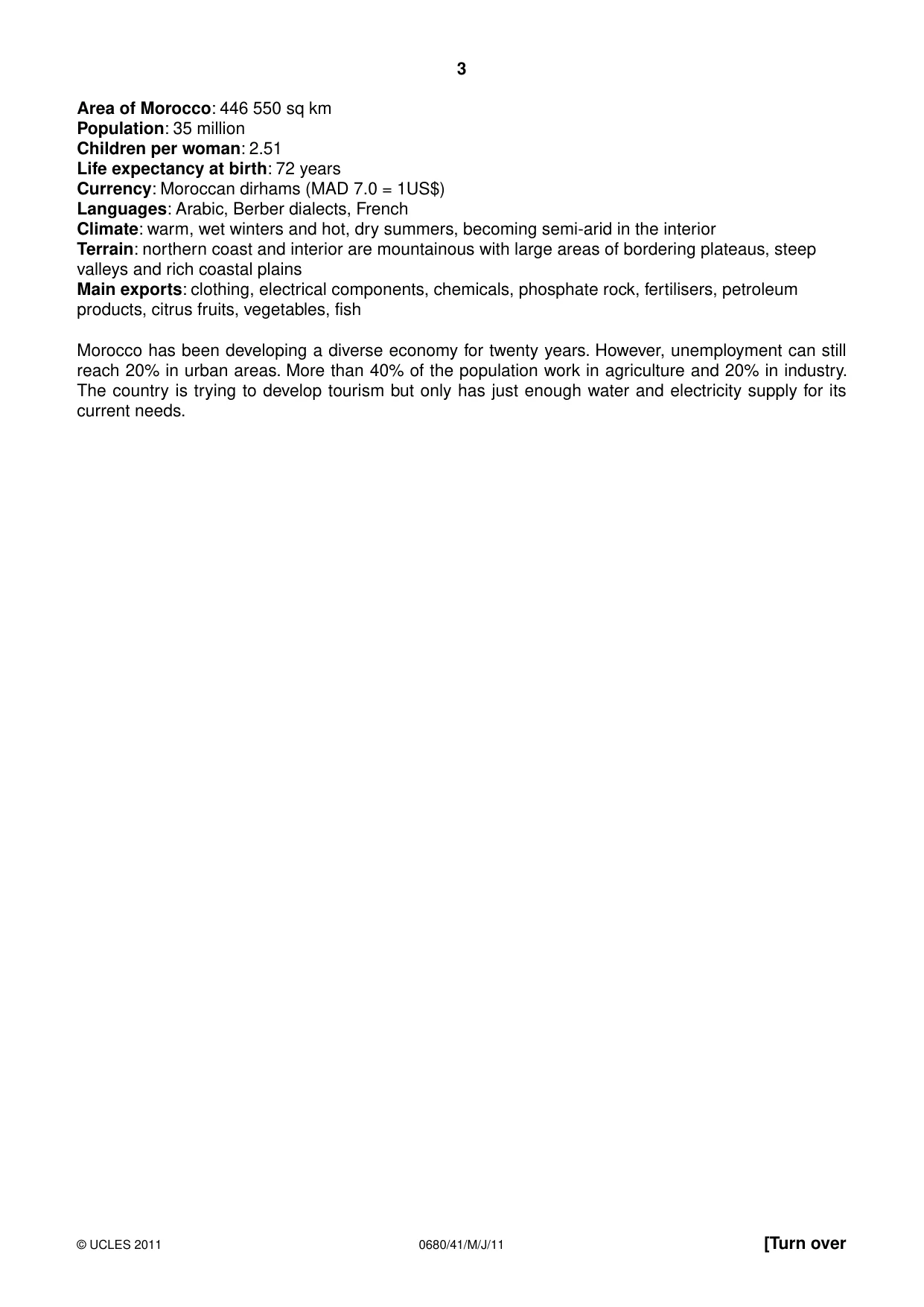
3 0680/41/M/J/11 © UCLES 2011 [Turn over Area of Morocco: 446 550 sq km Population: 35 million Children per woman: 2.51 Life expectancy at birth: 72 years Currency: Moroccan dirhams (MAD 7.0 = 1US$) Languages: Arabic, Berber dialects, French Climate: warm, wet winters and hot, dry summers, becoming semi-arid in the interior Terrain: northern coast and interior are mountainous with large areas of bordering plateaus, steep valleys and rich coastal plains Main exports: clothing, electrical components, chemicals, phosphate rock, fertilisers, petroleum products, citrus fruits, vegetables, fish Morocco has been developing a diverse economy for twenty years. However, unemployment can still reach 20% in urban areas. More than 40% of the population work in agriculture and 20% in industry. The country is trying to develop tourism but only has just enough water and electricity supply for its current needs.
Question paper, page 4
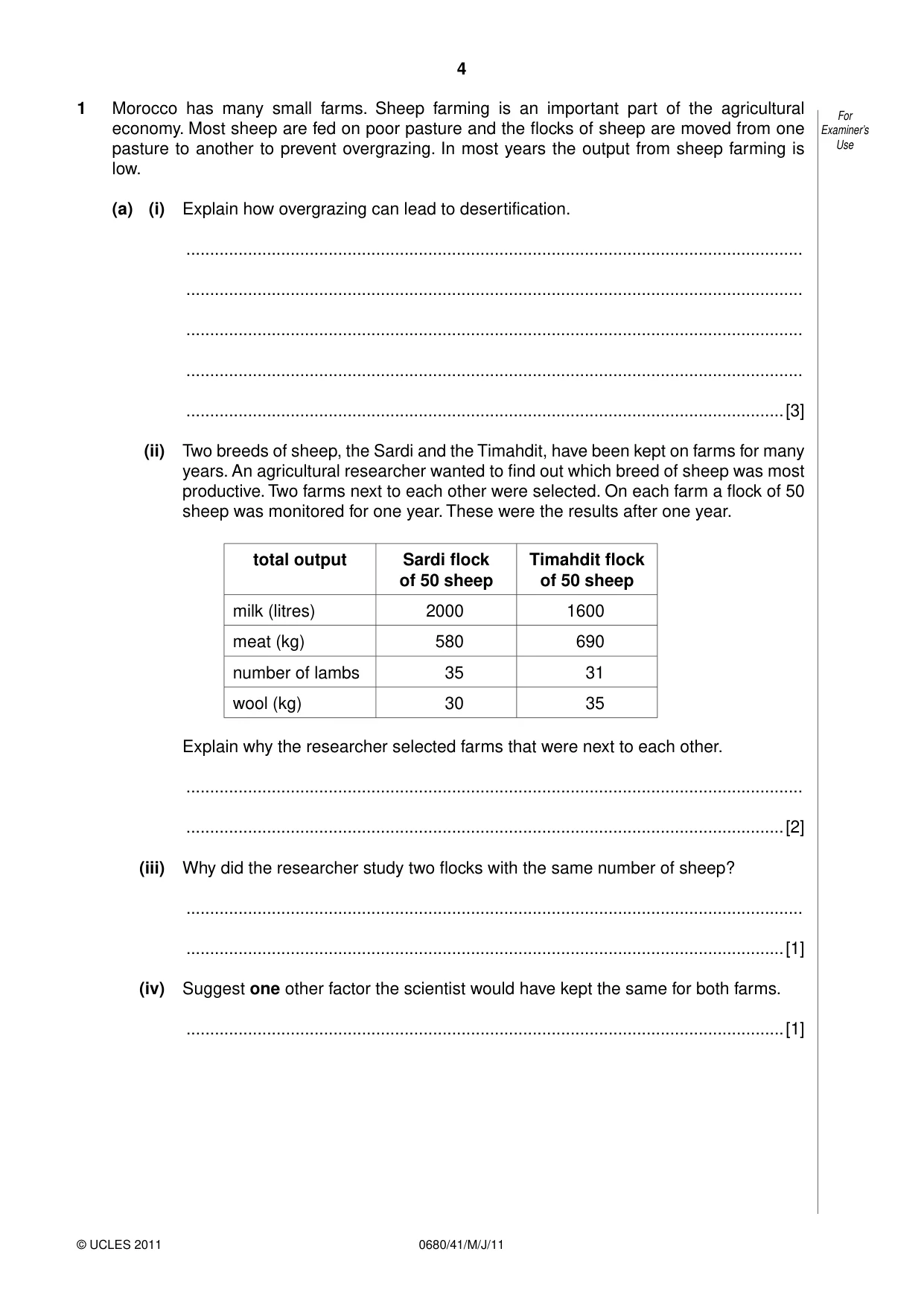
4 0680/41/M/J/11 © UCLES 2011 For Examiner’s Use 1 Morocco has many small farms. Sheep farming is an important part of the agricultural economy. Most sheep are fed on poor pasture and the flocks of sheep are moved from one pasture to another to prevent overgrazing. In most years the output from sheep farming is low. (a) (i) Explain how overgrazing can lead to desertification. … … … … …[3] (ii) Two breeds of sheep, the Sardi and the Timahdit, have been kept on farms for many years. An agricultural researcher wanted to find out which breed of sheep was most productive. Two farms next to each other were selected. On each farm a flock of 50 sheep was monitored for one year. These were the results after one year. total output Sardi flock of 50 sheep Timahdit flock of 50 sheep milk (litres) 2000 1600 meat (kg) 580 690 number of lambs 35 31 wool (kg) 30 35 Explain why the researcher selected farms that were next to each other. … …[2] (iii) Why did the researcher study two flocks with the same number of sheep? … …[1] (iv) Suggest one other factor the scientist would have kept the same for both farms. …[1]
Question paper, page 5
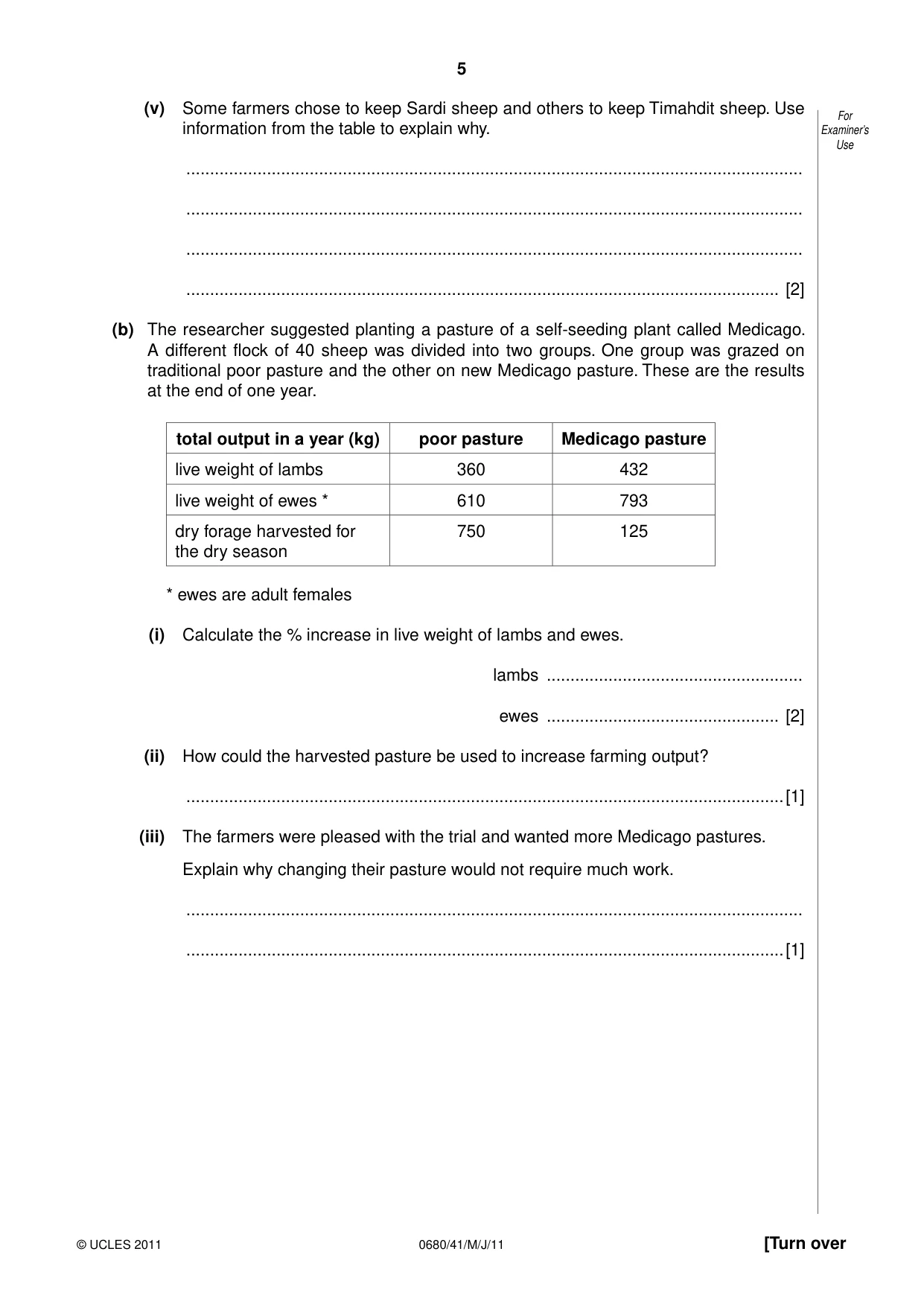
5 0680/41/M/J/11 © UCLES 2011 [Turn over For Examiner’s Use (v) Some farmers chose to keep Sardi sheep and others to keep Timahdit sheep. Use information from the table to explain why. … … … … [2] (b) The researcher suggested planting a pasture of a self-seeding plant called Medicago. A different flock of 40 sheep was divided into two groups. One group was grazed on traditional poor pasture and the other on new Medicago pasture. These are the results at the end of one year. total output in a year (kg) poor pasture Medicago pasture live weight of lambs 360 432 live weight of ewes * 610 793 dry forage harvested for the dry season 750 125 * ewes are adult females (i) Calculate the % increase in live weight of lambs and ewes. lambs … ewes … [2] (ii) How could the harvested pasture be used to increase farming output? …[1] (iii) The farmers were pleased with the trial and wanted more Medicago pastures. Explain why changing their pasture would not require much work. … …[1]
Question paper, page 6
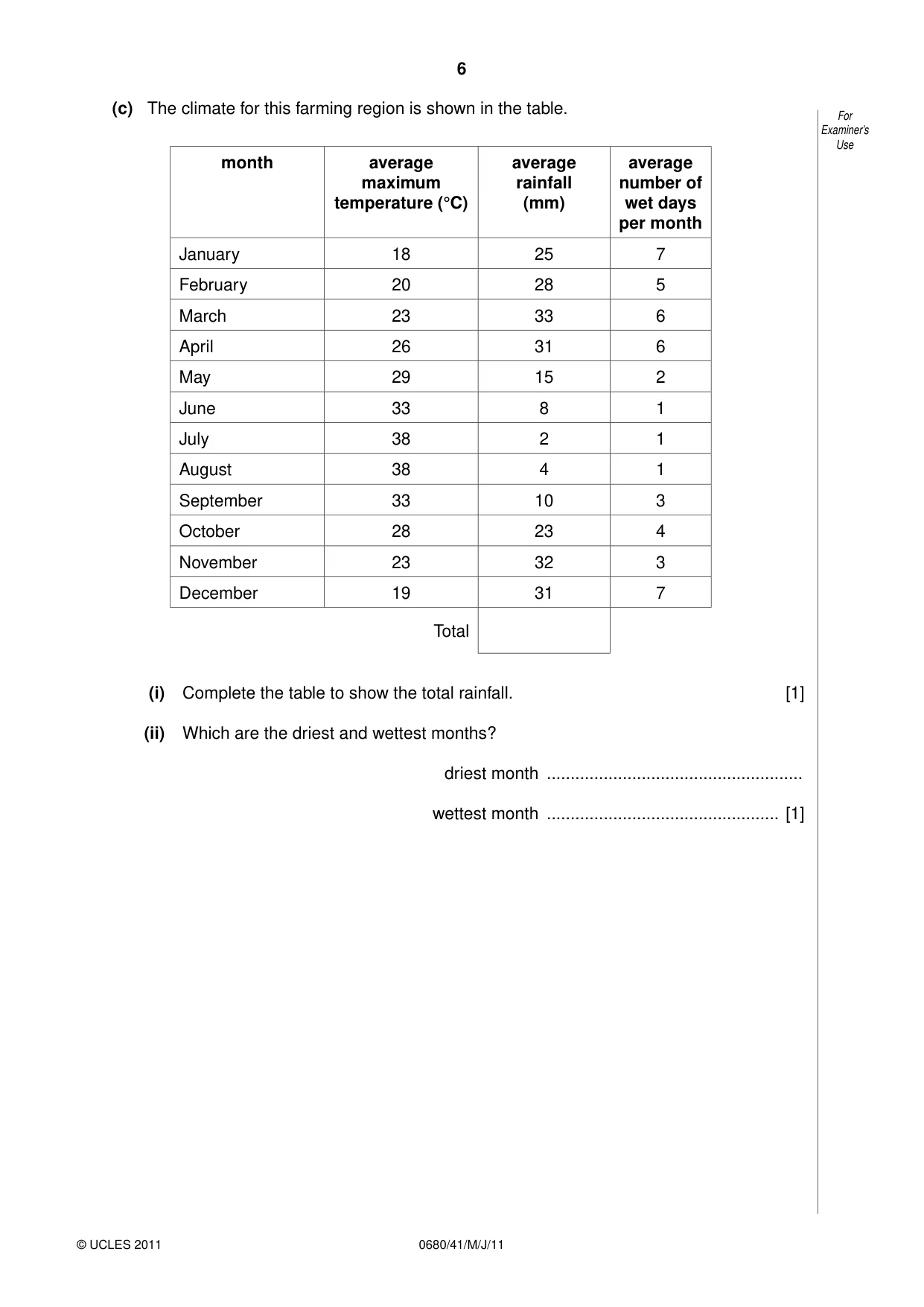
6 0680/41/M/J/11 © UCLES 2011 For Examiner’s Use (c) The climate for this farming region is shown in the table. month average maximum temperature (°C) average rainfall (mm) average number of wet days per month January 18 25 7 February 20 28 5 March 23 33 6 April 26 31 6 May 29 15 2 June 33 8 1 July 38 2 1 August 38 4 1 September 33 10 3 October 28 23 4 November 23 32 3 December 19 31 7 Total (i) Complete the table to show the total rainfall. [1] (ii) Which are the driest and wettest months? driest month … wettest month … [1]
Question paper, page 7
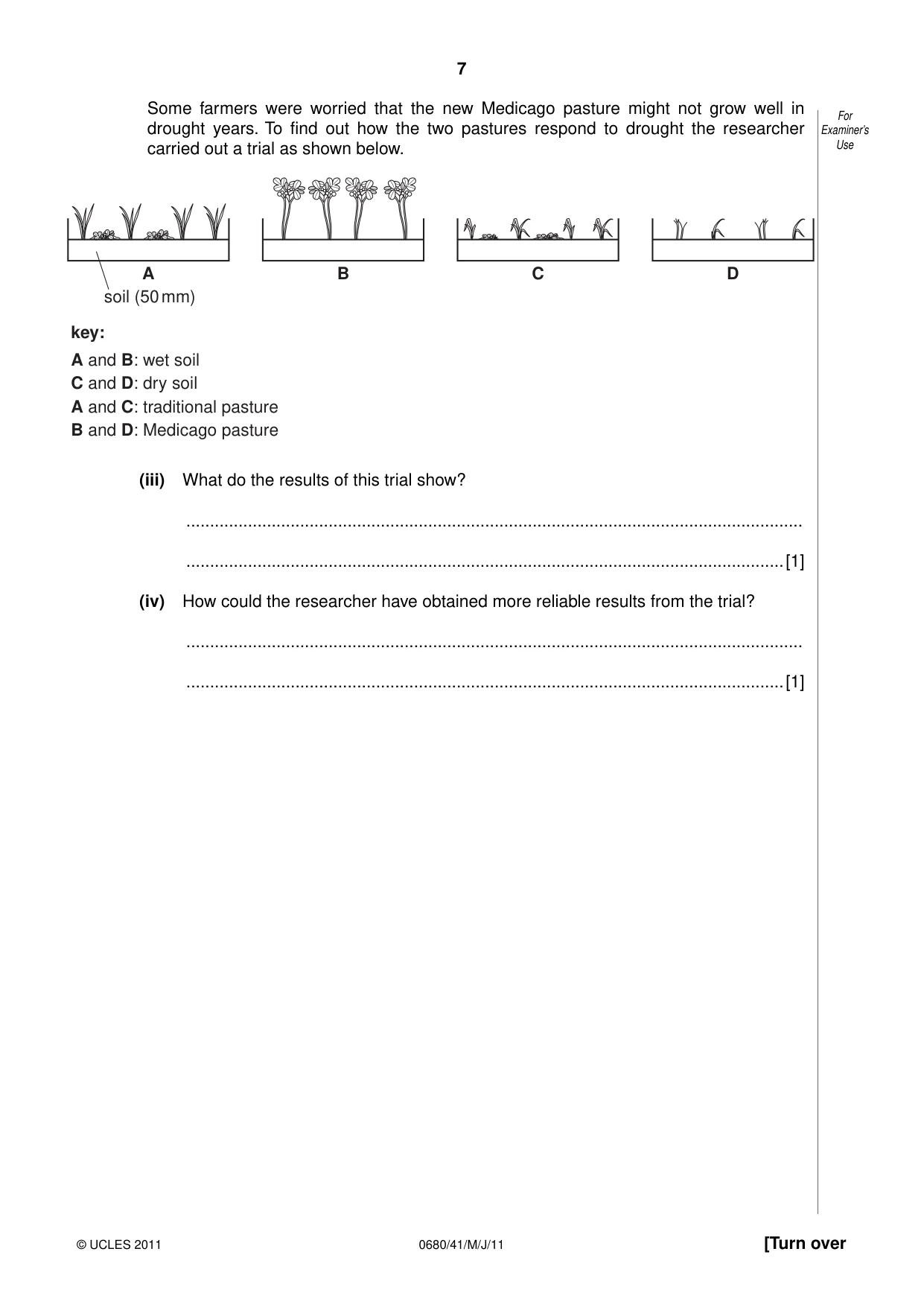
7 0680/41/M/J/11 © UCLES 2011 [Turn over For Examiner’s Use Some farmers were worried that the new Medicago pasture might not grow well in drought years. To find out how the two pastures respond to drought the researcher carried out a trial as shown below. soil (50 mm) key: A and B: wet soil C and D: dry soil A and C: traditional pasture B and D: Medicago pasture A B C D (iii) What do the results of this trial show? … …[1] (iv) How could the researcher have obtained more reliable results from the trial? … …[1]
Question paper, page 8
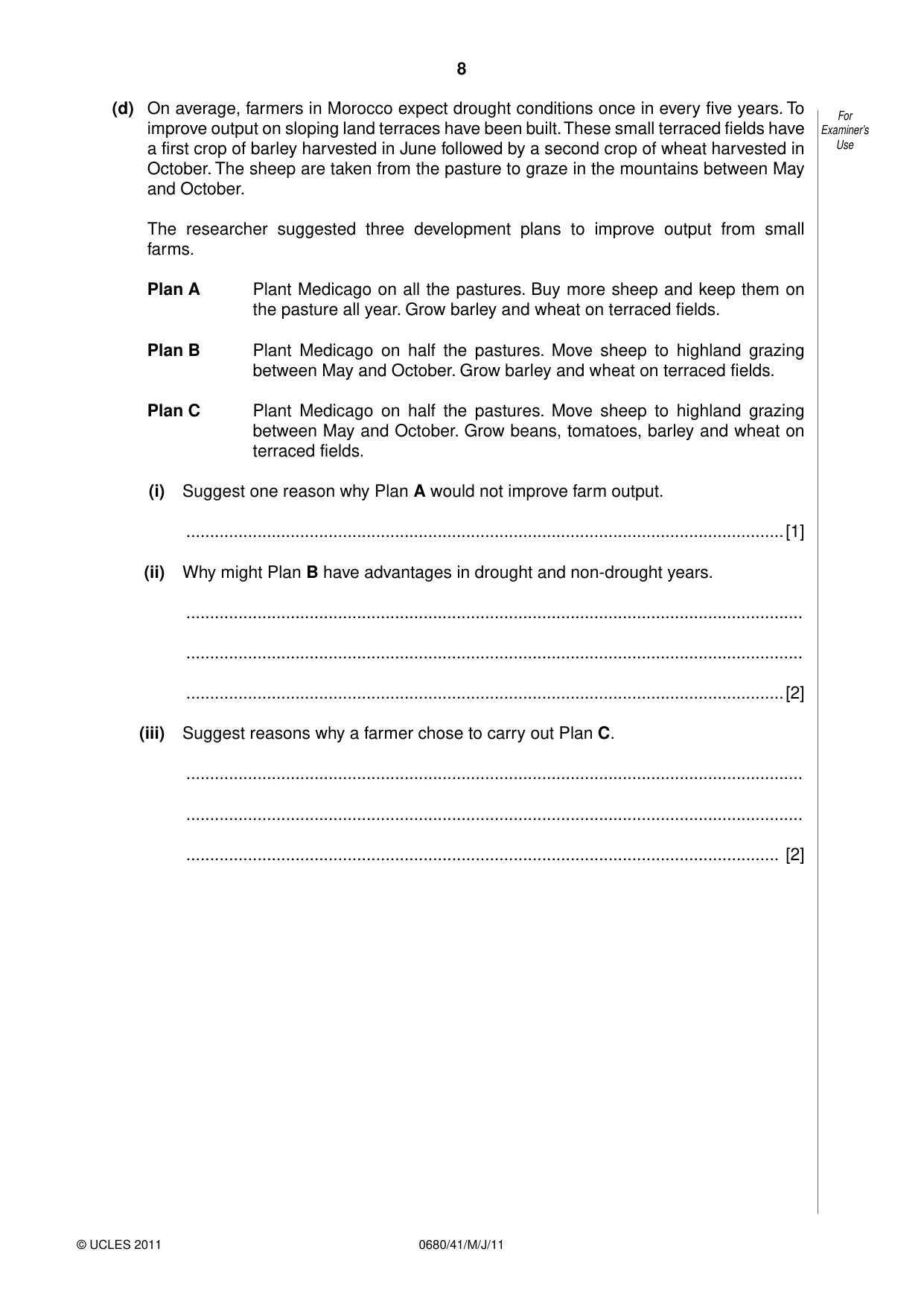
8 0680/41/M/J/11 © UCLES 2011 For Examiner’s Use (d) On average, farmers in Morocco expect drought conditions once in every five years. To improve output on sloping land terraces have been built. These small terraced fields have a first crop of barley harvested in June followed by a second crop of wheat harvested in October. The sheep are taken from the pasture to graze in the mountains between May and October. The researcher suggested three development plans to improve output from small farms. Plan A Plant Medicago on all the pastures. Buy more sheep and keep them on the pasture all year. Grow barley and wheat on terraced fields. Plan B Plant Medicago on half the pastures. Move sheep to highland grazing between May and October. Grow barley and wheat on terraced fields. Plan C Plant Medicago on half the pastures. Move sheep to highland grazing between May and October. Grow beans, tomatoes, barley and wheat on terraced fields. (i) Suggest one reason why Plan A would not improve farm output. …[1] (ii) Why might Plan B have advantages in drought and non-drought years. … … …[2] (iii) Suggest reasons why a farmer chose to carry out Plan C. … … … [2]
Question paper, page 9
9 0680/41/M/J/11 © UCLES 2011 [Turn over For Examiner’s Use (e) (i) Describe how a farmer could carry out Plan C over two or more years to increase output. The farm layout is shown below. pasture terrace 1 2 3 6 5 4 terrace field … … … … … …[4] (ii) Explain how terracing can help to maintain soil fertility and prevent soil erosion. maintain soil fertility … … … prevent soil erosion … … …[4]
Question paper, page 10
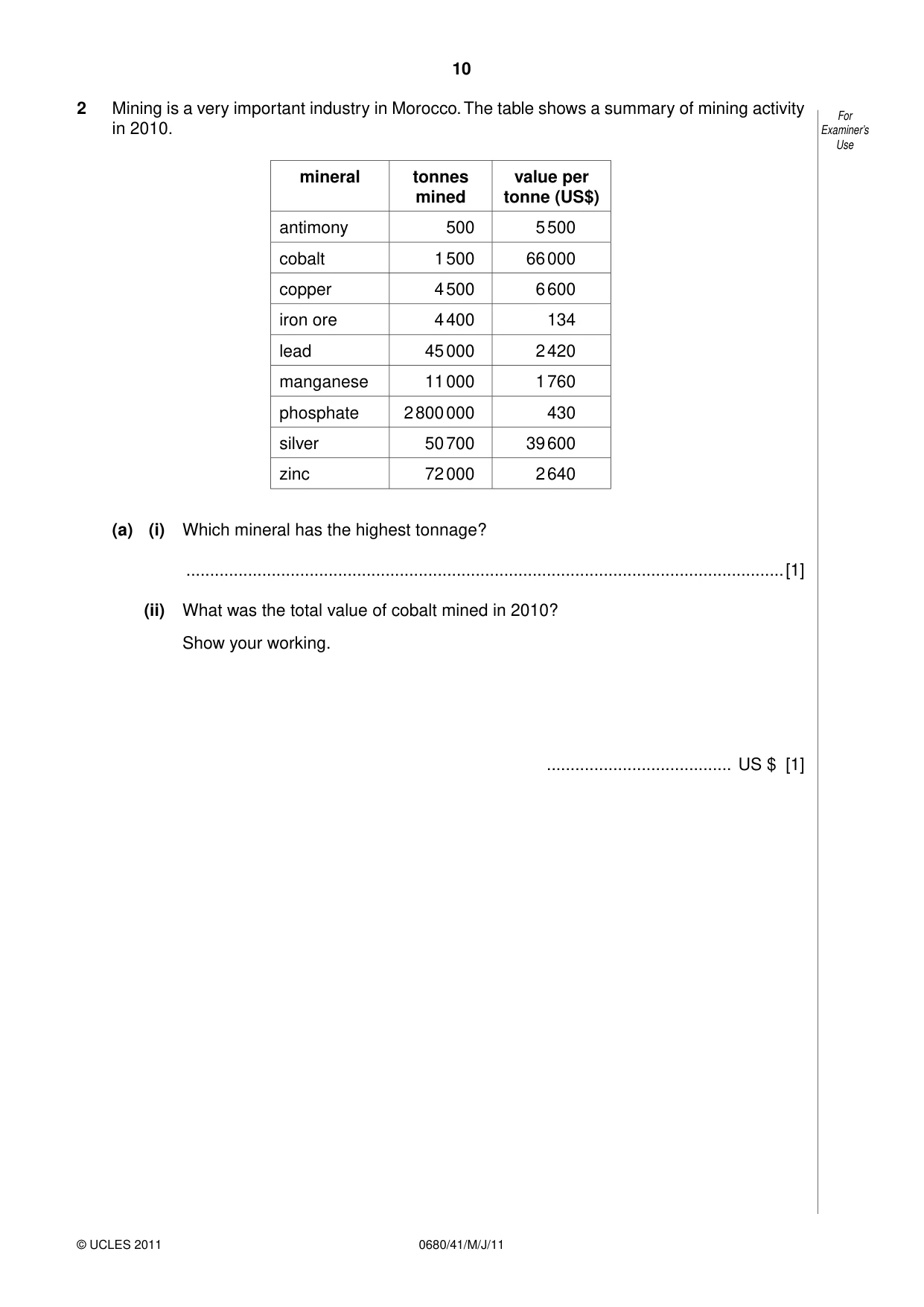
10 0680/41/M/J/11 © UCLES 2011 For Examiner’s Use 2 Mining is a very important industry in Morocco. The table shows a summary of mining activity in 2010. mineral tonnes mined value per tonne (US$) antimony 500 5 500 cobalt 1 500 66 000 copper 4 500 6 600 iron ore 4 400 134 lead 45 000 2 420 manganese 11 000 1 760 phosphate 2 800 000 430 silver 50 700 39 600 zinc 72 000 2 640 (a) (i) Which mineral has the highest tonnage? …[1] (ii) What was the total value of cobalt mined in 2010? Show your working. … US $ [1]
Question paper, page 11
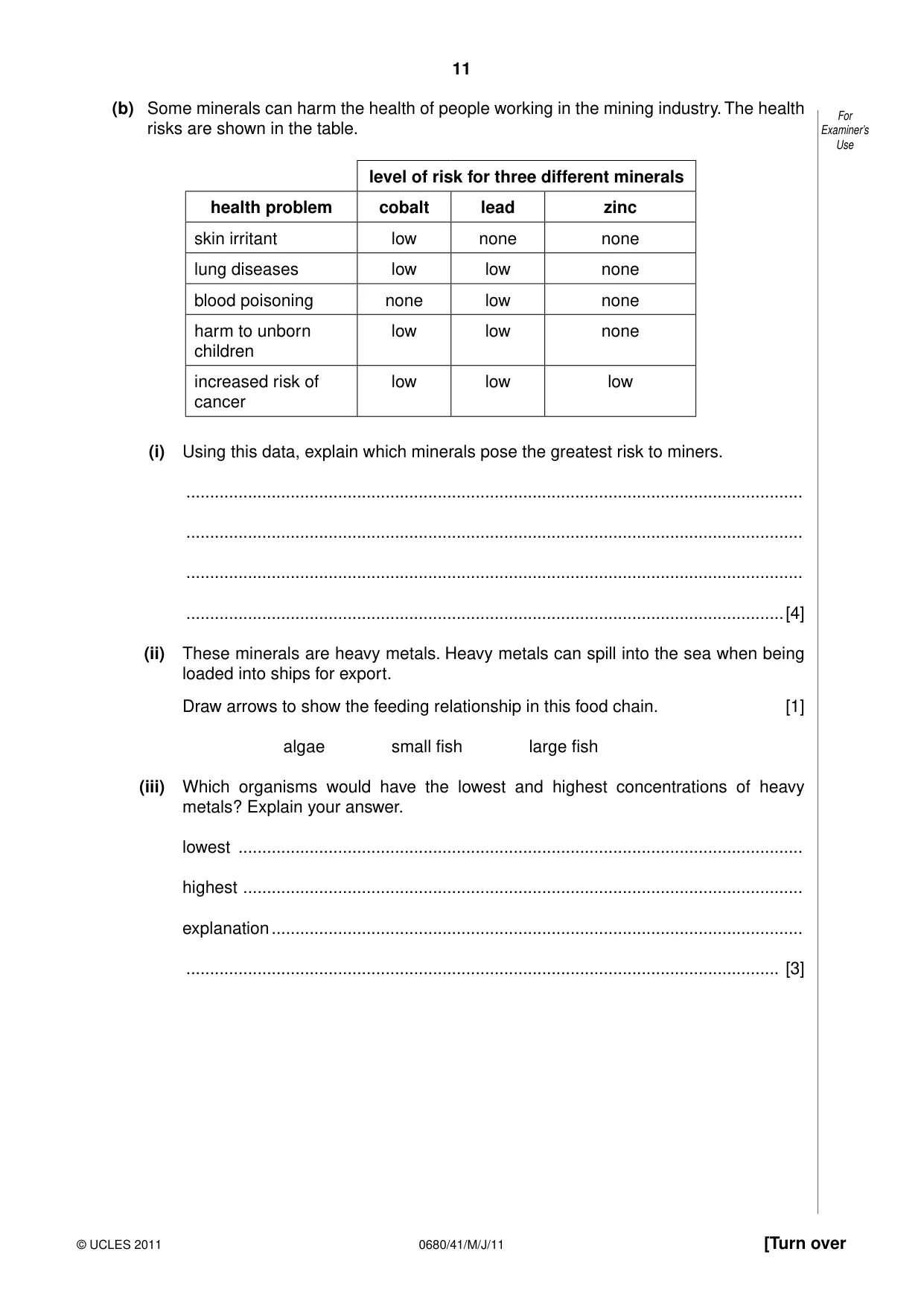
11 0680/41/M/J/11 © UCLES 2011 [Turn over For Examiner’s Use (b) Some minerals can harm the health of people working in the mining industry. The health risks are shown in the table. level of risk for three different minerals health problem cobalt lead zinc skin irritant low none none lung diseases low low none blood poisoning none low none harm to unborn children low low none increased risk of cancer low low low (i) Using this data, explain which minerals pose the greatest risk to miners. … … … …[4] (ii) These minerals are heavy metals. Heavy metals can spill into the sea when being loaded into ships for export. Draw arrows to show the feeding relationship in this food chain. [1] algae small fish large fish (iii) Which organisms would have the lowest and highest concentrations of heavy metals? Explain your answer. lowest … highest … explanation … … [3]
Question paper, page 12
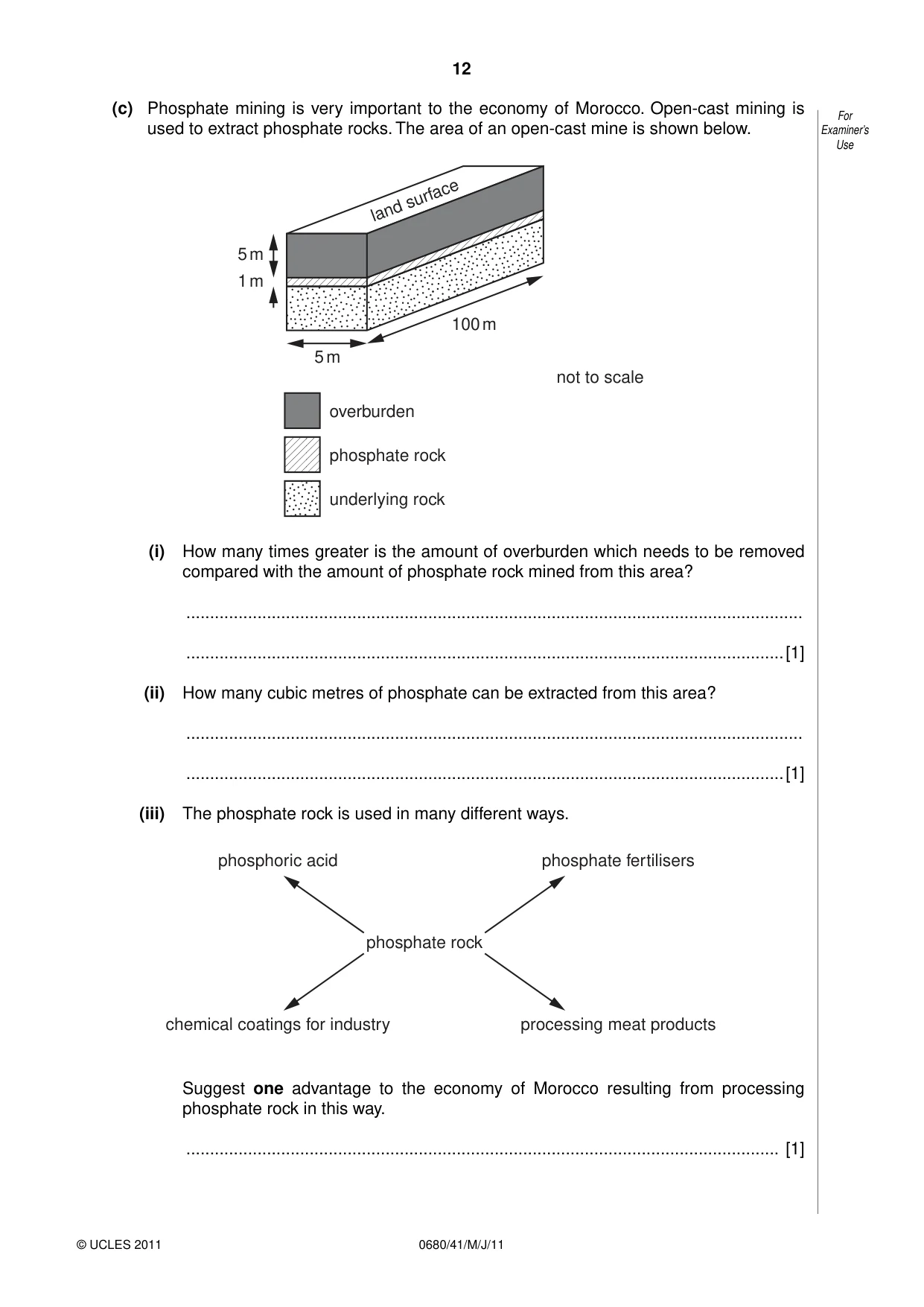
12 0680/41/M/J/11 © UCLES 2011 For Examiner’s Use (c) Phosphate mining is very important to the economy of Morocco. Open-cast mining is used to extract phosphate rocks. The area of an open-cast mine is shown below. land surface 100 m 5 m overburden phosphate rock not to scale underlying rock 5 m 1 m (i) How many times greater is the amount of overburden which needs to be removed compared with the amount of phosphate rock mined from this area? … …[1] (ii) How many cubic metres of phosphate can be extracted from this area? … …[1] (iii) The phosphate rock is used in many different ways. phosphate fertilisers phosphate rock processing meat products phosphoric acid chemical coatings for industry Suggest one advantage to the economy of Morocco resulting from processing phosphate rock in this way. … [1]
Question paper, page 13
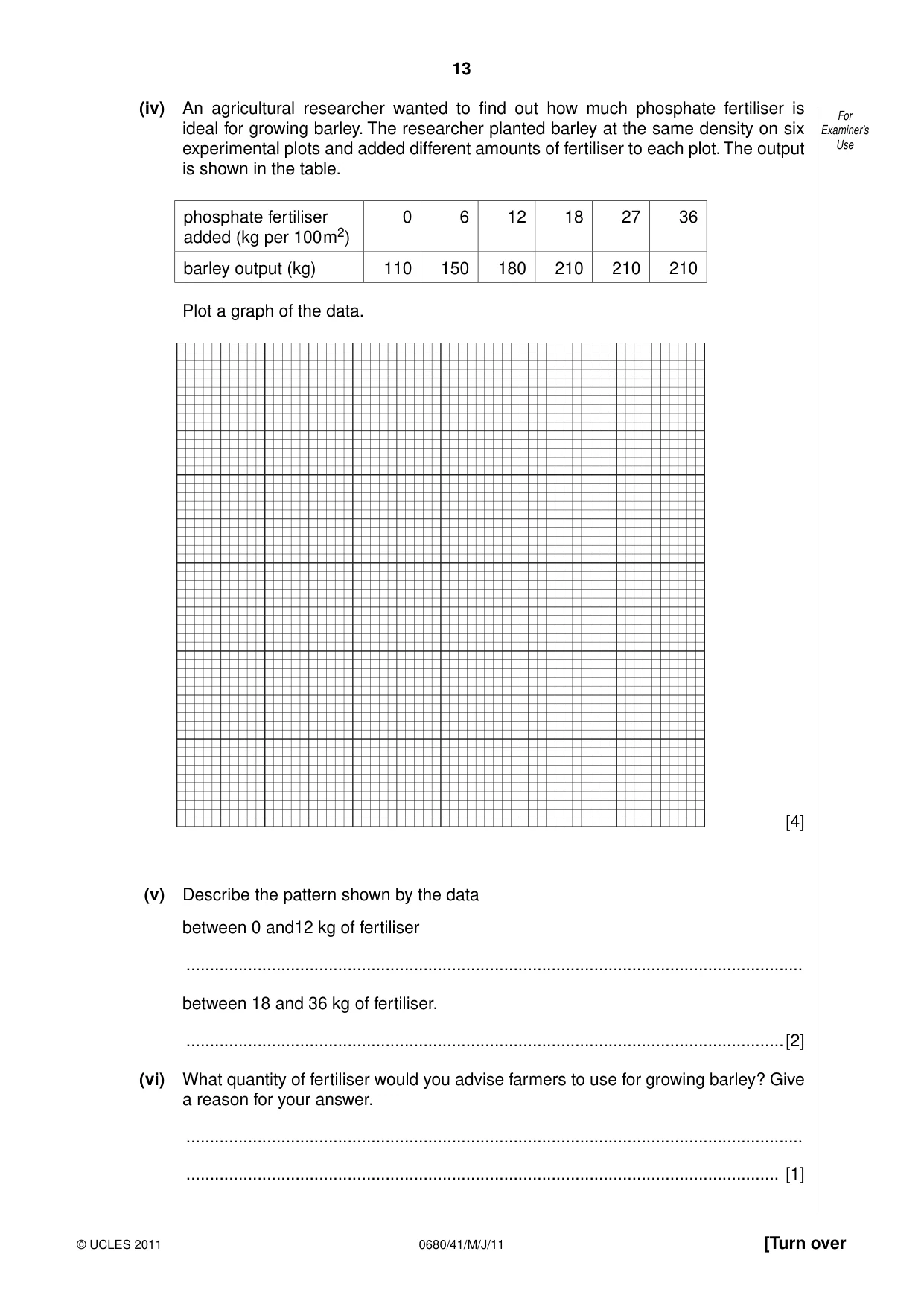
13 0680/41/M/J/11 © UCLES 2011 [Turn over For Examiner’s Use (iv) An agricultural researcher wanted to find out how much phosphate fertiliser is ideal for growing barley. The researcher planted barley at the same density on six experimental plots and added different amounts of fertiliser to each plot. The output is shown in the table. phosphate fertiliser added (kg per 100 m2) 0 6 12 18 27 36 barley output (kg) 110 150 180 210 210 210 Plot a graph of the data. [4] (v) Describe the pattern shown by the data between 0 and12 kg of fertiliser … between 18 and 36 kg of fertiliser. …[2] (vi) What quantity of fertiliser would you advise farmers to use for growing barley? Give a reason for your answer. … … [1]
Question paper, page 14
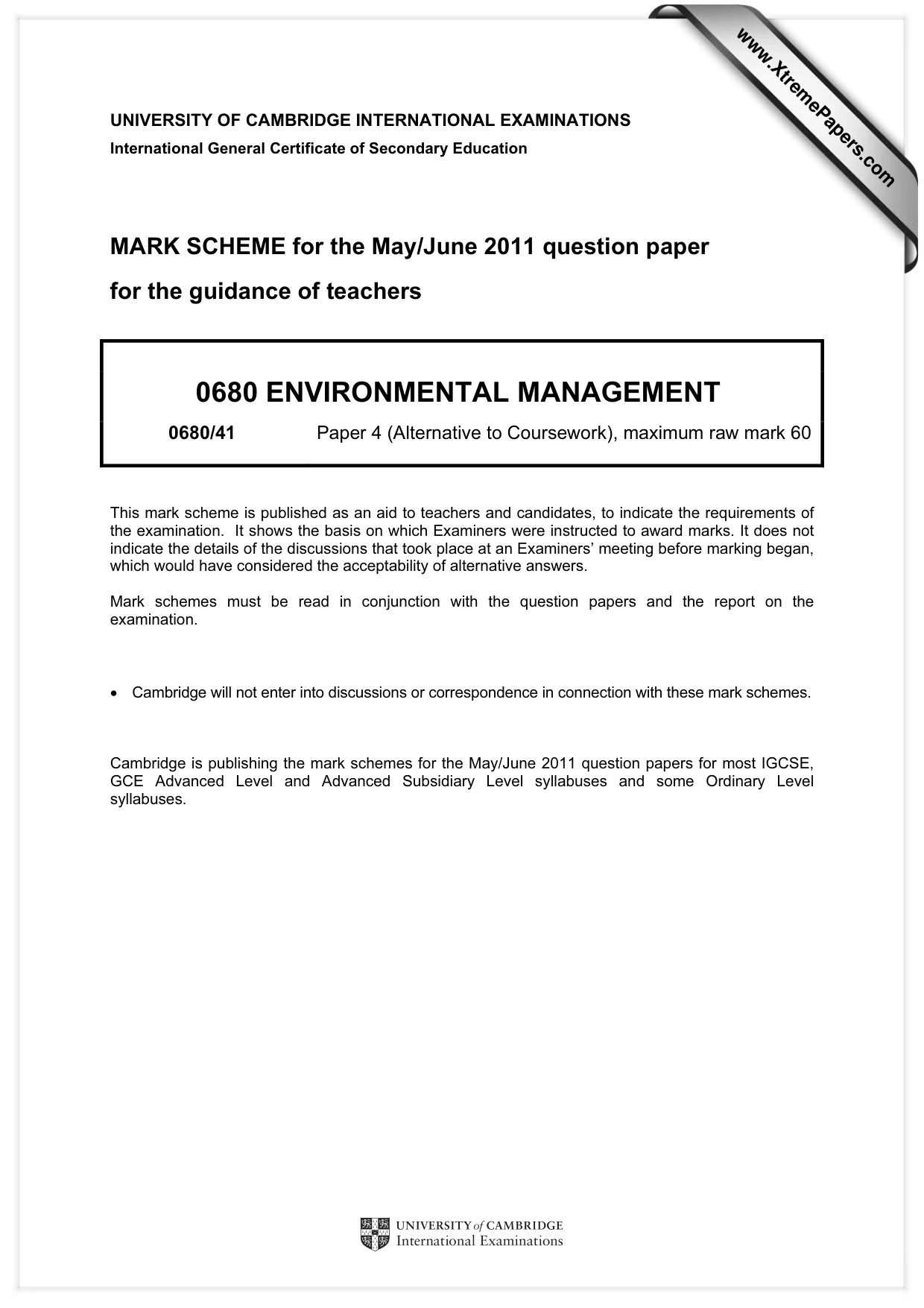
14 0680/41/M/J/11 © UCLES 2011 For Examiner’s Use 3 The Moroccan population has increased in the last twenty years. There have been shortages of electricity and frequent power cuts. A coal fired power station, 130 km from Casablanca, has been enlarged to supply one third of the country’s electricity. • This power station burns 4 million tonnes of coal a year • Morocco produces no coal of its own • The power station has a working life of thirty years • Waste called fly ash has to be stored • Fly ash can be used in cement manufacture • There are several cement plants in Morocco producing 15 million tonnes each year, some of which is exported (a) Explain why building a cement plant near this power station would be a sensible development. … … …[2] (b) Describe an environmental problem caused by burning coal to generate electricity. … … …[2] (c) The government is beginning to generate electricity from solar panels located in the desert in the south of the country. Suggest two advantages of generating electricity in this way. … … …[2] (d) Morocco produces some oil and natural gas but still has to import these from other countries. Describe an energy plan for the future that will allow a reliable supply of electricity for Morocco that people can afford. … … … … [4]
Question paper, page 15
15 0680/41/M/J/11 © UCLES 2011 BLANK PAGE
Question paper, page 16
16 0680/41/M/J/11 © UCLES 2011 Permission to reproduce items where third-party owned material protected by copyright is included has been sought and cleared where possible. Every reasonable effort has been made by the publisher (UCLES) to trace copyright holders, but if any items requiring clearance have unwittingly been included, the publisher will be pleased to make amends at the earliest possible opportunity. University of Cambridge International Examinations is part of the Cambridge Assessment Group. Cambridge Assessment is the brand name of University of Cambridge Local Examinations Syndicate (UCLES), which is itself a department of the University of Cambridge. BLANK PAGE
Mark scheme, page 1
UNIVERSITY OF CAMBRIDGE INTERNATIONAL EXAMINATIONS International General Certificate of Secondary Education MARK SCHEME for the May/June 2011 question paper for the guidance of teachers 0680 ENVIRONMENTAL MANAGEMENT 0680/41 Paper 4 (Alternative to Coursework), maximum raw mark 60 This mark scheme is published as an aid to teachers and candidates, to indicate the requirements of the examination. It shows the basis on which Examiners were instructed to award marks. It does not indicate the details of the discussions that took place at an Examiners’ meeting before marking began, which would have considered the acceptability of alternative answers. Mark schemes must be read in conjunction with the question papers and the report on the examination. • Cambridge will not enter into discussions or correspondence in connection with these mark schemes. Cambridge is publishing the mark schemes for the May/June 2011 question papers for most IGCSE, GCE Advanced Level and Advanced Subsidiary Level syllabuses and some Ordinary Level syllabuses. www.XtremePapers.com
Mark scheme, page 2
Page 2 Mark Scheme: Teachers’ version Syllabus Paper IGCSE – May/June 2011 0680 41 © University of Cambridge International Examinations 2011 1 (a) (i) loss of plant cover; roots pulled out; no roots to hold soil; loss of interception; erosion by wind; by rain; loss of minerals/nutrients/fertility; difficult for plants to regenerate; [3] (ii) same conditions; similar pastures/similar farms; same soil type; soil pH; same climate; same rainfall; [2] (iii) fair test/comparison idea [1] (iv) age of sheep/ size/type of pasture/farm/ AVP; [max 1] (v) Sardi, more milk; and lambs; OR Timahdit, more meat; more wool; (max one if both types discussed) [2] (b) (i) lambs 20(%); ewes 30(%); [2] (ii) extra feed in the dry season/eq so more growth/milk production/less disease as better fed; [1] (iii) only need to plant it once/ it is self seeding/ no need to plough; [1] (c) (i) 242; [1] (ii) driest July; AND wettest March; [1] (iii) drought causes a big decline in Medicago yield/not much difference between weedy and Medicago/eq; (allow Medicago still does better in drought years) [1] (iv) repeat the trial/eq; [1] (d) (i) plan A sheep might starve/overgrazing/eq; [1] (ii) plan B more food for sheep/eq; so survive drought; in non drought more sheep products to sell/eq [2] (iii) plan C more cash crops/income; not as reliant on one crop/more variety of crops; any disease would do less damage to yield/income; ref to crop rotation; ref to (beans)improved fertility/manures/sheep dung; [max 2] (e) (i) (description of) some crop rotation; intercropping; prevents soil erosion/water loss; suggest a specific cash crop; use of sheep manure; rotational grazing; ref to changes in year two; and three; AVP; such as ref to leguminous plants/N fixation [4] (ii) Soil fertility – organic matter not washed away/combined with soil; minerals not washed out/prevents/reduces leaching; Soil erosion – less surface runoff; so less soil washed away/no gulley formation/eq; [4]
Mark scheme, page 3
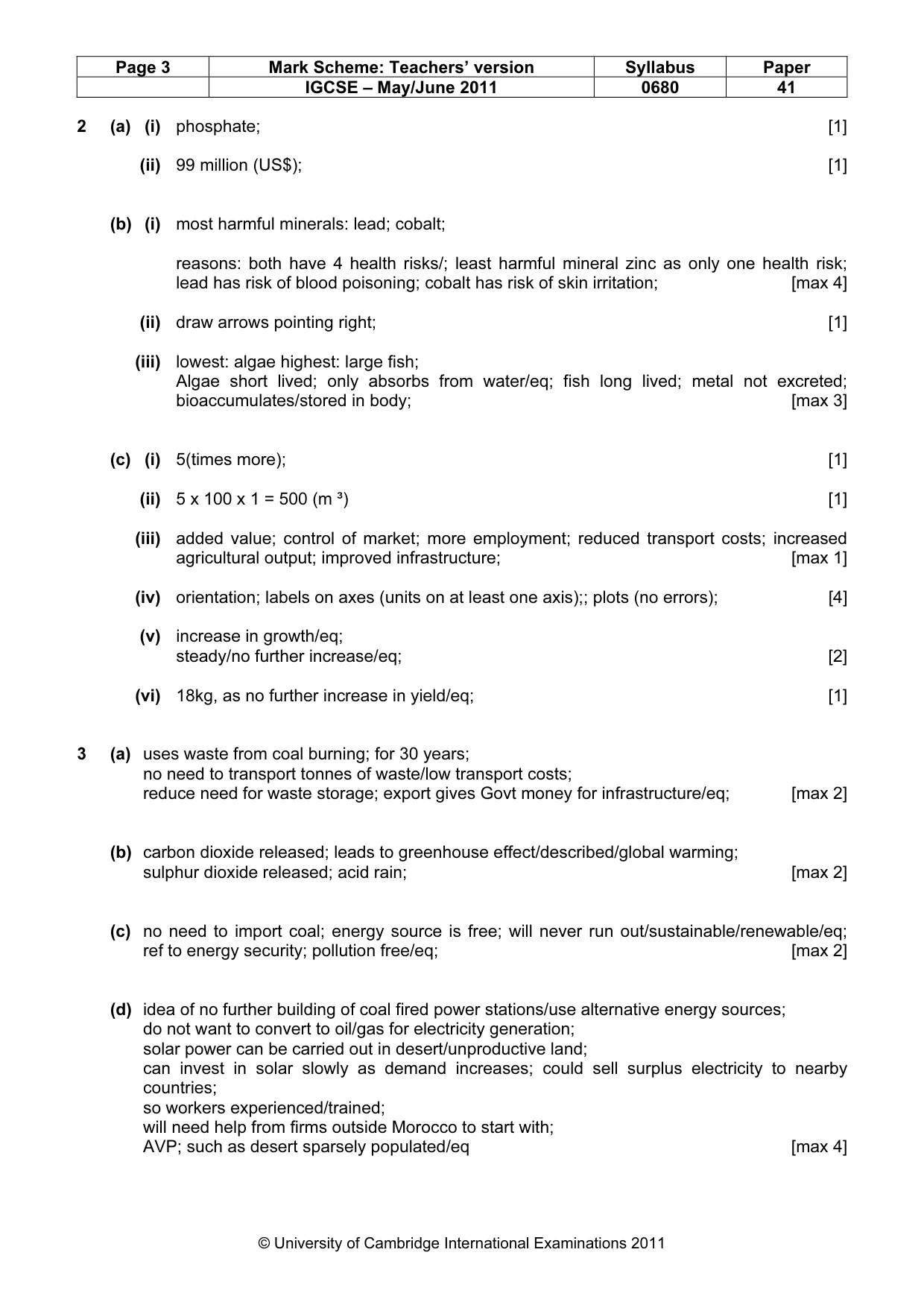
Page 3 Mark Scheme: Teachers’ version Syllabus Paper IGCSE – May/June 2011 0680 41 © University of Cambridge International Examinations 2011 2 (a) (i) phosphate; [1] (ii) 99 million (US$); [1] (b) (i) most harmful minerals: lead; cobalt; reasons: both have 4 health risks/; least harmful mineral zinc as only one health risk; lead has risk of blood poisoning; cobalt has risk of skin irritation; [max 4] (ii) draw arrows pointing right; [1] (iii) lowest: algae highest: large fish; Algae short lived; only absorbs from water/eq; fish long lived; metal not excreted; bioaccumulates/stored in body; [max 3] (c) (i) 5(times more); [1] (ii) 5 x 100 x 1 = 500 (m ³) [1] (iii) added value; control of market; more employment; reduced transport costs; increased agricultural output; improved infrastructure; [max 1] (iv) orientation; labels on axes (units on at least one axis);; plots (no errors); [4] (v) increase in growth/eq; steady/no further increase/eq; [2] (vi) 18kg, as no further increase in yield/eq; [1] 3 (a) uses waste from coal burning; for 30 years; no need to transport tonnes of waste/low transport costs; reduce need for waste storage; export gives Govt money for infrastructure/eq; [max 2] (b) carbon dioxide released; leads to greenhouse effect/described/global warming; sulphur dioxide released; acid rain; [max 2] (c) no need to import coal; energy source is free; will never run out/sustainable/renewable/eq; ref to energy security; pollution free/eq; [max 2] (d) idea of no further building of coal fired power stations/use alternative energy sources; do not want to convert to oil/gas for electricity generation; solar power can be carried out in desert/unproductive land; can invest in solar slowly as demand increases; could sell surplus electricity to nearby countries; so workers experienced/trained; will need help from firms outside Morocco to start with; AVP; such as desert sparsely populated/eq [max 4]
What you needed in this session
Cambridge’s own grade thresholds for 2011 May/June, Paper 4 · Variant 1. A higher threshold means an easier paper — the bar moves with how the cohort did.