Cambridge IGCSE Environmental Management 0680 — 2010 Oct/Nov Paper 4 · Variant 2
0680/42/O/N/10 · 60 marks · ≈68 min
The question paper and its mark scheme, free to read here and free to download. This is Cambridge’s own paper, exactly as it was sat.
Question paper16 pages


Mark scheme3 pages
Answers below. Sit the paper first if you are practising.
Paper as text
Question paper, page 1
This document consists of 13 printed pages and 3 blank pages. DC (AC/CGW) 22348/4 © UCLES 2010 [Turn over UNIVERSITY OF CAMBRIDGE INTERNATIONAL EXAMINATIONS International General Certificate of Secondary Education * 4 8 0 0 5 6 1 4 4 3 * ENVIRONMENTAL MANAGEMENT 0680/42 Alternative to Coursework October/November 2010 1 hour 30 minutes Candidates answer on the Question Paper Additional Materials: Ruler READ THESE INSTRUCTIONS FIRST Write your Centre number, candidate number and name on all the work you hand in. Write in dark blue or black pen. You may use a soft pencil for any diagrams, graphs or rough working. Do not use staples, paper clips, highlighters, glue or correction fluid. DO NOT WRITE IN ANY BARCODES. Answer all questions. Study the appropriate Source materials before you start to write your answers. Credit will be given for appropriate selection and use of data in your answers and for relevant interpretation of these data. Suggestions for data sources are given in some questions. You may use the source data to draw diagrams and graphs or to do calculations to illustrate your answers. At the end of the examination, fasten all your work securely together. The number of marks is given in brackets [ ] at the end of each question or part question. For Examiner’s Use www.XtremePapers.com
Question paper, page 2
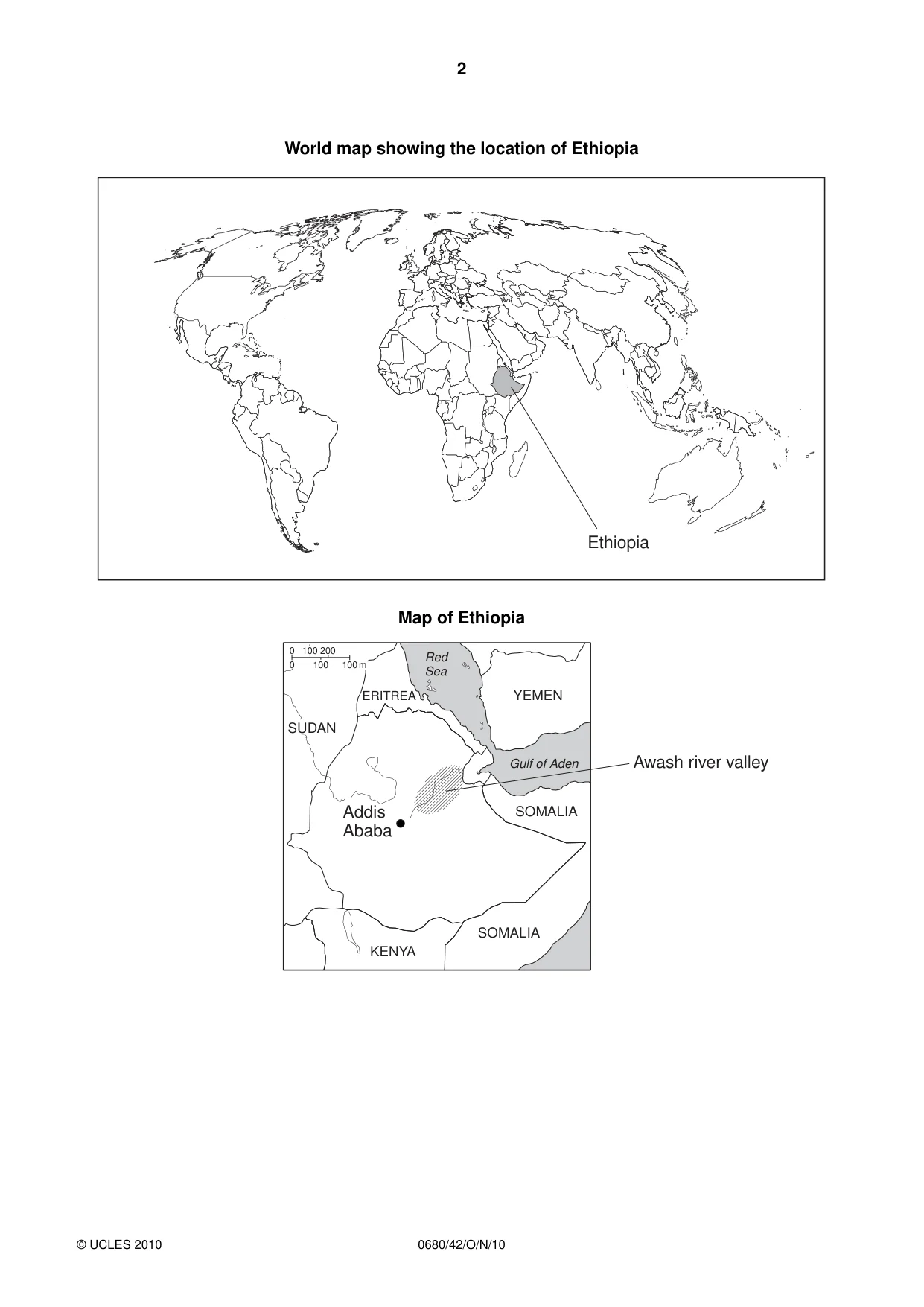
2 0680/42/O/N/10 © UCLES 2010 World map showing the location of Ethiopia Ethiopia Map of Ethiopia Awash river valley YEMEN SOMALIA SOMALIA KENYA Addis Ababa ERITREA Red Sea Gulf of Aden 0 0 100 100 200 100 m SUDAN
Question paper, page 3
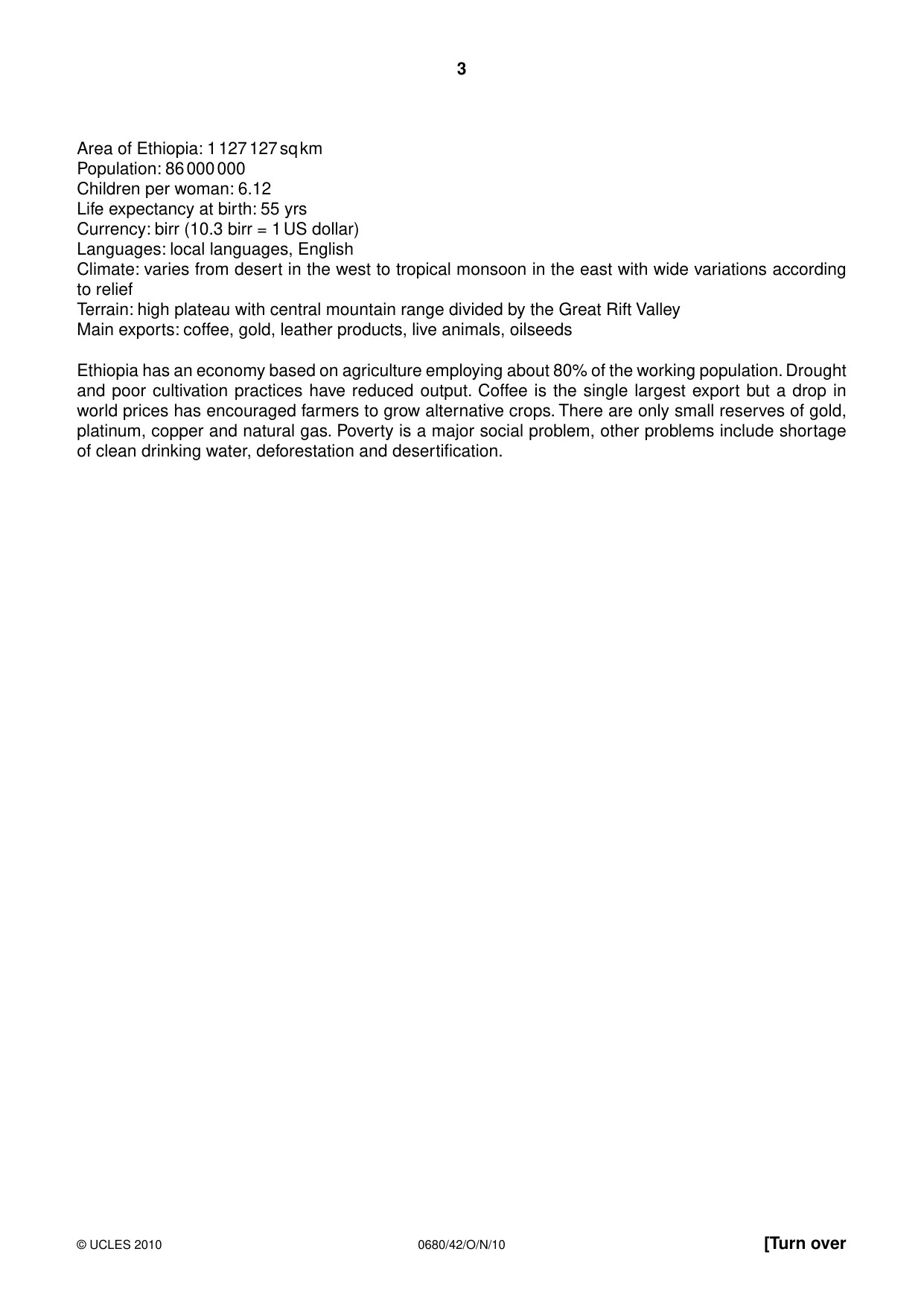
3 0680/42/O/N/10 © UCLES 2010 [Turn over Area of Ethiopia: 1 127 127 sq km Population: 86 000 000 Children per woman: 6.12 Life expectancy at birth: 55 yrs Currency: birr (10.3 birr = 1 US dollar) Languages: local languages, English Climate: varies from desert in the west to tropical monsoon in the east with wide variations according to relief Terrain: high plateau with central mountain range divided by the Great Rift Valley Main exports: coffee, gold, leather products, live animals, oilseeds Ethiopia has an economy based on agriculture employing about 80% of the working population. Drought and poor cultivation practices have reduced output. Coffee is the single largest export but a drop in world prices has encouraged farmers to grow alternative crops. There are only small reserves of gold, platinum, copper and natural gas. Poverty is a major social problem, other problems include shortage of clean drinking water, deforestation and desertification.
Question paper, page 4
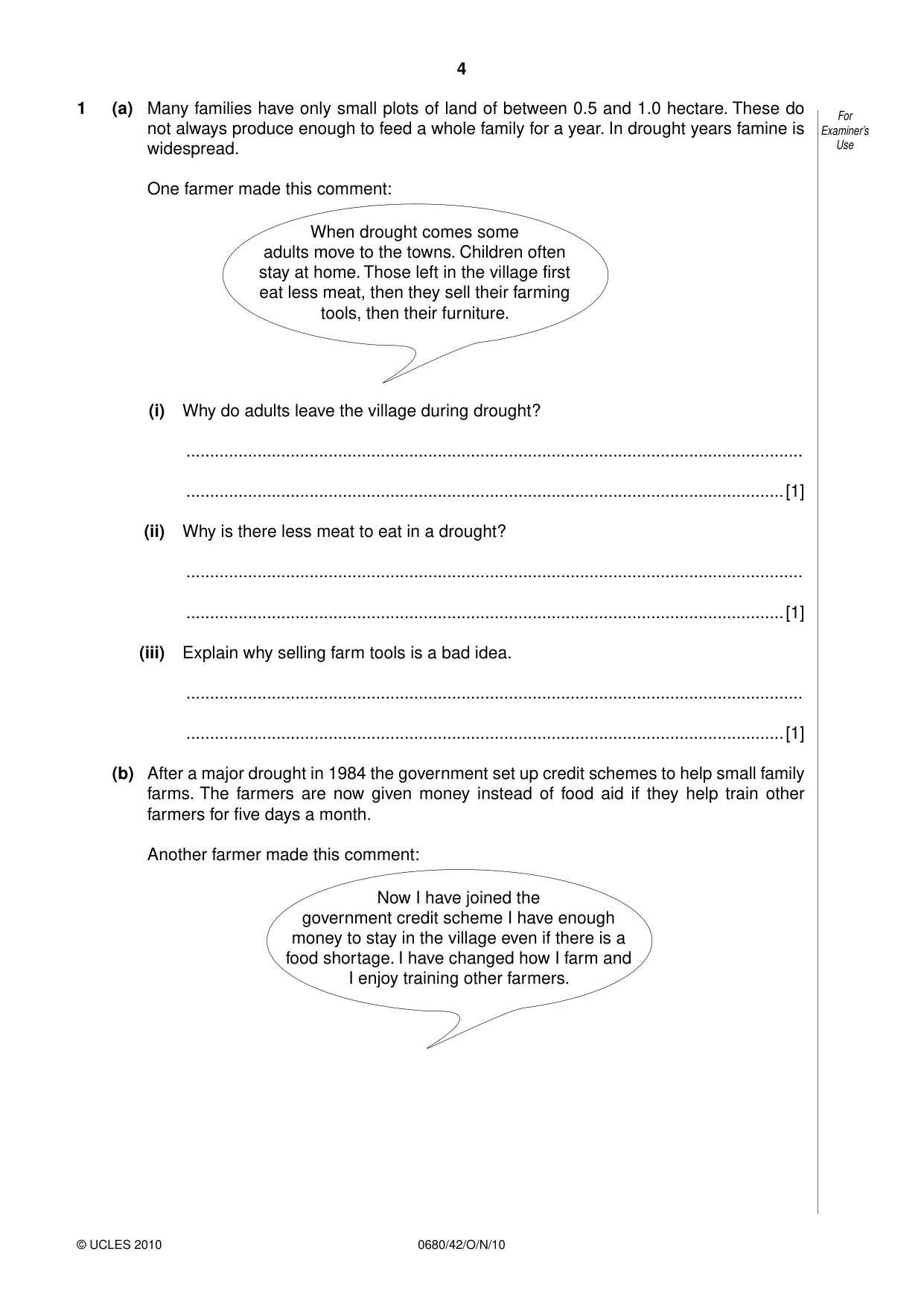
4 0680/42/O/N/10 © UCLES 2010 For Examiner’s Use 1 (a) Many families have only small plots of land of between 0.5 and 1.0 hectare. These do not always produce enough to feed a whole family for a year. In drought years famine is widespread. One farmer made this comment: (i) Why do adults leave the village during drought? … …[1] (ii) Why is there less meat to eat in a drought? … …[1] (iii) Explain why selling farm tools is a bad idea. … …[1] (b) After a major drought in 1984 the government set up credit schemes to help small family farms. The farmers are now given money instead of food aid if they help train other farmers for five days a month. Another farmer made this comment: When drought comes some adults move to the towns. Children often stay at home. Those left in the village first eat less meat, then they sell their farming tools, then their furniture. Now I have joined the government credit scheme I have enough money to stay in the village even if there is a food shortage. I have changed how I farm and I enjoy training other farmers.
Question paper, page 5
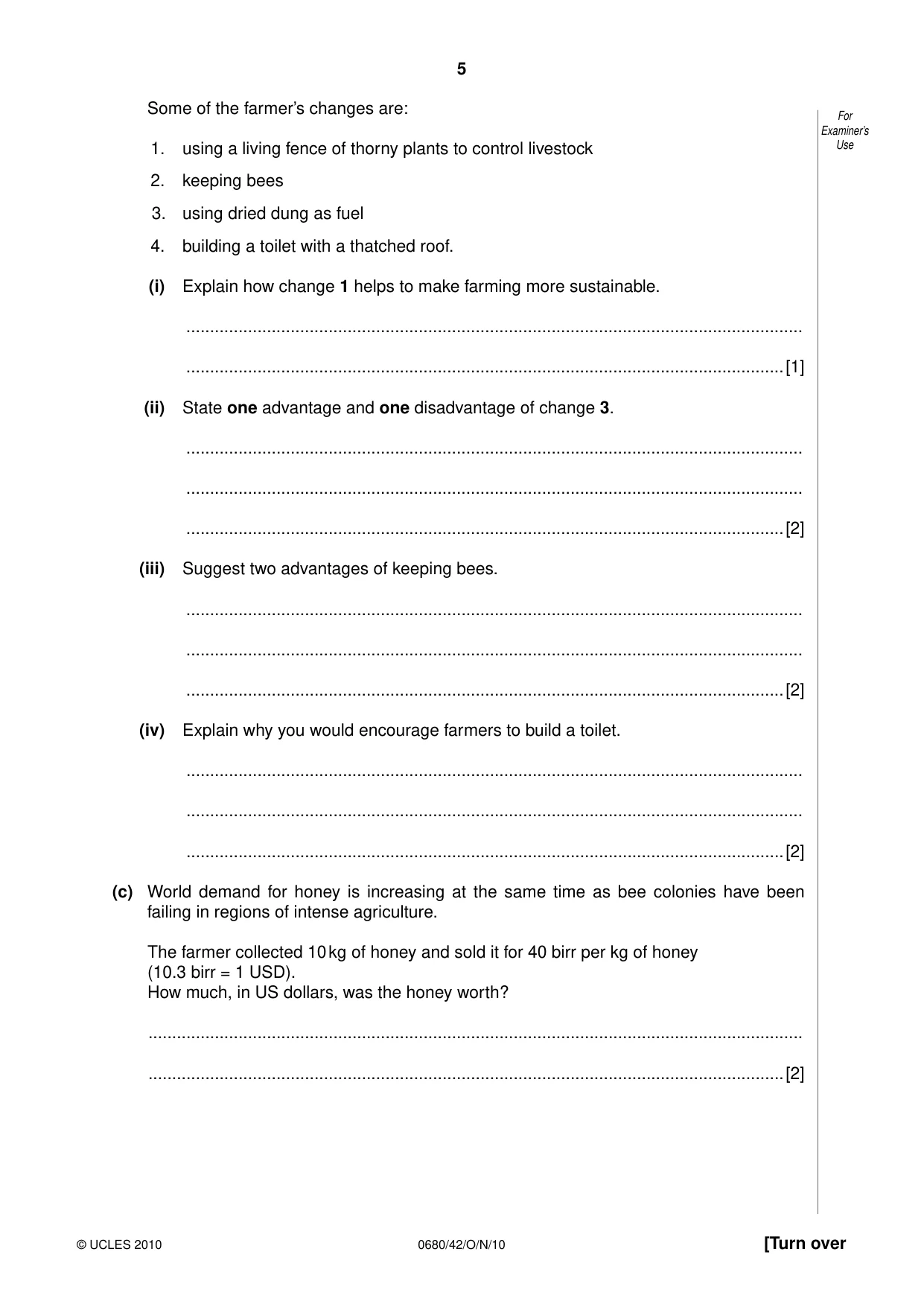
5 0680/42/O/N/10 © UCLES 2010 [Turn over For Examiner’s Use Some of the farmer’s changes are: 1. using a living fence of thorny plants to control livestock 2. keeping bees 3. using dried dung as fuel 4. building a toilet with a thatched roof. (i) Explain how change 1 helps to make farming more sustainable. … …[1] (ii) State one advantage and one disadvantage of change 3. … … …[2] (iii) Suggest two advantages of keeping bees. … … …[2] (iv) Explain why you would encourage farmers to build a toilet. … … …[2] (c) World demand for honey is increasing at the same time as bee colonies have been failing in regions of intense agriculture. The farmer collected 10 kg of honey and sold it for 40 birr per kg of honey (10.3 birr = 1 USD). How much, in US dollars, was the honey worth? … …[2]
Question paper, page 6
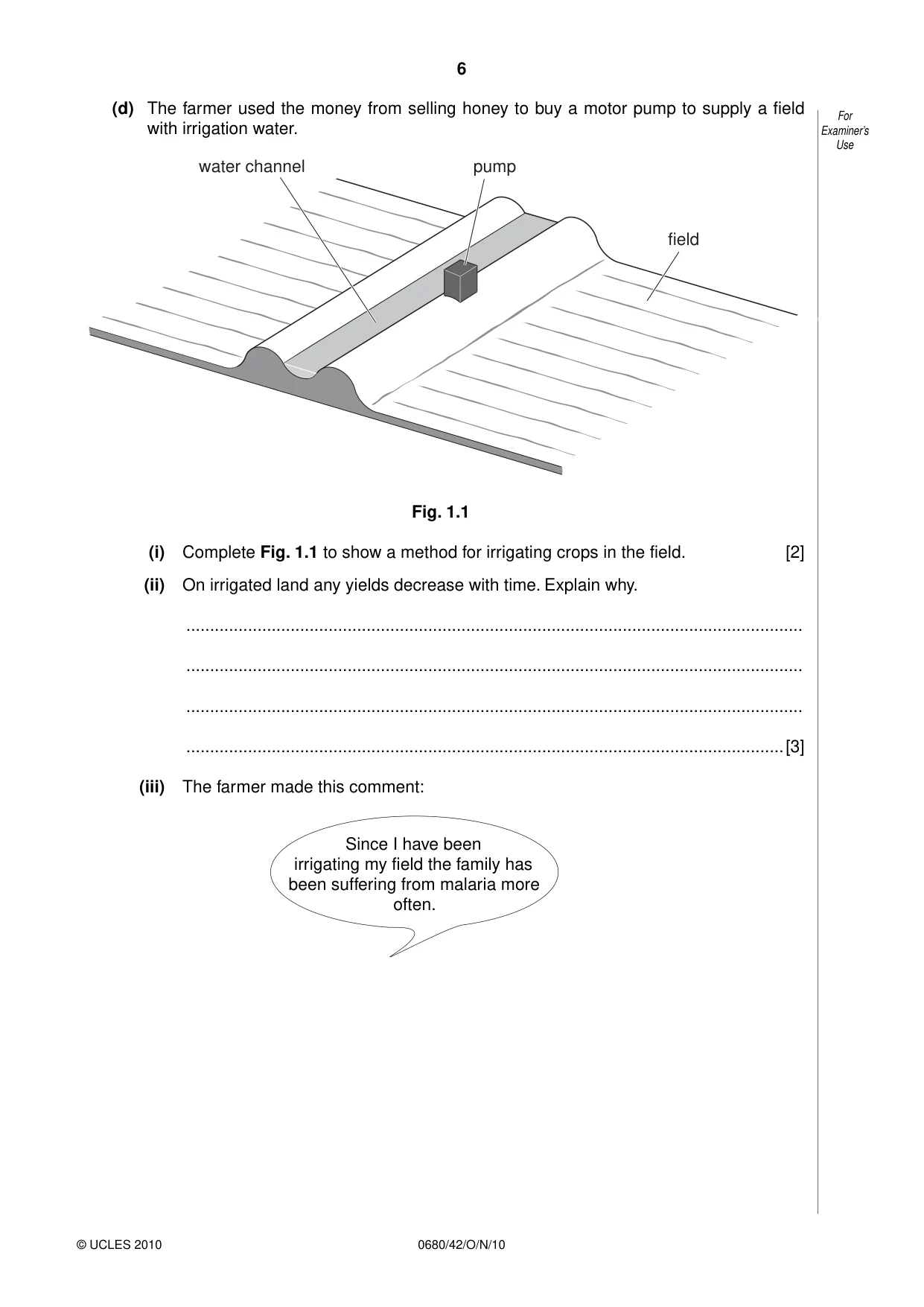
6 0680/42/O/N/10 © UCLES 2010 For Examiner’s Use (d) The farmer used the money from selling honey to buy a motor pump to supply a field with irrigation water. pump water channel field Fig. 1.1 (i) Complete Fig. 1.1 to show a method for irrigating crops in the field. [2] (ii) On irrigated land any yields decrease with time. Explain why. … … … …[3] (iii) The farmer made this comment: Since I have been irrigating my field the family has been suffering from malaria more often.
Question paper, page 7
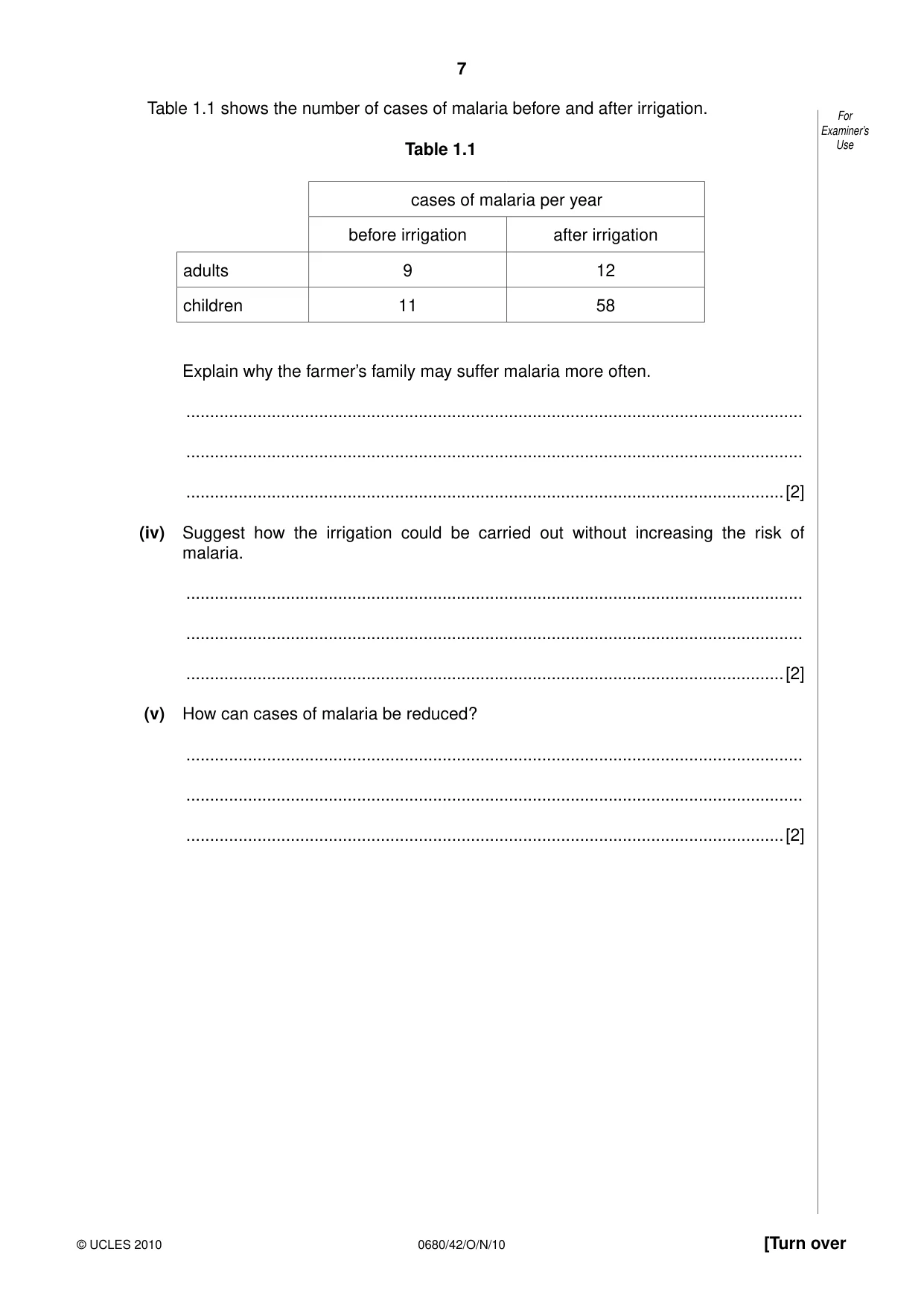
7 0680/42/O/N/10 © UCLES 2010 [Turn over For Examiner’s Use Table 1.1 shows the number of cases of malaria before and after irrigation. Table 1.1 cases of malaria per year before irrigation after irrigation adults 9 12 children 11 58 Explain why the farmer’s family may suffer malaria more often. … … …[2] (iv) Suggest how the irrigation could be carried out without increasing the risk of malaria. … … …[2] (v) How can cases of malaria be reduced? … … …[2]
Question paper, page 8
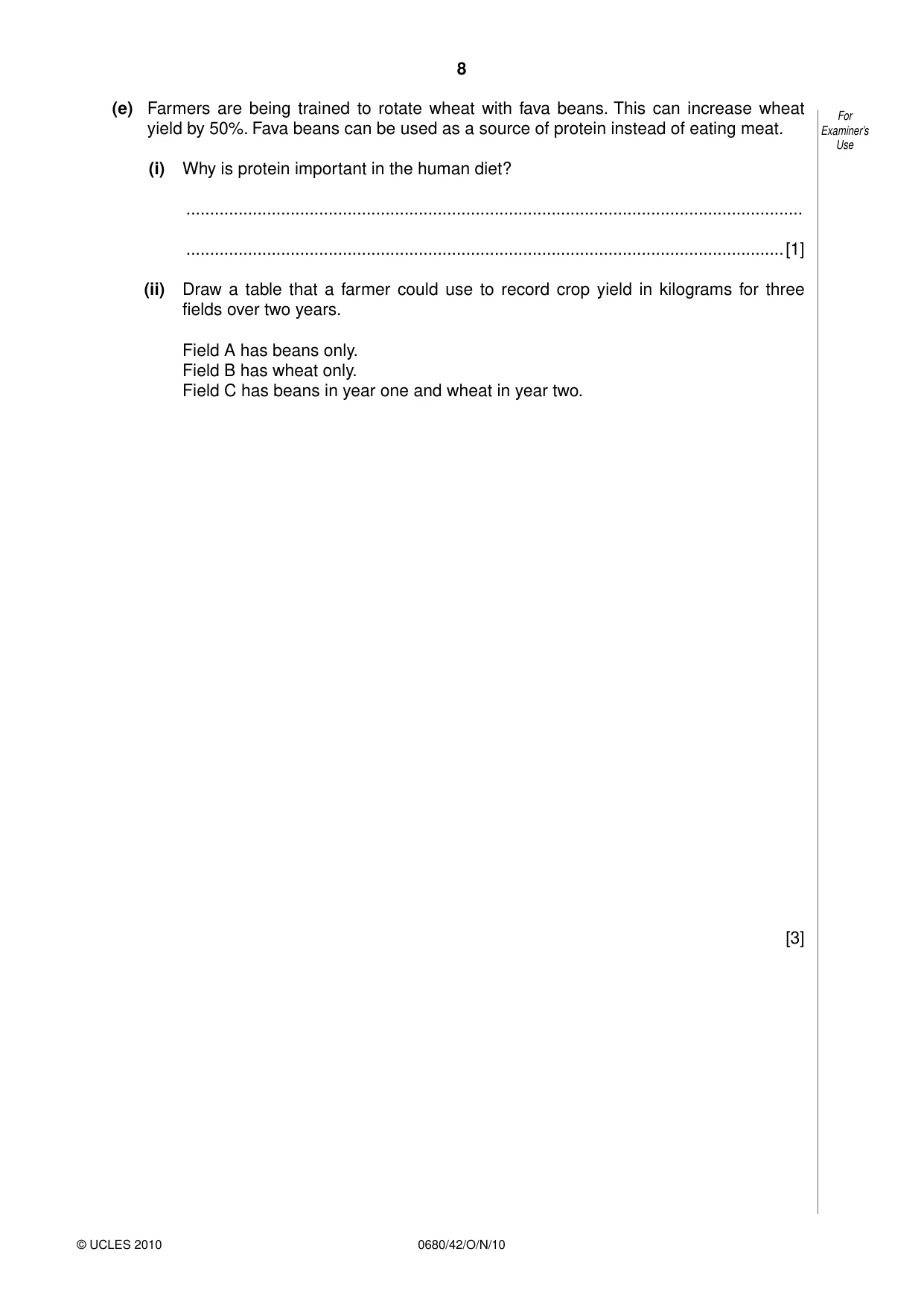
8 0680/42/O/N/10 © UCLES 2010 For Examiner’s Use (e) Farmers are being trained to rotate wheat with fava beans. This can increase wheat yield by 50%. Fava beans can be used as a source of protein instead of eating meat. (i) Why is protein important in the human diet? … …[1] (ii) Draw a table that a farmer could use to record crop yield in kilograms for three fields over two years. Field A has beans only. Field B has wheat only. Field C has beans in year one and wheat in year two. [3]
Question paper, page 9
9 0680/42/O/N/10 © UCLES 2010 [Turn over BLANK PAGE Question 2 starts on page 10.
Question paper, page 10
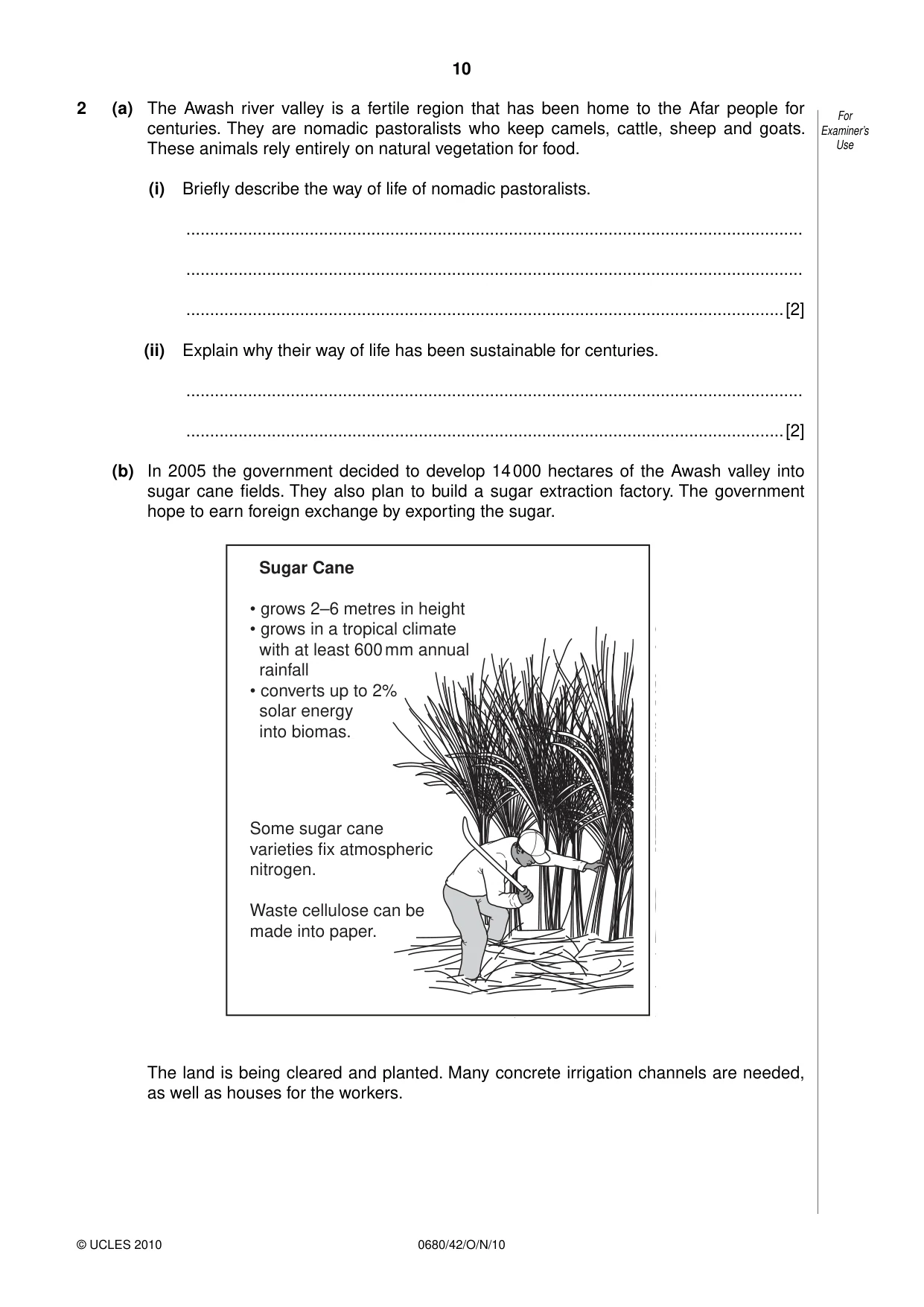
10 0680/42/O/N/10 © UCLES 2010 For Examiner’s Use 2 (a) The Awash river valley is a fertile region that has been home to the Afar people for centuries. They are nomadic pastoralists who keep camels, cattle, sheep and goats. These animals rely entirely on natural vegetation for food. (i) Briefly describe the way of life of nomadic pastoralists. … … …[2] (ii) Explain why their way of life has been sustainable for centuries. … …[2] (b) In 2005 the government decided to develop 14 000 hectares of the Awash valley into sugar cane fields. They also plan to build a sugar extraction factory. The government hope to earn foreign exchange by exporting the sugar. Sugar Cane • grows 2–6 metres in height • grows in a tropical climate with at least 600 mm annual rainfall • converts up to 2% solar energy into biomas. Some sugar cane varieties fix atmospheric nitrogen. Waste cellulose can be made into paper. The land is being cleared and planted. Many concrete irrigation channels are needed, as well as houses for the workers.
Question paper, page 11
11 0680/42/O/N/10 © UCLES 2010 [Turn over For Examiner’s Use (i) Suggest two reasons why the Afar people objected to this development. … … …[2] (ii) This development will need thousands of kilograms of cement to construct. A local cement factory has been given the contract to supply all the cement. A large amount of energy is needed to heat the ingredients to make cement. For every 1.0 kg of cement 0.5 kg of carbon dioxide is released. Some scientists think cement production causes serious environmental problems. Describe two of them. … … …[2] (iii) For this particular project other scientists think cement is not going to add to environmental problems. Explain their view. … … …[2] (iv) After sugar extraction the sugar cane waste can be used in three ways. Suggest the advantage of each way. 1. burning sugar cane waste … … 2. fermenting to produce ethanol … … 3. feeding to livestock (cattle) … …[4]
Question paper, page 12
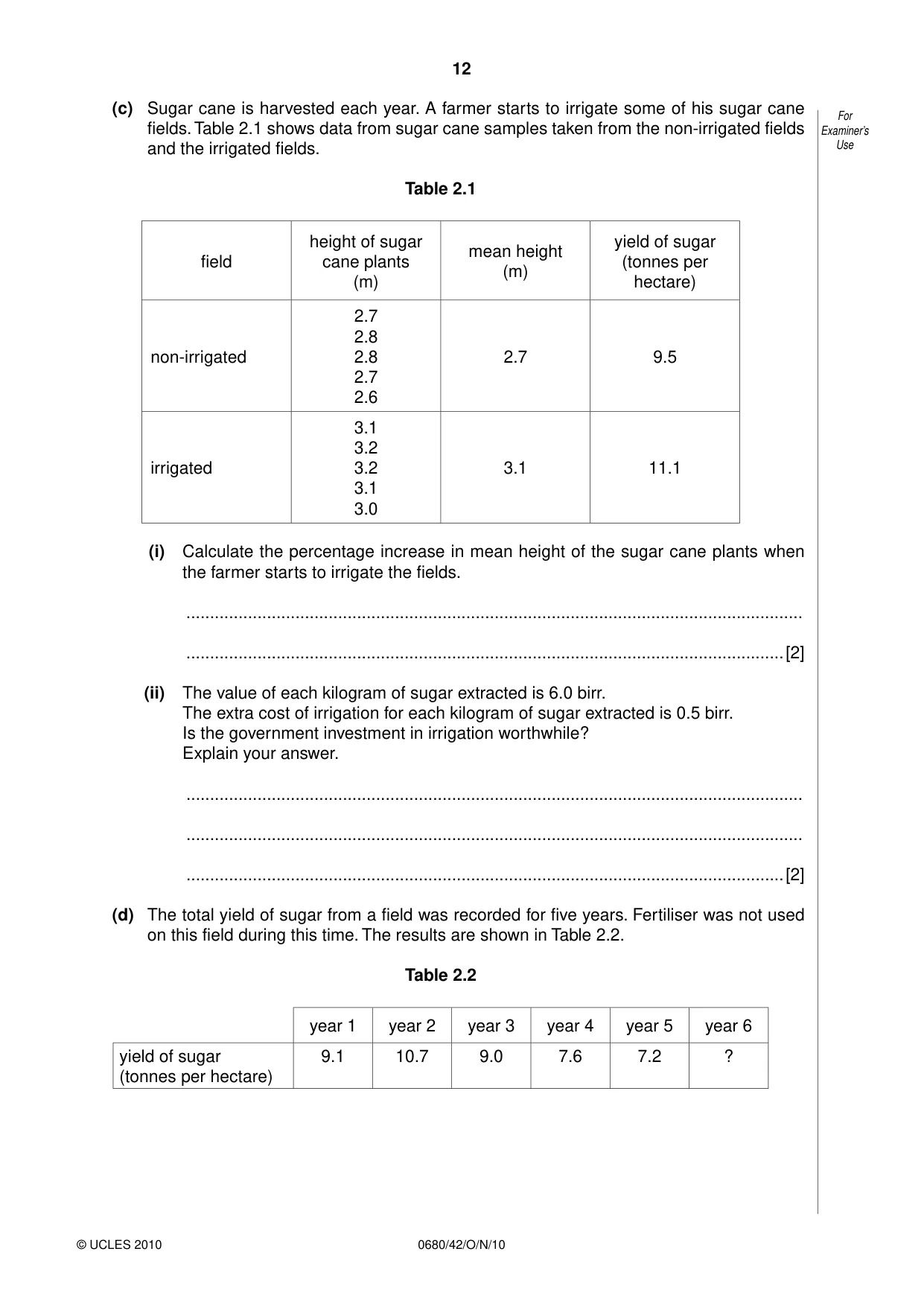
12 0680/42/O/N/10 © UCLES 2010 For Examiner’s Use (c) Sugar cane is harvested each year. A farmer starts to irrigate some of his sugar cane fields. Table 2.1 shows data from sugar cane samples taken from the non-irrigated fields and the irrigated fields. Table 2.1 field height of sugar cane plants (m) mean height (m) yield of sugar (tonnes per hectare) non-irrigated 2.7 2.8 2.8 2.7 2.6 2.7 9.5 irrigated 3.1 3.2 3.2 3.1 3.0 3.1 11.1 (i) Calculate the percentage increase in mean height of the sugar cane plants when the farmer starts to irrigate the fields. … …[2] (ii) The value of each kilogram of sugar extracted is 6.0 birr. The extra cost of irrigation for each kilogram of sugar extracted is 0.5 birr. Is the government investment in irrigation worthwhile? Explain your answer. … … …[2] (d) The total yield of sugar from a field was recorded for five years. Fertiliser was not used on this field during this time. The results are shown in Table 2.2. Table 2.2 year 1 year 2 year 3 year 4 year 5 year 6 yield of sugar (tonnes per hectare) 9.1 10.7 9.0 7.6 7.2 ?
Question paper, page 13
13 0680/42/O/N/10 © UCLES 2010 [Turn over For Examiner’s Use (i) Plot the data on a suitable graph. [4] (ii) Suggest a reason for the increase in yield from year 1 to year 2 even though fertiliser has not been used. … …[2] (iii) What yield would you expect from the harvest in year 6? …[1] (iv) Potassium fertiliser can be added to increase the yield of sugar cane. When would you start to add fertiliser? …[1]
Question paper, page 14
14 0680/42/O/N/10 © UCLES 2010 For Examiner’s Use (e) The sugar cane grub infects sugar cane and reduces yields. A pesticide called Confidor can be used to kill the grub. Confidor Information Sheet • may cause irritation by skin contact • irritates eyes • toxic to fish, aquatic insects, algae, bacteria and birds • not expected to leach into soils (i) Write three guidelines for sugar cane workers using Confidor. guideline 1 … … guideline 2 … … guideline 3 … …[3] (ii) The manager of the sugar cane plantation decided that any field with a yield of less than 70 tonnes per hectare should be cleared and replanted with new sugar cane plants. Explain the commercial and environmental advantages of this decision. commercial advantages … … … … environmental advantages … … … …[4]
Question paper, page 15
15 0680/42/O/N/10 © UCLES 2010 BLANK PAGE
Question paper, page 16
16 0680/42/O/N/10 © UCLES 2010 BLANK PAGE Permission to reproduce items where third-party owned material protected by copyright is included has been sought and cleared where possible. Every reasonable effort has been made by the publisher (UCLES) to trace copyright holders, but if any items requiring clearance have unwittingly been included, the publisher will be pleased to make amends at the earliest possible opportunity. University of Cambridge International Examinations is part of the Cambridge Assessment Group. Cambridge Assessment is the brand name of University of Cambridge Local Examinations Syndicate (UCLES), which is itself a department of the University of Cambridge.
Mark scheme, page 1
UNIVERSITY OF CAMBRIDGE INTERNATIONAL EXAMINATIONS International General Certificate of Secondary Education MARK SCHEME for the October/November 2010 question paper for the guidance of teachers 0680 ENVIRONMENTAL MANAGEMENT 0680/42 Paper 4 (Alternative to Coursework), maximum raw mark 60 This mark scheme is published as an aid to teachers and candidates, to indicate the requirements of the examination. It shows the basis on which Examiners were instructed to award marks. It does not indicate the details of the discussions that took place at an Examiners’ meeting before marking began, which would have considered the acceptability of alternative answers. Mark schemes must be read in conjunction with the question papers and the report on the examination. • CIE will not enter into discussions or correspondence in connection with these mark schemes. CIE is publishing the mark schemes for the October/November 2010 question papers for most IGCSE, GCE Advanced Level and Advanced Subsidiary Level syllabuses and some Ordinary Level syllabuses. www.XtremePapers.com
Mark scheme, page 2
Page 2 Mark Scheme: Teachers’ version Syllabus Paper IGCSE – October/November 2010 0680 42 © UCLES 2010 1 (a) (i) push/pull factors/described e.g. find jobs/earn money to buy food; [1] (ii) animals die/do not grow/sold off for other food; [1] (iii) no ability to farm after drought without tools; ref to cost of tools after drought; [1] (b) (i) living hedge is thorny so cannot be eaten; no need to cut trees to make fence; ref to deforestation; ref to desertification; do not need to buy materials to make fence; AVP; [max 1] (ii) advantage: not cutting wood for fuel/renewable energy source/easy to gather/ash can be used as a fertiliser/do not need to buy fertiliser/fuel; disadvantage: less manure to ground/increased risk of crop failure/soil erosion/ exhaustion/eq; [2] (iii) help to pollinate crops/described; honey is an extra food source; cash from selling honey for any valid purpose (i.e. school fees/medical bills/buying farm materials); [2] (iv) reduce the amount of disease; named disease; so less time of working/eq; not polluting well/drinking water; [max 2] (c) 40 × 10/10.3 = 38.8($); A working only; [2] (d) (i) sensible channels; connected to pump; [2] (ii) salinity/salinisation; described; depletion of nutrients/named nutrient; [3] (iii) more breeding grounds; mosquitoes lay eggs in water; longer to breed/eq; more mosquitoes to bite; [2] (iv) allow ditches to dry out between irrigations; so larvae die off/eq; ref to fast flowing water; [2] (v) oil on water; (impregnated) mosquito nets; repellents; other valid method; [2] (e) (i) for growth/repair/development/reproduction/muscles/immune system; [1] (ii) table drawn; suitable headings; correct rows; columns; [max 3]
Mark scheme, page 3
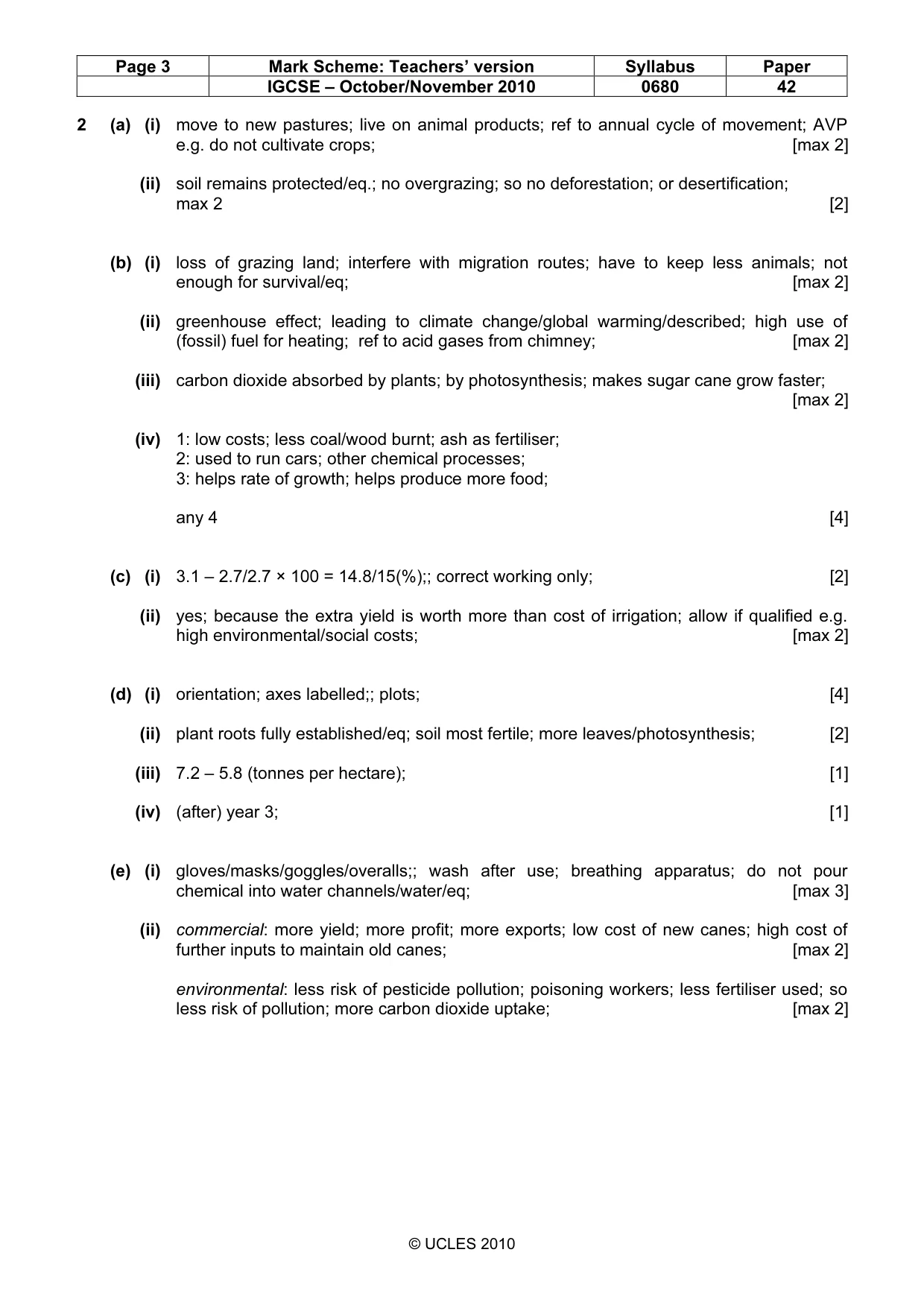
Page 3 Mark Scheme: Teachers’ version Syllabus Paper IGCSE – October/November 2010 0680 42 © UCLES 2010 2 (a) (i) move to new pastures; live on animal products; ref to annual cycle of movement; AVP e.g. do not cultivate crops; [max 2] (ii) soil remains protected/eq.; no overgrazing; so no deforestation; or desertification; max 2 [2] (b) (i) loss of grazing land; interfere with migration routes; have to keep less animals; not enough for survival/eq; [max 2] (ii) greenhouse effect; leading to climate change/global warming/described; high use of (fossil) fuel for heating; ref to acid gases from chimney; [max 2] (iii) carbon dioxide absorbed by plants; by photosynthesis; makes sugar cane grow faster; [max 2] (iv) 1: low costs; less coal/wood burnt; ash as fertiliser; 2: used to run cars; other chemical processes; 3: helps rate of growth; helps produce more food; any 4 [4] (c) (i) 3.1 – 2.7/2.7 × 100 = 14.8/15(%);; correct working only; [2] (ii) yes; because the extra yield is worth more than cost of irrigation; allow if qualified e.g. high environmental/social costs; [max 2] (d) (i) orientation; axes labelled;; plots; [4] (ii) plant roots fully established/eq; soil most fertile; more leaves/photosynthesis; [2] (iii) 7.2 – 5.8 (tonnes per hectare); [1] (iv) (after) year 3; [1] (e) (i) gloves/masks/goggles/overalls;; wash after use; breathing apparatus; do not pour chemical into water channels/water/eq; [max 3] (ii) commercial: more yield; more profit; more exports; low cost of new canes; high cost of further inputs to maintain old canes; [max 2] environmental: less risk of pesticide pollution; poisoning workers; less fertiliser used; so less risk of pollution; more carbon dioxide uptake; [max 2]
What you needed in this session
Cambridge’s own grade thresholds for 2010 Oct/Nov, Paper 4 · Variant 2. A higher threshold means an easier paper — the bar moves with how the cohort did.