Cambridge IGCSE Environmental Management 0680 — 2010 Oct/Nov Paper 4 · Variant 1
0680/41/O/N/10 · 60 marks · ≈68 min
The question paper and its mark scheme, free to read here and free to download. This is Cambridge’s own paper, exactly as it was sat.
Question paper16 pages


Mark scheme3 pages
Answers below. Sit the paper first if you are practising.
Paper as text
Question paper, page 1
This document consists of 15 printed pages and 1 blank page. DC (SLM/SW) 22349/4 © UCLES 2010 [Turn over UNIVERSITY OF CAMBRIDGE INTERNATIONAL EXAMINATIONS International General Certificate of Secondary Education * 9 1 9 4 5 8 7 5 5 9 * ENVIRONMENTAL MANAGEMENT 0680/41 Alternative to Coursework October/November 2010 1 hour 30 minutes Candidates answer on the Question Paper Additional Materials: Ruler READ THESE INSTRUCTIONS FIRST Write your Centre number, candidate number and name on all the work you hand in. Write in dark blue or black pen. You may use a soft pencil for any diagrams, graphs or rough working. Do not use staples, paper clips, highlighters, glue or correction fluid. DO NOT WRITE IN ANY BARCODES. Answer all questions. Study the appropriate Source materials before you start to write your answers. Credit will be given for appropriate selection and use of data in your answers and for relevant interpretation of these data. Suggestions for data sources are given in some questions. You may use the source data to draw diagrams and graphs or to do calculations to illustrate your answers. At the end of the examination, fasten all your work securely together. The number of marks is given in brackets [ ] at the end of each question or part question. For Examiner’s Use www.XtremePapers.com
Question paper, page 2
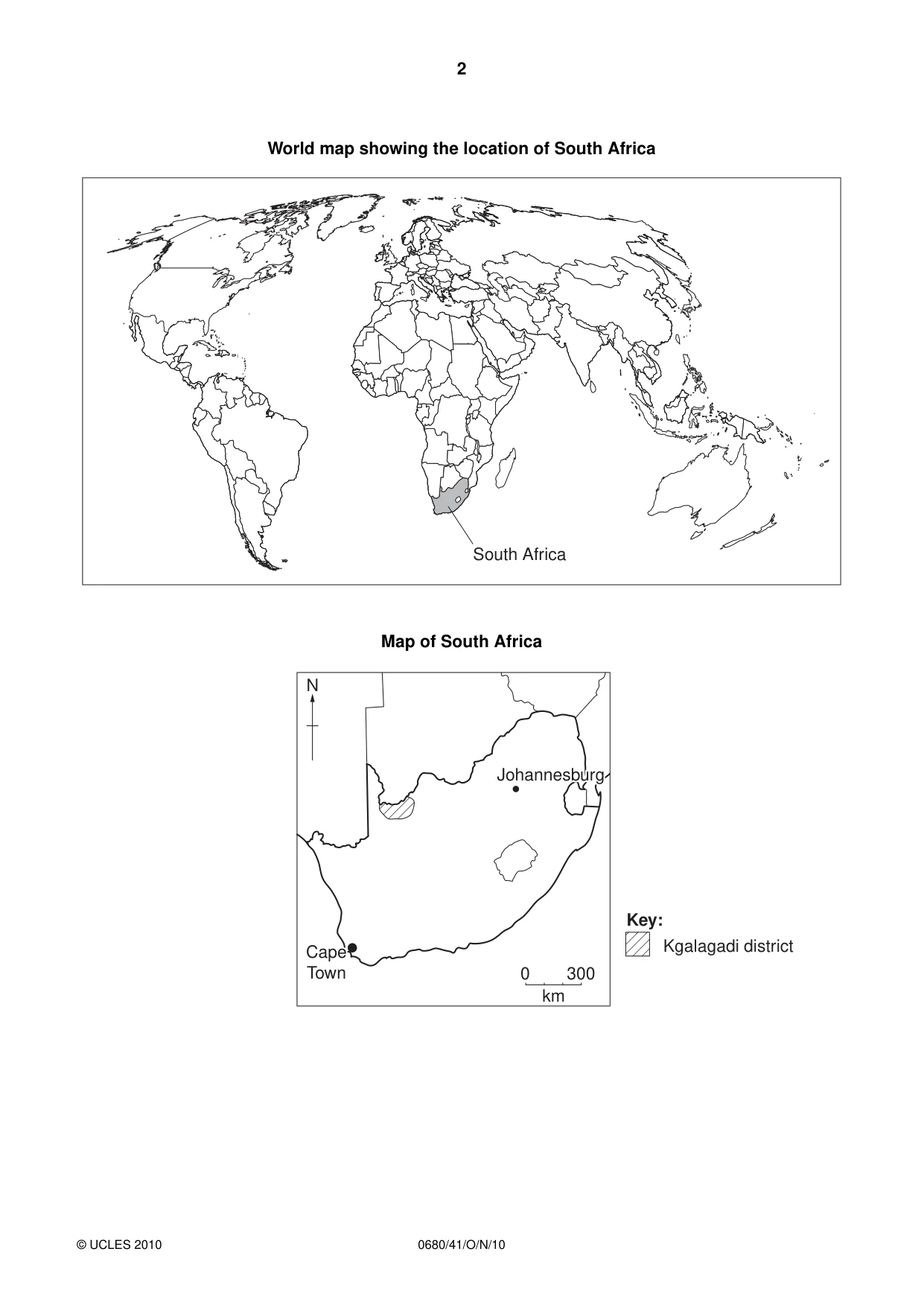
2 0680/41/O/N/10 © UCLES 2010 World map showing the location of South Africa South Africa Map of South Africa N Cape Town Johannesburg Cape Town 0 300 km Johannesburg Kgalagadi district Key:
Question paper, page 3
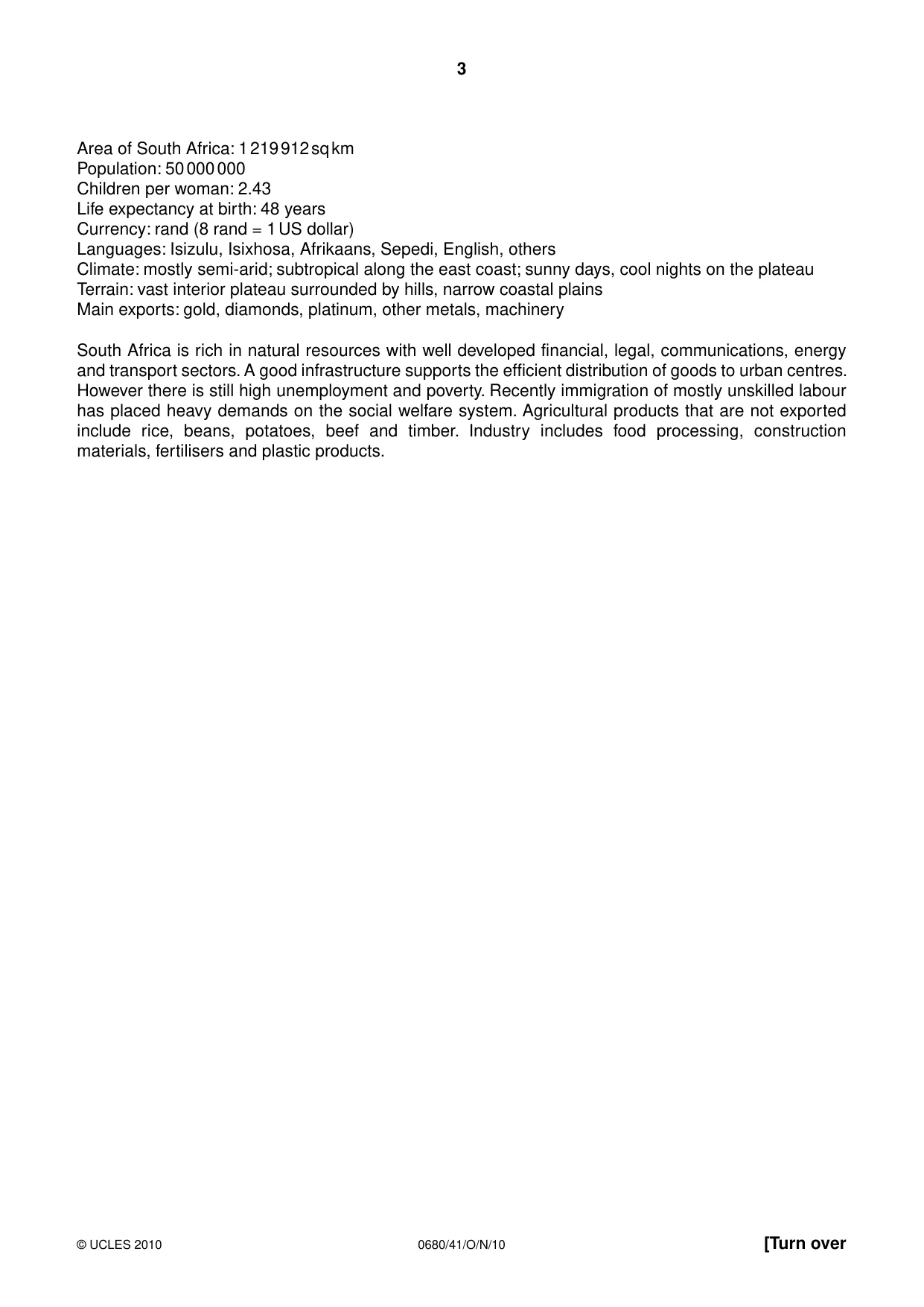
3 0680/41/O/N/10 © UCLES 2010 [Turn over Area of South Africa: 1 219 912 sq km Population: 50 000 000 Children per woman: 2.43 Life expectancy at birth: 48 years Currency: rand (8 rand = 1 US dollar) Languages: Isizulu, Isixhosa, Afrikaans, Sepedi, English, others Climate: mostly semi-arid; subtropical along the east coast; sunny days, cool nights on the plateau Terrain: vast interior plateau surrounded by hills, narrow coastal plains Main exports: gold, diamonds, platinum, other metals, machinery South Africa is rich in natural resources with well developed financial, legal, communications, energy and transport sectors. A good infrastructure supports the efficient distribution of goods to urban centres. However there is still high unemployment and poverty. Recently immigration of mostly unskilled labour has placed heavy demands on the social welfare system. Agricultural products that are not exported include rice, beans, potatoes, beef and timber. Industry includes food processing, construction materials, fertilisers and plastic products.
Question paper, page 4
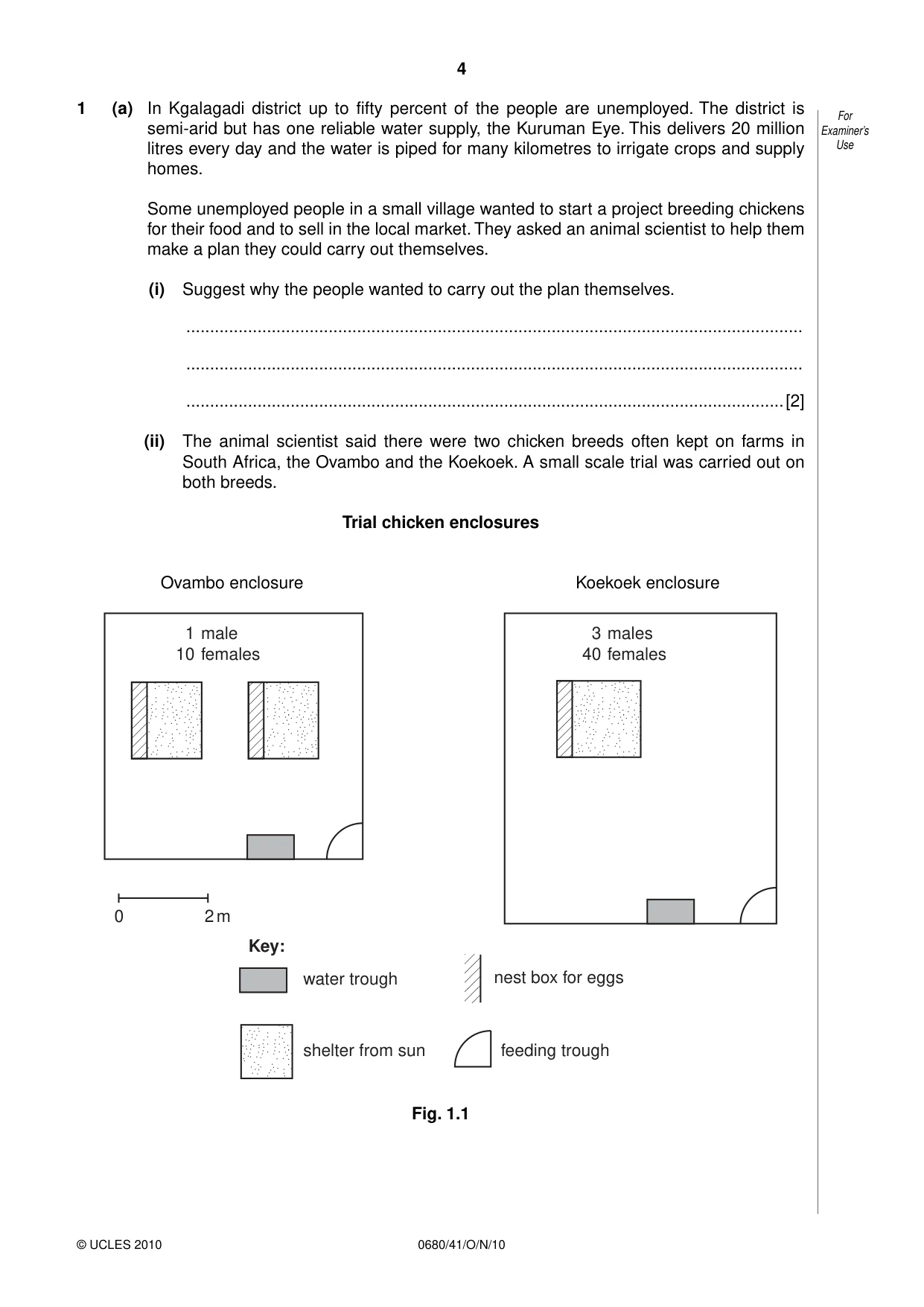
4 0680/41/O/N/10 © UCLES 2010 For Examiner’s Use 1 (a) In Kgalagadi district up to fifty percent of the people are unemployed. The district is semi-arid but has one reliable water supply, the Kuruman Eye. This delivers 20 million litres every day and the water is piped for many kilometres to irrigate crops and supply homes. Some unemployed people in a small village wanted to start a project breeding chickens for their food and to sell in the local market. They asked an animal scientist to help them make a plan they could carry out themselves. (i) Suggest why the people wanted to carry out the plan themselves. … … …[2] (ii) The animal scientist said there were two chicken breeds often kept on farms in South Africa, the Ovambo and the Koekoek. A small scale trial was carried out on both breeds. Trial chicken enclosures Ovambo enclosure Koekoek enclosure 1 10 male females 3 40 males females 0 2 m nest box for eggs feeding trough water trough Key: shelter from sun Fig. 1.1
Question paper, page 5
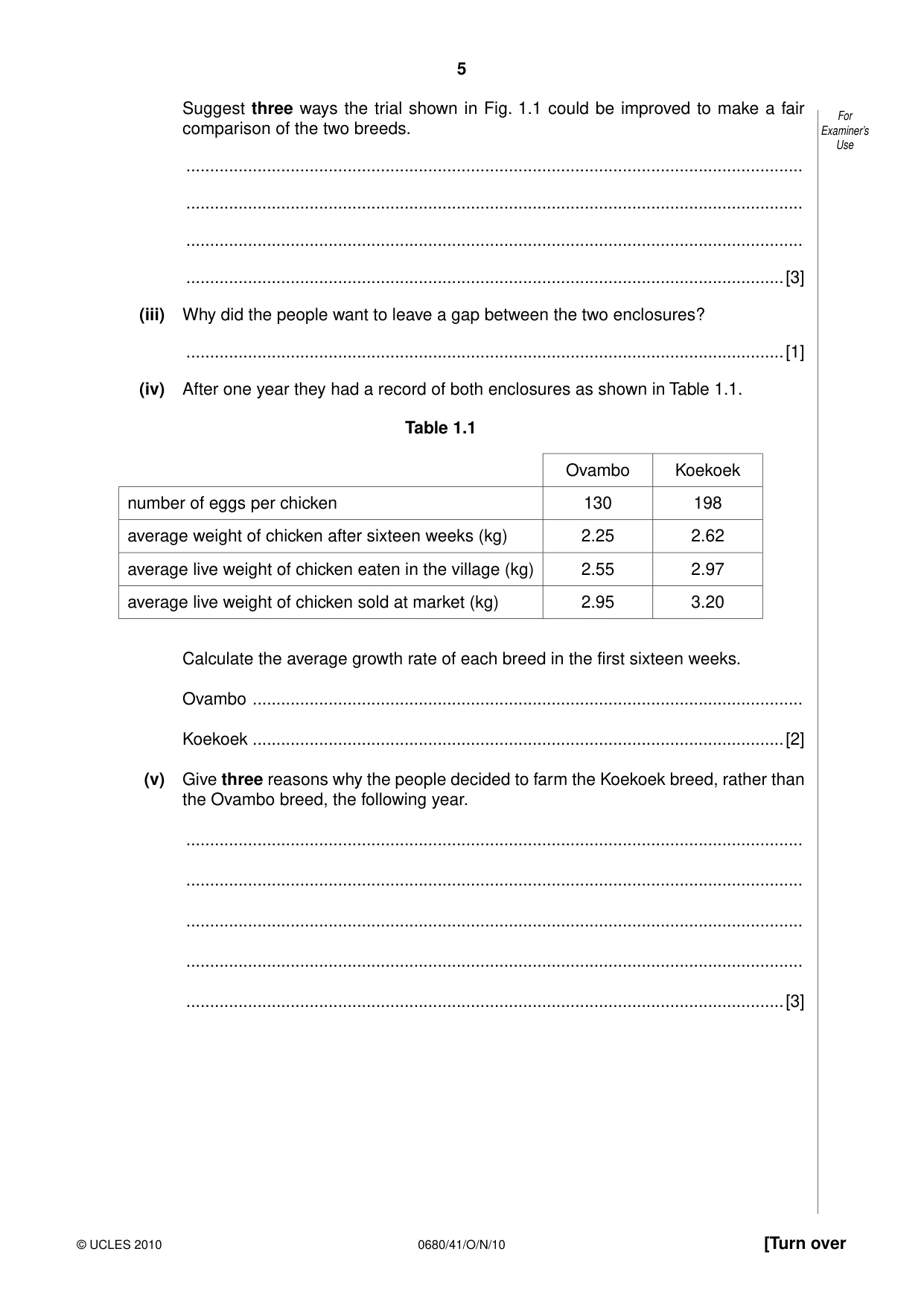
5 0680/41/O/N/10 © UCLES 2010 [Turn over For Examiner’s Use Suggest three ways the trial shown in Fig. 1.1 could be improved to make a fair comparison of the two breeds. … … … …[3] (iii) Why did the people want to leave a gap between the two enclosures? …[1] (iv) After one year they had a record of both enclosures as shown in Table 1.1. Table 1.1 Ovambo Koekoek number of eggs per chicken 130 198 average weight of chicken after sixteen weeks (kg) 2.25 2.62 average live weight of chicken eaten in the village (kg) 2.55 2.97 average live weight of chicken sold at market (kg) 2.95 3.20 Calculate the average growth rate of each breed in the first sixteen weeks. Ovambo … Koekoek …[2] (v) Give three reasons why the people decided to farm the Koekoek breed, rather than the Ovambo breed, the following year. … … … … …[3]
Question paper, page 6
6 0680/41/O/N/10 © UCLES 2010 For Examiner’s Use (b) The people built one large enclosure, 20 m × 20 m, for eighty females and six males. (i) In the space below draw a diagram to show the new Koekoek enclosure. [4] (ii) The Koekoek breed produces meat with a low fat content. Suggest why the people’s health improved when they could eat eggs as well as chicken meat. … …[1]
Question paper, page 7
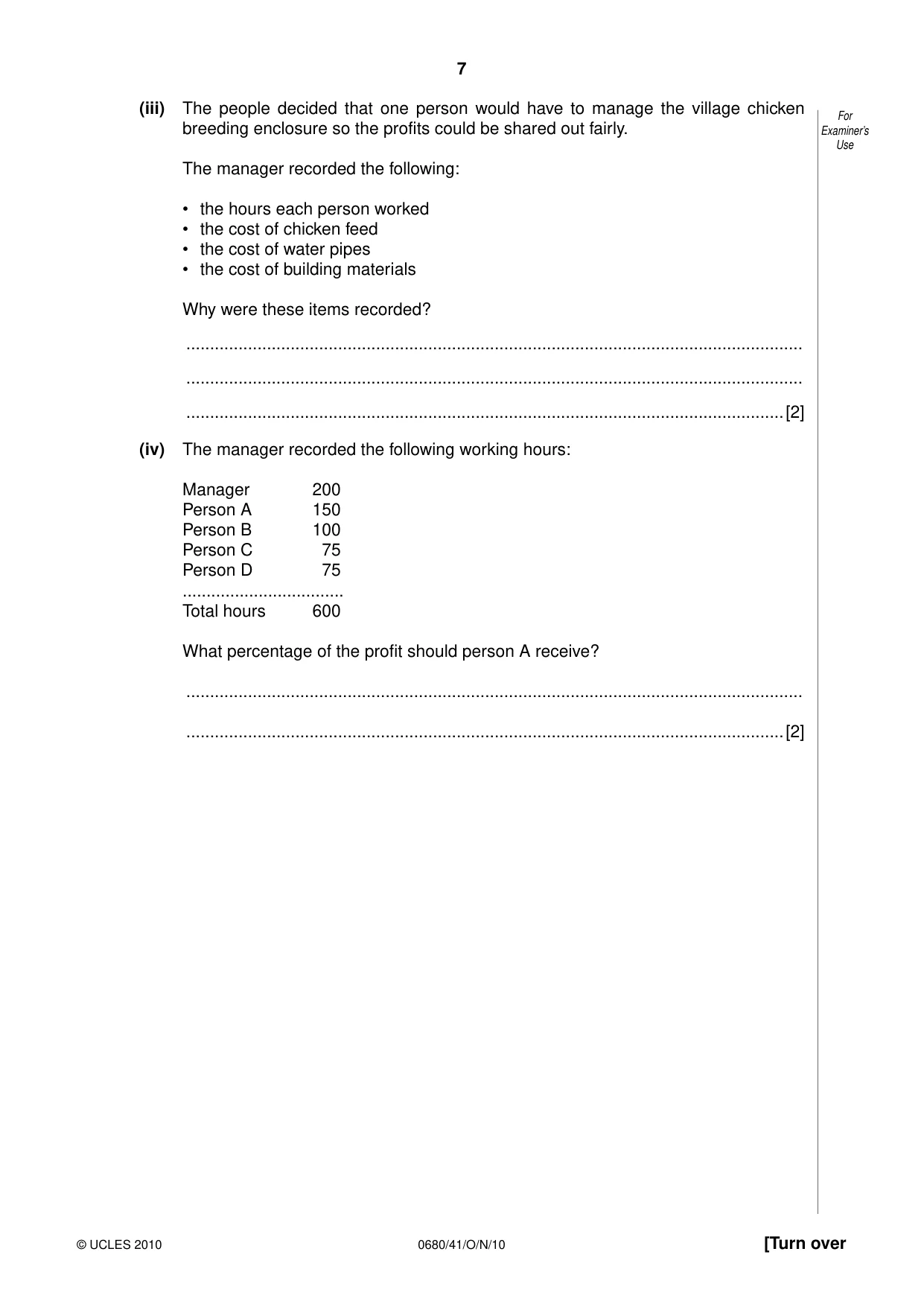
7 0680/41/O/N/10 © UCLES 2010 [Turn over For Examiner’s Use (iii) The people decided that one person would have to manage the village chicken breeding enclosure so the profits could be shared out fairly. The manager recorded the following: the hours each person worked • the cost of chicken feed • the cost of water pipes • the cost of building materials • Why were these items recorded? … … …[2] (iv) The manager recorded the following working hours: Manager 200 Person A 150 Person B 100 Person C 75 Person D 75 … Total hours 600 What percentage of the profit should person A receive? … …[2]
Question paper, page 8
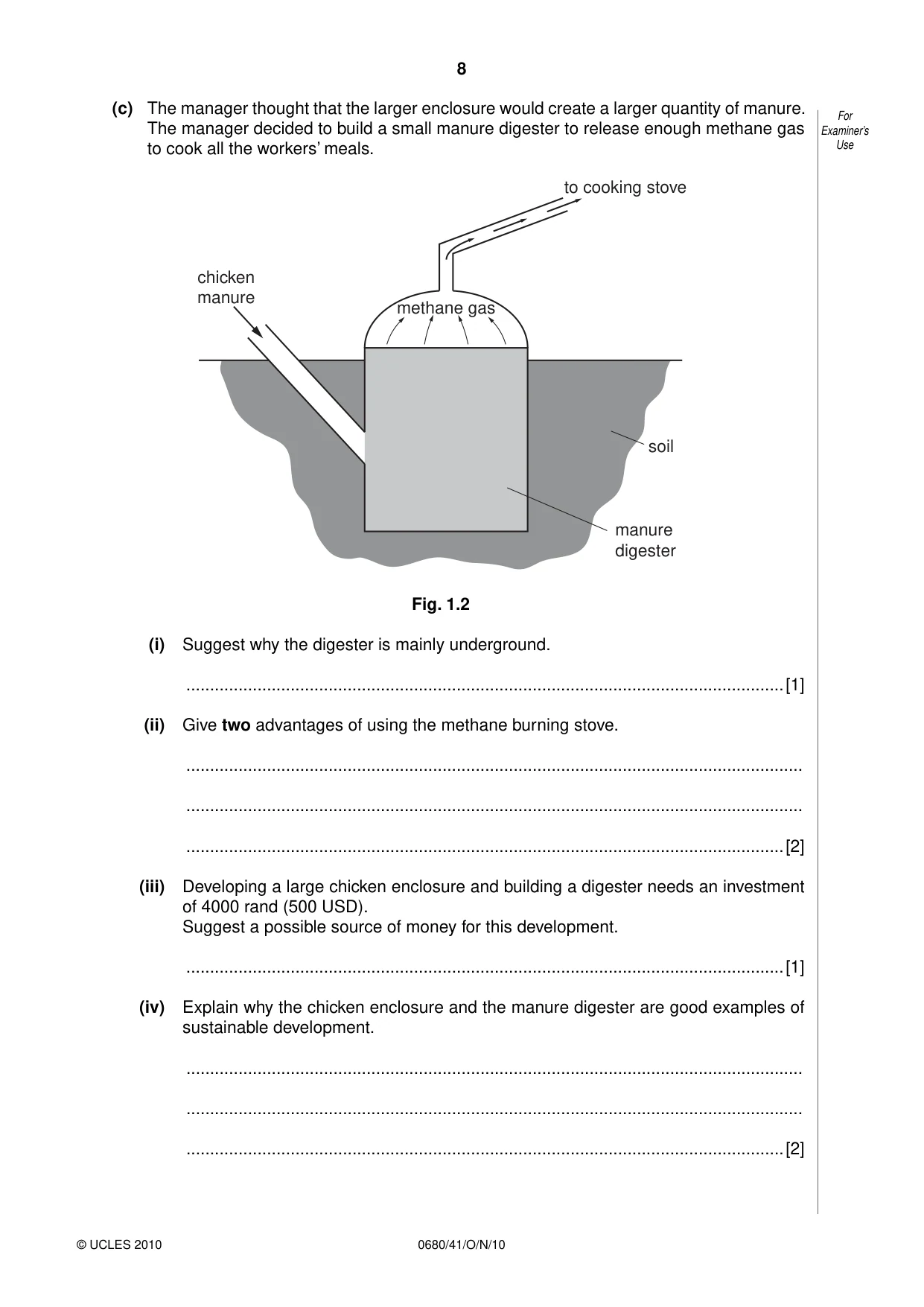
8 0680/41/O/N/10 © UCLES 2010 For Examiner’s Use (c) The manager thought that the larger enclosure would create a larger quantity of manure. The manager decided to build a small manure digester to release enough methane gas to cook all the workers’ meals. manure digester soil chicken manure methane gas to cooking stove Fig. 1.2 (i) Suggest why the digester is mainly underground. …[1] (ii) Give two advantages of using the methane burning stove. … … …[2] (iii) Developing a large chicken enclosure and building a digester needs an investment of 4000 rand (500 USD). Suggest a possible source of money for this development. …[1] (iv) Explain why the chicken enclosure and the manure digester are good examples of sustainable development. … … …[2]
Question paper, page 9
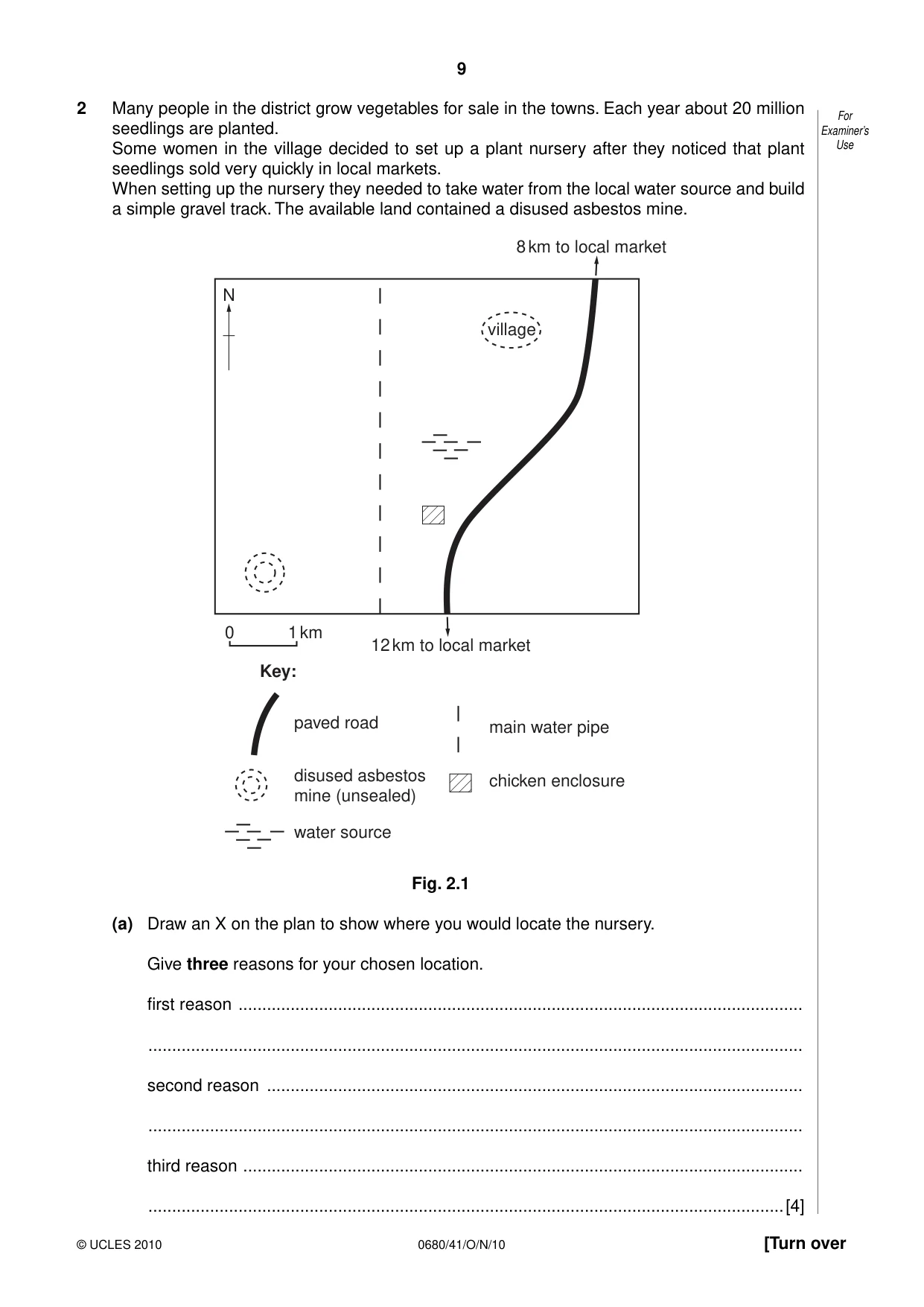
9 0680/41/O/N/10 © UCLES 2010 [Turn over For Examiner’s Use 2 Many people in the district grow vegetables for sale in the towns. Each year about 20 million seedlings are planted. Some women in the village decided to set up a plant nursery after they noticed that plant seedlings sold very quickly in local markets. When setting up the nursery they needed to take water from the local water source and build a simple gravel track. The available land contained a disused asbestos mine. 0 1 km village 8 km to local market 12 km to local market disused asbestos mine (unsealed) water source paved road Key: main water pipe chicken enclosure N Fig. 2.1 (a) Draw an X on the plan to show where you would locate the nursery. Give three reasons for your chosen location. first reason … … second reason … … third reason … …[4]
Question paper, page 10
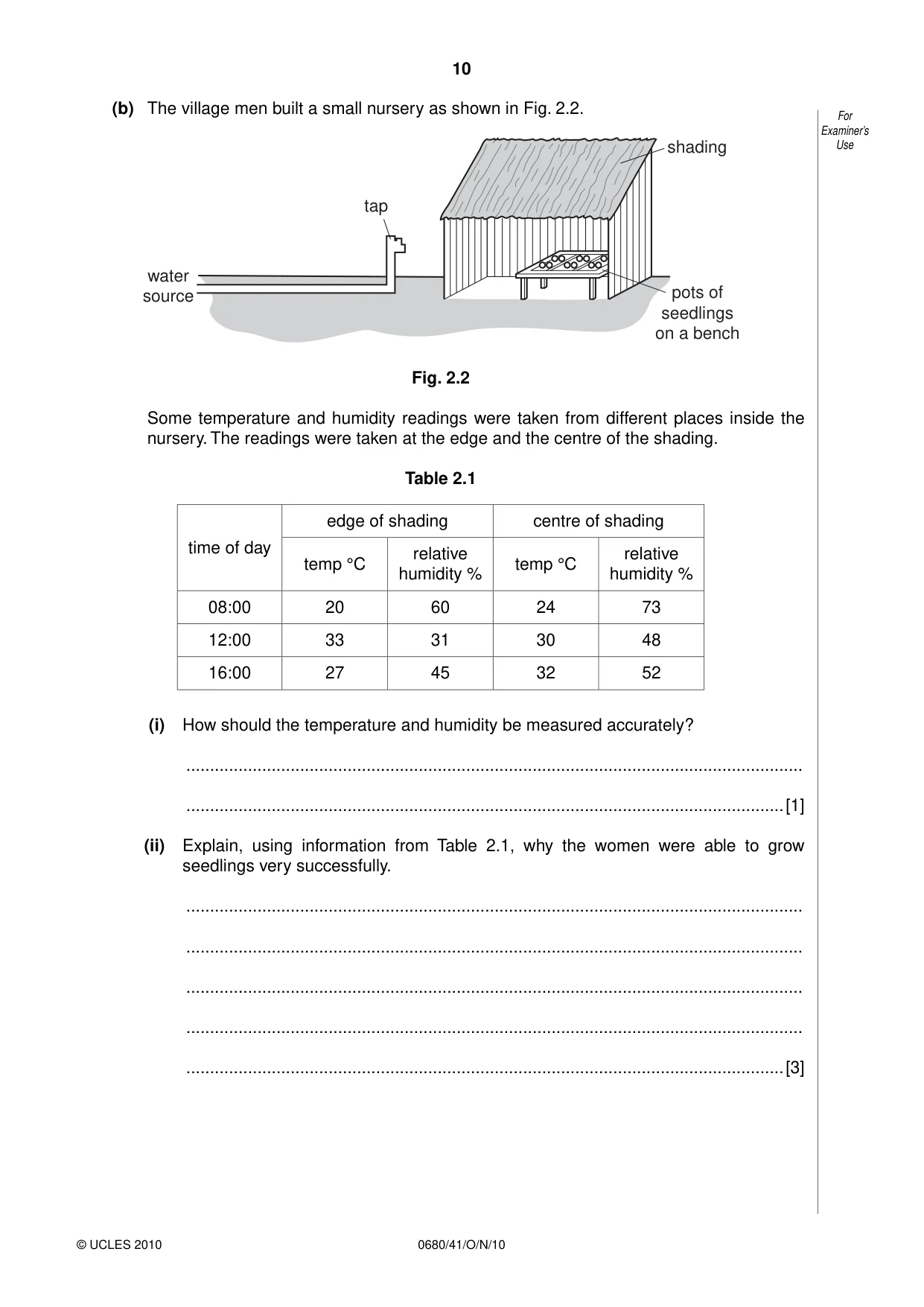
10 0680/41/O/N/10 © UCLES 2010 For Examiner’s Use (b) The village men built a small nursery as shown in Fig. 2.2. water source tap pots of seedlings on a bench shading Fig. 2.2 Some temperature and humidity readings were taken from different places inside the nursery. The readings were taken at the edge and the centre of the shading. Table 2.1 time of day edge of shading centre of shading temp °C relative humidity % temp °C relative humidity % 08:00 20 60 24 73 12:00 33 31 30 48 16:00 27 45 32 52 (i) How should the temperature and humidity be measured accurately? … …[1] (ii) Explain, using information from Table 2.1, why the women were able to grow seedlings very successfully. … … … … …[3]
Question paper, page 11
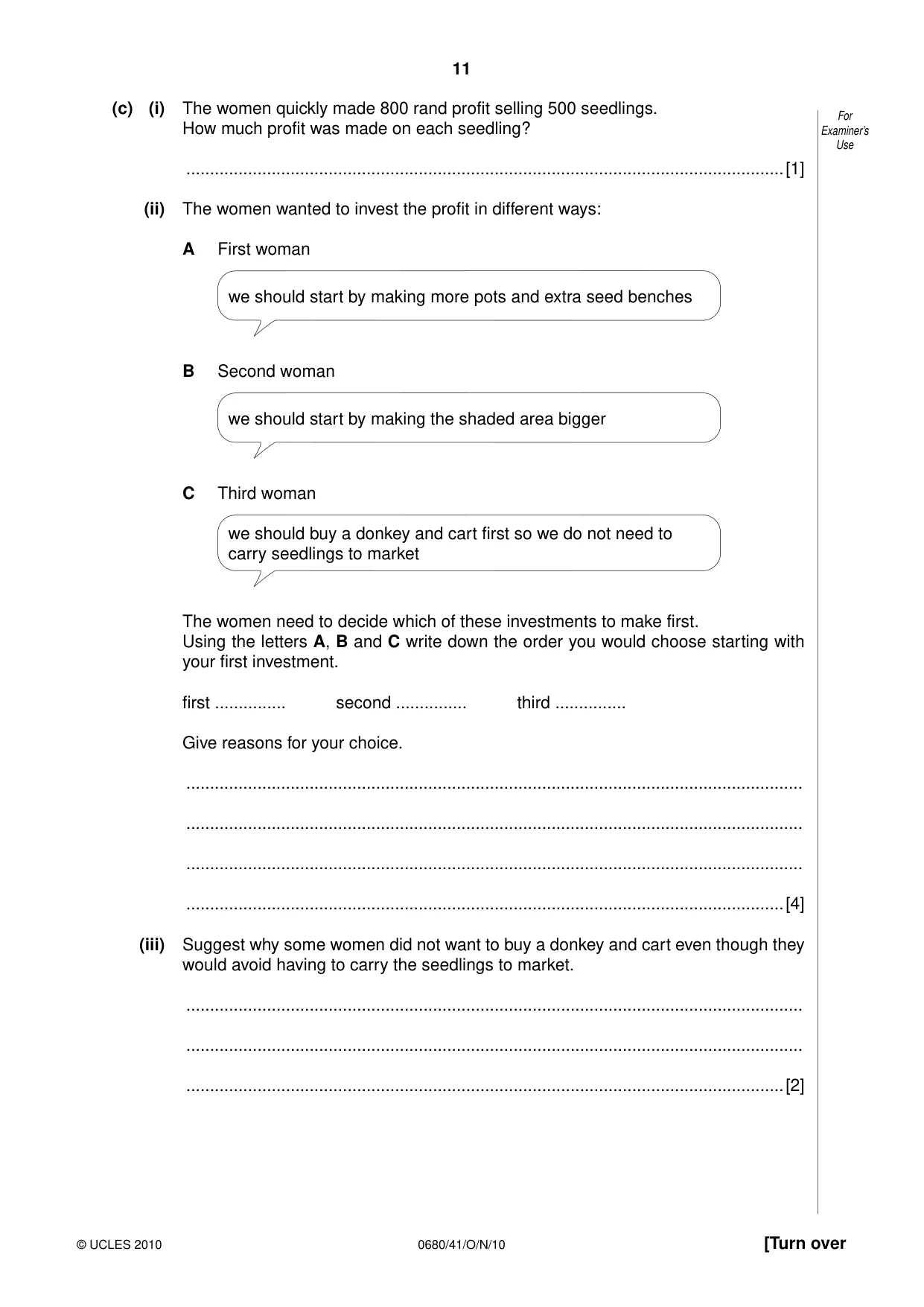
11 0680/41/O/N/10 © UCLES 2010 [Turn over For Examiner’s Use (c) (i) The women quickly made 800 rand profit selling 500 seedlings. How much profit was made on each seedling? …[1] (ii) The women wanted to invest the profit in different ways: A First woman we should start by making more pots and extra seed benches B Second woman we should start by making the shaded area bigger C Third woman we should buy a donkey and cart first so we do not need to carry seedlings to market The women need to decide which of these investments to make first. Using the letters A, B and C write down the order you would choose starting with your first investment. first … second … third … Give reasons for your choice. … … … …[4] (iii) Suggest why some women did not want to buy a donkey and cart even though they would avoid having to carry the seedlings to market. … … …[2]
Question paper, page 12
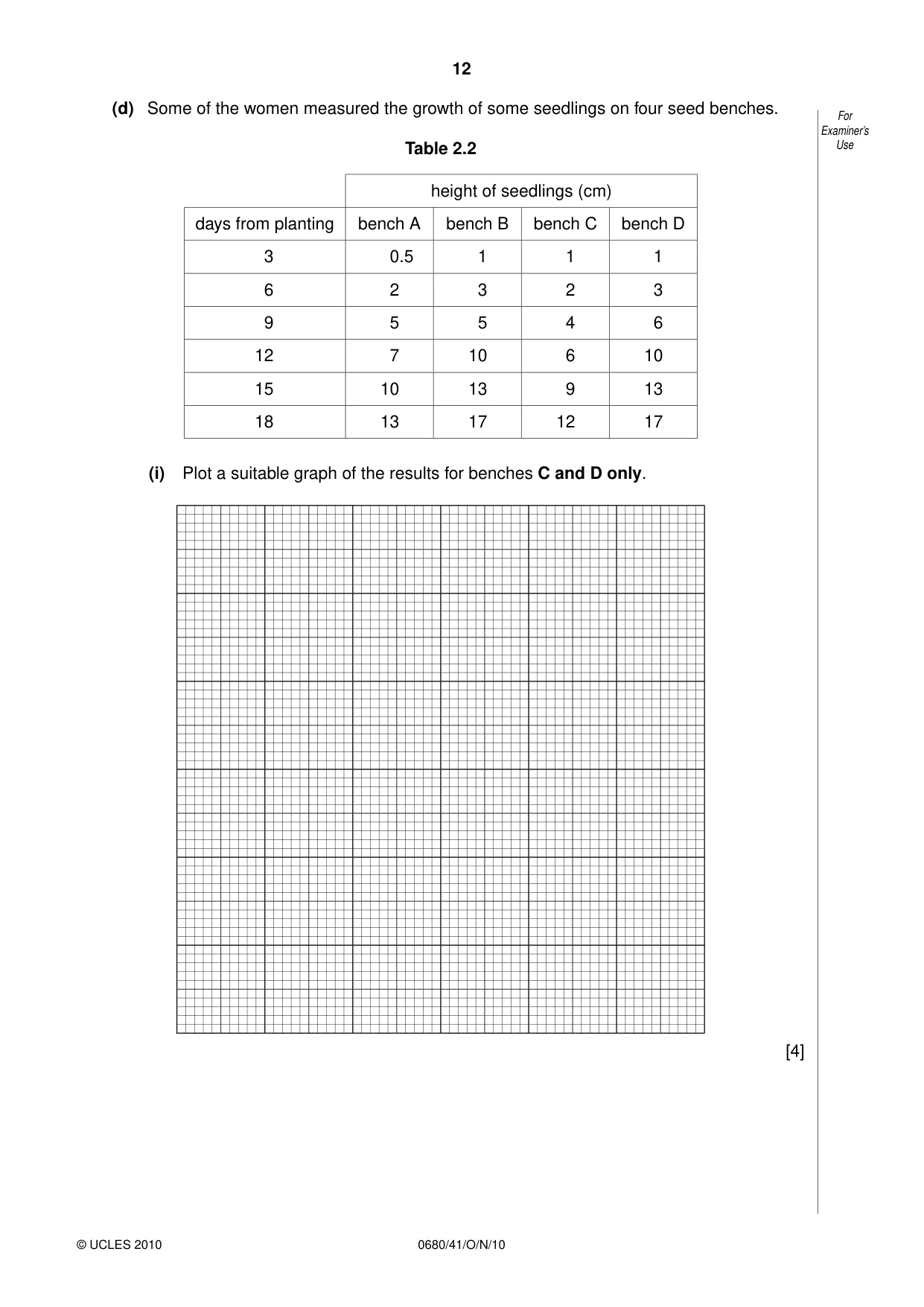
12 0680/41/O/N/10 © UCLES 2010 For Examiner’s Use (d) Some of the women measured the growth of some seedlings on four seed benches. Table 2.2 height of seedlings (cm) days from planting bench A bench B bench C bench D 3 0.5 1 1 1 6 2 3 2 3 9 5 5 4 6 12 7 10 6 10 15 10 13 9 13 18 13 17 12 17 (i) Plot a suitable graph of the results for benches C and D only. [4]
Question paper, page 13
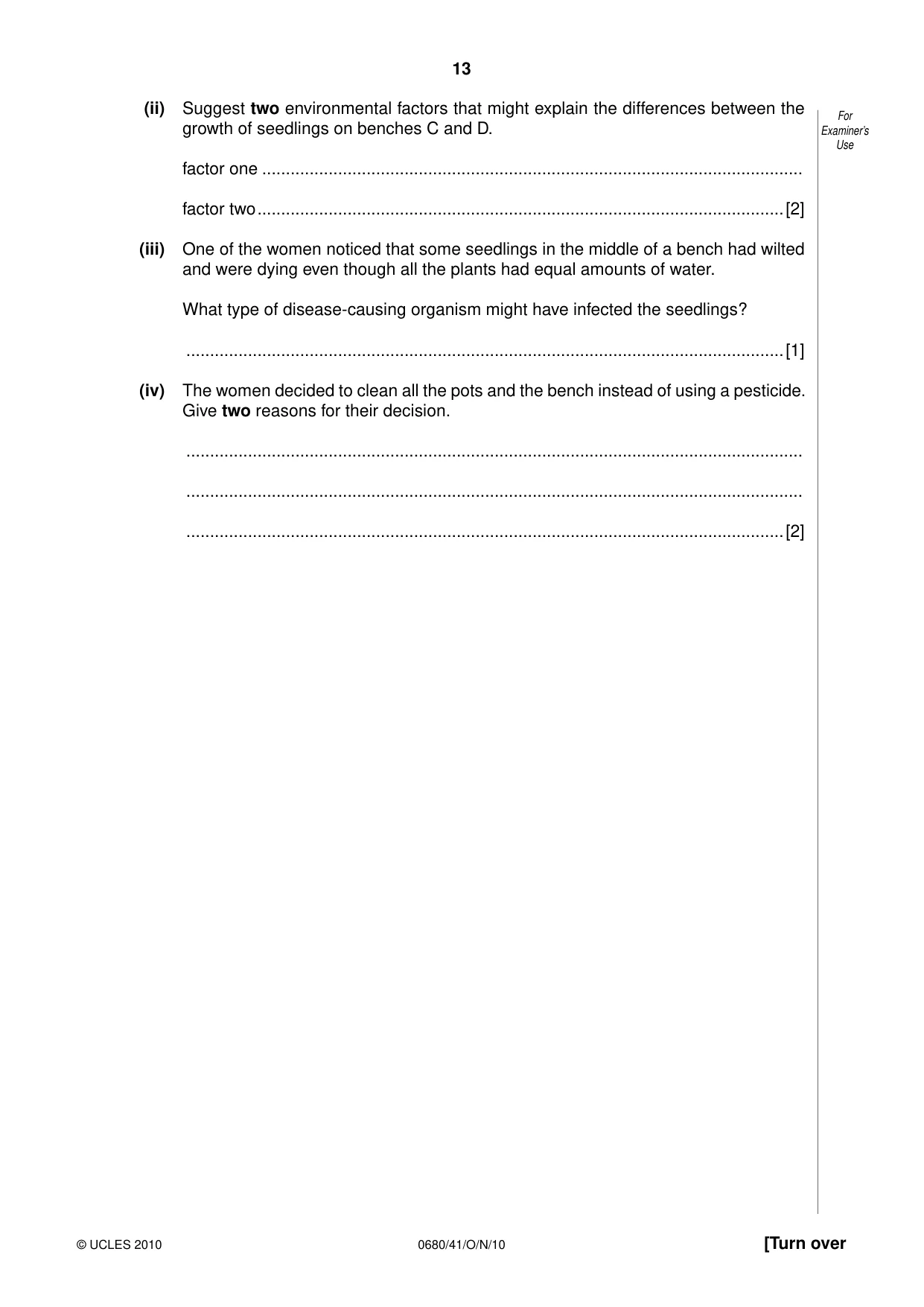
13 0680/41/O/N/10 © UCLES 2010 [Turn over For Examiner’s Use (ii) Suggest two environmental factors that might explain the differences between the growth of seedlings on benches C and D. factor one … factor two …[2] (iii) One of the women noticed that some seedlings in the middle of a bench had wilted and were dying even though all the plants had equal amounts of water. What type of disease-causing organism might have infected the seedlings? …[1] (iv) The women decided to clean all the pots and the bench instead of using a pesticide. Give two reasons for their decision. … … …[2]
Question paper, page 14
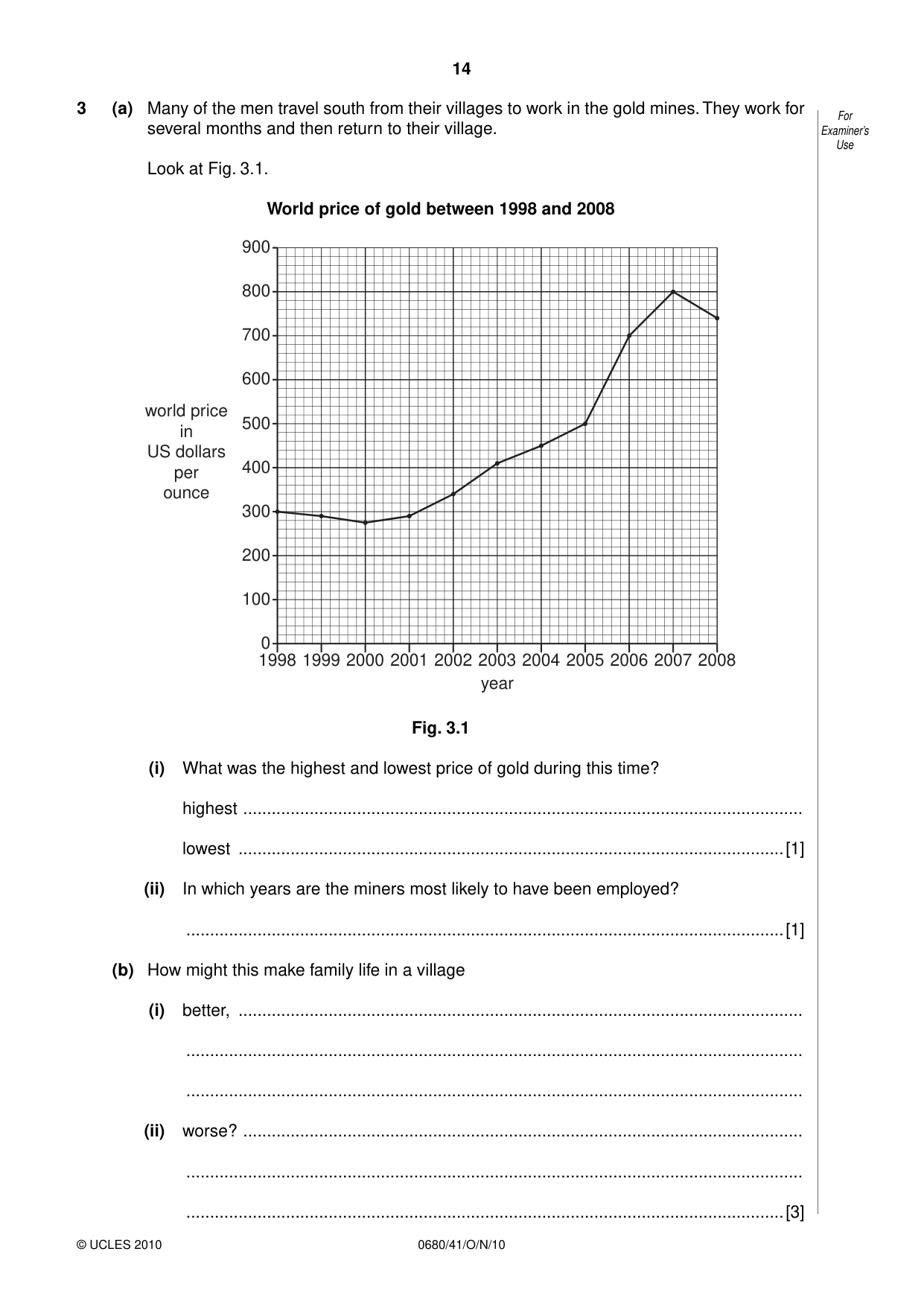
14 0680/41/O/N/10 © UCLES 2010 For Examiner’s Use 3 (a) Many of the men travel south from their villages to work in the gold mines. They work for several months and then return to their village. Look at Fig. 3.1. World price of gold between 1998 and 2008 0 1998 1999 2000 2001 2002 2003 year world price in US dollars per ounce 2004 2005 2006 2007 2008 100 200 300 400 500 600 700 800 900 Fig. 3.1 (i) What was the highest and lowest price of gold during this time? highest … lowest …[1] (ii) In which years are the miners most likely to have been employed? …[1] (b) How might this make family life in a village (i) better, … … … (ii) worse? … … …[3]
Question paper, page 15
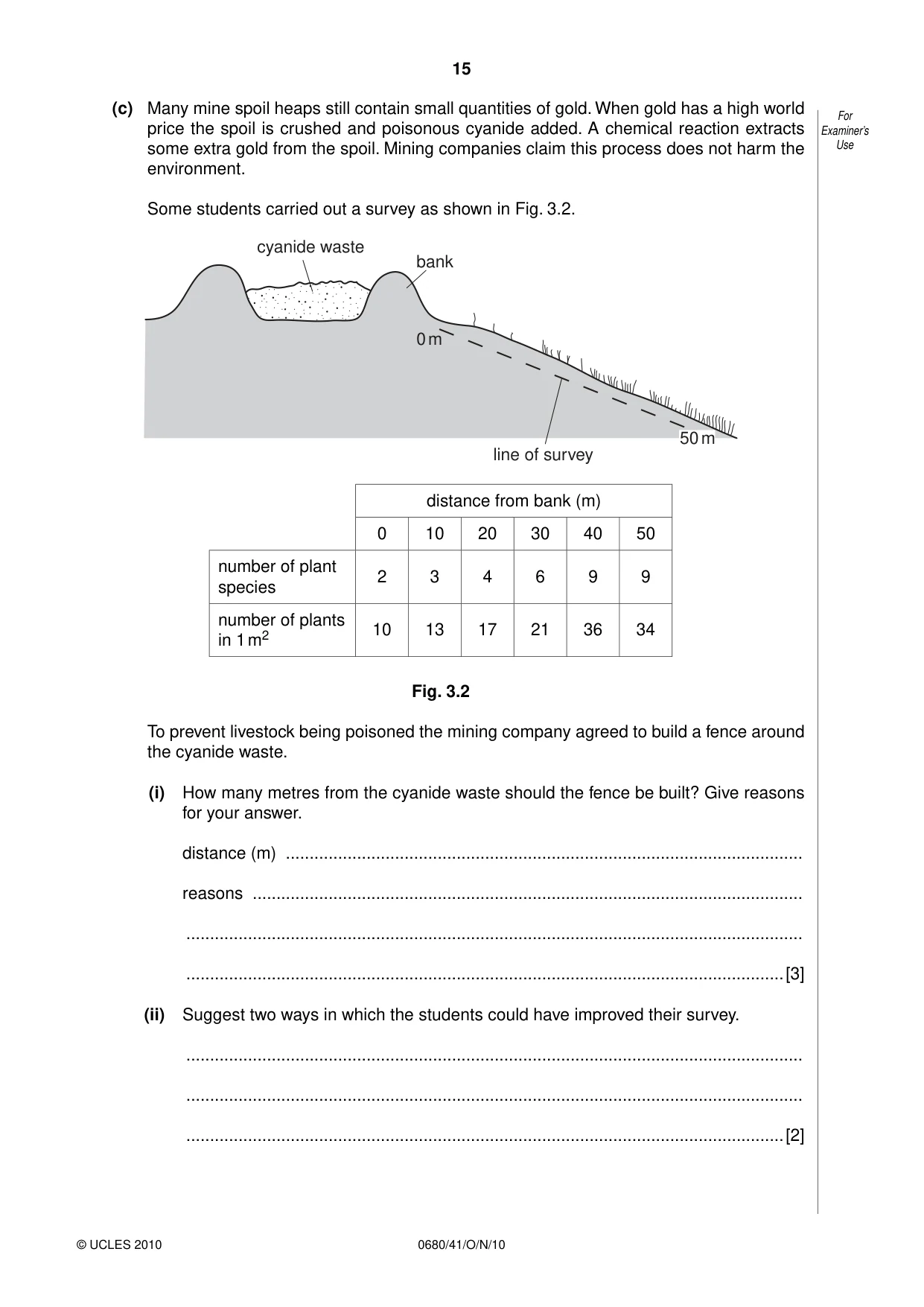
15 0680/41/O/N/10 © UCLES 2010 For Examiner’s Use (c) Many mine spoil heaps still contain small quantities of gold. When gold has a high world price the spoil is crushed and poisonous cyanide added. A chemical reaction extracts some extra gold from the spoil. Mining companies claim this process does not harm the environment. Some students carried out a survey as shown in Fig. 3.2. 0 m bank line of survey cyanide waste 50 m distance from bank (m) 0 10 20 30 40 50 number of plant species 2 3 4 6 9 9 number of plants in 1 m2 10 13 17 21 36 34 Fig. 3.2 To prevent livestock being poisoned the mining company agreed to build a fence around the cyanide waste. (i) How many metres from the cyanide waste should the fence be built? Give reasons for your answer. distance (m) … reasons … … …[3] (ii) Suggest two ways in which the students could have improved their survey. … … …[2]
Question paper, page 16
16 0680/41/O/N/10 © UCLES 2010 BLANK PAGE Permission to reproduce items where third-party owned material protected by copyright is included has been sought and cleared where possible. Every reasonable effort has been made by the publisher (UCLES) to trace copyright holders, but if any items requiring clearance have unwittingly been included, the publisher will be pleased to make amends at the earliest possible opportunity. University of Cambridge International Examinations is part of the Cambridge Assessment Group. Cambridge Assessment is the brand name of University of Cambridge Local Examinations Syndicate (UCLES), which is itself a department of the University of Cambridge.
Mark scheme, page 1
UNIVERSITY OF CAMBRIDGE INTERNATIONAL EXAMINATIONS International General Certificate of Secondary Education MARK SCHEME for the October/November 2010 question paper for the guidance of teachers 0680 ENVIRONMENTAL MANAGEMENT 0680/41 Paper 4 (Alternative to Coursework), maximum raw mark 60 This mark scheme is published as an aid to teachers and candidates, to indicate the requirements of the examination. It shows the basis on which Examiners were instructed to award marks. It does not indicate the details of the discussions that took place at an Examiners’ meeting before marking began, which would have considered the acceptability of alternative answers. Mark schemes must be read in conjunction with the question papers and the report on the examination. • CIE will not enter into discussions or correspondence in connection with these mark schemes. CIE is publishing the mark schemes for the October/November 2010 question papers for most IGCSE, GCE Advanced Level and Advanced Subsidiary Level syllabuses and some Ordinary Level syllabuses. www.XtremePapers.com
Mark scheme, page 2
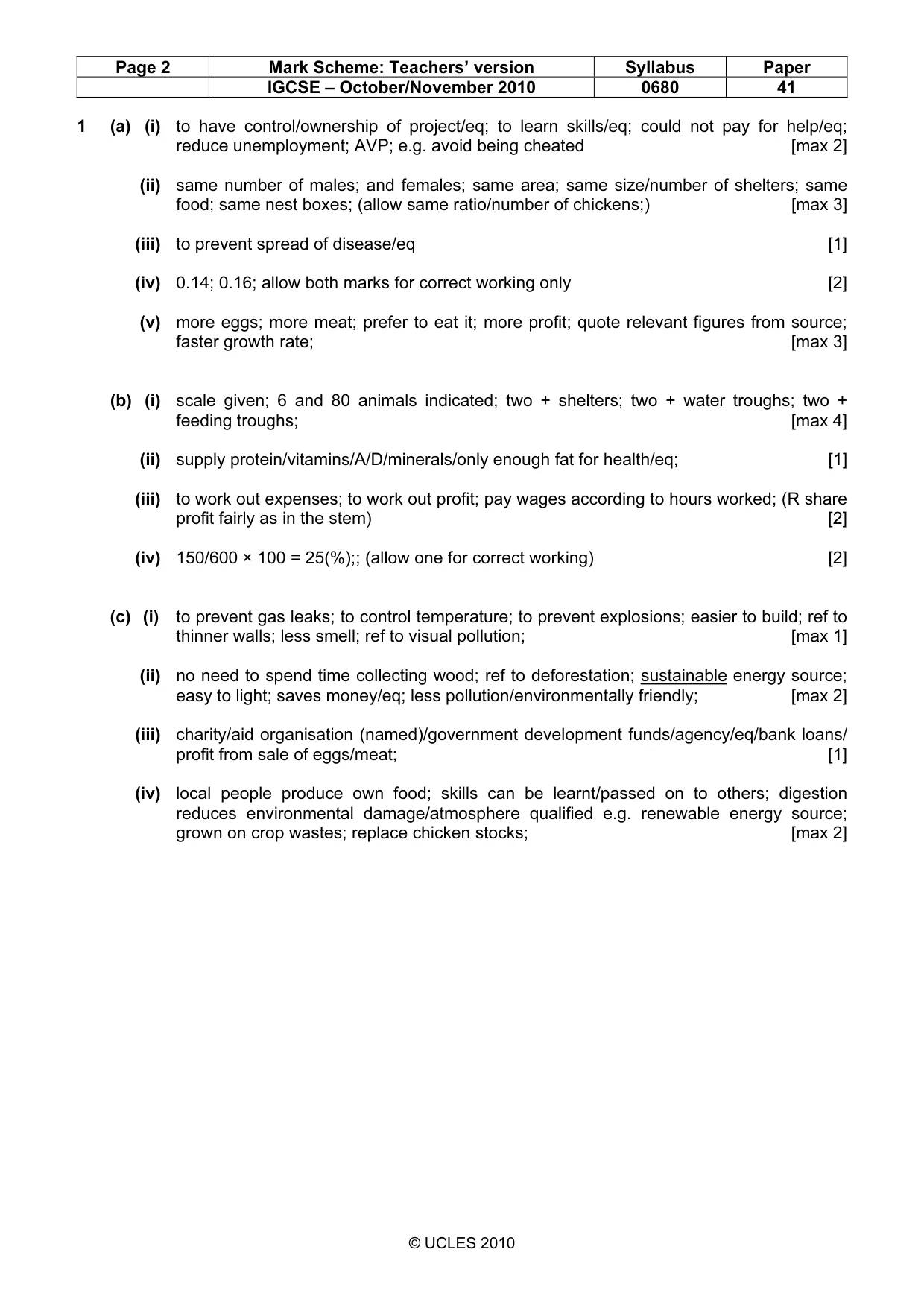
Page 2 Mark Scheme: Teachers’ version Syllabus Paper IGCSE – October/November 2010 0680 41 © UCLES 2010 1 (a) (i) to have control/ownership of project/eq; to learn skills/eq; could not pay for help/eq; reduce unemployment; AVP; e.g. avoid being cheated [max 2] (ii) same number of males; and females; same area; same size/number of shelters; same food; same nest boxes; (allow same ratio/number of chickens;) [max 3] (iii) to prevent spread of disease/eq [1] (iv) 0.14; 0.16; allow both marks for correct working only [2] (v) more eggs; more meat; prefer to eat it; more profit; quote relevant figures from source; faster growth rate; [max 3] (b) (i) scale given; 6 and 80 animals indicated; two + shelters; two + water troughs; two + feeding troughs; [max 4] (ii) supply protein/vitamins/A/D/minerals/only enough fat for health/eq; [1] (iii) to work out expenses; to work out profit; pay wages according to hours worked; (R share profit fairly as in the stem) [2] (iv) 150/600 × 100 = 25(%);; (allow one for correct working) [2] (c) (i) to prevent gas leaks; to control temperature; to prevent explosions; easier to build; ref to thinner walls; less smell; ref to visual pollution; [max 1] (ii) no need to spend time collecting wood; ref to deforestation; sustainable energy source; easy to light; saves money/eq; less pollution/environmentally friendly; [max 2] (iii) charity/aid organisation (named)/government development funds/agency/eq/bank loans/ profit from sale of eggs/meat; [1] (iv) local people produce own food; skills can be learnt/passed on to others; digestion reduces environmental damage/atmosphere qualified e.g. renewable energy source; grown on crop wastes; replace chicken stocks; [max 2]
Mark scheme, page 3
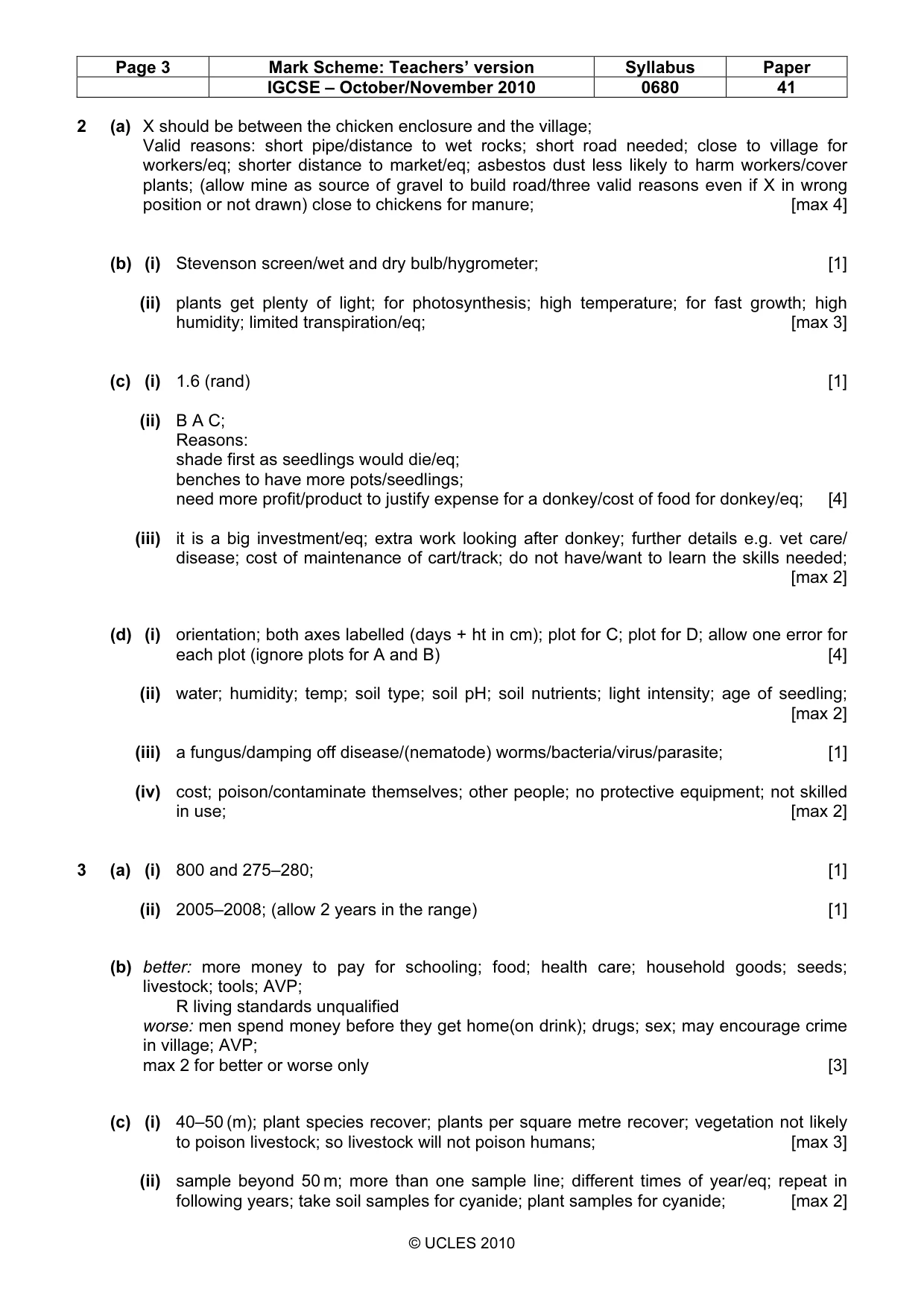
Page 3 Mark Scheme: Teachers’ version Syllabus Paper IGCSE – October/November 2010 0680 41 © UCLES 2010 2 (a) X should be between the chicken enclosure and the village; Valid reasons: short pipe/distance to wet rocks; short road needed; close to village for workers/eq; shorter distance to market/eq; asbestos dust less likely to harm workers/cover plants; (allow mine as source of gravel to build road/three valid reasons even if X in wrong position or not drawn) close to chickens for manure; [max 4] (b) (i) Stevenson screen/wet and dry bulb/hygrometer; [1] (ii) plants get plenty of light; for photosynthesis; high temperature; for fast growth; high humidity; limited transpiration/eq; [max 3] (c) (i) 1.6 (rand) [1] (ii) B A C; Reasons: shade first as seedlings would die/eq; benches to have more pots/seedlings; need more profit/product to justify expense for a donkey/cost of food for donkey/eq; [4] (iii) it is a big investment/eq; extra work looking after donkey; further details e.g. vet care/ disease; cost of maintenance of cart/track; do not have/want to learn the skills needed; [max 2] (d) (i) orientation; both axes labelled (days + ht in cm); plot for C; plot for D; allow one error for each plot (ignore plots for A and B) [4] (ii) water; humidity; temp; soil type; soil pH; soil nutrients; light intensity; age of seedling; [max 2] (iii) a fungus/damping off disease/(nematode) worms/bacteria/virus/parasite; [1] (iv) cost; poison/contaminate themselves; other people; no protective equipment; not skilled in use; [max 2] 3 (a) (i) 800 and 275–280; [1] (ii) 2005–2008; (allow 2 years in the range) [1] (b) better: more money to pay for schooling; food; health care; household goods; seeds; livestock; tools; AVP; R living standards unqualified worse: men spend money before they get home(on drink); drugs; sex; may encourage crime in village; AVP; max 2 for better or worse only [3] (c) (i) 40–50 (m); plant species recover; plants per square metre recover; vegetation not likely to poison livestock; so livestock will not poison humans; [max 3] (ii) sample beyond 50 m; more than one sample line; different times of year/eq; repeat in following years; take soil samples for cyanide; plant samples for cyanide; [max 2]
What you needed in this session
Cambridge’s own grade thresholds for 2010 Oct/Nov, Paper 4 · Variant 1. A higher threshold means an easier paper — the bar moves with how the cohort did.