Cambridge IGCSE English - Literature in English 0475 — 2020 May/June Paper 1 · Variant 3
0475/13/M/J/20
The question paper and its mark scheme, free to read here and free to download. This is Cambridge’s own paper, exactly as it was sat.
Question paper28 pages






Mark scheme4 pages
Answers below. Sit the paper first if you are practising.
Paper as text
Question paper, page 1
Cambridge IGCSE™ * 2 8 3 1 3 7 9 1 9 1 * DC (RCL/GO) 184381/2 © UCLES 2020 [Turn over This document has 28 pages. Blank pages are indicated. LITERATURE IN ENGLISH 0475/13 Paper 1 Poetry and Prose May/June 2020 1 hour 30 minutes You must answer on the enclosed answer booklet. You will need: Answer booklet (enclosed) INSTRUCTIONS ● Answer two questions in total: Section A: answer one question. Section B: answer one question. ● Follow the instructions on the front cover of the answer booklet. If you need additional answer paper, ask the invigilator for a continuation booklet. INFORMATION ● The total mark for this paper is 50. ● All questions are worth equal marks. Cambridge IGCSE™
Question paper, page 2
2 0475/13/M/J/20 © UCLES 2020 BLANK PAGE
Question paper, page 3
3 0475/13/M/J/20 © UCLES 2020 [Turn over CONTENTS Section A: Poetry text question numbers page[s] Songs of Ourselves Volume 1: from Part 3 1, 2 pages 4–5 Songs of Ourselves Volume 2 : from Part 2 3, 4 pages 6–7 Carol Ann Duffy: from New Selected Poems 5, 6 pages 8–9 Section B: Prose text question numbers page[s] Charlotte Brontë: Jane Eyre 7, 8 pages 10–11 Anita Desai: In Custody 9, 10 pages 12–13 Charles Dickens: Hard Times 11, 12 pages 14–15 Zora Neale Hurston: Their Eyes Were Watching God 13, 14 pages 16–17 John Knowles: A Separate Peace 15, 16 pages 18–19 George Orwell: 1984 17, 18 pages 20–21 Alan Paton: Cry, the Beloved Country 19, 20 pages 22–23 from Stories of Ourselves 21, 22 pages 24–25
Question paper, page 4
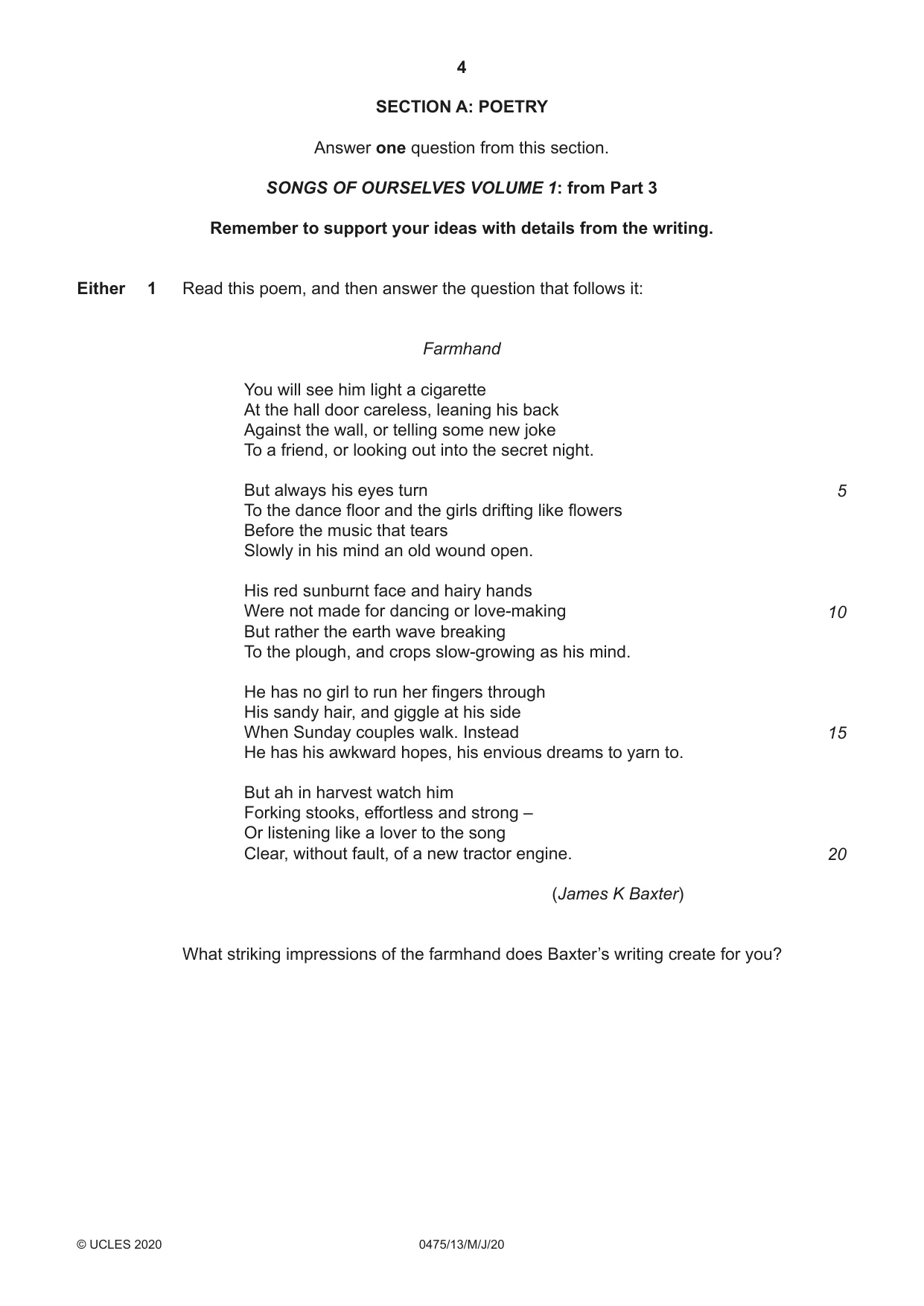
4 0475/13/M/J/20 © UCLES 2020 SECTION A: POETRY Answer one question from this section. SONGS OF OURSELVES VOLUME 1: from Part 3 Remember to support your ideas with details from the writing. Either 1 Read this poem, and then answer the question that follows it: Farmhand You will see him light a cigarette At the hall door careless, leaning his back Against the wall, or telling some new joke To a friend, or looking out into the secret night. But always his eyes turn To the dance floor and the girls drifting like flowers Before the music that tears Slowly in his mind an old wound open. His red sunburnt face and hairy hands Were not made for dancing or love-making But rather the earth wave breaking To the plough, and crops slow-growing as his mind. He has no girl to run her fingers through His sandy hair, and giggle at his side When Sunday couples walk. Instead He has his awkward hopes, his envious dreams to yarn to. But ah in harvest watch him Forking stooks, effortless and strong – Or listening like a lover to the song Clear, without fault, of a new tractor engine. (James K Baxter) What striking impressions of the farmhand does Baxter’s writing create for you? 5 10 15 20
Question paper, page 5
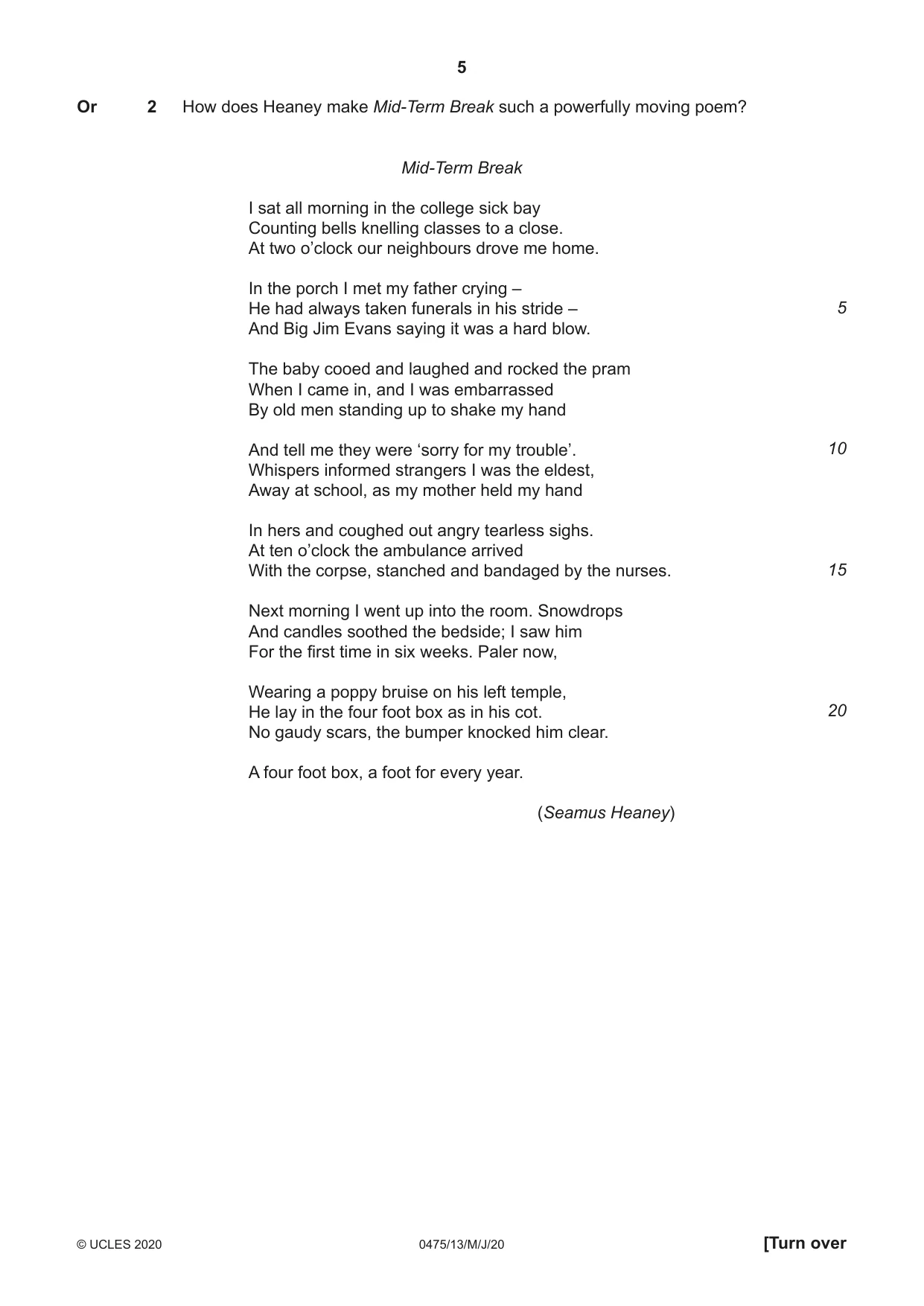
5 0475/13/M/J/20 © UCLES 2020 [Turn over Or 2 How does Heaney make Mid-Term Break such a powerfully moving poem? Mid-Term Break I sat all morning in the college sick bay Counting bells knelling classes to a close. At two o’clock our neighbours drove me home. In the porch I met my father crying – He had always taken funerals in his stride – And Big Jim Evans saying it was a hard blow. The baby cooed and laughed and rocked the pram When I came in, and I was embarrassed By old men standing up to shake my hand And tell me they were ‘sorry for my trouble’. Whispers informed strangers I was the eldest, Away at school, as my mother held my hand In hers and coughed out angry tearless sighs. At ten o’clock the ambulance arrived With the corpse, stanched and bandaged by the nurses. Next morning I went up into the room. Snowdrops And candles soothed the bedside; I saw him For the first time in six weeks. Paler now, Wearing a poppy bruise on his left temple, He lay in the four foot box as in his cot. No gaudy scars, the bumper knocked him clear. A four foot box, a foot for every year. (Seamus Heaney) 5 10 15 20
Question paper, page 6
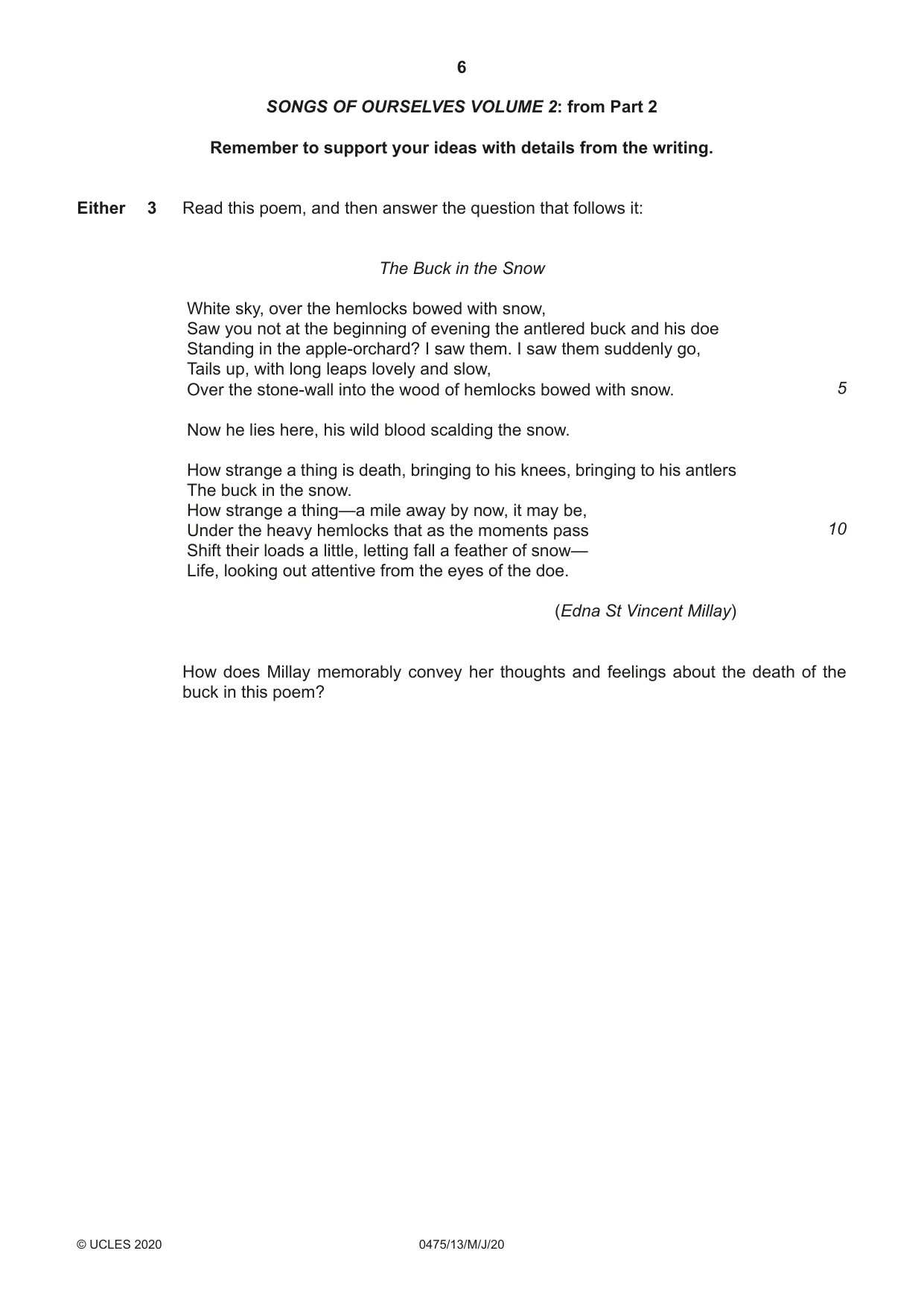
6 0475/13/M/J/20 © UCLES 2020 SONGS OF OURSELVES VOLUME 2: from Part 2 Remember to support your ideas with details from the writing. Either 3 Read this poem, and then answer the question that follows it: The Buck in the Snow White sky, over the hemlocks bowed with snow, Saw you not at the beginning of evening the antlered buck and his doe Standing in the apple-orchard? I saw them. I saw them suddenly go, Tails up, with long leaps lovely and slow, Over the stone-wall into the wood of hemlocks bowed with snow. Now he lies here, his wild blood scalding the snow. How strange a thing is death, bringing to his knees, bringing to his antlers The buck in the snow. How strange a thing—a mile away by now, it may be, Under the heavy hemlocks that as the moments pass Shift their loads a little, letting fall a feather of snow— Life, looking out attentive from the eyes of the doe. (Edna St Vincent Millay) How does Millay memorably convey her thoughts and feelings about the death of the buck in this poem? 5 10
Question paper, page 7
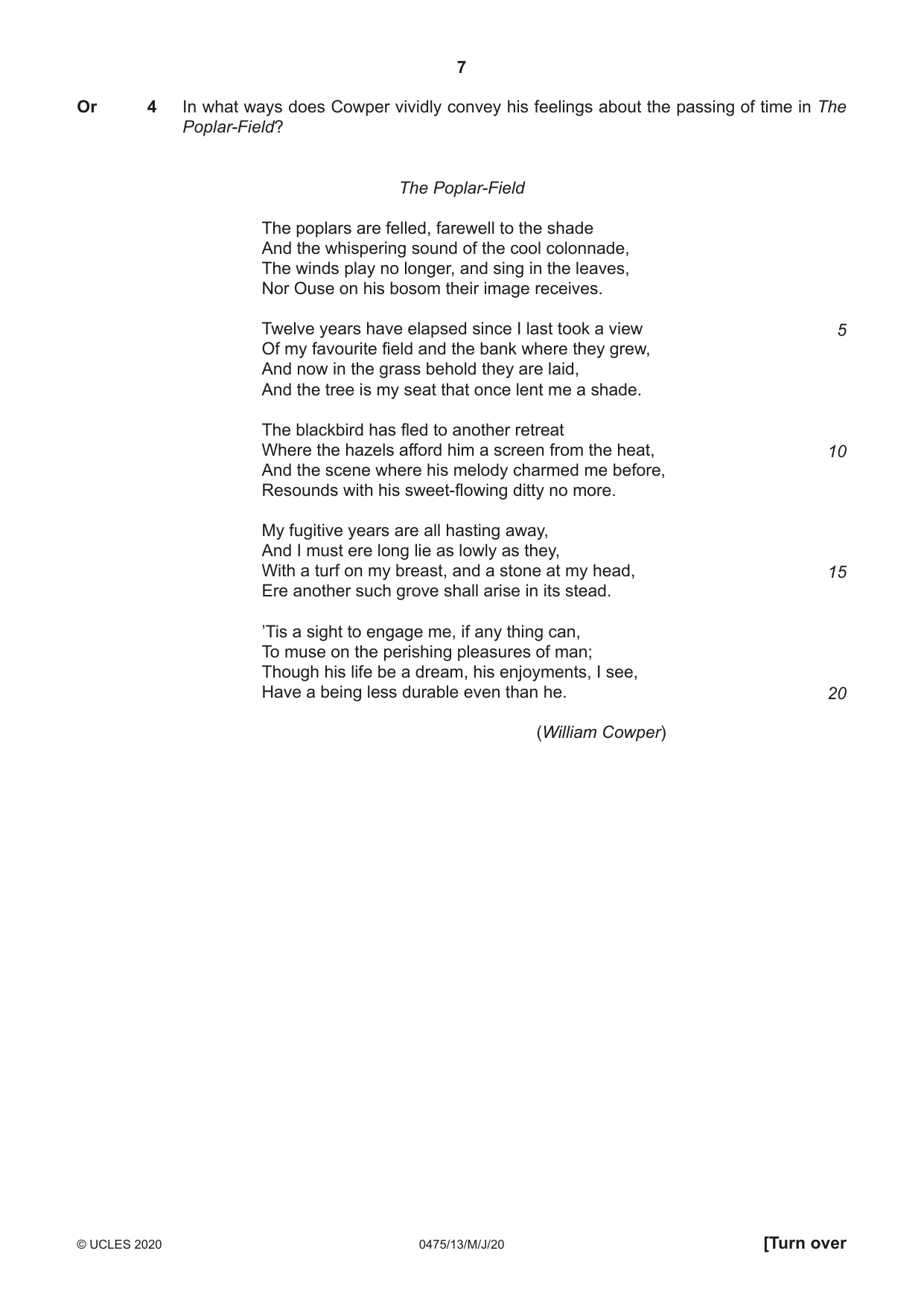
7 0475/13/M/J/20 © UCLES 2020 [Turn over Or 4 In what ways does Cowper vividly convey his feelings about the passing of time in The Poplar-Field? The Poplar-Field The poplars are felled, farewell to the shade And the whispering sound of the cool colonnade, The winds play no longer, and sing in the leaves, Nor Ouse on his bosom their image receives. Twelve years have elapsed since I last took a view Of my favourite field and the bank where they grew, And now in the grass behold they are laid, And the tree is my seat that once lent me a shade. The blackbird has fled to another retreat Where the hazels afford him a screen from the heat, And the scene where his melody charmed me before, Resounds with his sweet-flowing ditty no more. My fugitive years are all hasting away, And I must ere long lie as lowly as they, With a turf on my breast, and a stone at my head, Ere another such grove shall arise in its stead. ’Tis a sight to engage me, if any thing can, To muse on the perishing pleasures of man; Though his life be a dream, his enjoyments, I see, Have a being less durable even than he. (William Cowper) 5 10 15 20
Question paper, page 8
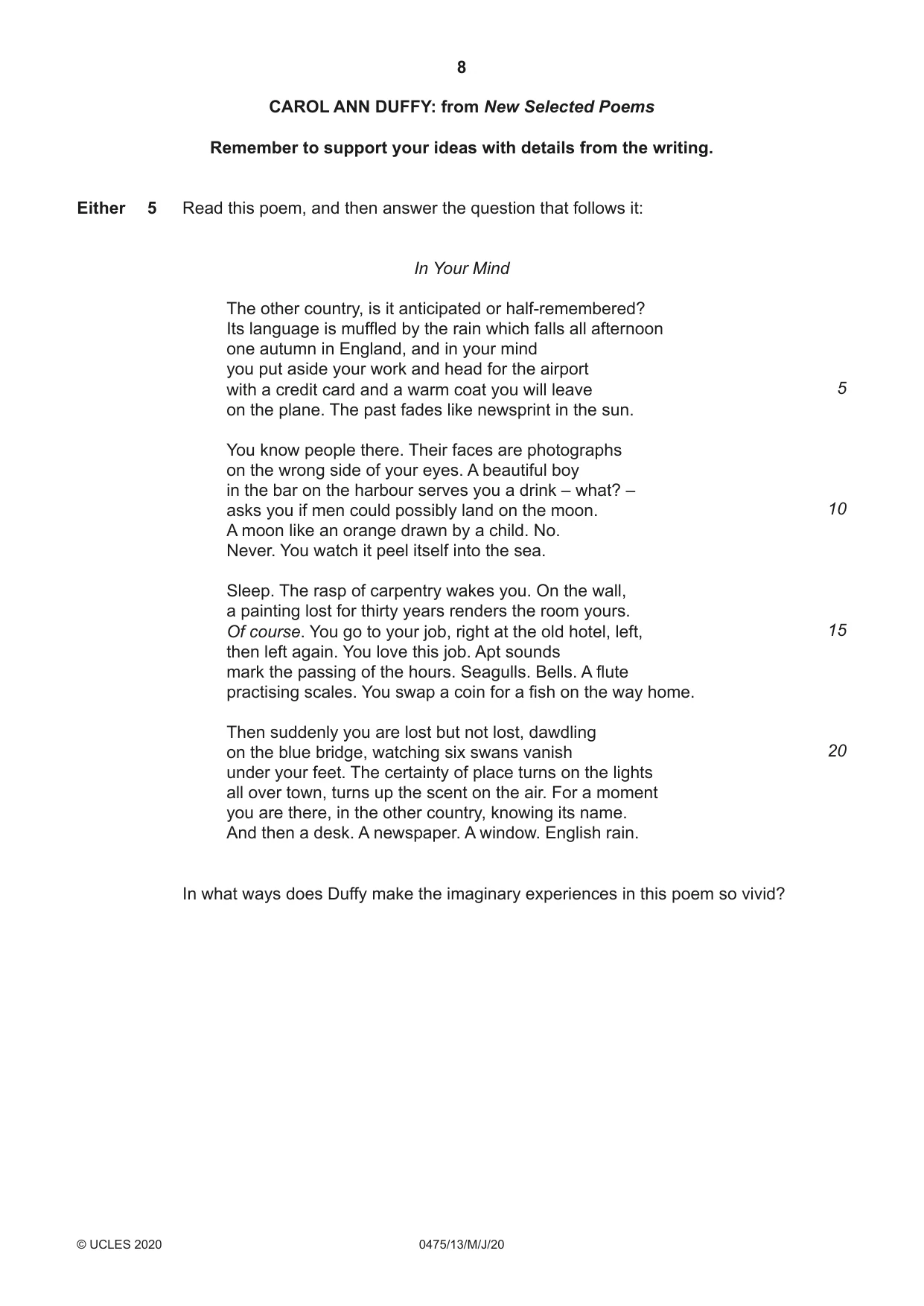
8 0475/13/M/J/20 © UCLES 2020 CAROL ANN DUFFY: from New Selected Poems Remember to support your ideas with details from the writing. Either 5 Read this poem, and then answer the question that follows it: In Your Mind The other country, is it anticipated or half-remembered? Its language is muffled by the rain which falls all afternoon one autumn in England, and in your mind you put aside your work and head for the airport with a credit card and a warm coat you will leave on the plane. The past fades like newsprint in the sun. You know people there. Their faces are photographs on the wrong side of your eyes. A beautiful boy in the bar on the harbour serves you a drink – what? – asks you if men could possibly land on the moon. A moon like an orange drawn by a child. No. Never. You watch it peel itself into the sea. Sleep. The rasp of carpentry wakes you. On the wall, a painting lost for thirty years renders the room yours. Of course. You go to your job, right at the old hotel, left, then left again. You love this job. Apt sounds mark the passing of the hours. Seagulls. Bells. A flute practising scales. You swap a coin for a fish on the way home. Then suddenly you are lost but not lost, dawdling on the blue bridge, watching six swans vanish under your feet. The certainty of place turns on the lights all over town, turns up the scent on the air. For a moment you are there, in the other country, knowing its name. And then a desk. A newspaper. A window. English rain. In what ways does Duffy make the imaginary experiences in this poem so vivid? 5 10 15 20
Question paper, page 9
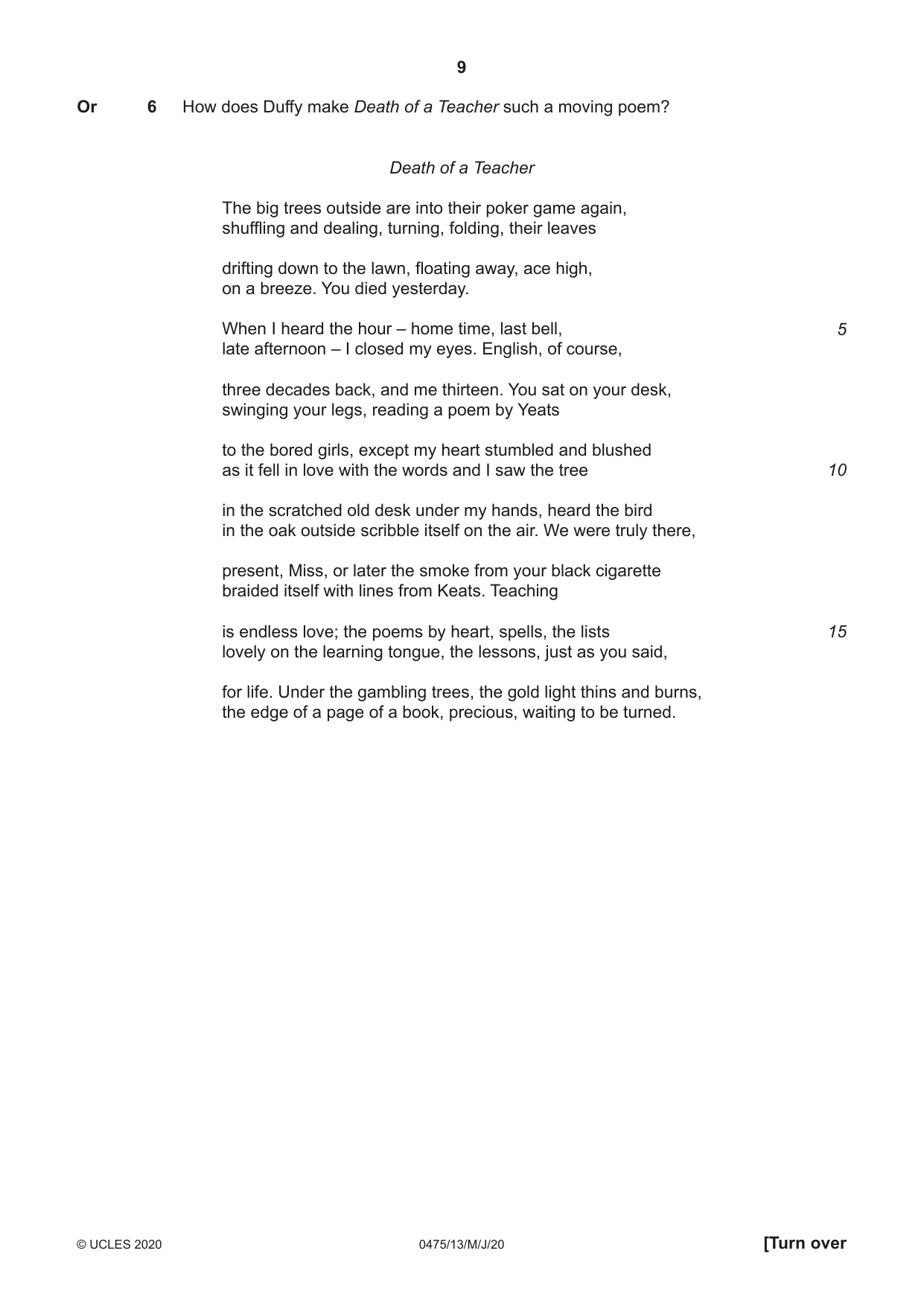
9 0475/13/M/J/20 © UCLES 2020 [Turn over Or 6 How does Duffy make Death of a Teacher such a moving poem? Death of a Teacher The big trees outside are into their poker game again, shuffling and dealing, turning, folding, their leaves drifting down to the lawn, floating away, ace high, on a breeze. You died yesterday. When I heard the hour – home time, last bell, late afternoon – I closed my eyes. English, of course, three decades back, and me thirteen. You sat on your desk, swinging your legs, reading a poem by Yeats to the bored girls, except my heart stumbled and blushed as it fell in love with the words and I saw the tree in the scratched old desk under my hands, heard the bird in the oak outside scribble itself on the air. We were truly there, present, Miss, or later the smoke from your black cigarette braided itself with lines from Keats. Teaching is endless love; the poems by heart, spells, the lists lovely on the learning tongue, the lessons, just as you said, for life. Under the gambling trees, the gold light thins and burns, the edge of a page of a book, precious, waiting to be turned. 5 10 15
Question paper, page 10
10 0475/13/M/J/20 © UCLES 2020 SECTION B: PROSE Answer one question from this section. CHARLOTTE BRONTË: Jane Eyre Remember to support your ideas with details from the writing. Either 7 Read this passage, and then answer the question that follows it: Miss Temple gently assisted me to his very feet, and I caught her whispered counsel – ‘Don’t be afraid, Jane, I saw it was an accident; you shall not be punished.’ The kind whisper went to my heart like a dagger. ‘Another minute and she will despise me for a hypocrite,’ thought I; and an impulse of fury against Reed, Brocklehurst, and Co. bounded in my pulses at the conviction. I was no Helen Burns. ‘Fetch that stool,’ said Mr Brocklehurst, pointing to a very high one from which a monitor had just risen: it was brought. ‘Place the child upon it.’ And I was placed there, by whom I don’t know. I was in no condition to note particulars. I was only aware that they had hoisted me up to the height of Mr Brocklehurst’s nose, that he was within a yard of me, and that a spread of shot orange and purple silk pelisses, and a cloud of silvery plumage extended and waved below me. Mr Brocklehurst hemmed. ‘Ladies,’ said he, turning to his family; ‘Miss Temple, teachers, and children, you all see this girl?’ Of course they did; for I felt their eyes directed like burning-glasses against my scorched skin. ‘You see she is yet young; you observe she possesses the ordinary form of childhood; God has graciously given her the shape that He has given to all of us; no single deformity points her out as a marked character. Who would think that the Evil One had already found a servant and agent in her? Yet such, I grieve to say, is the case.’ A pause – in which I began to steady the palsy of my nerves, and to feel that the Rubicon was passed, and that the trial, no longer to be shirked, must be firmly sustained. ‘My dear children,’ pursued the black marble clergyman with pathos, ‘this is a sad, a melancholy occasion; for it becomes my duty to warn you that this girl, who might be one of God’s own lambs, is a little castaway – not a member of the true flock, but evidently an interloper and an alien. You must be on your guard against her; you must shun her example – if necessary, avoid her company, exclude her from your sports, and shut her out from your converse. Teachers, you must watch her: keep your eyes on her movements, weigh well her words, scrutinise her actions, punish her body to save her soul – if, indeed, such salvation be possible, for (my tongue falters while I tell it) this girl, this child, the native of a Christian land, worse than many a little heathen who says its prayers to Brahma and kneels before Juggernaut – this girl is – a liar!’ Now came a pause of ten minutes, during which I – by this time in perfect possession of my wits – observed all the female Brocklehursts produce their pocket-handkerchiefs and apply them to their optics, while 5 10 15 20 25 30 35 40
Question paper, page 11
11 0475/13/M/J/20 © UCLES 2020 [Turn over the elderly lady swayed herself to and fro, and the two younger ones whispered, ‘How shocking!’ Mr Brocklehurst resumed. ‘This I learned from her benefactress – from the pious and charitable lady who adopted her in her orphan state, reared her as her own daughter, and whose kindness, whose generosity the unhappy girl repaid by an ingratitude so bad, so dreadful, that at last her excellent patroness was obliged to separate her from her own young ones, fearful lest her vicious example should contaminate their purity. She has sent her here to be healed, even as the Jews of old sent their diseased to the troubled pool of Bethesda; and, teachers, superintendent, I beg of you not to allow the waters to stagnate round her.’ With this sublime conclusion Mr Brocklehurst adjusted the top button of his surtout, muttered something to his family, who rose, bowed to Miss Temple, and then all the great people sailed in state from the room. Turning at the door, my judge said – ‘Let her stand half an hour longer on that stool, and let no one speak to her during the remainder of the day.’ [from Chapter 7] How does Brontë make you feel such sympathy for Jane at this moment in the novel? Or 8 How far does Brontë’s writing persuade you to admire St John Rivers? 45 50 55 60
Question paper, page 12
12 0475/13/M/J/20 © UCLES 2020 ANITA DESAI: In Custody Remember to support your ideas with details from the writing. Either 9 Read this passage, and then answer the question that follows it: Yet there were times when Nur would quietly, soberly recite his verse without any cajoling or prompting at all from Deven. Content removed due to copyright restrictions.
Question paper, page 13
13 0475/13/M/J/20 © UCLES 2020 [Turn over Someone appeared to be resisting eviction, then a man’s footsteps were heard thumping purposefully up the stairs, the screams became shriller, the sounds of beating more violent and eventually there followed a sound like the muffled roll of a body falling heavily down the stairs, to which everyone listened with their mouths open. [from Chapter 9] How does Desai create such amusing impressions of Nur at this moment in the novel? Or 10 How does Desai present Deven’s attitudes to women in the novel? Content removed due to copyright restrictions.
Question paper, page 14
14 0475/13/M/J/20 © UCLES 2020 CHARLES DICKENS: Hard Times Remember to support your ideas with details from the writing. Either 11 Read this passage, and then answer the question that follows it: Long after Louisa had undressed and lain down, she watched and waited for her brother’s coming home. That could hardly be, she knew, until an hour past midnight; but in the country silence, which did anything but calm the trouble of her thoughts, time lagged wearily. At last, when the darkness and stillness had seemed for hours to thicken one another, she heard the bell at the gate. She felt as though she would have been glad that it rang on until daylight; but it ceased, and the circles of its last sound spread out fainter and wider in the air, and all was dead again. She waited yet some quarter of an hour, as she judged. Then she arose, put on a loose robe, and went out of her room in the dark, and up the staircase to her brother’s room. His door being shut, she softly opened it and spoke to him, approaching his bed with a noiseless step. She kneeled down beside it, passed her arm over his neck, and drew his face to hers. She knew that he only feigned to be asleep, but she said nothing to him. He started by and by as if he were just then awakened, and asked who that was, and what was the matter? ‘Tom, have you anything to tell me? If ever you loved me in your life, and have anything concealed from every one besides, tell it to me.’ ‘I don’t know what you mean, Loo. You have been dreaming.’ ‘My dear brother:’ she laid her head down on his pillow, and her hair flowed over him as if she would hide him from every one but herself: ‘is there nothing that you have to tell me? Is there nothing you can tell me, if you will? You can tell me nothing that will change me. O Tom, tell me the truth!’ ‘I don’t know what you mean, Loo!’ ‘As you lie here alone, my dear, in the melancholy night, so you must lie somewhere one night, when even I, if I am living then, shall have left you. As I am here beside you, barefoot, unclothed, undistinguishable in darkness, so must I lie through all the night of my decay, until I am dust. In the name of that time, Tom, tell me the truth now!’ ‘What is it you want to know?’ ‘You may be certain:’ in the energy of her love she took him to her bosom as if he were a child: ‘that I will not reproach you. You may be certain that I will be compassionate and true to you. You may be certain that I will save you at whatever cost. O Tom, have you nothing to tell me? Whisper very softly. Say only “yes,” and I shall understand you!’ She turned her ear to his lips, but he remained doggedly silent. ‘Not a word, Tom?’ ‘How can I say Yes, or how can I say No, when I don’t know what you mean? Loo, you are a brave, kind girl, worthy I begin to think of a better brother than I am. But I have nothing more to say. Go to bed, go to bed.’ ‘You are tired,’ she whispered presently, more in her usual way. ‘Yes, I am quite tired out.’ ‘You have been so hurried and disturbed today. Have any fresh discoveries been made?’ ‘Only those you have heard of, from – him.’ 5 10 15 20 25 30 35 40 45
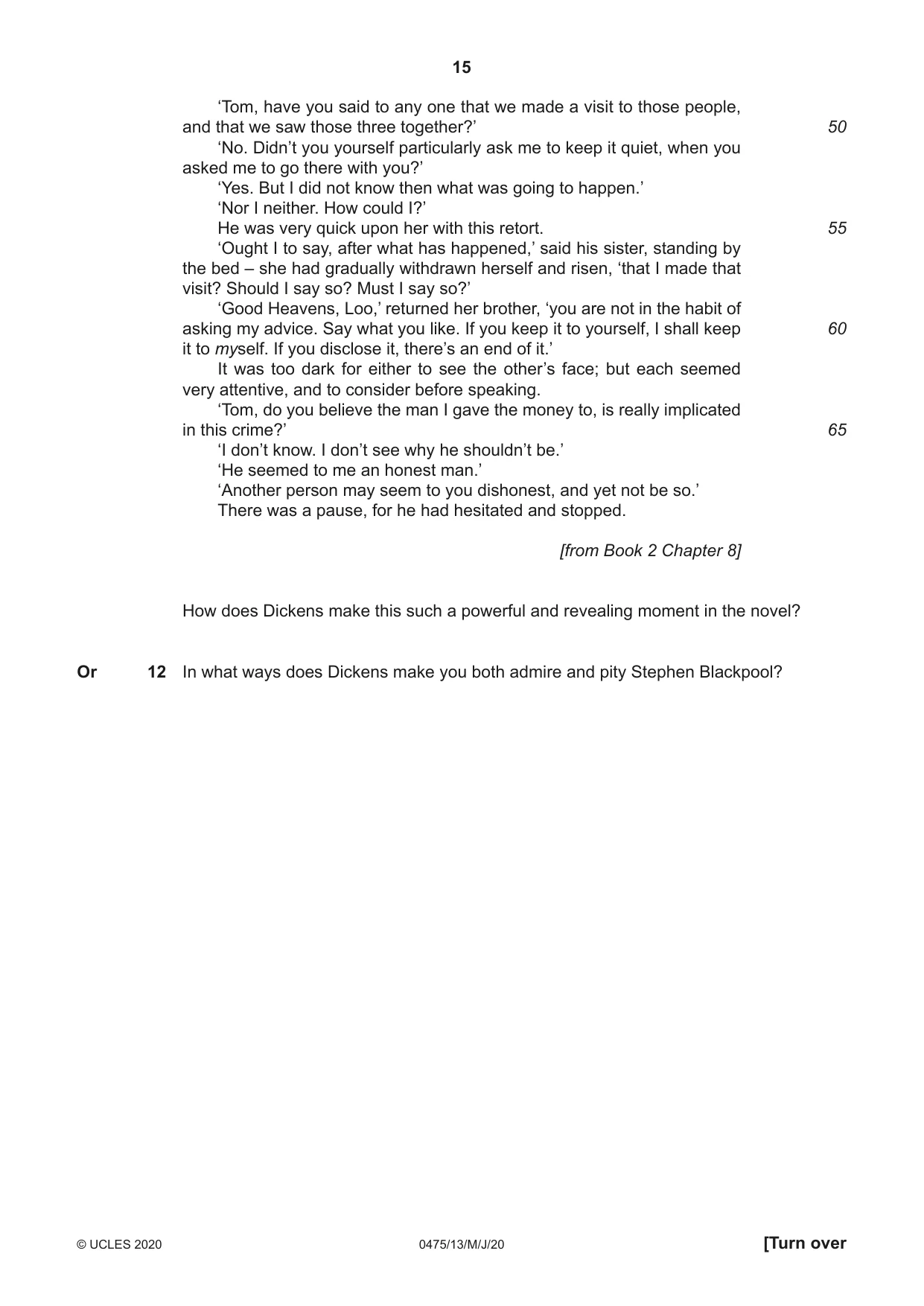
Question paper, page 15
15 0475/13/M/J/20 © UCLES 2020 [Turn over ‘Tom, have you said to any one that we made a visit to those people, and that we saw those three together?’ ‘No. Didn’t you yourself particularly ask me to keep it quiet, when you asked me to go there with you?’ ‘Yes. But I did not know then what was going to happen.’ ‘Nor I neither. How could I?’ He was very quick upon her with this retort. ‘Ought I to say, after what has happened,’ said his sister, standing by the bed – she had gradually withdrawn herself and risen, ‘that I made that visit? Should I say so? Must I say so?’ ‘Good Heavens, Loo,’ returned her brother, ‘you are not in the habit of asking my advice. Say what you like. If you keep it to yourself, I shall keep it to myself. If you disclose it, there’s an end of it.’ It was too dark for either to see the other’s face; but each seemed very attentive, and to consider before speaking. ‘Tom, do you believe the man I gave the money to, is really implicated in this crime?’ ‘I don’t know. I don’t see why he shouldn’t be.’ ‘He seemed to me an honest man.’ ‘Another person may seem to you dishonest, and yet not be so.’ There was a pause, for he had hesitated and stopped. [from Book 2 Chapter 8] How does Dickens make this such a powerful and revealing moment in the novel? Or 12 In what ways does Dickens make you both admire and pity Stephen Blackpool? 50 55 60 65
Question paper, page 16
16 0475/13/M/J/20 © UCLES 2020 ZORA NEALE HURSTON: Their Eyes Were Watching God Remember to support your ideas with details from the writing. Either 13 Read this passage, and then answer the question that follows it: Sometime that night the winds came back. Content removed due to copyright restrictions.
Question paper, page 17
17 0475/13/M/J/20 © UCLES 2020 [Turn over Already in some. [from Chapter 18] How does Hurston make this such a powerful moment in the novel? Or 14 How far does Hurston’s writing allow you to admire Joe Starks? Content removed due to copyright restrictions
Question paper, page 18
18 0475/13/M/J/20 © UCLES 2020 JOHN KNOWLES: A Separate Peace Remember to support your ideas with details from the writing. Either 15 Read this passage, and then answer the question that follows it: Although I was walking straight toward his front door he beckoned me on several times, and he never took his eyes from me, as though it was they which held me to my course. He was still at this ground-floor window when I reached the door and so I opened it myself and stepped into the hallway. Leper had come to the entrance of the room on the right, the dining room. “Come in here,” he said, “I spend most of my time in here.” As usual there were no preliminaries. “What do you do that for, Leper? It’s not very comfortable, is it?” “Well, it’s a useful room.” “Yes, I guess it’s useful, all right.” “You aren’t lost for something to do in dining rooms. It’s in the living room where people can’t figure out what to do with themselves. People get problems in living rooms.” “Bedrooms too.” It was a try toward relieving the foreboding in his manner; it only worked to deepen it. He turned away, and I followed him into an under-furnished dining room of high-backed chairs, rugless floor, and cold fireplace. “If you want to be in a really functional room,” I began with false heartiness, “you ought to spend your time in the bathroom then.” He looked at me, and I noticed the left side of his upper lip lift once or twice as though he was about to snarl or cry. Then I realized that this had nothing to do with his mood, that it was involuntary. He sat down at the head of the table in the only chair with arms, his father’s chair I supposed. I took off my coat and sat in a place at the middle of the table, with my back to the fireplace. There at least I could look at the sun rejoicing on the snow. “In here you never wonder what’s going to happen. You know the meals will come in three times a day for instance.” “I’ll bet your mother isn’t too pleased when she’s trying to get one ready.” Force sprang into his expression for the first time. “What’s she got to be pleased about!” He glared challengingly into my startled face. “I’m pleasing myself! ” he cried fervently, and I saw tears trembling in his eyes. “Well, she’s probably pleased.” Any words would serve, the more irrelevant and superficial the better, any words which would stop him; I didn’t want to see this. “She’s probably pleased to have you home again.” His face resumed its dull expression. The responsibility for continuing the conversation, since I had forced it to be superficial, was mine. “How long’ll you be here?” He shrugged, a look of disgust with my question crossing his face. The careful politeness he had always had was gone. “Well, if you’re on furlough you must know when you have to be back.” I said this in what I thought of at the time as my older voice, a little businesslike and experienced. “The army doesn’t give out passes and then say ‘Come back when you’ve had enough, hear?’” “I didn’t get any pass,” he groaned; with the sliding despair of his face and his clenched hands, that’s what it was; a groan. 5 10 15 20 25 30 35 40 45
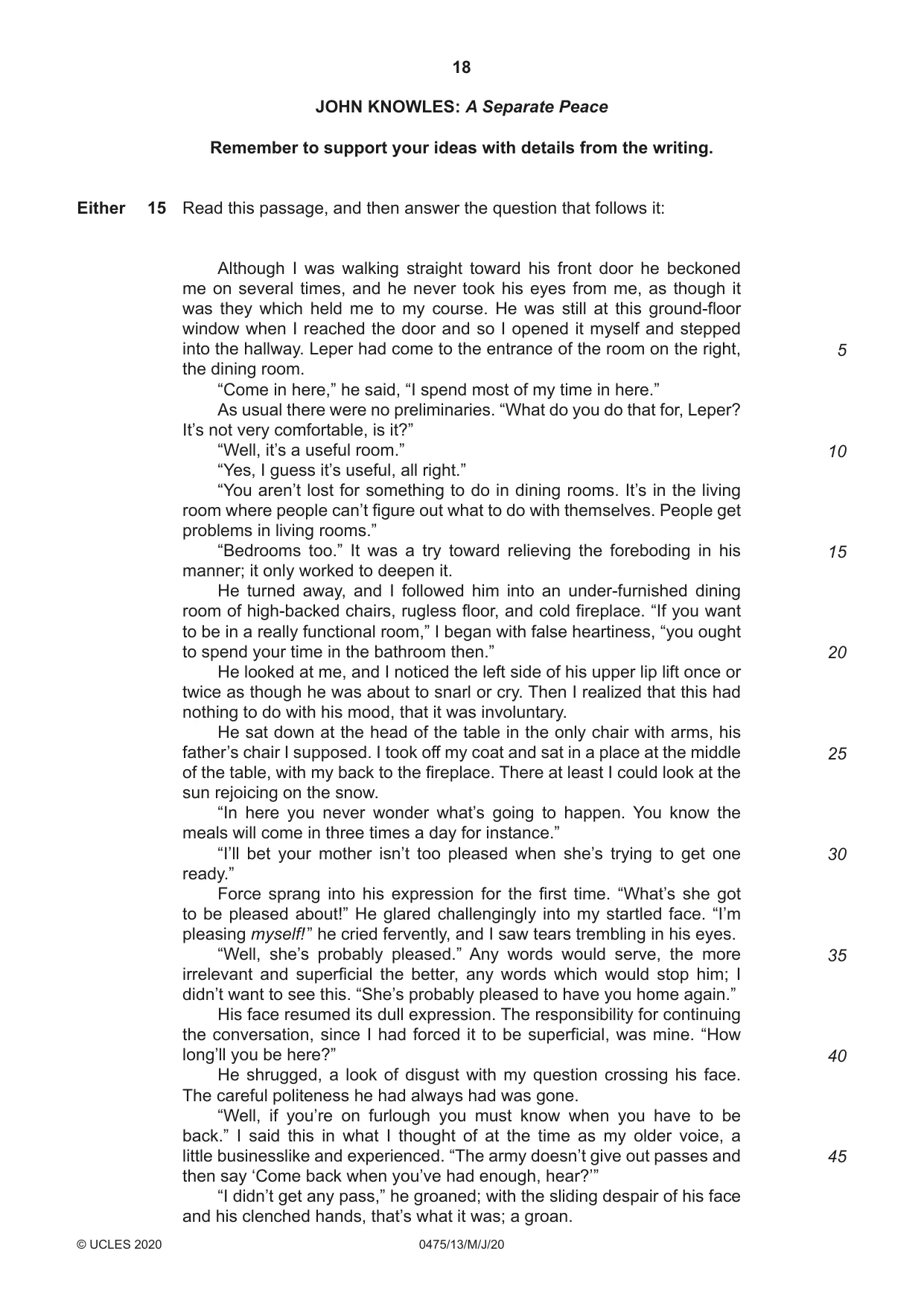
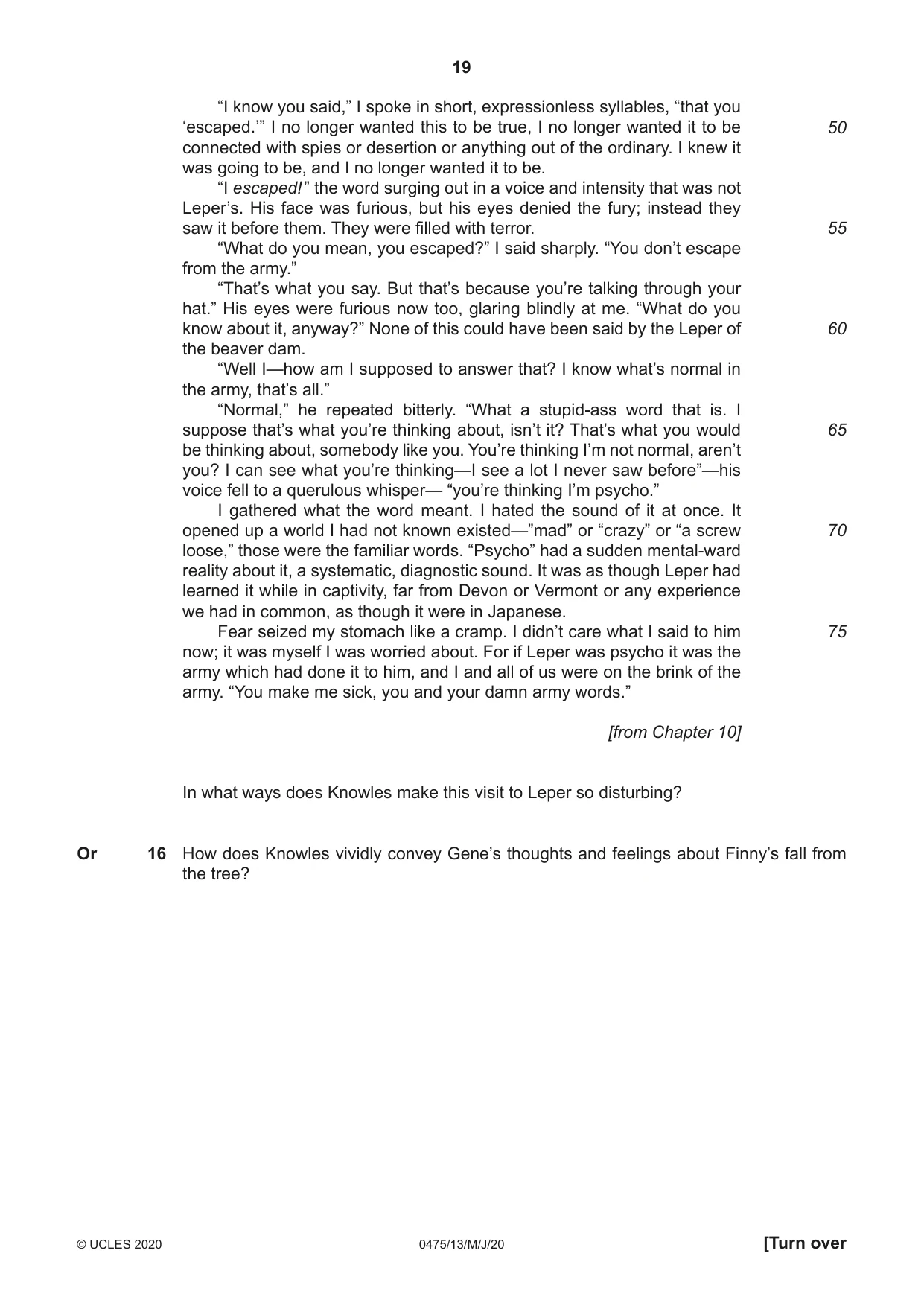
Question paper, page 19
19 0475/13/M/J/20 © UCLES 2020 [Turn over “I know you said,” I spoke in short, expressionless syllables, “that you ‘escaped.’” I no longer wanted this to be true, I no longer wanted it to be connected with spies or desertion or anything out of the ordinary. I knew it was going to be, and I no longer wanted it to be. “I escaped! ” the word surging out in a voice and intensity that was not Leper’s. His face was furious, but his eyes denied the fury; instead they saw it before them. They were filled with terror. “What do you mean, you escaped?” I said sharply. “You don’t escape from the army.” “That’s what you say. But that’s because you’re talking through your hat.” His eyes were furious now too, glaring blindly at me. “What do you know about it, anyway?” None of this could have been said by the Leper of the beaver dam. “Well I—how am I supposed to answer that? I know what’s normal in the army, that’s all.” “Normal,” he repeated bitterly. “What a stupid-ass word that is. I suppose that’s what you’re thinking about, isn’t it? That’s what you would be thinking about, somebody like you. You’re thinking I’m not normal, aren’t you? I can see what you’re thinking—I see a lot I never saw before”—his voice fell to a querulous whisper— “you’re thinking I’m psycho.” I gathered what the word meant. I hated the sound of it at once. It opened up a world I had not known existed—”mad” or “crazy” or “a screw loose,” those were the familiar words. “Psycho” had a sudden mental-ward reality about it, a systematic, diagnostic sound. It was as though Leper had learned it while in captivity, far from Devon or Vermont or any experience we had in common, as though it were in Japanese. Fear seized my stomach like a cramp. I didn’t care what I said to him now; it was myself I was worried about. For if Leper was psycho it was the army which had done it to him, and I and all of us were on the brink of the army. “You make me sick, you and your damn army words.” [from Chapter 10] In what ways does Knowles make this visit to Leper so disturbing? Or 16 How does Knowles vividly convey Gene’s thoughts and feelings about Finny’s fall from the tree? 50 55 60 65 70 75
Question paper, page 20
20 0475/13/M/J/20 © UCLES 2020 GEORGE ORWELL: 1984 Remember to support your ideas with details from the writing. Either 17 Read this passage, and then answer the question that follows it: It was the middle of the morning, and Winston had left his cubicle to go to the lavatory. A solitary figure was coming towards him from the other end of the long, brightly-lit corridor. It was the girl with dark hair. Four days had gone past since the evening when he had run into her outside the junk-shop. As she came nearer he saw that her right arm was in a sling, not noticeable at a distance because it was of the same colour as her overalls. Probably she had crushed her hand while swinging round one of the big kaleidoscopes on which the plots of novels were ‘roughed in’. It was a common accident in the Fiction Department. They were perhaps four metres apart when the girl stumbled and fell almost flat on her face. A sharp cry of pain was wrung out of her. She must have fallen right on the injured arm. Winston stopped short. The girl had risen to her knees. Her face had turned a milky yellow colour against which her mouth stood out redder than ever. Her eyes were fixed on his, with an appealing expression that looked more like fear than pain. A curious emotion stirred in Winston’s heart. In front of him was an enemy who was trying to kill him: in front of him, also, was a human creature, in pain and perhaps with a broken bone. Already he had instinctively started forward to help her. In the moment when he had seen her fall on the bandaged arm, it had been as though he felt the pain in his own body. ‘You’re hurt?’ he said. ‘It’s nothing. My arm. It’ll be all right in a second.’ She spoke as though her heart were fluttering. She had certainly turned very pale. ‘You haven’t broken anything?’ ‘No, I’m all right. It hurt for a moment, that’s all.’ She held out her free hand to him, and he helped her up. She had regained some of her colour, and appeared very much better. ‘It’s nothing,’ she repeated shortly. ‘I only gave my wrist a bit of a bang. Thanks, comrade!’ And with that she walked on in the direction in which she had been going, as briskly as though it had really been nothing. The whole incident could not have taken as much as half a minute. Not to let one’s feelings appear in one’s face was a habit that had acquired the status of an instinct, and in any case they had been standing straight in front of a telescreen when the thing happened. Nevertheless it had been very difficult not to betray a momentary surprise, for in the two or three seconds while he was helping her up the girl had slipped something into his hand. There was no question that she had done it intentionally. It was something small and flat. As he passed through the lavatory door he transferred it to his pocket and felt it with the tips of his fingers. It was a scrap of paper folded into a square. While he stood at the urinal he managed, with a little more fingering, to get it unfolded. Obviously there must be a message of some kind written on it. For a moment he was tempted to take it into one of the water-closets and read it at once. But that would be shocking folly, as he well knew. 5 10 15 20 25 30 35 40 45
Question paper, page 21
21 0475/13/M/J/20 © UCLES 2020 [Turn over There was no place where you could be more certain that the telescreens were watched continuously. He went back to his cubicle, sat down, threw the fragment of paper casually among the other papers on the desk, put on his spectacles and hitched the speakwrite towards him. ‘Five minutes,’ he told himself, ‘five minutes at the very least!’ His heart bumped in his breast with frightening loudness. Fortunately the piece of work he was engaged on was mere routine, the rectification of a long list of figures, not needing close attention. Whatever was written on the paper, it must have some kind of political meaning. So far as he could see there were two possibilities. One, much the more likely, was that the girl was an agent of the Thought Police, just as he had feared. He did not know why the Thought Police should choose to deliver their messages in such a fashion, but perhaps they had their reasons. The thing that was written on the paper might be a threat, a summons, an order to commit suicide, a trap of some description. But there was another, wilder possibility that kept raising its head, though he tried vainly to suppress it. This was, that the message did not come from the Thought Police at all, but from some kind of underground organisation. Perhaps the Brotherhood existed after all! Perhaps the girl was part of it! No doubt the idea was absurd, but it had sprung into his mind in the very instant of feeling the scrap of paper in his hand. It was not till a couple of minutes later that the other, more probable explanation had occurred to him. And even now, though his intellect told him that the message probably meant death–still, that was not what he believed, and the unreasonable hope persisted, and his heart banged, and it was with difficulty that he kept his voice from trembling as he murmured his figures into the speakwrite. He rolled up the completed bundle of work and slid it into the pneumatic tube. Eight minutes had gone by. He re-adjusted his spectacles on his nose, sighed, and drew the next batch of work towards him, with the scrap of paper on top of it. He flattened it out. On it was written, in a large unformed handwriting: I love you. [from Part 2] How does Orwell make this such a memorable moment in the novel? Or 18 In what ways does Orwell make O’Brien such a terrifying character? 50 55 60 65 70 75 80
Question paper, page 22
22 0475/13/M/J/20 © UCLES 2020 ALAN PATON: Cry, the Beloved Country Remember to support your ideas with details from the writing. Either 19 Read this passage, and then answer the question that follows it: – And if these two say there was no murder discussed at the house of Baby Mkize, they are lying? – They are lying. – And if they say that you made up this story after meeting them at the house of Mkize, they are lying. – They are lying. – And if Baby Mkize says that no murder was discussed in her presence, she is lying? – She is lying. She was afraid, and said we must leave her house and never return to it. – Did you leave together? – No, I left first. – And where did you go? – I went into a plantation. – And what did you do there? – I buried the revolver. – Is this the revolver before the Court? The revolver is handed up to the accused and he examines it. This is the revolver, he says. – How was it found? – No, I told the Police where to find it. – And what did you do next? – I prayed there. The prosecutor seems taken aback for a moment, but the Judge says, And what did you pray there? – I prayed for forgiveness. – And what else did you pray? – No, there was nothing else that I wished to pray. * – And on the second day you walked again to Johannesburg? – Yes. – And you again walked amongst the people who were boycotting the buses? – Yes. – Were they still talking about the murder? – They were still talking. Some said they heard it would soon be discovered. – And then? – I was afraid. – So what did you do? – That night I went to Germiston. – But what did you do that day? Did you hide again? – No, I bought a shirt, and then I walked about with the parcel. – Why did you do that? – No, I thought they would think I was a messenger. – Was there anything else that you did? – There was nothing else. 5 10 15 20 25 30 35 40 45
Question paper, page 23
23 0475/13/M/J/20 © UCLES 2020 [Turn over – Then you went to Germiston? To what place? – To the house of Joseph Bhengu, at 12 Maseru Street, in the Location. – And then? – While I was there the Police came. – What happened? – They asked me if I was Absalom Kumalo. And I agreed, and I was afraid, and I had meant to go that day to confess to the Police, and now I could see I had delayed foolishly. – Did they arrest you? – No, they asked if I could tell them where to find Johannes. I said no, I did not know, but it was not Johannes who had killed the white man, it was I myself. But it was Johannes who had struck down the servant of the house. And I told them that Matthew was there also. And I told them I would show them where I had hidden the revolver. And I told them that I had meant that day to confess, but had delayed foolishly, because I was afraid. – You then made a statement before Andries Coetzee, Esquire, Additional Magistrate at Johannesburg? – I do not know his name. – Is this the statement? The statement is handed up to the boy. He looks at it and says, Yes, that is the statement. And every word is true? – Every word is true. – There is no lie in it? – There is no lie in it, for I said to myself, I shall not lie any more, all the rest of my days, nor do anything more that is evil. – In fact you repented? – Yes, I repented. – Because you were in trouble? – Yes, because I was in trouble. – Did you have any other reason for repenting? – No, I had no other reason. [from Book 2 Chapter 5] How does Paton make the prosecutor’s questioning of Absalom so disturbing at this moment in the novel? Or 20 What does Paton’s portrayal of Msimangu make you feel about him? 50 55 60 65 70 75
Question paper, page 24
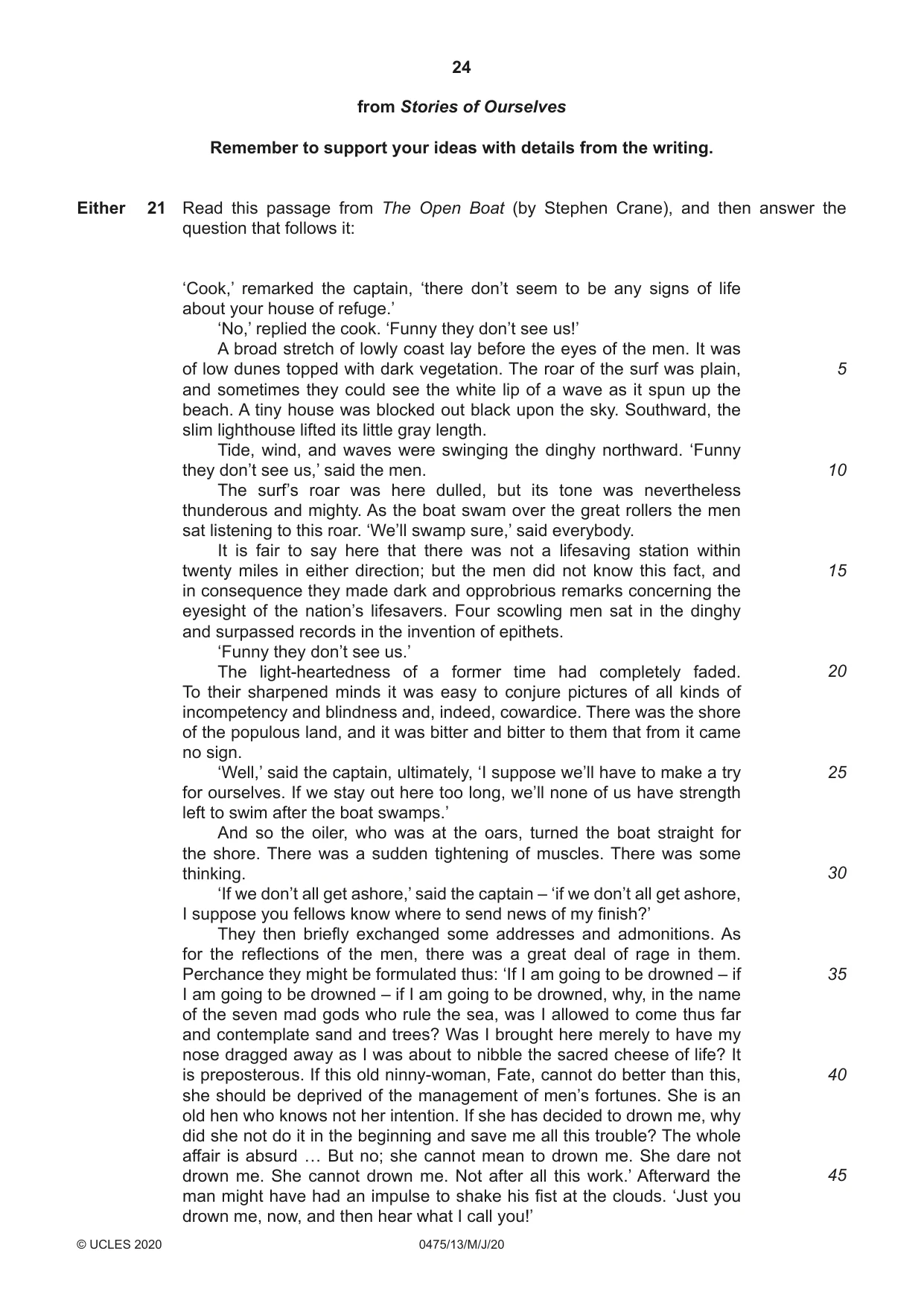
24 0475/13/M/J/20 © UCLES 2020 from Stories of Ourselves Remember to support your ideas with details from the writing. Either 21 Read this passage from The Open Boat (by Stephen Crane), and then answer the question that follows it: ‘Cook,’ remarked the captain, ‘there don’t seem to be any signs of life about your house of refuge.’ ‘No,’ replied the cook. ‘Funny they don’t see us!’ A broad stretch of lowly coast lay before the eyes of the men. It was of low dunes topped with dark vegetation. The roar of the surf was plain, and sometimes they could see the white lip of a wave as it spun up the beach. A tiny house was blocked out black upon the sky. Southward, the slim lighthouse lifted its little gray length. Tide, wind, and waves were swinging the dinghy northward. ‘Funny they don’t see us,’ said the men. The surf’s roar was here dulled, but its tone was nevertheless thunderous and mighty. As the boat swam over the great rollers the men sat listening to this roar. ‘We’ll swamp sure,’ said everybody. It is fair to say here that there was not a lifesaving station within twenty miles in either direction; but the men did not know this fact, and in consequence they made dark and opprobrious remarks concerning the eyesight of the nation’s lifesavers. Four scowling men sat in the dinghy and surpassed records in the invention of epithets. ‘Funny they don’t see us.’ The light-heartedness of a former time had completely faded. To their sharpened minds it was easy to conjure pictures of all kinds of incompetency and blindness and, indeed, cowardice. There was the shore of the populous land, and it was bitter and bitter to them that from it came no sign. ‘Well,’ said the captain, ultimately, ‘I suppose we’ll have to make a try for ourselves. If we stay out here too long, we’ll none of us have strength left to swim after the boat swamps.’ And so the oiler, who was at the oars, turned the boat straight for the shore. There was a sudden tightening of muscles. There was some thinking. ‘If we don’t all get ashore,’ said the captain – ‘if we don’t all get ashore, I suppose you fellows know where to send news of my finish?’ They then briefly exchanged some addresses and admonitions. As for the reflections of the men, there was a great deal of rage in them. Perchance they might be formulated thus: ‘If I am going to be drowned – if I am going to be drowned – if I am going to be drowned, why, in the name of the seven mad gods who rule the sea, was I allowed to come thus far and contemplate sand and trees? Was I brought here merely to have my nose dragged away as I was about to nibble the sacred cheese of life? It is preposterous. If this old ninny-woman, Fate, cannot do better than this, she should be deprived of the management of men’s fortunes. She is an old hen who knows not her intention. If she has decided to drown me, why did she not do it in the beginning and save me all this trouble? The whole affair is absurd … But no; she cannot mean to drown me. She dare not drown me. She cannot drown me. Not after all this work.’ Afterward the man might have had an impulse to shake his fist at the clouds. ‘Just you drown me, now, and then hear what I call you!’ 5 10 15 20 25 30 35 40 45
Question paper, page 25
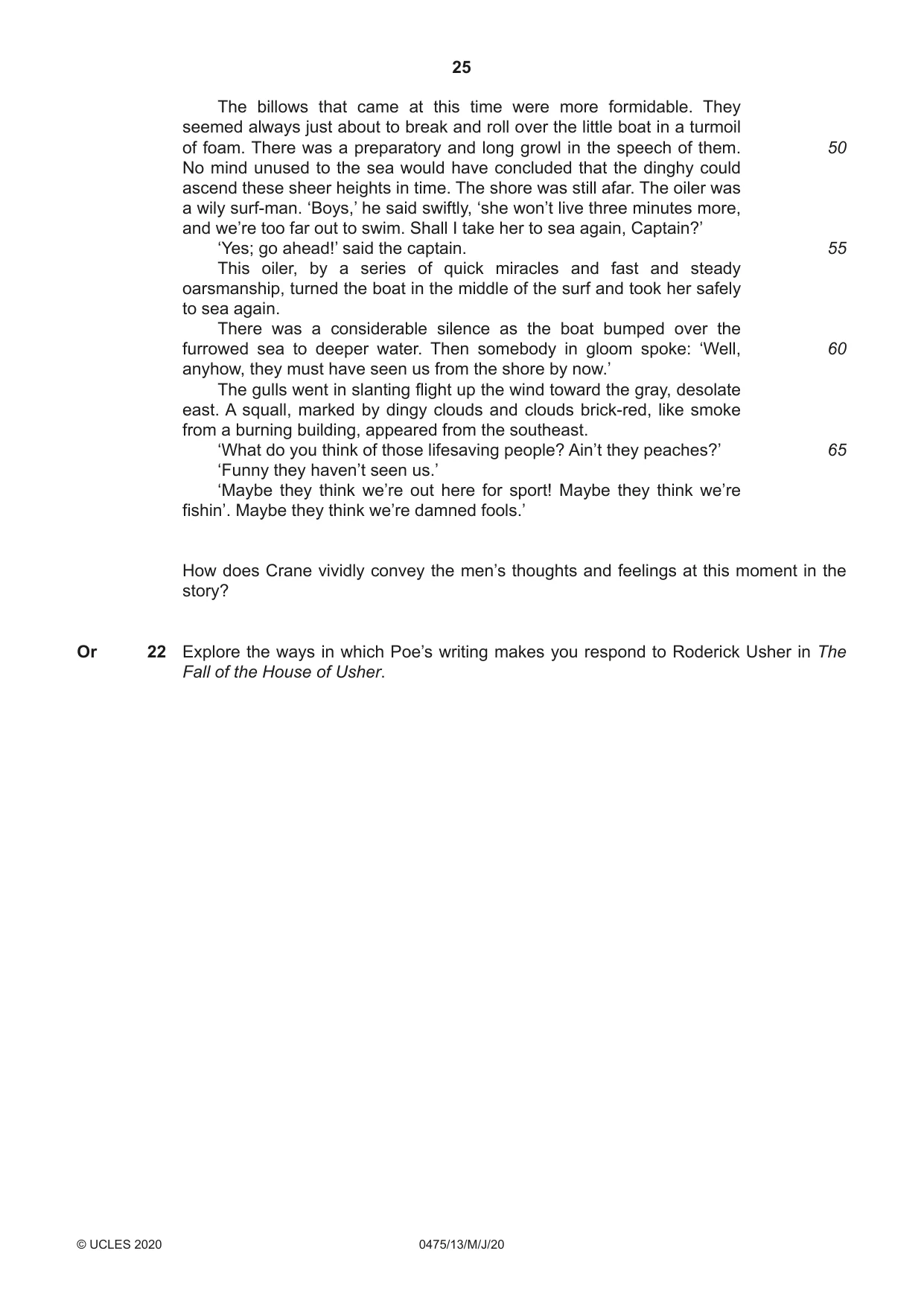
25 0475/13/M/J/20 © UCLES 2020 The billows that came at this time were more formidable. They seemed always just about to break and roll over the little boat in a turmoil of foam. There was a preparatory and long growl in the speech of them. No mind unused to the sea would have concluded that the dinghy could ascend these sheer heights in time. The shore was still afar. The oiler was a wily surf-man. ‘Boys,’ he said swiftly, ‘she won’t live three minutes more, and we’re too far out to swim. Shall I take her to sea again, Captain?’ ‘Yes; go ahead!’ said the captain. This oiler, by a series of quick miracles and fast and steady oarsmanship, turned the boat in the middle of the surf and took her safely to sea again. There was a considerable silence as the boat bumped over the furrowed sea to deeper water. Then somebody in gloom spoke: ‘Well, anyhow, they must have seen us from the shore by now.’ The gulls went in slanting flight up the wind toward the gray, desolate east. A squall, marked by dingy clouds and clouds brick-red, like smoke from a burning building, appeared from the southeast. ‘What do you think of those lifesaving people? Ain’t they peaches?’ ‘Funny they haven’t seen us.’ ‘Maybe they think we’re out here for sport! Maybe they think we’re fishin’. Maybe they think we’re damned fools.’ How does Crane vividly convey the men’s thoughts and feelings at this moment in the story? Or 22 Explore the ways in which Poe’s writing makes you respond to Roderick Usher in The Fall of the House of Usher. 50 55 60 65
Question paper, page 26
26 0475/13/M/J/20 © UCLES 2020 BLANK PAGE
Question paper, page 27
27 0475/13/M/J/20 © UCLES 2020 BLANK PAGE
Question paper, page 28
28 0475/13/M/J/20 © UCLES 2020 Permission to reproduce items where third-party owned material protected by copyright is included has been sought and cleared where possible. Every reasonable effort has been made by the publisher (UCLES) to trace copyright holders, but if any items requiring clearance have unwittingly been included, the publisher will be pleased to make amends at the earliest possible opportunity. To avoid the issue of disclosure of answer-related information to candidates, all copyright acknowledgements are reproduced online in the Cambridge Assessment International Education Copyright Acknowledgements Booklet. This is produced for each series of examinations and is freely available to download at www.cambridgeinternational.org after the live examination series. Cambridge Assessment International Education is part of the Cambridge Assessment Group. Cambridge Assessment is the brand name of the University of Cambridge Local Examinations Syndicate (UCLES), which itself is a department of the University of Cambridge. BLANK PAGE
Mark scheme, page 1
This document consists of 4 printed pages. © UCLES 2020 [Turn over Cambridge IGCSE™ LITERATURE IN ENGLISH 0475/13 Paper 1 Poetry and Prose 13 May/June 2020 MARK SCHEME Maximum Mark: 50 Published Students did not sit exam papers in the June 2020 series due to the Covid-19 global pandemic. This mark scheme is published to support teachers and students and should be read together with the question paper. It shows the requirements of the exam. The answer column of the mark scheme shows the proposed basis on which Examiners would award marks for this exam. Where appropriate, this column also provides the most likely acceptable alternative responses expected from students. Examiners usually review the mark scheme after they have seen student responses and update the mark scheme if appropriate. In the June series, Examiners were unable to consider the acceptability of alternative responses, as there were no student responses to consider. Mark schemes should usually be read together with the Principal Examiner Report for Teachers. However, because students did not sit exam papers, there is no Principal Examiner Report for Teachers for the June 2020 series. Cambridge International will not enter into discussions about these mark schemes. Cambridge International is publishing the mark schemes for the June 2020 series for most Cambridge IGCSE™ and Cambridge International A & AS Level components, and some Cambridge O Level components.
Mark scheme, page 2
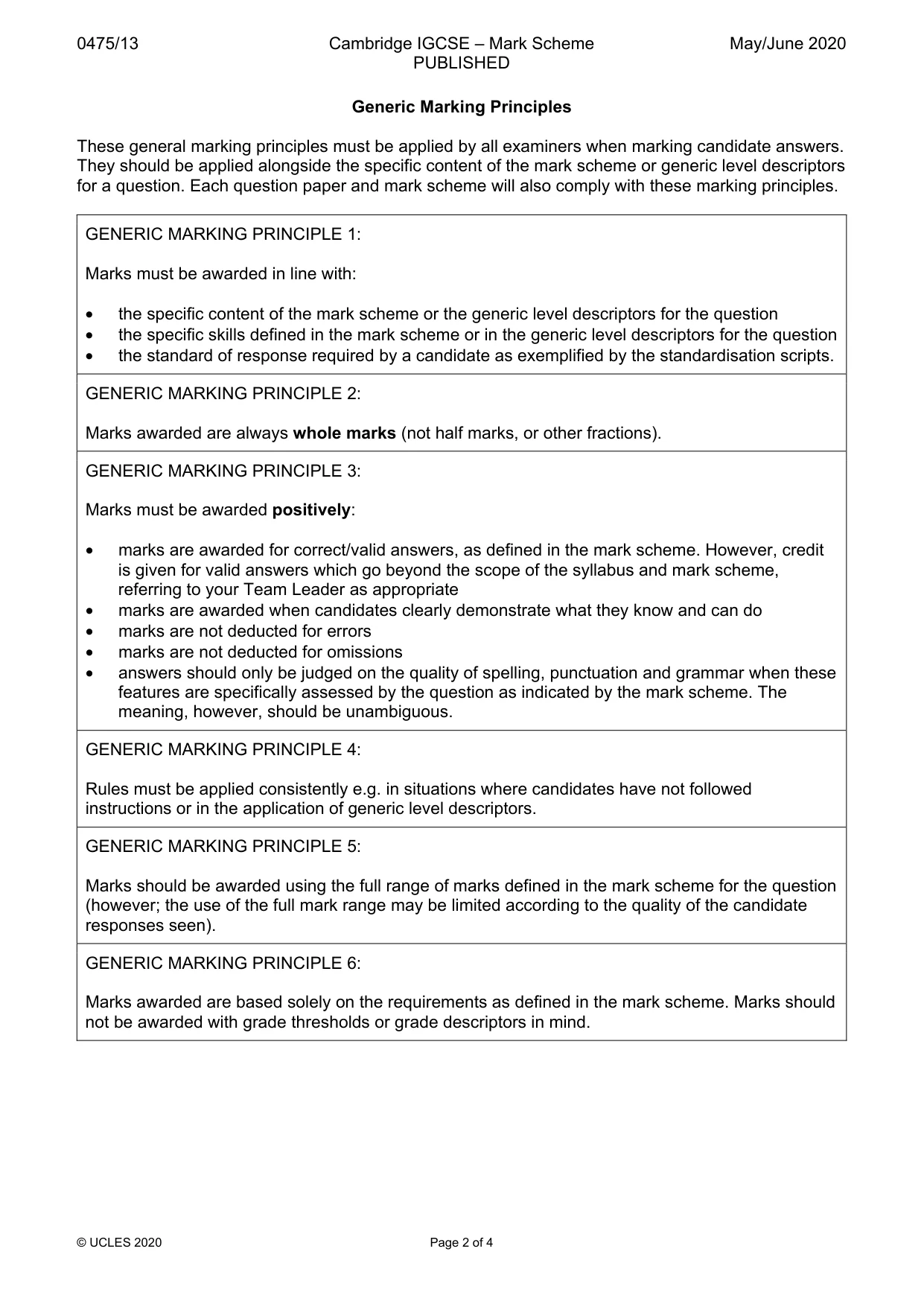
0475/13 Cambridge IGCSE – Mark Scheme PUBLISHED May/June 2020 © UCLES 2020 Page 2 of 4 Generic Marking Principles These general marking principles must be applied by all examiners when marking candidate answers. They should be applied alongside the specific content of the mark scheme or generic level descriptors for a question. Each question paper and mark scheme will also comply with these marking principles. GENERIC MARKING PRINCIPLE 1: Marks must be awarded in line with: • the specific content of the mark scheme or the generic level descriptors for the question • the specific skills defined in the mark scheme or in the generic level descriptors for the question • the standard of response required by a candidate as exemplified by the standardisation scripts. GENERIC MARKING PRINCIPLE 2: Marks awarded are always whole marks (not half marks, or other fractions). GENERIC MARKING PRINCIPLE 3: Marks must be awarded positively: • marks are awarded for correct/valid answers, as defined in the mark scheme. However, credit is given for valid answers which go beyond the scope of the syllabus and mark scheme, referring to your Team Leader as appropriate • marks are awarded when candidates clearly demonstrate what they know and can do • marks are not deducted for errors • marks are not deducted for omissions • answers should only be judged on the quality of spelling, punctuation and grammar when these features are specifically assessed by the question as indicated by the mark scheme. The meaning, however, should be unambiguous. GENERIC MARKING PRINCIPLE 4: Rules must be applied consistently e.g. in situations where candidates have not followed instructions or in the application of generic level descriptors. GENERIC MARKING PRINCIPLE 5: Marks should be awarded using the full range of marks defined in the mark scheme for the question (however; the use of the full mark range may be limited according to the quality of the candidate responses seen). GENERIC MARKING PRINCIPLE 6: Marks awarded are based solely on the requirements as defined in the mark scheme. Marks should not be awarded with grade thresholds or grade descriptors in mind.
Mark scheme, page 3
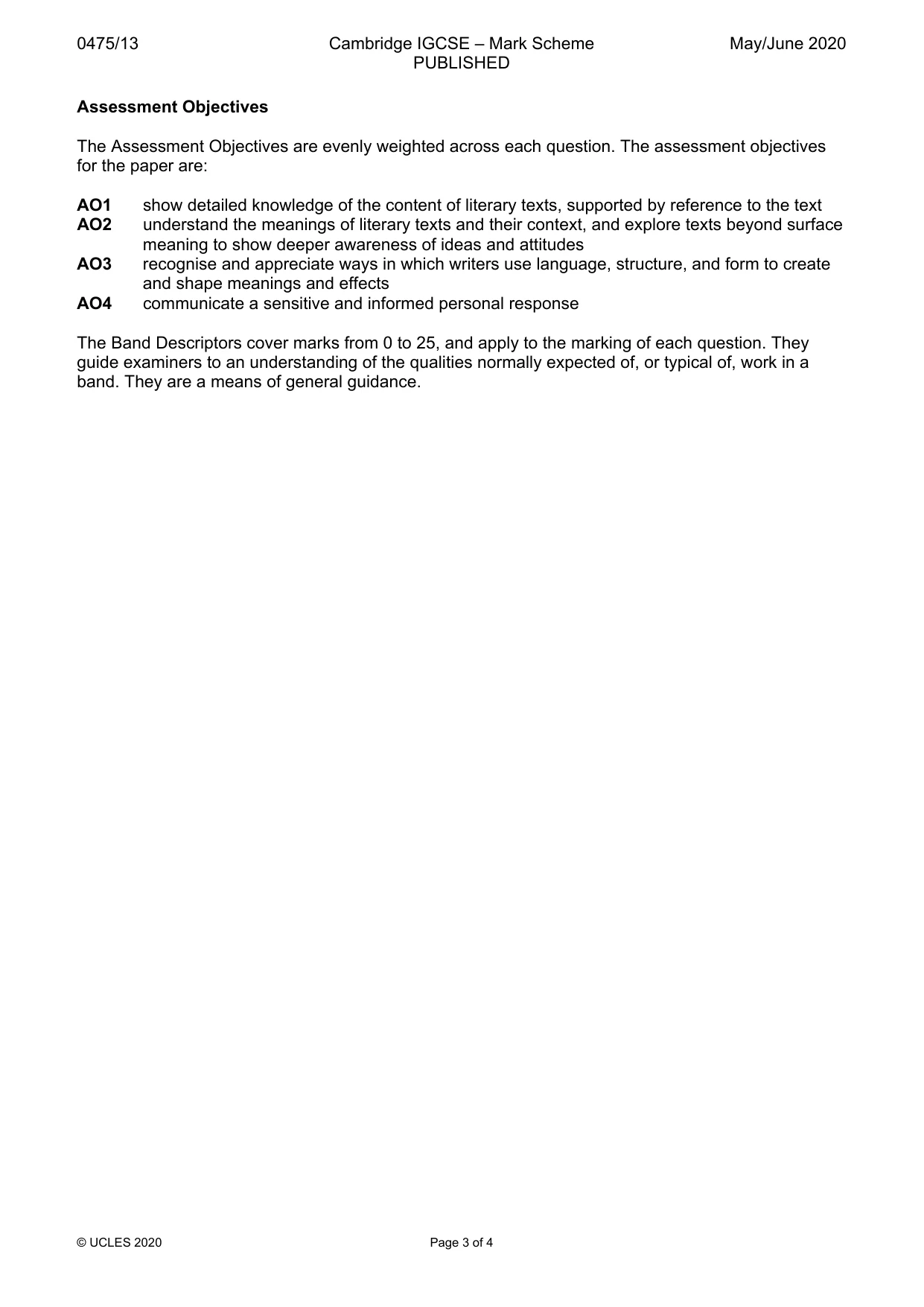
0475/13 Cambridge IGCSE – Mark Scheme PUBLISHED May/June 2020 © UCLES 2020 Page 3 of 4 Assessment Objectives The Assessment Objectives are evenly weighted across each question. The assessment objectives for the paper are: AO1 show detailed knowledge of the content of literary texts, supported by reference to the text AO2 understand the meanings of literary texts and their context, and explore texts beyond surface meaning to show deeper awareness of ideas and attitudes AO3 recognise and appreciate ways in which writers use language, structure, and form to create and shape meanings and effects AO4 communicate a sensitive and informed personal response The Band Descriptors cover marks from 0 to 25, and apply to the marking of each question. They guide examiners to an understanding of the qualities normally expected of, or typical of, work in a band. They are a means of general guidance.
Mark scheme, page 4
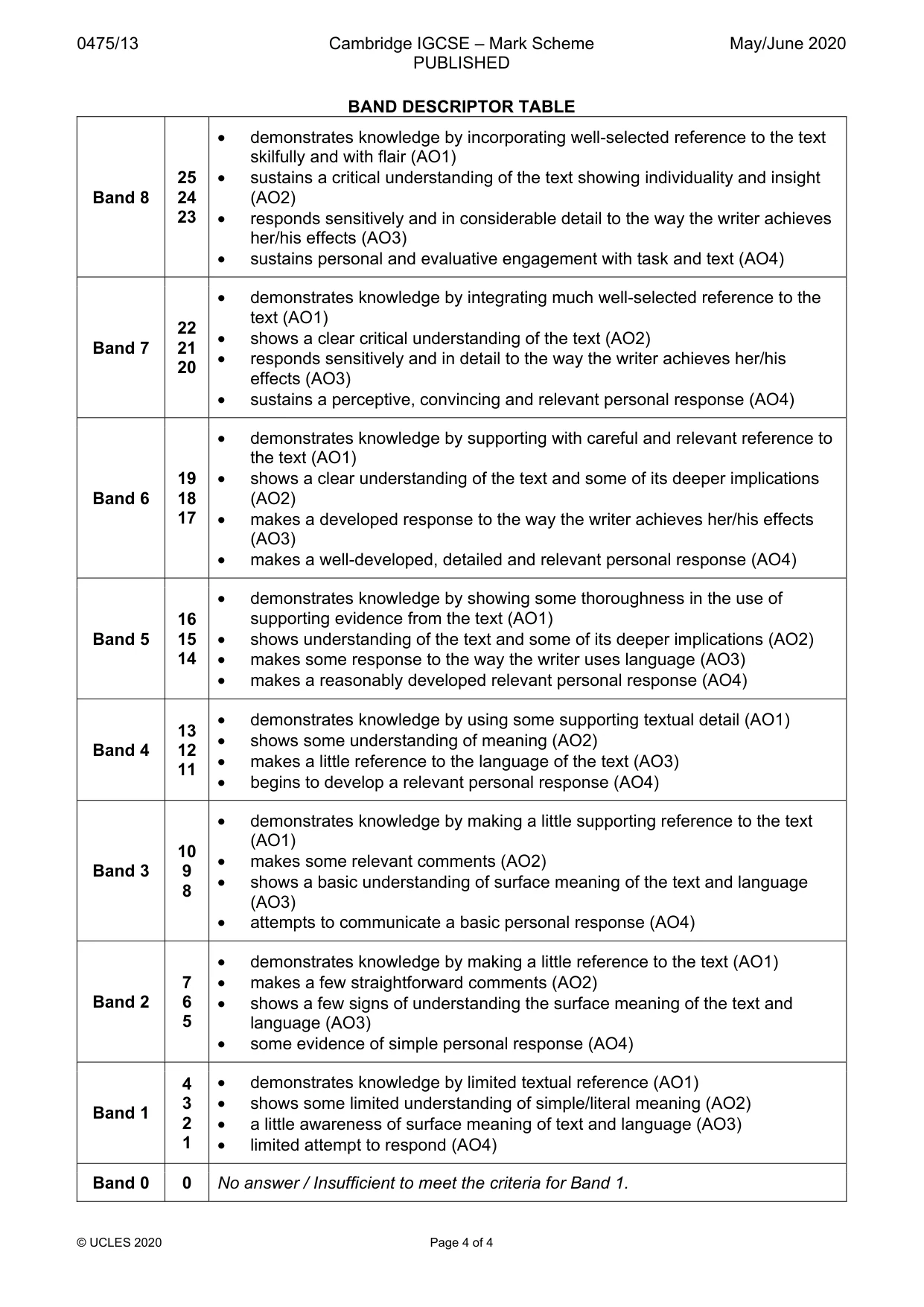
0475/13 Cambridge IGCSE – Mark Scheme PUBLISHED May/June 2020 © UCLES 2020 Page 4 of 4 BAND DESCRIPTOR TABLE Band 8 25 24 23 • demonstrates knowledge by incorporating well-selected reference to the text skilfully and with flair (AO1) • sustains a critical understanding of the text showing individuality and insight (AO2) • responds sensitively and in considerable detail to the way the writer achieves her/his effects (AO3) • sustains personal and evaluative engagement with task and text (AO4) Band 7 22 21 20 • demonstrates knowledge by integrating much well-selected reference to the text (AO1) • shows a clear critical understanding of the text (AO2) • responds sensitively and in detail to the way the writer achieves her/his effects (AO3) • sustains a perceptive, convincing and relevant personal response (AO4) Band 6 19 18 17 • demonstrates knowledge by supporting with careful and relevant reference to the text (AO1) • shows a clear understanding of the text and some of its deeper implications (AO2) • makes a developed response to the way the writer achieves her/his effects (AO3) • makes a well-developed, detailed and relevant personal response (AO4) Band 5 16 15 14 • demonstrates knowledge by showing some thoroughness in the use of supporting evidence from the text (AO1) • shows understanding of the text and some of its deeper implications (AO2) • makes some response to the way the writer uses language (AO3) • makes a reasonably developed relevant personal response (AO4) Band 4 13 12 11 • demonstrates knowledge by using some supporting textual detail (AO1) • shows some understanding of meaning (AO2) • makes a little reference to the language of the text (AO3) • begins to develop a relevant personal response (AO4) Band 3 10 9 8 • demonstrates knowledge by making a little supporting reference to the text (AO1) • makes some relevant comments (AO2) • shows a basic understanding of surface meaning of the text and language (AO3) • attempts to communicate a basic personal response (AO4) Band 2 7 6 5 • demonstrates knowledge by making a little reference to the text (AO1) • makes a few straightforward comments (AO2) • shows a few signs of understanding the surface meaning of the text and language (AO3) • some evidence of simple personal response (AO4) Band 1 4 3 2 1 • demonstrates knowledge by limited textual reference (AO1) • shows some limited understanding of simple/literal meaning (AO2) • a little awareness of surface meaning of text and language (AO3) • limited attempt to respond (AO4) Band 0 0 No answer / Insufficient to meet the criteria for Band 1.