Cambridge IGCSE English - Literature 0486 — 2017 Feb/March Paper 4 · Variant 2
0486/42/F/M/17 · 25 marks · ≈28 min
The question paper and its mark scheme, free to read here and free to download. This is Cambridge’s own paper, exactly as it was sat.
Question paper8 pages
Mark scheme3 pages
Answers below. Sit the paper first if you are practising.
Paper as text
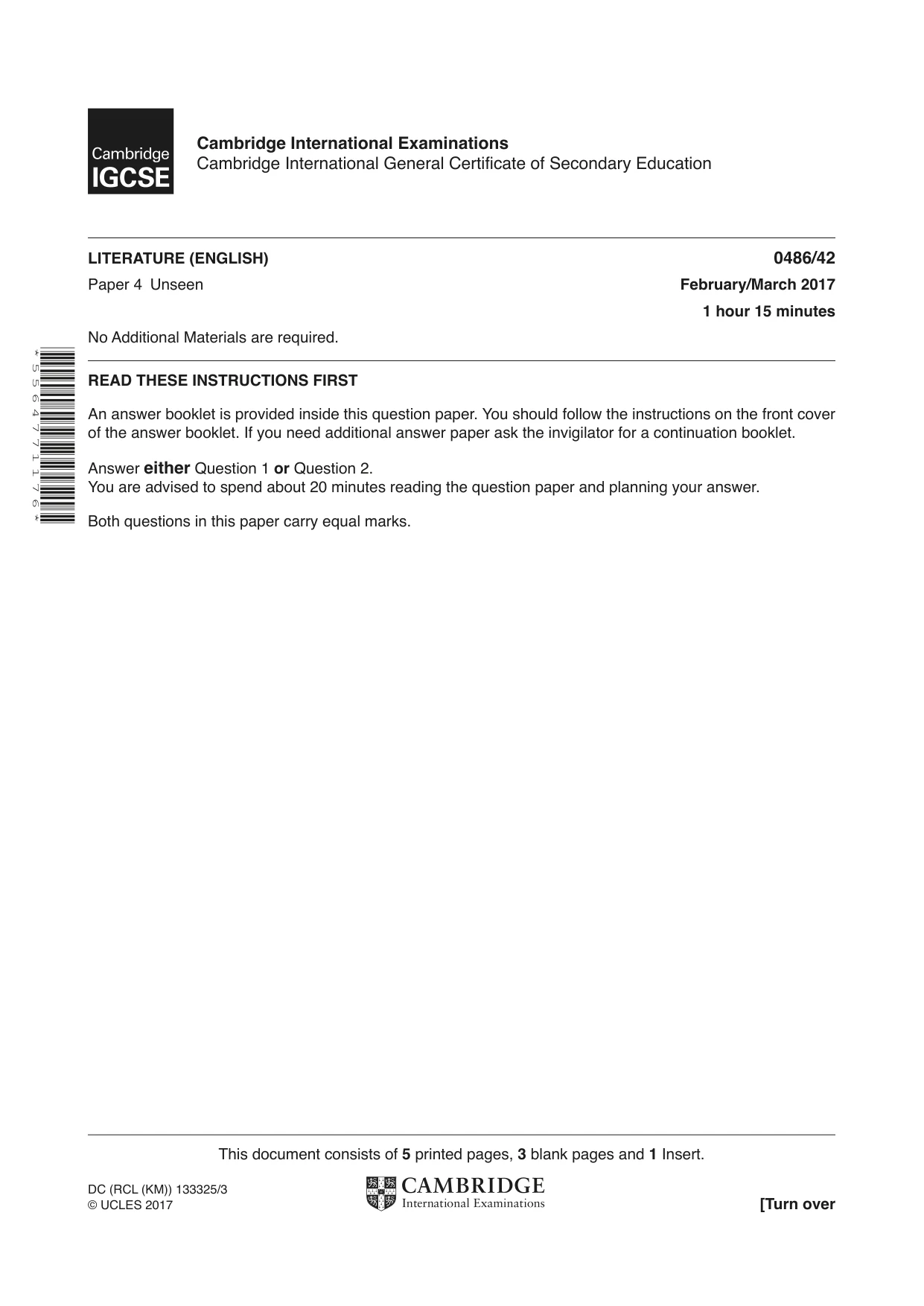
Question paper, page 1
This document consists of 5 printed pages, 3 blank pages and 1 Insert. DC (RCL (KM)) 133325/3 © UCLES 2017 [Turn over Cambridge International Examinations Cambridge International General Certificate of Secondary Education * 5 5 6 4 7 7 1 1 7 6 * LITERATURE (ENGLISH) 0486/42 Paper 4 Unseen February/March 2017 1 hour 15 minutes No Additional Materials are required. READ THESE INSTRUCTIONS FIRST An answer booklet is provided inside this question paper. You should follow the instructions on the front cover of the answer booklet. If you need additional answer paper ask the invigilator for a continuation booklet. Answer either Question 1 or Question 2. You are advised to spend about 20 minutes reading the question paper and planning your answer. Both questions in this paper carry equal marks.
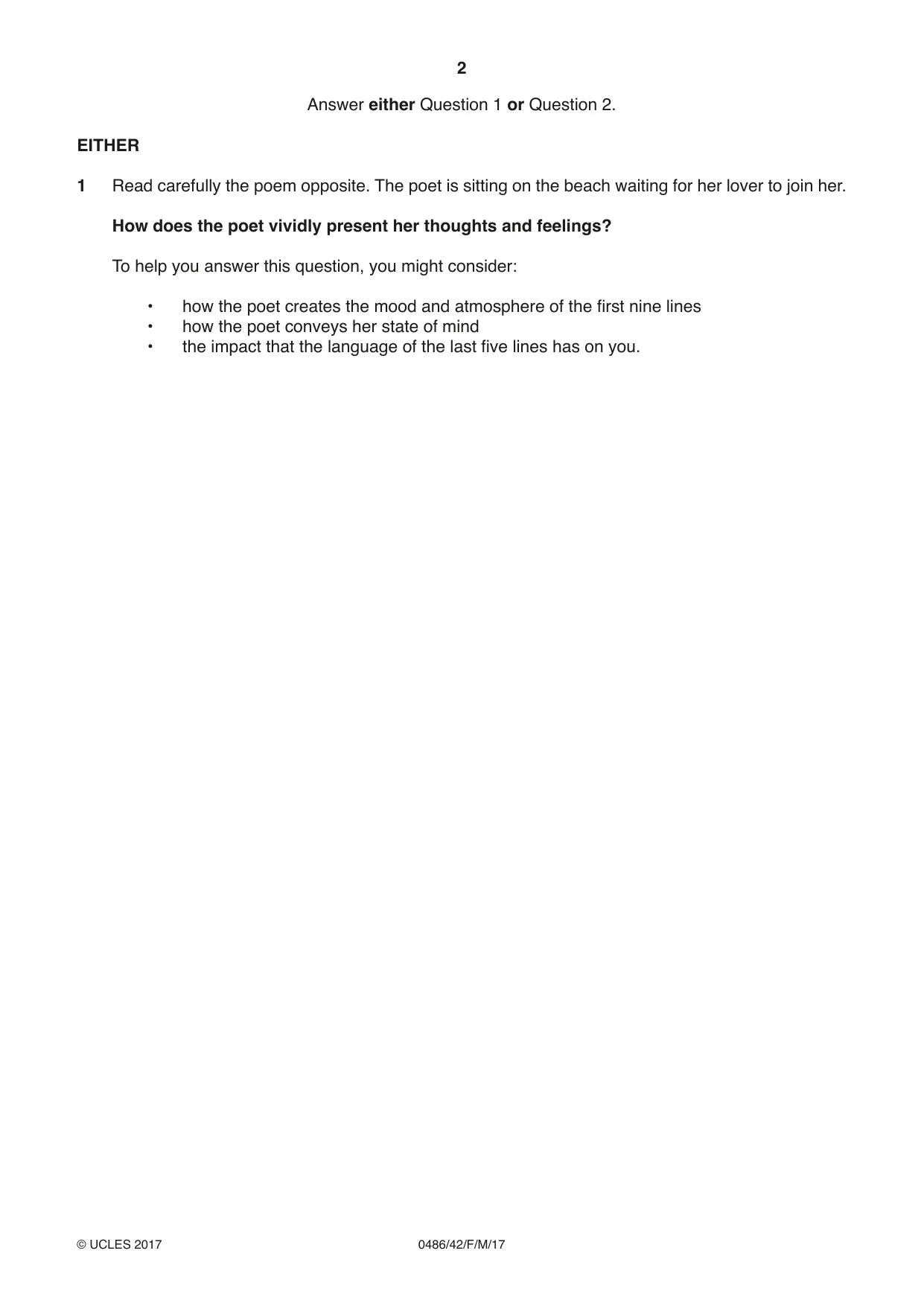
Question paper, page 2
2 0486/42/F/M/17 © UCLES 2017 Answer either Question 1 or Question 2. EITHER 1 Read carefully the poem opposite. The poet is sitting on the beach waiting for her lover to join her. How does the poet vividly present her thoughts and feelings? To help you answer this question, you might consider: • how the poet creates the mood and atmosphere of the first nine lines • how the poet conveys her state of mind • the impact that the language of the last five lines has on you.
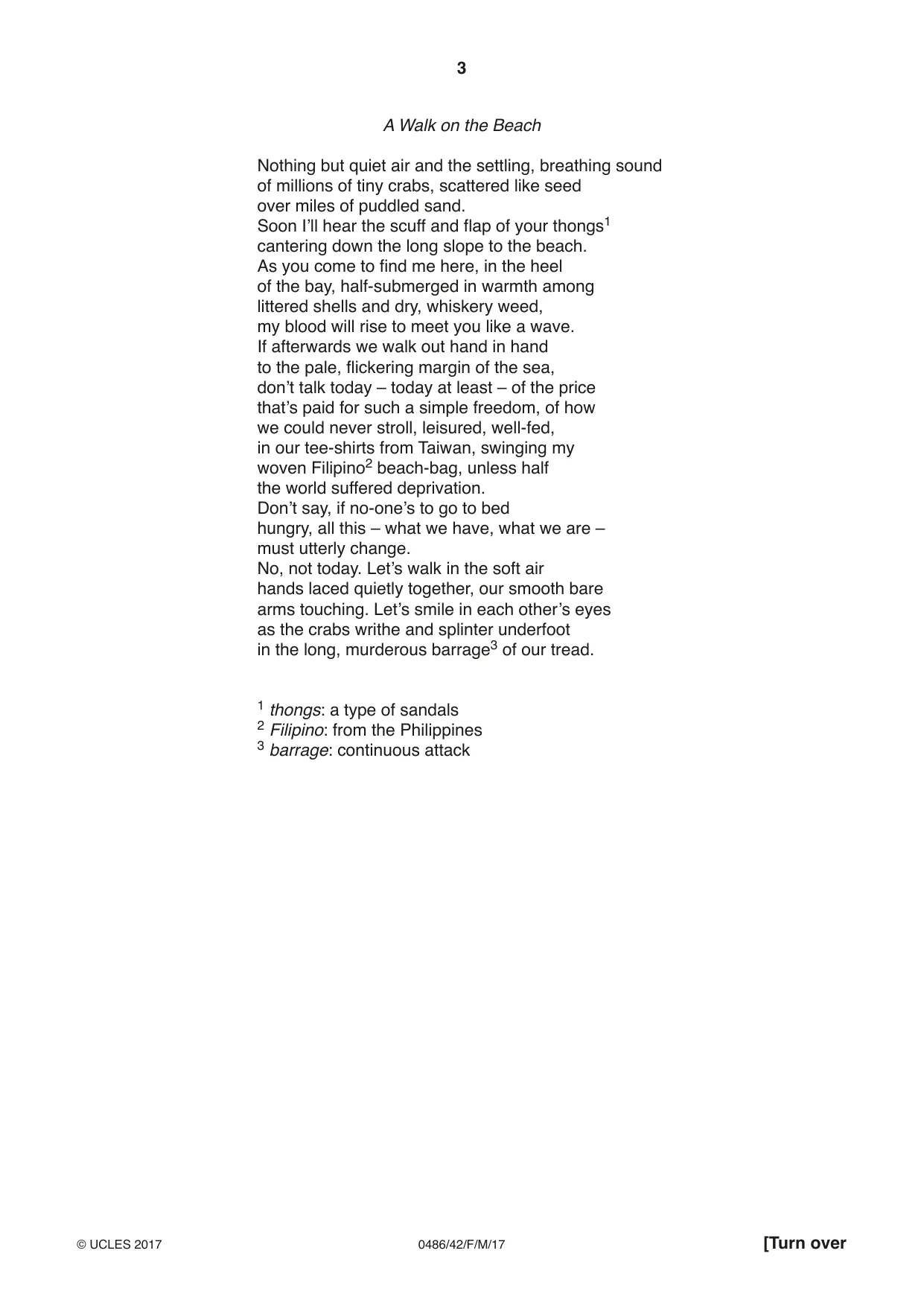
Question paper, page 3
3 0486/42/F/M/17 © UCLES 2017 [Turn over A Walk on the Beach Nothing but quiet air and the settling, breathing sound of millions of tiny crabs, scattered like seed over miles of puddled sand. Soon I’ll hear the scuff and flap of your thongs1 cantering down the long slope to the beach. As you come to find me here, in the heel of the bay, half-submerged in warmth among littered shells and dry, whiskery weed, my blood will rise to meet you like a wave. If afterwards we walk out hand in hand to the pale, flickering margin of the sea, don’t talk today – today at least – of the price that’s paid for such a simple freedom, of how we could never stroll, leisured, well-fed, in our tee-shirts from Taiwan, swinging my woven Filipino2 beach-bag, unless half the world suffered deprivation. Don’t say, if no-one’s to go to bed hungry, all this – what we have, what we are – must utterly change. No, not today. Let’s walk in the soft air hands laced quietly together, our smooth bare arms touching. Let’s smile in each other’s eyes as the crabs writhe and splinter underfoot in the long, murderous barrage3 of our tread. 1 thongs: a type of sandals 2 Filipino: from the Philippines 3 barrage: continuous attack
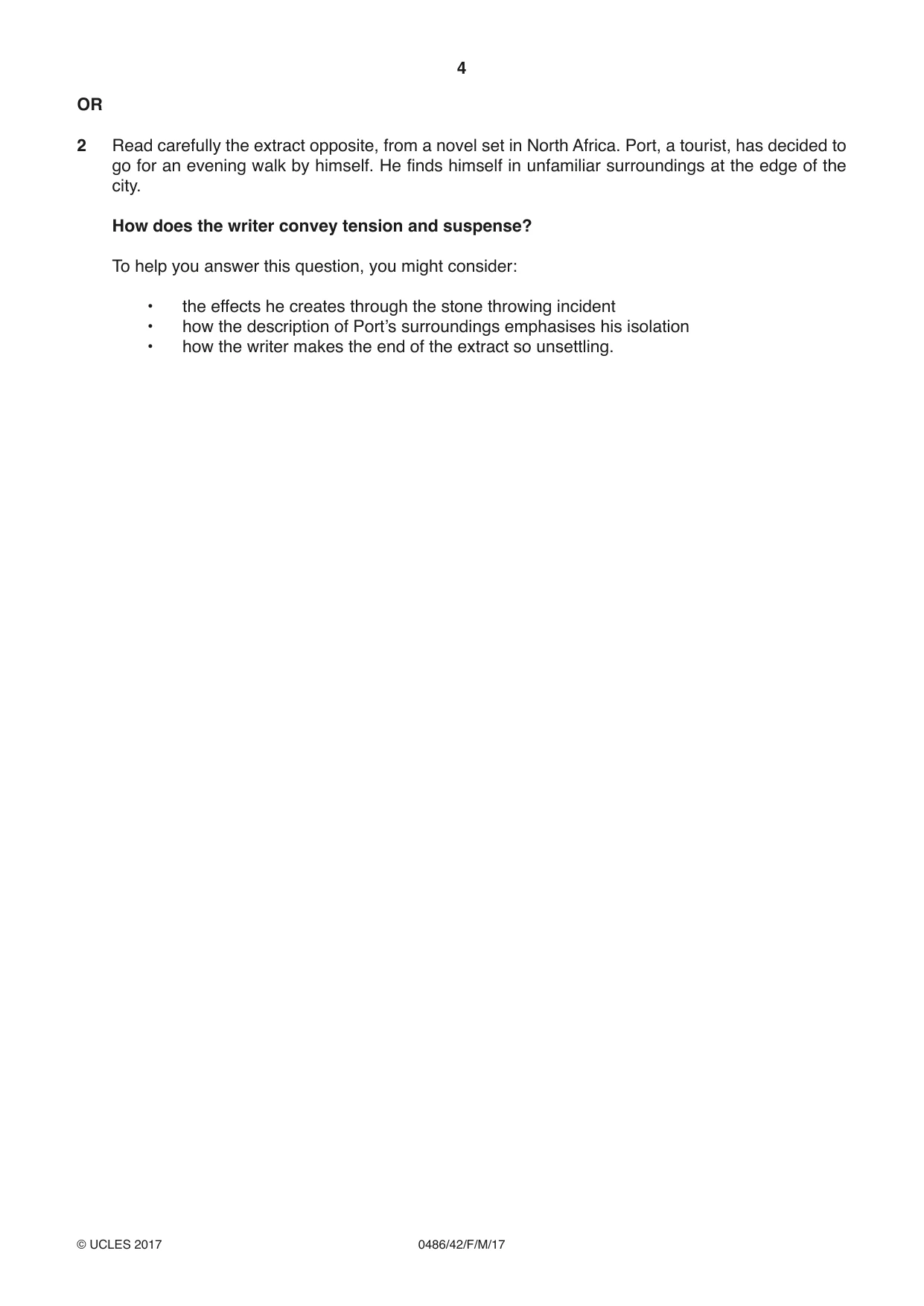
Question paper, page 4
4 0486/42/F/M/17 © UCLES 2017 OR 2 Read carefully the extract opposite, from a novel set in North Africa. Port, a tourist, has decided to go for an evening walk by himself. He finds himself in unfamiliar surroundings at the edge of the city. How does the writer convey tension and suspense? To help you answer this question, you might consider: • the effects he creates through the stone throwing incident • how the description of Port’s surroundings emphasises his isolation • how the writer makes the end of the extract so unsettling.
Question paper, page 5
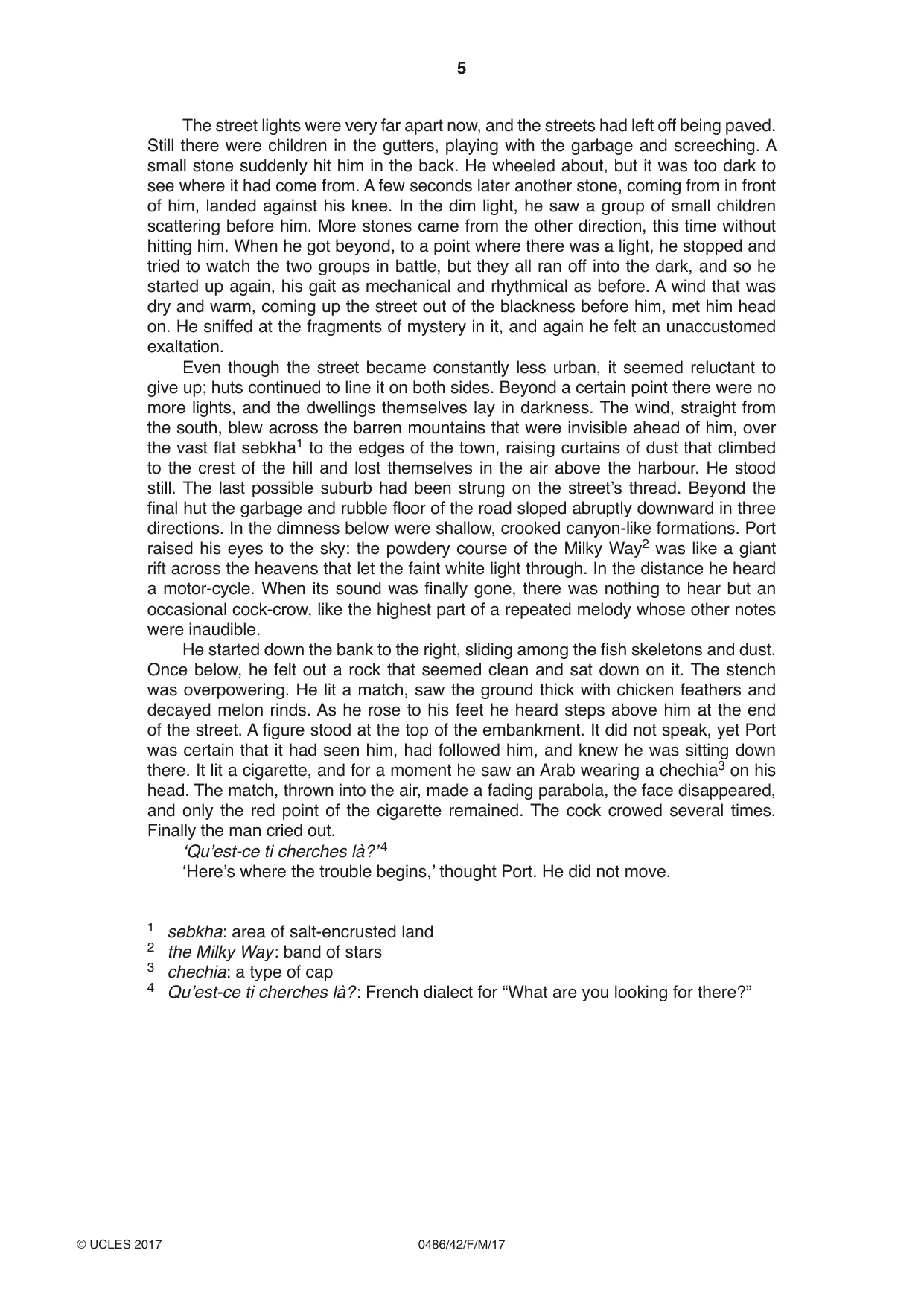
5 0486/42/F/M/17 © UCLES 2017 The street lights were very far apart now, and the streets had left off being paved. Still there were children in the gutters, playing with the garbage and screeching. A small stone suddenly hit him in the back. He wheeled about, but it was too dark to see where it had come from. A few seconds later another stone, coming from in front of him, landed against his knee. In the dim light, he saw a group of small children scattering before him. More stones came from the other direction, this time without hitting him. When he got beyond, to a point where there was a light, he stopped and tried to watch the two groups in battle, but they all ran off into the dark, and so he started up again, his gait as mechanical and rhythmical as before. A wind that was dry and warm, coming up the street out of the blackness before him, met him head on. He sniffed at the fragments of mystery in it, and again he felt an unaccustomed exaltation. Even though the street became constantly less urban, it seemed reluctant to give up; huts continued to line it on both sides. Beyond a certain point there were no more lights, and the dwellings themselves lay in darkness. The wind, straight from the south, blew across the barren mountains that were invisible ahead of him, over the vast flat sebkha1 to the edges of the town, raising curtains of dust that climbed to the crest of the hill and lost themselves in the air above the harbour. He stood still. The last possible suburb had been strung on the street’s thread. Beyond the final hut the garbage and rubble floor of the road sloped abruptly downward in three directions. In the dimness below were shallow, crooked canyon-like formations. Port raised his eyes to the sky: the powdery course of the Milky Way2 was like a giant rift across the heavens that let the faint white light through. In the distance he heard a motor-cycle. When its sound was finally gone, there was nothing to hear but an occasional cock-crow, like the highest part of a repeated melody whose other notes were inaudible. He started down the bank to the right, sliding among the fish skeletons and dust. Once below, he felt out a rock that seemed clean and sat down on it. The stench was overpowering. He lit a match, saw the ground thick with chicken feathers and decayed melon rinds. As he rose to his feet he heard steps above him at the end of the street. A figure stood at the top of the embankment. It did not speak, yet Port was certain that it had seen him, had followed him, and knew he was sitting down there. It lit a cigarette, and for a moment he saw an Arab wearing a chechia3 on his head. The match, thrown into the air, made a fading parabola, the face disappeared, and only the red point of the cigarette remained. The cock crowed several times. Finally the man cried out. ‘Qu’est-ce ti cherches là?’ 4 ‘Here’s where the trouble begins,’ thought Port. He did not move. 1 sebkha: area of salt-encrusted land 2 the Milky Way : band of stars 3 chechia: a type of cap 4 Qu’est-ce ti cherches là? : French dialect for “What are you looking for there?”
Question paper, page 6
6 0486/42/F/M/17 © UCLES 2017 BLANK PAGE
Question paper, page 7
7 0486/42/F/M/17 © UCLES 2017 BLANK PAGE
Question paper, page 8
8 0486/42/F/M/17 © UCLES 2017 BLANK PAGE Permission to reproduce items where third-party owned material protected by copyright is included has been sought and cleared where possible. Every reasonable effort has been made by the publisher (UCLES) to trace copyright holders, but if any items requiring clearance have unwittingly been included, the publisher will be pleased to make amends at the earliest possible opportunity. To avoid the issue of disclosure of answer-related information to candidates, all copyright acknowledgements are reproduced online in the Cambridge International Examinations Copyright Acknowledgements Booklet. This is produced for each series of examinations and is freely available to download at www.cie.org.uk after the live examination series. Cambridge International Examinations is part of the Cambridge Assessment Group. Cambridge Assessment is the brand name of University of Cambridge Local Examinations Syndicate (UCLES), which is itself a department of the University of Cambridge.
Mark scheme, page 1
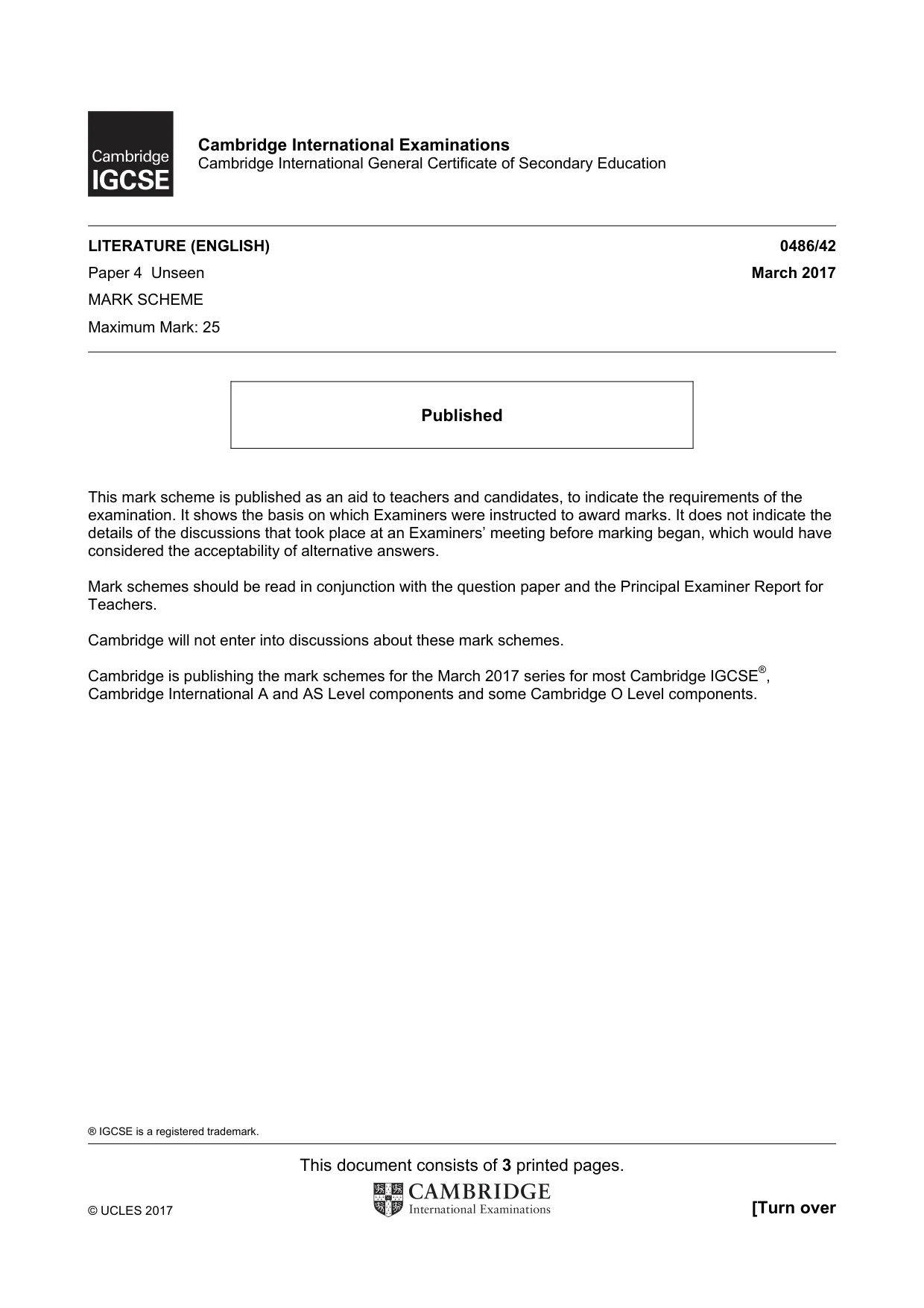
® IGCSE is a registered trademark. This document consists of 3 printed pages. © UCLES 2017 [Turn over Cambridge International Examinations Cambridge International General Certificate of Secondary Education LITERATURE (ENGLISH) 0486/42 Paper 4 Unseen March 2017 MARK SCHEME Maximum Mark: 25 Published This mark scheme is published as an aid to teachers and candidates, to indicate the requirements of the examination. It shows the basis on which Examiners were instructed to award marks. It does not indicate the details of the discussions that took place at an Examiners’ meeting before marking began, which would have considered the acceptability of alternative answers. Mark schemes should be read in conjunction with the question paper and the Principal Examiner Report for Teachers. Cambridge will not enter into discussions about these mark schemes. Cambridge is publishing the mark schemes for the March 2017 series for most Cambridge IGCSE®, Cambridge International A and AS Level components and some Cambridge O Level components.
Mark scheme, page 2
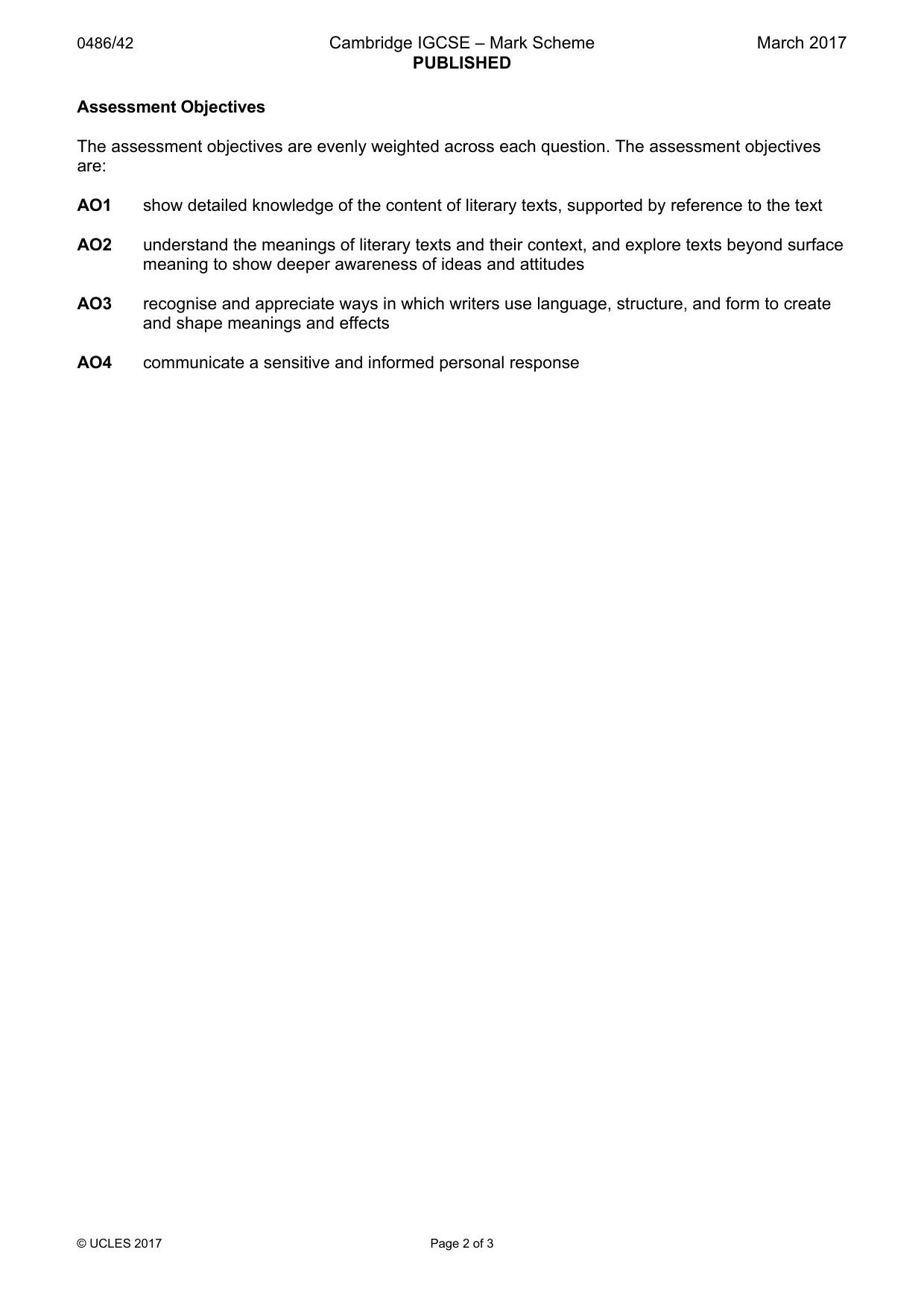
0486/42 Cambridge IGCSE – Mark Scheme PUBLISHED March 2017 © UCLES 2017 Page 2 of 3 Assessment Objectives The assessment objectives are evenly weighted across each question. The assessment objectives are: AO1 show detailed knowledge of the content of literary texts, supported by reference to the text AO2 understand the meanings of literary texts and their context, and explore texts beyond surface meaning to show deeper awareness of ideas and attitudes AO3 recognise and appreciate ways in which writers use language, structure, and form to create and shape meanings and effects AO4 communicate a sensitive and informed personal response
Mark scheme, page 3
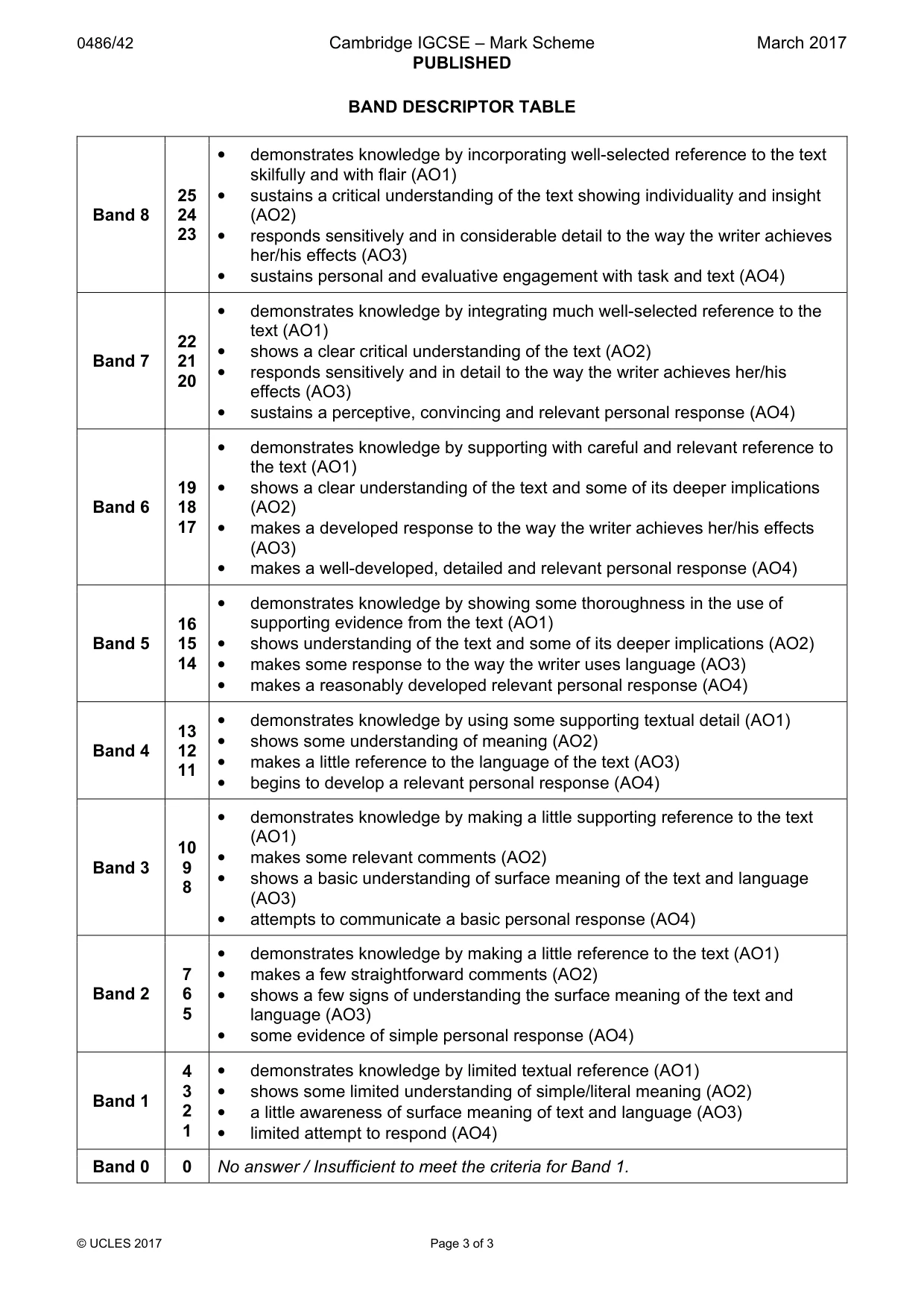
0486/42 Cambridge IGCSE – Mark Scheme PUBLISHED March 2017 © UCLES 2017 Page 3 of 3 BAND DESCRIPTOR TABLE Band 8 25 24 23 • demonstrates knowledge by incorporating well-selected reference to the text skilfully and with flair (AO1) • sustains a critical understanding of the text showing individuality and insight (AO2) • responds sensitively and in considerable detail to the way the writer achieves her/his effects (AO3) • sustains personal and evaluative engagement with task and text (AO4) Band 7 22 21 20 • demonstrates knowledge by integrating much well-selected reference to the text (AO1) • shows a clear critical understanding of the text (AO2) • responds sensitively and in detail to the way the writer achieves her/his effects (AO3) • sustains a perceptive, convincing and relevant personal response (AO4) Band 6 19 18 17 • demonstrates knowledge by supporting with careful and relevant reference to the text (AO1) • shows a clear understanding of the text and some of its deeper implications (AO2) • makes a developed response to the way the writer achieves her/his effects (AO3) • makes a well-developed, detailed and relevant personal response (AO4) Band 5 16 15 14 • demonstrates knowledge by showing some thoroughness in the use of supporting evidence from the text (AO1) • shows understanding of the text and some of its deeper implications (AO2) • makes some response to the way the writer uses language (AO3) • makes a reasonably developed relevant personal response (AO4) Band 4 13 12 11 • demonstrates knowledge by using some supporting textual detail (AO1) • shows some understanding of meaning (AO2) • makes a little reference to the language of the text (AO3) • begins to develop a relevant personal response (AO4) Band 3 10 9 8 • demonstrates knowledge by making a little supporting reference to the text (AO1) • makes some relevant comments (AO2) • shows a basic understanding of surface meaning of the text and language (AO3) • attempts to communicate a basic personal response (AO4) Band 2 7 6 5 • demonstrates knowledge by making a little reference to the text (AO1) • makes a few straightforward comments (AO2) • shows a few signs of understanding the surface meaning of the text and language (AO3) • some evidence of simple personal response (AO4) Band 1 4 3 2 1 • demonstrates knowledge by limited textual reference (AO1) • shows some limited understanding of simple/literal meaning (AO2) • a little awareness of surface meaning of text and language (AO3) • limited attempt to respond (AO4) Band 0 0 No answer / Insufficient to meet the criteria for Band 1.
What you needed in this session
Cambridge’s own grade thresholds for 2017 Feb/March, Paper 4 · Variant 2. A higher threshold means an easier paper — the bar moves with how the cohort did.