Cambridge IGCSE English - Literature 0486 — 2019 Feb/March Paper 4 · Variant 2
0486/42/F/M/19 · 25 marks · ≈28 min
The question paper and its mark scheme, free to read here and free to download. This is Cambridge’s own paper, exactly as it was sat.
Question paper8 pages


Mark scheme4 pages
Answers below. Sit the paper first if you are practising.
Paper as text
Question paper, page 1
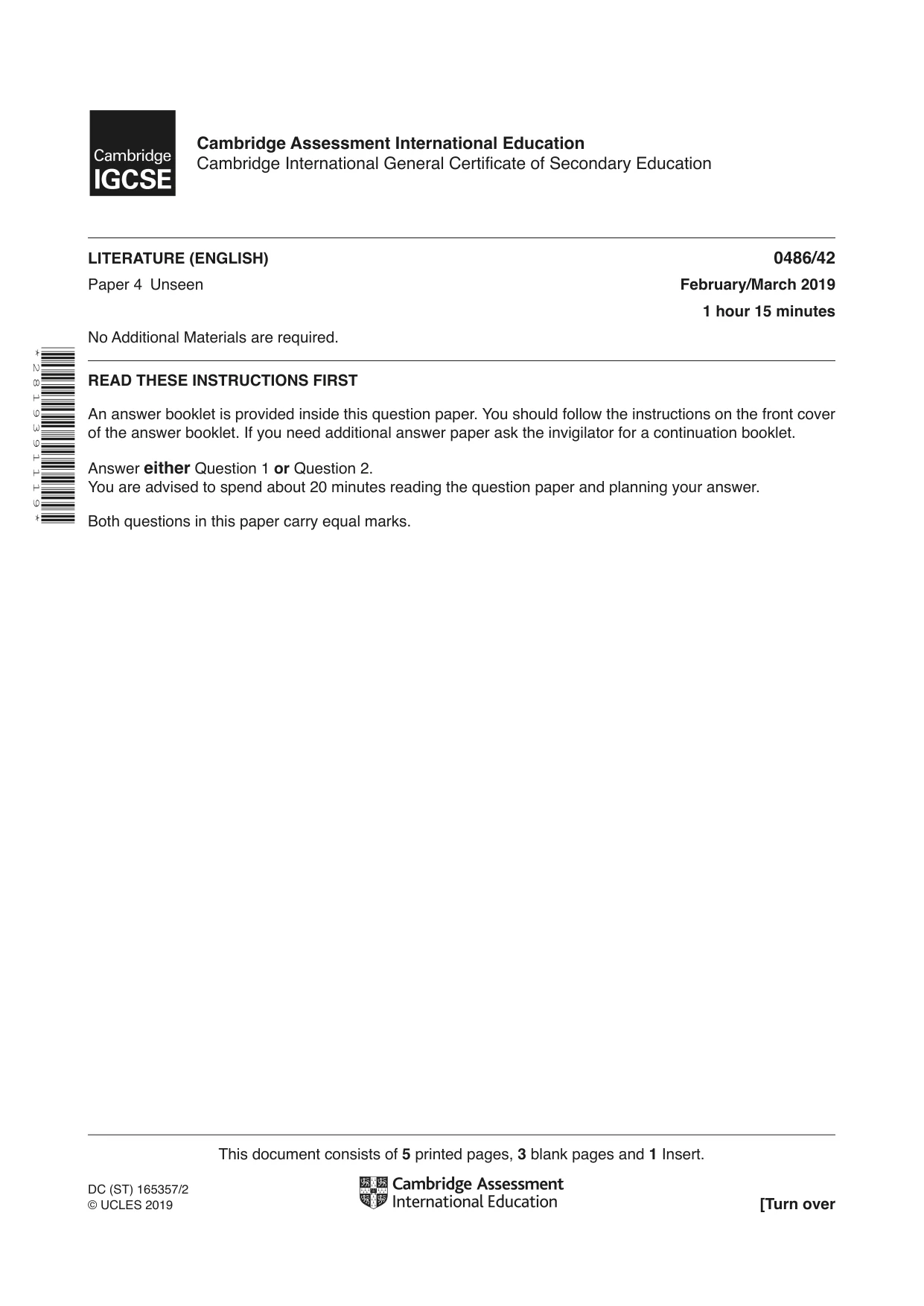
This document consists of 5 printed pages, 3 blank pages and 1 Insert. DC (ST) 165357/2 © UCLES 2019 [Turn over Cambridge Assessment International Education Cambridge International General Certificate of Secondary Education * 2 8 1 9 3 9 1 1 1 9 * LITERATURE (ENGLISH) 0486/42 Paper 4 Unseen February/March 2019 1 hour 15 minutes No Additional Materials are required. READ THESE INSTRUCTIONS FIRST An answer booklet is provided inside this question paper. You should follow the instructions on the front cover of the answer booklet. If you need additional answer paper ask the invigilator for a continuation booklet. Answer either Question 1 or Question 2. You are advised to spend about 20 minutes reading the question paper and planning your answer. Both questions in this paper carry equal marks.
Question paper, page 2
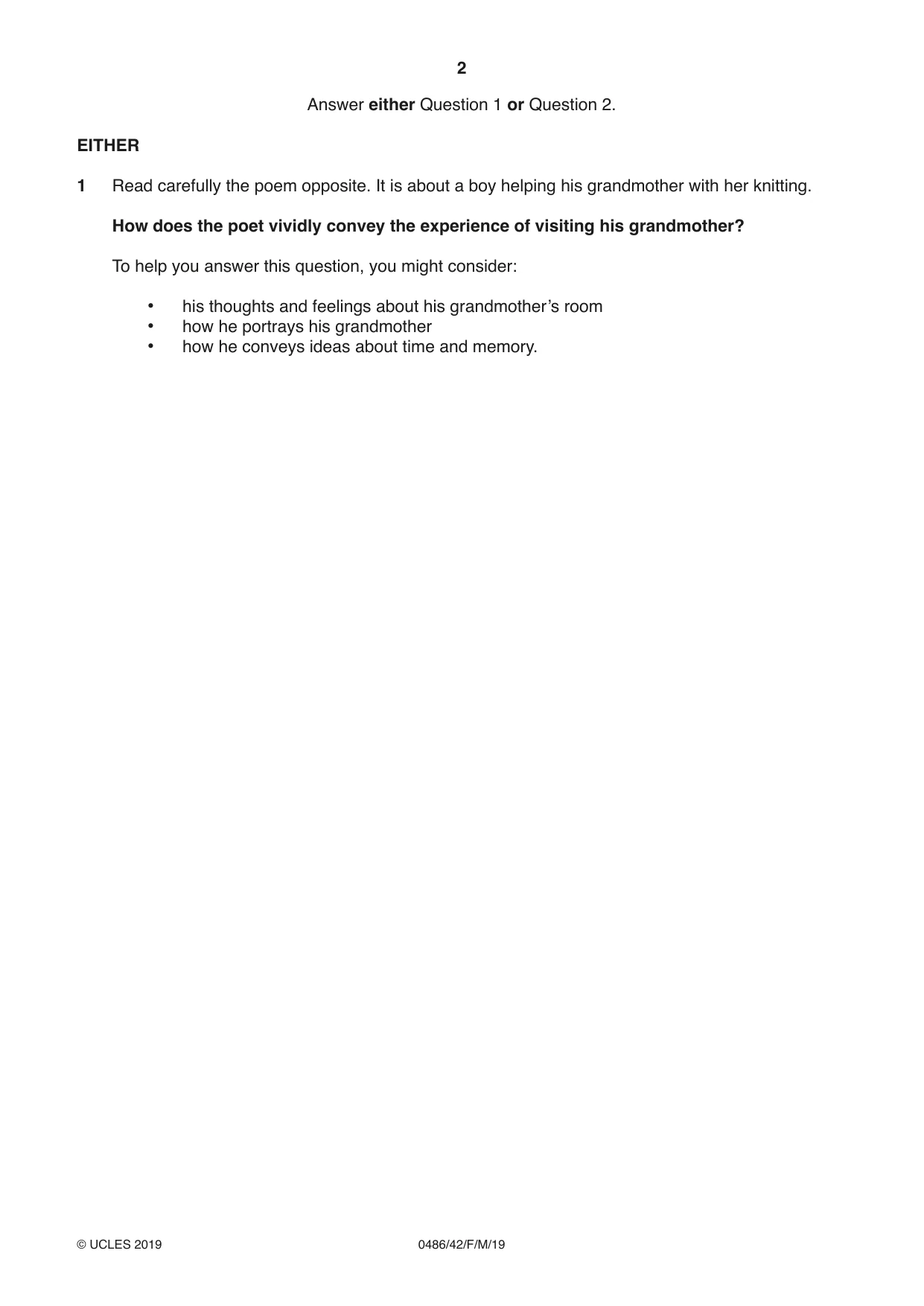
2 0486/42/F/M/19 © UCLES 2019 Answer either Question 1 or Question 2. EITHER 1 Read carefully the poem opposite. It is about a boy helping his grandmother with her knitting. How does the poet vividly convey the experience of visiting his grandmother? To help you answer this question, you might consider: • his thoughts and feelings about his grandmother’s room • how he portrays his grandmother • how he conveys ideas about time and memory.
Question paper, page 3
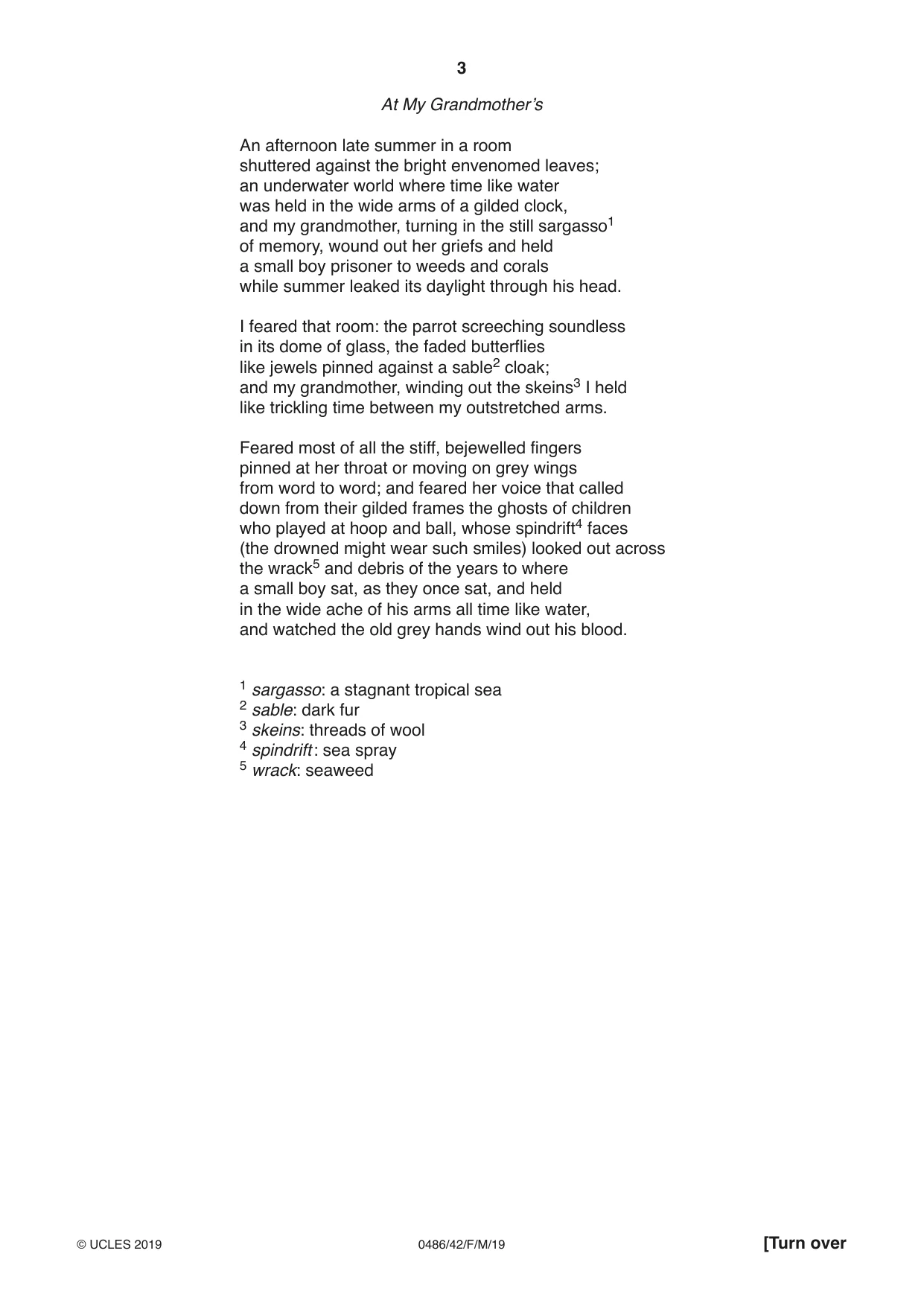
3 0486/42/F/M/19 © UCLES 2019 [Turn over At My Grandmother’s An afternoon late summer in a room shuttered against the bright envenomed leaves; an underwater world where time like water was held in the wide arms of a gilded clock, and my grandmother, turning in the still sargasso1 of memory, wound out her griefs and held a small boy prisoner to weeds and corals while summer leaked its daylight through his head. I feared that room: the parrot screeching soundless in its dome of glass, the faded butterflies like jewels pinned against a sable2 cloak; and my grandmother, winding out the skeins3 I held like trickling time between my outstretched arms. Feared most of all the stiff, bejewelled fingers pinned at her throat or moving on grey wings from word to word; and feared her voice that called down from their gilded frames the ghosts of children who played at hoop and ball, whose spindrift4 faces (the drowned might wear such smiles) looked out across the wrack5 and debris of the years to where a small boy sat, as they once sat, and held in the wide ache of his arms all time like water, and watched the old grey hands wind out his blood. 1 sargasso: a stagnant tropical sea 2 sable: dark fur 3 skeins: threads of wool 4 spindrift : sea spray 5 wrack: seaweed
Question paper, page 4
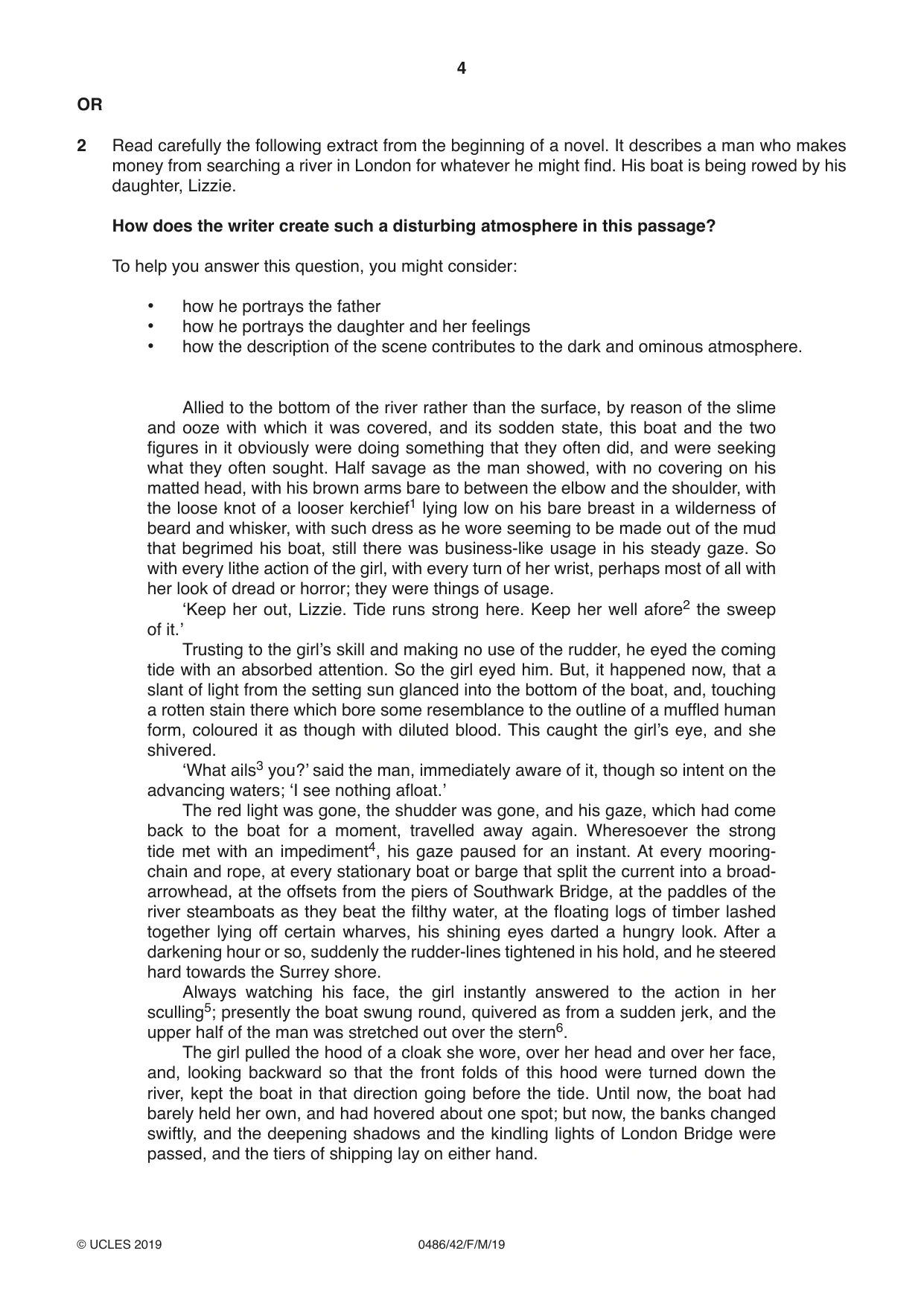
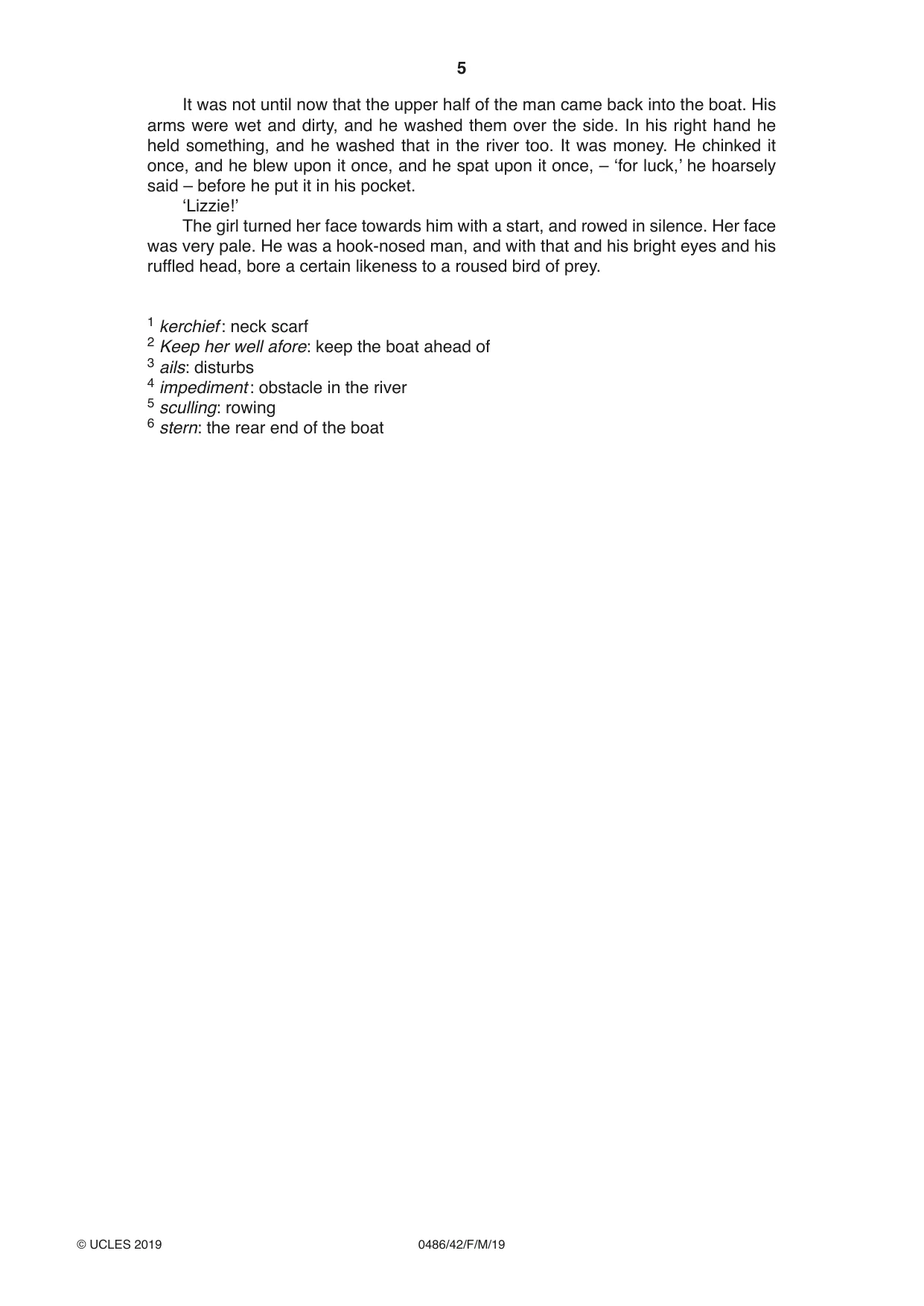
4 0486/42/F/M/19 © UCLES 2019 OR 2 Read carefully the following extract from the beginning of a novel. It describes a man who makes money from searching a river in London for whatever he might find. His boat is being rowed by his daughter, Lizzie. How does the writer create such a disturbing atmosphere in this passage? To help you answer this question, you might consider: • how he portrays the father • how he portrays the daughter and her feelings • how the description of the scene contributes to the dark and ominous atmosphere. Allied to the bottom of the river rather than the surface, by reason of the slime and ooze with which it was covered, and its sodden state, this boat and the two figures in it obviously were doing something that they often did, and were seeking what they often sought. Half savage as the man showed, with no covering on his matted head, with his brown arms bare to between the elbow and the shoulder, with the loose knot of a looser kerchief1 lying low on his bare breast in a wilderness of beard and whisker, with such dress as he wore seeming to be made out of the mud that begrimed his boat, still there was business-like usage in his steady gaze. So with every lithe action of the girl, with every turn of her wrist, perhaps most of all with her look of dread or horror; they were things of usage. ‘Keep her out, Lizzie. Tide runs strong here. Keep her well afore2 the sweep of it.’ Trusting to the girl’s skill and making no use of the rudder, he eyed the coming tide with an absorbed attention. So the girl eyed him. But, it happened now, that a slant of light from the setting sun glanced into the bottom of the boat, and, touching a rotten stain there which bore some resemblance to the outline of a muffled human form, coloured it as though with diluted blood. This caught the girl’s eye, and she shivered. ‘What ails3 you?’ said the man, immediately aware of it, though so intent on the advancing waters; ‘I see nothing afloat.’ The red light was gone, the shudder was gone, and his gaze, which had come back to the boat for a moment, travelled away again. Wheresoever the strong tide met with an impediment4, his gaze paused for an instant. At every mooring- chain and rope, at every stationary boat or barge that split the current into a broad- arrowhead, at the offsets from the piers of Southwark Bridge, at the paddles of the river steamboats as they beat the filthy water, at the floating logs of timber lashed together lying off certain wharves, his shining eyes darted a hungry look. After a darkening hour or so, suddenly the rudder-lines tightened in his hold, and he steered hard towards the Surrey shore. Always watching his face, the girl instantly answered to the action in her sculling5; presently the boat swung round, quivered as from a sudden jerk, and the upper half of the man was stretched out over the stern6. The girl pulled the hood of a cloak she wore, over her head and over her face, and, looking backward so that the front folds of this hood were turned down the river, kept the boat in that direction going before the tide. Until now, the boat had barely held her own, and had hovered about one spot; but now, the banks changed swiftly, and the deepening shadows and the kindling lights of London Bridge were passed, and the tiers of shipping lay on either hand.
Question paper, page 5
5 0486/42/F/M/19 © UCLES 2019 It was not until now that the upper half of the man came back into the boat. His arms were wet and dirty, and he washed them over the side. In his right hand he held something, and he washed that in the river too. It was money. He chinked it once, and he blew upon it once, and he spat upon it once, – ‘for luck,’ he hoarsely said – before he put it in his pocket. ‘Lizzie!’ The girl turned her face towards him with a start, and rowed in silence. Her face was very pale. He was a hook-nosed man, and with that and his bright eyes and his ruffled head, bore a certain likeness to a roused bird of prey. 1 kerchief : neck scarf 2 Keep her well afore: keep the boat ahead of 3 ails: disturbs 4 impediment : obstacle in the river 5 sculling: rowing 6 stern: the rear end of the boat
Question paper, page 6
6 0486/42/F/M/19 © UCLES 2019 BLANK PAGE
Question paper, page 7
7 0486/42/F/M/19 © UCLES 2019 BLANK PAGE
Question paper, page 8
8 0486/42/F/M/19 © UCLES 2019 BLANK PAGE Permission to reproduce items where third-party owned material protected by copyright is included has been sought and cleared where possible. Every reasonable effort has been made by the publisher (UCLES) to trace copyright holders, but if any items requiring clearance have unwittingly been included, the publisher will be pleased to make amends at the earliest possible opportunity. To avoid the issue of disclosure of answer-related information to candidates, all copyright acknowledgements are reproduced online in the Cambridge Assessment International Education Copyright Acknowledgements Booklet. This is produced for each series of examinations and is freely available to download at www.cambridgeinternational.org after the live examination series. Cambridge Assessment International Education is part of the Cambridge Assessment Group. Cambridge Assessment is the brand name of the University of Cambridge Local Examinations Syndicate (UCLES), which itself is a department of the University of Cambridge.
Mark scheme, page 1
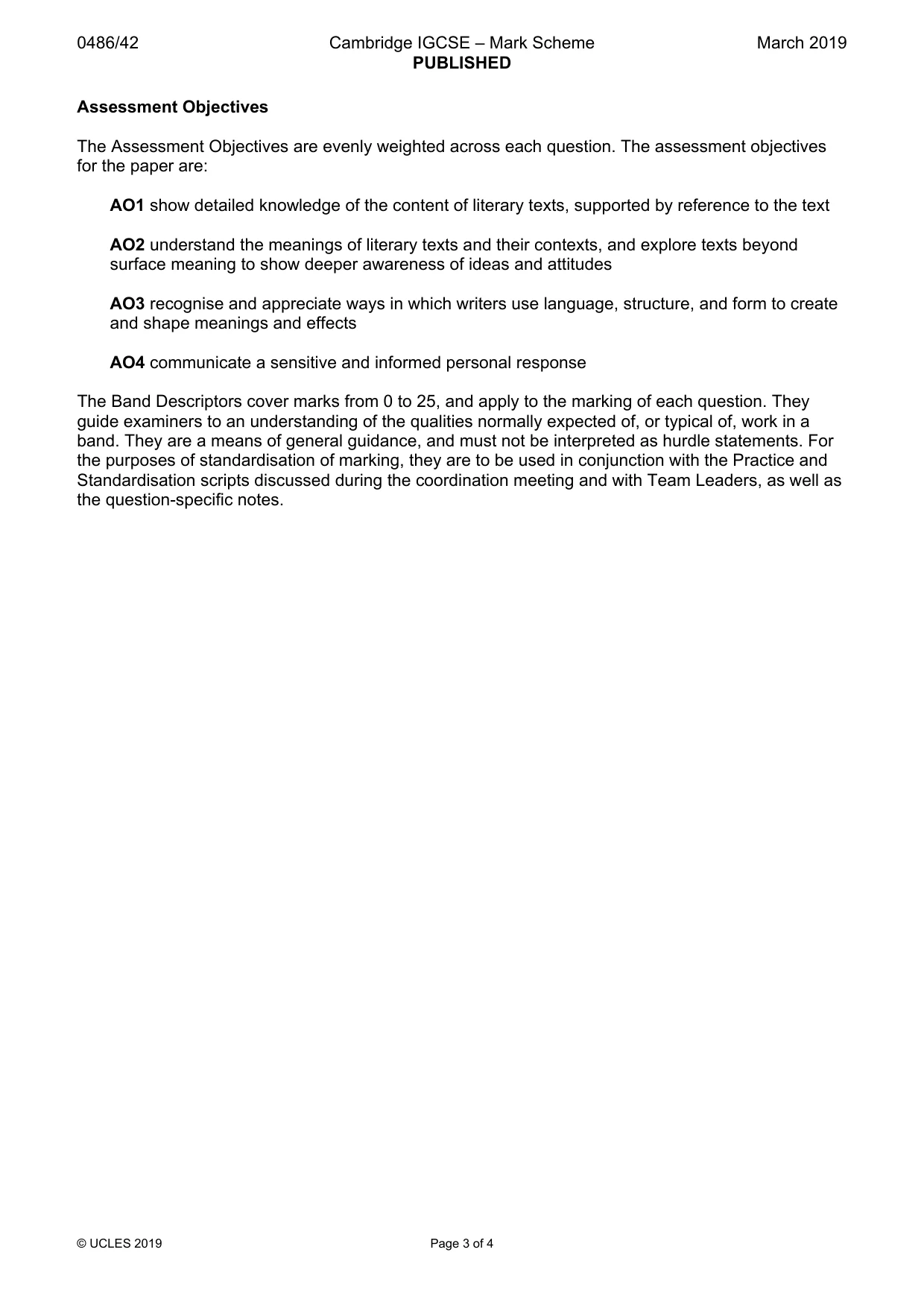
This document consists of 4 printed pages. © UCLES 2019 [Turn over Cambridge Assessment International Education Cambridge International General Certificate of Secondary Education LITERATURE (ENGLISH) 0486/42 Paper 4 Unseen March 2019 MARK SCHEME Maximum Mark: 25 Published This mark scheme is published as an aid to teachers and candidates, to indicate the requirements of the examination. It shows the basis on which Examiners were instructed to award marks. It does not indicate the details of the discussions that took place at an Examiners’ meeting before marking began, which would have considered the acceptability of alternative answers. Mark schemes should be read in conjunction with the question paper and the Principal Examiner Report for Teachers. Cambridge International will not enter into discussions about these mark schemes. Cambridge International is publishing the mark schemes for the March 2019 series for most Cambridge IGCSE™, Cambridge International A and AS Level components and some Cambridge O Level components.
Mark scheme, page 2
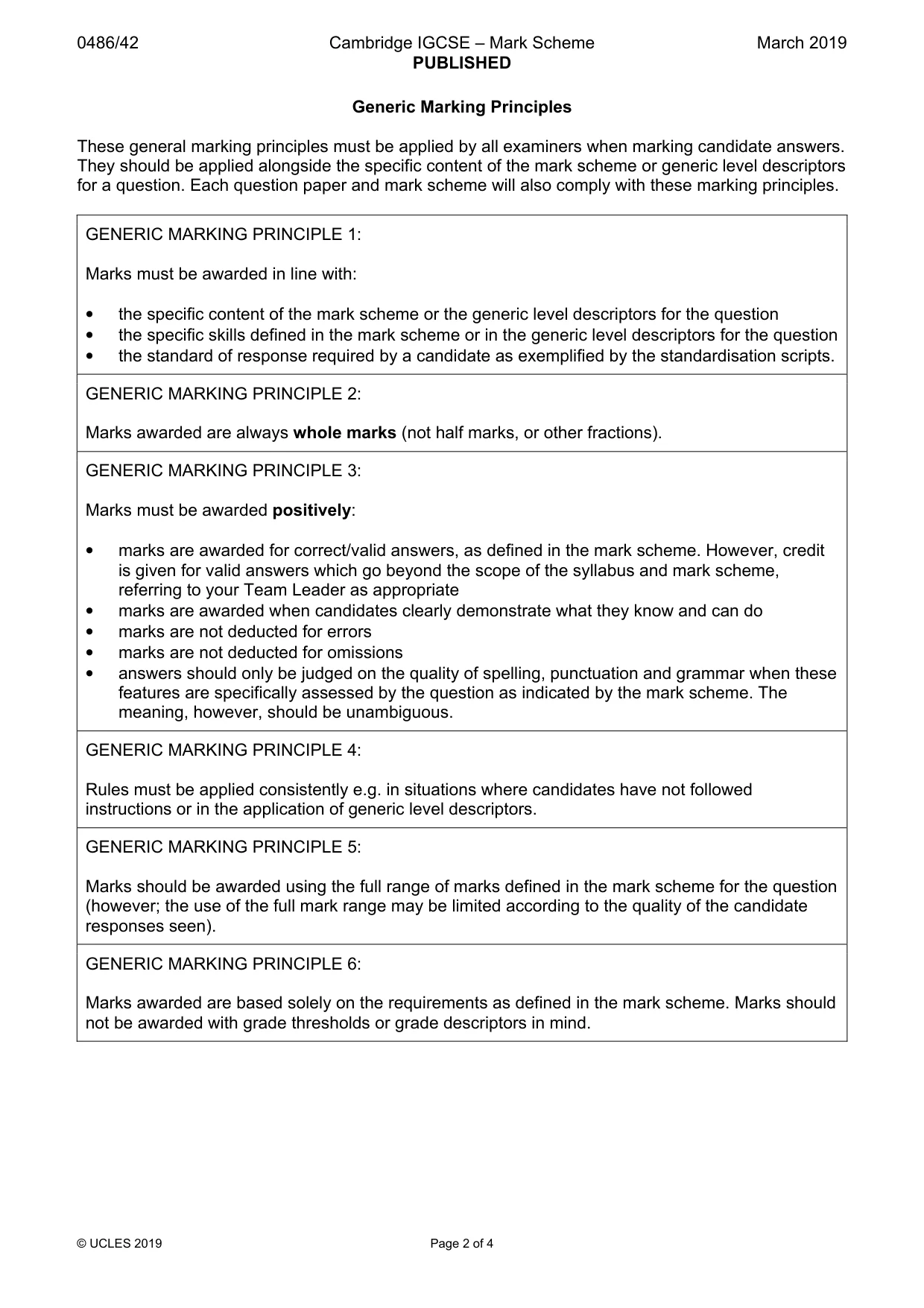
0486/42 Cambridge IGCSE – Mark Scheme PUBLISHED March 2019 © UCLES 2019 Page 2 of 4 Generic Marking Principles These general marking principles must be applied by all examiners when marking candidate answers. They should be applied alongside the specific content of the mark scheme or generic level descriptors for a question. Each question paper and mark scheme will also comply with these marking principles. GENERIC MARKING PRINCIPLE 1: Marks must be awarded in line with: • the specific content of the mark scheme or the generic level descriptors for the question • the specific skills defined in the mark scheme or in the generic level descriptors for the question • the standard of response required by a candidate as exemplified by the standardisation scripts. GENERIC MARKING PRINCIPLE 2: Marks awarded are always whole marks (not half marks, or other fractions). GENERIC MARKING PRINCIPLE 3: Marks must be awarded positively: • marks are awarded for correct/valid answers, as defined in the mark scheme. However, credit is given for valid answers which go beyond the scope of the syllabus and mark scheme, referring to your Team Leader as appropriate • marks are awarded when candidates clearly demonstrate what they know and can do • marks are not deducted for errors • marks are not deducted for omissions • answers should only be judged on the quality of spelling, punctuation and grammar when these features are specifically assessed by the question as indicated by the mark scheme. The meaning, however, should be unambiguous. GENERIC MARKING PRINCIPLE 4: Rules must be applied consistently e.g. in situations where candidates have not followed instructions or in the application of generic level descriptors. GENERIC MARKING PRINCIPLE 5: Marks should be awarded using the full range of marks defined in the mark scheme for the question (however; the use of the full mark range may be limited according to the quality of the candidate responses seen). GENERIC MARKING PRINCIPLE 6: Marks awarded are based solely on the requirements as defined in the mark scheme. Marks should not be awarded with grade thresholds or grade descriptors in mind.
Mark scheme, page 3
0486/42 Cambridge IGCSE – Mark Scheme PUBLISHED March 2019 © UCLES 2019 Page 3 of 4 Assessment Objectives The Assessment Objectives are evenly weighted across each question. The assessment objectives for the paper are: AO1 show detailed knowledge of the content of literary texts, supported by reference to the text AO2 understand the meanings of literary texts and their contexts, and explore texts beyond surface meaning to show deeper awareness of ideas and attitudes AO3 recognise and appreciate ways in which writers use language, structure, and form to create and shape meanings and effects AO4 communicate a sensitive and informed personal response The Band Descriptors cover marks from 0 to 25, and apply to the marking of each question. They guide examiners to an understanding of the qualities normally expected of, or typical of, work in a band. They are a means of general guidance, and must not be interpreted as hurdle statements. For the purposes of standardisation of marking, they are to be used in conjunction with the Practice and Standardisation scripts discussed during the coordination meeting and with Team Leaders, as well as the question-specific notes.
Mark scheme, page 4
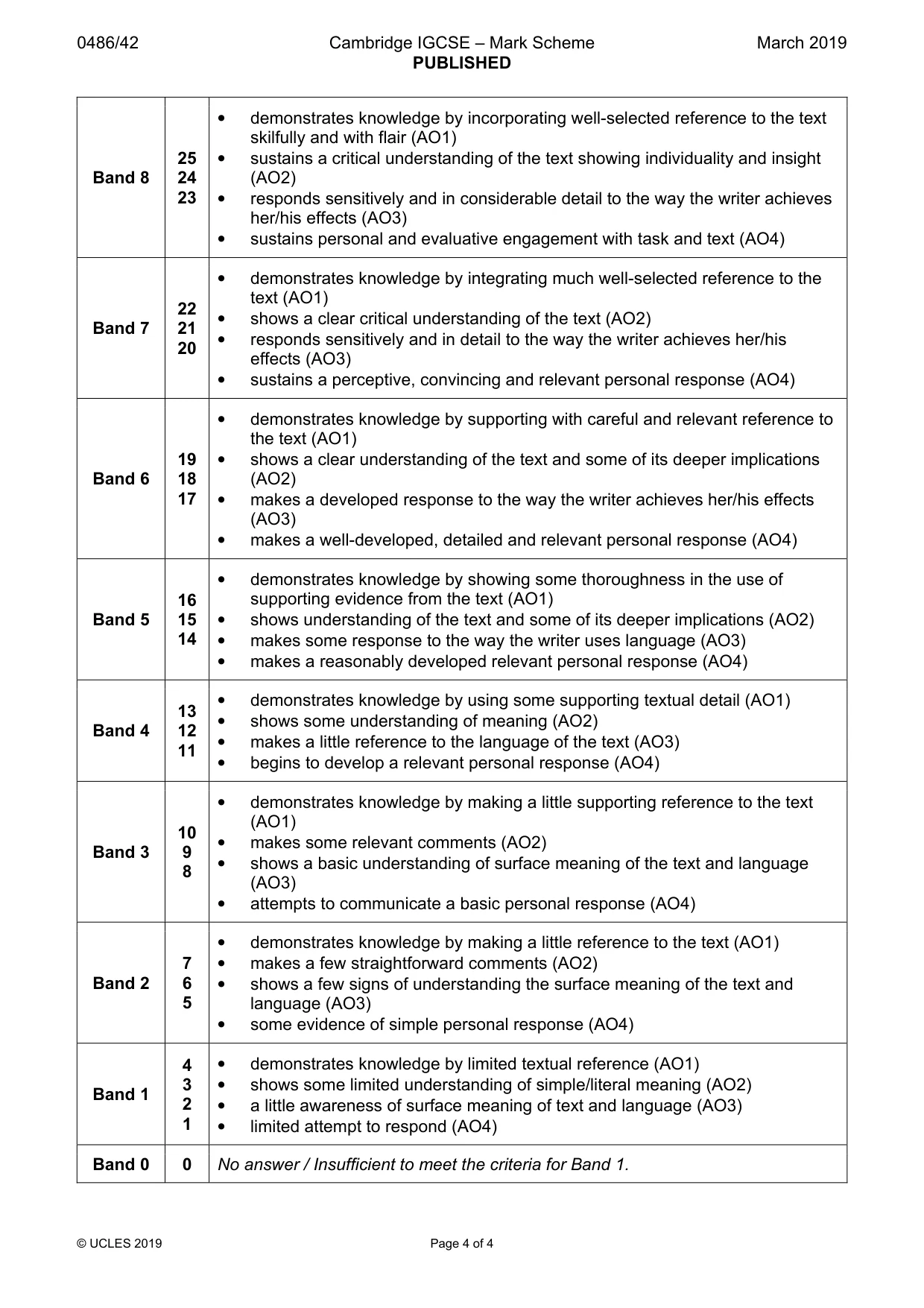
0486/42 Cambridge IGCSE – Mark Scheme PUBLISHED March 2019 © UCLES 2019 Page 4 of 4 Band 8 25 24 23 • demonstrates knowledge by incorporating well-selected reference to the text skilfully and with flair (AO1) • sustains a critical understanding of the text showing individuality and insight (AO2) • responds sensitively and in considerable detail to the way the writer achieves her/his effects (AO3) • sustains personal and evaluative engagement with task and text (AO4) Band 7 22 21 20 • demonstrates knowledge by integrating much well-selected reference to the text (AO1) • shows a clear critical understanding of the text (AO2) • responds sensitively and in detail to the way the writer achieves her/his effects (AO3) • sustains a perceptive, convincing and relevant personal response (AO4) Band 6 19 18 17 • demonstrates knowledge by supporting with careful and relevant reference to the text (AO1) • shows a clear understanding of the text and some of its deeper implications (AO2) • makes a developed response to the way the writer achieves her/his effects (AO3) • makes a well-developed, detailed and relevant personal response (AO4) Band 5 16 15 14 • demonstrates knowledge by showing some thoroughness in the use of supporting evidence from the text (AO1) • shows understanding of the text and some of its deeper implications (AO2) • makes some response to the way the writer uses language (AO3) • makes a reasonably developed relevant personal response (AO4) Band 4 13 12 11 • demonstrates knowledge by using some supporting textual detail (AO1) • shows some understanding of meaning (AO2) • makes a little reference to the language of the text (AO3) • begins to develop a relevant personal response (AO4) Band 3 10 9 8 • demonstrates knowledge by making a little supporting reference to the text (AO1) • makes some relevant comments (AO2) • shows a basic understanding of surface meaning of the text and language (AO3) • attempts to communicate a basic personal response (AO4) Band 2 7 6 5 • demonstrates knowledge by making a little reference to the text (AO1) • makes a few straightforward comments (AO2) • shows a few signs of understanding the surface meaning of the text and language (AO3) • some evidence of simple personal response (AO4) Band 1 4 3 2 1 • demonstrates knowledge by limited textual reference (AO1) • shows some limited understanding of simple/literal meaning (AO2) • a little awareness of surface meaning of text and language (AO3) • limited attempt to respond (AO4) Band 0 0 No answer / Insufficient to meet the criteria for Band 1.
What you needed in this session
Cambridge’s own grade thresholds for 2019 Feb/March, Paper 4 · Variant 2. A higher threshold means an easier paper — the bar moves with how the cohort did.