Cambridge IGCSE English - Literature 0486 — 2018 May/June Paper 3 · Variant 2
0486/32/M/J/18 · 25 marks · ≈28 min
The question paper and its mark scheme, free to read here and free to download. This is Cambridge’s own paper, exactly as it was sat.
Question paper12 pages
Mark scheme4 pages
Answers below. Sit the paper first if you are practising.
Paper as text
Question paper, page 1
Cambridge International Examinations Cambridge International General Certificate of Secondary Education 0486/32 LITERATURE (ENGLISH) May/June 2018 Paper 3 Drama (Open Text) 45 minutes Texts studied should be taken into the examination. READ THESE INSTRUCTIONS FIRST An answer booklet is provided inside this question paper. You should follow the instructions on the front cover of the answer booklet. If you need additional answer paper ask the invigilator for a continuation booklet. Answer one question. All questions in this paper carry equal marks. This document consists of 11 printed pages and 1 blank page. [Turn over 06_0486_32_2018_1.3 © UCLES 2018 *7555928994*
Question paper, page 2
J LAWRENCE & R E LEE: Inherit the Wind Remember to support your ideas with details from the writing. Either 1 Read this passage carefully, and then answer the question that follows it: The courthouse lawn. The same night. The oppressive heat of the day has softened into a pleasant summer evening. Content removed due to copyright restrictions 06_0486_32_2018_1.3 © UCLES 2018 2
Question paper, page 3
Content removed due to copyright restrictions [from Act 1] What striking impressions of Matthew Harrison Brady do the writers create at this moment in the play? Or 2 To what extent do you feel that the writers bring the play to a satisfying conclusion? [Turn over 06_0486_32_2018_1.3 © UCLES 2018 3 This is the squared circle where he has fought so many bouts with the English language, and won.]
Question paper, page 4
ARTHUR MILLER: A View from the Bridge Remember to support your ideas with details from the writing. Either 3 Read this passage carefully, and then answer the question that follows it: Now look, Baby, I can see we’re gettin’ mixed up again here. Eddie: Content removed due to copyright restrictions 06_0486_32_2018_1.3 © UCLES 2018 4
Question paper, page 5
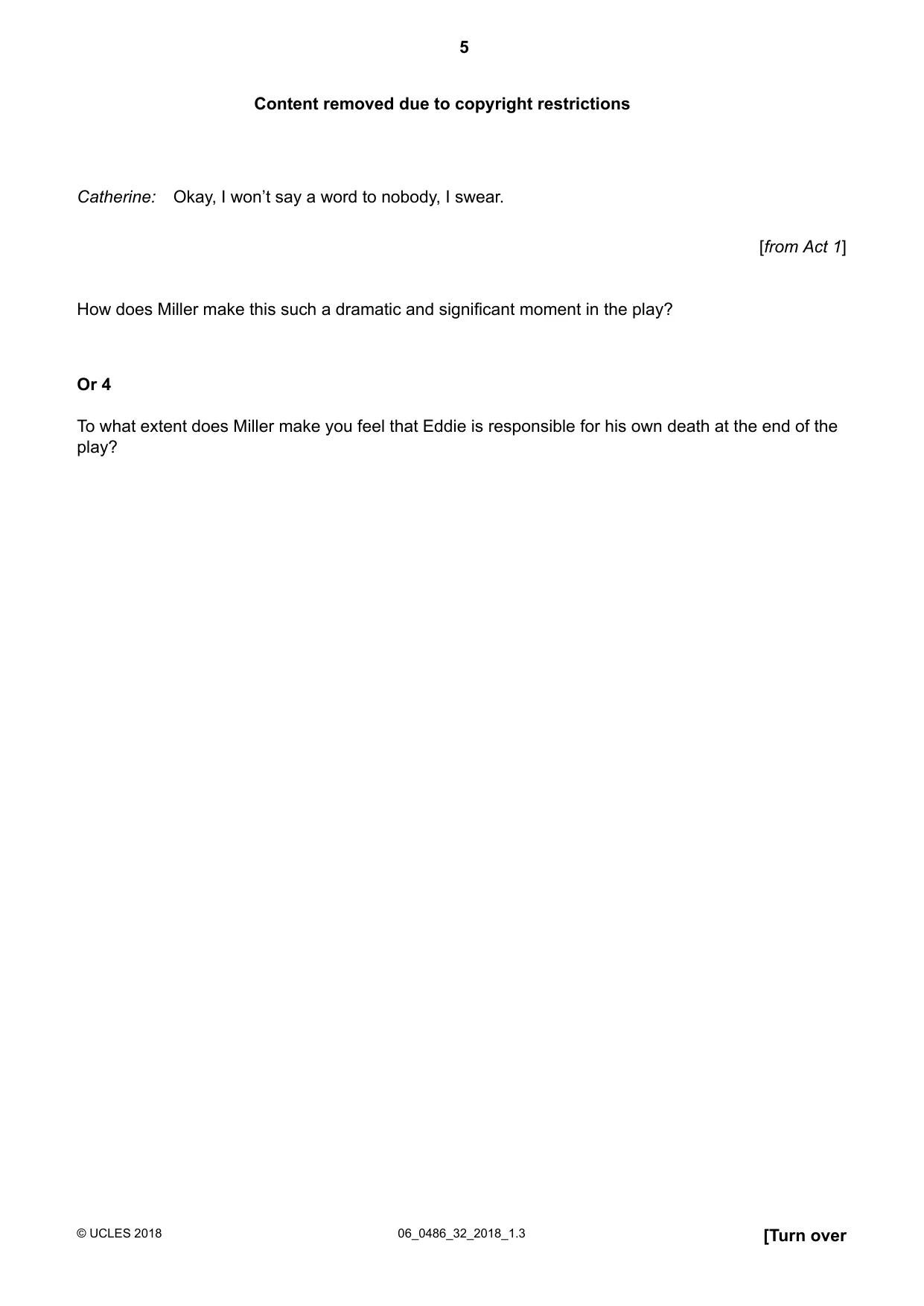
Content removed due to copyright restrictions Okay, I won’t say a word to nobody, I swear. Catherine: [from Act 1] How does Miller make this such a dramatic and significant moment in the play? Or 4 To what extent does Miller make you feel that Eddie is responsible for his own death at the end of the play? [Turn over 06_0486_32_2018_1.3 © UCLES 2018 5
Question paper, page 6
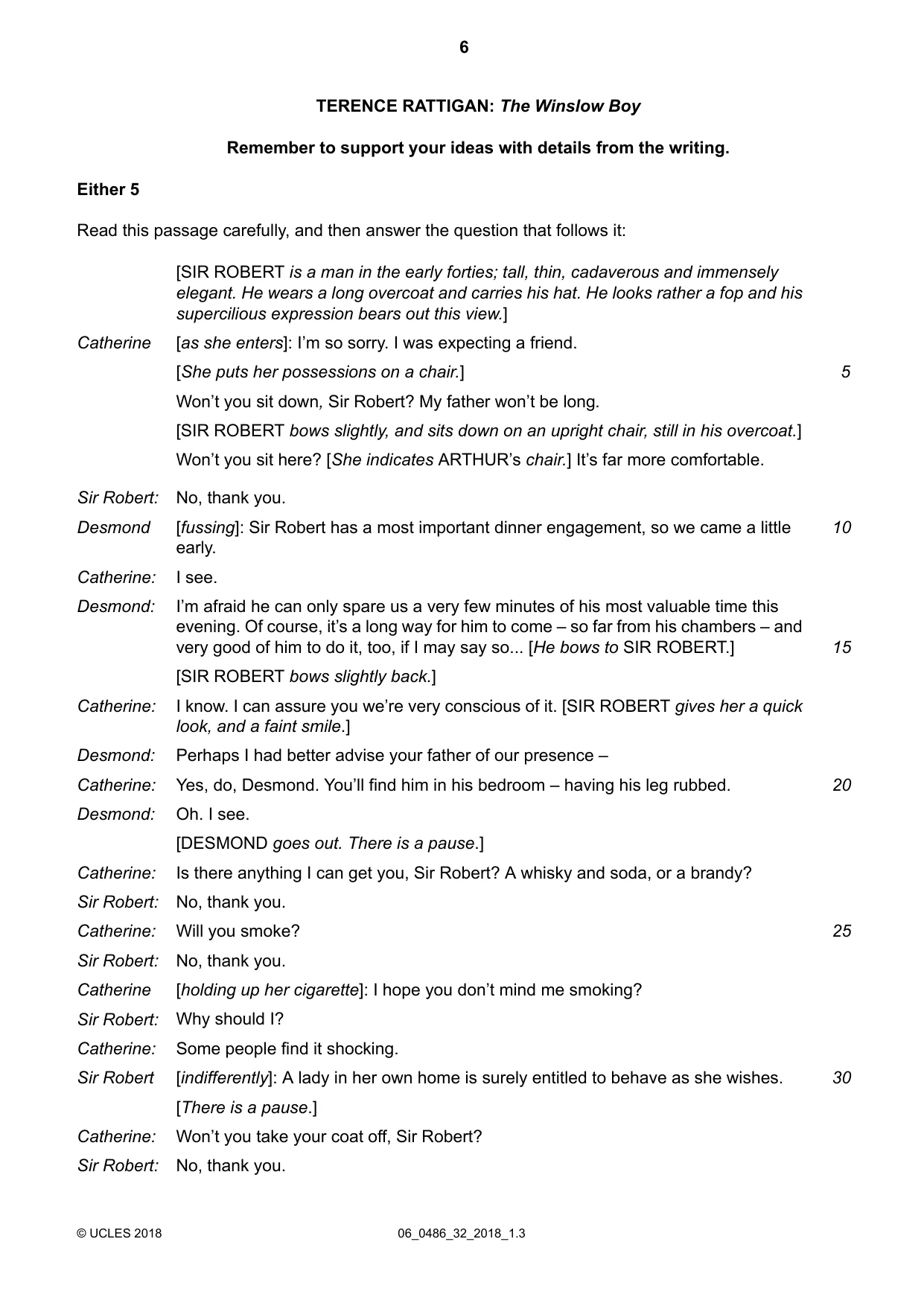
30 25 20 15 10 5 TERENCE RATTIGAN: The Winslow Boy Remember to support your ideas with details from the writing. Either 5 Read this passage carefully, and then answer the question that follows it: [SIR ROBERT is a man in the early forties; tall, thin, cadaverous and immensely elegant. He wears a long overcoat and carries his hat. He looks rather a fop and his supercilious expression bears out this view.] [as she enters]: I’m so sorry. I was expecting a friend. Catherine [She puts her possessions on a chair.] Won’t you sit down, Sir Robert? My father won’t be long. [SIR ROBERT bows slightly, and sits down on an upright chair, still in his overcoat.] Won’t you sit here? [She indicates ARTHUR’s chair.] It’s far more comfortable. No, thank you. Sir Robert: [fussing]: Sir Robert has a most important dinner engagement, so we came a little early. Desmond I see. Catherine: I’m afraid he can only spare us a very few minutes of his most valuable time this evening. Of course, it’s a long way for him to come – so far from his chambers – and very good of him to do it, too, if I may say so... [He bows to SIR ROBERT.] Desmond: [SIR ROBERT bows slightly back.] I know. I can assure you we’re very conscious of it. [SIR ROBERT gives her a quick look, and a faint smile.] Catherine: Perhaps I had better advise your father of our presence – Desmond: Yes, do, Desmond. You’ll find him in his bedroom – having his leg rubbed. Catherine: Oh. I see. Desmond: [DESMOND goes out. There is a pause.] Is there anything I can get you, Sir Robert? A whisky and soda, or a brandy? Catherine: No, thank you. Sir Robert: Will you smoke? Catherine: No, thank you. Sir Robert: [holding up her cigarette]: I hope you don’t mind me smoking? Catherine Why should I? Sir Robert: Some people find it shocking. Catherine: [indifferently]: A lady in her own home is surely entitled to behave as she wishes. Sir Robert [There is a pause.] Won’t you take your coat off, Sir Robert? Catherine: No, thank you. Sir Robert: 06_0486_32_2018_1.3 © UCLES 2018 6
Question paper, page 7
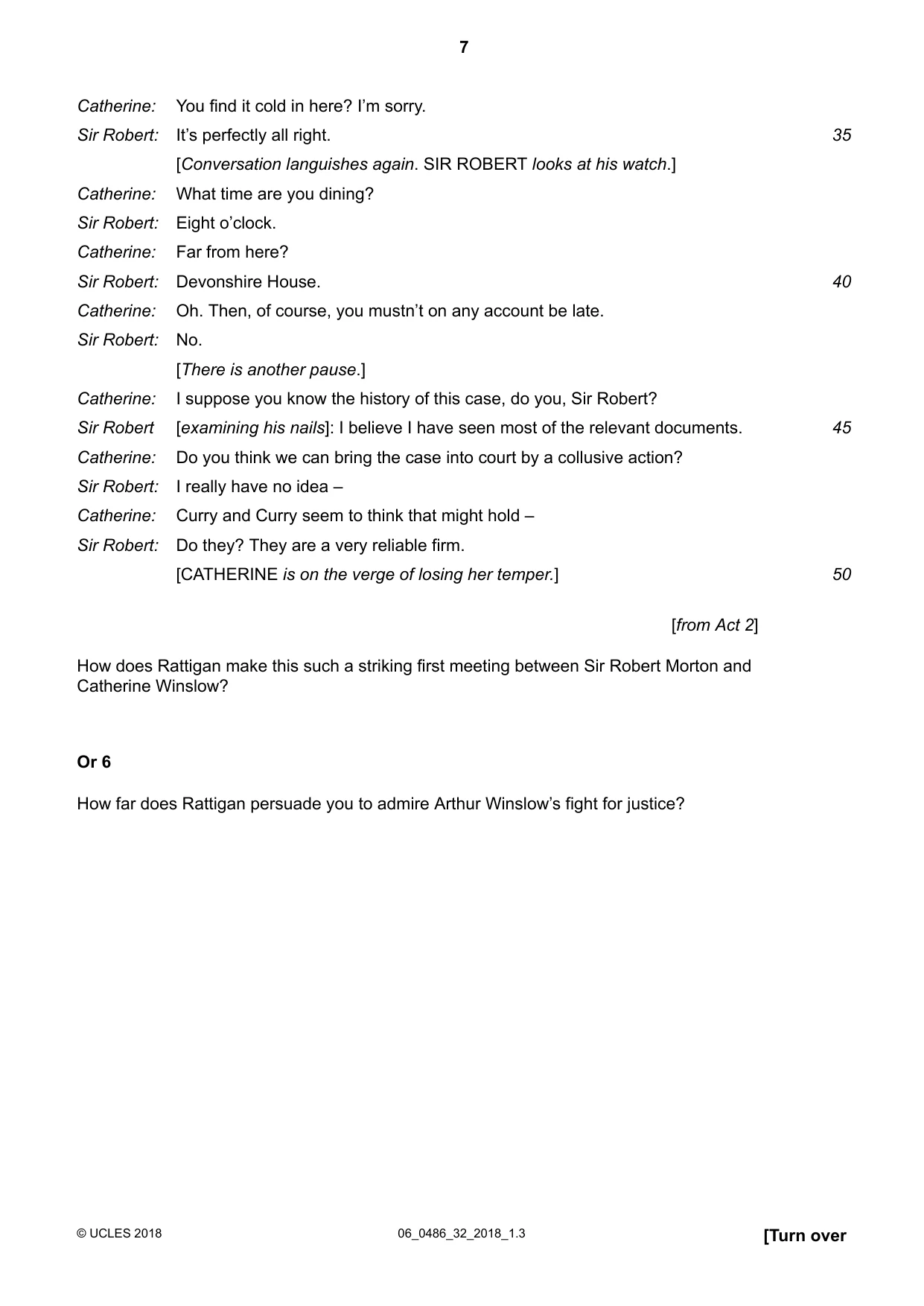
50 45 40 35 You find it cold in here? I’m sorry. Catherine: It’s perfectly all right. Sir Robert: [Conversation languishes again. SIR ROBERT looks at his watch.] What time are you dining? Catherine: Eight o’clock. Sir Robert: Far from here? Catherine: Devonshire House. Sir Robert: Oh. Then, of course, you mustn’t on any account be late. Catherine: No. Sir Robert: [There is another pause.] I suppose you know the history of this case, do you, Sir Robert? Catherine: [examining his nails]: I believe I have seen most of the relevant documents. Sir Robert Do you think we can bring the case into court by a collusive action? Catherine: I really have no idea – Sir Robert: Curry and Curry seem to think that might hold – Catherine: Do they? They are a very reliable firm. Sir Robert: [CATHERINE is on the verge of losing her temper.] [from Act 2] How does Rattigan make this such a striking first meeting between Sir Robert Morton and Catherine Winslow? Or 6 How far does Rattigan persuade you to admire Arthur Winslow’s fight for justice? [Turn over 06_0486_32_2018_1.3 © UCLES 2018 7
Question paper, page 8
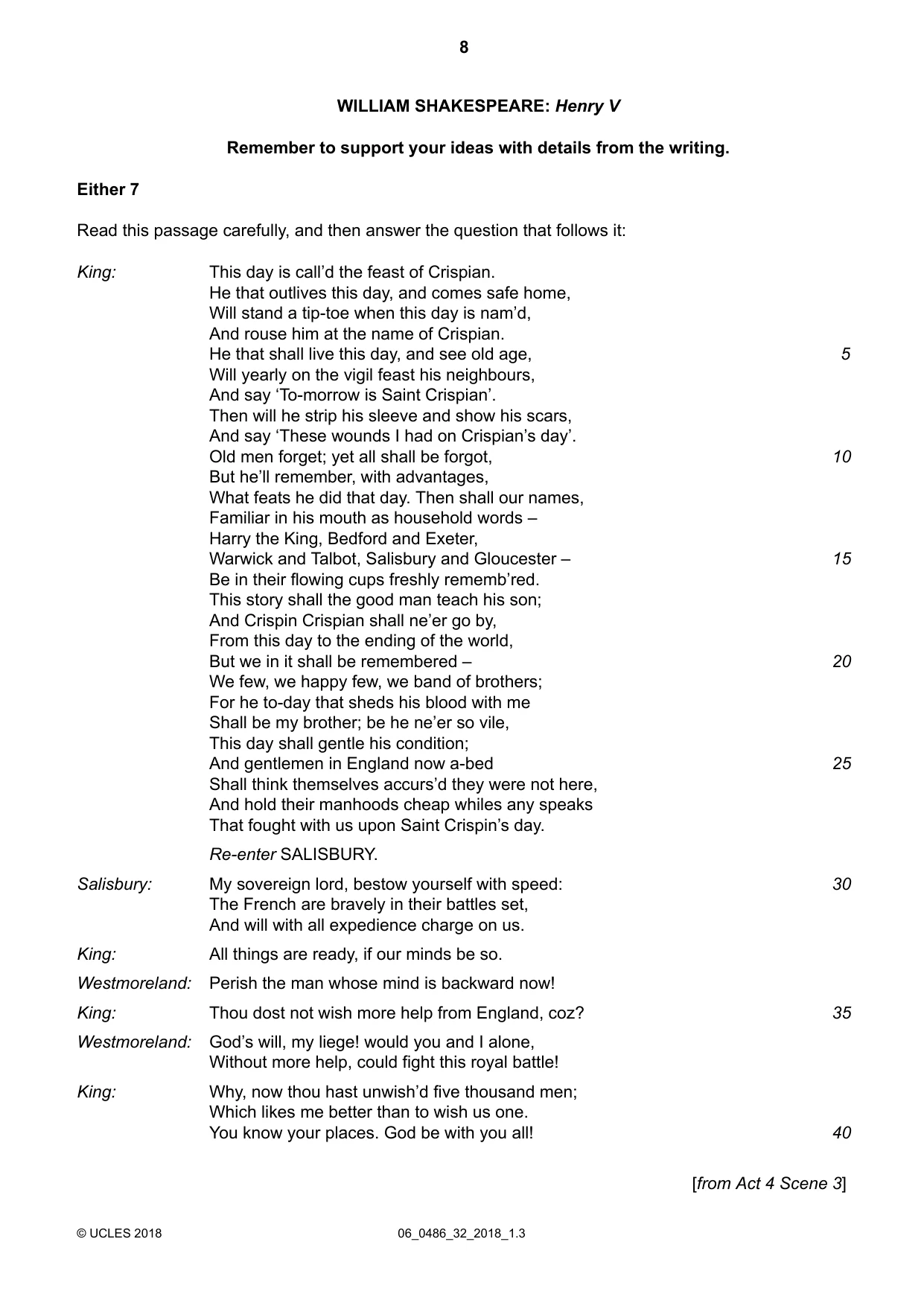
40 35 30 25 20 15 10 5 WILLIAM SHAKESPEARE: Henry V Remember to support your ideas with details from the writing. Either 7 Read this passage carefully, and then answer the question that follows it: This day is call’d the feast of Crispian. He that outlives this day, and comes safe home, Will stand a tip-toe when this day is nam’d, And rouse him at the name of Crispian. He that shall live this day, and see old age, Will yearly on the vigil feast his neighbours, And say ‘To-morrow is Saint Crispian’. Then will he strip his sleeve and show his scars, And say ‘These wounds I had on Crispian’s day’. Old men forget; yet all shall be forgot, But he’ll remember, with advantages, What feats he did that day. Then shall our names, Familiar in his mouth as household words – Harry the King, Bedford and Exeter, Warwick and Talbot, Salisbury and Gloucester – Be in their flowing cups freshly rememb’red. This story shall the good man teach his son; And Crispin Crispian shall ne’er go by, From this day to the ending of the world, But we in it shall be remembered – We few, we happy few, we band of brothers; For he to-day that sheds his blood with me Shall be my brother; be he ne’er so vile, This day shall gentle his condition; And gentlemen in England now a-bed Shall think themselves accurs’d they were not here, And hold their manhoods cheap whiles any speaks That fought with us upon Saint Crispin’s day. King: Re-enter SALISBURY. My sovereign lord, bestow yourself with speed: The French are bravely in their battles set, And will with all expedience charge on us. Salisbury: All things are ready, if our minds be so. King: Perish the man whose mind is backward now! Westmoreland: Thou dost not wish more help from England, coz? King: God’s will, my liege! would you and I alone, Without more help, could fight this royal battle! Westmoreland: Why, now thou hast unwish’d five thousand men; Which likes me better than to wish us one. You know your places. God be with you all! King: [from Act 4 Scene 3] 06_0486_32_2018_1.3 © UCLES 2018 8
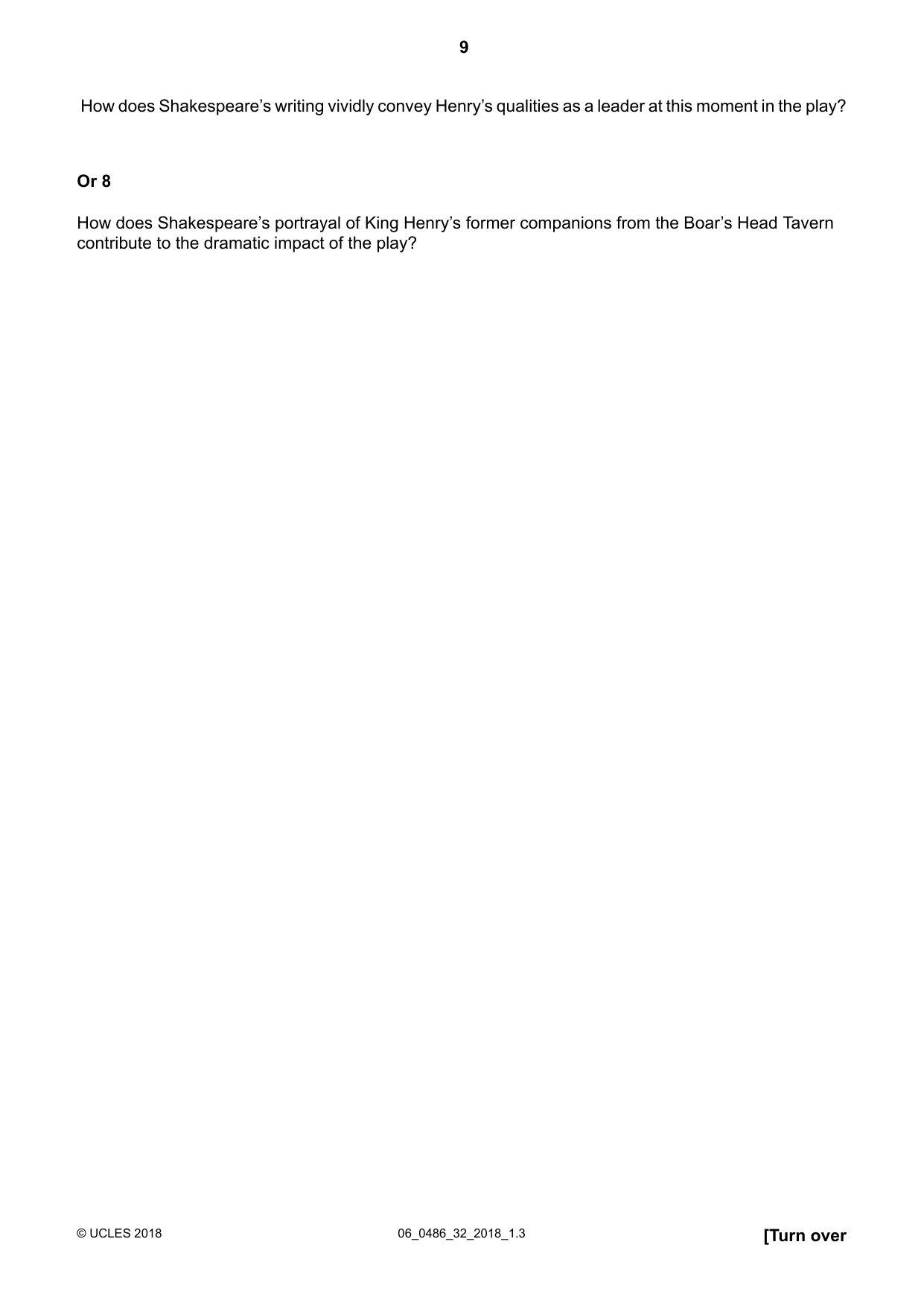
Question paper, page 9
How does Shakespeare’s writing vividly convey Henry’s qualities as a leader at this moment in the play? Or 8 How does Shakespeare’s portrayal of King Henry’s former companions from the Boar’s Head Tavern contribute to the dramatic impact of the play? [Turn over 06_0486_32_2018_1.3 © UCLES 2018 9
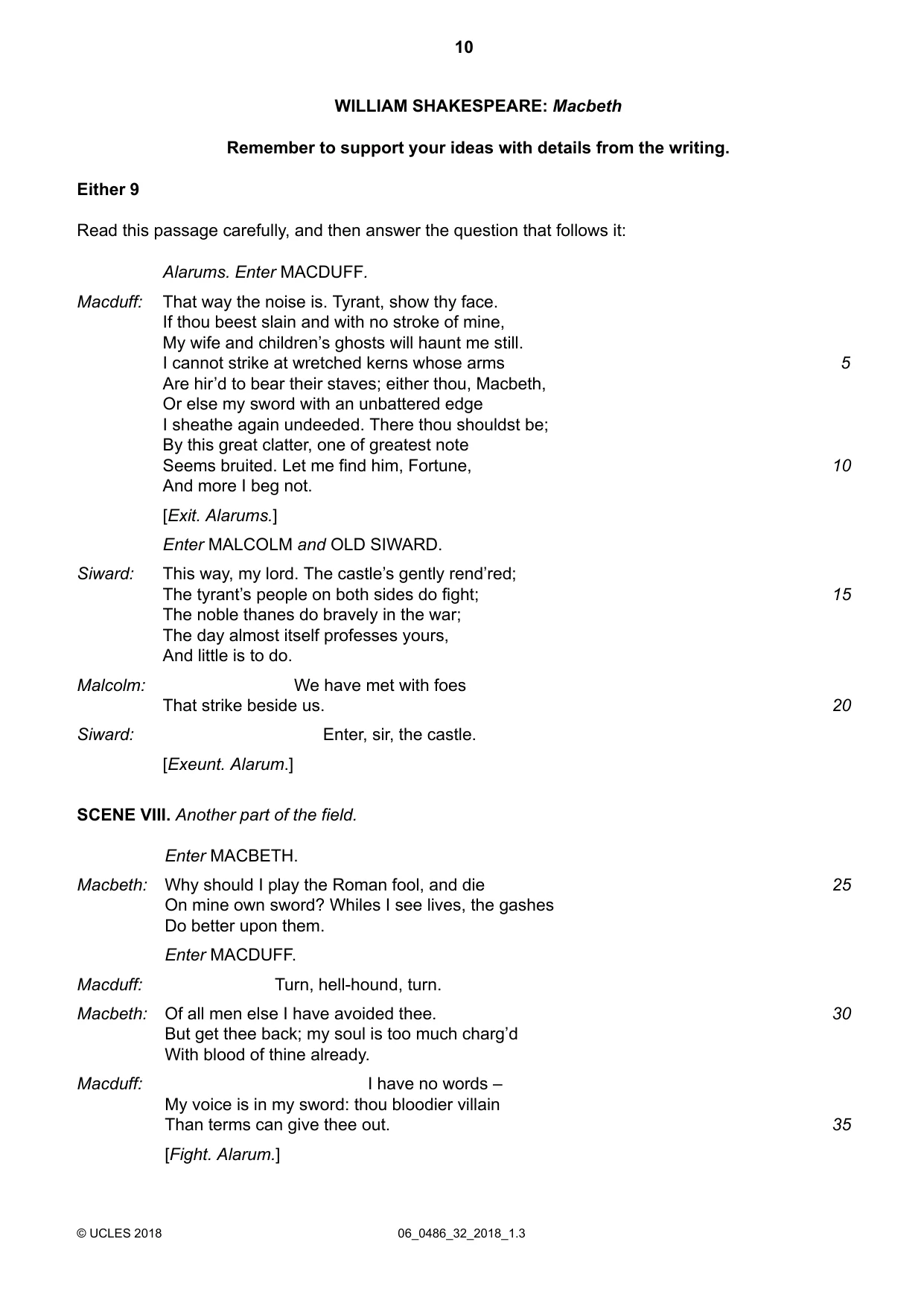
Question paper, page 10
35 30 25 20 15 10 5 WILLIAM SHAKESPEARE: Macbeth Remember to support your ideas with details from the writing. Either 9 Read this passage carefully, and then answer the question that follows it: Alarums. Enter MACDUFF. That way the noise is. Tyrant, show thy face. If thou beest slain and with no stroke of mine, My wife and children’s ghosts will haunt me still. I cannot strike at wretched kerns whose arms Are hir’d to bear their staves; either thou, Macbeth, Or else my sword with an unbattered edge I sheathe again undeeded. There thou shouldst be; By this great clatter, one of greatest note Seems bruited. Let me find him, Fortune, And more I beg not. Macduff: [Exit. Alarums.] Enter MALCOLM and OLD SIWARD. This way, my lord. The castle’s gently rend’red; The tyrant’s people on both sides do fight; The noble thanes do bravely in the war; The day almost itself professes yours, And little is to do. Siward: We have met with foes That strike beside us. Malcolm: Enter, sir, the castle. Siward: [Exeunt. Alarum.] SCENE VIII. Another part of the field. Enter MACBETH. Why should I play the Roman fool, and die On mine own sword? Whiles I see lives, the gashes Do better upon them. Macbeth: Enter MACDUFF. Turn, hell-hound, turn. Macduff: Of all men else I have avoided thee. But get thee back; my soul is too much charg’d With blood of thine already. Macbeth: I have no words – My voice is in my sword: thou bloodier villain Than terms can give thee out. Macduff: [Fight. Alarum.] 06_0486_32_2018_1.3 © UCLES 2018 10
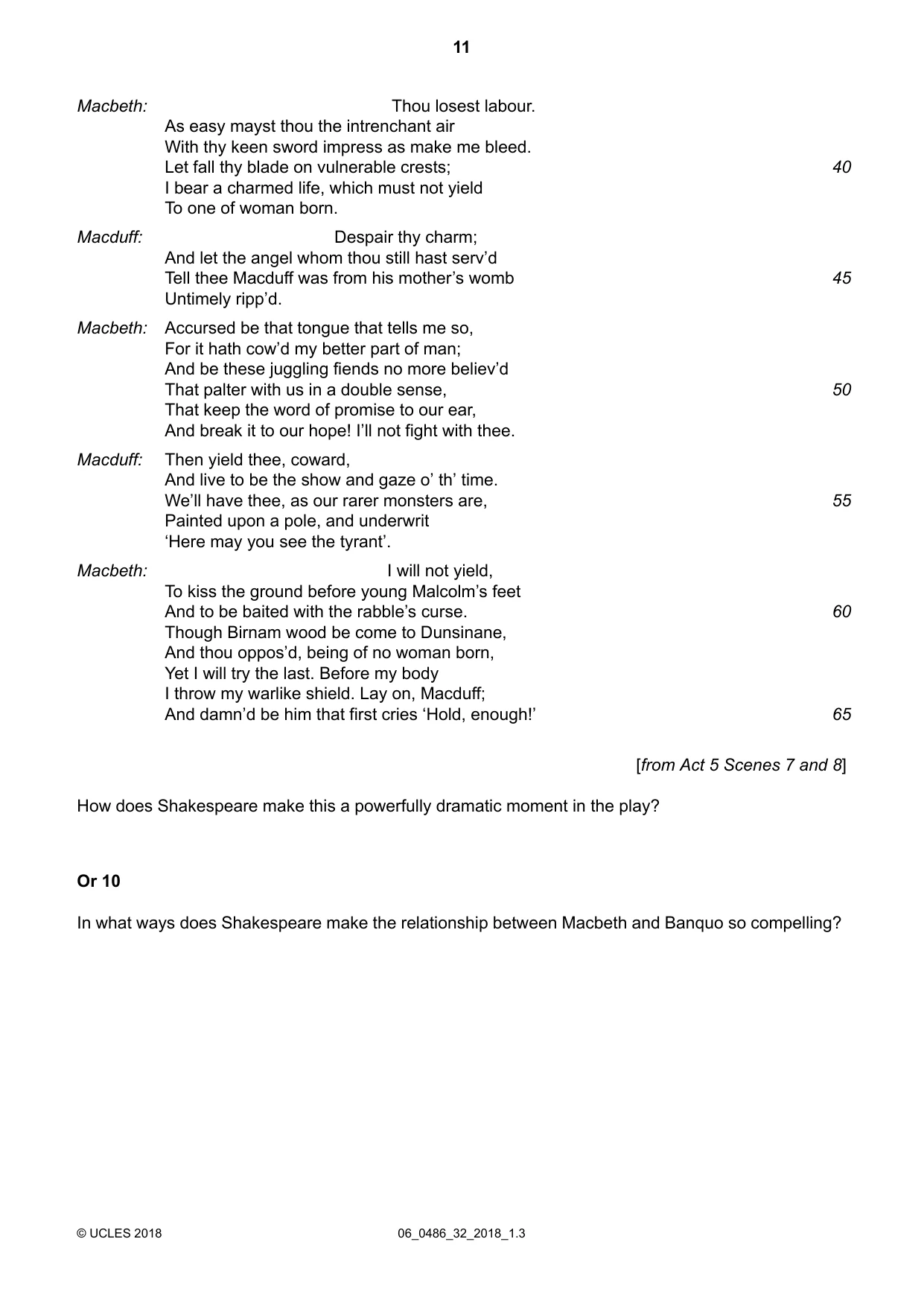
Question paper, page 11
65 60 55 50 45 40 Thou losest labour. As easy mayst thou the intrenchant air With thy keen sword impress as make me bleed. Let fall thy blade on vulnerable crests; I bear a charmed life, which must not yield To one of woman born. Macbeth: Despair thy charm; And let the angel whom thou still hast serv’d Tell thee Macduff was from his mother’s womb Untimely ripp’d. Macduff: Accursed be that tongue that tells me so, For it hath cow’d my better part of man; And be these juggling fiends no more believ’d That palter with us in a double sense, That keep the word of promise to our ear, And break it to our hope! I’ll not fight with thee. Macbeth: Then yield thee, coward, And live to be the show and gaze o’ th’ time. We’ll have thee, as our rarer monsters are, Painted upon a pole, and underwrit ‘Here may you see the tyrant’. Macduff: I will not yield, To kiss the ground before young Malcolm’s feet And to be baited with the rabble’s curse. Though Birnam wood be come to Dunsinane, And thou oppos’d, being of no woman born, Yet I will try the last. Before my body I throw my warlike shield. Lay on, Macduff; And damn’d be him that first cries ‘Hold, enough!’ Macbeth: [from Act 5 Scenes 7 and 8] How does Shakespeare make this a powerfully dramatic moment in the play? Or 10 In what ways does Shakespeare make the relationship between Macbeth and Banquo so compelling? 06_0486_32_2018_1.3 © UCLES 2018 11
Question paper, page 12
BLANK PAGE Permission to reproduce items where third-party owned material protected by copyright is included has been sought and cleared where possible. Every reasonable effort has been made by the publisher (UCLES) to trace copyright holders, but if any items requiring clearance have unwittingly been included, the publisher will be pleased to make amends at the earliest possible opportunity. To avoid the issue of disclosure of answer-related information to candidates, all copyright acknowledgements are reproduced online in the Cambridge International Examinations Copyright Acknowledgements Booklet. This is produced for each series of examinations and is freely available to download at www.cie.org.uk after the live examination series. Cambridge International Examinations is part of the Cambridge Assessment Group. Cambridge Assessment is the brand name of University of Cambridge Local Examinations Syndicate (UCLES), which is itself a department of the University of Cambridge. 06_0486_32_2018_1.3 © UCLES 2018 12
Mark scheme, page 1
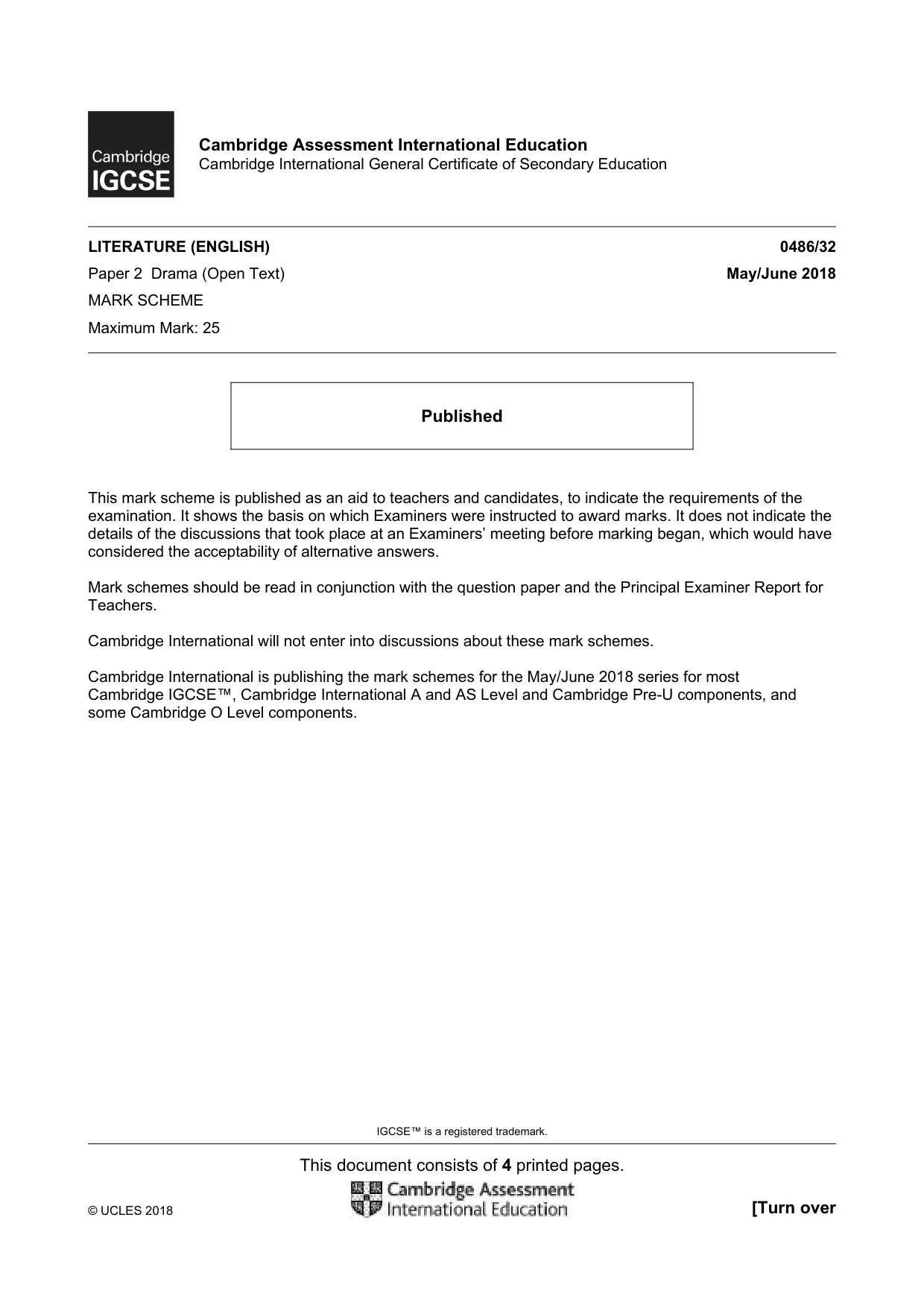
IGCSE™ is a registered trademark. This document consists of 4 printed pages. © UCLES 2018 [Turn over Cambridge Assessment International Education Cambridge International General Certificate of Secondary Education LITERATURE (ENGLISH) 0486/32 Paper 2 Drama (Open Text) May/June 2018 MARK SCHEME Maximum Mark: 25 Published This mark scheme is published as an aid to teachers and candidates, to indicate the requirements of the examination. It shows the basis on which Examiners were instructed to award marks. It does not indicate the details of the discussions that took place at an Examiners’ meeting before marking began, which would have considered the acceptability of alternative answers. Mark schemes should be read in conjunction with the question paper and the Principal Examiner Report for Teachers. Cambridge International will not enter into discussions about these mark schemes. Cambridge International is publishing the mark schemes for the May/June 2018 series for most Cambridge IGCSE™, Cambridge International A and AS Level and Cambridge Pre-U components, and some Cambridge O Level components.
Mark scheme, page 2
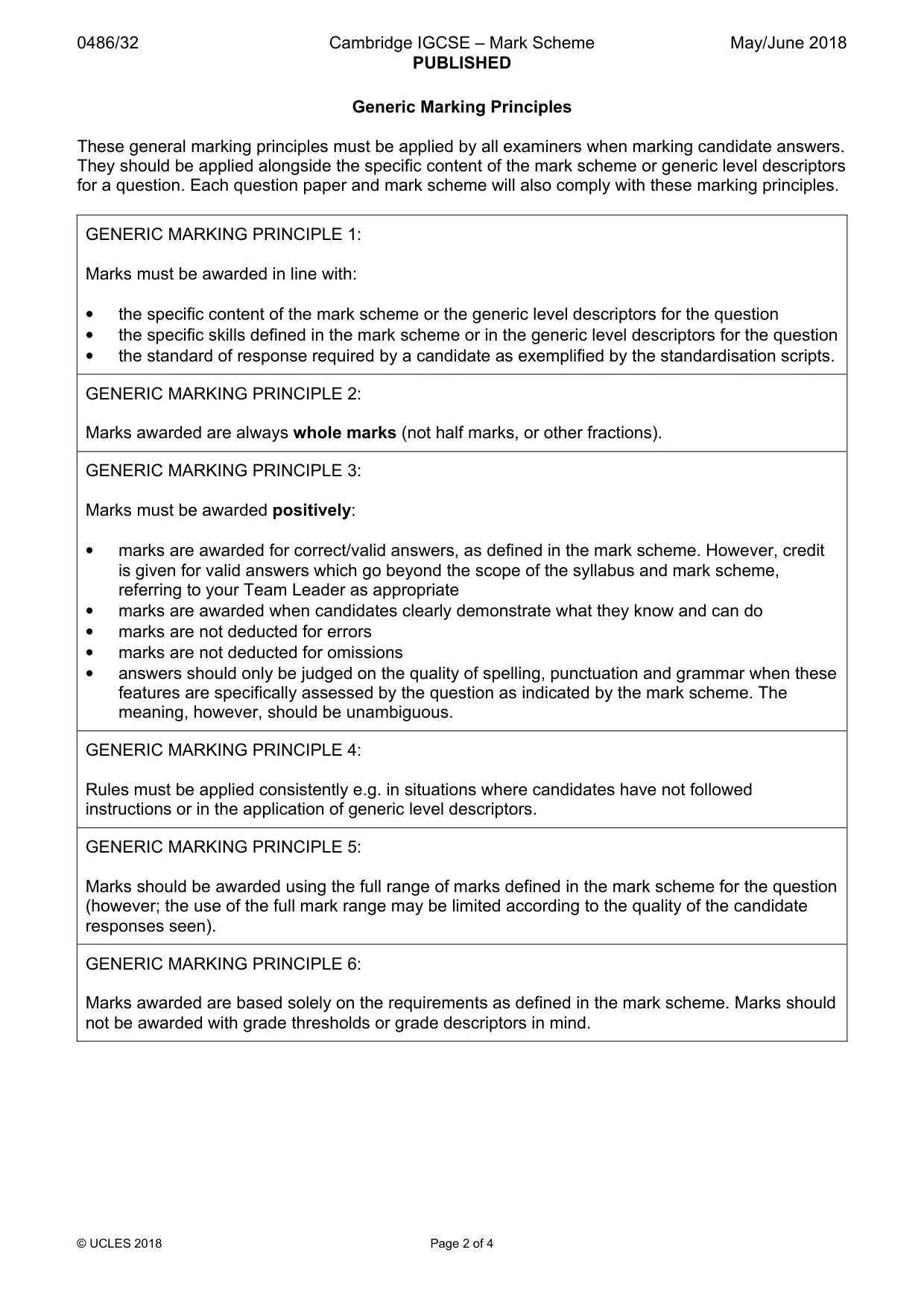
0486/32 Cambridge IGCSE – Mark Scheme PUBLISHED May/June 2018 © UCLES 2018 Page 2 of 4 Generic Marking Principles These general marking principles must be applied by all examiners when marking candidate answers. They should be applied alongside the specific content of the mark scheme or generic level descriptors for a question. Each question paper and mark scheme will also comply with these marking principles. GENERIC MARKING PRINCIPLE 1: Marks must be awarded in line with: • the specific content of the mark scheme or the generic level descriptors for the question • the specific skills defined in the mark scheme or in the generic level descriptors for the question • the standard of response required by a candidate as exemplified by the standardisation scripts. GENERIC MARKING PRINCIPLE 2: Marks awarded are always whole marks (not half marks, or other fractions). GENERIC MARKING PRINCIPLE 3: Marks must be awarded positively: • marks are awarded for correct/valid answers, as defined in the mark scheme. However, credit is given for valid answers which go beyond the scope of the syllabus and mark scheme, referring to your Team Leader as appropriate • marks are awarded when candidates clearly demonstrate what they know and can do • marks are not deducted for errors • marks are not deducted for omissions • answers should only be judged on the quality of spelling, punctuation and grammar when these features are specifically assessed by the question as indicated by the mark scheme. The meaning, however, should be unambiguous. GENERIC MARKING PRINCIPLE 4: Rules must be applied consistently e.g. in situations where candidates have not followed instructions or in the application of generic level descriptors. GENERIC MARKING PRINCIPLE 5: Marks should be awarded using the full range of marks defined in the mark scheme for the question (however; the use of the full mark range may be limited according to the quality of the candidate responses seen). GENERIC MARKING PRINCIPLE 6: Marks awarded are based solely on the requirements as defined in the mark scheme. Marks should not be awarded with grade thresholds or grade descriptors in mind.
Mark scheme, page 3
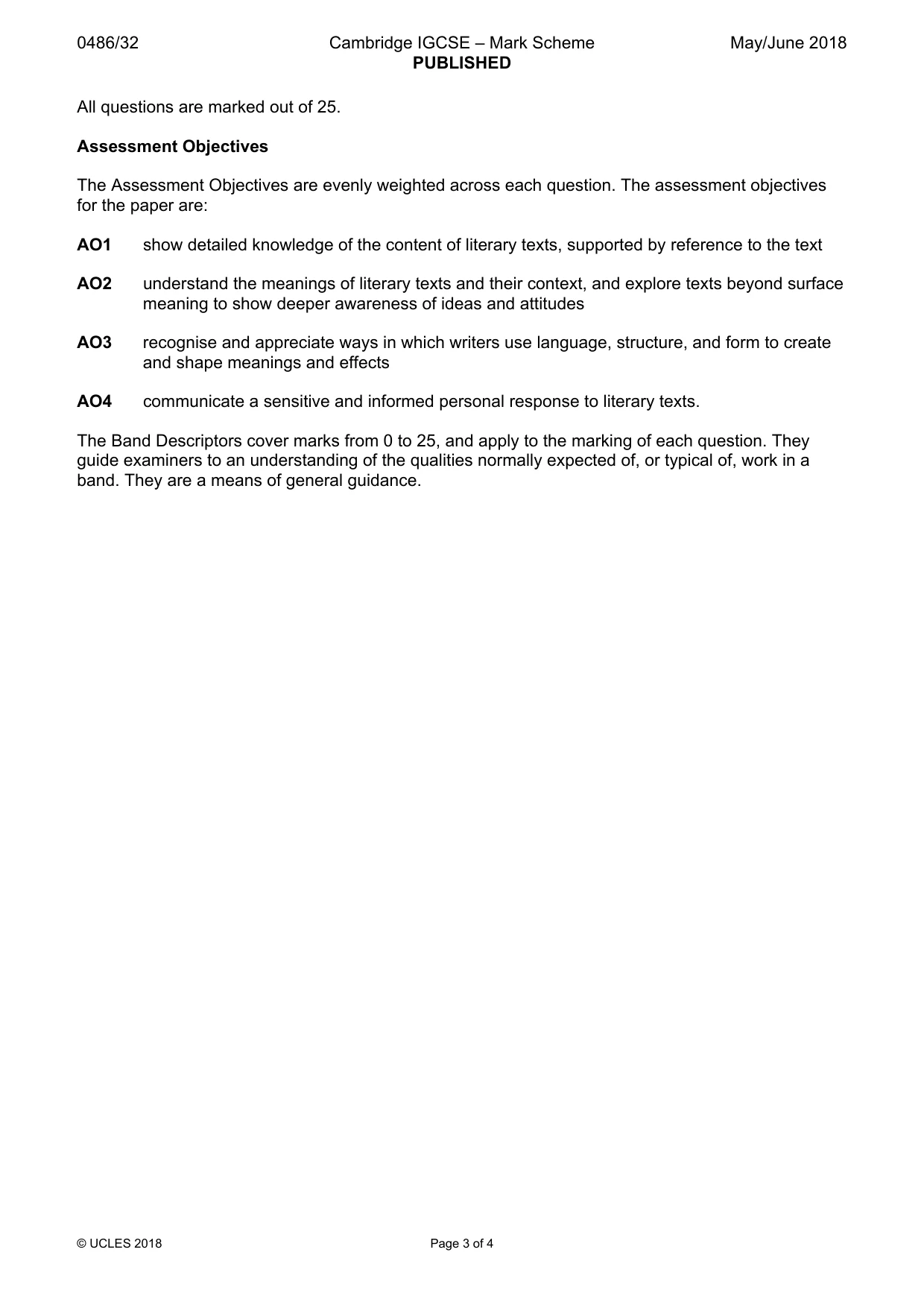
0486/32 Cambridge IGCSE – Mark Scheme PUBLISHED May/June 2018 © UCLES 2018 Page 3 of 4 All questions are marked out of 25. Assessment Objectives The Assessment Objectives are evenly weighted across each question. The assessment objectives for the paper are: AO1 show detailed knowledge of the content of literary texts, supported by reference to the text AO2 understand the meanings of literary texts and their context, and explore texts beyond surface meaning to show deeper awareness of ideas and attitudes AO3 recognise and appreciate ways in which writers use language, structure, and form to create and shape meanings and effects AO4 communicate a sensitive and informed personal response to literary texts. The Band Descriptors cover marks from 0 to 25, and apply to the marking of each question. They guide examiners to an understanding of the qualities normally expected of, or typical of, work in a band. They are a means of general guidance.
Mark scheme, page 4
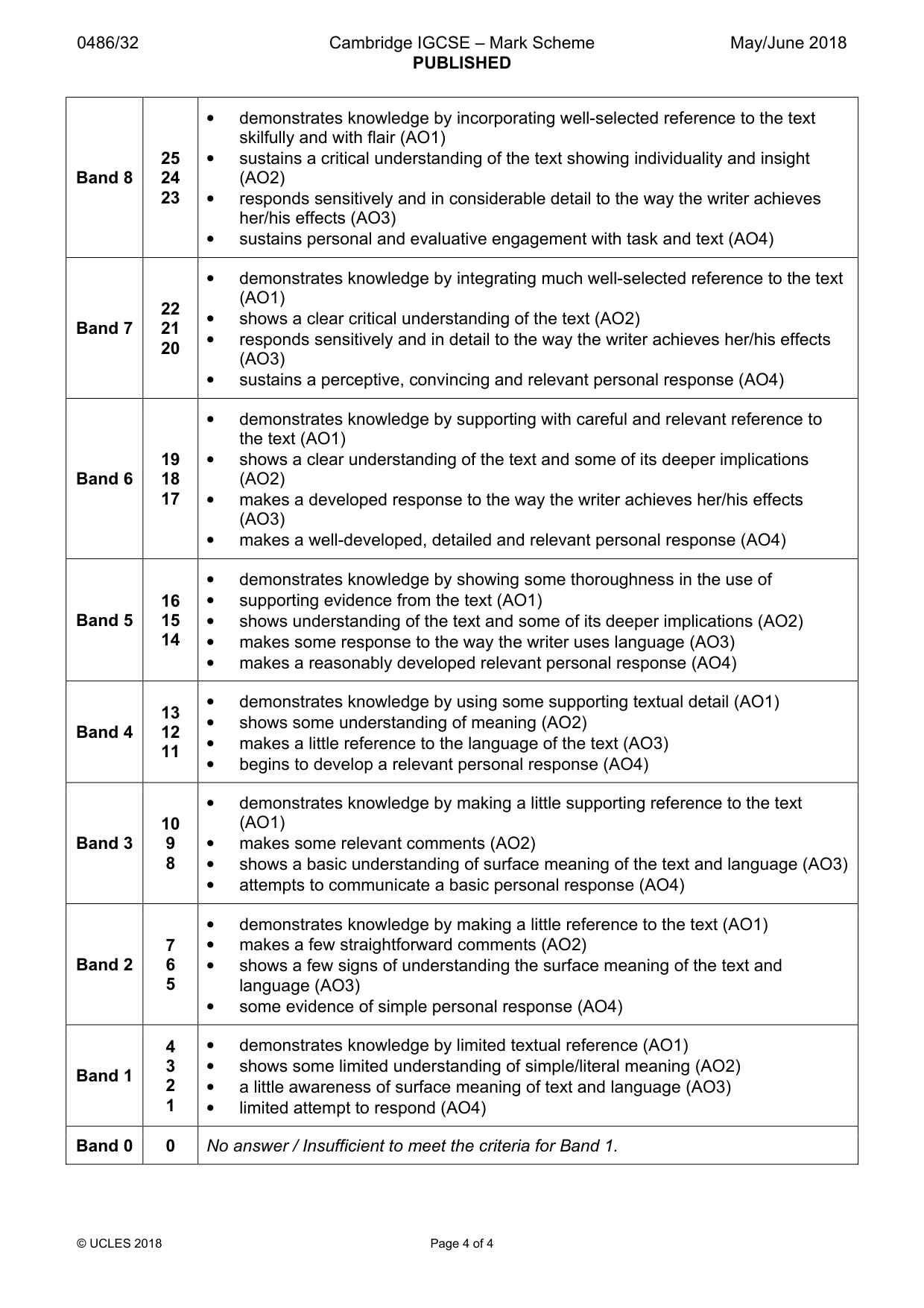
0486/32 Cambridge IGCSE – Mark Scheme PUBLISHED May/June 2018 © UCLES 2018 Page 4 of 4 Band 8 25 24 23 • demonstrates knowledge by incorporating well-selected reference to the text skilfully and with flair (AO1) • sustains a critical understanding of the text showing individuality and insight (AO2) • responds sensitively and in considerable detail to the way the writer achieves her/his effects (AO3) • sustains personal and evaluative engagement with task and text (AO4) Band 7 22 21 20 • demonstrates knowledge by integrating much well-selected reference to the text (AO1) • shows a clear critical understanding of the text (AO2) • responds sensitively and in detail to the way the writer achieves her/his effects (AO3) • sustains a perceptive, convincing and relevant personal response (AO4) Band 6 19 18 17 • demonstrates knowledge by supporting with careful and relevant reference to the text (AO1) • shows a clear understanding of the text and some of its deeper implications (AO2) • makes a developed response to the way the writer achieves her/his effects (AO3) • makes a well-developed, detailed and relevant personal response (AO4) Band 5 16 15 14 • demonstrates knowledge by showing some thoroughness in the use of • supporting evidence from the text (AO1) • shows understanding of the text and some of its deeper implications (AO2) • makes some response to the way the writer uses language (AO3) • makes a reasonably developed relevant personal response (AO4) Band 4 13 12 11 • demonstrates knowledge by using some supporting textual detail (AO1) • shows some understanding of meaning (AO2) • makes a little reference to the language of the text (AO3) • begins to develop a relevant personal response (AO4) Band 3 10 9 8 • demonstrates knowledge by making a little supporting reference to the text (AO1) • makes some relevant comments (AO2) • shows a basic understanding of surface meaning of the text and language (AO3) • attempts to communicate a basic personal response (AO4) Band 2 7 6 5 • demonstrates knowledge by making a little reference to the text (AO1) • makes a few straightforward comments (AO2) • shows a few signs of understanding the surface meaning of the text and language (AO3) • some evidence of simple personal response (AO4) Band 1 4 3 2 1 • demonstrates knowledge by limited textual reference (AO1) • shows some limited understanding of simple/literal meaning (AO2) • a little awareness of surface meaning of text and language (AO3) • limited attempt to respond (AO4) Band 0 0 No answer / Insufficient to meet the criteria for Band 1.
What you needed in this session
Cambridge’s own grade thresholds for 2018 May/June, Paper 3 · Variant 2. A higher threshold means an easier paper — the bar moves with how the cohort did.