Cambridge IGCSE English - Literature 0486 — 2019 May/June Paper 3 · Variant 2
0486/32/M/J/19 · 25 marks · ≈28 min
The question paper and its mark scheme, free to read here and free to download. This is Cambridge’s own paper, exactly as it was sat.
Question paper16 pages





Mark scheme4 pages
Answers below. Sit the paper first if you are practising.
Paper as text
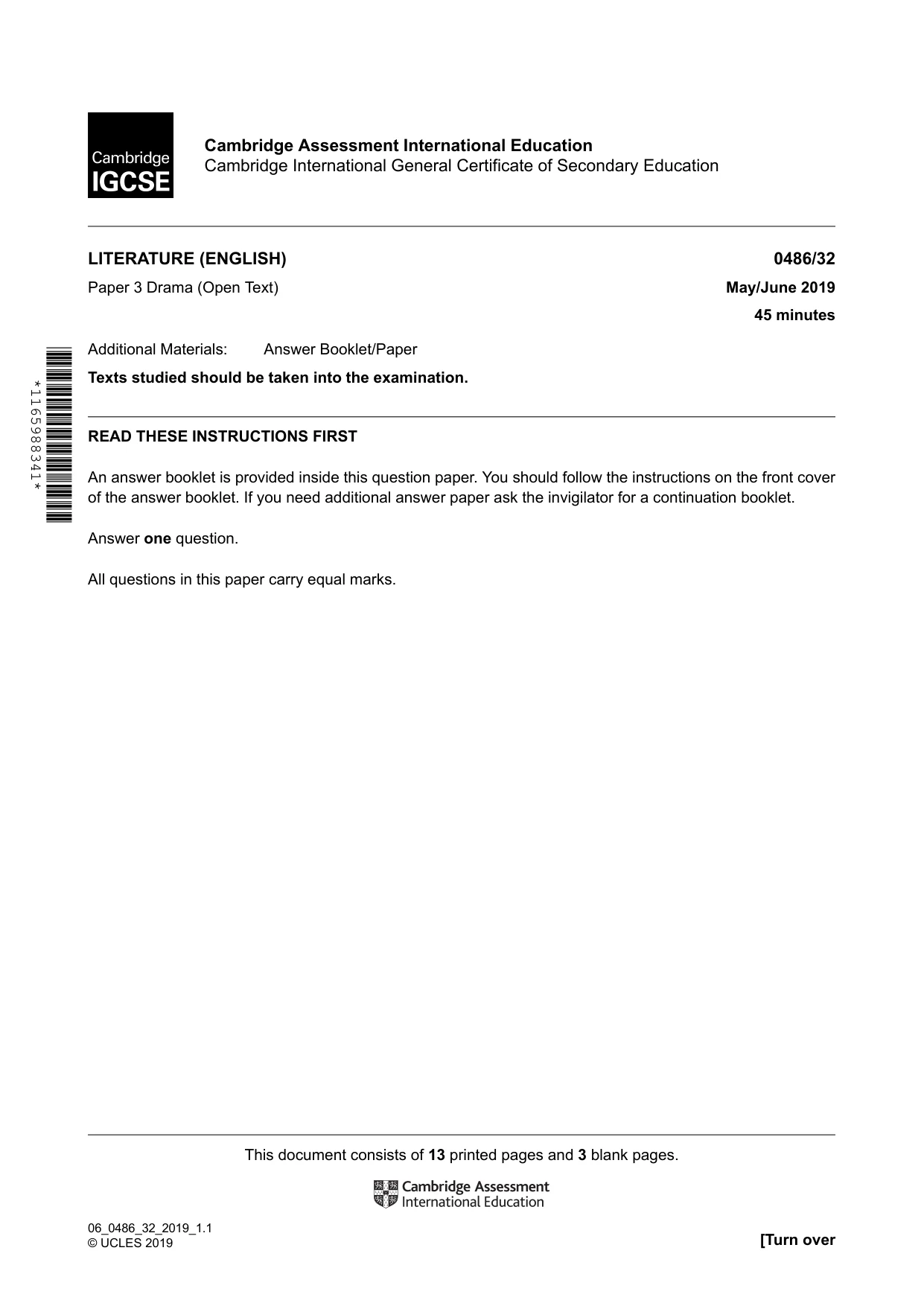
Question paper, page 1
Cambridge Assessment International Education Cambridge International General Certificate of Secondary Education 0486/32 LITERATURE (ENGLISH) May/June 2019 Paper 3 Drama (Open Text) 45 minutes Additional Materials: Answer Booklet/Paper Texts studied should be taken into the examination. READ THESE INSTRUCTIONS FIRST An answer booklet is provided inside this question paper. You should follow the instructions on the front cover of the answer booklet. If you need additional answer paper ask the invigilator for a continuation booklet. Answer one question. All questions in this paper carry equal marks. This document consists of 13 printed pages and 3 blank pages. [Turn over 06_0486_32_2019_1.1 © UCLES 2019 *1165988341*
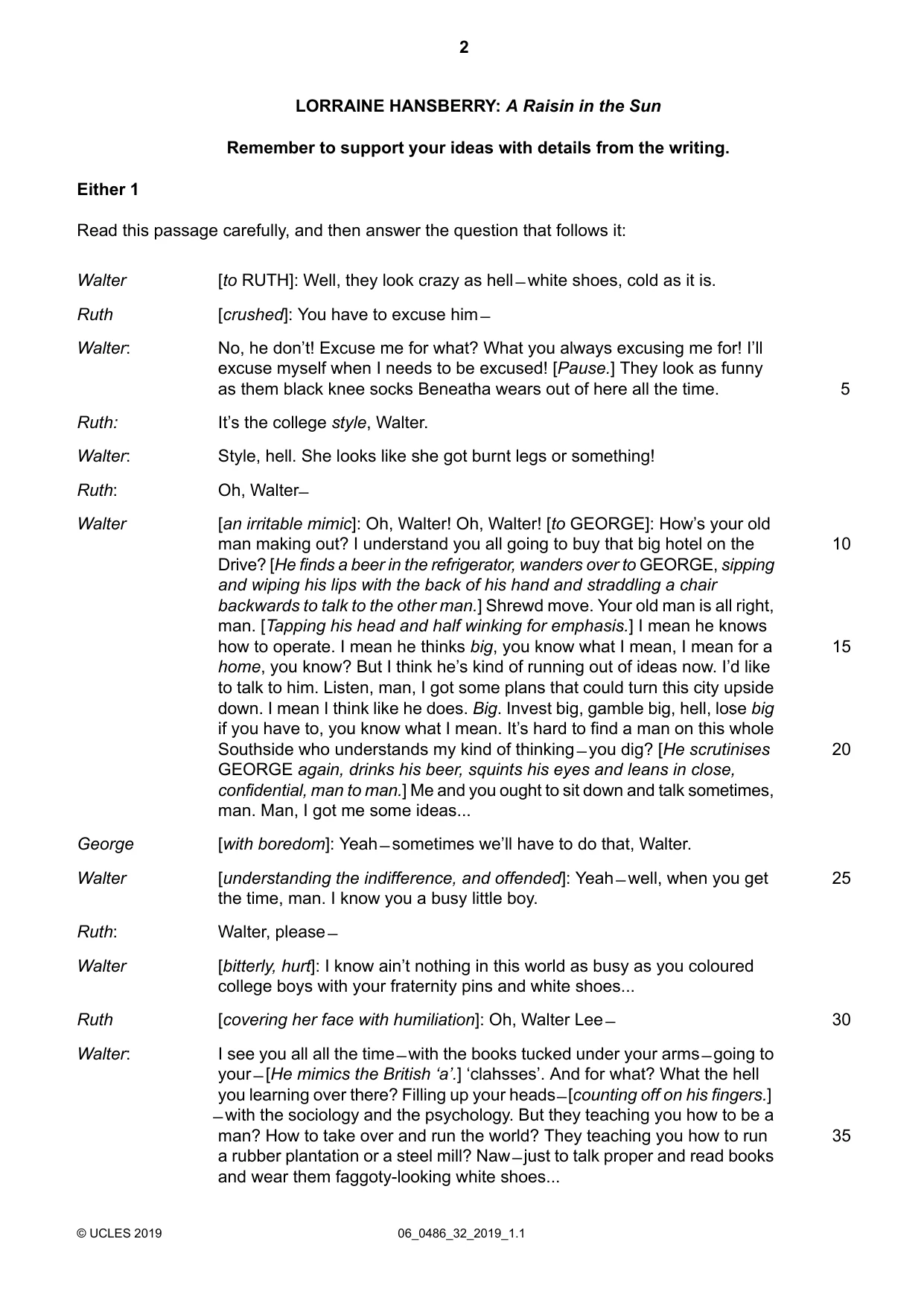
Question paper, page 2
35 30 25 20 15 10 5 LORRAINE HANSBERRY: A Raisin in the Sun Remember to support your ideas with details from the writing. Either 1 Read this passage carefully, and then answer the question that follows it: [to RUTH]: Well, they look crazy as hell ̶ white shoes, cold as it is. Walter [crushed]: You have to excuse him ̶ Ruth No, he don’t! Excuse me for what? What you always excusing me for! I’ll excuse myself when I needs to be excused! [Pause.] They look as funny as them black knee socks Beneatha wears out of here all the time. Walter: It’s the college style, Walter. Ruth: Style, hell. She looks like she got burnt legs or something! Walter: Oh, Walter ̶ Ruth: [an irritable mimic]: Oh, Walter! Oh, Walter! [to GEORGE]: How’s your old man making out? I understand you all going to buy that big hotel on the Drive? [He finds a beer in the refrigerator, wanders over to GEORGE, sipping and wiping his lips with the back of his hand and straddling a chair backwards to talk to the other man.] Shrewd move. Your old man is all right, man. [Tapping his head and half winking for emphasis.] I mean he knows how to operate. I mean he thinks big, you know what I mean, I mean for a home, you know? But I think he’s kind of running out of ideas now. I’d like to talk to him. Listen, man, I got some plans that could turn this city upside down. I mean I think like he does. Big. Invest big, gamble big, hell, lose big if you have to, you know what I mean. It’s hard to find a man on this whole Southside who understands my kind of thinking ̶ you dig? [He scrutinises GEORGE again, drinks his beer, squints his eyes and leans in close, confidential, man to man.] Me and you ought to sit down and talk sometimes, man. Man, I got me some ideas... Walter [with boredom]: Yeah ̶ sometimes we’ll have to do that, Walter. George [understanding the indifference, and offended]: Yeah ̶ well, when you get the time, man. I know you a busy little boy. Walter Walter, please ̶ Ruth: [bitterly, hurt]: I know ain’t nothing in this world as busy as you coloured college boys with your fraternity pins and white shoes... Walter [covering her face with humiliation]: Oh, Walter Lee ̶ Ruth I see you all all the time ̶ with the books tucked under your arms ̶ going to your ̶ [He mimics the British ‘a’.] ‘clahsses’. And for what? What the hell you learning over there? Filling up your heads ̶ [counting off on his fingers.] ̶ with the sociology and the psychology. But they teaching you how to be a man? How to take over and run the world? They teaching you how to run a rubber plantation or a steel mill? Naw ̶ just to talk proper and read books and wear them faggoty-looking white shoes... Walter: 06_0486_32_2019_1.1 © UCLES 2019 2
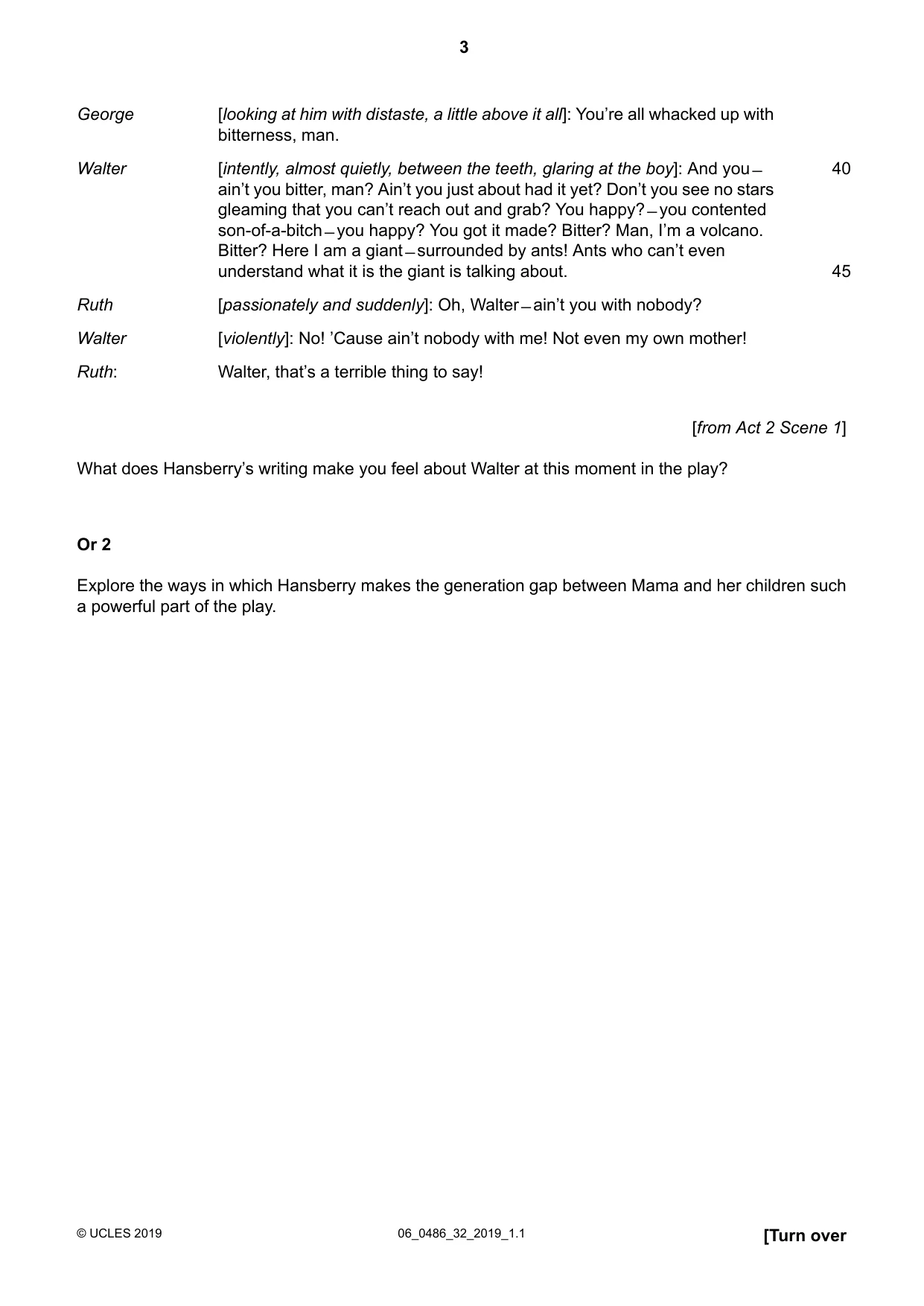
Question paper, page 3
45 40 [looking at him with distaste, a little above it all]: You’re all whacked up with bitterness, man. George [intently, almost quietly, between the teeth, glaring at the boy]: And you ̶ ain’t you bitter, man? Ain’t you just about had it yet? Don’t you see no stars gleaming that you can’t reach out and grab? You happy? ̶ you contented son-of-a-bitch ̶ you happy? You got it made? Bitter? Man, I’m a volcano. Bitter? Here I am a giant ̶ surrounded by ants! Ants who can’t even understand what it is the giant is talking about. Walter [passionately and suddenly]: Oh, Walter ̶ ain’t you with nobody? Ruth [violently]: No! ’Cause ain’t nobody with me! Not even my own mother! Walter Walter, that’s a terrible thing to say! Ruth: [from Act 2 Scene 1] What does Hansberry’s writing make you feel about Walter at this moment in the play? Or 2 Explore the ways in which Hansberry makes the generation gap between Mama and her children such a powerful part of the play. [Turn over 06_0486_32_2019_1.1 © UCLES 2019 3
Question paper, page 4
ARTHUR MILLER: A View from the Bridge Remember to support your ideas with details from the writing. Either 3 Read this passage carefully, and then answer the question that follows it: [never losing her aroused alarm]: Sit down, honey, I want to tell you something. Beatrice 06_0486_32_2019_1.1 © UCLES 2019 4 Content removed due to copyright restrictions.
Question paper, page 5
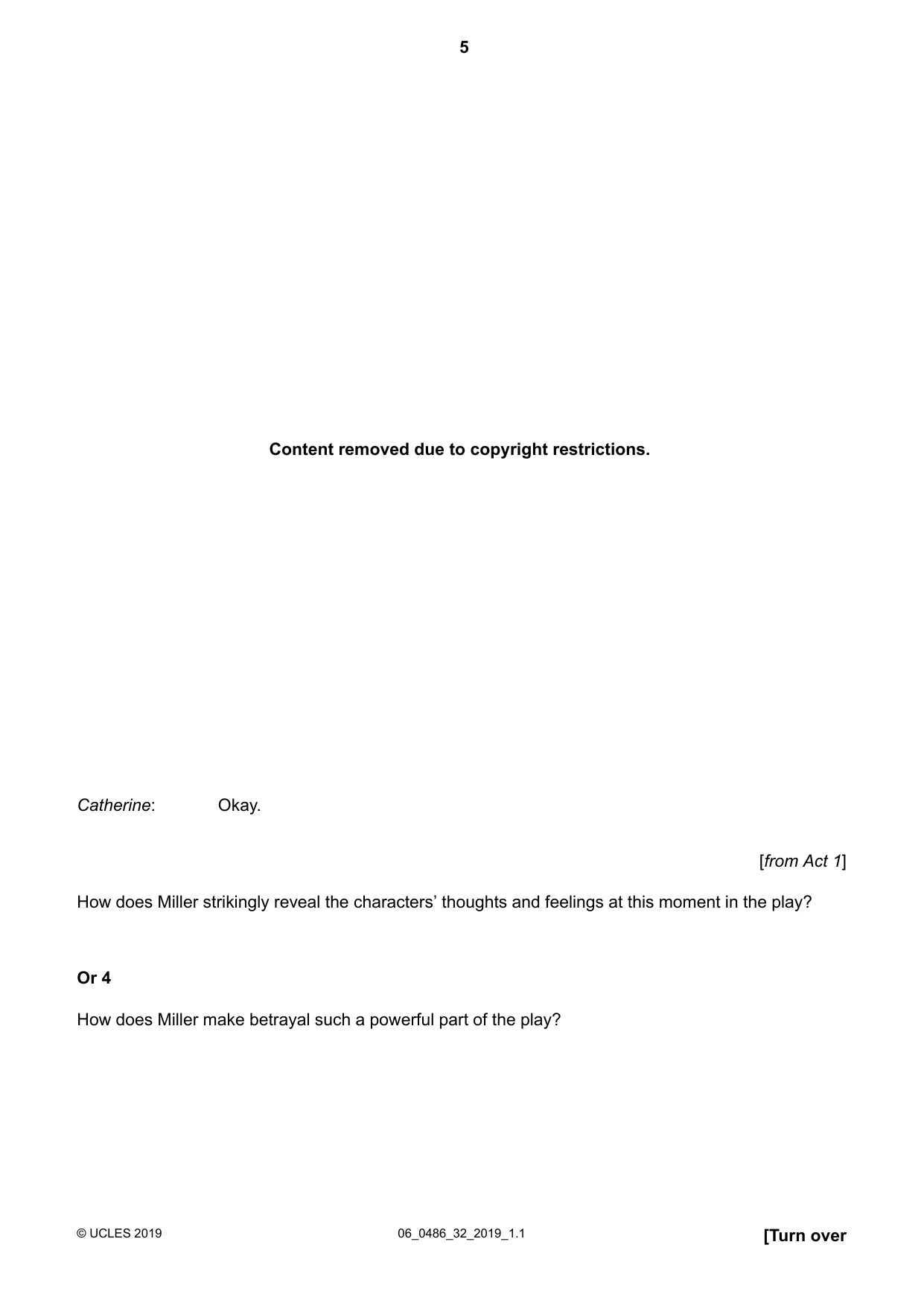
Okay. Catherine: [from Act 1] How does Miller strikingly reveal the characters’ thoughts and feelings at this moment in the play? Or 4 How does Miller make betrayal such a powerful part of the play? [Turn over 06_0486_32_2019_1.1 © UCLES 2019 5 Content removed due to copyright restrictions.
Question paper, page 6
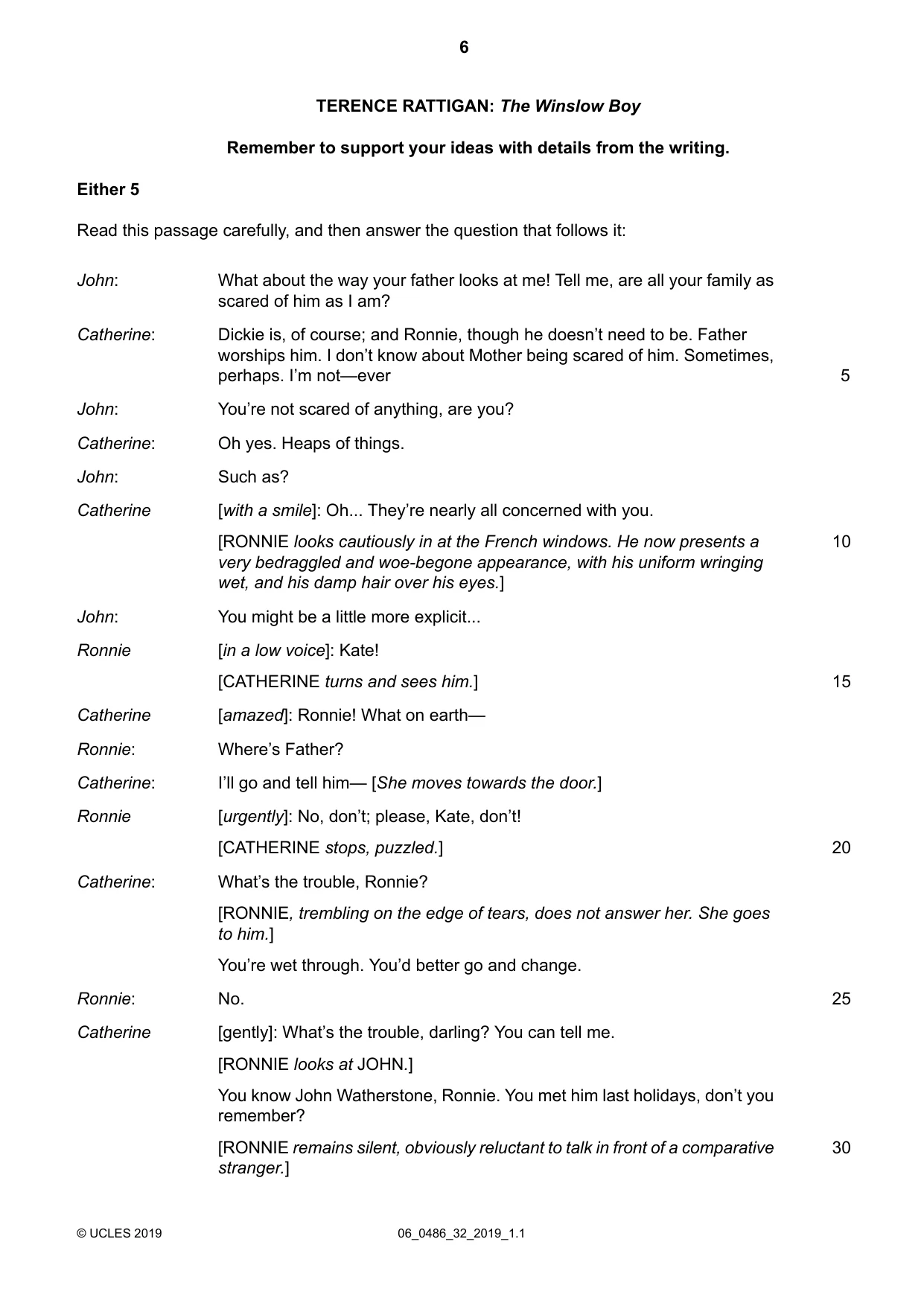
30 25 20 15 10 5 TERENCE RATTIGAN: The Winslow Boy Remember to support your ideas with details from the writing. Either 5 Read this passage carefully, and then answer the question that follows it: What about the way your father looks at me! Tell me, are all your family as scared of him as I am? John: Dickie is, of course; and Ronnie, though he doesn’t need to be. Father worships him. I don’t know about Mother being scared of him. Sometimes, perhaps. I’m not—ever Catherine: You’re not scared of anything, are you? John: Oh yes. Heaps of things. Catherine: Such as? John: [with a smile]: Oh... They’re nearly all concerned with you. [RONNIE looks cautiously in at the French windows. He now presents a very bedraggled and woe-begone appearance, with his uniform wringing wet, and his damp hair over his eyes.] Catherine You might be a little more explicit... John: [in a low voice]: Kate! [CATHERINE turns and sees him.] Ronnie [amazed]: Ronnie! What on earth— Catherine Where’s Father? Ronnie: I’ll go and tell him— [She moves towards the door.] Catherine: [urgently]: No, don’t; please, Kate, don’t! [CATHERINE stops, puzzled.] Ronnie What’s the trouble, Ronnie? [RONNIE, trembling on the edge of tears, does not answer her. She goes to him.] You’re wet through. You’d better go and change. Catherine: No. Ronnie: [gently]: What’s the trouble, darling? You can tell me. [RONNIE looks at JOHN.] You know John Watherstone, Ronnie. You met him last holidays, don’t you remember? [RONNIE remains silent, obviously reluctant to talk in front of a comparative stranger.] Catherine 06_0486_32_2019_1.1 © UCLES 2019 6
Question paper, page 7
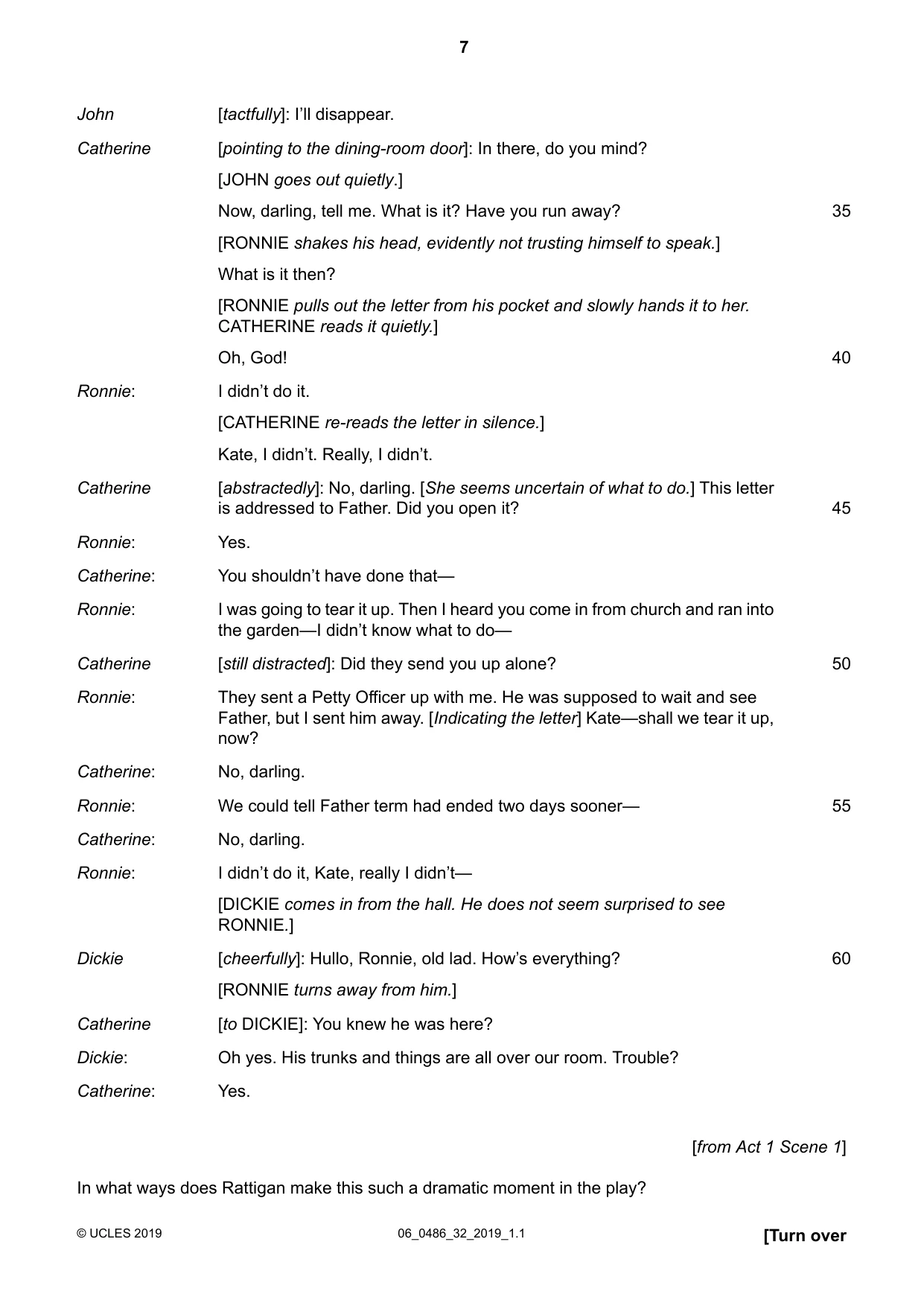
60 55 50 45 40 35 [tactfully]: I’ll disappear. John [pointing to the dining-room door]: In there, do you mind? [JOHN goes out quietly.] Now, darling, tell me. What is it? Have you run away? [RONNIE shakes his head, evidently not trusting himself to speak.] What is it then? [RONNIE pulls out the letter from his pocket and slowly hands it to her. CATHERINE reads it quietly.] Oh, God! Catherine I didn’t do it. [CATHERINE re-reads the letter in silence.] Kate, I didn’t. Really, I didn’t. Ronnie: [abstractedly]: No, darling. [She seems uncertain of what to do.] This letter is addressed to Father. Did you open it? Catherine Yes. Ronnie: You shouldn’t have done that— Catherine: I was going to tear it up. Then I heard you come in from church and ran into the garden—I didn’t know what to do— Ronnie: [still distracted]: Did they send you up alone? Catherine They sent a Petty Officer up with me. He was supposed to wait and see Father, but I sent him away. [Indicating the letter] Kate—shall we tear it up, now? Ronnie: No, darling. Catherine: We could tell Father term had ended two days sooner— Ronnie: No, darling. Catherine: I didn’t do it, Kate, really I didn’t— [DICKIE comes in from the hall. He does not seem surprised to see RONNIE.] Ronnie: [cheerfully]: Hullo, Ronnie, old lad. How’s everything? [RONNIE turns away from him.] Dickie [to DICKIE]: You knew he was here? Catherine Oh yes. His trunks and things are all over our room. Trouble? Dickie: Yes. Catherine: [from Act 1 Scene 1] In what ways does Rattigan make this such a dramatic moment in the play? [Turn over 06_0486_32_2019_1.1 © UCLES 2019 7
Question paper, page 8
Or 6 How does Rattigan make the Winslow family’s employment of Sir Robert Morton a striking part of the play? 06_0486_32_2019_1.1 © UCLES 2019 8
Question paper, page 9
Turn to page 10 for Question 7 [Turn over 06_0486_32_2019_1.1 © UCLES 2019 9
Question paper, page 10
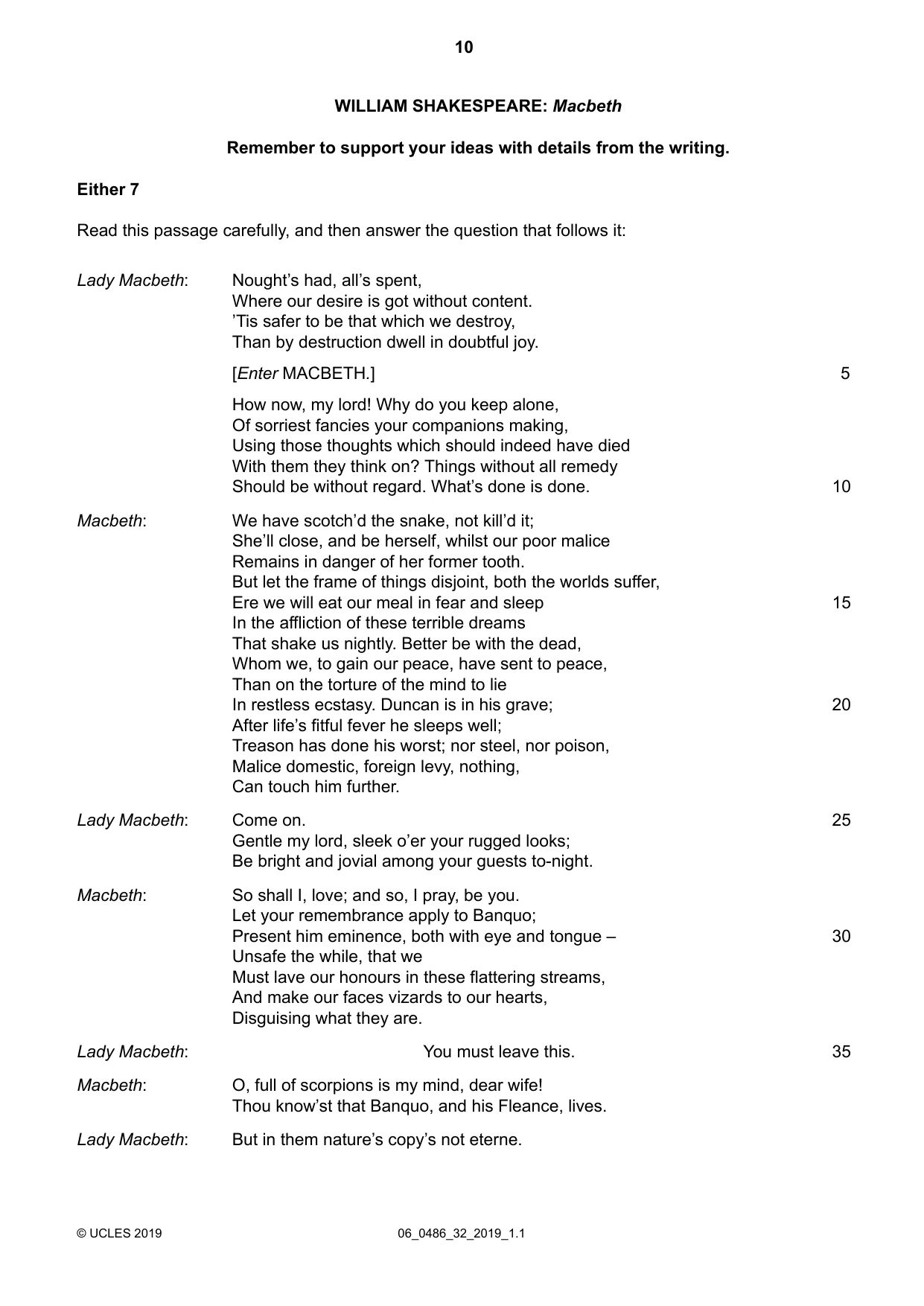
35 30 25 20 15 10 5 WILLIAM SHAKESPEARE: Macbeth Remember to support your ideas with details from the writing. Either 7 Read this passage carefully, and then answer the question that follows it: Nought’s had, all’s spent, Where our desire is got without content. ’Tis safer to be that which we destroy, Than by destruction dwell in doubtful joy. [Enter MACBETH.] How now, my lord! Why do you keep alone, Of sorriest fancies your companions making, Using those thoughts which should indeed have died With them they think on? Things without all remedy Should be without regard. What’s done is done. Lady Macbeth: We have scotch’d the snake, not kill’d it; She’ll close, and be herself, whilst our poor malice Remains in danger of her former tooth. But let the frame of things disjoint, both the worlds suffer, Ere we will eat our meal in fear and sleep In the affliction of these terrible dreams That shake us nightly. Better be with the dead, Whom we, to gain our peace, have sent to peace, Than on the torture of the mind to lie In restless ecstasy. Duncan is in his grave; After life’s fitful fever he sleeps well; Treason has done his worst; nor steel, nor poison, Malice domestic, foreign levy, nothing, Can touch him further. Macbeth: Come on. Gentle my lord, sleek o’er your rugged looks; Be bright and jovial among your guests to-night. Lady Macbeth: So shall I, love; and so, I pray, be you. Let your remembrance apply to Banquo; Present him eminence, both with eye and tongue – Unsafe the while, that we Must lave our honours in these flattering streams, And make our faces vizards to our hearts, Disguising what they are. Macbeth: You must leave this. Lady Macbeth: O, full of scorpions is my mind, dear wife! Thou know’st that Banquo, and his Fleance, lives. Macbeth: But in them nature’s copy’s not eterne. Lady Macbeth: 06_0486_32_2019_1.1 © UCLES 2019 10
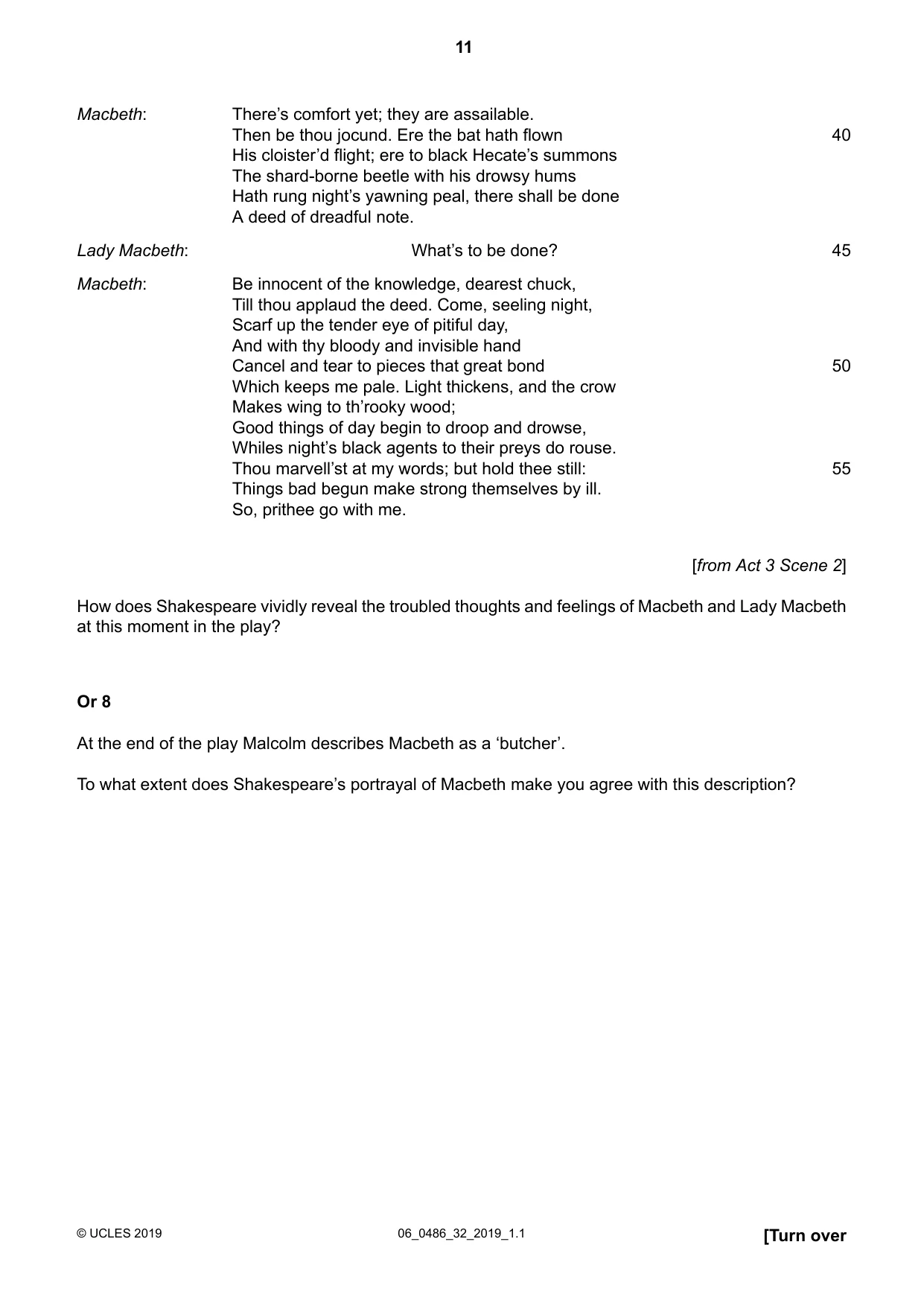
Question paper, page 11
55 50 45 40 There’s comfort yet; they are assailable. Then be thou jocund. Ere the bat hath flown His cloister’d flight; ere to black Hecate’s summons The shard-borne beetle with his drowsy hums Hath rung night’s yawning peal, there shall be done A deed of dreadful note. Macbeth: What’s to be done? Lady Macbeth: Be innocent of the knowledge, dearest chuck, Till thou applaud the deed. Come, seeling night, Scarf up the tender eye of pitiful day, And with thy bloody and invisible hand Cancel and tear to pieces that great bond Which keeps me pale. Light thickens, and the crow Makes wing to th’rooky wood; Good things of day begin to droop and drowse, Whiles night’s black agents to their preys do rouse. Thou marvell’st at my words; but hold thee still: Things bad begun make strong themselves by ill. So, prithee go with me. Macbeth: [from Act 3 Scene 2] How does Shakespeare vividly reveal the troubled thoughts and feelings of Macbeth and Lady Macbeth at this moment in the play? Or 8 At the end of the play Malcolm describes Macbeth as a ‘butcher’. To what extent does Shakespeare’s portrayal of Macbeth make you agree with this description? [Turn over 06_0486_32_2019_1.1 © UCLES 2019 11
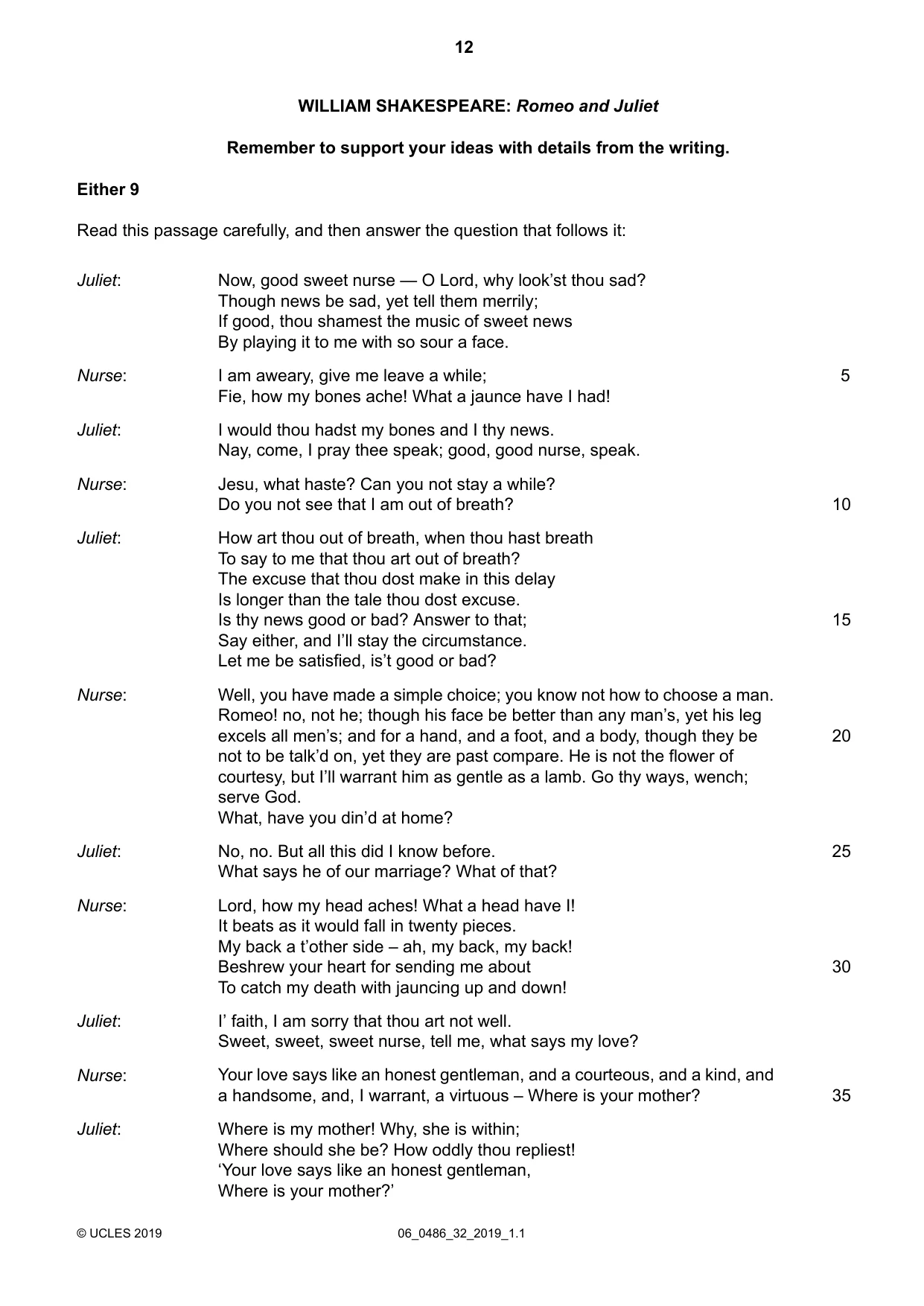
Question paper, page 12
35 30 25 20 15 10 5 WILLIAM SHAKESPEARE: Romeo and Juliet Remember to support your ideas with details from the writing. Either 9 Read this passage carefully, and then answer the question that follows it: Now, good sweet nurse — O Lord, why look’st thou sad? Though news be sad, yet tell them merrily; If good, thou shamest the music of sweet news By playing it to me with so sour a face. Juliet: I am aweary, give me leave a while; Fie, how my bones ache! What a jaunce have I had! Nurse: I would thou hadst my bones and I thy news. Nay, come, I pray thee speak; good, good nurse, speak. Juliet: Jesu, what haste? Can you not stay a while? Do you not see that I am out of breath? Nurse: How art thou out of breath, when thou hast breath To say to me that thou art out of breath? The excuse that thou dost make in this delay Is longer than the tale thou dost excuse. Is thy news good or bad? Answer to that; Say either, and I’ll stay the circumstance. Let me be satisfied, is’t good or bad? Juliet: Well, you have made a simple choice; you know not how to choose a man. Romeo! no, not he; though his face be better than any man’s, yet his leg excels all men’s; and for a hand, and a foot, and a body, though they be not to be talk’d on, yet they are past compare. He is not the flower of courtesy, but I’ll warrant him as gentle as a lamb. Go thy ways, wench; serve God. What, have you din’d at home? Nurse: No, no. But all this did I know before. What says he of our marriage? What of that? Juliet: Lord, how my head aches! What a head have I! It beats as it would fall in twenty pieces. My back a t’other side – ah, my back, my back! Beshrew your heart for sending me about To catch my death with jauncing up and down! Nurse: I’ faith, I am sorry that thou art not well. Sweet, sweet, sweet nurse, tell me, what says my love? Juliet: Your love says like an honest gentleman, and a courteous, and a kind, and a handsome, and, I warrant, a virtuous – Where is your mother? Nurse: Where is my mother! Why, she is within; Where should she be? How oddly thou repliest! ‘Your love says like an honest gentleman, Where is your mother?’ Juliet: 06_0486_32_2019_1.1 © UCLES 2019 12
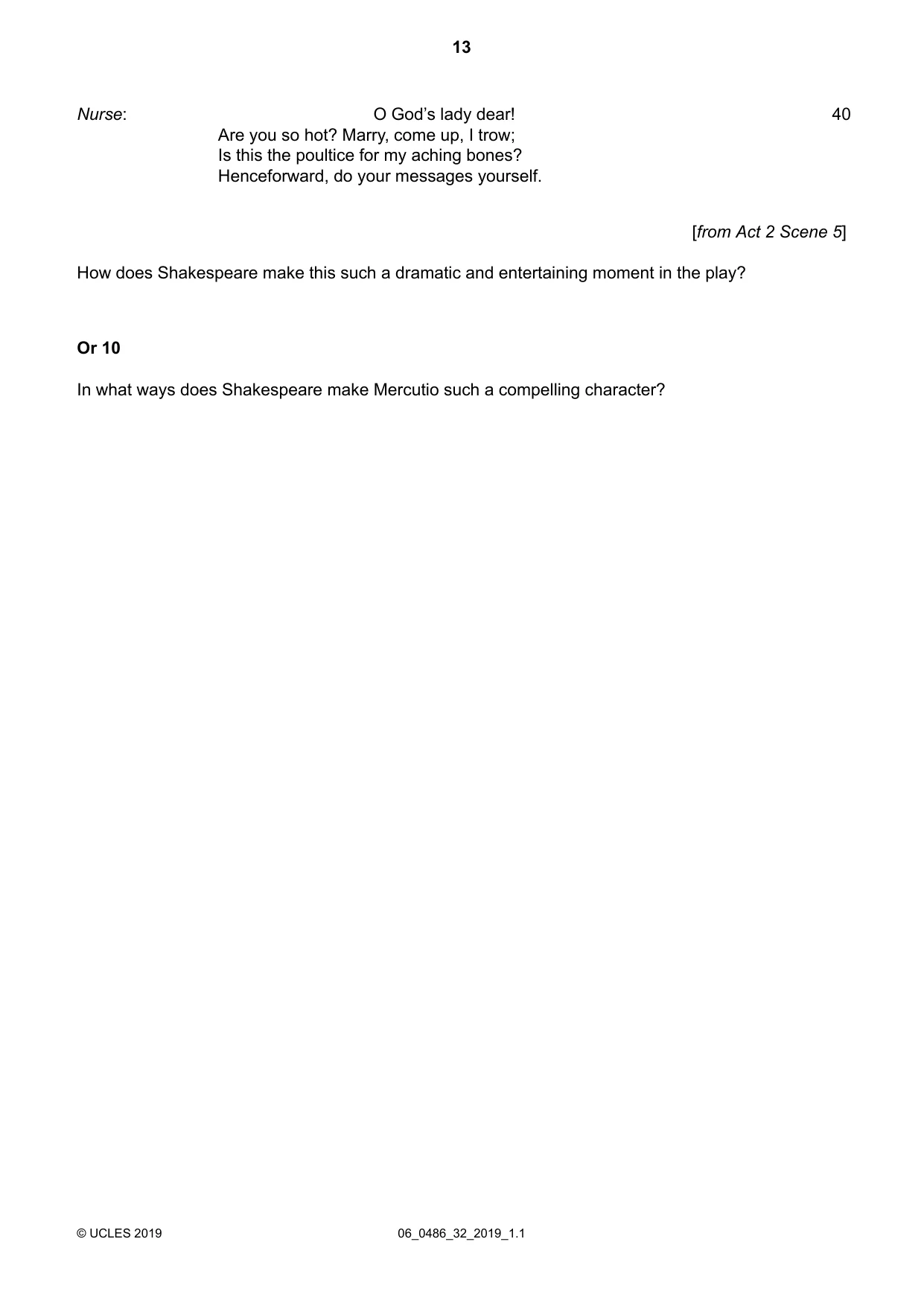
Question paper, page 13
40 O God’s lady dear! Are you so hot? Marry, come up, I trow; Is this the poultice for my aching bones? Henceforward, do your messages yourself. Nurse: [from Act 2 Scene 5] How does Shakespeare make this such a dramatic and entertaining moment in the play? Or 10 In what ways does Shakespeare make Mercutio such a compelling character? 06_0486_32_2019_1.1 © UCLES 2019 13
Question paper, page 14
BLANK PAGE 06_0486_32_2019_1.1 © UCLES 2019 14
Question paper, page 15
BLANK PAGE 06_0486_32_2019_1.1 © UCLES 2019 15
Question paper, page 16
BLANK PAGE Permission to reproduce items where third-party owned material protected by copyright is included has been sought and cleared where possible. Every reasonable effort has been made by the publisher (UCLES) to trace copyright holders, but if any items requiring clearance have unwittingly been included, the publisher will be pleased to make amends at the earliest possible opportunity. To avoid the issue of disclosure of answer-related information to candidates, all copyright acknowledgements are reproduced online in the Cambridge Assessment International Education Copyright Acknowledgements Booklet. This is produced for each series of examinations and is freely available to download at www.cambridgeinternational.org after the live examination series. Cambridge Assessment International Education is part of the Cambridge Assessment Group. Cambridge Assessment is the brand name of the University of Cambridge Local Examinations Syndicate (UCLES), which itself is a department of the University of Cambridge. 06_0486_32_2019_1.1 © UCLES 2019 16
Mark scheme, page 1
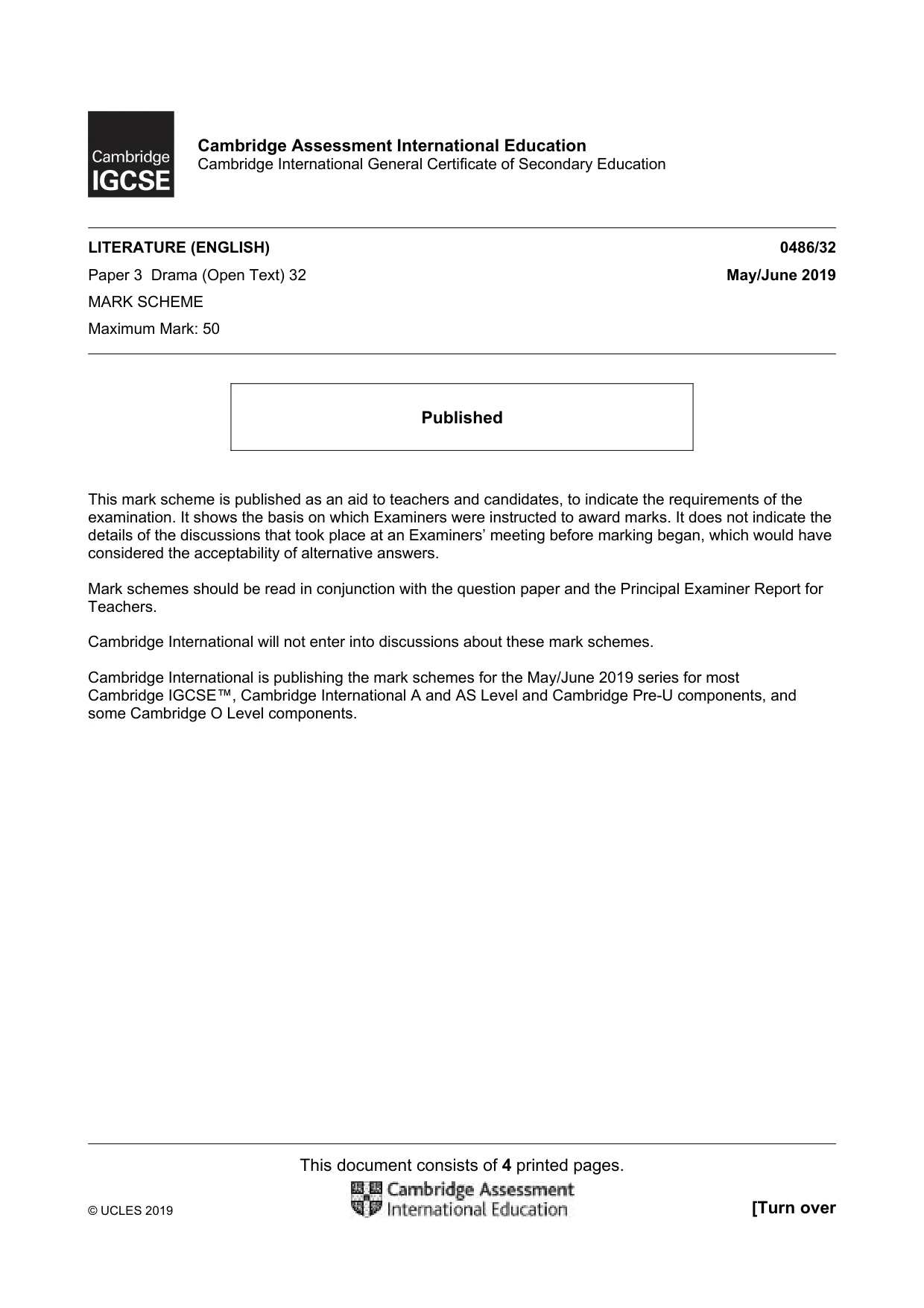
This document consists of 4 printed pages. © UCLES 2019 [Turn over Cambridge Assessment International Education Cambridge International General Certificate of Secondary Education LITERATURE (ENGLISH) 0486/32 Paper 3 Drama (Open Text) 32 May/June 2019 MARK SCHEME Maximum Mark: 50 Published This mark scheme is published as an aid to teachers and candidates, to indicate the requirements of the examination. It shows the basis on which Examiners were instructed to award marks. It does not indicate the details of the discussions that took place at an Examiners’ meeting before marking began, which would have considered the acceptability of alternative answers. Mark schemes should be read in conjunction with the question paper and the Principal Examiner Report for Teachers. Cambridge International will not enter into discussions about these mark schemes. Cambridge International is publishing the mark schemes for the May/June 2019 series for most Cambridge IGCSE™, Cambridge International A and AS Level and Cambridge Pre-U components, and some Cambridge O Level components.
Mark scheme, page 2
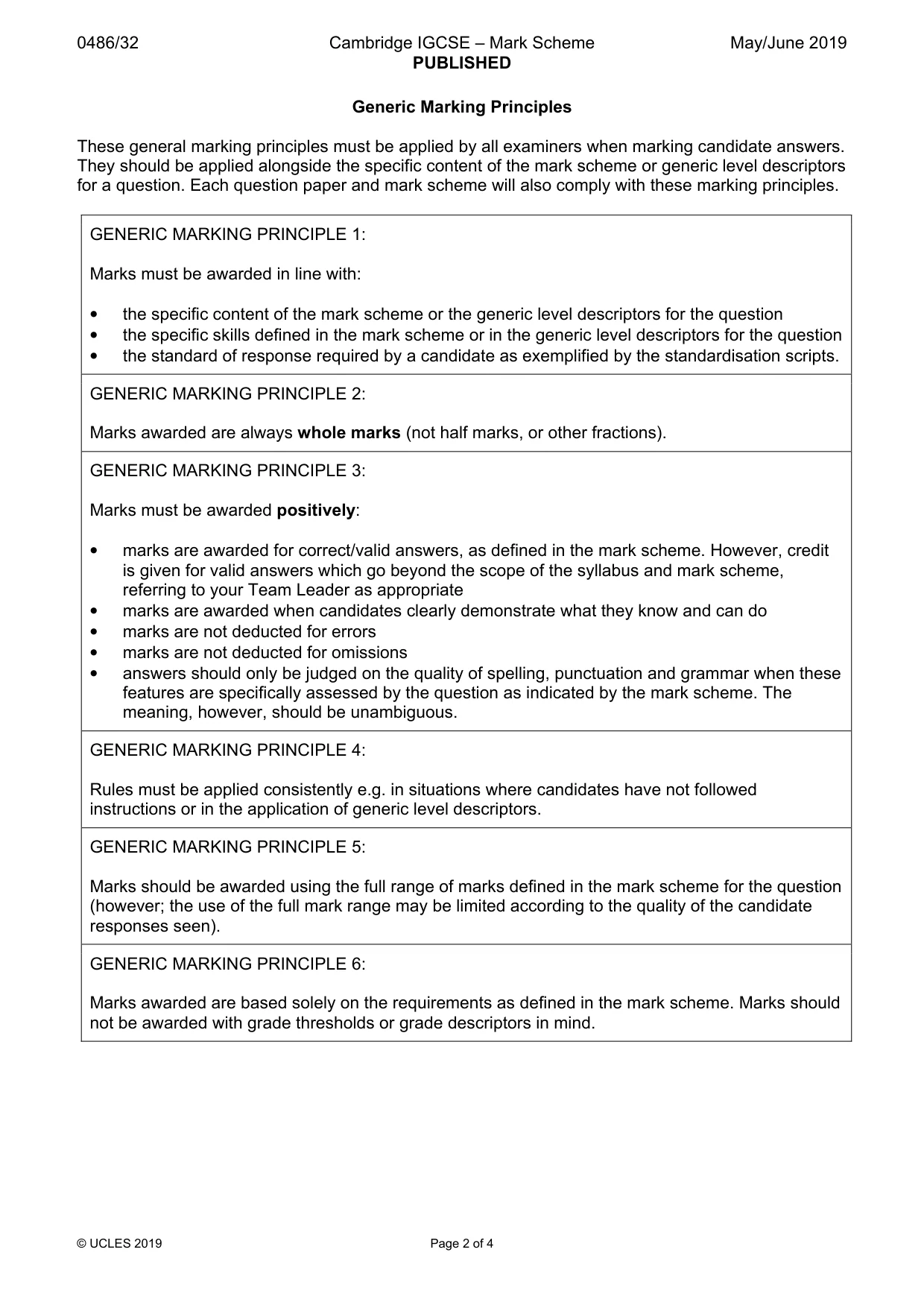
0486/32 Cambridge IGCSE – Mark Scheme PUBLISHED May/June 2019 © UCLES 2019 Page 2 of 4 Generic Marking Principles These general marking principles must be applied by all examiners when marking candidate answers. They should be applied alongside the specific content of the mark scheme or generic level descriptors for a question. Each question paper and mark scheme will also comply with these marking principles. GENERIC MARKING PRINCIPLE 1: Marks must be awarded in line with: • the specific content of the mark scheme or the generic level descriptors for the question • the specific skills defined in the mark scheme or in the generic level descriptors for the question • the standard of response required by a candidate as exemplified by the standardisation scripts. GENERIC MARKING PRINCIPLE 2: Marks awarded are always whole marks (not half marks, or other fractions). GENERIC MARKING PRINCIPLE 3: Marks must be awarded positively: • marks are awarded for correct/valid answers, as defined in the mark scheme. However, credit is given for valid answers which go beyond the scope of the syllabus and mark scheme, referring to your Team Leader as appropriate • marks are awarded when candidates clearly demonstrate what they know and can do • marks are not deducted for errors • marks are not deducted for omissions • answers should only be judged on the quality of spelling, punctuation and grammar when these features are specifically assessed by the question as indicated by the mark scheme. The meaning, however, should be unambiguous. GENERIC MARKING PRINCIPLE 4: Rules must be applied consistently e.g. in situations where candidates have not followed instructions or in the application of generic level descriptors. GENERIC MARKING PRINCIPLE 5: Marks should be awarded using the full range of marks defined in the mark scheme for the question (however; the use of the full mark range may be limited according to the quality of the candidate responses seen). GENERIC MARKING PRINCIPLE 6: Marks awarded are based solely on the requirements as defined in the mark scheme. Marks should not be awarded with grade thresholds or grade descriptors in mind.
Mark scheme, page 3
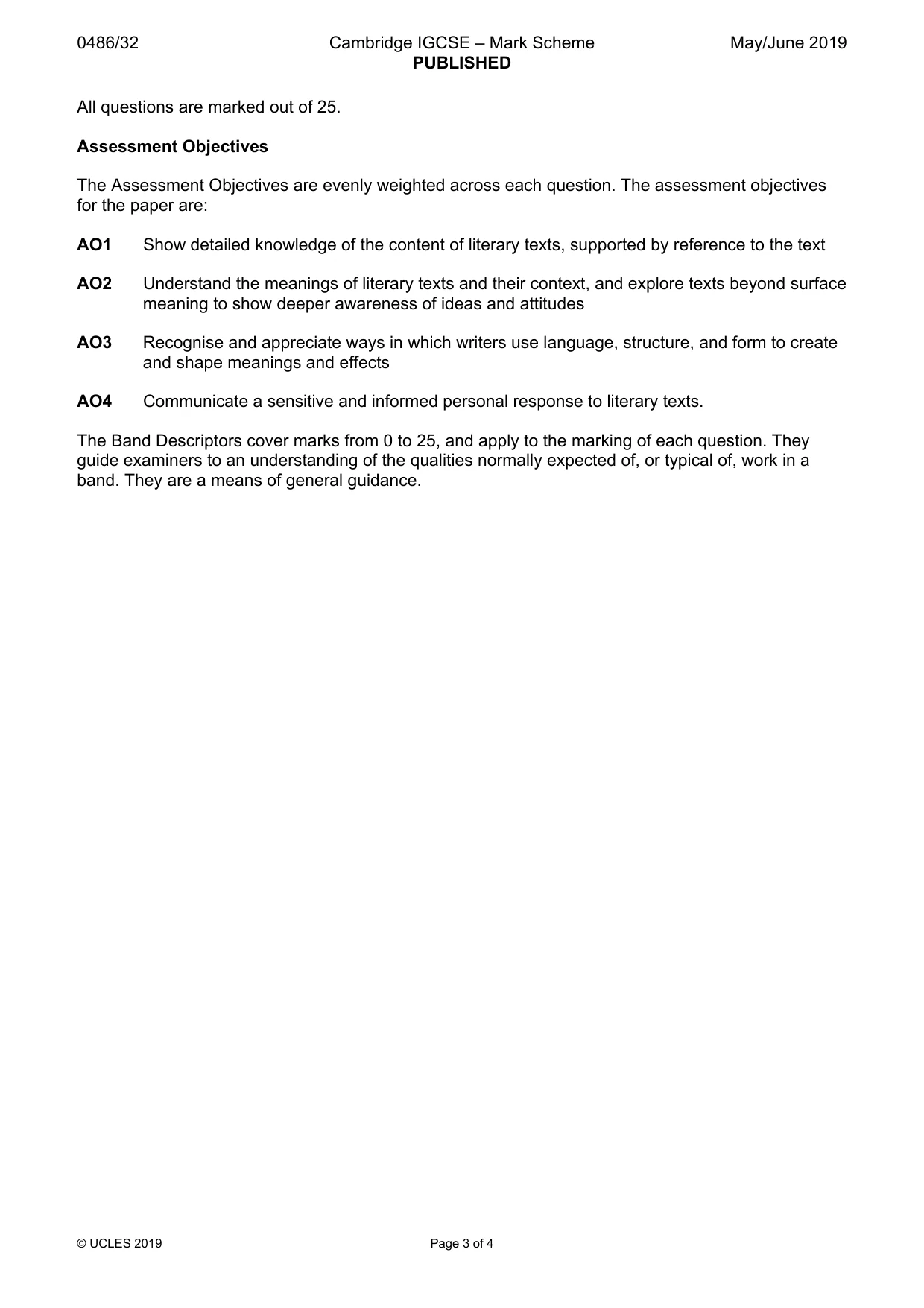
0486/32 Cambridge IGCSE – Mark Scheme PUBLISHED May/June 2019 © UCLES 2019 Page 3 of 4 All questions are marked out of 25. Assessment Objectives The Assessment Objectives are evenly weighted across each question. The assessment objectives for the paper are: AO1 Show detailed knowledge of the content of literary texts, supported by reference to the text AO2 Understand the meanings of literary texts and their context, and explore texts beyond surface meaning to show deeper awareness of ideas and attitudes AO3 Recognise and appreciate ways in which writers use language, structure, and form to create and shape meanings and effects AO4 Communicate a sensitive and informed personal response to literary texts. The Band Descriptors cover marks from 0 to 25, and apply to the marking of each question. They guide examiners to an understanding of the qualities normally expected of, or typical of, work in a band. They are a means of general guidance.
Mark scheme, page 4
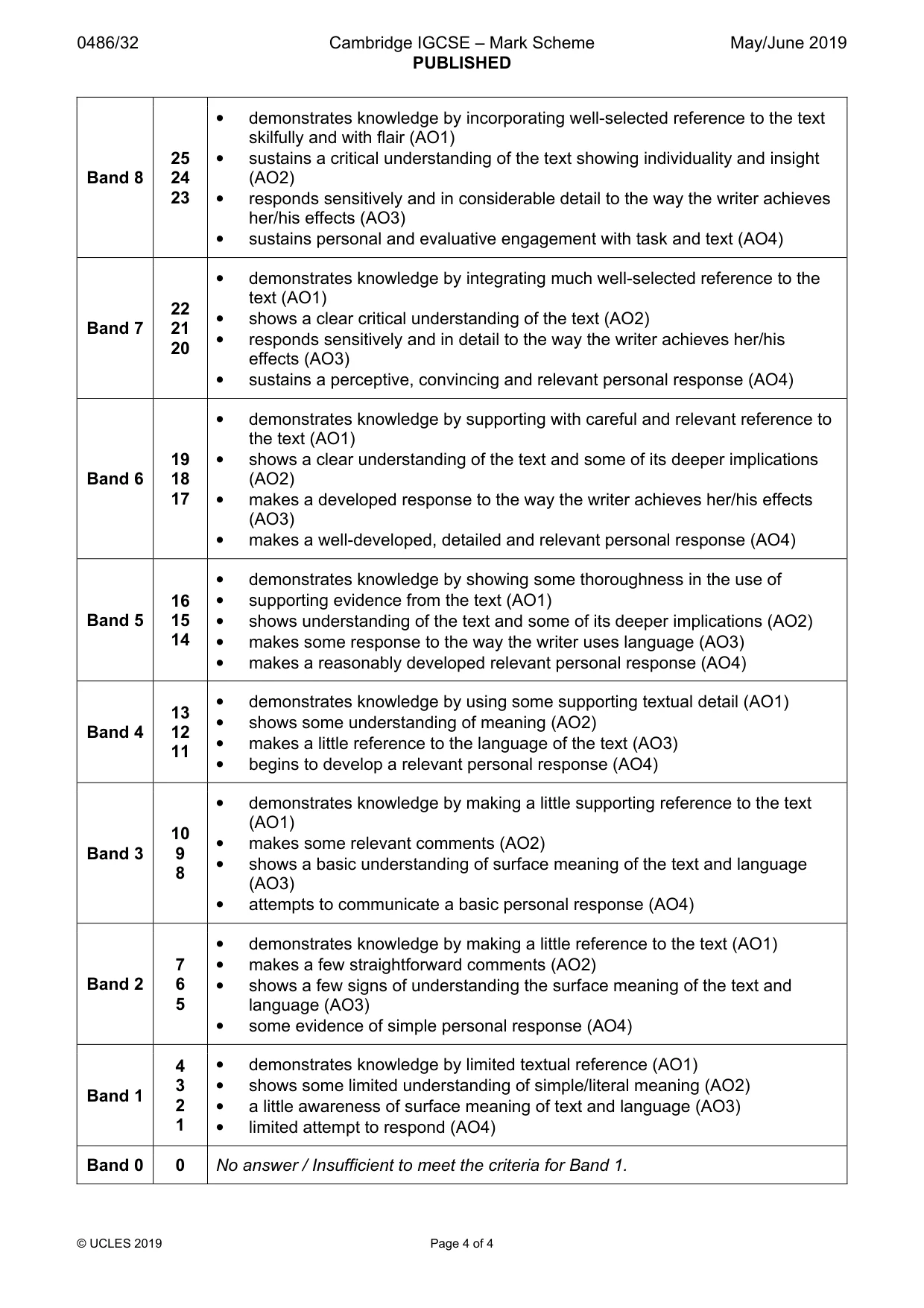
0486/32 Cambridge IGCSE – Mark Scheme PUBLISHED May/June 2019 © UCLES 2019 Page 4 of 4 Band 8 25 24 23 • demonstrates knowledge by incorporating well-selected reference to the text skilfully and with flair (AO1) • sustains a critical understanding of the text showing individuality and insight (AO2) • responds sensitively and in considerable detail to the way the writer achieves her/his effects (AO3) • sustains personal and evaluative engagement with task and text (AO4) Band 7 22 21 20 • demonstrates knowledge by integrating much well-selected reference to the text (AO1) • shows a clear critical understanding of the text (AO2) • responds sensitively and in detail to the way the writer achieves her/his effects (AO3) • sustains a perceptive, convincing and relevant personal response (AO4) Band 6 19 18 17 • demonstrates knowledge by supporting with careful and relevant reference to the text (AO1) • shows a clear understanding of the text and some of its deeper implications (AO2) • makes a developed response to the way the writer achieves her/his effects (AO3) • makes a well-developed, detailed and relevant personal response (AO4) Band 5 16 15 14 • demonstrates knowledge by showing some thoroughness in the use of • supporting evidence from the text (AO1) • shows understanding of the text and some of its deeper implications (AO2) • makes some response to the way the writer uses language (AO3) • makes a reasonably developed relevant personal response (AO4) Band 4 13 12 11 • demonstrates knowledge by using some supporting textual detail (AO1) • shows some understanding of meaning (AO2) • makes a little reference to the language of the text (AO3) • begins to develop a relevant personal response (AO4) Band 3 10 9 8 • demonstrates knowledge by making a little supporting reference to the text (AO1) • makes some relevant comments (AO2) • shows a basic understanding of surface meaning of the text and language (AO3) • attempts to communicate a basic personal response (AO4) Band 2 7 6 5 • demonstrates knowledge by making a little reference to the text (AO1) • makes a few straightforward comments (AO2) • shows a few signs of understanding the surface meaning of the text and language (AO3) • some evidence of simple personal response (AO4) Band 1 4 3 2 1 • demonstrates knowledge by limited textual reference (AO1) • shows some limited understanding of simple/literal meaning (AO2) • a little awareness of surface meaning of text and language (AO3) • limited attempt to respond (AO4) Band 0 0 No answer / Insufficient to meet the criteria for Band 1.
What you needed in this session
Cambridge’s own grade thresholds for 2019 May/June, Paper 3 · Variant 2. A higher threshold means an easier paper — the bar moves with how the cohort did.