Cambridge IGCSE English - Literature 0486 — 2018 May/June Paper 3 · Variant 3
0486/33/M/J/18 · 25 marks · ≈28 min
The question paper and its mark scheme, free to read here and free to download. This is Cambridge’s own paper, exactly as it was sat.
Question paper12 pages
Mark scheme4 pages
Answers below. Sit the paper first if you are practising.
Paper as text
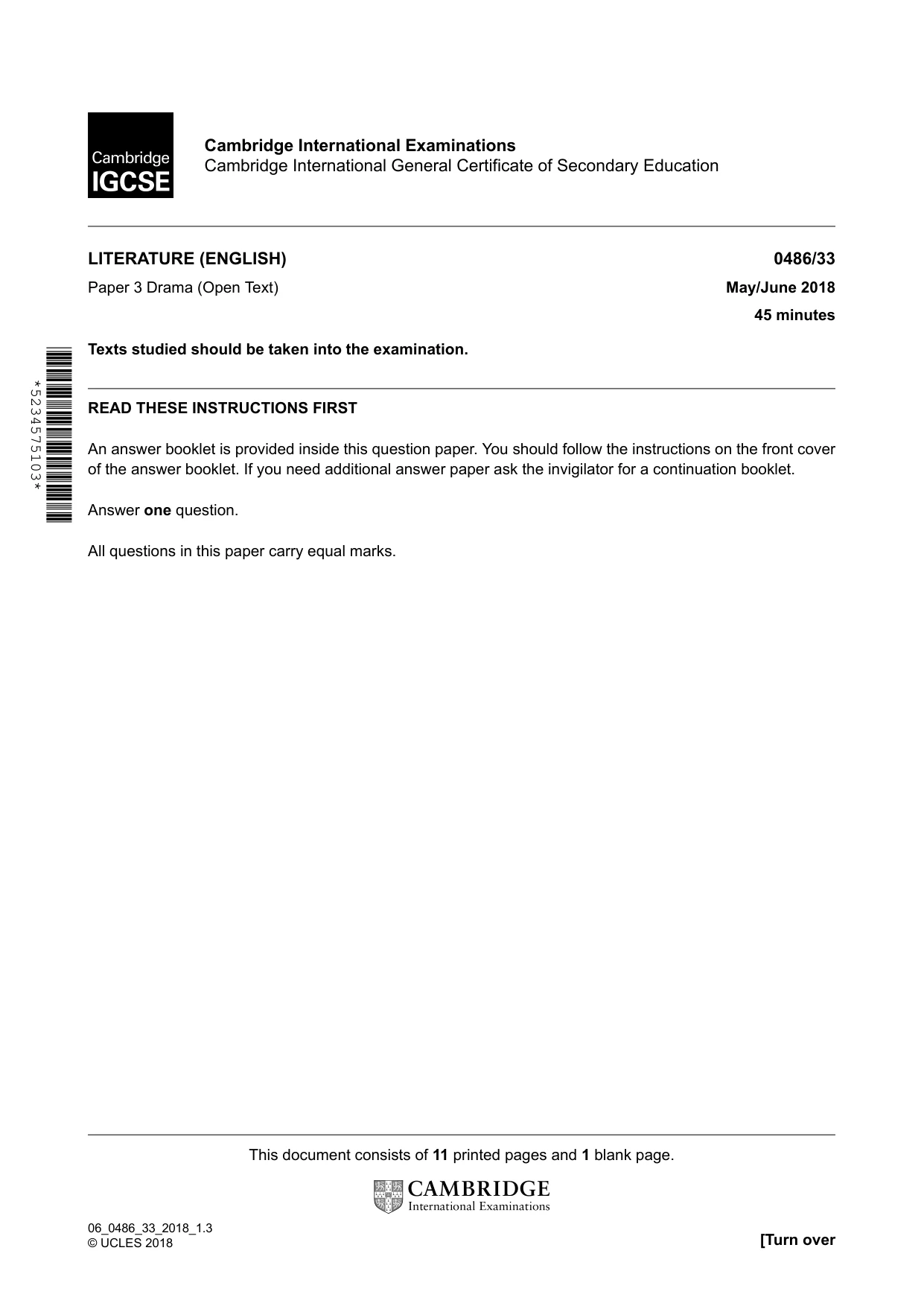
Question paper, page 1
Cambridge International Examinations Cambridge International General Certificate of Secondary Education 0486/33 LITERATURE (ENGLISH) May/June 2018 Paper 3 Drama (Open Text) 45 minutes Texts studied should be taken into the examination. READ THESE INSTRUCTIONS FIRST An answer booklet is provided inside this question paper. You should follow the instructions on the front cover of the answer booklet. If you need additional answer paper ask the invigilator for a continuation booklet. Answer one question. All questions in this paper carry equal marks. This document consists of 11 printed pages and 1 blank page. [Turn over 06_0486_33_2018_1.3 © UCLES 2018 *5234575103*
Question paper, page 2
J LAWRENCE & R E LEE: Inherit the Wind Remember to support your ideas with details from the writing. Either 1 Read this passage carefully, and then answer the question that follows it: [fiery]: You’ve ruled out all my witnesses. Drummond Content removed due to copyright restrictions 06_0486_33_2018_1.3 © UCLES 2018 2
Question paper, page 3
Content removed due to copyright restrictions [from Act 2 Scene 1] In what ways do the writers make this such a powerful moment in the play? Or 2 How do the writers make one character in the play particularly admirable for you? [Turn over 06_0486_33_2018_1.3 © UCLES 2018 3 [DAVENPORT sits. DRUMMOND opens up the rock, which splits into two halves.]
Question paper, page 4
ARTHUR MILLER: A View from the Bridge Remember to support your ideas with details from the writing. Either 3 Read this passage carefully, and then answer the question that follows it: That’s a nice kid? He gives me the heeby-jeebies. Content removed due to copyright restrictions 06_0486_33_2018_1.3 © UCLES 2018 4 Eddie:
Question paper, page 5
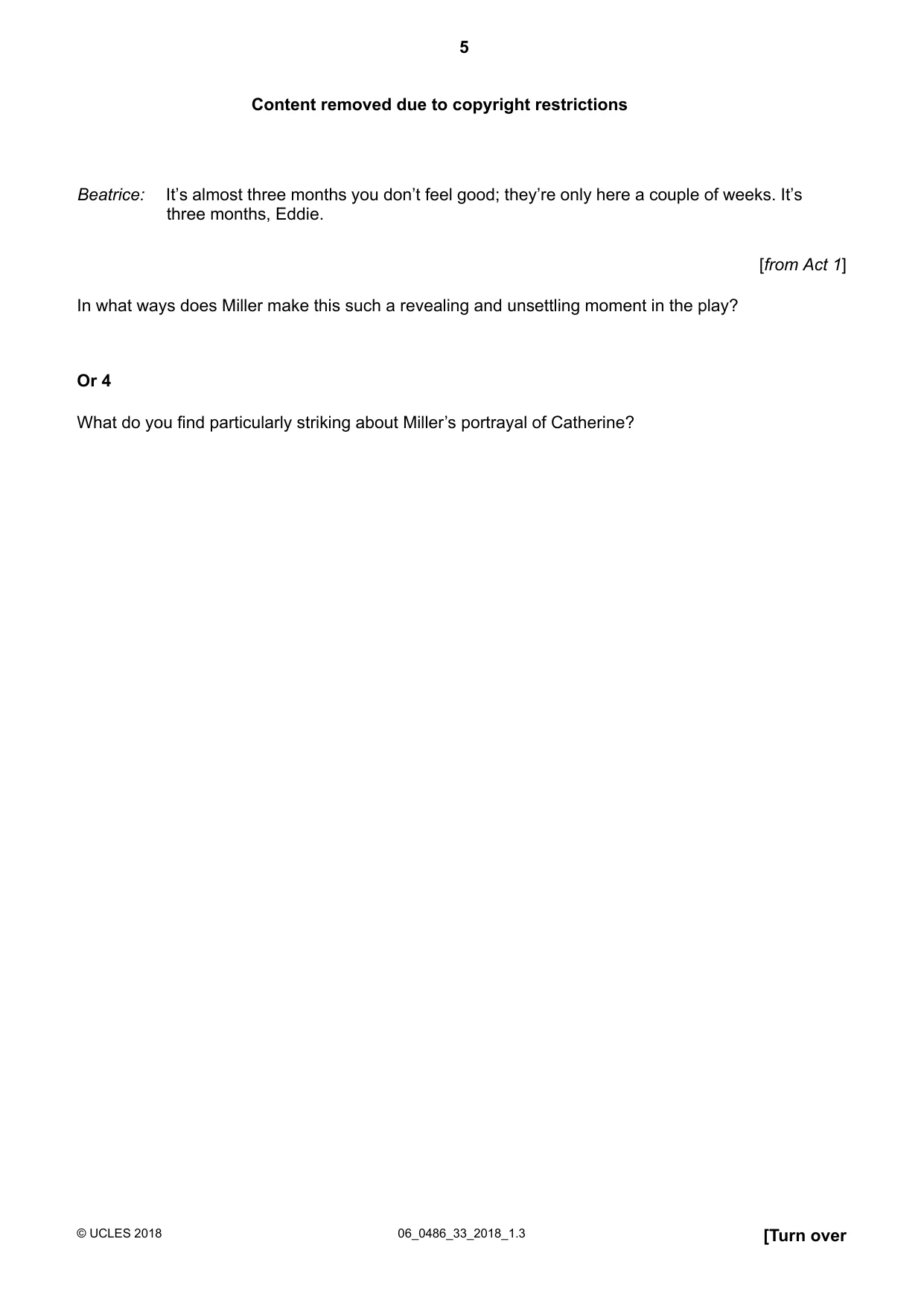
Content removed due to copyright restrictions three months, Eddie. [from Act 1] In what ways does Miller make this such a revealing and unsettling moment in the play? Or 4 What do you find particularly striking about Miller’s portrayal of Catherine? [Turn over 06_0486_33_2018_1.3 © UCLES 2018 5 Beatrice: It’s almost three months you don’t feel good; they’re only here a couple of weeks. It’s
Question paper, page 6
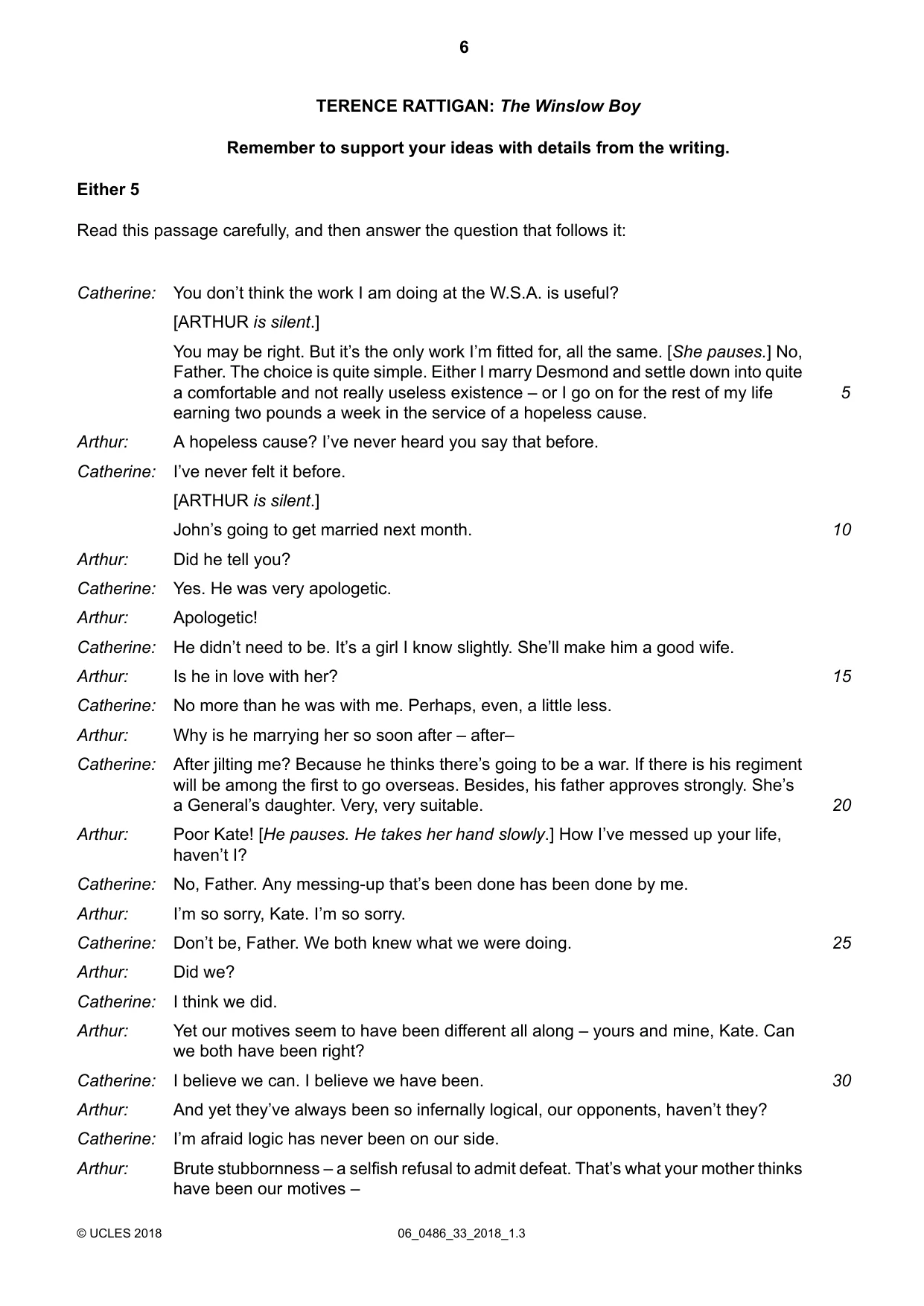
30 25 20 15 10 5 TERENCE RATTIGAN: The Winslow Boy Remember to support your ideas with details from the writing. Either 5 Read this passage carefully, and then answer the question that follows it: You don’t think the work I am doing at the W.S.A. is useful? Catherine: [ARTHUR is silent.] You may be right. But it’s the only work I’m fitted for, all the same. [She pauses.] No, Father. The choice is quite simple. Either I marry Desmond and settle down into quite a comfortable and not really useless existence – or I go on for the rest of my life earning two pounds a week in the service of a hopeless cause. A hopeless cause? I’ve never heard you say that before. Arthur: I’ve never felt it before. Catherine: [ARTHUR is silent.] John’s going to get married next month. Did he tell you? Arthur: Yes. He was very apologetic. Catherine: Apologetic! Arthur: He didn’t need to be. It’s a girl I know slightly. She’ll make him a good wife. Catherine: Is he in love with her? Arthur: No more than he was with me. Perhaps, even, a little less. Catherine: Why is he marrying her so soon after – after– Arthur: After jilting me? Because he thinks there’s going to be a war. If there is his regiment will be among the first to go overseas. Besides, his father approves strongly. She’s a General’s daughter. Very, very suitable. Catherine: Poor Kate! [He pauses. He takes her hand slowly.] How I’ve messed up your life, haven’t I? Arthur: No, Father. Any messing-up that’s been done has been done by me. Catherine: I’m so sorry, Kate. I’m so sorry. Arthur: Don’t be, Father. We both knew what we were doing. Catherine: Did we? Arthur: I think we did. Catherine: Yet our motives seem to have been different all along – yours and mine, Kate. Can we both have been right? Arthur: I believe we can. I believe we have been. Catherine: And yet they’ve always been so infernally logical, our opponents, haven’t they? Arthur: I’m afraid logic has never been on our side. Catherine: Brute stubbornness – a selfish refusal to admit defeat. That’s what your mother thinks have been our motives – Arthur: 06_0486_33_2018_1.3 © UCLES 2018 6
Question paper, page 7
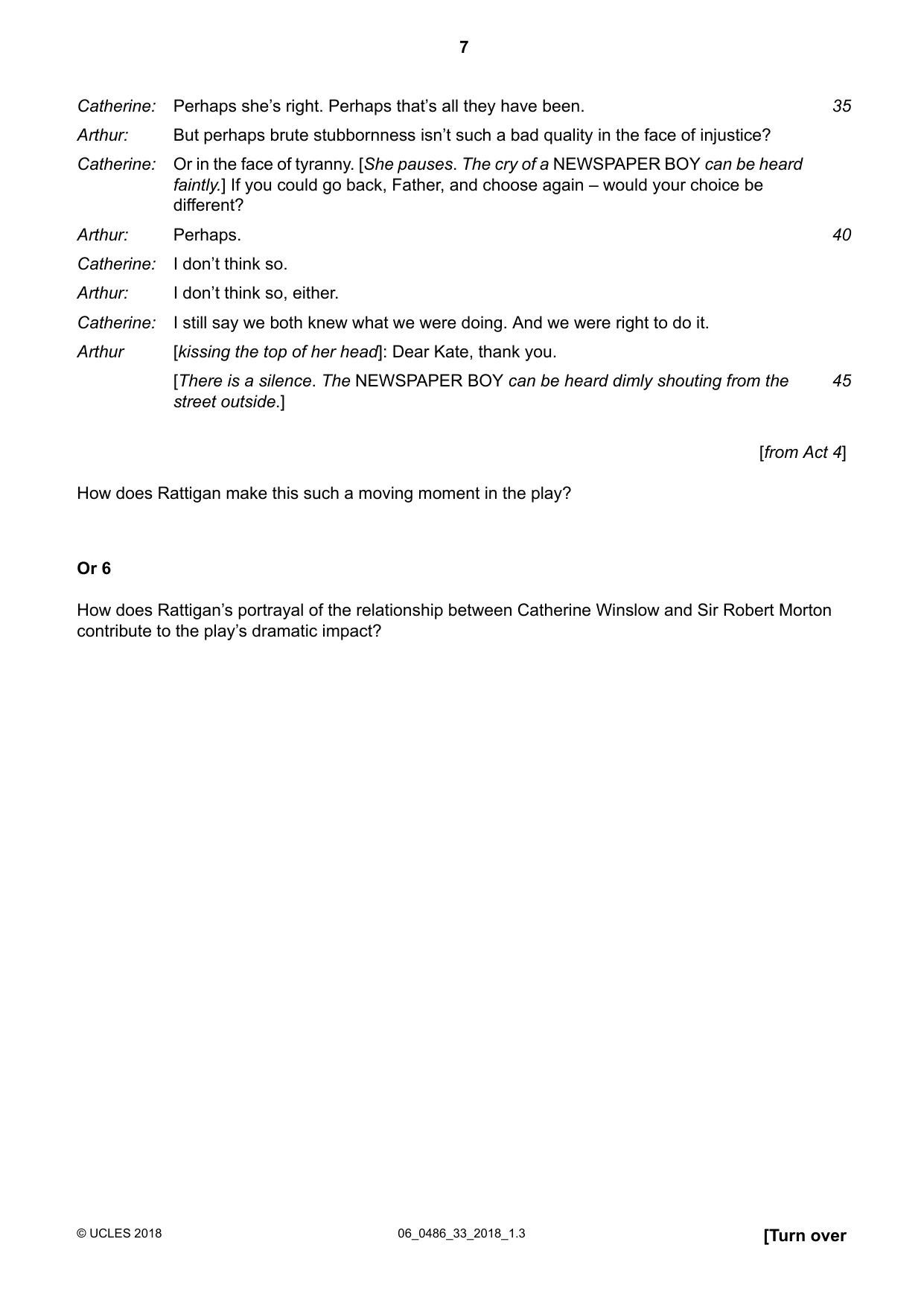
45 40 35 Perhaps she’s right. Perhaps that’s all they have been. Catherine: But perhaps brute stubbornness isn’t such a bad quality in the face of injustice? Arthur: Or in the face of tyranny. [She pauses. The cry of a NEWSPAPER BOY can be heard faintly.] If you could go back, Father, and choose again – would your choice be different? Catherine: Perhaps. Arthur: I don’t think so. Catherine: I don’t think so, either. Arthur: I still say we both knew what we were doing. And we were right to do it. Catherine: [kissing the top of her head]: Dear Kate, thank you. Arthur [There is a silence. The NEWSPAPER BOY can be heard dimly shouting from the street outside.] [from Act 4] How does Rattigan make this such a moving moment in the play? Or 6 How does Rattigan’s portrayal of the relationship between Catherine Winslow and Sir Robert Morton contribute to the play’s dramatic impact? [Turn over 06_0486_33_2018_1.3 © UCLES 2018 7
Question paper, page 8
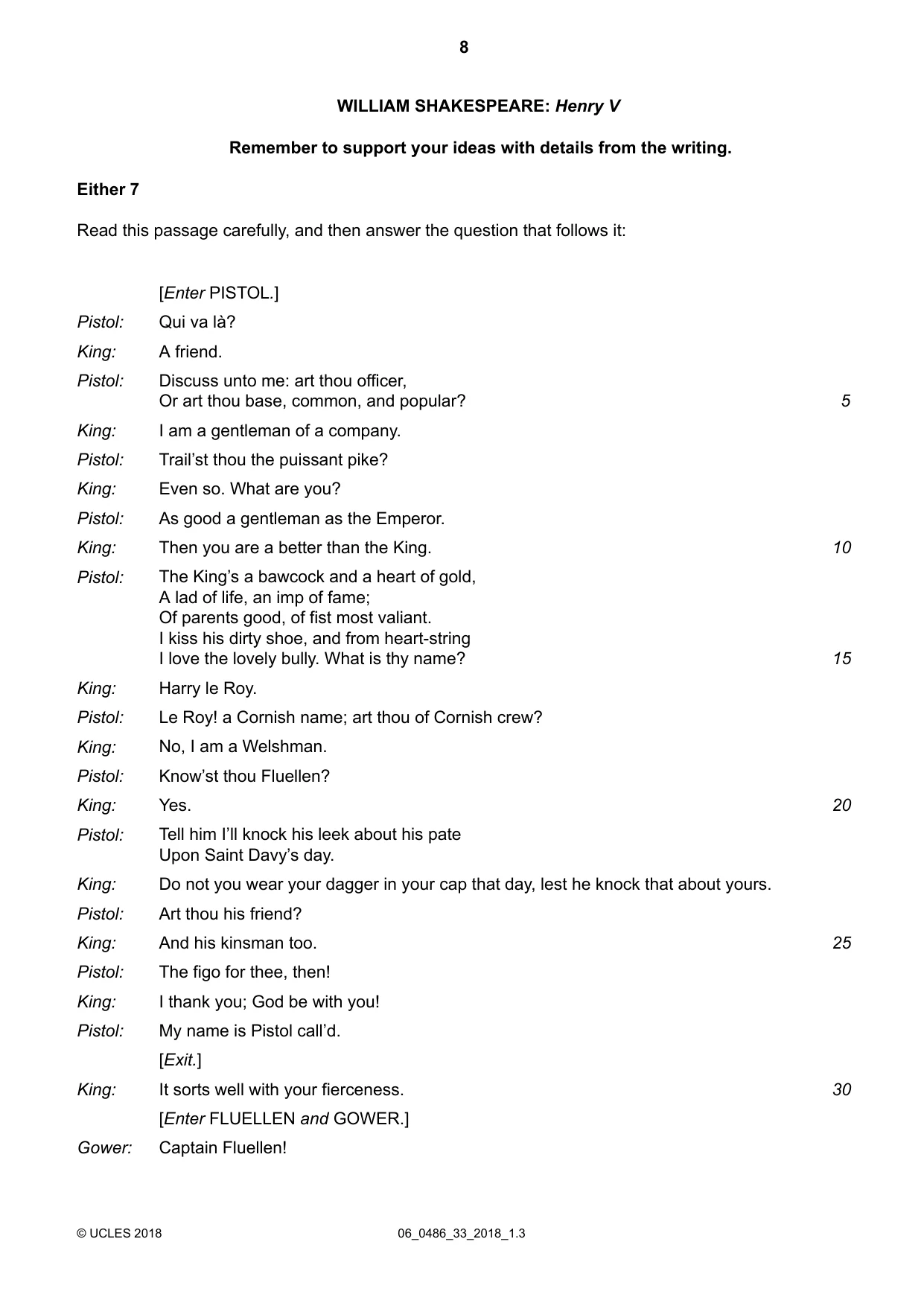
30 25 20 15 10 5 WILLIAM SHAKESPEARE: Henry V Remember to support your ideas with details from the writing. Either 7 Read this passage carefully, and then answer the question that follows it: [Enter PISTOL.] Qui va là? Pistol: A friend. King: Discuss unto me: art thou officer, Or art thou base, common, and popular? Pistol: I am a gentleman of a company. King: Trail’st thou the puissant pike? Pistol: Even so. What are you? King: As good a gentleman as the Emperor. Pistol: Then you are a better than the King. King: The King’s a bawcock and a heart of gold, A lad of life, an imp of fame; Of parents good, of fist most valiant. I kiss his dirty shoe, and from heart-string I love the lovely bully. What is thy name? Pistol: Harry le Roy. King: Le Roy! a Cornish name; art thou of Cornish crew? Pistol: No, I am a Welshman. King: Know’st thou Fluellen? Pistol: Yes. King: Tell him I’ll knock his leek about his pate Upon Saint Davy’s day. Pistol: Do not you wear your dagger in your cap that day, lest he knock that about yours. King: Art thou his friend? Pistol: And his kinsman too. King: The figo for thee, then! Pistol: I thank you; God be with you! King: My name is Pistol call’d. Pistol: [Exit.] It sorts well with your fierceness. King: [Enter FLUELLEN and GOWER.] Captain Fluellen! Gower: 06_0486_33_2018_1.3 © UCLES 2018 8
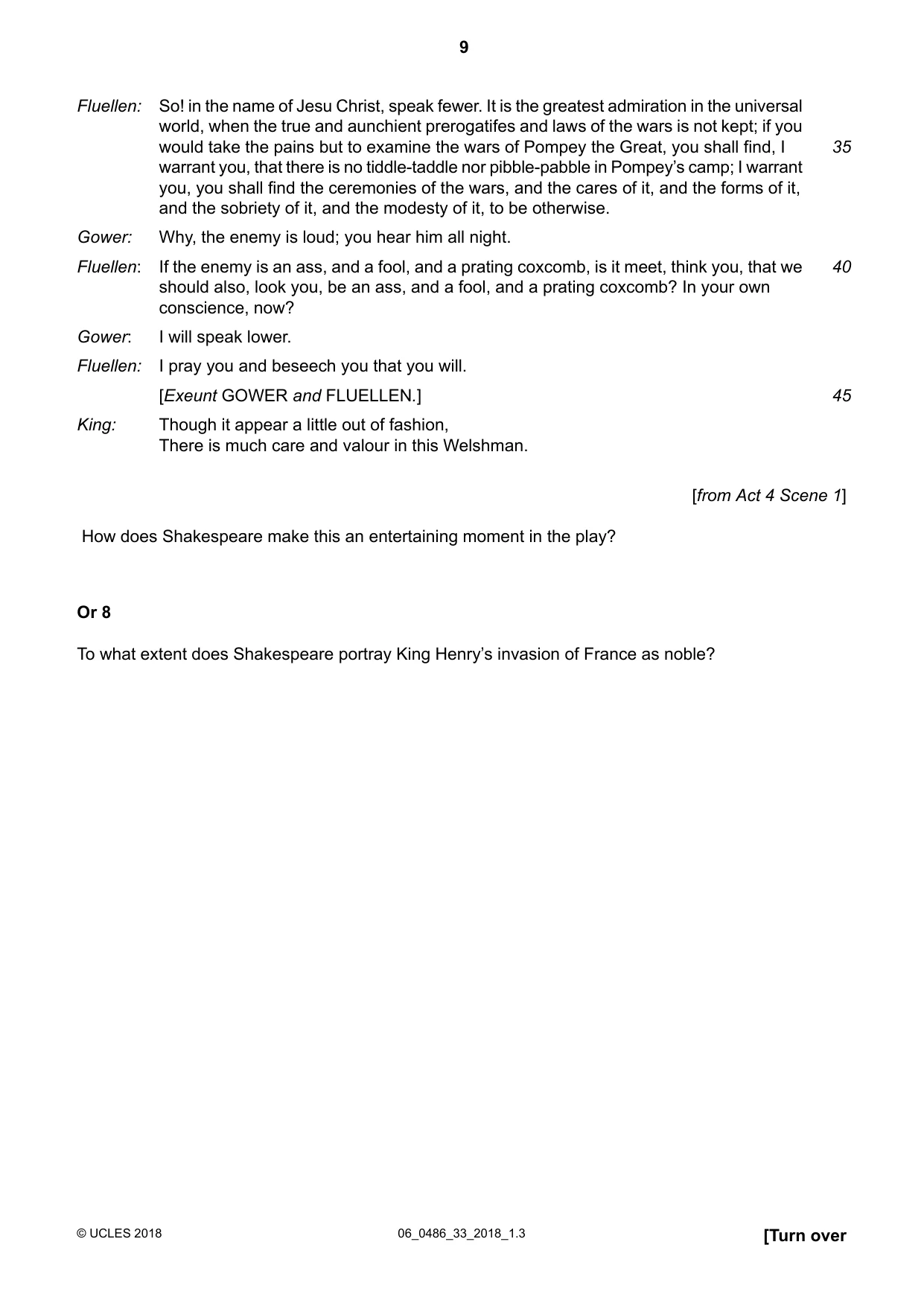
Question paper, page 9
45 40 35 So! in the name of Jesu Christ, speak fewer. It is the greatest admiration in the universal world, when the true and aunchient prerogatifes and laws of the wars is not kept; if you Fluellen: would take the pains but to examine the wars of Pompey the Great, you shall find, I warrant you, that there is no tiddle-taddle nor pibble-pabble in Pompey’s camp; I warrant you, you shall find the ceremonies of the wars, and the cares of it, and the forms of it, and the sobriety of it, and the modesty of it, to be otherwise. Why, the enemy is loud; you hear him all night. Gower: If the enemy is an ass, and a fool, and a prating coxcomb, is it meet, think you, that we should also, look you, be an ass, and a fool, and a prating coxcomb? In your own conscience, now? Fluellen: I will speak lower. Gower: I pray you and beseech you that you will. Fluellen: [Exeunt GOWER and FLUELLEN.] Though it appear a little out of fashion, There is much care and valour in this Welshman. King: [from Act 4 Scene 1] How does Shakespeare make this an entertaining moment in the play? Or 8 To what extent does Shakespeare portray King Henry’s invasion of France as noble? [Turn over 06_0486_33_2018_1.3 © UCLES 2018 9
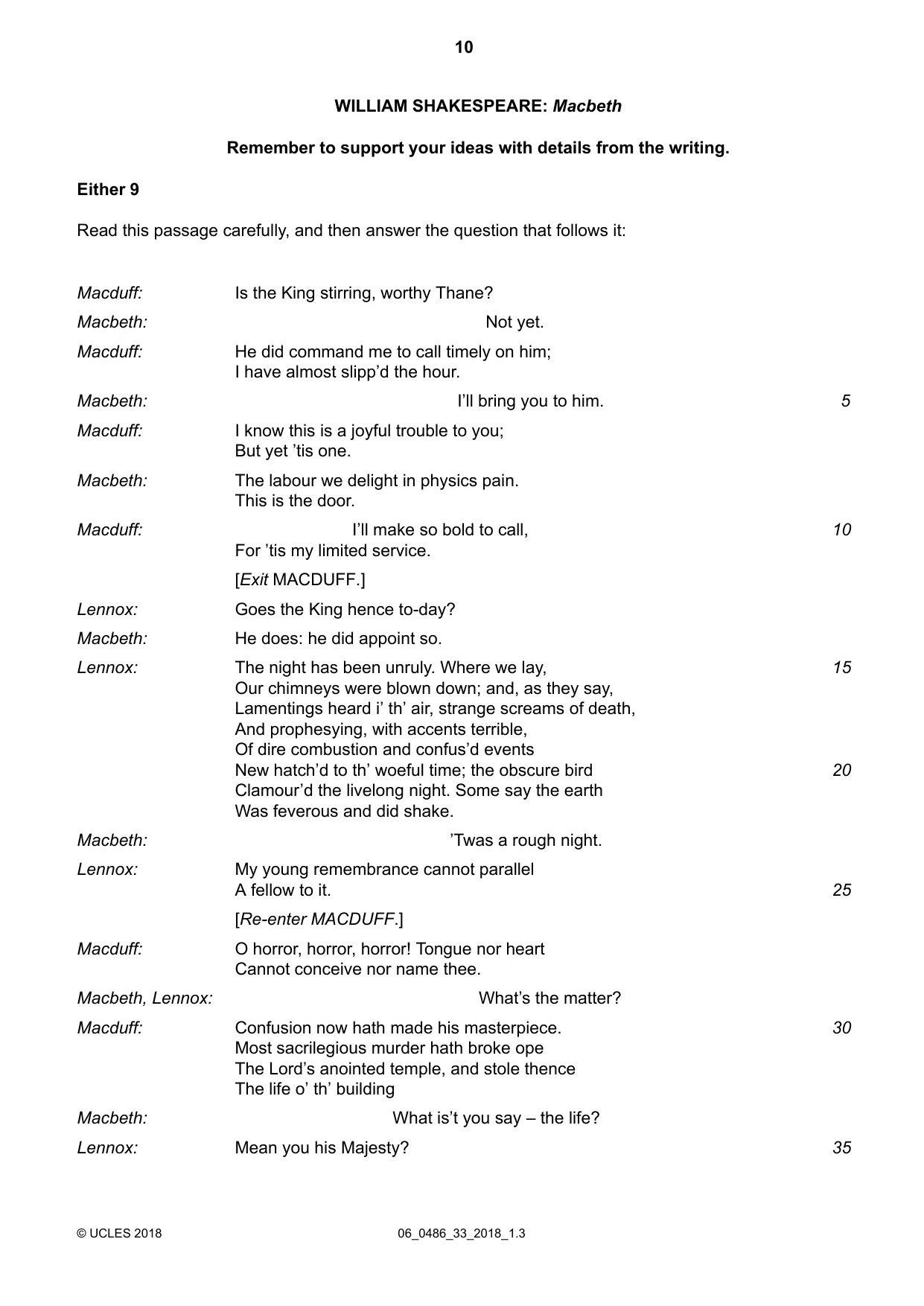
Question paper, page 10
35 30 25 20 15 10 5 WILLIAM SHAKESPEARE: Macbeth Remember to support your ideas with details from the writing. Either 9 Read this passage carefully, and then answer the question that follows it: Is the King stirring, worthy Thane? Macduff: Not yet. Macbeth: He did command me to call timely on him; I have almost slipp’d the hour. Macduff: I’ll bring you to him. Macbeth: I know this is a joyful trouble to you; But yet ’tis one. Macduff: The labour we delight in physics pain. This is the door. Macbeth: I’ll make so bold to call, For ’tis my limited service. Macduff: [Exit MACDUFF.] Goes the King hence to-day? Lennox: He does: he did appoint so. Macbeth: The night has been unruly. Where we lay, Our chimneys were blown down; and, as they say, Lamentings heard i’ th’ air, strange screams of death, And prophesying, with accents terrible, Of dire combustion and confus’d events New hatch’d to th’ woeful time; the obscure bird Clamour’d the livelong night. Some say the earth Was feverous and did shake. Lennox: ’Twas a rough night. Macbeth: My young remembrance cannot parallel A fellow to it. [Re-enter MACDUFF.] Lennox: O horror, horror, horror! Tongue nor heart Cannot conceive nor name thee. Macduff: What’s the matter? Macbeth, Lennox: Confusion now hath made his masterpiece. Most sacrilegious murder hath broke ope The Lord’s anointed temple, and stole thence The life o’ th’ building Macduff: What is’t you say – the life? Macbeth: Mean you his Majesty? Lennox: 06_0486_33_2018_1.3 © UCLES 2018 10
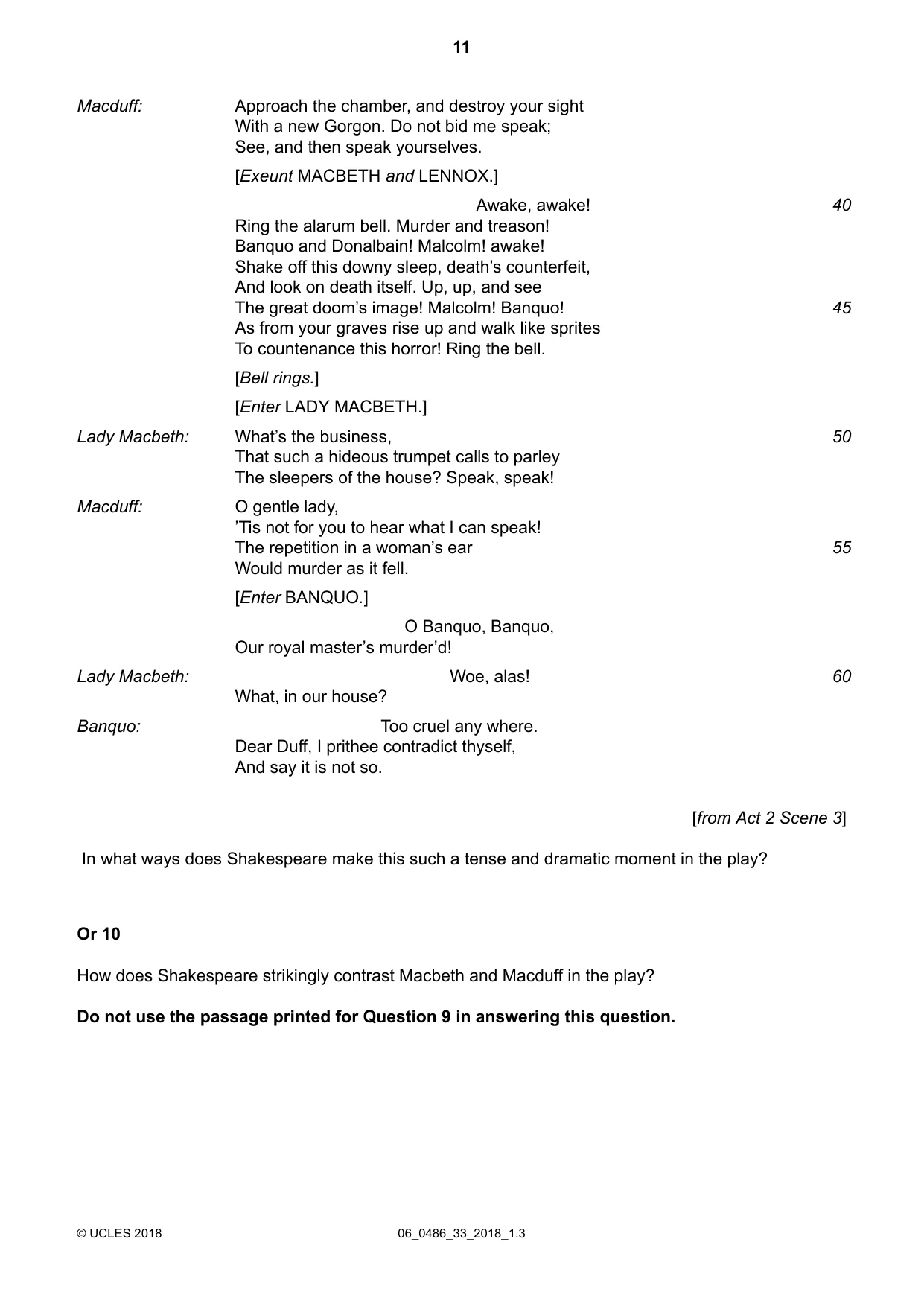
Question paper, page 11
60 55 50 45 40 Approach the chamber, and destroy your sight With a new Gorgon. Do not bid me speak; See, and then speak yourselves. Macduff: [Exeunt MACBETH and LENNOX.] Awake, awake! Ring the alarum bell. Murder and treason! Banquo and Donalbain! Malcolm! awake! Shake off this downy sleep, death’s counterfeit, And look on death itself. Up, up, and see The great doom’s image! Malcolm! Banquo! As from your graves rise up and walk like sprites To countenance this horror! Ring the bell. [Bell rings.] [Enter LADY MACBETH.] What’s the business, That such a hideous trumpet calls to parley The sleepers of the house? Speak, speak! Lady Macbeth: O gentle lady, ’Tis not for you to hear what I can speak! The repetition in a woman’s ear Would murder as it fell. Macduff: [Enter BANQUO.] O Banquo, Banquo, Our royal master’s murder’d! Woe, alas! What, in our house? Lady Macbeth: Too cruel any where. Dear Duff, I prithee contradict thyself, And say it is not so. Banquo: [from Act 2 Scene 3] In what ways does Shakespeare make this such a tense and dramatic moment in the play? Or 10 How does Shakespeare strikingly contrast Macbeth and Macduff in the play? Do not use the passage printed for Question 9 in answering this question. 06_0486_33_2018_1.3 © UCLES 2018 11
Question paper, page 12
BLANK PAGE Permission to reproduce items where third-party owned material protected by copyright is included has been sought and cleared where possible. Every reasonable effort has been made by the publisher (UCLES) to trace copyright holders, but if any items requiring clearance have unwittingly been included, the publisher will be pleased to make amends at the earliest possible opportunity. To avoid the issue of disclosure of answer-related information to candidates, all copyright acknowledgements are reproduced online in the Cambridge International Examinations Copyright Acknowledgements Booklet. This is produced for each series of examinations and is freely available to download at www.cie.org.uk after the live examination series. Cambridge International Examinations is part of the Cambridge Assessment Group. Cambridge Assessment is the brand name of University of Cambridge Local Examinations Syndicate (UCLES), which is itself a department of the University of Cambridge. 06_0486_33_2018_1.3 © UCLES 2018 12
Mark scheme, page 1
IGCSE™ is a registered trademark. This document consists of 4 printed pages. © UCLES 2018 [Turn over Cambridge Assessment International Education Cambridge International General Certificate of Secondary Education LITERATURE (ENGLISH) 0486/33 Paper 3 Drama (Open Text) May/June 2018 MARK SCHEME Maximum Mark: 25 Published This mark scheme is published as an aid to teachers and candidates, to indicate the requirements of the examination. It shows the basis on which Examiners were instructed to award marks. It does not indicate the details of the discussions that took place at an Examiners’ meeting before marking began, which would have considered the acceptability of alternative answers. Mark schemes should be read in conjunction with the question paper and the Principal Examiner Report for Teachers. Cambridge International will not enter into discussions about these mark schemes. Cambridge International is publishing the mark schemes for the May/June 2018 series for most Cambridge IGCSE™, Cambridge International A and AS Level and Cambridge Pre-U components, and some Cambridge O Level components.
Mark scheme, page 2
0486/33 Cambridge IGCSE – Mark Scheme PUBLISHED May/June 2018 © UCLES 2018 Page 2 of 4 Generic Marking Principles These general marking principles must be applied by all examiners when marking candidate answers. They should be applied alongside the specific content of the mark scheme or generic level descriptors for a question. Each question paper and mark scheme will also comply with these marking principles. GENERIC MARKING PRINCIPLE 1: Marks must be awarded in line with: • the specific content of the mark scheme or the generic level descriptors for the question • the specific skills defined in the mark scheme or in the generic level descriptors for the question • the standard of response required by a candidate as exemplified by the standardisation scripts. GENERIC MARKING PRINCIPLE 2: Marks awarded are always whole marks (not half marks, or other fractions). GENERIC MARKING PRINCIPLE 3: Marks must be awarded positively: • marks are awarded for correct/valid answers, as defined in the mark scheme. However, credit is given for valid answers which go beyond the scope of the syllabus and mark scheme, referring to your Team Leader as appropriate • marks are awarded when candidates clearly demonstrate what they know and can do • marks are not deducted for errors • marks are not deducted for omissions • answers should only be judged on the quality of spelling, punctuation and grammar when these features are specifically assessed by the question as indicated by the mark scheme. The meaning, however, should be unambiguous. GENERIC MARKING PRINCIPLE 4: Rules must be applied consistently e.g. in situations where candidates have not followed instructions or in the application of generic level descriptors. GENERIC MARKING PRINCIPLE 5: Marks should be awarded using the full range of marks defined in the mark scheme for the question (however; the use of the full mark range may be limited according to the quality of the candidate responses seen). GENERIC MARKING PRINCIPLE 6: Marks awarded are based solely on the requirements as defined in the mark scheme. Marks should not be awarded with grade thresholds or grade descriptors in mind.
Mark scheme, page 3
0486/33 Cambridge IGCSE – Mark Scheme PUBLISHED May/June 2018 © UCLES 2018 Page 3 of 4 All questions are marked out of 25. Assessment Objectives The Assessment Objectives are evenly weighted across each question. The assessment objectives for the paper are: AO1 show detailed knowledge of the content of literary texts, supported by reference to the text AO2 understand the meanings of literary texts and their context, and explore texts beyond surface meaning to show deeper awareness of ideas and attitudes AO3 recognise and appreciate ways in which writers use language, structure, and form to create and shape meanings and effects AO4 communicate a sensitive and informed personal response to literary texts. The Band Descriptors cover marks from 0 to 25, and apply to the marking of each question. They guide examiners to an understanding of the qualities normally expected of, or typical of, work in a band. They are a means of general guidance.
Mark scheme, page 4
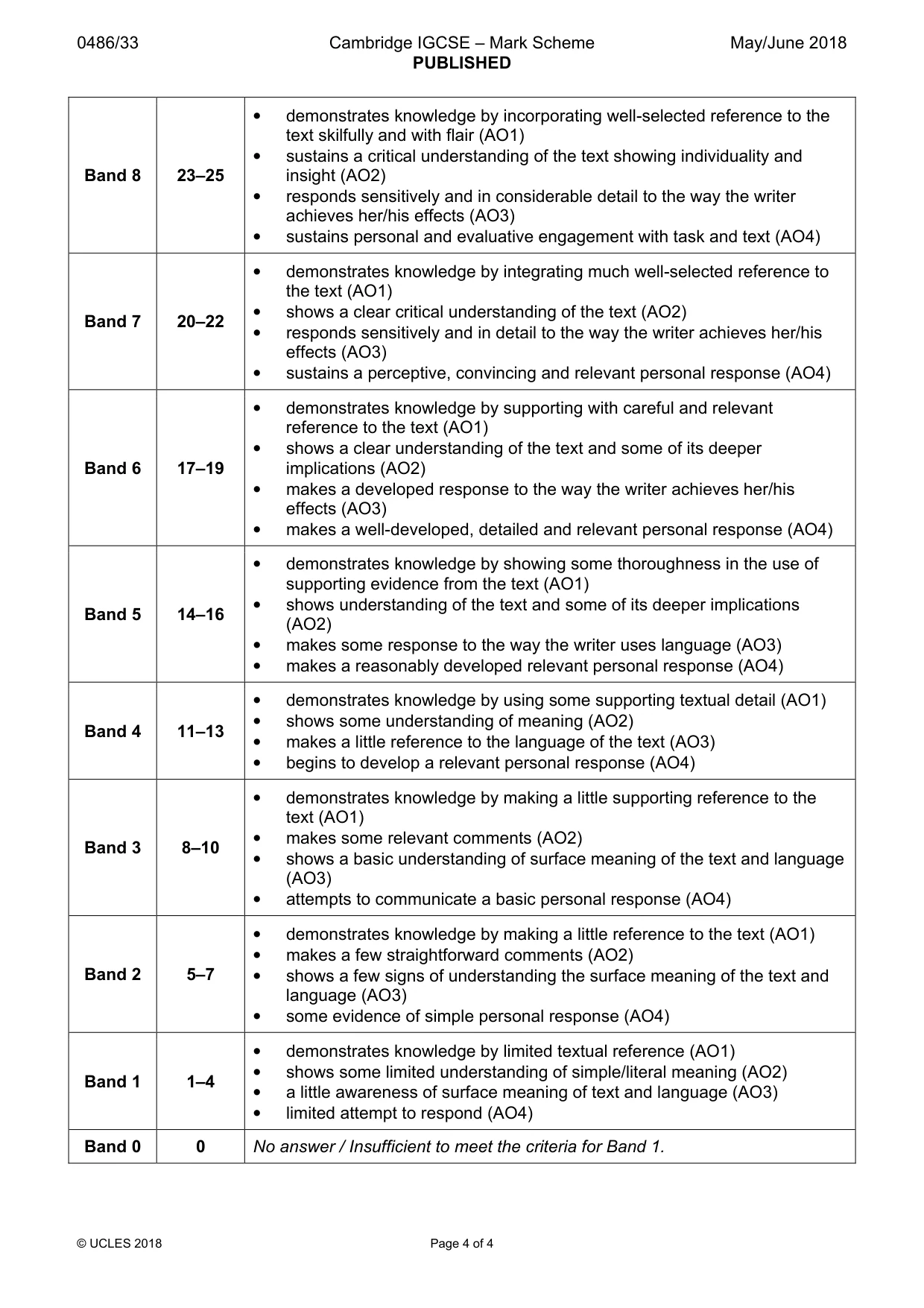
0486/33 Cambridge IGCSE – Mark Scheme PUBLISHED May/June 2018 © UCLES 2018 Page 4 of 4 Band 8 23–25 • demonstrates knowledge by incorporating well-selected reference to the text skilfully and with flair (AO1) • sustains a critical understanding of the text showing individuality and insight (AO2) • responds sensitively and in considerable detail to the way the writer achieves her/his effects (AO3) • sustains personal and evaluative engagement with task and text (AO4) Band 7 20–22 • demonstrates knowledge by integrating much well-selected reference to the text (AO1) • shows a clear critical understanding of the text (AO2) • responds sensitively and in detail to the way the writer achieves her/his effects (AO3) • sustains a perceptive, convincing and relevant personal response (AO4) Band 6 17–19 • demonstrates knowledge by supporting with careful and relevant reference to the text (AO1) • shows a clear understanding of the text and some of its deeper implications (AO2) • makes a developed response to the way the writer achieves her/his effects (AO3) • makes a well-developed, detailed and relevant personal response (AO4) Band 5 14–16 • demonstrates knowledge by showing some thoroughness in the use of supporting evidence from the text (AO1) • shows understanding of the text and some of its deeper implications (AO2) • makes some response to the way the writer uses language (AO3) • makes a reasonably developed relevant personal response (AO4) Band 4 11–13 • demonstrates knowledge by using some supporting textual detail (AO1) • shows some understanding of meaning (AO2) • makes a little reference to the language of the text (AO3) • begins to develop a relevant personal response (AO4) Band 3 8–10 • demonstrates knowledge by making a little supporting reference to the text (AO1) • makes some relevant comments (AO2) • shows a basic understanding of surface meaning of the text and language (AO3) • attempts to communicate a basic personal response (AO4) Band 2 5–7 • demonstrates knowledge by making a little reference to the text (AO1) • makes a few straightforward comments (AO2) • shows a few signs of understanding the surface meaning of the text and language (AO3) • some evidence of simple personal response (AO4) Band 1 1–4 • demonstrates knowledge by limited textual reference (AO1) • shows some limited understanding of simple/literal meaning (AO2) • a little awareness of surface meaning of text and language (AO3) • limited attempt to respond (AO4) Band 0 0 No answer / Insufficient to meet the criteria for Band 1.
What you needed in this session
Cambridge’s own grade thresholds for 2018 May/June, Paper 3 · Variant 3. A higher threshold means an easier paper — the bar moves with how the cohort did.