Cambridge IGCSE English - Literature 0486 — 2017 May/June Paper 3 · Variant 2
0486/32/M/J/17 · 25 marks · ≈28 min
The question paper and its mark scheme, free to read here and free to download. This is Cambridge’s own paper, exactly as it was sat.
Question paper12 pages


Mark scheme3 pages
Answers below. Sit the paper first if you are practising.
Paper as text
Question paper, page 1
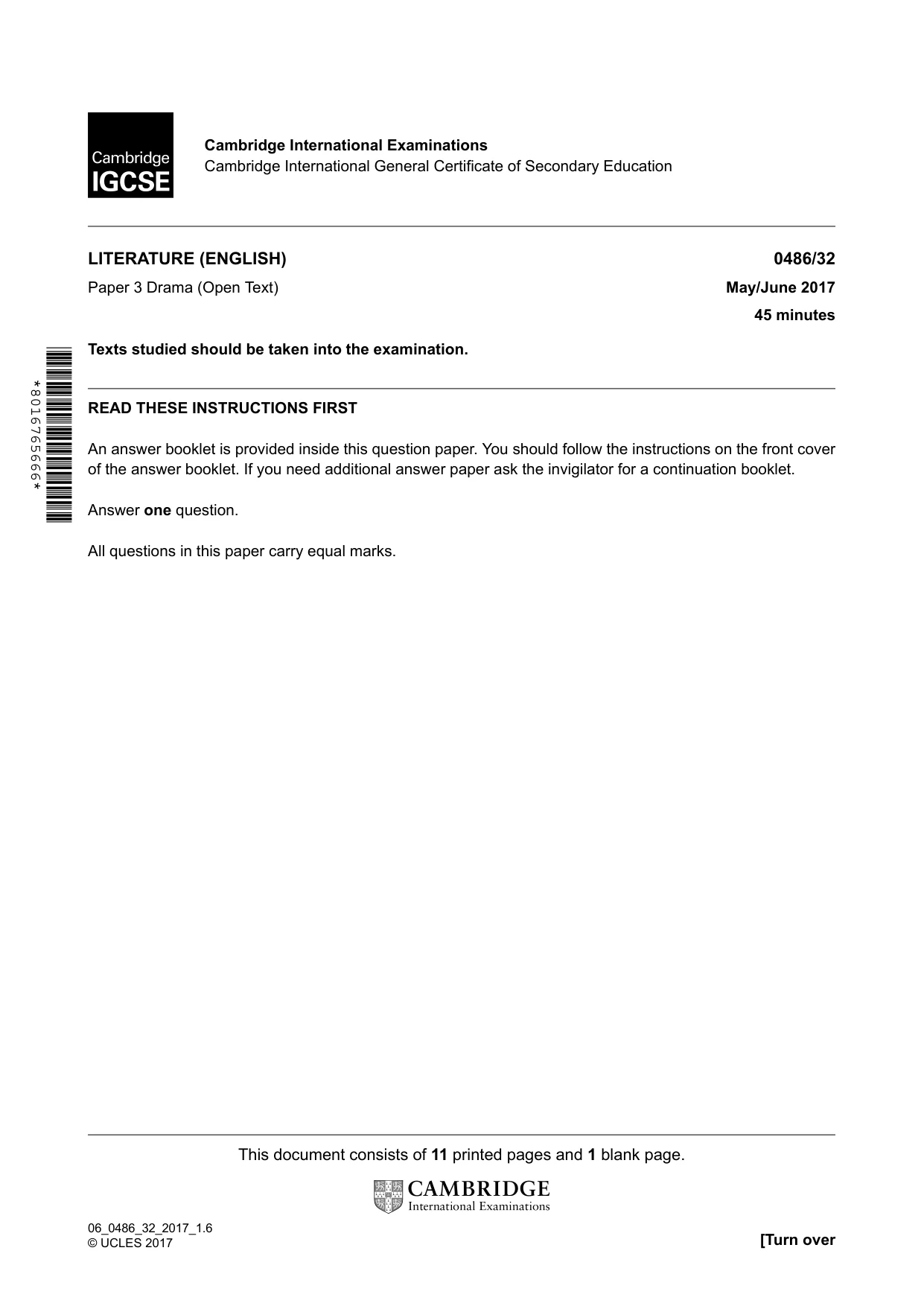
Cambridge International Examinations Cambridge International General Certificate of Secondary Education 0486/32 LITERATURE (ENGLISH) May/June 2017 Paper 3 Drama (Open Text) 45 minutes Texts studied should be taken into the examination. READ THESE INSTRUCTIONS FIRST An answer booklet is provided inside this question paper. You should follow the instructions on the front cover of the answer booklet. If you need additional answer paper ask the invigilator for a continuation booklet. Answer one question. All questions in this paper carry equal marks. This document consists of 11 printed pages and 1 blank page. [Turn over 06_0486_32_2017_1.6 © UCLES 2017 *8016765666*
Question paper, page 2
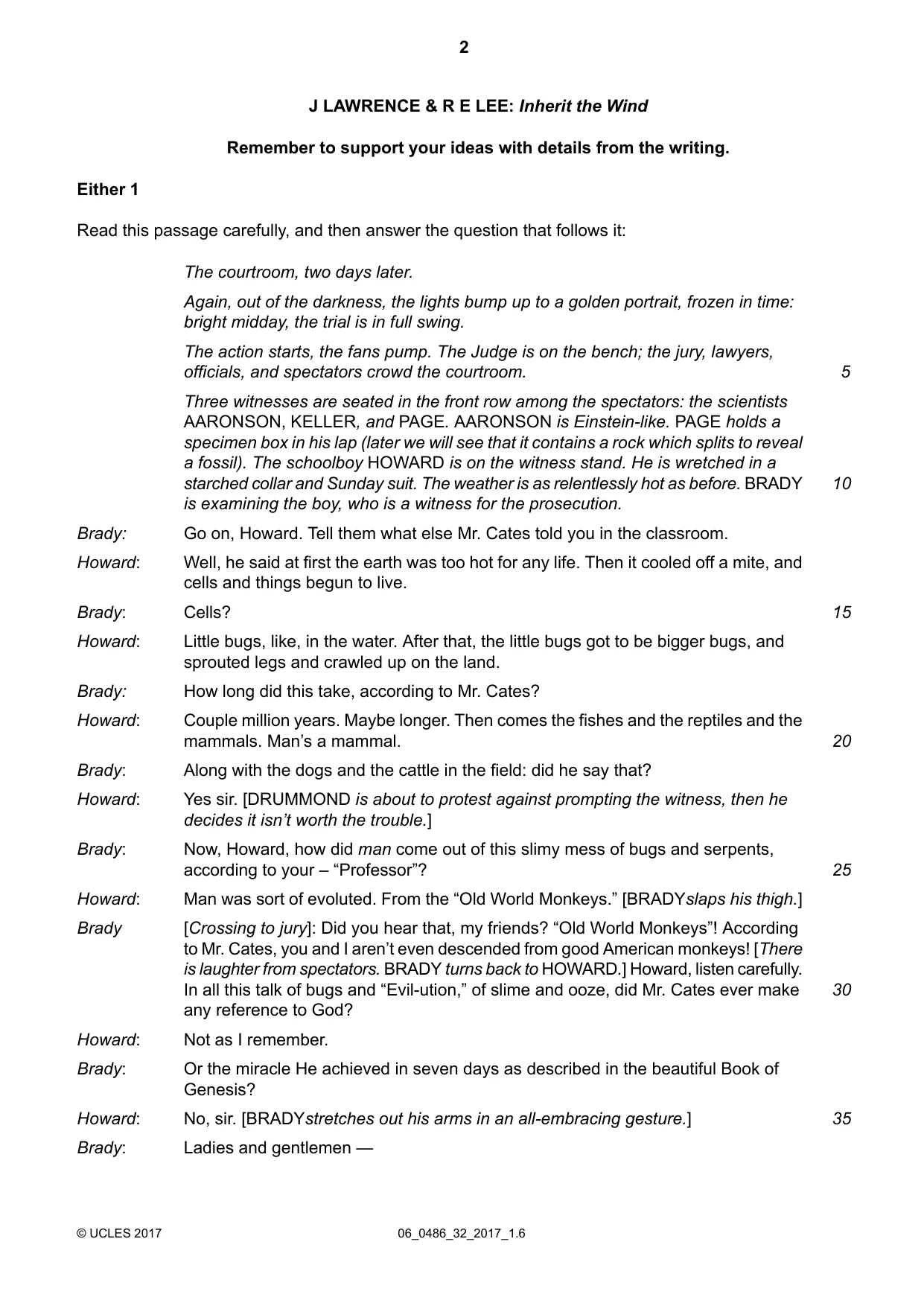
35 30 25 20 15 10 5 J LAWRENCE & R E LEE: Inherit the Wind Remember to support your ideas with details from the writing. Either 1 Read this passage carefully, and then answer the question that follows it: The courtroom, two days later. Again, out of the darkness, the lights bump up to a golden portrait, frozen in time: bright midday, the trial is in full swing. The action starts, the fans pump. The Judge is on the bench; the jury, lawyers, officials, and spectators crowd the courtroom. Three witnesses are seated in the front row among the spectators: the scientists AARONSON, KELLER, and PAGE. AARONSON is Einstein-like. PAGE holds a specimen box in his lap (later we will see that it contains a rock which splits to reveal a fossil). The schoolboy HOWARD is on the witness stand. He is wretched in a starched collar and Sunday suit. The weather is as relentlessly hot as before. BRADY is examining the boy, who is a witness for the prosecution. Go on, Howard. Tell them what else Mr. Cates told you in the classroom. Brady: Well, he said at first the earth was too hot for any life. Then it cooled off a mite, and cells and things begun to live. Howard: Cells? Brady: Little bugs, like, in the water. After that, the little bugs got to be bigger bugs, and sprouted legs and crawled up on the land. Howard: How long did this take, according to Mr. Cates? Brady: Couple million years. Maybe longer. Then comes the fishes and the reptiles and the mammals. Man’s a mammal. Howard: Along with the dogs and the cattle in the field: did he say that? Brady: Yes sir. [DRUMMOND is about to protest against prompting the witness, then he decides it isn’t worth the trouble.] Howard: Now, Howard, how did man come out of this slimy mess of bugs and serpents, according to your – “Professor”? Brady: Man was sort of evoluted. From the “Old World Monkeys.” [BRADYslaps his thigh.] Howard: [Crossing to jury]: Did you hear that, my friends? “Old World Monkeys”! According to Mr. Cates, you and I aren’t even descended from good American monkeys! [There Brady is laughter from spectators. BRADY turns back to HOWARD.] Howard, listen carefully. In all this talk of bugs and “Evil-ution,” of slime and ooze, did Mr. Cates ever make any reference to God? Not as I remember. Howard: Or the miracle He achieved in seven days as described in the beautiful Book of Genesis? Brady: No, sir. [BRADYstretches out his arms in an all-embracing gesture.] Howard: Ladies and gentlemen — Brady: 06_0486_32_2017_1.6 © UCLES 2017 2
Question paper, page 3
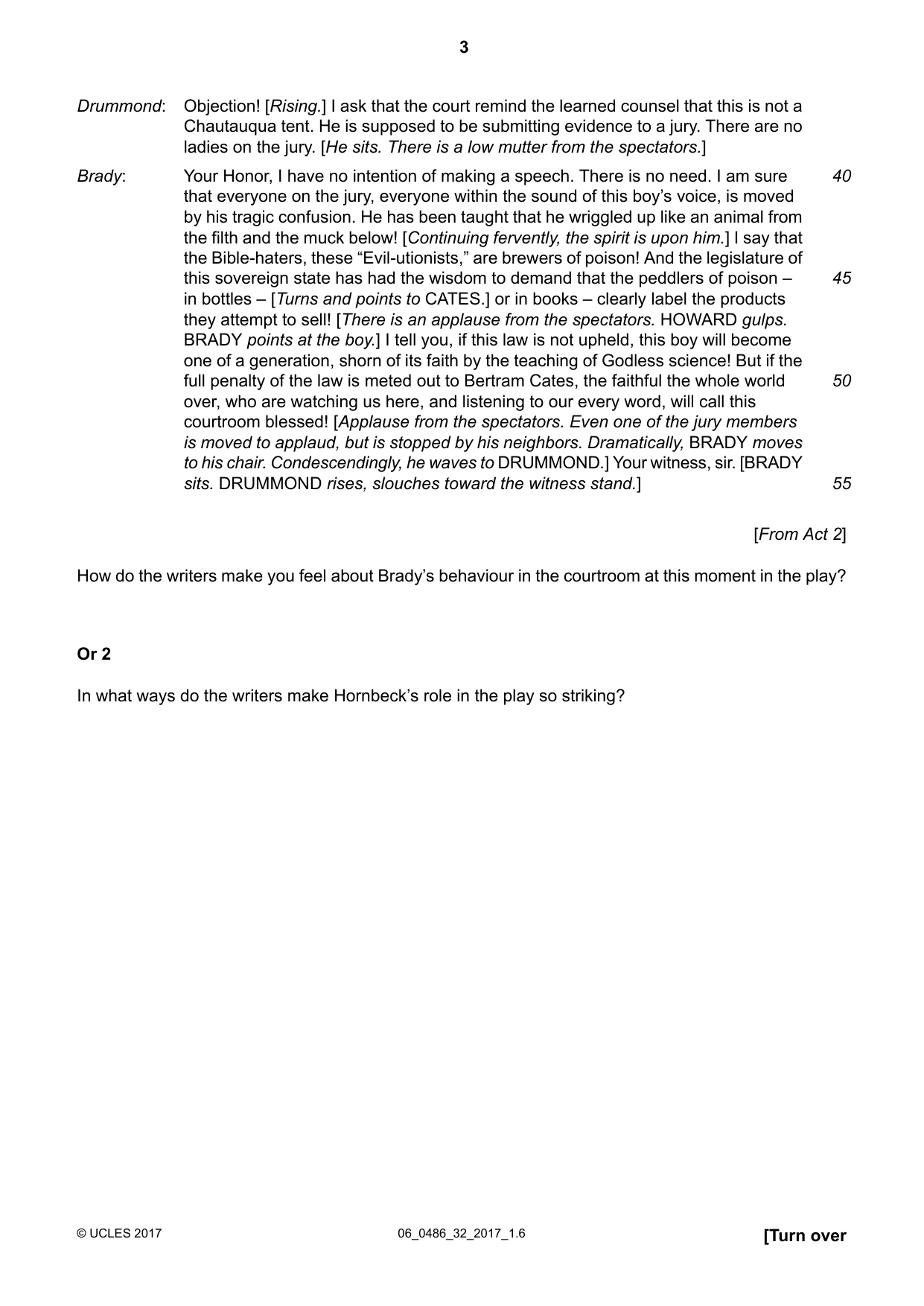
55 50 45 40 Objection! [Rising.] I ask that the court remind the learned counsel that this is not a Chautauqua tent. He is supposed to be submitting evidence to a jury. There are no ladies on the jury. [He sits. There is a low mutter from the spectators.] Drummond: Your Honor, I have no intention of making a speech. There is no need. I am sure that everyone on the jury, everyone within the sound of this boy’s voice, is moved Brady: by his tragic confusion. He has been taught that he wriggled up like an animal from the filth and the muck below! [Continuing fervently, the spirit is upon him.] I say that the Bible-haters, these “Evil-utionists,” are brewers of poison! And the legislature of this sovereign state has had the wisdom to demand that the peddlers of poison – in bottles – [Turns and points to CATES.] or in books – clearly label the products they attempt to sell! [There is an applause from the spectators. HOWARD gulps. BRADY points at the boy.] I tell you, if this law is not upheld, this boy will become one of a generation, shorn of its faith by the teaching of Godless science! But if the full penalty of the law is meted out to Bertram Cates, the faithful the whole world over, who are watching us here, and listening to our every word, will call this courtroom blessed! [Applause from the spectators. Even one of the jury members is moved to applaud, but is stopped by his neighbors. Dramatically, BRADY moves to his chair. Condescendingly, he waves to DRUMMOND.] Your witness, sir. [BRADY sits. DRUMMOND rises, slouches toward the witness stand.] [From Act 2] How do the writers make you feel about Brady’s behaviour in the courtroom at this moment in the play? Or 2 In what ways do the writers make Hornbeck’s role in the play so striking? [Turn over 06_0486_32_2017_1.6 © UCLES 2017 3
Question paper, page 4
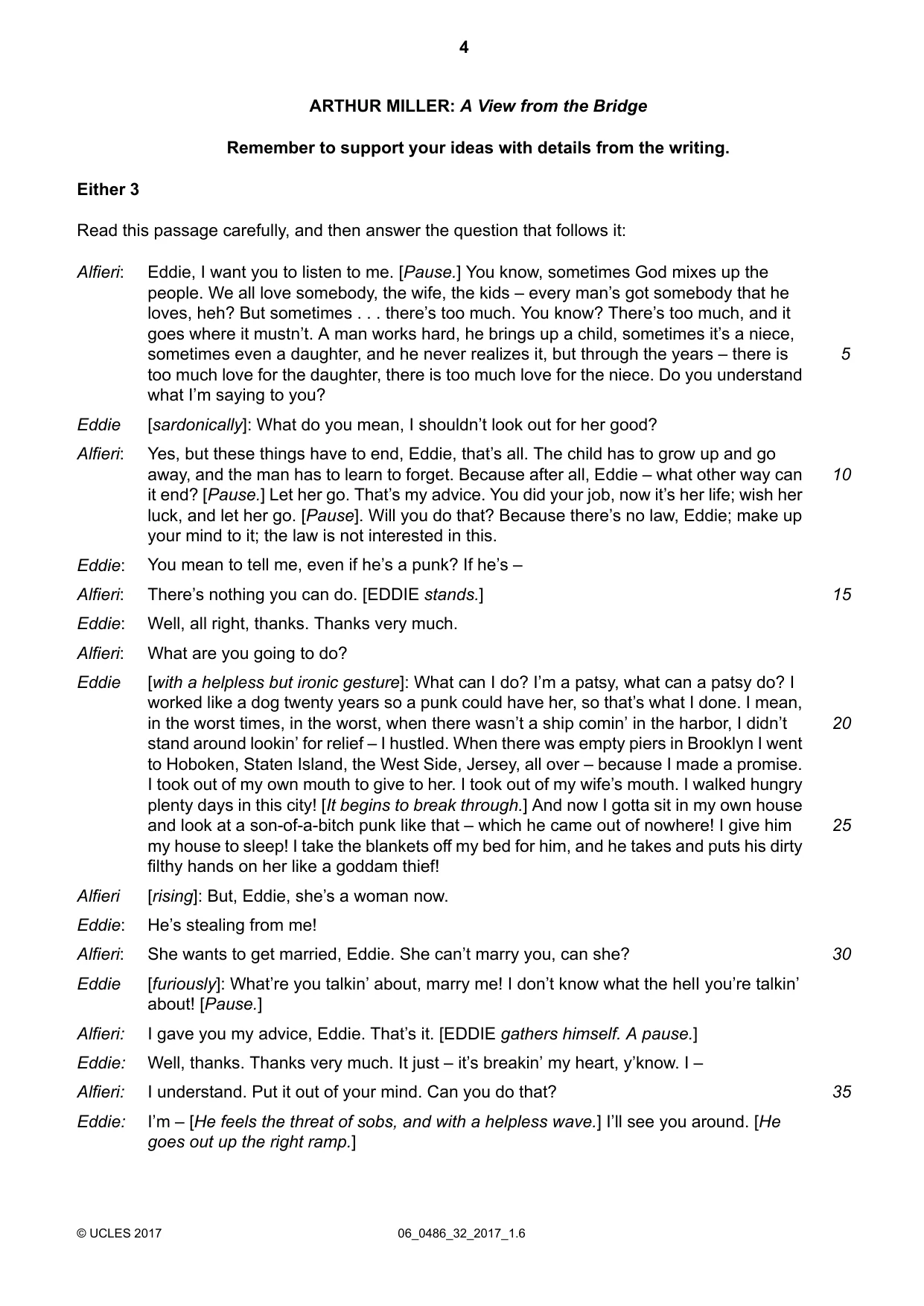
35 30 25 20 15 10 5 ARTHUR MILLER: A View from the Bridge Remember to support your ideas with details from the writing. Either 3 Read this passage carefully, and then answer the question that follows it: Eddie, I want you to listen to me. [Pause.] You know, sometimes God mixes up the people. We all love somebody, the wife, the kids – every man’s got somebody that he Alfieri: loves, heh? But sometimes . . . there’s too much. You know? There’s too much, and it goes where it mustn’t. A man works hard, he brings up a child, sometimes it’s a niece, sometimes even a daughter, and he never realizes it, but through the years – there is too much love for the daughter, there is too much love for the niece. Do you understand what I’m saying to you? [sardonically]: What do you mean, I shouldn’t look out for her good? Eddie Yes, but these things have to end, Eddie, that’s all. The child has to grow up and go away, and the man has to learn to forget. Because after all, Eddie – what other way can Alfieri: it end? [Pause.] Let her go. That’s my advice. You did your job, now it’s her life; wish her luck, and let her go. [Pause]. Will you do that? Because there’s no law, Eddie; make up your mind to it; the law is not interested in this. You mean to tell me, even if he’s a punk? If he’s – Eddie: There’s nothing you can do. [EDDIE stands.] Alfieri: Well, all right, thanks. Thanks very much. Eddie: What are you going to do? Alfieri: [with a helpless but ironic gesture]: What can I do? I’m a patsy, what can a patsy do? I worked like a dog twenty years so a punk could have her, so that’s what I done. I mean, Eddie in the worst times, in the worst, when there wasn’t a ship comin’ in the harbor, I didn’t stand around lookin’ for relief – I hustled. When there was empty piers in Brooklyn I went to Hoboken, Staten Island, the West Side, Jersey, all over – because I made a promise. I took out of my own mouth to give to her. I took out of my wife’s mouth. I walked hungry plenty days in this city! [It begins to break through.] And now I gotta sit in my own house and look at a son-of-a-bitch punk like that – which he came out of nowhere! I give him my house to sleep! I take the blankets off my bed for him, and he takes and puts his dirty filthy hands on her like a goddam thief! [rising]: But, Eddie, she’s a woman now. Alfieri He’s stealing from me! Eddie: She wants to get married, Eddie. She can’t marry you, can she? Alfieri: [furiously]: What’re you talkin’ about, marry me! I don’t know what the helI you’re talkin’ about! [Pause.] Eddie I gave you my advice, Eddie. That’s it. [EDDIE gathers himself. A pause.] Alfieri: Well, thanks. Thanks very much. It just – it’s breakin’ my heart, y’know. I – Eddie: I understand. Put it out of your mind. Can you do that? Alfieri: I’m – [He feels the threat of sobs, and with a helpless wave.] I’ll see you around. [He goes out up the right ramp.] Eddie: 06_0486_32_2017_1.6 © UCLES 2017 4
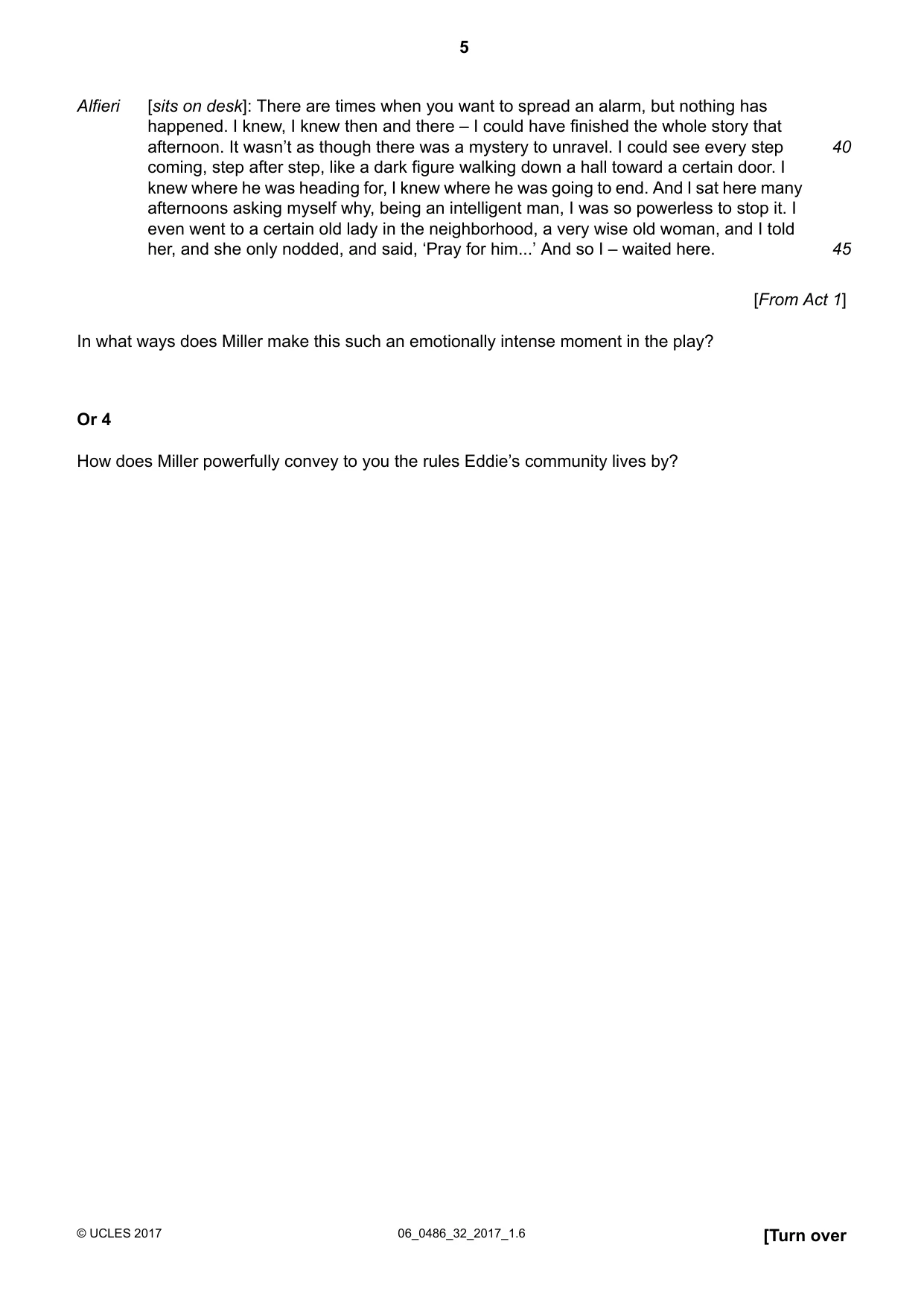
Question paper, page 5
45 40 [sits on desk]: There are times when you want to spread an alarm, but nothing has happened. I knew, I knew then and there – I could have finished the whole story that Alfieri afternoon. It wasn’t as though there was a mystery to unravel. I could see every step coming, step after step, like a dark figure walking down a hall toward a certain door. I knew where he was heading for, I knew where he was going to end. And I sat here many afternoons asking myself why, being an intelligent man, I was so powerless to stop it. I even went to a certain old lady in the neighborhood, a very wise old woman, and I told her, and she only nodded, and said, ‘Pray for him...’ And so I – waited here. [From Act 1] In what ways does Miller make this such an emotionally intense moment in the play? Or 4 How does Miller powerfully convey to you the rules Eddie’s community lives by? [Turn over 06_0486_32_2017_1.6 © UCLES 2017 5
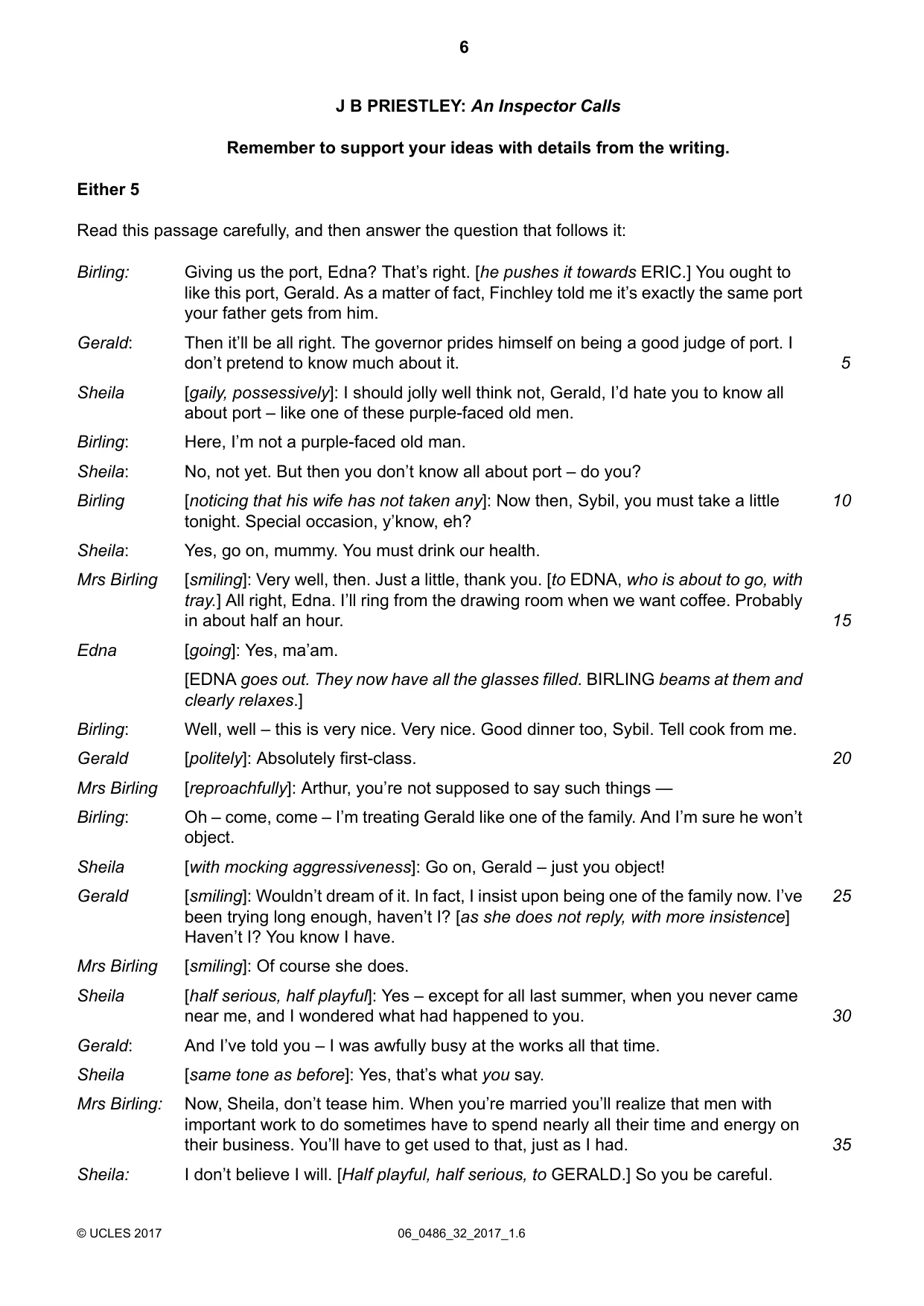
Question paper, page 6
35 30 25 20 15 10 5 J B PRIESTLEY: An Inspector Calls Remember to support your ideas with details from the writing. Either 5 Read this passage carefully, and then answer the question that follows it: Giving us the port, Edna? That’s right. [he pushes it towards ERIC.] You ought to like this port, Gerald. As a matter of fact, Finchley told me it’s exactly the same port your father gets from him. Birling: Then it’ll be all right. The governor prides himself on being a good judge of port. I don’t pretend to know much about it. Gerald: [gaily, possessively]: I should jolly well think not, Gerald, I’d hate you to know all about port – like one of these purple-faced old men. Sheila Here, I’m not a purple-faced old man. Birling: No, not yet. But then you don’t know all about port – do you? Sheila: [noticing that his wife has not taken any]: Now then, Sybil, you must take a little tonight. Special occasion, y’know, eh? Birling Yes, go on, mummy. You must drink our health. Sheila: [smiling]: Very well, then. Just a little, thank you. [to EDNA, who is about to go, with tray.] All right, Edna. I’ll ring from the drawing room when we want coffee. Probably in about half an hour. Mrs Birling [going]: Yes, ma’am. Edna [EDNA goes out. They now have all the glasses filled. BIRLING beams at them and clearly relaxes.] Well, well – this is very nice. Very nice. Good dinner too, Sybil. Tell cook from me. Birling: [politely]: Absolutely first-class. Gerald [reproachfully]: Arthur, you’re not supposed to say such things — Mrs Birling Oh – come, come – I’m treating Gerald like one of the family. And I’m sure he won’t object. Birling: [with mocking aggressiveness]: Go on, Gerald – just you object! Sheila [smiling]: Wouldn’t dream of it. In fact, I insist upon being one of the family now. I’ve been trying long enough, haven’t I? [as she does not reply, with more insistence] Haven’t I? You know I have. Gerald [smiling]: Of course she does. Mrs Birling [half serious, half playful]: Yes – except for all last summer, when you never came near me, and I wondered what had happened to you. Sheila And I’ve told you – I was awfully busy at the works all that time. Gerald: [same tone as before]: Yes, that’s what you say. Sheila Now, Sheila, don’t tease him. When you’re married you’ll realize that men with important work to do sometimes have to spend nearly all their time and energy on their business. You’ll have to get used to that, just as I had. Mrs Birling: I don’t believe I will. [Half playful, half serious, to GERALD.] So you be careful. Sheila: 06_0486_32_2017_1.6 © UCLES 2017 6
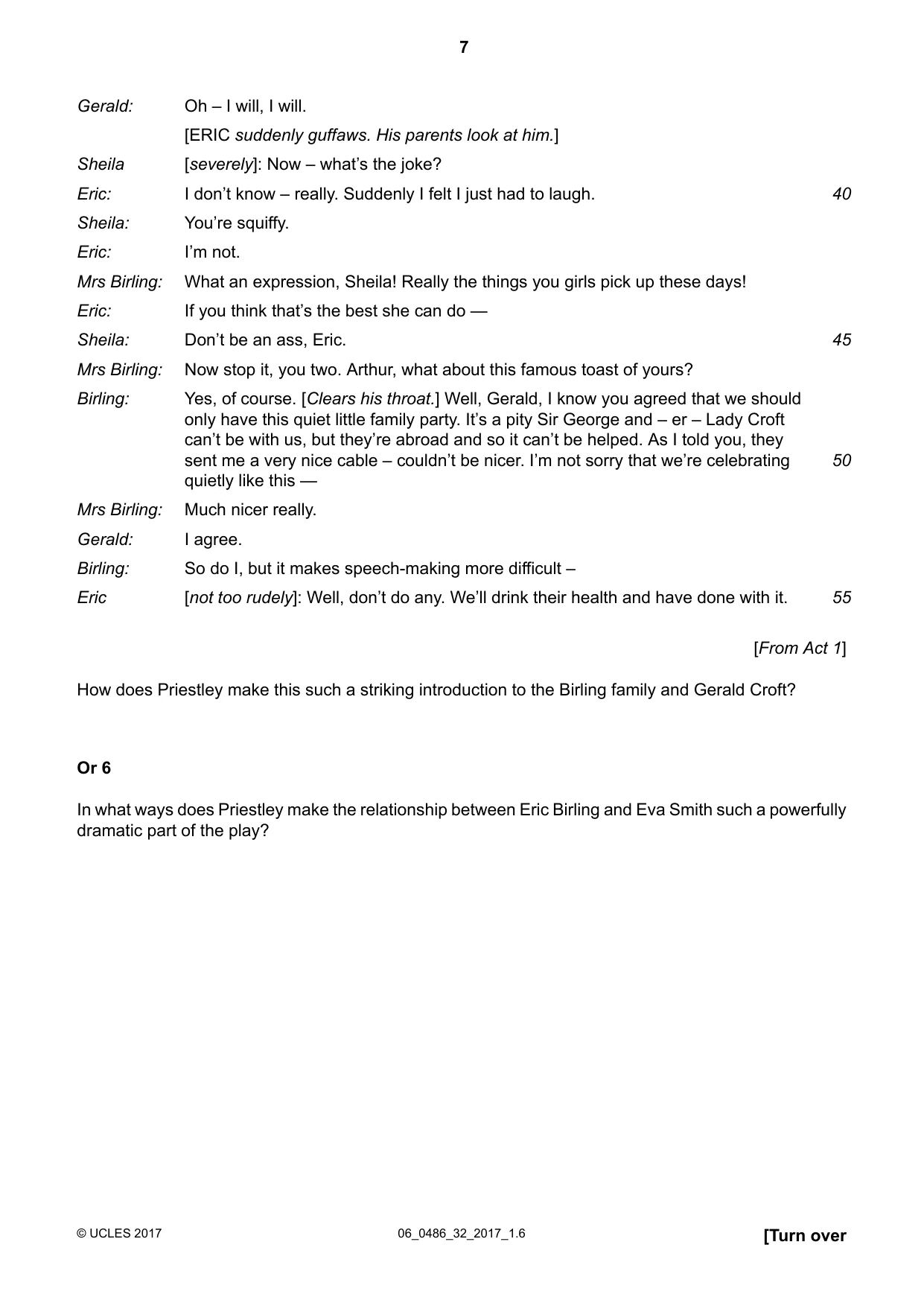
Question paper, page 7
55 50 45 40 Oh – I will, I will. Gerald: [ERIC suddenly guffaws. His parents look at him.] [severely]: Now – what’s the joke? Sheila I don’t know – really. Suddenly I felt I just had to laugh. Eric: You’re squiffy. Sheila: I’m not. Eric: What an expression, Sheila! Really the things you girls pick up these days! Mrs Birling: If you think that’s the best she can do — Eric: Don’t be an ass, Eric. Sheila: Now stop it, you two. Arthur, what about this famous toast of yours? Mrs Birling: Yes, of course. [Clears his throat.] Well, Gerald, I know you agreed that we should only have this quiet little family party. It’s a pity Sir George and – er – Lady Croft Birling: can’t be with us, but they’re abroad and so it can’t be helped. As I told you, they sent me a very nice cable – couldn’t be nicer. I’m not sorry that we’re celebrating quietly like this — Much nicer really. Mrs Birling: I agree. Gerald: So do I, but it makes speech-making more difficult – Birling: [not too rudely]: Well, don’t do any. We’ll drink their health and have done with it. Eric [From Act 1] How does Priestley make this such a striking introduction to the Birling family and Gerald Croft? Or 6 In what ways does Priestley make the relationship between Eric Birling and Eva Smith such a powerfully dramatic part of the play? [Turn over 06_0486_32_2017_1.6 © UCLES 2017 7
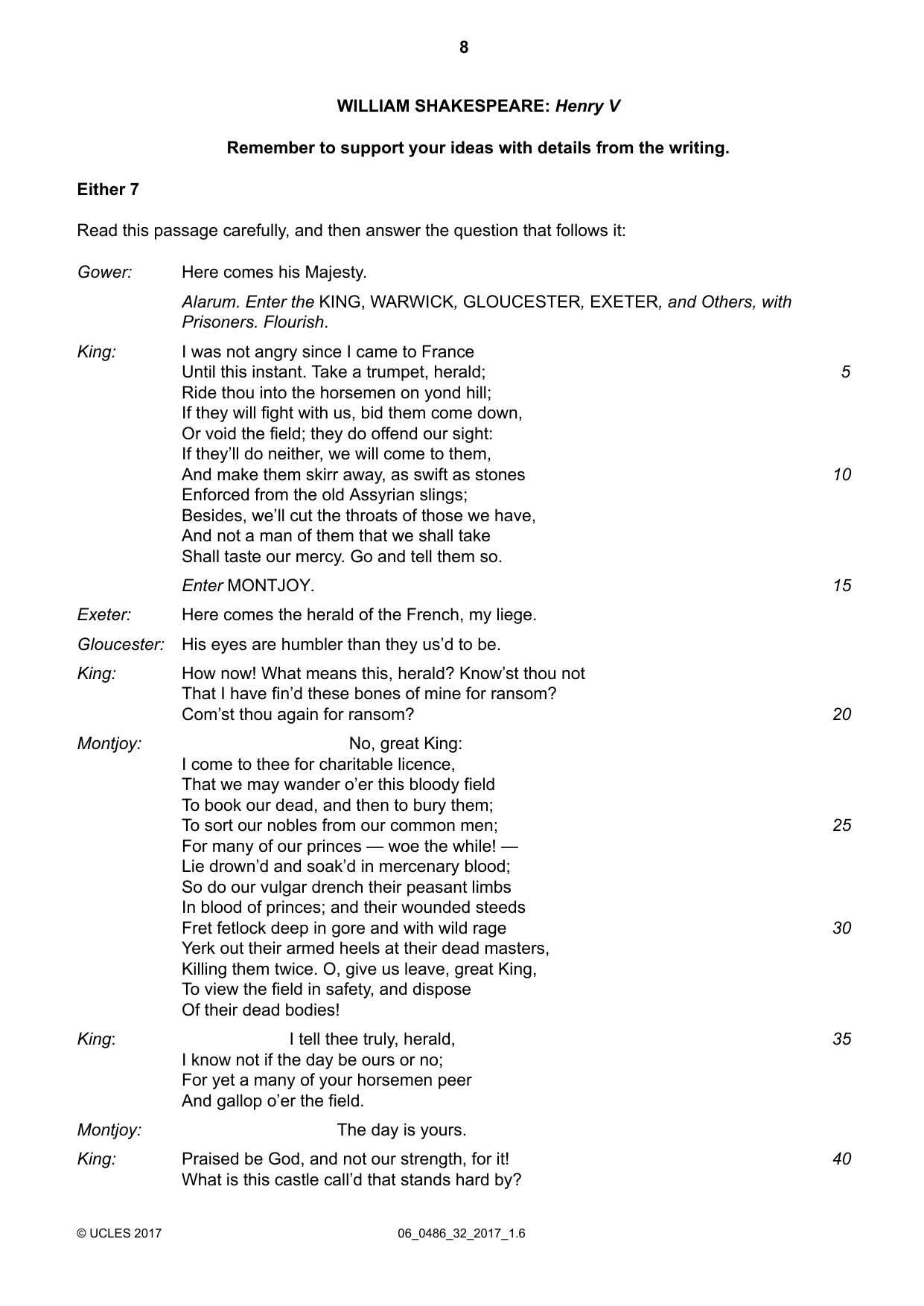
Question paper, page 8
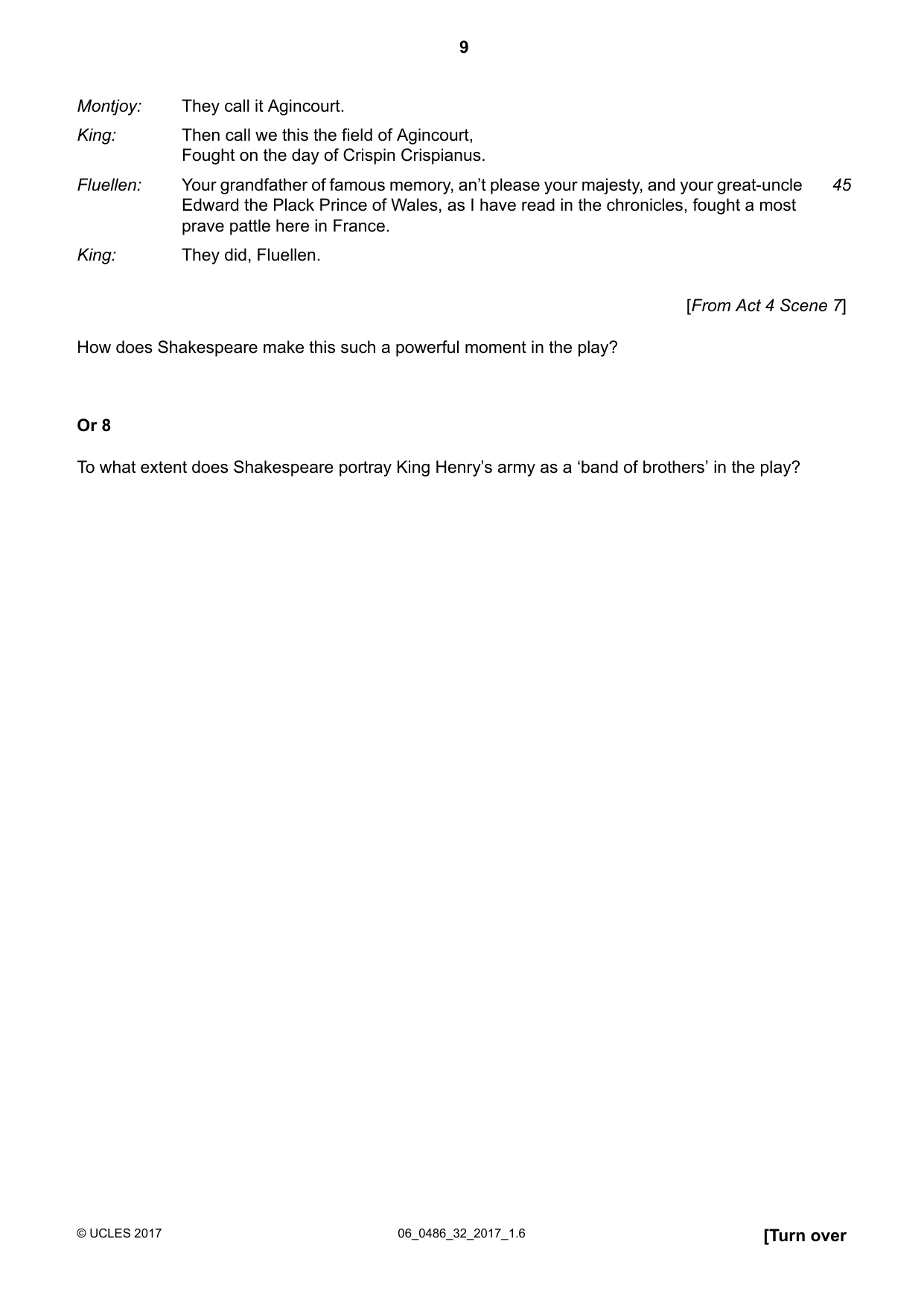
40 35 30 25 20 15 10 5 WILLIAM SHAKESPEARE: Henry V Remember to support your ideas with details from the writing. Either 7 Read this passage carefully, and then answer the question that follows it: Here comes his Majesty. Gower: Alarum. Enter the KING, WARWICK, GLOUCESTER, EXETER, and Others, with Prisoners. Flourish. I was not angry since I came to France Until this instant. Take a trumpet, herald; Ride thou into the horsemen on yond hill; If they will fight with us, bid them come down, Or void the field; they do offend our sight: If they’ll do neither, we will come to them, And make them skirr away, as swift as stones Enforced from the old Assyrian slings; Besides, we’ll cut the throats of those we have, And not a man of them that we shall take Shall taste our mercy. Go and tell them so. King: Enter MONTJOY. Here comes the herald of the French, my liege. Exeter: His eyes are humbler than they us’d to be. Gloucester: How now! What means this, herald? Know’st thou not That I have fin’d these bones of mine for ransom? Com’st thou again for ransom? King: No, great King: I come to thee for charitable licence, That we may wander o’er this bloody field To book our dead, and then to bury them; To sort our nobles from our common men; For many of our princes — woe the while! — Lie drown’d and soak’d in mercenary blood; So do our vulgar drench their peasant limbs In blood of princes; and their wounded steeds Fret fetlock deep in gore and with wild rage Yerk out their armed heels at their dead masters, Killing them twice. O, give us leave, great King, To view the field in safety, and dispose Of their dead bodies! Montjoy: I tell thee truly, herald, I know not if the day be ours or no; For yet a many of your horsemen peer And gallop o’er the field. King: The day is yours. Montjoy: Praised be God, and not our strength, for it! What is this castle call’d that stands hard by? King: 06_0486_32_2017_1.6 © UCLES 2017 8
Question paper, page 9
45 They call it Agincourt. Montjoy: Then call we this the field of Agincourt, Fought on the day of Crispin Crispianus. King: Your grandfather of famous memory, an’t please your majesty, and your great-uncle Edward the Plack Prince of Wales, as I have read in the chronicles, fought a most prave pattle here in France. Fluellen: They did, Fluellen. King: [From Act 4 Scene 7] How does Shakespeare make this such a powerful moment in the play? Or 8 To what extent does Shakespeare portray King Henry’s army as a ‘band of brothers’ in the play? [Turn over 06_0486_32_2017_1.6 © UCLES 2017 9
Question paper, page 10
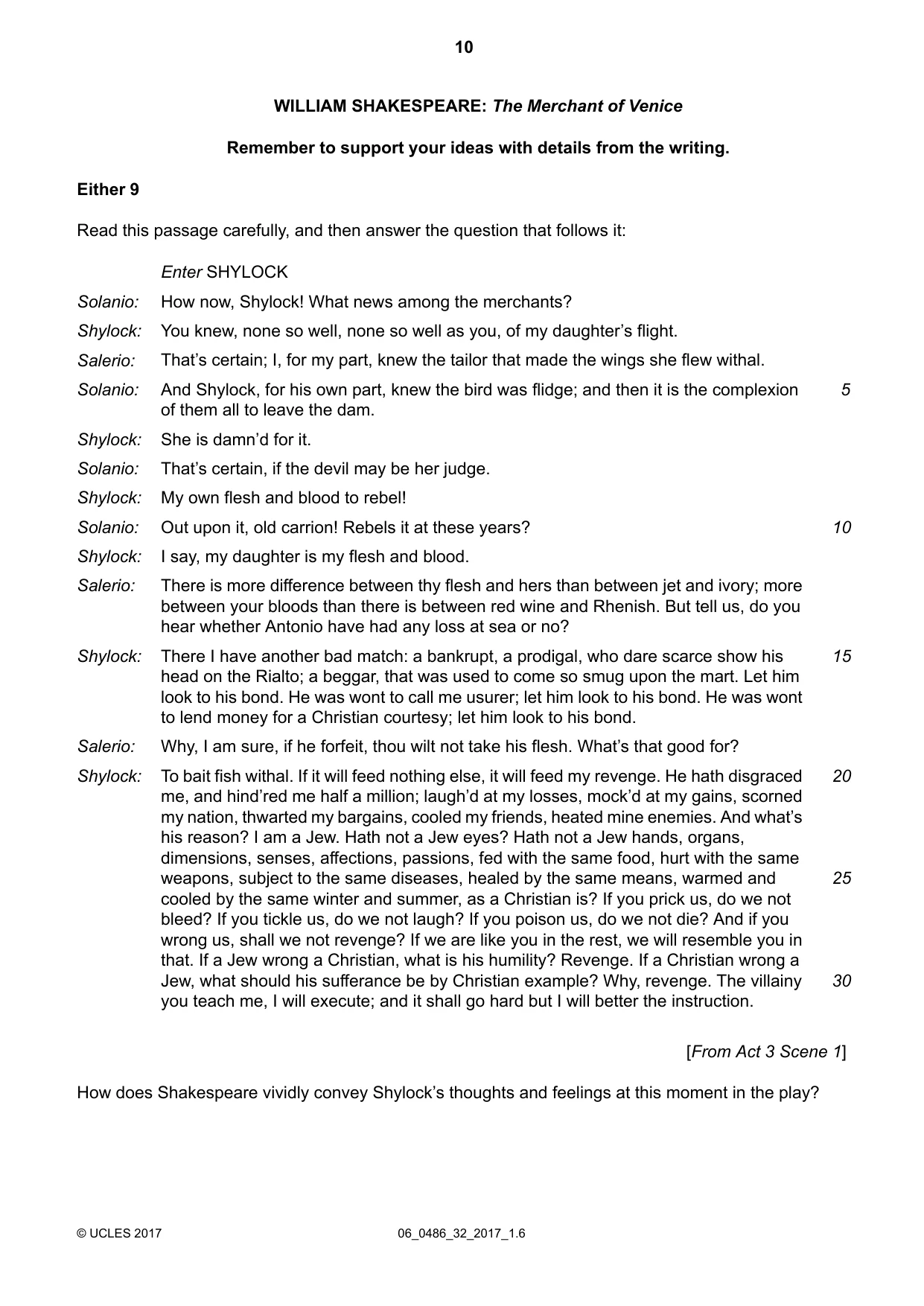
30 25 20 15 10 5 WILLIAM SHAKESPEARE: The Merchant of Venice Remember to support your ideas with details from the writing. Either 9 Read this passage carefully, and then answer the question that follows it: Enter SHYLOCK How now, Shylock! What news among the merchants? Solanio: You knew, none so well, none so well as you, of my daughter’s flight. Shylock: That’s certain; I, for my part, knew the tailor that made the wings she flew withal. Salerio: And Shylock, for his own part, knew the bird was flidge; and then it is the complexion of them all to leave the dam. Solanio: She is damn’d for it. Shylock: That’s certain, if the devil may be her judge. Solanio: My own flesh and blood to rebel! Shylock: Out upon it, old carrion! Rebels it at these years? Solanio: I say, my daughter is my flesh and blood. Shylock: There is more difference between thy flesh and hers than between jet and ivory; more between your bloods than there is between red wine and Rhenish. But tell us, do you hear whether Antonio have had any loss at sea or no? Salerio: There I have another bad match: a bankrupt, a prodigal, who dare scarce show his head on the Rialto; a beggar, that was used to come so smug upon the mart. Let him Shylock: look to his bond. He was wont to call me usurer; let him look to his bond. He was wont to lend money for a Christian courtesy; let him look to his bond. Why, I am sure, if he forfeit, thou wilt not take his flesh. What’s that good for? Salerio: To bait fish withal. If it will feed nothing else, it will feed my revenge. He hath disgraced me, and hind’red me half a million; laugh’d at my losses, mock’d at my gains, scorned Shylock: my nation, thwarted my bargains, cooled my friends, heated mine enemies. And what’s his reason? I am a Jew. Hath not a Jew eyes? Hath not a Jew hands, organs, dimensions, senses, affections, passions, fed with the same food, hurt with the same weapons, subject to the same diseases, healed by the same means, warmed and cooled by the same winter and summer, as a Christian is? If you prick us, do we not bleed? If you tickle us, do we not laugh? If you poison us, do we not die? And if you wrong us, shall we not revenge? If we are like you in the rest, we will resemble you in that. If a Jew wrong a Christian, what is his humility? Revenge. If a Christian wrong a Jew, what should his sufferance be by Christian example? Why, revenge. The villainy you teach me, I will execute; and it shall go hard but I will better the instruction. [From Act 3 Scene 1] How does Shakespeare vividly convey Shylock’s thoughts and feelings at this moment in the play? 06_0486_32_2017_1.6 © UCLES 2017 10
Question paper, page 11
Or 10 What does Shakespeare’s portrayal of Launcelot Gobbo contribute to your enjoyment of the play? 06_0486_32_2017_1.6 © UCLES 2017 11
Question paper, page 12
BLANK PAGE Permission to reproduce items where third-party owned material protected by copyright is included has been sought and cleared where possible. Every reasonable effort has been made by the publisher (UCLES) to trace copyright holders, but if any items requiring clearance have unwittingly been included, the publisher will be pleased to make amends at the earliest possible opportunity. To avoid the issue of disclosure of answer-related information to candidates, all copyright acknowledgements are reproduced online in the Cambridge International Examinations Copyright Acknowledgements Booklet. This is produced for each series of examinations and is freely available to download at www.cie.org.uk after the live examination series. Cambridge International Examinations is part of the Cambridge Assessment Group. Cambridge Assessment is the brand name of University of Cambridge Local Examinations Syndicate (UCLES), which is itself a department of the University of Cambridge. 06_0486_32_2017_1.6 © UCLES 2017 12
Mark scheme, page 1
® IGCSE is a registered trademark. This document consists of 3 printed pages. © UCLES 2017 [Turn over Cambridge International Examinations Cambridge International General Certificate of Secondary Education LITERATURE (ENGLISH) 0486/32 Paper 3 Drama (Open Text) May/June 2017 MARK SCHEME Maximum Mark: 25 Published This mark scheme is published as an aid to teachers and candidates, to indicate the requirements of the examination. It shows the basis on which Examiners were instructed to award marks. It does not indicate the details of the discussions that took place at an Examiners’ meeting before marking began, which would have considered the acceptability of alternative answers. Mark schemes should be read in conjunction with the question paper and the Principal Examiner Report for Teachers. Cambridge will not enter into discussions about these mark schemes. Cambridge is publishing the mark schemes for the May/June 2017 series for most Cambridge IGCSE®, Cambridge International A and AS Level and Cambridge Pre-U components, and some Cambridge O Level components.
Mark scheme, page 2
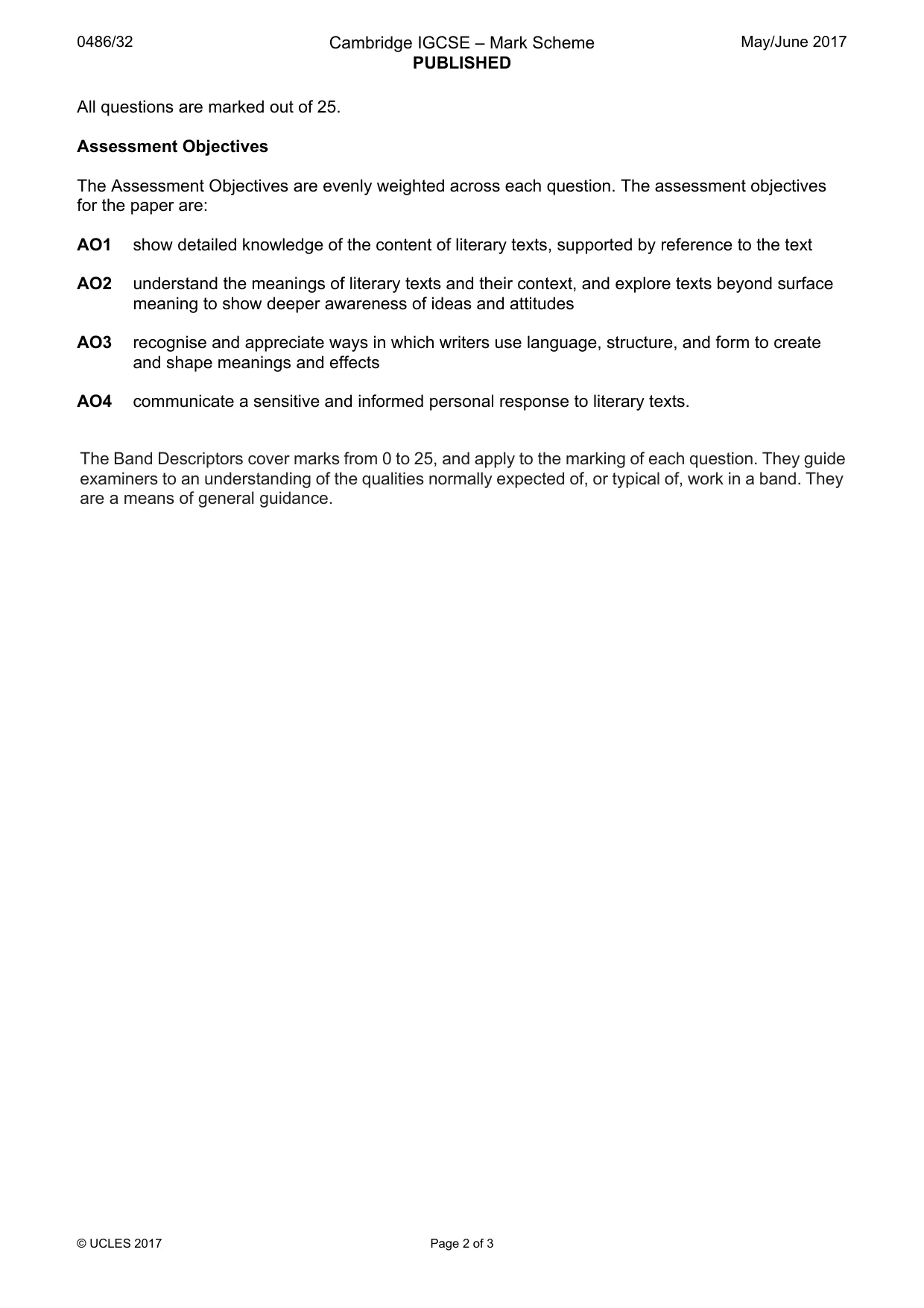
0486/32 Cambridge IGCSE – Mark Scheme PUBLISHED May/June 2017 © UCLES 2017 Page 2 of 3 All questions are marked out of 25. Assessment Objectives The Assessment Objectives are evenly weighted across each question. The assessment objectives for the paper are: AO1 show detailed knowledge of the content of literary texts, supported by reference to the text AO2 understand the meanings of literary texts and their context, and explore texts beyond surface meaning to show deeper awareness of ideas and attitudes AO3 recognise and appreciate ways in which writers use language, structure, and form to create and shape meanings and effects AO4 communicate a sensitive and informed personal response to literary texts. The Band Descriptors cover marks from 0 to 25, and apply to the marking of each question. They guide examiners to an understanding of the qualities normally expected of, or typical of, work in a band. They are a means of general guidance.
Mark scheme, page 3
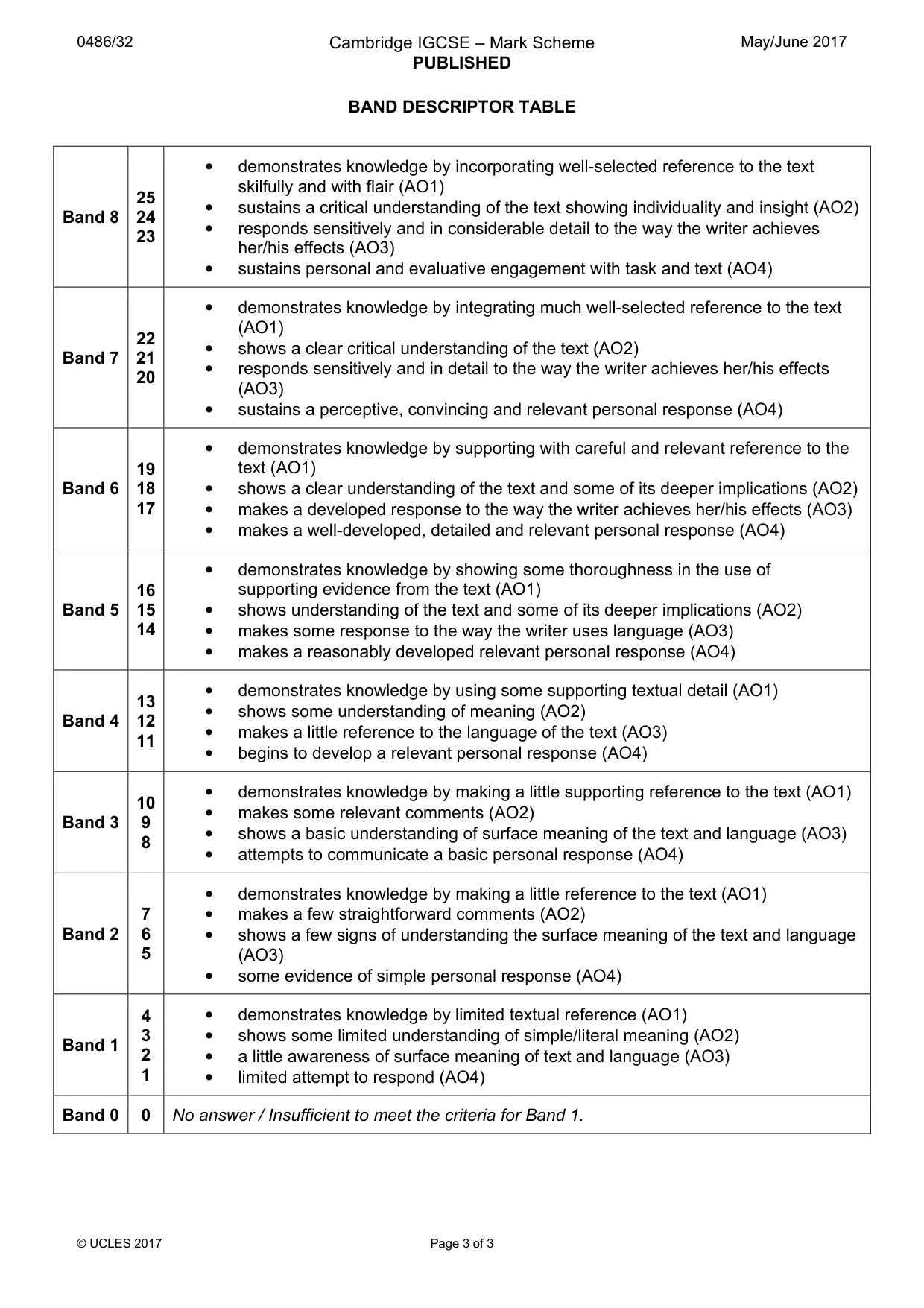
0486/32 Cambridge IGCSE – Mark Scheme PUBLISHED May/June 2017 © UCLES 2017 Page 3 of 3 BAND DESCRIPTOR TABLE Band 8 25 24 23 • demonstrates knowledge by incorporating well-selected reference to the text skilfully and with flair (AO1) • sustains a critical understanding of the text showing individuality and insight (AO2) • responds sensitively and in considerable detail to the way the writer achieves her/his effects (AO3) • sustains personal and evaluative engagement with task and text (AO4) Band 7 22 21 20 • demonstrates knowledge by integrating much well-selected reference to the text (AO1) • shows a clear critical understanding of the text (AO2) • responds sensitively and in detail to the way the writer achieves her/his effects (AO3) • sustains a perceptive, convincing and relevant personal response (AO4) Band 6 19 18 17 • demonstrates knowledge by supporting with careful and relevant reference to the text (AO1) • shows a clear understanding of the text and some of its deeper implications (AO2) • makes a developed response to the way the writer achieves her/his effects (AO3) • makes a well-developed, detailed and relevant personal response (AO4) Band 5 16 15 14 • demonstrates knowledge by showing some thoroughness in the use of supporting evidence from the text (AO1) • shows understanding of the text and some of its deeper implications (AO2) • makes some response to the way the writer uses language (AO3) • makes a reasonably developed relevant personal response (AO4) Band 4 13 12 11 • demonstrates knowledge by using some supporting textual detail (AO1) • shows some understanding of meaning (AO2) • makes a little reference to the language of the text (AO3) • begins to develop a relevant personal response (AO4) Band 3 10 9 8 • demonstrates knowledge by making a little supporting reference to the text (AO1) • makes some relevant comments (AO2) • shows a basic understanding of surface meaning of the text and language (AO3) • attempts to communicate a basic personal response (AO4) Band 2 7 6 5 • demonstrates knowledge by making a little reference to the text (AO1) • makes a few straightforward comments (AO2) • shows a few signs of understanding the surface meaning of the text and language (AO3) • some evidence of simple personal response (AO4) Band 1 4 3 2 1 • demonstrates knowledge by limited textual reference (AO1) • shows some limited understanding of simple/literal meaning (AO2) • a little awareness of surface meaning of text and language (AO3) • limited attempt to respond (AO4) Band 0 0 No answer / Insufficient to meet the criteria for Band 1.
What you needed in this session
Cambridge’s own grade thresholds for 2017 May/June, Paper 3 · Variant 2. A higher threshold means an easier paper — the bar moves with how the cohort did.