Cambridge IGCSE English - Literature 0486 — 2017 Feb/March Paper 3 · Variant 2
0486/32/F/M/17 · 25 marks · ≈28 min
The question paper and its mark scheme, free to read here and free to download. This is Cambridge’s own paper, exactly as it was sat.
Question paper12 pages
Mark scheme3 pages
Answers below. Sit the paper first if you are practising.
Paper as text
Question paper, page 1
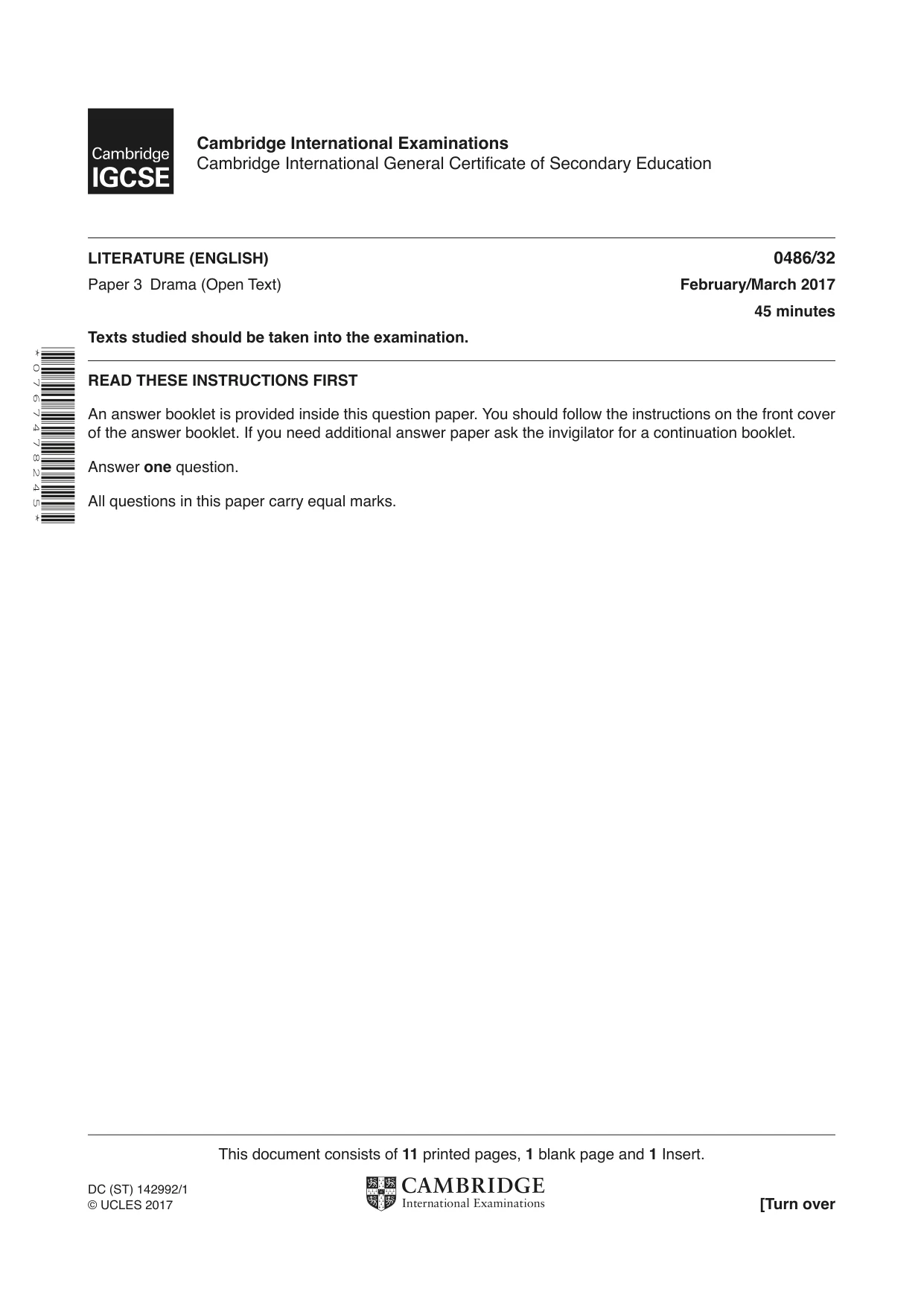
This document consists of 11 printed pages, 1 blank page and 1 Insert. DC (ST) 142992/1 © UCLES 2017 [Turn over Cambridge International Examinations Cambridge International General Certificate of Secondary Education * 0 7 6 7 4 7 8 2 4 5 * LITERATURE (ENGLISH) 0486/32 Paper 3 Drama (Open Text) February/March 2017 45 minutes Texts studied should be taken into the examination. READ THESE INSTRUCTIONS FIRST An answer booklet is provided inside this question paper. You should follow the instructions on the front cover of the answer booklet. If you need additional answer paper ask the invigilator for a continuation booklet. Answer one question. All questions in this paper carry equal marks.
Question paper, page 2
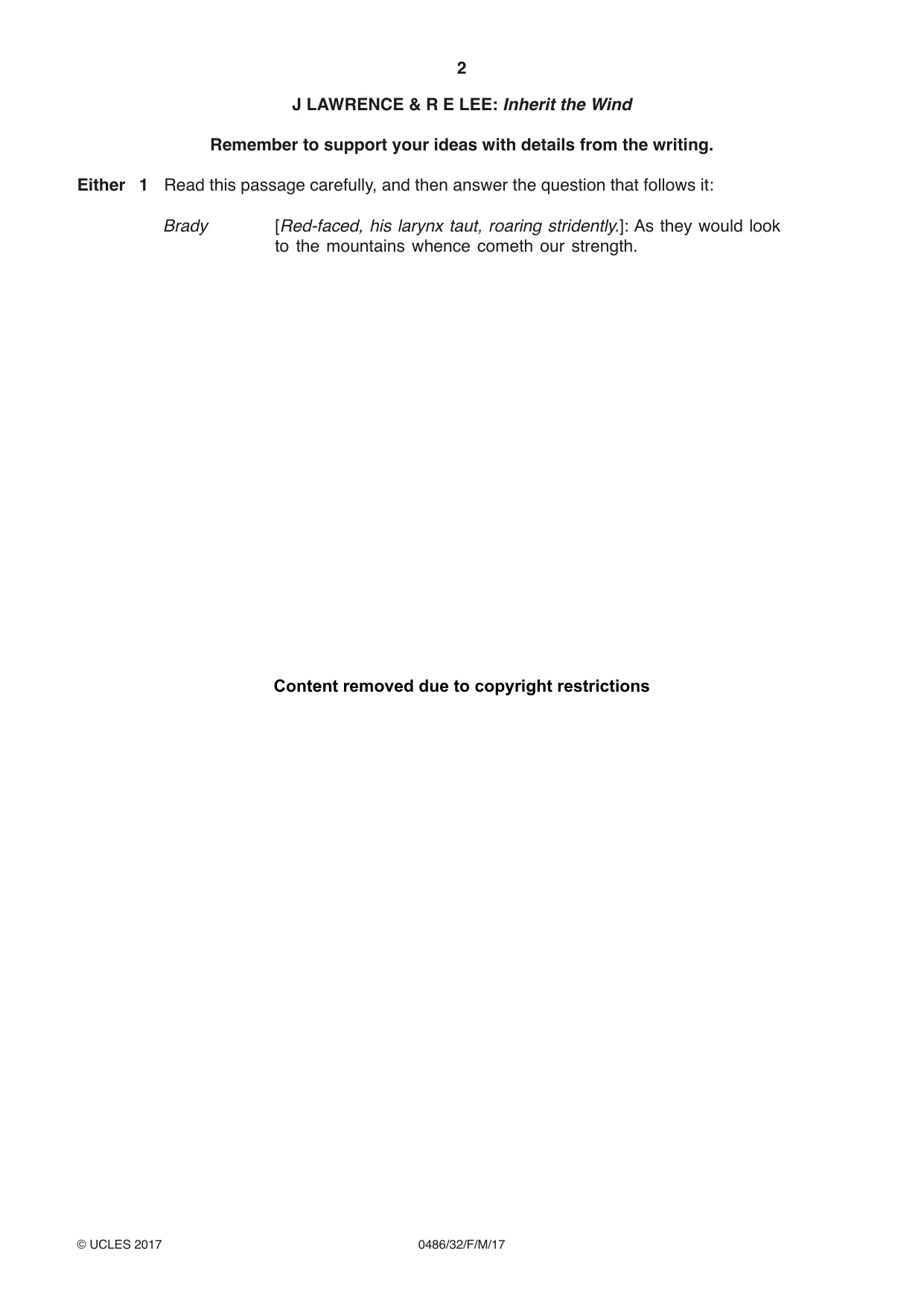
2 0486/32/F/M/17 © UCLES 2017 J LAWRENCE & R E LEE: Inherit the Wind Remember to support your ideas with details from the writing. Either 1 Read this passage carefully, and then answer the question that follows it: Brady [Red-faced, his larynx taut, roaring stridently.]: As they would look to the mountains whence cometh our strength. Content removed due to copyright restrictions
Question paper, page 3
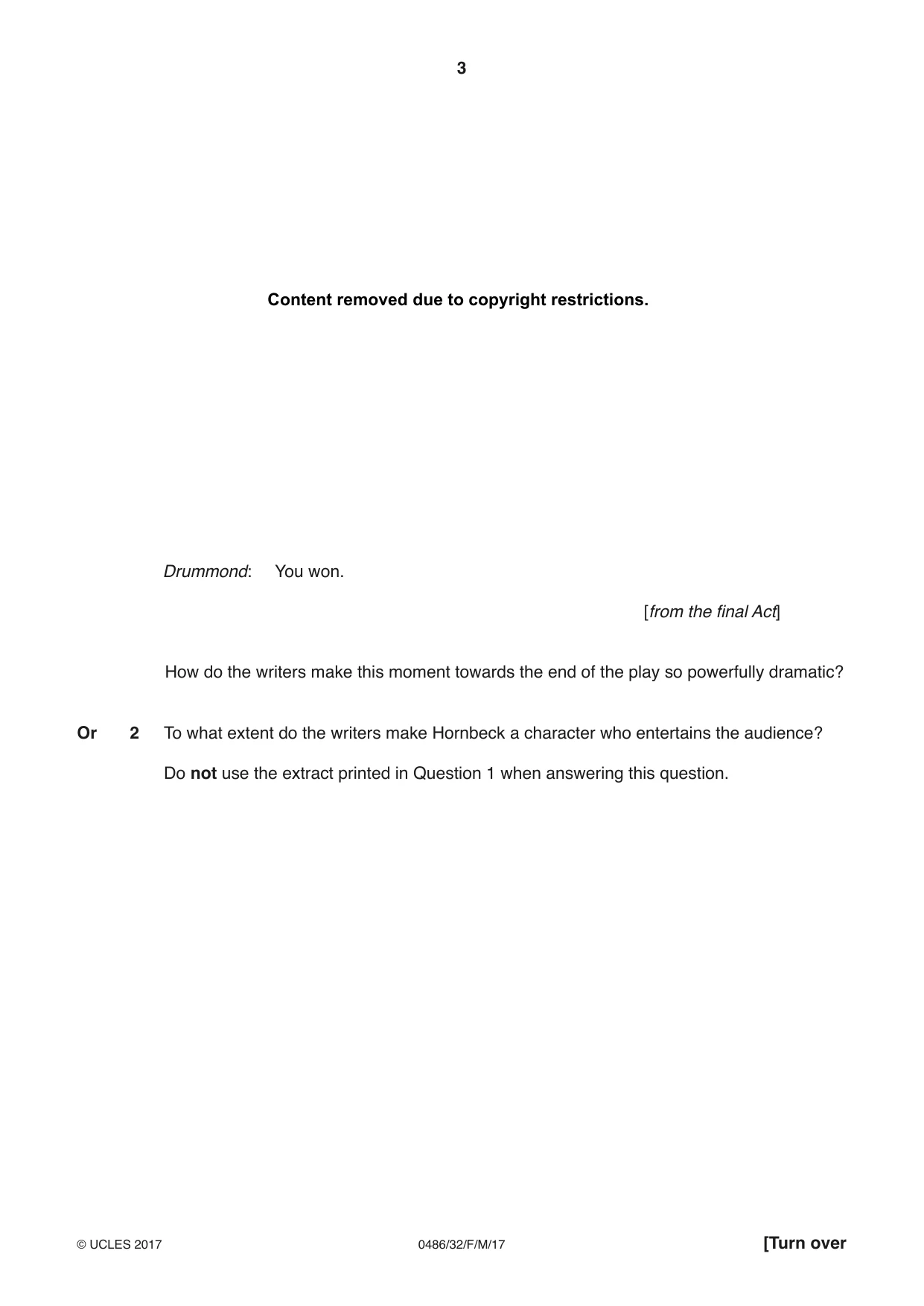
3 0486/32/F/M/17 © UCLES 2017 [Turn over Drummond: You won. [from the final Act] How do the writers make this moment towards the end of the play so powerfully dramatic? Or 2 To what extent do the writers make Hornbeck a character who entertains the audience? Do not use the extract printed in Question 1 when answering this question. Content removed due to copyright restrictions.
Question paper, page 4
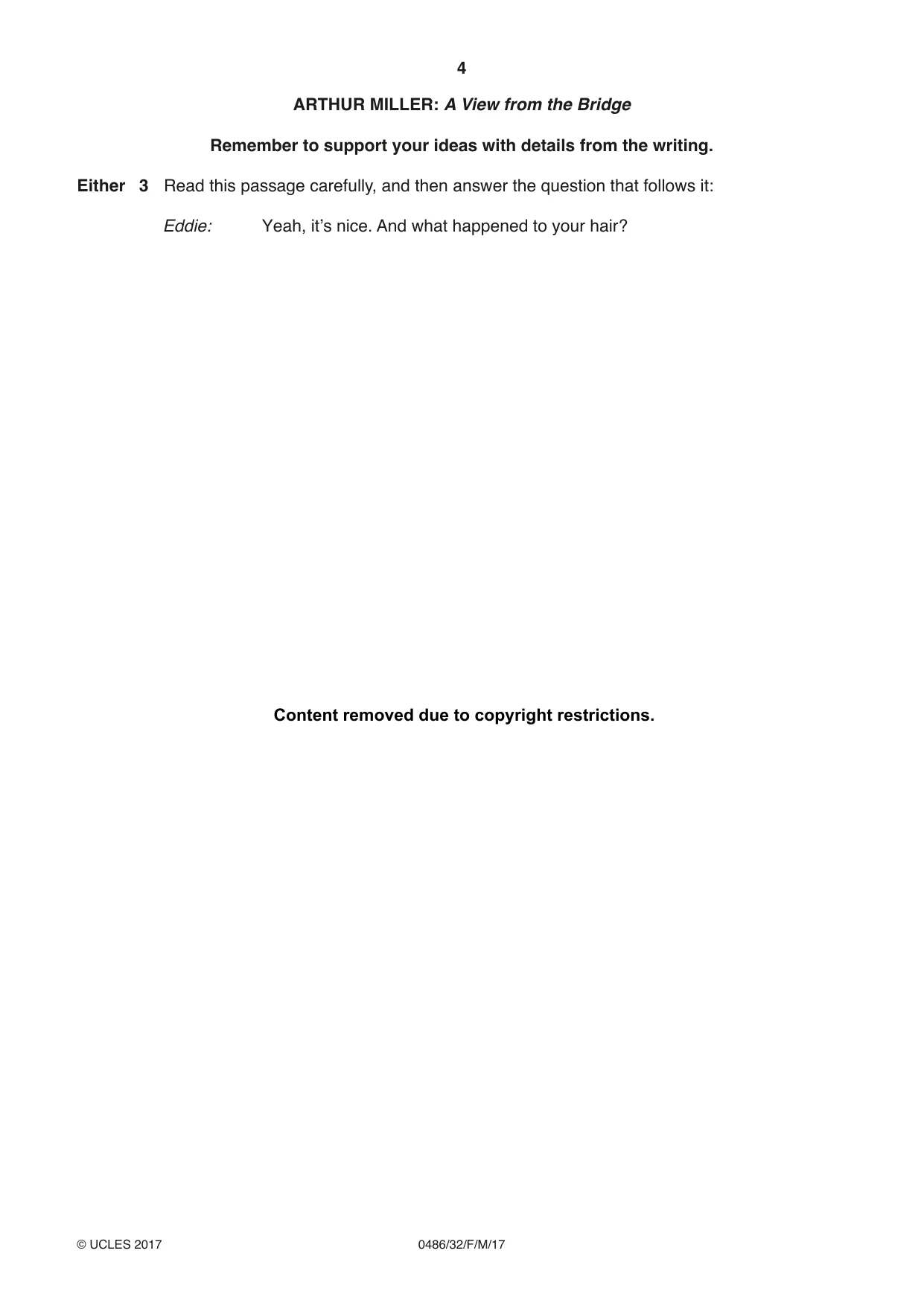
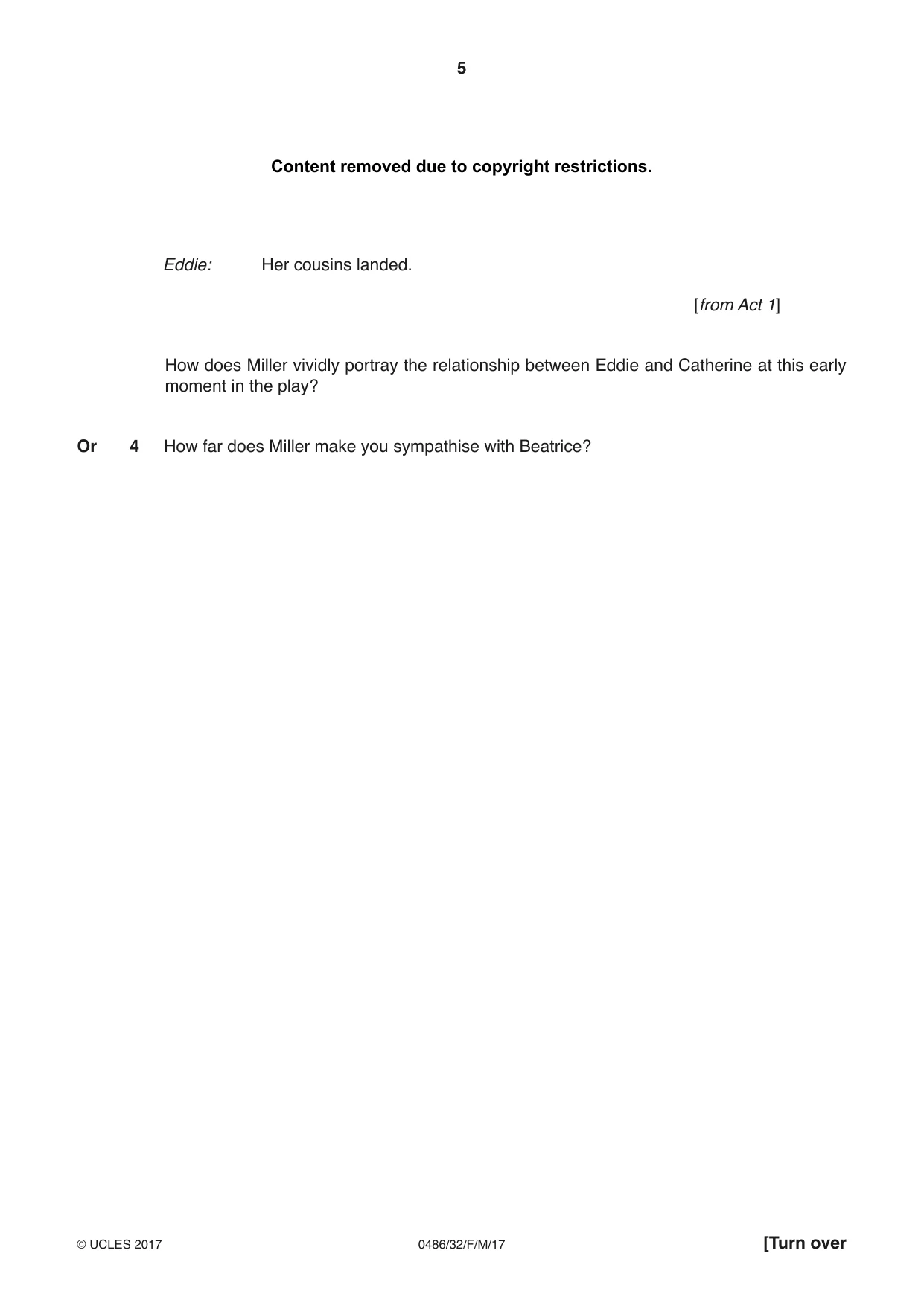
4 0486/32/F/M/17 © UCLES 2017 ARTHUR MILLER: A View from the Bridge Remember to support your ideas with details from the writing. Either 3 Read this passage carefully, and then answer the question that follows it: Eddie: Yeah, it’s nice. And what happened to your hair? Content removed due to copyright restrictions.
Question paper, page 5
5 0486/32/F/M/17 © UCLES 2017 [Turn over Eddie: Her cousins landed. [from Act 1] How does Miller vividly portray the relationship between Eddie and Catherine at this early moment in the play? Or 4 How far does Miller make you sympathise with Beatrice? Content removed due to copyright restrictions.
Question paper, page 6
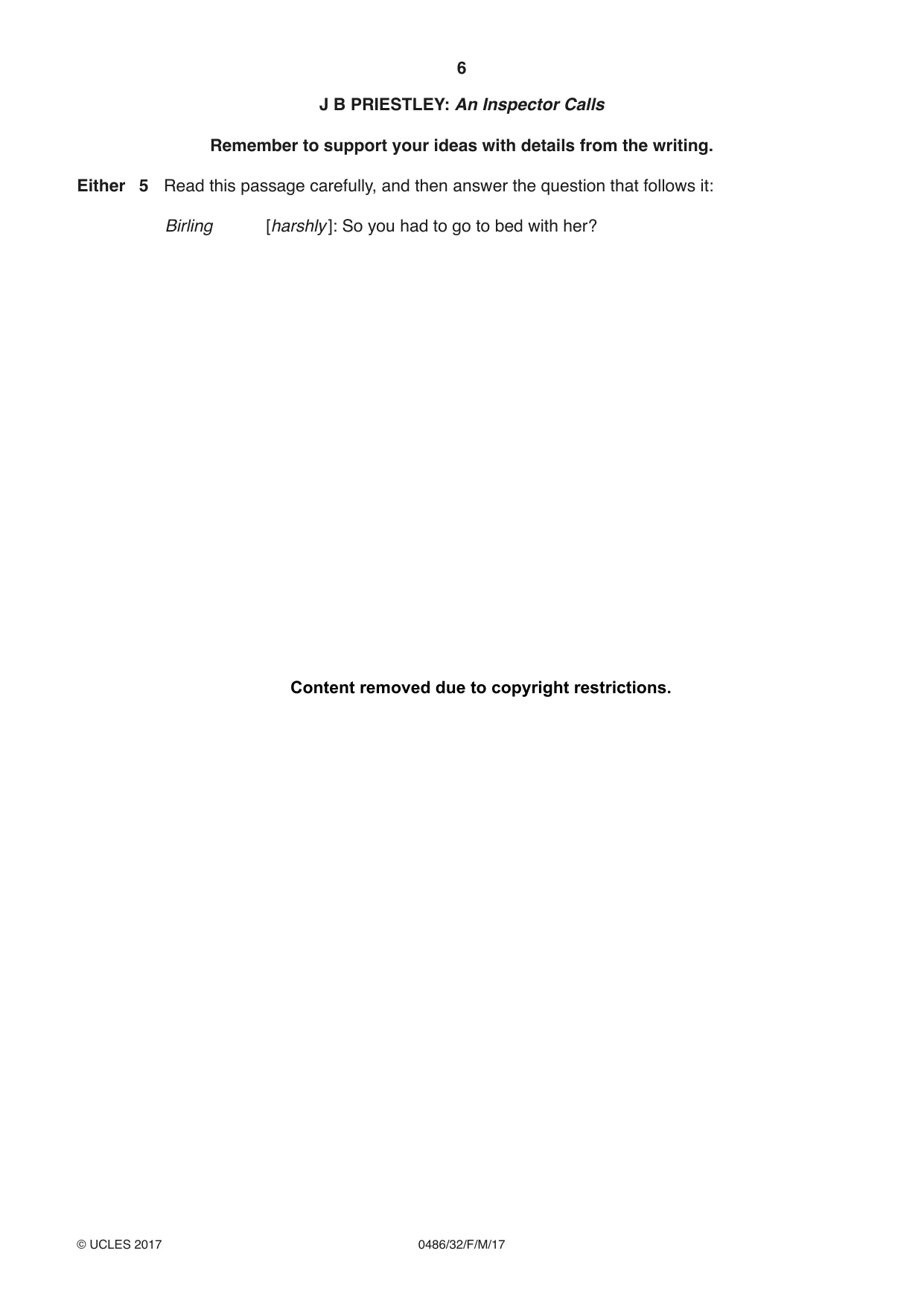
6 0486/32/F/M/17 © UCLES 2017 J B PRIESTLEY: An Inspector Calls Remember to support your ideas with details from the writing. Either 5 Read this passage carefully, and then answer the question that follows it: Birling [harshly ]: So you had to go to bed with her? Content removed due to copyright restrictions.
Question paper, page 7
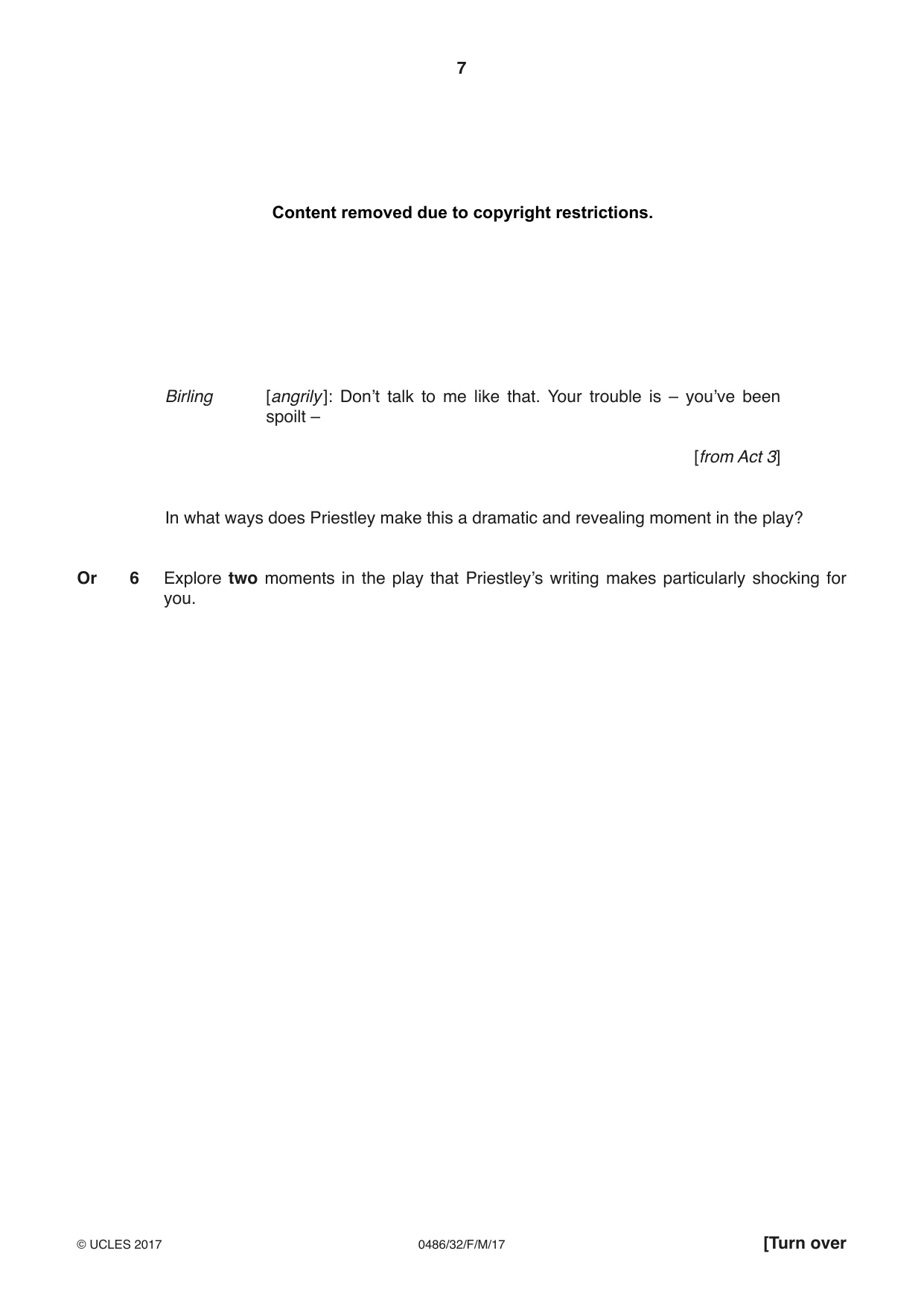
7 0486/32/F/M/17 © UCLES 2017 [Turn over Birling [angrily ]: Don’t talk to me like that. Your trouble is – you’ve been spoilt – [from Act 3] In what ways does Priestley make this a dramatic and revealing moment in the play? Or 6 Explore two moments in the play that Priestley’s writing makes particularly shocking for you. Content removed due to copyright restrictions.
Question paper, page 8
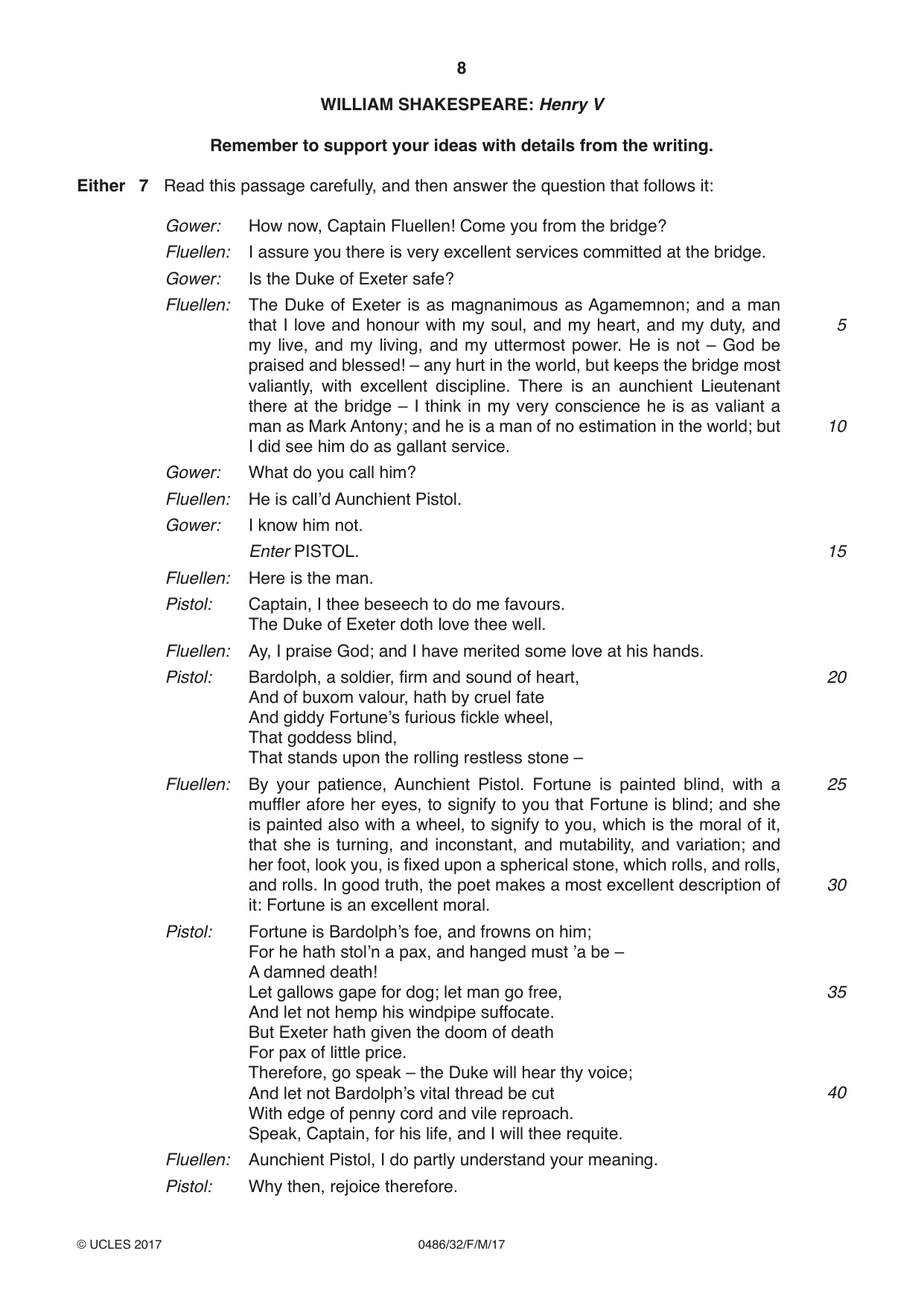
8 0486/32/F/M/17 © UCLES 2017 WILLIAM SHAKESPEARE: Henry V Remember to support your ideas with details from the writing. Either 7 Read this passage carefully, and then answer the question that follows it: Gower: How now, Captain Fluellen! Come you from the bridge? Fluellen: I assure you there is very excellent services committed at the bridge. Gower: Is the Duke of Exeter safe? Fluellen: The Duke of Exeter is as magnanimous as Agamemnon; and a man that I love and honour with my soul, and my heart, and my duty, and my live, and my living, and my uttermost power. He is not – God be praised and blessed! – any hurt in the world, but keeps the bridge most valiantly, with excellent discipline. There is an aunchient Lieutenant there at the bridge – I think in my very conscience he is as valiant a man as Mark Antony; and he is a man of no estimation in the world; but I did see him do as gallant service. Gower: What do you call him? Fluellen: He is call’d Aunchient Pistol. Gower: I know him not. Enter PISTOL. Fluellen: Here is the man. Pistol: Captain, I thee beseech to do me favours. The Duke of Exeter doth love thee well. Fluellen: Ay, I praise God; and I have merited some love at his hands. Pistol: Bardolph, a soldier, firm and sound of heart, And of buxom valour, hath by cruel fate And giddy Fortune’s furious fickle wheel, That goddess blind, That stands upon the rolling restless stone – Fluellen: By your patience, Aunchient Pistol. Fortune is painted blind, with a muffler afore her eyes, to signify to you that Fortune is blind; and she is painted also with a wheel, to signify to you, which is the moral of it, that she is turning, and inconstant, and mutability, and variation; and her foot, look you, is fixed upon a spherical stone, which rolls, and rolls, and rolls. In good truth, the poet makes a most excellent description of it: Fortune is an excellent moral. Pistol: Fortune is Bardolph’s foe, and frowns on him; For he hath stol’n a pax, and hanged must ’a be – A damned death! Let gallows gape for dog; let man go free, And let not hemp his windpipe suffocate. But Exeter hath given the doom of death For pax of little price. Therefore, go speak – the Duke will hear thy voice; And let not Bardolph’s vital thread be cut With edge of penny cord and vile reproach. Speak, Captain, for his life, and I will thee requite. Fluellen: Aunchient Pistol, I do partly understand your meaning. Pistol: Why then, rejoice therefore. 5 10 15 20 25 30 35 40
Question paper, page 9
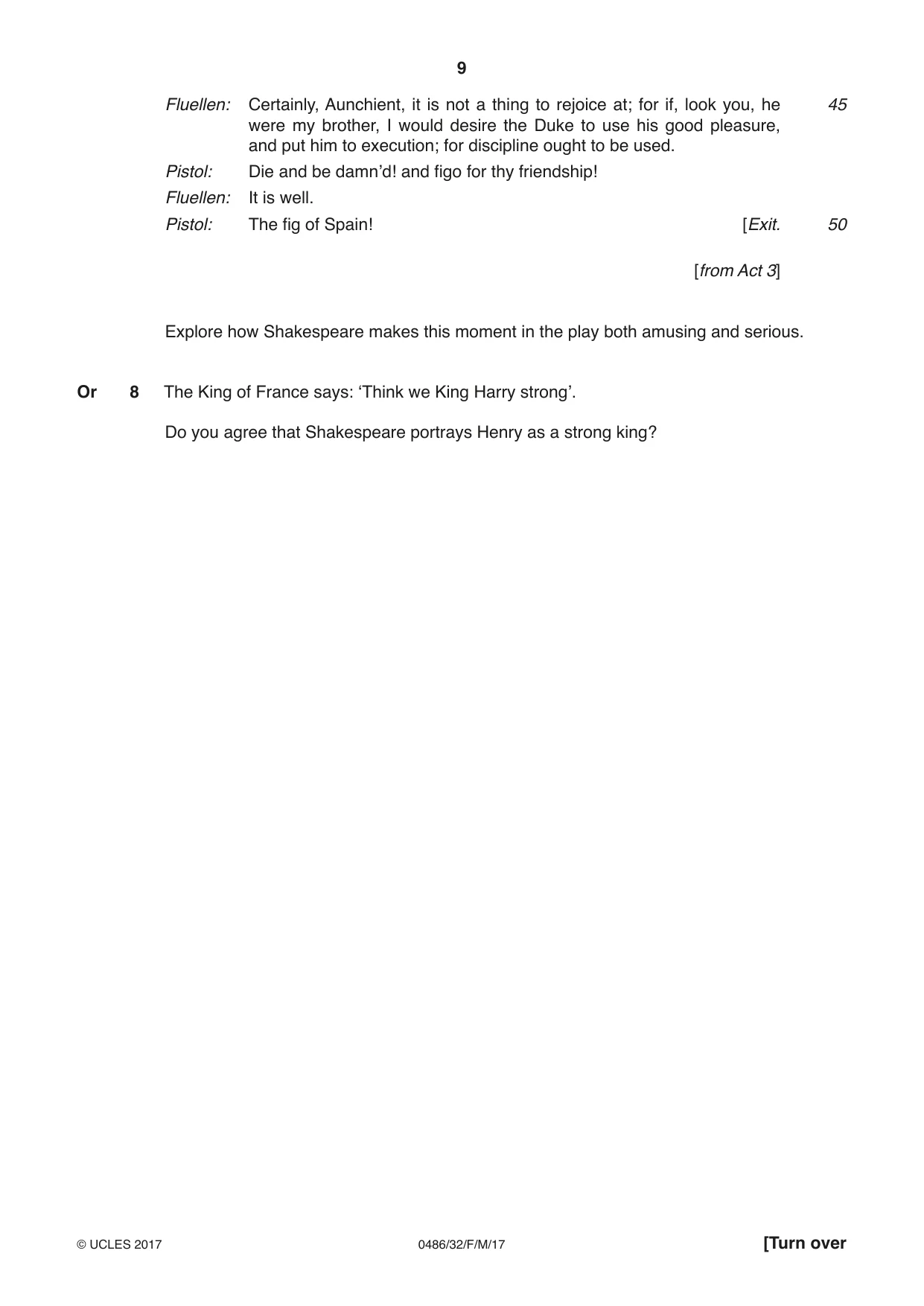
9 0486/32/F/M/17 © UCLES 2017 [Turn over Fluellen: Certainly, Aunchient, it is not a thing to rejoice at; for if, look you, he were my brother, I would desire the Duke to use his good pleasure, and put him to execution; for discipline ought to be used. Pistol: Die and be damn’d! and figo for thy friendship! Fluellen: It is well. Pistol: The fig of Spain! [Exit. [from Act 3] Explore how Shakespeare makes this moment in the play both amusing and serious. Or 8 The King of France says: ‘Think we King Harry strong’. Do you agree that Shakespeare portrays Henry as a strong king? 45 50
Question paper, page 10
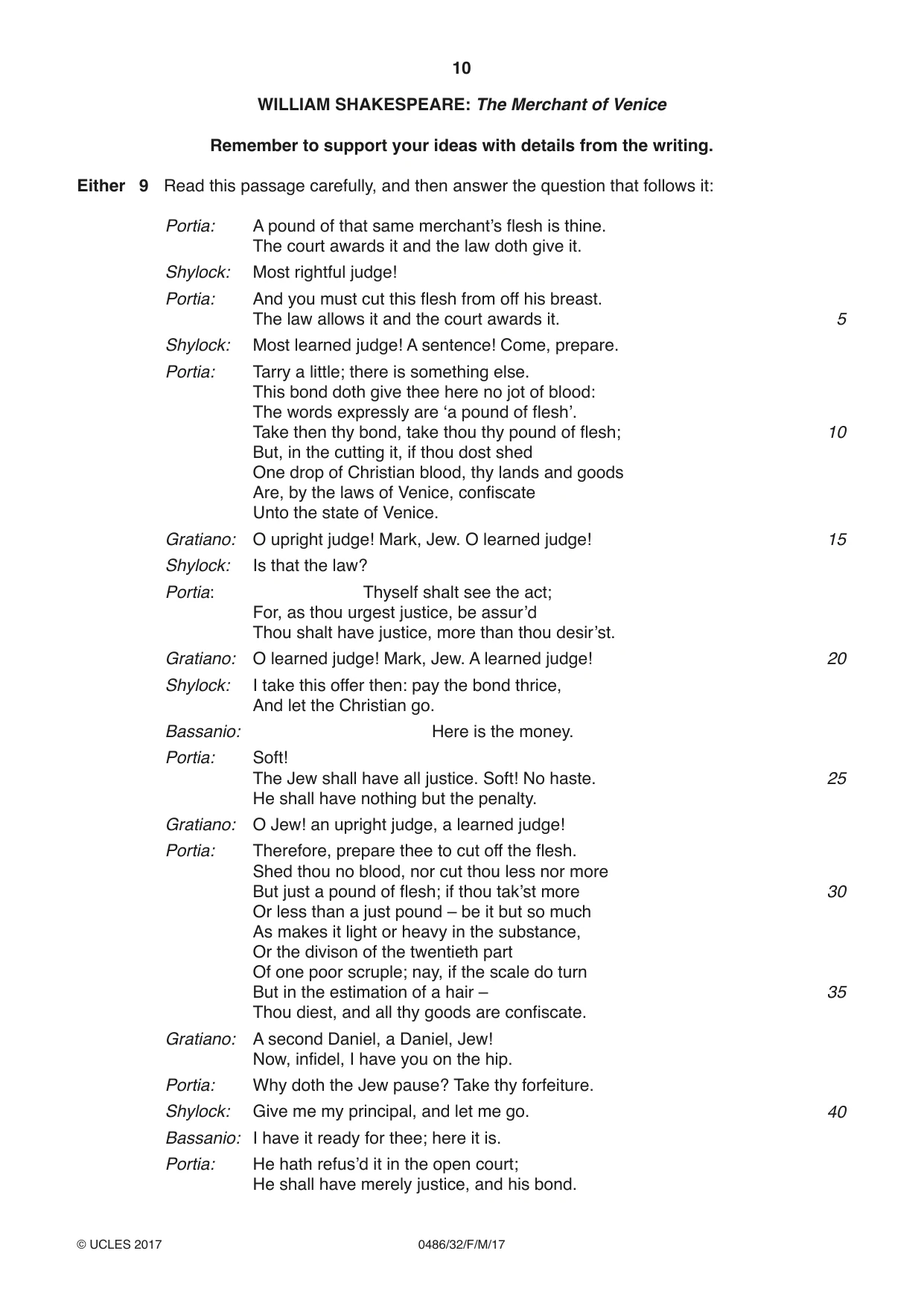
10 0486/32/F/M/17 © UCLES 2017 WILLIAM SHAKESPEARE: The Merchant of Venice Remember to support your ideas with details from the writing. Either 9 Read this passage carefully, and then answer the question that follows it: Portia: A pound of that same merchant’s flesh is thine. The court awards it and the law doth give it. Shylock: Most rightful judge! Portia: And you must cut this flesh from off his breast. The law allows it and the court awards it. Shylock: Most learned judge! A sentence! Come, prepare. Portia: Tarry a little; there is something else. This bond doth give thee here no jot of blood: The words expressly are ‘a pound of flesh’. Take then thy bond, take thou thy pound of flesh; But, in the cutting it, if thou dost shed One drop of Christian blood, thy lands and goods Are, by the laws of Venice, confiscate Unto the state of Venice. Gratiano: O upright judge! Mark, Jew. O learned judge! Shylock: Is that the law? Portia: Thyself shalt see the act; For, as thou urgest justice, be assur’d Thou shalt have justice, more than thou desir’st. Gratiano: O learned judge! Mark, Jew. A learned judge! Shylock: I take this offer then: pay the bond thrice, And let the Christian go. Bassanio: Here is the money. Portia: Soft! The Jew shall have all justice. Soft! No haste. He shall have nothing but the penalty. Gratiano: O Jew! an upright judge, a learned judge! Portia: Therefore, prepare thee to cut off the flesh. Shed thou no blood, nor cut thou less nor more But just a pound of flesh; if thou tak’st more Or less than a just pound – be it but so much As makes it light or heavy in the substance, Or the divison of the twentieth part Of one poor scruple; nay, if the scale do turn But in the estimation of a hair – Thou diest, and all thy goods are confiscate. Gratiano: A second Daniel, a Daniel, Jew! Now, infidel, I have you on the hip. Portia: Why doth the Jew pause? Take thy forfeiture. Shylock: Give me my principal, and let me go. Bassanio: I have it ready for thee; here it is. Portia: He hath refus’d it in the open court; He shall have merely justice, and his bond. 5 10 15 20 25 30 35 40
Question paper, page 11
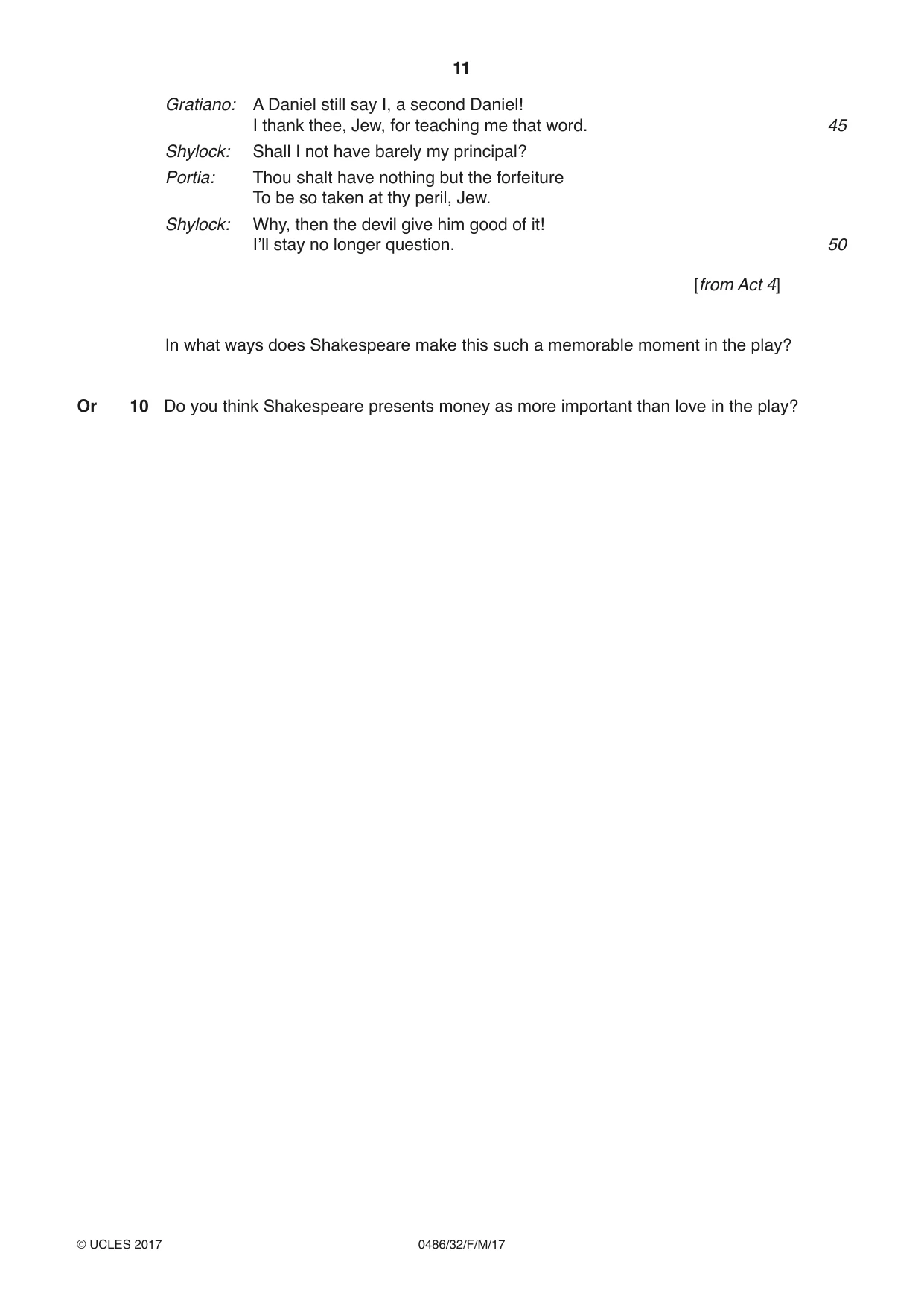
11 0486/32/F/M/17 © UCLES 2017 Gratiano: A Daniel still say I, a second Daniel! I thank thee, Jew, for teaching me that word. Shylock: Shall I not have barely my principal? Portia: Thou shalt have nothing but the forfeiture To be so taken at thy peril, Jew. Shylock: Why, then the devil give him good of it! I’ll stay no longer question. [from Act 4] In what ways does Shakespeare make this such a memorable moment in the play? Or 10 Do you think Shakespeare presents money as more important than love in the play? 45 50
Question paper, page 12
12 0486/32/F/M/17 © UCLES 2017 BLANK PAGE Permission to reproduce items where third-party owned material protected by copyright is included has been sought and cleared where possible. Every reasonable effort has been made by the publisher (UCLES) to trace copyright holders, but if any items requiring clearance have unwittingly been included, the publisher will be pleased to make amends at the earliest possible opportunity. To avoid the issue of disclosure of answer-related information to candidates, all copyright acknowledgements are reproduced online in the Cambridge International Examinations Copyright Acknowledgements Booklet. This is produced for each series of examinations and is freely available to download at www.cie.org.uk after the live examination series. Cambridge International Examinations is part of the Cambridge Assessment Group. Cambridge Assessment is the brand name of University of Cambridge Local Examinations Syndicate (UCLES), which is itself a department of the University of Cambridge.
Mark scheme, page 1
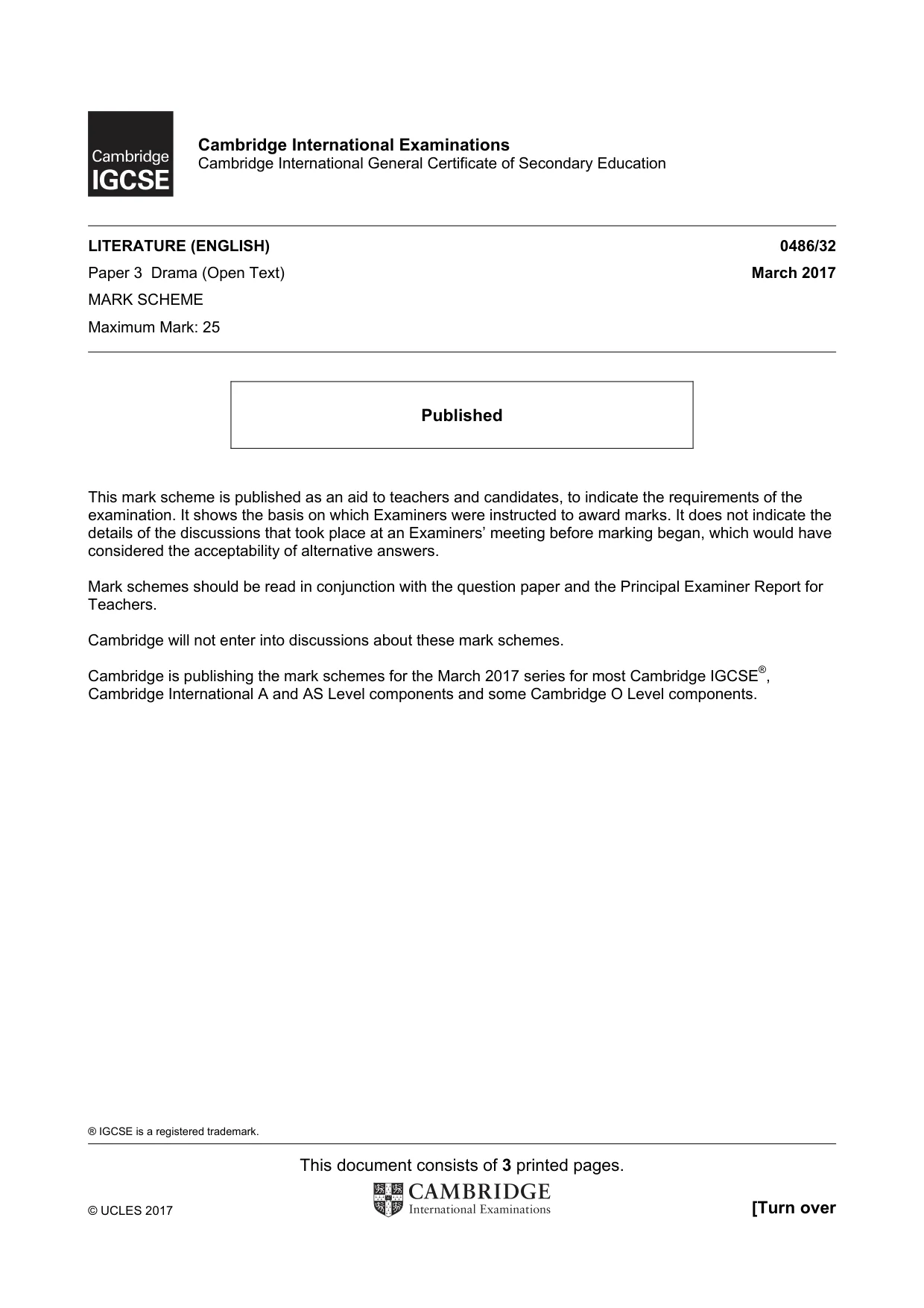
® IGCSE is a registered trademark. This document consists of 3 printed pages. © UCLES 2017 [Turn over Cambridge International Examinations Cambridge International General Certificate of Secondary Education LITERATURE (ENGLISH) 0486/32 Paper 3 Drama (Open Text) March 2017 MARK SCHEME Maximum Mark: 25 Published This mark scheme is published as an aid to teachers and candidates, to indicate the requirements of the examination. It shows the basis on which Examiners were instructed to award marks. It does not indicate the details of the discussions that took place at an Examiners’ meeting before marking began, which would have considered the acceptability of alternative answers. Mark schemes should be read in conjunction with the question paper and the Principal Examiner Report for Teachers. Cambridge will not enter into discussions about these mark schemes. Cambridge is publishing the mark schemes for the March 2017 series for most Cambridge IGCSE®, Cambridge International A and AS Level components and some Cambridge O Level components.
Mark scheme, page 2
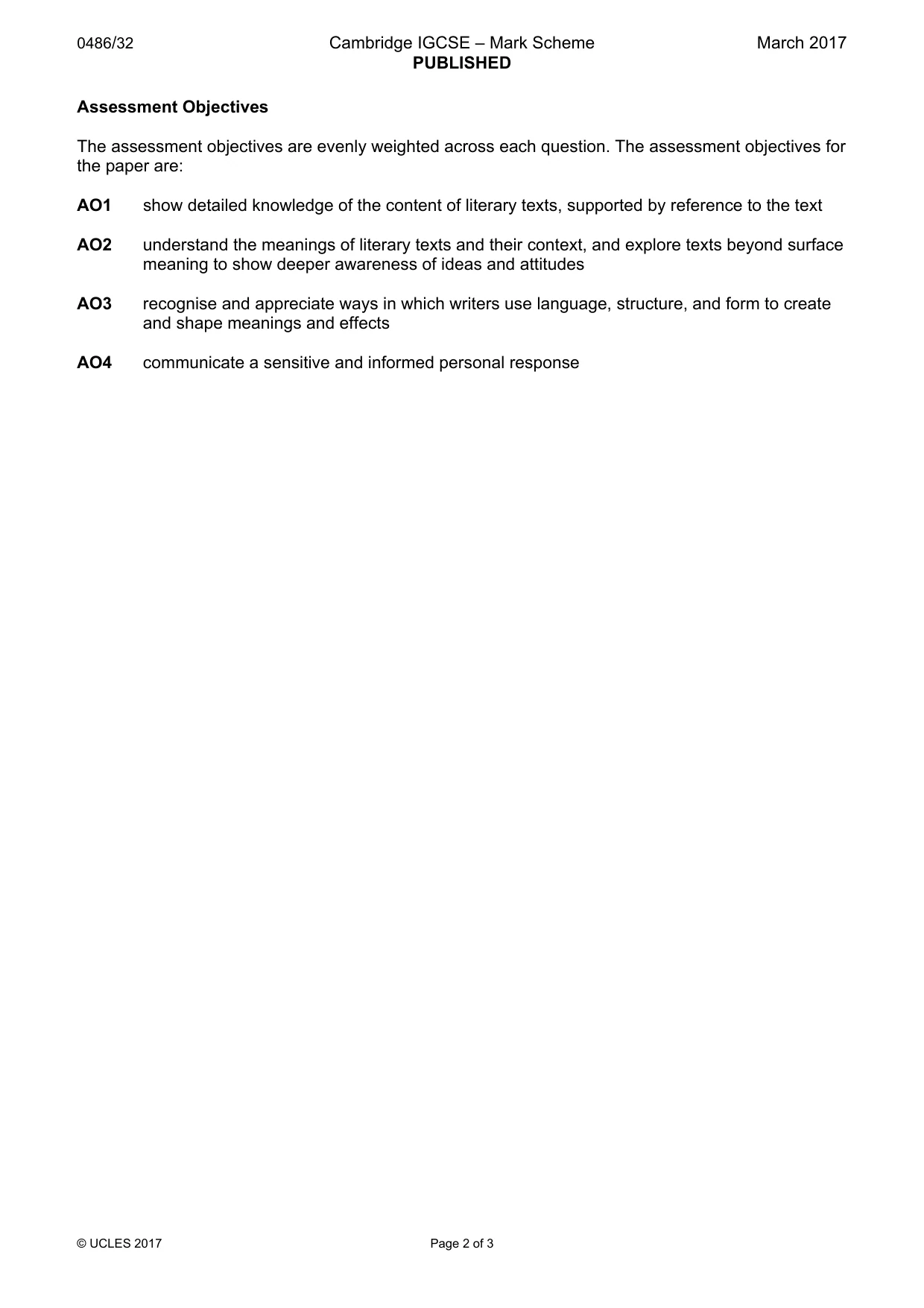
0486/32 Cambridge IGCSE – Mark Scheme PUBLISHED March 2017 © UCLES 2017 Page 2 of 3 Assessment Objectives The assessment objectives are evenly weighted across each question. The assessment objectives for the paper are: AO1 show detailed knowledge of the content of literary texts, supported by reference to the text AO2 understand the meanings of literary texts and their context, and explore texts beyond surface meaning to show deeper awareness of ideas and attitudes AO3 recognise and appreciate ways in which writers use language, structure, and form to create and shape meanings and effects AO4 communicate a sensitive and informed personal response
Mark scheme, page 3
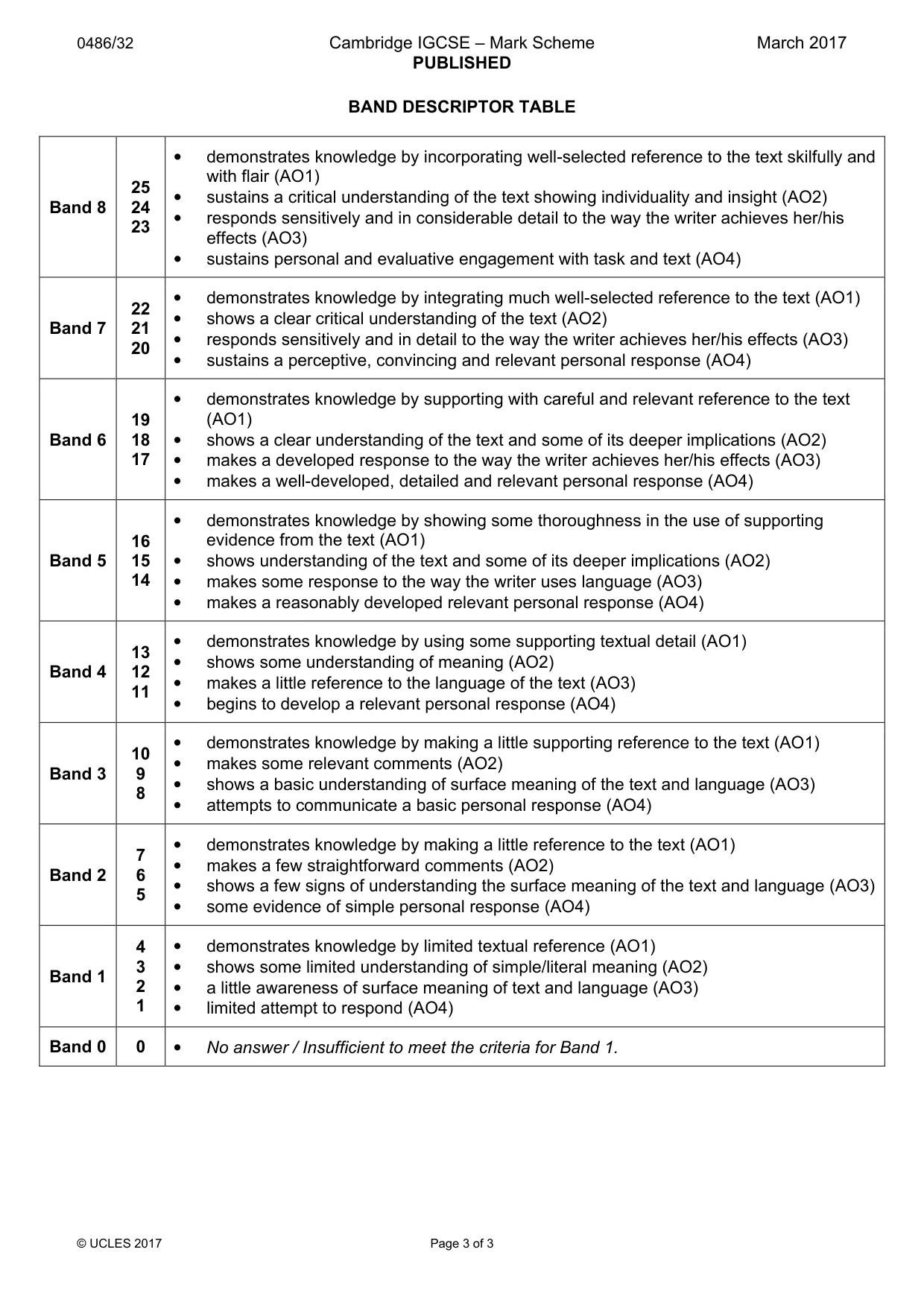
0486/32 Cambridge IGCSE – Mark Scheme PUBLISHED March 2017 © UCLES 2017 Page 3 of 3 BAND DESCRIPTOR TABLE Band 8 25 24 23 • demonstrates knowledge by incorporating well-selected reference to the text skilfully and with flair (AO1) • sustains a critical understanding of the text showing individuality and insight (AO2) • responds sensitively and in considerable detail to the way the writer achieves her/his effects (AO3) • sustains personal and evaluative engagement with task and text (AO4) Band 7 22 21 20 • demonstrates knowledge by integrating much well-selected reference to the text (AO1) • shows a clear critical understanding of the text (AO2) • responds sensitively and in detail to the way the writer achieves her/his effects (AO3) • sustains a perceptive, convincing and relevant personal response (AO4) Band 6 19 18 17 • demonstrates knowledge by supporting with careful and relevant reference to the text (AO1) • shows a clear understanding of the text and some of its deeper implications (AO2) • makes a developed response to the way the writer achieves her/his effects (AO3) • makes a well-developed, detailed and relevant personal response (AO4) Band 5 16 15 14 • demonstrates knowledge by showing some thoroughness in the use of supporting evidence from the text (AO1) • shows understanding of the text and some of its deeper implications (AO2) • makes some response to the way the writer uses language (AO3) • makes a reasonably developed relevant personal response (AO4) Band 4 13 12 11 • demonstrates knowledge by using some supporting textual detail (AO1) • shows some understanding of meaning (AO2) • makes a little reference to the language of the text (AO3) • begins to develop a relevant personal response (AO4) Band 3 10 9 8 • demonstrates knowledge by making a little supporting reference to the text (AO1) • makes some relevant comments (AO2) • shows a basic understanding of surface meaning of the text and language (AO3) • attempts to communicate a basic personal response (AO4) Band 2 7 6 5 • demonstrates knowledge by making a little reference to the text (AO1) • makes a few straightforward comments (AO2) • shows a few signs of understanding the surface meaning of the text and language (AO3) • some evidence of simple personal response (AO4) Band 1 4 3 2 1 • demonstrates knowledge by limited textual reference (AO1) • shows some limited understanding of simple/literal meaning (AO2) • a little awareness of surface meaning of text and language (AO3) • limited attempt to respond (AO4) Band 0 0 • No answer / Insufficient to meet the criteria for Band 1.
What you needed in this session
Cambridge’s own grade thresholds for 2017 Feb/March, Paper 3 · Variant 2. A higher threshold means an easier paper — the bar moves with how the cohort did.