Cambridge IGCSE English - Literature 0486 — 2018 Oct/Nov Paper 3 · Variant 2
0486/32/O/N/18 · 25 marks · ≈28 min
The question paper and its mark scheme, free to read here and free to download. This is Cambridge’s own paper, exactly as it was sat.
Question paper12 pages


Mark scheme4 pages
Answers below. Sit the paper first if you are practising.
Paper as text
Question paper, page 1
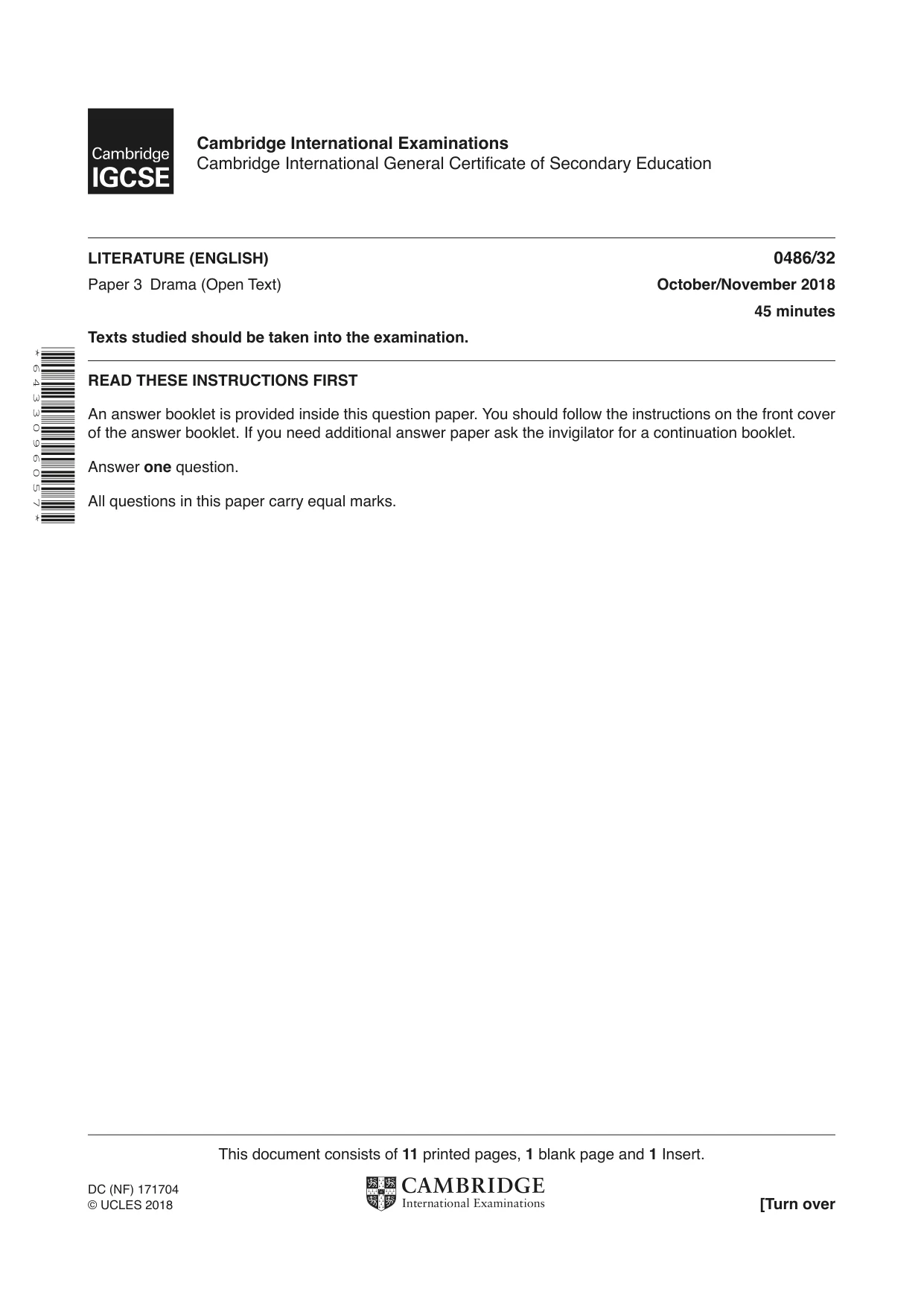
This document consists of 11 printed pages, 1 blank page and 1 Insert. DC (NF) 171704 © UCLES 2018 [Turn over Cambridge International Examinations Cambridge International General Certificate of Secondary Education * 6 4 3 3 0 9 6 0 5 7 * LITERATURE (ENGLISH) 0486/32 Paper 3 Drama (Open Text) October/November 2018 45 minutes Texts studied should be taken into the examination. READ THESE INSTRUCTIONS FIRST An answer booklet is provided inside this question paper. You should follow the instructions on the front cover of the answer booklet. If you need additional answer paper ask the invigilator for a continuation booklet. Answer one question. All questions in this paper carry equal marks.
Question paper, page 2
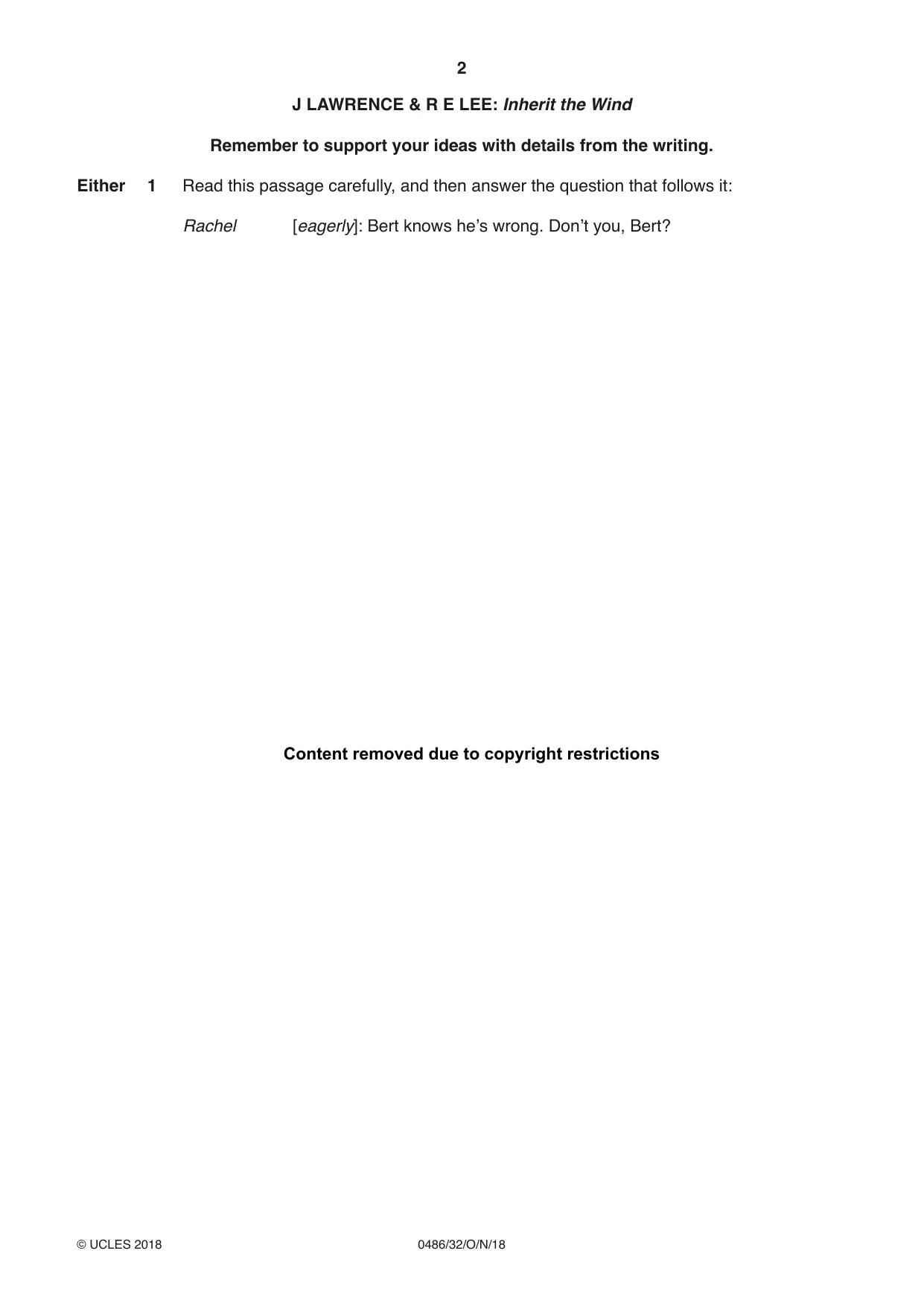
2 0486/32/O/N/18 © UCLES 2018 J LAWRENCE & R E LEE: Inherit the Wind Remember to support your ideas with details from the writing. Either 1 Read this passage carefully, and then answer the question that follows it: Rachel [eagerly]: Bert knows he’s wrong. Don’t you, Bert? Content removed due to copyright restrictions
Question paper, page 3
3 0486/32/O/N/18 © UCLES 2018 [Turn over [DRUMMOND puts on his hat, touches the brim of it as a gesture of good-bye and goes slowly off.] CURTAIN [from Act 1] How do the writers make this such a powerful moment in the play? Or 2 How does the writers’ portrayal of Reverend Jeremiah Brown contribute to the dramatic impact of the play? Do not use the passage printed in Question 1 in answering this question. Content removed due to copyright restrictions
Question paper, page 4
4 0486/32/O/N/18 © UCLES 2018 ARTHUR MILLER: A View from the Bridge Remember to support your ideas with details from the writing. Either 3 Read this passage carefully, and then answer the question that follows it: Rodolpho [he helps BEATRICE set out the coffee things]: I am also a singer, though. Content removed due to copyright restrictions
Question paper, page 5
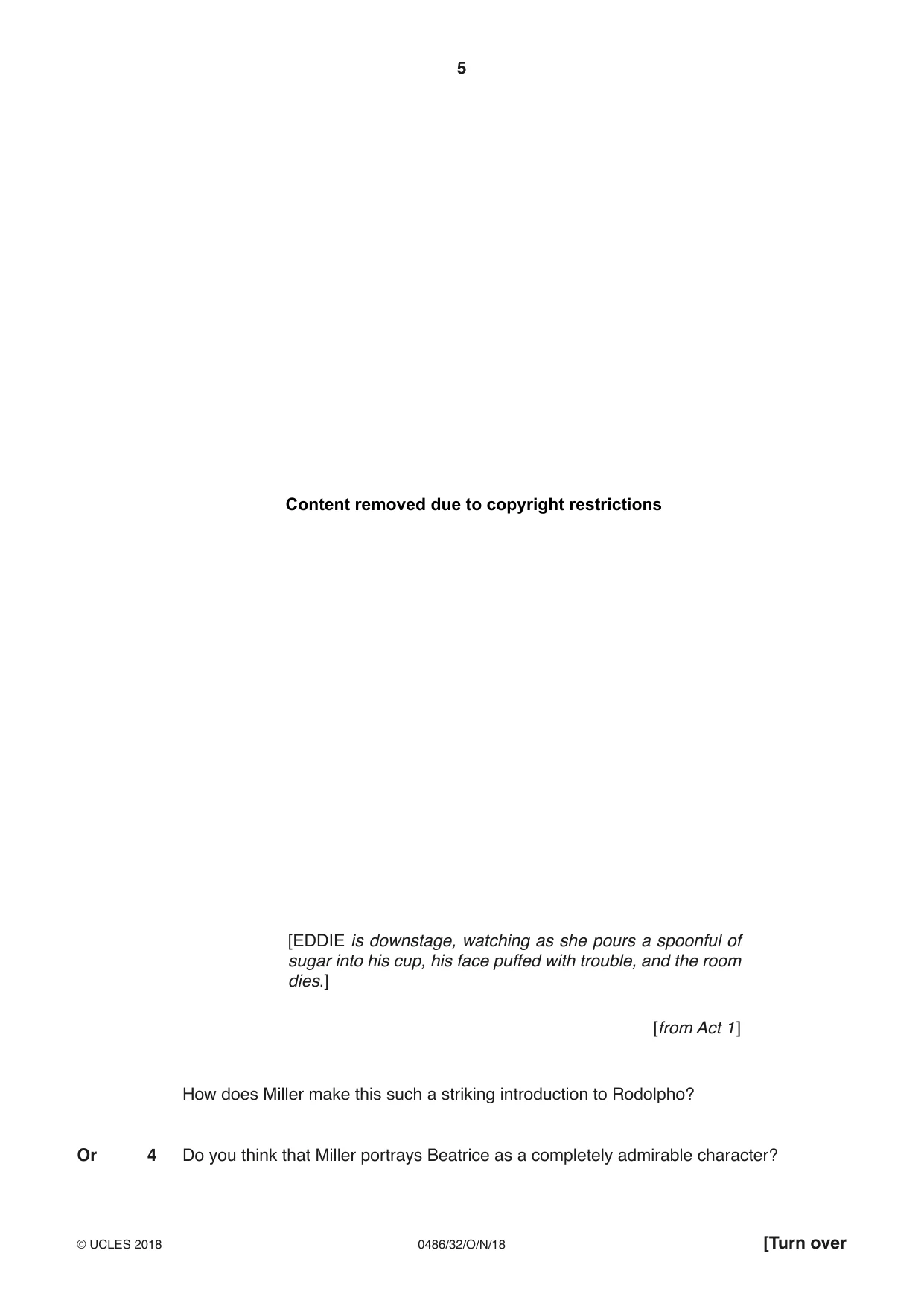
5 0486/32/O/N/18 © UCLES 2018 [Turn over [EDDIE is downstage, watching as she pours a spoonful of sugar into his cup, his face puffed with trouble, and the room dies.] [from Act 1] How does Miller make this such a striking introduction to Rodolpho? Or 4 Do you think that Miller portrays Beatrice as a completely admirable character? Content removed due to copyright restrictions
Question paper, page 6
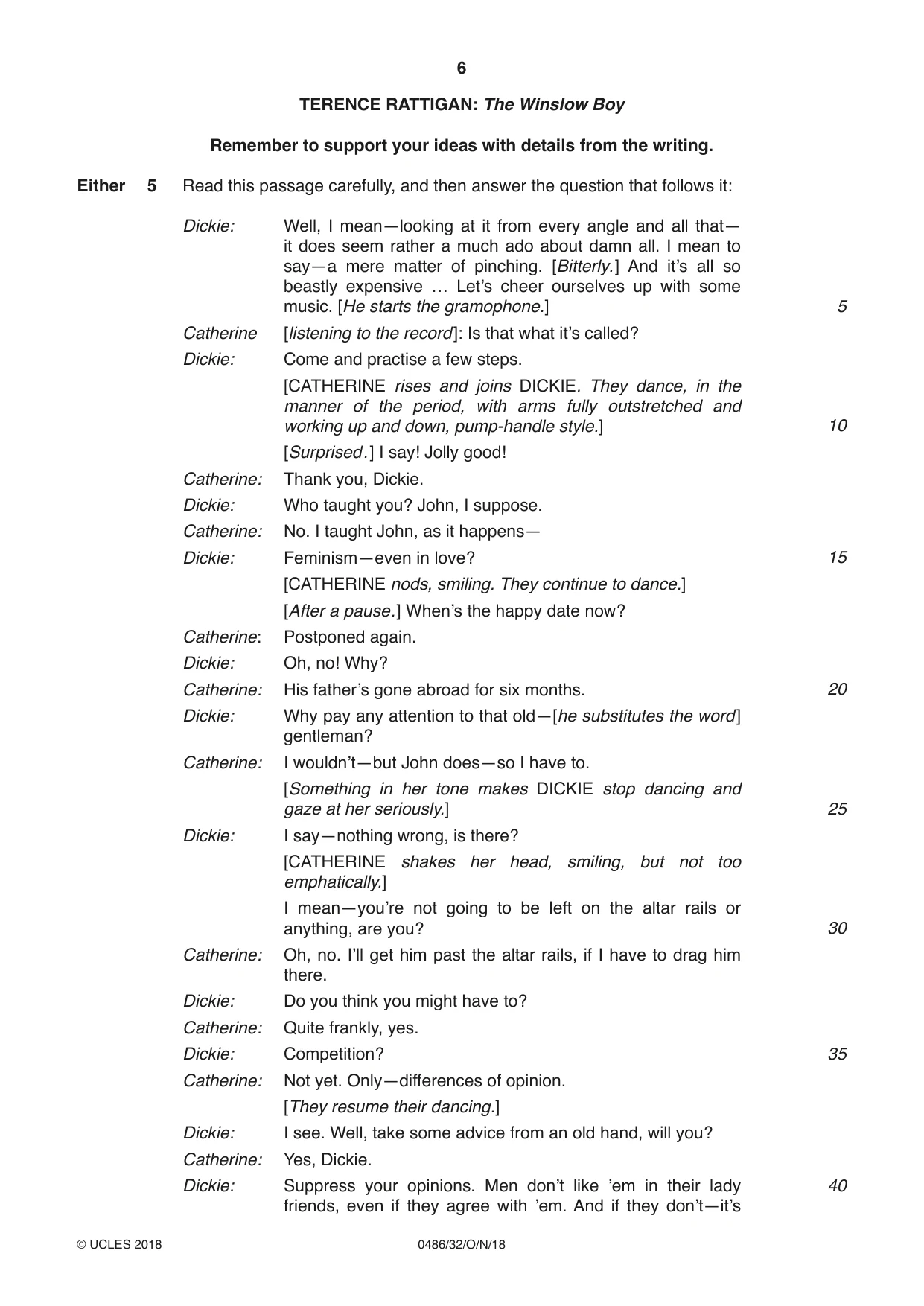
6 0486/32/O/N/18 © UCLES 2018 TERENCE RATTIGAN: The Winslow Boy Remember to support your ideas with details from the writing. Either 5 Read this passage carefully, and then answer the question that follows it: Dickie: Well, I mean—looking at it from every angle and all that— it does seem rather a much ado about damn all. I mean to say—a mere matter of pinching. [Bitterly.] And it’s all so beastly expensive … Let’s cheer ourselves up with some music. [He starts the gramophone.] Catherine [listening to the record]: Is that what it’s called? Dickie: Come and practise a few steps. [CATHERINE rises and joins DICKIE. They dance, in the manner of the period, with arms fully outstretched and working up and down, pump-handle style.] [Surprised.] I say! Jolly good! Catherine: Thank you, Dickie. Dickie: Who taught you? John, I suppose. Catherine: No. I taught John, as it happens— Dickie: Feminism—even in love? [CATHERINE nods, smiling. They continue to dance.] [After a pause.] When’s the happy date now? Catherine: Postponed again. Dickie: Oh, no! Why? Catherine: His father’s gone abroad for six months. Dickie: Why pay any attention to that old—[he substitutes the word] gentleman? Catherine: I wouldn’t—but John does—so I have to. [Something in her tone makes DICKIE stop dancing and gaze at her seriously.] Dickie: I say—nothing wrong, is there? [CATHERINE shakes her head, smiling, but not too emphatically.] I mean—you’re not going to be left on the altar rails or anything, are you? Catherine: Oh, no. I’ll get him past the altar rails, if I have to drag him there. Dickie: Do you think you might have to? Catherine: Quite frankly, yes. Dickie: Competition? Catherine: Not yet. Only—differences of opinion. [They resume their dancing.] Dickie: I see. Well, take some advice from an old hand, will you? Catherine: Yes, Dickie. Dickie: Suppress your opinions. Men don’t like ’em in their lady friends, even if they agree with ’em. And if they don’t—it’s 5 10 15 20 25 30 35 40
Question paper, page 7
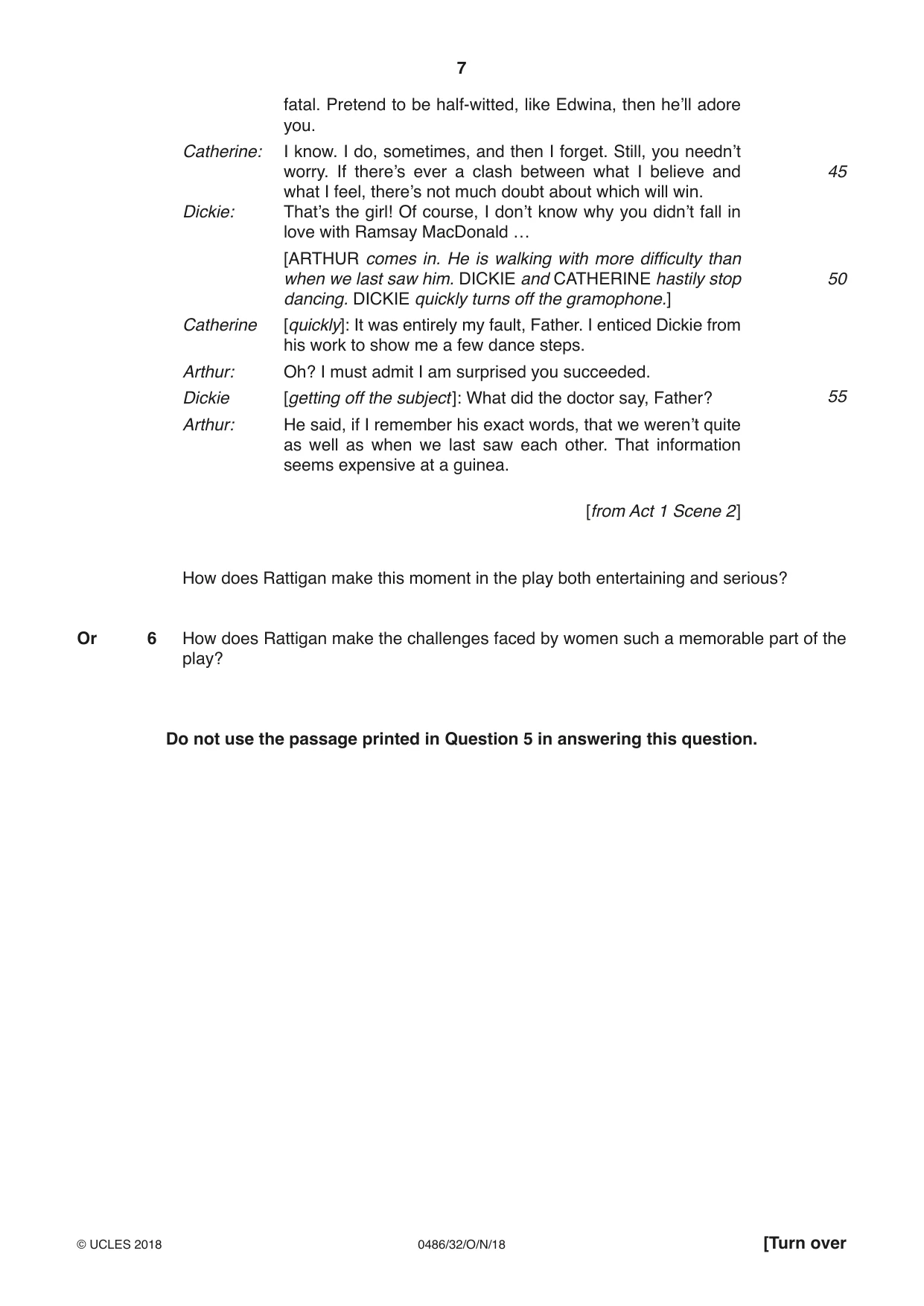
7 0486/32/O/N/18 © UCLES 2018 [Turn over fatal. Pretend to be half-witted, like Edwina, then he’ll adore you. Catherine: I know. I do, sometimes, and then I forget. Still, you needn’t worry. If there’s ever a clash between what I believe and what I feel, there’s not much doubt about which will win. Dickie: That’s the girl! Of course, I don’t know why you didn’t fall in love with Ramsay MacDonald … [ARTHUR comes in. He is walking with more difficulty than when we last saw him. DICKIE and CATHERINE hastily stop dancing. DICKIE quickly turns off the gramophone.] Catherine [quickly]: It was entirely my fault, Father. I enticed Dickie from his work to show me a few dance steps. Arthur: Oh? I must admit I am surprised you succeeded. Dickie [getting off the subject]: What did the doctor say, Father? Arthur: He said, if I remember his exact words, that we weren’t quite as well as when we last saw each other. That information seems expensive at a guinea. [from Act 1 Scene 2] How does Rattigan make this moment in the play both entertaining and serious? Or 6 How does Rattigan make the challenges faced by women such a memorable part of the play? Do not use the passage printed in Question 5 in answering this question. 45 50 55
Question paper, page 8
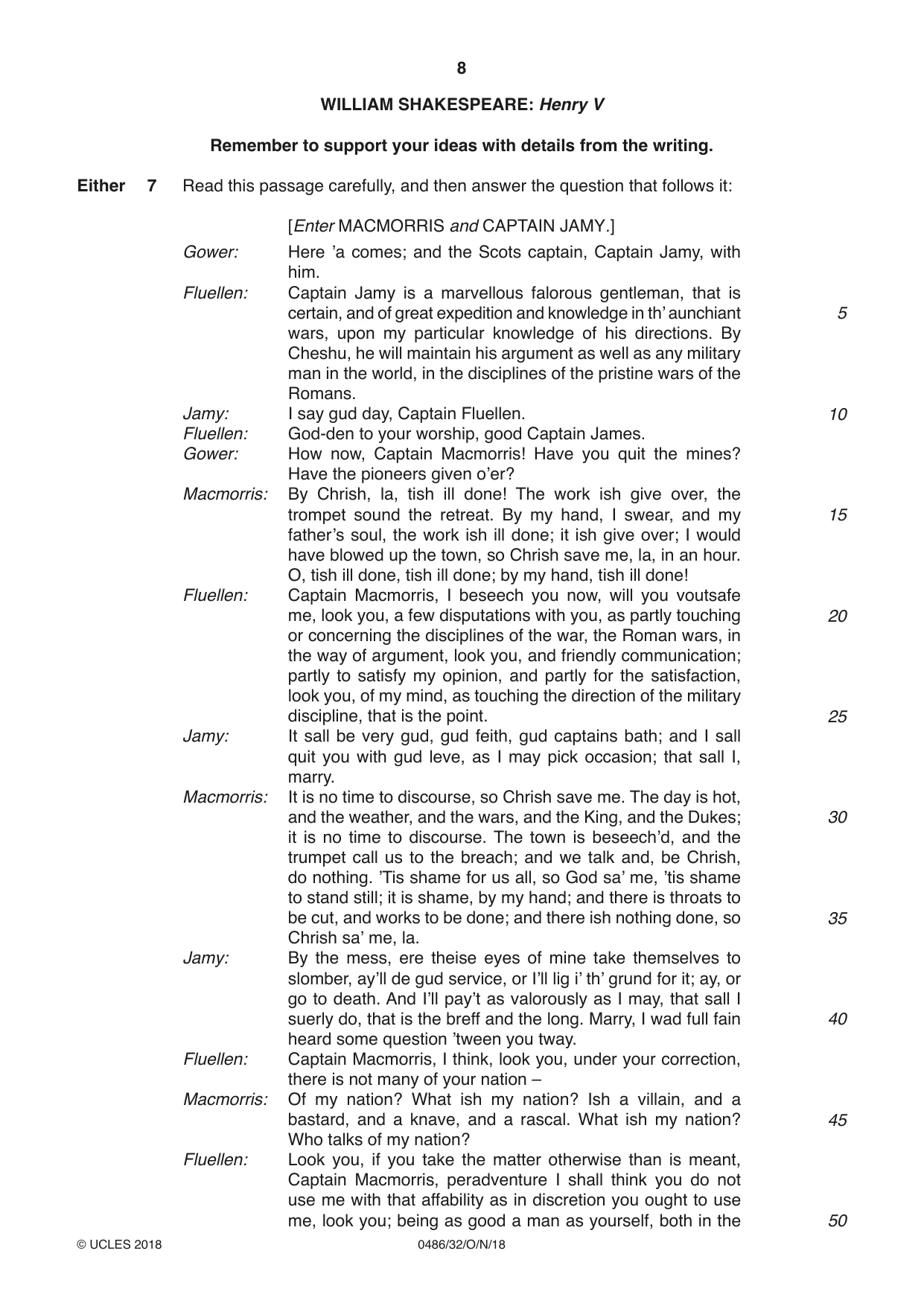
8 0486/32/O/N/18 © UCLES 2018 WILLIAM SHAKESPEARE: Henry V Remember to support your ideas with details from the writing. Either 7 Read this passage carefully, and then answer the question that follows it: [Enter MACMORRIS and CAPTAIN JAMY.] Gower: Here ’a comes; and the Scots captain, Captain Jamy, with him. Fluellen: Captain Jamy is a marvellous falorous gentleman, that is certain, and of great expedition and knowledge in th’ aunchiant wars, upon my particular knowledge of his directions. By Cheshu, he will maintain his argument as well as any military man in the world, in the disciplines of the pristine wars of the Romans. Jamy: I say gud day, Captain Fluellen. Fluellen: God-den to your worship, good Captain James. Gower: How now, Captain Macmorris! Have you quit the mines? Have the pioneers given o’er? Macmorris: By Chrish, la, tish ill done! The work ish give over, the trompet sound the retreat. By my hand, I swear, and my father’s soul, the work ish ill done; it ish give over; I would have blowed up the town, so Chrish save me, la, in an hour. O, tish ill done, tish ill done; by my hand, tish ill done! Fluellen: Captain Macmorris, I beseech you now, will you voutsafe me, look you, a few disputations with you, as partly touching or concerning the disciplines of the war, the Roman wars, in the way of argument, look you, and friendly communication; partly to satisfy my opinion, and partly for the satisfaction, look you, of my mind, as touching the direction of the military discipline, that is the point. Jamy: It sall be very gud, gud feith, gud captains bath; and I sall quit you with gud leve, as I may pick occasion; that sall I, marry. Macmorris: It is no time to discourse, so Chrish save me. The day is hot, and the weather, and the wars, and the King, and the Dukes; it is no time to discourse. The town is beseech’d, and the trumpet call us to the breach; and we talk and, be Chrish, do nothing. ’Tis shame for us all, so God sa’ me, ’tis shame to stand still; it is shame, by my hand; and there is throats to be cut, and works to be done; and there ish nothing done, so Chrish sa’ me, la. Jamy: By the mess, ere theise eyes of mine take themselves to slomber, ay’ll de gud service, or I’ll lig i’ th’ grund for it; ay, or go to death. And I’ll pay’t as valorously as I may, that sall I suerly do, that is the breff and the long. Marry, I wad full fain heard some question ’tween you tway. Fluellen: Captain Macmorris, I think, look you, under your correction, there is not many of your nation – Macmorris: Of my nation? What ish my nation? Ish a villain, and a bastard, and a knave, and a rascal. What ish my nation? Who talks of my nation? Fluellen: Look you, if you take the matter otherwise than is meant, Captain Macmorris, peradventure I shall think you do not use me with that affability as in discretion you ought to use me, look you; being as good a man as yourself, both in the 5 10 15 20 25 30 35 40 45 50
Question paper, page 9
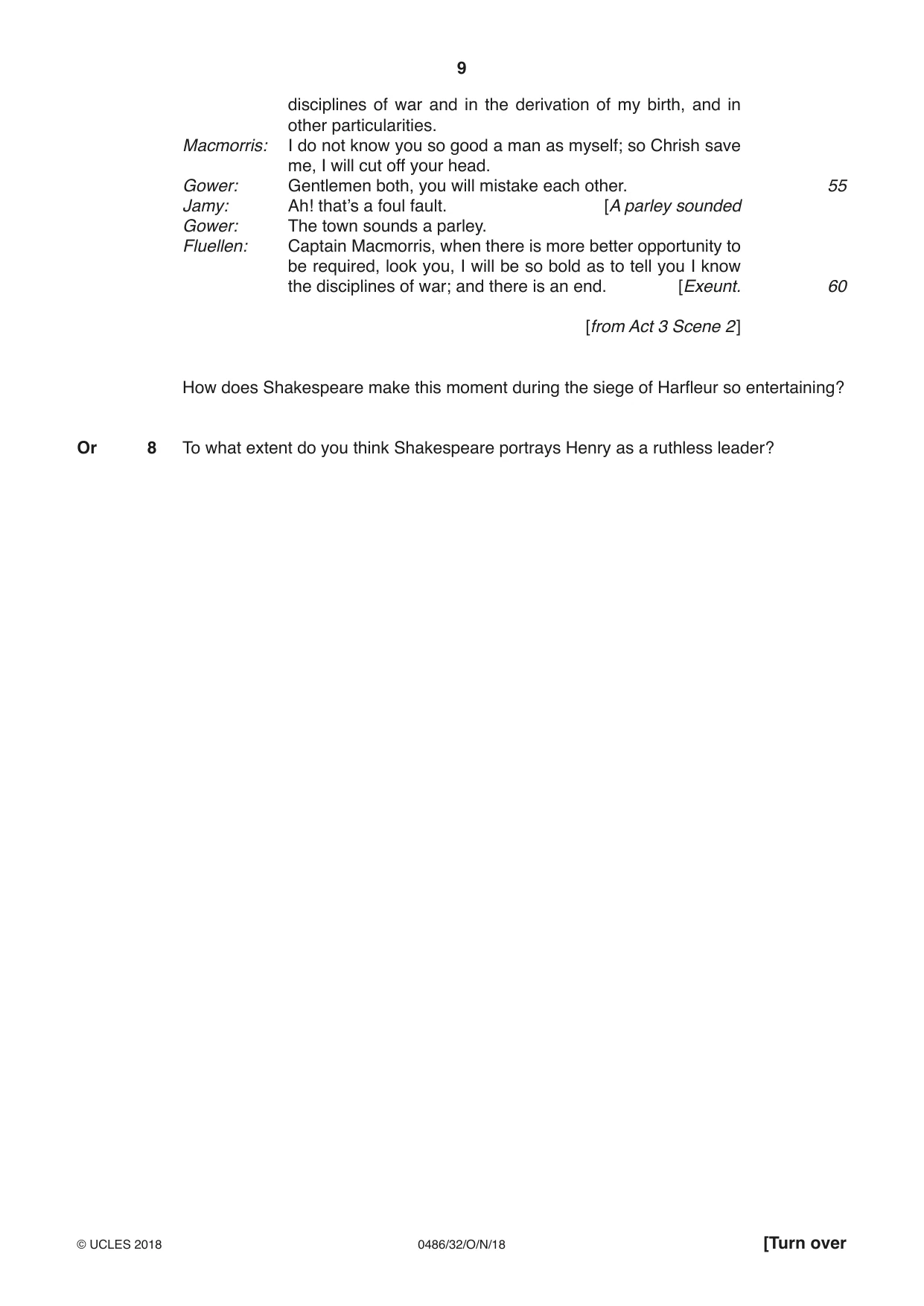
9 0486/32/O/N/18 © UCLES 2018 [Turn over disciplines of war and in the derivation of my birth, and in other particularities. Macmorris: I do not know you so good a man as myself; so Chrish save me, I will cut off your head. Gower: Gentlemen both, you will mistake each other. Jamy: Ah! that’s a foul fault. [A parley sounded Gower: The town sounds a parley. Fluellen: Captain Macmorris, when there is more better opportunity to be required, look you, I will be so bold as to tell you I know the disciplines of war; and there is an end. [Exeunt. [from Act 3 Scene 2] How does Shakespeare make this moment during the siege of Harfleur so entertaining? Or 8 To what extent do you think Shakespeare portrays Henry as a ruthless leader? 55 60
Question paper, page 10
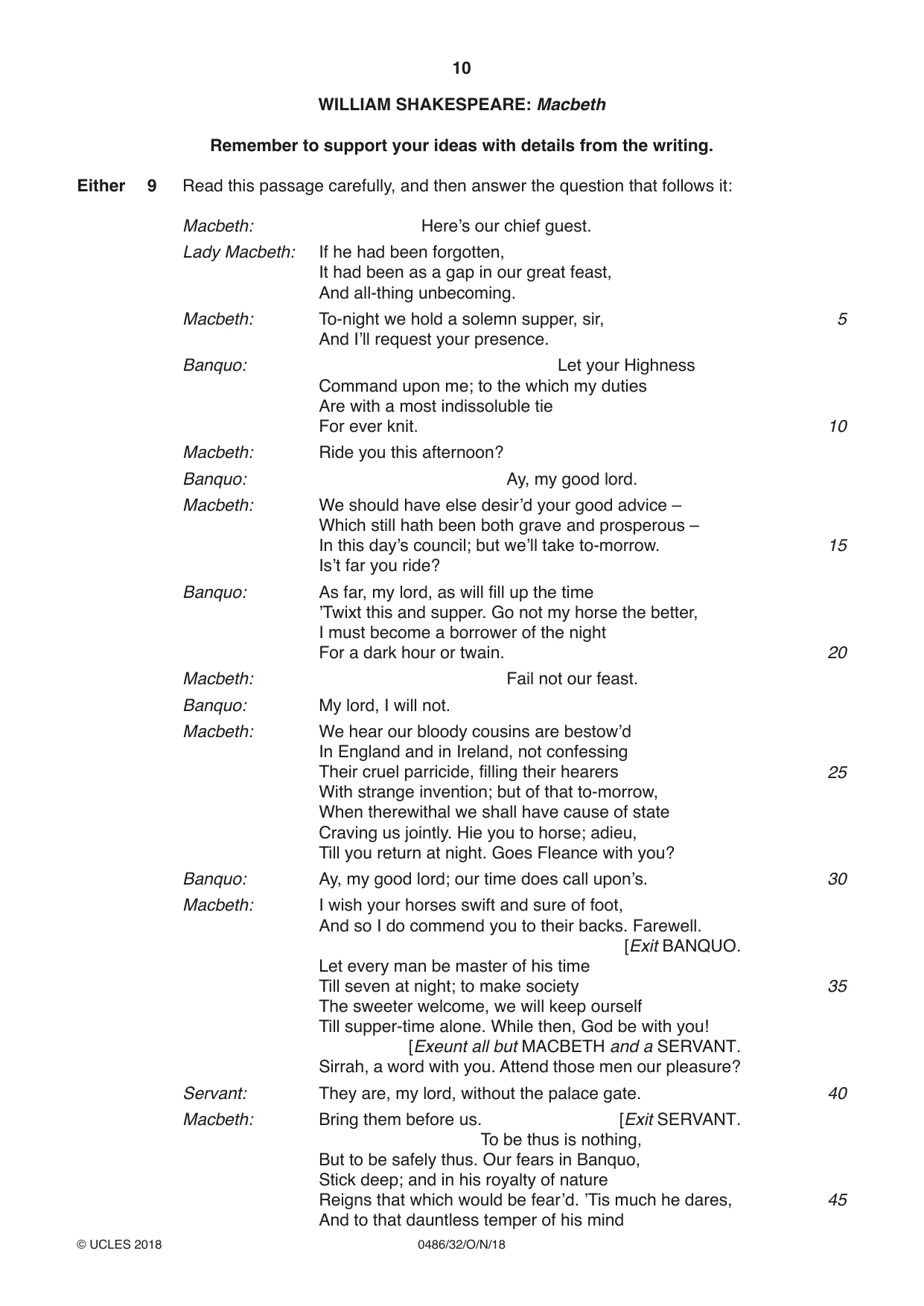
10 0486/32/O/N/18 © UCLES 2018 WILLIAM SHAKESPEARE: Macbeth Remember to support your ideas with details from the writing. Either 9 Read this passage carefully, and then answer the question that follows it: Macbeth: Here’s our chief guest. Lady Macbeth: If he had been forgotten, It had been as a gap in our great feast, And all-thing unbecoming. Macbeth: To-night we hold a solemn supper, sir, And I’ll request your presence. Banquo: Let your Highness Command upon me; to the which my duties Are with a most indissoluble tie For ever knit. Macbeth: Ride you this afternoon? Banquo: Ay, my good lord. Macbeth: We should have else desir’d your good advice – Which still hath been both grave and prosperous – In this day’s council; but we’ll take to-morrow. Is’t far you ride? Banquo: As far, my lord, as will fill up the time ’Twixt this and supper. Go not my horse the better, I must become a borrower of the night For a dark hour or twain. Macbeth: Fail not our feast. Banquo: My lord, I will not. Macbeth: We hear our bloody cousins are bestow’d In England and in Ireland, not confessing Their cruel parricide, filling their hearers With strange invention; but of that to-morrow, When therewithal we shall have cause of state Craving us jointly. Hie you to horse; adieu, Till you return at night. Goes Fleance with you? Banquo: Ay, my good lord; our time does call upon’s. Macbeth: I wish your horses swift and sure of foot, And so I do commend you to their backs. Farewell. [Exit BANQUO. Let every man be master of his time Till seven at night; to make society The sweeter welcome, we will keep ourself Till supper-time alone. While then, God be with you! [Exeunt all but MACBETH and a SERVANT. Sirrah, a word with you. Attend those men our pleasure? Servant: They are, my lord, without the palace gate. Macbeth: Bring them before us. [Exit SERVANT. To be thus is nothing, But to be safely thus. Our fears in Banquo, Stick deep; and in his royalty of nature Reigns that which would be fear’d. ’Tis much he dares, And to that dauntless temper of his mind 5 10 15 20 25 30 35 40 45
Question paper, page 11
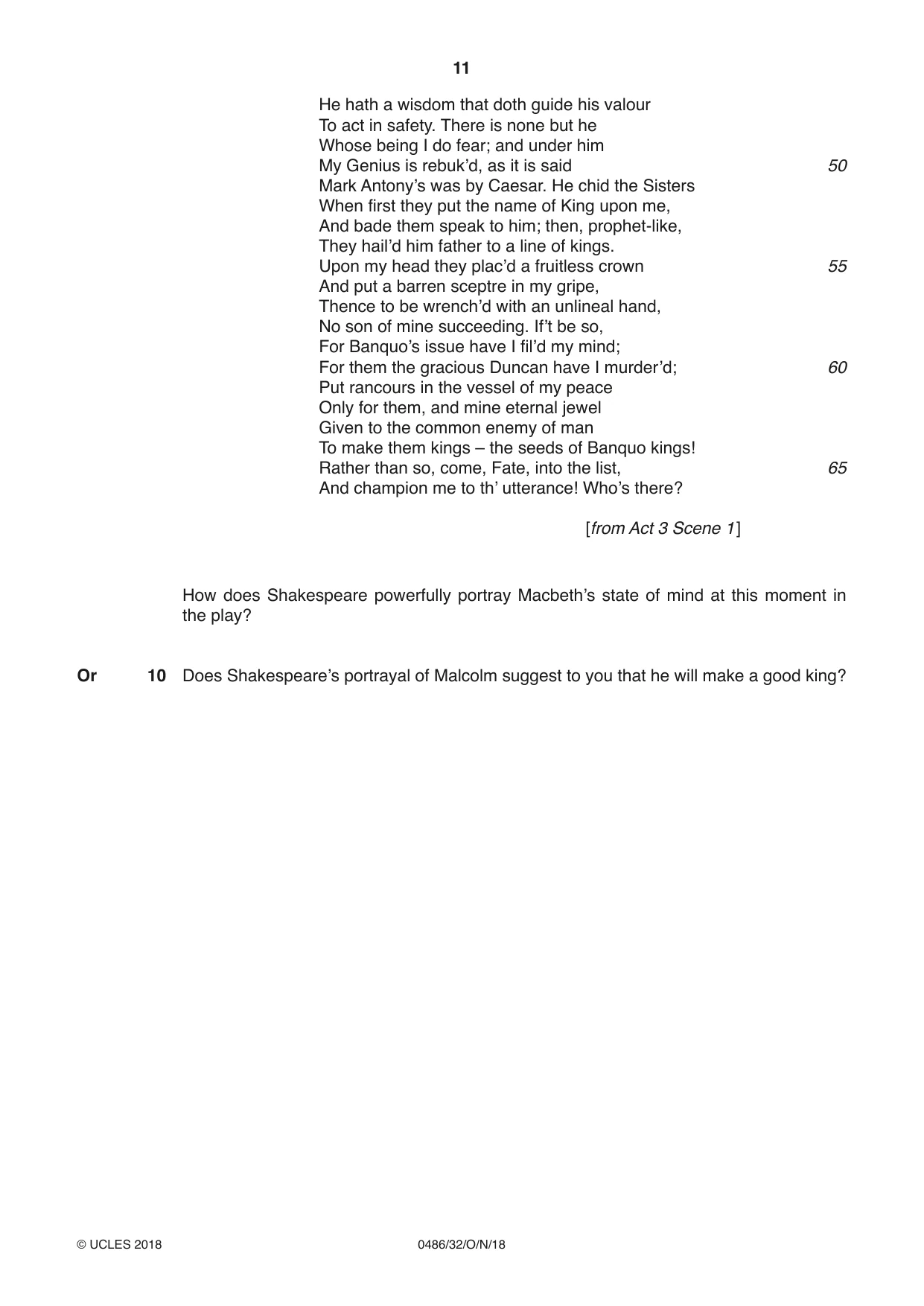
11 0486/32/O/N/18 © UCLES 2018 He hath a wisdom that doth guide his valour To act in safety. There is none but he Whose being I do fear; and under him My Genius is rebuk’d, as it is said Mark Antony’s was by Caesar. He chid the Sisters When first they put the name of King upon me, And bade them speak to him; then, prophet-like, They hail’d him father to a line of kings. Upon my head they plac’d a fruitless crown And put a barren sceptre in my gripe, Thence to be wrench’d with an unlineal hand, No son of mine succeeding. If’t be so, For Banquo’s issue have I fil’d my mind; For them the gracious Duncan have I murder’d; Put rancours in the vessel of my peace Only for them, and mine eternal jewel Given to the common enemy of man To make them kings – the seeds of Banquo kings! Rather than so, come, Fate, into the list, And champion me to th’ utterance! Who’s there? [from Act 3 Scene 1] How does Shakespeare powerfully portray Macbeth’s state of mind at this moment in the play? Or 10 Does Shakespeare’s portrayal of Malcolm suggest to you that he will make a good king? 50 55 60 65
Question paper, page 12
12 0486/32/O/N/18 © UCLES 2018 BLANK PAGE Permission to reproduce items where third-party owned material protected by copyright is included has been sought and cleared where possible. Every reasonable effort has been made by the publisher (UCLES) to trace copyright holders, but if any items requiring clearance have unwittingly been included, the publisher will be pleased to make amends at the earliest possible opportunity. To avoid the issue of disclosure of answer-related information to candidates, all copyright acknowledgements are reproduced online in the Cambridge International Examinations Copyright Acknowledgements Booklet. This is produced for each series of examinations and is freely available to download at www.cie.org.uk after the live examination series. Cambridge International Examinations is part of the Cambridge Assessment Group. Cambridge Assessment is the brand name of University of Cambridge Local Examinations Syndicate (UCLES), which is itself a department of the University of Cambridge.
Mark scheme, page 1
This document consists of 4 printed pages. © UCLES 2018 [Turn over Cambridge Assessment International Education Cambridge International General Certificate of Secondary Education LITERATURE (ENGLISH) 0486/32 Paper 3 Drama (Open Text) October/November 2018 MARK SCHEME Maximum Mark: 25 Published This mark scheme is published as an aid to teachers and candidates, to indicate the requirements of the examination. It shows the basis on which Examiners were instructed to award marks. It does not indicate the details of the discussions that took place at an Examiners’ meeting before marking began, which would have considered the acceptability of alternative answers. Mark schemes should be read in conjunction with the question paper and the Principal Examiner Report for Teachers. Cambridge International will not enter into discussions about these mark schemes. Cambridge International is publishing the mark schemes for the October/November 2018 series for most Cambridge IGCSE™, Cambridge International A and AS Level components and some Cambridge O Level components.
Mark scheme, page 2
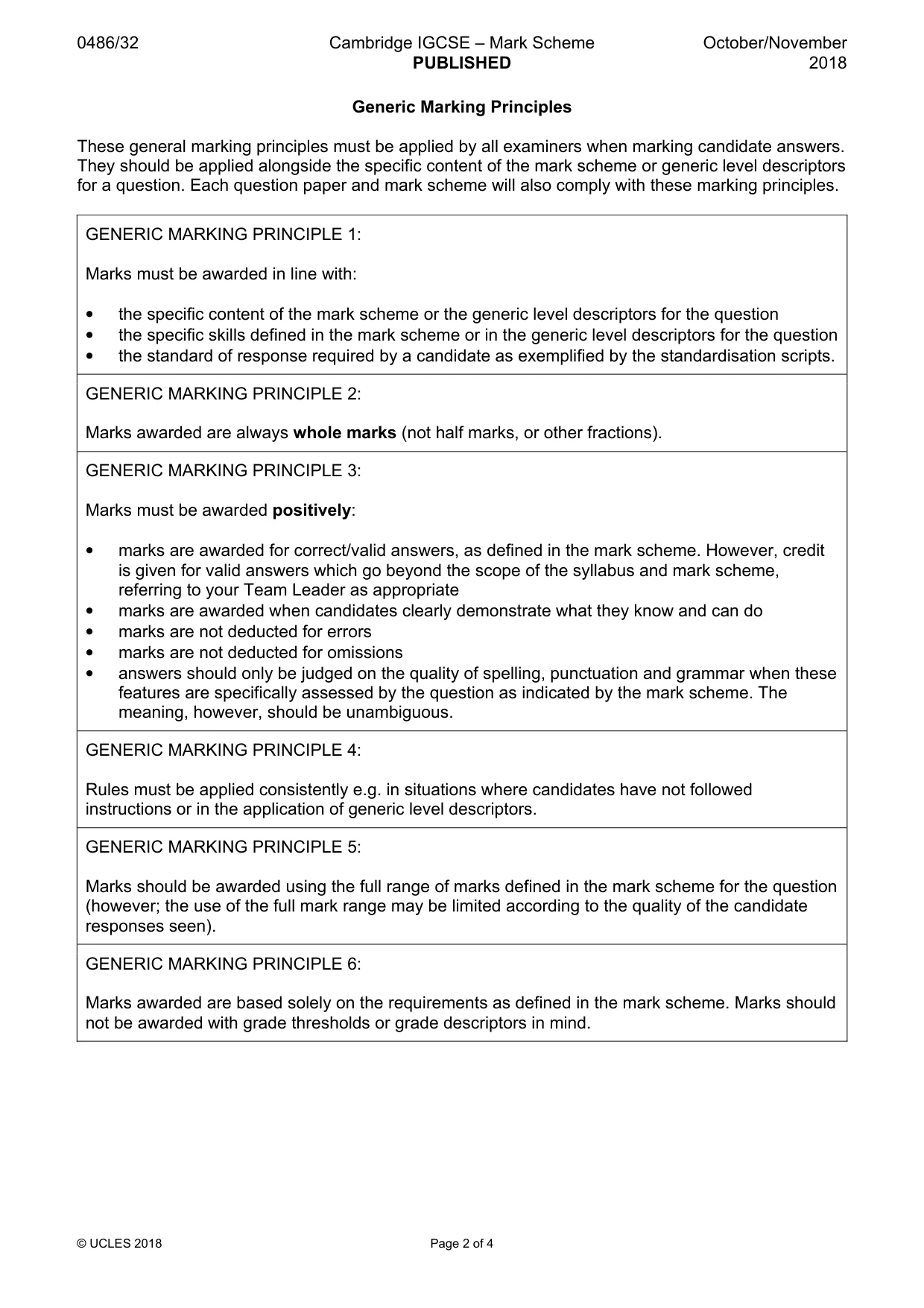
0486/32 Cambridge IGCSE – Mark Scheme PUBLISHED October/November 2018 © UCLES 2018 Page 2 of 4 Generic Marking Principles These general marking principles must be applied by all examiners when marking candidate answers. They should be applied alongside the specific content of the mark scheme or generic level descriptors for a question. Each question paper and mark scheme will also comply with these marking principles. GENERIC MARKING PRINCIPLE 1: Marks must be awarded in line with: • the specific content of the mark scheme or the generic level descriptors for the question • the specific skills defined in the mark scheme or in the generic level descriptors for the question • the standard of response required by a candidate as exemplified by the standardisation scripts. GENERIC MARKING PRINCIPLE 2: Marks awarded are always whole marks (not half marks, or other fractions). GENERIC MARKING PRINCIPLE 3: Marks must be awarded positively: • marks are awarded for correct/valid answers, as defined in the mark scheme. However, credit is given for valid answers which go beyond the scope of the syllabus and mark scheme, referring to your Team Leader as appropriate • marks are awarded when candidates clearly demonstrate what they know and can do • marks are not deducted for errors • marks are not deducted for omissions • answers should only be judged on the quality of spelling, punctuation and grammar when these features are specifically assessed by the question as indicated by the mark scheme. The meaning, however, should be unambiguous. GENERIC MARKING PRINCIPLE 4: Rules must be applied consistently e.g. in situations where candidates have not followed instructions or in the application of generic level descriptors. GENERIC MARKING PRINCIPLE 5: Marks should be awarded using the full range of marks defined in the mark scheme for the question (however; the use of the full mark range may be limited according to the quality of the candidate responses seen). GENERIC MARKING PRINCIPLE 6: Marks awarded are based solely on the requirements as defined in the mark scheme. Marks should not be awarded with grade thresholds or grade descriptors in mind.
Mark scheme, page 3
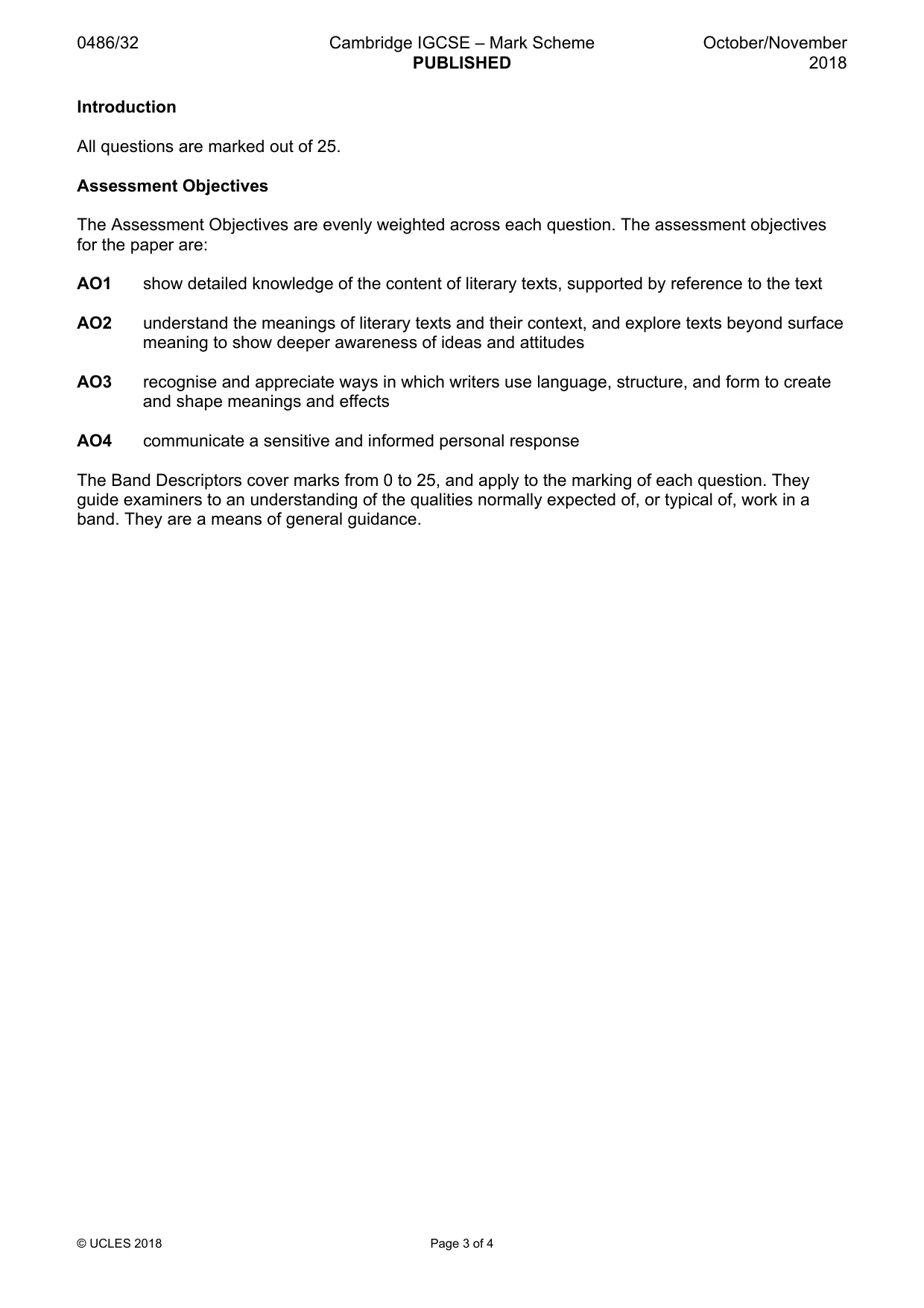
0486/32 Cambridge IGCSE – Mark Scheme PUBLISHED October/November 2018 © UCLES 2018 Page 3 of 4 Introduction All questions are marked out of 25. Assessment Objectives The Assessment Objectives are evenly weighted across each question. The assessment objectives for the paper are: AO1 show detailed knowledge of the content of literary texts, supported by reference to the text AO2 understand the meanings of literary texts and their context, and explore texts beyond surface meaning to show deeper awareness of ideas and attitudes AO3 recognise and appreciate ways in which writers use language, structure, and form to create and shape meanings and effects AO4 communicate a sensitive and informed personal response The Band Descriptors cover marks from 0 to 25, and apply to the marking of each question. They guide examiners to an understanding of the qualities normally expected of, or typical of, work in a band. They are a means of general guidance.
Mark scheme, page 4
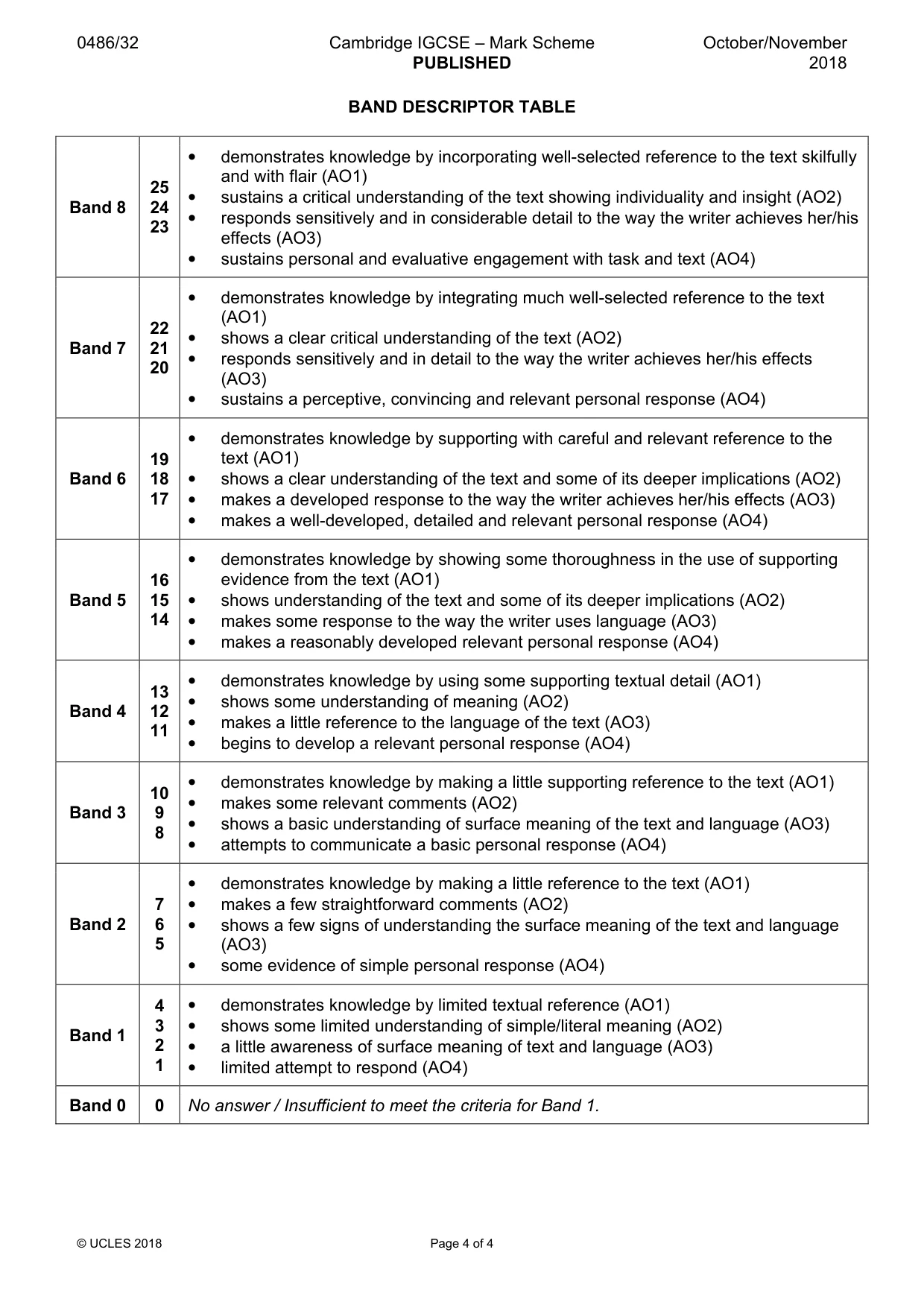
0486/32 Cambridge IGCSE – Mark Scheme PUBLISHED October/November 2018 © UCLES 2018 Page 4 of 4 BAND DESCRIPTOR TABLE Band 8 25 24 23 • demonstrates knowledge by incorporating well-selected reference to the text skilfully and with flair (AO1) • sustains a critical understanding of the text showing individuality and insight (AO2) • responds sensitively and in considerable detail to the way the writer achieves her/his effects (AO3) • sustains personal and evaluative engagement with task and text (AO4) Band 7 22 21 20 • demonstrates knowledge by integrating much well-selected reference to the text (AO1) • shows a clear critical understanding of the text (AO2) • responds sensitively and in detail to the way the writer achieves her/his effects (AO3) • sustains a perceptive, convincing and relevant personal response (AO4) Band 6 19 18 17 • demonstrates knowledge by supporting with careful and relevant reference to the text (AO1) • shows a clear understanding of the text and some of its deeper implications (AO2) • makes a developed response to the way the writer achieves her/his effects (AO3) • makes a well-developed, detailed and relevant personal response (AO4) Band 5 16 15 14 • demonstrates knowledge by showing some thoroughness in the use of supporting evidence from the text (AO1) • shows understanding of the text and some of its deeper implications (AO2) • makes some response to the way the writer uses language (AO3) • makes a reasonably developed relevant personal response (AO4) Band 4 13 12 11 • demonstrates knowledge by using some supporting textual detail (AO1) • shows some understanding of meaning (AO2) • makes a little reference to the language of the text (AO3) • begins to develop a relevant personal response (AO4) Band 3 10 9 8 • demonstrates knowledge by making a little supporting reference to the text (AO1) • makes some relevant comments (AO2) • shows a basic understanding of surface meaning of the text and language (AO3) • attempts to communicate a basic personal response (AO4) Band 2 7 6 5 • demonstrates knowledge by making a little reference to the text (AO1) • makes a few straightforward comments (AO2) • shows a few signs of understanding the surface meaning of the text and language (AO3) • some evidence of simple personal response (AO4) Band 1 4 3 2 1 • demonstrates knowledge by limited textual reference (AO1) • shows some limited understanding of simple/literal meaning (AO2) • a little awareness of surface meaning of text and language (AO3) • limited attempt to respond (AO4) Band 0 0 No answer / Insufficient to meet the criteria for Band 1.
What you needed in this session
Cambridge’s own grade thresholds for 2018 Oct/Nov, Paper 3 · Variant 2. A higher threshold means an easier paper — the bar moves with how the cohort did.